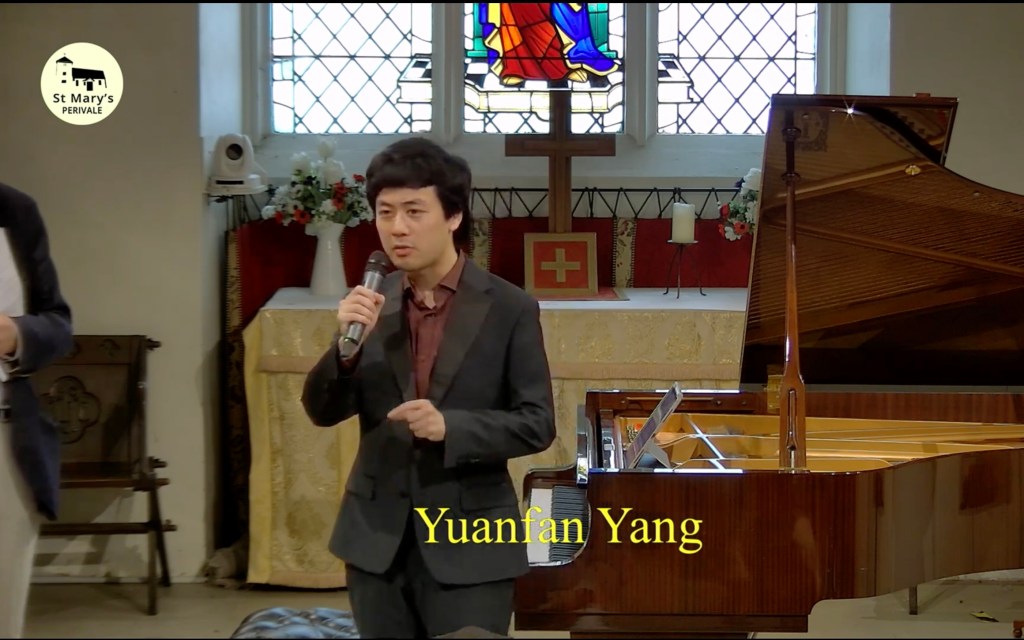
Yuanfan Yang the Scottish kapellmeister. I have known Yuanfan for quite some years since he became a Keyboard Trust Artist and I accompanied him to various venues around Italy. It had always amused me that his biography referred to him as Yuanfan Yang ,the Scottish pianist. But he was born in Edinburgh where his mother and father met on a cultural exchange organised by Margaret Thatcher. Both his parents were top runners at Beijing University and having started a family in Edinburgh they decided to stay. Yuanfan’s father has become a distinguished lecturer at Leeds University and his mother an expert in communications.
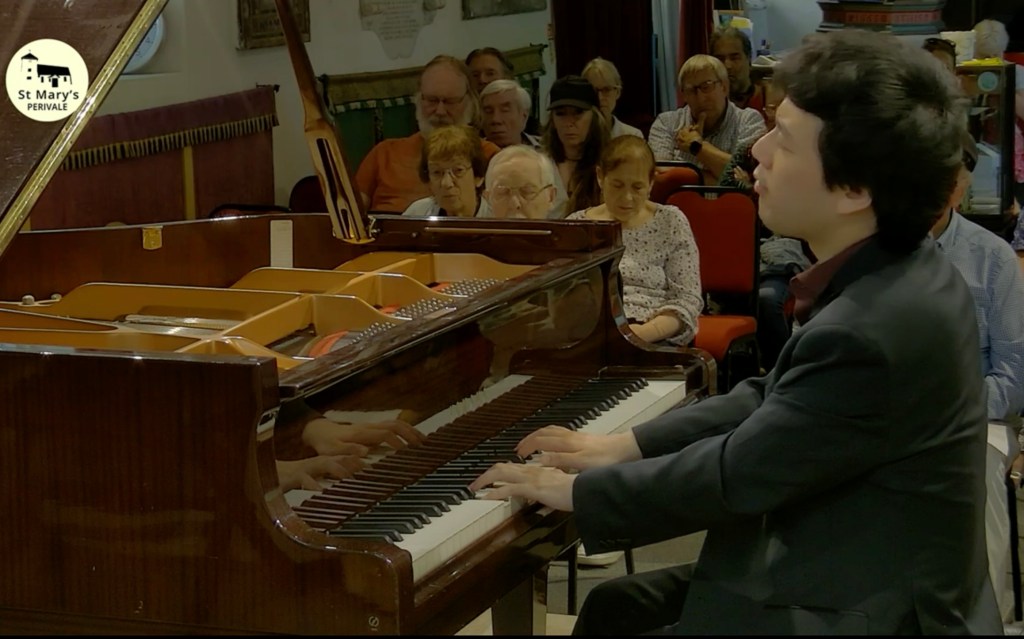
It was at a children’s party that one of the mothers asked Yuanfan’s who his piano teacher was, as she had admired his playing on their friend’s piano. ‘But he does not play the piano and we do not even have one at home!’. A God given talent of being able to conjure sounds out of thin air as he showed us today with his improvisations.
Yuanfan was then taken under the wing of Murray McLachlan at Chethams and went on to the Royal Academy in London to study with Christopher Elton. I remember telling the jury of the Rome International Piano Competition of his remarkable talent for improvisation. After his prize winning performance of Beethoven’s 3rd Piano Concerto the chairman asked him to improvise on Mozart’s ‘ La ci darem la mano ‘ which he did to the astonishment of all.
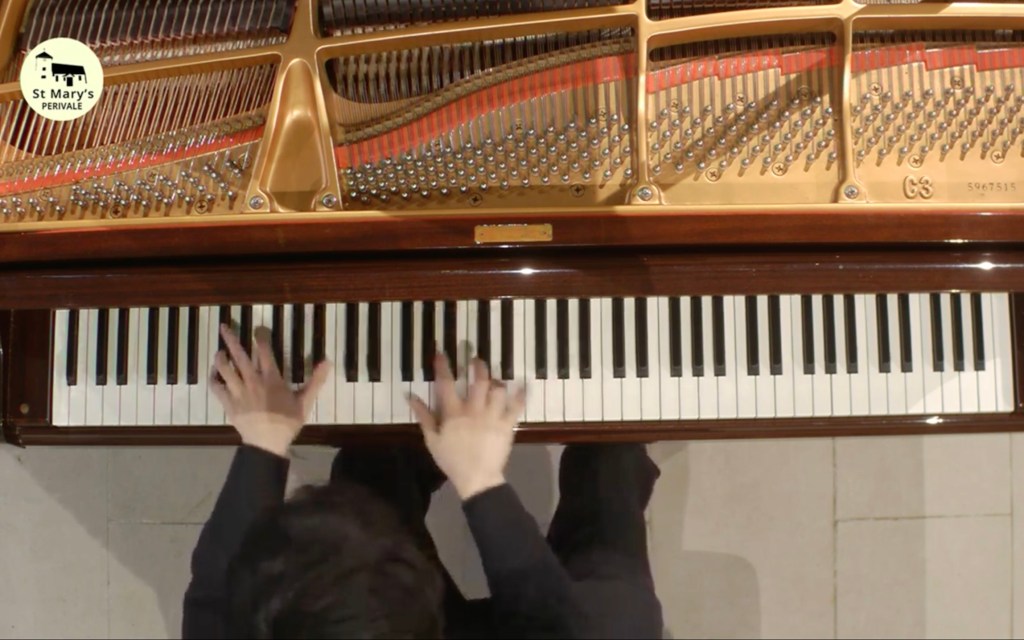
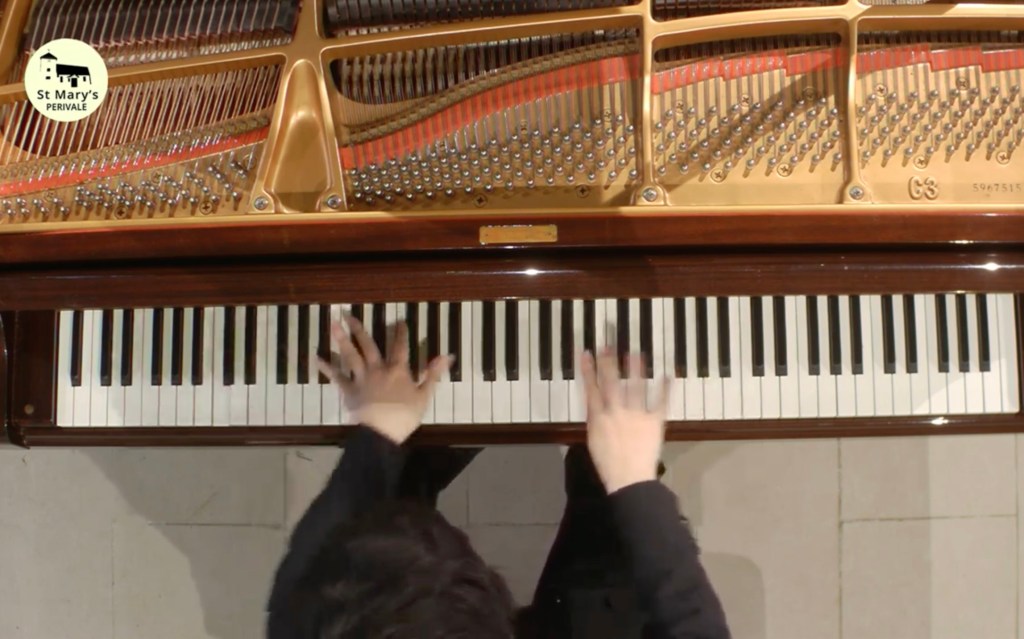
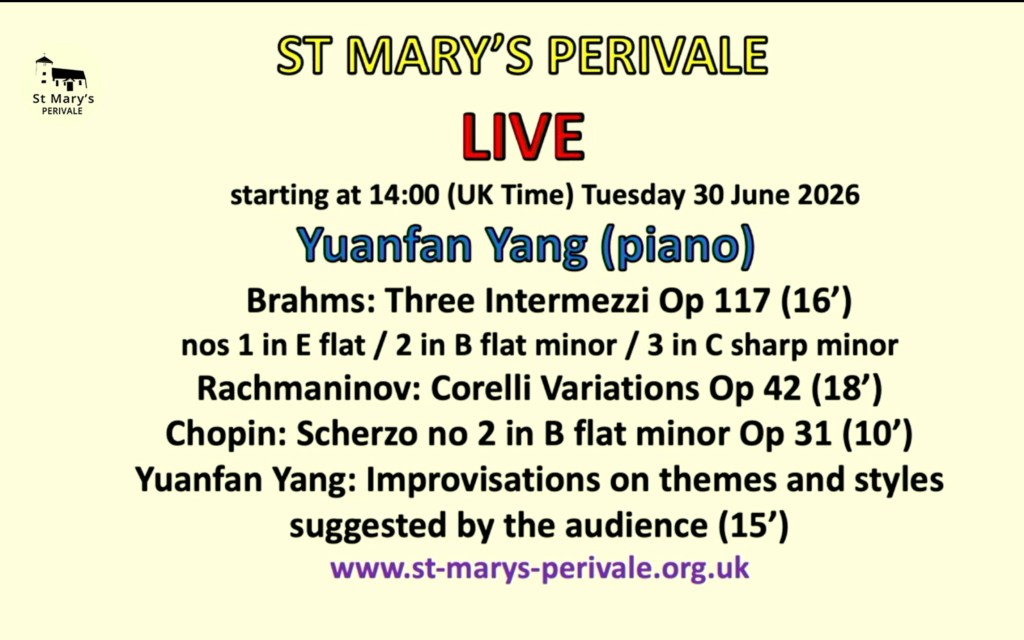
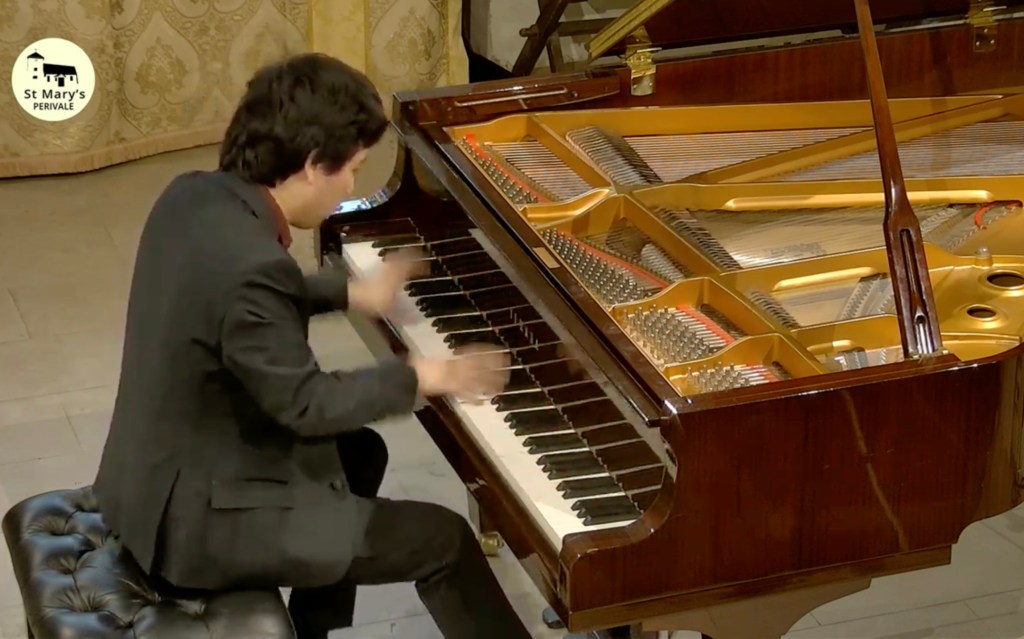
Yuanfan is a complete musician and magnificent pianist, as his performances today showed us, from masterly performances of Brahms, Rachmaninov and Chopin, to a souped up improvisation of the Mendelssohn Violin Concerto! Yuanfan delights in communicating where his love for music shines through all genres.
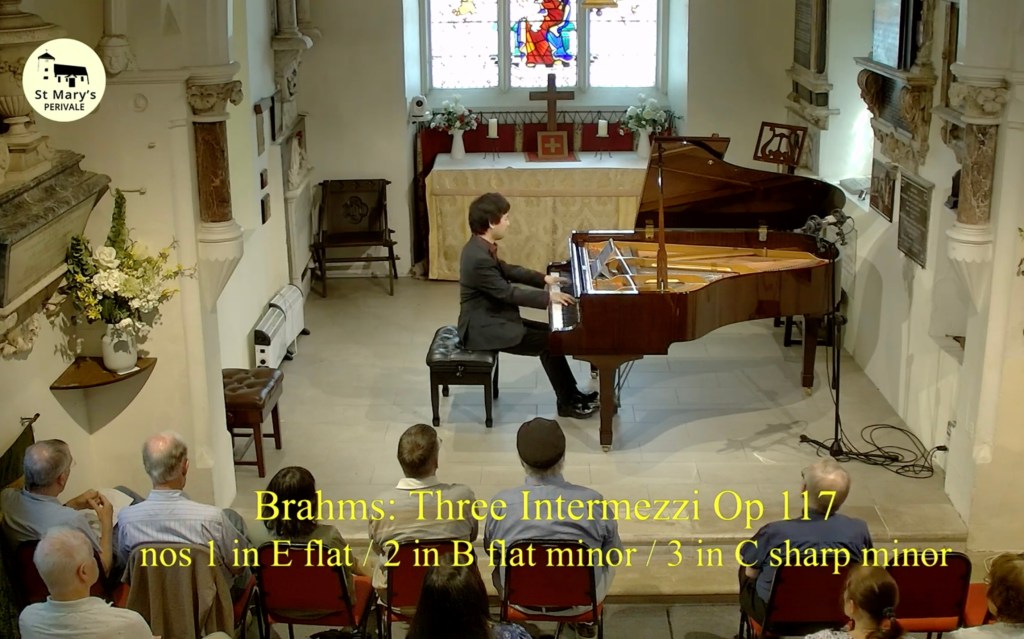
The three Intermezzi op 117 although he had not committed them to memory yet they were well and truly embedded in his soul as he opened with very sensitive, aristocratic playing of refined beauty and weight. A disarming simplicity to the first in E flat with it’s beautifully whispered question and answer of the ‘più Adagio’ played with a radiance and scrupulous attention to the composers markings for this the first of his ‘lullabies of grief’. The second in B flat minor was beautifully shaped as Yuanfan allowed it to flow with insinuating beauty. To see the beauty of the way Brahms had written the music on the page, like a painting of waves, was to appreciate the beautiful natural movements of Yuanfan’s arms, like swimming on waves of sound. The deeply sonorous chorale of the ‘più Adagio’ was of orchestral richness with comments like drops of water from on high.The final deep B flat in the bass was breathtaking for its sublimely poignant richness. He brought a beautiful legato to the notes in unison of the C sharp minor Intermezzo playing with whispered horizontal movements. The ‘più moto ed espressivo’ central episode was played with a crystalline clarity, as wisps of sound floated in this magical atmosphere of etherial beauty. Brahms searching for a way back with a quasi improvised path of extraordinary originality.
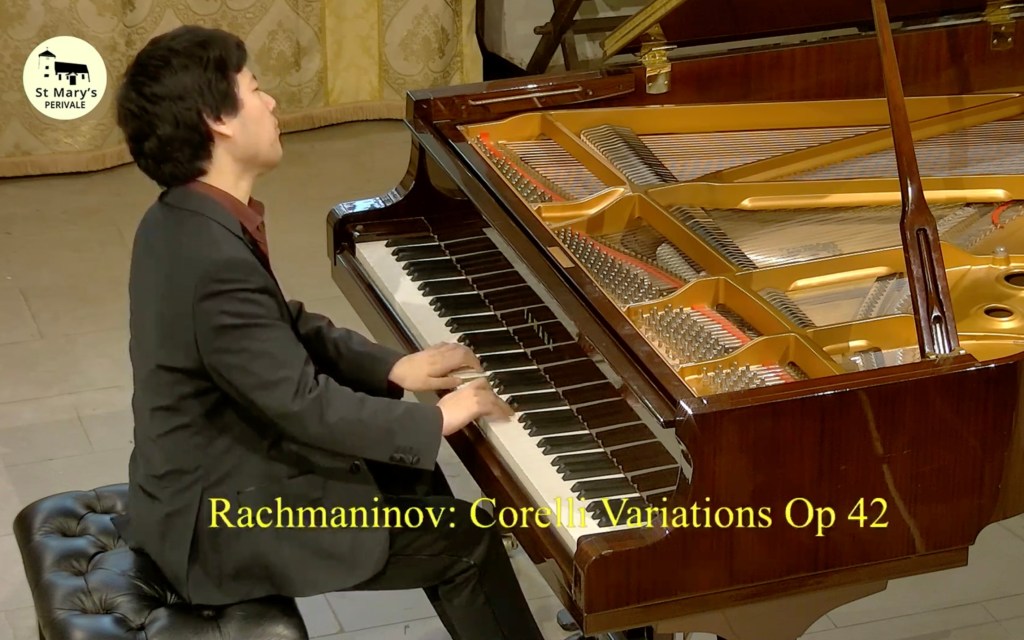
The Rachmaninov Corelli Variations were given a masterly performance where the extraordinary technical difficulties just disappeared in a performance that was concerned only with poetic beauty. Rachmaninov dedicated the work to his friend the violinist Fritz Kreisler . He wrote to another friend, the composer Nikolai Medtner, on 21 December 1931:
I’ve played the Variations about fifteen times, but of these fifteen performances only one was good. The others were sloppy. I can’t play my own compositions! And it’s so boring! Not once have I played these all in continuity. I was guided by the coughing of the audience. Whenever the coughing would increase, I would skip the next variation. Whenever there was no coughing, I would play them in proper order. In one concert, I don’t remember where – some small town – the coughing was so violent that I played only ten variations (out of 20). My best record was set in New York, where I played 18 variations. However, I hope that you will play all of them, and won’t “cough”.
Rachmaninoff recorded many of his own works, but this piece was never one of them.Yuanfan played them all today, as there was not a cough to be heard in Perivale, with an audience spellbound by the authority and mastery of our Scottish Kapellmeister. A beautifully slow Andante for the theme of ‘La Folia’ as it gradually came to life with undulating sounds in the first variation. The playful second, Yuanfan brought a meandering beauty to the legato inner part with the capricious staccato outer parts. A ‘Tempo di Menuetto’ of questioning and imposing comments leading to the radiant beauty of the theme with wisps of sound floating in the rarified air. A very decisive fifth played with dynamic drive and masterly control led to the intricate chattering of continual lightweight chords. A mighty bass ‘D’ was the anchor on which an outpouring of notes was spread over the entire keyboard.Yuanfan always playing with sumptuous sounds of Philadelphian richness as his use of the pedal and his velvet horizontal touch created waves of sumptuous beauty. A meandering whispered ‘Adagio misterioso’ was followed by the luxuriant bass chords out of which grew waves of sounds of haunting beauty. A typical whimsical Rachmaninov cluster of notes were thrown off with masterly ease as the next three variations erupted into strident no nonsense character of imposing dynamism. A beautiful improvised cadenza brought a change of key from D minor to D flat major that was like the sun suddenly coming from behind a cloud to fill the atmosphere with radiance and beauty. ‘La Folia’ now in D flat major where Rachmaninov allowed it to stay with seductive insinuation for the next variation. A build up to the notorious octaves of the twentieth and last variation that Yuanfan played with fearless mastery and passionate intensity.

Arriving at the final octave bass D that he played with two hands, his nose almost touching the keys, such was the burning intensity of his playing. A melodic line is heard floating on this sound of vibrating ‘D’ that Yanfan played like a poet born, with heart rending beauty and disarming simplicity. The long silence after he played the final two chords was proof enough that he had reached the hearts and souls of this very discerning Perivale public. Not a cough was heard throughout a performance that held us spellbound for its mastery and poetic intensity.
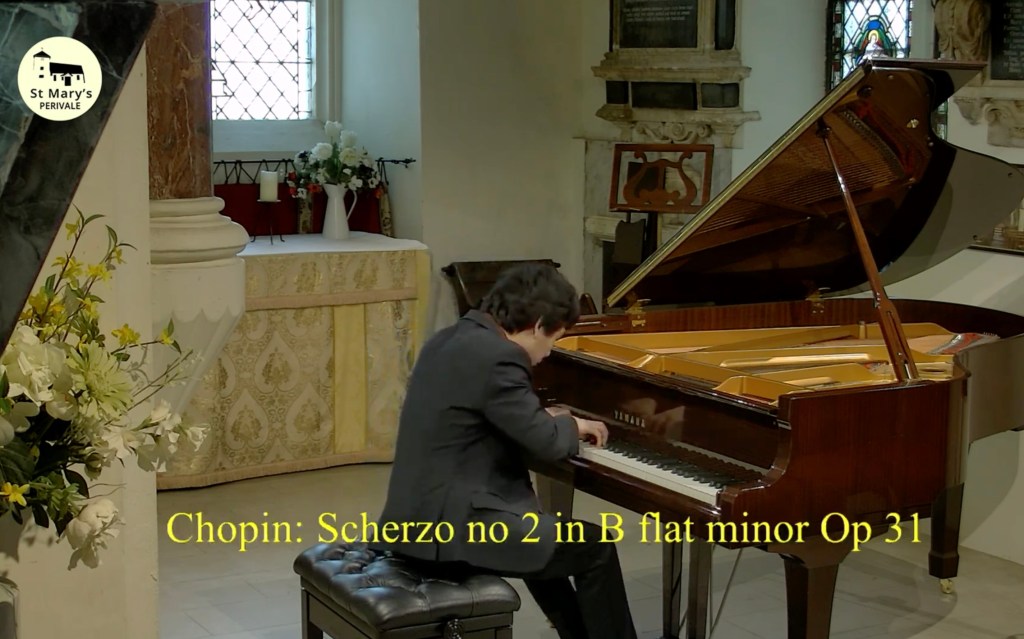
I had heard Yuanfan play two complete late night recitals of Chopin at Chethams International Piano School last summer as preparation for Warsaw. This was playing of aristocratic mastery and poetic beauty. A musician who could see the architectural shape of these masterworks but at the same could imbue the notes with such ravishing beauty. It was the same playing I heard today as Yuanfan began the Second Scherzo op 31. I remember Artur Rubinstein playing it at the end of his last recital at the Wigmore Hall in 1976. A partially blind master had agreed to play just one last time in order to stop the hall from being demolished. The Wigmore since that day has gone from strength to strength and is now the major chamber concert hall in London, much loved by the greatest artists. Rubinstein had to stop because he could not see out of the corner of his eyes to play the treacherous leaps that abound at the end of this scherzo. It was certainly no joke but a noble gesture from a great and generous artist . He made a speech asking the audience not to allow the builders to take over and invited the audience backstage .At a certain point Rubinstein exclaimed that he may be blind but not too blind to know a beautiful lady when she is standing by his side. It was Lauren Bacall the wife of Humphrey Bogard! Yuanfan is sixty years younger than Rubinstein and negotiated the leaps with youthful mastery. He also played with a wonderful sense of balance that could allow Chopin’s bel canto melody to float so beautifully of waves of undulating sounds. Cascades of notes were played with jeu perlé brilliance which contrasted with the intensity of the central ‘sostenuto’ of poignant beauty. It was interesting before the return of the main theme that the three final notes were played non legato and the final time legato that I had not been aware of until today. The long held ‘F’ on this last appearance gave an ominous presence to this final utterance.
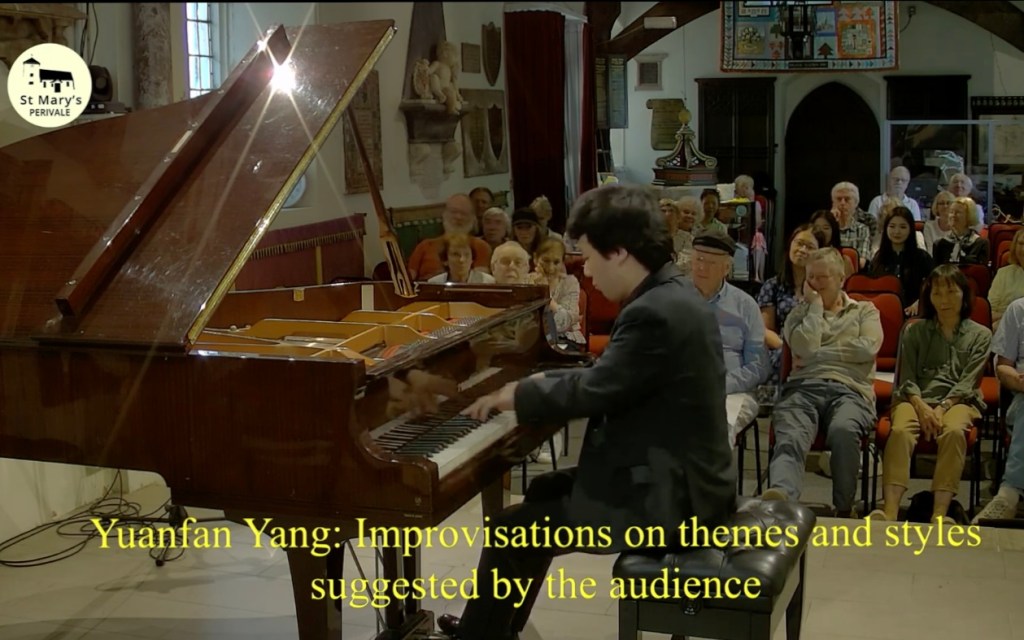
Now came the second part of this recital where the audience were made to participate. Improvisations on themes received from audience members and in styles decided by them.
The last movement of Beethoven’s 7th Symphony was played in the style of a Tchaikowsky Ballet.
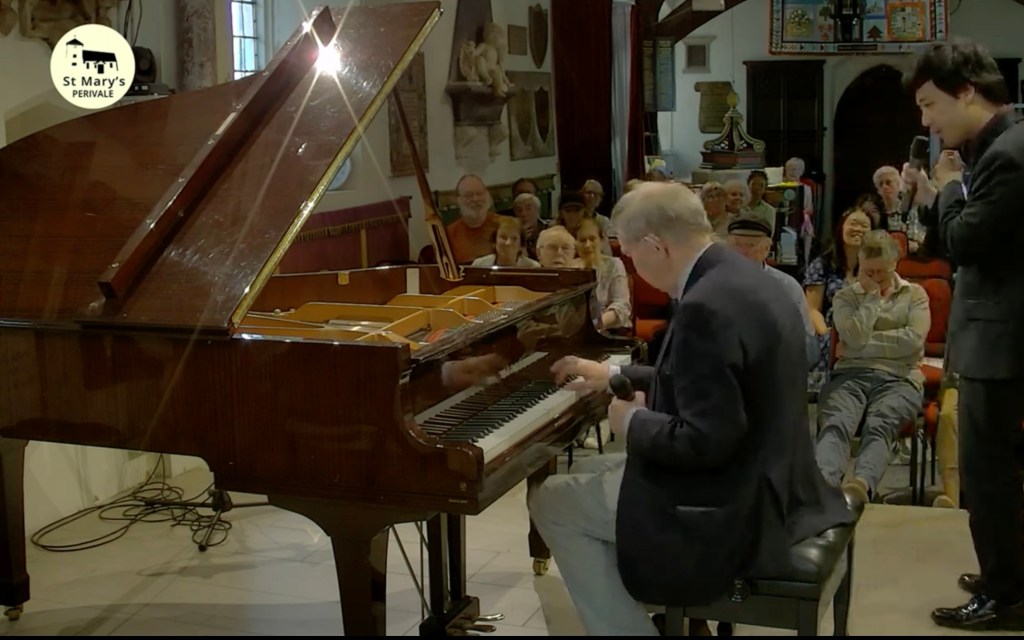
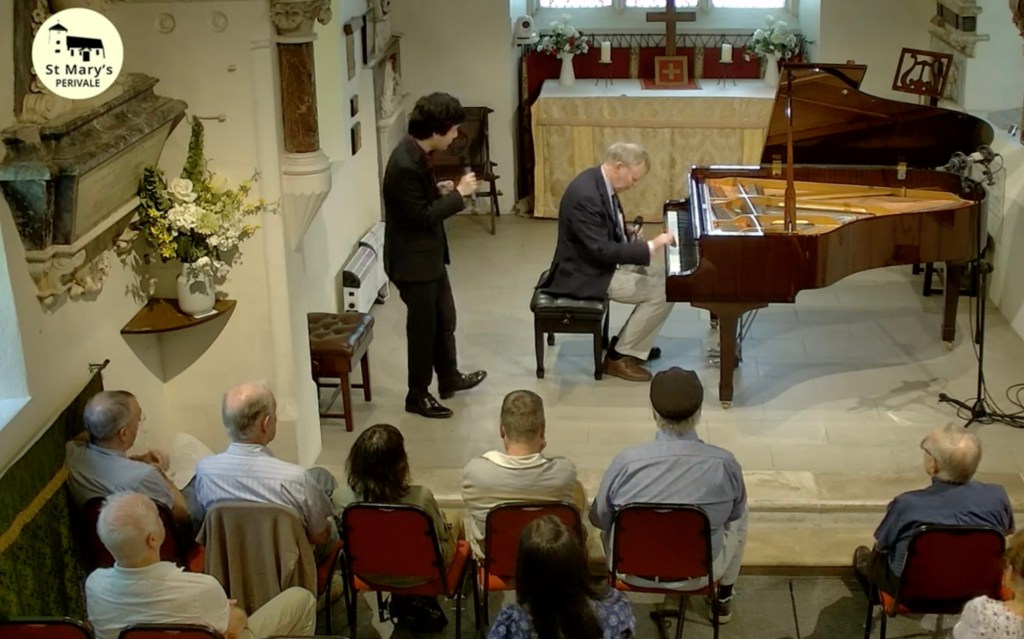

Dr Mather kindly reminding Yuanfan of his Beethoven! The theme of the Mendelssohn violin concerto played in punk rock style and finally Erik Satie in the form of a Fugue.
Dr Mather anxious to fix another date with this genial young artist before he leaves the church today for fear that the world might gobble him up and his diary would be full .
Born in Edinburgh and now based in Leeds, Yuanfan Yang is rapidly establishing himself as one of the most distinctive pianists, composers, and improvisers of his generation. Praised for interpretations of Schumann and Liszt that “rivalled those of the young Ashkenazy” (International Piano Magazine), he is equally recognised for his own compositions, described by The Observer as possessing “soulful poignancy.”
Yuanfan’s repertoire reflects a wide range of musical stylistic interests, which also influence his signature improvisations and original compositions. He has written four full-scale piano concertos performed across China, France, Russia, and the UK. Recent highlights include concerto appearances with the Royal Liverpool Philharmonic Orchestra, BBC Philharmonic (recorded for BBC Radio 3), Armenian State Symphony Orchestra, and the Orchestra of Opera North, where he performed the northern England premiere of his Piano Concerto No. 4, Ode to the Jing River . He has also appeared at major venues including the Sydney Opera House, Brighton Festival, St George’s Bristol, and Milano Auditorium.
Improvisation plays a central role in Yuanfan’s performances, where audiences suggest themes and musical styles from which he creates original works live in concert. His improvisation videos have attracted a large online following, with nearly two million views across social media, and in 2025 he presented two fully improvised concerts in London.
His recent competition successes include First Prize at the Ricard Viñes International Piano Competition and the James Mottram International Piano Competition in 2025, following major prizes at several international competitions since 2022. As a composer, his music has been broadcast on BBC television and radio. His debut album Watercolour , released on Orchid Classics, received critical acclaim, including a four-star review from International Piano Magazine. Yuanfan graduated in 2025 from the RNCM, having previously studied at the RAM, and RCM.