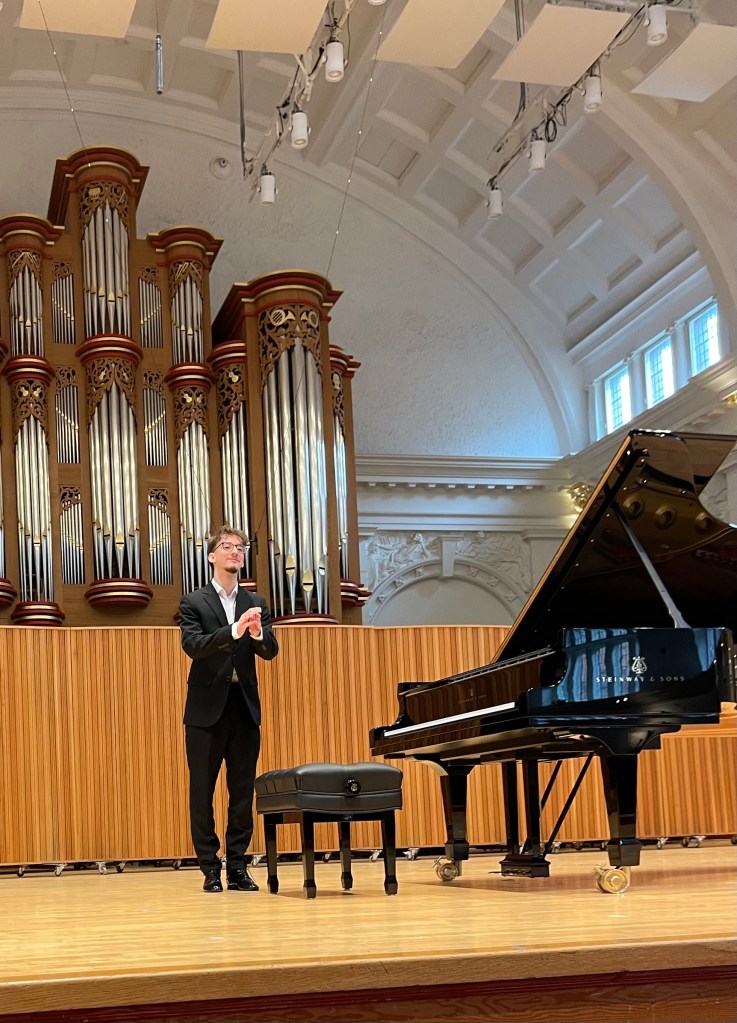
A performance of refined piano playing from a pianist who listens to himself with poetic intensity and an extraordinary palette of colour. A pianist who plays by persuasion rather than percussion with an extraordinary sensitivity to sound where passion and poetry were not shouted from the roof tops. He drew us in to a world of sounds that could allow the music to speak with an inner voice of rare beauty and poignant significance .
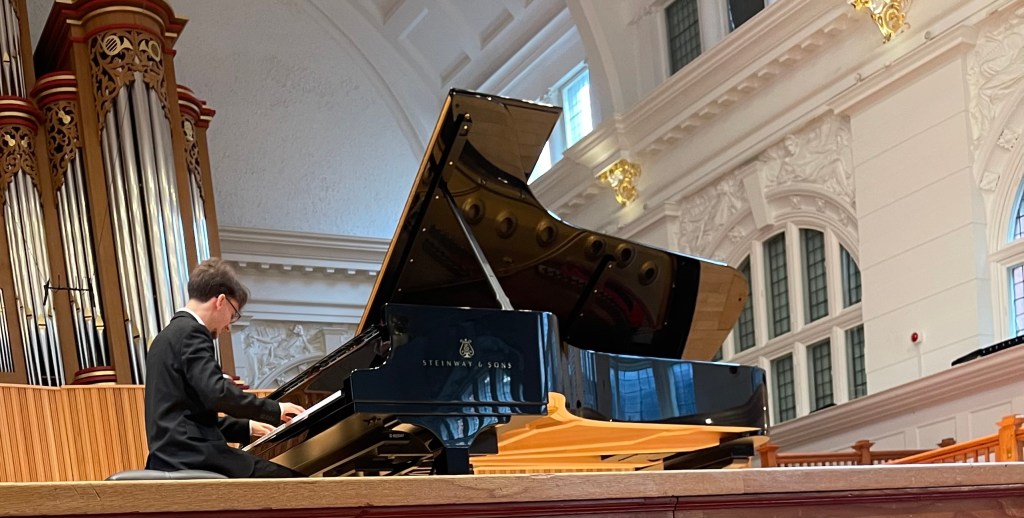
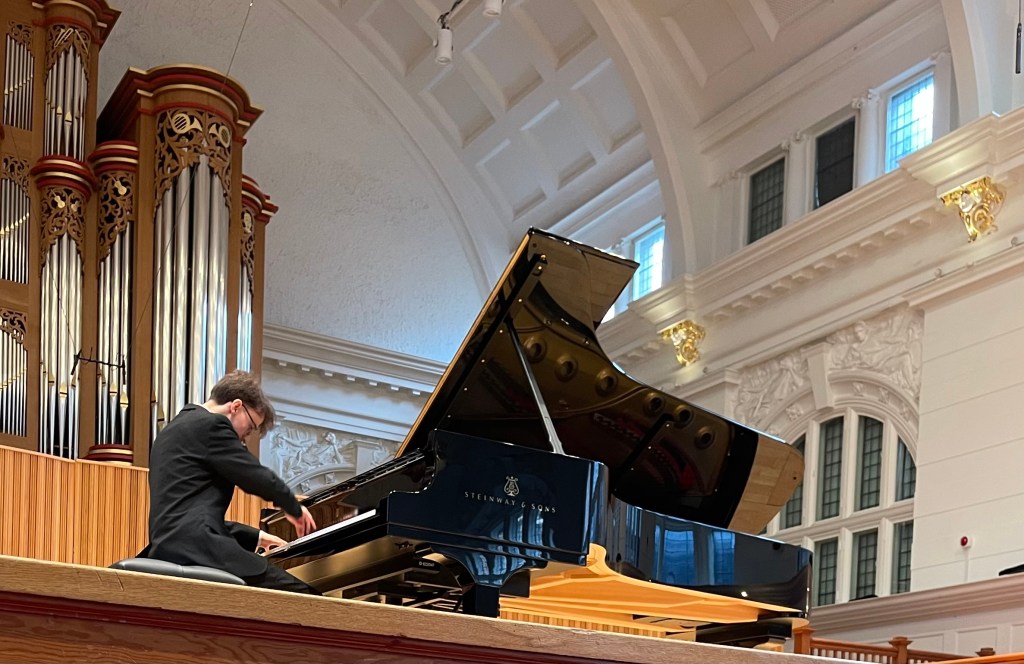
A ‘Bagatelle’ by Silvestrov was enough to create an atmosphere of someone who loves the piano and the beauty that can lie within this black box of hammers and strings.
The scene was set for the Brahms Rhapsodies op 79 that were played with remarkable clarity and sumptuous beauty . Combining a sense of freedom with an exhilarating freshness ,that does not deny power and passion, but always with a sense of balance that never substituted the beauty of sound for more orchestral thickness. The central episode of the first was played with a whispered radiance. A coda played in a poetic haze where his mastery of pedal could create a magic atmosphere without sacrificing the architectural clarity of visionary poetic effusions . The second rhapsody was a continuation of this world that he had created of ethereal beauty and mystery. A scrupulous attention to the composers very precise instructions meant that the final bars where Brahms’s very precise notation was incorporated into a performance of refined poetic intensity.
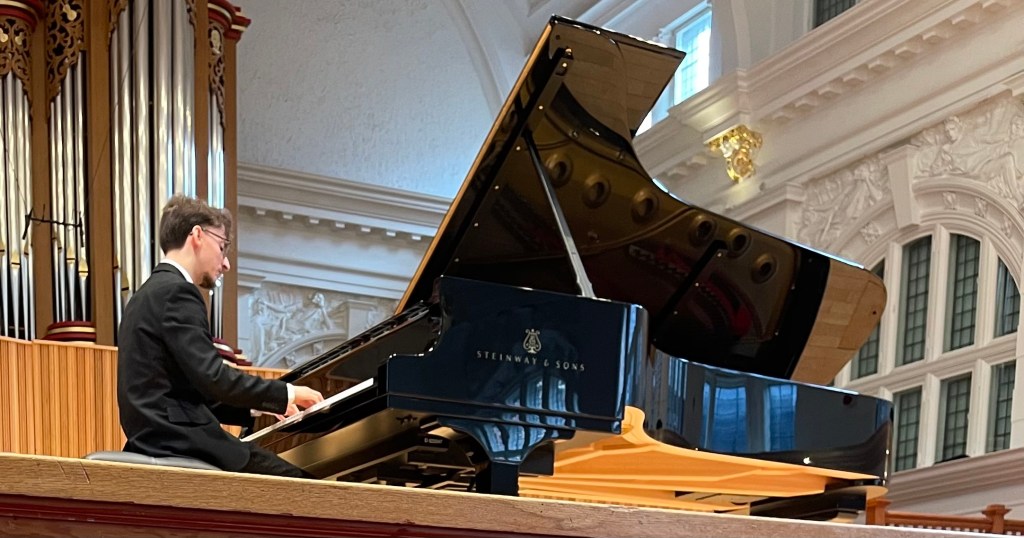
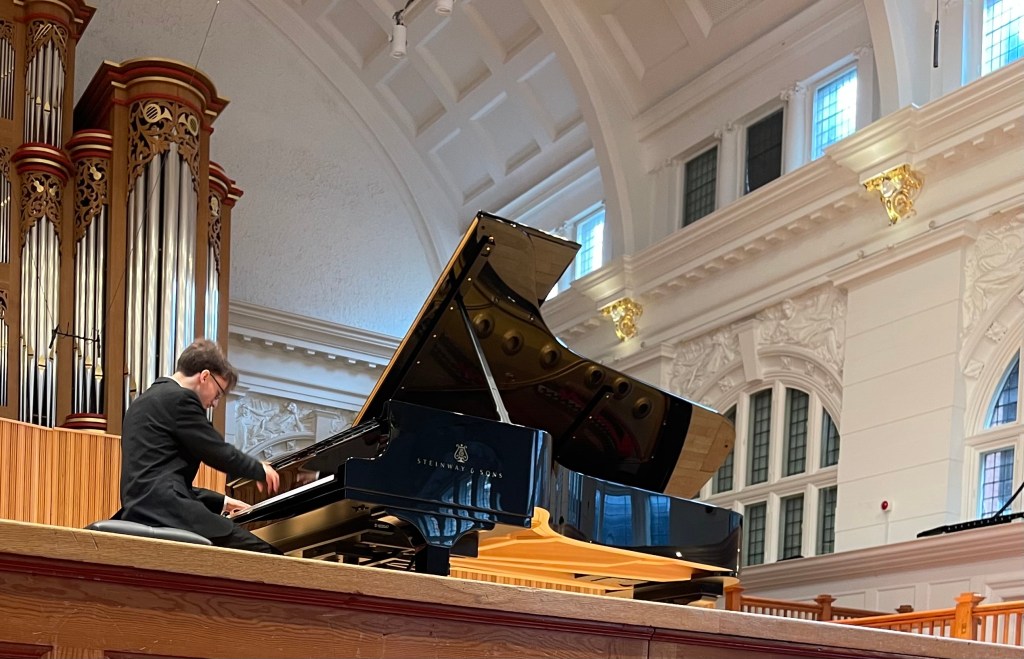
Chopin’s Mazurkas op 30 were played with an extraordinary sensitivity that reminded me of Jan Smeterlin, a disciple of Godowsky, who would show us every year in the Royal Festival Hall that music is made of a palette of sounds like a painter with his colours. Firoze covered these ‘canons’ with radiant blooms of natural fluidity and subtlety. It was Fou Ts’ong who surprised and shocked the world when he was awarded the Mazurka prize in one of the first editions of the Warsaw Chopin competition. How could a Chinese pianist understand the Mazurka better than the Poles? Ts’ong simply replied that the soul knows no frontiers and the same sentiments in Chopin are those found in Chinese poetry. The early studies of Firoze were with the wife of Fou Ts’ong and it was here that his early pedigree shone through these performances that have been nurtured by his present mentors of Dmitri Alexeev and Vitaly Pisarenko. Refined sensitivity with a fluidity and natural flexibility that cannot be taught. Dance too, played with aristocratic artistry, bass notes adding an anchor at crucial moments of its evolution. A final note of such golden beauty was the ending of the third Mazurka in D flat illuminating the piano with glowing radiance as it led the way to the extraordinary fourth in C sharp minor, that is a miniature tone poem of genial invention. It was interesting to note how Firoze played the trills from above allowing the fingers to vibrate freely just as the sounds that he produced .
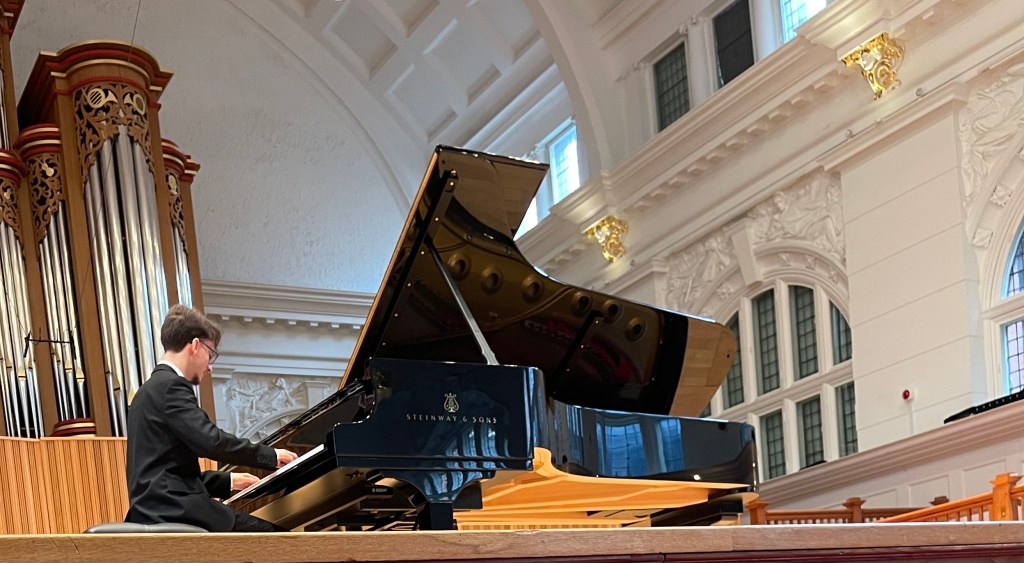
Debussy’s ‘La plus que lente’ was played with the sleezy insinuating beauty in what seemed differing layers of sound that lead so naturally to the two early poems of Scriabin. The first played with an improvised freedom and wistful suavity that we are used to hearing from Horowitz . If he missed the demonic drive of the second he did bring a sumptuous richness finding a remarkable solution for the composers indications of con eleganza e con fiducia!
‘La leggierezza’ found in Firoze and ideal interpreter as anyone who has heard Leopold Godowsky would immediately realise. A technical perfection of jeu perlé that never draws attention to itself but creates a breathtaking magic of undulating sounds and scintillating embellishments of jewel like beauty, together with moments of romantic effusions of passionate intensity .
Three Preludes by Debussy demonstrated the remarkable kaleidoscope of sounds that this young man has in his fingers…….. and feet! A mastery of pedal that also never draws attention to itself but becomes an accomplice to his poetic fantasy . ‘Brouillards’ with its whispered layers of sounds contrasted with the simple beauty of ‘Bruyères’ , and his self identification with ‘Général Levine’ was a call to attention for a young man with poetry in his soul. Some very strident militaristic sounds but always covered in velvet, as I doubt this young man could ever admit that the piano is, according to Stravinsky, a percussion instrument .
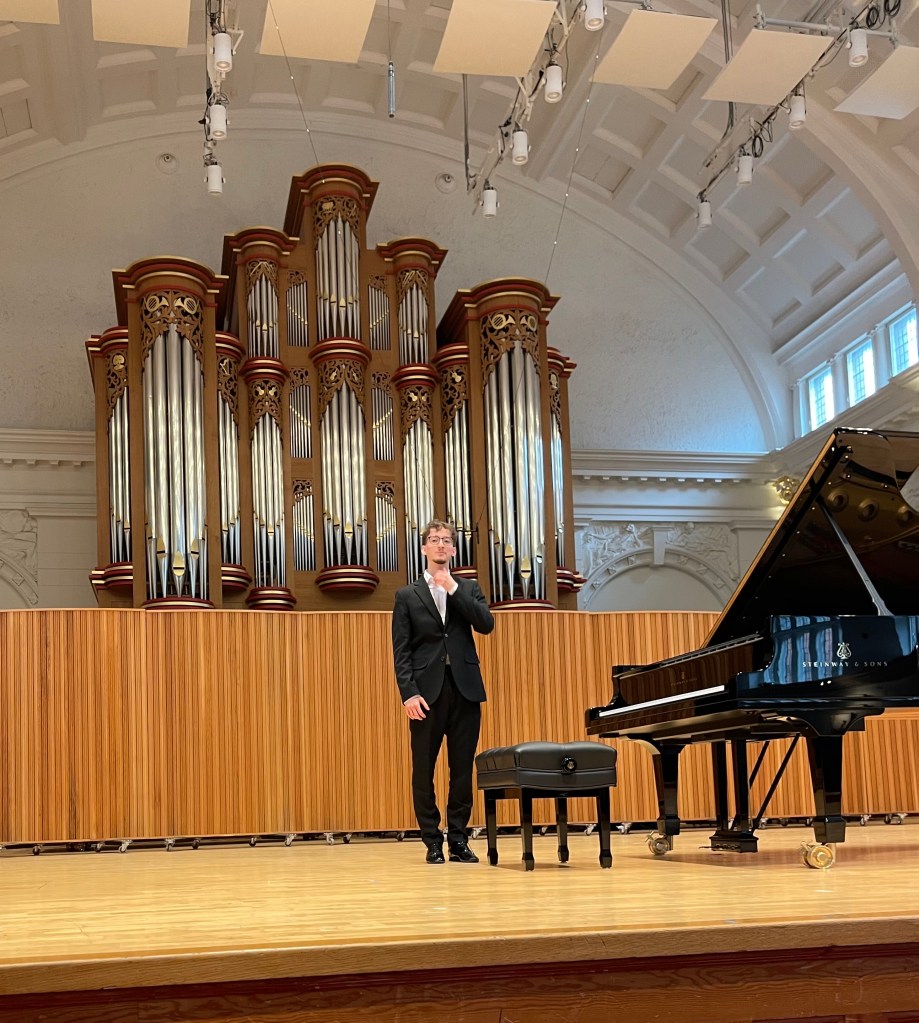
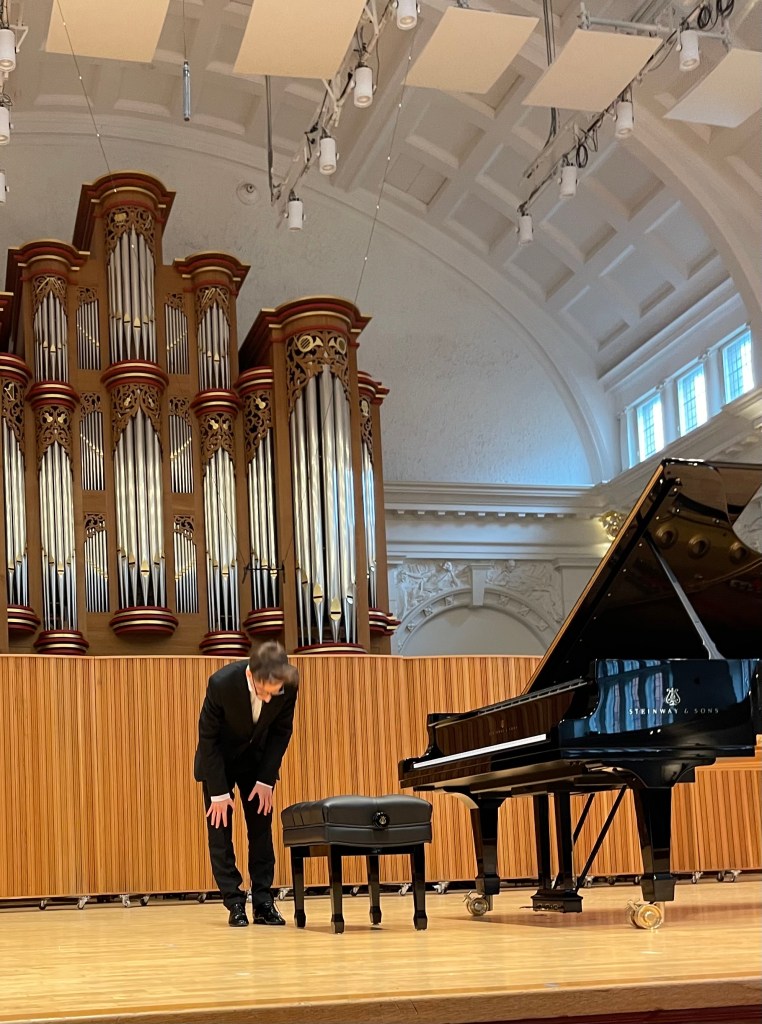
Even the Prokofiev Study op 2 n 4 so often played with brutality and showmanship was here played with poetry and a remarkable technical mastery at the service not of himself but the composer of whom he is but a humble servant .
https://christopheraxworthymusiccommentary.com/2026/05/30/sabina-suciu-at-the-royal-college-of-music-bringing-technical-brilliance-and-passionate-intensity-to-her-end-of-year-recital-from-the-class-of-dmitri-alexeev-and-vitaly-pisarenko-2/
https://christopheraxworthymusiccommentary.com/2026/02/21/alexander-doronin-and-tin-lam-ng-take-regent-hall-unexpectedly-by-storm/
This programme can be heard live streamed from St Mary’s Perivale on Tuesday 9th at 2
| Music at ST MARY’S Perivale |
| Tuesday 9 June 2 pm Firoze Madon (piano) Haydn: Sonata in B minor Hob.XVI:32 (9′) Allegro / Menuet / FinaleSilvestrov: Bagatelle Op 1 no 3 (4′) Chopin: Four Mazurkas Op 30 (9′) 1 in C minor / 2 in B minor / 3 in D flat / 4 in C sharp minorBrahms: Two Rhapsodies Op 79 (15′) no 1 in B minor no 2 in G minor Scriabin: Deux Poèmes Op 32 (4′) no 1 in F sharp major no 2 in D majorLiszt: ‘La leggierezza’ S144 no 2 (5′)Debussy – La plus que lente, L.121 (4′) Debussy: Preludes Book II, No. 1,5,6 (8′) Brouillards Bruyères Général Lavine – excentricProkofiev: Etude Op 2 no 4 (2′) Come along to St Mary’s Perivale or watch LIVE on YouTube or Facebook or watch the recording on YouTube |
Firoze is an award-winning British concert pianist, performing solo recitals, concerti and chamber music across the UK and Europe. He has appeared at prestigious venues including Wigmore Hall, Cadogan Hall, Southbank Centre, Saffron Hall and Philharmonie de Paris.
Firoze has received numerous prizes, most recently winning First Prize at the Globe International Piano Competition 2026 in the Netherlands and First Prize at the Eastbourne Symphony Orchestra’s Young Soloist Competition 2025. He also took Second Prize at the César Franck International Piano Competition in Belgium and gained notable recognition at both the Clara Haskil and Piano Campus International Piano Competitions. Firoze first came to national attention as a Keyboard Category Finalist in BBC Young Musician 2022, with his performance broadcast on BBC Four and BBC Radio 3.
Firoze has also enjoyed success as a song pianist, having been awarded the Pianist’s Prize at the prestigious Kathleen Ferrier Awards and the Alasdair Graham Pianist’s Prize in the RCM Lieder Competition in 2024. The following year, Firoze collaborated with British mezzo-soprano Angelina Dorlin-Barlow on Moments of Freedom by Joanna Borrett, released on streaming platforms and broadcast on radio. He was also invited to be a Waverley Young Artist at the Ryedale Festival.
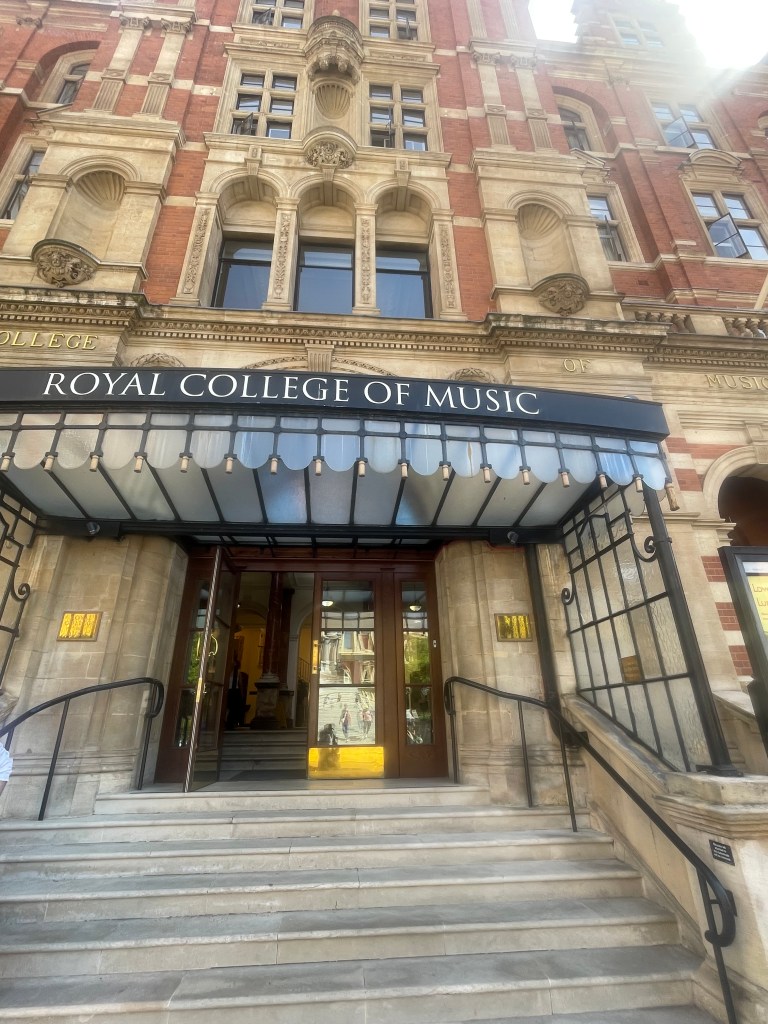
Firoze’s early musical development was at the Purcell School, where he studied piano with Patsy Toh and took lessons in violin and composition. He is currently studying at the Royal College of Music in London, under the tutelage of Professors Dmitri Alexeev and Vitaly Pisarenko and is generously supported by the Kendall Taylor Scholarship.