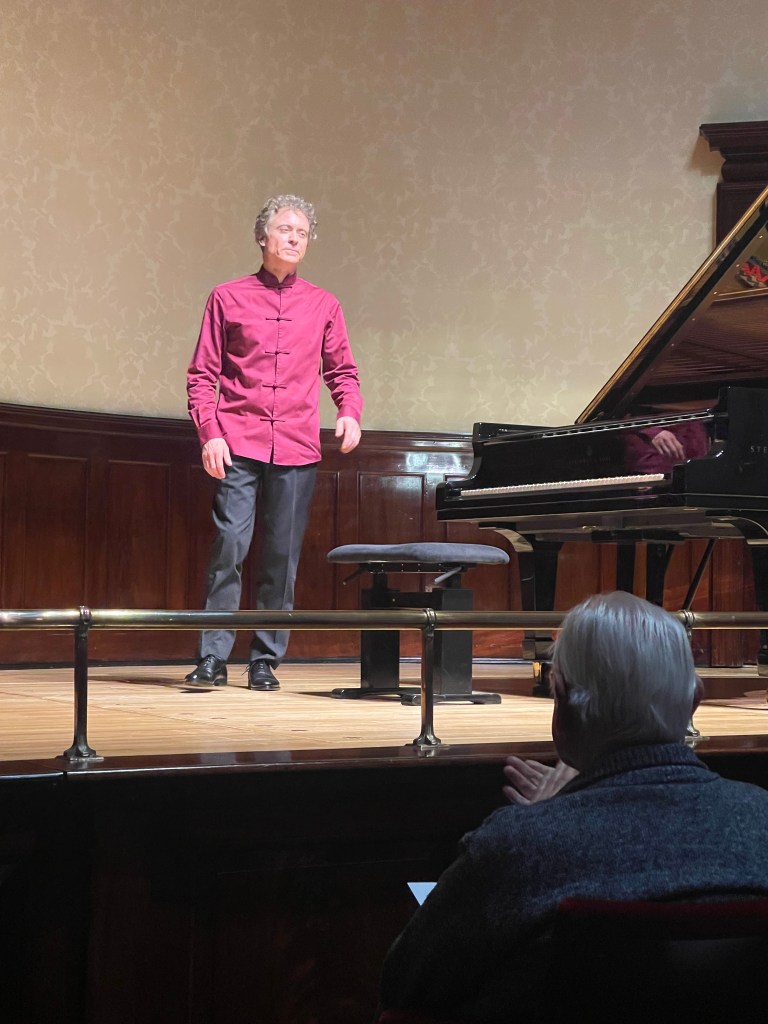
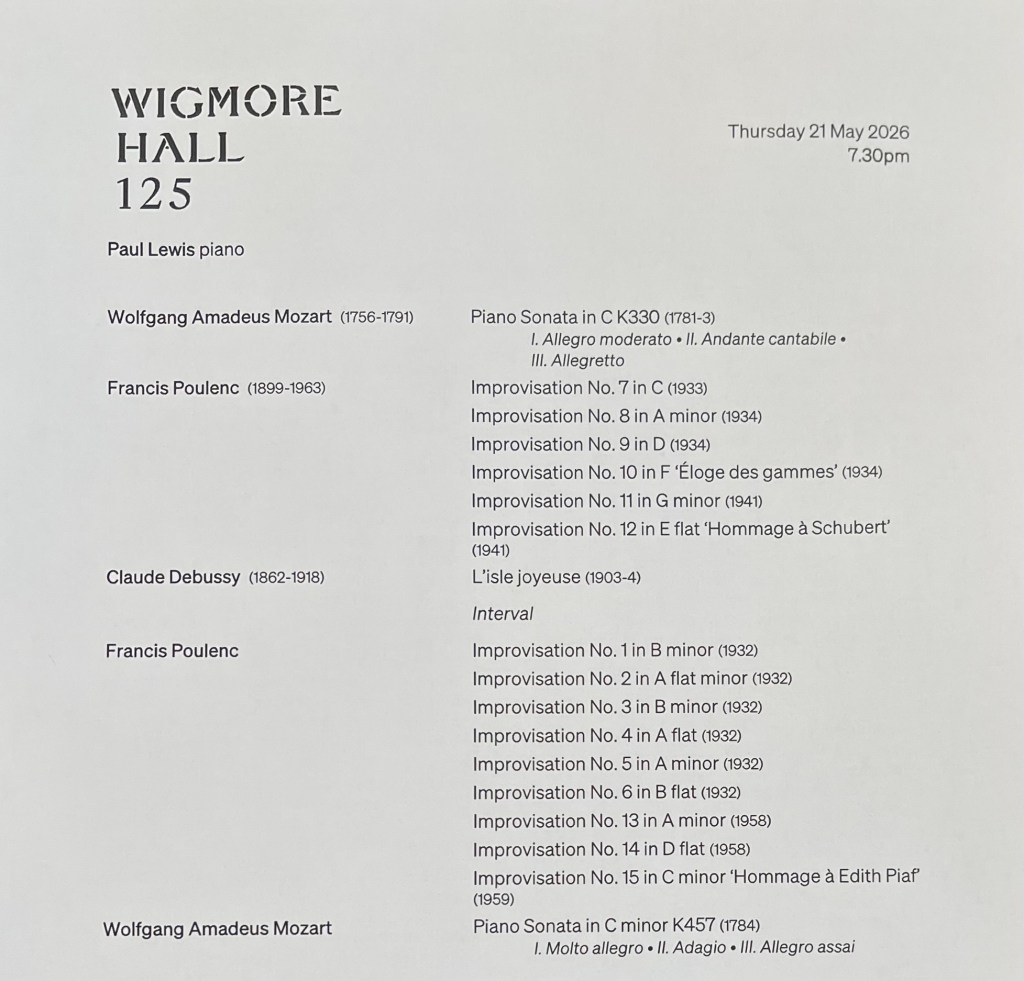
An eclectic programme from Paul Lewis last night who after dancing with Piaf was immediately plunged into the depths of despair of Mozart’s most dramatic piano Sonata, one of only two in the minor key .
Opening with radiance and light where Mozart transforms the key of C major into the refined simplicity and genial outpouring of a Genius .
Playing of simplicity and mastery from a pianist who as a young man was playing a virtuoso repertoire. Persuaded by his mentor Alfred Brendel to leave that to others, as a lifetime is not enough to delve deeply into the Viennese Classics without any diversions into the virtuoso school.
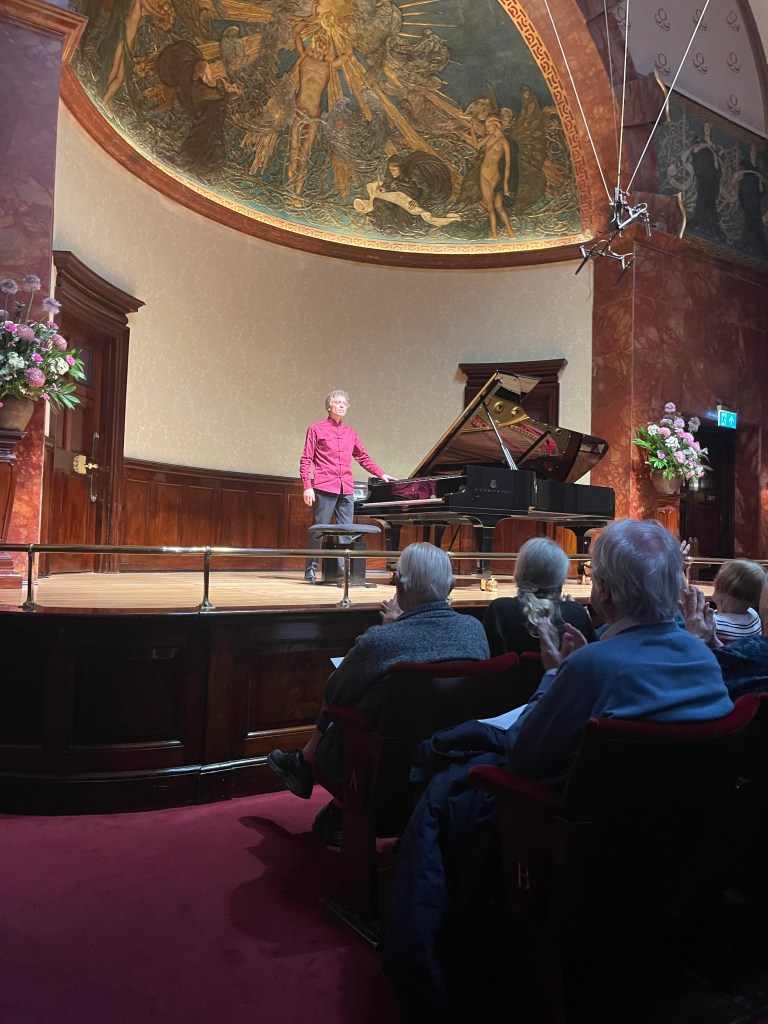
Paul Lewis’s playing allows the notes to speak for themselves without any superficial glitter of self indulgence but delving deeply into the genial notes and searching for the meaning behind and within them.
Of course with the personality of an artist of intelligence and good taste and with a technical mastery that allows him to be on equal terms with the composer.
I was intrigued to see Poulenc ‘s 15 improvisations on the programme that I had heard about from a memorable performance he gave for the Keyboard Trust at Steinways 33 years ago.
A revisitation from an artist who since those early days has been for many years much admired on the world stage .
Bringing a wonderful sense of colour and style to these ‘trifles’ of French elegance and impish good humour . If he did not have quite the twinkle in his eye of the composer himself or the sophisticated French elegance of Rubinstein but he brought his own classical restraint and beauty to works each dedicated to friends of the composer.
He was able to turn these charming baubles into gems. In between he give us Debussy’s birds-eye view of Jersey with a magical performance of the ‘Joyous Island ‘ as seen from a deckchair in Eastbourne ! Poulenc would have relished that !
A fascinating programme not least for the resonant sound of a piano, unusually sitting on the extreme right of the platform leaving the pianist centre stage which I am sure was the last of this dedicated pianists thoughts .
This is a pianist who thinks more of the composer than himself but with a personality that as Rubinstein said was inherited from the bees  , leaving the birds to fly high on wings of song
And song there was with the Allegretto quasi Andantino of Schubert ‘s Sonata in Aminor K537 . Encore is not the word for an artist of such self effacing dedication but it was the performance we had been waiting for.
Masterly subtle playing and a glowing beauty to the song that was to fill Schubert’s heart as it was revisited in the penultimate sonata of his trilogy of farewell to the world at only 31
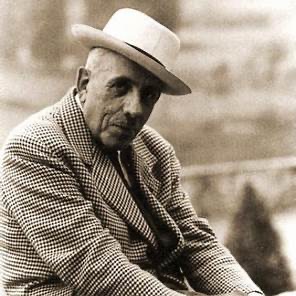
Dix improvisations (from French, Ten Improvisations), FP 63, is the first set of improvisations by Francis Poulenc . Written for solo piano, it was finished in 1934.
Poulenc did not set out to compose the ten improvisations as a set from the start. He lamented in a letter to Marie-Blanche de Polignac that, due to a lack of commissions, he would be compelled to compose piano pieces to satisfy his publishers: “I understand that one must create for the love of art, yet there are times when one must think as much about coal as about a pork chop.”[1] The first six improvisations were composed between November and December 1932 at Noizay, merely one month after writing the letter, and were initially published together as a set of six improvisation by Rouart, Lerolle & Cie in 1933. The seventh improvisation was written in November 1933, whereas the remaining three improvisations were completed in 1934. Rouart & Lerolle published these remaining four improvisations in 1934 as stand-alone, separate items. The whole set of ten improvisations was eventually republished by Salabert in 1990. The set was also republished in Les quinze improvisations, a compilation published in 1960 that also included Deux improvisations, FP 113 (1941), Deux improvisations, FP 170 (1958), and Improvisation No. 15 en ut mineur, FP 176 (1959). The compilation was issued to coincide with the publication of the final improvisation in 1960.
Since many of these little pieces were not initially expected to be published one way or another, each of the Dix improvisations is assigned a distinct dedicatee. Improvisation No. 1 is dedicated to Madame Long de Marliave, followed by dedications to Louis Duffey (No. 2), Brigitte Manceaux(No. 3), Claude Popelin (No. 4), Georges Auric (No. 5), Jacques Février (No. 6), the Comtesse A.J.de Noailles (No. 7), Nora Auric (No. 8), Thérèse Dorny (No. 9), and Jacques Lerolle (No. 10). The improvisations never received a formal premiere, though “seven” of them were performed at the sixth La Sérénade concert in on February 4, 1933, several months before the seventh improvisation was formally completed. He continued to tour around Europe and North Africa from 1933 to 1935 and performed these pieces relatively frequently.
Poulenc was particularly fond of these works,and he recorded four of them, Nos. 2, 5, 9, and 10, for Columbia Records on November 20, 1934, in Paris.
- à Madame Long de Marliave
- à Louis Duffey
- à Brigitte Manceaux
- à Claude Popelin
- à Georges Auric
- à Jacques Février
- à la Comtesse A. J. de Noailles
- à Nora Georges Auric
- à Thérèse Dorny
- à Jacques Lerolle
- à Claude Betaincourt
- à Edwige Feuillere
- à Madame Auguste Lambiotte
- à Henri Hell
XVème Improvisation en ut mineur, “Hommage à Édith Piaf”. Très vite (C minor)
- Improvisation in B minor. Presto ritmico
- Improvisation in A-flat major. Assez animé
- Improvisation in B minor. Presto très sec
- Improvisation in A-flar major. Presto con fuoco
- Improvisation in A minor. Modéré mais sans lenteur
- Improvisation in B-flat major. A toute vitesse
- Improvisation in C major. Modéré sans lenteur
- Improvisation in A minor. Presto (très sec et ironique)
- Improvisation in D major. Presto possibile (très sec et très net)
- Improvisation in F major. Éloge des gammes. Modéré, sans traîner
 ChristopherAxworthy-MusicCommentary