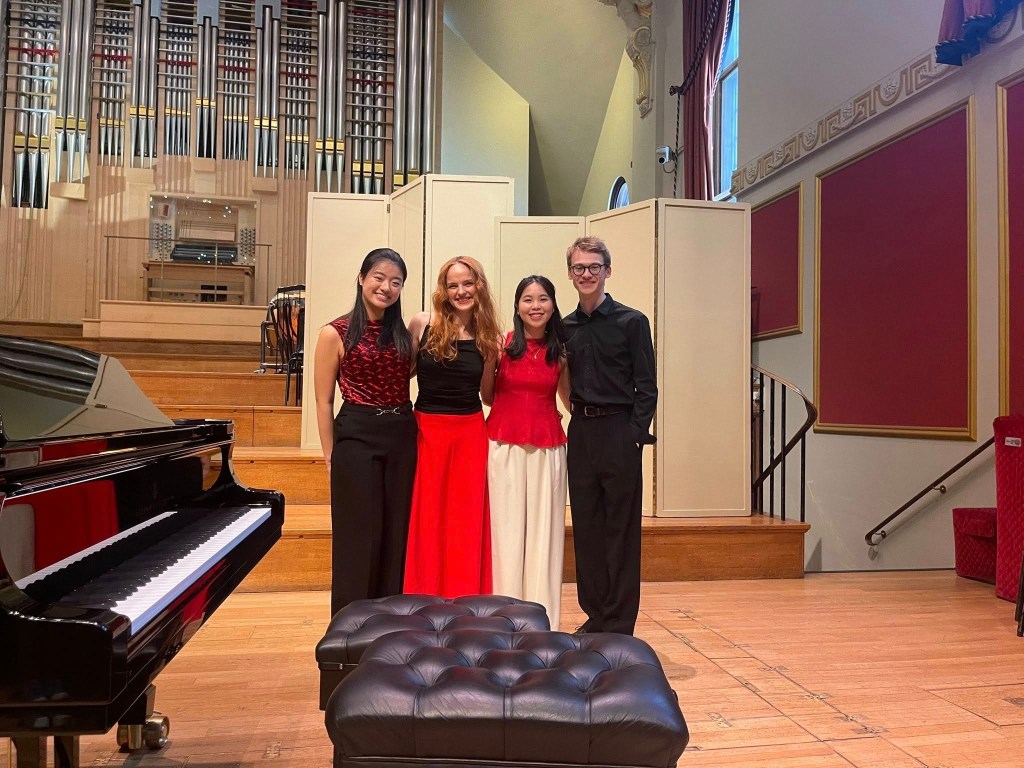
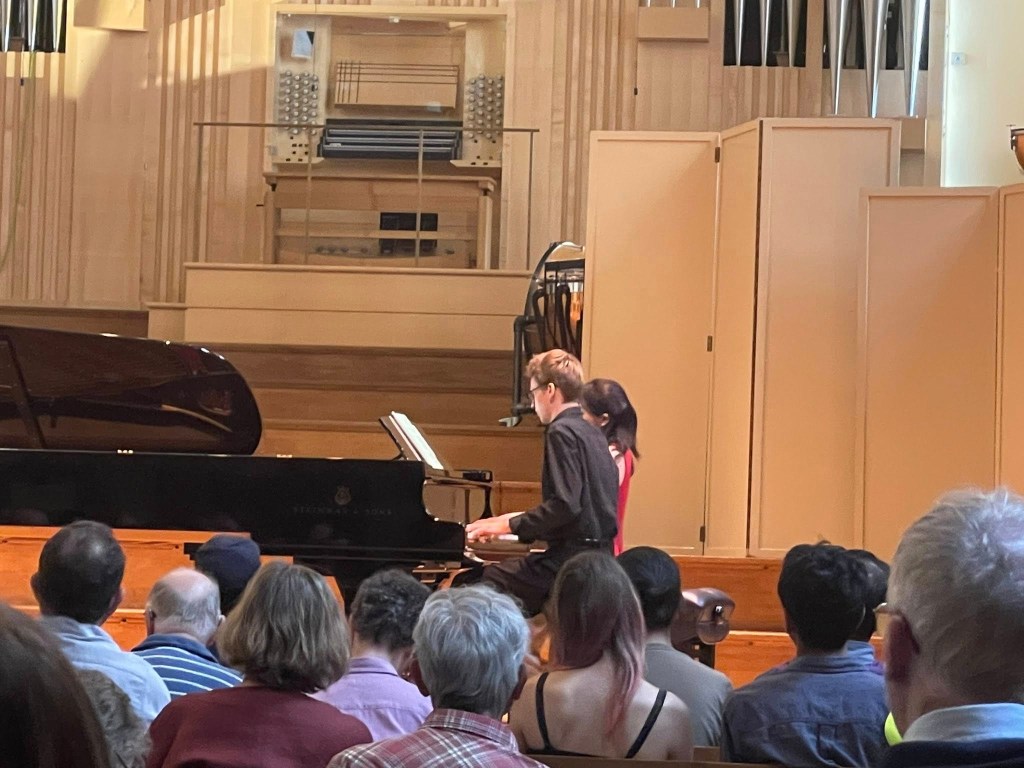
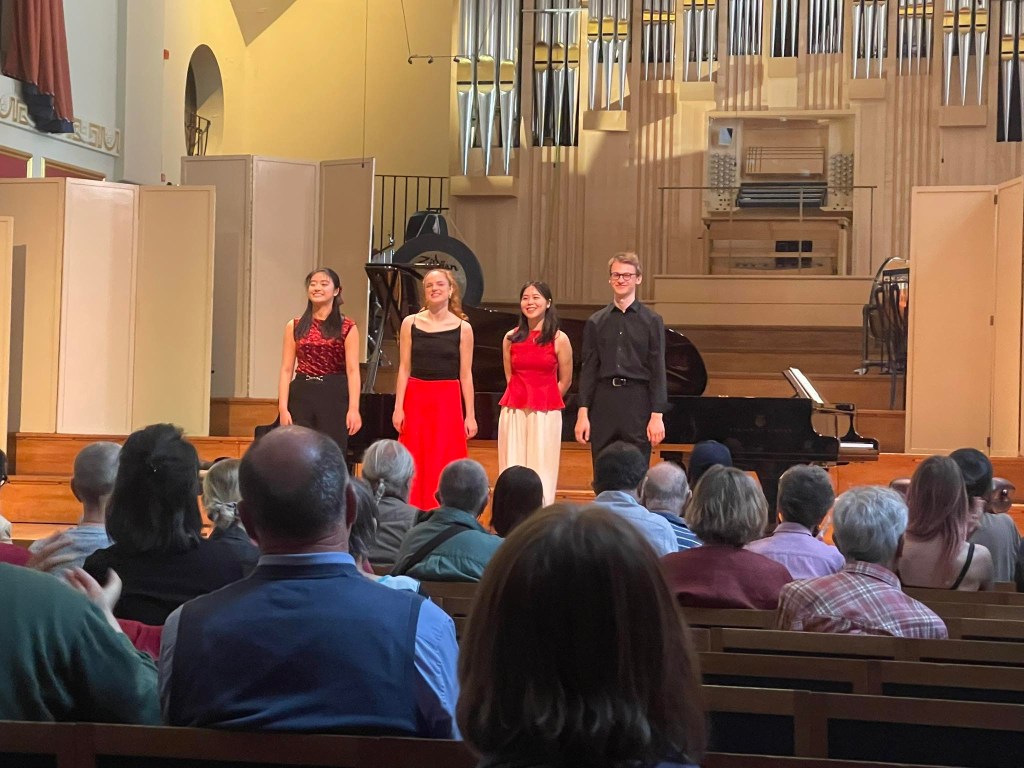
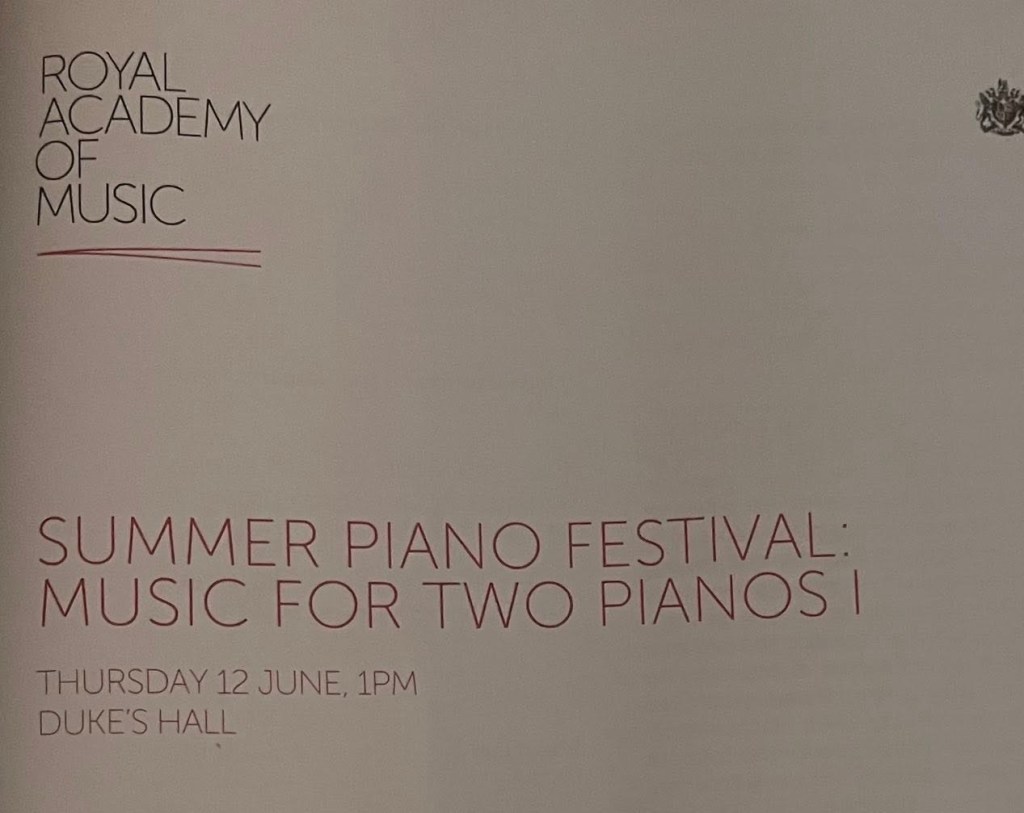
With the joy of graduation recitals out of the way four remarkable young artists could let their hair down and wallow in the sumptuous effusions of the equally youthful Rachmaninov.
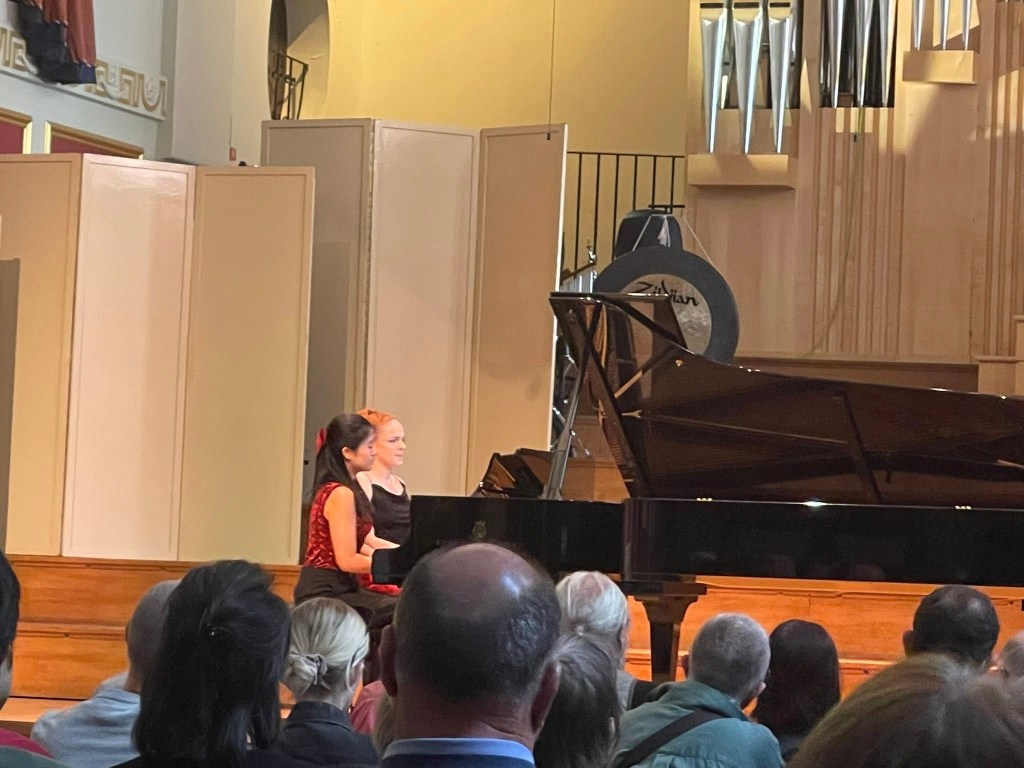
Sherri Lun and Melody Wu played the very early Fantasie -Tableaux Suite op 5 with sumptuous sounds and a refined sense of balance . Streams of delicate golden sounds accompanied Rachmaninov’s unending melodic invention that he had inherited from Tchaikovsky .Whispered magical sounds passed from one piano to the other with a subtle flexibility and wondrous palette of sounds. With the Easter bells pealing these two refined young artists let rip with joyous glee and remarkable technical finesse.
The second suite op 17 is much better known thanks also to the historic performance of Argerich and Freire who just passed by Barenboim’s festival in 1968 at the QEH, in between a shopping spree, to give a performance that has gone down in legend.
I imagine it could only have been matched by Rachmaninov and Horowitz playing together at a Hollywood Party in the 40’s.
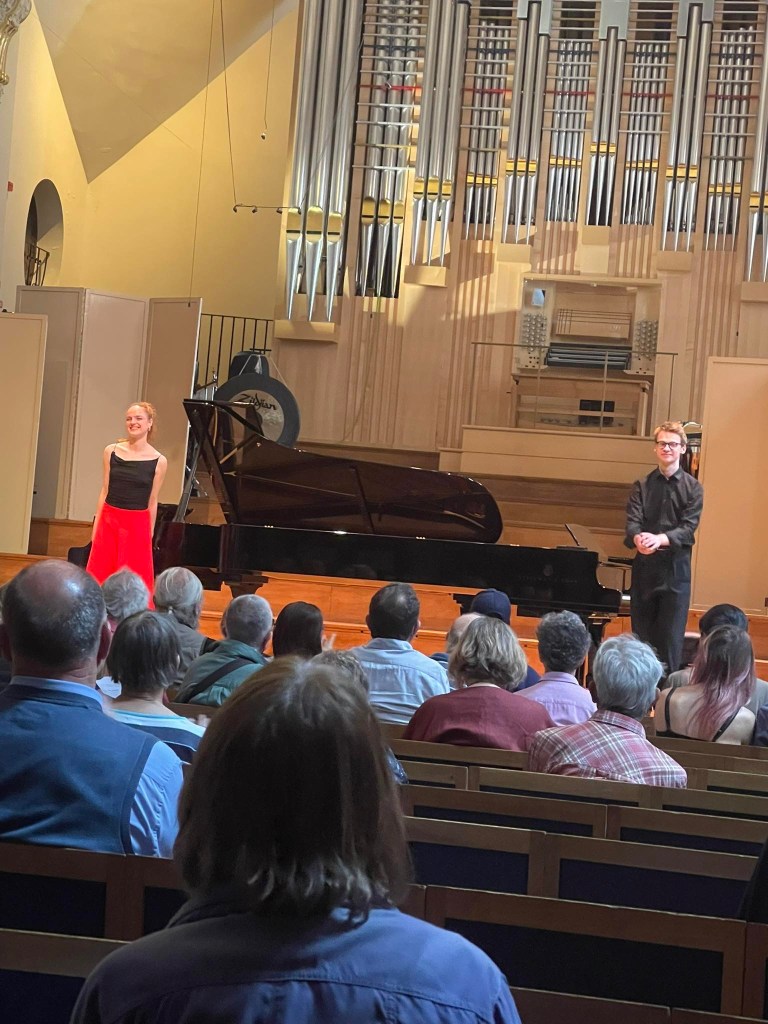
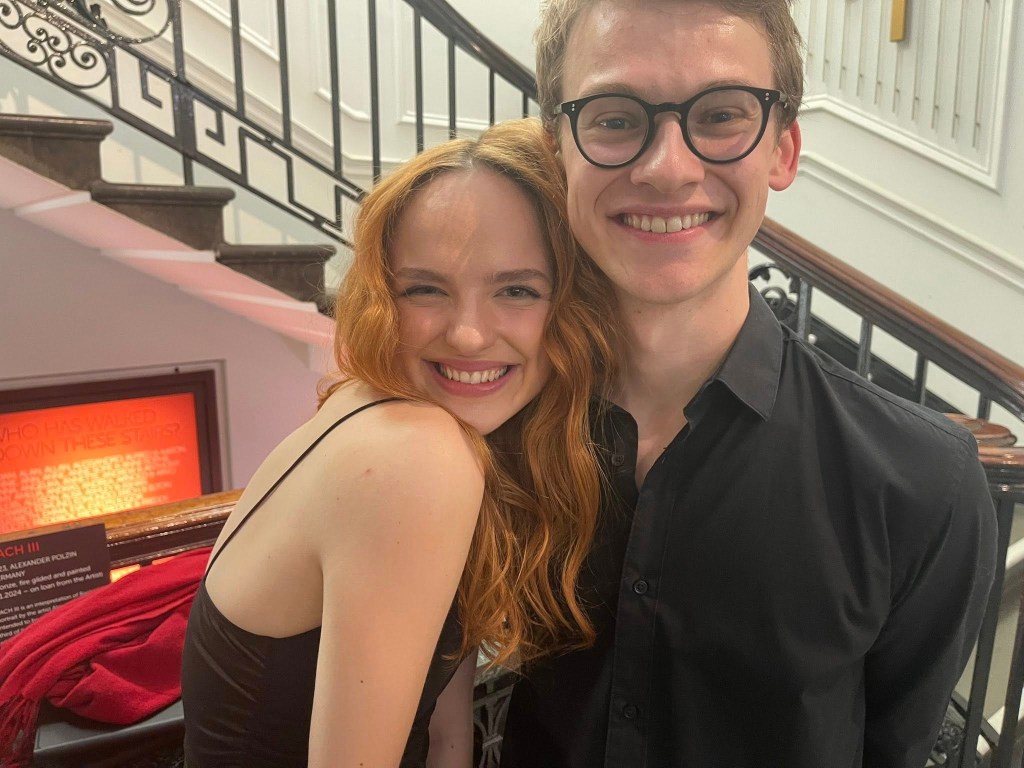
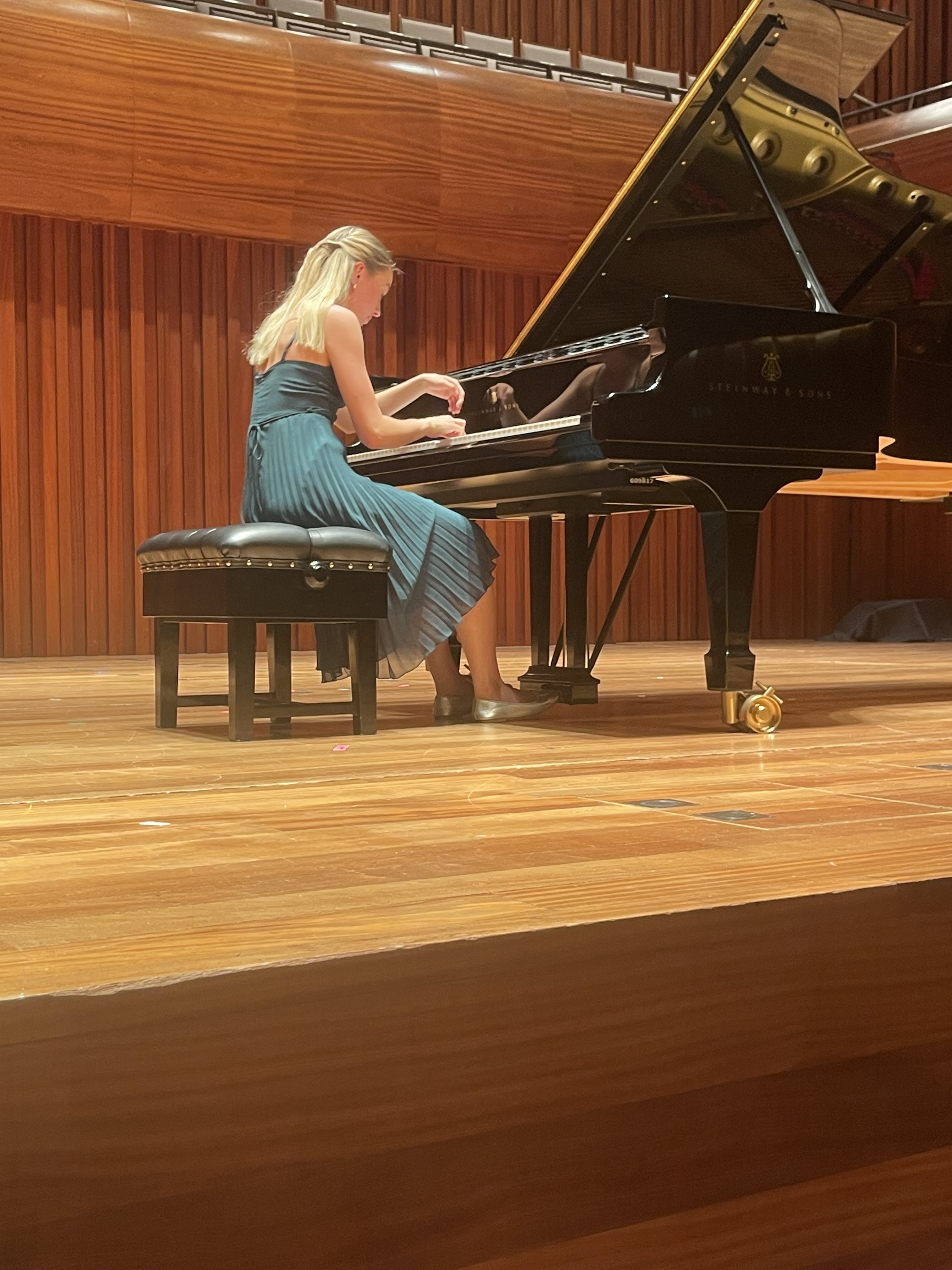
It is a work that needs youthful passion and transcendental technical control which Milda Daunoraite and Kasparas Mikužis have in abundance. What is it about the Lithuanian school that has a fluidity and ease when they play that is the envy of us all? Milda allowing Rachmaninov!s sumptuous melodies to transport her with visible emotion. Kasparas less demonstrative but what a remarkable talent of glowing fluidity and imagination . The Valse just flew from their well oiled fingers with perfect ensemble as they felt it as one .
Milda like Katherine Hepburn to Kasparas’s Clark Gable , what a pair and what music! Sparks flying in the Tarantelle as emotions were aflame after the subdued beauty of the Romance.
Sherri Lun had transcribed the slow movement of the cello sonata for eight hands on two pianos which showed off the sublime artistry of all four and not ending with the showmanship and bravura of the Rachmaninov Suites but with tears of glowing warmth of sublime beauty.
Schumann Davidsbündler and the second book of Debussy studies . Her total mastery of the pedals proved how true was Anton Rubinstein’s declaration that the pedals are the soul of the piano .
Debussy Studies where transcendental difficulties are wrapped in gold and silver . And Schumann’s conflict between Florestan and Eusebius happily resolved at midnight
Messiaen , Chen Qigang ,Takemitsu and Shostakovich with mysterious whispered sounds played with beautiful fluid movements. Like a ballet dancer this was truly a moving picture of such natural movements that of course all he touched was instantly of gold.
An eclectic programme played with great authority and mastery but above all with the palette of colours of a great master.,
Messiaen no.19 from “Vingt regards”
Chen Qigang, “Instant of a Peking Opera”
Takemitsu, “Rain Tree Sketch” & “Rain Tree Sketch II”
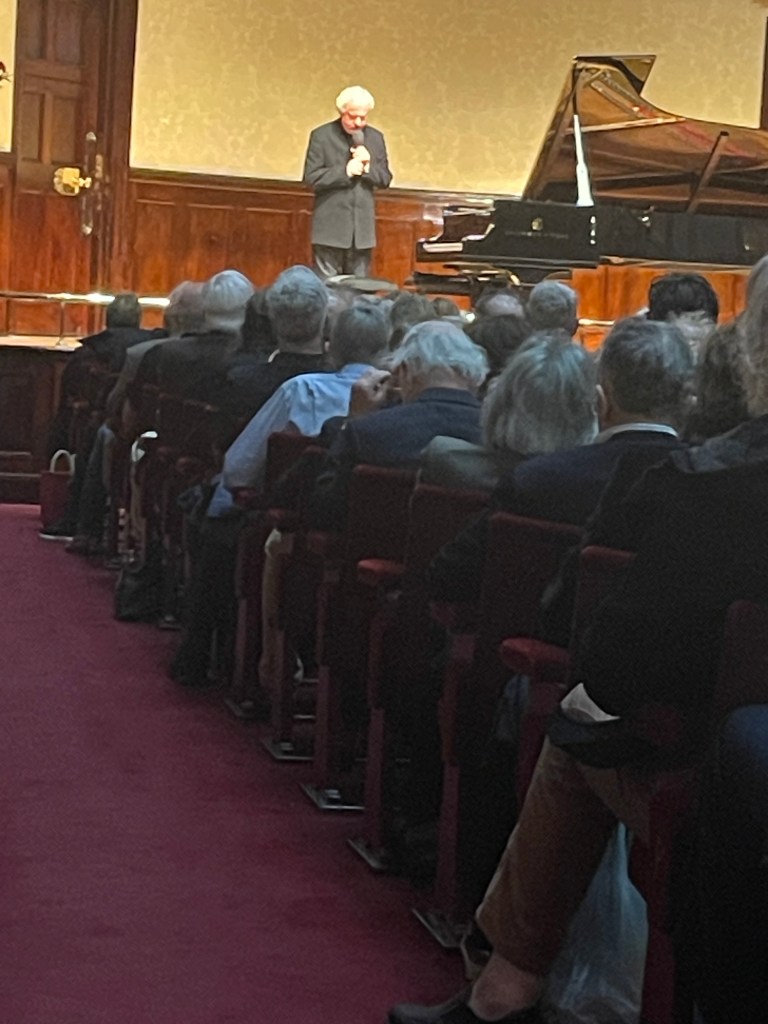
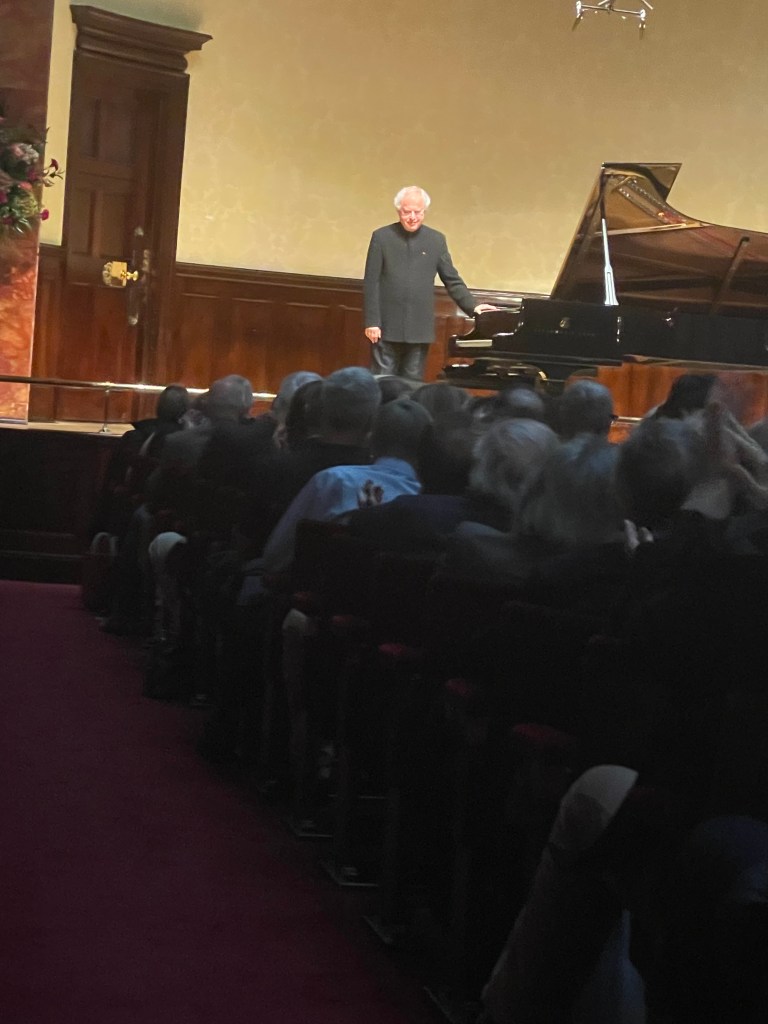
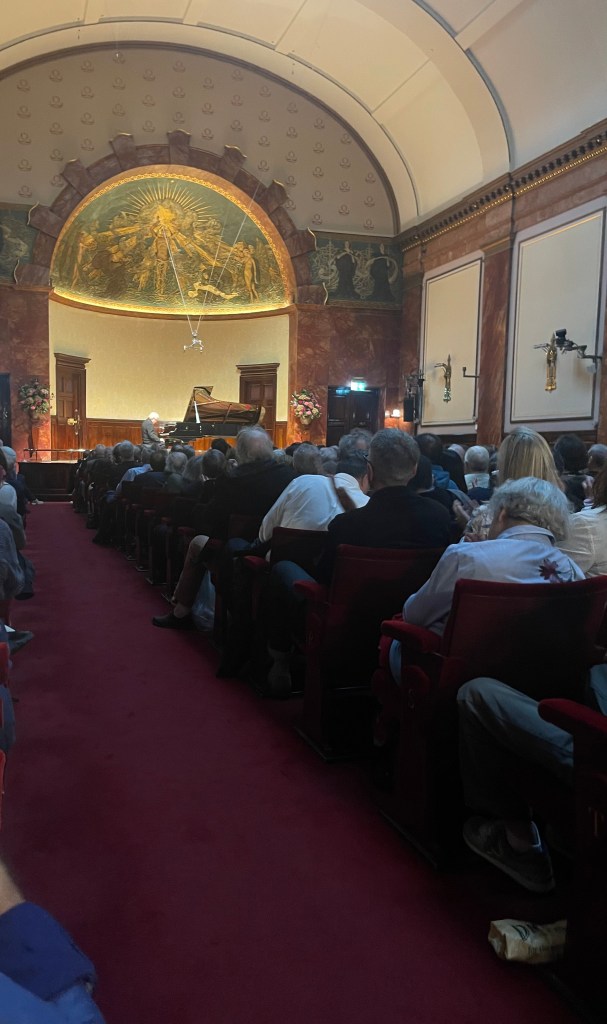
Andras Schiff takes us on a voyage of discovery with the ‘variation’ tonight. On Saturday I was told that he played Beethoven ‘Tempest’ Sonata and the Schubert ‘Fantasy ‘Sonata. Maestro Schiff does not like to announce his programmes months or years in advance and prefers to tell us .more personally, from the stage his choice. As he says the public know that he will stick to a repertoire of the great classics where a lifetime is not enough to delve into the meaning of these great works, and so he chooses to leave the Russian school to others!
What a privilege to be able to hear such continual beauty and a simplicity that many search for, but never seem to find .
Music just poured from his fingers that were merely servants for a searing authority and a musicianship of selfless humility .
But there was a great musical personality too that could delve into Bach’s counterpoints and highlight things that we seem never to have been aware of before. I have only ever heard this early Bach capriccio played with such character from Rosalyn Tureck. She seemed to bounce on the seat as the journey was about to begin and her ornamentation was as crystal clear as today. Serkin’s journey, too, seemed much more adventurous and desperate than the gentle joy of today’s happy departure of a beloved brother
But today there was a luminosity where the opening ornamentation could almost have been Rameau such was the character imbued in every note that flowed from the piano with such loving,glowing beauty.
Haydn Variations in F minor were created before our eyes with operatic personalities that entered and exited the stage with exhilarating freshness and astonishing eloquence.
Beethoven’s op 109 was a wave of undulating beauty that had commenced somewhere in the stratosphere and by some miracle Schiff had drawn it down to earth to remind us what sublime beauty was hidden in Beethoven’s soul.
A ‘Scherzo’ where it was the chiming bass that called the tune, before the unusually whispered trio, heralding the return of normality before our ascent into paradise with the heavenly theme and variations of ethereal beauty.
Even in the third variation it was the counterpoints that were given precedence over what is usually rattled off like a Czerny study . Highlighting Beethoven’s audacious descending intervals in what is often played as a call to arms . Here the intervals just glowed with poignant significance before bathed in a whirlpool of magical thematic arabesques. Leading to the disintegration and miraculous reconstruction of the theme on a stream of sounds that were not mundane trills but ethereal vibrations on which Beethoven could at last envisage the peace that would be his before reaching his three score years .
After the interval our genial master of ceremonies announced quite simply that he would now like to share thirty variations with us by J S Bach, probably the greatest variations ever penned.
Words are superfluous as they were with Wilhelm Kempff ( and I imagine with Edwin Fischer who I never heard live) . A kapellmeister where music just flows with humility and beauty as the piano is no longer a box of hammers and strings but a celestial instrument lent to us by the angels to enrich and ennoble us poor mortals in a world where priorities have been lost and forgotten for too long
It was a great privilege to be present tonight and it will be a memory that will remain, enrich, and sustain me for long to come. Amen.
We were not on our knees but everyone in the hall were on their feet, at the end of this simple message of beauty that Maestro Schiff had brought to share with us today.
Liszt: Après une lecture de Dante – Fantasia quasi sonata from Années de pèlerinage
Ligeti: Etude No.13 (L’escalier du diable)
Interval
Eleanor Alberga: Cwicseolfor (Quicksilver)
Chopin: 24 Preludes, Op.28
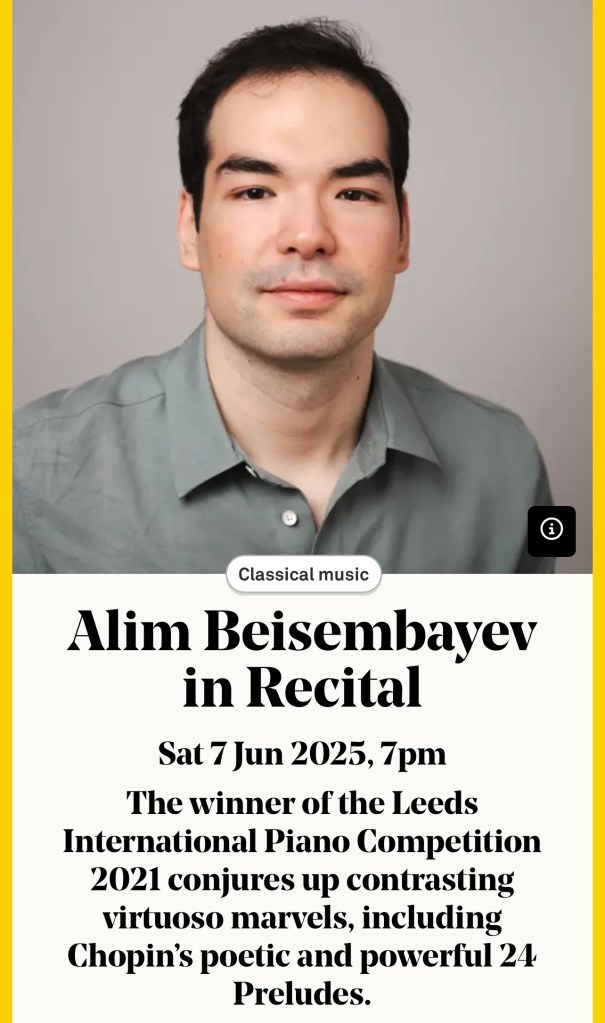
Alim Beisembayev winner of the 2021 Leeds competition and a young pianist I have followed for the past ten years from his studies at the Purcell School in the class of Tessa Nicholson with whom he went on to study at the Royal Academy having already won the Junior Van Cliburn competition in Fort Worth – the final of the Cliburn International by coincidence is tonight ( The winner Aristo Sham another British trained artist from Harrow School )
Transferring to the Royal College where he perfected his studies with another remarkable lady, Vanessa Latarche, going on to win the Gold Medal in Leeds .
His musical integrity and solid musicianship have been the rock on which a remarkably talented young pianist has been given time to mature, and the result was today the appearance of a great pianist of masterly authority with a palette of sounds that I have rarely heard in the concert hall .
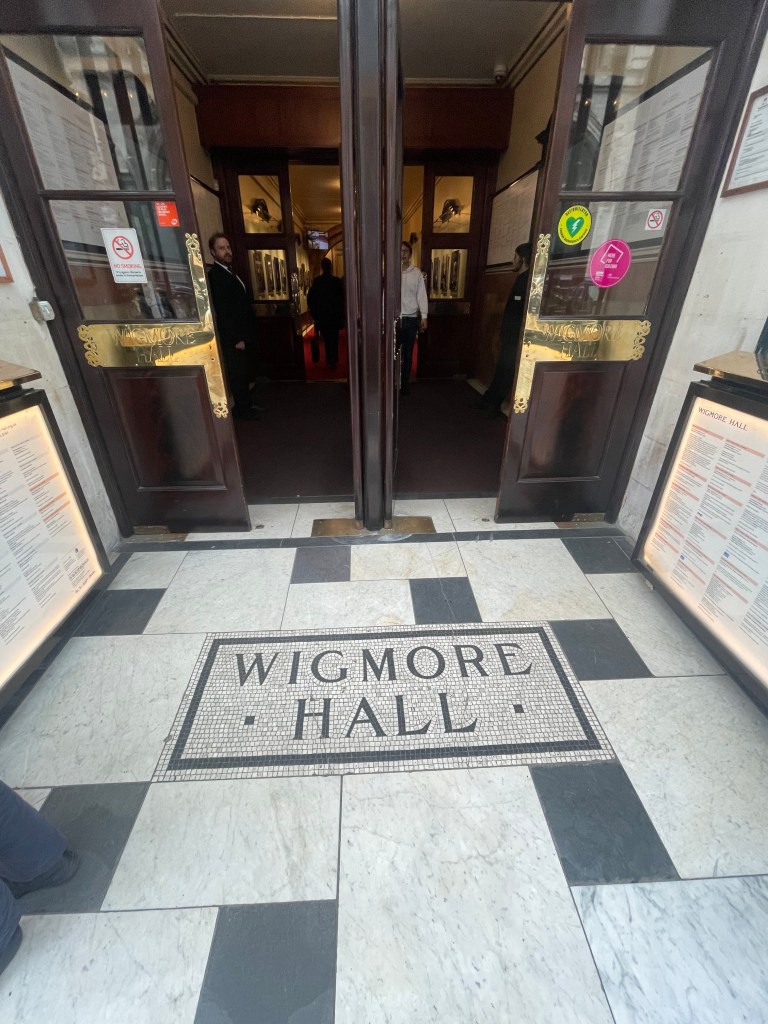
From the opening barely whispered sounds of Scarlatti’s D minor Sonata K 213 which in Alim’s sensitive hands became a tone poem of remarkable emotional poignancy . Whispered sounds that would glisten like jewels as Alim delicately highlighted the genial invention of Scarlatti with a yearning delicacy of poignant emotions. A variety of touch as every note he played was as though there were words on each note. I would say more a lament that a song but a remarkably assured start to his first major recital in London , having filled the Wigmore Hall on many occasions since his victory in Leeds.
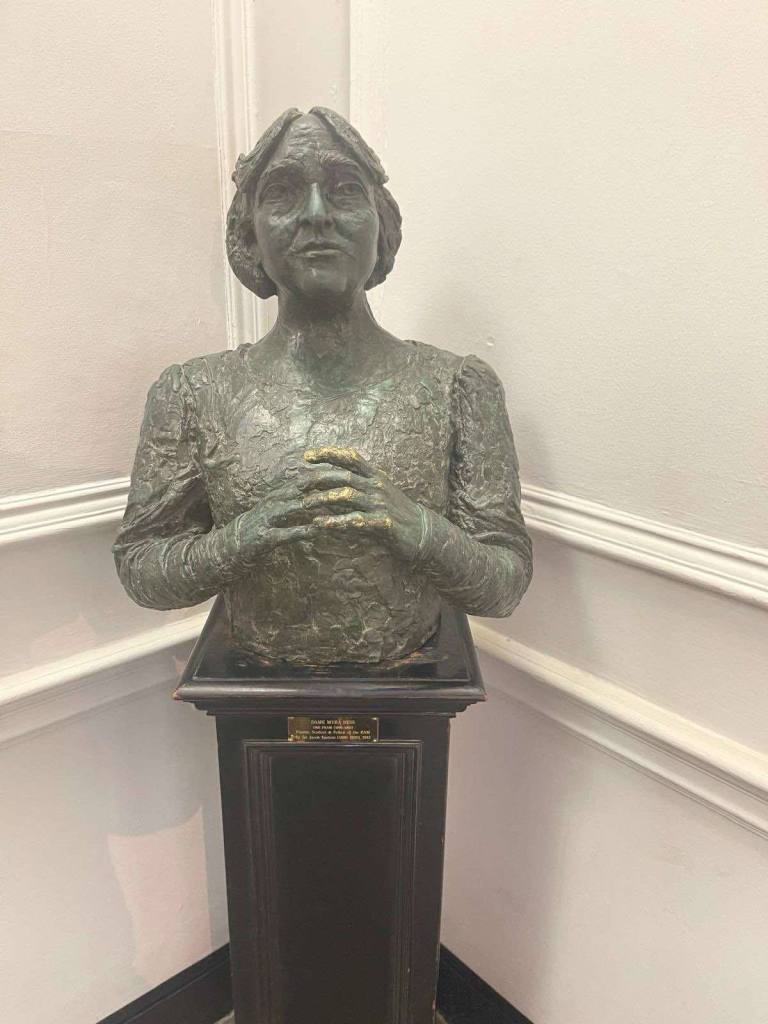
Dame Myra sitting som regally on the staircase at the RAM
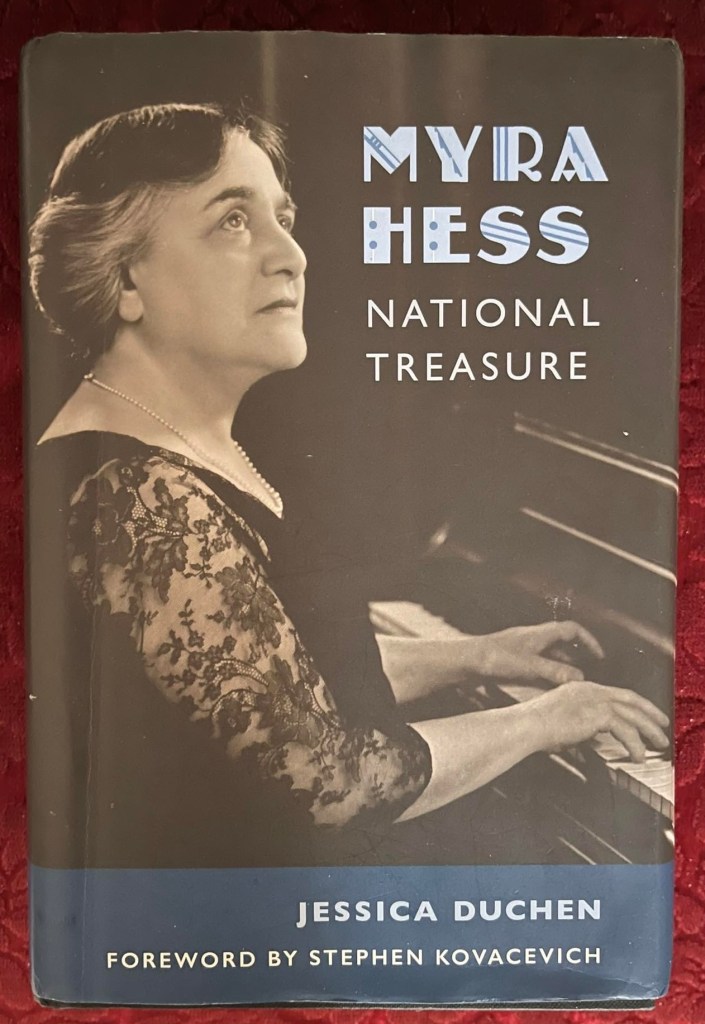
I am reminded of Dame Myra Hess,reading Jessica Duchen’s masterly biography, and of Uncle Tobbs and his search for the hundreds of gradations of sound that can be found in each note.
It is the first time I have heard Ravel’s elusive ‘Valses nobles e sentimentales’ from Alim’s sensitive hands and it was a revelation. Even the choice of the Scarlatti before showed the artistic personality of a true poet of the piano. Ravel writes sentimentales but woe betide those who think it means sentimental instead of noble sentiments of poignant aristocratic beauty.
After the clashing harmonies of the opening we were treated to whispered waltzes of disarming beauty and even childlike simplicity. There was an attempt at grandeur too, as Rubinstein would show us in the penultimate waltz, but which Alim barely suggested, not wanting to break the spell he had created with such a rhetorical outpouring . The final epilogue was played as if in a dream with sounds magically wafted around the piano with breathtaking mastery of control and penetrating poetic intensity.
Liszt Dante Sonata we have heard on so many occasions, mostly from pianistic gymnasts flexing their muscles , instead of the penetrating musicianship that we heard tonight. Every detail of the score had been pondered over and the meaning of the notes understood and incorporated into an interpretation of a symphonic poem of nobility, grandiloquence and breathtaking beauty . But what was so extraordinary was the potency of silence .
I had been struck recently by Alim’s interpretation of Beethoven’s ‘Appassionata’ where the rests were as potent as the notes, because there was energy in that silence that conditioned what came before and what came after. A lesson learnt from Serkin and Arrau and of course above all Guido Agosti for those that were privileged to frequent his studio in Siena .
Alim’s punctuation was impeccable but also his sense of architectural shape .
Rachmaninov always used to say that there was just one point in a composition which was the pivot on which the edifice stands. Alim understood this and when he let rip with his considerable technical arsenal it was even more breathtaking because so unexpected. With Alim there were always reserves of energy to use in crucial moments and not displayed in an egotistical show of muscle at the expense of the poetic meaning . The treacherous leaps towards the end were played with a mellifluous beauty rather than as a technical exercise.
Talking of which Ligeti’s ‘diabolical staircase’ was played with wondrous clarity trying to climb an impossible ladder only to fall back each time. Reaching as far as the keyboard would allow and even further had it been possible ( Victor Borge would have had a ball here ) I remember Shura Cherkassky coming to stay and bringing a crumpled copy from the BBC library and asking us to teach it to him . He chose it, I am sure for the title, as he did another year Copland’s ‘El Salon Mexico’ or Morton Gould’s ‘Boogie Woogie Etude’. An impish sense of humour that Alim still has to demonstrate on stage to complete his artistic personality .
Having said that of course the skittish jewel like perfection of his second encore of Scarlatti would have had even Cherkassky dancing with glee .
It was wonderful to see Ellie Alberga on the programme. We were all students at the Royal Academy together and living in West London . Ellie ,as thin as a rake with long spindly fingers, so talented but like her Jamaican friend David Johns, oh so lazy!
Ellie has become a renowned composer and put on some weight in both senses too! What a revelation her piece is with a ‘tour de force’ of dynamic rhythmic drive with hard driven sounds of chameleonic changes of character. A gently contrasted quasi chorale with ethereal unworldly sounds reverberating with an inner intensity. A performance of searing commitment and remarkable technical mastery .
Alim chose Chopin’s ’24 Preludes’ to end this very special occasion . I have heard him play them many times and I even tipped off the Frankls about his extraordinarily masterly BBC Wigmore performance of these 24 problems ( to quote Fou Ts’ong). Peter was extremely impressed and I just wish he could have heard tonight’s miraculous performance that has matured as only pure vintage can .
A standing ovation and three encores for a young man who has come of age and can join the ranks of one of the finest interpreters of our day .
The encores were Rachmaninov’s wondrous G minor Prelude; one of Scalatti’s 550 sonatas and Liszt’s F minor transcendental study n 10 played with refined breathtaking virtuosity and passionate abandon.
The 27-year-old pianist Alim Beisembayev has planned a magnificent array of music for his recital. Beginning with an energetic sonata by Scarlatti and Ravel’s hypnotically beautiful Valses Nobles et sentimentales, he moves on to Liszt’s powerful evocations of hell and redemption in the fantastical sonata Après une lecture du Dante, plus Ligeti’s most celebrated Etude, ‘The Devil’s Staircase’.The second half begins with Cwicseolfor(Quicksilver), a new work by the Jamaican-British composer Eleanor Alberga, written for Isata Kanneh-Mason and premiered in Budapest as part of a European concert hall tour in 2021. Now, at last, it gets its Southbank Centre premiere under the fingers of Beisembayev, who has become a significant advocate of Alberga’s music. Last year, Beisembayev gave the world premiere of Alberga’s Piano Concerto, which was commissioned for him as part of his prizes at the 2021 Leeds International Piano Competition.The concert sweeps to a close with Chopin’s 24 Preludes, each one a poetic miniature full of visionary imagination.
Joseph Haydn Piano Trio No. 39 in G major, ‘Gypsy’ Hob XV/25
Andante – Poco adagio, cantabile – Rondo all’ Ongarese :Presto
Felix Mendelssohn Piano Trio n. 1 . in D minor, Op.49
Molto Allegro agitato – Andante con moto tranquillo – Scherzo:Leggiero e vivace – Finale :Allegro assai appassionato
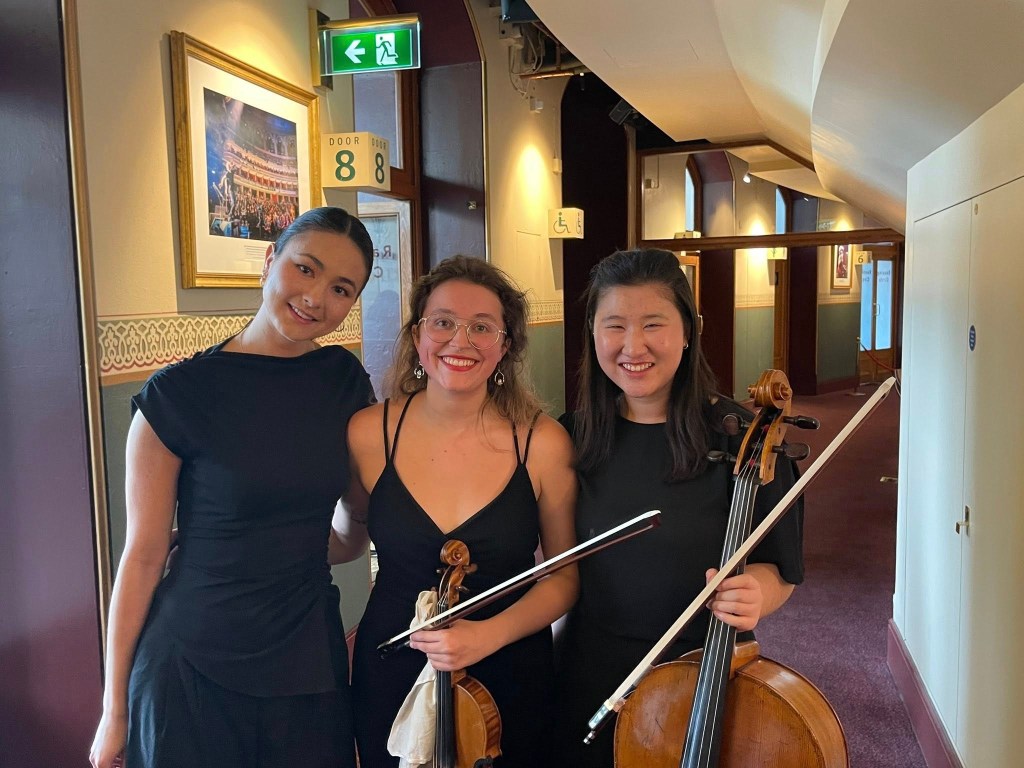
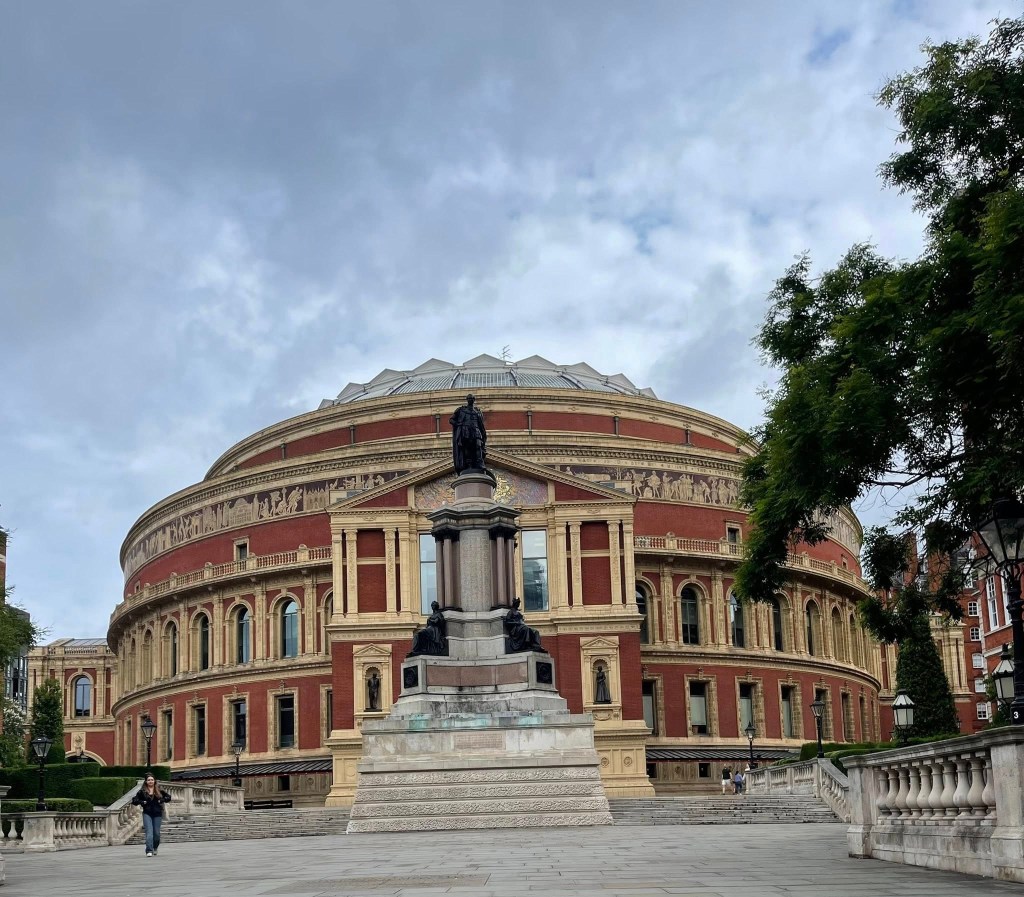
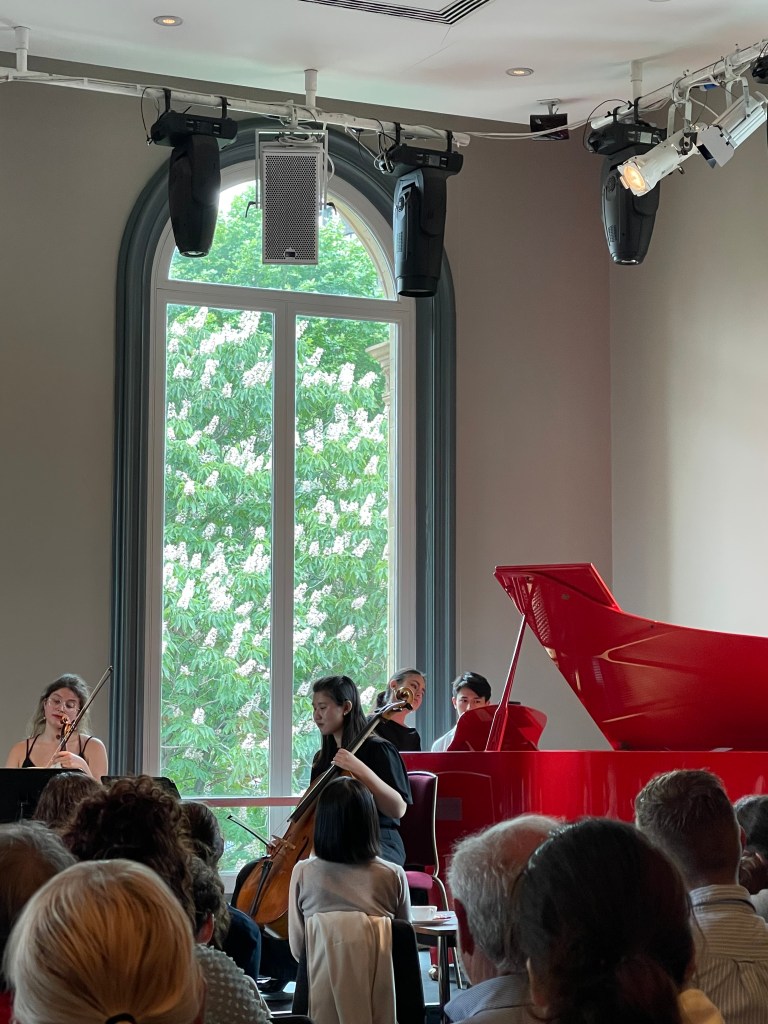
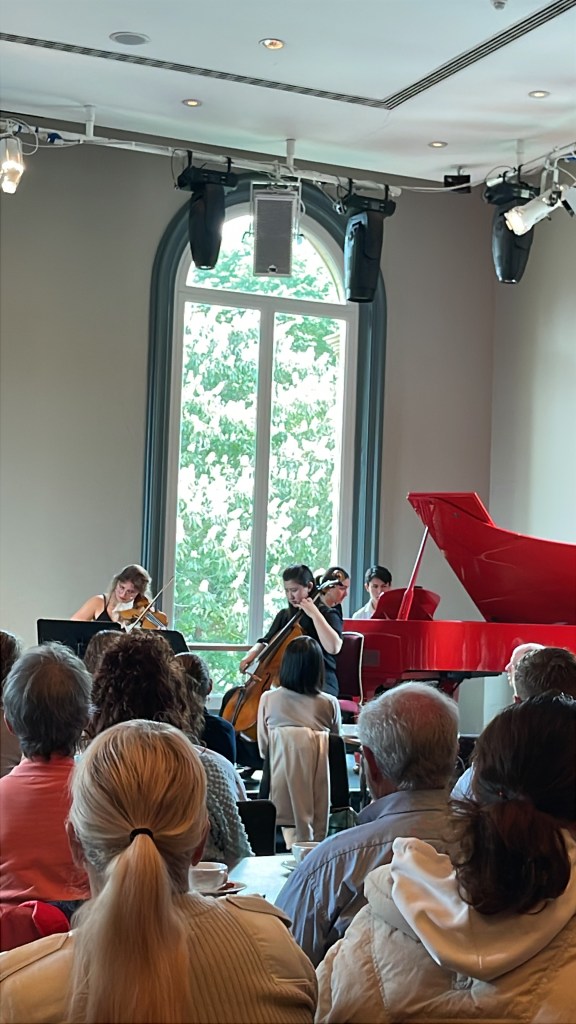
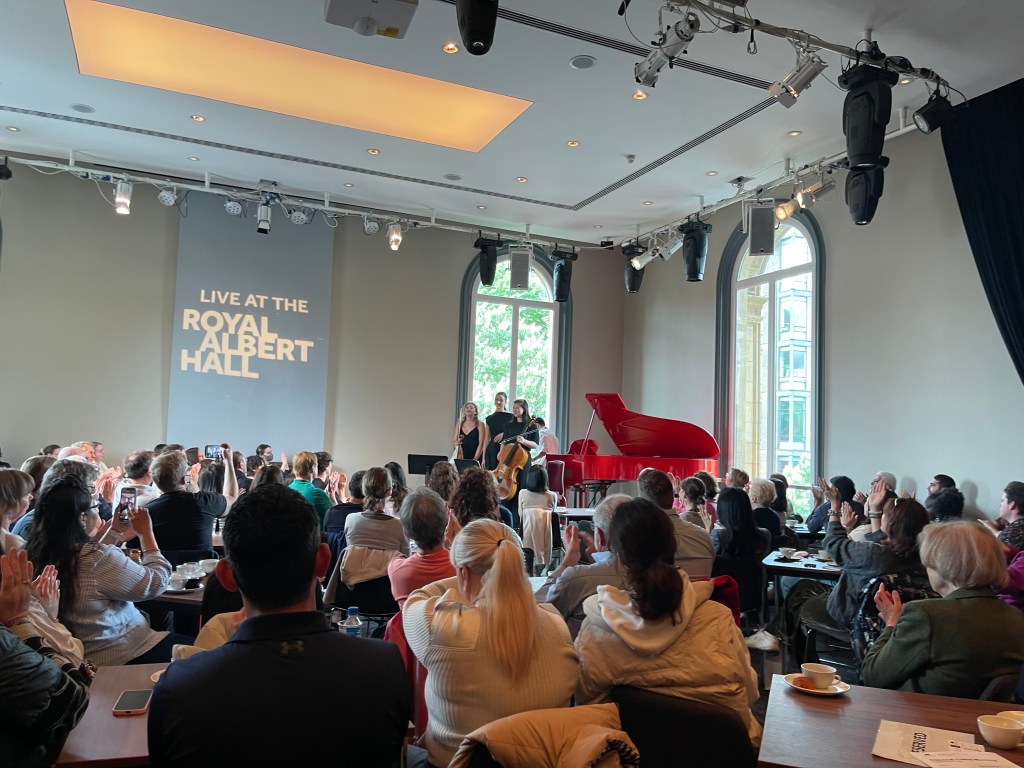
The Kaja Trio at the Royal Albert Hall, all graduates of the Royal College just a stones throw away. Three beautiful young ladies all imbued with a passionate need to make music together that was evident from the sumptuous performances of Haydn and Mendelssohn that they offered a full Elgar Room this morning .
A change of programme brought the Mendelssohn D minor in place of the announced Dumky Trio. But the Haydn Gypsy Rondo was still there.
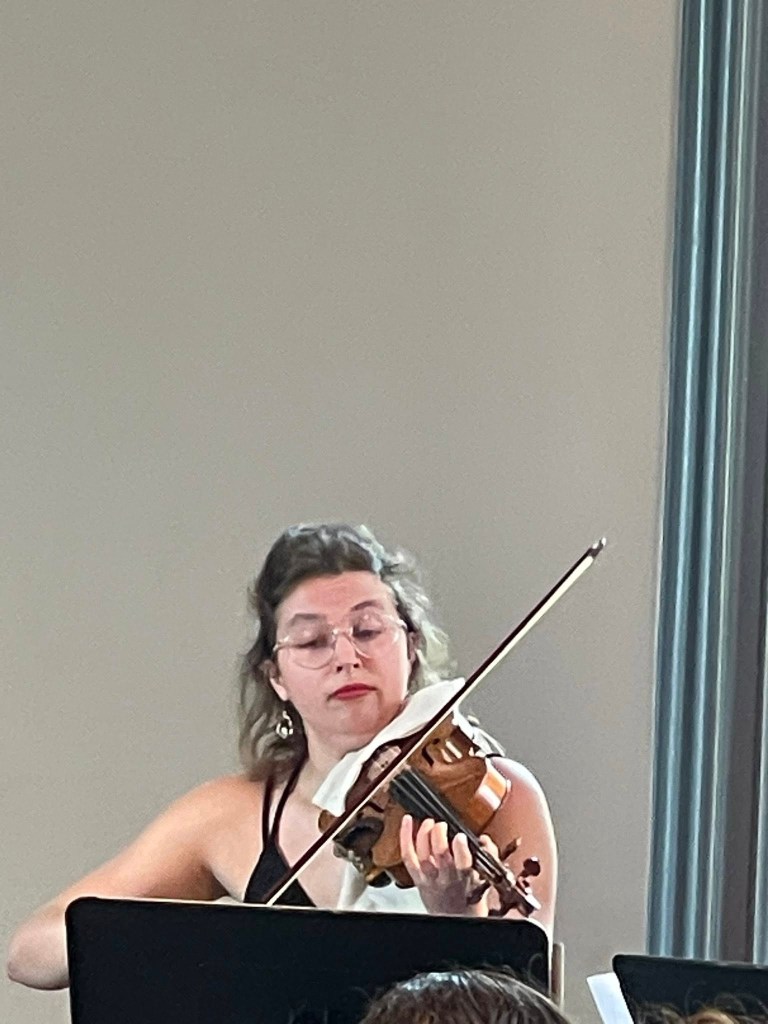
In Haydn as in Mozart the cello was not yet regarded as a soloist but more the anchor where music was was created. It was Clare Juan who not only presented the Haydn but also presided over the scintillating playing of her colleagues creating a base on which the beauty of Kaja Sešek’s sumptuous violin playing could duet with her fellow Slovenian Zala Kravos with the grace and elegance of its time.
Zala playing with the lid wide open of Elton John’s Red Yamaha piano without any fear of overpowering her colleagues. Three musicians that play as one, each master of her instrument . Sumptuous beauty of the piano in the second movement accompanied by the discreet richness of the violin and cello before passing the melodic line to the violin, this time with cello and piano following with vibrant attention . The Gypsy Rondo, last movement is a famous show piece for the piano and Zala’s glowing fluidity was brought vividly to life with the support of her two colleagues . All bursting into a Hungarian dance of exhilaration played by all three with searing conviction and dynamic brilliance
Zala is a wonderful pianist but her public speaking is not at the same level so her introduction I missed . What a surprise then that the ‘Dumky’ Trio in our programme was suddenly transformed into the sumptuous magic of Clare’s solo cello as she intoned the Mendelssohn D minor trio . I have heard Zala many times, she even gave a piano duo concert with her brother in France last summer who now was content to turn pages for his sister. No easy task for the pianist in Mendelssohn where there must be a record amount of notes for the piano!
It was an ideal decision because the Mendelssohn Trio is a masterpiece for three virtuosi musicians that can comune with each other with passion , mastery and technical brilliance. Three solists who can live together under the same roof passing Mendelssohn’s unstoppable melodic invention from one to the other with a mutual anticipation that requires great musicianship and above all listening more to their partners than to themselves.
At last we could appreciate from the very first notes the sumptuous beauty of Clare Juan’s cello and the ravishing rich sound of Kaja’s violin but above all the masterly brilliance and beauty of Zala’s playing .
Nowhere more than in the scherzo where all three played with the gossamer lightness of a Midsummer Mendelssohn, and the joie de vivre that made the composer a favourite at the court of Queen Victoria who had erected this very monument to the memory of her beloved husband Albert . There was a radiant beauty to the Andante with Zala’s opening solo creating a magic that became ever more radiant as the violin and cello duetted with her. The Allegro assai finale was played with passionate abandon and ravishing melodic beauty with three beautiful ladies playing as one with a voice of masterly conviction.
Sešek is a Slovenian violinist, currently finishing her Master of Performance degree at the Royal College of Music, London, where she is studying with Detlef Hahn. She completed her undergraduate studies at Academy of Music Ljubljana with Gorjan Košuta. She is an ongoing member of Gustav Mahler Jugendorchester since 2022. She has performed as a soloist with RTV Slovenia Symphony Orchestra and the Slovene Military Orchestra, among others. Her studies are supported by the Ad Futura Public Scholarship Fund of the Republic of Slovenia.
Clare Juan is an Australian cellist currently pursuing a Master of Performance at the Royal College of Music, London, under Gemma Rosefield. A passionate chamber musician, she has performed with the Marmen String Quartet and Ensemble 360 at venues like Wigmore Hall. Clare recently won first prize in the KraCamera International Competition and the RCM Contemporary Competition. She is The Sir Peter and Lady Walters Scholar, supported by the Pauline Hartley Award and the TAIT Performing Arts Association. Clare plays a 1804 William Forster Junior cello, on loan from the Royal College of Music.
Zala Kravos, born in Slovenia in 2002, began playing piano at five and has studied with Maria João Pires, Louis Lortie, Jean Müller, and Norma Fisher. A winner of multiple international competitions, she has performed in 19 countries, including China and the US. In 2018, she was nominated for the “Export Artist of the Year” award in Luxembourg. At 14, she recorded her first solo album, followed by a second in 2021 with her brother Val, featuring music for piano four hands.
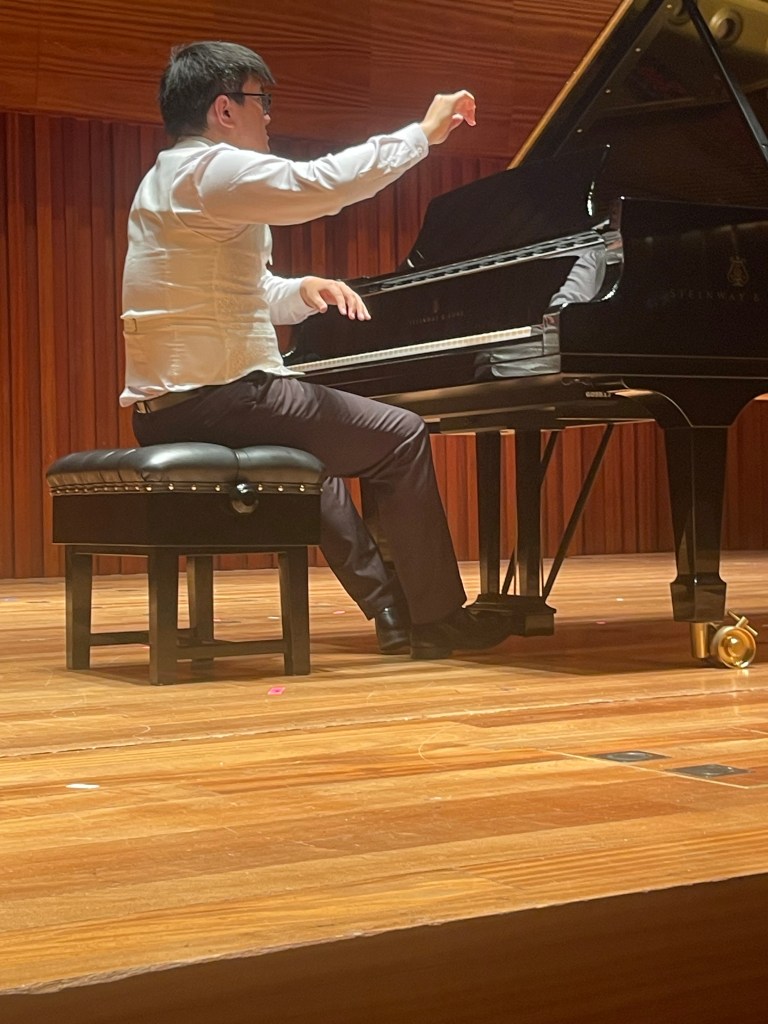
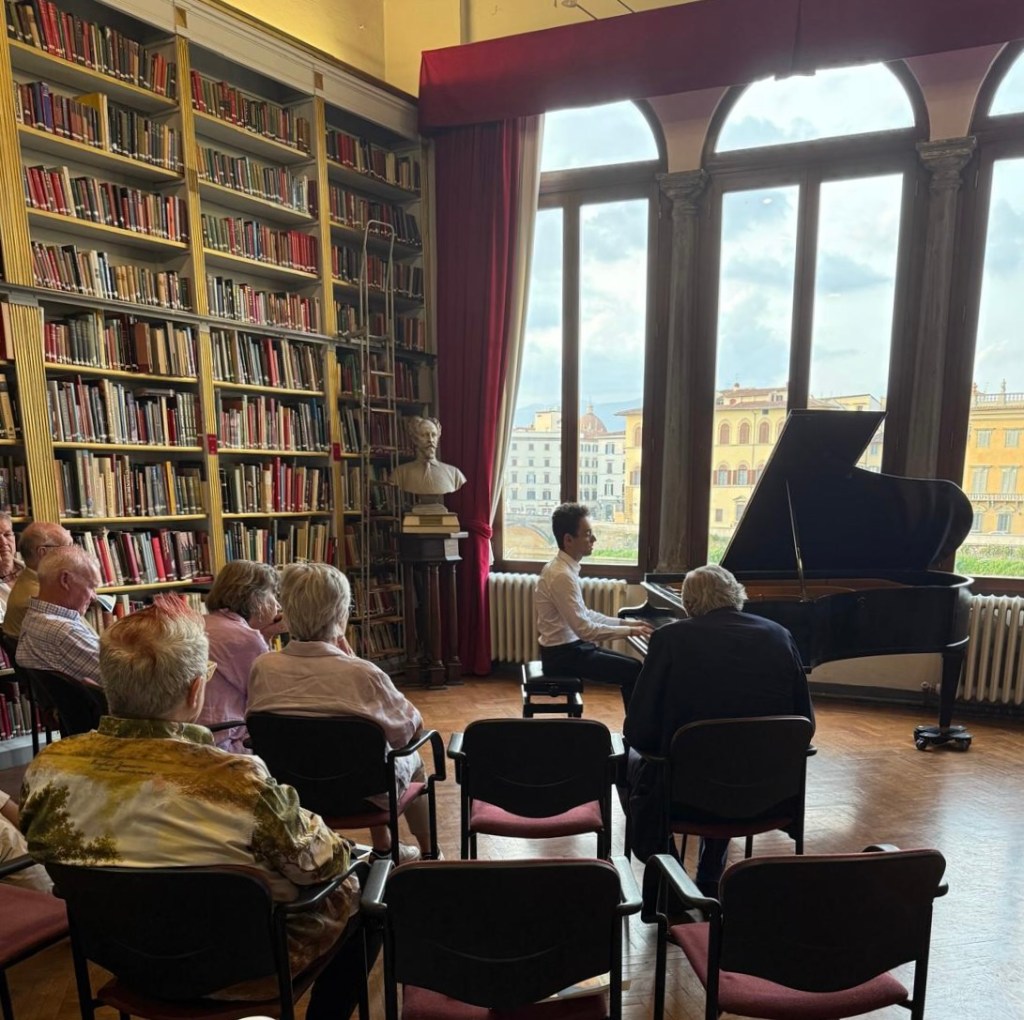
I was sorry to miss this recital but many friends and colleagues were there including Sir David Scholey who writes :’ Dear Christopher, Axel’s recital was superb and his introduction to the programme very much appreciated. He is a charming personality ‘
Jennifer Gammell,the director’s wife writes : ‘ Absolute magic, his hands how they just hovered over the keys so lightly and beautifully . A beautiful concert ‘
Alessio Masi writes : A wonderful concert!! He’s bravissimo . I met Sir David and Simon! Very nice people. Thank you so much for connecting me with them!
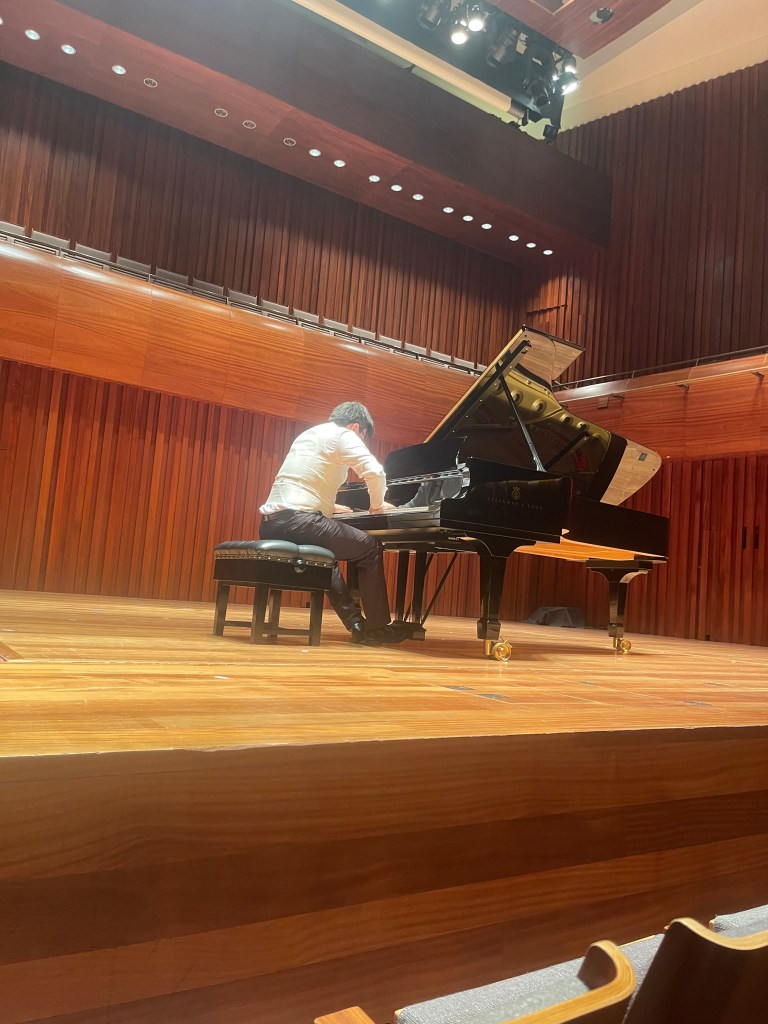
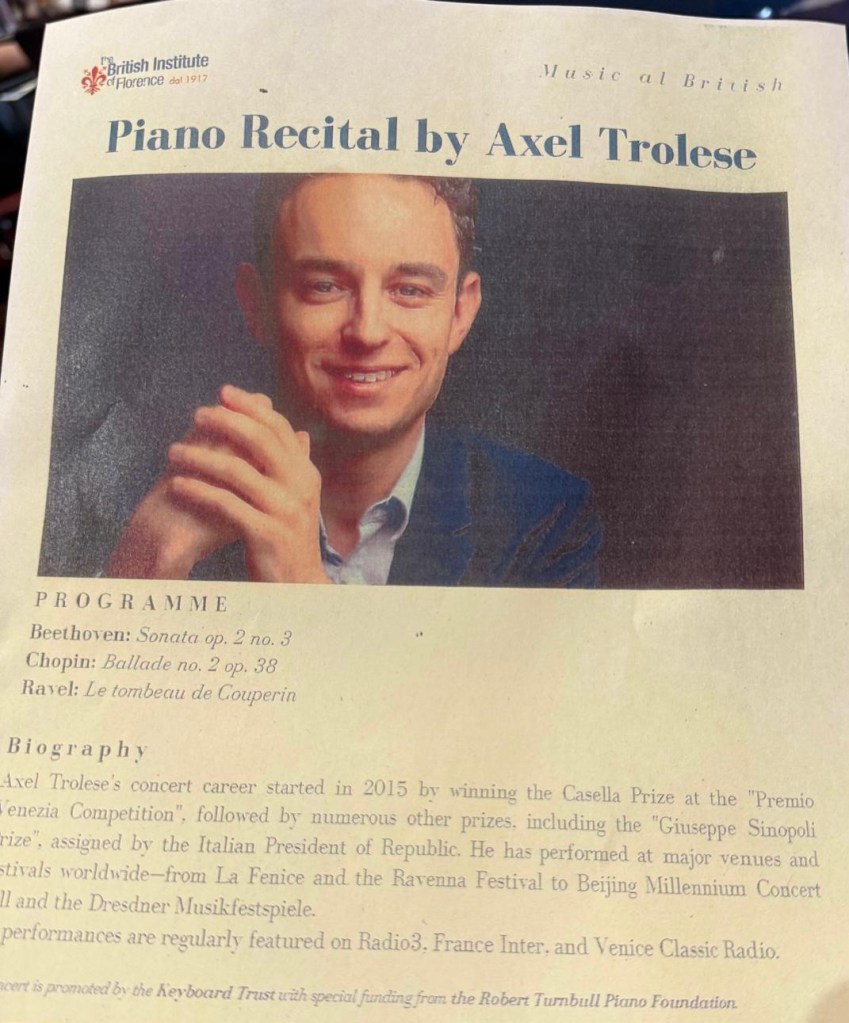
Axel Trolese‘s concert career started in 2015 by winning the Casella Prize at the “Premio Venezia Competition”, followed by numerous other prizes, including the “Giuseppe Sinopoli Prize”, assigned by the Italian President of Republic.
He has appeared in concerts in around the world, in concert halls and festivals such as Dresdner Musikfestspiele, Auditorium Parco della Musica, Beijing Millennium Concert Hall, Keyboard Trust London, Quirinal Palace, Ravenna Festival, Weimarhalle, La Fenice Theatre and Fazioli Concert Hall.
His concerts are regularly broadcasted by Radio3, France Inter and Venice Classic Radio.
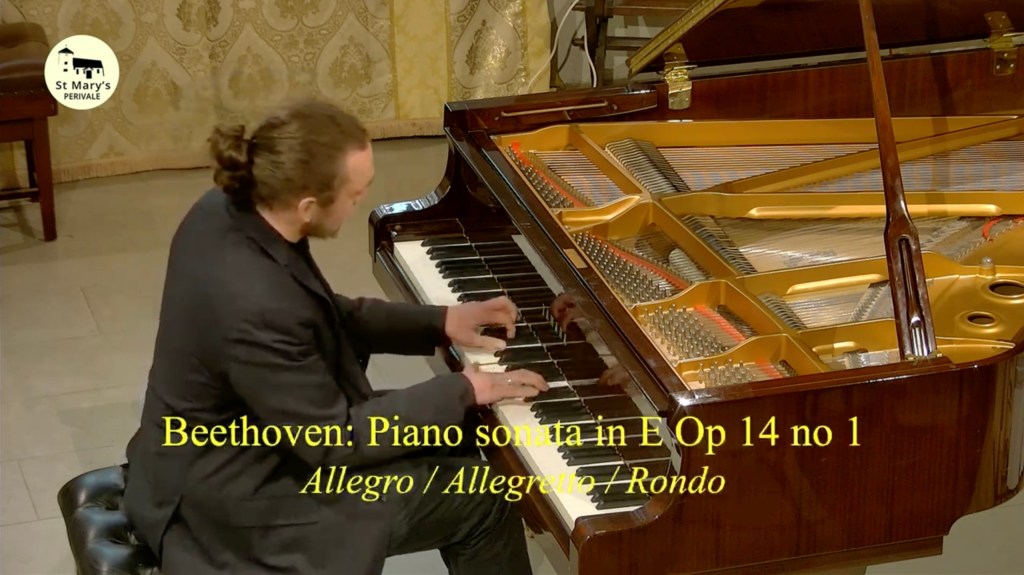
It was Richter on one of his first visits to London who played the two early Beethoven Sonatas op 14 – the ‘Hammerklavier’ was to come much later .Annie Fischer used to regularly play the G major op 14 n. 2. They are works with the simplicity of an earlier age but already with the eyes to the future. Serkin used to play op 2 n. 1 with his nervous energy and dynamic drive but above all respect for the score and with masterly musicianship.
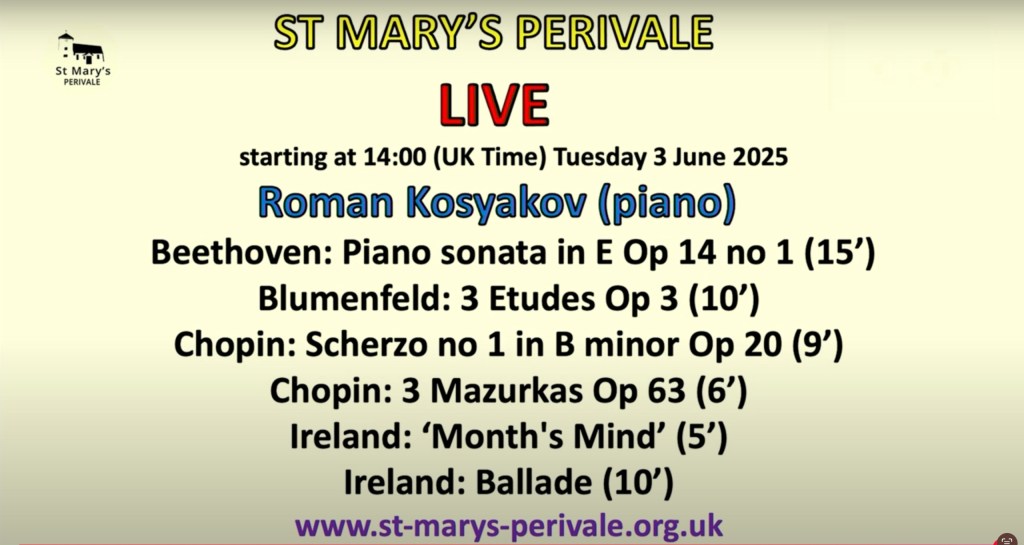
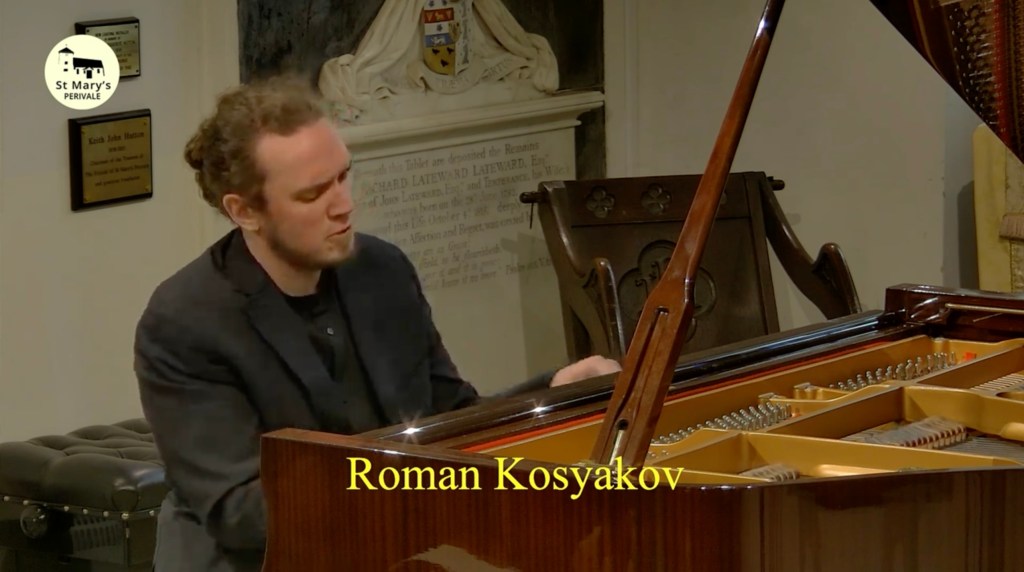
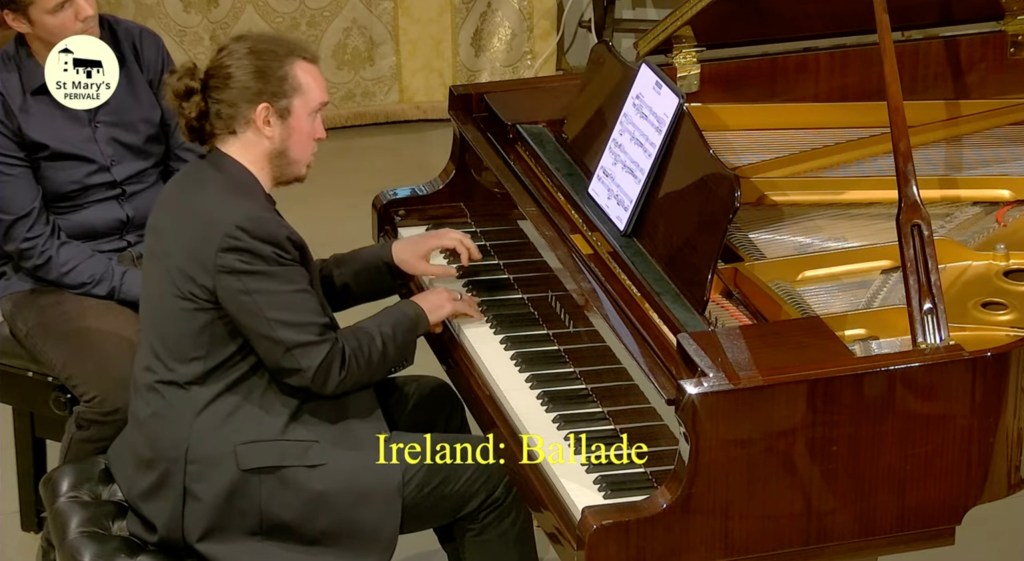
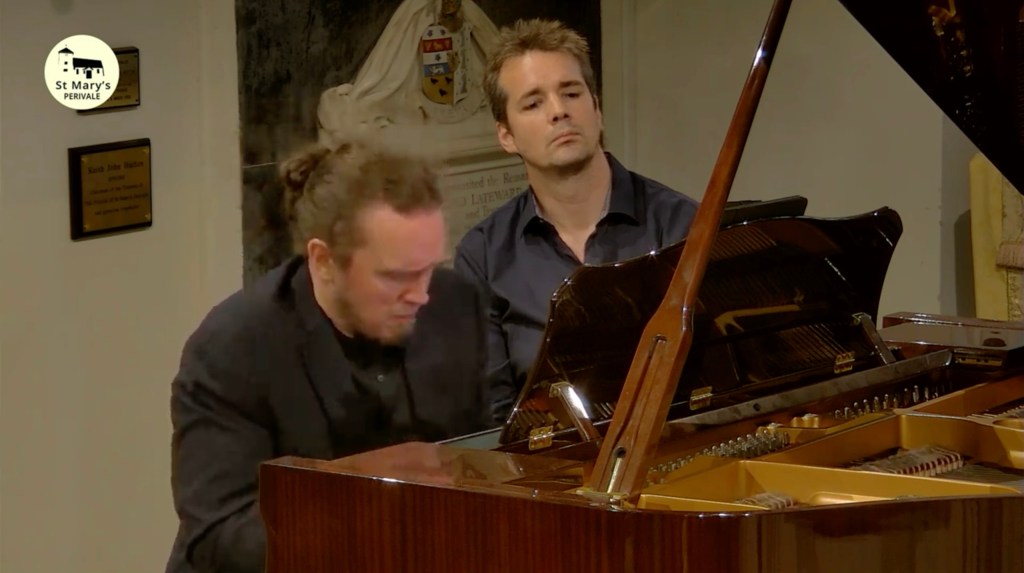
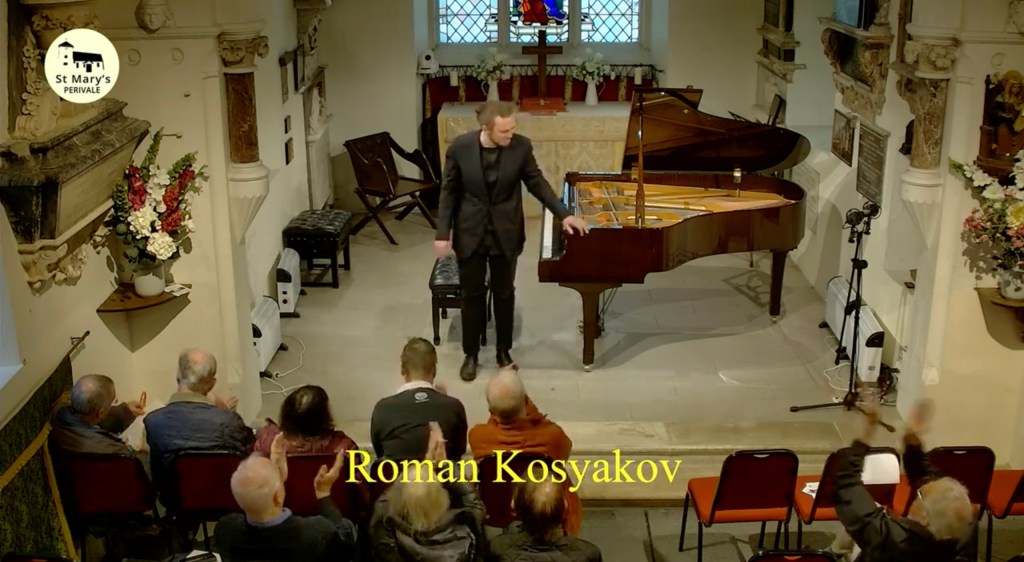
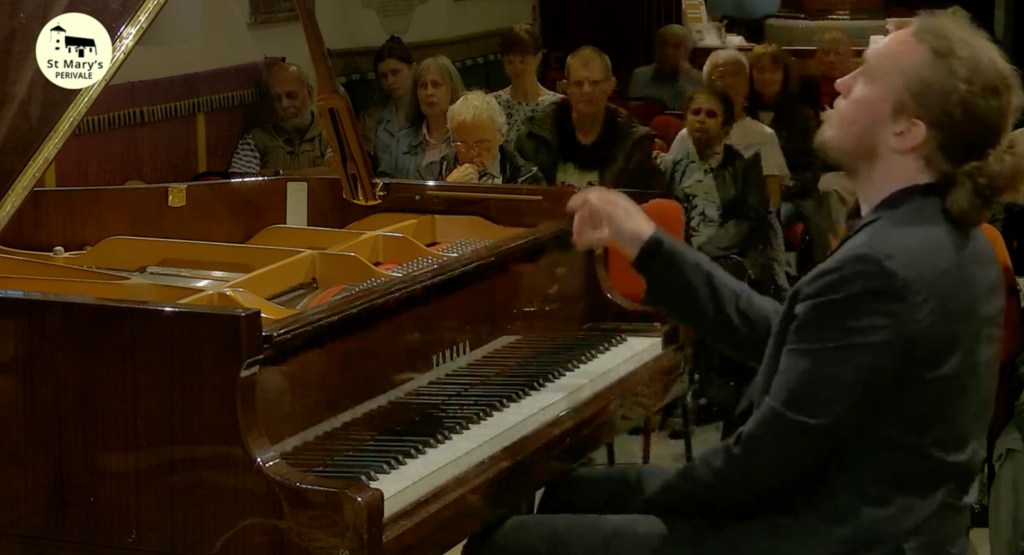
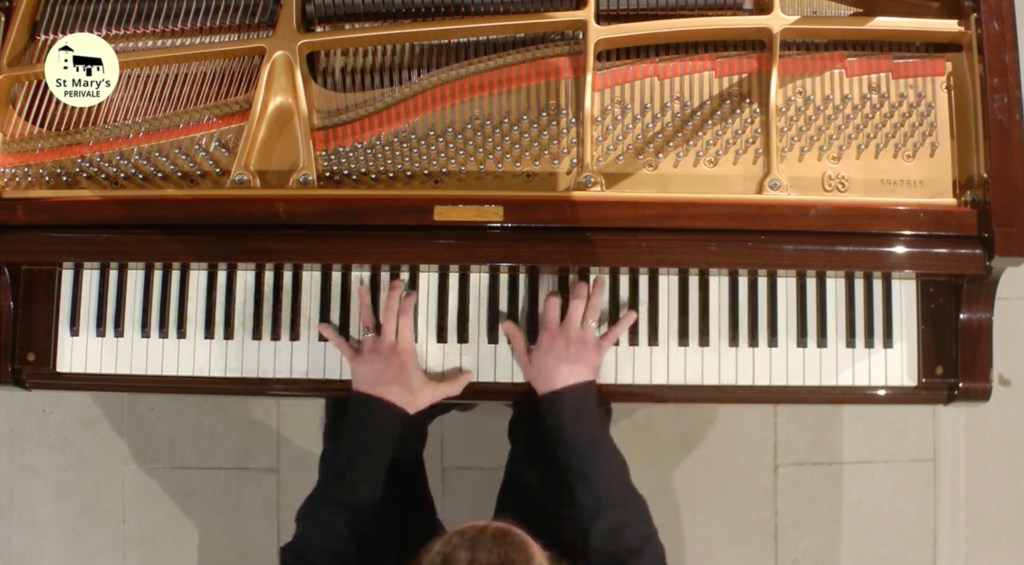
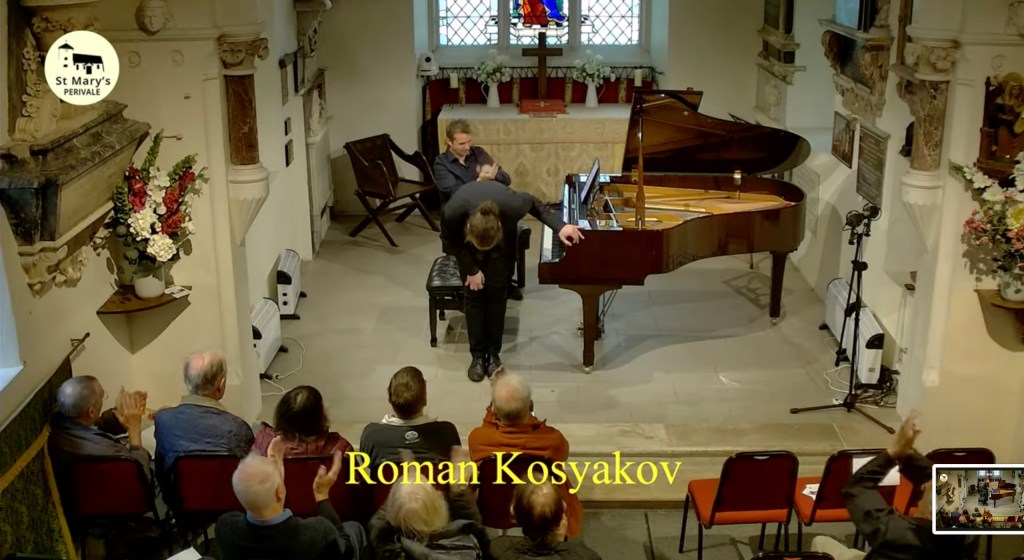
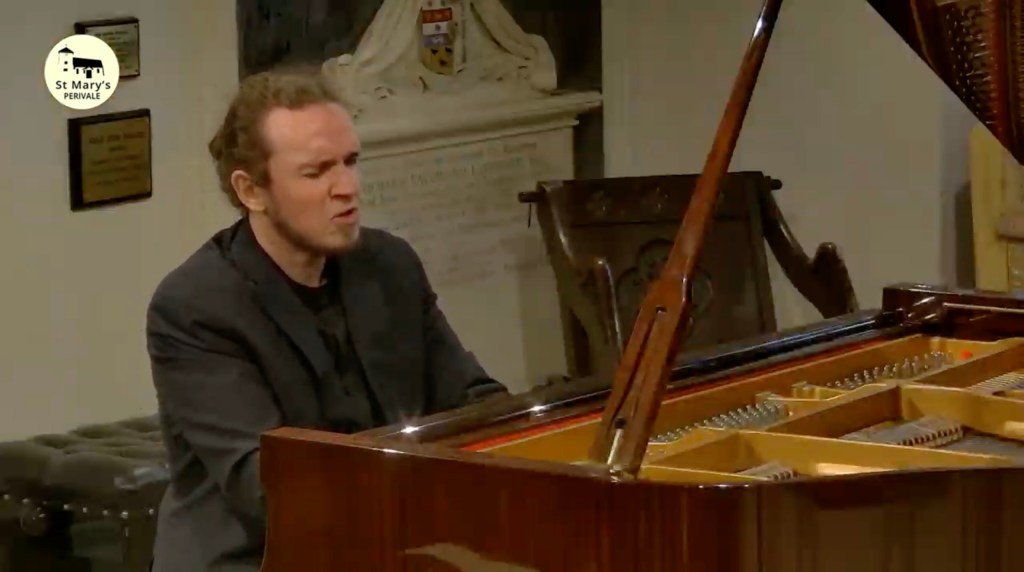
Roman joins this illustrious company today with a performance of a radiance and simplicity that belie the transcendental mastery that allows the music to flow with such seeming ease. Roman has hands that belong to the keys and with an elasticity formed at an early age can shape and colour the notes with such natural legato. His remarkable musicianship too means he can delve deeply into the score and inspire his imagination with the indications of the composer. There was a beautiful fluidity as the opening melody and accompaniment were interrupted by an impish germ or twitch that Beethoven’s genius transforms in so many extraordinary ways .The wonderful sense of balance where accompaniments became waves of moving harmonies never interfering but enhancing the glowing luminosity of the melodic line. A beautifully mellifluous ‘Allegretto’ played with glorious luxuriance, answered by what would have been called a Trio, of whispered beauty.The ‘Allegro comodo’ of the rondò was played with they hypnotic rhythmic drive as in the very first sonata op 2 n. 1. Here imbued with a melodious outpouring from the very first notes that gives such architectural shape recalling as it does the first movement. These are sonatas where the genius of Beethoven is already taking the Sonata from his teacher Haydn and pointing the way and transforming it as Schubert and Liszt were to do in the future.
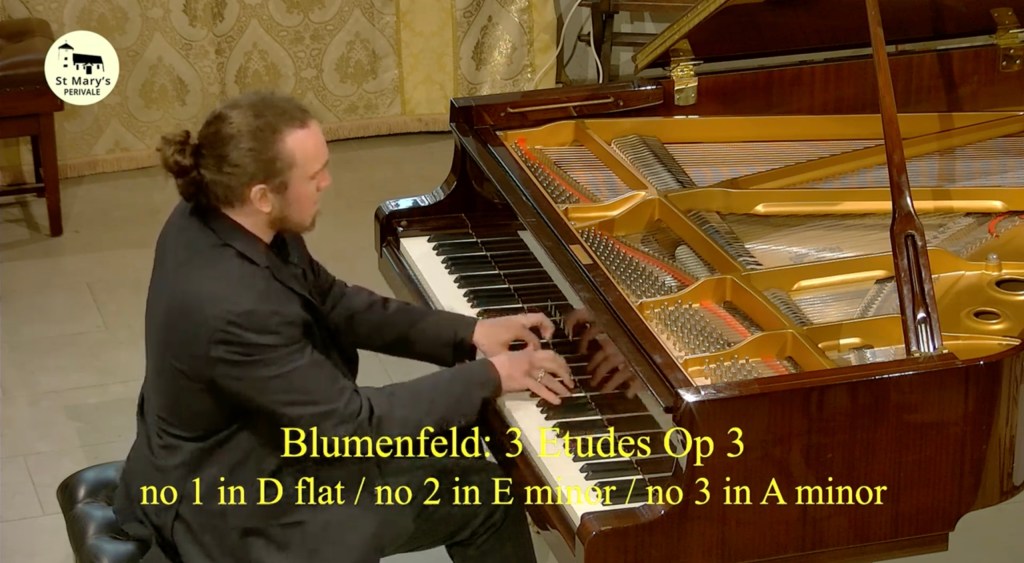
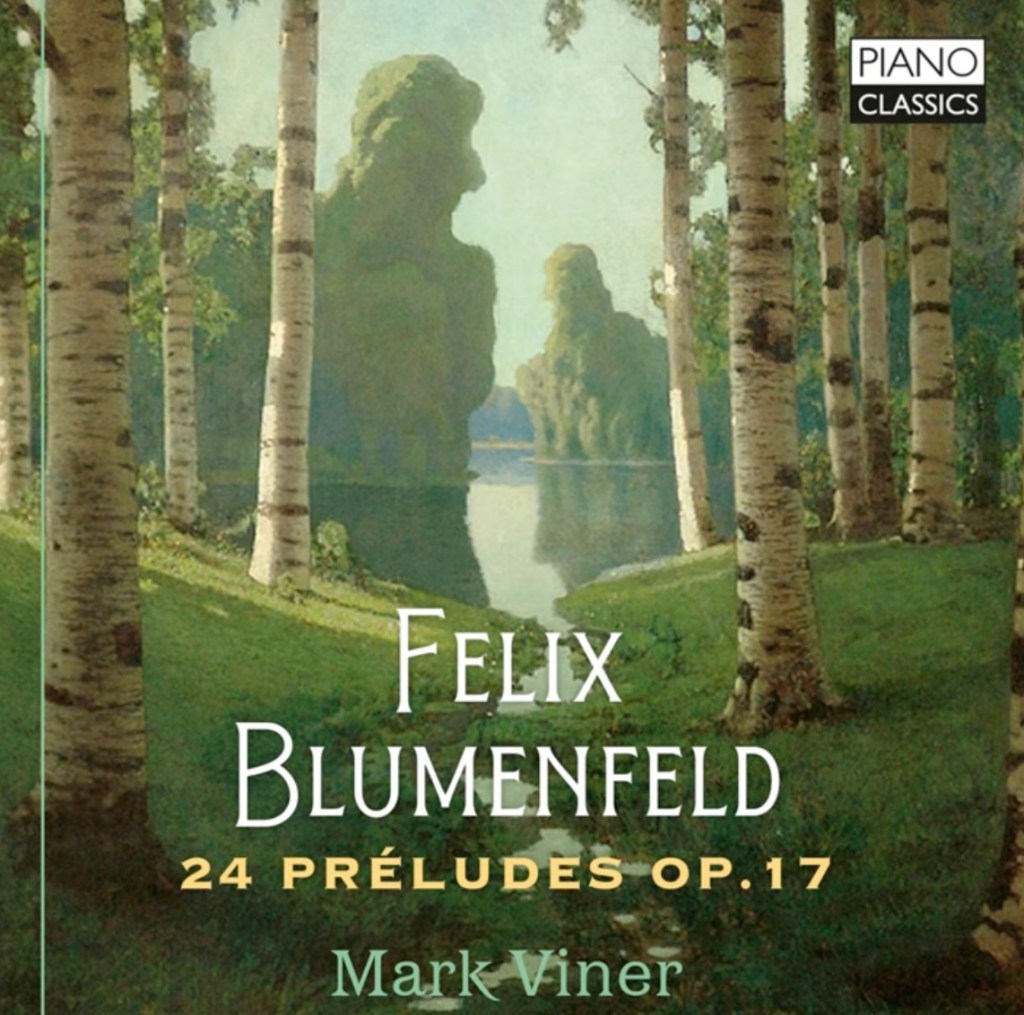
Felix Blumenfeld was the early teacher of Horowitz before he, like Chopin, took Paris by storm .Chopin was greeted by Schumann with ‘Hats off a genius!’ .Horowitz greeted by a major critic with ‘The greatest pianist alive or dead!’. Rubinstein was not too happy with that and a duel similar to Liszt and Thalberg seemed to be in the air!
Dr Mather had forgotten that Mark Viner has long been championing these great pianist /composers of the past, such as Alkan,Kalkbrenner,Thalberg,Chaminade and Blumenfeld.And his colleague Tyler Hay ,also from the class of Tessa Nicholson at the Purcell School ,has long been scouring the archives too.His latest foray into the 500 odd works laying on dusty shelves by Czerny, a pupil of Beethoven and teacher of Liszt, have come up trumps.
Sorry Roman but it is wonderful that you too will look for works that merit to be heard in public and not just studied in history books.That of course includes John Ireland whose piano concerto before or just after the war was championed by Moiseiwitch and Curzon.
Roman played these three studies with a beautiful fluidity and a delicate melodic line with a truly silver lining. A romantic outpouring of sounds in a period when pianist were not afraid of their emotions as in fact Horowitz would cry. I remember Cherkassky recounting that on a visit to his friend in New York ,Horowitz on hearing of the death of Jorge Bolet exclaimed : ‘Shura ,we are the only two left !’. Well there are still some up and coming disciples and it is nice to note that their home is in the Mecca of pianists that Dr Mather and his team have create in the no longer redundant church of St Mary’s.
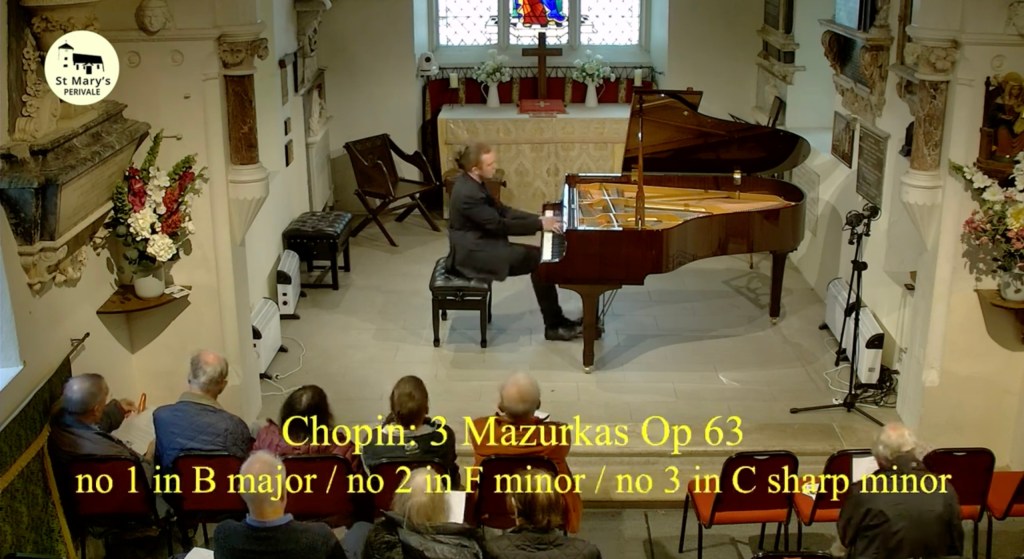
Three mazurkas, the last works that Chopin penned ,were played with extraordinary delicacy and beauty.The duet between the voices of the first and the most poignant of all Chopin’s melodies bewitching the senses in the second, and the strangely delicately whispered dance full of nostalgia of the third. Chopin had not indicated any dynamics in this last Mazurka but Roman has a soul that can dig deep into Chopin’s notes and find hidden secrets revealed to very few.
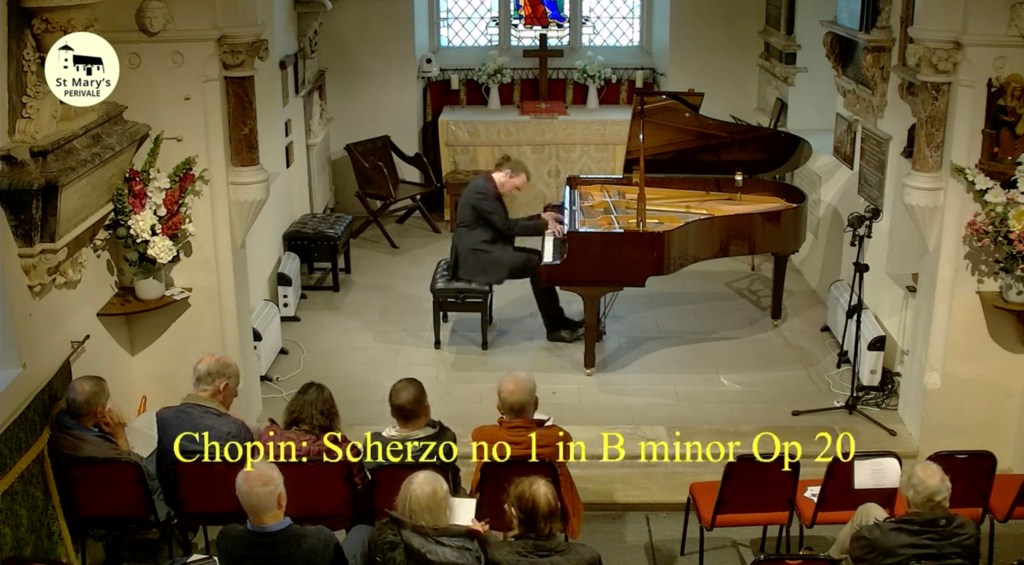
The first Scherzo usually played with a war cry where the two opening chords in Roman’s sensitive hands were an arresting opening to a romantic outpouring of dynamic drive and passionate beauty.The beautiful Christmas song that Chopin uses for the central episode was sung like a poet of the keyboard with the simple beauty and radiance of a traditional song. Too easy for children and too difficult for adults unless you are a poet!
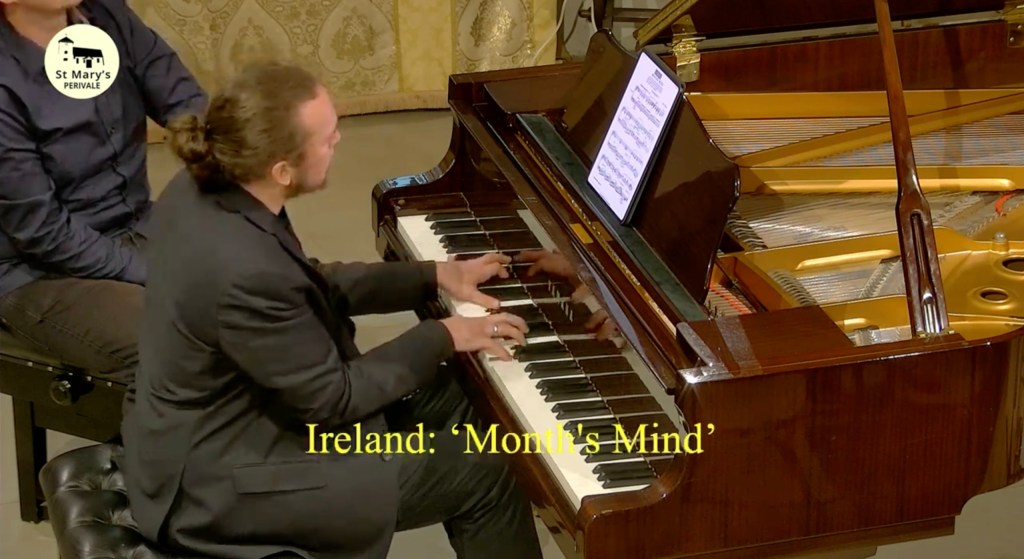
It was very interesting to hear two works by Ireland that I had not heard before. The rhapsodic beguiling unmistakable Englishness of ‘ Month’s Mind’,played with mastery, beauty and conviction.Maybe it was because another great pianist was looking over his shoulder.
The Ballade (1929) strangely written before the ‘Month’s Mind’ ( 1935) is a much longer, troubled and turbulent work that Roman played with burning conviction and masterly authority
Roman Kosyakov is a winner and a laureate of many international piano competitions: most recently he won the Third Prize and The Bridget Doolan Prize for the best performance of a piece by Mozart of The 12th Dublin International Piano Competition (Ireland, 2022); First Prize, Orchestra Prize and an Audience Prize of the XV Campillos International Piano Competition (Spain, 2021); Second Prize of the UK Piano Open International Piano Competition (UK, 2020); First Prize and the Orchestra Prize of the 14th Hastings International Piano Concerto Competition (UK, 2018), Gold Prize of the 3 rd Manhattan International Music Competition (USA, 2018); First Prize and the audience prize of the 10th Sheepdrove Piano Competition (UK, 2018). Roman was born into a musical family and made his debut with orchestra at the age of 12 with Mozart Concerto No.23 in A Major. In 2012, he graduated from the Central Music School in Moscow where he studied with Farida Nurizade and then in 2017 from the Tchaikovsky Moscow Conservatoire with Vladimir Ovchinnikov. From 2017-2021, he studied at the Royal Birmingham Conservatoire on a full scholarship with Pascal Nemirovski.
Roman’s performance career includes engagements in the most important venues and festivals across the UK, USA, and Europe such as Kings Place, St James Piccadilly, St Mary’s Perivale and Cadogan Hall in London, Bridgewater Hall in Manchester, Sursa Performance Hall in Ball State University (Muncie, IN, USA), Teatro Juan Bravo (Segovia, Spain), Festivals in Leamington, Battle, Barrow, Furness Classical, North Norfolk, West Meon and European Chamber Academy in Leipzig. He has worked with The Royal Philharmonic, Hastings Philharmonic, English Symphony, Bangor University, and Basingstoke orchestras.
a very distinguished page turner and colleague enjoying Roman’s superb performance
In January 2019 Roman received “The Royal Birmingham Conservatoire- Silver Medal” by the Musician’s Company in the UK, became a member of Musician’s Company Yeomen Young Artists’ Programme and has been invited to represent and launch the 2019 Hastings International Piano Concerto Competition at House of Commons in London. Roman is a winner of Denis Matthews Memorial Trust award, Kirckman Concert Society Artist and a scholar of the Drake Calleja Trust. In Summer 2019 Roman recorded a debut CD for “Naxos” with works by Liszt which was released in late 2020.
John Ireland (1879 – 1962 )at Rock Mill Born near Manchester, studied and taught at the Royal College of Music, lived in Chelsea, London for over 50 years and died in a converted windmill in Sussex. Ireland’s foremost inspirations were the ancient landscapes of the Channel Islands, Dorset and Sussex and the writings of pagan mystic Arthur Machen; the composer recounting that he himself had experienced a ‘vision’ on the South Downs. John Ireland was born in Bowdon, near Manchester, England on 13th August 1879. His parents were literary people and knew many writers of the day, including Emerson. Ireland entered the newly-established Royal College of Music in London at the age of fourteen, lost both his parents shortly after, and had to make his own way as an orphaned teenager, studying piano, organ and composition. The last was under Sir Charles Stanford, who taught many of the English composers who emerged at the end of the 19th century: Ralph Vaughan Williams, Gustav Holst, Frank Bridge (born in the same year as Ireland), Eugene Goossens, Arthur Bliss, Herbert Howells, George Butterworth, and many others. Ireland destroyed almost all his student works and juvenilia (the beautiful Sextet for clarinet, horn and string quartet being one of the few works which he permitted to be published, and then only towards the end of his life) and emerged as a celebrated composer towards the end of World War I when his Violin Sonata No.2 in A minor brought him overnight fame. From then until his death in 1962 he led an outwardly uneventful life combining composition, composition teaching at the Royal College (where his pupils included Benjamin Britten and E. J. Moeran), and his position as organist and choirmaster at St. Luke’s Church, Chelsea, in London. Ireland’s music belongs to the school of ‘English Impressionism’. Having been brought up on the German classics, notably Beethoven and Brahms, he was strongly influenced in his twenties and thirties by the music of Debussy, Ravel, and the early works of Stravinsky and Bartók. While many of his contemporaries, such as Vaughan Williams and Holst, developed a language strongly characterised by English folk song, Ireland evolved a more complex harmonic style closer to the French and Russian models. Like Fauré, he preferred the intimate forms of chamber music, song, and piano music to the larger orchestral and choral canvases, He wrote neither symphony (unlike his friend Arnold Bax who wrote seven) nor opera and only one cantata, These Things Shall Be, but his Piano Concerto is arguably the best to have been written by an Englishman, and is a work of intense emotion and nostalgic feeling. Ireland was strongly influenced by English poetry. His settings of A. E. Housman, Thomas Hardy, Christina Rossetti, John Masefield and Rupert Brooke are among the best known of his works. He was also highly susceptible to the spirit of place. He lived for many years in London’s Chelsea (Chelsea Reach is a depiction in the form of a barcarole of that great sweep of the Thames as it passes along the Embankment to the west of the Houses of Parliament). He was also devoted to the Channel Islands of Guernsey and Jersey. Their location between England and France must have seemed appropriate to his musical orientation, but more importantly he found there traces of prehistoric pagan ritual to which he had originally been drawn through the writings of the Welsh writer Arthur Machen. But perhaps his greatest love was for the English county of Sussex, a landscape of rolling downs and (in Ireland’s day) isolated villages, including Amberley whose ‘Wild Brooks’ – streams coursing through fields – gave him the inspiration for one of the most brilliant of his piano pieces. Ireland eventually retired to Sussex in 1953 when he bought a converted windmill, Rock Mill, underneath the Downs. He died there on 12th June 1962. Ireland’s music is intensely personal in style and has always attracted a devoted following among discerning music lovers. As well as his Piano Concerto, previously mentioned, works that continue to be frequently performed and recorded are: A Downland Suite and Concertino Pastorale for strings, The Overlanders, A London Overture, Mai-Dun, and TheForgotten Rite for orchestra, sonatas for cello and piano, violin and piano, and clarinet and piano, The Holy Boy, Sea Fever and his beautiful motet Greater Love (to name but a few). His hymn tune My Song is Love Unknown is sung in churches throughout the English speaking world.
From Stanford, Ireland inherited a thorough knowledge of the music of Beethoven ,Brahms and other German classical composers, but as a young man he was also strongly influenced by Debussy and Ravel as well as by the earlier works of Stravinsky and Bartók. From these influences, he developed his own brand of “English Impressionism “, related more closely to French and Russian models than to the folk-song style then prevailing in English music.
Like most other Impressionist composers, Ireland favoured small forms and wrote neither symphonies nor operas, although his Piano Concerto is considered among the best works composed by an Englishman. Piano music :
M to SMai-Dun, A Symphonic Rhapsody, arranged for piano four hands (1931)Merry Andrew (1919)Month’s Mind (1935)On a Birthday Morning (1922)Prelude in E-flat major (1924)Preludes for Piano (1913–15)The UndertoneObsessionThe Holy BoyFire of SpringRhapsody (1915)Sarnia: An Island Sequence(1940–41)Le CatiorocIn a May MorningSong of the SpringtidesA Sea Idyll (1960)Soliloquy (1922)Sonata in E minor (1920; premiered by Frederic Lamondon 12 June 1920, the only time he ever played it)[42][43]Sonatina (1926–27)Spring Will Not Wait (1928)Summer Evening (1920)
Felix Mikhailovich Blumenfeld (1863-1931) was a russian/soviet composer, pianist and conductor. He was born in Kirovograd (in present-day Ukraine), Kherson Governorate, Russian Empire, the son of Mikhail Frantsevich Blumenfeld, of Austrian Jewish origin, and the Maria Szymanowska. Blumenfeld studied with Gustav Neuhaus, married to his older sister. Then he studied composition at the St. Petersburg Conservatory under Nikolai Rimsky-Korsakov and piano under Fedor Stein between 1881 and 1885. He then taught piano there himself from 1885 until 1918, whilst also serving as conductor of the Mariinsky Theatre until 1911. The Mariinsky saw the premieres of the operas composed by his mentor Rimsky-Korsakov. He was also the conductor at the Russian premiere of Wagner’s opera Tristan und Isolde. In 1908, he conducted the Paris premiere of Modest Mussorgsky’s opera Boris Godunov. From 1918 to 1922, he was the director of the Music-drama school of Mykola Lysenko in Kiev, where, amongst others, Vladimir Horowitz was a pupil in his masterclasses. He returned to the Moscow Conservatory in 1922, teaching there until his death. Other famous pupils of his include Simon Barere, Maria Yudina, Nathan Perelman, Vladimir Belov, Anatole Kitain and Maria Grinberg. He died in Moscow. As a pianist, he played many of the compositions of his Russian contemporaries. His own compositions, which showed the influence of Frédéric Chopin and Pyotr Ilyich Tchaikovsky, include a symphony, numerous pieces for solo piano, an Allegro de Concert for piano and orchestra, and lieder. His virtuoso pieces for piano in particular have enjoyed something of a renaissance in recent years. He was the uncle of Heinrich Neuhaus and first cousin, once removed of Karol Szymanowski (Felix’s father and Karol’s father, Stanislaw Szymanowski, were cousins).
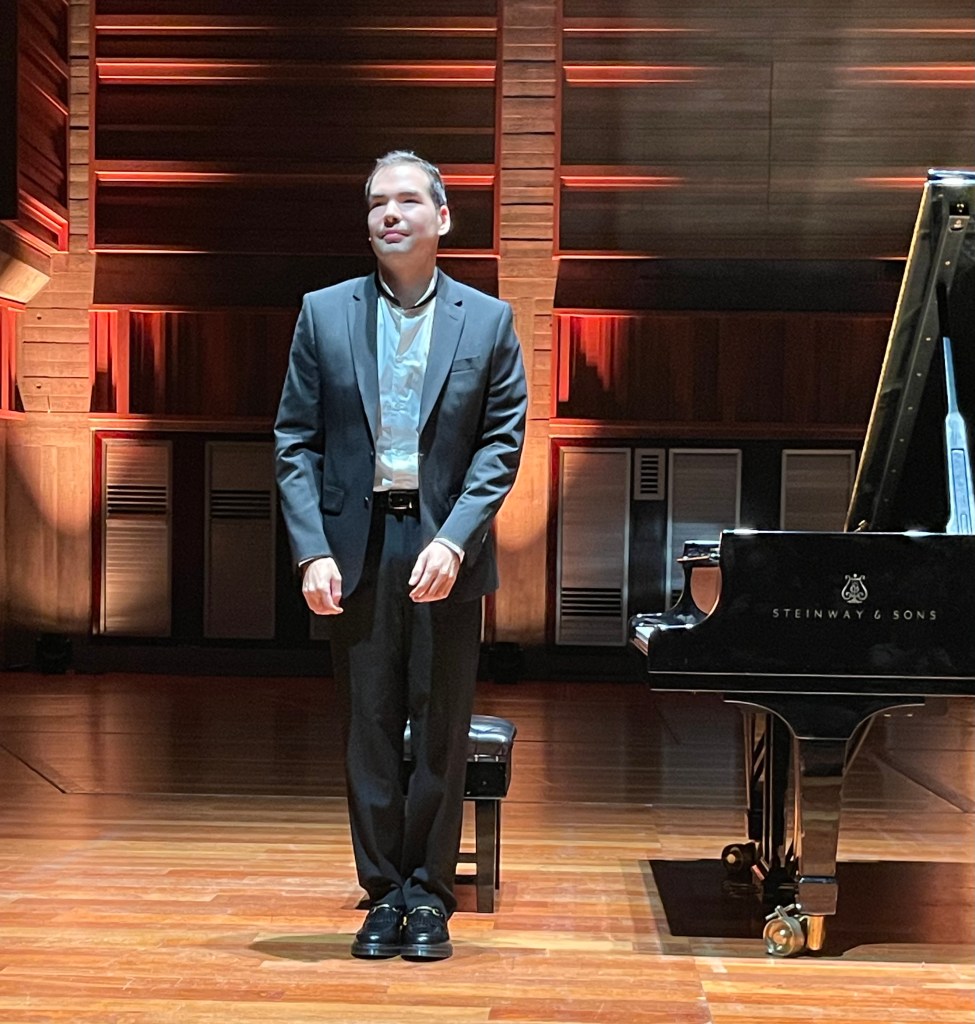
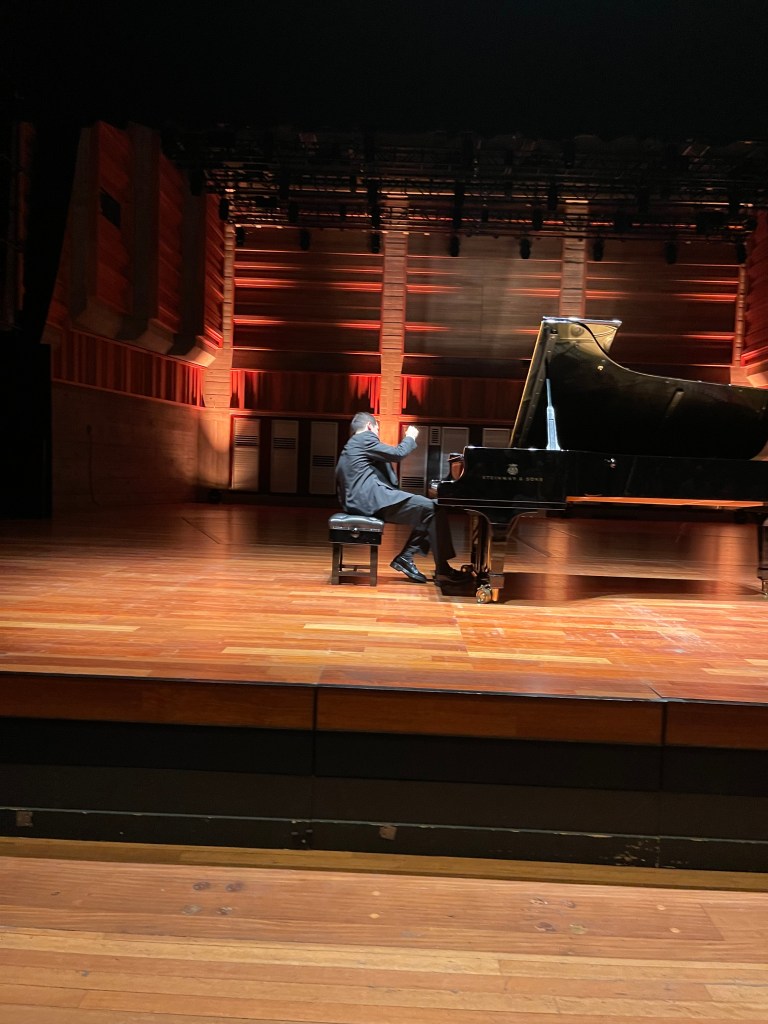
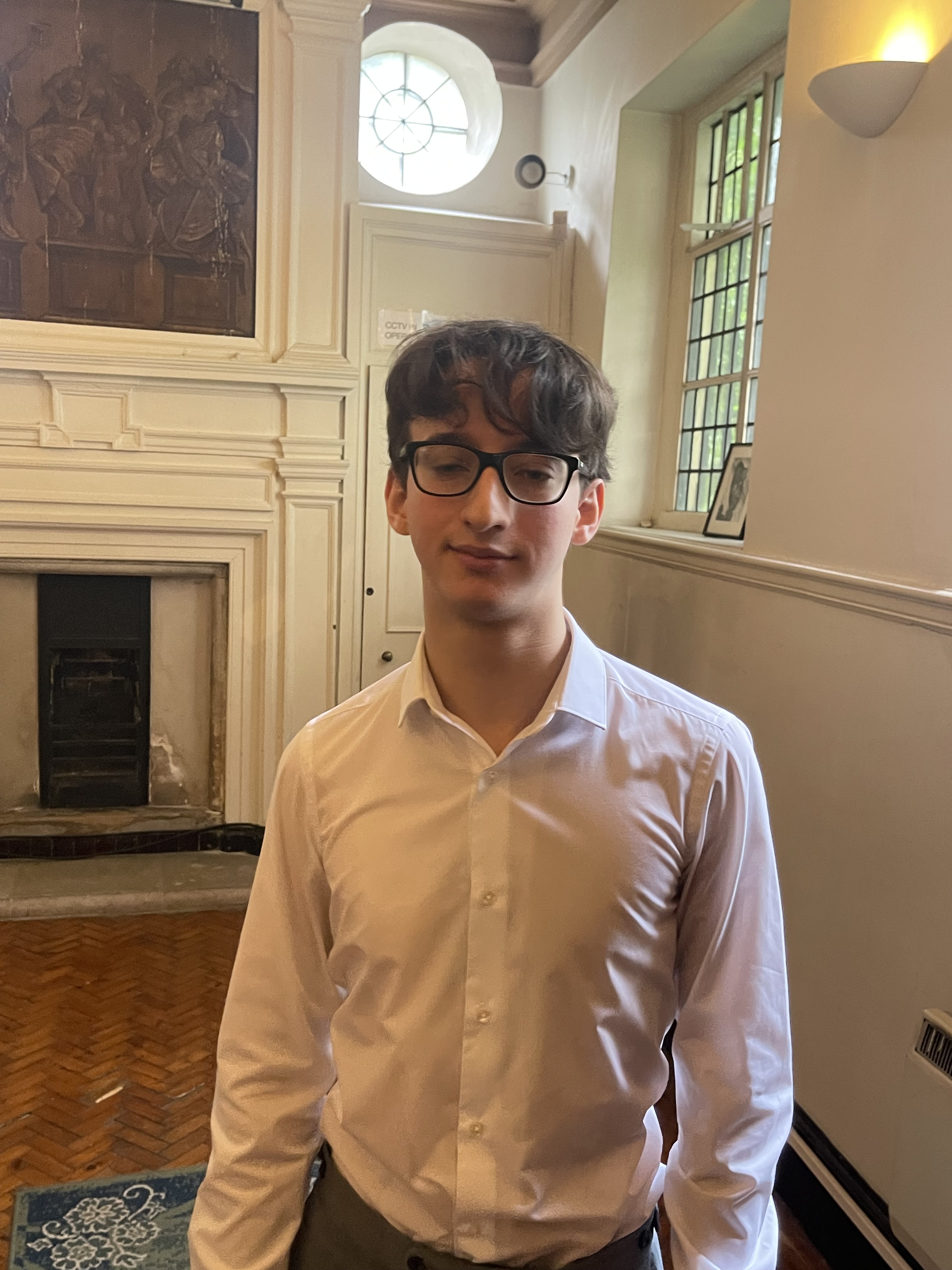
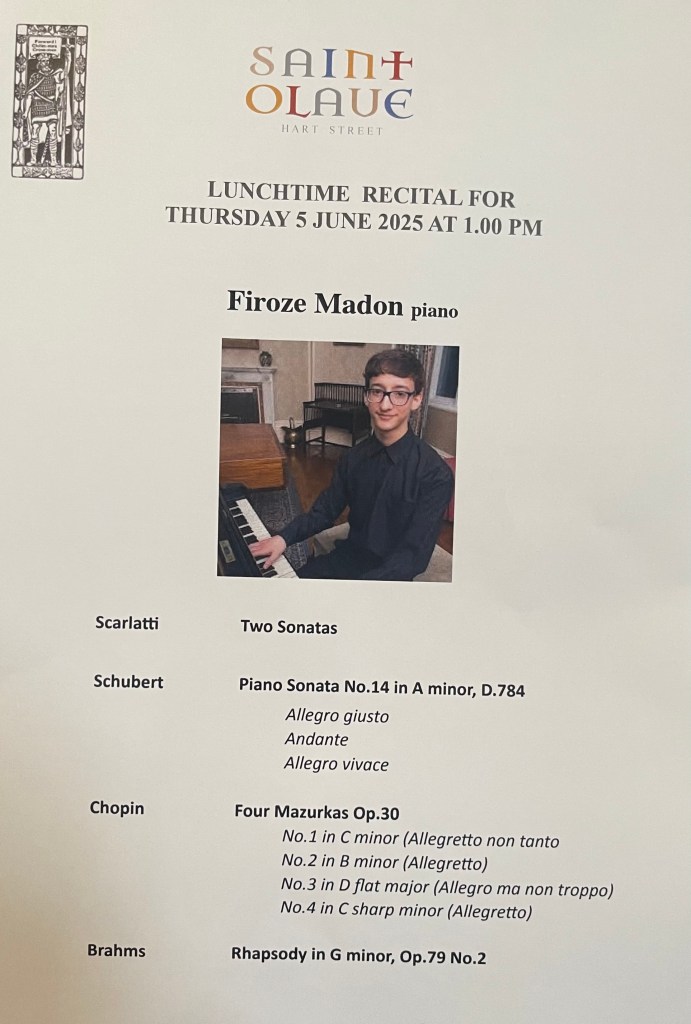
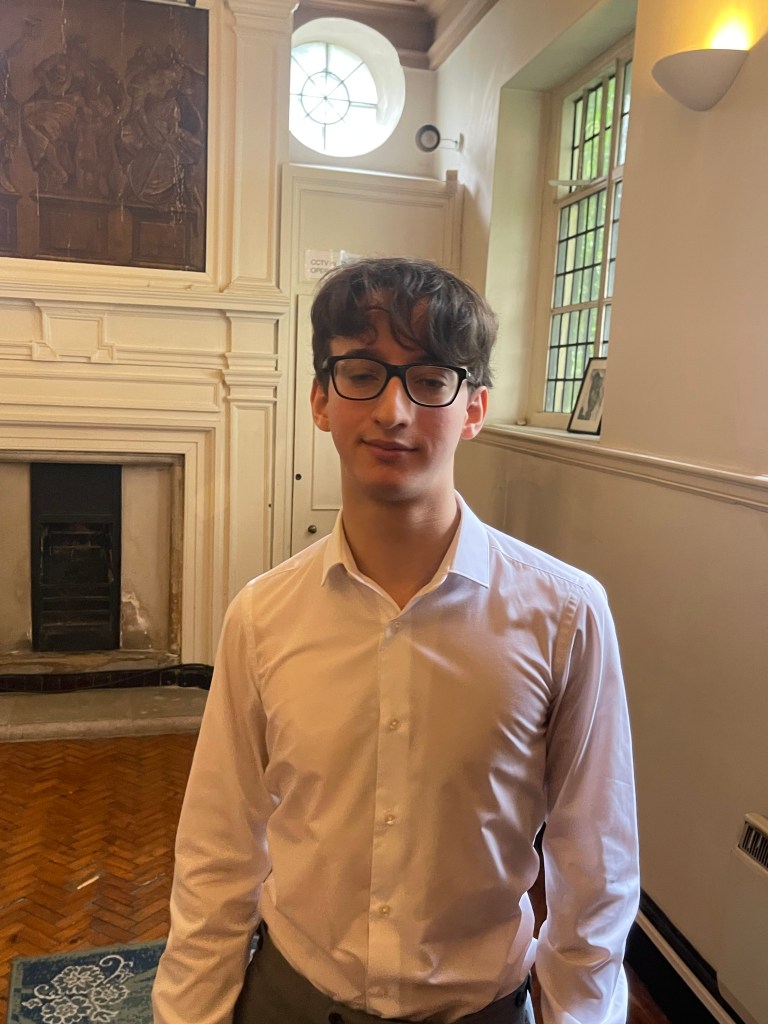
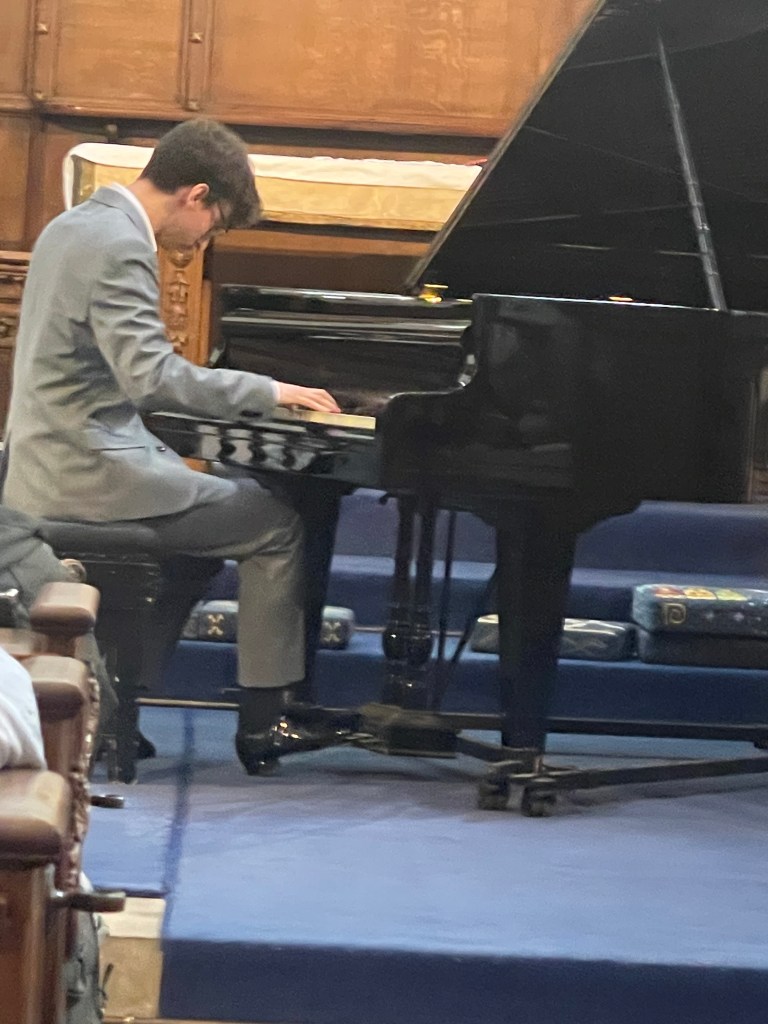
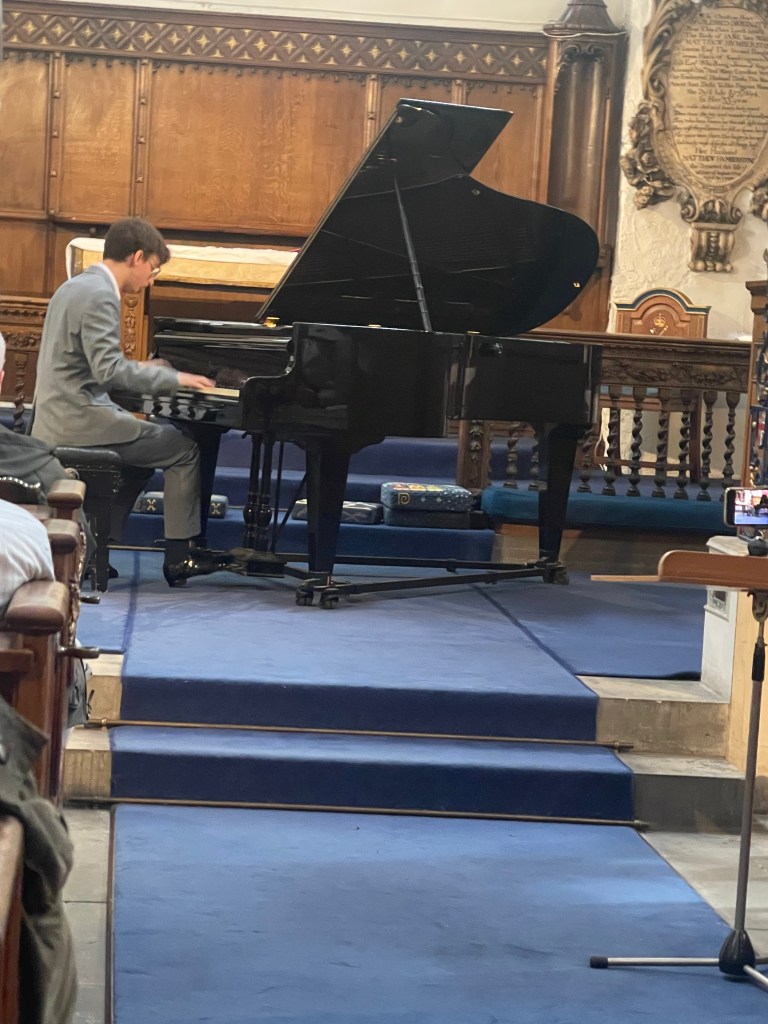
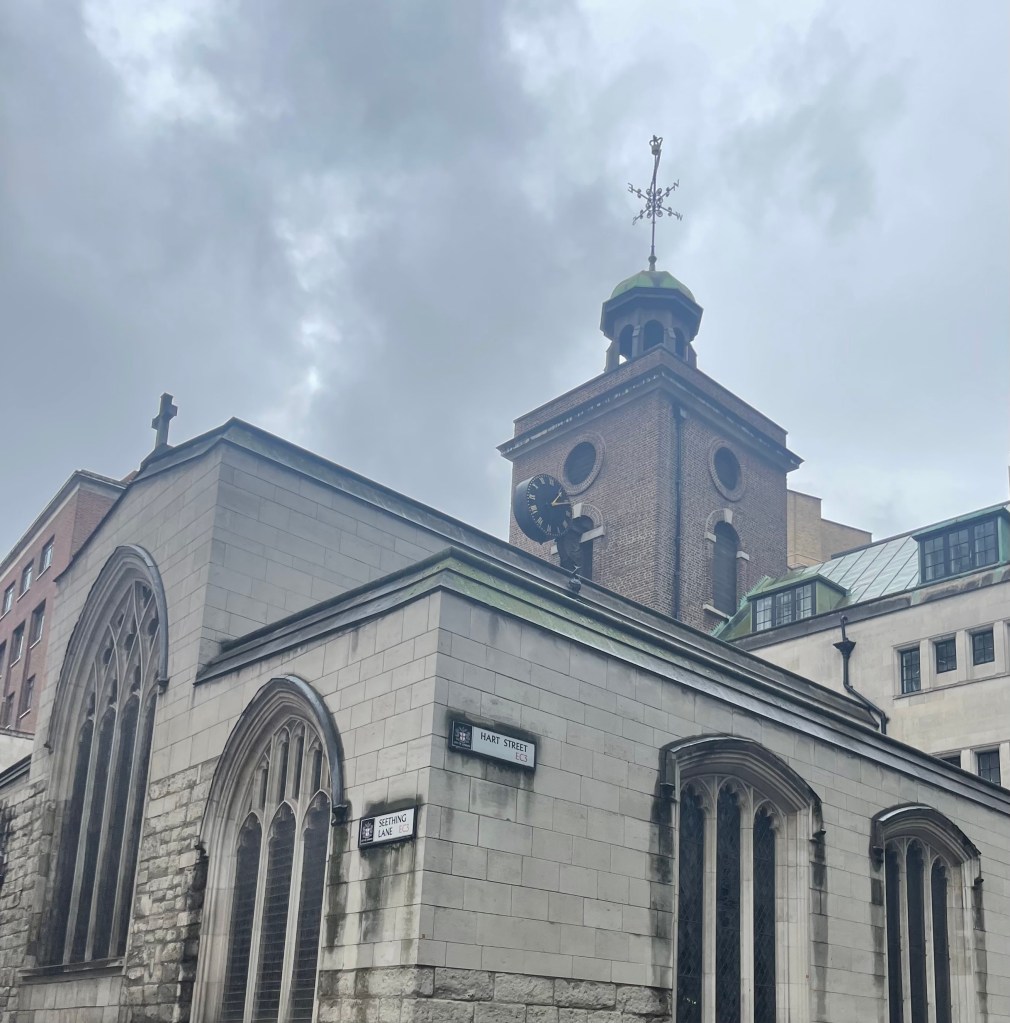
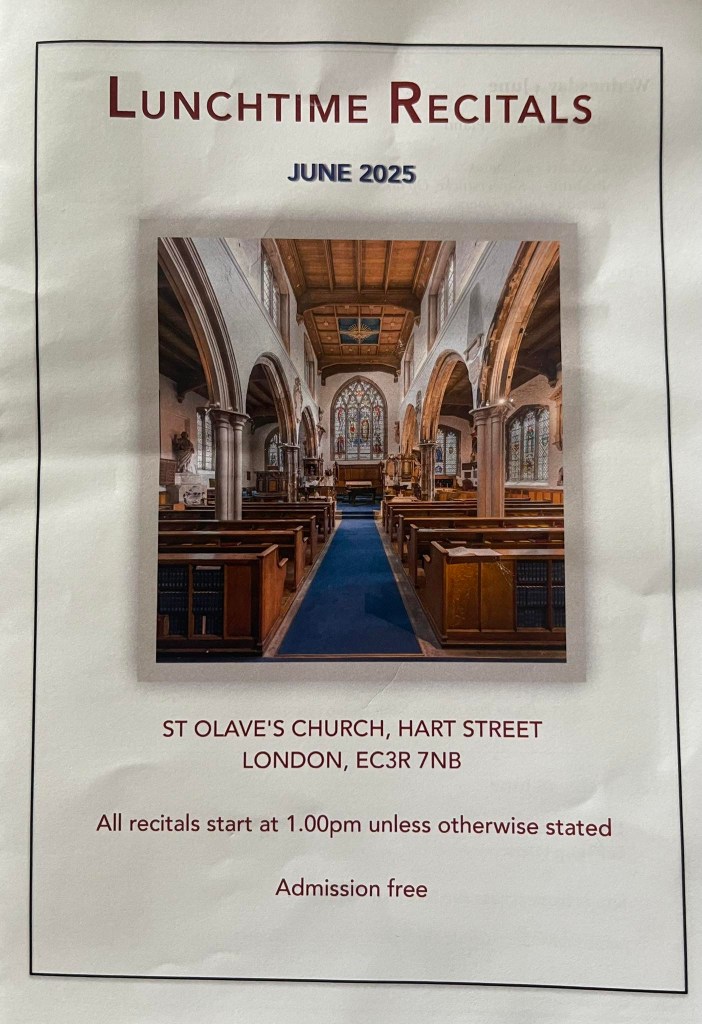
Firoze Madon at St Olave’s with playing of simple pure musicianship and mastery.
Two Scarlatti sonatas of the refined nobility and scintillating virtuosity of their age. His innate musicianship imbuing these gems with colouring and phrasing of extraordinary sensitivity and respect. The E major K 380 was played in a very measured aristocratic manner not in the traditional way but with a non legato touch and differing levels of sound with some beautifully delicate phrasing. The lesser heard F minor K 519 was a real discovery with its dynamic rhythmic drive and horn like imitations of invigorating energy .
Schubert’s A minor sonata the smaller in length of the other two, but one of the most beautiful creations that he was to write.
I remember Gilels playing it in a half empty Royal Festival Hall with a programme of Schubert and Shostakovich that was evidently not box office even when played by Gilels. The ravishing beauty of that recital was only to be matched by a competitor in the first round of the Leeds called Radu Lupu !
A work all too rarely heard in the concert hall these days where cycles or complete works are the norm.
So it was refreshing to be reassured that Firoze was playing this gem.
A gem played on a ‘casserole’ is indeed a challenge for a young artist about to compete in the Clara Haskil competition in Vevey . A competition not for Olympic champions but for imaginative poets as Magdalene Ho, also from the class of Dmitri Alexeev, has demonstrated, taking the world by storm with poetry and imagination instead of muscle and brawn!
Firoze from the opening notes showed his credentials playing with real weight digging deep into the notes to find the beauty that is hidden within . A poetic understanding but also an architectural one that gave strength to all he did . There was a subtle haunting beauty as Schubert shadows the melodic line with glistening gold. Dramatic outbursts played near the keys that allowed for a sumptuous rich orchestral sound without ever loosing the rhythmic drive.There was a constant yearning to the rhythm of the first movement that captivated our imagination that like a great wave was allowed to flow with such emotional potency. A whispered entry to the development that lead to a passionate outburst that Schubert immediately turns into song . And what a song in Feroze’s delicate hands, with a magic carpet that took us to the recapitulation where Schubert’s sublime mellifluous outpouring could be savoured with ever more poignancy.
Beautiful long lines to the Andante with it’s ominous interruptions played with such mastery on this not easy piano to control.There was passion too which only added to the sublime celestial sounds that Feroze was able to extract with mastery and poetic imagination .
The Allegro vivace ,Feroze had envisioned like the wind over the graves of Chopins B flat minor Sonata. But here Schubert’s miraculous melodic invention intervened as these graves came to life with a beauty and purity that was indeed of another world . Remarkable technical finesse but always at the service of the music with a sense of architectural line and poetic invention .
The four mazurkas op 30 by Chopin were played with great style and imagination . The first with a freedom and fantasy where the acciaccatura’s were played not as a pianist but as a singer, each time different words or meaning. A great sense of dance to the second with a beguiling rhythmic lilt . The deep tolling bell on the third bursting into sumptuous life as Chopin covered this canon with flowers that Feroze allowed to blossom as an elegant waltz before being reminded that this was so much more meaningful for the enforsed emigré looking on from afar. A beautiful dream of bewilderment opened the last of these four gems played with subtle colouring and an extraordinary poignancy, before bursting into bucolic life, but always tinged with a nostalgia and almost brooding that was to take us to the final whispered descent into the depths of the piano, where Chopin’s heart is left to glow with poetic radiance. It was indeed this final E that touched deeply this small but appreciative audience.
Brahms Rhapsody in G minor finished this lunchtime recital with dynamic drive and rich orchestral sounds. A passionate outpouring of yearning and insistent anguish right to the final whispered notes, like Chopin, except Brahms adds an assertive final two chords as Beethoven would have done and Chopin never !
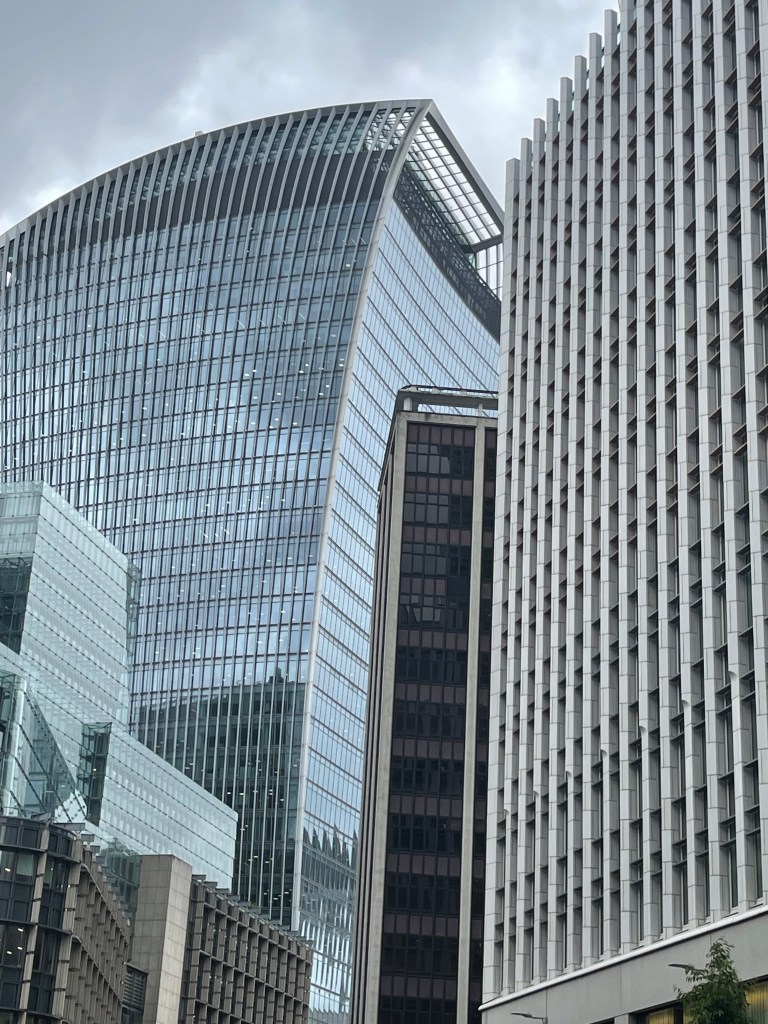
Dwarfed by big brother showing us what character London once possessed saving our heritage !!!am I in London?
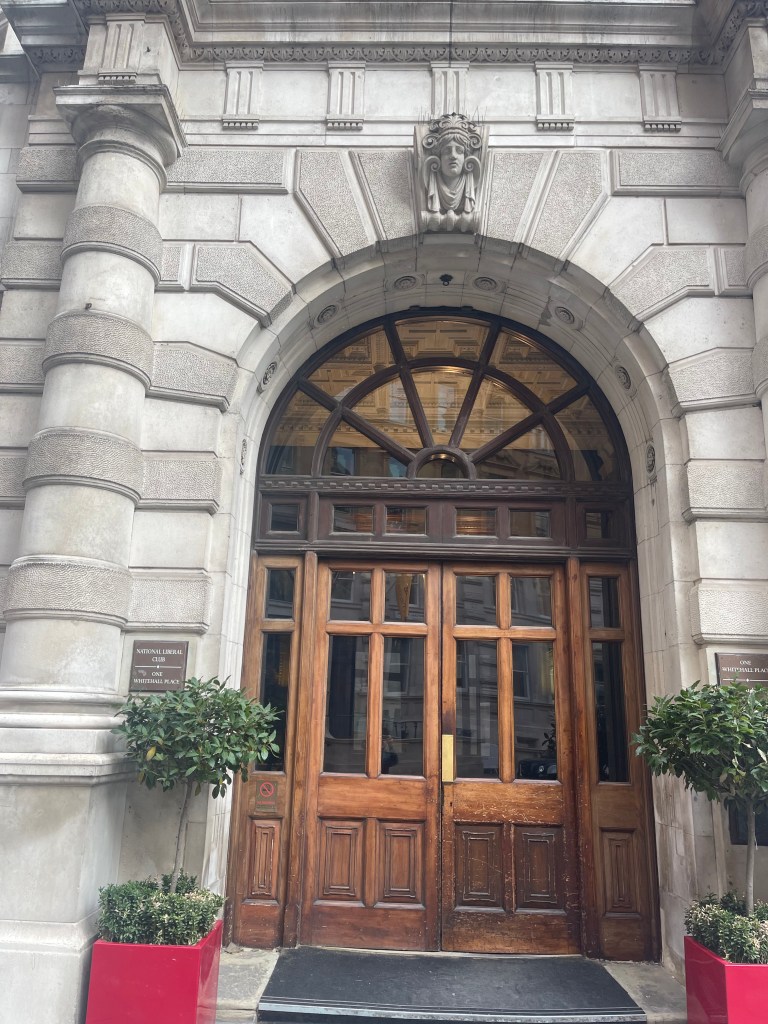
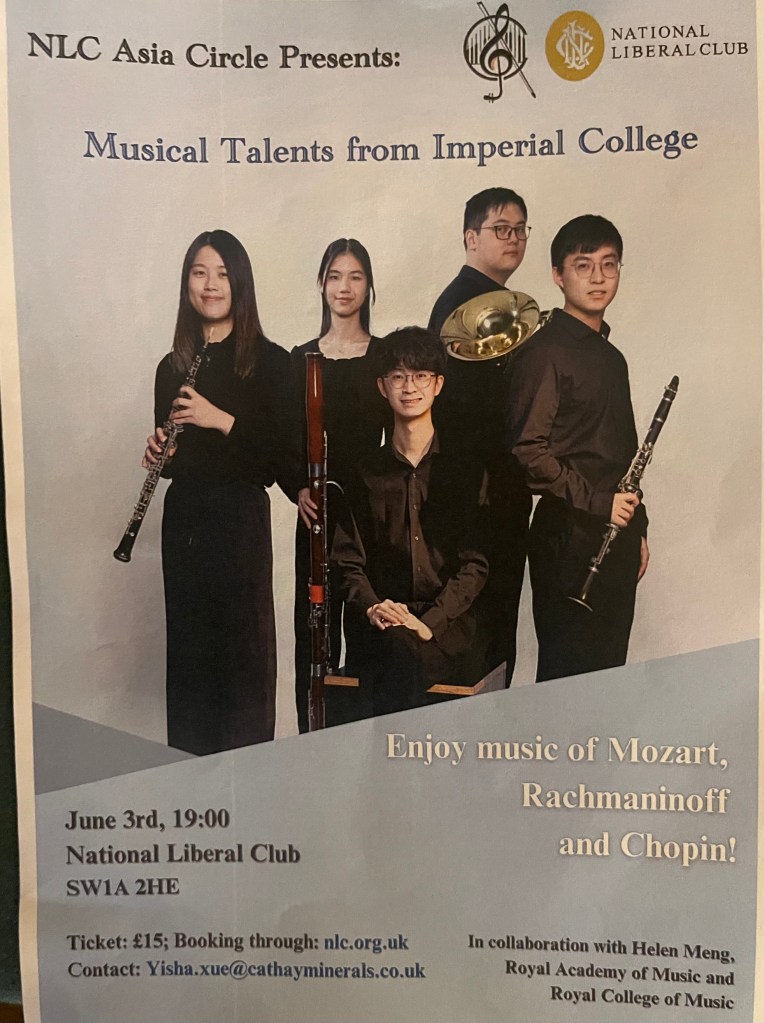
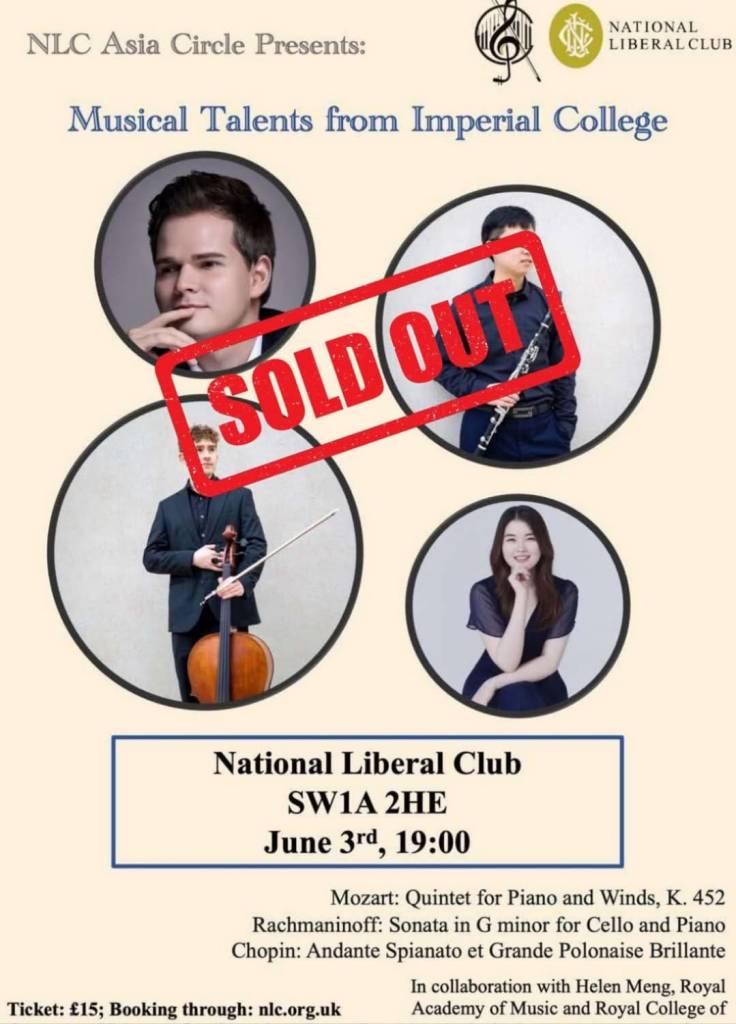
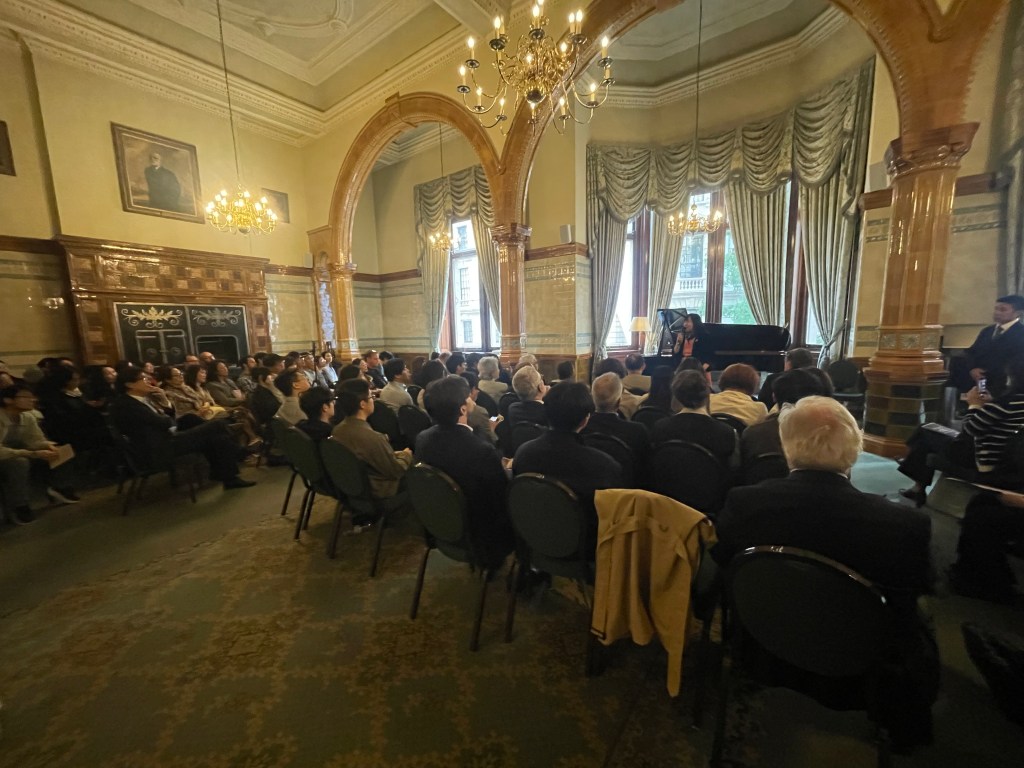
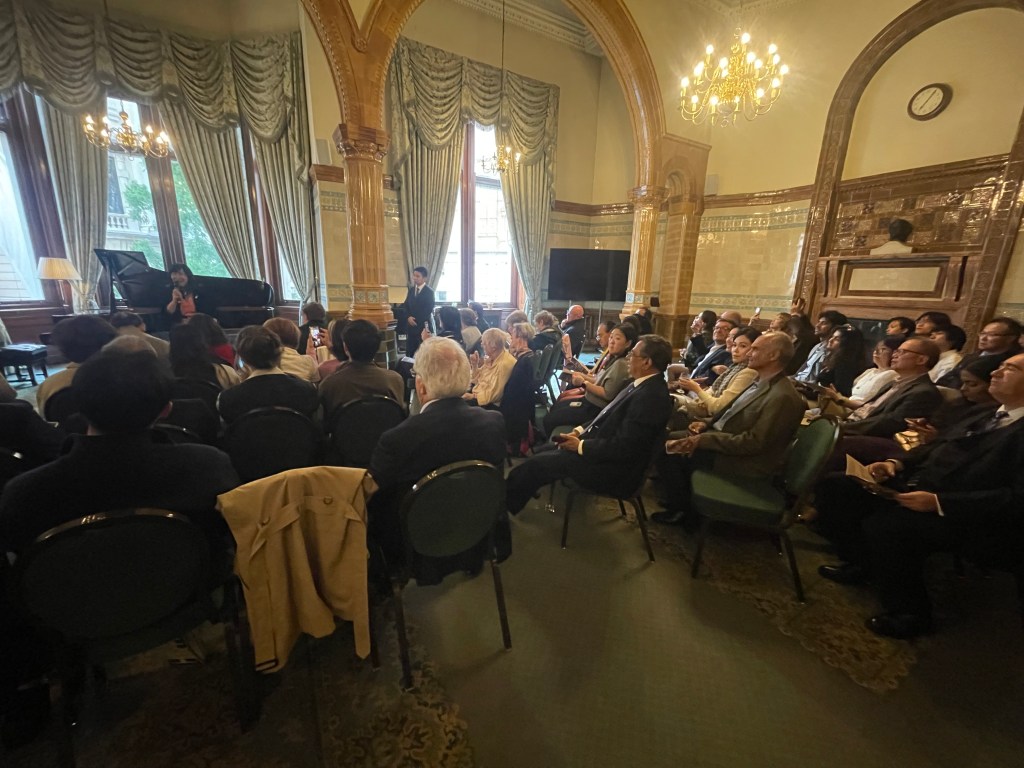
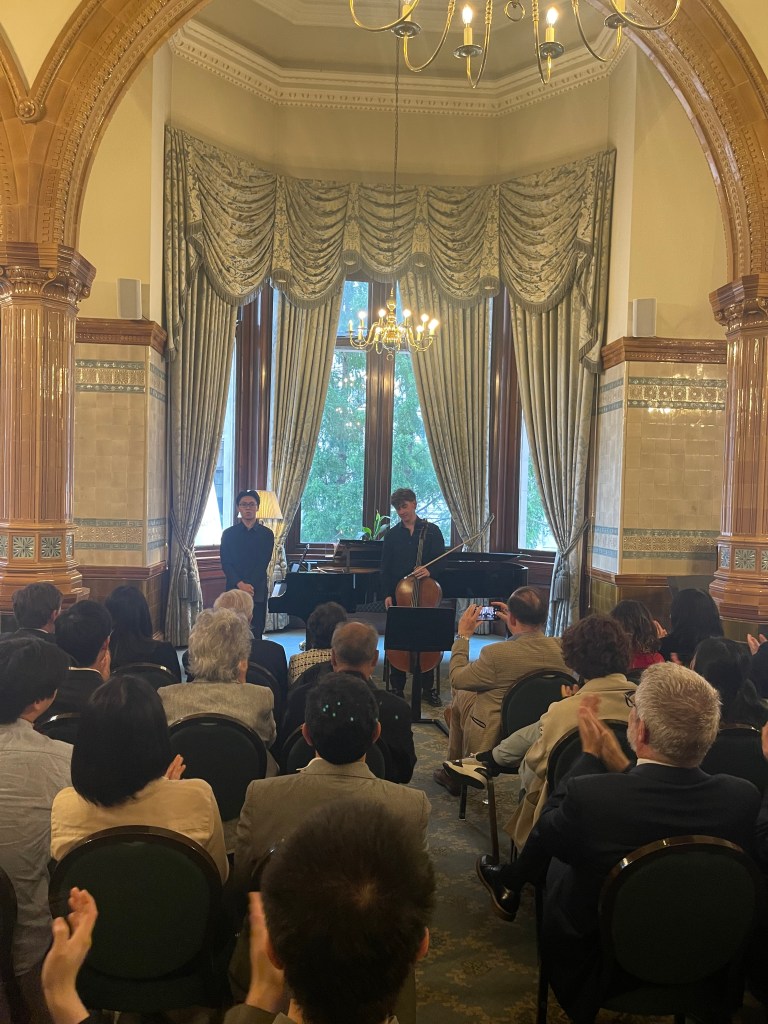
More music at the National Liberal Club with Yisha Xue’s Asia circle presenting another sold out concert of young musicians.
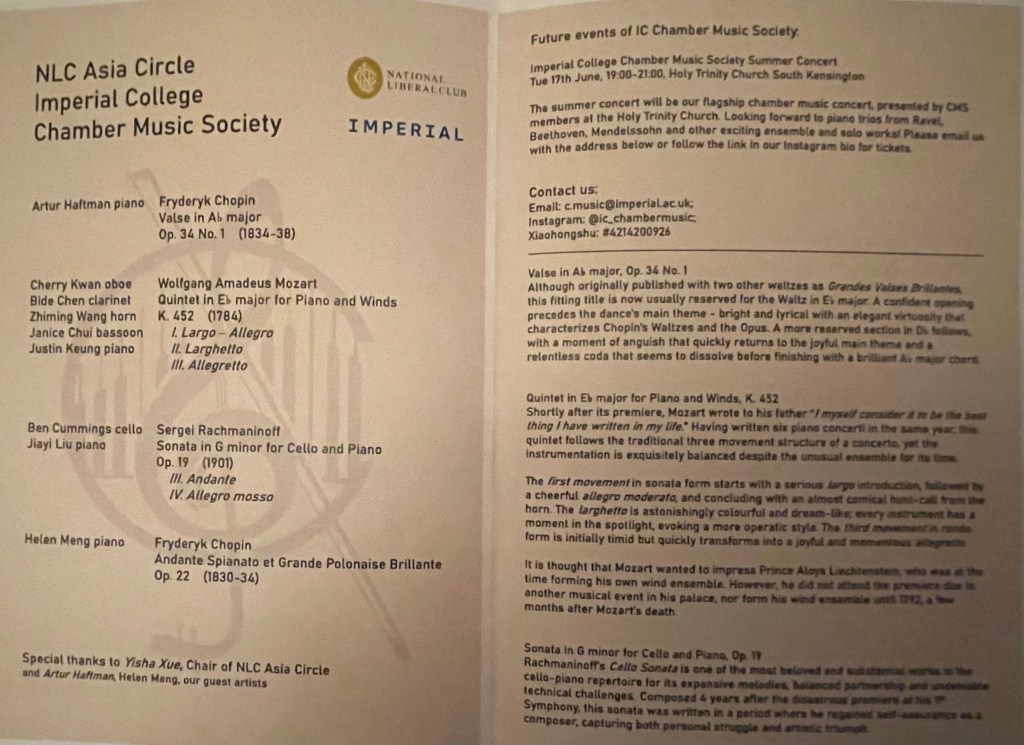
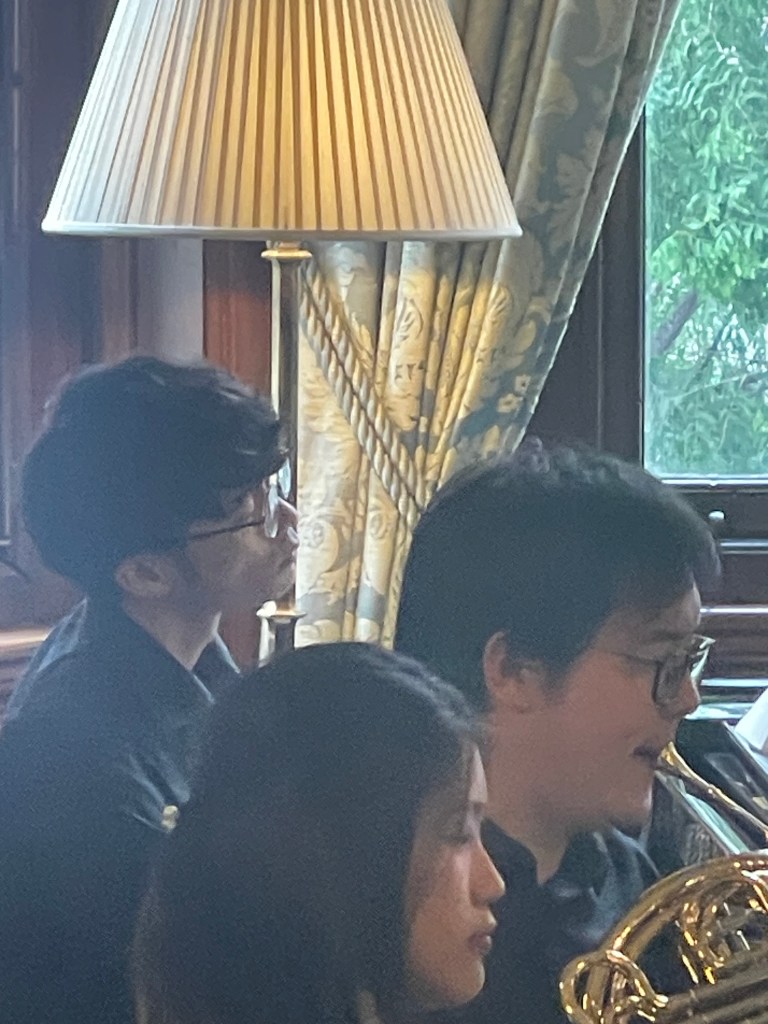
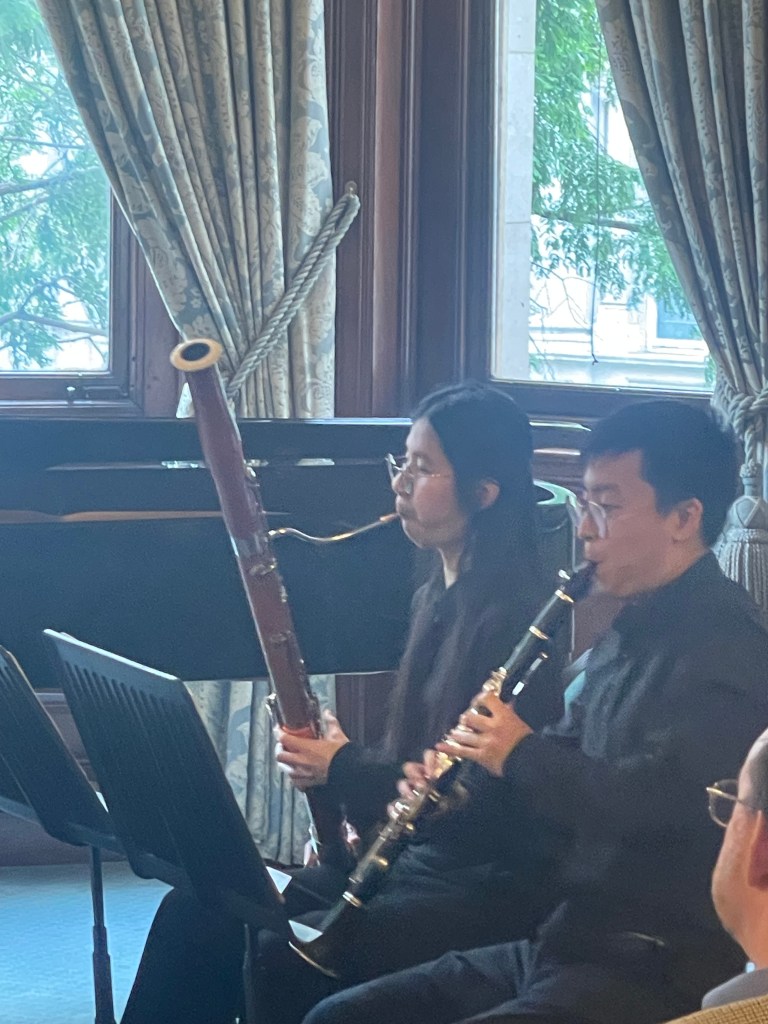
A wind quintet from Imperial college brought delicacy beauty and style to a work that even the composer Mozart thought was one of the finest things he had penned. A beautiful sense of balance between Cherry Kwan oboe with Zhiming Wang ,horn, seated opposite Janice Chiu,bassoon and Bide Chen,clarinet coordinated with style and refined elegance by Justin Keung piano.
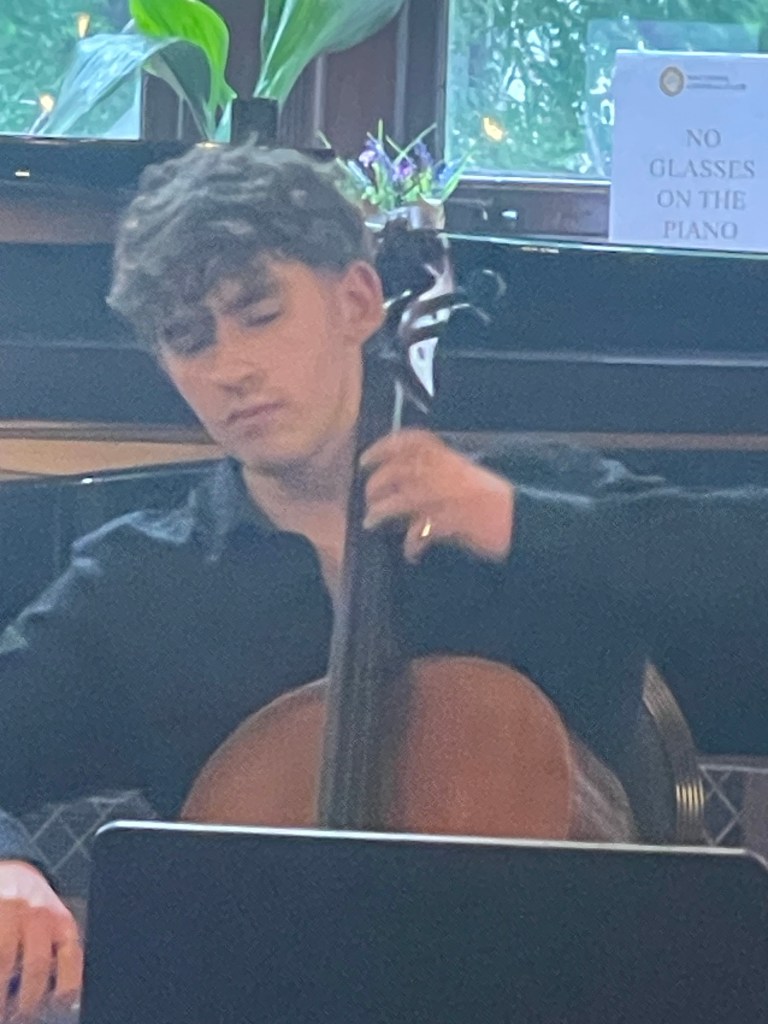
Ben Cummings brought seductive beauty and together with his duo partner Jiayi Liu excitement and considerable virtuosity to Rachmaninov’s Sonata in G minor .
Jiayi LiuBen Cummings
Ben a young cellist studying with a Professor at the Royal College whilst actually completing his engineering studies at Imperial College!
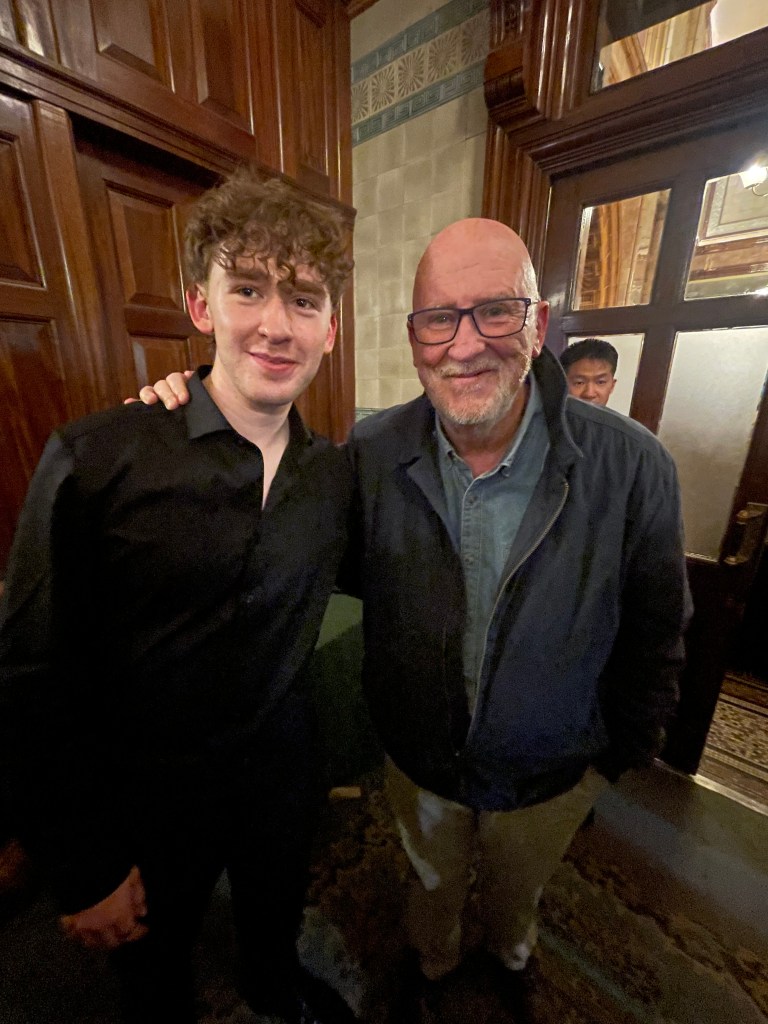
Ben Cummings with proud father
The concert had started and finished with Chopin . What better composer could there be to ignite and ravish the senses on the wonderful Steinway concert grand that adorns the music room at the Liberal Club. Continuing a long tradition with an investment in beauty at the Liberal club since Rachmaninov himself gave his last concert in London brought by club member Benno Moiseiwitch , that much loved pianist whose best friend simply said he plays me well. https://youtu.be/iFobyhwznng?si=ZT51-I3CppWXU8ot
The refined artistry of a born Chopin player
Artur Haftman opened the concert with one of Chopin’s most radiant waltzes op 34 n 1 .
An example of style and beauty with a jeux perlé that only the greatest Chopin players possess . I have known Artur for many years since he first came to London and took St James’s Piccadilly by storm with a lunchtime concert where he was called back to play encores until it was almost teatime ! He went on to graduate from the Royal College with Dmitri Alexeev and is now a distinguished pianist established with his wife in London masterminding the Young Musicians International Chopin Competition. As Rubinstein said talent cannot be taught but can be nurtured and allowed to flower as we saw tonight.
The concert ended with a work with which the young Chopin on his arrival in Paris took the noble salons by storm .
The Andante Spianato and Grande Polonaise Brillante was one of the works that inspired Schumann to declare ‘ Hats off a Genius ‘.
Helen Meng on the crest off a wave A proud father looking on
Helen Meng gave a ravishing performance full of subtle beauty and a kaleidoscope of bewitching sounds. A scintillating sense of style and a masterly command of the keyboard from a young artist recently graduated from the Royal Academy from the class of Joanna McGregor. Helen had also studied at the International Piano Academy Lake Como whose president is another lady pianist Martha Argerich .
She demonstrated that she is now ready to embark on a professional career that should take her music making far and wide with great success.
Of course every audience should be thanked with a little extra music and it was a piano duo from Imperial College who provided a seductive performance of Dvorak’s delicious Slavonic Dance in Eminor op 72 n 2
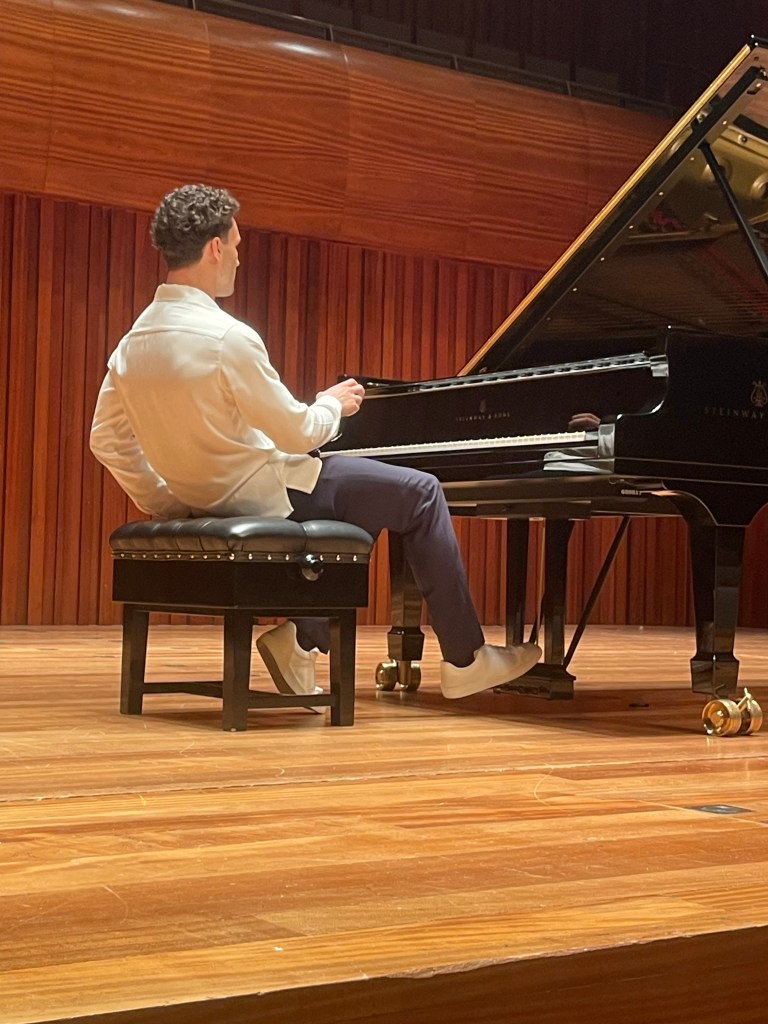
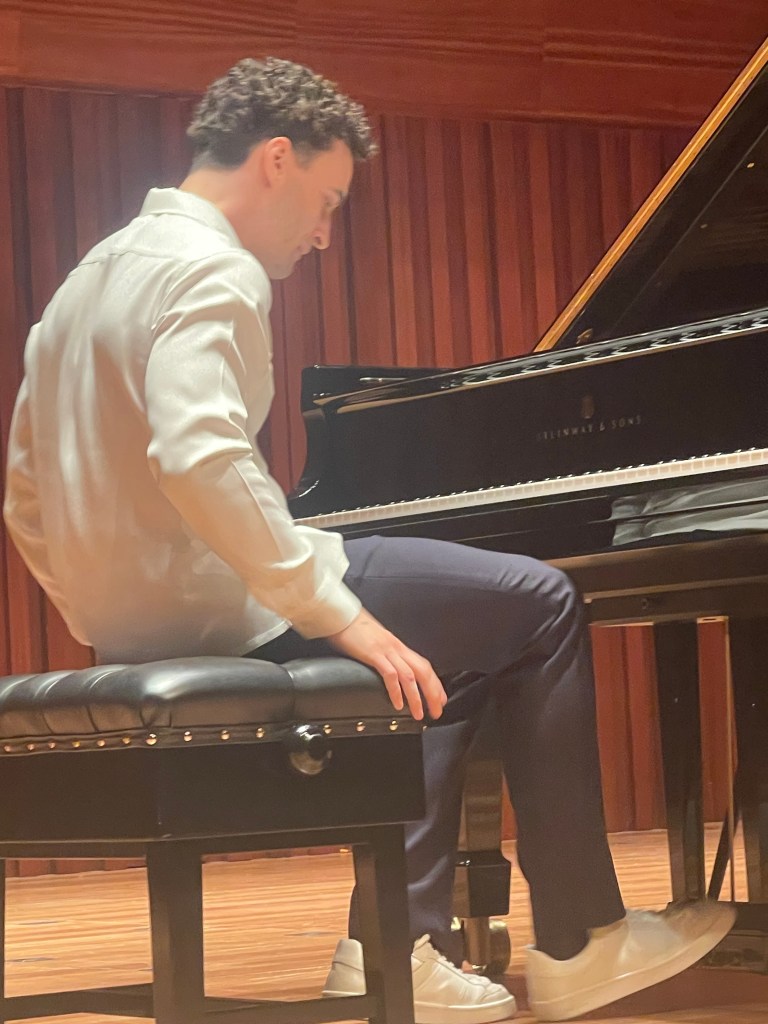
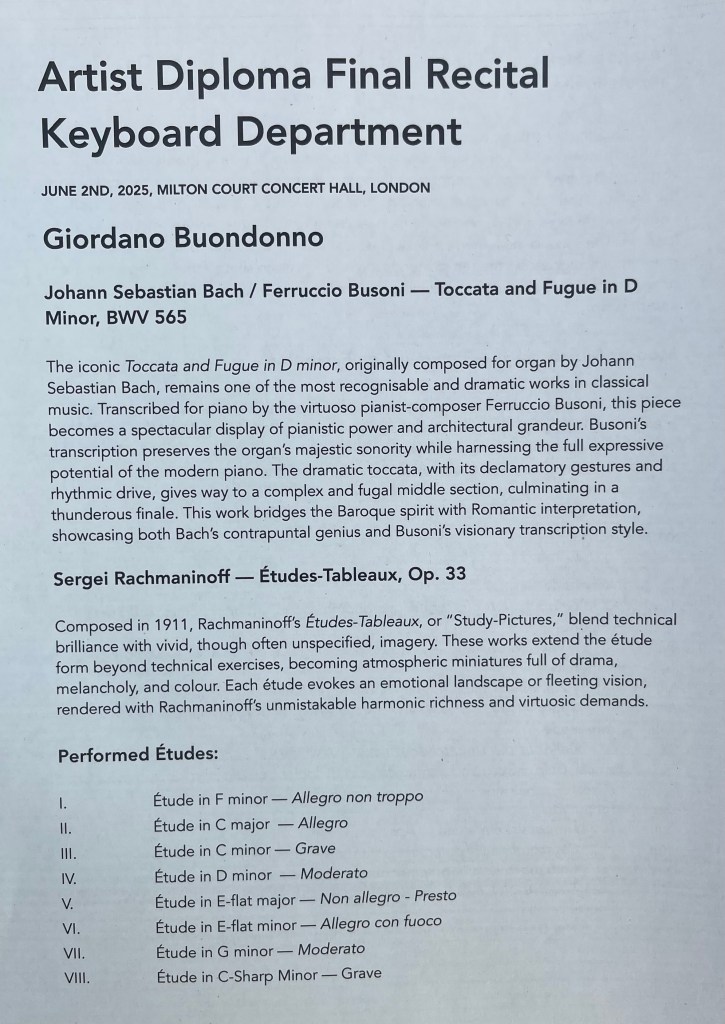
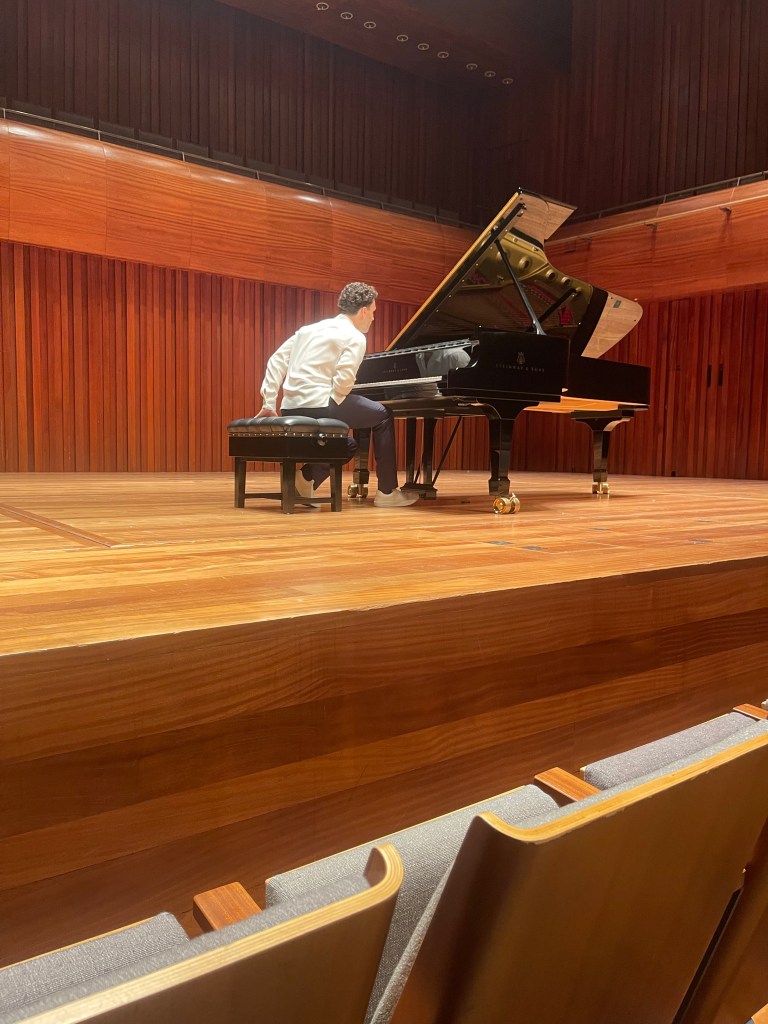
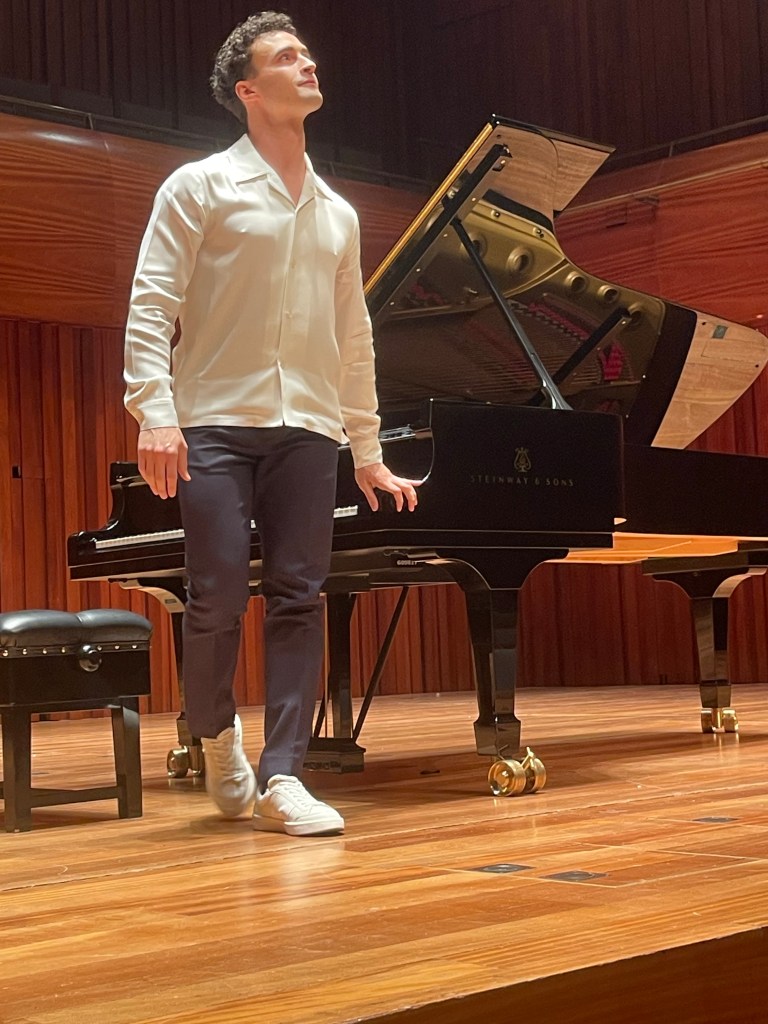
Giordano Buondonno coming to the end of his studies at the Guildhall with a final graduation recital in their beautiful Milton Court Concert Hall. Having graduated at Trinity Laban under Deniz Arman Gelenbe he has now perfected and consolidated that experience with Charles Owen and Noriko Ogawa at the Guildhall. The superb musicianship of all three artists have bequeathed a musical integrity to this young man’s music making that will remain with him during the illustrious career that awaits.
Giordano Buondonno is from La Spezia in Italy.
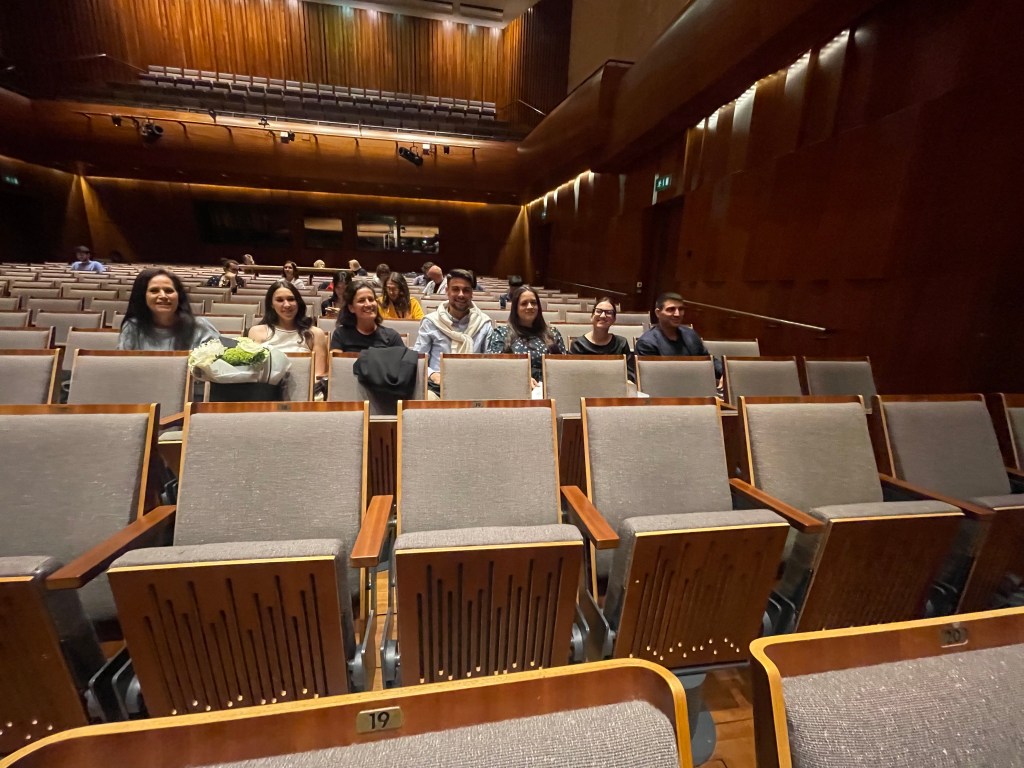
Infact it was family and friends who had flown in on the 2nd of June, which is Independence Day in Italy, to support and cheer a young man who has dedicated his youth to art.
Giordano coming home and taking a summer break from his intensive studies in London La Spezia comes to London
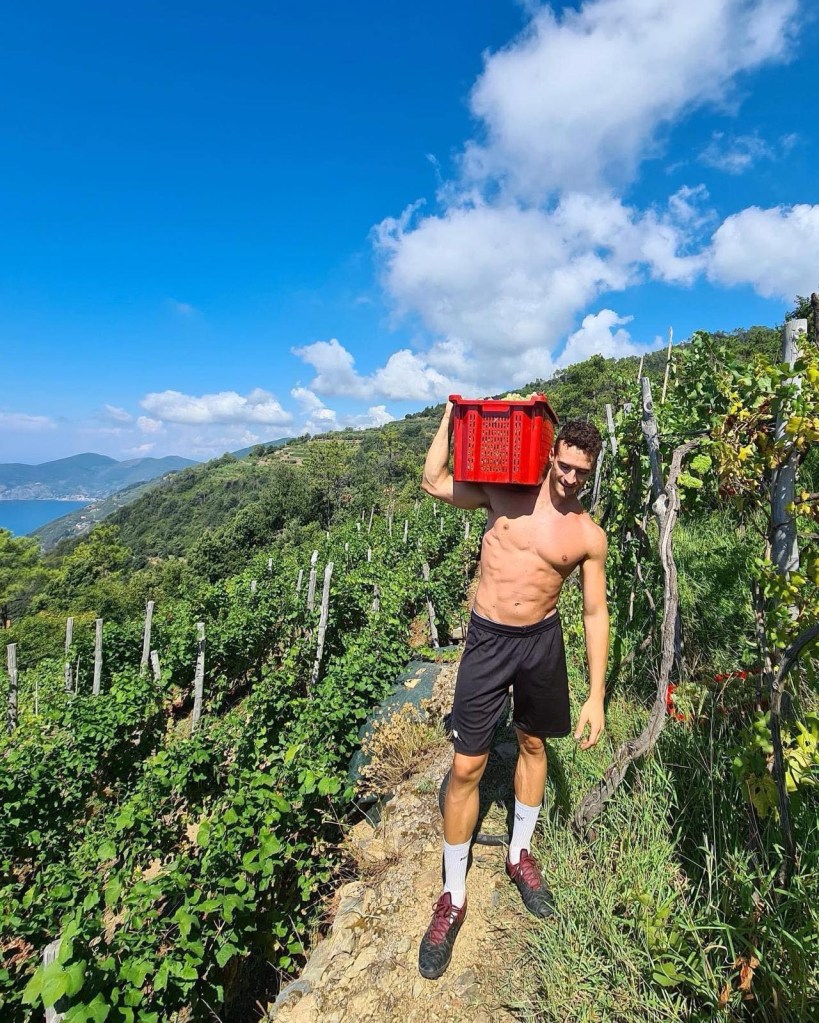
Exchanging the beauty of the Mediterranean with its vineyards and olive groves, in that part of Italy that is truly blessed by the Gods, to perfect his musical understanding in London and prepare him for a lifetime in music.
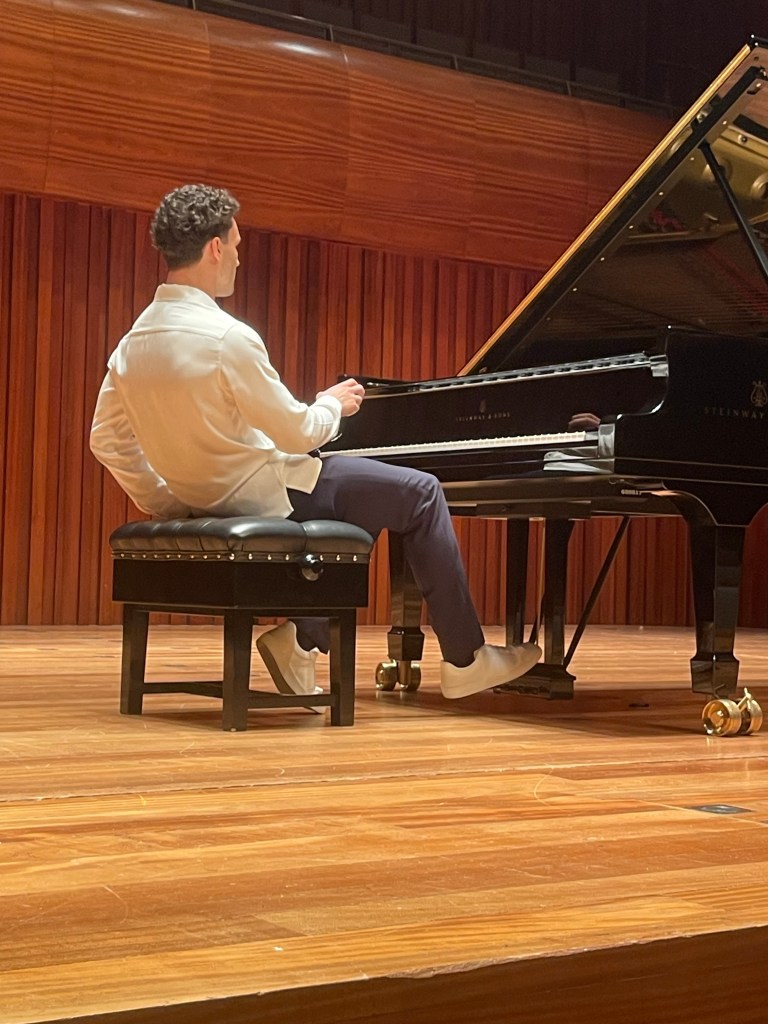
With his long spindly fingers and technique alla Benedetti Michelangeli he unraveled a long and complex programme with a very particular sound world of notes that were like drops of crystal such was their clarity and purity.
A hand that does not caress the keys but stays close and draws the sounds out of the piano like magic wands casting their magic spell into the keys.
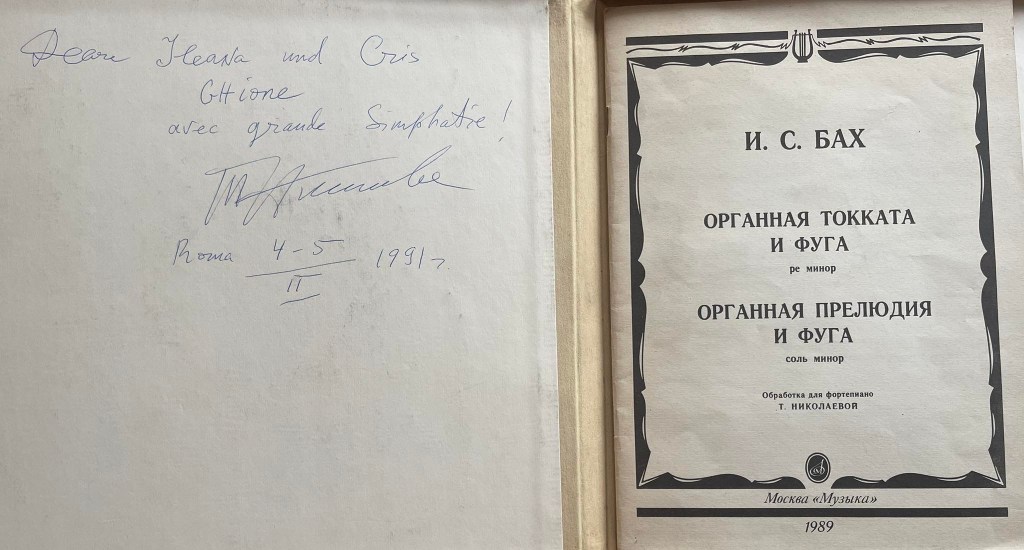
It was a pleasant surprise to hear the Bach Organ Toccata and Fugue in the Busoni transcription which is all too rarely played in the concert hall. Gilels and many other great pianists preferring the Prelude Toccata and Fugue in D major.
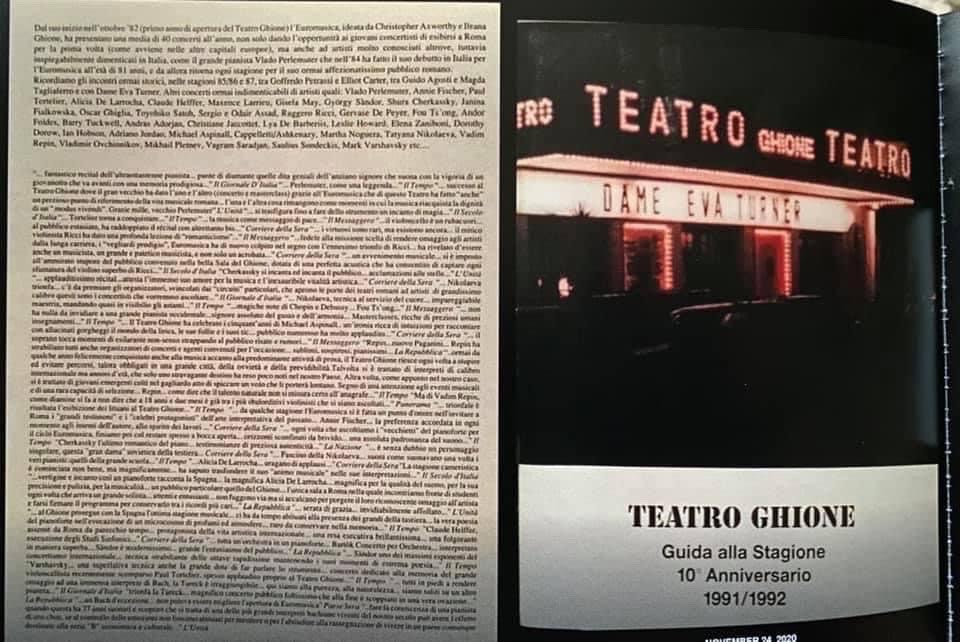
Nikolaeva gave me her own transcription when she played the first time for us in Rome. I never actually heard her play it preferring her Goldberg and Art of Fugue which she played in a masterly way for us. She did play one year,though, the Tchaikowsky G major Sonata and the Mussorgsky Pictures, which was exactly the work which Giordano closed his recital with today.
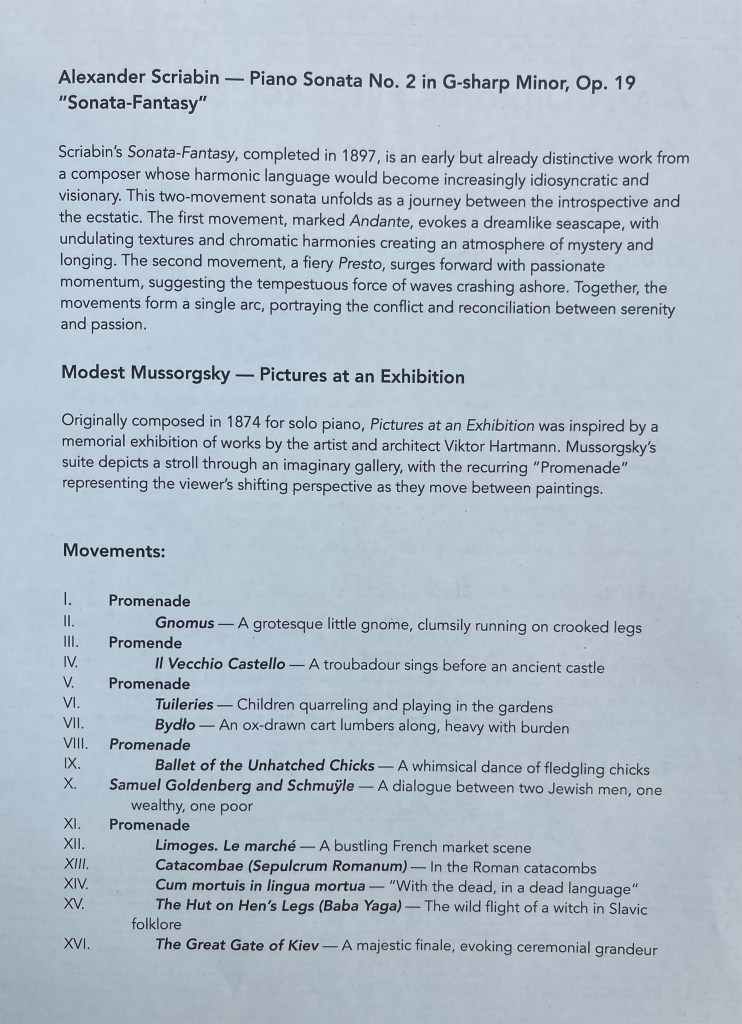
In between Giordano chose to play other works from the Russian school with Scriabin’s early Fantasy Sonata and Rachmaninov’s first set of Études -Tableaux op 33.
The Bach in the Busoni transcription rang out with piercing clarity of nobility and grandeur. There were extraordinary dynamic contrasts where one could envisage the change of manuals on the organ. Massive sounds of enormous organ like sonority would interrupt until out of a long aching silence the plaintive voice of the fugue was barely whispered as it began to converse with the other voices building to the massive climax of this ,the grandest of all organ works.
The eight Études -Tableaux by Rachmaninov were played with a characterisation of startling virtuosity and nostalgic poetic beauty. The remarkable clarity of the F minor with its extraordinarily fantasmagoric final bars followed by the burning insistence of the glowing melodic line in the C major étude.A brooding intensity to the ‘Grave’ C minor, followed by the insinuating insistence of the D minor n.4. Streams of notes just flowed over the entire keyboard with the E flat étude before the call to attention of the E flat minor played with sumptuous imperious authority. Radiance and lingering beauty of the G minor was answered by the turbulence of the last in C sharp minor.
It was in the early sonata by Scriabin that the crystalline beauty of Giordano’s playing created a glowing fluidity to Scriabin’s stream of notes out of which emerged with purity and beauty the sumptuous melodic line. A real tone poem of whispered beauty that reaches a romantic climax only to return to a murmur after such a sumptuous vision . The Presto last movement was played with dynamic drive, where the passionate explosions of romantic fervour were played with extraordinary clarity and beauty.
An imperious opening to Mussorgsky’s monumental Pictures at an Exhibition was played with a one finger technique that gave a glowing brilliance to this call to attention. He was to use the same technique again with astonishing accomplishment in the diabolical goings on of ‘Baba Yaga’.( A technique that is very noticeable with Romanovsky, another Italian trained pianist, and can lead to a greater clarity if used with knowing sensibility ). Startling characterisation of ‘Gnomus’ was followed by the etherial beauty of the ‘Old Castle’ disappearing into oblivion with whispered beauty. The teasing insistence of children in the ‘Tuileries’ was played with remarkable clarity with its improvised interruptions .’Bydlo’s’ unusually discreet appearance was built into an overpowering climax of lumbering insistence and the ‘unhatched chicks’ that followed were played with a remarkable coaxing of the keys with a continual opening and shutting movement that suited the delicate clucking of the chicks. Imperious nobility of ‘Goldenberg’ was played with steely brilliance replied by Schmuÿle’s whimpering with playing of glowing fluidity. ‘Limoges’ was a tour de force of dynamic fingerfertigkeit, from Giordano’s crystalline streamlined technique ,halted only but the imperiously frightening vision of the ‘Catacombs’. Massive sounds resounded of great resonance but never brittle or hard edged as they dissolved into the whispered glow of a vision of what lay within. The final two pictures were played with remarkable dynamic drive and masterly control of sound with the vision of the Great Gate revealed with astonishing nobility. A kaleidoscope of sounds and colours illuminated this Great symbolic vision, ever more actual in these days of misguided conflic! Played with fervent conviction and remarkable mastery it brought this recital to an extraordinarily brilliant conclusion.
All over with four years of intensive study completed -now the really hard work of starting a career in music
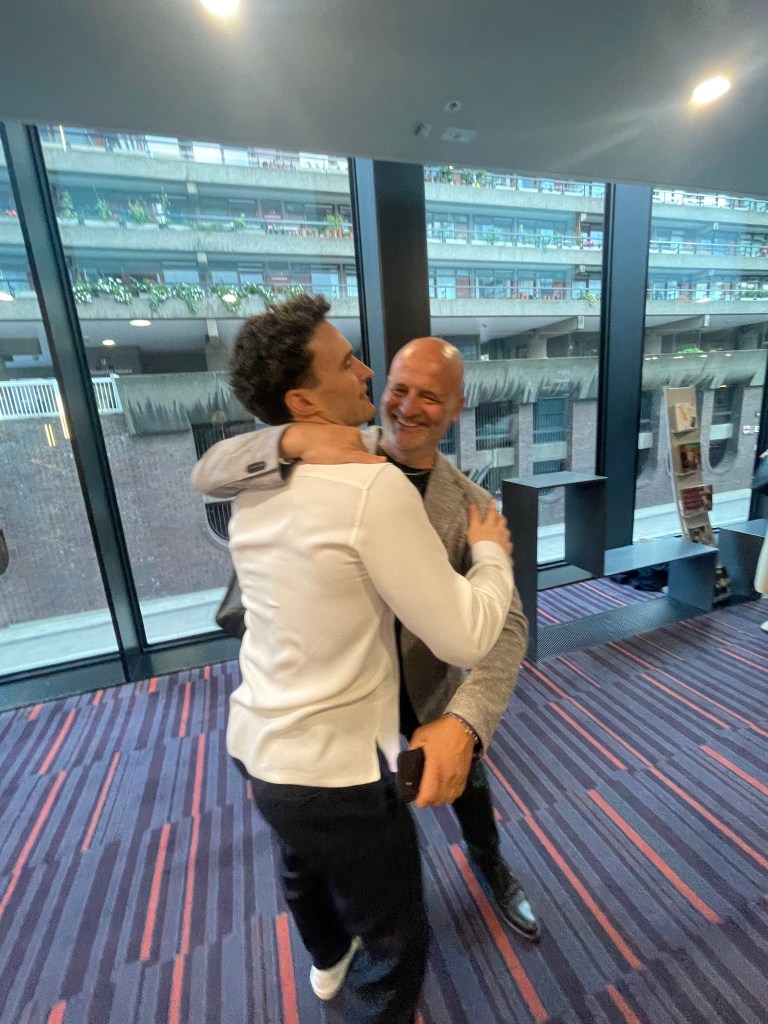
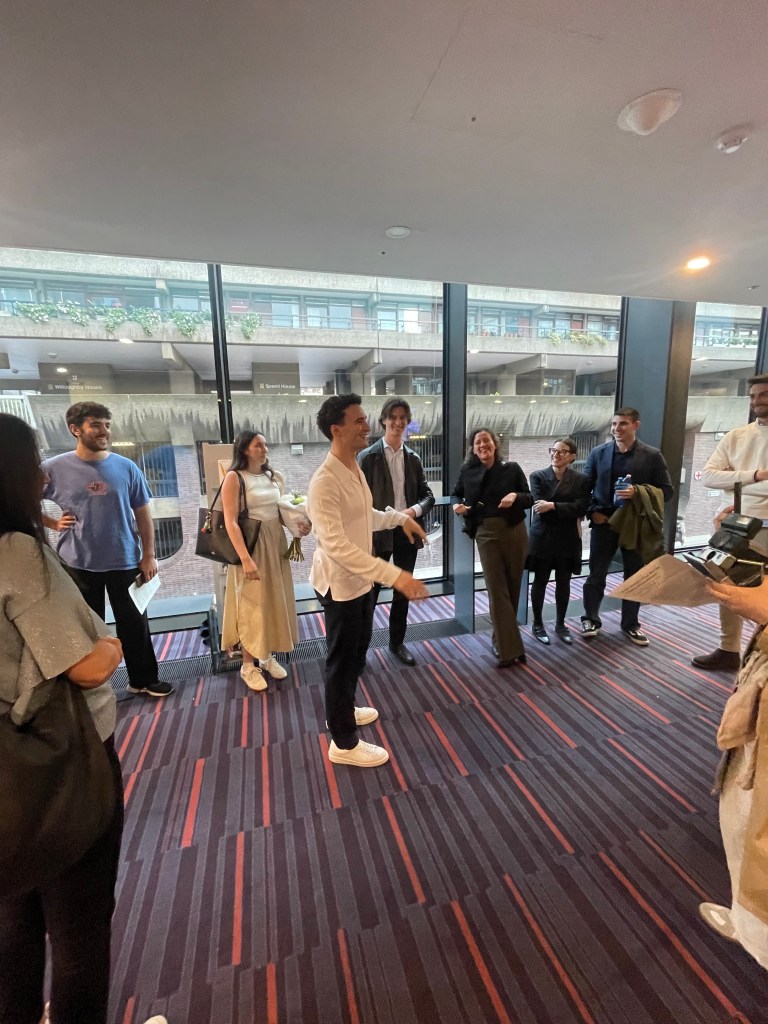
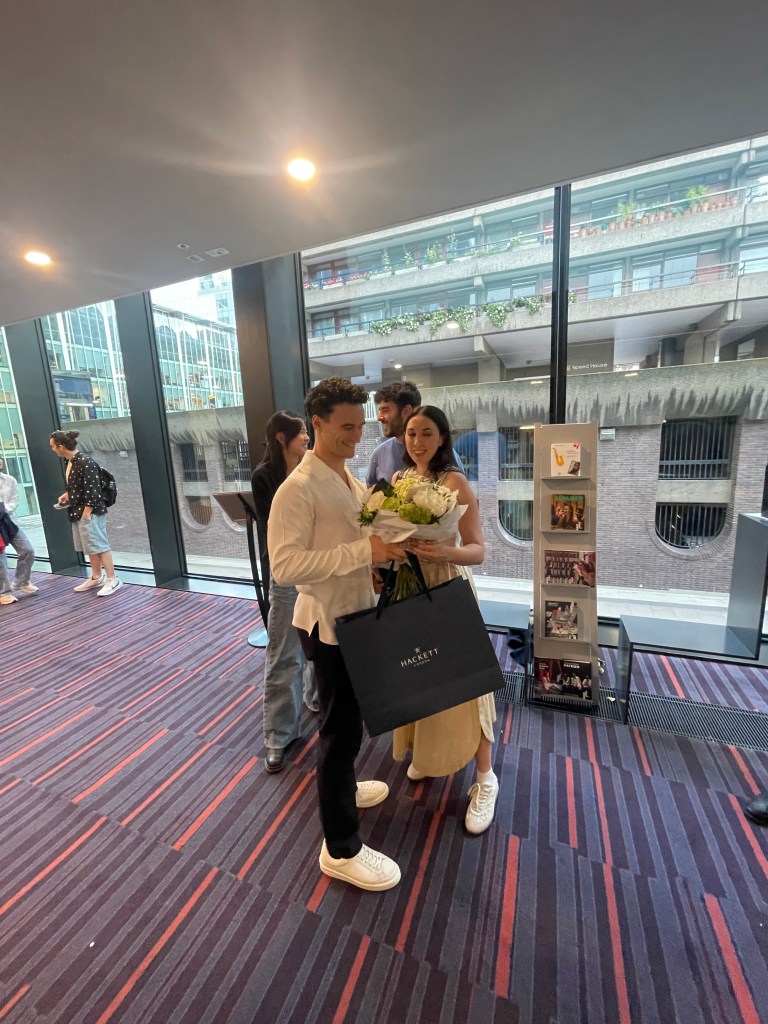
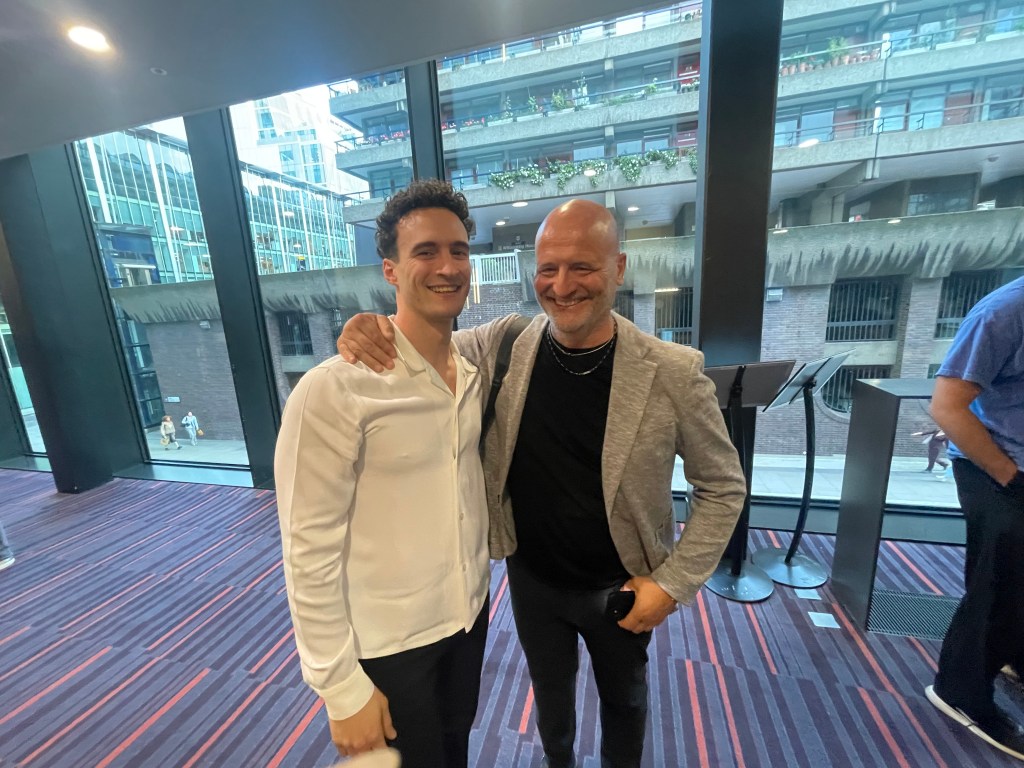
A proud mother and father embracing their talented son as he was greeted not only by friends from Italy but also by Charles Owen sporting for the occasion a remarkably elegant Italian jacket and happy to embrace, together with Noriko Ogawa, their quite ‘unique’ student in his moment of glory.






















 ChristopherAxworthy-MusicCommentary