Tuesday 27 June 3.00 pm
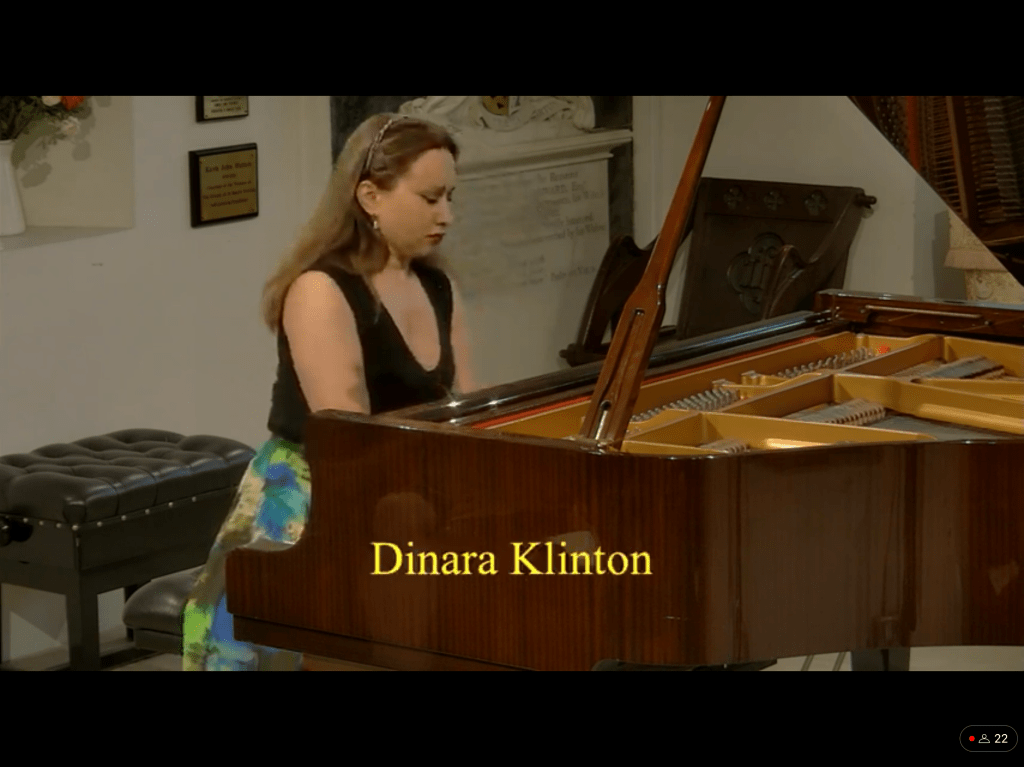
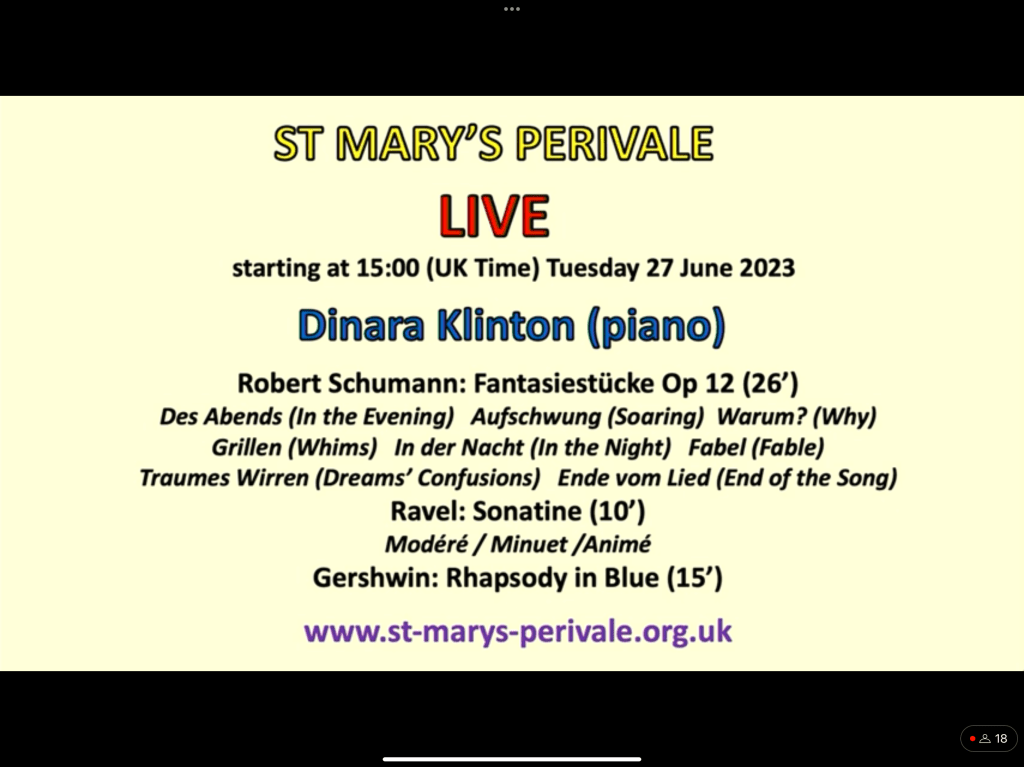
What a privilege indeed to have such a wonderful artist play at St Mary’s.The world does not know what it is missing but rather selfishly we will keep that to ourselves! A magnificent Schumann where each of the eight pictures were painted with a kaleidoscopic sense of colour and the same aristocratic poise that I remember from Artur Rubinstein.
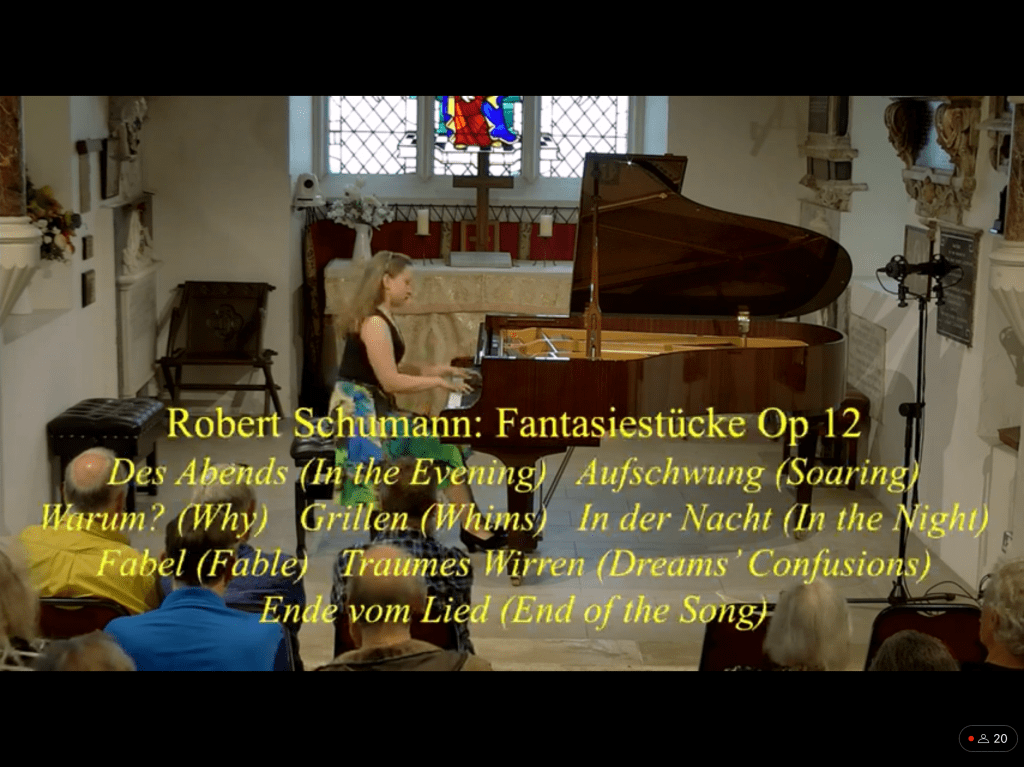
From the very first notes of ‘Des Abends’ there was an exquisite sense of balance and aristocratic control.But there was more than that because there was a sense of communication that is so rare to find these days.Time seemed to stand still such was the poignant beauty that was pouring from her fingers.A melodic line etched in gold on a cushion of pure velvet.
The sumptuous sounds in ‘Aufschwung’ where passion and control came together with a rhythmic drive and sounds of beguiling beauty.’Soaring’ indeed with a romantic sweep and a wonderful bass voice leading the way in the central episode.Her scrupulous attention to the composers indications had me searching the score for the wonderful staccatos before the brooding build up to the majesterial return of the opening passionate outpouring.
Her exquisite sense of balance had me indeed wondering ‘why’ this wonderful artist is not to be found more often on the world stage .I had heard her recently in the Royal Festival Hall and it was exactly her masterly control of sound that allowed her to project the softest of whispers with a radiance to the far reaches of that notorious cavern,as only Rubinstein or Arrau could do.
‘Warum’ indeed ………with its voices touchingly intertwined as they communed with each other so tenderly.A gentle comment from the bass adding a sensuousness to such disarming simplicity.
‘Grillen’ was played with such humour that she cheekily decided to add an unwarranted but much appreciated repeat.
There was a sweep to the ghostly murmurings of ‘In der Nacht’with strands of melody emerging with crystalline clarity above.The ‘Etwas Langsamer’ seemed actually to get faster rather than slower.Such was her artistry that the haunting melody that floats on top reminded me of a similar magic moment in the Fantasie op 17 that was to follow in a sequence of masterpieces that seemed to pour continuously from Schumann’s pen from op 1 to op 26.
Visions of such beauty that it is hardly surprising that his duel personality of Eusebius and Florestan in the end fought it out in his head with him ending up in an asylum !
A wonderfully capricious ‘Fabel’with its question and answer eloquently expressed exactly as Rubinstein used to enchant us with.Her masterly control was always present as the final chords were so beautifully placed each one slightly different from the other.
A masterly ‘Traumes Wirren’ as you would expect from a pianist known in the business as Mrs Feux Follets.
A masterclass in the RCM with Emanuel Ax some years ago when Professor Dinara was still a student and had just played two of Liszt’s Transcendental studies:’Paysage’and ‘Chasse Neige’.The next student down to play the ‘Hammerklavier’ after her,unsurprisingly,could not be found!So the Maestro asked Dinara to play something else while the search was on.
I held my breath and hoped she would play ‘Feux Follets.’She did,and Emanuel Ax burst out laughing at the end as he could not believe that anyone could play it with such ease and beauty.He had been the winner of the first Rubinstein Competition and certainly could never have played it like that!
Dinara is not a machine but a sensitive artist and ‘Traumes Wirren’ as ‘Feux Follets’ was played as a miniature tone poem not a cold blooded study!There was here in Schumann a flexibility of pulse and a ravishing sense of colour.Aristocratic grandeur signalled the ‘Ende vom Lied’ and if the ‘Etwas lebhafter’ was of the same colour it was because the shape and colour she brought to this central episode was part of an overall architectural measure that was totally convincing.The rapt concentration she brought to the coda where suddenly time stands still as the melody returns as if in a dream .The gradual disintegration in a magic ending of sublime poetic inspiration.It was as if Eusebius had been at work again like he had been in the last desolate dance of the Davidsbundler op 6.
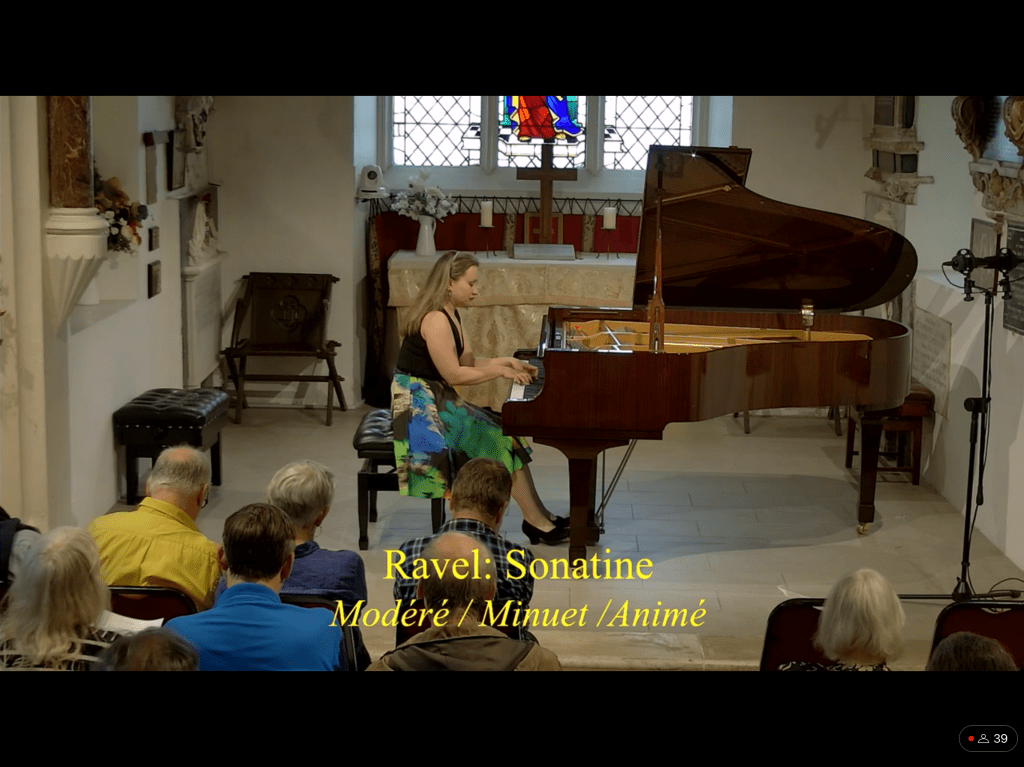
There was a wonderful sense of colour in the opening of the Ravel ‘Sonatine’ with the left hand doubling the melody giving great depth and haunting beauty to this fleetingly etherial opening.Fluidity and purity of the melodic line takes over with a feeling of resignation and nostalgia leading to the hauntingly beautiful ending with an almost unbelievable control of the magical sonorities .There was delicacy and a formal stately beauty to the ‘Menuet ‘ with a luminosity of sound of great simplicity.A beguiling tenor melody that crept in surreptitiously towards the end with ornaments that were played with the same delicacy that she was to show us in the Chopin nocturne that was still to come after the jazz and swing of Gershwin.A great wave of sounds engulfed the keyboard in the ‘Animé.’There were mysterious ghostly apparitions of melody duetting over a mist of sound.Simplicity,beauty and masterly control gave this innocent Sonatine the life of a jewel shining brightly in a sound world unmistakeable aristocratic and French.
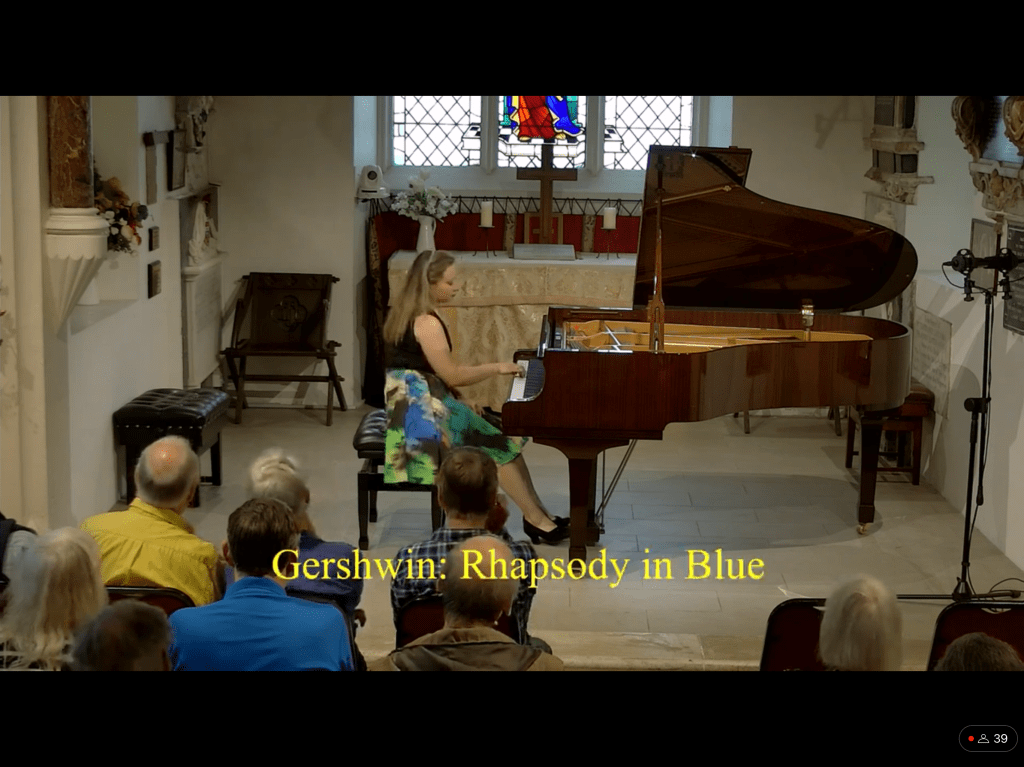
Gershwin was sleezy and dreamy,jazzy and improvised.Astonishing technical brilliance and mastery with the sumptuous sleepy final melody played with consummate artistry.Guitar like interruptions of animal excitement and magnificence just showed why Nadia Boulanger had refused to teach such an original talent for fear of contaminating this original mix of improvised and organised brilliance.
Chopin’s Nocturne in D flat op 27 n.2 was just the magic touch that Rubinstein would have added to a wonderfully satisfying programme.A magic mist of sound on which floated a bel canto of ravishing beauty.A timeless rubato with embellishments that just flowed so effortlessly from her masterly fingers with gossamer lightness.The whispered acciaccaturas at the end were of such delicacy that time stood still as it had all those years ago for Artur Rubinstein.
Dinara I continue to say is one of the great pianists of our time who has as yet to be discovered by a world submerged by mediocre piano players who are not great artists.Unfortunately we live in a speedy age where artists are getting fewer and fewer as our high speed world is too ready to accept quantity rather than quality.
Schumann Fantasiestücke, op 12, is a set of eight pieces written in 1837The title was inspired by the 1814–15 collection of novellas,essays, treatises, letters, and writings about music, Fantasiestücke in Callots Manier (which also included the complete Kreisleriana, another source of inspiration for Schumann) by one of his favourite authors, E.T.A.Hoffmann.He dedicated the pieces to Fräulein Anna Robena Laidlaw, an accomplished 18-year-old Scottish pianist with whom Schumann had become good friends.
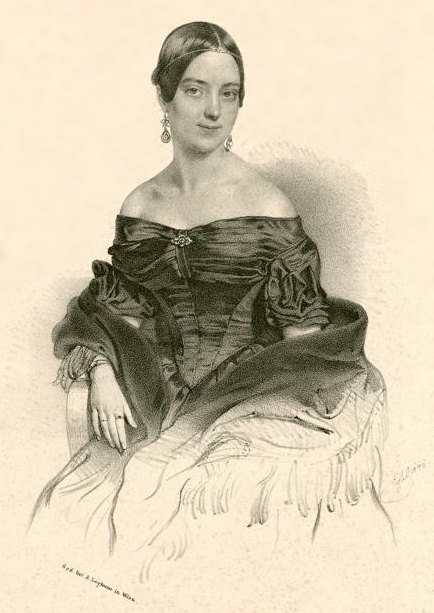
In 1834 she played for William IV and the ageing Paganini before returning two years later to play in Warsaw, St Petersburg, Dresden, and Vienna and the following year in Leipzig. There she met Schumann who created the eight pieces op 12 for her , in her honour, in the same year of 1837. It is not clear how close their relationship was, but Laidlaw is presumed to be the reason he started to compose again after a break of four months.
It was Schumann’s idea to reverse her first two names so that it was Anna Robena Laidlaw who was appointed court pianist to the queen of Hanover in 1840. She toured Europe until 1845 when she returned to London where she lived with her parents until she married in 1852. Her new husband, George Thomson worked in insurance and together they had four daughters.
Laidlaw died in London in 1901.
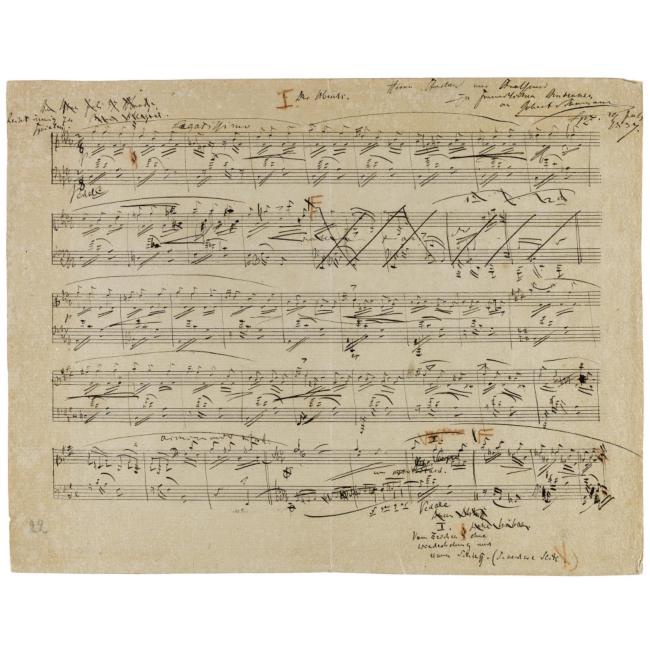
Schumann composed the pieces with the characters Florestan and Eusebius in mind, representing the duality of his personality. Eusebius depicts the dreamer in Schumann while Florestan represents his passionate side. These two characters parlay with one another throughout the collection, ending self-reflectively with Eusebius in “Ende vom Lied”.
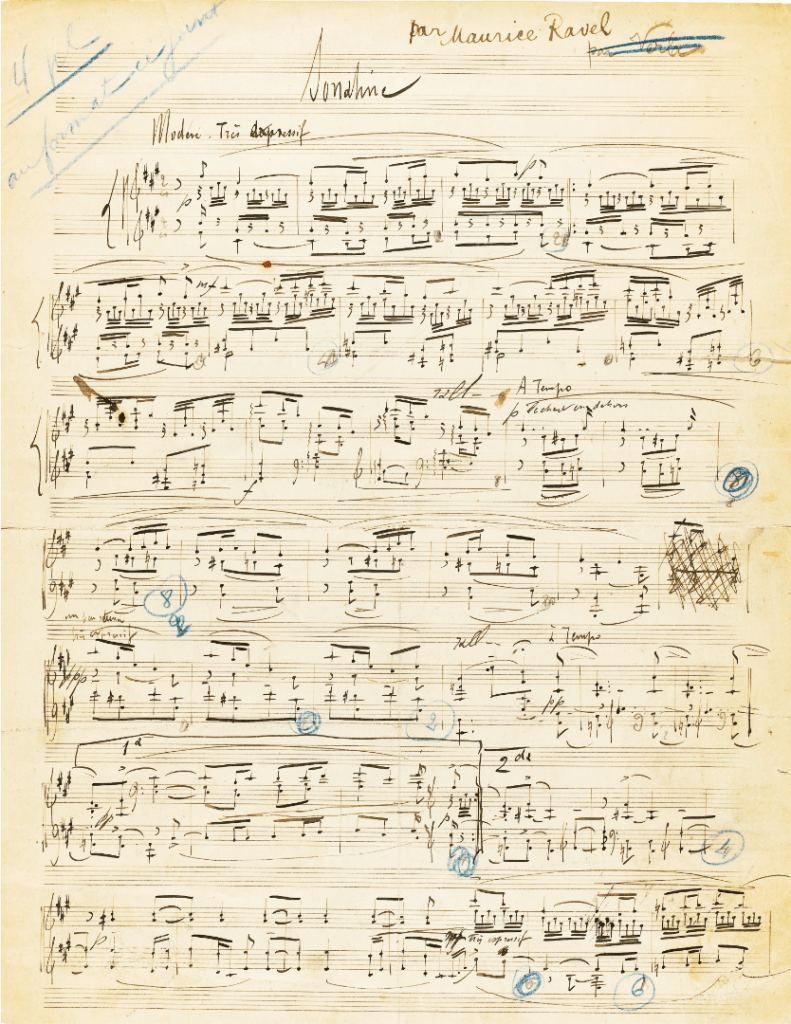
Ravel wrote the first movement of the Sonatine for a competition sponsored by the Weekly Critical Review magazine after being encouraged by a close friend who was a contributor to that publication. The competition requirement was the composition of the first movement of a piano sonatina no longer than 75 bars,with the prize being 100 francs.Calvocoressi recounted how he supposedly encouraged Ravel to write the piece in response to a competition posted in the Paris Weekly Critical Review.It seems to have been written between 1903 and 1905 as mentioned in an article in the Review published on 3rd March 1903 .The original manuscript that Ravel submitted had the text ‘par Verla’ written and struck out, replaced with ‘par Maurice Ravel’. Ravel submitted the piece under a pseudonym and chose an anagram of his name.
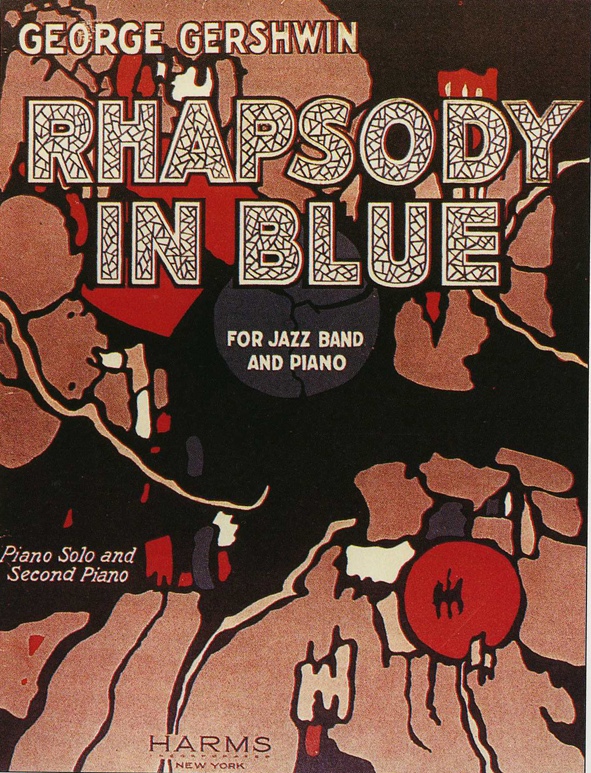
Rhapsody in Blue was written in 1924 for solo piano and jazz band, which combines elements of classical with jazz influenced effects. Commissioned by bandleader Paul Whiteman , the work premiered in a concert titled “An Experiment in Modern Music” on February 12, 1924, in Aeolian Hall ,New York City.Whiteman’s band performed the rhapsody with Gershwin playing the piano.Whiteman’s arranger Ferde Grofé orchestrated the rhapsody several times including the 1924 original.
With only five weeks remaining until the premiere, Gershwin hurriedly set about composing the work.He later claimed that, while on a train journey to Boston ,the thematic seeds for Rhapsody in Blue began to germinate in his mind.
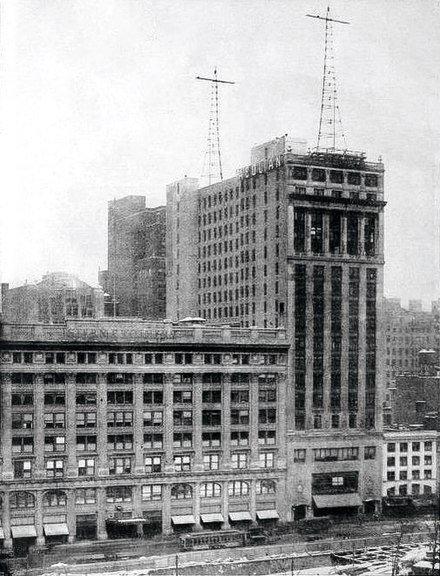
‘It was on the train, with its steely rhythms, its rattle-ty bang, that is so often so stimulating to a composer…. I frequently hear music in the very heart of the noise. And there I suddenly heard—and even saw on paper—the complete construction of the rhapsody, from beginning to end. No new themes came to me, but I worked on the thematic material already in my mind and tried to conceive the composition as a whole. I heard it as a sort of musical kaleidoscope of America, of our vast melting pot of our unduplicated national pep, of our metropolitan madness. By the time I reached Boston I had a definite plot of the piece, as distinguished from its actual substance.’
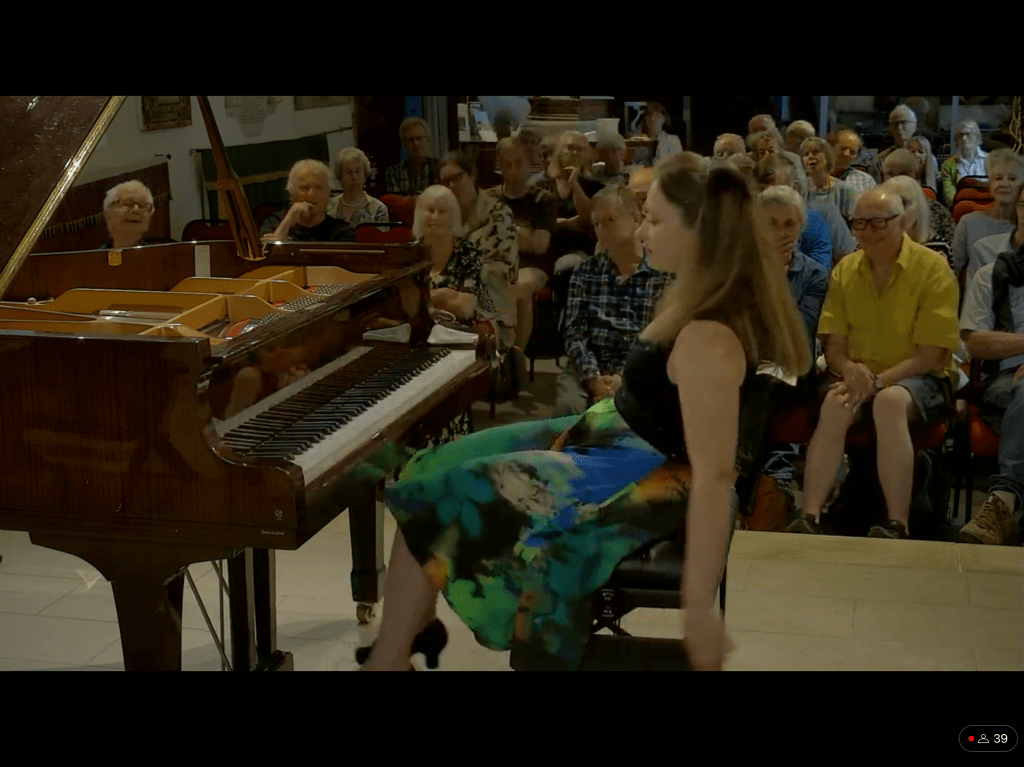
After sharing the top prize at the 2006 Busoni Piano Competition age 18, Dinara took up a busy international concert schedule, appearing at many festivals including the “Progetto Martha Argerich” in Lugano, the Aldeburgh Proms and “La Roque d’Antheron”. She has performed at many of the world’s major concert venues, including the Royal Festival Hall and Wigmore Hall in London, Berliner Philharmonie and Konzerthaus, Elbphilharmonie Hamburg, Gewandhaus Leipzig, New York 92Y, Cleveland Severance Hall. Her concerto engagements include The Philharmonia, Royal Philharmonic Orchestra, Lucerne Symphony Orchestra and others. Dinara combines her performing career with piano professor positions at the Royal College of Music and the Yehudi Menuhin School. As a recording artist, she has received widespread critical acclaim. Her album of Liszt’s Études d’exécution transcendante, released by the German label GENUIN classics, resulted in dazzling reviews and was selected by BBC Music Magazine as Recording of the Month. Her other albums include the complete Prokofiev Piano Sonatas released by Piano Classics.Dinara’s music education started in the age of five in her native Kharkiv, Ukraine. She graduated with highest honours at the Moscow State Conservatory P.I. Tchaikovsky under Eliso Virsaladze and went on to complete her Master’s degree at the Royal College of Music under Dina Parakhina.
Dinara Klinton-EunsleyPark-Ella Rundle mastery and artistry for Tchaikowsky at the Royal Festival Hall
Dinara Klinton at the Wigmore Hall RCM Benjamin Britten Fellow Recital
Dinara Klinton in Perivale and Washington ‘Dance,Song,Tales,Flowers and Romance’
 ChristopherAxworthy-MusicCommentary