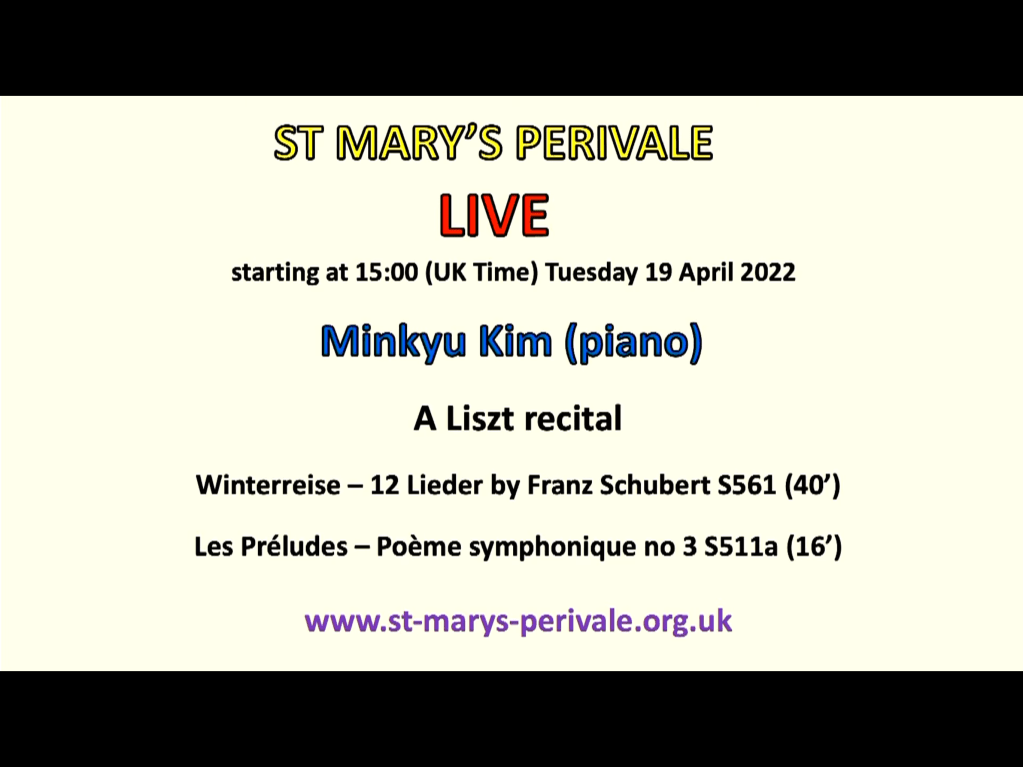
1 Gute Nacht 2 Die Nebensonnen 3 Mut 4 Die Post 5 Erstarrung 6 Wasserflut 7 Der Lindenbaum 8 Der Leiermann – 9 Täuschung 10 Das Wirtshaus 11 Der stürmische Morgen – 12 Im Dorfe
Les préludes – Poème symphonique no 3 S511a
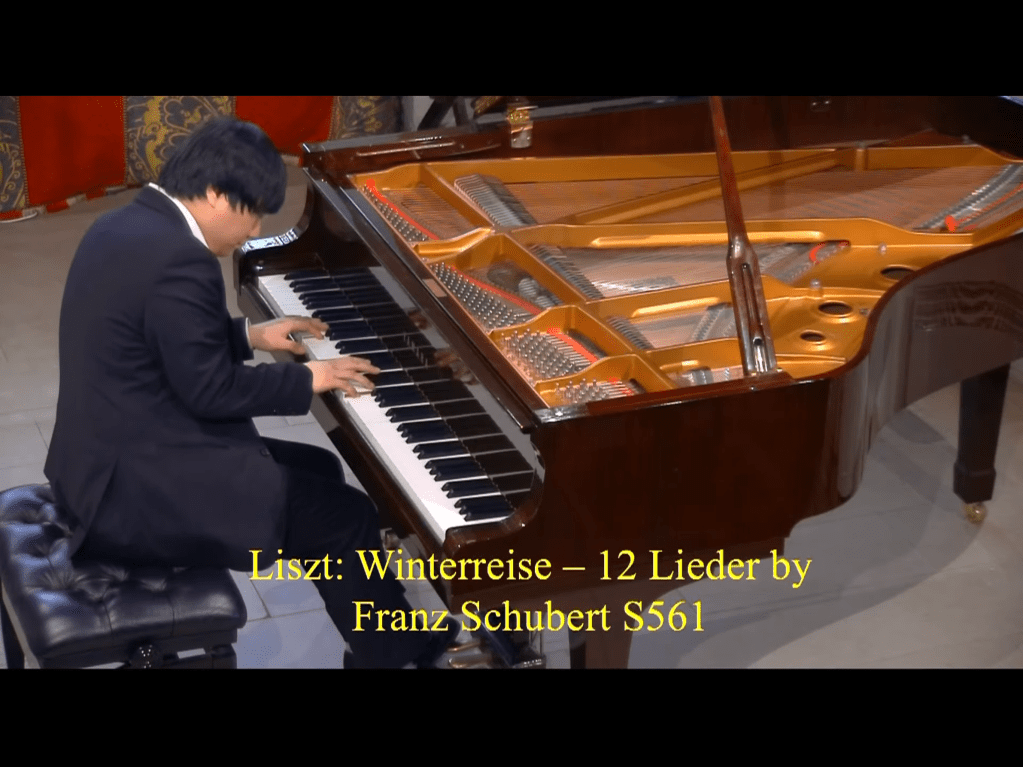
Sensational playing says Dr Hugh Mather what more can one say when one hears such mastery. Effortless breathtaking beauty and feats of transcendental pianism are added to the intelligence and musicianship of such an enquiring mind. I am reminded of Gilels that I will never forget playing the Spanish Rhapsody in the Festival Hall where the energy he generated was electric and had us all on the edge of our seats. Minkyu has the same limpet fingers of weight where he digs deep into the centre of each key and there is never any doubt about the sounds that he wants to extract from the piano. A Winterreise that was a marvel of recreation showing the genius of Liszt to create a new art form in many ways more beautiful than the original!The twelve transcriptions from Schubert’s great song cycle ‘Winterreise’ offer a unique blending of Classical inspiration with Romantic virtuosity. Here, Liszt retained the intense lyricism and emotional impact of Schubert’s songs as he transformed them into dazzling compositions for solo piano.
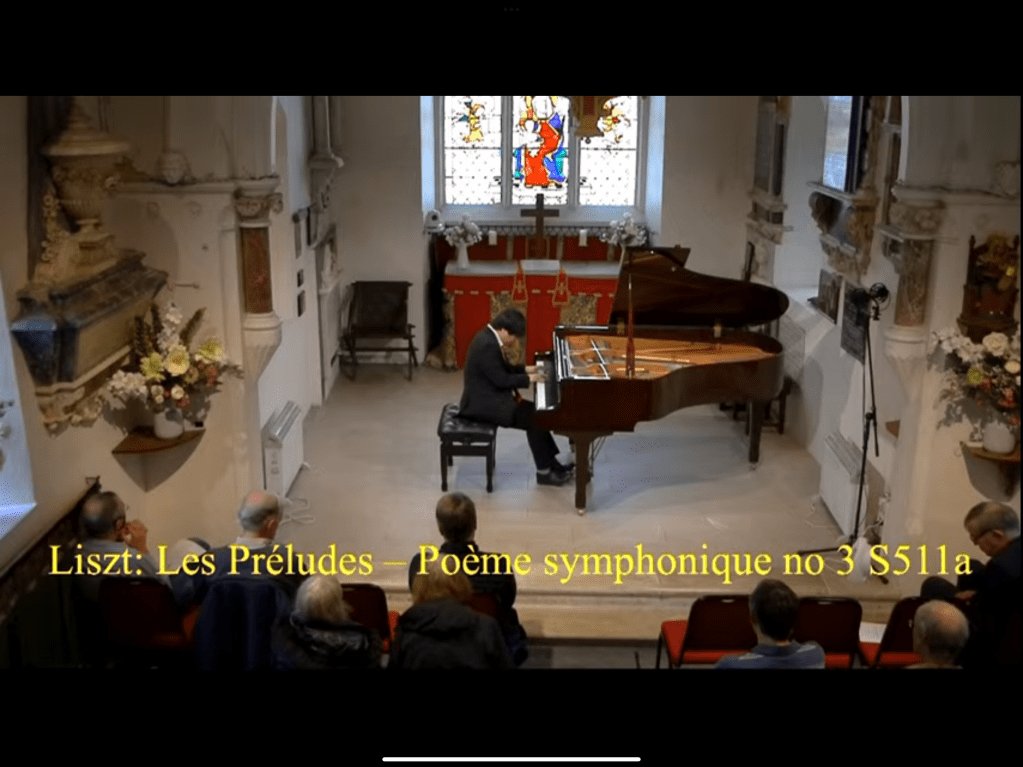
Les Preludes that had a whole orchestra in Minkyu’s hands with a sense of colour and orchestration that would have put many noble orchestras to shame.Although Liszt’s thirteen symphonic poems exist in two-piano transcriptions prepared by the composer himself, it was his Czech student August Stradal (1860–1930) who was to transcribe them for solo piano – versions which demand almost superhuman virtuosity and that transform these revolutionary orchestral compositions into viable and effective piano works, faithfully preserving their masterly musical substance
The full title of the piece, “Les préludes (d’après Lamartine)” refers to an Ode from the Alphonse de Lamartine’s Nouvelles méditations poétiques of 1823.
However, the piece was originally conceived as the overture to Les quatres élémens, settings of poems by Joseph Autran which itself was drawn from music of the four choruses of the cycle. It seems that Liszt took steps to obscure the origin of the piece, and that this included the destruction of the original overture’s title page, and the re-ascription of the piece to Lamartine’s poem, which however, does not itself contain anything like the music’s ‘question’.
The 1856 published score includes a text preface, which however is not from Lamartine.What else is our life but a series of preludes to that unknown Hymn, the first and solemn note of which is intoned by Death?—Love is the glowing dawn of all existence; but what is the fate where the first delights of happiness are not interrupted by some storm, the mortal blast of which dissipates its fine illusions, the fatal lightning of which consumes its altar; and where is the cruelly wounded soul which, on issuing from one of these tempests, does not endeavour to rest his recollection in the calm serenity of life in the fields? Nevertheless man hardly gives himself up for long to the enjoyment of the beneficent stillness which at first he has shared in Nature’s bosom, and when “the trumpet sounds the alarm”, he hastens, to the dangerous post, whatever the war may be, which calls him to its ranks, in order at last to recover in the combat full consciousness of himself and entire possession of his energy.
In the beginning of 1859 Les préludes was successfully performed in New York City.Karl Klauser, New York, made a piano arrangement, which in 1863 was submitted to Liszt. In a letter to Franz Brendel of 7 September 1863, Liszt wrote that Les préludes in Klauser’s arrangement was a hackneyed piece, but he had played it through again, to touch up the closing movement of Klauser’s arrangement and give it new figuration.Liszt sent Klauser’s revised arrangement to the music publisher Julius Schuberth of Leipzig,who was able to publish it in America. In Germany, due to the legal situation of that time, Breitkopf & Hartel as original publishers of Les préludes owned all rights on all kinds of arrangements. For this reason, in 1865 or 1866 Klauser’s arrangement was published not by Schuberth but by Breitkopf & Härtel.Besides Klauser’s arrangement there were further piano arrangements by Stradal and Tausig. Liszt made his own arrangements for two pianos and for piano duet.
An amazing display and I was not surprised to see Leslie Howard in the hall cheering his true heir like we all were with this amazing display of pianistic and musical genius.
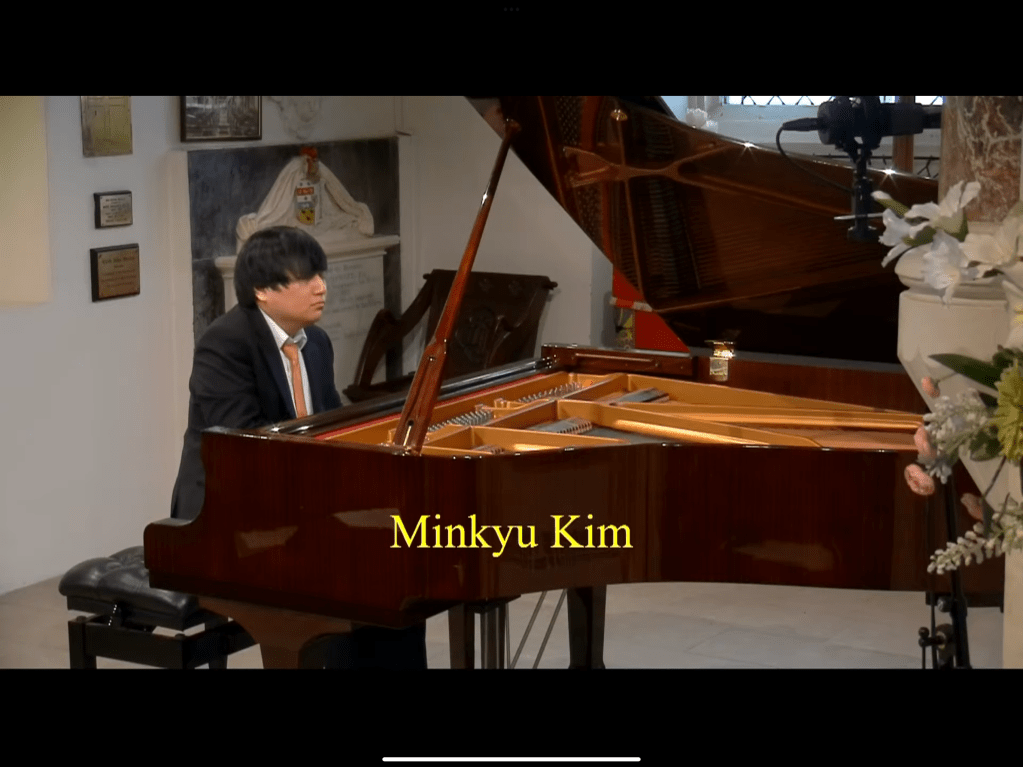
Minkyu Kim was born in South Korea in 1995. He studied piano with Soojeong Jeong at Goyang High School of Arts and with Hyung-Joon Chang and Sehee Kim at Seoul National University and harpsichord with Joohee Oh. He has won many prizes including second prize in the Korean Liszt Competition, first prize in the Jock Holden Memorial Mozart Prize (RCS), Governors’ Recital Prize for Keyboard (RCS), Philip Halstead Prize (RCS) and third prize in the Windsor International Piano Competition. He has been selected as one of 10 finalists of the International Franz Liszt Competition in Utrecht, to be held in October 2022. Minkyu has given many recitals in Korea, including several lecture concerts. He has also performed the entire Transcendental Études by Franz Liszt. Minkyu has performed piano concertos with Goyang High School of Arts Orchestra, Scottish Ensemble and the Royal Scottish National Orchestra, and has had several chamber music concerts with Seoul National University Philharmonic Orchestra. After graduating with distinction from the University in 2017, he began his studies at Royal Conservatoire of Scotland with a full scholarship from ABRSM. He is currently studying for a Doctor of Performance degree at the RCS in with Professor Aaron Shorr and Sinae Lee with a full scholarship.
La musica ci indica la strada. Andare a Teatro è un gesto responsabile
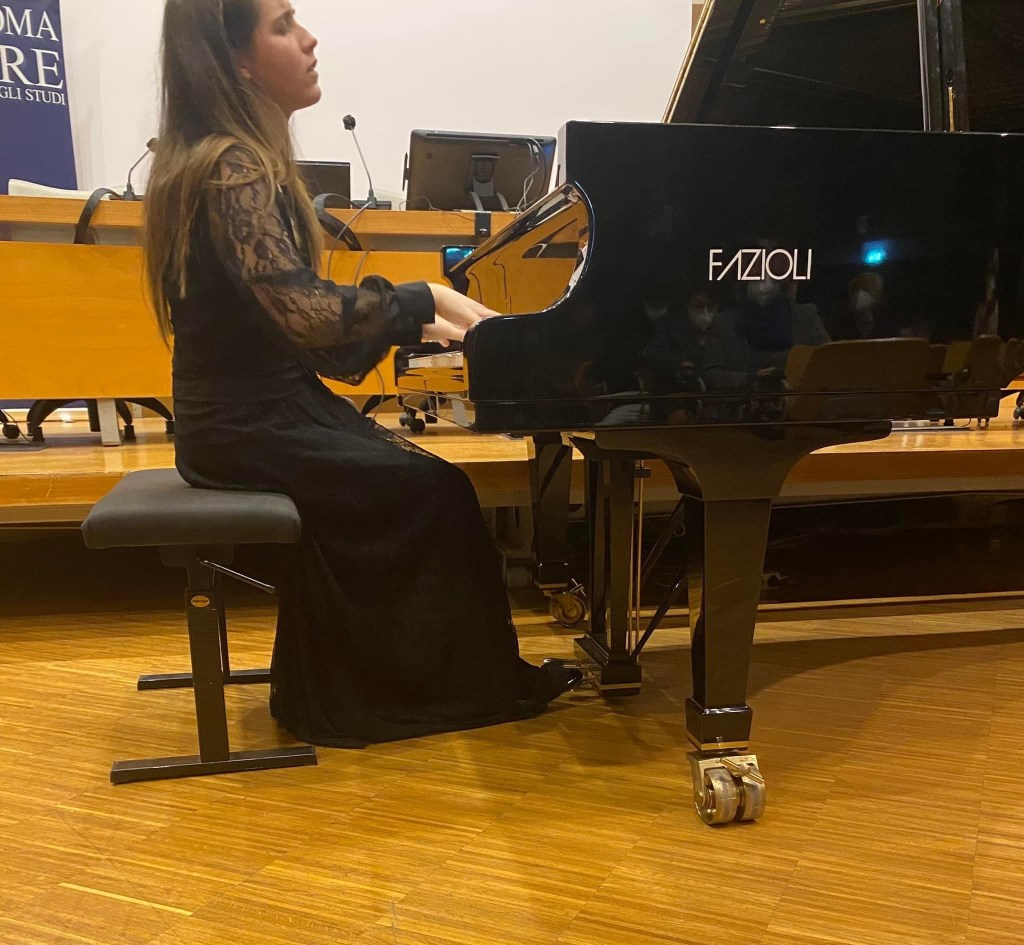
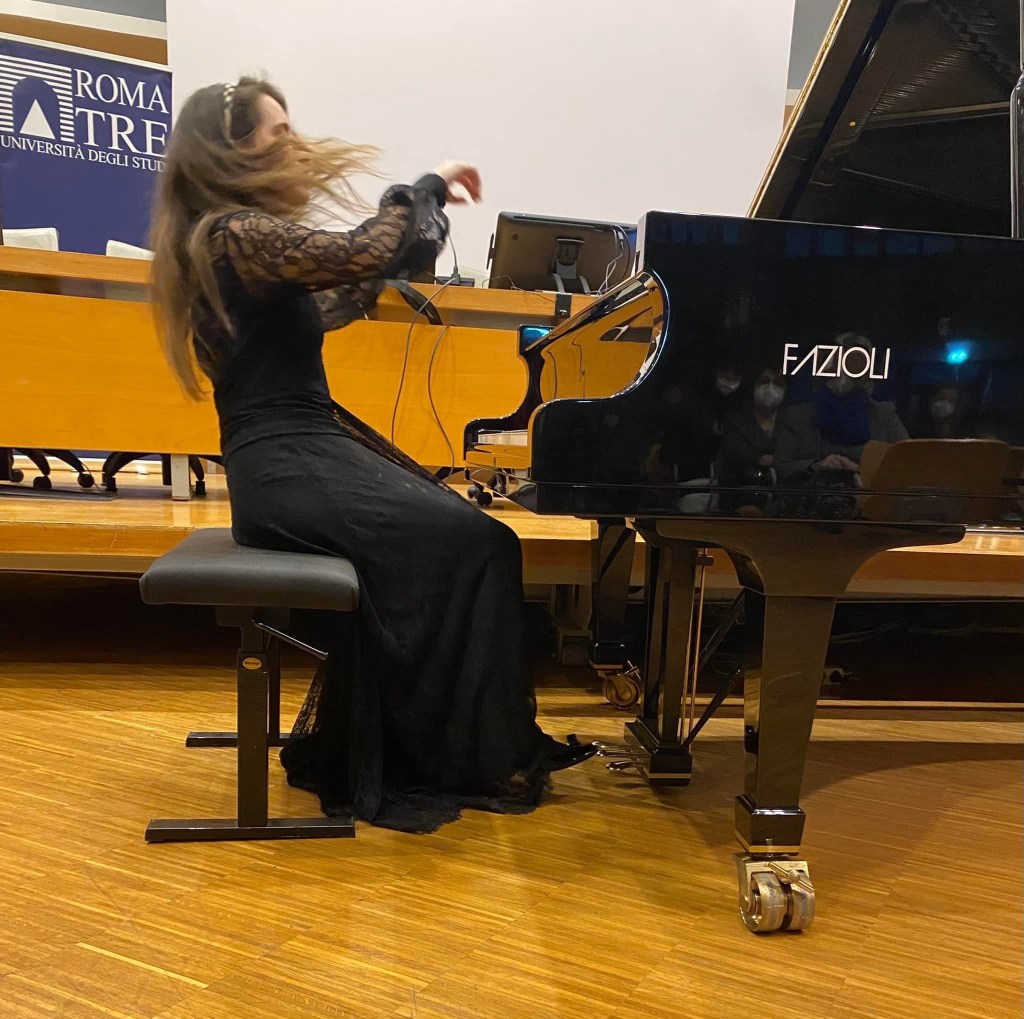
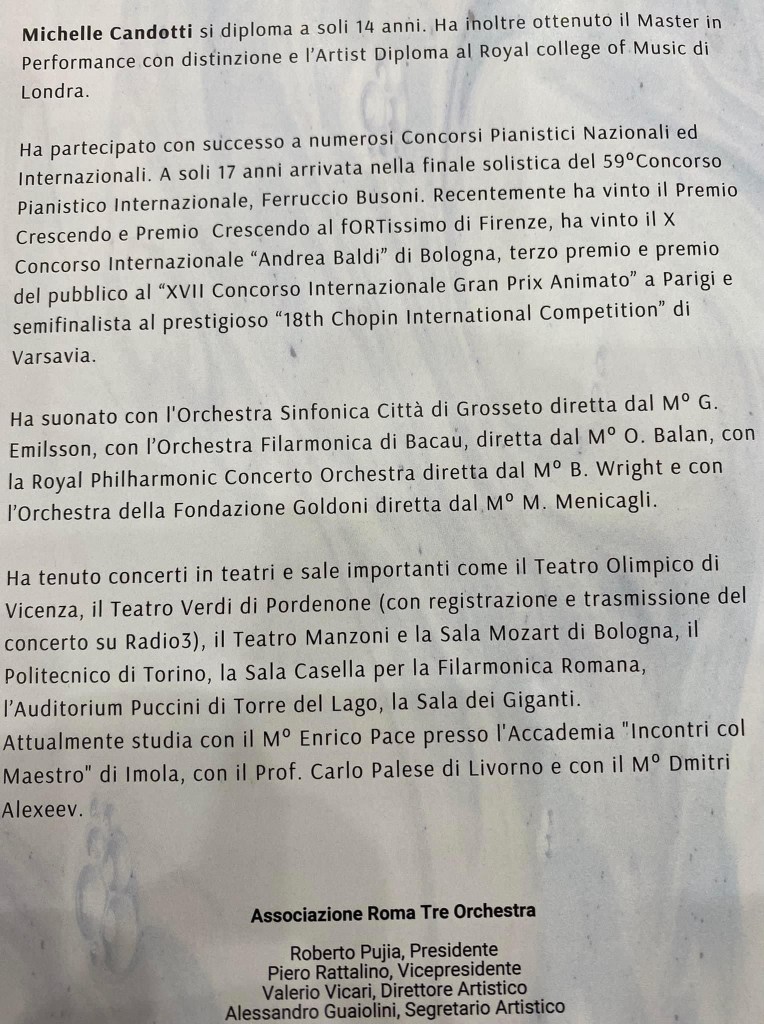
Michelle Candotti for the Roma Tre Young Artists Series is a pianist who I had noted in the Chopin Competition in Warsaw.A slender young lady from Livorno who plays like a lion with intelligence and technical prowess and breathtaking excitement as she enacts the music before our very eyes.
Such power and concentration but sublime beauty and subtle sounds too.In fact this Fazioli became an orchestra in her hands taking us into a world of fantasy and make believe.An overwhelming rhythmic energy and a hypnotic sense of communication that gave new life to that old war horse of the ‘Waldstein’ Sonata.
Allegro con brio first movement was played with a great sense of drive and rhythmic intensity.The second subject growing so naturally out of this whirlwind that Beethoven unleashes on an unsuspecting world.Coming as it does after the two rather Haydnesque sonatas op 49 Beethoven opens the flood gates for his irascible temperament that like Schumann’s Florestan and Eusebius was to oscillate between the tempest and the calm.It was exactly the character that this delicate looking young pianist surprised us with,astonishing explosions alternating with ravishing calm.A development episode that exploded into a continual display of multicoloured arpeggios where gradually the energy subsided and we are left with a menacing rumble in the bass played with remarkable clarity by Michelle even in pianissimo.Slamming the door shut at the end with Beethoven’s three fortissimo chords where even here her natural musicianship gave them a great sense of direction.This was after a scintillating coda of what Delius describes as Beethoven’s scales and arpeggios! The pianissimo octaves were surprisingly well played even though it was not a true finger legato but her natural musicianship allowed her to create the same illusion with a subtle use of the pedal.The Adagio molto introduction to the Rondo was played with great weight with Beethovens ‘rinforzando’ giving the just colour to Beethovens obvious orchestral writing.The Rondo flowed so beautifully out of this that one could forgive her for not risking Beethoven’s long pedal notes.However she gave it the same impression but also permitted a clarity that was unusually beautiful.The ever more technically difficult episodes that Beethoven alternates with the Rondo theme were played with breathtaking audacity and a rhythmic drive reminiscent of Serkin.He though would wet his fingers before playing each of the glissandi in the coda that lesser mortals play as very deft scales (Kissin like Michelle choose to play them as scales!)However that is just a detail compared to the beauty of the Rondo theme over Beethovens magic cloud of trills.These clouds of sound that from here onwards were the almost completely deaf composer reaching out to the paradise that was awaiting him in his last great trilogy.Michelle’s was a remarkable performance of exhilaration,excitement but also with this glimpse of calm and beauty.I look forward to hearing more of her Beethoven for her unique understanding of the very character of the composer.
The opening Barcarolle was imbued with subtle passion maybe even slightly too much …….but can it ever be too much when it is so totally convincing?There was a great sense of style from the very opening gentle flow of the left hand undulations which was to give continual momentum to Chopin’s most perfect creation.The beautiful melody that floats over it was sometimes with a very slight lack of synchronisation that gave expression and allowed even more colour to appear as if by magic.There was great beauty in the undulating middle section but it was the dolce sfogato that was so beautiful for its simplicity and lack of ‘traditional’ sentimentality.Coming after the legato meno mosso with its orchestral non legato accompaniment played so beautifully the sudden flowering of this part of the Barcarolle was where I remember Perlemuter exclaiming quite spontaneously in his lessons:’this is paradise’.It was followed by the passionate outpouring of the climax in which Michelle’s aristocratic understanding was with sumptuous full sounds that she produced from the bass creating the sound and a freedom that Chopin himself likened to a tree with roots firmly planted in the ‘Polish soil’ and the branches free to move freely with the wind.The delicacy of the final leggiero(sic) filigree above the gently melodic chords made one realise why Ravel so admired this particular passage .The great downward plunge to the final four four chords was played with aristocratic control, a control which had been the absolute key to this remarkably fine opening performance.
Has the maiden ever been so enchanted as by Michelle’s nightingale?A beautiful performance full of ravishing colours but with the weight and creamy rich sound that was so much the character that Rubinstein imbued into these beautiful Spanish pieces.’Mr Rubinstein turned baubles into gems’ said Joan Chissell and indeed he did like Alicia de Larrocha too.Michelle has that same intense feeling but within the notes not externally that gives such meaning to the sounds that she shapes like a sculptor or a painter where the sounds she is creating are the same shape as her movements on the piano.A true artist in all that she does.
And has Liszt’s Dante Sonata ever been so terrifying as she literally ravaged and seduced the piano with the same animal force that reminds me of her mentor Dmitri Alexeev in his all too rare public performances these days? Giovanni Bertolazzi gave a performance of the two Liszt Sonatas in this same series last January that was quite remarkable.’The best Dante I have ever heard’exclaimed Valerio Vicari.However today at the end of the concert I told Valerio that I would have gladly travelled 500 kilometres to hear these performances instead of my actual 200.He just smiled with that look that says it all ….‘I told you so!’It was a remarkable tour de force of a Dante Sonata completely different from Giovanni’s where she too lived every second – of course she is Tuscan so can understand the significance of Dante.But there was a technical assurance allied to a mature control that never took away from the moments of animal excitement.Even the treacherous skips at the end held no terror for her as they were part of the fantastic story she was telling and not just isolated moments of transcendental difficulty.The silences between episodes too were terrifying as they were unexpected.Her fearless abandon and volumes of sounds belied her rather frail appearance and were overwhelming.
Even she at the end was breathless and found it hard to announce her encore but certainly had no difficulty playing it!Expecting a nice peaceful nocturne or Bach Siloti Prelude our young pianist launched into Chopin’s octave study with a power and energy that was astonishing.Even the beautiful middle section was played with rich unsentimental sound incorporating it into a great architectural shape that gave such sense to a study so often broken into two parts.
With Ing.Giancarlo Tammaro of the Villa d’Este Liszt Festival
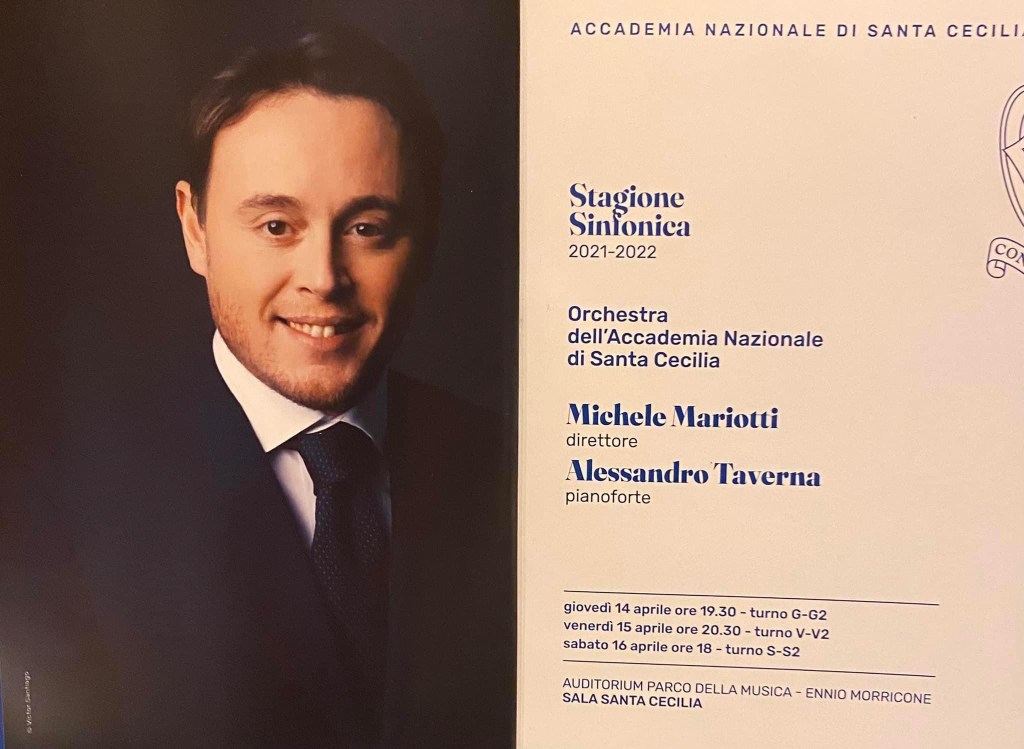
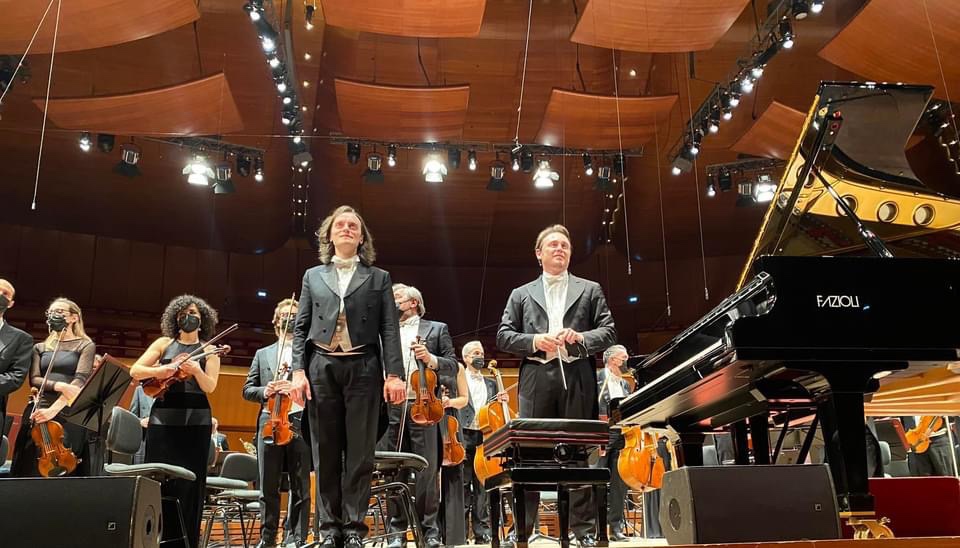
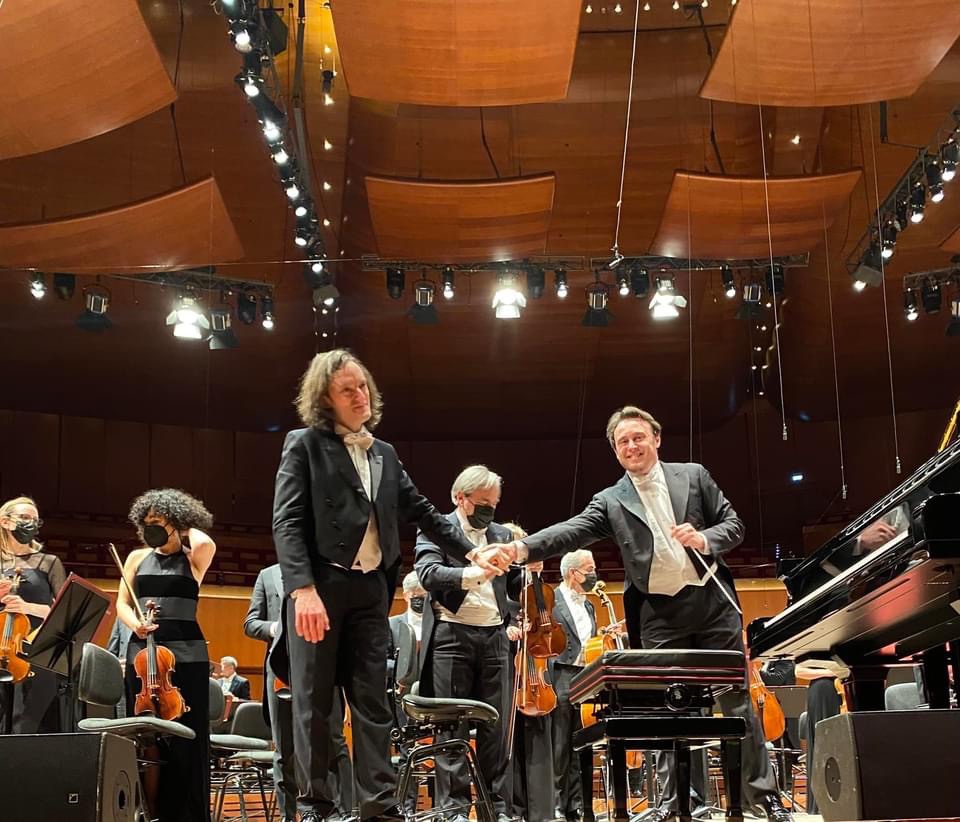
Michele Mariotti and Alessandro Taverna play Britten Piano Concerto op 13 on Good Friday in Rome. An early work written in 1938 receiving its first performance from the composer himself at the Proms under Sir Henry Wood and in the revised 1946 version Noel Newton-Wood (a name unjustly forgotten). In 1939 Britten and Pears left for America with the air of war becoming ever more apparent in Europe. It was revived in 1965 for Sviatoslav Richter who thanks to Britten was allowed out of Russia to take part in his Aldeburgh Festival where he and Rostropovich were regular visitors up to Britten’s early death in 1976. His simple tombstone in the graveyard of Aldeburgh is a fitting tribute to one of the most important composers of the twentieth century. Strangely his output for solo piano was very small but he will rightly be remember for his thirteen operas of which Peter Grimes in 1945 changed the course of opera creating a new dramatic art form. His only solo piano works are the youthful Holiday Diary Suite and later he wrote a nocturne as a set work for the first Leeds International Piano Competition having been bullied to be on the jury too by the indomitable Fanny Waterman. I was invited in 1973 ,whilst studying with Agosti in Rome ,to play them all over Italy by the British Council to celebrate the sixtieth birthday of the composer.
It is fitting that Alessandro Taverna started his professional career many years later in 2009 winning recognition in the Leeds Competition. Today he gave a superb performance to an audience sadly depleted for Easter in Rome. All those present,and I was glad to see it being recorded,were able to appreciate Alessandro’s crystal clear virtuosity on a magnificent Fazioli concert grand.It may have been a depleted audience but that did not stop their enthusiasm insisting on an encore.He gave a scintillating performance of Friedrich Gulda’s jazz piece Play piano Play.
Benjamin Britten was a master of orchestration and it was the interplay between orchestra and piano that was so fascinating. At one point just the viola double bass and flute and even the audacity,like the end of Beethoven’s Emperor, to have just piano and bass drum.
The virtuosity of Alessandro was at time exhilarating in its conviction and authority but it was in the quieter more reflective moments that he created a magic atmosphere of chamber music proportions. Much helped by the superb conducting of Michele Mariotti,the highly applauded director of Rome Opera, who could draw such sensitive intimate playing from the S.Celia Orchestra contrasting with the sumptuous full orchestra that Britten also demands. .
And sumptuous playing there was after the interval too with Tchaikowsky’s Second Symphony op 17 ‘Little Russian’.The wind section in particular gave some memorable performances and were singled out at the end by Mariotti after their exhilarating playing.Sumptuous sounds too from the string section.An orchestra that Pappano is bequeathing to Rome after many years of growing and discovering the joys of music making together .An orchestra that has learnt to listen to itself is a great orchestra indeed.Sir Anthony Pappano is moving to London to take over the reigns from Sir Simon Rattle who like Pappano had embarked on the same voyage of discovery with the City of Birmingham Symphony Orchestra before moving to the Berlin Philharmonic and the London Symphony Orchestra,
No war just stars moving around and making room for another one on the horizon at the Opera House-Michele Mariotti
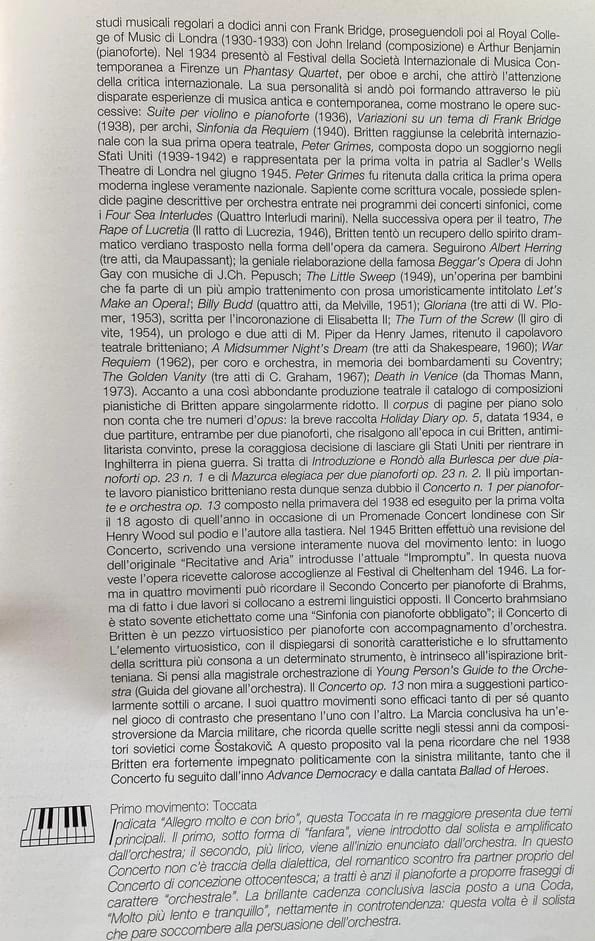
The concerto was written in 1938 and then revised in 1945, including the replacement of the third movement. This was Britten’s first work for piano and orchestra, which he premiered as the soloist at a Promenade Concert in 1938. Dedicated to the composer Lennox Berkeley,the concerto is a bravura work that has gained more international attention in recent years.Britten described the piece as “simple and in direct form”.It does in fact stand comparison with Prokofiev’s First Concerto in D flat for its way of using the piano with an almost chiselled melodic effect in unison and also much of the virtuoso passage work.
The revised version premiered at the Cheltenham Festival on July 2, 1946. The London premiere was performed soon after at the Proms in Royal Albert Hall with Noel Mewton -Wood as the soloist performing with the London Symphony Orchestra conducted by Basil Cameron .With Britten’s agreement, a theme from the revised version was used by his colleague William Walton as the basis of a 1969 orchestral work, Improvisations on an Impromptu of Benjamin Britten.
The best-known recording of the concerto is by the English Chamber Orchestra with Sviatoslav Richter as the soloist and Britten conducting, from a 1970 performance at the Snape Maltings, Aldeburgh, near Britten’s own home.There is also a 1957 recording supposedly of Moura Lympany with the Philharmonia under Herbert Menges which appeared in Italy in a 100 cd collection called Pianoforte for Fabbri .When I mentioned this to Dame Moura who had retired to Montecarlo she exclaimed that she had never played it.As it was coupled with the Rawsthorne Concerto that she did play the confusion was that the Britten was played by Jacques Abram and they appeared on the same HMV LP together.After all these years of thinking Dame Moura had forgotten .It is nice to know that she was of course right!Clifford Curzon when offered the European premier of the Khatchaturian concerto simply said give it to Moura she can learn it over night.And she did just that with the help of Uncle Tobbs (Tobias Matthay) and they are reported to have had such fun working on it together!
The work is scored for 2 flutes (both doubling piccolo), 2 oboes (II doubling English horn), 2 clarinets, 2 bassoons, 4 horns, 2 trumpets, 3 trombones, 1 tuba, timpani, glockenspiel, cymbals, whip, bass drum, snare drum, tambourine, tenor drum, harp, and strings.[1]
The four movements:
1. Toccata: Allegro molto e con brio The first is the most typically ‘bravura’ movement of the concerto. Much of the melody is derived from a sequence introduced in the opening bars. As in the rest of the piece, the orchestra plays a major role. There is a significant cadenza, written with no clear time signature and only approximate bar lines, where glissandi are a key feature. A lyrical melody opens up, before rapidly building to a dramatic end. A typical performance lasts around thirty-five minutes
2. Waltz: Allegretto
3. Impromptu: Andante lento Originally the third movement was a ‘Recitative and Aria’. There is another section marked ‘quasi cadenza’, again written with ambiguous bar markings.
4. March: Allegro moderato sempre a la marcia Dotted rhythms and crushed notes are an important feature of this movement, and a whip-crack is heard throughout, as is musical quotation of the first movement. The music is much denser than the other movements.
This was a mistake in this Italian edition as the Britten was played by Jacques Abram but appeared on the original HMV recording together with Moura Lympany playing the Rawsthorne Concerto
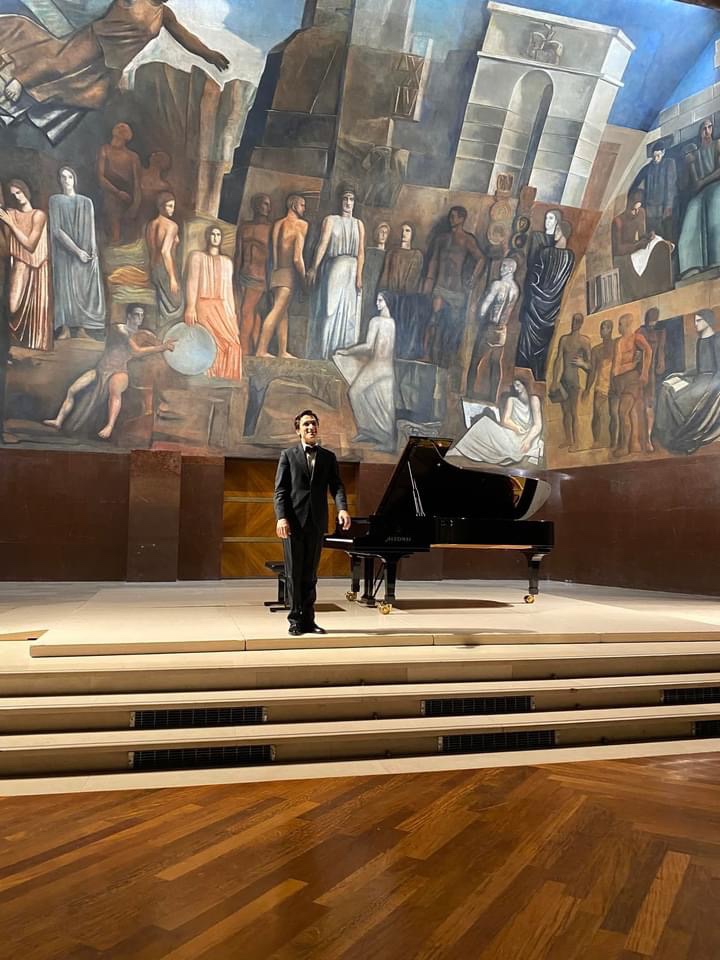
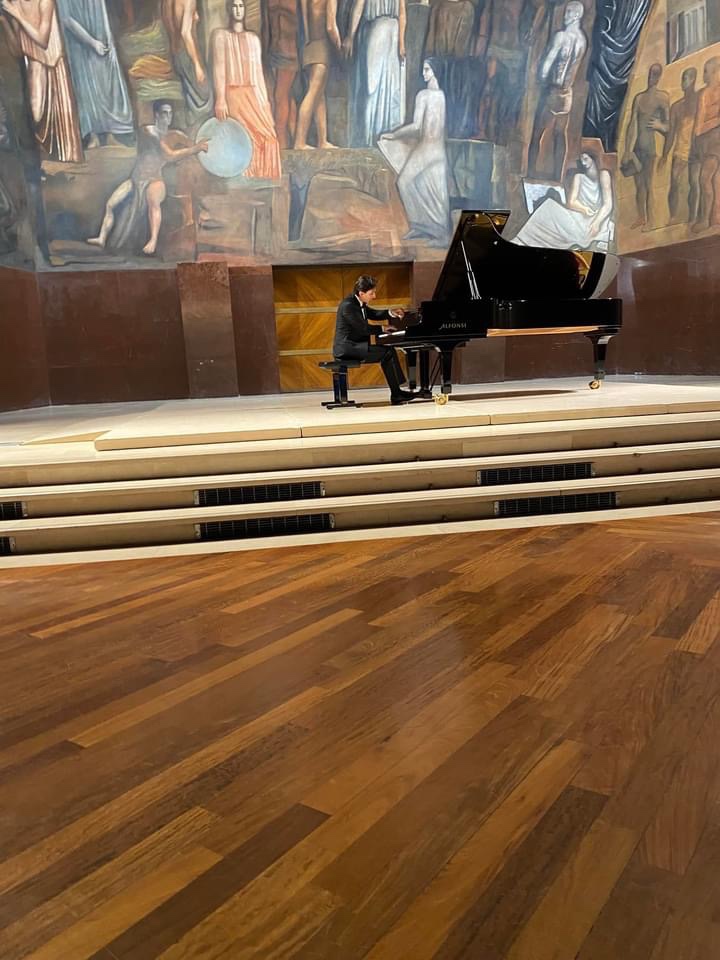
Alexander Romanovsky in front of the mural of Mario Sironi at the Aula Magna of La Sapienza
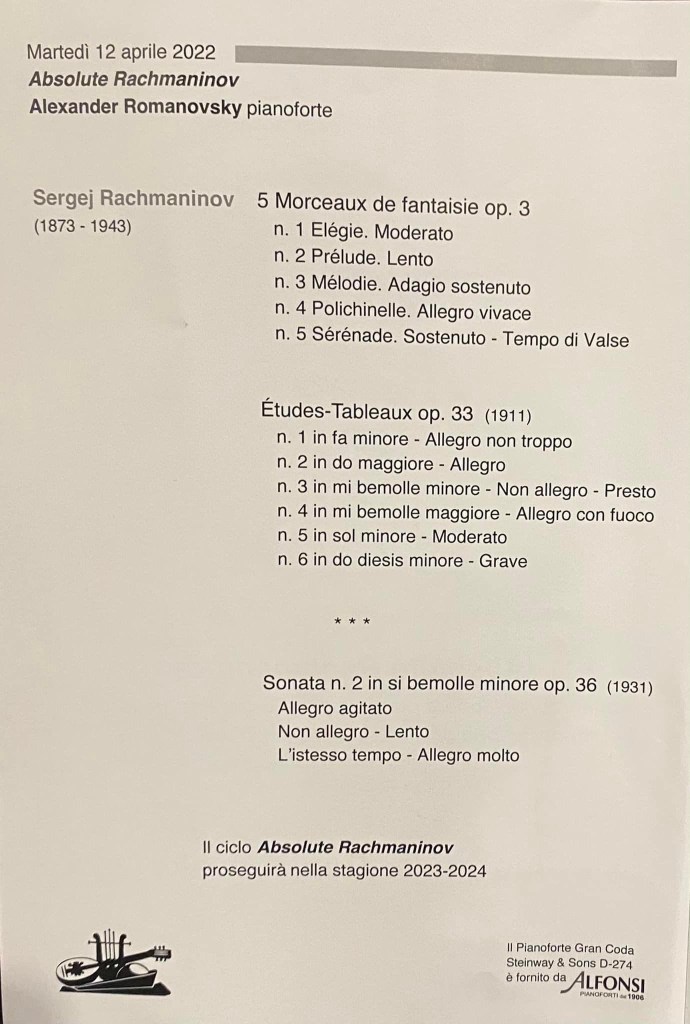
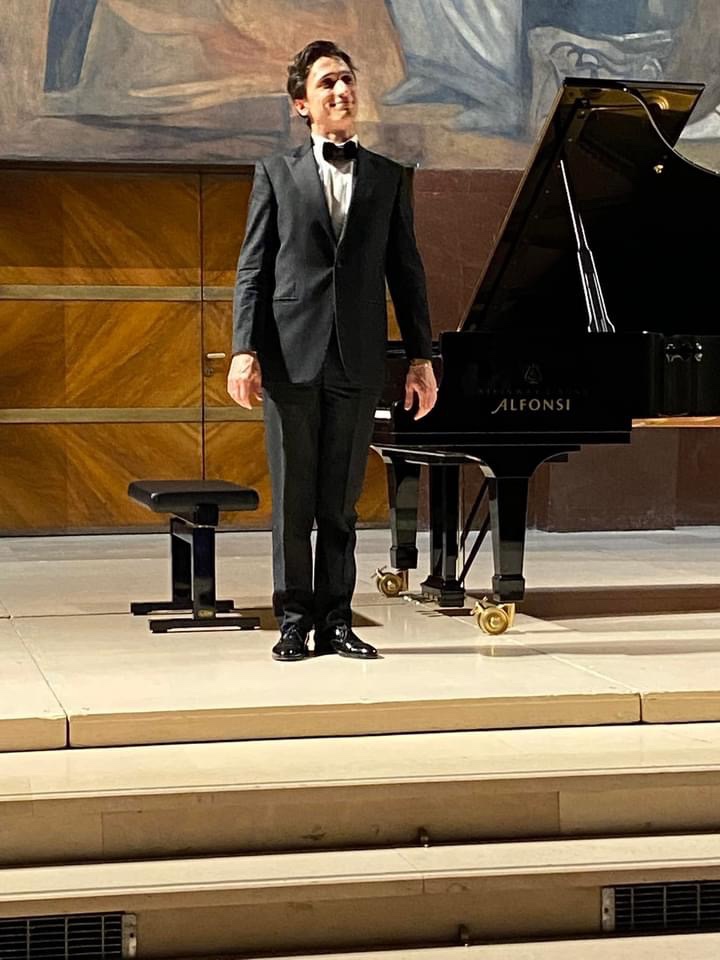
They say miracles never strike twice in the same place but in the Eternal city they do.After Sokolov’s six encores last night we were treated to eight from Alexander Romanovsky after his quite extraordinary recital in the first of his series of the complete works of Rachmaninov to celebrate the 150th anniversary of his birth.
The physicality of his playing I have only experienced from Richter,a fellow Ukrainian,who knew no rules in searching for the sounds that he tore from his soul. A savagery that I have never since experienced until tonight. Not showing any outward signs but listening like a praying mantice ready to pounce in performances that were exhilarating as they were astonishing and breathtakingly beautiful. The description of my old teacher Perlemuter fits exactly for Romanovsky. He told me that Rachmaninov would come on stage looking as though he had swallowed a knife but then produced the most romantic sounds that he had ever heard.
Sokolov is considered by many,including me,to be one of the finest pianist before the public today.His annual recitals established by the much missed Bruno Cagli are a highlight of the S.Cecilia season.But today I am reminded of Romanovsky’s performance of Rachmaninov 3rd concerto a few years ago when he stood in at the last minute for an indisposed Bronfman.
The cheers and standing ovation he got not only from the public but also from the world weary professionals of the S.Cecilia Orchestra were repeated again tonight after his triumphant opening concert at the IUC Sapienza University Concert Series.
After the sudden death in 2005 of my wife Ileana Ghione on stage in our theatre, struck down by an aneurysm whilst playing Hecuba.Escaping to London for a short break from the inevitable upheaval from the press and others I passed by Steinway Hall.Quite unexpectedly I was greeted by Noretta Conci Leech who with tears in her eyes knew of the tragedy that had befallen me in Italy.She was promoting with her husband a young Brazilian pianist, Pablo Rossi,and they suggested that I invite him to give a recital in our theatre in Rome.He came to play in the spring of 2007 and thus was sealed a link with the Keyboard Trust that is continuing up until the present day.A link that was forged when John and Noretta had accompanied Leslie Howard to play in Rome in my Euromusica season in the mid nineties.
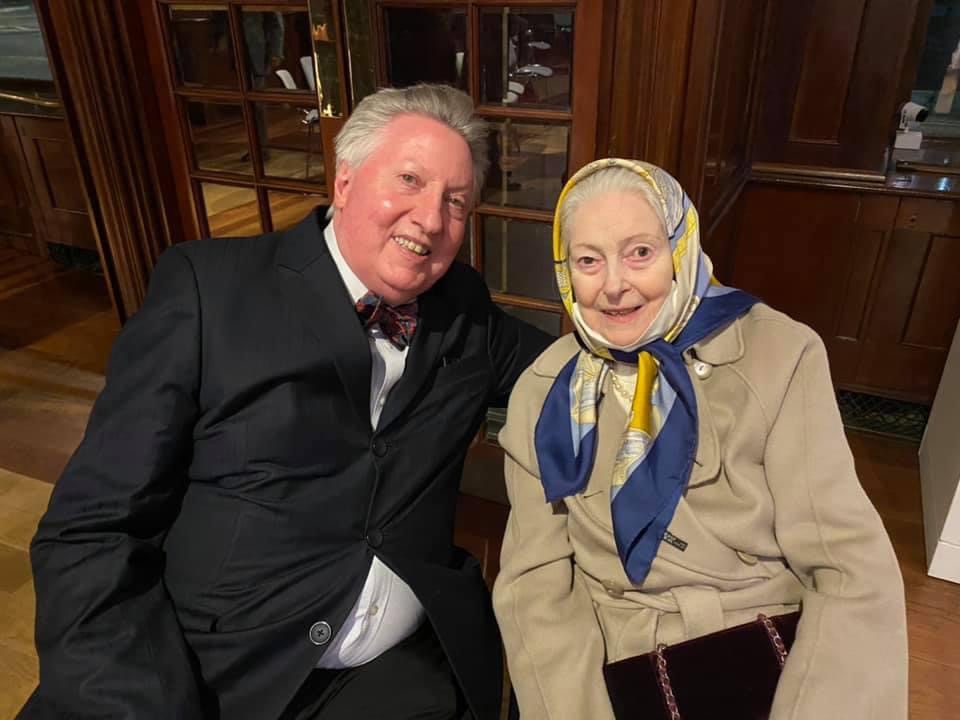
Noretta Conci Leech with Leslie Howard
After Pablo’s great success a series was created and in May 2008 a very doleful looking young Ukrainian pianist was invited to give a recital.I can still remember turning to the two very beautiful ladies who had accompanied Alexander Romanovsky and saying that I had never heard such beautiful sounds from our Steinway.It was the second subject of Chopin B minor sonata that will remain with me for the rest of my days.Tours for him with the Keyboard Trust followed in America and Germany crowned with the Keyboard Trust prizewinners recital at the Wigmore Hall in London.Since then Sasha has gone on to conquer the major musical centres throughout the world with a career that has established him as one of the finest pianists of his generation.So I was particularly happy to be able to hear him in recital again after many years.
It was the same artist,now in his late thirties,with every reason to appear doleful as tragedy unfolds day by day,blow by blow,in his homeland.I was astounded by the maturity and authority of his playing.Added to the beauty and sense of balance was a sense of weight which gave a sumptuous depth of sound.Any slight imperfections passed completely unnoticed such was his overwhelming vision and sense of communication.Here there was no doubt that the seventeen year old winner of the Busoni competition had joined the ranks of the great interpreters of our day.
The opening Elégie was overwhelming in its outpouring of noblility and nostalgia with its sumptuous sounds and kaleidoscopic sense of colour.There was a wonderful sense of flexibility with an infinite variety of sounds and a way of touching the piano that I have rarely noticed in others.He seemed to fearlessly strike the keys with passionate strokes from above , playing a series of notes with just one pointed finger.But such was his sensitivity that there was never a hard or ungrateful sound but an infinite variety of sounds allied to an overwhelming conviction that was quite breathtaking in its audacity and authority.There was a wonderful sense of balance too with the ravishingly haunting Mélodie that immediately followed the famous Prélude.It was this Prélude that was to shadow Rachmaninov all his career as it was the most requested piece in any of his recital programmes.Here Sasha struck the great chords from above but with massive strokes covered in velvet with an impact of grandiosity that held us riveted to every note.The final heart melting sounds of three delicate chords seemed to disappear into the rarified air.There was a transcendental command in Polichinelle where he swept over the entire keyboard with astonishing brilliance and sumptuous beauty before the insinuatingly subtle sounds of the final Sérénade.
The six Etudes -Tableaux op 33 were given a scintillating performance.From the imperious March opening of the first through to the ravishing melodic line of the second and the ‘Snow storm’ streams of golden sounds of the third.A great call to arms in the fourth was answered by the wonderful luminous sounds of the fifth with a sense of balance full of sumptuous colours.The grandeur and obsessive Scriabinesque motifs of the sixth was quite hypnotic and unleashed an animal like attack on the piano that was truly overpowering.
The second sonata in the revised 1931 version was played with the same fury and abandon that Horowitz had unleashed on an unsuspecting world in his historic comeback recitals.Astonishing pyrotechnics and animal attack alternating with the most seductively ravishing sounds that held the audience spellbound almost gasping in astonishment at the audacity and animal like frenzy that was unleashed on a piano that was ready and waiting for a great artist to bring it to life.
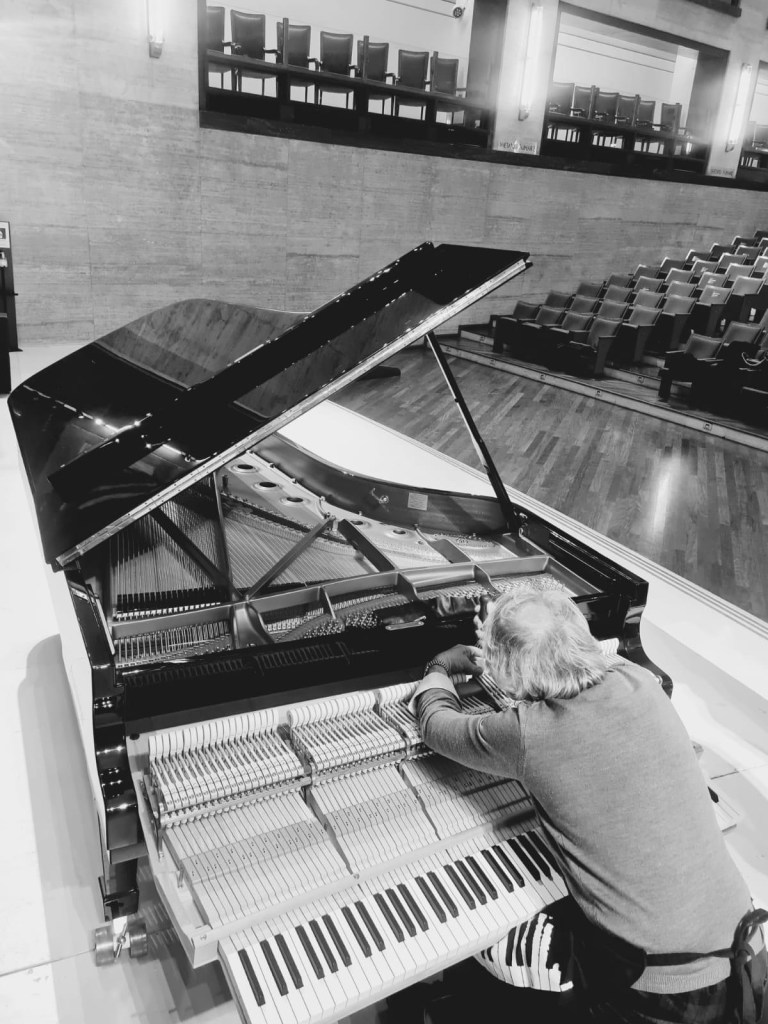
Mauro Buccitti that other great artist preparing the piano for Romanovsky’s recital
A piano prepared by that other artist,Mauro Buccitti who had spent many hours before the recital making sure that it would respond to a great artists’every demand.
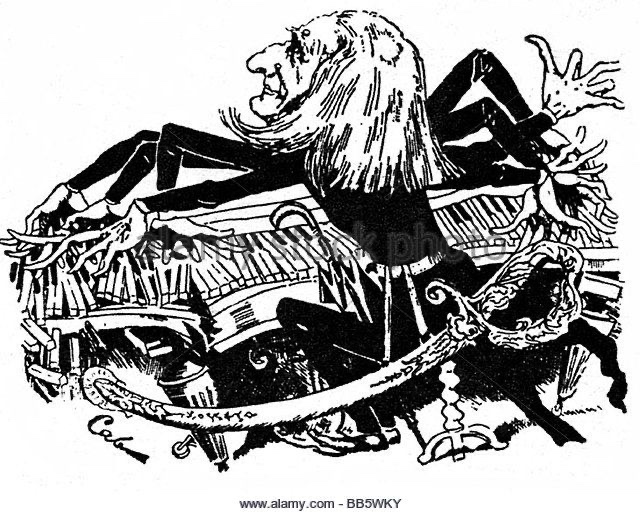
Well it certainly did that and I was reminded of that famous cartoon of Franz Liszt taming the animal with black and white keys that lay before him
What to say of the eight encores that he offered to a public drunk with the extraordinary performances that had been re-enacted so unexpectedly before them and not wanting the evening to come to an end.Three studies by Scriabin from the heart rending C sharp minor op 2 n.1 to the tumultuous study in D sharp minor op.8 n.12 .A revolutionary study that was mirrored by Chopin’s own op 10 n 12.How could he not include a scintillating performance of the black key study that Myra Hess would play with an orange and two carrots.Sasha certainly had no need of any assistance as his fingers unravelled like springs with octaves that were breathtaking as they cascaded down the keyboard in this by now party atmosphere .The Rachmaninov Prélude in G minor op 23 n 5 was played with such military authority that the ravishing central episode seduced us all.The final encore summed up the complete artistry of Romanovsky and was the same encore that Emil Gilels would captivate his audiences with.After all the overwhelming sounds and rhythmic drive here were the gentle ondulating arpeggios of Siloti’s Prélude in B minor.Whispered sounds out of which emerged a chorale melody of quite sublime beauty.
Alexander Romanovsky -Daniele Cipriani – Simonetta Allder- Leonetta Bentivoglio-Gaston Fournier-Facio in the green room after the recital
Described by Carlo Maria Giulini as “extraordinarily gifted,” pianist Alexander Romanovsky is a riveting, distinct and subtle performer with an utterly engaging voice.Born in Ukraine in 1984, Alexander studied with his mentor Leonid Margarius at the Imola Piano Academy for fifteen years before continuing his studies at the Royal College of Music (London) with Dmitri Alexeev. At the age of seventeen, he won First Prize at the prestigious Busoni Competition in Italy.Praised by The New York Times as “special, not just an extraordinary technician with a flair for colour and fantasy, but also a sensitive musician and lucid interpreter,” Alexander graces many of the world’s most prestigious stages in recital. Recent highlights include the complete Chopin Études in the Main hall of Amsterdam’s Concertgebouw; the Tchaikovsky Concert Hall in Moscow and the Great Hall of the Moscow Conservatoire; Accademia Nazionale di Santa Cecilia and Teatro Olimpico in Rome; Tokyo’s Asahi and Kioi halls; Chile’s Teatro Municipal; and Sala Verdi at Milan’s Conservatorio; as well as a performance with the Swedish Radio Symphony Orchestra under the baton of Valery Gergiev.Romanovsky regularly performs with major orchestras throughout Europe, Asia and The Americas including the UK’s Royal Philharmonic, English Chamber, Hallé and Bournemouth Symphony orchestras; Italy’s Orchestra dell’Accademia di Santa Cecilia in Rome and Milan’s Filarmonica della Scala; Russia’s Mariinsky and Russian National orchestras and St. Petersburg and National philharmonics; Japan’s Tokyo and NHK symphony orchestras; Chicago Symphony at the Ravinia Festival; Pacific and Santa Barbara symphony orchestras; Costa Rica Symphony; and with the New York Philharmonic, under Alan Gilbert, at the Bravo! Vail Festival. He collaborates at a very high level with conductors such as Vladimir Spivakov, Valery Gergiev, Michael Pletnev, Vladimir Fedoseyev, Sir Antonio Pappano, Gianandrea Noseda and James Conlon.Recent highlights have included Brahms No. 1 at the Brescia and Bergamo International Piano Festival with the Royal Philharmonic Orchestra under Pier Carlo Orizio; Shostakovich No. 2 with the Bournemouth Symphony Orchestra and Victor Aviat; Liszt No. 1 with the Moscow Philharmonic and Yuri Simonov; Tchaikovsky No. 1 at the Teatro Colon in Buenos Aires; Prokofiev No. 3 with the Orquesta Sinfónica de Castilla y León under Andrew Gourlay; and a concert in honour of the late Claudio Abbado at the Colmar International Festival, performing Beethoven No. 5 under Vladimir Spivakov. Recent recitals include Casa da Música in Porto; the Tchaikovsky Concert Hall in Moscow; Teatro Manzoni in Bologna; and Istituzione Universitaria dei Concerti in Rome.Highlights have also included performances of Rachmaninov No. 3 with the Filarmonica della Scala and Myungwhun Chung at the MITO Settembre Musica festival and in Verona and Muscat, as well as on tour in the Baltic states with the Russian National Philharmonic and Vladimir Spivakov; and his debut at the Royal Albert Hall in London playing Beethoven No. 5 with the Royal Philharmonic Orchestra and David Hill. Alexander performed the complete Beethoven Piano Concerti, returning to both the Pacific Symphony Orchestra and the Costa Rica Symphony under the baton of Carl St Clair.Recitals have included Musica Insieme Bologna, Amici della Musica di Padova, Unione Musicale Torino, Tchaikovsky Concert Hall in Moscow, Freiburg International Piano Series, Fondazione Accademia Musicale Chigiana, and his debuts at the Fondation Louis Vuitton in Paris and Spivey Hall, Atlanta; with repertoire including the complete Chopin Études, Beethoven Diabelli Variations, Brahms 7 Fantasien Op. 116, and the Bach Chaconne from Partita No. 2 .Alexander performs extensively throughout Italy, where he has lived since early childhood. In 2007, he was invited to give a concert at the Papal Residence in the presence of Pope Benedict XVI in celebration of the 110th Anniversary of Pope Paul VI’s birth. Since 2007, he has released five critically acclaimed albums on Decca: Beethoven: Diabelli Variations, Brahms/Schumann, Rachmaninov: Etudes-Tableauxand Corelli Variations, Rachmaninov: Piano Sonatas, and more recently Childhood Memories.Alexander Romanovsky has held the post of Artistic Director of the Vladimir Krainev Moscow International Piano Competition since 2014
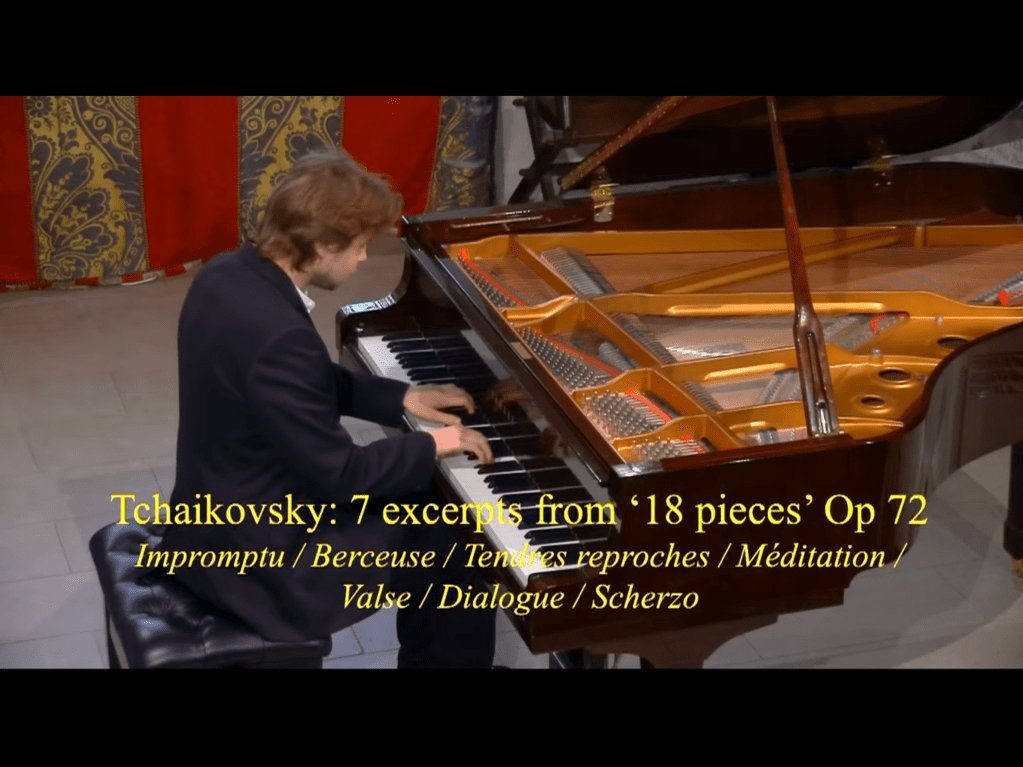
The last piano pieces written by Tchaikowsky -An Impromptu showing immediately a sense of style with a rhythmic energy ‘joie de vivre’-Sumptuous sounds in the Berceuse with the same nostalgic yearning that was to be so characteristic later of Rachmaninov.A meditation of ravishing beauty with such sense of weight which gave such solidity and richness of texture before disappearing in a stream of magic trills.A playful zest to the Valse just answered by the technical prowess of the Scherzo
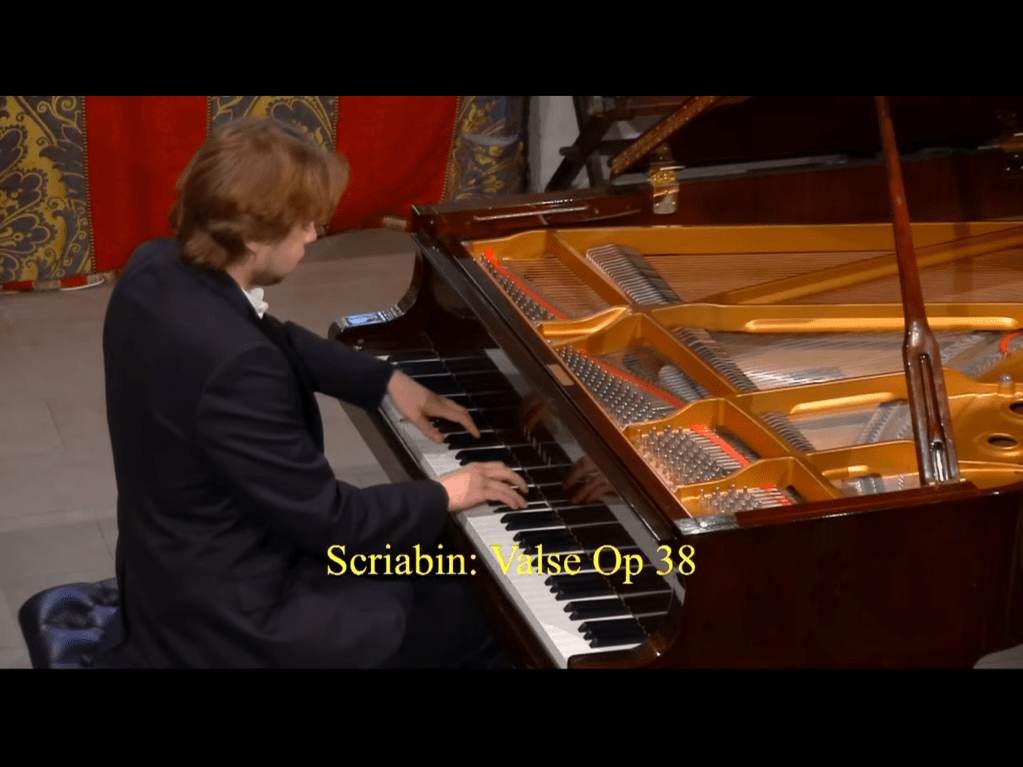
Scriabin: Valse Op 38
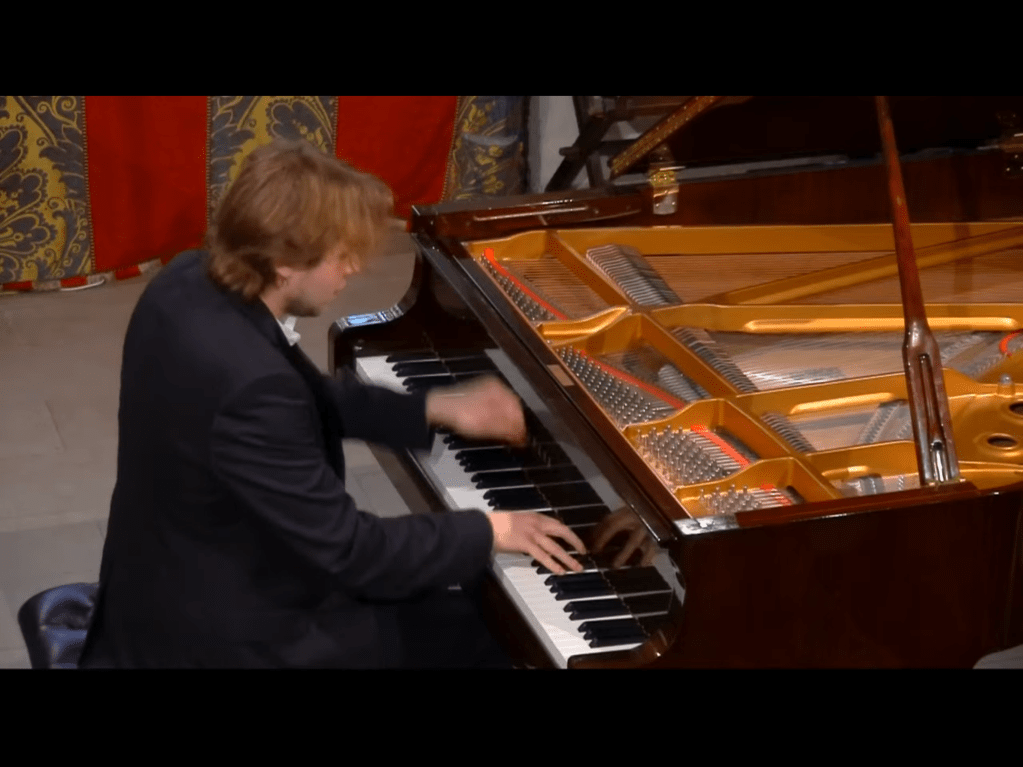
A kaleidoscope of subtle sounds from Nikita’s truly magic hands.A delicious irresistible sense of style of a work that merits to be heard more often in the concert hall- if you can throw off it’s transcendental difficulties with the ease and charm of Nikita!
Prokofiev: 2 pieces from ‘Cinderella’ Op 102
Playing the last two of the six pieces from Cinderella -Pas de Chale was played with all the tongue in cheek that was intended but also a great sense of fun with transcendental excitement at the end.There was sumptuous beauty in the last of the six pieces :’Amoroso’as it builds to a ravishing climax and glissandi thrown off with such ease creating a magic finale.
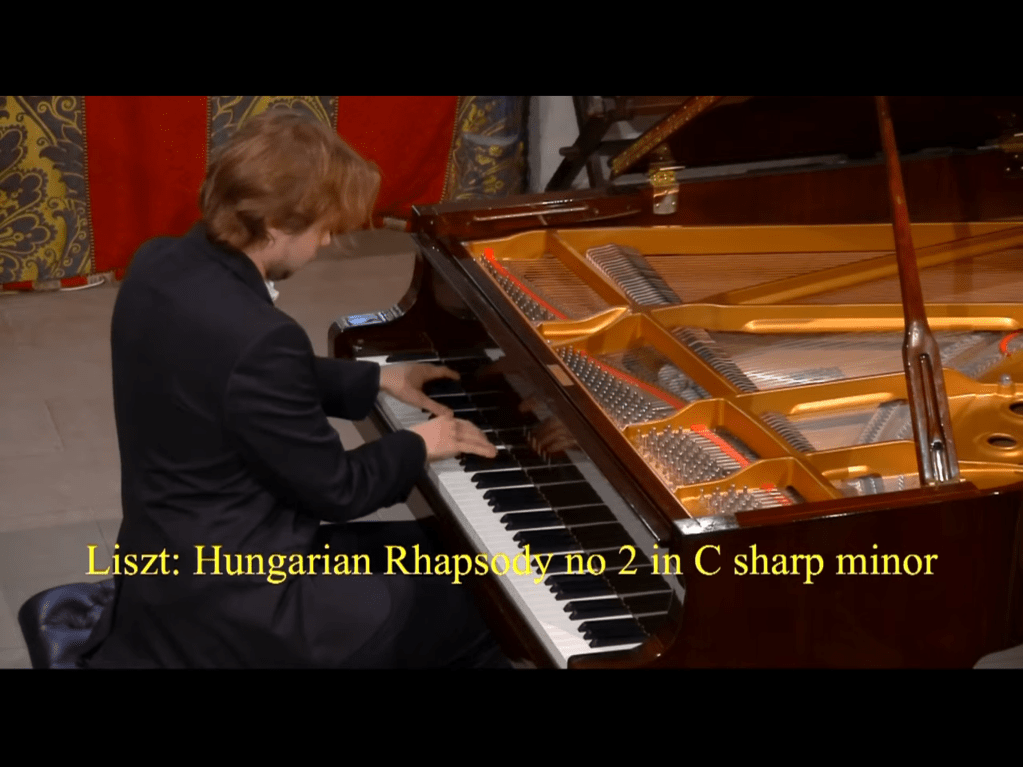
Liszt: Hungarian Rhapsody no 2 in C sharp minor
A superb sense of balance allowed us to hear the majestic opening as Liszt must have contemplated.Playing of such style restoring this much maligned masterpiece to its original glory with transcendental technical command and artistry.The outlandish Rachmaninov cadenza was very interesting to hear but I do not think even Rachmaninov played it on his historic recording!
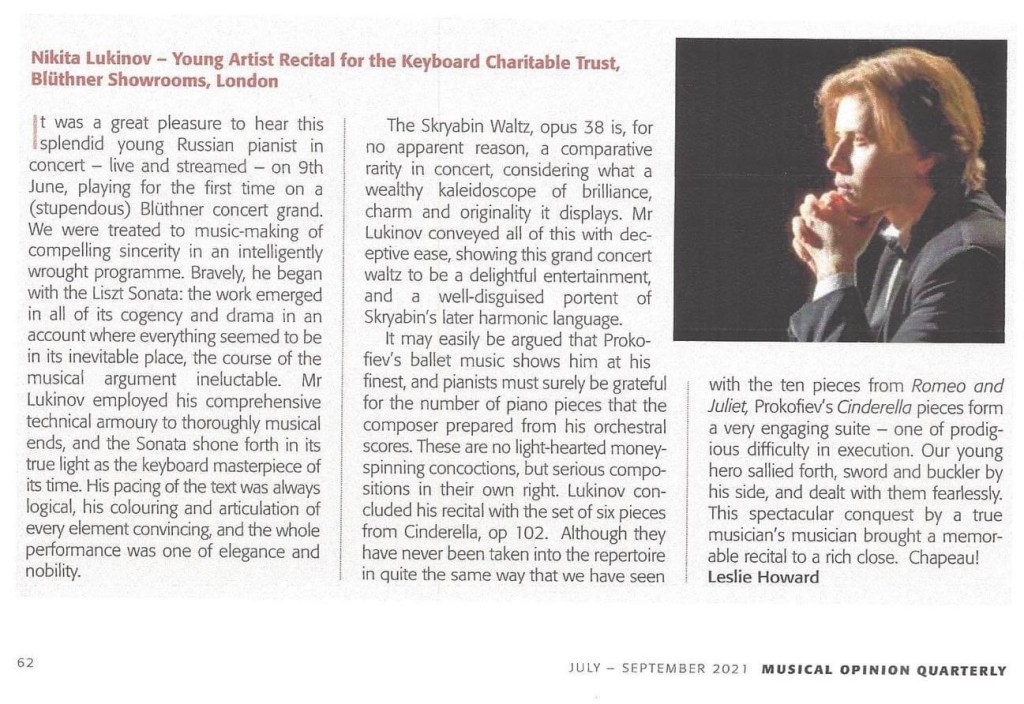
Dr Hugh Mather hit the nail on the head when he described Nikita Lukinov’s recital as masterly.But it was not only for the pyrotechnics,that were certainly not missing,but it was indeed the canons covered in flowers. It was such an effortless mastery that any technical difficulties were just incidental to the musical message that was foremost in this young artists hands.A sumptuous sense of colour and style turned these baubles into gems. I hope Nikita will forgive me for describing them as baubles as he is obviously in love with them.To describe them other than salon pieces would be to misjudge their qualities as pleasing works for an elite audience looking for instant gratification. Apart from the famous Liszt Hungarian Rhapsody we were treated to a series of miniatures from the Russian repertoire of Tchaikowsky,Scriabin and Prokofiev. But even in the Hungarian Rhapsody he could not resist adding Rachmaninov’s outsize cadenza. Russian repertoire ? But Prokofiev was born in the Ukraine.And so this terrible tragedy that we are living daily,blow by terrible blow,becomes ever more the ‘big end and little end’ tragedy inflicted on his people by a despot fighting for his own supremacy and survival.
Nikita fresh from his sold out recital in Shrewsbury that raised £4000 for the Ukraine relief fund
Not many know that Nikita was in Shrewsbury two days ago where he gave his services for the Ukraine relief fund explaining the unfathomable tragedy that is being enacted in his homeland. With daily news directly from their relations who are living and suffering in a unwarranted war zone.
Shrewsbury St Alkmunds Church where Nikita gave his services free for Ukraine relief fund
His efforts were awarded by a sold out concert and he was treated like a hero by a generous public that were only too pleased to donate 4000 pounds to the relief effort that our young warrior was outlining in heartfelt words but more eloquently with his music. Justly proud of his heritage in presenting a programme from his homeland in their hour of such suffering. But Nikita is not only a master pianist but also a master musician. We could catch glimpses of it in these miniatures but it was from his hands that we had heard recently one of the most musicianly performances of the much maligned Sonata by Liszt. A musician who delves deep into the score and looks with fresh eyes at exactly what the composer wrote rather than relying on a tradition. A tradition that has led to such distortion where to look at what the composer actually wrote can come as a shock.
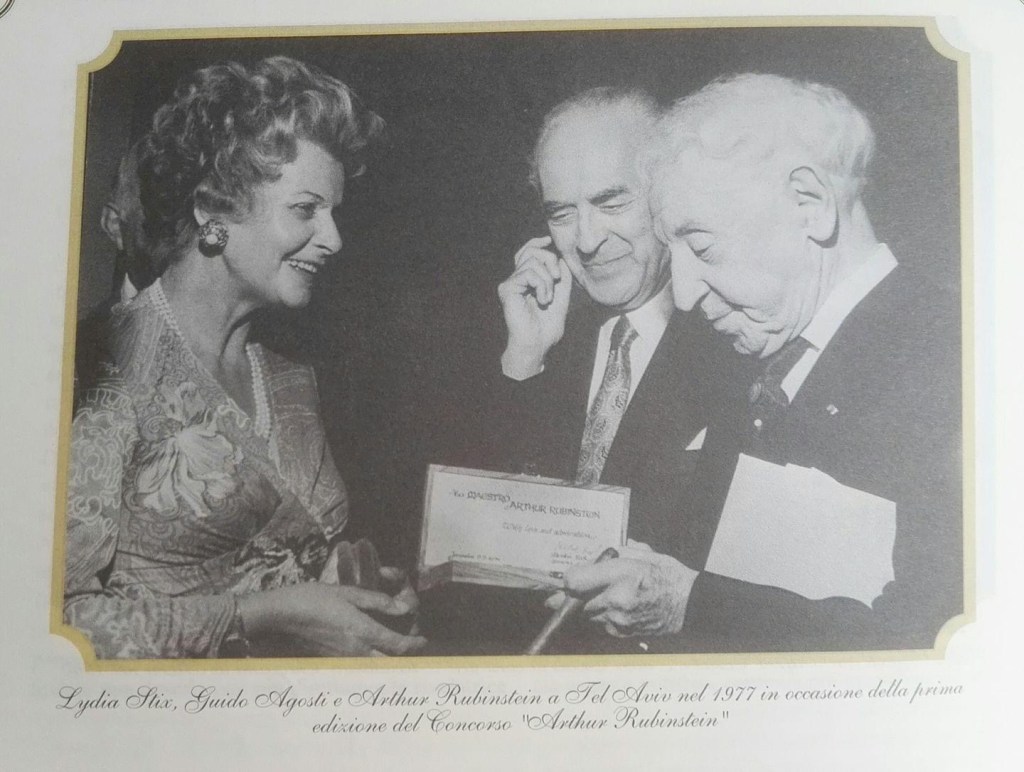
It is these shock tactics that both Leslie Howard and I received regularly from Guido Agosti in his studio in Siena. A disciple of Busoni ,a student of Liszt whose teacher Czerny had been a disciple of Beethoven. It is the same shock tactic that has us searching the scores as we listen to Murray Perahia or Krystian Zimerman.It is no surprise to learn that the former was mentored by Horowitz and the latter by Rubinstein. These are all thoughts that come to mind as I think in retrospect of the performances that we were treated to today by this young artist. His innocence and simplicity are expressed in his humility and modesty as his performances are received with ever more superlatives by consummate musicians.
Nikita Lukinov was born in Russia in 1998. In 2005 Nikita started studying at Voronezh Central Music School with Svetlana Semenkova, an alumna of Dmitry Bashkirov. Nikita’s first success was a Grand-Prix at the 2010 International Shostakovich Piano Competition for Youth (Moscow). Nikita’s debut with a symphonic orchestra was at the age of 11. Other achievements include 1st place in the Inter-Russian piano competition for young pianists, Finalist of an International television competition for young musicians “Nutcracker”, 1st place in the Inter-Russian Concerto competition, where he performed a Chopin piano Concerto No1 op.11 with on orchestra at the age of 14. Nikita’s most recent awards include 1st place in the Inter-Russian Competition “Music Talents of Russia” (Russia, 2020), 2nd place at the Franz Liszt Center International Piano Competition (Spain, 2021).
After studying in Russia, Nikita won a full scholarship to continue his studies in London at Purcell School for Young Musicians, the oldest and one of the most prestigious specialist music school in the UK. His musicianship was cultivated by Professor Tatiana Sarkissova, a Dmitry Bashkirov’s alumna. While studying at the Purcell School Nikita had his Kings Place and Wigmore Hall debuts, he also won The Purcell School Concerto Competition. He performed Prokofiev Concerto 1 op.10 and Mozart Concerto 15 K.450 with the Purcell School Orchestra at the age of 15. Since September 2017, Nikita continues his education at the Royal Conservatoire of Scotland on a full scholarship with Professor Petras Geniušas.
Nikita has been fortunate to gain numerous concert opportunities at prestigious venues across the UK and outside, such as St. Martin in the Fields, Wigmore Hall (London), Kings Place (London), Fazioli Hall (Italy), Vaduz Rathaussaal (Liechtenstein), The Small Hall of Moscow Conservatory, St. Petersburg Music House. He is the recipient of a personal scholarship from Voronezh’s State Government “For Outstanding Cultural Achievements”, “Russian Children’s Foundation” and an international charity foundation “New Names”, personal scholarship from the National Artist of Russia V. Ovchinnikov, scholarship from the International Academy of Music in Liechtenstein, where he participated in the Intensive Music Weeks and activities offered by the Academy in 2020. In 2020 Nikita was appointed as “Emissary of the Muses of San Antonio, Texas”. Nikita is one of the musicians at the Talent Unlimited scheme (London). 2021 highlights should include participation at the “Verbier Music Festival”, “Art of the Piano” Festival in the USA and a debut recital at the Steinway Hall in London.
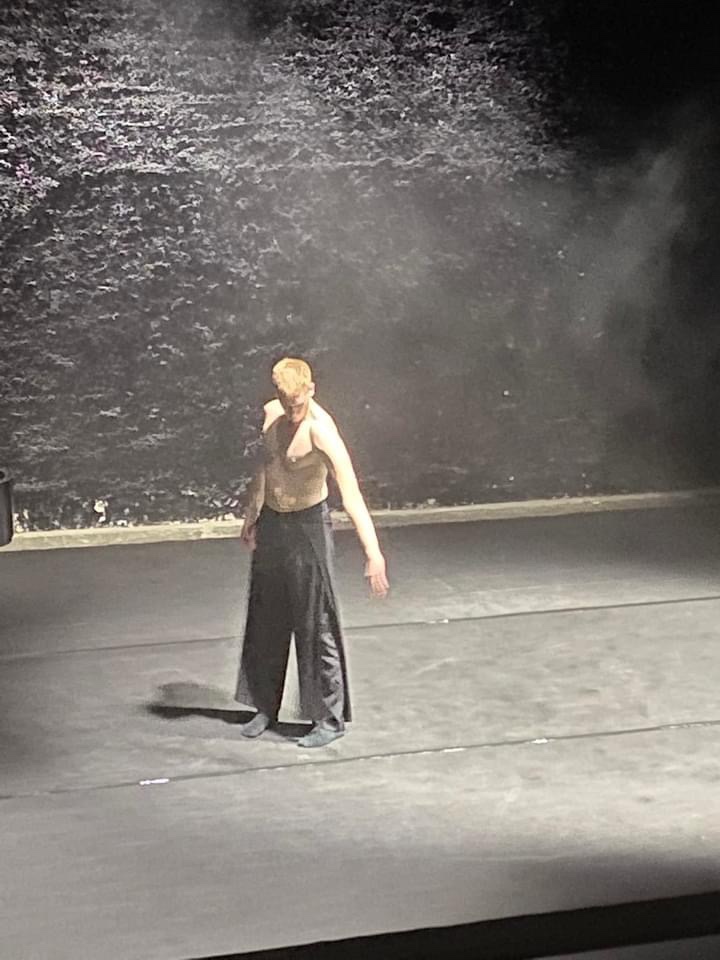
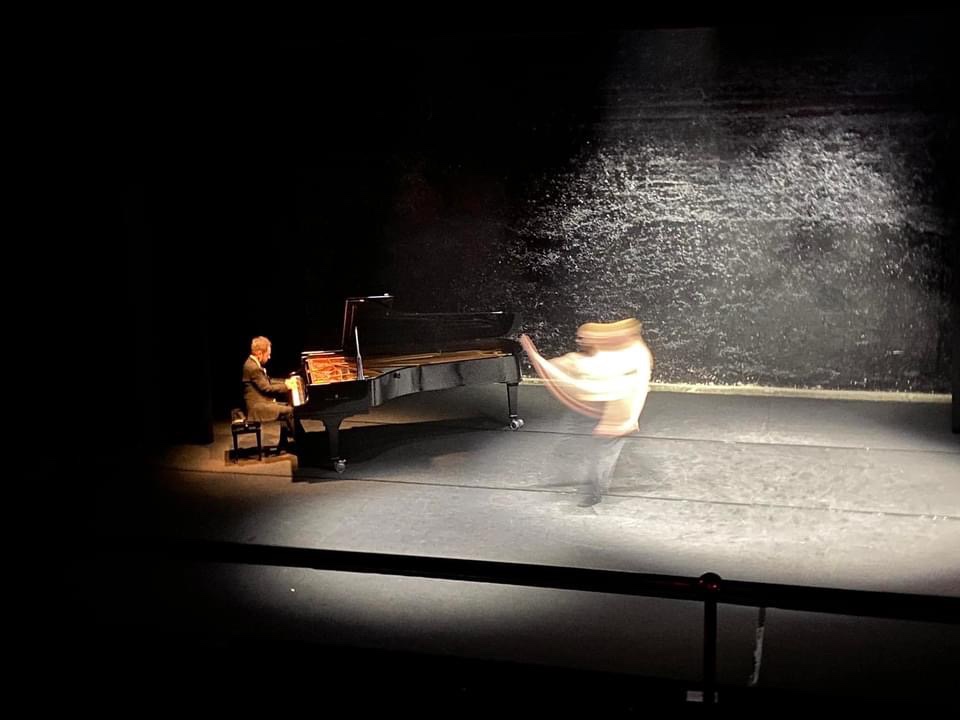
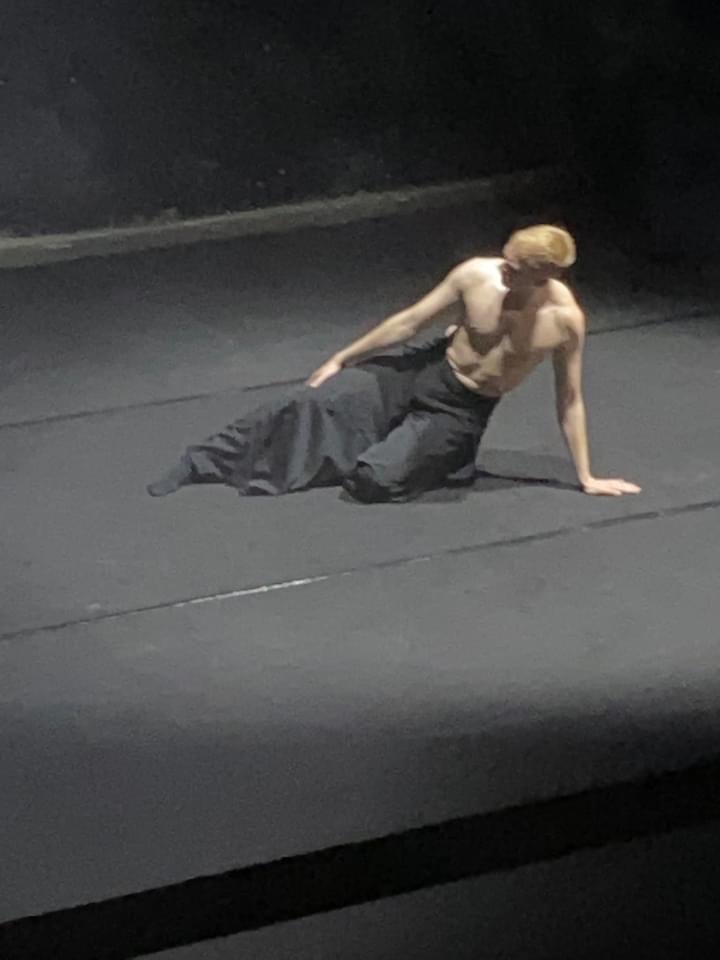
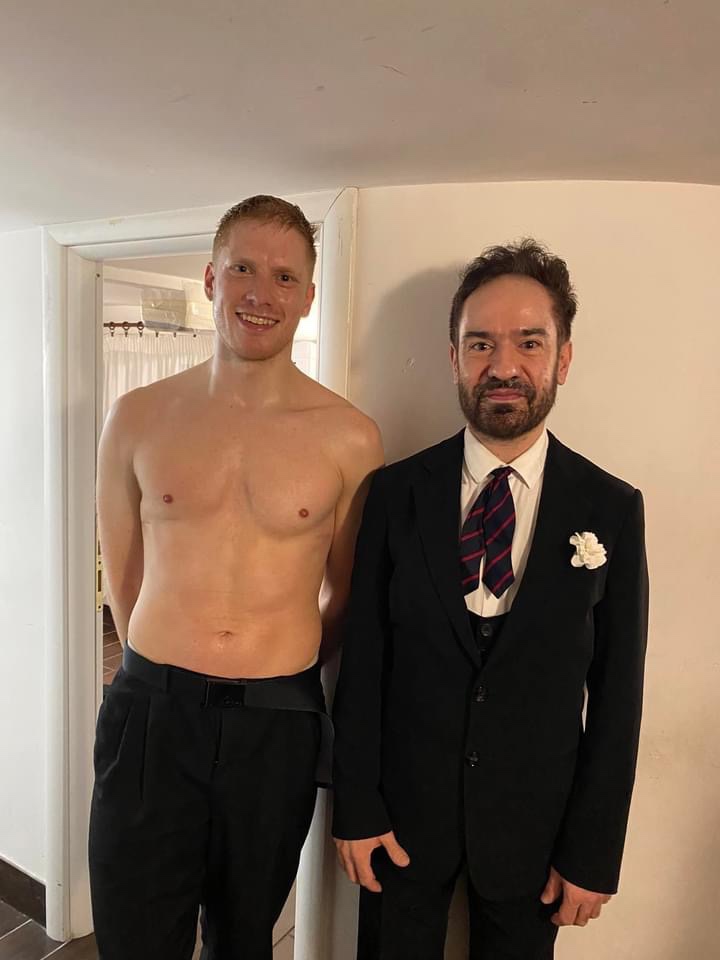
A fascinating combination of music and dance with Alistair Wroe and Raffaello Moretti at the Ghione Theatre in Rome. A programme that will be repeated in London on the 21st April at St John’s Smith Square. An eclectic choice of music superbly played by a pianist trained at the renowned International Piano Academy in Como with a Masters degree too from the Royal Academy in London. A dancer with a honours degree in contemporary dance from Trinity Laban music Academy in London. Raffaello Moretti also has a degree in Philosophy from Milan University and has just completed his PHD at Kings College London with a thesis on Alfred Cortot. A true renaissance man.And indeed it was a new art form that was reborn on the ‘wings of music’. Alastair Wroe has worked with many of the most important contemporary dance companies in Europe.
There was a very eclectic programme that was slightly modified after the interval due to the after effects of Covid on the artists a few weeks ago.Instead of the six short contemporary pieces that were in the programme we were treated to Chopin Preludes op 28 n1-12 and the Fourth Ballade op 52.Amazingly a change only decided after the fatigue of the first half on the dancer .These complex masterpieces by Chopin were performed with masterly style and authority and it should also be noted that Raffaello played the entire programme without the score.Even the complex transcription of the Shostakovich Quartet n. 8 in C minor which Boris Giltburg himself plays with the infamous I pad unfortunately too much in vogue these days !
The first impression listening and watching them perform together is almost like that of Eurythmics. A lost art form which has gone completely out of fashion these days but in the 20’s and 30’s was very much in vogue with Isadora Duncan the inspiration for many less professional would be dancers! This obviously was just a first impression but looking at the carefully constructed programme and the professionalism of these two artists they were able to shed much new light on classical music both old and new. It made this combination a fascinating art form and a ‘new route’ to a ‘recital’. It brings the message of music to an audience who also derive much enrichment from having a visual element synchronising and enhancing the musical performance.
D. Scarlatti. Sonate K 99,87, 155. These three sonatas were carefully chosen from Scarlatti’s output of over 500 and were played with scintillating style and clarity.From the simple beauty of K.99 to the beating of the drum and hypnotic dance rhythms of K.87 to the mellifluous outpouring of K.155 which led without a break into the bleak world of Shostakovich
D.Shostakovich. Quartetto in do minore ( trascrizione B. Giltburg).A long and complex work played without the score as they were both involved in interpreting this strange wondrous landscape that Shostakovich describes with such overwhelming power.
The promised second half that will be performed next time but today had to be substituted with:Chopin Preludes op,28 n. 1-12 and the Fourth Ballade op 52.A much requested encore was a very atmospheric performance of Satie’s Gnossienne n.1
T.Riley. Etude from the old country
J Adams China Gates
M. Price. Easter G.Ligeti Musica ricercata N 7 T. Riley. Simon’s Lullaby
E. Wild. Tre Studi da Gershwin
Alistair Wroe: Originario del Worcestershire, Alistair Wroe ha iniziato la sua formazione di ballerino presso il Center for Advanced Training di Birmingham e la Worcestershire Youth Dance Company. Ha completato un-BA (Hons) in Danza Contemporanea al Trinity Laban Conservatoire of Music and Dance. Durante la sua laurea ha lavorato con diversi coreografi tra cui Gary Lambert, Struan Leslie e Marie Gabrielle- Rotie. Inoltre, Alistair ha lavorato a stretto contatto con Alison Curtis- Jones e la Dott.ssa Valerie Preston-Dunlop, in particolare su nuove realizzazioni delle opere di Rudolf Laban Nacht e Green Clowns. Ha quindi continuato la sua formazione presso la London Contemporary Dance School, dove ha conseguito il suo Master of Arts, seguito da un tour internazionale come membro di EDge. Alistair ha avuto l’opportunità di lavorare con Philippe Blanchard, Alexander Whitley, Dazed Magazine per Craig Green, Tom Rosenthal, Tom Roden e Joseph Toong, rivelandosi come uno degli artisti più̀ talentuosi ed interessanti della nuova generazione di ballerini britannici, per carisma, presenza scenica, tecnica, eclettismo e profondità̀ di interpretazione.
Si è esibito a livello internazionale in Svizzera, Malesia, Norvegia e Italia. Attualmente continua ad esplorare ulteriormente il suo ruolo di interprete ed é inoltre interessato ad acquisire una profonda comprensione della pratica coreografica.
Raffaello Moretti: Diplomatosi a 18 anni con il massimo dei voti e la lode, Raffaele Moretti é stato allievo prima a Parigi di Aldo Ciccolini e Marie- Françoise Bucquet, ed in seguito di Alicia de Larrocha (Master triennale presso l’Academia Marshall- Barcellona) e Tatiana Sarkissova (Master biennale presso la Royal Academy of Music – Londra).Ha inoltre studiato per quattro anni presso la International Piano Foundation- Lake Como, presediuta da Martha Argerich, seguendo le lezioni di William Grant Naboré, Leon Fleisher, Claude Franck, Menahem Pressler, Charles Rosen, Dmitri Bashkirov, Fou Ts’ong ed Andreas Staier. Ha quindi lavorato intensivamente con Galina Eugiazarova, a Madrid. Masterclasses press il Mozarteum di Salisburgo (Andrzej Jasinski), la Foundation Yamaha di Parigi (Elisso Virsaladze) e lo Schwelzig Holstein Musik Festival di Lubecca (Bruno Leonardo Gelber). Laureato della Fondazione Cima in Toscana, ha inoltre vinto il Primo Premio assoluto presso diversi Concorsi Internazionali (tra cui Moncalieri e Mondovì). Concerti in Italia, Francia, Spagna, Germania, Inghilterra, USA, Messico ed Argentina. Ha inoltre collaborato per diversi anni con il Quintetto de I Solisti Aquilani. Laureato in Filosofia con il massimo dei voti presso la Università Statale di Milano, dove ha discusso con Carlo Sini una tesi su Nietzsche, ha seguito altresì le lezioni di Jacques Derrida presso l’HESS di Parigi. Sta completando un PhD su Alfred Cortot presso il King’s College di Londra con Daniel Leech- Wilkinson.
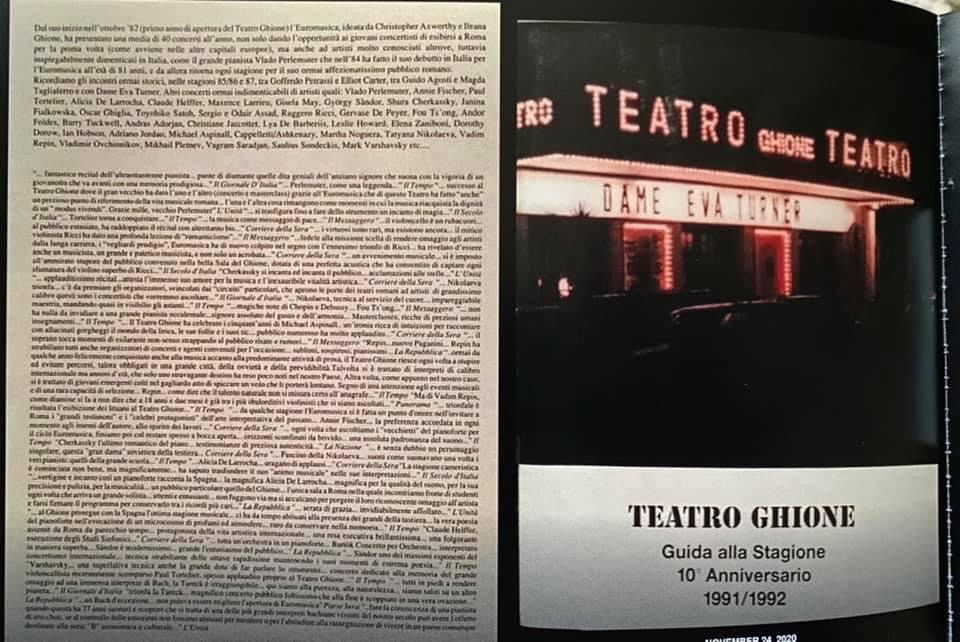
Alistair Wroe & Raffaello Moretti in the green room after their performance Nice to see music gradually returning after the historic Euromusica seasons of the 80’s and 90’sIleana Ghione -Constance Channon Douglass e marito Cesare Marinsanti -Lydia e Guido AgostiGuido Agosti -Virgilio Mortari-Arrigo Tassinari ( first flute of Toscanini at La Scala )-Ileana GhionePaul and Maud Tortelier- their favourite photo taken in Rome on one of their many visits to the Ghione Theatre William Grant Naboré founder of the International Piano Academy in Como and linked in its early years with the Ghione Theatre.A pianist who played many times in the theatre and is mentor of Raffaello Moretti Peter Frankl who together with Fou Ts’ong were regular visitorsThe historic return to the concert platform of the High Priestess of Bach One of many seasons of Euromusica Teatro Ghione
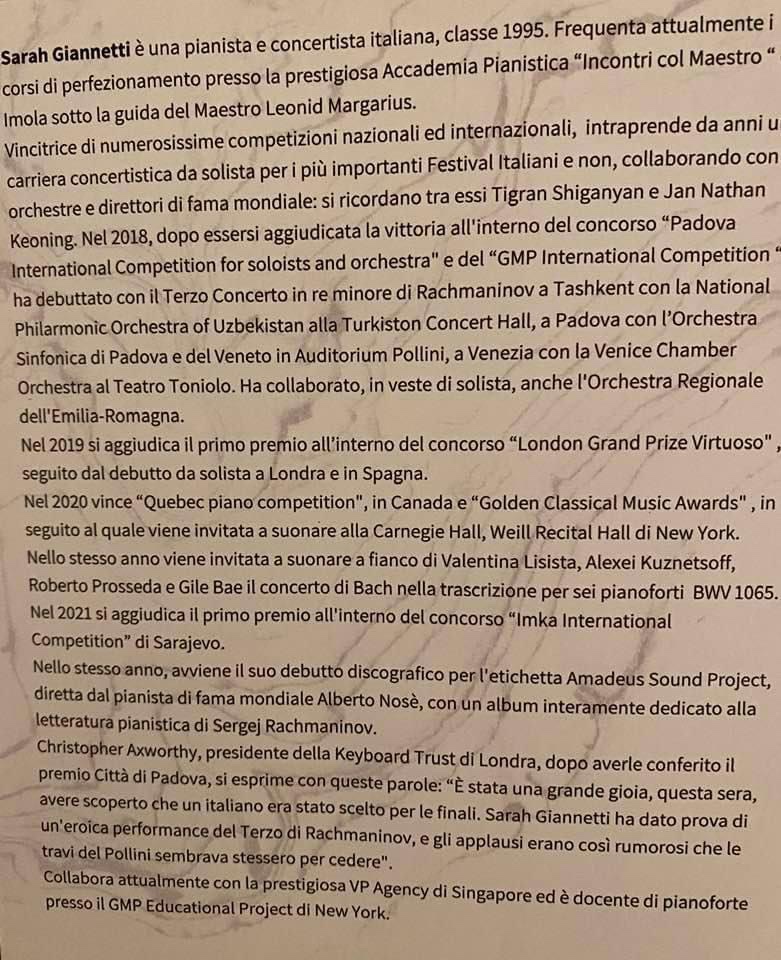
Sarah Giannetti making her debut for Roma Tre University with a passionate outpouring of Romantic masterpieces.I had heard Sarah four years ago when she gave a full blooded account of Rachmaninov’s 3rd Concerto when only in her early twenties.I remember it was impressive for the passion and fearless courage with which she threw herself into the fray and came out a winner!
I had met her again at the piano festival organised by Roberto Prosseda in that magic town of Barga,well known for its Opera Barga annual festival.Now thanks to Roberto this jewel in the crown of Tuscany is also known for Piano Barga.Sarah was one of six distinguished pianists invited by Roberto and his wife Alessandra Ammara who together with the internet phenomenon Valentina Lisitsa were conducted by Jan Latham Koenig in a repetitive work for six grand pianos by Steve Reich.
The Appassionata sonata flowed from her hands today with the same energy and authority that I remember from four years ago.But now it is allied to a maturity and a technical assurance that she has gained from her studies since then with Leonid Magarius and Alberto Nosé in the International Piano Academy of Imola.
One of Beethoven’s greatest and most technically challenging of his 32 sonatas the Appassionata was considered by Beethoven to be his most tempestuous piano sonata until the Hammerklavier op 106 .1803 was the year Beethoven came to grips with the irreversibility of his progressively deteriorating hearing.Written in 1804/6 op 57 was published in 1807 and was not given the name during the composer’s lifetime (1770-1827),but in 1838 by the publisher of a duet arrangement of the work.Beethoven’s autograph manuscript of the sonata though has “La Passionata” written on the cover, in Beethoven’s hand.One was immediately impressed by the very robust playing of this quite frail looking young artist who gives such a strong rhythmic drive to all that she does.The opening trills were given immediately a rhythmic urgency as was the first tumultuous cascade of notes that she played very courageously with one hand as Beethoven had written them.There was drama too in the sudden chordal interruptions as she brought a broad sweep to the melodic line in the beautiful second subject that was just the calm before the storm.Sarah played these tumultuous interruptions with courage and technical prowess leading to the tempestuous declamation of the opening motif at the extremes of the keyboard .The flourishing cadenza before the coda was played with the anchor in the bass resounding so magnificently on this beautiful Fazioli piano.The treacherous scale passages she chose this time to split between the hands,as most pianist do.There is a school of thought via Arrau and Serkin that the risk – like in the opening of the Hammerklavier – adds to the animal excitement that the composer obviously intends and to play safe is not part of Beethoven’s game!I am surprised that such a lioness as Sarah did not rise to the challenge this time!
The Andante con moto was played with a forward movement as this chordal procession wends its way to the dramatic interruption that heralds the arrival of the last movement.I would not have deliberately underlined the left hand on each repeat though,but let the music speak naturally for itself as it moves in an almost religious way much as the chorale does in Chopin’s third scherzo.Any added inflections or rubato take away from the poignant beauty of the music.The Allegro ma non troppo was played with an architectural shape and relentless drive that was quite exhilarating.The coda too was played with overwhelming conviction but I would not have held up the tempo on the first two long chords of which the second is sforzando not ritardando and I would have had the courage to follow Beethoven’s long final pedal marking to the very end.But Sarah’s temperament and technical prowess just underlined that she is indeed ‘La Passionata ‘that Beethoven wrote on his score.
Chopin’s elusive Scherzi were played with sumptuous colours and scintillating virtuosity.Six year old Arianna applauded her mother with great enthusiasm as did the audience in a hall I have rarely seen so full. A magnificent new Fazioli concert grand allowed Sarah to share all Chopin’s deepest thoughts with kaleidoscopic colours of velvet richness.
Tumultuous applause also from her daughter Arianna
Unlike the classical model of the Scherzo the musical form adopted by Chopin is not characterised by humour or elements of surprise, but by highly charged “gestures of despair and demonic energy”.Schumann wrote about the first scherzo: “How is ‘gravity’ to clothe itself if ‘jest’ goes about in dark veils?”Although various Beethovenian features of the scherzo are preserved—an A–B–A structure with sections A and B contrasting, triple time, pronounced articulation and sforzando accents—in terms of musical depth, Chopin’s four scherzos enter into a different and grander realm. They are all marked presto or presto con fuoco and “expand immeasurably both the scale of the genre and its expressive range”. In these piano pieces, particular the first three, any initial feeling of levity or jocularity is replaced by “an almost demonic power and energy”.The first three are all in a minor key and the major key to the fourth brings a radiance and lyricism that was to be such a mark of Chopin in his later years.
The opening chords at the extremes of the keyboard of the Presto con fuoco B minor first scherzo were a call to arms with which Sarah threw herself with courage and technical prowess.The Old Polish Christmas Song ‘Lulaze Jezunin’ that Chopin quotes in the middle episode was played with a serenity and beauty and contrasted so well with the cry of the fortississimo chords that lead to the animal excitement of the coda.The second scherzo was played with contrast between the impish opening and the chordal replies.There was beauty and a delicate sense of balance in the lyrical episode marked ‘con anima.’The explosions of passion and heroism as Sarah swept effortlessly across the keys led to a coda of great exhilaration bringing a spontaneous round of applause even from her own six year old daughter.There was drama in the opening of the third scherzo with its continuous outburst of octaves but it was the sumptuous beauty of the chorale that will remain in my memory with the gentle cascades of bells never allowing the architectural line to waver as it moved so mysteriously to the minor and a passage that is reminiscent of Debussy’s submerged cathedral.The coda marked con fuoco allowed Sarah to throw caution to the wind as she brought this scherzo to a truly majestic ending.The fourth scherzo, the only one in a major key was full of lyricism and almost Mendelssohnian lightness.The beautiful middle episode was allowed to sing so simply and with such a subtle sense of balance. Chopin is in the realm of the ‘Gods’ here that together with the Fourth ballade and the Barcarolle these are three of the finest works ever written for the piano.Sarah played this final scherzo with all the aristocratic style and poetry that brought her Rome debut to a triumphant ending.
Arianna congratulating her mother at the end of her Rome debut recital .
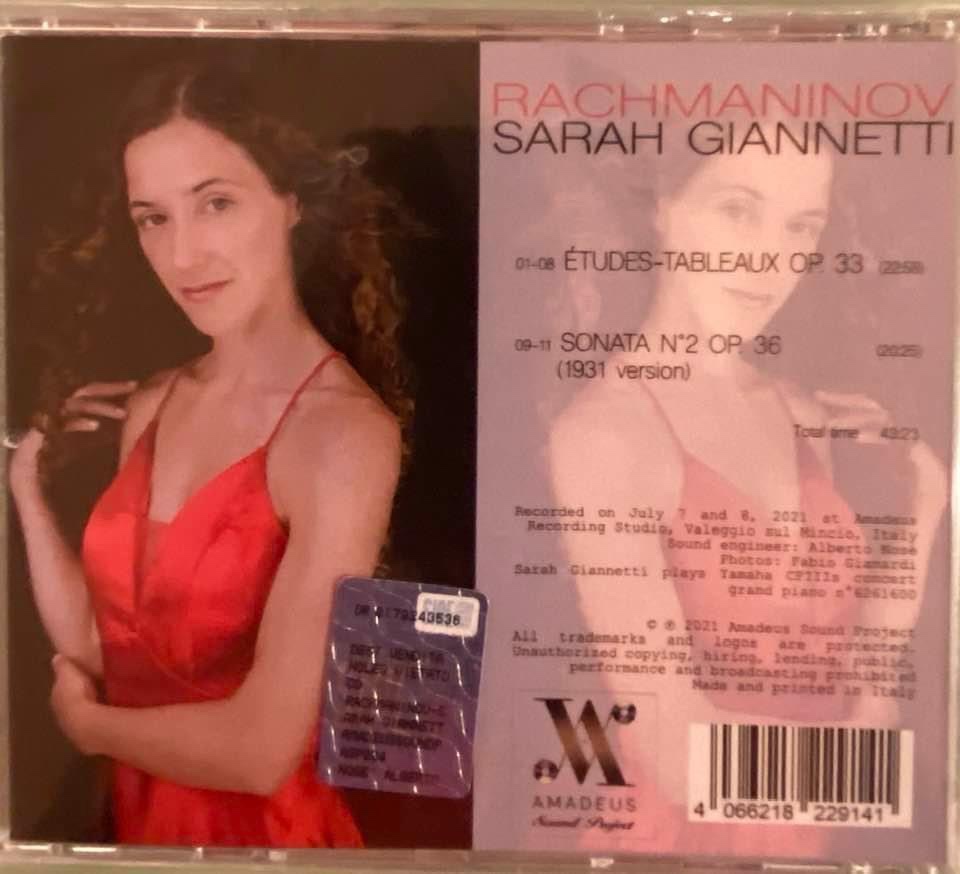
The Etude Tableau op 33 n.2 from her new CD of the complete set op 33 was her way of thanking her new Rome public that had turned out in unusually large numbers to applaud this young Tuscan artist.
Arianna with Giovanni Andrea Pisanu
Poche opere segnano come l’Appassionata quel mutamento di tendenza che si è prodotto nel corso degli anni nei confronti dell’interpretazione di Beethoven. Considerata a lungo, e per motivi non solo squisitamente musicali, il capolavoro più rappresentativo del periodo eroico, la sonata op 57 passa da un climax al successivo con un senso di assoluta e irrefrenabile progressione, fino alla fine. Beethoven, dopo aver sperimentato in sonate precedenti una diversa successione dei movimenti, torna nell’op. 57 ai tre movimenti classici, ma ne sovverte dall’interno gli equilibri, perché il movimento lento centrale non è una pausa che interrompa la drammaticità dei due movimenti estremi quanto un’introduzione al finale, cui è direttamente collegato. Il finale acquista proporzioni imponenti e intensa drammaticità, paragonabili a quelle dell’Allegro assai, che a sua volta supera quanto si era mai scritto prima per il pianoforte. Fu l’editore Cranz di Amburgo che pubblicò dopo la morte di Beethoven la Sonata sotto il nome di “Appassionata”, cercando di evidenziare il carattere drammatico della musica, immersa in un gioco contrastante di due stati d’animo diversi. Non per nulla Romain Rolland, analizzando la struttura del primo tema dell’Allegro assai iniziale, giunse alla formulazione di una chiara indicazione di perfetta antitesi, così formulata; «Due facce opposte dell’io. L’io-forza selvaggia e l’io-debolezza tremante». Chopin scrisse quattro Scherzi in tonalità diverse (in si minore op. 20; in si bemolle minore op. 31; in do diesis minore op. 39; in mi maggiore op. 54) che non si richiamano affatto agli analoghi tempi inseriti nelle Sonate e nelle Sinfonie beethoveniane, ma riflettono un tipo di composizione dalla fisionomia tutta particolare, dove la fantasia dispiega la propria libertà di espressione nei modi e nelle forme più opportune. Secondo l’opinione di qualche critico autorevole, come il polacco Jachimecki, gli Scherzi presenterebbero alcune analogie stilistiche e formali con le Ballate per quel carattere rapsodico e dai sentimenti contrastanti che caratterizza questa “forma” pianistica chopiniana.
Artistic director of Roma Tre Orchestra – Valerio Vicari -his Young Artists Piano Solo Series give opportunities to so many gifted young artists to perform in Rome.
Con noi la pianista toscana Sarah Giannetti, al suo debutto assoluto a Roma.
Sarah with companion the pianist Giovanni Andrea Pisanu
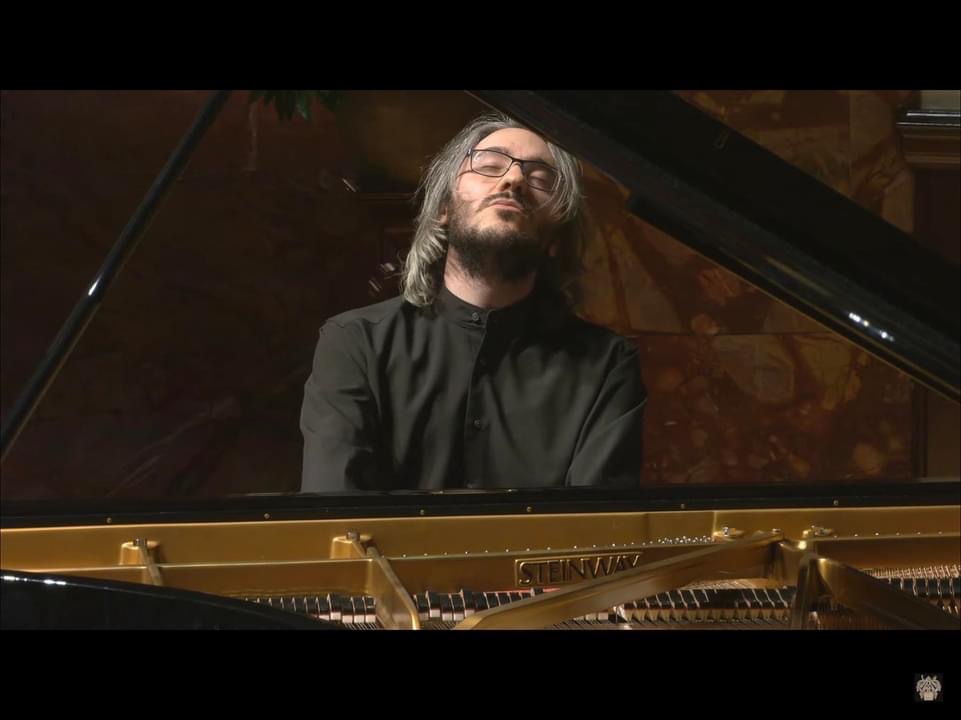
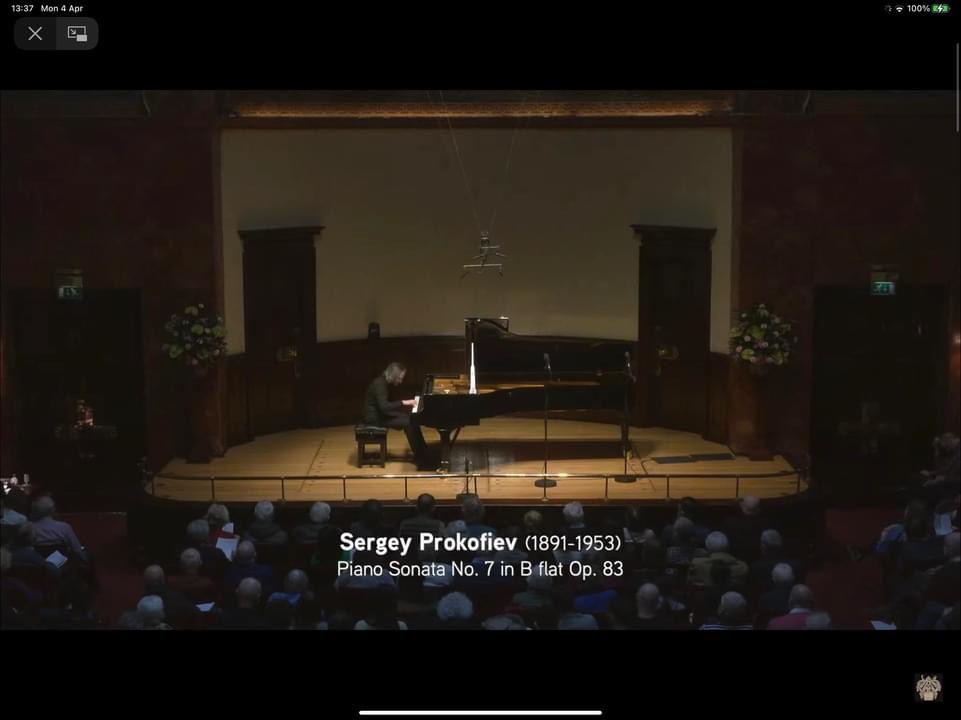
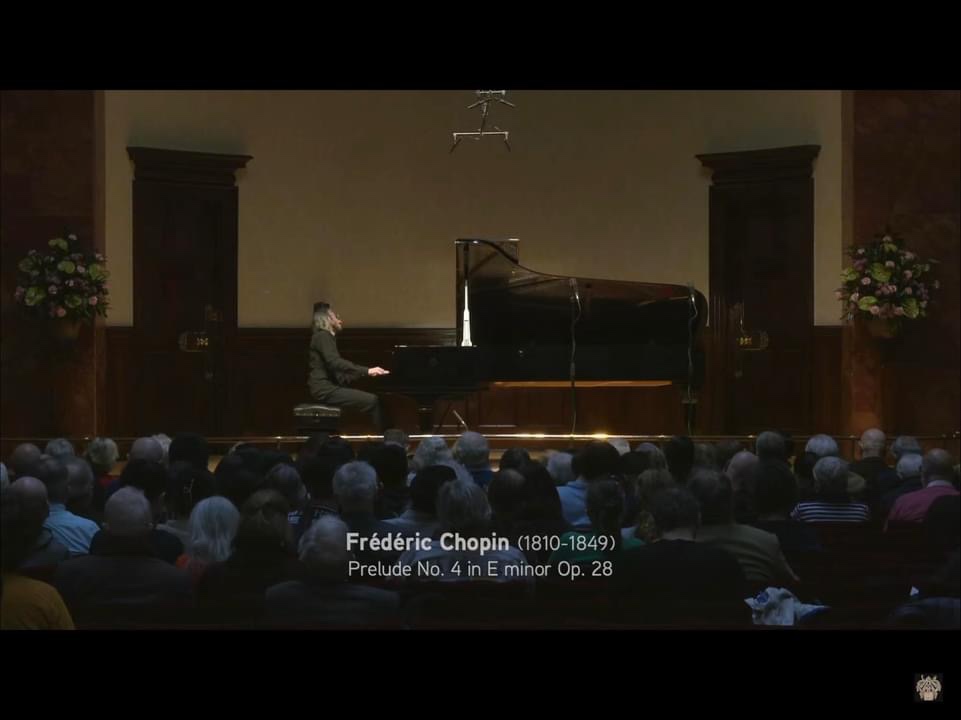
Alexander Gadjiev at the Wigmore Hall with a monumental performance of the Schumann Fantasie of a radiance and beauty where his passionate and compassionate soul brought the words of Schlegel vividly to life:’Resounding through all the notes ….there sounds a faint long-drawn note for the one who listens in secret’. I have not heard the Fantasie played with such freedom and sensitivity since the very first time I heard it played that was by Rubinstein in the 60’s.
A Prokofiev 7th Sonata where Schumann is quoted but was of a desolation and desperation of quite overwhelming emotional effect.Whispered sounds echoed around the Wigmore Hall as rarely before.The insistence of the precipitato brought him to superhuman feats of exhilaration and animal excitement – the same playing for the moment of Rubinstein where empty note picking has no place in the overall power of the musical message they have to share.The simplicity and glowing beauty of the Chopin Prelude in E minor was quite unforgettable as was his Etude op 10.n.8.Thrown off with nonchalant charm and ease like the great artists of the Golden age of piano playing.Art that conceals Art or maybe just having something to say and not being afraid to share it
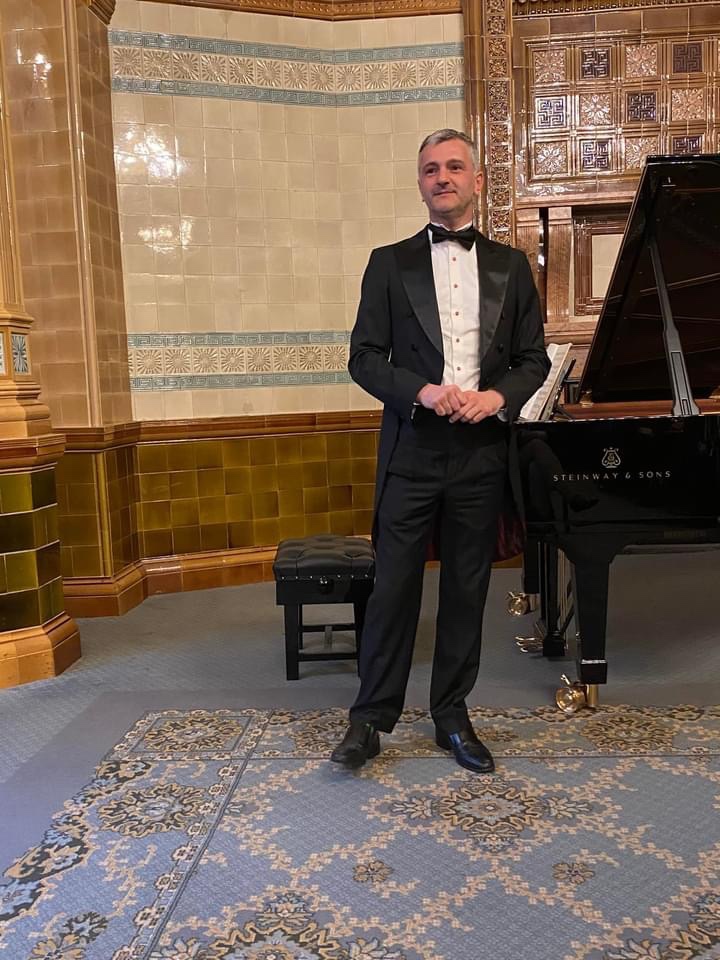
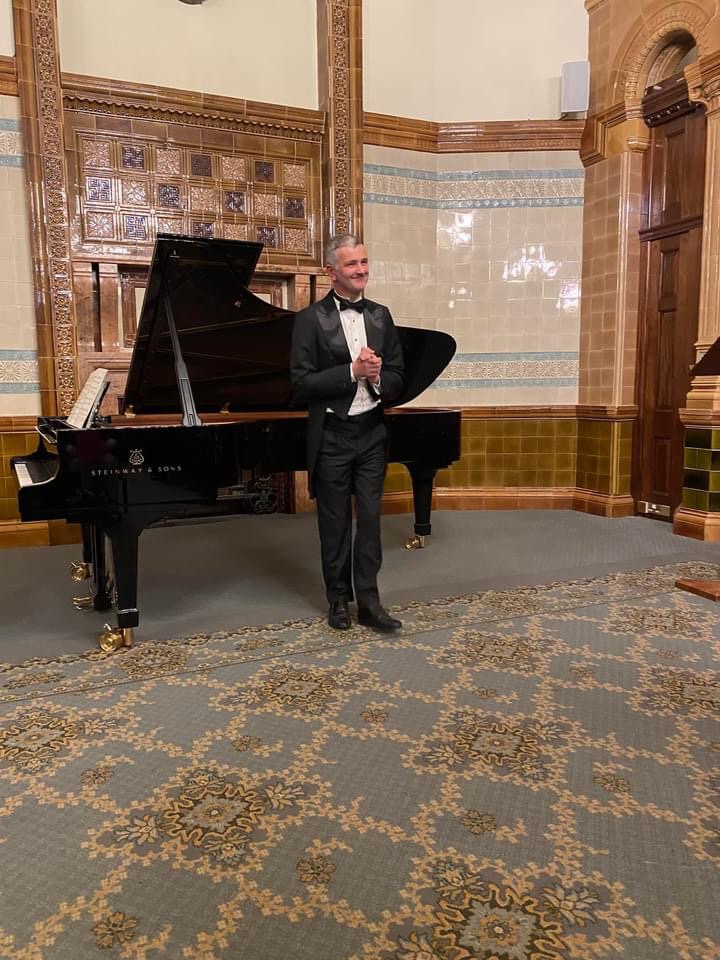
The Goldberg Variations in the National Liberal Club played for the first time by Daniel Grimwood on the magnificent new Steinway concert grand that sits so proudly in the hallowed halls of this illustrious club.
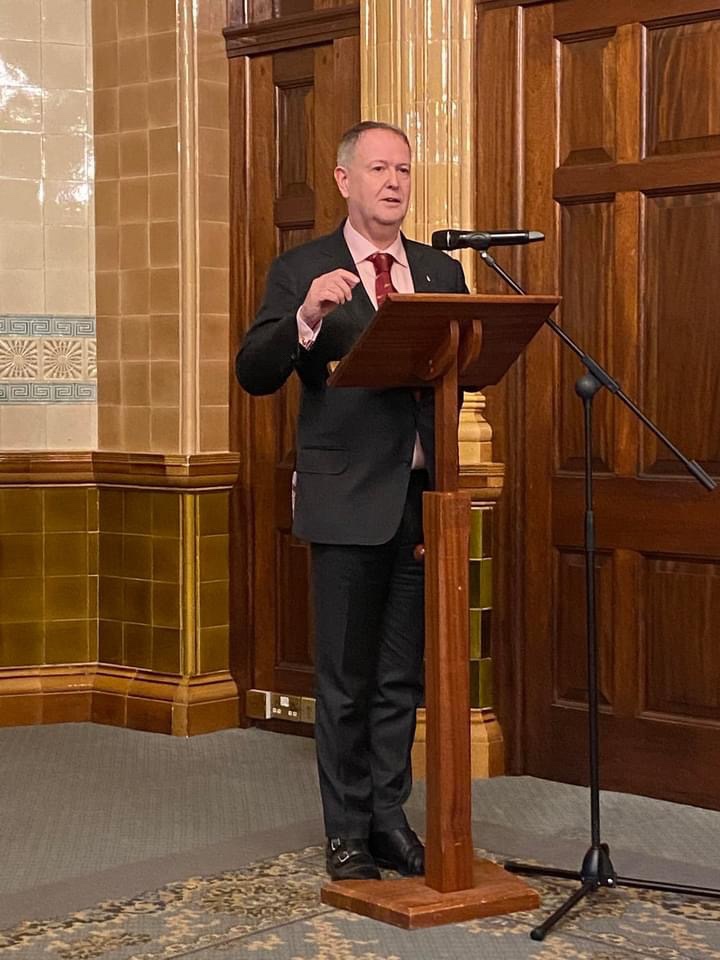
Alderman Tim McNally chairman of the National Liberal Club
As the chairman Tim McNally said this was the musical equivalent of scaling Everest and he made reference to Rosalyn Tureck who was described by the critics as the High Priestess of Bach.A mantle that passed to that eclectic and eccentric Canadian pianist Glenn Gould.It has now passed to another Canadian pianist Angela Hewitt who shares the accolade with Andras Schiff.
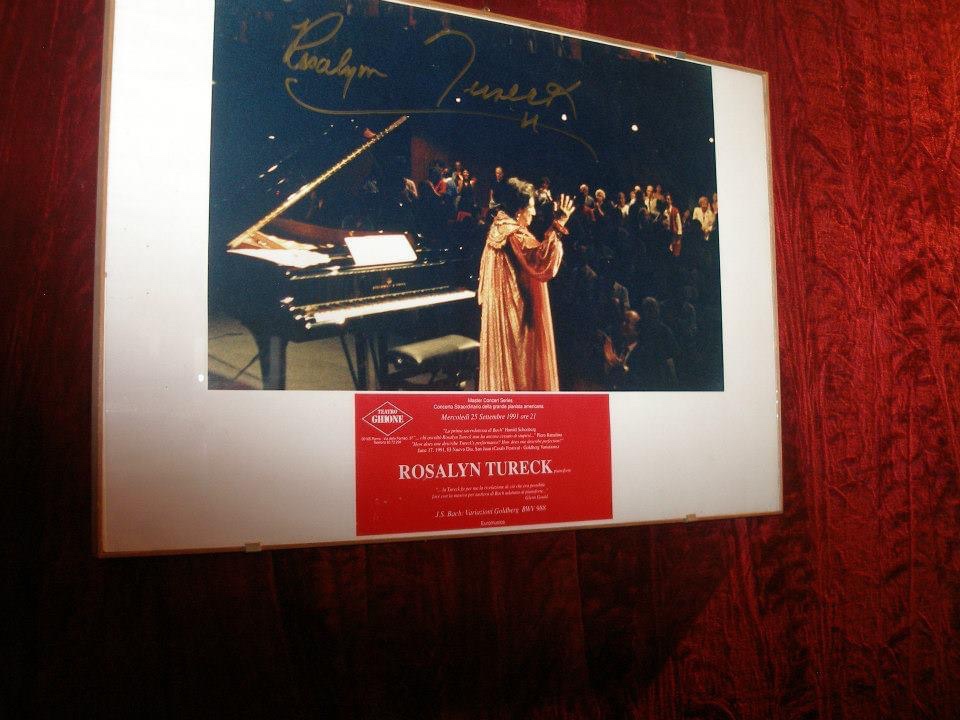
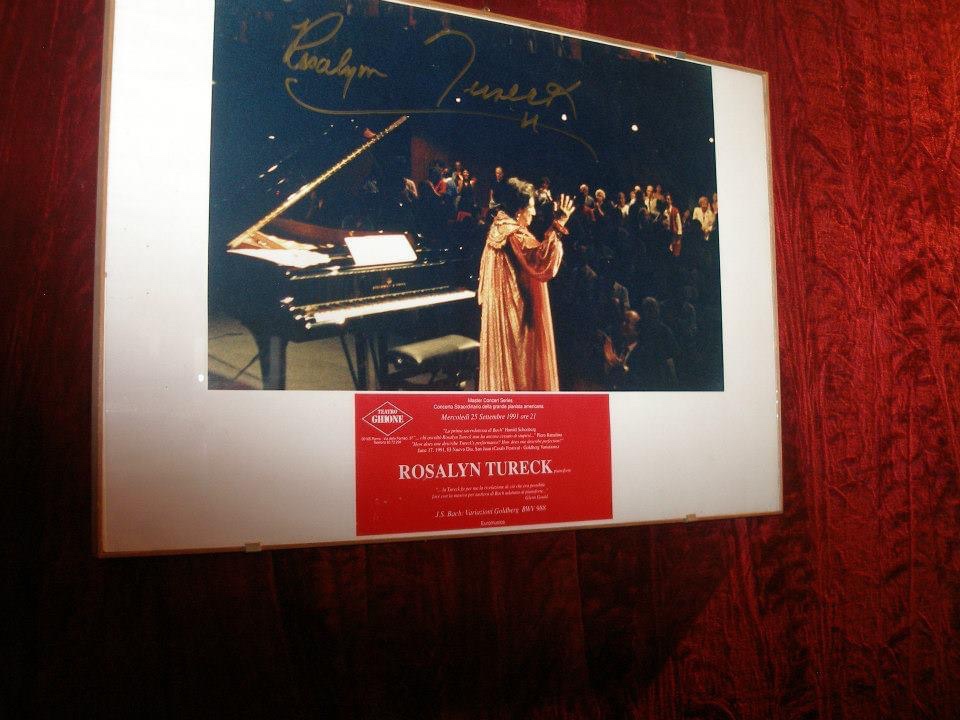
It was in the early nineties that I was able to persuade Rosalyn Tureck to return to the concert platform after years of dedicating herself in Oxford to the study of Bach and his absolute genius. She agreed to play in my theatre in Rome in late September after a brief workman’s holiday break in Sorrento. Of course I agreed even though it is still very much a holiday period and thought there would probably not be the public that she deserves. The theatre sold out and it was again the triumph reborn that she had known since having had a mystical experience about Bach in her early 20’s.
I took her all over Italy where she became once again the undisputed diva above all in Florence,the universal centre of culture. We became great friends during her Indian summer and I became a trustee of her Oxford Bach research institute.Her annual Symposia became a much awaited appointment for not only musicians but above all scientists and mathematicians all delving deep into the genius of Bach.
In that season a month later I invited Tatyana Nikolaeva to play the Goldberg Variations and was much criticised in unmusical circles for not having a more adventurous programme ! The comparison was enlightening and unique. Tureck like a monument carved in stone and Nikolaeva based on the more human song and the dance .
Daniel Grimwood and the magnificent new Steinway D that the chairman decided was an investment for the next 100 years replacing the previous worn out instrument that had been played by Rachmaninov and Moiseiwitch
So it is always with great interest and spiritual awakening that I listen to performances of the greatest set of variations ever carved in music. Let me say straight away that Daniel Grimwood gave a very fine performance that was remarkably the first time he had dared approach this monument.
A full hall for the greatest variations ever written. Daniel Grimwood persuaded to play them for the first time by Rupert Preston Bell
Playing with the score it was of a clarity and intelligence with discreet ornamentation,never overstepping the mark of good taste and genuine respect.
Having explained the significance of keys in Bach’s period where the key of G had a great meaning and the few times it entered the minor key was of great significance .There were some memorable moments from this very fine musician who every so often revealed the soul and sense of fantasy that is in every true artist. The end of the 21st variation disappearing into the infinite as he left the pedal on for the whispered entry of the sun appearing on the distant horizon in the 22nd. The glorious glissando type effect of the ornamentation in the ritornello of the French Overture – the half way mark where things start to get more serious and involved as we move to the glory of the 29th variation. The great organ stops in this penultimate variation resounding with such majesty on this magnificent Steinway. But then a moment of breathtaking beauty as the Quodlibet was allowed to enter in a mist of sound as these two popular melodies that Bach adds build to a passionate climax only to die to a whisper. Leaving the pedal ,a masterstroke that I have only experienced from Andre Tchaikovsky ,allowing the return of the aria to literally float on the magic cloud of G.
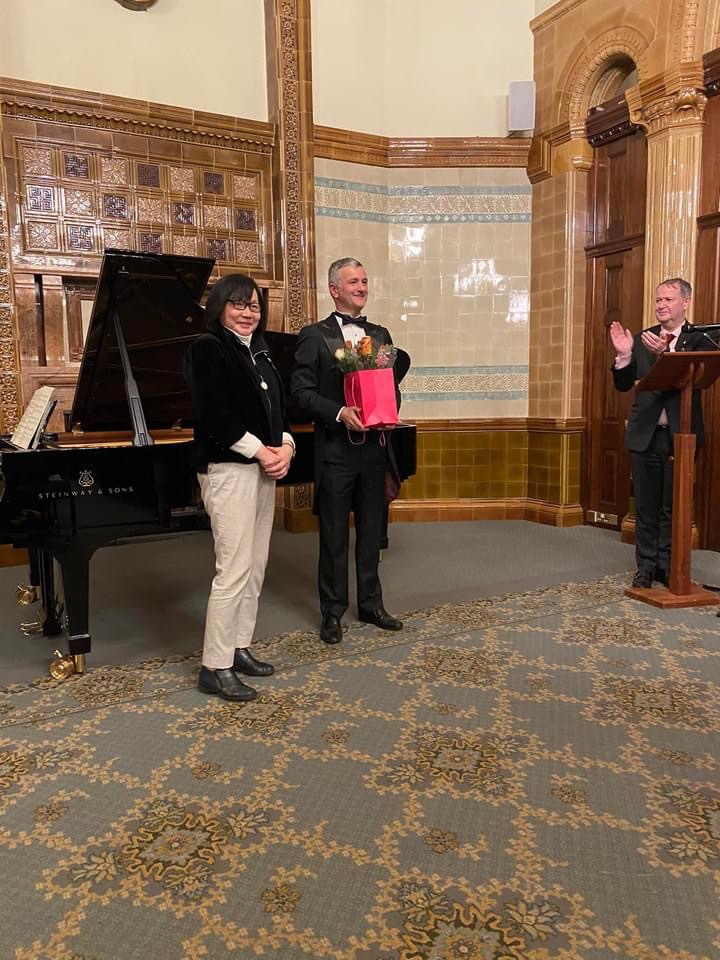
Yisha Xue presenting Daniel with flowers applauded by Chairman Tim McNally who had specifically asked for the Goldberg Variations to be performed at the Liberal Club
A full circle like in life. ‘In the beginning is our end’ – T.S.Eliot What a universal genius Bach is
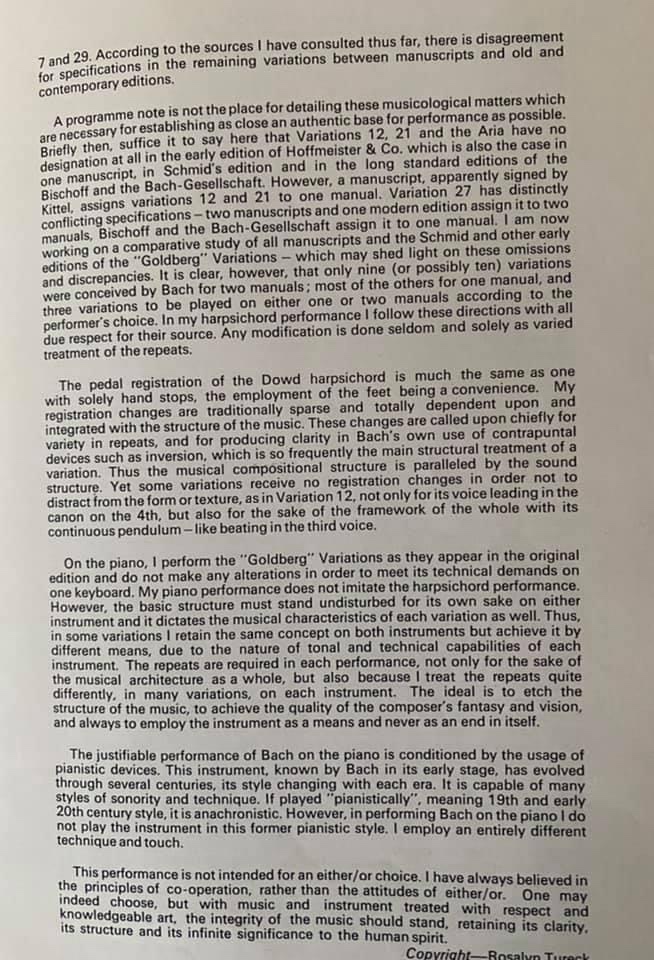
I had never forgotten this performance that I heard in London in my student days and can do no better than to include her own programme notesRosalyn Tureck with my wife Ileana Ghione at our country home of Circeo Off her pedestal she was a dear and faithful friend Tatyana Nikolaeva on stage with Ileana Ghione
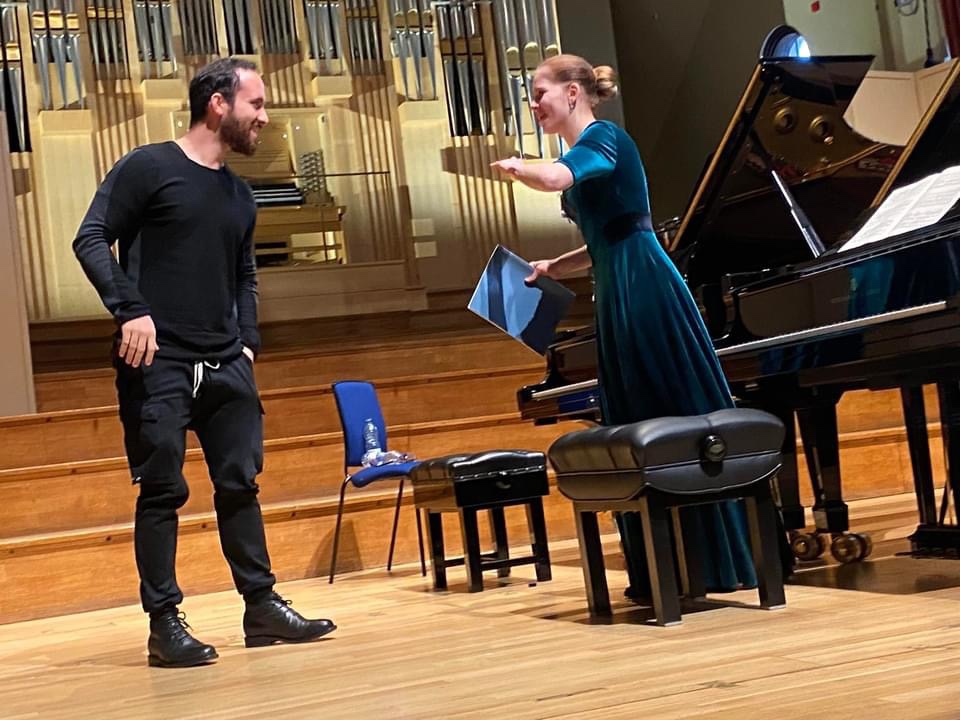
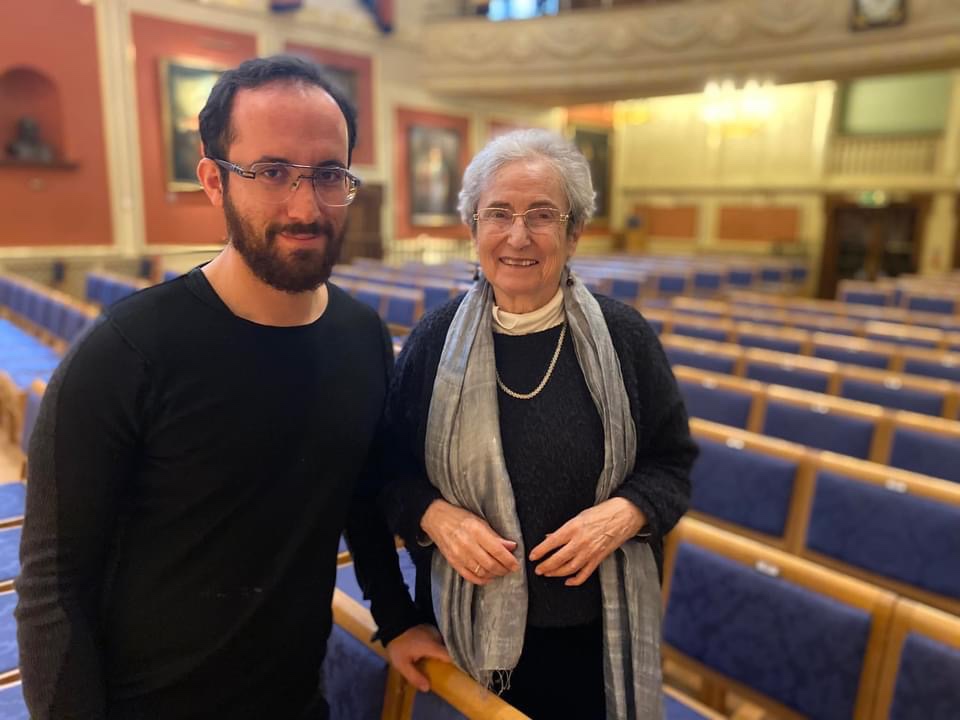
Meeting Igor Levit I am reminded of Victor Borge’s greeting to Kissin who he encountered in a New York restaurant after his sensational concert at Carnegie Hall. ‘A pleasure to meet you Mr Kissin I read you reviews’ he quipped,’They make me sick!’ All the young generation of pianists that I know have for a long time sung the praises of Levit and Sokolov ad nauseam. Sokolov I never miss his annual recital in Rome but Levit I have never heard live until today. I am very pleased to say that there is no doubt for me either today that we are in the presence of someone with such phenomenal energy and total mastery together with an all consuming passion for all he does. Some might call it genius and he has much in common with that other phenomenon Andras Schiff who is on record as calling Levit a genius. Takes one to notice one as they both share their knowledge and art with aspiring young musicians as well as gracing the most important concert halls throughout the world with enviable amounts of the piano repertoire. A three hour Masterclass on his day off from performing the complete Shostakovich Preludes and Fugues and performing the 90 minute Stevenson Passacaglia. There was no sign or tiredness or irritability.On the contrary there was a man inspired as he was inspiring and with selfless kindness and consideration proceeded to illuminate all that the three remarkable students set before him.
He had asked for Beethoven and got a magnificent Chinese pianist Yuzhang Li, playing the most beautiful of all concertos n. 4 .
Followed by Aidan Mikdad with the most beautiful of the Sonatas op 110.The promised Emperor was changed due to illness to the scintillating youthful n 2 with Gabrielé Sutkuté .As Levit said a cadenza that is a lesson how not to write a fugue!
What a morning as we all left on the crest of a wave of such inspiration …..no wonder Schiff or Levit never sleep,a life in music is too precious to waste on sleep
















































 ChristopherAxworthy-MusicCommentary