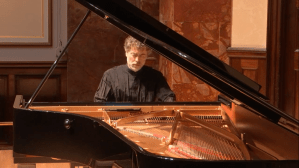
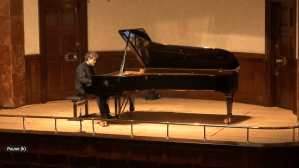
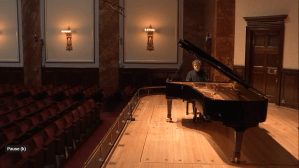
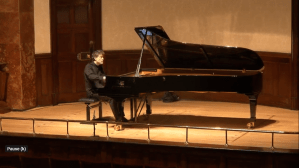
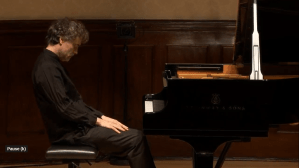
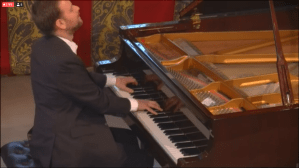
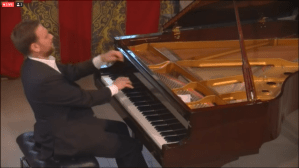
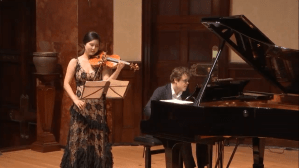
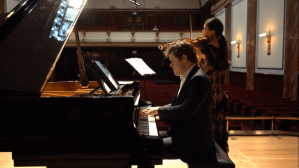
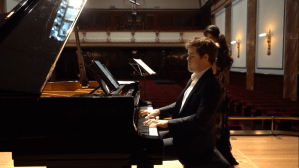
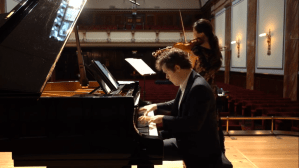
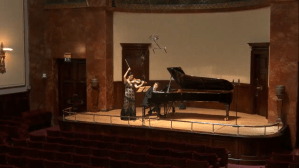
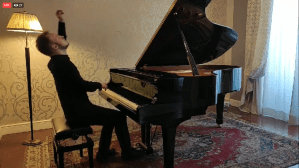
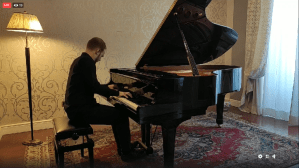
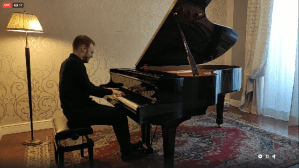
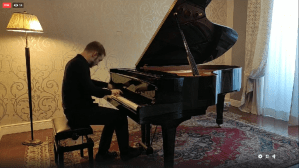
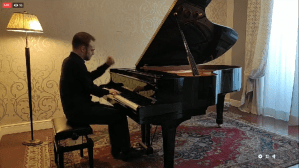
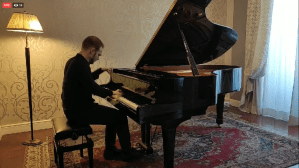
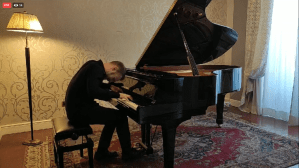
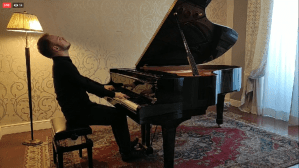
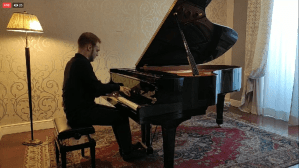
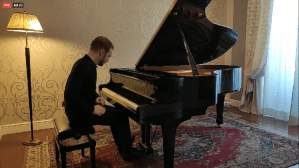
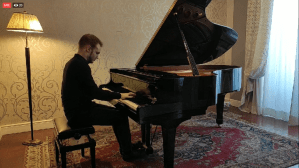
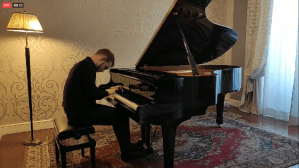
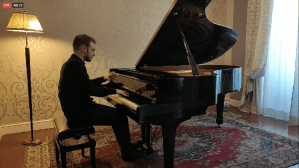
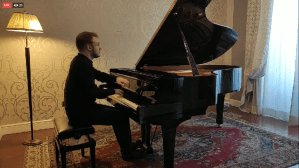
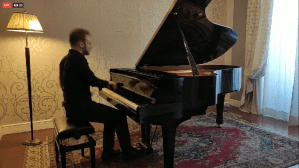
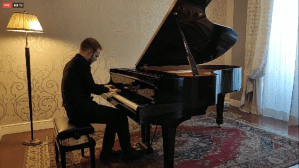
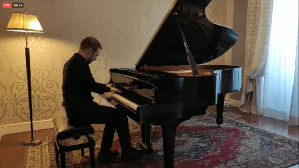
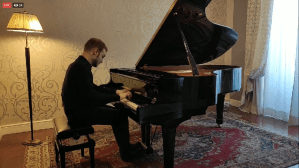
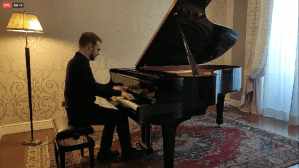
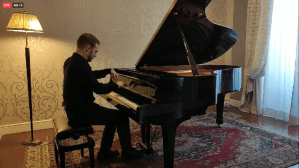
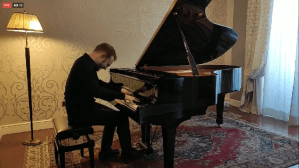
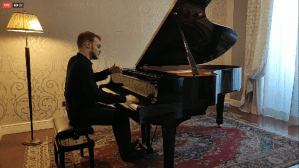
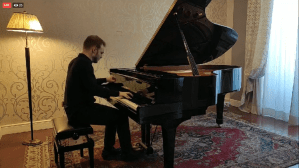
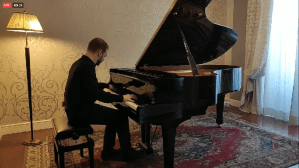
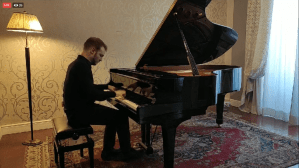
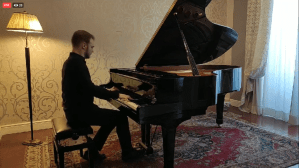
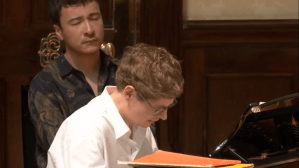
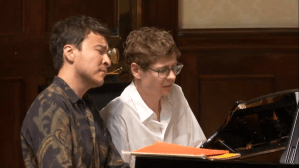
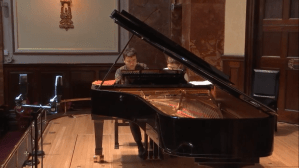
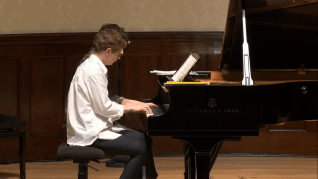
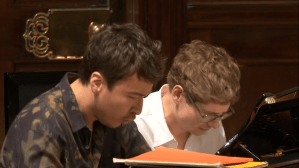
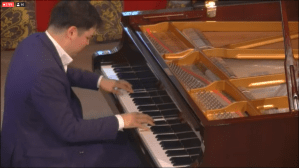
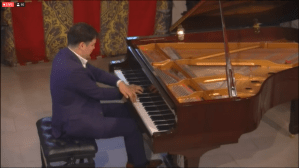
Multi-award-winning pianist Amit Yahav is much in demand as a recitalist, chamber musician and concerto soloist, having earned his reputation for interpretations that grip and move audiences with passion and intellectual insight. His interpretations of the music of Chopin and Schumann in particular have received high praise. Alongside his performing career, Amit also conducted research into Chopin with the generous support of the Royal College of Music’s Polonsky Award. In performance, Amit’s interpretations are historically informed, and often made accessible to the audience by spoken introductions which place the works in a historical, social and cultural context. Amit is keen to programme well-known and loved repertoire along lesser-known works. Amongst Amit’s success are the Anthony Lindsay Piano Prize, the Special Jury Prize at the Northwood-Ruislip Concerto Competition, the György Solti Award for Professional Development , and the Brooks-van der Pump Pianist Prize at the Royal College of Music. Amit also won the 1st International Israeli Music Competition in London and consequently performed Zvi Avni’s On the Verge of Time in London’s Southbank Centre in the presence of the composer.In 2014, Amit released his newest CD “ Amit Yahav Plays Chopin “, containing the four Ballades alongside the 2 Polonaises op.26 and the C# Minor Scherzo op.39. This release follows Amit’s tour showcasing the four Ballades in an explained recital, which was selected by the Royal College of Music as part of their Insight Series of soirees offered to their donors. In 2018, he earned a Doctor of Music degree for his thesis investigating interpretation in the music of Chopin.

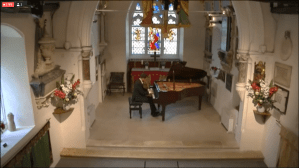
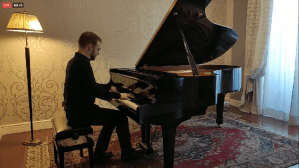
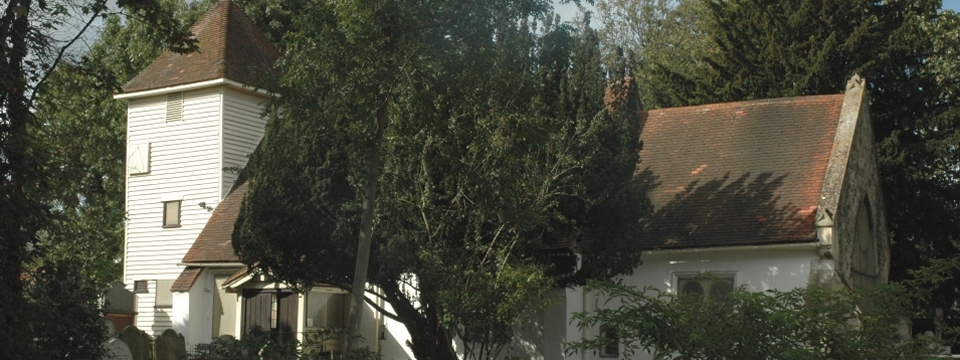
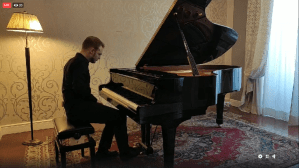
In the meanwhile, however, the music cannot and must not stop; the stages must not be left empty. I am very grateful to Hugh Mather for his indefatigable efforts. It is always a pleasure to be able to play at St. Mary’s Perivale, the church that has become West London’s greatest little concert hall. Today, sharing music with you from this very special venue is an honour and I do hope that many of you will be able to tune in to the live broadcast and make me feel like you are there.
And Hugh Mather replied after the concert:
“A fantastic LIVE piano recital by Amit Yahav this afternoon at St Mary’s Perivale. A delightful all-Chopin programme. Slightly strange without an audience but very satisfying nonetheless. And about 200 viewers (inc Amit’s family in Israel) have seen his recital online so far.”
And so it is that music will out.No matter the disasters and calamities that befall the world music will always find a way to enter our lives. It enters a secret territory that we have a need of.It reaches places where words are just not enough.Some people might even call it our ‘soul’It has taken only three months from the last concert in London on the 17th March (https://christopheraxworthymusiccommentary.wordpress.com/2020/03/17/the-last-recital-luka-okros-at-st-johns-smith-square/) to arrive via various desperate home attempts at hausmusik , at the formula of live music streamed into our homes wherever that may be in the world. Hats off to Hugh Mather and his team who were one of the first to continue concerts even in lockdown with Teatime Classics from their archive of over 400 performances to choose from.Realising that these young artist had not only lost a platform and in a sense their raison d’etre but also any source of income.The artists were paid for their archive recordings.With the official opening up of the Wigmore Hall live streamed BBC Lunchtime recitals from the 1st of June Dr Mather, ever vigilant to respect the self distancing rules that have become so necessary, felt free to do likewise at his mecca in Perivale.
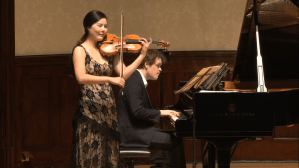
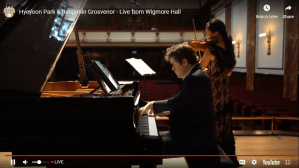
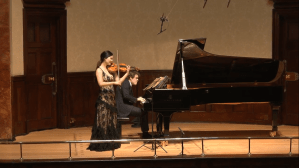
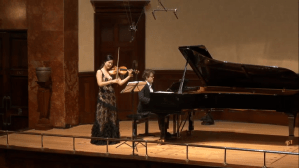
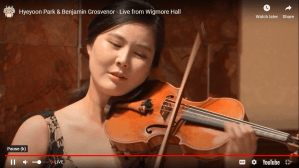
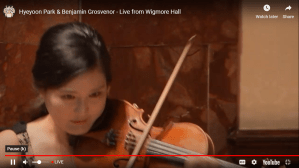
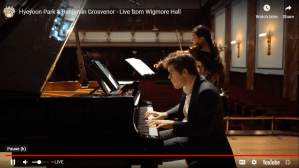
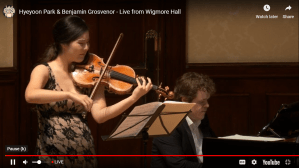
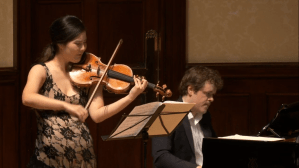
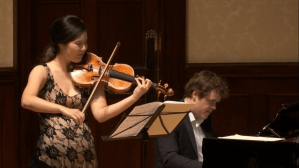
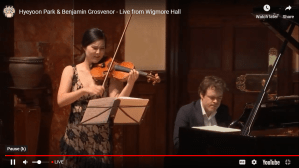
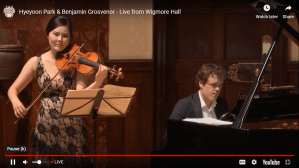
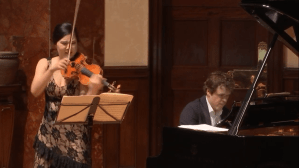
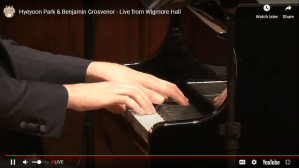
And so it was today not only lunchtime with Hyeyoon Park and Benjamin Grosvenor at the Wigmore( https://christopheraxworthymusiccommentary.wordpress.com/2020/06/10/hyeyoon-park-and-benjamin-grosvenor-live-at-the-wigmore-hall/)but also a Chopin recital by Amit Yahav for tea!A magic carpet that took me and many others from one concert hall to another.

A beautifully shaped all Chopin programme within a framework of two of his last and most profound works: the Polonaise Fantasie op 61 and the Fourth Ballade op 52.With a substantial filling of two nocturnes op 9 and 55 and mazurkas op 6 and 7; the first Scherzo op 20 and the scintillating waltz op 34 n.1 .Infact in just one hour of music a complete panorama of the magic world of Chopin.It is hardly surprising to read that in 2018, he was awarded a Doctor of Music degree for his thesis investigating interpretation in the music of Chopin.

A beautiful shape to the opening of the Polonaise Fantasie,the arch of his left hand poised to await the arrival of the magic wave of sounds created by the right.There was a great architectural shape to the work with a forward movement that allowed for all the nostalgic nobility without any sentimentality.A beautifully shaped central section with some poignant counterpoints that glistened from the left hand leading to a magical return of the opening waves of sound after some truly majestic trills.A heroic ending played with all the aristocratic nobility of one of Chopin’s greatest and most original works.

There was a beautiful sense of balance in the hauntingly simple musings of this first of Chopin’s nocturnes.The first performance I ever heard was on a piano roll by Josef Lhevine in the archive from the Brentford piano museum just down the road from Perivale. The same haunting nostalgia has remained with me all these years and it was from Amit’s mellifluous hands that I was so poignantly reminded.The nocturne op 55 n.2 in F minor was the favourite of Shura Cherkassky who played it in a much more serene and fantastically coloured way than Amit.I found his performance just a shade too fast to allow full range to the fantasy of the final flowing arpeggios that pass like the wave of sound that he had found so perfectly in the Polonaise Fantasie.
The central work of the recital was the tempestuous first Scherzo in B minor op 20 .Amit played it with great passion and precision and brought a beautiful contrasting stillness to the simple Polish folk melody that Chopin quotes in the central section.The return to the tempest and coda were played with technical assurance and great excitement.The two early Mazurkas were played with all the infectious dance rhythms and contrasts of Chopin’s nostalgia for his beloved homeland.And the Waltz op 34 n.1 was played with all the ‘joie de vivre’ and infectious gaiety of one of his most joyous waltzes.One that Rubinstein loved to play as an encore with great final elan in his many all Chopin recitals.

The fourth Ballade in F minor op 52 is like the Sonata in B minor by Liszt and the Schumann Fantasy op 17 one of the pinnacles of the romantic piano repertoire .Amit gave an impeccable performance from the beautifully liquid opening as though a door had just been opened leading to the purity of sound that he found for the theme.A control and intellectual understanding that did not preclude some exquisite playing.From the return of the opening and the magical cadenza to the sumptuous lead up to the passionate final triumph of such a seemingly simple melody.After the five calming chords a coda of great technical assurance but shaped liked the true musician he revealed himself to be today.


Alicja Fiderkiewicz was born in Warsaw, and showed outstanding musical talent at an early age. She was accepted into the Central School of Music attached to Moscow’s Conservatoire aged 9. During her 6 years in Moscow Alicja played in front of Tatiana Nikolayeva, Sviatoslav Richter and Emil Gilels. She then studied in Warsaw for 4 years, winning the Polish National Bach and Beethoven Competitions, and she also won Chopin’s Scholarship for 4 years in succession. Having graduated from Warsaw’s Lyceum of Music with Distinction, Alicja entered the Royal Northern College of Music in Manchester, studying with Polish pianist, Prof. Ryszard Bakst for a period of 6 years. She won a number of college awards and concerto competitions and represented her college in many concert venues across the UK, and graduated with Distinction. She is a winner of the Dudley International Piano Competition and bronze medalist in the Premio Dino Ciani International Piano Competition in La Scala, Milan, and also won a Calouste Gulbenkian Fellowship. She has performed widely throughout the UK including number of recitals in the Wigmore Hall and St. John’s Smith Square. For a number of years, Alicja took some time – out from performing but continued her work as a member of keyboard department at Chetham’s School of Music in Manchester, UK. Since returning to the stage Alicja has reestablished her career as performing and recording artist. She teaches at the prestigious International Summer School for Pianists at Chetham’s, Manchester and has also been a jury member on number of competitions.She has appeared on BBC Radio and TV as well as on some local radio stations. There are 4 highly acclaimed CD’s on Divine Arts label.

The refreshing thing about this teatime edition from the St Mary’s archive is that we are able to catch up on some of the many concerts that we have inevitably missed.
Dr Mather and his team of Dr Felicity Mather ,Roger Nellist and many other enthusiastic music lovers give a platform to so many musicians that allows them to be heard by a audience not only live but also to a vast audience via their very good streaming.
The archive lists 360 pianist,160 violinists,53 viola,110 cello,40 Piano Trios and many other instrumentalists and singers.An amazing opportunity not only for young musicians to be offered a professional engagement but also to give a platform to distinguished musicians who are no longer on the International concert circuit.An important window in which to share one’s music .
I was very interested to hear Alicja Fiderkiewicz who I have much admired for her comments on social media and her obvious intimate knowledge of music and musical education at a very high level.But I had never heard her play and thought that perhaps her playing career had been shelved as she shared her experience and musicianship with the next generations.
It was good to hear a programme totally dedicated to her homeland.Not only Chopin but also Bacewicz and Paderewski.
Opening with the two nocturnes op 48 by Chopin she immediately demostrated her notable credentials.With a bold rich sound and a beautiful sense of shape and subtle shading.Played with great sentiment especially in the climax of the C minor nocturne but with a technical control and passion that excluded any sentimentality. The opening of the F sharp minor nocturne was full of fantasy as she gradually allowed Chopin to unravel his melodic line with a flexibility of great style and good taste.The ending was quite magical.

This opened the field for another Polish composer Grazyna Bacewicz who was born in the same city, Lodz, as Artur Rubinstein only twenty years later.She stayed and taught at the Conservatory there where although a violinist she dedicated herself mainly to composition.She wrote mainly for violin and chamber or orchestral music but she did write some things for piano.As Alicja said in her very interesting introduction she only knew the second sonata and was not sure if there had been any more and did not even know the first( which remains unpublished)She had heard her RNCM Professor Ryszard Bakst play it and had fallen in love with it immediately.

He advised her not to but she subbornly disobeyed and played it to him a few weeks later.As it turned out much to his approval.It is an interesting piece that owes much to it’s time of 1953.Almost a war sonata one could say as Poland coped with the regime in that post war period crying for help and mercy.It was movingly introduced by Alicja and played with great technical assurance and rhythmic energy.An overpowering first movement of great conviction with violent passages alternating with luminous melodic episodes.Ending with a great cry of violence before the movingly beseeching lament of the slow movement.A final toccata based on Polish dance rhythms somewhat reminiscent in style to Villa Lobos with a relentless forward propulsion.
This contrasted with the charming Nocturne op 16 by Paderewski. A salon piece of great charm obviously used by Paderewski on his concert tours .He had resumed his career in the 1920’s after he had been Poland’s first Prime minister and as foreign minister had signed the Treaty of Versailles that ended World War 1.He returned briefly to politics in 1940 and founded the Polish relief fund for which he gave many benefit concerts but died a year later at the age of 80.His last pupil was Malcuzynski and it is his influence and the school of Niedzielski and Askenase that Alicja was obviously influenced by.

It was obvious from her interpretation of Chopin’s 4th Ballade, one of the pinnacles of the Romantic repertoire .Full of nobility and a sense of architecture with a forward momentum that took us from the opening murmur to the tumultuous declamation before the fireworks of the coda.Even the repeat of the opening murmur had a masculine authority that while deeply heartfelt one knew that these were not tears but an anguish and longing for the homeland.As Cortot says”avec un sentiment de regret”The final long C was held over as the five magical chords and created the link to the tumultuous coda.Throwing caution to the wind she plunged into these final pages with a passionate thrust that brought this illuminating recital to an exciting end.

Almost the end!
She had still a beautiful performance of the Berceuse op 57 to share with her enthusiastic audience.
It was this and the slow movement of the first piano concerto that were the highlights of the recital .A simplicity and purity of the bel canto melodic line that Chopin weaves with such intricate mastery.Her own arrangement of the Romance from the first concerto where she created the same silvery meanderings as in the Berceuse. Only someone with the Polish spirit in their heart could understand the nobility,passion and yearning without rhetoric in the notes that Chopin penned a long way from his homeland.


Steven Isserlis and Mishka Momen Rushdie live at the Wigmore Hall


Music atT ST MARY’S PPerivale |

Beethoven: Sonata in C minor Op 111

Alim Beisembayev was born in Kazakhstan in 1998. He started playing the piano at the age of 5 in a music school in Almaty. In September 2008, he moved to study at the Central Music School of Moscow. Later that year, he won the televised, international competition for young talented musicians “Nutcracker”.After two years of studying in Moscow, he moved to continue his studies at the Purcell School for Young Musicians in the UK, where he was taught by Tessa Nicholson.In 2010, Alim recorded Beethoven’s Piano Concerto No. 1 with the Symphony Orchestra “New Russia” under the baton of Evgeny Bushkov.His performances have taken place in prestigious halls such as the Great Hall of Moscow Conservatoire, Tchaikovsky Concert Hall, the St. Petersburg Philha rmonia of Shostakovich, the Steinway Hall, Wigmore Hall, Purcell Room and the Royal Festival Hall.
Alim was awarded 3rd prize at the Liszt International Junior Competition in Weimar and he won the First Prize in the inaugural Cliburn International Junior Piano Competition in Fort Worth, Texas.In February 2016, Alim was a guest at BBC Radio 3’s ‘In Tune’ promoting his concert at the Royal Festival Hall, where he performed Rachmaninov’s Second Piano Concerto with the Purcell School Symphony Orchestra.In summer 2017, Alim was awarded 1st prize at the Manchester International Piano Competition where he performed the First Tchaikovsky Piano Concerto with the Manchester Camerata. Later that year, he also won the Jaques Samuel Intercollegiate Piano Competition which led to his Wigmore Hall debut in June 2018.Since September 2016, Alim continues studying with Tessa Nicholson at the Royal Academy of Music in London on a full scholarship.