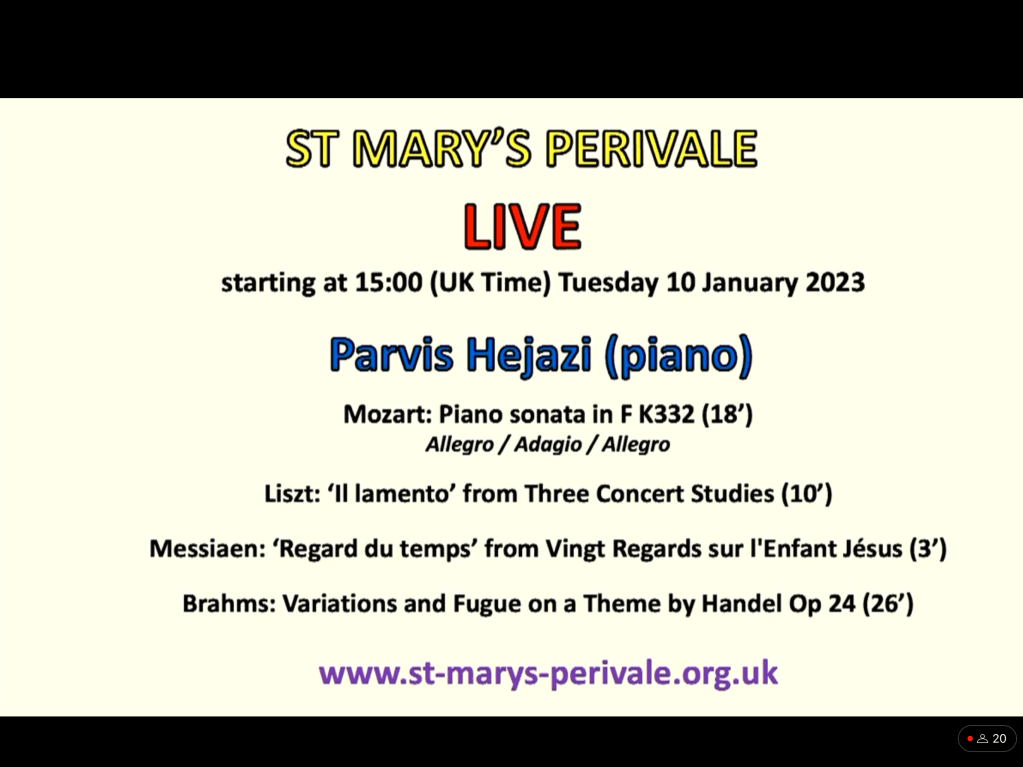
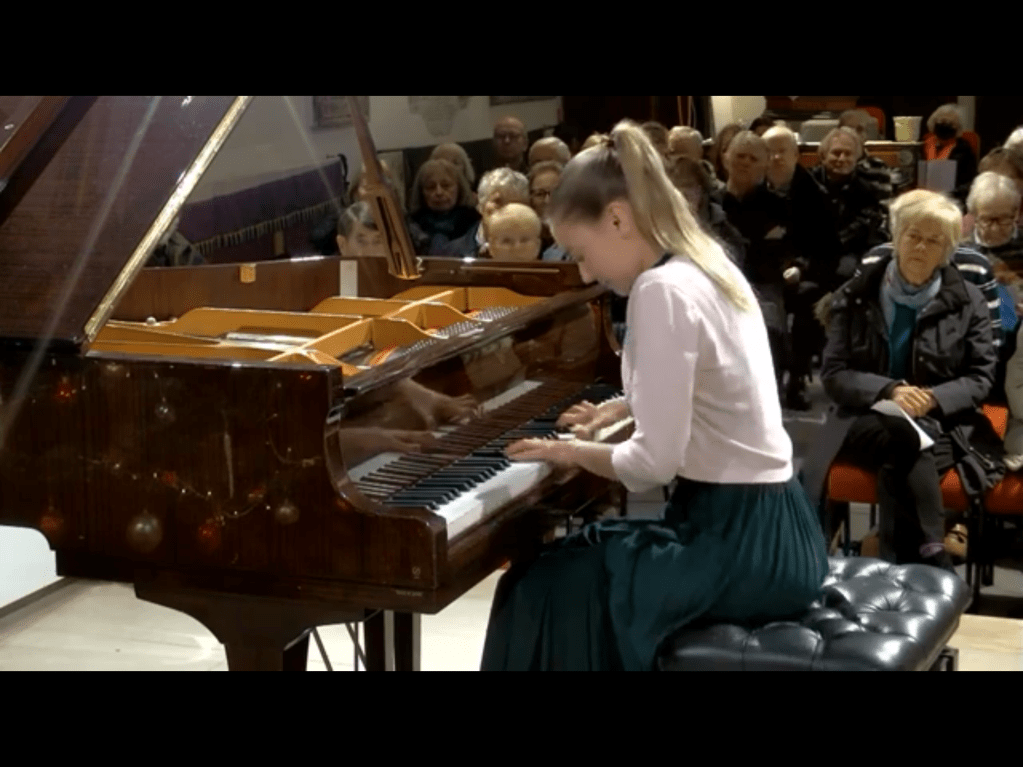
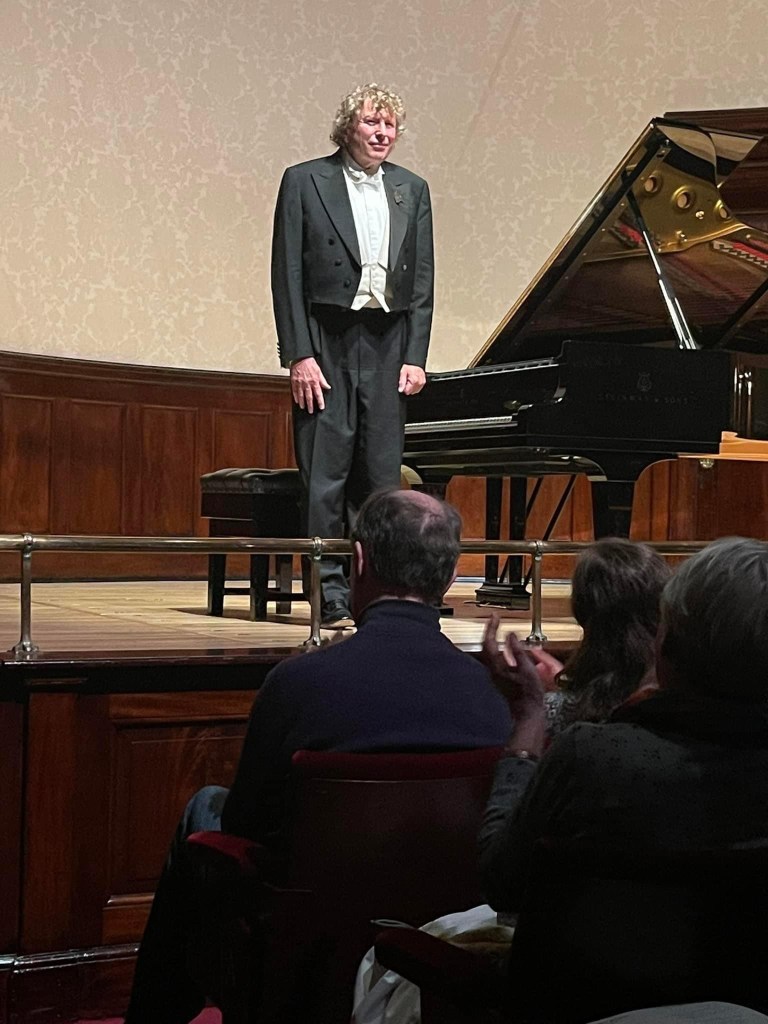
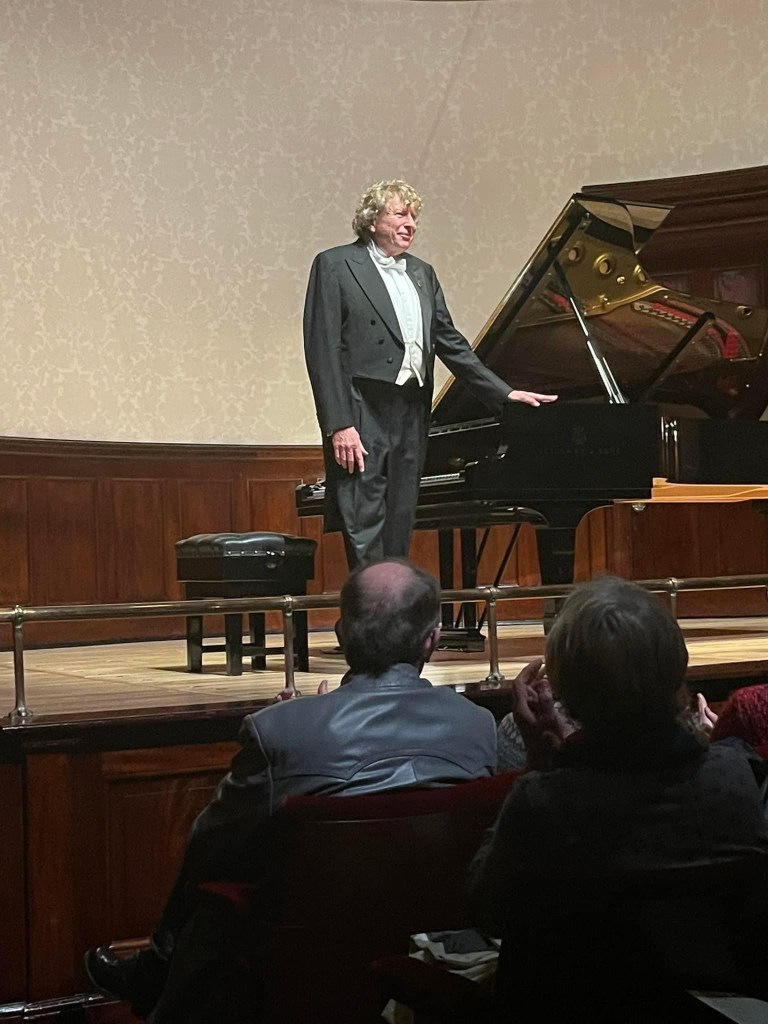
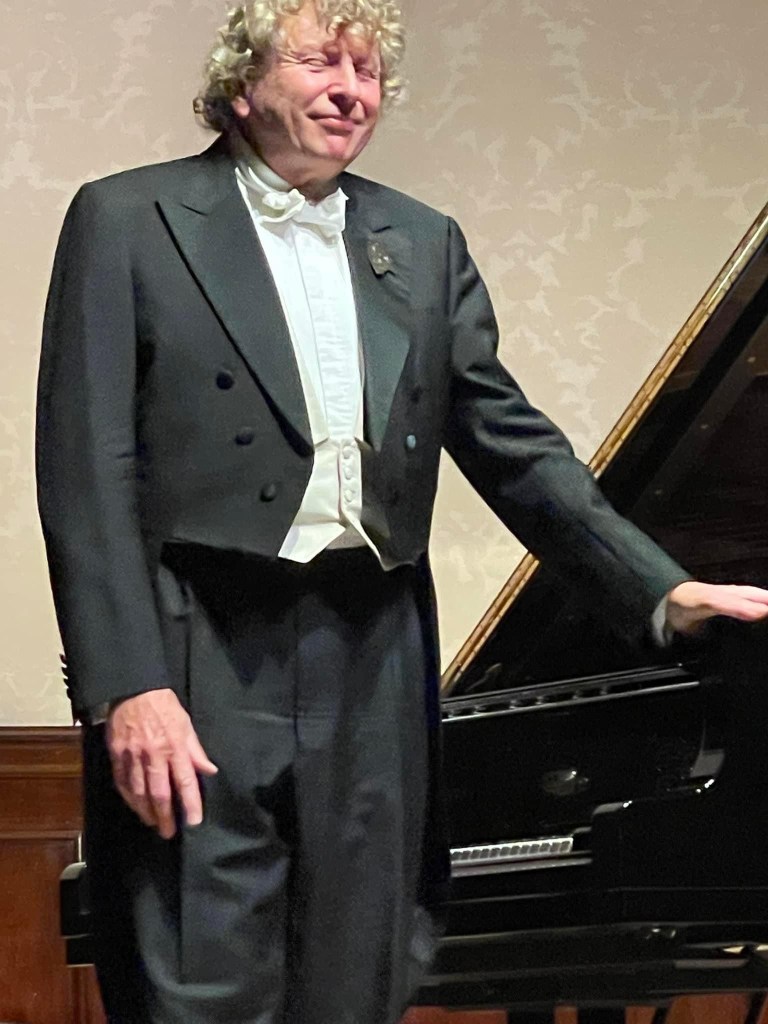
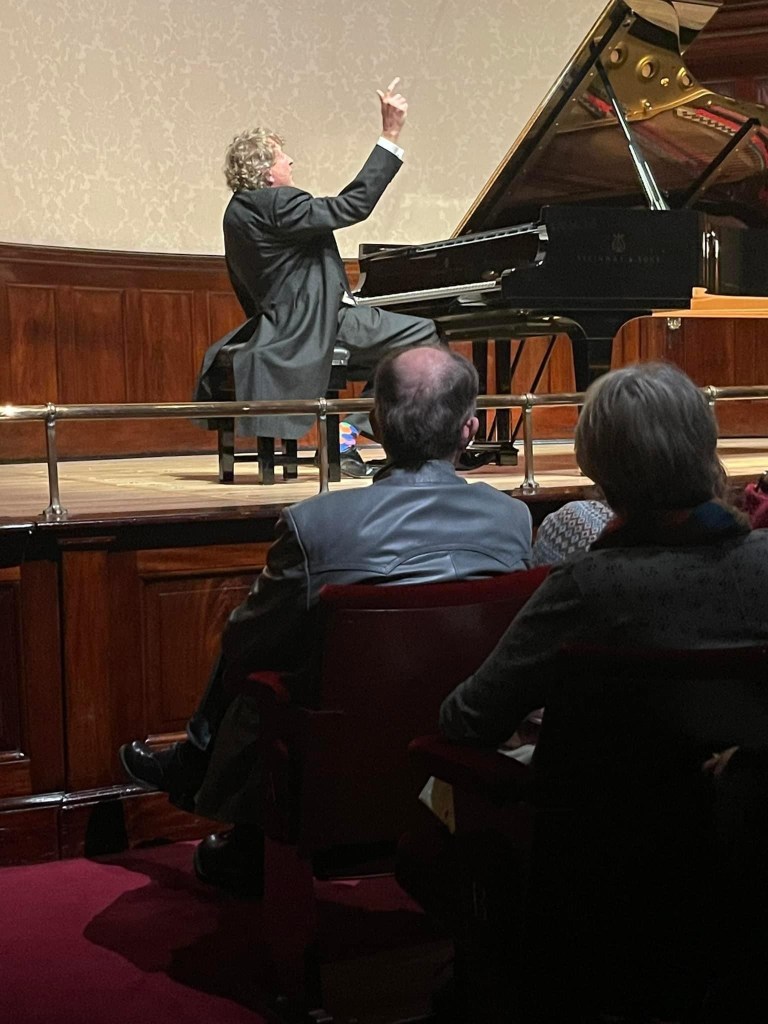
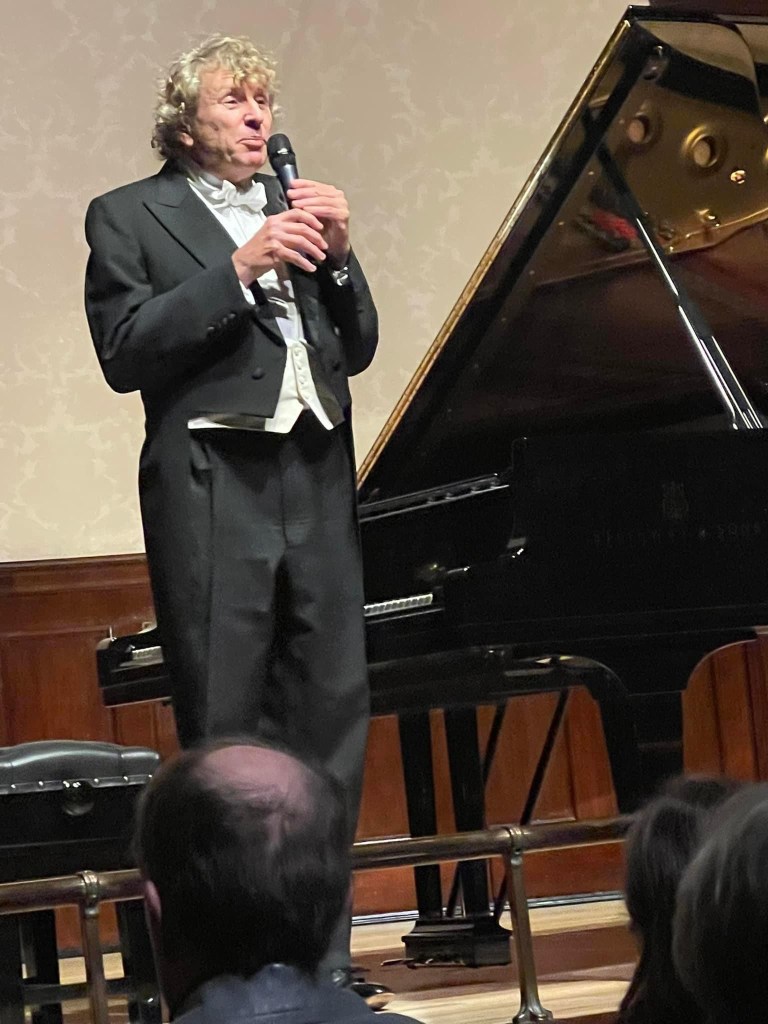
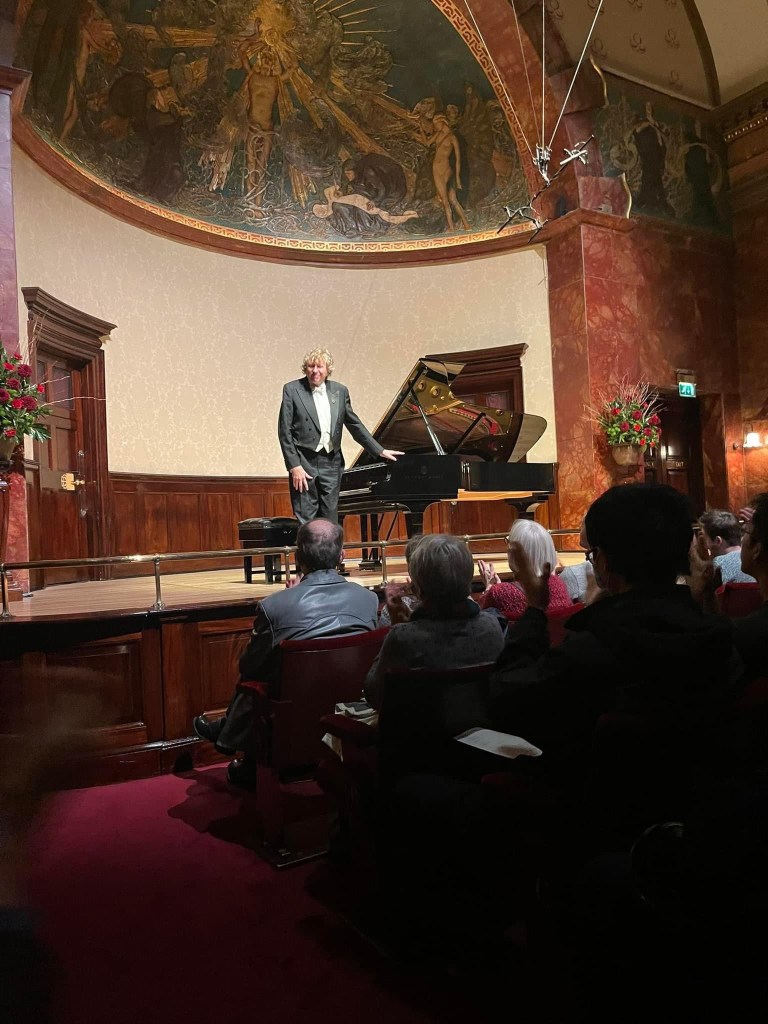
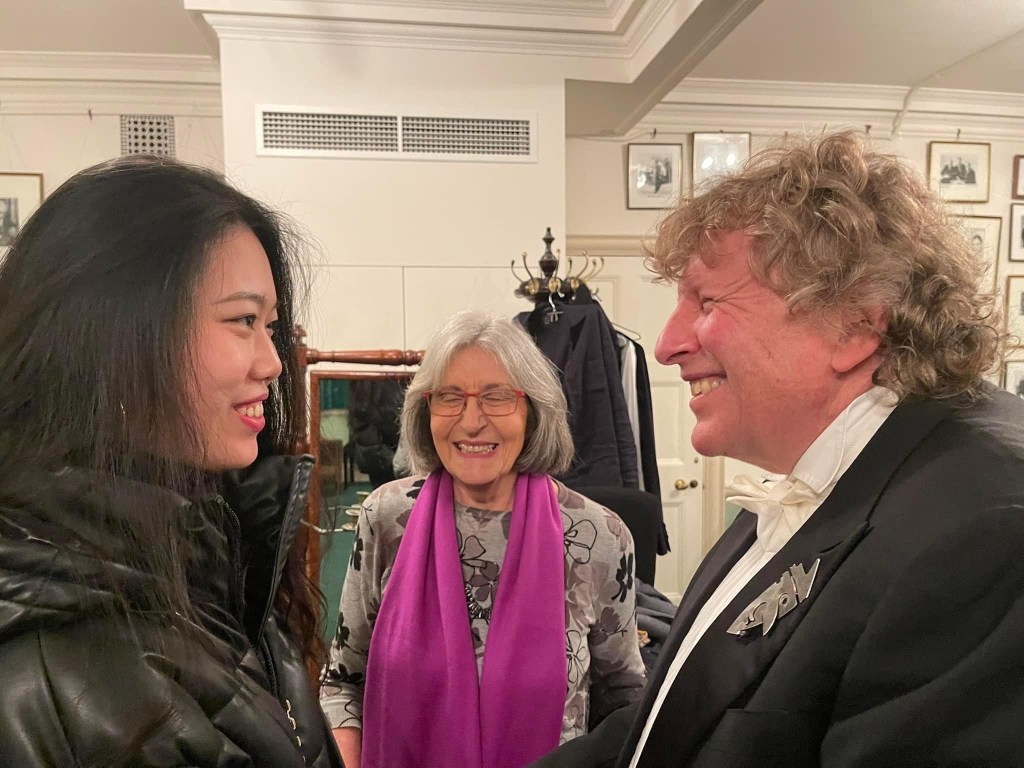
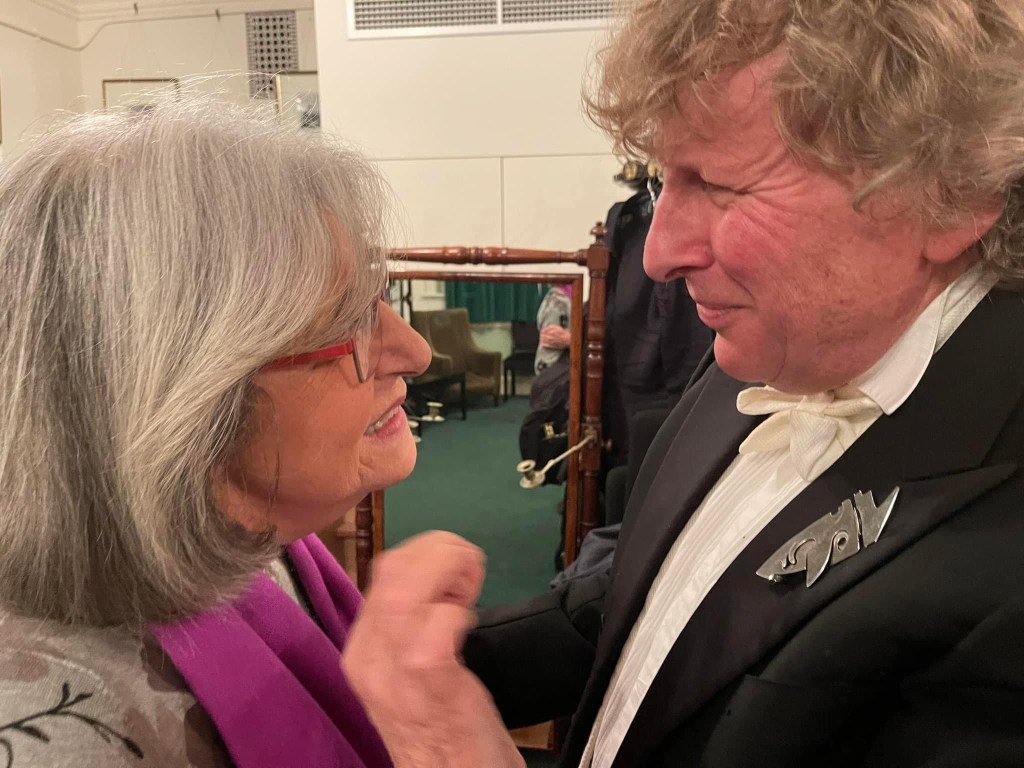
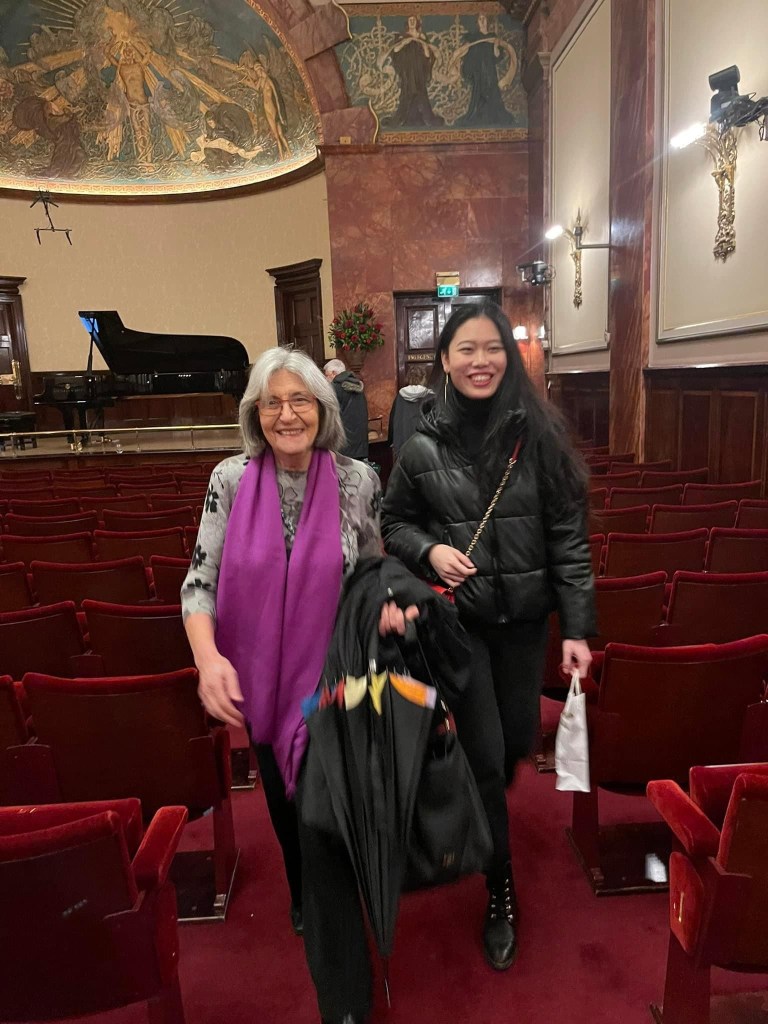
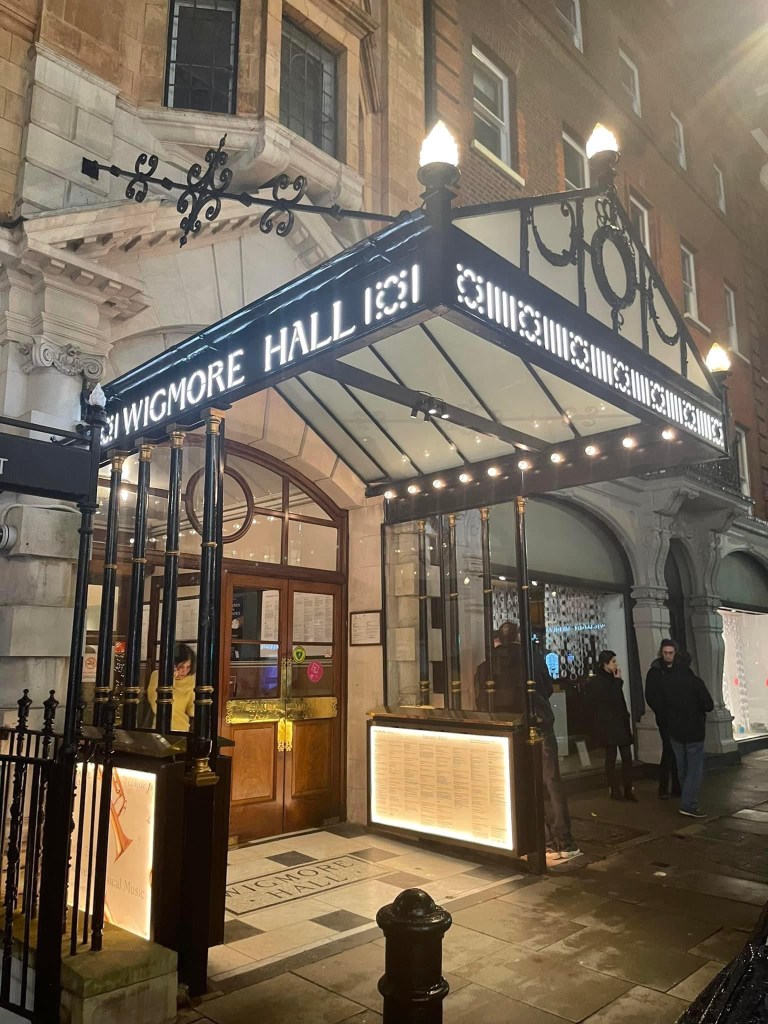
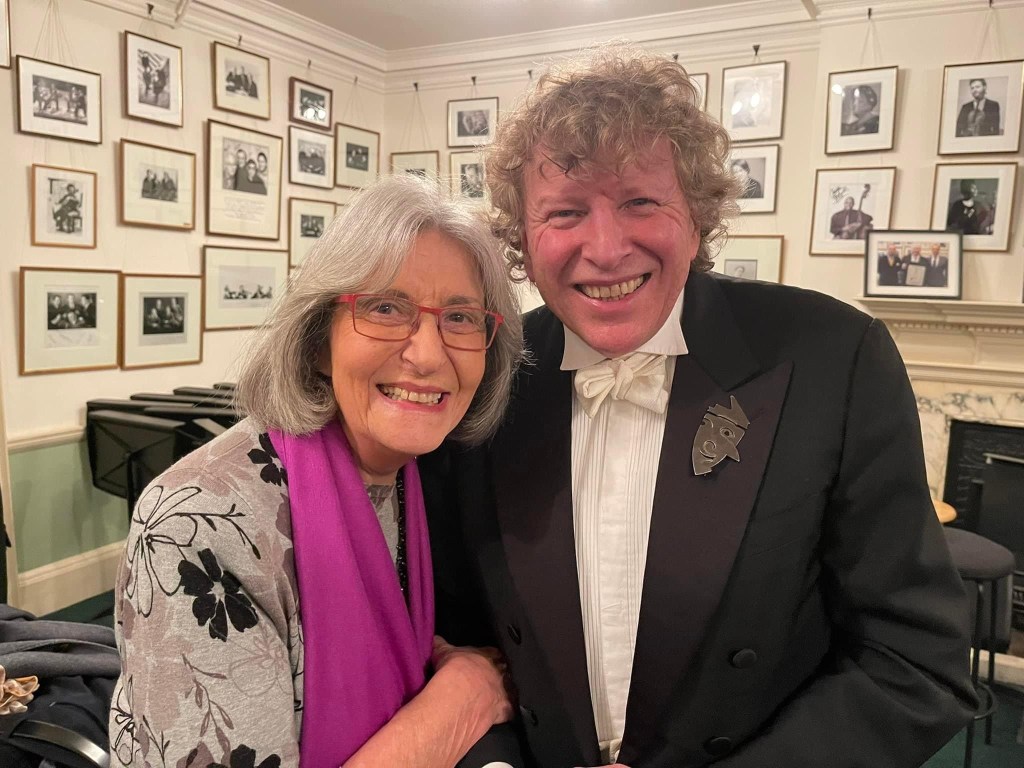
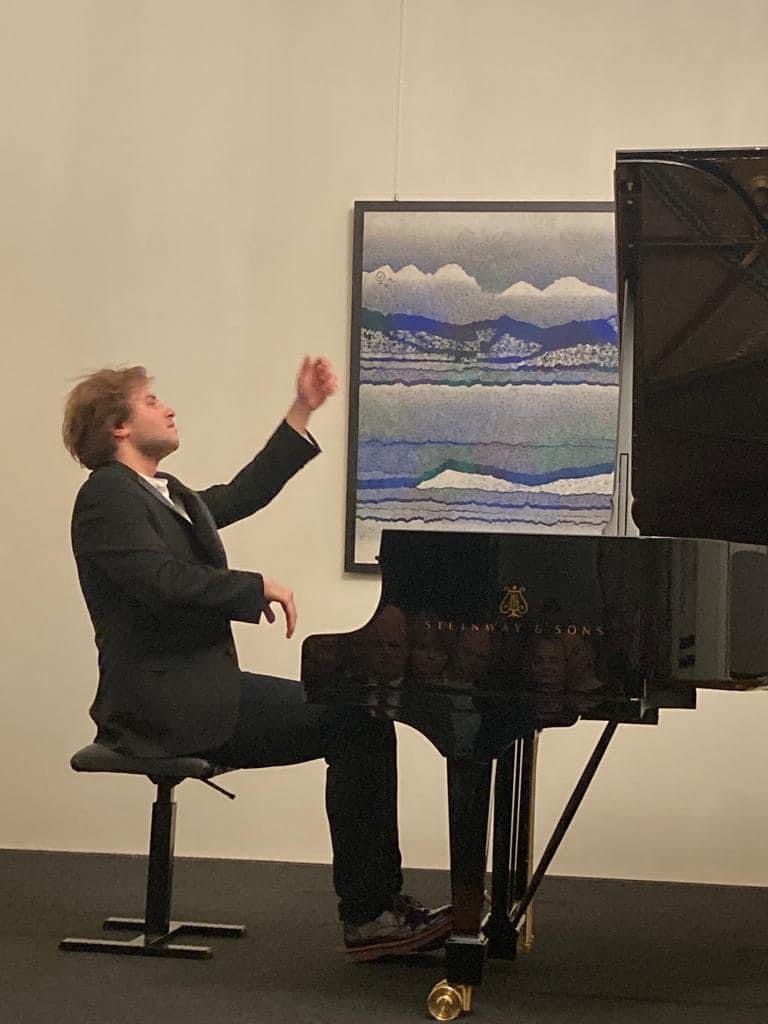
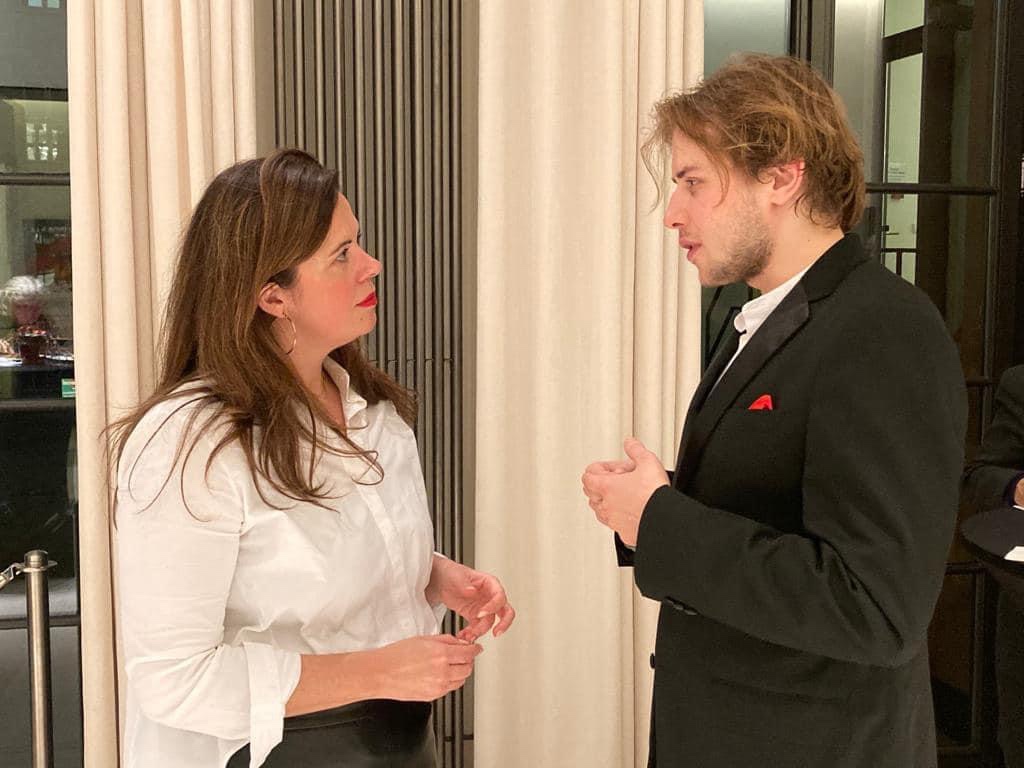
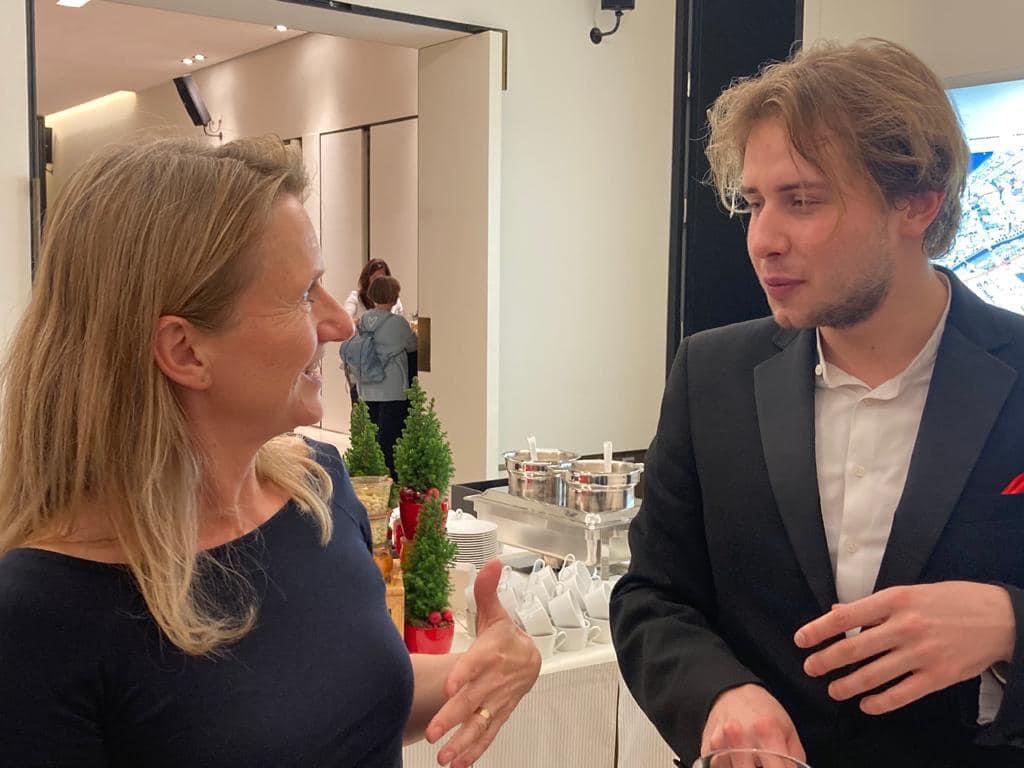
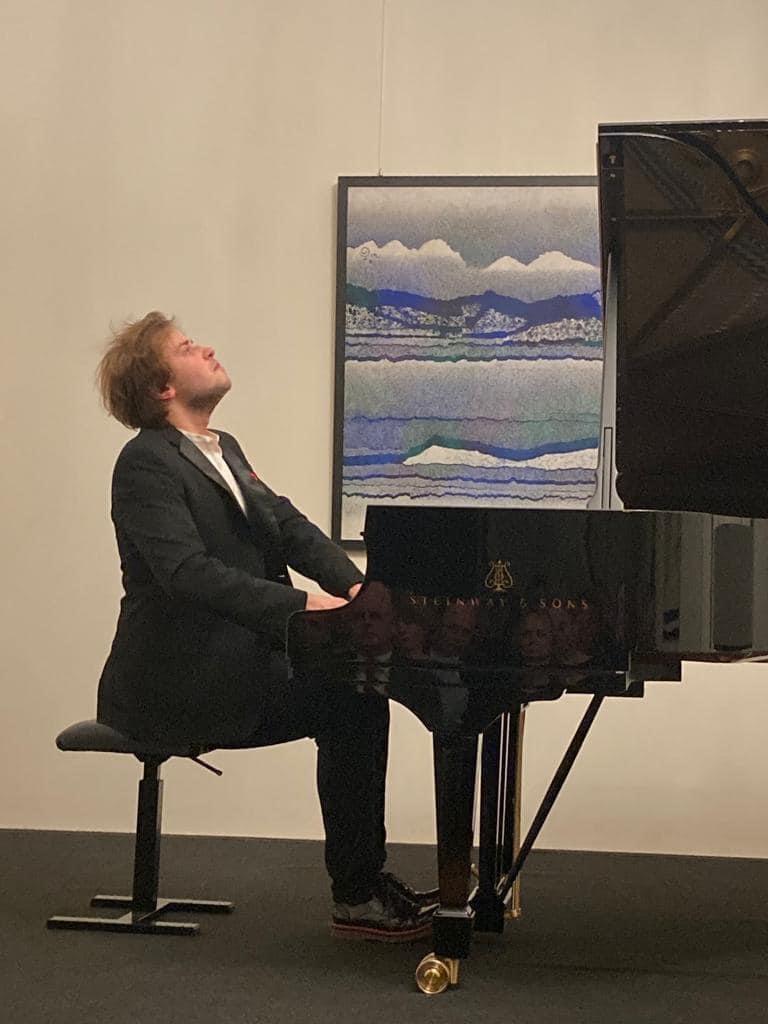
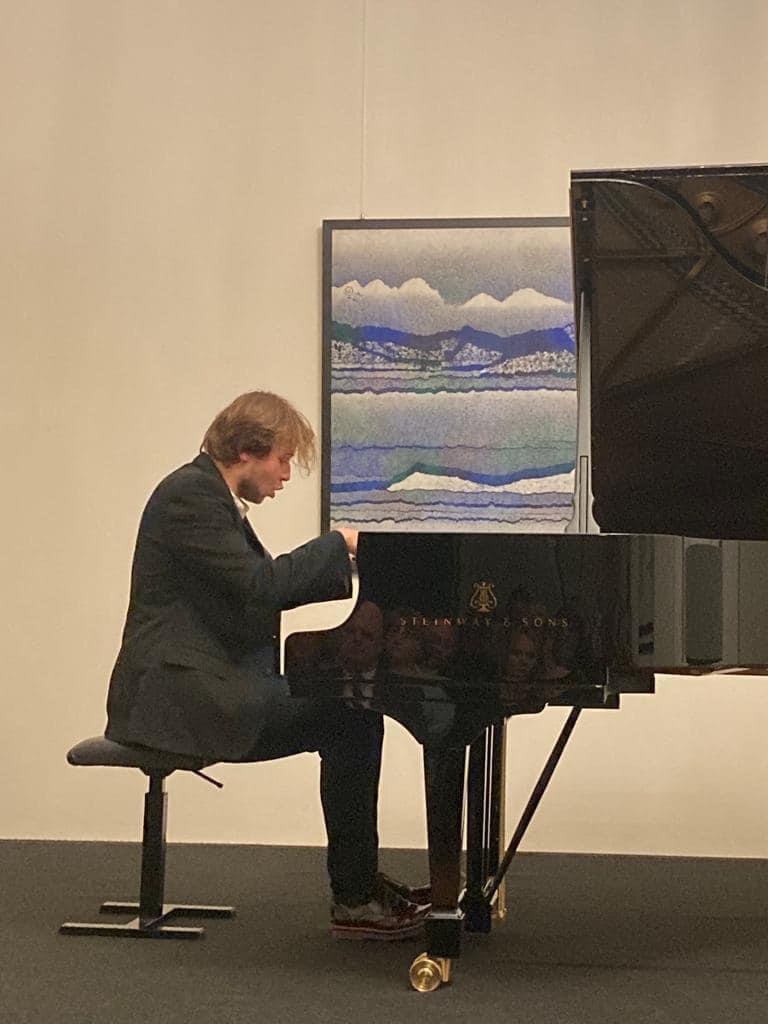
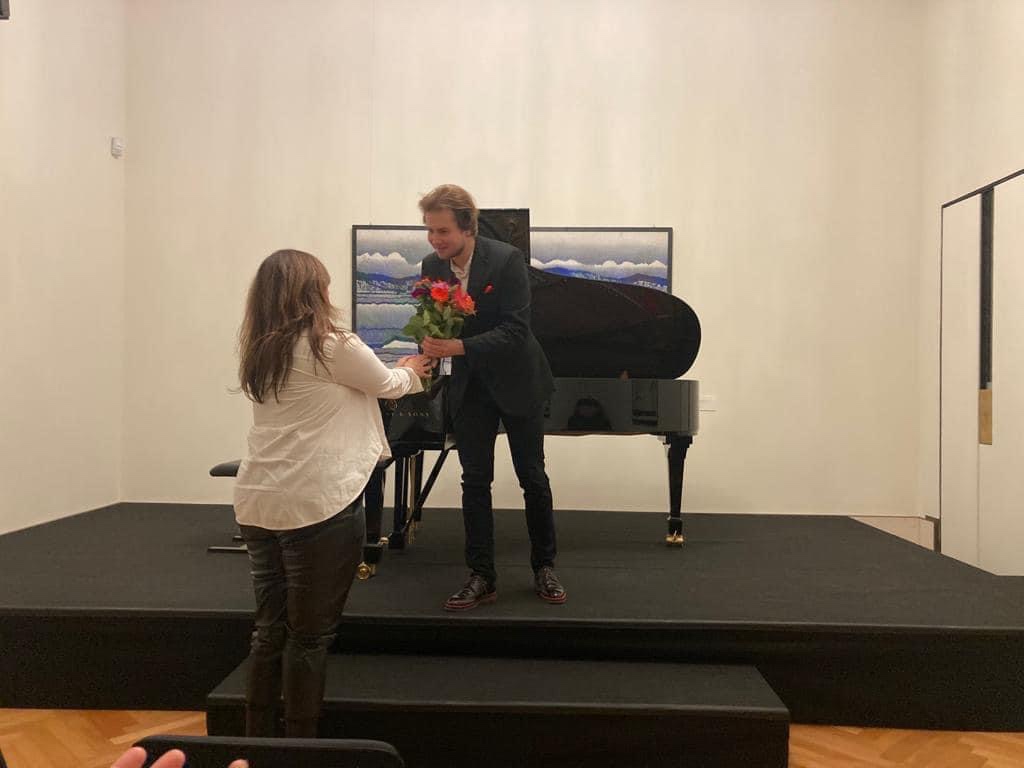
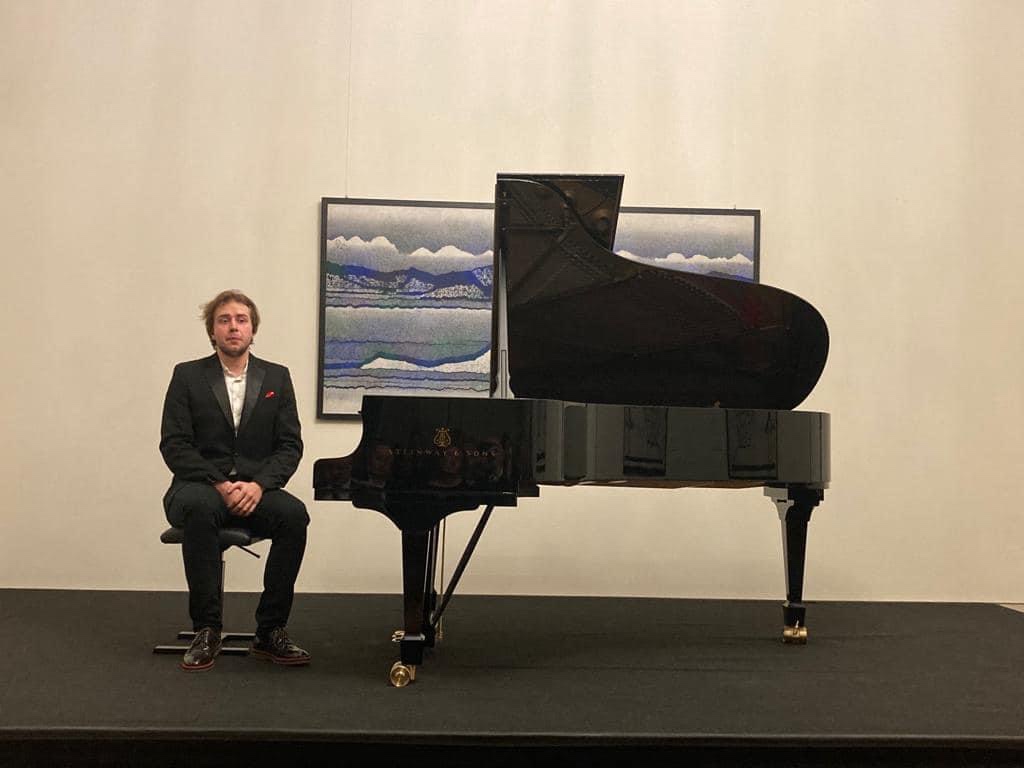
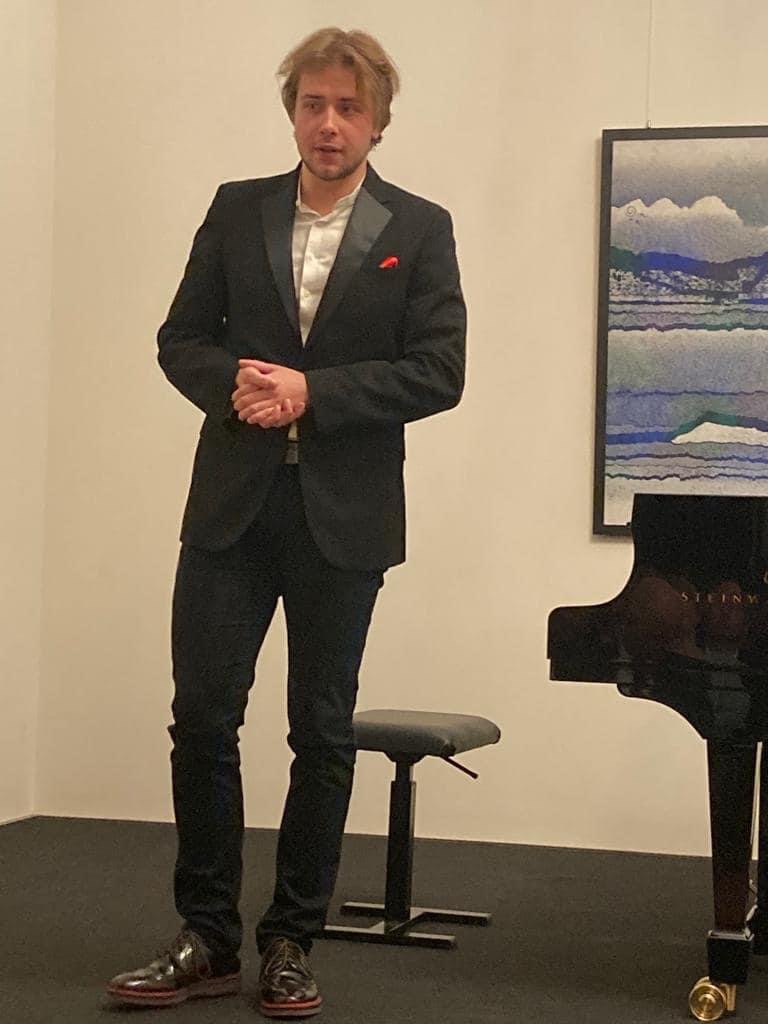
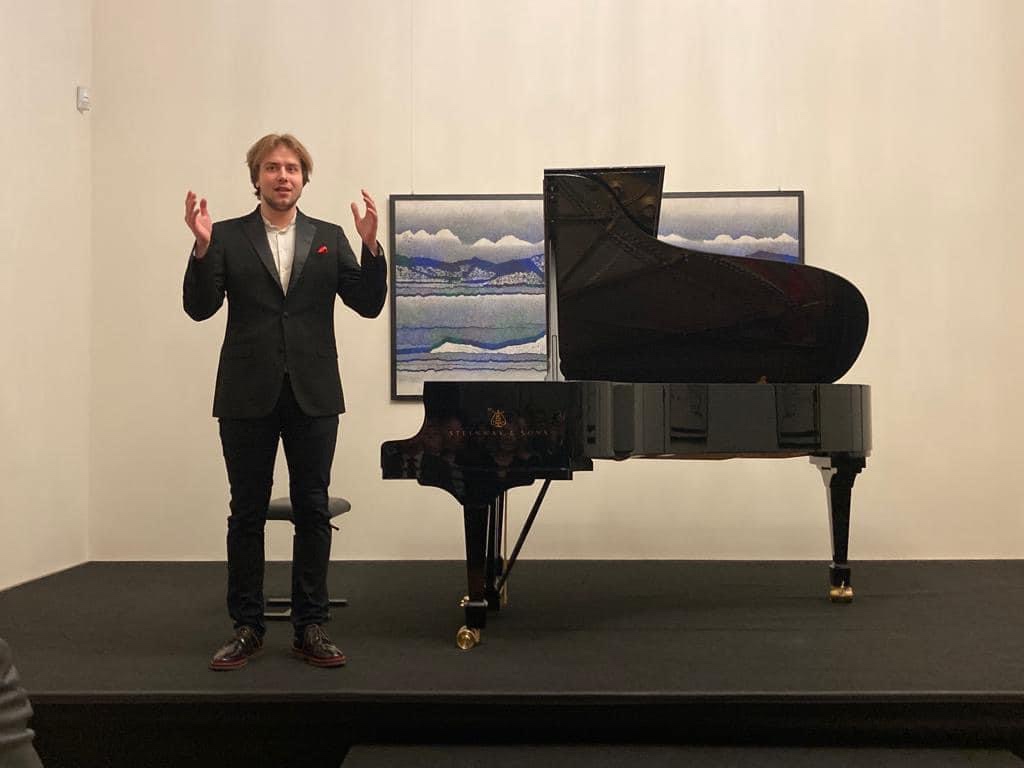
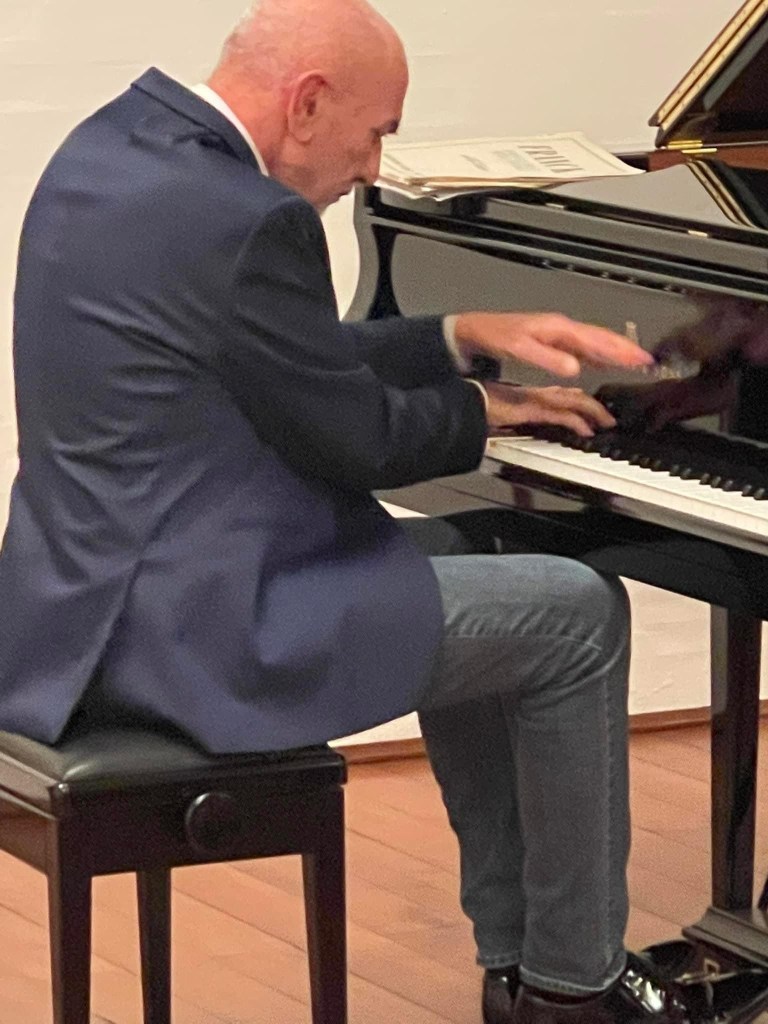
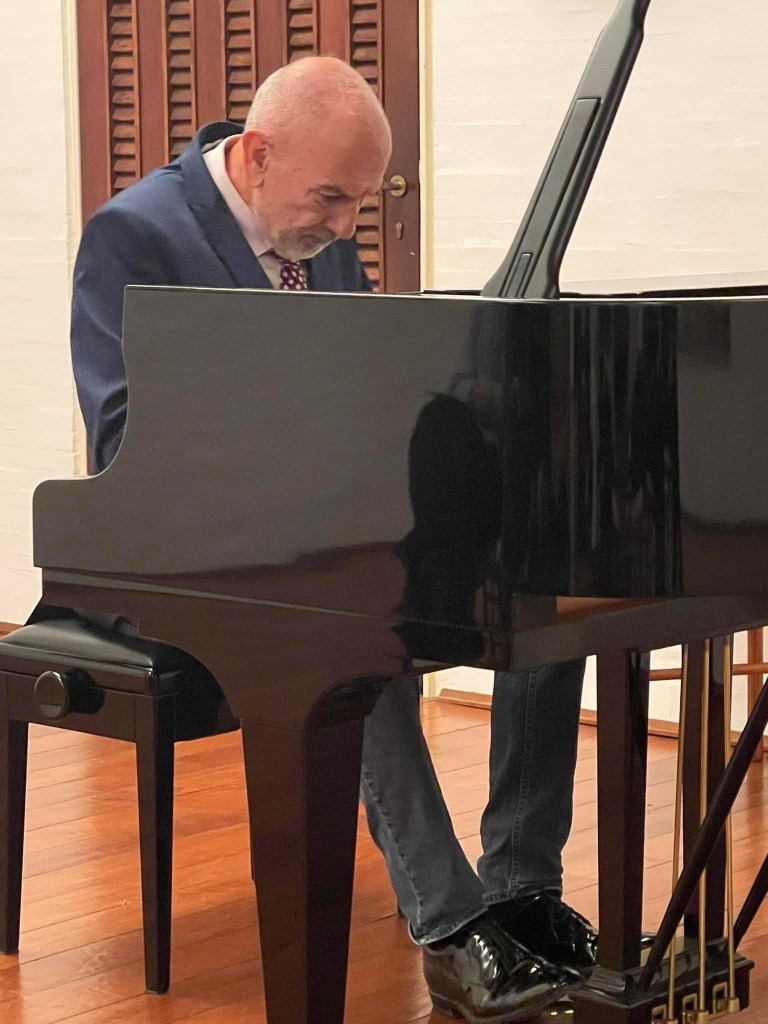
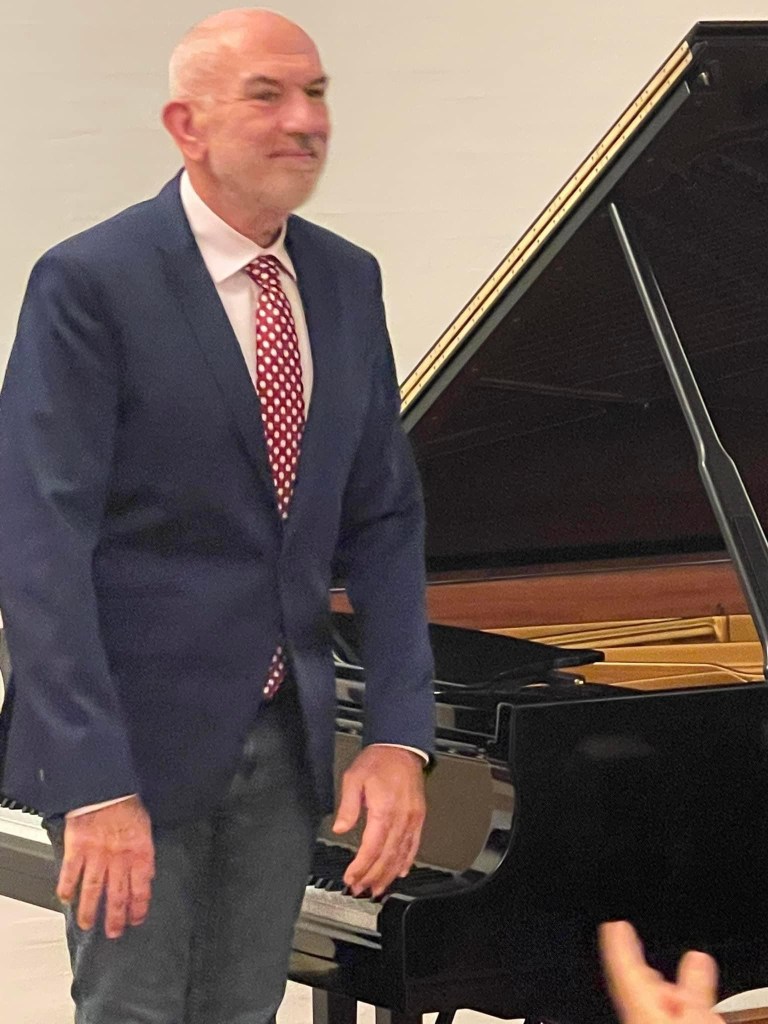
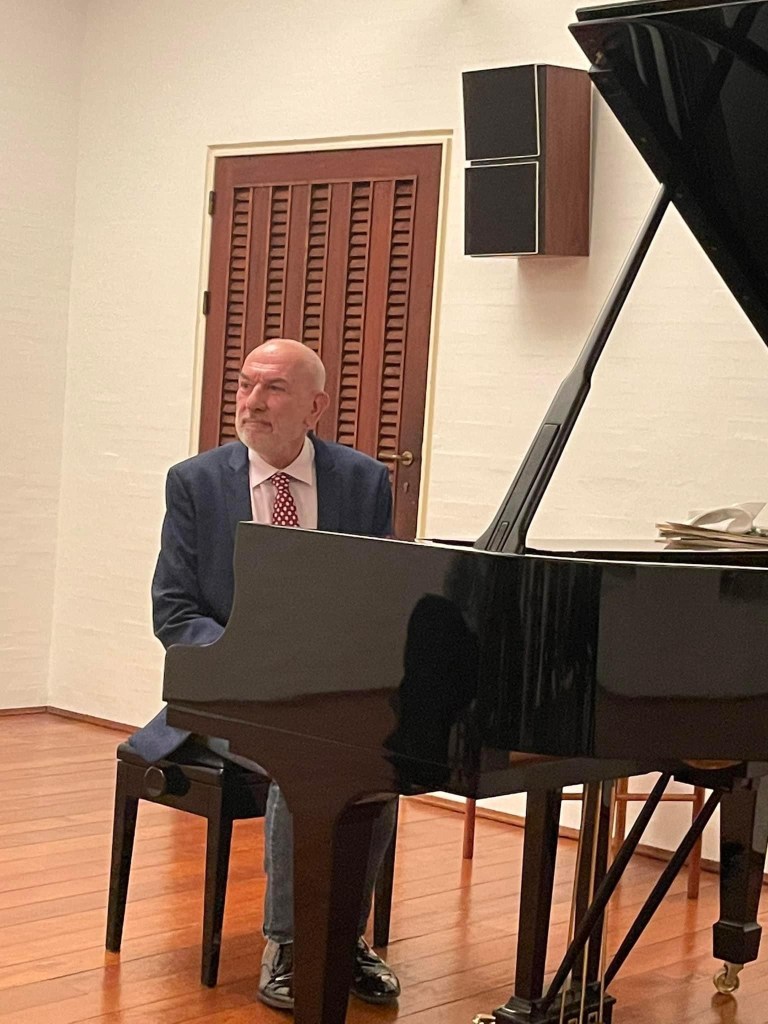
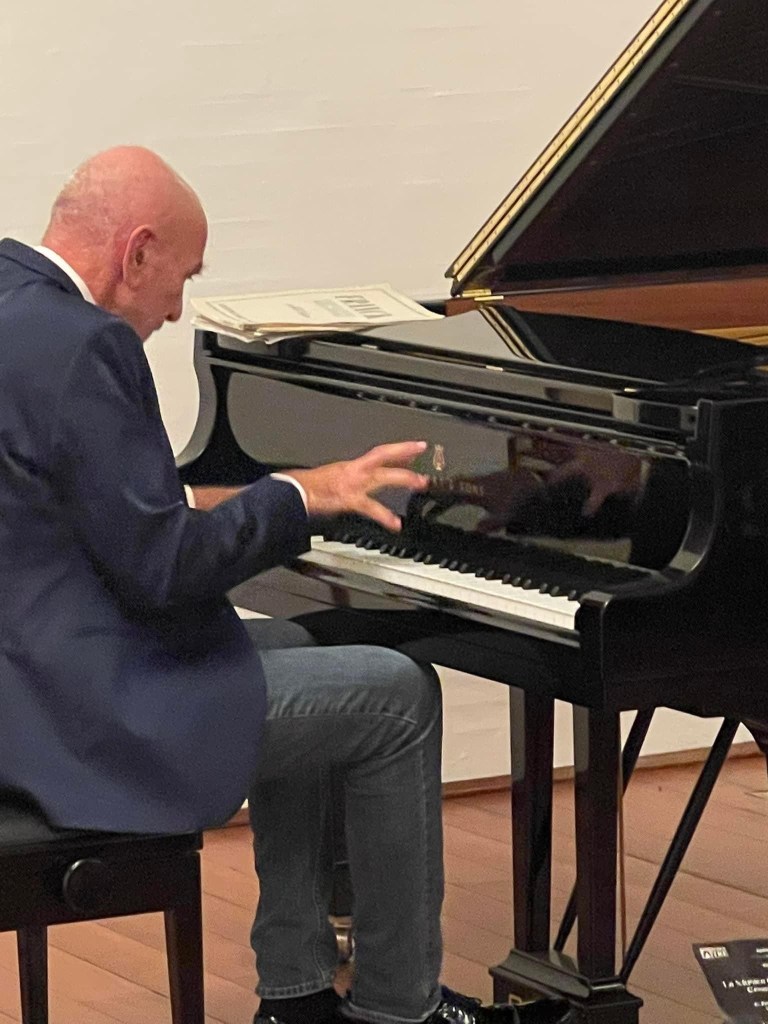
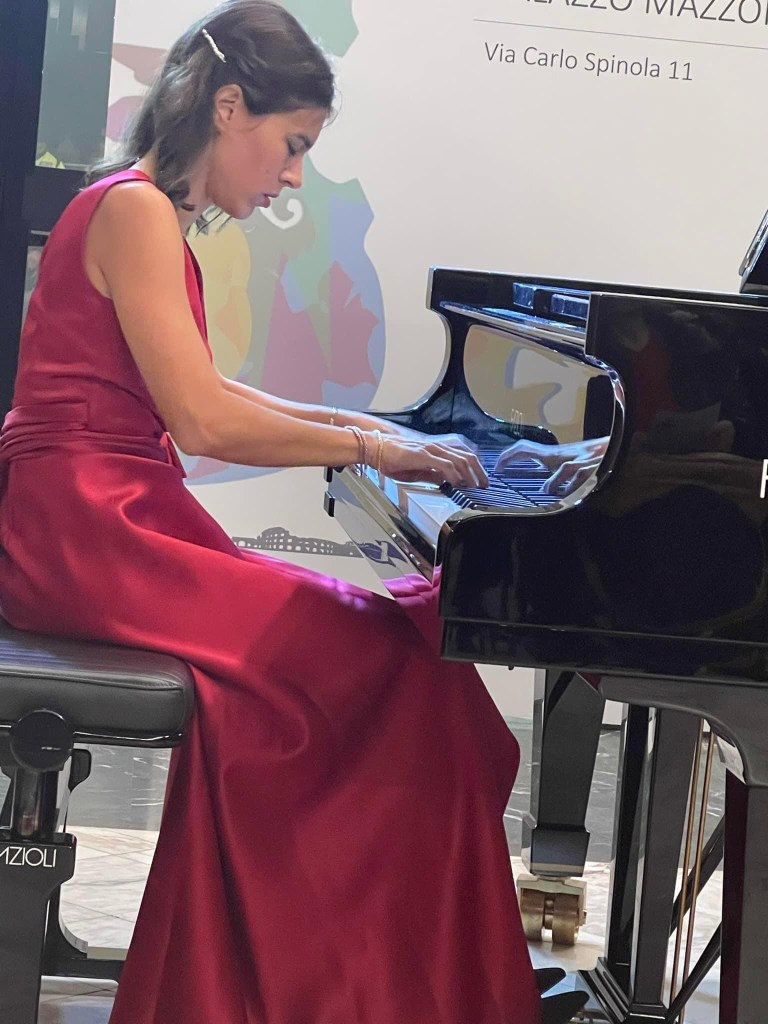
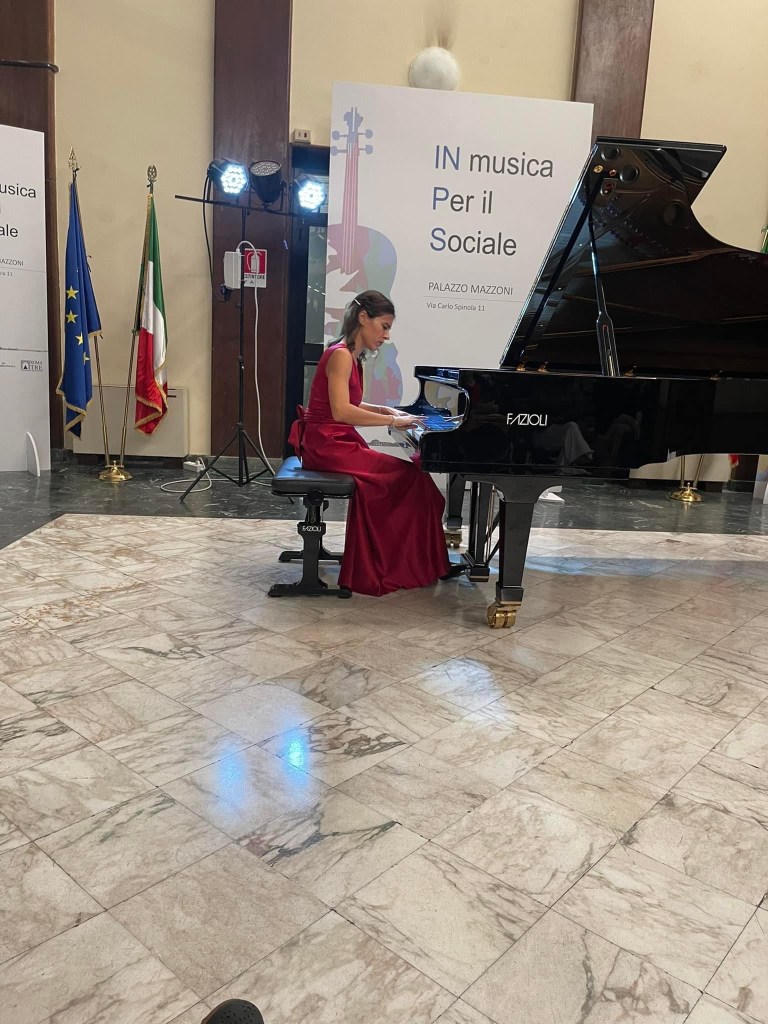
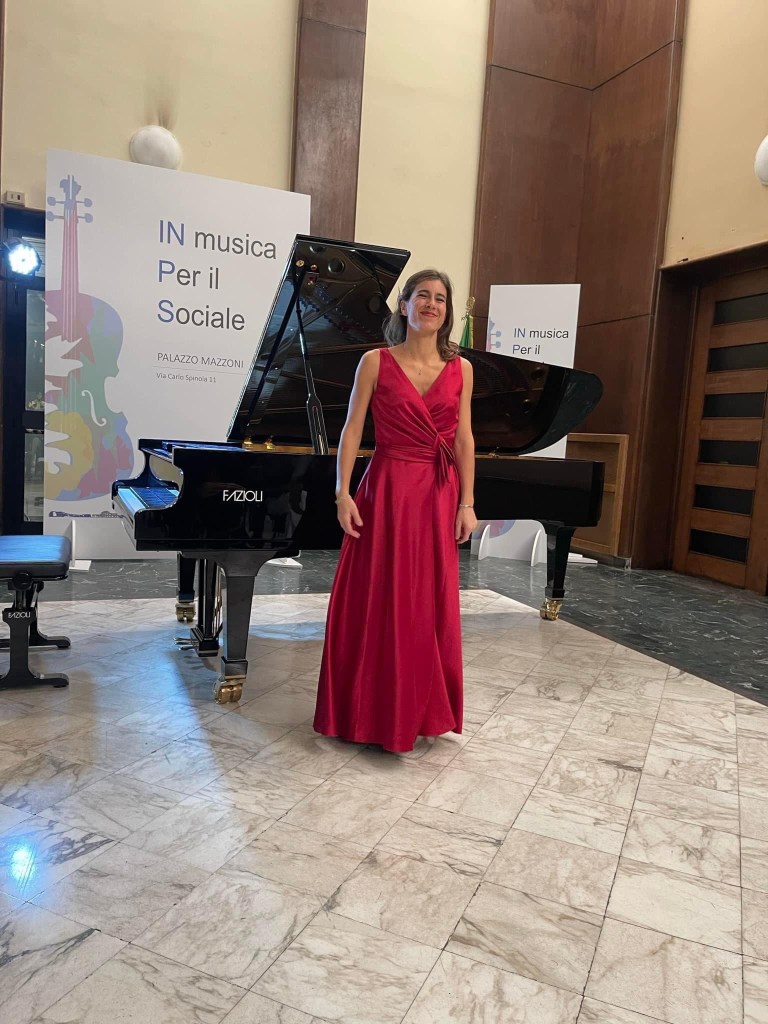
Parvis Hejazi the clarity and intelligence of a youthful poet in Perivale

Tuesday 10 January 3.00 pm 
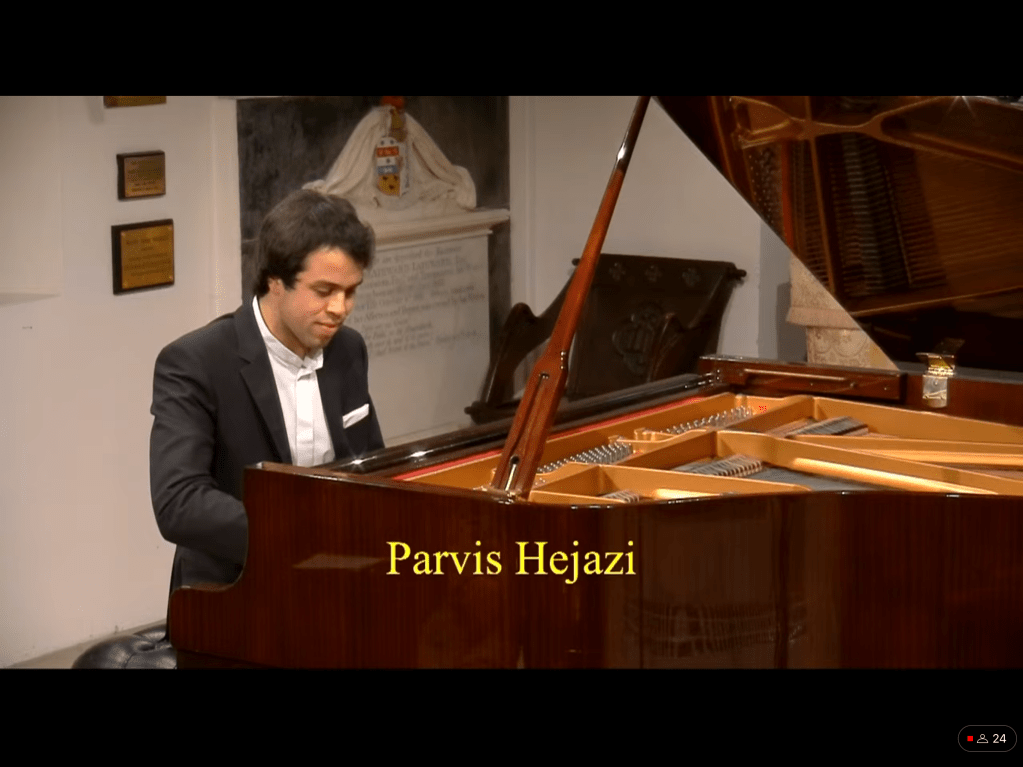
https://youtube.com/watch?v=RCRoPBgmld4&feature=share

Some superb playing from a poet who not only has a heart but also a mind as you would expect from the school of Norma Fisher.
A Mozart of a clarity and sense of character but with a rhythmic precision and buoyancy that brought this well known sonata vividly to life.The characters entered and exited from the stage in what is a superb operatic scenario.
It was a great operatic sweep he also brought to Liszt’s all to rarely heard ‘Lamento’.It was played with a sense of style and just the right amount of showmanship that could bring this beautiful piece vividly to life.The delicacy he brought to the final few bars was most touching after the passionate outpouring that had preceded it with a sumptuous sound and refined sense of balance.
There were chiselled sounds of great beauty in Messiaen’s contemplation.Pungent harmonies and atmospheres with the intensity of a fervant believer.
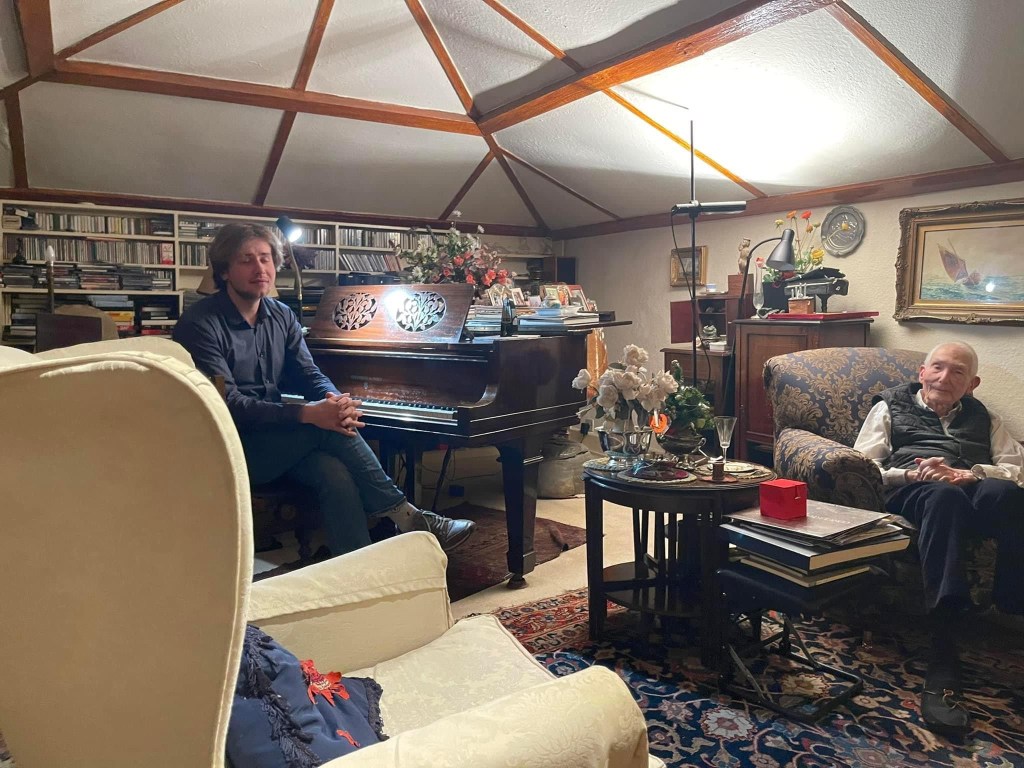
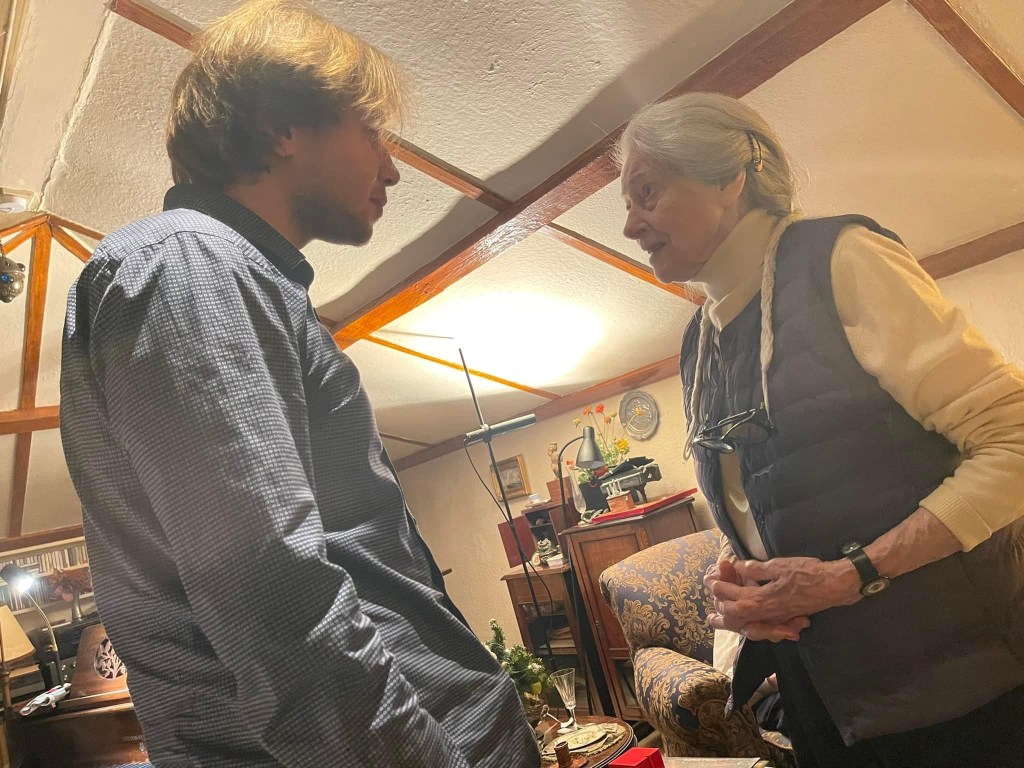
The first performance I ever heard of Brahms Handel Variations was from Parvis Hejazi’s teacher Norma Fisher.I had been taken as a teenager by our mutual teacher Sidney Harrison to hear his star pupil in the London Pianoforte Series at the Wigmore Hall when she was already an established artists.
I have never forgotten that performance of such warmth and nobility and an astonishing transcendental command of the structure of this almost orchestral work.
Parvis gave a remarkable performance of simplicity and dynamic drive.Shorn of all rhetoric it was a young man’s performance – Brahms was after all only 28 when he wrote it for his beloved Clara’s birthday.
Of course from Norma Fisher he had learnt the importance of the bass and each variation grew out of the other with this never wavering anchor that he had created.A technical command that was astonishing for a live performance and a clarity that was not ‘Brahmsian’- thank God!
The sheer beauty of his playing and unwavering command was quite remarkable as Handel’s innocent little melody was transformed into an outpouring of Busonian proportions.Spurred on into the fugue by this driving undercurrent that he had created he brought this masterpiece to a breathtaking conclusion.
Visibly exhausted as we all were he was happy to share his own beautiful Messiaen like piece with an enthusiastic audience.
‘After the magnificat’ showed the same fervent conviction of a true believer with magic sounds the melted into a cherished distance of oblivion and peace.
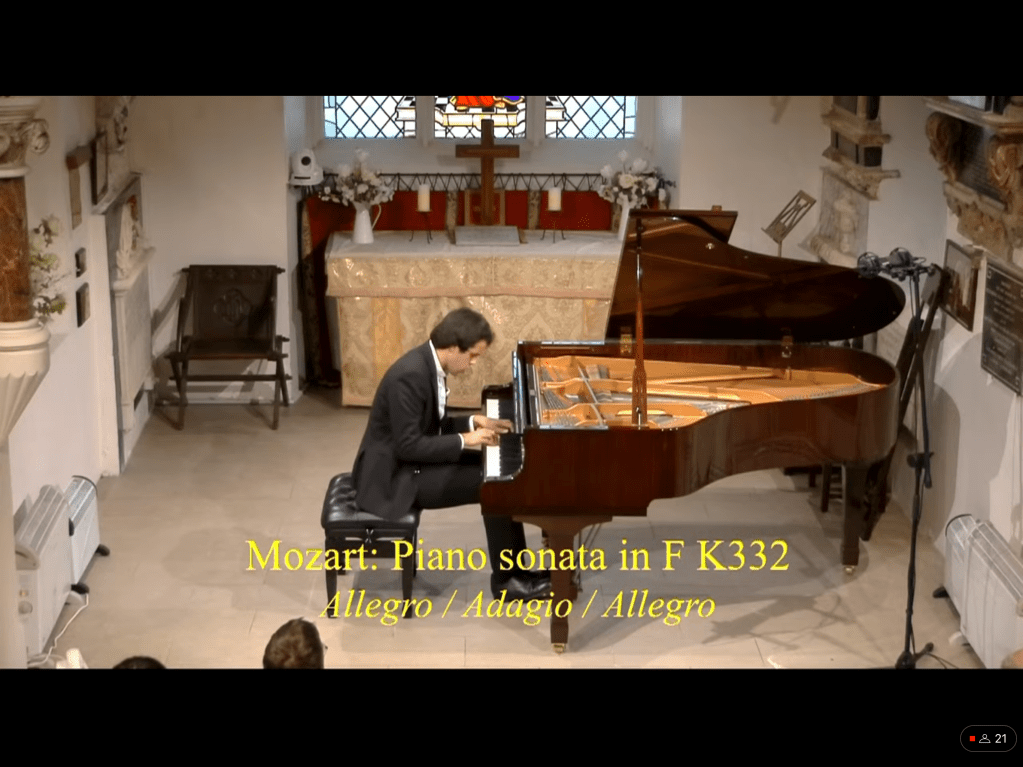
There was above all a clarity and sense of style that allowed Mozart’s players in this operatic scenario to enter and exit,each with their own character and personality.Interrupted only by the fairy like horn call or the pungent forte and piano contrasts,all played with such delicacy and style.The Adagio was poised and eloquent with a sense of balance that allowed the melodic line to sing so naturally.There was great delicacy too with subtle ornamentation in the ritornello.The Assai Allegro was played with infectious rhythmic verve and buoyancy.The staccato and legato could have been more carefully noted at the end to create even more contrast with Mozart’s genial surprise ending after the streams of notes of innocent Mozartian charm.

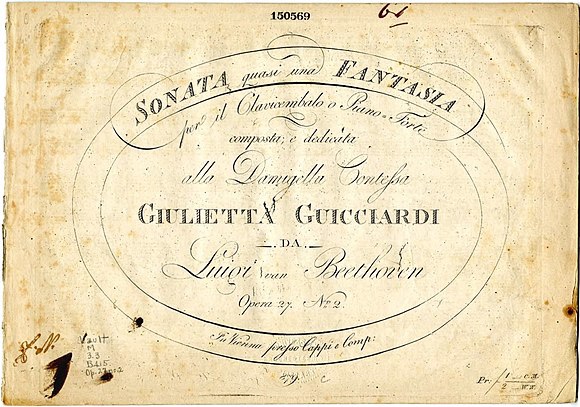
The Piano Sonata No. 12 in F major K.332 was published in 1784 along with the No.10 in C major, K. 330, and No.11 K. 331.[Mozart wrote these sonatas either while visiting Munich in 1781, or during his first two years in Vienna.[Some believe, however that Mozart wrote them during a summer 1783 visit to Salzburg made for the purpose of introducing his wife, Constanze to his father. All three sonatas were published in Vienna in 1784 as Mozart’s Op. 6.In the 1994 film Immortal Beloved , Giulietta Guicciardi is heard playing the second movement during a piano lesson with Beethoven
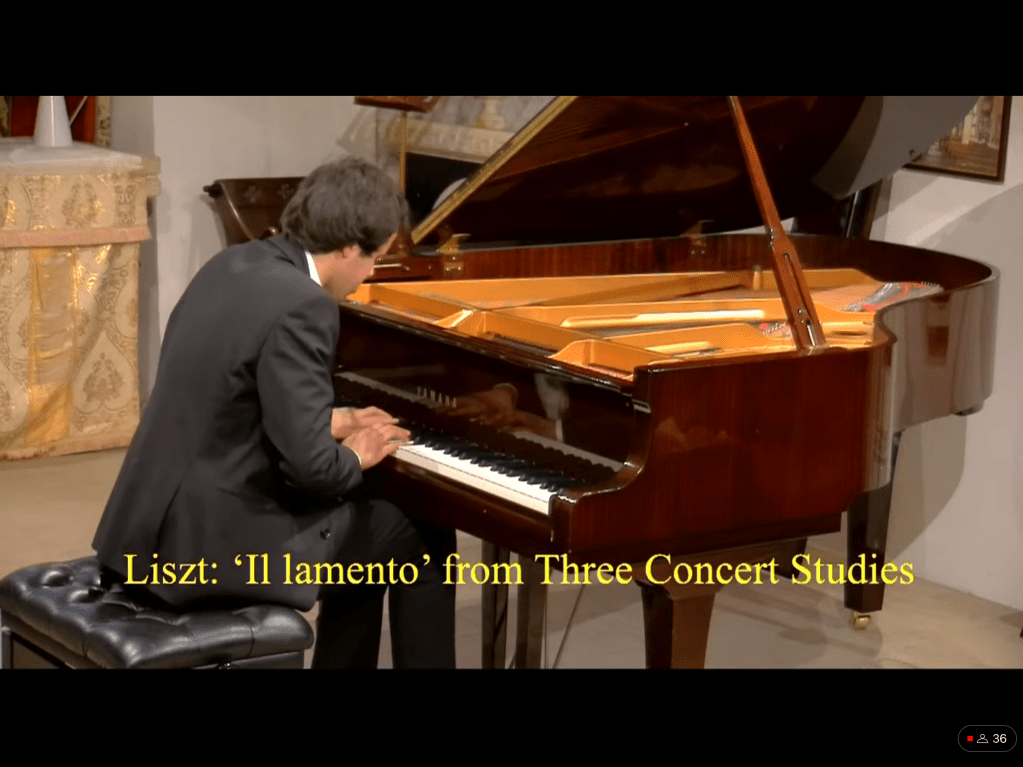
Great sweep to Liszt’s luxuriant melodic line that was played with style and just the right amount of showmanship.The passionate climax was played with grandeur and aristocratic authority before the return of the opening melody embellished with cascades of golden strands leading to an ending of subtle beauty.

Three Concert Études (Trois études de concert), S.144 is a set of three Etudes by composed between 1845–49 and published in Paris as Trois caprices poétiques with the three individual titles as they are known today:Il lamento (“The Lament”), La leggierezza (“Lightness”), and Un sospiro (“A sigh”)Il lamento is the first of the études and is among Liszt’s longest pieces in the genre. It starts with a four-note lyrical melody which folds itself through the work, followed by a Chopin like chromatic pattern which reappears again in the coda.Although the piece opens and ends in A-flat major, it shifts throughout its three parts to many other keys, A, G, D-sharp, F-sharp and B among them.
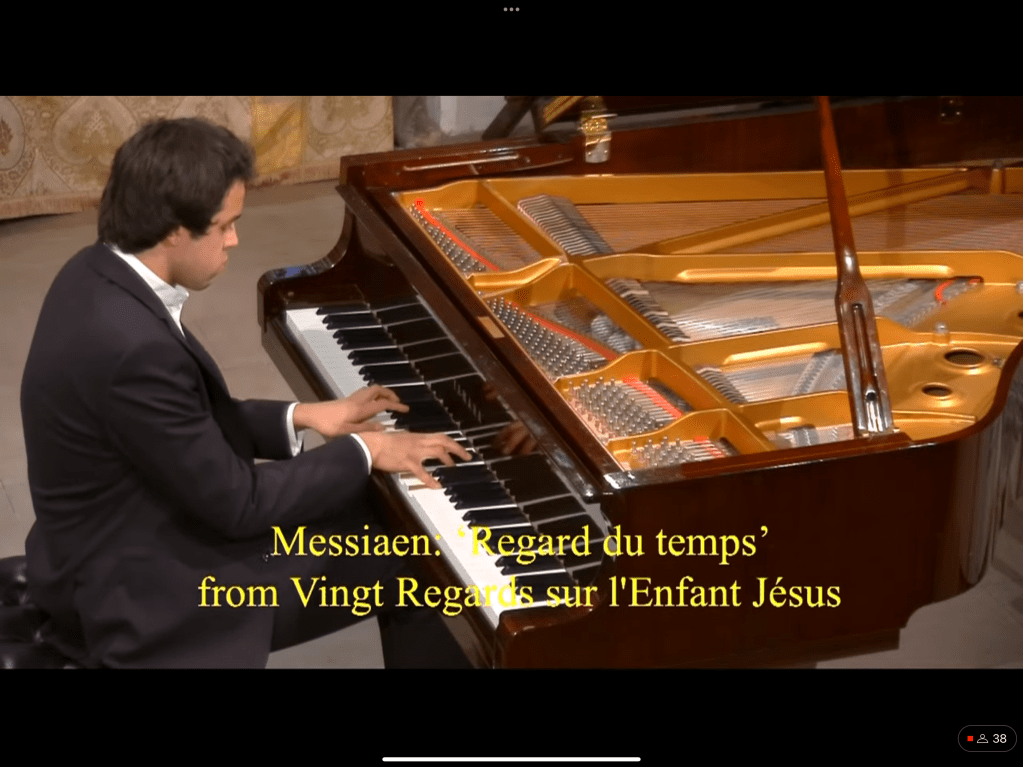
Chiselled sounds of ravishing simplicity with pungent harmonies creating the rarified air of a true believer.Insistent harmonies with fervent conviction ever more intense.

The Vingt regards sur l’Enfant-Jésus (“Twenty Contemplations on the Infant Jesus”) are a suite of 20 pieces for solo piano by the French composer Olivier Messiaen (1908–1992). It is a meditation on the childhood of Jesus and was composed from March to September of 1944 following commission by Maurice Toesca wishing for a reading of his twelve poems on the nativity. The abandoned plan was later reworked with a dedication to his protégée Yvonne Loriod later to become his wife.Although the work was finished shortly after the liberation of Paris in August and excerpts played in public by Messiaen and Loriod, the complete premiere took place 26 March 1945 at the Salle Gaveau with the composer reading aloud his own commentaries.Messiaen uses Thèmes or leitmotifs, recurring elements that represent certain ideas. They include:

  • Thème de Dieu (“Theme of God”)
  • Thème de l’amour mystique (“Theme of Mystical Love”)
  • Thème de l’étoile et de la croix (“Theme of the Star and of the Cross”)
  • Thème d’accords (“Theme of Chords”)

Regard du temps (“Contemplation of time”) in the 9th of the set.
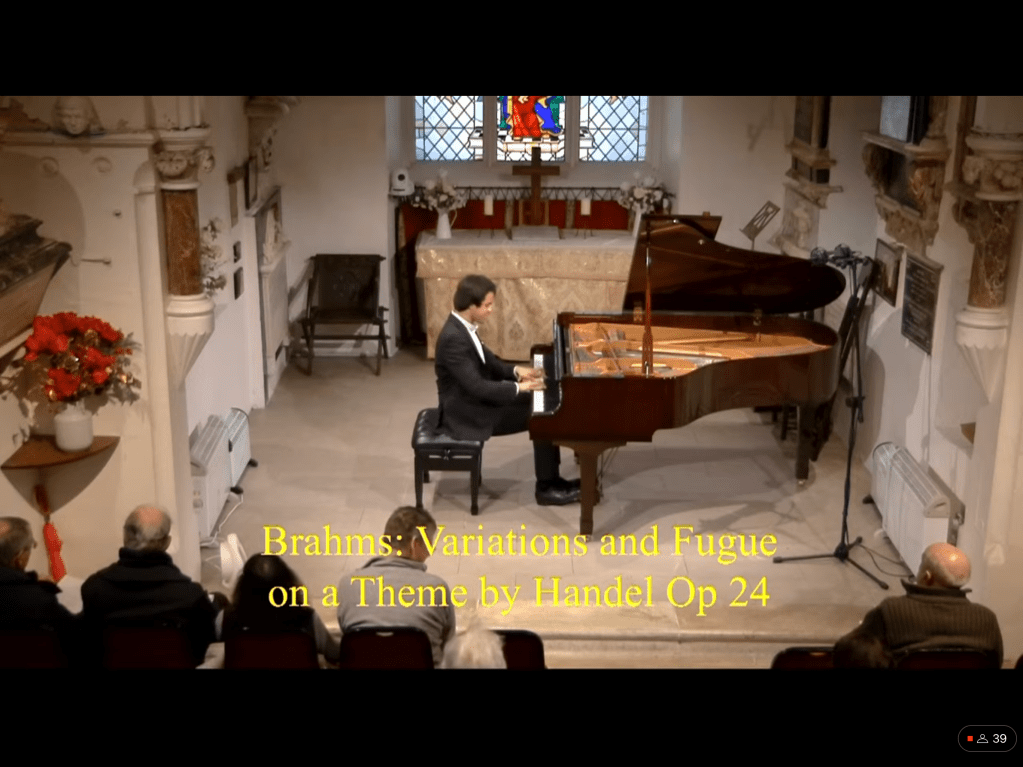
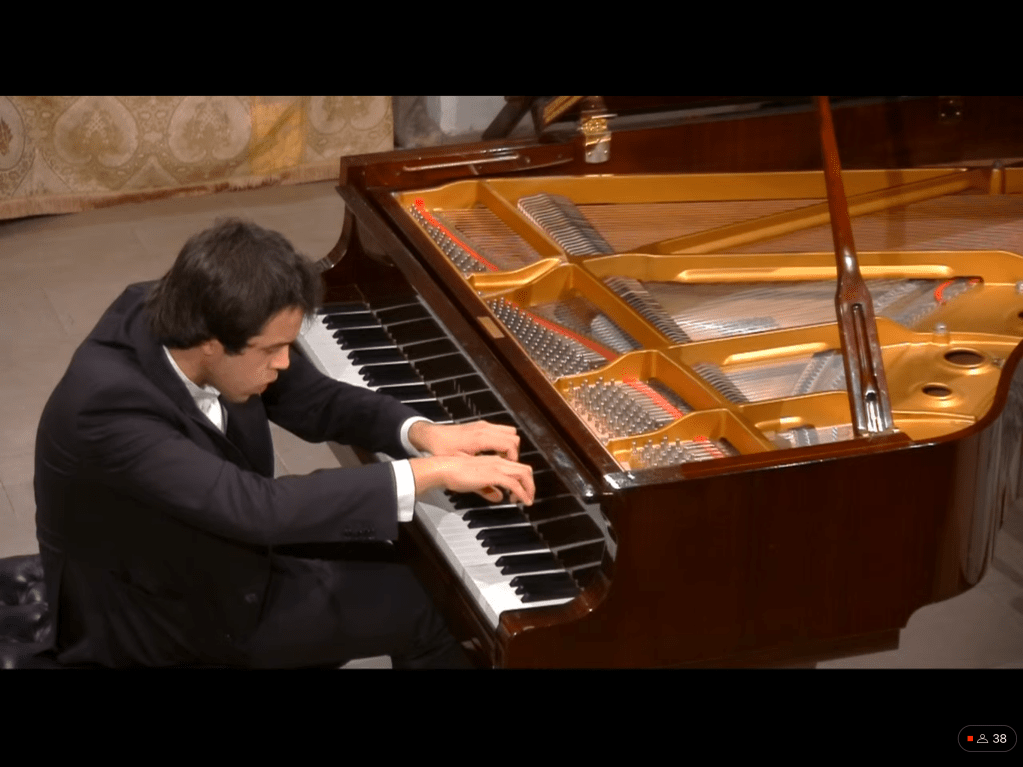
Rather a brisk opening which opened the gate for this extraordinary set of variations.From the rhythmic flow of the first,flowing legato and solidity of the second and the charm of the halting rhythm of the third.The fourth was of great nobility dissolving into the mellifluous continuous outpouring of the fifth.Octaves mysteriously shadowing each other to be interrupted by the militaristic rhythmic insistence of the seventh.Grandeur and nobility of the ninth before the quixotic chase up and down the keyboard of the tenth.Contrasting with the beautiful outpouring of the eleventh played with a sumptuous sense of balance.Gentle cascades of notes in the seventeenth before the gentle bourée of elusive charm and grace.There was ravishing beauty in the music box variation before the ominous build up of great rhythmic drive with ever more exciting swirls of forward moving notes,like a great gust of wind.The triumphant declaration,before the entry of the fugue,was played with great assurance and overpowering authority.The Fugue was played with great clarity and even if he was visibly tired after such an exhausting journey he managed to bring this early masterpiece to a triumphantly youthful conclusion.Missing maybe the orchestral sounds and thick luscious harmonies of more mature artists Parvis gave us a vision of clarity and sincerity shorn of the usual Brahmsian rhetoric that can weigh down a work that is of a master craftsman

The Variations and Fugue on a Theme by Handel, Op. 24, was written by in 1861. It consists of a set of twenty-five variations and a concluding fugue, based on a theme from Handel’s Harpsichord suite N.1 in B flat .Ranked by Tovey as “the half-dozen greatest sets of variations ever written” and biographer Jan Swafford describes the Handel Variations as “perhaps the finest set of piano variations since Beethoven”.They were written in September 1861 after Brahms, aged 28, abandoned the work he had been doing as director of the Hamburg women’s choir (Frauenchor) and moved out of his family’s cramped and shabby apartments in Hamburg to his own apartment in the quiet suburb of Hamm, initiating a highly productive period that produced “a series of early masterworks”.Written in a single stretch in September 1861,the work is dedicated to a “beloved friend”, Clara Schumann widow of Robert and was presented to her on her 42nd birthday, September 13.Brahms’s approach to variation writing is made explicit in a number of letters. “In a theme for a set of variations, it is almost only the bass that has any meaning for me. But this is sacred to me, it is the firm foundation on which I then build my stories. What I do with a melody is only playing around … If I vary only the melody, then I cannot easily be more than clever or graceful, or, indeed, if full of feeling, deepen a pretty thought. On the given bass, I invent something actually new, I discover new melodies in it, I create.” The role of the bass is critical.
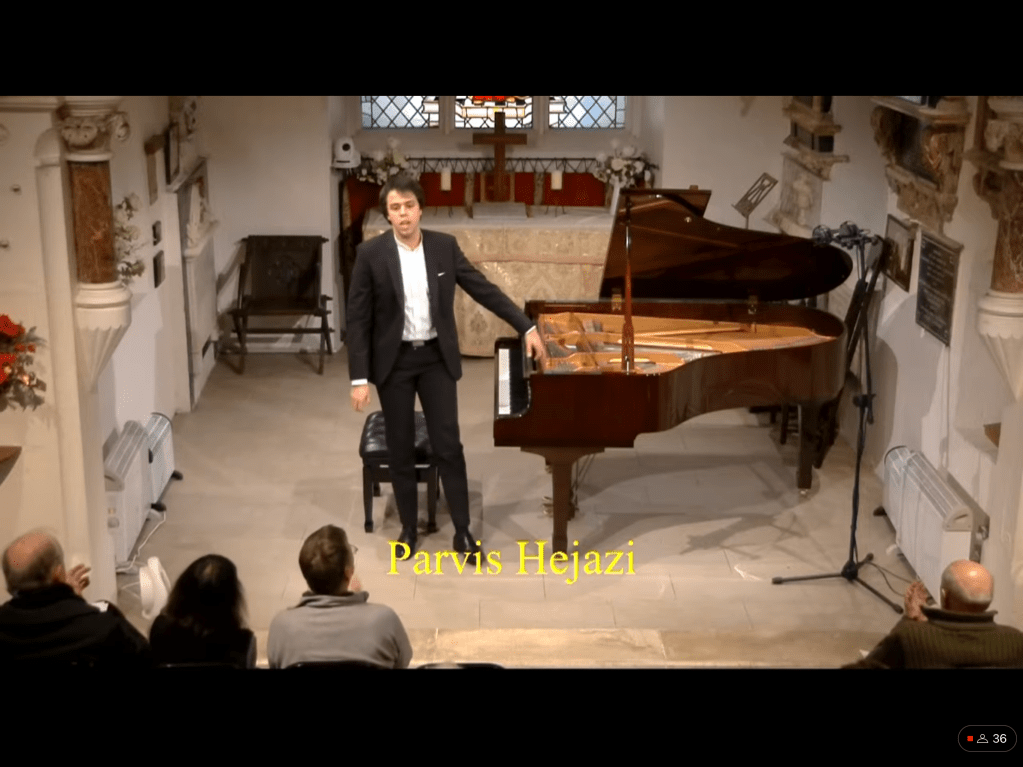

Being a pianist and composer, Parvis Hejazi is known as a “rising star on the piano sky” (ARD television), interested in a variety of performance activities from solo recital and concerto programmes to chamber music performances and from composing to conducting his own works. He holds the Gerd Bucerius award of the Deutsche Stiftung Musikleben for being “a highly promising young artist”. In 2021, Parvis won the Grand Prix of the International PianoArt Competition in Kiev. He furthermore was awarded the first prize and special prize of the International Piano Competition Gagny in 2017 and was also awarded first prizes in various national and international competitions in Germany.His performance activities led Parvis to prestigious venues, including the Laeiszhalle Hamburg, Die Glocke Bremen, the Robert Bosch Foundation in Berlin, the SWR Sendesaal Stuttgart, the Wiener Saal and Solitaire at the Mozarteum Salzburg and to France, Belgium, the Netherlands, Italy, the Czech Republic and Israel. Broadcasts of concerts and TV documentaries were transmitted on leading German TV and radio stations such as ARD, NDR, NDR Kultur and Deutschlandfunk.
Born in 1999, Parvis studied piano and composition at the Junior Department of the University of the Arts Bremen. He received crucial influence from working with world leading pianists such as Norma Fisher, Jerome Lowenthal, Vanessa Latarche, Stephen Hough, Jerome Rose, Anatol Ugorski, Igor Levit and Lars Vogt.He is currently studying with Norma Fisher at the Royal College of Music in London with a Music Talks Scholarship, as well as grants from the prestigious Evangelisches Studienwerk (Villigst), the Hollweg Foundation and the D eutsche Stiftung Musikleben. Parvis is a Member of the Keyboard Charitable Trust as well as of Talent Unlimited UK.
https://christopheraxworthymusiccommentary.com/2022/07/09/parvis-hejazi-in-recital-in-london-july-2022/

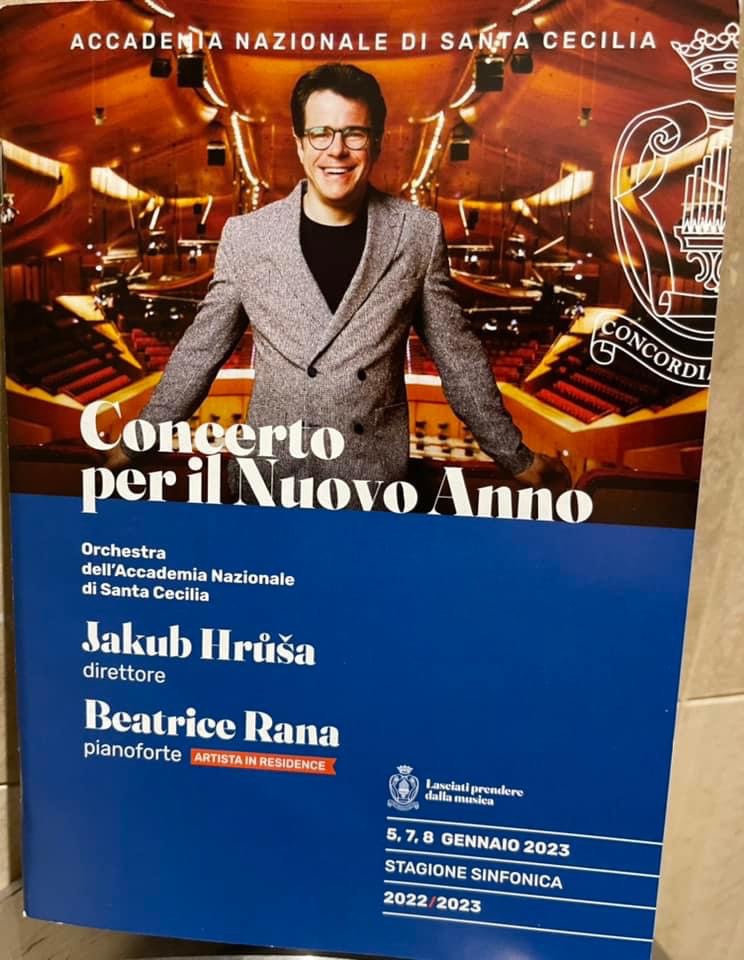
Jakub Hrusa and Beatrice Rana – Florestan and Eusebius unite and ignite La Befana in Rome

A New Year concert with the dynamic man of the moment Jakub Hrusa.
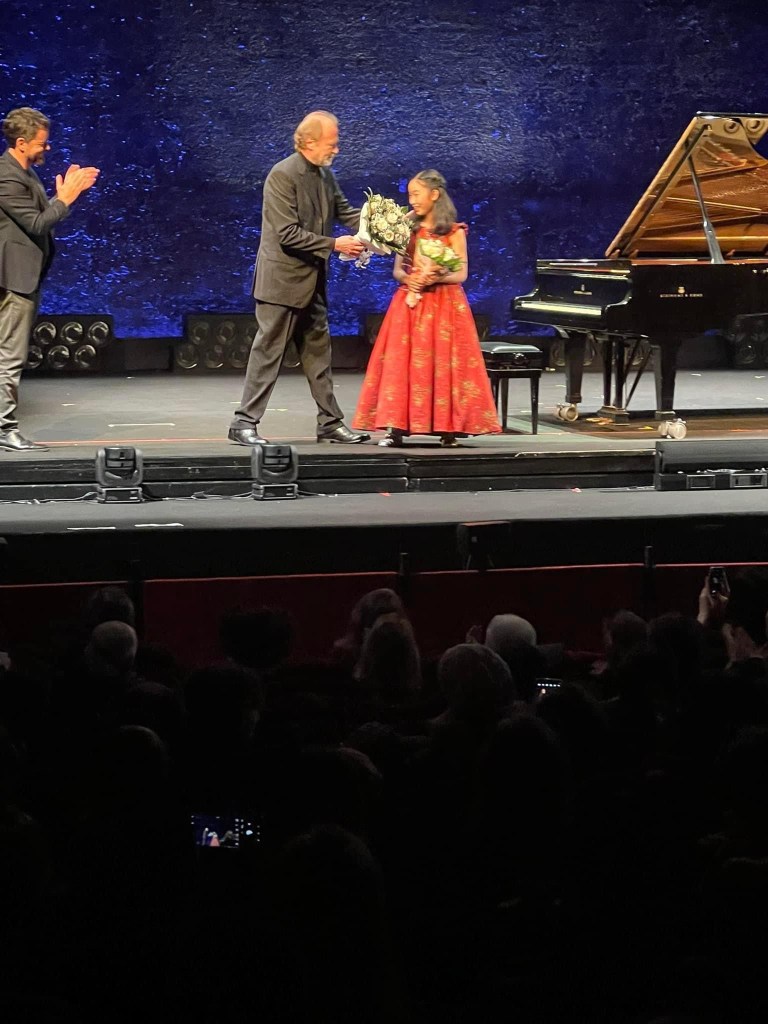
The heir to Pappano,inheriting ‘his’ orchestra in Rome which he has nurtured and turned into one of the finest orchestras on the world stage An orchestral body that actually listens to itself as over the past twenty years they have worked and played together as equals.
Just as Simon Rattle had done in Birmingham in his formative years.
Jakub is also taking over Covent Garden in London in 2025 whilst our adored Maestro takes over the reigns from Simon Rattle of the London Symphony Orchestra.One of the truly great orchestras of the world.
Two Knights in shining armour indeed.
Vieni,vedi,vinci!

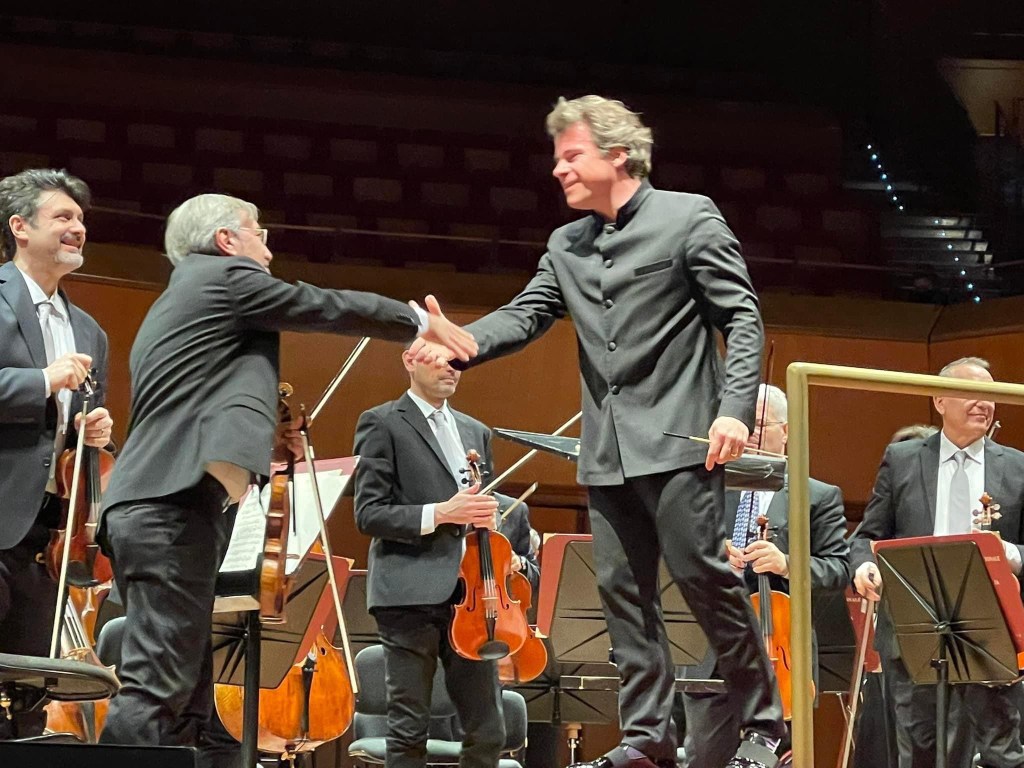
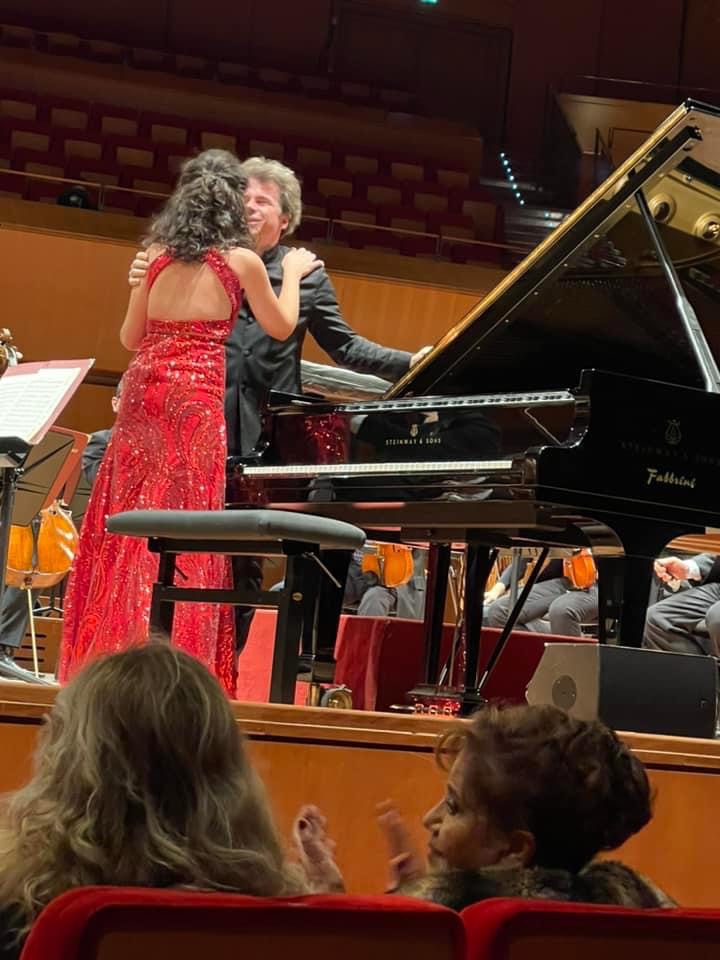
Thanking the orchestra by shaking the hand of its superb leader Carlo Maria Parazzoli


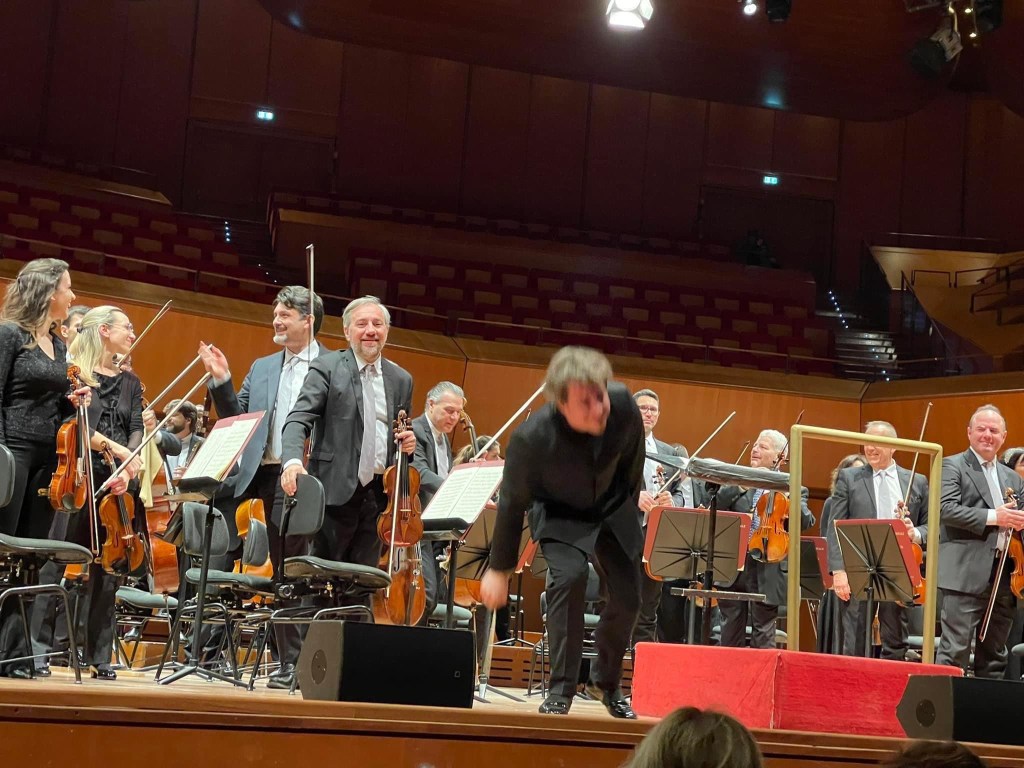
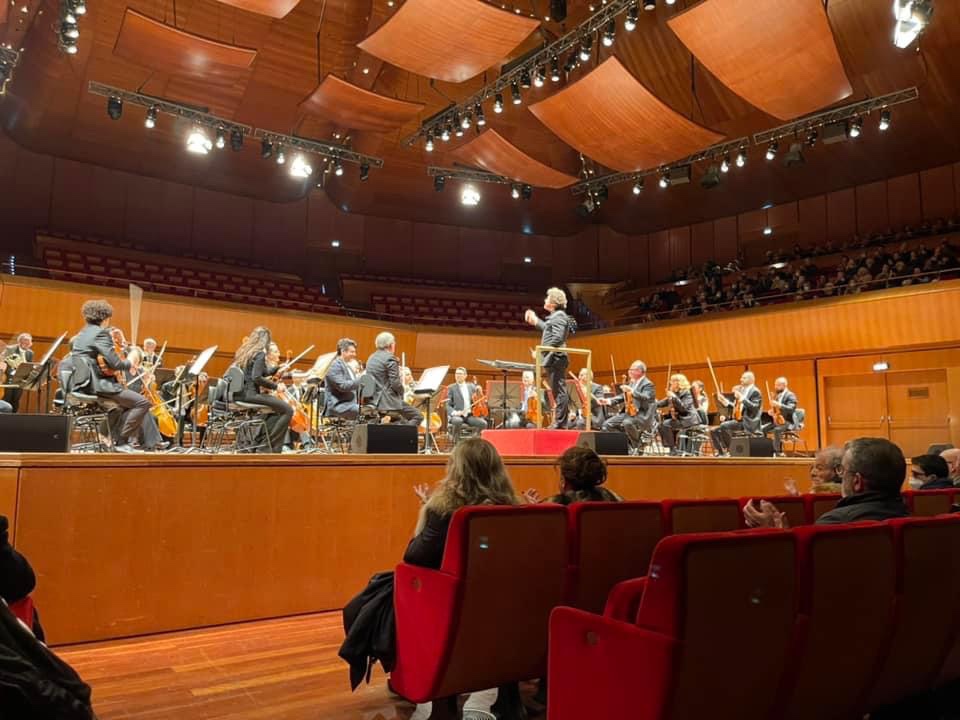
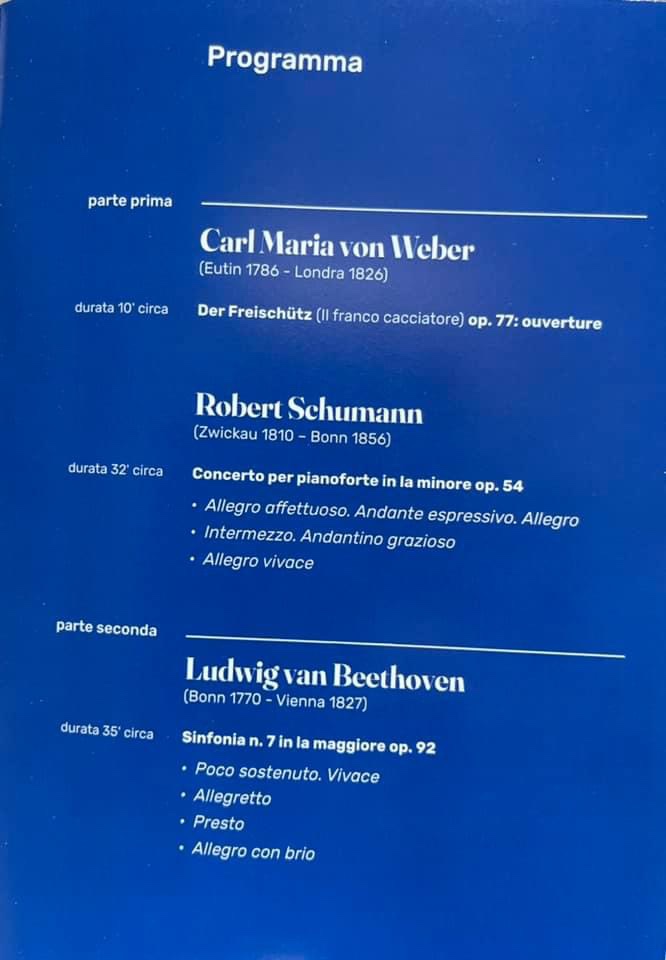
From the very first notes of Der Freischutz with its whispered asides,at times barely audible,bursting into joyous operatic outpourings of popular mellifluous sounds of brass band proportions .Driven with dynamic energy,Jakub urging his players on to give as much passionate involvement as he was demonstrating on the podium with ever more ferocious strokes and athleticism.
He stoked the flames of his players though always with intelligent musicianship and a overall sense of architectural shape.

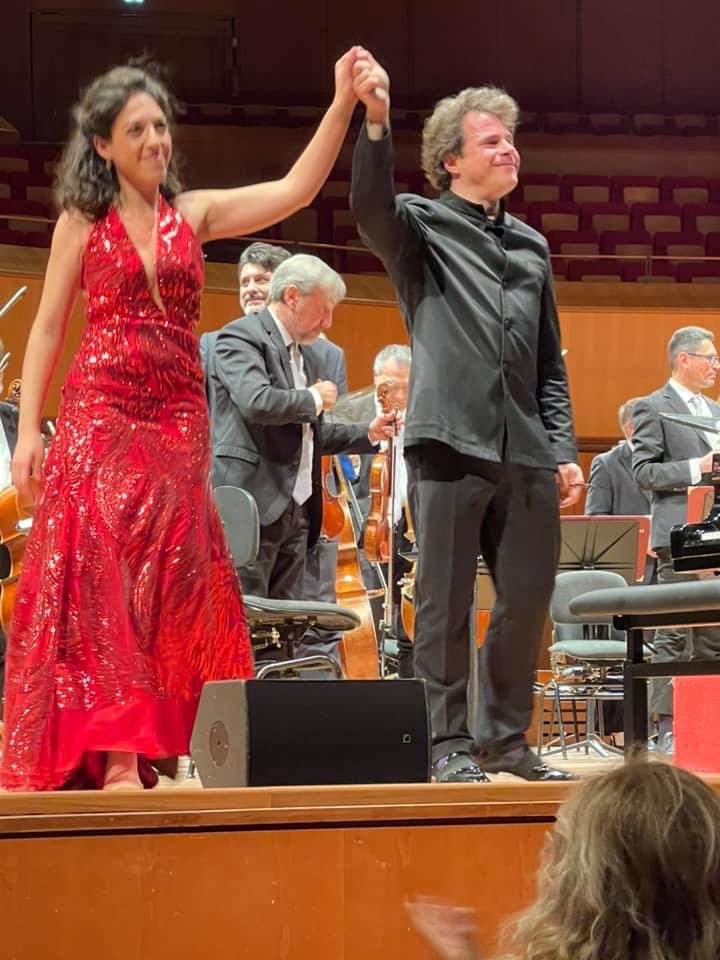
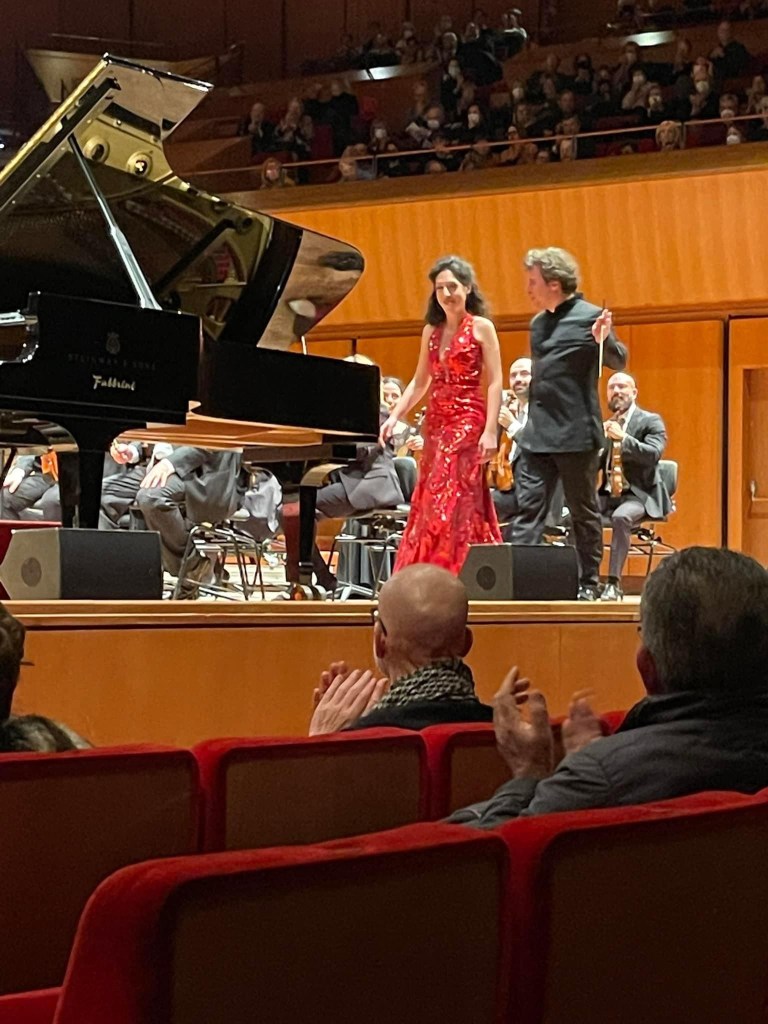
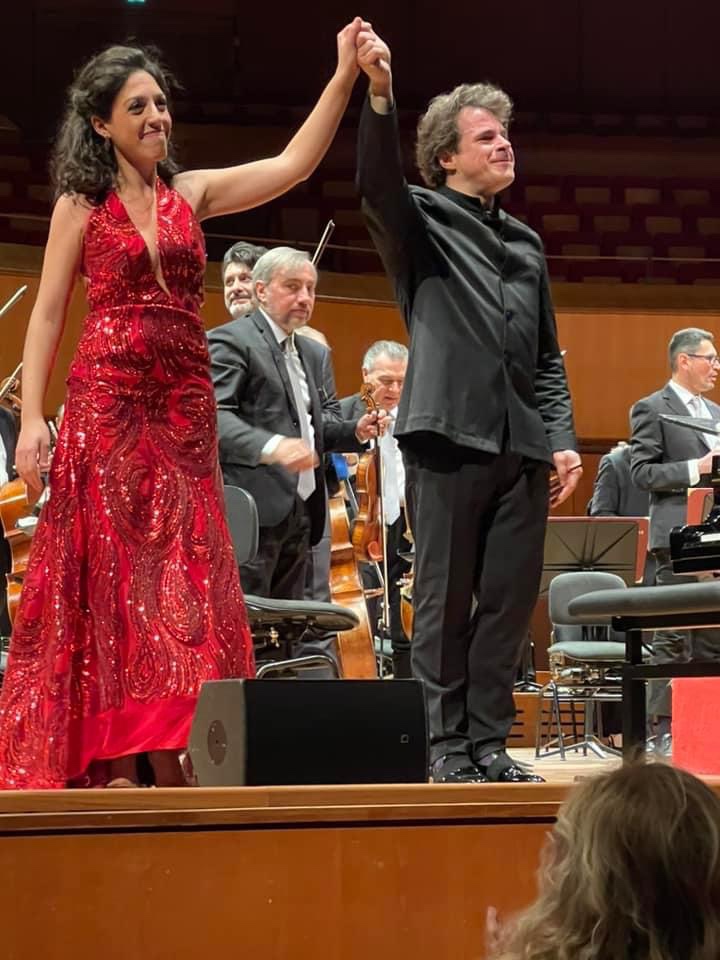
Beatrice in her flaming red dress offering an encore of Scriabin Prelude in B minor op 11


Beatrice Rana is an artist in residence both here in Rome and at the historic Wigmore Hall in London.It was in a recent recital there that she unleashed a tornado with a Hammerklavier of breathtaking proportions – an all or nothing outpouring of dynamism and intelligence.
I have not seen the like since Serkin took London by storm and was left holding the final chord of the mighty fugue still kicking and spitting.A passionate participation that had exhausted not only him but an audience hypnotised by such a force of nature.
https://christopheraxworthymusiccommentary.com/2022/10/12/beatrice-rana-a-tornado-ignites-the-wigmore-hall/

Friends and a musical complicity that made for a memorable combination


Tonight she chose the more passive world of Eusebius ,Schumann’s dreaming poet,leaving the dynamism of Florestan to her simpatico partner.
Hers was the communing of a selfless chamber music player only occasionally allowing herself to raise her head with shows of great virtuosity.
She had shown us at the beginning of the season her virtuosity and dynamism in the concerto by the 16 year old future mother of Robert’s 8 children.
https://christopheraxworthymusiccommentary.com/2022/11/05/the-house-of-schumann-clara-wieck-piano-concerto-rana-pappano-triumph-at-s-cecilia-in-rome/


Today it was the turn of the mature genius of Clara’s husband ,the poet Robert.
A world inhabited by psychic problems and conflicts.Demonstrated by his double personality with the meek Eusebius and the rumbustuous Florestan. Genius is never easy to live with and Robert after attempting suicide entered an asylum where his days were numbered .
He left the ever courageous Clara with a family of numerous siblings and a career that was to last 61 years as one of the first women virtuosi of her age.
The difference between the youthful prodigy Clara and the mature poet Robert was an abyss which accounts for the neglect of Clara’s large but mostly uninspired compositions.
Beatrice showed us the exquisite poetry in the music of Robert from the very opening where she replied to the orchestras opening with phrasing of timeless beauty.


A musical conversation with an orchestra that was listening as attentively as she,and both responding with unusual poetic intimacy.
Even at the end of the cadenza where for an instant Beatrice’s command of the piano and its overwhelming sonorities allowed a moment of flaming glory.It was to dissolve into counterpoints usually in lesser hands of knotty twine.In her hands today they were glistening layers of sound that moved inexorably to the energy that was to bring us to the close of this movement.
A fantasy that he had written for his Clara and only later added two movements to complete the concerto we know and love today.
Beatrice was in dreamy mood today and although the Intermezzo was ravishingly beautiful I found it more whispy and capricious rather than simply grazioso.
Continuing her ever more intimate conversations with the superb solists of this great orchestra.Luigi Piovano we know is a great cellist and he was matched today by the magnificence of the wind players with Andrea Oliva,flute;Francesco Di Rosa,oboe;the superb clarinet of Stefano Novelli and the horn of Alessio Bernardi.

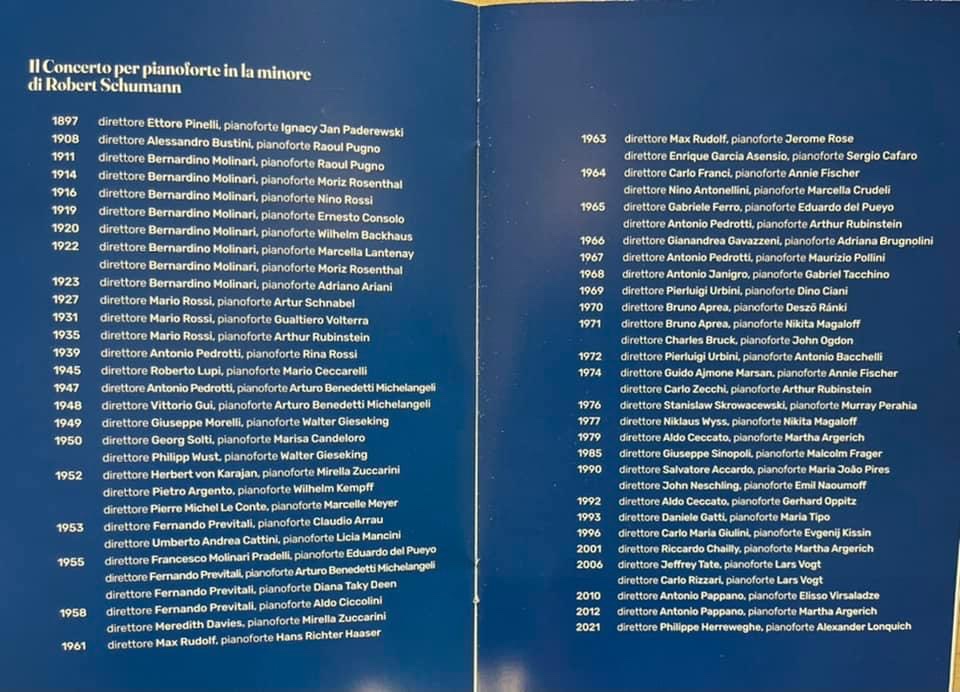
Interesting to note from the very informative programme of past performances with the orchestra


This was Hausmusik shared with an intimacy and flexibility that is rare to find away from an intimate salon.
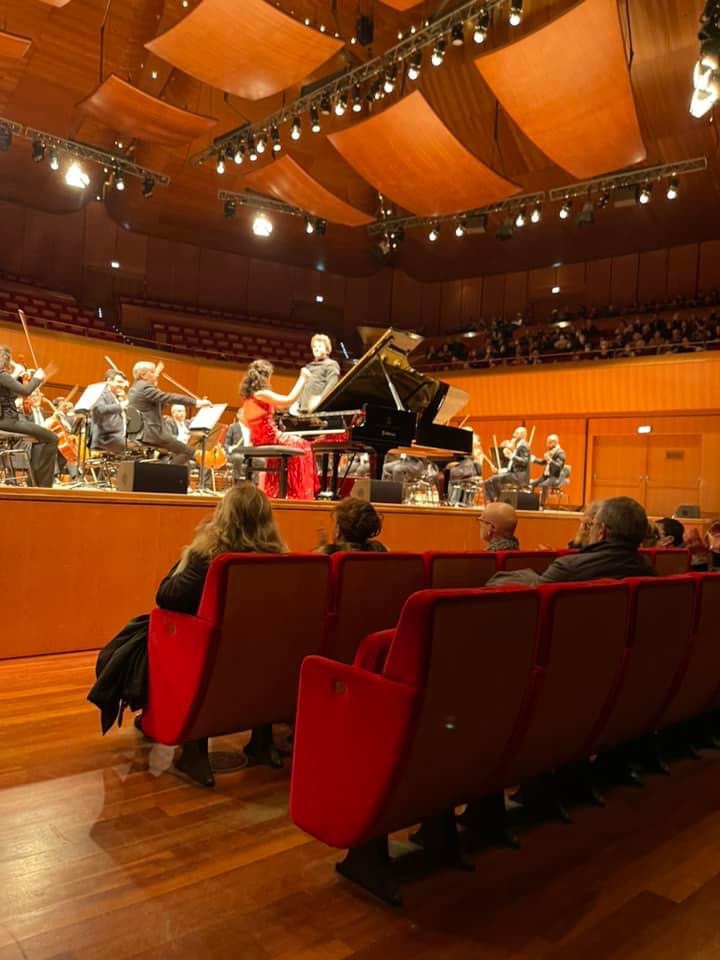
I think that the recording will be even more effective rather than in this vast hall which calls for what Richter used to call ‘the good old professional cantabile’to project and maintain the musical line.
Richter was referring to Rubinstein whose playing he adored and who I had heard many times playing this concerto.
Rubinstein had a ‘diaphragm’ that could transmit his love to the first row with the same intimacy as those in ‘paradiso’ (the Gods or loggione)!
A secret learnt by a lifetime communicating with an adoring public as Beatrice too will find on her magic carpet that is flying ever higher.
Beatrice sacrificed the rhythmic precision of the opening statement of the Allegro vivace for a smoother more eloquent style where her intricate weaving in and out of the orchestra was a ravishing web of golden sounds.
Even the final statement in octaves was shaped and phrased with the timeless poetry that had pervaded the whole of todays wondrous performance.

The distinguished critic Simonetta Allder with Christopher Axworthy

As to Jakub Hrusa’s mind blowing account of Beethoven’s ‘apotheosis of the dance’ I can do no better than quote my distinguished colleague Simonetta Allder :’As for the sheer energy of Beethoven’s Seventh played by the Santa Cecilia Orchestra under the baton of Jakub Hrusa, I feared for a moment that the entire Orchestra was going to explode, and the whole Auditorium would literally blow up, with a mind-shattering display of Twelfth Night fireworks going off in all directions, visible all the way to the moon! ‘
Pages of the score and even finally the baton were victims of this assault.


An energy that was unleashed without any timidity.Beethoven’s irascible temperament shared by our ‘man of the moment’.
It was a riveting account of a work that we have known and loved for a lifetime .An electric injection of energy, subtle colouring and phrasing that made this Seventh Symphony shine like a newly minted masterpiece.
The famous Allegretto was played with an unrelenting rhythmic energy that I am not used to and I did rather miss the calm between the stormier movements.
It was played though with such overwhelming authority that any petty comments of that sort become totally irrelevant.

Beatrice offered only one encore.Could it have been by Clara Schumann or even worse Fanny Mendelssohn or Medtner?Whatever it was she,like all great artists,with her magic wand could turn any bauble into a gem!!!!I learn this morning.however,that it was the Prelude in B minor op 11 by Scriabin……his 24 Preludes op 11 are a much neglected masterpiece and that would explain her sublime performance too.

Beatrice too as a teenager was discovered in the class of Benedetto Lupo …small world …….and La Puglia baciata da Dio

Carissimo Christopher, 

Grazie davvero per la tua mail e per le tue parole sul “mio” 3° di Rachmaninoff! 

Spero di rivederti prossimamente, purtroppo per me era impossibile venire a Roma in questi giorni per sentire Beatrice, dopodomani ho un recital al Teatro Verdi di Trieste con un programma completamente diverso, formulato specialmente per ricordare il primo recital della Società dei concerti di Trieste di 90 anni fa, con Carlo Zecchi al pianoforte

Nella prima parte suonerò Schumann Kinderszenen (una delle pochissime registrazioni disponibili di Zecchi) e Kreisleriana (che Zecchi suonò a Trieste 90 anni fa), in seconda parte l’omaggio sarà più personale perchè ricorderà il prima brano che io suonai per Zecchi da ragazzino, Debussy Images première série… all’epoca era al suo corso di perfezionamento a Sorrento, Francesco Canessa scriveva per il Mattino di Napoli ed era venuto a trovare Zecchi, rimase così colpito che ne scrisse subito dopo sul Mattino! Io avevo appena compiuto 15 anni, non sapevo neanche chi fosse Francesco Canessa, immaginati quando parecchi anni dopo me lo sono ritrovato davanti come sovrintendente al San Carlo quando vi debuttai con la Burleske di Strauss! 

Ti allego anche il vecchissimo articolo che sono riuscito a ritrovare per questa occasione; davvero altri tempi per i quotidiani, per fortuna che ci sono ancora persone come te che ogni tanto parlano dei giovani… e dei meno giovani!

Porta i miei migliori auguri a Noretta e al marito, un abbraccio a te e spero di rivederti presto,

Benedetto

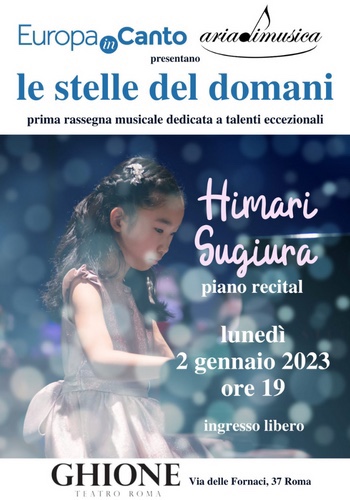
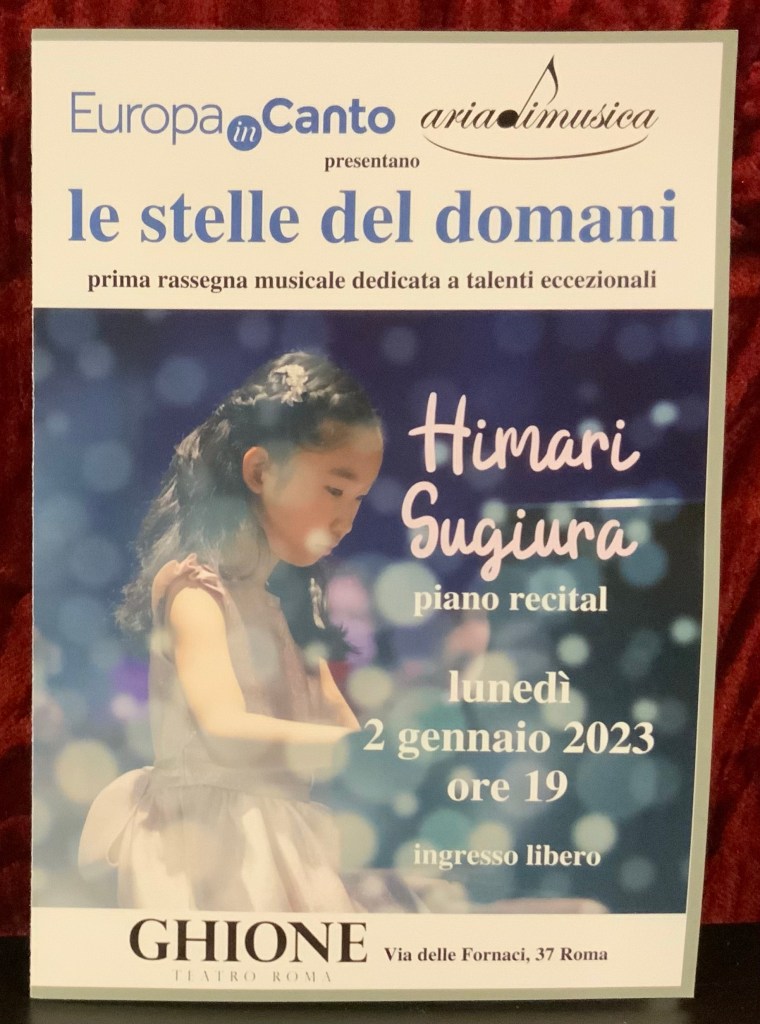
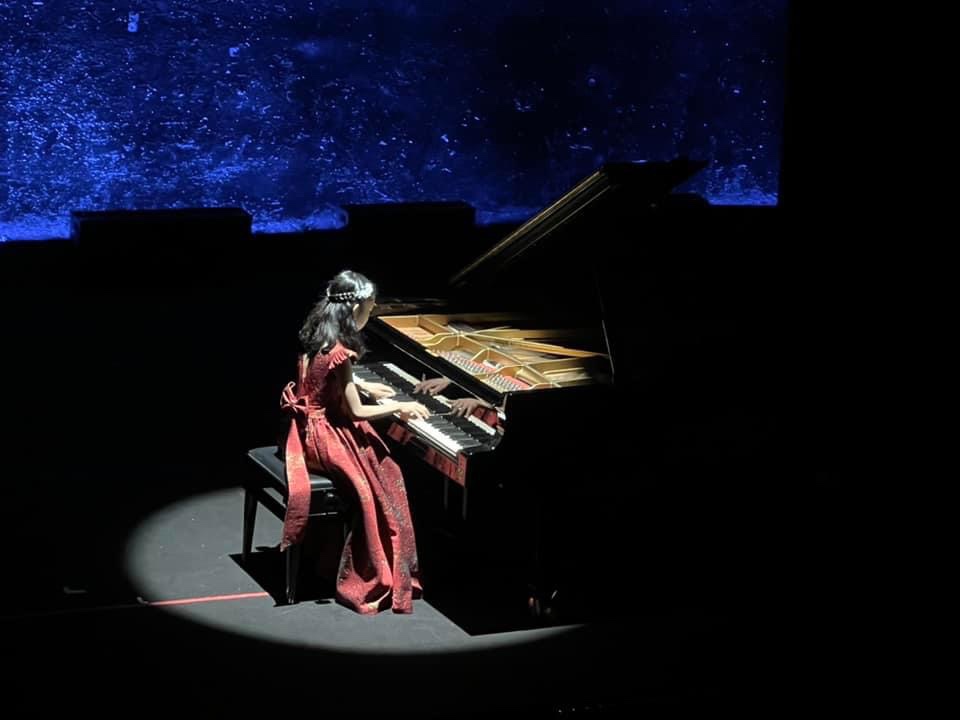
Ten year old Himari Sugiura in Rome at Teatro Ghione ‘On Wings of Song’

What a wonder to hear of the activity of Europa in Canto dedicated to sharing music and culture with the younger generation.As the programme says Europa in Canto was born in 2012 convinced that promoting culture and all forms of art at a very early age is a necessity for the development of man and his role in the world.As Shakespeare says:‘ If Music be the food of love ….play on .’And Europa in Canto certainly does that as was shown tonight with their collaboration with ‘Aria di Musica’ giving precious concert experience to a ten year old pianist .

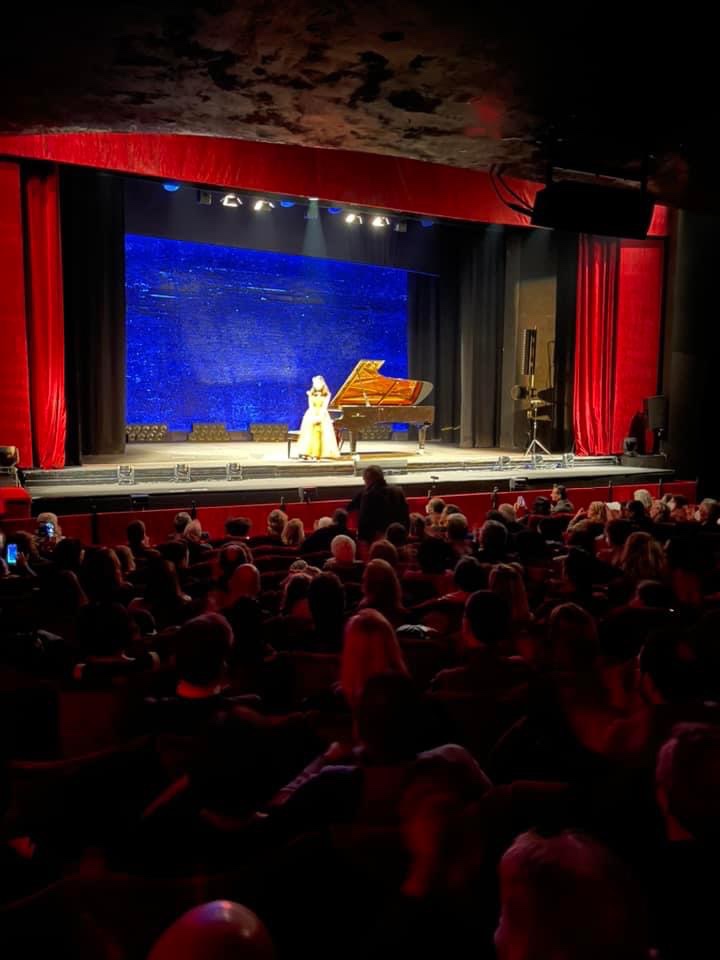
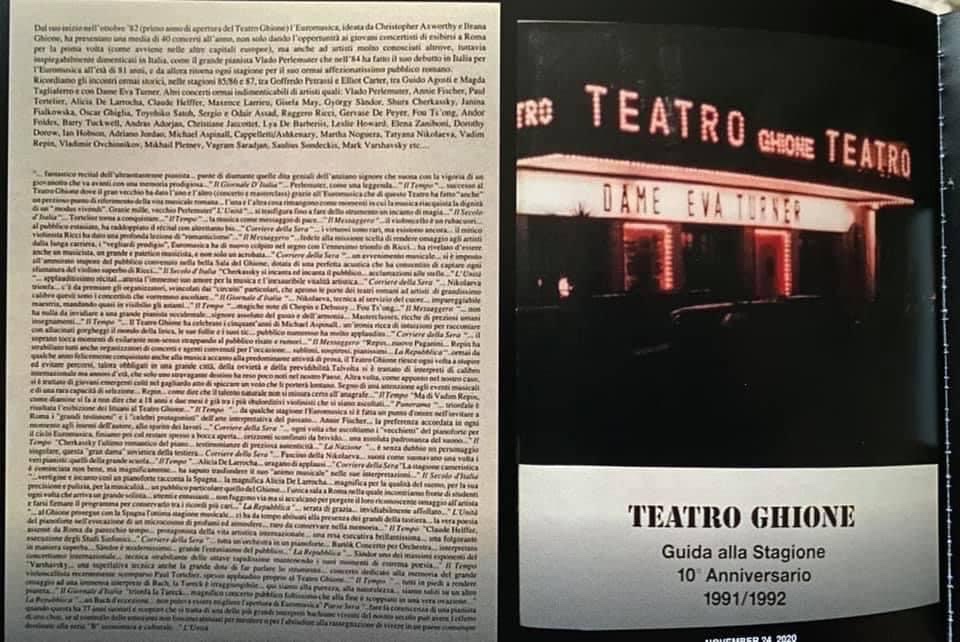
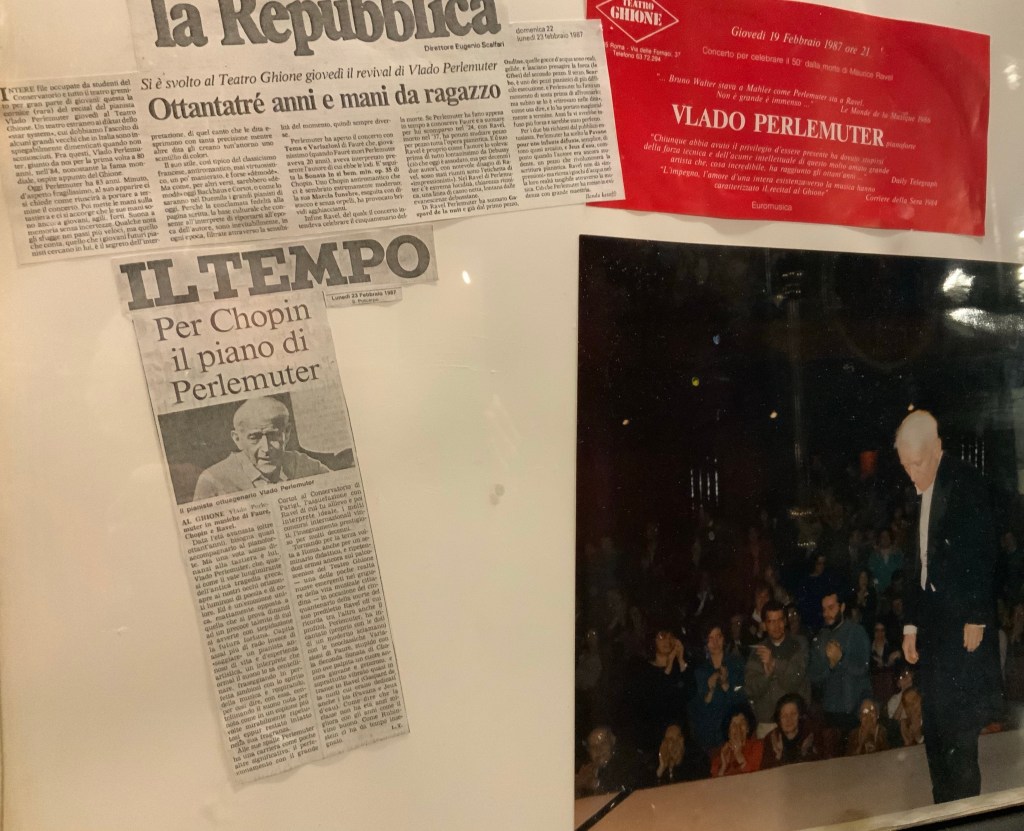
Playing in a theatre where the greatest musicians of our age have played in the past .From Guido Agosti – a student of Busoni to Vlado Perlemuter a student of Cortot mentored by Ravel an Fauré.In fact it was Gianni Maria Ferrini who brought his ten year old student Himari Sugiura to have one of her first concert experiences under his careful supervision in a hall where he as a teenager had heard Perlemuter playing Ravel .

Cristiana Pegoraro a young student playing to Perlemuter in 1985. https://christopheraxworthymusiccommentary.com/2022/12/21/ithaka-of-cristiana-pegoraro-a-star-shining-brightly-in-latina-for-christmas/

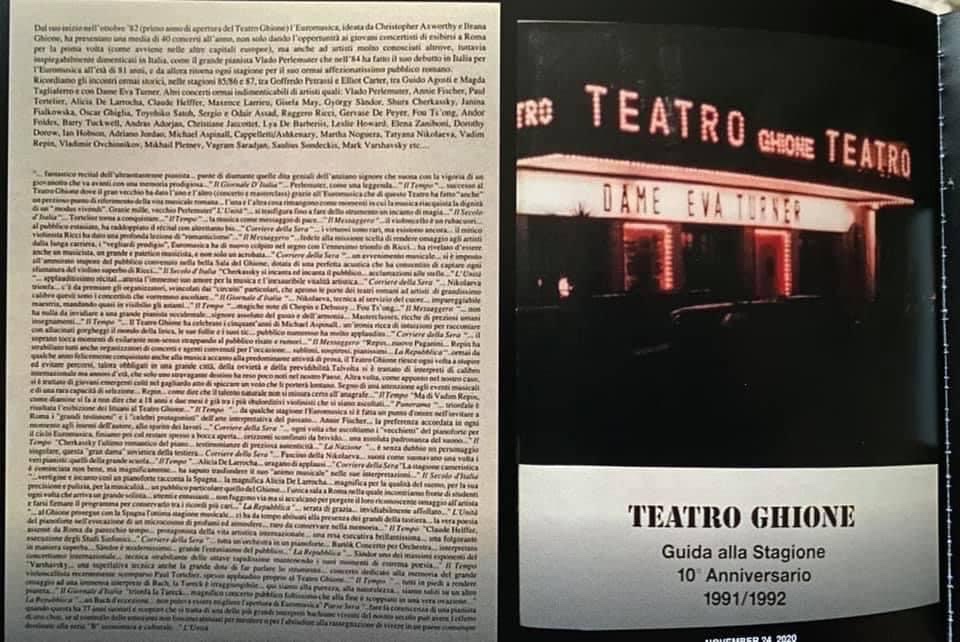
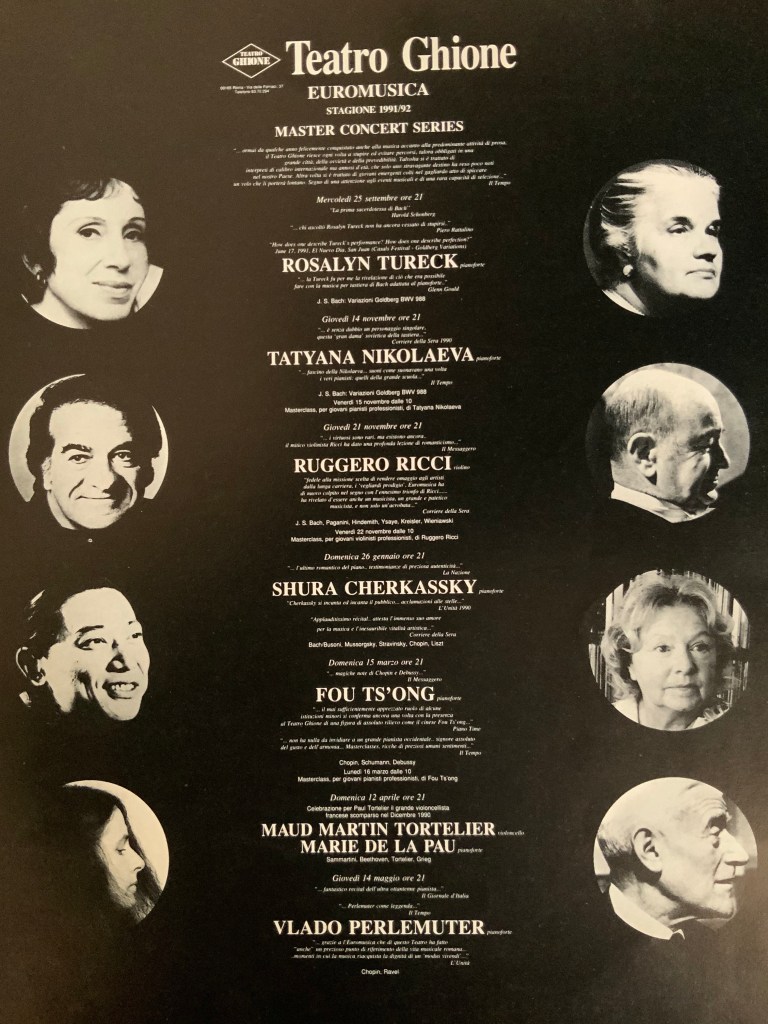
Cristiana Pegoraro flocked to the theatre too where she had given one of her first recitals as a fourteen year old student of Elio Maestosi. Cristiana is pictured on the walls of the theatre playing in the masterclass of Perlemuter in the 80’s.A glorious period for the Ghione Theatre when in the 80’s and 90’s Rome was in urgent need of a chamber music hall along the lines of the Wigmore Hall in London.

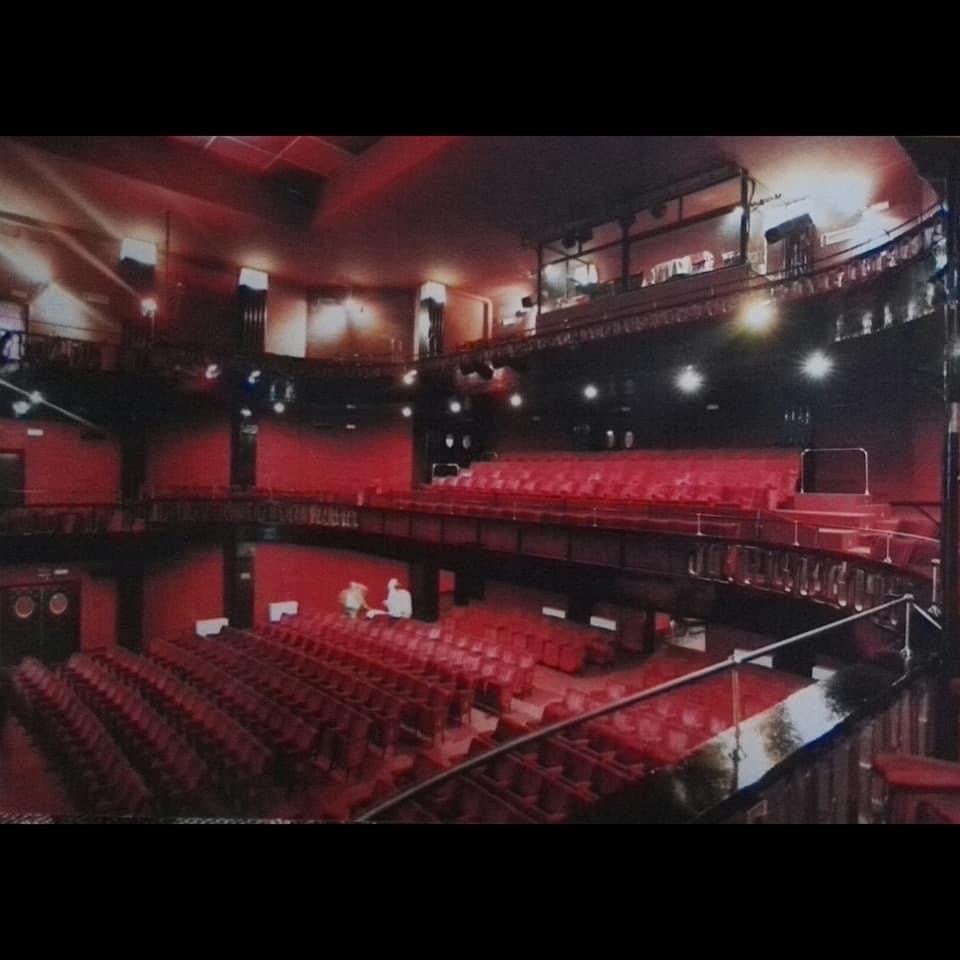
It was known affectionately as the ‘ Salotto di Roma’.Ileana Ghione dedicated her life with her husband Christopher Axworthy to sharing a space that was created with ‘love’ and the conviction that theatre is a social necessity .

Ileana Ghione at home in Circeo with the High priestess of Bach Rosalyn Tureck

Ileana was proud to be awarded ‘Grande Ufficiale’ by President Ciampi even though as our great friend Rosalyn Tureck said:’It is nice to have one’s work recognised but it is the work not the award that counts!’ (Word had spread about our activity and I was awarded an associateship from my old Alma Mater -The Royal Academy in London).With the opening of the wonderful concert halls created by Renzo Piano at the Parco della Musica the Ghione theatre returned to its origins as a theatre.

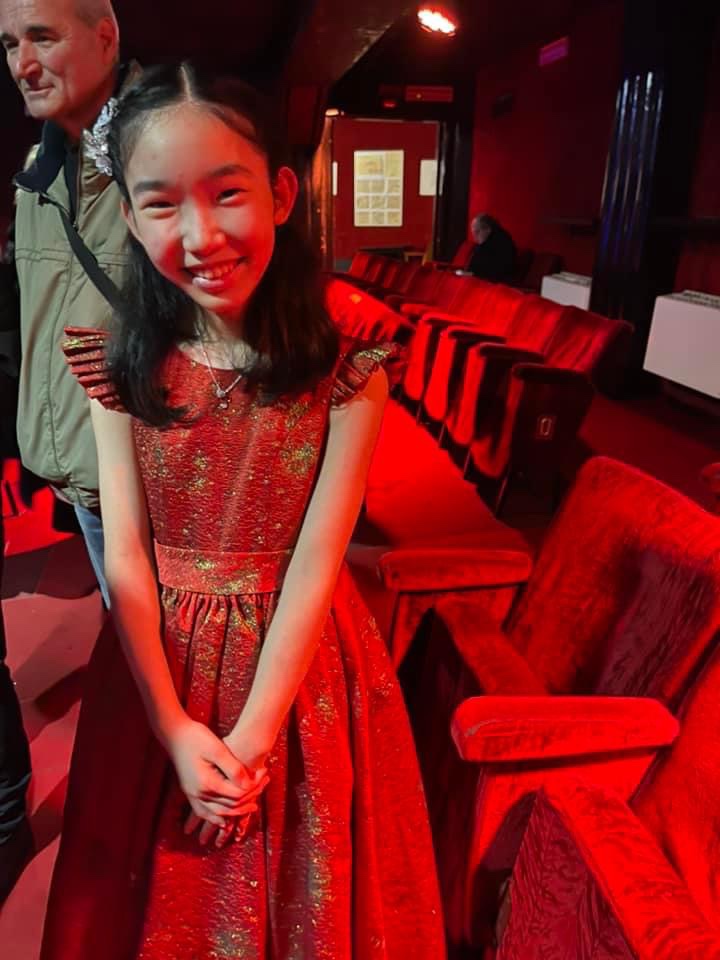
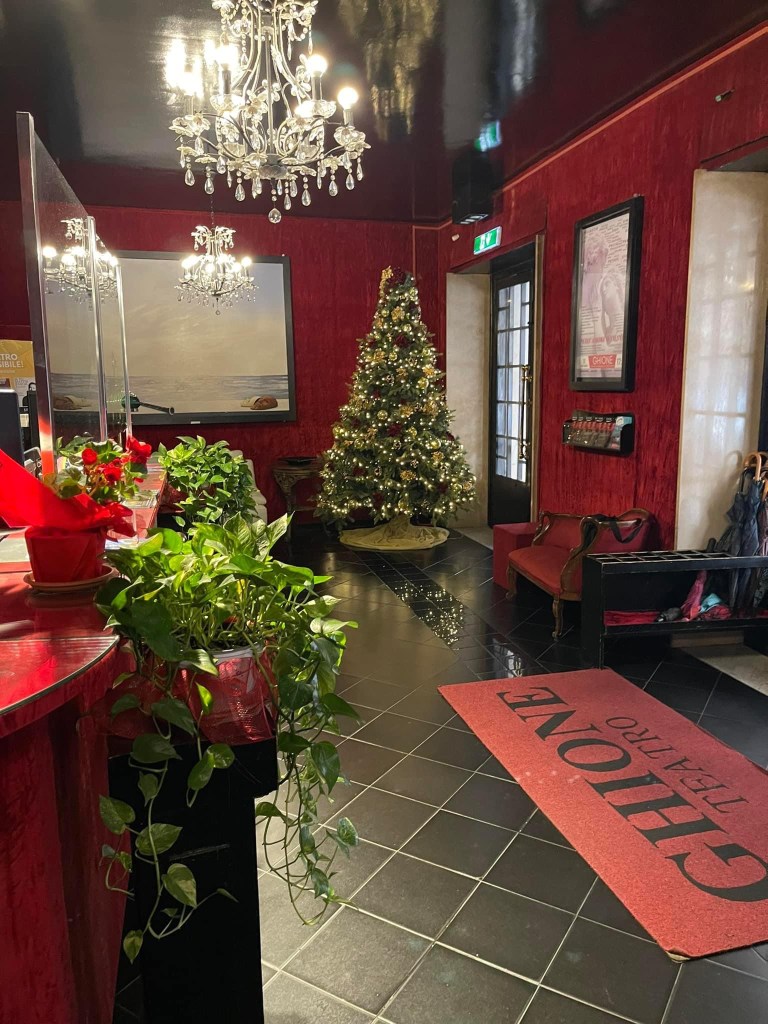
But there are many that remember their student years when they could hear their colleagues making their debut in Rome like Cristiana,Roberto Prosseda,Francesco Libetta,Leslie Howard,Angela Hewitt,Janina Fialkowska etc etc alternating with some of the greatest musicians missing from Rome for lack of space :Annie Fischer,Alicia de Larrocha,Shura Cherkassky Moura Lympany or Fou Ts’ong etc etc .It was the favourite theatre of Stockhausen and was where Goffredo Petrassi shared the stage with Eliot Carter……Berio too figures in the photos along the beautiful ‘red plush’corridors.Red velvet made to seem antique which gives a warmth and homely feel like the theatres in London that Ileana loved to frequent and dreamt one day to create in Rome.A dream come true and a place where dreams can be realised ‘…..perchance to dream ‘as was the inspiration of the Universal genius of Shakespeare.

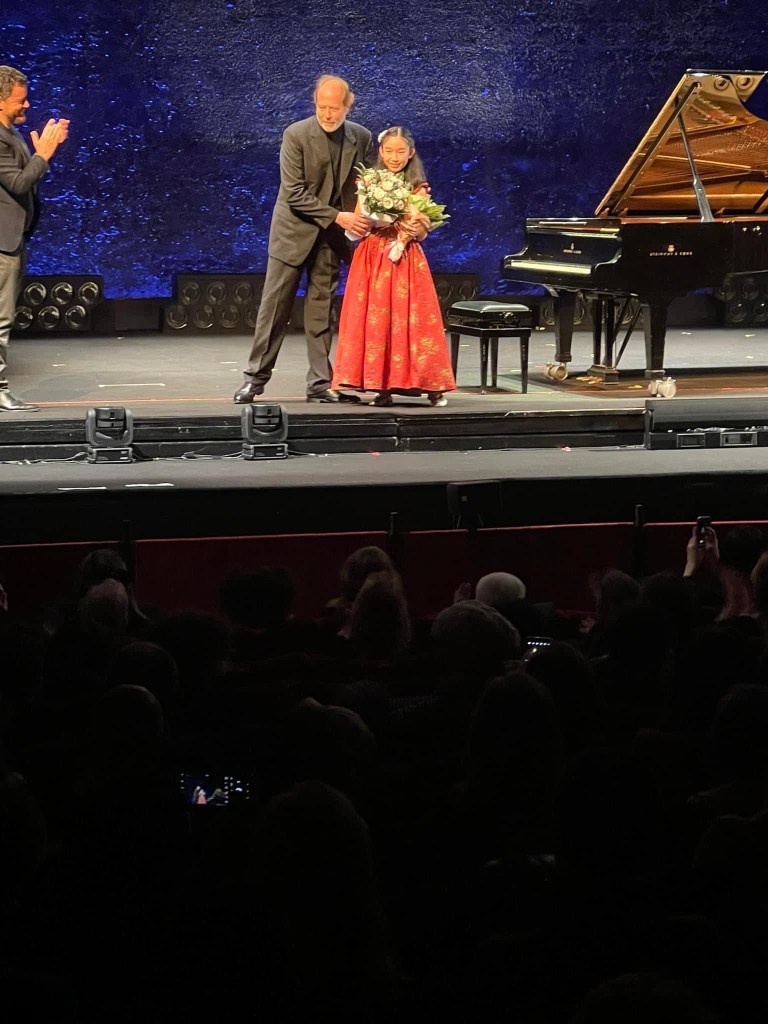
Gianni Maria Ferrini sharing in the applause with Himari

‘Aria di musica’ was created in 2015 by Himari’s teacher Gianni Maria Ferrini a student of Orazio Frugoni and Aldo Ciccolini and for many years repetiteur at the Rome Opera together with our much missed friend Steven Roach who had played many times at the Ghione Theatre.An orchestra of young musicians has been formed directed by Maestro Donato Renzetti.In fact yesterday the orchestra played in the historic Teatro Argentina where Rossini’s Barber of Seville had first seen light and where for many years S.Cecilia held their concerts.It is now like the Ghione theatre mostly dedicated to drama.However these theatres are reopening their doors again to music thanks to the passion and expertise of Associations like Europa in Canto and Aria di Musica -‘On Wings of Song’….flying high indeed.Musica con le Ali del Veneto is an organisation with similar aspirations for young performers and Giovanni Bertolazzi,…………..https://christopheraxworthymusiccommentary.com/2022/12/04/giovanni-bertolazzi-the-mastery-and-authority-of-liszt/. …………one of the finest young musicians of his generation will play at Teatro La Fenice for Carlo Hruby on the 12th January https://www.musicaconleali.it/attivit%C3%A0/calendario/17-calendario-eventi/381-fenice-12-01-2023.html

Germano Neri and Nunzia Negro founders of Europa in Canto – formed at the school of Emma Contestabile at S.Cecilia Conservatory.I was on the jury of an International Piano and Singer competition in Enna with Madam Contestabile in the 80’s.An artist and remarkable musician of immovable beliefs who in her home in Montepulciano used to supervise the ten hours of practice that she insisted on from any “serious”student!

Le nostre due realtà hanno come obiettivo quello di diffondere la cultura artistica e musicale tra le nuove generazioni, lavorando con e per i giovani. Presentiamo quindi insieme la prima rassegna musicale dedicata a talenti eccezionali. In apertura la giovanissima pianista giapponese Himari Sugiura allieva del M° Gianni Maria Ferrini ad Ariadimusica dall’età di 4 anni.
A 7 anni si è esibita nella meravigliosa cornice del Parco Archeologico di Paestum e a soli 9 anni ha eseguito il Concerto per pianoforte e orchestra K 246 di Mozart diretta dal M° Donato Renzetti al Teatro Italia di Roma.


Il programma della serata, di grande impegno tecnico e musicale, è dunque affidato ad una bambina dalle incredibili capacità musicali e pianistiche. Bach, Clementi, Chopin e Debussy eseguiti in maniera stupefacente. Afferma il suo Maestro: “Il nostro è un lavoro di grandissima attenzione reciproca, trascorriamo ore e ore insieme al pianoforte. Certamente è una allieva dotata di qualità eccezionali, ma studia con grande dedizione e metodo. Il lavoro del pianista si costruisce soltanto così. E’ una gioia per me che possa far sentire dal vivo ciò di cui è capace”.

The remarkable activity of Europa in Canto and Aria di Musica outlined in the programme


“Felicissimi di poter presentare progetti che dimostrano l’importanza dell’educazione musicale che può certamente cambiare la vita dei giovani” afferma il M° Germano Neri, Direttore Artistico e Musicale di Europa in Canto.
Dopo questo evento, un contest determinerà i prossimi talenti protagonisti della rassegna.
Un appuntamento imperdibile.

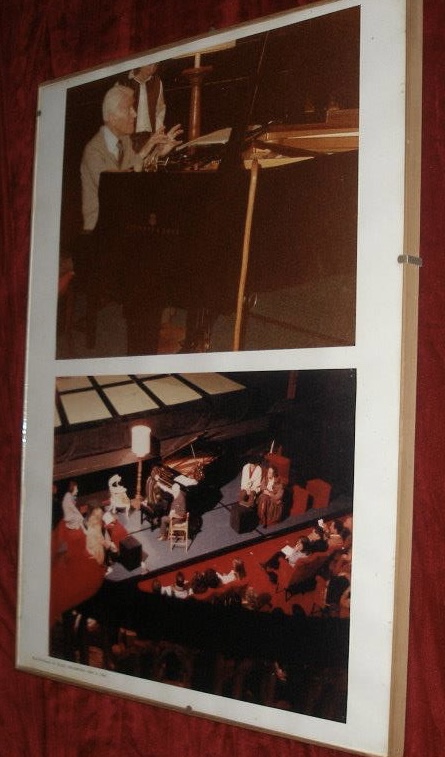
Perlemuter giving a masterclass at the Ghione Theatre in 1985 with Cristiana Pegoraro ,Constance Channon Douglass ,Antonio Sardi di Letto with the guitarist Griselda Ponce de Leon looking on far left.

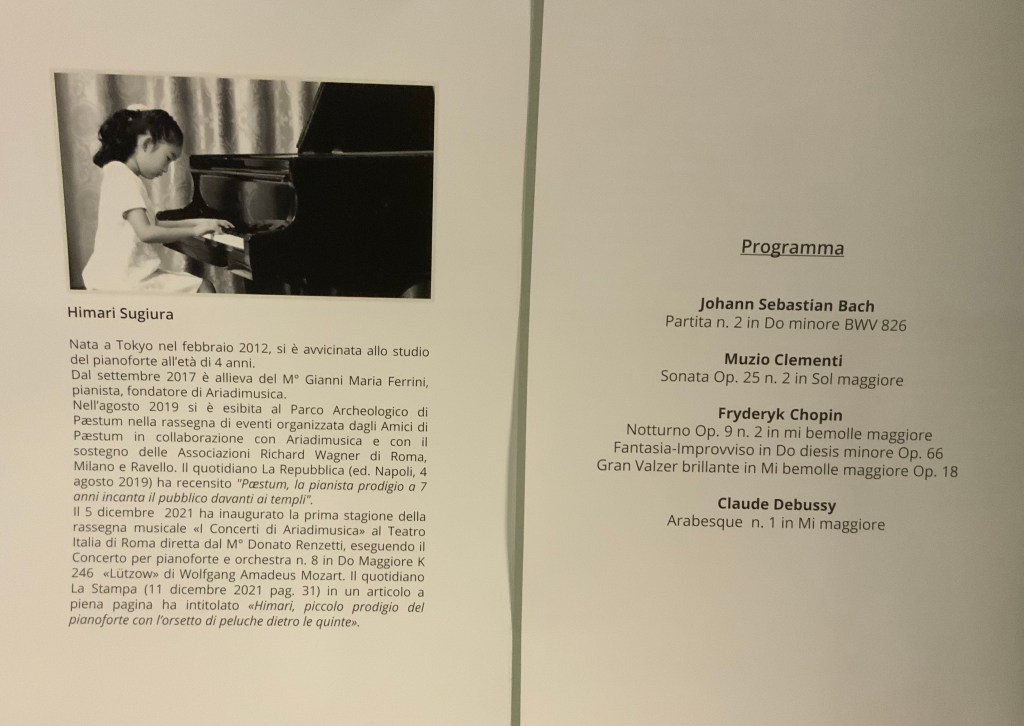
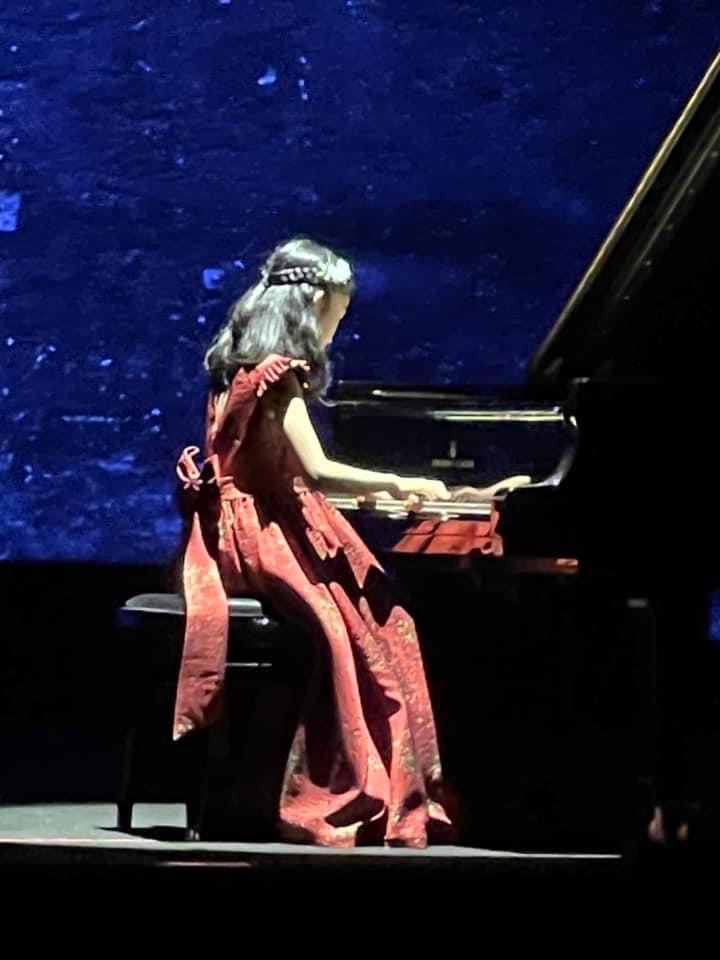
And so to the programme of a rather shy ten year old pianist.She has been studying from the age of four in 2017 with Gianni Maria Ferrini whilst her parents were here from Japan on diplomatic duties.Now transferred back to Tokyo she continues her studies on line with occasional visits to her Professor in Rome for essential one to one lessons.As Maestro Ferrini said it is the experience of playing in public from an early age that is so important.But he is also aware that this is work in progress and to be treated as such even though it is nice to receive applause from an appreciative audience.A child prodigy has to be treated with care as extraordinary gifts must go hand in hand with the normal activity of a child growing up as naturally as parents and teachers can offer.The difficulty is to pass from a child to an adult,as maestro Ferrini is very much aware.He is treating her public performances as an essential learning curve and not as a circus act!

Cherkassky in one of his many performances at the Ghione Theatre

I remember Cherkassky telling me that Rachmaninov refused to teach him unless he gave up playing in public.Hoffman on the other hand encouraged public performances hand in hand with youthful studies and became director of the Curtis Institute .A role that later Rudolf Serkin was to hold.

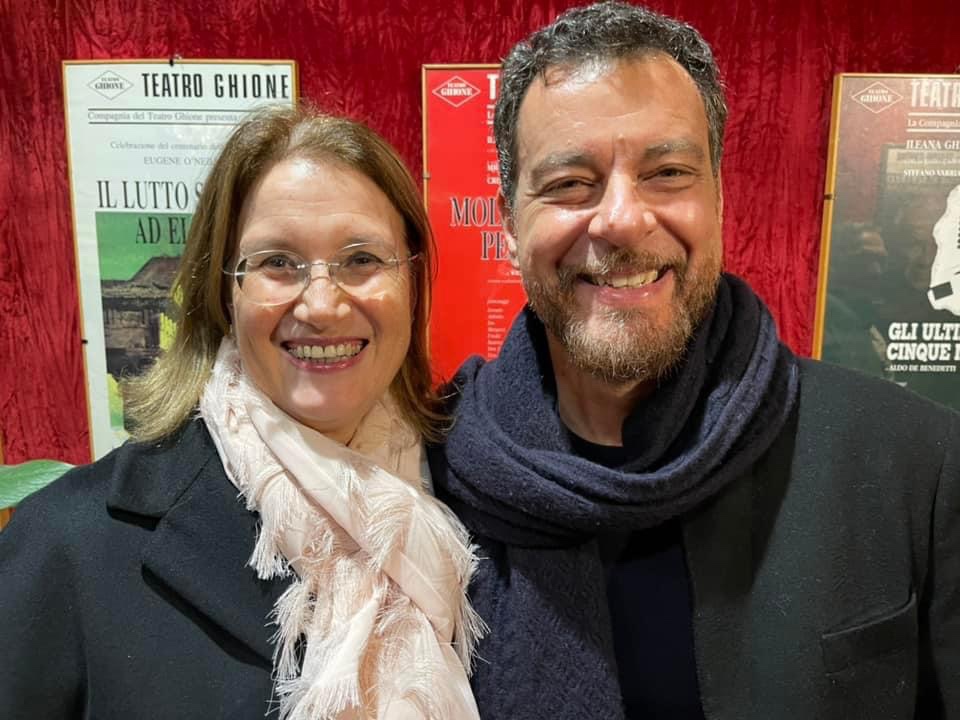
In the Green Room of the Ghione Theatre with great friend Constance Channon Douglass

The Partita for keyboard No. 2 in C minor,BWV 826, is a suite of six movements written originally for the harpsichord by J.S. Bach It was announced in 1727,issued individually, and then published in 1731 as Bach’s Clavier – Ubung 1 .Sinfonia – Allemande – Courante – Sarabande- Rondeau – Capriccio .It is an important work and Bach is an essential ingredient for a young pianist.Chopin used to insist on his pupils learning Bach especially the 48 Preludes and Fugues.But the six partitas are also a basis for any musician of learning about control ,articulation and architectural shape.

Himari played it with admirable musicianship and sense of style with a very solid declamatory opening where the difficult dotted rhythms were impeccably played.The Allemande flowed beautifully as did the Sarabande giving great shape to the fluidity of Bach’s genial outpouring of song.The Courante needed a clearer articulation that will come with time as she works hard with her teacher to obtain ‘fingers of steel but wrists of rubber’ to quote Busoni.Work in progress that already shows a great understanding of the shape and style and with time she will perfect the inner details.A remarkable performance though played without the score which for a ten year old is already a great achievement and gives hope for a future career as her studies progress.

The Clementi Sonata was played with clarity and contrasts where a greater sense of balance would have given a lightness to this charming two movement work.Her Chopin playing showed great musicality and the nocturne in particular showed a sense of balance that allowed the melodic line to sing unimpeded with a natural rubato that was very beautiful.The same beauty she brought to the central episode of the Fantasie Impromptu op 66.The jeux perlé of the outer episodes was played with a musical shape that could now,as her fingers grow in strength, give more articulation to this knotty twine that Chopin weaves with such a mellifluous outpouring of romantic sounds.

Her playing of Debussy showed a great sense of colour and style .The Arabesque n.1 was beautifully atmospheric as was Claire de lune that she added as an encore by great request.Her teacher had told me that she was determined to play Chopin’s Study op 10 n.8 as a first encore and she played it with a musicality and she will gradually gain a clearer articulation with the hours of study that lie ahead.It was Curzon who said that to be a pianists was 90% work and 10% talent.Of course for a born pianist playing is a passion and a joy and the hours spent at the keyboard are some of the happiest as the quest of discovery opens a world of fantasy …..’perchance to dream’

Roberta Blasi directing the Ghione Theatre with the same passion and dedication with which it was created by Ileana Ghione.

Let’s hope that this is just the start of music returning to the hallowed stage of the Ghione Theatre directed so ably by Roberta Blasi and Ercole Palmieri with their two sons Luca and Matteo.A happy family indeed and I know Ileana would be as overjoyed as I am to know that it is being run with the same loving care and dedication that had created this beautiful theatre next to St Peters Square .

In the meantime as a musician I too have been involved in helping young musicians to arrive at their goal with a satisfying journey of creative art .Leslie Howard who had made his Rome debut at the Ghione 37 years ago shares the artistic direction with me and Elena Vorotko of the Keyboard Charitable Trust.Honorary president Sir Anthony Pappano.All roads obviously lead to …..or from Rome.A journey that is a never ending search for sharing beauty and art with others.Dedicating one’s youth to Art is not only fun but is a fulfilment that is sadly lacking in an ever more consumerist society.A life truly enriched as Europa in Canto and Aria di Musica have outlined in their programme and by their actions tonight

https://christopheraxworthymusiccommentary.com/2022/09/14/the-gift-of-life-the-keyboard-trust-at-30/. https://youtu.be/9L9Vc0ebt7o. https://youtu.be/tu92-VR3YdM

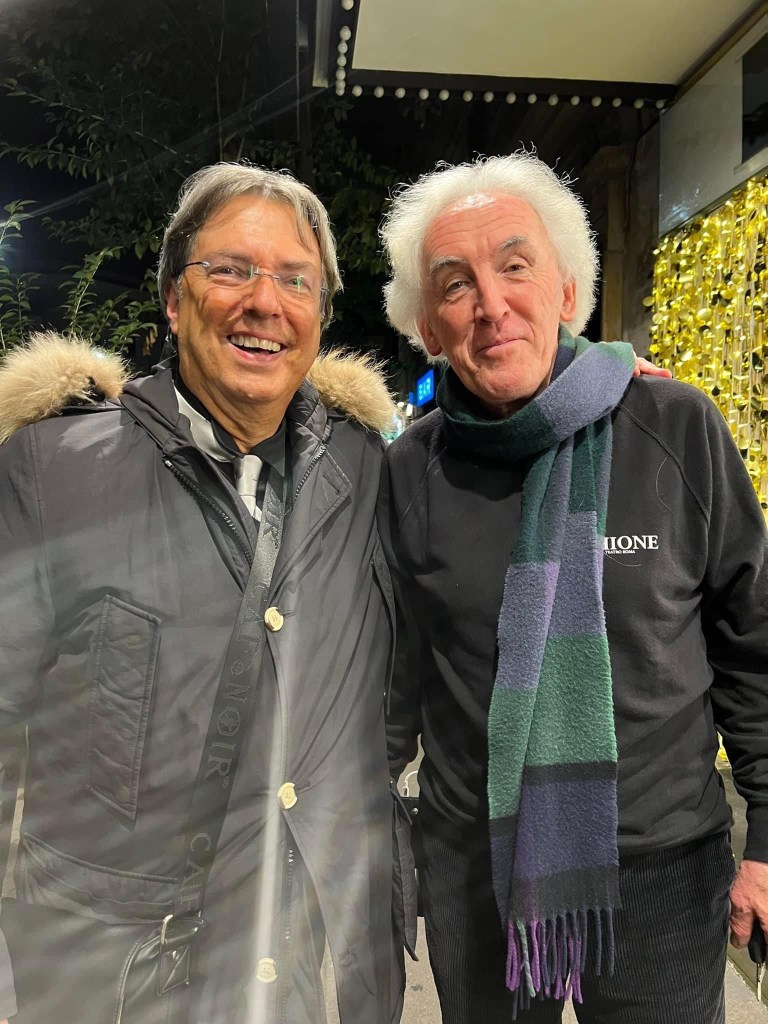
Maestro Franco Mezzena teacher of violin and chamber music at Aria di Musica Academy ……..outside the Ghione Theatre with Christopher Axworthy
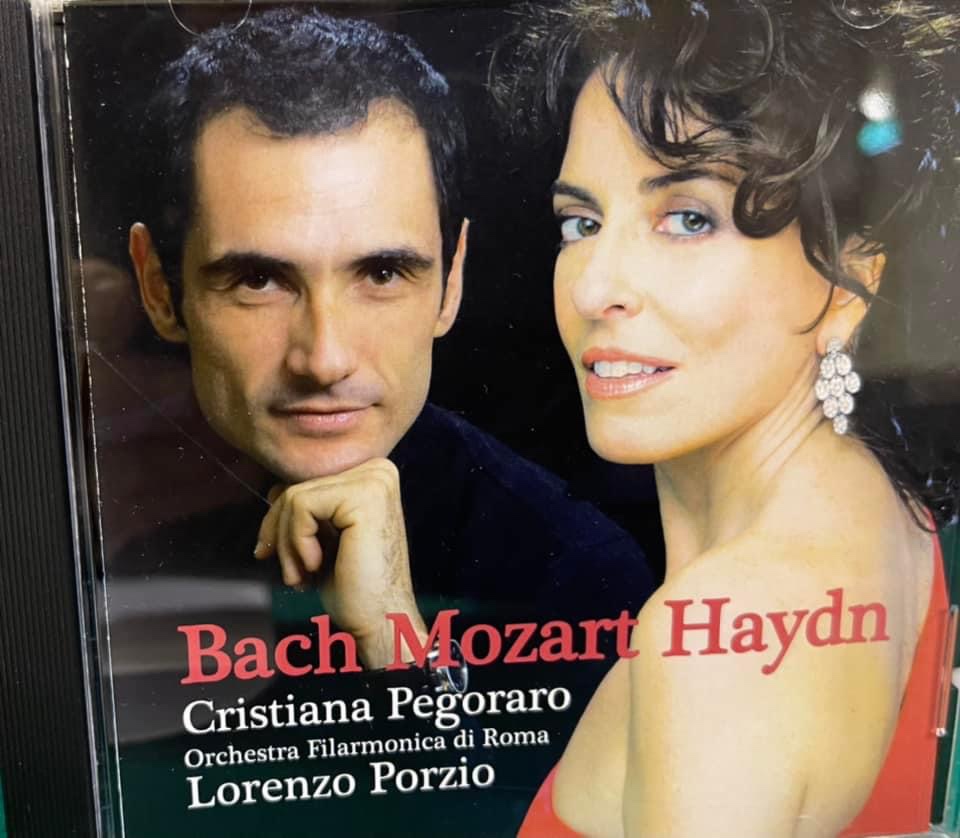
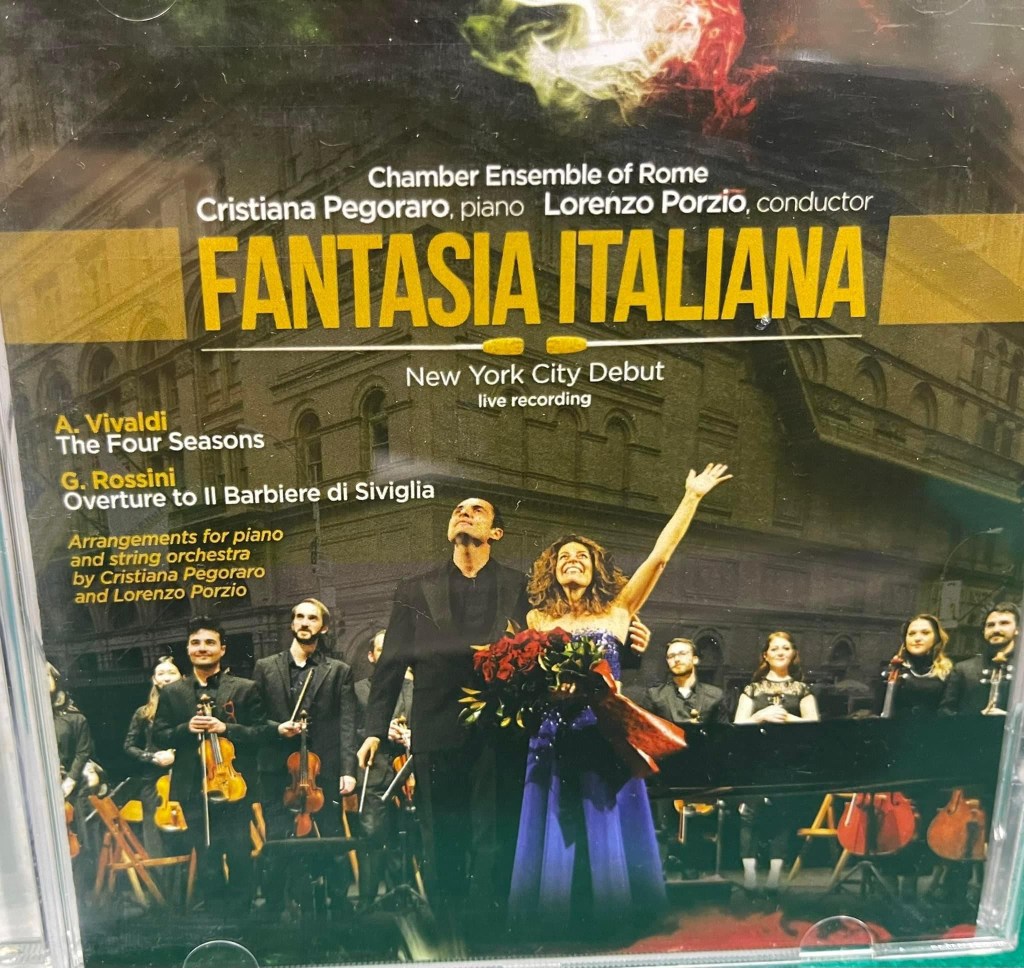
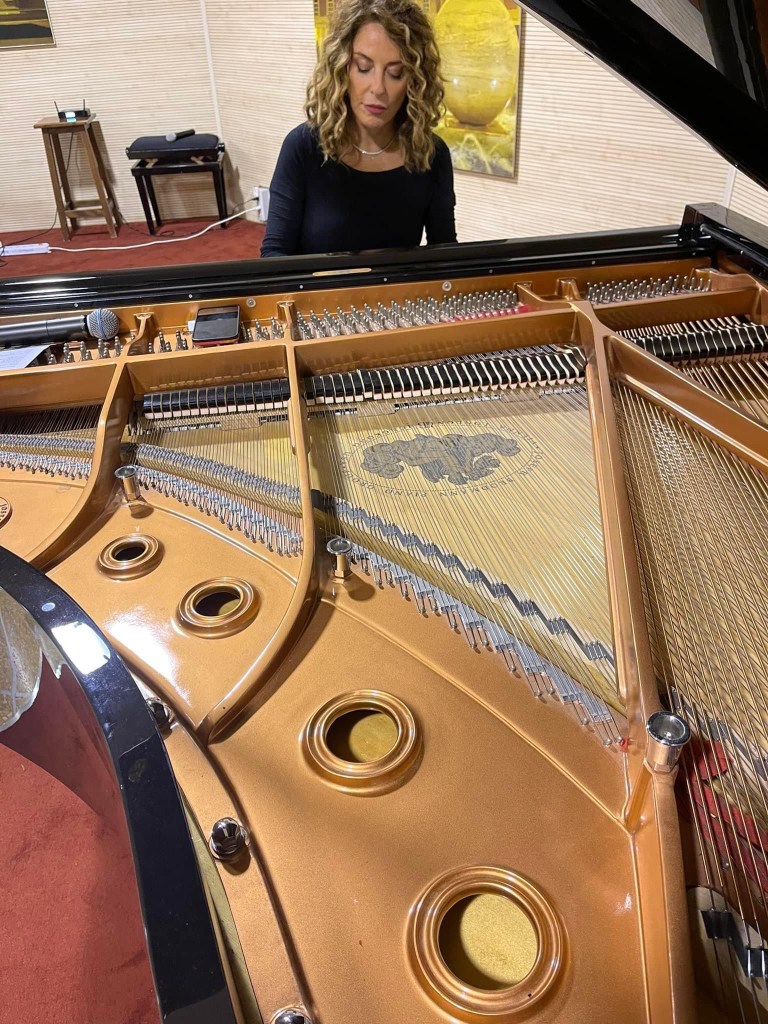
Cristiana Pegoraro with companion Lorenzo Porzio,conductor and the irreplaceable piano technician Valerio Sabattini
Luca Angelillo with Cristiana both having been brought up musically playing in their student days in the Ghione theatre
Our star shining brightly after her concert .

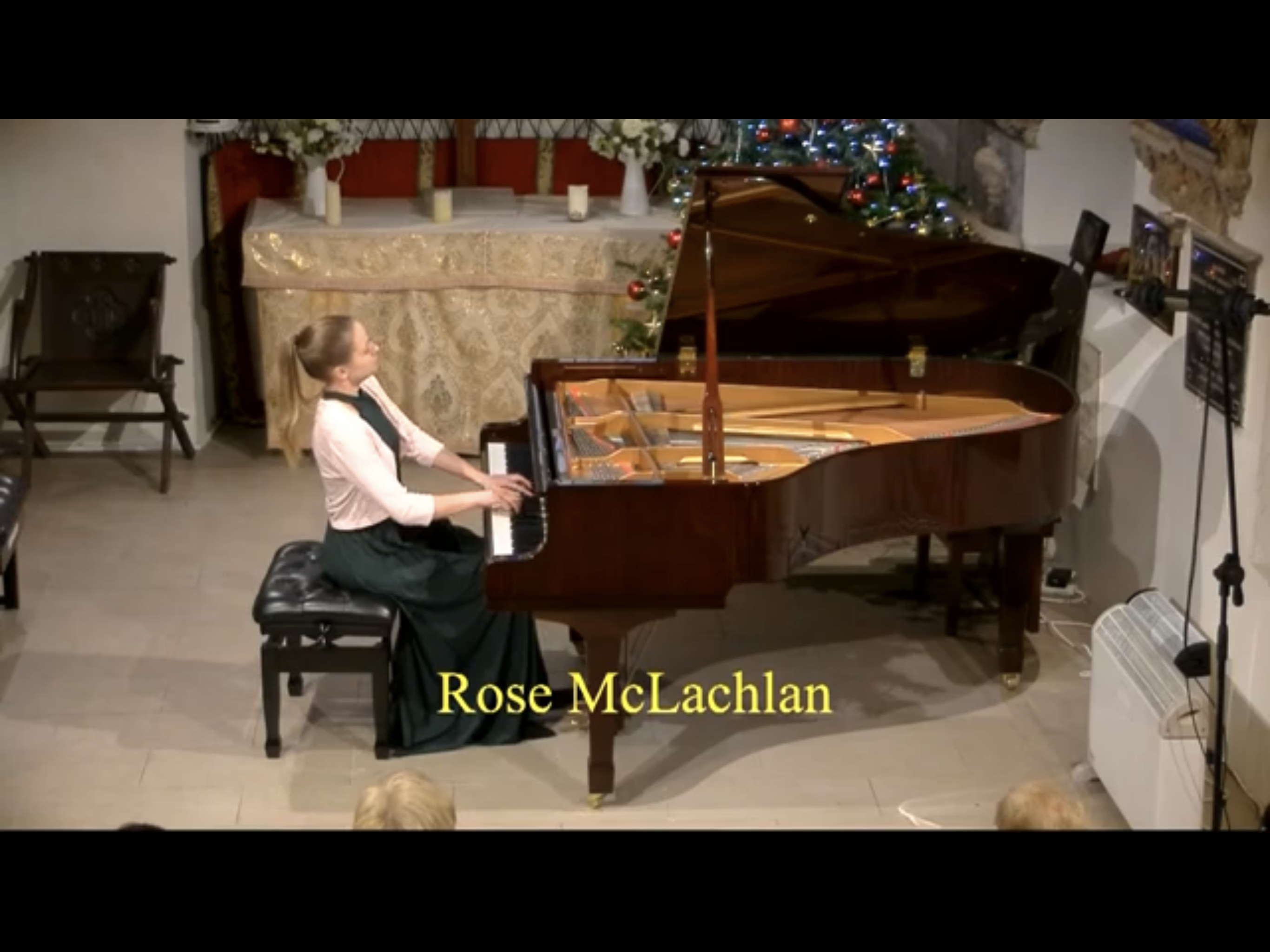
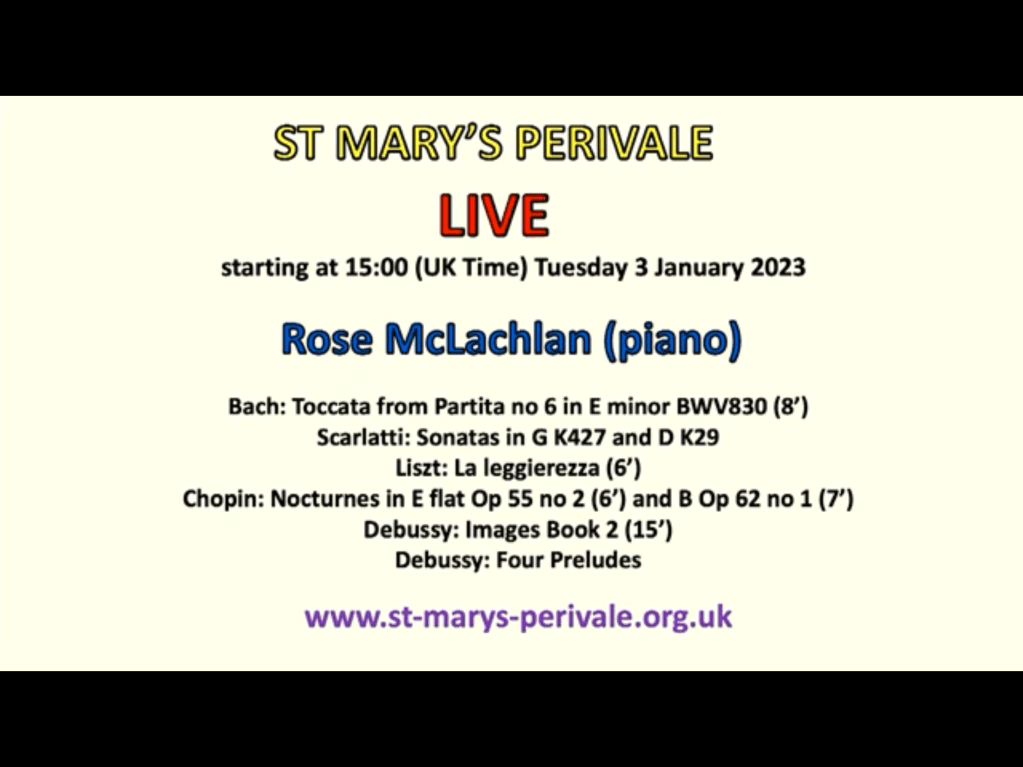
Rose Mc Lachlan The birth of an artist at St Mary’s

Tuesday 3 January 3.00 pm 

https://youtube.com/watch?v=OFArDcO_2tk&feature=share

It was nice to see that the opening of the new season of concerts at St.Mary’s should be with a pianist who a few years ago gave a very promising recital at St Barnabas and now has returned to St Mary’s as a very refined artist.From a family of musicians she had from an early age received expert training from her father.Well trained fingers,musicianly performances of intelligence and sensibility.I well remember her scintillatingly diligent account of Schumann’s early Abegg Variations.Today we have seen the transformation of a prize winning student into an artist of stature.

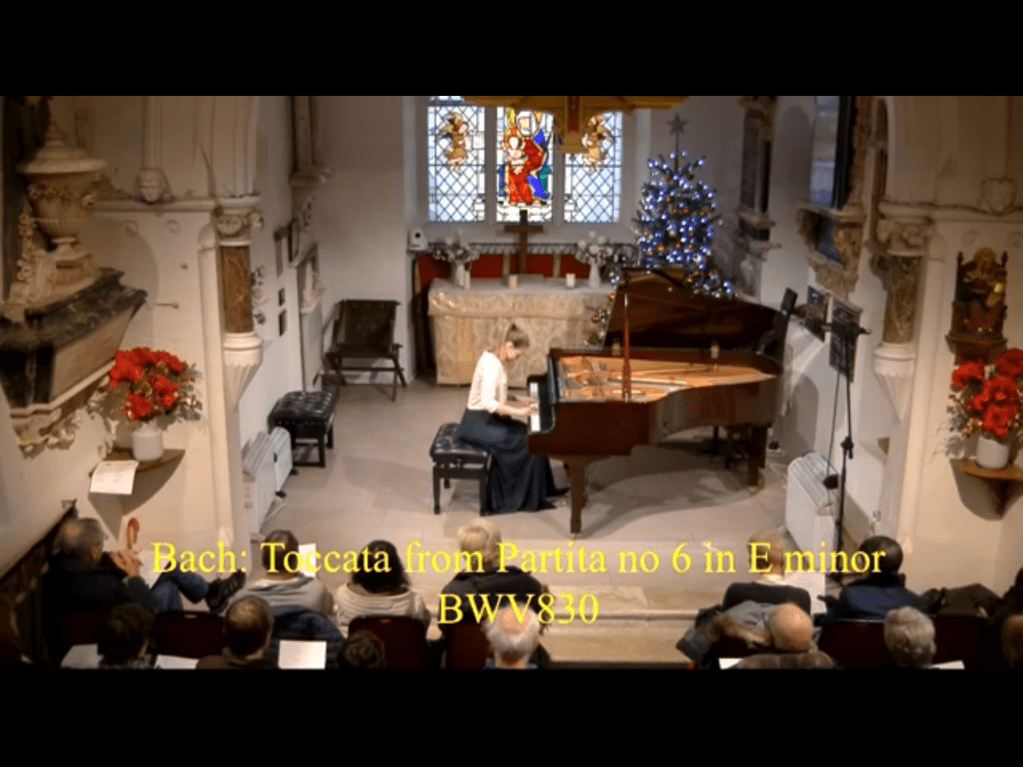
From the opening flourish of the Bach Toccata that immediately caught our attention with her natural musicality allowing the music to flow with subtle natural shape.It was played with a sense of style both of nobility and aristocratic authority.I found her insistence on playing ‘non legato’ though not quite as natural as though someone had told her rather than her being convinced and allowing her natural musicality to lead her rather than someone else’s head!It did though create a contrast between the opening improvised flourish and the following fugato passages.But Bach is based on the song and the dance as Angela Hewitt and Andras Schiff have shown us – Nikolaeva was one of the first to allow Bach to flow naturally from her fingers.Rosalyn Tureck,of course was unique but was more monumental than natural as was her disciple Glenn Gould who took Bach to the extremes with genius and individuality.I well remember Shura Cherkassky playing this Partita to me in his hotel room in Florence.He had programmed it in his next concert programmes and just needed to try it out.Cherkassky was not known for his Bach playing but he imbued it with his unique colour palette and a natural musicality that has remained in my memory for its unaffected musicianship.Rose with her natural musicality allows the music to flow through her with naturalness and musicianship where rules and regulations should now have no place as was so clearly shown with her wonderfully mellifluous Chopin Nocturnes.

The Scarlatti Sonata in G that followed the Bach Toccata was played with clarity and rhythmic buoyancy.A delicacy and infectious ‘joie de vivre’of whispered fun and games.Even the chordal interruptions were unusually delicately placed that made the jeux perlé passages even more enticing.

The D major Sonata showed a commanding dexterity as she allowed a natural hand position to hover over the keys horizontally rather than in her Bach where they were almost vertical.A natural hand position that allowed her to let the music flow through her with searing controlled passion.These were jewels that sparkled and shone with scintillating rhythmic energy of subtle shaping and colour and a sense of timing that cannot be taught but is of great artistry.

Chopin: Nocturne in B Major Op 62 no 1

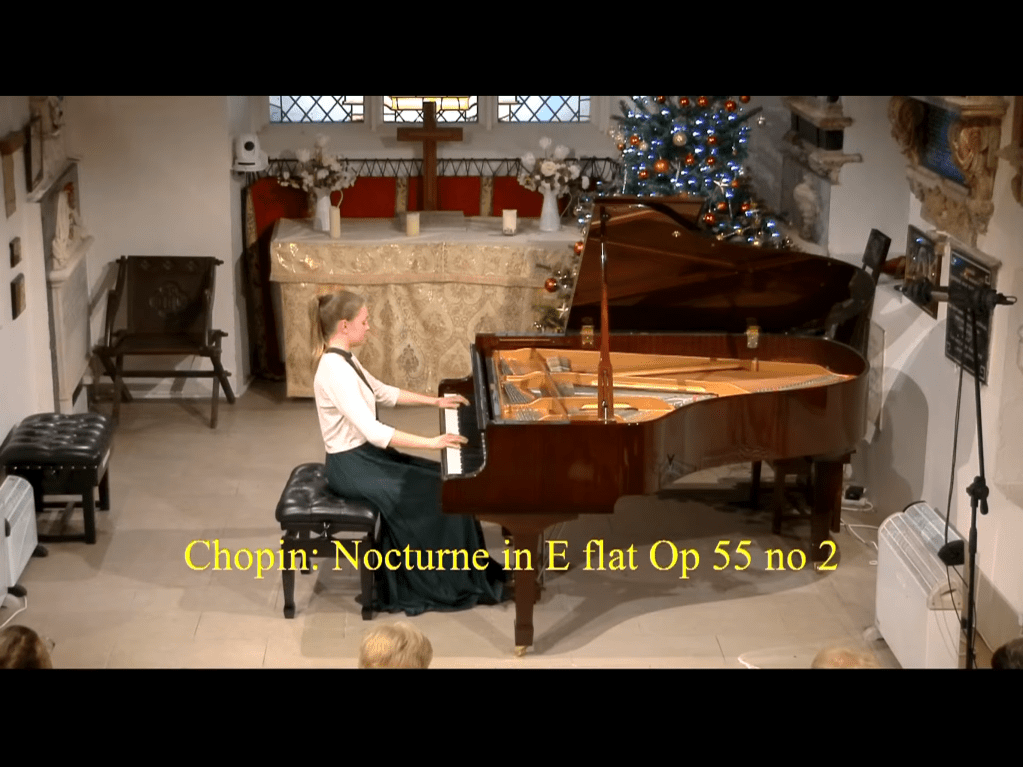
And what beauty she brought to the two Chopin Nocturnes.The B major was played with a wonderful sense of balance where the melodic line was allowed to sing with sensitivity and a rubato that was so natural.It could have flowed more ‘Andante’,though, as Chopin marks ,which would have made the ‘sostenuto’ of even greater contrast.The trills,poco piu lento and dolce,were played like beams of light vibrating in this ever more languid atmosphere.At the return to the original tempo she allowed the meandering embellishments to flow with all the time they needed to cast their magic spell.Strangely enough it was the ‘Lento sostenuto’ of the E flat Nocturne that flowed so poetically and naturally with insinuating counterpoints poignantly played.It gradually built in passion only to dissolve with magical embellishments to its final resting place.These were performances of great artistry and searing beauty of ravishing sounds and poetry.

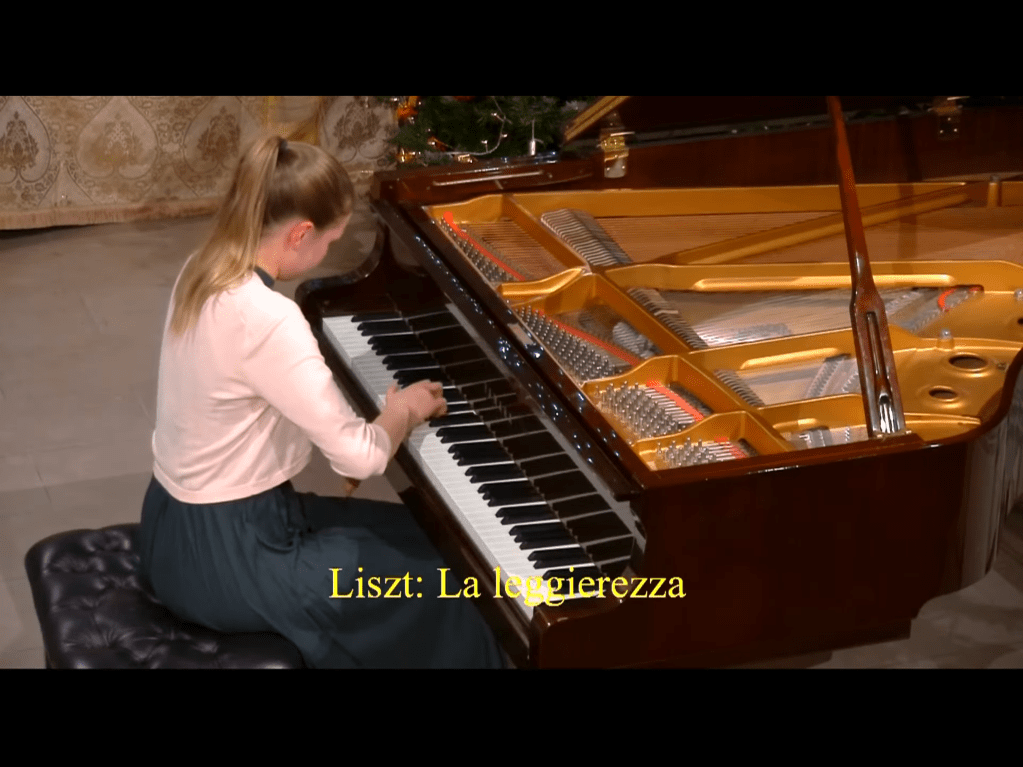
I well remember listening astonished at the refined and subtle virtuosity of Leopold Godowsky in this very piece by Liszt.It was a performance from a piano roll that had recently come to light in Frank Holland’s Piano Museum in Brentford.Sidney Harrison ,my teacher,was very much involved in helping Frank ,who was not a musician but an engineer,in bringing these amazing performances to the attention of a discerning musical public.They were first heard on BBC programmes late at night where one could listen to these rediscovered performances of legendary pianists from the Golden Age of piano playing.One became ever more aware of a virtuosity that was as remarkable for its range of sounds not only from forte to fortissimo but more from mezzo forte to pianissimo.This was,of course before the arrival of Sviatoslav Richter in the west.Rose played it with a beautiful legato and subtle sense of rubato.Grandeur and delicacy turned this neglected work into the miniature masterpiece that it truly is.’Au Bord d’une source’ and ‘Ricordanza’ together with this study are true miniature masterpieces that are unduly neglected these days.Hats off to Rose for including it in her recital and placing it along side recognised masterpieces by Chopin

I had heard Rose play Debussy in a recital streamed from St James’s this summer and had been deeply impressed by her identification with this sound world.Today she not only chose four preludes but the extraordinary second book of Images.The multicoloured bells of ravishing sounds spread over the entire keyboard flowed from her entire body with such ease.Like a great painter spreading colour over the entire canvas with strokes of beauty where the sounds she was creating were mirrored in the movements that were making them.’Et La Lune descend ‘,sounds of echoed vibrations and melancholic recollections with a translucency of vibrant lyricism.Played with astonishing delicacy with sounds that at times were barely audible such was their rightful place in this poetic landscape.Have Debussy’s Gold Fish ever been allowed to wallow in such clear waters?An aristocratic French sound of vibrancy and urgency with a fluidity as Debussy asks ‘Expressif et sans rigueur ‘disappearing to a mere magical whisper.

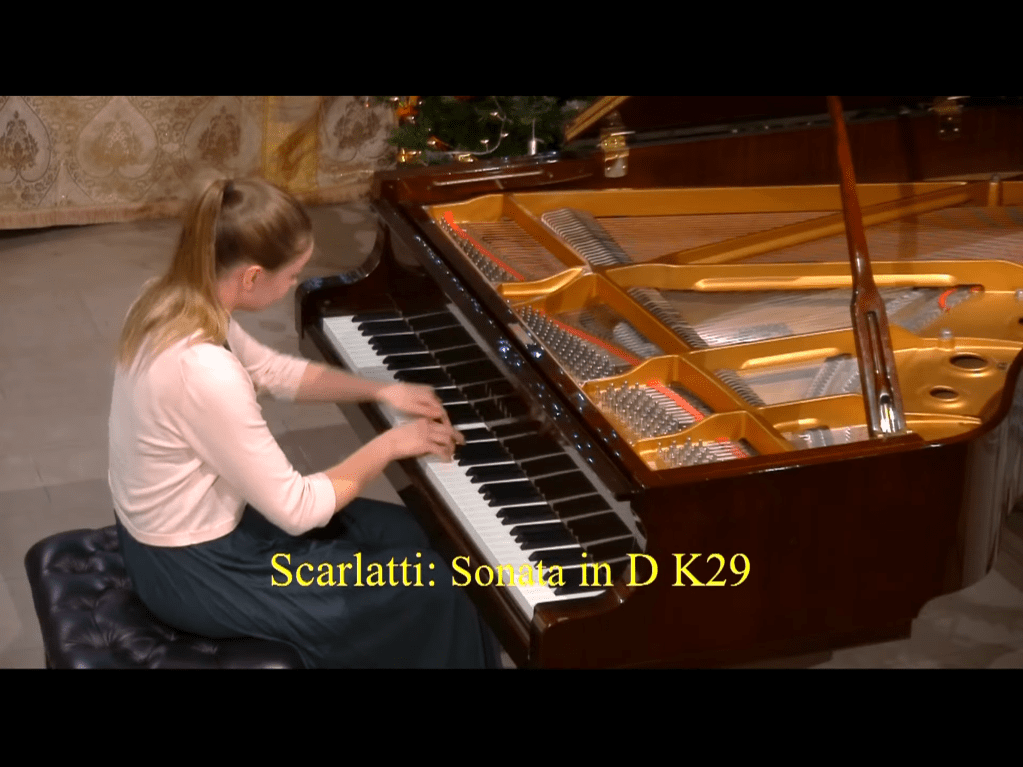
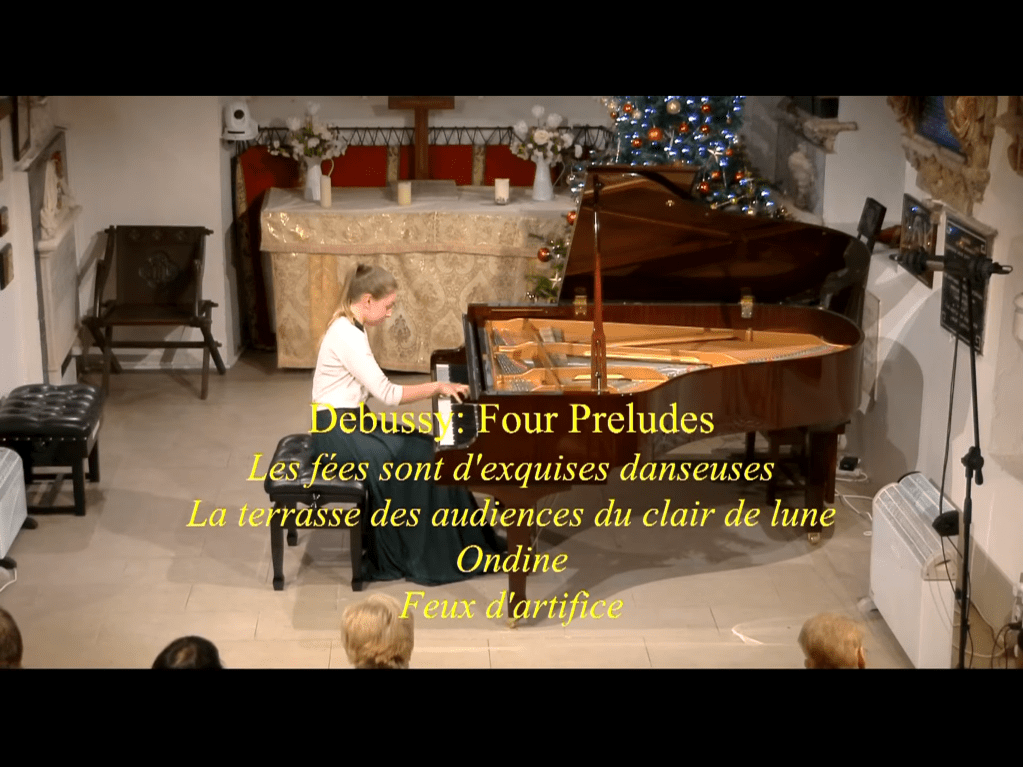
Four Preludes were of great character and beauty .’Fairies’that were indeed ‘exquisite’and the magic rays of the moon shone so clearly as Ondine darted in and out of the picture.But it was the Fireworks that showed of her remarkable technical assurance where her authority and remarkable virtuosity were used to create a picture of extraordinary imagery.The Marseilles was allowed to shine in the distance over the smokey atmosphere that was all that was left after a multicoloured feast and dazzling display of sounds.

Rose McLachlan comes from a family of musicians and was born in Cheshire in 2002. She began piano lessons with her father and entered Chetham’s School of Music in 2010, initially as a chorister at Manchester Cathedral. She now studies piano with Helen Krizos. After gaining a high distinction for grade 8 at 11, Rose was awarded the LTCL performers diploma with distinction in 2017. Rose has already had considerable successes in national and international competitions. After being awarded the Sir David Wilcock’s Organ Scholarship in 2014/15 she was the overall winner of the 2016 Scottish International Youth Prize at the Royal Conservatoire of Scotland. As a result of winning the Yamaha Prize in the 2017 EPTA UK competition, Rose performed at St Martins in the Fields. As an overall winner of the Chetham’s concerto competition in February 2018, Rose was selected to perform the Ravel G major concerto with the Chetham’s Symphony Orchestra during the 2018-19 season. In 2018, Rose won the Chopin and Beethoven prizes at Chetham’s and in 2019 she was overall winner of the junior intercollegiate Beethoven Piano Society of Europe competition. Also, in 2019 Rose was the overall winner of the 11th “Dora Pejacevich” competition organized by EPTA Croatia. She has performed Beethoven’s second Piano Concerto five times with orchestra, as well as solo recitals in Lanzarote, St James Piccadilly, London, Portsmouth and Birmingham. With her family, Rose has given recital tours in Scotland. In March 2019, Rose performed the Clara Schumann concerto with the New Tyneside Orchestra in Newcastle conducted by Monica Buckland. 2018 saw her first commercial recording being issued by Divine Art, performing ‘Five Hebridean Dances’ by John McLeod. In October 2019 she performed Shostakovich’s Second Concerto with the BBC Concert Orchestra conducted by Barry Wordsworth in the Malcolm Arnold Festival which was broadcast on BBC Radio Three. As a result of this concert she was immediately invited to perform live at the Royal Festival Hall as a solo pianist on Radio 3 in a concert scheduled for 6 May 2020. In January 2020, Rose recorded piano duets by the distinguished British composer, Edward Gregson, with her father for a new commercial recording on the Naxos label. In 2021, Rose was a winner of the Pendle Young Musicians Bursary. In September 2021, Rose was a Tabor Piano Ambassador in the Leeds International Piano Competition, resulting in her first published article for the online Pianist magazine. In February 2022, Rose was the winner of the Kirklees Young Musician of the Year. Rose is now at the Royal Northern College of Music in Manchester, continuing her studies with Helen Krizos. She is extremely grateful to receive financial support from the Waverley Fund.

https://christopheraxworthymusiccommentary.com/2022/08/24/rose-mclachlan-at-st-james-piccadilly-je-sensje-joue-je-trasmet-artistry-and-poetic-imagination-of-a-musician/

Piers Lane a nightingale ravishes us at the Wigmore Hall – A Christmas treat from a true poet of the piano.

Edvard Grieg (1843-1907). Holberg Suite Op. 40 (1884)
I. Praeludium • II. Sarabande • III. Gavotte • IV. Air • V. Rigaudon

Edvard Greig
Piano Sonata in E minor Op. 7 (1865)
I. Allegro moderato • II. Andante molto • III. Alla menuetto, ma poco più lento • IV. Finale. Molto allegro

Franz Liszt
Weihnachtsbaum S186 (1874-6)
Schlummerlied • Abendglocken • Ehemals


Franz Liszt (1811-1886). Piano Sonata in B minor S178 (1849-53)
Lento assai – Allegro energico – Andante sostenuto – Allegro energico – Lento assai

A favourite pianist with a wide repertoire selected works from two popular composers, one very much a musical nationalist, the other of the widest intellectual interests. Compared to the virtuosic B minor Sonata, Franz Liszt’s Christmas Tree is relatively simple – a suite of pieces first performed on Christmas Day 1881 in the hotel room in Rome where his granddaughter Daniela von Bülow – the work’s dedicatee – was staying.

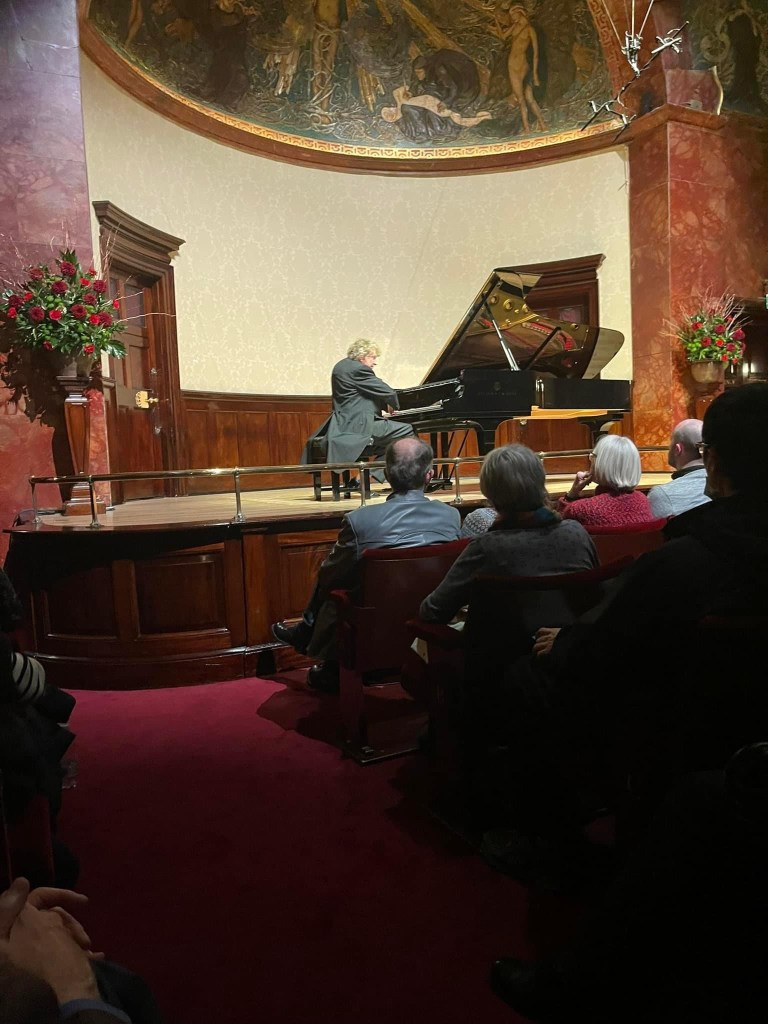
Piers Lane the nightingale of the piano ravished us with his playing of Grieg in the first half of his Christmas piano recital at the Wigmore Hall.
Charming as ever he decided to keep Grieg and Liszt apart.
Playing the Holberg Suite followed by the youthful Sonata in E minor in the first half and Liszt three pieces from his Christmas Tree Suite and the B minor Sonata in the second.


Some magical playing with the Air of the suite and the Andante molto of the sonata as we have come to expect from this poet of the piano.A refined sense of balance that can persuade us into believing that the piano can sing as beautifully as any nightingale in Berkeley Square.
It was a few years ago that I was stopped in my track as I listened to radio 3 where someone was playing so beautifully:’A Nightingale sings in Berkeley Square’.Listening entranced in my garden in Italy as the announcer told us that it was Piers Lane – I have never forgotten the indelible impression of that performance.
Grieg had taken his piano concerto to show Liszt who famously sat down and sight read it but too fast for the composer’s taste!
Nothing like that tonight with the selfless musicianship that our true nightingale,Piers,shared with us.

Piers with a few well chosen words to guide us on our journey together


The Holberg Suite was written originally for piano when Grieg was at the height of his fame .It was commissioned for the bicentenary celebrations of the birth of the playwright Ludvig Holberg with an attempt to reconstruct the sounds of his epoque.
A Praeludium with a perpetual mobilé of nobility and beauty with harmonies tinged with nostalgia and pungent expression.
A Sarabande and Gavotte of great charm and grace leading to the Aria which was allowed to shine like a jewel of radiance and delicacy in Piers magical hands.
Ending with a Rigaudon played with scintillating rhythmic energy and a jeux perlé bursting into a grandiloquence of rhetorical nobility.
I am not sure that it was a good idea to change the order of a programme that had originally been conceived as Grieg /Liszt – Liszt/Grieg.
The reason was obviously in order to finish the recital with a monument of the Romantic Piano Repertoire :the Liszt B minor Sonata – and it was a truly monumental performance.
But an entire first half of Grieg even in such poetic hands I found hard to enjoy as I would have in smaller doses!
The last time I heard Grieg’s only sonata for piano was with Shura Cherkassky and I remember being surprised that it was not included more often in concert programmes.There are many beautiful things not least the haunting opening theme based on the composers initials E H (b)G played with insinuating romanticism and ravishing sounds of passionate drive.A luscious Andante of Hollywood proportions follows.A surprisingly dramatic ‘Alla menuetto’ and a highly charged Finale all played with architectural shape and drive contrasted with episodes of subtle beauty.


With his supreme good taste and intelligence Piers played these two works by Grieg with masterly musicianship.I secretly longed to hear,though,the magical Lyric Pieces that are so rarely heard in concert rather than these pieces painted on too large a canvas for a nationalistic miniaturist.
The exception ,of course,is the piano concerto which with the aristocratic nobility of a great artist can captivate any audience.The slow movement is one of those moments of magic,like the Mahler Adagietto, that must be high on the list of favourites to take to a desert island .

Piers greeted by Li Siqian with her mentor Norma Fisher looking on https://christopheraxworthymusiccommentary.com/2021/07/13/li-siqian-streams-of-ravishing-gold-at-st-marys/


Three pieces from the twelve that make up Liszt’s Christmas Tree Suite dedicated to his granddaughter in 1881 were the foil for the B minor sonata.
Liszt had played them for her in her hotel room in Rome.Ibsen was staying just around the corner in via Condotti and it is where he too was inspired to write his revolutionary masterpiece ‘A Doll’s House’in 1879.We produced the play in Rome on it’s 100th anniversary with my wife Ileana Ghione in the ‘women’s lib’ role of Nora!
All roads obviously lead to Rome!

The Wigmore in festive mood


Liszt’s late Christmas Tree are pieces full of luminous sounds of whispered secrets but without any sense of true direction.Liszt with only ten more years on this earth was profetically pointing the way to a future that Busoni was to continue and bring to its ultimate conclusion as mathematics took over from the burning intensity of the heart.
It was a fascinating entrée to the B minor Sonata and luckily in this urtext age we were treated to only three very carefully selected pieces – the other nine will have to wait for eternity!Arrivederci a non presto!

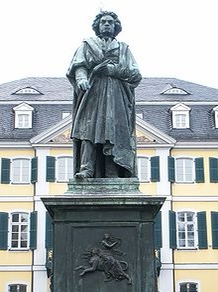
Beethoven eternally present in Bonn thanks to Liszt


The B minor Sonata is dedicated to Schumann in grateful thanks for the dedication of the Fantasie op 17.
It was the work that Schumann donated to the appeal that Liszt had taken in hand to build a monument to his master ,Beethoven,in his birthplace of Bonn.
Many other composers had donated their works to the appeal amongst which Mendelssohn offered his ‘Variations Serieuses’.
The efforts of Liszt were rewarded with the unveiling of the statue in 1845 on the 75th anniversary of Beethoven’s birth and which still very much dominates the city of this universal genius.


The clue to the Sonata is in the first and last pages.The three ideas that become the leit motif of a new container freeing the Sonata form of its constraints.The opening ideas are transformed as if by magic into a landscape that allows more Romantic freedom of expression but still with an architectural form of cohesion.
The last page of the Sonata is pure genius as the disintegration or sublimation of the three motives are combined in this supreme rethought of a revolutionary genius.
Liszt had scratched out the initial bombastic final page and replaced it with a visionary revisitation of almost religious contemplation.The final three chords reach for the heights only to be denied the inevitable with a sudden pianissimo and the same deep note in the bass where the journey had begun.
It was this page that Piers played to perfection and all the trials and tribulations ,triumphal outpouring of transcendental difficulty mixed with whispered secrets of mouthwatering delicacy found at last a mystical peace .It was all played with such consummate artistry that the technical hurdles passed unnoticed as they were part of a much larger musical landscape.
A message that Piers brought to it’s ultimate conclusion and which earned him a spontaneous ovation from the full house that had greeted this much loved artist.

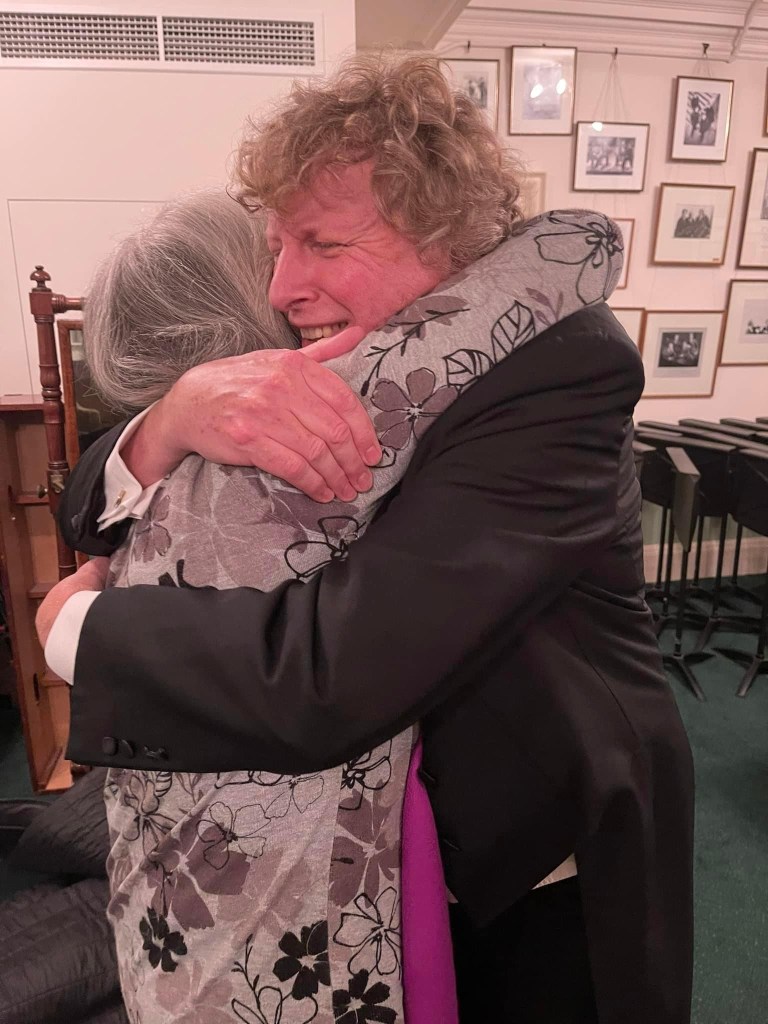
Norma embracing Piers in a Green Room she knows so well. https://christopheraxworthymusiccommentary.com/2022/05/12/norma-fisher-at-steinway-hall-the-bbc-recordings-on-wings-of-song-the-story-continues/


Norma Fisher was the first to greet him backstage with a heartfelt embrace.
How many times as a student I had heard her on this very stage invited by our mutual teacher Sidney Harrison to proudly show his schoolboy student where our journey might eventually lead.


What to offer as an encore after such an enormous meal?
Of course a sorbet was needed consisting of a ravishing Barcarolle written for an Australian film.
Liszt after all was a supreme show man and Grieg a supreme miniaturist and here combined in one simple piece was the charm and sounds that had beguiled and bewitched us all evening.
Happy Christmas ,dear Piers,and may there be many many more New Years!

Like our teacher Sidney Harrison Norma accompanying her star student Li Siqian to the Wigmore hall to listen and learn from her friend and colleague Piers Lane

Edvard Hagerup Grieg 15 June 1843 – 4 September 1907) the Norwegian composer and pianist was raised in a musical family. His mother was his first piano teacher and taught him to play when he was six. At the age of 15 the boy’s talent was noted by a family friend the violinist Ole Bull who persuaded his parents to send him to the Leipzig Conservatory where the piano department was directed by Ignaz Micheles.He later declared that he left Leipzig Conservatory just as stupid as he entered it. Naturally he did learn something, but his individuality was still a closed book to him.During 1861, Grieg made his debut as a concert pianist in Karlshamn in Sweden and in 1862, he finished his studies in Leipzig and had his first concert in his home town,where his programme included Beethoven’s Pathetique sonata.During 1868, Franz Liszt ,who had not yet met Grieg, wrote a testimonial for him to the Norwegian Ministry of Education, which resulted in Grieg’s obtaining a travel grant.

The two men met in Rome in 1870. During Grieg’s first visit, they examined Grieg’s Violin Sonata No. 1, which pleased Liszt greatly. On his second visit in April, Grieg brought with him the manuscript of his Piano Concerto, which Liszt proceeded to sightread (including the orchestral arrangement). Liszt’s rendition greatly impressed his audience, although Grieg said gently to him that he played the first movement too quickly. Liszt also gave Grieg some advice on orchestration (for example, to give the melody of the second theme in the first movement to a solo trumpet, which Grieg himself chose not to accept).The Holberg Suite, op.40, more properly From Holberg’s Time is in Norwegian: Fra Holbergs tid), subtitled “Suite in olden style” (Norwegian: Suite i gammel stil), is a suite of five movements based on eighteenth – century dance forms, and was written by in 1884 to celebrate the 200th anniversary of the birth of Dano-Norwegian humanist playwright Ludvig Holberg (1684–1754).It exemplifies nineteenth-century music which makes use of musical styles and forms from the preceding century.
It was originally composed for the piano, but a year later was adapted by Grieg himself for string orchestra

Liszt’s Weihnachtsbaum was chiefly composed between 1874 and 1876. The set of 12 pieces represents Christmas from three different viewpoints, with hymns (including Adeste Fideles), then a series of pieces portraying Christmas with an attitude of child- like purity (e.g. No. 7, Schlummerlied), and finally a Christmas tinted with experience (No. 9, Abendglocken, and No. 10, Ehemals). There is a further reading of Ehemals, in which it may also represent Liszt’s first meeting with his lover Princess Sayn-Wittgenstein, a match prevented by family and religion.

Nikita Lukinov plays breathtaking charity recital for Ukraine in Berlin.

An appreciation by Moritz von Bredow

On December 8th 2022 the 24-year-old Russian pianist Nikita Lukinov, who comes from Voronezh in Russia, gave an acclaimed benefit recital for a Ukrainian aid organization at the Representation of the Hanseatic City of Hamburg in Berlin. The mayors of Kiyv and Hamburg had signed a humanitarian pact to support the Ukrainian population, for which Nikita Lukinov now committed himself with this performance. He had already given benefit concerts for Ukraine in the UK in the past.

Nikita Lukinov’s recital was enabled through the cooperation between the Keyboard Charitable Trust, London and the Representation of the City of Hamburg, as well as the generous support of Steinway & Sons, Berlin, who had once again supplied an amazing Steinway B.

The artist, who appears modest and listens attentively in conversation, has every artistic means at his disposal to make him a truly great pianist. He showed this impressively on this evening.

Trained by Bashkirov students Svetlana Semenkova in Voronezh and Tatiana Sarkissova at the Purcell School in London, Lukinov is currently studying at the Royal Conservatoire of Scotland (RCS) with Lithuanian pianist Petras Geniušas in the master’s program. He has also been teaching at his conservatoire since October 2022.

For tonight’s performance he had chosen two colossal works of the romantic piano literature.

The demonic opening of Franz Liszt’s Piano Sonata in B minor made each of the 120 listeners in the sold-out hall sit up and hold their breath. Lukinov fully understands the complex character of this demanding sonata, which is nevertheless often heard in concert halls, and at no point he allowed himself to be carried away by tasteless exaggerations or “kitschy” embellishments. At all times he was able to master the musical complexity, combined with the immense technical challenges, in an absolutely controlled manner. His technical mastery as well as his always idiomatic musical expression are impressive. He succeeded not only in great orchestral colours and fantastic climaxes, but also in lyrical cantilenas and dreamy, subtle rubato – just as Liszt had notated. The listeners were spellbound. 

I found the outstanding use of the two pedals particularly impressive: the right pedal was never used to excess, on the contrary: many of those phrases which with other pianists blur or disappear in a great, hurricane-force surge of notes were heard clearly, chiselled and transparent. The left pedal was used with restraint, at most for displaying colours, but never to breathe away a powerless, dull pianissimo.

Great applause – great, intelligent piano playing.

Nikita Lukinov then played the Symphonic Etudes, Opus 13 by Robert Schumann, to whom, incidentally, Franz Liszt had dedicated his previously played Sonata in B minor.

In addition to the etudes, Nikita Lukinov had also selected some of the variations composed later by Robert Schumann and woven them into the overall work with great sensitivity. 

Here, too, he mastered both the musical demands and the technical challenge. Both merged into a unity.

The two characters repeatedly quoted by Robert Schumann, Florestan (the wild rebel) and Eusebius (the lyrical dreamer), which he had borrowed from a novel by the Romantic poet Jean Paul, were wonderfully brought out by Lukinov in their musical contrasts, thus perfectly capturing the Symphonic Etudes. At the end, there was once again unending applause. Two encores by Tchaikovsky and Scriabin rounded off this extremely impressive and moving piano recital.

Although Nikita Lukinov had chosen two colossal works of the romantic piano literature, there was at no time any tonal or acoustic exaggeration, which one unfortunately hears all too often in concert halls. Young pianists are all too likely to be seduced by showmanship and the above mentioned “kitschy” exaggeration, but none of this was to be heard in Lukinov’s performance. 

And so I am eager to hear how this promising pianist, equipped with all the means for a grandiose career, will develop. 

I think of Glenn Gould or Kit Armstrong with Byrd and Gibbons, the interpretations of Bach by Samuel Feinberg and Svatjoslav Richter, of Scarlatti with Vladimir Horovitz and Beethoven with Emil Gilels, of Cage with Grete Sultan. Nikita Lukinov seems absolutely equal to all these pianists with his performance offered here. 

And so this would be my only wish: that one may hear Nikita Lukinov also with compositions from other epochs, from the Renaissance to the Modern. This could be, as already shown here with works from the Romantic period, a musical revelation, and he could show the whole range of his immense pianistic skills in highly interesting, musically diverse programmes.

https://christopheraxworthymusiccommentary.com/2022/04/11/nikita-lukinov-at-st-marys-a-masterly-warrior-with-canons-covered-in-flowers/

https://christopheraxworthymusiccommentary.com/2022/07/15/two-young-giants-cross-swords-in-verbier-giovanni-bertolazzi-and-nikita-lukinov/

https://christopheraxworthymusiccommentary.com/2021/06/15/nikita-lukinov-at-bluthner-piano-centre-for-the-keyboard-trust-liszt-restored-to-greatness/

John Leech listening to Nikita talk as well as play
Nikita with Noretta Conci overwhelmed by his beautiful playing
Soirée musicale for the founders of the Keyboard Trust – a Christmas treat indeed

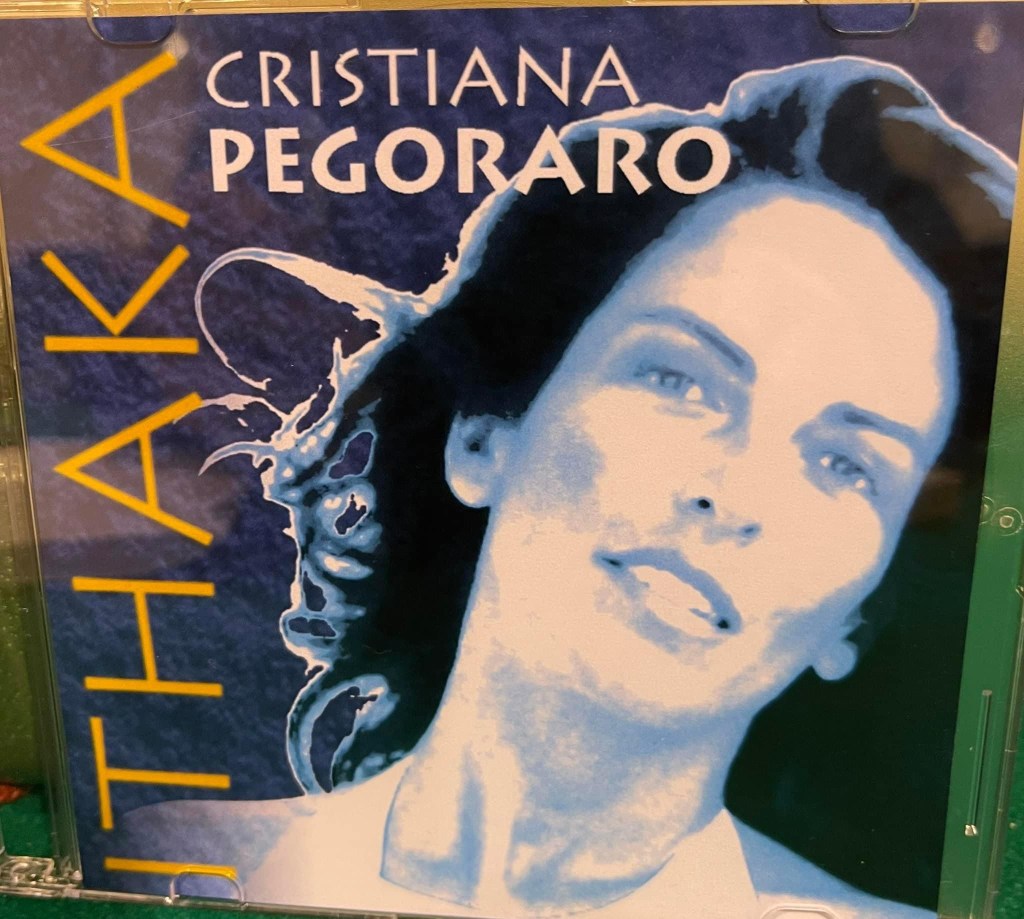
Ithaka of Cristiana Pegoraro A star shining brightly in Latina for Christmas

Cristiana forty years on – a star shining brightly as she guides her audiences worldwide via music to a broader vision of the meaning of life.

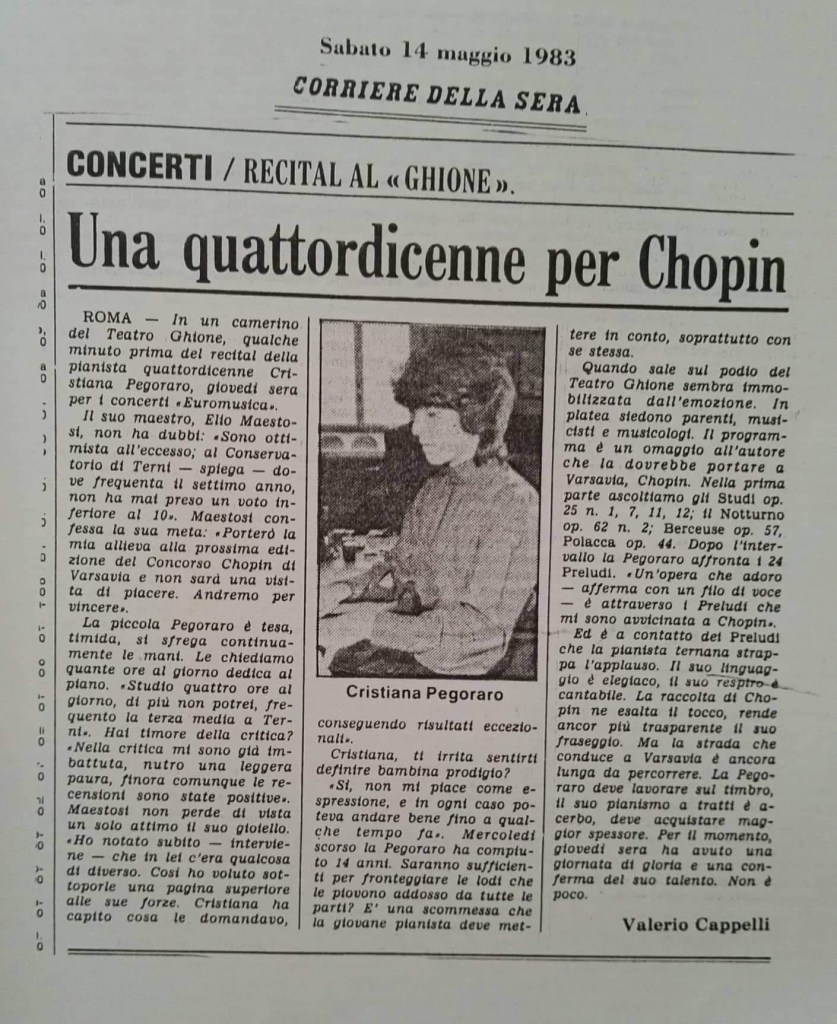
It was in 1983 that a fourteen year old schoolgirl was presented to us in the Ghione theatre by the brother of our leading actor Walter Maestosi.Side by side with my wife Ileana Ghione in Private Lives by Noel Coward and a new play ‘Only a Holiday’ by Guido Nahum.Elio Maestosi had met at the Chopin Competition in Warsaw ,Thorunn Johannsdottir who was destined in 1961 to become the wife of Vladimir Ashkenazy.He was an expert dedicated to the performance of Chopin and was now teaching at the Terni Conservatory .He had a remarkably talented young student who he wanted to make her debut playing Chopin in Rome.She played for our Euromusica Concert season ,a programme that included the 24 Preludes by Chopin.

Guido Agosti with my wife Ileana Ghione .He felt relaxed and at home in our beautiful theatre

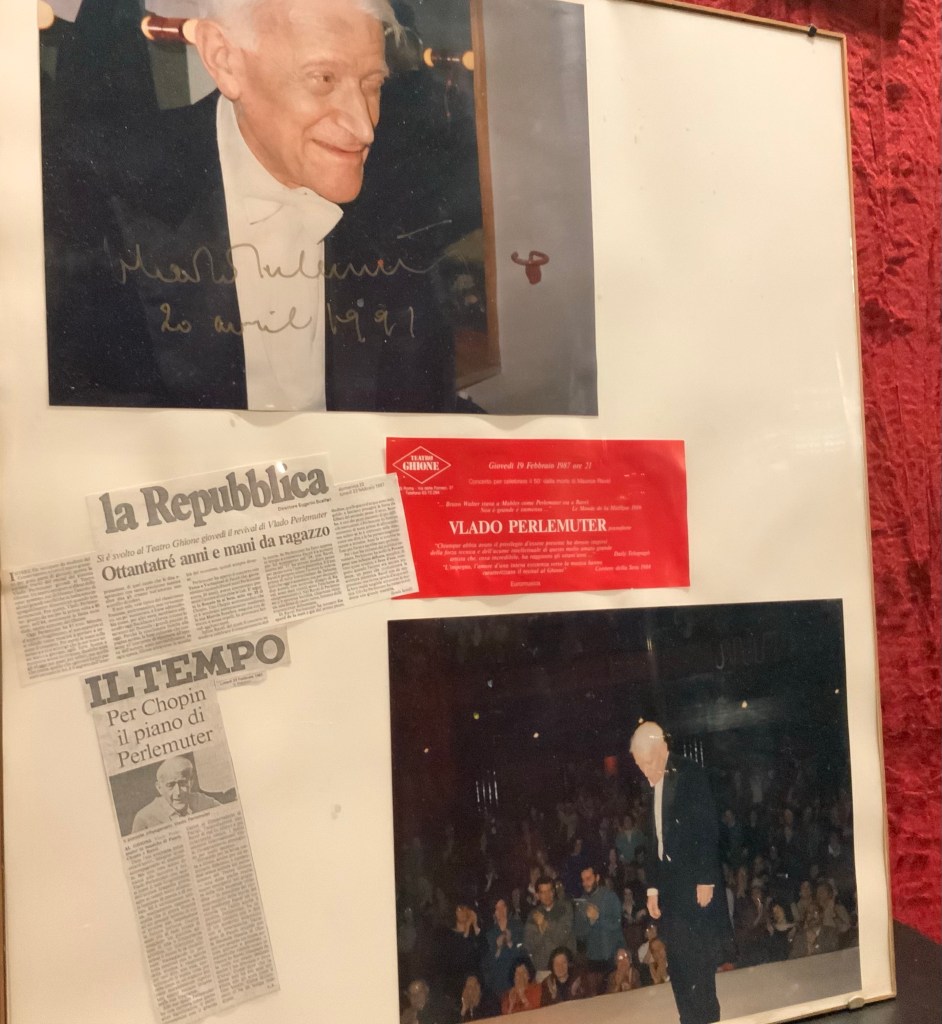
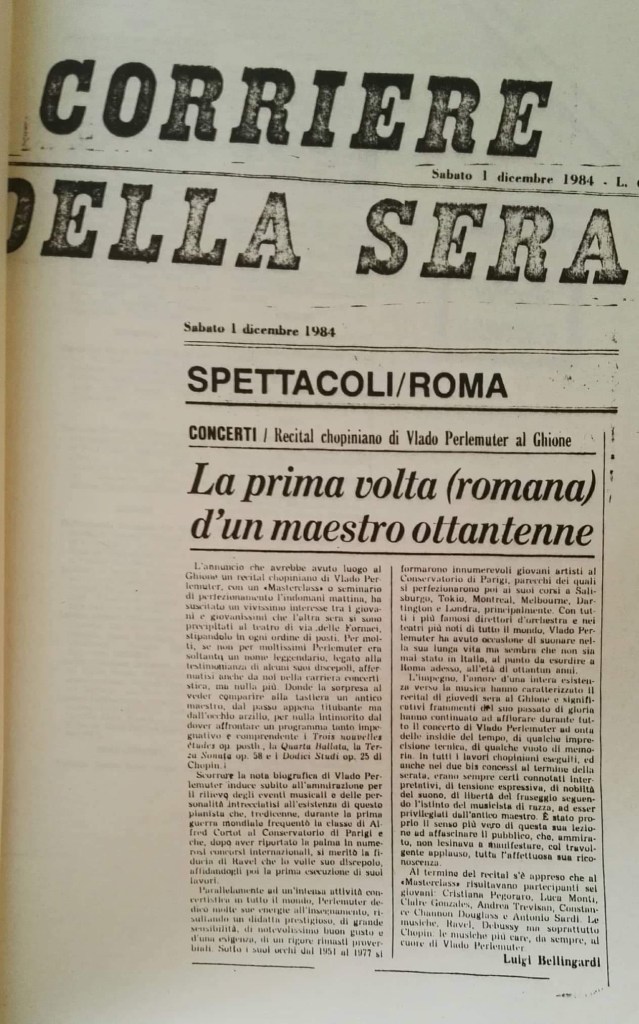
It was in December 1984 that I invited my teacher Vlado Perlemuter to make his debut in Italy – he was 81.It followed in the footsteps of another forgotten legend and teacher of mine :Guido Agosti who played in 1983 also in his 80’s.Legendary figures strangely neglected by the concert circuits due to their fear of playing continuously in public and their own careers as the most sought after teachers of their age.

Cristiana in the masterclass of Vlado Perlemuter in 1984

Perlemuter had been ,at the age of fourteen,the youngest student of Alfred Cortot.He lived in the same house in Paris as the director of the Conservatoire ,Gabriel Fauré .He was one of the first pianists to play the complete piano works of Ravel under the composers supervision.He not only gave a recital – all Chopin – for us but was invited immediately to play in Padua and from there Venice Milan and Florence .He played for us until his ninetieth year and he would also give a masterclass the day after his concert.It was in 1984 that Cristiana played in his first of many classes that he gave over the next ten years.

https://christopheraxworthymusiccommentary.com/2017/12/19/in-praise-of-joan-2/

The Ghione Theatre

The theatre had opened in 1982 after three difficult years of restoring a derelict cinema in the centre of Rome.With a ridiculously low budget we managed to transform an abandoned cinema into a jewel of a theatre thanks to to my wife’s determination and my hard work!I had left all my commitments in London to help my future wife in her life’s quest to have a theatre of her own.With only three workmen to keep inspired daily ,the theatre opened and fast became a favorite venue where the plays that my wife could now choose lived happily together with music.Rome in that period was a city where there was a desperate need for a medium size hall for chamber music and recitals.We filled that gap!

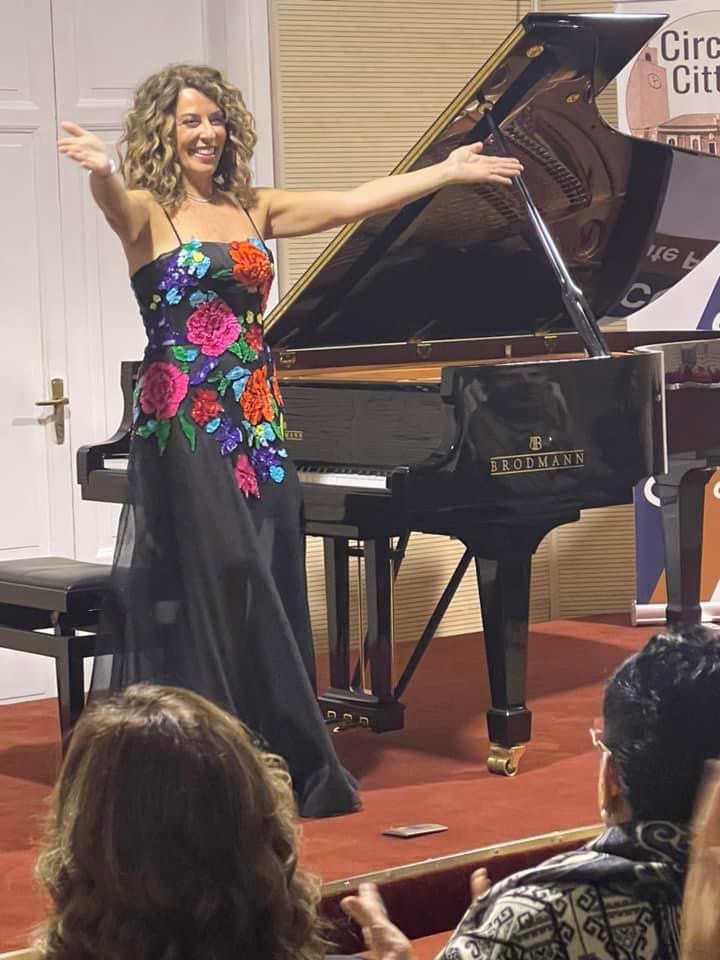
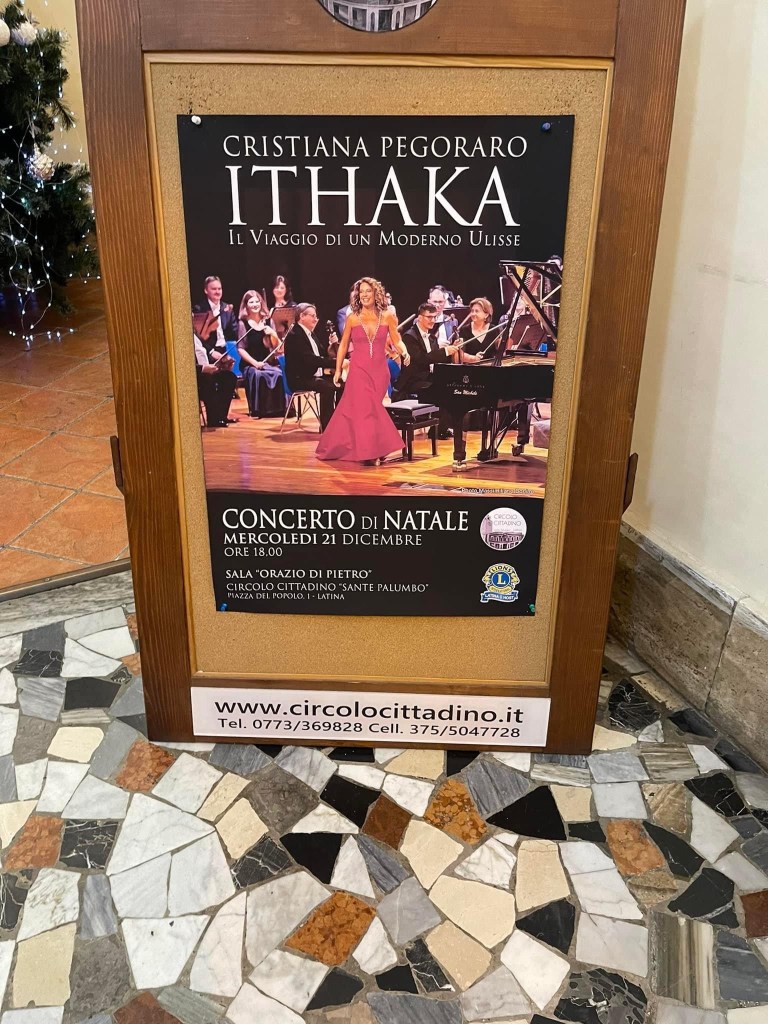
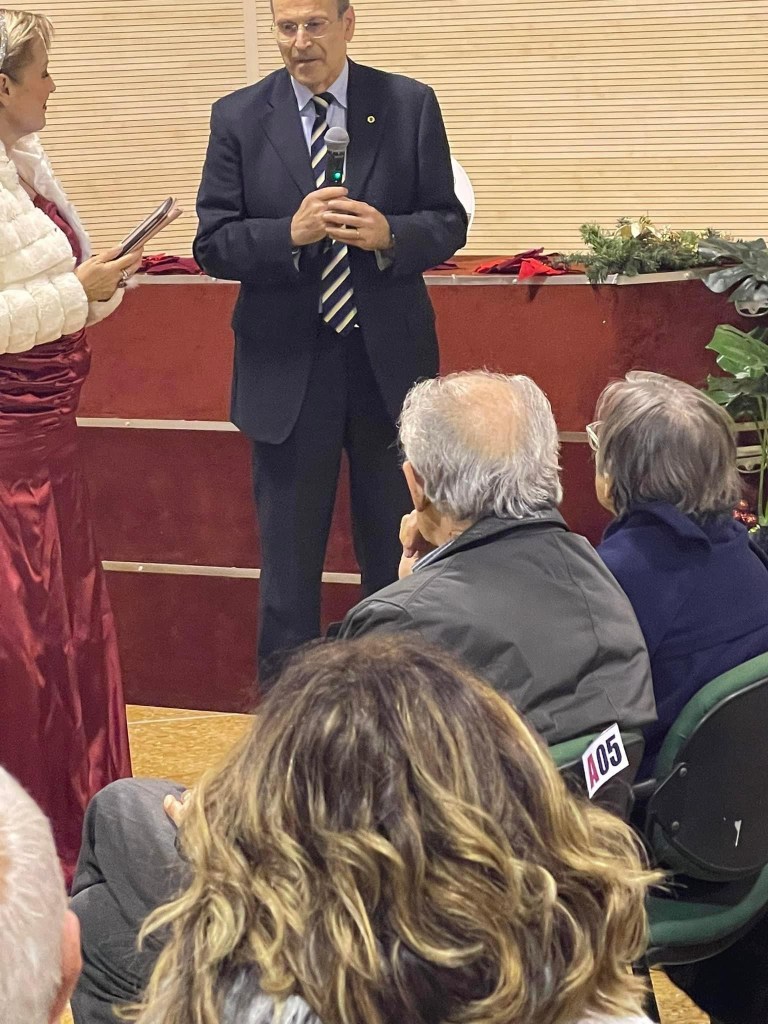
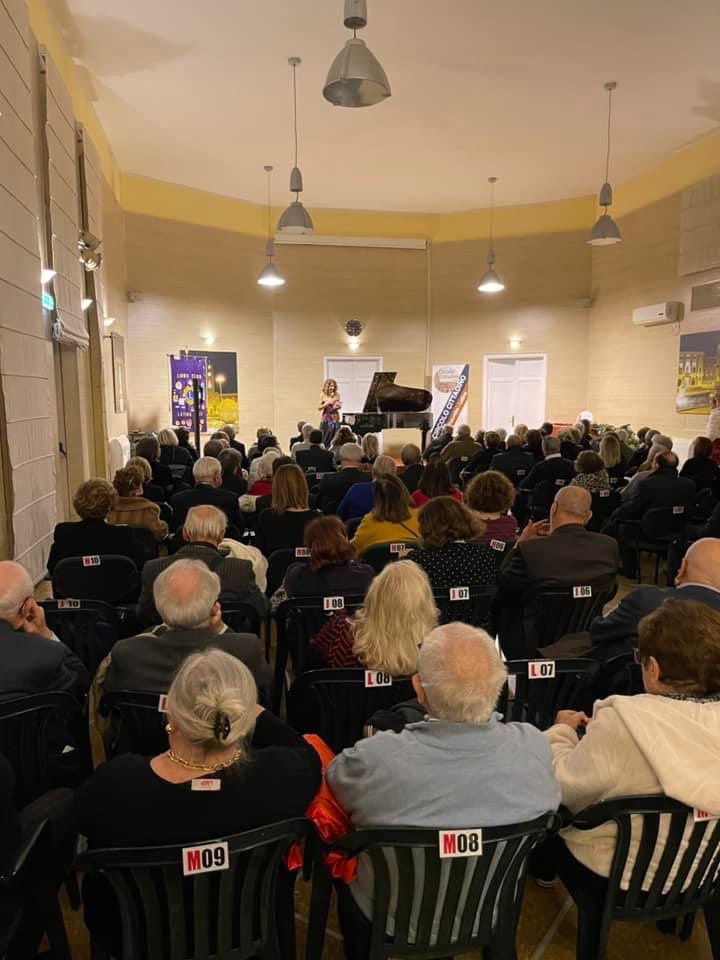
Cristiana today in Latina with a benefit concert for the Lions Club Latina to create funds for the Breast Cancer Unit at the Goretti Hospital.A guest of Alfredo De Santis and Roberto Volpe the untiring organisers of fund raising events in Latina.

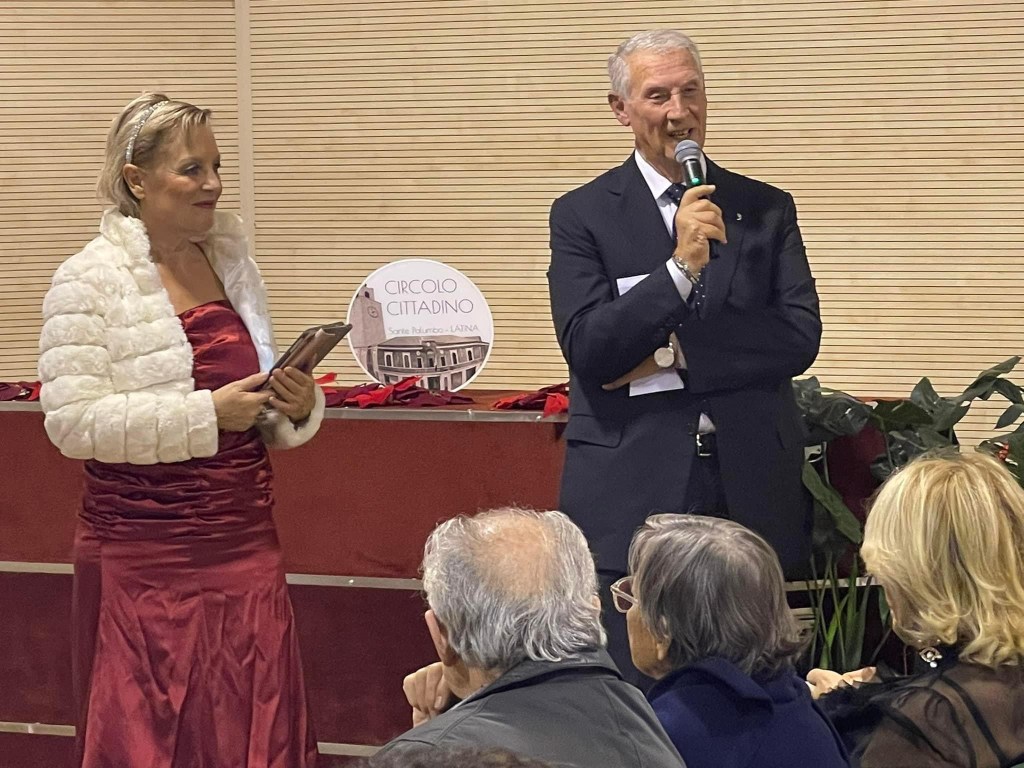
Dott.De Santis welcoming the audience that had filled everything seat in the theatre of the Town Hall
Dott.Roberto Volpe ,President of Lions Latina, presenting Cristiana Pegoraro for the second time to Latina

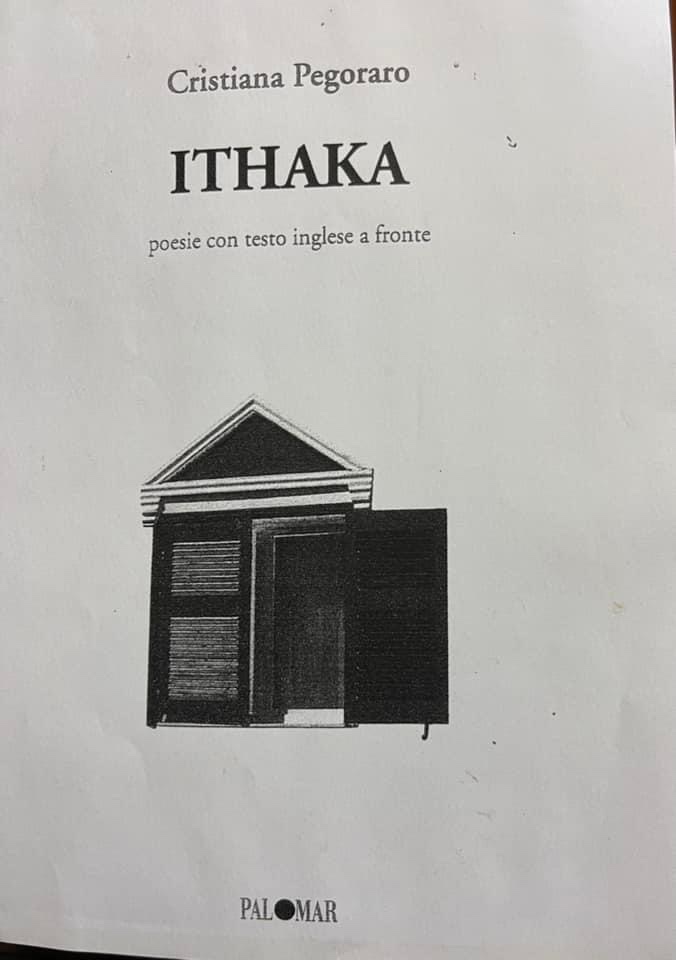
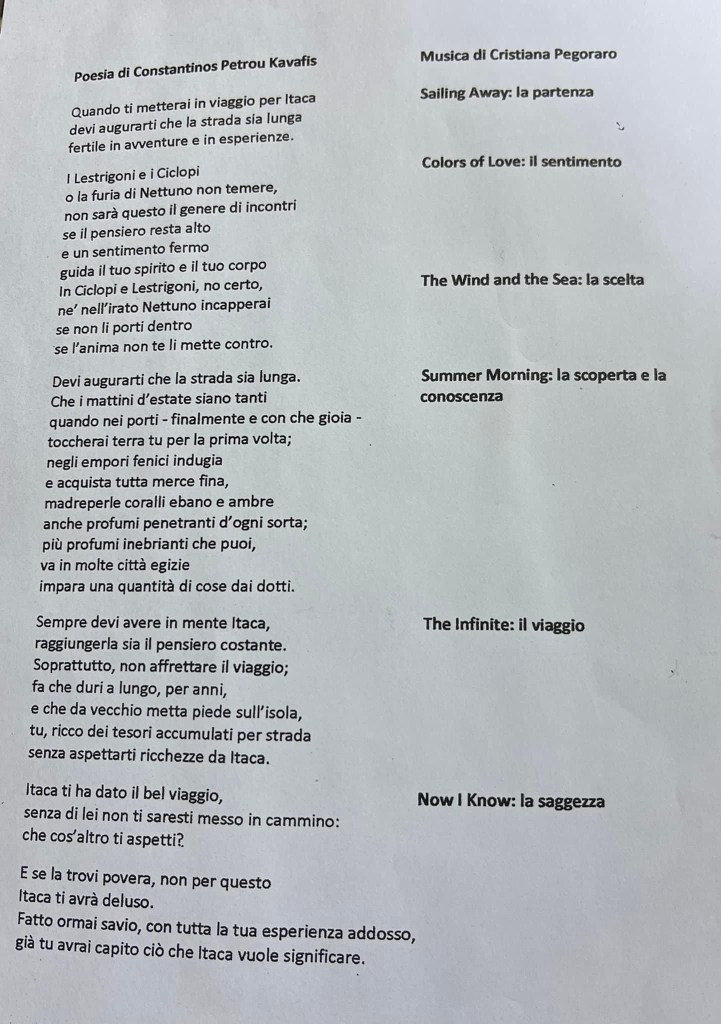
A voyage of Ithaka a modern day Ulysses.A theme inspired by the poetry of Costantino Petrou Kavatis.

A voyage of life around which Cristiana had composed a suite that describe a life’s journey in search of love.

Her own book of poetry is dedicated to her parents for never having denied her the possibility to dream.

Sold out hall for benefit of the local hospital

In fact it is Giuseppe Giacovazzo who beautifully sums up the meaning of Cristiana’s message:‘ A book of verse that is a love letter without address.Sent to eternity but with an unknown destination .A letter inexorably destined to a mailbox………hers. Releasing a secret chest,a kite to the wind.And it was returned to its sender.Like the kites.Cristiana could not have expected anything else from her thirst.So limitless.

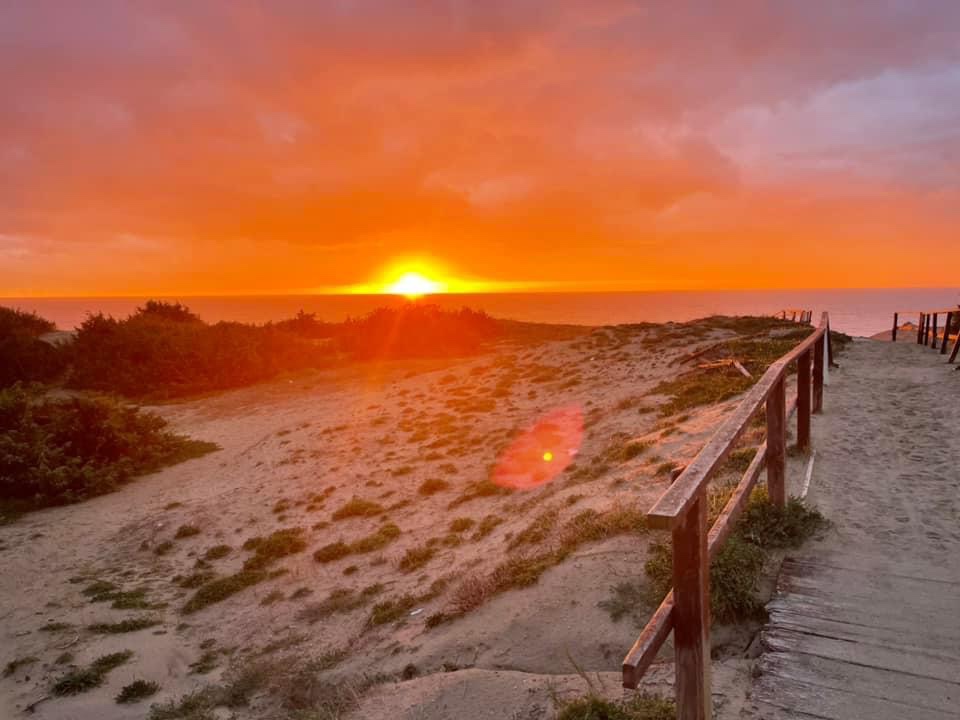
What better than this view of the sea just 20 minutes from Latina ,in Sabaudia,on the way to Cristiana’s magic journey of Ithaka

There is a musical trace of her in those verses:the sea.Its music .”This autumn is becoming too vast for those who cannot forget the colour of the sea”.She feels life like the sea that “stole the imprints from the sand”In the winter months she dreams of being the seagull that dominates,alone,the waves of the sea.And the storms of love.This is the music that accompanies the song of her piano.

And so it was with the pieces she chose from her suite that described this journey.’Sailing away’;’The wind and the sea’;’Summer morning’;’Infinite’;’Now I know’.Some very descriptive playing of great colour and passionate involvement.A technical command that allowed her to bring her classical training to an almost improvised outpouring of sounds.From the whispered secrets of the sea to the passionate wind.Every bit as expressive as Ravel or Debussy but with a more immediate popular melodic appeal.

Opening with a ‘smile’ as she delightfully describe the start of her journey.Mozart’s Turkish March from his Sonata K.331 was played with impeccable style and good taste.As she said it was written for a piano in Mozart’s day,that would have provided a pedal effect of drums and bells that in Cristiana’s hands were more than amply provided for from this gleaming Brodmann Grand.

Terni in the regione of Umbria like Perugia,Spoleto and Assisi.Terni home of San Valentino who gives the name to it’s Cathedral

This was followed by a piece dedicated to the patron saint of her home town of Terni:San Valentino.A work that also summed up the message that Cristiana wanted to share with us today:’Colours of Love- Never loose the courage to love’.

By request of our host Dott De Santis her own transcription of Rossini’s Figaro from the Barber of Seville was played with scintillating jeux perlé and remarkable technical command.

Let’s not forget that Cristiana a while ago asked me if she could play the 32 Beethoven Sonatas in our concert season where her debut recital had included Chopin’s 24 Preludes.A real virtuoso ,dedicated also to concerts with a social meaning but who after her early studies in Italy had continued at the Juilliard School in New York where she plays regularly to a sold out Weil Hall of the Carnegie Hall

Cristiana in rehearsal on a new Brodmann piano that unfortunately she had not noticed a bass ‘A’that did not repeat .It made her second encore of Piazzola a bit of a nightmare due to it’s repeated pedal note of ‘A’!!!Her great professionality ,though,turned a problem into a triumph!Her first encore of a repeat of ‘Sailing away’ had brought us magically full circle.
Dott De Santis looking on with great satisfaction at the great success that Cristiana had brought to Latina
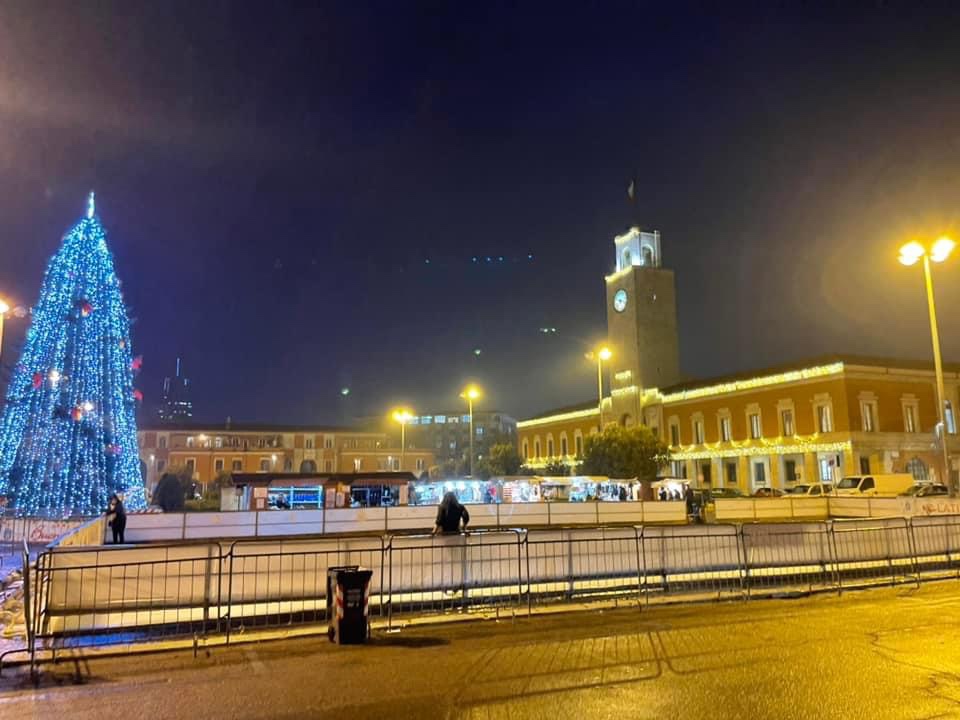
Latina in Christmas mood ……..Piazza del Popolo and the Town Hall

https://christopheraxworthymusiccommentary.com/2019/08/20/cristiana-pegoraro-celebrates-filippo-berardini-in-san-sebastiano-dei-marsi/

Christmas comes to Frascati The gift of music illuminates the city.

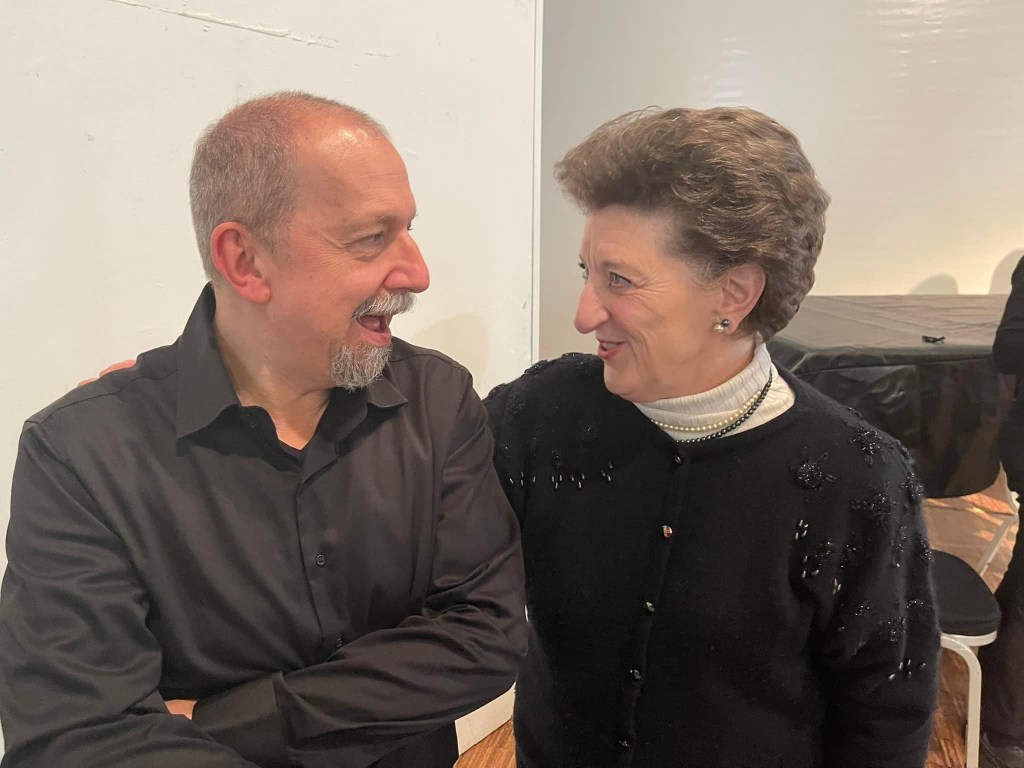
Federico Biscione with Marylene Mouquet

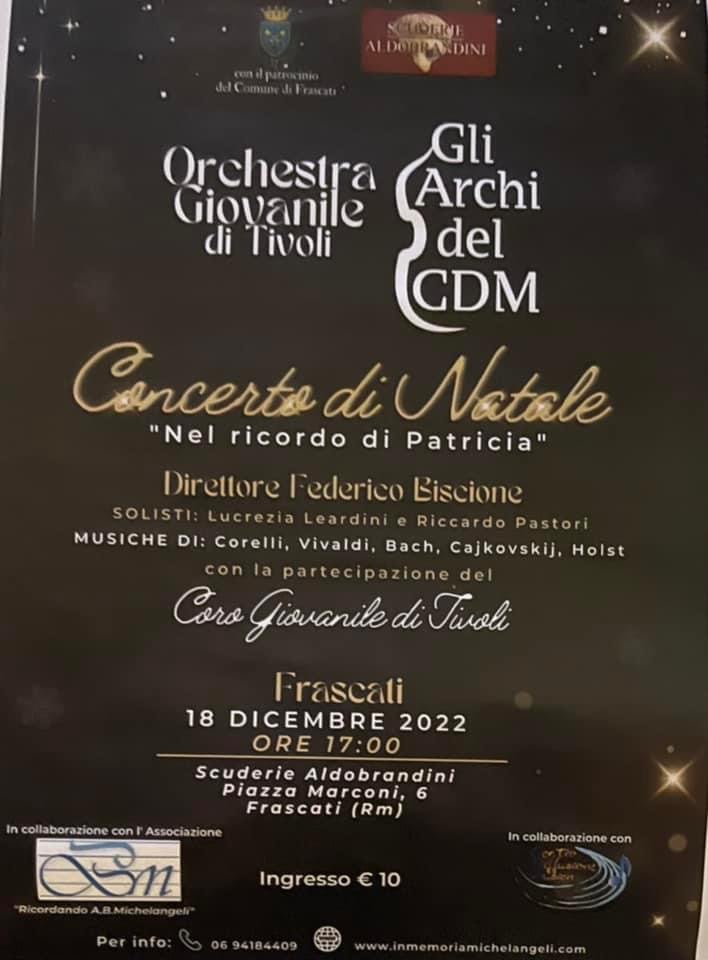
What a memorable celebration the distinguished pianist Marylene Mouquet had organised in memory of her daughter,Patricia,who died tragically in December 2004.

https://christopheraxworthymusiccommentary.com/2021/04/16/marylene-mouquet-at-villa-grazioli-for-the-michelangeli-association-in-celebration-of-beethoven/

Marylene has long been a central figure in Frascati where her Association dedicated to her teacher Arturo Benedetti Michelangeli has long given a platform to talented young musicians with her concert series in the historic Villa Aldobrandini in Frascati .Once a year she also invites young piano stars from the prestigious Keyboard Trust to perform in her series.

https://christopheraxworthymusiccommentary.com/2022/05/23/shunta-morimoto-a-colossus-bestrides-villa-aldobrandini-as-it-had-when-liszt-was-in-residence/. https://christopheraxworthymusiccommentary.com/2020/02/01/yuanfan-yang-in-italy-part-2-viterbofrascati-and-rome/

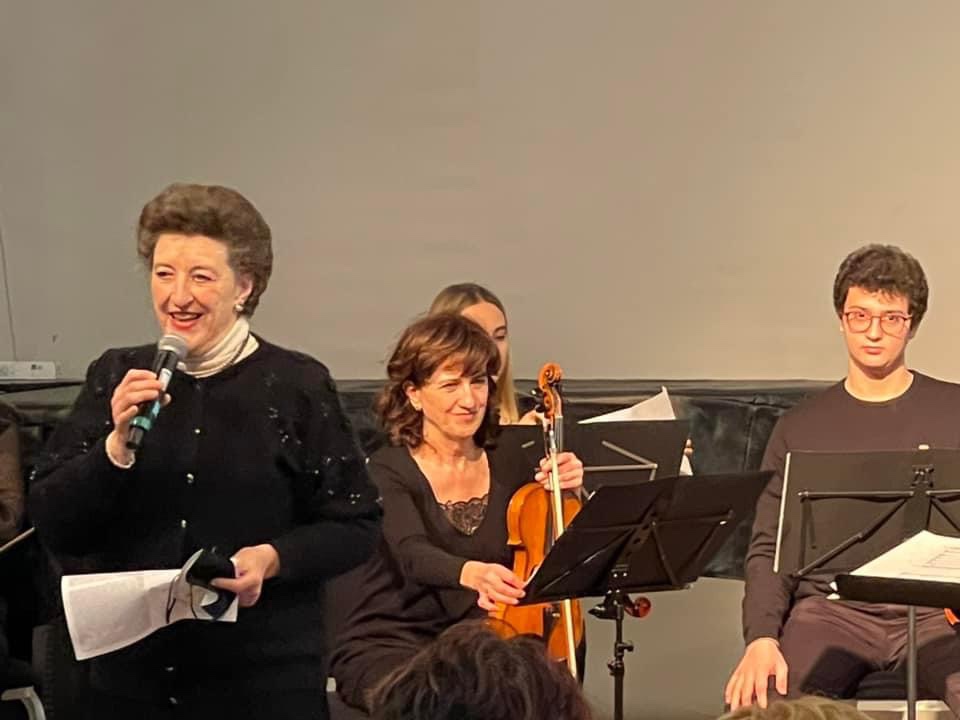
Marylene introducing her guests

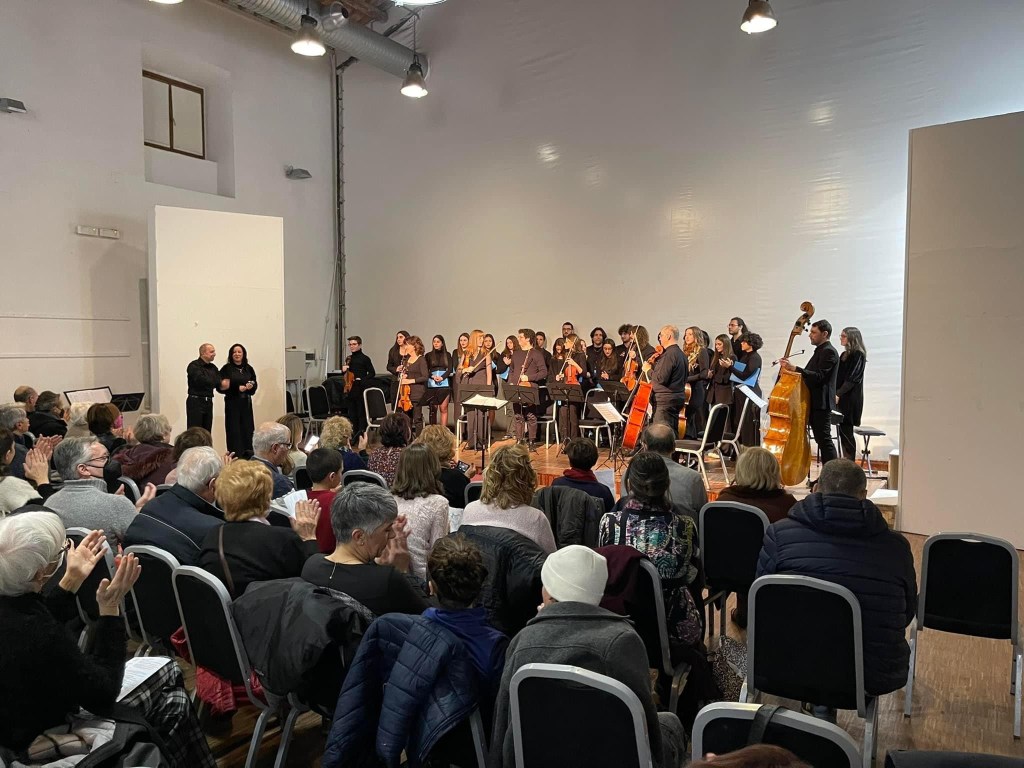
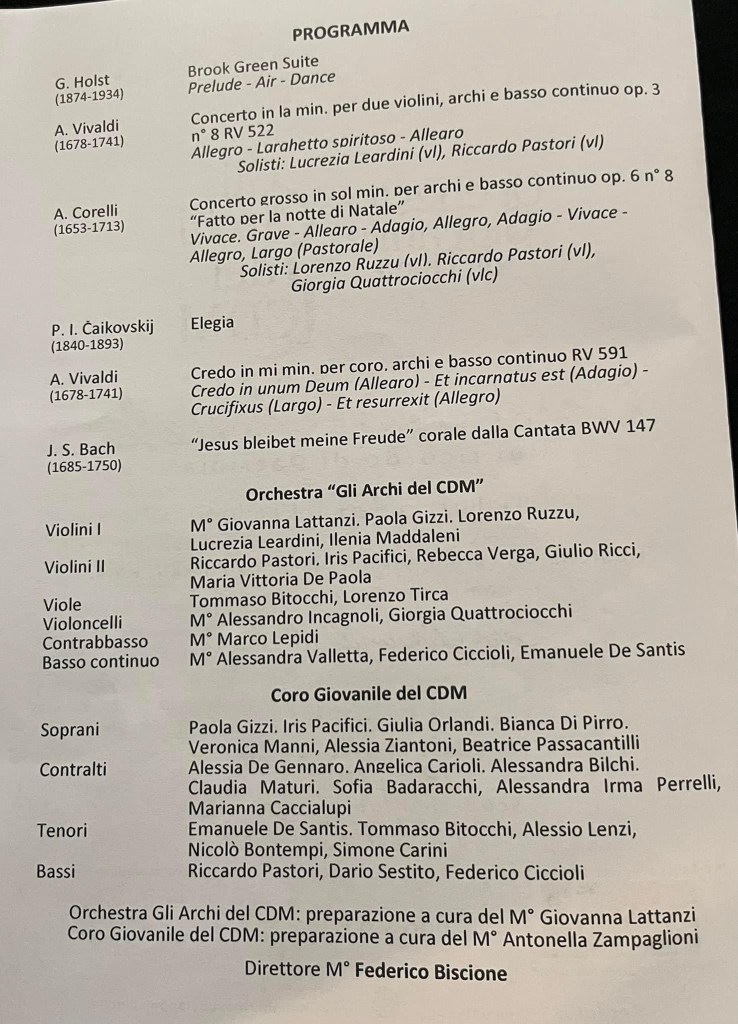
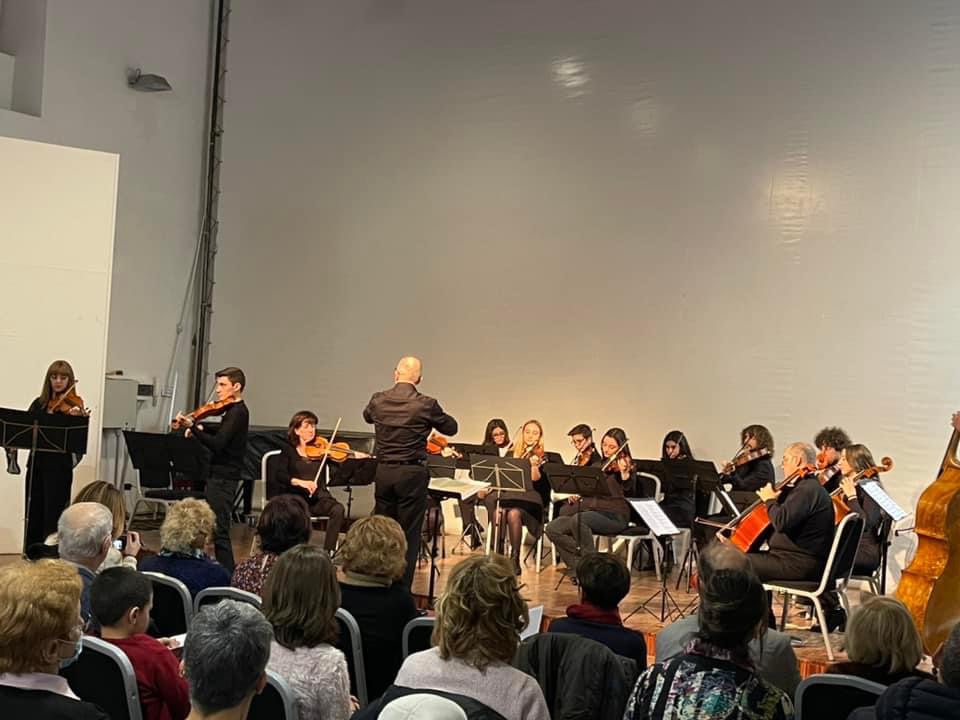
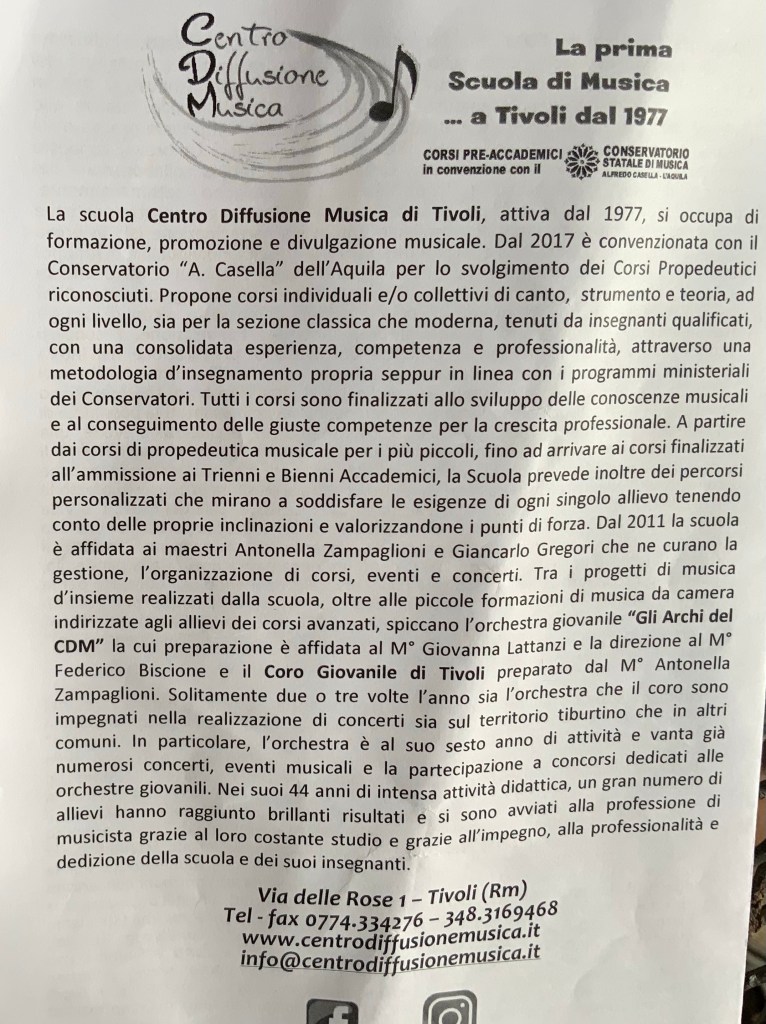
Every year a Christmas concert is dedicated to her daughter’s memory and this year she had invited musicians from the Centro Diffusione Musica at Tivoli directed by Federico Biscione.With his passionate commitment and the superb preparation of the string orchestra by Giovanna Lattanzi and the chorus by Antonella Zampaglioni they gave remarkable performances of works from Bach,Vivaldi and Corelli to Tchaikowsky and even Holst.

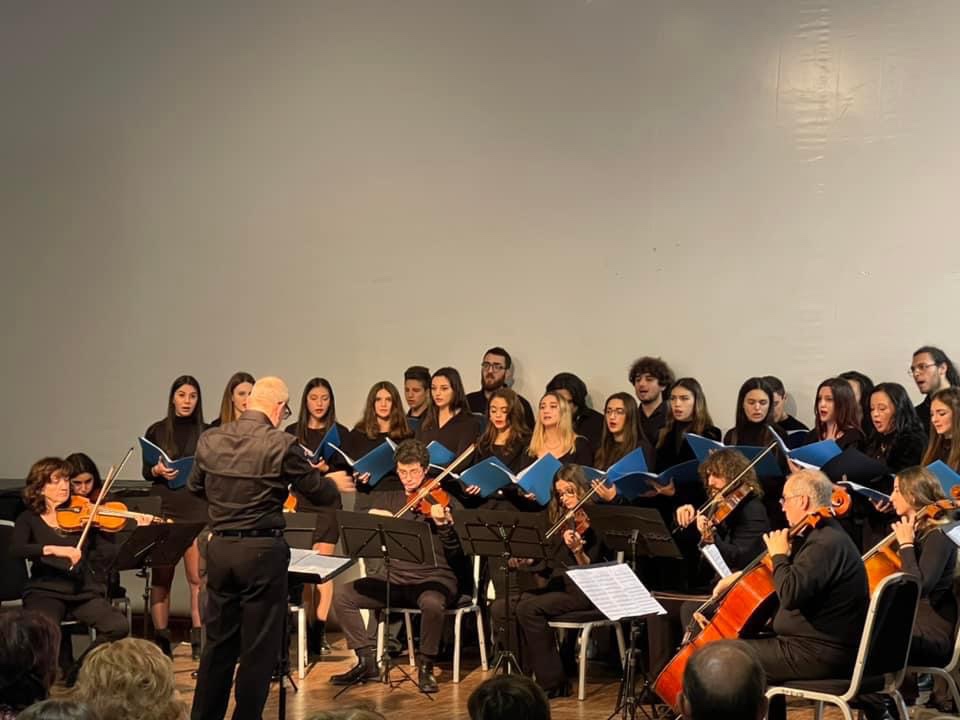
The CDM orchestra and choir

Remarkable,considering that these young students are delving into music with evident seriousness but also with real joy and passion.It was refreshing to see some of the orchestral musicians,girls but also numerous boys,joining the choir for a splendidly rhythmically engaging Vivaldi Credo,transmitting too the sublime simplicity of Bach’s Jesu Joy of Man’s Desiring.We hear so often in the mass media of the problems of students struggling to survive in an ever more populated world.What we never hear about is the joy and passion that youthful commitment to making music together can give them them as they share their passion with others.The Gift of Music is a wondrous thing and it is thanks to Marylene that she has given us this gift from ‘Patricia’ to add moments of joy and peace,escaping for a moment the turmoil that we are told by the media is ever more engulfing us

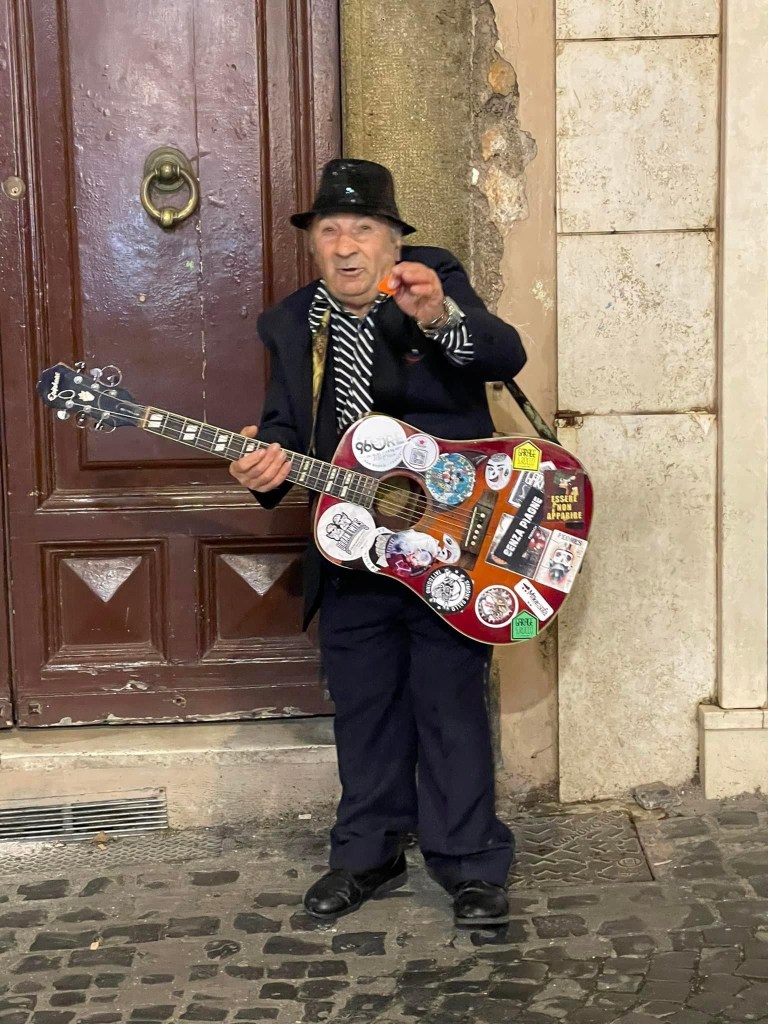
Music is everywhere in Frascati
Captured or captivating !
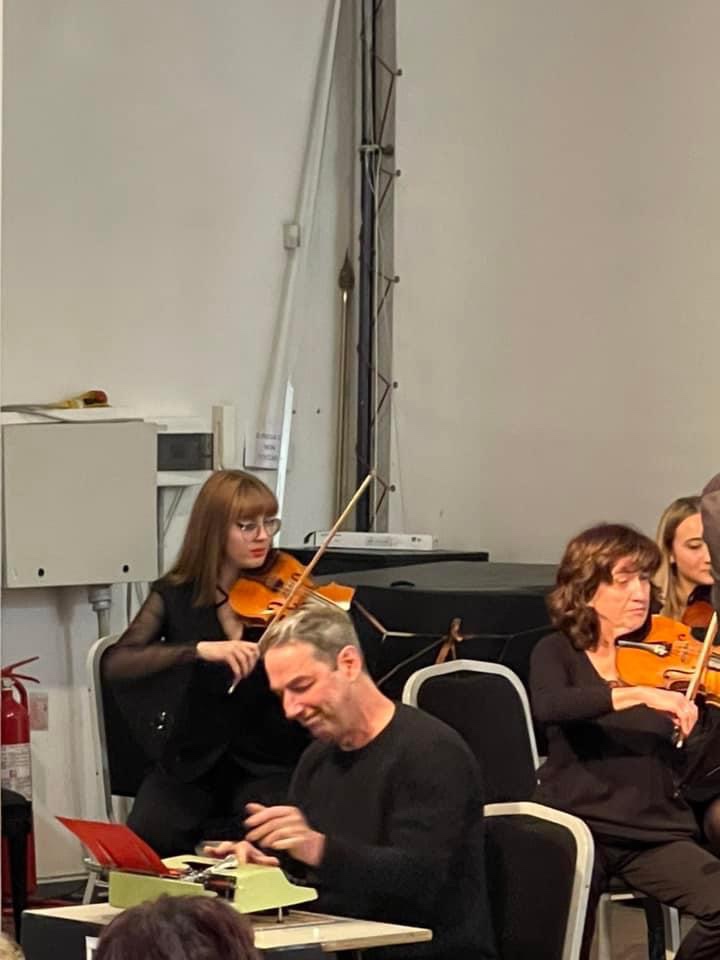
An addition to the programme gave us a chance to hear the Polka for typewriter and strings ….where the bell at the end of each line was fundamental to the delicious charm and flow of the music.
Lucrezia Leardini and Riccardo Pastori ,the splendid violin soloists in Vivaldi and Corelli
The extraordinary Choir and Strings of CDM of Tivoli playing with such commitment and accomplishment under the passionate baton of Federico Biscione
The streets of Frascati resounding once again to the ‘sound of music’
Liszt was a frequent visitor the the Villa Aldobrandini in Frascati and the Villa d’Este in Tivoli
https://christopheraxworthymusiccommentary.com/2022/09/14/the-gift-of-life-the-keyboard-trust-at-30/. https://youtu.be/9L9Vc0ebt7o. https://youtu.be/tu92-VR3YdM

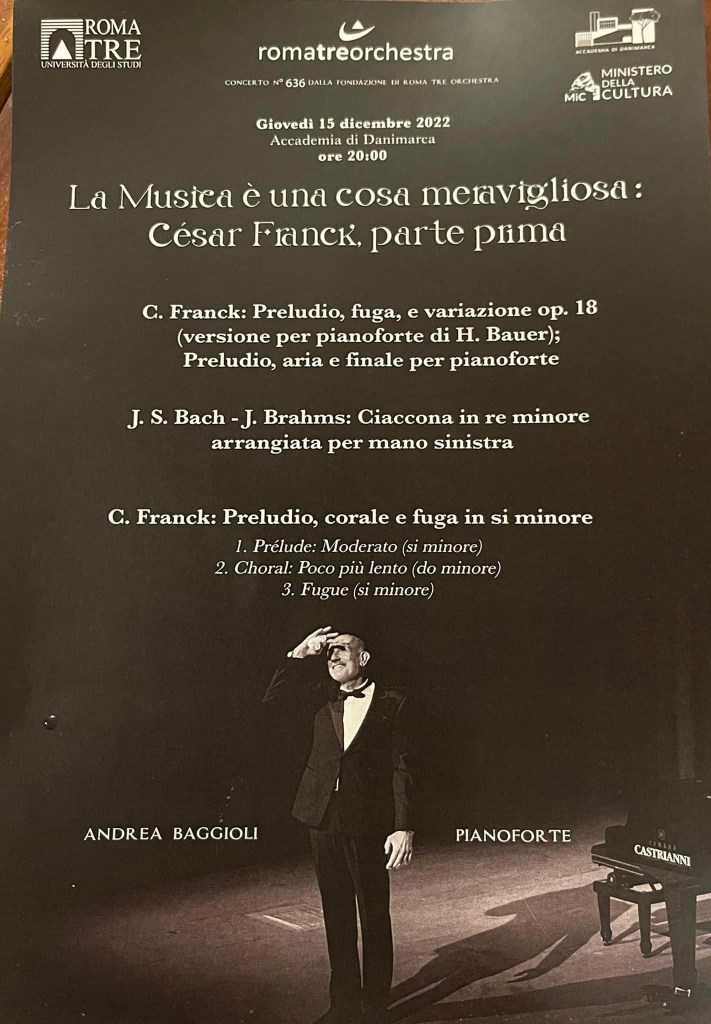
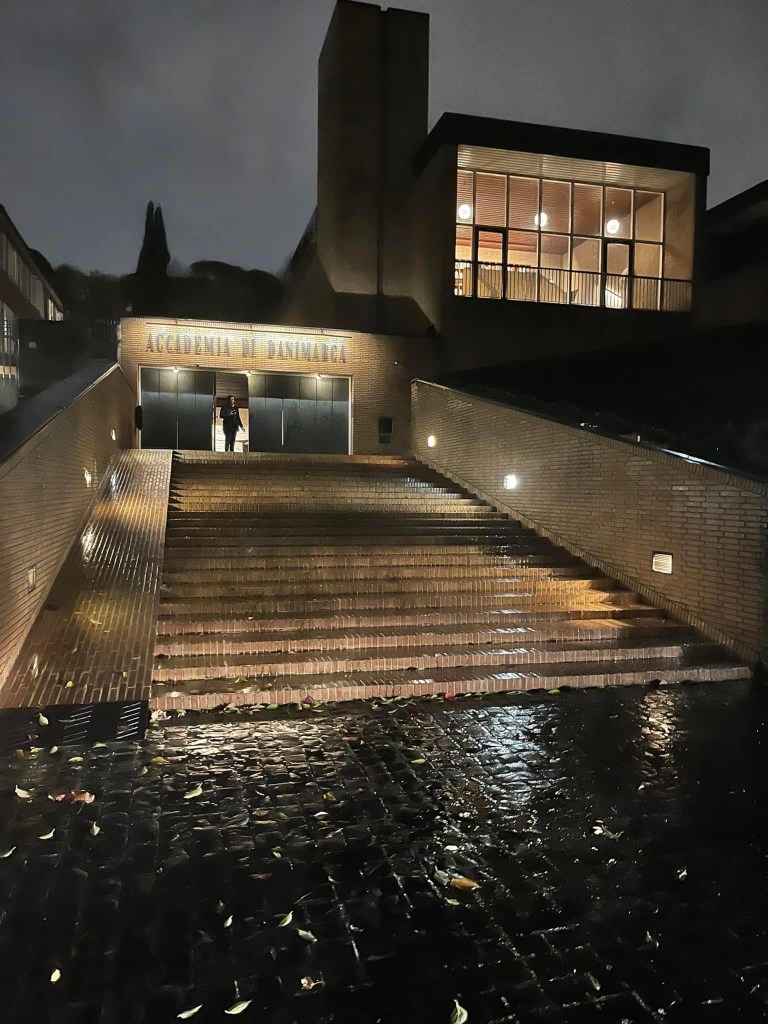
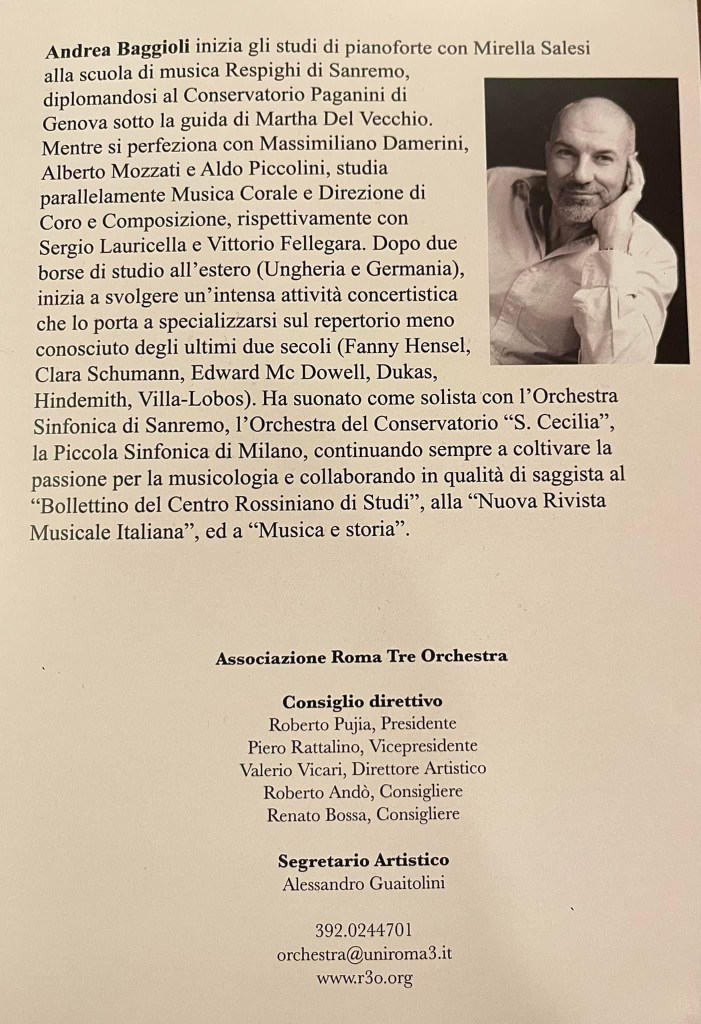
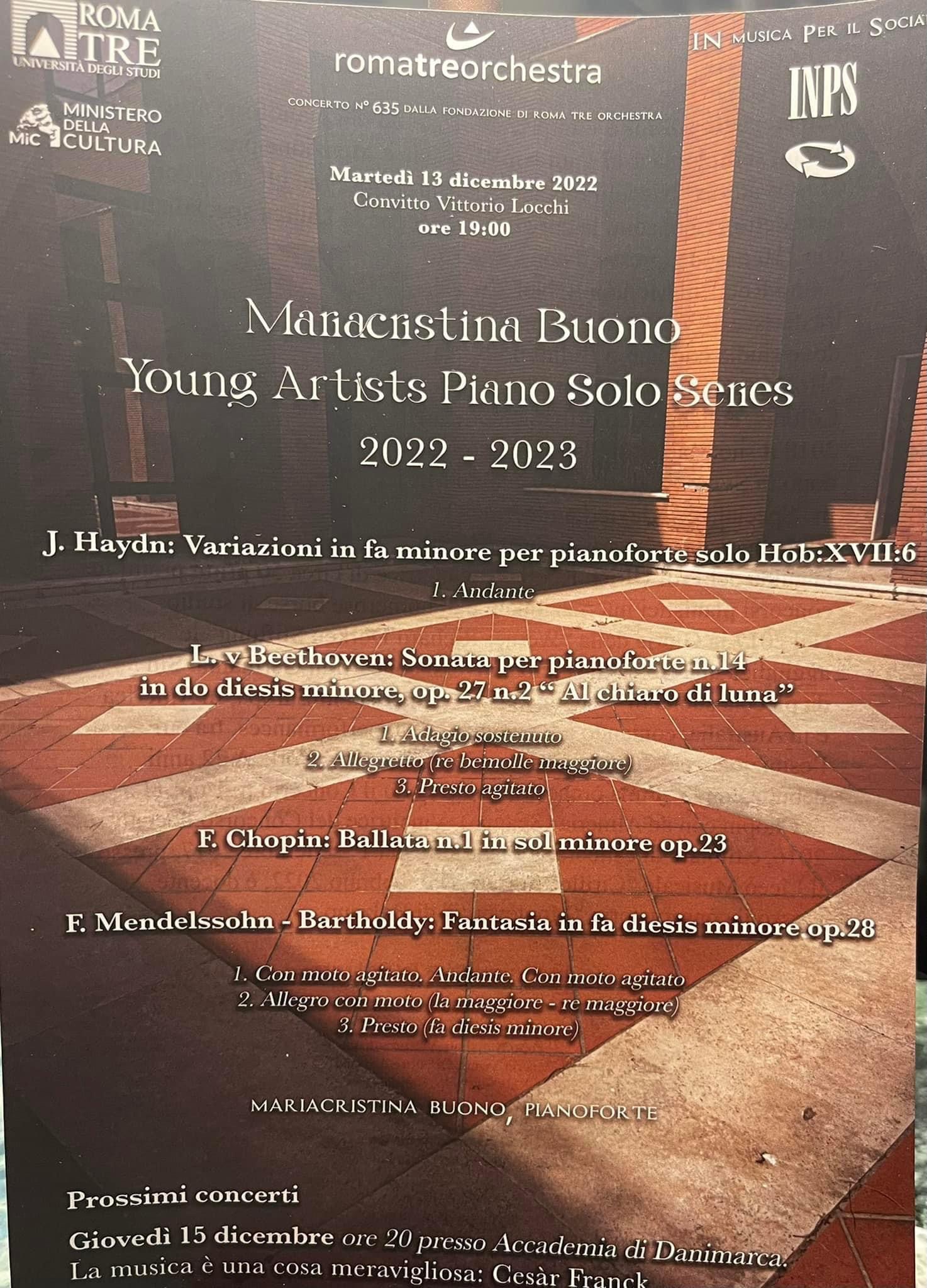
Andrea Baggioli – Roma 3 at the Danish Academy for the 200th Anniversary of César Franck

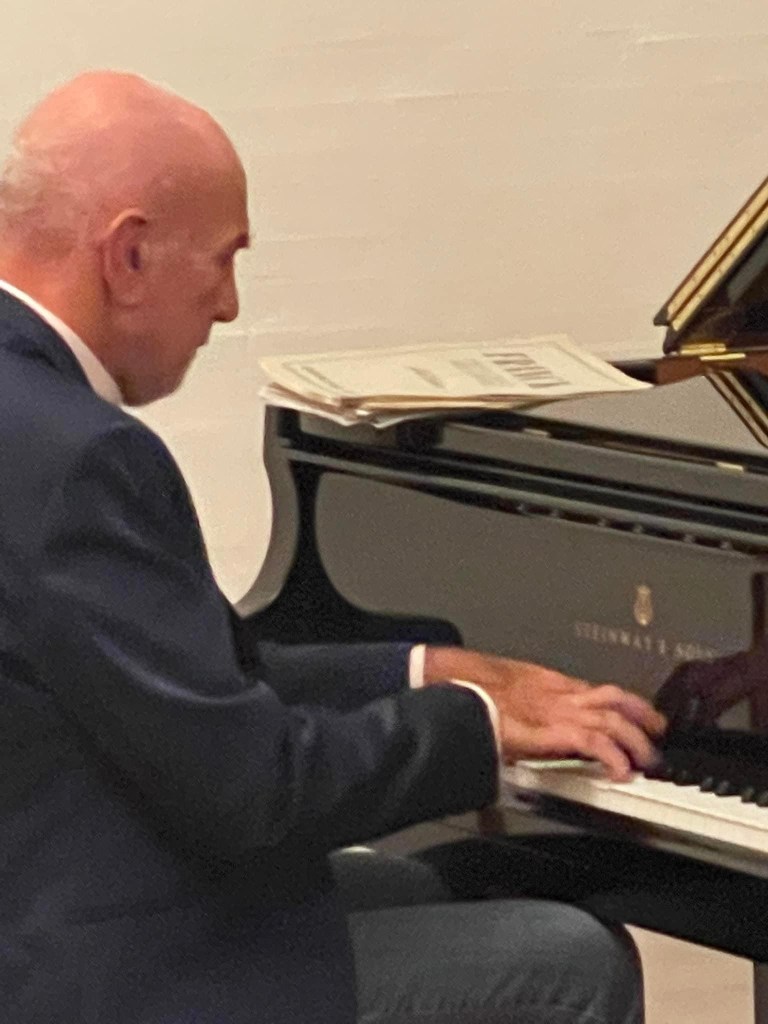
Fascinating to hear three master works for piano by César Franck on the 200th anniversary almost to the day of his birth on the 10th December 1822.The pianist and musicologist Andrea Baggioli was at the Danish Academy in Rome to remind us of the importance of these works that are rarely heard in concert these days and certainly not together.Including also the Bach Chaconne not in the more usual Busoni transcription but in that of Brahms for the left hand alone.Playing of great architectural understanding if sometimes not of the clarity in Franck that would have made his ingenious counterpoints even more revealing.What better way to celebrate Cesar Franck’s 200th anniversary than with his Prelude Chorale and Fugue when it is played with such weight and authority.A prelude bathed in mysterious colours with clouds of pedal and a chorale that was allowed to shine on high above magisterial spread chords.The bold entry of the fugue and its climax on which the sublime opening theme in this cyclic work floated into the air of the Danish Academy ,as it must have done in St Clotilde in Paris , creating a magic that was to lead to the triumphant and nobly emphatic exultation of a true believer.

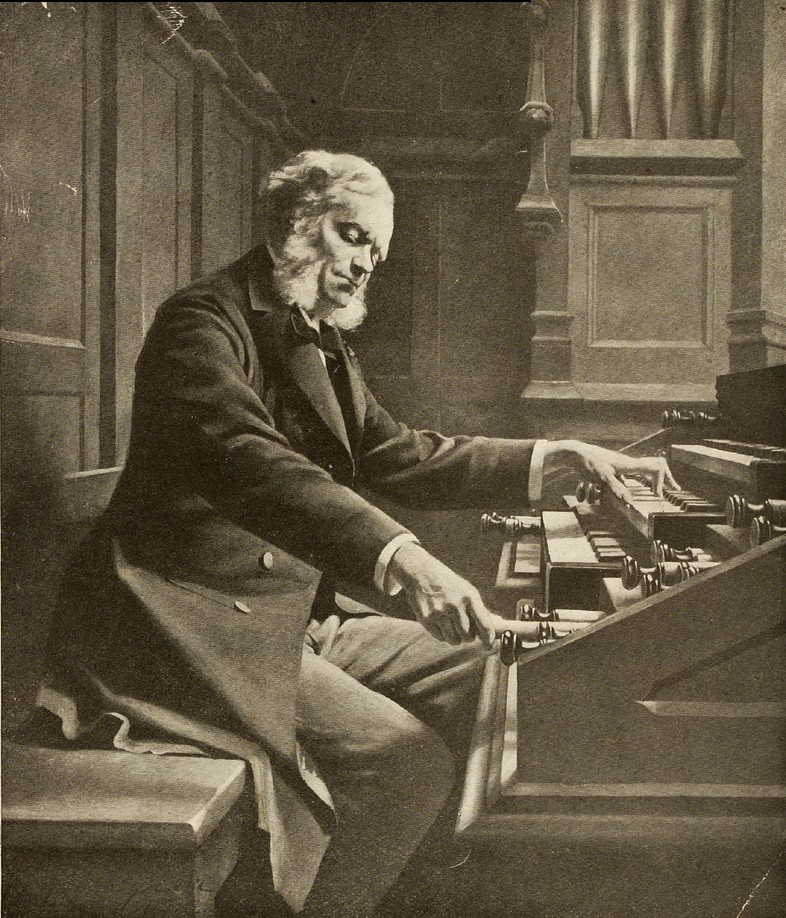
Prélude, Choral et Fugue, FWV 21 was written in 1884 and is an exemple of Franck’s distinctive use of cyclic form .The key to Franck’s music may be found in his personality. His friends record that he was “a man of utmost humility, simplicity, reverence and industry.” Louis Vierne , a pupil and later organist titulaire of Notre-Dame, wrote in his memoirs that Franck showed a “constant concern for the dignity of his art, for the nobility of his mission, and for the fervent sincerity of his sermon in sound… Joyous or melancholy, solemn or mystic, powerful or ethereal: Franck was all those at Sainte-Clotilde.”Franck had huge hands (evinced by the famous photo of him at the Ste-Clotilde organ), capable of spanning the interval of a 12th on the keyboard.This allowed him unusual flexibility in voice-leading between internal parts in fugal composition, and in the wide chords and stretches featured in much of his keyboard music.In his search to master new organ-playing techniques he was both challenged and stimulated by his third and last change in organ posts. On 22 January 1858, he became organist and maître de chapelle at the newly consecrated Sainte-Clotilde (from 1896 the Basilique-Sainte-Clotilde), where he remained until his death. Eleven months later, the parish installed a new three-manual Cavaillé-Coll instrument,whereupon he was made titulaire. The impact of this organ on Franck’s performance and composition cannot be overestimated; together with his early pianistic experience it shaped his music-making for the remainder of his life.

Here is the rare historic recording of Blanche Selva in 1928 one of the pioneers of french music https://youtube.com/watch?v=IdlM-nK8ppM&feature=share

Prélude, Aria et Final, op 23 was written in 1886 – 87 Unusually for a composer of such importance and reputation, Franck’s fame rests largely on a small number of compositions written in his later years, particularly his Symphony in D minor (1886-88) the Symphonic Variations for piano and orchestra (1885), the Prelude Chorale and Fugue for piano solo (1884), the Violin Sonata in A (1886), the Piano Quintet in F minor (1879), and the symphonic poem Le Chasseur maudit (1883).

Here is the historic 1932 recording of Alfred Cortot whose edition of the score Andrea was using today https://youtube.com/watch?v=WV2cEfjlHec&feature=share

César Franck at the console, painting by Jeanne Rongier , 1885

His set of Six Pièces for organ, written 1860–1862 (although not published until 1868). These compositions (dedicated to fellow organists and pianists, to his old master Benoist, and to Cavaillé-Coll) remain part of modern organ repertory and were,the first major contribution to French organ literature in over a century, and “the most important organ music written since Mendelssohn”.The group includes two of his best-known organ works, the “Prélude, Fugue et Variation”, op. 18 and the “Grande Pièce Symphonique op 17.”Franck was inspired to write this organ piece for the instrument at the church of Sainte-Clotilde. While it sounds majestic on the organ, it is also frequently heard in Harold Bauer’s transcription for the piano.The Prelude, Fugue and Variation, Op. 18 is one of Franck’s Six Pieces for organ, premiered by the composer at Sainte-Clotilde on 17 November 1864. They mark a decisive stage in his creative development, revealing how he was building on the post-Beethoven Germanic tradition in terms of the importance given to musical construction.


The Prelude, Fugue and Variation is dedicated to Saint-Saëns. Years earlier, when Franck published his Op. 1 trios, Liszt was among their admirers but had advised his younger colleague to write a new finale for the third of the trios and create a separate work from the original finale – this became Franck’s Fourth Piano Trio, Op. 2, dedicated to Liszt. In spring 1866, the Hungarian composer was in Paris for the French premiere of his Missa solennis for the consecration of the Basilica in Gran (Esztergom) at the Église Saint-Eustache on 15 March, a work about which Franck was enthusiastic. At the beginning of his stay, Liszt had come to listen to Franck improvising at Sainte-Clotilde and, apparently at Duparc’s instigation, a second private performance took place on 3 April. Franck wanted to play Liszt’s Prelude and Fugue on the Name BACH but the latter asked instead to hear Franck’s own Prelude, Fugue and Variation.


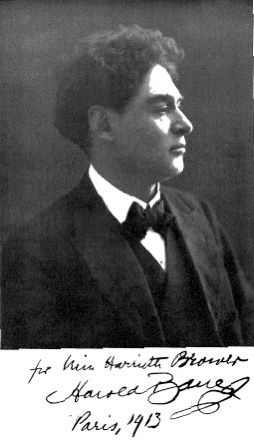
The piano transcription of this organ work was made by Harold Bauer (1873-1951), the British pianist who gave the world premiere of Debussy’s Children’s Corner and was the dedicatee of Ondine, the first piece in Ravel’s Gaspard de la nuit.Harold Bauer made his debut as a violinist in London in 1883, and for nine years toured England. In 1892, however, he went to Paris and studied with Paderewski for a year.In 1900, Harold Bauer made his debut in America with the Boston Symphony Orchestra, performing the U.S. premiere of Brahms’Piano Concerto No.1 in D minor. On 18 December 1908, he gave the world premiere performance of Debussy’s Children’s Corner Suite in Paris.After that he settled in the United States.He was also an influential teacher and editor, heading the Piano Department at the Manhattan School of Music . Starting in 1941, Bauer taught winter master classes at the University of Miami and served as a Visiting Professor at the University of Hartford Hartt .Students of Harold Bauer include notably Abbey Simon and Dora Zaslavsky.

Here is Mariam Batsashvili talking about and playing this Franck /Bauer transcription https://youtube.com/watch?v=35ZYj_SNvYM&feature=share

Presenting his transcription to Clara Schumann (his friend and the widow of Robert Schumann), Brahms wrote: “The Chaconne is, in my opinion, one of the most wonderful and most incomprehensible pieces of music. Using the technique adapted to a small instrument, the man writes a whole world of the deepest thoughts and most powerful feelings. If I could picture myself writing, or even conceiving, such a piece, I am certain that the extreme excitement and emotional tension would have driven me mad. If one has no supremely great violinist at hand, the most exquisite of joys is probably simply to let the Chaconne ring in one’s mind. But the piece certainly inspires one to occupy oneself with it somehow…. There is only one way in which I can secure undiluted joy from the piece, though on a small and only approximate scale, and that is when I play it with the left hand alone…. The same difficulty, the nature of the technique, the rendering of the arpeggios, everything conspires to make me feel like a violinist!”

Here is the 1889 recording of Brahms himself playing – not the chaconne unfortunately but a short extract of one of his Hungarian Dances https://youtube.com/watch?v=H31q7Qrjjo0&feature=share

Majesty and vastness are easily conjured when two hands and a grand piano, or for that matter a full symphony orchestra, are called into service. But it is far more challenging to recognize that the true genius of the Chaconne is that it achieves its immenseness within the confinements of a single violin, and then to seek to inhabit on the piano this achievement with just the left hand alone.

Valerio Vicari,artistic director of Roma 3 having battled with a rain storm in Rome arriving late but not too late to applaud his distinguished Professor from the S.Cecilia Conservatory

Mariacristina Buono bringing Christmas to Roma 3 with intelligent brilliance.

Mariacristina Buono – Young Artists Piano Solo Series 2022 – 2023

I might have guessed that our genial host at Roma 3,Valerio Vicari,would have something special up his sleeve for the last concert before Christmas of his Young Artists Piano Solo Series.
The surprise was a beautiful young pianist from the school of Benedetto Lupo in Bari – the home of San Nicola – Father Christmas.After a recital of well known classics from the piano repertoire she appeared with one year old baby Leonardo in her arms.

Mariacristina with baby Leonardo and Valerio Vicari


Having just watched a Christmas Carol in the Ghione Theatre too I am feeling very much in the Christmas Spirit in the Eternal City.


Mariacristina Buono trained from an early age under Benedetto Lupo and went on to study with Fabio Bidini in Cologne and in Zurich with Ulrich Koella.
It was no surprise then that her intelligent musicianship from such superb mentors shone through everything she played.
Haydn Variations that were played with a clarity and impeccable phrasing with the tempo intelligently maintained as the variations were allowed to unfold so naturally.
If it was slightly missing grace and charm it was in part due to the brightness of this magnificent Fazioli Concert Grand that stands so proudly in this overly spacious rationalist hallway.
It was also,we realised later,the tension at leaving baby Leonardo in the Green Room while his very talented mother left him in his grandmother’s arms so she could offer us her gift of music that she had brought from Bari to the Eternal City.

The return to Bari


Leonardo’s cousins ,uncle and grandmother had travelled up together to Rome to enjoy this musical treat that Maria Cristina was sharing so generously with us today.

The new venue for Roma 3 concerts


This is the splendid new venue that Valerio has added to the Teatro Palladium and the historic Teatro Torlonia.
The Convitto Vittorio Locchi is just a stone’s throw from Roma 3’s Teatro Palladium and is in its own grounds where open air concerts were held this summer under the portico of this very imposing building which is the seat of INPS – the official Italian social security office.


Beethoven’s so called ‘Moonlight’Sonata was allowed to flow naturally with the melodic line architecturally shaped.Sustained by the anchor in the bass as the triplets were obviously the gently flowing waves of Lake Lucerne that had inspired Rellstab’s naming of ‘Moonlight.’The Allegretto was gracefully played and phrased so intelligently with scrupulous attention to the composer’s indications.The imposing Trio was played with weight as it contrasted so well with the gentle charm of the ‘Minuet’.Leading immediately into the Presto agitato that was played with startling rhythmic energy and real Beethovenian bite.The tumultuous last cascades of notes finally came to rest on a trill that unwound so naturally as it led to the downward scale which heralded the exciting final few bars.


Chopin’s first Ballade is one of the best known works by Chopin and in Mariacristina’s intelligent hands it was restored to the aristocratic tone poem that had been inspired by the poet Adam Mickiewicz.
From the very opening flourish that was played like someone opening a book with a tale about to be told .Coming to rest on a long held note that gradually dissolves as Chopin recounts his story of ravishing beauty and nobility.The subtle beauty of the opening led to the nobility of the first passionate climax played with aristocratic authority and musical intelligence.It dissolved into brilliance and scintillating jeux perlé as it built up again to the outpouring of mellifluous passion leading to a transcendental coda of technical brilliance and excitement.


The Mendelssohn Fantasy op 28 found Mariacristina in a more relaxed mood as the reams of notes that Mendelssohn weaves with mercurial lightness just flowed so naturally from her fingers.Played with passionate conviction and architectural shape as she moulded the phrases with mercurial sentiment of great control and brilliance.If the Allegro con moto could have been lighter with more Italian charm than German nobility it was contrasted with the breathtaking brilliance of the Presto.Knowing Leonardo was enjoying her performance too she threw herself into the fray with astonishing abandon and passion.


All obviously was now well back stage and Mariacristina felt free to offer as a thank you to her enthusiastic audience Chopin’s final study op 25.Ocean waves flowing with passionate drive and ravishing sounds played with brilliance and a technical command with a musical line of clarity and intelligence.
Happy Christmas to you all from Valerio Vicari and his untiring team at Roma 3.

The Andante with variations in F minor (Hoboken 17/6), also known as Un piccolo divertimento, was composed in Vienna in 1793 for the talented pianist Barbara (‘Babette’) von Ployer, for whom Mozart had written the concertos K449 and K453. This profoundly felt music vies with the Andante of the ‘Drumroll’ Symphony as Haydn’s greatest set of alternating minor–major variations and is among his most popular piano works.It was possibly inspired by the death of Maria Anna von Genzinger (1754–93, called “Marianne”) The variations are a set of double variations, the first theme is in F minor and the second theme in F major.Two variations of each theme and an extended coda follow.Haydn’s last piano work is also considered to be his most famous single work for this instrument. The minor theme is filled with emotional depth: “a melancholy andante in f minor, with variations, as only a genius can do them, that almost sounds like a free fantasia” (thus described in a review of the time). The autograph shows us that the work was originally intended to be the first movement of a sonata.

Title page of the first edition of the score, published on 2 August 1802 in Vienna by Giovanni Cappi e Comp

The Piano Sonata No. 14 Quasi una fantasia, op 27 n.2 was completed in 1801 and dedicated in 1802 to his pupil Countess Giulietta Guicciardi The popular name Moonlight Sonata goes back to a critic’s remark after Beethoven’s death and comes from remarks made by the German music critic and poet Ludwig Rellstab. In 1832, five years after Beethoven’s death, Rellstab likened the effect of the first movement to that of moonlight shining upon Lake Lucerne.Beethoven’s pupil Czerny described the first movement as “a ghost scene, where out of the far distance a plaintive ghostly voice sounds”.Berlioz commented that it “is one of those poems that human language does not know how to qualify”

Autograph of the first movement

The first movement was very popular in Beethoven’s day, to the point of exasperating the composer himself, who remarked to Czerny, “Surely I’ve written better things”.although technically a sonata,’quasi una fantasia’is suggestive of a free-flowing, improvised fantasia.
Of the final movement, Charles Rosen has written “it is the most unbridled in its representation of emotion. Even today, two hundred years later, its ferocity is astonishing”.It is thought to have been the inspiration for Chopin’s Fantaisie Impromptu, and the Fantaisie-Impromptu to have been in fact a tribute to Beethoven.

The Grey Goose San Felice Circeo

Mendelssohn was among many nineteenth-century German composers, among them Beethoven, Schubert, Schumann, Brahms and Bruch, who were fascinated by Scotland, by its folk music, history and literature. Mendelssohn was the only one of these six who visited Scotland, when at the age of twenty during the summer of 1829 he found the inspiration for his Scottish Symphony at Holyrood Chapel in Edinburgh and for the ‘Hebrides’ Overture (also known as the ‘Fingal’s Cave’ Overture) on the desolate island of Staffa off the coast of Mull in the Hebrides. But well before he made his celebrated walking tour of Scotland in 1829, he was reading the poetry and novels of the ‘great wizard’ of the North, Sir Walter Scott, and was acquainted with the ‘Ossianic’ poems, one of the great literary forgeries of the eighteenth century. In the early 1820s he composed two settings of verses from Scott’s epic poem The Lady of the Lake (including the Ave Maria, also set by Schubert). Then, probably in 1828 or early 1829, the young composer attempted his first full-scale work inspired by a Scotland he had not yet seen or experienced. The three-movement Fantasia in F sharp minor, Op 28, eventually released in 1834, took shape originally as a ‘Sonate écossaise’, mentioned already in family correspondence from early 1829. Four years later, early in 1833, Mendelssohn revised the work, still titled ‘Sonate écossaise’, but then published it the following year as a Fantasia, without its Scottish attribution.

Christmas comes to Italy – the Grey Goose San Felice Circeo

The ballade dates to sketches Chopin made in 1831, during his eight-month stay in Vienna.It was completed in 1835 after his move to Paris, where he dedicated it to Baron Nathaniel von Stockhausen, the Hanoverian ambassador to France.

Autograph of the first page

In 1836, Robert Schumann wrote: “I have a new Ballade by Chopin. It seems to me to be the work closest to his genius (though not the most brilliant). I even told him that it is my favourite of all of all his works. After a long, reflective pause he told me emphatically: ‘I am glad, because I too like it the best, it is my dearest work.'”

Mariacristina Buono intraprende lo studio del pianoforte all’età di 5 anni, si diploma a 17 anni con 10, Lode e Menzione presso il conservatorio “Niccolò Piccinni” di Bari; prosegue gli studi con Benedetto Lupo, sotto la cui guida
consegue la Laurea specialistica con 110 e Lode, presso il conservatorio “Nino Rota” di Monopoli. Nel 2015 si trasferisce all’estero, dapprima in Germania dove studia con Fabio Bidini presso la “Hochschule für Musik und
Tanz” di Colonia, concludendo brillantemente nel 2018 il suo Master in Pianoforte solistico; dopo in Svizzera, dove frequenta un Master in “Specialized Klavierkammermusik” all’ Università delle arti di Zurigo, sotto la guida del Prof Ulrich Koella. E’ vincitrice di circa 50 primi premi in concorsi pianistici internazionali, e di numerose borse di studio. Nel 2017 la Giuria della “Werner Richard Dorken Stiftung” le aggiudica una Borsa di studio e diversi concerti in Germania. Sin da piccola suona in veste di solista e camerista in Europa, in America e in Australia, contando ad oggi più di 200 performances, fra cui l’esibizione, nel 2019, alla Carnegie Hall di New York. A 22 anni debutta con la “Fima orchestra” eseguendo il Concerto n. 1 op. 11 di Chopin con ad Almeria (Spagna). Vincitrice del Concorso docenti 2016, è titolare di cattedra di Pianoforte dal 1° settembre 2017, presso il Liceo Musicale “Cirillo” di Bari.
Dal febbraio 2022, è docente presso il conservatorio “Monteverdi” di Bolzano.

My adopted granddaughter Anastasia first birthday today too !
All well ,Christmas is here
Our genial host the artistic director of Roma 3 Valerio Vicari
Mariacristina presenting her programme