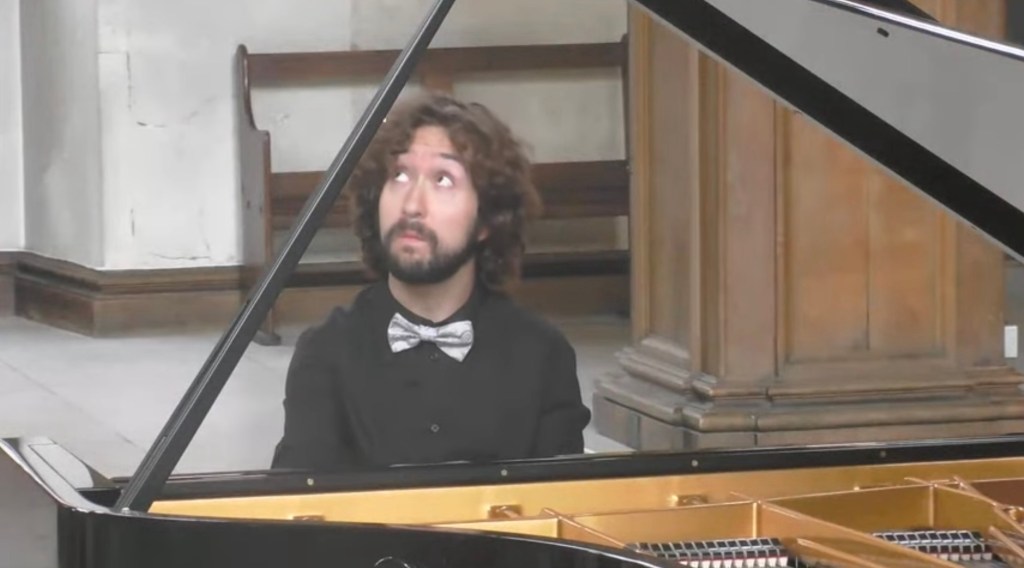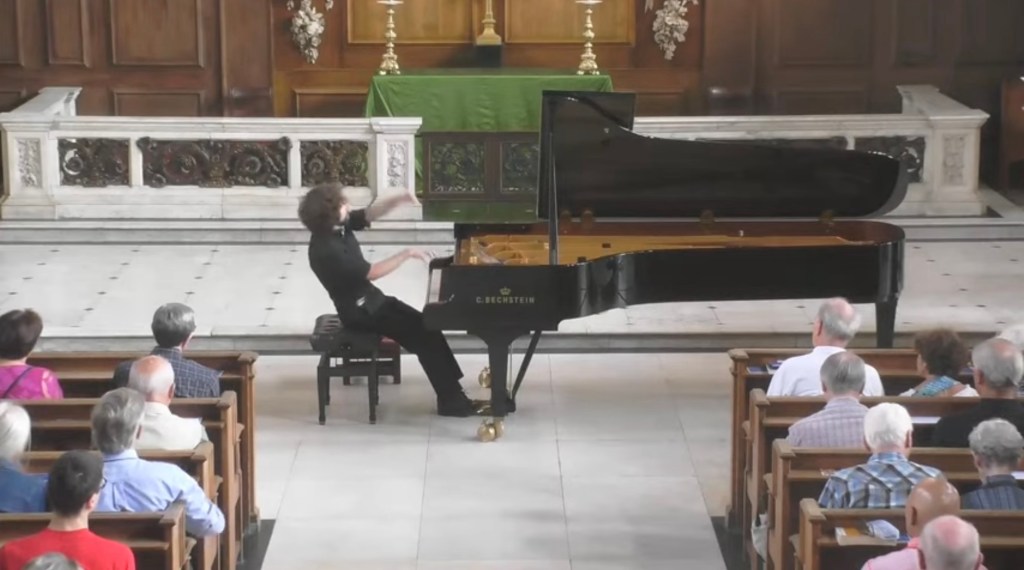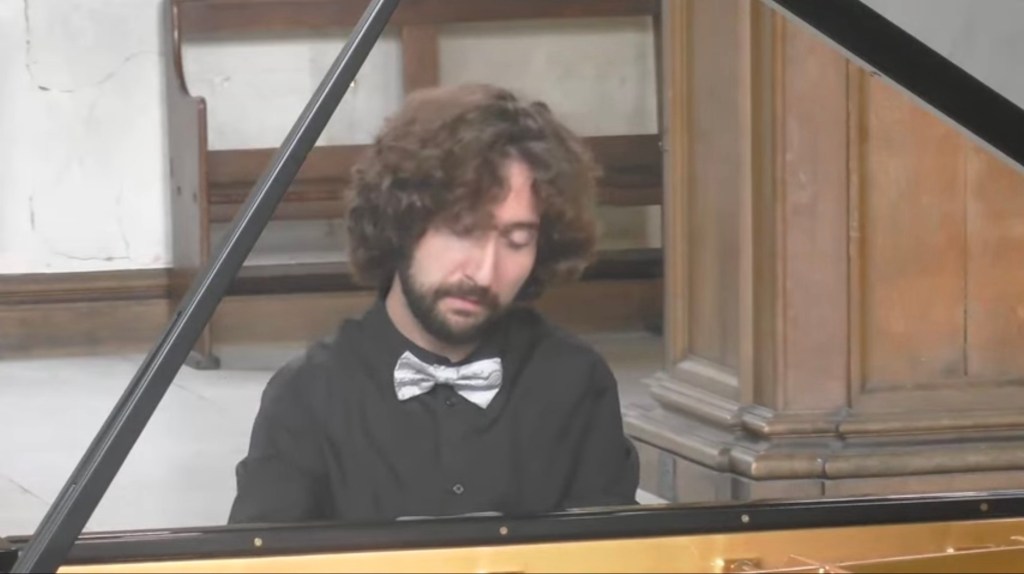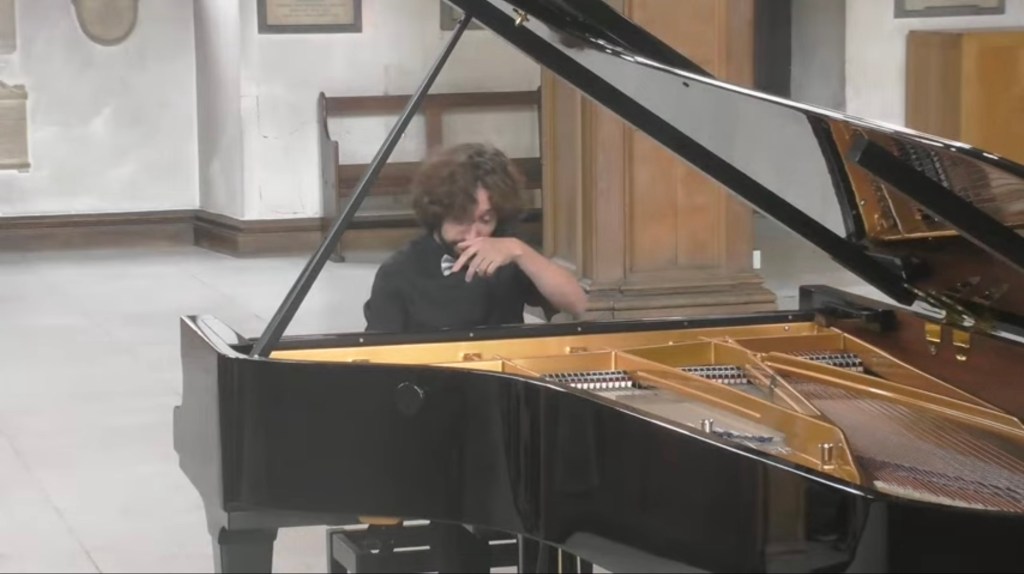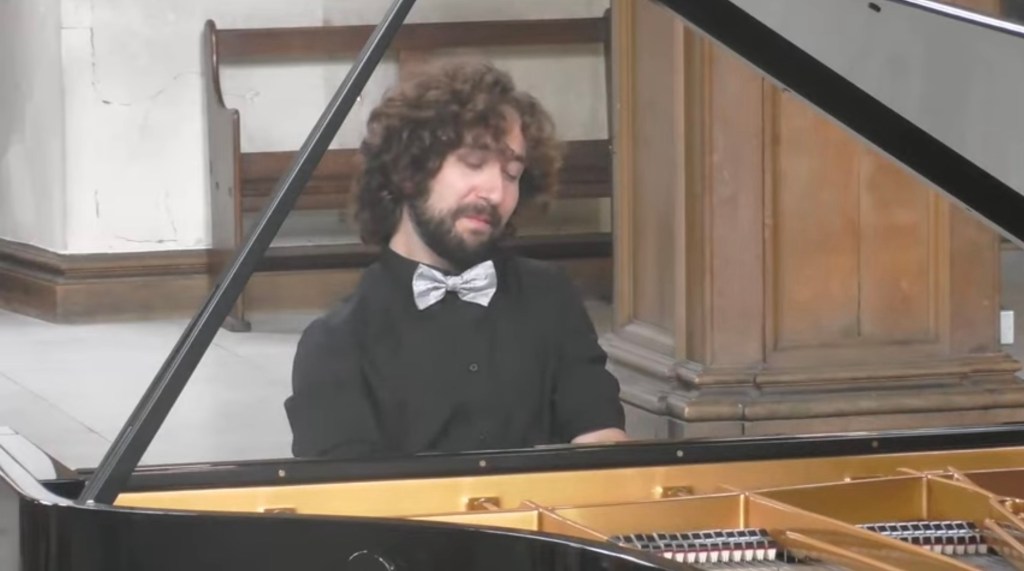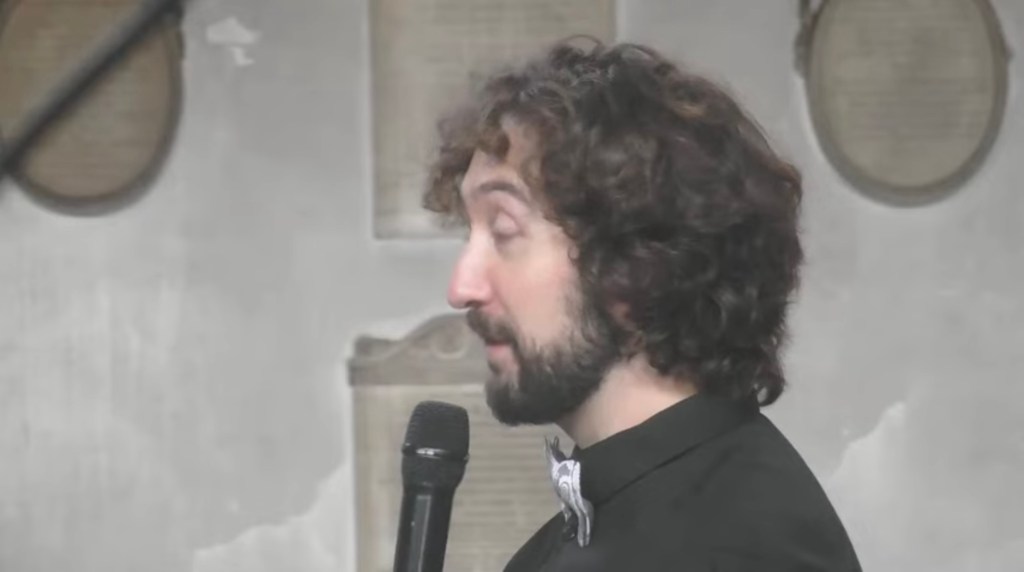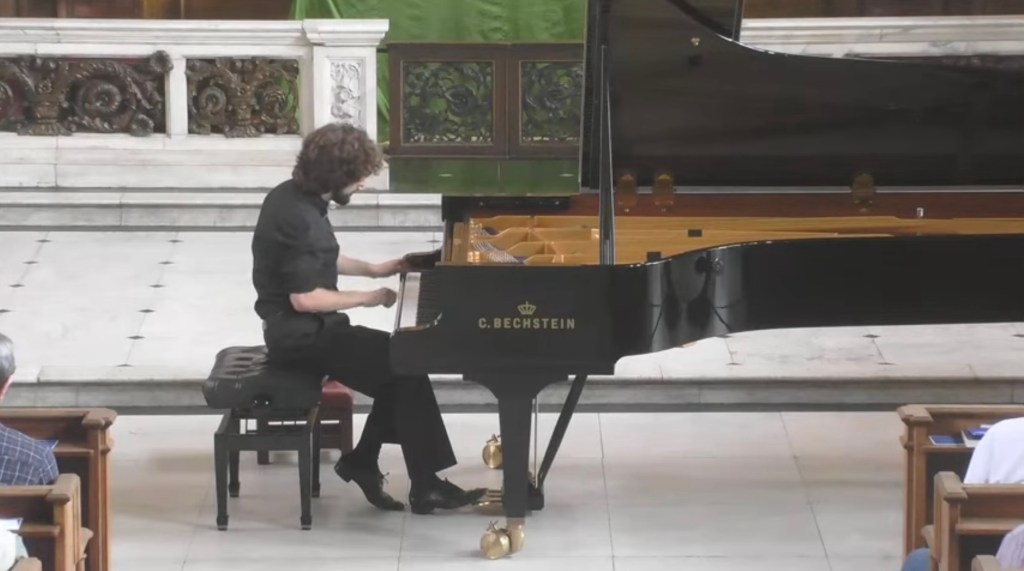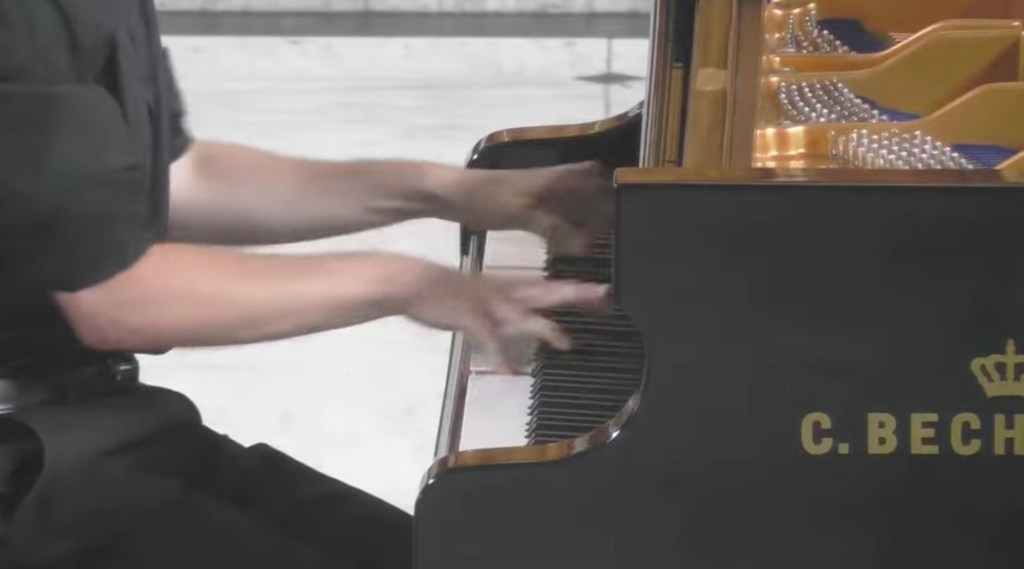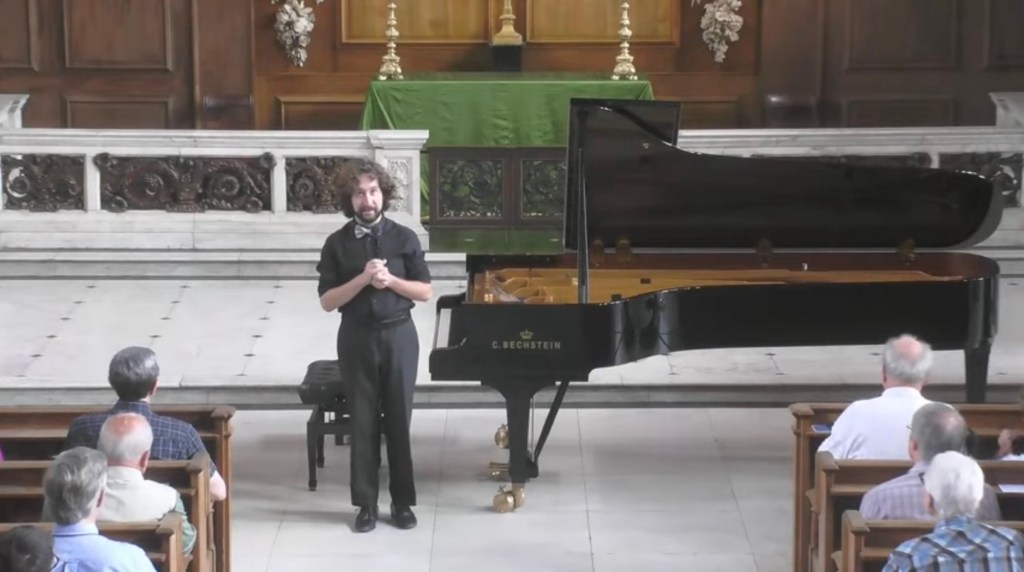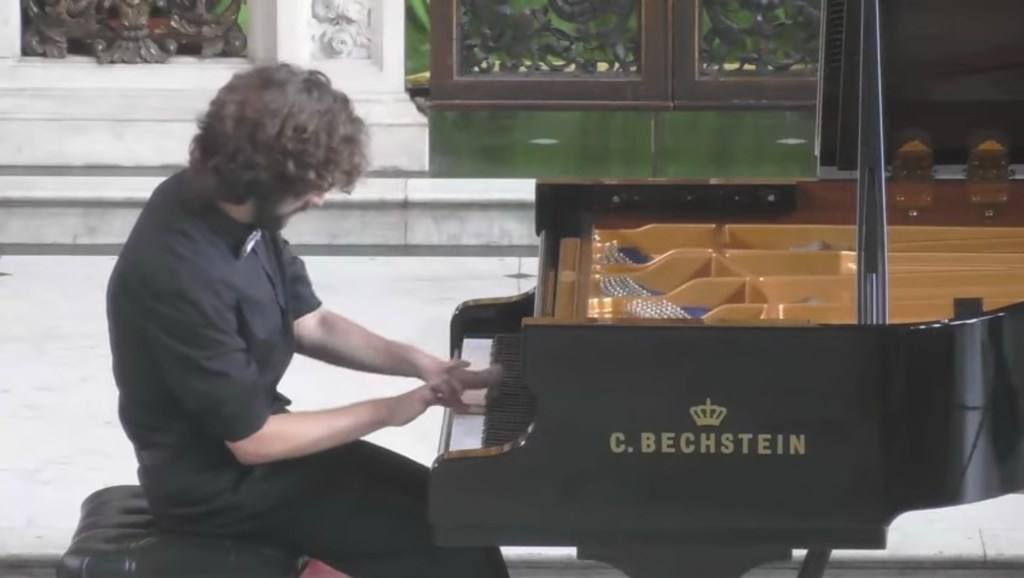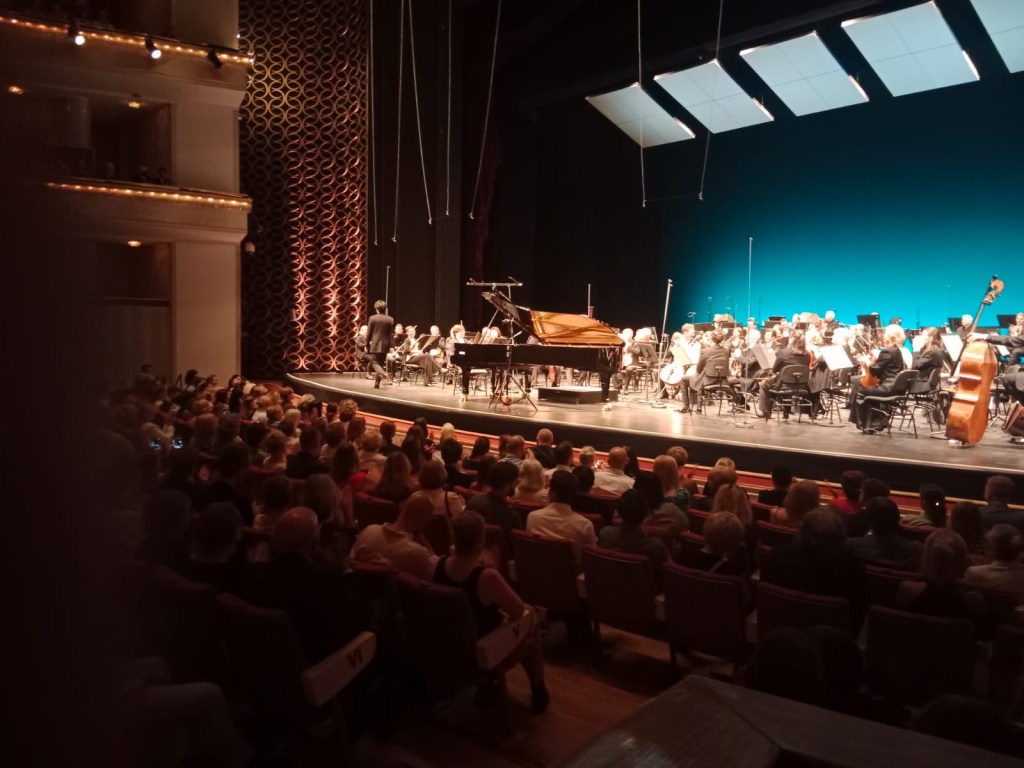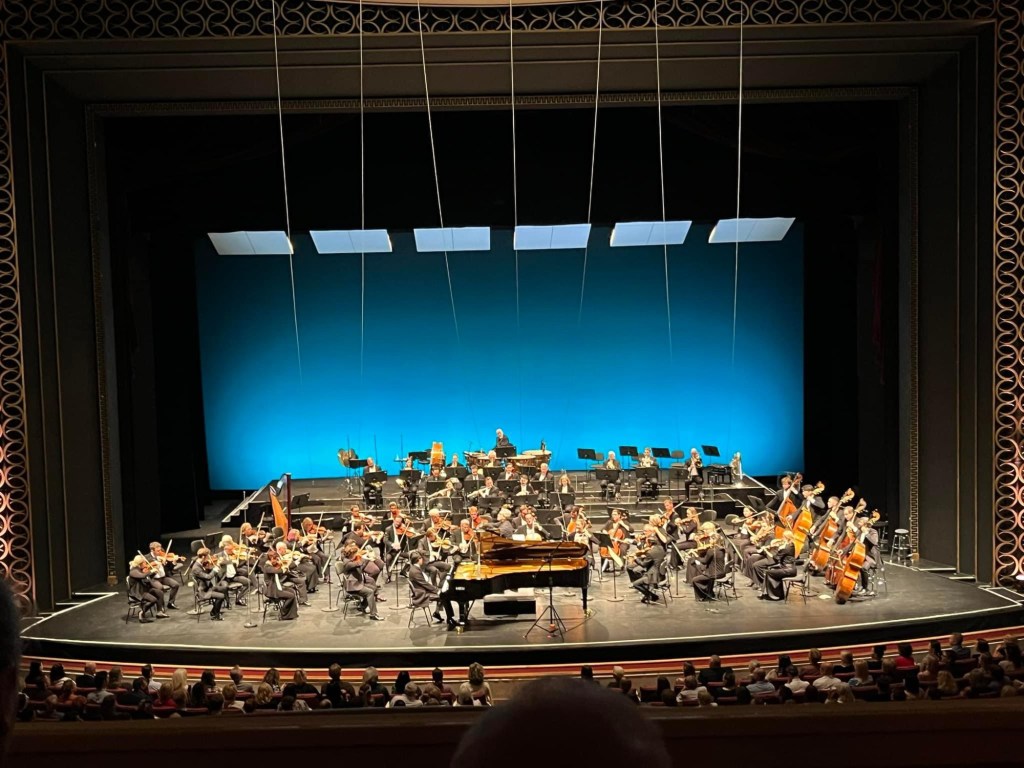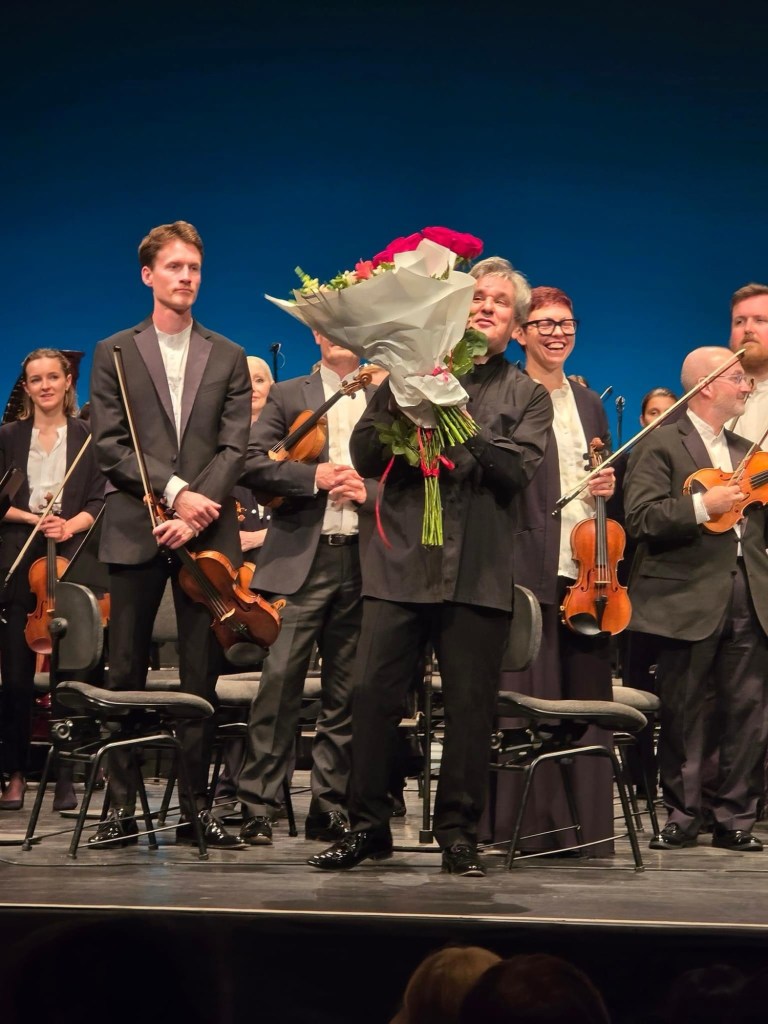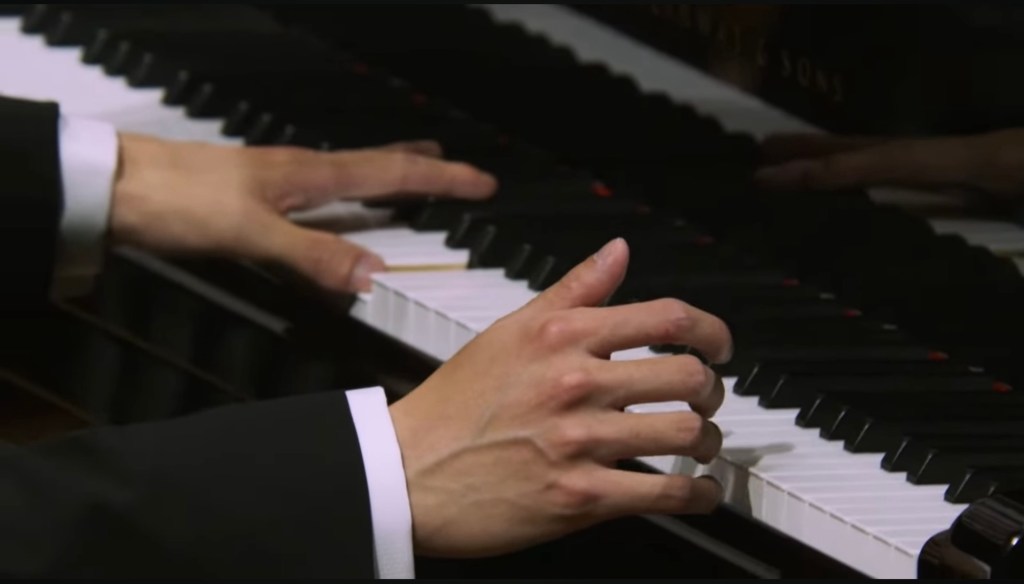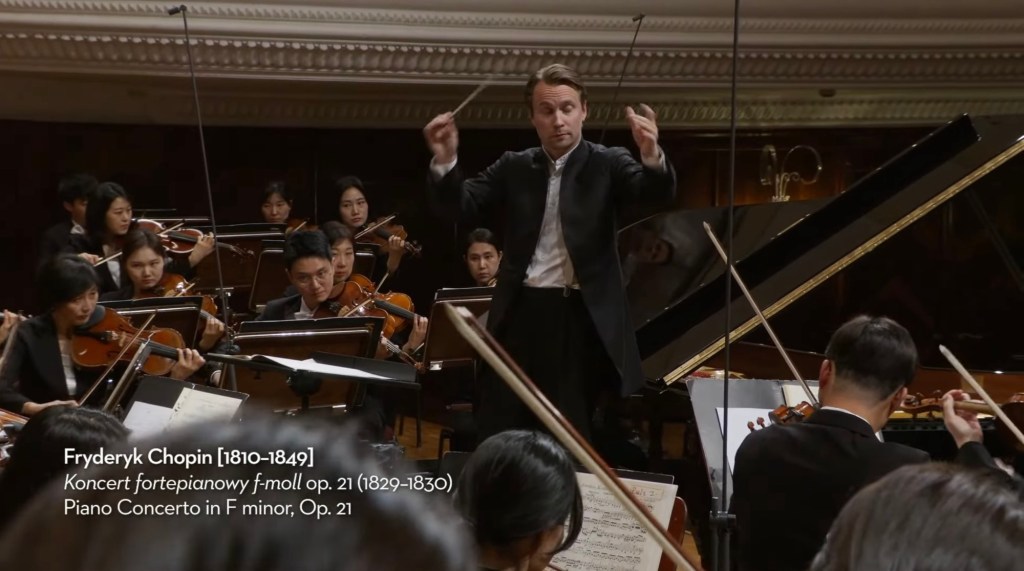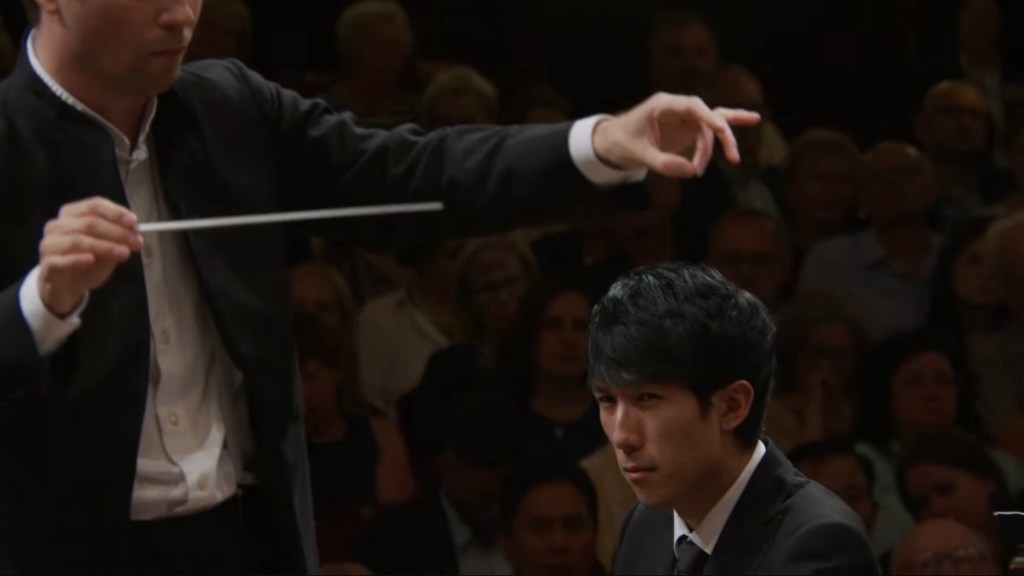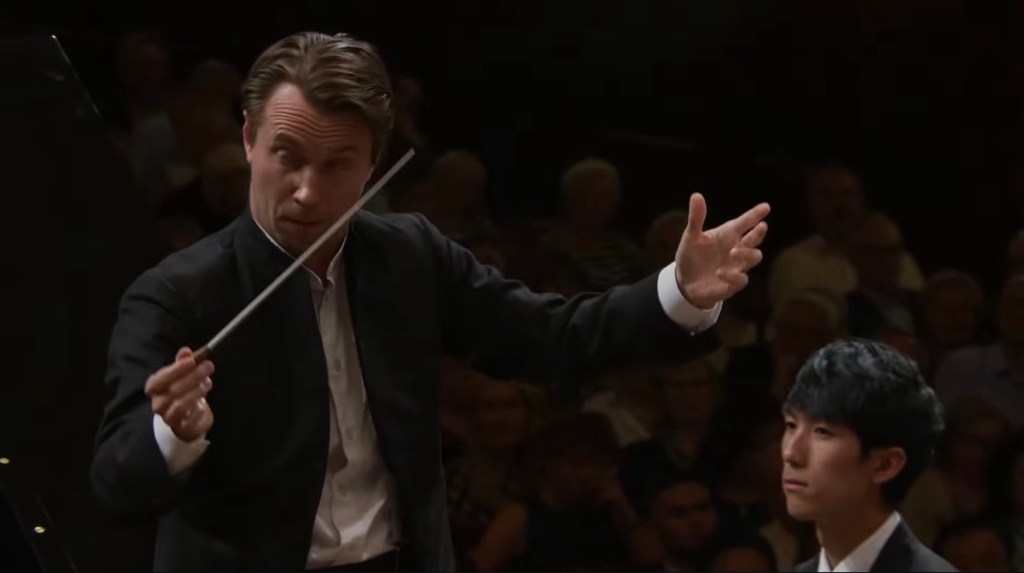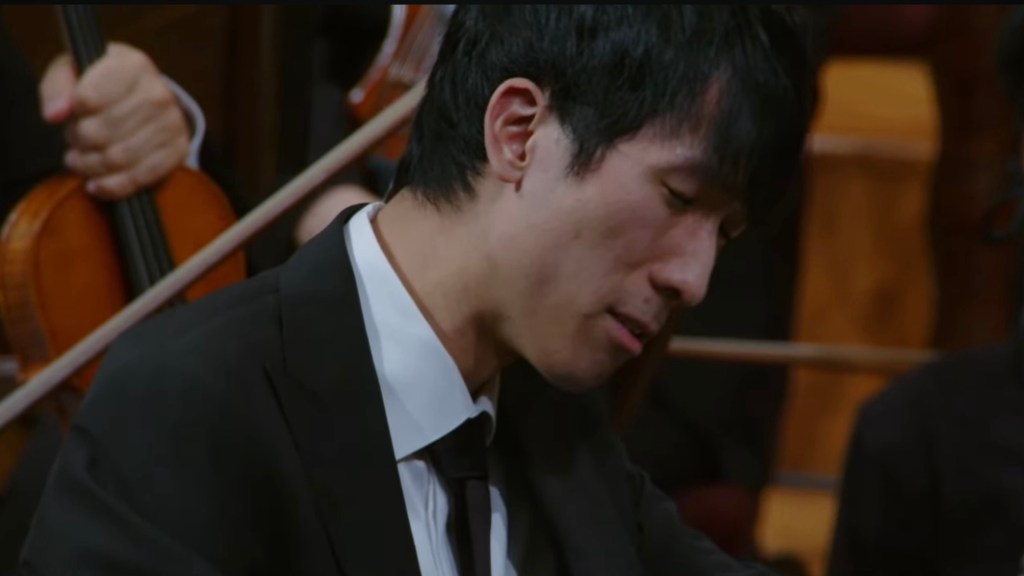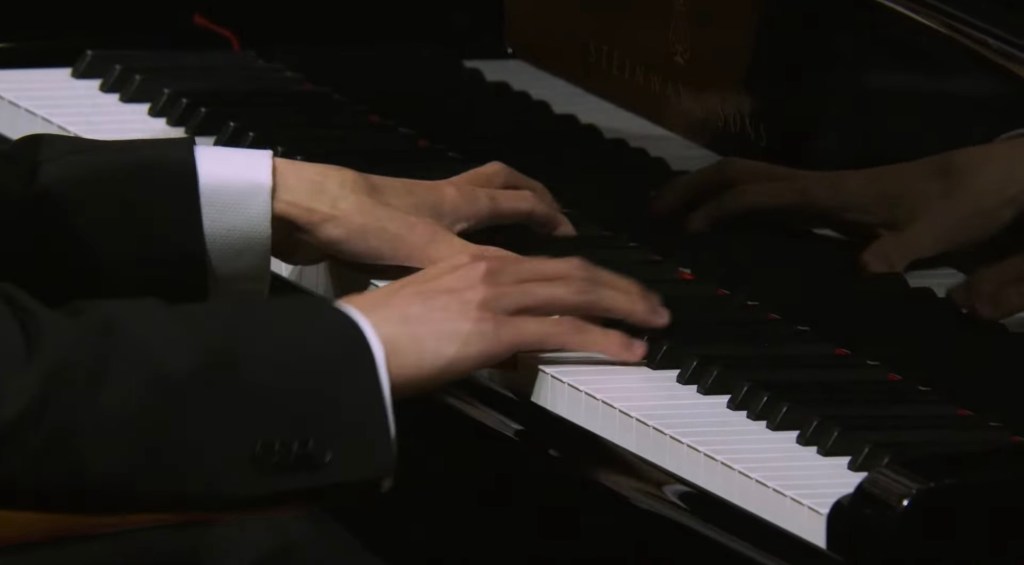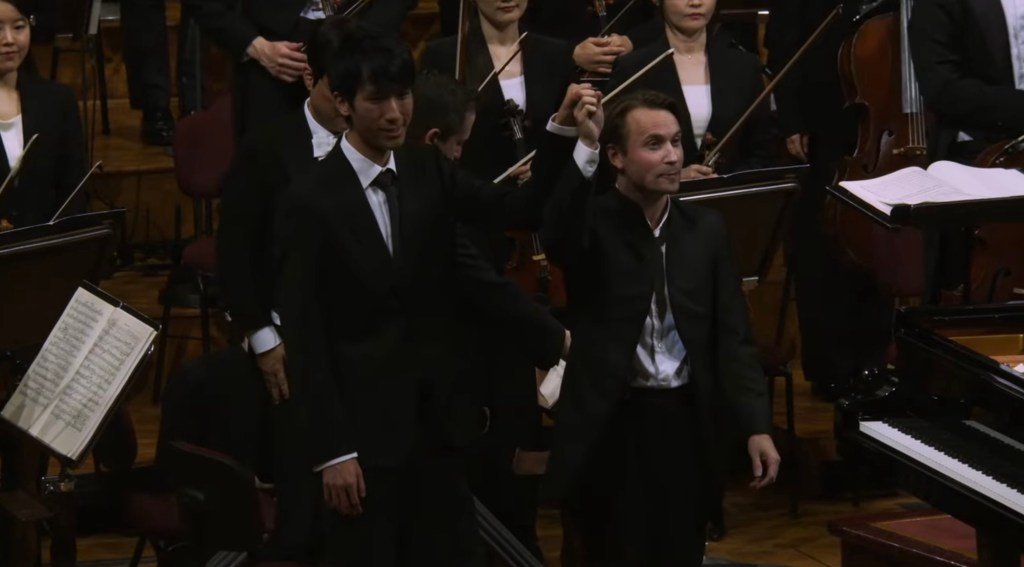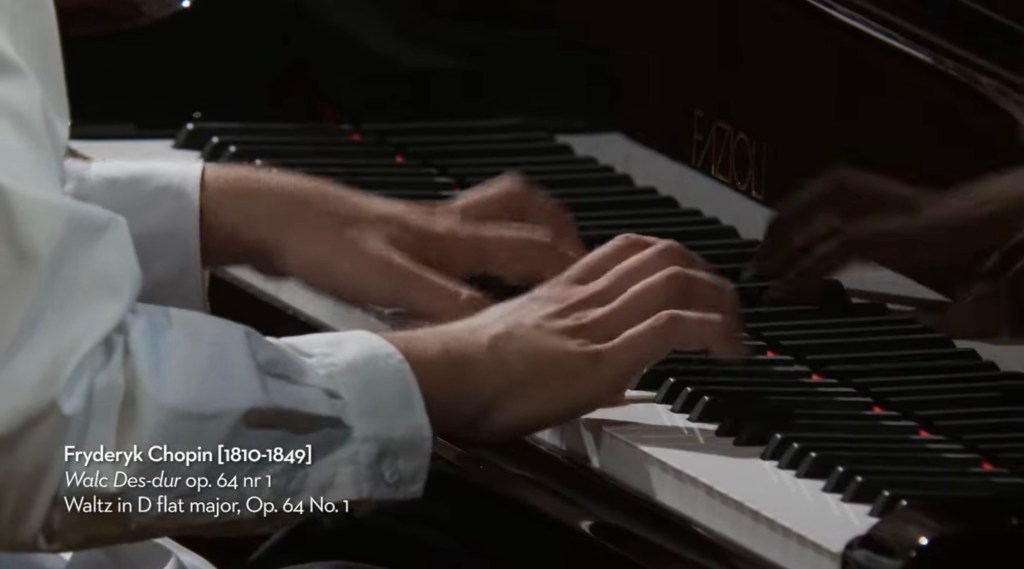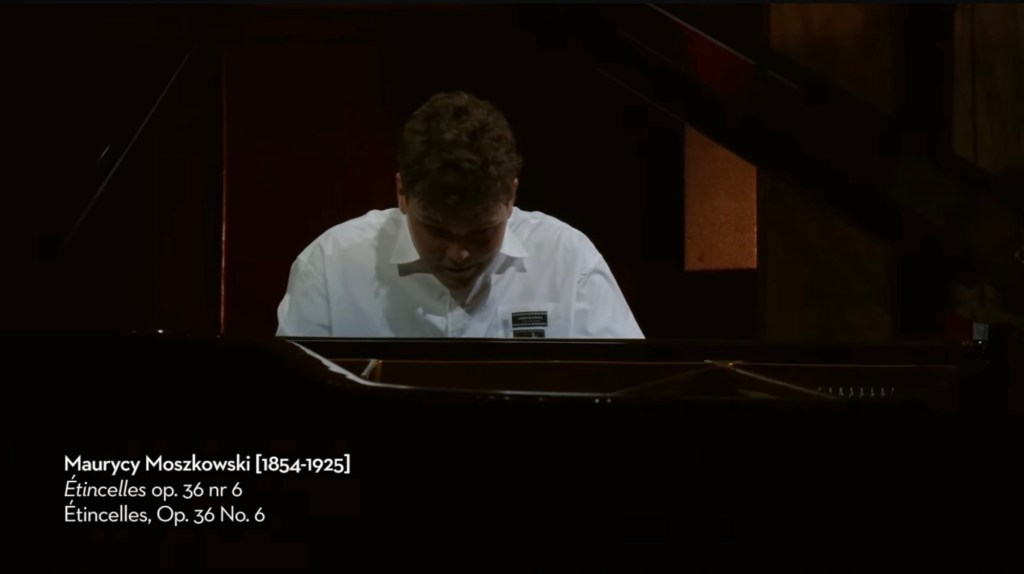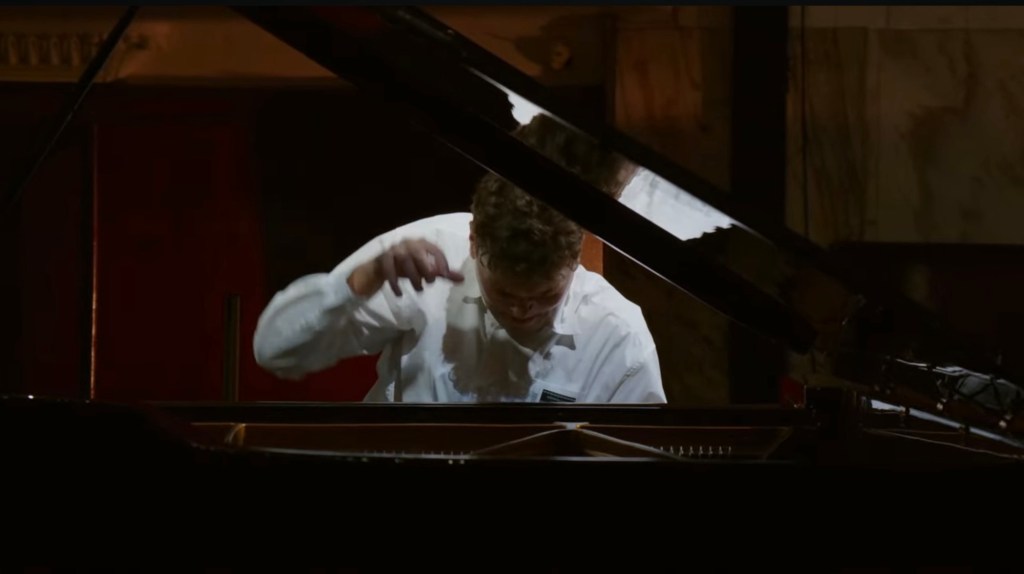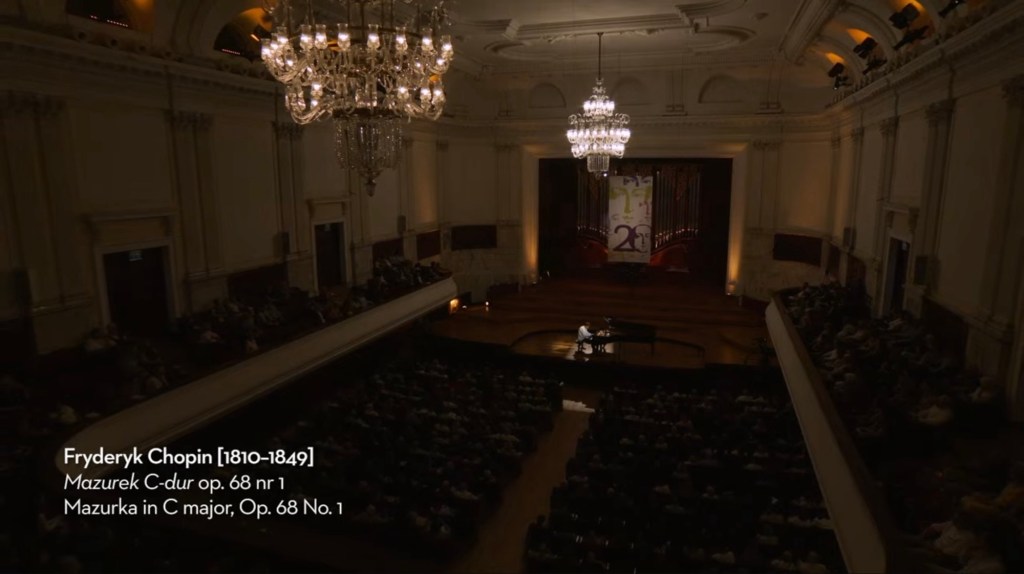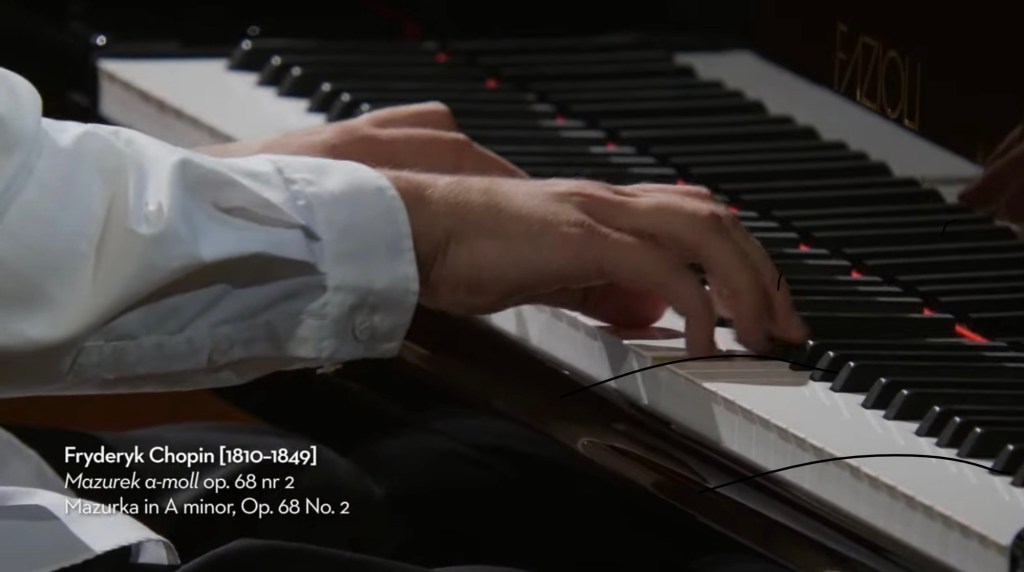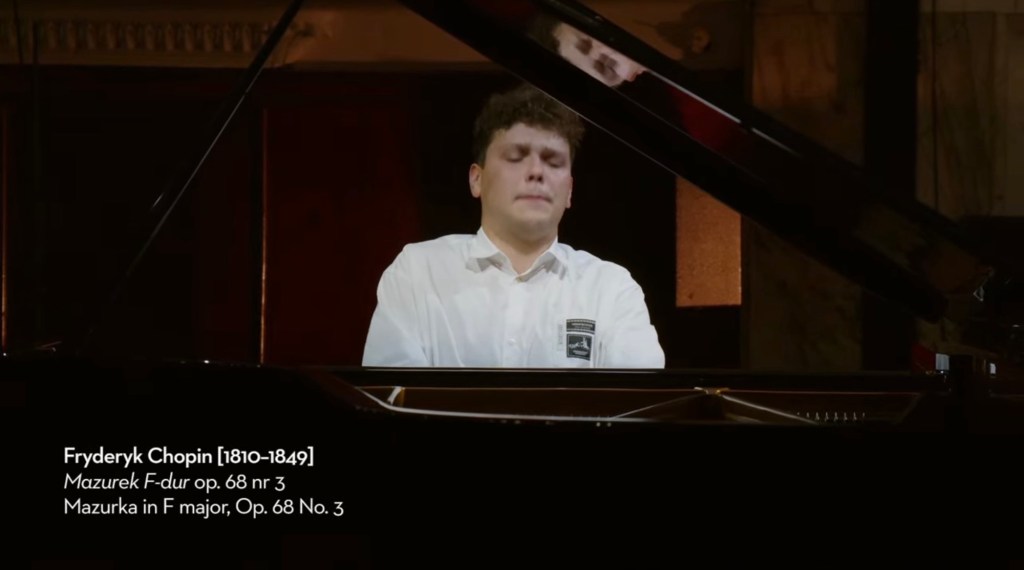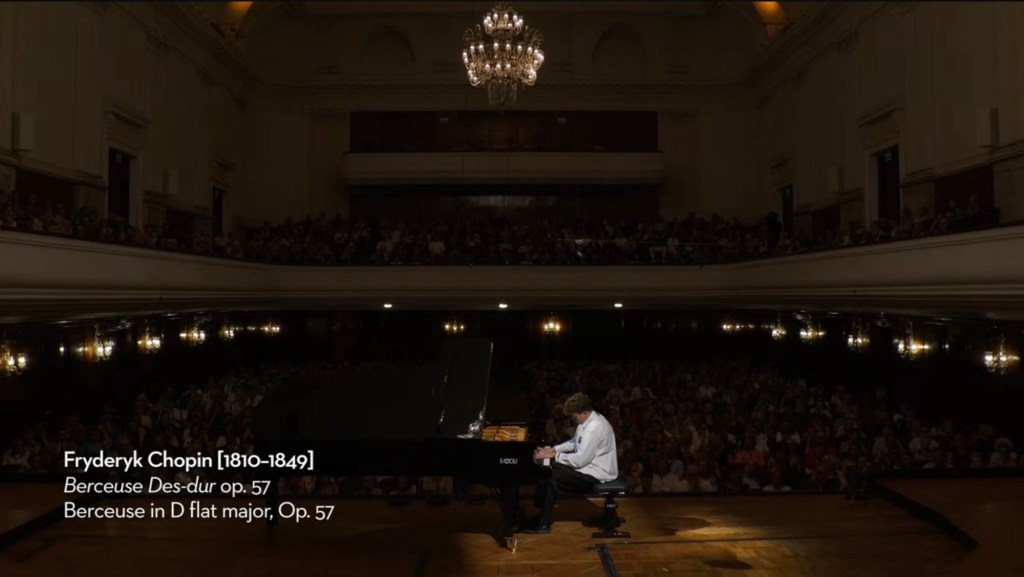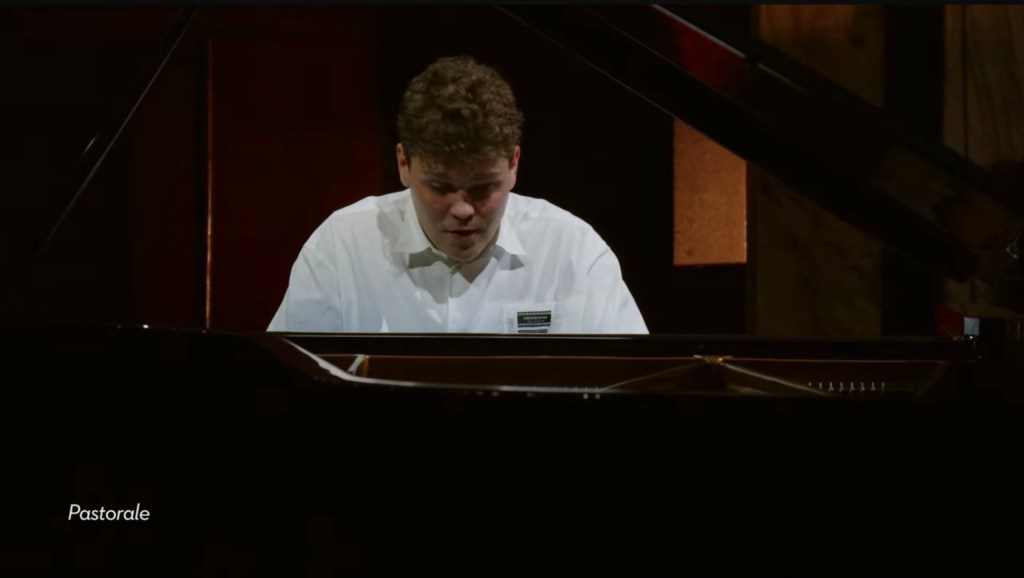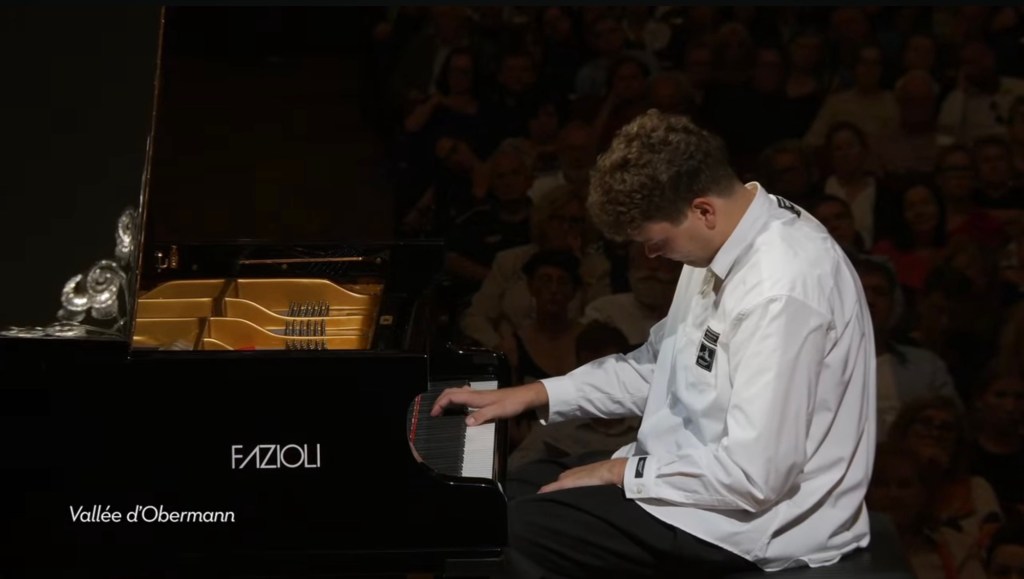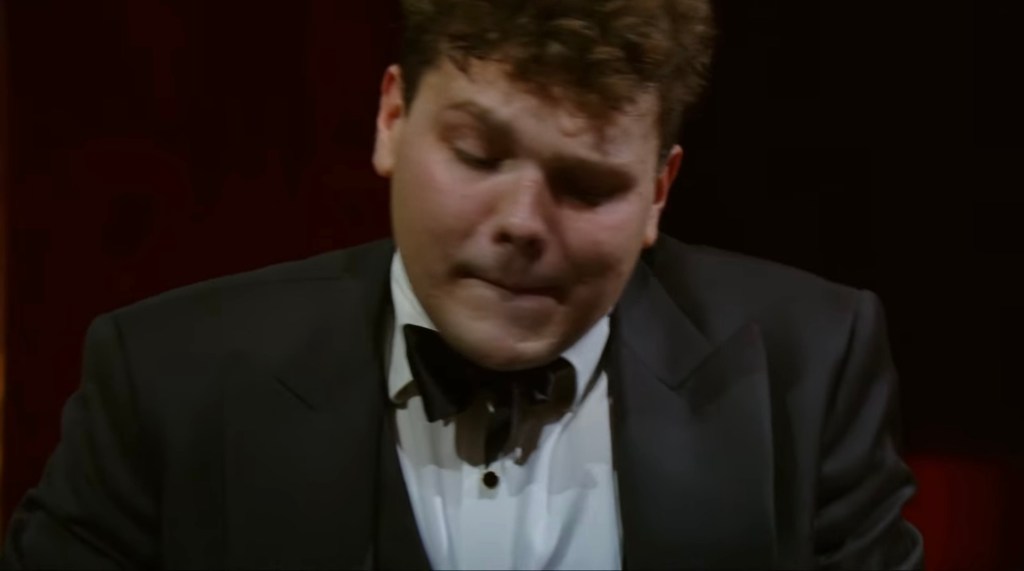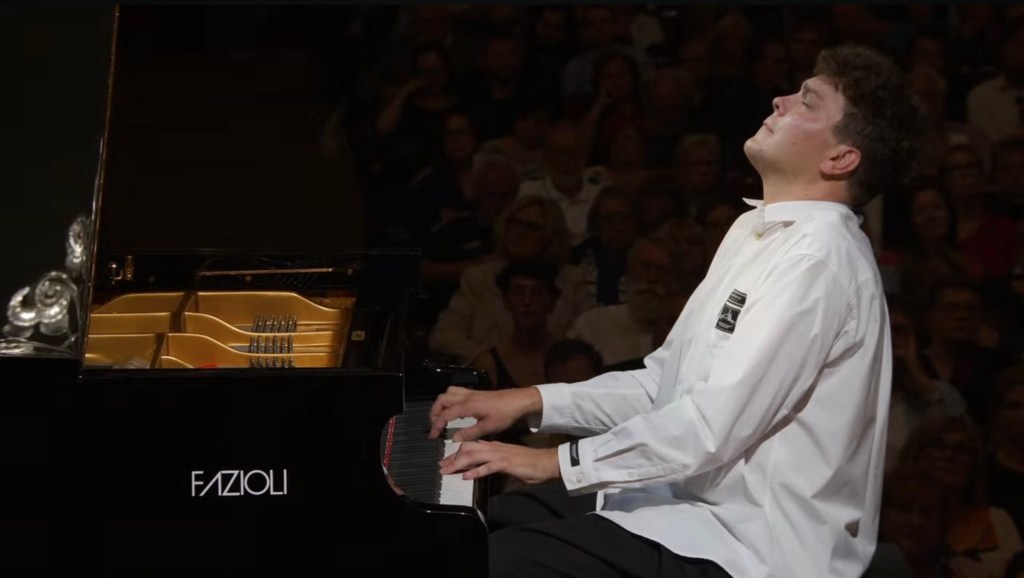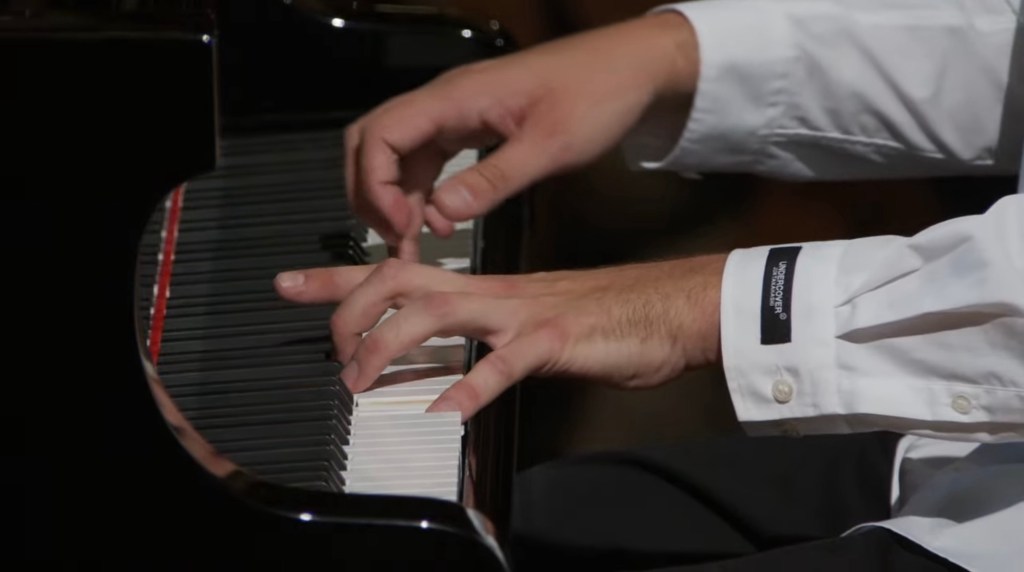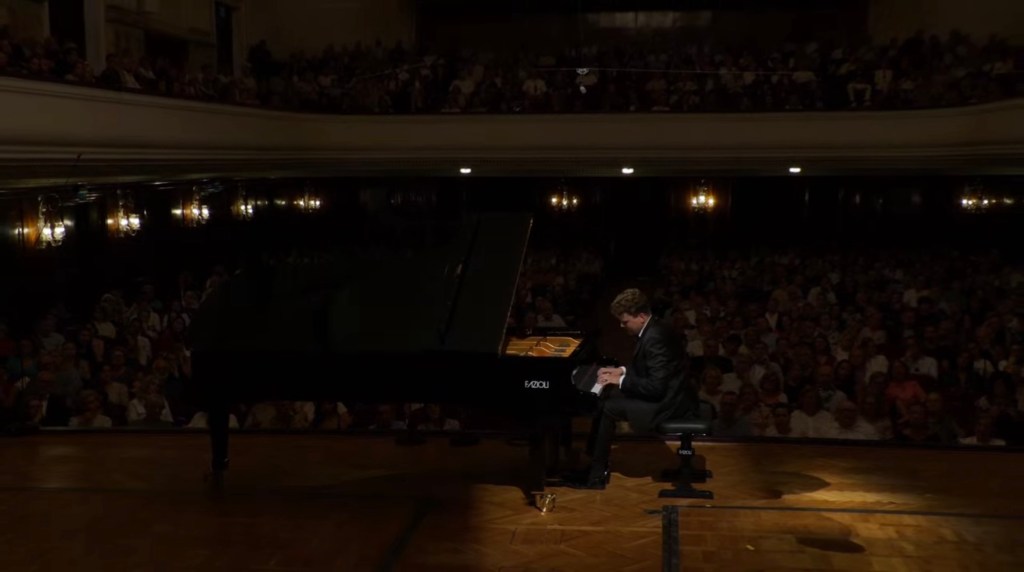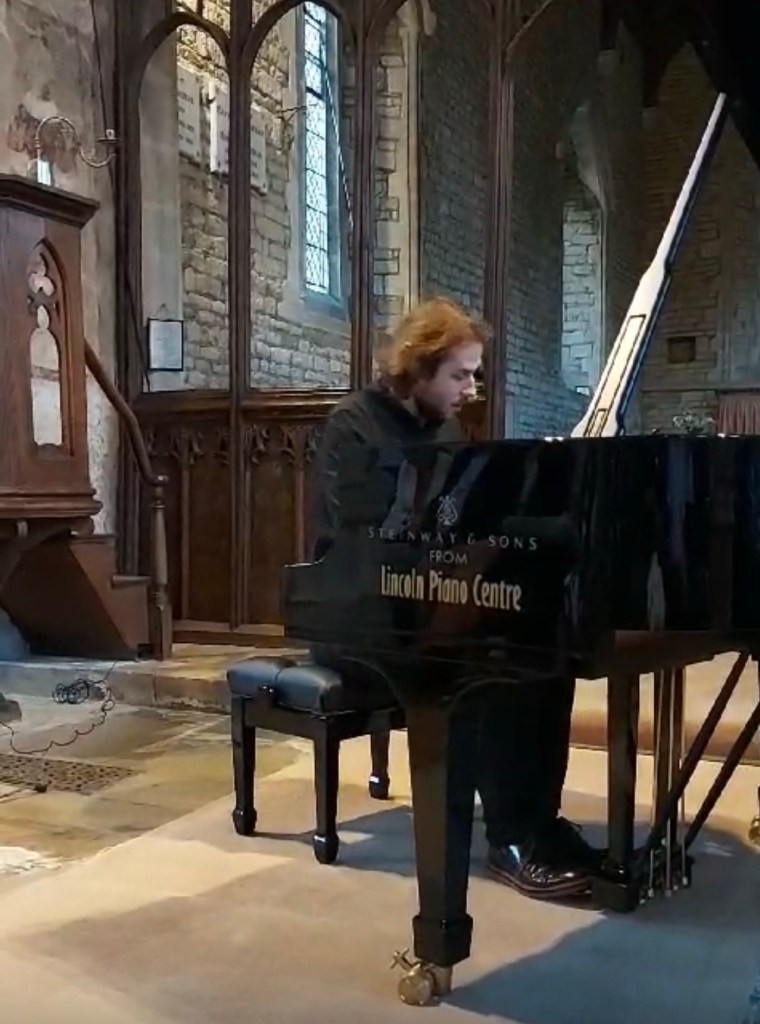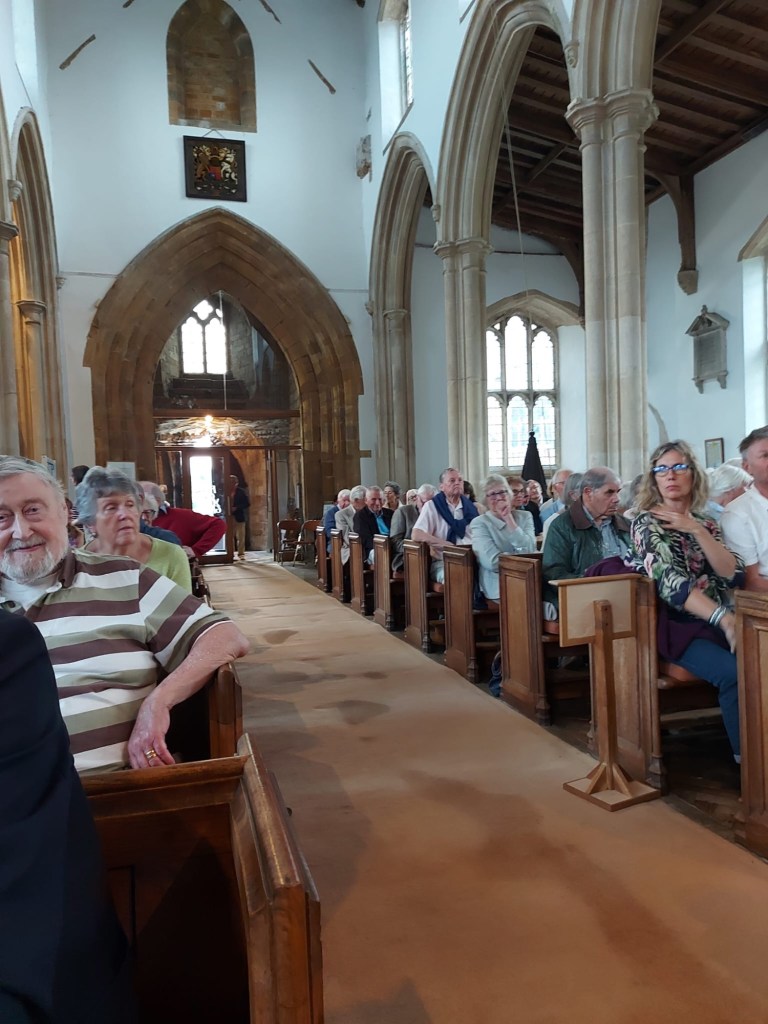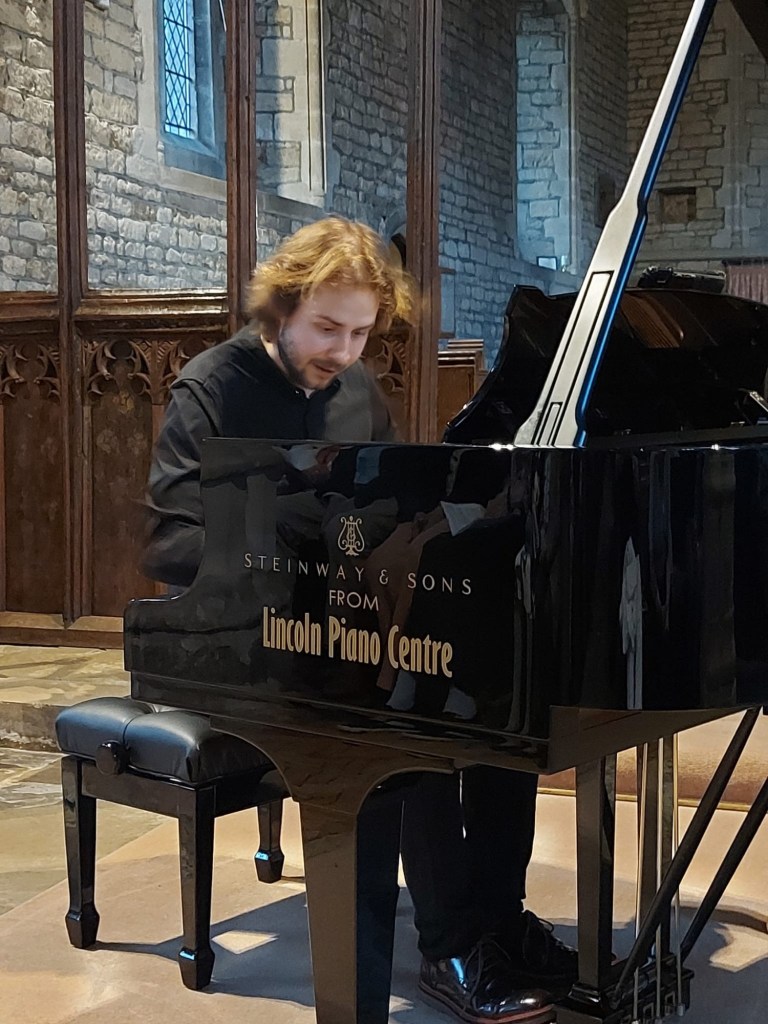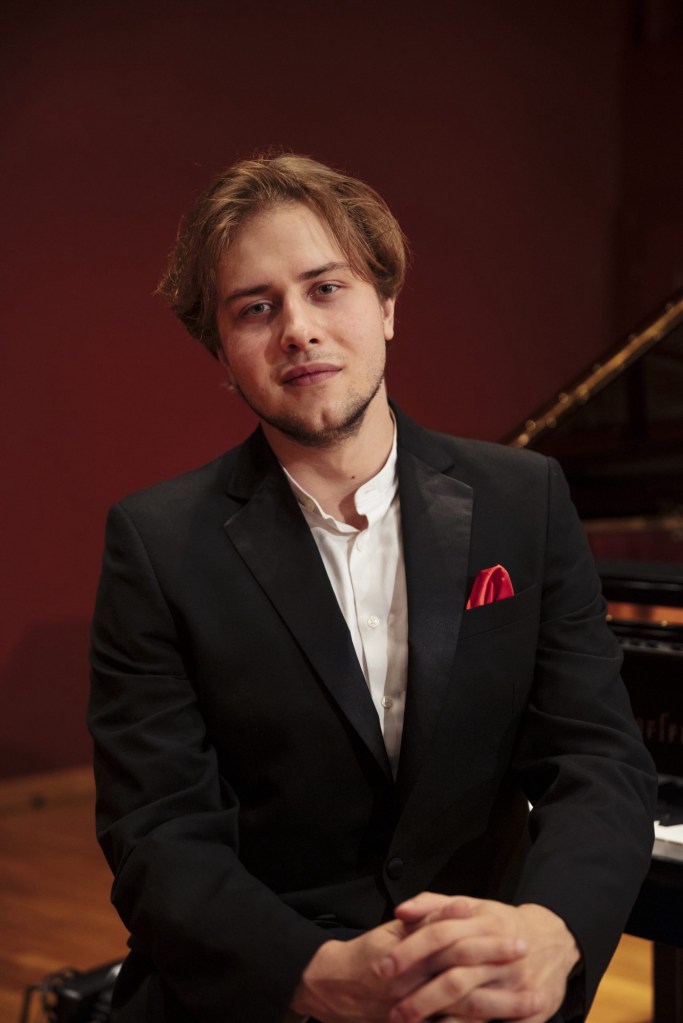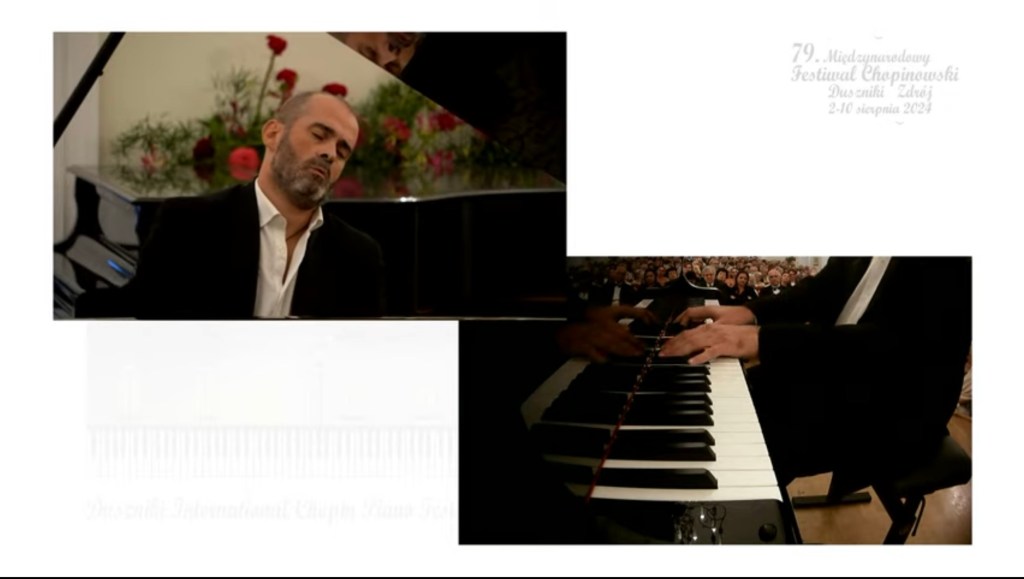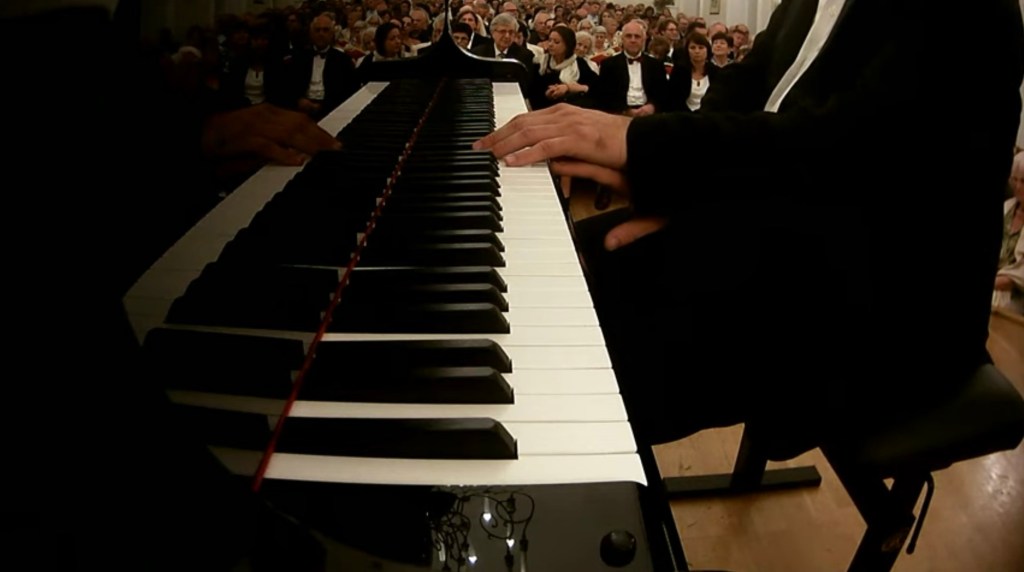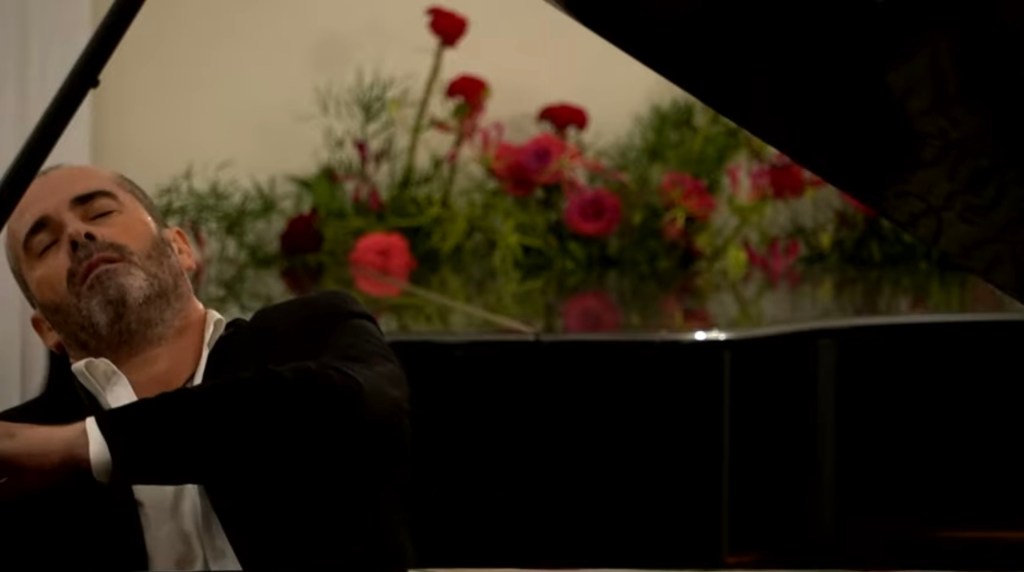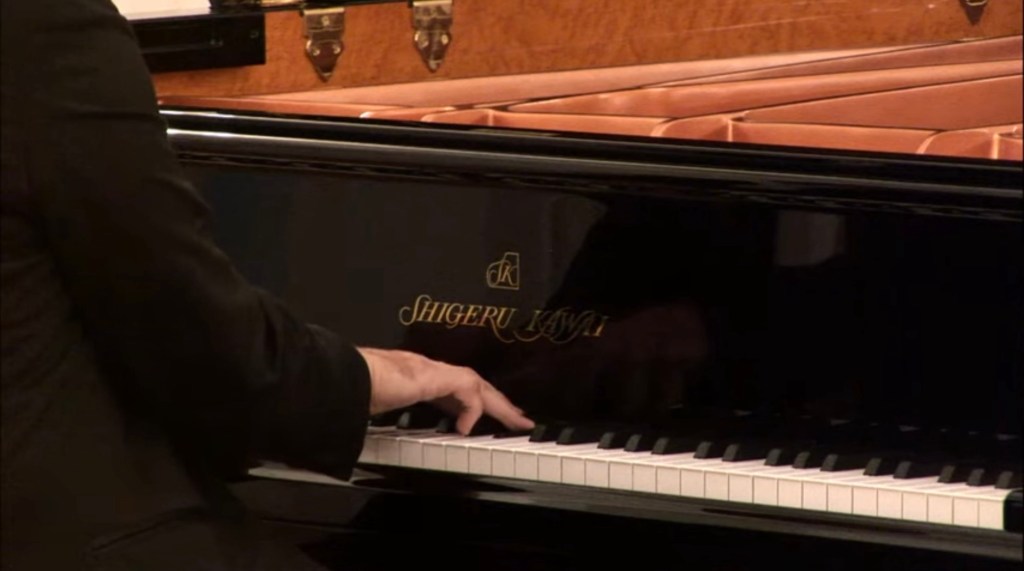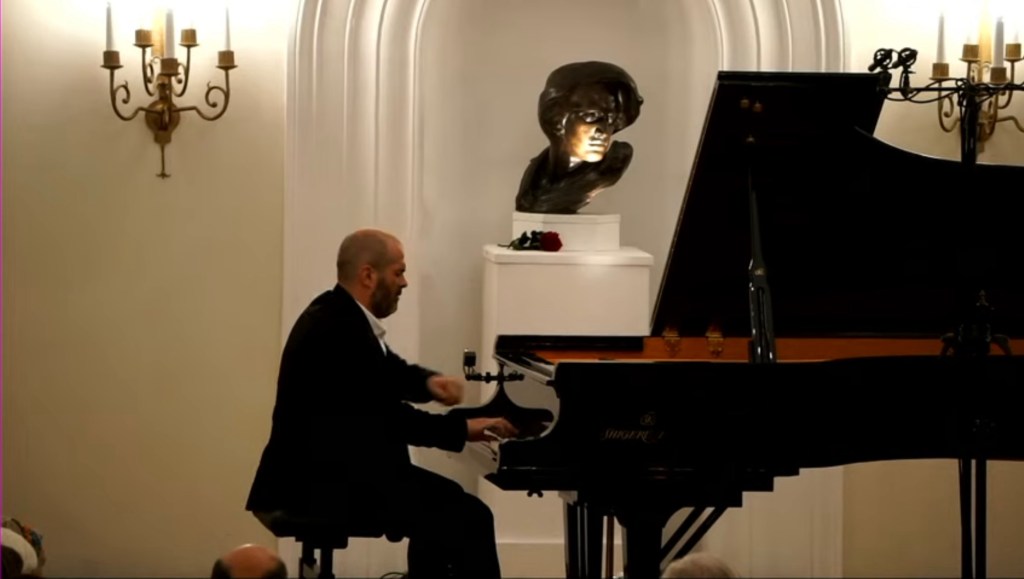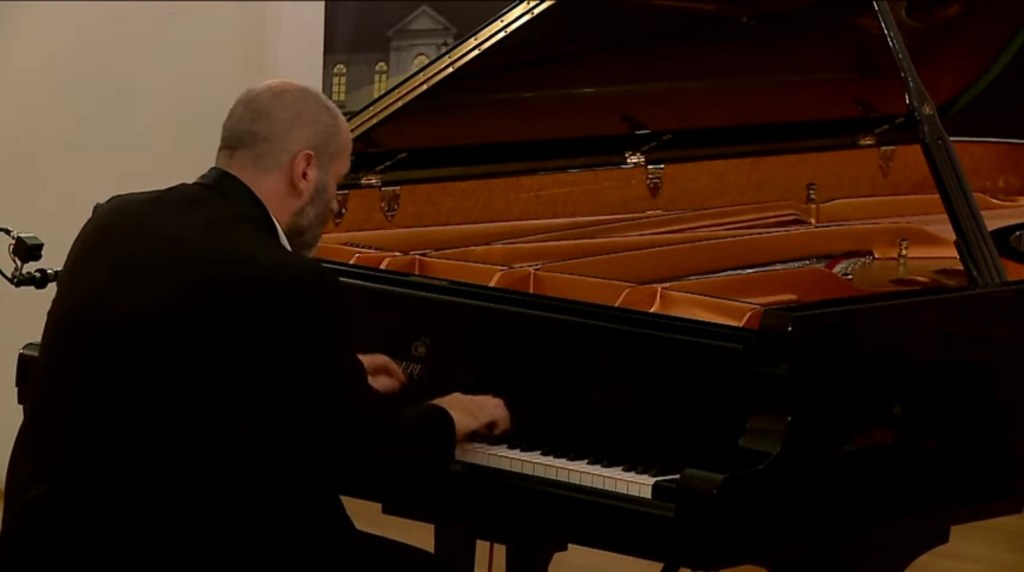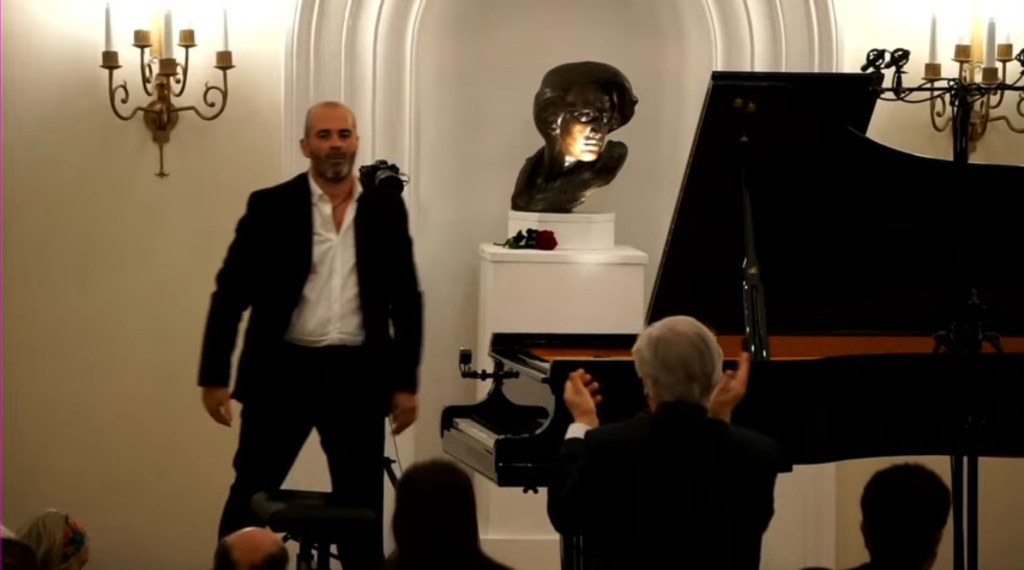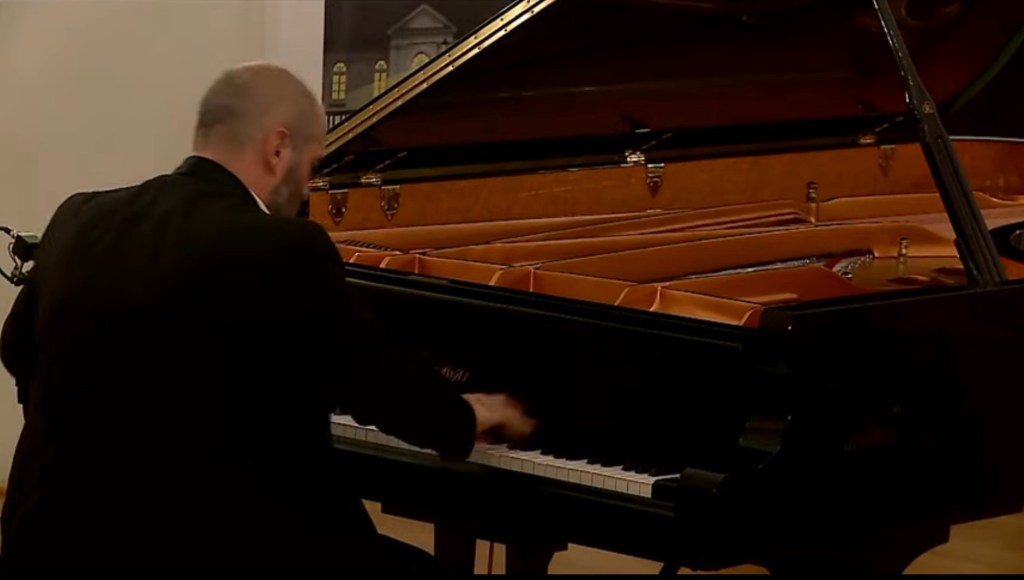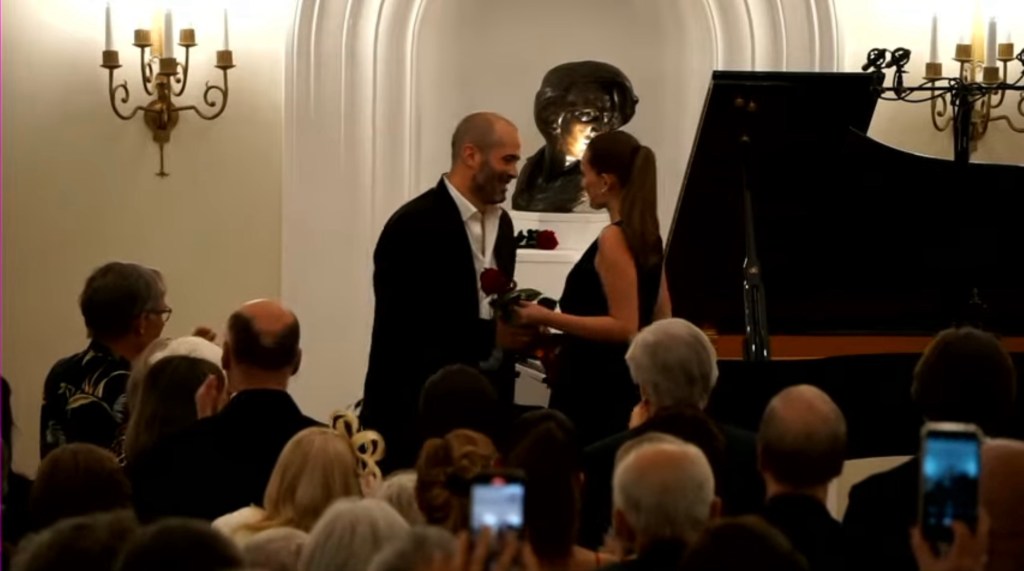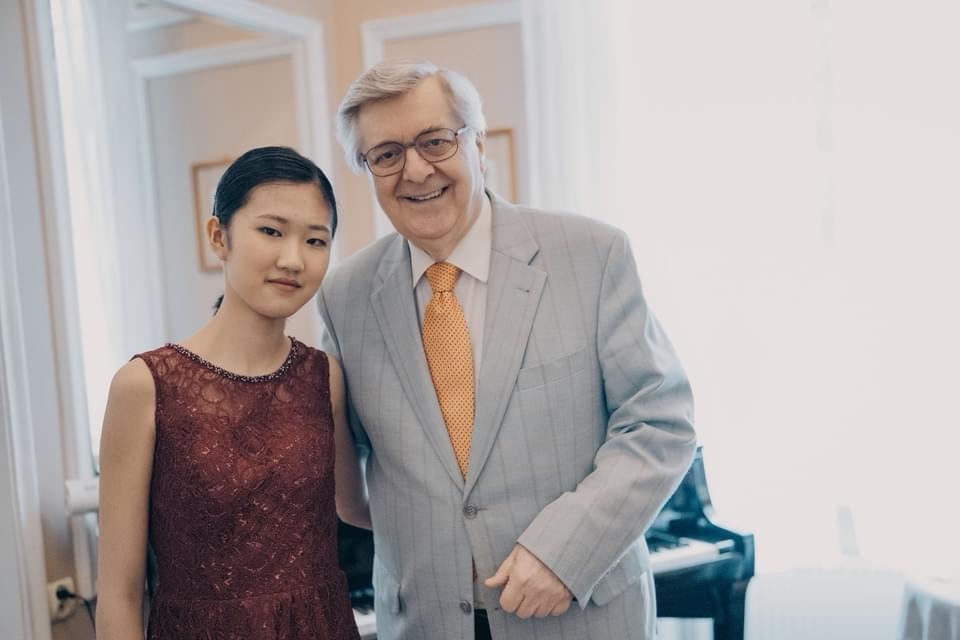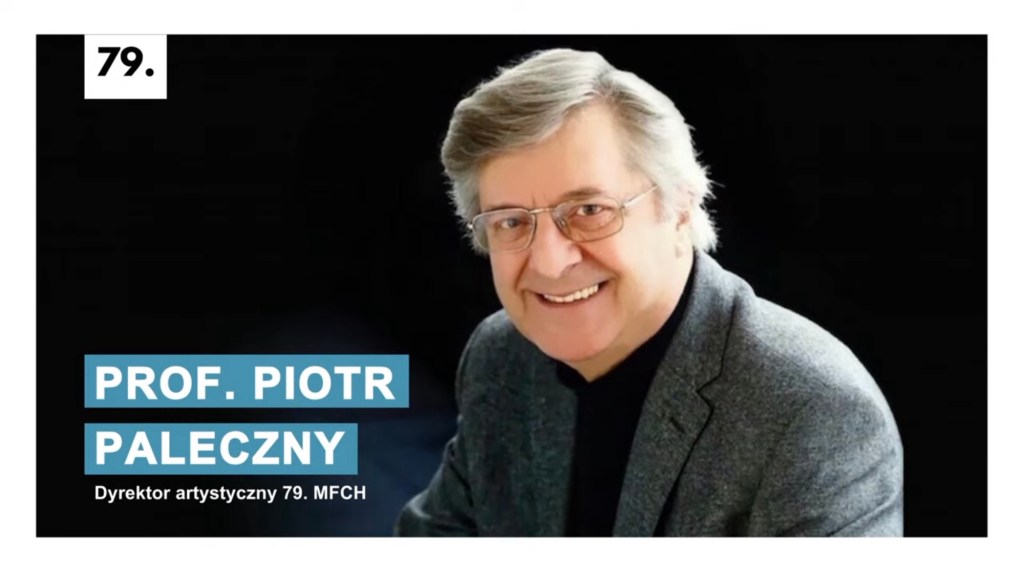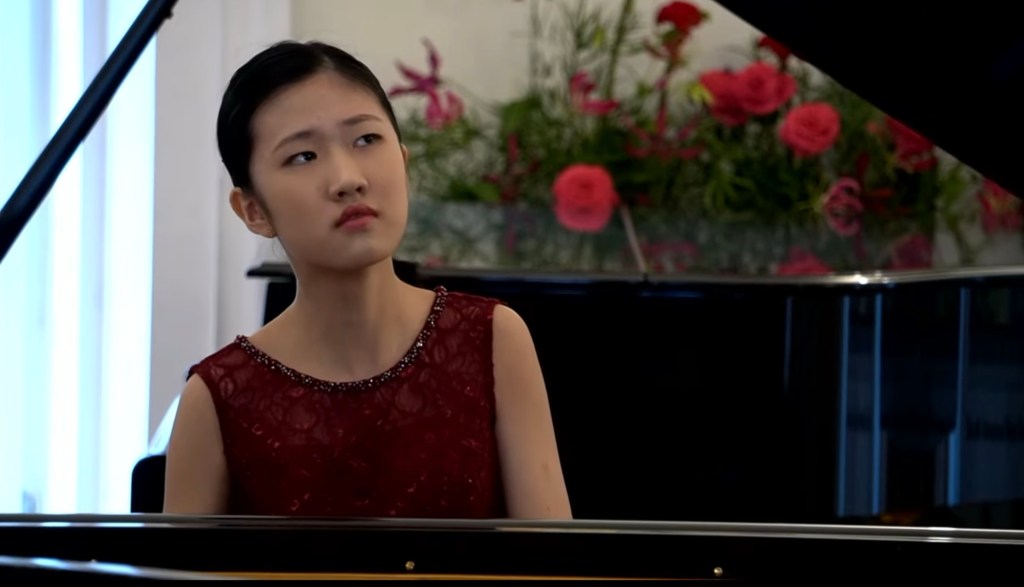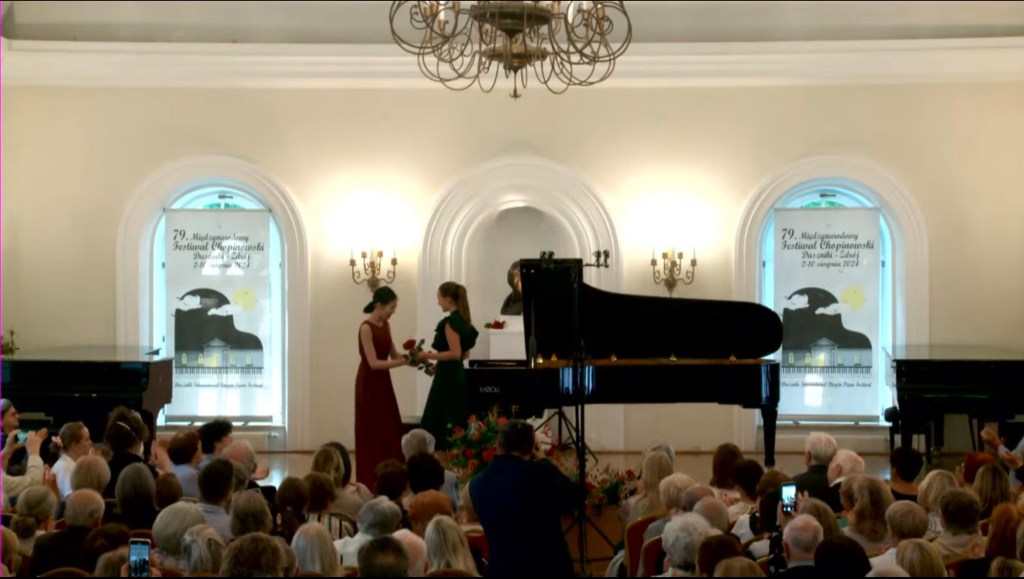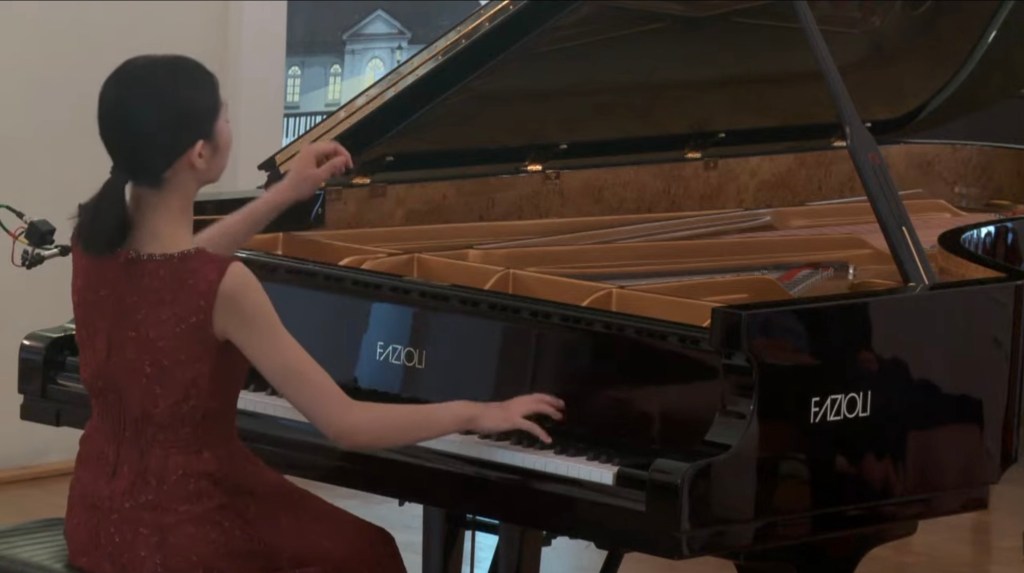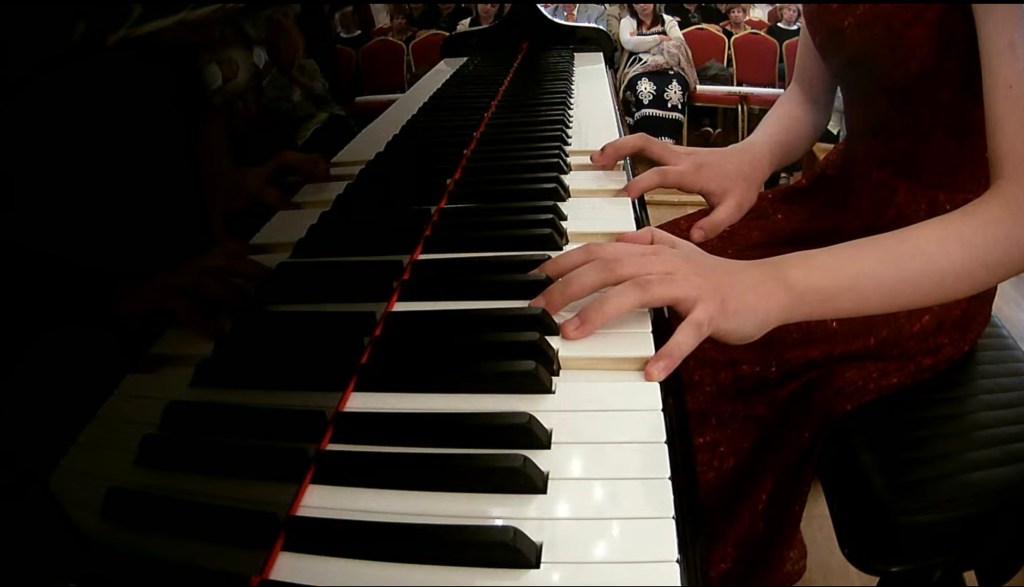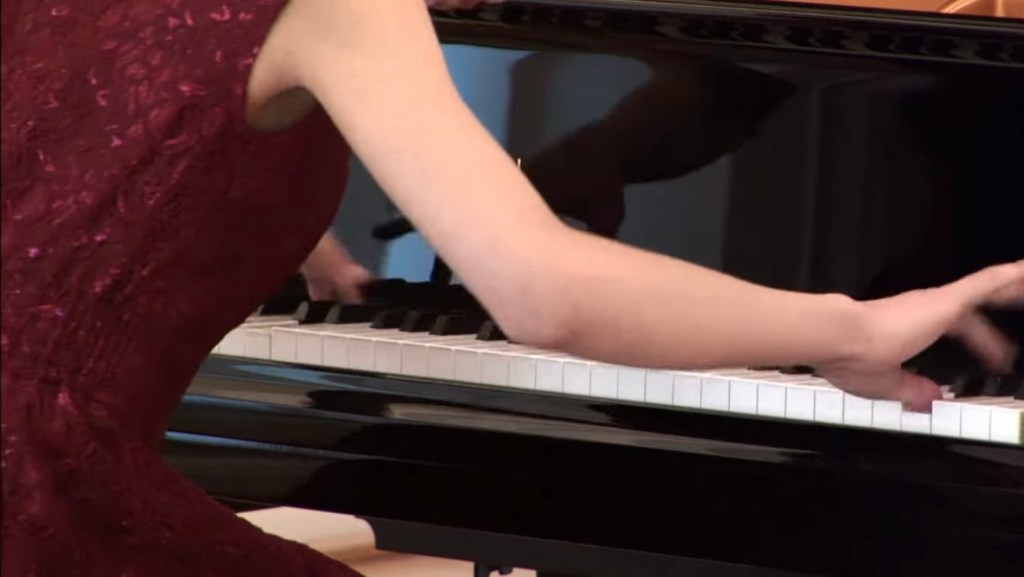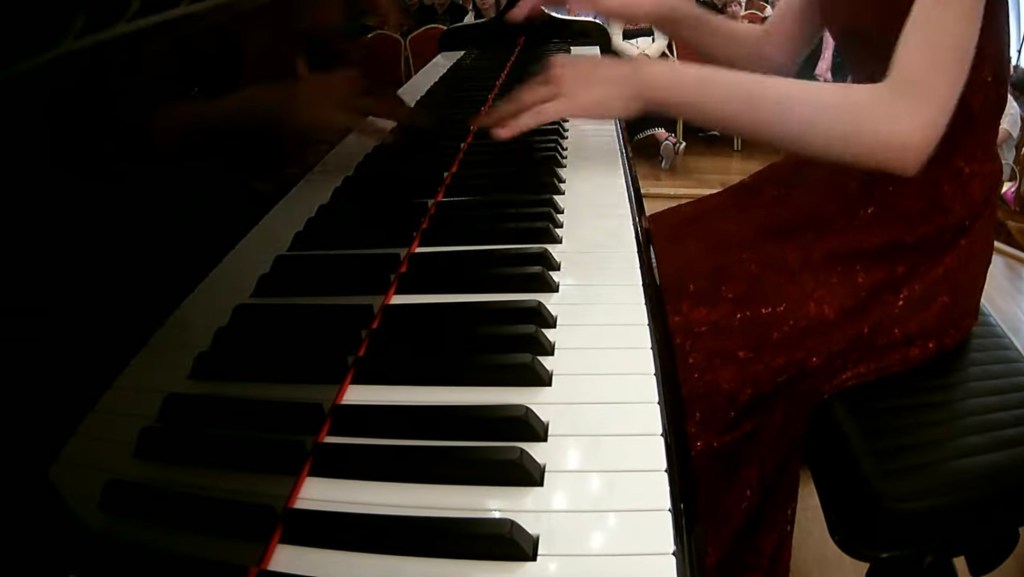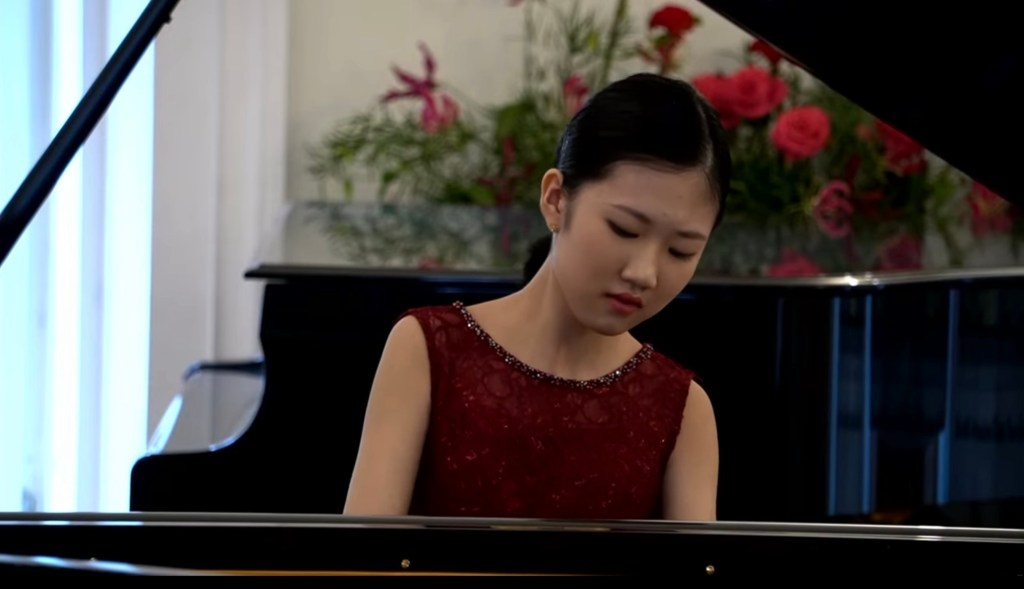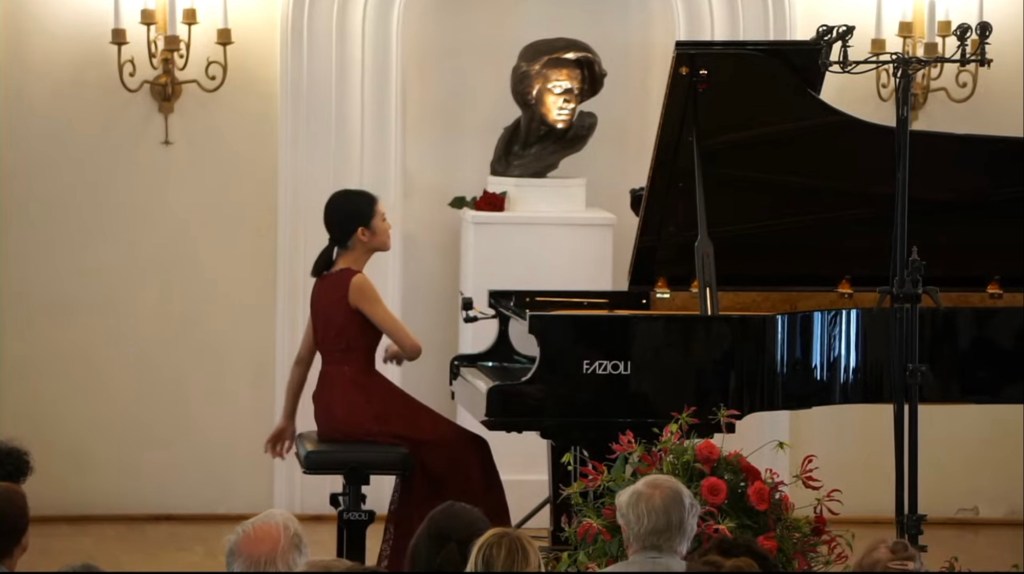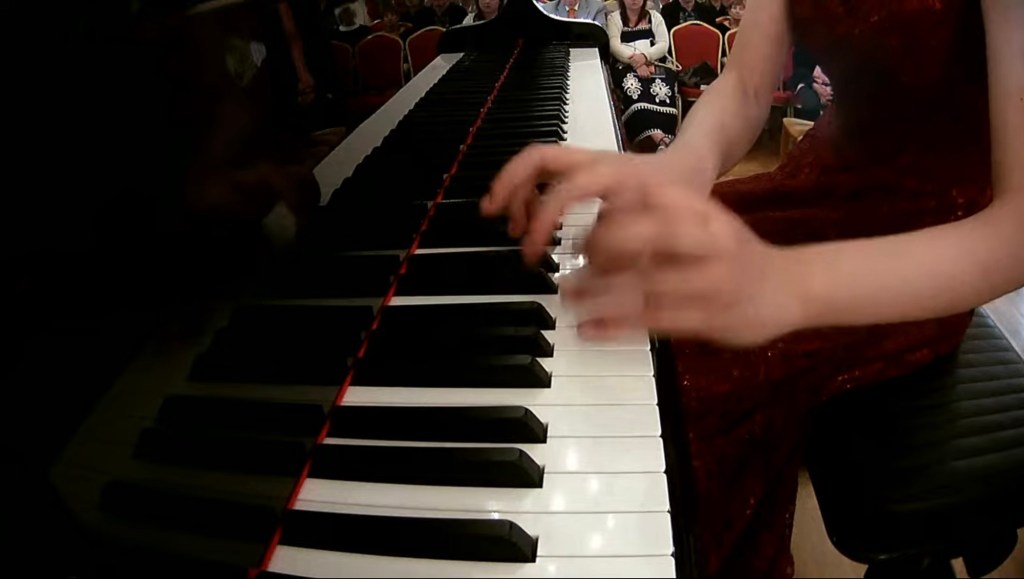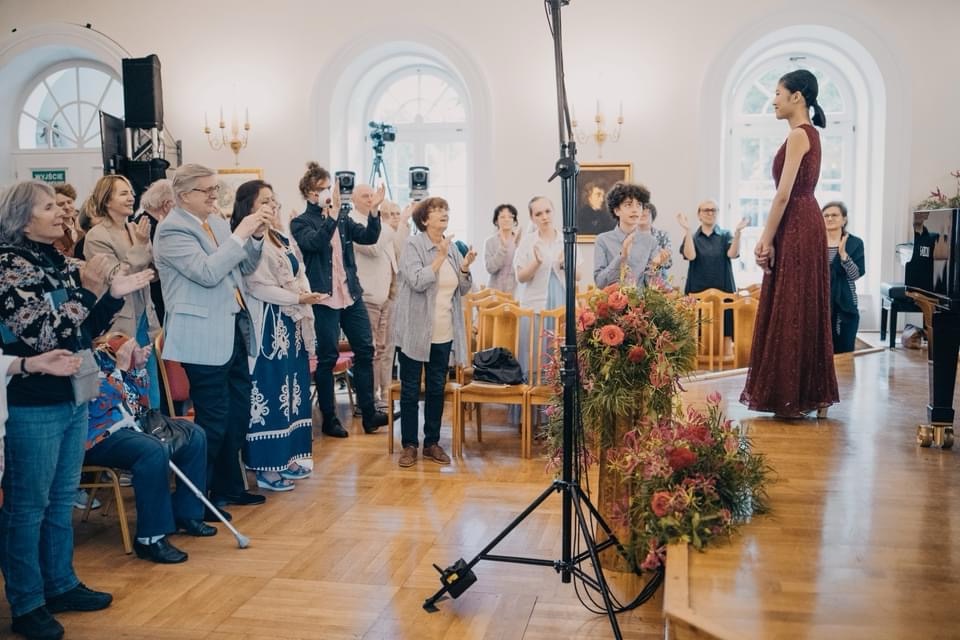
Shunta Morimoto at Brighton Festival The sublime inspiration of a poet of the piano

Hastings International Piano Competition Winner 2022

Bach French suite No. 6 in E minor BWV 817  
Schubert Klavierstücke D. 946 no.2 E flat major
Chopin Barcarolle Op. 60  
Schumann Davidsbündlertänze Op.6  

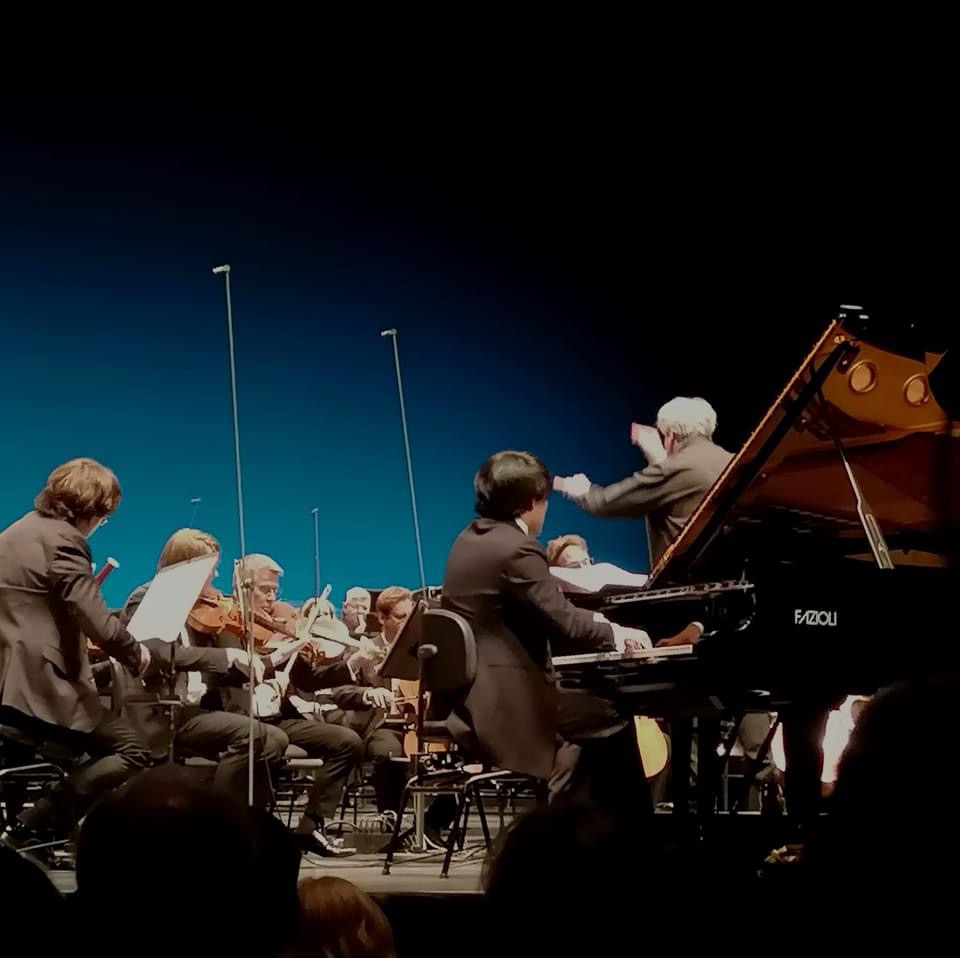
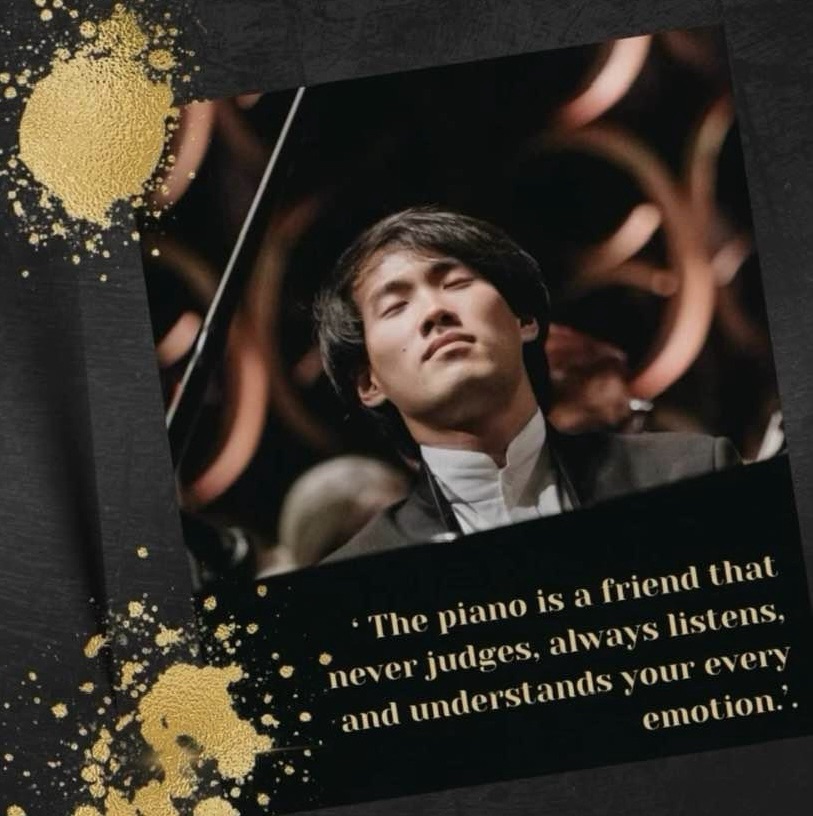
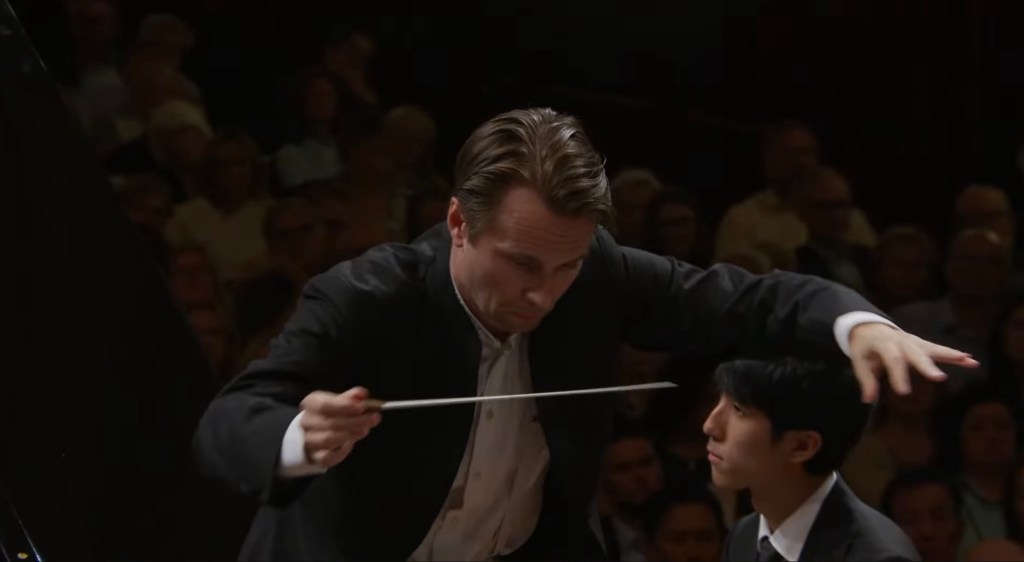
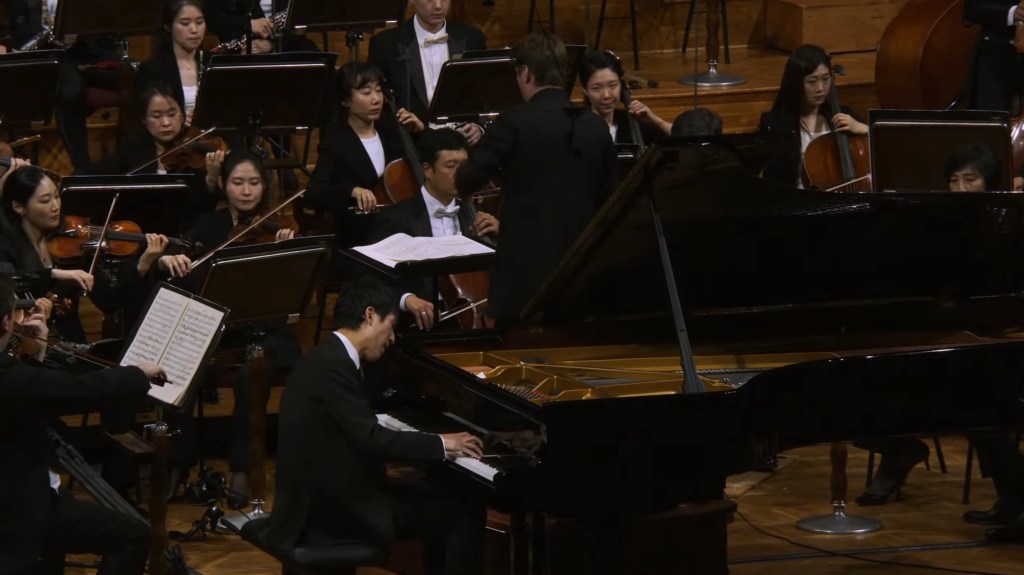
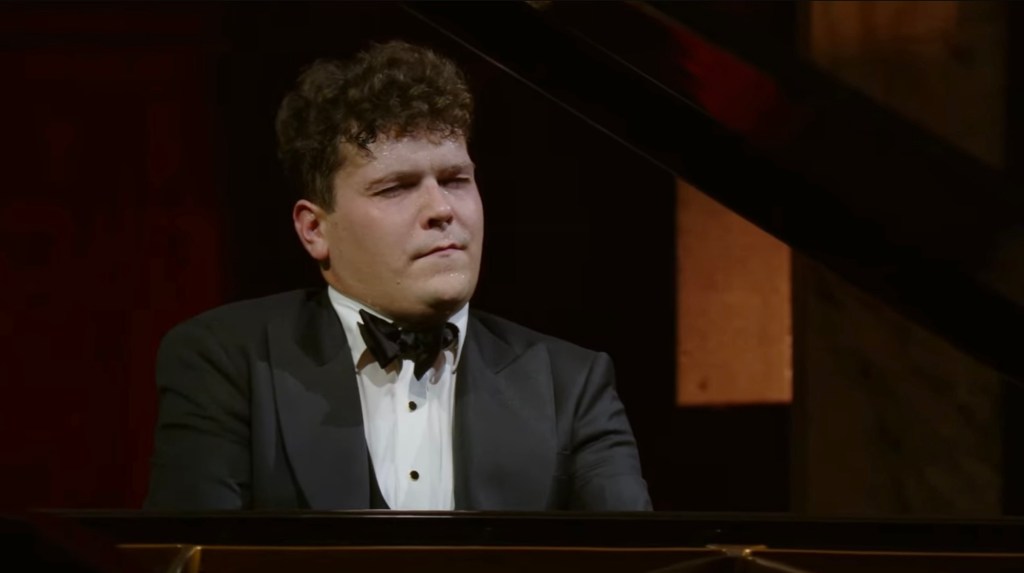
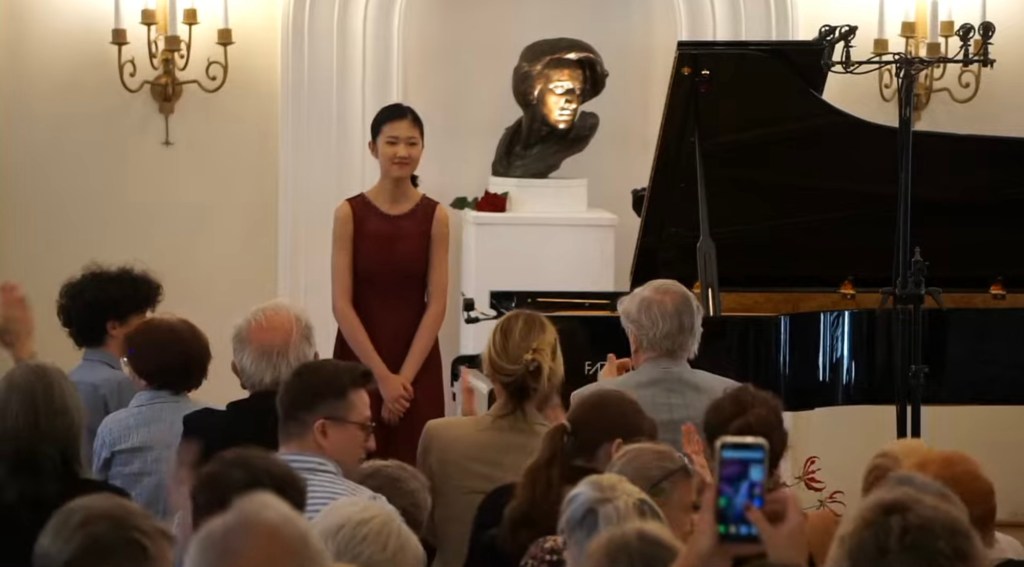
In 2022, aged just 17, Japanese pianist Shunta Morimoto was unanimously awarded First Prize in the Hastings International Piano Concerto Competition following his performance of Schumann’s Piano Concerto. Here he ends his lunchtime recital with the same composer’s Davidsbündlertänze, a kaleidoscopically varied set of 18 ‘dances’ for Florestan and Eusebius – two supposed members of Schumann’s imaginary ‘League of David’, but actually representing twin aspects of his artistic personality.

In Association with Hastings International Piano Competition

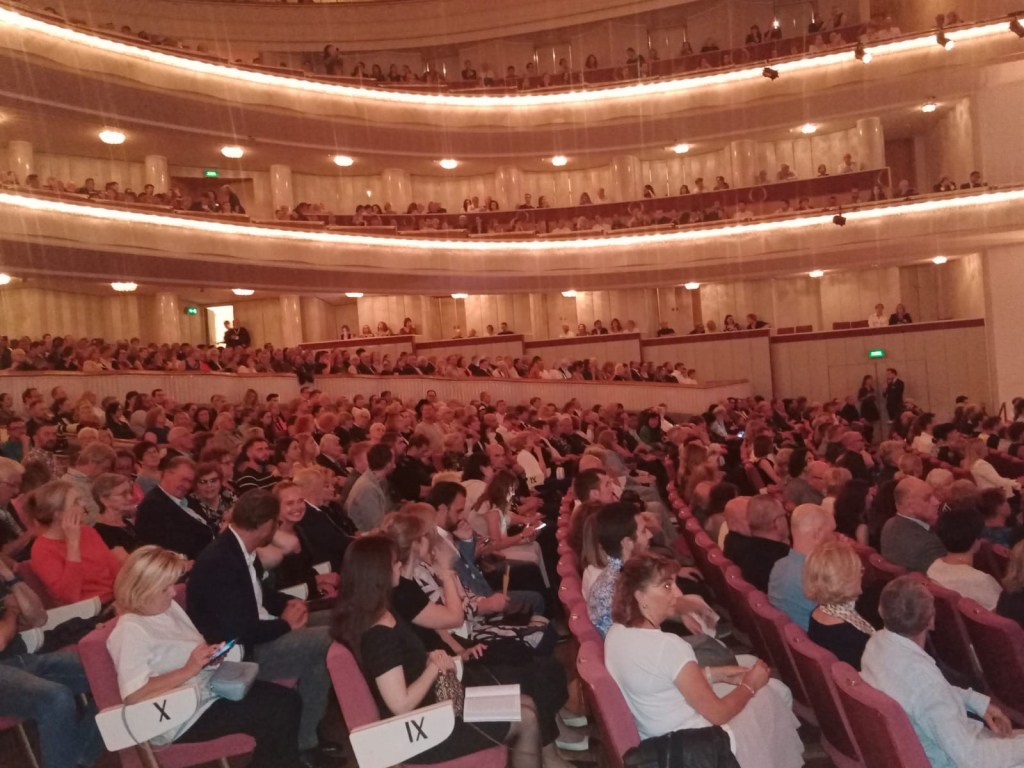
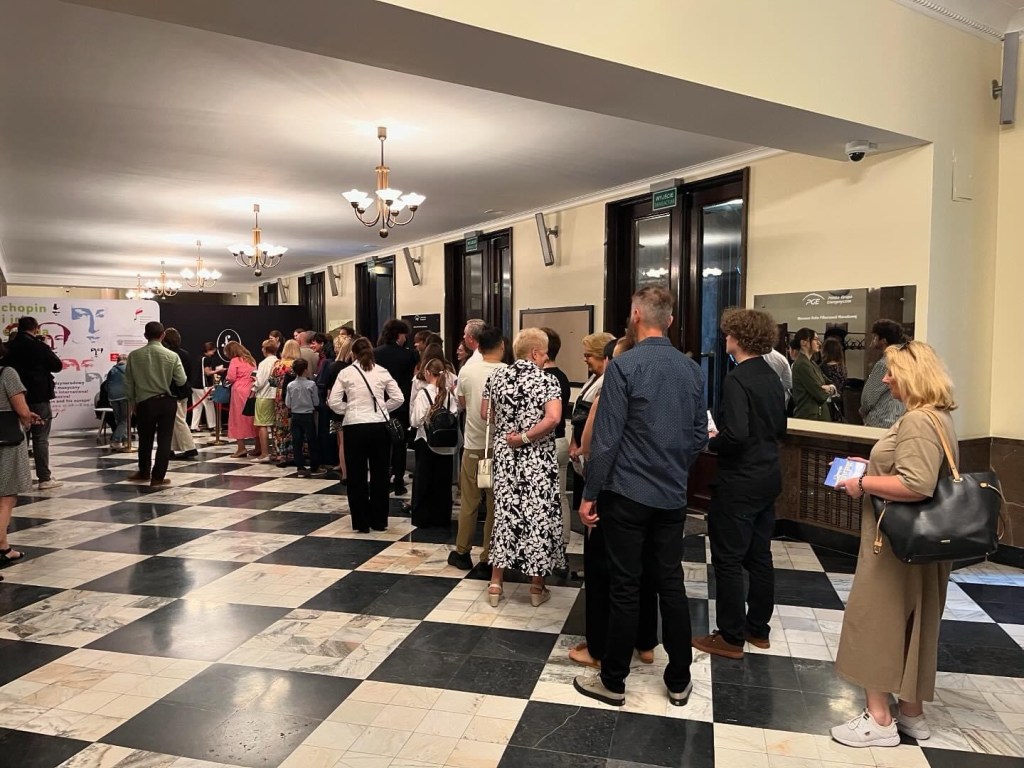
I have heard Shunta many times over the past few years but rarely have I heard him play with the intimacy that only a large hall can afford .

Bach’s 6th French Suite was played with exquisite ornaments that shone like jewels and discreet changes of register that he acknowledged with sudden changes of colour of whispered tones just shadowing what it mirrored.A sense of dance that was hypnotic and tantalising in it’s subtlety. Bach is Song and Dance and nowhere more than in Shunta’s inspired hands.Each of the eight movements flowed so naturally that time stood still as the magnificence of Bach was revealed with simplicity and sublime beauty.

The second of the three Klavierstucke flowed from his fingers with a luminosity and fluidity that when the sinister undertones of the first episode suddenly appeared on the scene we were held in a spell of discovery not knowing how such a drama would play out. The storm in a teacup was followed by a second episode of refined beauty and sumptuous golden sounds.The whispered return of the opening melody was overwhelming in its impact as we were drawn into this intimate private world that this young man shared with us today.

Chopin’s Barcarolle was a continuous outpouring of song played by Shunta today with a simplicity and freedom that was hypnotic.From the opening deep C sharp he held us in a spell of aristocratic simplicity where the music was allowed to pour from his fingers as the waves washed around Chopin’s imaginary lagoon.The transition from the sublime beauty of the central episode to the final outpouring of nobility and heart rending passion was masterly controlled as we were held on a wave of sound that gradually increased in intensity until bursting point and the final disintegration.We could literally see the strands gradually unfolding until they wafted on high with a cadenza of breathtaking beauty where time seem to stand still as the notes unfolded with that inevitable simplicity that I have only ever experienced with Rubinstein in the hall next door.

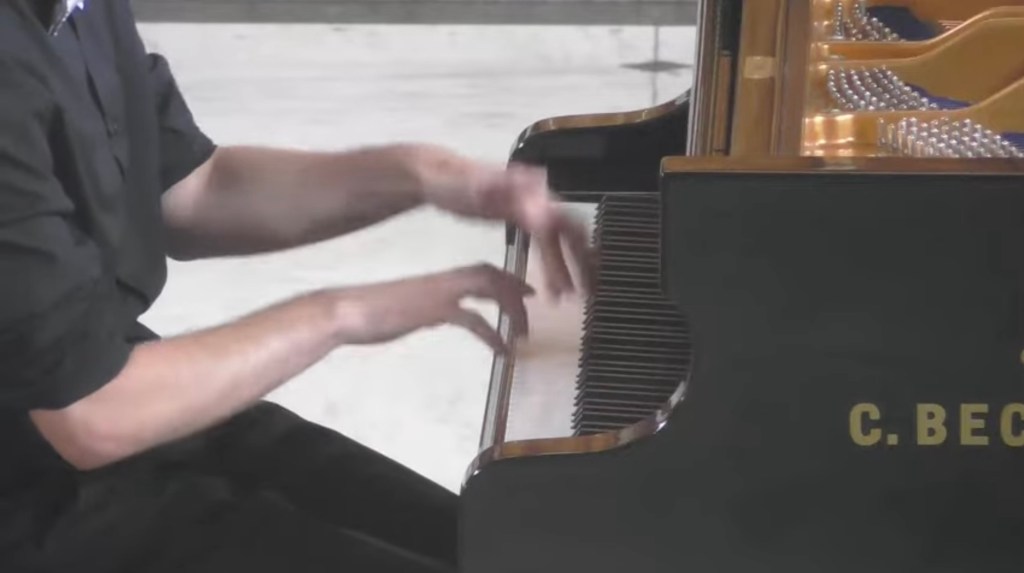
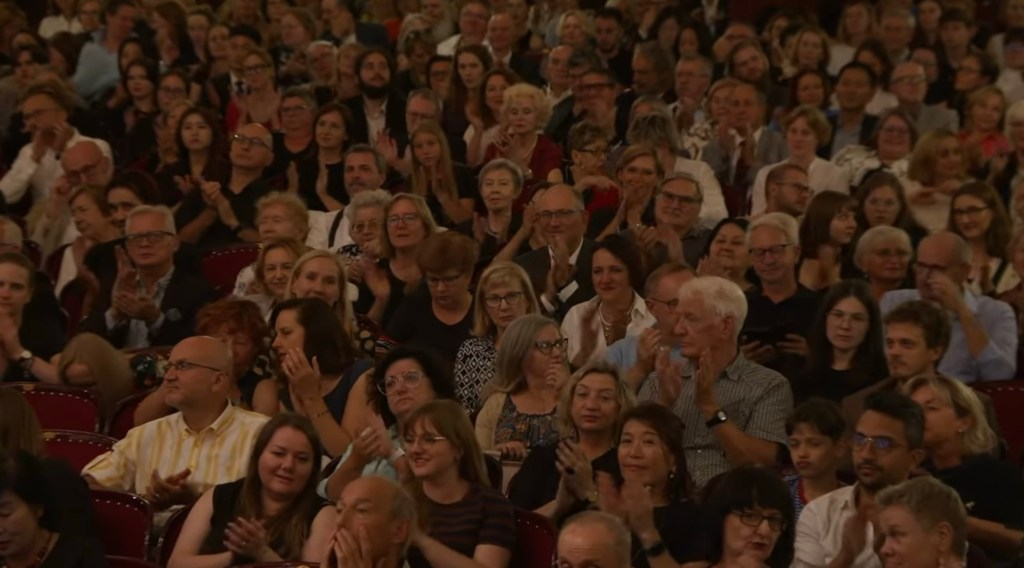
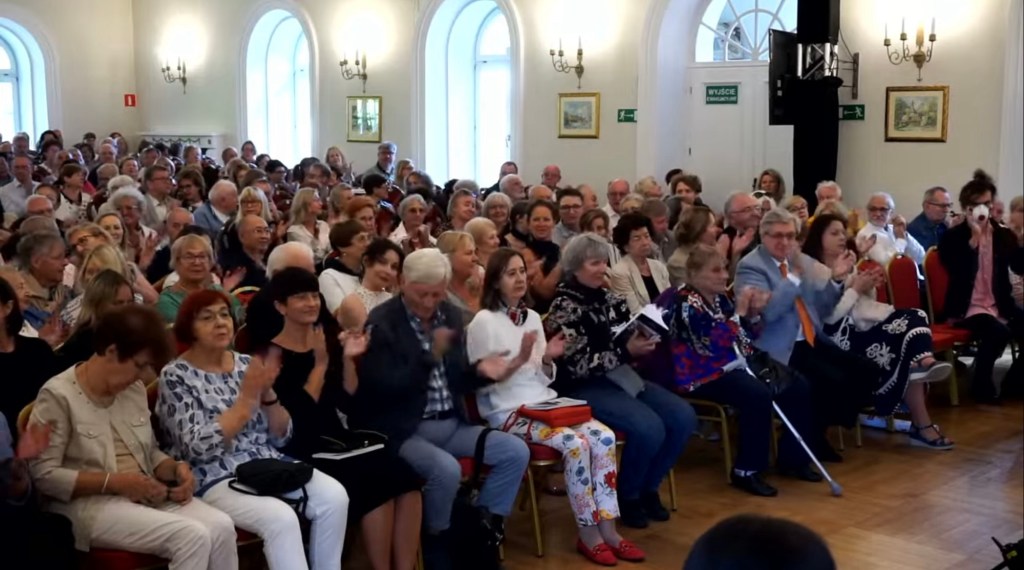
Schumann’s Davidsbundlertanze filled the second half of this lunchtime recital where the freedom and subtle colours that Shunta found was nothing short of miraculous.There was passion and transcendental playing of astonishing natural ease where technical difficulties ceased to exist with an artist where music was burning within his being and was the only consideration.The beautiful fourteenth dance was played with glowing beauty and a balance that showed us too the very roots from which this sublime music had grown.The penultimate dance that Schumann describes as ‘from a distance’ was played with trance like beauty of etherial sounds that gradually built up to the final climax that dissolved as fast as it arrived.It left just the final dance that was played with subtle whispered sounds where we were caught in a spell of magic that was greeted by the silence of an audience unified in one of those rare magic moments that can still occasionally happen in the concert hall.

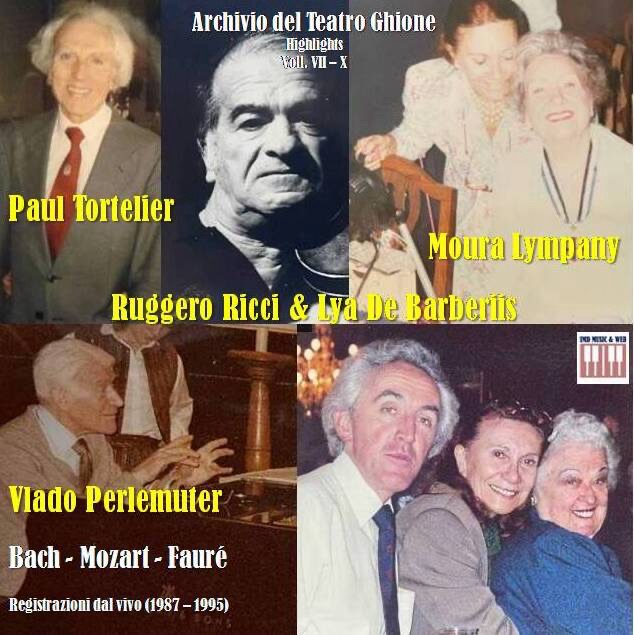
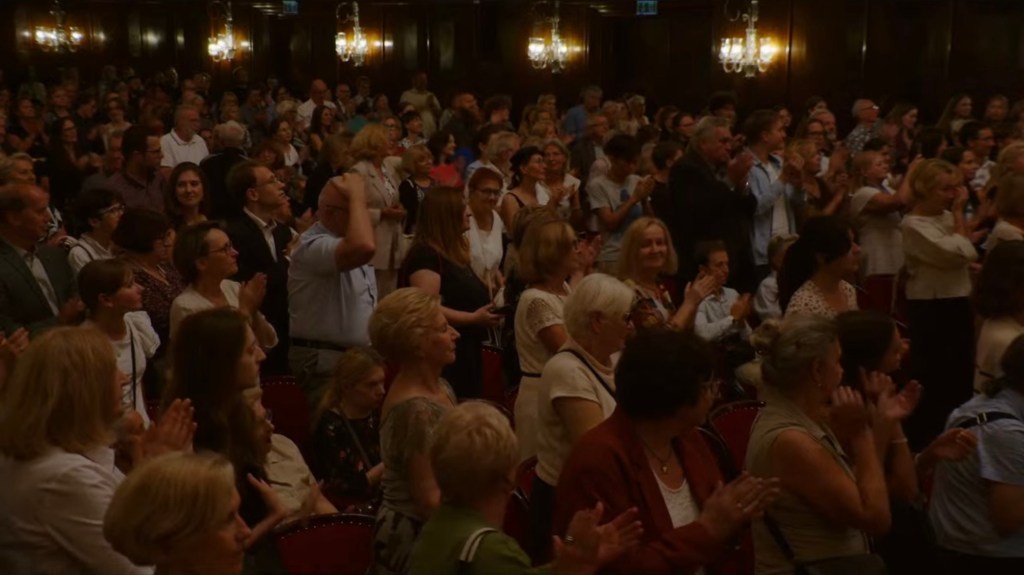
The spell was broken by an ovation that brought this young man back on stage for three encores .Chopin’s Study op 10 n. 4 was breathtaking not only for its transcendental virtuosity but more for the music he made of these notes .I have only ever heard from Perlemuter streams of sound and moving harmonies as one phrase was passed from the right hand to the left in a playful duet until the final outburst of passionate abandon.I have heard many pianists play this study but no one has ever played it with the musical mastery of this young man.

Bach’s prelude and fugue n.13 from the first book was Shunta’s way of thanking us and wanting to share with us again the sublime beauty of the Genius of Bach.


1748 portrait of Bach, showing him holding a copy of the six-part canon BWV 1076

21 March 1685 Eisenach 28 July 1750 (aged 65) Leipzig

The French Suites, BWV 812–817, are six suites which Johann Sebastian Bach wrote for the clavier (harpsichord or clavichord )between the years of 1722 and 1725.Although Suites Nos. 1 to 4 are typically dated to 1722, it is possible that the first was written somewhat earlier.The suites were later given the name ‘French’ (first recorded usage by F.W Marburg  in 1762). Likewise, the English Suites received a later appellation. The name was popularised by Bach’s biographer Forkel , who wrote in his 1802 biography of Bach, “One usually calls them French Suites because they are written in the French manner.”This claim, however, is inaccurate: like Bach’s other suites, they follow a largely Italian convention.There is no surviving definitive manuscript of these suites, and ornamentation varies both in type and in degree across manuscripts.

Gavotte from French Suite No. 5

Suite No. 6 in E major, BWV 817

  1. Allemande
  2. Courante
  3. Sarabande
  4. Gavotte
  5. Polonaise
  6. Bourrée
  7. Menuet
  8. Gigue

Franz Peter Schubert 31 January 1797 – 19 November 1828

The three “piano pieces” D.946, were completed in May 1828, the year Schubert died, and follow the far more well-known and popular Impromptus D.899 and D.935, which Schubert composed the previous year. Like the Impromptus, the Drei Klavierstücke express in microcosm so much of Schubert’s unique soundworld and musical personality – daring and unusual harmonies, beautiful songful melodies, and episodes of profound poignancy or intimacy. Throughout these three pieces, we hear the extraordinarily broad scope of his creativity and emotional landscape.

“He has sounds to express the most delicate feelings, of thoughts, indeed even for the events and conditions of human life.” – Robert Schumann 

Untitled and unpublished in Schubert’s lifetime, it was Johannes Brahms who anonymously edited and published the Drei Klavierstücke in 1868 and gave the works their collective title. The second of the triptych is a five-part rondo. It opens in E-flat major, which connects it to the previous piece, though it is not known whether Schubert conceived the three pieces to be linked. An elegant barcarolle, the A section has an aria-like melody coloured by harmonic shifts between major and minor.

Daguerreotype, c. 1849
Frédéric François Chopin born Fryderyk Franciszek Chopin;
1 March 1810 – 17 October 1849

The Barcarolle in F sharp major op 60 , by Chopin was composed between autumn of 1845 and summer 1846, three years before his death. This is one of Chopin’s last major compositions, along with his Polonaise – Fantasie op 61. In the final years of his short life, Chopin reached a new plateau of creative achievement. His sketches from these years suggest that the agony of composition, the resistance it set up, wrested from him only music of an exceptional, transcendent quality. And nowhere is this clearer than in the three great extended works of 1845–6: the Barcarolle Op 60, Polonaise-Fantasie Op 61 and Cello Sonata Op 65

In the summer of 1845, alongside new mazurkas and songs, the Barcarolle was written . Perhaps by coincidence, perhaps by design, the last of the three Mazurkas, Op. 59, composed in the key of F sharp minor, ends with a switch to the bright F sharp major. And it is in that same F sharp major – a rare key in Chopin – that the Barcarolle begins. It is also in shades of F sharp major (as the work’s main key) that the Barcarolle’s musical narrative proceeds, departing from it and returning to it again.

We do not know when and in what circumstances the idea for this music was conceived. Chopin never visited Venice. He had but a fleeting encounter with Italian landscapes and atmosphere on a boat trip from Marseilles to Genoa. A storm at sea was perhaps more likely to have impressed itself onto his memory of that fatiguing expedition than any image of the city. It is assumed that Chopin could have been given the idea of composing a barcarolle, as well as a prototype for its shape and character, by works in that genre which functioned in the current musical repertoire, especially in opera, and above all in Rossini and Auber. All the operatic barcarolles by those composers were well known to Chopin. He could not possibly have forgotten the barcarolles from Guilllaume TellLa muette de Portici or Fra Diavolo.

The barcarolle genre was becoming increasingly popular in vocal and pianistic lyricism. We know that Chopin gave his pupils Mendelssohn’s Lieder ohne Worten to play. The sixth number in the first book of the Songs without Words bears the title ‘Venezianisches Gondellied’ Venetian boat song. This could certainly have been a path for Chopin into the convention of the nineteenth-century barcarolle. Yet in Chopin’s Barcarolle there are no references to either the historical tradition of the songs of the Venetian gondoliers (as do appear in Liszt’s ‘Venezia e Napoli’) or the banal idiom of the opera-salon barcarolle of the day, which would soon reach its pinnacle with the Barcarolle from Offenbach’s Les contes d’Hoffmann. In Chopin’s Barcarolle, beneath the cloak of the generic convention, we find music that encapsulates his supreme pianistic experience and the musical maturity that he had attained during this rather reflective phase, and at the same time music that echoes his experience of the whole Mediterranean south of Europe: the Italian songs of Lina Freppa, Bellini’s bel canto, the passionate Spanish songs of Pauline Viardot, which Chopin listened to in rapture, and the wild, but incredibly beautiful landscape of Majorca.

One peculiar, extraordinary moment comes at the point which Chopin defines with the words dolce sfogato and precedes with a lead-in filled with hushed mystery. That enigmatic, unfathomed dolce sfogato then starts to develop and bloom.

In his Notes on Chopin, André Gide went into raptures: ‘Sfogato, he wrote; has any other musician ever used this word, would he have ever had the desire, the need, to indicate the airing, the breath of breeze, which, interrupting the rhythm, contrary to all hope, comes freshening and perfuming the middle of his barcarolle?’

Robert Schumann Davidsbündlertänze (Dances of the League of David), op 6, is a group of eighteen pieces composed in 1837 by Robert Schumann , who named them after his music society Davidsbundler. The low opus number is misleading: the work was written after Carnaval op 9 and the Symphonic Studies op.13.

Original manuscript first page 

Robert Schumann’s early piano works were substantially influenced by his relationship with Clara Wieck . On September 5, 1839, Schumann wrote to his former professor: “She was practically my sole motivation for writing the Davidsbündlertänze, the Concerto , the Sonata and the Novelettes .” They are an expression of his passionate love, anxieties, longings, visions, dreams and fantasies.

Clara’s Mazurka printed in the 1997 urtext edition of Davidsbundler 

The theme of the Davidsbündlertänze is based on a mazurka by Clara Wieck.The intimate character pieces are his most personal work and in 1838, Schumann told Clara that the Dances contained “many wedding thoughts” and that “the story is an entire Polterabend (German wedding eve party, during which old crockery is smashed to bring good luck)”.

The pieces are not true dances but characteristic pieces, musical dialogues  about contemporary music between Schumann’s characters Florestan and Eusebius. These respectively represent the impetuous and the lyrical, poetic sides of Schumann’s nature. Each piece is ascribed to one or both of them. Their names follow the first piece and the appropriate initial or initials follow each of the others except the sixteenth (which leads directly into the seventeenth, the ascription for which applies to both) and the ninth and eighteenth, which are respectively preceded by the following remarks: “Here Florestan made an end, and his lips quivered painfully”, and “Quite superfluously Eusebius remarked as follows: but all the time great bliss spoke from his eyes.” The suite ends with the striking of twelve low Cs to signify the coming of midnight.

The first edition is prefaced by :

Old saying
In each and every age
joy and sorrow are mingled:
Remain pious in joy,
and be ready for sorrow with courage

The movements are : 

  1. Lebhaft: Lively (Vivace),Florestan and Eusebius;
  2. Innig: Intimately (Con intimo sentimento), , Eusebius;
  3. Etwas hahnbüchen: Somewhat clumsily (Un poco impetuoso) (1st edition), Mit Humor: With humor (Con umore) (2nd edition), Florestan (hahnbüchen, translates as “cockeyed” )
  4. Ungeduldig: Impatiently (Con impazienza), , Florestan;
  5. Einfach: Simply (Semplice), , Eusebius;
  6. Sehr rasch und in sich hinein: Very quickly and inwardly (Molto vivo, con intimo fervore) (1st edition), Sehr rasch: Very quickly(Molto vivo) (2nd edition), , Florestan;
  7. Nicht schnell mit äußerst starker Empfindung: Not fast, with very great feeling (Non presto profondamente espressivo) (1st edition), Nicht schnell: Not fast (Non presto) (2nd edition), Eusebius;
  8. Frisch: Freshly (Con freschezza), Florestan;
  9. No tempo indication (metronome mark of ♩ = 126) (1st edition), Lebhaft: Lively (Vivace) (2nd edition), , Florestan;
  10. Balladenmäßig sehr rasch: Balladically very fast (Alla ballata molto vivo) (1st edition), (“Sehr” and “Molto” capitalized in 2nd edition), (ends major), Florestan;
  11. Einfach: Simply (Semplice), Eusebius;
  12. Mit Humor: With humor (Con umore), Florestan;
  13. Wild und lustig: Wildly and merrily (Selvaggio e gaio), Florestan and Eusebius;
  14. Zart und singend: Tenderly and singing (Dolce e cantando), Eusebius;
  15. Frisch: Freshly (Con freschezza), – Etwas bewegter: With agitation (poco piu mosso),with a return to the opening section (with the option to go round the piece once more), Florestan and Eusebius;
  16. Mit gutem Humor: With good humor (Con buon umore) (in 2nd edition, “Con umore”), – Etwas langsamer: A little slower (Un poco più lento); leading without a break into
  17. Wie aus der Ferne: As if from afar (Come da lontano), (including a full reprise of No. 2), Florestan and Eusebius; and finally,
  18. Nicht schnell: Not fast (Non presto), Eusebius.

Shunta Morimoto takes Hastings by Storm

https://christopheraxworthymusiccommentary.com/2023/06/09/shunta-morimoto-pitti-piano-festival-florence-the-inspired-recreation-of-a-great-artist/

https://christopheraxworthymusiccommentary.com/2023/05/06/shunta-morimotos-all-or-nothing-performance-of-liszt-with-aristocratic-nobility-and-brilliance/

https://christopheraxworthymusiccommentary.com/2024/03/20/christopher-axworthy-dip-ram-aram/

Ariel Lanyi illuminates Richmond Concert Society with the integrity and humility of a great artist

Ariel Lanyi at the Richmond Concert Society playing a very serious programme of just three great works: Beethoven’s Sonata op 109 ,Franck’s Prelude Aria and Final and Reger’s monumental Variations and Fugue on a Theme by Bach .
Last year Alim Beisembayev had given a recital here opening too with late Beethoven, the second of the last trilogy: op 110 .

Alim Beisembayev – The poetic vision of a great artist


Both had made their mark at the a Leeds International Piano Competition and both are revealing themselves to be extraordinary musicians dedicated with selfless humility to serving the composer and following with scrupulous attention the very precise indications that litter the scores of Beethoven.


Ariel is a very intense and dedicated musician following in the footsteps of Rudolf Serkin but he is also a supreme stylist where the composers indications are incorporated into interpretations of ravishing beauty and searing intensity.
I well remember Serkin playing this sonata op 109 as I also remember him as being the only pianist I have encountered that had the courage and conviction to bring Reger into the concert hall


Ariel’s op.109 was like the same apparition of Franck as it wafted into our lives on a magic wave of sounds .
The sounds of Beethoven played with scrupulous attention to not only what the composer marks on the page but more importantly the sounds that must have been in his head at the moment of inspiration.
Ariel playing with fervant dedication convinced us that this was the only path he could have taken today. And it was with one breath that he created a halo of sounds that never overstepped their essential place in a jig saw of dynamic drive and ethereal beauty, pulsating rhythmic intensity but also moments of sublime visionary peace.


Franck’s unjustly neglected twin received a performance of overwhelming nobility and the intense beauty of a true believer that one wondered why this was probably one of the all too few times we had heard it in the concert hall.A kaleidoscope of sounds but a masterly architectural control that when he reached the climax it was of such overwhelming sumptuous sounds that it truly was the cry of someone desperately wanting to share the vision of a dedicated believer with us.


Reger’s monumental variations were a tour de force in every possible way.Based on the Aria ‘No one can fathom his omnipotence’ unfolding in mellifluous Brahmsian style.Followed by variations of almost Paganinian complexity thrown off with enviable ease by an artist whose only concern was to find the true meaning behind this complex outpouring of nobility and extraordinary complexity.Starting like Brahms and finishing like Busoni with a fugue where the words knotty twine would be an understatement.Even with all these complexities Ariel played with masterly assurance and searing intensity.I don’t know if Ariel is a true believer but he certainly convinced us tonight that he is blessed by the Gods with a gift to see into the very heart of the music and to be able to transmit it with simplicity and humility.


Even the Chopin Nocturne op posth offered as an encore was played with the same aristocratic love and good taste that he had so generously shared with us all evening.

I have reviewed both the Reger and Franck recently in more detail that can be seen and even heard in the links below.

https://christopheraxworthymusiccommentary.com/2023/09/06/ariel-lanyi-at-st-marys-simple-pure-beethoven-and-monumental-reger-a-new-serkin-is-in-our-midst/

But Ariel is a great artist where there are no printed pages but every performances is a vibrant discovery and rejoicing that makes live performance still so essential in these days of instant communications.

https://christopheraxworthymusiccommentary.com/2022/05/02/ariel-lanyi-the-simplicity-and-poetry-of-a-great-musician-at-st-marys/

It was Mitsuko Uchida who very wisely said when asked if photos or recording could be taken from her live performances .She simply exclaimed with her penetrating directness that a performance should remain a memory that grows and glows in the memory and not just a printed picture of a moment that with time will fade! As always so perceptive and right.

https://christopheraxworthymusiccommentary.com/2023/09/06/ariel-lanyi-at-st-marys-simple-pure-beethoven-and-monumental-reger-a-new-serkin-is-in-our-midst/

https://christopheraxworthymusiccommentary.com/2024/03/20/christopher-axworthy-dip-ram-aram/

Beatrice and Eleonora Dallagnese in Viterbo.Mastery and Musicianship with a duo that plays as one

https://www.youtube.com/live/j6Y8kTk9DzU?feature=shared

A quite extraordinary recital from these identical twins.To say they play as one would be too obvious but their sense of ensemble and musical understanding are so remarkable that there really is an alchemy that is their birthright. These two beautiful young ladies sit bolt upright listening to each other and without the score create a kaleidoscope of sounds as they truly play as one.

https://bedallagnese.com/

There was a fluidity and clarity to the opening of the Respighi and even the nursery rhymes quoted never interrupted the continual flow as they depicted these vivid ‘Pines of Rome’ with the same colours and excitement as an orchestra.Playing of mastery and breathtaking technical prowess.Even the deep meditative sounds and evocative bird calls showed a masterly control of the pedal as they listened so attentively to the overall line they were creating together with a deep concentration that seemed to exclude any physical movement.

Swopping over for the Schubert but I have no idea who is who but I do know that the Schubert was of sublime beauty and sensitivity with the same perfect ensemble. An architectural understanding that held this long sonata movement as one glorious whole where the change to the major towards the end showed so poignantly Schubert’s sublime outpouring of mellifluous beauty. Pianississimo that was truly that and forte that was always with the long musical line in mind as they created a complete musical whole of great power and beauty.

No change over for the Stravinsky that was given a quite remarkable performance and it is the first time I have heard it in this four hand version.There was all the vivid characterisation and sudden dynamic outbursts .The excitement they generated with the ‘Shrove Fair’ was the same they had shown at the end of the Respighi and it was breathtaking in it’s tonal control and gradual building of excitement.

A quite remarkable duo and the only other team I know that play the four hand – two piano repertoire without the score are the Jussen brothers – not twins but obviously something in their genes like the two young ladies today.

A beautiful Brahms waltz was offered as an encore and just showed their refined sense colour and stylistic mastery .

Beatrice and Eleonora Dallagnese began studying the
piano at the age of 4 under the guidance of M° Eleonora Mometti.

Their parents still recall the twin’s first recital with emotion: “Two pianists who played with their feet dangling because they couldn’t reach the floor”. From that first performance, Beatrice and Eleonora Dallagnese embarked on a path that to date has led to them being recognized as among the leading Italian female pianists, and seeing them perform in some of the most prestigious theatres.

From playing their very first notes, thanks to the intuition of their teachers, they began to develop their distinctive technique as a duo that today places them among the leading Italian classical pianists. A technique which over time they have refined and perfected through the symbiosis so common to twins, whilst not detracting from their differences.

In 2015, they joined the International Piano Academy “Incontri con il Maestro” in Imola, founded by M° Franco Scala. They were instructed in piano by M° Stefano Fiuzzi and M° Ingrid Fliter, and by M° Nazzareno Carusi for their chamber music class. The educational path undertaken by Beatrice and Eleonora has allowed them to grow professionally with an international vision.

They continue their studies with M° Ingrid Fliter and M° Boris Petrushansky, whilst from 2015 also taking classes with M° Alberto Nosé.

In 2018 they graduated from the “C. Pollini ” Conservatory of Padua, both with full marks, praise and special mention.


Franz Peter Schubert
31 January 1797, Himmelpfortgrund,Vienna
Died: 19 November 1828 (age 31 years), Vienna

The Allegro in A minor, D947 and the Rondo in A major, D951 were written in May and June 1828 respectively, and may well have been intended to form a two-movement sonata along the lines of Beethoven’s E minor Sonata Op 90. Rondo was published in December 1828, less than a month after Schubert died, but its A minor companion-piece did not see the light of day until 1840, when Anton Diabelli issued it under the heading of Lebensstürme (‘The storms of life)

Franz Schubert was one of the most prolific composers of ensemble piano music, and the Allegro in A Minor, Op. 144, demonstrates his mastery at writing for one piano, four hands. This large and passionate work was composed in 1828, the year of Schuberts death. It is written in sonata-allegro form and may have been intended as the first movement of a sonata. It was first published by Anton Diabelli in 1840 with the title Lebensstürme: Characterischeres Allegro (Lifes Storms: Characteristic Allegro). The Allegro makes extensive use of chromaticism, Neapolitan sixth chords, and contrasts of moods.


Ottorino Respighi 
9 July 1879 Bologna , Italy. 18 April 1936 (aged 56). Rome, Italy

Pines of Rome (Pini di Roma), P 141 is a tone poem in four movements for orchestra completed in 1924 and is the second of his three tone poems about Rome following Fontane di Roma (1916) and preceding Feste Romane  (1928) He completed I Pini di Roma in the summer of 1924, after he had “conceived, started and restarted” work on the piece in the course of several years. Having relocated from his hometown of Bologna to Rome in 1913, Respighi said that the city’s “marvellous fountains” and “umbrella-like pines that appear in every part of the horizon” were two characteristics that “[have] spoken to my imagination above all”.This influence resulted in the first of his three tone poems about Rome, the Fontane di Roma  (1916), which brought him international fame.

The piece consists of four movements, for which Respighi wrote programmatic notes describing each scene:

  1. “I pini di Villa Borghese” (“The Pines of the Villa Borghese”) – Allegretto vivace This movement portrays children playing by the pine trees in the Villa Borghese gardens , dancing the Italian equivalent of the nursery rhyme “Ring a Ring o’Roses”and “mimicking marching soldiers and battles; twittering and shrieking like swallows”.[
  2. “Pini presso una catacomba” (“Pines Near a Catacomb”) – Lento In the second movement, the children suddenly disappear and shadows of pine trees that overhang the entrance of a Roman catacomb dominate.It is a majestic dirge, conjuring up the picture of a solitary chapel in the deserted Campagna; open land, with a few pine trees silhouetted against the sky. A hymn is heard (specifically the Kyrie ad libitum 1, Clemens Rector; and the Sanctus from Mass IX, Cum jubilo), the sound rising and sinking again into some sort of catacomb, the cavern in which the dead are immured. An offstage trumpet plays the Sanctus hymn. Lower orchestral instruments, plus the organ pedal at 16′ and 32′ pitch, suggest the subterranean nature of the catacombs, while the trombones and horns represent priests chanting.
  3. “I pini del Gianicolo” (“The Pines of the Janiculum”) – Lento The third is a nocturne set on the Janiculum Hill  and a full moon shining on the pines that grow on it. Respighi called for the clarinet solo at the beginning to be played “come in sogno”(“As if in a dream”).The movement is known for the sound of a nightingale  that Respighi requested to be played on a phonograph  during its ending, which was considered innovative for its time and the first such instance in music. In the original score, Respighi calls for a specific gramophone record to be played–“Il canto dell’Usignolo” (“Song of a Nightingale, No. 2”) from disc No. R. 6105, the Italian pressing of the disc released across Europe by the Gramophone Record label between 1911 and 1913.[8] The original pressing was released in Germany in 1910, and was recorded by Karl Reich and Franz Hampe. It is the first ever commercial recording of a live bird.Respighi also called for the disc to be played on a Brunswick Panatrope  record player. 
  4. “I pini della via Appia” (“The Pines of the Appian Way”) – Tempo di marcia Respighi recalls the past glories of the Roman Empire in a representation of dawn on the great military road leading into Rome. The final movement portrays pine trees along the Appian Way in the misty dawn, as a triumphant legion  advances along the road in the brilliance of the newly-rising sun. Respighi wanted the ground to tremble under the footsteps of his army and he instructs the organ to play bottom B♭ on the 8′, 16′ and 32′ organ pedals. The score calls for six buccine  – ancient circular trumpets that are usually represented by modern flugelhorns , and which are sometimes played offstage. 


Igor Fyodorovich Stravinsky 17 June 1882 St Petersburg – 6 April 1971 New York was a Russian composer and conductor with French citizenship (from 1934) and United States citizenship (from 1945). 
Stravinsky as drawn by Picasso  in 1920

The meeting of Diaghilev and Stravinsky was inspired by a performance of the latter playing his piano version of Fireworks in 1909. Diaghilev commissioned him to write The Firebird, and although Stravinsky was 27 and unknown at this time, he still possessed the chutzpah to verbalize his reluctance to compose within constraints or to collaborate with set designer Alexandre Benois and choreographer Mikhail Fokine.

The Firebird, of course, was a huge success. But it was their second collaboration – Petrushka – that brought the pair its first multimedia success and freed Stravinsky to put his own stamp on Parisian musical life.

Unlike The Firebird, the idea for Petrushka was Stravinsky’s own. It had haunted him during the final weeks of revisions for Firebird, and when the project was finished he threw himself into the first sketches. Stravinsky wrote to his mother: “…my Petrushka is turning out each day completely new and there are new disagreeable traits in his character, but he delights me because he is absolutely devoid of hypocrisy.” Petrushka is a descendant of the commedia dell’arte Pulcinella, a clown representing the trickster archetype. He is playful, quarrelsome, mercurial, antiauthoritarian, naughty, but of course indestructible, which is the reason for his appeal. Other characters evolved: the Blackamoor, Petrushka’s nemesis and eventual murderer; the Ballerina, a Ballets Russes version of the commedia dell’arte Columbine – pretty, flirtatious, shallow, irresistible; and the Magician, who reveals Petrushka’s immortality.

The concert version of Petrushka comprises four tableaux – imagine scenes from a storybook come to life. The first tableau depicts the last days of Carnival, 1830, Admiralty Square, old St. Petersburg.

First tableau: The Shrovetide Fair the music opens with a bustling fair day: crowds and glittering attractions everywhere reflected in the constantly shifting rhythms and harmonies, and in orchestration that alternates and ultimately merges high winds and bell-like tones in piano with thrusting low strings, erupting into a fantastic, oddly accented full-orchestra fiesta. Two drummers appear outside a puppet theater, and a drum roll (a connecting device that runs throughout the work) knocks the crowd into pregnant silence. The Magican appears to the mesmerizing twists and turns of the orchestra, featuring an undulating, almost lurching, flute solo, and the sinister spell is cast. Petrushka is introduced with the other major connective device of the work: the “Petrushka Chord,” a tone cluster made of the major triads of C and F-sharp that weaves the work together both harmonically and melodically. Here we also meet the Ballerina and the Blackamoor, and the three together do a warped, angular, yet still quite folksy Russian dance.

Second tableau: Petrushka’s Room evokes Petrushka alone in a gloomy cell. Piano arpeggios accompany the puppet’s dreaming of freedom, which escalates to enraged cries in the trumpets and trombones. Solo flute re-enters with a flirty little tune, shifting the mood to portray the Ballerina, whom Petrushka loves. She will tease, but of course wants nothing to do with him.

Third tableau: The Moor’s Room Who the Ballerina really wants is the Blackamoor, the bad boy who is the center of the third tableau. A clumsy, banal tune played by solo winds and pizzicato strings, all sounding slightly out of sync with each other, accompanies their lovemaking. Petrushka crashes the party, and the Blackamoor chases him into the crowd.

Fourth tableau: The Shrovetide Fair (Toward Evening) after the music of the fair scene, the Blackamoor pursues Petrushka and murders him. The Magician realizes that Petrushka is a puppet, and when Petrushka’s ghost appears the Magician runs away scared; the recurring “Petrushka chord” gives the last laugh. Stravinsky later said he was “more proud of these last pages than of anything else in the score.”

Petrushka opened on June 13, 1911, at the Théâtre du Châtelet in Paris to overwhelming success. Conducted by Pierre Monteux, then 36, the performance was praised as a feat of sophisticated, intellectual theatrical folklorism.

During rehearsals for the 1911 premiere, Stravinsky and other pianists including Russian composer Nikolai Tcherepnin used a piano four hand  version of the score. This has never been published, although Paul Jacobs and Ursula Oppens , among other pianists, have played it in concert.

In 1921, Stravinsky created a virtuosic and celebrated piano arrangement for Artur Rubinstein Trois mouvements de Patrouchka, which the composer admitted he could not play himself, for want of adequate left-hand technique.

Cremona Musica ….2023 Day 2 Angelo Fabbrini the crowned Prince of Cremona

Reformed and inspired as the stars shine brightly at midday in Pall Mall with Simone Tavoni and Mon-Puo Lee

All set at the Reform Club to be welcomed by the indomitable Michael Corby who is dedicating his 80th birthday celebrations on the 14th June to funding a twin for the magnificent ex Wigmore Steinway that has now found a truly glorious retirement home.

Michael Corby with Simone Tavoni’s Spanish fiancée.
Michael has had a miraculous escape and highly recommends leaving the hot water tap on before going to bed!
His passion for music has surmounted all obstacles and his presence at the Reform Club is a guarantee of sumptuous music making.


Simone Tavoni had told me of a brief tour with a young cellist who had also played in his bi- annual festival in Spain. Simone’s parents, both distinguished doctors in Tuscany and his fiancée from Budapest had flown in especially for this week of sumptuous music making

Simone’s parents (centre and right) both distinguished doctors flown in from Tuscany to enjoy a glorious feast of music


Simone had told me Mon- Puo Lee was good but he did not tell me how good!
There was magic from the first ethereal sounds from the extraordinary world that Ades inhabits.

‘Les champs’ is the third of four movements of Thomas Adès ‘Lieux Retrouvés’ and is an atmospheric piece of whispered sounds. Deep bass notes from the piano just create even more mystery for a piece searching its way ever more secretly as it reaches for the infinite ,and probably the highest register the cello has ever been asked to reach ………finally silence with our ears now ready to listen as sounds were not projected out but it was we that were enticed in to this magic world of Adès. An extraordinary tour de force to open a programme with such stillness and intensity that requires a transcendental technique from the cellist to be able to sustain and maintain such sounds without ever risking a split or misplaced note.


An intensity that is rarely encountered and Mon-Puo like a cat about to pounce listening and watching to see which way he could jump.
A cat on a hot tin roof but a cat that is above all one of the finest young cellists of his generation.


I have only seen this recently with Peter Frankl and the Kelemen Quartet in the Liszt Academy in Budapest.

Peter the Great- Peter Frankl with the Kelemen Quartet in Budapest


It is a burning intensity that is hypnotic as it casts a spell where a voyage of discovery is a journey together into a world of dreams.I was fascinated to read in the CV after making what turned out to be a prophetic comment : ‘Mon-Puo’s musical journey took a significant turn when he joined the Kelemen Quartet, investing three years in the interpretation of essential quartet repertoire. This experience not only refined his technical proficiency but also enriched his artistic expression, contributing significantly to his growth as a chamber musician.’!!!!


There was scintillating brilliance from Simone with four Scarlatti sonatas of radiance and sparkling vitality. A rhythmic drive and clarity to the first but also delicacy with ornaments that sparkled like jewels on this superb Steinway.The second was of a brilliance as one hand was answered by the other in a scintillating cascade of notes of great character. There were beautiful harmonic sequences where notes became but moving living sounds of colour.The third was of ravishing beauty with a melodic line of beseeching cries of gentle insinuation and a continual outpouring of secret sounds of pregnant beauty. A Spanish dance erupted with the fourth sonata with its riveting animal drive and clashing dissonances all played with scintillating drive and electric energy.
Mon-Puo Lee played the third movement, ‘Allegro Molto vivace’ ,from Kodaly’s monumental solo Sonata op 8 of 1915 ,with a kaleidoscope of sounds of breathtaking audacity. A dynamic drive with the folkloristic idioms of a hundred different voices. A deep and passionate bass melodic line of searing intensity and a driving forward force of great virtuosity and tonal mastery

Sulkhan Tsintasadze’s Five Pieces on Folk Themes written in 1950 was the ideal way to lead us back to the duo before the final grandiose Brahms Sonata.A fine ensemble in pieces that are intricately spun by this Georgian composer – 1925-1991

1. Villain’s Song on a Carriage

2.     Tchonguri (Chonguri)

3.     Sachidao

4.     Nana

5.     Dance Tune

The first was an emotional outpouring of passionate significance.The second was a dance of beguiling drive for pizzicato cello solo.The third was teasingly dissonant with evident folk influence before breaking into a rumbustuous gypsy dance with a unexpectedly quixotic ending. Gentle flowing sounds on the piano open the fourth and creates the scene for a disarmingly simple folk melody on the ‘cello. Ending with high spirits of the fifth where the piano has much to say as they both dance to the end.

But it was in the Brahms F major Sonata that the two combined to produce a passionate and intense outpouring of orchestral sounds .A real dialogue between ‘cello and piano .Simone never overpowering even with the piano lid fully opened, and as Graham Johnson once quipped, it works because he knows how to drive! The cellist was enjoying too the open lid that could amalgamate and reflect their masterly playing into one unified whole directed at us the lucky recipients of such a feast.There was passion with the opening but also moments of sublime beauty and stillness as piano chords are placed over a mysterious vibrating bass creating an etherial world before unleashing the opening passion once more.There was an intensity and poignant beauty in the ‘Adagio affettuoso’ as the music was allowed to unfold with disarming simplicity in a dialogue between these two sensitive artists.Simone had his work cut out on the ‘Allegro passionato’ and rose heroically to the challenge as the music gathered ever more momentum only to expand into the trio of gloriously rich full sounds.There was a beautiful pastoral simplicity to the ‘ Allegro molto’ finale with its continual stream of notes passing so naturally from the ‘cello to the piano in a true dialogue between two such extraordinary artists.With the smell of the sumptuous cuisine from the restaurant wafting up to the library and was the sign to finish this ‘lunchtime’ concert with no time left for more on this occasion.

Simone with his father comparing ties


Extraordinary unexpected oasis of great music making in one of the most noble of clubs and where before the midday concert we exchanged views on designer ties as this is one of the last bastions insisting on a dress code .
Noblesse oblige if that is the key to paradise!

The magnificent Steinway now a happy pensioner from the Wigmore Hall
https://christopheraxworthymusiccommentary.com/2022/01/27/simone-tavoni-triumphs-on-the-italian-tour-for-the-keyboard-trust-part-1-florence/

Massimo Spada piano quintet in Viterbo.Refined music making of passion and intelligence

https://youtube.com/live/gaLb_NMWMYM?feature=shared

A quintet of players of refined good taste and musicianship.With the piano lid fully opened but never overpowering the quartet of strings as they created together an amalgam of rich beautiful sounds .Massimo Spada was at the helm with some ravishing sounds of delicacy and passion.Glissandi that were streams of colour that just illuminated and added an extra colour to the strings.

Mirei Yamada and Matteo Morbidelli on the violins swapping places for the two quintets. Matteo Introna and Alessandro Sacchetti,viola and cello,having a special voice in the Korngold where they produced a radiance of sound of Philadelphian proportions.This rarely played Quintet by Korngold started with an explosion of sounds with glissandi on the piano and many other effects of Hollywoodian style but always of expert craftsmanship.The slow movement was a meditative outpouring on the viola and cello joined by the violins in a ravishingly beautiful dialogue with gently throbbing unearthly sounds from the piano.There was a dramatic opening to the last movement leaving just a solo violin soon to be joined by her colleagues for a very exciting and quixotic ending.

The Franck Quintet is one of the most notoriously difficult scores for the piano and is a passionate outpouring of ravishing sounds .There were some featherlight sounds from the piano too but it was the ravishing flights of fantasy and passionate abandon of this youthful quintet that showed the difference between the highly crafted quintet of Korngold and the genial invention of this masterpiece by Franck.

Rana and Spada – The crossing of swords with sublime music making in Viterbo


May 29, 1897 Brno,Moravia,Austria – Hungary.
November 29, 1957 (aged 60)Los Angeles, California

Rarely if ever has the world encountered a more precocious musical talent than that of Erich Wolfgang Korngold. Compared in his youth to Mozart and Mendelssohn, he enjoyed immensely successful and well-publicized premieres of his work while still in his early teens, being championed by musicians such as Artur Nikisch, Felix von Weingartner, Artur Schnabel, and Richard Strauss.

At age 11, he composed his ballet Der Schneemann (The Snowman), which became a sensation when performed at the Vienna Court Opera in 1910, including a command performance for Emperor Franz Josef. He continued composing with great success throughout his teens.At the age of 12, he composed a piano trio and his Piano Sonata No. 2 in E major, which followed, was played throughout Europe by Artur Schnabel.He wrote his first orchestral score, the Schauspiel-Ouvertüre, when he was 14. His Sinfonietta appeared the following year, and his first two operas, Der Ring des Polykrates and Violanta, in 1914.In 1916, he wrote songs, chamber works, and incidental music, including to Much Ado About Nothing , which ran for some 80 performances in Vienna.

Success followed success, and in 1920, at the age of 23, his masterpiece Die Tote Stadt was premiered in Hamburg and Cologne. The Piano Quintet Op. 15 (SCMS performance July 7) was written a year later.He completed a Concerto for the left Hand for pianist Paul Wittgenstein in 1923 and his fourth opera, Das Wunder der Heliane four years later.

Korngold had his first taste of career disappointment in 1927 with the premiere of his opera Das Wunder der Heliane, at which point the Viennese public showed the first signs of having moved on from his late-romantic musical language. As music became more tonally progressive and experimental, Korngold stayed true to himself, writing music that seemed more from the past than of the present.

In 1934, Korngold wrote his first film score for Max Reinhardt’s film adaptation of A Midsummer Night’s Dream. Shortly thereafter, he signed an exclusive contract with Warner Brothers, eventually winning two Oscars for his film scores. As a Jew, Korngold’s world was crumbling around him, and in 1938 Korngold and his family moved to the United States. He vowed to write no more concert music until Hitler was removed from power.Korngold was a master film composer and his wonderful melodies, orchestrated in the most gorgeous Richard Strauss-oriented manner, are a joy to hear, even when the films are forgettable. Robin HoodThe Sea Hawk, and Elizabeth and Essex all display Korngold’s musical extravertism, and for some reason, his unmistakable Viennese kind of sentiment helped Errol Flynn be a convincing English hero.

The American Film Institute  ranked Korngold’s score for The Adventures of Robin Hood as number 11 on their list of the greatest film scores . His scores for the following films were also nominated for the list:

  • The Private Lives of Elizabeth and Essex (1939)
  • The Sea Hawk  (1940)
  • Kings Row (1942)
  • Deception  (1946)

When Korngold returned to Europe in 1949, musical tastes had changed. Despite an initial success with his Symphonic Serenade Op. 39, critics were unmoved and subsequent performances were poorly attended. In his absence, the European musical community had moved on.When he died in Hollywood in 1957 at the age of 60, he believed himself forgotten and for the next 40 years, he was little more than a musical footnote, occasionally remembered through his film scores, a few arias, and the violin concerto.

Erich Wolfgang Korngold’s Piano Quintet in E major dates from the period following perhaps the composer’s greatest work, the opera Die tote Stadt, which had received simultaneous premieres in Hamburg and Cologne in December 1920. The following year, as he shepherded his opera to worldwide success, conducting performances in Dresden, Frankfurt and Vienna, Korngold began work on a pair of chamber-music works: the first of his three string quartets, and this piano quintet. Though the quartet did not receive its premiere until January 1924, the quintet was first performed in Hamburg on 16 February 1923 and in Vienna on 1 March, with Korngold at the piano alongside the Mairecker-Buxbaum Quartet. Perhaps unsurprisingly, the Viennese music critics gave the new work considerable attention, and in a feuilleton in the Neue Freie Presse (the newspaper of which Korngold’s father, Julius, was chief music critic), Josef Reitler waxed lyrical, noting, ‘as soon as the bold main theme begins with enthusiastic gestures, one has the unmistakable feeling: Korngold!’. Reitler made the point that the composer, whose Opus 1 was a piano trio, always returned to chamber music following his dramatic works—pointing to the string sextet that followed his two single-act operas, Violanta and Der Ring des Polykrates—and his fellow critic Heinrich Kralik, in the Neues Wiener Tagblatt, likewise saw the composer’s devotion to instrumental forms as a taking of breath or gathering of forces before the effort of creating new stage characters. As such, Kralik found in the piano quintet the legacy of Die tote Stadt, pointing to that same dramatic theme that had struck Reitler so forcefully and finding in it a ‘spirit akin to that of Marietta’, the main female character of the opera.

Kralik, however, also made his readers aware of the close connection between the quintet and Korngold’s Vier Abschiedslieder of a few years previously. These ‘songs of farewell’ provide the material for a set of free variations that form the quintet’s central movement, in the same way that Korngold used his song ‘Schneeglöckchen’ as the basis for a movement of the Violin Sonata, Op 6. Kralik thus suggested that this was a ‘quintet of farewell … that once more the composer draws to the heart the dear and familiar figures of his past before devoting himself entirely to the new future’. Undoubtedly though, the reference to the Abschiedslieder was about more than a farewell to the past. For Korngold, these songs—and thus the quintet—are intimately tied to his burgeoning romance with Luise von Sonnenthal, or Luzi as she was known. Their long courtship, which Korngold’s parents did everything to frustrate, featured long periods of separation, and Luzi maintained that one of the Abschiedslieder even included a secret message to her that imitated the sound of her voice. The pair finally married on 30 April 1924, a year after the quintet was first performed. Their first summer together was spent at Altaussee—with Korngold’s parents in tow—and it was during this period that Luzi helped correct the score and parts of the quintet for publication, whereupon it was dedicated to the composer’s friend, the sculptor Gustinus Ambrosi.

The three-movement Piano Quintet is a highly charged, virtuosic, and overwhelmingly positive piece.

  1. Mäßiges Zeitmaß, mit schwungvoll blühendem Ausdruck
  2. Adagio. Mit größter Ruhe, stets äußerst gebunden und aus drucksvoll
  3. Finale. Gemessen beinahe pathetisch

The optimistic first movement alternates between extroverted romanticism and the introspective beauty, and revels in its instrumental complexity. The 2nd movement is a glorious set of nine variations on themes from his song cycle of 1920, Songs of Farewell, with the third song, Moon, thou riseth again, being the main inspiration.  The finale opens with severe, declamatory cadenza material, before giving way to a jocular rondo theme. The coda brings back material from the beginning of the piece and brings the work to a rousing conclusion.


César-Auguste-Jean-Guillaume-Hubert Franck
10 December 1822 Liège,Belgium
8 November 1890 (aged 67) Paris, France

Franck’s Piano Quintet in F minor for 2 violins,viola and cello was composed in 1879 and has been described as one of Franck’s chief achievements alongside his other late works such as Symphony in D minor,the Symphonic Variations,the string Quartet and the Violin Sonata

It was premiered by the Marsick Quartet , with Camille Saint-Saens  playing the piano part, which Franck had written out for him with an appended note: “To my good friend Camille Saint-Saëns”. In three movements

  1. Molto moderato quasi lento – Allegro
  2. Lento  con molto sentimento
  3. Allegro non troppo  ma con fuoco

The music has a cyclical character whereby a motto theme of two four-bar phrases, used 18 times in the first movement, recurs at strategic point later in the work.The work has been described as having a “torrid emotional power”, and Edouard Lalo characterised it as an “explosion”

Magdalene Ho illuminates and exults the candlelit beauty of St Mary Le Strand

St Mary Le Strand where the candles were shining brightly today illuminated by the piano genius of Magdalene Ho.
Standing in at very short notice for an indisposed Murray McLachlan she wallowed in Beethoven,astonished in Fauré and ravished with Schumann only to simply revel in the delectable virtuosistic flights of fantasy in Saint Saens.

Just back from the Walton Foundation on Ischia,Murray McLachlan called whilst on the train from the airport to ask if Magdalene could substitute for him the next day as a family necessity had meant he could no longer travel from his home in Manchester to London.

Magdalene Ho A musical genius in Paradise

I immediately got in touch with Warren Mailly Smith the promoter and concert pianist in his own right to say that she would be happy to play.

https://christopheraxworthymusiccommentary.com/2023/05/20/murray-mclachlan-the-recital-that-never-was-at-the-chopin-society-uk/

I knew a little about Warren’s activities but was flabbergasted when he told me the extent of the concerts he not only promotes but where he actually plays himself too. Concerts that just this month includes the two Chopin Concertos,three Bach Concertos and Beethoven Concerto n. 2 in a complete series,as well as recitals of an extraordinary amount of piano repertoire.Hats off indeed especially as he also gives work to his colleagues who are desperately in need of venues in the Capital City with a public ready to partecipate with enthusiasm and love.

‘If they don’t want to come,you can’t stop’ em’ , Boris Berman very spiritedly and philosophically exclaimed after a poorly attended recital in my Euromusica series in Rome. A series that in thirty years of activity would occasionally find that a concert date coincided with a football match or the sun would be shining and the so called ‘elite’ of Rome would rather go to the beach than listen to one of the great pianists of our time.A concert by Alicia de Larrocha once coincided with the final of the World Cup!

This is what Warren sent me on my insistence about knowing a little more of his activities :

https://christopheraxworthymusiccommentary.com/2023/08/02/tyler-hay-reaching-for-the-stars-from-candlelight-to-starlight-a-masterly-display-of-artistry-and-showmanship-at-st-martin-in-the-fields/


‘I’m promoting 450 concerts this year and performing as soloist in about 150 of them, so please take your pick’.

‘The Steinway B tonight at St Mary Le Strand is my own, which I have purchased to facilitate recitals and chamber music in London.’

http://www.citymusicpromotions.co.uk is my company

http://www.Piccadillysinfonia.com is my orchestra

And http://www.ticketsource.co.uk/cm is the box office for all the events I am promoting.

https://christopheraxworthymusiccommentary.com/2020/09/23/martin-cousin-at-st-marys-awaiting-beethoven-250-festival/

Hats off indeed especially on entering this beautiful church which has become a magical oasis of peace and beauty since the pedestrian precinct has revealed that it is so much more than the central island of a roundabout for London’s busiest traffic .I could appreciate as an ex theatre manager with what attention he was promoting all these activities :

https://christopheraxworthymusiccommentary.com/2022/09/05/julian-trevelyan-at-st-marys-a-voyage-of-discovery-to-astonish-and-uplift/
And just an hour after the concert by Magdalene Ho this musical haven was ready for the glory of Bach . A magnificent Forster Cello in the hands of a superb cellist playing the first three of Bach’s six Suites
(Born in Cumbria, Forster established his own workshop in London around 1760. He subsequently received the Royal Warrant from the Prince of Wales and was contracted with Haydn to publish his works in England.
Forster’s cellos are sought-after, many of which were made on a distinctive shortened Amati model, and supplied to many soloists of the time.
Very resonant, bright sound and even projection across the range – registers compliment each other very ) .It also matched the colour of Wallis Power’s beautiful dress and as one of the church trustees commented resembled the famous Augustus John painting of Suggia

Magdalene played part of the recital she had just performed on Ischia but looking on the web site of Warren’s concerts she very professionally noted that just the day before had been dedicated to piano music by Brahms .So instead of op 116 Fantasies that she had played a few days ago she substituted it for the ‘Davidsbundlertanze’ op 6 by Schumann.

I have heard her play it before and it was one of the works that won her the much vaunted Gold Medal at the Clara Haskil International Piano Competition in Vevey at the age of 19. Now aged 20 I could hear it again! Having heard her play it in Milan and Florence for the keyboard Trust last winter.

Magdalene Ho in Florence and Milan The exquisite finesse and noble style of a musical genius………the final word

An artist of Magdalene’s sensibility means that her performances are never a printed page being repeated but a living breathing thing that takes wing afresh every time she opens that magic sound world that is in her hands.

I have reviewed these works in Florence and Ischia in much more detail but the atmosphere and beauty she transmitted last night demanded me to exorcise the enormous emotions that she had been able to share with us in this noble edifice.

The opening of Beethoven’s two movement Sonata op 78 she played much slower than I remember as she allowed this gloriously profound Adagio to resound around this noble resonant acoustic.It showed us the string quartet quality of Beethoven’s most profound creations as he came to the end of a turbulent life and had resigned himself to only being able to hear such wondrous sounds in his head.The last string quartets and the theme and variations of his final sonatas for piano op 109 and op 111 spring to mind already in this Sonata as this young artist allowed the music to unfold with poignant timeless dignity.

Magdalene presenting the concert

Fauré’s last nocturne resounded around this beautiful edifice with seemless golden strands that were as I imagine the composer must have conceived them.Washes of sound that built up to an aristocratic inner passion inhabiting a strange inconclusive world of sumptuous beauty.The final chords were like palpitations of a world weary heart and demonstrated this young pianists maturity and complete understanding of a world that she had found the key to and could transmit with desolate searing intensity.The Schumann too in this acoustic where streams of sounds and glowing melodic outpourings were enriched by the golden aura that surrounded them.The second of the dances ‘Innig’ was played with a simplicity and golden sound as seen from a distance that she was to reproduce in the seventeenth dance.There was red hot passion too in the fourth dance ‘ungeduldig’ which made the disarming simplicity of the fifth ever more radiant.The precision and clarity she brought to the sixth was quite extraordinary as to how she managed it with this resonant acoustic. Where there is a will there is always a way!

Patsy Fou Toh the widow of the legendary chinese pianist Fou Ts’ong and herself a remarkable teacher has nurtured Magdalene’s talent for many years. And now happy to place her into the masterly hands of Dmitri Alexeev at the Royal College in London
https://christopheraxworthymusiccommentary.com/2021/01/13/roberto-prosseda-pays-tribute-to-the-genius-of-chopin-and-the-inspirational-figure-of-fou-tsong/

Magdalene’s wish to make the music speak transcends any technical considerations as it does for those few artists truly blessed by the ‘Gods’. The clarity and high spirits she brought to the twelfth ‘Mit Humor’ was nothing short of miraculous and the great chorale of the thirteenth was of breathtaking sumptuous beauty.The fourteenth – one of the most beautiful of all Schumann’s creations – was played with simplicity and a glowing warmth just as the fifteenth was played with passionate romantic abandon that was equally overwhelming.The final two dances as seen ‘from afar’ were the things that dreams are made of and as Schumann himself writes in the score :’Quite superfluously Eusebius added the following; but in so doing, much happiness radiated from his eyes.’

Magdalene had wanted to offer a Brahms Intermezzo as an encore but at my request in order finish on a high note she played the Saint Saens ‘Etude en forme de valse ‘ .In her hands it worked its magic and had the audience on their feet in awe and admiration of a pianism of a past age that of great artistry when musicians were also magicians.

Patsy Fou with the distinguished architect and former Professor at the RAM ,Lee Chung-nung and his wife on a visit from their home in Seattle.A former student of Max Pirani he had decided to become an architect but returned to his first love after retirement and started working with Craig Sheppard in Seattle where he won many prizes in adult piano competitions.

What a privilege to be able to visit this extraordinary historic edifice that has survived fires,wars ……..and even developers!

https://christopheraxworthymusiccommentary.com/2024/03/20/christopher-axworthy-dip-ram-aram/

Tom Zalmanov at Steinway Hall for the Keyboard Trust

It was enough to see who was in the audience ,at the Keyboard Trust concert of Tom Zalmanov at Steinways last night, to know that we were in for something special.
In fact this young Israeli pianist was the first to thank his Professor Ian Fountain (Rubinstein winner in 1989 together with Benjamin Frith – two British pianists winning joint first prize that year!) and a special thanks to Murray Perahia and Lady Weidenfeld who are following his career with helpful interest.
Studying for his Masters at the Royal Academy he not only demonstrated his notable pianistic credentials but also his intelligence and eloquence in the short conversation he had with Elena Vorotko,one of the artistic directors of the KT,at the end of his short showcase recital.


A programme based around Schubert’s revolutionary Wanderer Fantasy, the inspiration for the genius of Liszt and Wagner where already Schubert was pointing to a future that he was destined never to see.
Tom showed us the strength and tightly knit construction with a sense of architectural drive and shape that held the four movements as one glorified whole.
Even the whispered ‘Wanderer’ that the composer quotes in the Adagio was played with a string quartet texture that became part of a symphonic whole. Variations that were woven with beguiling whispered tones with a jeux perlé that flowed with such ease from his well trained fingers.


Not an easy task on this magnificent Steinway D which a hall of two thousand would be proud to have on stage rather than in a room for just forty lucky people.
Tom was determined to show us the Beethovenian side to Schubert and threw caution to the wind as he plunged into this mighty work with youthful energy and passion .In a less stressful situation he might have tamed and kept his enormous technical reserves for a hall much bigger than this one.
It was Fou Ts’ong who exclaimed that it was much easier to find intimacy in a big hall than in a small one.


But Tom is a refined artist of good taste and aristocratic style and there were many moments to cherish as there were indeed in the contemporary work (written for the Rubinstein competition I believe) Memory and Variations by Tal-Haim Samnon.
Here Tom opened his Pandora’s box of jewels that he had kept concealed in Schubert and brought these eight short variations beautifully to life with sounds and different touches that illuminated ‘baubles ‘ and turned them into gleaming gems.

Illustrious guests following Tom’s every move


The three Rachmaninov Preludes were played with a kaleidoscopic range of sounds with the beautiful D major prelude allowed to reverberate with ravishing colours around this beautiful room .The final G minor Prelude too Tom allowed the glorious duet between voices in the central episode to beguile and seduce but again his youthful passion rather overwhelmed in the dynamic excitement of all that enclosed it.


The Busoni Carmen Fantasy opened with the featherlight hustle and bustle that Busoni depicts so precisely with a babble between conflicting octaves .Dissolving into the sumptuous seductive Latin sounds from a French composer who understood the Spanish idiom better than any of the native Spaniards. A Habanera that with Tom’s superb fingers unravelled with spider like precision and delicacy as it led with the addition of Busoni’s genial inventions to the marzial triumph and the heart rending ending of such a tragic tale.

In conversation with Elena Vorotko,co artistic director of the KT


It was played with real fantasy and colour and the same sense of style that had opened this short recital with the three Novellettes by Poulenc. Tom had immediately shown us from the very opening what an intelligent highly professional pianist this young man already is.
His choice of programme ,as he so eloquently told us in the after concert conversation ,showed a real thinking musician where music is for him a way of life.

Tom spilling the beans


He had us all baffled by an encore that resembled more Rameau than a movement from a Bach Suite and just showed his inquisitive mind and remarkable musicianship not to mention his teasing sense of humour!
Murray Perahia knew he had played it himself which gave us the clue that is was Bach not Rameau.
It was Tom,though ,who had to put us out of our misery before joining in the fun and games over a glass of two of Champagne and more intimate conversations with a remarkable artist who has much to reveal on and off the stage.

Lady Weidenfeld greeting Tom’s professor at the RAM .Ian Fountain winner of the Rubinstein competition in 1989


I have known and admired Murray Perahia since the first time I heard him in Rome in 1972/3 substituting for Serkin in a duo recital of the Brahms violin sonatas with Pina Carmirelli.
I had much later seen and followed him as he rose to the heights where he truly belongs and I was also touched to see him and Alfred Brendel at Cherkassky’s funeral.Two completely different schools but it was Shura more than any other who could find sounds in the piano that others never knew existed .
He confided to me one day after listening to many young musicians covered in international accolades that he thought they just did not listen to themselves.
Of course he meant with that inner ear, the one of a true illusionist or magician who can turn a box of hammers and strings into a treasure trove of beauty.
Tom is a remarkable young musician but the hunt is on for that ever elusive Pandora’s box that was truly Shuras.

https://thirtyseveneast.com/cherkassky-bis/

https://youtube.com/watch?v=ZFumJqMprEA&feature=shared

https://www.youtube.com/watch?v=uRcqcPh3IZ0

Murray Perahia with our genial hostess at Steinways Wiebke Greinus Concert and Artists Manager :
A STEINWAY is a STEINWAY — and there’s nothing like in the world.
— ARTHUR RUBINSTEIN
https://christopheraxworthymusiccommentary.com/2023/06/02/the-gift-of-music-the-keyboard-trust-at-30/

Emanuil Ivanov a great pianist of humility and intelligence takes St.Mary’s by storm

A quite breathtaking recital from one of the finest young pianists of his generation .Not only a pianist but also a composer and it is this that comes across in all that he does. A sense of architectural understanding whether the complex sound world of Hough or the rugged Hungarian dance idiom of Bartok or the ravishing world of Schumann and even the gem of a Mendelssohn Song without words .
An eclectic multifaceted pianist who is about to play the Busoni Piano Concerto and has just played Rzewski’s marathon variations in Germany (that awaits London at the Wigmore Hall in October) or playing his own theme and variations written as an engagement present for his future wife. Piano genius I think is not too exaggerated a word in this case …………….Hats off, dear Emanuil ,as Hugh so rightly said the best recital ever at Perivale today

As Emanuil said programming contemporary music is a way of keeping creativity alive and so he chose to open his programme with the sparse sounds of Stephen Hough’s ‘Trinitas’ .Emanuil is not only a great pianist but a complete thinking musician of great humility and sensitivity. Listening to this contemporary work one is given a completely different picture of a pianist well known for his sense of late romantic style of piano playing of a lost age. Stephen has brought back into the concert hall works that were long not considered important enough for the concert stage in these modern times where a rigid adhesion to the score can also kill the very creative impulse of the composer when the ink was still wet on the page.Listening to the sparse sounds of this Sonata just underlines what Emanuil said about recreating music with a freshness and not just painting a picture of times past.This explains of course why Stephen Hough’s performances of such miniatures by Delibes,Chaminade or Mompou are of ravishing beauty that with such refreshing innocence he can turn baubles into gems. Cherkassky too ,who was a great admirer of the young Hough, lived by the motto :’je joue,je sens ,je trasmet.’ Mitsuko Uchida in refusing to allow photos or recordings of her live recitals forcefully exclaimed as only she could ,that a performance should remain in the memory as a thing of beauty and not just end up being something stale on a printed page. Last but certainly not least was Rubinstein who would add the four Mazurkas op.50 written for him by Szymanowski as a sorbet in the midst of a sumptuous feast of Chopin.

And so it was today that everything that Emanuil played was with a spontaneity and freshness that made for a bond of mutual creativity between the audience and the performer.There was the dramatic opening of sparse sounds of stark nakedness as there was also an elegance and fluidity to these sounds that were hypnotic and captivating. Great rhythmic energy in the middle movement that was also played with astonishing clarity and agility.Suddenly distant sounds reminiscent of Messiaen could be heard in the far distance. There was even a recognisable melody in the midst of a continuous flow of dynamic note spinning. Long vibrant sounds with whispered reverberations on high where Chopin’s 3rd Scherzo came to mind as a chorale is heard with such regal purpose. Colourless sounds too of beauty but without a specific voice as they sounded like dead wooden interjections. The work ending with the same sparse sounds as the opening where at last peace is allowed to reign sovereign again.Emanuil created a world of kaleidoscopic sounds but managed to steer us through unknown waters with the simplicity and astonishing clarity of a convinced musician.

https://christopheraxworthymusiccommentary.com/2023/03/31/emanuil-ivanov-premio-busoni-2019-al-british-in-the-harold-acton-library-a-room-with-a-view-of-ravishing-beauty-and-seduction/

There was a startling rhythmic energy and above all a clarity that I have not heard since Andor Foldes or Geza Anda. A great personality that took us by storm alternating with beguiling beseeching sounds but always with a burning hypnotic intensity.A slow movement that was a deep siren of long drawn out sounds, like the slow movements of his concertos, where there is a religious intensity of poignant meaning.The dynamic drive he brought to the Allegro finale was of astonishing virtuosity with a flexibility that was like stretching an elastic band that seemed to have an eel like vitality of it’s own.

https://christopheraxworthymusiccommentary.com/2022/12/09/emanuil-ivanov-in-capua-the-bells-of-their-100-churches-tolling-brightly-ignited-by-his-mastery-and-dedication/

With these Symphonic Studies our eclectic musician had decided to incorporate some of the differences from the first 1837 edition that the composer had excluded from his second in 1852. Principally in the Finale where the repetitive nature of the ‘Allegro brillante’ was relieved by glimpses of melodic oasis’s amidst such a continuously driven stream of notes.There was a beautiful simplicity to the first three variations or studies where the theme was allowed to unfold with unadorned beauty.The variations were allowed to flow so naturally with a scrupulous attention to detail but without ever interrupting the continual evolution as one variations flowed so easily into the next. There was astonishing ‘fingerfertigkeit’ in the fleeting butterfly third study where the melodic line was allowed to emerge rather that being intentionally projected . It was at this point that Emanuil had decided to allow the first three of the five posthumous studies to take part in the proceedings. Some pianist choose not to include these five posthumous studies that were first published by Brahms after Schumann’s untimely death in an asylum. Others add them all after the ‘Gothic cathedral’ (to quote Guido Agosti) variation 7 ( study n. 8) .

Emanuil found just the right place for the swirling dramatic sounds of this first study that contrasted so well with the utter simplicity of the second that gradually works itself into a series of mysterious agitated sounds on which the theme suddenly appears naked on high like a mystical apparition.There was a wonderful sense of balance to the third that only a true musician could have found with such simplicity. At this point Emanuil rejoined the original version with the fourth study or 3rd variation where he shaped the chords with wonderfully crisp but varied sounds subtly phrased as they became transformed into the fleeting lightness of the fifth study or fourth variation.Rarely have I heard this dotted scherzando rhythm played with such clarity and melodic shape. There was a passionate outpouring to the fifth variation without any rhetorical exaggerations as is so often the case in lesser hands, leading to a sixth variation of dynamic drive.The great ‘Gothic Cathedral’ was played with disarming simplicity and with contrasts in phrasing that were breathtaking for their understanding and poignant significance.It was at this point that Emanuil added the fourth and fifth posthumous studies creating a beauty of glowing fluidity with Schumann’s sounds of searing beauty. The spell was broken with the Mendelssohnian chords of fleeting lightness and transcendental difficulty thrown off by this virtuoso with a mastery of aristocratic class where the music was always sovereign.The tenth study ( eighth variation ) erupted with energy and drive but always shaped into phrases with a sense of direction and purpose.The eleventh study was played with disarming simplicity as this Chopinesque nocturne was allowed to flow with a ravishing sense of balance.The ‘Allegro brillante’ finale was played with a driving forward movement and even the glimpses left from the first edition could not quel the accumulation of excitement and aristocratic grandeur of one of the pinnacles of the piano repertoire.

An ovation as rarely seen in Perivale and our host unusually lost for words, was greeted by the Mendelssohn Song without Words in E major op 30 n. 3 .Just one page but there was magic in the air that this young piano genius had created with music making as rarely witnessed before at St Mary’s in over 800 concerts.

https://christopheraxworthymusiccommentary.com/2022/10/16/emanuil-ivanov-at-steinway-hall-for-the-keyboard-trust/

Emanuil Ivanov attracted international attention after receiving the First prize at the 2019 Ferruccio Busoni Piano Competition in Italy. This achievement was followed by concert engagements in some of the world’s most prestigious halls including Teatro alla Scala in Milan and Herculessaal in Munich. He was born in 1998 in the town of Pazardzhik, Bulgaria. From an early age he demonstrated a keen interest and love for music. He started piano lessons with Galina Daskalova in his hometown around the age of seven. He later studied in and graduated from the Bertolt Brecht language high school in Pazardzhik. Ivanov studied with renowned bulgarian pianist Atanas Kurtev from 2013 to 2018. He is currently studying on a full scholarship at the Royal Birmingham Conservatoire under the tutelage of Pascal Nemirovski and Anthony Hewitt. 

Emanuil Ivanov has won prizes in competitions such as “Alessandro Casagrande”, “Scriabin-Rachmaninoff”, “Liszt-Bartok”, “Young virtuosos” and “Jeunesses International Music Competition Dinu Lipatti”. He was also awarded the honorary Crystal lyre and the Young Musician of the Year Award – some of the most prestigious awards in Bulgaria. In 2022 he received the honorary Silver Medal of the London Musicians’ Company and later in the same year became a recipient of the Carnwath Piano Scholarship.

https://christopheraxworthymusiccommentary.com/2021/02/27/emanuil-ivanov-at-la-scala-to-the-glory-of-god-and-beyond/

In February 2021, at the height of the Covid-19 pandemic, Ivanov performed a solo recital in Milan’s famous Teatro alla Scala. The concert was live-streamed online and is a major highlight in the artist’s career. He has performed at many festivals in Bulgaria and has also given solo recitals in Japan, France, Italy, Germany, Austria, Cyprus, South Africa, the United Kingdom and Poland. He has played with leading orchestras in Bulgaria and Italy.

https://christopheraxworthymusiccommentary.com/2023/02/15/emanuil-ivanov-sensational-recital-of-technical-assurance-and-refined-intelligence/

Robert Schumann in 1839
Born
8 June 1810
Zwickau,Saxony 
Died
29 July 1856 (aged 46)
Bonn , Rhine Province, Prussia

The Symphonic Studies Op. 13, began in 1834 as a theme and sixteen variations on a theme by Baron von Fricken, plus a further variation on an entirely different theme by Heinrich Marschner.The first edition in 1837 carried an annotation that the tune was “the composition of an amateur”: this referred to the origin of the theme, which had been sent to Schumann by Baron von Fricken, guardian of Ernestine von Fricken, the Estrella of his Carnaval op. 9. The baron, an amateur musician, had used the melody in a Theme with Variations for flute. Schumann had been engaged to Ernestine in 1834, only to break abruptly with her the year after. An autobiographical element is thus interwoven in the genesis of the Études symphoniques (as in that of many other works of Schumann’s).Of the sixteen variations Schumann composed on Fricken’s theme, only eleven were published by him. (An early version, completed between 1834 and January 1835, contained twelve movements). The final, twelfth, published étude was a variation on the theme from the Romance Du stolzes England freue dich(Proud England, rejoice!), from Heinrich Marschner’s opera Der Templer und die Judin based on Sir Walter Scott’s Ivanhoe (as a tribute to Schumann’s English friend, William Sterndale Bennett to whom it is dedicated )The earlier Fricken theme occasionally appears briefly during this étude. The work was first published in 1837 as XII Études Symphoniques. Only nine of the twelve études were specifically designated as variations. The entire work was dedicated to Schumann’s English friend, the pianist and composer, and Bennett played the piece frequently in England to great acclaim, but Schumann thought it was unsuitable for public performance and advised his wife Clara not to play it.The highly virtuosic demands of the piano writing are frequently aimed not merely at effect but at clarification of the polyphonic complexity and at delving more deeply into keyboard experimentation.

  • Theme – Andante [C minor]
  • Etude I (Variation 1) – Un poco più vivo [C minor]
  • Etude II (Variation 2) – Andante [C minor]
  • Etude III – Vivace [E Major]
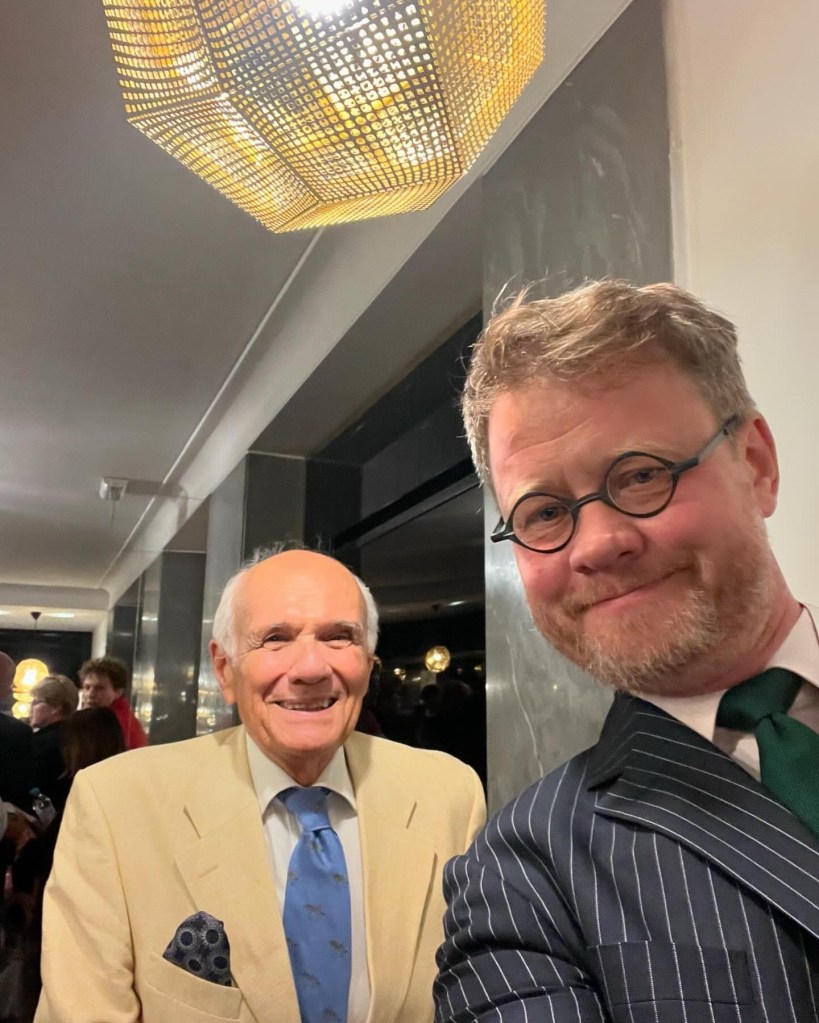
  • Etude IV (Variation 3) – Allegro marcato [C minor]
  • Etude V (Variation 4) – Scherzando [C minor]
  • Etude VI (Variation 5) – Agitato [C minor]
  • Etude VII (Variation 6) – Allegro molto [E Major]
  • Etude VIII (Variation 7) – Sempre marcatissimo [C minor]
  • Etude IX – Presto possibile [C minor]
  • Etude X (Variation 8) – Allegro con energia [C minor]
  • Etude XI (Variation 9) – Andante espressivo [G minor]
  • Etude XII (Finale) – Allegro brillante (based on Marschner’s theme) [D Major]

On republishing the set in 1890, Johannes Brahms restored the five variations that had been cut by Schumann. These are now often played, but in positions within the cycle that vary somewhat with each performance; there are now twelve variations and these five so-called “posthumous” variations which exist as a supplement.

The five posthumously published sections (all based on Fricken’s theme) are:

  • Variation I – Andante, Tempo del tema
  • Variation II – Meno mosso
  • Variation III – Allegro
  • Variation IV – Allegretto
  • Variation V – Moderato.
  • Moderato.

In 1834, Schumann fell in love with Ernestine von Fricken, a piano student of Friedrich Wieck, and for a time they seemed destined to marry. The relationship did not last—Schumann got cold feet after he learned that she had been born out of wedlock—but it inspired some notable music. Carnaval, Op. 9, a set of character pieces for piano, is based on a four-note motive derived from the name of Ernestine’s home town. The Etudes symphoniques, Op. 13, are variations on a theme by Ernestine’s father, Ignaz Ferdinand von Fricken, a nobleman and amateur composer. Of course, Schumann eventually transferred his affections to Clara Wieck, and it was she who gave the first performance of the Etudes symphoniques, in 1837. The piece was published by Haslinger that same year, with a dedication to the English composer William Sterndale Bennett rather than to Ernestine. A revised version appeared in 1852.

Our manuscript is a sketch that includes the theme and variations 1, 2, 5, 10, 12, as well as five others that were not published until 1873, in an appendix edited by none other than Johannes Brahms. It formerly belonged to Alice Tully (1902–1993), the philanthropist whose name graces a concert hall in Lincoln Center. She gave it to Vladimir Horowitz (who counted Schumann’s music among his many specialties in the piano repertoire), and two years after his death, his widow Wanda Toscanini Horowitz donated it to Yale. The other principal manuscript source for this piece belongs to the library of the Royal Museum of Mariemont, in Belgium.

Hough’s Piano Sonata III, “Trinitas”, commissioned by The Tablet, the second-oldest surviving weekly journal in Britain after The SpectatorThe Tablet is a journal which combines loyalty to the Catholic Church with an irrepressible inquisitiveness, and thus its special connection with Stephen Hough seems especially appropriate.

In his new Sonata, Hough explores the 12-note row, the compositional technique of “serialism”. It is a form of musical dogma, and Hough cleverly links this back to The Tablet and Catholicism by scoring the work in three movements and subtitling it “Trinitas”, Latin for “Trinity”, another dogma, the theological ordering of numbers. To guide the listener, each movement is helpfully described (“bold, stark”, “punchy, jazzy” and “majestic, proud”).The middle movement, rhythmically vibrant with its lively syncopations, rapid tinkling notes high in the treble and colourful note clusters, was redolent of Messiaen, another devout Catholic, while its virtuosity referenced Liszt. The final movement, with rich textures and majesty, quotes a familiar hymn tune (Nicea, a setting of the Trinitarian text “Holy, Holy, Holy”) which is disrupted by discordant sounds towards its conclusion. Yet despite the dogma and metaphysics, this work was accessible and at times witty, quirky and playful, and it is exciting to know that such variety and imagination is readily available for other pianists to tackle and enjoy.

The Piano Sonata, BB 88, Sz. 80, is by Bela Bartok  was composed in June 1926. 1926 is known to musicologists as Bartók’s “piano year”, when he underwent a creative shift in part from Beethovenian intensity to a more Bachian craftsmanship

The work is in three movements, with the following tempo indications:

  1. Allegro moderato
  2. Sostenuto e pesante
  3. Allegro molto

It is tonal  but highly dissonant (and has no key signature ) using the piano in a percussive fashion with erratic time signatures Underneath clusters of repeated notes, the melody is folklike. Each movement has a classical structure overall, in character with Bartók’s frequent use of classical forms as vehicles for his most advanced thinking. Musicologist Halsey Stevens finds in the work early forms of many stylistic traits that became more fully developed in Bartók’s “golden age”, 1934–1940.

Bartók wrote Dittának, Budapesten, 1926, jun. at the end of the score, dedicating it to Ditta Pasztory- Bartok , his second wife. A performance generally lasts around 15 minutes. Bartók wrote the duration as around 12 minutes and 30 seconds on the score.

Bartok wrote this piece with an Imperial Bosendorfer  in mind, which has extra keys in the bass (97 keys in total). The second movement calls for these keys to be used (to play G sharp and F0).

Bartók had previously written a piano sonata in 1896, which is little known.

Magdalene Ho A musical genius in Paradise

Having recently won one of the two top prizes at the Royal College of Music in London together with Misha Kaploukhii, the artistic director of La Mortella ,Lina Tufano immediately invited them both to play in this paradise of music and nature that was an oasis for the Waltons whose express wish was to give a platform to talented young musicians at the start of their careers.

This was Misha last weekend :

https://christopheraxworthymusiccommentary.com/2024/05/05/misha-kaploukhii-mastery-and-clarity-in-waltons-paradise-where-dreams-become-reality/

A standing ovation for Magdalene Ho on the Walton’s estate of La Mortella ……..The artistic director Lina Tufano exclaiming that she is one of the greatest talents to have ever graced this paradise .
Beethoven’s seemingly innocuous ‘A Thérèse’ sonata in her hands was of Serkin like intensity .
Nocturnes by Fauré where the composers somewhat inconclusive final utterings were today given a burning intensity and glowing aristocratic meaning .
Brahms’ elusive op 116 were a passionate outpouring of dynamic drive but even more of intimate confessions of sublime beauty.
An encore of Liszt’s Tarantella was a breathtaking homage to Naples that had welcomed this genius of the piano with open arms.

A programme that I had heard recently in London and had written an appreciation as well as including the video recording from that other remarkable oasis for young musicians that is St Mary’s.

https://christopheraxworthymusiccommentary.com/2024/04/24/magdalene-ho-at-st-marys-a-magic-world-of-genial-whispered-secrets/

Here at la Mortella is the paradise that the Waltons have bequeathed to a much bruised and abused world to remind us with what simplicity real beauty can be revealed.

Susana a final resting place near to her husband overlooking the Paradise they had created together
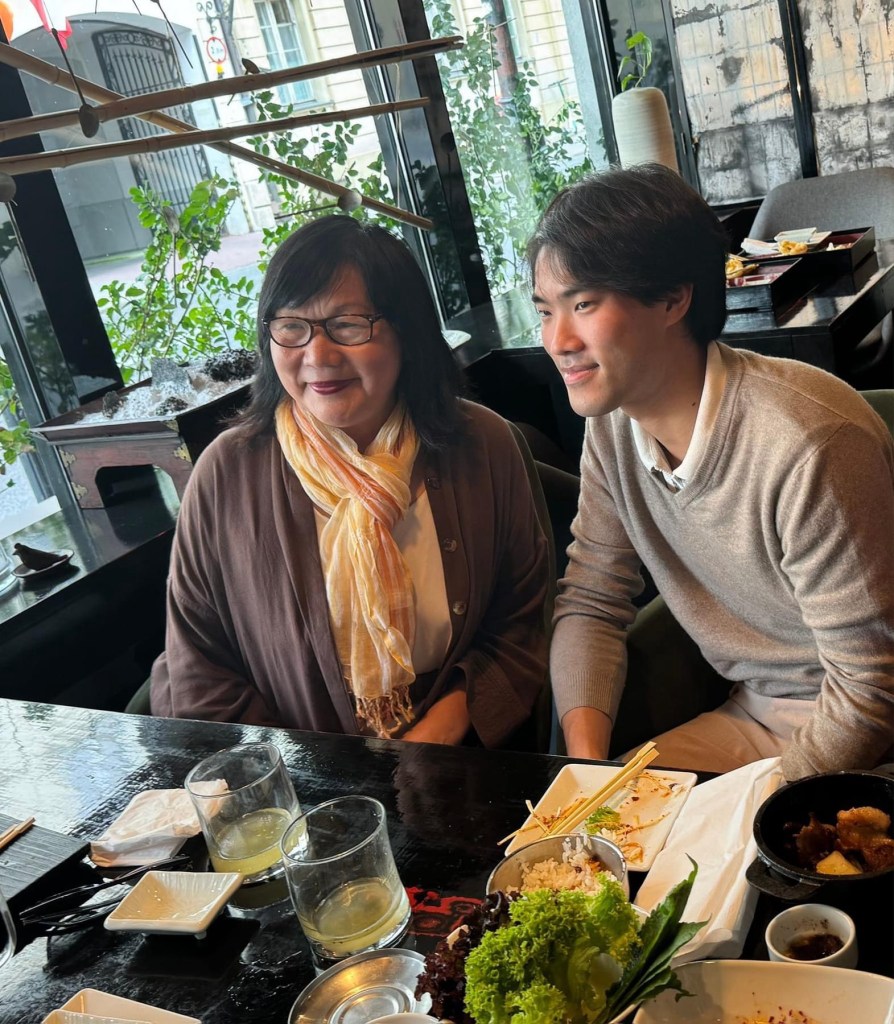
Not only are there the exotic plants in a botanical garden that Susana has created but also the platform that her husband wanted to offer to young musicians who have dedicated their youth to their art and are just in need of a place to share these delicate jewels with a public thirsting for something they have yet to discover. La Mortella is not a Paradise Lost but one where one can find that elusive but ever more important thing that is called a ‘soul’.
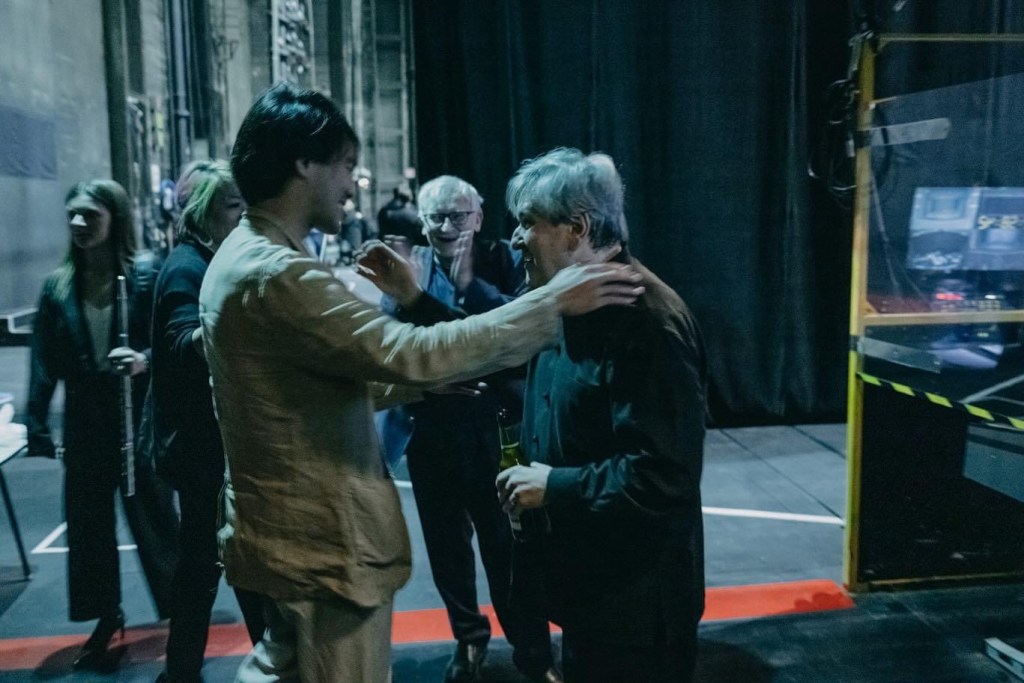
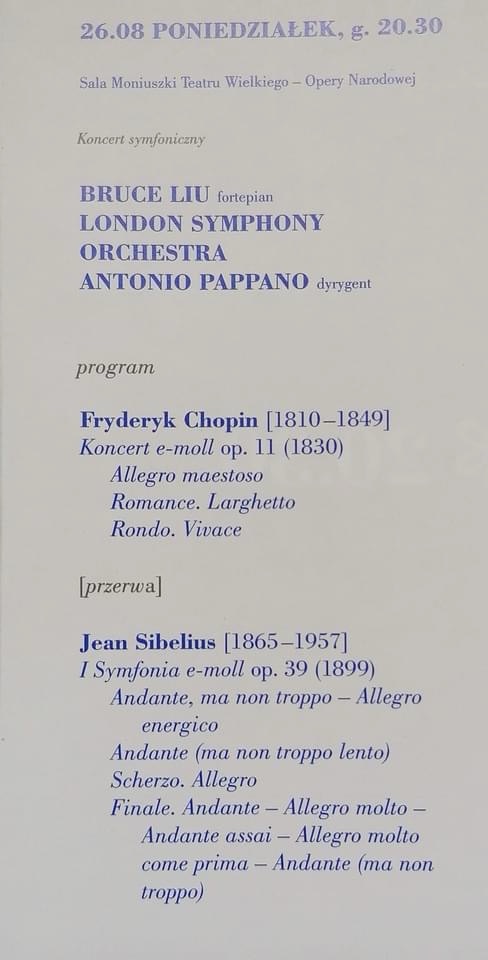
William’s rock that overlooks a Paradise found

And it was Magdalene today who showed us from the very opening notes of one of Beethoven’s favourite Sonatas how a whole world can be opened up and shared.There was an extraordinary clarity and expressiveness to the opening ‘Adagio cantabile’ that Magdalene played with conviction almost as if in a trance.

It was this ‘seance’ that captivated the audience and held them in her spell for the entire concert.Some things cannot be taught but are gifts that are in the genes of a rare few and may reveal themselves in many fields but it is this total dedication and conviction that gives the impression that in that moment this is the most important thing on earth. A hypnotic tension that Magdalene certainly has as she is totally absorbed but also can captivate and cast a spell on all around her . There was a rhythmic flow to the first movement as though riding on a wave of sound that flowed relentlessly forward. A kaleidoscope of sounds that were always noble and full even when she found the most etherial of whispered golden strands. The ‘Allegro ma non troppo’ was hard on the heels of the first movement with a burst of energy and electric drive that I have only ever experienced from Rudolf Serkin. It marked a frenzied drive that swept all before it in a performance of breathtaking exhilaration and liberation.

A scrupulous attention to the precise indications that scatter Beethoven’s scores meant that this was an artist of intelligence and maturity and above all an artist that one can trust! 7Taking the notes off the printed page and returning them to the sounds that the composer had in his head at the moment of creation is the true art of an interpreter. Pollini, who we celebrated in Rome a few days ago, showed us with selfless dedication for so many years what it means to be the servant of a master.

Emanuel Ax pays homage to the Genius of Maurizio Pollini

Perlemuter’s score of the first nocturne

I was brought up with Perlemuter’s performances of Fauré. He insisted that I tell the public in a recital in Rome that the nocturnes by Fauré that he was playing were those that Fauré ,the Director of the Paris Conservatoire,had sent down to him to try out with the ink still wet on the page. Perlemuter could not abide any sickly rubato or weak fussy playing as was so often the case with the so called Chopin tradition still rampant. He, like Magdalene today, presented a Fauré of aristocratic nobility and originality where the sentiments are deeply imbedded within the notes and not just applied on the surface!

Magdalene played three of Fauré’s thirteen Nocturnes starting with the beautifully poetic sixth nocturne where the melodic line is allowed to sing unimpeded by the counterpoints that can obscure the later ones in lesser hands. It was an outpouring of simple aristocratic sounds of poignant poetic meaning. The gentle stream of the morning chorus in the ‘Allegro moderato’ may have been the inspiration for Messiaen a hundred years on and here was a sumptuous stream of sounds on which the melodic line could float so magically.There were sudden washes of sound where notes no longer existed as Magdalene took us into a land that obviously spoke so deeply to her. Rarely have I heard this rather inconclusive sound world of Fauré speak with such eloquence and simplicity. Even the more elusive later Nocturnes were given a musical line and meaning that is very rare indeed. In the eleventh she depicted a desolate landscape of searing intensity and the mysterious final words of Fauré with his thirteenth and last Nocturne opened with whispered tones. Searching for a path that she found with the clouds lifting and sudden rays of bright light allowed to gleam as she played with breathtaking conviction and passionate abandon opening a gate to a masterpiece that is rarely revealed by lesser mortals.

Magdalene Ho ‘kissed by the Gods’

Brahms’s seven fantasies op 116 is a masterwork but not always easy to perform complete in public as it requires extreme concentration not only from the performer but also the audience. Magdalene succeded even more than on the previous occasion I had heard her and the cheers that greeted her final Capriccio just showed how she had been able to takes us on a voyage of discovery holding us in the same trance that she herself was obviously experiencing.There are the three explosions of passionate orchestral sounds in the Capriccios but in the Intermezzi there is an intensity and deeply moving meaning to every note that Magdalene magically transmitted to us as she depicted a world where the music spoke with such touching eloquence.

There was an explosion of passion and delicacy with the first Capriccio in D minor, an outpouring of intensity and exhilaration.The beautiful sweeping left hand octaves were just like a wind blowing across this red hot terrain. A gentle pleading in the A minor intermezzo was with a full string quartet sound that contrasted with the glistening etherial ‘non troppo presto’ that Brahms implores to be played ‘molto piano’ and ‘legato’. Bursting into flames again with the G minor Capriccio with the glorious nobility of ‘un poco meno Allegro’ Trio with its sumptuous abandonment of rich golden sounds. This was truly a full orchestra of Philadelphian richness. Following on with one of Brahms’s most poignant utterings: the Intermezzo in E where so few notes can say so much in Magdalene’s sensitive hands. An ‘una corda’ that was a whispered secret miraculously shared with us as we awaited every note with baited breath, the wafts of sound glistened in this autumnal landscape. ‘Andante – Allegretto con grazia ed intimissimo sentimento’ are Brahms indications for the gentle lilting question mark of the Intermezzo in E minor answered by the sombre brooding in the major of the ‘Andantino teneramente’. Magdalene brought great meaning to this strangely unsettled world with its gloriously flowing central episode that opens the gate for ever more whispered confessions. A transcendental control of sound to the final seemingly infinite arpeggio with a top note that truly pointed to an unearthly world on high . Sumptuous sounds and passionate conviction were thrown off with the ease of a great virtuoso in the final Capriccio in D minor with its meandering search of superfine clarity and whispered drive until the final explosion of sumptuous nobility and brilliance.

Magdalene who in these days has been playing Chopin’s first piano concert in Switzerland and a recital in Trieste had not thought that she might have been asked for an encore. An encore was demanded by an audience who had no intention of letting this young genius go so easily. The Tarantella ,the last of Liszt’s Venezia e Napoli suite of three pieces, was the answer and it was a breathtaking example of virtuosity and style. If the beautiful central Neapolitan song was a little slow it was because she too was enjoying the sunlight that suddenly was shining brightly after Brahms’s deep brooding and introspection. A work that her former teacher Patsy Fou ( the widow of the great Chinese pianist Fou Ts’Ong) told me that she had not played since she was 12 !

Roberto Prosseda pays tribute to the genius of Chopin and the inspirational figure of Fou Ts’ong

Returning to her own world of deep introspection and selfless denial Magdalene played a second encore demanded by an ever more enthusiastic public.The Intermezzo in A op 118 n.2 was played with tenderness and the sumptuous rich intimacy of a pianist who knows what playing with weight really means.

‘Chapeau’ or to quote Schumann :’Hats off Gentlemen,a genius! ‘

Genius knows no limits as it is a continual inspiration for all those caught in their illuminating rays.

‘ Catch a falling star ‘ so the song goes and what a perfect combination of Genius in Paradise – stars to be cherished indeed.

The second concert had included Mozart’s C minor Sonata in place of the last Fauré nocturne.
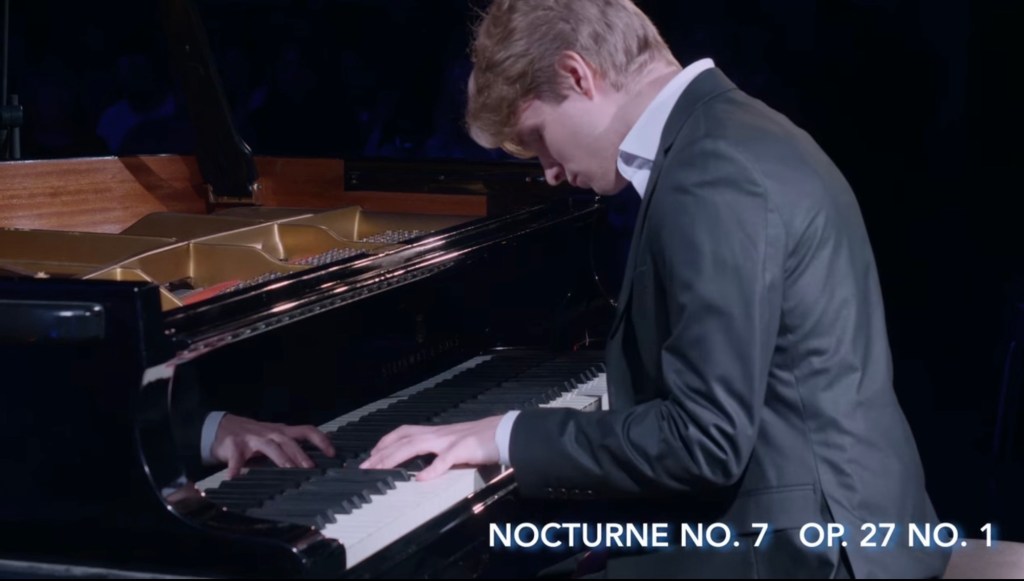
And today opening with Mozart’s C minor Sonata with a nervous energy and subtle dynamic range that brought this masterpiece vividly to life as I have rarely heard before. Amazingly Magdalene told me afterwards that it was the first time she had performed this work in public! There were incredible subtle inflections of refined artistry that were quite unexpected from a pianist still only twenty years old. A rhythmic drive but of its time with a humanity and sense of civilised passion and a startling range of sounds judged to absolute perfection always with the architectural shape of the whole sonata in view.
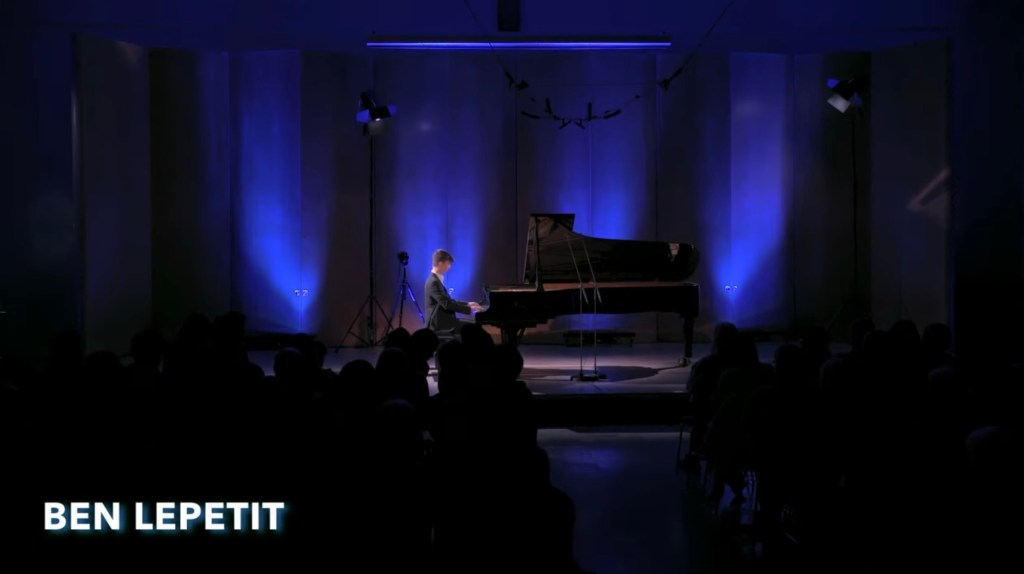
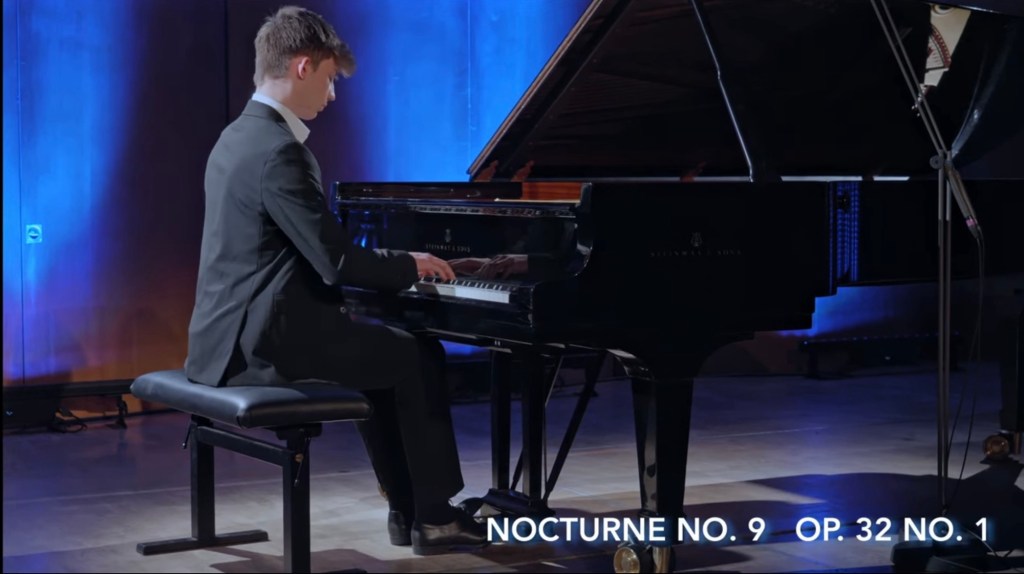
An Adagio of disarming simplicity and beauty where the music was allowed to speak with a human voice of the most refined ‘bel canto’.It was pure magic as the poignant understatement of the final chords were like heartbeats pulsating deep in the depths of the keyboard .

Beethovenian irascible changes of character in the ‘Molto allegro’ were followed by Mozart’s unmistakable melodic outpouring of utter simplicity. Magic was in the air as she allowed Fauré’s etherial D flat nocturne to fill this hall that today was full to the rafters unknowingly congregating to celebrate Fauré’s birthday (12th May 1845).

And today Magdalene had a little secret up her sleeve with two encores in the style of the scintillating playing of Lhevine,Hoffman,Godowsky or Rachmaninov .Playing of the Golden Era of Piano Playing when at the end of a recital pianists would allow themselves to indulge in playing of teasingly beguiling half shades and technical wizardry. I had suggested to Magdalene that she could finish on a high with some pianistic acrobatics instead of another tribute to Fauré that she had suggested .Well she locked herself away with a piano for five minutes whilst she brushed up some pianistic lollipops that she had not played for quite sometime.

She gave a ravishing performances of beguiling half colours and a sumptuous sense of balance with Schubert’s ‘Standchen’ in Liszt’s beautiful transcription.And finally letting her hair down with Saint- Saens ‘Etude en forme de valse ‘ played with tantalising, teasing style and subtle virtuosity that was greeted with a standing ovation for a pianist the like of whom this hallowed hall has never seen before.

Malaysian pianist  Magdalene Ho  was born in 2003 and started learning the piano at the age of four. In 2013, she began studying in the UK with Patsy Toh, at the Purcell School. In 2015, she received the ABRSM Sheila Mossman Prize and Silver Award. As part of a prize won at the PIANALE piano festival in Fulda, Germany, she released an album of Bach and Messiaen works in 2019. She was a finalist at the Düsseldorf Schumann Competition 2023 and was awarded the Joan Chissell Schumann Prize for Piano at the Royal College of Music a few months later. In September 2023, she won the Clara Haskil International Piano Competition in Vevey along with receiving the Audience Prize, Young Critics’ Prize and Children’s Corner Prize. She has been studying with Dmitri Alexeev at the Royal College of Music since September 2022, where she is a Dasha Shenkman Scholar supported by the Gordon Calway Stone Scholarship, and by the Weir Award via the Keyboard Charitable Trust. She recently won the Chappell Gold Medal at the RCM

Alessandra Vinciguerra director of La Mortella introducing the concert as Lady Walton had done for many years – Prof Lina Tufano overseeing the concert from Sir William’s music room and now the artist’s green room
Raffaella the perfect hall manager. The daughter of Reale who was Susana Waltons informally adopted daughter and whose exquisite soufflé was the stuff that legends are made of.
Publicity on the boat crossing the Bay of Naples to Ischia

Gabriel Urbain Fauré
12 May 1845, Pamiers ,France – 4 November 1924 ,Paris

Fauré’s major sets of piano works are thirteen nocturnes , thirteen barcarolles , six impromptus , and four valses-caprices. These sets were composed during several decades in his long career, and display the change in his style from uncomplicated youthful charm to a final enigmatic, but sometimes fiery introspection, by way of a turbulent period in his middle years. His other notable piano pieces, including shorter works, or collections composed or published as a set, are Romances sans paroles, Ballade  in F♯ major, Mazurka  in B♭ major, Thème et variations in C♯ minor, and Huit pièces brèves. For piano duet, Fauré composed the Dolly Suite and, together with his friend and former pupil André Messager , an exuberant parody of Wagner in the short suite Souvenirs de Bayreuth.Fauré’s stylistic evolution can be observed in his works for piano from the elegant and captivating first pieces, which made the composer famous and show the influence of Chopin, Saint-Saëns, and Liszt. The lyricism and complexity of his style in the 1890s are evident in the Nocturnes nos. 6 and 7, the Barcarolle no. 5 and the Thème et variations. Finally, the unadorned ,essential style of the final period of the last nocturnes (nos.10–13), the series of great barcarolles (nos. 8–11) and the astonishing Impromptu no. 5. Fauré scholars are generally agreed that the last nocturne n. 13 in B minor – which was the last work he wrote for the piano – is among the greatest of the set. Nectoux writes that along with the sixth, it is “incontestably the most moving and inspired of the series.”Bricard calls it “the most inspired and beautiful in the series.”For Pinkas, the work “achieves a perfect equilibrium between late-style simplicity and full-textured passionate expression.”The work opens in a “pure, almost rarefied atmosphere” (Nectoux), with a “tone of noble, gentle supplication … imposing gravity and … rich expressive four part writing.”This is followed by an allegro, “a true middle section in a virtuoso manner, ending in a bang” (Pinkas).The repeat of the opening section completes the work.The eleventh nocturne was written in memory of Noémi Lalo; her widower, Pierre Lalo , was a music critic and a friend and supporter of Fauré and its funereal effect of tolling bells may also reflect the composer’s own state of anguish, with deafness encroaching.The melodic line is simple and restrained, and except for a passionate section near the end is generally quiet and elegiac.The sixth nocturne, dedicated to Eugène d’Eichthal, is widely held to be one of the finest of the series. Cortot said, “There are few pages in all music comparable to these.” It is among the most rich and eloquent of all Fauré’s piano works and one of the most passionate and moving works in piano literature. Fauré wrote it after a six-year break from composing for the piano.Copland wrote that it was with this work that Fauré first fully emerged from the shadow of Chopin,

7 May 1833 Hamburg – 3 April 1897 (aged 63) Vienna

Johannes Brahms presumably wrote the Fantasies op. 116 at the same time as the Intermezzi op. 117 in the summer of 1892 in Bad Ischl. His sojourn in the Salzkammergut obviously inspired Brahms to write music for solo piano, as a year later he worked on other cycles when he was there. Amongst these late melancholy piano pieces, op. 116 is in particular characterised by opposites. Four “dreamy” intermezzi according to Clara Schumann are juxtaposed with three “deeply passionate” capricci. 

After an early focus on works for solo piano, including the three sonatas that Robert Schumann described as “veiled symphonies,” Brahms tended to employ his chosen instrument, the piano, in collaborative works, producing a variety of duo sonatas (with violin, cello, and clarinet), piano trios, piano quartets, and one piano quintet, as well as two more trios (one with horn and one with clarinet). His final efforts for solo keyboard were published in four sets of shorter works (Op

116-119), which appeared between 1891 and 1893.

These four sets of late solo piano pieces are all in effect abstract instrumental songs, though unfailingly idiomatic. (So much so, that he abandoned his attempt to orchestrate the immediately popular Intermezzo, Op. 117, No. 1.) All are in the A-B-A song form typical of character pieces and are as highly concentrated as his greatest songs.

Only the first of these groups (Op. 116) has a continuity that argues for continuous performance. The probable dedicatee of these works, Clara Schumann , with whom Brahms had a rather complicated relationship, praised them as “a true source of enjoyment, everything, poetry, passion, rapture, intimacy, full of the most marvellous effects”.

Ludwig van Beethoven
17 December 1770. 26 March 1827 (aged 56). Vienna 

The Piano Sonata No. 24 Op. 78, nicknamed “à Thérèse” (because it was written for Countess Thérèse von Brunswick ) was written in 1809.

The second movement is a variation to the ending of the popular patriots song “Rule Brittania!”

According to Carl Czerny, Beethoven himself singled out this sonata and the “Appassionata “ as favourites together with the later ‘Hammerklavier”. After a pause of four years, Beethoven returned to the piano sonata genre in 1809. Unlike its predecessor, the F minor Sonata op. 57 (the “Appassionata”), this work strikes a new and lyrically cantabile tone that must have been the reason for its tradition-breaking two-movement structure; a slow middle movement would not have provided the necessary contrast to the outer ones. Just as unusual as the general character of opus 78 is its four bar Adagio introduction; this does not directly refer to the subsequent motifs and themes, and serves no other purpose than to “conjure up the atmosphere of the entire sonata in our hearts” (Hugo Riemann).


Wolfgang Amadeus Mozart 27 January 1756 – 5 December 1791

The Piano Sonata No. 14 in C minor K.457, was composed and completed in 1784, with the official date of completion recorded as 14 October 1784 in Mozart’s own catalogue of works.It was published in December 1785 together with the Fantasy in C minor K.475 as opus  11 by the publishing firm Artaria ,Mozart’s main Viennese publisher.The sonata is in three movements:

  1. Molto allegro
  2. Adagio
  3. Allegro assai

The title page bore a dedication to Theresia von Trattner (1758–1793), who was one of Mozart’s pupils in Vienna. Her husband, Thomas von Trattner (1717–1798), was an important publisher as well as Mozart’s landlord in 1784. Eventually, the Trattners would become godparents to four of Mozart’s children.

Manuscript Sonata in A minor K 310

It was composed during the approximately 10-year period of Mozart’s life as a freelance artist in Vienna after he removed himself from the patronage of the Archbishop of Salzburg in 1781 and is one of the earliest of only six sonatas composed during the Vienna years.It is only one of two sonatas Mozart wrote in a minor key, the other being the in A minor K 310 , which was written six years earlier, around the time of the death of Mozart’s mother. Mozart was extremely deliberate in choosing tonalities for his compositions; therefore, his choice of C minor for this sonata implies that this piece was perhaps a very personal work.

After concert supper
Prof Lina Tufano artistic director of the Incontri Musicali at La Mortella
Breakfast alla Mortella with the marmalade made by Alessandra in the long winter months when the gardens are closed
https://christopheraxworthymusiccommentary.com/2024/03/20/christopher-axworthy-dip-ram-aram/

https://fb.watch/w7YQAqyB-q/

CONGRATULATIONS !

Dear Friends,

We had the privilege of experiencing two extraordinary and unforgettable days at the Casals Forum!

It is difficult to put into words the exceptional talent and the stunning performances of the six nominees for the

13th International German Piano Award.

These days were filled with musical beauty and the passion that each artist brought to the stage. My heartfelt congratulations go to all six nominees, who enriched both the jury and the audience with their incredible talent.

However, I would like to extend a very special congratulations to

𝐌𝐀𝐆𝐃𝐀𝐋𝐄𝐍𝐄 𝐇𝐎:

After 11 years, she is the first woman to win the International German Piano Award!

Dear Magdalene, your performance in the Grand Prix with Schumann’s Piano Concerto was nothing short of breathtaking, and your appearances on all previous stages were equally unforgettable. Every note was deliberate and played with gentle precision—a true masterpiece. Congratulations on this outstanding achievement! You are undoubtedly a pianist of great promise.

Emanuele Savron supreme artistry revealed in Mozart that spoke with a unique voice.

Another affirmation for a young musician who is fast becoming an artist to reckon with. Emanuele Savron has been studying with Marcella Crudeli for some years where I have heard him in her Masterclasses and also playing concertos with orchestra as part her Magisterium class that she holds each year giving guidance to carefully selected young musicians from every part of Italy .

https://christopheraxworthymusiccommentary.com/2021/10/23/magisterium-of-marcella-crudeli-takes-viterbo-and-rome-by-storm/

Emanuele has always revealed a natural talent and under Marcella has acquired a refined musical palette ,but he lacked the discipline and hard work needed to become anything other than a talented amateur. Last year I heard him again in recital at the press launch of the International Piano Competition that Marcella Crudeli has been fielding with enviable energy and passion for the past thirty or more years. I was bowled over by the progress he had made .

https://christopheraxworthymusiccommentary.com/2023/10/17/roma-international-piano-competition-recital-by-emanuele-savron-a-giant-bestrides-the-capitoline-hill-in-rome/

A teenager had now matured into a young artist of great stature. An artist who has something to say and fast earning the means to say it.It was the great English pianist Clifford Curzon who said for a real artist playing in public requires ninety per cent work and ten per cent talent.The talent Emanuele has, as Marcella patiently acknowledged, but the work was sadly lacking until this extraordinary recital last year. Putting on my Sherlock Holmes hat I discovered that for the past few years Emanuele had come under the influence of Leonid Magarius at the piano academy in Imola.The great Russian school where there are no half measures, or you work all the hours needed or you are shown the door! Magarius is a well known and esteemed trainer of pianists such as Romanovsky or Lifits both winners of the Busoni Competition.http://www.margarius.com/biography.htm.

So the secret was out and a lazy teenager had decided it was time to seriously work at a professional career. Roma Tre under Valerio Vicari give important opportunities for young musicians to find an audience and his ‘Young Artist’s Solo Piano Series ‘ is just one of many initiatives that this dedication of Roma Tre University offers .They have also created a full symphony orchestra that gives graduate instrumentalists the chance to gain experience of playing in ensembles as well as in the orchestra. It is fast becoming a recognised reality as it has grown wings and recognition from the powers that be, to leave their nest at the Teatro Palladium and fly to many other important Italian cities.

I was not able to be at Emanuele’s recital but many of my friends were, and told me of his success crowned with three encores.More importantly Emanuele sent me many video recording of his playing of the recital.It took just one short recording of the opening of the Adagio from the Mozart Sonata K 332 to show what an artist this young musician has become.There are subtle inflections and a very individual punctuation that a true artist adds where the piano becomes a human voice and no longer just a box of hammers and strings. It is an illusion and the great artists are the greatest of illusionist. A jeux perlé in the outer movements where the ‘joie de vivre’ and rhythmic energy were combined in an operatic performance of vivid personality. It was Artur Schnabel who famously said the Mozart was too easy for children but too difficult for adults . Curzon would cover his scores with markings as he searched for the hidden meaning behind Mozart’s seemingly sparse scores.

There was the same personality and artistry in his playing of Rachmaninov and the Liszt Campanella was played with the ease and charm of the great pianist from the Golden Era of Piano Playing of Lhevine,Godowsky or Hoffman.

This is not intended to be a review but a celebration and Hosanna to Roma Tre who are allowing so many young musicians the possibility to mature and find their true artistic identities and a place in the professional music world.

https://christopheraxworthymusiccommentary.com/2023/02/23/ballando-con-le-stelle-marcella-crudeli-ed-emanuele-savron-could-have-danced-all-nightfor-roma-3-orchestra-concert-season/

To Marcella Crudeli who has always believed in Emanuele’s talent to the extent of playing with him in duo concerts.

https://christopheraxworthymusiccommentary.com/2024/02/10/marcella-crudeli-and-emanuele-savron-master-and-pupil-play-brahms-side-by-side-in-viterbo/

And of course to Leonid Magarius for cracking the whip and inspiring so many young musicians to dedicate their youth to their art.

Not least to Emanuele who with dedication and hard work is making the ever difficult transition from a talented young musician to a great artist.

Chapeau to you all indeed !

https://christopheraxworthymusiccommentary.com/2024/03/20/christopher-axworthy-dip-ram-aram/