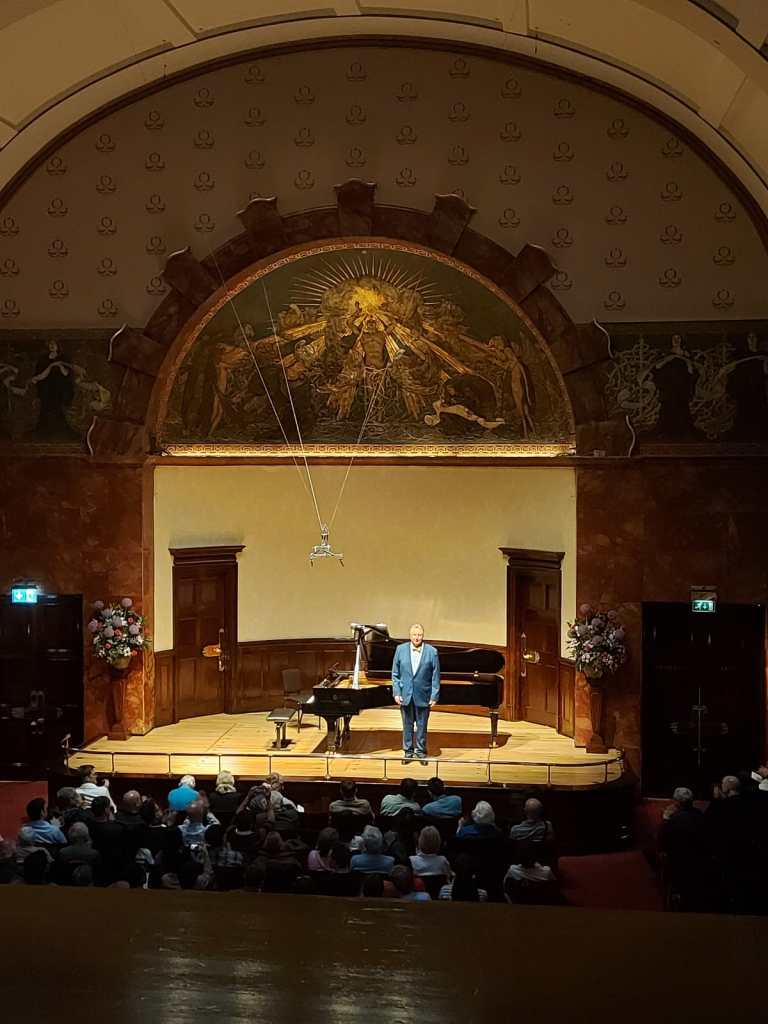
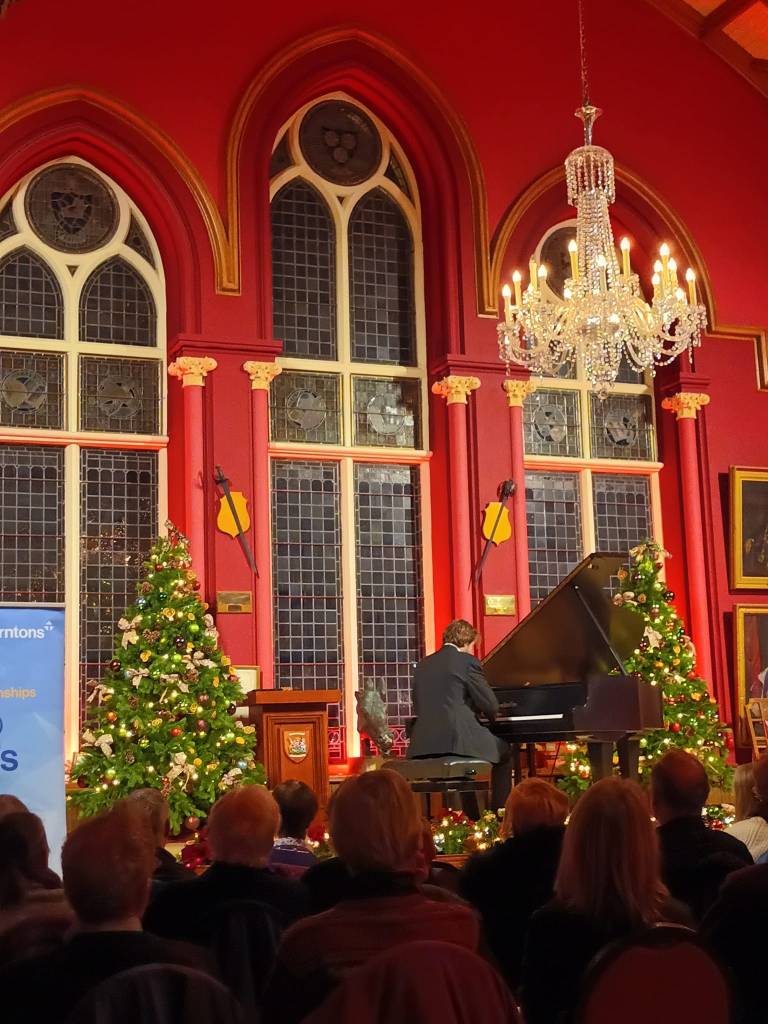
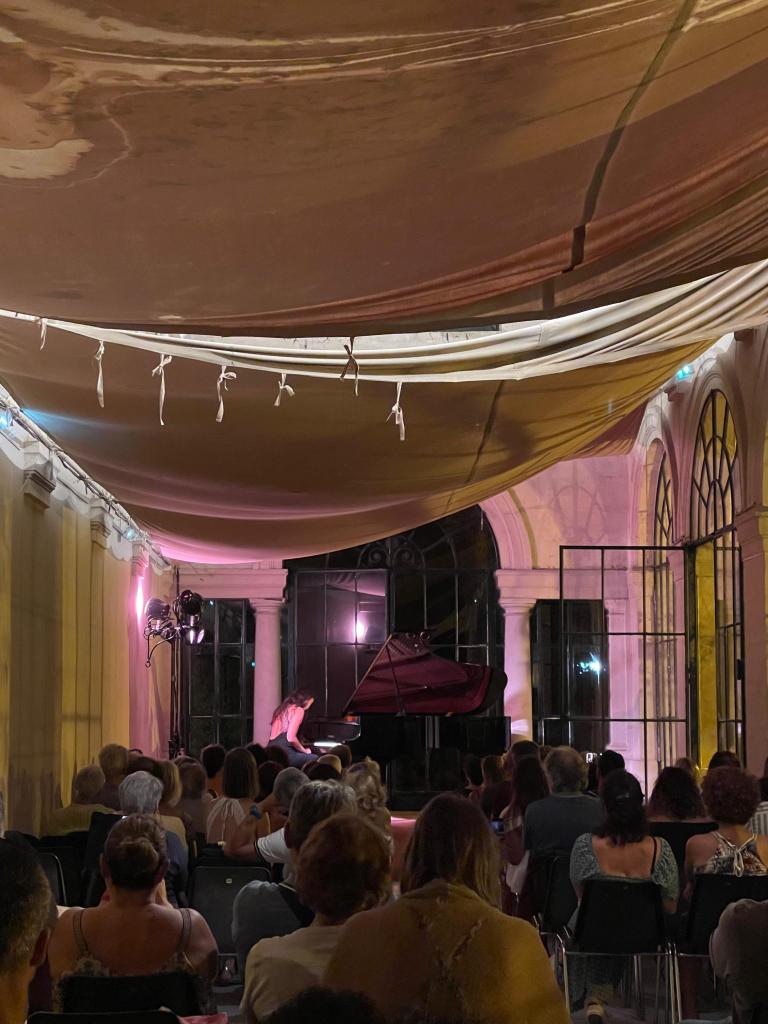
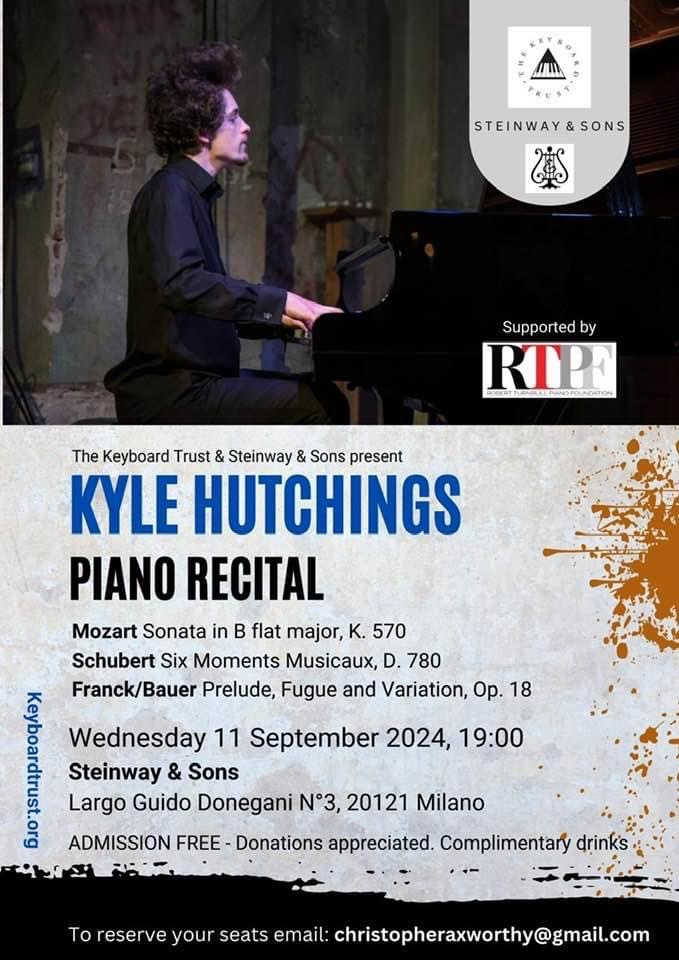
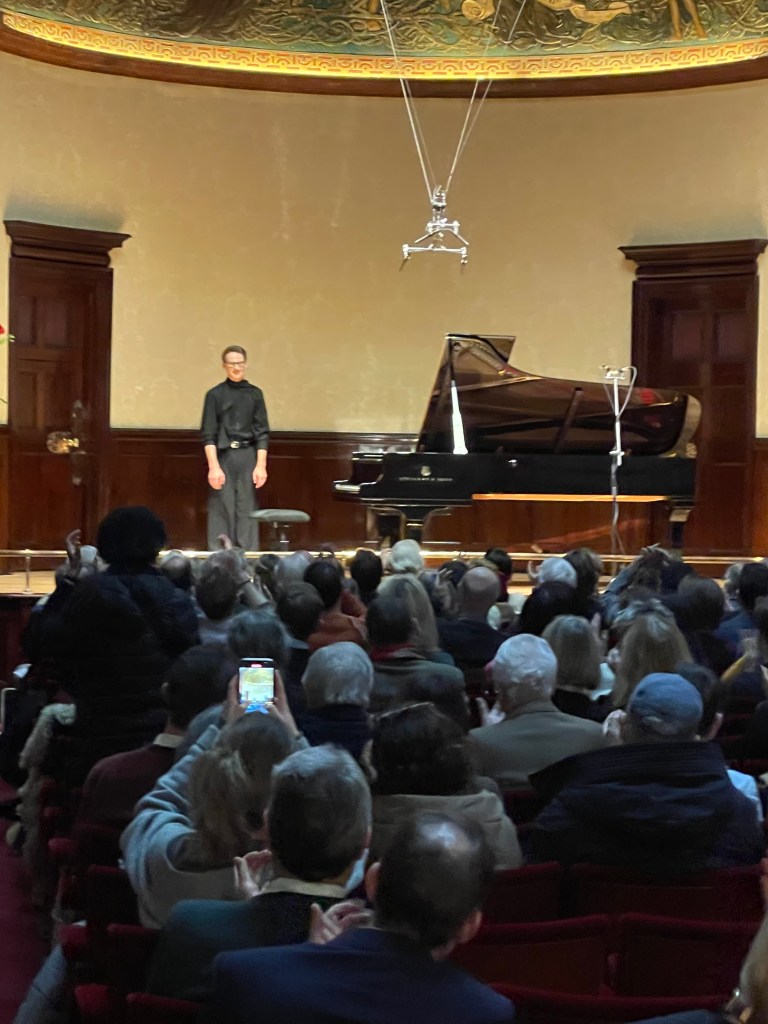
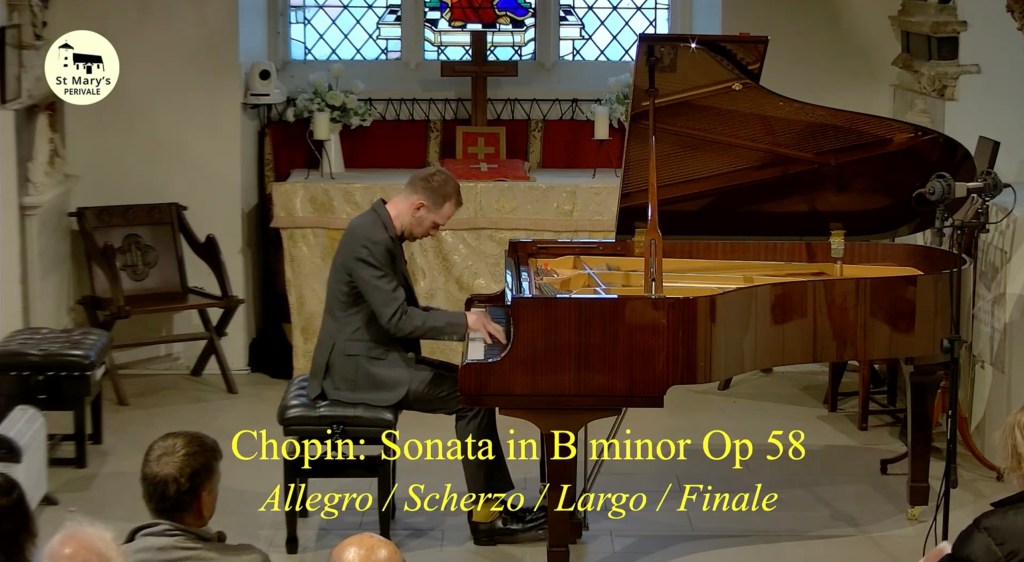
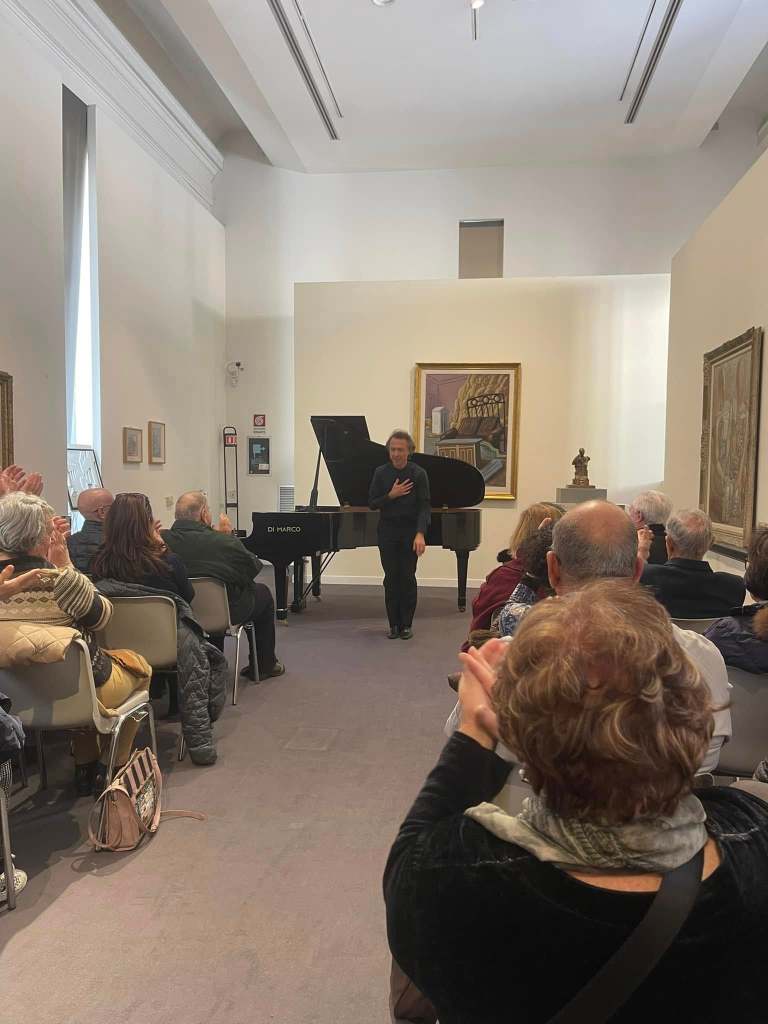
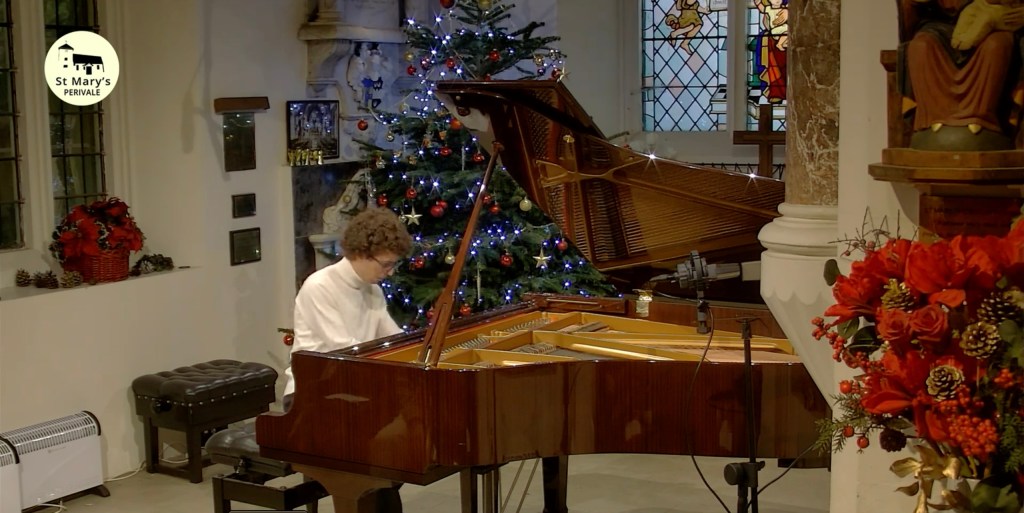
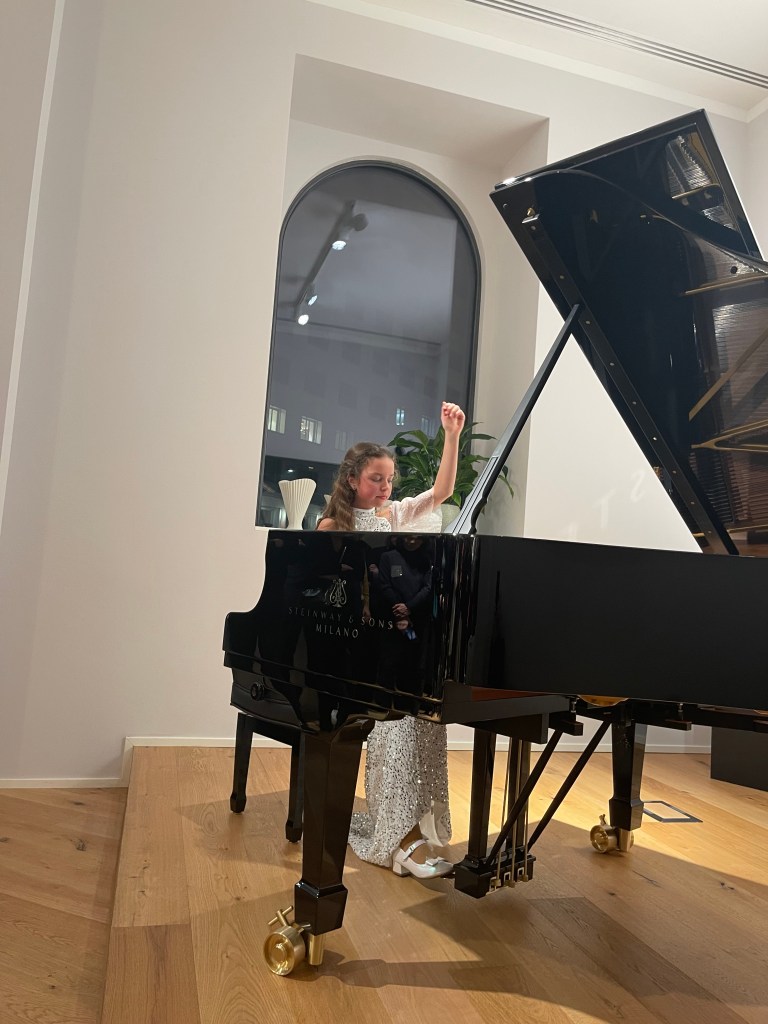
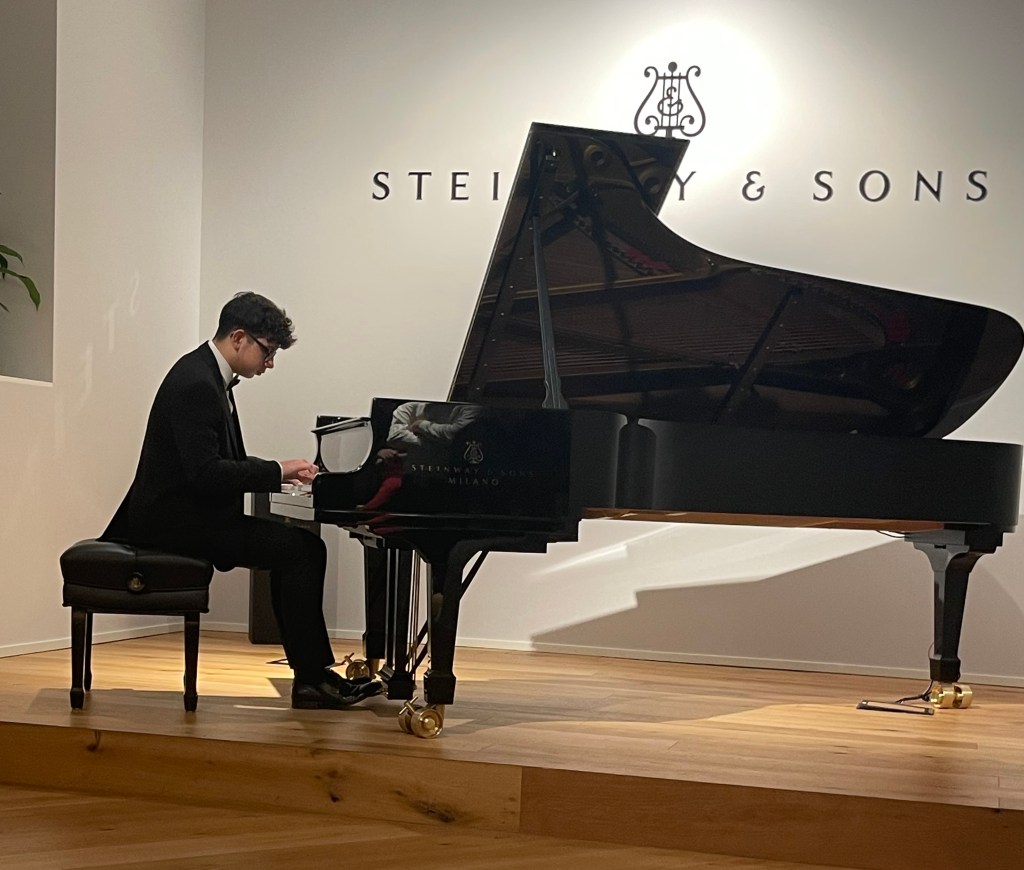
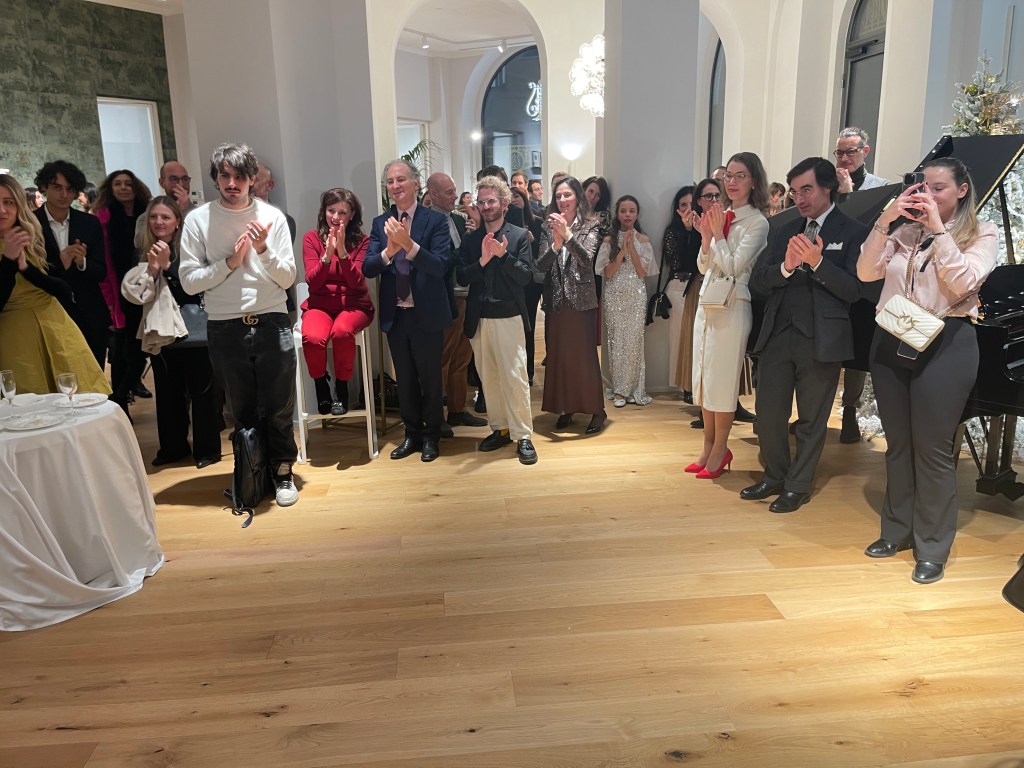
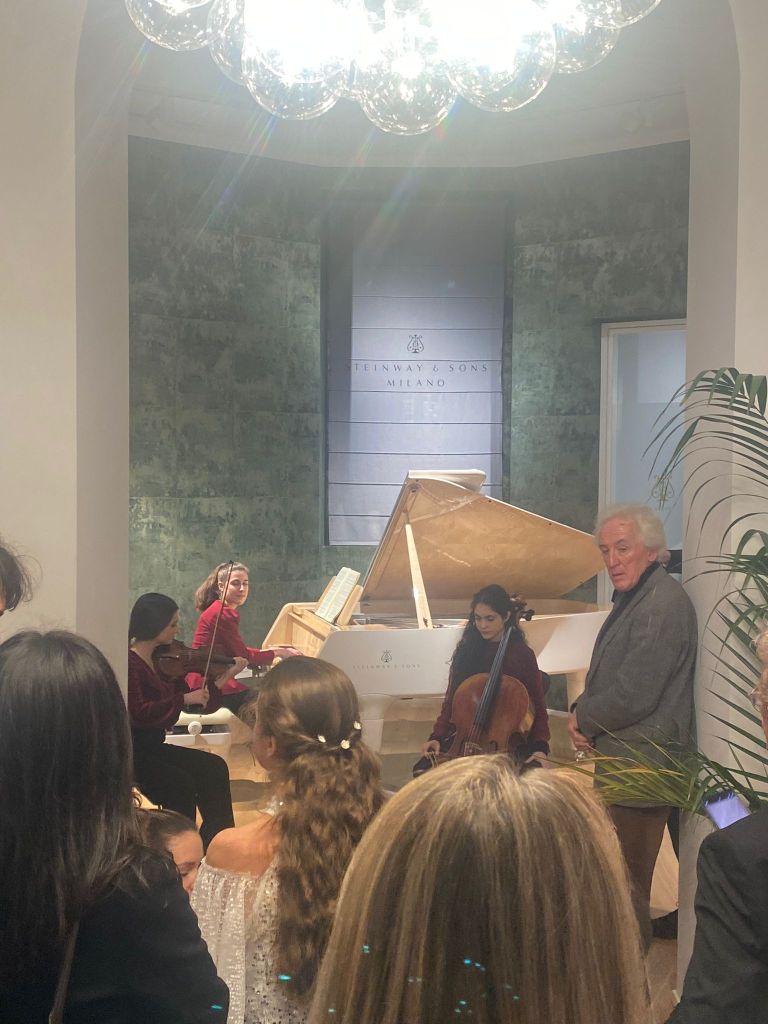
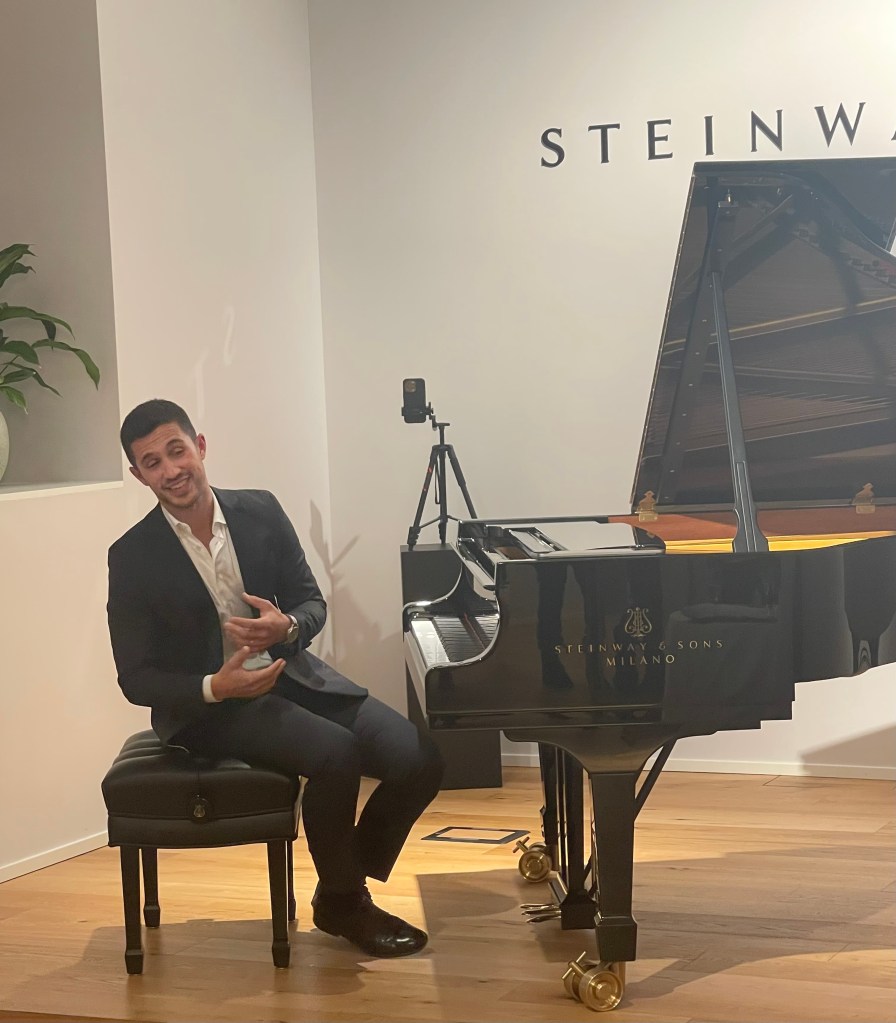
Some superb playing of great artistry and intelligence allied to an aristocratic grandeur and complete technical command. Infact these two masterworks were revealed in a new light where any of the rhetoric of tradition was substituted by a scrupulous attention to the composers detailed indications in the score.
Bénediction I well remember from the early recordings of Liszt by Alfred Brendel that it was exactly his musicianship , technical mastery and respectful integrity that we heard for the first time with a composer too often represented as a barnstorming virtuoso and seducer of the senses. The leisurely opening of Mengyang’s performance created the atmosphere of reverence and dignified beauty with the bass melody allowed to unfold with the shimmering accompaniment above it , gradually building to a passionate outpouring of sumptuous sounds .’Cantando sempre’ as the melodic line moves so magically from the bass to the tenor with harp like chords just adding a golden sheen to such beauty. Mengyang judged superbly the gradual build up in intensity to a sumptuous climax that dissolved immediately to prepare for the chorale like ‘Andante’ that she played with simplicity and devout beauty. ‘Più sostenuto quasi preludio’ was played with aristocratic good taste as the melodic line was now reversed with the theme in the right hand and with shimmering left hand harmonies just adding to the radiant fluidity. Building this time to a climax that Liszt marks ‘rinforzando molto e sempre più appassionato’ and is the cry of Liszt the fervent believer with an almost unbearable intensity. Menyang calling on her wonderfully florid arms to add ever more sumptuous sounds without ever a trace of hardness. In fact the beauty and luminosity of sound was one of the most remarkable things of this performance and of the sonata that was to follow. Streams of harp like sounds were played with ravishing fluidity as the left hand melodic line sang it’s heart out with refined and respectful beauty. ‘Andante semplice espressivo’ was indeed the final prayer with Liszt on his knees calling on all the sublime beauty and radiance that he could offer to his maker. This was a remarkable performance and was the ideal accompaniment for the B minor Sonata. Two great works restored to their rightful place at the pinnacle of the pianistic repertoire.
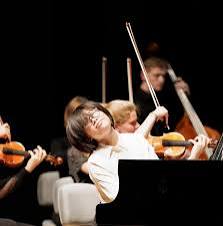
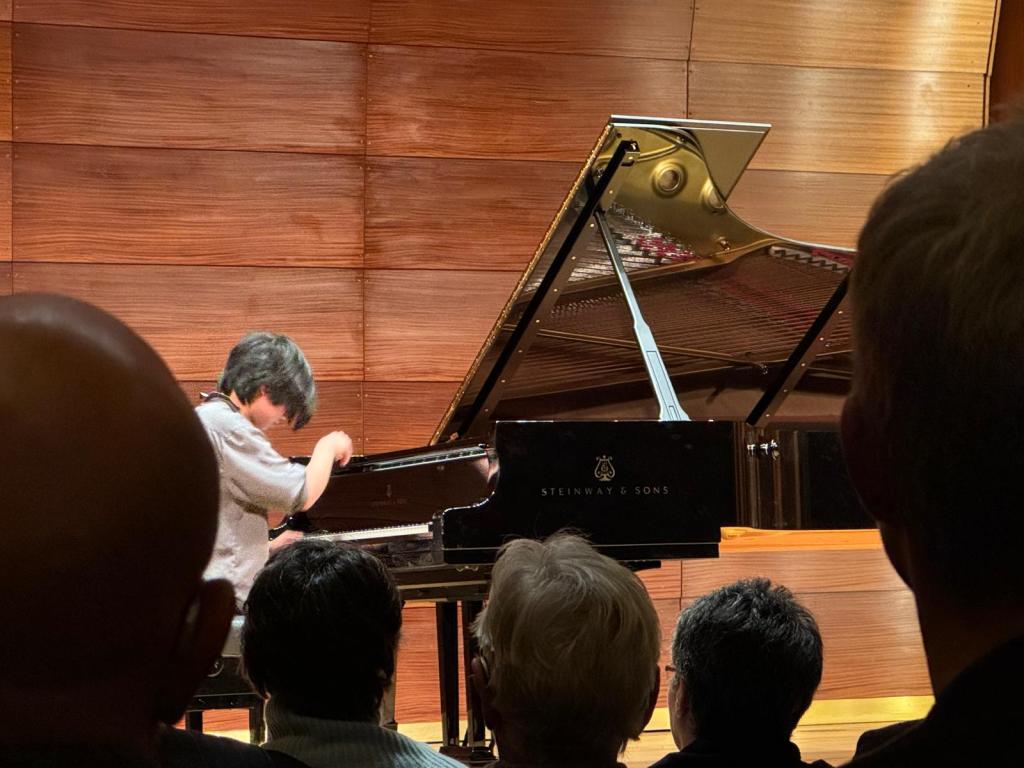
The Liszt Sonata saw Mengyang in demonic mood sometimes playing with a clenched fist as the drama unfolded.The three opening themes that are transformed throughout the Sonata were played with such characterisation from the mystery of the sombre deep bass to the call to arms of the ‘Allegro energico’ and the pummelled bass notes that Liszt indeed indicates ‘marcato’. This was a truly superb performance where her technical command was allied to a poetic understanding as she allowed this masterpiece to unfold with scintillating virtuosity and sumptuous beauty. The same quasi religious integrity of Benediction she brought to the ‘Andante sostenuto’ and was remarkable for the simplicity and beauty that unfolded from her delicate fingers .The ‘Quasi Adagio’ was breathtaking in it’s delicacy ‘dolcissimo con intimo sentimento’ as it lead to the nobility and majesty of the passionate climax before reaching for the infinite with scales that just wafted over the keys with featherlight whispered sounds.The Fugato that follows was played with fearless control and dynamic energy as she dispatched Liszt’s diabolical octaves with enviable mastery. The final prophetic pages were played with a radiance and beauty of two pages that demonstrate more than any other the genius of Liszt looking always into the future.
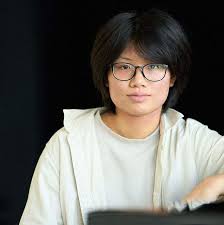
Pianist Mengyang Pan, known for her captivating performances, has graced prestigious stages worldwide, including the Royal Festival Hall, the Wigmore Hall, Bruckner Haus Austria, UNESCO Paris and many more. Born in China, she began her musical journey at the Central Conservatory of Music and later pursued her studies in the UK at the Purcell School and the Royal College of Music. Earning accolades at competitions such as the Ettlingen International Piano competition, Rina Sala Gallo International Piano Competition, Dudley International Piano Competition Birmingham International Piano Competition and many more, Mengyang’s mastery of both traditional and contemporary repertoire has earned her critical acclaim, with her delicate touch and tonal shades praised by critics. Collaborating with renowned conductors like Vladimir Ashkenazy and John Wilson, her electrifying performances have garnered high acclaim.
Beyond performance, Mengyang is a dedicated educator, serving as a piano professor at the Royal College of Music and actively participating in international competitions and music festivals as an adjudicator and masterclass instructor. Co-founding the Elisi-Pan Piano Duo, she continues to share her musical expertise through recitals worldwide. Additionally, Mengyang contributes significantly to piano pedagogy as a module leader and lecturer at the RCM and directs various music education programs, including the IPPA Conero International Piano Competition. Her passion for musical exploration is evident in her curation of festivals dedicated to reviving overlooked compositions and composers while embracing contemporary expressions.
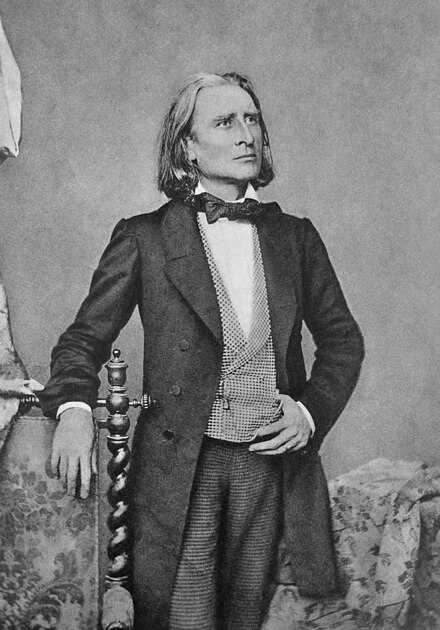
Franz Liszt 22 October 1811 Doborjan, Kingdom of Hungary, Austrian Empire
31 July 1886 (aged 74) Bayreuth Kingdom of Bavaria, German Empire
Harmonies poétiques et religieuses (Poetic and Religious Harmonies), S.173, is a cycle of piano pieces written by Franz Liszt at Woronince the Polish-Ukrainian country estate of Liszt’s mistress Princess Caroline von Sayn-Wittgenstein in 1847, and published in 1853. The pieces are inspired by the poetry of Alphonse de Lamartine as was Liszt’s symphonic poem Les Préludes.
The ten compositions which make up this cycle are:
Invocation (completed at Woronińce);
Ave Maria (transcription of choral piece written in 1846);
Bénédiction de Dieu dans la solitude (‘The Blessing of God in Solitude,’ completed at Woronińce);
Pensée des morts (‘In Memory of the Dead,’ reworked version of earlier individual composition, Harmonies poétiques et religieuses (1834));
Pater Noster (transcription of choral piece written in 1846);
Hymne de l’enfant à son réveil (‘The Awaking Child’s Hymn,’ transcription of choral piece written in 1846);
Funérailles (October 1849) (‘Funeral’);
Miserere, d’après Palestrina (after Palestrina);
La lampe du temple (Andante lagrimoso);
Cantique d’amour (‘Hymn of Love,’ completed at Woronińce).
Liszt’s Bénédiction de Dieu dans la solitude [“Benediction of God in solitude”] is the third work from his cycle Harmonies poétiques et religieuses [“Poetic and Religious Harmonies”] completed in 1853. This magnificent piece is the perfect marriage between Liszt’s abilities as a virtuoso pianist and his profound spirituality. The Benediction is prefaced by a poem of the French literary romantic Alphonse de Lamartine, and comes from a collection dating from 1830 also titled Harmonies poétiques et religieuses. Through several meetings, Lamartine’s socio-political, aesthetic, and religious views influenced Liszt greatly. Despite the popular belief that he only converted to Catholicism late in life in order to repent from his youthful transgressions, Liszt’s father took him to several churches as a young boy and instilled in him a curiosity and reverence which would persist through old age.
The piece can be divided into four large sections [ABCA’]. The A section features long, rich, fluid melodies while B is contrasting in its short gestures and pastoral peacefulness. Section C is rather improvisatory and guides the music emotionally from the tranquil B section to the glorious return of the A section. This time, the melody is further ornamented with elaborate accompanimental figures as the music climactically ascends to the heavens. An introspective, prayer-like postlude follows in which a fragment from the B section appears as a reminiscence, a cyclical feature present in many of Liszt’s larger late works. A professor of mine once remarked about the piece, “It doesn’t matter whether you are religious or not, when you listen to the Bénédiction you are convinced that there is a God.”
The Piano Sonata in B minor S.178 is in a single movement and was completed the work during his time in Weimar, Germany in 1853, a year before it was published in 1854 and performed in 1857. He dedicated the piece to Robert Schumann , in return for Schumann’s dedication to Liszt in his Fantasie in C major op 17. A copy of the work arrived at Schumann’s house in May 1854, after he had entered Endenich sanitorium . Pianist and composer Clara Schumann did not perform the Sonata despite her marriage to Robert Schumann; according to scholar Alan Walker she found it “merely a blind noise”.Already in 1851 Liszt experimented with a non-programmatic “four-movements-in-one” form in an extended work for piano solo called Grosses Concert – Solo which in 1865 was published as a two-piano version under the title Concerto Pathétique shows a thematic relationship to both the Sonata and the later Faust Symphony .Walker claims the quiet ending of the Sonata was an afterthought; the original manuscript contains a crossed-out ending section which would have ended the work in a loud flourish instead.[7]
Page 25 of the manuscript. The large section crossed out in red contains the original loud ending
The Sonata was published by Breitkopf & Härtel in 1854 and first performed on 27 January 1857 in Berlin by Hans von Bulow. It was attacked by Eduard Hanslick who said “anyone who has heard it and finds it beautiful is beyond help”. Brahms reputedly fell asleep when Liszt performed the work in 1853. However, the Sonata drew enthusiasm from Richard Wagner following a private performance of the piece by Karl Klindworth on April 5, 1855.It took a long time for the Sonata to become commonplace in concert repertoire because of its technical difficulty and negative initial reception due to its status as “new” music. However by the early stages of the twentieth century, the piece had become established as a pinnacle of Liszt’s repertoire and has been a popularly performed and extensively analyzed piece ever since.
Camille Saint – Saens , a close friend of Liszt, made a two-piano arrangement of the Sonata in 1914, but it was never published in his lifetime because of rights issues. It was first published in 2004 by Durand in Paris, edited by Sabrina Teller Ratner. According to a letter from Saint-Saëns to Jacques Durand , dated 23 August 1914, the two-piano arrangement was something that Liszt had announced but never realized.
Liszt effectively composed a sonata within a sonata, which is part of the work’s uniqueness, and he was economical with his thematic material.The first page contains three motive ideas that provide the basis for nearly all that follows, with the ideas being transformed throughout. The complexity of the sonata means no analytical interpretation has been widely accepted.Some analyses suggest that the Sonata has four movements,although there is no gap between them. Superimposed upon the four movements is a large sonata form structure,although the precise beginnings and endings of the traditional development and recapitulation sections have long been a topic of debate. Others claim a three-movement form,an extended one-movement sonata form,and a rotational three-movement work with a double exposition and recapitulation .Inspired by the Wanderer Fantasie by Schubert that Liszt much admired which is a work where the transformation of the themes was incorporated into a more conventional form and was the basis of Liszt’s breaking away from the conventional forms of the day but having allowing themes to be transformed like character terms in a play.And has provoked a wide range of divergent theories from those of its admirers who feel compelled to search for hidden meanings. Possibilities include the following:
The Sonata is a musical portrait of the Faust legend, with “Faust,” “Gretchen,” and “Mephistopheles” themes symbolizing the main characters.
The Sonata is autobiographical; its musical contrasts spring from the conflicts within Liszt’s own personality.
The Sonata is about the divine and the diabolical; it is based on the Bible and on John Milton’s Paradise Lost
The Sonata is an allegory set in the Garden of Eden ; it deals with the Fall of Man and contains “God,” “Lucifer,” “Serpent,” “Adam,” and “Eve” themes.
The Sonata has no programmatic allusions; it is a piece of “expressive form” with no meaning beyond itself.
I was very interested to hear Inna Faliks play the Brahms F minor Sonata and here is a recording made in Cremona on the 28th September in the Fazioli Concert Hall.
It is an orchestrally conceived piece of great breadth and grandeur and a remarkable testament to a composer who was only twenty when he wrote it. In many ways it is pianistic as it knows how to exult the sounds within the piano but it is in many ways also awkward in its insistence of orchestral timbre and architectural shape. It is truly a pianistic symphony,a title that Alkan was quite happy to give to his study op 39, but for Brahms his four symphonies were much more suffered and required a long period of gestation. It is very difficult for the interpreter not to get distracted by detail as it is the overall architectural shape that is of fundamental importance. But it is also essential that Brahms’s subtle and sumptuous sound world is given time to breathe and expand. It is a work that in the wrong hands can sound either like a bull in a china shop or a fussy stylist who cannot see the wood for the trees.
Inna entered this world of Brahms with fearless abandon with leaps that are not negotiable, as they can wrongly be in Beethoven’s op 106 or 111. Leaps that must immediately establish the tempo and rhythmic drive of this monumental work. Inna played with freedom but above all with intelligence and aristocratic nobility. There was a majesty to the voices as they cried out within the ever rhythmic tolling bell as we are seduced by the luxuriant sound of the tenor melody as suddenly the strings take over with a succulent richness – ‘quasi cello espressivo’ indeed. Played by Inna with weight, digging deep into the soul of this magnificent Fazioli piano as rarely we have heard it divulge such secrets before! Deep bass notes held in the pedal, as Brahms indicates, starting pianissimo as the excitement increases. A beautifully shaped ‘più vivo’ with just the right amount of rubato, that Brahms suggests, leading to a final glorious outpouring. Pure orchestral chords for the ‘più animato’ suddenly brought nobility and order to the passionate outpouring of the youthful intensity of Brahms.
The ‘Andante espressivo’ was played with disarming clarity and a sense of balance that was of great beauty with a gently flowing tempo of mellifluous fluidity. The ‘ben cantando’ whispered duet between the voices was of deeply moving poignancy and the gentle ‘poco più lento’ floated on a sublime wave of searing beauty. There were moments of passionate outpourings but they were short lived and played with sensitive understanding as we drew ever closer to the sublime coda :’Andante molto – pianississimo ed espressivo ‘. From this sublime reawakening Inna built up a climax of earth shattering passion allowing it to drift away on a stream of harp like sounds of such simple purity and serenity.
The entire programme of the concert in Cremona on the 28th September
This was immediately dispelled by the dynamic energy and great characterisation she brought to the ‘Scherzo’. She produced a beautiful full tone to the ‘Trio’ with it’s sombre elegance and whistful searching. The extraordinary ‘Intermezzo’ is a calming voice between the two vigorously quixotic third and fifth movements. Infact it could almost have been conceived like the ‘Waldstein’ sonata where Beethoven substituted his first thoughts and placed an introduction to the final movement. The whispered meditation with its bass drum rolls ever more menacing that Inna carved with a superb sense of architectural shape whilst never loosing the rhythmic impact of devastating desolation that it can and should provoke. The ‘Allegro moderato’ that followed was indeed ‘con rubato’ with its buoyant rhythms and syncopated replies bursting into song ‘con espressione.’ Leading to the glorious ‘chorale’ played by the sumptuous string like sounds of Philadelphian beauty. Building of excitement with the drive of the ‘più mosso’ before the devilish dance of the ‘Presto’ played with astonishing technical mastery that went completely unnoticed as it was the musical message that was so overpowering before the orgiastic release of the final few bars .
A red carpet for Inna and the critic/pianist and commentator Jed Distler
A remarkable performance of great authority and poetic beauty from a master musician .
Brahms in 1889 7 May 1833, Hamburg – 3 April 1897 (aged 63) Vienna
Brahms’s Piano Sonata No. 3 in F minor, Op. 5 was written in 1853 and published the following year. It is unusually large, consisting of five movements , as opposed to the traditional three or four. Brahms, enamored of Beethoven and the classical style the sonata with a masterful combination of free Romantic spirit and strict classical architecture. As a further testament to Brahms’ affinity for Beethoven, the Piano Sonata is infused with the instantly recognizable motive from Beethoven’s Symphony n. 5 in the first, third, and fourth movements.Composed in Dusseldorf it marks the end of his cycle of three sonatas , and was presented to Robert Schumann in November of that year; it was the last work that Brahms submitted to Schumann for commentary. Brahms was barely 20 years old at its composition. The piece is dedicated to Countess Ida von Hohenthal of Leipzig.The five movements are :
Allegro maestoso
Andante espressivo — Andante molto The second movement begins with a quotation above the music of a poem by Otto Inkermann under the pseudonym C.O. Sternau. Der Abend dämmert, das Mondlicht scheint, da sind zwei Herzen in Liebe vereint und halten sich selig umfangen
Through evening’s shade, the pale moon gleams While rapt in love’s ecstatic dream
Scherzo . Allegro energico avec trio beginning with a musical quotation of the beginning of the finale of Mendelssohn’s Piano Trio n.2 op 66
Intermezzo (Rückblick / Regard en arrière) Andante molto
Finale. Allegro moderato ma rubato
Annie Fischer played it in her first recital of three for us in Rome.Trying the piano out with a great flourish that broke a string ! I used to hold a lighted cigarette for her in the wings. One of the truly great interpreters born to play the piano with a naturalness,intelligence and passion she was a truly remarkable lady and and her performances and presence in out lives will never be forgotten .I heard Artur Rubinstein play the Brahms twice in 1969 and 1972 A work that was truly ‘his’ I KNEW I was a musician long before I knew I was Jewish, Ukrainian, or Soviet.” So begins the captivating memoir Weight in the Fingertips: A Musical Odyssey from Soviet Ukraine to the World Stage (2023) by Inna Faliks, a distinguished concert pianist and now a music professor at UCLA’s Herb Alpert School of Music. Her journey from child musical prodigy in Soviet Ukraine to an émigré artist at the highest levels of her profession takes several surprising twists, described in prose alternating between thoughtful and delightfully breezy but always deeply wise in its contemplation of a life spent pursuing an individual musical voice true to the disparate components of her identity. Manuscripts Don’t Burn is a recital/reading that delves into the world of Inna Faliks’s recently published memoir about her adventures as an acclaimed, Ukrainian-American, Jewish concert pianist: In Weight in the Fingertips Inna Faliks weaves together excerpts from her memoir with performances of old and new works that have been especially meaningfull to her. It also marks the release of “Manuscripts Don’t Burn,” a new recording on Sono Luminus.
Today at Kings Place Rose McLachlan played with such exquisite finesse and beauty that I am tempted to say that she turned ‘baubles’ into ‘gems.’
Only time will tell if they are indeed gems but these lucky 22 women composers have certainly found a superb artist to present their beautiful ‘nocturnes ‘.
Eight of the twenty two composers present today
I already know that the pianist and critic in New York Jed Distler after hearing the première last September is playing several of the nocturnes in his programmes including those by Nancy Litten’s Night Time Stroll and Alanna Crouch. But today listening again at the distance of a year I was mesmerised by the exquisite beauty of each and every nocturne. Could it be the influence of Katya Apekisheva on Rose that she has entered that magic world of ravishing sounds and whispered confessions. Like her brother ,a door has opened to a magic world of colour and fantasy, and whose performances in Leeds recently could only be described as sublime. As Elena Cobb wrote :
“ Enjoy the view of the full house at the London Piano Festival earlier today anticipating Rose McLachlan’s recital. A professional film, created by Katie Edwards will be available next week on YouTube.
Everyone who was there will agree that Rose’s playing was spell bounding. Her pianissimo was especially impressive as I agree with Herbert von Karajan who once said: “Everyone can play loud and fast. Try slow and quiet.”
I was so happy to be able to whisper in her father’s ear, as I did when I heard Callum play Schumann op 13 : ‘You must be so proud’.
And yet another of the McLachlan clan ,Matthew, with the Chappell Gold Medal already to his credit. I wonder is there no limit to the artistry and industry of this embarrassingly talented family?
https://christopheraxworthymusiccommentary.com/2022/10/08/schubertiade-at-kings-place-all-you-need-is-love/Charles Owen and Katya Apekisheva ,Directors of the LPF ,on extremities of the group Prof Tessa Nicholson with Nancy Litten whose Fred and Berties’s Night- Time Stroll with thoughts of Chopin op 55 n.1 was one of twenty two gemsAnn Martin-Davis with Kathryn Page McLachlanA full house in Hall Two A birds eye view of the performers and directors
No doubt for me this is the finest artist before the public today. Eighty minutes in which the golden aura that surrounded him illuminated and uplifted souls as no other artist can today . Swaying gently as the music just poured from him with a simplicity and staggering mastery. It was just him and us immersed in a glorious outpouring of golden strands of music. This was an artist recreating the music with an improvisatory mastery and we were held mesmerised in his spell No external assistance from I pads which would have been unthinkable with an artist of his genius because this wild looking young man carries the music with him deep in his soul ‘Hats off a Genius’ is too little to express the emotions that his pure simple music making provokes and enriches. It was to the ‘Barricades’ that he turned at the end of this musical seance as an encore , coming full circle as he played it ever more searchingly with its beguiling insinuatingly daring harmonic changes. The Wiggies in delirium wanted even more and this humble servant of music sent us away with the most famous of all baroque pieces :’Le Tic Toc Choc’ ,played with astonishing fluidity and plucked ease – Sokolov eat your heart out !
Les Barricades Mystérieuses (The Mysterious Barricades) is a piece of music that Francois Couperin composed for harpsichord in 1717. It is the fifth piece in his Ordre 6ème de clavecin in , from his second book of collected harpsichord pieces (Pièces de Clavecin).
“The four parts create an ever-changing tapestry of melody and harmony, interacting and overlapping with different rhythmic schemes and melodies. The effect is shimmering, kaleidoscopic and seductive”
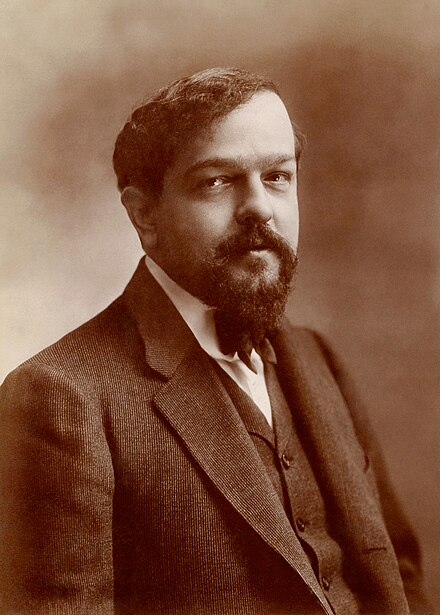
Debussy considered François Couperin to be the “most poetic of our [French] harpsichordists” expressed particular admiration for Les Barricades Mystérieuses.In 1903, wrote:
“We should think about the example Couperin’s harpsichord works set us: they are marvelous models of grace and innocence long past. Nothing could ever make us forget the subtly voluptuous perfume, so delicately perverse, that so innocently hovers over the Barricades Mystérieuses.”
A programme made up of thirty two (thirty three counting the Chopin mazurka encore ) miniatures .Many if not all masterpieces but played with whispered half shades and murmured asides that reminded me of the pianists at turn of the last century.Pianists who would beguile and seduce their audiences with playing of exquisite delicacy and jewel like sounds and were magicians of the keyboard that with the innovation of the pedal were able to seek out the very soul with a kaleidoscopic range of sounds.Some even spoke to the public to let them know how it was all proceeding !
Tonight we were treated to some phenomenal playing of breathtaking beauty and many sounds in the Bartok that I have never heard from the piano before.Brahms too a selection of only Intermezzi that in many ways was masterful as was the Beethoven op 126 Bagatelles. This is a master pianist and above all a magician of sound .The difficulty is however that without contrast or an architectural shape it is difficult to hold an audience in more than one or two pieces. Tonight there was undisputed mastery but because of the nature of the programme it became too much of a good thing and I found myself thinking about the marvels that were evolving from this box of hammers and strings rather than being overwhelmed and involved in a musical conversation.
Was it the programme or was it me or was it that this master pianist thought more of the sounds he was producing than what the composer intended? A controversial artist as many are who have come from the east with phenomenal technical training but lacking the culture of the west The big end or the little end? Controversy is always better than indifference in every walk of life!
I remember Perlemuter being sent a demo of a famously controversial pianist playing Ravel. DG hoping for some words from a disciple of the composer to use in their marketing publicity. “Qu’est-ce que c’est que ca ?’ Innocently enquired the humble master .The pianist after a clamorously unsuccessful competition experience went on to conquer the world and become a cult figure .
Tonight this master pianist received a standing ovation but rather a poor turn out due again to the choice of programme.
A beautiful review in the Guardian which I totally agree with except for the Bach but Genius that confronts Genius it is always JSB that wins !As I said Anderszewski is often controversial but there is no doubt that he loves the piano even if for me as on this occasion he smothers it.
Rosen,K.U Schnabel and Fleischer were not always in agreement with his interpretation but strangely it was Fou Ts’ong who loved him………Ts’ong was also deeply in love with music and often would say to me that he knew I preferred his performances from the Chopin Competition in the ‘50’s to his present day performances when he would play and give masterclasses for us in Rome every year. His widow Patsy Toh Fou writes:‘I haven’t heard Piotr for a very long time.Charles Rosen’s comment was rather extreme !!!!!Piotr is controversial but very creative and tends to manipulate the music I think rather than being at the service of the composer’.I remember Ts’ong arriving in Rome to play for us and finding that the day before another controversial figure was playing.He wanted to hear the recital of Mozart and Chopin.After the concert I explained that this pianist ,like Cherkassky tends to manipulate the music rather than following what the composer had indicated in the score . Ts’ong exploded as only he could do :’But Shura loves the piano – this man hates it!’ ………There is no doubt that both Ts’ong and Anderszewski are deeply in love with music.
Ravishing beauty and supreme artistry combined with total mastery of art that conceals art has me searching for superlatives for one of the finest most moving recitals I have been to for years .
Waldszenen that was an outpouring of subtle beauty where every note had a poignant significance .Beethoven’s Pathetique as though I had never heard it before such was the kaleidoscope of sounds and dynamic drive.An ‘Adagio cantabile’ that was a true bel canto that arose out of a sumptuous accompaniment and the central episode like a heart beating -Beethoven’s! Alkan that was so exquisite it brought tears to my eyes as did the ravishing beauty of Chaminade’s Automne . Liszt Pesther Carneval was breathtaking , astonishing and at the same time so characterful that it brought smiles to the face just as it brought gasps as phenomenal gymnastics were thrown off with rhetorical mastery …..and all this on what Perlemuter would have generously described as a casserole! ……..much more to come tomorrow when I have got my breath back!
Fascinating programme notes from an eclectic artist who not only plays the notes but enters and relives the world in which they were conceived.
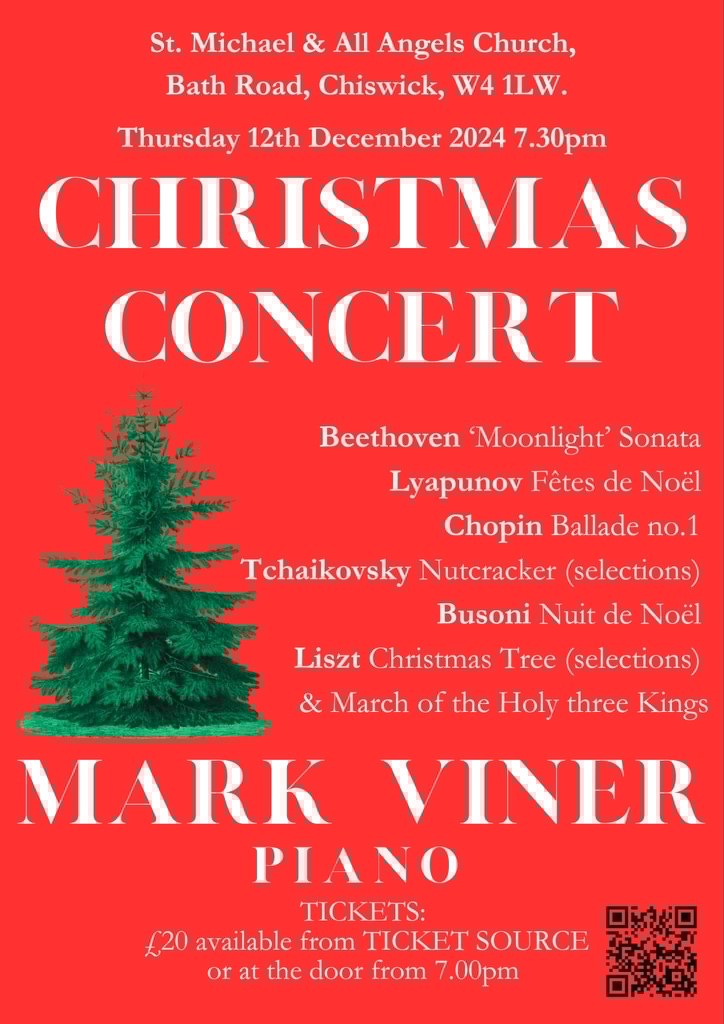
A programme that at first glance seemed interesting if rather conventional. Beethoven’s Pathétique ,Schumann,Alkan,Chaminade and Liszt .It was from the first mighty chord of the Beethoven that one was aware of a piece that was like new and was unfolding before our eyes in a voyage of discovery where clarity and beauty went hand in hand with a pulsating heart of poignant significance. It was the dynamic contrasts that added even more meaning to an opening where I had never been aware before now of it’s grandiloquence combined with searing beauty. Florestan and Eusebius spring to mind or the split personality that could be two things in one. The irascible temperament of Beethoven that could flare up with impatience and frustration but also the serene deep inner soul that was indeed to come to the fore as the composer could see the paradise that awaited him. All these thoughts come to mind, now,thinking about last night’s performance.Technical and professional considerations ( no I pad in sight as the music for this artist was internal not external!) ca va sans dire ,it did not even pass through one’s mind as the music just poured forth in a continuous stream of mellifluous sounds on a piano that miraculously Mark had found it’s soul ( not sole) very deep down in it’s roots.The silences were so poignant too before the chromatic scale, marked and surprisingly played piano without a crescendo,where the sforzando was a shock tactic before the burning intensity of the Allegro di molto ma con brio. A dynamic drive but still the searing beauty of the exchange between voices as the music was driven relentlessly forward.This continual forward movement made the return of the opening call to arms even more of a shock as were the rests between each gasp that were held with breathless courage as long as he dared.This was music making that was recreation and which we the audience were unknowing accomplices.This is the very ‘raison d’etre’ of live music making as opposed to perfectly concocted studio performances. This is ‘X’ certificate stuff not for the uninitiated with fear of the unknown! I was not expecting to be so involved with such a popular work that at first glance I had underestimated.The melting beauty of the diminuendo into the abrupt return of the Allegro will remain with me for a long time as will the reappearance in the coda and the ‘Grave’. A continual stimulation of the senses that I cannot begin to imagine the effect on the public of the day with this revolutionary invasion of their private emotions.
Professor Mark Viner always so concise and informed
The surprise after such upheaval is the heavenly peace of the ‘Adagio cantabile’ that was played with the beauty of Bel Canto (which we were also to appreciate in Alkan later in the programme) of which Mark is a master. Freedom but within certain limits of good taste and style ( Chopin likens it to branches free to move but with the roots firmly fixed in the soil). All sustained by a luscious undercurrent of harmonies that gave such depth to this much loved but often maligned movement. The central episode with it’s pulsating heartbeat ( as in Chopin op 28 n.17) on which the melodic line is answered by the bassoon like bass notes. The gradual pizzicato bass notes played so clearly that the return of the melodic line now incorporated with a reverberating heartbeat was like wallowing in a sumptuous jacuzzi !
The sun suddenly came out and the radiance of the Rondo was exhilarating and rejuvenating with a ‘joie de vivre’ and technical relishment.It made the slow chorale episode even more poignant as a momentary cloud passed over our heads before the lightweight pitter patter to join the fun once again. What a voyage of discovery this was and I can only think back to Serkin’s performance in the Festival Hall for a similar experience.
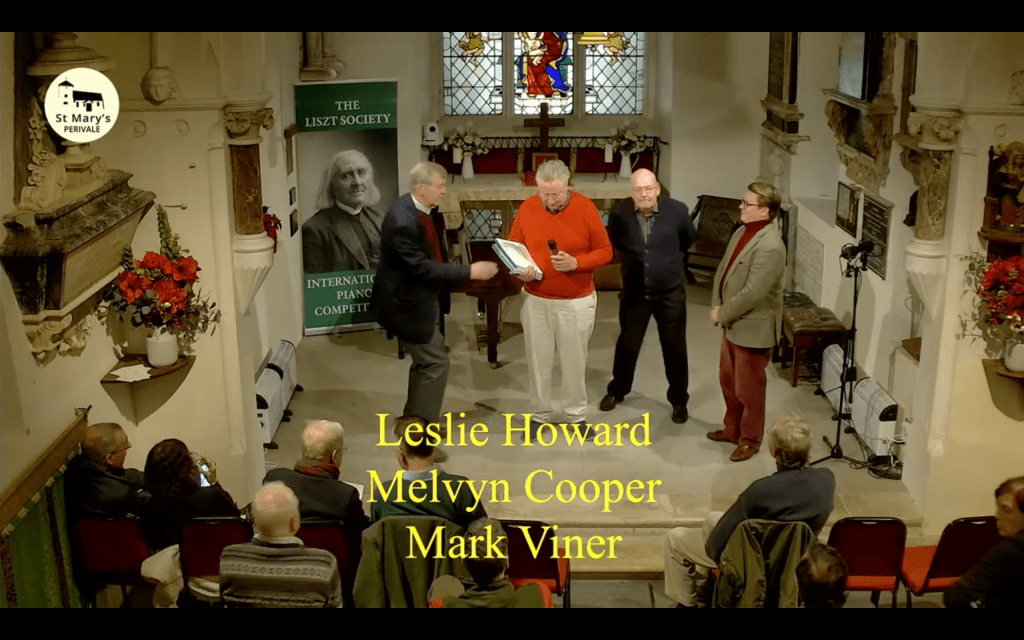
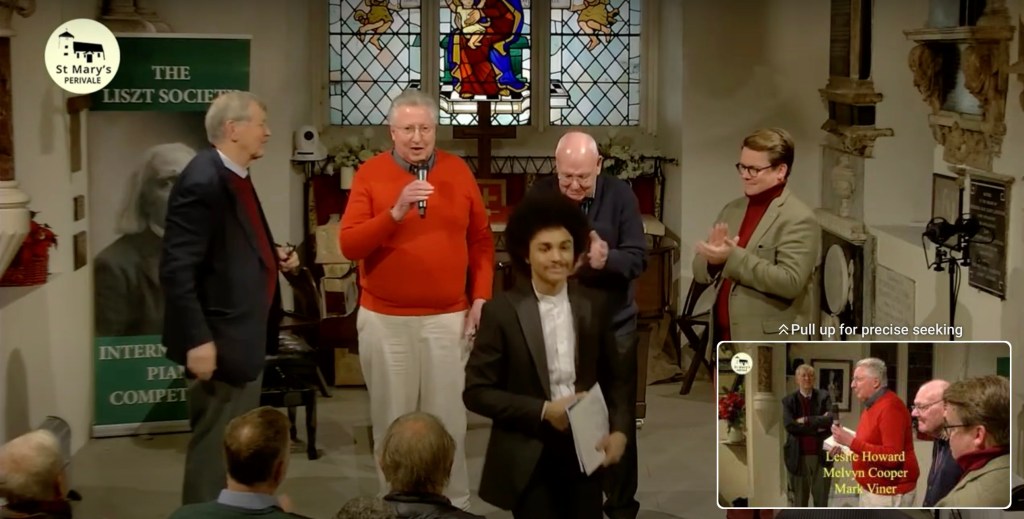
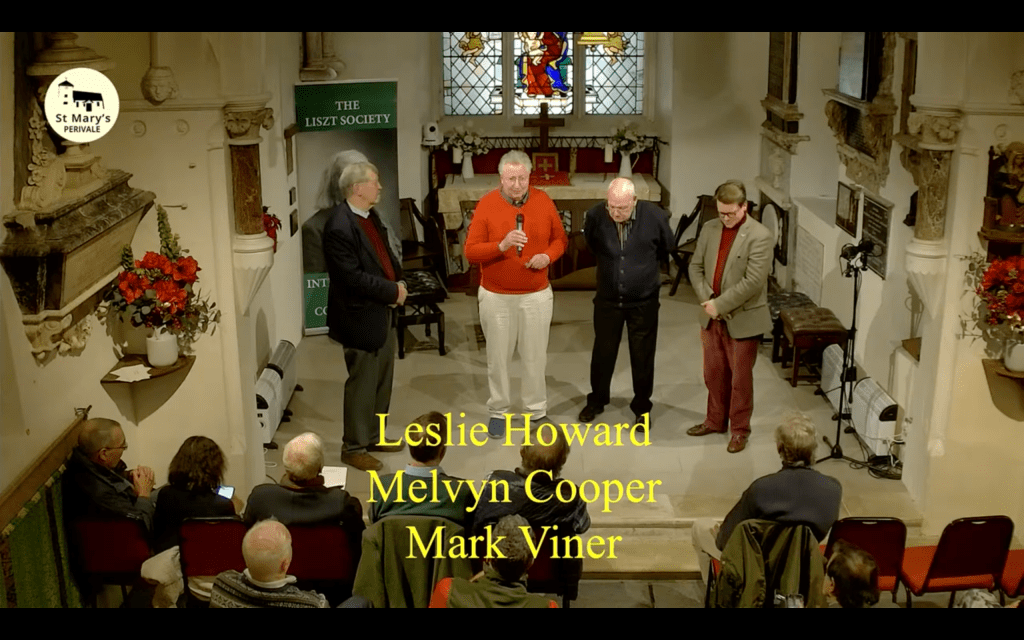
A visitor from the Liszt Society of UK of which Leslie Howard is the President Mark is a member too but also President of the Alkan Society . Between them they know more about the works of Liszt and Alkan ,respectively,than anyone alive or dead!
Waldszenen long a favourite of Peter Frankl but long forgotten by the younger pianists generation . That other Mark, Marc-André Hamelin and Viner have much in common. Hamelin being one of the first to include Alkan in his programmes and also physically like ‘our’ Mark does not portray his emotions with unnecessary movements but looks and concentrates on the sounds he is searching for! It was just a few months ago that Hamelin played them in Warsaw , a performance he repeated in Cremona last weekend .My first impression after listening to Hamelin was the same that I had today listening to Mark – Thank God I have lived to hear such beauty!
If Marc-André is the Prince surely Mark Viner ‘c’est le Roi ‘ ( to quote Rostropovich on listening to Perlemuter who he had invited to play in his festival in Evian many years ago ). Every note was made to speak like a lieder singer such was the power of communication and feelings aroused as we too were on a tour in the mysterious woodland of Schumann’s fantasy. Deep nostalgia and beauty as we entered with the rhythmic drive of the hunter following us. Only to be stopped in our tracks by the simplicity and radiant beauty of solitary flowers.The brooding of the left hand gave a real sense of atmosphere to the cursed place that made one realise why Schumann’s beloved Clara refused to include it in her performances! The two final chords lifeless and without expression are enough to strike fear into the heartiest of souls. The joyful singing on finding such a friendly landscape afterwards was quite exhilarating in Mark’s well oiled hands. There was a pastoral beauty as we saw the wayside inn with it’s bass melodic line and gentle harp like flourishes unfolding. There was the radiant solitary beauty of the prophet bird that was of such significance with a solemn celestial beauty to the central chorale as she surveyed the scene in such a leisurely knowing way. It was played quite exquisitely, poetry from a poet’s hands! Rhythmic playfulness of the Hunting song was immediately calmed by the sublime calm and beauty of the farewell. Fluidity and radiance with deep bass notes just adding a richness to the sublime golden streams of sound that were enveloping this old but surely vintage casserole!
Alkan has long been a first love for Mark since he was bewitched by a visit of Ronald Smith to the Purcell School where he was studying with Tessa Nicholson. He asked his teacher to show him how to acquire a technique so that he too could delve into a world that had ignited his imagination. ‘Noblesse oblige’ and Tessa trained him as she has so many other remarkable young musicians including Tyler Hay and Alim Beisembayev. Mark is now embarking on a series of recordings of all the works of Alkan and I believe he has arrived almost half way with CD n. 7 already in the can. On listening to this collection of six ‘songs without words’ that had been inspired by Mendelssohn and that Alkan too had composed in several series of six miniatures . Alkan’s ‘3 Recueil de chants’ op 65 was so exquisite I found myself absorbed and ravished by the subtle beauty, exquisite jeux perlé and astonishing fiortiori that on reliving such beauty I cannot understand why these are never heard in recital or at least on Classical FM ! ‘Vivante’ was a true song and miniature tone poem with the emphatic doubling of the melodic line so reminiscent of Mendelssohn yet with a unique original voice. The ‘Esprits follets’ was a tour de force of Horowitzian bewitchment with featherlight scales disappearing into the bass as the melodic line unwound unperturbed with nonchalant mastery of sound and pedal. There was the simple elegance of the ‘Canon à la 8’ but the most incredible playing was in the ‘Tempo giusto’ which it may have been , but to cram in so many notes so as not to disturb the Tempo giusto is the stuff that legend is made of and that surrounds the mysterious recluse that was Alkan.Sumptuous rich sound for ‘Horace et Lydie’ where I doubt this piano has ever been seduced as Mark did today giving up such riches for two hands and two feet. But Mark also has a soul that was to surface ever more in the Barcarolle that was played with beguiling rarified whispered sadness and a kaleidoscope of sounds that were like jewels sparkling in the radiant beauty of this atmosphere.
Mark may have mentioned that Chaminade has been accused of composing elevated salon music when ‘Le Six ‘ were hard at creating a different world. ‘Automne’ is indeed the work often heard on Classical FM and which used to adorn every home that had a piano and aspidistra. Such a beautiful melody played exquisitely by Mark but I have never heard the central virtuosistic interruptions that of course our Auntie would have ignored! Not Mark who played with fearless brilliance and passionate conviction before lying exhausted as he allowed the ravishing melody to flow from his fingers and lay to rest as a bare whisper but happy at having known such beauty.
The Liszt Hungarian rhapsody is the longest of a collection of 19 and is usually heard in a cut version because lesser mortals than Mark see just technical wizardry and a vehicle to arouse applause and a standing ovation . Of course this is the showman Liszt but as Mark showed us there is much much more to it than just note spinning. Time seemed to stand still as Mark let rip at the keyboard with unbelievable pyrotechnics and an extraordinary range of emotions that kept us enthralled as he spun off the piano seat with a final victorious flourish.
What a night that was in the Church that I had passed for the first 25 years of my life having spent my childhood in Bedford Park in Flanders Mansions. Little could I have imagined what wonders it would still hold for me fifty years on !
A link to a fascinating discussion about Alkan in Cremona with Marc-André Hamelin last weekend can be heard in this long distance article that I wrote :
A church with a view and Mark lives next door and officiates every Sunday in St Michael and All Angels. He is also a regular visitor to the Tabard inn.
A remarkable private occasion for friends of the Hastings International Piano competition .
Curtis in London, from Hanover where he now studies with Arie Vardi, playing with the RPO last Thursday in the prize winners London debut concert. A very mature and also highly poetic interpretation of the Schumann piano concerto. It is interesting to note that Shunta Morimoto, the previous Gold medalist, won the competition with the same work but chose Beethoven 4 for his London debut .They both have played the old Tchaikowsky warhorse this year breathing fresh life into such a well known work. Curtis in Hastings and Shunta in Japan ( Shunta will at the end of the month play the Grieg concerto in Hastings)
Both choices show that the vision of Hastings is for master pianists who are above all else masterly musicians with something to say . And so it was tonight Champagne and canapés washed down with the ‘Hammerklavier’ Sonata !
Curtis presenting his programme with some very thoughtful insights while Vanessa listened quite moved by such deep thoughts from this teenage artist
At only 19 this was a display of mature musicianship and masterly control. Prefacing it with two of the most important and poignant of Chopin’s nocturnes op 27 n 2 and op 48 n 1. It was interesting to note that the first note of the D flat nocturne deep in the bass Curtis played with the right hand as he did the first deep bass note at the opening of ‘Hammerklavier’. It prompted me to ask rather impishly afterwards if he was left or right handed !
Curtis with Dayu Guo sponsor of the Sophia Guo first prize in Hastings
I know Serkin would have shut the score if anyone dared open op 106 thinking to play safe. But Curtis, like Rana too recently, realised the struggle that this Sonata implies with its heroic call to arms that is not and should not be in a play safe zone.
Curtis demonstrated all that was implied by a Beethoven struggling with life, deafness and pianos that were not yet the instruments that his genius could foresee for the future. An ‘Adagio sostenuto’ with passion but also strength of emotion and a kaleidoscope of sounds was followed by the ‘tour de force’ of a fugue that was written to scare off all but the fearless. The two Chopin Nocturnes were played with ravishing sounds and profound musicianship but where the bel canto could not float as freely as it could have with a slightly more fluid tempo.
Vanessa Latarche centre presenting Curtis with our hostess Sarah Coop in the beautiful home of Sarah and David Kowitz ,left and Lydia Connolly right mentor and a director of Harrison and Parrott concert agency
Promoted by Vanessa Latarche the enlightened artistic director and deus ex macchina of the Royal College, Hastings International Piano and much else besides, befriending so many extraordinarily talented young musicians as the great artist she is herself but also a sensitive caring figurehead. Already Curtis is receiving sessions from experts in how to deal with both the business and human side of his life at the start of a career.
Lydia Connolly with Curtis – who was awarded this year the Hastings Fellowship which deals with the mentoring and coaching by Lydia Connolly and Trudy Wright
Youths that have sacrificed much for their calling but are also young and above all with the prospect of a happy life in front of them doing what they love.
Vanessa even managed to persuade Curtis to play a little ‘bon bon’ – her words not mine – which brought forth an outpouring of passion and virtuosity the same that Schumann felt for his beloved Clara . ‘Widmung’ was indeed breathtaking and overwhelming as one might expect from such a charming young nineteen year old artist with the world at his feet. An interesting discussion with Roberto Prosseda in Cremona ,recently elected artistic director of the Rina Sala Gallo Competition in Monza just shows with what intelligence and care these gifted young musicians are looked over by their peers https://www.facebook.com/share/v/yBLVYNaujV9Emwpr/?mibextid=KsPBc6
P.S. Nadia Boulanger often quoted from Shakespeare in her classes this phrase:’Words without thought no more to heaven go ‘
And I am please to conclude this encounter with an extraordinary young artist by his beautiful and deeply thoughtful few words in response to mine about his performance.
“Dear Christopher, thank you for this warm and touching review and thank you for pointing out the tempo issue in Chopin – I completely agree.
About starting the note with the right hand – it’s just a matter of gesture. In my opinion, there are certain occasions where certain gestures are more or less helpful. A very clear example that comes to mind right now is Chopin first ballade in g. I always prefer to start the hand movement from the knees – make a very long upbeat, and slowly. The first sound I would not make it like paramount pictures the gong, but strings with bassoon – not trombone, not horn.
I believe every motion, every movement we do must be good for the music, for the instrument and for me, myself. If all three – it’s very good. If two of the three – it’s also very good. It should never contradict the interest.
I would gladly like to invite you to my upcoming performance at St. Mary’s Perivale on Tuesday 26th with a probably more experienced program – I’m sure you feel the same as I do that the Hammerklavier needs its time to develop. I haven’t really played in public, but yesterday was a nice place to try it out.
I hope I haven’t written too much or inconvenienced you, but your article inspired me to write this to you.”
All the best Curtis
Curtis in discussion with Christopher Axworthy . Sarah Biggs CEO of the Keyboard Trust looks on with Lydia Connolly
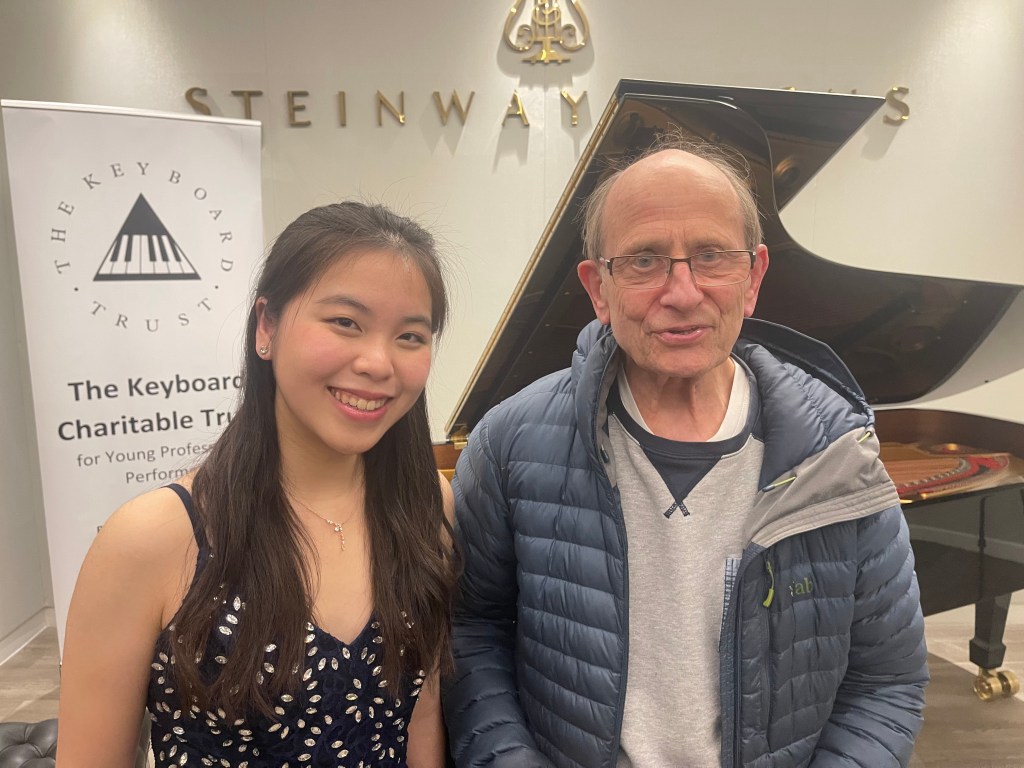
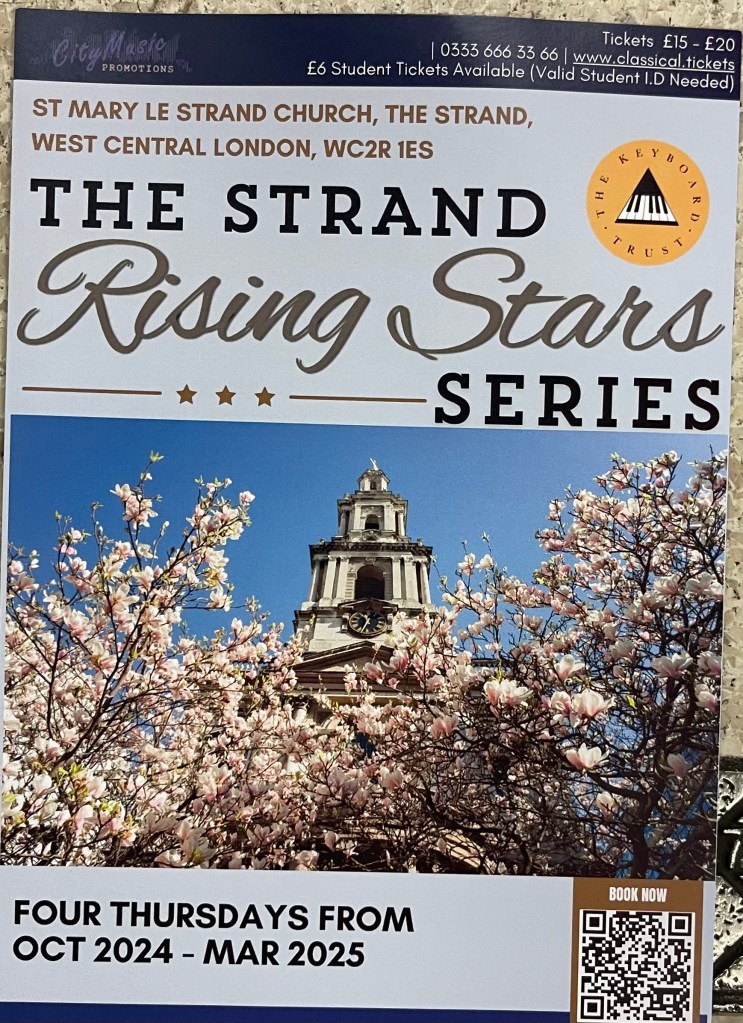
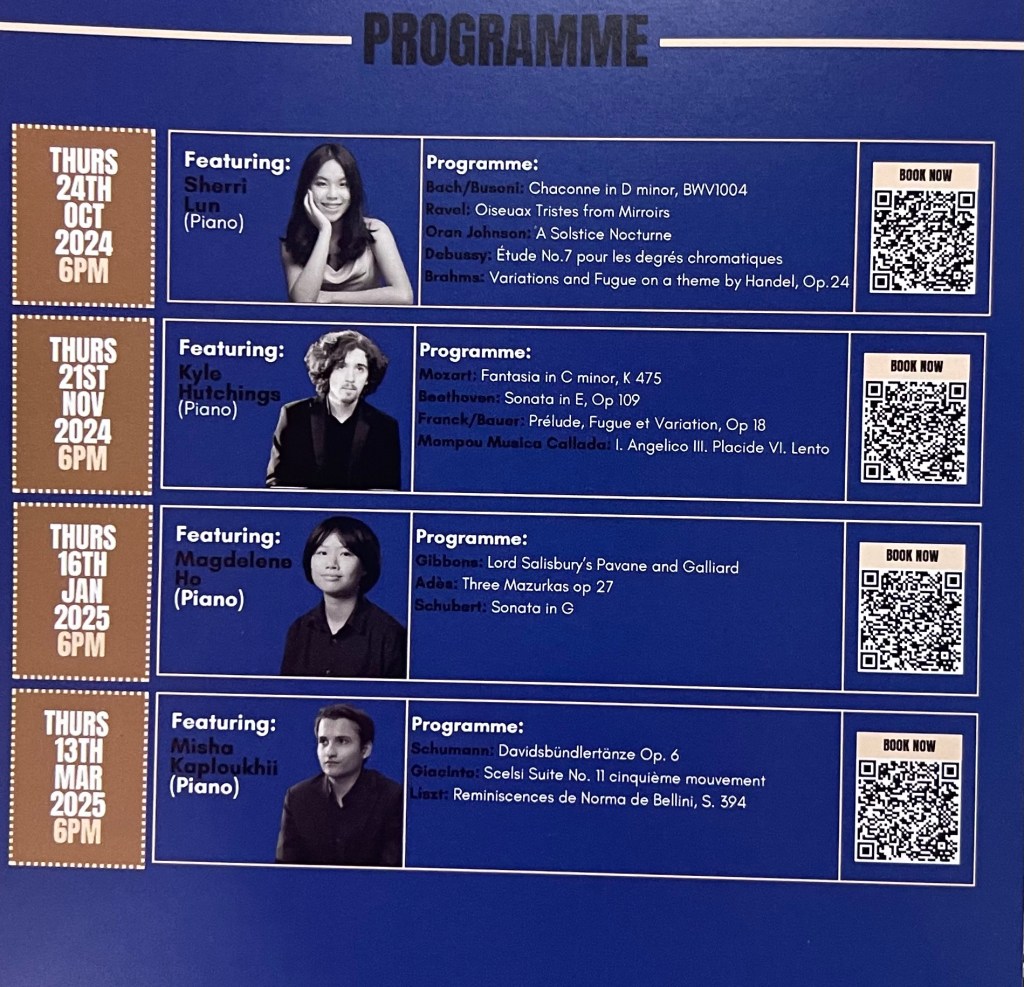
A letter from Cremona is actually a letter about Cremona . At the last minute unable to come to Cremona ,as I have been doing for many years , I took the title from Alistair Cooke’s famous ‘Letter from America’ .It was a radio programme that kept us informed for over forty years about day to day life and what the man in the street felt and thought .Usually good news about good people …….the mass media fill us up with the bad news and the bad people! It is above all to Alessio Zuccaro that my thanks must go for the minute by minute reports by ‘whats app’ of most of what was going on in the piano world of Cremona.Videos,audios,photos I saw and heard more than I have ever done before.Topped up by dear friends and esteemed colleagues Inna Faliks,Jed Distler,William Naboré, Michail Lifits and of course Valentina Lo Surdo.This is a chronicle designed to help above all wonderful young musicians who having dedicated their youth to music , crave nothing more than an audience with which to share it.It is a publicity for them most of whom I know and can include my thoughts about past performances but I am glad to make the acquaintance of some that have slipped through my net.I am a trustee and one of the artistic directors of the Keyboard Trust that tries to help exceptionally talented young musicians bridge the gap between finishing their apprenticeship and starting a career in music.Founded by John Leech with his wife Noretta Conci many many years ago unofficially and officially 33.
I was doing the same in Rome for some 30 years with the Ghione Theatre trying to give young musicians a platform in the theatre I had created with my wife.In my case not only young musicians but also famous musicians who by some extravagance had never or very rarely ever performed in Rome or even Italy. My old piano teachers were the starting point : Vlado Perlemuter and Guido Agosti .They were soon to be joined by Annie Fischer,Shura Cherkassky,Rosalyn Tureck,Tatyana Nikolaeva,Gyorgy Sandor ,Moura Lympany and above all the mercurial genius of Fou Ts’ong.It was Ts’ong who was always pleased when Roberto Prosseda as a teenager could take part in his masterclasses because he could instantly understand and do what they had discovered together.Many years have passed but Roberto has never forgotten the debt he owes to Ts’ong
Roberto Prosseda centre. Inna Faliks and Jed Distler left. Marc -André Hamelin right
And it is to Roberto that the piano world must now be thankful for this annual meeting of minds in Cremona .The highlight and message for me were the words of simple wisdom that Roberto spoke in the discussion about his role as artistic director of the Rina Sala Gallo Competition in Monza. Genial,simple and humble are all signs of greatness and it was Roberto who outlined the importance for young musicians to use the competition platform as a launching pad for a career in music and not just try to be the first to pass the post. There is the tortoise and the hare to consider and that true talent may need more time and experience to mature. Roberto came third in Casagrande but he met his wife there who came second .They now have a very large family and important careers in music! Michail Lifits too in the same conversation said that he as a jury member of a competition that he had actually won together with Busoni was looking for pianists who are artists and that the most important thing is that they have something to say.
You will find the complete discussion recorded from the stream in the article below – ‘Words without thought no more to heaven go’ Nadia Boulanger would continually exhort her students and it applies even more today as we live in an age of instant communications where quantity rather than quality is e more the ruling factor .
Mateusz Dubiel was born in Bielsko-Biała (Poland). He graduated from the Stanisław Moniuszko Music School in his hometown, having studied with Anna Skarbowska.
He has been a Prize-winner in competitions both in nationwide venues in Poland, such as the First Prize at the 51st Fryderyk Chopin General Competition in Warsaw (2022), and in international venues, such as Second Prize in the Third International Piano Competition “Jeune Chopin” in Lugano, Switzerland-sponsored by Martha Argerich (2023), and II Prize in 5th Baltic International Piano Competition in Gdańsk. He won First Prize and four specialty prizes in the 27th International Fryderyk Chopin Competition for Children and Youths in Szarfarnia (Poland). In 2021 he placed sixth in the 12th “Arthur Rubinstein in memoriam” International Competition for Young Pianists in Bydgoszcz. He has participated in classes with such noted pedagogues as Andrzej Jasiński, Kevin Kenner, Piotr Paleczny, Arie Vardi and Katarzyna Popowa-Zydron. He has performed actively across Poland and abroad, including appearances in the Royal Castle in Warsaw, Chopin’s birth-house in Żelazowa Wola, the Krzysztof Penderecki European Music Center in Lusławice, the Academy of Music in Bydgoszcz, the Pomeranian Philharmonic, Cavatina Hall in Bielsko-Biała, and abroad in the Festsaal of the Amtshaus Hietzing in Vienna, the Orangerie du Parc de Bagaelle in Paris, and also in Budapest, Mallorca, Hamburg, Köln, and Vilnius (among others).In May of 2023 he played solo recitals in Tokyo, in the “Chopin in Omotesando” festival, and in Osaka, Kobe, and Hamamatsu (Japan). Mateusz Dubiel appeared in music festivals such as, among others, Chopin Festival in Duszniki-Zdrój (Poland), Paderewski Festival in Raleigh, and Chopin à Paris. He won scholarships in numerous other competitions: Bielsko-Biała Mayoralty Prize, the National Fund for Young People in Music, the Teresa Sahakian Fund for the Royal Castle in Warsaw, the Ministry of NationalHeritage and Sport (for each of the last three years), and the Fund for “Young Poland” in 2021.He is presently studying at the Music Academy in Kraków with prof. Mirosław Herbowski.
Mateusz Dubiel was born in Bielsko-Biała (Poland) in 2004. He graduated from the Stanisław Moniuszko Music School in his hometown, having studied with Anna Skarbowska. He has been a Prize-winner in competitions both in nationwide venues in Poland, such as the First Prize at the 51st Fryderyk Chopin General Competition in Warsaw (2022), and in international venues, such as Second Prize in the Third International Piano Competition “Jeune Chopin” in Lugano, Switzerland-sponsored by Martha Argerich (2023), and II Prize in 5th Baltic International Piano Competition in Gdańsk. He won First Prize and four specialty prizes in the 27th International Fryderyk Chopin Competition for Children and Youths in Szarfarnia (Poland). In 2021 he placed sixth in the 12th “Arthur Rubinstein in memoriam” International Competition for Young Pianists in Bydgoszcz. He has participated in classes with such noted pedagogues as Andrzej Jasiński, Kevin Kenner, Piotr Paleczny, Arie Vardi and Katarzyna Popowa-Zydron. He has performed actively across Poland and abroad, including appearances in the Royal Castle in Warsaw, Chopin’s birth-house in Żelazowa Wola, the Krzysztof Penderecki European Music Center in Lusławice, the Academy of Music in Bydgoszcz, the Pomeranian Philharmonic, Cavatina Hall in Bielsko-Biała, and abroad in the Festsaal of the Amtshaus Hietzing in Vienna, the Orangerie du Parc de Bagaelle in Paris, and also in Budapest, Mallorca, Hamburg, Köln, and Vilnius (among others). In May of 2023 he played solo recitals in Tokyo, in the “Chopin in Omotesando” festival, and in Osaka, Kobe, and Hamamatsu (Japan).
Mateusz Dubiel appeared in music festivals such as, among others, Chopin Festival in Duszniki-Zdrój (Poland), Paderewski Festival in Raleigh, and Chopin à Paris. He won scholarships in numerous other competitions: Bielsko-Biała Mayoralty Prize, the National Fund for Young People in Music, the Teresa Sahakian Fund for the Royal Castle in Warsaw, the Ministry of NationalHeritage and Sport (for each of the last three years), and the Fund for “Young Poland” in 2021.
He is presently studying at the Music Academy in Kraków with prof. Mirosław Herbowski.
Here he is playing a month later in London :
‘Mateusz Dubiel a very young looking artist but artist he certainly is ( see below for biography – born in 2004) . Great fluidity and refined rubato in Chopin’s most passionate of all Nocturnes. A cry of joy and ecstasy that this young man played with crystalline clarity where the intricate counterpoints were strands of sounds or voices each one answering the other with a remarkable technical mastery of sound. I was alarmed at hearing the opening of the B minor Sonata in a concert of four pianist of whom Mateusz was only the second! But alarm turned to deep enjoyment of a young man who could bring such architectural strength to this Maestoso opening movement.Unbounded admiration for the crystalline clarity of his fingers in the fleeting Scherzo and his mastery of line in the sumptuous Trio. Linking the end of the Scherzo to the opening dramatic opening of the Largo is a master stroke that only the most sensitive of artists can understand.The Presto non tanto although his youthful passion did not allow for the crescendo on the opening introductory flourish his musicianship and architectural understand immediately after added such excitement to the rondo as it returned ever more insistently until boiling over into a coda that was truly masterly. A magical mystery tour it was indeed with a very youthful looking Mateusz Dubiel singing his heart out with one of Chopin’s most passionate of Nocturnes op 55 n.2 before plunging into a masterly account of the B minor Sonata op 58.’
Monza International Piano Competition Rina Sala Gallo Presentation
Perspectives and opportunities of international competitions
With Roberto Prosseda, Alessandra Garbagnati, Marco Ferullo, Michael Lifits, Jed Distler
With the participation of the Councillor for Culture of the City of Monza Arianna Bettin
A fascinating enlightened discussion full of common sense and a true wish to help young musician show off their artistry.Roberto Prosseda is artistic director of Cremona but also the Rina Sala Gallo Competition in Monza .
I was on the jury in 2008 and was glad to note the innovations which underline the very raison d’etre of competitions .New rules that give greater transparency to a competition which is a window for talent .There may be a first first prize winner who receives momentary attention and rewards but as Roberto said he never won a first prize but has been recognised and has forged a major career as have many other notable pianists
Christopher Axworthy: As you said Julian Brocal who did not get to the final in Monza asked me as a jury member what he should do next .He played a beautiful Carnaval but there had been a vibe that an Italian should win. Shortly after the competition Julian was taken up by Pires and is now like you with a major career in music on his hands
Christopher Axworthy: I remember Pires telling me off when I thanked her for all she was doing for young musicians . Julian Brocal was playing Mozart double with her . ‘It’s not what I do for them but what they do for me’ retorted Madame Pires with extreme humility
Founded in 1947 by Monza pianist Rina Sala Gallo together with Arturo Benedetti Michelangeli, the Rina Sala Gallo International Piano Competition in Monza is an absolute benchmark among international music competitions, a member of the World Federation of Music Competitions and the Alink-Argerich Foundation. The most talented pianists from around the world gather for a week in Monza to compete in a series of solo rehearsals, culminating in a piano concerto performed by the Milan Symphony Orchestra.
The jury selected by President and Artistic Advisor Roberto Prosseda includes internationally renowned concert pianists and industry experts for a broader and more diverse observation of relevant aspects of piano performance. Its members include pianist-composer Lera Auerbach (Russia), Gramophone magazine music critic Jed Distler (United States), pianists Inna Faliks (Ukraine/United States), Michail Lifits (Germany), Roland Pöntinen (Sweden) and musicologist John Rink (Great Britain).
With the 27th edition of the Competition, scheduled for Sept. 29 to Oct. 5, 2024, important changes have been introduced in the regulations, starting with greater freedom of choice in the repertoire to be performed during the preliminary rounds and a ban on jury members having relatives, students or alumni among the candidates, ensuring more transparent selection criteria.
The philanthropic spirit that inspired the founders, Rina Sala Gallo and Arturo Benedetti Michelangeli, is renewed every year with commitment and passion: to support young piano talents at the beginning of their careers so that they can realize their dreams.
The many winners include artists such as Angela Hewitt, Massimiliano Ferrati, Maria Perrotta, Anna Vinniskaya, Michael Lifits. Sofya Gulyak, Scipione Sangiovanni, Fiorenzo Pascalucci, Alexander Panfilov, Igor Andreev, and Young Sun Choi, winner of the 2022 edition.
Gioachino Rossini (1792-1868):The Barber of Seville. Arrangements for piano duo four hands by Arnold Schoenberg (1874-1951)Selections:
1. Overture 2. Cavatine: Largo al factotum 3. Aria/Cavatine Una voce poco fa 4. Duett: Dunque io son 5. Aria: A un Dottor della mia sorte 6. Quintet 7. Terzett: Ah qual colpo 8. Di si felice graft
Jed Distler and Martina Frezzotti, piano duo . Italian concert pianist Martina Frezzotti is known for being one of Lazar Berman’s last pupils. In 2007 she became a student of Elisso Virsaladze. Frezzotti is the first Italian pianist who obtained a PhD degree at the prestigious P.I.Tchaikovsky Conservatory in Moscow, where she graduated in 2012.
Composer/pianist Jed Distler studied with Andrew Thomas, Stanley Lock and William Komaiko, and taught for more than 20 years at Sarah Lawrence College. Early in his career Distler gained acclaim for his transcriptions of jazz piano solos by Art Tatum and Bill Evans, while his new music piano recitals have offered premiers of works by Virgil Thomson, Andrew Thomas, Richard Rodney Bennett, Frederic Rzewski, Alvin Curran, Lois V Vierk and many more.
27SEPCategoryPianosMAYAKA NAKAGAWA, PIANO RECITALSala Stradivari13:00 – 14:00
Mayaka Nakagawa, pianist, born in 1993 in Aichi Prefecture, Japan, graduated at the top of her class from the Tokyo University of Music with a special scholarship for gifted students. She then completed her Master’s in Piano as a special invited student. In 2014, she received a scholarship from the Yamaha Foundation, and in 2017, from the Sadao Yamada Foundation established by Daido Corporation. She soon achieved numerous national and international awards: Special Prize at the prestigious 32nd Alessandro Casagrande Competition in Italy; 1st Prize and Orchestra Prize at the 13th International Campillos Competition in Spain; 1st Prize at the FAZIOLI Online Piano Competition; Diploma in the second stage of the 17th International Fryderyk Chopin Piano Competition in Poland; 2nd Prize and Special Prize at the 38th PTNA Competition in Japan.
She has already performed extensively in Japan and has been invited to several international festivals: the International Piano Festival of Nałęczów in Poland and La Folle Journée TOKYO. Recently, she has given concerts in various countries, including Italy, Spain, Poland, and Japan.She is currently studying at the International Piano Academy of Imola in Italy under the guidance of Maestro Leonid Margarius and Ingrid Fliter. She is the winner of the Alkan Prize for Romantic Pianistic Virtuosity 2023, which includes cash prizes, concerts, and various audio and video recordings, with the production of two CDs by 2R Studio Multimedia Productions, which has named her “Resident Pianist at 2R Studio,” offering sponsorships and multimedia productions.Her latest recording, recently released by the 2R Digital Classics label, “My Favorite Chopin,” is entirely dedicated to the works of the Polish composer.
27SEPCategoryPianosVLADIMIR PETROV, PIANO RECITALZelioli Lanzini Room15:00 – 16:00
Laureate and Winner of the Audience Prize at the 63rd Busoni Competition, Russian pianist Vladimir Petrov has lived since the age of three in Mexico, which he fondly considers his homeland. Under the guidance of his parents and teachers (Valery Piassetsky, Elisso Virsaladze and Grigorii Gruzman) he has now launched a brilliant piano career. A graduate of the Tchaikovsky State Conservatory in Moscow, he is currently continuing his studies at the Hochschule für Musik F. Liszt in Weimar, Germany. His career is embellished by First Prizes in international competitions such as the “Lotar Shevchenko” in Russia, the “Ciudad de Vigo” in Spain, the “Jose Jacinto Cuevas” (Yamaha) in Mexico, the “NTD piano competition” in New York and the “Neapolitan Masters Competition” in Italy. His activity also includes performances in Spain, Cyprus, Russia, Germany, France, Malta, Holland, Switzerland, Belarus, Romania, Cyprus, the United States, Canada and Mexico.
ClevelandClassical.com: “His performance was incredible—strong, virtuosic, and appropriately mischievous.”
New York Concert Review: “Mercurial mood changes, extreme dynamics, and elements of atonality all contribute to the difficulty of this repertoire, but the young Mr. Wang was up to the challenge!”
‘Taige Wang’s much anticipated debut at the Cremona Musica Festival largely fulfilled all expectations from this young genius of the piano. At 14, Taige is already a master of the instrument with a complete command of every facet of piano playing: octaves, scales and arpeggios, double notes, LEGGIEREZZA, flying staccato and a superb sound! Stuff of the piano legends! But what is unique is his creativity as an artist. Every piece he played was a tone poem highlighting new aspects of beauty in the repertoire he performed in many unusual ways.
His repertoire was far ranging from Beethoven (Sonata n. 30, op. 109) to Liszt (2 Transcendental Etudes) to Bartok (two rarely performed Romanian Dances) to Rachmaninov (three Etudes -Tableaux). Throughout the whole performance given with the highest professional polish and acumen, Taige revealed new vistas of all these great works. There was nothing distorted or self serving, only the pure joy of making music! To add to the charm, he is a bit devilish and witty at the same time. Adorable! Evviva!’
with William Grant Naboré
Fourteen-year-old Taige Wang, a Young Steinway Artist and a young scholar of the Lang Lang International Music Foundation, studies piano at The Juilliard School with Yoheved Kaplinsky. Previously, he studied piano with William Grant Naboré.Taige began studying piano and gave his first public performance at the age of four. The following year, he performed live on China Central Television and won his first competition at the regional Steinway Sons Competition. At the age of seven, he gave his first full solo recital by invitation of Steinway Sons. Since then, Taige has accumulated numerous victories in piano competitions, including the YAMAHA Piano E Competition, the Los Angeles International Liszt Competition, the Chicago International Music Competition, and the Rosalyn Tureck International Bach Piano Competition, among others.
with Jed Distler
In 2023, as the youngest competitor, Taige reached the quarterfinals of the Cliburn Junior Competition and was one of the three finalists at the Thomas and Evon Cooper International Piano Competition, where he performed with the renowned Cleveland OrchestraTaige appeared on NPR’s *From the Top* in 2021 and at the *From the Top* Gala in 2022, where he was the youngest of the three musicians selected nationally. He has performed at various prestigious venues, including Carnegie Hall’s Stern Auditorium, the Nixon Presidential Library Museum, Lincoln Center, Severance Hall, and the Henan Grand Theater in China. Taige studies composition with Bruce Adolphe. As an award-winning composer, his piano trio *Chopin vs Chopin 2.0* was commissioned by the Chamber Music Society of Lincoln Center, and he debuted it at Alice Tully Hall on April 16, 2023. Taige received the American President’s Volunteer Service Gold Award in 2022.
Programme:
Ludwig van Beethoven Piano Sonata No. 30 in E major, Op. 109
Franz Liszt Transcendental Études, S.139 No. 4 Mazeppa D minor No. 5 Feux follets B♭ major
Béla Bartók Two Romanian Dances, Op. 8a No.1 Allegro vivace No.2 Poco allegro
Sergei Rachmaninoff Études-Tableaux, Op. 39 No.5 Appassionato in E♭ minor No.6 Allegro in A minor No.9 Allegro moderato. Tempo di marcia in D major
A unique figure in today’s music scene, Roby Lakatos is a visionary and eccentric violinist in the most “positive” sense of the term. His reinterpretations of traditional and classical repertoire pieces with his ensemble both surprise and enchant. In this program, Gypsy music meets jazz influences and other folk traditions, resulting in a surprising and captivating performance. Even though the program may appear eclectic on paper, it will come across as unusual yet cohesive, thanks to the charisma and intensity of Lakatos and his extraordinary musicians. The presence of violinist Michael Guttman as a guest star adds further prestige to this concert, making it suitable both for enthusiasts and for those experiencing live music for the first time.
program
Darius Blasband (b. 1965) Tic Tac Jeno Hubay (Budapest, 1858 – 1937) On the waves of the Balaton Roby Lakatos (Budapest, b. 1965) A Night in Marrakesh Traditional Concert Czardas in C minor Roby Lakatos (Budapest, b. 1965)
Fire Dance Darius Blasband (b. 1965) Nina
interval
Andy Smeets (b. 1965) Budapest Waltz Andy Smeets (b. 1965) Hungarian Fantasy Zoltan Kodàly (Kecskemét, 1882 – 1967) The Kàllò Double-Dance (violin and piano) JănosIvŏ Csampai (1899 – 1984) Memory of Bihari Roby Lakatos (Budapest, b. 1965)
Roby Lakatos (violin), Lazlo Boni (violin), Lazlo Racz (cimbalom), Gabor Ladanyi (guitar), Robert Szakcsi Lakatos (piano), Vilmos Ciskos (double bass)
Violinist Roby Lakatos is not only a brilliant virtuoso, but a musician of extraordinary stylistic versatility. Equally at home in classical music as in jazz and Hungarian folk music, Lakatos eludes any classification. He is referred to from time to time as a tzigan violinist, a “devil’s violinist,” an amazing virtuoso, a wizard of jazz improvisation, a composer and arranger. Lakatos has played in major concert halls and has been a guest at major festivals in Europe, Asia and America. In March 2004 he was acclaimed for a grand concert with the London Symphony Orchestra and Maxim Vengerov at the “Genius of the Violin” Festival. Born in 1965 into the legendary family of Gypsy violinists descended from Janos Bihari, “the King of the Gypsy Violinists,” Roby Lakatos was a child prodigy who made his public debut as the leader of a Gypsy group at the age of nine. He honed his talent at the Budapest Conservatory, where he won first prize as a classical violinist in 1984. Lakatos has collaborated with Vadim Repin and Stéphane Grappelli, and his style has been particularly admired by Yehudi Menuhin. When Roby Lakatos mixes so-called “classical music” with Gypsy vitality, the result is a special alchemy that reveals the deep cultural roots of the Gypsy people without being in any way disrespectful of the great classical tradition. And just as Liszt, Brahms and other composers used Hungarian and Tziganian themes in their compositions, so today audiences have a way to compare the classical repertoire with the very rich cultural tradition.
Michael Guttman is a violinist, conductor and artistic director of music festivals around the world, including Pietrasanta in Concerto, Crans Montana Classics, Le Printemps du Violon in Paris and Made in Polin in Warsaw. He is also music director of the Napa Valley Symphony and the Belgian Chamber Orchestra. He made his debut at the age of 14 with Jean Pierre Rampal and met his mentor Isaac Stern, who encouraged him to continue his studies at the Juilliard School in New York, where he perfected his skills with Dorothy Delay and the Juilliard Quartet. He also studied with legendary Russian violinist Boris Goldstein, in whose honor he organized a violin competition in Bern in 2014. He represented Belgium at the World Expo in Seville in 1992 and has performed in prestigious venues such as Lincoln Center and Salle Pleyel. He has participated in renowned festivals, including the Martha Argerich Project and the Menuhin Festival in Gstaad. Guttman took part in the first performance of Philip Glass’s double concerto with the Dallas Symphony Orchestra and the Hong Kong Philharmonic, conducted by Jaap Van Zweden. He has toured with artists such as Martha Argerich and Nigel Kennedy. After collaborations with composers such as Lukas Foss and Noam Sheriff, he began a conducting career, performing in 2017 with Ivo Pogorelich in Spain. His encounter with Astor Piazzolla prompted him to explore tango, leading him to compose in 2017 the first double concerto for violin and bandoneon with the Orpheus Chamber Orchestra and Argentine bandoneonist Juan Pablo Jofre. Guttman plays a 1735 Guarneri del Gesù violin once owned by Giovanni Battista Viotti.
DAY 2
28SEPCategoryPianosCONCERT BY ELENA CHIAVEGATO, PIANO. “ROMANTIC WOMEN”Monteverdi Room11:00 – 12:
Concert by Elena Chiavegato, piano.
Maria Szymanowska: Nocturne in B-flat Major
Clara Schumann: Nocturne Op. 6 no. 2 in F major
Fanny Mendelssohn: Nocturne in G minor
Amy Beach: Nocturne op. 107
Mélanie Bonis: Impromptu “Gai Printemps”
Germaine Tailleferre: Impromptu in E major
Lili Boulanger: 3 pieces for piano
Nadia Boulanger: 3 pieces for piano
Louise Farrenc: Etude op. 26 no. 3 in A minor
Cécile Chaminade: Etude op. 35 no. 4 “Appassionato” in C minor
“Donne Romantiche” is a project entirely dedicated to female composers of the 19th century, a necessary tribute in a musical landscape that, unfortunately, has always favored male figures. Even today, many women composers are considered marginal figures, often unknown or forgotten. This gap is not filled even in musical training paths, and their works continue to be almost completely absent from concert and theater repertoires. Despite the social and cultural restrictions of their time, and despite the immense hardships and prejudices they faced, these women managed to leave an indelible mark on the history of music. Their compositions deserve to be rediscovered and admired so that contemporary audiences can appreciate and celebrate the richness of their artistic legacy.
28SETTCategorieMusic Culture,PianosPRESENTATION OF FRIEDRICH ADOLF STEINHAUSEN’S BOOK “PHYSIOLOGICAL ERRORS AND THE TRANSFORMATION OF PIANO TECHNIQUE,” WITH ANDRÉ GALLO (EDITOR)Media Lounge11:00 – 11:30
Presentation of Friedrich Adolf Steinhausen’s book The Physiological Errors and the Transformation of Piano Technique, edited by Aandré Gallo.
With André Gallo.
In his desire to explore the essence of the piano art, Friedrich Adolf Steinhausen offers us a unique and fascinating perspective. Translated in its entirety into Italian for the first time, this volume represents a pillar in the literature on piano technique. His extraordinarily timely work underscores the importance of interdisciplinary research and determinedly highlights the necessary changes for pianists and musical society.
An ever-evolving approach that, thanks to recent discoveries in neuroscience and neurobiology, may profoundly influence teaching and piano art.
An illuminating discussion with André for the Keyboard Trust in London in which he talks and demonstrates his extraordinarily natural technical command of the keyboard https://youtu.be/1TTxiaFESH0
28SEPCategoryPianosINNA FALIKS, PIANO RECITALZelioli Lanzini Room12:00 – 13:00
Mike Garson: A Psalm for Odesa (for Inna Faliks) – European premiere
Johannes Brahms: Sonata opus 5
Inna Faliks, piano
Inna had sent me the first movement of the Brahms recorded at home and this is our little tete à tete :
‘Here is Brahms f minor 1st mvt on my out of tune piano and a few broken strings to make you chuckle.’
‘Wow that’s great what a great pianist you are to hold that movement together and be free as well and to link it all to a sumptuous almost decadent sound world ….all under the same roof ……..More please no importance the piano or recording some things can transcend such luxuries’
Inna Faliks the Streisand of the piano with Jed Distler the Tom Lehrer /Harold Schonberg of the piano world . A red carpet is the minimum that Roberto could provide for them Manuscripts Don’t Burn is a recital/reading that delves into the world of Inna Faliks’s recently published memoir about her adventures as an acclaimed, Ukrainian-American, Jewish concert pianist: Weight in the Fingertips : a Musical Odyssey from Soviet Ukraine to the World Stage Inna Faliks weaves together excerpts from her memoir with performances of old and new works that have been especially meaningfull to her. It also marks the release of “Manuscripts Don’t Burn,” a new recording on Sono Luminus. Birds of a feather ….two of the most talented people I know
In her autobiography Weight in the Fingertips, Inna Faliks gives a very personal account of her life, full of vivid, colorful details and written in a very beautiful, rich language. An interesting, informative, and enjoyable reading. –Evgeny Kissin, concert pianist and composer
Inna Faliks’ recent biography is a captivating and deeply personal account of a child prodigy-performer-teaching artist. She writes with a directness and an inviting intimacy that I would categorize as “un-put-down-able.” — “Piano Magazine”
Inna Faliks’s memoir is a rare and colorful window into the fraught process through which a young, vulnerable talent becomes a virtuoso. Filled with insights and adventures, her recollections–from tentative beginnings in Odessa to eye-opening explorations at cultural centers around the world–reveal the challenges of coming of age in the pressurized atmosphere of an emerging artist. Along the way she allows us to peer into the secrets behind the forging of beautiful sounds. Weight in the Fingertips explores the thrills, dangers, frustrations and triumphs of a life in music. –Stuart Isacoff, author of Temperament: How Music Became a Battleground for the Great Minds of Western Civilization 𝗝.𝗦.𝗕𝗮𝗰𝗵 Concerto Nach Italienischem Gusto BWV 971 𝗟.𝗗𝗮𝗹𝗹𝗮𝗽𝗶𝗰𝗰𝗼𝗹𝗮 Sonatina Canonica su “Capricci” di N.Paganini 𝗟.𝗩.𝗕𝗲𝗲𝘁𝗵𝗼𝘃𝗲𝗻 Sonata op.106 “Hammerklavier”
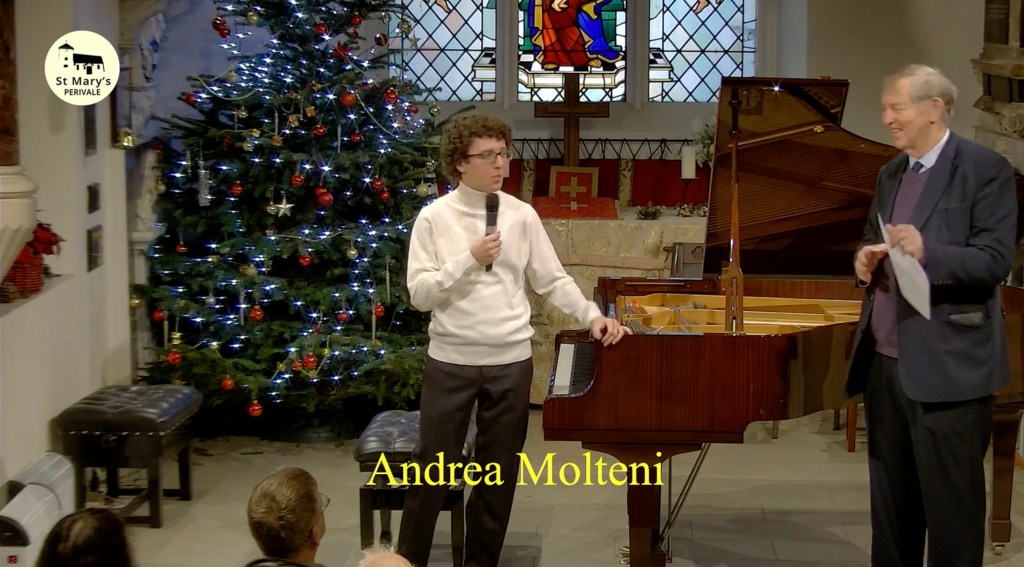
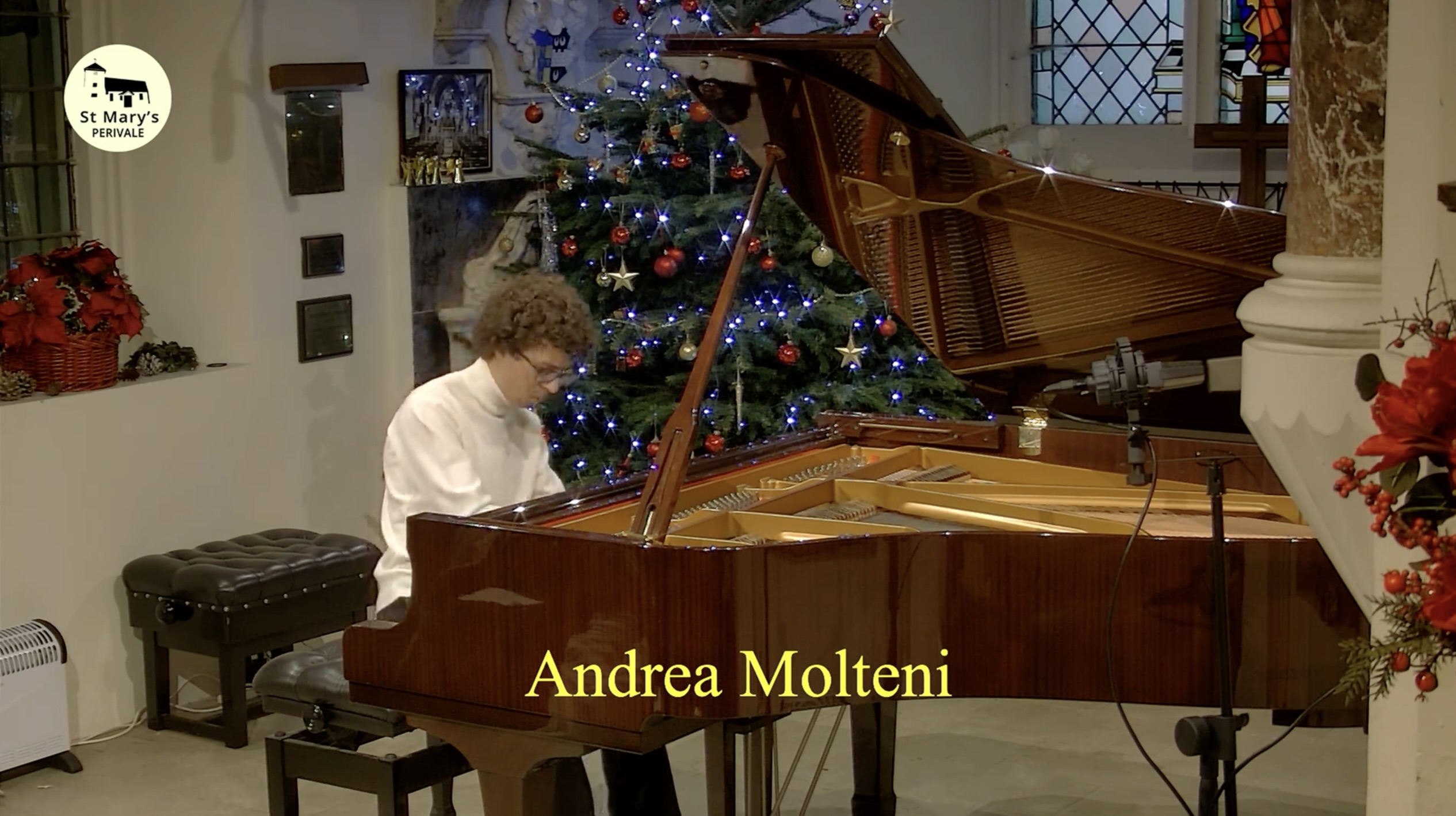
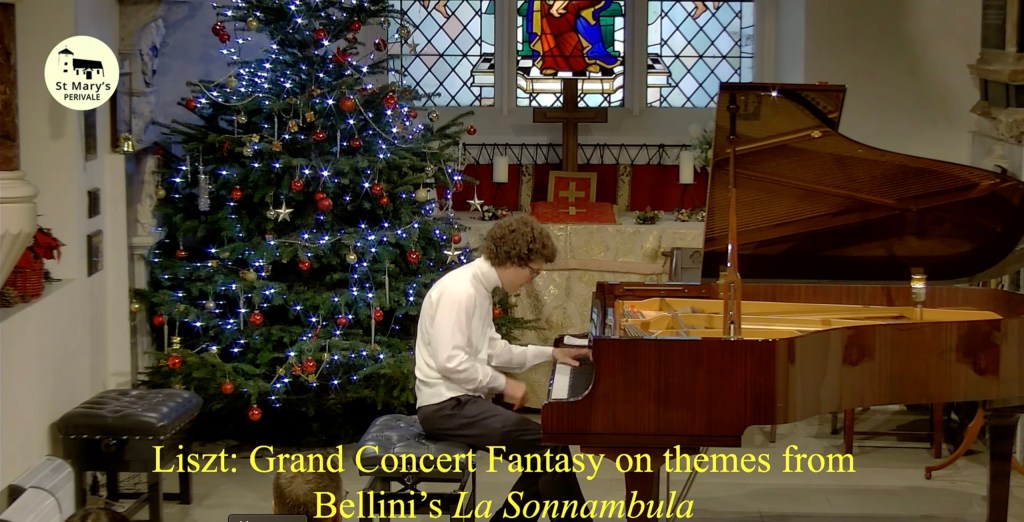
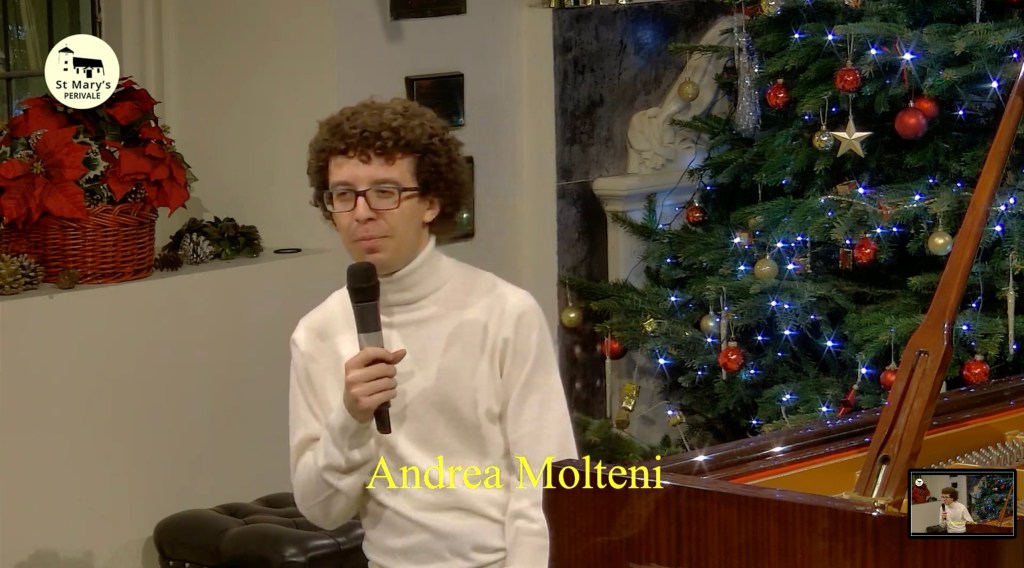
‘Andrea Molteni, one of the most gifted of the young international pianists of the moment gave a memorable concert at the Cremona Music Festival. The “clou” of the concert was his profound and supremely accomplished rendition of the Hammerklavier Sonata op. 106 of Beethoven. Few pianists can play this score with such accuracy and fidelity to the score. This was a heroic accomplishment of which the audience, transfixed by the performance in front of them, enthusiastically applauded.’
The Italian Concerto of Bach, impeccably played, as well as the Sonatina Canonica of Dellapiccola completed the program.
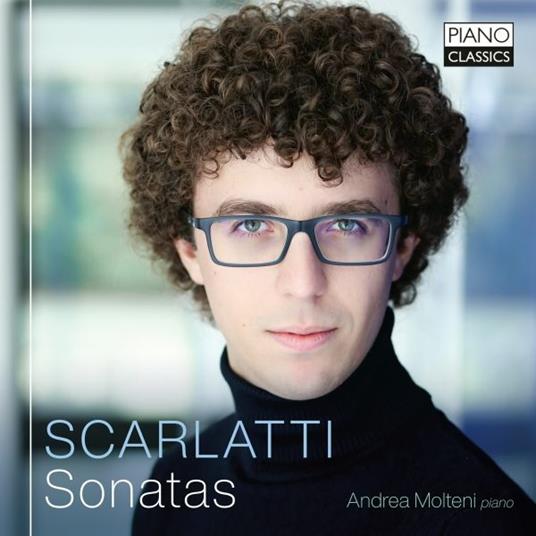
A promising young Italian piano talent, 26-year-old Andrea Molteni is building his international profile with performances in the United States, Italy, France, Germany, Austria, Switzerland, Eastern Europe, and Asia. Three albums, recently released on Brilliant Classics and broadcast on France Musique, Germany’s MDR Kultur, and Radio Classica in Italy, have received international acclaim: the complete piano works of Petrassi and Dallapiccola, a selection of Scarlatti’s sonatas, and *Beethoven: Con alcune licenze*, featuring *Hammerklavier, Op. 110* and *The Grosse Fuge*, never before recorded in a solo piano version.
Andrea Molteni benefits from the artistic guidance of William Grant Naboré and Stanislav Ioudenitch. He has also participated in masterclasses with Andras Schiff, Elisabeth Leonskaja, Pavel Gililov, Dang Thai Son, and Vladimir Feltsman. Mr. Molteni began his career at the age of 15 when he participated in the Bayreuth Festival celebrating Wagner’s 200th anniversary, performing in France and Monte Carlo. Since then, he has played at the Mozarteum University in Salzburg, the Scriabin Museum in Moscow, the Esplanade in Singapore, the Forbidden City Concert Hall in Beijing, the Sydney Conservatorium of Music, the National Opera Center and DiMenna Center in New York, the Chopin Music University in Warsaw, the Cincinnati Conservatory of Music, among other venues. The pianist regularly performs with orchestras such as the Antonio Vivaldi Orchestra, the Mihail Jora Philharmonic Orchestra of Bacau in Romania, and the University of Costa Rica Orchestra. In the upcoming season, he will give 25 concerts across three continents, including tours in China and Australia, as well as recitals in Milan, Bergamo, Cremona, and other Italian cities.
28SEPCategoryMusic Culture,PianosCONCERT BY ANGELA NISI, SOPRANO, ENRICA RUGGIERO, PIANO. MUSIC BY ENNIO PORRINOMonteverdi
Ennio Porrino (1910-1959):
The Songs of Exile (1945) Collection of 15 lyrics for soprano and piano
Three Greek lyrics
Three troubadour lyrics
Three Italian operas: first series from 200 to 400
Three Italian operas: second series from 500 to 700
Three songs of exile (on texts by Ennio Porrino himself)
Angela Nisi, soprano Enrica Ruggiero, piano
Aleksandar Laskowski and Stefania Porrino with the artists
After graduating at Accademia Nazionale di Santa Cecilia in Rome and studying with Manuela Custer e Cristina Melis, Angela Nisi she made her debut in 2010 singing Micaela (Carmen) and, after winning the Ziino Competition (2012), she has appeared in international concert halls and opera stages, such as Accademia Nazionale di Santa Cecilia in Rome, Massimo in Palermo, Carlo Felice in Genoa, San Carlo in Naples, Maggio Musicale Fiorentino, Budapest State Opera, Aalto-Theater Essen, Open Köln, working with conductors such as Pappano, Oren, Gelmetti, Renzetti, Palumbo, Callegari, Lanzillotta, and directors such as Brockhaus, Livermore, Micheli, Muscato, Pizzi, Poda.
Her large operatic, symphonic and chamber repertoire includes operas by Puccini (La bohème, Turandot, La rondine, Suor Angelica), Verdi (Otello, Requiem, Falstaff, La traviata, Simon Boccanegra, Un giorno di regno), Rossini (Petite Messe Solennelle and Stabat Mater), Leoncavallo (Pagliacci), Strauss (Vier Letzte Lieder), Mozart, Britten, Stravinsky, Respighi, Poulenc, Schumann, Tutino, and many others, performing in several recordings for Naxos, Tactus and Dynamic.
Enrica Ruggiero studied under the guide of Michele Campanella, with whom she got the Diploma at the Accademia Chigiana of Siena and at the Ravello Piano High School.
She also earned a Chamber Music Master at the Accademia Nazionale of Santa Cecilia with F. Ayo , following after the musicians of the Trio di Trieste.
She is a multi-award-winning musician in Chamber music throughout Italy and Europe. She has extensive experience as an accompanist pianist. She has worked as the coach with the Teatro dell’ Opera in Rome since 2004 and has been a guest as Korrepetitorin at the Vienna State Opera in the 2011/2012 season. She has worked with directors such as Richard Muti, James Conlon, Alain Lombard, Gianluigi Gelmetti, Jesus Lopez-Cobos, Roberto Abbado, Yves Abel, Marco Arminiato, Donato Renzetti, Bruno Campanella, Daniele Gatti and many more.
Angela Nisi and Enrica Ruggiero will soon release their first duo recording project for Brilliant Classics, dedicated entirely to the unreleased vocal chamber music of Ennio Porrino.
28SEPCategoryPianosYOUNG SUN CHOI, PIANO RECITALZelioli Lanzini Room15:00 – 16
J. Haydn: Piano Sonata in C Major, Hob. XVI:48
G. Fauré: Impromptu in F minor, Op. 31 No. 2
E. Granados: Goyesca No. 4 ‘Quejas o la Maja y el Ruiseñor’
R. Schumann: Piano Sonata No. 1 in F# minor, Op. 11
Young Sun Choi, piano
A South Korean pianist, Young Sun Choi won first prize and the audience prize along with two other special prizes at the 26th Rina Sala Gallo International Piano Competition in Monza. She has earned top honors in such prestigious competitions as the Gurwitz International Piano Competition (first San Antonio International Piano Competition), the Bösendorfer USASU International Piano Competition, the American International Paderewski Piano Competition, and the Lyon International Piano Competition. Choi has performed concerts with orchestras around the world, including the Mexico City Philharmonic Orchestra, Milan Symphony Orchestra, KBS Symphony Orchestra, Prime Philharmonic Orchestra, “O. Stillo” Orchestra, Kazan Chamber Orchestra “La Primavera” and Indiana University Symphony Orchestra.
She has played under the baton of great conductors including Kolja Blacher, Thomas Wilkins, Scott Yoo and nSung Chang. In 2023, she was invited to the Paderewski Festival in North Carolina with Martin Garcia Garcia, Hyuk Lee, Mateusz Krzyzowski, and Maria Stratigou. She was invited by Fazioli Pianos to perform the Winners Series Concert. A passionate chamber musician, she has her own piano trio, Trio Unio, which includes violinist Eunji Kim and cellist Ah-Yeon Nam. Trio Unio won second prize at the International Franz Schubert Chamber Music and Modern Music Competition in Graz, Austria. They were recently invited to perform by Samsung Electronics in their concert hall. Choi’s solo performances have been broadcast on Texas Public Radio and Arte TV. Choi had the honor of being the dedicatee of “Three Preludes for Piano” by Grammy Award-winning composer Michael Fine. The score is available on the Donemus Publishing website. She graduated from Yewon School, Seoul Arts High School, under the guidance of Jung Won Moon. She received her bachelor’s degree in piano and musicology from Seoul National University under Aviram Reichert. She later earned a master’s degree in piano performance from the Jacobs School of Music at Indiana University, where she is currently continuing her education as a doctoral student, under the guidance of Arnaldo Cohen. In addition, Choi has worked as an associate professor in the piano department at the Jacobs School of Music.
VERA CECINO is 20 years old and has been studying piano since the age of 6 with Maddalena De Facci, under whose guidance she graduated with honors from the “Maderna” Conservatory in Cesena in 2021. She obtained her specialized diploma under the guidance of Maestro Andrzej Jasinski at the Accademia del Ridotto in Stradella, where she is currently enrolled in the Master’s program with Maestro Natalia Trull. She is also attending the second-level Biennium at the Padua Conservatory under the guidance of Maestro Alessandro Taverna. Since 2018, she has regularly performed solo recitals in Spain, Switzerland, Poland, and Italy, in venues such as the Cantelli Festival in Novara, the Bellagio and Lake Como Festival, the “Katharsis” Concert Season in Trento, the Literary Society of Verona, the Musical Festival of Nations in Rome, the Monferrato Classic Festival, the Birthplace of Fryderyk Chopin in Żelazowa Wola, the Triennale di Milano, Palazzo dei Rettori in Belluno, Casa Mahler in Sobrio, Sala Eutherpe in León, Palazzo Cavagnis in Venice, Palazzo dei Capitani in Malcesine, the Episcopal Seminary of Pistoia, and the Casa della Musica in Arezzo.
At the age of 13, she made her solo debut with an orchestra, and since then, she has collaborated with the Orchestra Concentus Musicus Patavinus, the Ferruccio Busoni Orchestra of Empoli, the “I Concerti nel Tempio” Orchestra, and the Orchestra of the International Piano Competition “Rome.”She has won numerous awards in piano competitions, including the Second Prize at the Chopin section of the Roma International Piano Competition in 2023, the entire 2019 edition of the Premio Crescendo in Florence, the Cosima Wagner Competition in Bellagio in 2024, the International “Giuseppe Martucci” Prize in Novara in 2022, and the First Prize at international competitions such as “Val Tidone” in Piacenza, “Ars Nova” in Trieste, and “Colafemmina” in Acquaviva delle Fonti. Vera also won the First Prize at the “Caesar Franck” competition in Brussels and the Second Prize at the “Isidor Bajic Piano Memorial” in Novi Sad.Alongside her solo career, she has always pursued chamber music studies.
She is currently attending the Advanced Course with the Trio di Parma at the Accademia Perosi in Biella, performing in duo and trio with strings, and regularly appearing in concert. Previously, with a notable and stable four-hands duo, she won the First Absolute Prize in major Italian piano competitions such as “Riviera Etrusca” in Piombino, “Città di Albenga,” “Giulio Rospigliosi” in Lamporecchio, and “J.S. Bach” in Sestri Levante.
28SEPCategoryPianosPIANOLINK INTERNATIONAL AMATEURS COMPETITIONPonchielli Theatre10:00 – 18:00.
🎼 La giuria, composta da rinomati pianisti ed esponenti del panorama musicale internazionale, ha visto coinvolti Jean-Marc Luisada come presidente, Cyprien Katsaris, Bruno Canino, Svetlana Smolina, Andreas Kern, Constantine Carambelas-Sgourdas.
Roberto Prosseda with some of the jury members
Ieri si è svolta, presso il teatro Ponchielli di Cremona, la quinta edizione del PianoLink International Amateurs Competition per pianisti amatori, dedicato a tutti gli amanti e appassionati del pianoforte.🏆Alla premiazione sono intervenuti Massimo de Bellis (Direttore Generale Cremona Fiere), Giovanni Iannantuoni, Enrico Bonfante (Yamaha Music Europe e Bösendorfer) e i direttori artistici Andrea Vizzini e Roberto Prosseda.❤️ I 5 vincitori del concorso si sono aggiudicati, fra i numerosi premi, un Recital a Milano all’interno del MiAmOr Music Festival 2025.
Vi sveliamo i loro nomi: Charl de Wet (Sud Africa), Tomoko Inoue (Giappone), Sara Tomasoni (Italia), Leonard Donadio (USA), Marco Cima (Italia). Al candidato Charl de Wet (Sud Africa) è stato attribuito il primo premio assoluto!
Cremona Musica Awards Ceremony
Cremona Musica Award, “Performance – Winds” Category: Sir James Galway
Tribute to James Galway: P. Taffanel: Fantasia on Francesca da Rimini E. Morricone: For the Ancient Scales Anonymous: Danny Boy
Andrea Oliva, flute Andrea Dindo, piano
Cremona Musica Award, Category “Composition”: Giorgio Battistelli
Paolo Fazioli with Roberto Prosseda and Valentina Lo Sordo
Cremona Musica Award, Category “A Life for the Piano”: Paolo Fazioli
Cremona Musica Award, Categoria “Comunicazione”: Documentario “Ennio”, di Giuseppe Tornatore. Marco Morricone accepts the award .
Cremona Musica Award, Cateogry “Project”: Stauffer Academy(featuring Salvatore Accardo, Bruno Giuranna, Franco Petracchi, Alberto Bocini, Cristiano Gualco)
Concert by students and alumni of the Stauffer Academy:
J.S. Bach: from the Sonata for Solo Violin no. 2 in A minor, BWV 1003 III. Andante IV. Allegro
N. Paganini: Caprices no. 20 – 24
Simon Zhu, violin
J. Haydn, String Quartet Op. 76 no. 2 in D minor “The Fifths” I. Allegro
E. Schulhoff, Five Pieces for String Quartet I. To the Viennese Valse (allegro) II. Alla Serenata (allegretto con moto) III. Alla Czeca (molto allegro) IV. Alla Tango milonga (andante) V. Alla Tarantella (prestissimo con fuoco)
Perché parlare di Richard Wagner oggi? Questo libro offre uno sguardo avvincente sulla complessa personalità e sul coraggioso spirito del compositore tedesco, sottolineandone l’attualità sotto molteplici aspetti. Seguendo le vicende di Wagner, si dipana un racconto coinvolgente, degno di una serie tv, che ci parla di sfide, resistenza e resilienza, una storia fatta di eccessi, trionfi e flop, amori etero e tratti queer, accordi e disaccordi, incredibili colpi di scena, azioni di grande generosità insieme ad altre di straordinaria meschinità. È l’intensità emotiva delle sue esperienze a creare il filo conduttore della narrazione. Con questo libro, Vicari ci invita a riscoprire Wagner e ad apprezzarne l’umanità, assai lontana dall’immagine stereotipata del personaggio, ma anche la sua importanza nella cultura contemporanea, senza trascurare gli aspetti più scabrosi, come la ben nota passione che Hitler coltivava per lui. Il tutto, rivolgendosi agli appassionati di musica, teatro e storia, come a chiunque sia curioso di esplorare questa vita pazzesca, collocata in un’epoca dove i confini dell’arte e della cultura si stavano definendo per come li conosciamo oggi.
Valerio Vicari is the artistic director of Roma Tre Orchestra who via Roma 3 University has done more to help young musicians than anyone I can think of . Creating an orchestra that gives experience to young graduate musicians to obtain experience of playing in ensemble .But he also has created a series of concerts for Young Pianists that gives a platform to so many remarkable young musicians . His personal passion is Wagner of course :
Valerio Vicari è Direttore Artistico dell’Associazione Roma Tre Orchestra fin dalla sua costituzione nel gennaio 2005, di cui è stato uno dei soci fondatori. È laureato in Scienze dell’Amministrazione e in Lettere presso l’Università degli Studi Roma Tre. Ha studiato composizione sperimentale e pianoforte presso il Conservatorio di Musica “Santa Cecilia” di Roma, con Gian Paolo Chiti e Matteo D’Amico. Partecipa attivamente all’attività politica e culturale delle più importanti associazioni di categoria quali Aiam, Cidim, Agis Lazio. Ha compilato alcune voci di letteratura medievale all’interno della Encyclopedia of Italian Literary Studies pubblicata nel 2006 dalla casa editrice statunitense Routledge.
Johannes Brahms (Hamburg, 1833 – Vienna, 1897)
Variations on a Theme by Schumann, Op. 9
Robert Schumann (Zwickau, 1810 – Endenich 1856)
Variations of the Spirits, WoO 24
Symphonic studies, op. 13 and posthumous
Andante Theme Variation I – A Little More Alive Variation II – Marked singing, expressive Studio III – Lively Variation III Variation IV – Scherzando Variation V – Agitated Variation VI – Allegro molto Posthumous variation I Posthumous Variation III Posthumous variation IV Posthumous variation II Posthumous variation V Variation VII Study IX – Soon to be possible Variation VIII – Always with energy Variation IX – With expression Finale – Allegro brillante
Elia Cecino is a recent first-prize winner at the Iturbi International Piano Competition 2023 in Valencia, where the jury chaired by Joaquín Achúcarro also awarded him special prizes for best interpretation of a Beethoven concerto and best interpretation of Chopin’s music. Elia won first prize at the New Orleans, “James Mottram” competitions in Manchester and Ricard Viñes in Lleida. In 2020 Suonare Records released his debut CD dedicated to music by Beethoven, Chopin and Skrjabin, and a second monographic album on Chopin was released by OnClassical in 2021. He has appeared as soloist with orchestras such as Royal Liverpool Philharmonic, Orchestra del Teatro La Fenice, Israel Philharmonic, Israel Camerata Jerusalem, Louisiana Philharmonic, Simfònica del Vallès, Sinfónica de Galicia, Orquesta de València, Düsseldorf Symphony Orchestra, Sichuan Philharmonic, Bacau Philharmonic, Sinfonica di Milano, FVG Orchestra, Sinfonica Città di Roma.
Elia has been performing continuously since 2014 at many European halls such as Palau de la Música Catalana in Barcelona, Laeiszhalle in Hamburg, Gran Teatro La Fenice and Teatro Malibran in Venice, Teatro Verdi in Trieste, Fazioli Concert Hall in Sacile, Teatro Olimpico in Vicenza, Auditori Enric Granados in Lleida, Gesellschaft für Musiktheater in Vienna, Norden Farm Centre for the Arts in Maidenhead, Palatul Culturii in Iași. In 2016 he took part in a concert tour in the United States. In addition to the study of solo repertoire, Elia combines an intense chamber activity in duo, trio and quintet with strings. In December 2020 he collaborated with cellist Mario Brunello on the occasion of the 250th anniversary of Beethoven’s birth.
Born in 2001 in Treviso, Elia began studying piano at the age of 9 with Maddalena De Facci, graduating at 17 as a private student with honors at the conservatory of Cesena. The following year he won the XXXVI Premio Venezia for the best graduates of Italian conservatories. In 2021 he obtained the Master Diploma of the Accademia del Ridotto in Stradella studying with Andrzej Jasinski. He is currently specializing with Elisso Virsaladze and Boris Berman. Since 2019, Elia has been an artist-in-residence of the “Luigi Bon” Foundation.
29SEPCategoryPianosSVETLANA SMOLINA, PIANO RECITALSala Stradivari15:00 – 16:00
F. Chopin Nocturne Op. 9 No. 2 in E-flat major F. Chopin Scherzo No. 2 Op. 36 in B-flat minor P.I.Tchaikovsky – M. Pletnev: from the concert suite “The Nutcracker” Intermezzo, March, Dance of the Fairy Dragee, Andante – Maestoso S. Rachmaninoff: Prelude Op.32 No. 5 in G minor E. Lecuona “Malaguena” from the Andalucia Suite M. Moszkowski Caprice Espagnol Op. 37 M. Balakirev: Islamey, Oriental Fantasy
Svetlana Smolina has performed with orchestras and given recitals worldwide – with the New York Philharmonic at Avery Fisher, Mariinsky Orchestra at Carnegie Hall, St. Petersburg Philharmonic, Orchestre National de France, Salzburg Festival at Mozarteum, Hollywood Bowl in Los Angeles, Ravinia Rising Stars in Chicago, White Nights in Saint Petersburg, Maggio Musicale Fiorentino, Mikkeli Festival Finland, Ruhr Klavier in Germany, Moscow Easter Festival, Rotterdam Philharmonic, at the Stresa Festival, Hanoi Opera House, London ́s Royal Opera Covent Garden, Tchaikovsky Conservatoire Moscow and Rome ́s Accademia Santa Cecilia. Her recordings include a solo album “Romantic Journey” on Universal Music Label, Chopin album for iTunes, Scriabin on Pentatone, with Christopher O’Riley at a live concert in Montana, the Britten concerto from a live concert at Disney Hall in Los Angeles, and broadcasts for NPR, WQXR, BBC, PBS, RAI, Kultura TV and other networks. Her recording with Valery Gergiev of Stravinsky ́s Les Noces received an ICMA award. Svetlana’s recent performances include a tour to China with Dublin Philharmonic with Derek Gleeson, concerts with Orquesta Sinfonica Nacional Juvenil in Lima, Peru, at Carnegie Hall in NYC, with violinist Lee-Chin Siow in Singapore, at the Basel Casino with Charlie Siem, CCK Symphony Hall/Buenos Aires in the “Best Pianists of the 21st Century series,” at the Classical Tahoe Festival with Maestro Joel Revzen/, at the festival in Ushuaia/ Argentina, and at Cremona International Summer Festival. Svetlana collaborated in chamber concerts with Ida Haendel, Vadim Repin, Narek Hakhnazaryan, Kian Soltani, Geyhee Kim, Alexander Knyazev, Enrico Dindo, Lee-Chin Siow, Pavel Sporcl, Charlie Siem Roberto Cani, Oleg Sendetsky, Kim Fisher, Julian Milkis, Dr. Subramaniam and many others. Svetlana and Vadim Repin have given duo recitals in Bogota at Teatro Colon for the Cartagena Festival, at Teatro Lirico di Cagliari, in Bangalore and Mumbai for XXV Lakshminarayana Global Music Festival, at Koerner Hall in Toronto and at Salle Garnier de Monte Carlo for Prince Albert ́s Monaco Foundation, as well as for Trans-Siberian Art Festival in Novosibirsk, Washington DC, London and New York. 2023 invitations include New Year Eve Gala with Shanghai Philharmonic and with Harbin Symphony & Maestro Muhai in China, recital at Recital at Taihu Art Festival/ 22 nd China Shanghai Int Arts Festival at Wuxi Grand Theater; duo concerts with Vadim Repin at NCPA Beijing, Shanghai Concert Hall, Shenzhen Concert Hall Belt & Road International Music Festival, debut at Dellarte Concert Series in Sao Paolo and Rio de Janiero, Brazil; concert in Osaka, Japan with Kazuhiro Takagi, recital in Megaron Concert Hall Thessaloniki with Jannis Georgiadis, at Megaron Chamber Hall in Athens for the Piano Plus Festival, at Burgos International Music Festival, Spain and at the Triumph Music Festival/ Kimmel Center Music Academy in Philadelphia. In June 2024 Svetlana began collaboration with Bluthner and gave recital at Desevedavy Pianos in Nantes, France, followed up by invitations to play in Leipzig, Nantes and at Le Mans. Svetlana Smolina is a Grand Prix winner of Italy ́s Citta Di Senigallia International Piano Competition, Murray Dranoff 2 piano and many other competitions. Since 2011 she has directed the piano program at the Philadelphia International Music Festival and on the piano faculty at Irvine Valley College and London Performing Academy of Music.
Shio Okui began her career at a very early age. Since the age of eight, she has played with many orchestras in various countries. At age 12, she performed with the Mariinsky Theater Symphony Orchestra under the direction of Valery Gergiev and signed with JapanArts. Since then she has performed with world-renowned conductors, including Mikhail Pletnev, Vladimir Fedoseyev, Vladimir Spivakov, Kazuki Yamada, Jiří Rožeň. In April 2021, at the age of 16, she was awarded “Classical Performer of the year from Partner State” at the III BraVo International Professional Music Award ceremony held at the Bolshoi Theater in Russia. Born in Tokyo in 2004, Shio studied at the Central School of Music of the Moscow State Tchaikovsky Conservatory (class of Prof. Elena Ashkenazy) and graduated from the Gnessin Special School (College) of Music in Moscow (class of Prof. Tatiana Zelikman) with highest honors. She is currently pursuing a bachelor’s degree at the Haute école de musique de Genève in the class of Prof. Nelson Goerner. Since the age of nine, Shio has been invited to international music festivals, including Mariinsky International Piano Festival, Mariinsky International Festival “FarEast,” Russian Seasons in Germany, Sergei Rachmaninoff “White Lilac” Festival, NHK Music Festival, and ArtDialog Festival. Shio has already premiered in renowned concert halls such as the Louis Vuitton Foundation in Paris, the Kurhaus in Wiesbaden, the Tonhalle in Düsseldorf, the Tonhalle in Zurich, the National Auditorium in Madrid, the Bozar in Brussels, the Mariinsky Theater, the Bolshoi Theater, the Great Hall of the Moscow Conservatory of Music, the Tokyo Metropolitan Theater, the Tokyo Opera City Concert Hall, and the Astana Opera. As a soloist, Shio has often played with various orchestras: the Russian National Orchestra, the Russian National Philharmonic Orchestra, the Russian State Orchestra named after E. Svetlanov, the NHK Symphony Orchestra, the Yomiuri Nippon Symphony Orchestra, the Tokyo Symphony Orchestra, the New Japan Philharmonic, and other orchestras from Armenia, Italy, Japan, Kazakhstan, Russia, and the United Kingdom, etc.Shio has been awarded prizes in various prestigious competitions, including the 12th Paredewski International Piano Competition (Poland, 2022, youngest finalist and honorable mention), the Vladimir Krainev International Piano Competition in Moscow (Russia, 2015, 1st prize), the Manchester International Piano Concerto Competition under-16 category (UK, 2013, 1st prize), the Vladimir Horowitz Memorial International Competition for Young Pianists (Ukraine, 2013, 1st prize), the International Television Competition for Young Musicians “Nutcracker” (Russia, 2013, 2nd prize “Silver Nutcracker” and audience prize).
29SETTCategorieMusic Culture,PianosPANEL DISCUSSION: CHARLES-VALENTIN ALKAN: ROOTS, INFLUENCES AND THE PERFORMANCE OF HIS MUSIC IN THE 21ST CENTURYMedia Lounge15:30 – 17:00
Panel Discussion: Charles-Valentin Alkan: Roots, Influences and the Performance of his music in the 21st century
A fascinating discussion about Alkan and a surprise speaker Marc-André Hamlin who is well known for including Alkan in his programmes
Charles-Valentin Alkan (1813-1888) was one of the most outstanding piano virtuosos of his age and a genial composer. His personality was strong and imaginative. During his time he was considered a great artist and was compared with such masters as Frédéric Chopin and Franz Liszt. Chopin was indeed one of his closest friends.
Alkan’s beloved piano professor and mentor at the Conservatoire de Paris was Pierre-Joseph-Guillaume Zimmerman (1785-1853). Zimmerman was the leading piano professor in Paris and a highly regarded composer.
Ambroise Thomas, Charles Gounod, Georges Bizet and César Franck were among his famous pupils. He organized legendary concerts inhis salon at Square d’Orleans inviting illustrious musicians to participate. Alkan considered Zimmerman a father figure, cherished him and remembered him throughout his life.
During the round table discussion, we will examine Alkan’s roots, his life, the composers who influenced his thought and, of course, his relation to Zimmerman. In addition, his place in the21st century international music scene will also be highlighted.
A recently discovered letter of Alkan
The round table is moderated by Constantine P. Carambelas-Sgourdas, President of the C.V. Alkan-P.J.G. Zimmerman International Music Association, President of the Gina Bachauer International Music Association, President of the Greek Critics Association for Music, Drama and Dance.
Speakers:
Emanuele Delucchi, pianist and composer Jed Distler, pianist, composer, music critic Yasushi Ueda, musicologist, Kyoto University
The legendary Canadian pianist Marc-André Hamelin will perform a recital for the first time in Cremona on September 29, 2024, at 6:00 PM at the Teatro Ponchielli, as part of Cremona Musica and in collaboration with Fazioli Pianoforti. Hamelin is one of today’s most acclaimed pianists, renowned for his impeccable virtuosity and the clarity and intelligence with which he interprets the classical and romantic repertoire. The completeness of his technical and expressive abilities, along with the depth of his interpretations, make each of his concerts an intense and memorable experience.
Inna Faliks,Jed Distler,Roberto Prosseda and Marc-André Hamelin
I have heard Marc- André Hamelin many times is concert and was sorry to miss this new programme. I had heard another programme in Warsaw recently and my review is above . Hamelin I heard the first time in London playing the Khachaturian Piano Concerto ! Of course a big success for a concerto that Moura Lympany had given the UK premier of many years ago . It had been been passed on to her from Clifford Curzon to whom it had been offered first !!!!!! Hamelin came out to play an encore of Chopin’s Minute Waltz that seemed like a strange choice after such an epic performance. But we got to a point in the waltz where double thirds ,sixths and all the tricks of the trade suddenly were adorning this simple little piece and it was an unforgettable experience of style and breathtaking virtuosity. Many other occasions followed after that to hear this giant of the keyboard.But it was last summer in Warsaw that I was not so much overwhelmed by his phenomenal digitation as I listened to Schumann’s Waldszenen and I will go down on my knees and thank God that I lived to hear such a beautiful performance.I look forward to hearing this programme in London or Rome hopefully later in the season.
Haydn, Joseph: Piano Sonata in D major Hob. XVI:37£ Beethoven, Ludwig van: Piano Sonata no. 3 in C major op.2 no.3
— Interval —
Medtner, Nikolai: Improvisation in B flat minor (in variation form) op.31 no.1 Festive Dance, op.38 no.3
Rachmaninov, Sergei: Etude-Tableau op.39 no.5 Sonata no.2 in B flat minor op.36 (1931)
PIANISTA SALENTINO CLASSE 1993, ALESSIO ZUCCARO SI DIPLOMA PRESSO IL CONSERVATORIO DI MUSICA “TITO SCHIPA” DI LECCE SOTTO LA GUIDA DI CORRADO DE BERNART, CONSEGUENDO SIA IL TRIENNIO CHE IL BIENNIO COL MASSIMO DEI VOTI, LA LODE E LA MENZIONE D’ONORE. HA ESORDITO COME SOLISTA CON ORCHESTRA NELL’ESECUZIONE DELLA “BALLATA” DI GABRIEL FAURÈ DIRETTO DA FRANCESCO LIBETTA. HA CONSEGUITO IL MASTER OF ARTS IN MUSIC PEDAGOGY PRESSO IL CONSERVATORIO DELLA SVIZZERA ITALIANA SOTTO LA GUIDA DI NORA DOALLO PER IL PIANOFORTE E DI ANDREA CONENNA PER LA DIDATTICA, DOVE HA OTTENUTO LA LODE. SI È DIPLOMATO IN IMPROVVISAZIONE PIANISTICA CON GALINA VRACHEVA. È SOCIO FONDATORE ED EX PRESIDENTE DELL’ASSOCIAZIONE “SERAPHICUS” DI NARDÒ, CON LA QUALE PROMUOVE EVENTI CULTURALI NEL SALENTO. È FONDATORE DELL’INNOVATIVO GRUPPO DI IMPROVVISAZIONE ARTISTICO-MUSICALE IMPROS. HA INCISO MUSICHE DI LIBETTA E CASTÉRÈDE PER L’ETICHETTA NIREO. IMPEGNATO NELL’ATTIVITÀ DEL GIORNALISMO MUSICALE, COLLABORA CON LE TESTATE AMADEUS, SUONARE NEWS, TG MUSIC E LE SALON MUSICAL.
This chronicle was only made possible with the indispensable help of Alessio Zuccaro who kept me informed minute by minute so I could ‘virtually’ be in Cremona again this year
https://christopheraxworthymusiccommentary.com/2024/03/20/christopher-axworthy-dip-ram-aram/ I enclose this to show the programmes etc of the Teatro Ghione the theatre and cultural centre we created in the centre of Rome . The photo was taken last Saturday after an injection or two of Tattinger after a week in hospital.If only I had been prescribed such a cure earlier I might have made it to Cremona John Leech with Lady Weidenfeld as the celebrations for Johns 100th in April get under way John Leech founder of the Keyboard Trust in his 100th year
Dr Hugh Mather and his team have organized over 1460 concerts at St Mary’s Perivale since September 2004, with performances by 500 pianists and 210 violinists etc, and now hold 120 concerts per year. They have installed superb video facilities, and now broadcast virtually all concerts, receiving over 100,000 views per year from over 70 countries on YouTube. This has been a collaborative effort, with major contributions from Roger Nellist, and our technical team led by Simon Shute, with George Auckland and Andrew Whadcoat, as well as many other people. This lecture will present the story of the past 20 years.
Hugh Mather started the piano and organ at an early age, gaining the FRCO and the ARCM piano performers diplomas. He then studied medicine at Cambridge University and Westminster Medical School and was Consultant Physician at Ealing Hospital from 1982 to 2006. He continued his piano studies with James Gibb, and gave countless concerts in West London as concerto soloist, recitalist, accompanist and chamber musician. He has been Chairman of the Friends of St Mary’s Perivale since 2005, and has organized almost 1500 concerts there. He is also organist at St Barnabas Church in Ealing.
Playing of beauty and poetry from the very first notes of the sublime Prelude in B minor by Bach.Immediately apparent was his delicacy and beautiful colours with playing of timeless beauty of reverent solemnity.This poetic sensitivity was the mark of all that Connor did from sublime Bach to diabolical Liszt.
Beethoven’s ‘Waldstein’ Sonata is based very much on scales and arpeggios ,to quote Delius. Here it was given a more subdued poetic reading than usual from the very first notes that were played like mere vibrations before opening out to the beauty and intricacy of the mature Beethoven.Sometimes missing the clockwork rhythmic precision where Connor preferred to turn corners with more romantic style than Beethoven’s sometimes abrupt irascible change of gear. There was a poignant beauty to the Adagio introduction to the final Rondo.Bathed in pedal it was more conceived in pianistic terms than the orchestral that was obviously Beethoven’s inspiration.It was in the last movement ,though, that Beethoven does indeed ask for long pedal notes as the bell like first note rang out so beautifully in Connor’s hands before the undulating wave of accompaniment became alive and the melodic line was allowed to float on magical sounds as it was to do later in the coda suspended in air on a cloud of trills. The dynamic drive to the alternating episodes were beautifully contrasted of technical mastery and excitement with the wonderland surrounds that Beethoven had tried to express in sound.The famous glissandi in the coda were accommodated a little too romantically though to allow the savage drive of the coda to continue unabated to the final heroic bars.
It was in Schubert’s G flat Impromptu that Connor returned to the world of his opening Bach where his playing was of ravishing beauty and refined poetry.There was a beautiful dialogue between the hands and a sense of balance that allowed the musical line to sing with such a sublime voice.
Liszt’s Dante Sonata opened with drama and mystery.Sumptuous rich sounds contrasted with sublime whispered secrets of poetic beauty. Fearless octaves were thrown off with dynamic drive and brilliance but always within the context of a great drama that was unfolding before our eyes.An ending of exhilarance and technical mastery with the final notoriously treacherous leaps played with musical understanding and the poetic shaping of a drama that was unfolded with musicianly architectural understanding and poetic beauty.
Connor Heraghty is a distinguished British concert pianist and has performed as a soloist and chamber musician at some of the most prestigious venues in the UK and Europe. Notable UK venues include Wigmore Hall, Milton Court Barbican, St Martin-in-the-Fields, St James’s Piccadilly, and Buckingham Palace, where he performed in the presence of King Charles. Internationally, he has performed for audiences at The Fazioli Concert Hall in Venice, The Lithuanian Music Theatre & Academy Hall, and Radziejowice Palace in Poland.
Connor was awarded a scholarship to study piano performance with Valéria Szervánszky at the Purcell School of Music. He continued his studies at the Guildhall School of Music & Drama under the guidance of Senior Professor of Piano, Joan Havill, where he completed his B.Mus (Hons), Master of Music, and Master of Performance postgraduate degrees, followed by the prestigious Artist Diploma. He currently studies with Norma Fisher.
Connor was appointed Junior Artist Fellow at Guildhall and has been supported by scholarships from The Guildhall Trust, Leverhulme Arts Trust, Countess of Munster, and the Alec Beecheno Bursary Award. Connor’s career has been shaped by mentorship from renowned musicians such as Nelson Delle-Vigne Fabbri, Sir Stephen Hough, Peter Frankl, and Michel Béroff.
His solo career is complemented by his role as co-founder of the prize-winning London Piano Duo with pianist Daisy Ou. Connor is represented by Piha Entertainment and is supported by Talent Unlimited Musicians.