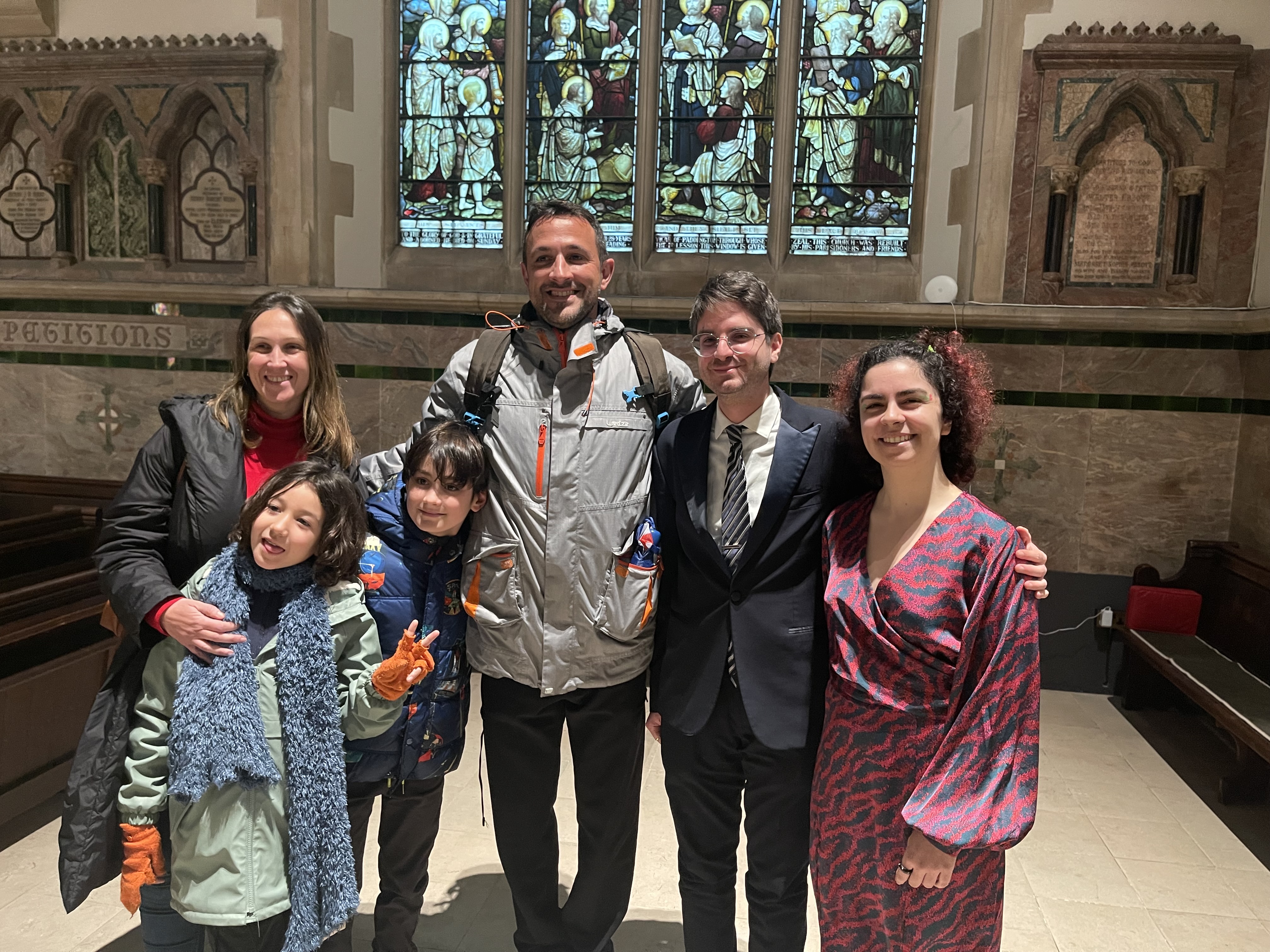
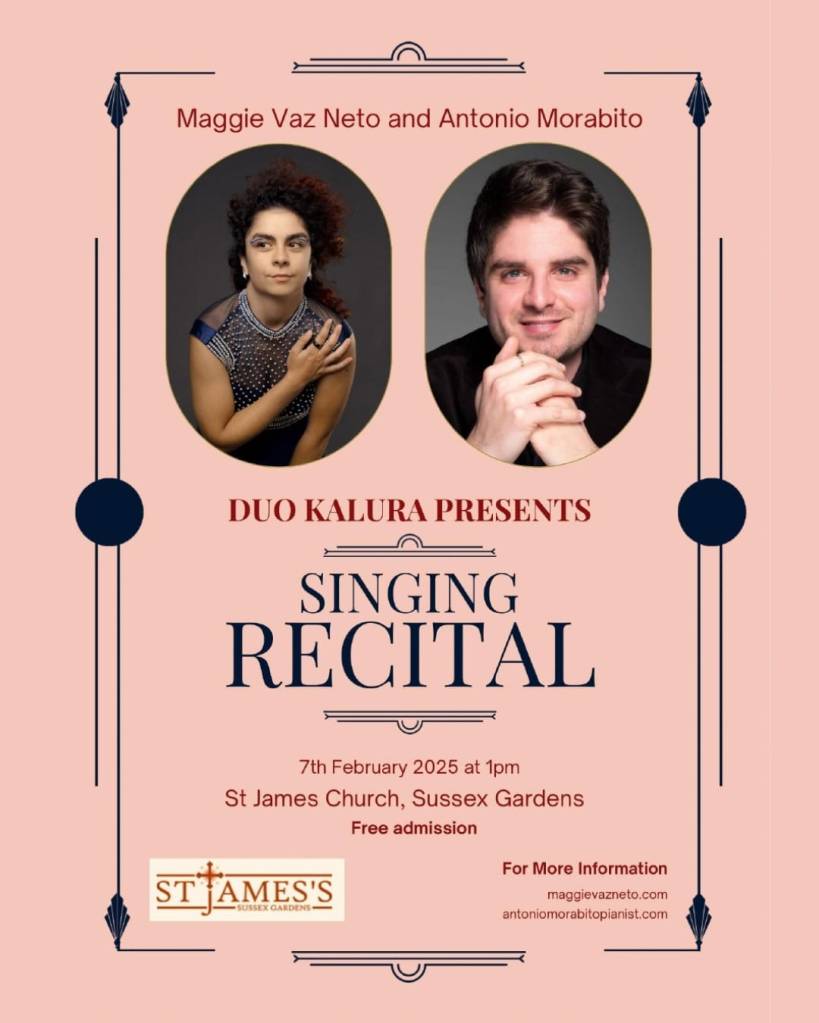
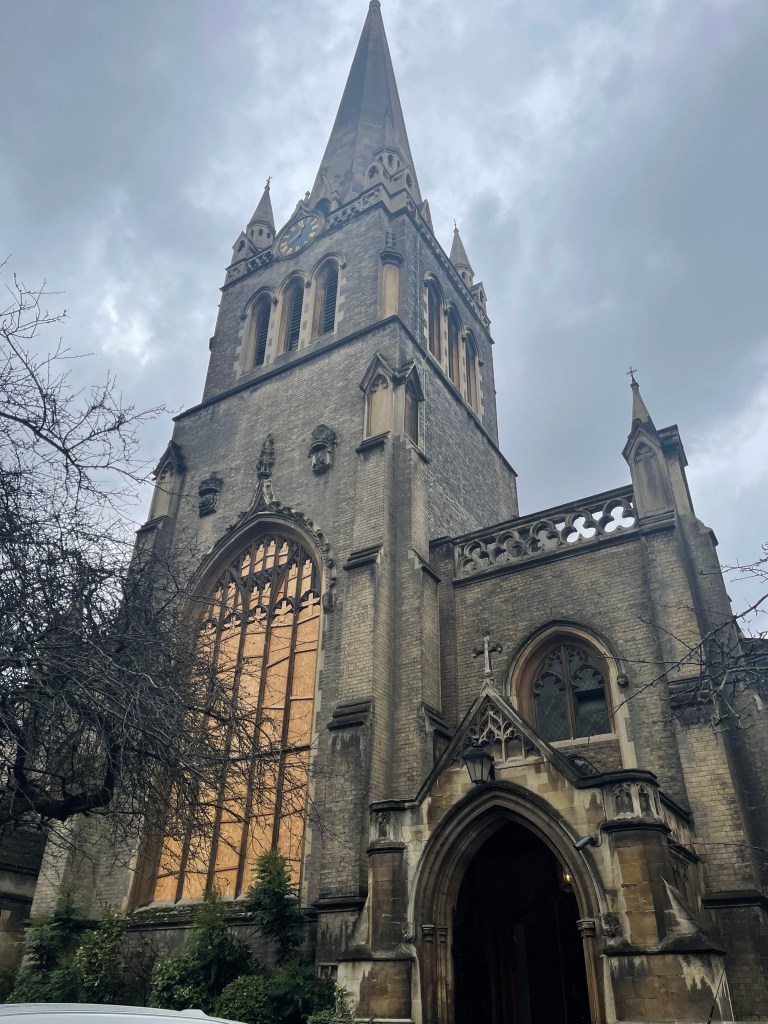
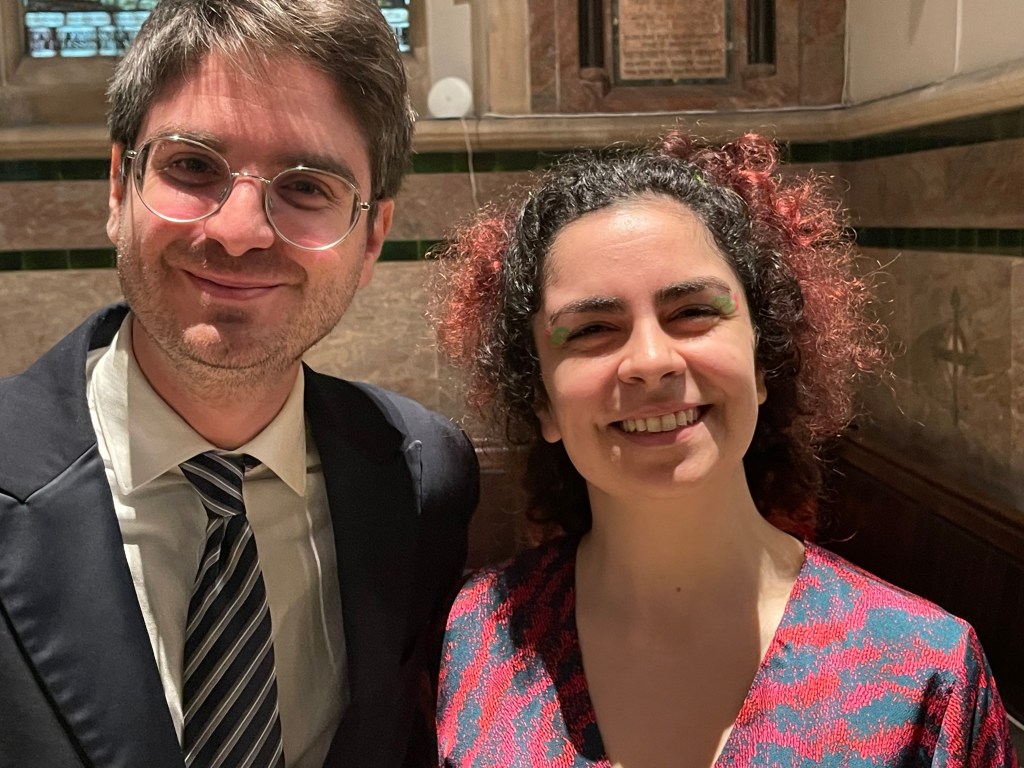
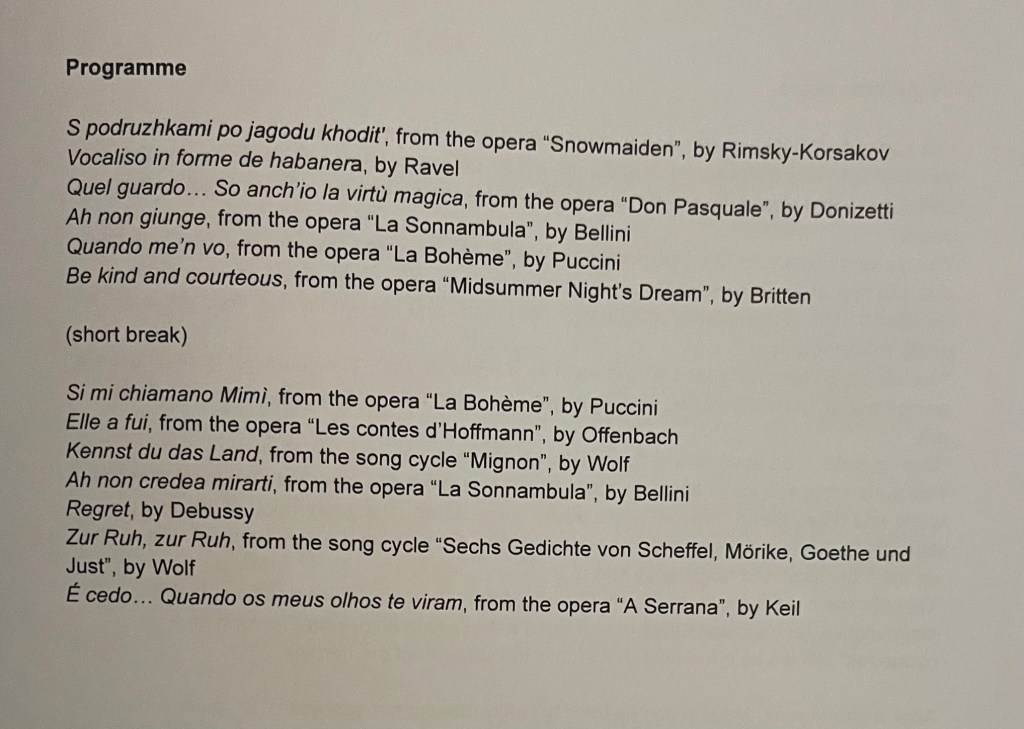
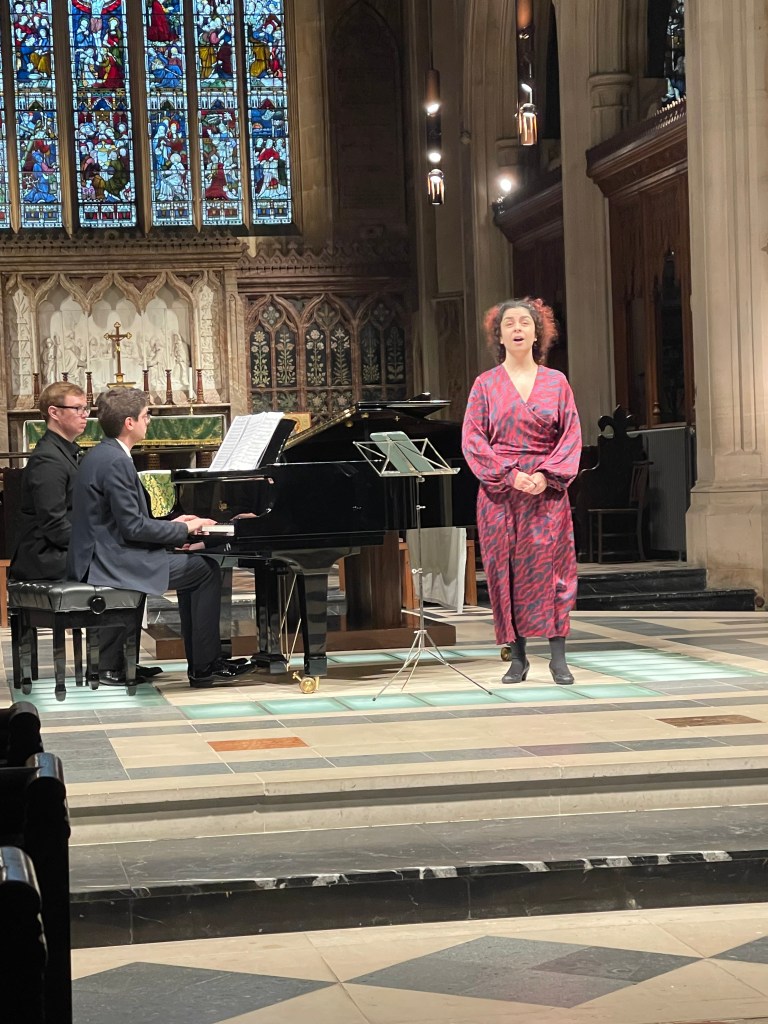
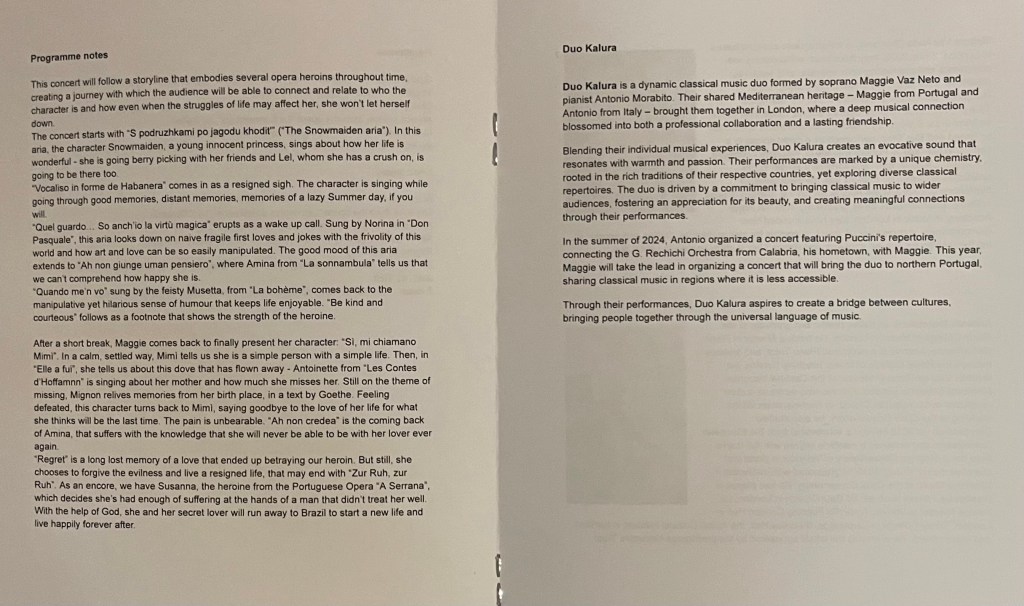
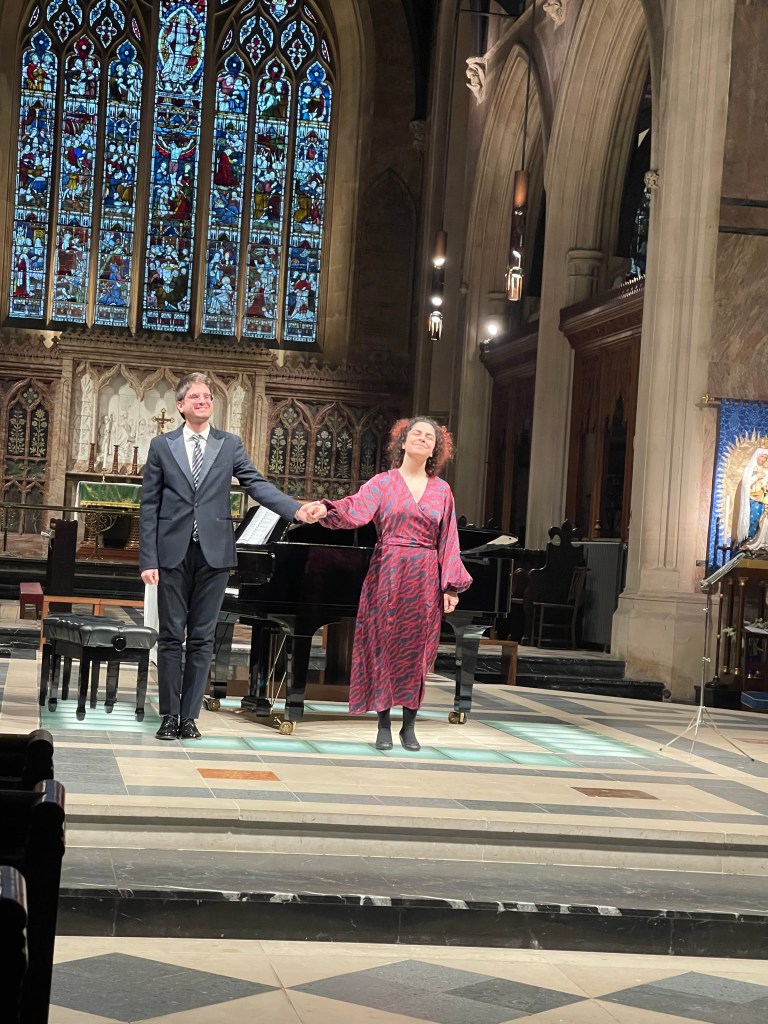
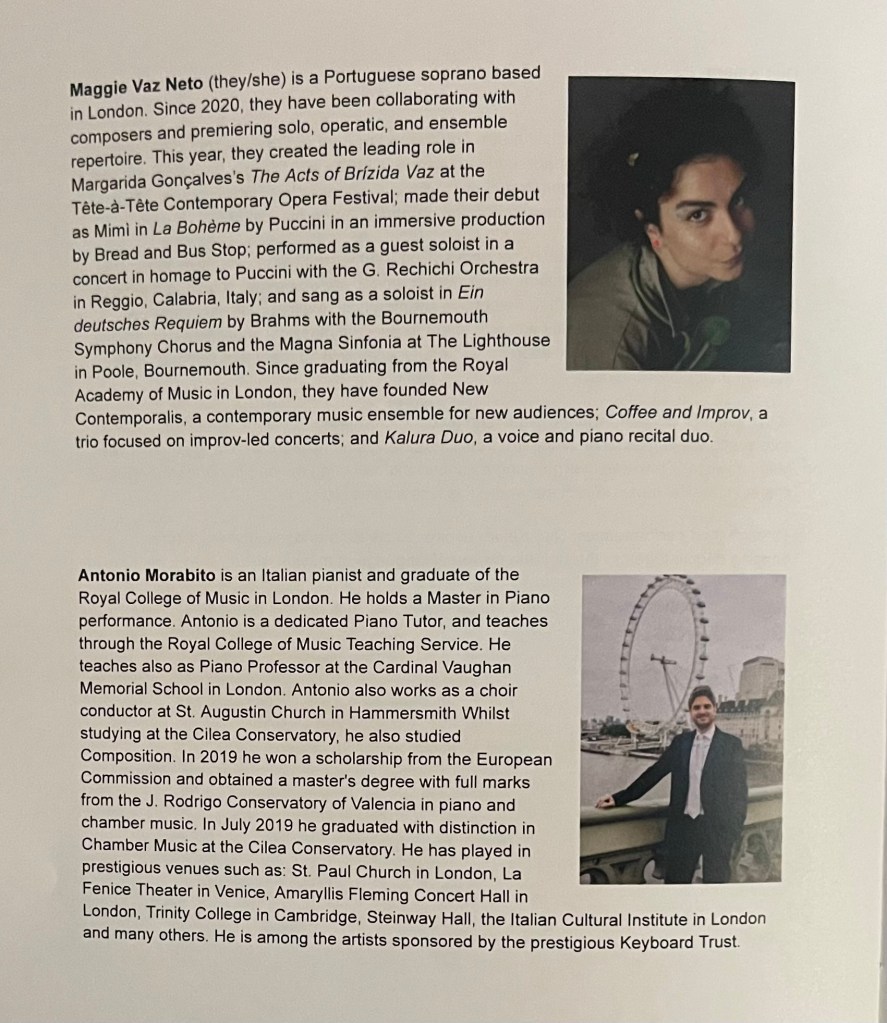
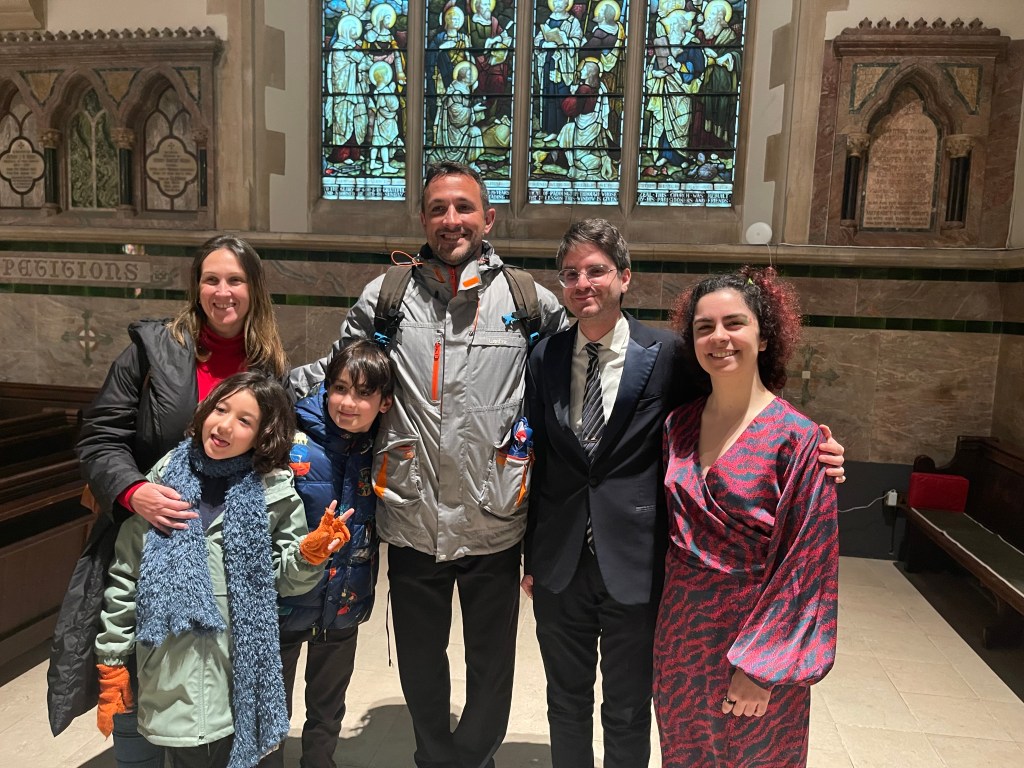
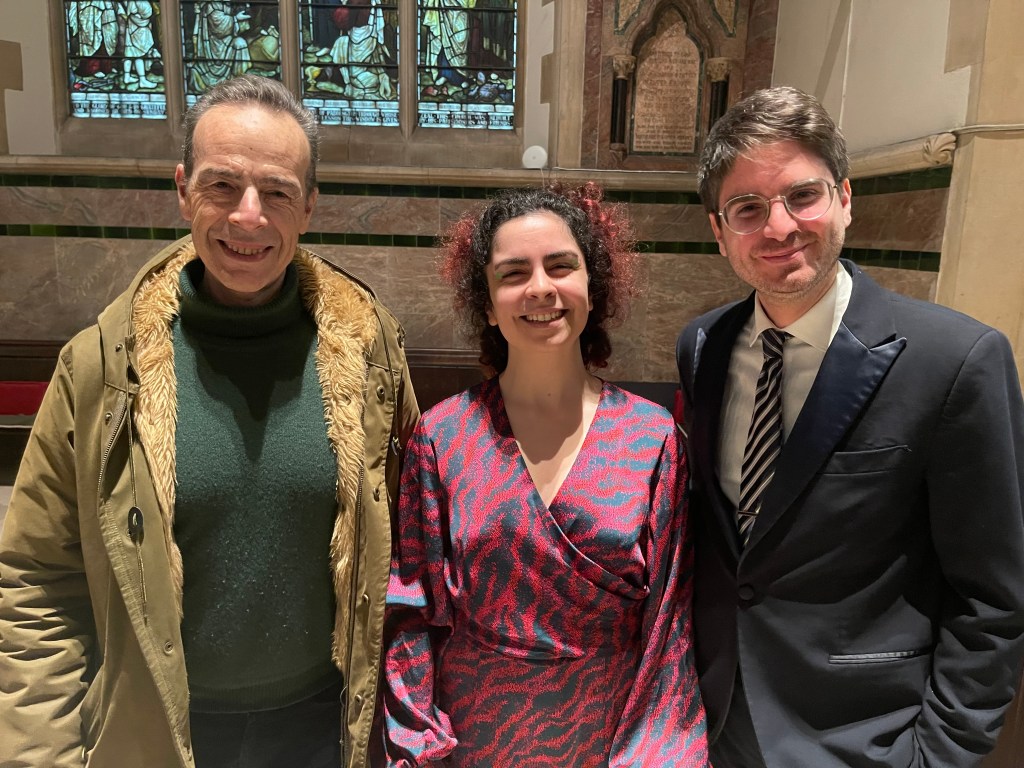
A very varied recital for the sumptuous voice of Maggie Vaz Neto with the refined playing of Antonio Morabito. An eclectic programme ranging from the great operatic arias by Puccini to the voluptuous beauty of Ravel’s Habanera. Hugo Wolff’s refined tone poems were placed next to Bellini’s astonishing bel canto. A sumptuous Rimsky Korsakov and a surprisingly sumptuous Debussy was contrasted with a composer I did not know until today, with an aria from ‘A Serranda’ by Keil. A deep rich soprano voice of radiance, beauty and quite considerable power was accompanied by Antonio Morabito with nobility and restraint. A small but distinguished audience, on one of the coldest days of the year, were rewarded and warmed by a feast of music that resounded around this noble edifice with radiance and beauty.
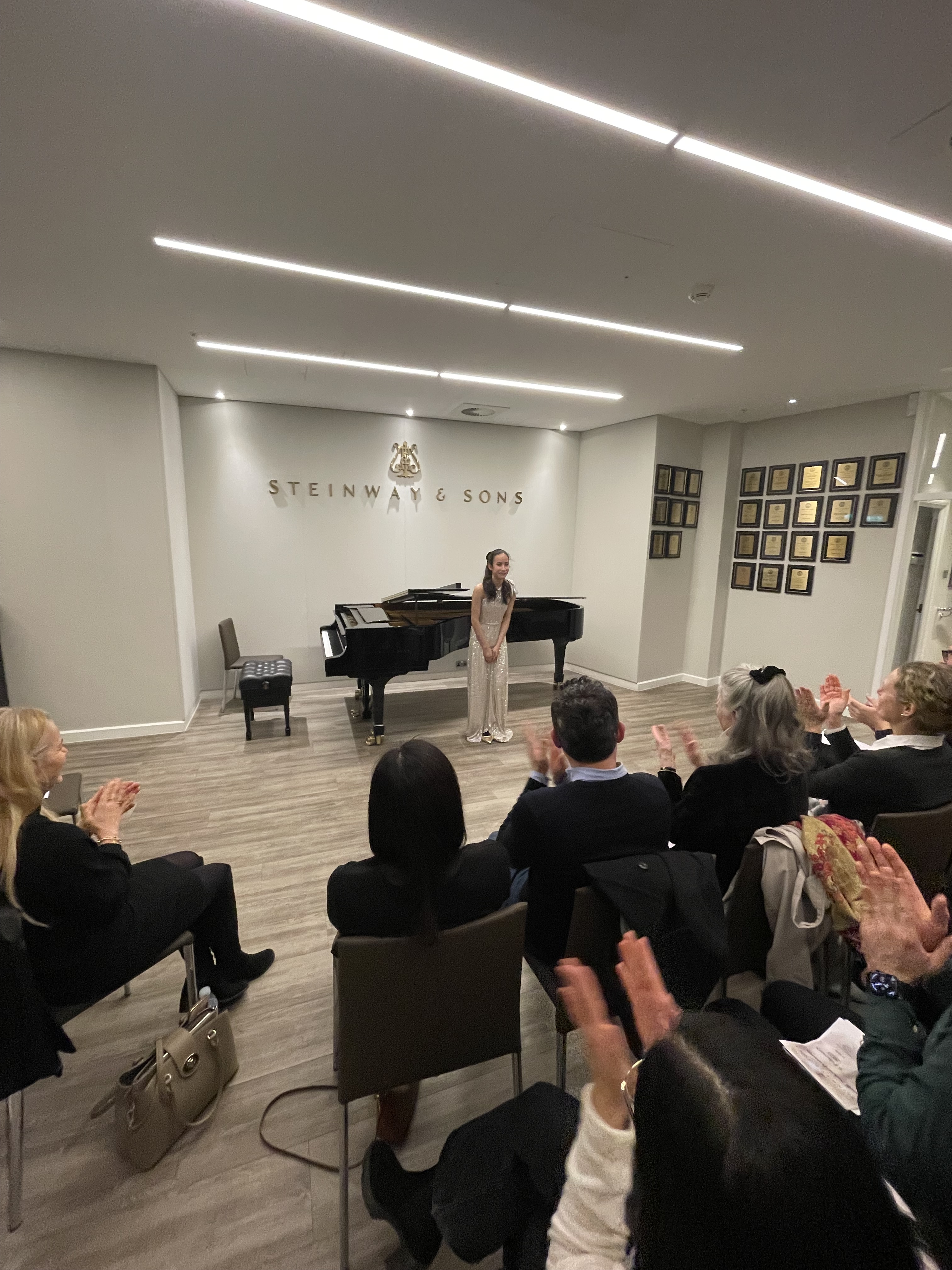
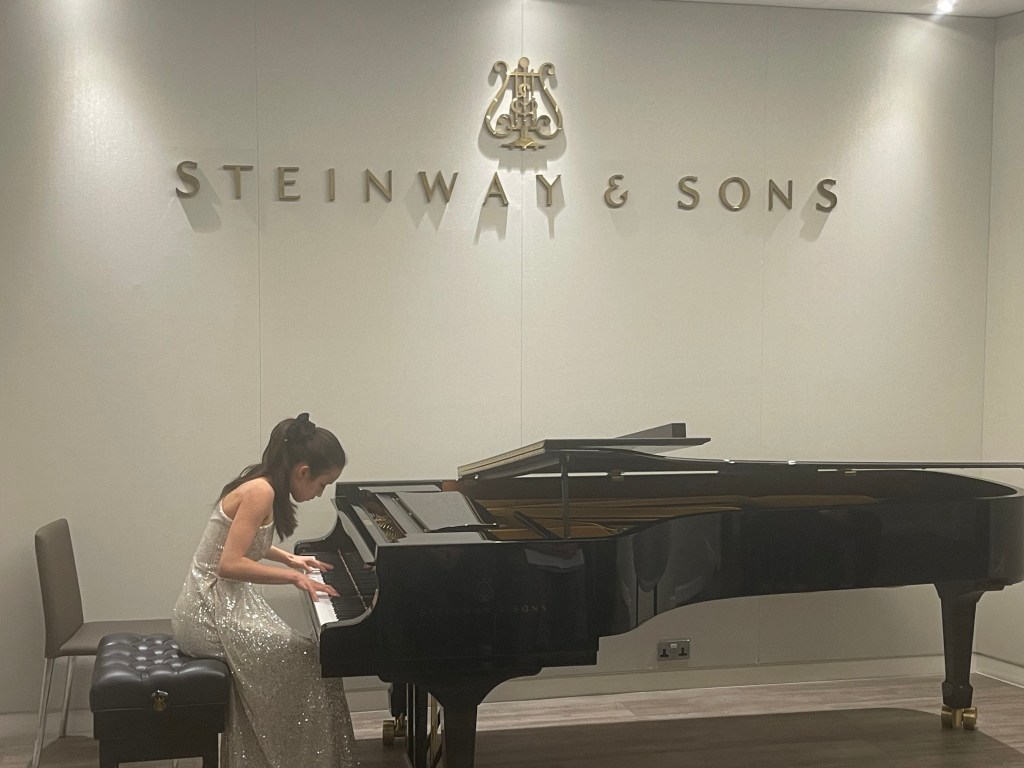
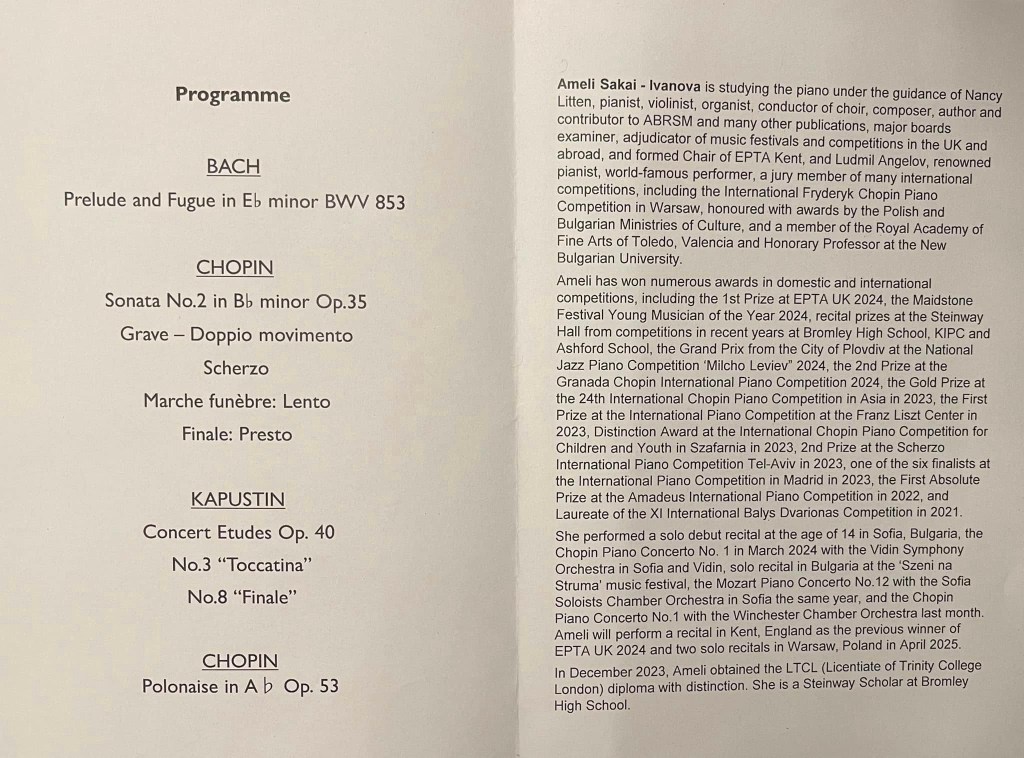
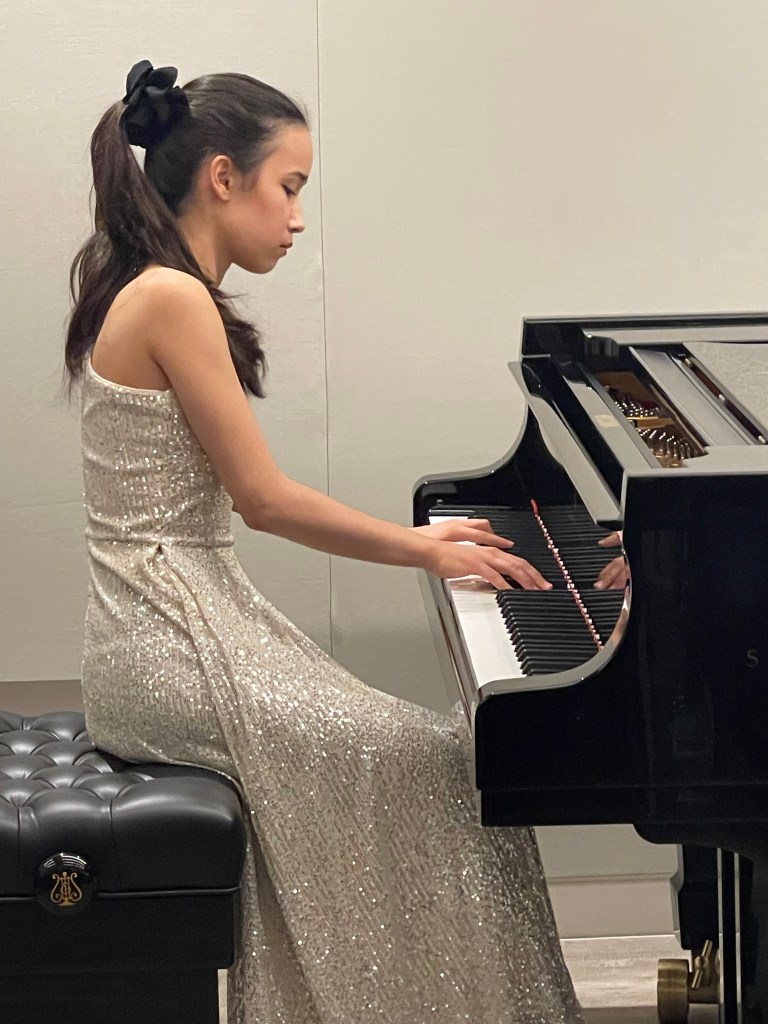
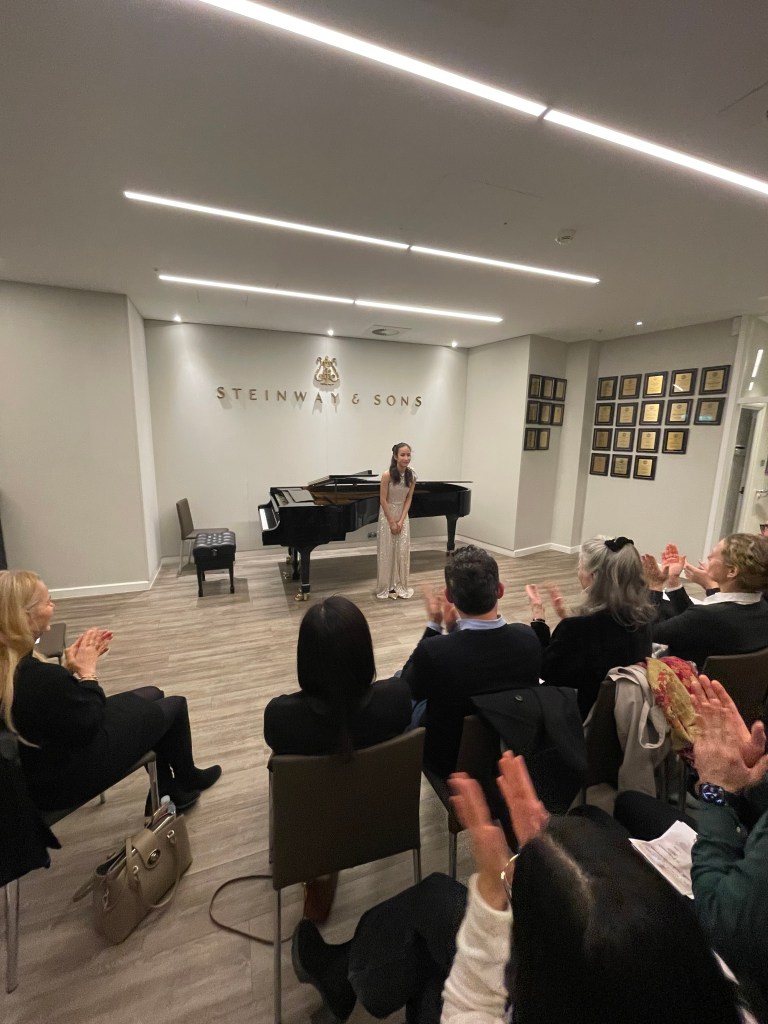
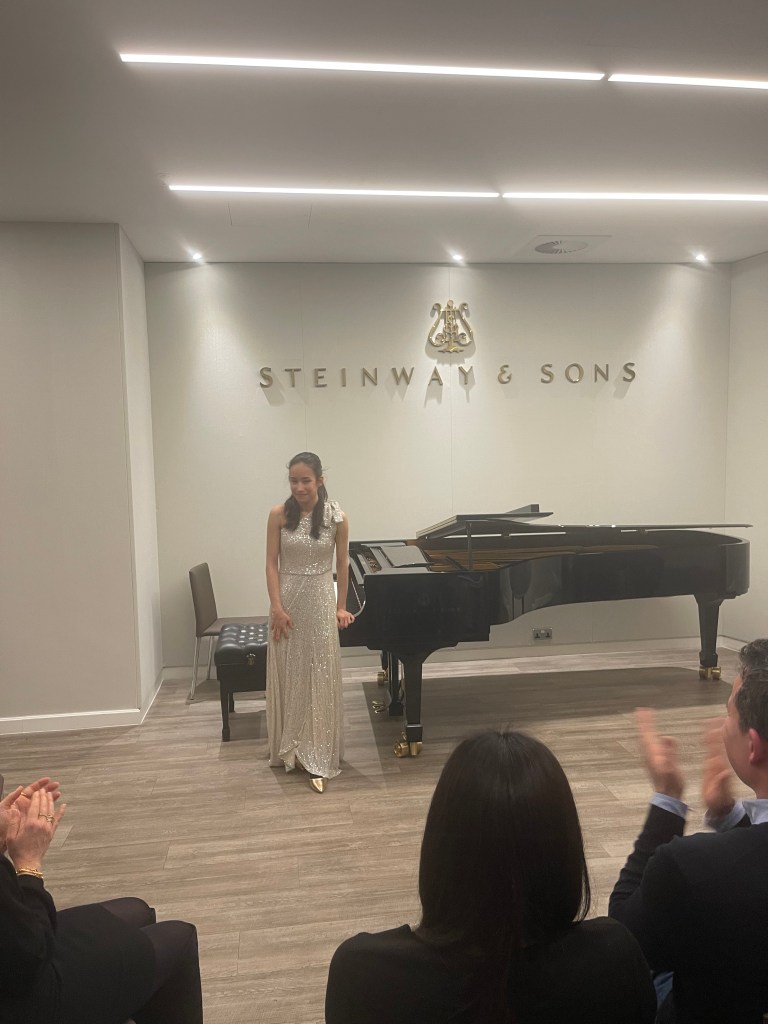
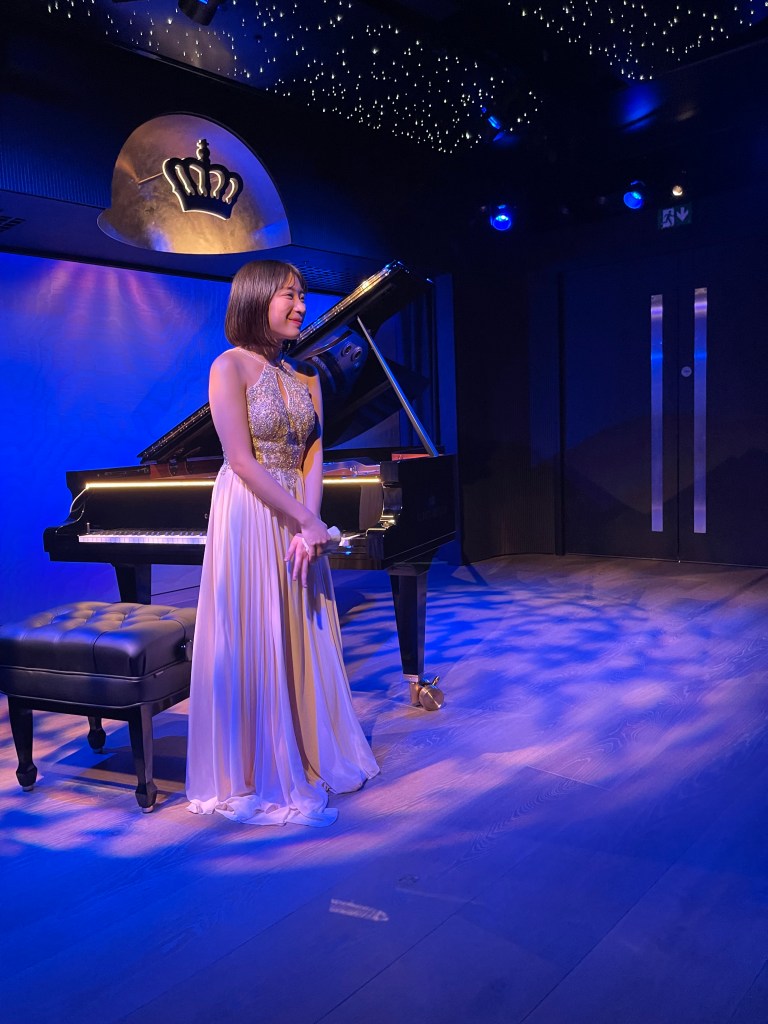
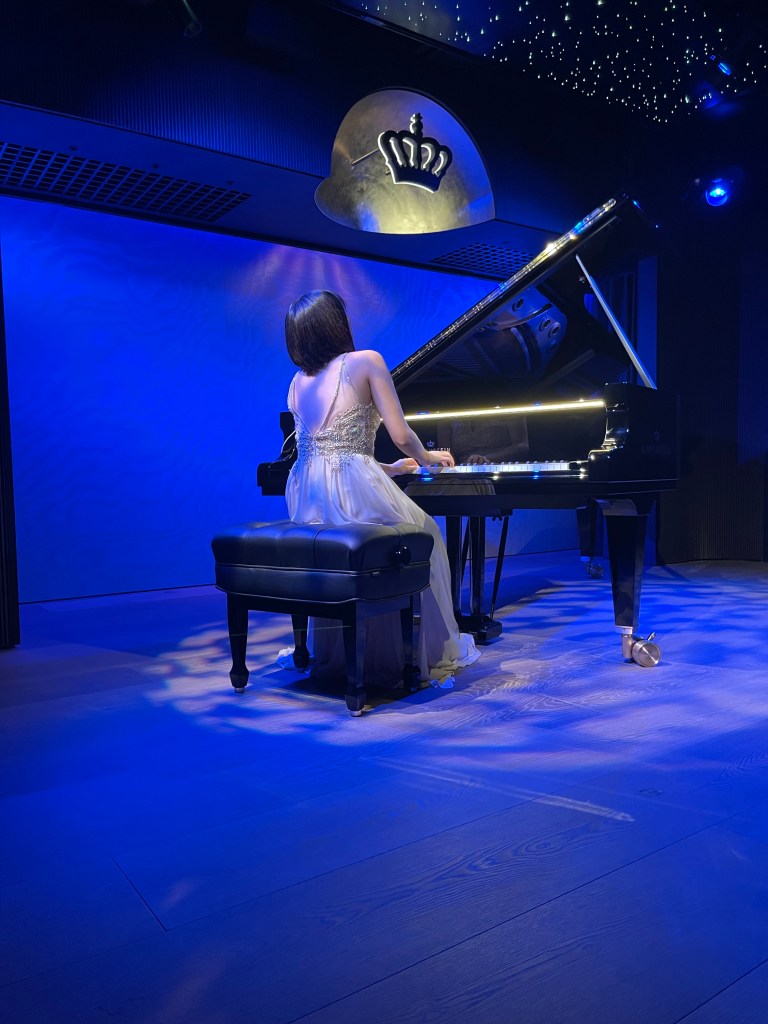
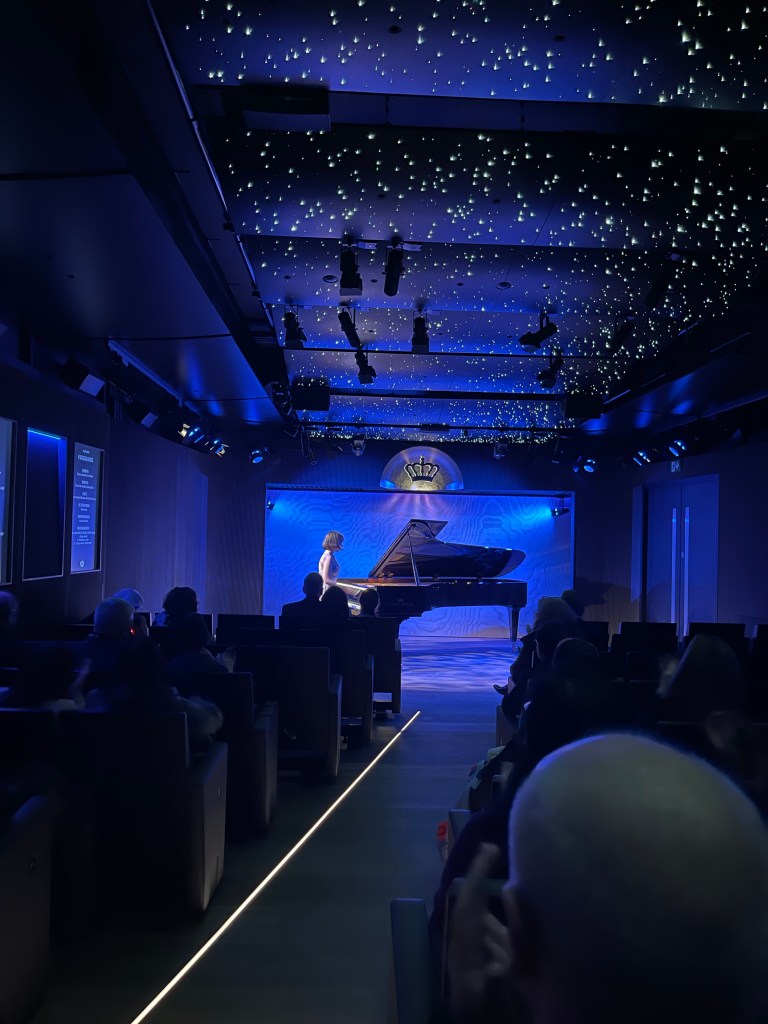
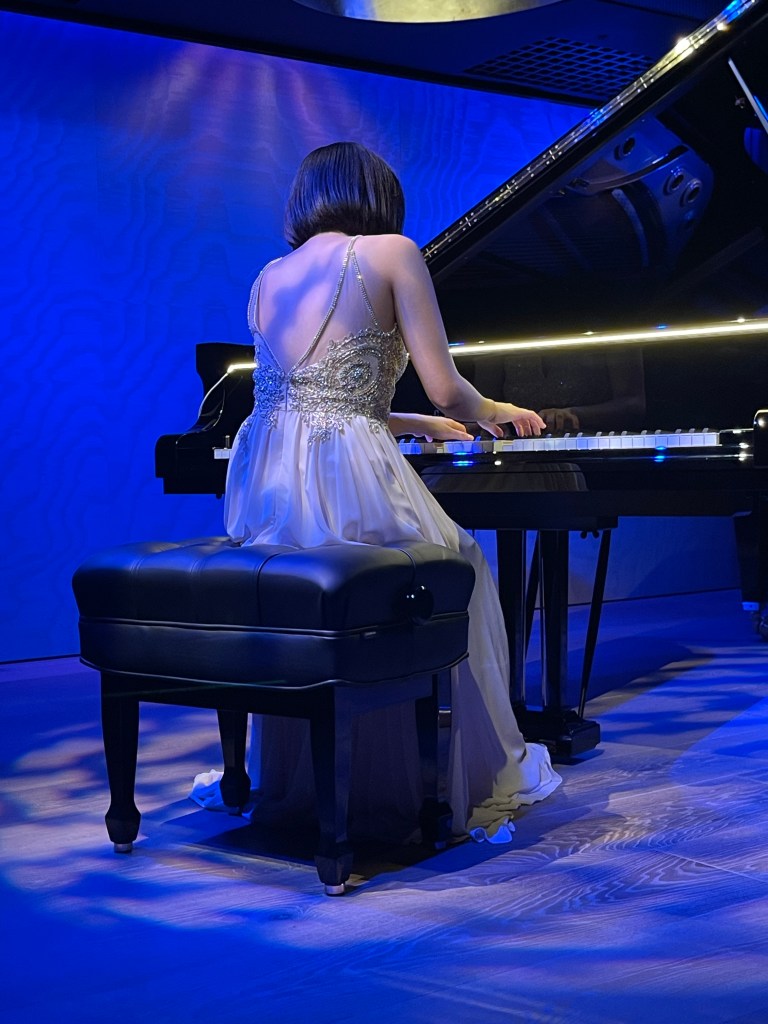
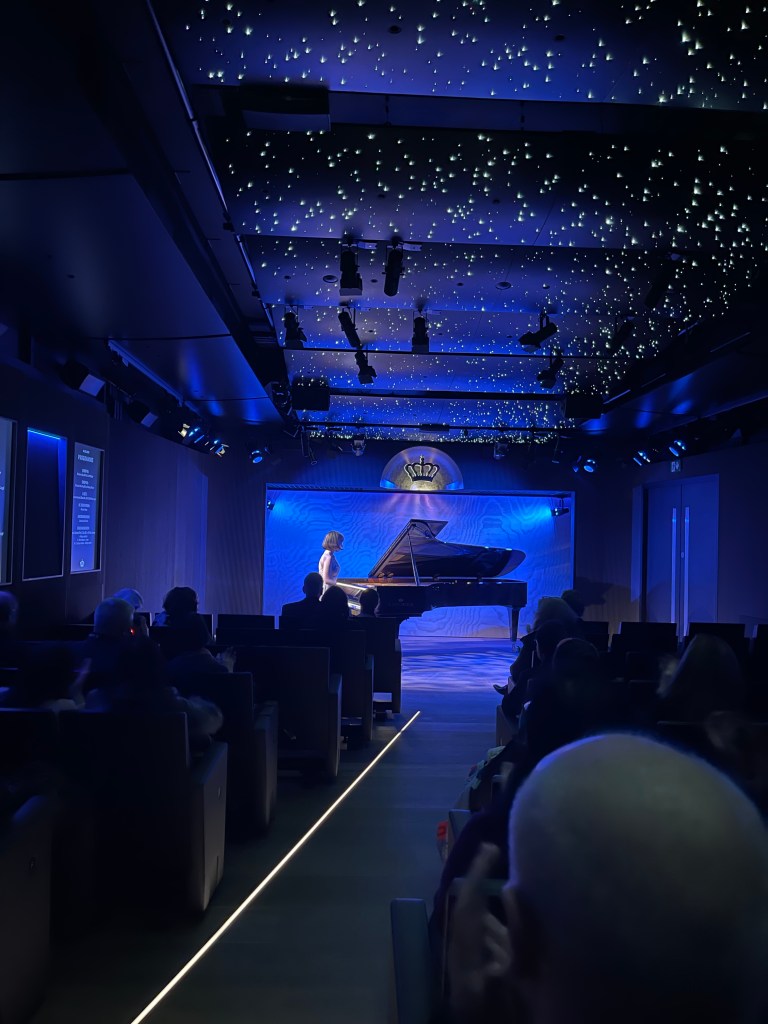
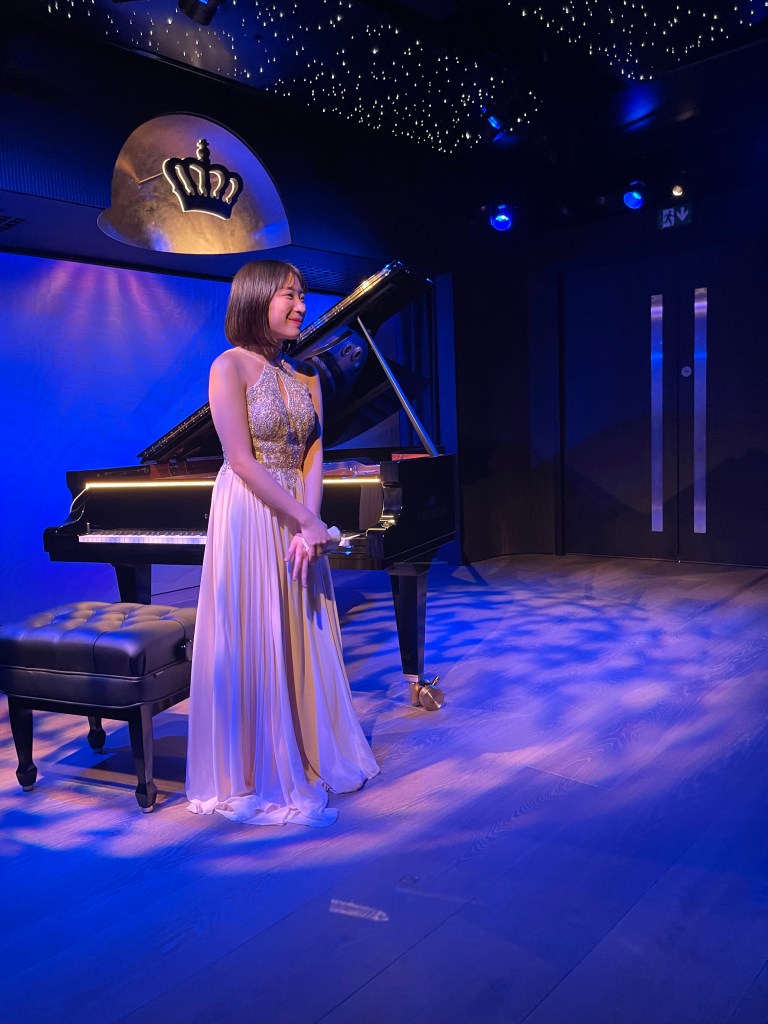
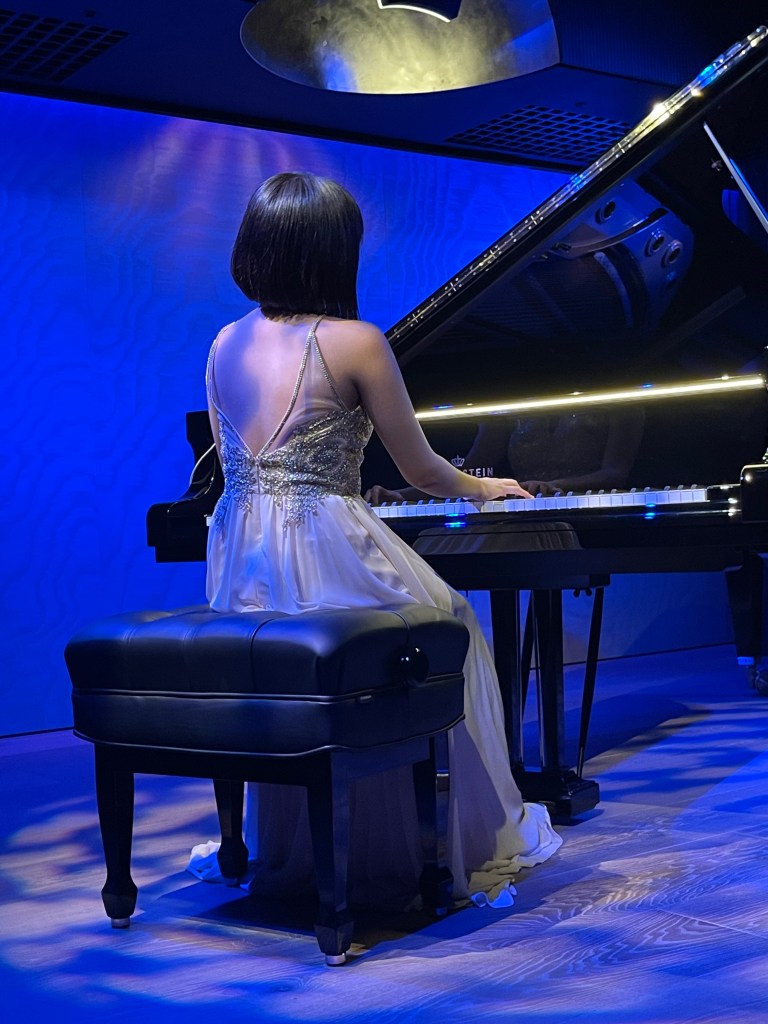
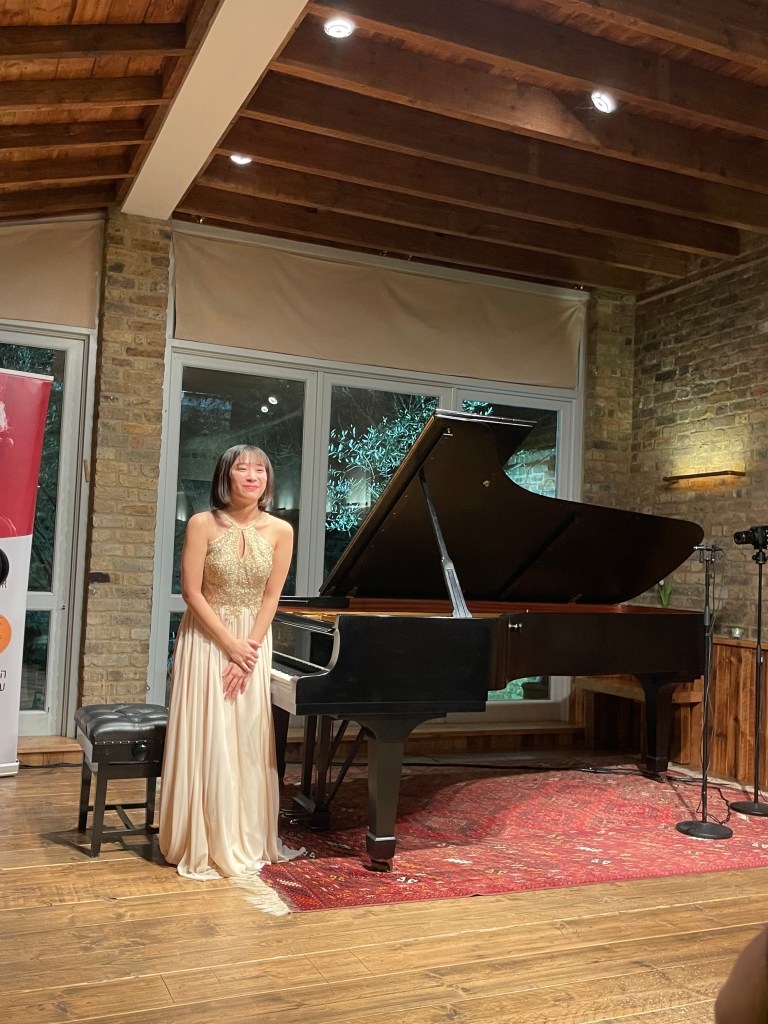
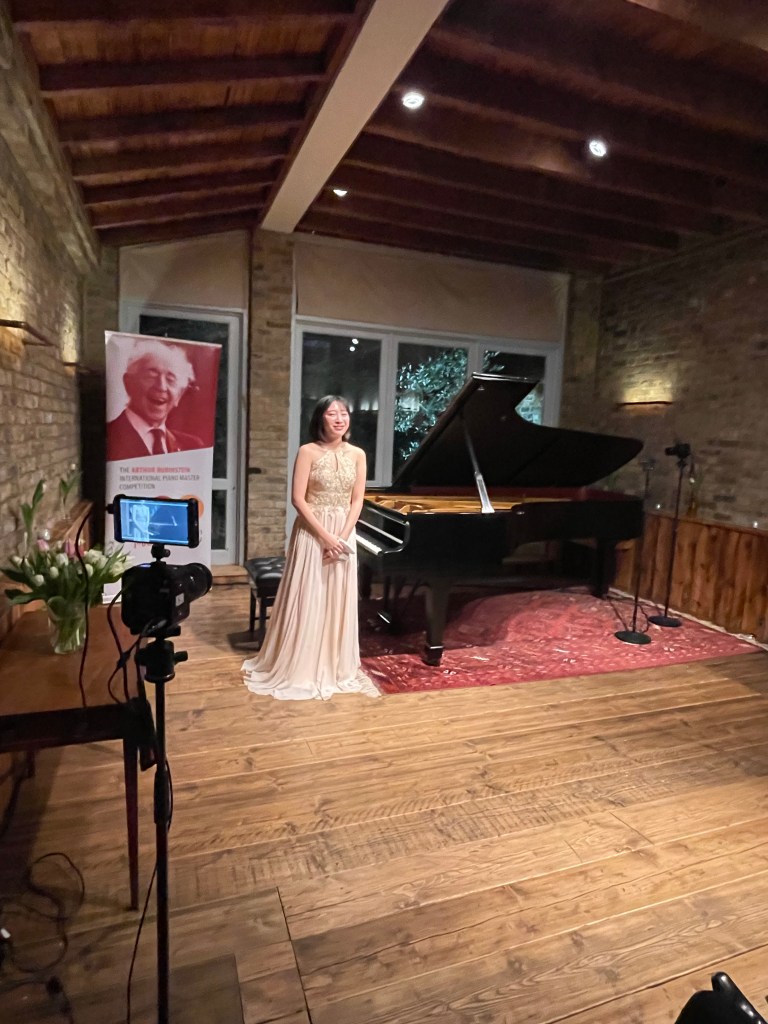
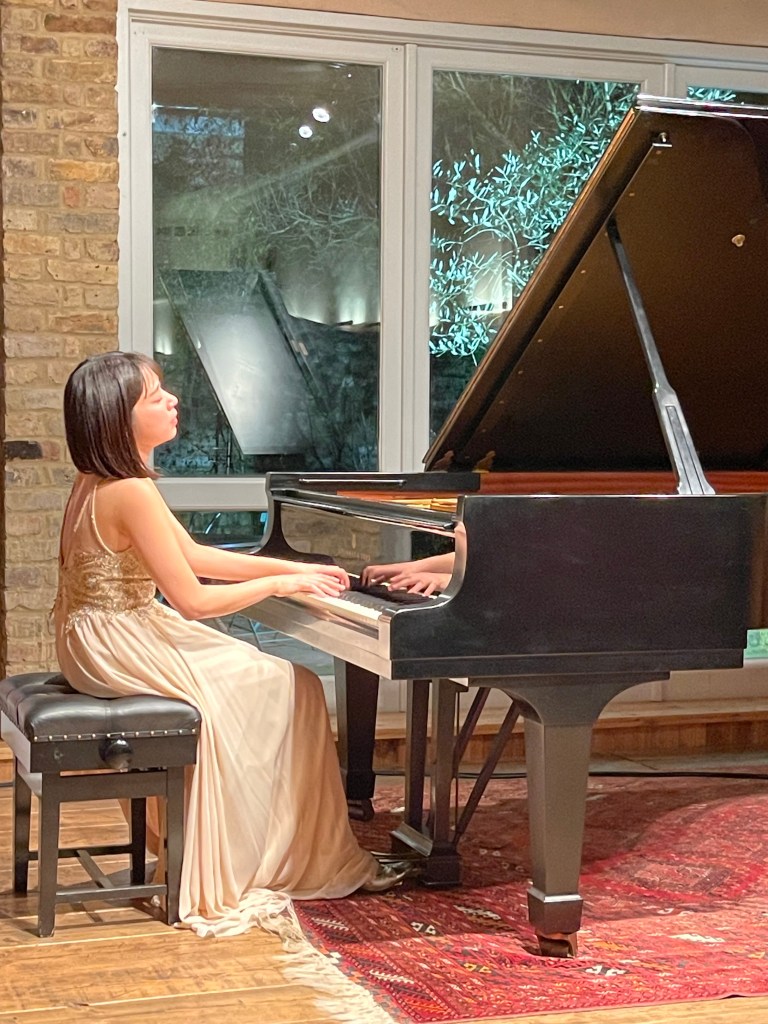
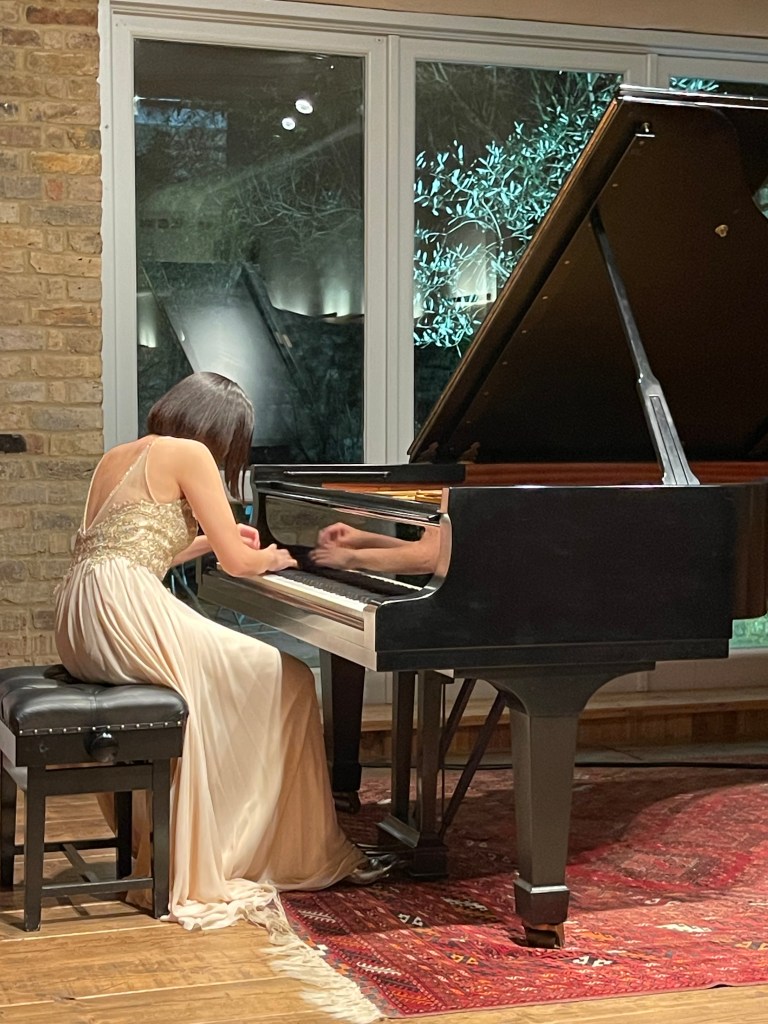
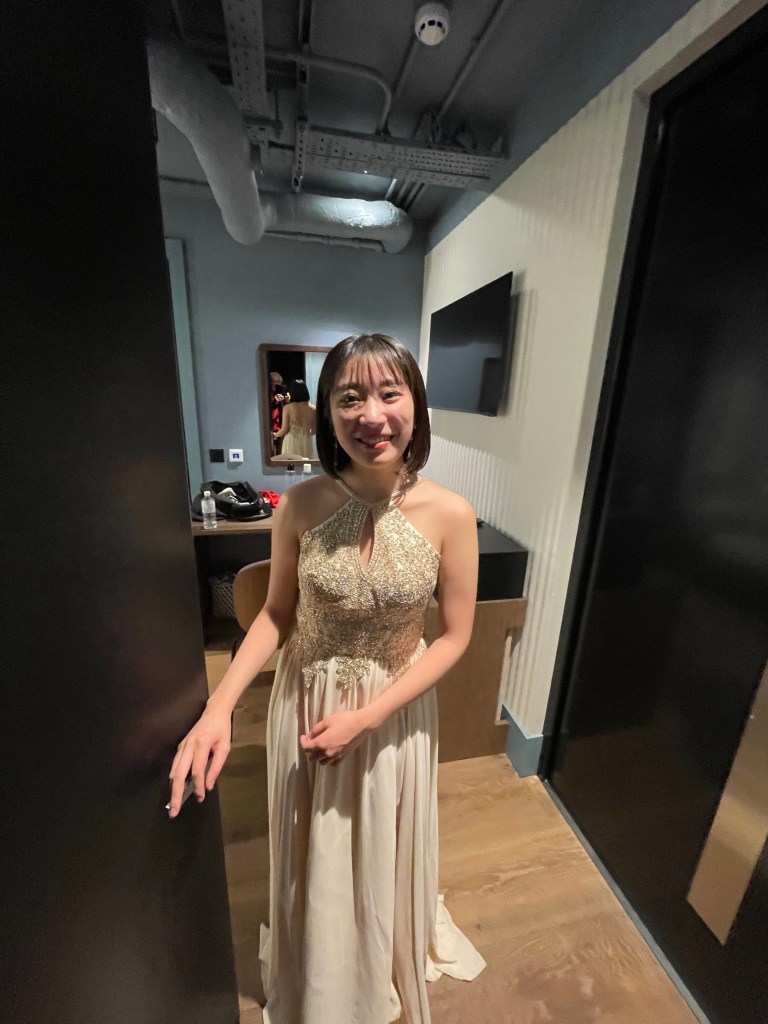
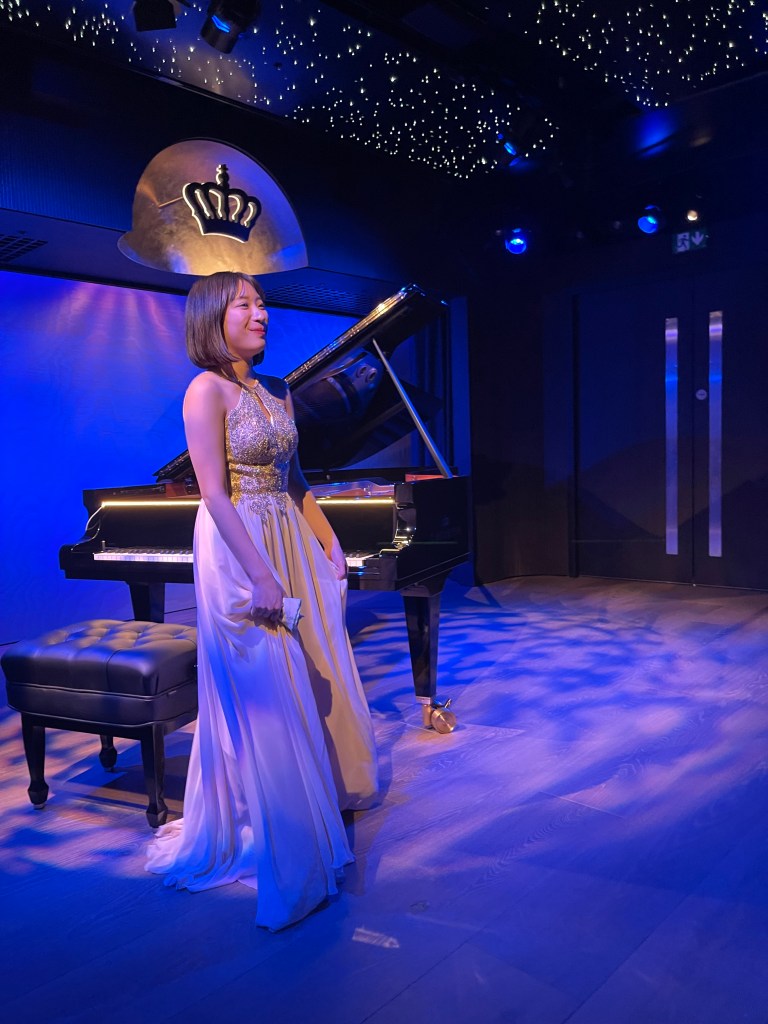
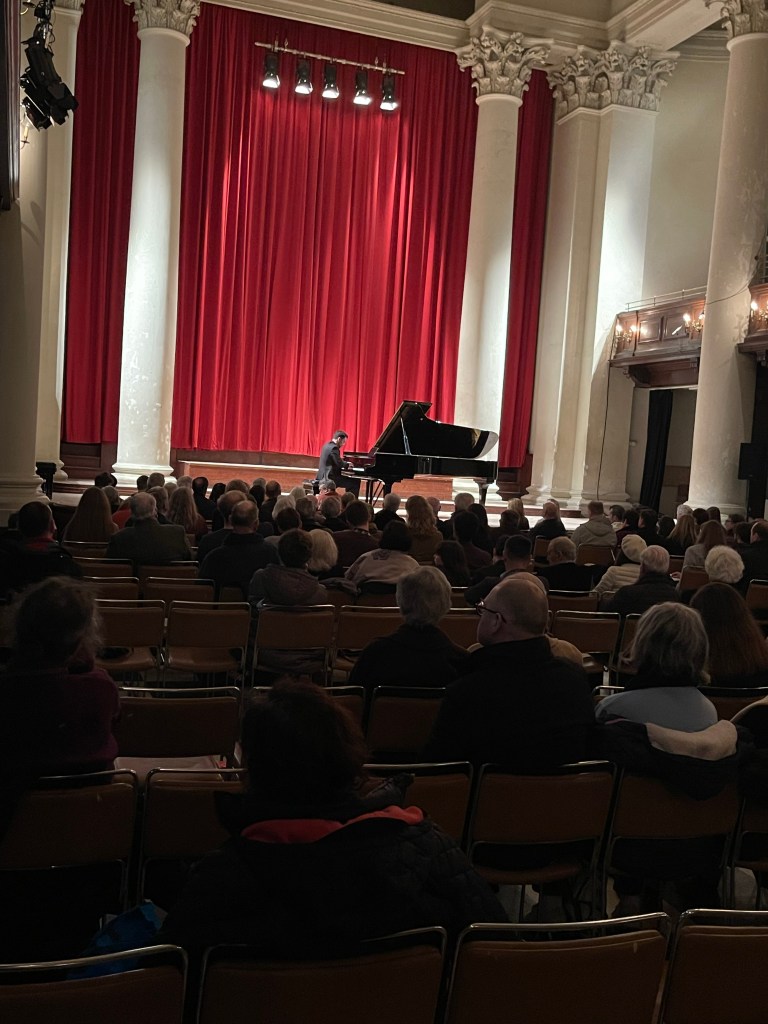
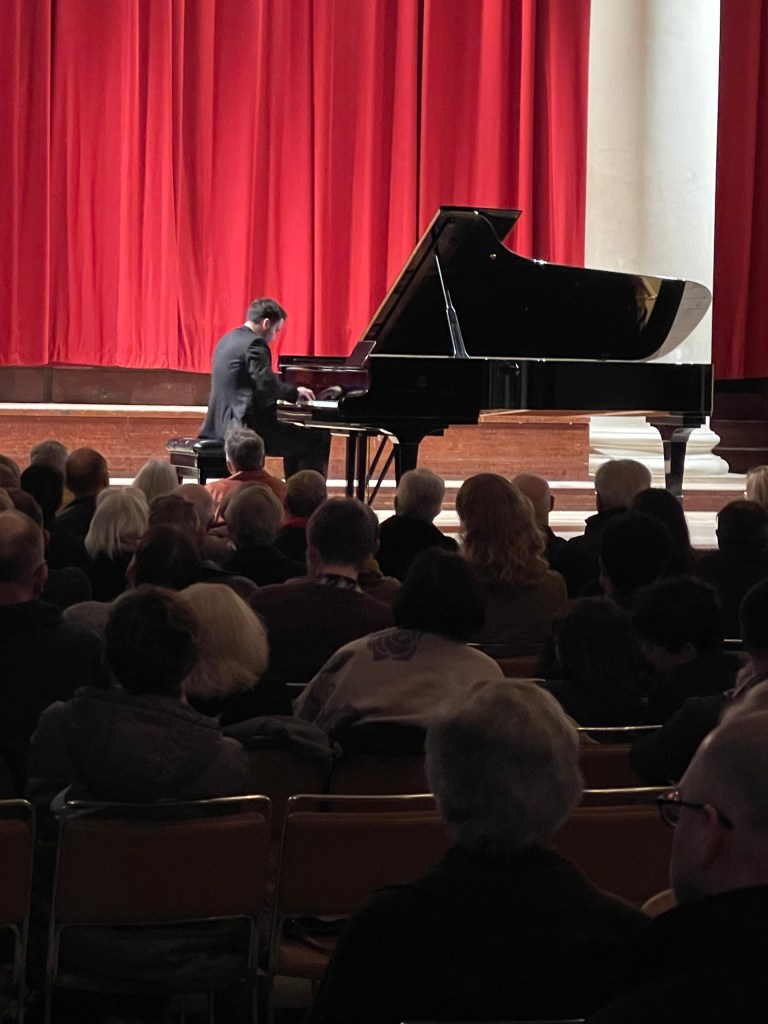
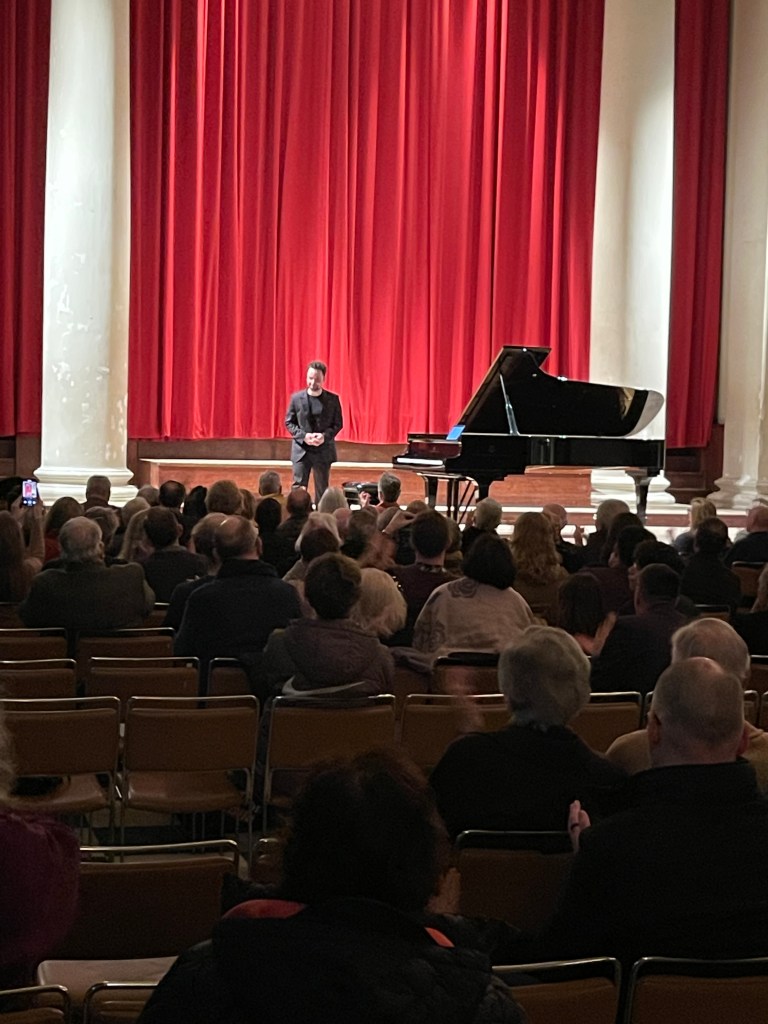
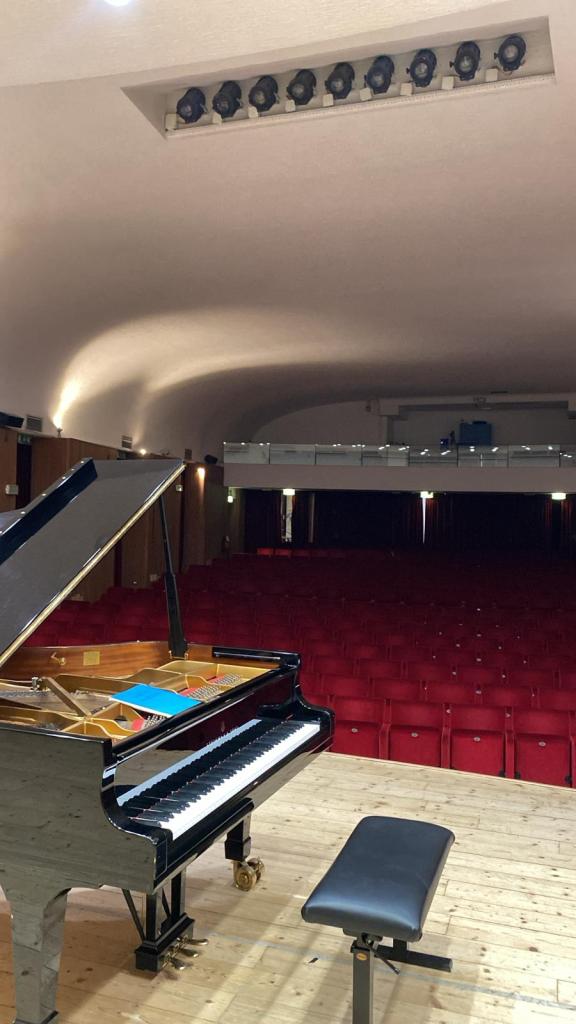
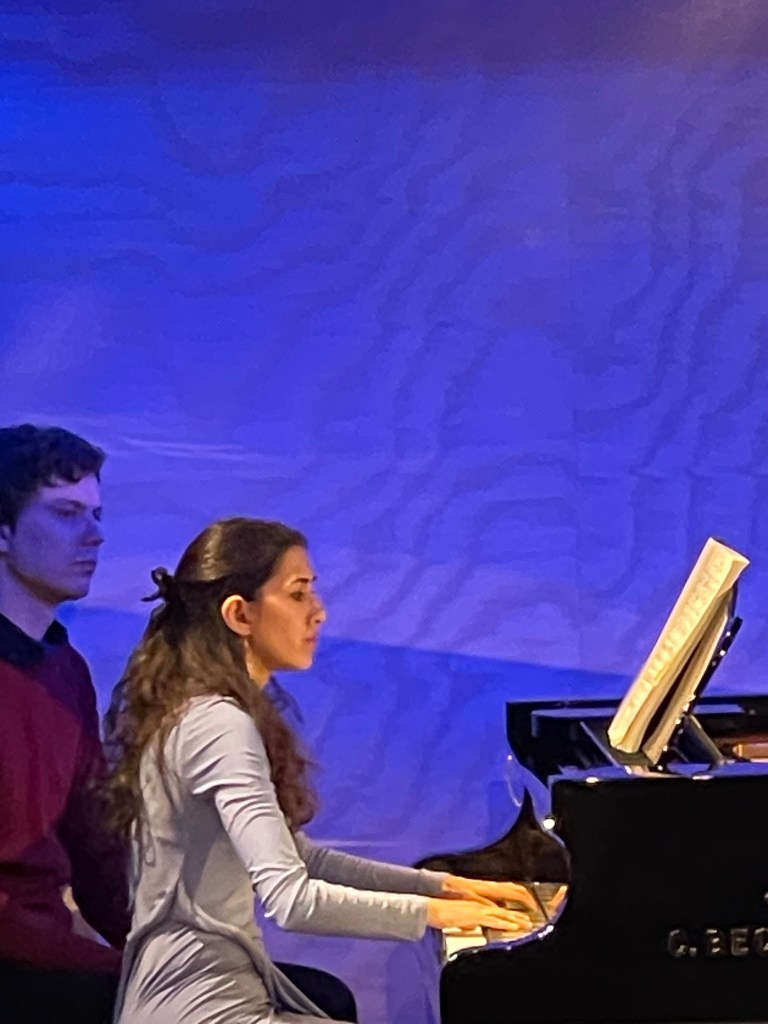
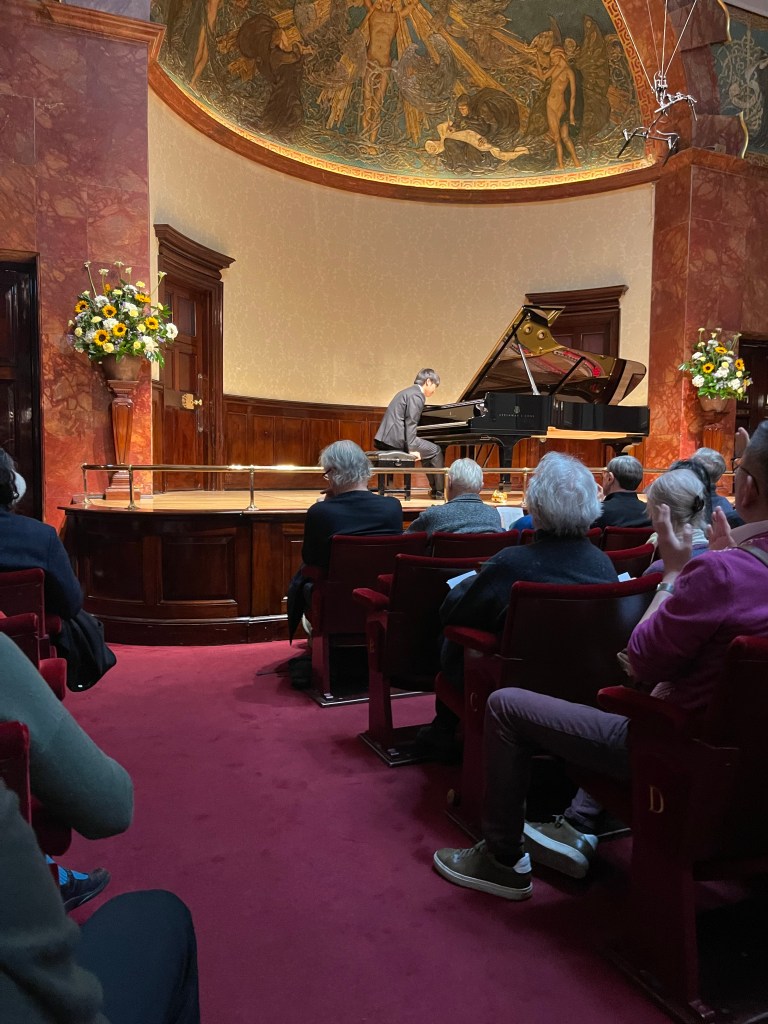
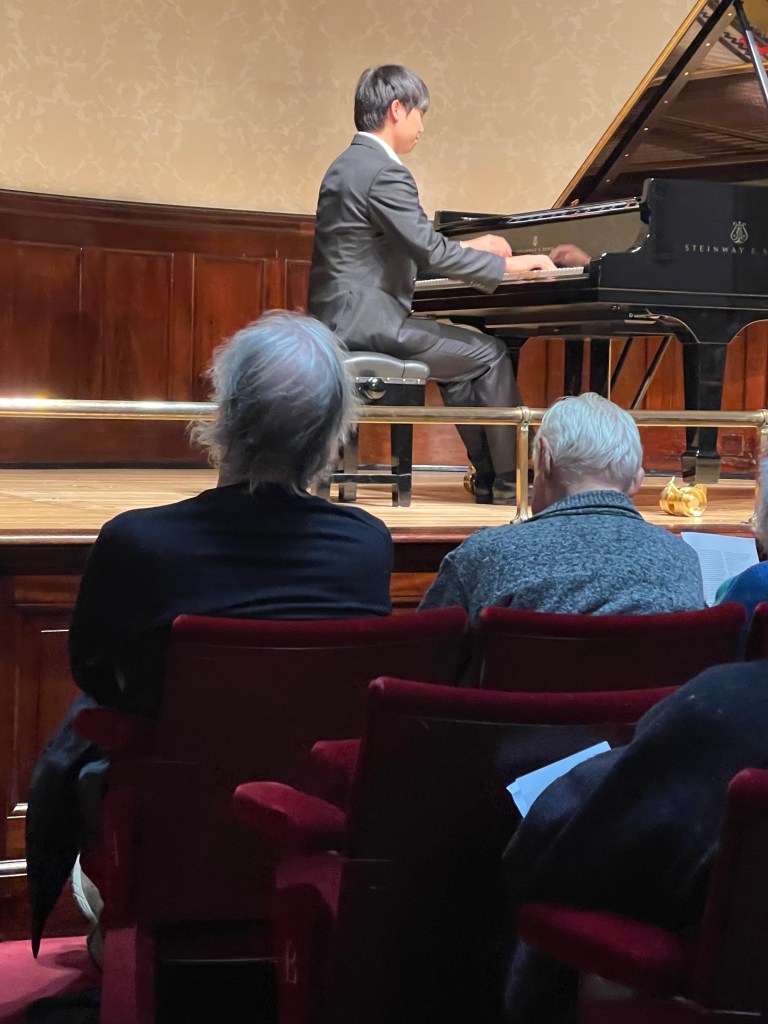
Thanks to Steinway & Sons we were able to hear the 16 year old Ameli Sakai – Ivanova, student of the eclectic multi talented Nancy Litten, performing on a magnificent concert grand to a select audience .
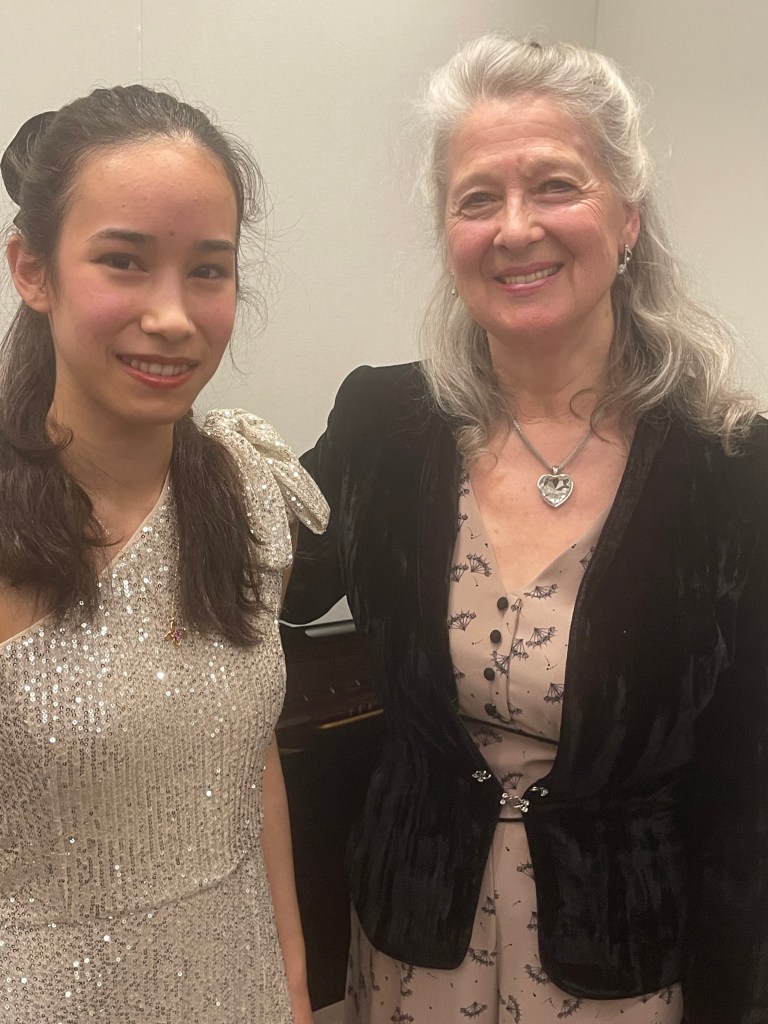
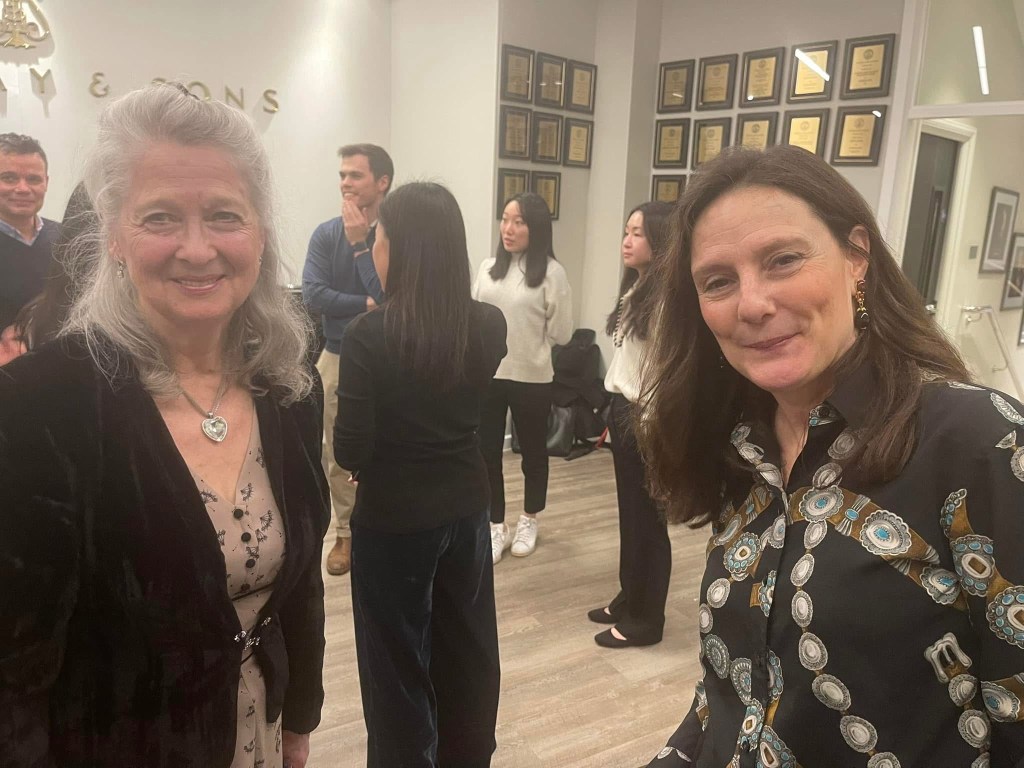
With Nancy Litten
Already at such a tender age she has won great recognition and given public performances of concertos by Chopin and Mozart.
A very solid preparation both technically and musically as you might expect from the student of a graduate of the Royal Academy and a fellow colleague of mine in the early 70’s.
There are some things that cannot be taught but can be allowed to flower naturally. They are the passion and natural musicianship that can ignite and inspire young musicians to great heights under the right musicianly guidance.
It is this passion that shone through her performance of Chopin’s ‘Héroique’ Polonaise that closed this short programme. A performance of passionate conviction and robust technical perfection with a maturity that belies her youthful appearance. It was though in the more lyrical passages that she allowed her natural musicianship to guide her with refined musical taste and beauty. A young pianist playing with all the joy of someone who could conquer such a pianistic hurdle but in the louder passages her exhilaration and mastery belied the fact that the Polonaise is above all a dance. There are also various degrees of ‘forte’, as there are ‘piano’, that can help her shape the louder passages with more refinement, that will come naturally with the maturity of time. The treacherous ride of the cavalry was played with superb lightweight octaves on which they could ride fearlessly onto the battlefield. Building the sound with technical mastery and listening very careful to the balance, defusing the tension with the beauty of the undulating melodic outpouring, before the exhilaration and excitement she brought to the final pages of this truly ‘héroique’ performance.
Her technical preparation allowed her to give fearless performances of two of Kapustin‘s notoriously knotty Jazz Studies. She played them with a dynamic drive and extraordinary dexterity as she unraveled with clarity and mastery Kapustin’s dizzying maze of notes that were breathtaking in their audacity. .
But it was the Chopin B flat minor Sonata that revealed her extraordinary maturity, as she could carve an architectural line in the first movement that allowed her to play the second subject with poetic poise without having to slow the tempo or loose control of her aristocratic vision. Some very beautiful pointing of harmonies in the tenor register gave great depth and beauty and it was particularly noticeable in the beauty she brought also to the ‘Trio’ of the ‘Scherzo’. A movement she had opened with fearless abandon and technical mastery shaping the notes into the dance it truly is, playing with an unrelenting forward drive. Beautifully linked without a pause to the ‘Marche Funèbre’ that she allowed to flow from her fingers with nobility and simplicity. A beautiful rich sound to the ‘Trio’ gave great strength to Chopin’s beautiful bel canto, with playing of great poignancy but no sentimentality. More care of the balance between the hands would have allowed her to give more fluidity and glowing sound adding even more magic to one of Chopin’s most miraculous creations.
The ‘wind over the graves’ of one of Chopin’s ‘wildest children’ (to quote Schumann) showed off Ameli’s quite extraordinary ‘fingerfertigkeit’ and allowed her to play with such clarity Chopin’s quite astonishingly original finale. This was a very mature and in many ways masterly account of one of the greatest works of Chopin.
The Bach Prelude and Fugue in E flat minor Book 1 is a work new to Ameli’s repertoire and although I found the prelude rather slow it was played with weight and beauty .The Fugue showed a great musical personality as she played Bach’s ‘knotty twine’ ( to quote Delius) with extraordinary clarity and rhythmic drive.
A teenage schoolgirl with remarkable musical gifts that she will with time refine and be able to ride on a more horizontal wave of sound that will give her even more freedom to conquer the great works that will lay before her. It is wondrous voyage of discovery that awaits.
It is nice to know that another lady pianist was playing next door. Martha Argerich, too, had started her musical journey at the age of sixteen. Now at 83 that glorious voyage is continuing in the pursuit of perfection and beauty that has given so much to so many over a lifetime’s dedication to music.
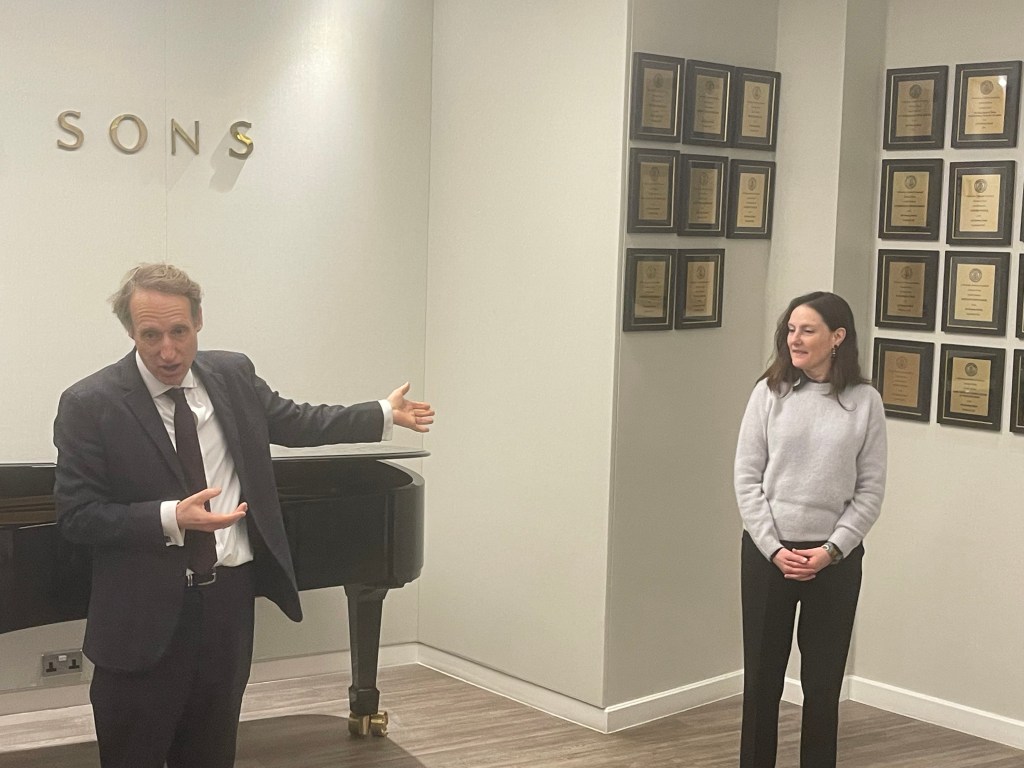
Maura Romano of the Steinway flagship in Milan,in London by chance, was able to hear Ameli today and offer her a recital next season.
She, like George Soole and Wiebke Greinus in London have created an important platform for young musicians that gives these exceptionally talented artists one of the first important steps at the start of the long ladder in a career in music.
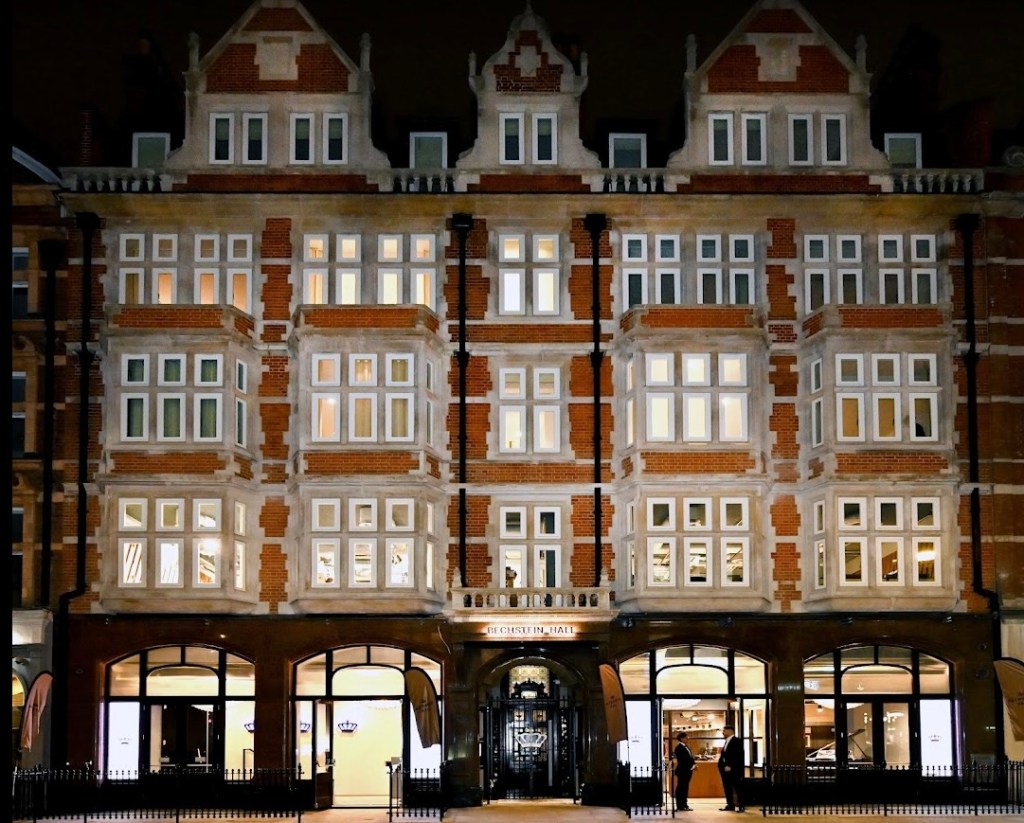
The New Bechstein Hall after its initial launching is now accessible to all with a Sunday morning Young Artists Series at only five pounds, with as much coffee as you need at 10.30am! Thomas Masciaga opens the Bechstein Young Artists Series with canons covered in flowers https://christopheraxworthymusiccommentary.com/2025/02/02/thomas-masciaga-opens-the-bechstein-young-artists-series-with-canons-covered-in-flowers/ Evening concerts starting from 18 pounds and a sumptuous restaurant that is also opening for luncheon. A beautiful new hall that is just complimenting the magnificence of the Wigmore Hall and the sumptuous salon of Bob Boas.Providing a much need space for the enormous amount of talent that London,the undisputed capital of classical music,must surely try to accommodate .
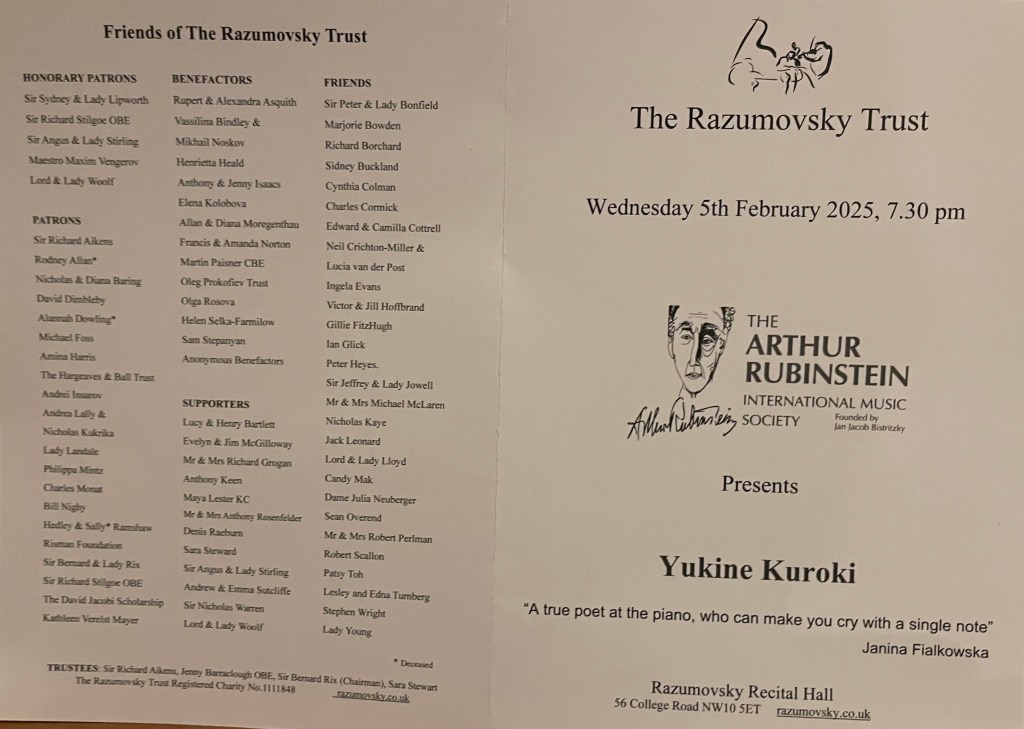
“A true poet at the piano, who can make you cry with a single note” – Janina Fialkowska
A multi competition winner including laureate of the Rubinstein International, First Prize at the Dublin and First Prize at The Utrecht Liszt which led to her sold out debut at Amsterdam’s Concertgebouw.
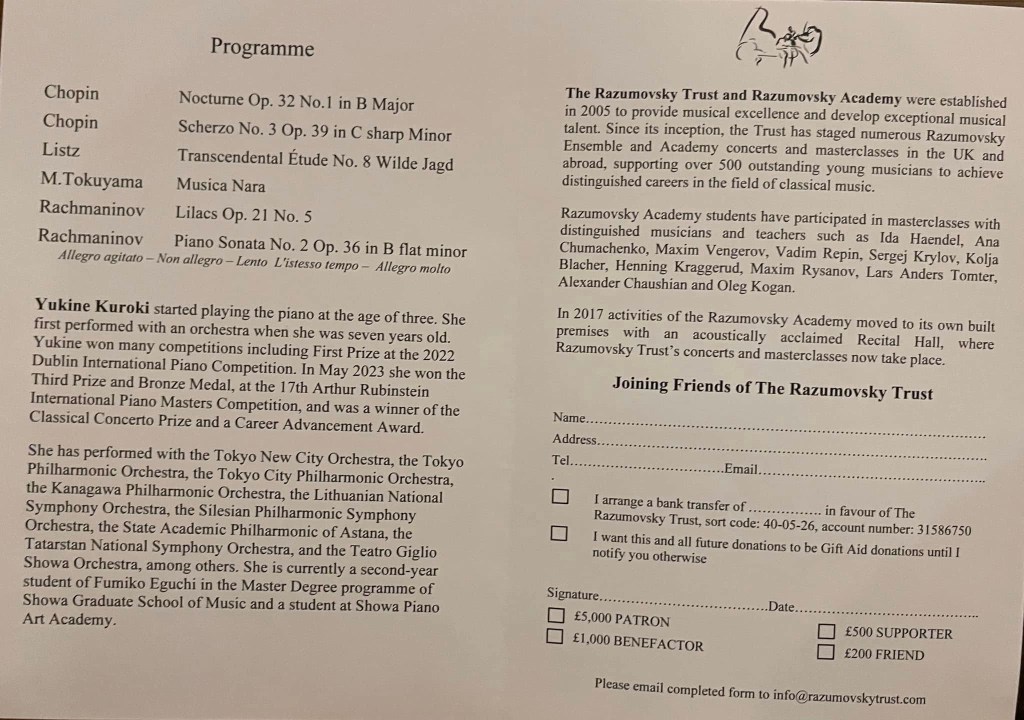
CHOPIN: Nocturne Op.32 No.1 in B Major
CHOPIN: Scherzo No.3 Op.39 in C sharp Minor
LISZT: Transcendental Étude No. 8 S. 139 Wilde Jagd
M.TOKUYAMA: Musica Nara
RACHMANINOV: Lilacs Op.21 No.5
RACHMANINOV: Piano Sonata No.2 Op.36 in B flat minor
I. Allegro agitato
II. Non allegro – Lento
III. L’istesso tempo – Allegro molto
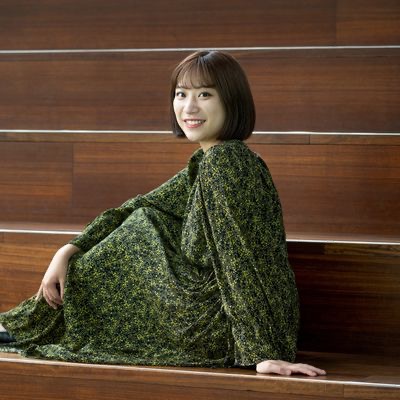
The London debut of Yukine Kuroki in the sumptuous new Bechstein Hall. The directors of both Rubinstein and Utrecht International Piano Competitions had flown in especially to applaud their latest star.
the sumptuous new restaurant where celebrations and congratulations were the order of the day Rob Hilberink with Ariel Cohen Bechstein’s superb restaurant opening shortly for lunch too
And a star was certainly shining brightly as Janina Fialkowska’s words were brought vividly to life: ‘ A true poet at the piano who can make you cry with a single note ‘
Was it not Rubinstein at his very first competition, nearly 50 years ago, who had said the same of Janina as she played a monumental Liszt Sonata that brought tears to his eyes?
Chopin’s Nocturne op 32 n 1 in B, not one of the most often heard, was given a glowing tone of fluidity and delicacy where the bel canto was allowed to unfold with an ease that allowed the music to breathe so eloquently. Brought to a barely whispered halt as a startling cadenza appeared and was played with arresting nobility and authority. Yukine had perceived this seemingly simple nocturne as a tone poem with a story to tell of great poetic originality. It was her dedication to what the composer had written but seen through a different lense. One that could see things that only a genial poet of the piano could perceive with a palette of colours on a canvas like the greatest pointillist painters.
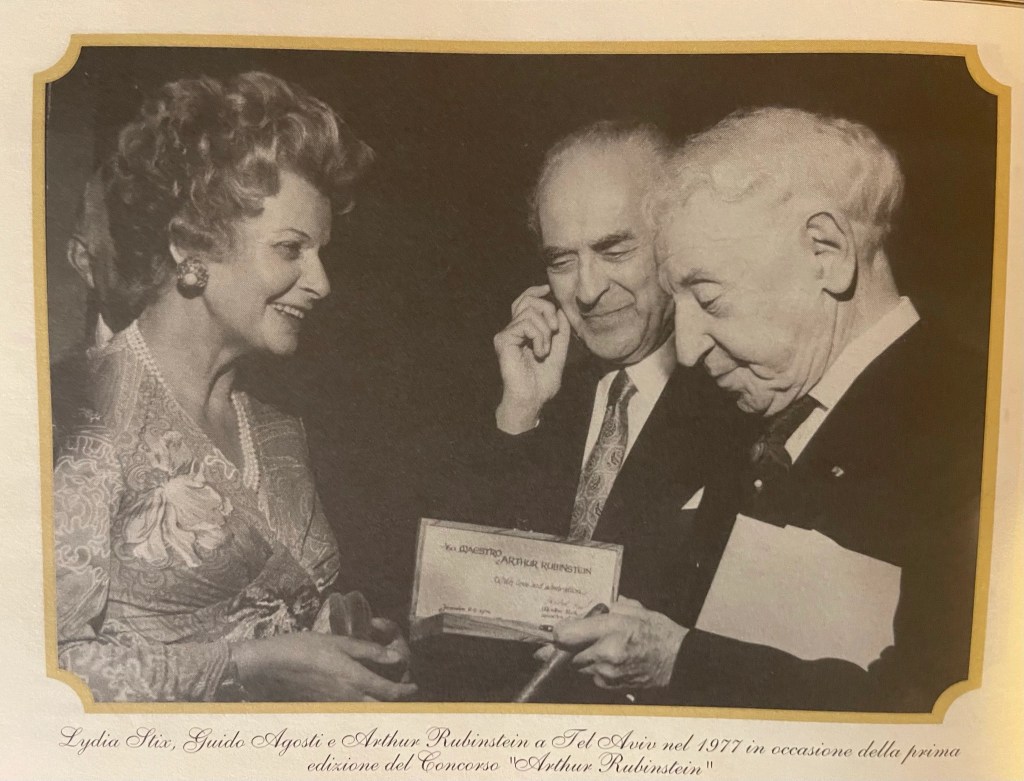
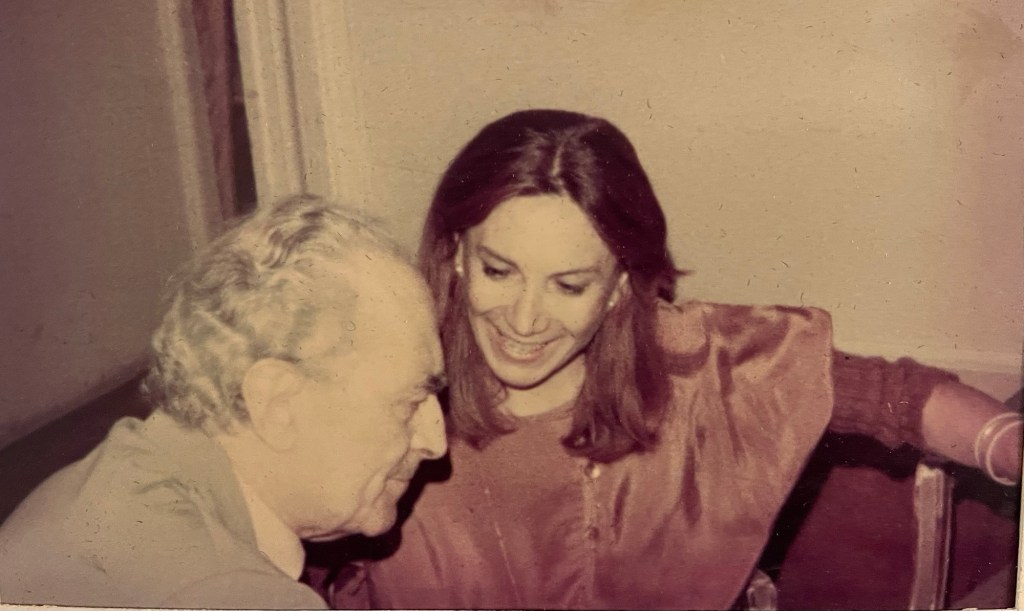
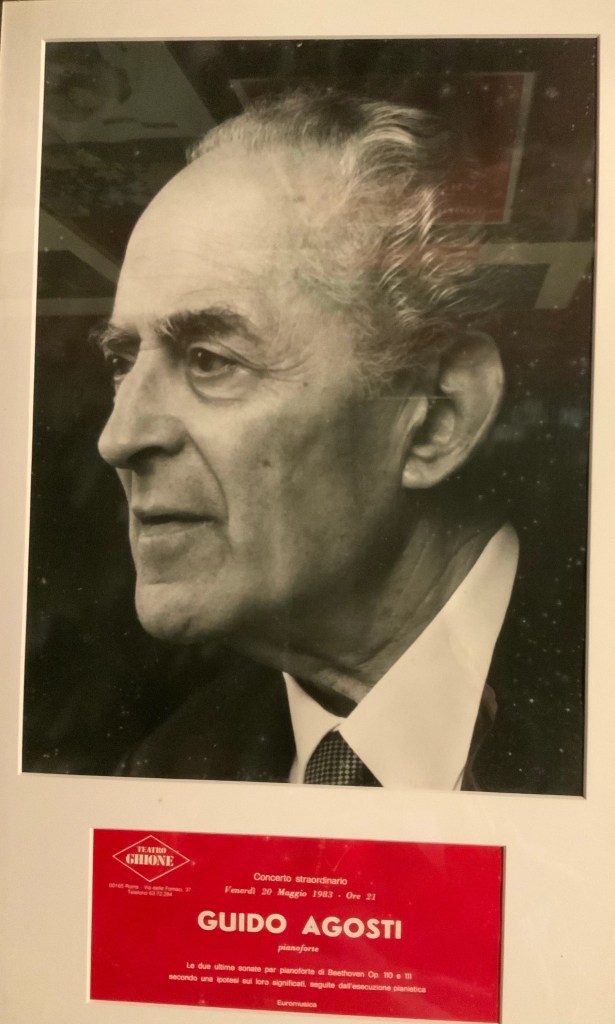
It was the same voyage of discovery that she brought to the third Scherzo. The words ringing in my ears of my teacher and friend Guido Agosti ( one of the jury members of the first Rubinstein competition ) as he listened in his studio in Siena to aspiring young virtuosi.
Agosti with my future wife Ileana Ghione in Siena in 1978one of the very few recordings of this great musician made in the Ghione theatre live in 1983 of op110 and 111 i
Pianists would flock to this Mecca to hear sounds that would never be forgotten. ‘All that banging’ he would admonish so many young ‘virtuosi’ as he ,one of the last students of Busoni who in turn had been a student of Liszt,knew the real secrets that were hidden within that box of hammers and strings ! The piano should be played horizontally not vertically and as Anton Rubinstein, another disciple of Liszt , exclaimed ‘ the pedals are the real soul of the piano.’ The three handed pianism of Thalberg and Liszt were the ultimate trick of supreme illusionists.
All this came to mind as Yukine opened the third scherzo with a range of colour and an architectural shape that returned this much maligned masterpiece to its original poetic inspiration. Like with so many recitals by Murray Perahia it had me rushing to the score to see where this poetic invention had come from . Because everything Yukine did is there in the score but it takes a poetic sensibility and a magician of sound to turn it into the wondrous originality that was obviously in the composers hands at the moment of creation. The gentle opening gradually leading up to the first ‘fortissimo’ and the real opening of the scherzo: ‘Presto con fuoco’. Here the tumultuous octaves were give a shape and colour and a sense of direction with a definite architectural design. Explosive sounds too, at the moments of maximum culmination of passion, but dying away to the chorale central episode where Yukine’s sense of line and colour were only commented on by the streams of filigree sounds that cascaded like water with shimmering beauty. Each return of the chorale was ever more emphatic with the intervening deep bass just allowing the notes to fly from her fingers like streams of golden sounds of etherial magic.The final return of the chorale ‘sotto voce’,Chopin writes, but could he have ever imagined the mystery and timeless beauty that Yukine could imbue from those words? There was magic in the air on this magnificent Bechstein piano as the gentle heart beat deep in the bass became ever more insistent, reaching for the tumultuous outpouring of octaves and a coda that just sprang from her well lubricated fingers. Even in this coda, that is a tour de force of transcendental piano playing, Yukine could find the real meaning that was the culmination of all that had been created before. Exhilaration and excitement were kept masterfully under control as she reached for the final three chords. An epic journey that rarely have I heard revealed with such poetic mastery.
‘Der Wilde Jagd’ unleashed a hurricane of sounds from the very first notes. A superb sense of balance and colour were complimented by an extraordinarily original musicianship.This was Liszt ,no longer the barnstorming virtuoso, but the poet of the piano, as Yukine demonstrated with playing of refined crystalline beauty. A finesse that one is not used to hearing in these transcendental studies. Each one is a miniature tone poem with a story to tell of breathtaking scope and searing beauty. Transcendental mastery of course, but within all these pianistic gymnastics there was the poetic fantasy of a genius. There was unexpected charm to the march played as if in the distance, as it led into a melodious outpouring worthy of Schubert with its sudden ray of light that seemed to appear so out of the blue. An explosion of passion and ravishing beauty that Yukine played with great intensity. The final bars were a cry from the heart of passion and unrestrained beauty. Breathtaking pianistic gymnastics too played like the supreme artist that had won her the Gold medal in Utrecht International Liszt Competition.
Musica Nara by Minako Tokuyama was like a breath of fresh air after such intense romantic outpouring. A beautifully expressive atmospheric work with a kaleidoscope of sounds of undisputed Japanese tradition. Etherial sounds of delicacy cascading like the gentlest of playful water that Liszt depicts at the Villa d’Este. This time Tokayama depicts a pastoral Japanese landscape that was soon interrupted by the dynamic animal drive of true Jazz style, where Yukine had led us into a dive of Gulda proportions. This was short lived as the gentle return to the idyllic opening landscape allowed this remarkable picture in music to disappear into the heavenly distance.
Lilacs, Op. 21, No. 5 was a song written in 1902, and adapted into a solo piano transcription around 1913 by Rachmaninov himself who often used to play it as an encore in his recitals. It is a languid outpouring of ravishingly beautiful sounds and was played with sumptuous beauty before the explosion of the Second sonata.
The sonata, in the revised 1931 version, was a real ‘tour de force’ of fearless transcendental playing. Cascades of notes this time like streaks of lightning, and a pulsating satanic drive were complimented with playing of the simple nostalgic beauty that imbues so much of Rachmaninov’s works. A leit motif ,like in the first sonata, that links the three movements into an architectural whole. There was total commitment as Yukine, a person bewitched and possessed, as we looked on astonished at the demonic goings on. Ravished by the sumptuous sounds of extreme filigree delicacy contrasting with passionate outpourings of breathtaking romanticism.The final declaration and triumphant radiance of the main melody was played with a Philadelphian richness of sound and quite exhilarating streams of notes of breathtaking daring.
This is the work that Horowitz reintroduced to a new generation and from total neglect it has become the most played piece of aspiring young virtuosi in music academies around the world.(The first sonata, thanks to Kantarow, is fast taking its place!) Yukine showed us a sonata with her intelligent musicianship and sensibility, where the virtuosistic demands were always following the composers very precise indications. Her sense of architectural shape gave great strength to a work that has been much misunderstood and manhandled since the magnificence of the reincarnation that Horowitz offered to the world during his miraculous Indian Summer.
A Jazz study by Kapustin was the exhilarating encore that Yukine offered to a very enthusiastic public.
Letting her hair down with a performance of a true jazz musician, that of an Art Tatum who even Horowitz used to go and admire in the dives of New York.Virtuosity and unashamed showmanship played with the swing and style of its time.
Oleg Kogan the distinguished cellist and creator with his wife Polina of the Razumovsky Academy with Hila Mizrahi ,of the Rubinstein Competition
And tomorrow in the refined space of the Razumovsky Academy of Oleg Kogan. She will play on Fou Ts’ong’s Steinway concert grand that now sits proudly in this much loved hall.
On 29 September 2022 Kuroki was awarded the first prize of Liszt Utrecht after an exhilirating performance with the Netherlands Radio Philharmonic Orchestra. On 2 October she performed her debut at the Concertgebouw Amsterdam in a sold-out main hall. Kuroki started playing the piano at the age of three. She first performed with an orchestra when she was seven years old. She has won many competitions including first award at the Dublin Piano Competition (2022). She has performed with the Tokyo New City Orchestra, the Tokyo Philharmonic Orchestra, the Tokyo City Philharmonic Orchestra, the Kanagawa Philharmonic Orchestra, the Lithuanian National Symphony Orchestra, the Silesian Philharmonic Symphony Orchestra, the State Academic Philharmonic of Astana, the Tatarstan National Symphony Orchestra, and the Teatro Giglio Showa Orchestra, among others. She is currently a second-year student in the master’s program of Showa Graduate School of Music and a student at Showa Piano Art Academy. She is studying under Fumiko Eguchi.
For her last of three recitals on this short tour for the Arthur Rubinstein I.M.C.such was the warmth created with a full hall that Yukine added yet another encore. Encouraged and emboldened by our genial host ( and constructor of this unique hall ) the cellist Oleg Kogan, Yukine ,after a moments thought, played Schubert’s ‘Ave Maria’ ravishingly elaborated by Franz Liszt. A performance that showed off Yukine’s gifts of communicating love and beauty to all she does. What better way to finish these few days than playing on Fou Ts’ongs much loved piano in a hall that has been created especially for ‘hausmusik’ by the Kogan family. As Lady Annabelle Weidenfeld so rightly said a unique hall that exudes the warmth and loving care that is so often missing in our music making these days.
Oleg Kogan presenting the concert in the hall that he built with his own hands
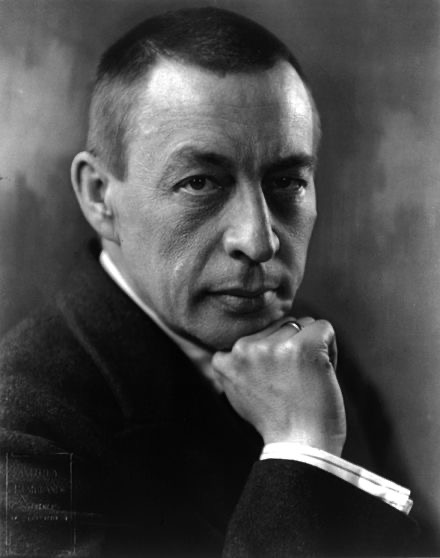
Piano Sonata No. 2 in B flat minor ,op 36 was composed in 1913, who revised it in 1931, with the note, “The new version, revised and reduced by author.” Three years after his third concerto was finished, Rachmaninoff moved with his family to a house in Rome that Tchaikowsky had used. It was during this time in Rome that Rachmaninov started working on his second piano sonata. However, because both of his daughters contracted typhoid fever, he was unable to finish the composition in Rome. Instead, he moved his family on to Berlin in order to consult with doctors.
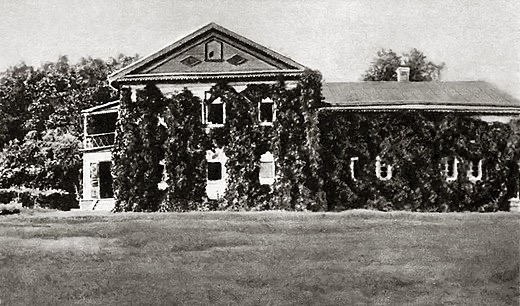
Ivanovka was the ideal location for Rachmaninoff to compose., their private country estate near,Tambov, to which the composer would return many times until 1917
When the girls were well enough, Rachmaninoff travelled with his family back to his Ivanovka country estate, where he finished the second piano sonata. Its premiere took place in Kursk on 18 October 1913
The sonata is in three interrelated movements:
Allegro agitato
Non allegro—Lento
Allegro molto
It is unified by two Non allegro bridges between the movements. The outer movements follow sonata form.
When Rachmaninov performed the piece at its premiere in Moscow, it was well received.However, he was not satisfied with the work and felt that too much in the piece was superfluous. Thus, in 1931, he commenced work on a revision. Major cuts were made to the middle sections of the second and third movements and all three sections of the first movement, and some technically difficult passages were simplified.
A performance of the original version lasts approximately 25 minutes while a performance of the revised version lasts approximately 19 minutes.
In 1940, with the composer’s consent, Vladimir Horowitz created his own edition which combined elements of both the original and revised versions. His edition used more original material than revised throughout all three movements. A performance of the Horowitz revision lasts approximately 22 minutes.
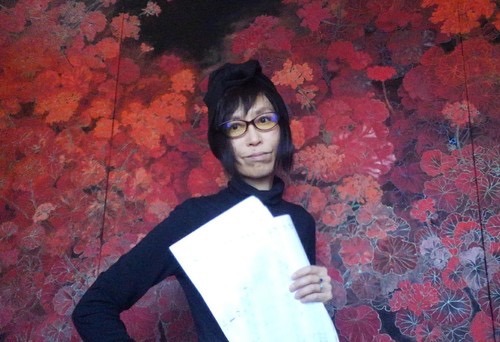
Minako TokuyamaBorn in Osaka in l958, Tokuyama Minoko received degrees from both the Tokyo University ot Fine Arts and Music and the Universitat der Kunste Be studied composing under lkenouchi Tomoiiro, Yashiro Akio, Noda Teruyuki and lsang Yung. In 1984 she was bestowed the JSCM’s First New Artist award, and in l990 she represented japan at the First Pacific Composers Conference at the Pacific Music Festival as well as earning a diploma at the Valentino Bucchi International Competition in Composition in Italy. She was invited to compose Spring Festival at Contemporary Music, Seattle consecutively in 1991 and 1992, and in i992 she took the First prize in the 5th Prix de Fukui de Musique Harpe. She was invited to judge that same contest in 1995. In October of i997 her piece commemorating the Namihaya Japan Sports Association was first performed by the Century Orchestra Osaka, and she also won first place that year in the International Wiener Komposition as well. The piece she wrote tor that competition, “Mement Mori”, was performed tor the on stage at the Wien Modern Festival by the Winer Staatsopernballett in November 1997. She has been judging Composition in the japan Music Competition since 2003.Christopher Axworthy Dip.RAM ,ARAM https://christopheraxworthymusiccommentary.com/2024/03/20/christopher-axworthy-dip-ram-aram/Ileana and Joan 3rd December https://christopheraxworthymusiccommentary.com/2023/12/05/ileana-and-joan-3rd-december-2023/
The birth of a great artist yesterday at the POSK theatre in Ravenscourt Park,London.
A young pianist of exceptional talent where the more talented you are the more you are disturbed by the impossible task of seeking perfection.
Andrzej Wiercinski I have been listening to for some years ever since his first appearances over ten years ago in that Mecca for all aspiring young musicians. St Mary’s Perivale is where Dr Mather and his team offer a concert and recording to artists that have dedicated their youth to art and just need an audience to continue their voyage of discovery with.
But today I heard a pianist who was at one with the music with performances of great personality but totally at the service of the composer.
His Kreisleriana seemed as an improvisation such was his extraordinary palette of sounds allied to a scrupulous attention to the score. A fleetingly chameleonic change of character from the passionate opening to the sublime intimate flights of fantasy. A breathtaking performance where he had us sitting on the edge of our seats in anticipation of the secrets that this Poet of the piano would reveal in what is quite the greatest interpretation I have ever heard.
It is a work in eight episodes that is not easy to shape into one unified whole. Andrzej found the key in the sumptuous bass sounds that was the common denominator that pervaded the entire work. A bass that could allow for the piano to open up its sonorities and create sounds of full richness and passionate intensity as it could allow for the most exquisite sounds of barely murmured sentiments. The opening was a hurricane of passion where the intricate weaving strands in the right hand of quite considerable virtuosity were sustained by the rich full bass and masterly use of the pedal.The central episode was allowed to ride on this sumptuous rich wave of sound without having to slow down as it grew out of what came before and was to come after.Ravishing playing of such subtle shaping and delicacy before the hurricane regained its energy with even more passionate energy. There was extraordinary beauty to the legato of the second episode with the deep bass melody just hinted at as was the melodic line in the right hand all incorporated into this one long outpouring of song. Interrupted by the first Intermezzo that was played with clockwork precision and drive and contrasted so well with the continual wave of song that was forever present.The second Intermezzo was remarkable for its sense of line, and the prominence given to the bass in the final few bars was indeed a master stroke. It was the clarity of line and sumptuous sounds bathed in pedal that made the central part of the third episode quite memorable, with one melodic strand overlapping the other in a duet of sumptuous beauty. Again it contrasted with the spiky rhythmic drive of the outer episodes.The coda ‘Noch schneller’ was breathtaking for it’s animal excitement and enormous sonorities that were never hard but always with a sense of line and overall shape. A tour de force of control of sound quite apart from the extraordinary precision and finger dexterity. There was a simplicity to the disarming ‘sehr langsam’ of the fourth episode played with poignant intensity, the tension released with the gentle song of the ‘Bewegter’. Within all the capricious rhythmic elements of the fifth episode, Andrzej managed to find the musical line that in turn was linked with the mellifluous central episode, where even here one seemed to grow so naturally out of the other. A wonderfully passionate outpouring to this central episode that was a true explosion of romantic fervour. A whispered beauty to the melodic line in the sixth episode where out of nothing there seemed to be born new life, in one of those magic moments that only the poet Schumann could envisage.The ‘sehr rash’ of the seventh was played with a brilliance and animal fervour that was overwhelming in its dynamic drive and digital perfection. Even in these transcendentally difficult passages Andrzej could steer us through a maze of notes giving them an architectural, expressive shape and meaning. Wonderful to hear the non legato chords in the coda that suddenly become legato as they come to rest on a cloud of beauty.The last episode is probably the most difficult to hold together and it was here that Andrzej showed a complete understanding of Schumann’s chameleonic change of character. There was the beautiful bass melody allowed to flow so gracefully in the first episode and the wondrous use of the pedal and the deep bass notes in the second that allowed a build up of sonority without any hardness or exaggeration. The gently rhythmic outer episodes were sustained by deep bass notes as the work finished with whispered notes deep in the bottom of the keyboard.
The young talented teenager now on the edge of thirty has become a very great artist.
Chosen to present the newly acquired manuscript of Chopin’s Fourth Ballade for the Polish Institute in Warsaw, he changed the announced programme of the third Ballade to the fourth.
A press conference was held to present the manuscript of the Ballade in F minor, Op. 52, composed in 1842. My participation was the presentation of the national version and the version from the manuscript so as to highlight the differences. Such a wonderful experience. You can watch the entire conference at the link below.: https://www.youtube.com/live/QHk1LbWTYWE?si=ad_uKXvFSJVjxBER
But it was the opening Nocturnes op 55 and the Mazukas op 50 that immediately revealed his great artistry. A freedom that had in its midst a burning energy that carried him on a wave of sound where the music just seemed to pour out of him.
Of course the B minor Sonata and the F minor Ballade showed his architectural understanding not only of the structure but what true Bel Canto can mean.
Hats off to Norma Fisher, and Roger Nellist of Perivale, who have been monitoring and helping him in these past few years where his seemingly unattainable vision was so close but yet so far.
‘Je sens, je joue, je trasmet’ was used to describe Cherkassky many years ago and with Andrzej today has never been more actual
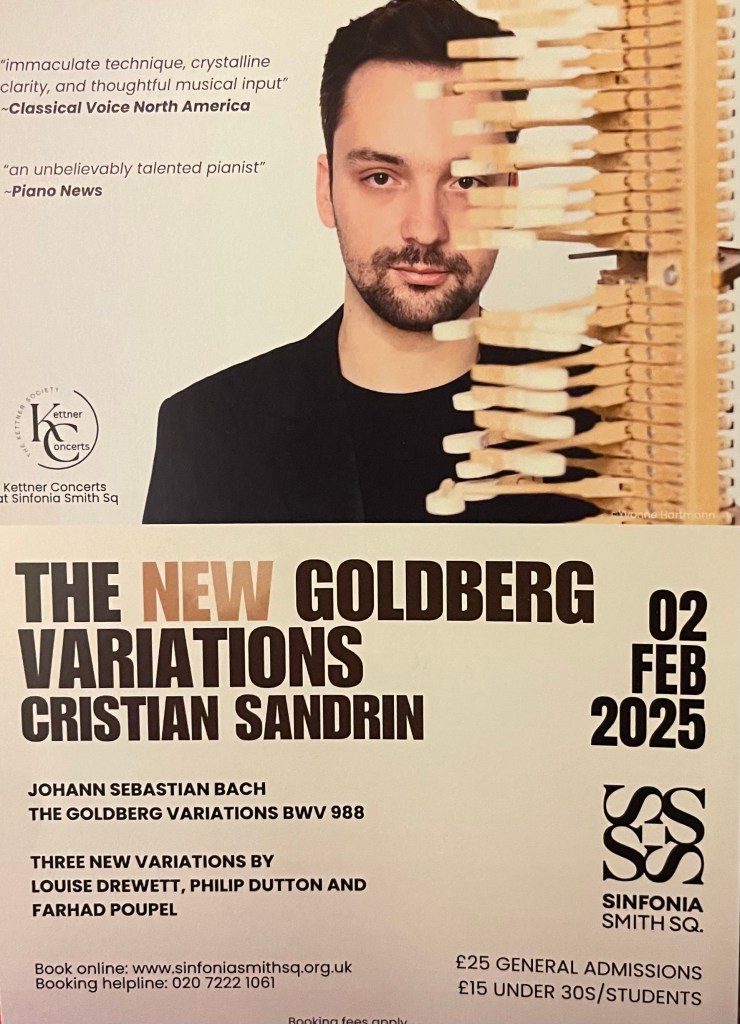
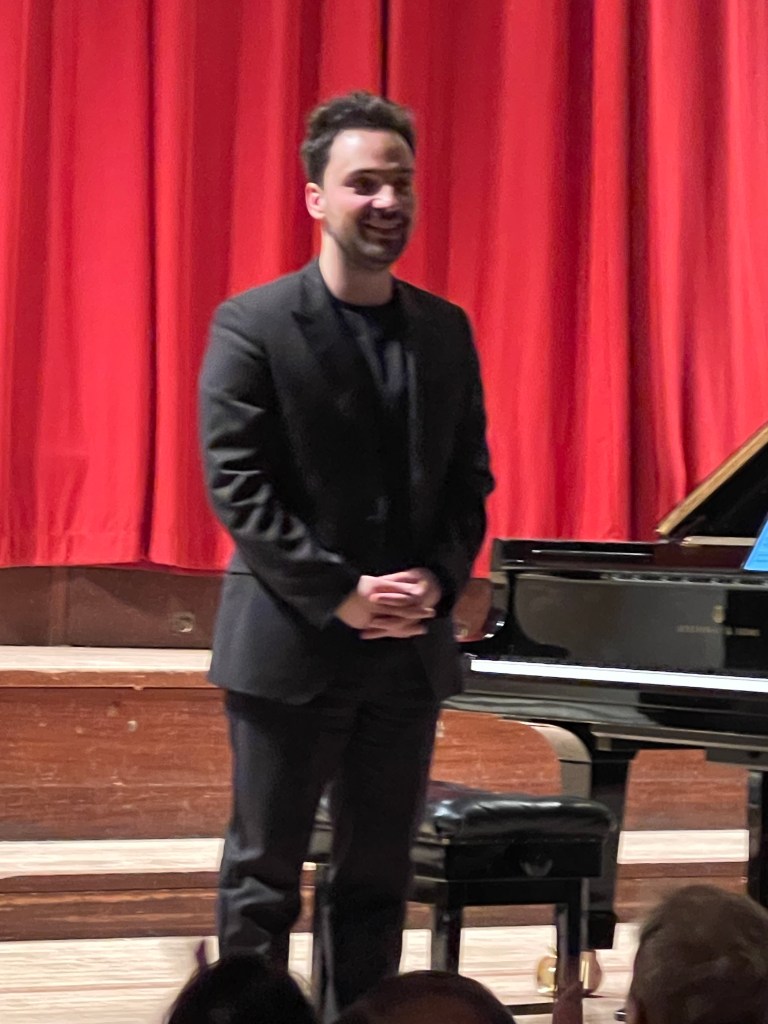
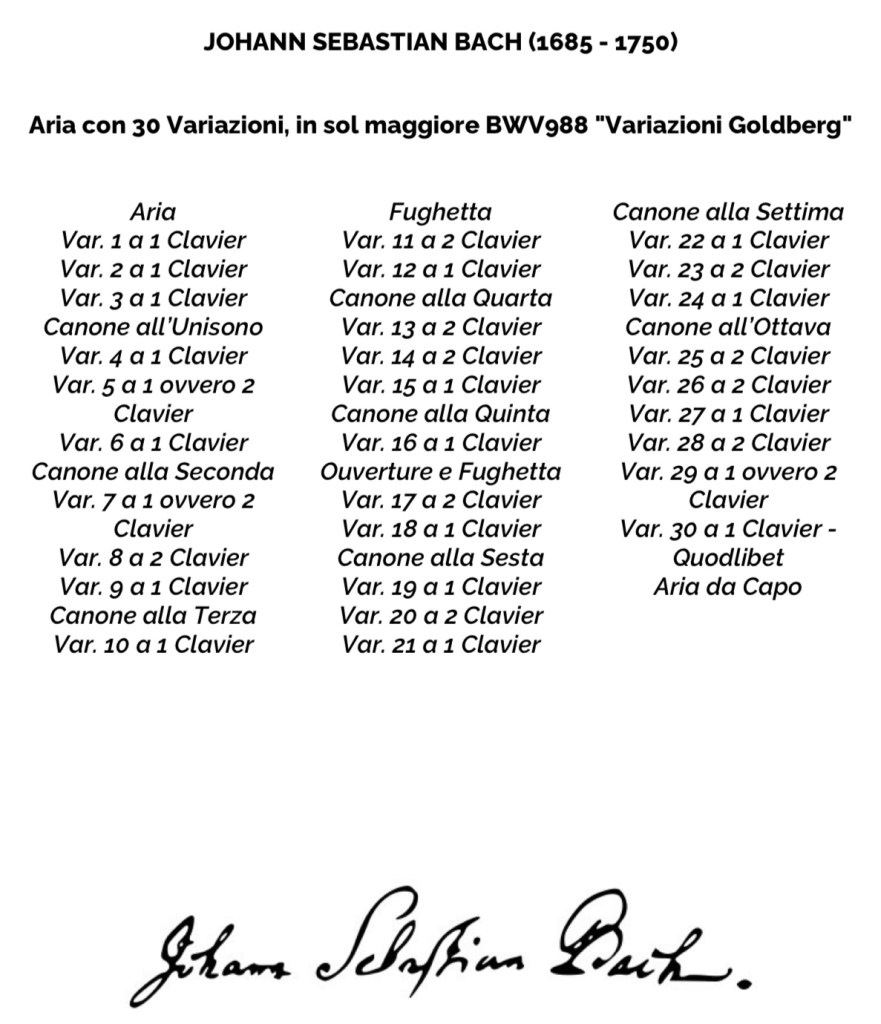
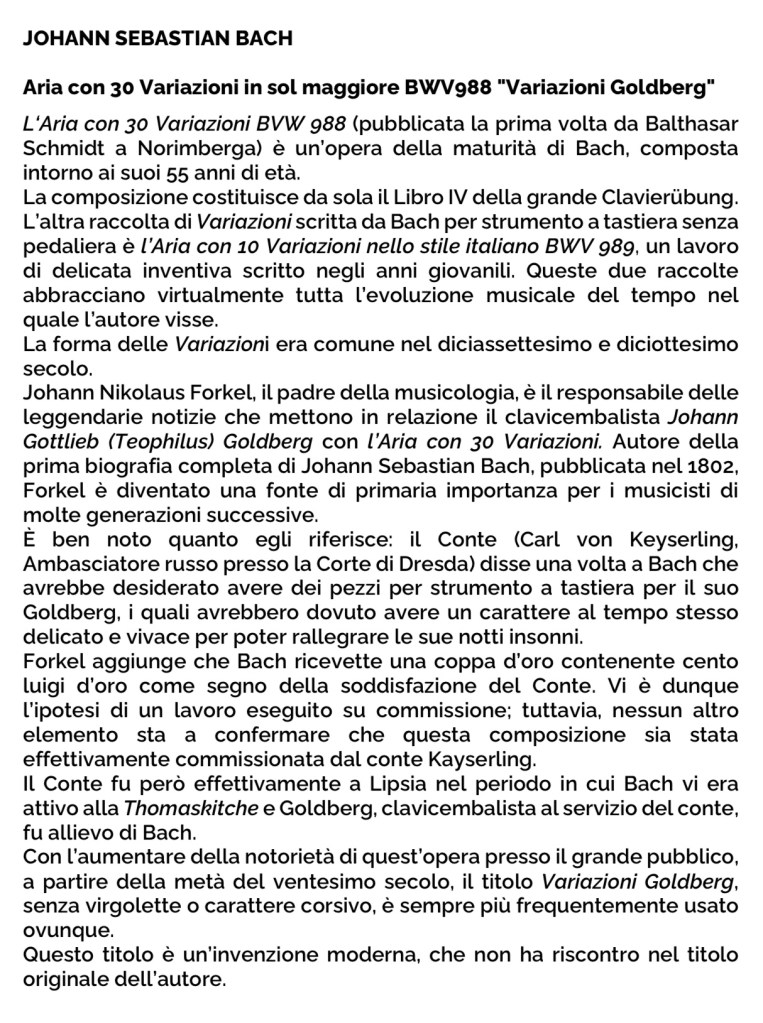
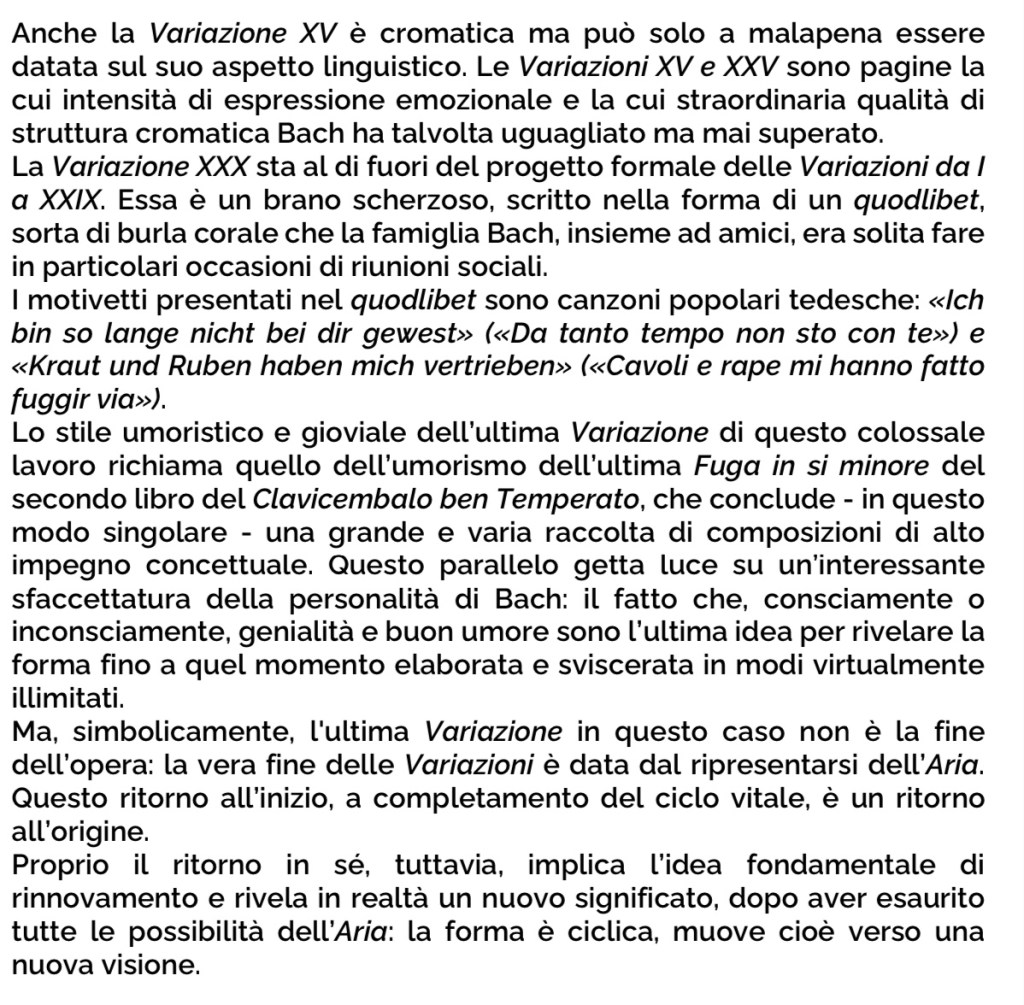
Unfortunately Bach could not make it on stage at the end of a ravishingly beautiful performance of his Goldbergs by Cristian Sandrin last night .
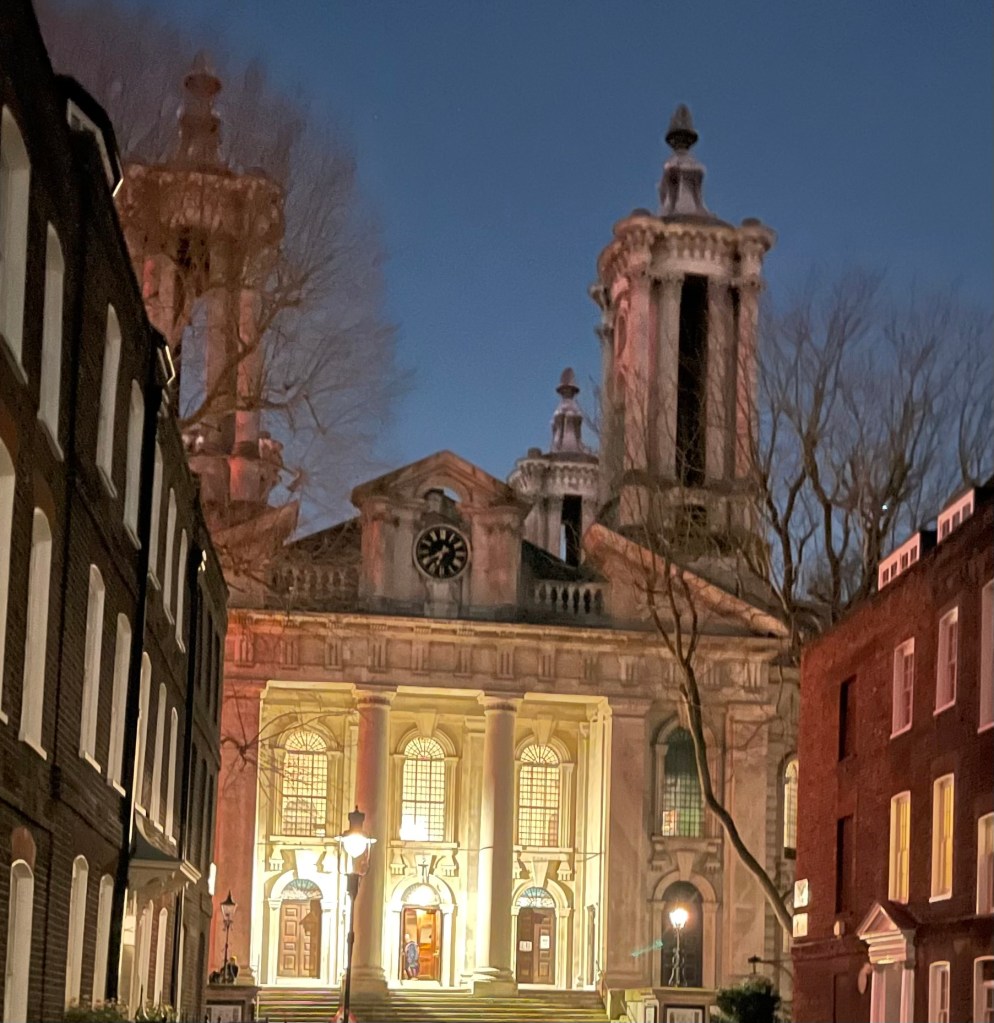
His presence was felt strongly, though, in this most beautiful of London Concert Halls.
These were not the monumental variations that the High Priestess of Bach would offer in a quasi religious seance. These were seen through another prism, one that had inspired three young composers,commissioned by this eclectic musician, to enhance the aspect of beauty and ravishment that Bach had been commissioned to write to inspire the dreams of an insomniac. Perchance to dream indeed !
Nearly two hours of music as our genial host like all serious musicians played all Bach’s repeats, bar one, adding discretely with the use of an I pad the three where the ink was still wet on the page .
Bach’s work seemed to have on him quite the opposite effect from its commission as he extracted the three new variations and allowed them to shine on their own with ravishing beauty around this magnificent edifice. Encore took on a new meaning just as the title the ‘New Goldberg Variations’ had promised.
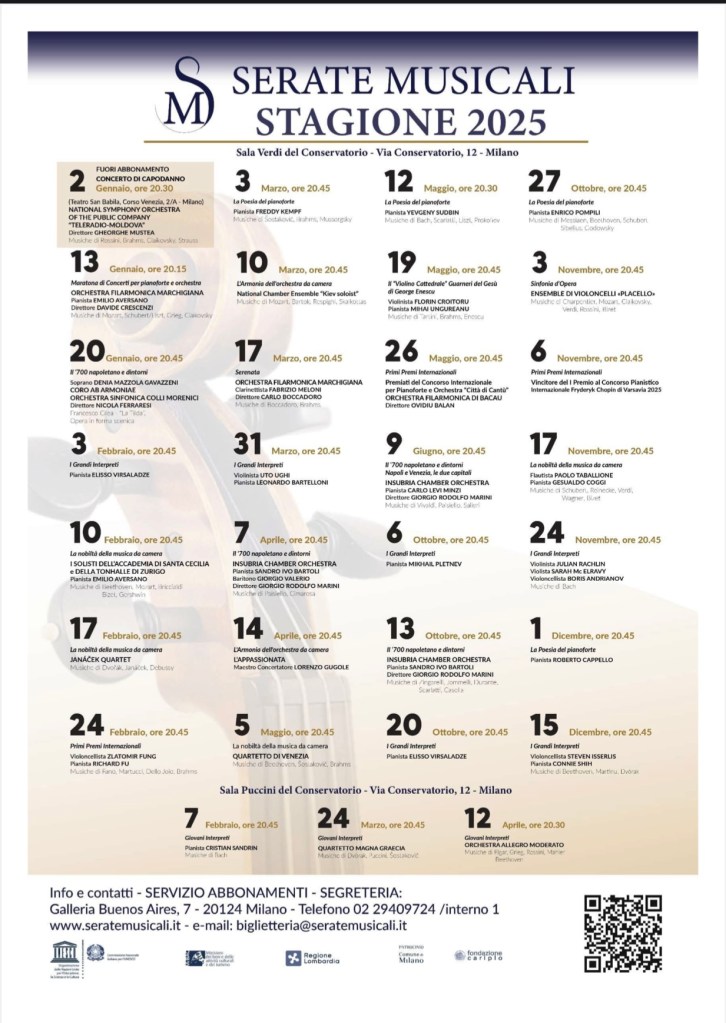
A triumph and a refreshingly original performance of one of the greatest creations of all keyboard works. Lucky Milan who will get seconds on Friday for Hans Fazzari’s Serate Musicali !
The opening of a much needed Young Artists Series at the new Bechstein Hall that is fast making it’s mark as an important new concert venue in London, just complimenting its next door neighbours of Wigmore Hall and Bob Boas Salon in nearby Mansfield Road. An important new venue especially for young musicians who have dedicated their youth to art and are just in need of a public to continue their voyage of discovery together.
What better choice could there have been than a young man perfecting his quite considerable skills at the Guildhall under such esteemed musicians as Charles Owen and Lucy Parham ,who we have recently applauded in this very hall.
Thomas Masciaga ,a young Italian from Ivrea whose evident love for the piano shone through everything he did.
Just two Sonatas both in B minor and both played with ravishing sound and a musicianly sense of style. I have rarely heard the Chopin scherzo from the B minor Sonata played as beautifully with a jeux perlé so exquisitely shaped.
The mighty Rondo Finale: ‘Presto non tanto’ was so beautiful that each time the rondo returned it was played ever more radiantly and not just treated with the usual brutal force and lack of finesse of lesser artists . The cascades of notes after the imperious chords were truly like wafts of golden sunlight shining on the ever more exciting forward drive.
The opening of the sonata was indeed Maestoso and if his love for Chopin’s glorious outpouring of Bel Canto meant that he had to sacrifice the overall architectural shape of the movement , it was the price he had to pay for having such an exquisitely sensitive heart .
The mighty chords at the opening of the Largo were the consequence of the final notes of the scherzo and heralded a bel canto of beguiling freedom and beauty.
This was playing of a supreme stylist who could bring to life a work so often manhandled by so called virtuosi.Thomas has all the same virtuosity but it was canons covered in flowers!
The Haydn Sonata too was played with exquisite style but also with a kaleidoscope of colour with a first movement of beauty and grace and an architectural shape that suited the style of its age. A ‘Menuetto’ of beguiling delicacy and pastoral innocence with the spell broken momentarily only by the imposing ‘Trio.’ The return of the ‘Menuetto’ was gracefully embellished, as is the vogue these days, but wonder whether an artist who can make the modern piano speak with such an exquisite voice needs to add embellishments that were of an age when the magnificent voice of the Bechstein of today was not yet envisage.The ‘Presto’ was played with brilliance and grace with lubricated fingers of crystalline clarity. The ritornello here (he had ignored it in the Chopin) just added to the sumptuous enjoyment that he was providing this morning.
Hats off to the director Terry Lewis, present this morning ,to applaud this young artist in a hall he has fought for many years to bring to fruition.
Born in Italy to an Anglo-Italian family, Thomas started playing piano at the age of 7, studying first at the local music school and then privately with Italian concert pianist Chiara Bertoglio. At 12, he debuted with a solo recital in Siena at Teatro dei Rozzi, going on to win several national and international competitions in subsequent years. At the age of 15, he began commuting between Italy and London to attend the Junior Guildhall Music Program where he won the Piano Prize, was a Lutine Prize finalist, and a Beethoven Intercollegiate Piano Competition finalist in Manchester. Thomas continued his undergraduate and postgraduate studies at the Guildhall School of Music and Drama, working alongside Lucy Parham, Charles Owen, Paul Roberts, and Joan Havill. Graduating with a first-class bachelor’s degree, he was awarded a Concert Recital Diploma, and is currently in the first year of his Artist Diploma. Thomas is also a student of renowned Russian pianist Konstantin Bogino in the prestigious Accademia Perosi of Biella. During his studies in London, Thomas has regularly performed solo recitals and piano concertos in both England and Italy, including prestigious venues such as St.James’s Piccadilly and Milton Court Concert Hall, has worked with various orchestras and has been a session player at the Abbey Road Studios. Thomas is a proud Talent Unlimited Artist since November 2024.
Beethoven in all his glory tonight at Bechstein’s. The first and last cello sonatas, the penultimate twin of op 102 and the virtuoso show piece variations ‘See the conquering hero comes’.
After the deep contemplation of the opening ‘Adagio sostenuto’ this first sonata of Beethoven burst into an outpouring of joy with the sun shining unusually brightly for Beethoven. Even the Allegro Vivace final movement was full of playful energy and shifting colours.Youthful brilliance and exhilarating energy were the hallmarks of a performance that reminded me of that ‘Golden couple’ almost fifty years ago. A light still shining brightly with these two genial musicians.
Op 102 n.1 where the plaintive cry of the cello was answered by the simple benediction of the piano before the eruption into the imperious Allegro vivace. It was played with dynamic relentless drive and with its abrupt non nonsense Beethoven ending.The question and answer of the Adagio was followed by the unexpected changes of character in the Allegro vivace in a performance of great authority and musical integrity.
The variations that followed the interval were a series of brilliant show pieces for each instrument with each player trying to outdo the other. The eleventh variation showed the genial invention of Beethoven with the poignancy of the two instruments united in an Adagio that was to point to the final and greatest inspiration of Beethoven with his Sonata op 102 n.2.
It was here, in this final sonata, that both players were inspired to give a mesmerising performance of this great work, from its opening call to arms ( every bit as arresting as the Fifth Symphony) and the Adagio of searing beauty with a deep soulful communion of great poignancy. Played with poise and aristocratic weight, its gentle hints barely whispered of what was to come with the mighty Fugue final movement. A movement played with quite considerable mastery not only technically but above all for the music line that together they could carve out of this monumental construction. Veni Vidi Vici indeed
It is this that could well have given the title to performances tonight of dynamic drive and searing intensity.
Guy Johnston and Mishka Momen Rushdie, two players that play as one .
The piano lid fully opened and the cellist using the sound board of the piano to project sounds that rarely we hear in the concert hall united with such vibrancy and energy.
Guy Johnston and Mishka Momen Rushdie are both masters linked inexorably together to bring Beethoven’s thoughts to us ‘hot off the press.’ These were performances in this sumptuous new hall that were born of an intelligence and musical integrity of an age when there was time to dig deep into the very core of the music and extract the meaning that hides behind the seemingly innocuous black and white symbols on the page.
These were performances that in the not too distant past one would travel to Marlborough or Prades to hear and learn from.
Ludwig van Beethoven Baptised 17 December 1770. 26 March 1827 (aged 56) Vienna
Beethoven composed five sonatas for cello and piano, between 1796 (op. 5 nos. 1–2) and 1815 (op. 102 nos. 1–2)
In February 1796, Beethoven set out on a tour of East-Central Europe, starting with Prague and working his way to Berlin via Dresden and Leipzig. Berlin had been one of Europe’s musical centers but was, by the time Beethoven arrived that May, in dire musical straits. Johann Friedrich Reichardt, the distinguished composer who had brought the city’s musical life to distinction in the 1780s, had been relieved of his post for pro-French-Revolution sympathies. (He apparently let slip that the best kind of king was one with no head during a card-game in Hamburg, something that didn’t exactly thrill his boss, King Friedrich Wilhelm II of Prussia.) Among the few performers of distinction who remained in the Prussian capital was the cellist Jean-Louis Duport, a favorite of the king, who was himself a fine amateur cellist. So it was only natural that Beethoven should write some music for cello and piano during his stay in Berlin. His first two Cello Sonatas, Op. 5, and the Variations on “See the conqu’ring hero comes” from Handel’s Judas Maccabaeus were the results. The Judas Maccabaeus Variations date from this Berlin visit; they, too, were published by Artaria (without an opus number) in 1797. The theme – probably the best-known from Handel’s entire oratorio – was an especially felicitous choice on the part of the young Beethoven. He may not have known it, but Handel occupied a special place in Friedrich Wilhelm’s affections. The king, during his days as crown prince, had declared his musical independence from his predecessor, Friedrich the Great, by sponsoring a massive performance of Handel’s Messiah in the Berlin Cathedral. Beethoven, too, held Handel’s music in the highest esteem. The theme, with its measured tread and lofty bearing, provided the composer with the basis for an engaging set of 12 variations. The eleventh variation, an extended adagio, is the longest “slow movement” Beethoven would write for cello and piano until his final work for the pairing, the Sonata, Op. 102, No. 2.
Nikolaus Kraft (1778-1853) was the eldest son of the cellist Anton Kraft (1749-1820). In 1801 he travelled to Berlin together with his father where he received cello lessons for one year from the virtuoso cellist Jean-Louis Duport (1749-1819), who was employed there at the Prussian court of King Friedrich Wilhelm II. Nikolaus, as well as his father, was also for a time a member of the Schuppanzigh string quartet – named after its founder the violinist Ignaz Schuppanzigh (1776-1830) – which gave a number of first performances of Beethoven’s string quartets.The Krafts were not the only cellists with whom Beethoven worked during his life. In spring of 1796 Beethoven visited the Prussian court in Berlin, where he also met Jean-Louis Duport, and it was there that his op. 5 cello sonatas originated. These sonatas are regarded today as the first ‘true’ sonatas for cello and piano, as the two instruments are given equal importance.Jean-Louis Duport was one of the most influential cellists of his time. In the early 19th century he published a violoncello treatise entitled: Essai sur le doigté du violoncelle et sur la conduite de l’archet (Essay on fingering the violoncello and on the conduct of the bow) (Paris, 1806). This became one of the most influential cello treatises in the history of the cello; the exercises (Études) that are included in it are still practised by cello pupils today.
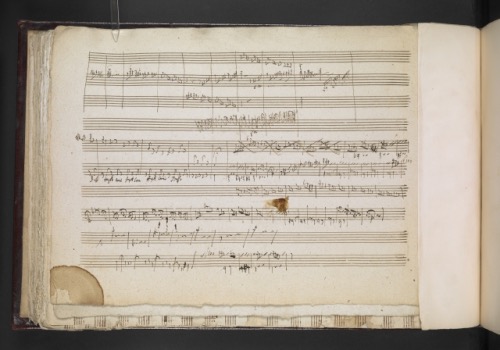
Sketches for Beethoven’s Cello Sonata op. 5 no. 1 in the ‘Kafka’ sketch miscellany. Allegro movement.
At the time of Beethoven’s visit, Jean-Louis Duport was principal cellist in the opera orchestra and, together with his brother the virtuoso cellist Jean-Pierre Duport (1741-1818), also instructed the king on the cello. Beethoven and Jean-Louis Duport performed his op. 5 cello sonatas for the king, and apparently, Beethoven also intended to dedicate the two sonatas to him. This is evident from a letter, now lost, which Duport sent to him where he wrote: ‘Duport, acknowledges the dedication to him of Beethoven’s two sonatas for piano and violoncello and expresses the wish to play them with the composer’. In the end the op. 5 cello sonatas were dedicated to the King of Prussia, Friedrich Wilhelm II.
The Sonatas for cello and piano No. 4 in C major. op.102, No. 1, and No. 5 in D major, Op. 102, No. 2, were composed simultaneously in 1815 and published, by Simrock, in 1817 and were dedicated to the Countess Marie von Erdödy, a close friend and confidante of Beethoven.
The two sonatas were written between May and December 1815. The first copy by Beethoven’s copyist Wenzel Rampl was made in late 1815 but was then subject to further alterations by Beethoven. A subsequent ‘good’ copy was supplied in February 1816 to Charles Neate for proposed, though unrealized, publication in London. Beethoven then made further small alterations prior to their eventual publication by Simrock in Bonn.
During the period 1812 to 1817 Beethoven, ailing and overcome by all sorts of difficulties, experienced a period of literal and figurative silence as his deafness became overwhelmingly profound and his productivity diminished. Following seven years after the A major op 69 the complexity of their composition and their visionary character marks (which they share with the piano sonata op 101 the start of Beethoven’s ‘third period’.
The critics of the time, were often perplexed by Beethoven’s last compositions: ‘They elicit the most unexpected and unusual reactions, not only by their form but by the use of the piano as well…We have never been able to warm up to the two sonatas; but these compositions are perhaps a necessary link in the chain of Beethoven’s works in order to lead us there where the steady hand of the maestro wanted to lead us.’
Guy Johnston is one of the most exciting British cellists of his generation. His early successes included winning the BBC Young Musician of the Year, and significant awards, notably the Shell London Symphony Orchestra Gerald MacDonald Award, Suggia Gift Award and a Young British Classical Performer Brit Award. He has performed with many leading international orchestras including the London Philharmonic, NHK Symphony Orchestra,BBC Symphony, Deutsches Symphonie-Orchester Berlin, Orquestra Sinfônica do Estado de São Paulo, and St Petersburg Symphony. Recent seasons have included a BBC Prom with BBC National Orchestra of Wales, concertos with The Hallé, Philharmonia Orchestra, Royal Philharmonic Orchestra, Orchestra of Opera North, BBC Symphony Orchestra, Aurora Orchestra, Royal Northern Sinfonia, and Orchestra of The Swan. Most recently, he has been the featured soloist of Taverner’s ‘The Protecting Veil’ for Britten’s Sinfonia 2024 UK and Ireland tour receiving critical acclaim in The Guardian and the Arts Desk. Performances and recordings with eminent conductors have included collaborations with Alexander Dmitriev, Sir Andrew Davis, Daniele Gatti, Ilan Volkov, Leonard Slatkin, Mark Wigglesworth, Robin Ticciati, Sir Roger Norrington, Sakari Oramo, Vassily Sinaisky, Yan Pascal Tortelier and Yuri Simonov. Guy is a passionate advocate for chamber music and recitals as founding Artistic Director of the Hatfield House Music Festival and performs regularly at prestigious venues and festivals across Europe including Wigmore Hall, Louvre Museum, the Moscow Tchaikovsky Conservatory, and Three Choirs Festival, collaborating with instrumentalists such as Anthony Marwood, Brett Dean, Huw Watkins, Janine Jansen, Kathy Stott, Lawrence Power, Melvyn Tan, Mishka Rushdie Momen, Sheku KannehMason and Tom Poster. A prolific recording artist often championing contemporary British composers, Guy’s recent releases include Dobrinka Tabakova’s Cello Concerto with The Hallé and Rebecca Dale’s ‘Night Seasons’ with the Philharmonia Orchestra. Other recordings include a premiere of Herbert Howells’ completed Cello Concerto with the Britten Sinfonia, a celebration disc of the tricentenary of his David Tecchler cello with commissions by Charlotte Bray, David Matthews, Mark Simpson and a collaboration with the acclaimed Orchestra dell’Accademia Nazionale di Santa Cecilia in Rome, where the cello was made. 2025 will bring forth Guy’s latest recording of Xiaogang Ye’s My Faraway Nanjing with the Royal Liverpool Philharmonic Orchestra. He gave the premiere of Charlotte Bray’s ‘Falling in the Fire’ at the BBC Proms and Joseph Phibbs ‘Cello Sonata’ at Wigmore Hall. His 2024/2025 season will see the world premiere of Joseph Phibbs’ Cello Concerto for Guy and the BBC Symphony Orchestra. Other premières include Emma Ruth Richards ‘Until a Reservoir no longer remains’ and a recording of Matthew Kaner’s solo suite for cello.In addition to a busy and versatile career as an international soloist, chamber musician and guest principal, Guy is an inspiring leader of young musicians. He was Associate Professor of Cello at the Eastman School of Music in Rochester, New York (2018-2024) and a guest Professor of Cello at the Royal Academy of Music, where he was awarded an Hon. ARAM in 2015. He has recently been appointed President of the European String Teachers Association and is patron of several charities which promote music education for school children and young people including Music First and Future Talent. He is also a board member of the Pierre Fournier Award for young cellists.
Guy Johnston plays the 1692 Antonio Stradivari cello known as the “Segelman, ex Hart” kindly loaned to him through the Beare’s International Violin Society by a generous patron. He is a Larsen Strings Artist. Hailed as “one of the most thoughtful and sensitive of British pianists” (The Times), Mishka Rushdie Momen captivates audiences with her refined and expressive playing. Mishka Rushdie Momen’s wide repertoire focuses on Mozart, Beethoven, Schubert, and Schumann, whilst reaching back to Gibbons and Rameau. Committed to performing new music, Mishka Rushdie Momen has commissioned works by Nico Muhly and Vijay Iyer, and premiered An Inviting Object by Héloïse Werner at the Lucerne Summer Festival in 2022. Recent and upcoming concerto highlights include debuts with The Royal Danish Opera, London Philharmonic Orchestra, Turku Philharmonic Orchestra and Mannheim Chamber Orchestra. Further orchestral engagements to date include City of Birmingham Symphony Orchestra, Deutsche Kammerakademie Neuss, Orchestre National d’Ile de France, Britten Sinfonia and play/directing Mozart K.271 with Luzerner Sinfonieorchester, working with Dinis Sousa, Anu Tali, Paul Meyer, Case Scaglione and Natalia Ponomarchuk. Rushdie Momen’s recital highlights include performances atHamburg Elbphilharmonie, Lucerne Festival, Tonhalle Zurich, Wigmore Hall, Antwerp’s deSingel, Guggenheim Museum Bilbao and Leeds Piano Competition and, in the US, Philadelphia Chamber Music Society, Phillips Collection in Washington DC, New York’s 92Y, Carnegie Hall, Portland Piano and The Maestro Foundation in Santa Monica. Her 24/25 recitals include Wigmore Hall, Royal Welsh College of Music and Drama, Aldeburgh Festival, and the re-opening festival of the Frick Collection in New York.
Equally at home as a chamber musician, Rushdie Momen’s chamber partners include Ian Bostridge, Mark Padmore, Joshua Bell, Midori, Angela Hewitt, Steven Isserlis, Timothy Ridout and Zlatomir Fung, with festival performances including Rheingau Festival, Gstaad Menuhin Festival, Oeiras International Piano Festival, Chamonix Vallée Classics, Hindsgavl, Chipping Campden, Trasimeno Festival, the new Casals Forum at Kronberg, and IMS Prussia Cove. Rushdie Momen’s latest release Reformation (Hyperion, 2024) presents the works of William Byrd, John Bull, Orlando Gibbons and Jan Pieterszoon Sweelinck, performed on the modern piano. The album was described in The Times’ selection of the best releases of 2024 as “a triumph”, as “quietly beguiling” (The Guardian) , “performed with thrilling exuberance and subtlety” (The Spectator), topped the Classical Charts in July 2024 and was chosen as a Classic FM Discovery of the Week. Her debut solo recording, Variations, was released in October 2019 by SOMM Recordings, featuring works by Robert and Clara Schumann, Brahms, and Mendelssohn. Mishka Rushdie Momen was The Times Arts critics’ chosen nominee in the field of classical music for their 2021 Breakthrough Award, given by Sky Arts and The South Bank Show, who profiled her for an episode of the programme broadcast in July 2021 Mishka Rushdie Momen studied with Joan Havill and Imogen Cooper at the Guildhall School of Music and Drama. She also studied periodically with Richard Goode, and at the Kronberg Academy with Sir András Schiff, who has presented her in recital and orchestral dates across the USA and Europe. Mishka Rushdie Momen’s studies at the Kronberg Academy were generously funded by the Henle Foundation.
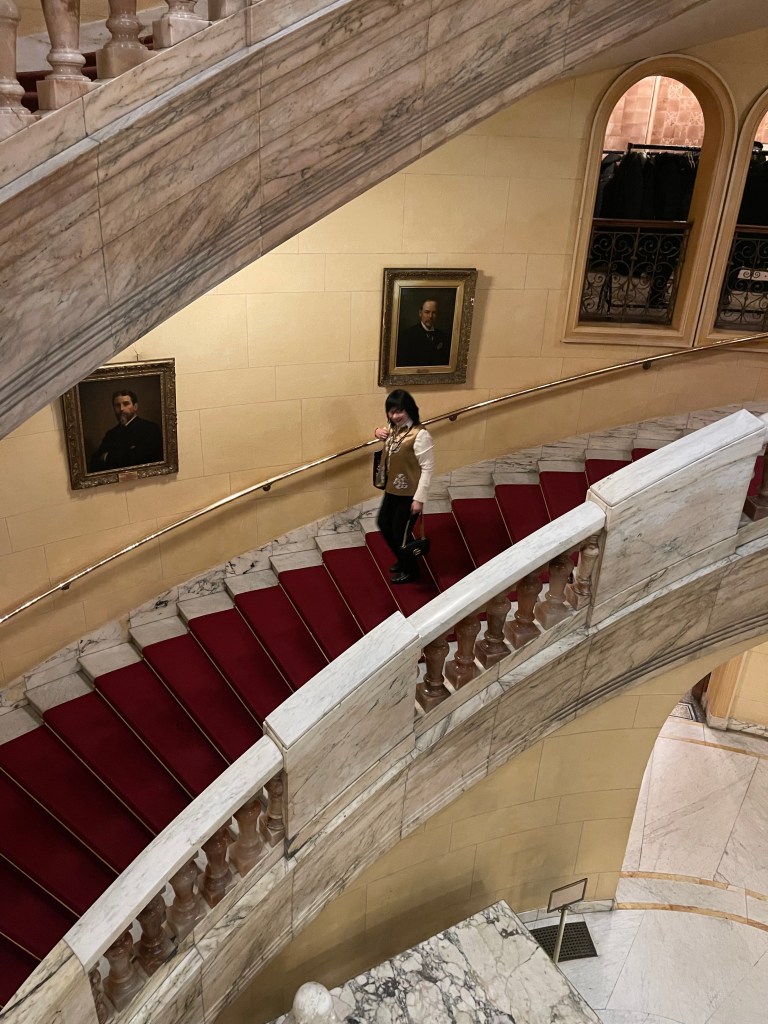
Curtis on the staircase to paradise – Hollywood could never match this
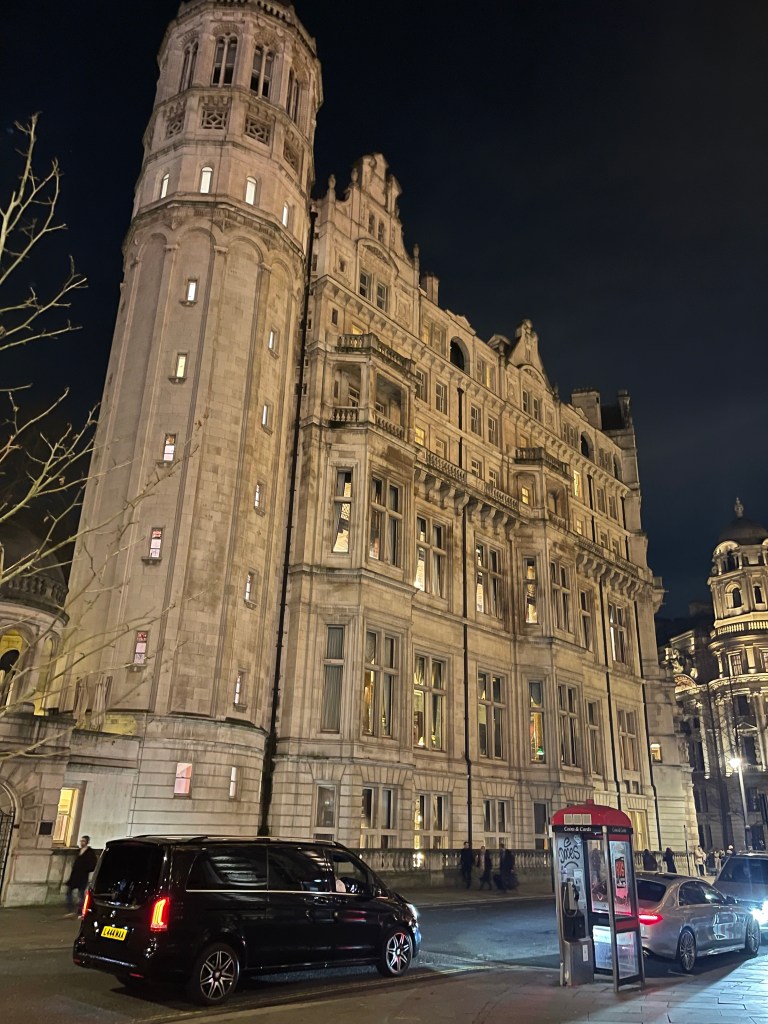
Lunar New Year at the National Liberal Club in an evening of sumptuous delight organised every year by Yisha Xue for her Asia Circle.Curtis invited for the first five days of Snake Year.
Dragon ,drums and many other delights to celebrate the opening of this New Year.The year of the Snake.
Yisha Xue on the red carpet leading to the NLC music room
A culinary feast for over 100 distinguished guests but it was the twenty year old Taiwanese pianist Curtis Phill Hsu who stole the show with playing of such exquisite artistry that silenced an audience ready for revelry. We were stopped in our tracks in one of those collective moments when time stands still.
Yisha’s daughter Amy Hawkins of the Guardian with former BBC journalist Humphrey HawkselyYisha Xue presenting the evening
The winner of the Hastings International Piano Competition cast a spell over the festive atmosphere and illuminated our evening with the perfumed delights of Debussy but above all the timeless beauty he brought to Schubert’s G flat Impromptu.
A sumptuous improvised paraphrase of a popular chinese film score was played with the ease and kaleidoscope of colours from a young man whose destiny is already sicured.
Yisha with new snakes 36,48 ,60 in the year of 2025 with prizes donated by Nicola,Marianna ,Roger Pillai and Kan Loo Roger,David,James with speaker Charlotte cane MPThe National Liberal Club
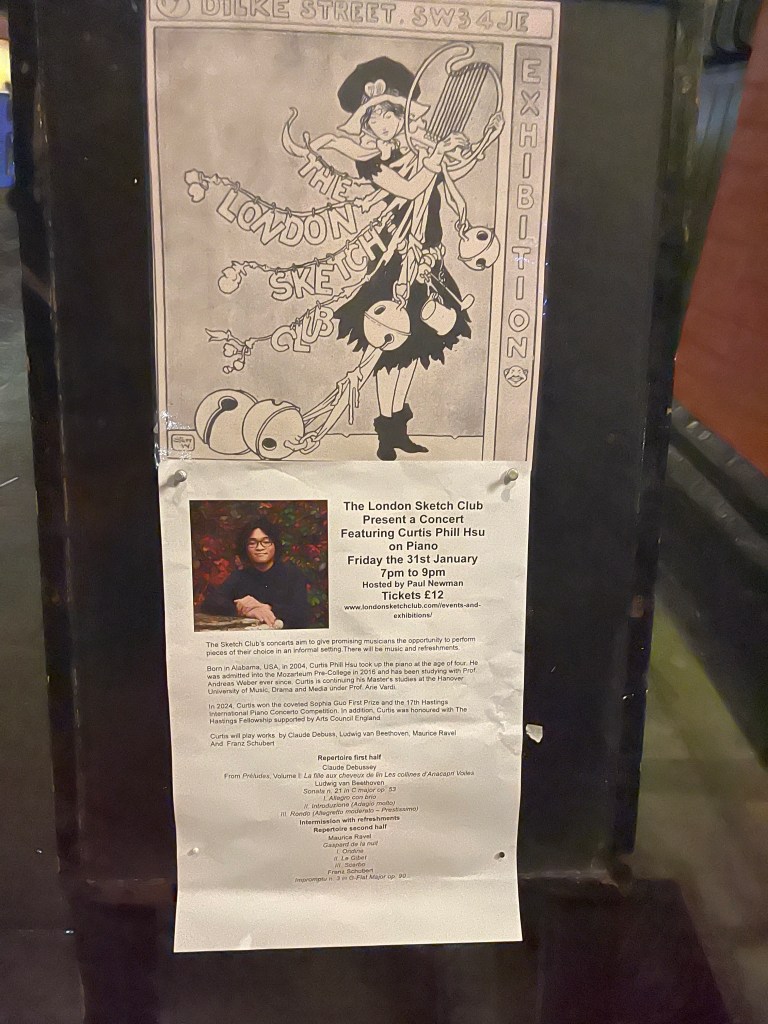
After the sumptuous Chinese New Year Celebrations at the NLC, Yisha together with Ian Brignall and Paul Newman, who had both travelled up especially from Hastings, having organised for the 2023 Hastings winner two extra concerts in Chelsea at the Sketch Club and finally on Sunday at the Arts Club.
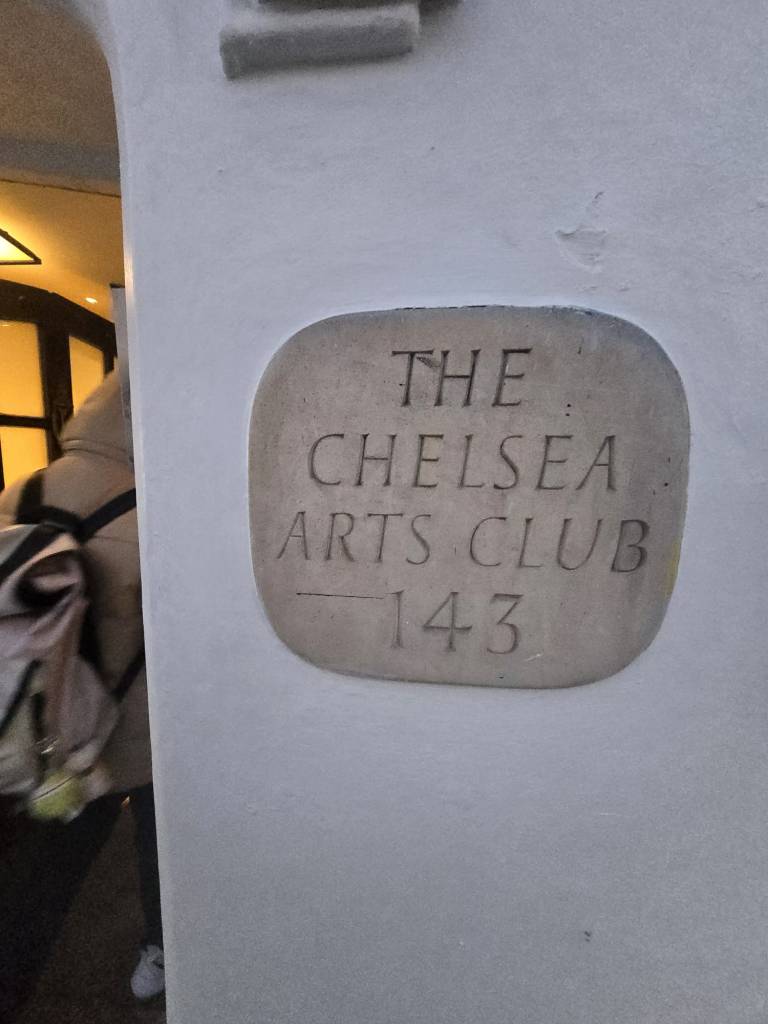
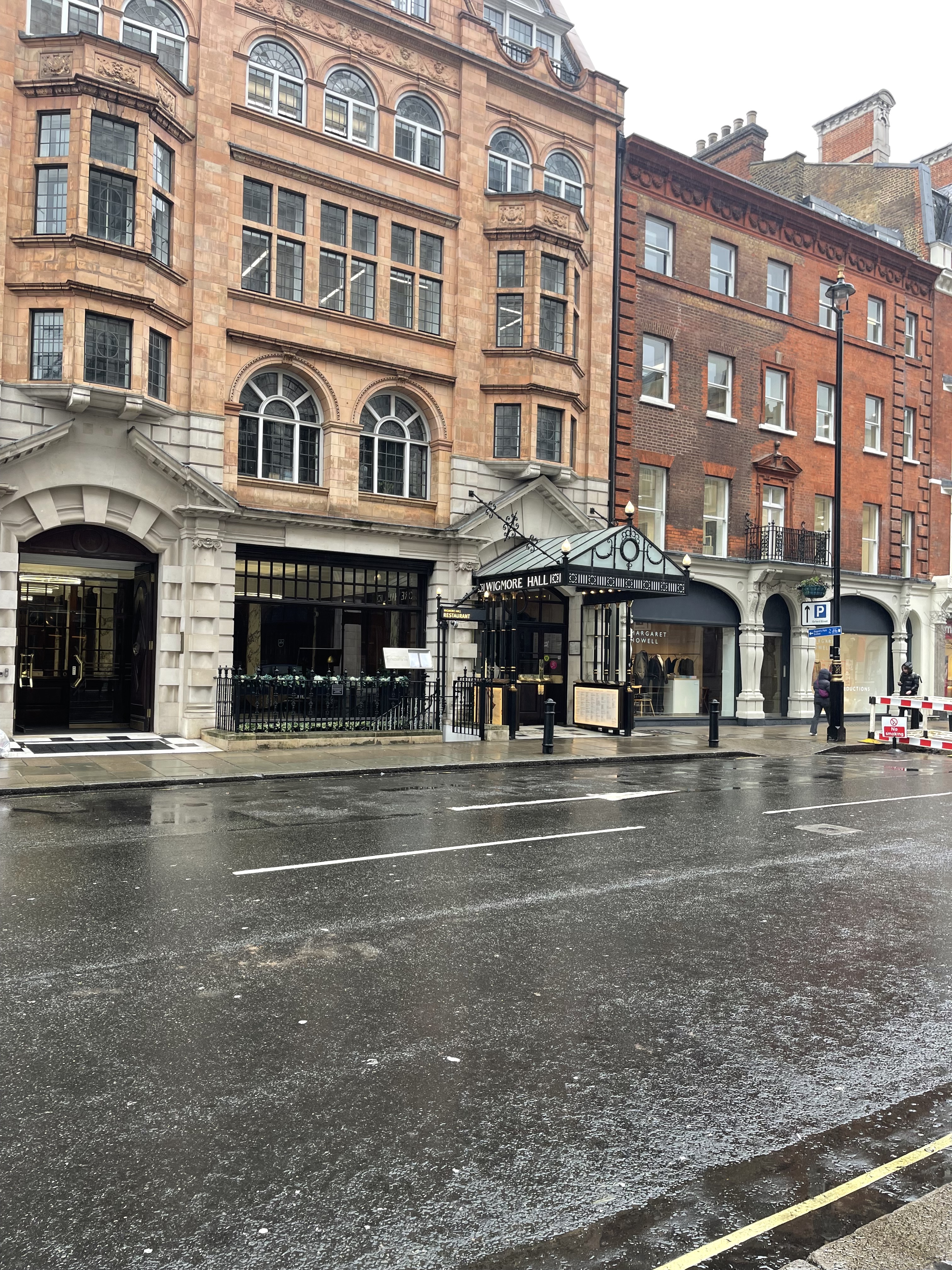
This little tour had in fact commenced with a full recital in Bob Boas sumptuous salon, neighbour of the Wigmore and Bechstein Halls,and had concluded after the NLC and Sketch Club with a Sunday evening concert at Chelsea Arts Club.
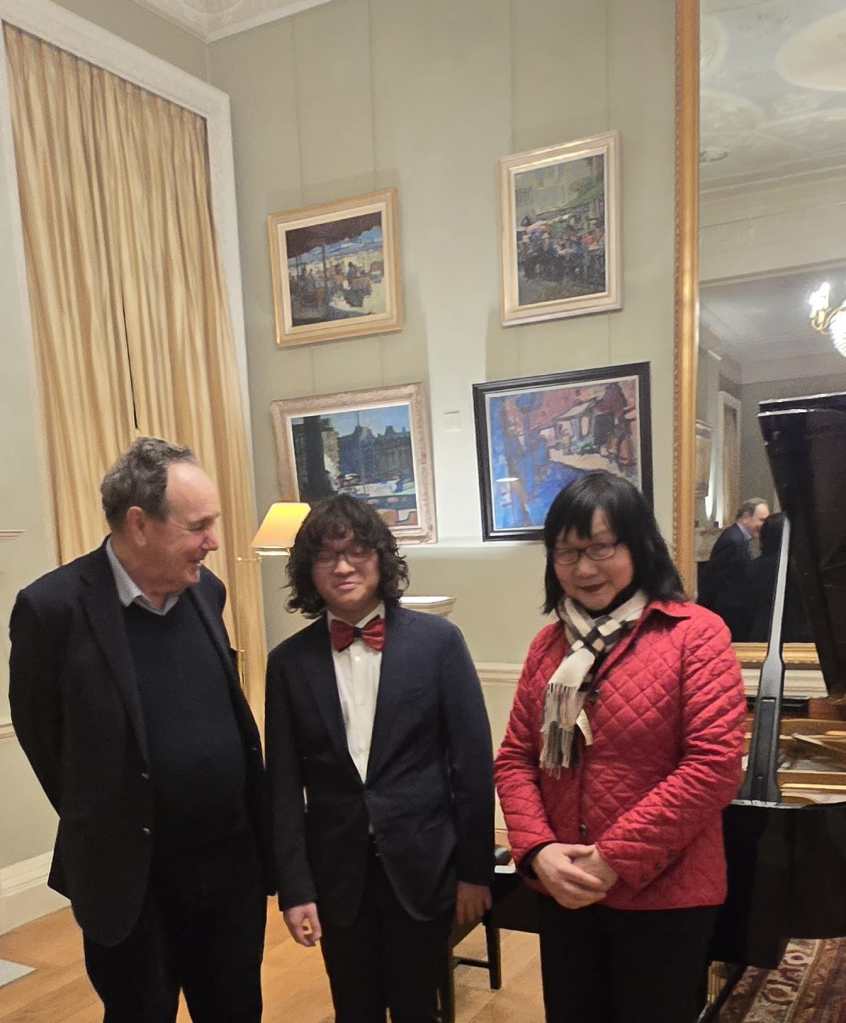
Last concert of this short ‘Snake’ tour at the Chelsea Arts Club Bob Boas with Curtis and Yisha at the recital at his salon in 22 Mansfield Road on the 29th January the day before the National Liberal Club Celebration
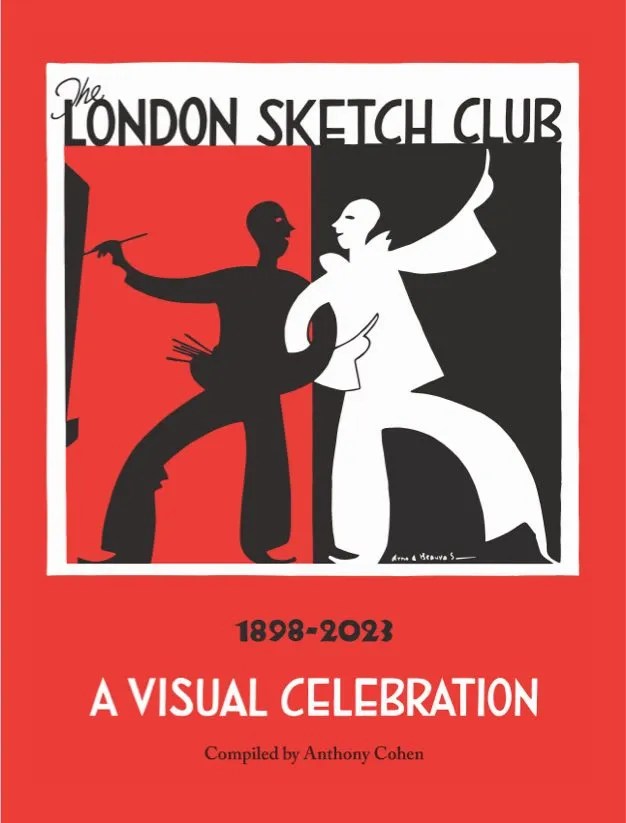
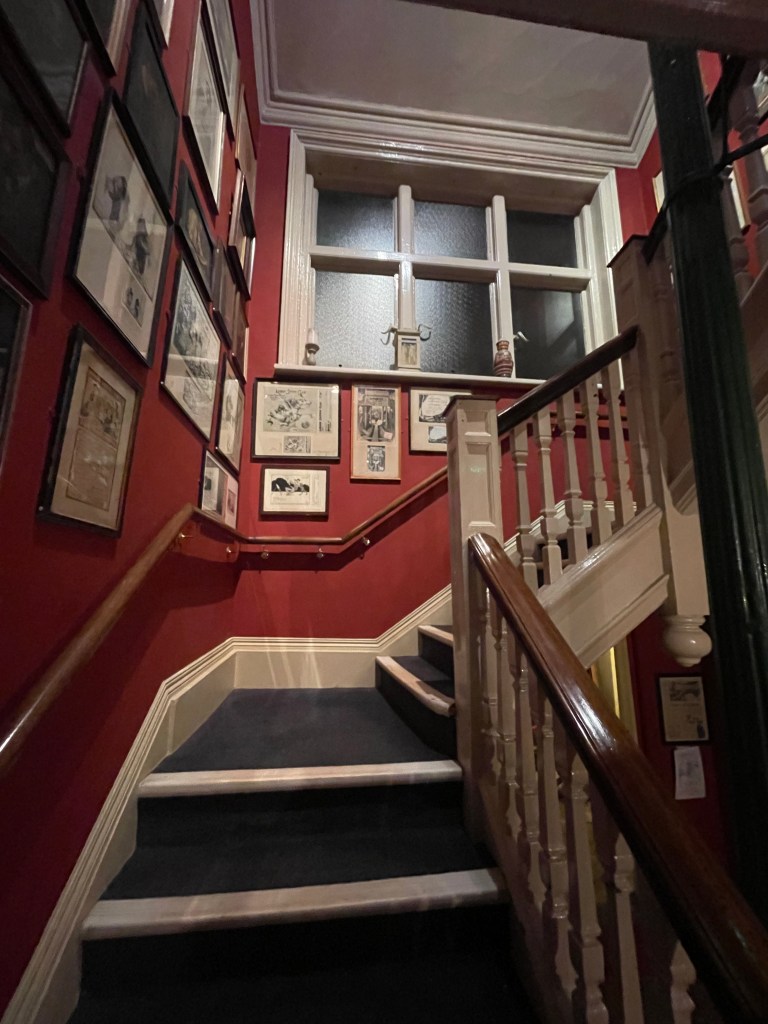
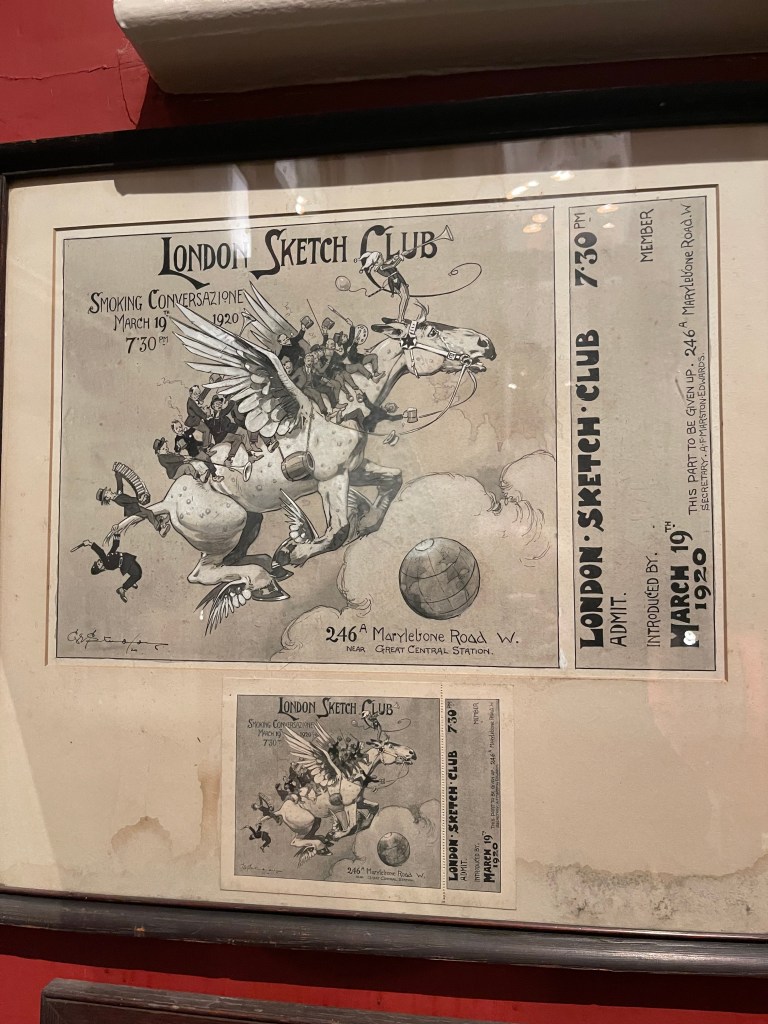
I never knew of the existence of the Sketch Club even though I have visited friends on many occasions who live almost next door on Cheyne Walk overlooking the historic Physic Garden. It is a journey back in time which quite frequently happens in the ‘Circoli’ that one can still occasionally find in noble old Italian cities, but I had no idea could be found in the centre of London! Mozart of course talks about going for a ride in the countryside of Chelsea but that is almost three centuries ago.
An amazing place full of the atmosphere of Artists from past times who came together to discuss, create and smoke! Similar of course to Montmartre at the turn of the 1900’s as described by Picasso,Stravinsky,Poulenc and Rubinstein.
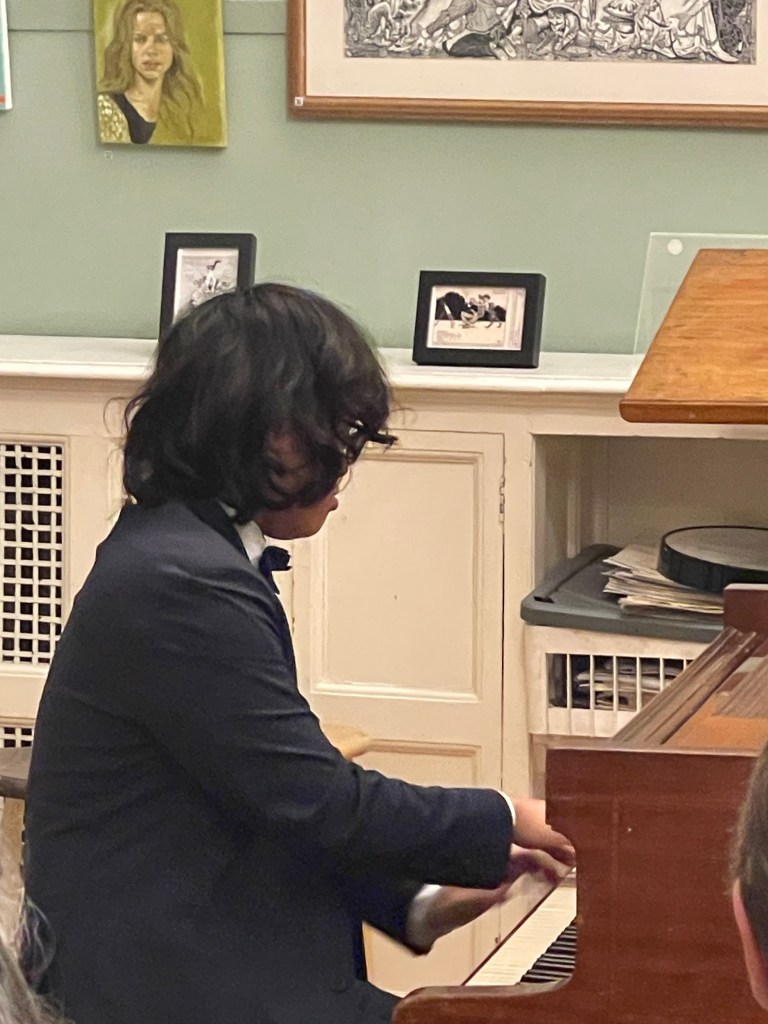
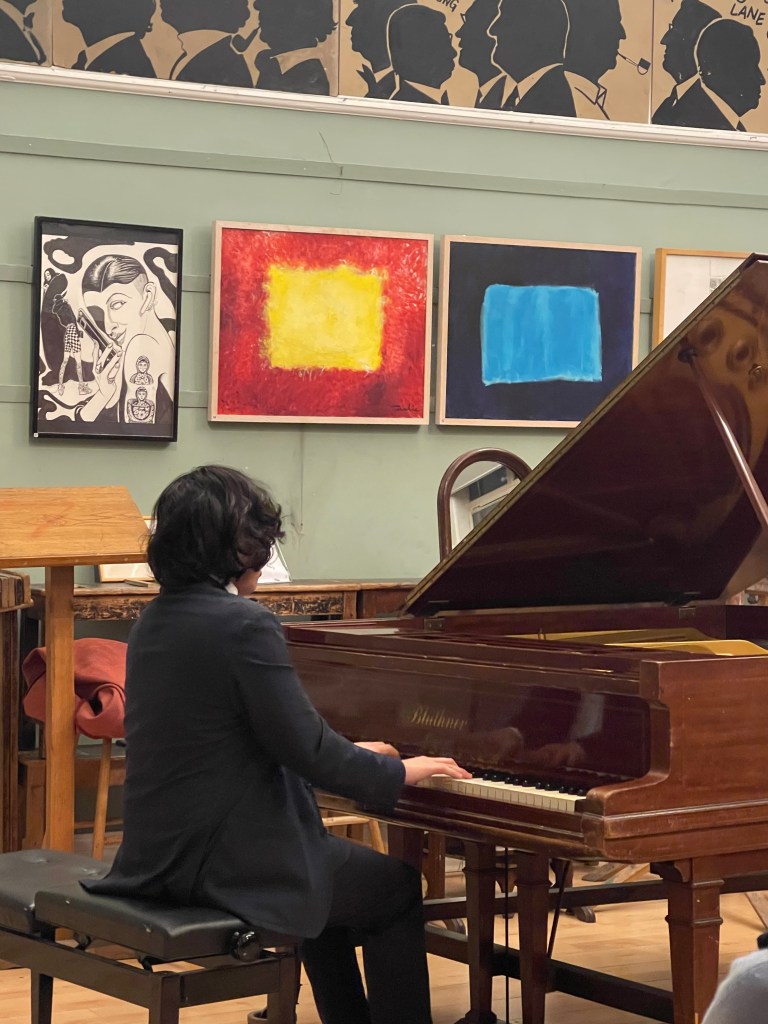
A noble Blüthner sits in the vast studio,with painters’ easles stained with paint stacked in the corner, because it is a club still vibrant with activity. It was here that Paul Newman had organised a second full recital for Curtis of Debussy,Beethoven,Ravel and Schubert with a surprise item by Benjamin Britten. It was here that we could rediscover the true mastery of this young musician.
our host Paul Newman presenting the concert Ian Brignall of Hastings with Curtis and Yisha
Opening with three Debussy Preludes from Book 1. ‘La file aux cheveaux de Lin’ was played with aristocratic weight, freedom and ravishing beauty.’Très calme et doucement expressif ‘ could not have found more sensitive hands as they carved out this well ‘trodden’ melody without a trace of sentimentality but with a poignant significance of poetic understanding.The final bars marked ‘murmuré et en revenant peu à peu’ was where Curtis brought out the inner parts that led so naturally upwards drifting into the distance before the two crystalline split notes of farewell. There was magic in the air in a place where the bohemian Debussy would have felt completely at home.The distance bells of ‘Les collines d’Anacapri’ were answered by the gradual awakening of the joyous excitement of the Neapolitan Riviera. Curtis created a wonderful sense of improvisation with chameleonic changes of colour and character as the melody was heard in the bass ‘avec la liberté d’une chanson populaire’. A passionate outpouring of subtle innuendo of sultry insinuation, was played with all the style of a jazz player before the return to the hustle and bustle of the mediterranean and the final ecstatic cry for joy that Curtis punched out with such gleeful exuberance.
The final prelude in this ‘tris’ was the most innovative and remarkable. Debussy was quite a considerable pianist and knew the scores of past masters well ,he even edited the works of Chopin. But it was here the three handed pianism of Thalberg and Liszt that created an ongoing wave of sound on which floated the glowing melodic line. Curtis played with the same mastery that I remember from Richter on his first visits to the West. Streams of notes played with such mastery that they become merely gold and silver sounds as the sails are allowed to float so naturally around the keyboard. A tour de force especially on a piano that was most probably the original one from the 1890’s when this club was first formulated! Richter ,too, used to enjoy his encounter with unknown instruments and the challenge of delving deep to find a soul that may have been hidden from all, until its master can tame them.
I have hear Curtis play Beethoven before, both the ‘Waldstein’ and ‘Hammerklavier’ revealed an artist with the same sacred fire of a Serkin.The same intellectual intelligence of all great interpreters searching deep into the score to discover what the composer really intended.
I have reviewed the ‘Waldstein’ before as you can read here :
But every performance for a real thinking musician is a new voyage of discovery and it was this that came across with the dynamic rhythmic drive and inner energy that opened the ‘Waldstein’. Delius used to dismiss all other composers except himself with just a few words.Bach he would describe as ‘knotty twine’ whereas Beethoven was ‘all scales and arpeggios!’ It is this sonata and the ‘Emperor’ concerto that does in fact use scales and arpeggios in a truly genial way.
Curtis played with absolute rhythmic precision, even taking the tempo of the Allegro con brio from the tempo needed for the melodic second subject. A driving rhythmic impulse that did not turn corners in a ‘stylish’ way but realised that the abrupt changes of character were more tonal than slowing the tempo. Curtis with fingers like limpets that could play with Gilels and Gelber like precision, where every note was given its just weight and worth.The sudden changes from piano to sforzando in the development were as hair raising as they must truly have seemed in Beethoven’s day. An introduction to the last movement ( the slow movement Beethoven obviously considered too distracting for this whirlwind he had created and was later published as the Andante favori ).
Curtis brought a weight and profound beauty to this deeply meditative outpouring with an architectural sense of line that led to the top G, that Beethoven, as if by magic, turns into the opening of the Rondo. An undulation of sounds as the composer has indicated, with very precise pedal markings, and which Curtis scrupulously interpreted. A tour de force of scales and arpeggios indeed, but what drive and architectural shape this young man, with great maturity, could lead us through a maze of breathtaking virtuosity.
‘Gaspard de la Nuit’ was written by Ravel with the intent of creating a piano piece of even more transcendental difficulty than Balakirev’s ‘Islamey’. ‘Scarbo’ is indeed one of the most difficult pieces in the piano repertoire and needs a virtuoso technique, but also a resilience that can keep the driving rhythms of the impish demon flitting around the keyboard with unrelenting skill. It also has moments of passionate outpourings that Curtis played with fiery conviction. Holding back with aristocratic authority before letting go with extraordinary vehemence.The deep bass gongs at the beginning of the mysterious central episode I have never heard played with such clarity or demonic devilry. Curtis not only was master of the notes but above all master of the character and subtle dynamic range that Ravel demands.
The opening ‘Ondine’ was played with extraordinary clarity on a piano that I doubt has ever been asked to respond to such mastery. The nymph sang out above the washes of sound and the lead up to the climax was breathtaking in its exhilarating ecstatic declamation. Wonderful control on a not easy piano as Curtis left the pedal down for the final whispered cry of the nymph before allowing her to flit off into the distance. ‘Le Gibet’ (the gallows swaying in the wind) showed the true mastery of Curtis because the truly great pianists are not those that can play louder and faster than their rivals but those that can play quieter and with total control. And nowhere more could one appreciate Curtis’s great artistry than in the much maligned G flat Impromptu of Schubert with which he closed his recital . I wonder if Curtis knew that today the 31st January was Schubert’s birthday in 1797.There was indeed magic in the air and a sense of timeless beauty as Curtis stretched the melodic line with the rarified breath control of the greatest of Bel Canto singers.
And it was to the human voice that Curtis turned as he accompanied our host Paul Newman in a delicious rendering of Britten’s ‘Foggy Foggy Dew’.They had tried it out for fun in the afternoon with no idea of sharing it publicly, but Curtis was only too delighted to finish his recital together with such a genial host.
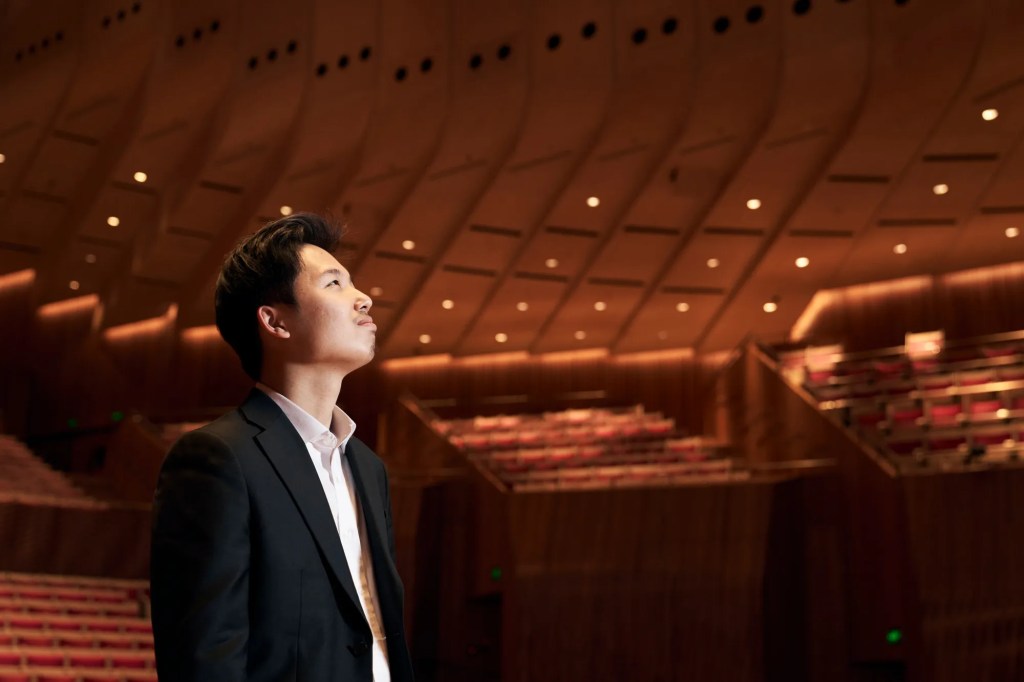
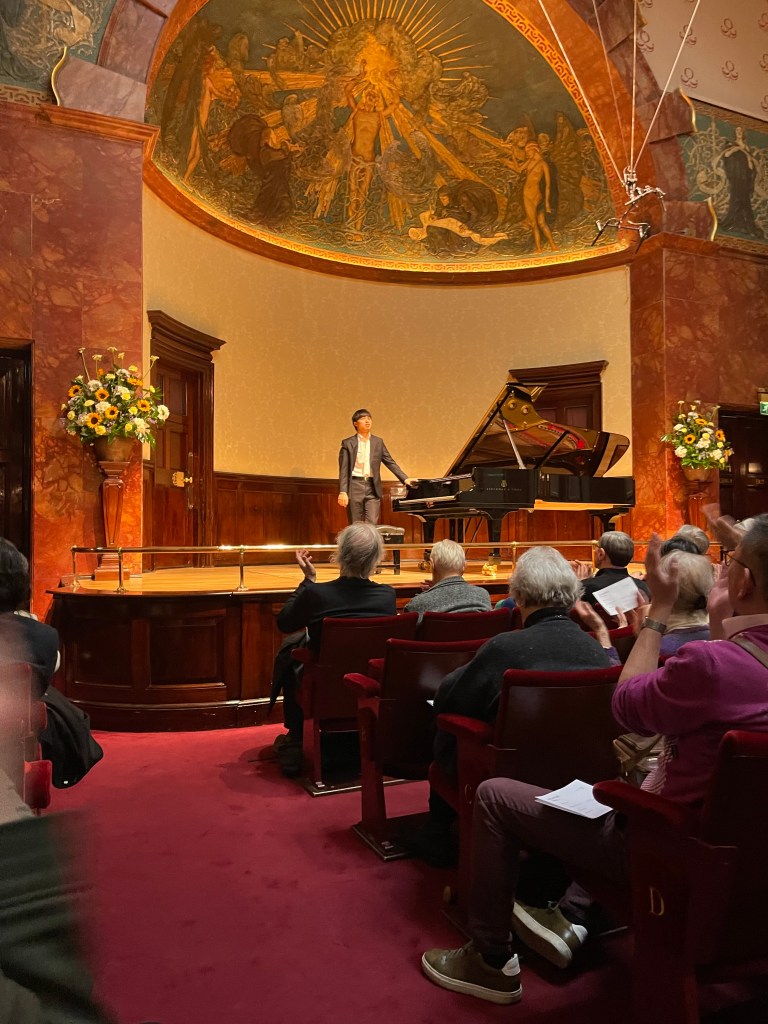
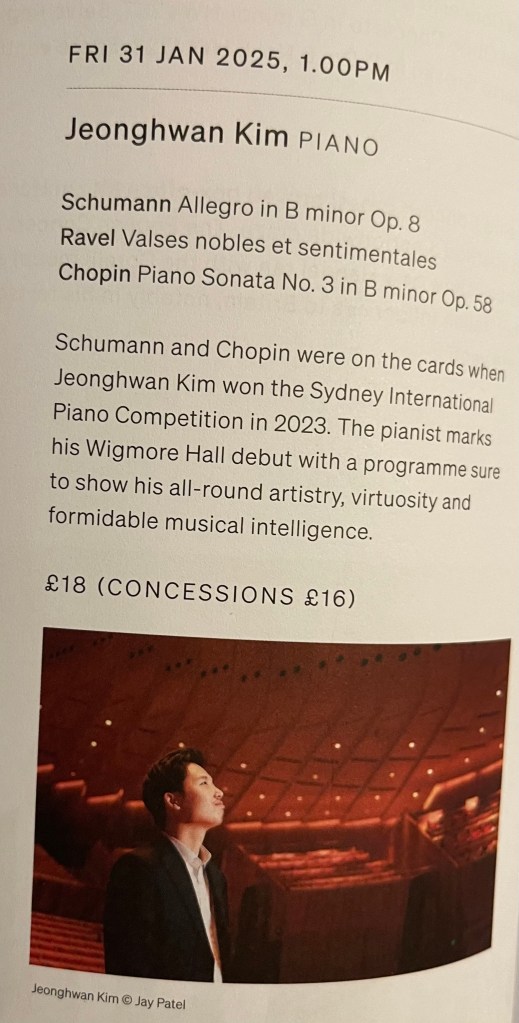
Jeonghwan Kim , winner of the 2023 Sydney International Piano Competition, making his debut at the Wigmore Hall with extraordinary finesse and mastery, more alla Godowsky than Rachmaninov .
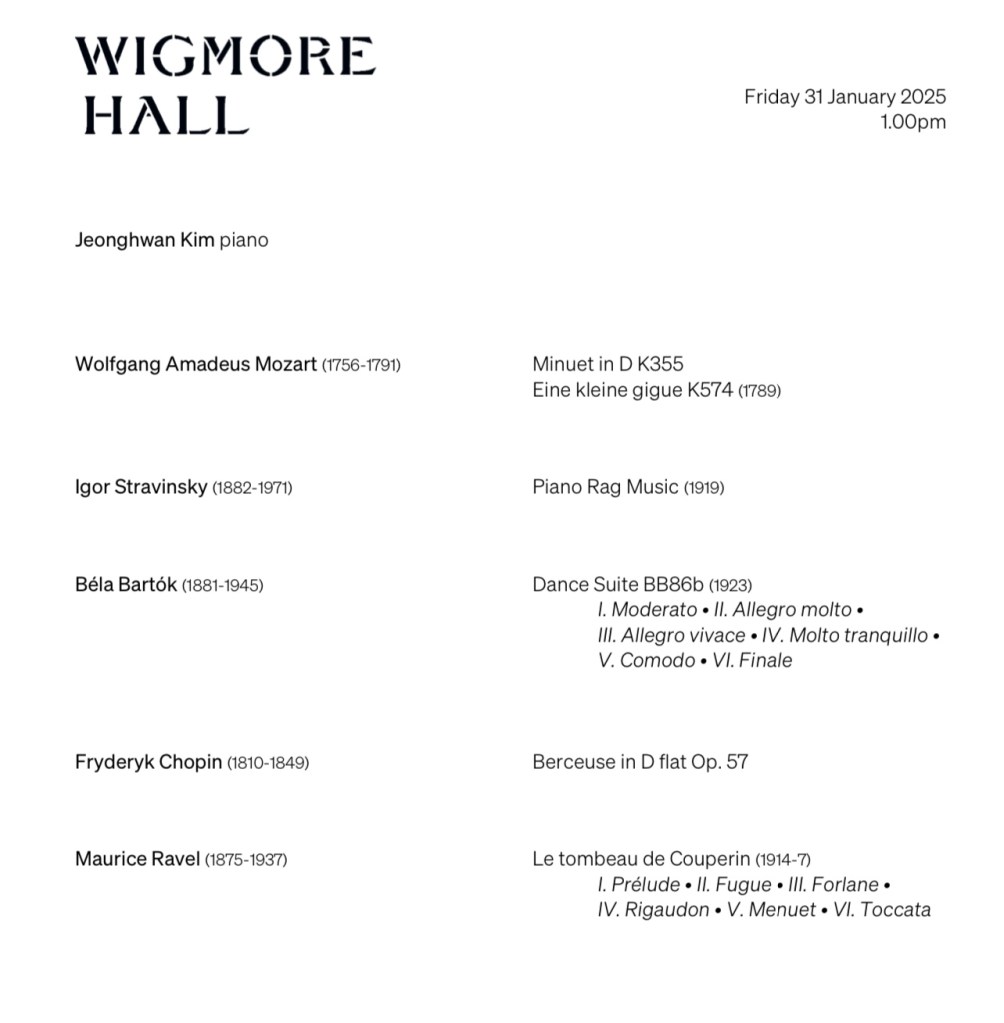
Expecting Schumann op 8, Chopin op 58 and Valses Nobles which would have shown us a different side from the exquisite whispered sounds of clockwork precision of Ravel ‘Le Tombeau’ .The barely audible Chopin Berceuse was exquisite but Chopin’s filigree bel canto was thrown off with a lightweight beauty that was completely at odds with the gentle lapping rhythm where Chopin, as in his Barcarolle, sets the scene. Roots firmly embedded in the ground but here with Kim’s beautiful branches left to flounder on their own.
Mozart Minuet in D K 355 where Kim accentuated the pungent dissonances that seemed to reappear in Stravinsky’s Rag, that followed after Mozart’s Little Gigue K 574. Even the little gigue was played at Stravinskian tempos that denied the charm and grace of its age but allowed Kim to point us to the future, which was obviously his intellectual scope.
Stravinsky’s Piano Rag Music was commissioned by his friend Rubinstein who refused to play it in public!
Kim gave a superb performance where his clarity and kaleidoscope of sounds brought to life, with infinite charm and even grace, a piece that Rubinstein declared too ungrateful to inflict on his audiences. Stravinsky made amends by dedicating his own piano transcription of Petrushka to him, a few years later, allowing him to make a simplified version of a work of quite transcendental difficulty, for public performances, knowing full well that it would have kept the ‘Prince of Pianists’ locked in the practice studio for far too long!
After this Kim played Bartok’s 1923 Dance Suite full of ravishing sounds and dynamic contrasts. A rhythmic drive that was never overpowering in volume but more of a compelling inner rhythmic energy. A quite unique, masterly performance of a work that indeed needs the mastery of Kim to bring it into the concert hall.
Ravel’s ‘Tombeau’ was exactly the measure of Kim’s remarkable mastery, with the clockwork precision with which Ravel depicts and remembers friends who gave up their youthful lives in the conflict of the First World War. A conflict that was agreed in the comfort of Parliament by aristocratic politicians who never put foot in the trenches! Ravel was an ambulance driver and saw the tragic and useless end of so many of his generation. Absolute clarity and precision where all Kim’s great gifts came together for the beauty of Ravel’s recreation of baroque perfection. Streams of notes that rose and fell with infinite subtlety and beguiling atmosphere. An exquisite tonal palette to the ‘Fugue’ out of which the ‘Forlane’ sprang to life with a distant vision of paradise in its midst, and with the grace and charm of its magical ending. The ‘Rigaudon’ was played with a playful sense of colour and rhythmic energy with a central episode of haunting beauty, where the left hand’s detached notes accompanied the luminous glowing melody in the right. A ‘Minuet’ of beauty, radiance and delicacy flowing simply with exquisite unnoticeable rubato. Of course the ‘Toccata’ was played with absolute perfection where sudden rays of light would illuminate the most exquisite outpouring of melody (so similar to Mozart or Schubert with their sudden genial melodic invention ) Coming almost to a halt before the breathtaking final bars of quite extraordinary mastery, brilliance and above all of musical imagination.
Kim, a very serious musician and master pianist, announced that he does not play encores, but that he would improvise on notes given to him by us, the audience. Four notes shouted with glee, by audience members, that Kim proceeded to elaborate into a waltz with all the finesse and grace of a Levitski or Rosenthal. An extraordinary thinking musician and master pianist.
His virtuosity is astounding, his accuracy in the most complex passages breathtaking…
[…] brought tears to my eyes”
-Piers Lane
Born in Seoul in 2000, Jeonghwan Kim first began playing the piano at the age of six. In the following years, his numerous first prizes in national competitions led to his admittance to the “Seoul Arts Center Academy for Young Talented Musicians” at just nine years old. Since moving to Berlin in 2011, he has continued to earn extensive recognition in prestigious national and international piano competitions. At the 2017 International Liszt Competition for Young Pianists in Weimar, he received the third prize along with two special prizes.
In 2019, he was awarded the 1st prize at the Aarhus International Piano Competition in Denmark, prompting immediate Invitations to perform with the Aarhus and Odense Symphony Orchestras. He has since given concerts in major halls in Berlin, Weimar, Hamburg, and Aarhus, among others.
In 2022, he was awarded three prizes: in January, he won the 1st prize at the Felix Mendelssohn-Bartholdy competition in Berlin. Five months later, in June, he won the fourth prize and the audience prize at the Sendai International Piano Competition.
In July 2023 he won the 1st prize along with two special prizes for his performance for the Bartok’s second piano concerto and the Best Overall Concerto Prize at the renowned Sydney International Piano Competition.
Since 2017, Jeonghwan has been studying at the University of Music Hanns Eisler in the class of Prof. Konrad Maria Engel. His former professors include So Yong Choi, Leda Kim, and Thomas Just. He has also participated in masterclasses with Jakob Leuschner, Bob Versteegh, and Robert Levin. Other crucial influences on his artistic development include Stephan Imorde, Konstantin Heidrich, Antje Weithaas and Jonathan Aner.
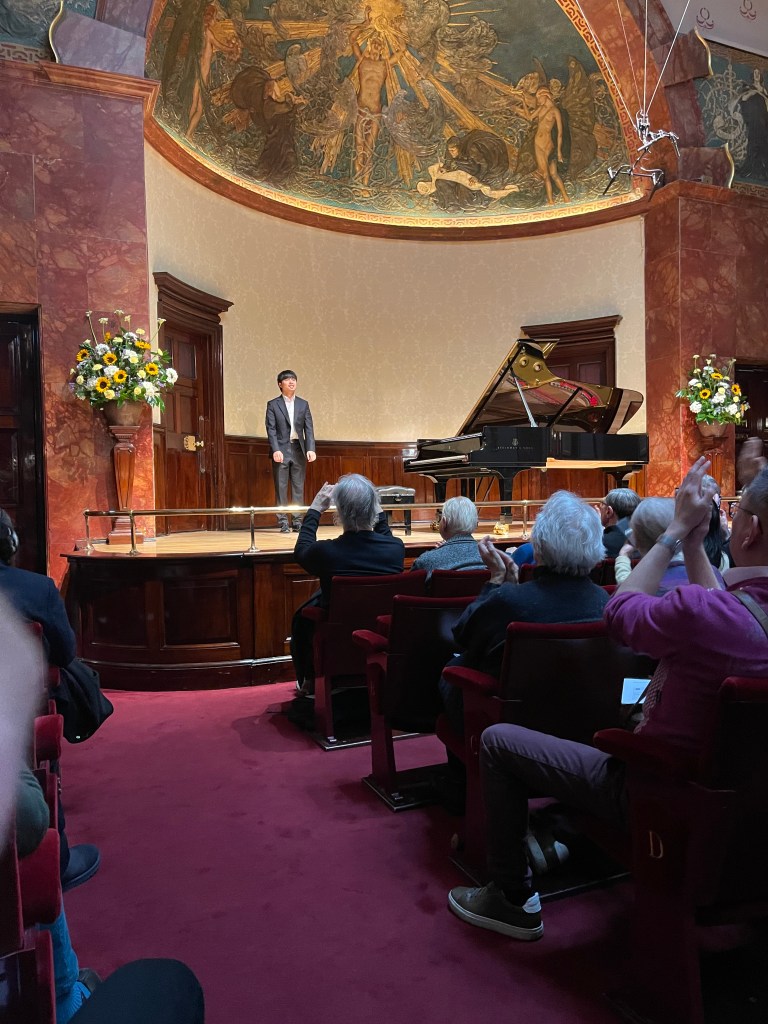
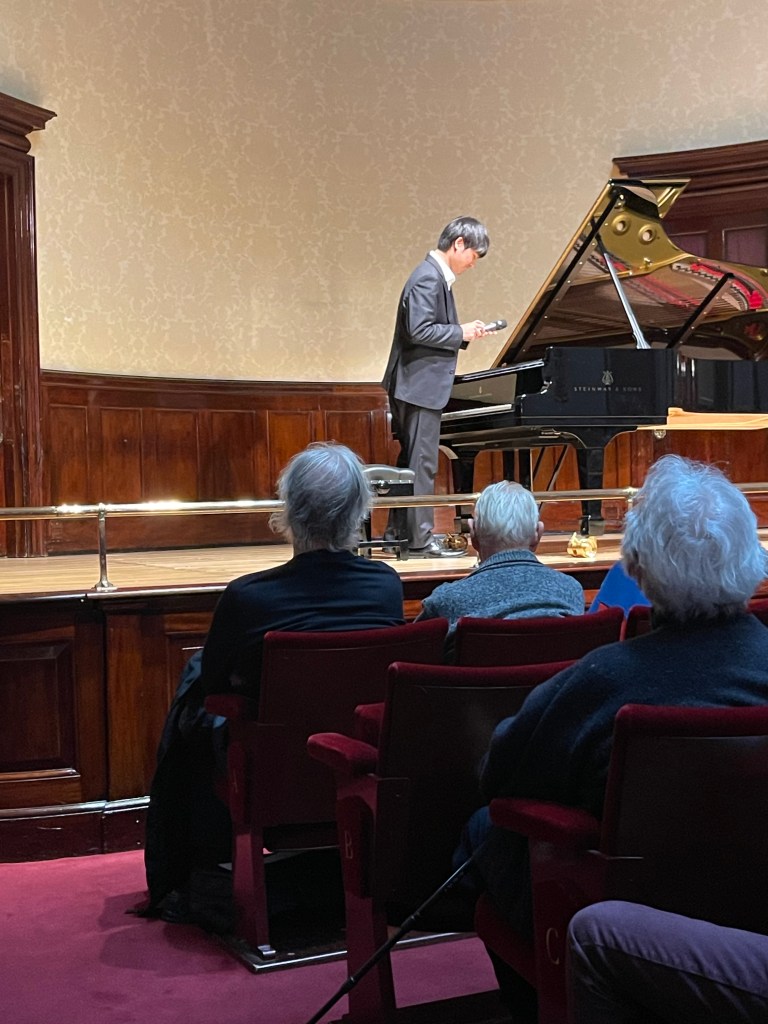
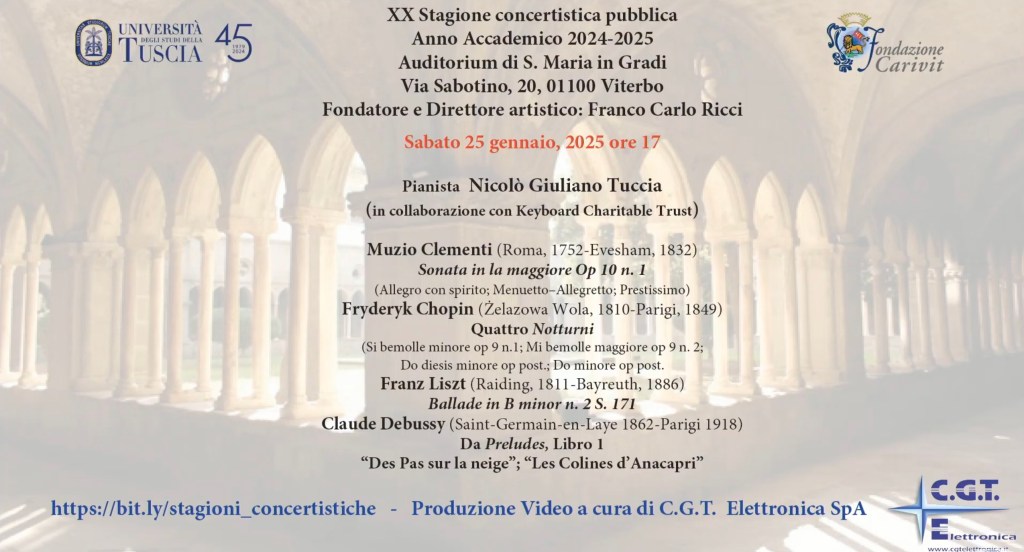
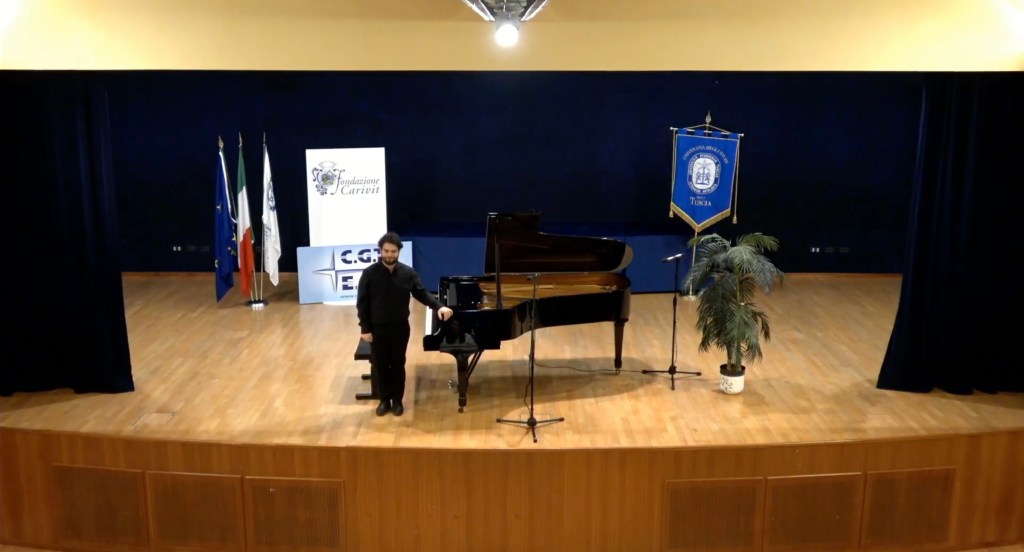
A very varied programme for the annual recital of a Keyboard Trust Artist, Giuliano Tuccia. A native of Forlì where he has created his own concert series celebrating the cities most famous citizen, the legendary pianist Guido Agosti.
Giuliano has music in his blood and looks like a born pianist at the keyboard with fingers that are like limpets that cling to the keys sucking the life blood from each one without ever producing a hard or percussive sound.
The early Clementi sonata he played with brilliance and clarity bringing a subtle beauty to the ‘Menuetto’ where the melodic line was allowed to sing with simplicity and ease.The sumptuous tenor voice answered by an ever more poignant melodic outpouring. A ‘Prestissimo’ of meanderings of brilliance. This early sonata was played with the grace and charm of its age and just needed that clockwork precision of which Michelangeli was such a master.
Four Nocturnes by Chopin were played with a freedom and beautiful Bel Canto from a different age.The Golden Age of playing of Lhevine,Rosenthal ,Godowsky, who were real magicians, who with a subtle use of balance and the pedals and sometimes unsynchronised hands, could give the effect that the piano could sing as mellifluously as any singer. It is an allusion because the piano is simply a box of hammers and strings but with subtle artistry it can appear to produce the same legato as the human voice. Giuliano obviously loves the piano and it was this same love that allowed him to make the piano sing with subtle heartfelt rubatos and a kaleidoscope of sounds. But it was Chopin who used to explain to his students that rubato could be likened to a tree with its roots so firmly planted in the ground that the branches were free to move and sway freely in the wind.
The first of Chopin’s twenty one nocturnes ,op 9 n. 1, was played with great beauty and the central episode with subtle whispered sounds, but the left hand was rather too agitated and did not quite created the base of simplicity that Chopin described to his students. Whilst being very beautiful with a ravishing cantabile sound it could have been played with more simplicity and the left hand allowed to unfold more naturally.The famous nocturne in E flat op 9 n. 2, that followed was of beguiling beauty and luminosity. A freedom sometimes at the limit of good taste but was played with such genuine and touching sentiment that we could overlook Giuliano’s youthful love for something so beautiful. There was a beautiful sense of balance in the C sharp minor Nocturne op posth where Giuliano allowed the music to sing with simplicity and subtle beauty. Chopin’s cross rhythms were played with aristocratic weight and the ending was of haunting beauty. The C minor Nocturne op posth was again played with old style rubato that rather held up the natural flow of this deeply bitter sweet outpouring of nostalgia. Hats off to Giuliano for presenting just nocturnes in his recital to show us what miniature masterpieces they really are, usually only played with other of Chopin’s works and rarely allowed to stand on their own as Chopin’s homage to the magic world inspired by Bellini.
It was in Liszt’s Second Ballade that all Giuliano’s gifts came together. It was played with great fantasy and a freedom with a real sense of the drama that was being enacted.There was the luminosity and almost prayer like comments of the Angels contrasting with the sumptuous tenor melody that is then transformed in so many different transcendental ways. Giuliano’s youthful passion transforming Liszt’s notes into a vivid tone poem of great emotional impact.
This was followed by Debussy’s hauntingly beautiful ‘footsteps in the snow.’ Whispered sounds of great fluidity and now the simplicity that his romantic soul had denied him before. There was also a burning intensity behind the seemingly sparse sounds that Giuliano was playing with extreme delicacy. The last work on the programme was ‘Le Collines d’Anacapri’ that brought us all the radiance and joyous Neapolitan confusion, with playing of subtle colours and dynamic drive, and the final brilliant notes played with chiselled ice cold perfection.
An encore of Rachmaninov’s torrent of romantic sounds with the Moment Musicaux op 16 n. 4. Giuliano threw himself fearlessly into the fray as Rachmaninov’s romantic soul was laid bare with red hot passion and considerable technical prowess.
Nicolò Giuliano Tuccia è considerato da Leslie Howard uno dei musicisti più sensibili e interessanti della sua generazione. Nato nel 1999, comincia giovanissimo lo studio del pianoforte sotto la guida del Maestro Giancarlo Peroni. Si laurea brillantemente al Conservatorio “B. Maderna” di Cesena nel 2022 risultando vincitore di una borsa studio offerta dal Rotary Club. Attualmente frequenta l’Accademia Pianistica “Incontri col maestro” di Imola, sotto la guida dei maestri André Gallo, Alessandro Taverna e Igor Roma e il Master di secondo livello al Conservatorio “Francesco Venezze” di Rovigo con i maestri Federico Nicoletta e Roberto Prosseda. Ha inoltre perfezionato i suoi studi in summer festival e masterclass, seminari e convegni con maestri di chiara fama internazionale quali: Edith, Fischer, Avedis Kouyoumdjian, Riccardo Risaliti e Sergio Tiempo. Nicolò Giuliano Tuccia vanta oltre 50 premi in importanti concorsi pianistici nazionali ed internazionali quali “Concorso pianistico internazionale Sergio Fiorentino” (Menzione d’Onore), “Concorso pianistico Elevato” (Menzione d’onore), “Concorso pianistico internazionale di Vigo” (Semifinalista), Map concorso musicale internazionale a Los Angeles (primo premio), “Kings Peak International Music Competition” (secondo premio e premio speciale), concorso musicale internazionale di Londra (menzione speciale), Nota Music (duo cameristico) premio finalista e molti altri. Nicolò Giuliano Tuccia ha suonato in sale prestigiose in tutta Europa e in Italia. Tra i più importanti ricordiamo il “Teatro Galli” di Rimini”, il, il “Teatro Alighieri” di Ravenna, il “Teatro Atti” di Rimini, il “Foyer Respighi” del Teatro Comunale di Bologna, la Sala Corelli del “Teatro Alighieri di Ravenna”, “L’Oratorio San Rocco” di Bologna, il “Teatro Masini di Faenza, la “Sala della Prefettura” di Forlì, il “Teatro Talia” di Gualdo Tadino, il “Cinema Teatro Don Bosco” di Perugia, il “Circolo Ufficiali” di Bologna, il “Palazzo Raffaello” di Urbino, la “Villa Carcano” di Lecco, il “Convitto Vittorio Locchi” di Roma, la “Main concert Hall” del Conservatorio di Musica di Porto, l’Auditorium “Martin Codax” di Vigo, la “Salon Bank” di Vienna, la “Remonstrantse Kerk” di Alkmaar, la “St. Marie Perivale Church” di Londra, la “Main Concert Hall” dell’ Università di Semiotica Musicale di Helsinki, la “Main Concert Hall” della Galleria d’Arte del M.K. ciurlionis di Kaunas, la “Sala Concerti” dell’Auditorium Telki, la “Sala Eutherpe” di León, la “Cattedrale di Sant’Agata” della Badia di Catania, l’Auditorium” di Villa Rina di Padova”, la “Steinway Hall” di Londra, la “Casa della Musica” di Trieste, “Museo di Casa Martelli” di Firenze, il Teatro Fabbrica delle Candele di Forlì, Casa Menotti di Spoleto ,la “Beethoven Chamber Music Hall” di Bonn, La Grossersaal Scholss di Bergisch Gladbach, Colonia, la Gartensaal Schloss di Wolfsburg e la Concert Hall dell’IIC di Berlino, la Stanza della Musica a Roma per Rai Radio 3 e la Galleria Nazionale di Palazzo Spinola a Genova. Sono diversi i festival a cui Nicolò ha preso parte. Tra i tanti ricordiamo Festival “Conoscere la Musica” a Bologna, “Misano Piano Festival” a Misano Adriatico, “Ravenna Festival”, Festival di ErConcerti “Le soirees Musicaux” in Emilia-Romagna, Festival “Le Note Tra i Calanchi” a Bagnoregio, Festival “Clivis Umbria”, “Kaunas Piano Festival” in Lituania, “Altalena Music Fest” in Ungheria, Festival della “Società Musicale” a Helsinki, Finlandia, Festival “HIMF in Olanda, Festival “Roma Tre orchestra”, Festival autunnale della Chiesa di St. ’Perivale “ per il Keyboard Trust di Londra, il Festival della “Salon de la musique”, il “Festival Bellini” di Catania, il Larius International Piano Fest di Lecco, il Festival del “Concorso Pianistico Elevato” a Bonn, Vienna e Oporto, il festival degli “Amici della musica di Casa Martelli” per l’associazione il Suono Giovane di Firenze, festival dell’Associazione Mozart Italia sede di Trieste festival dell’ Associazione Mozart Italia sede di Lecce, “Scriabin Concert Series” di Grosseto e per gli “Amici del Teatro Carlo Felice e del Conservatorio Niccolò Paganini di Genova”. Nicolò Giuliano ha suonato con l’Orchestra da Camera del Conservatorio Bruno Maderna di Cesena, “Circle Simphony Orchestra” di Padova, l’Orchestra Sinfonica “Rimini Classica”
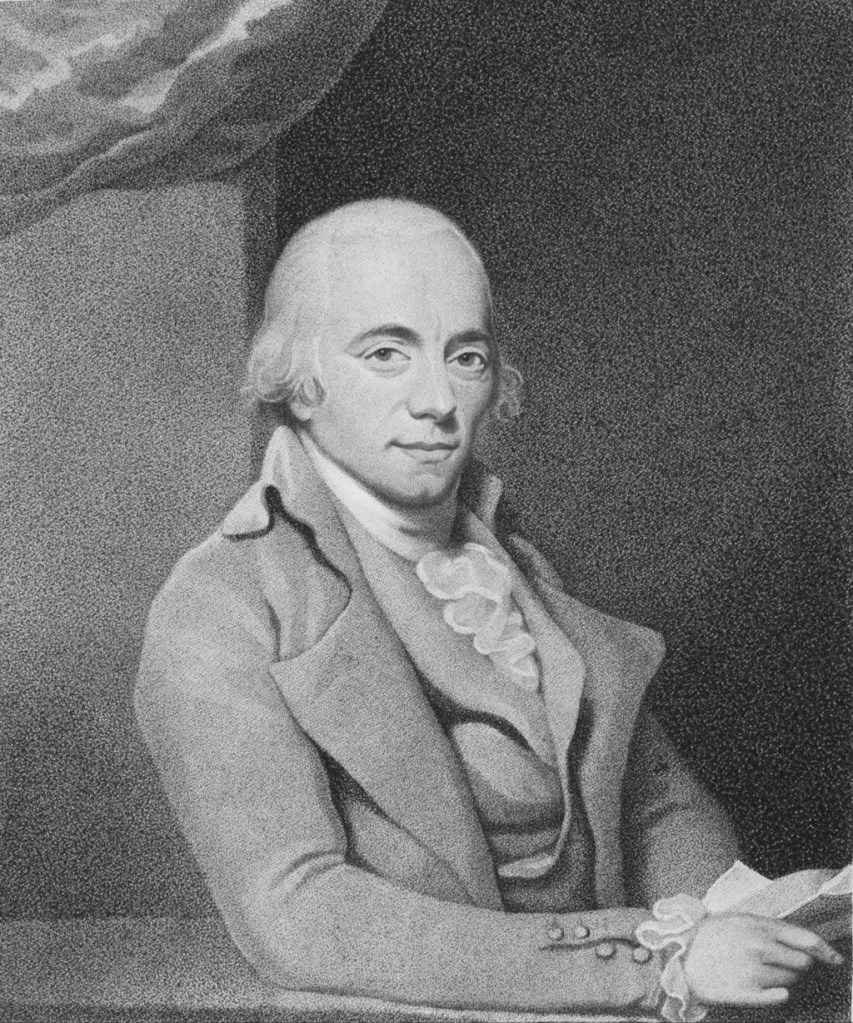
Muzio Filippo Vincenzo Francesco Saverio Clementi (23 January 1752 – 10 March 1832) was an Italian-British,composer , virtuoso pianist , pedagogue, conductor , music publisher, editor, and piano manufacturer, who was mostly active in England. Encouraged to study music by his father, he was sponsored as a young composer by Sir Peter Beckford who took him to England to advance his studies. Later, he toured Europe numerous times from his long-standing base in London. It was on one of these occasions, in 1781, that he engaged in a piano competition with Wolfgang Amadeus Mozart. As a composer of classical piano sonatas, Clementi was among the first to create keyboard works expressly for the capabilities of the piano. He has been called “Father of the Piano” Of Clementi’s playing in his youth, Moscheles wrote that it was “marked by a most beautiful legato, a supple touch in lively passages, and a most unfailing technique.” Mozart may be said to have closed the old—and Clementi to have founded the newer—school of technique on the piano. Clementi composed almost 110 piano sonatas. Some of the earlier and easier ones were later classified as sonatinasafter the success of his Sonatinas Op. 36.
Muzio Clementi was born four years before Mozart and outlived Beethoven by five. Thus this Italian pianist and composer helped fashion the entire Classical era in music. However, his pedagogical tour de force, the “Gradus ad parnassum”, has tended to negatively influence the esteem he enjoyed as an artist. His predilection for the finer points of part-writing and contrapuntal art blend here with a formal and dignified classicism. “Decisive and manly,” “most profound sentiment and delicacy,” and “imaginative humour” – thus does Beethoven’s contemporary Carl Czerny accurately describe the three movements of this expressive sonata. No autograph manuscript has survived and the first edition of the three sonatas op. 10, published in Vienna in 1798, forms the sole basis for the Urtext edition
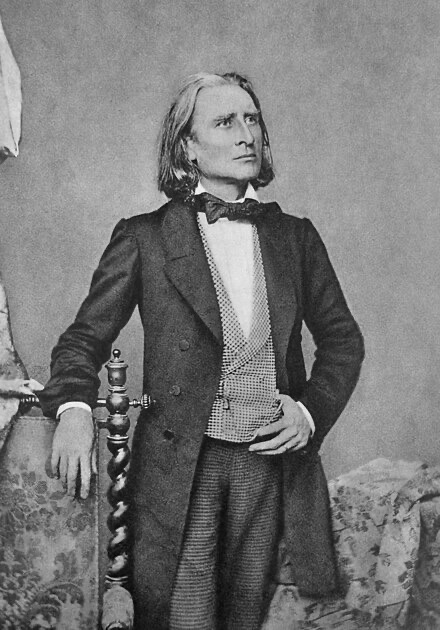
Liszt in 1858 22 October 1811,Doborján,Hungary 31 July 1886 (aged 74) Bayreuth,Bavaria
The Ballade No. 2 in B minor, S. 171, was written in 1853.
Claudio Arrau , who studied under Liszt’s disciple Martin Krause, maintained that the Ballade was based on the Greek myth of Hero and Leander, with the chromatic ostinati representing the sea: “You really can perceive how the journey turns more and more difficult each time. In the fourth night he drowns. Next, the last pages are a transfiguration”.
The ballade is based largely on two themes: a broad opening melody underpinned by menacing chromatic rumbles in the lower register of the keyboard, and a luminous ensuing chordal meditation. These themes are repeated a half-step lower; then march-like triplet-rhythms unleash a flood of virtuosity. Eventually, Liszt transforms the opening melody into a rocking major-key cantabile and reiterates this with ever-more grandiose exultation. The luminous chords provide a contemplative close.Liszt wrote his two Ballades in 1845–49 and 1853 during a time of personal turmoil. The successful virtuoso increasingly saw himself as a composer who strove after formal clarity, as shown by the B minor sonata that was also composed in 1853. When Liszt began work on the first Ballade, he had just separated from his mistress of many years, Marie Comtesse d’Agoult. He called the first sketches for the work Dernières Illusions. A better-known work is the second Ballade in B minor, with whose ending he struggled (the two fortissimo endings in Liszt’s autograph have been published for the first time in the appendix to the Henle edition). It has been linked with the story of Hero and Leander, but it is more generally accepted to have been inspired by Gottfried Bürger’s ballad Lenore. Sacheverell Sitwell found in the work ‘great happenings on an epic scale, barbarian invasions, cities in flames—tragedies of public, rather than private, import’. Composed in the spring of 1853, shortly after the completion of the Sonata, the Second Ballade is a continuation of Liszt’s thoughts in the key of B minor, and similarly explores subtle methods of thematic transformation to achieve a range of evocative moods, bonded by their motivic coherence.


















































 ChristopherAxworthy-MusicCommentary