Konstantinos Destounis at the Elgar Room for the R.C.M

Konstantinos Destounis in the Elgar Room at the Royal Albert Hall
Konstantinos Destounis for the Royal College of Music at the Elgar Room in the Royal Albert Hall today, the next door neighbour,present in this very room since a Mr Barton played there in 1884 .
A student of Dmitri Alexeev and Aquiles delle Vigne both regular performers for many years in my theatre in Rome . So it was a great pleasure to hear this young man again after his prize winning performances at the Liszt Society annual competition last november. Konstantinos is also studying with Ian Jones at the R.C.M for a doctorate in contemporary Greek composers.
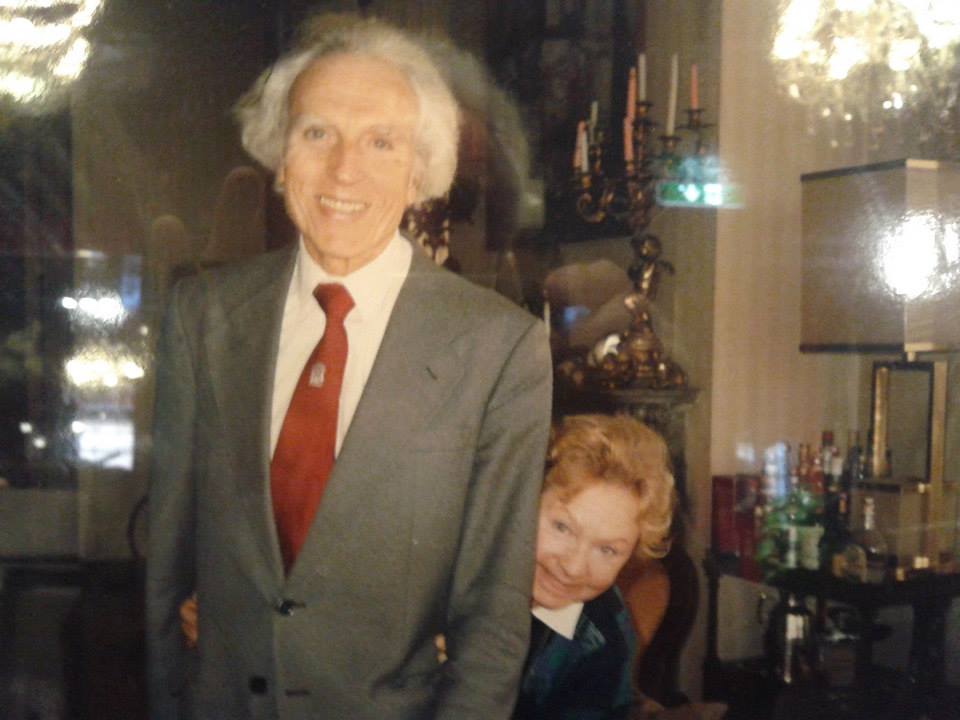
So it was not surprising that three such composers were in his programme today(one of whom,Dimitrios Skyllas, was present in the hall today…..see foto)sandwiched between major works of Chopin and Liszt.
All this on Elton Johns “Big Red Piano” provided by Markson Pianos. A not easy Yamaha to tame especially under the eagle eye of Ella Fitzgerald,The Beatles and Frank Sinatra.
Elgar nowhere to be seen today except in name.
Chopin and Liszt were not present either but were brought to life by the dextrous fingers and big romantic heart of Konstantinos in his very generous early morning sold out coffee concert.
Two of Chopin’s greatest works the Scherzo n.2 in B flat minor and the Barcarolle op 60 started the concert.
Chopin once likened the freedom or rubato in his works to a tree with the roots firmly placed in the earth allowing the branches to flow in the wind. And it was indeed in Konstantinos’s very fine romantic performances that one felt this need of an anchor for his heartfelt fervour.
A more attentive bass ,especially in the slower parts would have infact allowed more freedom without loosing the impetus so splendidly realised by his remarkable virtuosity.
It was a few years ago that another great friend of the Ghione Theatre in Rome,Janina Fialkowska, was giving a memorial concert dedicated to my wife,Ileana Ghione,when she whispered in my ear after a performance of the Barcarolle ,that” this was Ileana”.
Janina the true heir to the Rubinstein Chopin legacy meant that the sheer beauty,refinement and strength found in this masterpiece of the Romantic repertoire were all facets of Ileana’s personality too.
A legacy that means that in simplicity there can be passion,beauty and strength but only if the roots are firmly planted in the ground.
A difficult lesson for a romantic young man full of life and energy to understand ,but it will come with the maturity of a real artist.
The three Greek composers that he introduced in his very attractive native accent were of course played to the manner born,as one would expect.
The Prelude and Toccata by Theodore Antoniou receiving its UK premiere was played with all the resources of the piano exposed to the full .From the quiet murmur to the most thunderous cry. And like the Jettatura by John Psathas the Toccata showed his enormous dexterity and was very impressive indeed.
The very suggestive sounds in the Nine Miniatures for the Universe by Dmitrios Skyllas were hampered by a not very resonant piano but Konstantinos produced miracles in his total identification with music from his native land.
For Konstaninos is a real artist as was shown by his virtuoso performance of Liszt’s Mephisto Waltz that brought this very fine recital to a rousing conclusion.
Maybe his passionate participation could have had more dynamic control but this was a young man’s Liszt and totally convinced his audience ,much as the great man himself might have done ……no swooning ladies but a great ovation from a more discreet Sunday morning audience.
The piano does not have the depth of sound to allow many colours or refinement to be obtained but I remember my old mentor ,Vlado Perlemuter,telling me that the finest concert he ever gave was on an old ” casserole” in a school in South London……..”where there is a will there is always a way” as maturity will no doubt inform this very fine young musician.

Dinara Klinton at St Lawrence Jewry

Dinara Klinton at the C.M.F
Dinara Klinton at the City Music Foundation  with  Scarlatti,Chopin,Scriabin.
Interesting the CMF that give so much advice and help to their chosen artists on how to manage,market and promote themselves in order to be ready for the professional world.
The music is not their business but the music business is.
Splendid ….worth taking a look www.citymusicfoundation.org/support.
Dinara ,fresh from adding third prize in the Cleveland International Competition to her already impressive list of honours and prizes .
I was surprised to see a very grand Fazioli piano where I was expecting Beecham’s splendid old grand that used to be in St Martins in the Fields.
Unfortunately this magnificent new piano was just not mellow enough to suit the very resonant acoustic in the beautiful church which is St Lawrence Jewry,just next to the Guildhall in the heart of the business world in London.
I was sitting almost next to Dinara and was overpowered by the resonance even there. But Dinara Klinton‘s supreme professionalism allowed her to play a difficult programme with her usual aplomb.Two Scarlatti sonatas played with great sense of style and an almost imperceptable flexibility .
The first slow Sonata K.87 suffered from our having to adjust to the acoustic .
The second K.96 where the technical difficulties were thrown off with the same ease as a Sokolov. Here the Fazioli was in a realm of its own for the ease with which the ornaments could be played with a precision and crispness that rarely can be equalled on the German pianos.
Her Chopin Barcarolle was given a very individual interpretation more masculine alla Rubinstein than the rather feline interpretations that are prevalent these days .It did,in fact, suit the hall admirably and I expect that Dinara had understood the problems of St Lawrence Jewry and had adapted accordingly to great effect.
The Funeral March Sonata was given a very taught reading even including the repeat in the first movement which is actually in the original score .
This was a very intelligent reading , full of impetus and poetry.
The Funeral March was played with a stillness and lack of sentimentality that had just the effect that Chopin must have intended.
The last movement the famous wind over the graves was an inevitable release from the tension she had so admirably created .
In Scriabin’s Vers la Flamme op.72 ,that finished this short programme,the obsessive motif that pervades the whole work was admirable realised.
Maybe missing the demonic element that was so much part of Horowitz’s world ,it was,however, played with great cohesion and brought this recital to a brilliant close.
I was sitting with one of the most renowned critics ,Bryce Morrison ,who was glad to hear Dinara for the first time .
Her fame had in fact preceded her on this occasion.
I doubt that the CMF could have expected a more glowing example for all the work they have remarkable offered these  young artists..

Mei Yi Foo at St Mary’s Perivale.

Mei Yi Foo at St Mary’s Perivale
Wonderful summers day for Mei Yi Foo`s recital at St Mary the Virgin ,Perivale in Hugh Mathers remarkable new Tuesday series.
An interesting programme of Schubert .Couperin,Gubaldulina,Bartok and Messiaen.
Beautiful church with a good acoustic in the middle of Ealing Golf Course, where just before the beginning of the concert they had decided to mow the green .
Our master of ceremony,Hugh Mather disappeared outside and managed to calm the rather noisy lawn mower so we could fully appreciate the exquisite,musicianly playing of Mei Yi Foo.
Three of the op 90 Impromptus D.899 strangely played with the score but with a fresh musicality and sensitivity that these well known pieces were brought to life as if for the first time.
Presenting the concert Mei Yi pointed out the interesting juxtaposition in her choice of combining Couperin ,Gubaldulina ,Bartok and Messiaen ,that followed the Schubert.
Some exquisite sounds in the Night Music from the Suite Out of Doors by Bartok and a truly savage performance of Regard de l’Esprit de joie by Messiaen.
A tour de force of piano playing , finding some truly extraordinary colours in this very difficult piece.
The Tic- Toc Choc by Couperin was partnered with a little piece by Sofia Gubaldulina to show the similarity in spirit although a different musical language.
Much look forward to hearing Mei Yi in Beethoven’s Third Piano Concerto with the Philharmonia in London later this season .
It is four or five years since Mei Yi played in L’Aquila where the Keyboard Charitable Trust was invited by Guido Barbieri ,of the renowned Societa’ dei Concerti to bring three young pianists,from three different nations to play and talk about their careers and experience,L’Aquila had suffered a most serious earthquake and this culturally very important city had been reduced to a ghost town with the buildings that were left standing propped up by metal supports whilst awaiting restoration . Rubinstein was an honorary citizen and played every season as did many other famous artist .
The restoration is still only partially under way and it is now that the supports too are crumbling.
Another earthquake recently in the nearby town of Amatrice has shaken once again the hardy people of this region of Italy just sixty miles from Rome.
The city of Trento had given to the people of L’Aquila a new concert hall,designed by Renzo Piano (Shard/London and Parco della Music /Rome) and the offer of Claudio Abbado to give the first concert .
Just outside the gates to the city it was an ideal place for our young musicians to come and give the hope and strength that is to be found only in music and culture , to the beleaguered people of L’Aquila.
Three young musicians Pablo Rossi,Mei Yi Foo and Vitaly Pisarenko were the much appreciated artists who filled the people of this shaken city with hope for the future, if only momentarily.
Carlo Grante the very fine pianist born in L’Aquila was with us too visiting his mother ,one of the many inhabitants who ,because of this tragedy had been rehoused ,momentarily it was supposed, in our Hotel .
All three artists are to be heard in Hugh Mathers remarkable series in this charming little church in Perivale on Tuesday afternoons at 2 o’clock . Some of the finest young pianist of their generation and not to be missed by anyone interested in hearing the stars of tomorrow. +5

Jayson Gillham at St Mary the Virgin

Jayson Gillham at St Mary the Virgin
Jayson Gillham at St Mary the VirginSo sorry to have arrived too late to hear the first two pieces on Jayson Gillham’s programme due to the very poor service at the weekend on public transport in this part of the world .
However I did arrive in time to hear a remarkable account of the little “introduzione” to the final movement of Beethoven.s “Waldstein” Sonata.
The movement that replaced the original movement printed separately as the Andante Favori .
Adagio molto it certainly was but with a intense sense of meaning that rarely I have heard before.
Infact a profound statement in Jayson’s hands that made so much sense.
Leading into the seemingly serene Rondo which then erupts into great bursts of rhythmic energy so typical of the so called ” middle ” period of Beethoven.
The long pedal that Beethoven indicates was beautifully realised on a not easy piano.But here in Jaysons hands all seemed possible such was his mastery and control. and above all intelligence never forsaking the sense of line .
I would have preferred more grandiloquence alla Arrau in the more virtuostic passages and I am sure that Jayson with maturity will come to realise this too .
It was though a remarkably assured performance with real “sturm und drang ” that was totally convincing . Never a harsh sound but a great range of sound from the very quiet to the Beethovenian outbursts so much part of this sonata.
I was sorry to have missed Bach’s C minor Toccata and the Handel Chaconne both of which our magnificent ever present host Hugh Mather told me were superb.
After the interval the Complete Etudes Symphoniques op 13 by Schumann .
As Jayson told us these variations were published in various forms and it was only in the Brahms edition of 1890 that the five so called ” posthumous” variations were published . Jayson supposed that these very intimate extra variations were written with Schumann’s fiance of the time: Ernestine von Fricken in mind .
The theme was infact written by her father.
Schumann obviously thought that Clara Schumann would not have been happy to play these as they were so obviously written for his previous love.
The Etudes Symphoniques were infact dedicated to William Sterndale Bennett ,the first director of the Royal Academy of Music in London who often used to include them in his recital programmes
What a triangle …so it was up to Brahms to actually publish them and it was these complete variations that were inserted so intelligently by Jayson into the accepted fabric. He also incorporated some of the variants in the finale that appear in previous editions . The first thing that was evident was the beauty of tone that Jayson found on what we thought was a difficult instrument .
Whether pianissimo or fortissimo there was never a harsh sound but a supreme sense of colour and direction that held a full hall under his command for the entire second half. The posthumous variations being inserted in perfect harmony within the overall structure .The first two immediately inserted after the first variation and the most magical one saved almost for the end with quite exceptional effect.
I have heard Jayson’s performance before at the Wigmore Hall for the Keyboard Charitable Trust prize winners concert,and although now much more mature and with a more profound musicality I am still not convinced of his habit of bringing out the bass in the repeat of many of the variations.
However it was a magisterial interpretation of great assurance and rhythmic urgency that totally held us all under his spell .
A performance of the Prelude from Bach’s Violin Suite in E major transcribed by Rachmaninov was such that I doubt that the master (Rachmaninov,ca va sans dire) himself could have bettered it
Jayson,quite rightly , is making a great name for himself and after his success in the Montreal International Piano Competition is adding many notable triumphs under his belt on the way to being recognised as the superb complete artist we are coming to know .
And he is the first to recognise all that Hugh Mather has done for him and his colleagues and his affectionate appearances in Perivale are like a return home for this talented charming ” sunny” young Australian. +6

The genius of Trifonov

Trifonovs own goal ……….Trifonov with Thielemann and the Staatskapelle Dresden
Wonderfully interesting talk before the Prom about the Dresden Staatskapelle – not to be confused with the Berlin Staatskapelle that we have heard under Barenboim in the last two days.
Founded in 1558 it must be one of the longest established orchestras in the world.
Great links with Wagner but above all Richard Strauss.Rudolf Kempe was oboist in the orchestra before becoming a world renowned conductor.Colin Davis had a very special rapport with the orchestra and in particular with the people of Dresden.
And so it was to an orchestra bathed in tradition that Daniil Trifonov ,renowned for his virtuoso performances of the Romantic and Russian repertoire,turned for his first venture into the hallowed classical repertoire.Presenting Mozart K 467 “Elvira Madigan”concerto that from the first note revealed himself as a born Mozart player. Such wonderful singing sound as we have only heard recently from Menahem Pressler or Graham Johnson almost nearing the even more mellow and near perfect sound of Curzon. A sound that was transmitted to the gallery,where I was tonight,which is rightly called “paradiso” in the Teatro Colon in Argentina .
From the very opening the Dresden made clear their credentials with a wonderful string sound and sense of style and shaping of almost chamber music proportions. Such was their innate musicality, bathed in centuries of tradition, guided by the finest conductors of the age .And now under the superb Bochum like musicianship of Thielemann.
Difficult to follow an introduction as we heard tonight but Trifonov matched it and drew us even more into Mozart’s innermost thoughts with his superb cantabile and sense of colour ,poise and phrasing . Unfortunately he got in a tangle towards the end of the first movement and understandably lost his total domination of the audiences’ attention that he had conquered from his very first entry. He never really regained that poise although there were many things to admire. His cadenzas were obviously from his own genius and for that totally outlandish,fascinating and out of style. Just as Schnabel had been all those years ago. Genius cannot be contained within the confines of what we expect – for Trifonov is a genius a one in a million . On this occasion he missed the goal but what a match was had.
Next time I am sure we will hear the great Mozart player that he obviously will become.A rather obscure encore  from Prokofiev Cinderella Suite that did not pamper to the usual gladiator tactics of the virtuoso performer.He was just anxious to share with us his musical thoughts.
I actually preferred the warmth and romantic fervour of Barenboims 4th and 6th Bruckner Symphonies heard earlier this week But Thielemann’s 3rd of course showed off the magnificent sound of his orchestra .His superb musicianship showed us the structure and guided us through the difficult Bruckner waters. I missed the passion and subtle phrasing that Barenboim had found with the Berlin Staatskapelle but that of course in a question of taste.
There can be no doubt that in these days we have heard the best of the great German Orchestras with the Berlin Philharmonic followed by the Staatskapelle of Berlin and Dresden …………….London and the Proms is really the place to be for music lovers during the summer months .How lucky we are and the millions throughout the planet that can tune in so easily to the nightly BBC live relay. +11

The magic world of Kausikan Rajeshkumar

Kausikan Rajeshkumar at S.Mary’s Perivale

It was a few years ago that I heard a young Sri Lankan pianist play at the Royal Festival Hall in the Martin Trust Young Musicians series.
It was an outstanding performance of Chopin’s B minor sonata together with a pieces by Villa Lobos .
I immediately made a note of his name as someone to watch out for and rushed back to inform my colleagues and founders of the Keyboard CharitableTrust,John and Noretta Leech .
And so it was that two years ago he appeared in the little town near to my home in Italy ,Sermoneta,to partecipate in the famous master classes at the Summer School founded by Menuhin and Szigeti ,
The great pianist and ever generous teacher Elisso Virsaladze returns every year for masterclasses to which the greatest young talents flock. Kausikan was one of the few selected by her to play in the final concert of her master students .
I still remember the magic of the Sonata n.2 by Scriabin ,the so called Fantasy Sonata in two movements .
A magic that was remembered too by many people on the beach the following day that had flocked to these very special concerts and had been entranced by this young pianist. .
And so it was today in the new series invented by that indefaticable Hugh Mather that we too were able to be entranced by this very performance .
An almost improvisatory performance such was his self identification with the sound world of Scriabin .
Full of subtle colours and demonic energy .
The two movements very much conceived as a whole with the fragmentary almost hinted melodies of the first united in the second movement in a triumphant final exposition … the famous “star” for which even in his early years Scriabin was searching.
Little did the public know that Kausikan has a unique improvisatory talent and can with great ease improvise in many different styles on any theme given to him .
We all admired the Brazilian pianist Gabriela Montenero at the Proms the other day.How she improvised in many different styles on the Sailors Horn Pipe tune so associated with the last night of the Proms.
I have heard Kausikan do similar and maybe even more and sincerely hope that he will share this with his public that is not used to what today is considered a unique gift.
It is a talent given to a young man who gained a first in Cambridge at a very early age having been trained in the piano at the Purcell School.
It is only now that we are seeing the remarkable results of British trained musicians from the Purcell and Menuhin Schools that give superb musical training to highly talented children whilst allowing them to combine normal school activities .
Kausikan from the remarkable school of Tessa Nicholson who has trained so many of the remarkable talents that are now coming to the fore.Gone is the age when we all looked to the East and to the USA for highly trained musicians whilst the British were admired for their musicianship but sadly lacking technical accomplishment .Now too the British musicians are in the forefront on the International Concert Scene.
It was ,in my opinion,a little too improvisatory, for the great E major Sonata of Beethoven ,the first of his last great trilogy of Sonatas.
Whilst as he rightly indicated in his excellent presentation,this is the most serene almost pastoral of the last Sonatas ,it does need to have a very solid backbone that sometimes Kausikan in his search for that special sound world of his and Scriabin slightly lost the pulse in the ebb and flow of this sublime music.
Not helped by an ungrateful piano two studies by Chopin and Liszt were given virtuoso performances greatly appreciated by our master of ceremony Hugh Mather.
It was refreshing to hear ” Waldesrauchen” by Liszt that I have not heard since Perlemuter played it as an encore after a monumental performance of the B minor Sonata ,some thirty years ago.
The most poetic of Rachmaninoff Preludes ,that in D major op 23 was followed by the final piece in the programme the tempestuous Etude Tableau in D op 39.
At the insistence of our very enthusiastic host and also a very appreciative audience we were treated to the so called ” minute” Waltz which Kausikan delivered in fifty five delicious seconds.

foto di Christopher Axworthy.

Simon Rattle and the Berlin Philharmonic

“He is so talented if only he would practise the piano more !” exclaimed Gordon Green of the young towsled haired Liverpudlian in our class at the Royal Academy in 1970.
A class that included Philip Fowke,Tessa Uys,John Blakely,Ann Shasby and Richard McMahon.
We all knew that Simon was more interested in forming and conducting chamber groups than he was playing solo piano.
But who could have predicted that he would become one of the great innovative conductors of our time and receive the Heros welcome at the Proms that he had this evening .
A monumental performance of Mahler’s 7th combined with a performance of Boulez’s Eclat for a chamber group .Played with a clarity and sense of line that the Master himself would have found hard to match .
The Mahler,of course,was a tour de force with the Berlin Philharmonic in magnificent form .

Yerma at the Young Vic

Shattering performance of Simon Stones Yerma from the original
 by Lorca at the Young Vic tonight . Tour de force of acting with almost no help from props or scenery . Amazing ,disturbing performance from Billie Piper
A standing ovation for a staggering unforgettable theatrical experience.
The three hour queue for a return ticket was a small price to play for such a shattering experience.

For the Glory of God at the Proms

Over fifty years ago I was taken to the Albert Hall by my piano “daddy” Sidney Harrison who was concerned that his star schoolboy pupil should receive the right nourishment from an early age.
And so that was the first occasion that I heard Bach`s Mass in B minor.
Later as a student at the Royal Academy I was privileged to hear two performances with Otto Klemperer and the unforgettable Janet Baker.
The former performance in the 1960`s I expect was for large choral forces but the second with Klemperer was much reduced and,of course, very slow with great weight and meaning to each note as one expected from a musician of such stature now passed into legend.
It was with Walter Legge`s legendary Philharmonia in the Festival Hall.
But nothing could have prepared me for the absolute clarity of line from William Christie and Les Arts Florissants tonight fifty years on.
This must have been what Bach heard and made one realise that it could not be any other way.
This is not music of effect but the greatest work ever dedicated to the Glory of God.

That is not to say that there was not much interplay and subtle rubato between the partecipants.This was no cold “authentic” performance but a live and moving experience.
Almost two hours,without interval, with six thousand people in total rapt silence following the inspired language that Bach had lain before them.
The famous Agnus Dei that was so memorable with Janet Baker here was sung by the counter tenor Tim Mead and how could it possibly be otherwise in this context.
Andre Morsch the magnificent baritone with Katherine Watson,soprano and Reinoud Van Mechelen ,tenor all singing with the magnificent chorus …there were no divas here but all equal together in the Glory of God !
What a lesson in real humility and absolute musicianship .
As if this was not enough it was preceded by a Proms Extra of a Paul Tortelier masterclass of Bach’s 3rd cello suite from vintage BBC television when television was still a means of instructing and informing .
None of these monosyllabic dramas of today, interrupted every fifteen minutes by advertisements that are often much better than the actual dramas so highly advertised by the PR boys!Yes Young Victoria is what I tried to digest the other day . Hard indeed to digest after having seen Yerma at the Young Vic and listening now the Bach B minor mass.
Endless reminders about television license ……..well I think they should pay us damages for having such rubbish transmitted into every living room in the land!

And there was our adorable Tortelier who often came to play in my theatre in Rome.
I asked him once to give a talk on Bach .He said he thought he might be able to talk for an hour.
Well after six hours of talking ,playing both cello and piano and involving all the public I had to ask him to stop in order to prepare for that evenings stage performance.
Actually it was Paul who said he would play in the so called authentic way when they discovered and authentic way of making recordings!
What an artist !Never forgotten…and there he was this evening as an aperitivo to the Greatest Work written to the Glory of God .He would have loved it!

 Maude and Paul Tortelier their favourite foto in our house in Rome and the foto  on the wall in the theatre that people always asked if he was my father ….now they think it is me!
foto di Christopher Axworthy.

Ashley Fripp at St James’s Piccadilly

Stopped by an enthusiastic listener after Ashley Fripp `s exemplary recital.He said it was one of the best recitals he has heard for years.
Now living in Los Angeles I told him to go back to tell Ashley himself.
How much it can mean to an artist to have reached out to an unknown public.
But as Ashley, in his very eloquent introduction, said how grateful he was to be taken under the wing of the ever generous Canan Maxton and her exemplary Talent Unlimited that aims to help such great talent to be heard by a vast public whilst they embark on the long road to recognition.
One of several organisations that try to circumvent the International Piano Competition Circuit .
Together with the remarkable series of Hugh Mather in Ealing ,YCAT and the Keyboard Charitable Trust  organisations that offer an alternative route from the rather Circus like atmosphere of the Competition Circuit, where inevitably there can be only one winner, but unfortunately many disillusioned great talents.
Let us not forget that many of the great artists before the public today have never had success in competitions:Paul Lewis,one of the finest musicians this country has produced is now paradoxically artistic director of the Leeds International Piano Competition founded by another non winner: the remarkable Dame Fanny Waterman now in her 95th year.
Also amongst illustrious “loosers” are Andras Schiff and Angela Hewitt,both with justly remarkable careers.

Starting his recital at St James’s Piccadilly with Bach s English Suite in A minor,played with an inner energy even more remarkable for his magisterial sense of balance in the slow Allemande and Sarabande.
Maybe ,in my opinion,he could now take more leisurely tempi as that High Priestess Rosalyn Tureck had shown us in her last memorable recitals in my theatre in Rome when she was in her late seventies and eighties.

However let us not forget the she too was the “Young Firebrand” in her youth.
Ashley’s was remarkably assured musicianly playing and with maturity  he will be ,without doubt be  in the forefront of Bachian interpreters.
After all a really good wine matures with age.

Of course his Chopin playing we had already experienced on streaming from the Warsaw Competition.
An extraordinary Nocturne in D flat op 27 n.2 on a Kwai piano, was unforgettable .
The same magical sound and nobility was produced today in the Barcarolle and the Andante Spianato.

Having already heard , this summer, his very fine performance of the Barcarolle in Elisso Virsaladze’s masterclasses in Sermoneta .
Much impressed this great artist has taken Ashley under her wing and he will this winter have her unrivaled musicianly help and advice in Fiesole where all the greatest talents flock to her renowned classes.
A very fine Grande Polonaise Brillante ,that with this church acoustic could ,for my taste,have been taken at a more leisurely pace ,ended the recital .
After all are these not “canons covered in flowers”.

Certainly,as with the whole programme, this was playing of great assurance and conviction that can only get more profound with contact with the vast public that surely awaits.

foto di Christopher Axworthy.
+6