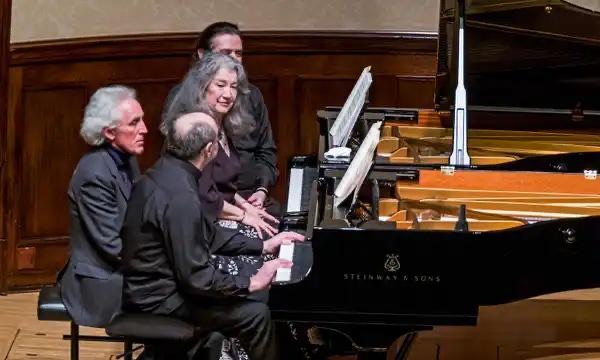
Juan Perez Floristan at the Wigmore Hall

Santander Prizewinners concert
Juan Perez Floristan at the Wigmore Hall tonight for the Prizewinners concert of the Santander International Piano Competition. A strange programme confronted us with the first half the Liszt Sonata and the second four preludes by Debussy ,three by Gershwin and in between the Bartok Sonata and Ginasteras`s Argentinian Dances.
My first reaction ,of course,was to think it rather foolhardy or at the very least presumptuous to open a debut recital with such a monumental work. However in his hands it was a totally convincing and satisfying first half. A very mature intelligent reading allied to a luminosity of sound that allowed this masterpiece to unfold without any exaggerations or over passionate exclamations .In fact a quite overwhelmingly professional performance without the hystrionics of a Horowitz or the deep introspection of an Arrau but a real understanding of the structure of this masterpiece.
Blessed,obviously,with a large hand,strong fingers and relaxed arms his sound could be likened to cristal drops reminiscent of Michelangeli. It suited him well also in the second half. His Canope ,one of four preludes by Debussy, was the most remarkable performance in a notable debut recital. La Puerta del Vino was given a performance of orchestral proportions such was his feeling for the colour and style that he was able to produce. A Bartok Sonata of such clarity and precision one was reminded of Andor Foldes memorable recording.
Some subtle additions to Gershwin’s seductive second prelude added to the razz matazz that he found in the outer ones. Leading ,of course, to a sensational account of Ginasteras dances that brought the house down. Party time secured an encore charmingly introduced to the public :his own arrangement of a Flamenco to thank us and wish us goodbye. Well it was quite a farewell for this consummate artist still only twenty three so there will be many more occasions to hear him in London again …………the earlier the better. As Paloma O`Shea says in her programme introduction :”the combination of luminosity and musical depth make Juan a very special pianist”………..this remarkable promoter of the arts has hit the nail on the head that is for sure

Anna Tsybuleva and Dame Fanny Waterman

 thAnna Tsybuleva Leeds International Piano Competition Prize Winner’s Recital
Anna Tsybuleva this evening gave her much awaited debut at the Wigmore Hall as winner of the Leeds International Piano Competition founded by the ever amazing Dame Fanny Waterman over fifty years ago.
Dame Fanny at 95 presiding as always over her “children” that have included Murray Perahia,Radu Lupu ,Dmitri Alexeev,Rafael Orozco,Andras Schiff,Mitsuko Uchida,Louis Schwizgabel and many more besides .
Since the very first competition winner,her star pupil , the seventeen year old Michael Roll,much admired by Benjamin Britten and a jury of some of the greatest pianists alive all persuaded by this remarkable lady to give up their valuable time with the sole aim of finding their rightful heir and in doing so helping the next generation to astonish a vast public that was awaiting .
Magaloff,Curzon,Bachauer,Fischer,Tureck ,Siki,Boulanger,Sandor these were some of the names on the first juries.
And so it has been a whole host of great artists brought to the public’s attention thanks to the passionate advocacy of this minute power house of energy who had decided in the 1960s that Leeds should house one of the most prestigious piano competitions in the world.
Tonight it was the turn of the young Russian pianist Anna Tsybuleva ,an extremely beautiful young lady with a red hot passionate approach to the piano that had been so admired in her winning performance in Leeds of Brahms Second Piano Concerto.
In fact the visual participation was something that was more admired on the television than on the radio performance .
And so it was tonight in the second half of the recital with a commanding performance of Medtners Sonata in G minor op 22 in which the sense of line and direction were so clearly etched together with a cohesion of sound that made this not fully understood work totally comprehensible .
Not since Richter have we heard the wondrous sounds that she found in Voiles ,the first of three preludes that made up a group of magical Debussy pieces culminating in a passionate performance of L’Isle Joyeuse .
Minstrals was charcterised is such an idiomatic way one was almost reminded of the famously idiosyncratic recording of Paderewski .
Feux d’Artifice could have been more mysterious but the clarity, musicality and sheer virtuosity was breathtaking .
An ovation from a full house was regaled with The Girl with the Flaxen Hair of such liquidity one was totally unaware that here was a box hammers and strings instead of a choir of angels.
The first half on the other hand had been more perplexing . Anna’s inner fire had been to her detriment and the CPE Bach Fantasia in F sharp minor Wq.67 was very fragmented from magnificent frenzied rhythmic articulation to sounds spread over a larger canvas that somehow did not gel into one whole that one could follow.
The Schumann Etudes Symphoniques op 13 too was much too fussy and not simple enough …..somehow her passionate involvement got in the way of the musical line .
The posthumous studies inserted after what Agosti used to describe as the architecturally Gothic cathedral were strangely fragmented and seemingly improvised and not at all part of the overall rather straightforwardly musical line of the variations of this much maligned masterpiece .
In all this performance my one thought was for the great gift that Dame Fanny has with her passionate involvement with music been able to communicate to a vast audience worldwide .
She was very interested to know that Radu Lupo tomorrow would be playing Beethoven Fourth Piano Concerto in Rome with Sir Anthony Pappano . I also told her that Murray Perahia would be giving a recital on the 6th of March.
This great pianist and winner of her competition in the 1970’s who represents so wonderfully her ideals for the Leeds Competition that  she is projecting into the future when I have have no doubt she will be looking on approvingly  from afar.

Welcome back Mr Kissin

The triumphant return of Kissin to Rome last night
Evgeny Kissin returned to the concert platform after a year’s sabbatical refreshed,renewed and rejuvinated.
The title at the gates of the magnificent Parco della Musica just about sums up what Kissin was about to offer to Rome an “Inverno Incantato” . It was indeed just that and he was awarded a spontaneous standing ovation by a capacity audience that included Sir Anthony Pappano,Donatella Flick , Nicola Bulgari,Benedetto Lupo and many other illustrious music lovers.
A first half of classical repertoire : the Mozart little C major K.330 and Beethoven’s Appassionata op 57.
Whilst the second half was dedicated after short but magical Intermezzi op 117 by Brahms to Spanish music where he really let his hair down which led to an ever more enthusiastic audience demanding more .
Ever generous and obviously glad to be back ,a sign of real enjoyment showed not only on his face but by the ravishing sounds that he drew from the piano in The Maiden and the Nightingale and in the famous 5th Spanish dance by Granados. At this point having set the pace the recital should obviously have ended with a breathtakingly virtuoso account of Brahms Hungarian Dance in G minor in some demonic transcription reminiscent of those presented by that other super virtuoso Arcadi Volodos.
But from an imploring public visibly in delerium we were treated to a little Spanish piece full of melancholy and nostalgia . No one seemed to know what it was but does that matter when we are treated to such music that we thought we would never hear again since the passing of the great and much missed Alicia De Larrocha .The Master informs me that it was “Oriental” by Granados
The first half quite rightly was a strictly  classical affair in every sense.
The beautiful little Mozart played with all the repeats that instead of lasting the usual fifteen minutes lasted almost thirty.
As with Richter and many other discerning musicians who quite rightly insist that repeats are an integral part of the structure.
I personally think there could be a compromise at least in public recitals but what does it matter when there is playing of such charm , grace and intellectual musicianship. Some of the startling changes of harmony  though were not so surprising the second time around  even though played with such a sense of control and colour .
The last movement could have had more wit and the bubbling enthusiasm of youth ,but the seriousness of this performance set the tone of the recital and led us into a dramatic and tautly drawn performance of the Appassionata.
Never has the contrast between the whispered opening and the explosive chords sounded so overwhelming- reminiscent of the Liszt Sonata although always in the classical style as befits the new vision of this great artist.
The last movement was played non troppo Allegro but with the driving rhythm together with a total control that had us sitting on the edge of our seat something we thought was lost with the passing of his great predecessor Emil Gilels.
Not quite the luminosity of sound in the Andante con moto but played with great sentiment but without sentimentality, a great unfolding corteo as Agosti liked to describe it, only interrupted by the astonishing chords that are so much part of the revolutionary Beethoven of this period and that takes us into the frenzy of the final movement.
The architecture of the first movement was clearly chiselled together with the unexpected changes of dynamics of this extraordinary work.
Last but not least mention must be made of his extraordinary performance of Asturias from the Suite Espanola by Albeniz.The barely audible whispering of guitar strings to the enormous build up was a tour de force of control , sense of colour and style and was followed by a virtuoso performance of Viva Navarra by Larregla .
I was expecting the famous Navarra that Rubinstein used to offer at the end of his recitals but this was another piece with the same febrile sense of excitement and it brought the official programme to a rousing ending .
A startling journey of discovery that indeed left the audience exhausted and “incantato” as the sign had shown us as we entered this hallowed hall.
Tomorrow Pappano with his magnificent orchestra on a voyage of discovery with Janine Jansen .
An unknown work to me and to most others too I believe ,of Bernstein’s Serenata dal Simposio di Platone .
Sugaring the pill for Christmas with Ravel Miroirs , La Valse and Sibelius’s extraordinary Seventh Symphony .
Music is alive and well in the Eternal City as it has never been before ,since the arrival of our knight in shining armour .

Jianing Kong in Perivale

A standing ovation for Jianing Kong in Hugh Mather’s remarkable Tuesday series in Perivale of some of the most talented young pianists around.
Very distinguished performances of two of Beethoven`s best loved Sonatas : The Waldstein and Appassionata. Somewhat reminiscent of Solomon in its seemingly direct and intelligent musicianship where everything seemed so logical and clearly expounded.
The most noticeable thing about these performances was the luminosity of sound that he was able to find on this not easy instrument. Allied to a very strong Beethovenian temperament he held a full hall enthralled as we listened to these very well known works as if for the first time.
Tightly held together with a very strong and precise rhythmic impulse that seemed to come from within ,such was his identification with the aggressive and at the same time lyrical and calming world that belongs to Beethoven in his middle period. The subdued opening of the last movement of the Waldstein made the irascible outbursts even more unexpected.The continuous pulse of the second movement and its variations in the Appassionata has never sounded more like the cortege that the composer so obviously intended.
The lead into the coda in the last movement literally had us all on the edge of our seats for the animal excitement that he was able to generate. Beethovens pedalling scrupulously noted and intelligently interpreted as at the end of the two sonatas .Especially finely interpreted in the first movement of the Appassionata where the demonic motive reminiscent of the Fifth Symphony took on a frighteningly menacing aspect as rarely heard before. Such precision allied to such innate musicianship was exactly the reason that Solomon sprang immediately to mind.
No encores possible after that but a word of congratulations from our host and best wishes on his recent wedding to another remarkable pianist Caterina Grewe who will be performing the Liszt Transcendental Studies on this very piano in April. Now that is what I would call a very equilibrated household and send them both all best wishes from myself and in particular the Keyboard Charitable Trust for whom they have been selected a few years ago.

A birds eye view of a very happy occasion Martha Argerich and Alberto Portugheis Wigmore Hall 75th birthday celebration

Happy Birthday Martha and Alberto a page turners view of a remarkable occasion .
CHRISTOPHER AXWORTHY·MARTEDÌ 13 DICEMBRE 2016

Wonderful birthday celebration at the Wigmore Hall last night for the joint birthday concert of Martha Argerich and her old friend Alberto Portugheis – their 75 Anniversary. And what energy they both have with nearly four hours of rehearsal before the two hours of the concert.
Fortified in between with only a cup of coffee it was a memorable occasion in which two old friends from their long distant youth in Buenos Aires ,shared their love and enjoyment of making music together with a packed out Wigmore Hall.
Two fine Steinways side by side for the two piano works on the programme Mozart Sonata in D and the Brahms Haydn Variations and a single piano was enough for the two duets of Rachmaninov Six Pieces op 11 and Ravel Ma Mere l’Oye . To an enraptured audience they offered two encores :Oblivion by Piazzolla in the arrangement of another old friend Eduardo Hubert and Milhaud’s Braziliana from Scaramouche. Two old friends as page turners completed the festive atmosphere on this very special occasion
Wonderful to hear the exchange between two old friends in the exquisite second movement of the Mozart and the real fun they had in the outer movements . Some beautiful sounds through a very special use of the sustaining pedal in their magical performance of Ravel’s Ma Mere L’Oye suite. And the Rachmaninov played with all the pathos that the twenty one year old composer was able to convey in these very atmospheric six pieces.
And like all good old friends they shared equally the two scores Martha taking the top in Ravel and Alberto the top in the Rachmaninov.
Virtuosity abounding in a rousing performance of the Haydn Variations by Brahms in which Martha Argerich took on the first piano showing all her remarkable gifts that have made her one of the most loved and sought after musicians of our time.
Our remarkable Alberto,nominated for a Nobel Peace Prize no less,showed all his innate musicality in this heartwarmingly affectionate conversation shared with all their adoring friends in the wonderfully welcoming space that is the Wigmore Hall.
Festivities with friends long into the night completed this memorable encounter of two friends of a life time in music.

Daniel Harding’s tribute to his Master

‘Resurrected on the Immacolata
Immaculate performance of the Resurrection Symphony under a superb Daniel Harding truly worthy of the dedication of tonights concert to Claudio Abbado on the feast day of the Immacolata.
Pappano’s wonderful S. Cecilia Orchestra and Chorus in Rome in magnificent form. A truly memorable performance for its controlled passion and grandeur.
A great sense of line in the German Kappelmeister tradition of Jochum or Klemperer as exemplified in our time by the great and much missed Claudio Abbado .
To say that we were not aware of the ten horns and eight trombones is the greatest compliment one could give to this young director discovered and helped by Abbado for whom he became assistant .
The one and a half hour work all leading  inevitably to the last movement inspired by the funeral of Hans von Bulow where the entry of the magnificent chorus is so movingly  right.
All performed with a sense of line ( not easy with the enormous orchestra asked for by Mahler) that held the packed audience spellbound to the end.
A standing ovation was not enough for such a profound experience .We left the hall uplifted by this great tribute to Claudio Abbado as Mahler had been at the funeral of Liszt’s son in law.
Where words are not enough …….music can reach the realms that our souls need these days, when we appear to have so much but in fact after this experience  it is in fact too little .

The great lesson from L’Aquila

A great lesson of humility and humanity by the noble people of L’Aquila

Great performance today at the Ghione Theatre in Rome and all proceeds to be given to those stricken by the recent earthquake in Amatrice by their next door neighbours of L’Aquila who are still very much suffering from the destruction to their magnificent city seven years ago.
The orchestra and soloists in this semi staged performance all trained at the Conservatory of Aquila.

Such youthful energy and wonderful voices bodes well for the future for this earthquake stricken area just 100KM from Rome.

But what stories these poor people have to tell about the aftermath and consequencies of such a tragedy.Not only for their loved ones that were lost in those few tragic seconds but the complete change of life and even their homes , declared unsafe to inhabit , being taken over by vandals many from Albania and Rumania who terrorise the just inhabitants of this once glorious city.

What a wonderful noble gesture of real solidarity and understanding for your neighbours tragedy that was yours only a short while ago.
I well remember my visit with the Keyboard Trust to Aquila and repeat here a description that I was reminded of as I went up to listen to Carlo Grante and Luisa Prayer and to applaud the courage once again of these strong,noble people.

Hats off indeed and lets us all learn from them .

https://christopheraxworthymusiccommentary.wordpress.com/

This is what I found just a couple of months ago……………..

The Emperor speaks Carlo Grante – Orchestra Sinfonica Abruzzese directed by Marcello Bufalini
CHRISTOPHER AXWORTHY·DOMENICA 23 OTTOBRE 201613 letture
It must be over twenty five years ago that Vittorio Antonellini asked me if his orchestra could give Sunday morning concerts in my theatre in Rome .
And so for many Sundays we had the Orchestra Sinfonica Abruzzese anxious to have a prestigious presence also in Rome apart from their home city of L’Aquila where they had their own hall.
Many memorable concerts in spite of the difficulty to get an orchestra on stage when in the afternoon there was a stage performance of a play.
But where there is a will there is a way and we succeeded as indeed the orchestra have now in their earthquake torn city.

They have re- emerged to offer comfort as only music can to their strong but shaken citizens .
In the Ridotto of the Teatro Comunale the Orchestra has found its home whilst the actual Theatre next door is being reconstructed after the terrible earthquake seven years ago that almost flattened this very important city.

By coincidence two young artists that were performing regularly in my theatre in the same period were Carlo Grante and Luisa Prayer.
Carlo born in L’Aquila gave several series of concerts playing a large part of the piano repertoire of which he was already master.
Luisa too a student of our near neighbour that magnificent musician Sergio Cafaro ,played many concerts demonstrating, as all Sergio’s students did, a rare musicality .Another of his students to find a home in my theatre was in fact Roberto Prosseda.who recently recorded Mendelssohn’s third piano concerto with Riccardo Chailly ,performing it also with the LPO at the Festival Hall in London and many other prestigious venues throughout the world

So it was a great joy to hear Carlo Grante play the Emperor Concerto at the inaugural concert of the Orchestra Sinfonica Abruzzese of which the new artistic director is Luisa Prayer.
Directed by Marcello Bufalini the musician who had infact recently completed from fragments Mendelssohn’s third piano concerto mentioned above.
(Another coincidence was listening on the radio on my long trip back to Rome the opening concert from La Scala which was directed by Riccardo Chailly with Benjamin Grosvenor the much applauded soloist in Liszt’s first piano concerto)
The world of great music making is very small indeed !

A splendid performance of the Emperor played with that great Beethovenian energy (that Pappano had too in Fidelio that was awaiting me on my return this evening on the television transmitted from the opening concert of S,Cecilia ,that I had attended the day before).
Some very fine playing form Carlo not least for his utmost attention to the bass – the very roots of the Beethoven sound.
It much reminded me ,in his mature innate musicianship,of that other renowned musician Paul Badura Skoda (who has just been performing in Carlo’s new Piano Festival Cristoferi in Padua).
The same clarity but at the same time extreme attention to detail as was obvious from a magical account of the slow movement.

The opening had all the majesty and command together with an impetus that propelled the music forward and swept us along with it too.The Orchestra very well directed by Bufalini had found the same impetus that was also very well projected into the final Allegro con spirito that was in fact repeated as an encore from a very numerous and insistent audience.
An appeal from Carlo from citizen to citizen to spread the word about this wonderful music making in this strife ridden city and remind their friends that there was still time to buy a season ticket and thus give the maximum support to this splendid venture so ably directed by Luisa Prayer.

I should add also that three years ago we at the Keyboard Charitable Trust were invited by Guido Barbieri,the renowned critic,and artistic director of the Amici della Musica, a music society that goes back more than a century and where Rubinstein and many other illustrious musicians would return every year .Rubinstein was in fact an honorary citizen .#

We too were invited to bring three young pianists to play and talk about our activity of encouraging and helping young musicians in the very difficult period between the end of studying and starting a career .
We performed in a new hall,designed by Renzo Piano(The Shard,Parco della Musica)and given to the L’Aquila by another earthquake torn city,that of Trento.
Claudio Abbado had agreed to give the inaugural concert donating also he ,his services as a sign of solidarity and encouragement .
And so it was shortly afterwards that three very fine young pianists Pablo Rossi,Vitaly Pisarenko and Mei Yi Fou were chosen to come L’Aquila together with the founders of the Keyboard Charitable Trust -Noretta Conci-Leech and her husband John Leech.We came to give comfort and a message of hope for the future to these very strong,courageous people .
What was it that Shakespeare said :” If music be the food of love …..play on …”
For music arrives where words are just not enough .

foto di Christopher Axworthy.


For whom the bell tolls ………50th anniversary celebrations of Michele Campanella

For whom the bells tolls….
Michele Campanella fifty years on stage Celebration concert at Rome University.
It must be well over forty years ago during my student days in Italy that I ventured up to the beautiful Amphitheatre in Fiesole (the town overlooking Florence )to hear a young pianist play Mussorgsky and Liszt .A recital that has remained in my memory ever since .
I would never have imagined that forty three years later I would be listening to that same pianist in the same Pictures at an Exhibition of all that time ago. I often wondered why this fantastically talented young pianist never reached the heights of his colleague Maurizio Pollini although I would occasionally see his name in prestigious Italian music venues. I did once hear him play a few years back for a series of lecture recitals on Liszt by Roman Vlad in which he played the musical examples. He is in fact in the process of recording many of Liszt’s major works on Liszt’s Bechstein that is housed in the Chigiana in Siena. It is the piano that inspired Barenboim to have a similar instrument single strung for his recent Schubert recitals in London and in Italy just last week .
It was Roberto Valli (that wonderful magician of the piano who looked after us with his magnificent Steinways for our complete Rachmaninov Concerto Series in Pesaro ed Ancona recently) ,who introduced it to him and it was Roberto today that was looking after Maestro Campanella on a very fine Yamaha Grand of which he is an official artist. I have always been interested to find out about the different schools of piano playing that abound and even went down to Naples in the 1980’s to listen to the great Vincenzo Vitale giving masterclasses at the Villa Pignatelli. (Scaramuzza too was from Naples before moving to Buenos Aires where he has taught some of the finest virtuosi of our age – Martha Argerich is his most famous one these days) .
Vincenzo Vitale that day spoke only of music but having heard his pupils play I was aware of the very particular discipline that his method involved . Laura di Fusco,Carlo Bruno,Bruno Canino and Michele Campanella are all examples of the Vitale school and are all highly professional pianists all with a very clean precise sound . The complete opposite of the so called Matthay Method as exemplified by the sheer beauty and liquidity of sound of Myra Hess or Moura Lympany . In fact it would seem that the complete independence of the fingers ( remember the old trick of balancing a coin on the back of the hand whilst playing scales) in the Vitale method was in contrast with the totally flexibility of Matthay as was obvious from the sound produced. And so it was today some wonderfully clean ,precise musicianly playing but sadly lacking the attention to the sound produced .
I was pleasantly surprised by the beauty of sound in the opening of the Papillons by Schumann but the moment we got to the left hand octaves in the third piece the sound became hard and inflexible as this rather rigid technique seemed to take over. As this very fine musicianly recital progressed it seemed as though his arms were not part of his body and the communication between his mind ,arms and fingers seemed to exclude the participation of his whole body. This of course led to some rather perplexing moments especially in the monumental performance of Mussorgsky.The sound produced in Bydlo and Baba Yaga was almost unbearable in its violence without resonance .
This too is exemplified in the playing of some remarkable Russian pianists such as Toradze and Matsueev or previously Lazar Berman( known sometimes as Laserbeam for obvious reasons ). Some wonderful beautiful cantabile sounds unfortunately mixed with the most hard ingratiating fortissimi .It is obviously a choice but one that does not appeal to my taste where music for me must talk and there must be a comprehensible language and a love for the variety of sounds produced . Some people in the audience recognised me from the concerts in my theatre and they too exclaimed how wonderfully Shura Cherkassky had played years ago at the Ghione Theatre , a little Scherzo by Mendelssohn offered tonight as an encore together with a charming Schubert Moment Musicaux . But Shura loved the piano I exclaimed spontaneously after having my ears ringing from the Great Gate that we had just heard constructed obviously by the military forces.
It was however a very successful and moving celebration for a notable career spanning fifty years This great artist got a well deserved standing ovation ……………I will just remain with the wonderful memories of forty years ago.

Alexander Lonquich. For love of Schumann

Alexander Lonquich. For love of Schumann
Alexander Lonquich in Rome at Parco della Musica. Schumann recital op.4,12,WoO31and op. 6.
A long time has passed since the sixteen year old Alexander Lonquich won first prize at the Casagrande Competition . I remember him being taken under the wing of Nikita Magaloff and Sandor Vegh and now he returns almost forty years later as the great artist he has matured into, giving an all Schumann Recital in the great hall of Renzo Piano’s magnificent concert halls in Rome .
Such a refined and intriguing a choice, as befits the real thinking musician that he is today, including two rarely heard works :the Intermezzi op.4 and The Studies in the Form of Variations on a theme by Beethoven(the second movement of the seventh symphony).The later only fairly recently came to light in 1974 having been in private hands since its origin in 1833.
These two works as preludes to the masterpieces that we know so well: Phantasiestucke op12 and the Davidsbundler op 6.
Wonderful sounds all at the service of the music where one was never aware for a minute of the supreme technical and musical feats that were being performed by this master musician. Such was the concentration and total self identity with the sound world of Schumann that we were taken on a magical trip to the wonder world of Florestan and Eusebius .
The world that Schumann inhabited and that was eventually to send him in to a mental institution .
Such is the concentration though in these series of short pieces that in order to get their message across one has to stand back and in a sense almost use a classical style to allow the message that is so much integral part of the composition to speak for itself in a simple and beautiful way.
So a whole recital of Schumann in the hands of someone like Lonquich who obviously loves it so much can be overpowering . A bit like being almost smothered by love .
So much so that one cannot sometimes see the wood for the trees.
It was a fantastic recital but I just felt I would have preferred some parts to be allowed to speak for themselves in a simple way – the words are enough without any emphasis or underlining and without constant caressing and passionate embraces.
As Schnabel famously said about Mozart :too easy for children and too difficult for adults.
One just has to listen to the masterly recording of Davidsbundler by Gieseking to hear such simple restraint allied to such sense of colour that the whole architecture of this series of little pieces becomes a completely satisfying whole. So difficult to attain especially when a whole recital consists of almost 30 or so little pieces.
Geza Anda whose modern day playing of Davidsbundler was a classic example programmed them in his last recital in London , as a dying man ,with Mozart D major Sonata and Beethoven op 110.
Fou Ts’ong I am very proud to say learnt them especially for me but he too loved them so much that he was not able to show us the complete form but so many wonderful small nuances as there were  today .
A very difficult path to tread in this day of complete performances but I note that another much loved artist Andras Schiff is playing today in London the Davidsbundler coupled with Bach,Bartok and Janacek.
Very interesting to hear for the first time the Beethoven variations.
Such transcendentally difficult pieces but played with such a refined sense of colour and complete mastery that one wonders why they are not more often performed .
The Intermezzi op 4 sandwiched as they are between The Abegg Variations op.1,Papillons op.2 and the Davidsbundler op.6 have always been perhaps not totally unjustly overlooked .Such are the masterpieces before and after that this interesting work does pale in such context.
Wonderful opening to the Phantasiestucke – Des Abends played with such a refined control of sound it could almost have been a human voice .
In fact after these masterly performances we were offered one of the pieces from the Album for the Young – Winterszeit n.2 and what a revolutionary piece this is hidden away in this little box of jewels.
Standing ovation and insistence from a unjustly poorly attended recital was rewarded by the famous Arabesque op 18 with such decisive contrast between the beautiful recurring melody of Eusebius and the outbursts of Florestan (maybe rather over exaggerated here ).The wonderful ending somewhat reminiscent of Dichterliebe sent us out into the cold winters night with our hearts full of the message of love that we had been privileged to share with Maestro Lonquich .

Leonardo Colafelice at the Filarmonica

Leonardo Colafelice at the Filarmonica
Leonardo Colafelice at the Filarmonica in Rome this evening in their complete Beethoven series in the Sala Casella .
One of the best kept secrets here in Italy is what we call the Florence of the south meaning the cultural capital of Italy . It is in fact that wonderful city of Lecce, all Spanish Baroque in the heel of Italy .
When we were on tour with the Importance of being Earnest and Pirandello’s La Vita che ti Diedi we could not believe that even the man on the petrol pump had a season ticket for the theatre .Even at the back of the stage was a statue to the great Tito Schipa .
Martina Franca in the Valle d’Itria,the shin that leads to the heel one might say, has become one of the major Opera Festivals in Europe along the lines of Wexford in Ireland in discovering unknown opera masterpieces and performing them for the first time in modern times.
Paolo Grassi (together with Giorgio Strehler founders of the Piccolo Teatro di Milano – the National Theatre) and the great violinist Gioconda da Vita were both born in Martina Franca.
Riccardo Muti was born in Monopoli in Puglia where the pianist Benedetto Lupo has been teaching for some years with some startling results: the most recent of whom Beatrice Rana is rapidly taking the international concert scene by storm.
A recent CD with Pappano of Tchaikowsky 1 and Prokofiev 2 has had the critics world wide searching for superlatives .
And so it was today the turn of Leonardo Colafelice from Altamura in Puglia present in the fourth recital in the complete Beethoven Cycle that Andrea Lucchesini has devised for the Filarmonica to give a stage to some of the most remarkable young Italian pianists that are appearing ever more frequently as top prize winners in International Piano Competitions .
Matteo D’Amico,renowned composer and artistic director of the Filarmonica, had decided to include a short contemporary work by young living Italian composers in every concert with a brief interview with Guido Zaccagnini of Rai 3 radio all to be broadcast at a later date. A wonderful opportunity for these great young talents,pianists and composers alike , to be heard by a wider public .
The series opened in October with Federico Colli,winner of the Leeds International Piano Competition in 2011.
Leonardo Colafelice at only 18 was a finalist in the Rubinstein Competition ,and went on to win second prize in Cleveland as well as being finalist in the Busoni competition last year . Beautiful piece by Francesco Fournier “Fernweh ” a world premiere was full of beautiful colours as well as some very virtuosistic sections reminiscent of Stravinsky.
It was Stravinsky played as an encore: Dance Russe from Petrouchka and the March from Pletnev’s transcription of the Nutcracker that showed off to the full, the range ,colour and virtuosity of Leonardo Colafelice’ s remarkably assured playing .
His Beethoven was very correct and musicianly presented but I felt it was too Beethovenian in the sense of being too stern ,lacking in the colour and character that he reserved for the other of today’s composers on the menu.
Whereas Leonora Armellini in the second recital in this series had shown us what colours and sensitive music there is in Beethoven not only the stern severe unsmiling teutonic composer that Leonardo had chosen to show us this evening .
Surely the little sonata op 79 in G major is full of charm and wit apart from great rhythmic drive – deprive it of that and we have a series of wonderfully performed scales and arpeggios but there is no story being told.
The very opening Sonata op 54 Tempo di Minuetto lacked the very lilt and charm that this unique little sonata offers sandwiched as it is between the great Waldstein and Appassionata sonatas .
Surely the wonderfully played octaves in op 54 should not sound so bare and unyielding even although played with an enviable assurance.
The Sonata op 81a” Les Adieux” that ended the recital was by far the most successful Beethoven performance of the evening of the four Sonatas offered .
It was exactly as though Beethoven having pointed out the story our wonderful young virtuoso was happy to tell it to us and to lead us with his imagination into a territory he had not dared venture before .