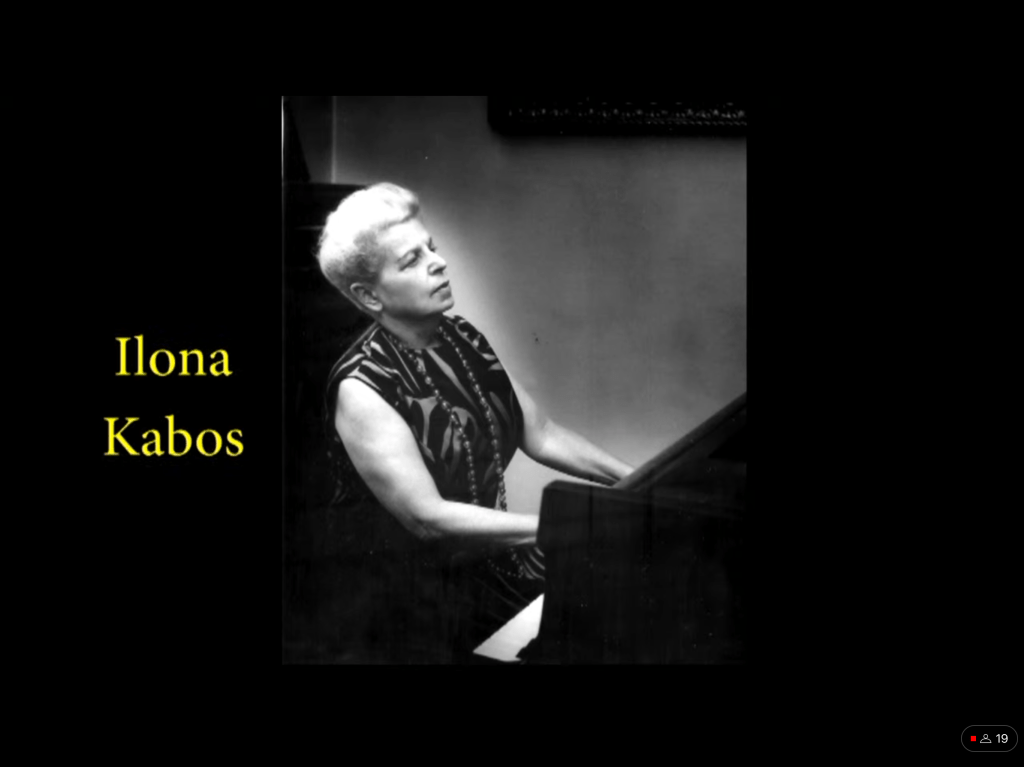
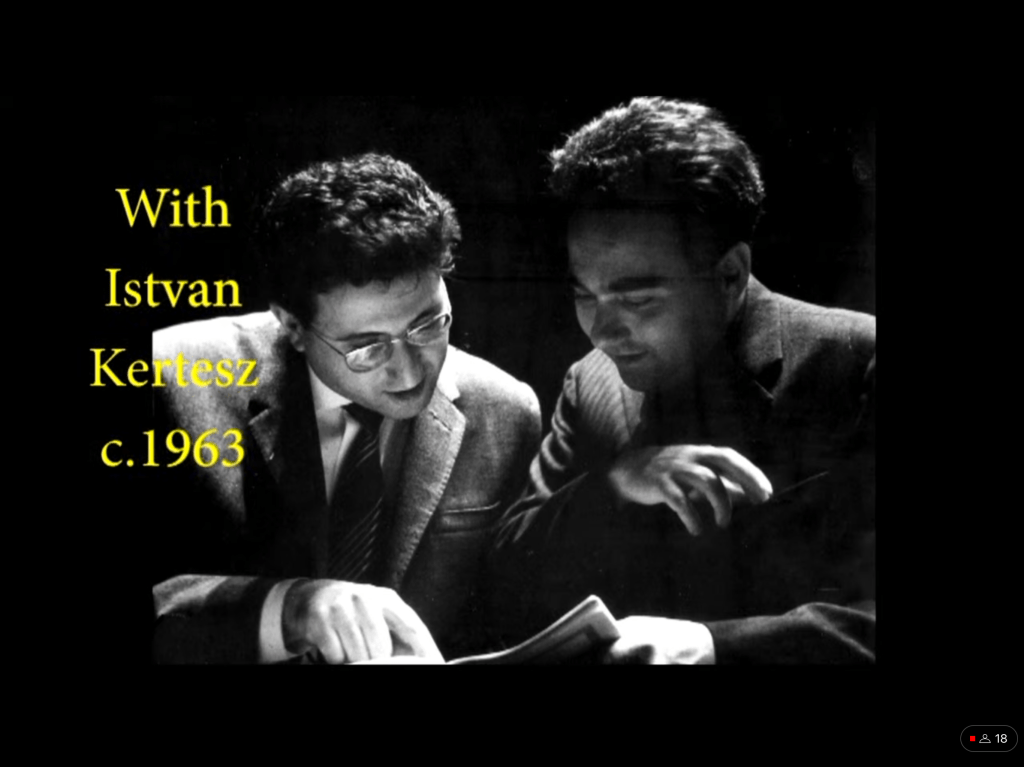
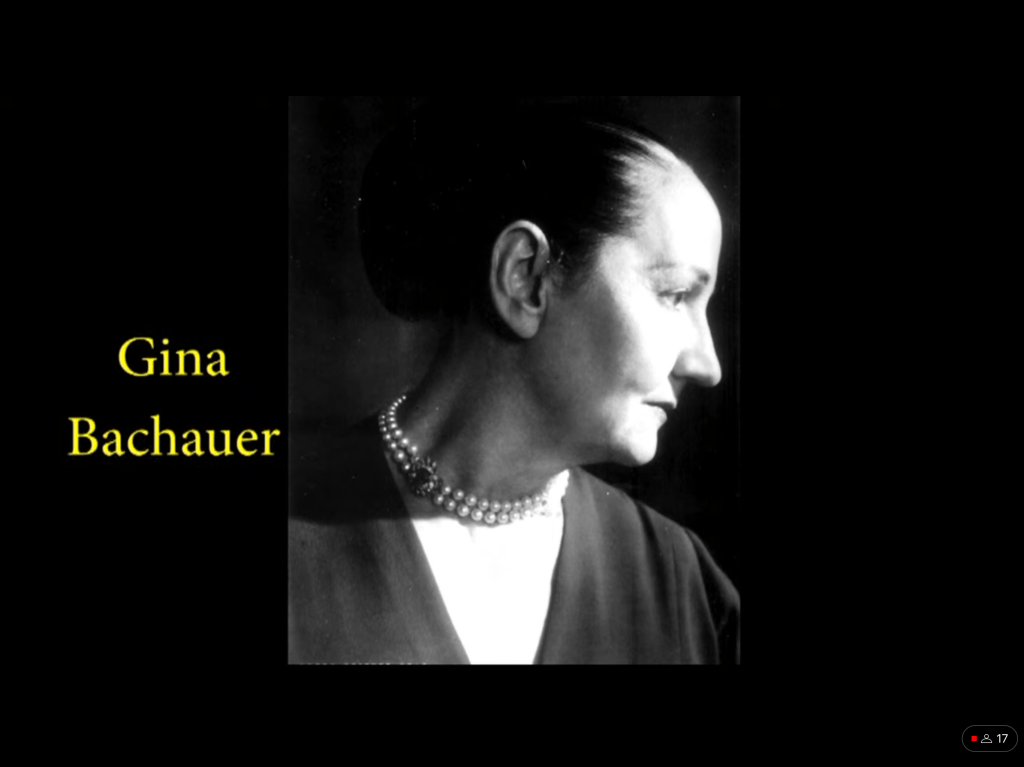
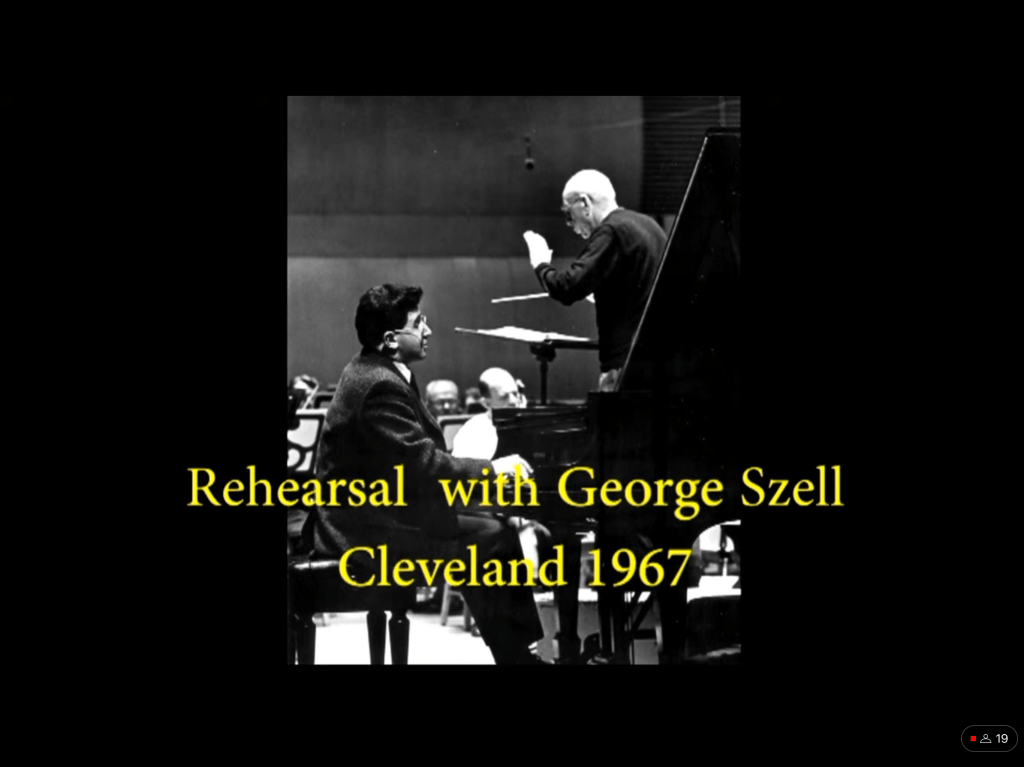
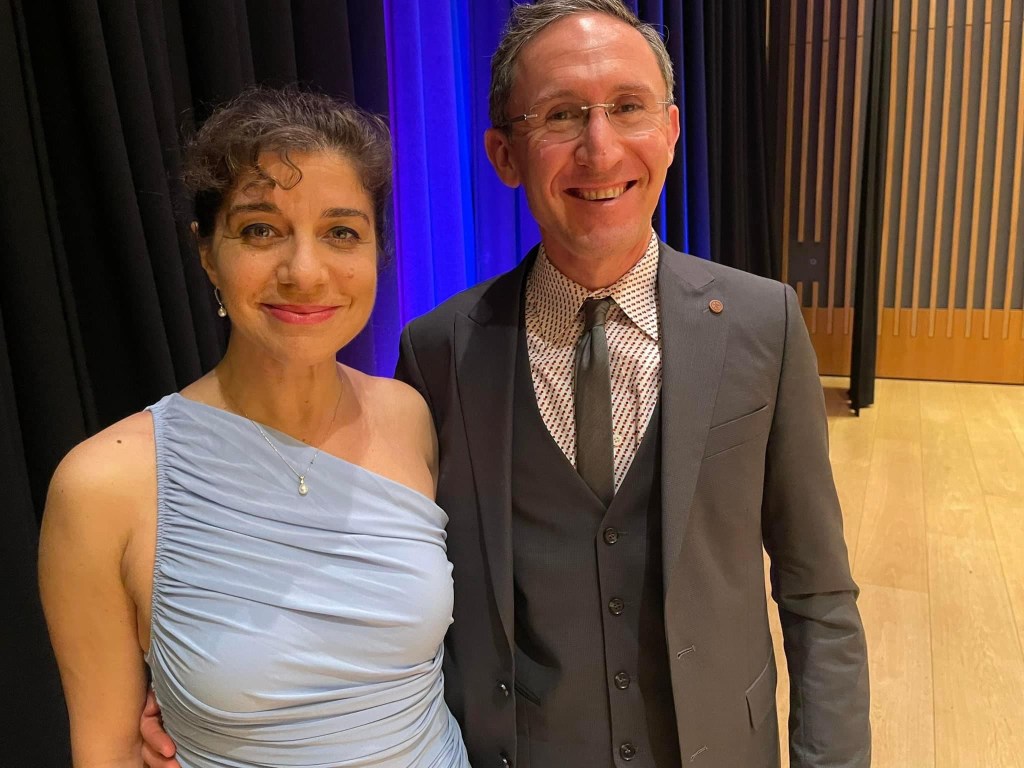
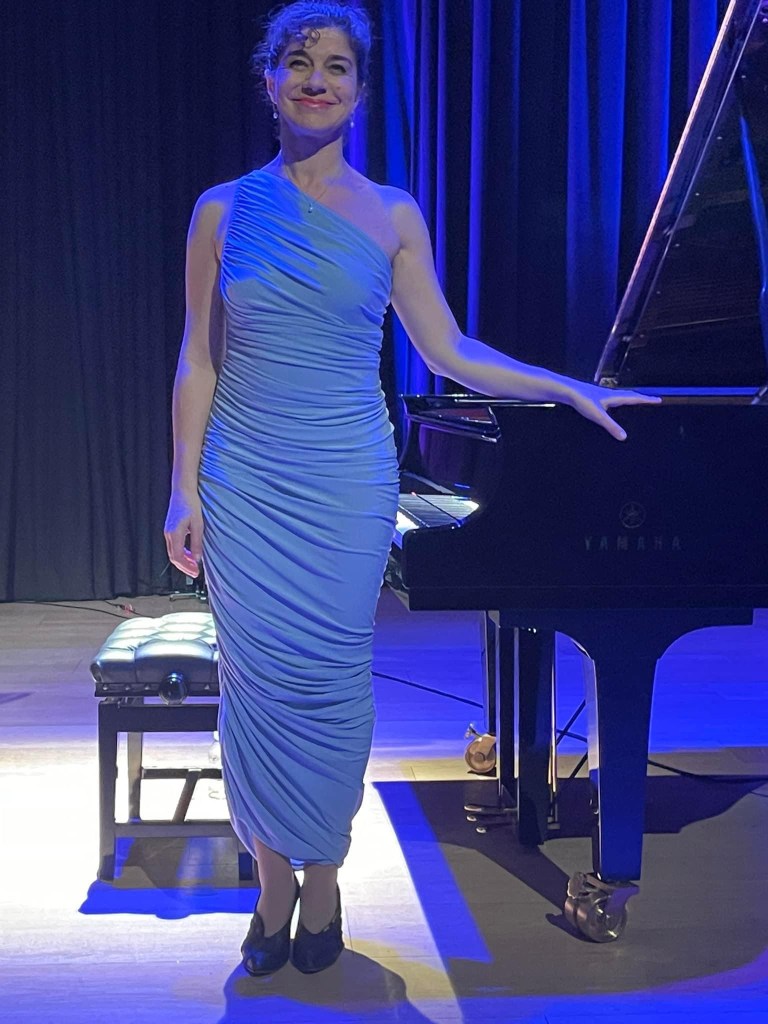
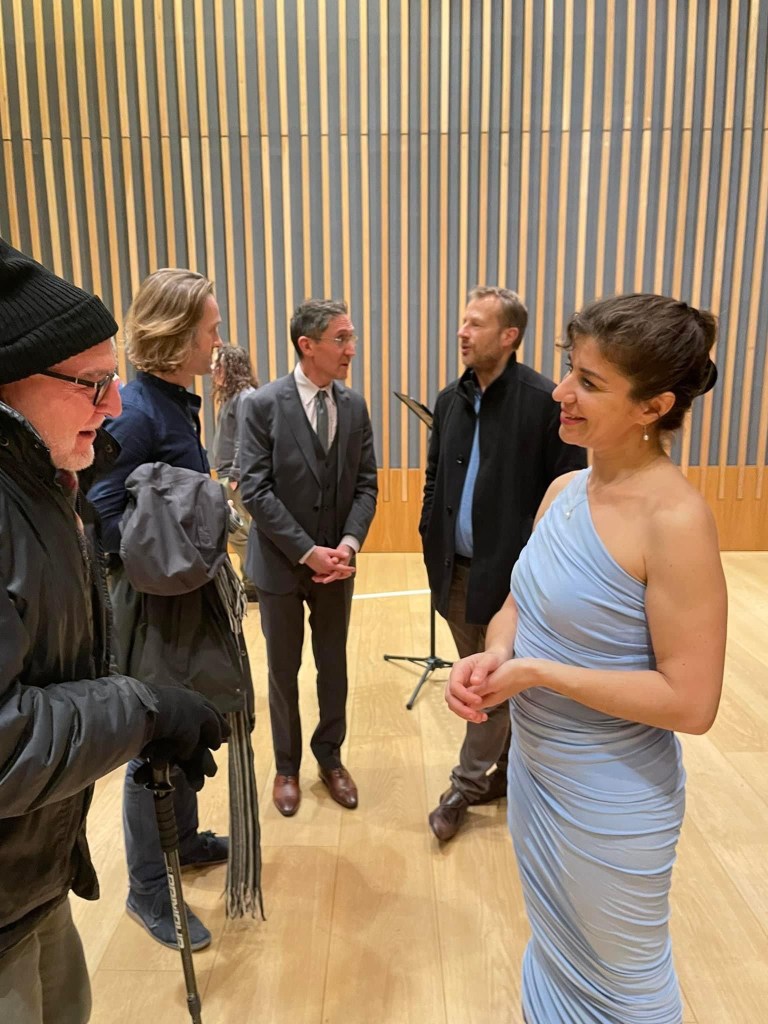
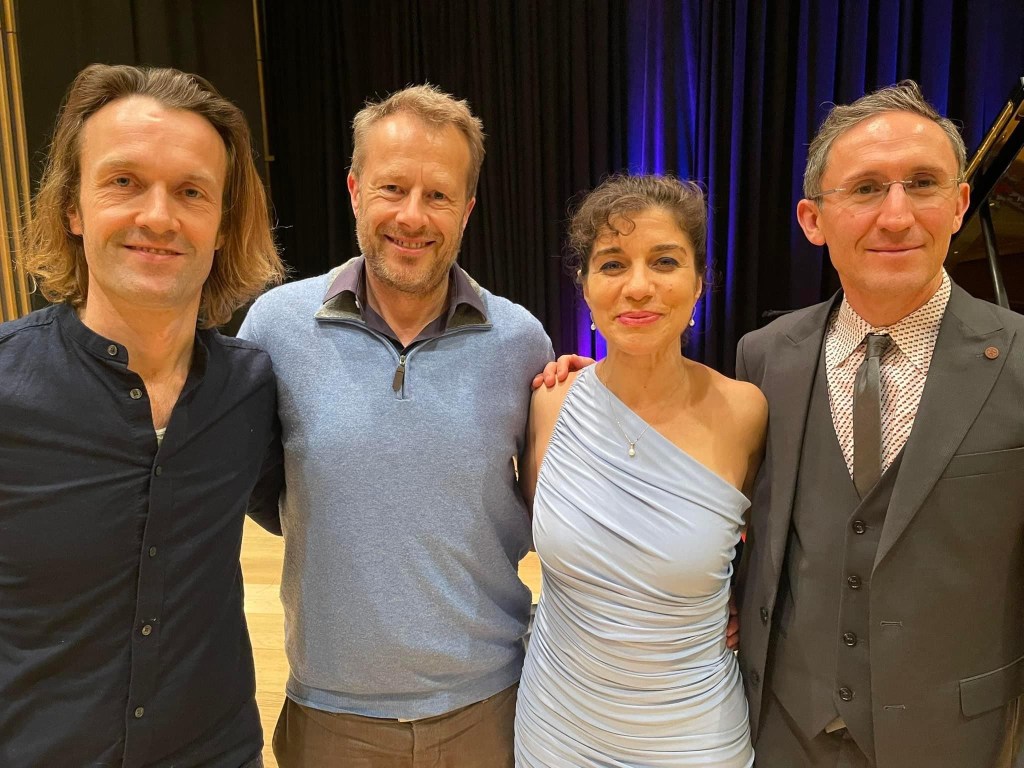
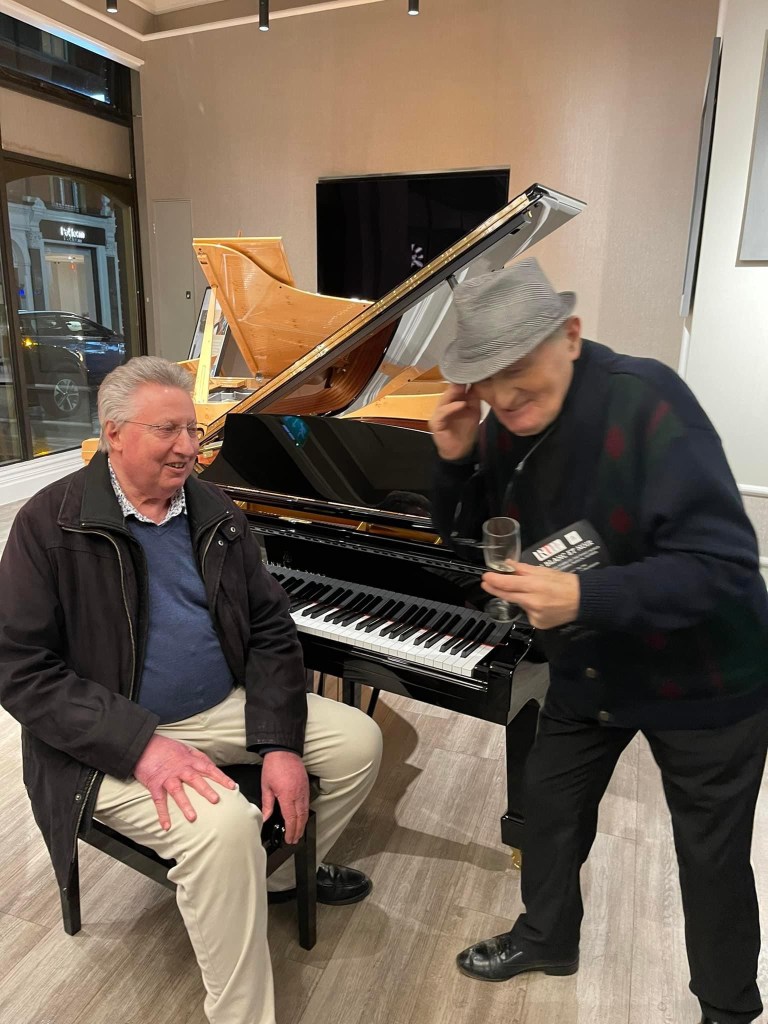
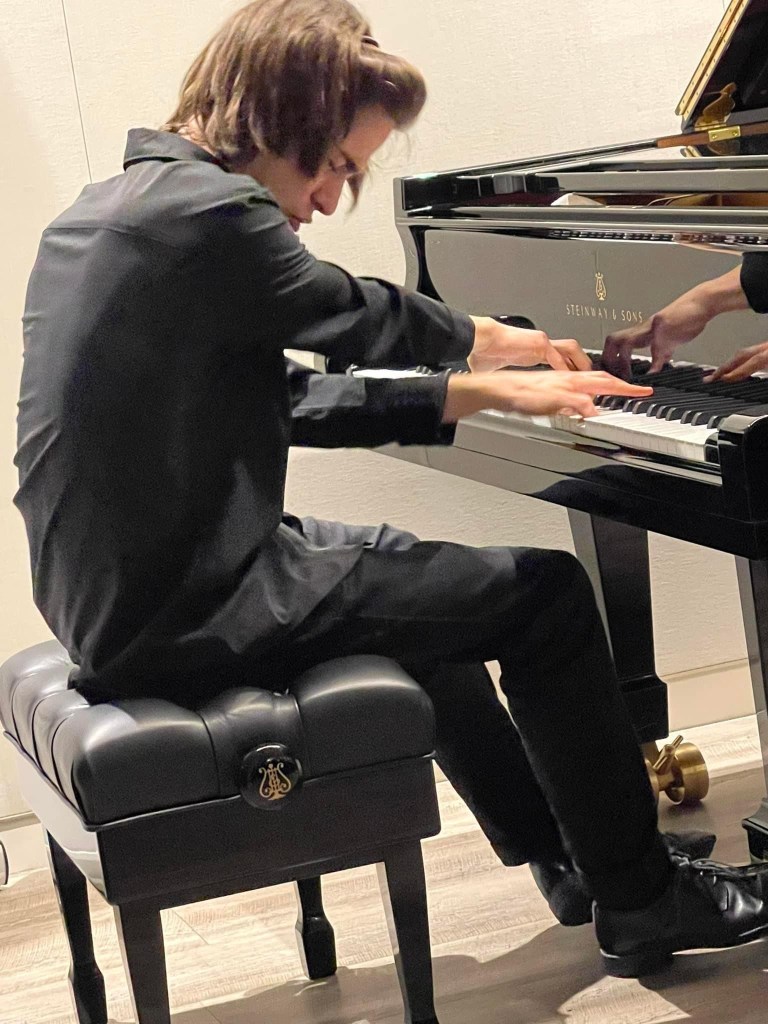
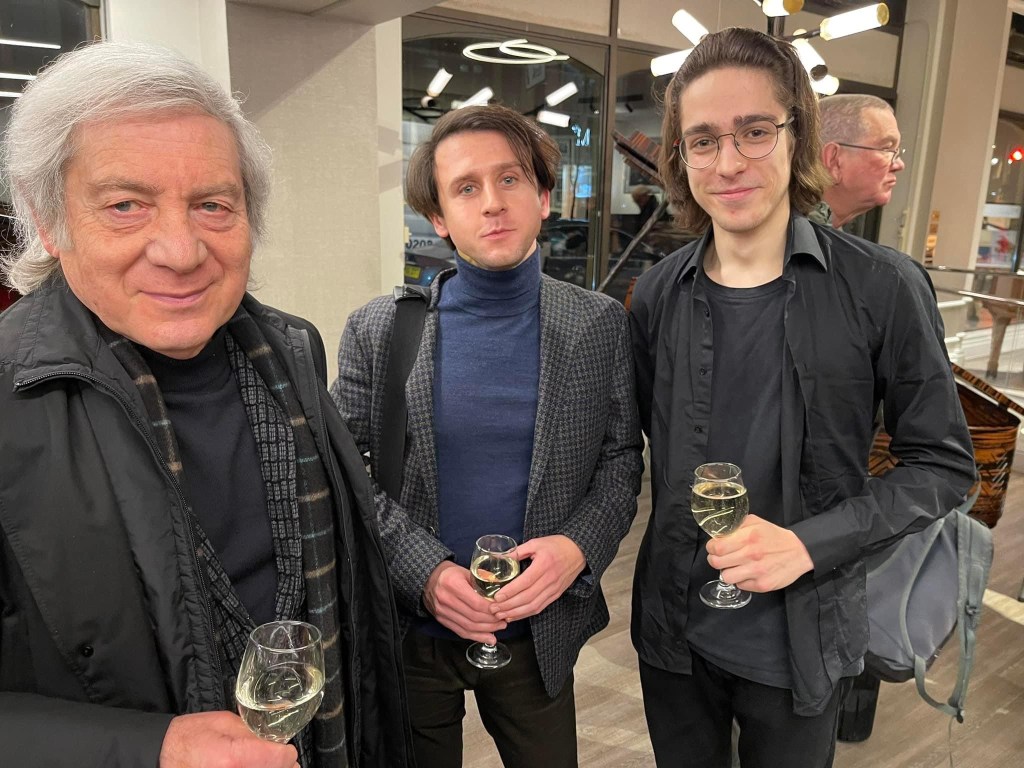
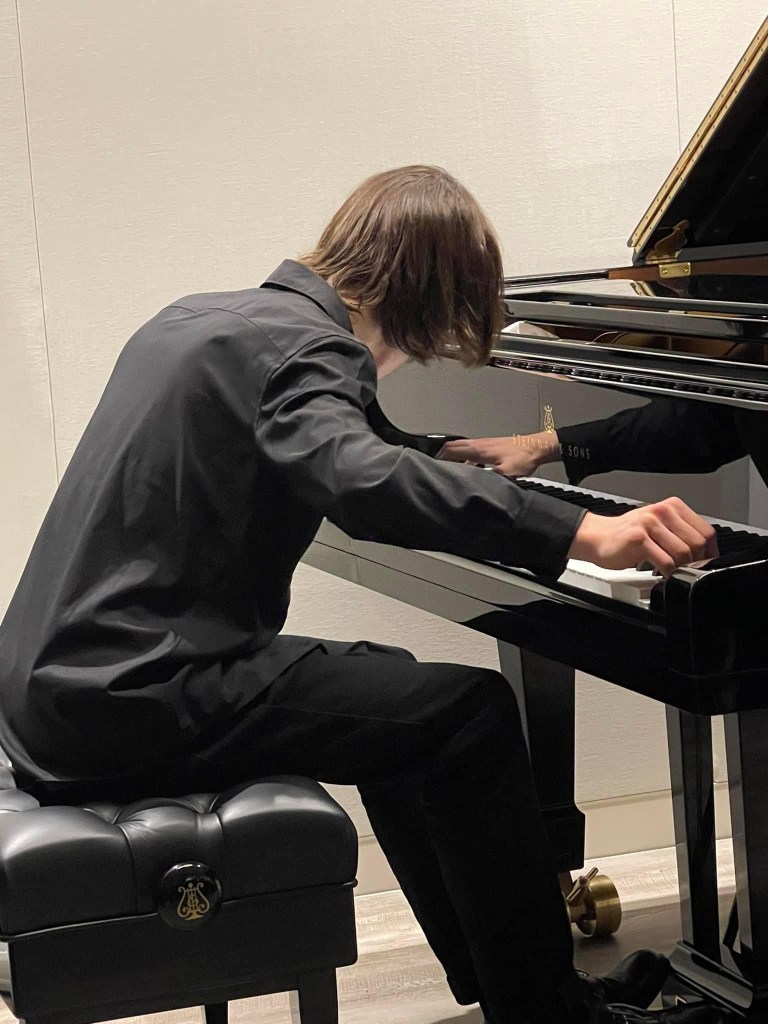
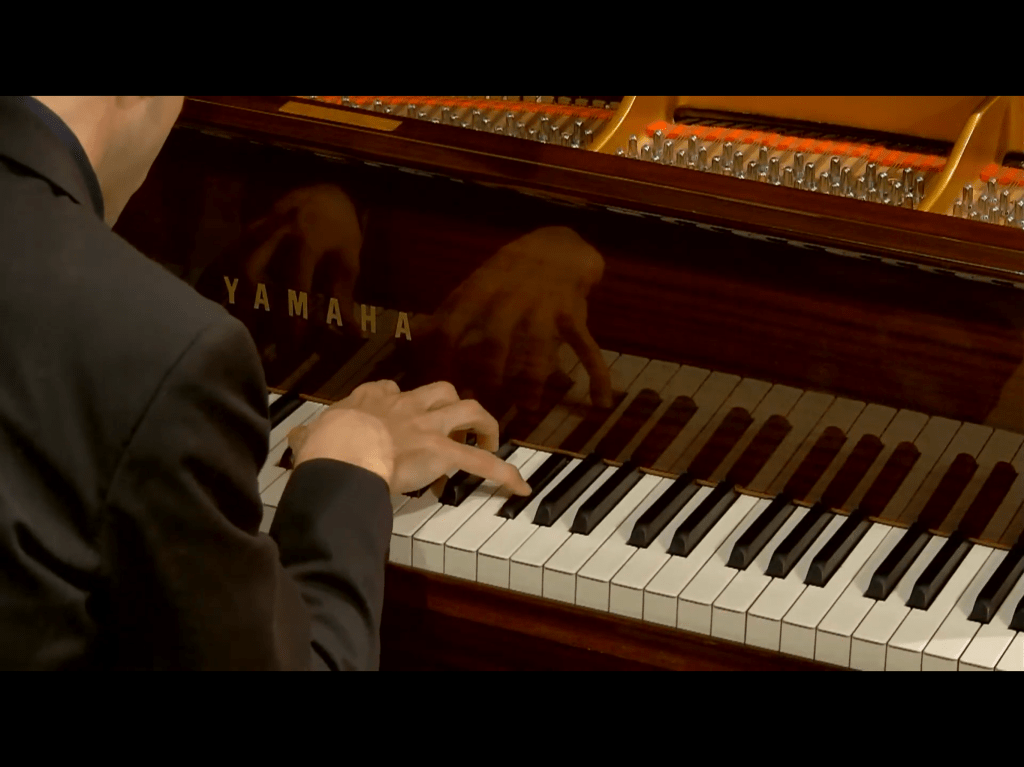
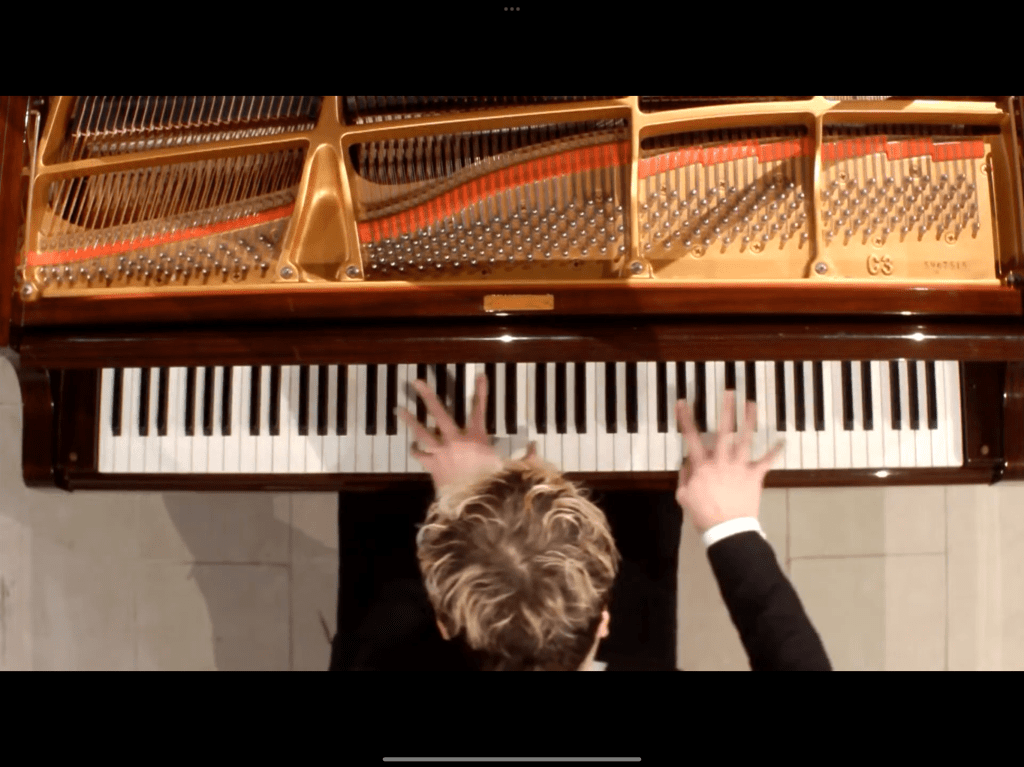
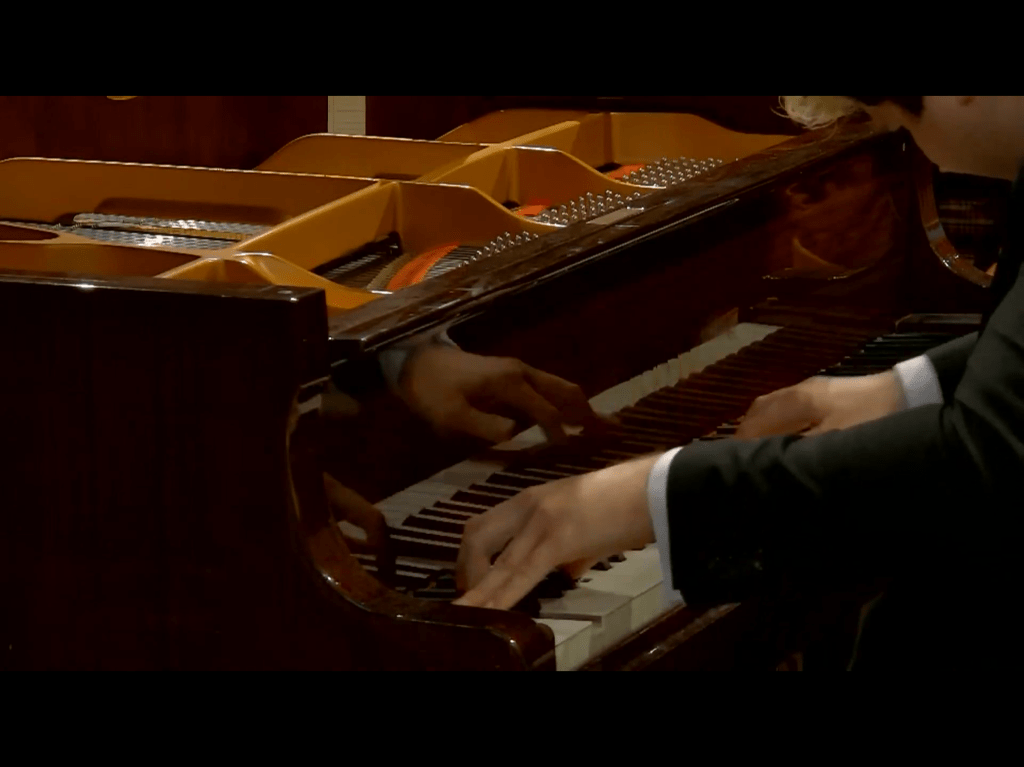
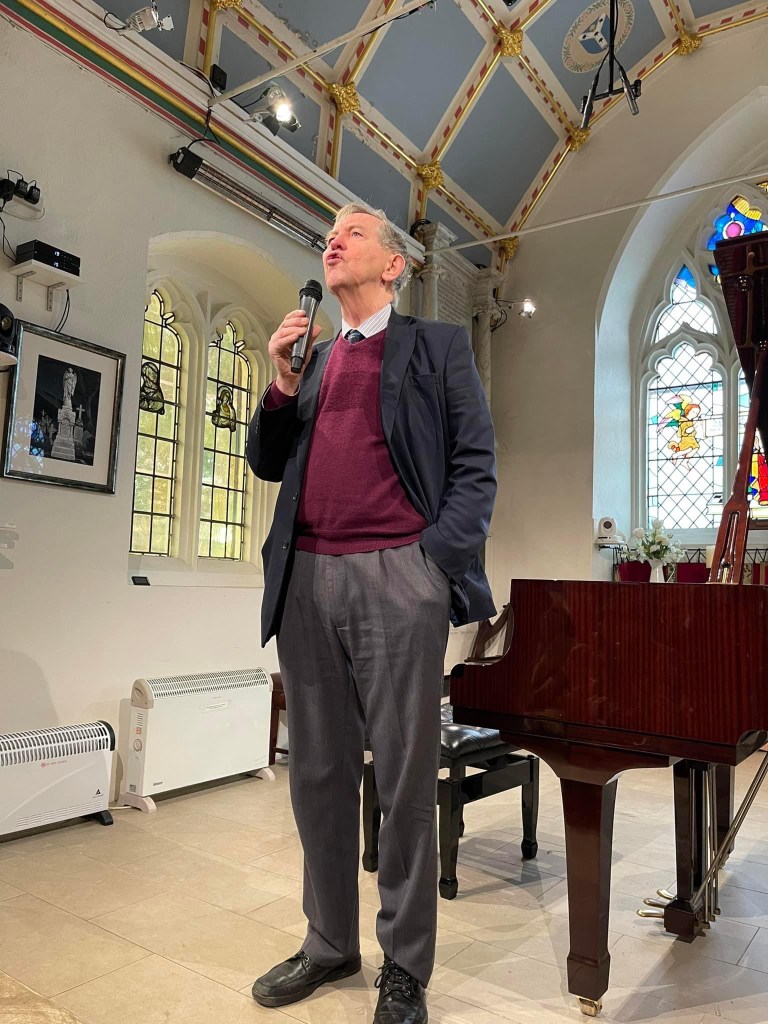
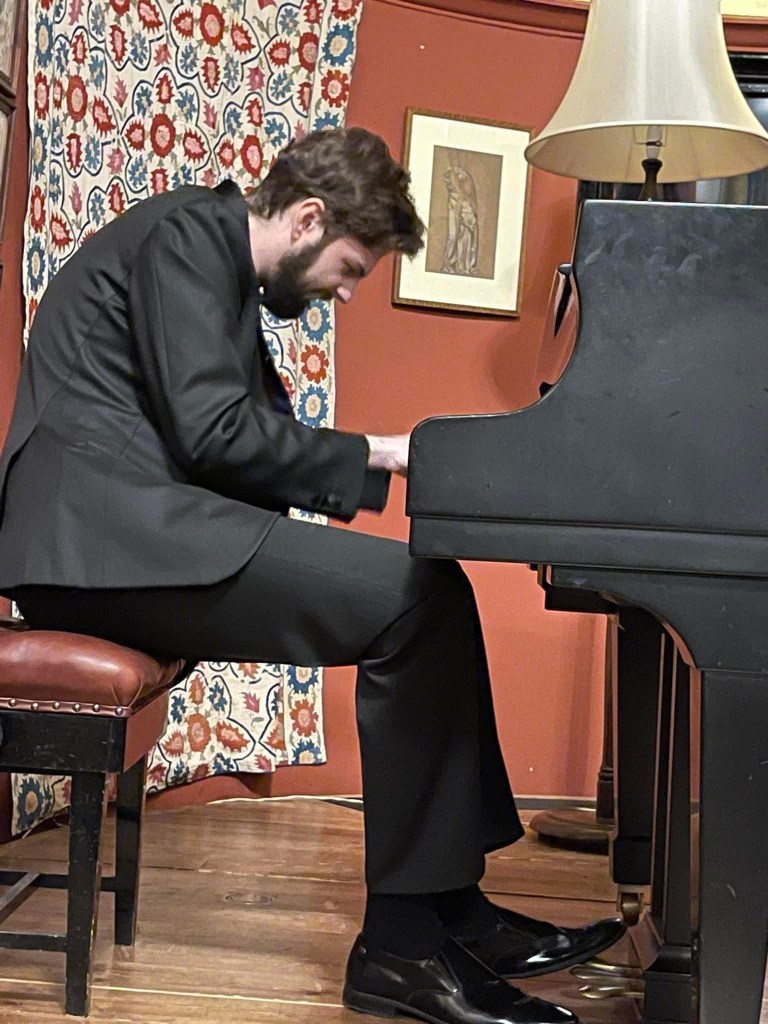
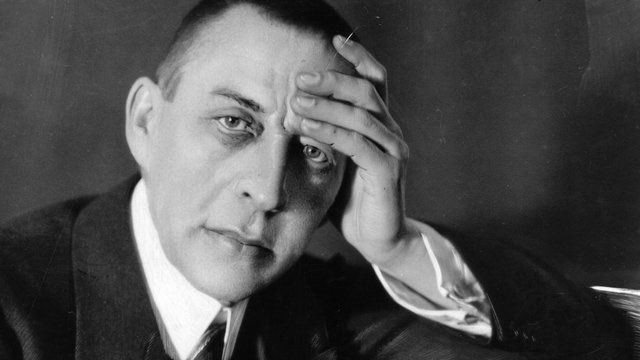
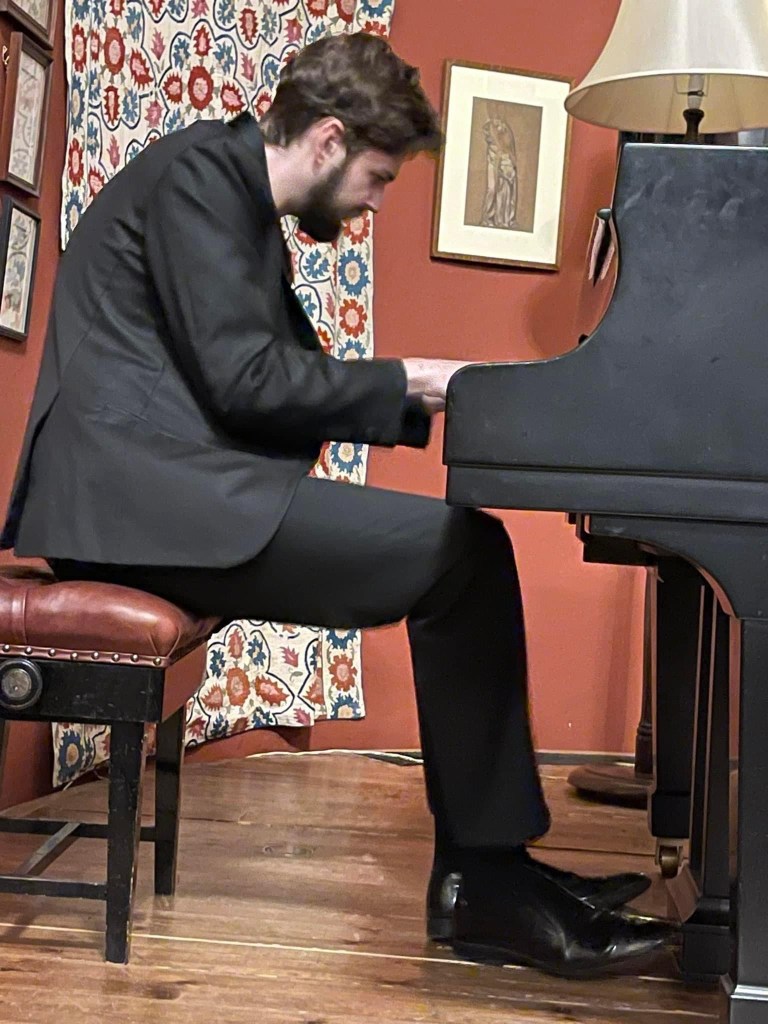
https://youtube.com/live/Ro3FZmydEpA?feature=shareMemorable afternoon in the company of not only a great musician but a great human being I mentioned Peter the Great when he gave what was to be his last concert two years ago …..never more have my words rung so true .
Here is the link to a documentary that will be shown on Hungarian Television to celebrate a great artist https://youtu.be/gSD7W8CmnN0
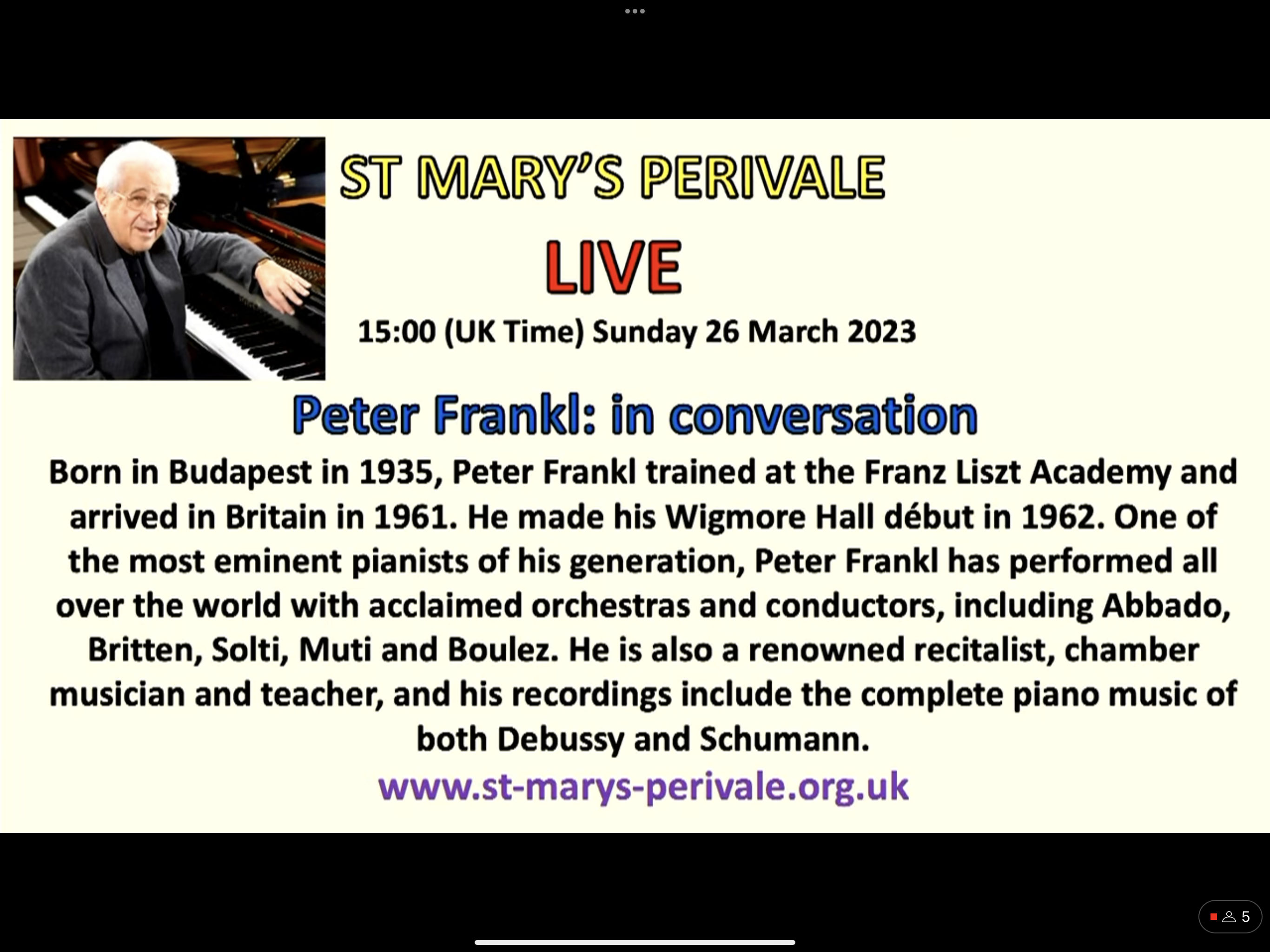
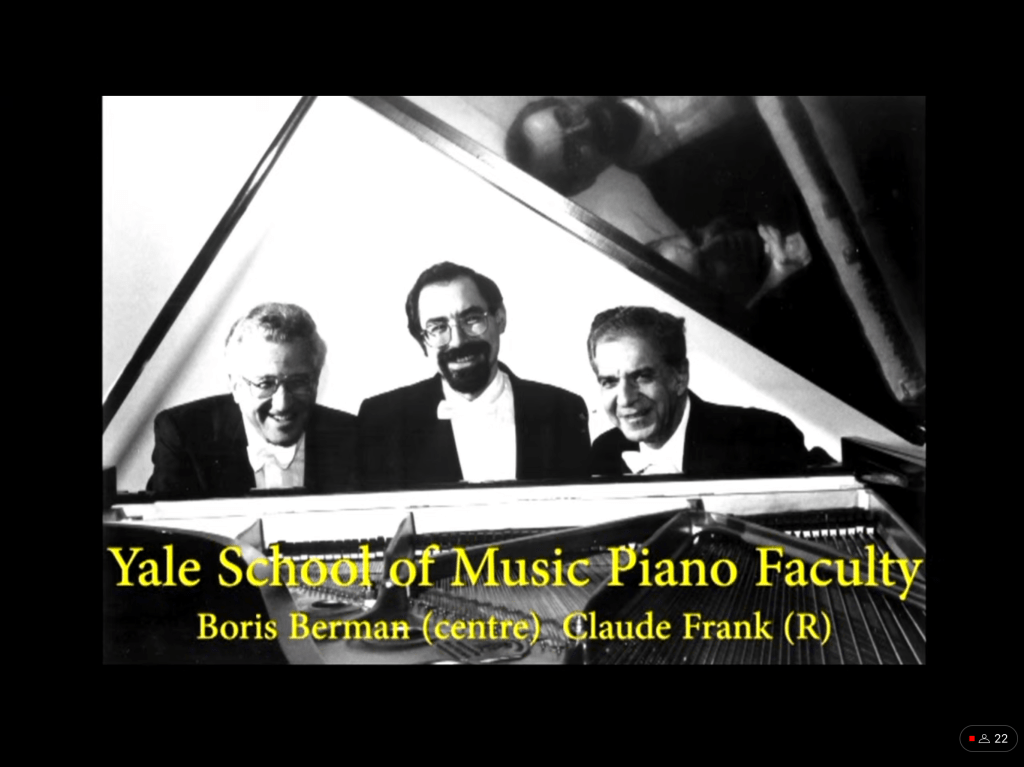
Peter Frankl was born in Budapest in 1935 and is recognised as one of the great pianists of the last century. His father died in a labour camp and he was in the Budapest ghetto in 1944. After studying at the Franz Liszt Academy of Music in Budapest, he won several piano competitions in the late 1950s, and made his London debut in 1962 and first performed in New York in 1967 when he appeared with the Cleveland Orchestra under George Szell. Since then, he has played on the world’s top stages with the most celebrated orchestras and eminent conductors, including Abbado, Boulez, Davis, Haitink, Maazel, Masur, Muti, and Solti. His world tours have taken him to Japan, Korea, Australia, New Zealand, and South Africa. He has appeared more than 20 times at London’s BBC Proms and at many major festivals. He is also a well- known chamber music performer. For years, the Frankl-Pauk-Kirshbaum Trio travelled the world, and his many chamber music partners include the world’s most renowned artists. He is a much-respected teacher and served as Professor of Piano at the Yale School of Music in USA for 30 years.
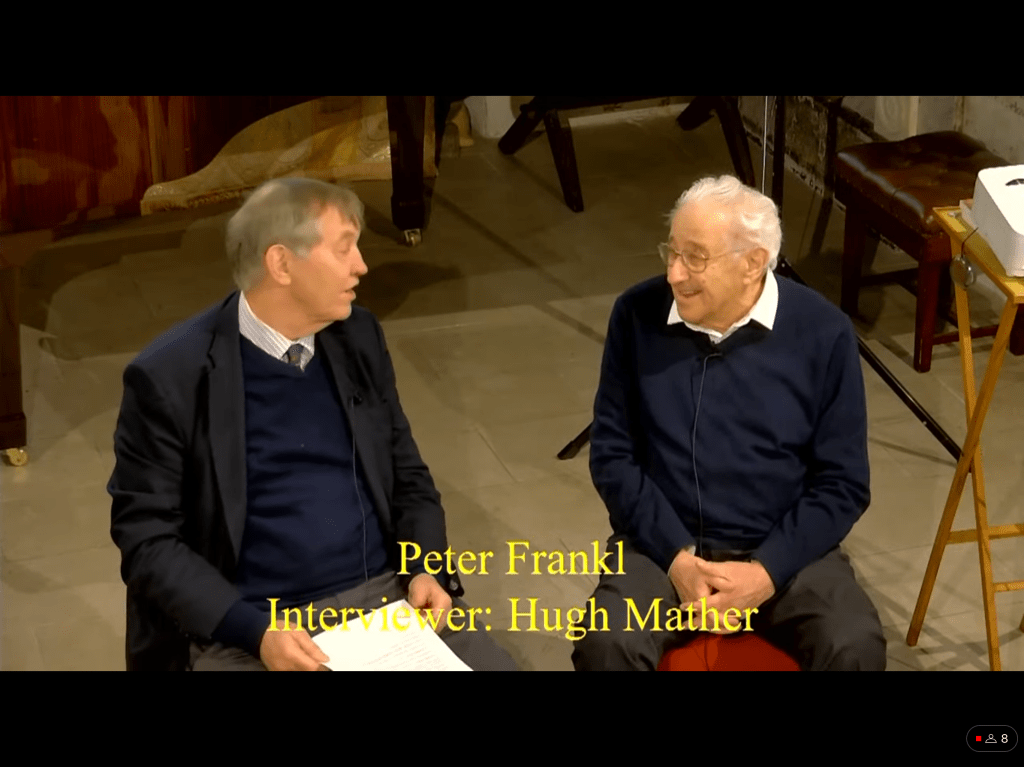
In this conversation, he talks about his early life, his subsequent career as an international soloist, chamber musician and teacher, and his reflections on a long and fruitful life as an eminent musician.
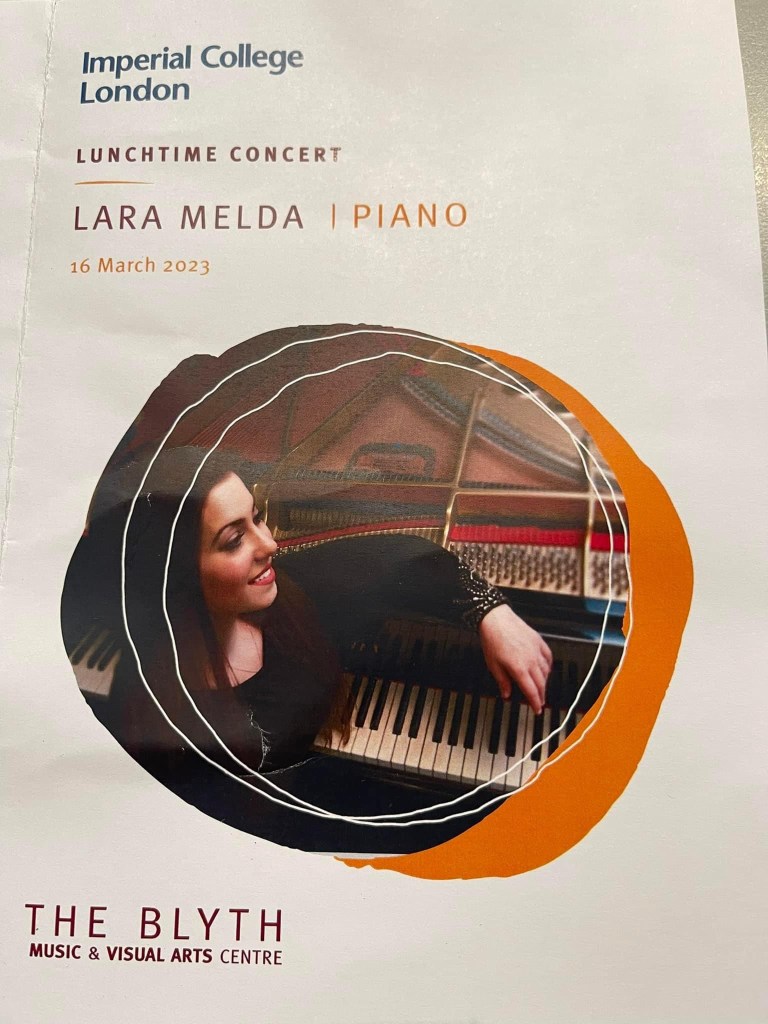
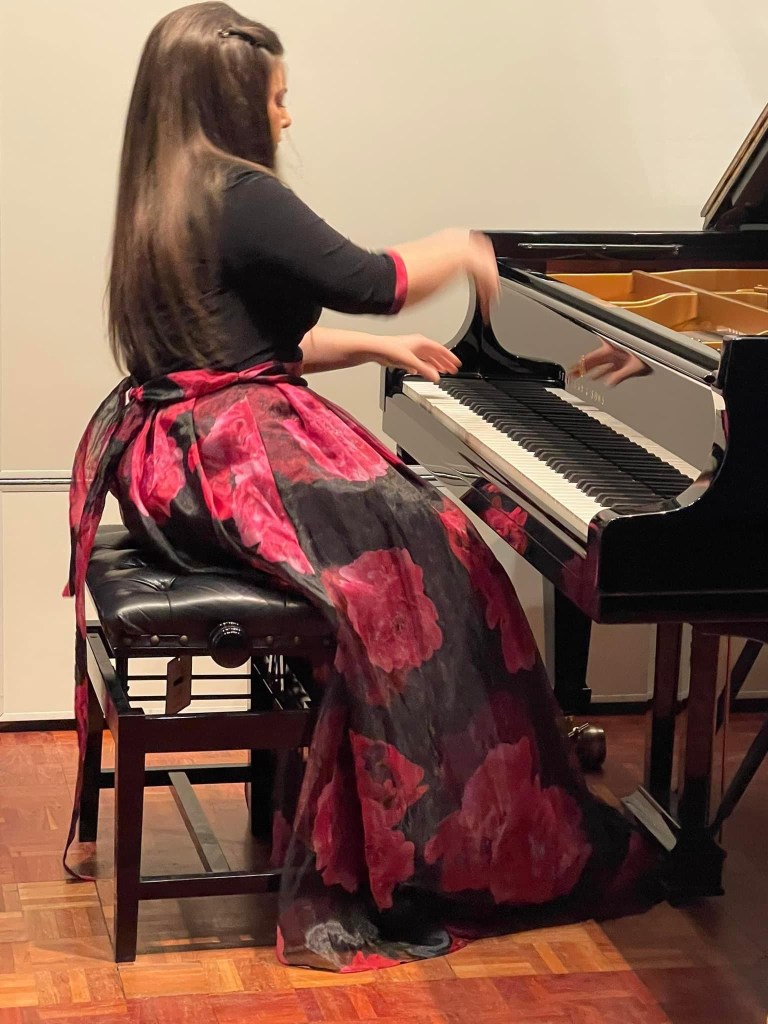
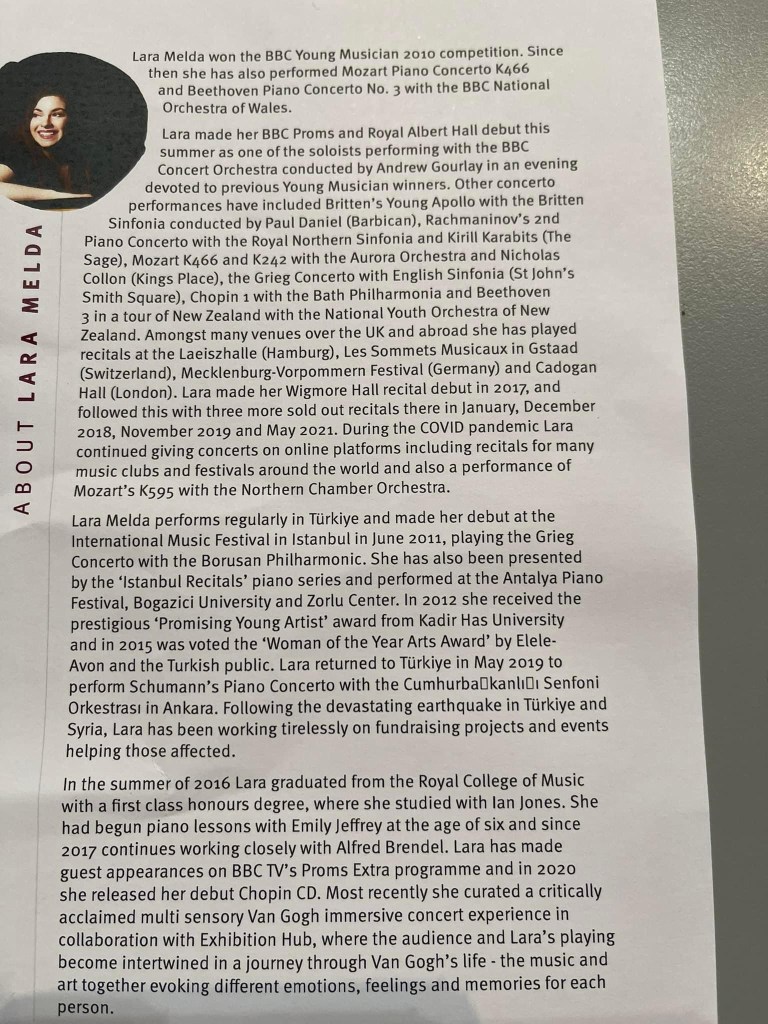
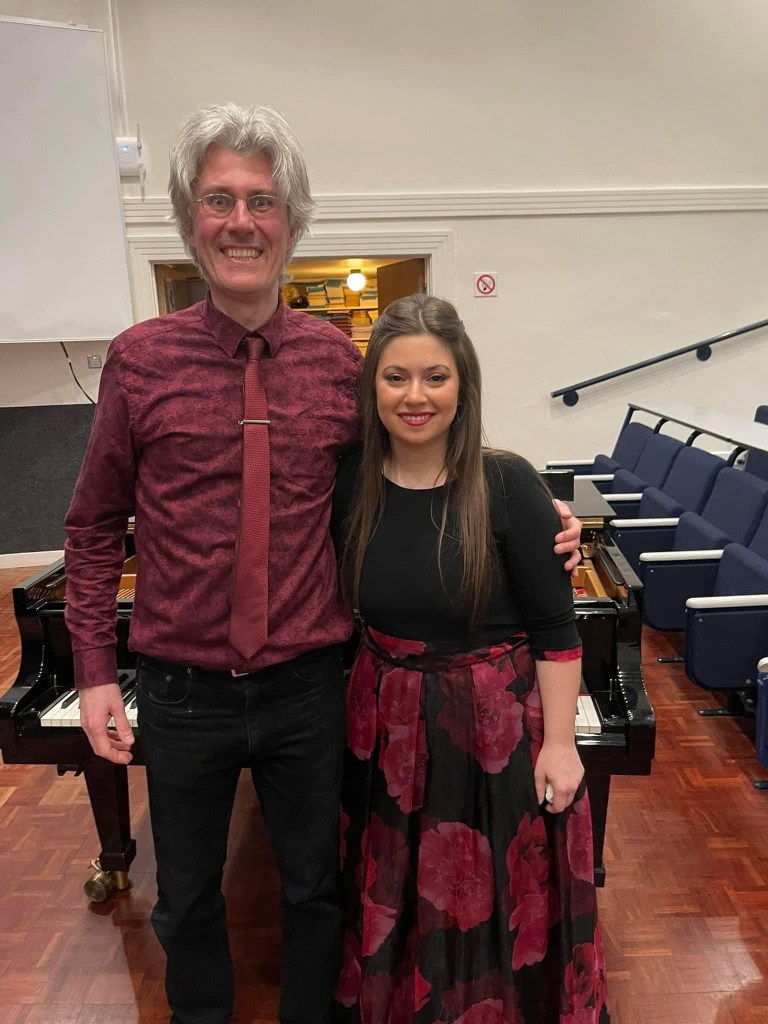
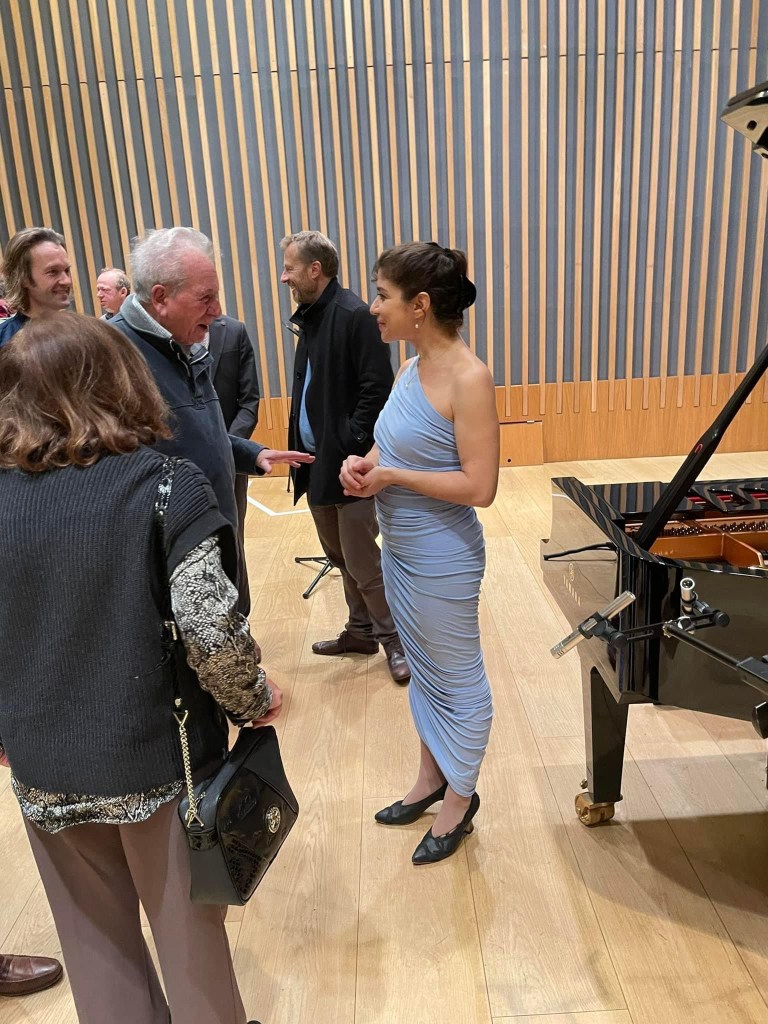
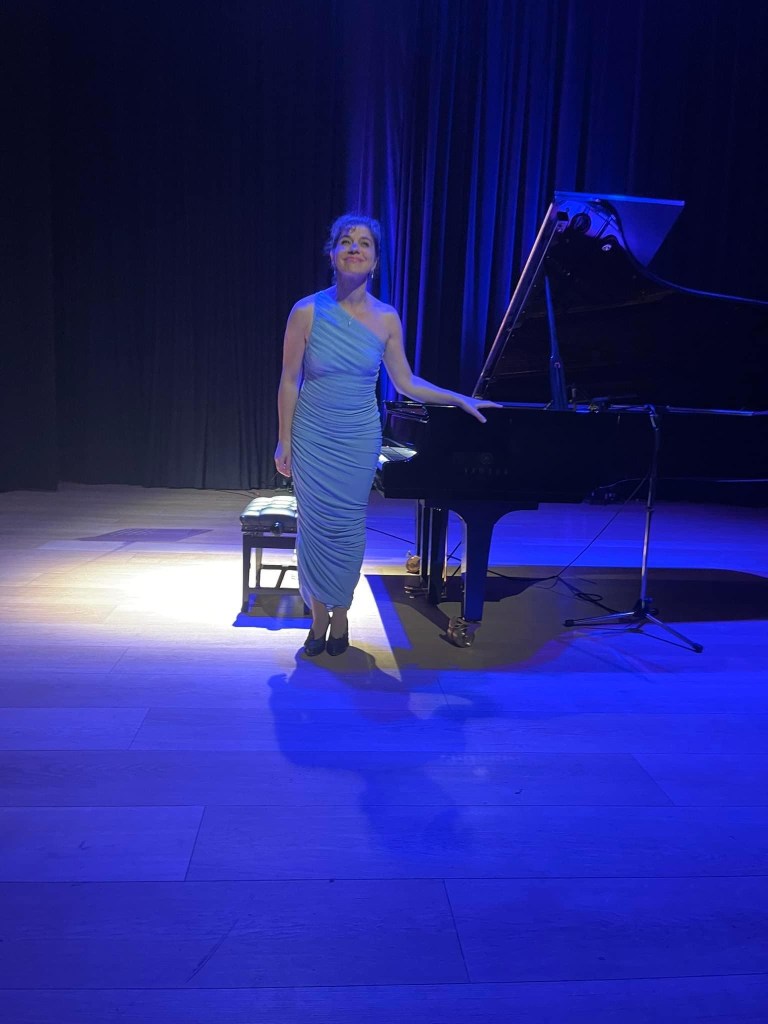
From the very first note of Chopin’s first nocturne Lara Melda demonstrated her poise and aristocratic bearing in one of Chopin’s simplest Bel canto outpourings.
Her fingers seemed to belong to the centre of the keys as they extracted a velvet sound of subtlety and ravishing beauty.Not only a regal bearing like Gina Bachauer but the same golden sound of a small hand that clung to each key like a limpet. Gilels had the same way of squeezing golden sounds out of the keys.Even in the most passionate outpouring his sound would only get richer but never hard and ungrateful. Ravishing sounds in Brahms A minor intermezzo op 116 that seemed to disappear into a celestial oblivion as Lara threw herself into the keys with a rhythmically savage Capriccio in D minor.Passion and beauty combined as she ravished the piano extracting sounds of pure golden richness.
This was just a prelude to Chopin’s Sonata in B minor.The first movement was played with aristocratic control but with moments of tenderness and beauty as she allowed the second subject all the time of a great bel canto singer.Over a gentle continuous accompaniment she could weave a golden thread of such elastic freedom knowing that the anchor was always there.There was dynamic drive and control in the development and the triumphant return of the second subject was played with passion tinged with pathos as it led to the majestic final chords. The jeux perlé of the scherzo was played like the last movement of the B flat minor sonata.It is often likened to the wind over the graves but here it was a wind of joyous beauty. The melodic trio was played with great poise as she joined the busy counterpoints together finding a melodic path that gave great shape and strength to this melodic respite before the return of the busy joyous weaving of the opening.
There was grandeur in her announcement of the tender beauty of the Largo.A melodic line of subtle colour and shape that had been hinted at in her opening Nocturne.There was ravishing beauty as the gently floating sounds in the right hand were a continual presence of golden beauty above the utter simplicity of the suggestive tenor melody. Some truly ravishing playing where her overall sheen of sound created a cocoon in which she was free to shape Chopin’s genial creations with kaleidoscopic colours of subtle inflections. The Finale Rondo was breathtaking in its relentless forward movement but also for the transcendental control that allowed her to build the excitement to fever pitch until it spilt over into the scintillating coda. A masterly sense of balance allowed her to add moments of sudden quietness even in the most energetic of moments that allowed her the space to build the sound without any forcing. Infact the whole Sonata reminded me of the sheen of sound that one can appreciate in the magnificent historic recordings of Guiomar Novaes.One of the greatest pianist considered a God in her native Brazil.Her greatest admirer and pupil was our dear friend Nelson Freire who had inherited the sound that we hear today from Lara. A very delicate ‘story’ by Turkish composer Adnan Saygun created an intimate atmosphere of great desolation very similar to the ringing bell landscape of Ravel’s Le Gibet In just forty minutes Lara had ravished,seduced and enriched us with her poetry,intelligence and golden sounds.
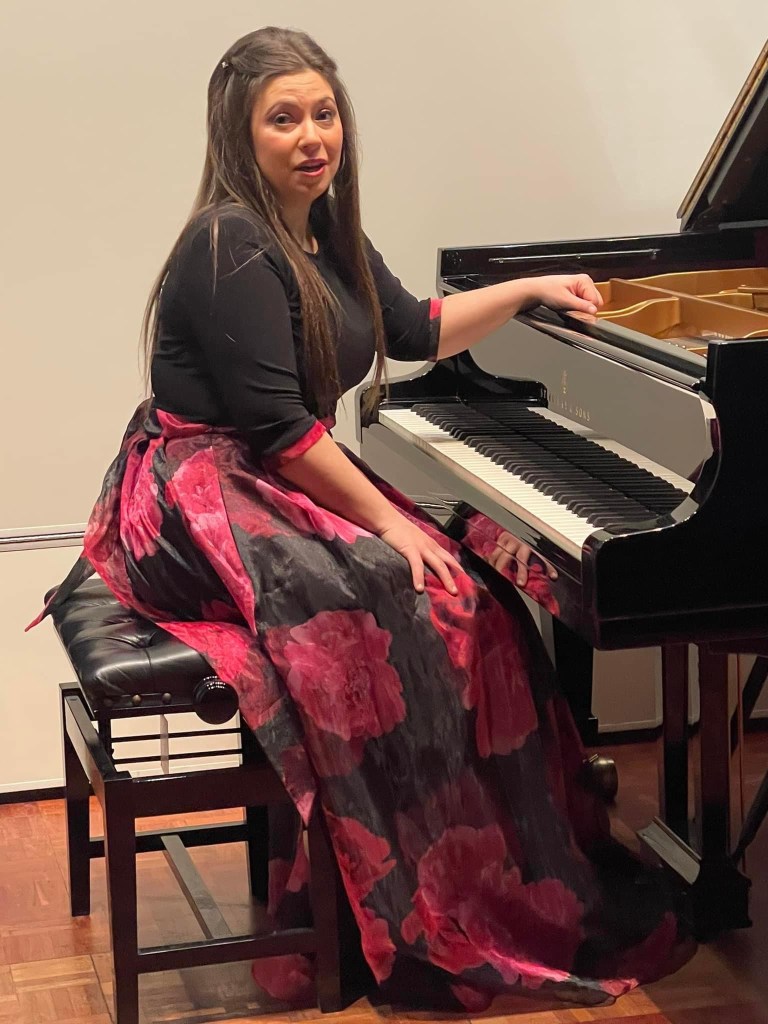
Lara announcing her encore ‘Masal’ by Turkish composer Adnan SaygunWith super enthusiastic Jonathan Mark Roberts from Llandudno
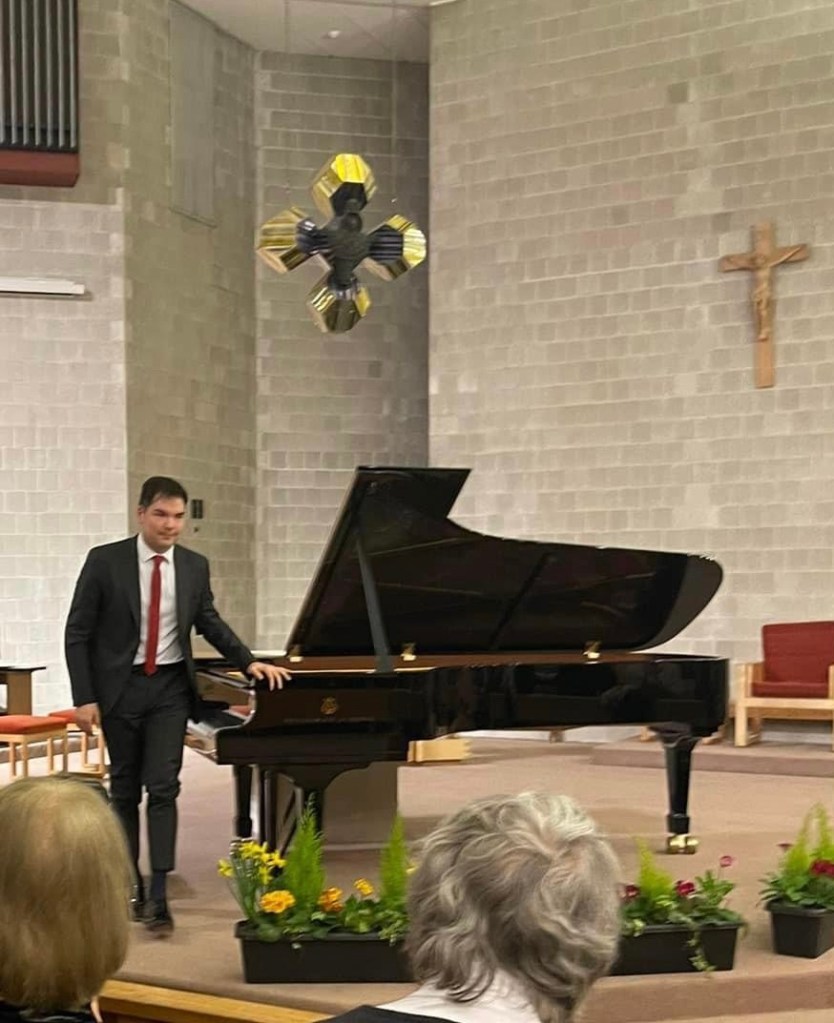
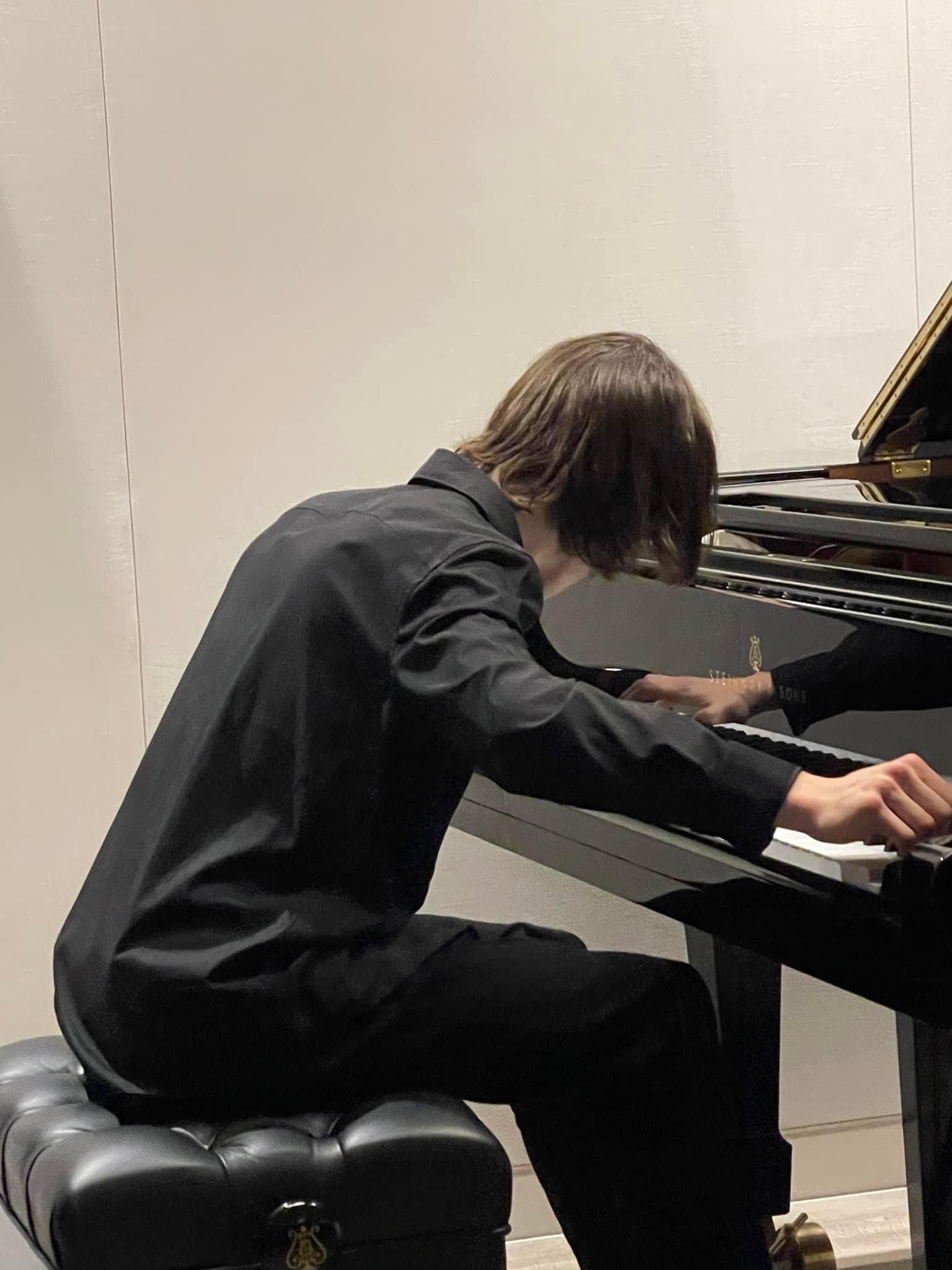
Alim Beisembayev at the Richmond Concert Society with Beethoven op 10 n.3 and op 111 (in place of the advertised op 110) and a second half of Rachmaninov and Liszt. I remember coming to this modern Catholic Church many years ago to hear Vlado Perlemuter long before he became my teacher and friend.He complained bitterly about the acoustics that he could not hear himself play.But for Vlado right up to his 90th birthday,when Joan and I had to push him on stage at the Wigmore Hall ,every step to the stage was always like going to the guillotine!Cherkassky standing in for Bolet of course loved it !
Beethoven’s early sonata op 10 n.3 was played with much more grace and lightness than we are used to hearing .This together with op 2 n.3 and op 7 begin to show the evolution of Beethoven from the early Haydn inspired Sonatas through to the revolutionary ‘middle period’ of the ‘Tempest’,Waldstein’ ‘Appassionata’ and on to the visionary last Sonatas where the gate is thrown open with the most Schubertian of all the sonatas that of op 90.It was a performance of Murray Perahia that had first made me aware of the grace and fantasy in this Sonata.Subtle phrasing and changing colours together with the same youthful rhythmic energy of the first two concerti.Alim too took me by surprise with the grace he gave to the opening octaves.A speed that at first I thought was excessive but he convinced me by his superb sense of musical architecture where everything fell so perfectly into place.There was astonishing brilliance but allied to a rhythmic precision that like a perfectly crafted clock was a marvel to behold.The rising scales in the left hand answered by the impatient comments from the right and continuing without any slacking of tempo or tension as the left hand jumped from one end of the keyboard to the other .I have only heard this sort of clockwork musical precision in early Beethoven from Perahia.(Is it just a coincidence that they were both Gold medal winners in Leeds?)The Largo e mesto was a bold and profound statement where his sensibility and aristocratic poise gave great weight to a slow movement that was the innovative creation of a genius.Alim’s control of the pedal too was masterly as he had understood the effects that Beethoven indicates in the score and translated it to the modern day instrument – not just blindly following the road map but understanding what it was really saying.The beautiful ‘pastoral’ Minuet was played with a simplicity that allowed Beethoven’s rude interjections to bring a smile to his face.And a Trio so finely crafted that the question and answer over a continuous stream of triplets was quite ravishing in its rhythmic perfection.The question and answer of the Rondo was also finely woven and full of rhythmic energy.The glistening stream of jeux perlé silver scales shooting across the keyboard were without any slackening but with a masterly control of sound with the insistent gasps in the left hand .It was an unforgettable way to close a remarkable performance.
Today in Alim’s hands we could hear the gentlest of whispers and savour his refined palette of colour on the sumptuous Steinway concert grand that they had brought in especially for the concert. I had heard Alim some years ago ,the star student of Tessa Nicholson,at the Purcell School. Today,after his years of intense study with her at the Royal Academy he has now completed his Master’s Degree with Vanessa Latarche at the Royal College where he will complete his Artist’s Diploma in his third and final year. I heard now a great artist with a refined tone palette of sounds and a musical intelligence that spontaneously recreated the music.He held the audience in his spell from the first to the last note.
Alim had decided,in agreement with the charming people at Richmond concert society, that he would play op 111 instead of the advertised op 110.I remember Stephen Kovacevich trying the piano in our theatre in Rome and asking if I would mind if he played the Schubert A major sonata instead of the last B flat.The piano,the hall,the atmosphere and above all the artist were more attuned to giving a worthy interpretation of the penultimate sonata rather than the last in that moment.Alim gave a masterly performance and ,as he said in his introduction,a young artist has to start to climb the mountain some time!I will not say he conquered the mountain but then does anyone?What he did do was to show us a vision that was memorable for its fresh close look at the score and to transmit what he found with a poetic freshness that must have been the core of the inspiration of a genius.I doubt the deep rumble in the bass at the end of the introduction has ever been more menacing as it’s whisper took us finally to the home key of C. But that is only an arrival marked ‘f’ because what comes after is the real start of the sonata and is marked ‘ff’.Small details but fundamental for the structure of such a monumental work.The moments of rest from this boiling cauldron were played with a ravishing control of sound without ever loosing sight of the burning intensity that was waiting to erupt.There was a long religious wait at the end of a long cloud of C – home at last – at the end of the first movement.Barely touching the keys of the Arietta he created an atmosphere where we the audience were drawn in to the ravishingly noble story that was unfolding from Alim’s poetic hands.Alim hardly moves when he plays ,there is no extraneous physical show as his total concentration and masterly control allows the notes to speak for themselves – ‘Je sens,je joue,je transmets.’This as Rubinstein showed us in his Indian summer is the height of maturity where true love of music transcends one’s own persona.The variations were allowed to evolve in such a natural way that Alim’s technical perfection passed unnoticed .There was a remarkable control of sound and tempo in the long communing from the murmured bass fragments reaching out on high to the celestial vision that will miraculously appear on the last page.These fragments come together on a vibration of celestial sounds that could never be called anything as mundane as trills in Alim’s magic hands.Beethoven’s vision of paradise was indeed celestial as revealed to us today.Alim at 25 shows signs of a maturity way above his age.
Playing of ravishing beauty as he showed us the two sides of Beethoven.From the unexpectedly exquisitely shaped op 10.n.3 finishing with the magical vibration of sounds of op 111 on which Beethoven floats on high his final thoughts of a paradise already in view. Liszt transcendental studies that were real miniature tone poems. Has ‘Ricordanza ‘ever sounded as beautiful as if it was Liszt’s own ‘Benediction’ ?Petri came near but Alim today even nearer! The wild passionate fervour of the F minor study with at last the rhythmic clarity that Liszt demands.Calmed by the ravishing sounds of evening only to be led into the terrifying blizzard depicted in Chasse Neige. Playing that when he decided to relinquish his masterly control was breathtaking in it’s wild abandon.
Alim presenting his programme to a very attentive audience
The D major Prelude by Rachmaninov was played with the same subtle poetry and stillness that evoked the young Richter .And the mighty E flat minor Etude -Tableau was breathtaking in it’s aristocratic passionate abandon. Rage over a lost penny was his way of thanking the eclectic audience in Richmond in their 61st season that has seen some of the greatest artist of the age.They can now add Alim to that illustrious list .
I should also add that Alim is one of the nicest,simplest people I know and I was very touched by his consideration for me today.But the greatest artists are always the simplest ,you see ,as their souls have found peace and satisfaction in being able to comunicate the message hidden in music to others.
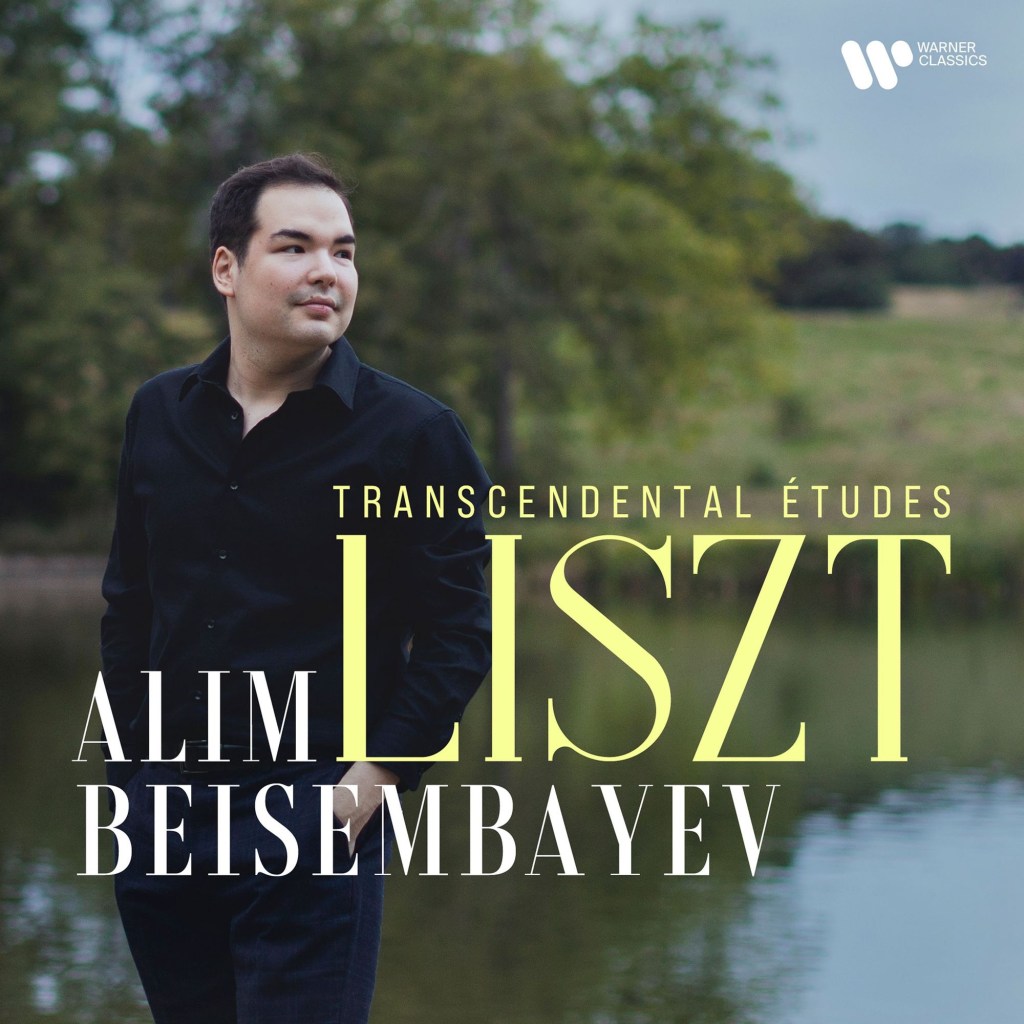
‘A Star is Born: Liszt’s Transcendental Studies from Alim Beisembayev A necessary purchase for all lovers of piano music. Alim Beisembayev is the real deal ‘ Colin Clarke
‘ The Leeds International Piano Competition winner in Autumn 2021 was hailed as a worthy prizewinner all round. Now 24, the UK-trained Kazakh pianist, Alim Beisembayev, has turned his considerable energies to the mind-boggling virtuosity required in Liszt’s 12 Études d’exécution transcendante. If he doesn’t quite make them sound as easy as pie, he certainly delivers them with beguiling nonchalance, a gleaming touch and unflappable clarity, aided and abetted by superb recorded sound.’ Jessica Duchen
Born in Kazakhstan in 1998, Alim has already performed with the State Academic Symphony Orchestra of Russia “Evgeny Svetlanov”, Moscow State Symphony and Fort-Worth Symphony, and at Royal Festival Hall and Wigmore Hall. During his time at the Purcell School he won several awards, including First Prize at the Junior Cliburn International Competition. Alim was taught by Tessa Nicholson at school and continued his studies with her at the Royal Academy of Music. He is currently completing his master’s degree at the Royal College of Music with Professor Vanessa Latarche. He is generously supported by numerous scholarships such as the ABRSM, the Countess of Munster, Hattori Foundation, the Drake Calleja Fund trusts, and belongs to the Talent Unlimited charity scheme.Alim Beisembayev won First Prize at The Leeds International Piano Competition in September 2021, performing Rachmaninov’s Rhapsody on a Theme of Paganini with the Royal Liverpool Philharmonic Orchestra and Andrew Manze. He also took home the medici.tv Audience Prize and the Royal Liverpool Philharmonic Society Prize for contemporary performance, with The Guardian praising him as a “worthy winner” with a “real musical personality”.Highlights of the 2021/22 season include debuts with the Royal Liverpool Philharmonic (under Case Scaglione), BBC Symphony Orchestra (Clemens Schuldt), RCM Symphony Orchestra (Sir Antonio Pappano) and SWR Symphonieorchester Stuttgart (Yi-Chen Lin). Recent and forthcoming recitals include the Wigmore Hall, Southbank Centre, Oxford Piano Festival, Bath Mozartfest, St George’s Bristol, and Chopin Institute in Warsaw, in addition to a tour of Europe, in association with the Steinway Prizewinner Concerts Network, and Korea, with the World Culture Network. His debut release with Warner Classics was released in September 2021 — an EP featuring Scarlatti, Ligeti and Ravel.
Wherever there is something special you will find Mike Oldham – master page turner too St Margaret of Scotland – Twickenham
Jean Rondeau the Prince of the Harpsichord. An artisan arriving on stage with sleeves rolled up ready to caress and lovingly coax sounds from the beautiful antique box before him. Cherishing every moment he shares with the delicate instrument just as a master violin maker lovingly shapes the wood that with great artistry and mastery he brings to life.Transforming it into a breathing,living instrument of another age. There were filigree embellishments that were like delicately carved Chinese ornaments of refined intertwined golden thread.
But there was also a sense of line and architectural shape that kept us on the edge of our seats for the eighty minutes of continuous music that poured with such simplicity from his hands. A body in continuous motion like on a great wave following the currents of sound that were flowing with such power and inevitability from this beautiful instrument.A body and instrument that become one is a rarity indeed.
I am not competent to go into the details of harpsichord technique or the specialist scholarship that is needed to bring this music to life in an authentic way. But by God I do know when a musical genius is at work. Schumann exclaimed on hearing the young Chopin what could very well apply to Jean Rondeau tonight :’Hats off ,Gentlemen,a genius !‘
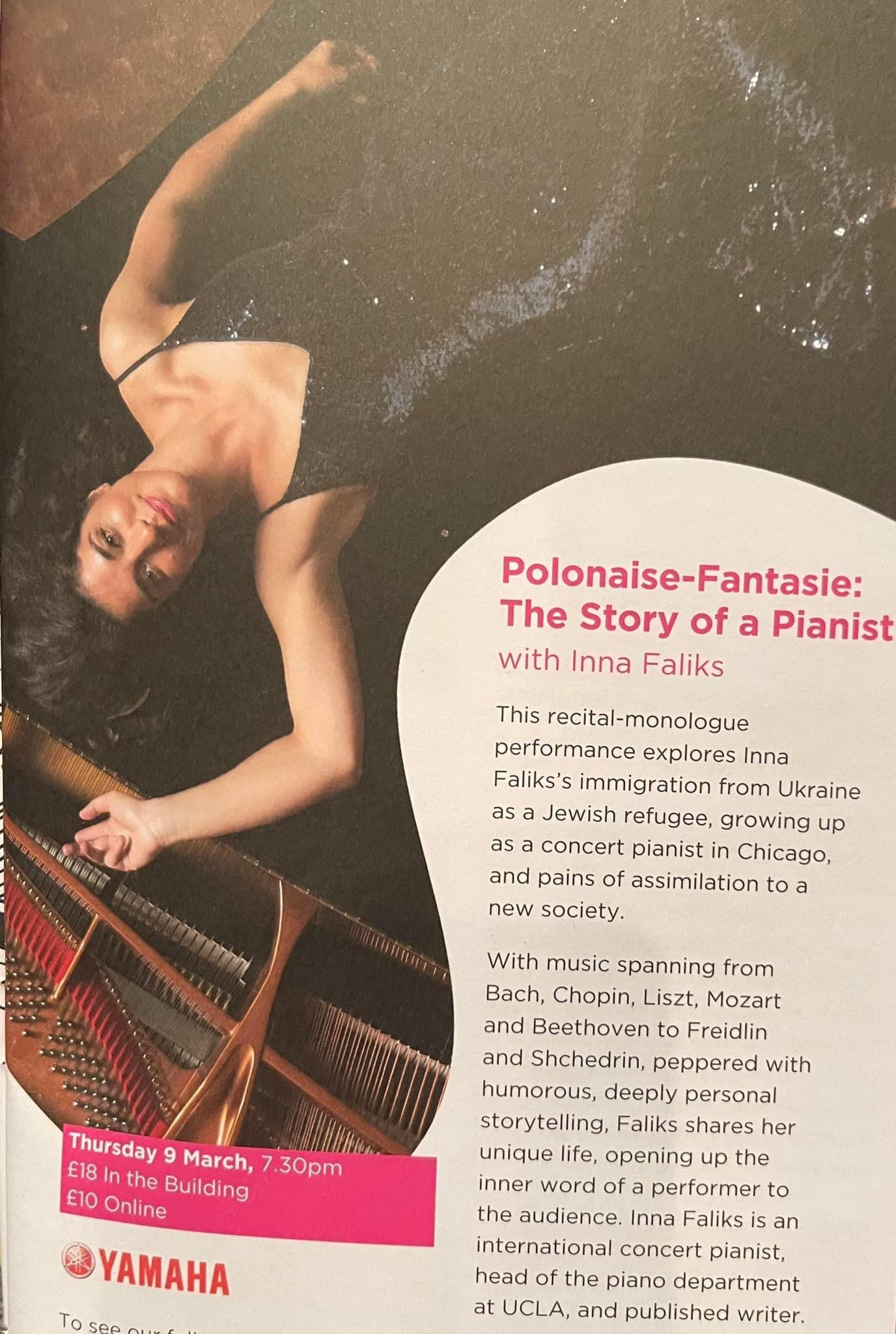
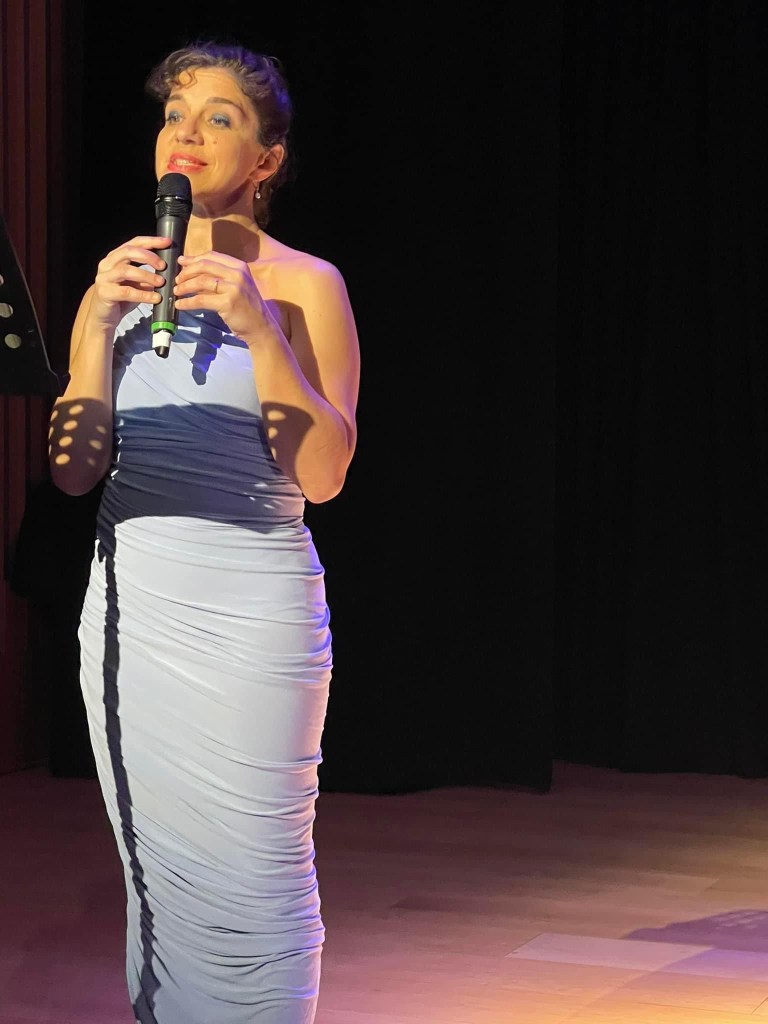
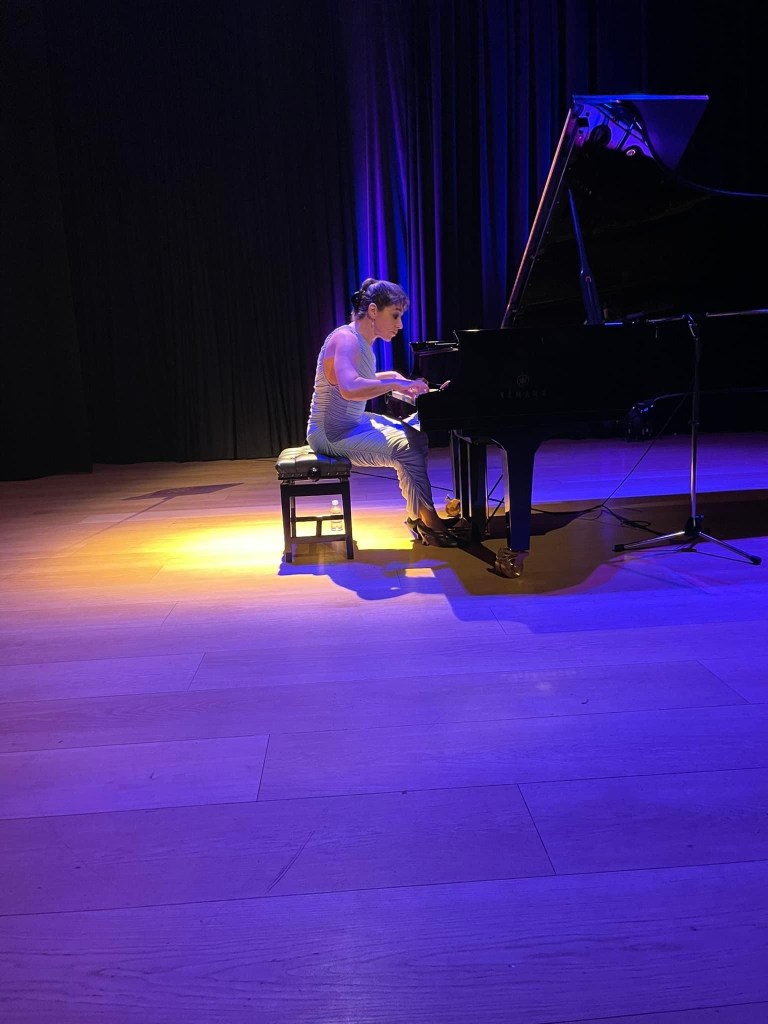
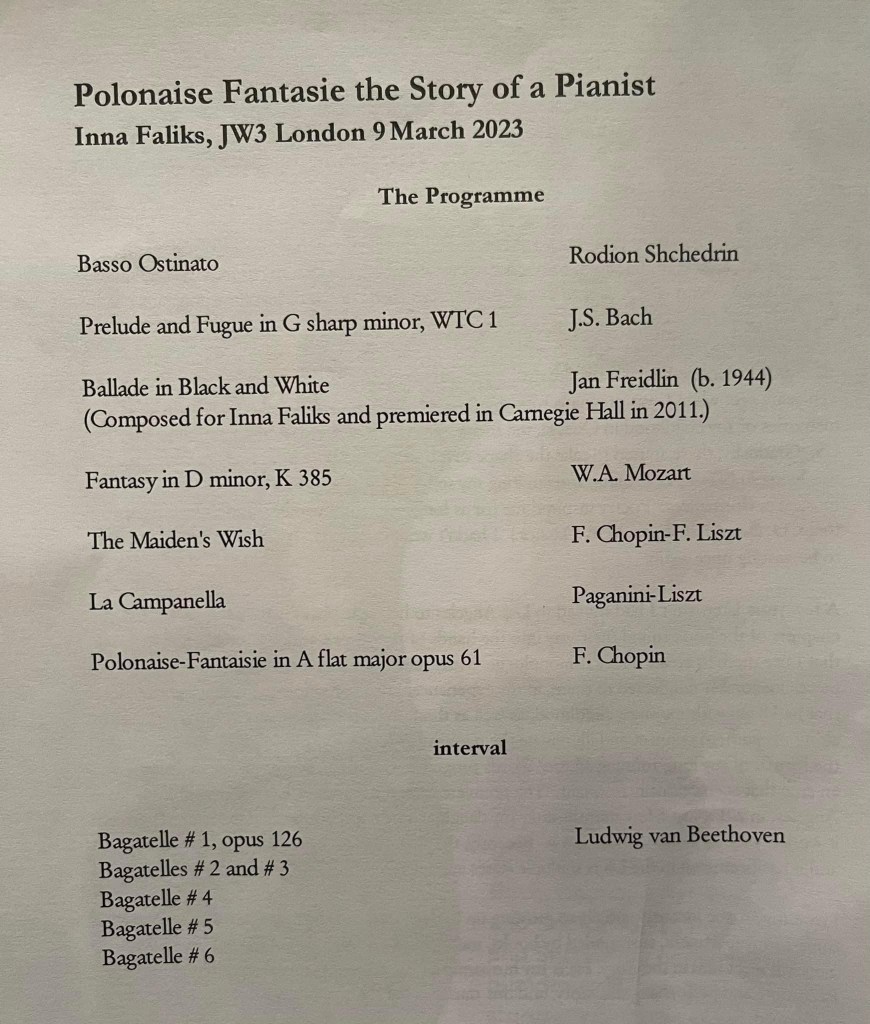
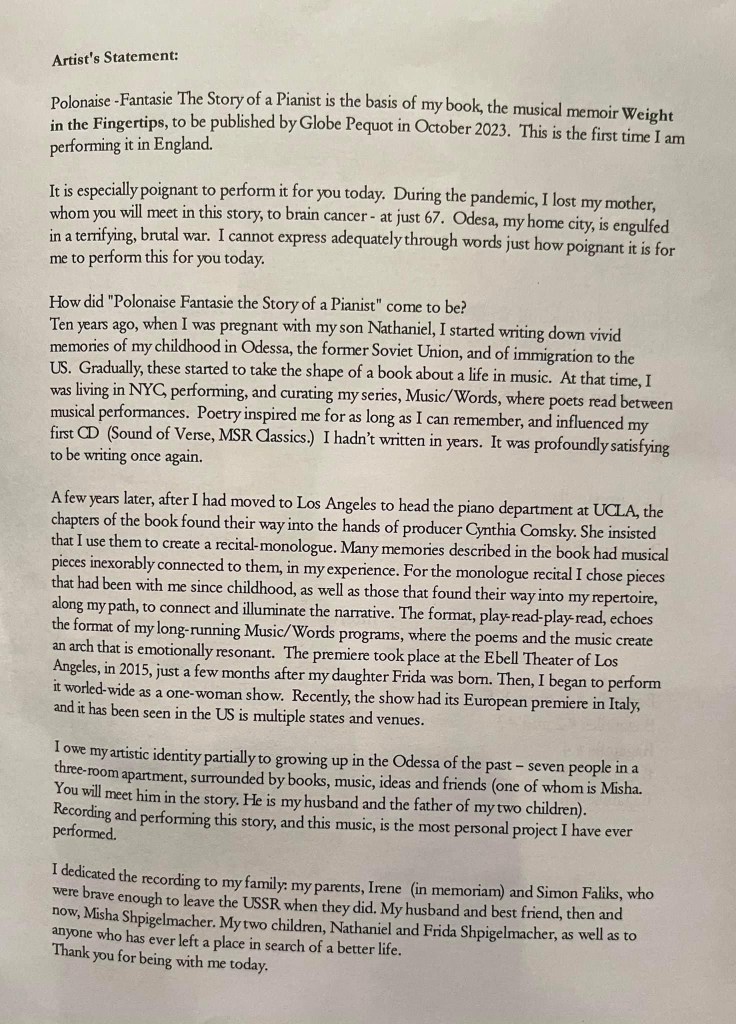
Inna Faliks in London to play for the first time in the JE3 Arts centre. Telling her story of growing up in Odessa under the Soviet regime and even playing on the red piano in the room allocated to her family. A three room appartment allocated to seven people! Immigration was the word used in 1988 when the family prepared to flee to a freer life in the USA. Now head of piano at UCLA in Los Angeles she came to London to share her story with us.
Elegant as a poet – glamorous as Streisand but above all a Tiger on the keys.
Eloquent as a poet but above all an eloquence in music that is so immediate and simple as every note touched places that other musicians can rarely reach.
A first half opening with Shchedrin’s athletic Basso Ostinato.Like a tiger being let out of cage as Inna ravaged this magnificent Yamaha piano with devilish glee .A ‘coup du theatre’ indeed after which we needed the calm aristocratic sounds of Bach’s knotty twine. Jan Freidlin’s Ballade in Black and White was composed for Inna who gave it’s premiere in 2011 in Carnegie Hall.It was played with a clarity and total conviction that was enthralling. After Bach it was Mozart to calm the air now with a performance of his D minor Fantasy of great simplicity and beauty. The ‘Maiden’s Wish’ was played with wondrous jeux perlé in the style of the pianists of another age,that of pure gold.Scintillating exuberance and aristocratic style made one wonder why this little gem has been so rarely heard in the concert hall since the grandiloquence of Arrau.
Following with the most famous of showpieces :’ La Campanella’.Paganini and Liszt in cahoots to beguile and seduce with seemingly impossible pianistic gymnastics. Inna played it with amazing clarity and insinuating charm with a kaleidoscope of colours that made this old war horse shine as new. Streams of gold and silver sounds were thrown off with an ease and precision that were breathtaking in their audacity. The mighty Polonaise Fantasie,from which this moving tale takes its name,was played with aristocratic style and ravishing beauty. There was an architectural shape of such intelligence that restored this work to the Olympian heights of beauty and originality penned at the end of Chopin’s all too short life.It gave great meaning to a work that can sometimes,in lesser hands,appear simply fragmented and structurally weak. Inna showed us the revolutionary originality of the form that is free but in a highly original frame where Chopin’s genius shines through every bar. Inna had realised this as she saw in this masterpiece a road plan of her own extraordinary life.
Inna Faliks with her companion for life Misha Shpigelmacher
The most moving part was to come,both in words and in music,as Inna described the reappearance of Mischa Shpigelmacher in her life. Out of the blue an old schoolboy friend suddenly appears at her concerts. A spark is felt as she decides to turn down a sumptuous after concert supper and to flee to Paris with Mr Shpigelmacher becoming fast best friends and an obvious kindred spirit for life. Now happily married with two teenage children Mr and Mrs Shpigelmacher are still best friends and enjoying together this moving celebration of love in London.
What better music could there be than Beethoven’s op 126 Bagatelles. Ravishing beauty and quixotic changes of character they were played with the true mastery of someone who listens to the sounds she is creating. A purity of sound with a fluidity where bar lines seemed not to exist .Even Beethoven’s precise pedal makings in the third were translated into the magical disintegration of the melodic line.A magic disappearing trick interpreted as Beethoven obviously intended. It contrasted with the ferocious fourth that in turn dissolves into a bagpipe drone on which a fragmented melodic line is allowed to float as if suspended in air. The purity of the melodic line in the fifth was a lesson in how to let the composers words speak for themselves without any personal intervention from the mere performer. ‘Je sens,je joue,je trasmets’. The tornado that is unleashed in the sixth broke the spell but created another even more mysterious cloud of sounds where mere words have no place. Like in the last great trilogy of Sonatas,in particular op 111,the fragments of melody were floated on a bass pedal note like puffs of smoke that Beethoven could see with the vision of the paradise that awaits. With subtle intelligence and scholarship she could turn these baubles into gems. Penned in the last moments of Beethoven’s life when he could find the serenity that had eluded him all his life.
Inna imbued them with the same love that she communicated so movingly in this personal story.One that has become even more poignant for the events that are unfolding with disturbing intensity in her homeland where her soul still abides. Dedicating the performance to her family:her parents,Irene and Simon Faliks who were brave enough to leave the USSR when they did. Her husband and best friend,then and now,Misha Shpigelmacher.Her two children,Nathaniel and Frida,as well as to anyone who has ever left a place in search of a better life. If music be the food of love,play on!
What a story! Simple great music pouring from a sensitive soul as she communicates the remarkable adventure that is her life. Fragments pieced together on a constant bass undercurrent which is love itself. No greater story could there be than this extraordinary ‘Love of life’.
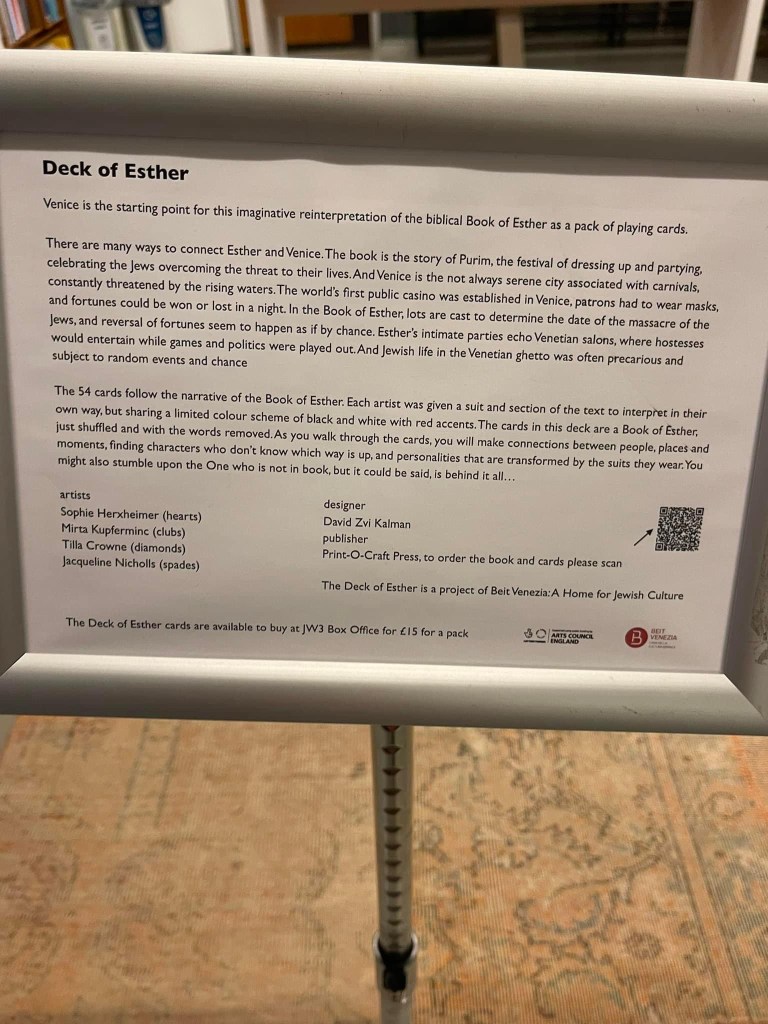
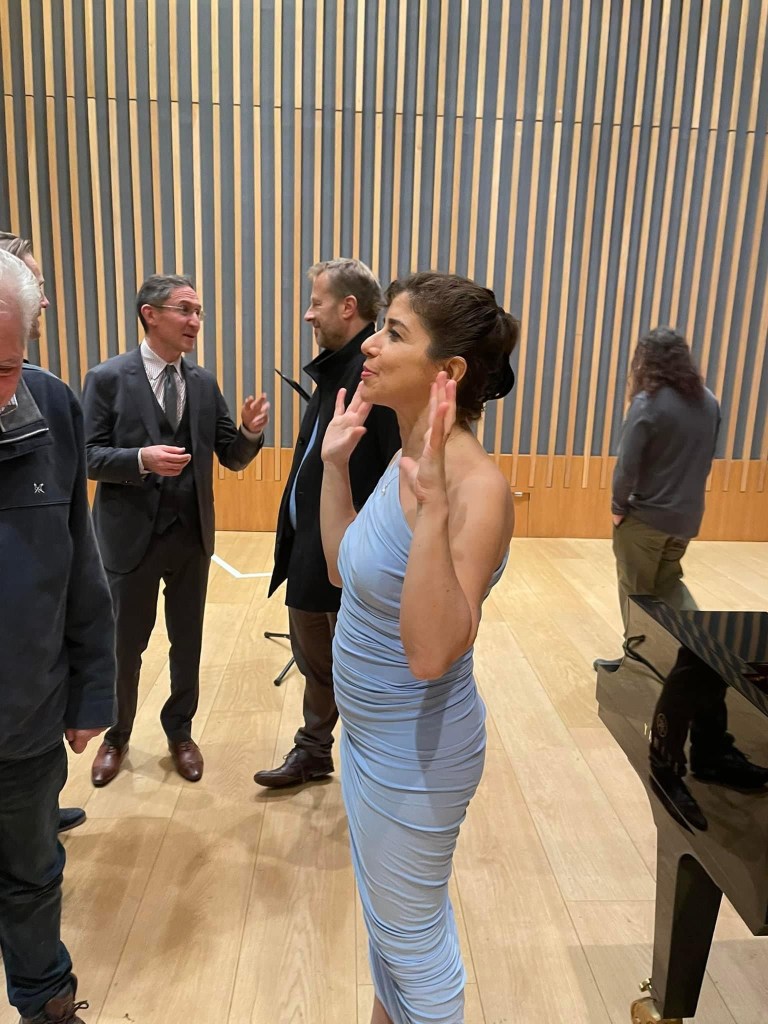
With Gabriel Prokofiev and Ian Jones (centre left) vice head of Keyboard at the RCM where Inna will share her thoughts on Monday with four wonderful young artists Inna Faliks class on Monday 13 March, room 203 Royal College of Music 9.30-10.30am: Jose Navarro 10.30-11.30am: Gabriele Sutkute 12-1pm: Grace Dong 1-2pm: Zvjezdan Vojvodic The remarkable JW3 Community and Arts Centre An exhibition of visual art organised by our hostess freshly returned from Venice today
Great pyrotechnics from the twenty year old Alexander Doronin and astonishingly mature musicianship. A recital at Steinway Hall for the Keyboard Trust in the presence of his teacher Dmitri Alexeev -the second time this week that I have seen the Alexeev’s following the career of super talented young musicians in their care . https://christopheraxworthymusiccommentary.com/2023/03/06/victor-maslov-at-leighton-house-masterly-playing-of-intelligence-and-poetic-vision/ Together with star pianist Vitaly Pisarenko they were there to follow these early steps in what surely will be an important career. The clarity and chiselled precision suited perfectly the neoclassicism of Stravinsky (1924 not the earlier youthful effort as mistakenly on the programme ) or the diabolical streams of notes that Ligeti like a spider’s web would trace with such glee over the entire keyboard. It was the same precision and intelligent musicianship that he brought to the two early works by Brahms.A clarity that missed Brahms’s sumptuous orchestral sonorities but gave it a refreshingly youthful rhythmic impetus of great conviction . It was however in the Berg Sonata that he found the magical sonorities that brought the ingenious knotty twine of this early masterpiece vividly to life.A superb performance that just showed what glories await his full maturity on graduation amazingly still two years off.
A short conversation with Leslie Howard discovering news of his early studies at the Gnessin school in Moscow for super talented children.And now perfecting his already extraordinary professional talent with a Master as in the class of Dmitri Alexeev at the RCM. His artistry will bloom under the guidance of the ever generous Alexeev’s as Sasha’s magnificent youthful Ferrari will turn into a magical carriage full of a kaleidoscope of gold and silver gems. Meeting the artist afterwards with all the guests is a highlight of these very special occasions.
Wiebke Greinus our genial hostess
Together with the ever generous Wiebke Greinus and her colleagues at Steinways.And ,of course,with the genial Leslie Howard passing from Aida to Grainger at the touch of a hat -(Mario’s!) showing us the sumptuous colours that are hidden in the magnificent instruments on display.
Mario lending an ear to Leslie Howard
A glass of wine in hand and good relaxed conversation together with the star of the evening,Alexander Doronin.The cockles of our hearts were truly warmed on one of the coldest nights of the year.
Dmitri Alexeev with students past and present Vitaly and Sasha Sarah Biggs ,General Manager of the KT Tatyana Sarkissova with a student of hers from the RAMVitaly Pisarenko -Leslie Howard -Sasha Doronin
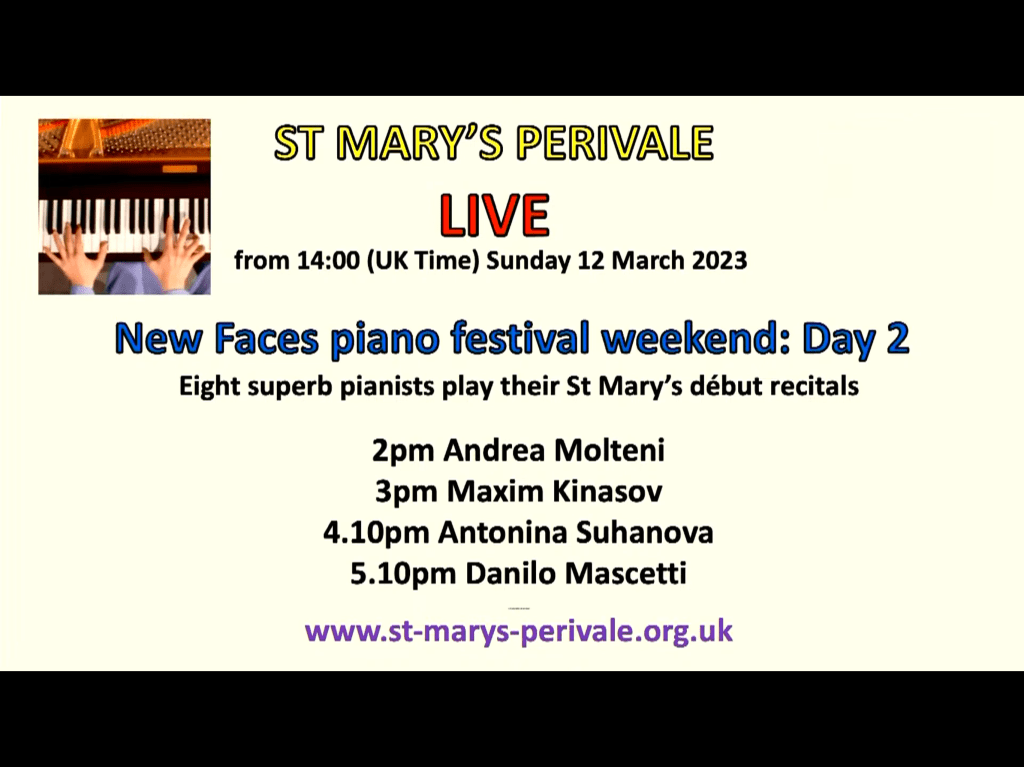
Day two of this mini festival ‘New Faces’ saw another four pianists on the threshold of important careers.
2.0 pm Andrea Molteni
Andrea Molteni had flown in from Como and demonstrated his remarkable artistry with playing of a purity and clarity that illuminated all that he played.
A refreshing intelligence that gave new life to Chopin’s Fantasy where the indications of the composer were scrupulously observed without any adhesion to the so called ‘tradition’.From the very first note marked staccato in the score but when have we ever been aware of it?It gave such strength to the contrast of the beseeching legato answering phrases .There was a sense of improvisation too but always with a direction and ultimate goal in view.A freedom but within a certain framework.A miracle of beauty at the end with the tumultuous build up to the final Adagio sostenuto but then with his scrupulous attention to the silences that Chopin demands there followed the pianissimo yearning phrases before the final glistening stream.The rest that followed was so pregnant with meaning that the two majestic final chords came as a blessed relief.
The early Brahms Scherzo op 4 ,rarely heard in the concert hall,was played with an incisive rhythmic drive and an orchestral sense of colour.A performance of great breadth and nobility with the final ‘ben marcato’and ‘piu mosso’octaves of searing depth and sonority.Only to be dismissed in such an abrupt manner as indicated by Brahms in his quasi orchestral score.It is easy to see how the Sonata op 5 evolved after this work op 4.
The Beethoven Sonata op 110 was played with simplicity and beauty where again his attention to the indications of the composer were translated into sounds that had an overpowering force .We were swept along by this driving energy from the first to the last notes .The beauty of the left hand swirling accompaniment in the first movement I have rarely heard Beethoven’s precise indications so clearly played.The Scherzo was ‘Allegro molto’ but not so much so that it interrupted the continuous pastoral flow of one of Beethoven’s most perfect creations.Surely this and the fourth concerto must be among the most celestial creations of this tormented soul.Beethoven’s own long held pedal at the end of the scherzo was where the first chord of the Adagio was so rightly placed and created a magic atmosphere for all that followed .It was a magic that Andrea maintained to the final religiously fervent outpouring of passion and exultation.It should be noted too that Andrea did not split the final cascade of notes between the hands that would have only under minded the explosion on the final A flat chord.
An exciting young Italian piano talent, Andrea Molteni is developing his international profile with regular appearances in the USA, Italy, UK, Europe, Russia, China and Singapore. His latest album, Scarlatti Sonatas (that was released in January 2022), has already got important reviews from critics such as Jean-Charles Hoffele and has been broadcasted in the German radio MDR Kultur.The album “Petrassi and Dallapiccola Complete Piano Works” (May 2021) received reviews on significant music magazines (magazine Musica, December 2021; Opus Klassiek, May 2021) and it has been broadcasted in Radio Classica and in the French Radio France Musique. Winner of numerous International Competitions, Mr. Molteni enjoys the artistic guidance of William Grant Naboré under the auspices of the prestigious International Lake Como Piano Academy. In 2020, he was awarded a master’s degree Magna cum Laude in Advanced Performance Studies by the Conservatorio della Svizzera Italiana in Lugano.
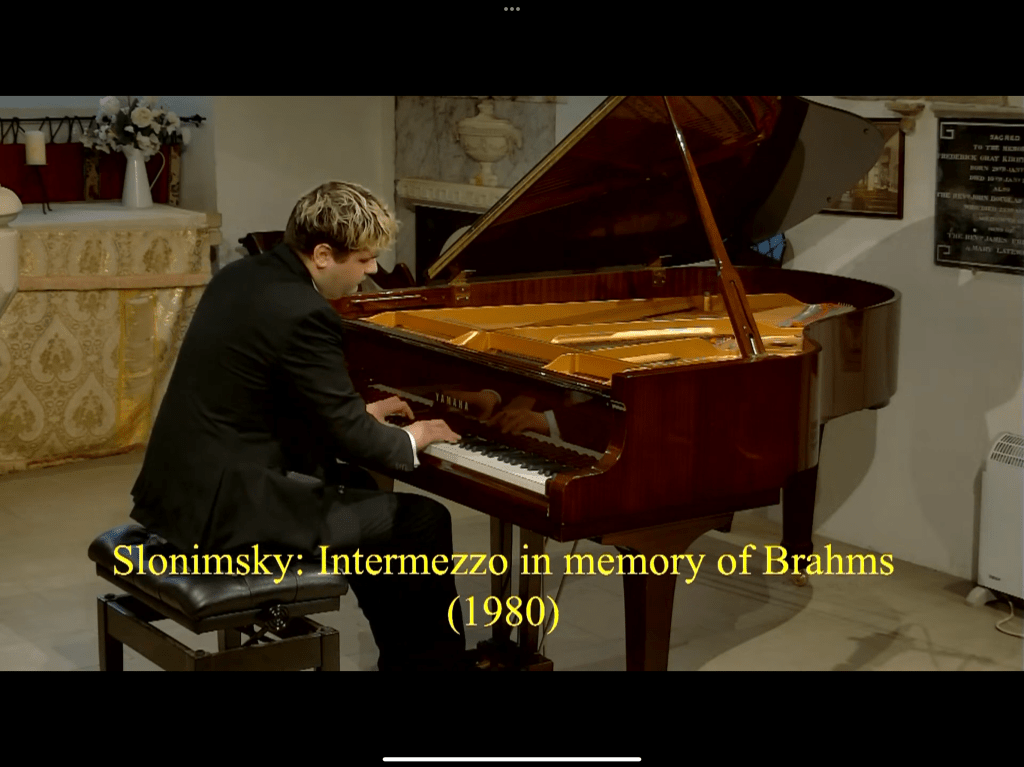
Maxim Kinasov came on stage and threw himself into the keyboard with the same animal like ferocity that I have not seen since Richter.Infact it reminded me so much of Richter to see this young man so enveloped in the sounds that he was producing.Pulling,punching caressing the most wondrous rich sounds out of the piano.An Intermezzo dedicated to Brahms by Slonimsky opened his programme of dedications – to Brahms,Paganini,Bach and finally to the oppression of World War Two with Prokofiev’s 7th Sonata ,one of the Trilogy of War Sonatas.
Nicolas Slonimsky, born Nikolai Leonidovich Slonimskiy, was a Russian-born American conductor, author, pianist, composer and lexicographer.Born: 27 April 1894, Saint Petersburg Died: 25 December 1995, Los Angeles California.A film ‘A touch of genius’ was made for his 100th birthday https://youtube.com/watch?v=0LYSd05BbOg&feature=share.It was fascinating to read about a composer I had not heard before.I was intrigued to find out more after the overwhelming performance today.
Max writes that I got the wrong Slonimsky,Nicolas instead of Sergei and i am glad too be corrected and to learn even more about this remarkable family https://en.m.wikipedia.org/wiki/Sergei_Slonimsky
Sergei Mikhailovich Slonimsky 12 August 1932 – 9 February 2020) was a Russian and Soviet composer, pianist and musicologistHe was the son of the Soviet writer Mikhail Slonimsky and nephew of the Russian-American composer Nicolas Slonimsky.Slonimsky died in Saint Petersburg on 9 February 2020 after a long illness.He composed more than a hundred pieces: 5 operas, 2 ballets, 34 symphonies and works in all genres of chamber, vocal, choral, theatre and cinema music, including Pesn’ Volnitsy (The Songs of Freedom, based on Russian folk songs, 1962), A Voice from the Chorus, a cantata set to poems by Alexander Blok. Concerto-Buffo, Piano Concerto (Jewish Rhapsody), Cello Concerto, 24 preludes and fugues, etc.
From the very first notes Maxim’s fingers were like limpets on the keys .His whole body was engaged in the music that was being reproduced in a voyage of discovery that was quite hypnotic and mesmerising.An outpouring lament of sumptuous sounds .A deep yearning as the variations unfolded ,a kaleidoscope of colour with trills gleaming like jewels .There was an animal like urgency of cascades of notes ending in a silence of such aching poignancy.Like an animal let loose on the keys with that same hypnotic ferocity of Richter and the same total mastery.A ferocious passion that swept all before it.
From the opening theme of Paganini it was obvious that we were in for an exhilarating performance of Brahms’s notoriously difficult variations.The beautifully shaped theme led to variations of such differing character all played with a continuous driving forward movement .Even the beautiful second ‘poco animato’ was on a great wave carrying all with it on its long voyage.There was charm too in the eighth variation that contrasted with the overpowering force of the ninth and tenth.There was ravishing beauty in the poco Andante before the tumultuous whirlwind of the final Presto.What grandeur at the end!I doubt this piano has ever sounded so ‘grand’ as in the velvet gloved hands of this giant of a pianist.
The Bach/Siloti Prelude in B minor was played with a simplicity and a magical sense of colour but there was also a certain solidity to the sound that gave it an austere reverent importance.
The Prokofiev Sonata unleashed the same unconventional ferocity that I remember from its dedicatee Sviatoslav Richter when he played it in London in 1971.I was a student in my final years at the Royal Academy and i remember being overwhelmed by a force of nature that broke all the conventional rules that had been imbued in me in that noble institution.I remember my wife thinking she had made a mistake in an acting exam and being told by a great Italian artist:’But there are no rules just convince me.’And my God Richter certainly did that as Maxim did today too.From the very first call to arms of ferocity and clarity.Through the sumptuous beauty of the Andante with it’s swirling visions of desolation in a hoped for paradise.The final brutality of the Precipitato with a driving intensity that swept Maxim on to impossible heights where the rhythms kept him afloat and notes became superfluous.The hysterical excitement of the final breathtaking pages were greeted by cheers from an audience hypnotised by a truly great artist.Headed for the heights this tormented soul finds home only at the keyboard like Richter or Beethoven even!
Chapeau Maestro I am proud to be able to say that I heard you at the beginning of your illustrious career
Maxim Kinasov is the First Prize Winner of more than 10 prestigious international piano competitions around the world, including UK ‘s 2022 Birmingham International Piano Competition and 2022 Windsor International Piano Competition, and 2019 Cantù International Piano and Orchestra Competition and 2014 Chopin Roma International Piano Competition in Italy . He also won Second Prizes in prestigious 2019 Hastings International Piano Concerto Competition ( UK ) and 2015 Gian Battista Viotti International Piano Competition ( Italy ). In 2017, he graduated with distinction from Moscow Tchaikovsky Conservatoire in the class of Sergei Dorensky and moved to the UK to study at the Royal Northern College of Music in Manchester. In 2018, Maxim won the RNCM Gold Medal and played in the Gold Medal Winners concert at Wigmore Hall in March 2019. Also, he was selected as a Kirckman Concert Society Artist for 2019-20 and played his full-length solo debut at Wigmore Hall in October 2019. He completed his International Artist Diploma degree in 2021 at the RNCM in the class of Ashley Wass . Maxim performed internationally with the most prestigious orchestras in the UK and abroad, such as the BBC Philharmonic Orchestra, Royal Philharmonic Orchestra, The Hallé, City of Birmingham Symphony Orchestra, RNCM Symphony Orchestra , Orchestra of the Teatro Carlo Felice , St Petersburg State Academic Symphony Orchestra and the European Union Chamber Orchestra .
What an afternoon this was turning out to be as Antonina Suhanova stepped onto the platform.A slim young woman who would play Mozart and Rachmaninov.An exemplary Mozart played with joy and exhilaration.A beautiful velvet sound in a work that she shaped with intelligence and crystalline beauty.
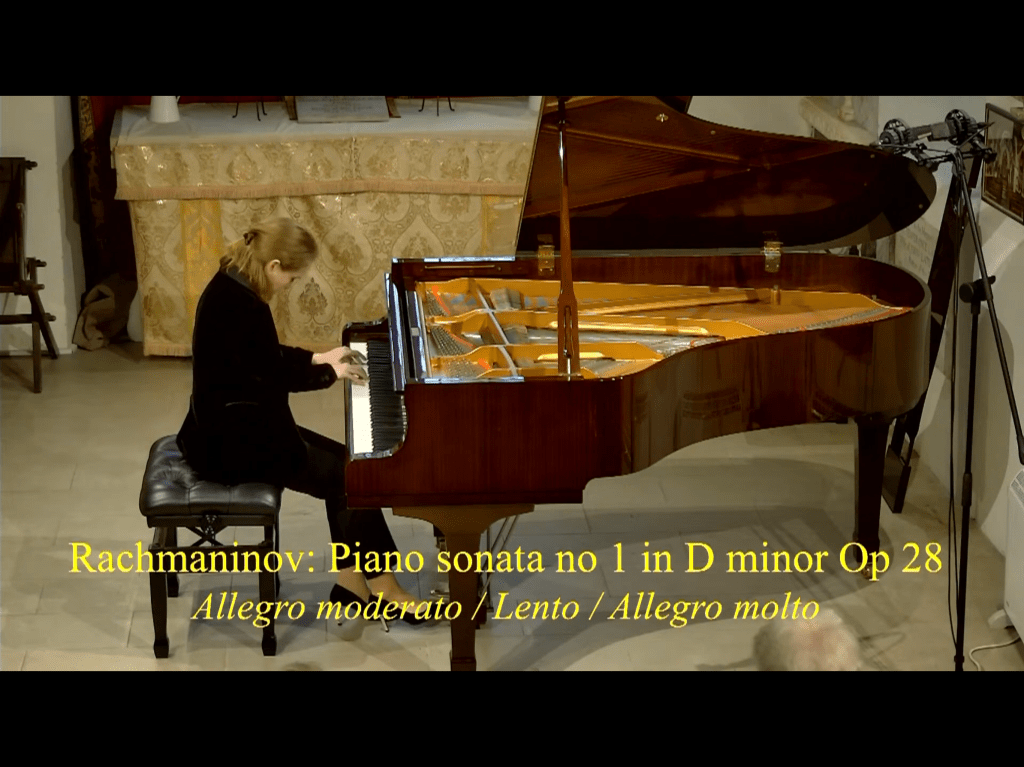
But then she attacked Rachmaninov’s First Sonata with a menace and passion.A spine tingling outpouring of desperation with a cauldron of romantic sounds of burning intensity.How this young lady produced such overpowering sounds and an overall sheen is a mystery.At last there was an architectural line that gave direction to a work that I have often dismissed as overlong and over elaborate.There was a ravishing beauty of desolation to the ‘Lento’ and an energetic ride on a continuous wave of sounds in the Allegro molto.This was a truly great performance and it totally convinced me of what a masterpiece it is.Only Kantarow recently has come anywhere near the towering performance that we heard today.An unforgettable performance that literally brought tears to my eyes being totally overwhelmed by the emotional power that music can exert on some very rare occasions from the hands of a master magician,
Pianist Antonina Suhanova has performed on international stages since 2000, in venues like the Steinway Hall in New York, the Wiener Saal in Salzburg, the Wigmore Hall and the Barbican Hall in London. From 2012 to 2018 she acquired First Class Bachelor of Music, Master of Performance and Artist Diploma degrees, all with distinction, under the tutelage of the British pianist Ronan O’Hora at the Guildhall School of Music and Drama. During her studies, Antonina participated in numerous masterclasses of such world-renowned pianists as Vladimir Ashkenazy, Idil Biret, Steven Osborne, Matti Raekallio, Richard Goode, Robert Levin and Yefim Bronfman. Antonina has appeared as a soloist with the “ Moscow Virtuosi ” Chamber Orchestra, the Latvian National Symphony Orchestra, the City of Cambridge Symphony Orchestra and other collectives, collaborating with such distinguished conductors as Andris Nelsons and Vladimir Spivakov. She has performed at renowned festivals in the United Kingdom, USA, Brazil, China, Italy, Germany, Netherlands, Switzerland, Austria and Russia. Antonina is a recipient of the Hattori Foundation Senior Award, Help Musicians UK awards, the Drake Calleja Trust award, the William Brown prize in the Scottish International Piano Competition (2017) and a nominee for the International German Piano Award 2018. In 2018, her solo debut at the Wigmore Hall was broadcasted live on BBC Radio 3. In 2020 as the Musicians ‘ Company prize winner Antonina made her solo debut at the Southbank Centre, Purcell Room. In 2022 she became grant holder of Oleg Prokofiev Trust and was invited to perform at the Rio Piano Festival in Brazil. Since September 2022 Antonina joined the faculty of the Junior Guildhall School of Music and Drama. Antonina ‘ s artistic schedule in 2023 includes appearances with the Surrey Mozart Players, the Epsom Symphony Orchestra, as well as solo and chamber music recitals across the UK.
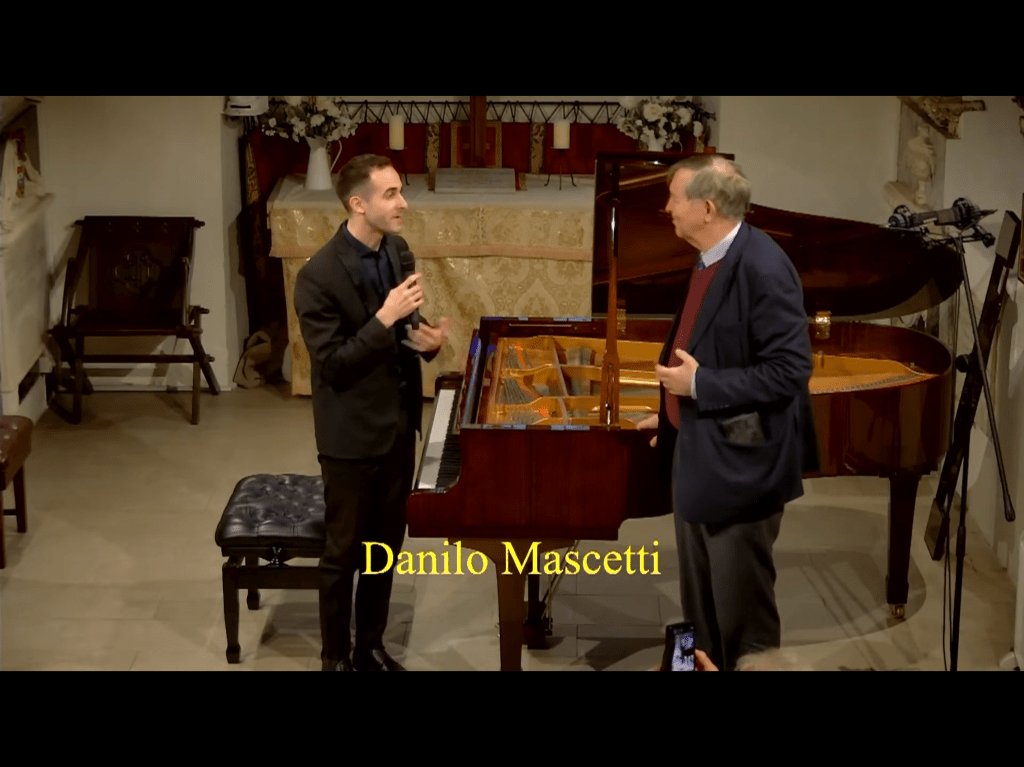
5.10 pm Danilo Mascetti
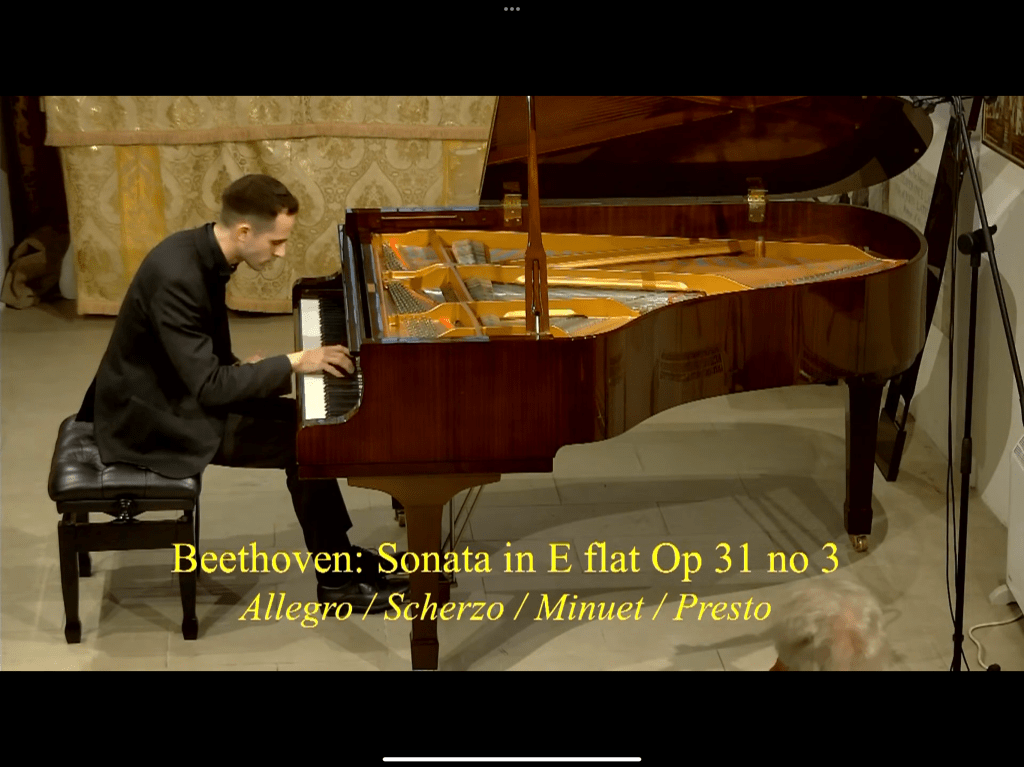
There was a rhythmic freshness to this most ‘Pastoral’ of Beethoven Sonatas.A clarity and innocent purity to the sound and a scrupulous attention to detail that brought this work vividly to life.A scherzo played with the same drive and joy that was so much part of Rubinstein’s characterful playing of this sonata.Incidentally it was the one he chose for his very last performance at the Wigmore Hall in 1976.The deliciously nonchalant ending of the Scherzo was followed by the beautiful cantabile of the Minuet.The Trio in particular was played with a subtle sense of colour and beguiling character that made one understand why Saint Saens had used it as the theme for his variations for two pianos.The Presto con fuoco was a little too fast even for Danilo but he gave it such character and sense of exhilaration that any minor mishaps passed unnoticed with the ‘joie de vivre’that was being transmitted.
Danilo’s superb intelligence and musicianship totally convinced me that it was right to extract only the Allegretto second piece from the Drei Klavierstucke.It stands so well on it’s own with the simple beauty of the opening melody with the ornament perfectly incorporated like a singer into the overall phrasing.The contrasting episodes played with menacing intensity that made the return to the opening melody so touchingly poignant.
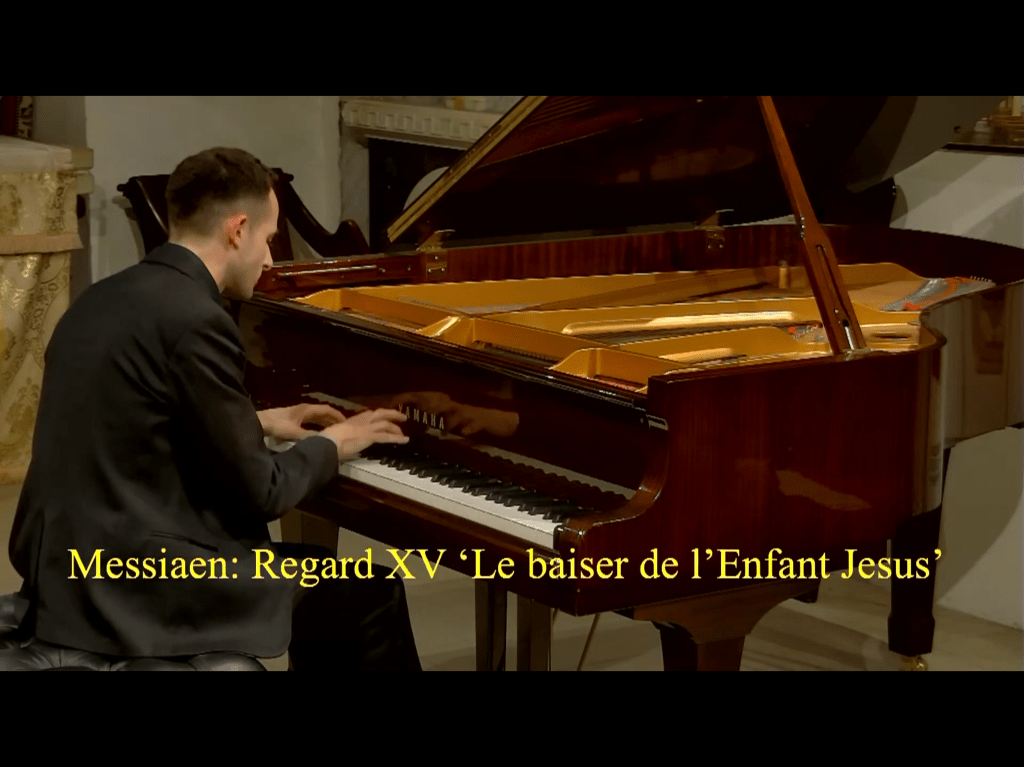
It was such a good idea after all the notes we had heard this afternoon to finish with a piece of moving simplicity.Hauntingly beautiful as the pungent clashing harmonies describe the emotional impact of a true believer.There were magical embellishments that shone like stars in the night sky as the kiss of the baby Jesus invokes such intensity and reverence.It was played with great beauty by Danilo in a meditative performance of masterly control and technical assurance.it should be mentioned that Danilo was fresh from the International Piano Academy Lake Como where he had been working with William Naboré and Dag Achatz.
Danilo Mascetti is an Italian pianist known for his intense performances and original programming, combining traditional repertoire with less known piano works. Equally at home with classical piano and fortepiano, since his debut with Pomeriggi Musicali Orchestra in the prestigious Sala Verdi, Milan, Danilo performs regularly all over Europe with orchestras such as Thessaloniki State Orchestra, Johannesburg Philharmonic Orchestra, Symphonic State Orchestra of Craiova. From 2014 he performs in China and Japan, debuts in London at Steinway Hall, in New York at Merkin Hall, Wallenstein Palace in Prague, Rome, Russia, South Africa and Morocco, with orchestras such as the West Bohemian Symphony Orchestra, Philharmonic Orchestra Hradec Králové, the Nova Amadeus orchestra, the NYCA Symphony Orchestra. Highlights from the last seasons include concerts in Turkey at the Bodrum Gu ¨ mu ¨ s ¸ lu ¨ k Mu ¨ zik Festivali; in Cambridge, with Brahms Concerto n. 1 with Peter Britton, conductor, at the West Road Concert Hall; performances of newly written piano concertos by E. Karlidag and E. Sener with the Talent Unlimited Orchestra. During the summer he presents a tour with the new programme “Contemplations” in the UK, and the premiere of three new harpsichord works at Castello Sforzesco in Milano. Exciting performances for the beginning of 2023 include harpsichord performances for Ton Koopman, a Double Mozart Concerto in Den Haag with historical orchestra, and Brahms Quintet op. 34 on historical instruments. Danilo is originally from Lake Como and is currently based in The Hague (NL) and Brno (CZ)
Thanks to the Mathers whose generosity and infectious love for all that they do has created a mecca for so many young artists at the start of their career.
Eight star pianists in a unique showcase festival at the Piano Mecca of London …..all streamed live on you tube or Vimeo ……they just need an audience of discerning listeners – the rest they will do themselves with their extraordinary artistry and with a little technical help from the magnificent team led by Hugh Mather.
Day one saw four pianists two of whom are new to me but none have ever played at St Mary’s before.Four very interesting recitals with completely different programmes with remarkably no overlapping of works.The interesting thing was the fact that although it is the same piano they are playing they all got completely different sounds from it.Of course all four pianists have a technical mastery earned by years of hard work and discipline under expert guidance.But there are many different sounds in each key and it is personal taste that decides what sound to draw out of each key.A taste acquired by listening to many performances of music of all types and choosing a path from listening to performances that one does not agree with as well as those that are cherished .A musical character is formed and in the practice studio hours are spent trying to piece together a jigsaw puzzle that is an accumulation of personal taste.Rubinstein likened it to the bees pollinating flowers that they choose ,every bee chooses differently and so each pot of honey is different from another.A simple analogy from a pianist who at the end of his long life had found the sublime simplicity that had the world at his feet.
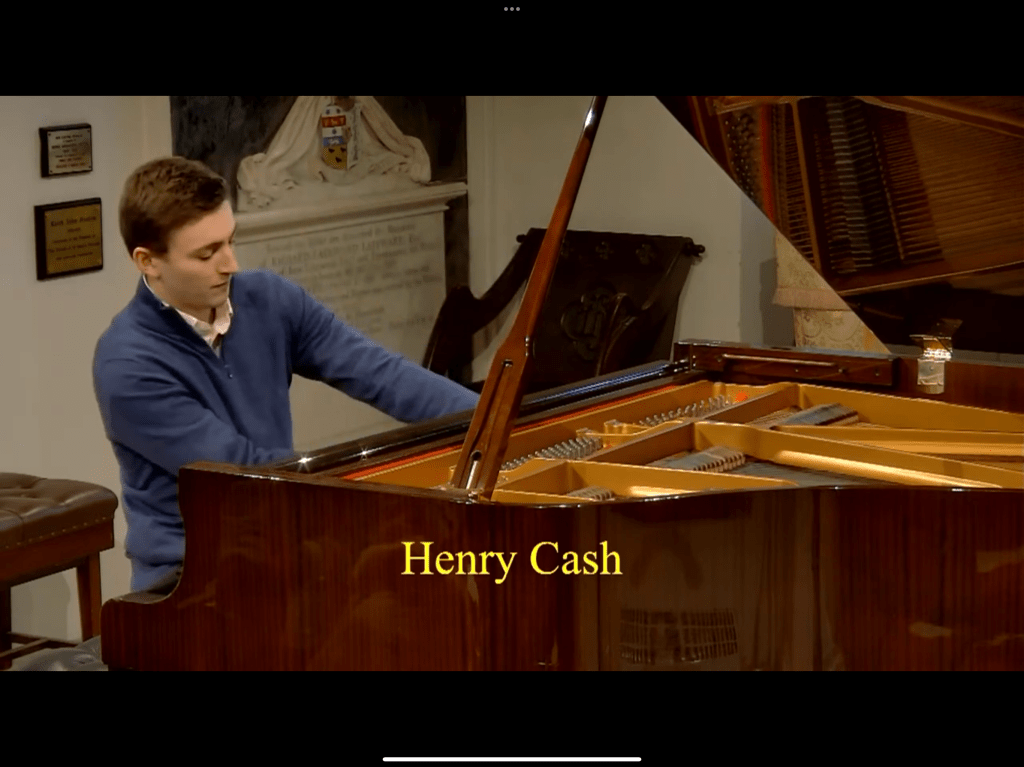
2.0 pm Henry Cash
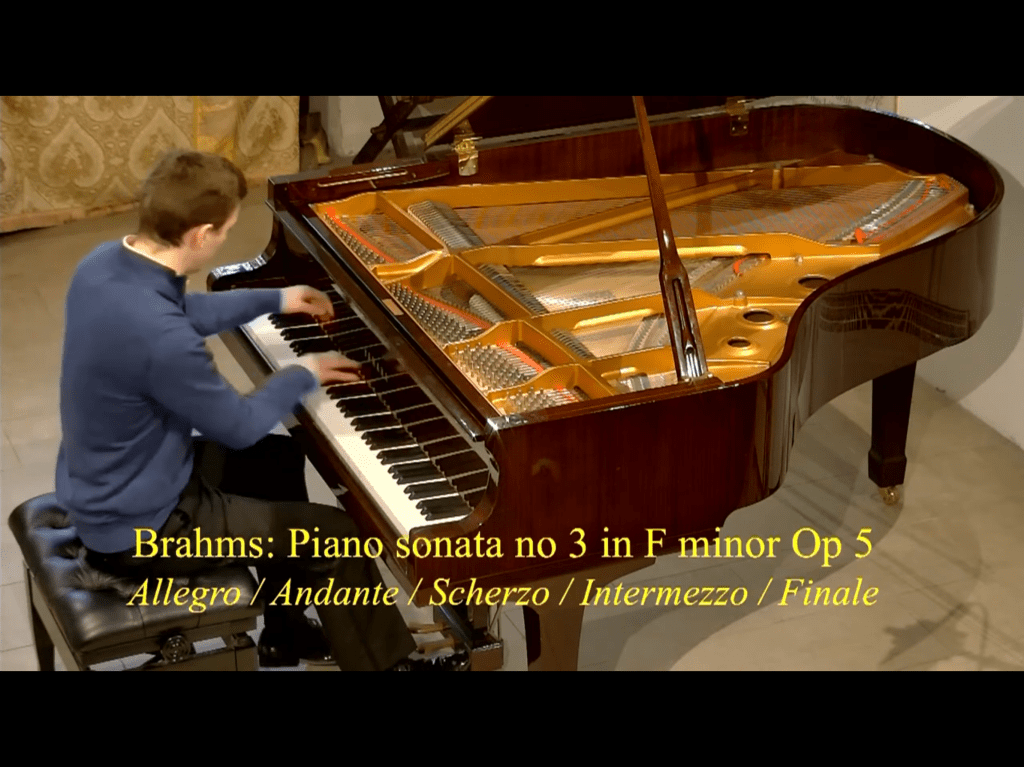
Henry Cash I have not heard before but his teacher Colin Stone has played many times in Perivale.It was obvious from his musicianly performances that he is receiving advice from a master.Henry is a true musician armed with a very solid technique that seems to know no difficulties .He chose Rachmaninov’s favourite prelude to open his concert.I remember Benno Moiseiwitch playing it to his friend Rachmaninov who was surprised when Benno said it reminded him of ‘the return’.Rachmaninov was taken aback as that is exactly what inspired the piece.Henry played it with great poise and a remarkable clarity,simplicity and great assurance.His musicianship is of great architectural lines and his body movements are like a continual wave from which sounds are discovered with naturalness and ease.There are no half lights or insinuating textures but a direct simple message without any rhetoric or showmanship that could interrupt this continual flow of sounds.
The Brahms Sonata in five movements is a very difficult work to hold together as the intimate details and contrasts can detract from the continual flowing undercurrent that takes us on a forty minute journey .I have rarely heard this sonata played with such assurance both technical and musical as today in the hands of this twenty three year old artist.Because an artist he certainly is and there were many ravishingly beautiful things in his performance as there was also passion,drama and a technical mastery that allowed him to play fearlessly the treacherous octave leaps that Brahms demands.The coda to the last movement was played with a clarity and a speed that I have rarely heard in the concert hall.The scherzo too was played with exhilarating daring and a relentless forward movement.It contrasted with the sublime beauty of the Andante and the intensity of the Intermezzo
Henry Cash is 23 and from Huddersfield. He began his musical training at Chetham’s School of Music, age 13, before receiving a scholarship in 2017 to study with Rustem Hayroudinoff at the Royal Academy of Music. After graduating with a first class degree from the Royal Academy he received a scholarship to study with Colin Stone at the Royal Northern College of Music. He has given numerous concerts in the UK and abroad including solo recitals in venues such as the Bridgewater Hall, the Stoller Hall and St James’s Piccadilly. He performed Rachmaninov’s Piano Concerto No 1 in 2015 (age 16), accompanied by the Chetham’s Symphony Orchestra and again with the Bristol Classical Players in 2018. Henry won second prize at the 2021 James Mottram International Piano Competition performing the Grieg Piano Concerto with the Royal Liverpool Philharmonic Orchestra in the final round. He is grateful for the generous support he recieves from the Drake-Calleja Trust, the Pendle Young Musicians’ Bursary and the Oglesby Charitable Trust.
3.0 pm José Navarro Silberstein
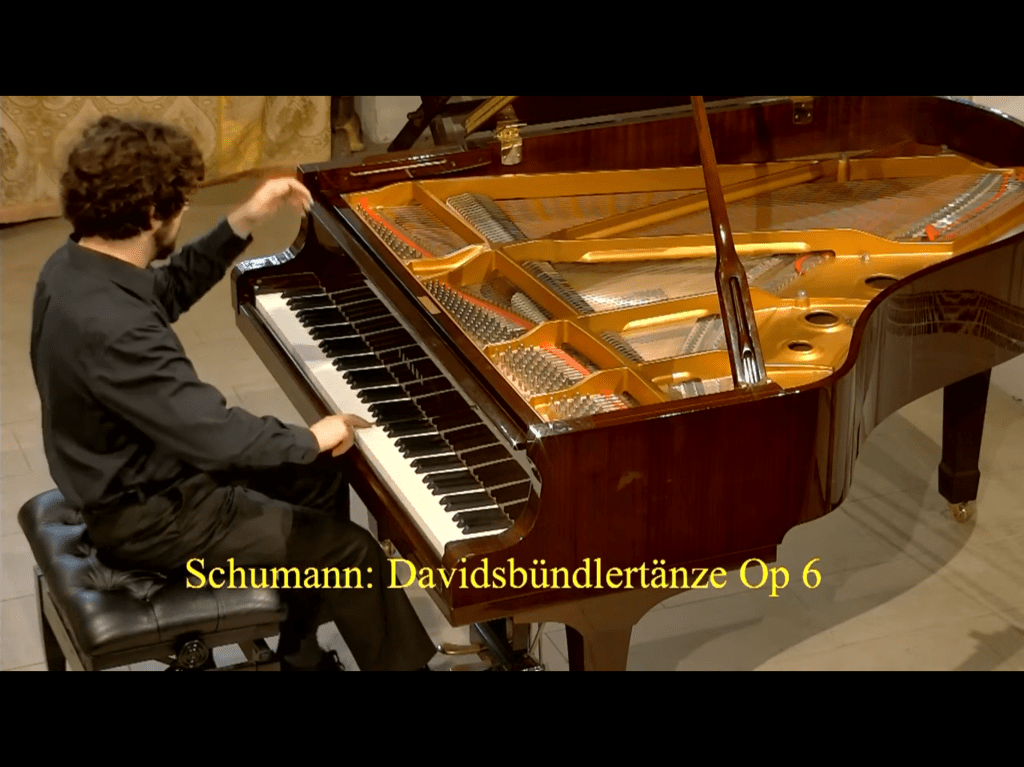
The Davidsbundler saw another side of this remarkable musician.He had put aside his native love of life for the more serious German side to his character.The dances were played with superb intelligence and remarkable control even if it sometimes missed the fleeting dance element of elegance and grace of Eusebius.Florestan was very much magnificently in charge and even the opening Lebhaft was played with a more military band than a court orchestra opening the ball.There was not much humour to the party like atmosphere of the third dance but there was ravishing beauty and superb sense of balance with the ‘innig’ that precedes it.This is the true voice of Eusebius- Schumann’s soul speaking.Florestan could have fun too as he showed us so eloquently and with superb technical control in the sixth ‘Sehr rasch’.Frisch and lebhaft were German style and not part of they party atmosphere until we got to ‘mit humour ‘which was thrown of with ease and grace and daring technical skill.Banana skins abound,in this little dance ,for lesser mortals but theres was no fear of slipping for José.It was in the thirteenth dance that the two sides of Schumann’s personality were united in a performance that was both ‘wild und lustig’ but also touchingly solemn and serious.The most beautiful of all is the fourteenth ‘zart und singend’ and it was here that we could appreciate the true artistry of this young Bolivian pianist.A perfect sense of balance that allowed one of Schumann’s most beautiful melodies to sing so simply and naturally.How Schumann with so little could say so much is a wonder of the world.Liebeslied and the end of Liederkreis are touching examples of Schumann’s inheritance from Schubert.Followed by a rather German style ‘Frisch’ and ‘mit gutem humor’ that brought us back into the real world too soon.The magical 8th of book 2 – the final dance where José was back in wonderland with a distant look back at the magical evening that had been spent together .A masterly control of sound and colour as we were left suspended in air on the final chord.Schumann had more to say with his last nostalgic waltz where José put his scholarship behind him as he allowed his heart to sing with the deeply felt sould of a true artist.
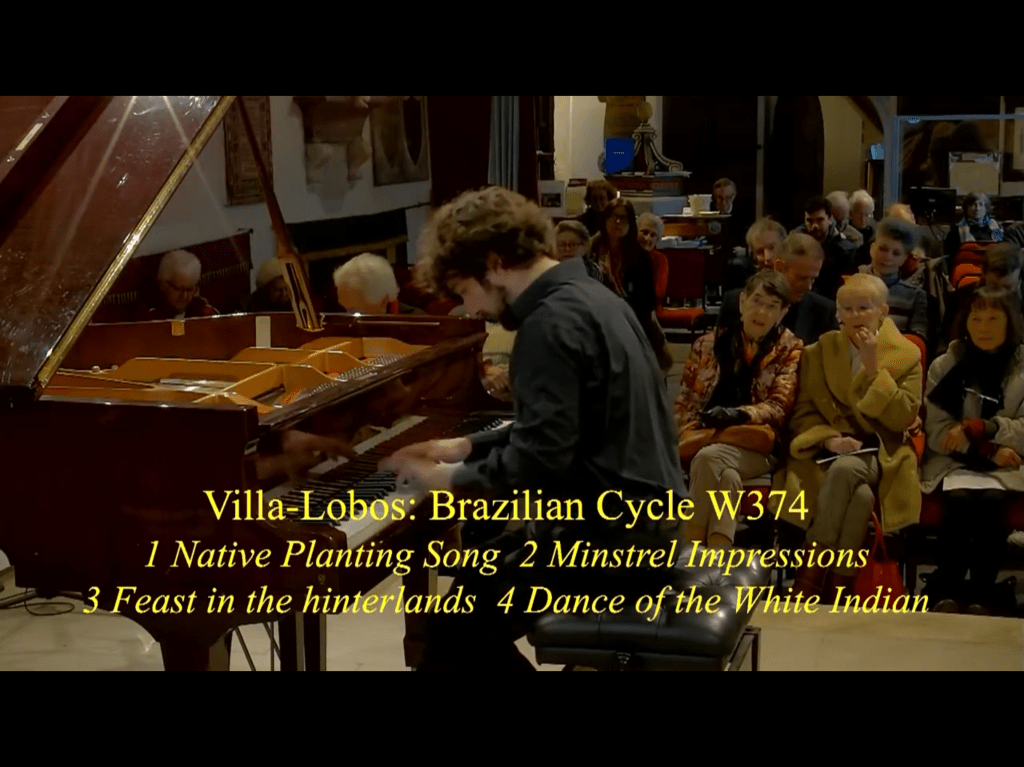
Who better to play Villa Lobos’s ‘Brazilian Cycle’ than José Navarro.Latin blood was flowing with hypnotic results as he played the four pieces W.374 with scintillating excitement and throbbing passion.Hysterics too in the ‘Feast of the Hinterlands’ with a joyous toccata full of bright sunlight and high spirits.There was the haunting beauty of the ‘Native Planting Song’ with it’s seductively beautiful tenor melody accompanied by golden arabesques.They were exquisite with an etherial lightness,a jeux perlé par excellence,from a pianist with a mastery of colour and style.There were almost hysterical interruptions of startling virtuosity but always returning to the ever more beautiful native melody.The ‘Dance of the White Indian’ with it’s menacing bass rumble and ever more insistent excitement was played with astonishing energy and virtuosity.
The young Bolivian pianist has performed in different countries in venues and festivals in Europe, South America and USA. Halls include Teatro Municipal “Alberto Saavedra Pérez” in his hometown La Paz to the Musikverein in Vienna. He is a Talent Unlimited Artist in London. As a soloist, he has performed with the Jena Philharmonic Orchestra, Norddeutsche Philharmonie Rostock, Georgian Philarmonic Orchestra, La Paz Symphony Orchestra, Orquesta de Jóvenes Musicos Bolivianos, Orquesta Sinfónica Juvenil de Santa Cruz de la Sierra among others. He is a prize winner at the Anton Rubinstein Piano Competition in Düsseldorf, Tbilisi International Piano Competition in Georgia, International Competition Young Academy Award in Rome, Claudio Arrau International Piano Competition in Chile among many others. He was a finalist at the Eppan Piano Academy and at the 63r d Ferruccio Busoni International Piano Competition. In Bolivia he gave masterclasses in La Paz Conservatory, Sucre Conservatory Santa Cruz Fine Arts College and Laredo School in Cochabamba. He served as a jury member in national music competitions. He was mentored by Paul Badura Skoda. He studied with Balasz Szokolay at the Franz Liszt University in Weimar and with Claudio Martínez Mehner at the University of Music and Dance in Cologne. At the moment he is at the Artist Diploma programme at the Royal College of Music in London under the guidance of Norma Fisher and Ian Jones.He holds scholarships from Royal College of Music, Herrmann Foundaiton Liechtenstein- Bolivia, Theo and Petra Lieven Foundation of Hamburg, Clavarte Foundation in Bern and Elfrun Gabriel Foundation for Young Pianists.
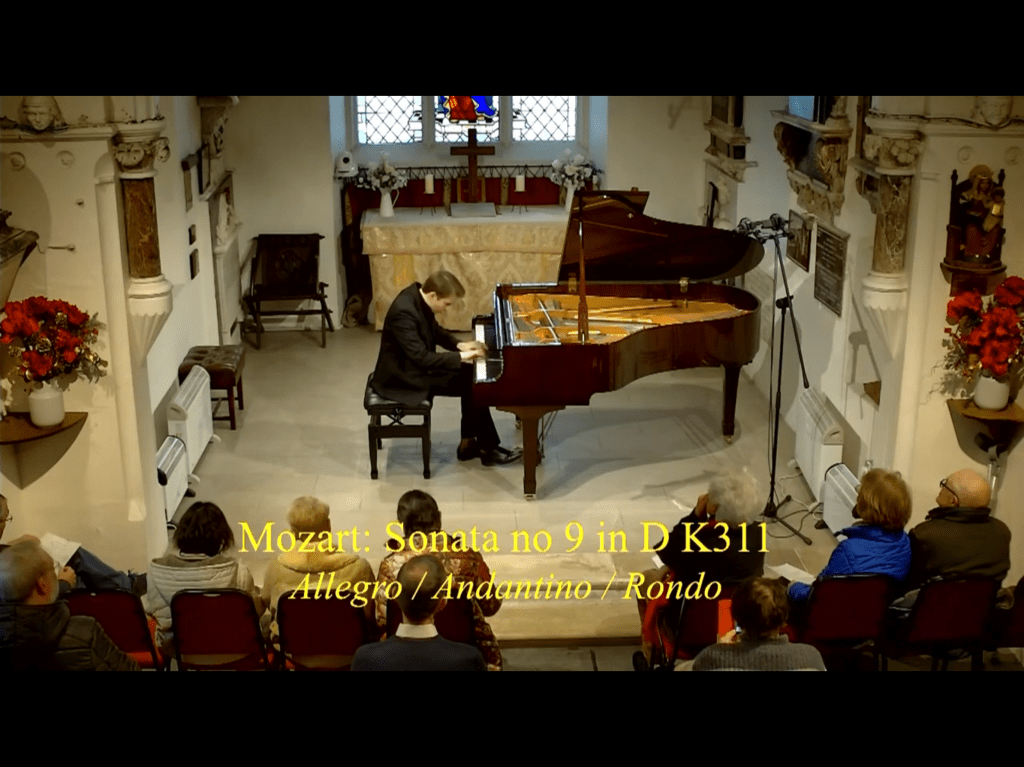
A Mozart of crystalline clarity with ornaments that sprang from Misha’s fingers like well oiled springs.There was a driving rhythmic energy but also subtle contrasts in dynamics played with elegance and style.An Andantino that had a purity of sound with its chiselled beauty and poise and a Rondo of such innocent good humour and driving energy.Exemplary Mozart exclaimed Dr Mather,but it was more than that as it was played like a true artist who listens to himself and shapes the music with loving care and intelligence .
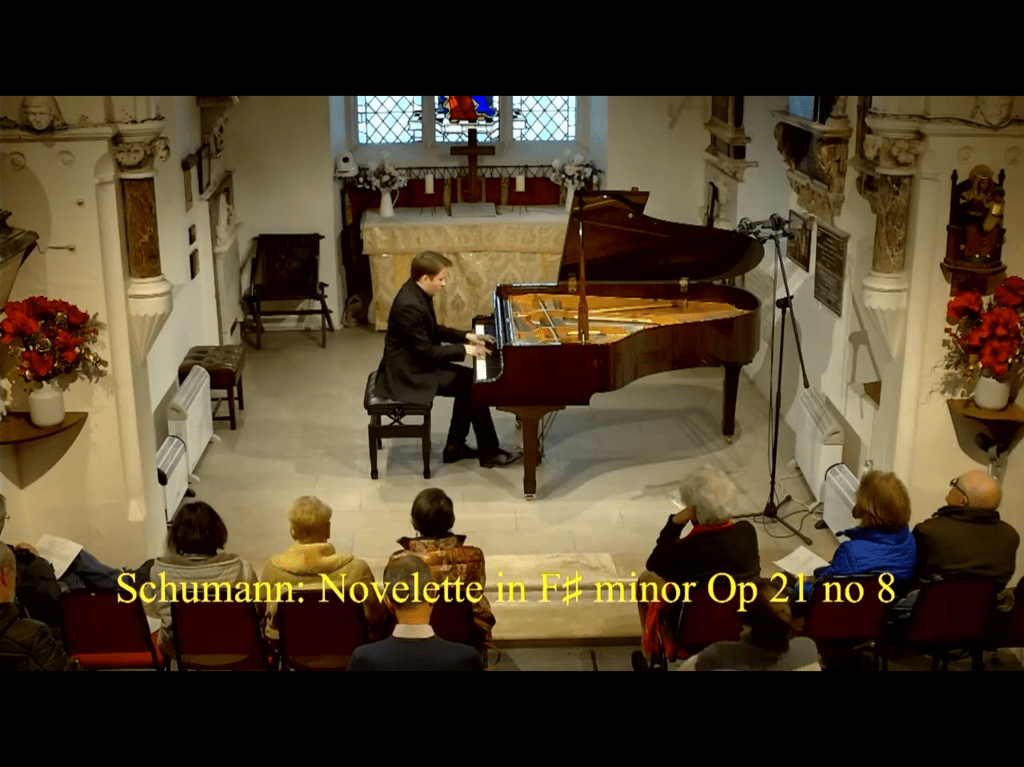
The piano was immediately engulfed in sumptuous sounds with Schumann’s eighth novelette.The longest and most complex ,it could well have been the first movement of a Sonata or Fantasy with its continual changes of character and mood.There was a driving passion but also a clarity due to Misha’s sparing use of the pedals that allowed all the strands of Schumann’s ingenious counterpoints to be heard so clearly.Playful capricious contrasts alternated with passionate outbursts of swirling romantic fervour played with remarkable technical mastery.There was also the touching etherial beauty where Misha played with such refined sounds.Schumann shows us a whole world in this last of his op 21 novelettes.Richter used to play it (together with the fourth in D ) with the same driving rhythms and breathtaking passion that swept all before it .Misha too showed us what a masterpiece it can be in the hands of a true artist.
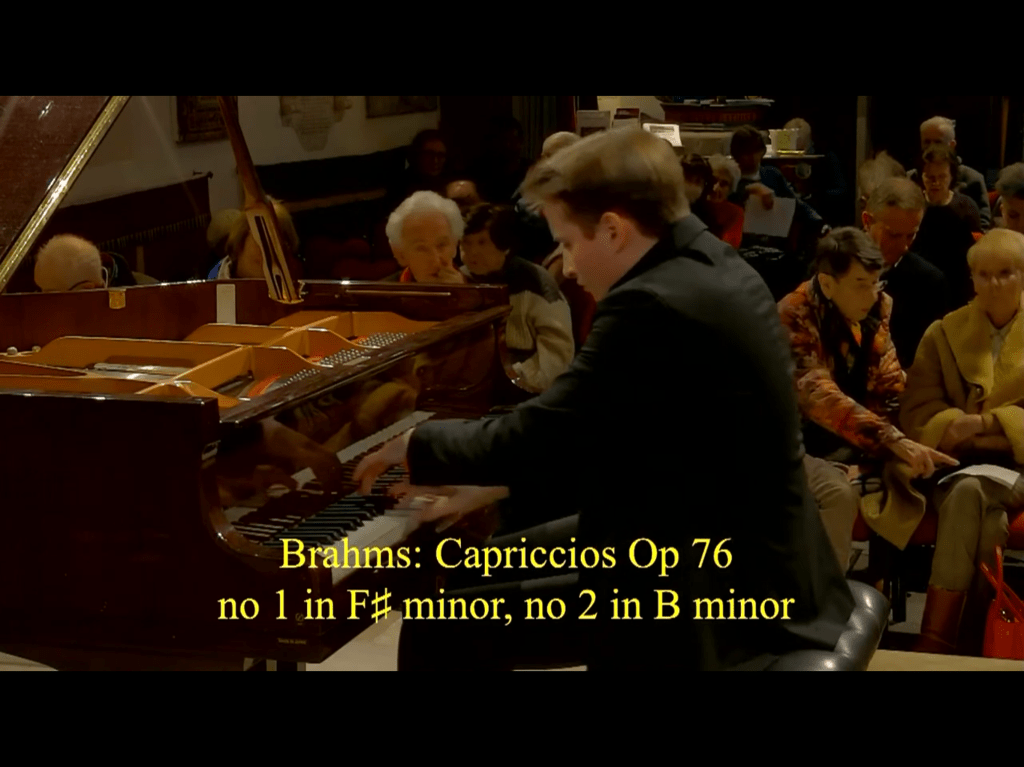
The piano was engulfed in romantic sounds as Brahms’s poignant arpeggios spread over the keyboard with driving passion and poignancy.A technical command that incorporated the playful capricious contrasts before being enveloped in the washes of even more passionate cascades of notes.There was a beautiful simplicity to Brahms’s seemingly innocent B minor Capriccio with its quixotic changes 4643 5z and sty4t4eafescjle.
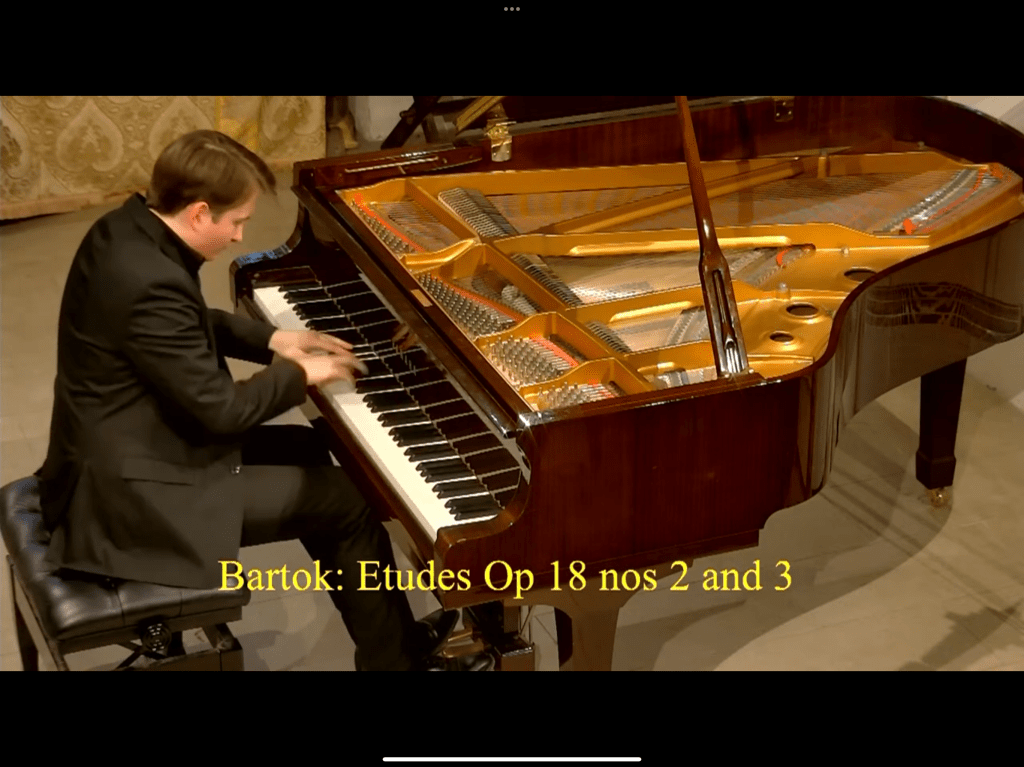
There was an extraordinary technical control in the Bartok studies with amazing sounds spread with remarkable virtuosity over the entire keyboard in the second.There was also the toccata like gymnastics of the third study with its majestic outpouring and surprise ending .
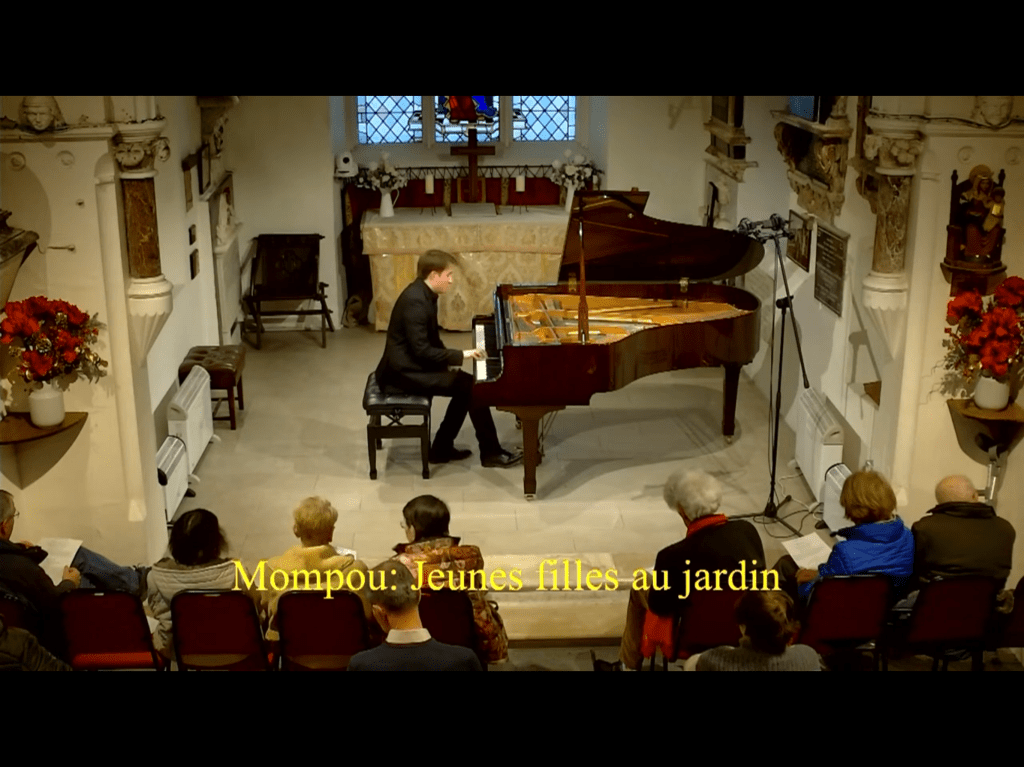
Mompou was played with a capriciousness and ravishing beauty.There were sumptuous rich sounds of beguiling melodic insinuation.Tinged with nostalgia as it was played with great artistry.One could do no better than to quote Joan Chissell when she said ‘Baubles were turned into Gems.’
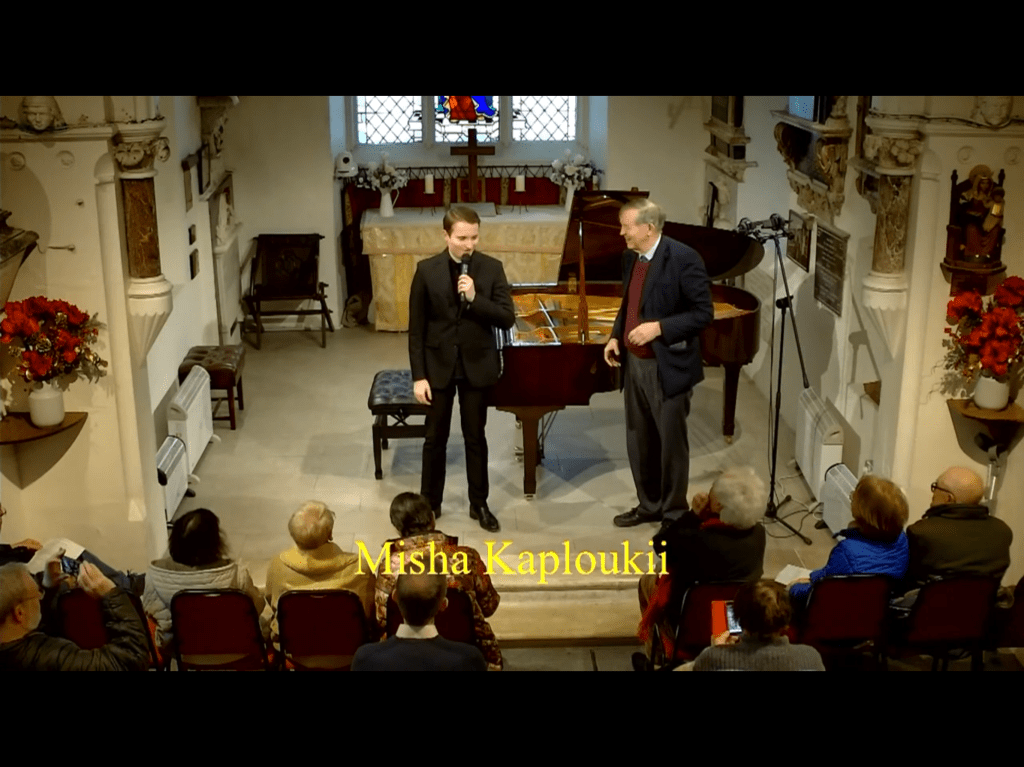
Pianist and flautist Misha Kaploukhii was born in 2002 and is an alumnus of the Moscow Gnessin College of Music, where he studied in the piano class of Mikhail Egiazarian. Misha is currently studying at the Royal College of Music; he is an RCM and ABRSM award holder generously supported by Robert Turnbull Piano Foundation and Talent Unlimited charity studying for a Bachelor of Music with Professor Ian Jones. He also gained inspiration from lessons and masterclasses with musicians such as Claudio Martínez Mehner, Dmitri Bashkirov, Jerome Lowenthal and Konstantin Lifschitz. Misha already has experience of performing with orchestras internationally including his recent debut in Cadogan Hall with the Rachmaninoff 1st Piano Concerto, his overall repertoire includes a wide range of solo and chamber music. Recently, Misha has won prizes in the RCM concerto competition (playing Liszt’s 2nd Piano Concerto) and in the International Ettlingen Piano Competition.”
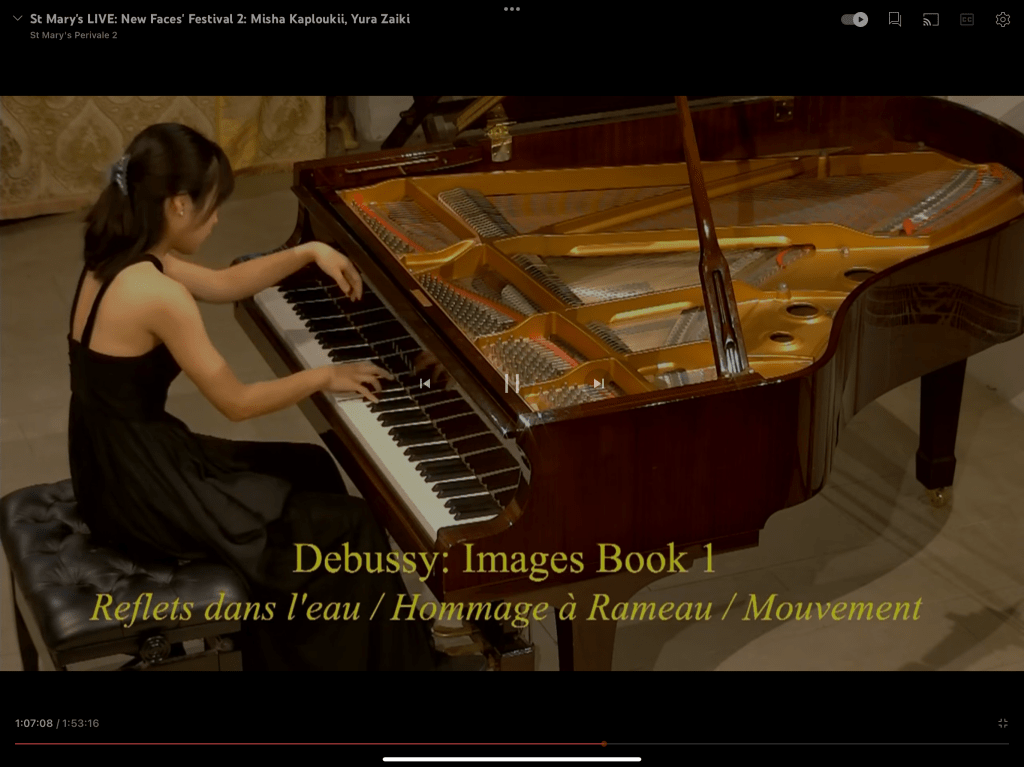
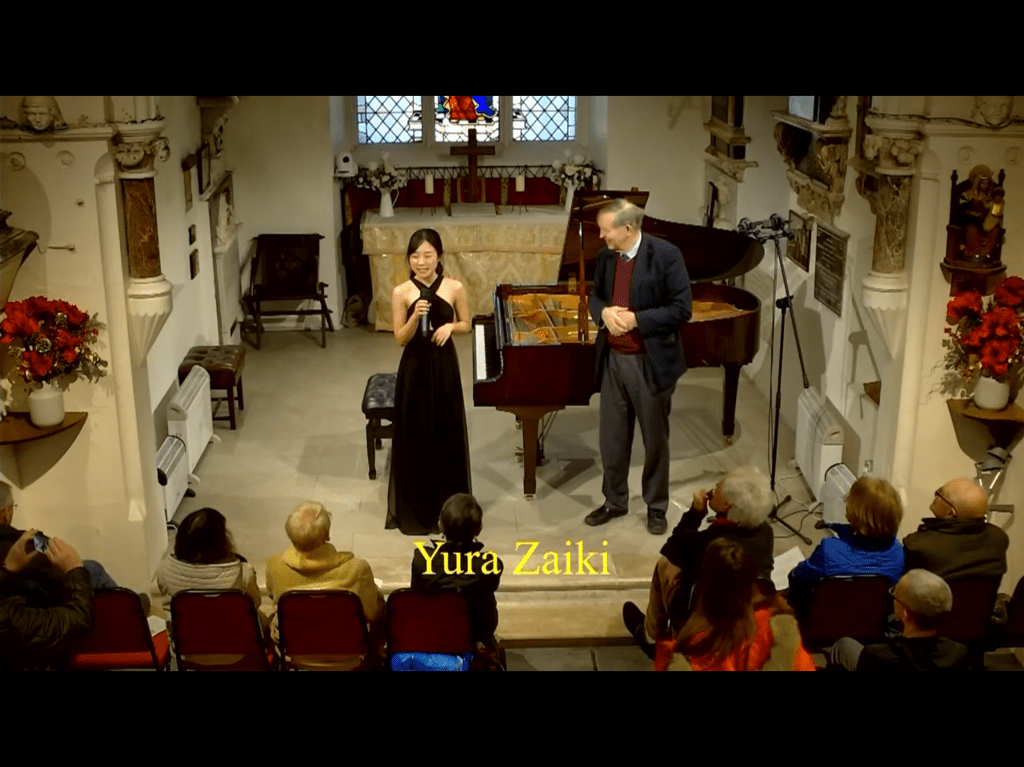
Debussy’s Images Book 1 were played with great poise and elegance.Reflets dans l’eau was allowed to hover above the keys and Hommage a Rameau was played with aristocratic style. Mouvement was a continuous outpouring of whispered sounds with tumultuous outbursts played with technical bravura of notes spread with ease over the entire keyboard.
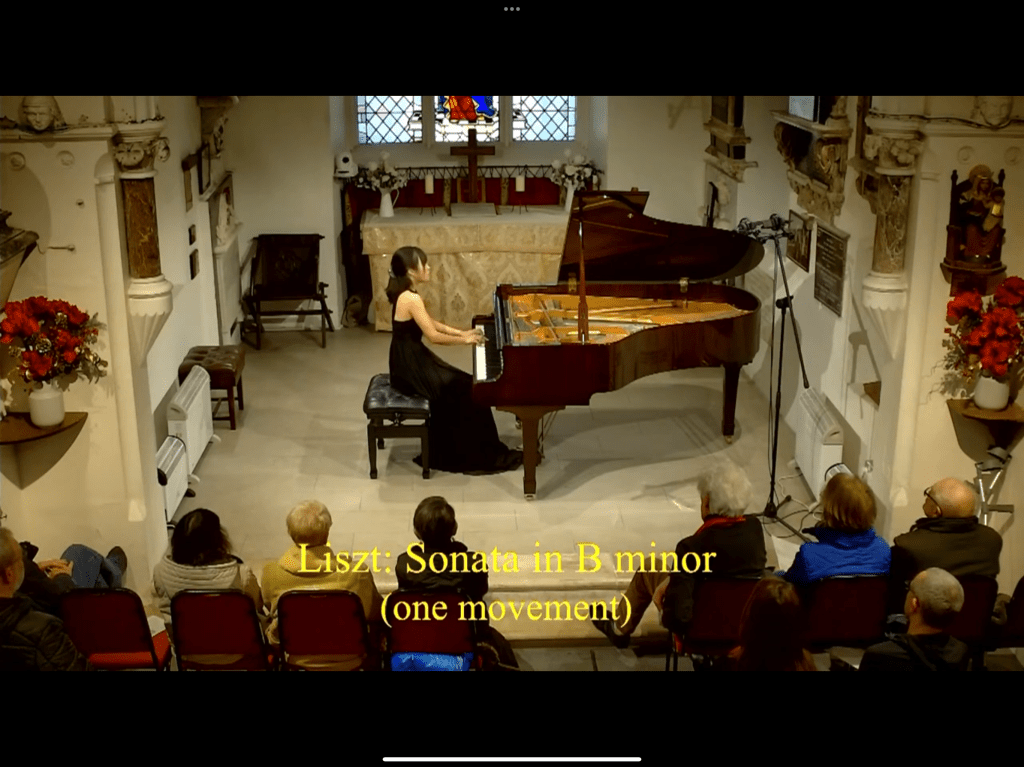
The Liszt Sonata was played with blazing passion and technical bravura.There were moments in the andante of great beauty.This is one of the great works of the Romantic repertoire and is dedicated to Schumann.When the score arrived at the Schumann household Clara declared that it was a blazing noise and she certainly would never play it in public.Hans von Bulow gave the first performance and it takes a true musician to followed Liszt’s very precise road map for a work of such blazing originality.The opening pages are marked piano,mezzo forte leading to the fortissimo outburst and the true start of Liszt’s adventure on the second page.The three opening themes are the leit motif that are transformed in a highly original way creating a revolutionary new art form that was to be such an influence on Liszt’s son in law .Richard Wagner took it to sublime heights in the Ring Cycle.Yura played it with great conviction and the public were totally won over but a more careful study of the score would reveal a work of searing originality and fundamental importance and not just a showpiece for brilliant virtuosi.
Yura Zaiki is a Japanese pianist based in London. She studied at the Royal Conservatoire of Scotland with Professors Aaron Shorr, Fali Pavri, and Jonathan Plowright, where she completed her bachelor and masters degree. Her studies have been supported by the ABRSM scholarship, and the Royal Conservatoire of Scotland trust scholarship. She graduated top of her class and was awarded the Performance Prize for Keyboard.Previously, she joined the Junior Department of the Royal Academy of op let Music, where she won First prize in the Iris Dyer Piano Competition. Her awards in competitions include First prize in the Evangelia Tjiarri International Competition, Second prize in the Elena Richter International Competition, First prize in the Chiba Piano Competition, plain First prize in the North London Piano Festival, Fifth prize in the Petrof Piano Competition. She also received the Craxton Memorial Trust Award.She has performed in venues such as the Piano Festival at FAZIOLI Hall in Italy, and the BBC interval concert at Glasgow City Halls. She was also invited to perform by the Embassy of the Republic of Lithuania & Japan at Goldsmiths University of London, at the Institut français d’Écosse in Edinburgh, and the Larnaca Municipal Theater in Cyprus. She is an animal lover and a founder of The Cerasus, where she organises a series of charity concerts in Tokyo, London, and Glasgow, for animals in need. She also had the privilege of playing in Masterclasses with great pianists including Jean-Efflam Bavouzet, Richard Goode, Robert Levin, Steven Osborne and Frank Wibaut. (250)
What fun we had …..and what music ……..,and another day still to enjoy
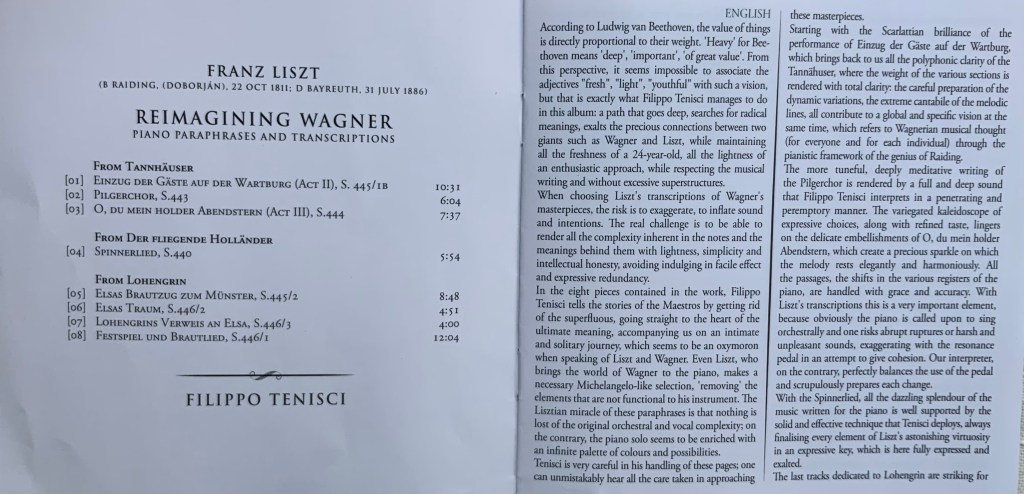
The second concert in this eleventh edition inspired by Liszt’s Erard piano lovingly restored by Ing .Tammaro.He also had the genial idea of bringing this antique instrument to life with an annual series of concerts which also give a platform to young master musicians.And it all started with the Liszt bicentennial celebrations in 2011 originally in the Villa D’Este but now transferred to another of the hills around Rome in Velletri. In the beautifully restored monastery that is now a thriving arts centre this Erard piano has found the ideal home for an instrument that was destined for intimate gatherings and certainly not the vast concert halls of today.
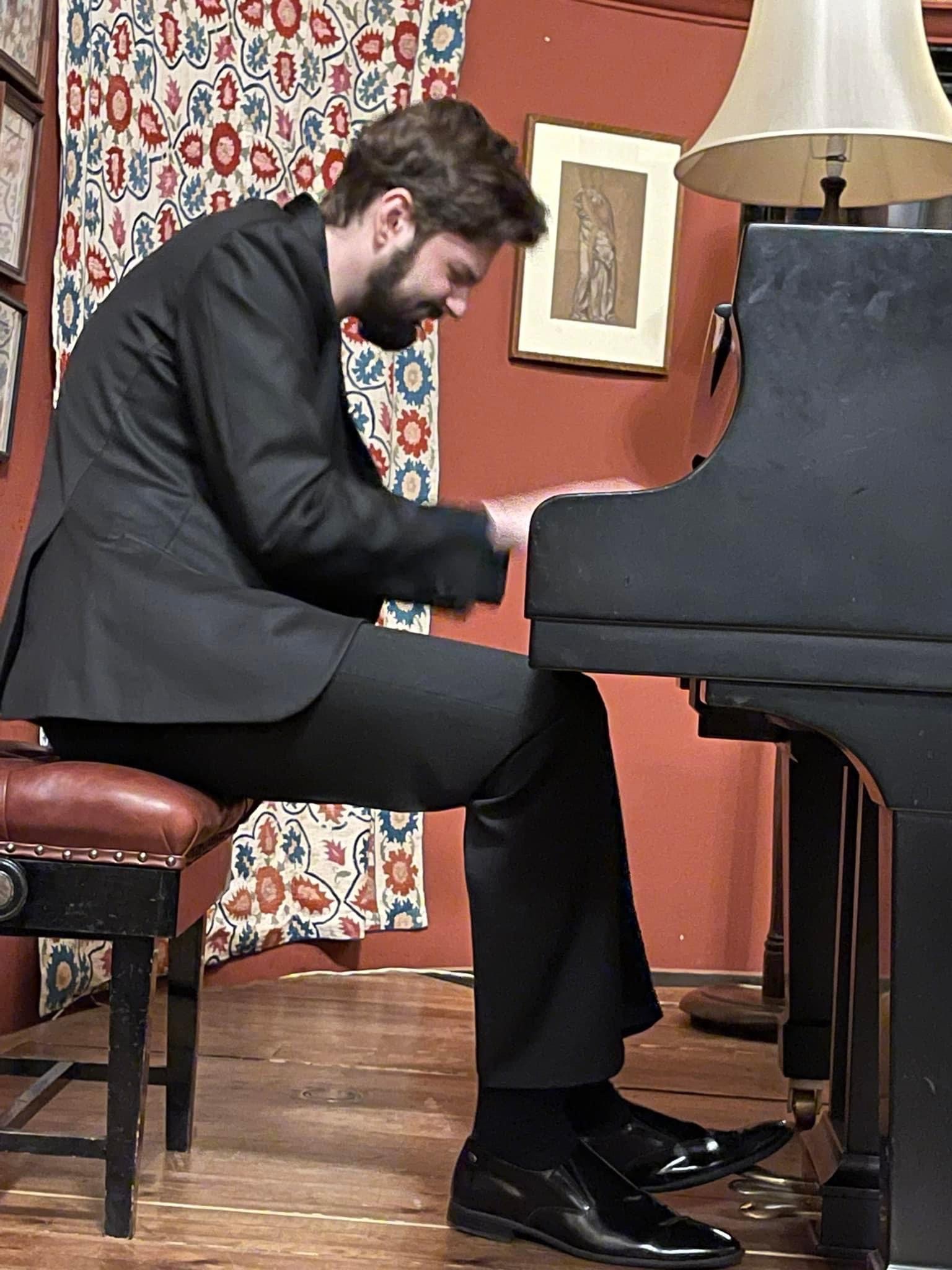
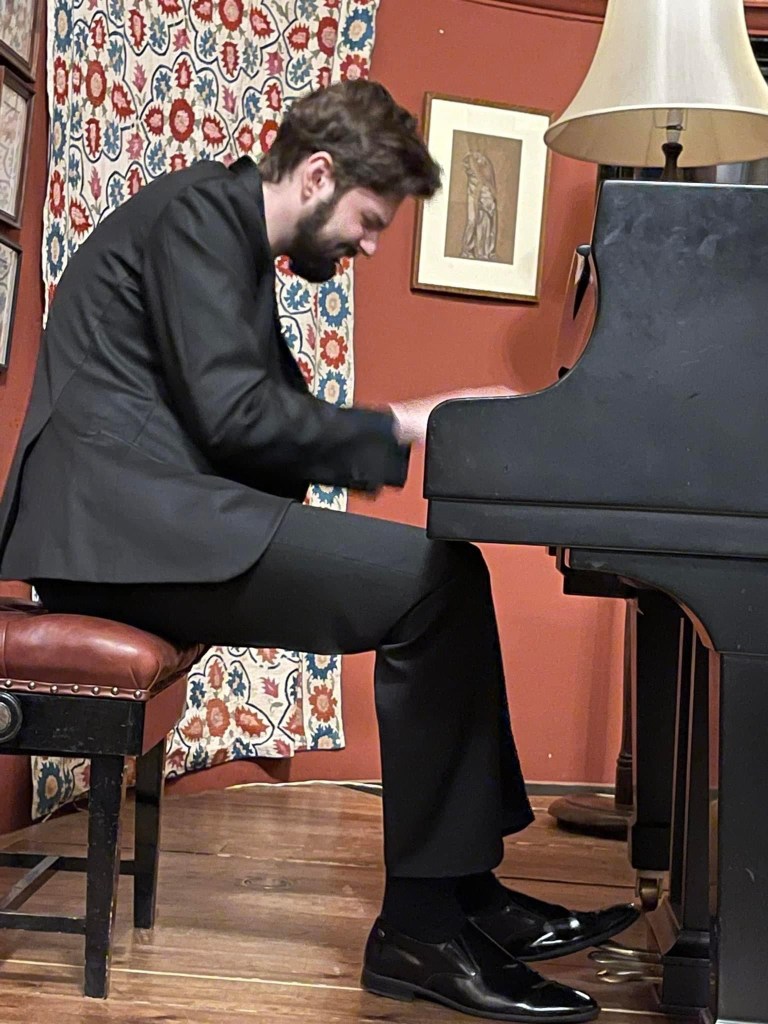
Today it was an all Wagner concert alla Liszt by the young Albanian born pianist Filippo Tenisci from the class of Maurizio Baglini. https://christopheraxworthymusiccommentary.com/2021/06/24/che-festa-the-joy-of-musicmaurizio-baglini-project-at-roma-3/ Maurizio Baglini and Roberto Prosseda are two prodigiously eclectic promoters of music and young musicians in Italy. I am proud to say that they were both spotted and helped in their formative years by the Keyboard Trust which has now taken Filippo under their wing too.
Celebration concert in London just a month before his much awaited appearance this season in Velletri
The world is very small when one encounters master musicians dedicated to a voyage of discovery into the world of the great composers bringing their discoveries to life with dedicated scholarship,passion and instrumental mastery. And so it was today with this young musician who I had heard recently playing so beautifully a Mozart concerto with the University Roma Tre Orchestra.https://christopheraxworthymusiccommentary.com/2021/02/09/roma-3-orchestra-the-mozart-project/ I was not expecting to find such dedicated mastery and serious scholarship in an eclectic repertoire of Wagner as from the hands of his father in law Liszt. I have only heard the Tannhauser Overture before as it was the ‘cavallo di battaglia’ of the great ‘virtuosi’of the past . There exists a famous video recording of Moiseiwitch playing it. https://youtube.com/watch?v=XKDYla5C5cA&feature=share I also remember Shura Cherkassky playing it for us in Rome in one of his many recitals there in his glorious Indian summer. It is a real paraphrase and as Ing.Tammaro rightly explained is the only piece on the programme today that is not just a pure transcription. It is a work in which virtuosistic gymnastics abound but above all requires a superb sense of balance and colour to restore its orchestral glory to two hands and two feet in front of a box of strings and hammers !
Here and in the ingenious ‘Spinnerlied’or the ‘Entrata degli ospiti nel Warburg’ Filippo showed his technical mastery of the keyboard with sparkling jeux perlé,brilliant arabesques and powerful octaves.There was real beauty as he intoned the ‘Coro dei Pellegrini’ with its atmospheric ending that was later to be transformed in the Overture paraphrase with the transcendental gymnastics of a master illusionist.There was ravishing beauty that opened the ‘O du mein holder Abendstern’ with its tenor melody and lapping arabesques before its apparition on high bathed in a luminous mist of pedal.This was just the introduction to the full sumptuous tenor melody in all its moving glory.It was played with great delicacy surrounded by arabesques gradually building to a truly ecstatic climax.It showed Filippo’s very stylish mastery without ever loosing the aristocratic sentiment pregnant with meaning and never descending into empty sentimentalism.
A sudden injection of life with ‘Entrata degli ospiti nel Wartburg’ with the troups insistently marching in the left hand leading to a triumphant finale of great virtuosity and showmanship.The Ballade unfolded with great drama and was a true tone poem in Filippo’s inspired and convincing hands It followed the busy weaving of the famous ‘Spinnerlied’ already mentioned.
It is interesting to note that with Lohengrin Wagner left his youthful world of Tannhauser and Rienzi and was heading for the genial heights that changed the world of opera forever.The first performance in Weimar of Lohengrin was with Liszt on the podium who wrote to Wagner: ‘The wonderful score of Lohengrin moved me deeply.Your opera is simply sublime’.And so it was with the’Corteo nuziale di Elsa alla Cattedrale’ that the long drawn out melodic line was played with absolute serenity as Filippo unfolded it’s simple melodic line in this most literal of transcriptions.The ‘Dream of Elsa’ from Lohengrin was played with the tenor line ,sumptuous and simple over a shimmering accompaniment of great sensibility .
It was Filippo’s remarkable musicianship and scholarship that shone through all he did.Nowhere more than in the brief encore that he offered after a transcendental performance of the Tannhauser Overture.I look forward to the imminent publication of his new Wagner/Liszt CD. Filippo took this opportunity of publically thanking Ing.Tammaro for the untiring help he gives to young musicians.Giving them a much needed platform to be able to share their music with a discerning public in his seasons of such scholarship and meaningful importance .
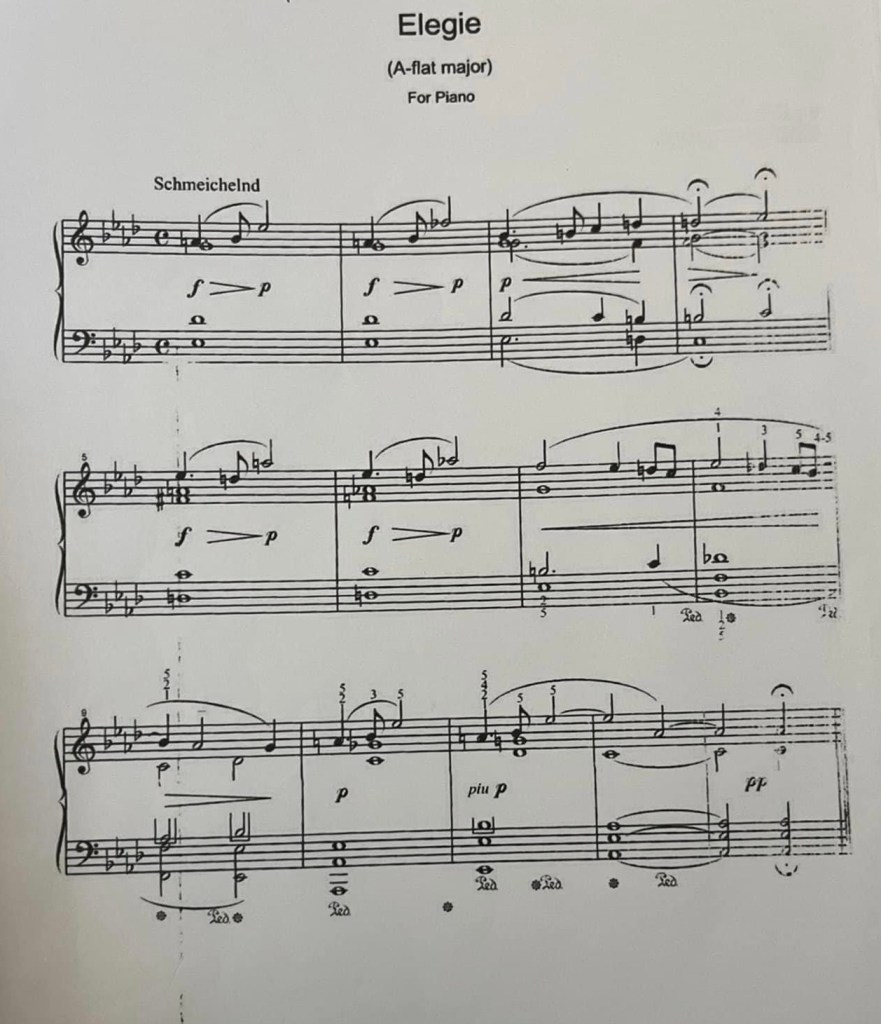
He announced he would like to play a piece written for the piano by Wagner himself. Written in 1853 but revised and authenticated only a year before his 70th and last birthday in 1883. Just one page of disarming simplicity that after all the notes we had heard today it was a fitting testimony to one of the greatest composers of all time. It was played by Filippo with simple disarming beauty – a sublime benediction before which I am sure Liszt would have gone on his knees too !To quote Wagner from his letters:’An excitement almost painful comes over me with the arrival of the promised Erard Grand……..On it’s arrival I was extremely moved …….you know for how long I had hoped to own one……Here it is finally the magnificent piano with a voice of gold.’
As Ing Tammaro pointed out it was just such a piano that sat so nobly on the stage today.
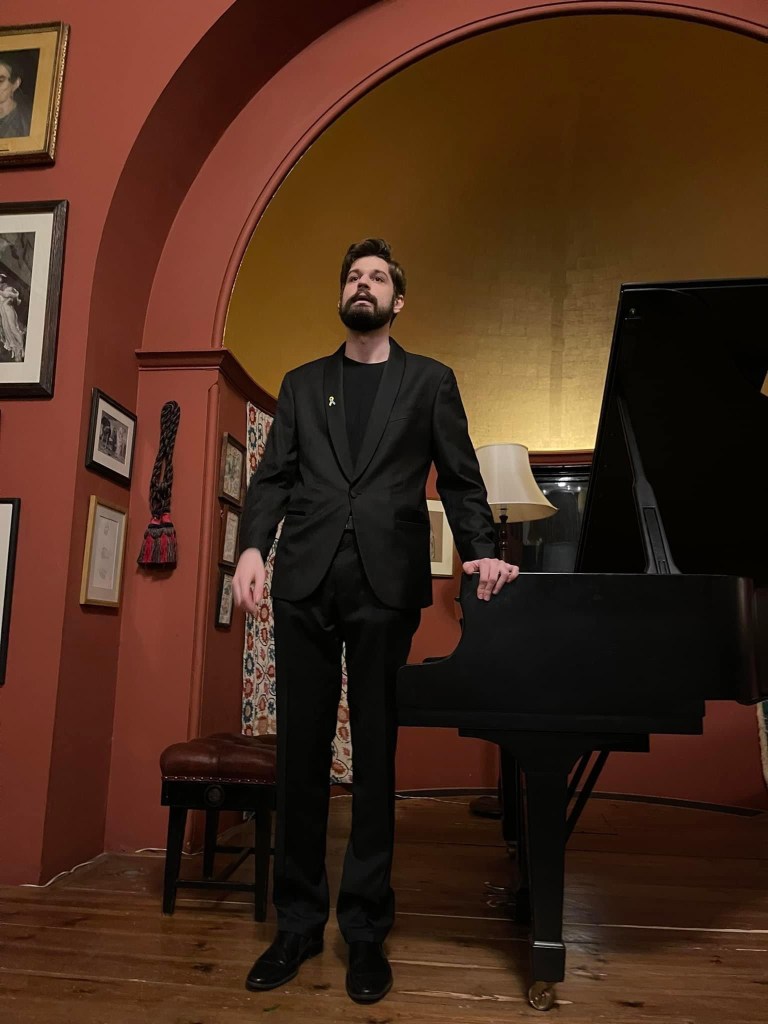
Elegie by Richard Wagner completed in 1883 the year of his death – three years before Liszt in 1886.Ing Tammaro with the dress coat loaned to Liszt by a noble lady in Via Sistina in Rome,where he lived,when his own had been drenched by rain .
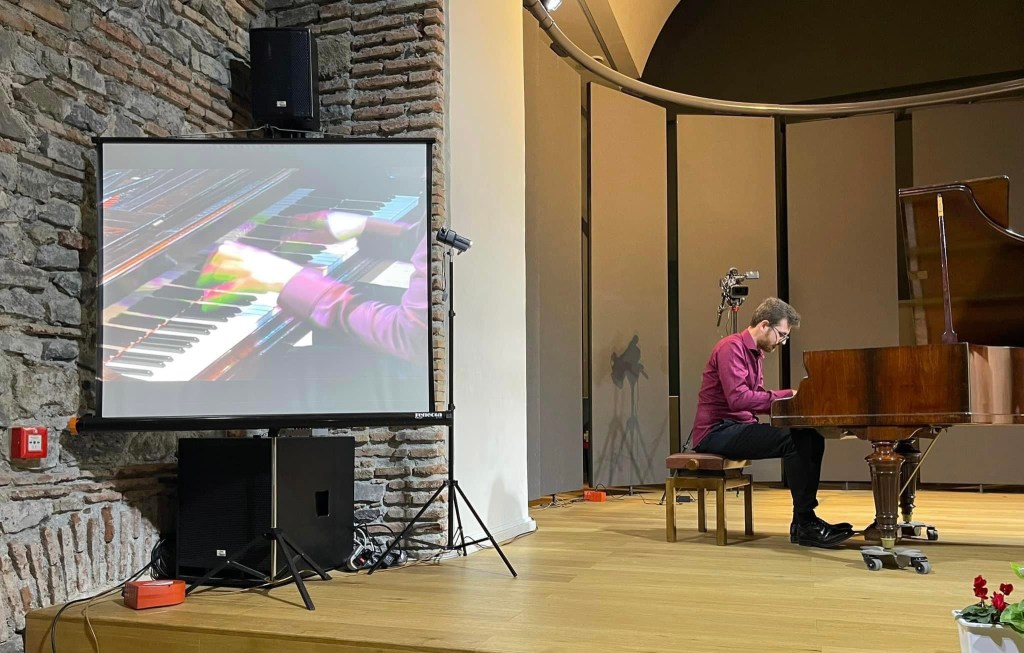
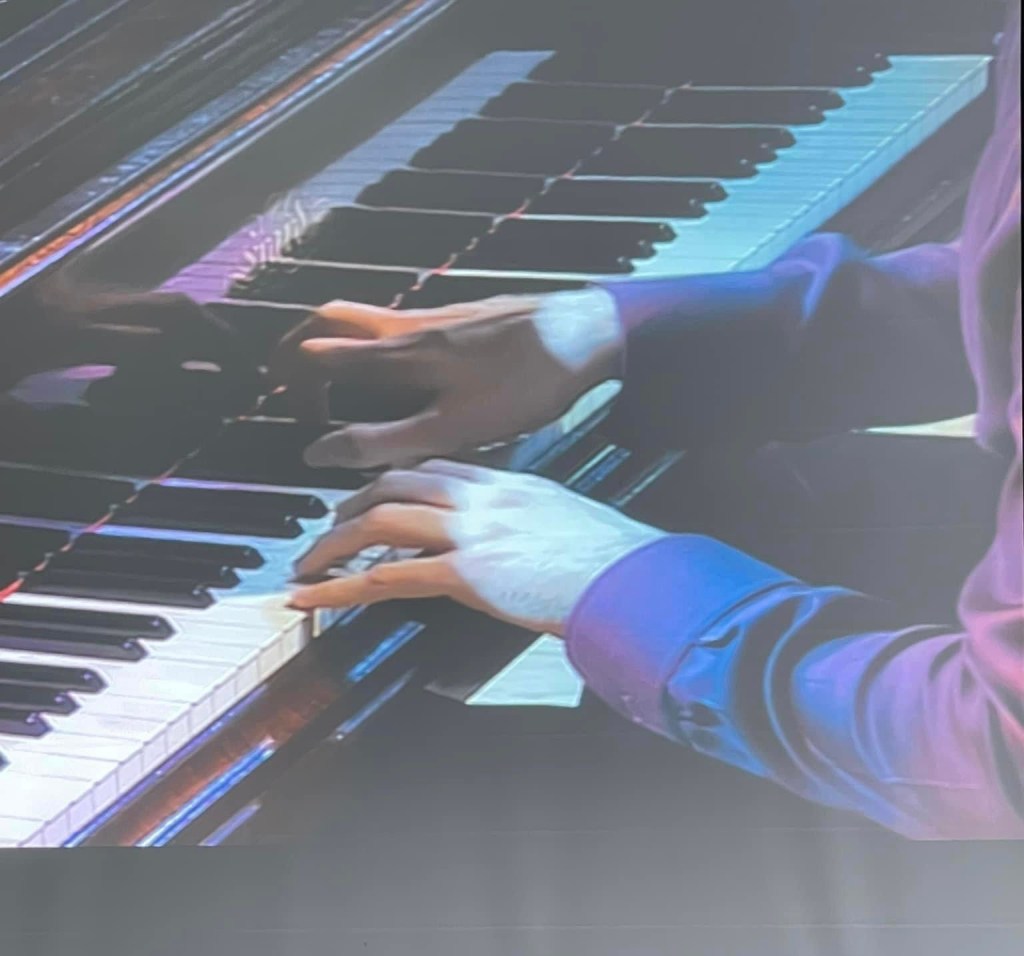
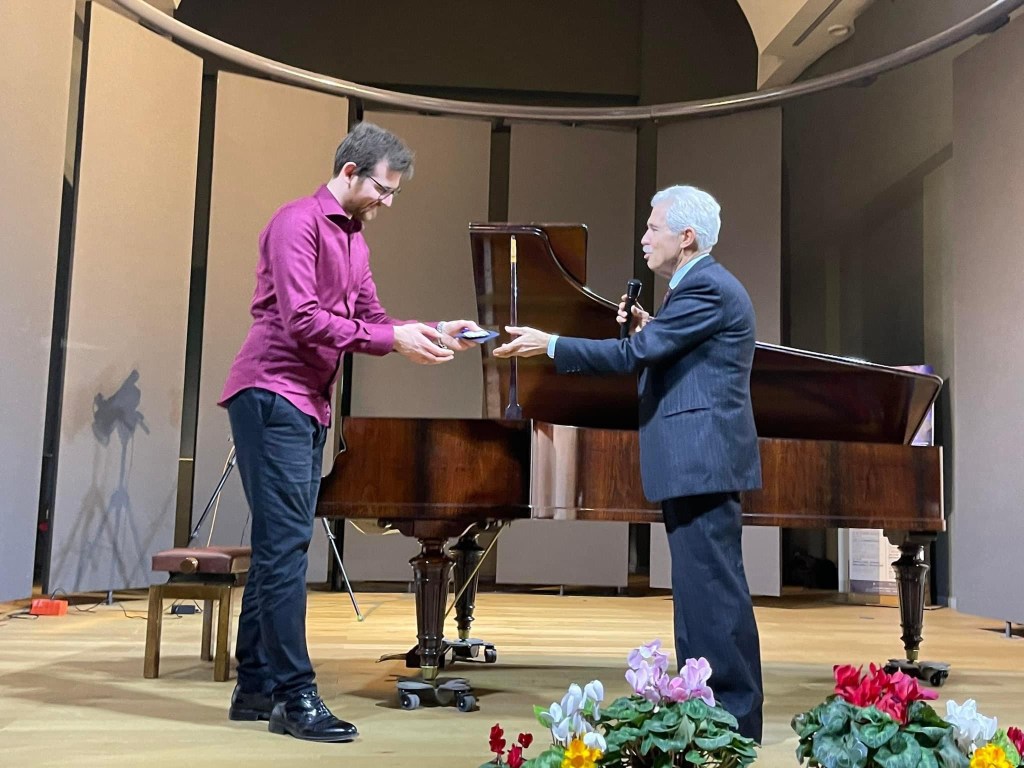
Ing.Tammaro presenting Filippo with the specially embossed medal of thanks The Maxi screen allowed us to appreciate Filippo’s beautiful hand movements and his sensitivity to touch Cast of Liszt’s left hand Filippo Tenisci
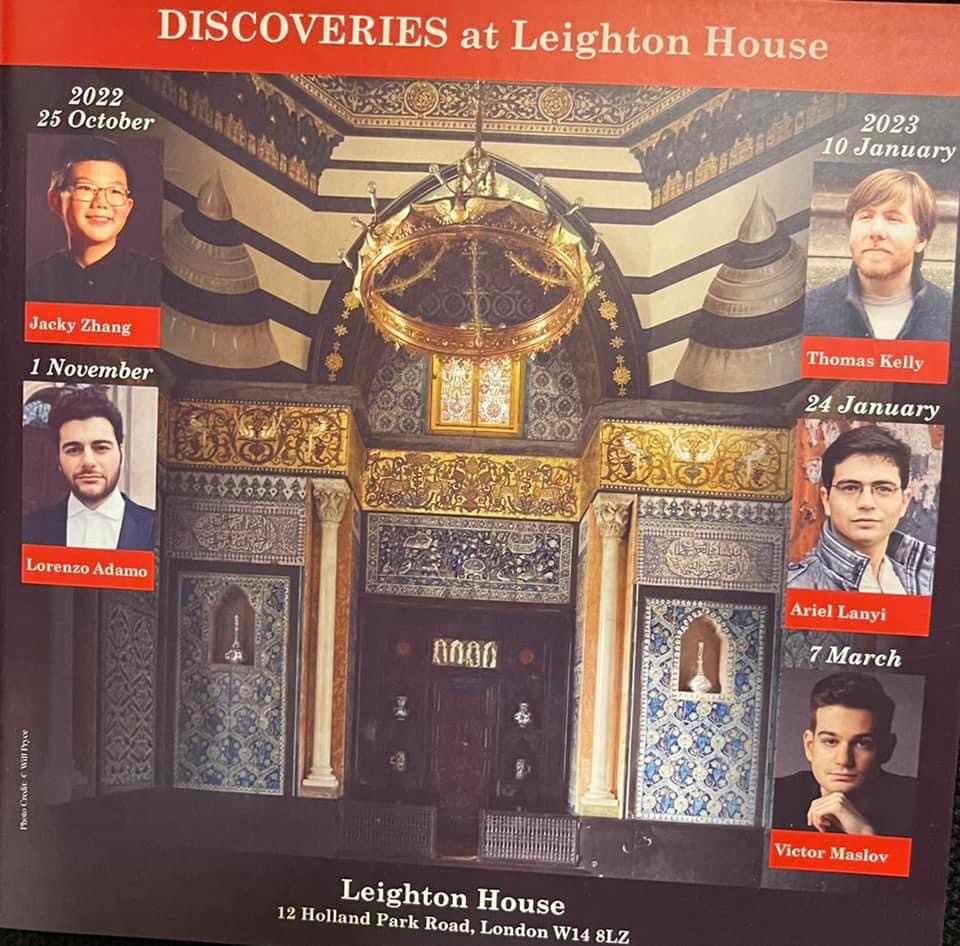
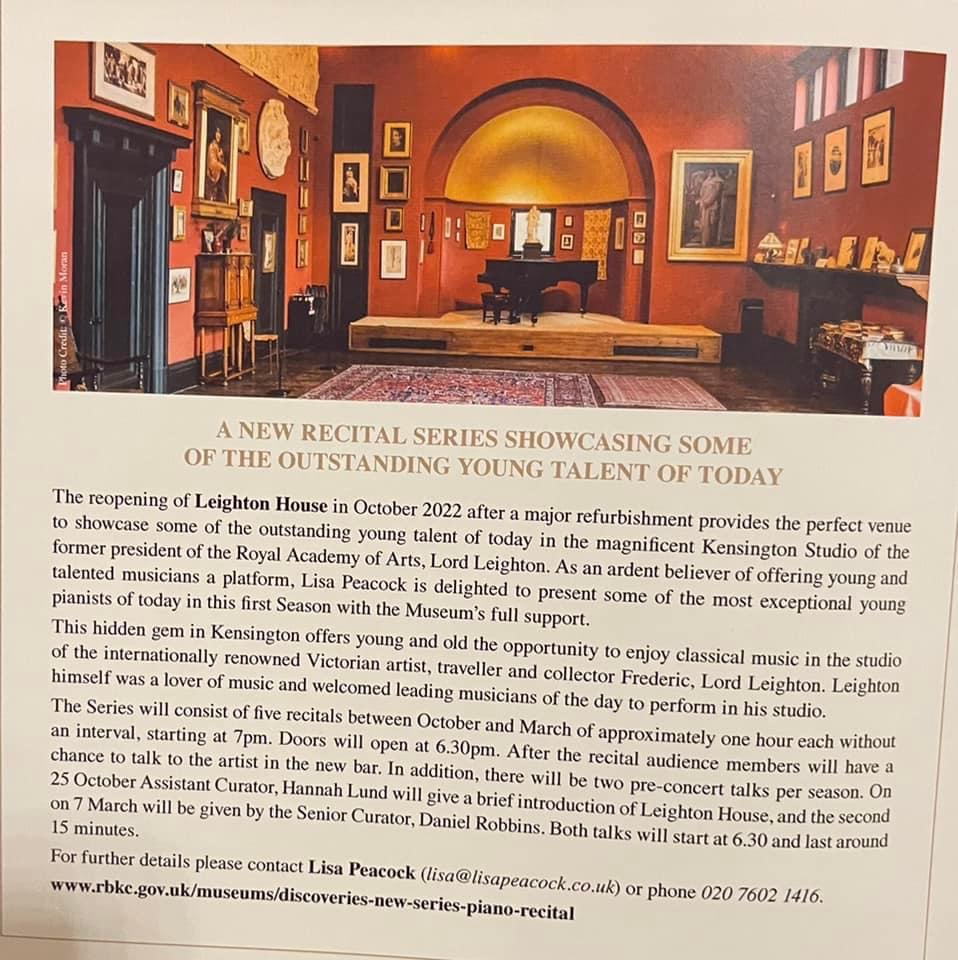
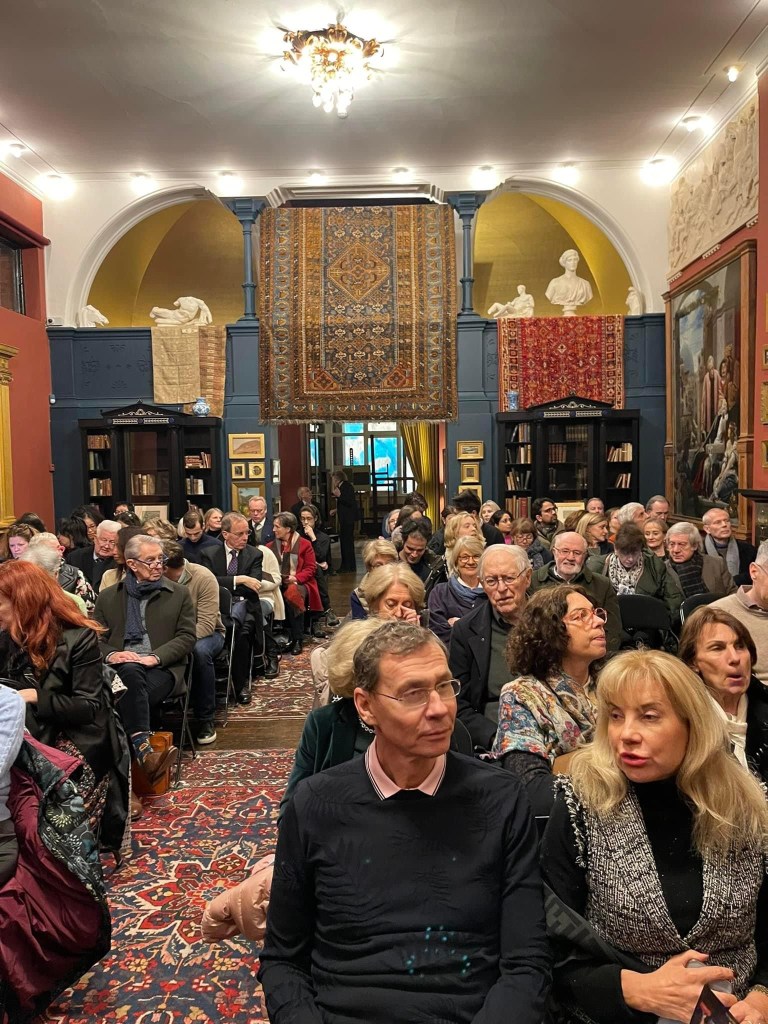
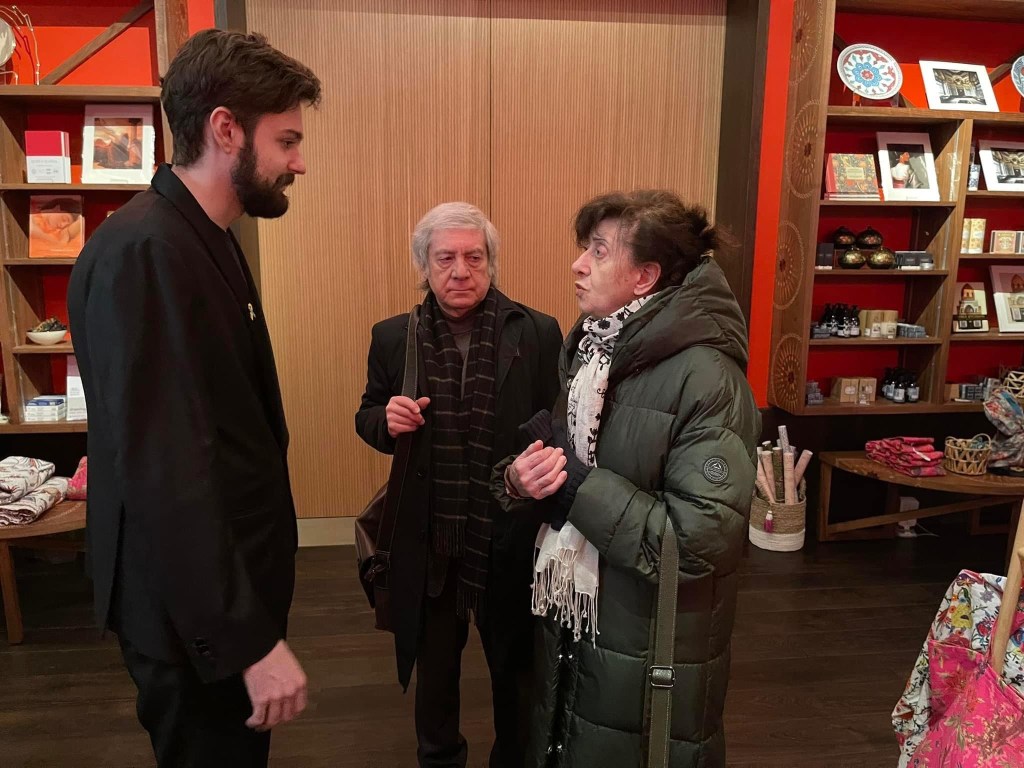
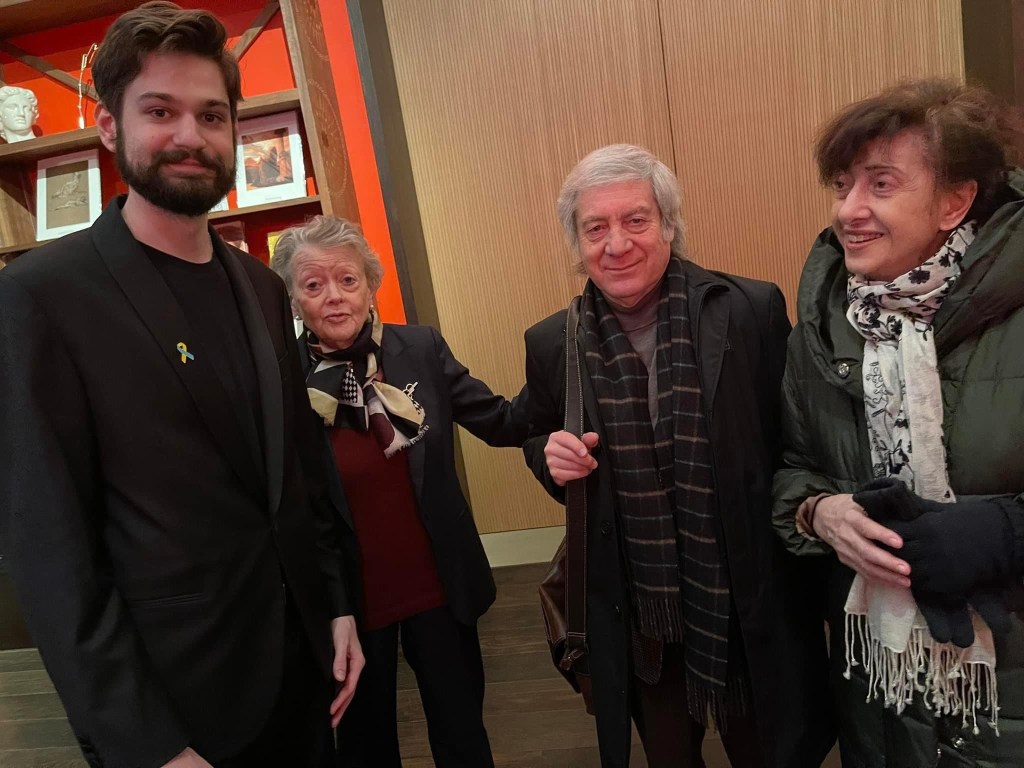
The finale concert in Lisa Peacock’s series of ‘discoveries’ in the splendour of the newly restored Leighton House.Five concerts with five future stars in Lord Leighton’s sumptuous music room. Pianists who have come to London to perfect their already quite considerable talent.Today it was Victor Maslov who closed the season with a full hall that included his mentor Dmitri Alexeev and his wife Tatyana Sarkissova. Three of the five pianists chosen to take part in this new series were mentored by Dmitri Alexeev at the Royal College of Music and it was the master himself who had given a memorable concert here too just a few weeks ago. https://christopheraxworthymusiccommentary.com/2023/02/06/dmitri-alexeev-the-supreme-mastery-and-anguish-off-a-tormented-soul/
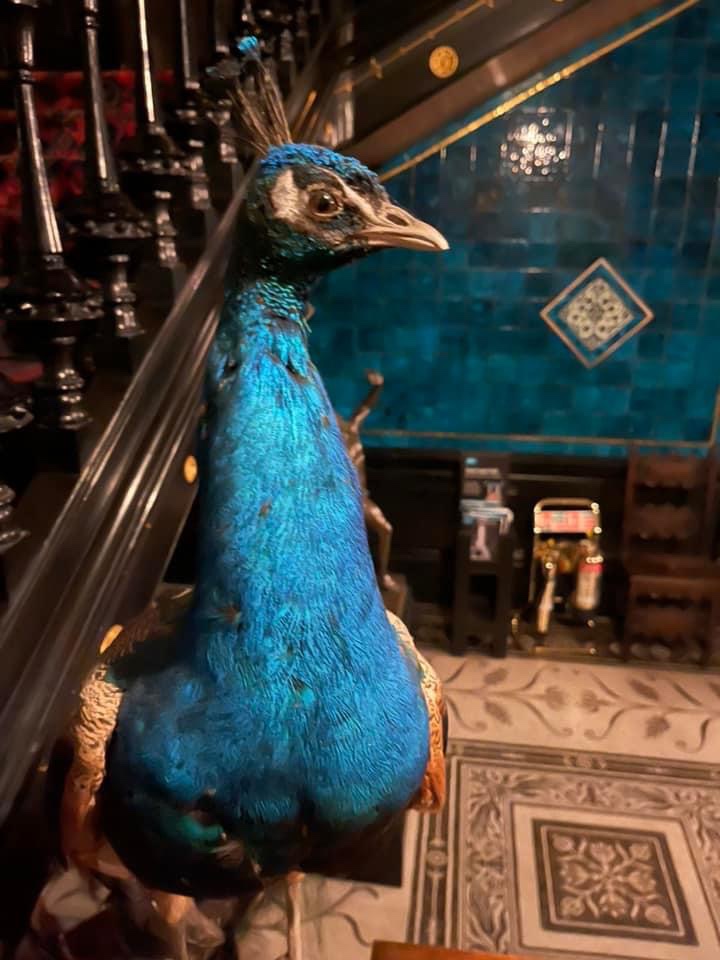
Could it be coincidence that this beautiful feathered bird should be the symbol on the staircase to the music room.
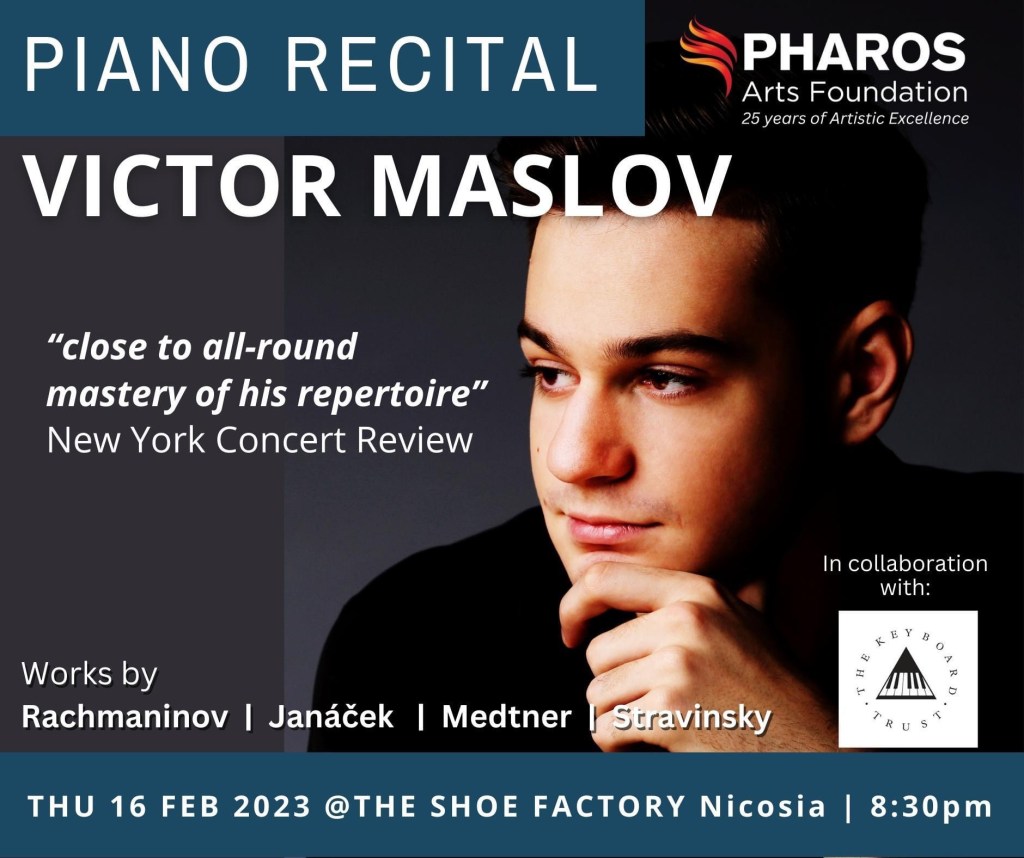
Victor Maslov graduated in 2021 covered in prestigious prizes and gaining his Masters of Performance with distinction as well as a Bachelor of Music First Class degree. He is fast making a name for himself on the world stage and only a few days ago gave a memorable recital at the Pharos Arts Centre in Cyprus organised in partnership with the Keyboard Trust. Just an hour of music but from the very first notes it was obvious that we were in the company of a master. Whether in the poetic vision of Rachmaninov delving deep into the Russian soul or the disarming simplicity of Janacek’s hauntingly nostalgic folk melodies or the amazing fireworks of Stravinsky’s Firebird ,Victor held us in his spell with masterly playing of intelligence and poetic vision. It was the disarming beauty of his encore ,the G sharp minor Rachmaninov Prelude that summed up his artistry where in just two pages he could show us a world of nostalgic yearning and brooding unrest with a kaleidoscopic range of colour but above all an aristocratic sound of ravishing beauty and purity.
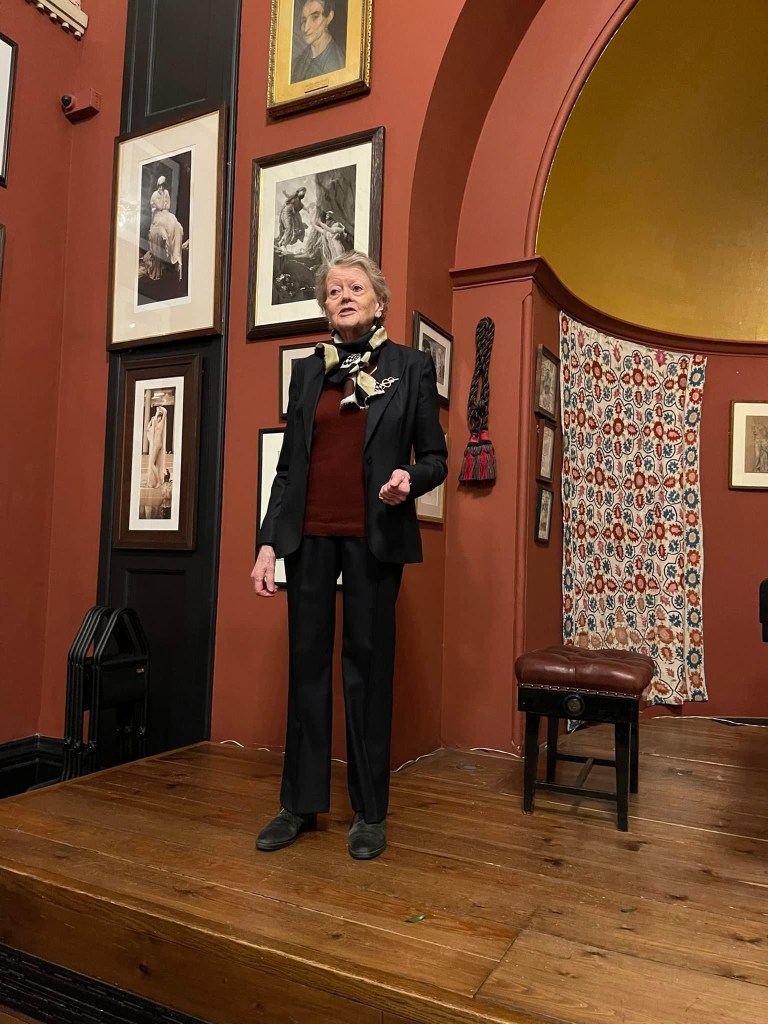
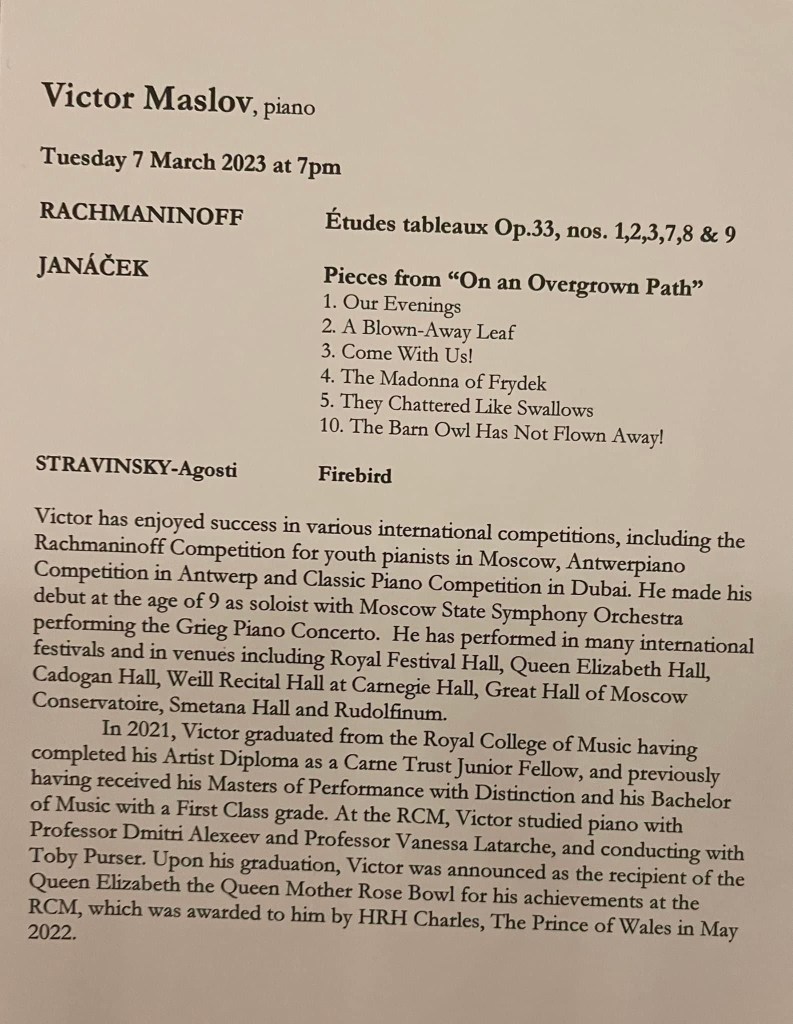
Lisa Peacock introducing the last in this remarkable series of ‘Discoveries’ that one hopes will be the first of many more seasons to come.Rachmaninov Etudes Tableaux that were six tone poems of subtle sounds and character.Deeply nostalgic Russian brooding and beauty but always tinged with a sadness and aristocratic nobility that gives Rachmaninov an unmistakably unique voice.From the strident march of the first study where Victor immediately showed us his orchestral sense of colour.Long held notes took on a poignancy as the left hand march continued relentlessly.A momentary vision of distant bells was even more remarkable because the insistent march had momentarily been halted only to surface in the final bars as the march continued into the far distance.There was ravishing beauty in the second study with the yearning melodic bel canto floating magically on a stream of gently murmuring sounds.A momentary climax ‘appassionato e sempre più mosso’was quickly dispelled with a ravishing cloud of shimmering notes played with supreme delicacy as the wafts of sound led to the final tenor exaltation of yearning.The third created an atmosphere of terror that in Victor’s hands truly sent a shiver down our back.His extraordinary sense of balance and colour allowed him to translate Rachmaninov’s very precise indications into sounds.There was terrifying reality as waves of notes were turned into sounds on which Rachmaninov’s sparse melodic notes were allowed to vibrate with extraordinary luminosity.Immediately changing mood with the imperious fanfare of op 33 n.7 and its driving rhythmic impetus .A momentary quixotic change of mood that Victor could chameleonically portray as he led this rumbustuous study to it’s turbulent ending of enormous sonority and exhilaration.There was a complete change of character with op 33 n. 8 .An oasis of subtle beauty and luminosity with a melody etched in gold surrounded by magic arabesques that gradually became more turbulent only to burn themselves out with an almost too serious coda that Rachmaninov dismisses with disarmingly abrupt chords piano and finally pianissimo.Op 33 n.9 interrupted this magic atmosphere with a dramatic opening ‘Grave ‘ indeed but then a boiling cauldron of turbulence ,reminiscent of the insistent turbulence in some of Scriabin,leading to the ecstatic,dramatic and above all spectacular ending.A remarkable journey that Victor shared with us with complete mastery and sense of colour that could bring vividly to life the vision that Rachmaninov paints so poignantly in these Tableaux Studies.
The Études-Tableaux (“study pictures”), Op. 33, is the first of two sets of piano études composed by Rachmaninoff .They were intended tudto be “picture pieces”, essentially “musical evocations of external s visual stimuli”. But Rachmaninoff did not disclose what inspired each one, stating: “I do not believe in the artist that discloses too much of his images. Let [the listener] paint for themselves what it most suggests.”However, he willingly shared sources for a few of these études with the Italian composer Ottorino Respighi when Respighi orchestrated them in 1930.Rachmaninoff composed the Op. 33 Études-Tableaux at his Ivanovka estate in Tambov,Russia between August and September 1911, the year after completing his second set of preludes ,Op. 32. While the Op. 33 Études-Tableaux share some stylistic points with the preludes, they are actually not very similar. Rachmaninoff concentrates on establishing well-defined moods and developing musical themes in the preludes. Rachmaninoff biographer Max Harrison calls the Études-Tableaux “studies in [musical] composition”; while they explore a variety of themes, they “investigate the transformation of rather specific climates of feeling via piano textures and sonorities. They are thus less predictable than the preludes and compositionally mark an advance” in technique.Rachmaninoff initially wrote nine pieces for Op. 33 but published only six in 1914. One étude, in A minor, was subsequently revised and used in the op 39 set ; the other two appeared posthumously and are now usually played with the other six. Performing these eight études together could be considered to run against the composer’s intent, as the six originally published are unified through “melodic-cellular connections” .Differing from the simplicity of the first four études, Nos. 5–8 are more virtuosic in their approach to keyboard writing, calling for unconventional hand positions, wide leaps for the fingers and considerable technical strength from the performer. Also, “the individual mood and passionate character of each piece” pose musical problems that preclude performance by those lacking strong physical technique.The study Grave in C minor n.3 was re-used in the Largo of Rachmaninov’s Fourth concerto which was completed in 1926.
Victor chose six pieces from the Janacek cycle of ‘On an Overgrown Path’.A work rarely heard in the concert hall but one of very touching simplicity missing an overall architectural shape but creating an atmosphere with a hauntingly mellifluous traditional outpouring.’Our Evenings’ was played with absolute delicacy and simplicity and it led to ‘A blown- away leaf’ with all the gentle fluidity and luminosity of the fairytale it is.There was the playful halting rhythm of this short quixotic story ‘Come with us’ indeed!Followed by a deep brooding opening to ‘The Madonna of Frydek’ with its magical music box musings leading to an imperious outpouring of great lament that just bursts into intimate song.Declamations of striking atmosphere in ‘They Chattered Like Swallows’ and finally the echoing vibrations of desolation in ‘The Barn Owl Has Not Flown Away!’.A remarkable oasis of serenity and peace between the turbulence of the two Russian works either side of it on the programme
On an Overgrown Path is a cycle of fifteen piano pieces written by Leos Janacek and organized into two volumes.Janáček composed all his most important works for solo piano between 1900 and 1912.He probably began preparing his first series of Moravian folk melodies in 1900.At this time, the cycle had only six pieces, intended for harmonium : Our evenings, A blown-away leaf, The Frýdek Madonna, Good night!, The barn owl has not flown away! and a Piu mosso published after Janáček’s death.These melodies provided the basis for the first volume of On an Overgrown Path. Three of these compositions were first published in 1901 with the fifth volume of harmonium pieces, Slavic melodies, under the title On an overgrown path – three short compositions.By 1908 the cycle had grown to nine pieces, and was by then intended for piano instead of harmonium. The definitive version of the first book was published in 1911.On 30 September 1911, Janáček published the first piece of the second series in the Lidove noviny newspapers. The new series was created, in its entirety, around 1911.The complete second book was printed by the Hudební matice in 1942. The première of the work took place on 6 January 1905 at the “Besední dům” Hall in Brno.
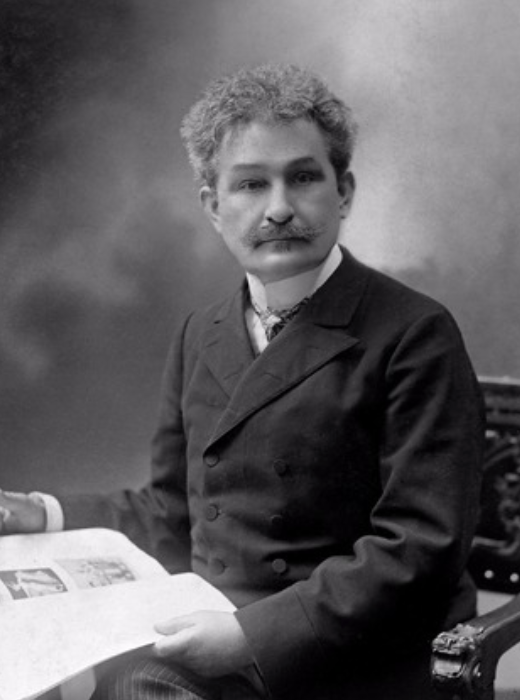
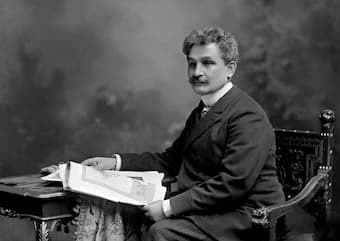
Leos Janacek
The Nostalgia and Pain of Memory: Janáček’s On an Overgrown PathThe nationalism that hit the 19th century and carried through to the 20th century had a profound effect on music. Music that had been ignored for its folk-like character, or its non-urban nature, became the basis for new works that not only celebrated the folk sources but also the country itself.In Czech music history, three composers defined the nation: Smetena (1824-1884), =Dvorak (1841-1904), and Janacek (1854-1928). Janáček took inspiration from Moravian and other Slavic folk music to create his works, supported by his own research into the folklore and music of his country. Achieving international fame in his 60s with his opera Jenůfa, Janáček joined Smetana and Dvořák in symbolising Czech music.
A piano cycle created starting around 1900, On an Overgrown Path, had a complicated birth. Seven pieces were originally written for harmonium, and five were published as Slavonic Melodies in 1901 and 1902. The remaining two pieces were set aside. In 1908, Janáček revised the work and wrote 3 more pieces, and made the 8 pieces into a cycle for piano. Two more pieces were added in 1911. That formed series I. Series II, which started with two new pieces, grew with the addition of the two pieces that had been set aside in 1902, forming nos. 1, 2, 3, 5 of Series II. No. 4 is just an ink sketch with some pencil revisions. Series II was published in 1942 after Janáček’s death and the 5 pieces do not have characteristic titles but only tempo indications.The title for the work, On an Overgrown Path, had been settled by 1901, but the titles of the individual movements changed before the publication of Series I in 1911. For example, No. 2, started out as ‘A Declaration of Love,’ was then changed to ‘A Love Song’ and finally became a much more mysterious title of ‘A Blown-Away Leaf’.Janáček described the work as having a double trajectory of ‘distant reminiscences’ of his childhood and reflection on the death of his 20-year-old daughter Olga in 1903.The first five parts of the cycle refer to his childhood: No. 1. Our Evenings, for evenings by the fireside; No. 3. Come with us!, for children’s games; and no. 4. The Madonna of Frydek, for a religious procession near his home village.As we get into the second part, emotion, rather than memory, has a place: no. 6. Words fail!, No. 8. Unutterable Anguish, and No. 9. In Tears.No. 7, Good Night!, was a metaphor for Olga’s death, while the last movement, No. 10. The Barn Owl Has Not Flown Away!, refers to the owl’s status as a foreteller of doom.Janáček’s change in the work from childhood memories to the tragedies of the grownup parent make this a unique statement of the human condition.
A transcendental performance of Agosti’s famous 1928 transcription of the ‘Firebird’.Victor threw himself into they fray from the very opening notes with breathtaking drive and scintillating virtuosity-a truly Infernal Dance! There were beautiful sounds of orchestral colour in the Berceuse with a kaleidoscope of colours appearing over the entire keyboard.But it was the ravishing beauty of the appearance of the Firebird in the finale that was truly breathtaking.The build up to the tumultuous final bars was astonishing as the excitement mounted to a frenzy of unbelievable virtuosity and exhilaration.
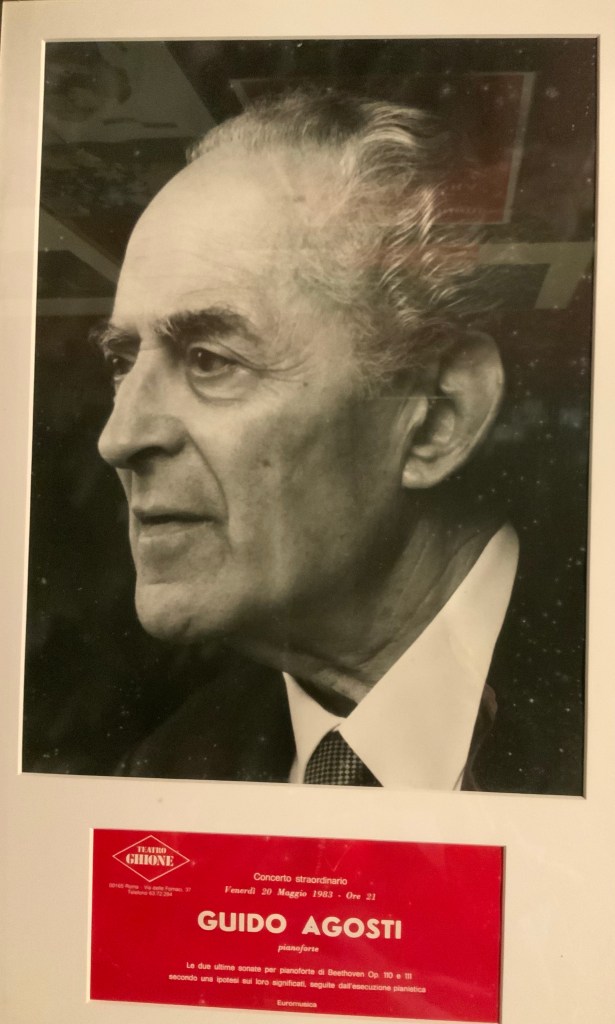
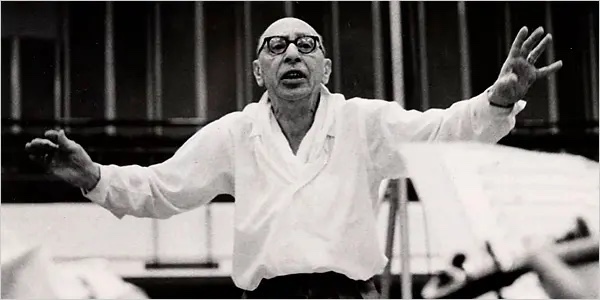
Stravinsky’s score for The Firebird was written for Sergei Diaghilev’s Ballets Russes dance company, which premiered the work in Paris in 1910. Based on ancient Russian folk tales, it tells the story of the young Prince Ivan’s quest to find a legendary magic bird with fiery multi-coloured plumage. In the course of his adventures, he falls in love with a beautiful princess but has to fight off the evil sorcerer Katschei to eventually marry her. The suite presents the culminating scenes of the ballet in a piano transcription by the Italian pianist and pedagogue Guido Agosti (1901-1989), who studied with Ferruccio Busoni.
The Danse infernale depicts the brutal swarming and capture of Prince Ivan by Katschei’s monstrous underlings until Prince Ivan uses the magic feather given to him by the Firebird to cast a spell on his captors, making them dance until they drop from exhaustion. The Berceuse is a lullaby depicting the eerie scene of the slumbering assailants, leading to the Finale, a wedding celebration for Prince Ivan and his princess bride.Agosti’s piano transcription, completed in 1928, is a daunting technical challenge for the pianist. Most of the piano writing is laid out on on three staves in order to cover the multi-octave range of the keyboard that the pianist must patrol. The piano comes into its own in this transcription as a percussion instrument, to be played with the wild abandon with which a betrayed lover throws her ex-partner’s possessions off the balcony onto the street below.Judging from the shocking 7-octave-wide chord crash that opens the Dance infernale, Agosti captures well the bruising pace of the action, with off-beat rhythmic jabs standing out from a succession of punchy left-hand ostinati constantly nipping at the heels of the melody line. The accelerating pace as the sorcerer’s ghouls are made to dance ever more frantically is a major aerobic test for the pianist.
Relief comes in the Berceuse, which presents its own pianistic challenges, mainly those of finely sifting the overtones of vast chord structures surrounding the lonely tune singing out from the middle of the keyboard.The wedding celebration depicted in the Finale presents Stravinsky’s trademark habit of cycling hypnotically round the pitches enclosed within the interval of a perfect 5th. Just such a melody, swaddled in hushed tremolos, opens this final movement. It is a major challenge for the pianist to imitate the shimmering timbre of the orchestra’s brightest instruments as this theme is given its apotheosis to end the suite in a blaze of sonority that extends across the entire range of the keyboard.
Guido Agosti (11 August 1901 – 2 June 1989) was an Italian pianist and renowned for his yearly summer course in Siena frequented by all the major musicians of the age.It was on the express wish of Alfredo Casella that Agosti took over his class which he did for the next thirty years.Sounds heard in his studio have never been forgotten.
Guido Agosti being thanked by Ileana Ghione after a memorable concert and masterclasses in the theatre my wife and I had created together in Rome.
Agosti was born in Forli 1901. He studied piano with Ferruccio Busoni Bruno Mugellini and Filippo Ivaldiand earning his diploma at age 13. He studied counterpoint under Benvenuti and literature at Bologna University. He commenced his professional career as a pianist in 1921. Although he never entirely abandoned concert-giving, nerves made it difficult for him to appear on stage,and he concentrated on teaching. He taught piano at the Venice Conservatoire and at the Santa Cecilia Academy in Rome.In 1947 he was appointed Professor of piano at the Accademia Chigiana Siena .He also taught at Weimar and the Sibelius Academy in Helsinki.
In the Ghione Theatre in the early 80’s with Ileana Ghione,’Connie’Channon Douglass Marinsanti ,Lydia Agosti ,Cesare Marinsanti,Guido Agosti.A closely knit family .
His notable students include Maria Tipo,Yonty Solomon Lelsie Howard,Hamish Milne,Martin Jones,Ian Munro,Dag Achat,Raymond Lewenthal,Ursula Oppens,Kun- Woo Paik,Peter Bithell.He made very few recordings; there is a recording of op 110 from the Ghione theatre in Rome together with his recording on his 80th birthday concert in Siena of Debussy preludes .
A full hall for the last in this series of ‘Discoveries’Victor in discussion after the concert with Dmitri Alexeev and Tatyana SarkissovaA family group with Victor,Lisa,Dmitri and Tatyana celebrating the triumphant ending of a wonderful series .‘Victor was phenomenal, powerful yet sensitive, with a rich spectrum and colour.A thrilling performance.’ Garo Keheyan Pharos Arts Foundation