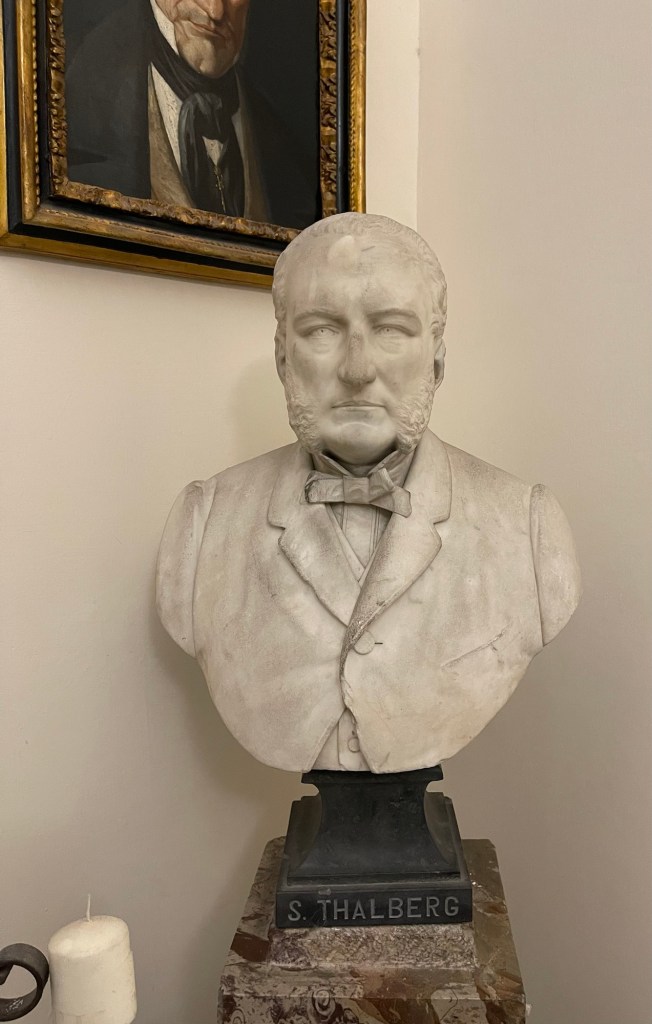
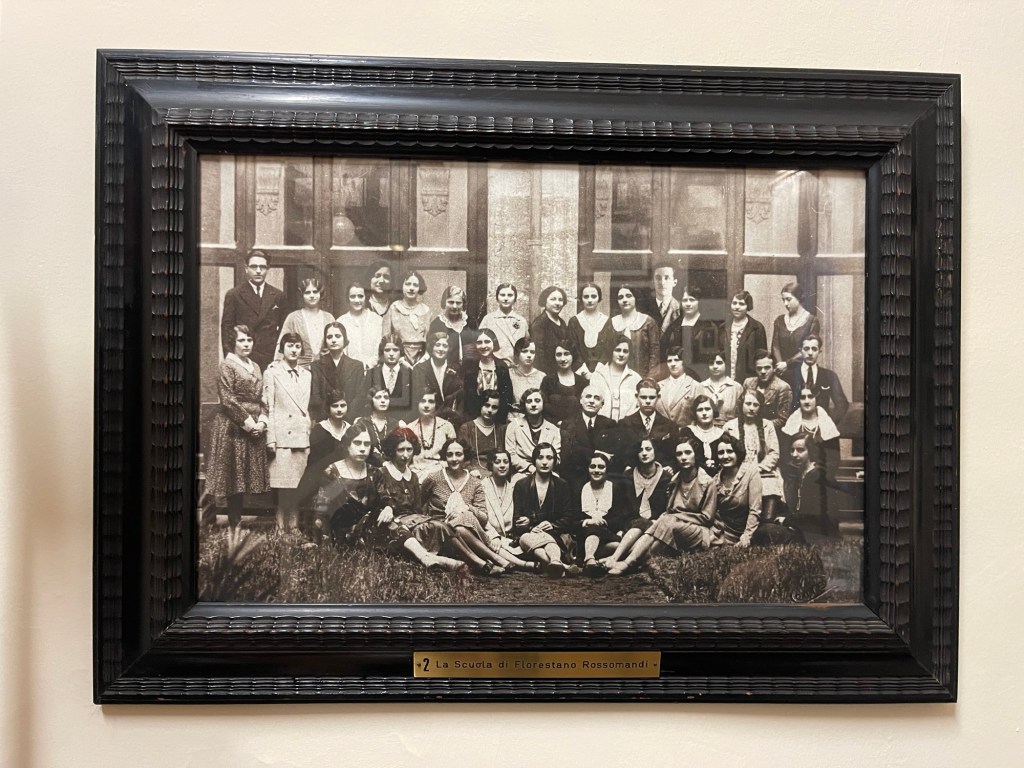
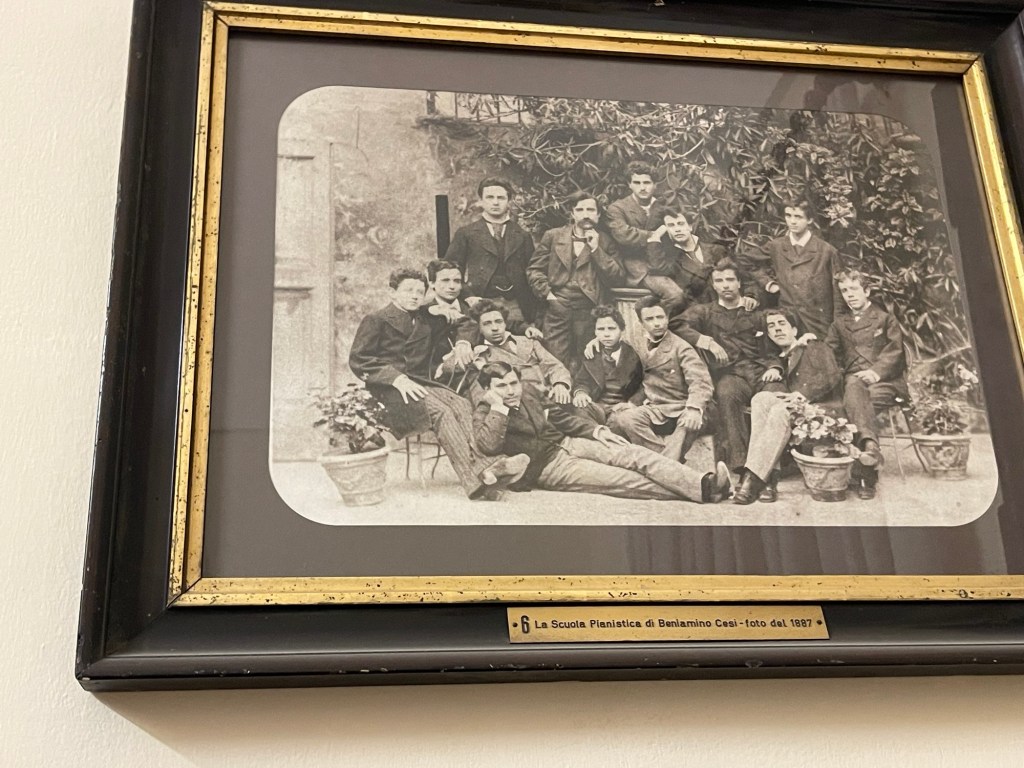
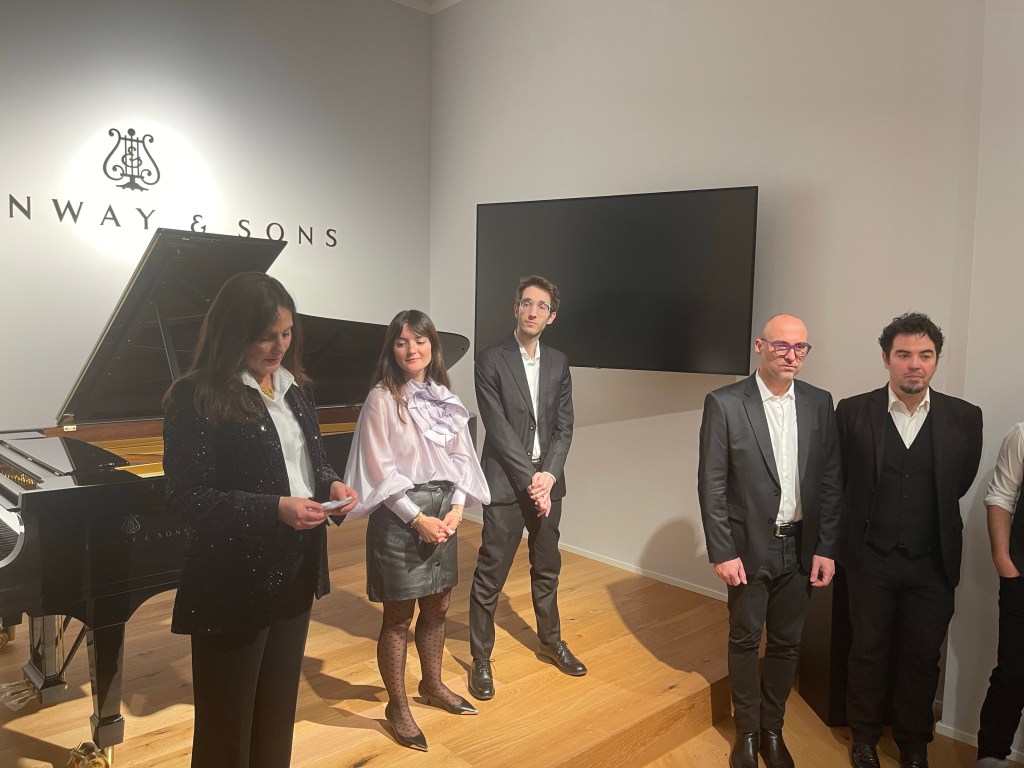
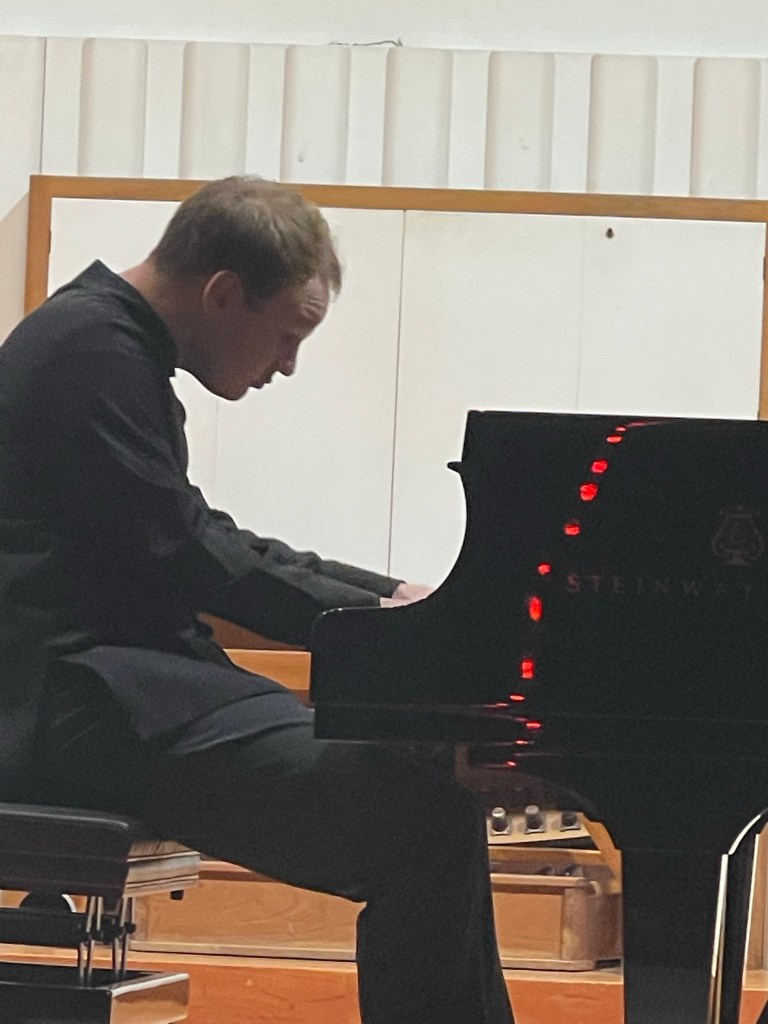
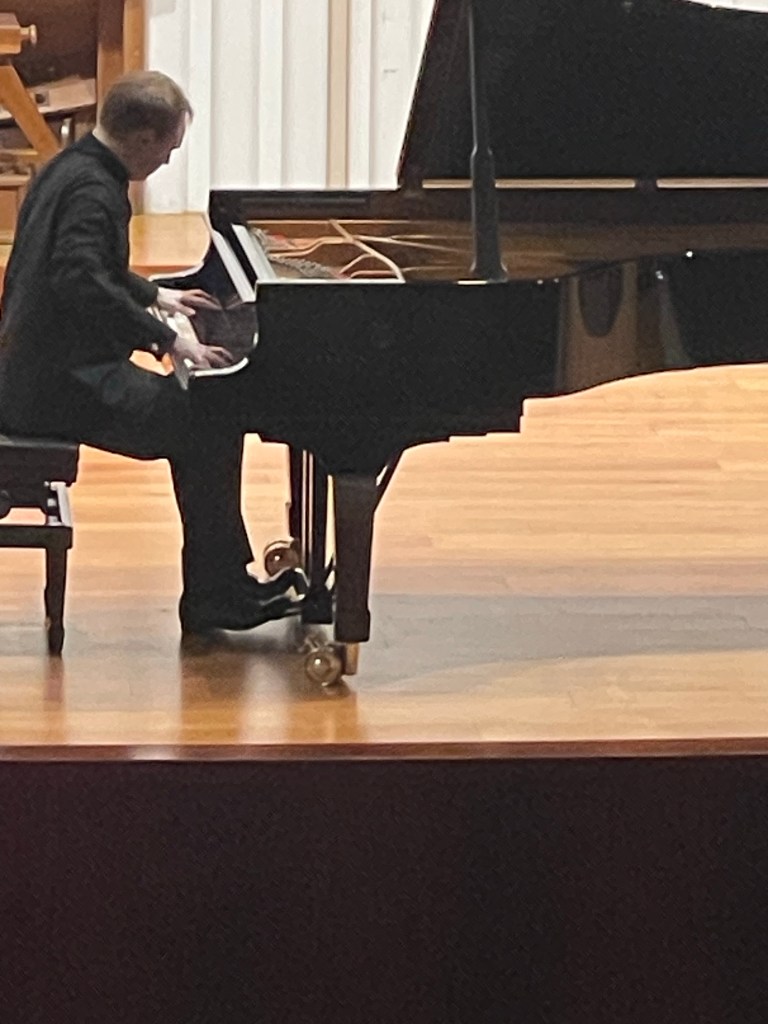
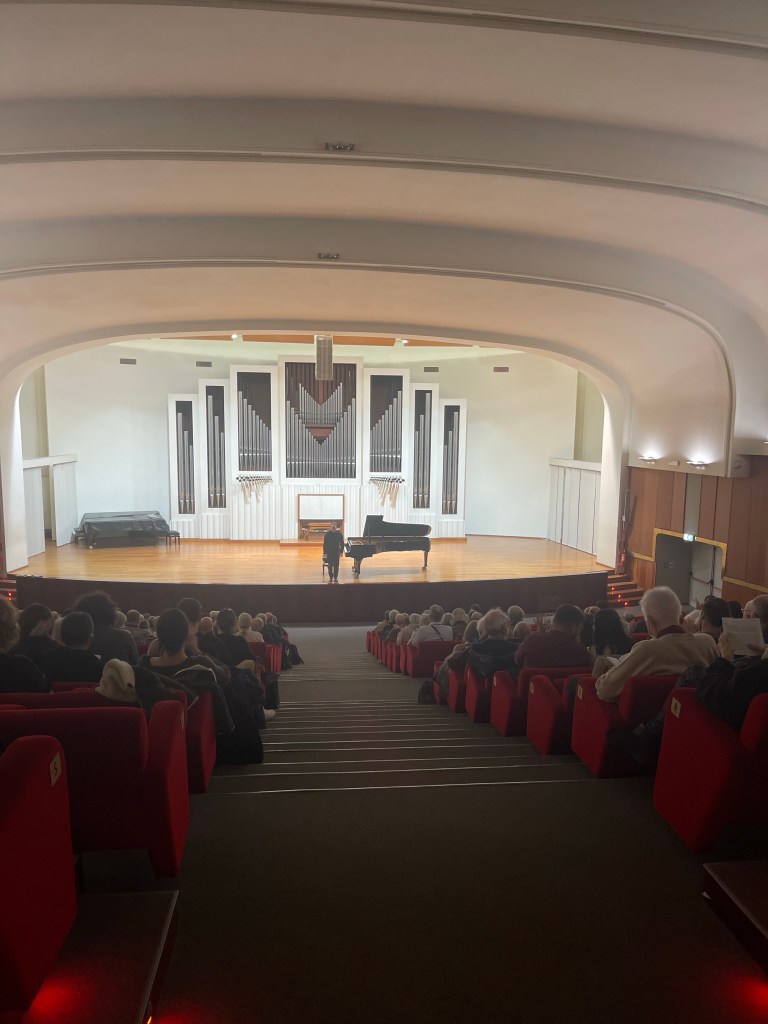
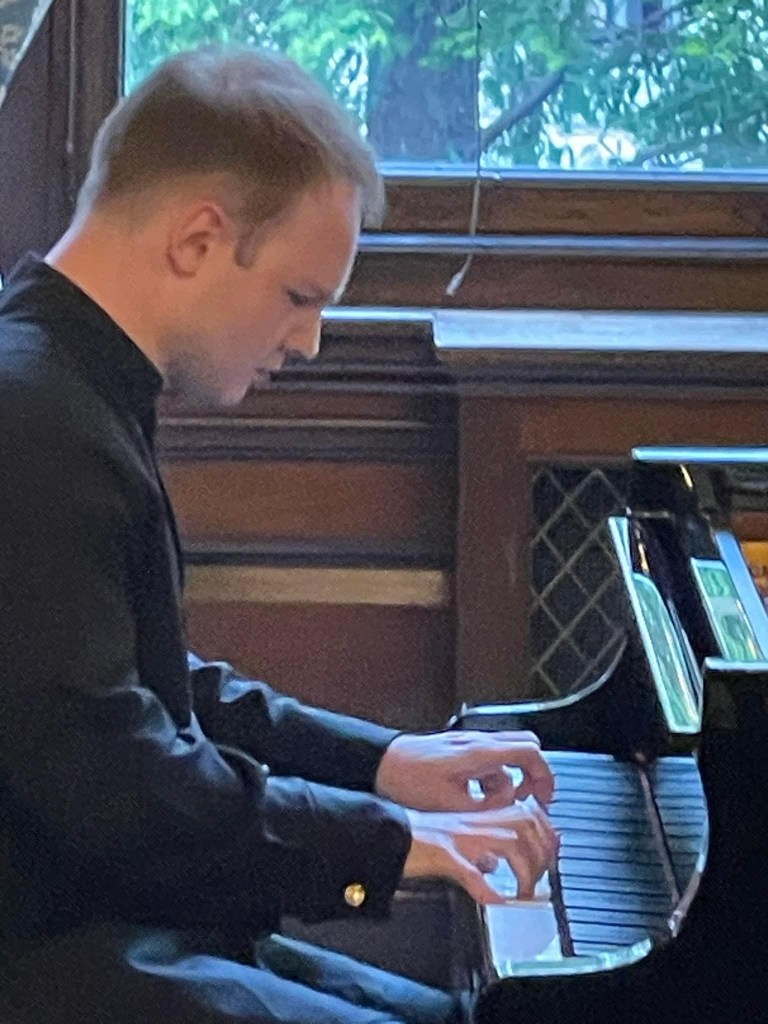
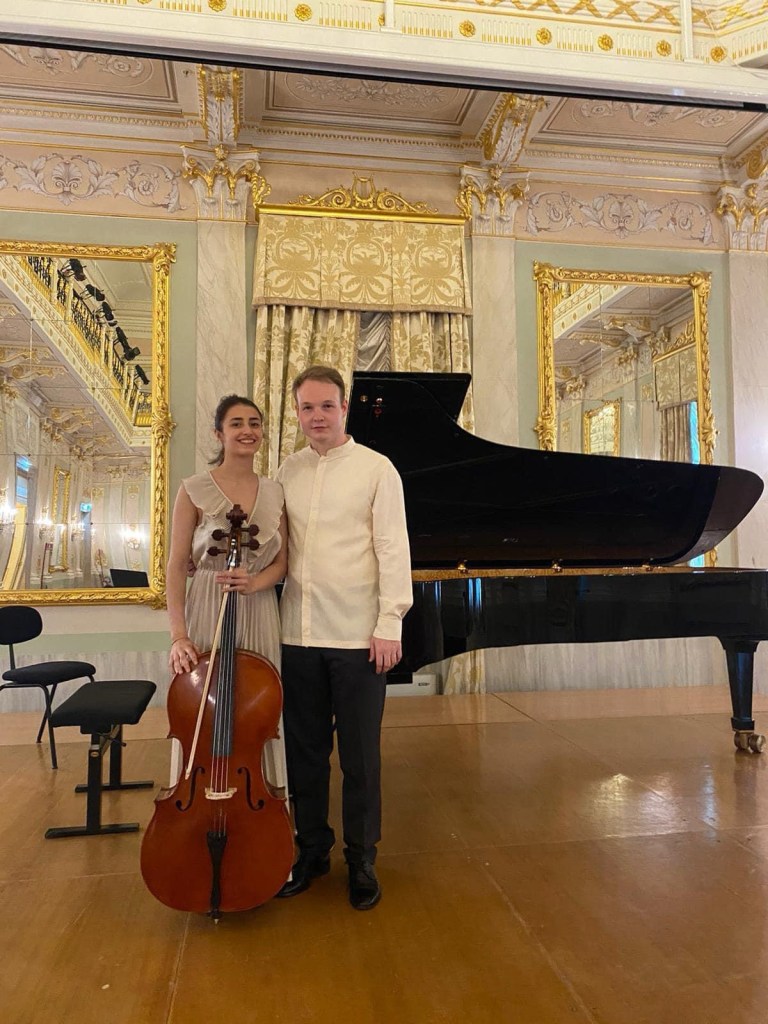
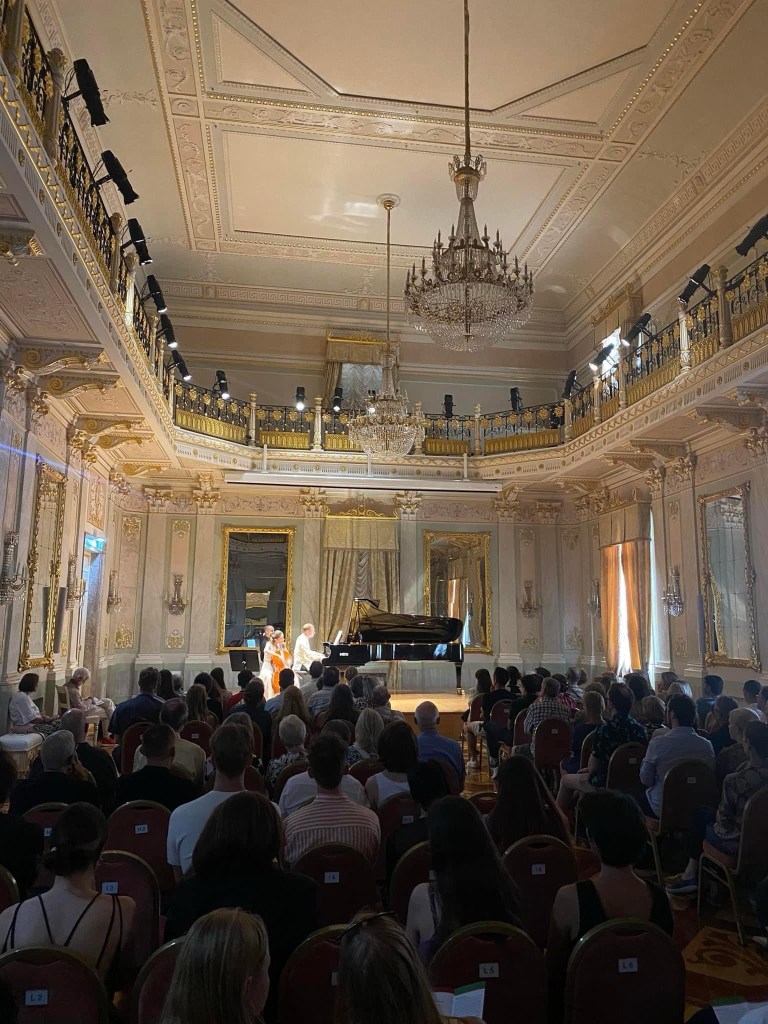
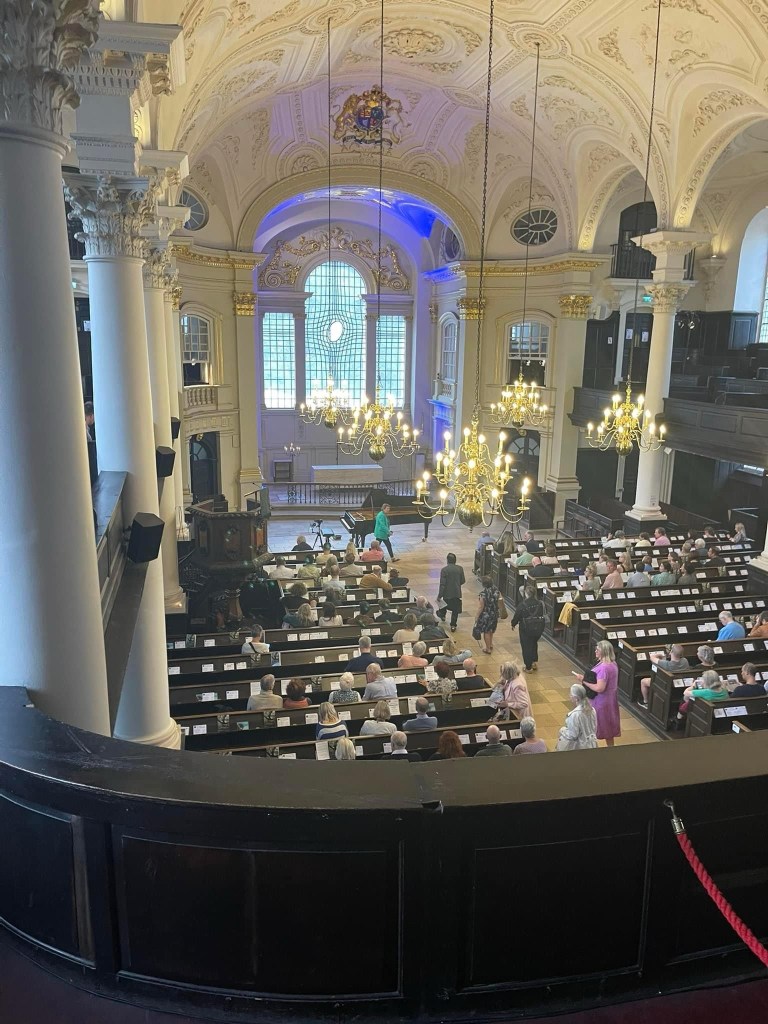
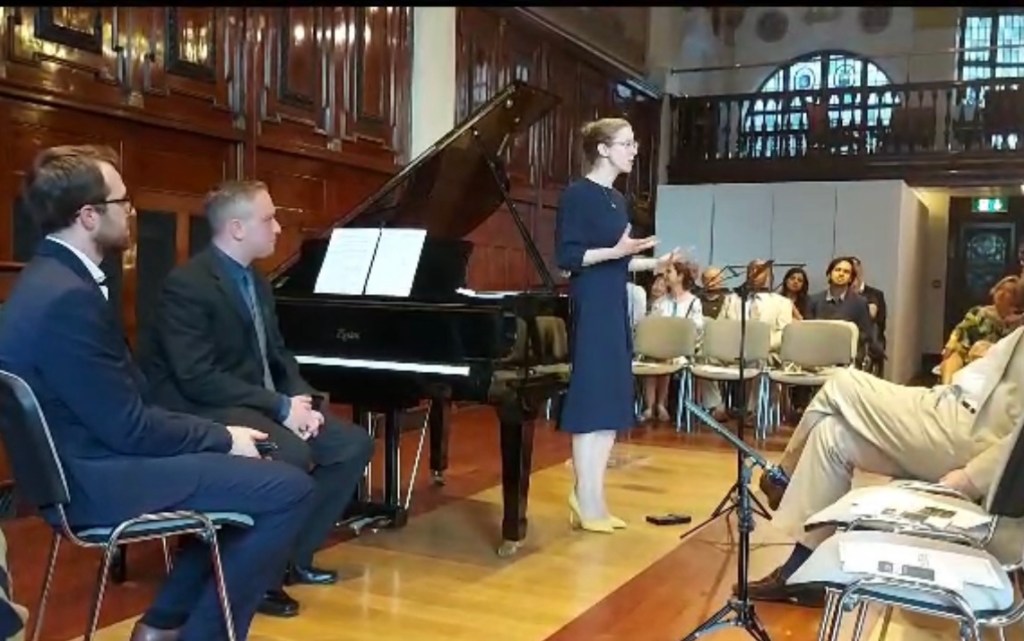
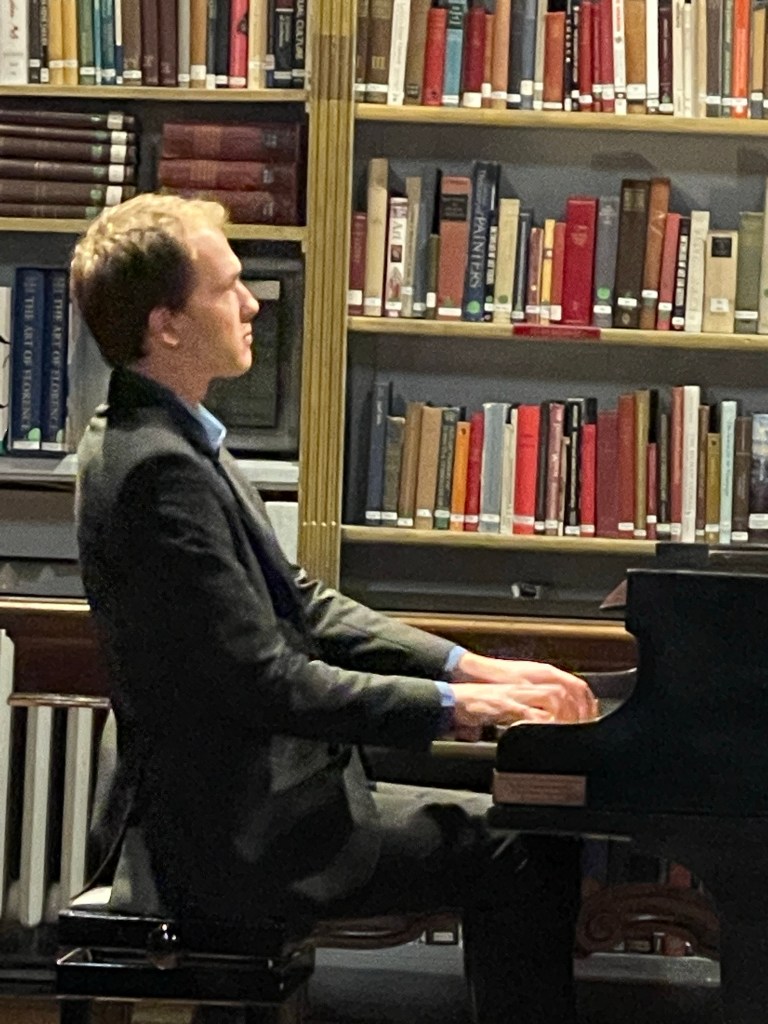
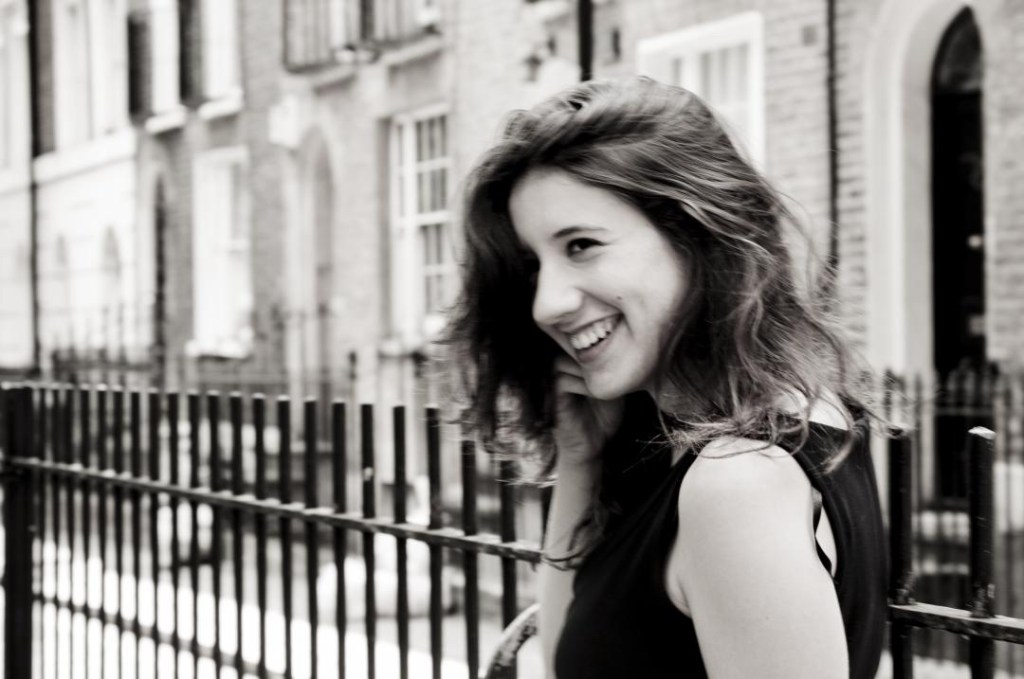
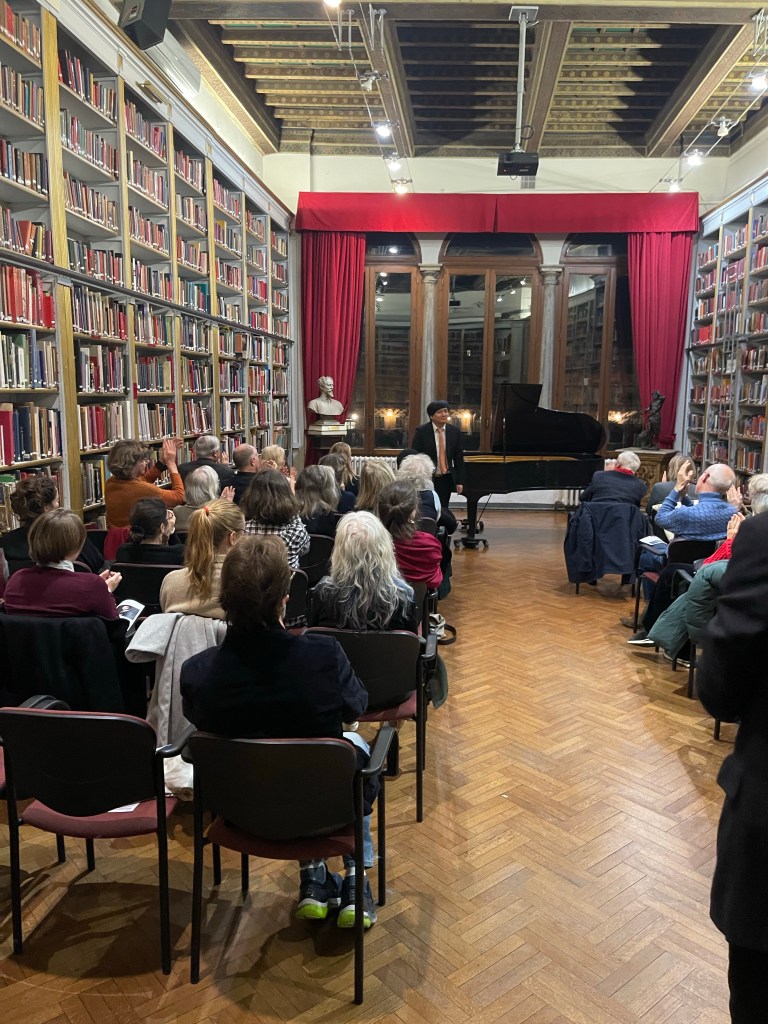
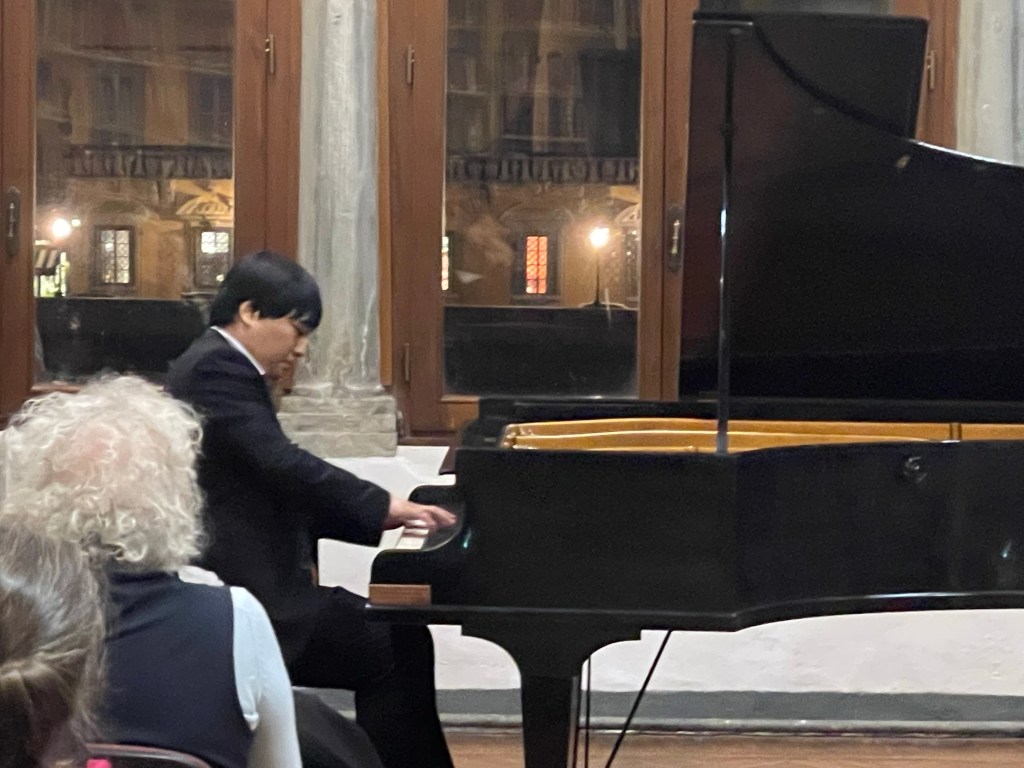
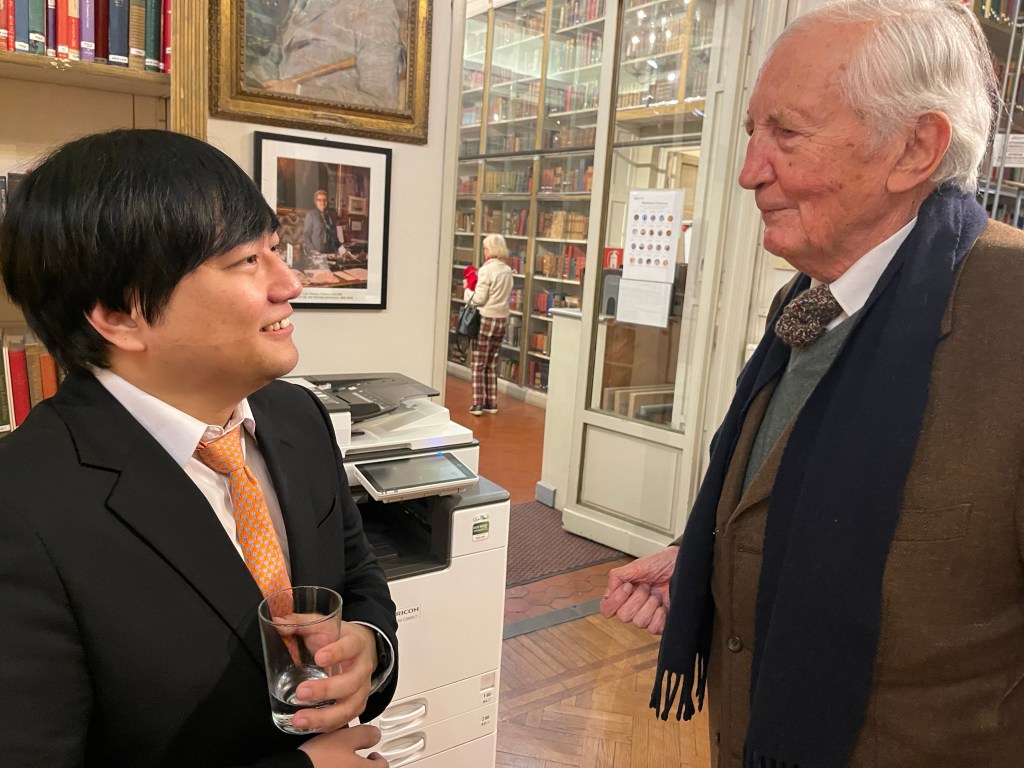
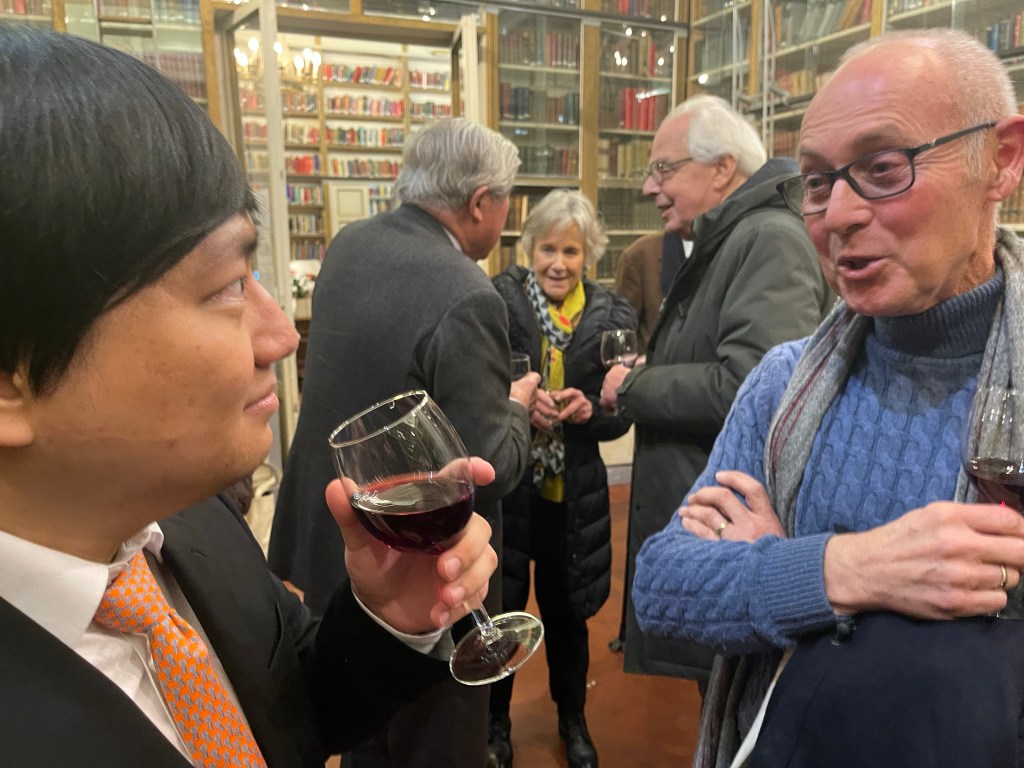
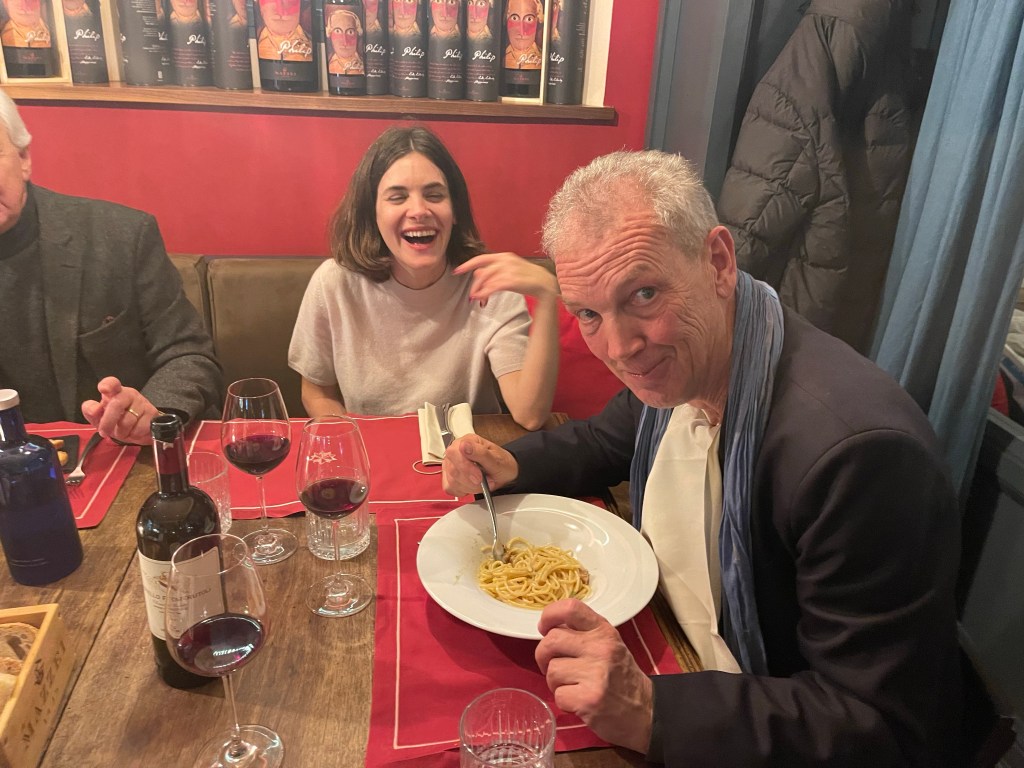
What greater tribute could a son make to his mother on what wouid have been her 100th birthday . A city ready to salute such an important figure of the great Neapolitan piano school and to have her anniversary celebrated by the opening of a new era for this great school that goes back to Clementi and forward to Martha Argerich via Denza ,Thalberg,Rossomandi,Cesi,Vitali,Scaramuzza and Anna Maria Pennella
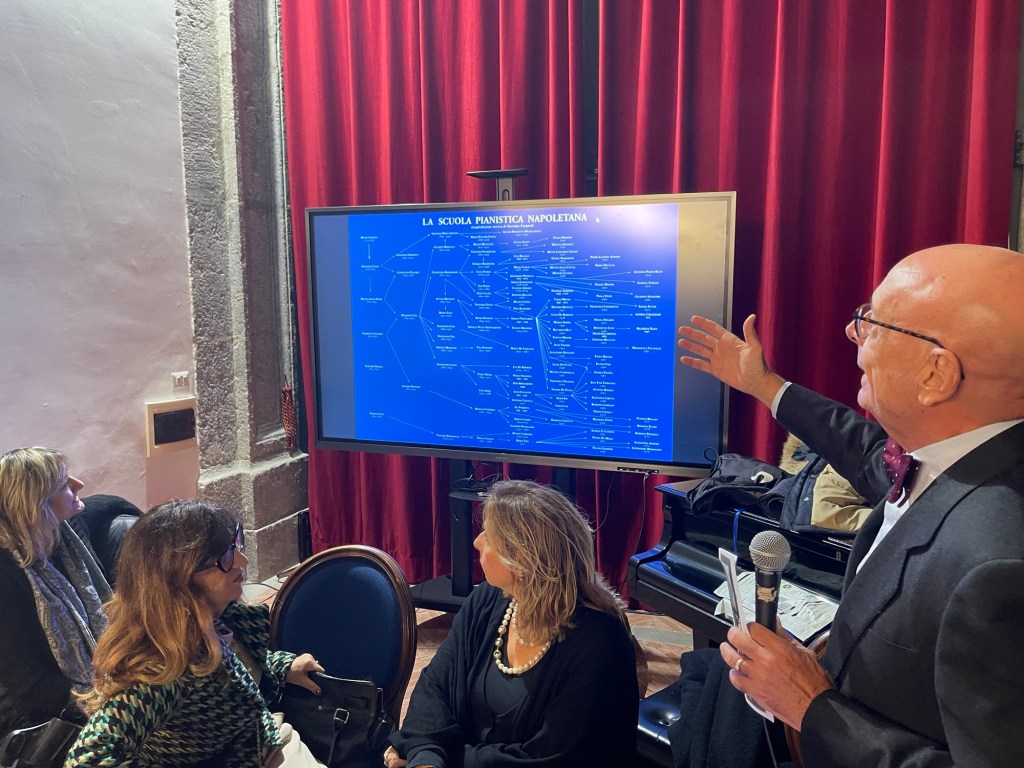
The glorious family tree of the Neapolitan School of Piano by Massimo Fargnoli who had invited la Pennella to play in 2014 in a special event that was to be the last time she played in public – at the age of 91.It was illustrated tonight,due to the absence through a family illness of Fargnoli ,by Paologiovanni Maione with Emanuela Grimaccia,Eloisa Intini,Carla Di Lena
After tributes from illustrious colleagues it was the music of one of her former stellar students that demonstrated that music can reach us where words are not enough
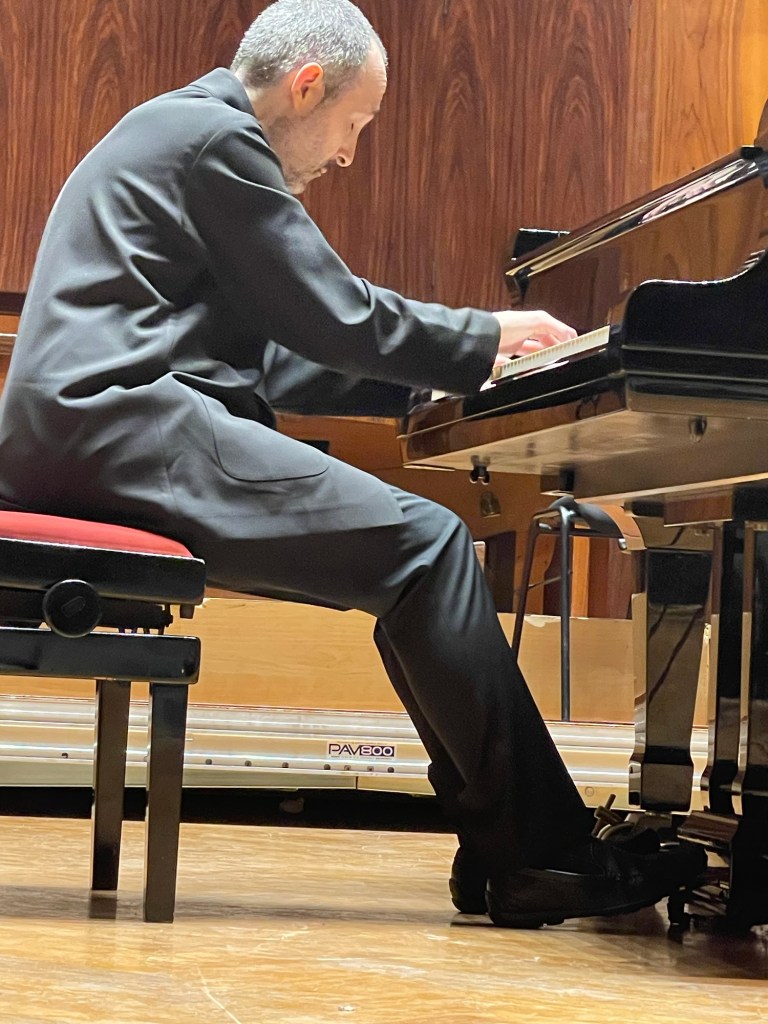
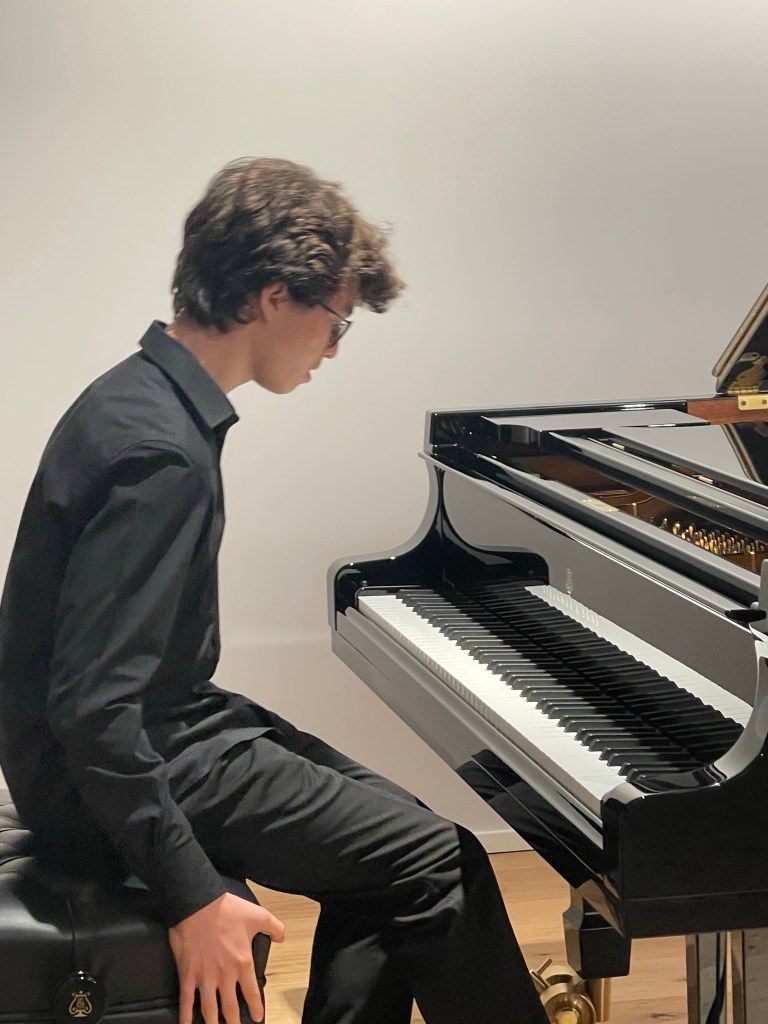
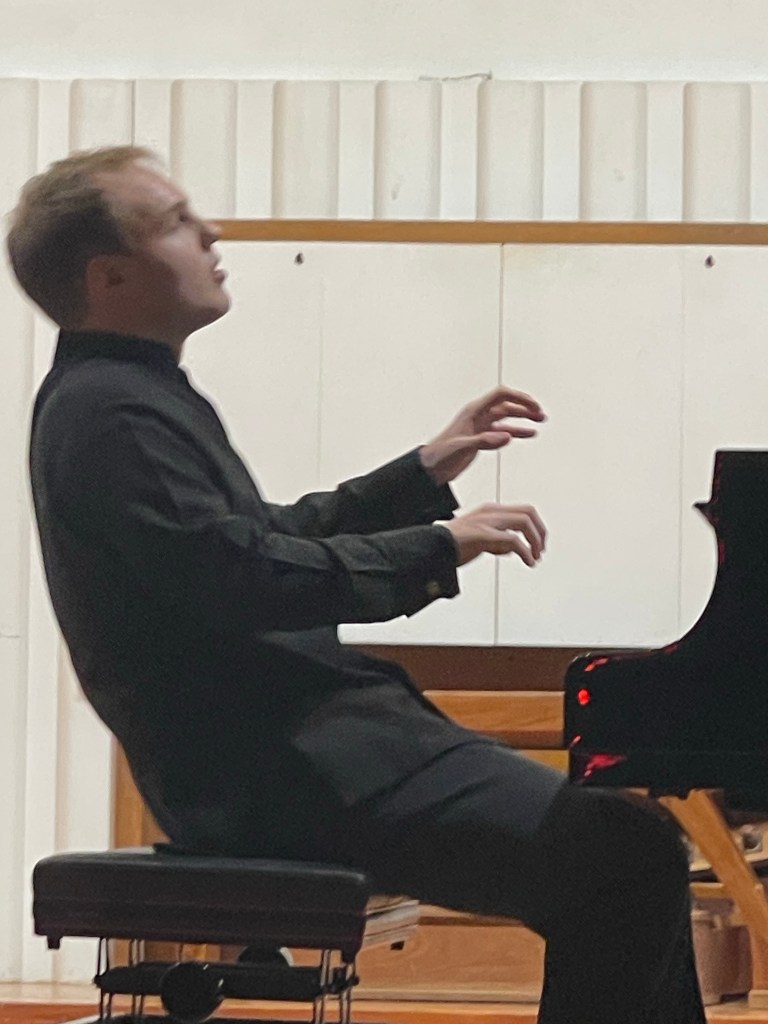
Opening with Liszt’s great tone poem of Hero and Leander , that is the Second Ballade,with it’s chromatic ostinati representing the sea.Arrau,second generation of Liszt writes “You really can perceive how the journey turns more and more difficult each time. In the fourth night he drowns. Next, the last pages are a transfiguration”. And in today’s performance I have rarely heard it played so clearly or with such colour.Chiselled sounds of purity over a chromatic murmuring base.A pointed finger technique that like Michelangeli was penetrating and luminous.A wonderful sense of colour and a feeling for the inner harmonies in a truly magic wonderland of sounds. Cascades of notes generating an overwhelming excitement and exhilaration whilst never losing sight of the overall orchestral line with its jewel like precision but with a prism of chameleonic colours. I have heard many wonderful performances of this work from Arrau,Horowitz,Kentner and many others but none that touched me as this remarkable pianist I heard today.There was an overall shape that contained all the emotions and atmosphere and even a sense of showmanship in moments of a culmination of exhilaration.This is a great musician listening like Horowitz with arms open wide as he embraced and pointed to the jewel like sounds as a conductor might do with a great orchestra.
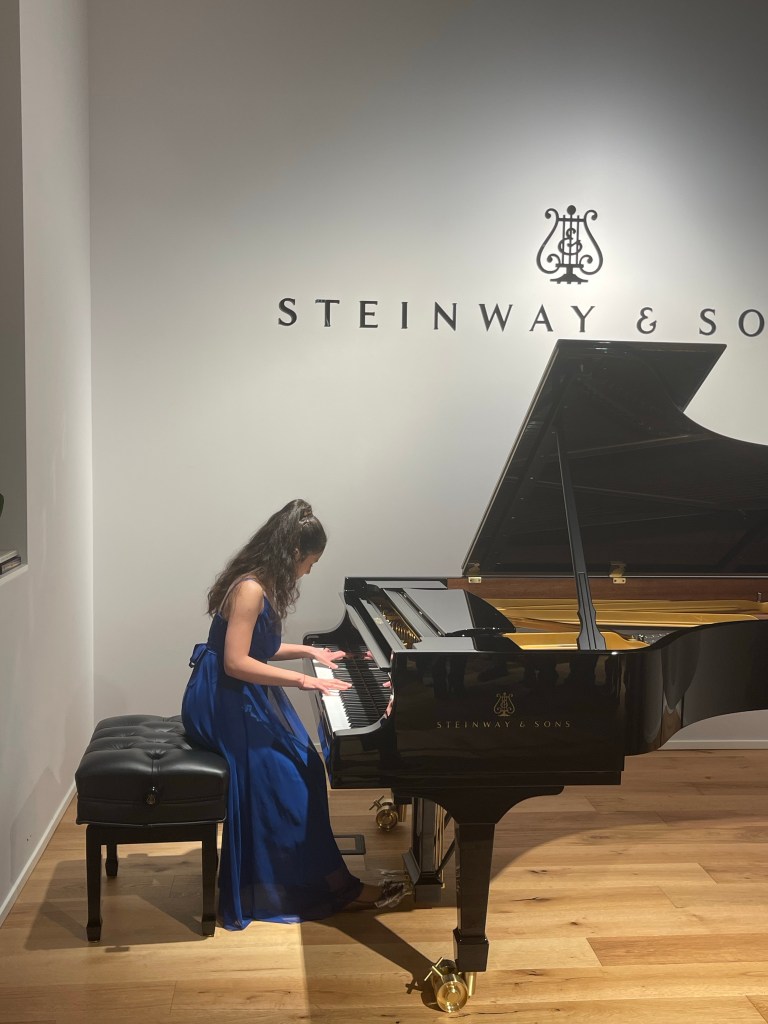
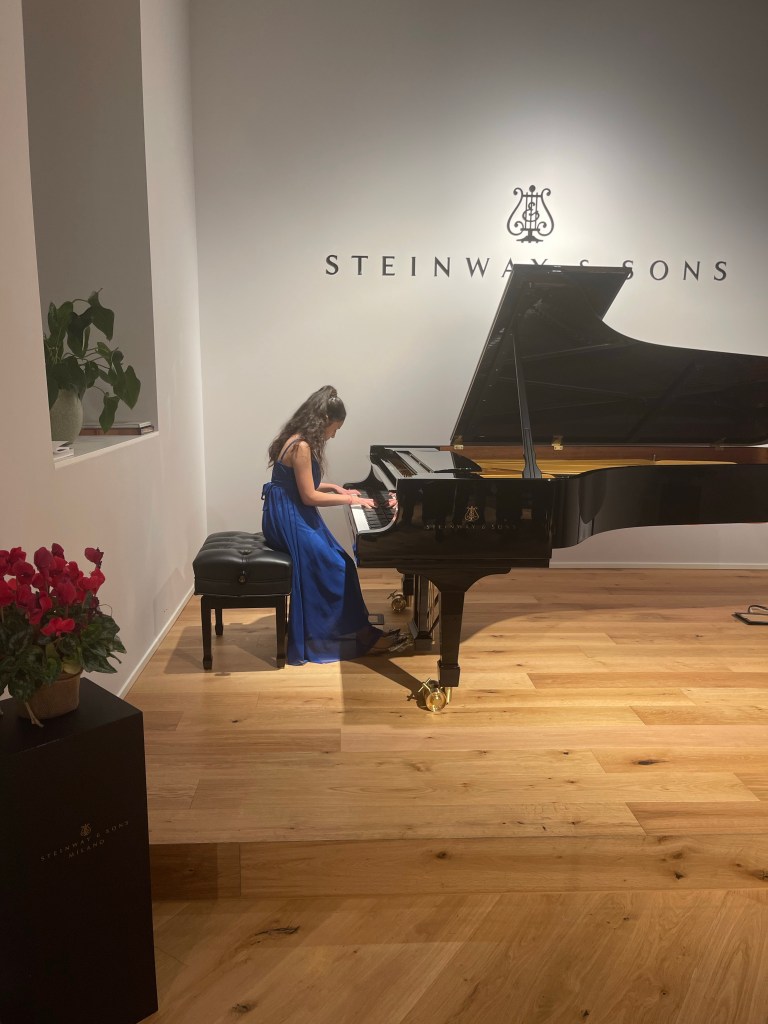
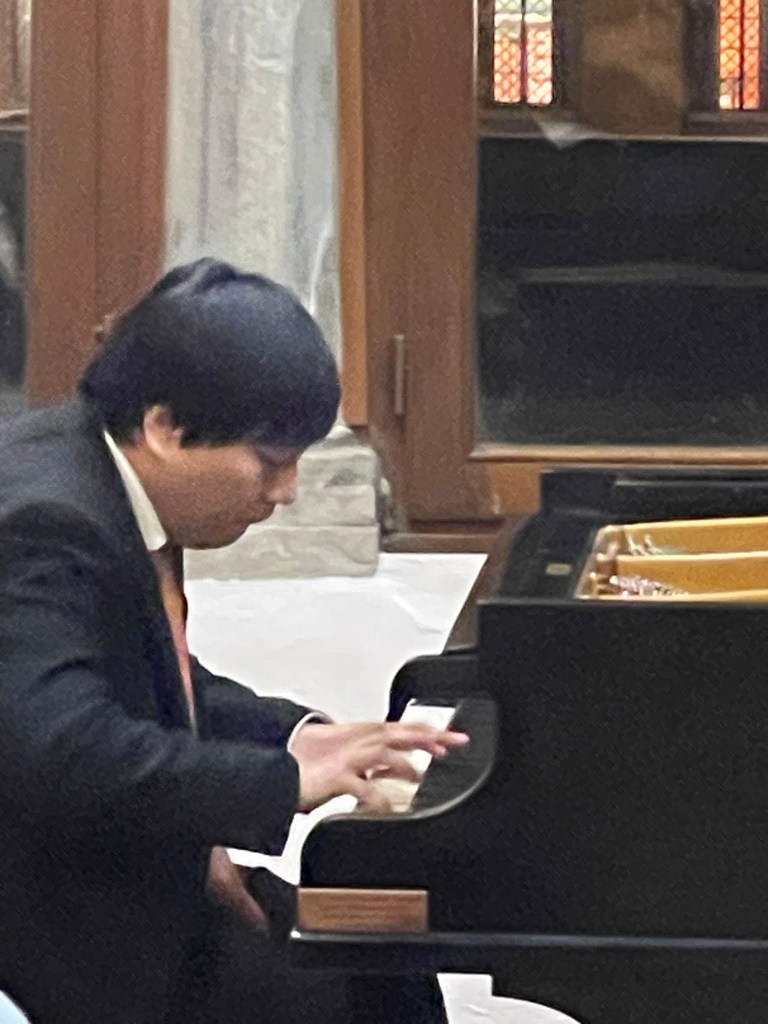
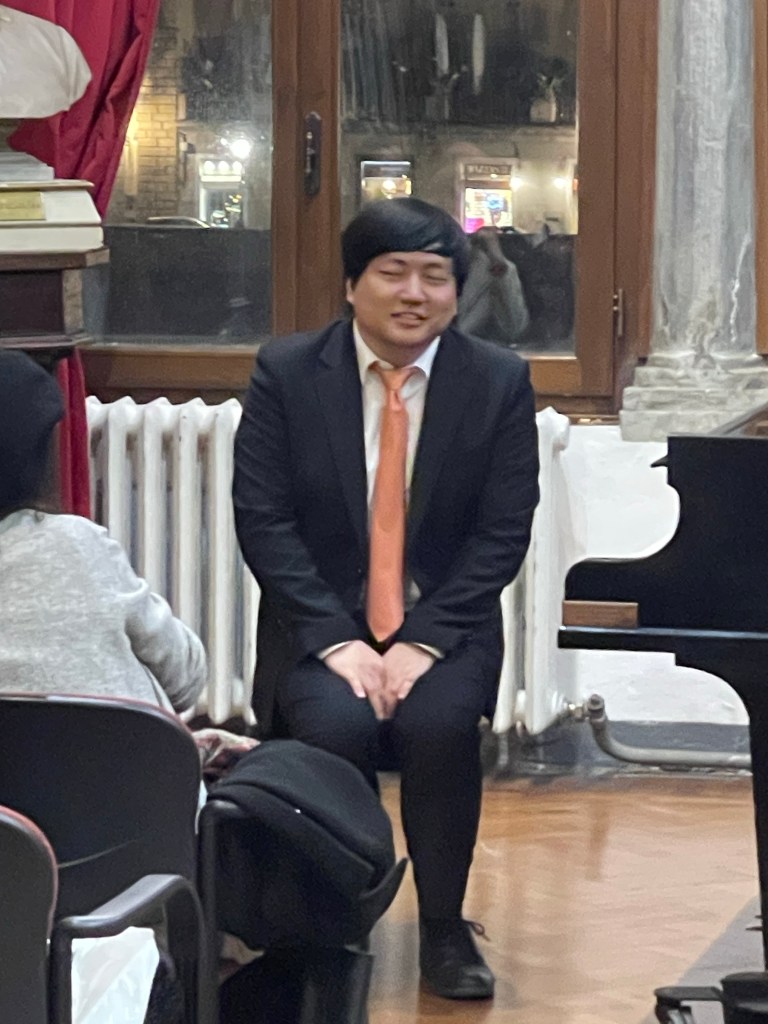
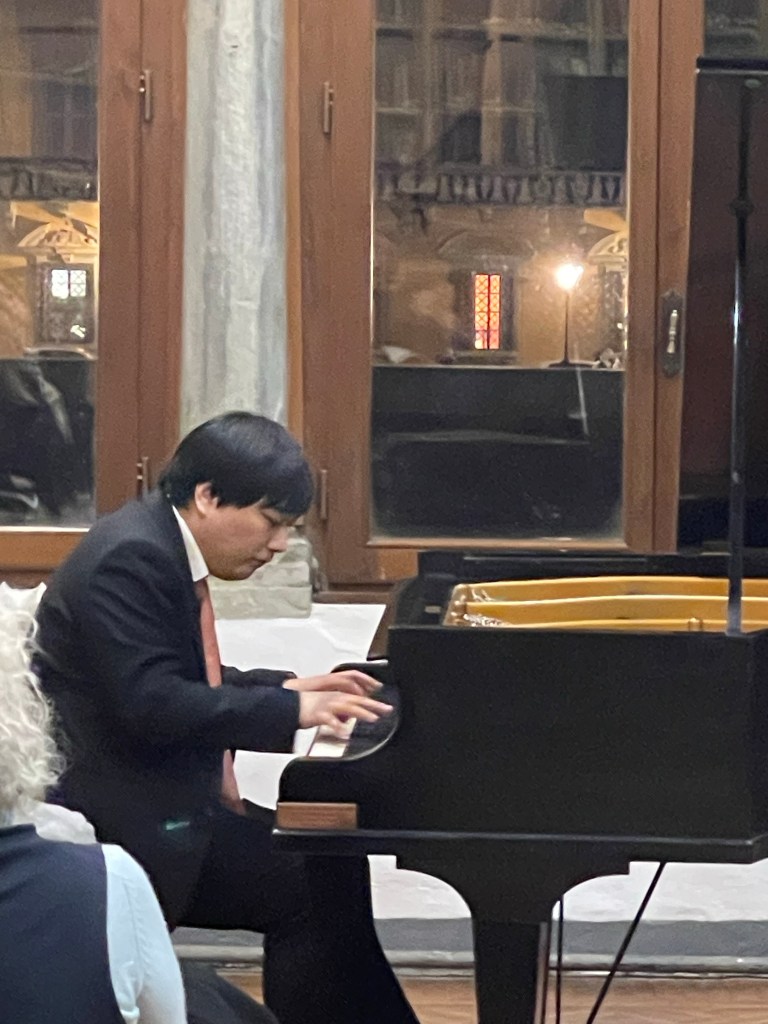
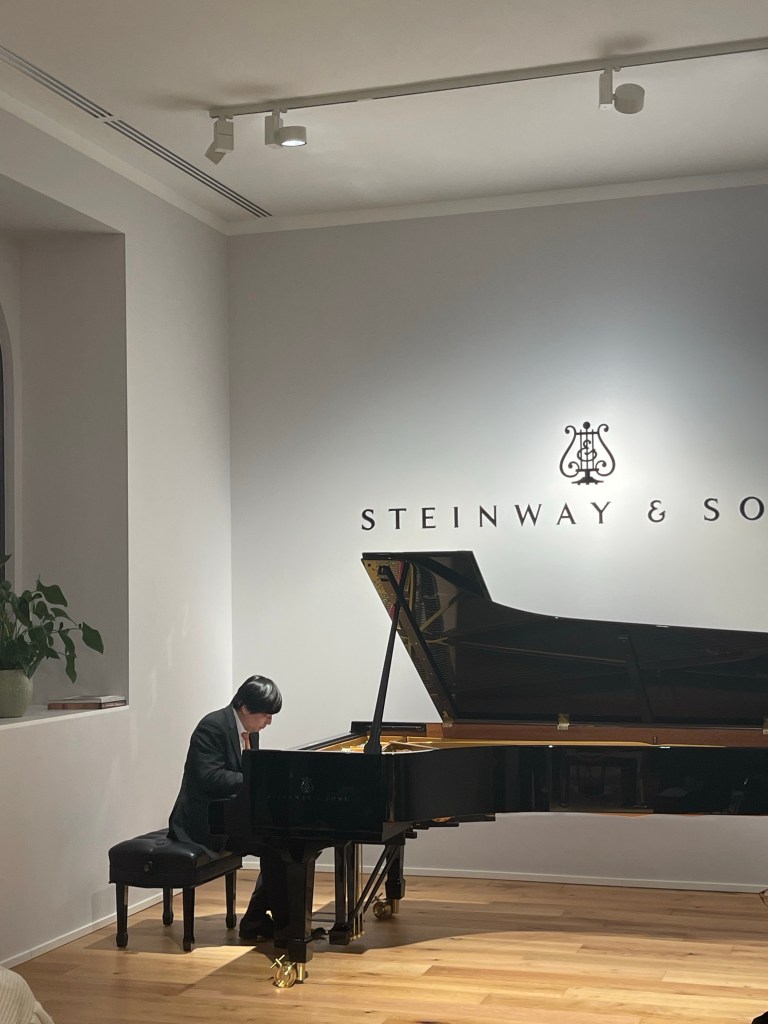
Antonio Pompa-Baldi had flown in from America where he now resides to give a recital that included the very first piece that he had studied with his adored piano ‘mother ’ : Rachmaninov ‘Corelli variations’.A performance that in the city of San Gennaro had something of the miraculous about it and was certainly the finest performance I have ever heard !
Like his ‘piano mother’ he obviously chose a contemporary work as the centrepiece of his Homage to Anna Maria Pennella.The CD of the Sonata and 25 pictorial Preludes by Roberto Piana played by Antonio Pompa-Baldi, recently received an enthusiastic review from the prestigious American Record Guide (Stephen Wright): “Hats off, gentlemen: a genius. The piano music of Robert Piana (b. 1971) puts me in mind of Ola Gjeilo and Keith larrett-but couched in more ambitious and expansive structuresand late Debussy, plus York Bowen after he absorbed the influence of Rachmaninoff and Debussy. This is sublime and memorable music”. Pianist and composer, Roberto Piana was born in Sassari, on the Italian island of Sardinia, in 1971. He perfected his studies with numerous famous pianists, but owes his training to Isabella Lo Porto, with whom he graduated in piano studies with top marks, at the Music Conservatory of Sassari where he now teaches and is based : http://www.robertopiana.com. Aldo Ciccolini,that great pianist of the Neapolitan school wrote of Piana’s own playing :’«I liked his way of playing very much, there is colour, imagination, an overwhelming sensitivity, determination… the instrumental performance is of enviable clarity». It could be exactly the way to describe what we heard today.This was a remarkable work played with a clarity and character that were mesmerising and it is obviously a work that will become with time a stable part of the piano repertoire. There were scintillating vibrations of ‘Scarbo’ proportions of ‘Cerbero’.The bell like distant chimes with its beautiful tenor melodic line of ‘Fortuna’.The plaintive cry of ‘Messo Celeste’and the deep tenor voice of ‘Epicuro’.Or the high pitched sounds of chiselled notes of ‘Arpie’ with a syncopated melody in its midst of tantalising and mesmerising clockwork precision with a final chord like broken glass. Enticing ‘Penelope’ with its ravishingly beautiful harmonies with swirling mists of sounds spread over the whole keyboard from which a deep tenor melody emerges with a brooding constant wave of sounds.’Lucifero’with great bass vibrations of fluidity that were never hard but extraordinarily liquid. This was an extraordinary performance of a master work.
At the end of sensational performances of a pianist I did not know but who is in my opinion without doubt one of the greatest pianists I have heard since Michelangeli and dare I say Horowitz too. He played two of the Brahms Paganini variations that his teacher had particularly loved. This was after a performance of Liszt’s Second Ballade that I have never heard played with such clarity and passion.A breathtaking performance followed ‘Sguardi sulla Divina Commedia’ ,written only two years ago by his colleague Roberto Piana and following in his teacher’s footsteps of promoting the music of their contemporaries. A straight finger technique (as Agosti always said :’ fingers of steel but a wrist of rubber’ ) .What Agosti did not say was also a heart of gold and a soul that can reach all the multicoloured stars that are hidden in this black box of hammers and strings. The colours that this pianist managed to discover in a Shegeru Kwai that he was able by his total mastery to turn a good solid bauble of a piano into a golden box of gems .
Rachmaninov’s ’Corelli Variations’ op 42 his last work for solo piano was quite simply the finest performance I have ever heard. A purity of chiselled beauty.A clarity where every strand was clear and part of a sumptuous whole.Each variation was imbued with a character that I have never heard before.After the tumultuous final build up with driving rhythmic energy and virtuoso octaves with an increasingly sumptuous and rich sound only vibrations were left dying away and from the distance a nostalgic heartrending final apparition of ‘La Folia’. A truly memorable performance that if I had my score with me I would have like to describe each marvel in more detail.
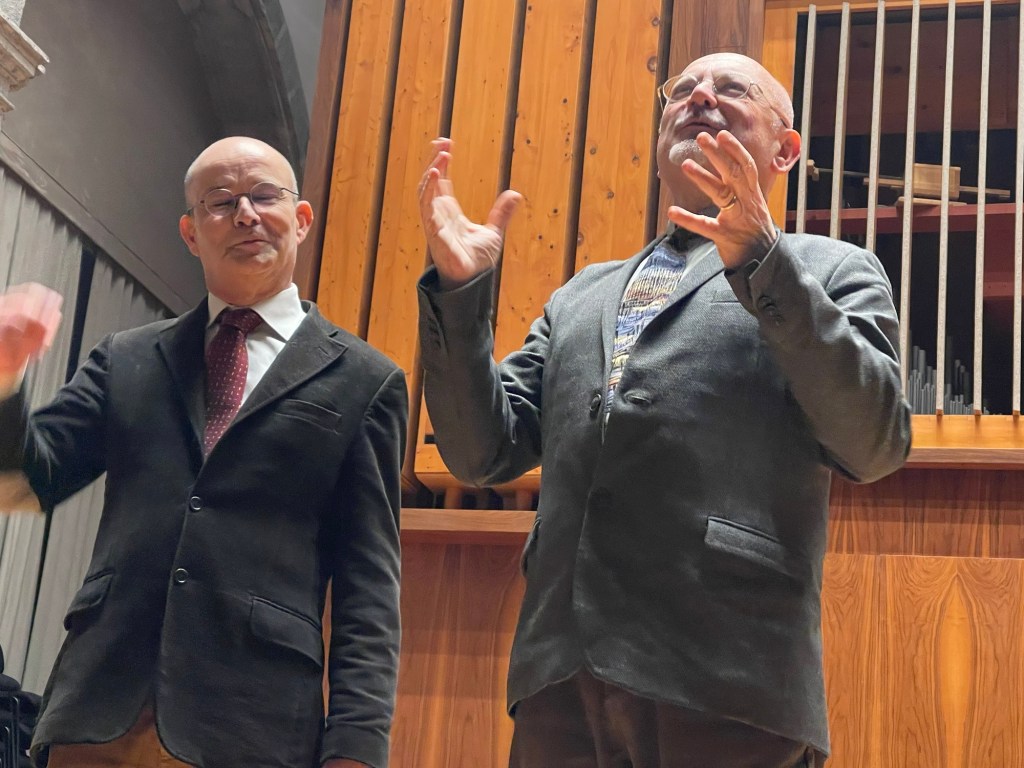
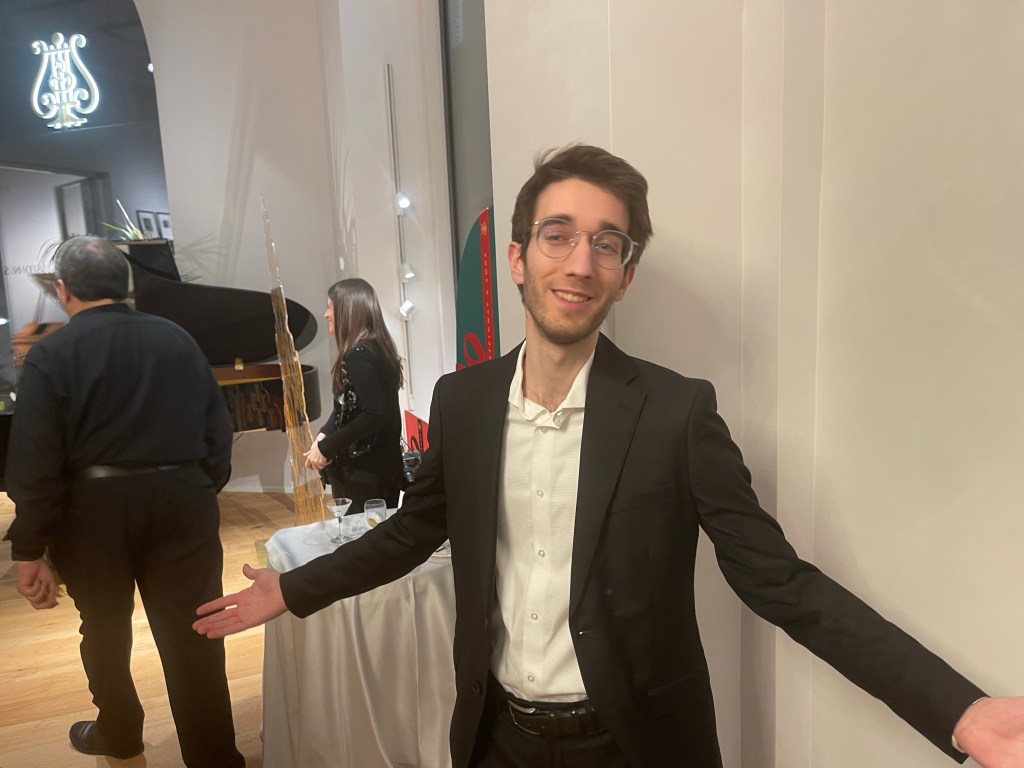
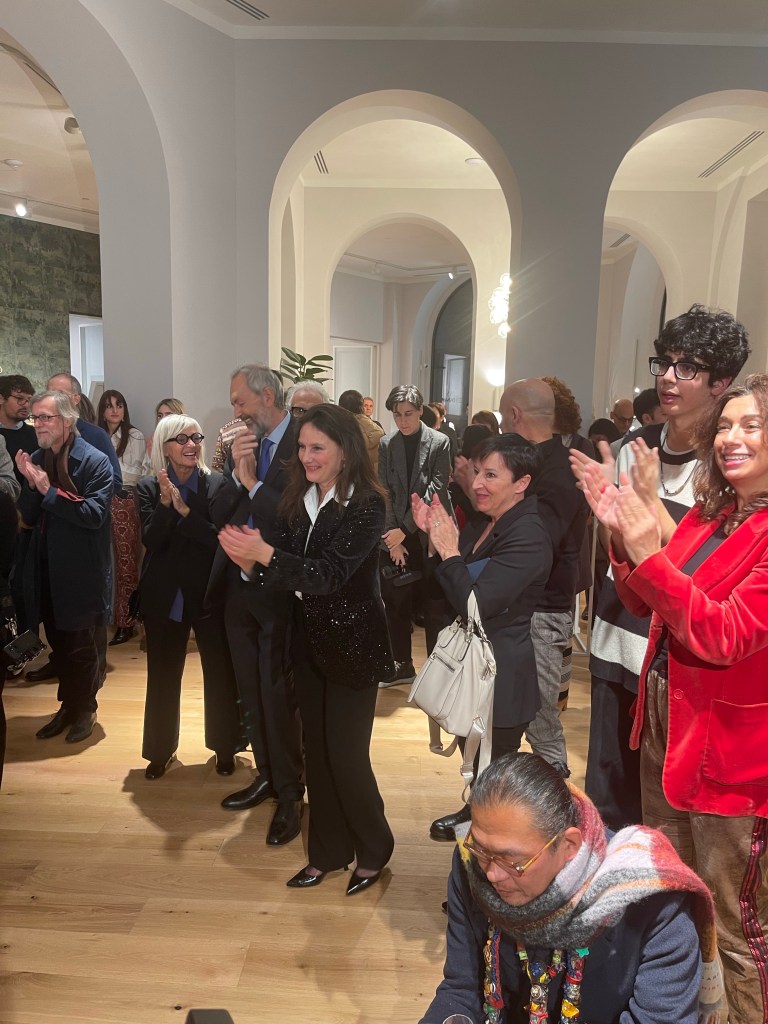
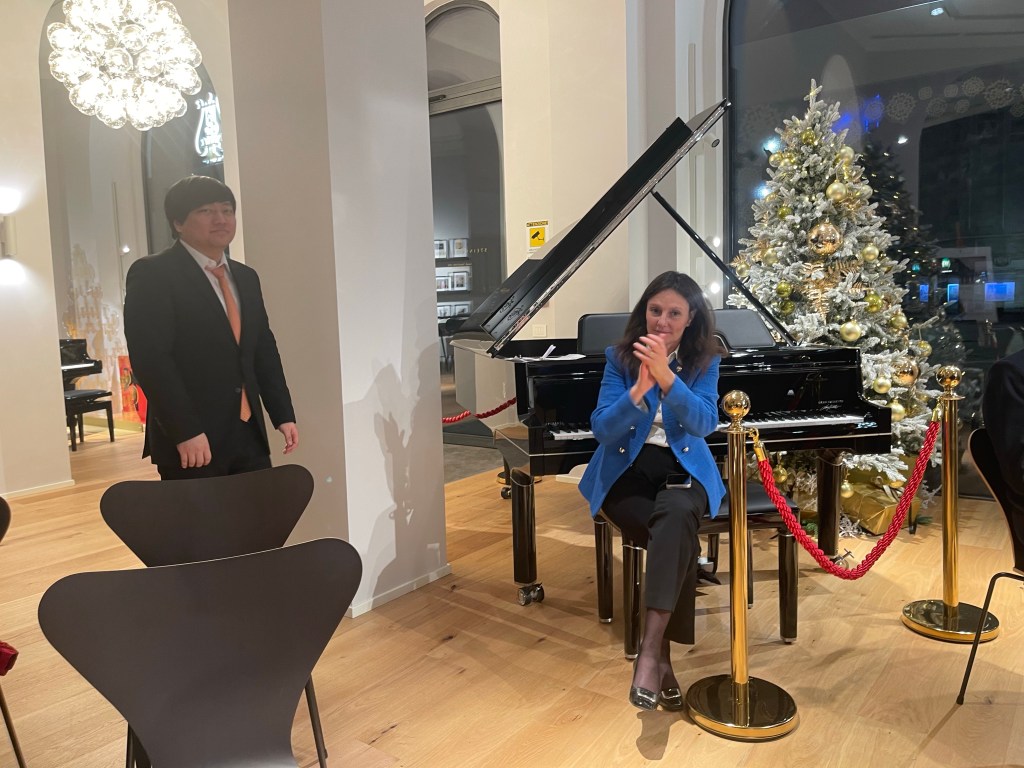
But it was the final encore ‘Le Chemin de l’amour ’ that said it all and had her son the distinguished pianist Orazio Maione on his feet together with the entire audience to salute not only Antonio Pompa- Baldi but his ‘piano mother’ Anna Maria Pennella who by the same miracle as San Gennaro was with us today in her city seething with activity just a few days before Christmas.
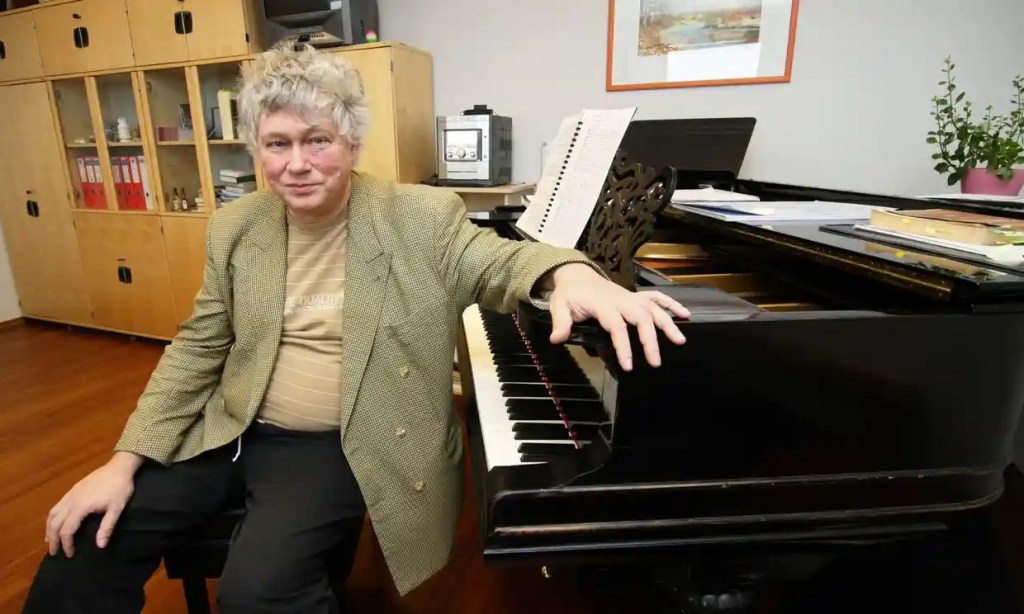
The distinguished pianist and professor ,Orazio Maione the son of Anna Maria Pennella
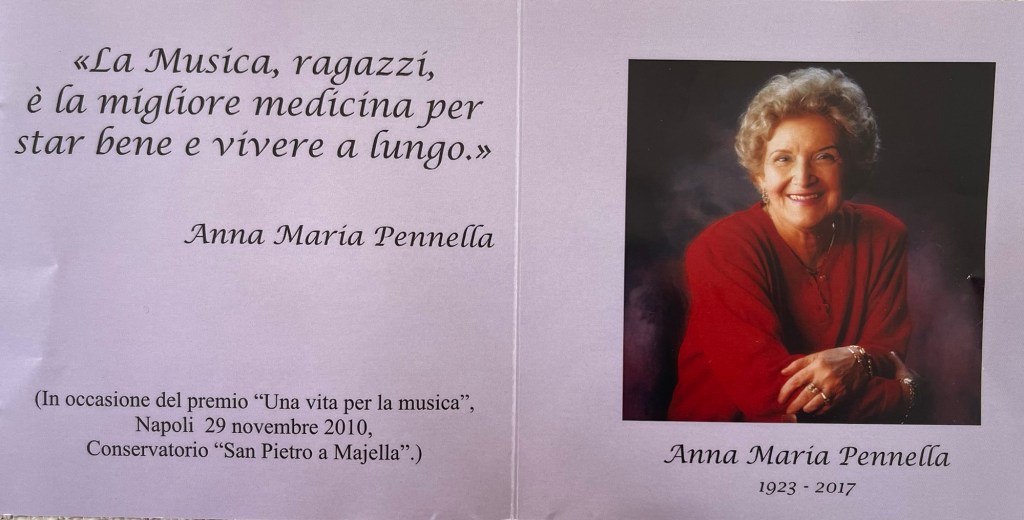
Born in Portici ,Naples in 1923 Anna Maria Pennella dedicated her life to music in her city that she loved and today returned that same love. As she said to her students : ‘Music is the best medicine for living well and having a long life’.
A long queue to salute Orazio after the concert A vast entourage that moved into the green room before being invited to leave by a Conservatory that had run out of time .
Something that is amply demonstrated by her CD of Brahms Sonata op 5 recorded live in 2010 at the age of 87 when she was awarded ‘ Una vita per la musica’…………
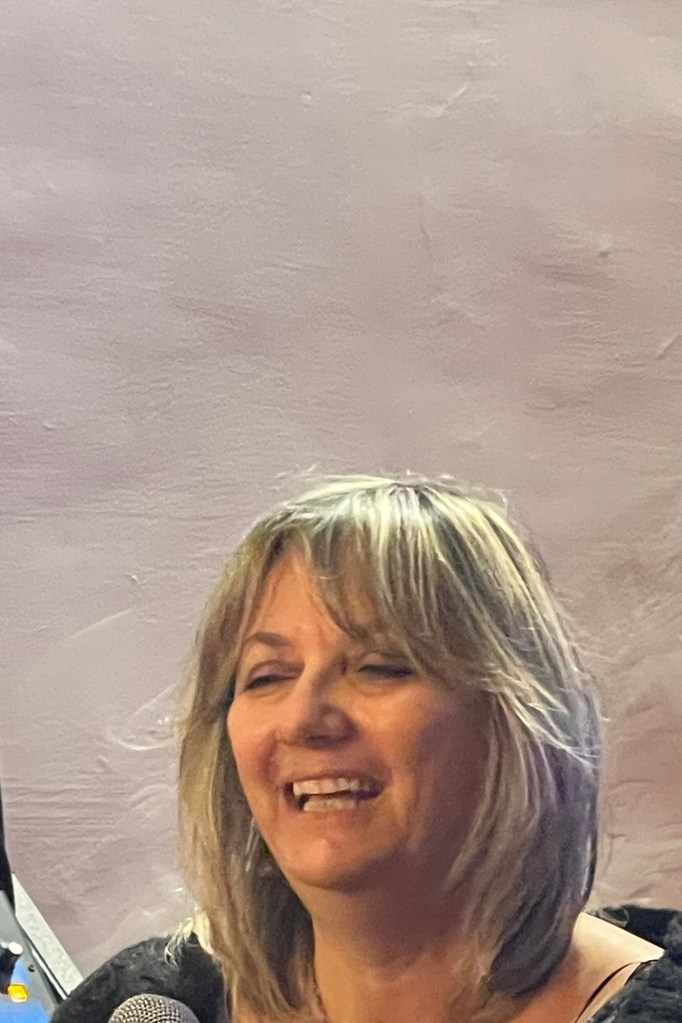
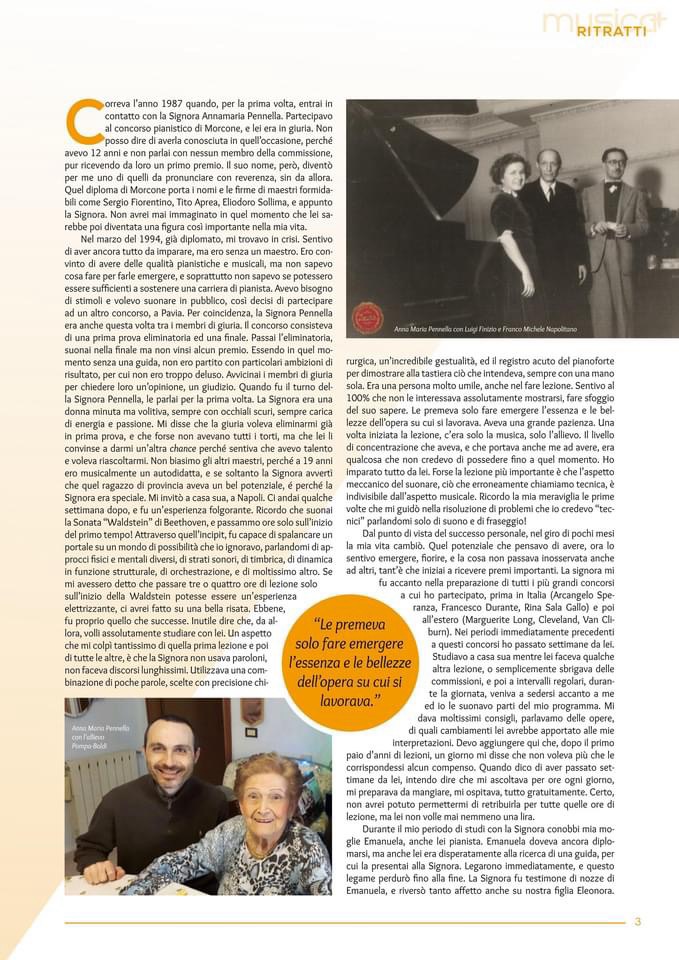
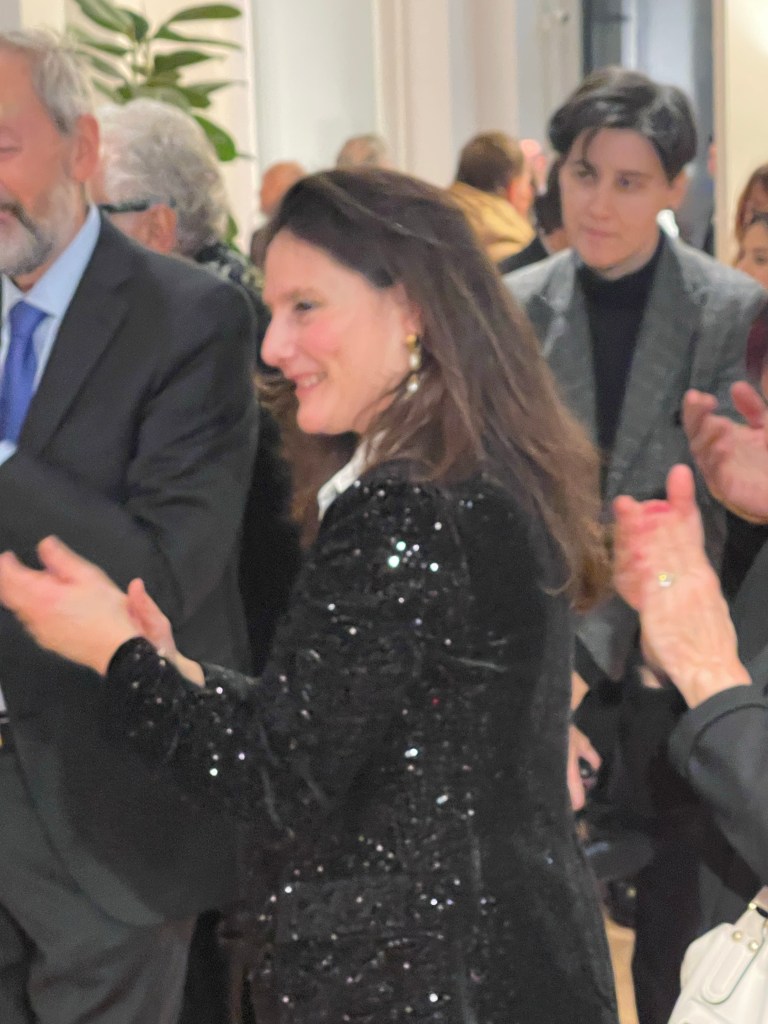
Carla Di Lena with Marco Scolastra https://christopheraxworthymusiccommentary.com/2023/10/24/marco-scolastra-at-the-goethe-institute-a-voyage-of-discovery-from-clementi-to-rossini/ Marco who had played the Brahms First Concerto op 15 four hands with Orazio Maione and his mother having heard a try through announced that she could now bless their duo.The Sala Muti full for the conversation that preceded the concert in the main hall Eloisa Intini spoke with emotional warmth of a person who had been a dominant force for her.Anna Maria Pennella shared her enormous energy with each student individually.With artistic intuition like a poet who can see the whole picture as opposed to the writer who can only see the words.A personality that wanted to share and transmit her great musical obsession with all that came into range.Emanuela Grimaccia spoke so eloquently about the important role that Anna Maria played in the long Neapolitan Piano Tree.Although not a student of Anna Maria she had come very much under her influence.Carla Di Lena spoke of the great musician she had known and it was she that shared this beautiful article by her star student with us.It was printed in the Musical Magazine of the Conservatory of L’Aquila in 2017 the year of her death.The genial generosity of the Director of San Pietro a Majella,Gaetano Panariello with a warm welcome for this 100th Anniversary Homage
And so to the real Homage in music opening with a work by Debussy that Orazio’s mother had fallen in love with in her last years :Images oubliees n. 1 Lent (melancolique et deux) .Played by a student of her son : Giuliano Grella .
The young pianist (I biennio) Giuliano Grella played these whispered secrets with ravishing colours and refined passion .There was a delicacy with a kaleidoscope of colours but an architectural line that made one wonder why these pieces are rarely heard. I remember Fou Ts’ong often delving into these early works of Debussy as well as playing the last great work and absolute masterpiece that are the Etudes.
Claude Debussy composed Images, a three-piece cycle for piano, in 1894. The cycle was only eventually published in its entirety in 1977, entitled Image (oubliées). The reason for adding the words “forgotten” was to prevent it from being confused with his other two popular Images cycles, published in 1905 and 1907 .Maurice Ravel orchestrated the Sarabande in 1923, and Zoltán Kocsis created an orchestral transcription of the other two pieces. The first, “melancholic and sweet” is followed by the Sarabande, which Debussy instructed to be performed “[…] with dignified and slow elegance, not unlike an old portrait, a memory from the Louvre, etc. […]” The vigorous and humorous third piece is based on the first line of the French nursery song “Nous n’irons plus au bois”. Images (oubliées) No. I. Lent (Mélancolique et doux) No. II. Sarabande (Ravel’s orchestration) No. III. Quelques aspects
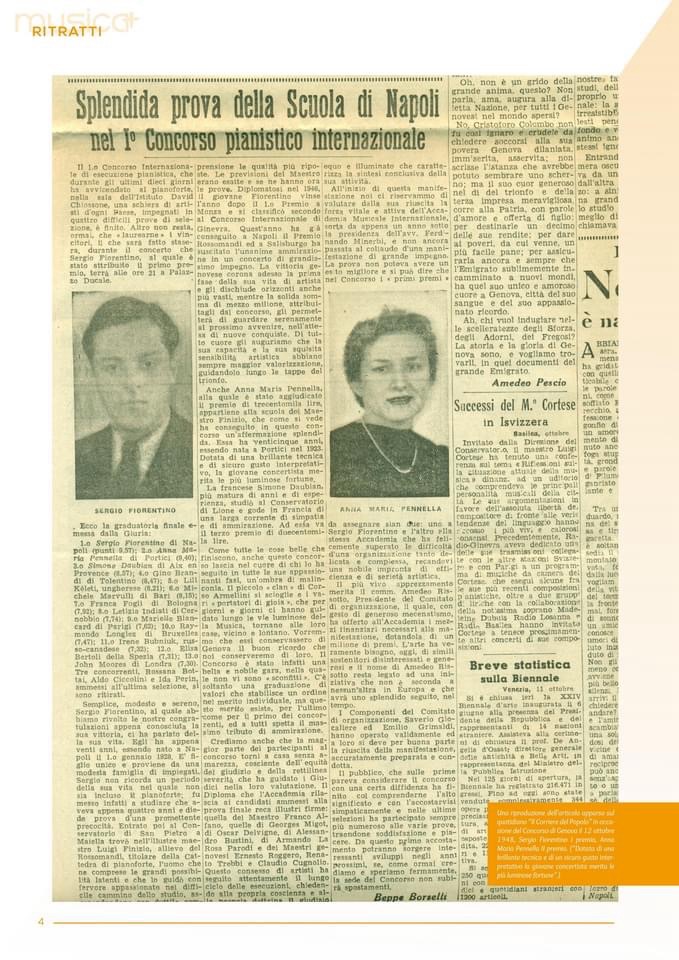
Carla di Lena writes :Domani sarò presente all’omaggio che il Conservatorio di Musica San Pietro a Majella di Napoli renderà ad Anna Maria Pennella, scomparsa alcuni anni fa, quest’anno ne avrebbe compiuti 100. Su questa personalità straordinaria – da ascoltare le sue interpretazioni disponibili su YouTube – che ha formato schiere di pianisti e di attuali docenti di conservatorio, nonchè mamma di un bravissimo pianista e docente come Orazio Maione, avevamo pubblicato un articolo qualche anno fa ( n. 49/2017 ) nella rivista Musica+ del Conservatorio dell’Aquila. Lo ripropongo qui perchè è una bella testimonianza del suo allievo Antonio Pompa-Baldi, che domani suonerà per ricordarla. Tra le immagini, nell’articolo, è stato inserito per intero un estratto del “Corriere del Popolo” del 1948 relativo al Concorso Pianistico di Genova, concorso nel quale Annamaria Pennella vinse il secondo premio, il primo era stato assegnato a Sergio Fiorentino. E proprio domani 22 dicembre Fiorentino avrebbe compiuto 96 anni. Una bella coincidenza, che vede idealmente unite due figure importanti per la storia del pianoforte in Italia. Per la lettura in pdf questo il link (pp.21-24) https://www.consaq.it/files_repos/pubblicazioni/riviste/musica/2664/49lugsett17Musicapiu.pdf
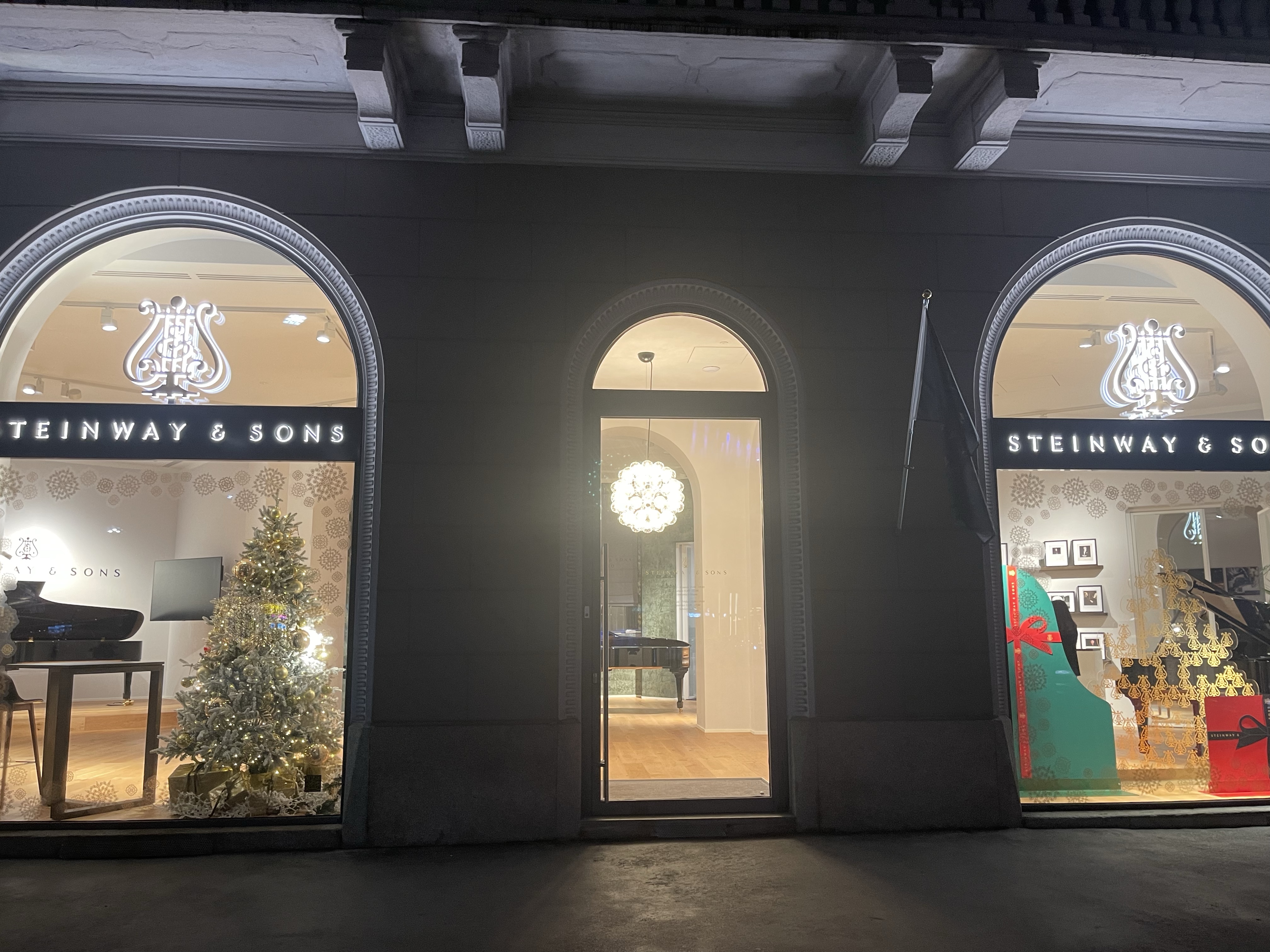
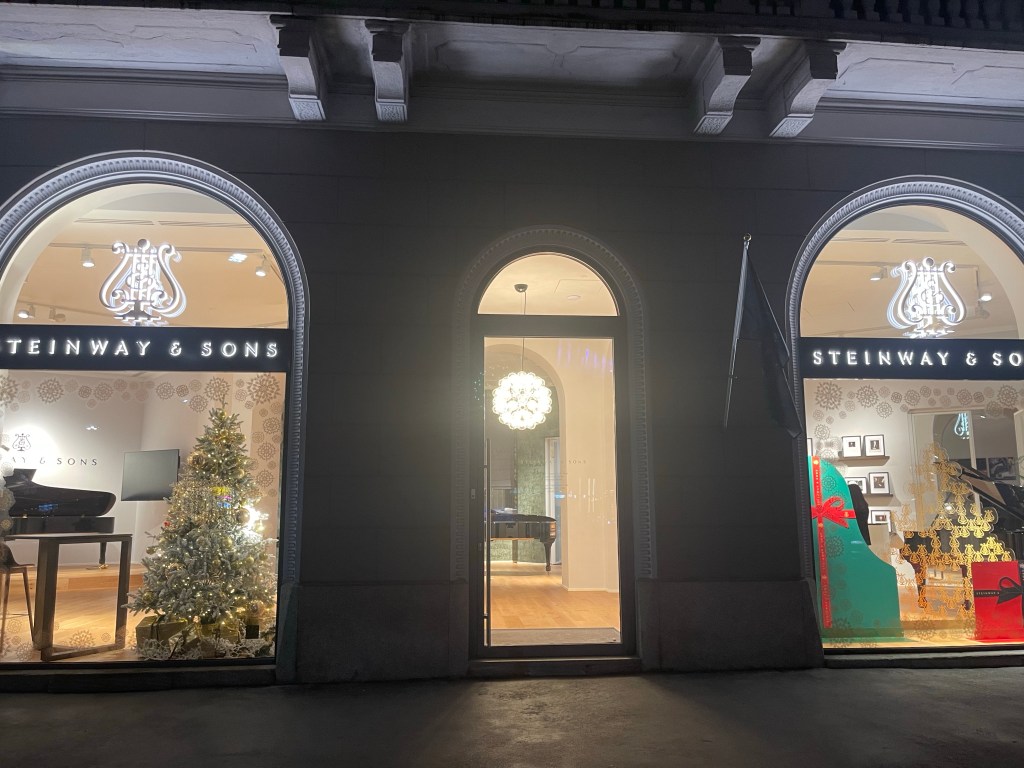
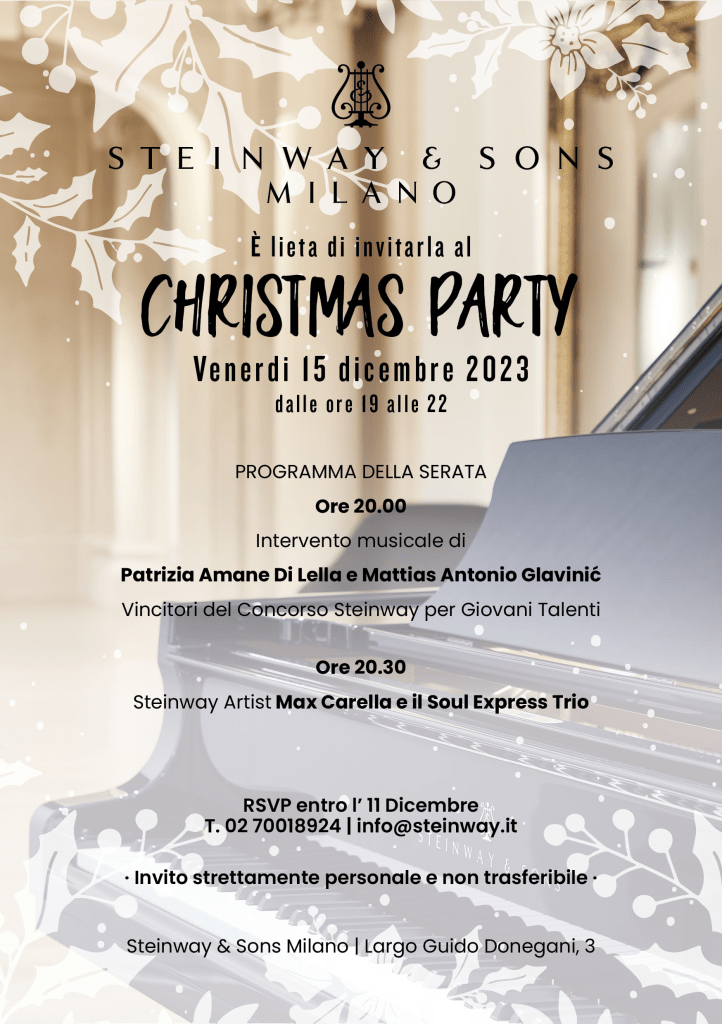
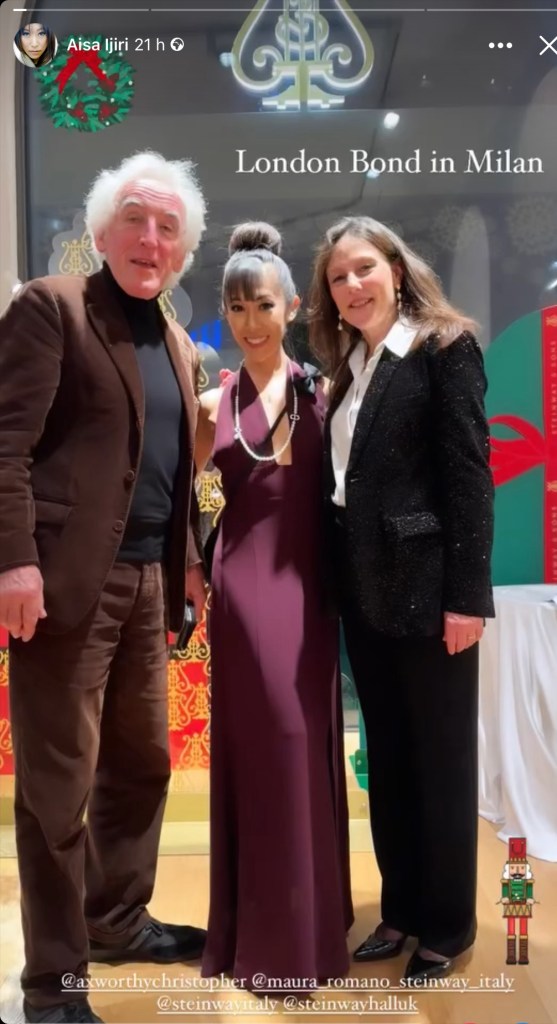
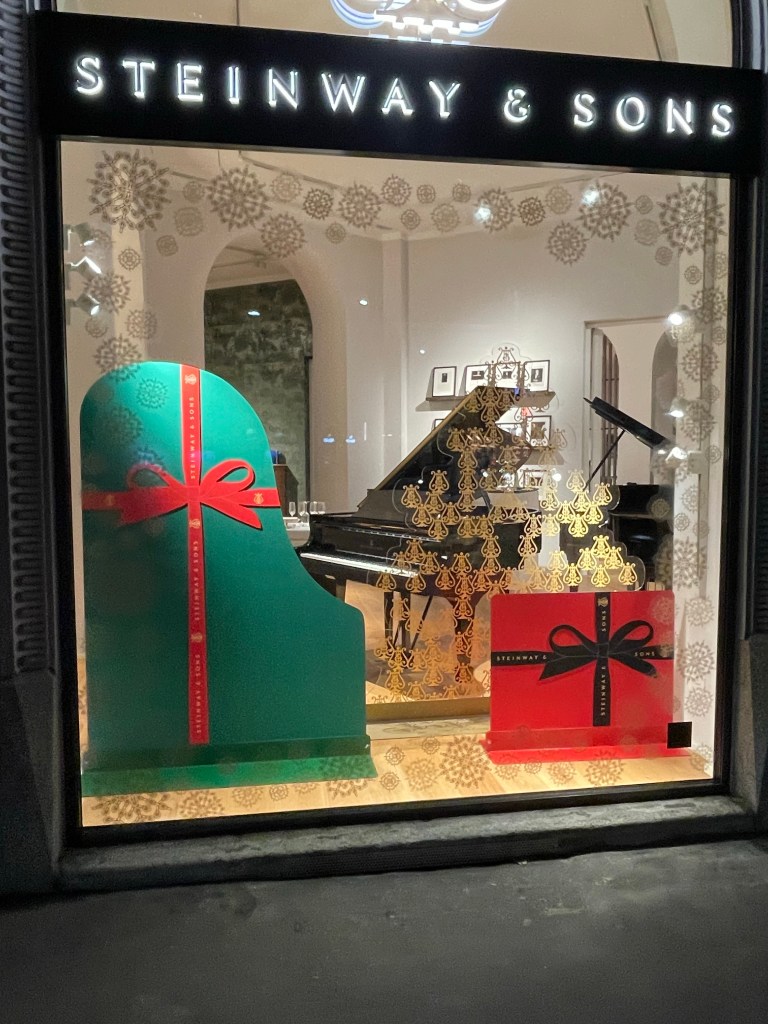
Let there be fun,games ,glorious music and sumptuous food …….if music be the food of love …..play on in this festive season in Milan …….thanks to Steinway and all their wonderful sons and daughters
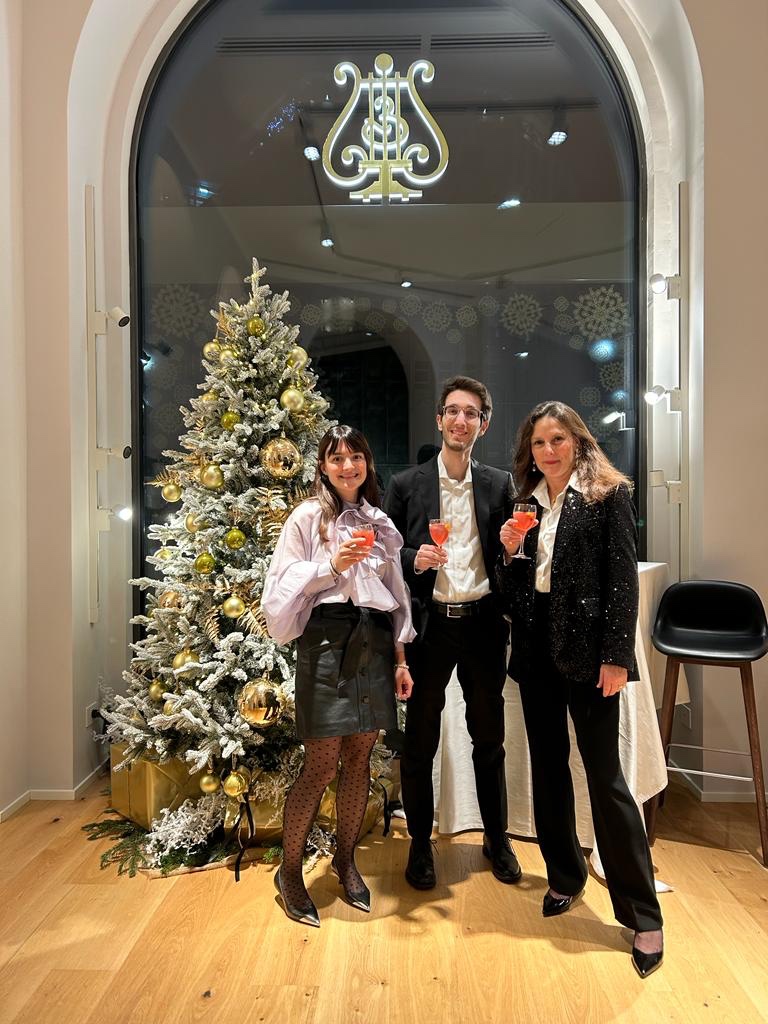
The Steinway team
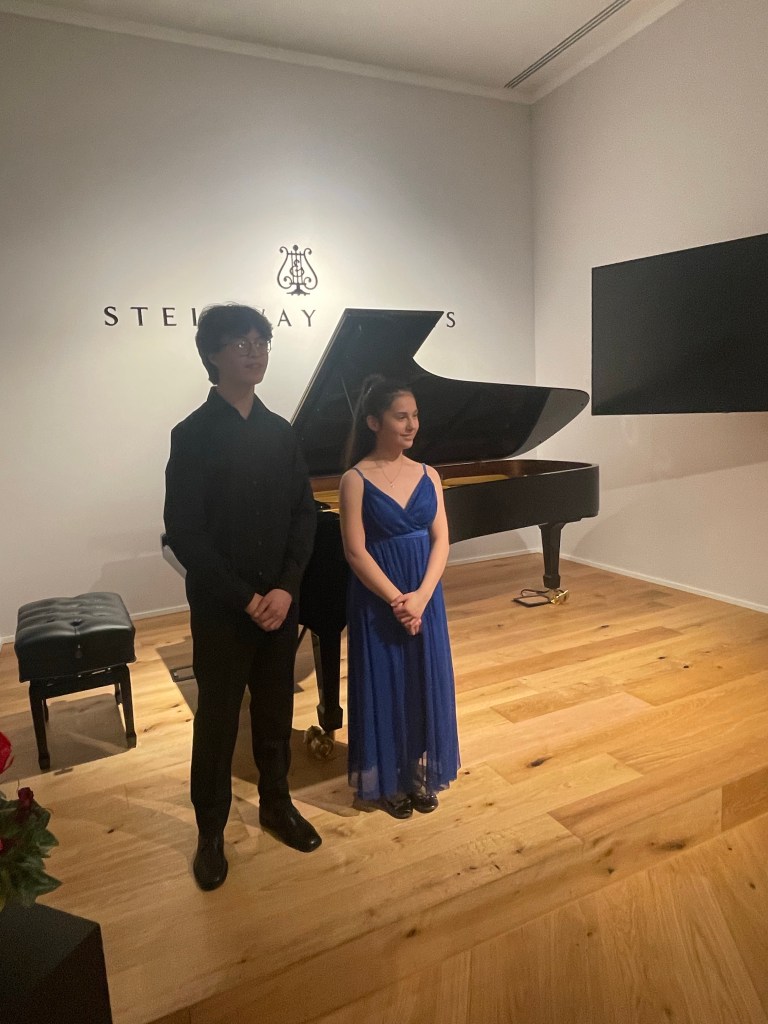
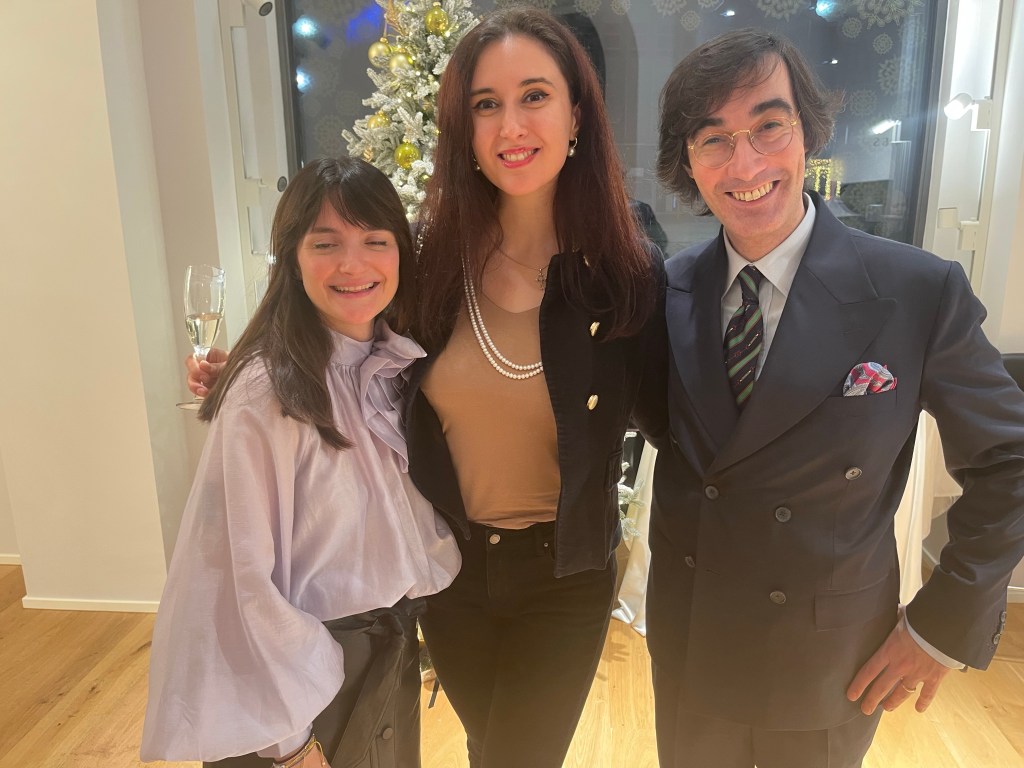
Oh what a wonderful party ………….with the two winners of the Steinway Young musicians contest …………..13 and 14 years old ….what talent …listen below ………….after the music strictly limited to 20 minutes the fun and games truly began in Maura Romano style.We could have danced all night ……and nearly did except midnight was in view and I am not keen on pumpkins.
Alessandro Livi,sales consultant for Maura Romano ,country manager Flagship store and institutions.
Patrizia Amane Di Lena 13 year old student in Milan of Silvia Rumi winner with Mattias Glavinic of the Steinway Young Artists Contest ……. A superb Fantasy Sonata by Scriabin that at 14 is a technical challenge and at 21 a musical one ….but this young lady had it all in her fingers ,brain and heart.
A remarkable performance of youthful innocence and passion with an enviable command of the keyboard.The various strands of melody in the first movement that she magically pieced together and the driving rhythmic energy that she brought to the second movement I have rarely heard played so musically and with such simple innocent passion.
The enthusiasm of Maura knows no bounds in her quest to help young musicians reach their goal.
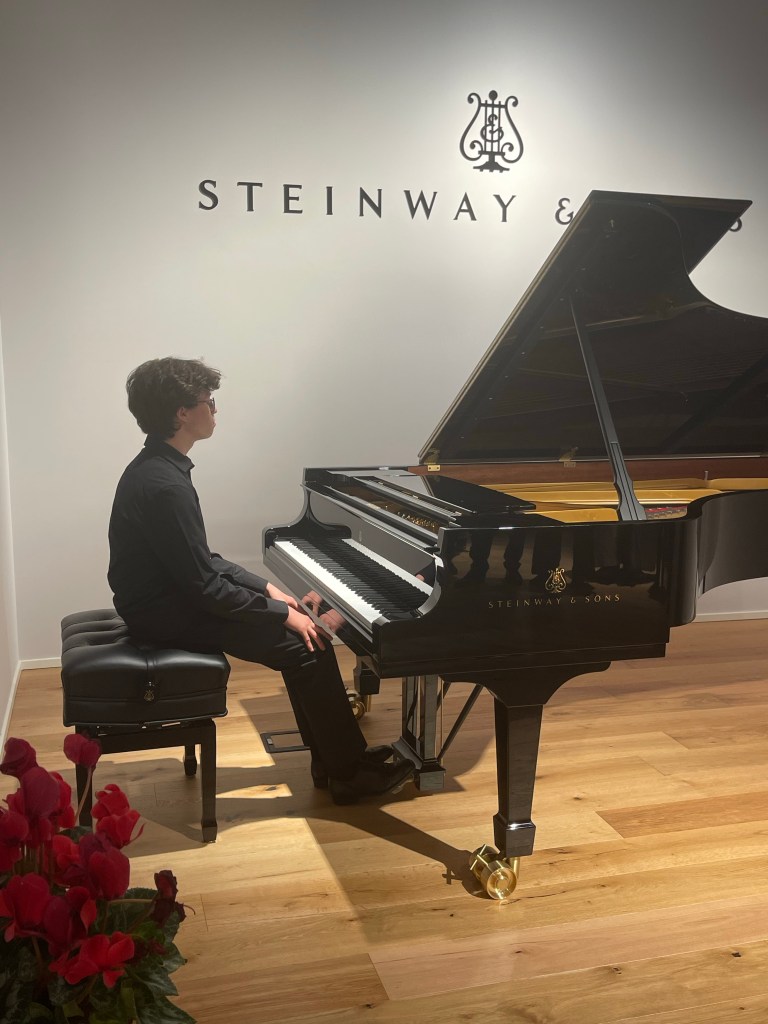
Playing on the magnificent Steinway D that sits so regally in this wonderful Flagship captained by Maura Romano……. Calm seas and treacherous voyage are no danger here in the centre of Milan next door to the musical temple that is La Scala. Maura is a wonderful sailor who knows how to calm the waters and encourage all those great talents that sail with her to their land of dreams.
It was a memorable recital as was the performance by fourteen year old Mattias Glavinic today.Maura had rationed these two young artists to ten minutes each but I would have gladly listened to them for much longer – but Christmas Cheer needs time to digest and enjoy too!
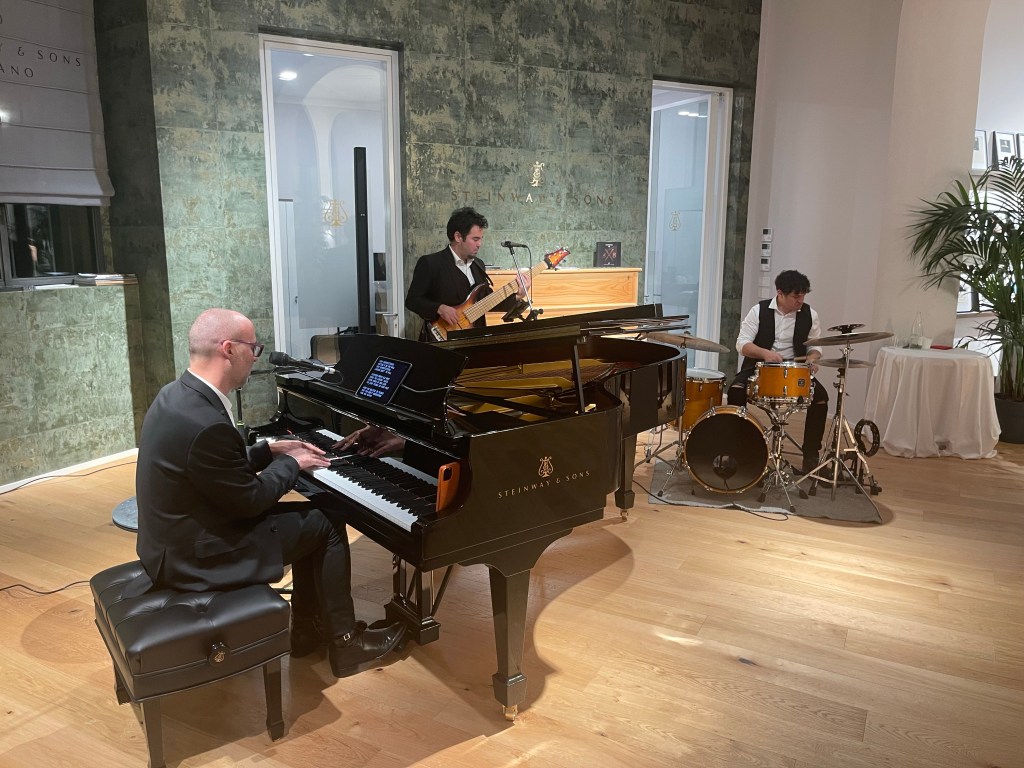
Music provided for all tastes with a superb jazz trio
Mattias played a quite remarkable ‘La Leggerezza’ concert study by Liszt. The subtle rubato and insinuating beguiling sounds that uncurled from his delicate agile fingers reminded me of Godowsky’s famous recording :
Maura and her team presenting the two winners of the Steinway Junior Competition
Some things cannot be taught and this beauty of sound and flexibility of pulse is acquired unconsciously in infancy and once given the technical know how expresses itself in what we heard tonight. Obviously he has a good teacher who does not obstruct his great natural talent but just helps it grow. He also played Chopin’s Third Ballade – the most pastoral of the four remarkable tone poems that Chopin created for the piano. It was a musicianly performance that showed a great command of the keyboard but also of Chopin’s very precise pedal indications that are so fundamental for the shaping of phrases and maintaining the lilting pulse of this sunniest of Ballades. A remarkable performance for the control of his youthful love and passion for music and if I had to criticise him at the end it was only to point out the fact that the visual beauty of movement should depict the same beauty and shape of the notes on the page. Volodos is the prime example these days, as to watch him paint the ravishing sounds he makes is like admiring a painting by Leonardo Da Vinci or a sculpture of Michelangelo.
Pianists often facilitate these movements by pianistic trickery as Mattias did today in the last great scale that plunges into the depths of the piano before the final glorious four chords.The shape of that scale should be the shape physically of the arm movement …it is a question of mind over matter …………I pointed it out to Mattias because for such a potentially great talent it is food for thought to think and ponder over and be aware of. A dimension that only the greatest of talents can understand and digest. Mattias is just such a talent !
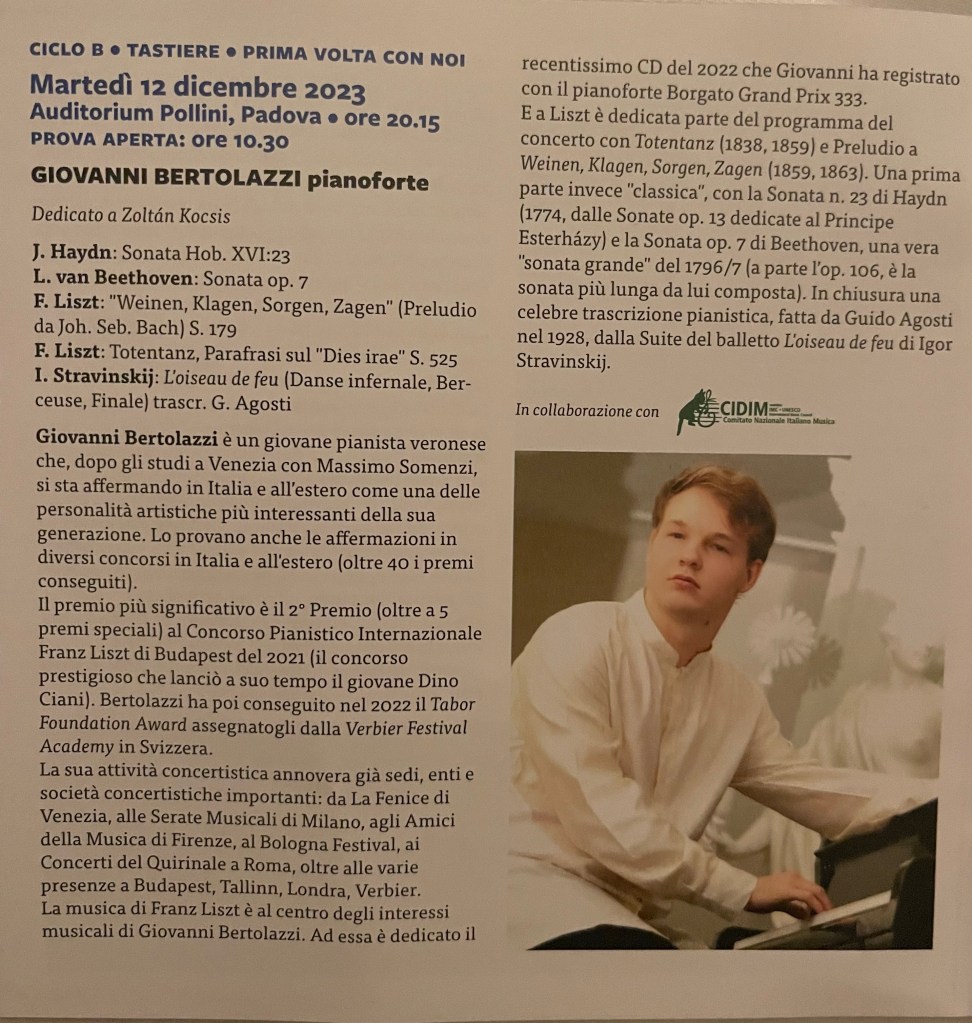
Giovanni Bertolazzi e gli Amici della Musica di Padova desiderano dedicare il concerto di questa sera alla memoria di Zoltán Kocsis, nel ricordo sempre vivo dei suoi concerti padovani “Si dovrebbe tendere all’eterno, non a ciò che finisce.” Z. Kocsis (1952 – 2016) ‘One should think of the infinite ,not just that which finishes ‘
Joseph Haydn (1732 – 1809) Sonata in fa maggiore Hob. XVI:23
Allegro moderato Adagio Finale (Presto)
Ludwig van Beethoven (1770 – 1827) Sonata in mi bemolle maggiore op. 7
Allegro molto e con brio Largo, con gran espressione Allegro Rondo (Poco allegretto e grazioso)
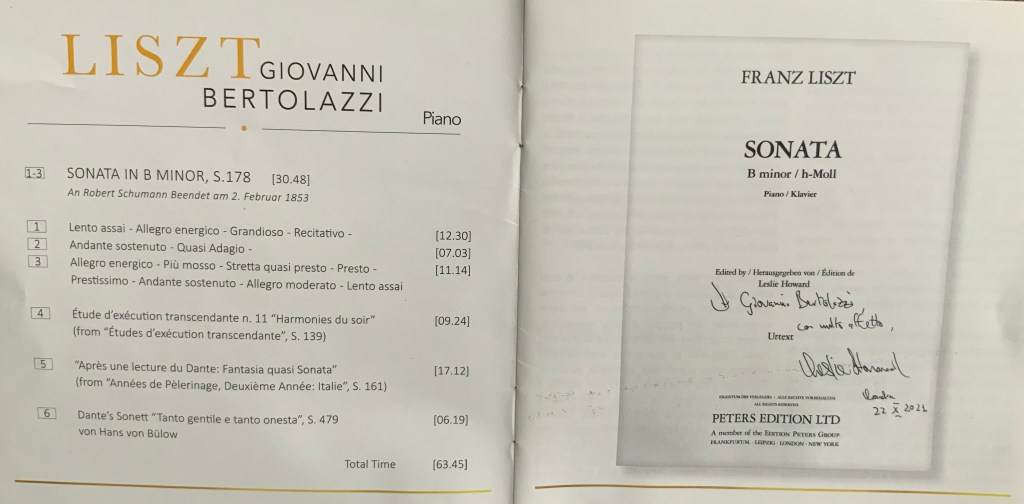
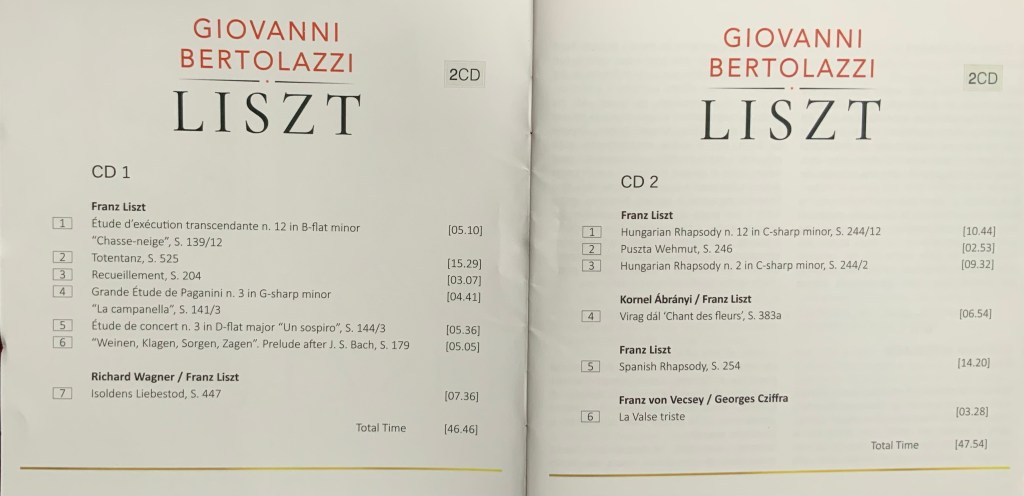
Franz Liszt (1811 – 1886) “Weinen, Klagen, Sorgen, Zagen” (Preludio da Joh. Seb. Bach) S. 179
Totentanz, Parafrasi sul “Dies irae” S. 525
Igor Stravinskij (1882 – 1971) da L’oiseau de feu (trascr. Guido Agosti) Danse infernale Berceuse Finale
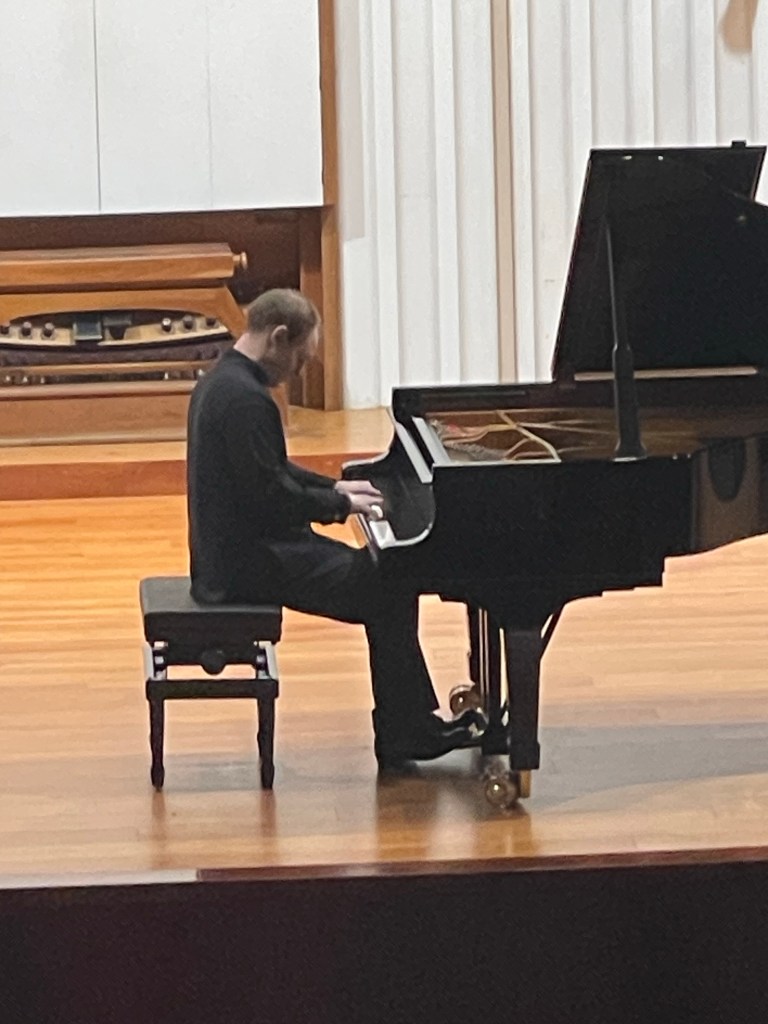
It was almost four years ago that Giovanni played in the Sala dei Giganti in a sunday morning series dedicated to young competition winners .Giovanni,I had already heard in Bolzano and had immediately realised that here was potentially a remarkable musician and passionately dedicated pianist.I wrote about that first concert in Padua giving it the title ‘A Giant amongst the Giants’
Giovanni has now grown into a very mature young man with a quarter of a century behind him as his playing is growing steadily in stature.He has been taken under the wing of the Keyboard Trust and has already played in London on two occasions.On the first occasion he took advantage of the generosity of Leslie Howard ,the leading Liszt expert of the day and Artistic director of the KT ,to discuss repertoire and consult scores with a true expert.Leslie had been a esteemed student of Guido Agosti who had studied with Busoni who in turn had been a student of Liszt.On the same occasion he played the Liszt Sonata to Peter Frankl at his home and they spent many hours discussing it together.Giovanni on his second visit to London last June took the National Liberal Club by storm as he gave the first in a series of six concerts for young musicians in a hall which had seen Rachmaninov and Moiseiwitch before the war.Last autumn he toured America and astounded all that heard him including the New York critic Jed Distler one of the most informed critics of our day. I like to think that Giovanni and I have become friends since that fateful day in Bolzano when I by chance bumped into him with his father and was able to congratulate him on the superb performances he had given in the ‘Busoni’.
It is this artistry that has flowered into a towering presence where he is merely the medium between the composers and his audience.I have heard most of the works in today’s programme but such was his way of recreating the music that I was bowled over by so many things that I had not noticed before.One of the most remarkable things about Giovanni’s playing is his kaleidoscopic sense of colour and with just the right amount of showmanship that allows him to reenact the music before our astonished eyes.Remarkable ,no nonsense contrasts in the Trio of the Scherzo but it had also been noticeable from the very first notes of this early sonata.A sonata where the genius of Beethoven suddenly comes to the fore as he takes the form bequeathed to him by his teacher Haydn and transforms it with his irascible genius into the sonatas that were to be the thermometer for a life span in 32 steps.
I have written about Giovanni’s performance quite recently in London but suddenly in Giovanni’s hands one becomes aware of what a great work this early sonata is.It is ,of course ,the Largo that is so poignant and already points to the things that are to come in the last great trilogy.Giovanni on a piano that at first seemed rather muffled, here in this great slow movement he discovered its secrets and he created a full string quartet sound where even the rests took on a searing significance as each gasp became more and more intense.A mastery of touch that allowed a non legato bass but with a legatissimo melodic line of such subtle tenderness.Slightly leaning on the inner notes of the chords in the octaves it gave a real string quartet feel as one could suddenly be aware of what ravishing beauty the young Beethoven was capable of .The opening of the Scherzo- Allegro was like opening a window to let fresh air in after such intensity.It was in the Trio with its rolling harmonies with injections of electric shocks that must have been truly astonishing in Beethoven’s time and it was this same surprise and stupor that this musician ,the same age as Beethoven when he penned such marvels,was able to show us today.A rondo that was all elegance and delicacy and on each appearance still more insinuatingly presented.But this was rudely interrupted by an episode of overwhelming power and rhythmic energy.The most noticeable thing was the clarity that Giovanni brought to the music with never hard or ungrateful sounds but always rich and full of a string quartet or orchestral texture.This was not just a great virtuoso but a musician of stature dedicated to recreating the music and surprising even himself as the music was allowed to unravel so naturally from his extraordinarily sensitive ten players.
I am reminded of Kantarow who is one of the blessed few that lives every note and like Giovanni makes the music speak in a musical conversation that keeps us enthralled from the first to the last.A story that has to be told ….and what a story!It was the same immediacy that he had brought to Haydn’s sonata in F that opened this well balanced programme.An Allegro moderato that was all brilliance and charm .From these very first notes the subtle legato of the right hand with the gentle non legato of the left was a transcendental tour de force of touch that I have not heard played with this Matthay type simplicity for too long .The ravishing beauty of the Adagio had me thinking that this surely is the birth of ‘bel canto’.A sense of balance that allowed the melodic line to glow and shine with golden beauty and ornaments that unwound with the ease and grace of a great singer.Haydn marks the Finale Presto but surely not so fast as to loose the sense of fun and games that the composer is treating us too.Giovanni’s kaleidoscopic palette of colour allowed him nevertheless to shape this movement with subtle shading but surely Giovanni you can let your hair down now and have more fun after the burning intensity you had shown us in the sublime Adagio?
Filippo Juvarra artistic director with on the right Luigi Borgato
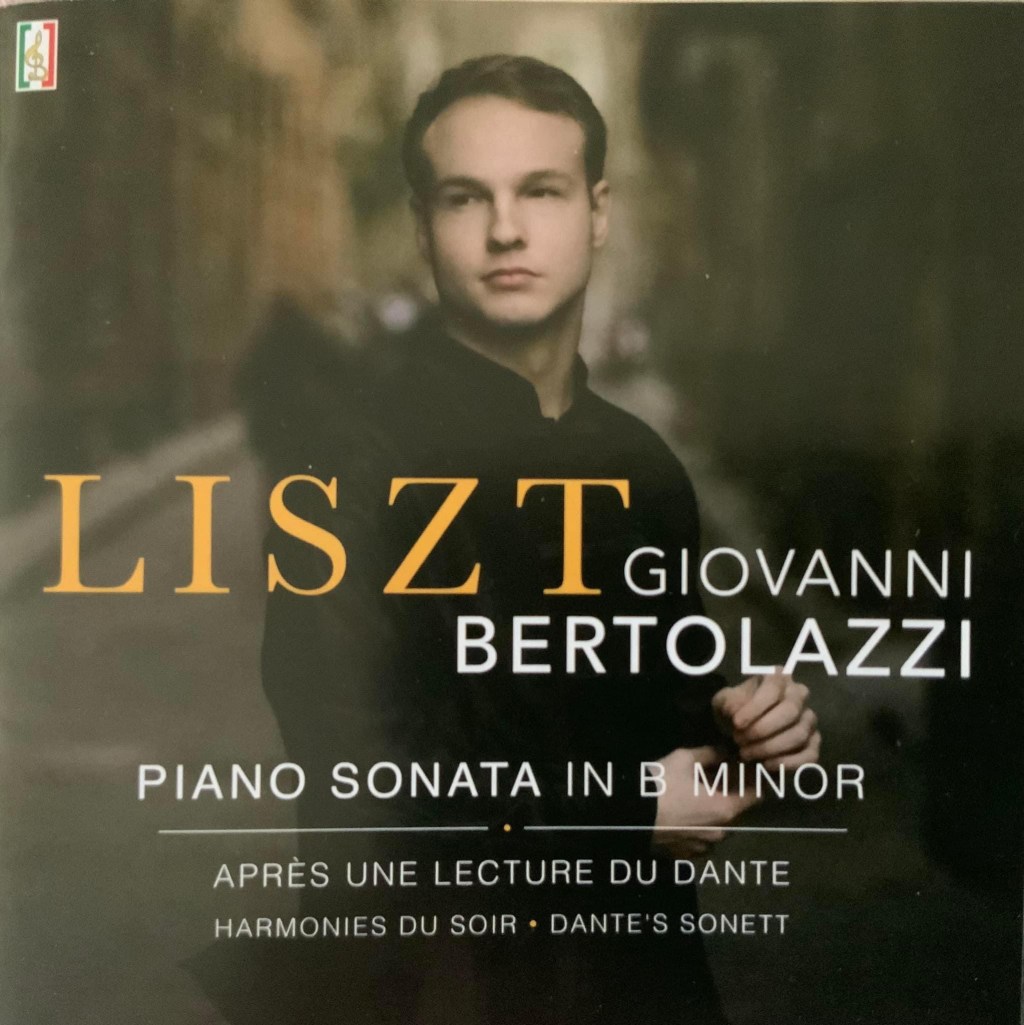
Giovanni’s Liszt playing is well known as his CD’s can already testify.CD’s that were produced by Borgato the makers of superb instruments and infact the preferred piano of Radu Lupu whenever he played in the Teatro Olimpico in Vicenza.
Giovanni’s father carefully following his son as he reaches for the heights in a very competitive field
Hopefully this marriage between Borgato pianos and a star pianist will bring lustre to both in the name of art.Mr Borgato was present tonight together with Giovanni’s father and both were visibly bowled over as were we all by what we were about to be treated to after the interval.
The auditorium C.Pollini in Padua
It was Liszt that he and Kevin Chen had surprised the world with at the International Competition in Budapest.Both top prize winners Chen a genial figure who at fourteen ,a prodigious genius who went on to astonish the juries of Geneva at 16 and Rubinstein at 18.Like Lim or Trifonov it is an early presumptuous genius that may or may not mature well.Giovanni has been carefully delving into the scores and studying intensely helped by many great musicians like Jean Eflem Bavouzet and Peter Frankl in particular.It is this time that has been so important to allow the music to mature within this already superbly trained musician.Here mention should be made of the five years vigorous training that Giovanni received in Catania from Epifanio Comis .We live in an age when time to stop and think becomes ever more precious .An age of instant comunication, fast travel and where quantity seems to be more important that quality.
All this to say that I was overwhelmed by Giovanni’s performances of Liszt and Agosti ( Agosti my own teacher and great friend who I will celebrate tomorrow in Forlì where he was born and is buried .A student of Busoni who was in turn a student of Liszt.Liszt who had been taught by Czerny,a student of Beethoven who in turn had been a student of Haydn – small world !).
Liszt’s “Weinen,Klagen,Sorgen,Zagen ‘ I have never been aware of what a remarkably beautiful work it is until today.It was played with a simplicity as the opening desolate notes were whispered into our ears only to be transformed into a work of a true believer with genial resources in his hands and heart.Totentanz too ,usually a work of scintillating virtuosity here was transformed into a satisfying whole where each variation whilst given its own character was part of a much larger architectural design.Astonishing technical fireworks abound,of course ,but like with Arrau never forgetting the extraordinary musical invention of a master work.
Breathtaking virtuosity with double notes I have never heard before played with such colour and ease.Glissandi that shot across the keyboard like streaks of lightening but linked always to an overall musical line.But it was Agosti’s ‘Firebird’ where all of Giovanni’s technical brilliance and kaleidoscopic sense of colour produced an unforgettable performance that is for me undoubtedly the greatest I have ever heard.There have been some remarkable performances from two stars such as Kantarow and Rana recently but what Giovanni produced today I could only imagine coming from the hands of Agosti himself.All those that flocked to Agosti’s studio in the summer months at the Chigiana in Siena have never forgotten the sounds that came from this rather reserved musical genius.
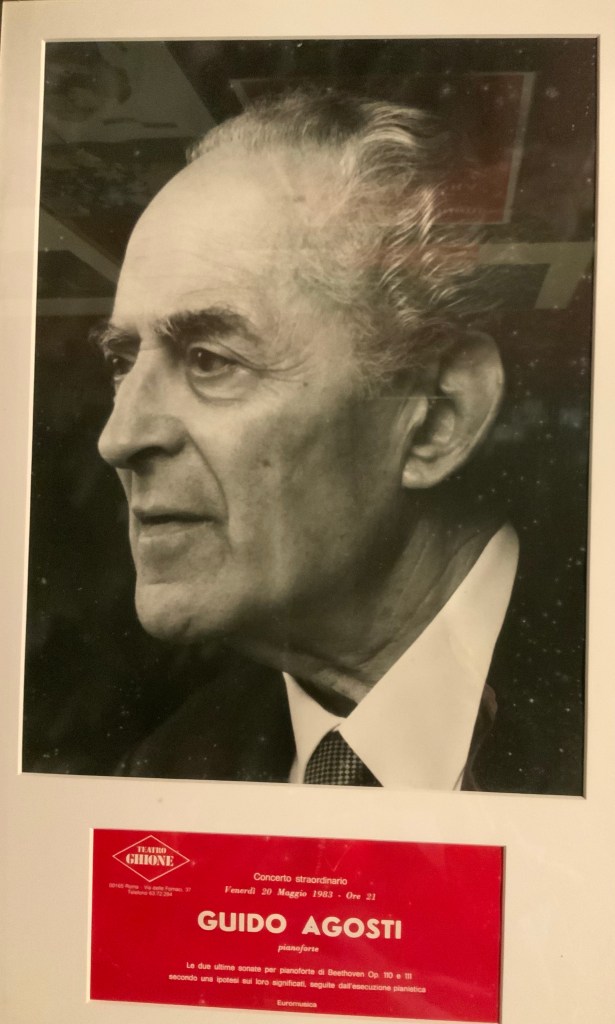
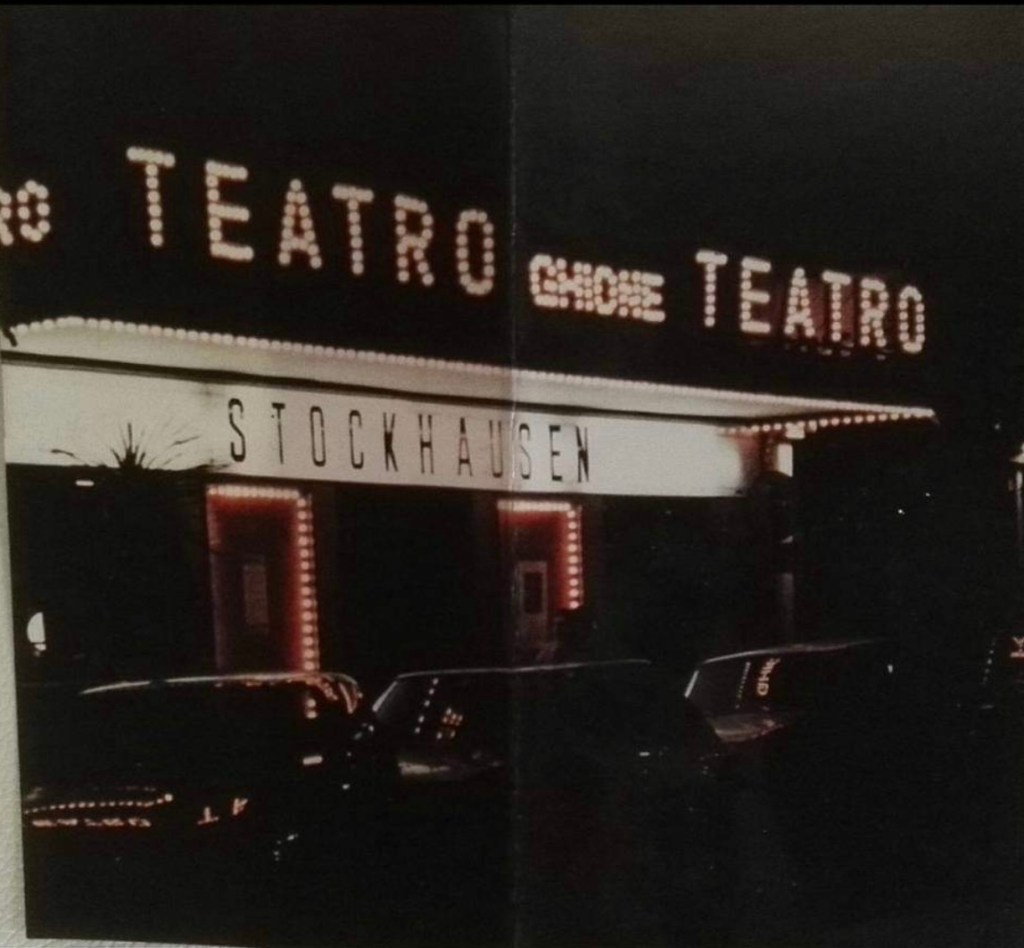
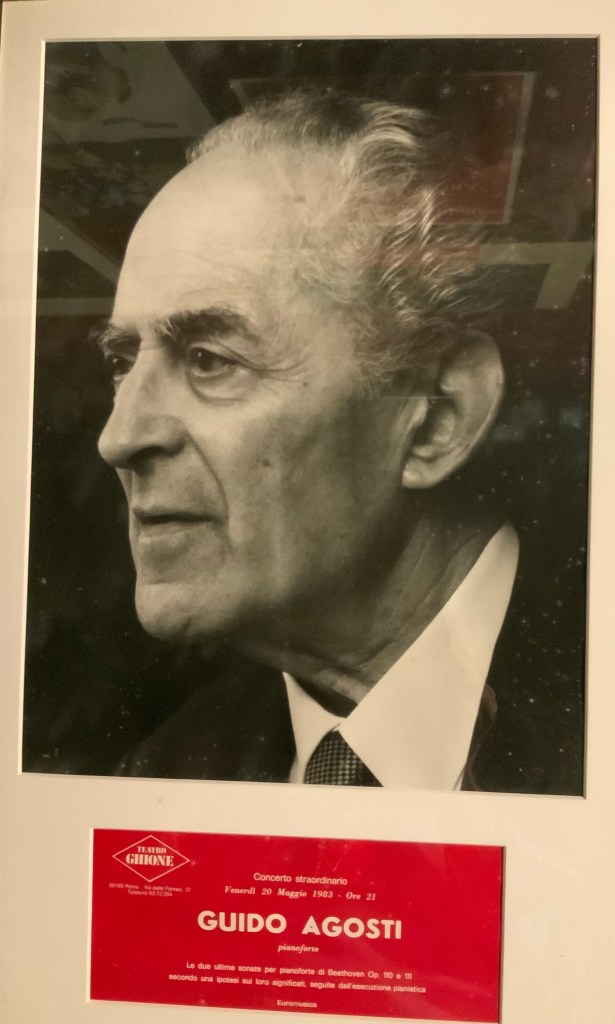
Guido Agosti a rare recording that I made in 1983 in the Ghione Theatre in Rome
The opening was indeed a ‘Danse Infernale’ as Giovanni suddenly let rip with amazing technical command, authority and above all a rhythmic drive that was exhilarating and exciting.The hushed tones of the Berceuse were bathed in pedal and whispered with a glowing fluidity in a magic sound world that kept us all mesmerised .It is always a magic moment when the clouds open and the ‘Firebird’ is revealed but today the ravishing beauty that Giovanni was able to create still is with me as I write these few poor lines to try to understand myself and share with others such a wondrous musical experience.The gradual build up to the final tumultuous wave of sounds was truly masterly .
I thought of the young pianist I had heard all those years ago in Bolzano and the long difficult path he has had to pursue since.A trial of fire indeed for a young man who dedicates his life to his art but what joy he finds as he comes out of the jungle to become one of the most exciting performers before the public today.
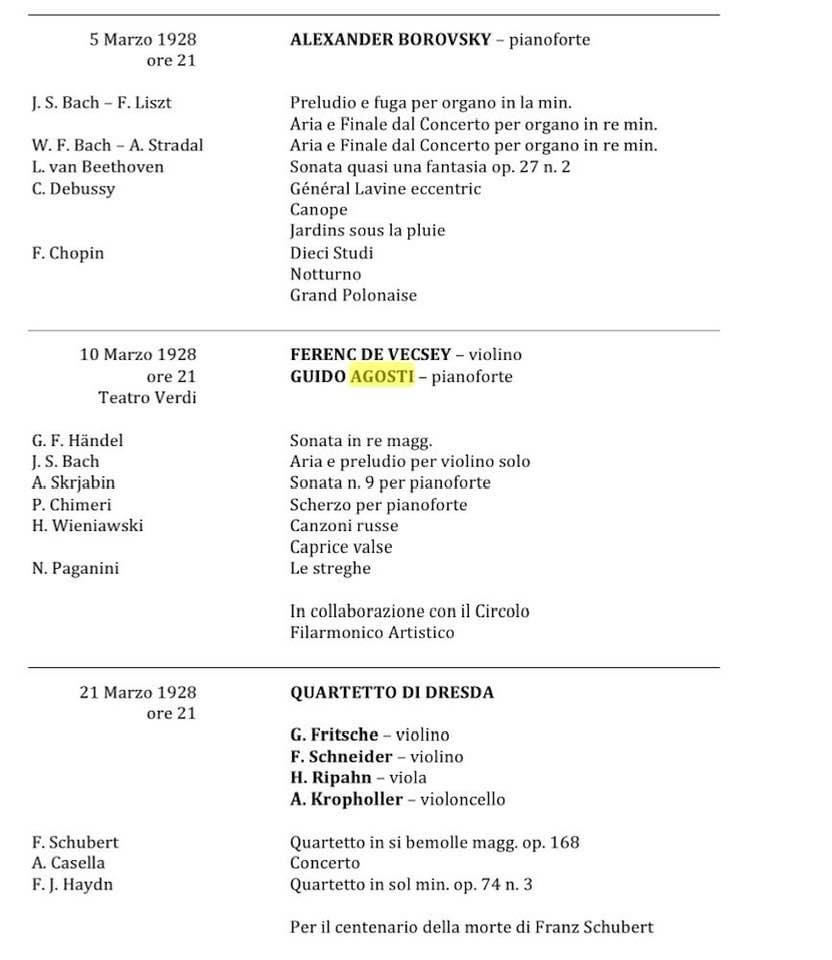
An encore was introduced very eloquently considering the tour de force that Giovanni had been through .The ‘Valse Triste’ in a transcription by Cziffra of the violinist Vecsey.A violinist almost forgotten these days but as Giovanni had told us he had played for the Amici della Musica di Padova in 1928 .What he did not tell us was that Agosti had written his transcription of the ‘Firebird’in that same year!A vintage year indeed!Also I was just told en passant that Guido Agosti was the pianist!
Gian Luca Sfriso who I hold the archives
I have written about Giovanni’s performance before so let’s just enjoy it together now.
Here is a link to a recent performance Giovanni gave in Milan for the Serate Musicali :
Franz von Vecsey was a Hungarian violinist and composer, who became a well-known virtuoso in Europe through the early 20th century. Born: March 23, 1893, Budapest ,Hungary Died: April 5, 1935, Rome his Full name: Ferenc Vecsey
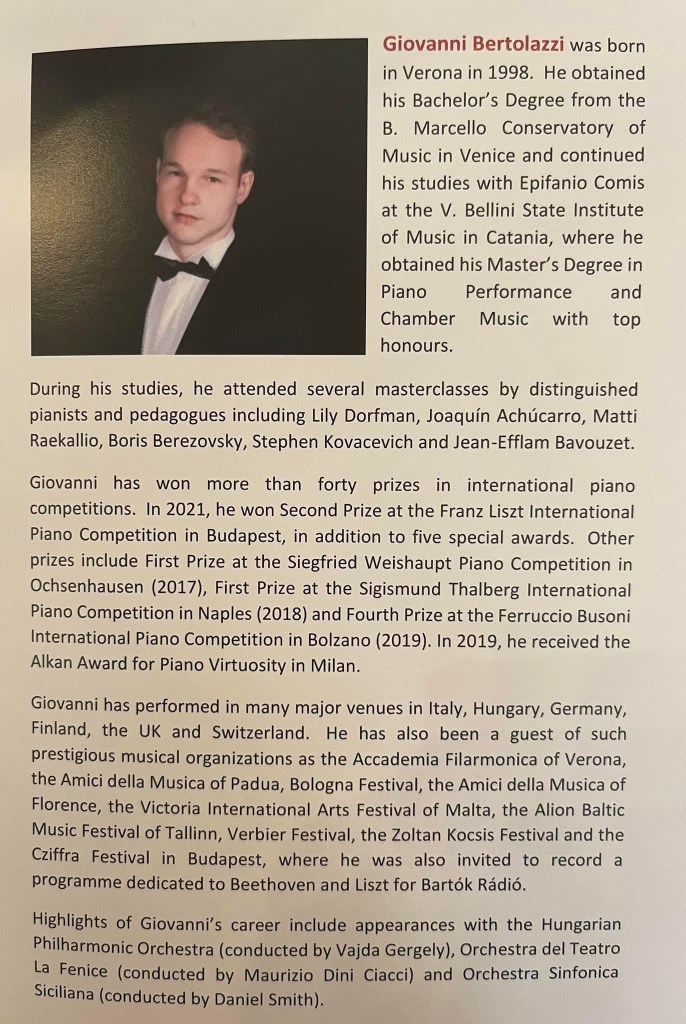
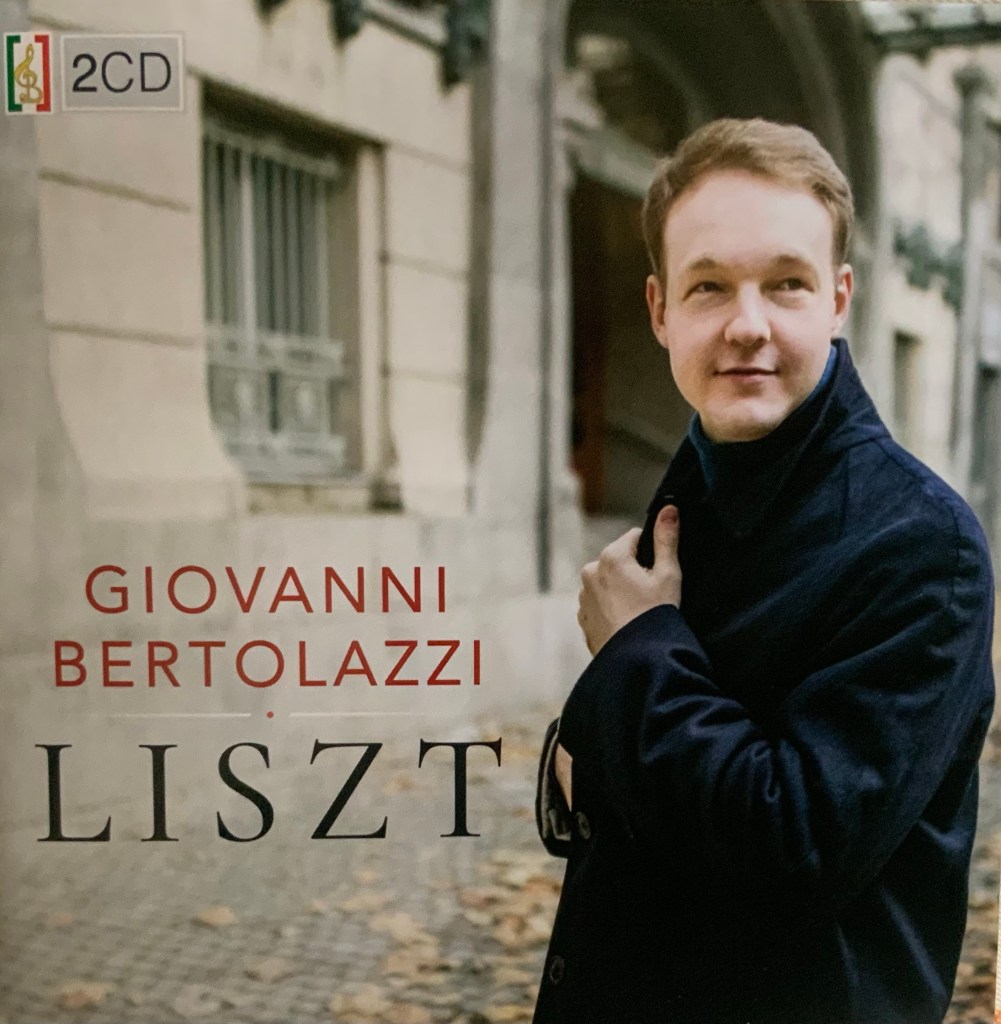
GIOVANNI BERTOLAZZI Giovanni Bertolazzi è il vincitore del 2° Premio e di 5 premi speciali al Concorso Pianistico Internazionale “Franz Liszt” di Budapest (2021). Nato a Verona nel 1998, si è avvicinato al pianoforte da bambino, crescendo in una famiglia particolarmente interessata alla cultura, all’arte ed alla musica. Dopo aver conseguito il diploma accademico di I livello in Pianoforte con 110 e lode presso il Conservatorio “B. Marcello” di Venezia con Massimo Somenzi, decide di seguire gli insegnamenti della scuola pianistica di Epifanio Comis presso l’Istituto Superiore di Studi Musicali “V. Bellini” di Catania, dove ha conseguito il diploma accademico di II livello con 110, lode e menzione speciale. Durante i suoi studi, ha frequentato diverse masterclass di pianoforte tenute da illu- stri pianisti e pedagoghi come Lily Dorfman, Joaquín Achúcarro, Matti Raekallio, Violetta Egorova, Boris Berezovsky, Stephen Kovacevich e Jean-Efflam Bavouzet. Ha vinto più di 40 premi in concorsi pianistici internazionali, tra cui il 1° Premio al Concorso Pianistico “Siegfried Weishaupt” di Ochsenhausen (2017), il 1° Premio al Concorso Pianistico Internazionale “Sigismund Thalberg” di Napoli (2018) e il 4° Premio al Concorso Pianistico Internazionale “Ferruccio Busoni” di Bolzano (2019). Nel giugno 2019 a Milano ha ricevuto il “Premio Alkan per il virtuosismo pianisti- co”. Da gennaio 2020, Giovanni è sostenuto artisticamente dalla Associazione Culturale “Musica con le Ali”. Nel luglio 2022 è stato premiato con il “Tabor Foundation Award”, riconoscimento assegnatogli dalla Verbier Festival Academy in occasione del Verbier Festival (Svizzera). Si è esibito in importanti sedi tra cui Teatro La Fenice di Venezia, Palazzo Pitti di Firenze, Teatro Politeama Garibaldi di Palermo, Teatro Bellini di Catania, Palazzo del Quirinale a Roma, Sala Verdi del Conservatorio di Milano, “F. Liszt” Academy of Music di Budapest, Liszt Ferenc Memorial Museum a Budapest, Landesmusikakademie di Ochsenhausen, Kadrioru Kunstimuuseum di Tallinn, Steinway Hall a Londra. Inoltre è stato ospite di prestigiose organizzazioni musica- li come Serate Musicali di Milano, Amici della Musica di Padova, Bologna Festival, Amici della Musica di Firenze, Verbier Festival, Cziffra Festival di Budapest nel- l’ambito del quale è stato anche invitato a registrare un programma dedicato a Beethoven e Liszt per Bartók Rádió.
Haydn’s six Piano Sonatas Hob. XVI:21-26 were published in 1774 with a dedication to Prince Nicholas Esterházy I. The Sonata in F major Hob. XVI:23 is undoubtedly the most popular of them. The playful opening movement with its two contrasting themes, the wonderfully melancholic Adagio in f minor and the lively Presto finale make this work a prime example of the classical sonata,
Painting of Ludwig Van Beethoven by Joseph Karl Stieler made in the year 1820
Sonata no. 4 in E flat major, opus 7: Beethoven himself named this pianoforte sonata Grande Sonate because it was published by itself in 1797 – unusual for the time. It remains his second-longest sonata, behind the Hammerklavier Sonata op 106. Beethoven’s pupil (and Liszt’s teacher) Carl Czerny wrote: “The epithet appassionata would fit much better to the Sonata in E flat op. 7, which he wrote in a very impassioned mood”. It may be that the reason behind such passionate music was the composer’s attraction for his dedicatee, the then 16-year-old pupil Anna Luise Barbara Countess von Keglevich, and it is possible be that her father had commissioned Beethoven to write the work for her.
Franz Liszt 22 October 1811 Doborjan ,Hungary 31 July 1886 (aged 74) Bayreuth,Germany
Weinen, Klagen, Sorgen, Zagen (Weeping, lamenting, worrying, fearing),BWV 12, is a church cantata composed by J.S.Bach in Weimar for Jubilate ,the third Sunday after Easter with the first performance on 22 April 1714 in the Schlosskirche, the court chapel in Weimar. Variations on “Weinen, Klagen, Sorgen, Zagen,” S. 180 is one of Franz Liszt’s most significant works. Written after Liszt joined the Third Order of Saint Francis and during a time of deep personal tragedy, it reflects both Liszt’s religious journey and his coping with suffering and shows daring explorations of chromaticism that pushed the limits of tonality. It was arranged for organ one year after the piano version was composed and became one of his best-known compositions for organ.The work dates from 1862 and was motivated by the death of Liszt’s elder daughter, Blandine and is dedicated to Anton Rubinstein.This massive set of variations was written by Franz Liszt when two of his three children had died within three years of each other; he had resigned his position of Kapellmeister to the court of Weimar due to continued opposition to his music, and finally his long sought marriage to Princess Caroline Wittgenstein had been thwarted by political intrigue.Giovanni played the heartrending prelude S.179 which precedes the massive set of variations S.180.
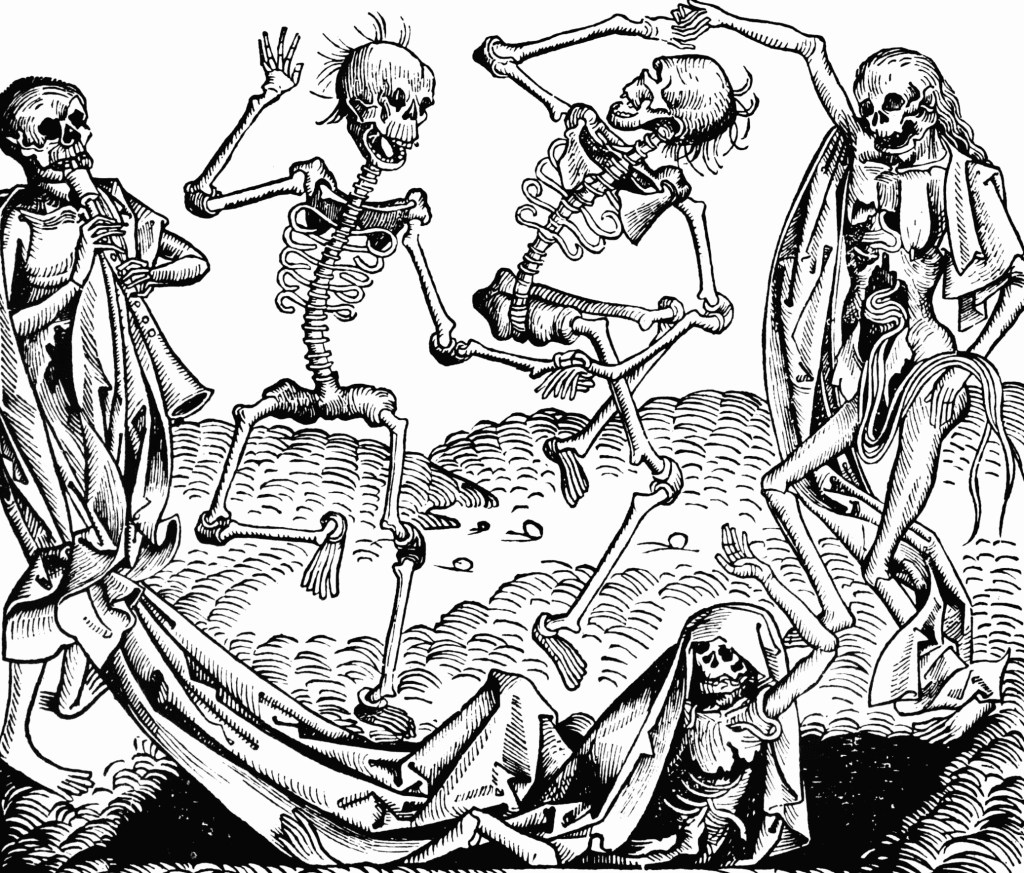
Totentanz (Dance of the Dead): Paraphrase on the ‘Dies irae’, S126 for pianoforte and orchestra is notable for being based on the Gregorian hymn Dies irae as well as for its many stylistic innovations. The piece was completed and published in 1849, and later revised twice (1853-9 and early 1880s. All these versions were also prepared for two pianos). In the late 1860s, Liszt published a version for pianoforte solo, S525. Some of the titles of Liszt’s pieces, such as Totentanz, Funérailles, La lugubre gondola and Pensée des morts show the composer’s obsession with mortality, as well as his profound Christian faith, these things being apparent from Liszt as a teenager right up until his last days – more than 50 years later.
The Dance of Death (Totentanz) from Liber Chronicarum [Nuremberg Chronicle], 1493, attr. to Michael Wolgemut
In the last movement of the Symphonie fantastique by Berlioz the medieval (Gregorian) Dies Irae is quoted in a shockingly modernistic manner. In 1830 Liszt attended the first performance of the symphony and was struck by its powerful originality. Liszt’s Totentanz presents a series of variations on the Dies irae – a theme that his will have known since 1830 at the latest from Berlioz’s Symphonie fantastique. As an early biographer noted, “Every variation discloses some new character―the earnest man, the flighty youth, the scornful doubter, the prayerful monk, the daring soldier, the tender maiden, the playful child.” A second theme, beginning at variation 6 – taken from the Prose des morts in the Catholic breviary – is itself varied before the first theme returns at the end of the work.
Liszt’s hand
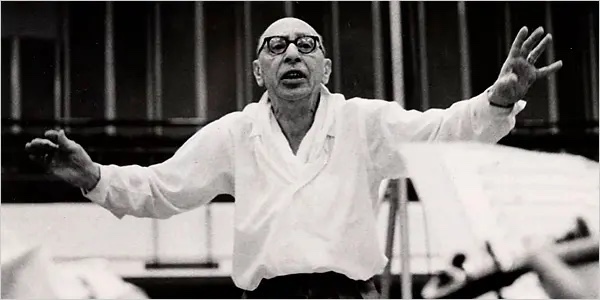
Igor Stravinsky 17 June 188. Saint Petersburg, Russia – 6 April 1971 (aged 88) New York City, US
Stravinsky’s score for The Firebird was written for Sergei Diaghilev’s Ballets Russes dance company, which premiered the work in Paris in 1910. Based on ancient Russian folk tales, it tells the story of the young Prince Ivan’s quest to find a legendary magic bird with fiery multi-coloured plumage. In the course of his adventures, he falls in love with a beautiful princess but has to fight off the evil sorcerer Katschei to eventually marry her. The suite presents the culminating scenes of the ballet in a piano transcription by the Italian pianist and pedagogue Guido Agosti (1901-1989), who studied with Ferruccio Busoni.
The Danse infernale depicts the brutal swarming and capture of Prince Ivan by Katschei’s monstrous underlings until Prince Ivan uses the magic feather given to him by the Firebird to cast a spell on his captors, making them dance until they drop from exhaustion. The Berceuse is a lullaby depicting the eerie scene of the slumbering assailants, leading to the Finale, a wedding celebration for Prince Ivan and his princess bride.Agosti’s piano transcription, completed in 1928, is a daunting technical challenge for the pianist. Most of the piano writing is laid out on on three staves in order to cover the multi-octave range of the keyboard that the pianist must patrol. The piano comes into its own in this transcription as a percussion instrument, to be played with the wild abandon with which a betrayed lover throws her ex-partner’s possessions off the balcony onto the street below.Judging from the shocking 7-octave-wide chord crash that opens the Dance infernale, Agosti captures well the bruising pace of the action, with off-beat rhythmic jabs standing out from a succession of punchy left-hand ostinati constantly nipping at the heels of the melody line. The accelerating pace as the sorcerer’s ghouls are made to dance ever more frantically is a major aerobic test for the pianist.
Relief comes in the Berceuse, which presents its own pianistic challenges, mainly those of finely sifting the overtones of vast chord structures surrounding the lonely tune singing out from the middle of the keyboard.The wedding celebration depicted in the Finale presents Stravinsky’s trademark habit of cycling hypnotically round the pitches enclosed within the interval of a perfect 5th. Just such a melody, swaddled in hushed tremolos, opens this final movement. It is a major challenge for the pianist to imitate the shimmering timbre of the orchestra’s brightest instruments as this theme is given its apotheosis to end the suite in a blaze of sonority that extends across the entire range of the keyboard.
Guido Agosti (11 August 1901 – 2 June 1989) was an Italian pianist and renowned for his yearly summer course in Siena frequented by all the major musicians of the age.It was on the express wish of Alfredo Casella that Agosti took over his class which he did for the next thirty years.Sounds heard in his studio have never been forgotten.
Guido Agosti being thanked by Ileana Ghione after a memorable concert and masterclasses in the theatre my wife and I had created together in Rome.
Agosti was born in Forli 1901. He studied piano with Ferruccio Busoni Bruno Mugellini and Filippo Ivaldiand earning his diploma at age 13. He studied counterpoint under Benvenuti and literature at Bologna University. He commenced his professional career as a pianist in 1921. Although he never entirely abandoned concert-giving, nerves made it difficult for him to appear on stage,and he concentrated on teaching. He taught piano at the Venice Conservatoire and at the Santa Cecilia Academy in Rome.In 1947 he was appointed Professor of piano at the Accademia Chigiana Siena .He also taught at Weimar and the Sibelius Academy in Helsinki.
In the Ghione Theatre in the early 80’s with Ileana Ghione,’Connie’Channon Douglass Marinsanti ,Lydia Agosti ,Cesare Marinsanti,Guido Agosti.A closely knit family .
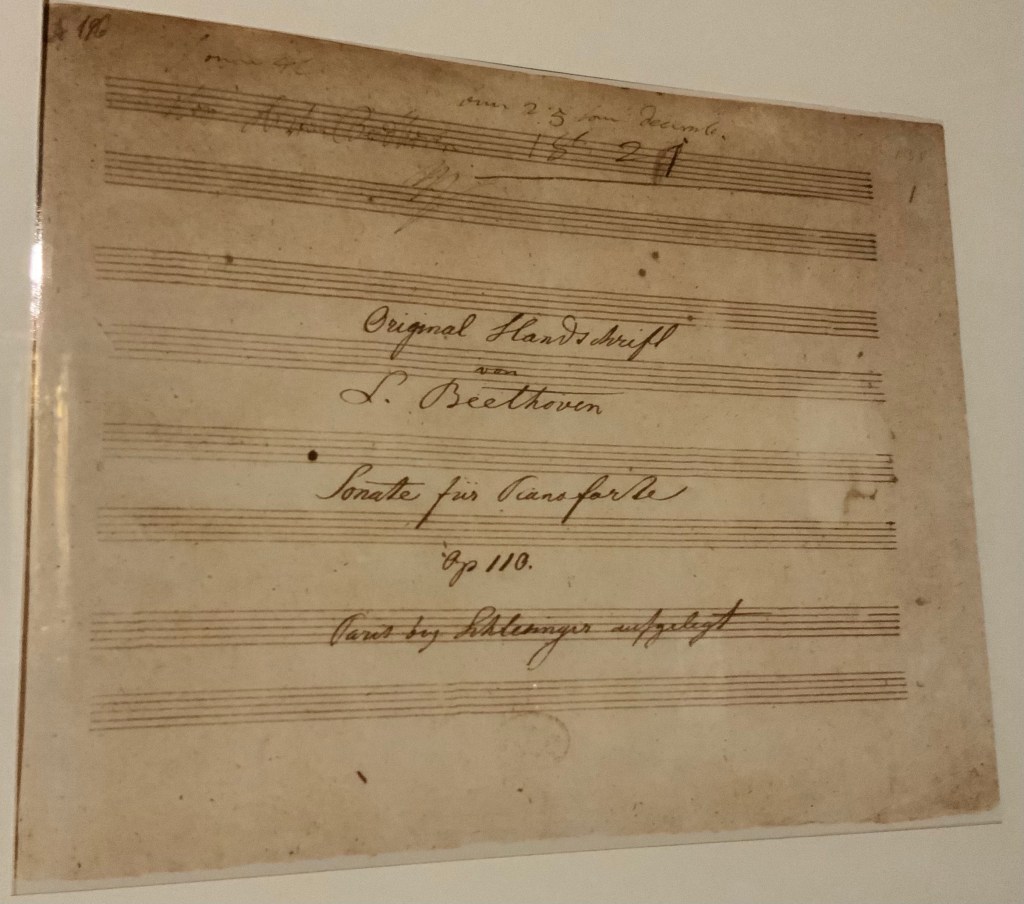
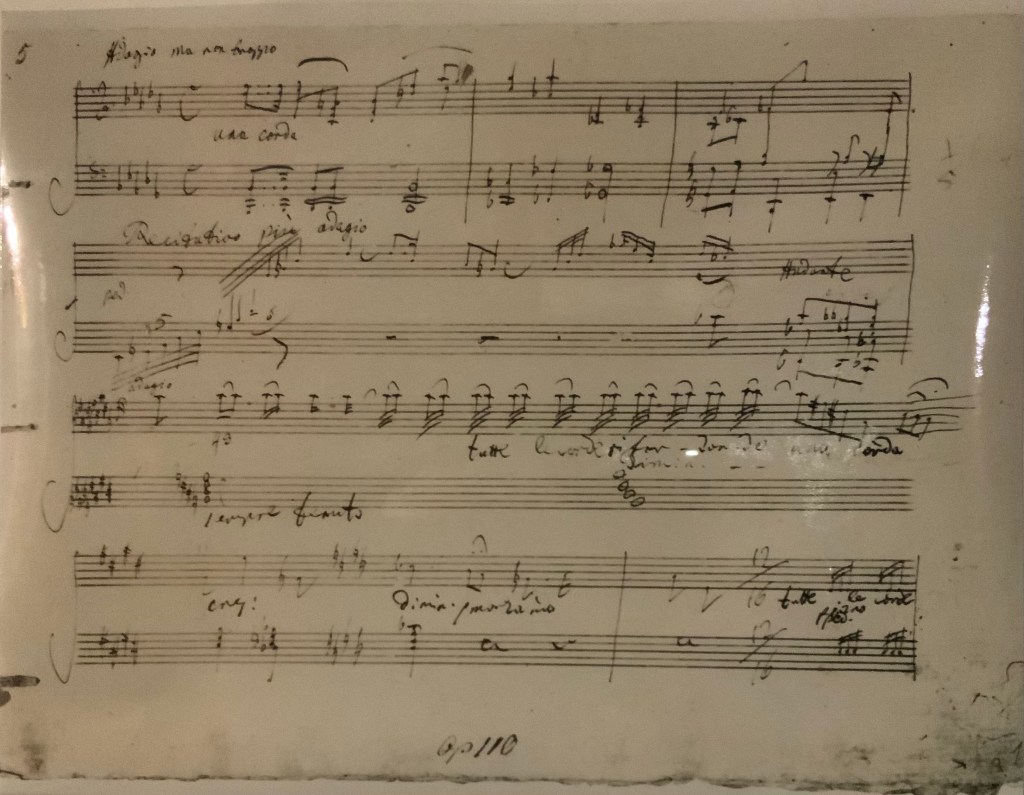
His notable students include Maria Tipo,Yonty Solomon Leslie Howard,Hamish Milne,Martin Jones,Ian Munro,Dag Achat,Raymond Lewenthal,Ursula Oppens,Kun- Woo Paik,Peter Bithell.He made very few recordings; there is a recording of op 110 from the Ghione theatre in Rome together with his recording on his 80th birthday concert in Siena of Debussy preludes .
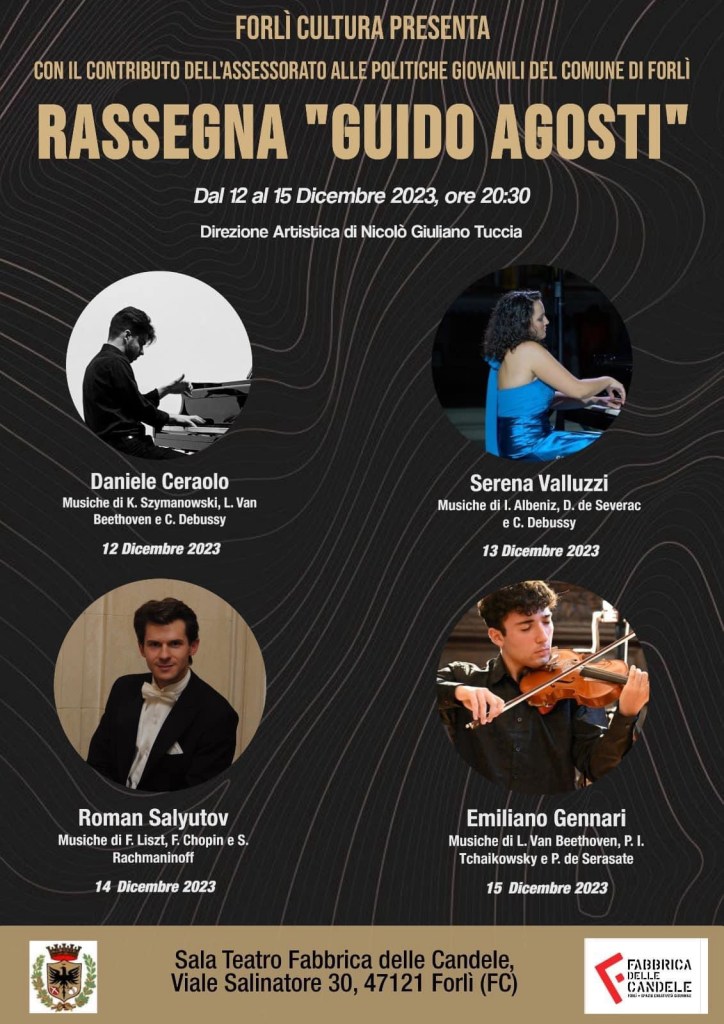
A celebration by a young Forliese pianist that is dedicated to Guido Agosti in the town where he was born and is buried
An admirer,Giselle Pascal,looking at a pianist’s hands.She had heard Cziffra play Totentanz in Paris
Giovanni Bertolazzi con Caterina Isaia Museo Teatrale alla Scala di Milano
Complimenti a Caterina Isaia e Giovanni Bertolazzi che questa sera al Museo Teatrale Alla Scala di Milano, come ieri al Teatro La Fenice di Venezia, hanno emozionato il pubblico in una Sala Esedra sold out! Il Salotto Musicale, realizzato in collaborazione con il Museo Teatrale alla Scala, torna a settembre…grazie a tutti e al prossimo appuntamento con l grande musica dei migliori giovani talenti italiani!
Caterina Isaia and Giovanni Bertolazzi at the Teatro La Fenice Sala Esedra Venice La Scala La Fenice
Zoltán Kocsis, pianist and conductor, born 30 May 1952; died 6 November 2016
Zoltán Kocsis one of three great pianist from the same generation that include Deso Ranki and Andras Schiff .Zoltan Kocis made a great contribution to the culture of his native Hungary as conductor, teacher, composer, record producer and critic.He had a burning desire to pass on the insights and experience of previous generations.
Zoltán Kocsis, died aged 64 following a long illness, was a member of a distinguished troika of Hungarian pianists – with Dezsö Ránki and András Schiff – who emanated from the late 1960s class of Pál Kadosa at the Liszt Academy of Music in Budapest. Schiff, although the youngest of the trio, was the first to embark on an international career, while Kocsis, like Ránki, remained closer to Hungary ,engaging fruitfully with his compatriots, provocatively and often courageously towards officialdom. Kocsis’s contribution to the culture of his native country was all the more valuable in that he was not only a pianist and conductor, but also a teacher, arranger, musicologist, composer, record producer and critic.
Underpinning that versatility was a sense of mission: a burning desire to pass on the insights and experience of previous generations. To that end he would proselytise on behalf of, for example, Rachmaninov’s or Bartók’s performances of their own works, even when this approach ran counter to orthodoxy. Thus his interpretations of Bartok (he recorded the complete piano works, both solo and with orchestra , to high acclaim) exemplified his conviction that. The ‘barbarism’ traditionally projected in the ubiquitous motor rhythms was too extreme, too mechanical. Kocsis preferred a more flexible and sensitive approach, as had been demonstrated, he maintained, by Bartók himself.
Rubato was indeed a prominent feature of all Kocsis’s playing, whether in his ravishing account of Grieg’s Erotik, in the subtle inflections of Debussy’s Clair de Lune, evoking the preternatural stillness of a moonlit night, or in the transcendental figuration of Liszt’s Les Jeux d’Eau à la Villa d’Este .The other predominant characteristic of his performances was the pellucid tone, consistently sensuous even in passages of heightened emotion and enhanced by the singing quality he unfailingly brought to melodic lines.
As a conductor, Kocsis achieved prominence as co-founder with Iván Fischer of the Budapest Festival Orchestra in 1983. Remaining as an artistic director until 1997, he helped establish the orchestra as one of the leading world ensembles, with appearances at the Amsterdam Concertgebouw, Vienna Musikverein, BBC Proms and Salzburg and Lucerne festivals. In 1997 he became music director of the Hungarian national Philharmonic Orchestra , nailing his colours to the mast with a performance of Schoenberg’s massive Gurrelieder in his first season. Inventive programming and contemporary repertoire remained features of his orchestral and solo piano programmes: among the composers who wrote works for him was György Kurtág, another of his teachers at the Liszt academy.
Born in Budapest, son of Mária (nee Mátyás) and Ottó Kocsis, Zoltán began his piano studies at the age of five and continued them at the Béla Bartók Conservatory, where he also learned composition. Moving on to the Liszt Academy in 1968, he was still a student when he won the Hungarian Radio Beethoven Competition in 1970. The following year he toured the US, and in 1972 appeared in London and at the Salzburg and Holland festivals. Rapidly establishing a career as an international pianist, he also achieved celebrity status in Hungary, as conductor and teacher as well as pianist. His academic pursuits continued to inform his activities on all fronts: meticulous in his study of texts and sources, he brought a scholarly, inquiring mind to the art of performance. He was appointed to teach at the Liszt academy in 1976.
Dividing his time between playing and conducting, he appeared with leading orchestras such as the Berlin Philharmonic and Royal Concertgebouw, as well as the Hungarian National Philharmonic. He also toured extensively in Europe,America and the Far East.
With his cherubic features, shock of wavy hair and penetrating, often idiosyncratic, readings, he had a charismatic stage presence, and was especially renowned for his exceptional pianistic talents, on account of a series of prizewinning recordings. In addition to the complete Bartók series, he made some acclaimed recordings of Debussy, Rachmaninov, Liszt and Dohnányi. Drawing on his talents as composer and arranger, he made his own version of Rachmaninov’s Vocalise, concluding with imaginatively virtuosic figuration.
His transcription of the prelude to Wagner’s Tristan und Isolde , which at the climax spills on to multiple staves, deployed virtuosity to project the heights of passion. It is possible to feel that his account of the Liebestod from the same work (this time using Liszt’s version) emphasised passion at the cost of Isolde’s transfiguration; a similar criticism may be levelled at his forceful rather than enraptured Prelude to Lohengrin. Elsewhere, however, his undoubted virtuosity was harnessed to a sensitivity and poetic imagination that made his artistry compelling.
In 1986 he married the pianist Adrienne Hauser . After their divorce, in 1997 he married the pianist Erika Tóth. She survives him, as do their son, Krisztian, also a pianist, and daughter, Viktoria, and his son, Mark, and daughter, Rita, from his first marriage.
I concerti di Zoltán Kocsis per gli Amici della Musica di Padova
28 aprile 1983 B. Bartók: C. Debussy: R. Wagner: For children (I fascicolo) Arabesque n. 1 – Tarantelle Styrienne (Danse) – Pour le piano Berceuse hé roique – Images (oublié es) Parsifal: Scena delle fanciulle-fiore e Finale (trascr. Z. Kocsis)
19 novembre 1992 L.v. Beethoven: B. Bartók: F. Chopin: F. Chopin: F. Liszt: Sonata op. 2 n. 1 Sette Bagatelle op. 6: QuattroMazurche(op.7n.2,op.17n.4,op.24n.1,op.67n.2) Polonaise-Fantaisie op. 61 Da Anné es de pè lerinage, Troisiè me Anné e, Italie: IV: Les jeux d’eau à la Villa d’Este – VI: Sunt lacrymae rerum Csárdás macabre
27 gennaio 1998 C. Debussy: W.A. Mozart: B. Bartók: Douze Préludes Libro II Fantasia in do min K 475 Dieci Pezzi da Mikrokosmos Sonata 1926
This was the beginning of a very exciting and successful year in which we had a series of concerts in Hazlemere for Stephen Dennison with: Adam Heron ,Thomas Kelly and Milda Daunoraite
The ever generous Stephen had also invited two of our star pianists to perform in his series at the Cranleigh Arts Centre : Victor Maslov and Damir Durmanovic together with our illustrious Artistic Director Leslie Howard who had celebrated his 75th birthday at the Wigmore Hall whilst fighting health problems that have thankfully been resolved.
Leslie Howard at the end of his superbly heroic 75th birthday concert at the Wigmore Hall
An important new series at the National Liberal Club was made possible with the generosity of the Robert Turnbull Trust administered by Rupert Christiansen .The first concert was with Giovanni Bertolazzi on the 5th June – the first of six recitals in the sumptuous surrounds of the Liberal Club thanks also to Yisha Xue’s Asia Circle.
Giovanni Bertolazzi trying the piano with the piano tuner present
The National Liberal Club Arseni Mun winner of the Busoni 2023
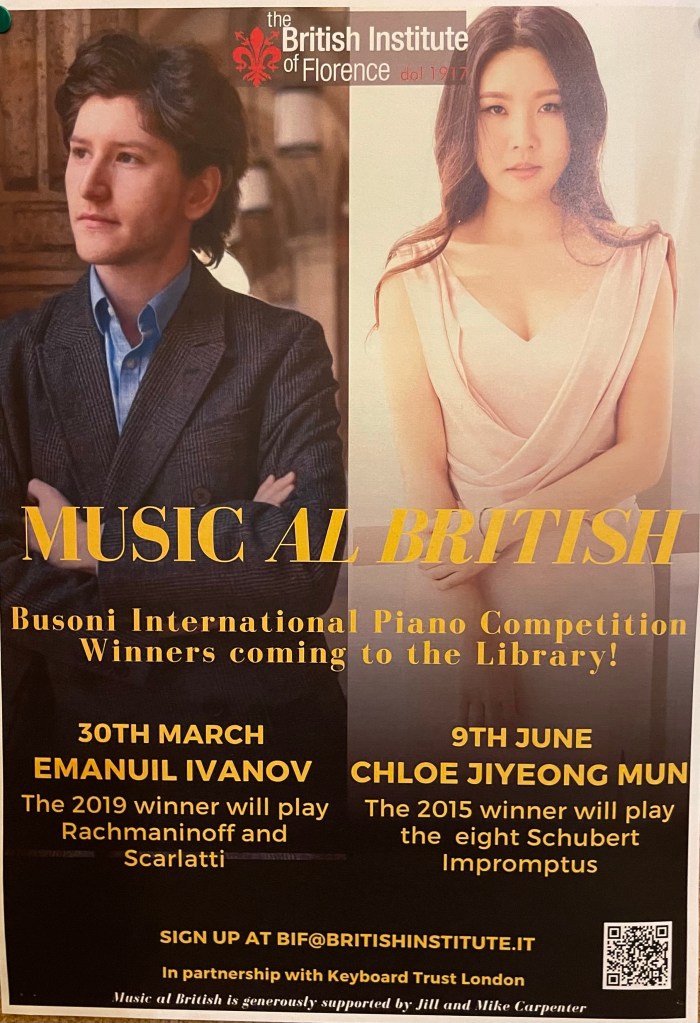
A series of concerts at the Harold Acton Library in Florence included the winners of the Busoni Competition who are awarded by the Trust a career e development prize including a London concert – this year’s winner,Arseni Mun,will play at Steinway Hall on the 26th June
In the meantime Ivan Krpan,Emanuil Ivanov,Chloe Jiyeong Mun and Jaehong Park played in this KT Festival in Florence which was concluded with Minkyu Kim and will include Steinway Hall in Milan thanks to our dearest friend Maura Romano.
Concerts in Cyprus for the Pharos Arts Centre with Victor Maslov and a triumph for Damir Durmanovic with star violinist Guido Sant’Anna ……..Ivan Krpan will close the year with a concert on the 14th December.
Thanks to the generosity of Dr Hugh Mather and his remarkable team at St Mary’s. Perivale we had a true marathon with ten pianists playing in two days :
This was intended to give a platform to the artists that we had selected to audition for us augmenting the six dates that Steinway Hall very generously give us every year
It was a wonderful surprise to learn that one of our latest recipients of the Weir Trust, of which we are execeteurs ,won the Gold Medal at the coveted Clara Haskil International Piano Competition .Magdalene Ho ,19,will be playing for us in February in Florence and Milan .
Two summer concerts at St Martin in the Fields,thanks to Richard Thomas,with a church full to the rafters for two popular concerts by two of our most charismatic pianists.
Tyler Hay also astonished us all with his mastery of an unknown Brazilian Composer whose works he had learnt especially to play in our collaboration with the Brazilian Embassy in the beautiful ex Cunard Hall in Trafalgar Square
Elena Vorotko presenting the charismatic Tyler Hay at the Sala Brazil ex Cunard
There were concerts at the Erin Arts Centre on the Isle of Man with George Todica and Minkyu Kim playing and introducing their programmes to very enthusiastic audiences
St Jude’s Prom is an annual engagement and this year Victor Maslov took them by storm.
Tomoki Sakata was chosen to play at the Michelangeli Festival in Cles the town where Noretta has a family home as did Michelangeli.
A harpsichord recital in the Edinburgh Fringe Festival with Dominika Maszczynska
There were tours of Germany with Can Arisoy and Milda Daunoraite organised by Dr Moritz von Bredow
Two concerts thanks to Simone Tavoni at the Festival ‘Sous les Arbres’ in France Lunel – Viel with Ilaria Cavalleri and Thomas Kelly
Simone had played in Viterbo and Roma 3 University and also a concert in the Natural History Museum in Livorno .
And so to our last concerts in Cyprus at Pharos Arts Centre with Ivan Krpan and Rome with Evelyne Berezovsky at Roma 3 .Two stars shining brightly to close the year for us .
Evelyne Beresovsky
Nikita Lukinov will open the new year with our Italian tour of Venice/Padua/Abano and Vicenza – starting on the 13 January in Venice and closing in Vicenza on the 16th .
The new Steinway Flagship in Milan
This is just a personal view and there are many concerts that time and space could not accomodate and I hope to expand on this reduced chronicle in the New Year.
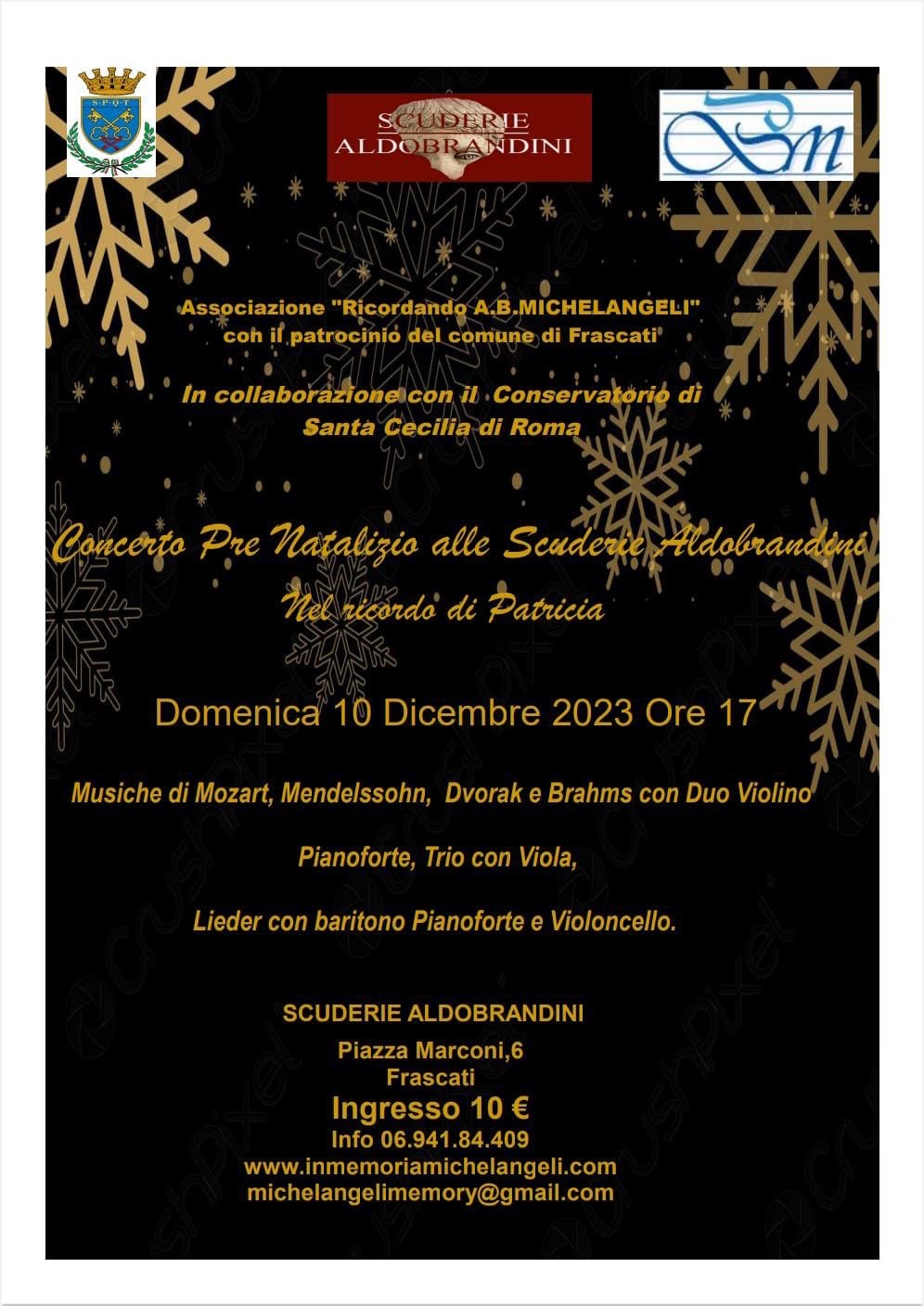
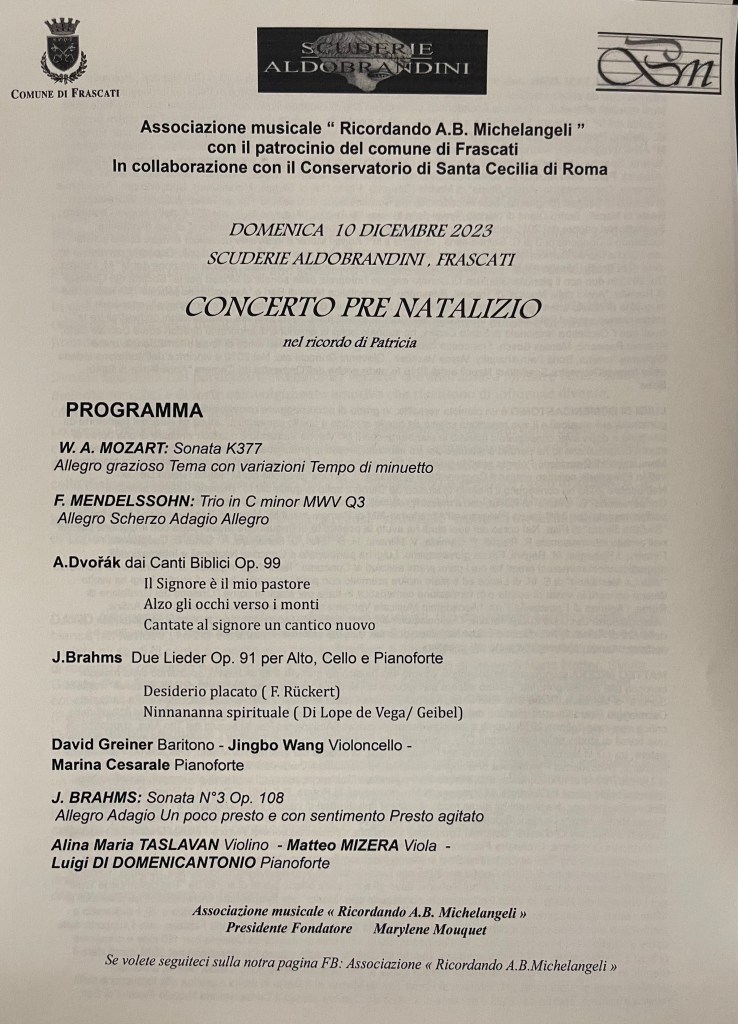
Another beautiful tribute from a mother to her daughter in Villa Aldobrandini in Frascati. The distinguished French pianist Marylene Mouquet dedicates a special Christmas concert to her daughter Patrizia every year after her tragic death in a road accident exactly nineteen years ago on this day the 10th December.
This year a chamber music concert with works for violin and piano by Mozart and Brahms .A trio by Mendelssohn with viola instead of cello and lieder by Dvorak and Brahms (with piano and cello).
David Greiner baritone with Marina Cesarale piano
David Greiner was the splendid baritone of great presence and very clear diction.He was helped in the Canti Biblici op 99 by the very sensitive playing of Marina Cesarale.
With Jingbo Wang cello obligato
For the Brahms op 91 Jingbo Wang added the beauty of his cello to the lusicious beauty of the voice.
Alina Maria Taslavan ,violin Luigi di Domenicantonio ,pianoforte
This lead so naturally into the last of Brahms violin Sonatas n.3 in Dminor op 108 where Alina Maria Taslavan and Luigi Di Domenicantonio found their voice together in a passionate and moving account of this sonata.Playing with the lid full open of the Steinway – that I know very well from my concerts here with the much missed Lya De Barberiis.-he managed to create an almost orchestral sound without ever overpowering the ravishing beauty of Alina’s sumptuous playing.They had opened with the Sonata K.377 where the balance was very much weighed in the favour of the piano and rather overpowered the refine subtle tones that Alina brought to their duo.
With Matteo Mizera ,viola
A very interesting trio by Mendelssohn with a viola in place of the usual cello for a piano trio.This obviously early work was played with great style with all three musician blending into one magnificent whole.Problems of balance with the piano vanished as these three young players allowed the music to pour from their souls ,united with vitality ,passion and technical brilliance.
Marylene Mouquet with the artists for her Associazione Musicale ‘Ricordando A.B.Michelangeli ‘
A moment of beauty and reflection from six fine artists whilst the world outside waits to celebrate Christmas.
Frascati Cathedral Frascati in Festive mood.Great presence of David Greiner in Dvorak and Brahms Marylene presenting the artists The splendid duo Taslavan – Di Domenicantonio
Sunday April 28th the return of 19 year old piano genius Shunta Morimoto.
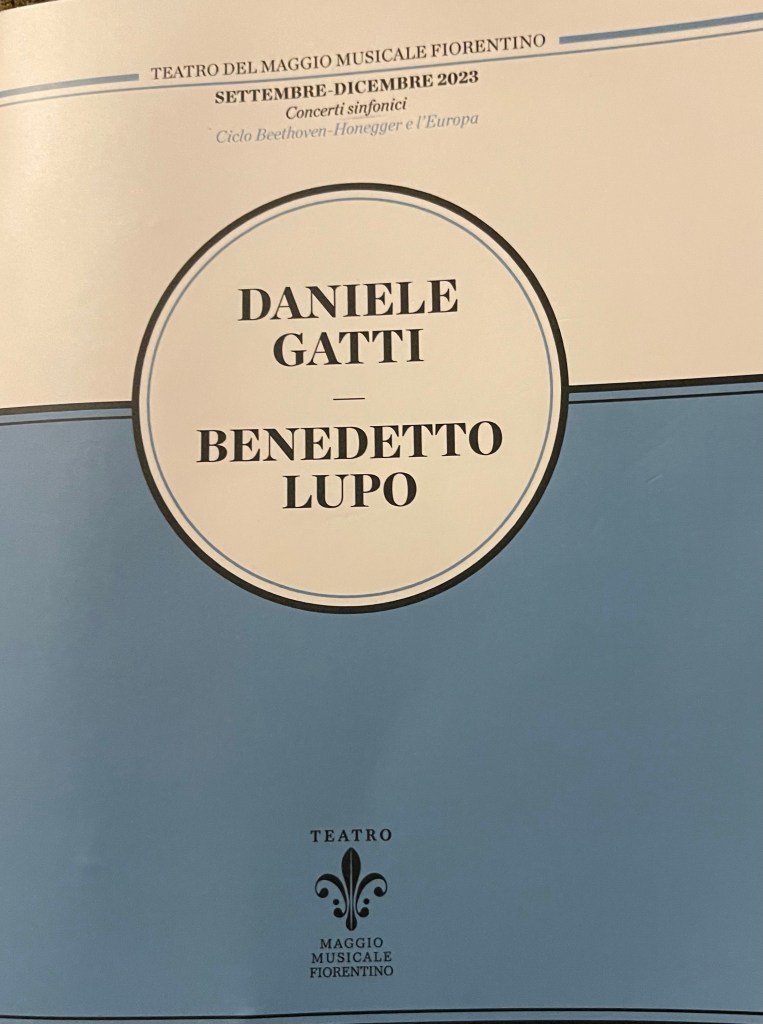
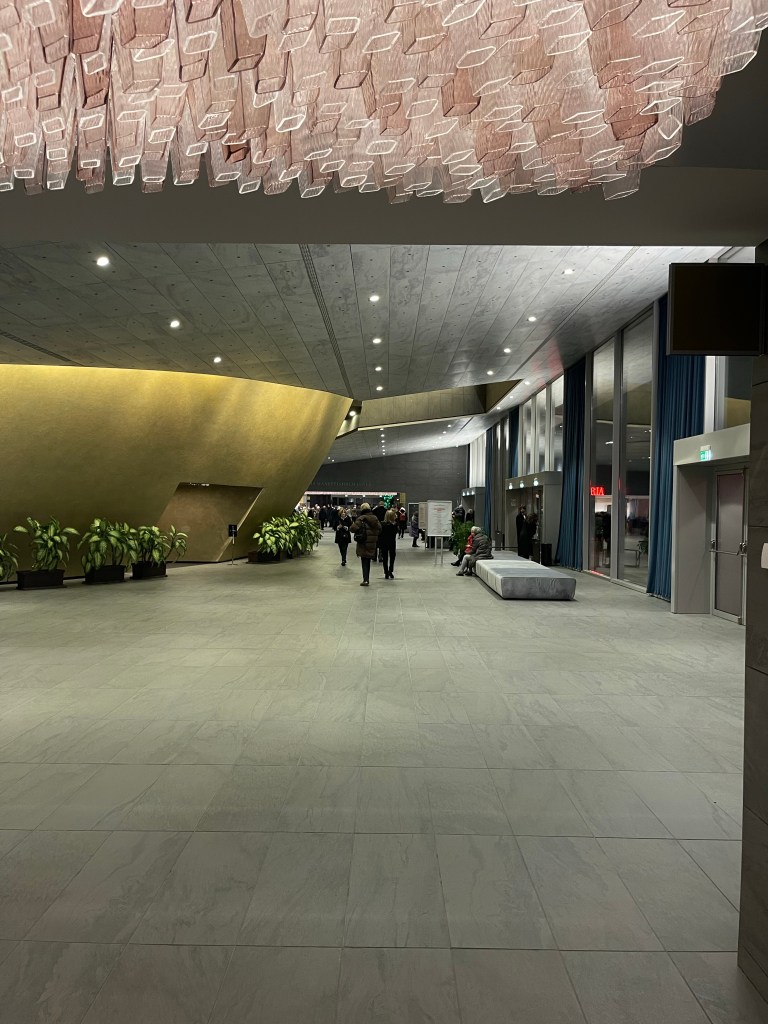
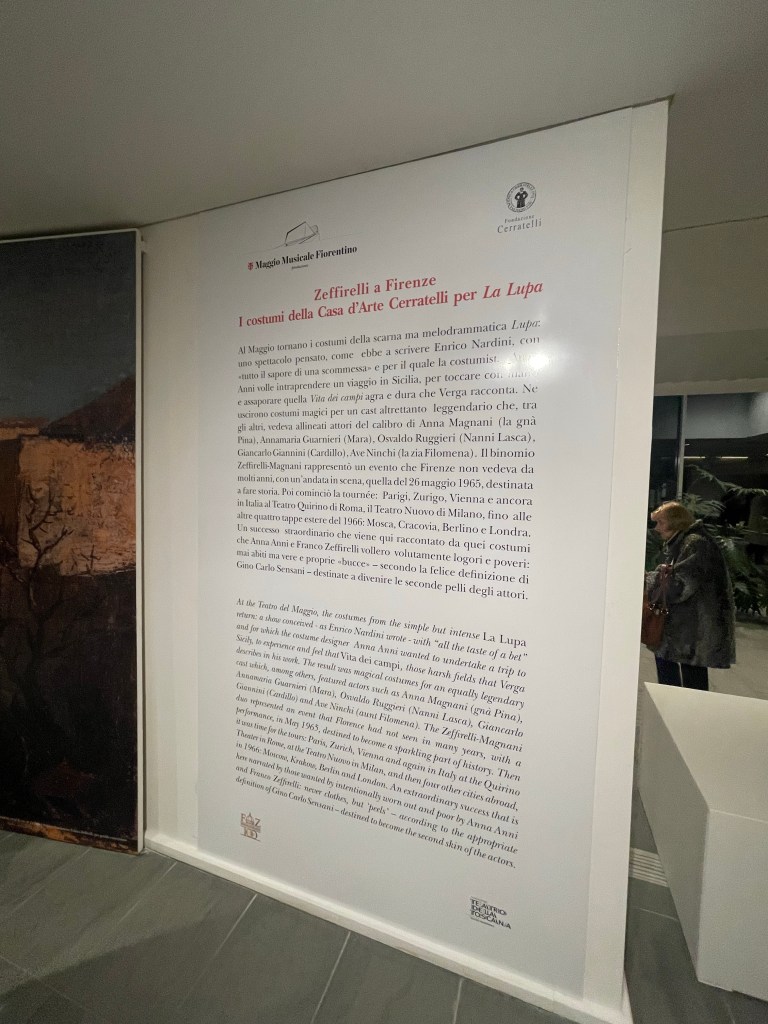
The Teatro del Maggio Musicale Fiorentino is a multifunctional complex built to replace the old Teatro Comunale and was designed by architect Paolo Desideri .It is the main venue of the Maggio Musicale Fiorentino , and hosts various types of musical and cultural events.It is located near the Parco delle Cascine and the Firenze Porta al Prato station and is equipped with a hall with 1890 seats, intended for the opera theatre, an auditorium, named after the maestro Zubin Mehta , with 1200 seats, for symphony concerts and concert music. room, and an outdoor auditorium with 2000 seats work was undertaken from 2009-2021and opened on December 21, 2011
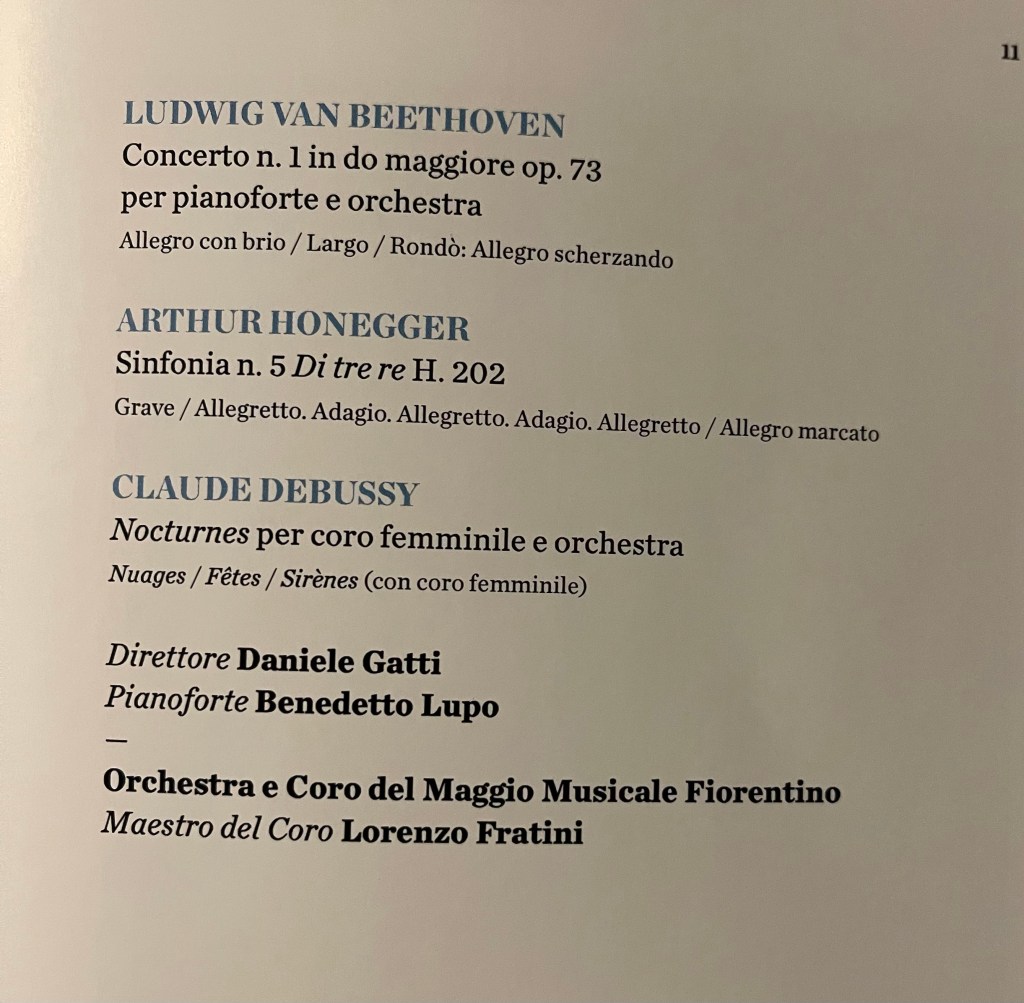
We came to hear Beethoven with Lupo and Gatti but it was Brahms that stole our hearts. After a performance of Beethoven’s first piano concerto of dynamic brilliance and refined beauty Benedetto by great insistence was enticed into playing an encore. It was as though the heavens had opened as he caressed the keys with an aristocratic sense of style and a kaleidoscopic range of sounds in the Brahms Intermezzo in A op 118 n.2.
The whispered opening almost unnoticeably grew in sound and weight to a sumptuously rich climax.The duet between voices in the central episode was of orchestral proportions as they wove together with a golden glow of warmth that seemed to entice us in to the sublime world that was evolving from Benedetto’s hands.The gradual disintegration of the ending was played with barely audible sounds that seemed to shimmer and gleam with poignant poetry in this visionary landscape. A Beethoven where Benedetto had defined the opening with a driving rhythmic insistence that contrasted so well with the whispered legato of the central episode. The Largo was played with such intimacy but at the same time the notes were projected into the upper reaches of the Zubin Mehta hall. Daniele Gatti too was a sensitive partner who was able to create such an initimate atmosphere from the superb young players he had before him.
The rondo just shot from Benedetto’s hands where his artistry in knowing how to shape and sculpture the sounds brought this movement so vividly to life. Mention should also be made of the delicacy of his playing in the ‘little’ cadenza of the first movement but even more beautiful were the final notes from the piano that he allowed to glisten as they flowed like jewels from his fingers before the final explosion from the orchestra brought to a conclusion a remarkably refined performance of what was infact Beethoven’s second Concerto!
The sumptuous foyer of the new Teatro del Maggio Musicale Fiorentino The Sala Zubin Mehta The new hall near to the old Teatro Comunale that I knew so well from my student days and that has now been demolished to make way for the new
Considered by international critics as one of the most interesting and complete talents of his generation, Benedetto Lupo made his debut at thirteen years of age with Beethoven’s First Concerto; he immediately earned distinctions in numerous international competitions, including the Cortot and the Ciudad de Jaén competitions in Europe, and the Robert Casadesus, Gina Bachauer, and Van Cliburn competitions in the United States. In 1992, as his intense performance activity brought him to the Americas, Japan, and Europe, he won the Terence Judd Award in London.
Benedetto Lupo has played on numerous occasions at New York’s Lincoln Center, Salle Pleyel in Paris, Wigmore Hall in London, Berlin’s Philharmonie, Palais des Beaux Arts in Brussels, the Tanglewood Festival, the Lanaudière Festival, the Oxford Festival, the International Festival in Istanbul, the Enescu Festival in Bucharest, and at Copenhagen’s Tivoli Festival. He has been guest of the leading Italian theatres –Teatro alla Scala in Milan, San Carlo in Naples, La Fenice in Venice, the Teatro Comunale theatres of Bologna and Florence, Turin’s Teatro Regio, Teatro Verdi in Trieste, Teatro Carlo Felice in Genoa, Teatro Filarmonico in Verona, Teatro Massimo in Palermo, Teatro Lirico in Cagliari, and Teatro Petruzzelli in Bari – and of the major national concert institutions, including the Orchestra dell’Accademia di S. Cecilia in Rome, the RAI National Symphony Orchestra, the Orchestra Verdi in Milan, I Pomeriggi Musicali, the Orchestra Regionale Toscana, Unione Musicale in Turin, La Società del Quartetto in Milan, the Accademia Filarmonica Romana, Amici della Musica in Florence, Festival Pianistico Internazionale in Bergamo and Brescia, and the “Micat in Vertice” season of the Accademia Musicale Chigiana.
Of the world-famous orchestras he has played with, in North and South America, mention may be made of the Philadelphia Orchestra, the Chicago Symphony, the Boston Symphony, the Los Angeles Philharmonic, the Baltimore Symphony, the Orchestre Symphonique de Montréal, the New World Symphony, the Saint Louis Symphony, the Seattle Symphony, the Vancouver Symphony, Les Violons du Roy, and the Orquestra Sinfonica Brasileira; in Europe, he has performed with the London Philharmonic, Gewandhaus Orchester in Leipzig, the Rotterdam Philharmonic, the Hallé Orchestra, the Deutsches Symphonie-Orchester, the Stuttgarter Philharmoniker, the Orquesta Nacional de España, the Orchestre Philharmonique de Monte Carlo, the Orchestre Philharmonique de Liège, the Bergen Philharmonic, the Slovak Philharmonic, the Orchestre du Capitole de Toulouse, and the Bruckner Orchester Linz. The conductors he has worked with most frequently include Yves Abel, John Axelrod, Piero Bellugi, Umberto Benedetti Michelangeli, Fabio Biondi, Daniele Callegari, Christoph Campestrini, Aldo Ceccato, Nicholas Collon, Yoram David, Vladimir Delman, Gabriel Feltz, Gabriele Ferro, Ed Gardner, Andrew Grams, Giancarlo Guerrero, Lü Jia, Vladimir Jurowski, Jean-Jacques Kantorow, Stanislav Kochanovsky, Pavel Kogan, Bernard Labadie, Louis Langrée, Marko Letonja, Alain Lombard, Nicholas McGegan, Fabio Mechetti, Juanjo Mena, Kent Nagano, Daniel Oren, George Pehlivanian, Zoltan Pesko, Michel Plasson, Josep Pons, Carlos Miguel Prieto, Lawrence Renes, Corrado Rovaris, Joseph Silverstein, Stanislaw Skrowaczewski, Michael Stern, Gregory Vajda, Alexander Vedernikov, Antoni Wit, Hugh Wolff, Kazuki Yamada, and Xian Zhang.
In addition to his recordings for numerous radio and television broadcasters in Europe and the United States, Lupo has recorded for TELDEC, BMG, VAI, NUOVA ERA, and the complete works for piano and orchestra by Schumann for ARTS. In 2005, a new recording of Nino Rota’s Concerto Soirée was released for Harmonia Mundi, winning no fewer than five international prizes, including the “Diapason d’Or.”
A pianist with an enormous repertoire, Benedetto Lupo can also boast a major chamber and teaching career; he holds master classes at major international institutions and is often invited to the juries of prestigious international piano competitions. Since the 2013/2014 academic year, he has been professor of piano in the master courses at the Accademia Nazionale di Santa Cecilia, where, in December 2015 he was named “Active Academician.”
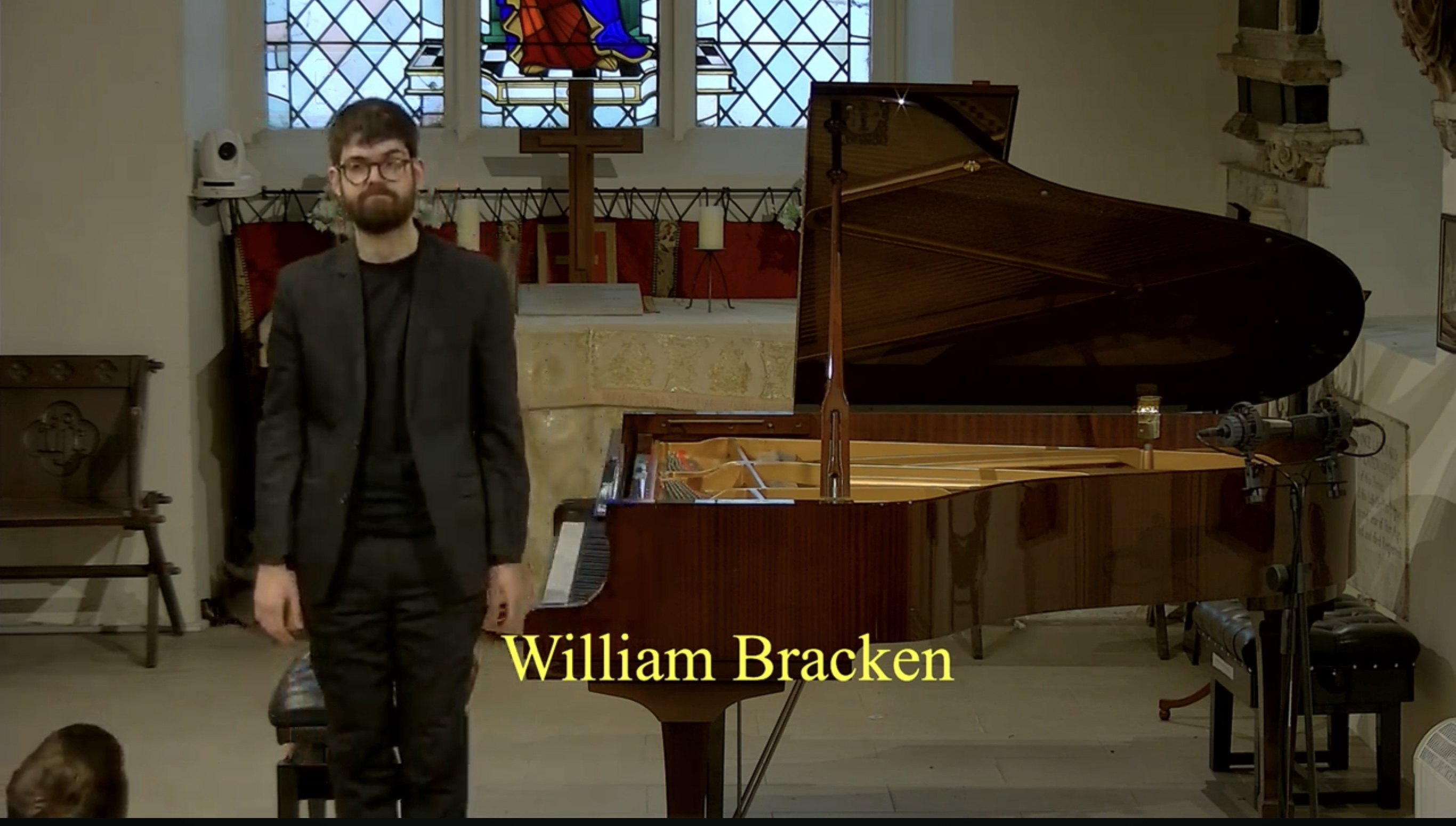
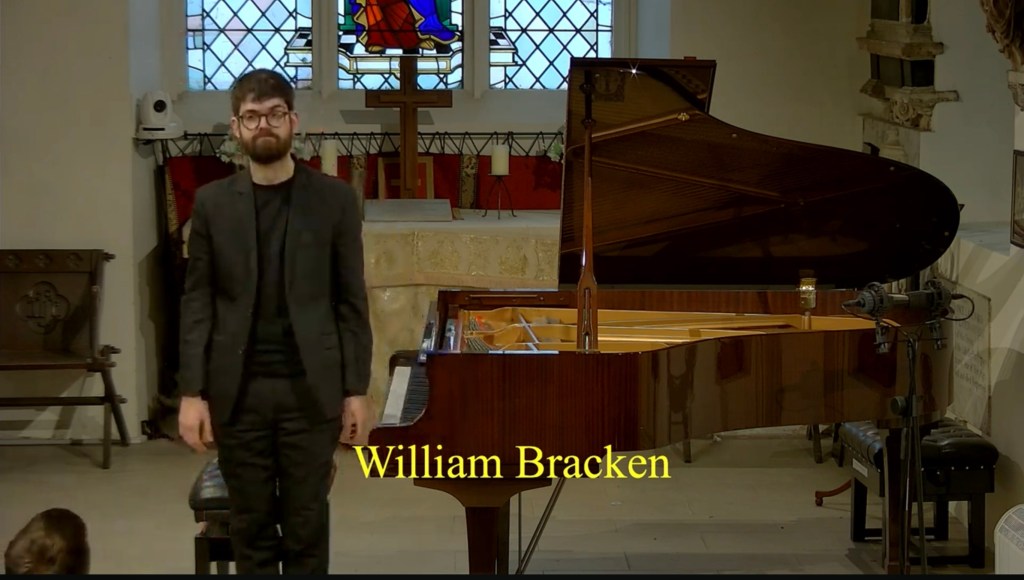
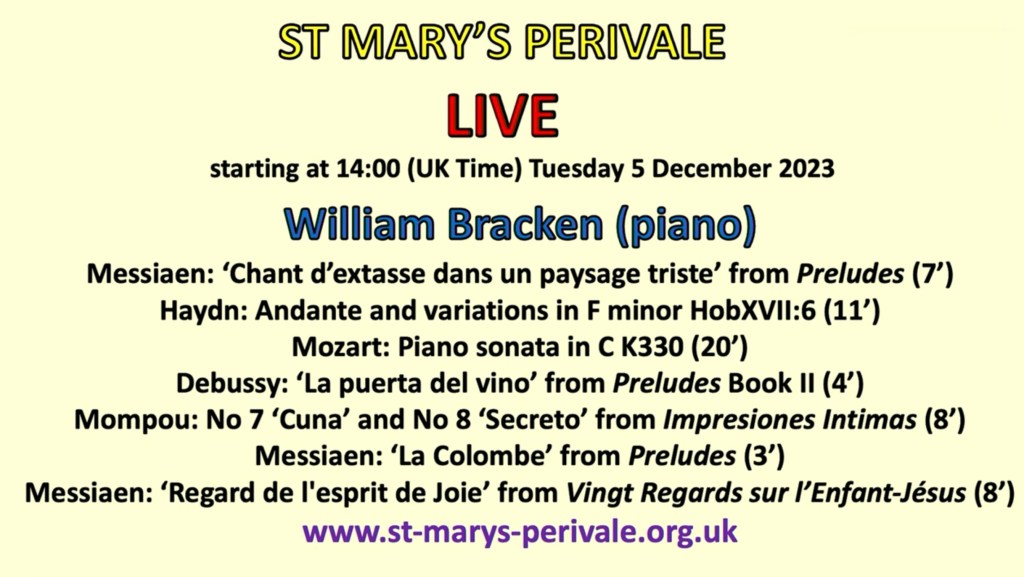
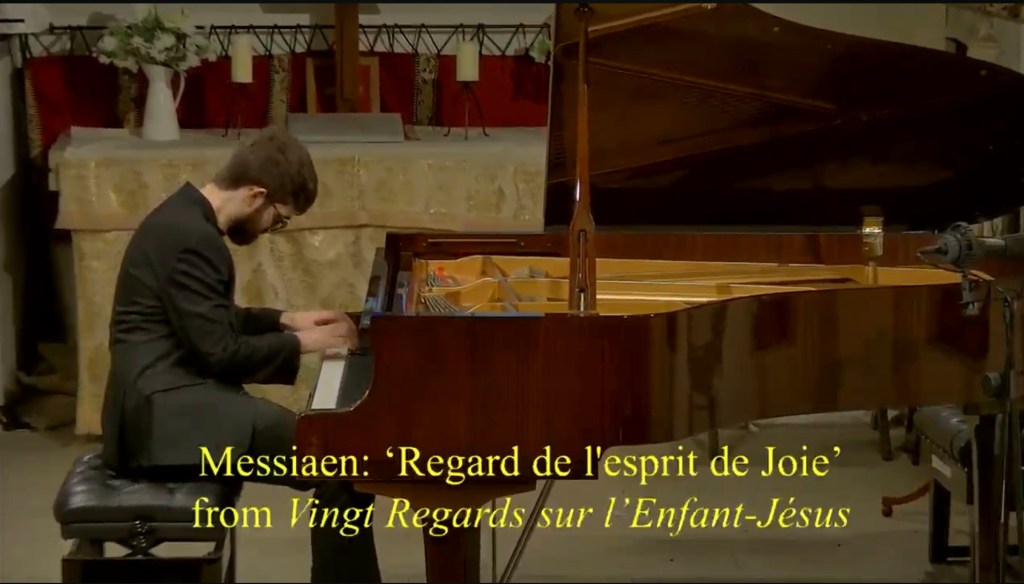
Some more remarkable playing from this young musician who I had heard in the early stages of his student career at the Guildhall.It was a Beethoven competition streamed during the pandemic where he played very musically and diligently and did in fact win the competition.I would never have imagined though that he would mature ,even under such superb musical guidance from Martin Roscoe and Ronan o ‘Hora,into the artist that we have now witnessed twice at St Mary’s within the last ten days.His performance for the Liszt Society as winner of their previous competition revealed an artist who had grown in stature since the previous years victory.Now again after only ten days I am astonished by his even more mature mastery of style and pianistic colour allied to a security both technical and musical.Not only giving note perfect ( in every sense) performances but being able to share his obvious love and passion for music with such eloquent and intelligent words.The exquisite sounds of chiselled beauty are those that only a true believer like Messiaen would dare write with such fervent devotion.Deep mediative sounds combined with a very devout atmosphere where layers of chiselled sounds would be thrown on top with heart rending meaning and untamed devotion.The performances of two of the Preludes showed a kaleidoscopic sense of colour allied to a musicianship that could guide us so directly to the very core of the creation where William had told us that so few notes could mean so much.The number of notes was to increase quite considerably as Messiaen matured and his devotion became ever more intense.The ‘Regard de l’Esprit de Joie’ is a well known tour de force for any pianist.It was Jean- Rodolphe Kars who brought it to our attention in the rounds of the first Leeds Competition over 50 years ago.Substituting for Michelangeli at the last minute too at the Royal Festival Hall we had a chance again to hear this clean clear brilliance that allowed the music of Messiaen to hypnotise us with his religious and his ornithologic obsession.Kars became a Trappist Monk as he obviously felt the music in the same way as Messiaen!William played it with the same clarity and ‘Aimard’ type brilliance and precision that was quite remarkable for a live performance from memory .Anyone who has seen the score of Messiaen’s works will appreciate what a tour de force that truly is.To all this was added the ‘Spanish’ part of the recital with insinuatingly tantalising performances of Debussy in Spanish mood( how right William was to note that it takes French composers to write convincing Spanish music!) .A Mompou that can be better appreciated in this context and in smaller quantities than we are being exposed to these days.
There was a simple beauty and a gracious sense of style that he showed in the Haydn Variations that he brought vividly to life with each variation given its own character but within a framework that was masterly held together.Even the slight addition of ornaments was done with subtle good taste that just added to the refined beauty of these variations.Mozart too and even the appoggiatura played as acciaccatura in the last movement was the choice of a thinking musician who could bring Mozart’s characters centre stage with such evident bucolic enjoyment and joie de vivre.The Andante too was played with profound simplicity and a wondrous range of sounds but always with the sense of style and graciousness that were of their time.No encore was possible after the tumultuous ending created by his Messiaen but it would not have surprised me if he,like Serkin,would have sat down and played the Aria from the Goldberg Variations ………followed by their thirty or so off spring!Chapeau indeed dear William onwards and upwards!
Messiaen: ‘La Colombe’ from Preludes
William Bracken is in high demand as a recitalist, concerto soloist, chamber musician and teacher. The Wirral-born pianist has won numerous awards including 1st prize at the 2022 Liszt Society International Piano Competition and 1st prize, press prize and audience prize at the 2023 Euregio Piano Award international piano competition. He is currently continuing studies at the Guildhall School of Music and Drama in London where he also holds a position as assistant professor of classical improvisation. Concert highlights include several concerto performances at The Barbican, Liverpool Philharmonic Hall, St. John’s Smith Square and recitals at Chipping Campden Festival, LSO St. Luke’s and most recently Wigmore Hall, where he was praised by the Telegraph for his “courage and stamina and musicality in abundance” and “an ability to hold an audience in the palm of his hand”.
William has worked with many of today’s leading musicians including Stephen Hough, Richard Goode, Simon Trpceski and Paul Lewis. In 2022 William was made a scholar of the Imogen Cooper music trust which involved participating in a week of intensive study in the south of France with renowned pianist Dame Imogen Cooper – that summer he also won a full scholarship to attend the Aspen Music Festival and Summer School in Colorado U.S.A, studying with Hung-Kuan Chen and Fabio Bidini. William performs a large and diverse range of repertoire and also has a keen interest in jazz and improvisational elements of performing classical music. He is supported in his postgraduate studies with profs. Martin Roscoe and Ronan O’Hora by the GSMD.
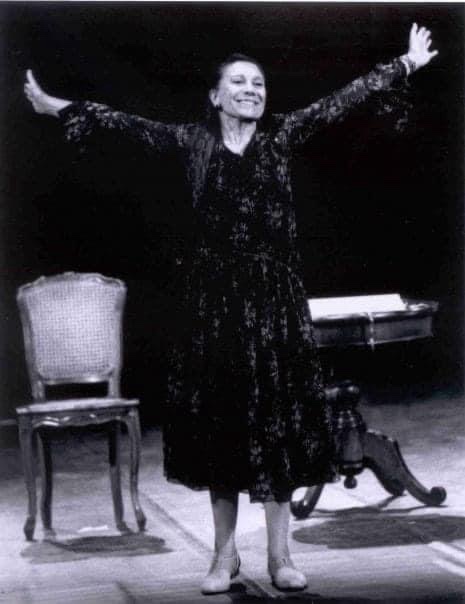
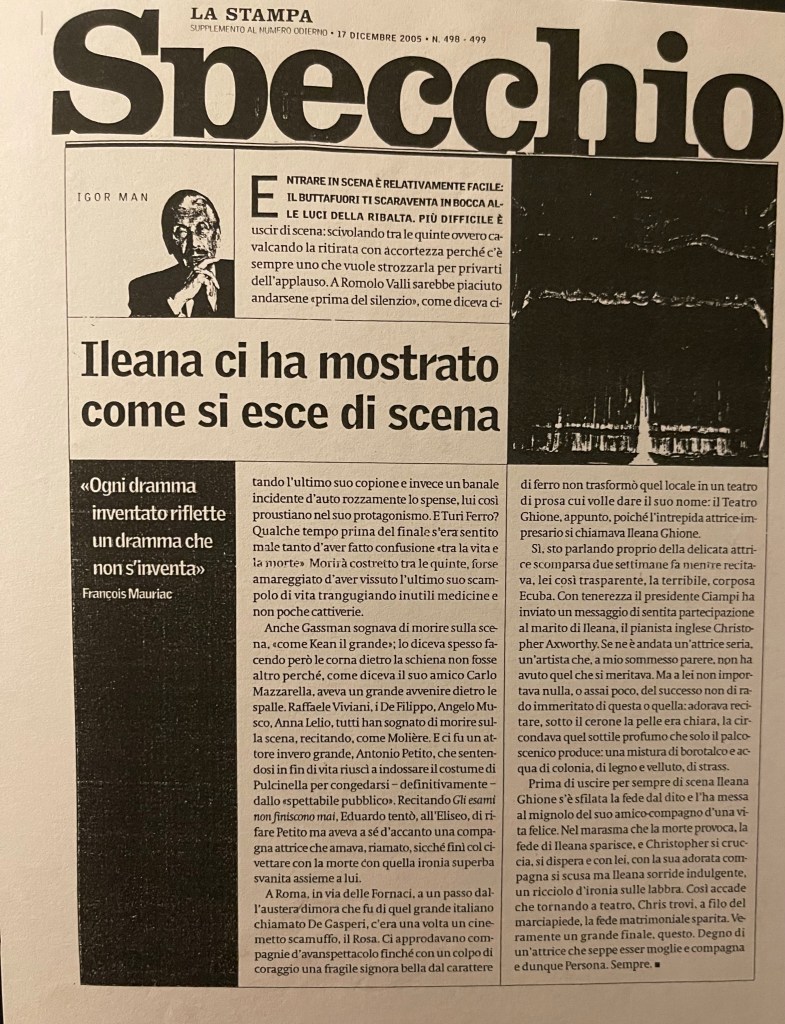
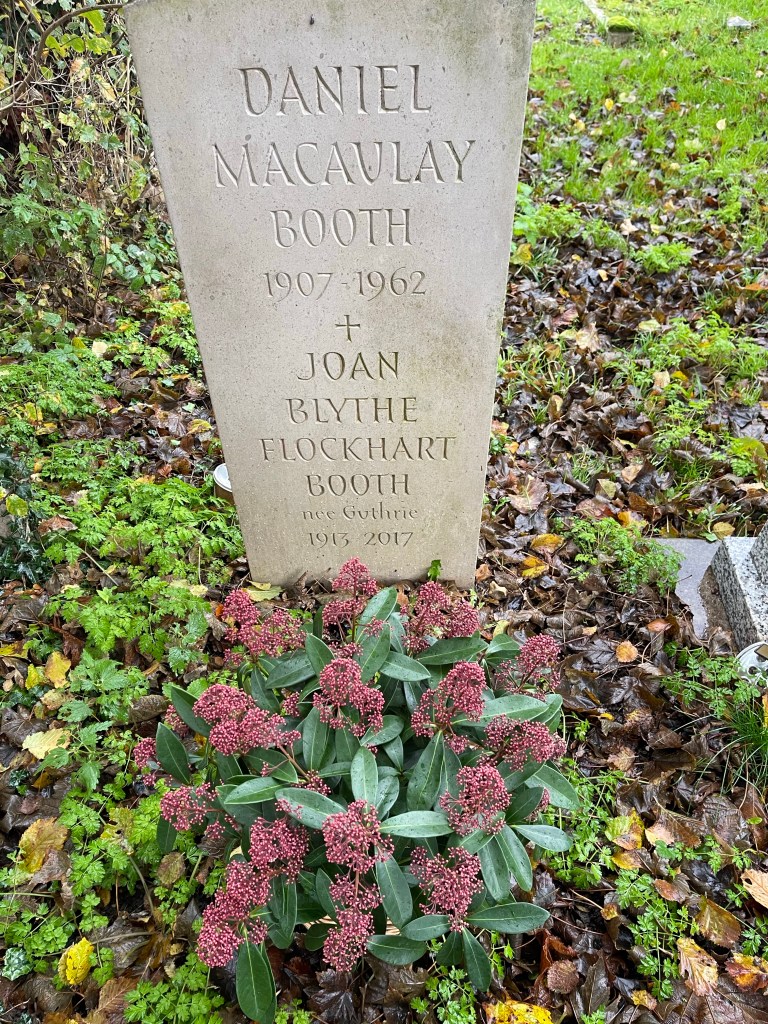
Ileana Ghione 3rd December 2005. Joan Booth 3rd December 2017
“She passed away the same day as my wife (12 years previously) in the light of the Super Moon and I like to think that Ileana opened her arms to light the way for my dearest friend.”
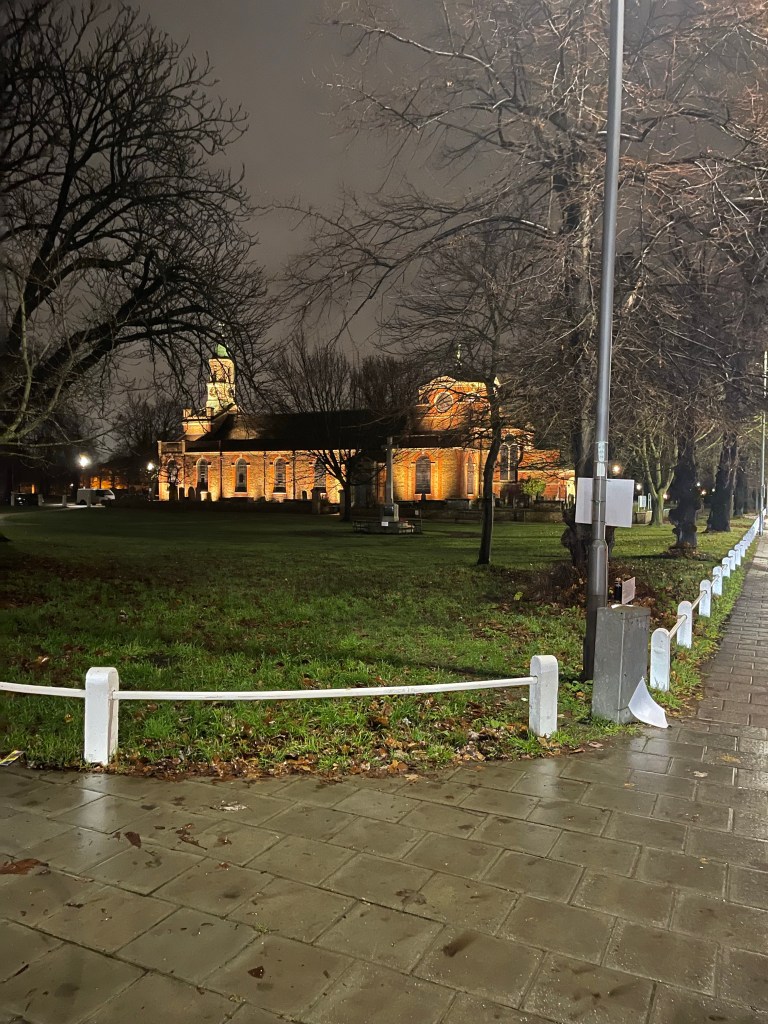
It was just a year since Ileana had died and I decided to dedicate a mass to her in the Cathedral of her home town of Asti.She felt her roots very deeply and we wouid often come to Asti to see her mothers sister and grand children who we were glad to have helped when their father died and they were still teenagers. Massimo Scaglione,her lifelong friend and distinguished television and stage director, would often invite Ileana to performances in Asti -The photo is from an evening he dedicated to Ileana a few years before. I came back now a year later which was just enough time to be abandoned by ‘our’ family who we had shared everything with so generously over our thirty years together with esteem and love and much else besides. Parassitic greed meant that I now arrived in ‘our’ city alone with terrible rumours spread by Ileanas brother and sister of my evil machinations and intentions Milena Vukotic and Renzo Rosso two such warm faithful friends spurred me on to commemorate my adored wife who had left me alone too soon. The cathedral was full to the rafters and I decided ,spurred on by Milena to talk about Ileana and our love story of thirty years. No sign of our ‘cousins ‘ or close family was very hurtful but there are so many things that are revealed when a close family member dies. The next morning in the hotel in the main square that we had always stayed in together I was having breakfast feeling very alone when the waiter asked if he could talk to me.A friendly respectful voice ‘Of course’……’I just wanted to tell you how moved we all were when you spoke about your love for Ileana ….we come to church so often and hear about people in distress or disasters but we never could have imagined a love that you described to us last night ‘. The next year Eugenio Guglielminetti the great set designer and artist ,also from Asti ,designed a garden in the centre of the city to be dedicated to their illustrious citizen Ileana . Eugenio who had advised and designed Ileanas homes,theatre and stage sets died before the opening ceremony but we went ahead dedicating the garden to them both.
Ileanas brother and sister ,cousins and family members were nowhere to be seen and after their evil machinations have joined Ileana in the family tomb that I care for.There are the lemons that I went to our home to collect in Sabaudia to make the tomb more beautiful . Ileanas mother had built it much to our amusement at the time .It now needed to be cared for and a beautiful garden created to house our beloved Ileana who after all had also paid for it and given the world so much of herself.
Eighteen years on the Foundation that we both wanted to create has been abandoned . It was created immediately after her death so our thirty years dedication of bringing culture to the Eternal City could continue and flourish long after we were no longer on this earth and above all give a much needed platform to aspiring young actors and musicians . This ,after years of wrangling with a legal system that is so slow and unjust,has not been possible.A system where you are guilty and have to prove your innocence becomes fodder for professionals with enormous fees .Guilty or innocent depending on which way the wind blows over a fifteen year period as fees reach sky high proportions without any guarantee of success.The vultures were all around waiting to zoom in for the kill knowing how to take advantage of a legal system that does not protect the innocent or the accused . But thanks to my adopted family of Roberta Blasi Ercole Palmieri Luca Palmieri ,Matteo Palmieri Francesca Langella and Ilaria Gregori the Teatro Ghione is going from strength to strength and hopefully our wishes will be respected despite such unexpectedly despicable opposition from within. I can now begin to mourn in peace knowing that I have completed our mission the best I could!
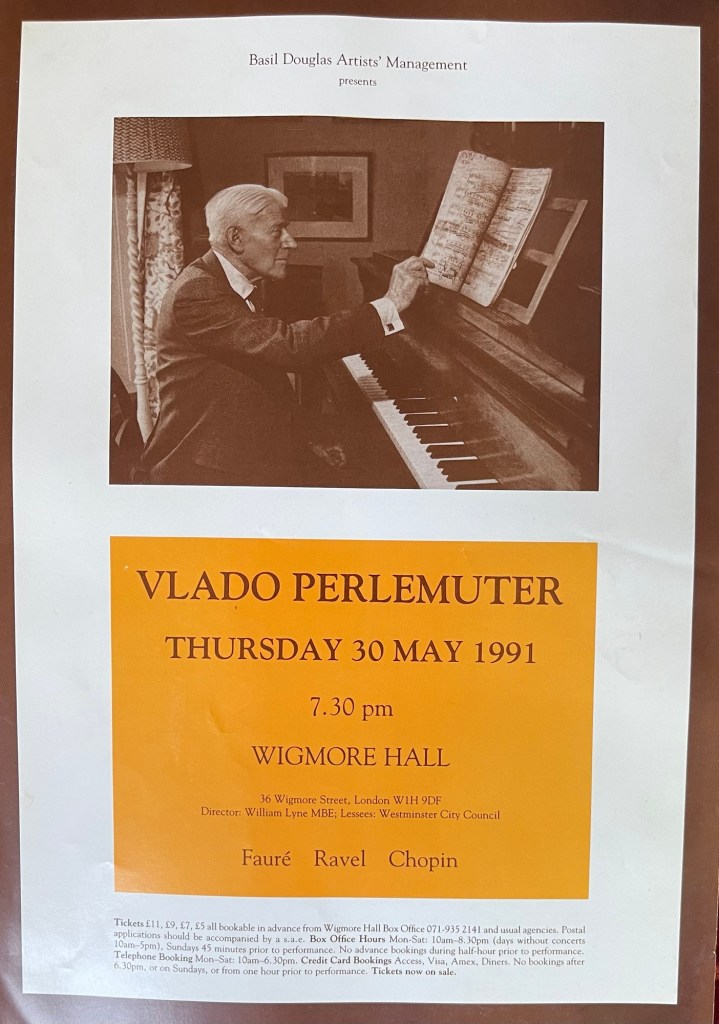
Today I lay a wreath on the grave of Joan in Ewelme deep in the heart of Oxfordshire ……..Ileana knew and loved Vlado and Joan and their idyllic love nest in Ewelme that we visited so often.
They will both be looking on today with a knowing smile as I await to join them
Ewelme church where Joan was celebrated in 2017St Anne’s Kew Green where Ileana and I were married on 28th July 1984Photo taken by Bianca Galvan a friend of Ileana who had persuaded her to go to Siena together in 1978 for the course of Lydia Agosti ‘Da Schoenberg ad oggi’ .That is where we met and our life became entwined forever more Our ‘ baby’ that we created together with love and devotion .A cultural centre of excellence for Rome , providing a much needed recital hall for many musicians just searching for a space where to perform in the Eternal City
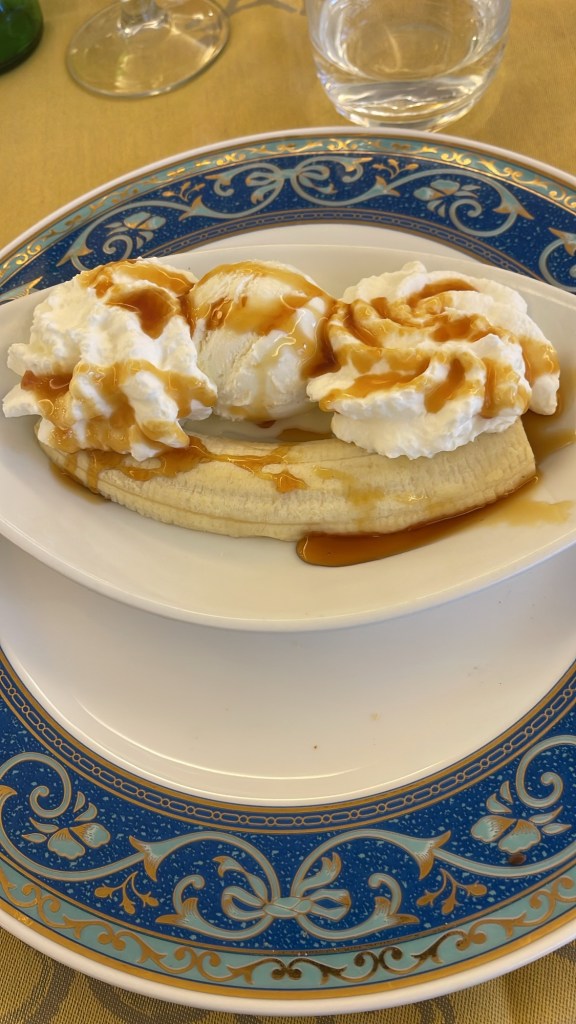
Life is indeed a mystery as the waiter asked me what dessert I would like and then coming back again he said we have banana split today . Little could he have known the significance of the very first thing that united Ileana and I 45 years ago . It came the day after Ileana’s birthday . We were travelling down to Siena together Ileana driving the young repetiteur flown in from London to help his old teachers wife Lydia Stix Agosti with her inexplicably named course for actors :From Schoenberg to today’. Driving her own car and singing operatic arias on the way we stopped for a snack and she had a banana split that she said was her favourite desert. In the Campo later that evening we were having a welcome drink with the class and I ordered a banana split for Ileana . She was so moved that I had remembered that this was the first seed of a love that was to last almost thirty years. Ileana had suffered as only those that have had a loved one commit suicide can understand .Her beloved husband Ezio Gagliardo had suffered from depression and had decided to take this drastic step leaving Ileana shocked distraught and mistrusting.The idea that someone could have remembered something so trivial as a love for banana split was the first step in eventually being reborn and able to live and to love life again. The waiter today could never have known why a banana split should have brought tears to my eyes !
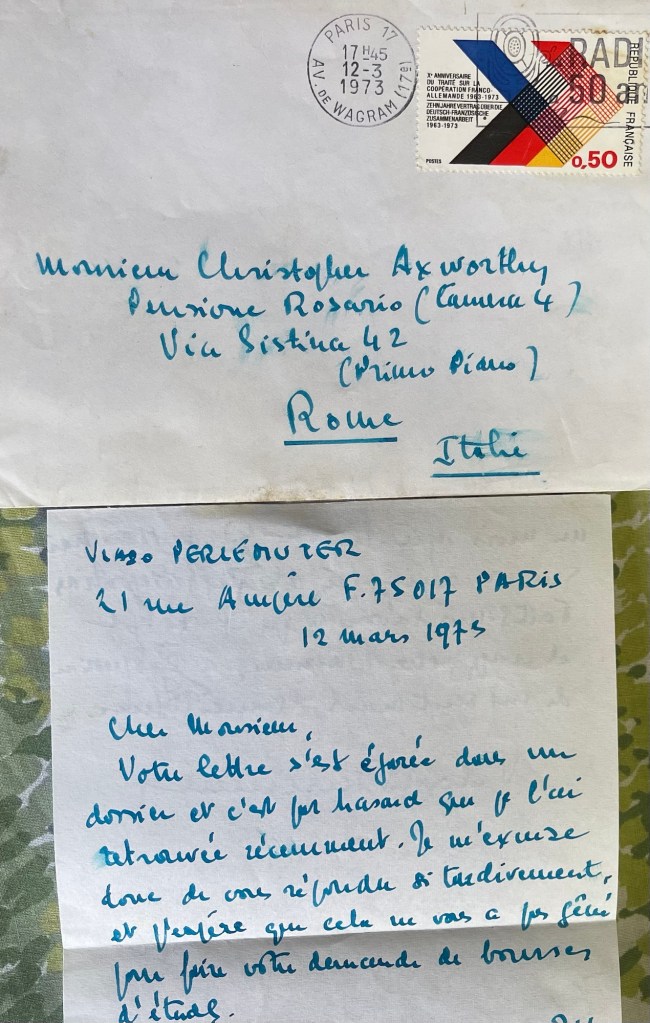
Banana Split at the Ritz Abano Terme Vlado’ s last concert where I was backstage with Joan – Ileana in the audience A letter from Vlado before he became our great friend
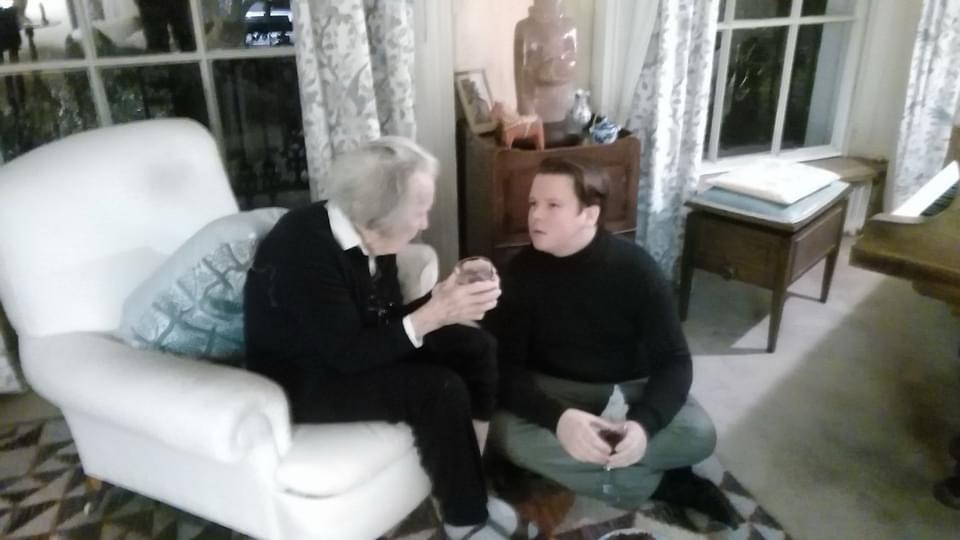
Unforgettable try through recital on Perlemuter`s piano with the amazing 104 year old companion for so many years of Vlado . And the astonishing Mark Viner . Wonderful,sounds.Wonderful music.Wonderful company.Thank you to all .February 2017
Oggi 18 anni senza Achille Millo, pseudonimo di Achille Scognamillo (Napoli, 25 novembre 1921 – Roma, 18 ottobre 2006) Image of Ileana Ghione and Achille Millo in Dress the Unknown
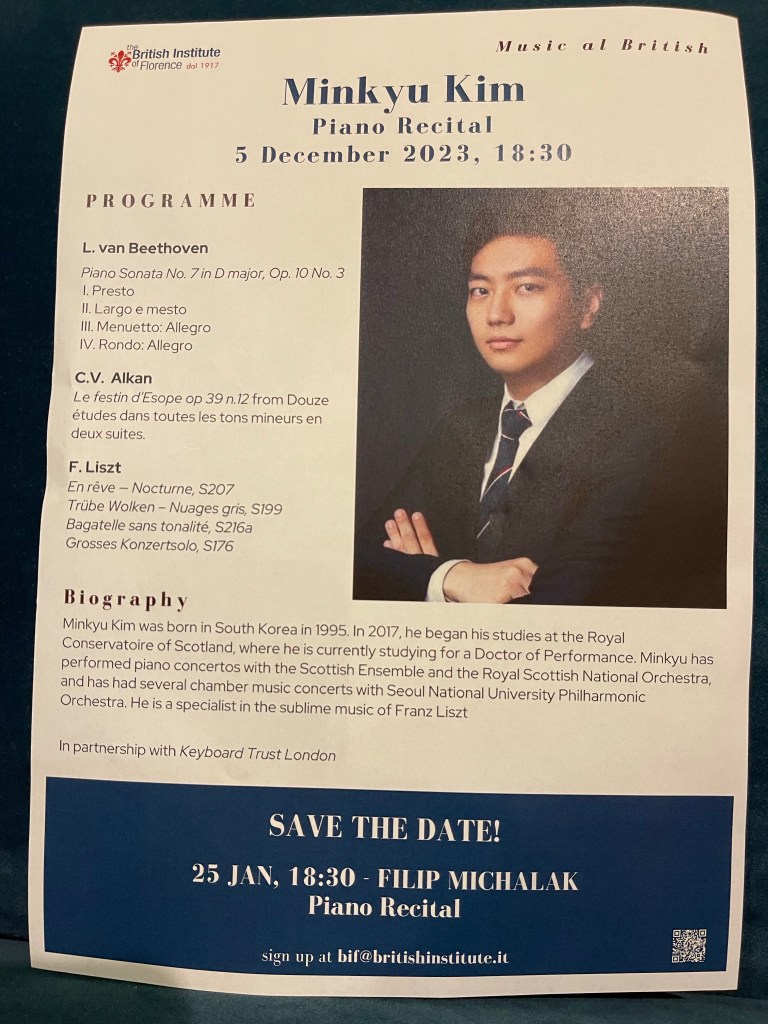
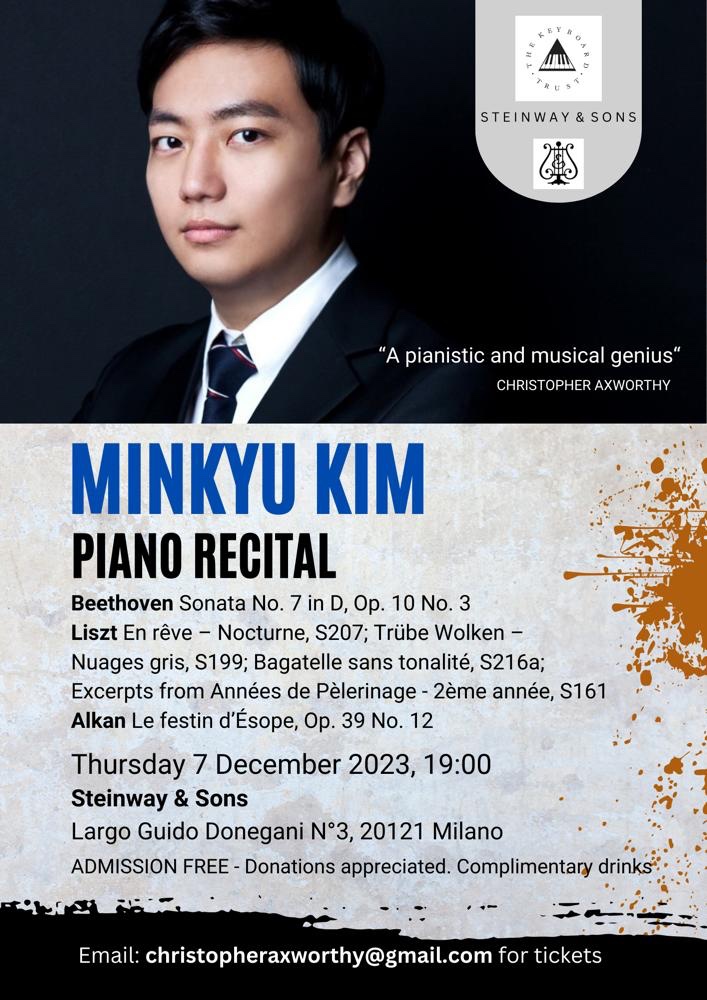
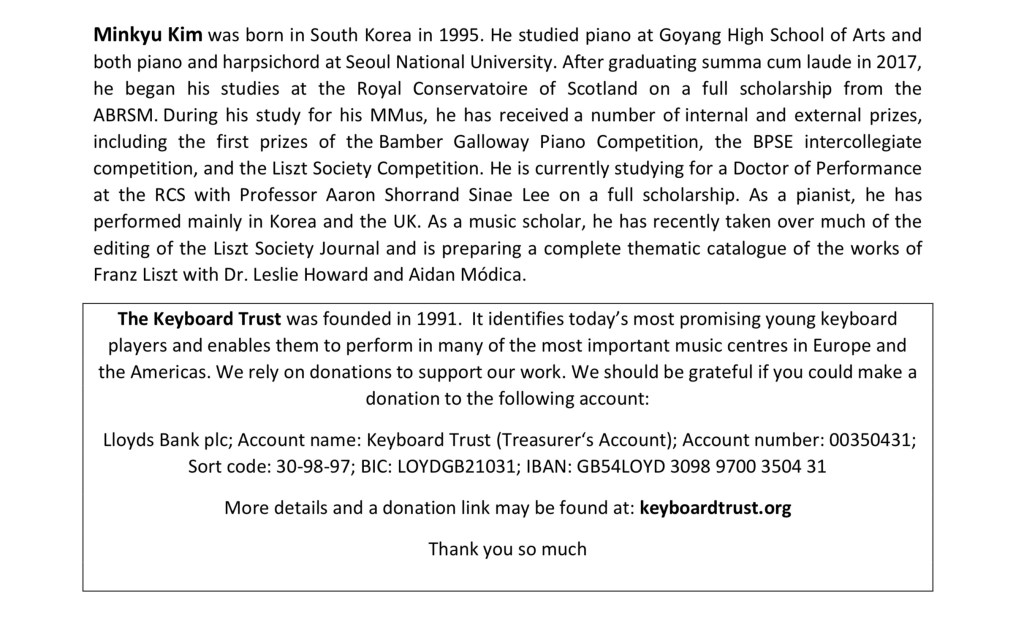
Minkyu Kim was born in South Korea in 1995. In 2017, he began his studies at the Royal Conservatoire of Scotland, where he is currently studying for a Doctor of Performance. Minkyu has performed piano concertos with the Scottish Ensemble and the Royal Scottish National Orchestra, and has had several chamber music concerts with Seoul National University Philharmonic Orchestra. He is a specialist in the sublime music of Franz Liszt
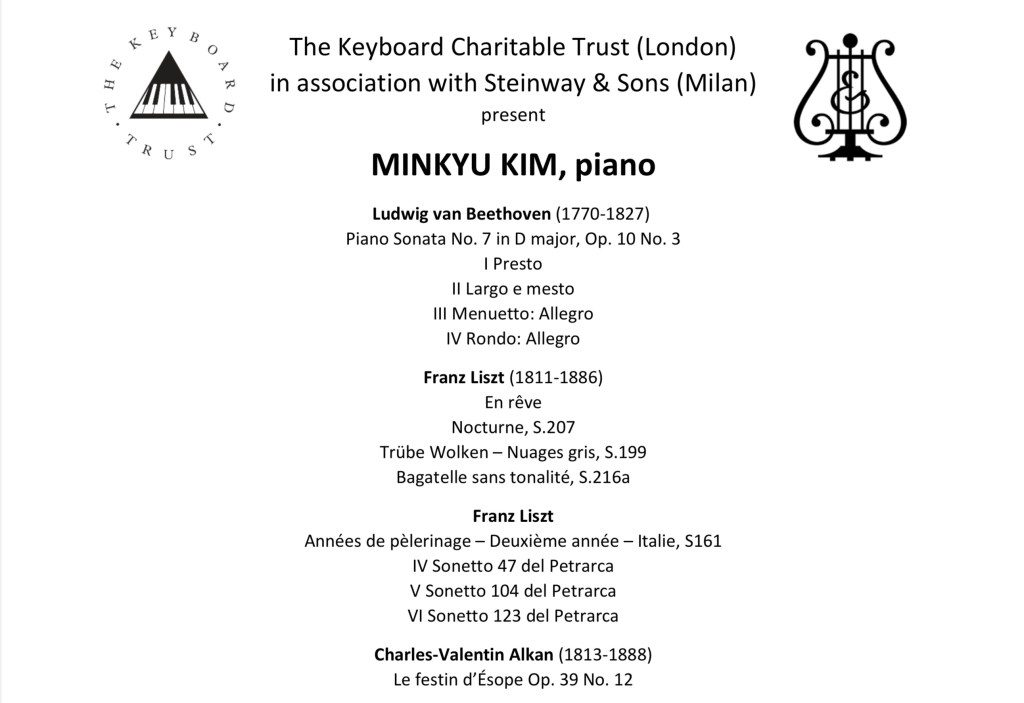
Beethoven: Piano Sonata No. 7 in D major, Op. 10 No. 3
I. Presto II. Largo e mesto
III. Menuetto: Allegro
IV. Rondo: Allegro
Alkan: Le festin d’Esope op 39 n.12 from Douze études dans toutes les tons mineurs en deux suites.
Liszt:
En rêve — Nocturne, S207
Trübe Wolken – Nuages gris, S199
Bagatelle sans tonalité, S216a
Grosses Konzertsolo, S176.
An unexpected improvised introduction to the Beethoven Sonata op 10.n.3 that Minkyu was later to talk about .He explained about concert practices in the eighteenth century when it was the norm to add an improvised ‘prelude’ to link the keys of the works together in order to prepare and accustom the ear when appropriate.There was a dynamic drive to the Beethoven with a great sense of character and startling contrasts in a work that was already revealing the genius and originality of Beethoven.It was the profoundly moving Largo e mesto that Minkyu played with a sense of line allowing the music to flow so naturally with its quartet like strands of harmonies interwoven with such poignant beauty.The entry of the Menuetto was like a breath of fresh air and was played with a simplicity and ravishing beauty that contrasted so well with the bucolic good humoured Trio .There was a sense of question and answer in the Rondo with ever more a feeling of improvised freedom.Minkyu’s wonderfully fluid fingers just adding a glow to the streams of golden sounds that accompany the opening theme as is disappears into the depths of the keyboard with a refined ending that even now can take the audience by surprise as it did indeed on this occasion!
An extraordinary recital by Minkyu Kim in Florence An eclectic programme played with the simplicity and humility of a great musician with a voracious appetite for many neglected masterpieces.With a transcendental technical commmand he thrilled the audience in the library of the celebrated aesthete Harold Acton with Beethoven’s early Sonata op 10 n. 3 where his genius was already beginning to manifest itself with its profound and intense slow movement.Alkan’s pianistic genius was revealed with astonishing brilliance as his animals were let out of their cage and allowed to sprawl all over this 1876 Bechstein.
‘Le festin d’Esope’ by Alkan is one of the composers most played works (even if all too rarely) from an enormous range of compositions that are still being discovered.It is a work that needs a sense of imagination and above all a virtuoso technique to be able to cope with the composers original demands.And astonishing demands they are too in this 12th and last of his studies op 39 that includes a Symphony,Concerto and Overure for solo piano. Such was the startling originality of Alkan that we see the score scattered with unconventional but very apposite indications for performance.Written in not perfect Italian but their meaning is clear and nowhere more so than in Minkyu’s transcendental performance. The theme to be played ‘without any license whatever’.’Marziale- Scampanatino (tinkling),Trombato,Leggiermentebut then leggierissimamente’ meaning ever more scintillating as we would have noticed from Minkyu’s well oiled and delicate fingers.’Lamentevole’ as octave’s are played in gasps leading to simple fortississimi chords ‘impavidé?!’ ‘Senza arpeggiare aleuramente’And then on to the ‘caccia’ played with stirling precision and rhythmic drive by Minkyu before the startling ‘Abbajante” (barking) .Leading to ‘tempestoso’ and ‘Tronfalmente’ in a finale of astonishing chordal demands on poor Minkyu who showed no signs of tiring,quite the contrary as he built the excitement to fever pitch with the control and musicianship of a true showman. This was a quite remarkable ‘tour de force’ of virtuosity in the hands of superb intelligent musicianship.
But it was the Genius of Liszt that Minkyu was to demonstrate to us with the ‘Grosses Konzertsolo’,the much neglected monumental forerunner of the B minor Sonata .He played it with towering committed artistry that will surely astonish the Professors of the Royal Scottish Academy where he is about to complete his doctorate before embarking on an obligatory military career in the Korean army!
There was no prelude to link Alkan to Liszt as Minkyu wanted to talk about the Genius of Liszt and in particular about the three visionary pieces he was about to perform before the final Konzertsolo. Liszt was always looking to the future and nowhere more than in his later pieces when his youthful showmanship was transformed into penitence and devotion and he was able to anticipate the direction in which music was moving developing ,leading eventually to the twelve tone music of Schoenberg etc.A world where there is no formal or tonal centre but sounds that create a form in themselves.Nowhere is this transition more clear than in the three late pieces that Minkyu offered today. ‘En rève’ is a beautiful nocturne played by Minkyu with ravishing glowing sounds of delicacy but it is a nocturne,barely a page long,that has no ending as it finishes with a question mark. As does the extraordinary ‘Nuages Gris’ with its strange meandering phrases of such desolation with glimpses of melody that shone like stars sparkling in the mist. The opening dissonance of what was to be the Fourth Mephisto Waltz is nothing like the famous First Mephisto Waltz that we are used to hearing from the hands of dashing virtuosi.There is a tantalising jeux perlé of dancing notes but short lived as this work too ends in suspense with Liszt opening a door to who knows what is to come next. The ‘Grosses Konzertsolo’ is a fairly early work in comparison and is Liszt trying ,thanks to Schubert’s Wanderer Fantasy, to find a less formal form than the standard ‘Sonata’.A form where the themes represent an image or personality and are part of a story that are then in themselves transformed as the story progresses – the so called Leit motif . It was to open the door for Liszt’s son in law Richard Wagner just a few years later.A performance where the leit motif was so clearly outlined in Minkyu’s very intelligent hands that we could appreciate the final extraordinary pages where the motif becomes heartrendingly exhausted after its long journey.I hope one day Minkyu will record the performance and place it where it belongs side by side with its monumental twin the B minor Sonata.Only now recognised as a masterpiece even though Clara Schumann on receiving it ( it was dedicated to her husband who was already institutionalised ) described it as a horrible noise.Brahms famously fell asleep listening to it .It is now considered together with the Schumann Fantasie a pinnacle of the romantic piano repertoire.Minkyu introducing his choice of Liszt ‘Il Penseroso’ for his Florentine recital In 1520, the Medici came back to Michelangelo with another grand proposal, this time for a family funerary chapel in the Basilica of San Lorenzo.For posterity, this project, occupying the artist for much of the 1520s and 1530s, was more fully realised. Michelangelo used his own discretion to create the composition of the Medici Chapel which houses the large tombs of two of the younger members of the Medici family, Giuliano,Duke of Nemours, and Lorenzo, his nephew. It also serves to commemorate their more famous predecessors, Lorenzo the Magnificent and his brother Giuliano, who are buried nearby. The tombs display statues of the two Medici and allegorical figures representing Night and Day ,and Dusk and Dawn .The chapel also contains Michelangelo’s Medici Madonna.In 1976, a concealed corridor was discovered with drawings on the walls that related to the chapel itself.Minkyu in front of the tomb of Lorenzo de’Medici with ‘Il penseroso’ at the centre
“Il penseroso” a poem and sculpture by Michelangelo that sits in the Medici Chapel that had inspired Liszt to write a piece for his ‘Years of Travel’ when he visited the city in 1838 .Minkyu had learnt it especially as a homage to Liszt and to Florence on this occasion …..an encore from an eclectic thinking musician and superb virtuoso pianist.It was fascinating to hear him explain the ‘preludes’ he had improvised between pieces as was the practice in the 18th Century to prepare the public for the next piece.And to know that the ‘prelude’ to the Grosses Konzertsolo was from the orchestral introduction of it that Liszt had insisted be played before his orchestral version (left unfinished by Liszt but completed and recorded by Leslie Howard )
Minkyu admiring the statue whilst listening to Leslie Howard’s recording The Medici Chapel Cupola From the first edition of Liszt ‘Il Penseroso’ that was inspired by Michelangelo’s sculpture of the same name. There is also the poem by Michelangelo on the front page of the first edition The statue is actually part of a tombstone made for the Lorenzo de Medici, Duke of Urbino. Michelangelo shows Lorenzo as a man deep in thought. Liszt must have interpreted these thoughts as a dark place, as if he were receding into the shadows. Matching this depiction, Il penseroso is a very dark piece. There is not much movement, and it is confined to the the lower registers of the piano, with many slow chords.
With Sir David Scholey a great admirer and follower of the Keyboard Trust pianists.The unbounded enthusiasm of Michael Griffiths OBEA very warm welcome from an admiring public A sumptuous after concert feast hosted by the ever generous Sir David with on his left Jennifer Gammell Simon Gammell OBE director of the British Institute with his daughter on a surprise visit from Tel Aviv The programme in Milan included Liszt’s three Petrarch Sonnets in place of the Grosses Konzertsolo .They were played with sumptuous sounds from whispered asides to passionate outpourings .A technical brilliance of embellishments always incorporated into the overall shape of Liszt’s extraordinarily evocative melodic and poetic outpourings.Minkyu presenting his encore of Liszt’s ‘Sposalizio ‘ which was inspired after seeing the painting by Raphael in Milan .It was played with ravishing sounds and passionate conviction The Marriage of the Virgin, also known as Lo Sposalizio, by Raphael was completed in 1504 for the San Francesco church in Città downtown Castello it depicts a marriage ceremony between Mary and Joseph and since 1806 it is housed in the Pinacoteca di Brera in Milan Sposalizio is the title of the first piece in Liszt’s Deuxième Annie de Pèlerinage :Italie (Second Year of Pilgrimage: Italy), published in 1858. The composition starts out with a simple pentatonic melody, described as a “bell-like motif”,turning into a complex musical architecture. The melody then changes to a type of wedding march, continually embellished leading to the grand climax before ending quietly.Minkyu had found time on his way to the airport to visit the Brera Gallery and see the original Maura Romano ,director of Steinway Milano ,far right with her assistant Alessandro Livi far left and guests Alberto and Ioana Chines,Minkyu Kim and two guests from the perfume shop opposite By great demand Minkyu played a second encore and this time in the spirit of S.Ambrogio with an improvised version of ‘Jingle Bells’ with flashes of astonishing technical brilliance.It brought this last recital on Minkyu’s short Italian tour to a festive ending on the feast of the patron saint of Milan when preparations begin in earnest for the Christmas festivities and by tradition La Scala Opera House opens it’s new season .Maura Romano with the famous ‘Do di petto’ cakes inspired by Katia Ricciarelli An after dinner treat for Minkyu.Beethoven in 1796; designed by G. Stainhauser; engraving by Johann Josef Neidl, executed for the publisher Artaria (Haydn published more than 300 works through Artaria. The value of Haydn’s works helped push Artaria to the top of the music publishing world in the late 18th century. This important relationship helped Artaria secure the rights to the works of other important classical composers such as Luigi Boccherini and, most notably, Wolfgang Amadeus Mozart. During his lifetime, Artaria was Mozart’s principal publisher and starting in 1793, Artaria published several early works of Beethoven until a bitter dispute over the publishing rights of Beethoven’s String Quartet op 29 which culminated in a court case from 1803 until 1805.Yet, Artaria also published Beethoven’s Hammerklavier Sonata in 1819. The dispute with Beethoven highlights the role the company played in helping determine early copyright laws. Artaria continued to be a leading publisher through the 19th century, until it finally ceased its music publication business in the twentieth century. Artaria publishing house was dissolved in 1932. The art dealership closed in 2012.
Beethoven’s Piano Sonata No. 7 in D major, Op. 10, No. 3, was dedicated to the Countess Anne Margarete von Browne, and written in 1798. This makes it contemporary with his three string trios op 9 , his three Op. 12 violin sonatas, and the violin and orchestra romance that became his op 50 when later published. The year also saw the premiere of a revised version of his second piano concerto whose original form had been written and heard in 1795.The three Op. 10 sonatas are usually described as angular or experimental, as Beethoven began moving further and further away from his earlier models. This third sonata of the set is the longest and is the only one of the Op. 10 sonatas that has four movements and Beethoven’s pupil the teacher of Franz Liszt described it as ‘grand and significant’
First edition of op 10 Sonatas Facsimile of the sonata op 28 Charles -Valentin Alkan ( 30 November 1813 – 29 March 1888) was a French composer and virtuoso pianist. At the height of his fame in the 1830s and 1840s he was, alongside his friends and colleagues Chopin and Liszt among the leading pianists in Paris, a city in which he spent virtually his entire life. In 1848 Alkan was bitterly disappointed when the head of the Conservatoire,Auber,replaced his teacher the retiring Zimmerman with the mediocre Antoine Marmontel as head of the Conservatoire piano department, a position which Alkan had eagerly anticipated, and for which he had strongly lobbied with the support of Sand, Dumas, and many other leading figures.A disgusted Alkan described the appointment in a letter to Sand as “the most incredible, the most shameful nomination”;and Delacroix noted in his journal: “By his confrontation with Auber, [Alkan] has been very put out and will doubtless continue to be so.”The upset arising from this incident may account for Alkan’s reluctance to perform in public in the ensuing period. His withdrawal was also influenced by the death of Chopin; in 1850 he wrote to Masarnau “I have lost the strength to be of any economic or political use”, and lamented “the death of poor Chopin, another blow which I felt deeply.”Chopin, on his deathbed in 1849, had indicated his respect for Alkan by bequeathing him his unfinished work on a piano method, intending him to complete it , and after Chopin’s death a number of his students transferred to Alkan.After giving two concerts in 1853, Alkan withdrew, in spite of his fame and technical accomplishment, into virtual seclusion for some twenty years.For many years it was believed that Alkan met his death when a bookcase toppled over and fell on him as he reached for a volume of the Talmud from a high shelf.The story of the bookcase may have its roots in a legend told of Aryeh Leib ben Asher , rabbi of Metz,the town from which Alkan’s family originated.
Le festin d’Ésope (Aesop’s Feast), op .39 No. 12, is the final étude in the set Douze études dans tours le tons miners (Twelve studies in all minor keys), Op. 39, published in 1857 (although it may have been written during the previous decade). It is a work of twenty-five variations based on an original theme and is in E minor. The technical skills required in the variations are a summation of the preceding études.
The work requires exceptional virtuosic skills, with extremely fast overlapping octaves, fast scales with left accompaniments, enormous leaps, rapid octave chords, tremolos, double octaves and trills. A typical performance of this piece lasts 10 minutes.
Introduction to the Piano Music of Alkan by Raymond Lewenthal who was the first in modern times to present Alkan in public recitals in London.At the Wigmore Hall together with Liszt , three recitals completely sold out with queues all around the hall when rumour spread that there was something very special going on.On this success he later gave a recital in the Royal Albert Hall (that his agent Wilfred Van Wyck – also Rubinstein’s agent- advised against) A strange affair where Lewenthal presented himself alone with a cloak and top hat on the vast stage with just a lamp standard like in a living room or 18th century salon .He played the Liszt Hexameron and before the interval Chopin First Ballade and Moonlight Sonata trying to emulate a scene from the previous century – Van Wyck was proven to be right !A portrait of Alkan for the 110th anniversary of the birth published by Mark Viner ,an emeritus KT artist and expert on Alkan.
At a later stage in his life Liszt experimented with “forbidden” things such as parallel 5ths in the “Csárdás macabre”and atonality in the Bagatelle sans tonality (“Bagatelle without Tonality”). Pieces like the “2nd Mephisto-Waltz” are unconventional because of their numerous repetitions of short motives. Also showing experimental characteristics are the Via crucis of 1878, as well as Unstern!, Nuages Gris and the two works entitled La lugubre gondola of the 1880s.
En rève (‘Dreaming’) was composed in 1885 and unlike in many of the works from the last years of Liszt’s life, nothing disillusioned or bleak, but rather a note of acceptance and reconciliation.
Nuages gris or Trübe Wolken,was composed on August 24, 1881. It is one of Liszt’s most haunting and at the same time one of his most experimental works, representing , “a high point in the experimental idiom with respect to expressive compositional procedure.” Yet it was only in the second half of the twentieth century that the significance of Liszt’s late experimental works began to be appreciated. “Arguably, Liszt was the first composer to establish the augmented triad as a truly independent sonority, to consider its implications for modern dissonance treatment, and to ponder its meaning for the future course of tonality. Liszt’s accomplishments were summarised in Busoni’s phrase, as the ‘master of freedom’.Debussy probably had Nuages gris in mind when he composed his own Nuages .On a more mundane note it was used in the shocking scene at the morgue in Stanley Kubrick’s last film Eyes Wide Shut.
Bagatelle sans tonalité was written by in 1885. The manuscript bears the title “Fourth Mephisto Waltz”and may have been intended to replace the piece now known as the Fourth Mephisto Waltz when it appeared Liszt would not be able to finish it; the phrase Bagatelle ohne Tonart actually appears as a subtitle on the front page of the manuscript.
While it is not especially dissonant, it is extremely chromatic becoming what Liszt’s contemporary Fétis called “omnitonic”in that it lacks any definite feeling for a tonal center.Like the Fourth Mephisto Waltz, however, it was not published until 1955.
Années de pèlerinage S.160-161-162-163is a set of three suites for solo piano by . Much of it derives from his earlier work, Album d’un voyageur, his first major published piano cycle, which was composed between 1835 and 1838 and published in 1842.Années de pèlerinage is widely considered as the masterwork and summation of Liszt’s musical style. The third volume is notable as an example of his later style Composed well after the first two volumes, it displays less virtuosity and more harmonic experimentation.
The title Années de pèlerinage refers to Goethe’s famous novel of self-realization, whose original title Wilhelm Meisters Wanderjahre meant Years of Wandering or Years of Pilgrimage, the latter being used for its first French translation.Liszt clearly places these compositions in line with the Romantic literature of his time, prefacing most pieces with a literary passage from writers such as Schiller, Byron or Senancour, and, in an introduction to the entire work, writing:
“Having recently travelled to many new countries, through different settings and places consecrated by history and poetry; having felt that the phenomena of nature and their attendant sights did not pass before my eyes as pointless images but stirred deep emotions in my soul, and that between us a vague but immediate relationship had established itself, an undefined but real rapport, an inexplicable but undeniable communication, I have tried to portray in music a few of my strongest sensations and most lively impressions.”
Deuxième année: Italie” (“Second Year: Italy”), S.161, was composed between 1837 and 1849 and published in 1858 by Schott. Nos. 4 to 6 are revisions of Tre sonetti del Petrarca which was composed around 1839–1846 and published in 1846.All three are based on Sonnets, or Canzone, by the Italian Renaissance poet Francesco Petrarca (1304-1374). They are meditations on love, specifically the poet’s passionate love for Laura de Noves. In the first, Benedetto sia ‘L giorno -Blessed be the day…., Canzone LXI, sometimes erroneously noted as Sonnet 104), he prays for divine blessing on the joys and sufferings of love. The second, Pace non trovo – I find no peace….. Canzone CXXXIV; sometimes erroneously noted as Sonnet 47is more agitated. In it, the poet ponders the confused state love has put him in. Enthralled to his lady, he feels imprisoned yet free, he burns with love, yet feels he is made of ice: in modern psychological parlance, a true state of ‘limerence’. The third, lividi in terra angelici costumi – I Beheld on Earth Angelic Grace…., Canzone CLVI; sometimes incorrectly listed as Sonnet 123, is an ardent love poem in which the poet describes the perfect beauty and purity of his love and its effect on all of Heaven and Nature.
In 1851 Breitkopf & Härtel published the solo piano work Grosses Konzertsolo S.176. Though not as popular as the later Sonata in B minor the work achieves significance by the fact that it anticipates the Sonata as a large-scale nonprogrammatic work. It shows structural similarities to the Sonata and obvious thematic relationship to both the Sonata and the Faust Symphony.
One unpublished earlier version of the work exists, titled in French in the manuscript Grand Solo de concert (S.175a). This version differs structurally from the published Grosses Concert-Solo, thus revealing the existence of interesting material for a study on the genesis of Liszt’s gradual innovations in constructing a large-scale musical organism, which were to come to full fruition in the Sonata.
In 1866 a two-piano version was published under the title Concerto pathétique (S.258/2) which, though not differing structurally from the Grosses Concert-Solo, introduces a more effective layout of the musical thoughts, mainly due to an innovative concerto-like treatments of the two piano version.The fact that the solo Grosses Concert-Solo has been overshadowed by the later two-piano version has obscured the importance of the former as one of Liszt’s largest and most ambitious original works for the instrument. The Grosses Concert-Solo anticipates several of the most salient features of Liszt’s undisputed masterwork, the Sonata in B minor , namely the nonprogrammatic “four-movements-in-one” form.The piece was written between 1849 and 1850, and dedicated to Adolf Henselt who professed himself unable to play it, even though Liszt had intended it as a competition piece for the Paris Conservatoire.
Leslie Howard the noted Liszt expert having recorded all the works of Liszt on over 100 CD’s .He is an Artistic Director of the Keyboard Trust and is president of the Liszt Society in London and is seen here talking about and playing the Grosses Konzertsolo :
The South Bank with the Festival Hall far right and National Theatre illuminated in red !!!!
Bartók 14 Bagatelles, Op.6
Liszt Bagatelle without tonality, S.216a
Beethoven 15 Variations and Fugue on an original theme in E flat (Eroica), Op.35
Interval
Bach Chorale-prelude, Nun freut euch, lieben Christen gmein, BWV.734 arr. Kempff Bach Chorale-prelude, Nun komm’ der Heiden Heiland, BWV.659 arr. Busoni
Dowland In darkness let me dwell (a recording for voice & lute)
Thomas Adès Darknesse visible
Beethoven Sonata in A flat, Op.110
It was a sign of the esteem that Imogen Cooper has earned over her long career ,in which musical standards have reigned sovereign over the transcendental pianism that has taken centre stage over the past forty years ,to see so many illustrious musicians in the audience on this particularly cold last month of the year. In the audience was Alfred Brendel who with great difficulty negotiated the freezing temperatures and endless steps to salute one of his greatest protégées.Dame Janet Baker ,Dame Jane Glover ,Gyorgy Pauk and many young musicians from the Imogen Cooper Music Trust ,including the now distinguished pianist Cristian Sandrin,that she has so generously helped to advance in their musical understanding.
The long hike to the Green Room
It was Imogen who after her much criticised studies in Paris as her father ,Martin Cooper,the great musicologist and critic advocated the great British Musical Institutions for study rather than the almost obligatory period ‘abroad’. He had sent his daughter to study with Yvonne Lefebure ,though,in Paris .On her return after hearing Brendel play she told him that she would commit suicide if he would not become her mentor. In the very first lesson twenty minutes were spent on perfecting just one chord ! I remember Imogen who had just returned from Paris and delighted Vlado Perlemuter in his Dartington Masterclass in 1967 not only with her superb playing of Ravel ‘Valses’ but also on her perfect French. In the audience tonight there were also many young pianists including the winners of the Leeds ,Alim Beisembayev and Ariel Lanyi , where Imogen has taken over the reigns from that other great Dame: Fanny Waterman. At the end of the recital it was Lady Weidenfeld who exclaimed to me what marvels had been heard and she should know having known two of the greatest musicians of our time .She has for long been associated with the Rubinstein Competition of which Janina Fialkowska had been a top prize winner in the very first edition.
Emil Gilels and Artur Rubinstein with Janina Fialkowska in 1977 in New York
Rubinstein himself had supervised a career that she was not expecting.She just wanted to meet her idol before taking up a career in law but had studied in Paris too with the remarkable Yvonne Lefebure and she and Imogen became lifelong friends. They both have something in common ,that Rubinstein and Brendel had noted: they think more of music than themselves. A humility and integrity and above all their artistry is placed at the service of the composer.’Je sens ,je joue je trasmets.’ It was this that came across today and left the many musicians present moved to crowd to the green room to thank our adored Dame for her unflinching dedication to values that are fast evaporating .Quantity rather than quality is the name of the game these days.Instant communications where a photo on a mobile device can be seen instantly the other side of the globe and where a recording of a performance can be kept forever.It was Gilels who said that the difference between a recorded performance and a live one was the difference between fresh or canned food.Mitsuko Uchida refused (gracefully) an enthusiastic fan who wanted her to pose for a ‘selfie’ and exclaimed so astutely that it is the memory of a performance or an encounter that is so much more important than having a printed copy of it.
The most remarkable parts of the recital for me were those that are not really associated with Imogen.Dame Imogen has long been associated ,as one would expect from the class of Brendel ,with Schubert and Beethoven.So it came as a surprise to hear Bartok with a kaleidoscopic range of sounds and a chameleonic sense of character.There was the precision of Webern with the feeling that every one of the notes had a fundamental part to play in a musical discourse.They were reminiscent of Prokofiev’s early Vision Fugitives or dare I say Beethoven Bagatelles, largely written towards the end of his life, where so little can say so much.Imogen had distilled the very essence from each of these fourteen miniature jewels that kept her audience in rapt silence of wonderment.The Liszt Bagatelle just entered on the trail of the Bartok which was immediately apparent by the sudden jeux perlé brilliance and scintillating sense of dance of what was the originally projected Fourth Mephisto waltz.
Plunged into pitch darkness as we listened with baited breath to Dowland’s ‘In Darkness let me dwell’ in a recording of voice and lute.The curtain was gradually raised to the pungent multicoloured sounds of Thomas Adès’s atmospheric ‘Darknesse visible’.Here again Dame Imogen had a range of colours helped by a masterly use of the pedals that made the music speak just as eloquently as her Beethoven.And it was Beethoven this time that crept in on these magic sounds and they gave a golden glow to the opening of a work that Dame Imogen has made very much her own over the years.There was a warmth to the sound of the whole Sonata that seemed to be sheltered under a dome that contained within its walls a world of intimate beauty and as Dame Imogen so eloquently said in words and even more in music ‘affirms the return to life that gives us hope and strength to go forward’.It was the same sound world that the Eroica variations had inhabited where even the more strenuous variations were incorporated into an architectural sound world and not played as gymnastic exercises. If she missed the ravishing sense of elegance and sheer physical exhilaration that Curzon brought to the variations – that he too played from the score as time and tide wait for no man in long and illustrious careers – It was though the beauty of the sound that was so convincing as Imogen ,like her illustrious predecessors Dame Myra and Dame Moura both from the class of Uncle Tobbs,has like those of the Matthay school an infinite variety of sounds in every note that can make the music speak with such eloquence.The two chorale preludes by Bach -Kempff and Busoni I well remember Kempff playing in this very hall fifty years or more ago……Busoni unfortunately I never heard live but I have heard his recording and quite frankly what we heard tonight was even more enlightened as I am reminded of what Dame Mitsuko said about printed photos!Moved by the audience reaction and overwhelming ovation Dame Imogen gave an even more convincing performance of Bartok with his Durge op 9 n. 1.
There is obviously nothing like a Dame !
Dame Imogen writes:
“The construction of this programme has two strands to it, clearly in each half. The Bartók /Liszt group is a little teaser around tonality; the Liszt Bagatelle sans tonalité is a fantastic piece but difficult to programme as very short and not really belonging anywhere. After choosing the Bartók Bagatelles Op.6 – a masterpiece so rarely heard – it occurred to me that Bartók too was playful with tonalities and keys – the first bagatelle is written with the right hand in C sharp minor and the left hand in C minor (fairly novel for 1908) and in the successive bagatelles, he hardly stays in the keys he initially chooses. It seemed the obvious work into which to insert the Liszt, not least as, surprisingly, there were only around 25 years between the two compositions – and both composers were of course from Hungary. I like the idea of a certain aspect of destabilisation when listening, and my insertion of the Liszt in the body of the Bartók work is randomly placed in the sequence. I hope that this does justice to the wit and originality of both composers. It certainly makes the return to full tonality in the Beethoven Eroica Variations all the more startling, with the call to arms of the opening E flat major chord. There is wit aplenty in this work too, as so often in this particular form of Beethovenian composition – a certain wild energy too, and little melancholy. In the second half of the recital, I have an image of a descent from joyfulness into dark depths followed by a kind of triumphal resurrection. The first of the Bach chorales is ebullient and optimistic, the second reflective and sombre. Dowland then takes us into real blackness with his extraordinary poem, from which Adès’ glittering rejoinder emerges, with its final two lines a direct quote of Dowland’s music. Somehow the only exit from there has struck me as being Beethoven’s Op.110 Sonata, which comes as balm to the soul as it starts on its own journey, not without profound grief in the two great Ariosi, but terminating in an affirmative return to life that gives us hope and strength to go forward.”
Béla Bartók (1881–1945) 14 Bagatelles, Op.6 i Molto sostenuto ii Allegro giocoso iii Andante iv Grave v Vivo vi Lento vii Allegretto molto capriccioso viii Andante sostenuto xi Allegretto grazioso x Allegro xi Allegretto molto rubato xii Rubato xiii Elle est morte. Lento funebre viv Valse: Ma mie qui danse. Presto.
Béla Bartók was 27 when he composed his Op.6 Bagatelles in 1908, and reeling from romantic rejection by violinist Stefi Geyer, who’d infatuated him for quite some time. He vents his despair and anger in the last two of the 14 pieces: No.13 is a sinister funeral march named ‘Elle est morte’, while the final bagatelle, ‘Valse (ma mie qui danse)’ is a bitter, grotesque waltz. The rest of the set of pithy miniatures, however, are similarly forward- looking, and daringly experimental, from the pianist’s hands playing in two unrelated keys in No.1 to the bracing folk tunes of Nos.4 and 5, from the bare unisons of No.9 to the driving rhythms of No.10.
Franz Liszt (1811–86) Bagatelle without tonality, S.261a
At a later stage in his life Liszt experimented with “forbidden” things such as parallel 5ths in the “Csárdás macabre”and atonality in the Bagatelle sans tonality (“Bagatelle without Tonality”). Pieces like the “2nd Mephisto-Waltz” are unconventional because of their numerous repetitions of short motives. Also showing experimental characteristics are the Via crucis of 1878, as well as Unstern!, Nuages Gris and the two works entitled La lugubre gondola of the 1880s.
Bagatelle sans tonalité was written by in 1885. The manuscript bears the title “Fourth Mephisto Waltz”and may have been intended to replace the piece now known as the Fourth Mephisto Waltz when it appeared Liszt would not be able to finish it; the phrase Bagatelle ohne Tonart actually appears as a subtitle on the front page of the manuscript.
While it is not especially dissonant, it is extremely chromatic becoming what Liszt’s contemporary Fétis called “omnitonic”in that it lacks any definite feeling for a tonal center.Like the Fourth Mephisto Waltz, however, it was not published until 1955.
Ludwig van Beethoven (1770–1827) 15 Variations and Fugue on an original theme in E flat (Eroica), Op.35 From supposedly lightweight bagatelles to something far weighter, and more heroic. Beethoven clearly loved the theme he used as the basis for his 1802 Op.35 Variations: it began life entertaining Viennese dancers as one of the 12 Contredanses he composed in 1801 for the Austrian capital’s ballrooms, and he went on to use it in his ballet score The Creatures of Prometheus, and, most famously, in the finale of his Eroica Symphony (the piece that gives today’s piano work its nickname). Perhaps it’s the tune’s very simplicity that inspired him, or the way he could explode it and explore its potential across a whole range of moods and settings – something he did in the Symphony, and something he similarly does in tonight’s Variations. Beethoven opens with just the theme’s bassline, offering three variations, before moving on to 15 contrasting settings of the tune as a whole, ending with a richly decorated slow section, a mind-bending fugue, and a dazzling conclusion. With hand- crossings, athletic runs across the length of the keyboard, and free-flowing cadenzas, it’s a piece that’s clearly designed to show off the skills of its performer.
Johann Sebastian Bach (1685–1750) Chorale-prelude, Nun freut euch, lieben Christen gmein, BWV.734 arr. Kempff Chorale-prelude, Nun komm’ der Heiden Heiland, BWV.659 arr. Busoni After pioneering bagatelles and virtuosic variations, there’s a slightly more sober, even spiritual mood to the concert’s second half. JS Bach wrote no fewer than 46 chorale preludes for organ, works that take well-known hymn tunes and elaborate them with rippling accompaniments, unusual harmonies and more – often to prepare a congregation to sing the hymn in question itself. A tradition of reworking these organ pieces for piano has continued since the 19th century, bringing Bach’s creations out of the church and into concert halls and even private homes. Pianist and composer Wilhelm Kempff made his piano version of Bach’s ‘Nun freut euch, lieben Christen gmein’ (Now rejoice, dear Christians) in 1926, reimagining the original organ piece from Bach’s Weimar years between 1708 and 1717 as a brisk and joyful piano creation. Italian composer Ferruccio Busoni – a devoted admirer of Bach – saw transcribing, adapting and freely composing as part of the same musical continuum, and one that Bach himself had also explored. The original Chorale Prelude ‘Nun komm’ der Heiden Heiland’ (Come, saviour of the nations) weaves a web of sometimes anguished lines around its 1524 hymn tune, with words by Martin Luther. Busoni’s piano version maintains the original’s poignant interplay of melody and accompaniment voices in music that’s sometimes dramatic and despairing, other times moving and meditative.
John Dowland (1562/3–1626) In darkness let me dwell (a recording for voice & lute) Composer, lutenist and singer John Dowland was a musical superstar in the 16th and 17th centuries, with an output of often deeply troubled, melancholic lute songs that charmed and captivated admirers across a growing English middle class, who’d even take up the instrument to emulate him (Henry VIII, for example, insisted that his three children – who’d become Edward VI, ‘Bloody’ Mary and Elizabeth I – each learned the lute). Published in 1610, ‘In darkness let me dwell’ is one of Dowland’s most bleakly beautiful creations, a setting of an anonymous poem (see below), included in the 1606 Funeral Teares collection by John Coprario, whose writer abandons light, music, or any sense of consolation, preferring the peace of the grave. The song’s grinding dissonances, halting structure and apparently premature, cut-off ending only serve to emphasise its overall despair and resignation.
In darkness let me dwell In darknesse let mee dwell the ground shall sorrow be, The roofe Dispaire to barre all cheerfull light from mee, The wals of marble black that moistened still shall weepe, My musicke, hellish, jarring sounds to banish friendly sleepe. Thus wedded to my woes, and bedded to my Tombe, O let me living die, till death doe come.
Thomas Adès (b.1971) Darknesse visible
Thomas Adès is one of the world’s most celebrated musicians. A composer, pianist, and conductor, Adès’s comfort in thinking through his works both structurally and pragmatically (though his personal virtuosity often begets scores with an unforgiving level of difficulty) yields music that is not only smart but incredibly moving and communicative. While he is definitely a British composer, Adès has spent a great deal of time on both coasts of the United States, both in his ad- opted second hometown of Los Angeles and in Massachusetts, where he serves as the Boston Symphony Orchestra’s artistic partner as well as director of the Tanglewood Music Center’s Festival of Contemporary Music. Darknesse Visible is Adès’s “explosion” of a lute song by the composer John Dowland, “In Darknesse Let Mee Dwell,” composed in 1610. Adès writes: No notes have been added; indeed, some have been removed. Patterns latent in the original have been isolated and regrouped, with the aim of illuminating the song from within, as if during the course of a performance. In darknesse let mee dwell, the ground shall sorrow be, The roofe Dispaire to barre all cheerful light from mee, The wals of marble blacke that moistned still shall weepe, My musicke hellish jarring sounds to banish friendly sleepe. Thus wedded to my woes, and bedded to my Tombe, O let me living die till death doe come. Dowland ends the song with a restate- ment of the opening line.
His austerely powerful work is a far more radical transformation than Kempff and Busoni’s piano reimaginings of Bach, though its piercing accents, its wavering tremolos and its ghostly, blurred harmonies provide a compelling contemporary perspective on Dowland’s deep melancholy.The World premiere: October 1992 at the Franz Liszt House, Budapest, Hungary, with the composer as piano soloist
Ludwig van Beethoven (1770–1827) Piano Sonata in A flat, Op.110 Moderato cantabile molto espressivo Allegro molto Adagio ma non troppo – Fuga allegro ma non troppo From darkness and death to spiritual transcendence. Beethoven the young pioneer, out to demonstrate his compositional and pianist prowess in the earlier Eroica Variations, had become a very different composer two decades later, when he came to write his final trilogy of piano sonatas: more contemplative, philosophical, even otherworldly. Op.110 is the middle sonata in the trilogy, composed in 1821 and published the following year, and it packs a huge amount of drama, insight and innovation into its relatively brief 20-minute span. A prayer-like theme (marked ‘amiable’) opens its tender first movement, whose ethereal beauty is quickly dispelled by the boisterous, earthy second movement, based on two German folksongs. To end, Beethoven effectively combines two separate movements: first a tragic, song-like lament (you might even hear certain resonances from Dowland), and second a vigorous, life-affirming fugue that builds to a shattering climax. The lamenting song returns, exhausted, only for the music to gather confidence (Beethoven indicates ‘little by little gaining new life’) as it heads towards its joyful, transcendent climax.
The legendary Guido Agosti held summer masterclasses in Siena for over thirty years.All the major pianists and musicians of the time would flock to learn from a master,a student of Busoni,where sounds heard in that studio have never been forgotten.He was persuaded by us in 1983 to give a public performance of the last two Beethoven Sonatas.The recording of op 110 from this concert is a testament,and one of the very few CD’s ever made,of this great musician .
A new concert series to commemorate Guido Agosti in his home town where he was born and is buried – ‘Guido Agosti musicista’ is the simple inscription for one of the greatest musicians of his age
In the summer of 1819, Adolf Martin Schlesinger from the Schlesinger firm of music publishers based in Berlin sent his son Maurice to meet Beethoven to form business relations with the composer.The two met in Modling,where Maurice left a favourable impression on the composer.After some negotiation by letter, the elder Schlesinger offered to purchase three piano sonatas for 90 ducats in April 1820, though Beethoven had originally asked for 120 ducats. In May 1820, Beethoven agreed, and he undertook to deliver the sonatas within three months. These three sonatas are the ones now known as Op. 109,110, and 111 the last of Beethoven’s piano sonatas.
Beethoven’s own markings with the ‘bebung‘ or vibrated notes in the Adagio of op.110
The composer was prevented from completing the promised sonatas on schedule by several factors, including his work on the Missa solemnis (Op. 123),rheumatic attacks in the winter of 1820, and a bout of jaundice in the summer of 1821.Op. 110 “did not begin to take shape” until the latter half of 1821.Although Op. 109 was published by Schlesinger in November 1821, correspondence shows that Op. 110 was still not ready by the middle of December 1821. The sonata’s completed autograph score bears the date 25 December 1821, but Beethoven continued to revise the last movement and did not finish until early 1822.The copyist’s score was presumably delivered to Schlesinger around this time, since Beethoven received a payment of 30 ducats for the sonata in January
Some of the young musicians who have been so generously helped by The Imogen Cooper Music Trust :