Another chance to be astonished and seduced in London by the playing of this young pianist, still in his twenties having taken the world by storm ten years ago in Warsaw when he was the youngest competitor ever to win a top prize in the Chopin Competition
It is playing of such excitement and exhilaration that Horowitz or Cziffra come to mind .
‘X certificate’ stuff as the sheer animal excitement from his obvious joy of seducing the piano is communicated with astonishing feats of virtuosity and heart on sleeve sentiments that seduce the public.
But Tony is not only a showman but a poet of the keyboard with sounds of jewel like beauty that he allows to glisten and glow with a kaleidoscope of colours that are rarely heard in the concert hall these days .
This is old style playing when communication and personality could seduce audiences as indeed Liszt himself did. In the Paris salons of the eighteen hundreds refined ladies of the aristocracy would be reduced to a screaming mob ready to snatch any souvenir from their idol.
The nearest we got to this in our time was Horowitz who on arriving in Paris in the 30’s was described by a critic as the greatest pianist alive or dead!
Artur Rubinstein was not amused, but there was room for both pianists. One looking back to the times of the romantic virtuosi like Liszt or Thalberg and the other looking forward to the modern day pianism of Lipatti or Pollini where the pianist was the humble servant of the composer. As the princess Belgiojoso very diplomatically exclaimed in the famous duel between Liszt and Thalberg. ‘Thalberg is a great pianist but Liszt in unique’. Honour was saved !
‘Je joue, je sens , je trasmet’, was the raison d’etre of a humble servant of the composer.
It is a high wire act where those that can climb up onto the high wire can easily fall to one side as a showman or to the other as an intellectual, both though creating excitement , but one like good wine matures with age and the other that thrills the palette but after a while becomes rather flat and predictable .
I remember Shura Cherkassky telling me of his visits to Horowitz’s New York home, and with the recent death of Jorge Bolet they both exclaimed that they were the last two left of a past age.
No one knew the scores better than Horowitz but he was also from the Golden age when virtuosi could exert a power over their audience much as the Beatles or Rolling stones could do in the stadium.
All this to say that for all the wonders that Tony showed us last night the highlight for me were the simple Preludes op 16 by Scriabin. Playing of such freedom and with exquisite sounds of jewel like beauty . A sense of line and architectural understanding that could show us the moment of creation with the ink still wet on the page. Tony became Scriabin in one of those magic moments of recreation that are so rare in this play safe CD perfection age that can lead to performances as Gilels said, like canned instead of fresh food.
Tony has the courage to climb on the high wire and in Chopin adding deep bass notes and double octaves where Chopin was happy with scales and his piano had less notes. If the four scherzi had overstepped the border between animal excitement and scrupulous attention to the score , Tony had a personal vision of these works that might shock rather than inform as he sometimes feels more animal exhilaration rather than respect for the composers precise indications. But it communicated a vision of poetic artistry with a mastery of colour and balance that I am sure he will distill with less youthful exhilaration into interpretations of extraordinary depth. There were so many wonderful moments to cherish such as the simple Christmas Carol that Chopin quotes in the central part of the B minor Scherzo .It reminded me of the weight and beauty that Cherkassky could bring with his chiselled Belcanto of subtle innuendo.
I remember Fou Ts’ong playing in my series in Rome the day after Pogorelich had played the four scherzi .
I explained to Ts’ong that he had the same sort of freedom with the score as Cherkassky which might not be to his eclectic taste. After the concert Ts’ong, in his inimitable way, exclaimed :’ but Shura loves the piano, this man hates it !’
Greeting Lisa Peacock who had promoted his first concert last season in her Discovery Series at Leighton House
Tony’s love for the piano shines through all he does and if his youthful mastery excites him as much as many of the audience he will pare it down with maturity and these performances will become interpretations to cherish . I remember John Barbirolli defending the passion of the young Jacqueline Du Pre saying if you do not play with passion in your youth what do you pare off in maturity ! Jacqueline lived just long enough to show us,before her career was so cruelly interrupted by illness at only 28.
Tony’s playing of Scriabin was quite extraordinary as this was the world of perfumed sounds of multicolour . A decadence of seething passion and an undercurrent of burning intensity like a cauldron coming to the boil . A volcano with the red hot lava spreading over the entire landscape . It was this, the neurotic obsessive work of Scriabin that spoke to the youthful Tony more than the refined aristocratic poetry of Chopin.
Two Liszt Petrarch Sonnets were played after Scriabin, with the same kaleidoscope of colours and a knowing freedom of ravishing beauty. The first of Liszt’s two legends was given a masterly performance where showmanship and poetry were combined with the fervent conviction of a true believer .
Yisha Xue presenting her young protégée to Tony Bobby Chen and Ashley Fripp two of many distinguished musicians coming to support Tony in London Ashley had studied with Eliso Virsaladze in Florence with Tony where I too first met them both
What can one say of Tony’s Mephisto where showmanship and astonishing virtuosity combined with poetic understanding giving an architectural shape but including the exhilaration and excitement as only Horowitz or Cziffra could have done. A scintillating encore , one of Rubinstein’s favourites , the A flat waltz op 34 n 1 was a refined and brilliant way to finish before greeting old and new friends backstage anxious to thank this great young artist who had so generously shared his passion for music with us in the new born Bechstein Hall
with Concert Manager Lisa Peacock and Yisha Xue of the Asia circle of the National Liberal Club indefatigable promoters of young musicians
Hailed by CBC Music as one of Canada’s finest young musicians, pianist Tony Yike Yang first rose to international acclaim at the age of 16 after becoming the youngest-ever laureate in the history of the International Chopin Piano Competition in Warsaw, winning the 5th prize in 2015. Additionally, Yang has also won prizes at the Van Cliburn, Gina Bachauer, Hilton Head, Cooper, and the Bosendorfer & Yamaha USASU International Piano Competitions.
As a soloist, Yang has performed internationally in venues such as Koerner Hall in Toronto, Great Hall of the Moscow Conservatory, Severance Hall in Cleveland, Carnegie’s Weill Hall, Tokyo Metropolitan Theatre, the National Philharmonic in Warsaw, Seoul Arts Center, the National Arts Centre in Ottawa, Osaka Symphony Hall, Rockport Music, Esplanade Singapore, and the Millennium Amphitheatre in Dubai.
Yang has also performed for royalty and dignitaries such as Her Royal Highness Camilla, the Duchess of Cornwall, Queen Mathilde of Belgium, former Canadian Prime Minister Stephen Harper, and Polish President Andrzej Duda, among others.
Concerto highlights include appearances with the Cleveland Orchestra, Warsaw Philharmonic, Orchestre Métropolitain, Ontario Philharmonic, Fort Worth Symphony, Toronto Sinfonietta, Jakarta Sinfonietta, Edmonton Symphony, Saskatoon Symphony, Changsha Symphony, and the Hilton Head Symphony Orchestra.
Born in Chongqing and raised in Toronto, Yang is a recent graduate of Harvard University where he obtained a Bachelor of Arts in Economics. He is Artist-in-Residence at the Ingesund Piano Center in Sweden and at the Chinese University of Hong Kong, Shenzhen, and in the past, was a fellow at the Oberlin-Lake Como International Piano Academy. Currently pursuing his Master of Music at the Hochschule für Musik, Theater und Medien Hannover under Prof. Arie Vardi, Tony is named as “One To Watch” by Scala Radio UK in 2024.Programme
CHOPIN: Scherzo in B minor, Op. 20
CHOPIN: Scherzo in B-flat minor, Op. 31
CHOPIN: Scherzo in C-sharp minor, Op. 39
CHOPIN: Scherzo in E major, Op. 54
Intermission 30 minutes
SCRIABIN: 5 Preludes, Op. 16
SCRIABIN: Fantasy in B minor, Op. 28
LISZT: Sonetto 47 del Petrarca from “Années de pèlerinage II”, S. 161/4
LISZT: Sonetto 104 del Petrarca from “Années de pèlerinage II”, S. 161/5
LISZT: Légende No. 2 “St. François de Paule marchant sur les flots”, S. 175/2
This was the annual recital of the Keyboard Trust in an over twenty year collaboration between Mariantonietta Squeglia with Noretta Conci and John Leech, the founders, thirty five years ago, of the KT ( the 60th birthday present from John to his adored Noretta) . Next year ‘Incontro con la tastiera’ will celebrate its 50 years of filling the rarified air of Vicenza with music. The refined perfection of Palladio is everywhere to be seen with the Teatro Olimpico the jewel in his crown .
The new Teatro Comunale is a magnificent complex of two theatres and stands proudly just outside the city walls.
It was in the smaller 400 seater hall that Mikhail Kambarov revealed himself to be a true poet of the keyboard with performances that ranged from Mozart to Mussorgsky, including also the refined beauty of two rarities by Schumann and Mendelssohn. Not Felix but his sister Fanny, that Mikhail played with refined poetic beauty and a palette of sounds of glowing radiance . Schumann ‘s much neglected ‘Blumenstück’ op.19 was revealed to be a miniature masterpiece every bit as beautiful as its companion the Arabesque op 18 .
The recital had opened with the early Sonata K 281 by Mozart where Mikhail’s refined brilliance and multicoloured playing gave an operatic life to the charm and grace of the first movement. But it was the tongue in cheek ebullience that he brought to the ‘Rondo’ that revealed the masterly musicianship of this young musician being mentored in Weimar by an Emeritus KT artist Michail Lifits, past winner of the Busoni Competition.
A first movement ‘Allegro’ was played with delicacy and brilliance that did not deny charm and grace. A jewel like precision of beauty and clarity of remarkable fluidity. An ‘Andante amoroso’ of disarming simplicity with a palette of subtle shading that illuminated the sedate seriousness of the constant poetic dialogue. A ‘Rondò’ – Allegro of beguiling good humour as the music unwound with impish rhythmic drive of scintillating charm.
The three ‘Songs without words’ not by Felix but by Fanny Mendelssohn, were a revelation in Mikhail’s hands as he shaped the ‘Allegro moderato’ with a knowing freedom of searing beauty. It makes one wonder why we always hear of the genius of the brother but never the sister! Mikhail improvising between pieces to create a beautiful three movement whole with the ‘Andante con espressione’, a poignant outpouring of weight and glowing beauty with a truly inspired coda of breathtaking subtlety, played with exquisite sensibility. A gently flowing melody to the final ‘Larghetto’ of radiance as it duetted with the bass.
Another discovery in this poet’s hands was Schumann’s ‘Flower Piece’. A flower that opened up to reveal a miniature tone poem played with a rare sense of fantasy and beguiling flexibility. If Eusebius was admiring the petals , it was Florestan that commented too on the flowers with authority and a sense of line that gave great shape to this unjustly neglected masterpiece. Mikhail revealed every bloom of this beautiful flower, ending with a whisper as Eusebius was astonished too at the beauty that Schumann could reveal with so few notes.
Mikhail with the presenter of the concert Alessia BartolomucciThe director of the Banca Delle Terre Venete Marco Zarantonello, sponsor of the concerts
Nowhere more was this apparent than in his poetic performance of Mussorgsky’s ‘Pictures’.
From the very first notes usually played with brutal indifference, in Mikhail’s hands they became a promenade of leisurely serenity and beauty. Each of the ‘pictures’ that Mussorgsky had composed in just three weeks, were inspired by a memorial exhibition for his friend, artist Viktor Hartmann, both sharing a common artistic goal: to imbue their work with a distinctly Russian character.
Mariantonietta Sgueglia with the President of Incontro Enrico Hüllweck
What greater declamation of peace and joy could there be than the imagined ‘Great Gate of Kiev’ in these years of painful conflict. Mikhail who cannot return home and has not been able to see his family for many years, imbued it with a resonance and richness where the tolling bells rang out in searing defiance .
Eleven pictures that Mikhail imbued with knowing beauty as each one was a miniature tone poem with a kaleidoscope of characters and emotions, revealing even more intensely a true Poet of the Keyboard. The first picture ‘Gnomus ‘ was played with mystery with a mastery of pedal that could create a vision of a terrifying landscape of violent contrasts with trills that were like the screams of Munch. A walk on tip toe to the ‘engloutie’ of the ‘Old castle’ that was seen through a poetic mist of subtle delicacy with a ravishing palette of colours as it disappeared from sight completely submerged in magic. The Venetians know something of that! What fun the ‘kids’ had in the Tuileries with Misha’s agile fingers of featherlight ‘fingerfertigkeit’. Contrasting with the lumbering ‘Bydlo’ where Mikhail’s mastery of balance as the music became full but never hard and Bydlo was allowed to wend his way into the invisible distance. Elated by such poetic depictions an etherial gait of barely heard footsteps were awakened by the vision of the brilliantly busy ‘chicks’ hatched by Mikhail with extraordinary good humour. Goldberg burst onto the scene with great authority which Mikhail enriched with the silences between notes of burning significance. Schmuyle became a whimpering servant that Mikhail played with the knowing resonance of a master of the pedal. Listening to the blistering reverberations in the Catacombe leading into the heavenly sounds of paradise. Rudely interrupted now by the strident sounds of a quickened pace as Baba Yaga grappled with fate adding enormous sonorities and dynamic drive . What a marvel was the central episode where Mikhail gave great character to the distant vision of the witch until it burst onto the scene again with incumbent violence . And now the crowning glory was the vision an oasis of peace:The Great Gate of Kiev. An extraordinary explosion of luminosity and fervent prayer. Mikhail revealing the people on their knees by taking away the glowing radiance of the Gateway , revealing a moment of poignant intimacy by masterly use of the pedal and touch. Gradually the bells start to cry out with luminous bass notes of great reverberation creating a mist on which pealing bells are heard before the final triumphant declaration played with sounds of reverberating beauty, never hard or brittle, but with the luminosity of looking upwards into the stars . A masterly performance of a poet rather than a warrior , one that could show us the real significance behind the notes and not just the steely sheen of confrontation.
Musorgsky Sculpted with Iron Technique – Kambarov Enchants
The young Russian pianist performed at the Ridotto of the Teatro Comunale, opening with a “light” Mozart but a more defined Mendelssohn.
By Filippo Lovato
31st March 2026 Il Giornale di Vicenza
VICENZA — It’s a pity that the young Russian pianist Mikhail Kambarov performed before only a small “select” audience at the Ridotto of the Teatro Comunale, thanks to the long-standing partnership between Incontro sulla tastiera, the Keyboard Trust Foundation, and the Robert Turnbull Foundation.
Kambarov, born in 2000, is currently refining his craft in Germany and—according to presenter Alessia Bartolomucci—cannot return to Russia to embrace his loved ones (he risks being sent to the front). But the prize awarded to him by the jury president at the latest edition of the Van Cliburn International Piano Competition—perhaps the most prestigious accolade in his already impressive résumé—demonstrated that he deserves it. He revealed himself to be a pianist of solid technique and considerable interpretative depth.
The program, which opened with Mozart’s Sonata K. 281, continued with the first three Lieder for piano Op. 8 by Fanny Mendelssohn and Schumann’s Blumenstück Op. 19, culminating in Mussorgsky’s Pictures at an Exhibition. The result was an engaging expressive crescendo. One only had to observe his use of the sustaining pedal—barely touched in the Mozart piece, then employed more generously, and rightly so, in the Russian masterpiece.
The score by the Salzburg genius was articulated with great clarity, yet supported by incisive phrasing. Not a “light” Mozart, but certainly a well-defined one. The works of Fanny Mendelssohn—Felix’s talented sister—and Schumann were illuminated by the same clarity. They shared a clean execution, woven with softness, sweetness, and melancholic nuance, as if they were two pieces from an early Romanticism still in bud, where emotional excess was unknown.
And yet, Schumann is actually permeated with restlessness—but the pastel tones suited well the introspective nature of his “flower pieces.” If anyone had expected Kambarov to hold back expressive intensity, they were quickly proven wrong by his grand performance of Mussorgsky’s Pictures at an Exhibition, sculpted with an iron technique, in its lighter, more ironic details as well as in its most powerful passages.
And there it was at the end: the majestic Great Gate of Kiev, a project never realized, in Russian style, described musically through a theme based on a hymn of the Russian Orthodox Church. A conclusion more emotionally charged than ever, which also evokes the present-day relationship between Moscow and Kiev.
Warm applause from an appreciative audience. Perhaps next time, less space for sponsor self-promotion.
I have heard Callum play many times over the past few years as he left his early studies at Chethams to continue studying abroad, first in Salzburg then Cologne. He is now perfecting his studies in Berlin with Kirill Gerstein.
I remember a recital at St James’s Piccadilly where, after Callum had played the theme of Schumann’s Symphonic Studies, I turned to Murray McLachlan and said you must be so proud. It was a performance of overwhelming beauty and sensitivity with an extraordinary sense of colour and refined elegance. His playing has now become even more refined as Callum’s search for sound has shown him that the way to find the secrets in the piano is to caress the keys. Like a painter before his canvas to use natural strokes where the shape of the hand and arm are the very shapes that he is describing in sound. He has gone through the necessary apprenticeship of acquiring a ‘fingerfertigkeit’ which has given him fingers of steel. He has now combined these ten independent orchestral instruments with wrists and body movements of rubber. As Curzon famously said, piano playing is 90% hard work and only 10% talent. Volodos is the supreme example to us all of how to create beauty with beauty, where everything is played with natural movements and the sound and the visual element are one and the same thing. It is a search for the sounds and colours that are hidden in this black box of hammers and strings that reveal their secrets only to the greatest of artists who are prepared to delve deeply into a world that Matthay could describe perhaps too well! It was Casals who created the so called cello technique that would allow him to play the works of Bach on an instrument that was very much in evolution. Segovia too created a way of making music on the guitar that would allow him to play the masterworks on his instrument. To watch both Casals and Segovia was to watch artists painting in sound. There were no rules or regulations because they had to make up their own with the music showing them the way. Richter broke all the so called rules that have been built up by various methods over the past two centuries, but my God he made up his own because Genius knows no rules. One cannot put music into a straight jacket …..It is quite simply as Rubinstein said : ‘you cannot teach talent’. https://youtu.be/gex0sOR7XZ0
Today Callum showed us what it means to be an artist as he brought the music to life with quite extraordinary character. I have not heard Beethoven played with such ‘joie de vivre’ since Curzon or Ravel since Perlemuter. Today I heard a great artist born on wings of song!
There was a luminosity to the Beethoven that he had described as Beethoven searching for beauty. It was a pastoral outpouring, poetically phrased and played with a horizontal timeless innocence.The ‘Vivace’ in lesser hands breaks this magic spell but with Callum instead of military precision there was the rhythmic drive of the song and the dance . It was given an unusually musical shape, where dotted rhythms can lead to such a black and white sense of phrasing ( for example the second movement of the Schumann Fantasy). Callum shaped everything with poetic beauty whilst scrupulously following Beethoven’s very precise instructions. His long pedal effects were understood and created a music box delicacy with great sensitivity to which he also added an impish sense of good humour. The ‘Adagio’ was a deep meditation of extraordinary depth and emotional weight. Immediately interrupted by the return of the opening pastoral vision of beauty before with Beethovenian impatience an ‘Allegro’ burst onto the scene with extraordinary operatic character. There was a ‘joie de vivre’ as the characters entered and exited from the stage like characters from a Mozart opera. Technical mastery too with the busy meandering counterpoints on which a glowing legato melody was placed, just brought a smile to my face, as this young man could make the music talk in a quite extraordinary way. This was without doubt one of the finest and most poetic performances that I have heard.
Ravel too was full of surprises as Callum looked closely into the score and found so many wonderful things that I have rarely been aware of before. An unusually melodic opening to the moths flitting around the keyboard, where there was an inner legato that I have never heard of before. This was while there was a lightness and glowing jeux perlé thrown off with extraordinary flexibility and freedom. A deep lament is suddenly heard with playing of sumptuous weight and a sense of balance full of glistening colours.
There was a wonderful resonance to the Saddest of Birds and a kaleidoscope of colours with they screeched as they were violently disturbed.
There was a sense of calm to Callum’s ocean until a deep bass note announced the tempest that is to strike with masterly playing of glissandi, that Callum played with the palm of the hand, just dusting the keys as they became washes of sound. Streams of notes were strewn over the entire keyboard until peace is gradually restored and a hymn of thanksgiving is heard in the midst of an ocean that is now calm. Here there was a masterly clockwork precision to the waves in the right hand. Wafts of sounds were thrown off with mastery and poetic ease as Callum shaped this movement into a tone poem of quite extraordinary effect.
Brittle sounds of ‘Alborada’ were a complete contrast to the previous movements as the sun shone with piercing brilliance. Passionate intensity to the seductive recitativi as Callum played with an almost indecent vibrancy of X certificate expectancy.
Ravel’s bells have never been heard in such a magical mist of sounds as today with a nostalgic lament pouring its soul out in this dream world of poetic beauty.
A Brahms Intermezzo op 118 n.2 was the encore that Callum offered to a very enthusiastic and numerous audience. It was played with the same timeless beauty and poetic phrasing of radiance and simplicity that had bewitched us throughout his recital today
Callum was born into a family of musicians and began piano lessons with his father at age 7. He entered Chetham’s School of Music at age 11, studying with Dina Parakhina, and was later awarded the highest diploma from Trinity College London (FTCL). He completed his Bachelor’s degree with Professor Claudius Tanski at the Universität Mozarteum Salzburg, then pursued further studies in Salzburg and Cologne with Jacques Rouvier and Claudio Martínez Mehner.He currently studies with Professor Kirill Gerstein at the Hochschule für Musik Hanns Eisler Berlin.
He was a finalist of the 18th Schumann Competition Zwickau and semi-finalist at both the Leeds and Santander International Piano Competitions, has been described as “a born Schumann player” with “a magical sense of colour and extraordinary technical prowess.” His performances at the Leeds were broadcast live on BBC Radio 3 and Medici.tv, viewed by thousands worldwide. The Leeds described him as “continuing to captivate audiences with his profound musicality and virtuosic performances.”
Following his success there, he was the only British pianist selected for the 17th Van Cliburn International Piano Competition. Gramophone magazine praised him for “the warmth and body of his gorgeous sonority,” with his first-round described as “luminescent, clear, virtuosic, and balanced.”
He has recently made major debuts at Yamaha Hall (Tokyo), Klavier-Festival Ruhr, Menton International Music Festival, Mallorca Piano Festival, Lake District Summer Music, Wasserburg Klavier Sommer, Allerheiligen Hofkirche Munich and Van Cliburn Concert Hall (Fort Worth). Last season he made his debut with Staatsphilharmonie Nürnberg and John Fiore, performed the Swiss premiere of Eric Tanguys Piano Quartet for Classeek, and was invited for Solo Recitlas at Verdi Hall Milan and Bechstein Hall London.
He has performed at many of the most important concert venues throughout the UK, Europe, and USA, including Laeiszhalle Hamburg, Wien Konzerthaus, Pereda Hall Santander, London’s Steinway Hall and Manchester’s Bridgewater and Stoller Hall. An active chamber musician, he has performed with the renowned ensemble Casals Quartet, Kaleidoscope Ensemble and maintains a regular duo with Queen Elisabeth laureate cellist Jeremias Fliedl.
Tomos Boyles in a room with a view in Florence with an imposing programme that showed the musical pedigree of a first class honours graduate of Christ Church Oxford . Now perfecting his pianistic skills at the Royal Academy, that have just been recognised with a prestigious award from the Kirckman concert society in London. Playing that has been praised for its romantic flair and passion.
Tomos comes from a Welsh speaking family in a country where music and rugby go hand in hand with passionate participation.
Tomos with his father
Talking to Tomos and his father after the concert we touched on subjects that ranged from the excitement of a much awaited battle on the rugby pitch between Italy and Wales to the Eisteddfod that saw the birth of a very young Pavarotti and his father in this land of song where the male voice choirs of the mining community are legendary.
I remember two very distinguished Welsh Dames, Gwyneth Jones and Margaret Price awaiting, whilst they were both singing in my concert series in Rome, about news of creating a singing academy of excellence in Craig y Nos, the castle where Adelina Patti (the Callas of her day) reigned with her noble Welsh husband. Alas the Arts Council was fickle and this wonderful opportunity came to nothing !
So innate musicality is hardly surprising, listening to Tomos’s Bach played with refined mellifluous beauty rather than the more usual brick laying insensitivity that passes for Bach’s monumentality.
Just one Prelude and Fugue, not the more usual 24 or 48 played in concerts these days , but like Friedrich Gulda, just one, played with such jewel like fantasy of disarming beauty and poetic invention, that it makes one wonder why just a single one of these genial inventions is not seen more often on concert programmes.
The Prelude and Fugue in F sharp from Book 2 opened with a pastoral fluidity of playing with a refined tonal palette of great beauty as the music was allowed to unfold with a natural flowing freedom. Poetically played with delicacy but also with an internal strength. It was this almost spiritual fervour that imbued the fugue, where Bach’s knotty twine was allowed to unfold with glowing simplicity.
On this short tour organised by the Keyboard Trust, Tomos will be playing in Venice , the land of dreams that was to inspire Chopin to write, late in his short life, his greatest masterpiece, the Barcarolle.
Chopin had never been to Venice, as Ravel had never been to Spain, but they were inspired by the idealistic images that ignited their imagination more than composers like Liszt or Wagner who had taken a leisurely pelegrinage to foreign parts.
The Barcarolle, that Tomos presented, is a long outpouring of song from the first to the last note, floating on the gently lapping waves of the imagined lagoon. Tomos produced very delicate playing of great sensitivity as Chopin’s imaginary landscape unfolded with mystery and subtle beauty. Some beautiful underlining of texture with thumb notes just shadowing the continuous melodic line as it reached moments of passionate intensity that contrasted with the sublime whispered bel canto, where Chopin shows us the paradise that was to await him in the not too distant future. If Tomos sometimes got into choppy waters it was obviously a modern day vaporetto disturbing the ‘berceuse’ constancy of Chopin’s secret lagoon, but it did not disturb, too much, the subtle refined beauty of Chopin’s most beautiful song.
The highlight of the recital was a quite ravishing performance of Debussy’s Images book 2 . We held our breath as Tomos revealed the secret sounds in this 1890 Bechstein that have lain hidden for too long .There was magic in the air as sounds of extraordinary poetic imagination were recreated with Debussy’s bells gradually revealed, as they grew in intensity with ravishing glowing beauty, in a mist of radiance and subtle colouring .
One could almost imagine Debussy’s moon shining down on the antique remains of a once monumental temple. The poetic imagination of Debussy found an ideal interpreter in Tomos, where with transcendental control of sound and with masterly use of the pedals we could envisage the Valley of Temples in Agrigento without the outrageous skyscrapers that have been allowed to grow like mushrooms in their midst.
As Mitsuko Uchida so wisely said, a memory is stronger than fact!
Tomos shared this memory with us, only breaking the spell as the image of a lacquered Gold Fish was allowed to dart amongst the keys with Michelangelian mastery, awaking us from a dream .
The ‘main’ work on the programme was Beethoven’s last piano sonata . Thirty two sonatas written over a turbulent life time, charting the tempestuous journey of a Universal Genius. Arriving at this last stop, where a totally deaf composer could envisage the paradise that awaited him only a few years hence . It was here that Tomos’s mature musicianship could etch out this monumental work with an architectural understanding allied to dynamic contrasts of turbulent energy. Ending with a simple poetic declaration of beauty, trills that became rays of glowing sounds on which Beethoven could float his melody as it is gently absorbed into the stratosphere.
Tomos brought dynamic energy to the monumental opening and the consequent turbulent boiling waters that are generated were played always with a sense of proportion under a cloud of a sound world that was so amalgamated . No matter what dynamic drive or transcendental virtuosity Tomos exerted it was always part of a sound world with never a trombone or horn out of place . This was playing of a true kapellmeister, more like Bochum or Kleiber than Kondrashin or Svetlanov !
The gauntlet that Beethoven throws down at the beginning, with treacherous leaps in the left hand , as in his earlier ‘Hammerklavier’ , where Beethoven makes it quite clear that this is not ‘play safe’ music, but only for the most intrepid and fearless. Tomos rose to the challenge with mastery and technical perfection.
It lead into the ‘Arietta’ played with great poise and concentrated contemplation, as the variations were allowed to unfold without ever changing the tempo that the composer does for himself with his very precise notation . The explosion of the third variation was played with masterly conviction before dissolving with poetic sensibility into a world where Beethoven could show us the paradise that he could see so clearly.
After such a monumental work only silence is left according to Andras Schiff .
Tomos with youthful ‘joie de vivre’ in his veins had a better idea. as he treated us to Rachmaninov’s searingly nobile and nostalgic Étude Tableaux in E flat minor which brought him a well deserved ovation from a very full hall .
Another three pianists still to come before summer, from the stable of the pedigree pianists of the Keyboard Trust .
Young musicians in need of an audience and with whom Simon Gammell at the British Institute has found a happy collaboration, inviting these young artists to the Museum of the World , to quote the legendary cellist Rostropovich.
The Keyboard Trust tour of Italy continues with Tomos Boyles moving from Florence to Forlì on his way to Venice and Padua.
Florence is the museum of the world but Forlì can certainly boast to being a city of vast culture.
A Baroque exhibition in their magnificent San Domenico Art Gallery where I was astonished to see so many famous paintings and sculptures so beautifully displayed with such intelligence and loving care. Forlì can also boast of being the birthplace and the final resting place of one of the greatest musicians of our age …Guido Agosti.
The musical world used to flock to his studio in the Accademia Chigiana in Siena every summer, where the sounds they heard from this pupil of Busoni have never been forgotten. It has taken another young Forlivese to celebrate Agosti in his home town and bring him the recognition that he has long been denied from his fellow citizens. https://fb.watch/FR4HMcAA24/
Nicolò Giuliano Tuccia , a young aspiring pianist, decided it was time that Forlì celebrated the musician that has been long feted by the world. Coming into contact with Leslie Howard and Christopher Axworthy via the Keyboard Trust, both students and close friends of the Agosti’s. Nicolò Giuliano Tuccia together with his inseparable companion Chiara Bolognesi have created a concert series that is now in its fourth season and going from strength to strength. It gives space to many remarkable young pianists as well as distinguished more established ones, who are being invited to play in Forlì to honour the memory of Guido Agosti.
Martha Noguera ,the 85 year old veteran colleague and childhood companion of Martha Argerich is flying in from Argentina to close the season on the 29th May.
A magnificent Steinway piano that Tomos chose from the two on stage in the Angelo Masini Music Academy, allowed him to show us his quite considerable artistry interpreting works that were particularly close to Guido Agosti himself.
Bach that flowed with mellifluous beauty and the intelligence of a pianist who also is a graduate of Oxford University. It was today that the Chopin Barcarolle had a particular poetic authority of radiance and beauty. Maybe it was the idea that tomorrow he would be playing in the city of dreams that had so inspired Chopin to create his greatest masterpiece. It obviously gave a special meaning to notes that just seemed to pour from his soul with poignant significance, but also with such technical mastery. He played with the weight of a musician who can dig deep into the notes and extract the very life blood from each one with the limpet tenacity of Agosti or Gilels.
Magical sounds again for Debussy, a composer who Agosti particularly revered, and even dedicated his 80th birthday concert to in Siena. Agosti describing each one of the Preludes with such poetic insights that the concert finished way after midnight and the surprise celebration amongst his family and close friends in 1981 went on into the small hours.
Tomos finished this recital dedicated to Agosti with one of the works that were particularly associated with him.The final trilogy op 109,110,and 111 were indeed works that Agosti had pondered over for a lifetime and op 110 and op 111, I had managed to convince him to play in my series in Rome, thanks to the persuasion of his wife Lydia Stix Agosti and mine, Ileana Ghione. It is also one of the very few recording ever captured of this very private musical genius.Tomos gave a monumental performance where the final trills after Beethoven’s supreme exultation created a magic silence at the end, where the entire audience were united as one, in a moment of sublime communal creation.
Bacchus Tomas
Tomos had no intention of playing an encore after that, but Nicolò implored him to play just one more work.The Étude Tableaux in E flat minor on this superb Steinway, with a pianist and audience now elated by such music making, was played with transcendental mastery, where passion and nostalgia were united with fearless bravura ………..Schiff may have said after music there is only silence ……but he obviously had not contemplated the God , Bacchus , who has the power to calm and console after such poetic exhilaration.
After a much needed Pizza celebration, Venice now awaits.The third concert in this Keyboard Trust tour of north Italy arriving in Venice in the sumptuous salon of the Palazzo Albrizzi Capello with Prof Albrizzi welcoming Tomos to his family home.
A fine Kwai piano, donated to the hall by a patron from a Villa in Liguria, had made the journey a few years ago, by road and boat and miraculously arrived intact ready to give the opportunity to many young musicians to play in the city of dreams.
Part of the training for young musicians is to play a programme three or four times in a row and to cope with travel and constant changes, but still allow the music to sound fresh and perfectly minted .
Today Tomos rose to the occasion with experience gained from his student days in Oxford, when he had to cope with finding time to continue his piano studies with Rusten Hayroudinoff in London whilst completing his degree in Christ Church Oxford . Sacrifice and hard work resulted in a first class honours degree. With time now to dedicate himself totally to the piano, his talent has been already recognised at the Royal Academy with numerous special awards and enviable recognition from the much vaunted Kirckman Concert Society.
Prof Albrizzi Capello
Playing today to a small but very appreciative Saturday afternoon audience Tomos demonstrated his professional qualifications, giving the finest performances so far of his tour programme .
A slight change of programme where he decided on the spur of the moment to play a Bach Chorale Prelude in the sublime arrangement of Busoni, instead of the Prelude and Fugue in F sharp,
This was the fresh air he needed that allowed him to reach even greater heights.
Chopin’s ‘Barcarolle ‘ was inspired by this magic city that the composer had never visited but could envisage with his supreme poetic invention. A genius who could reveal secrets hidden within the piano as no other before or after.
This Kwai gave great solidity to a work that can suffer from too much improvised fluidity in lesser hands. Tomos brought delicacy and strength to Chopin’s masterpiece with moments of ravishing seduction contrasted with passionate strength and a sumptuous rich palette of sounds.
Debussy too had an architectural line that did not deny the subtle delicate figurations of a composer inspired by the poetic mastery of Chopin. A composer of original genius but with the tone palette inspired by Chopin, who with the advent of the sustaining pedal could continue the search for poetic meaning and atmosphere, which Tomos understood so well.
The strident very positive sounds of this Kwai allowed Tomos to give a fearlessly monumental performance of the ‘Allegro con brio’ of Beethoven’s last piano sonata. Moments of reflection contrasted with Beethoven’s irascible impatience as Tomos could insert these oases of peace into a tempest of unrelenting insistence . The long echo of C major with final whispered vibrations were imbued with the same breathless energy as a world was opened up for one of Beethoven’s most poignant statements
The ‘Arietta’ came as a blessed relief as Beethoven comes to terms with life and over a series of variations can bring this opening contemplation to glistening ethereal radiance . Tomos played with poetic understanding allied to a technical mastery that allowed the music to move forward with commanding authority. The authority of a poet not that of a mere technician.
There was a wind of change today at this half way mark of the tour as we had to get Tomos back from the Green room to play an encore for an audience who had no intention of breaking the magic spell he had created.
Tomos returned and chose another Étude Tableaux by Rachmaninov, the last op 38 n 9 , which he played with commanding authority and a brilliance that finally brought us back to earth and ready to cross the lagoon on the way to the next stop, Padua……….and torrential rain !!
The fourth stop for Tomos Boyles with his Italian tour touches Padua. An historic university city of art where music, art and cuisine combine adding to the noble beauty of Padua.
And in the afternoon a full house for this year’s much awaited Keyboard Trust artist , a partnership with AGIMUS that John Leech and Noretta Conci had sealed many years ago.
Elia Modenese and Elisabetta Gesuato have been heroically promoting young artists in Padua for the past thirty three years. Both professors in conservatories, but also a husband and wife piano duo team with many CD’s to their name. And now their 19 year old daughter about to graduate with her father at the piano as a violinist of quite considerable potential. Tomos presenting his programme on a very fine Yamaha with a slightly changed order to the programme to ensure the interval began with a ‘bang’ . So Debussy’s Gold Fish was moved to second place and Chopin’s Barcarolle was the masterly performance that we took with us to the all important interval.
A time for the refined Paduan’s to talk to each other and discuss the performances that were unfolding. It is this warmth and wish to communicate that was demonstrated to Tomas by the queue at the end of the concert of people who wanted his autograph on their programme , but above all wanted to tell him personally how much they had been moved by his beautiful performances.
In fact after an even more authoritative performance of Beethoven, Tomos played the Etude Tableaux op 39 n 9 which again finished a magnificent recital on a high, after the deep concentrated farewell of Beethoven.
Another success secured and luckily we managed to get into the restaurant next door in this beautiful square of Prato della Valle for a sumptuous feast that only the Paduans know how to provide.
this is the Paduan’s idea of graffiti
Their simple ‘cordon bleu’ mastery demonstrated by the fact that without a booking you will be very hard put to find a seat in any of the restaurants in this beautiful, vibrantly alive city. A city ,where the sound of Music but above all Culture and warmth of Communication, are priorities in life.
Of course a celebration drink with the Modenese family with Tomos’s father flying in especially from Cardiff to share in his sons triumph ………….and enjoy the culture and cuisine in the Museum of the World that is Italy
Last stop of the Keyboard Trust tour and the fifth recital of Tomos Boyles in the ‘Room of Mirrors’ at the Ritz in Abano Terme. A spa town that has sprung up around the hot water springs that abound in this area, at the foot of the Euganean Hills.
Tomos playing with ever more authority and beauty was inspired by such ‘burning’ fluidity to add Schubert’s beautiful song ‘Der Müller und der Bach’ to his established tour programme. A Bach Chorale prelude in the beautiful flowing transcription by Busoni began the recital on this Steinway of mature pedigree. Sumptuous playing ‘mirrored’ in such luxurious and luxuriant surrounds was the only way to finish this trial by fire that had ignited in Tomos ever more intense concentrated performances. The noble people wallowing in the mud and thermal waters this morning will have memories of the beauty they had enjoyed last night in the Sala dei Specchi , that they will remember and reflect on for long to come.
Thanks again are due to Elia Modenese and Elisabetta Gesuato for filling these magic hills with the sound of music from the hands of masterly young musicians.
Tomos Boyles an award-winning rising star, praised for his “romantic flair and passion.” He has performed at major venues including Wigmore Hall, St Martin-in-the-Fields, and the Wales Millennium Centre, and recently won First Prize at the 2025 Dudley International Piano Competition.
A graduate of Oxford and now an Advanced Artist Diploma student at the Royal Academy of Music, Tomos continues to gain acclaim for his expressive artistry and impressive musical achievements.
Programme:
Bach: Prelude and Fugue in F sharp from the Well Tempered Clavier Book 2, BWV 882
A special thanks is due to the Robert Turnbull Piano Foundation in the person of Rupert Christiansen for making this tour possible
Adelina Patti (19 February 1843 – 27 September 1919)was a Spanish-Italian opera singer. At the height of her career, she was earning huge fees performing in the music capitals of Europe and America. She first sang in public as a child in 1851, and gave her last performance before an audience in 1914. Along with her near contemporaries Jenny Lind and Christina Nilsson, Patti remains one of the most famous sopranossin history, owing to the purity and beauty of her lyrical voice and the unmatched quality of her bel canto technique. Giuseppe Verdi , writing in 1877, described her as being perhaps the finest singer who had ever lived and a “stupendous artist”.Verdi’s admiration for Patti’s talent was shared by numerous music critics and social commentators of her era.
Above the door to the entrance of La Sala del Giganti
There is music in the air in Padua this morning with the last concert of Filippo Juvarra’s Sunday in Music dedicated to young prize winning Italian musicians
Today I was in time to hear the clarinet duo of Giona Pasquetto and Kristofer Gjoni . A duo that was formed as students and now at the start of professional careers has been crowned by recognition in numerous competitions .
Today they were brought to Padua as winners of the prize created to celebrate the memory of the Paduan clarinettist Elio Peruzzi of 1927- 2018 .
A duo that plays as one, as Giona played in the shadow of the lid of this magnificent piano.
A piano of great pedigree , lovingly cared for by that piano magician Zanta . It was the preferred piano of Richter and the piano that Vlado Perlemuter played at the age of 81 when I brought him to Padua on the express invitation of the eclectic Maestro Filippo Juvarra, artistic director of the Amici della Musica.
The piano today was in the hands of Kristofer Gjoni who had come especially from Berlin where he is perfecting his studies. Playing of great fluidity and the extraordinary thing was the amalgam of sound they produced together.
Opening with the Albumblatt 1905 of Max Reger with its Schumannesque outpouring, as the clarinet and piano moulded into an amalgam of sumptuous sounds.
An imposing opening to the Sonata 1970 of Carlos Guastavino opening up a great fantasy world of traditional songs in the style of composers of a century earlier than its actual 1970 compositional date. Music of great effect played as one with the two instruments entwined in the sweet melodic outpouring of quasi Hollywoodian radiance. A melodic line of searing beauty in the ‘Andante’ passing from the clarinet to the piano in a haze of romantic passion and a rhetoric of great brilliance. The beseeching beauty of the clarinet, barely whispered, due to Giona’s extraordinary breath control, as he carved out a beguiling melody with refined grace and quasi Brahmsian beauty.Taken up by the piano as the clarinet wove a web of ever more passionate effusions . There were the pulsating rhythm from the piano in the Rondò as the clarinet continued it’s ever more impish meanderings.
Hindemith’s 1939 Sonata opened up a much more complex sound world of knotty twine of masterly construction. A very particular voice, instantly unmemorable, as this was absolute music of cerebral invention where Hindemith like Busoni was searching for a voice via his absolute mastery of counterpoint and compositional techniques. It is a search in itself remarkable, especially when played with the musicianship and personality of these two young musicians today. After the lightness and impish good humour of the ‘Lebhaft’ there was the deep contemplation of the ‘Ruhig’. Intensity and emotional weight was combined by the two musicians with remarkable unity of intent. It contrasted with the scintillating brilliance of the Rondò which was not as little as the composers title would have us believe.
A joyous outpouring of brilliance and rhythmic playfulness signalled the opening of Bohuslav Martinů’s 1956 Sonatina. A fluidity from the piano mirrored by the mastery of the clarinet. Leading straight into the ‘Andante’ with the beauty and simplicity of the piano’s stepping stones on which the clarinet could intone a deep lament, all too short, as the ‘Poco allegro’ erupted with burning energy and intricacy.
Four pieces in the shape of a Bird with piercingly unearthly sounds. A dynamic drive contrasted with fluidity. An invention of playfully repetitive invention, and a cadenza for clarinet with interruptions of pianistic outbursts.
An encore brought us full circle with Guastavino’s ‘Enchantment’ played with the same poetic beauty that had pervaded the entire recital
The clarinet taking on the warm sounds of the piano, playing under the same roof so to speak, where their chameleonic musicianship meant they could shape the sounds with extraordinary poetic beauty . The clarinet for me has always been an instrument of very present sometimes even invasive sounds (and I have played in duo with Gervase de Peyer,one of the greatest players of our day). Rarely do artists trust each other to stand or sit apart , as eye contact is also fundamental in playing chamber music . But above all in music it is listening and discovering the sounds together that is the very ‘raison d’etre ‘of creating music together.
Today the two young artists showed us what it means to make music together in a programme that started and ended with the Hollywoodian sounds of Guastavino. But there was plenty of music of more complex character, from the exquisite Schumannesque ‘Albumblatt’ of Reger to the extraordinarily imaginative sounds of Yoshimatsu.
score of Yoshimatsu
Hindemith’s B flat Sonata was played with mastery and mystery as the almost anonymous sound world of genial invention was given a character and depth that I have rarely heard in this strange world of composers searching for a voice of their own. The Martinu sonata sprang to life with impish good humour and remarkable technical mastery.
The historic Sala del Giganti
Playing as one as this was a musical conversation between artists that were equals .They choose to finish as they had begun with the enchanting world of Carlos Guastavino with his openly declared ‘Enchantment’.
Fulvio Nicolosi had flown in from Catania in Sicily where he had graduated with honours from the Bellini Conservatory in 2022 completing his masters with Massimo Spada in Perugia.
He is now continuing his artistic development at the International Piano Academy Lake Como.
Leslie Howard in discussion with Fulvio Leslie welcoming our guests with fascinating information about Alexis Weissenberg nom de plume
His musical heritage has been assured from birth with his father being first flute in the orchestra of the glorious Teatro Bellini in Catania and his uncle Francesco Nicolosi who guards the tomb and the musical heritage of Thalberg in Naples .
Teatro Bellini Catania
It was these two worlds that came together in the encore that was demanded from a very enthusiastic full house at Steinways last night.
‘Casta Diva’ in the magical transcription by Thalberg that Fulvio played with radiance and poetic understanding, truly making the piano sing with an exquisite sense of balance and a ravishing palette of colour.
Thalberg had been the Lang Lang of his day amassing a vast fortune before retiring to Naples The grave robbers who sacked his tomb in Naples Monumental Cemetery must have done their homework just a few years ago, but now the tomb is locked and the key held with Nicolosi.
Fulvio had also included in his programme 6 arrangements of Charles Trenet songs in the hair raising arrangements of another great virtuoso Alexis Weissenberg . It was here that we could appreciate the transcendental mastery of this young Sicilian who brought these ‘chansons’ to life with an extraordinary subtle sense of colour and style. Embellishments that just flew from his fingers with the improvised freedom and scintillating brilliance with which they were penned. But there was also his bel canto that allowed the piano sing with the same irresistible charm of Charles Trenet himself.
It was the same improvised freedom that he brought to Bach’s Toccata in D . Seven early Toccatas designed to show off not only virtuosity and masterly invention but also an architectural shape and the unmistakeable genius of the master of Köthen. It was here that Fulvio could show us his musical intelligence and scholarly understanding of works that can seem monocrome and unexciting in lesser hands .
The Scriabin Fantasy was full of passion and dynamic drive of seduction and ravishment. Fulvio brought his transcendental mastery to full use as he played with a fearless abandon and youthful mastery that was breathtaking.
What better way to conclude this ‘operatic’ recital than with Wagner’s ‘Isoldes Liebestod’ in Liszt ‘s famous transcription, where Fulvio could give full reign to his poetic sensibilities. Here his sumptuous palette of sounds could allow Liszt’s transcription to soar into the air filling the hall with ravishing whispered sounds of radiance and beauty with passionate outbursts of heartrending grandeur. The ending of barely whispered arpeggios just opened the gates of Paradise for Bellini’s magical ‘Casta Diva’.
The concert had begun with Clementi the ‘English’ virtuoso, where Fulvio’s extraordinary facility came into play with a record amount of notes that did not seem to speak to him with the same beauty and understanding as the rest of the programme . Strangely earthbound or should I say ‘English’, for this young poet of the keyboard from the wondrous city that was born on the wings of Bel Canto
Jiali’s playing has grown in stature since her graduation recital at the Royal Academy last year ……..this is the third time I have heard her Dutilleux Prélude : ‘Le Jeu des Contraires’ and today she finally convinced me of a work of great value in which resonance and dissonance can live together only separated by transcendental brilliance. Jiali playing with great authority a score of obvious technical and intellectual complexity where it is already a ‘tour de force’ to be able to play such a work without the score. The point is, I believe, that it would be impossible to play it with the score and be able to convince and communicate the dynamic drive and kaleidoscope of colour that Jiali did today. Like Berio whose music plays with the reverberations of the notes even striking a chord and then replacing it silently again to allow the reverberations to continue after the initial shock. Streams of notes that acted as a bridge between these two ‘contrary ‘ worlds were played with a crystalline clarity and extraordinary precision.
This was followed by another French composer from the previous century with the Nocturne in D flat by Fauré. Jiali explained that she saw the work more as a landscape in mid afternoon ,Fauré’s ‘après midi ‘ ?, which she played with long flowing lines of chiselled beauty. I remember a masterclass with Vlado Perlemuter in 1968 when Imogen Cooper played this nocturne to him together with Ravel Valses ,both works that he had studied with the composers.I was later to become a close friend of Vlado as he made his Italian debut in my series in Rome in 1984. He was 81 and I took him all over Italy until he was 90, once he had been discovered ! I remember a recital in Rome where he wanted me to tell the public, before he played some Fauré nocturnes, that the composer, who was director of the Paris Conservatoire at the time, would send the music with the ink still wet on the page for the young prodigy of Cortot to try out ! Perlemuter would always play strictly in time never slowing down the ends of phrases but playing with a chiselled aristocratic nobility. It was exactly this that Jiali showed us today and it gave an emotional strength to her interpretation. I remember Perlemuter’s absolute faithfulness to the organ like legato between the right hand and the syncopated chords of the left. All things that come naturally to an organist but where pianists are tempted to join notes with the pedal. Absolute clarity too to the ‘Allegro moderato’ where the fluttering birds are serenaded with one of Fauré’s most beguiling melodies. Streams of jeux perlé notes just finished off phrases without ever changing the tempo. There was passion too but always of purity and cleanliness where the great architectural line was the guiding light that she followed.
I have heard Jiali play the second sonata of Brahms and today I was glad to be able to listen to her interpretation of the third, considered by many to be his masterpiece amongst his ‘veiled symphonies’ ( Schumann). The sonatas are all in four movements but the third sonata has an introduction to the finale that by many is considered to be a fifth movement. It is a monumental work and although it does not have the same amount of notes as Liszt, Chopin or Schumann Sonatas it is constructed in marble and requires a construction of architectural importance and absolute precision. It is written too, with more orchestral sounds in mind than just pianistically satisfying virtuosity and bel canto. Jiali paid scrupulous attention to the composers markings and especially to his rhythmic precision where rests become as important as the sounds. From the very opening Jiali played with absolute precision the monumental declaration of intent allowing it to die away to moments of sublime introspection ‘con espressione’. Of course slight fluctuations of tempo as the poetry flowed through her veins but always ready to bring the entire orchestra in with Toscanini like precision and nobility. There was a radiance to the ‘Andante’ that she allowed to flow with disarming simplicity where the voices were allowed to speak to each other with remarkable clarity as she arrived at the whispered beauty of ‘poco piú lento’ which she played with great poise and beauty .Again it was here that her clarity and attention to the rests carried the music forward on a magical ‘wing of song’ . Gradually Brahms writes in, his own ritardando with notes and rests as we arrive at the heart of the work with the ‘Andante molto’ coda, where Brahms reaches sublime heights of controlled passion.I would not have returned to the original tempo ‘con molto expressione’ final bars as she decided to do, but would have stayed in the poignant Adagio and allowed the music to unwind with harp like radiance. However this was a remarkably mature performance of a real thinking musician and whatever her choices nothing was left to chance as this was a monument sculptured in marble. The Scherzo just swept from her fingers with Arrau type tenacity, with a limpet touch where each note was played with unambiguous authority. The Trio was played with sumptuous full sounds where each note of the chords had a significance and an important part to play. The ‘Intermezzo’ or fifth movement ,was played with searing intensity and it was here, as at the beginning, where rests became of such terrifying importance. A rhythmic precision to the ‘Finale’ that in lesser hands can seem so fragmented allowed her to show us the great architectural line and a central chorale that became the climax of this remarkable work. Fearlessly played , the coda was the climax to a truly monumental performance
Jiali Wang is an accomplished pianist with extensive experience as a soloist and collaborative musician. She is currently based in London, where she is pursuing doctoral research at the Royal Academy of Music , alongside holding a fellowship at the International Piano Academy of Lake Como. Her performance work has taken her to major concert venues internationally, including Carnegie Hall in New York, Sun Yat-sen Memorial Hall in Beijing, and the Temppeliaukio Rock Church in Helsinki. She was artist-in-residence at the Petworth Festival , presenting twelve performances across three days at the Petworth Proms. She has worked in concerto settings with conductors including Edward Gardner, Daniel Hogan, and José Luis López-Antón , and continues to perform regularly in recital and collaborative projects in the UK and abroad.
Jiali has won a number of major international prizes. She is the winner of the Edna Bralesford Piano Prize , the Royal Academy of Music’s most prestigious award for instrumentalists graduating with the highest distinction. She has also won First Prizes at the Gershwin International Music Competition , the Málaga International Piano Competition , the Alion Baltic International Piano Competition , the Royal Academy of Music Piano Duo Competition , and the Harbin International Piano Festival Competition . In 2022, she won the Harriet Cohen Bach Competition Prize in England, together with the Harold Samuel Special Prize , recognising her interpretation of early music .
Alongside her performance and research activity, Jiali has worked closely with a wide range of leading pianists and pedagogues. Her principal mentors include William Grant Naboré and Christopher Elton . She has also regularly worked with artists such as Yevgeny Sudbin , Steven Osborne , Pascal Rogé , and Adrian Brendel . She has participated in advanced international training programmes including the International Holland Music Session with Boris Berman , and was a full-scholarship student at the Dartington International Summer School , led by Rolf Hind and Mahan Esfahani . In masterclass settings, she has collaborated with distinguished artists including Arie Vardi , Alexander Toradze , Fabio Bidini , Ian Hobson , Hung-Kuan Chen , Jerome Lowenthal , and Oxana Yablonskaya .
A last minute substitution at St James’s gave me a chance to listen to Bocheng’s artistry after some time. His playing has grown in stature and authority, as was evident with his choice of Scarlatti’s enigmatic F sharp major Sonata that opened the programme. A long bel canto that was well suited as an opening work to Chopin’s 24 Preludes op 28. A work I had remember hearing from Bocheng some time ago when he was still a student mentored by Christopher Elton and Ian Fountain at the Royal Academy.
A beautiful opening to K.318 , a long bel canto of strength and beauty – delicacy and nobility. A whole world was opened up with refined playing of great authority, where ornaments were like highly wounds springs just adding a ray of light to such a poignant outpouring. A sudden change of key to D flat added a momentary short lived breath of fresh air but returned secretly to the home key where Bocheng found even more intensity with delicacy of chiselled beauty.
Chopin’s 24 Preludes op 28 were rarely played together as they are now, as Chopin had conceived them to be played in groups. But played together by a musician such as Bocheng they reveal themselves as a unified whole with the 16th being the turning point that takes us to the final conclusion. Chopin always had a copy of Bach’s 48 on his piano so can it be a coincidence that the 16th variation of Bach’s Goldberg is just such an important turning point. Fou Ts’ong described them as 24 problems because each prelude is quite unique and explores a range of emotions and technical problems. There is however an architectural shape that can give strength and unity to one of Chopin’s greatest works. Bocheng has a technical mastery which allows him to delve deeply into the poetic meaning of each prelude whilst always vigilant that one grows out of the other , creating a unified whole. From the improvised freedom of the first to the technical brilliance of the sixteenth and the triumphant exhilaration and exoneration of the twenty fourth with its final three great ‘D’s’ deep in the depths of the piano, which Bocheng played with his fist! Not the fist of a butcher but that of a poet, I hasten to add!
The first was like someone swimming in sounds with Bocheng’s beautiful fluid horizontal movements just caressing the keys so naturally. The second was a real tone poem carved out with great character and poignant beauty with the ever present pulsating bass, a heartbeat adding elegiac beauty to such a harrowing tale. The third, like a breath air with the fluidity of the left hand that was to be mirrored in the penultimate prelude, that are both like water flowing on which Chopin adds a melodic line of disarming simplicity. This was followed by the intense poignancy of the ‘Largo’ where so few notes can mean so much, and the fifth just entering with its whispered Mazurka type knotty twine. The ‘Lento assai’ that follows showed Bocheng’s transcendental command of the keyboard where the gasps of the right hand could be played with intensity whilst the left carved out a beautiful cello elegy. The seventh is the shortest of the preludes, barely fifteen bars in length, but was played with simple elegance and refined sensibility. The ‘Molto agitato’ that follows just glided in as it built into a passionate outpouring of emotional turbulence, played with extraordinary mastery and dynamic control. A ‘Largo’ of nobility that was played with an aristocratic voice and almost religious fervour, followed by a cascade of jeux perlé of glistening fluidity. This was followed by a beautiful bel canto of flowing radiance played with a legato of perfect breath control. The ‘Presto’ was played with great solidity of almost militaristic authority with a rhythmic insistence of masterly control dissolving into a coda of impish good humour before the stomp of two very authoritarian footsteps. The thirteenth is for me one of the most beautiful of the preludes, and is a nocturne of bel canto freedom, similar to the Nocturne op 27 n. 2, where the flowing bass are the roots firmly embedded in the soil leaving the branches free to flow in the wind above. The ‘più lento’ is one of those magic moments of breathtaking beauty that Chopin can seduce us with and which Bocheng played with ravishing delicacy. Mystery and menace, thankfully short lived, as one of Chopin’s ‘craziest children’ is let loose with Bocheng failing to find a melodic line as it ends too quickly in a puff of smoke. The ‘Raindrop’ prelude was played with simplicity and disarming innocence before the deep brooding and tumultuous climax that is calmed by the even more innocent return of our ‘Raindrop’ .
‘Presto con fuoco’ that Bocheng played with fearless abandon and masterly control with a real ‘tour de force’ of a perpetuum mobile of unyielding brilliance. The ‘Allegretto’ that follows was like a breath of fresh air on which long melodic lines are allowed to flow with great emotional strength and poetic beauty. The deep A flat’s of the coda knowingly understated by Bocheng creating a poetic beauty of timeless wonder.The ‘Allegro molto’ – cadenza was played very sedately as it built in intensity with Chopin adding more and more notes as Liszt himself might have done. The nineteenth is one of the technical most difficult with an Aeolian Harp of awkward leaps but a melodic line that takes no heed of that, as Bocheng allowed it to it float so magically, rising above such difficulties.Two final chords played with the same authority that Bocheng gave to the C minor ‘Largo’ that followed A simple progression that has been used by many composers as the inspiration for variations. Bocheng played it with great authority gradually giving way to deeply felt emotions.Chopin marks the next prelude simply ‘Cantabile’ or singing which Bocheng played with great flexibility and resonance underlining its quite magical changes of harmony. There was a controlled passion of aristocratic nobility of exhilaration and excitement to the ‘Molto agitato’ ‘octave’ prelude and it contrasted with the disarming flowing radiance of glistening fluidity of the penultimate ‘au bord d’une source ‘ . The final twenty fourth prelude of nobility and aristocratic control was played with a wondrous sense of colour and with a sumptuous fullness in the climax. Playing of such intensity that the final three notes deep in the bass were played by Bocheng’s poetic fist.
A remarkably satisfying performance showing Bocheng’s artistry that has flowered over the past years into a maturity of commanding authority
Bocheng Wang has performed as a soloist with the Royal Academy of Music Symphony Orchestra, the Dulwich Symphony Orchestra and the London Mozart Players. He has toured across Europe including in the UK, Germany, Poland, Denmark, France and Spain. Following his debut recital at Wigmore Hall in 2023, Bocheng was described by The Arts Desk as ‘a force to be reckoned with’, playing passages ‘with mastery and drama’.
An artist with Kirckman Concert Society, Making Music UK, Keyboard Charitable Trust and Talent Unlimited, Bocheng has performed at festivals including PianoTexas International Festival & Academy, Ferrara Summer Festival, Dartington Music Summer School and Festival and The International Musical Artistry Goslar. He has taken masterclasses with the likes of Richard Goode, Stephen Kovacevich, Pavel Gililov, Arie Vardi, Imogen Cooper, Pascal Rogé and Steven Osborne. His important competition successes include First Prize at the Royal Overseas-League Piano Competition (2023), Second Prize at the Windsor International Piano Competition (2022), Semi-finalist Prize at the Santander International Piano Competition (2018), and the First & Grand Prize at the Croydon Performing Arts Festival Concerto Competition (2015).
Bocheng reached the highest level of achievement during his studies at the Royal Academy of Music, culminating in full marks from the Academy’s Advanced Diploma in Performance programme under Professor Ian Fountain. He also previously achieved a Master’s Degree with the highest performance award DipRAM and a Bachelor’s Degree with First Class Honours under Professor Ian Fountain and Professor Christopher Elton. Bocheng’s studies were supported by Sir Elton John.
Andras Schiff with Chloe Mun transforming the Wigmore Hall into the intimate space where Schubert would have created his masterpieces for four hands to play with the lady of his choice . Chloe has been perfecting her studies with Schiff at the Barenboim Said Academy, having won both Geneva and Busoni International Competitions as a teenager. The only other person to have done that was Martha Argerich, so it was hardly surprising that he chose her to share in playing such masterpieces for his public that are happy to leave always the choice of music to him .
As he says the public trust him and know only the greatest music will flow from his hands.
And so it was today a sublime outpouring, with Schiff looking at Chloe in crucial moments, not playing the policeman, as they played as one, but sharing such intimacy not only with Chloe but with us all.
A Grand Rondò in A of refined delicacy and warmth was like greeting a long lost friend. There was a flexibility of tempo and with Schiff as an anchor moving the music on, showing us that the emotional strength was in the music, with no need or even scent of sentimentality. There was passion too with Andras suddenly going into fifth gear where Chloe’s exquisite finesse and refined phrasing suddenly were swept along on a wave of gentle persuasion from the bass until the return of the rondò was like seeing a friendly face on the horizon. Beckoning to us with scintillating streams of notes that glistened and glowed like rays of golden light as suddenly dotted rhythms provoked an outburst of notes from both players. Played not with Beethovenian impatience but with an internal agitation of refined mutual anticipation. Finally the melodic line passed to the tenor register which Andras played with refined insinuation as Chloe allowed her hands to shimmer with changing harmonies of ravishing beauty. A final few bars, where our old friend was revealed, as Chloe scaled the heights on a whispered trail ending with a glistening vibration of sublime beauty. A performance that I have rarely heard played so beautifully, as not only did they play as one, but they produced a unified sound through an extraordinary mastery of balance, as they were listening to the overall architectural shape that they were creating together. An amalgam of sound that all too often with four hands on one piano can sound too thick, but with two master musicians listening to themselves and both with a chameleonic technical mastery these sublime works written towards the end of the composers life can be recreated as he showed us a glimpse of the paradise that awaited him and was already so close.
One masterpiece followed another with the ‘Lebensstürme’ with Chloe playing ‘Primo’ and the ‘F minor Fantasie’ with Andras ‘Primo’, being the centre pieces of this Schubertiade. An architectural understanding of these two great works that were allied to a control of sound and with a palette of colours that could turn an electric shock of intensity into immediate sublime contrasts. In fact all through the performances it was this continual contrast between the sublime and the passionate that created a spiritual and emotional intensity that held us spellbound as we were allowed a glimpse of the paradise that the Genius of Schubert in his last days could transmit with such poetic and unearthly beauty.
Ulrich Gerhartz putting his ‘Old Lady’ to bed after such a stimulating outing
Accompanied by ‘Deux Marches Caractéristiques’ and two of the ‘Grandes Marches et Trios’ that are rarely revealed as Schubert actually wrote them. Wigmore’s ‘Old Lady’ dressed in her ‘Sunday best’ by that magician Ulrich Gerhartz ,was persuaded to give up all her secrets under such sensitive hands.
The two Grandes Marches with Schiff at the top was where the dynamic drive of the march was contrasted with the beautiful timeless beauty of the trios. Playing of quite extraordinary brilliance but always with scrupulous attention to the composers very meticulous markings brought these two marches to life as rarely I have heard before. With Schubert’s extraordinary accent on the up beat in the second march creating an electric shock of propulsion that was then relieved by the simple elegance of the Trio. The left hand ‘fp’ accents from Chloe made the disarming simplicity of Andras’s entry in the March n. 3 even more full of tongue in cheek character. A trio played with the grace and charm of a ‘ländler’ that Andras played with an exquisite palette of colour and whispered elegance.
The two marches that ended the second half, after a harrowing performance of the great ‘F minor Fantasie’ was where Schubert could let his hair down and prove he also had an impish sense of humour. Andras was now at the bottom and Chloe played the top with scintillating brilliance riding on the buoyancy created in the bass. The second march was remarkable for the effect that sudden pianissimo had before bursting into joyous brilliance and each time this understated theme occurred it brought with it a smile of impish good humour.
It was the Andantino Varié in B minor that was a revelation as Sir Andras explained that Beethoven and Mozart were very wary of delving into this key of ‘death ‘. Schubert had no such fear as he could already see the paradise that was awaiting him at only 31, and B minor became a celebration and thanksgiving for the genius that had been bequeathed to him. Andras playing the ‘Primo’ with a wonderful sense of improvised freedom as the music was allowed to flow with natural elegance.Chloe this time in the bass as the simple whispered theme that opened and closed this remarkable work was played by Andras with understated importance. Streams of notes played with scrupulous attention to Schubert’s very precise indications created a knotty twine of refined brilliance.
A ravishing ‘lied ‘ by Schumann, the fourth of his ‘Bilder aus Osten’ with Chloe playing ‘Primo’ was offered as an encore. A page of music that the composer simply marks ‘Nicht Schnell.’ In fact it is a page of sublime simplicity full of the same reassuring warmth that had been the hallmark of two hours of sublime, civilised, music making.
An oasis of peace and beauty that we have such need of in these turbulent times.
Franz Peter Schubert 31 January 1797 Vienna 19 November 1828 (aged 31)
Schubert is unique among great composers in having written almost as much piano music for four hands as for two. Piano duetting was a popular pastime in his day, and the prospects for having such pieces published were far healthier than they were for solo piano music, particularly when it came to works of the ambitious scope Schubert wanted to write. Several of his most significant four-hands works had their origins in his two protracted visits to Hungary, where he was employed as music-master to the daughters of Count Esterházy von Galánta at his summer residence in Zseliz (now Zveliezovce, in Slovakia). When Schubert first went there, in 1818, the younger countess, Karoline, was a girl of thirteen, but when he returned six years later she had blossomed into a young woman, and by all accounts he fell deeply in love with her. Schubert may have intended the piano duets he composed at Zseliz for his two pupils to play together, or he may have taken one of the parts himself, thereby from time to time allowing himself a degree of intimacy with Karoline. In all likelihood, the players would have assumed the primo and secondo parts by turns.
The so-called ‘Divertissement über Französische motive ‘ D 823 with it’s first movement ‘en forme d’une marche brillante et raisonnée , the adjective ‘raisonée’ was the publisher’s only hint that the piece was a rigorously argued sonata allegro. The work is seldom played in its complete form, but its slow movement, the Andantino varié in B minor, is one of the most perfect and beautiful of all Schubert’s duets. The inspiration behind it is likely to have been Mozart’s piano duet Variations in G major K501, which have a similar chamber-music intimacy, and in which—as in Schubert’s piece—the theme returns in all its original simplicity to round the music off. Among Schubert’s variations, the second, with its toy-trumpet fanfares, has a Mendelssohnian lightness and transparency; while the third presents a continuous pattern of semiquavers in seemingly effortless counterpoint between the players’ right hands. In the deeply expressive final variation the tempo slows, and the music undergoes a change into the radiant key of B major. Rather than offer a literal repeat of each half of the theme, as in the first three variations, Schubert now presents elaborately ornamented quasi-repeats, so that this is in effect two variations rolled into one. From here, the music dissolves into an abbreviated repeat of the original theme, its unadorned nature highlighted by the intricacy of the music that has preceded it.
The Allegro in A minor, D947 and the Rondo in A major, D951 were written in May and June 1828 ,the last year of Schubert’s life , and may well have been intended to form a two-movement sonata along the lines of Beethoven’s E minor Sonata Op 90. Schubert’s rondo is lovingly modelled on the lyrical finale of Beethoven’s sonata: his theme follows a similar harmonic pattern, and even the keyboard layout of its opening bars, with the melody’s initial phrase followed by a more assertive answer in octaves, echoes Beethoven’s. Schubert mirrors Beethoven’s procedure, too, by transferring the final reprise of the rondo theme to the sonorous tenor register, with a continuous pattern of semiquavers unfolding above it. Particularly beautiful is the manner in which one of the important subsidiary themes returns towards the end, surmounted by a shimmering pianissimo accompaniment in repeated chords from the primo player.
The A major Rondo was published in December 1828, less than a month after Schubert died, but its A minor companion-piece did not see the light of day until 1840, when Anton Diabelli issued it under the heading of Lebensstürme (‘The storms of life’) which is one of Schubert’s most imposing sonata movements. Its turbulent opening pages contrast with the serenity of a second subject.Making dramatic use of abrupt silences—nowhere more startling than at the end of the first part where the music breaks off in mid-stream, only to plunge into a wholly unexpected key for the start of the central development section.
Throughout his life, Schubert was fascinated by the challenge of welding the various movements of a sonata into a continuous and unified whole—much as Beethoven had done in the first of his two piano sonatas ‘quasi una fantasia’, Op 27. Schubert’s earliest surviving composition, written at the age of thirteen, is a Fantasie for piano duet, the famous piano duet Fantasie in F minor, D940, composed in the early months of 1828, was preceded by two important works of a similar kind, both in C major: the ‘Wanderer’ Fantasy for piano solo, D760, where virtually everything arises out of the repeated-note dactylic rhythm of the song-fragment that forms the basis of its slow second section; and the Fantasy for violin and piano, D934, which also makes use of a pre-existing song.The Fantasie’s opening melody is similar the theme from the slow movement of Schubert’s C major String Quintet, composed in the same year. When Schubert submitted a list of his available compositions to the publishers Schott & Sons in February 1828, he informed them that the Fantasie was to be dedicated to Karoline Esterházy! It is a masterpiece and one of the most sublime works ever written for piano duet.
Today he could let his hair down with scintillating performance for two pianos of Saint- Saëns, Shostakovich, Mussorgsky and ending with Tchaikowsky’s ‘Nutcracker’. Enticed into playing less serious fare by Michael Corby ,at the helm of two magnificent Steinway ‘D’ pianos that stand proudly in the ‘Golden’ library at the Reform Club.
A fascinating concert devised by the eclectic Professor Jacobson, who also happens to be a virtuoso pianist as is Nikita Lukinov. A star shining brightly in an overcrowded sky, Nikita has long included in his solo programmes his own arrangement of Mussorgsky’s elusive early ‘Bald Mountain’, It is a youthful work that from an early age had haunted Mussorgsky and which he never actually heard performed, in any form, in his lifetime. It has also haunted Julian who wrote his arrangement for two pianos to play with Andrew Ball, the much missed head of piano at the Royal College of Music. https://christopheraxworthymusiccommentary.com/2023/02/14/a-celebration-of-the-life-of-andrew-ball-the-thinker-pianist-at-the-r-c-m-london/
Various revisions have now resulted in this latest one, even more faithful to the original intentions of the composer. May the composer now rest in peace with this faithful transcription of what had lain in his heart and mind for a lifetime. Two superb Steinways proudly showing their teeth and played by two pianists listening to each other as they follow the long architectural lines with utmost care and attention. A sense of balance that only two musicians could find, as one accompanied the other with mutual anticipation, united too in glorious outbursts of excitement and exhilaration.
The concert had begun with the ‘Dance Macabre’ , a harrowing tale of demonic sounds from Saint -Saëns, a great pianist who knew all the tricks of the trade, and which he used to diabolical effect in this work. Nikita working harder than Julian with scintillating playing of passionate intensity. Julian at the helm with the pulsating heart beat never wavering but encouraging his younger colleague to even greater heights of demonic exhilaration.
Two solo pieces played by Julian. Two ‘salon’ pieces of charm and fantasy. Glinka’s ‘Souvenir d’une Mazurka’ a rarity that I have never heard in the concert hall before, but that Julian had found in the archives and brought to life with beguiling insinuation and subtle charm. Balakirev made a ravishing transcription of Glinka’s well known song ‘The Lark’ that was played by many great pianists of the ‘Golden Age’ and is still to be found as an encore of many Russian virtuosi such as Kissin and Pletnev. It is a beautiful piece of great effect and Julian played it with a whispered cantabile and delicate accompaniment that was transformed as this Lark flew into action with a scintillating flight of notes before an even more embellished return of enchantment .
Nikita, in his turn, had played some solo pieces transcribed by that modern day virtuoso, Mikhail Pletnev. Two scenes from the Nutcracker and two from the Sleeping beauty were played with an extraordinary palette of colour and passionate dynamic drive. But it was the sumptuous arrangement of the ‘Adagio’ from the Sleeping Beauty that really prepared us for the ‘Grande Finale.’ Tchailkowsky’s ‘Valse des Fleurs’ transcribed for two pianos by another virtuoso pianist Nicolas Economou ,a protégé of Martha Argerich for whom he wrote this transcription ,but whose life was tragically cut short in a sports car accident.I had heard them both at his Festival at La Fenice in Venice in the ’80’s ,a very handsome couple indeed and what talent !
The first half of the programme had ended with Shostakovich’s one movement Concertino op 94, a very effective piece written for his son to play, as was his second piano concerto. Full of effects and moments of surprising beauty, from a proud father wanting to exult the mastery of his very talented son, Maxim.Julian and Nikita played it with dynamic drive of rugged nobility and meandering beauty.
A quick visit to Peter and the Wolf saw Julian and Nikita share the same keyboard, as Julian prefaced a few episodes, narrating the story as well as describing it in sounds on the keyboard!
a birds eye view of two pianists duetting
A glorious final visit to the ballet, with Tchaikowsky’s ‘Valse des Fleurs’ , filled this beautiful ‘Sala Dorata’ with the sumptuous fullness that only two Steinway Concert Grands can offer from the hands of two master musicians.
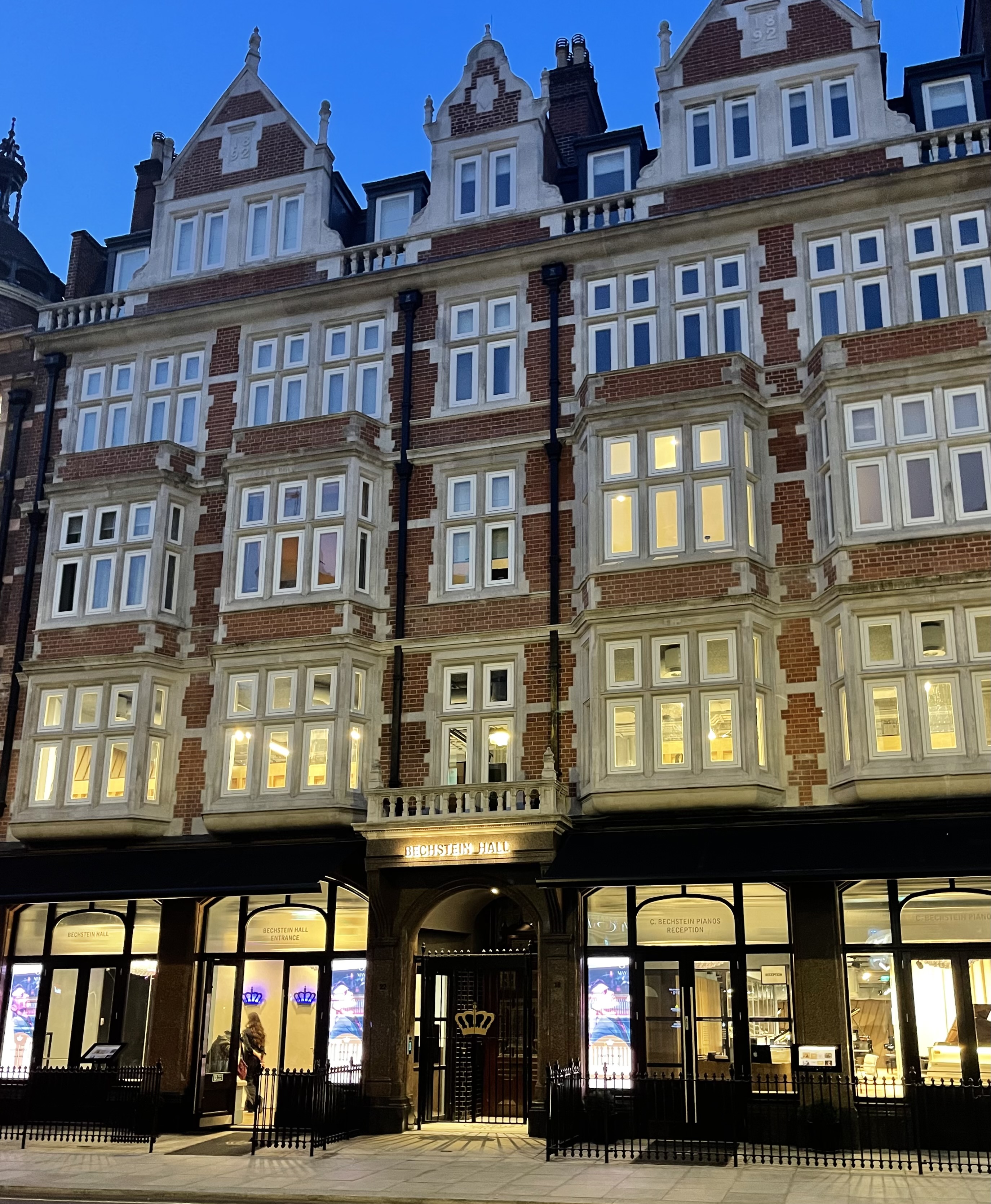
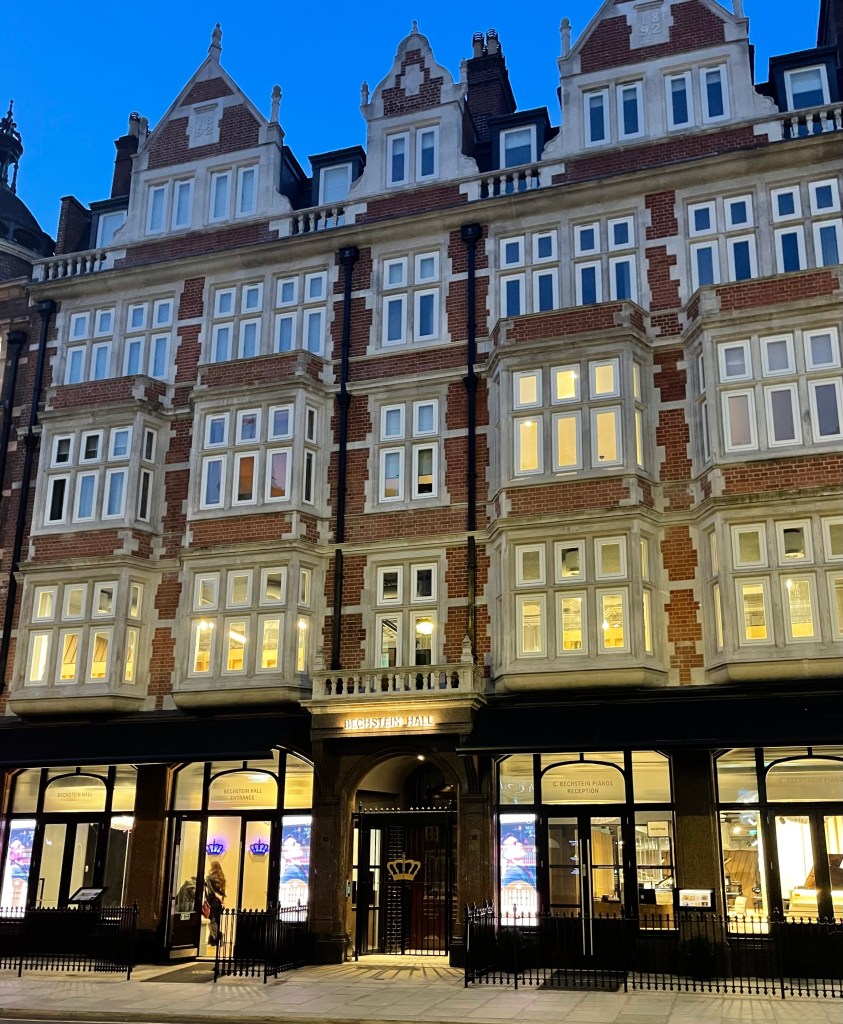
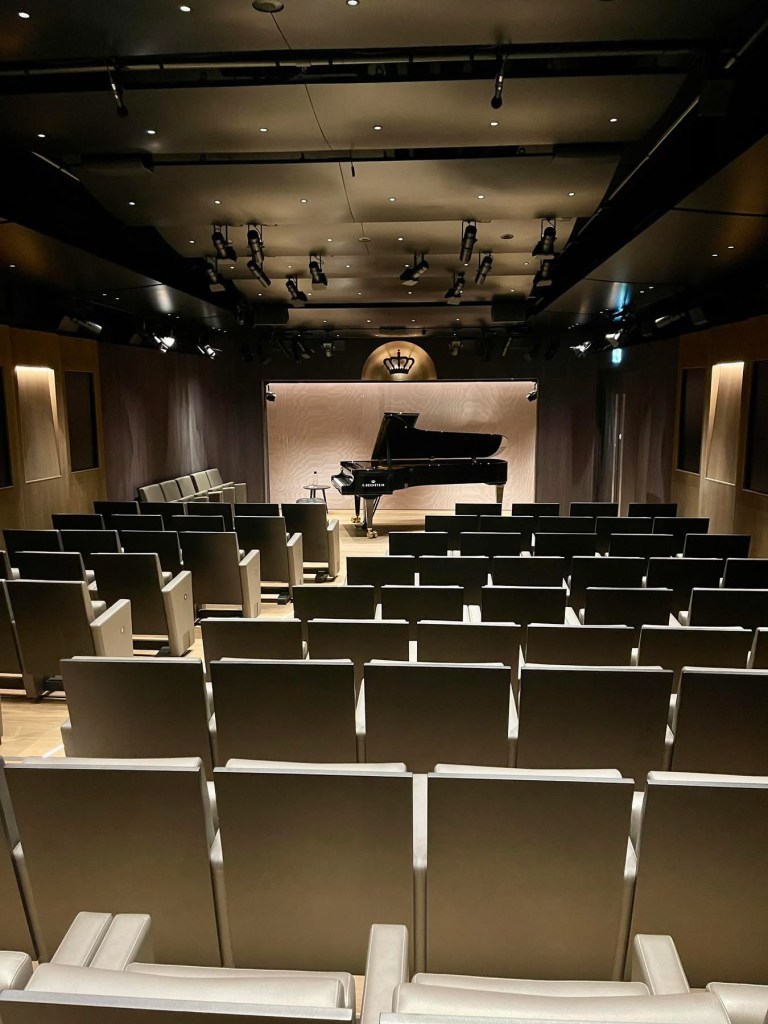
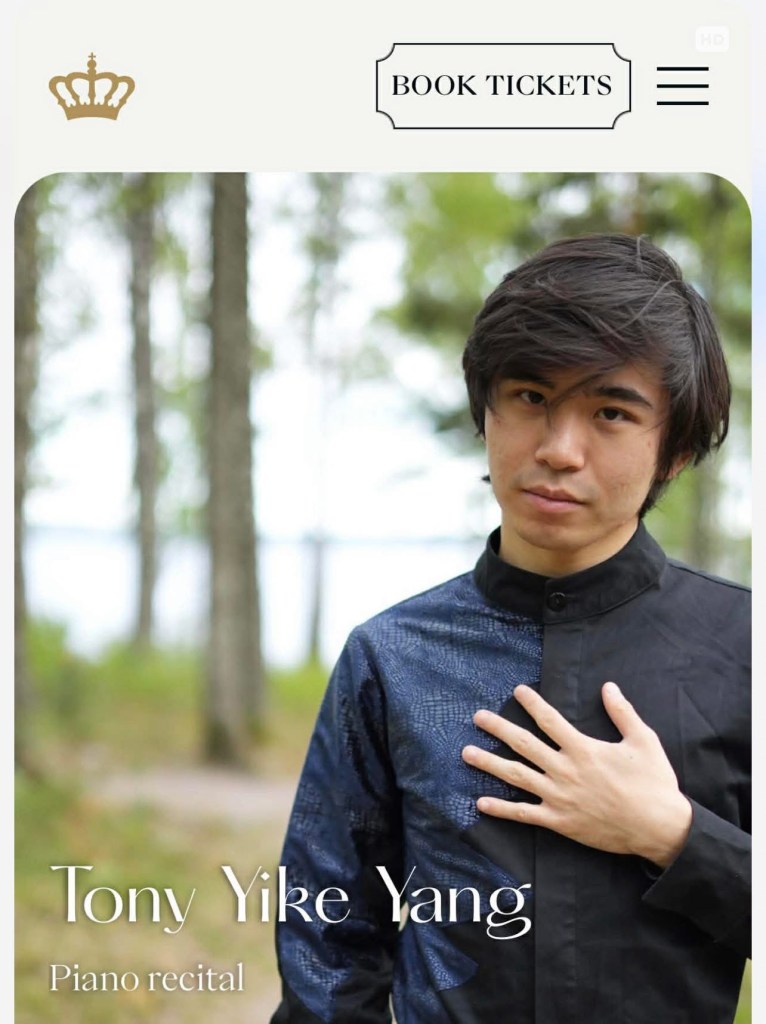
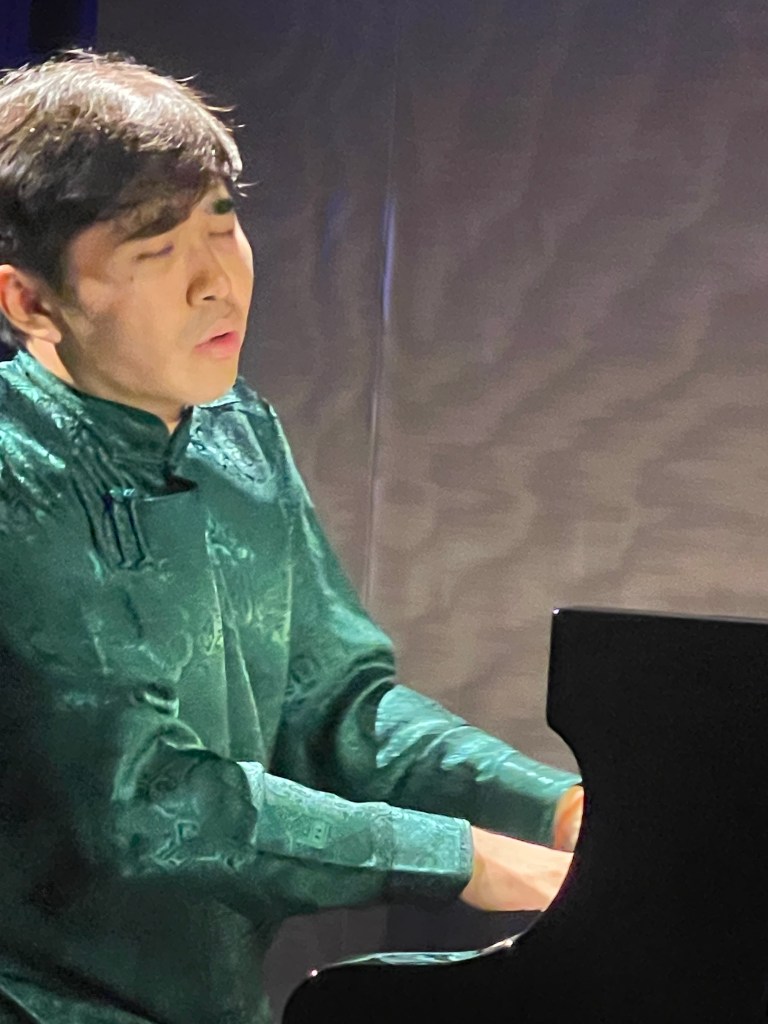
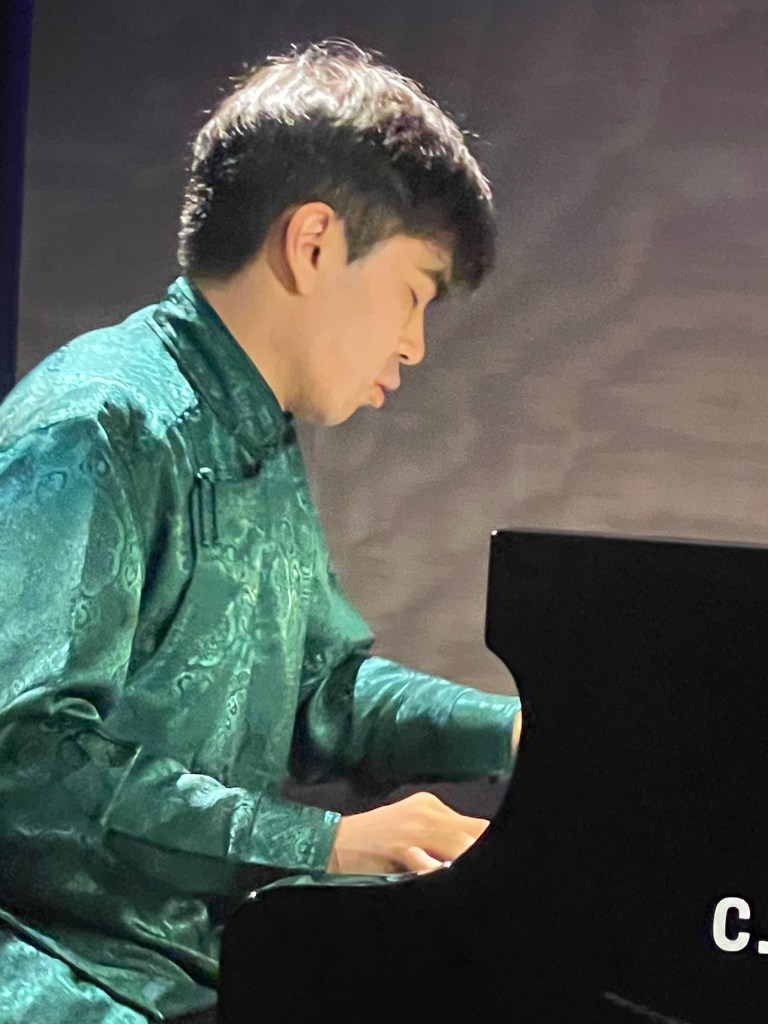
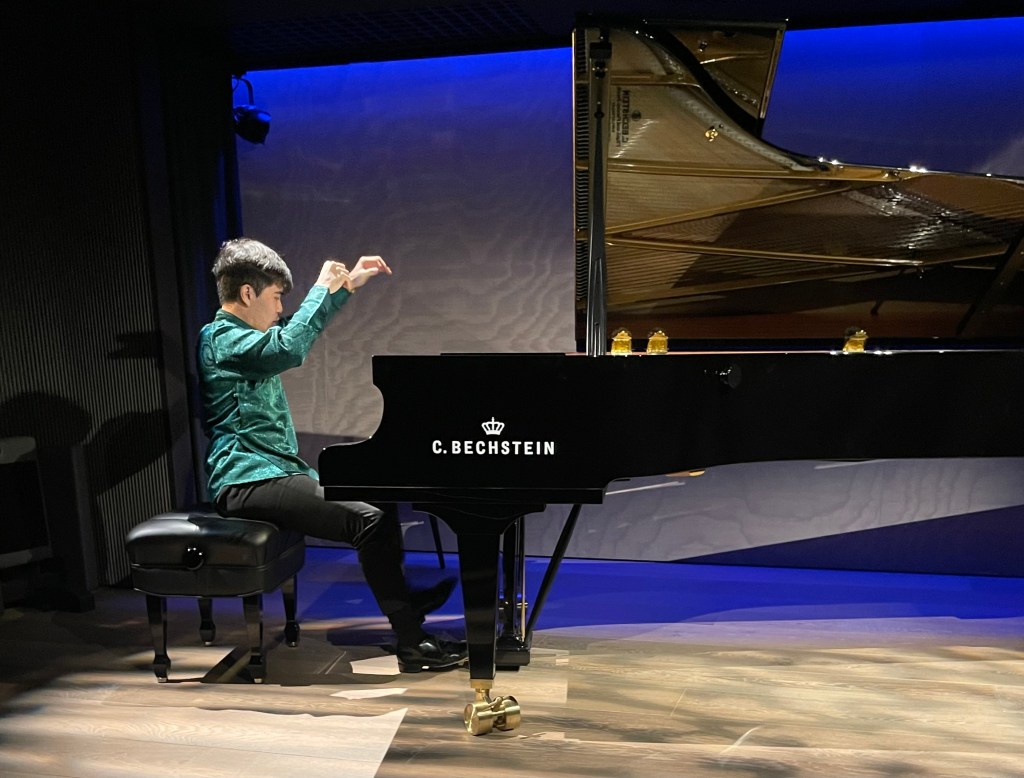
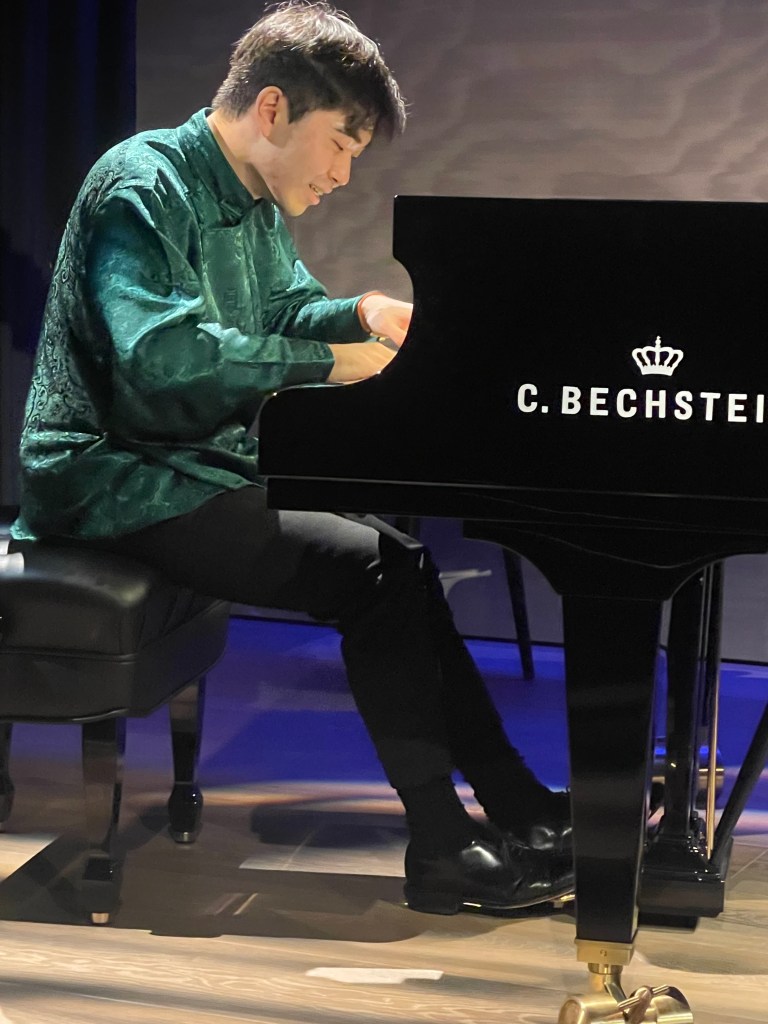
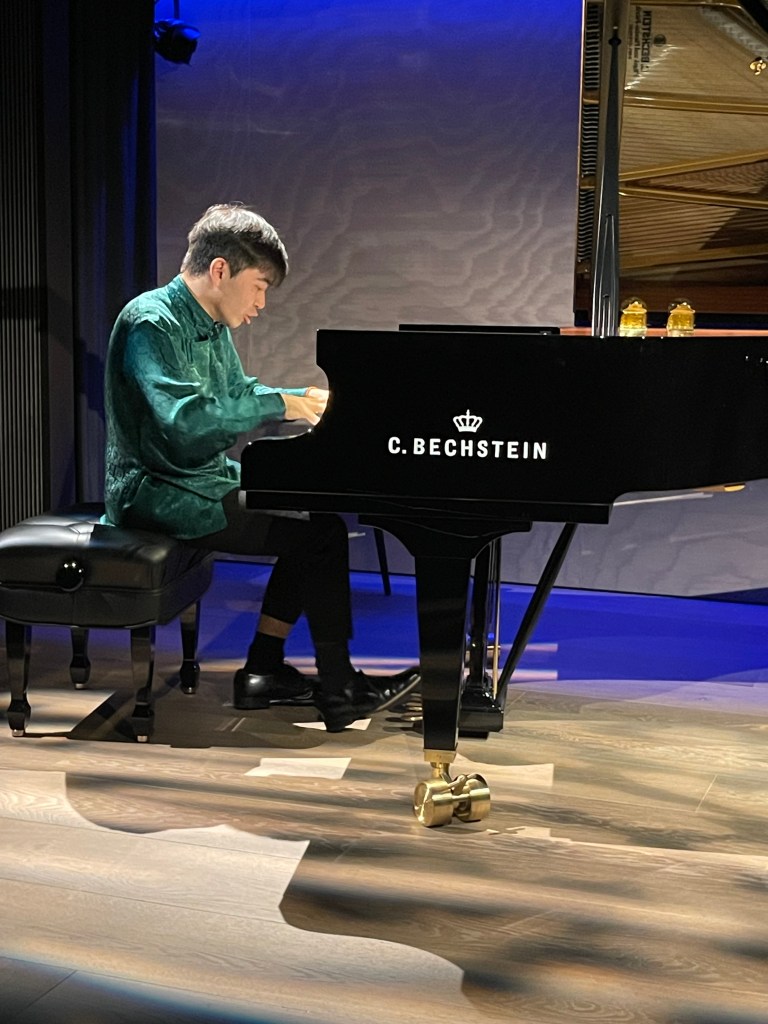
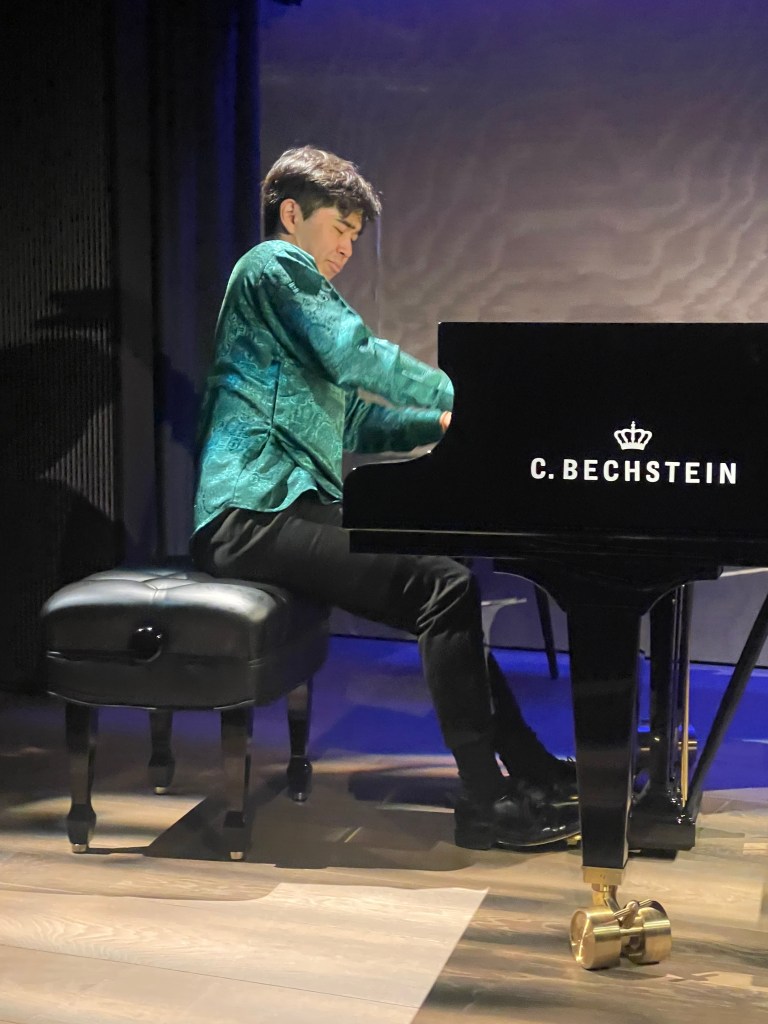
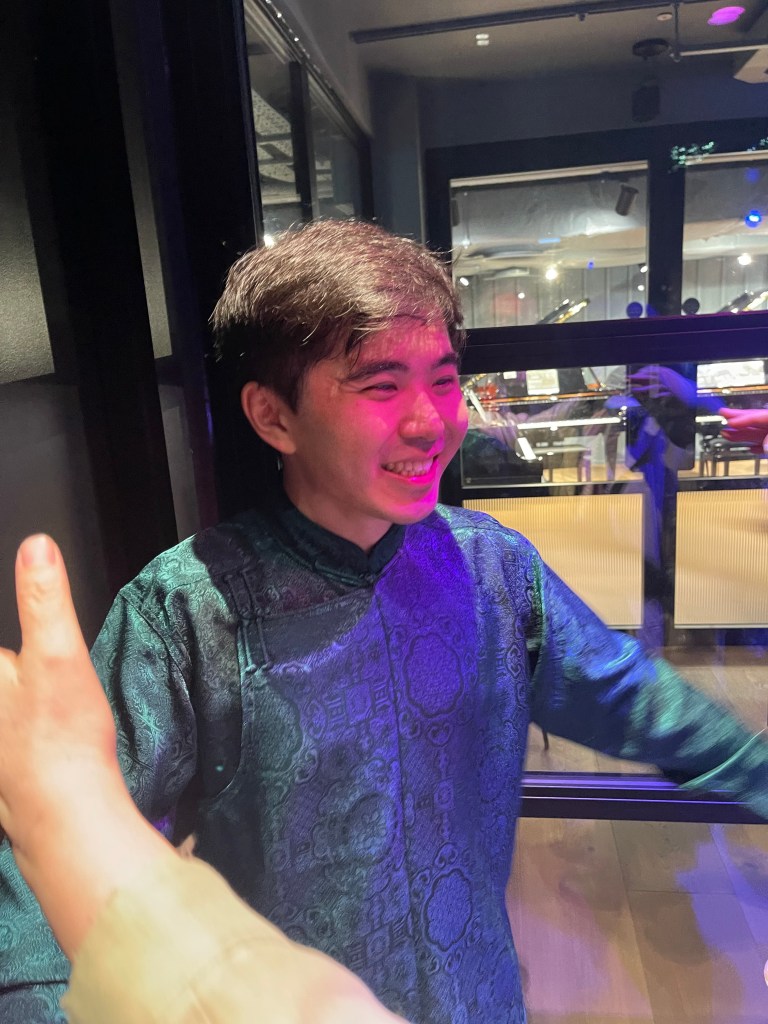
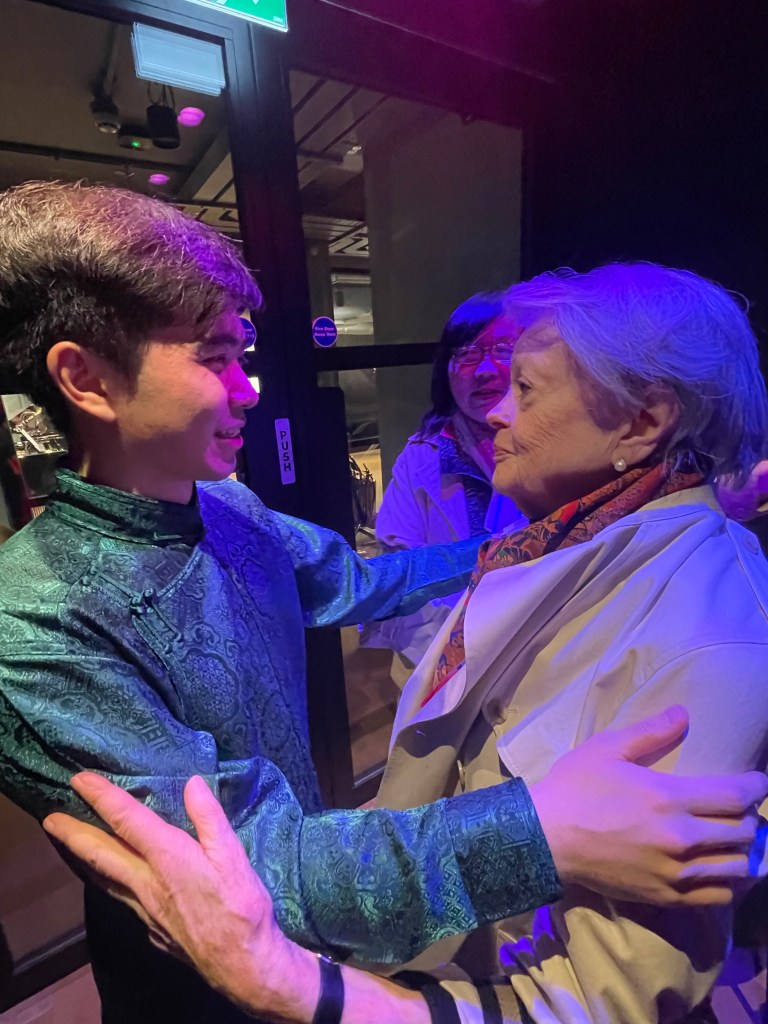
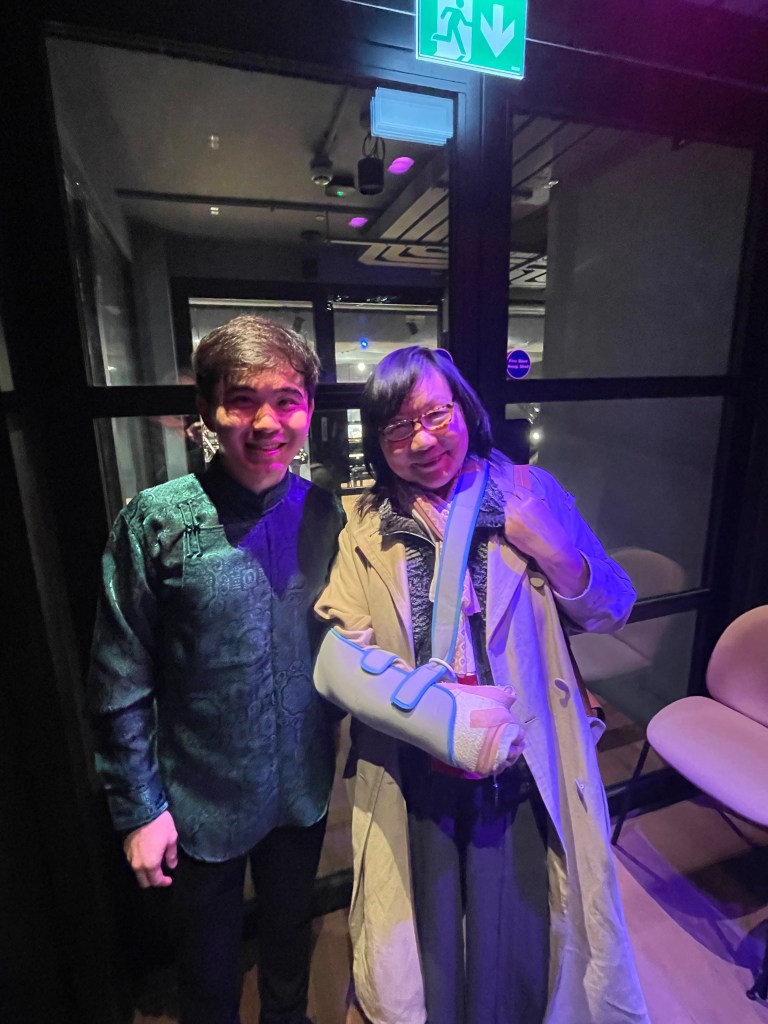
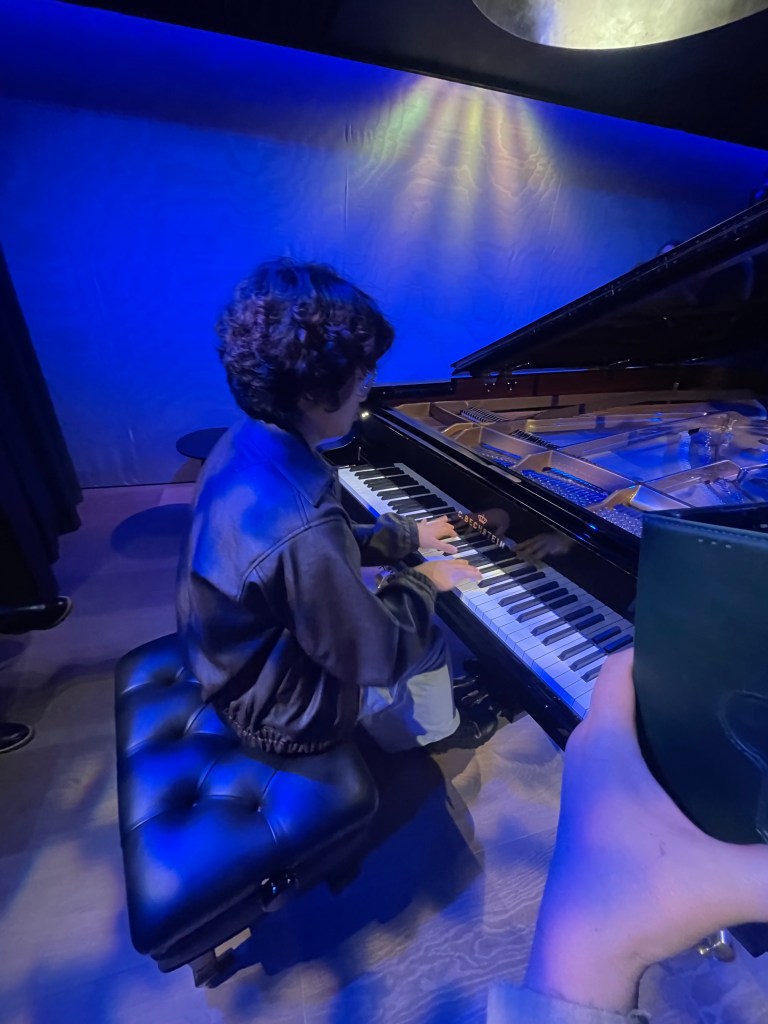
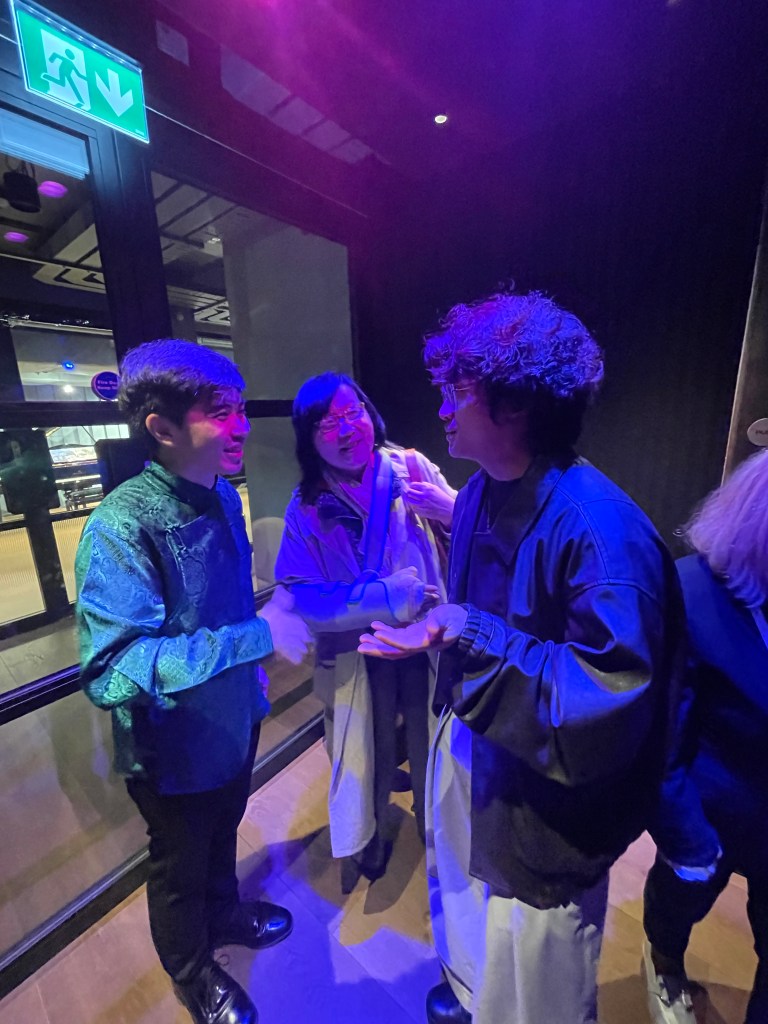
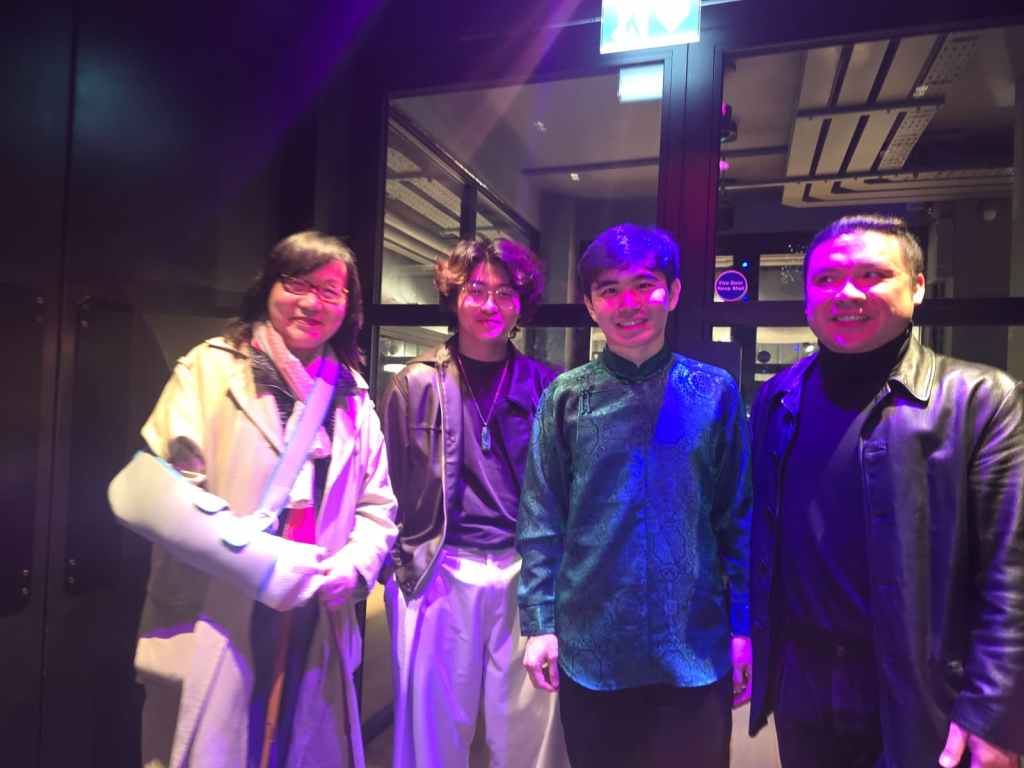
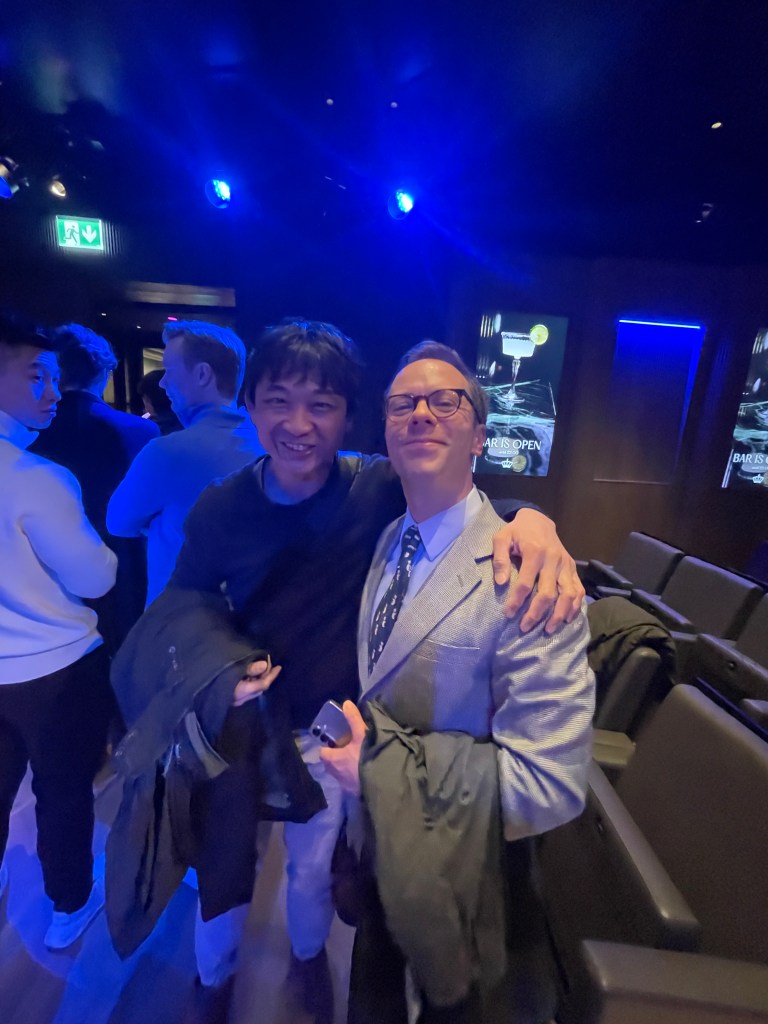
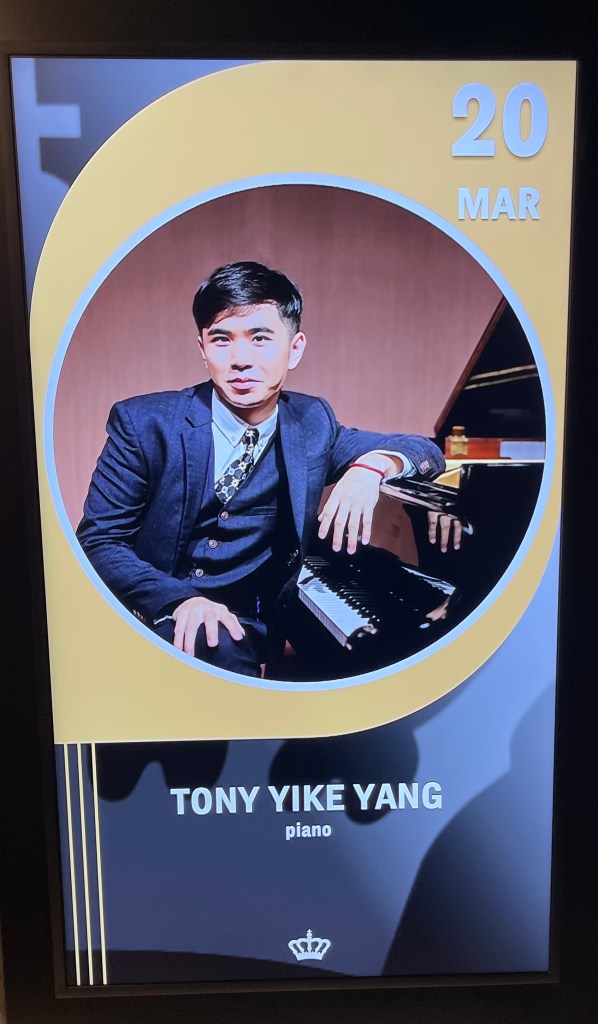
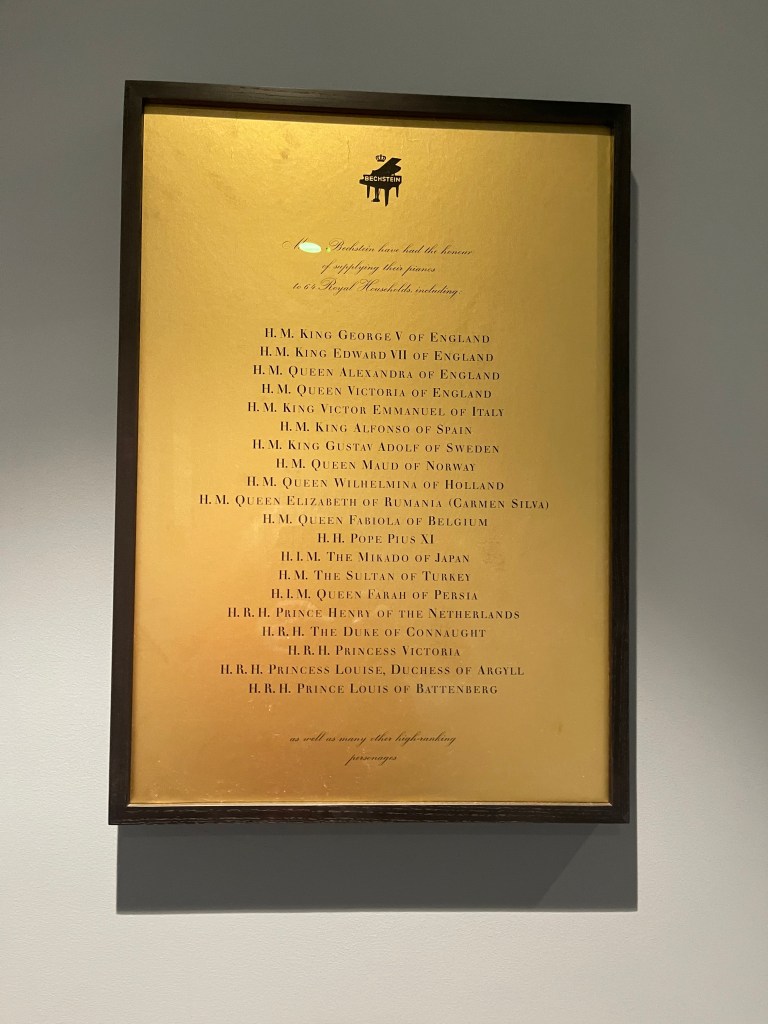
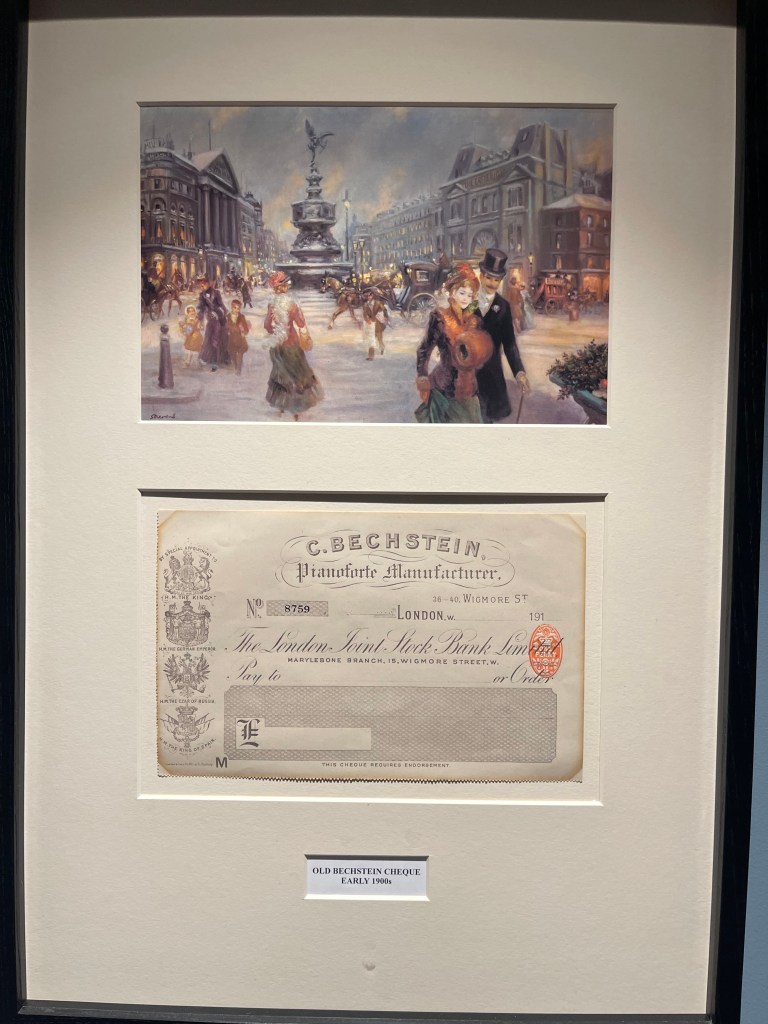
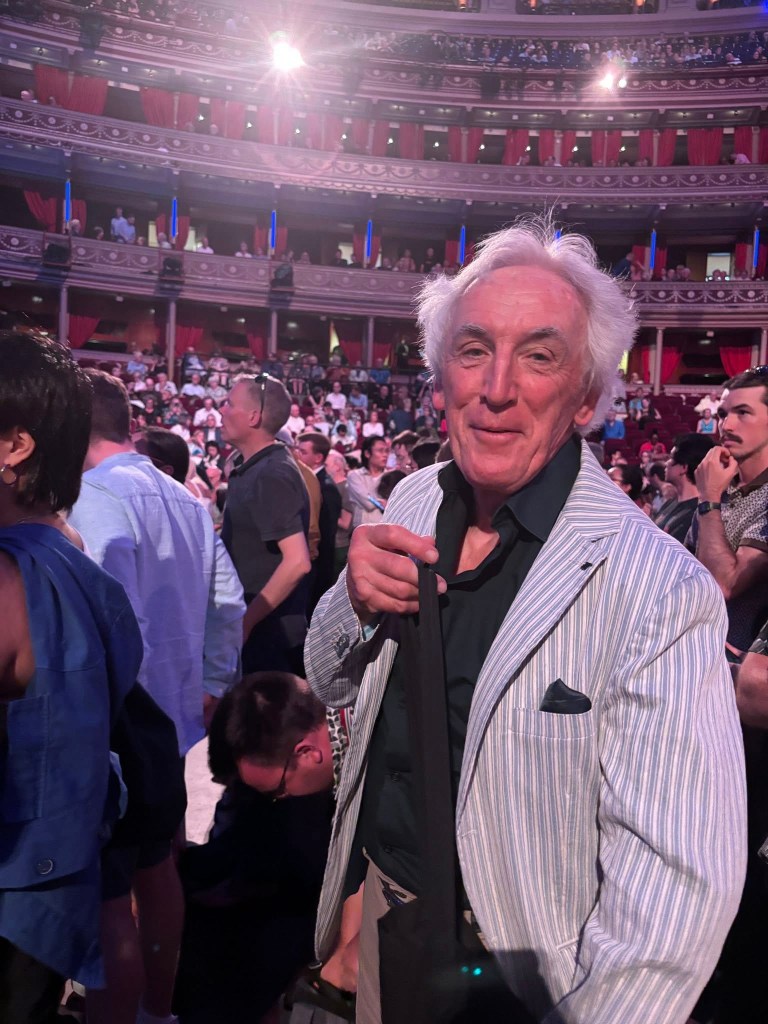
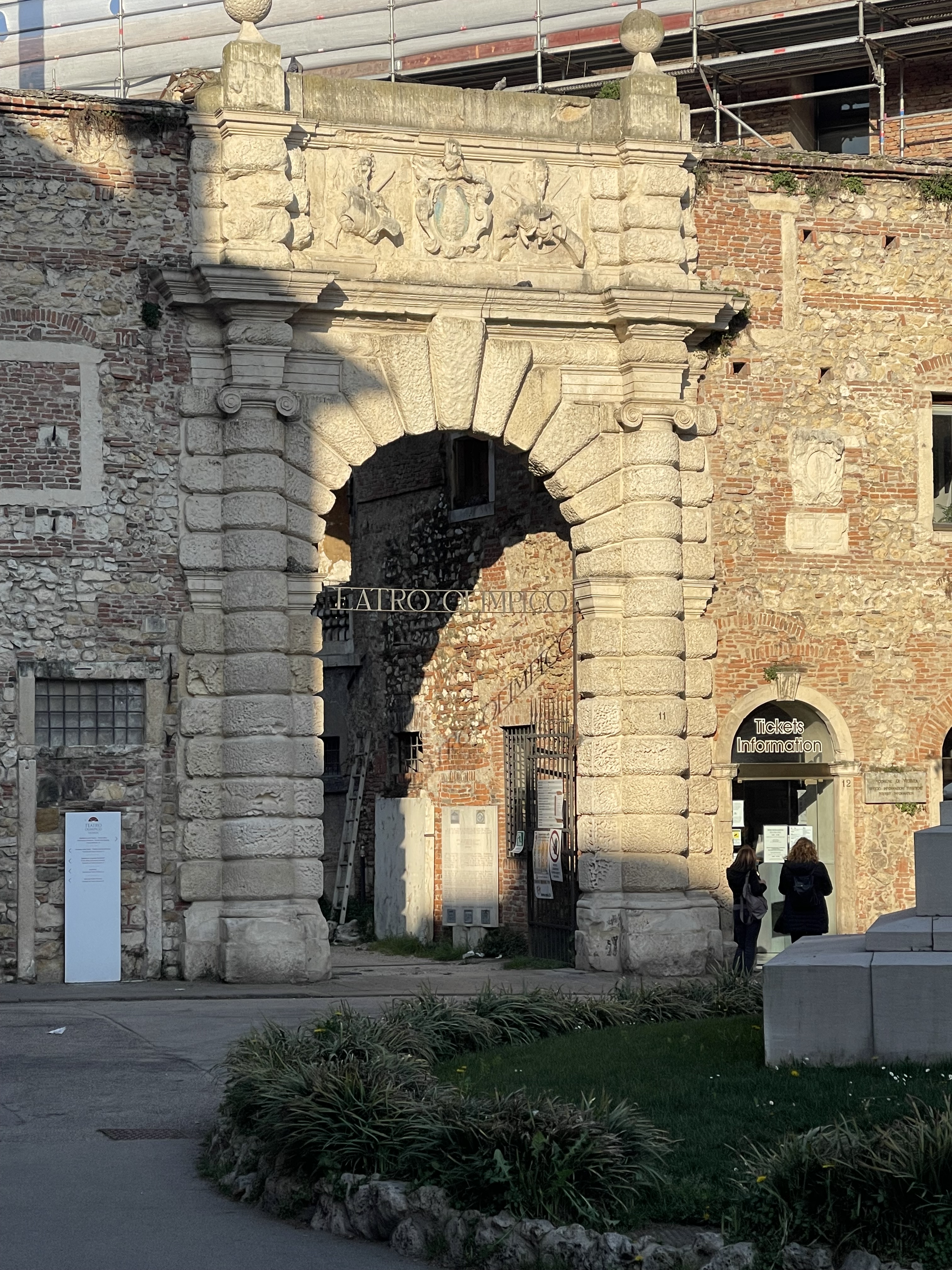
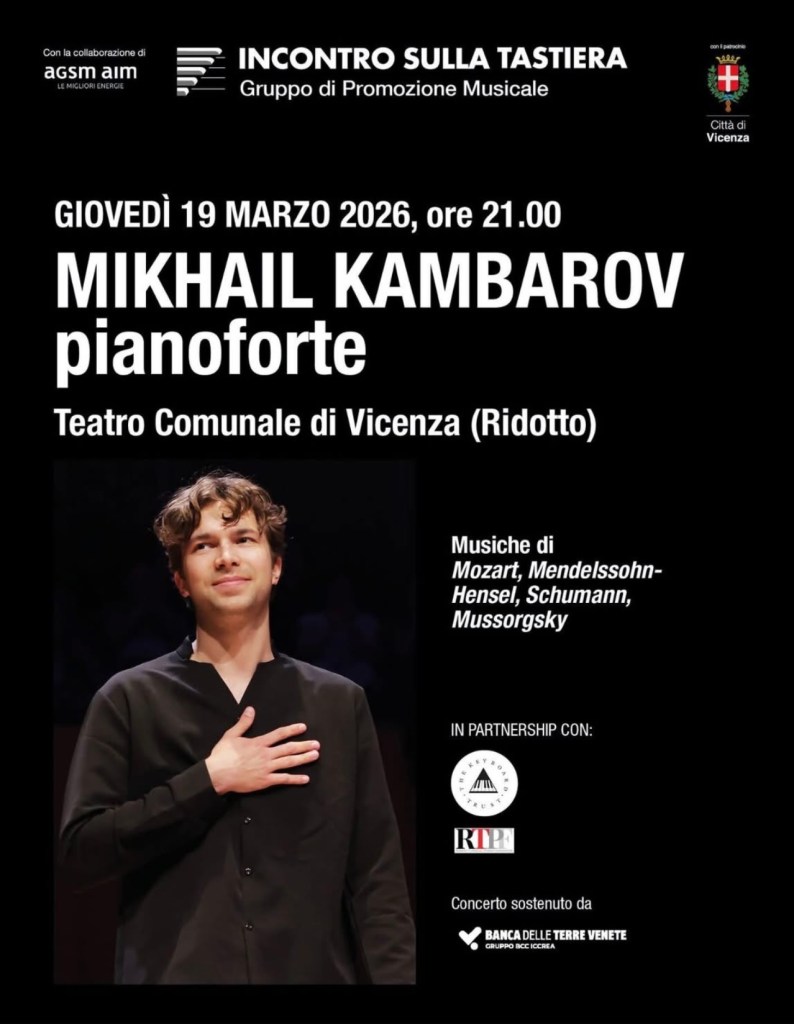
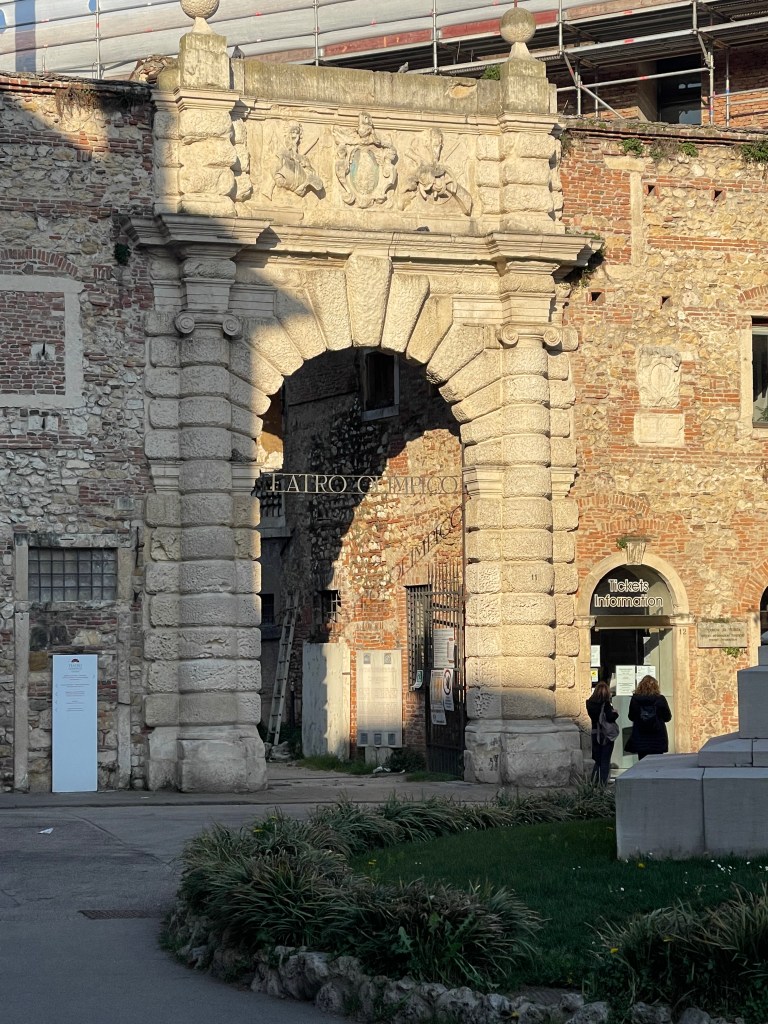
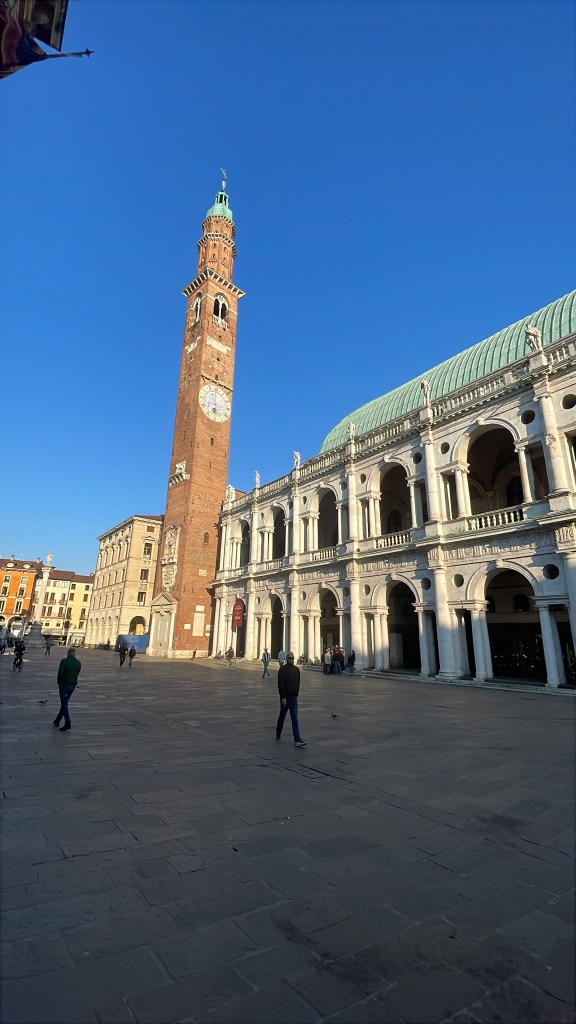
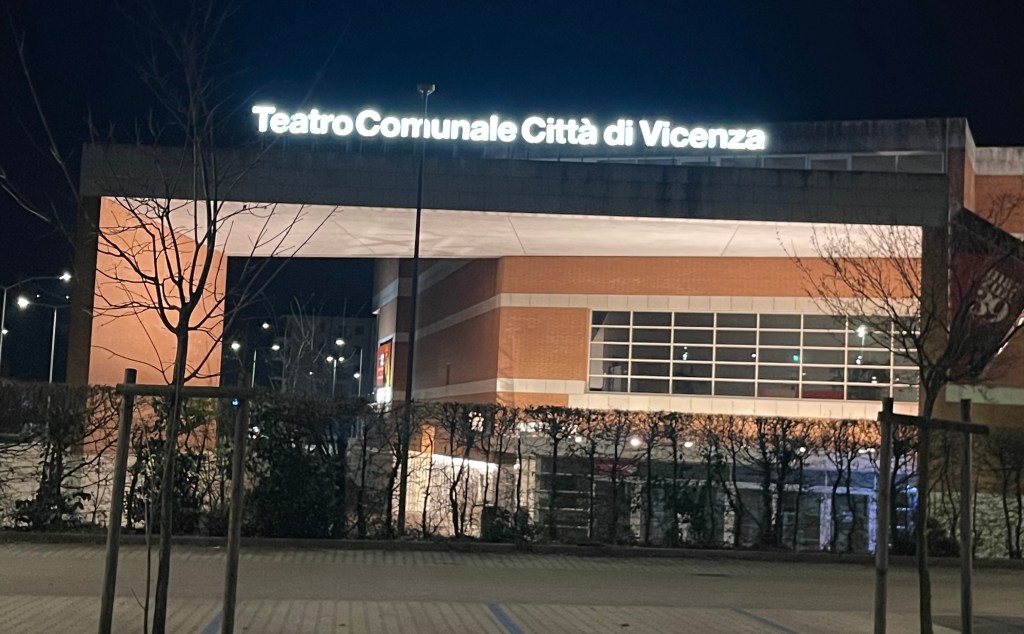
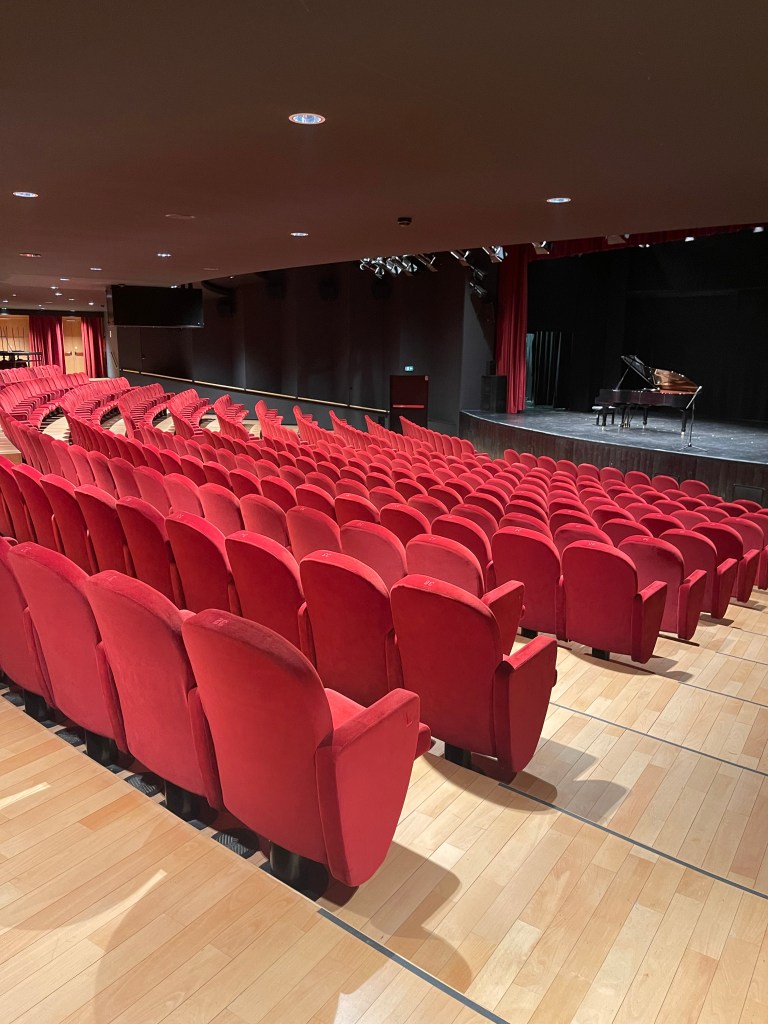
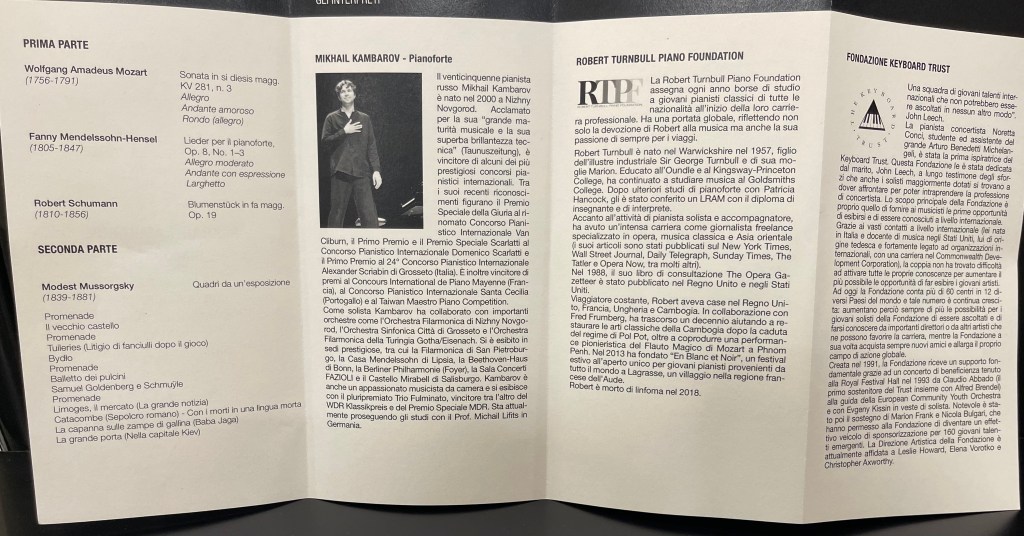
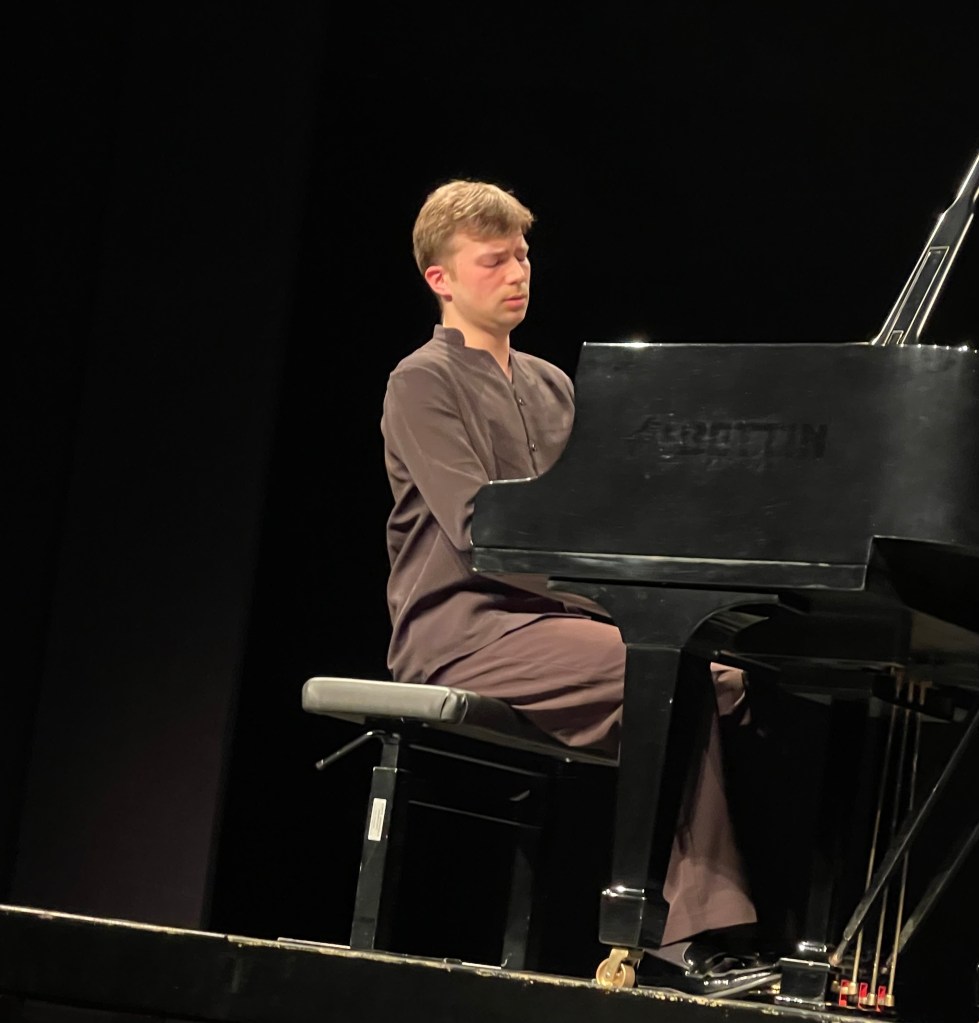
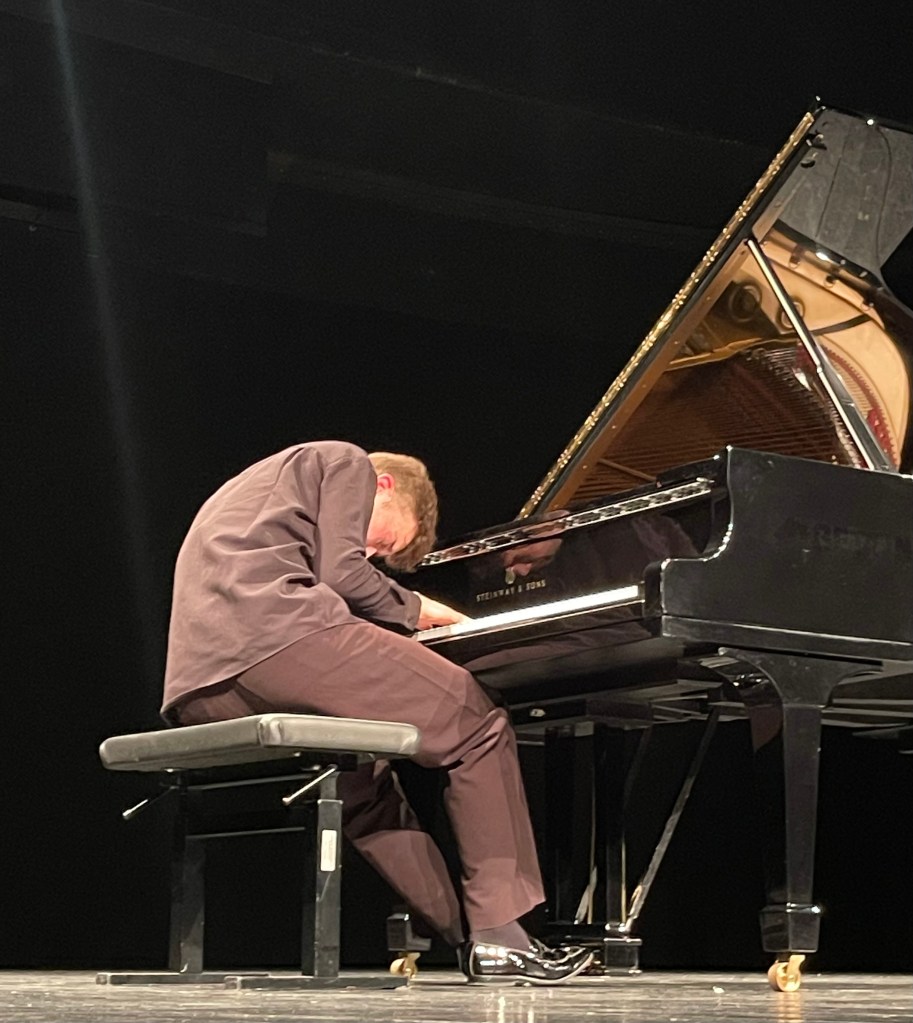
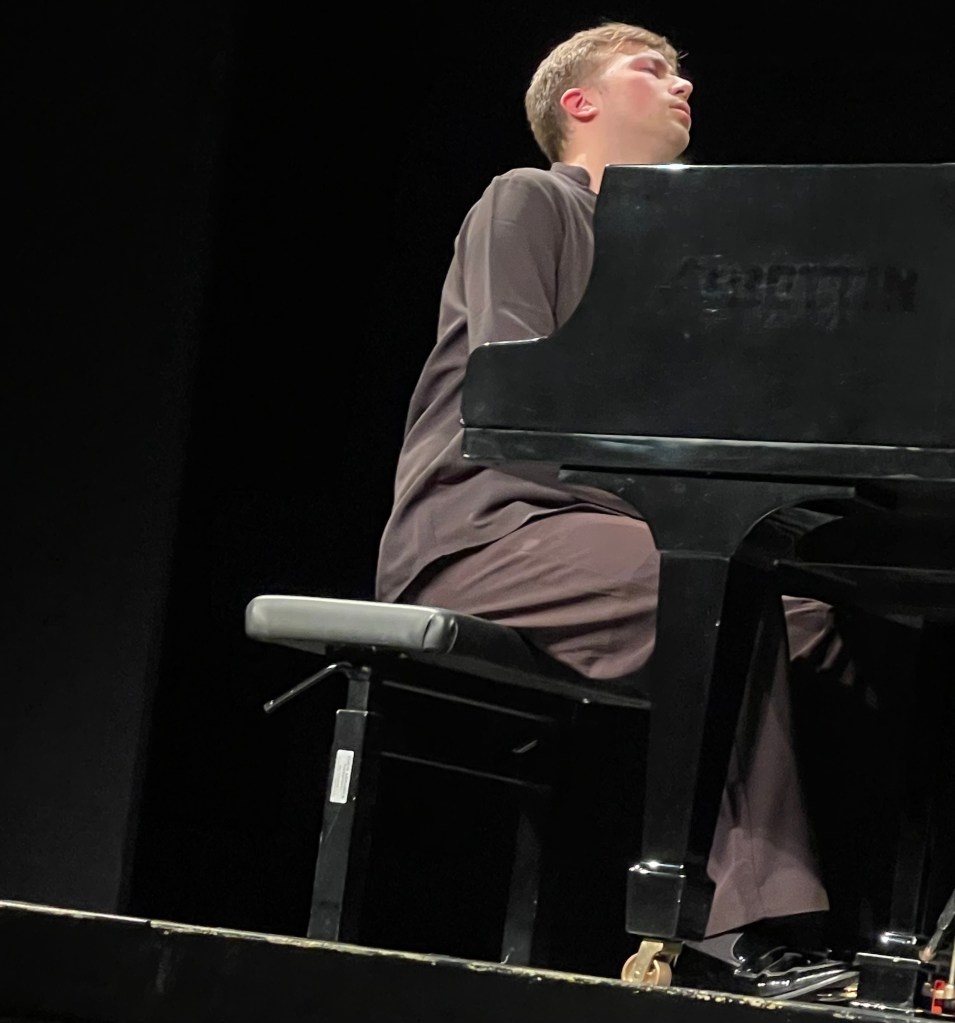
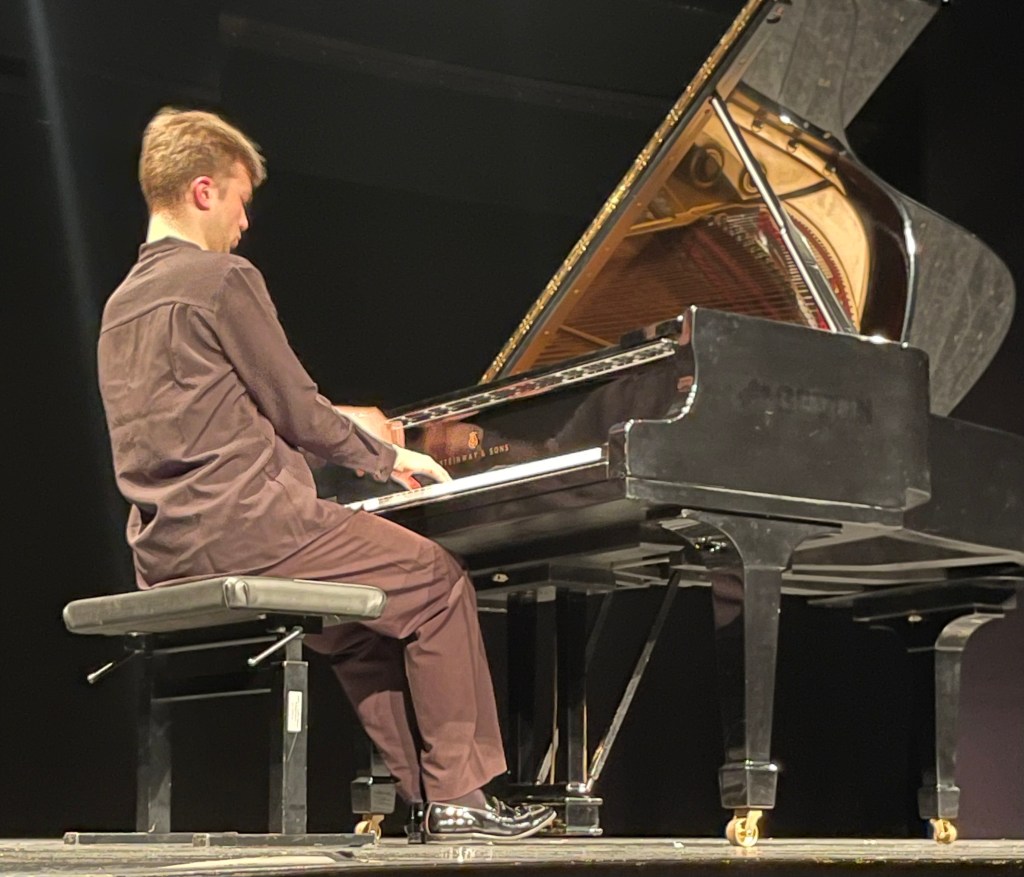
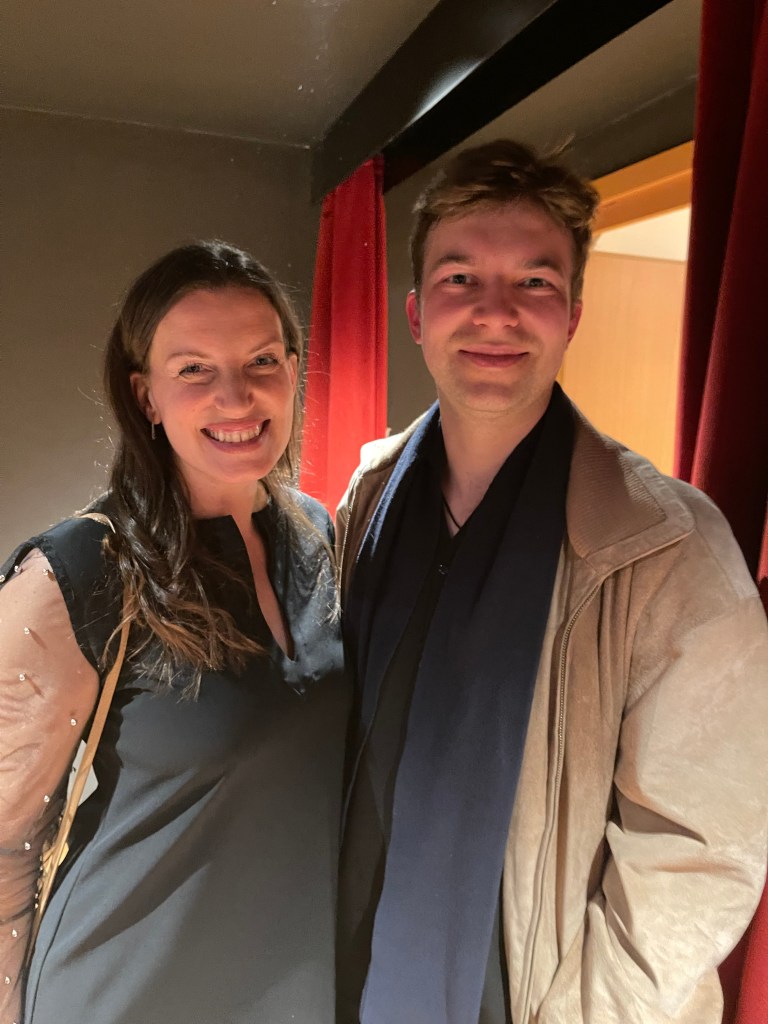
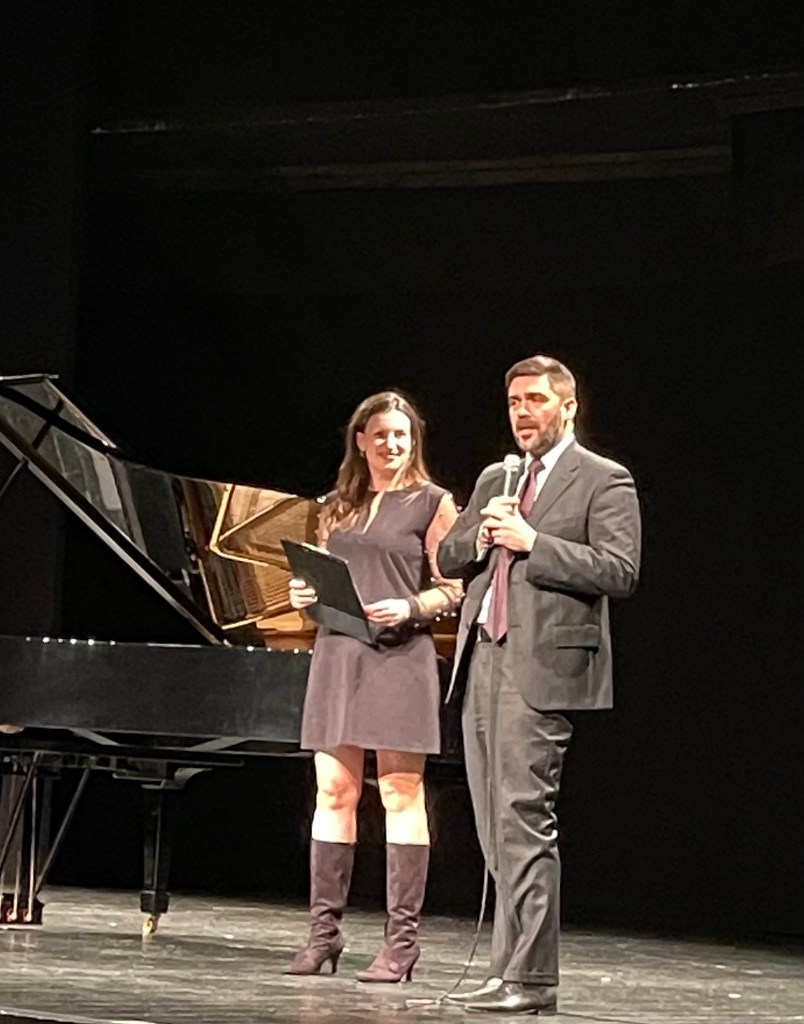
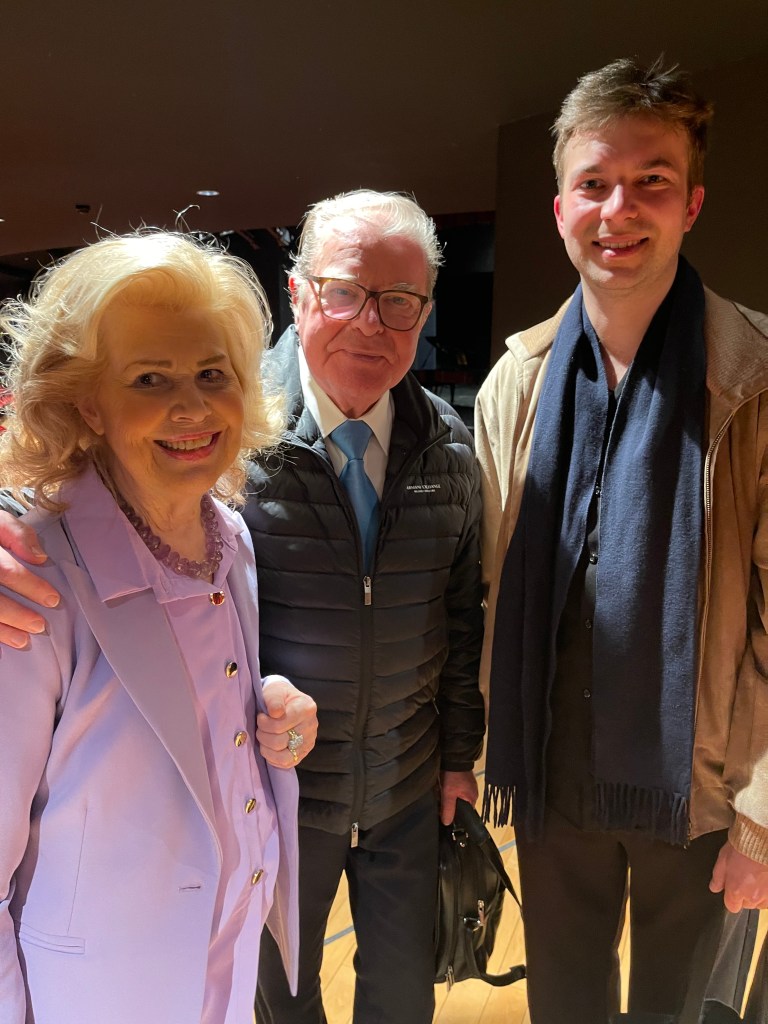
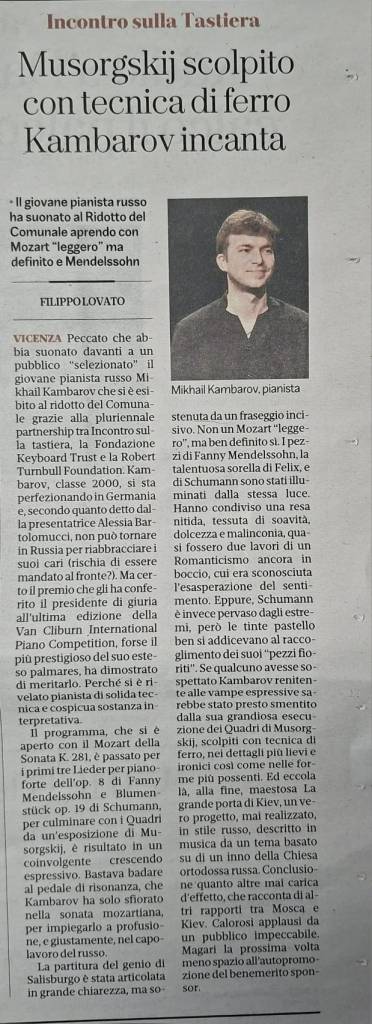
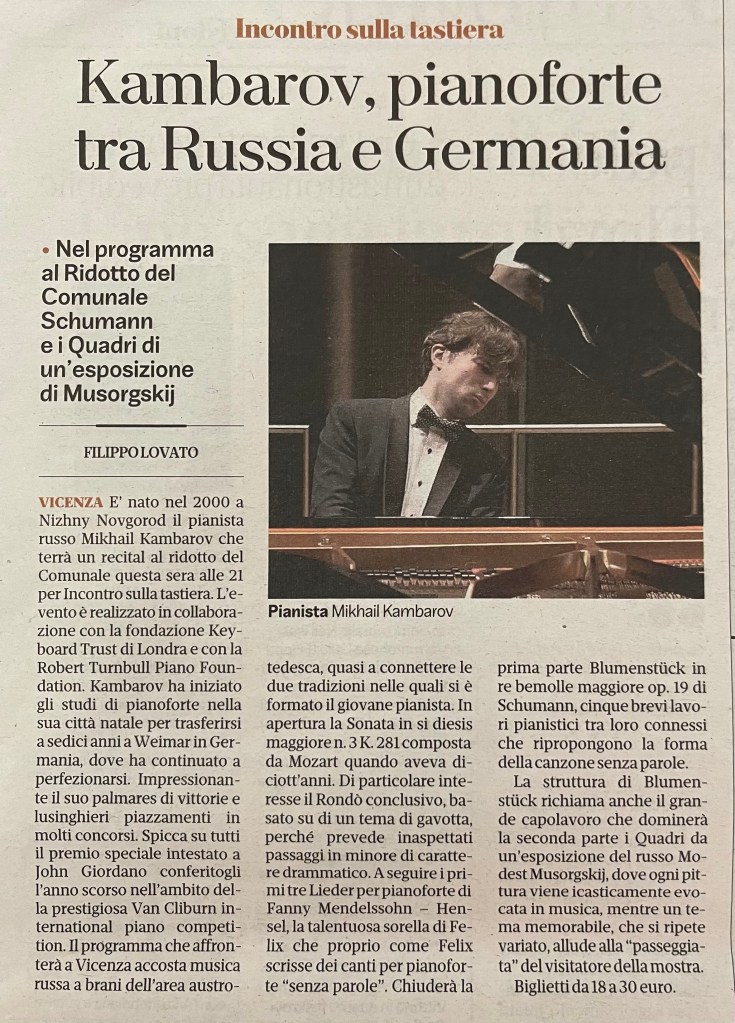
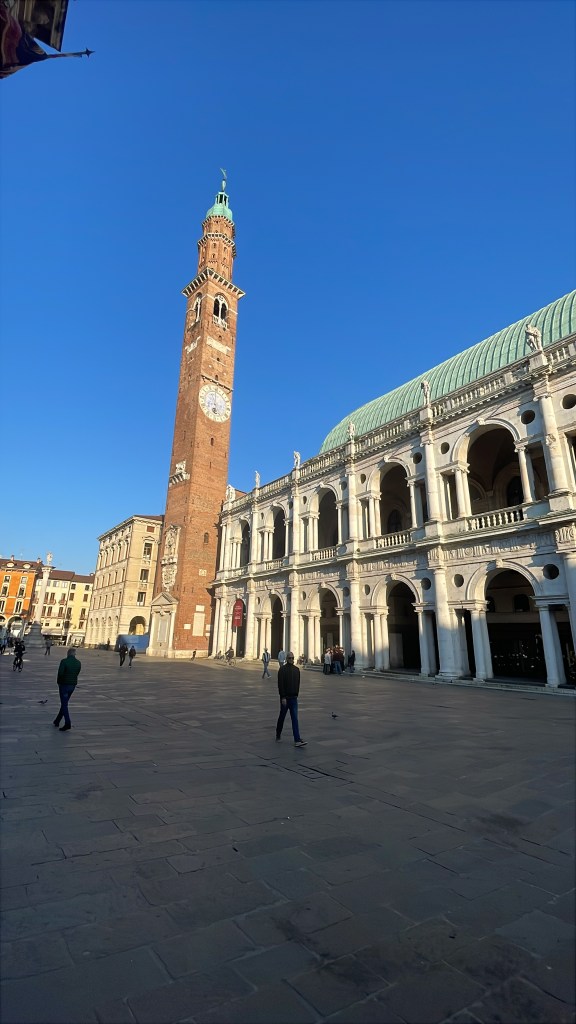
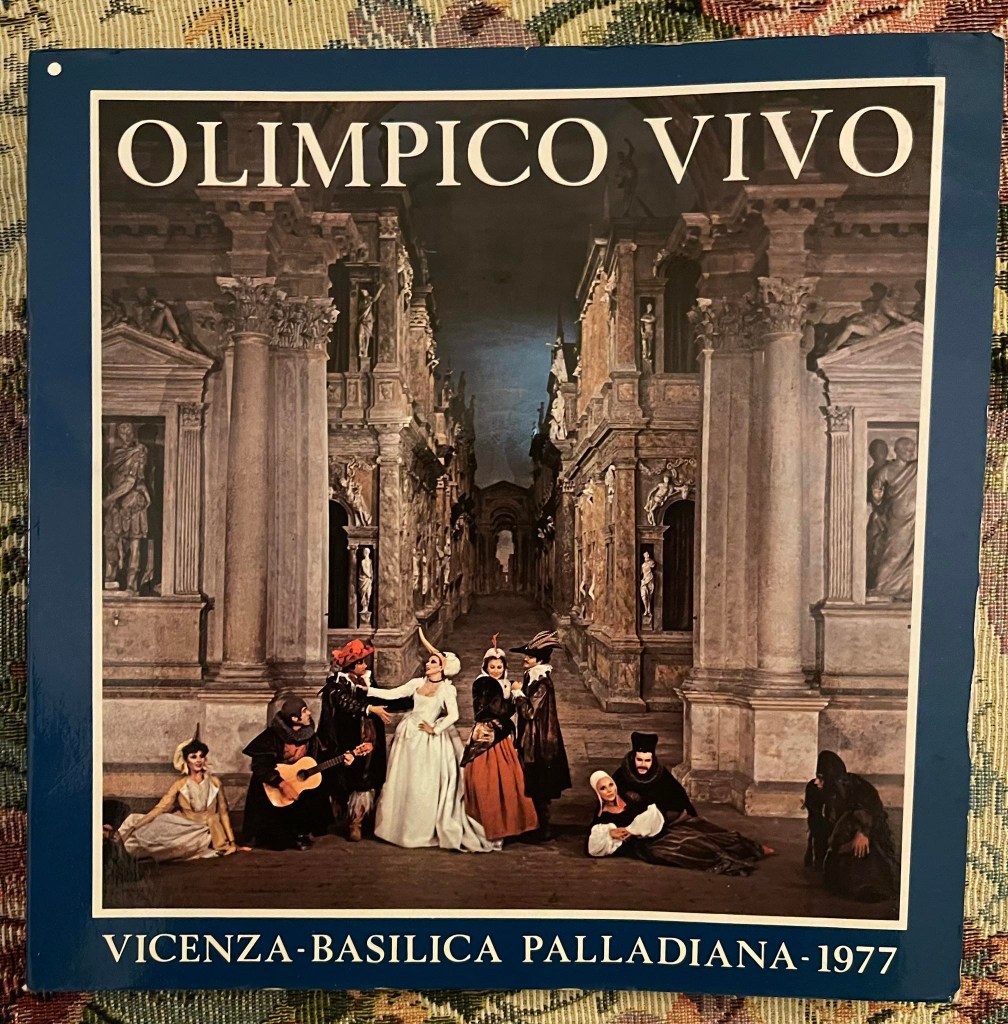
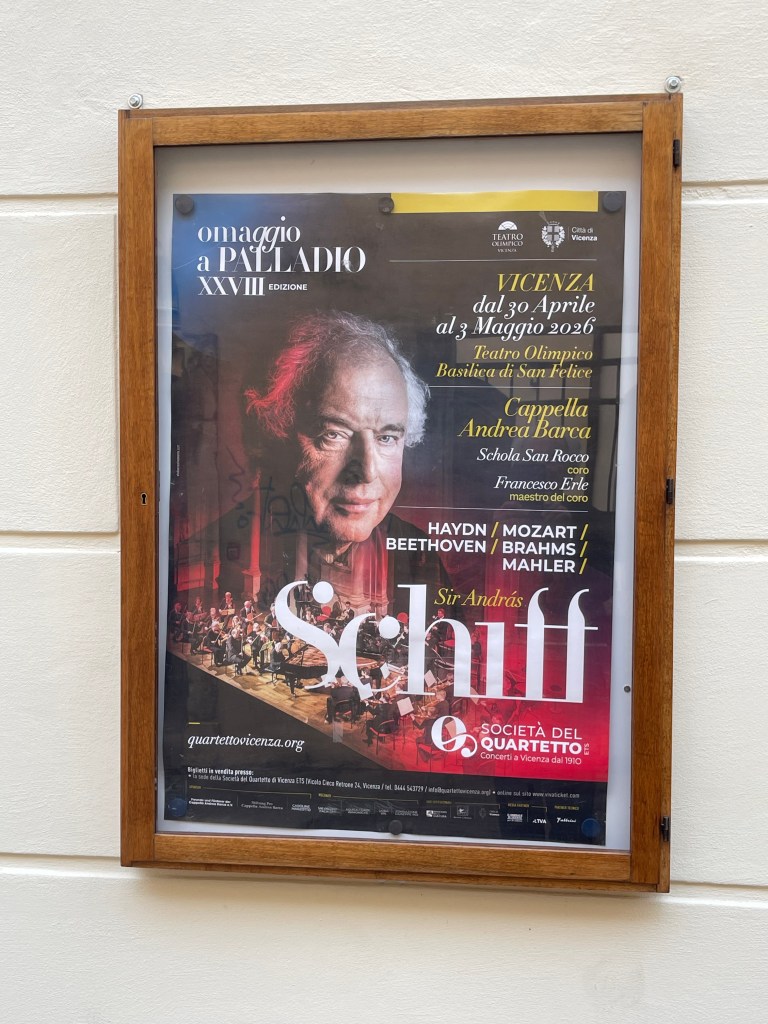

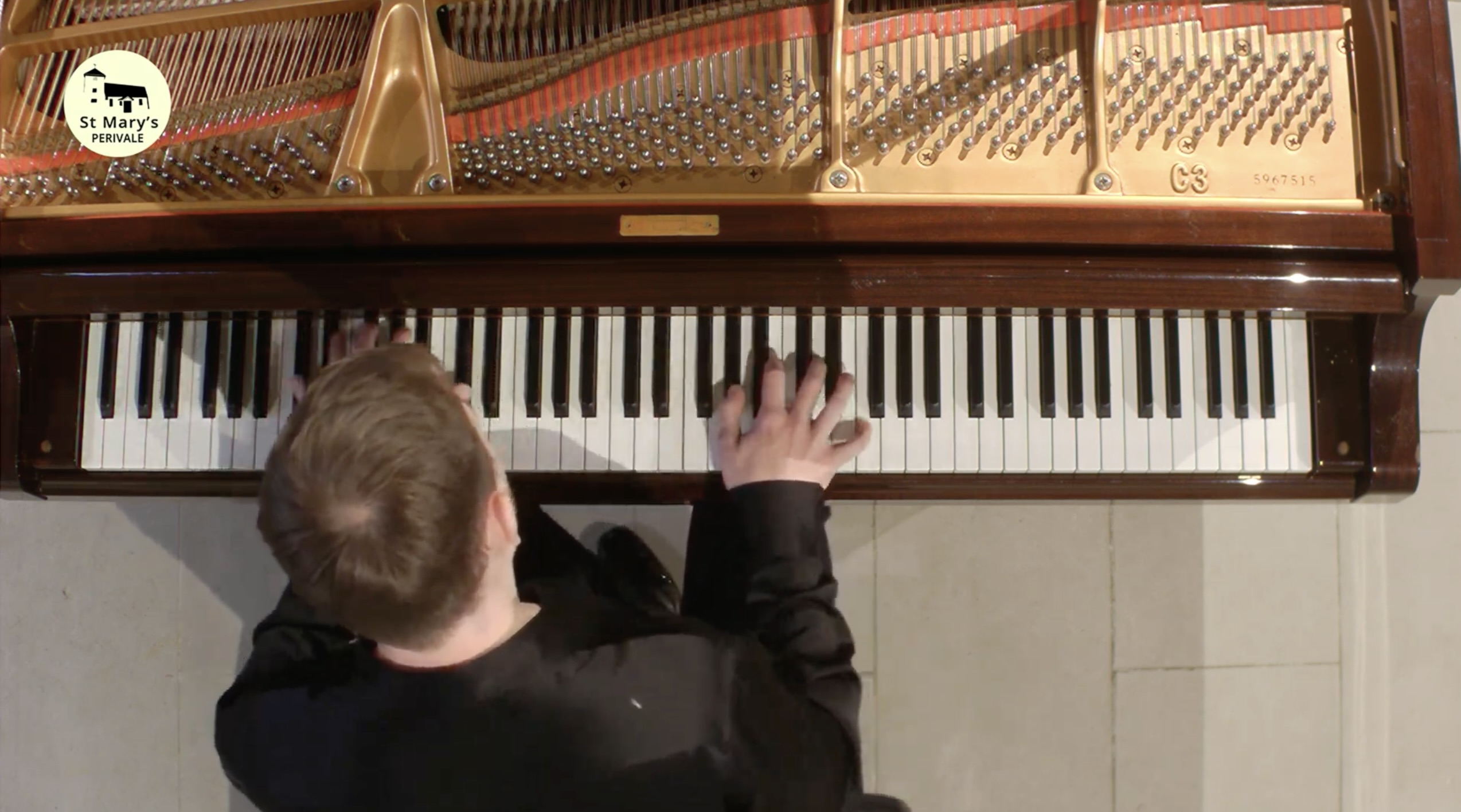
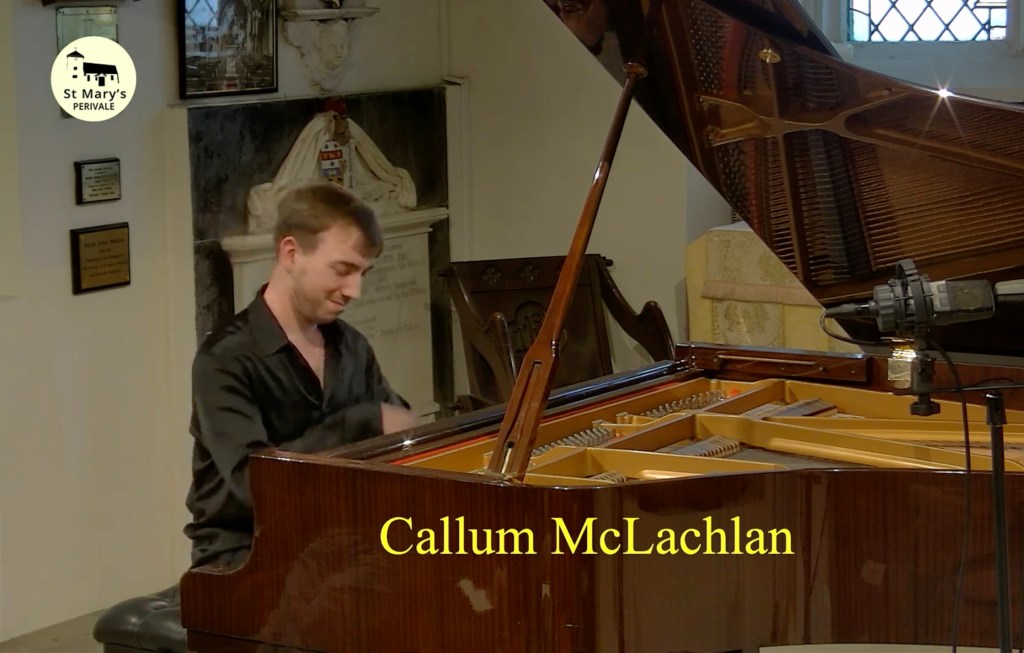
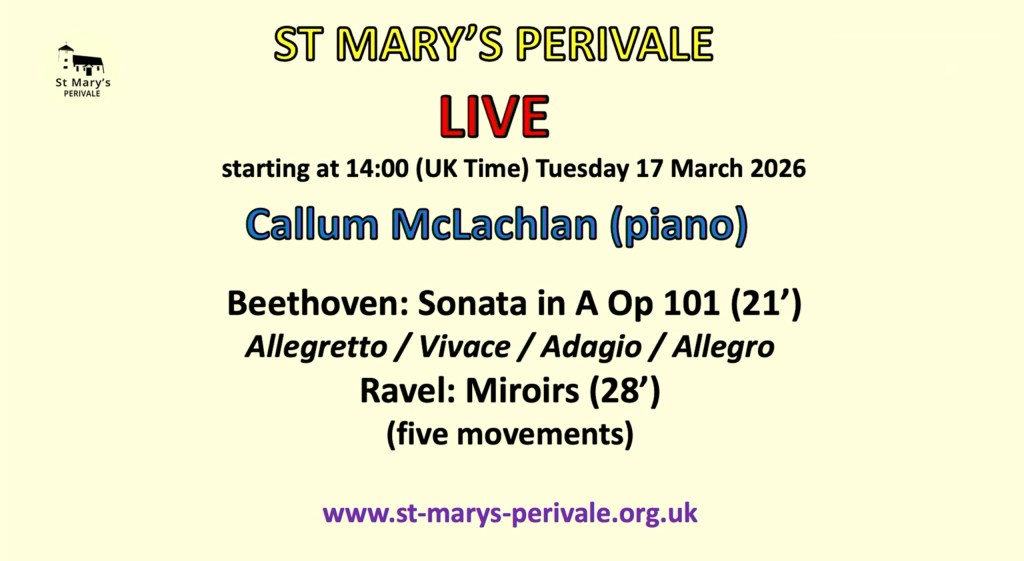
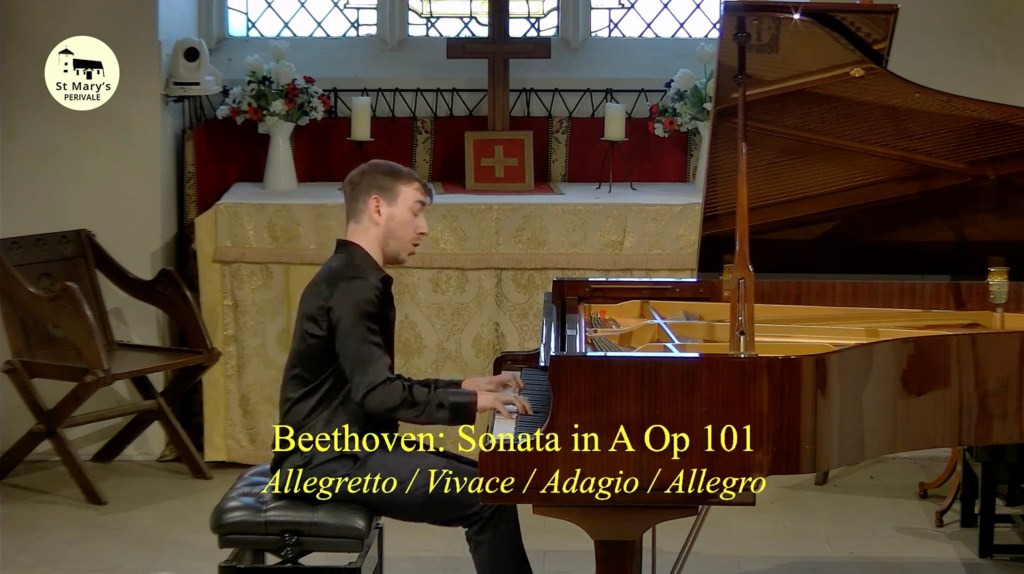
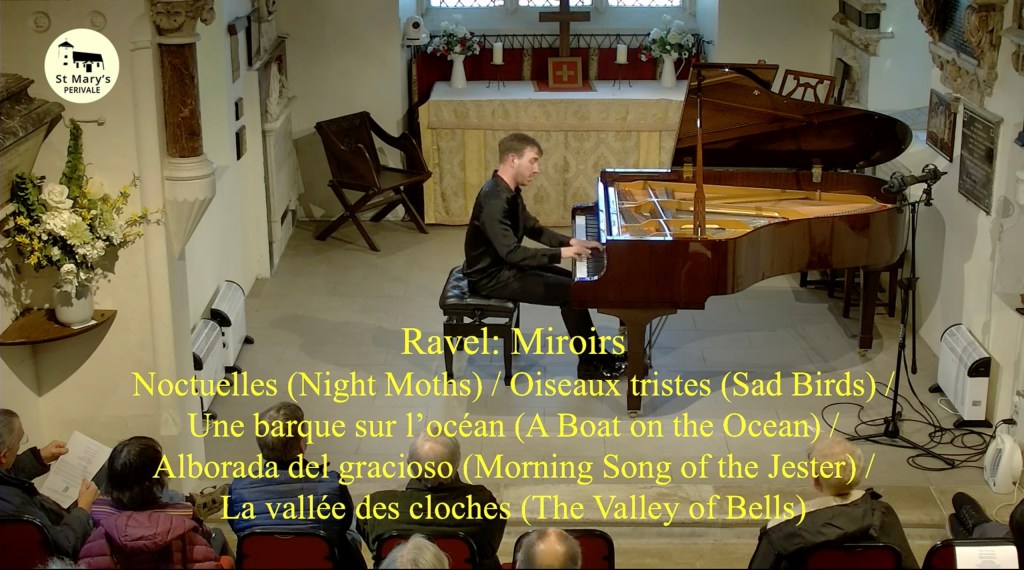
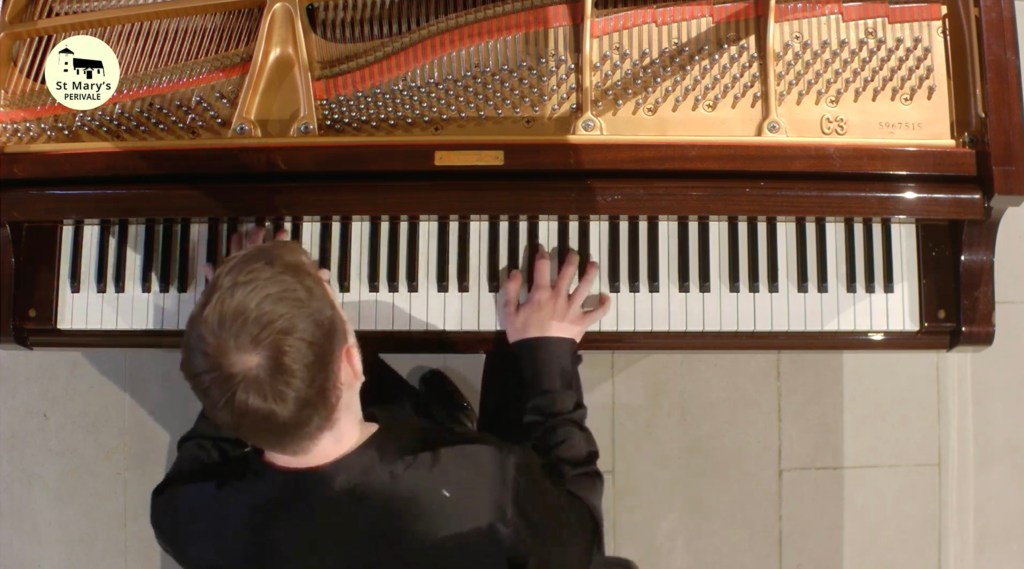
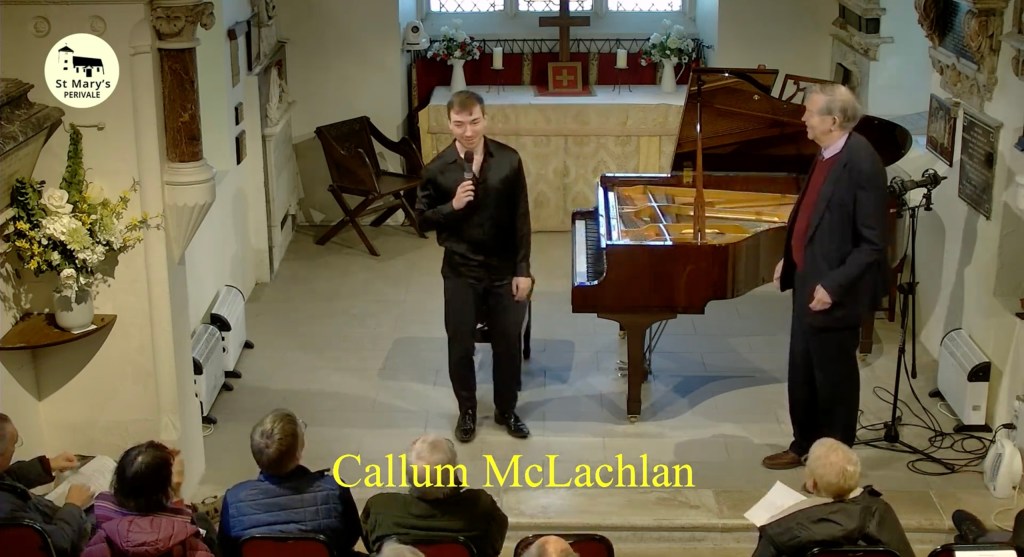
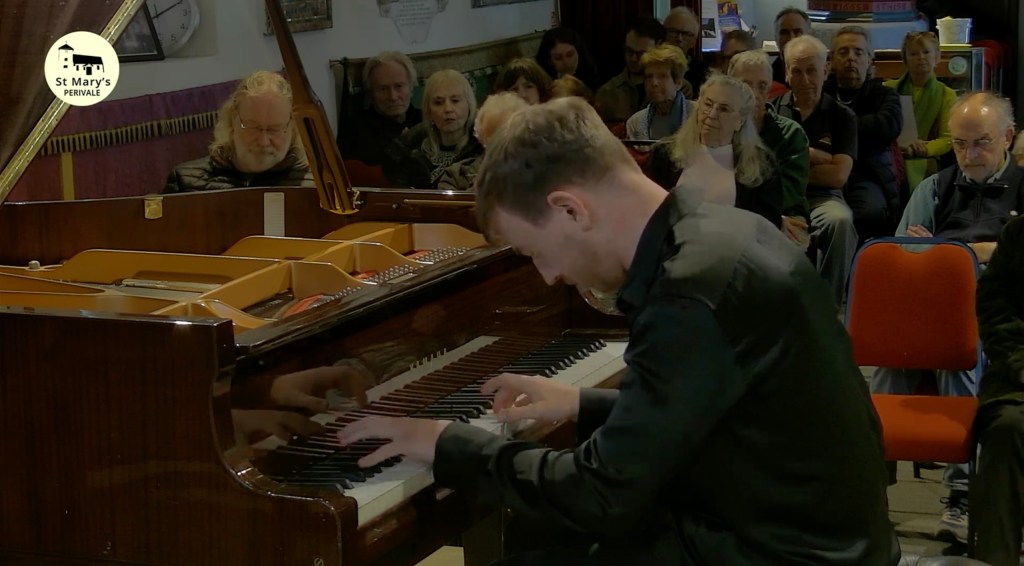
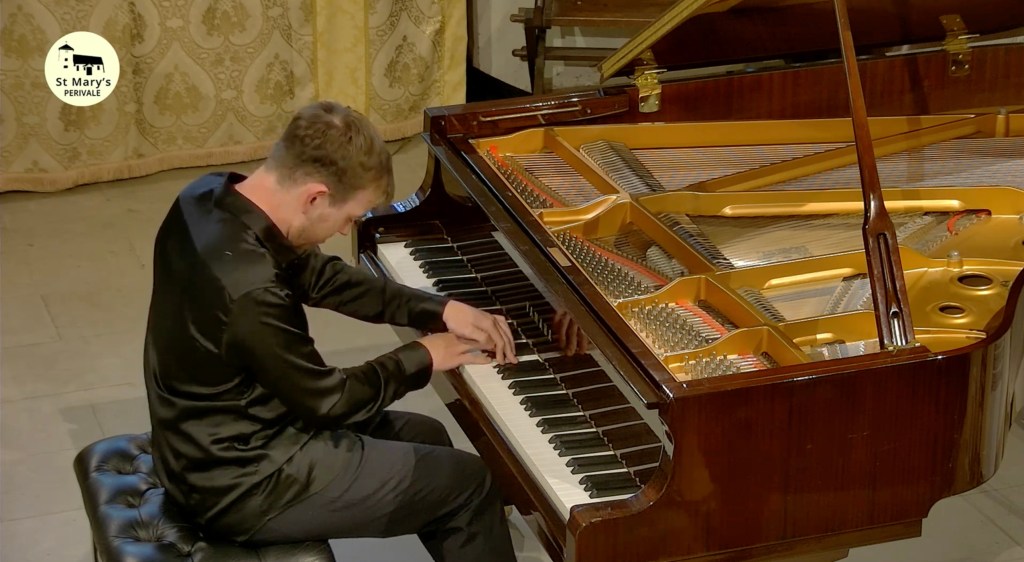
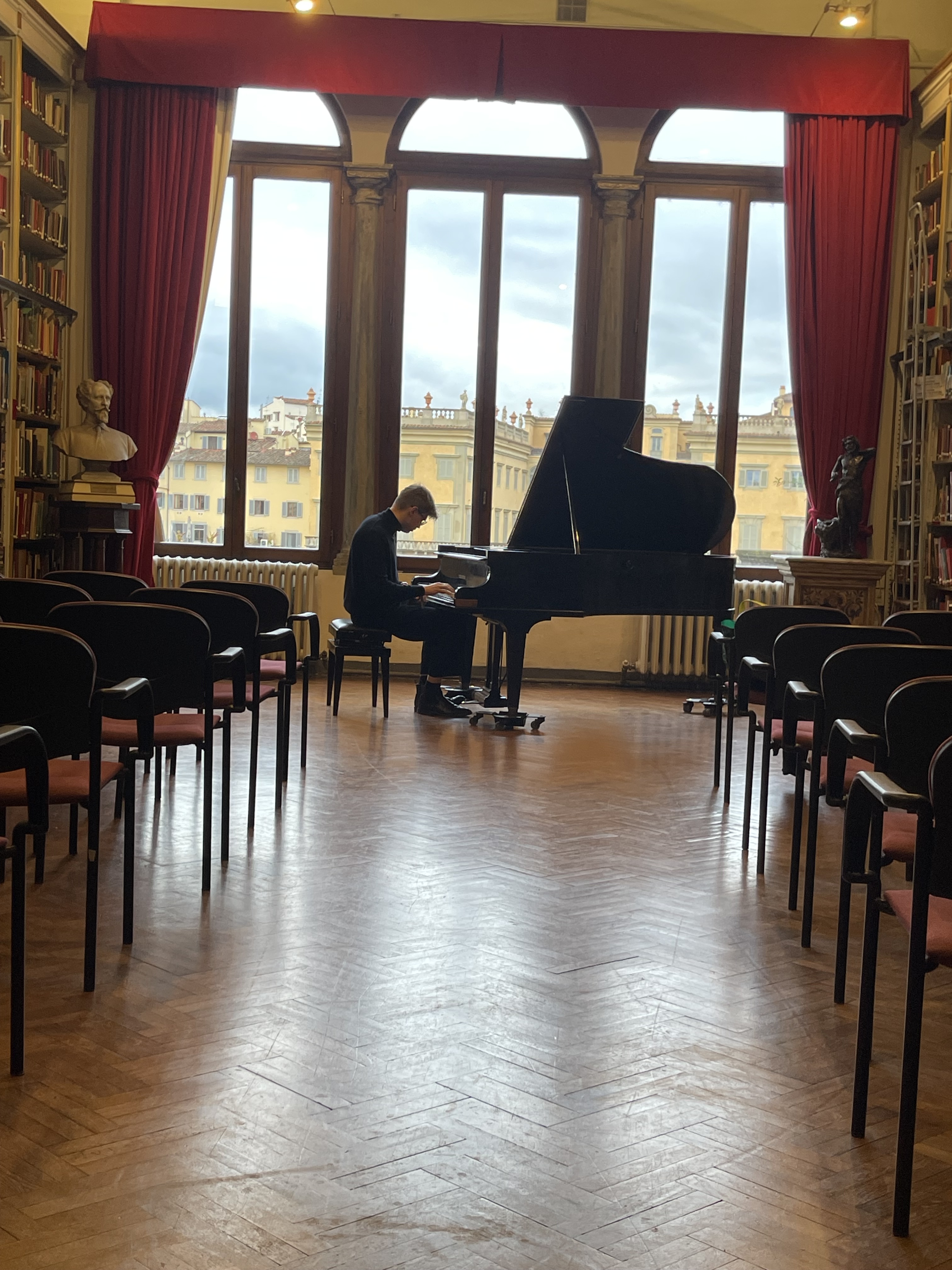
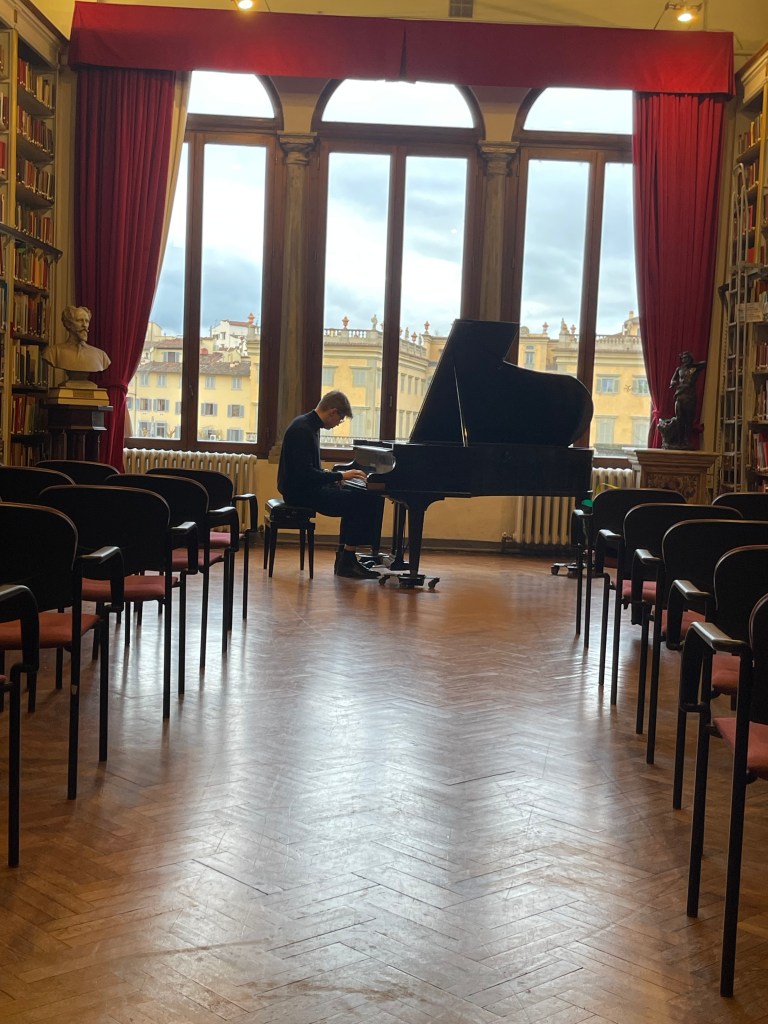
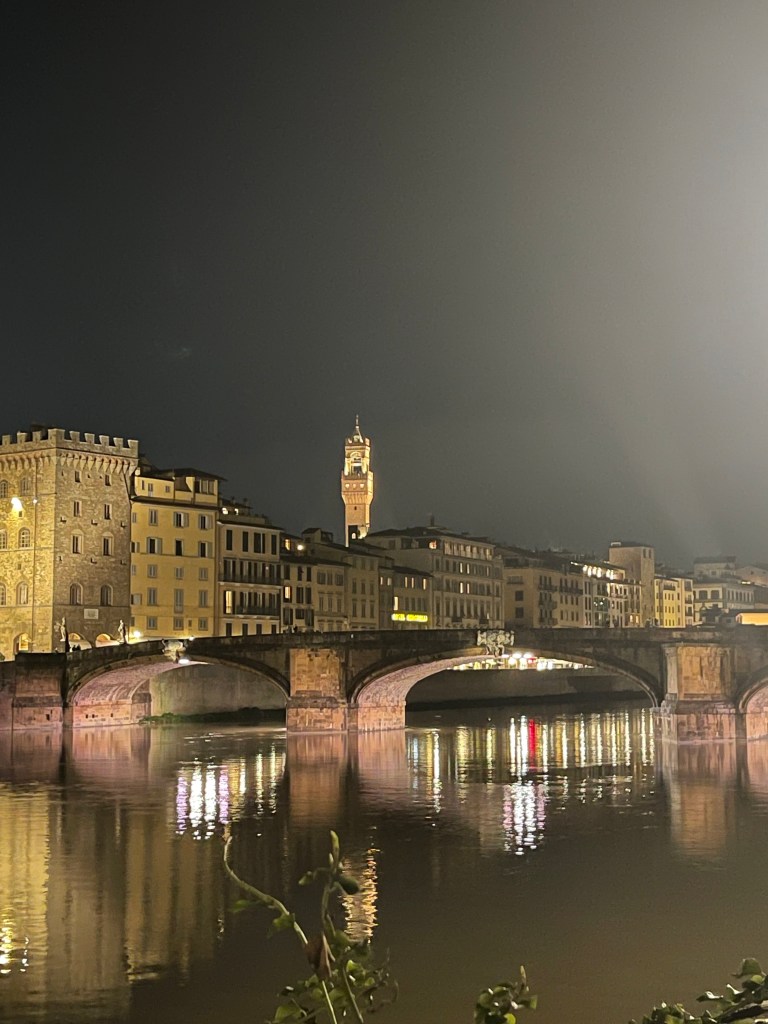
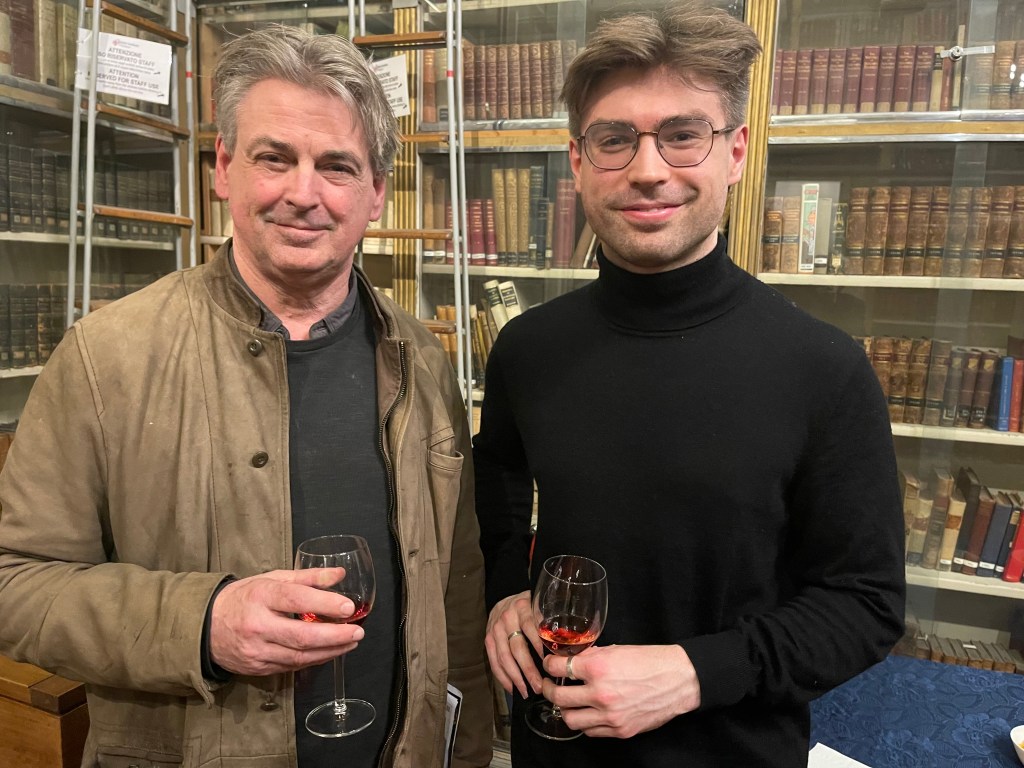
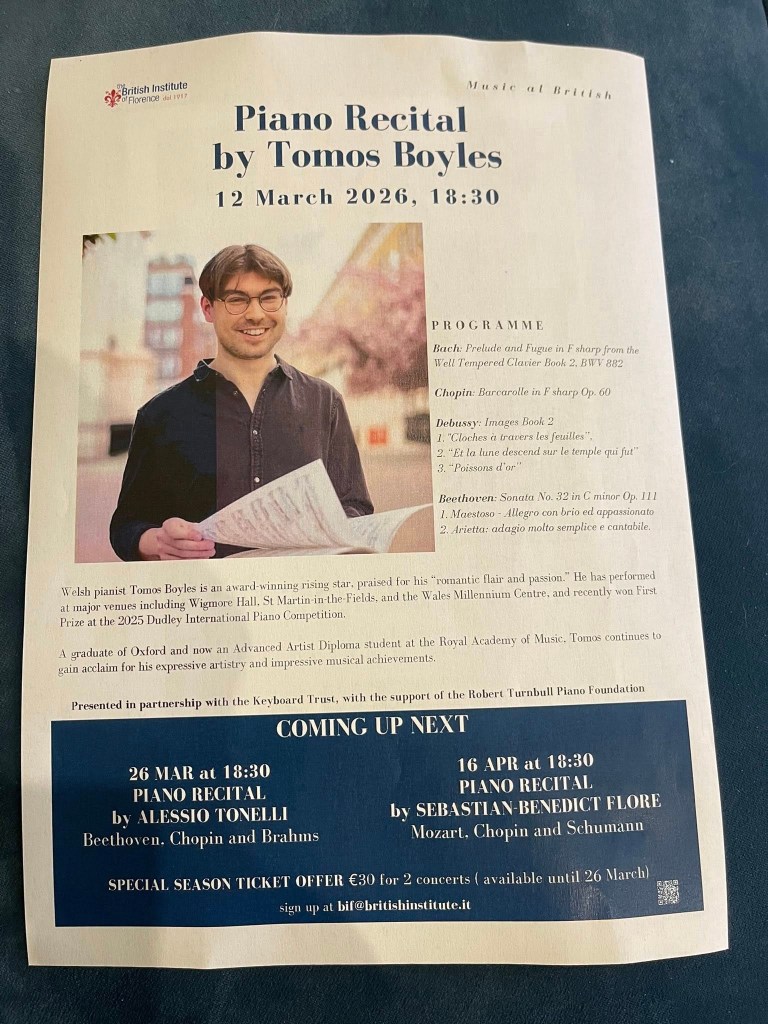
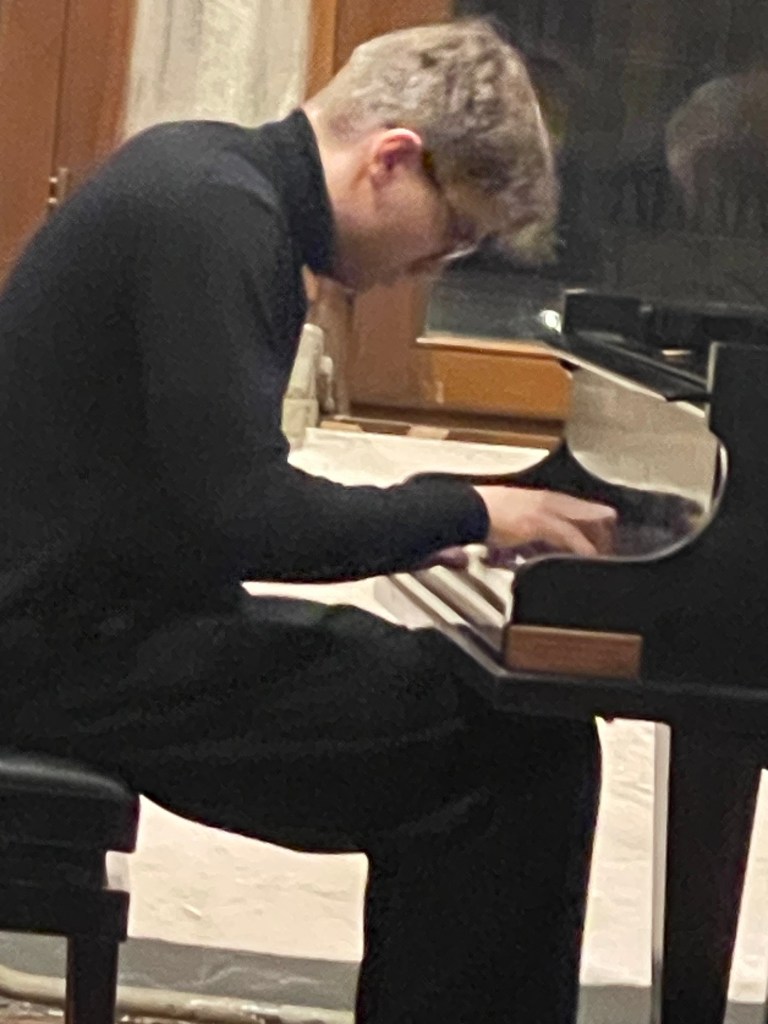
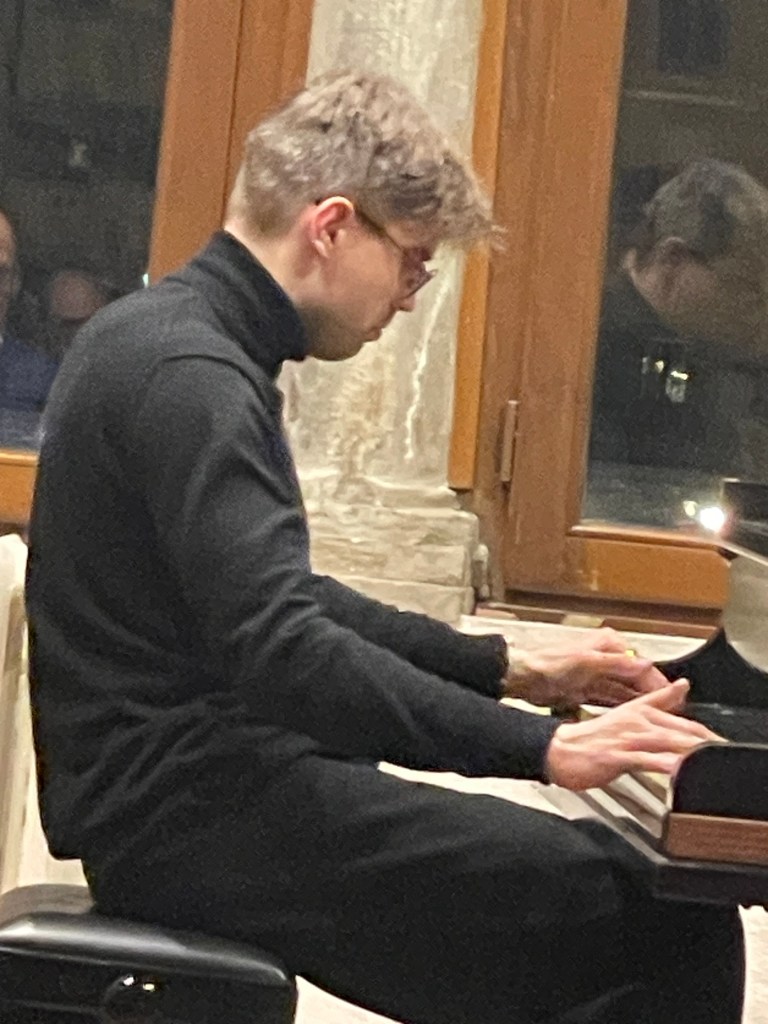
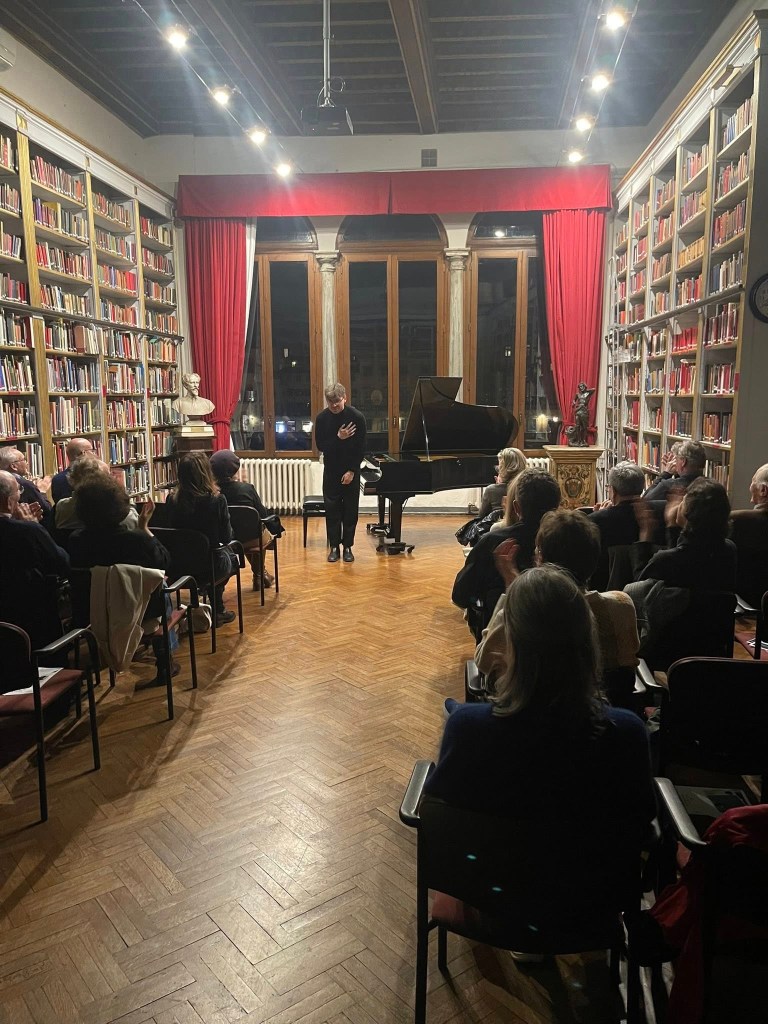
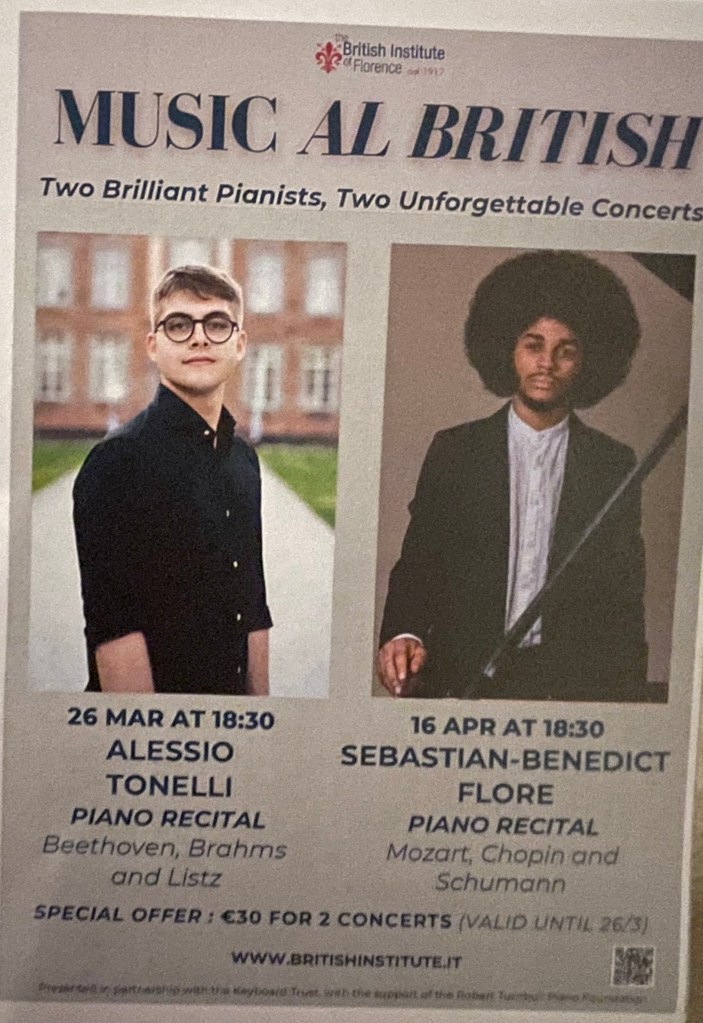
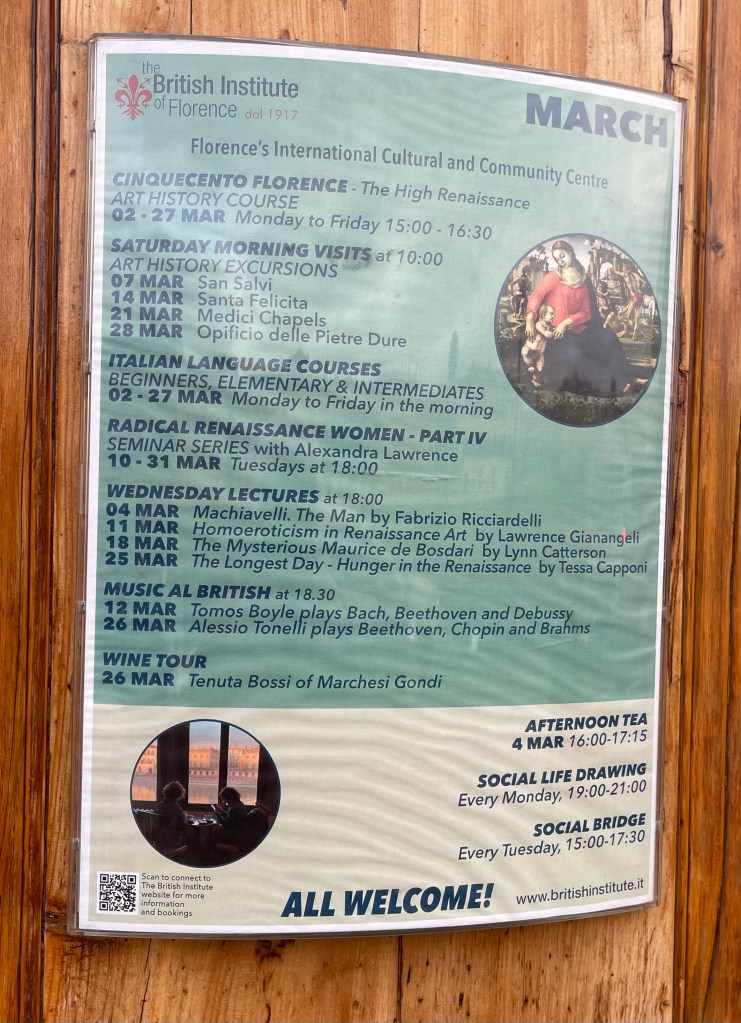
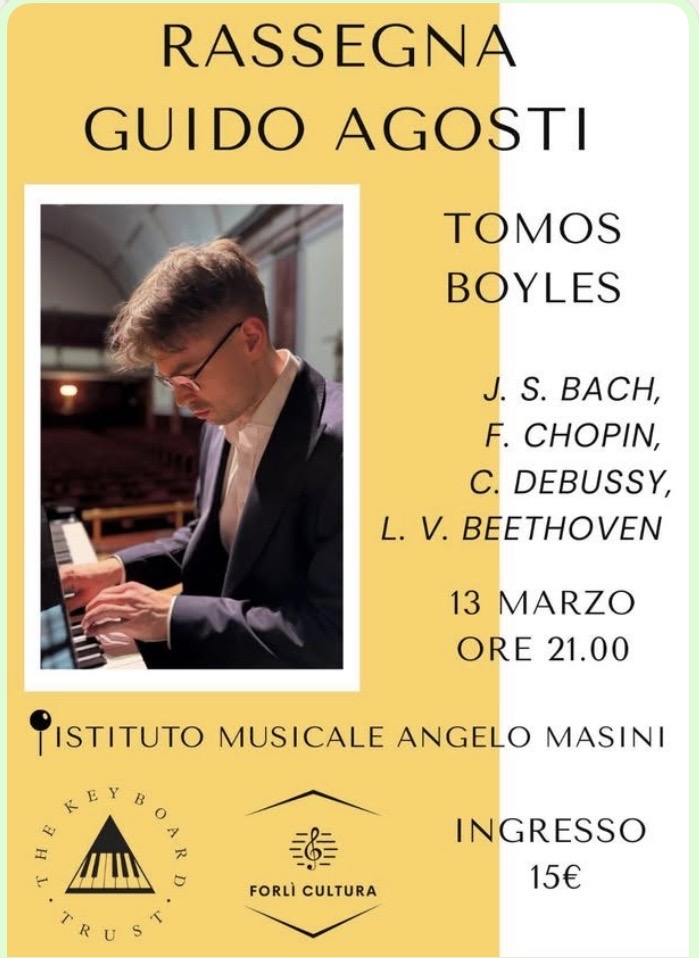
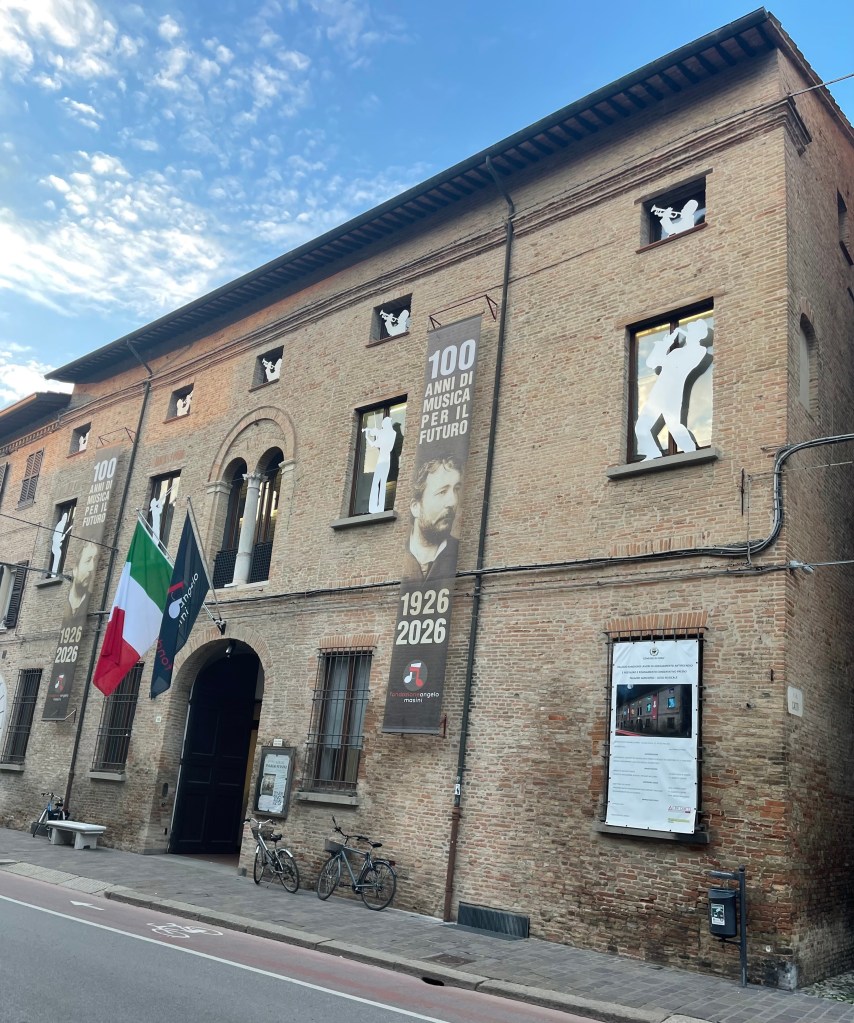
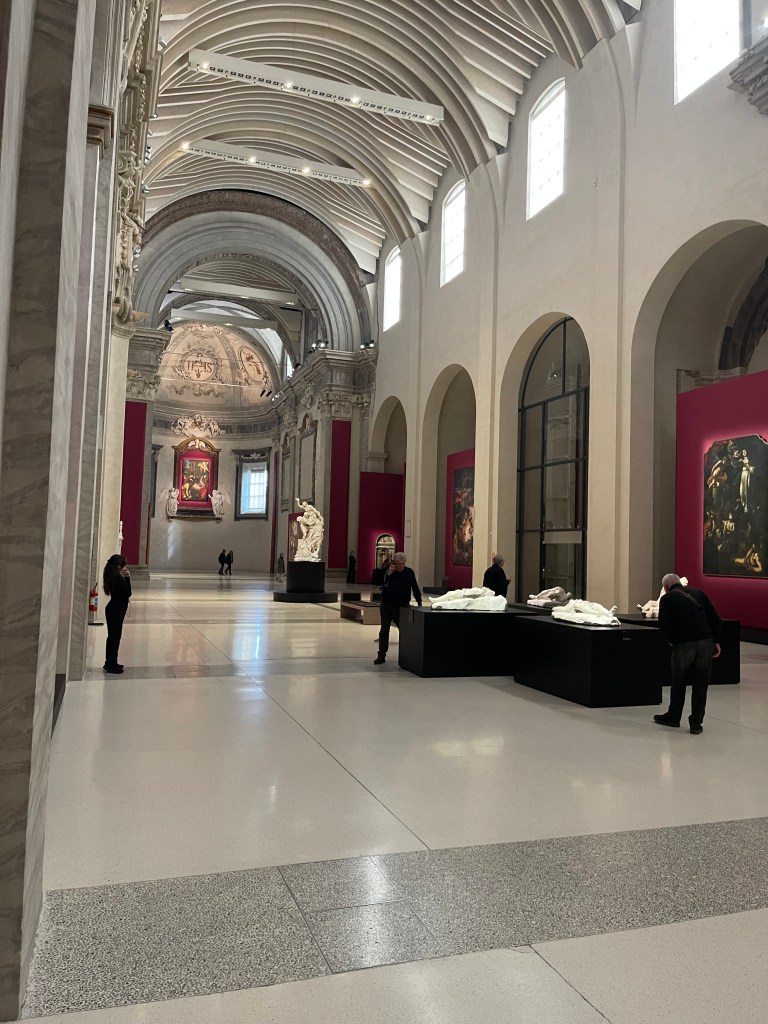
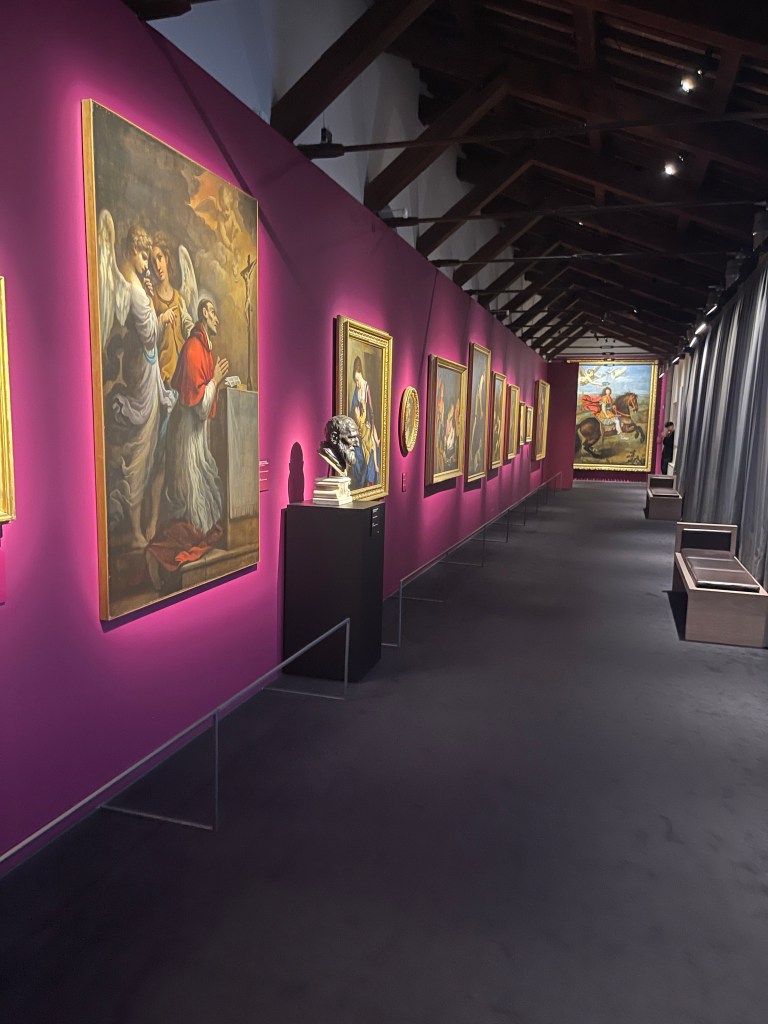
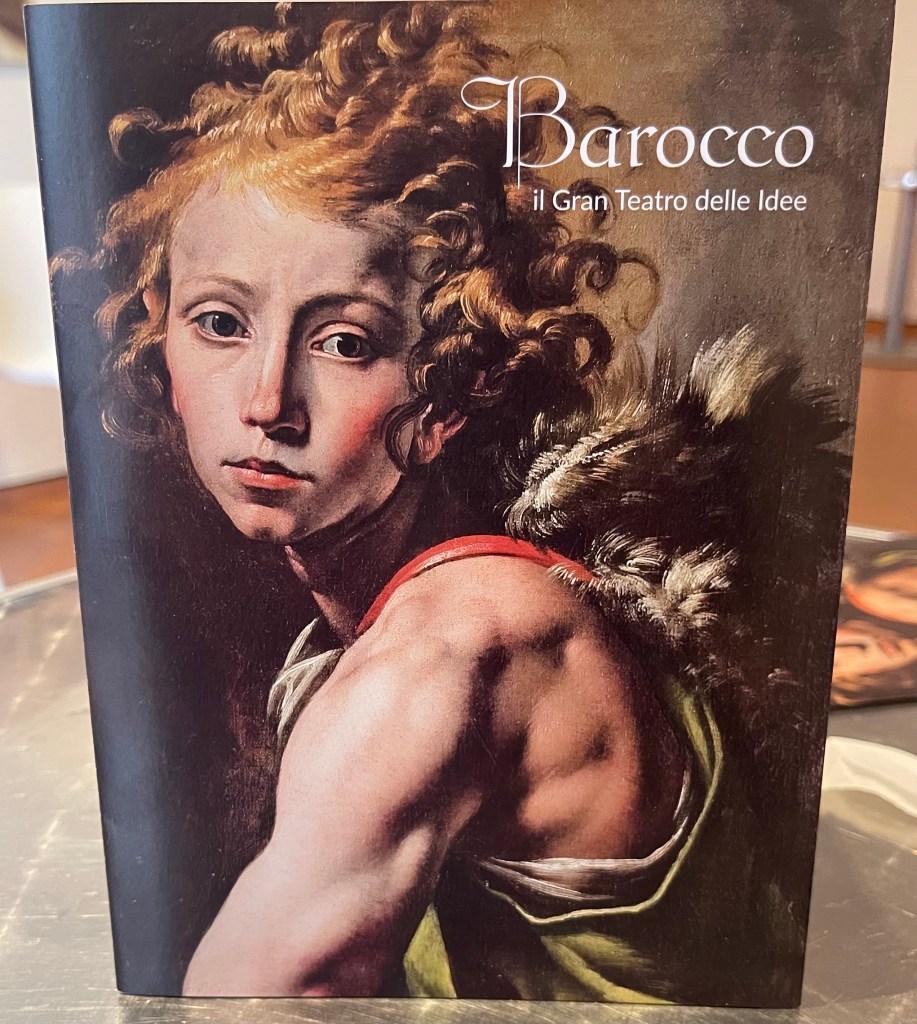
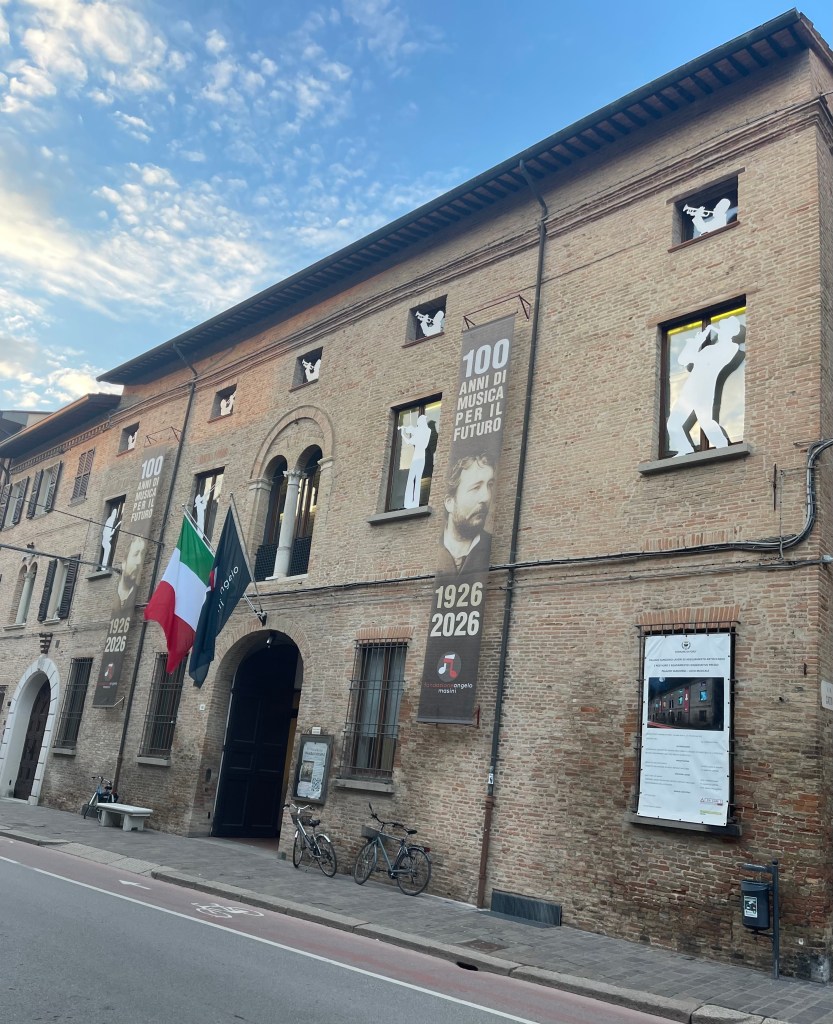
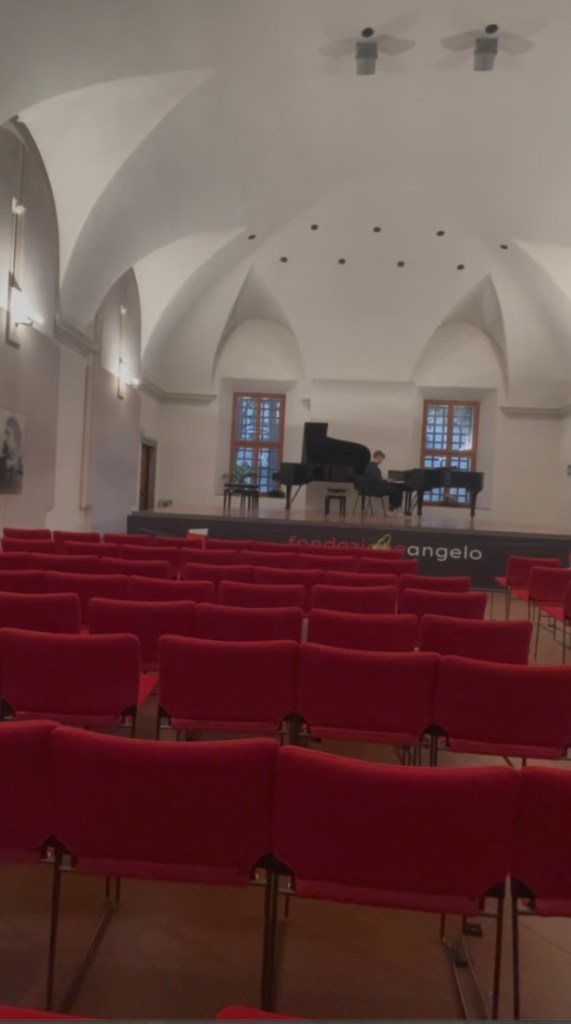
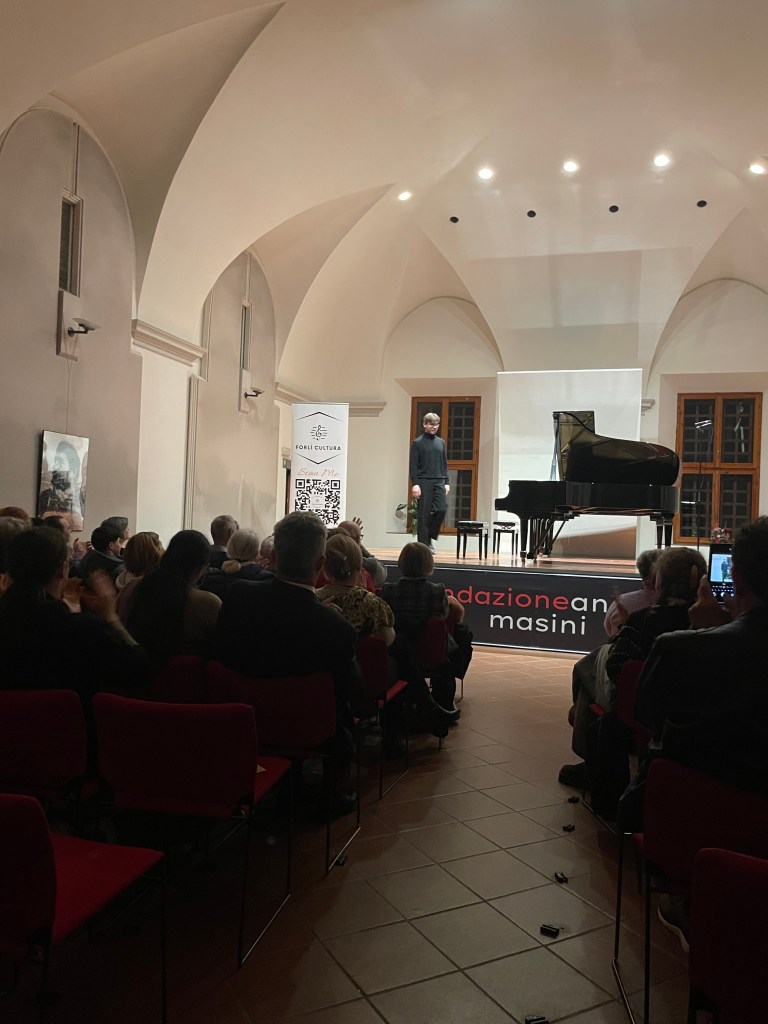
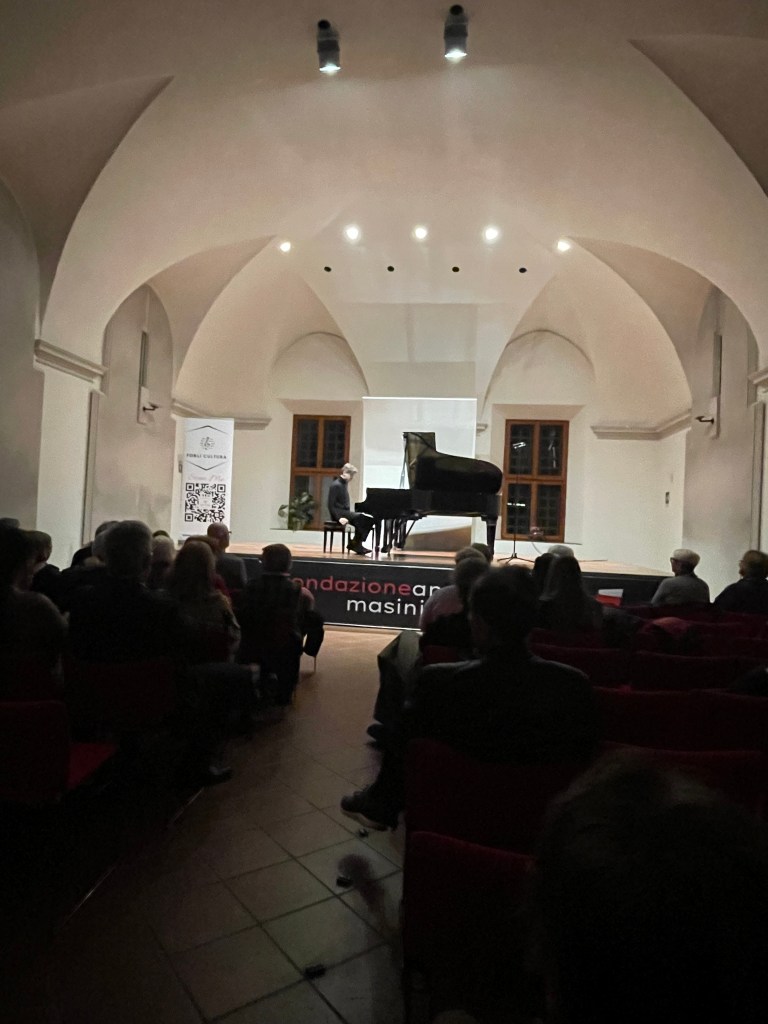
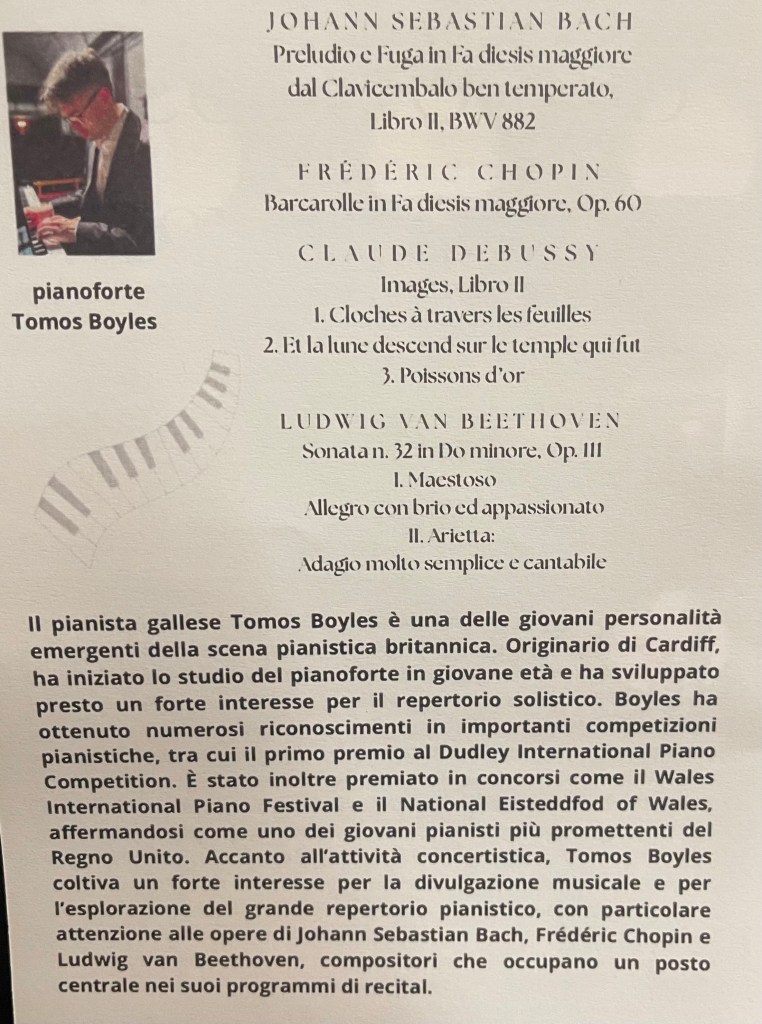
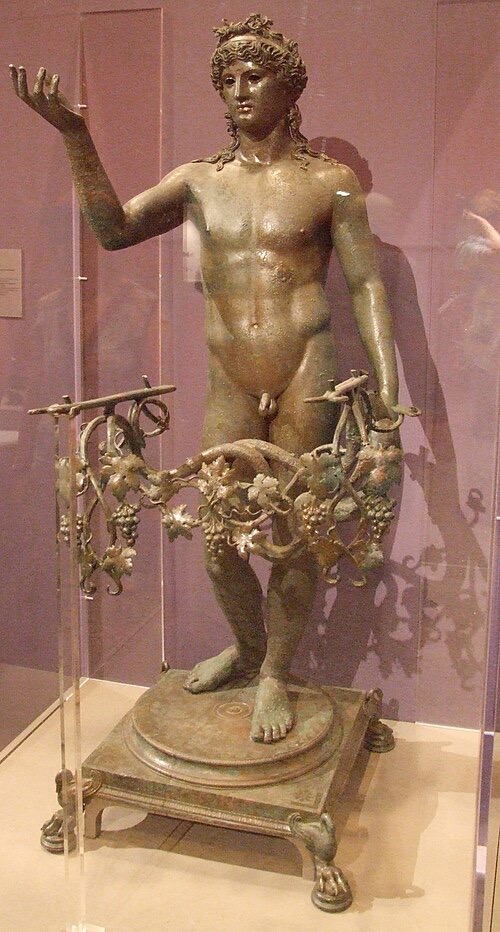
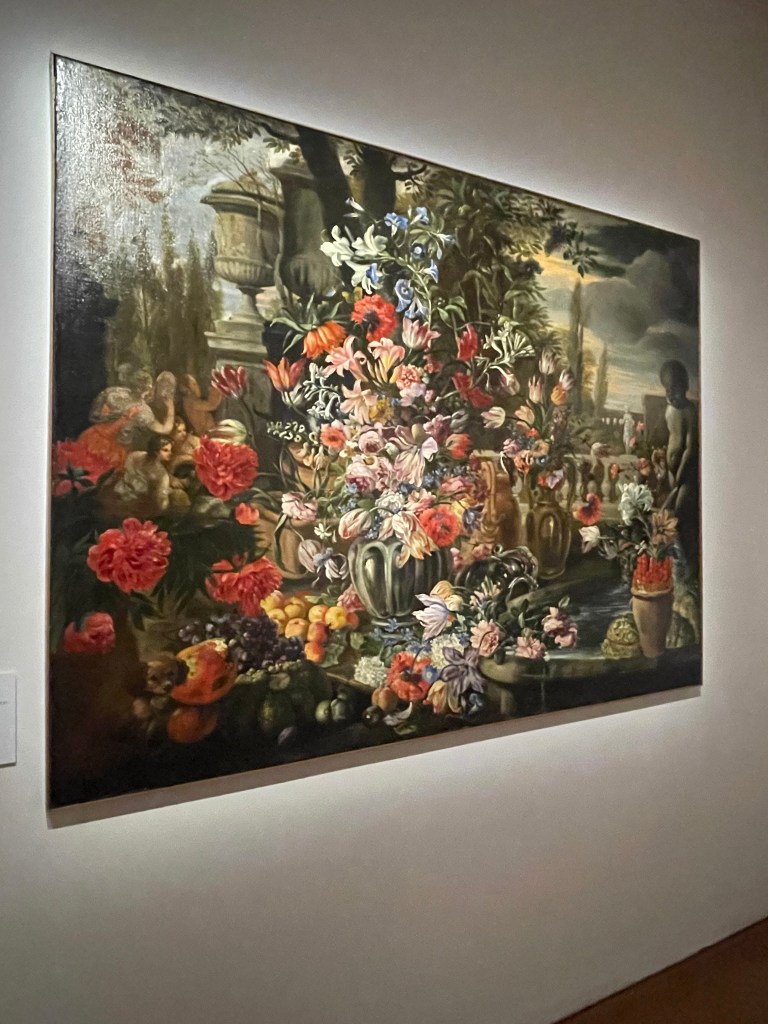
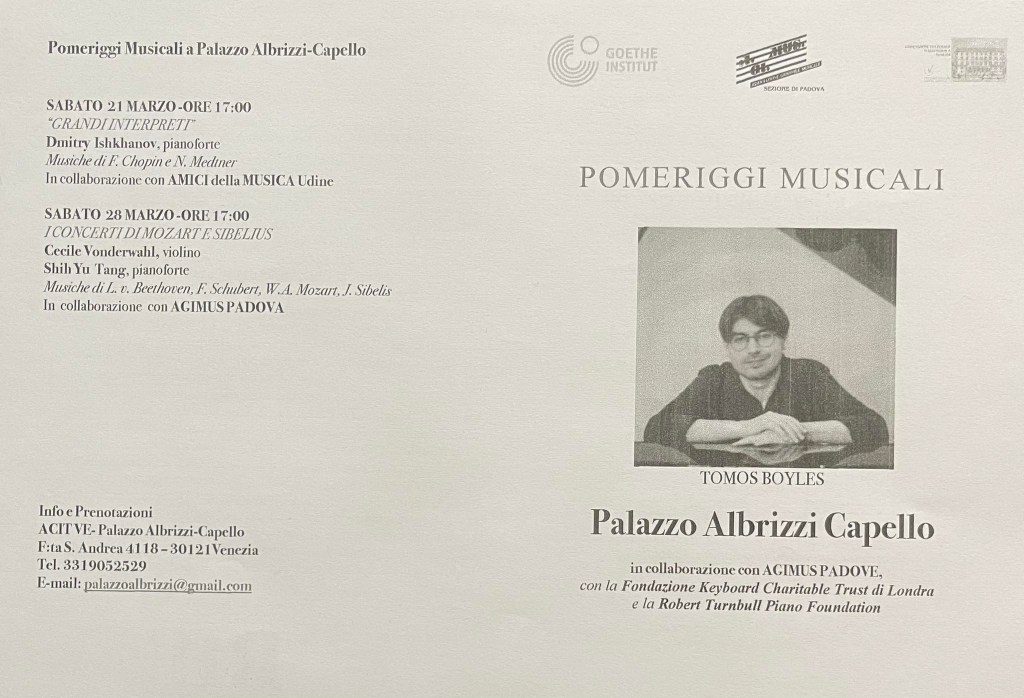
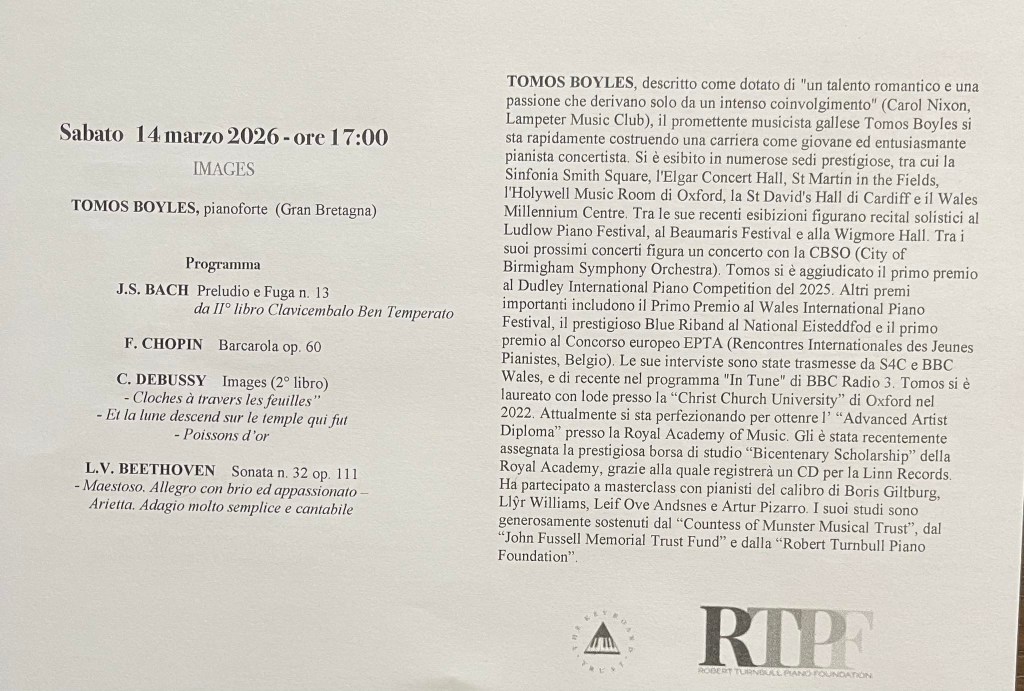
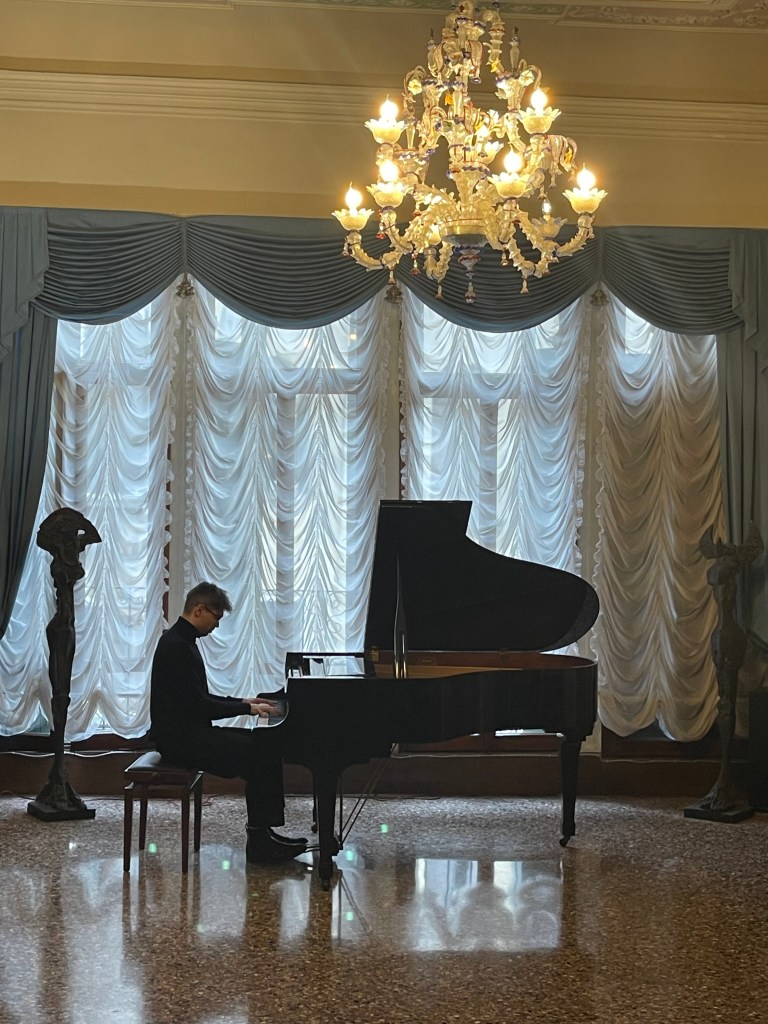
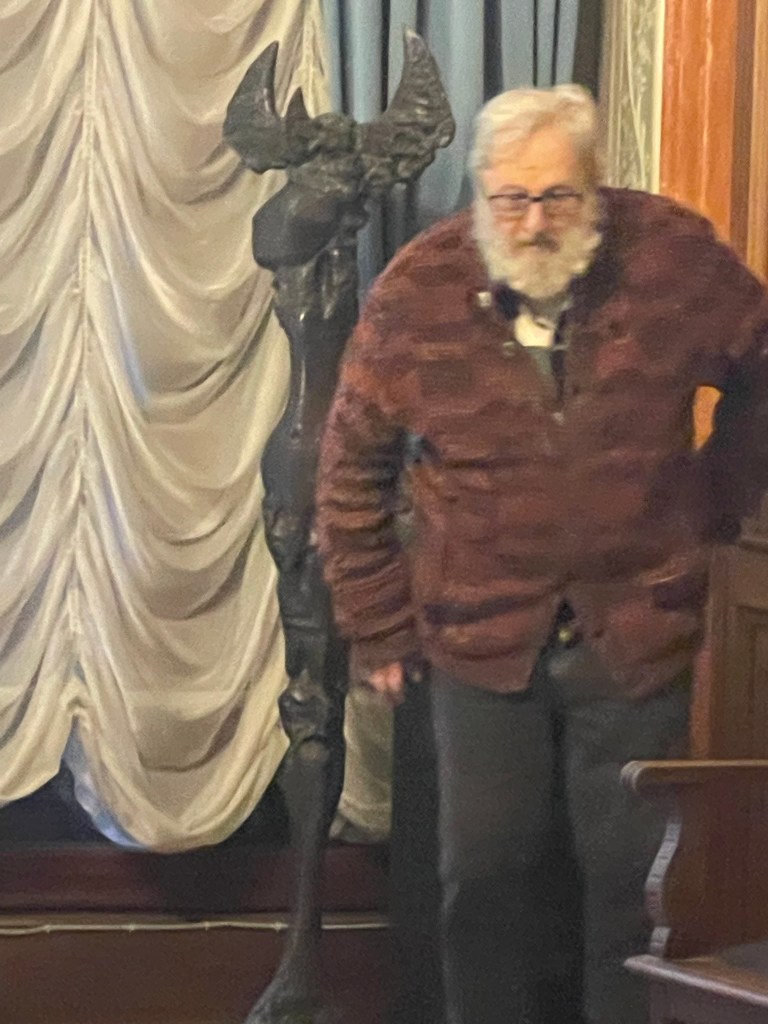
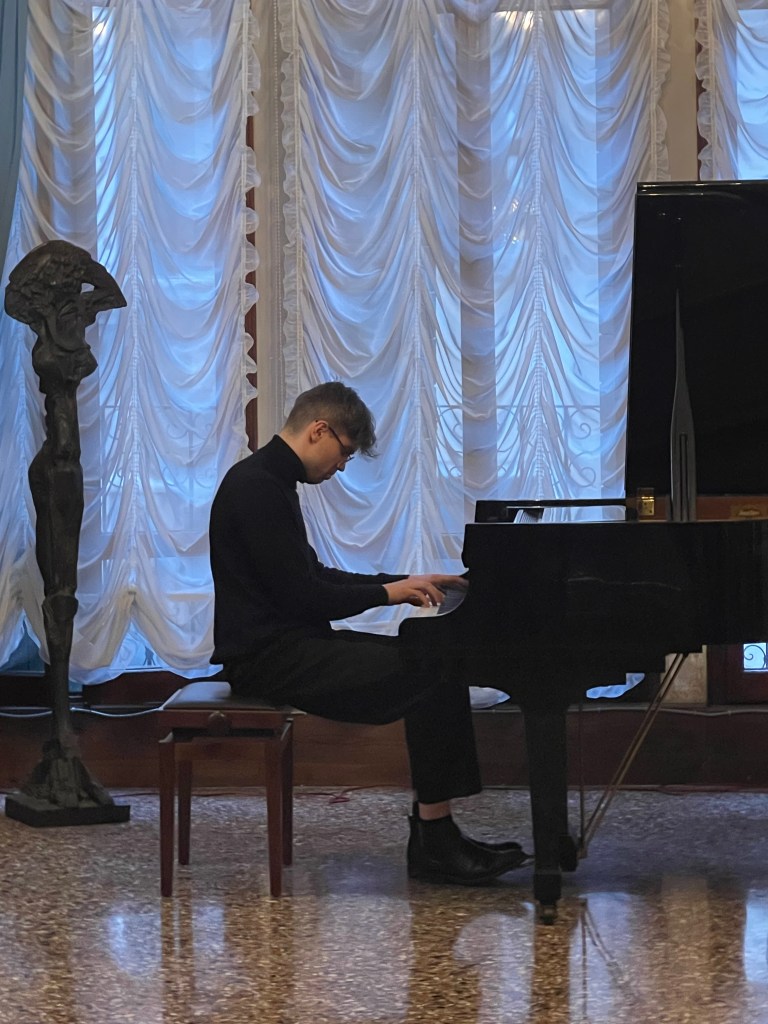
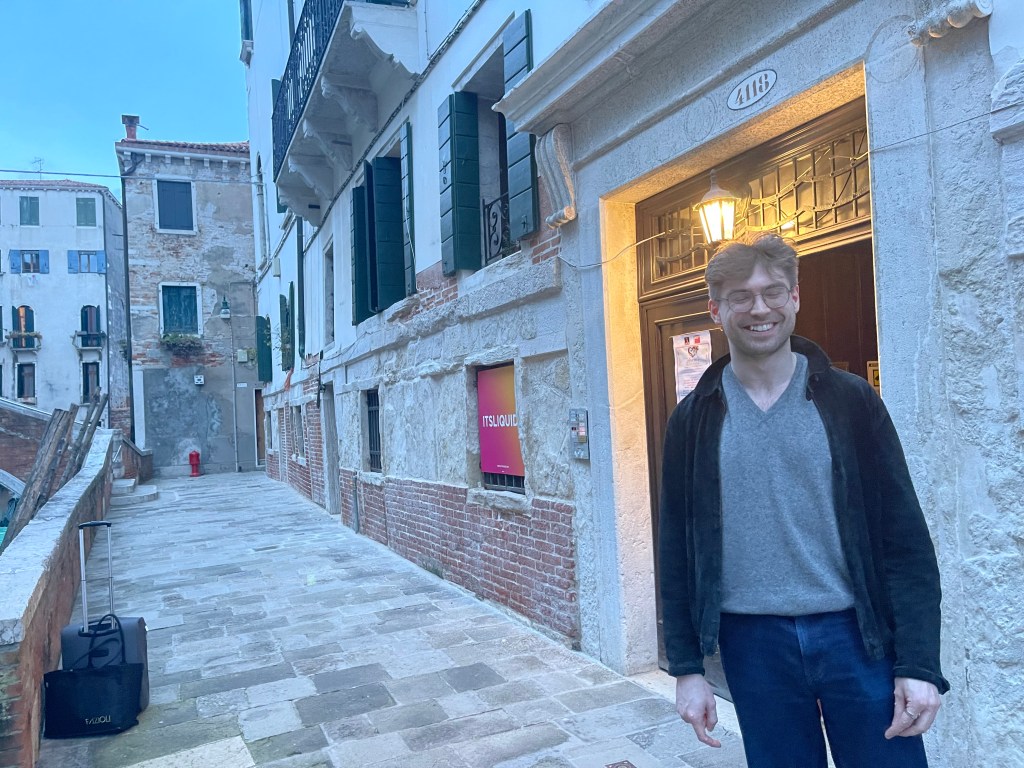
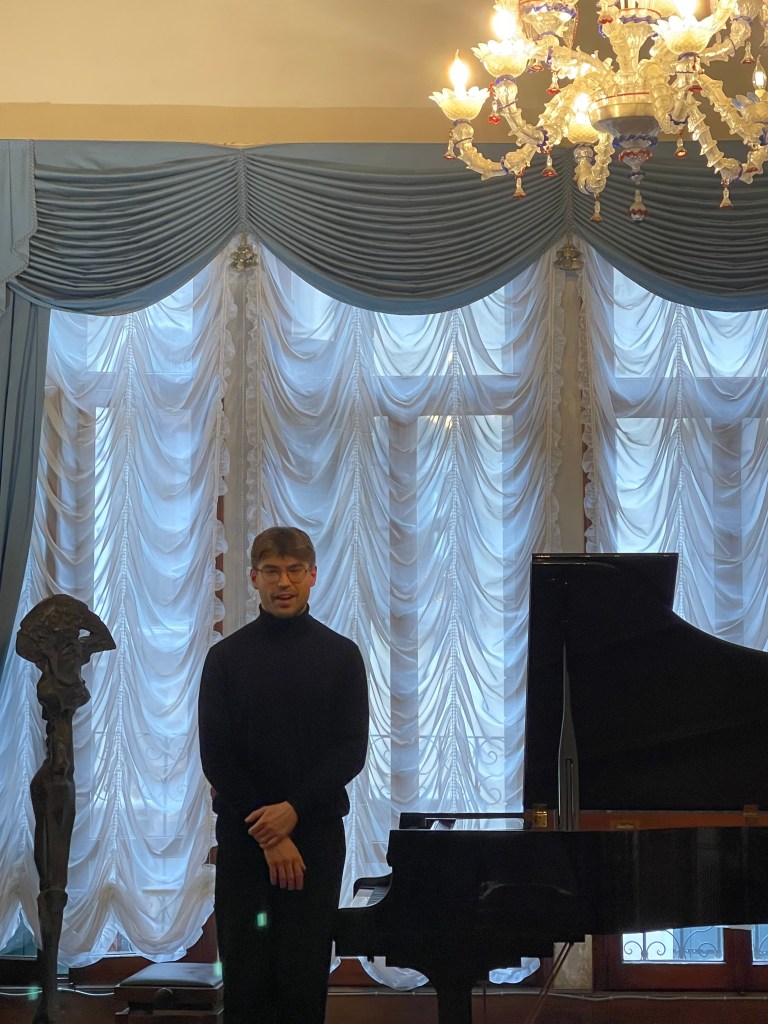
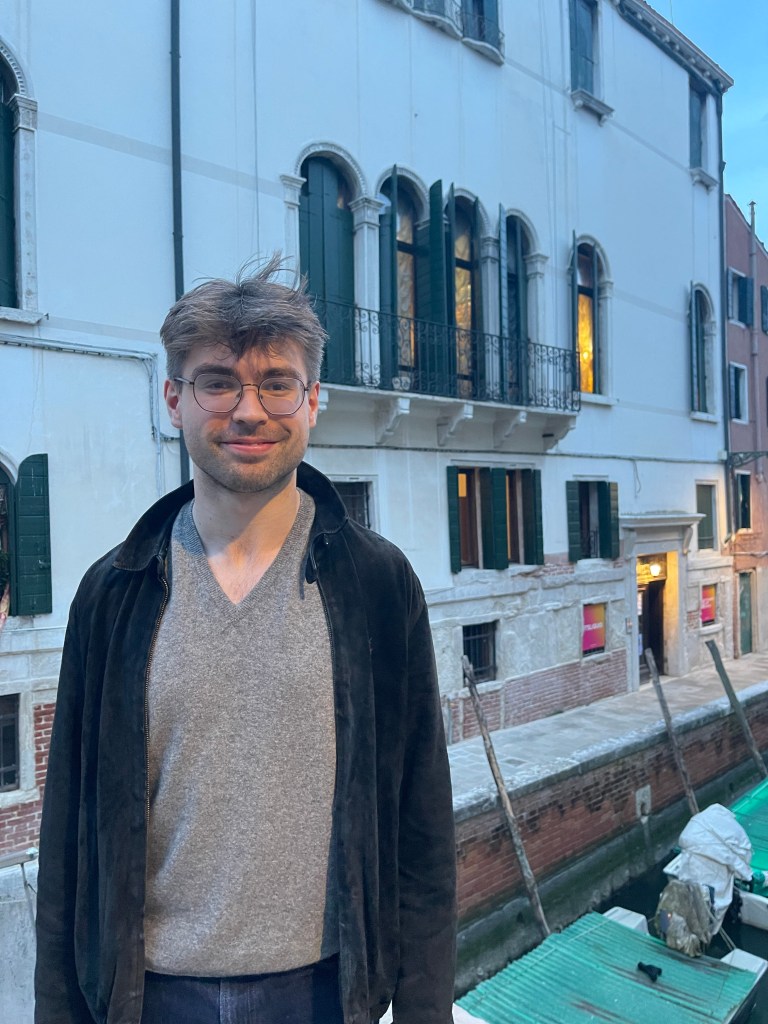

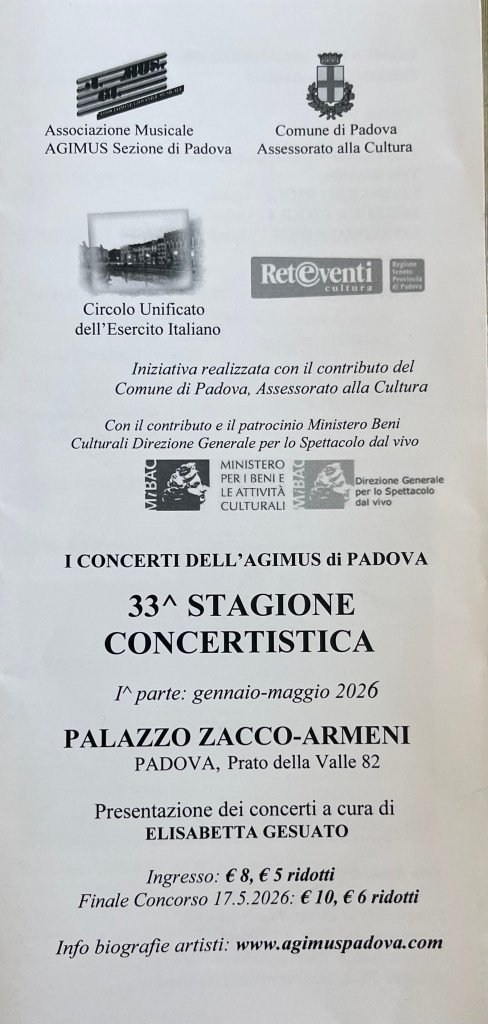
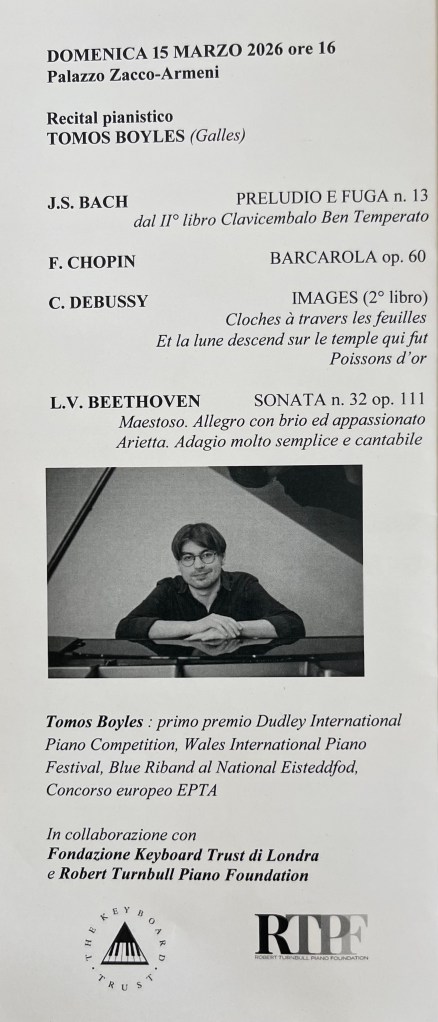
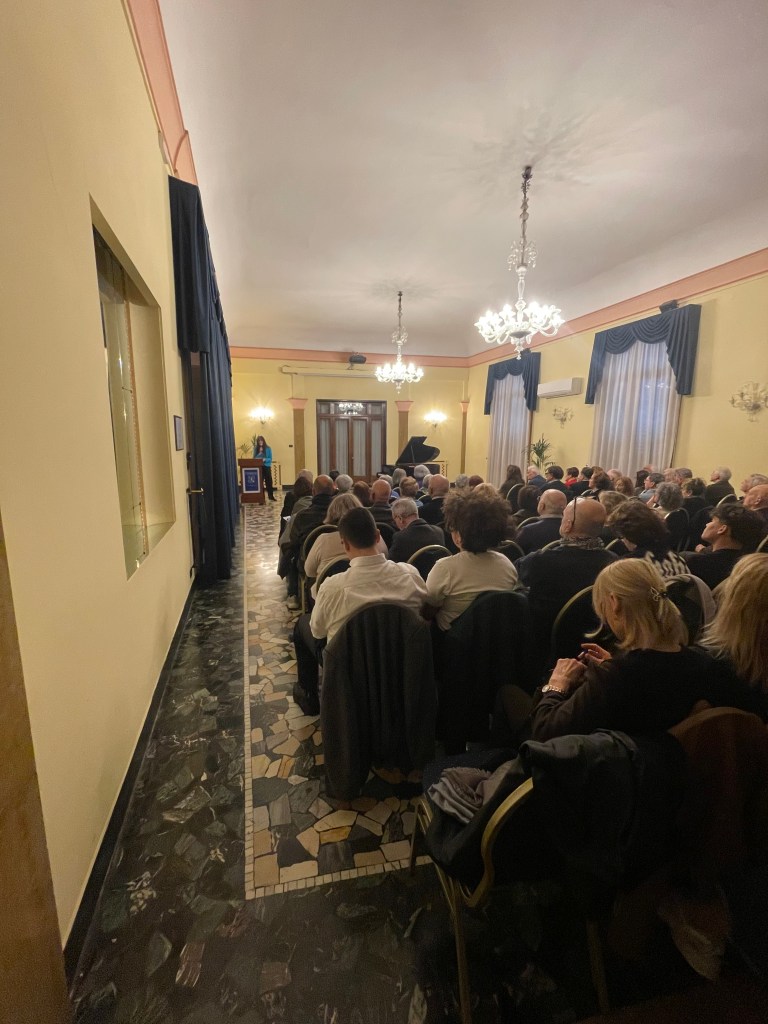
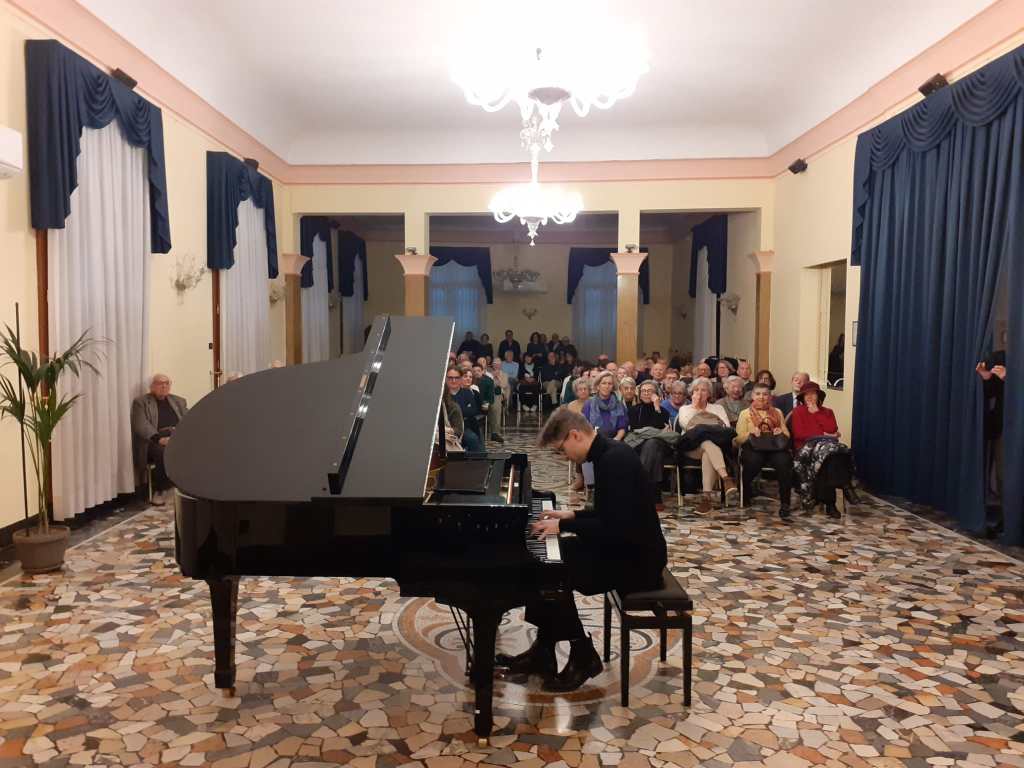
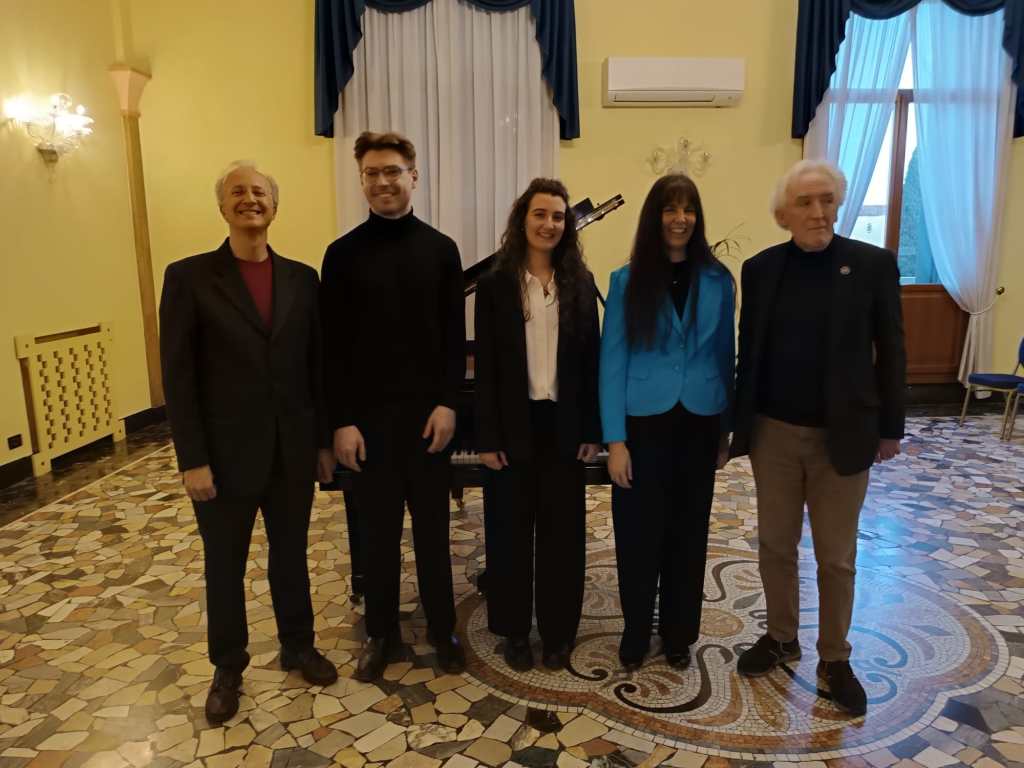
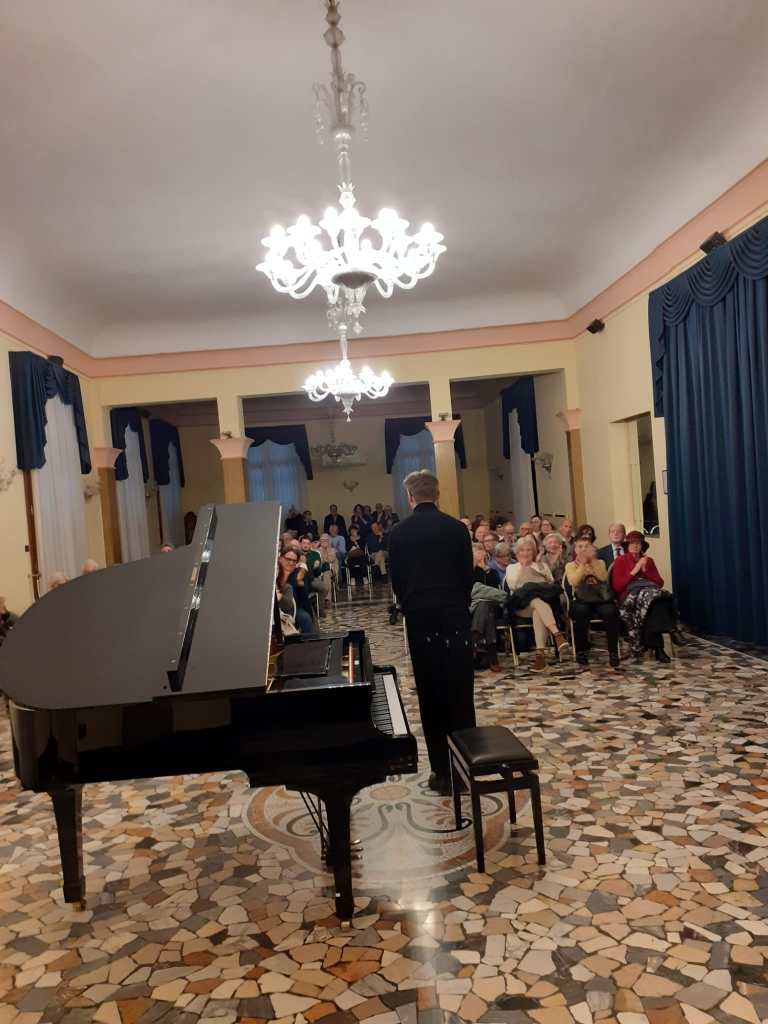
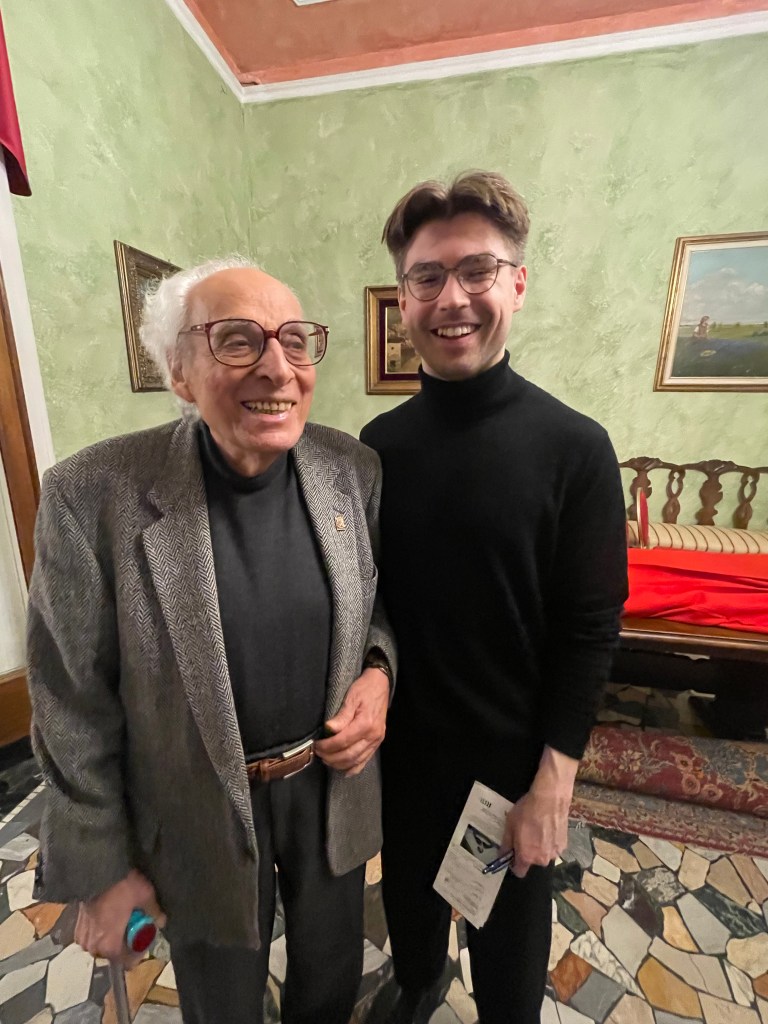
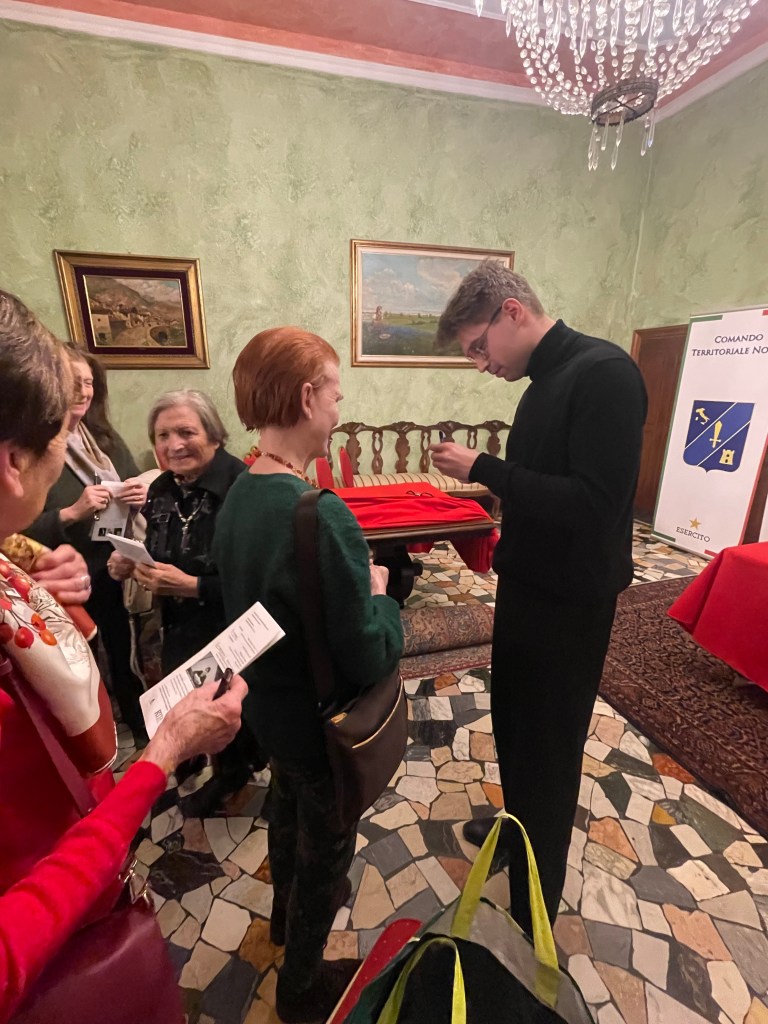
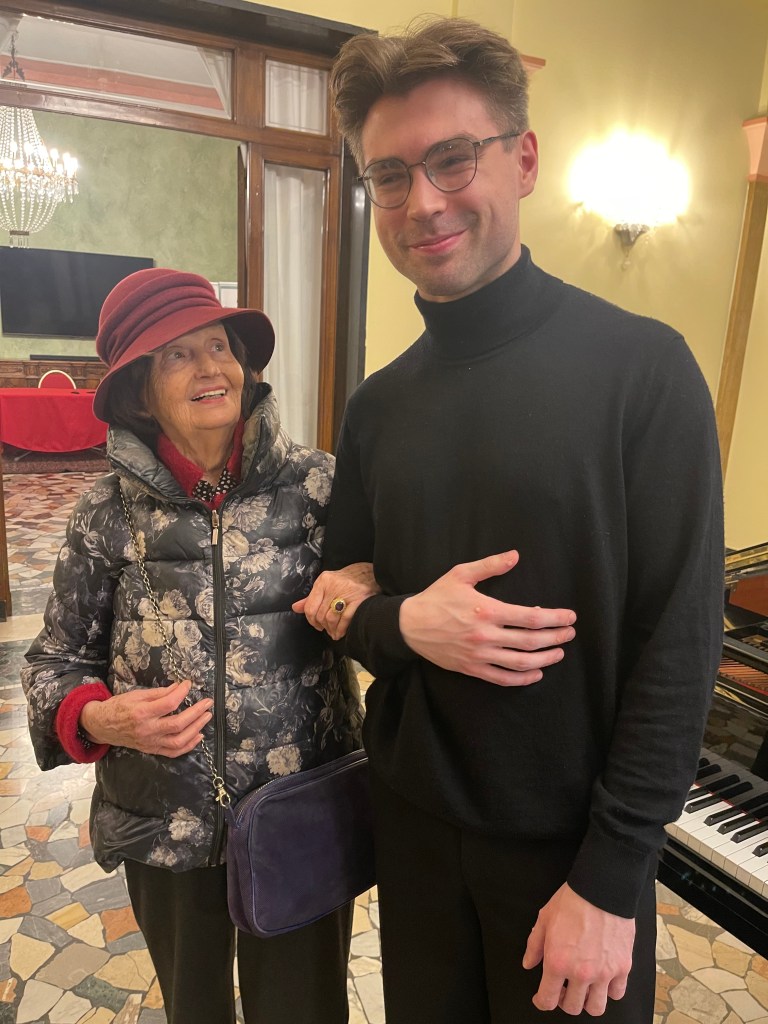
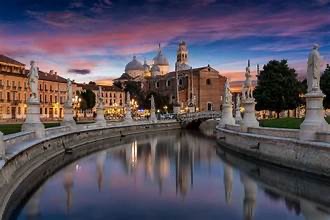
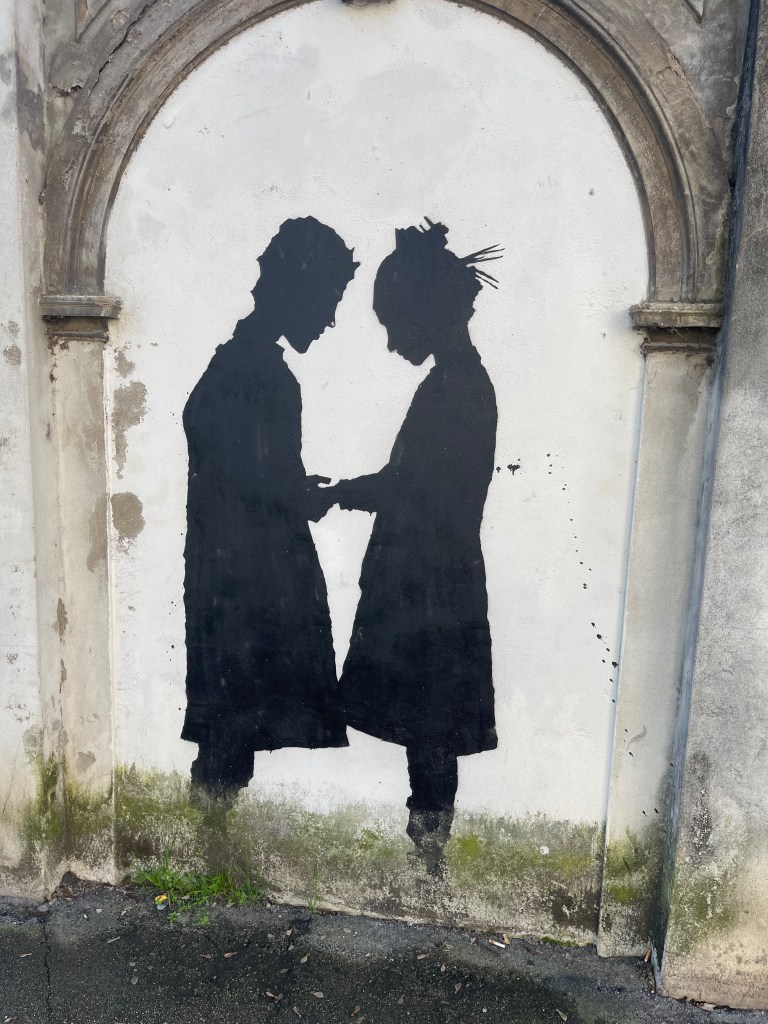
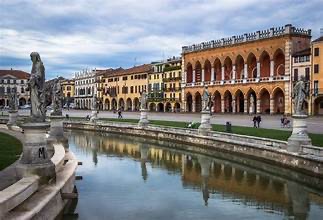
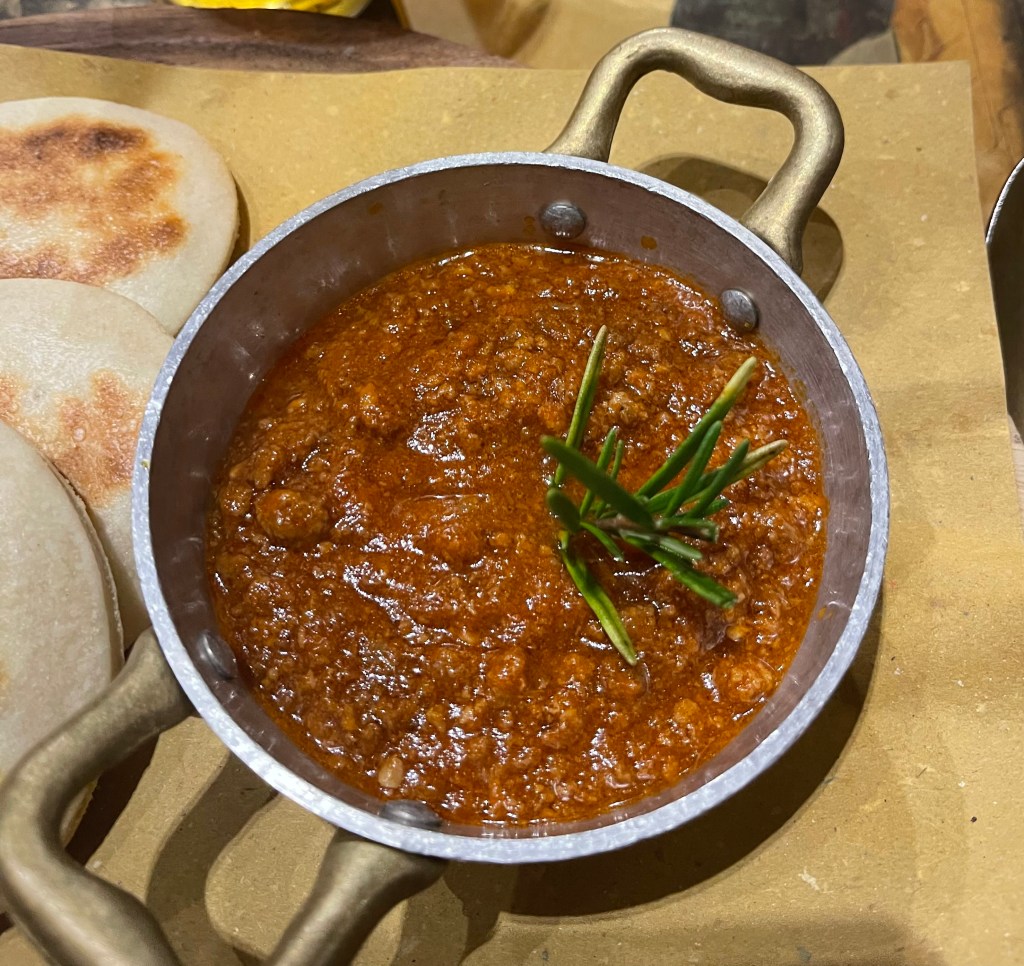
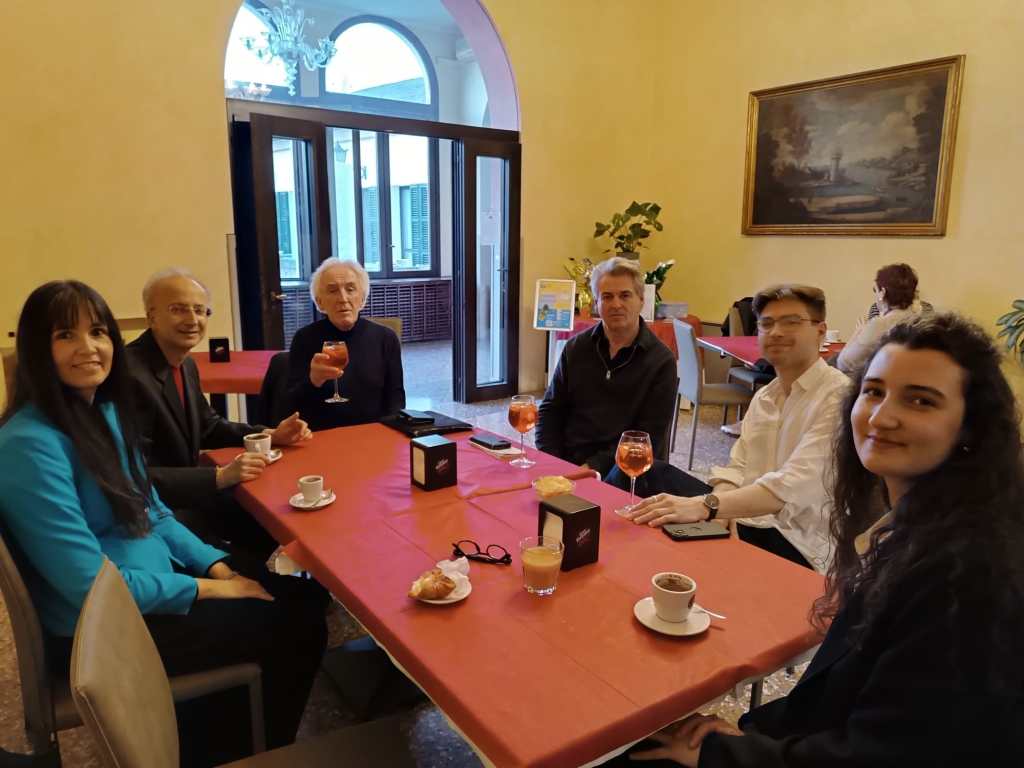
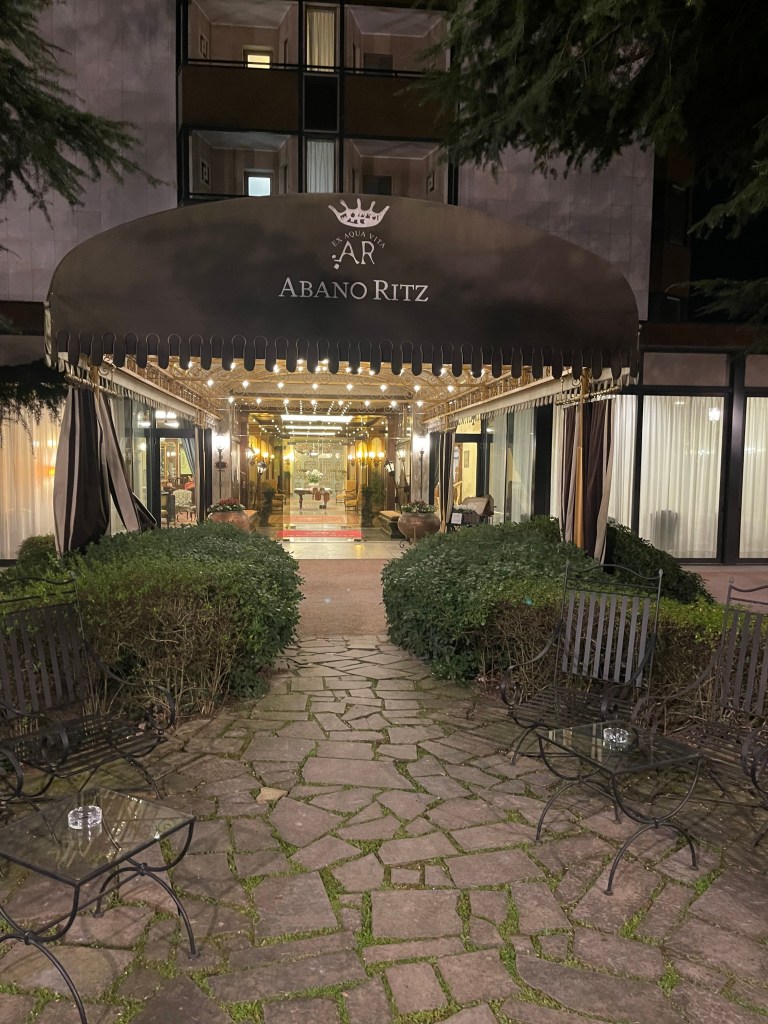
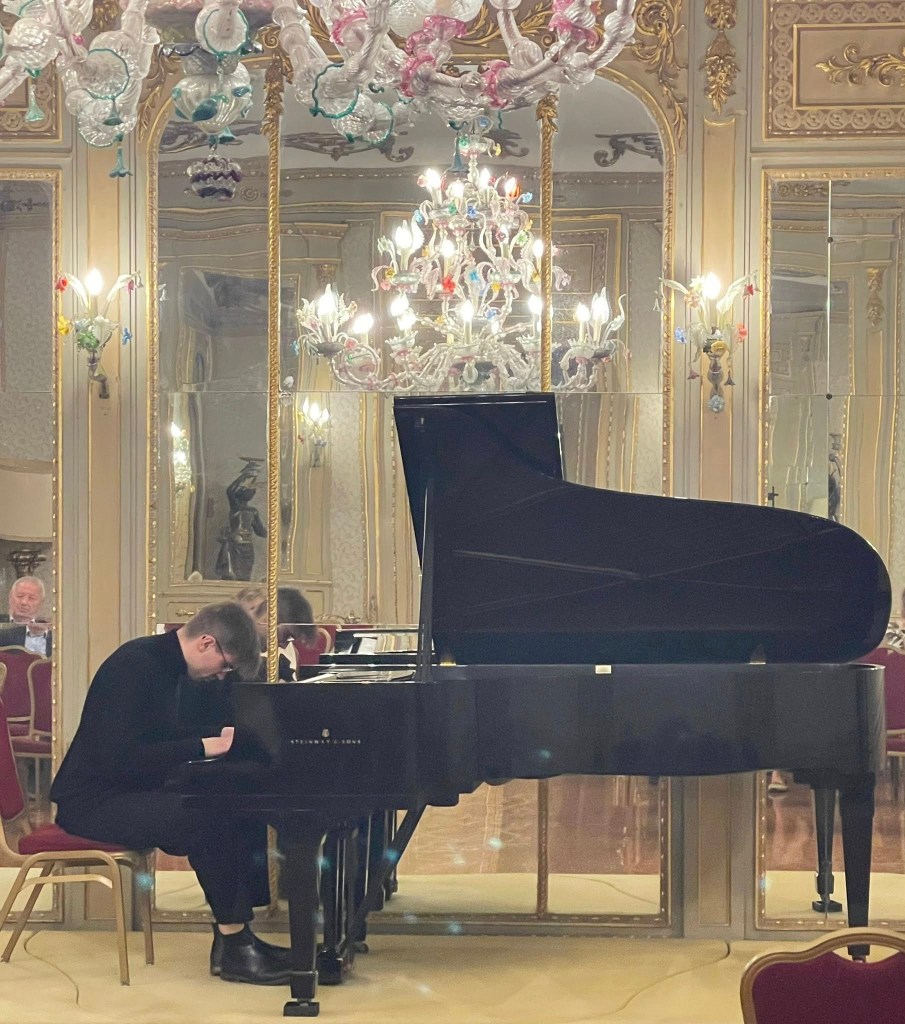
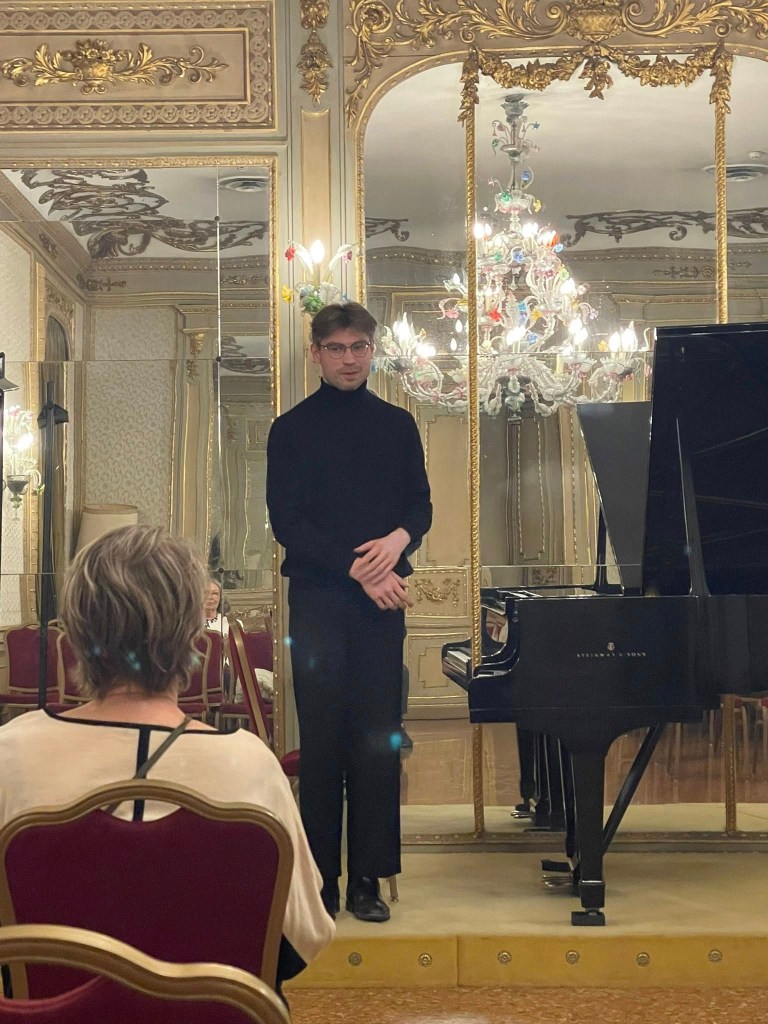
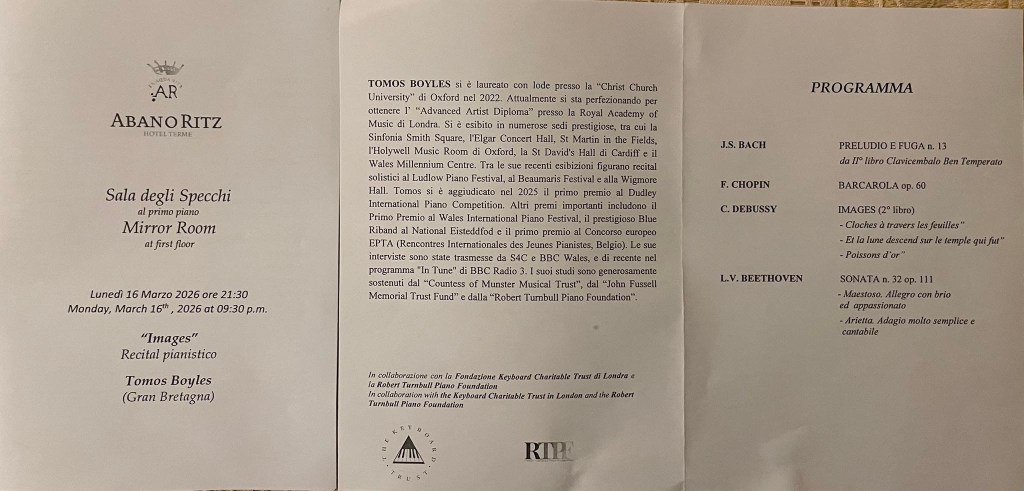
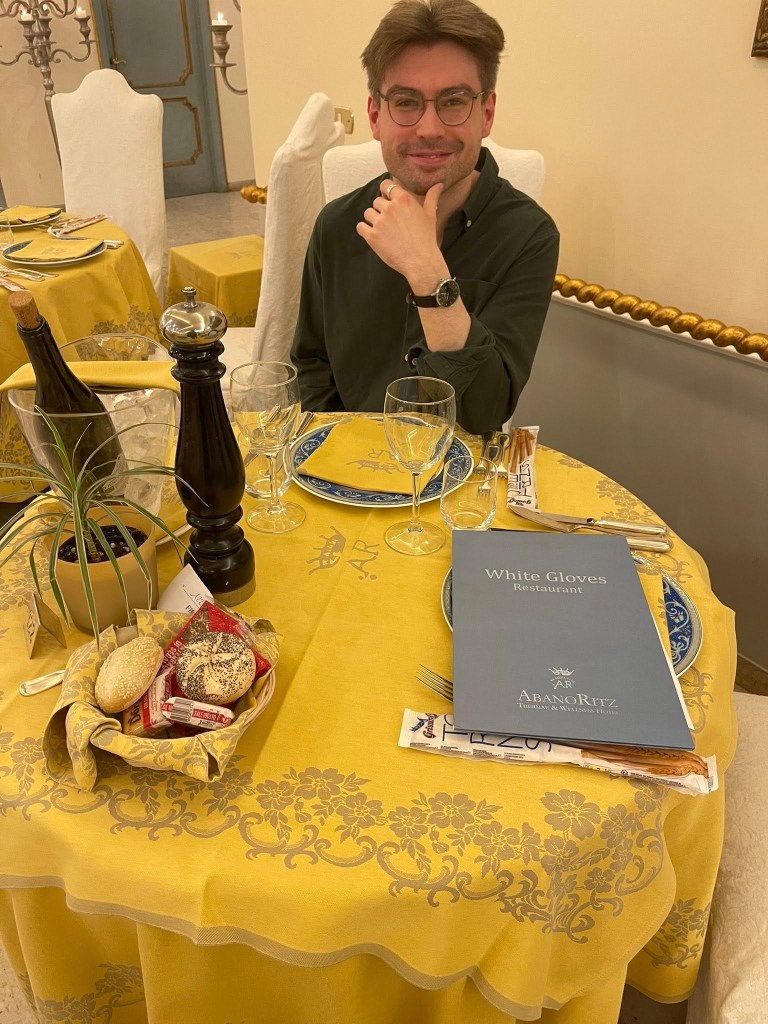
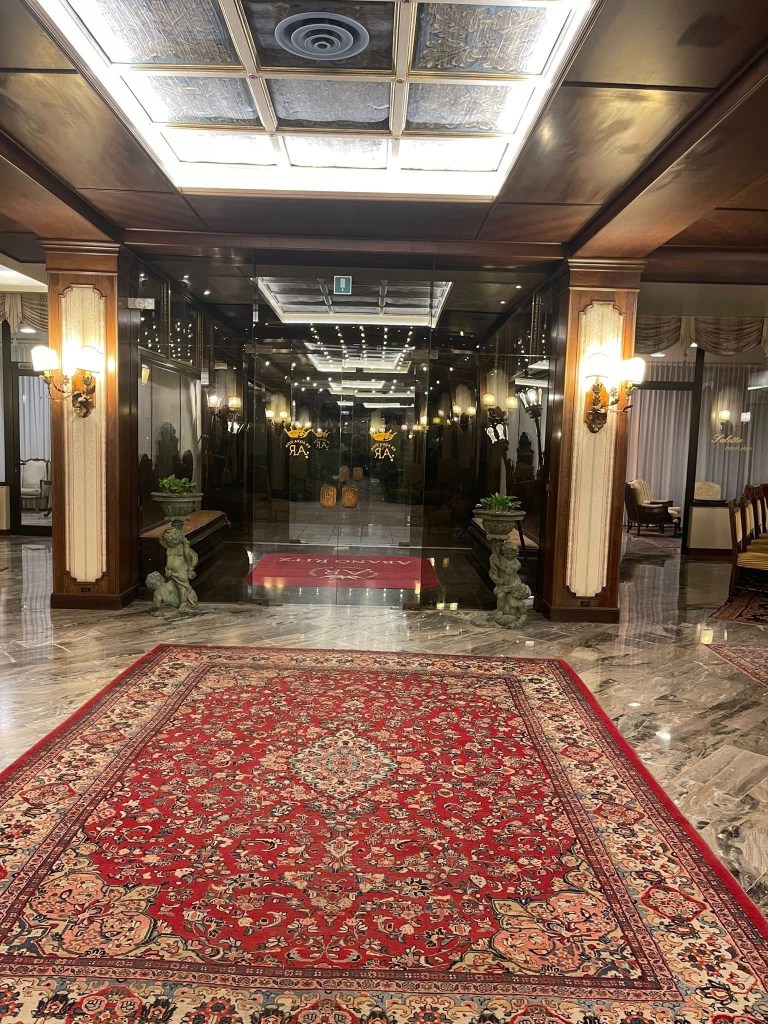

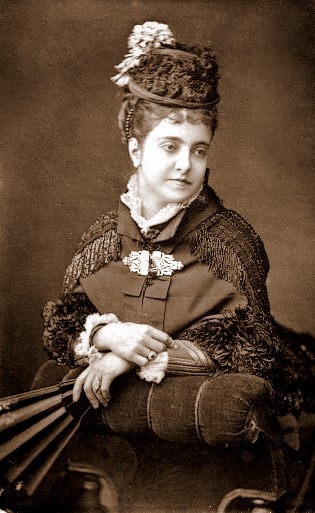
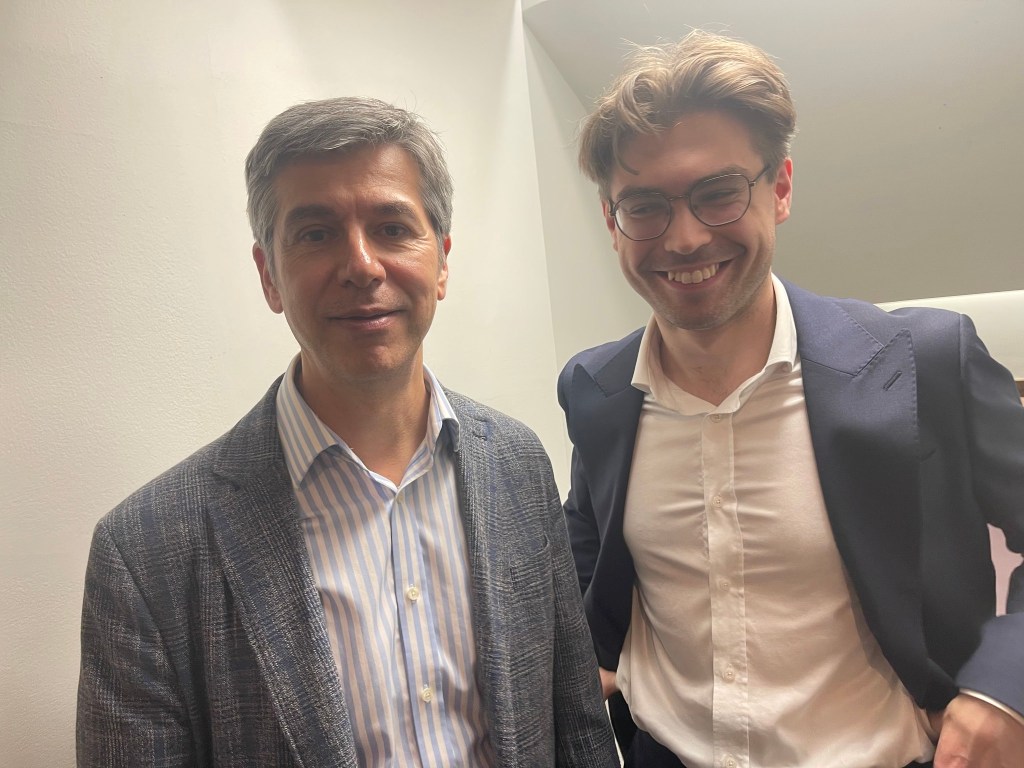
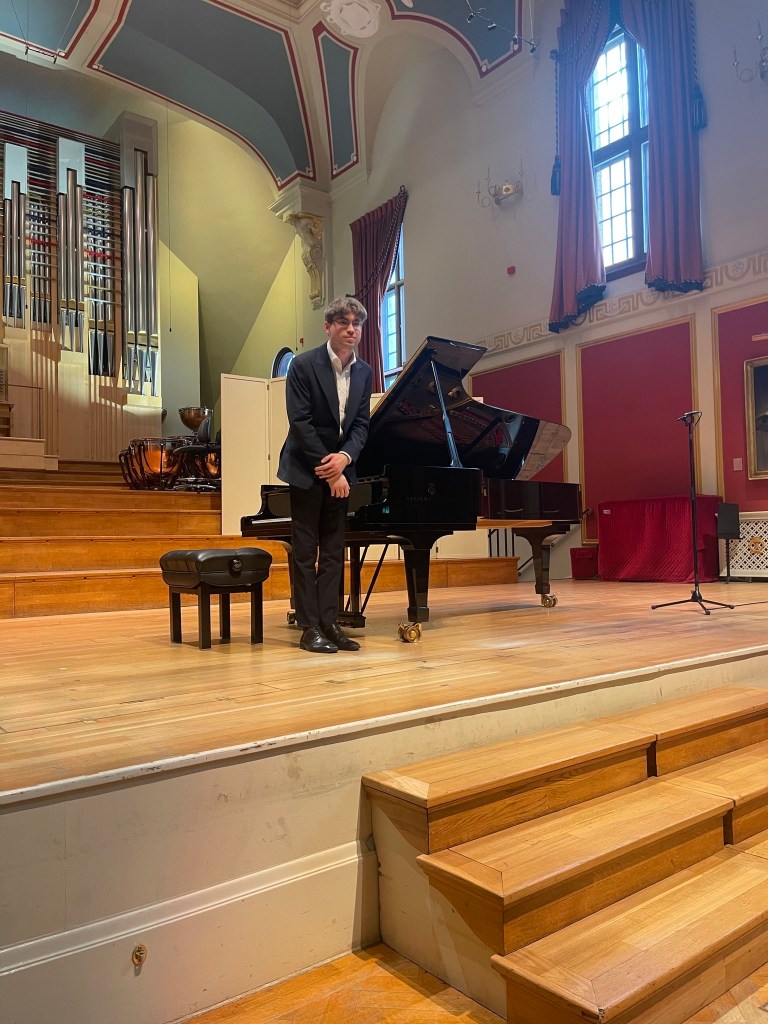
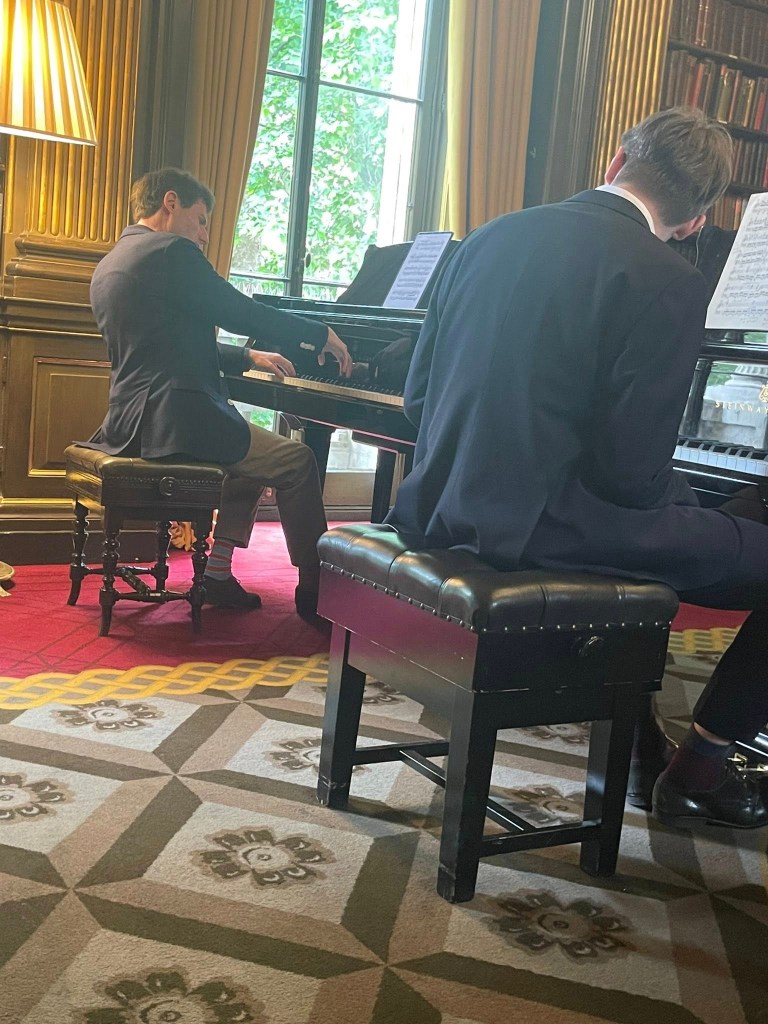
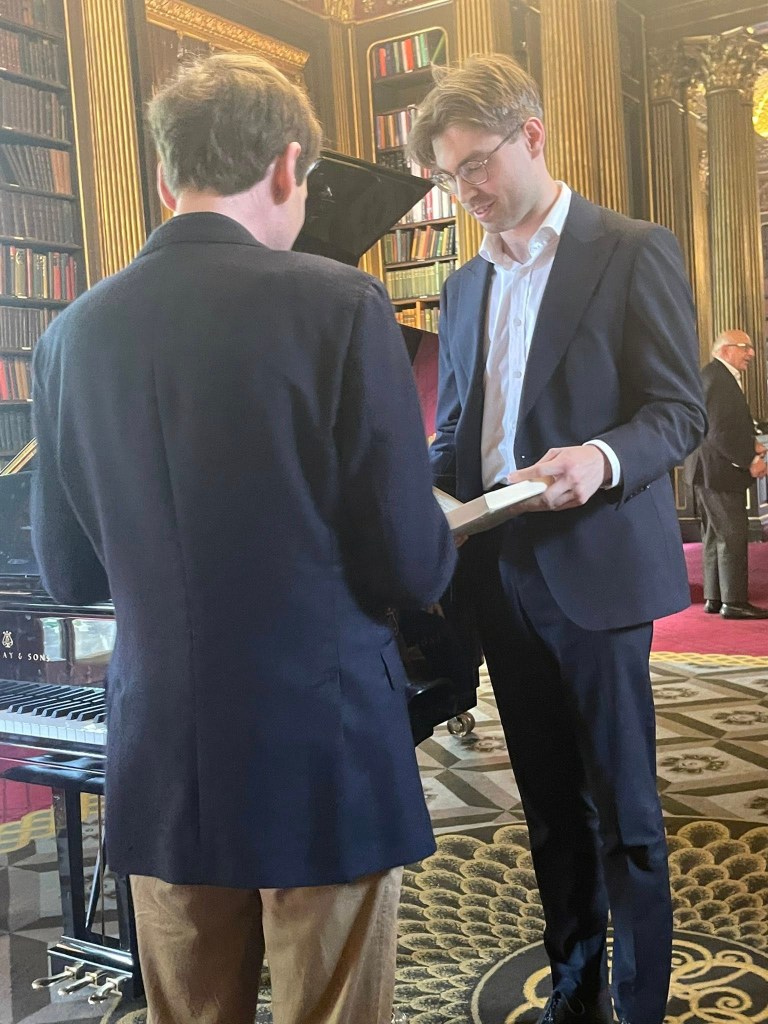
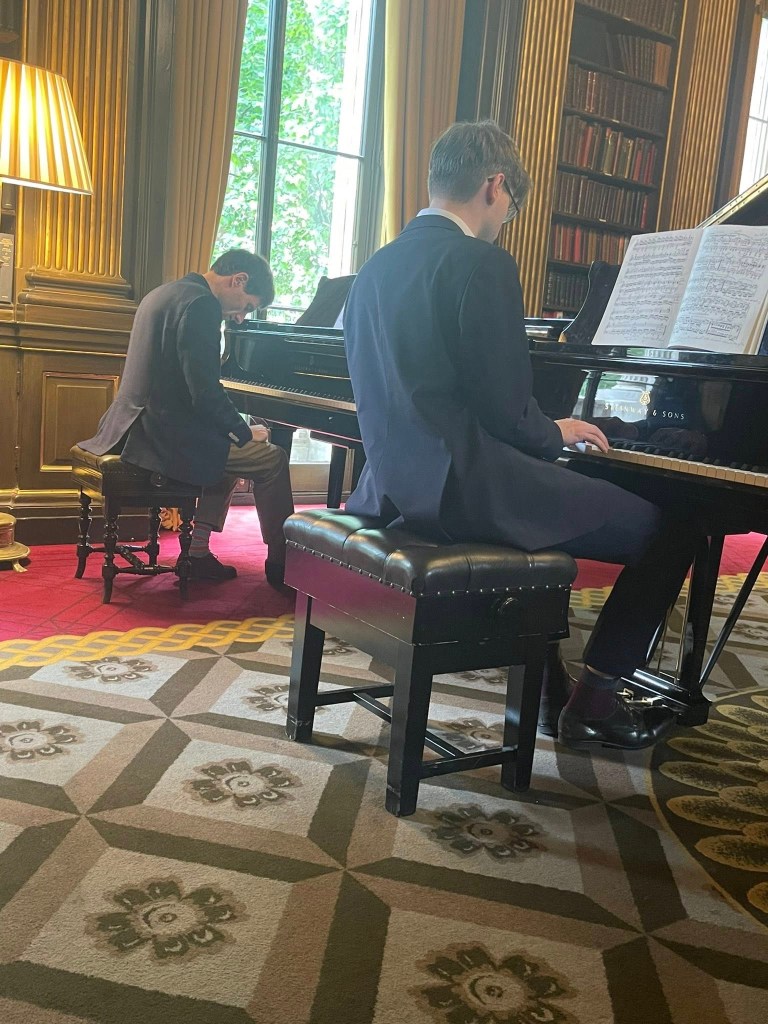

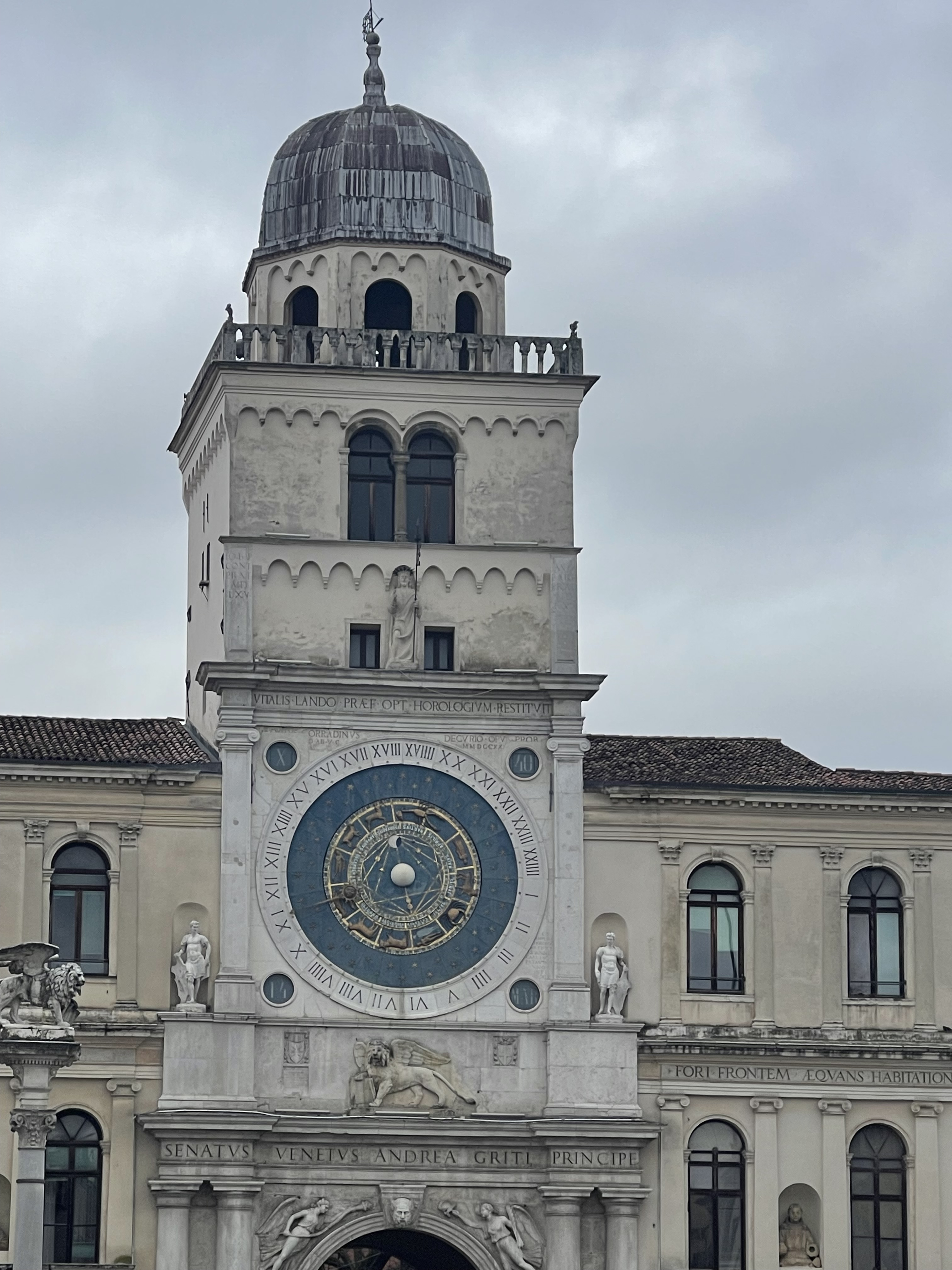
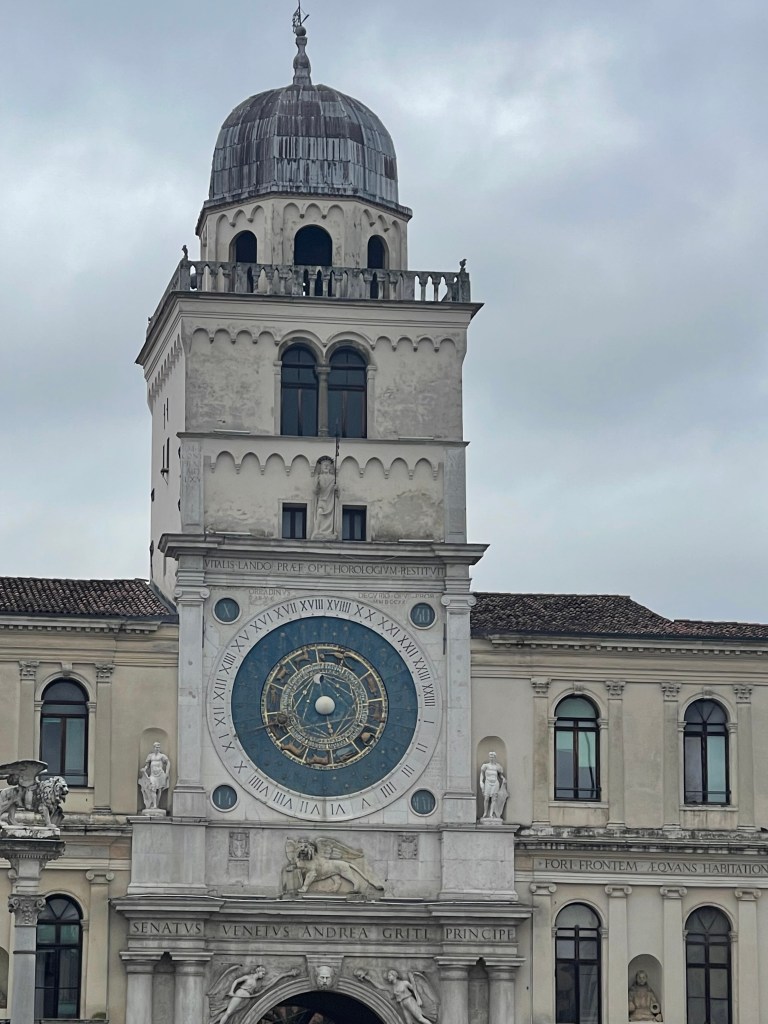
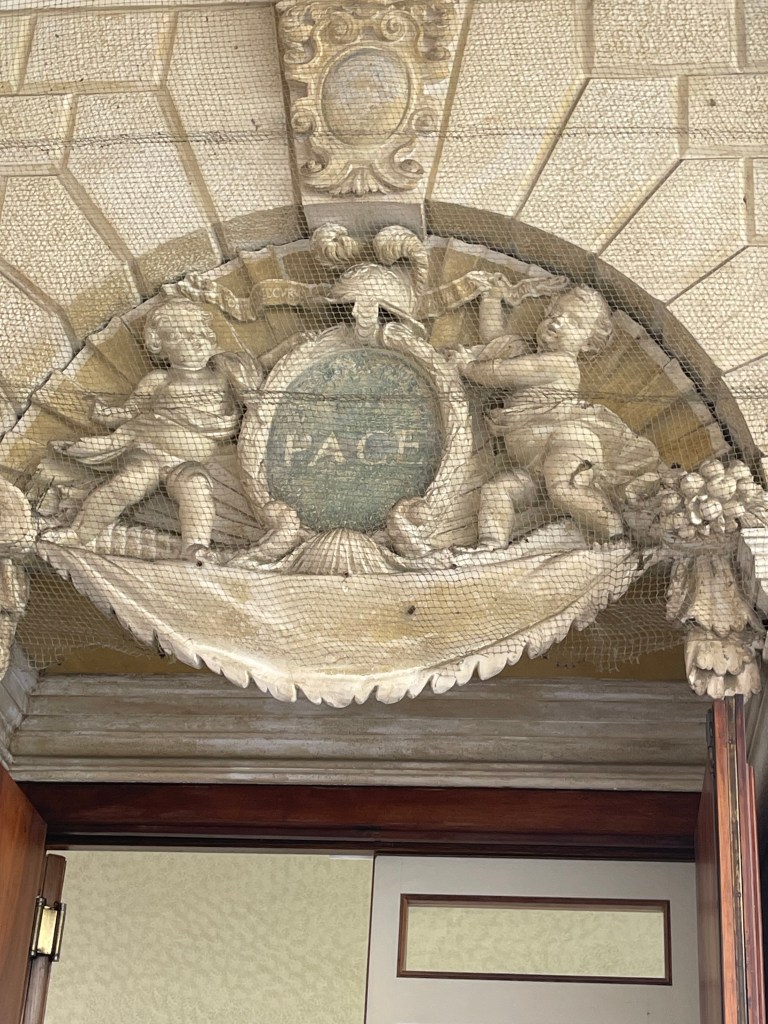
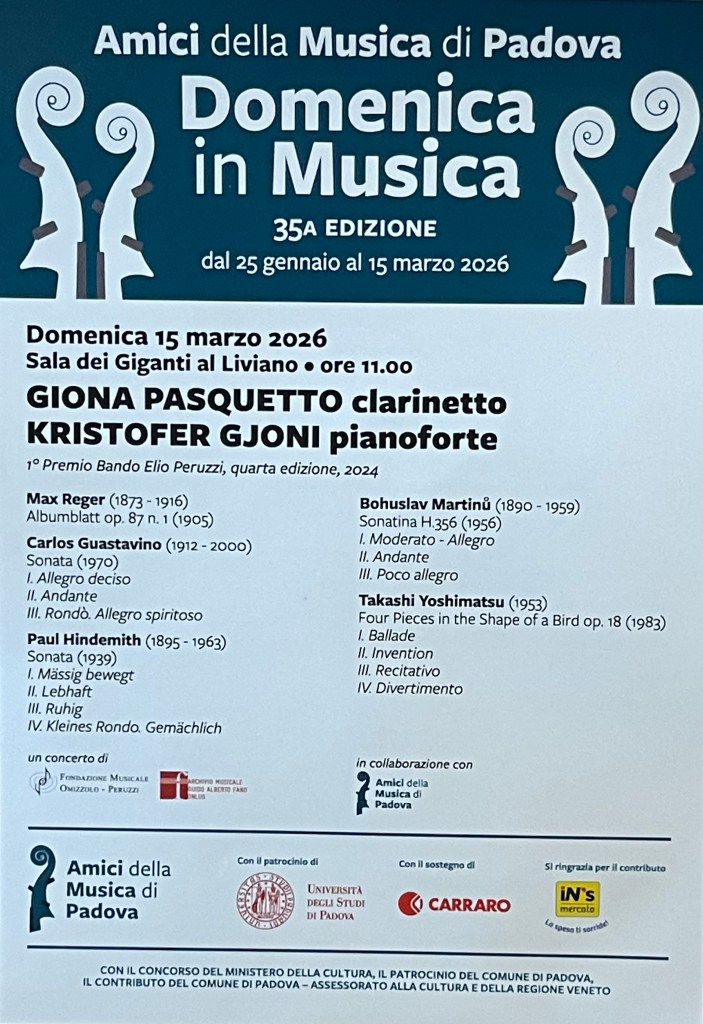
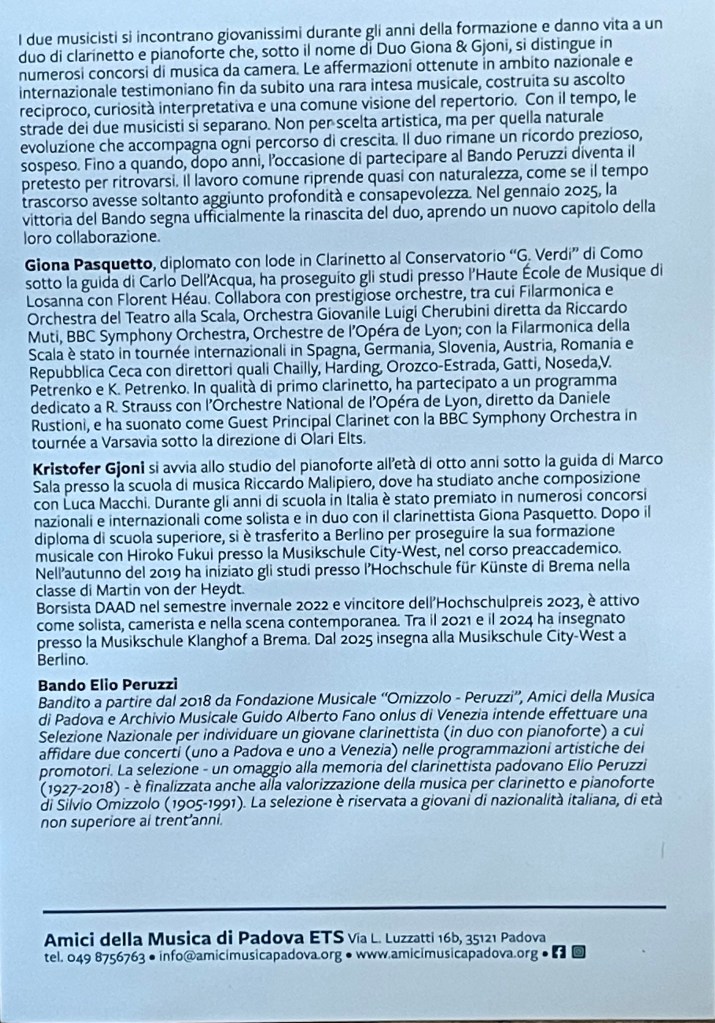
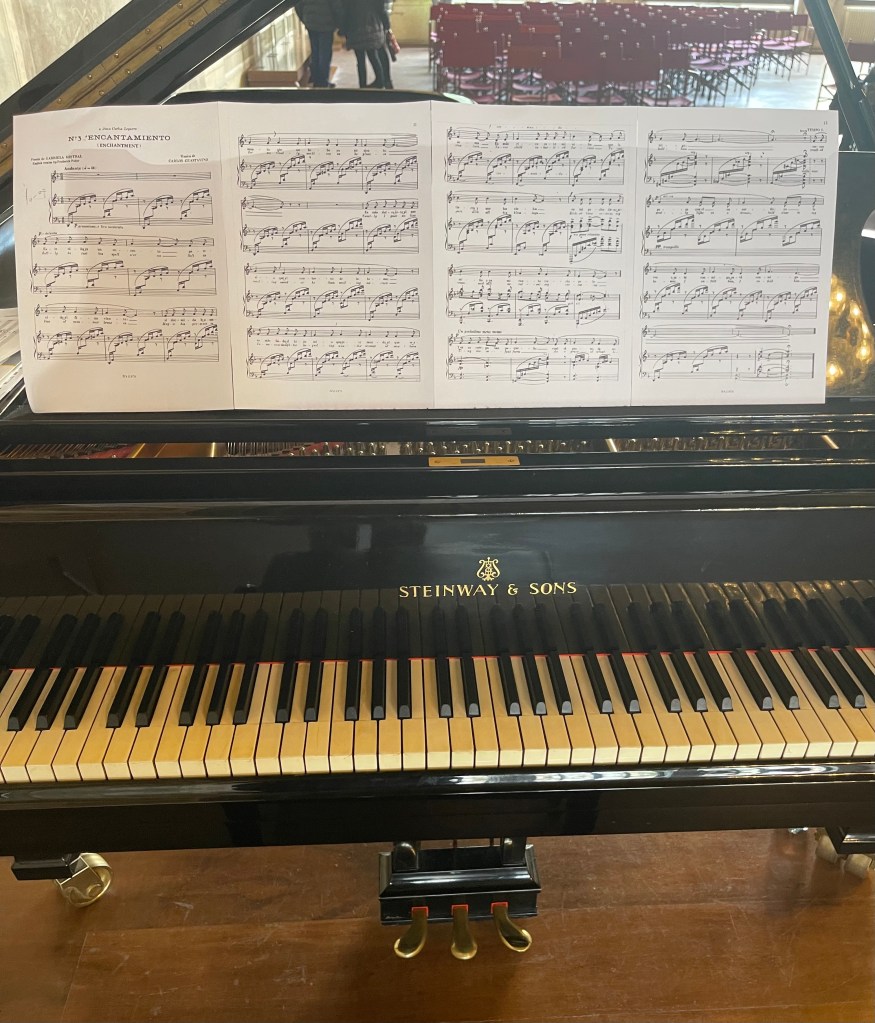
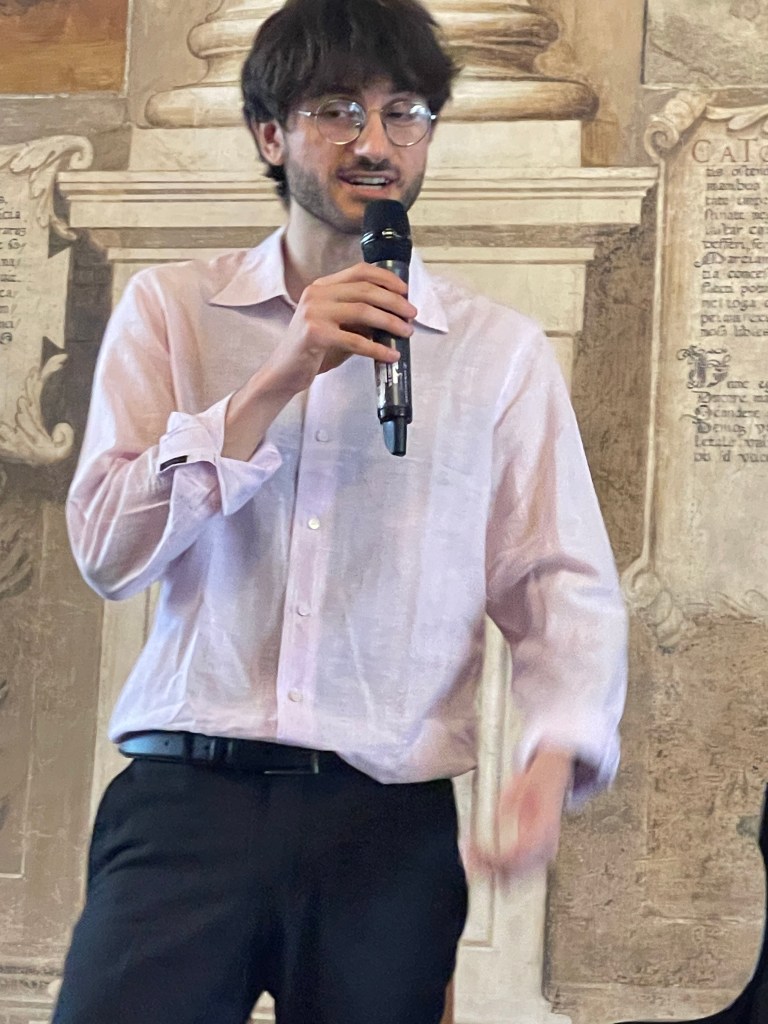
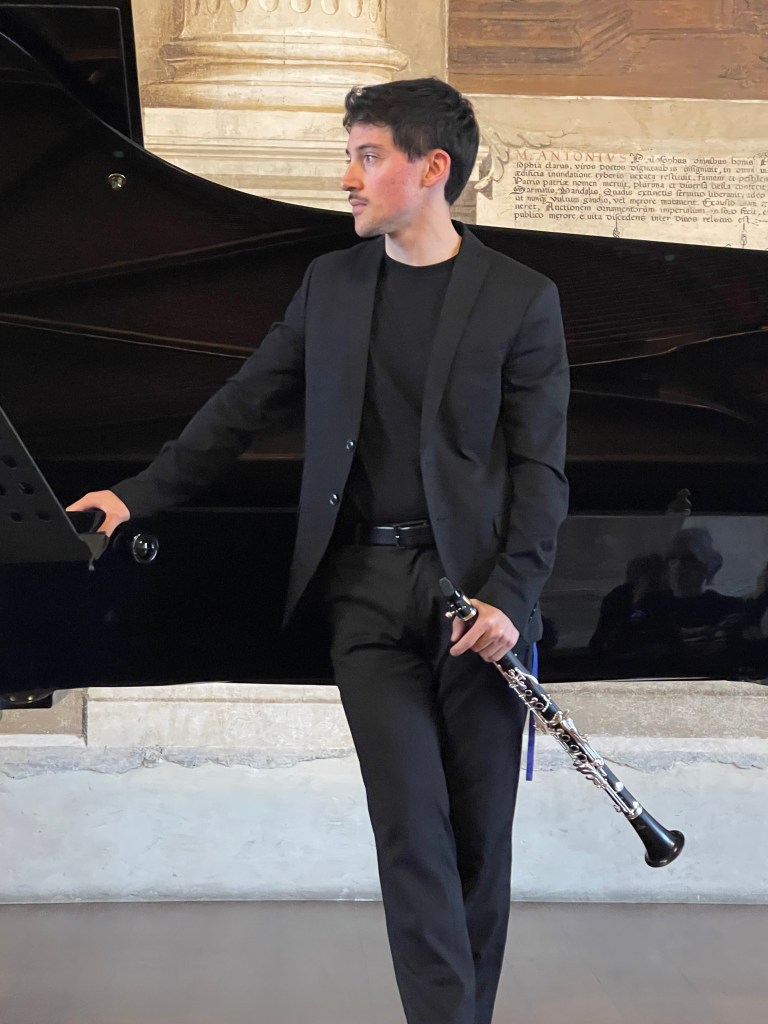
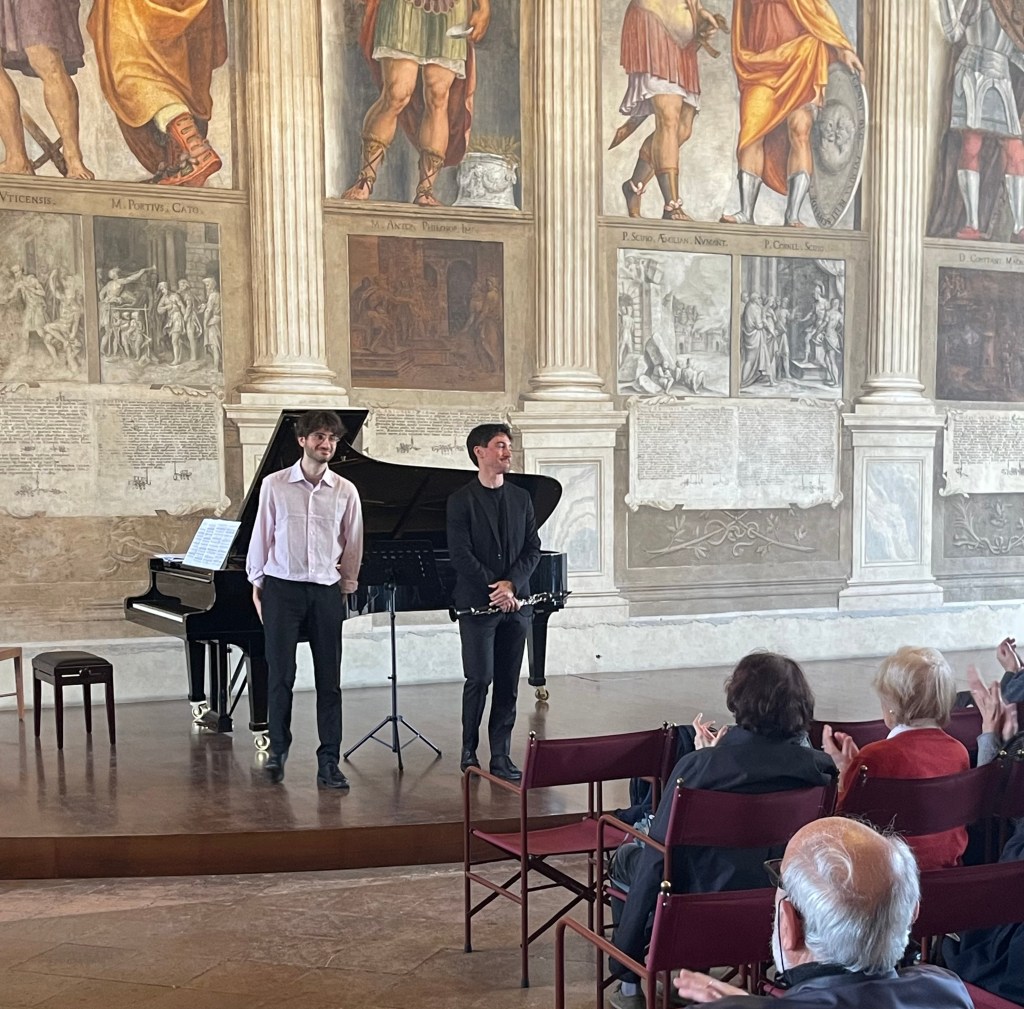
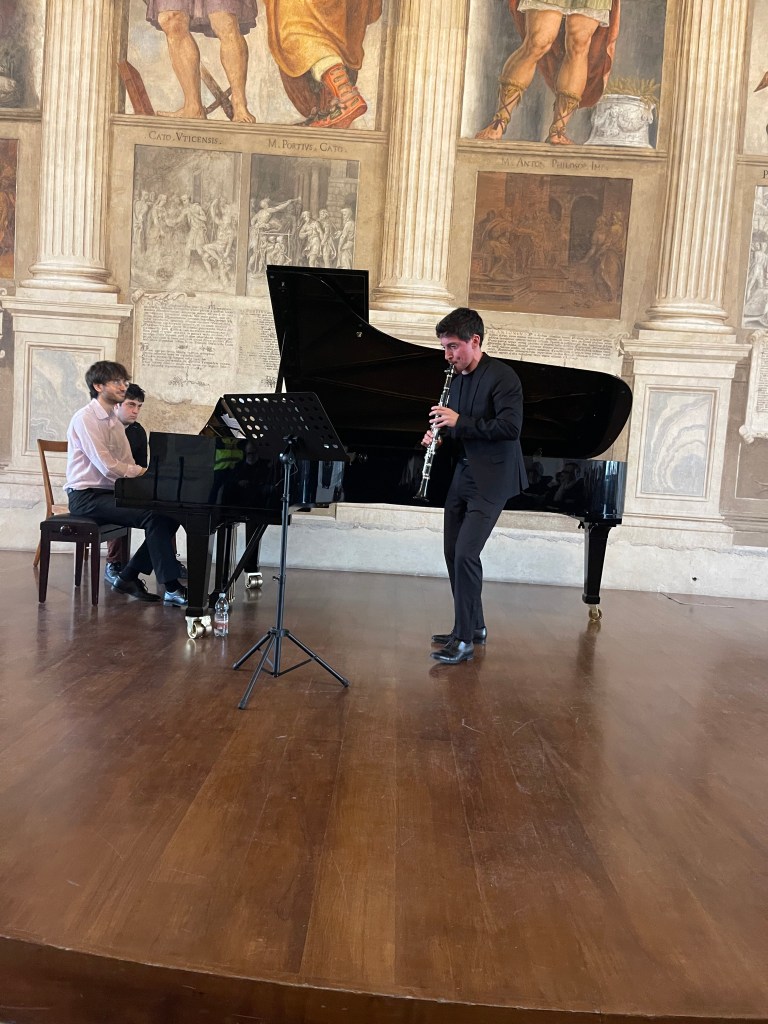
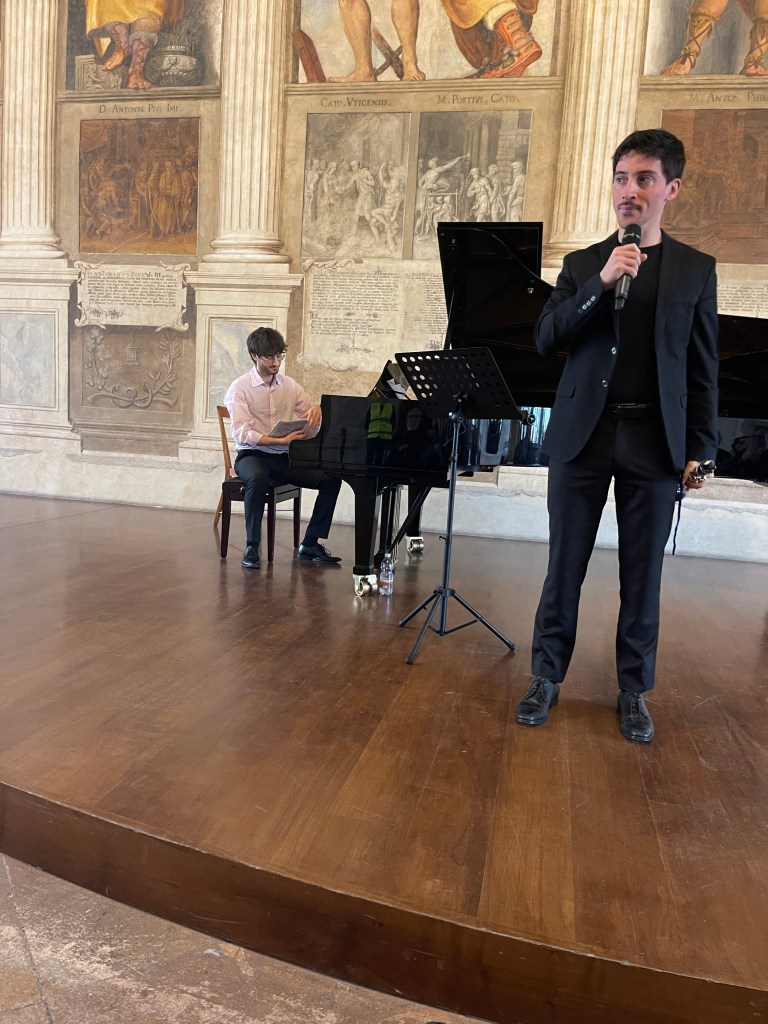
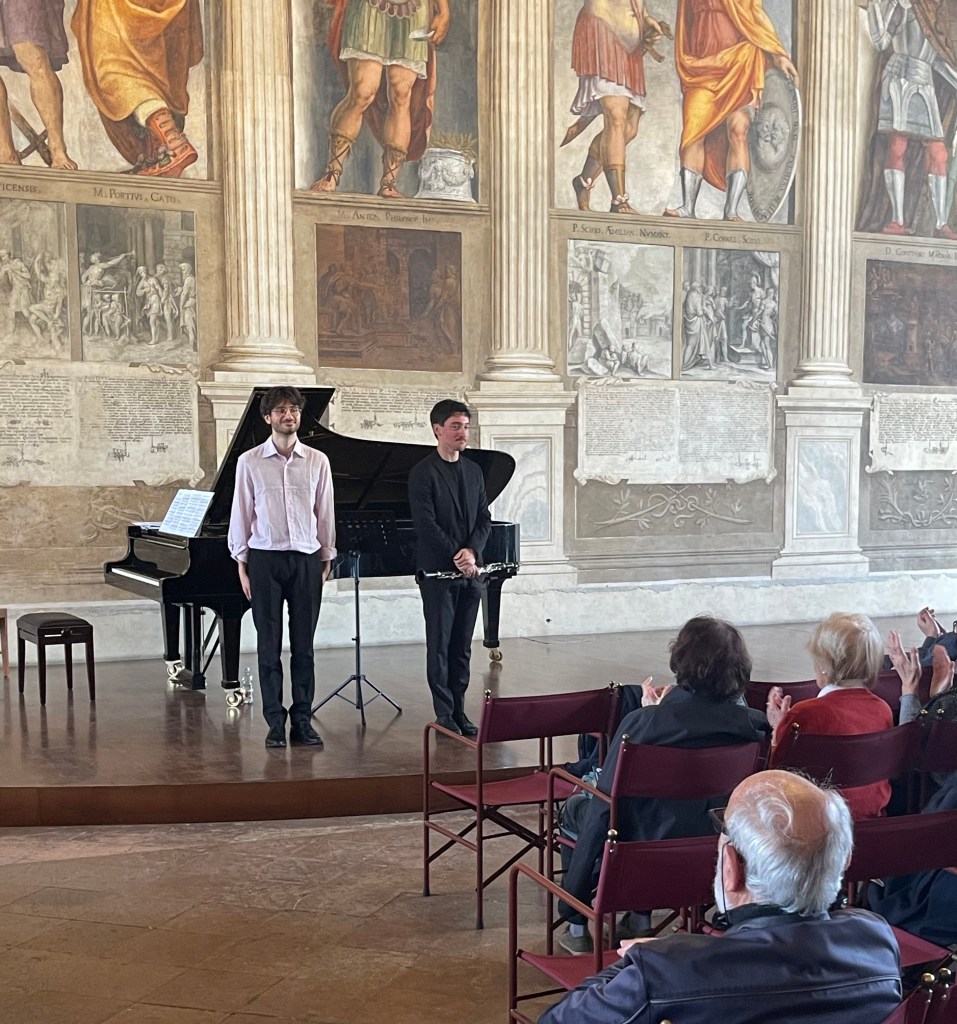
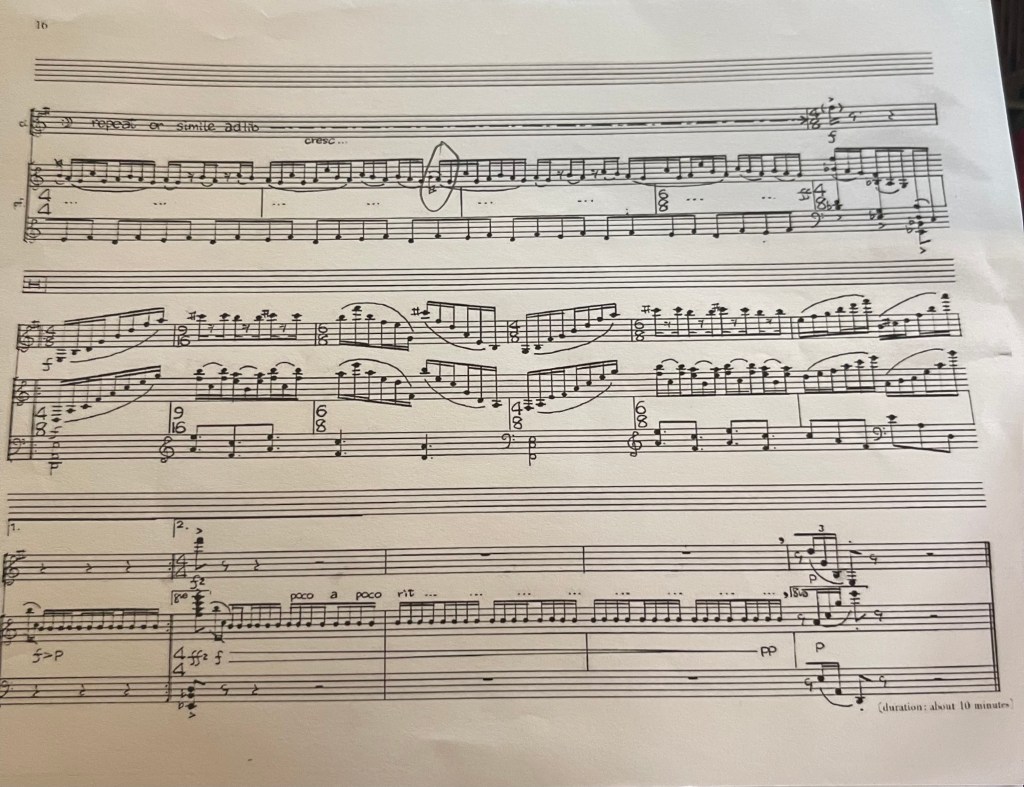
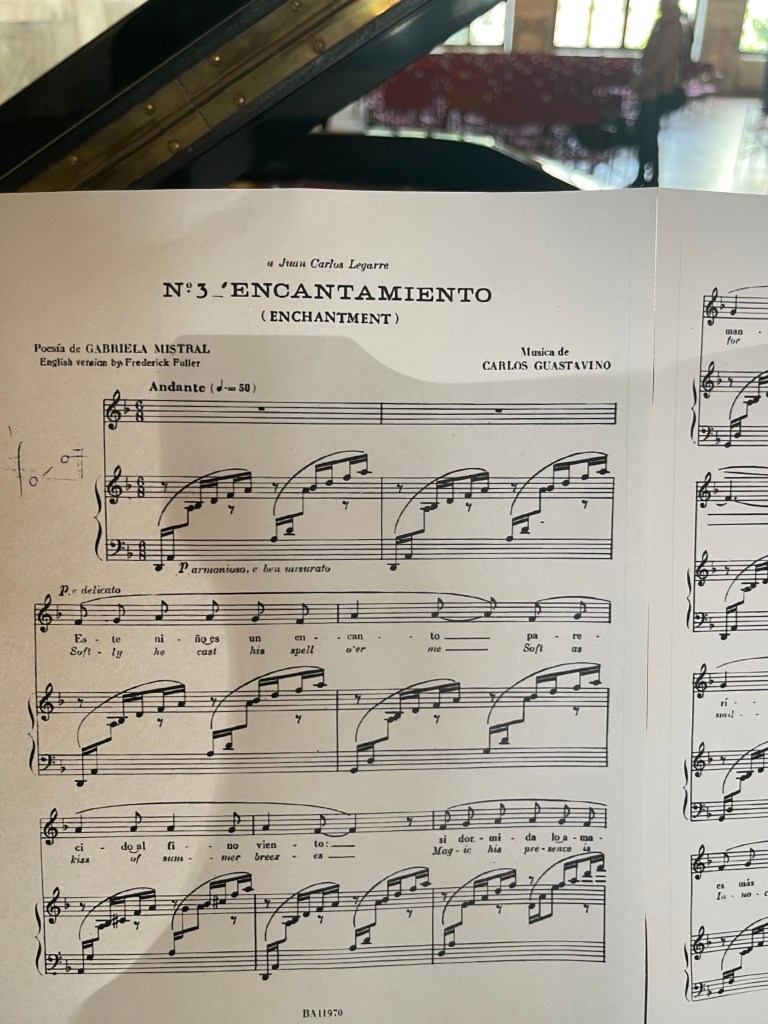
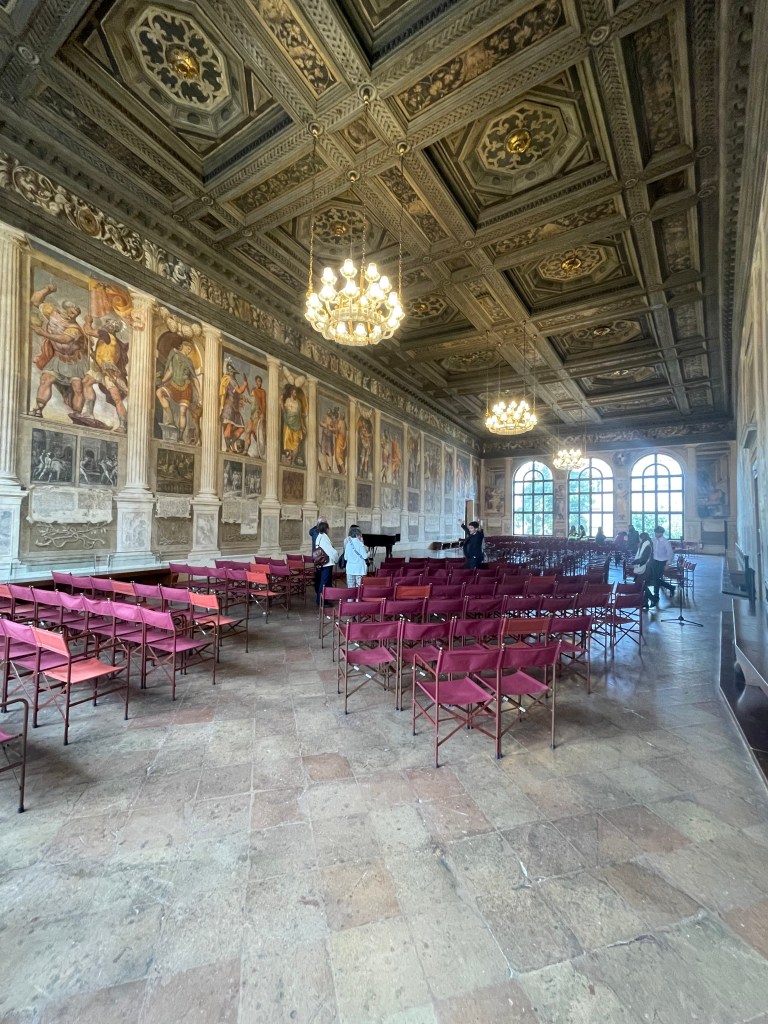
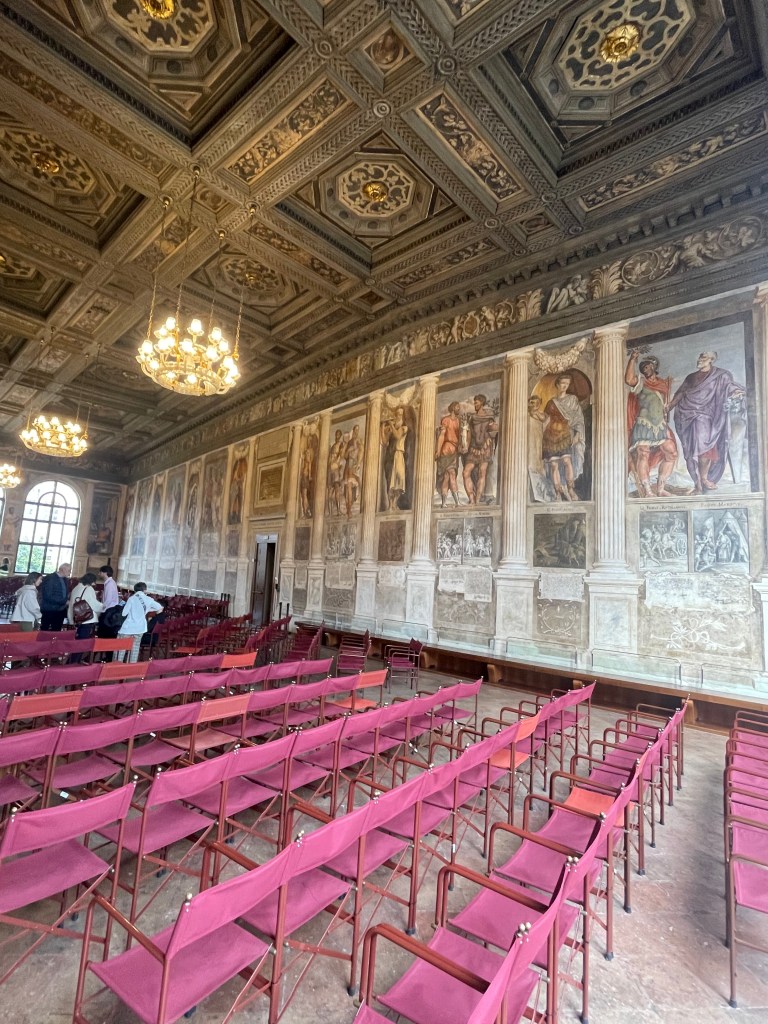
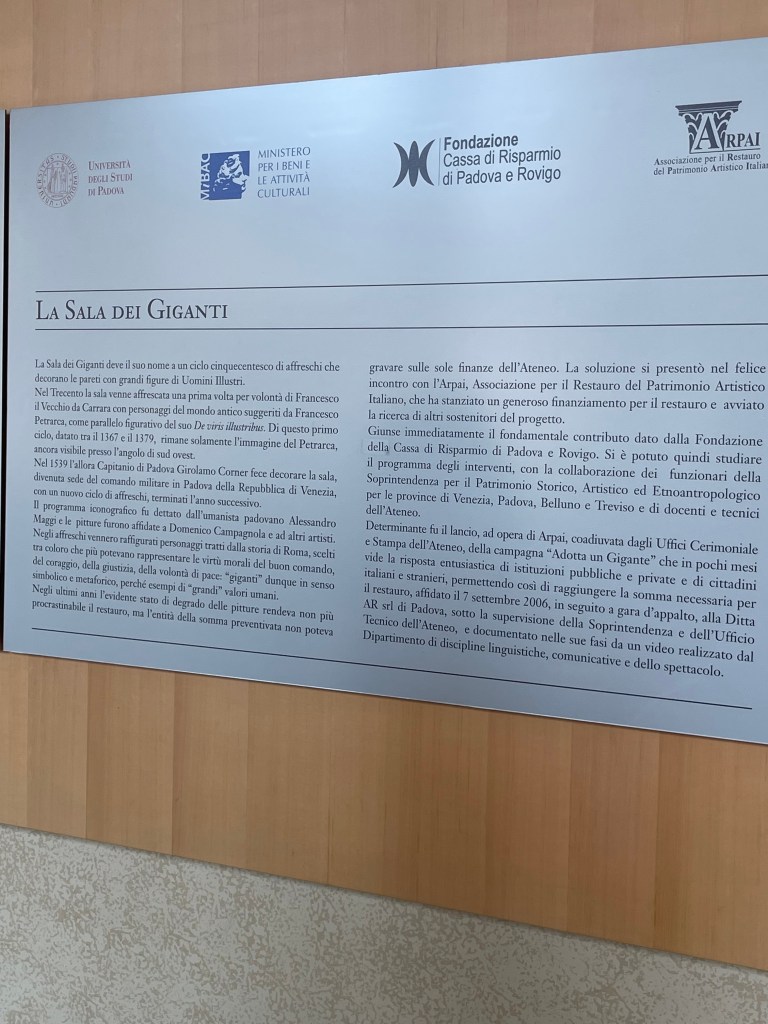
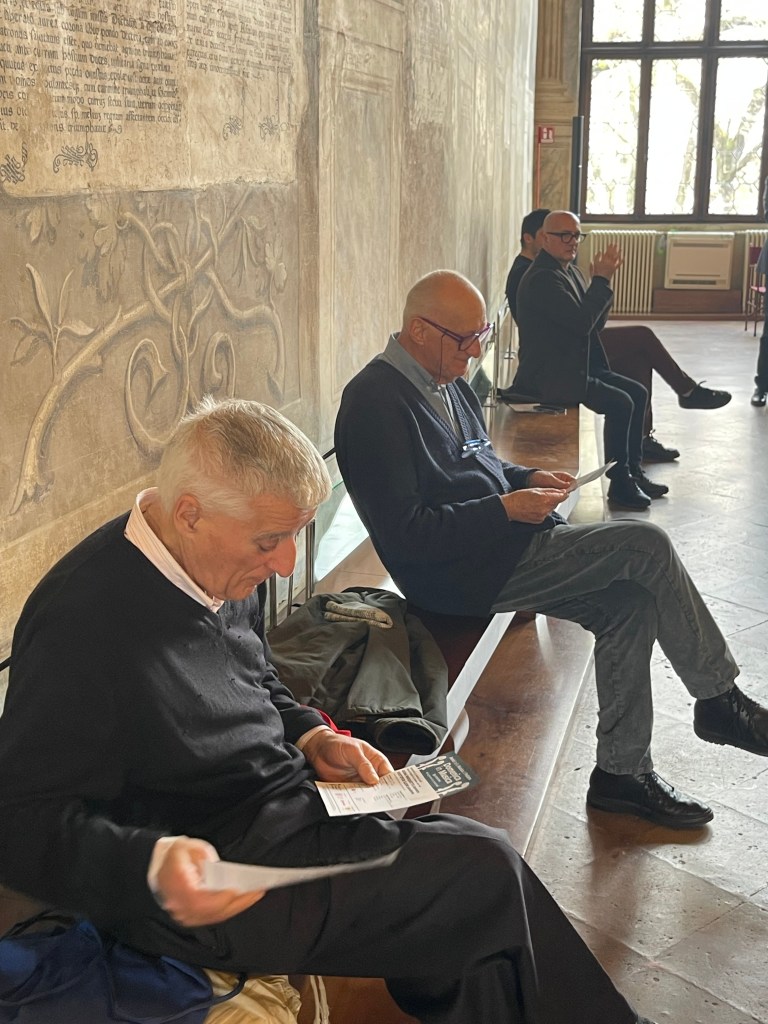
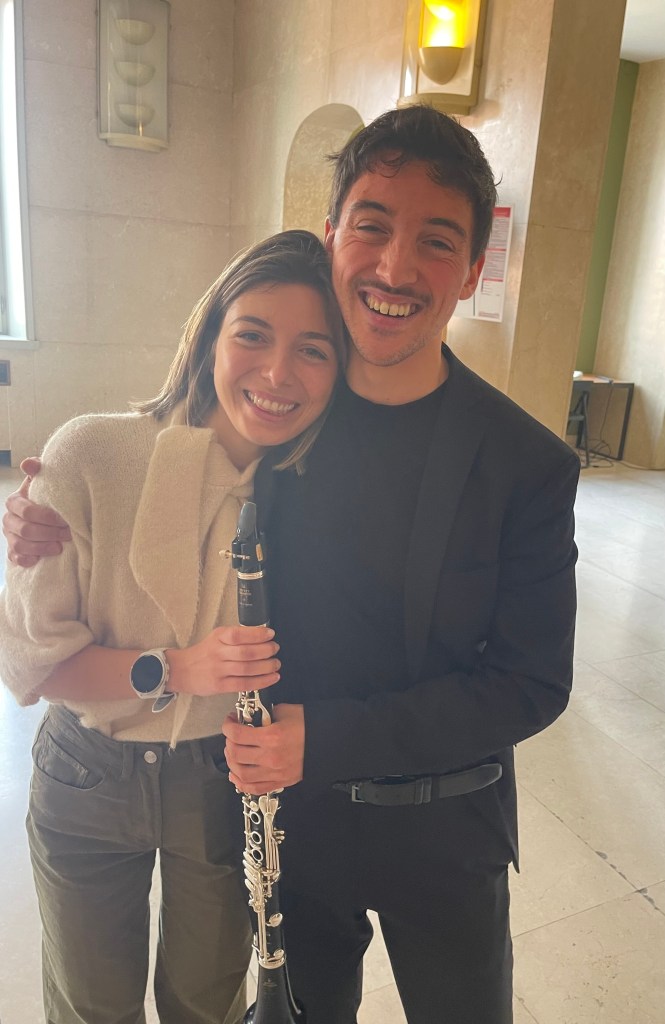
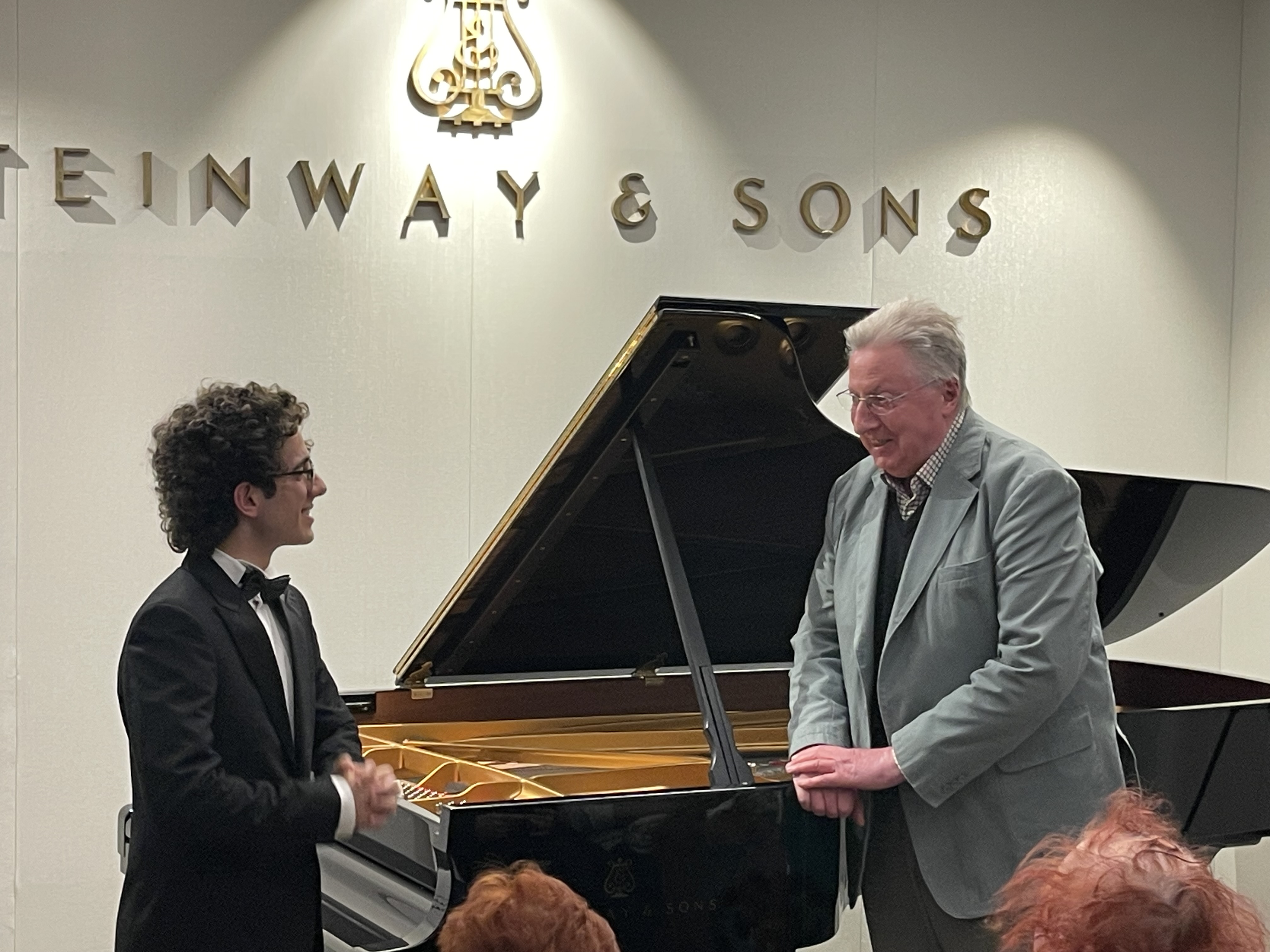
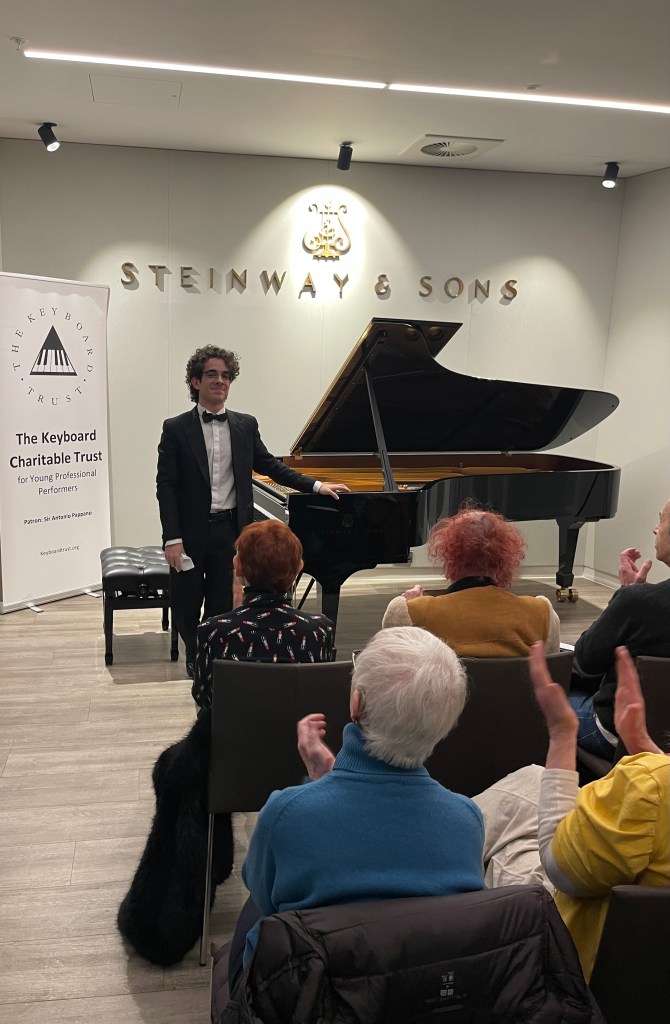
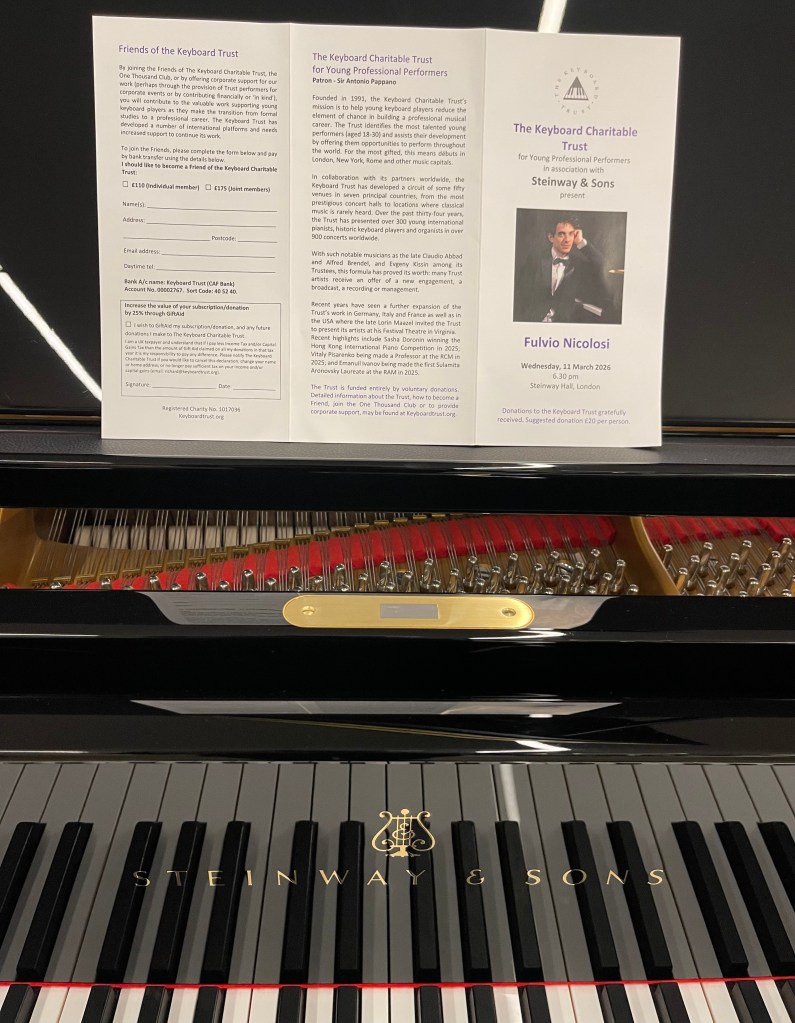
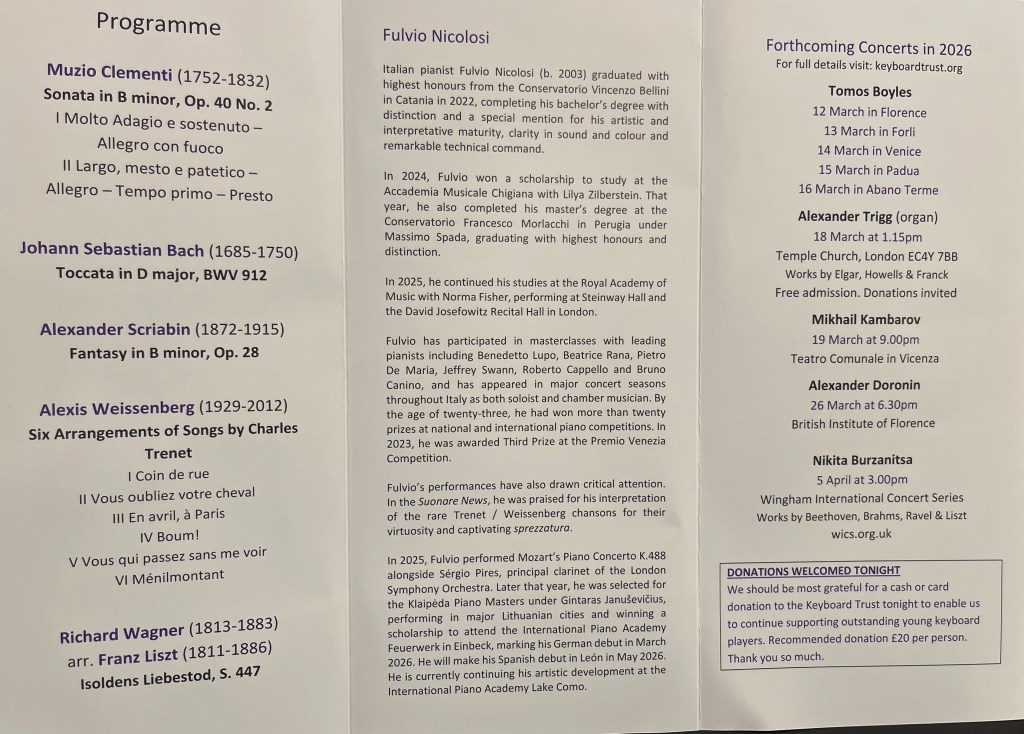
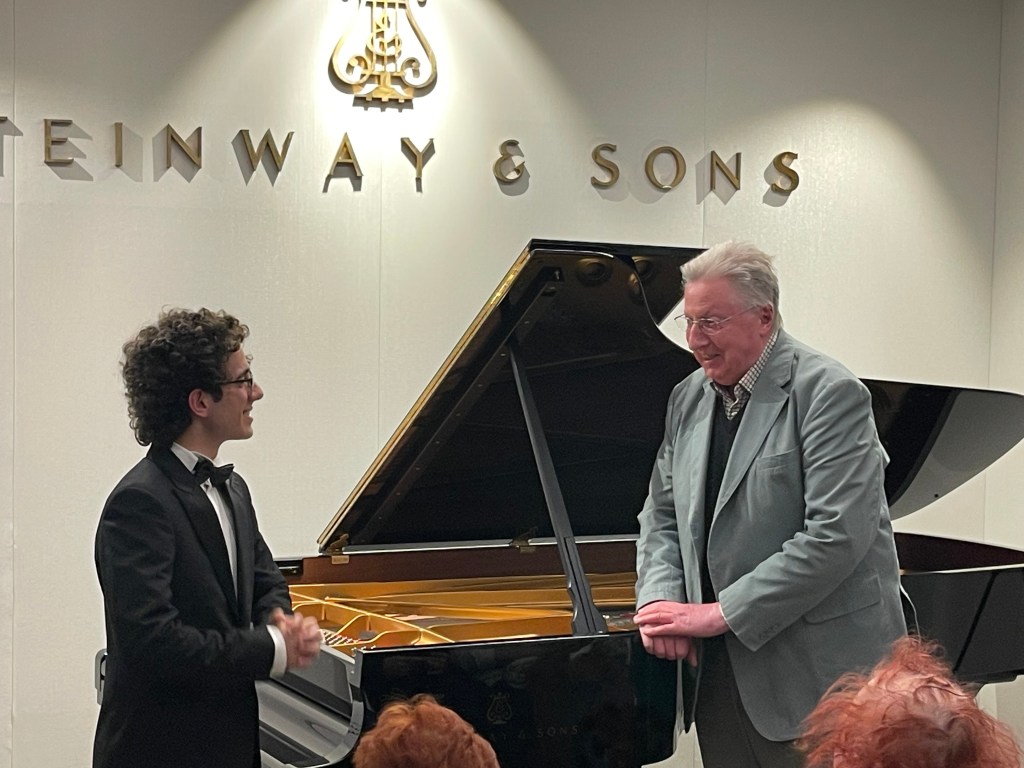
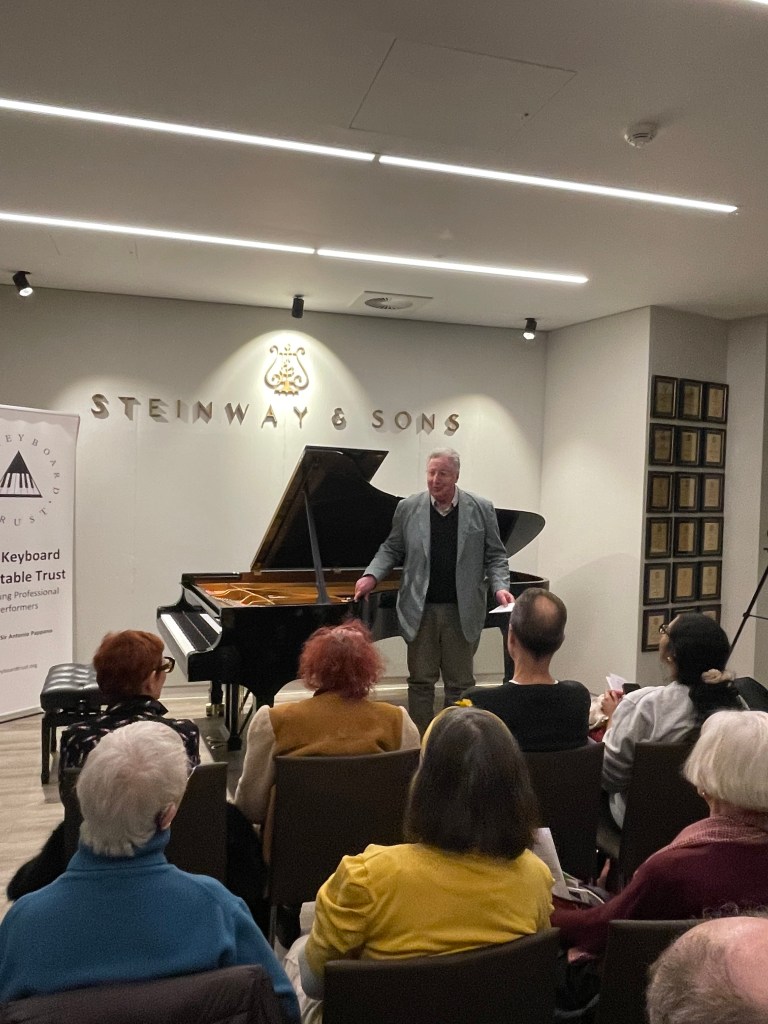
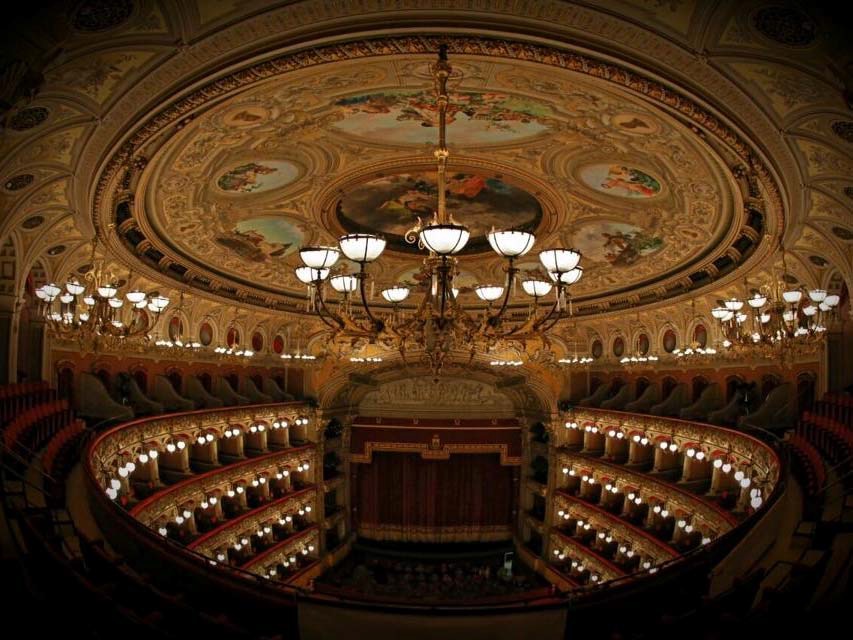
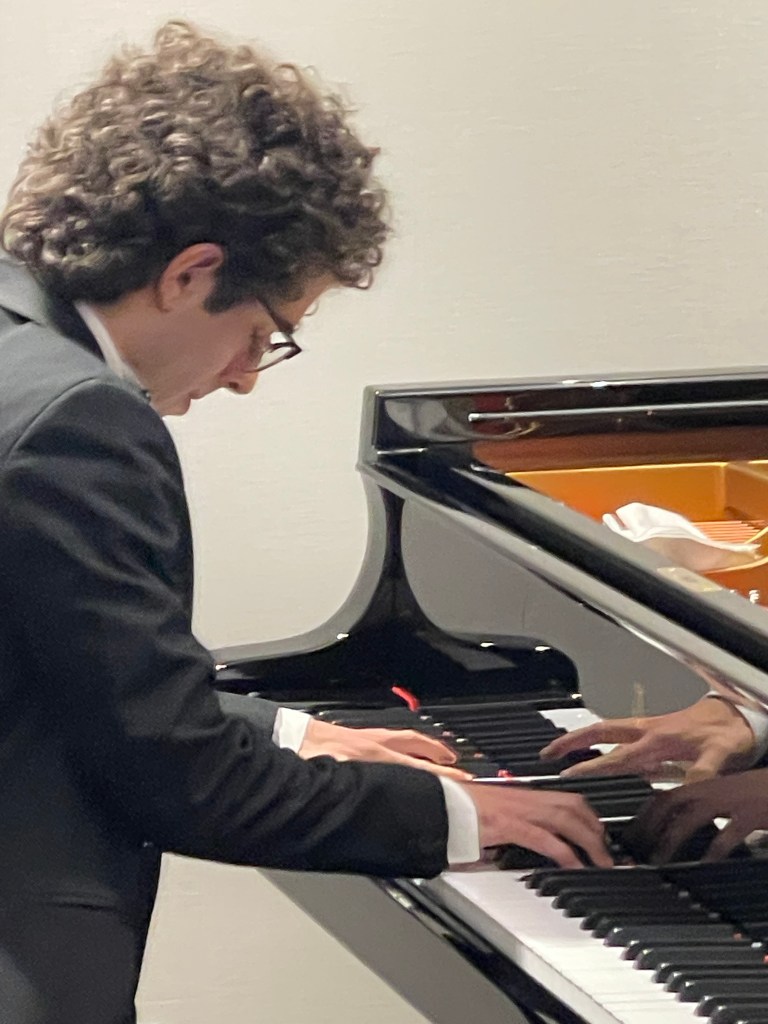
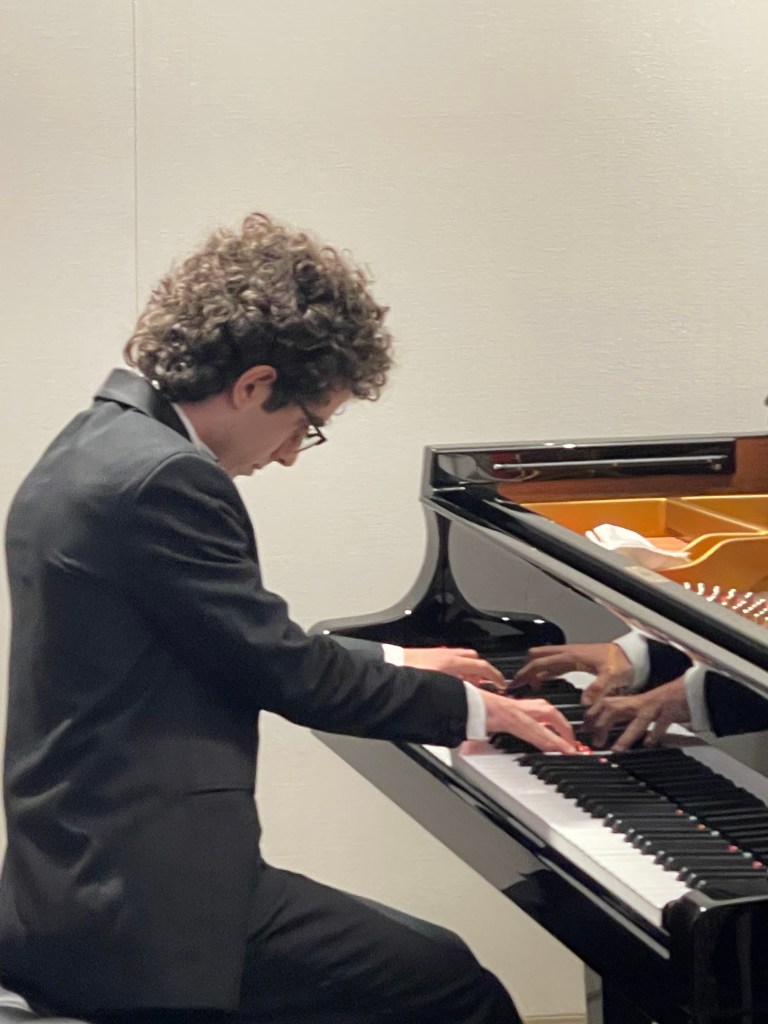
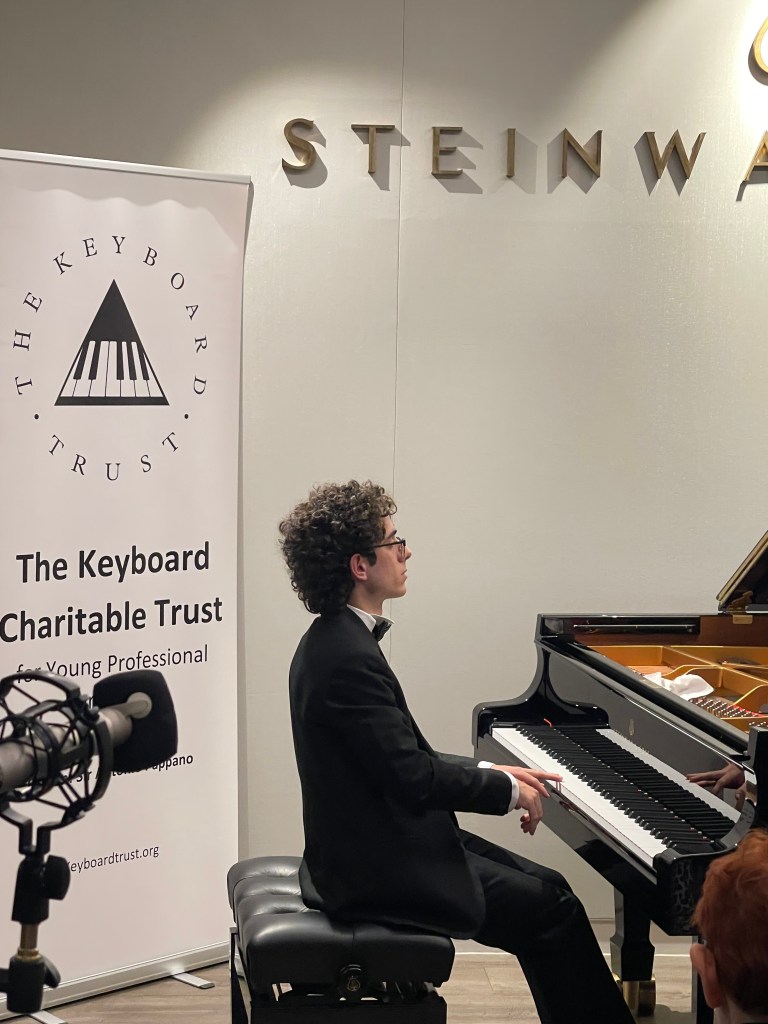
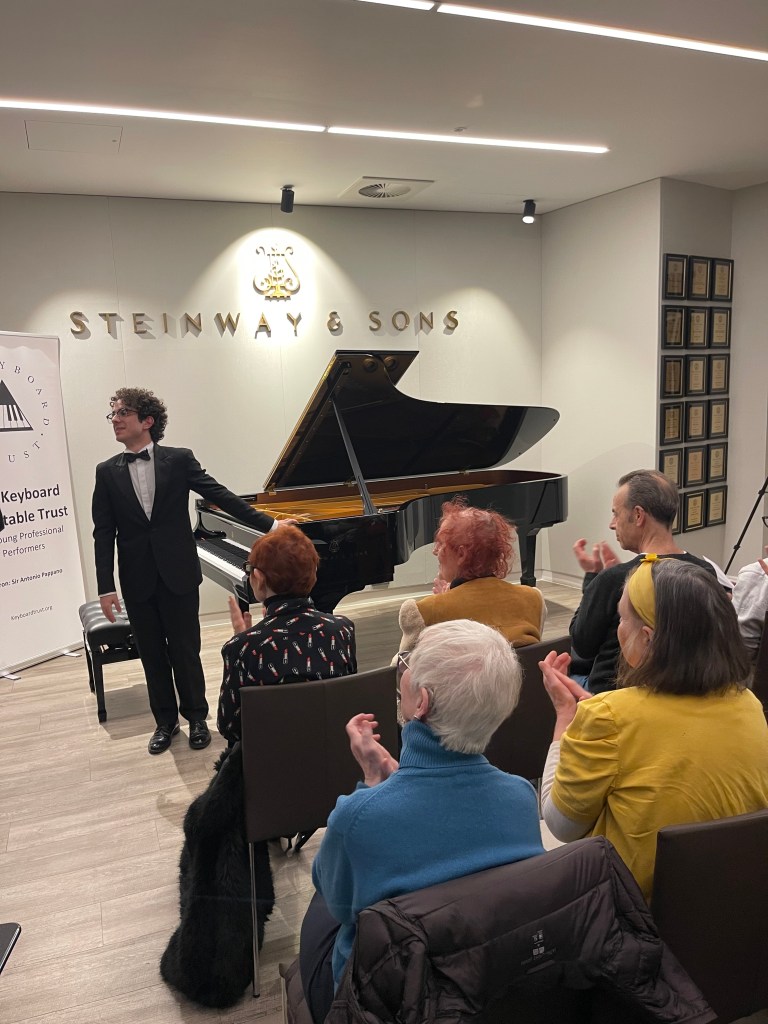
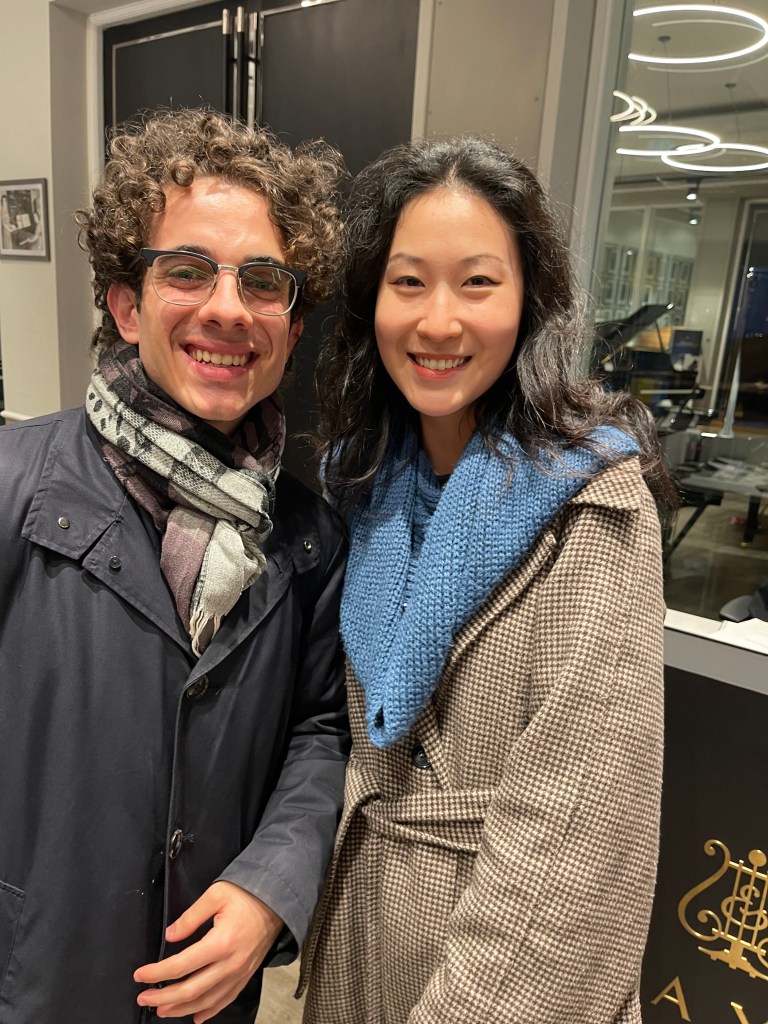
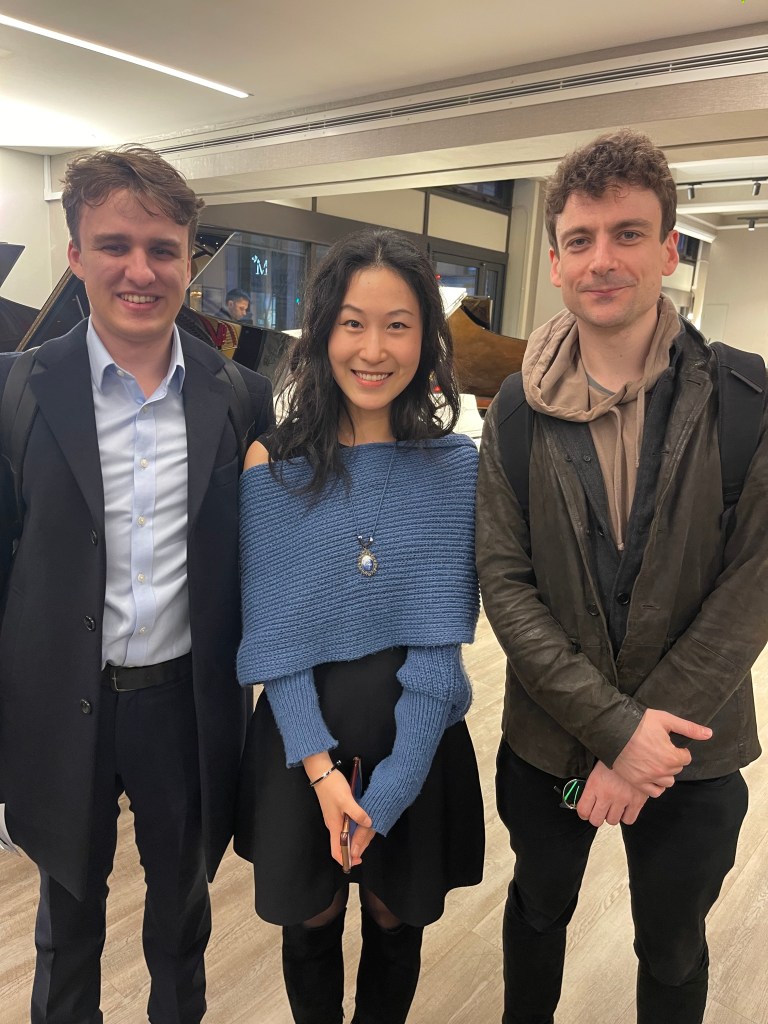
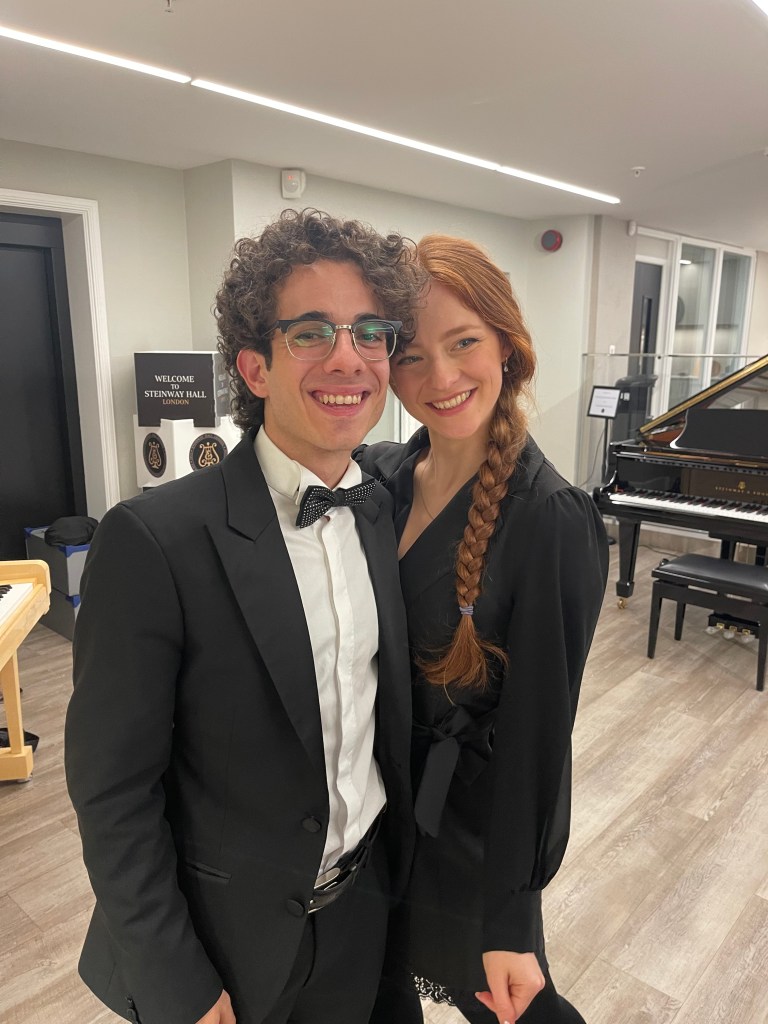
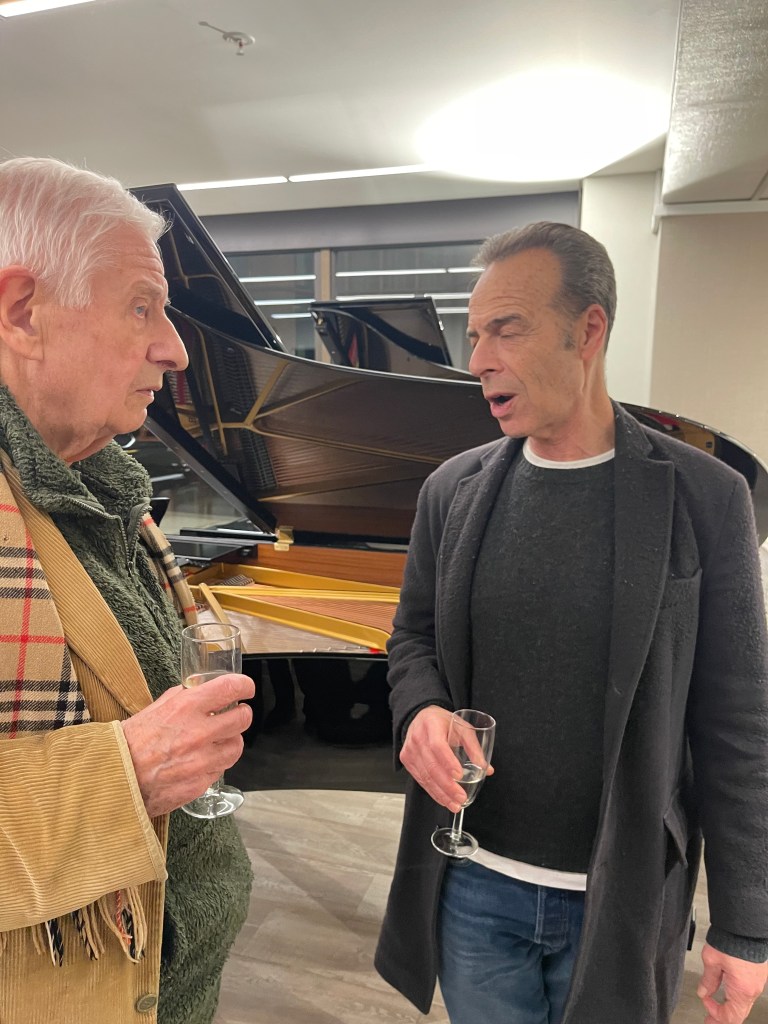

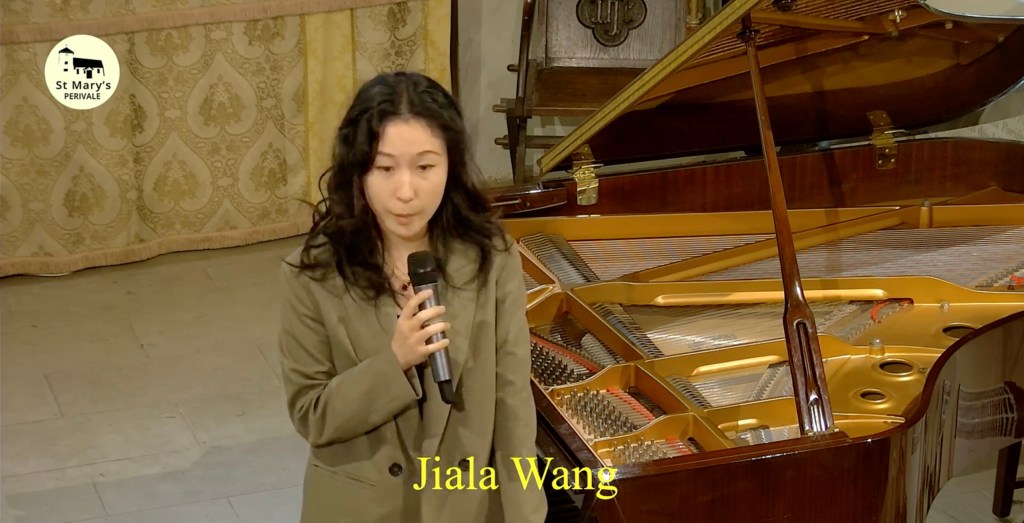
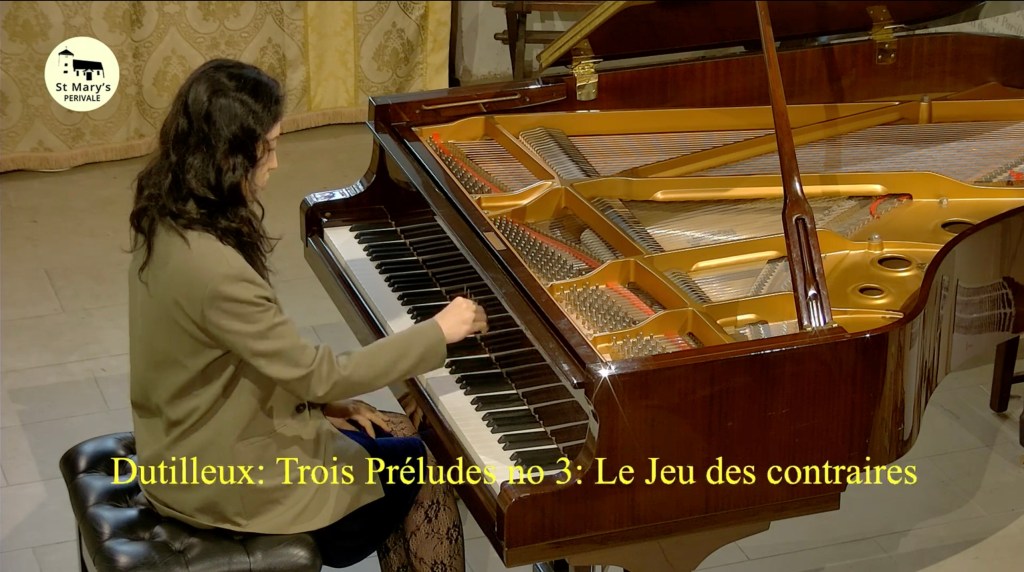
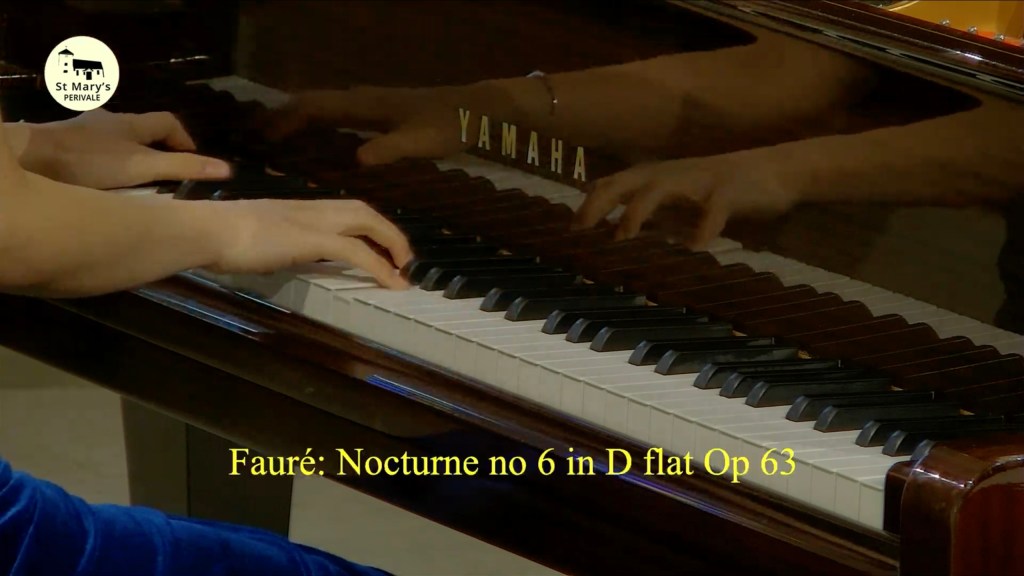
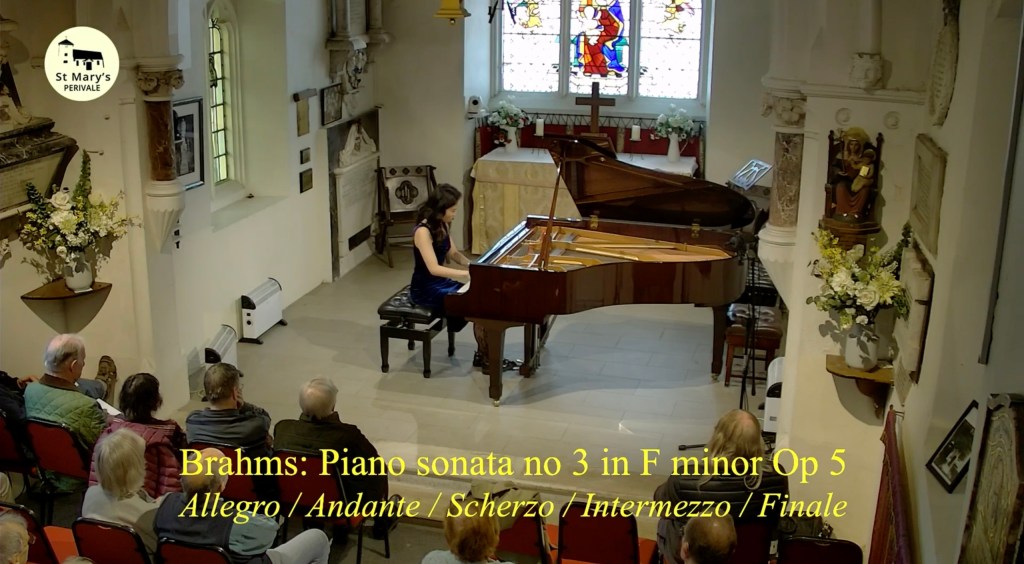
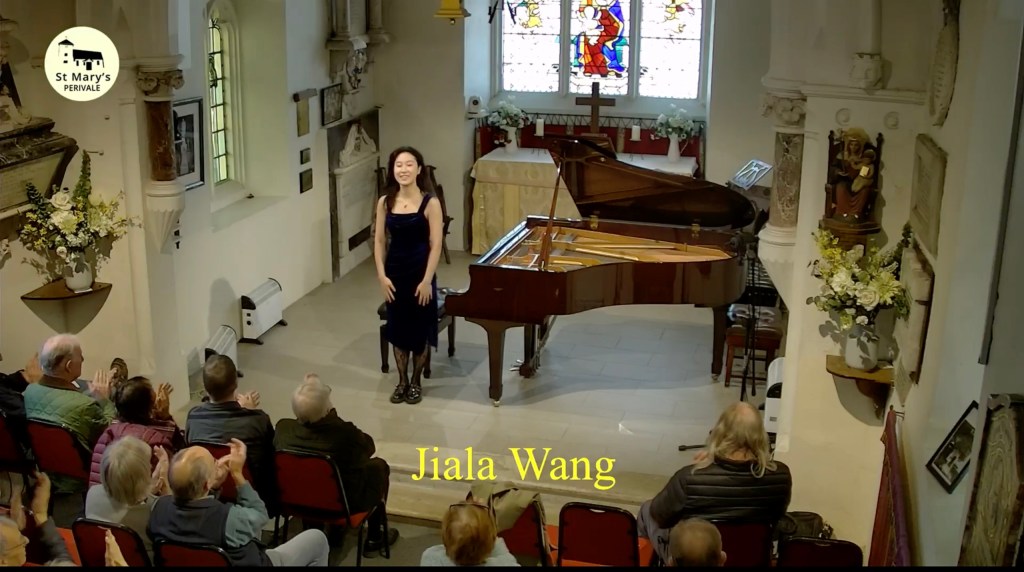
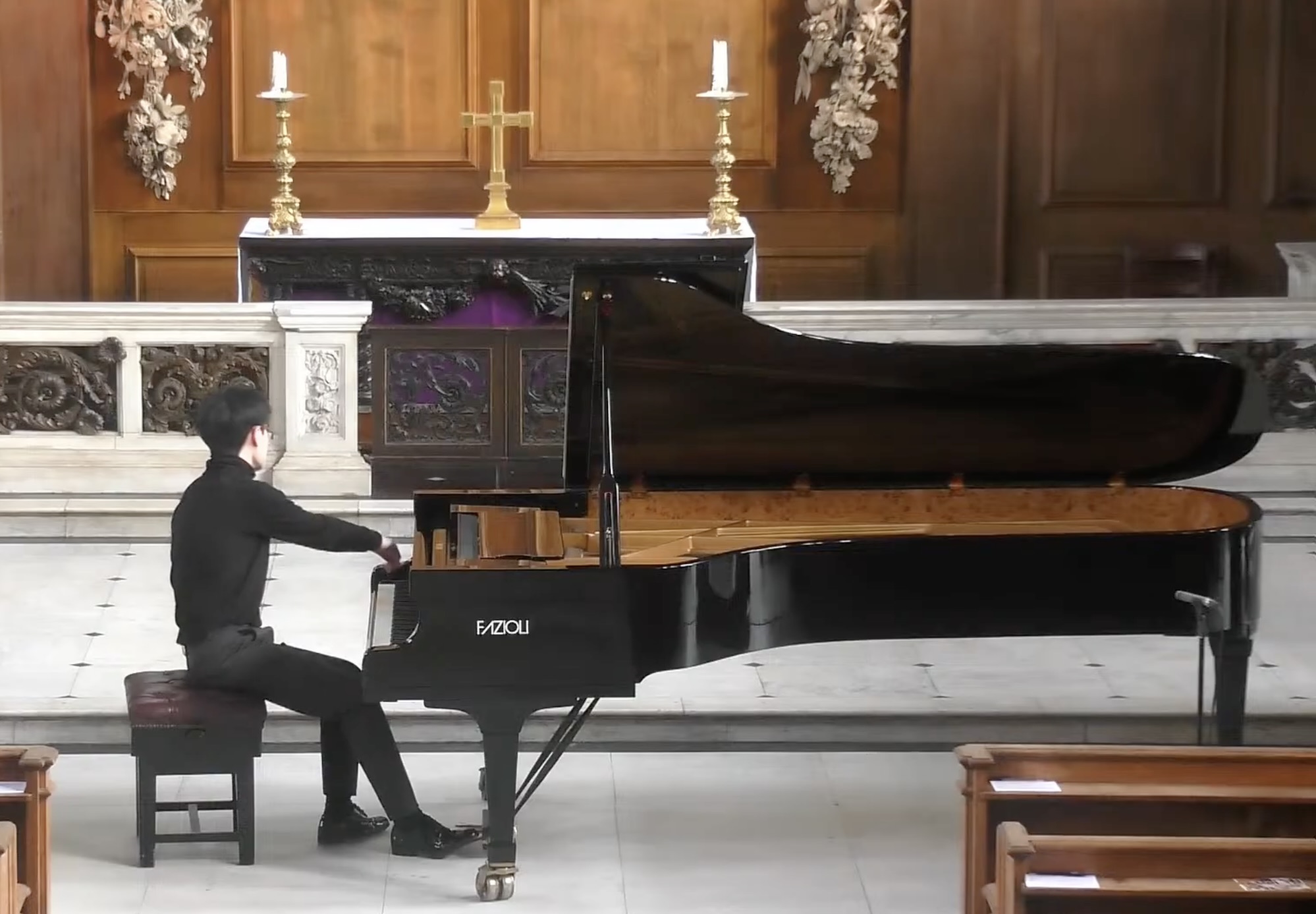
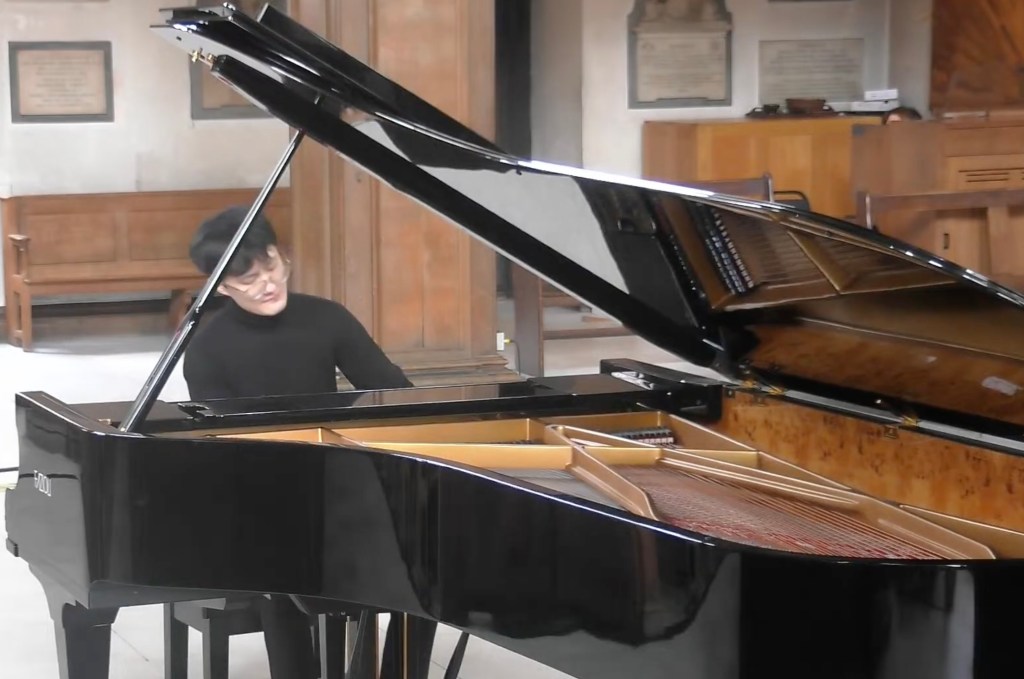
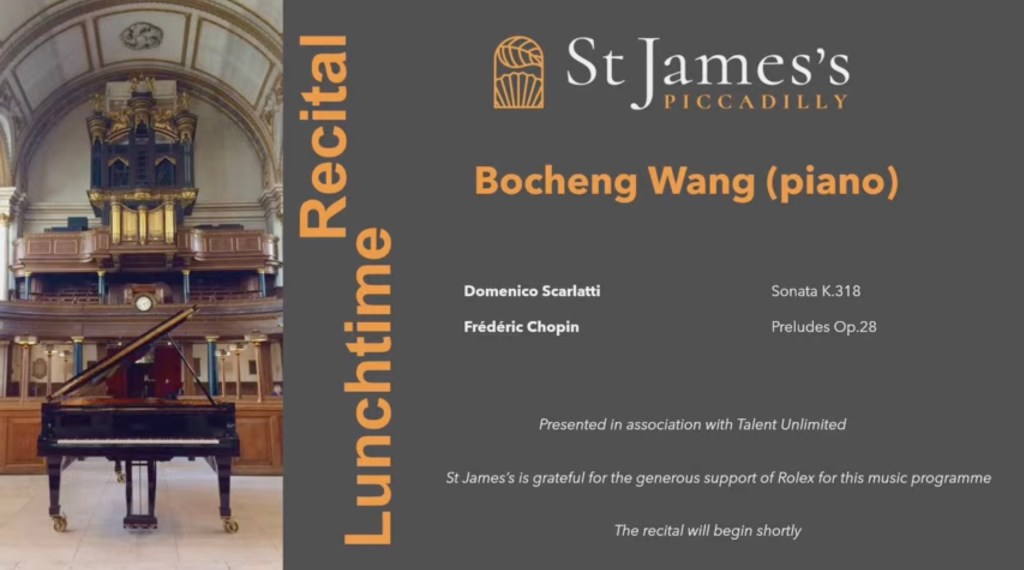
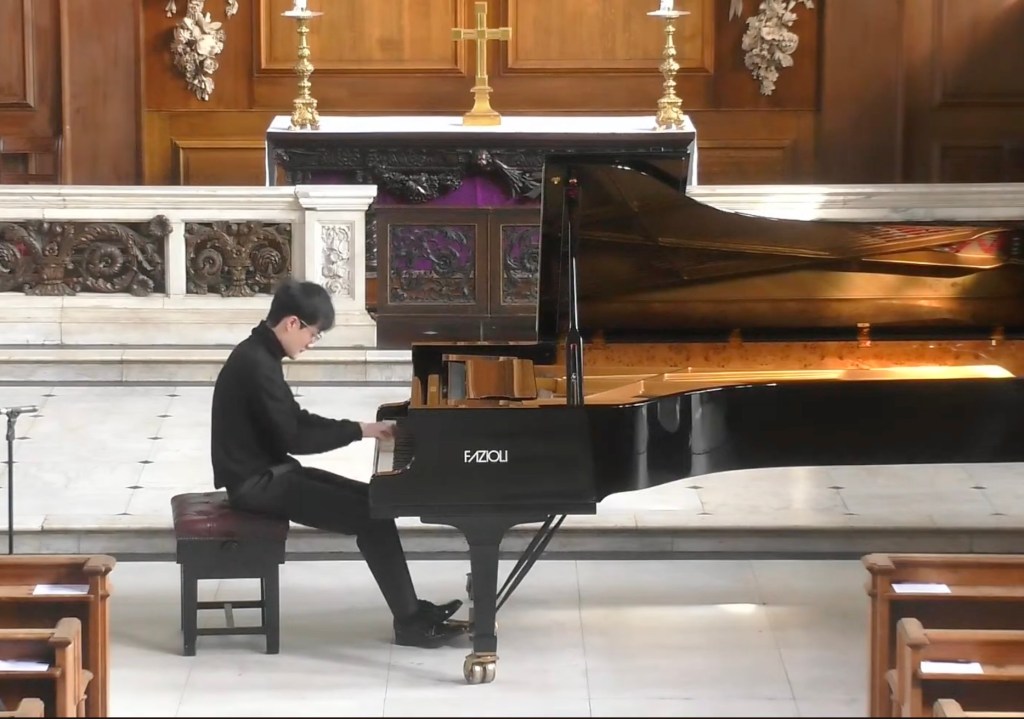
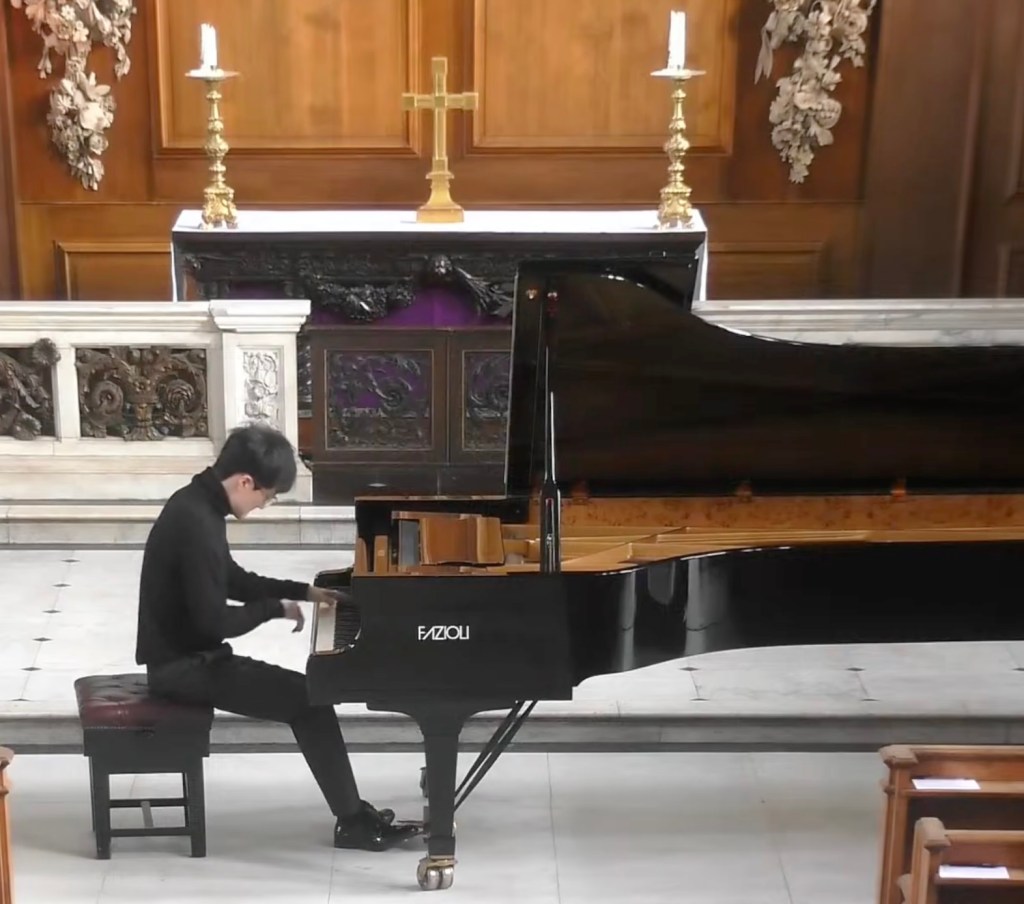
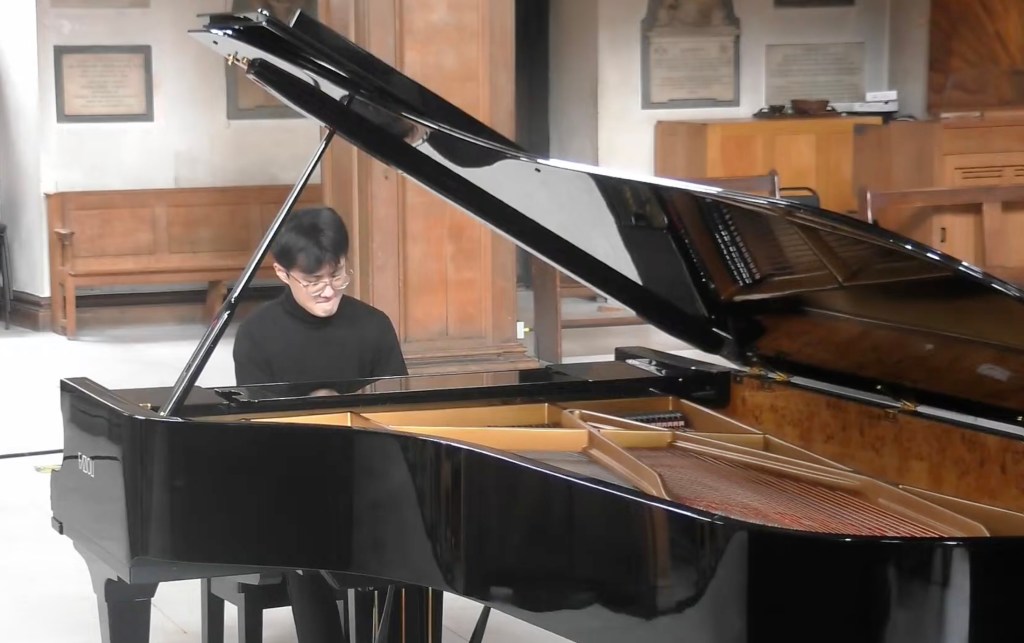
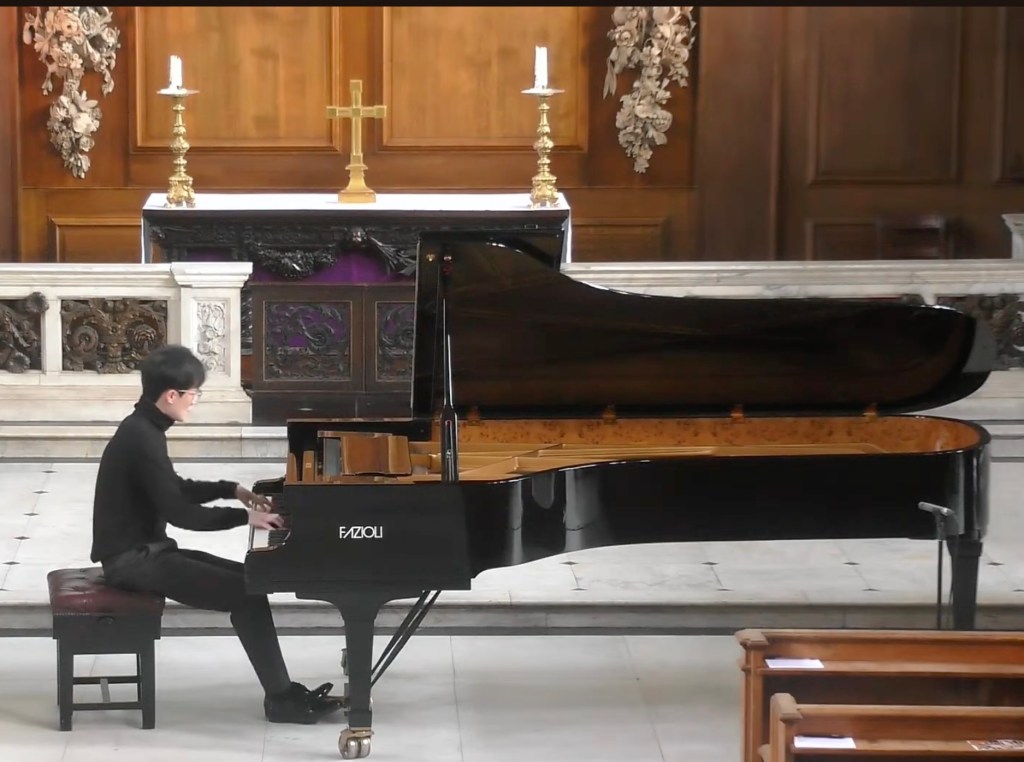
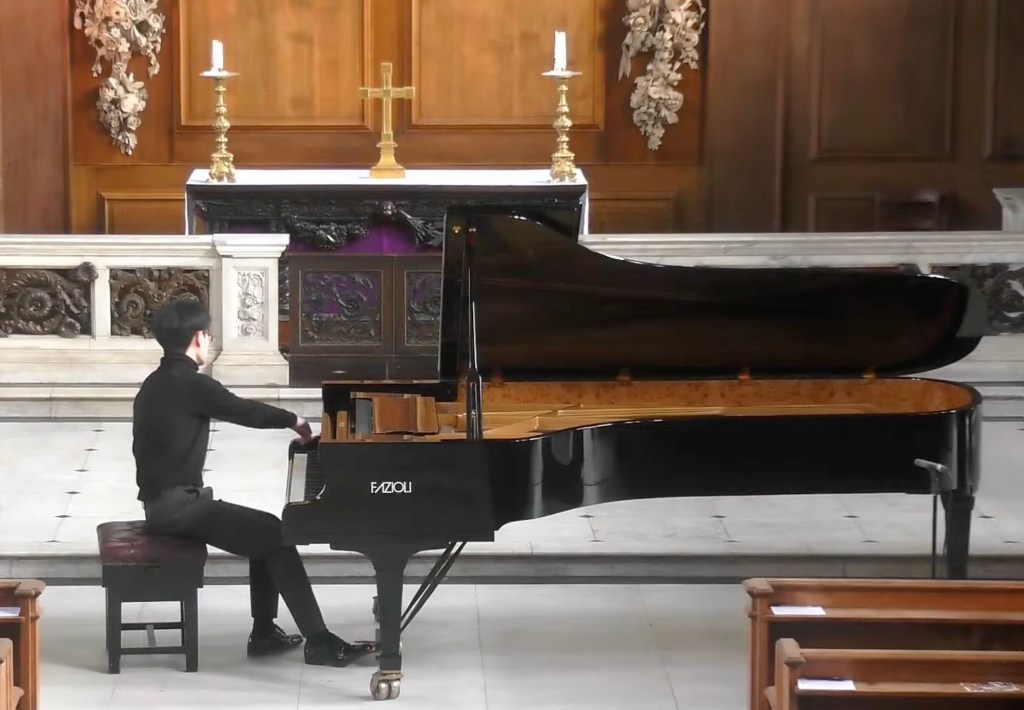
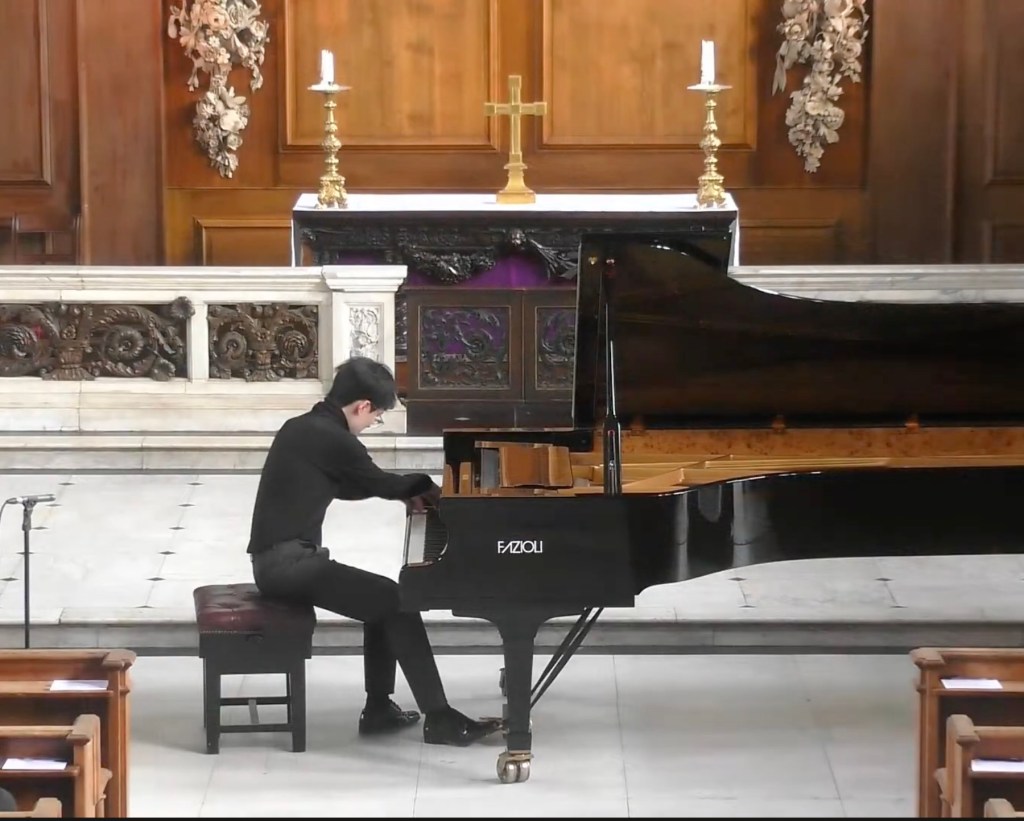
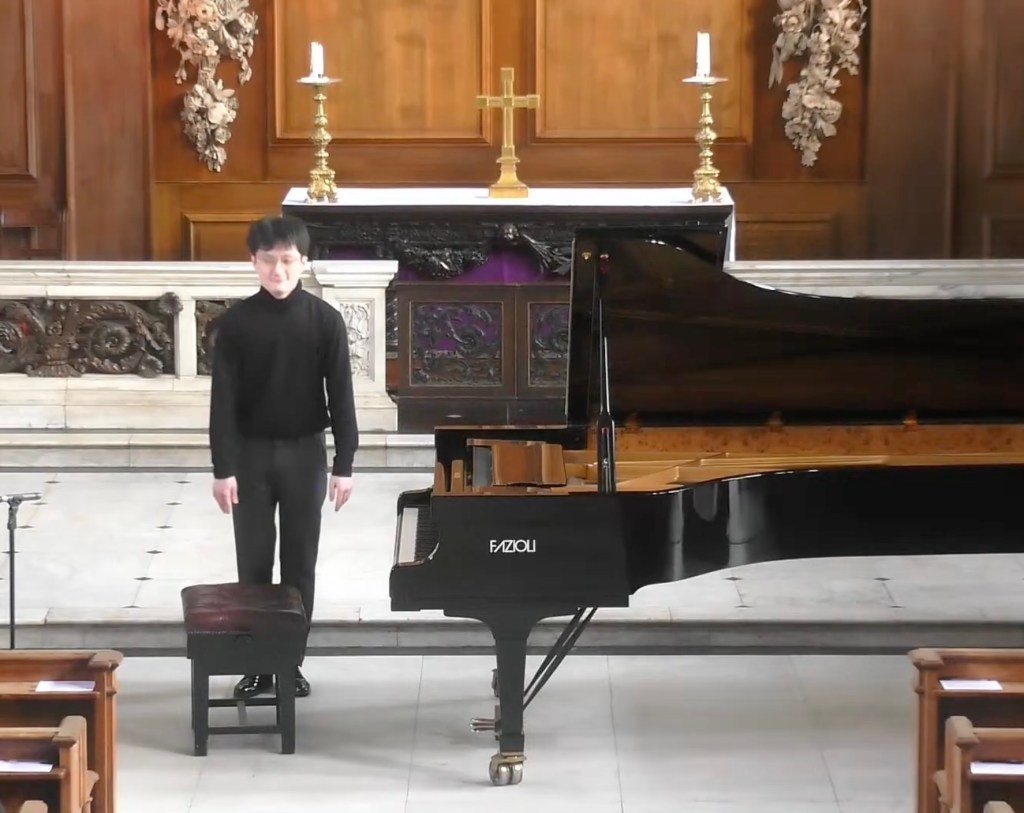
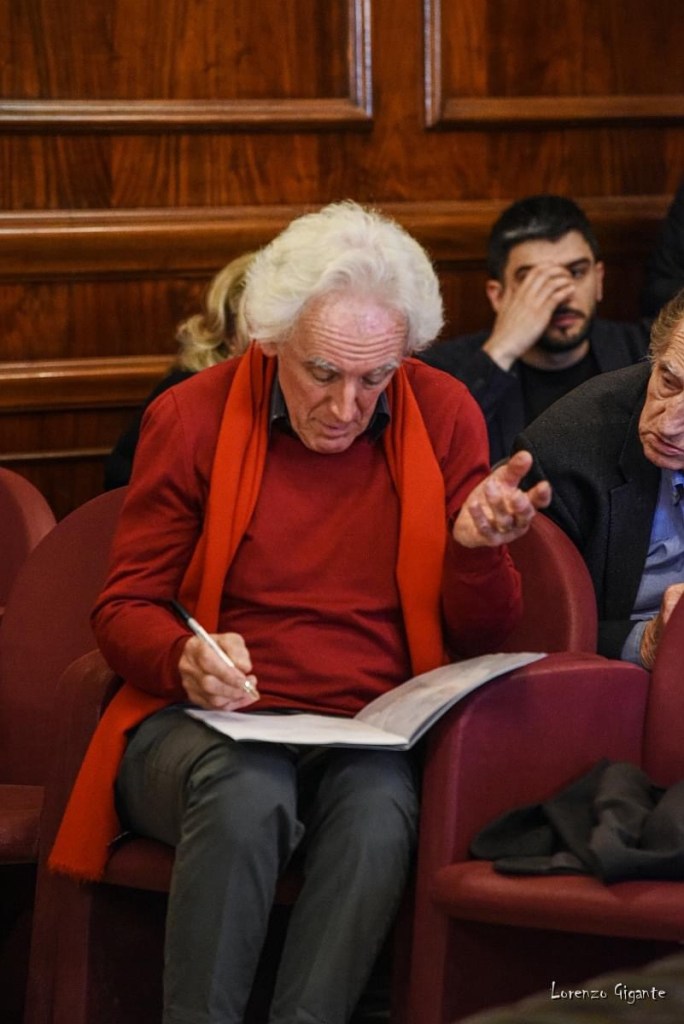
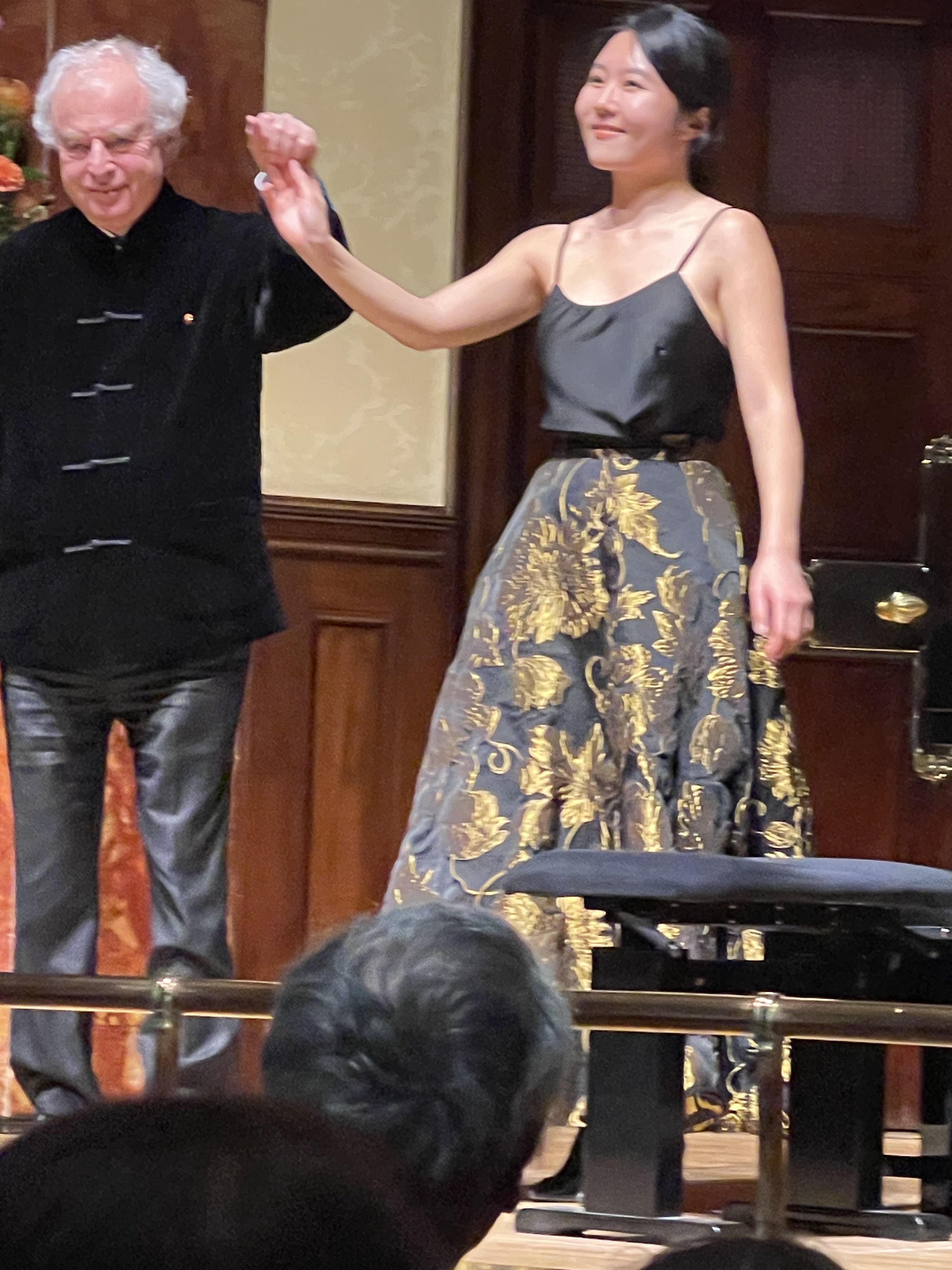
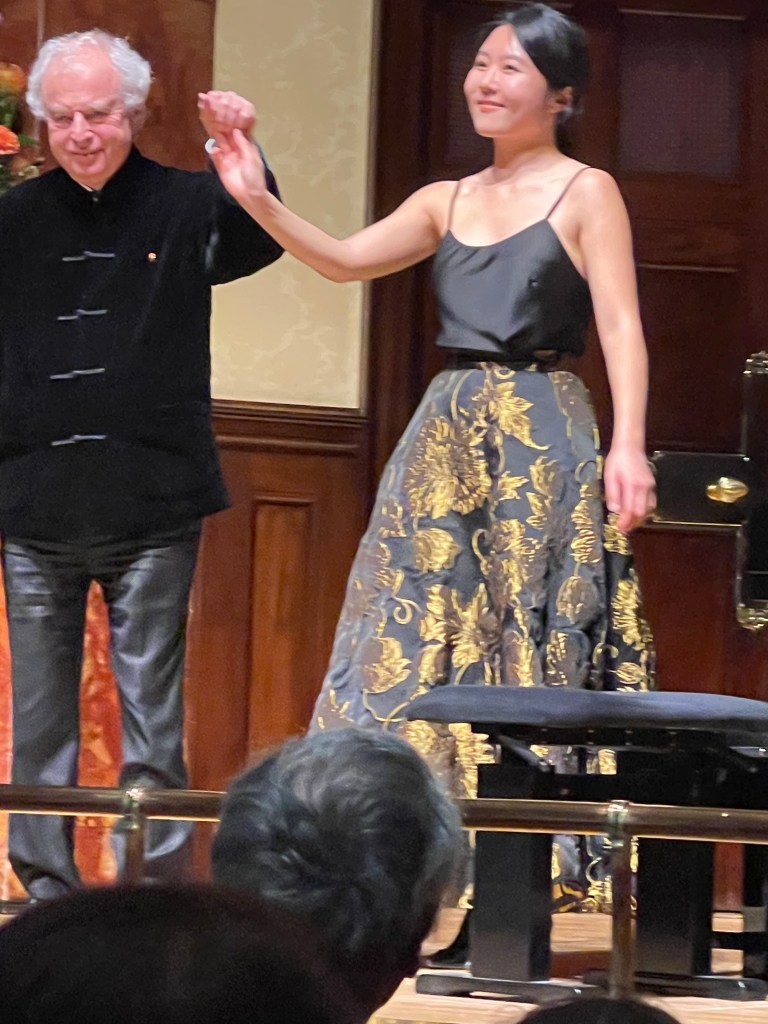
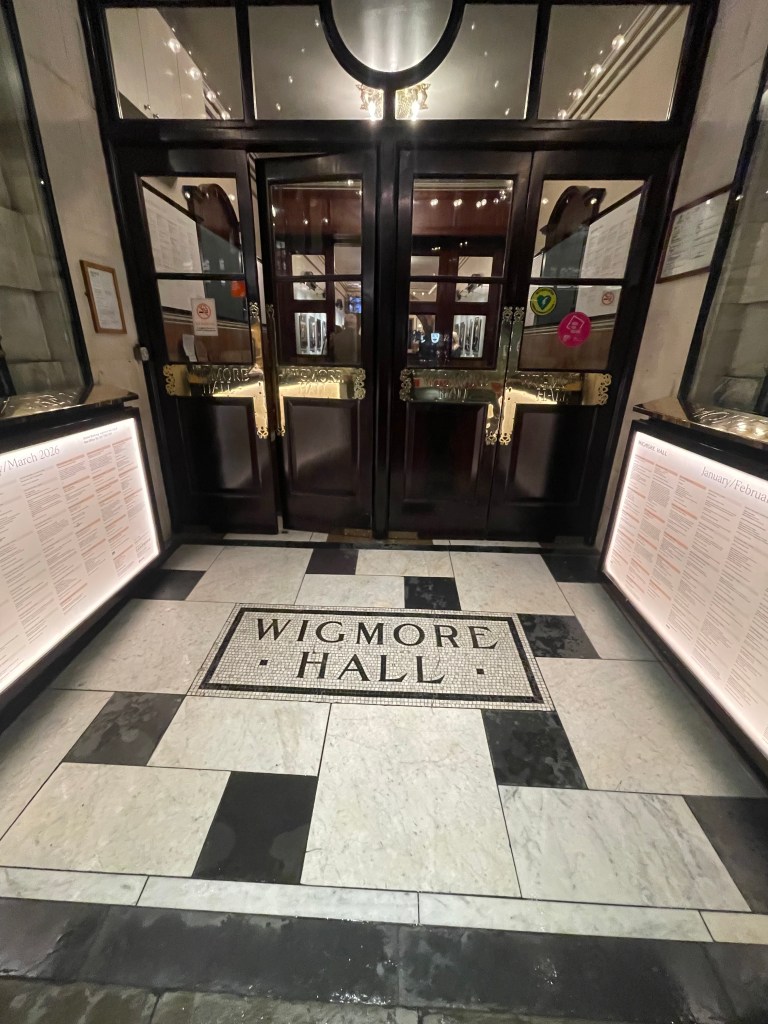
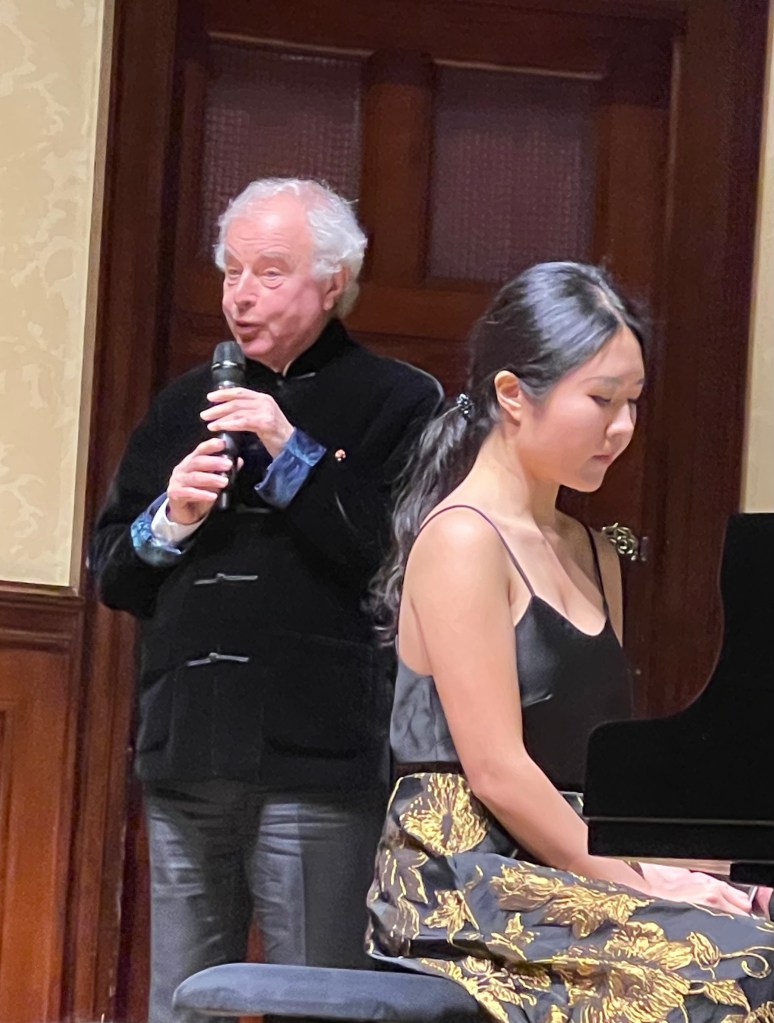
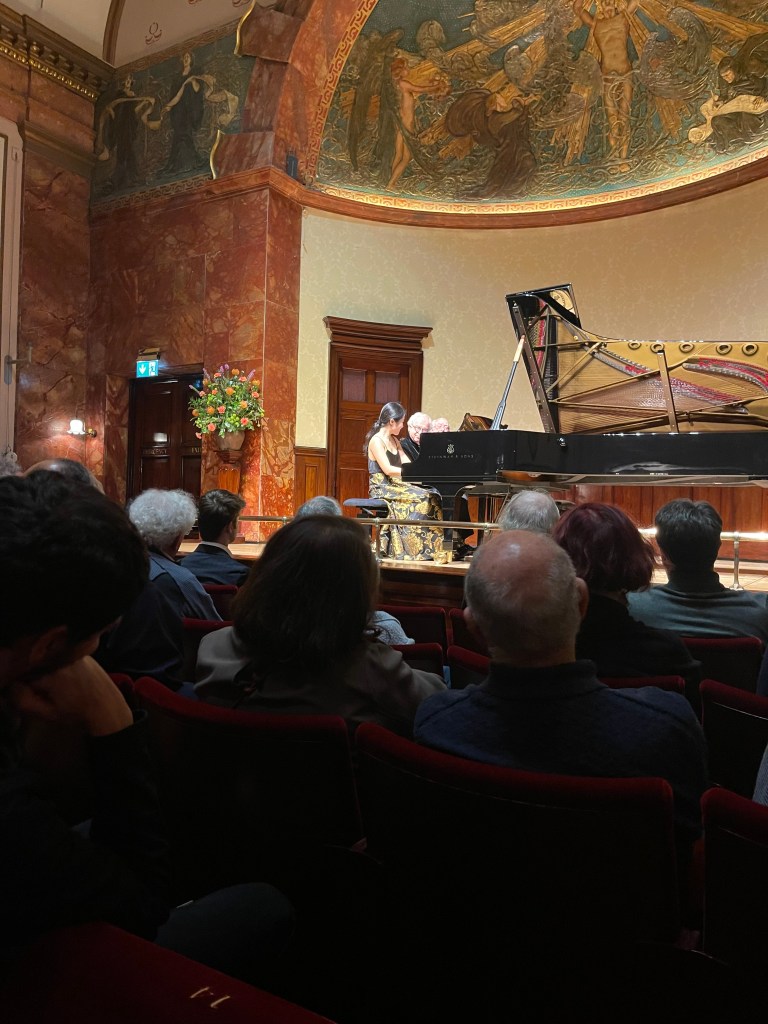
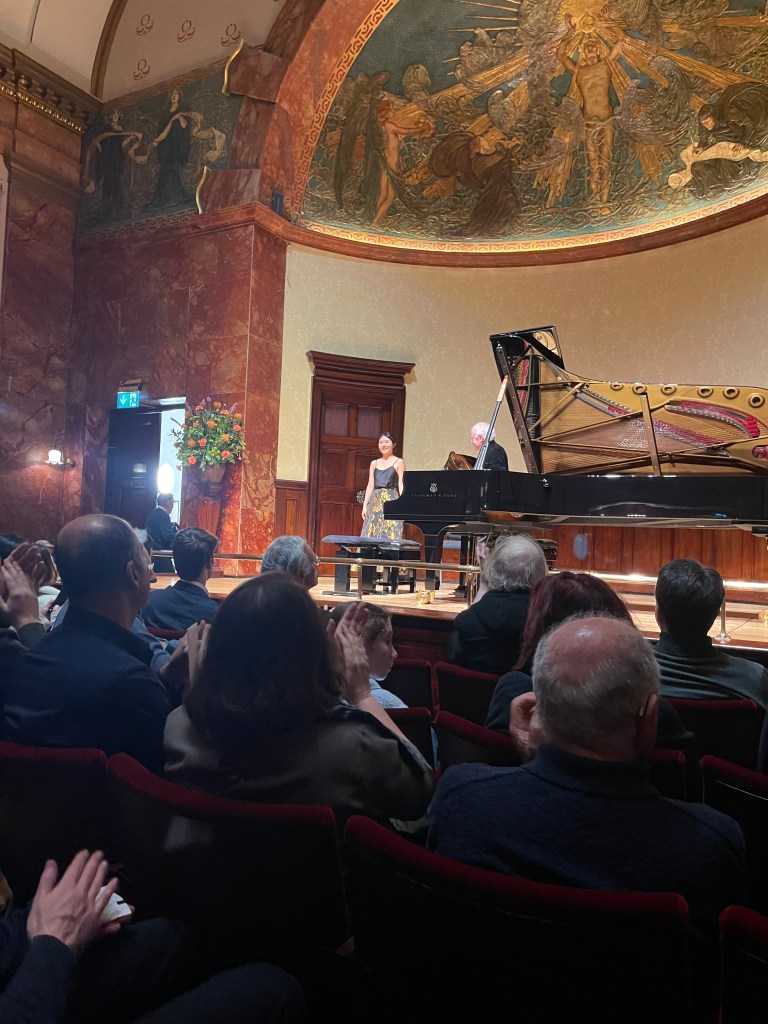
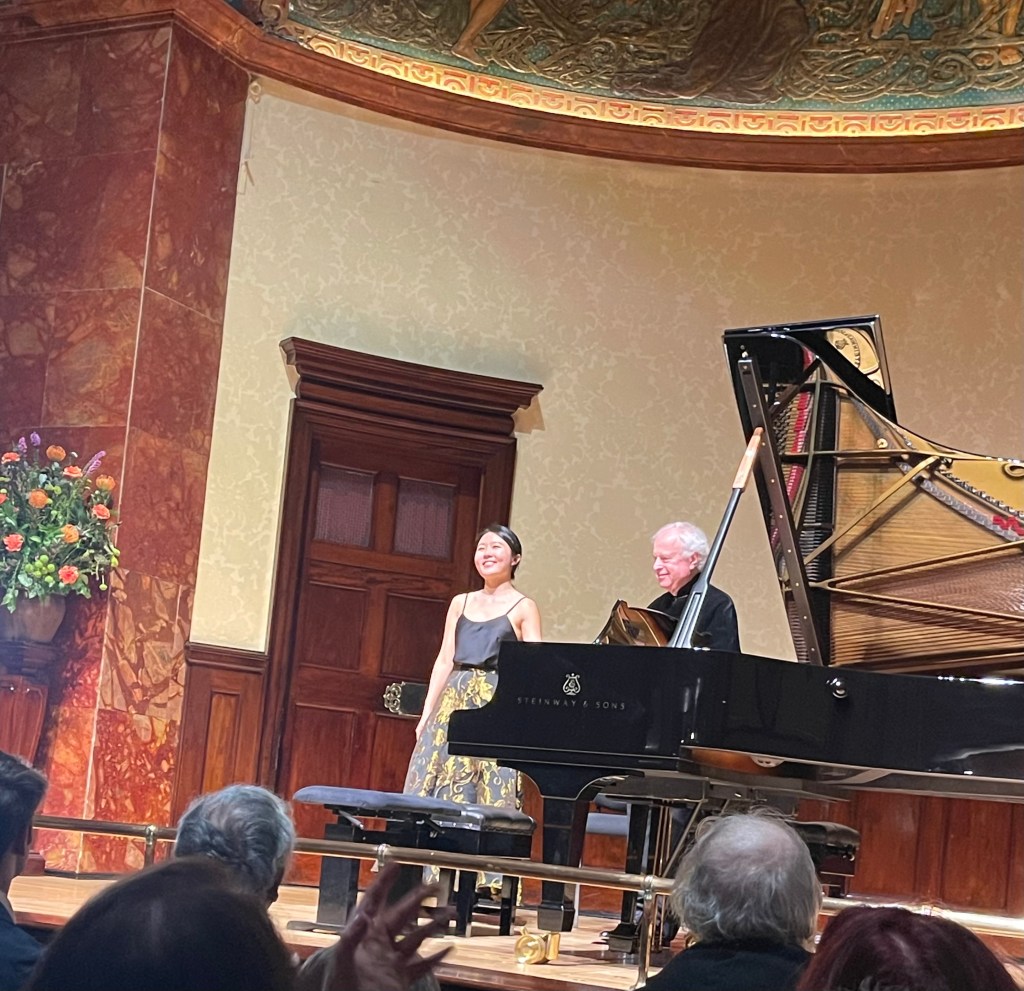
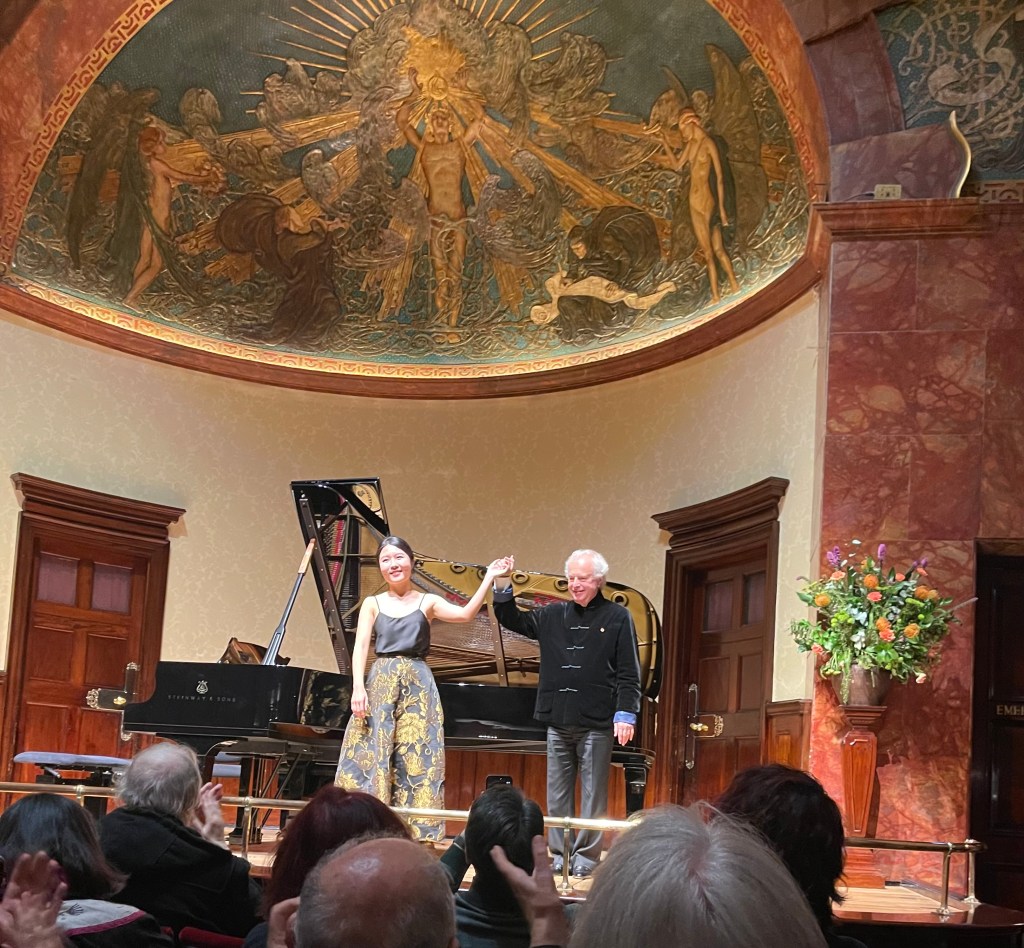
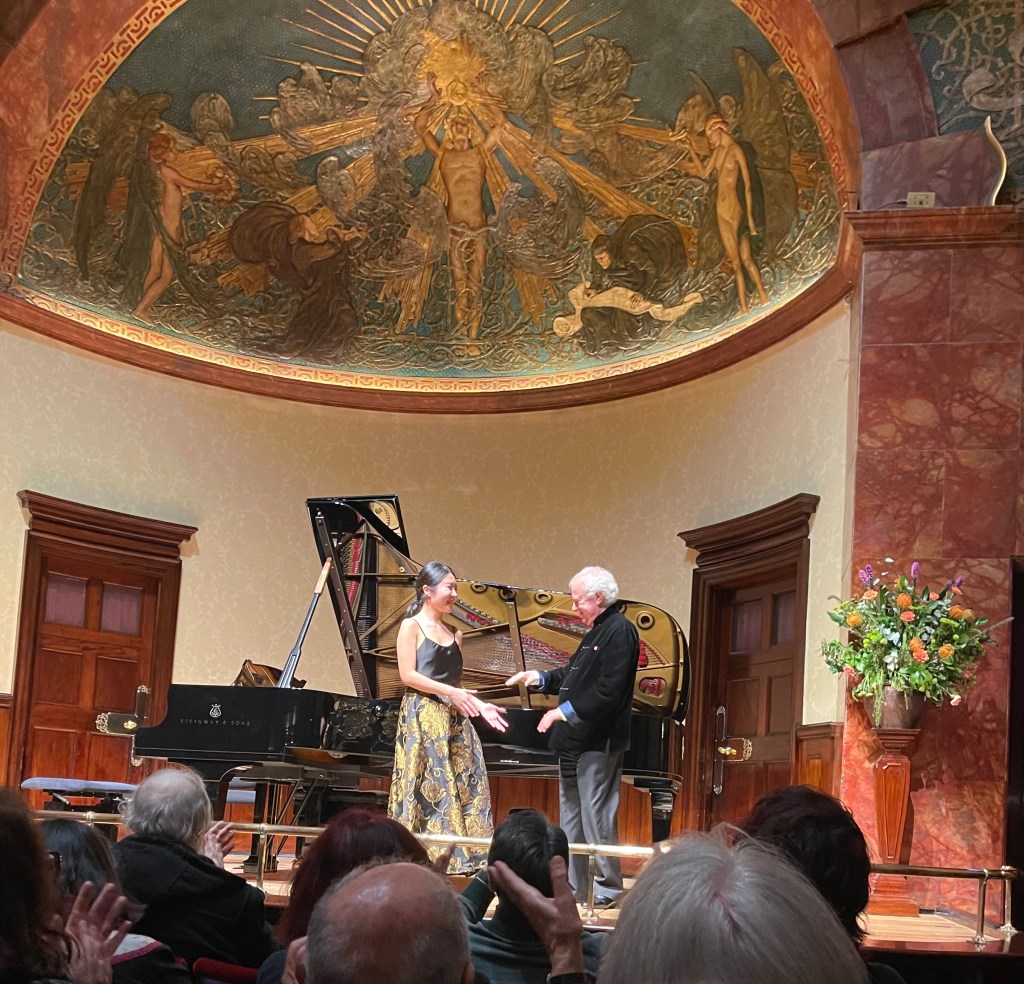
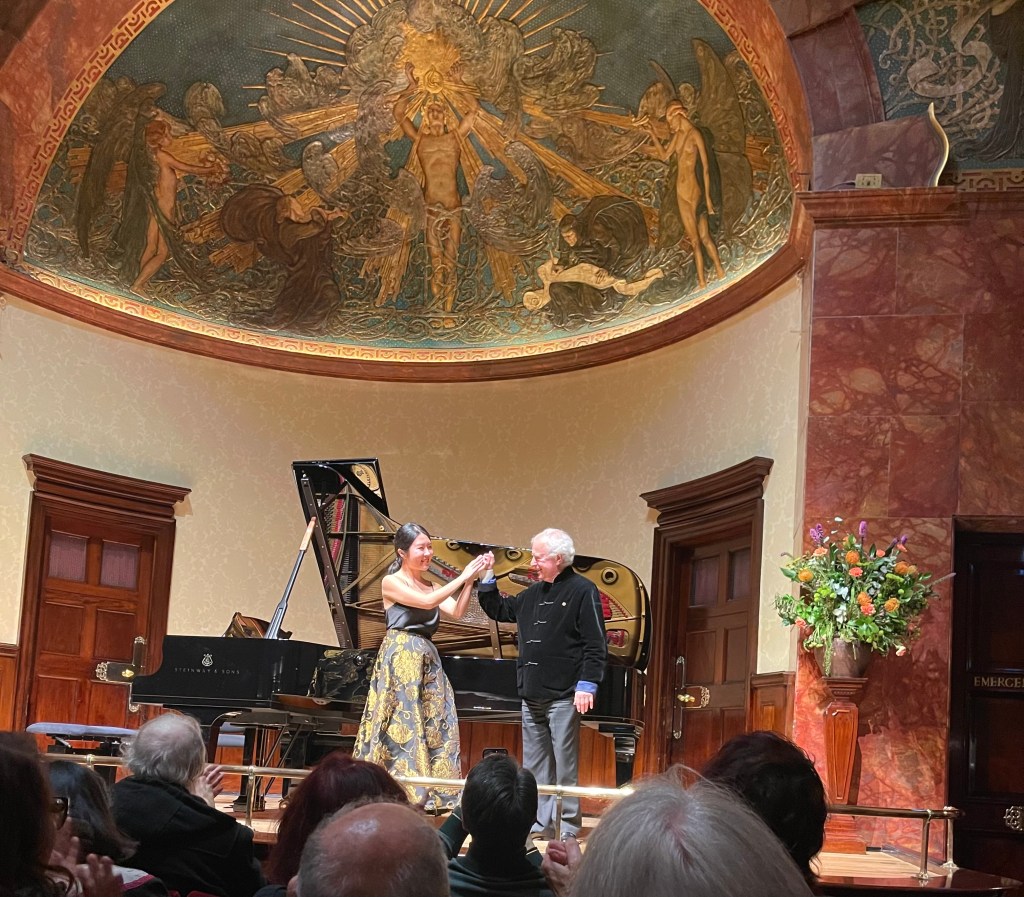
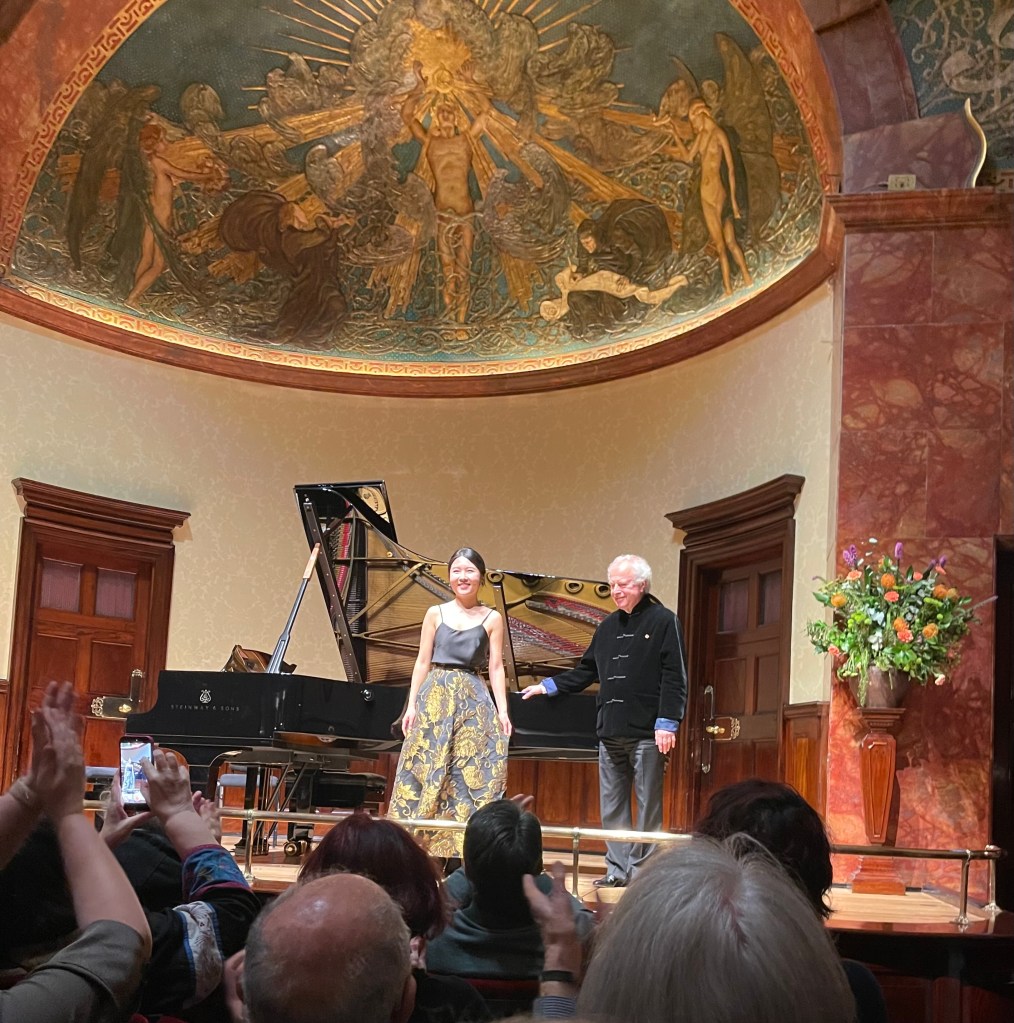
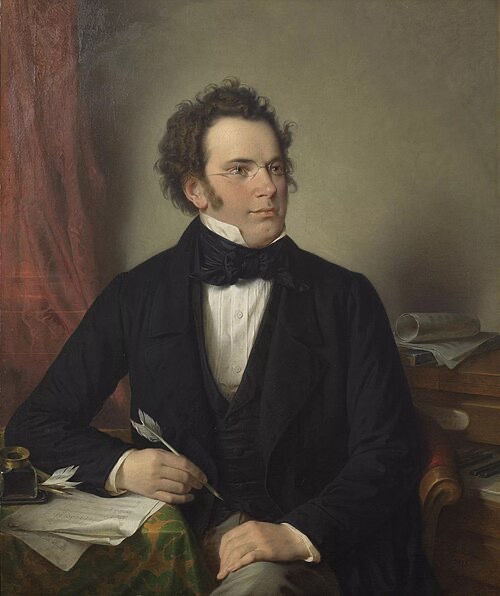
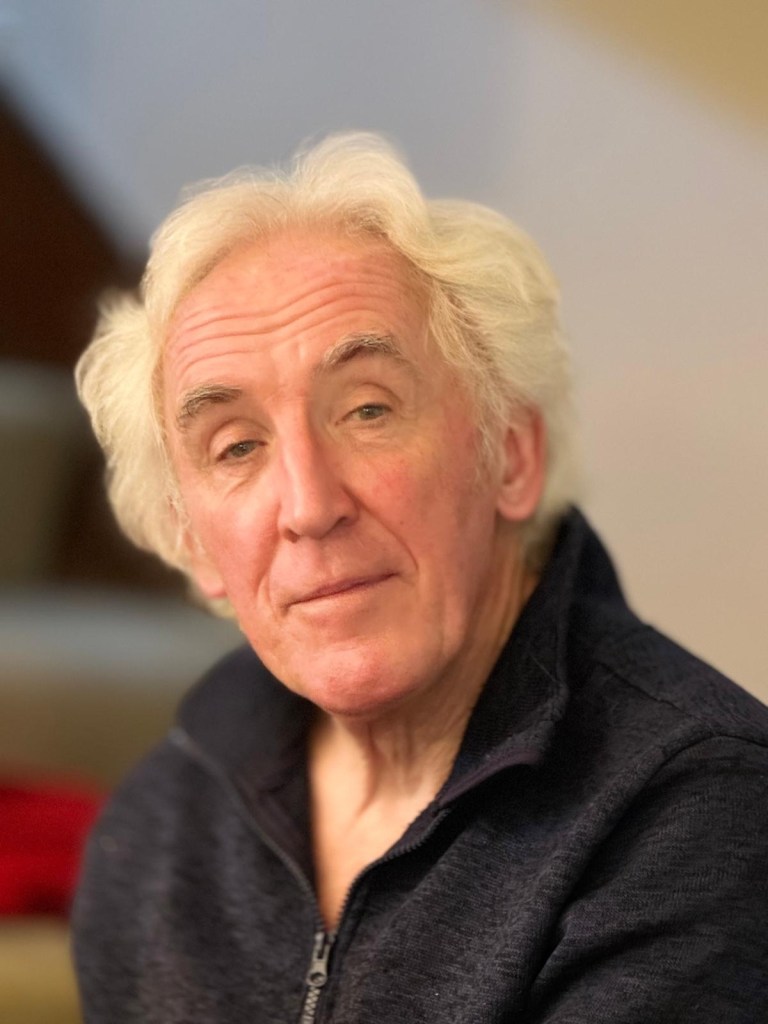
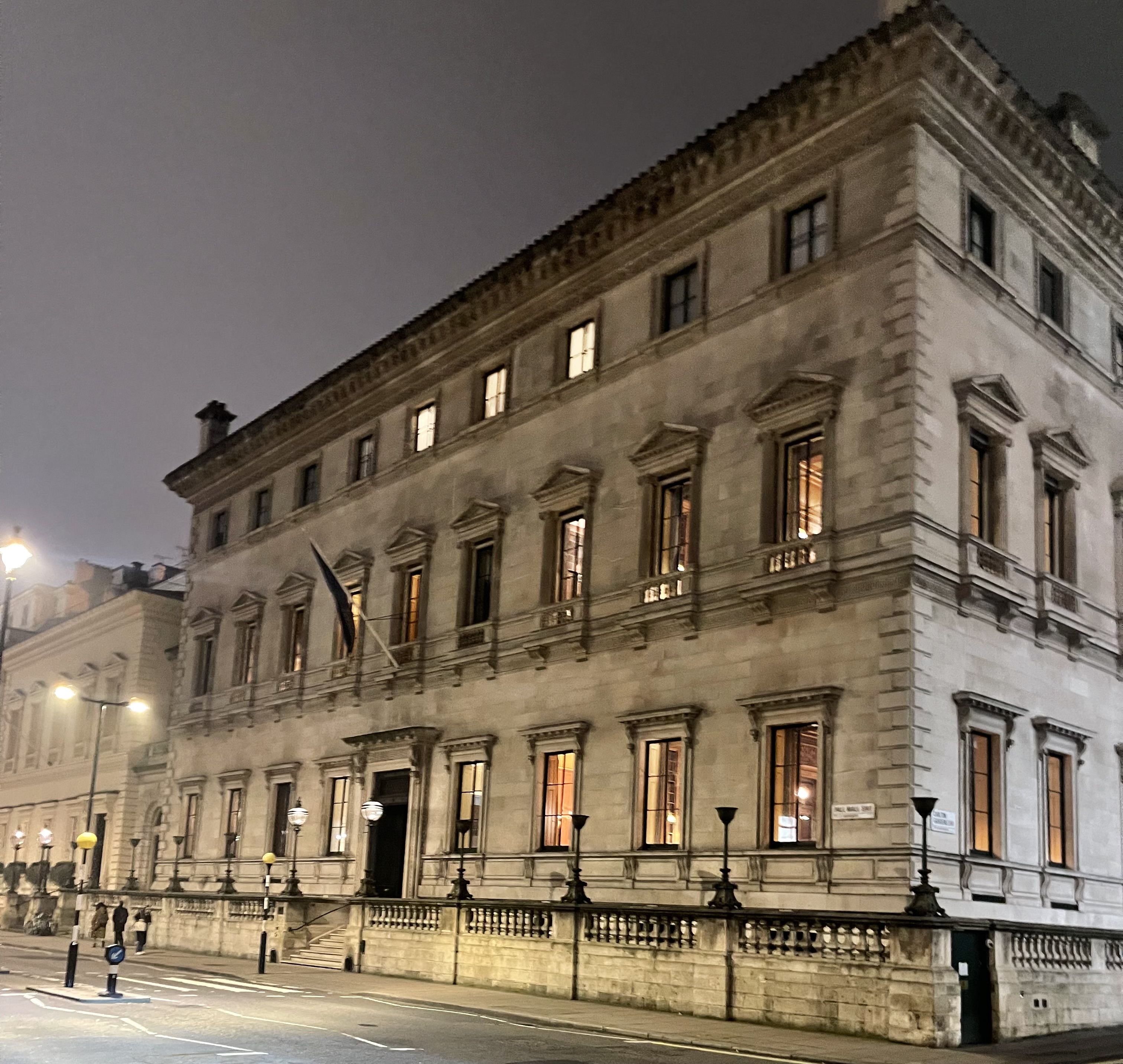
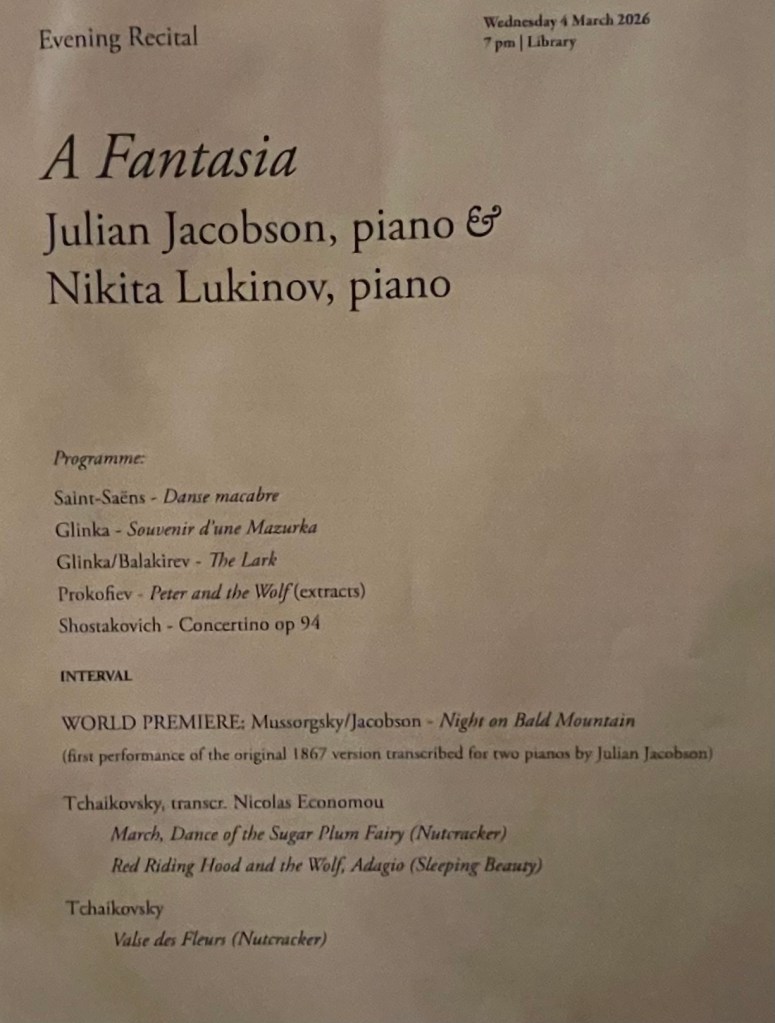
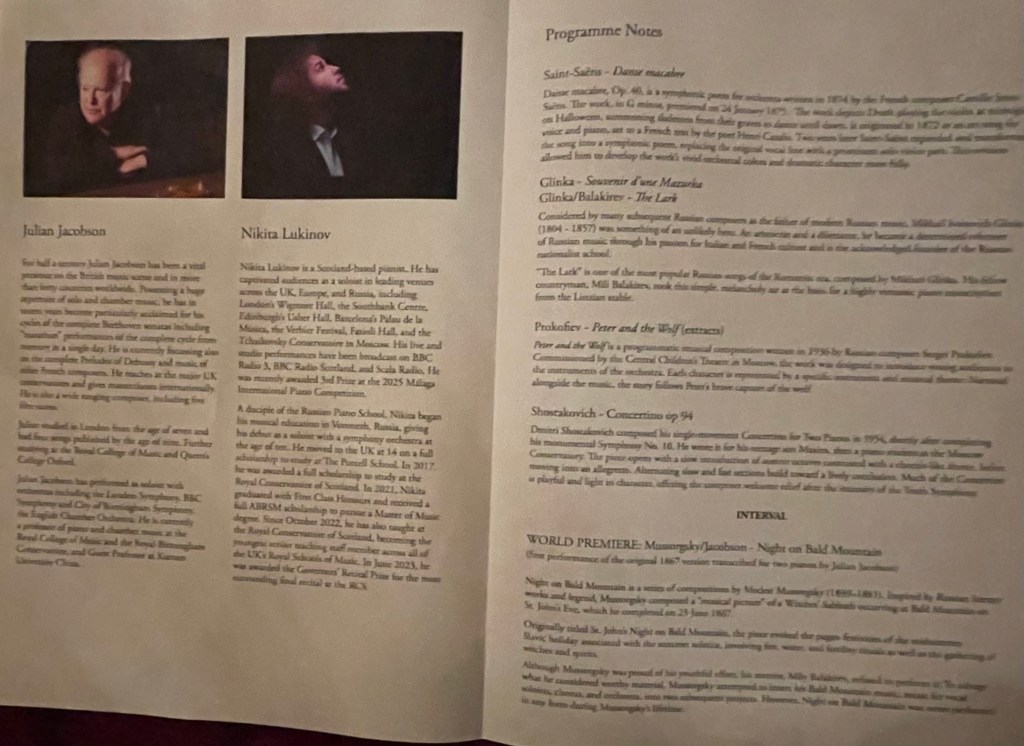
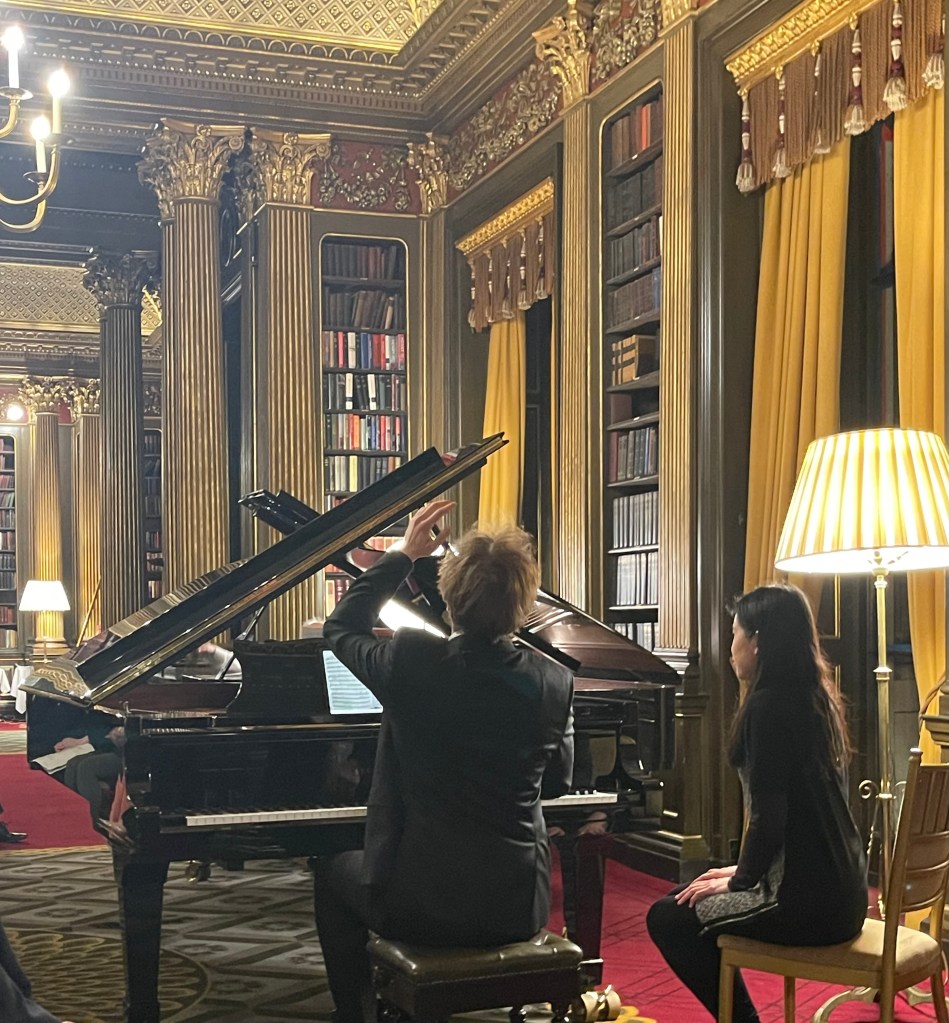
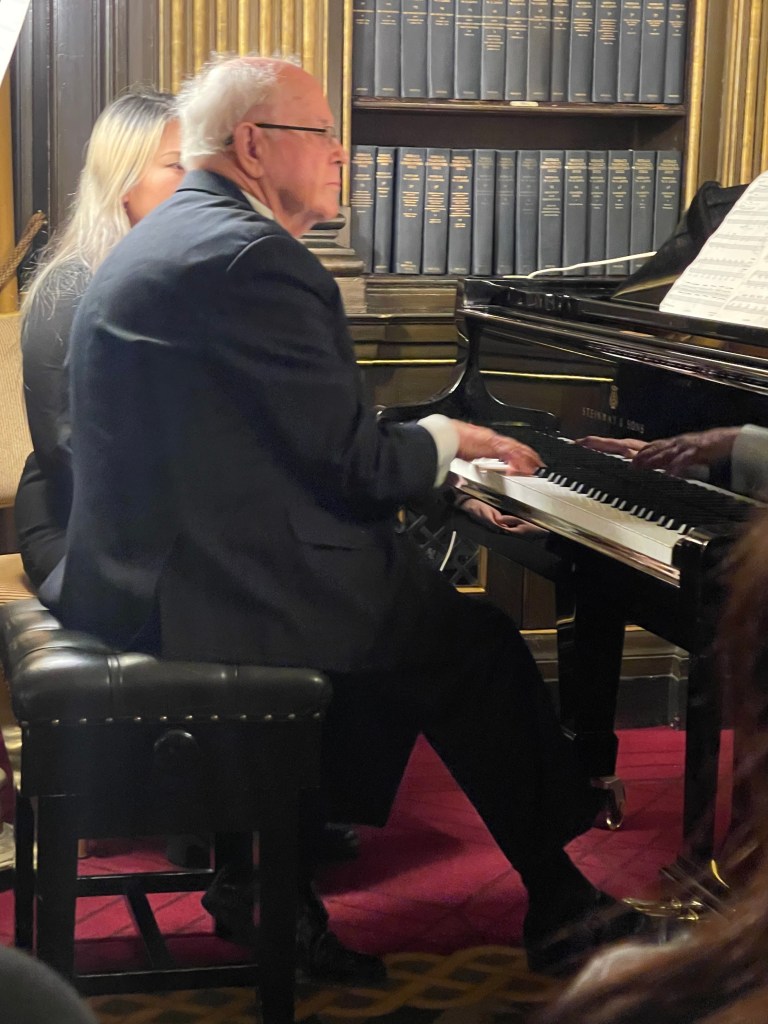
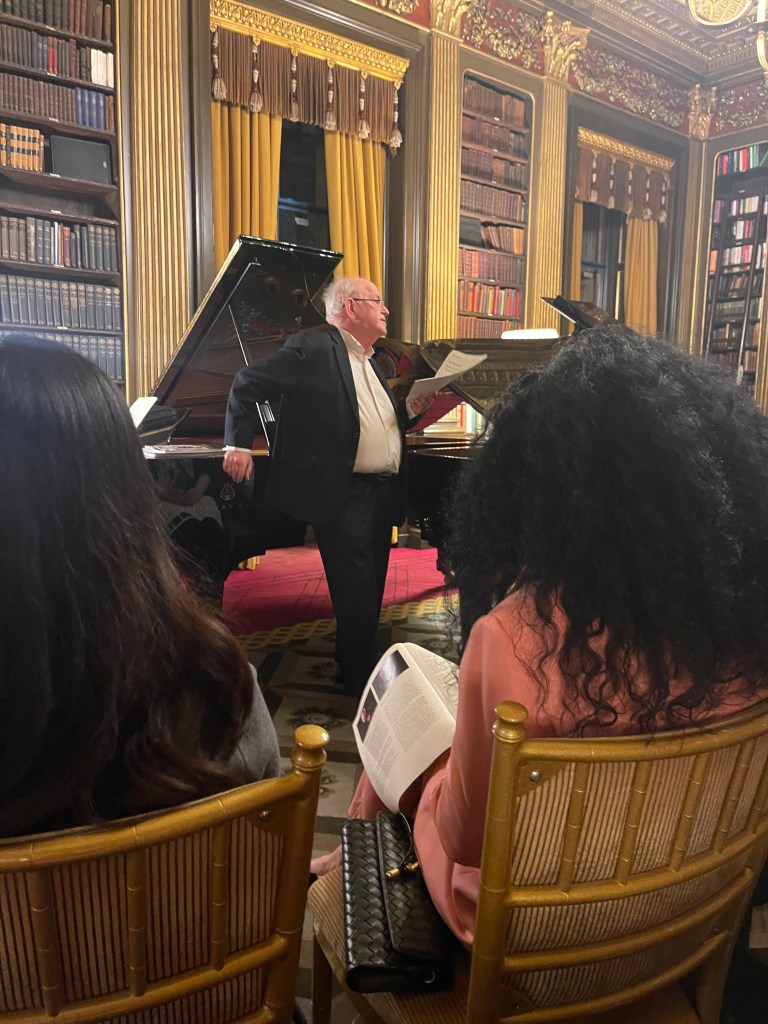
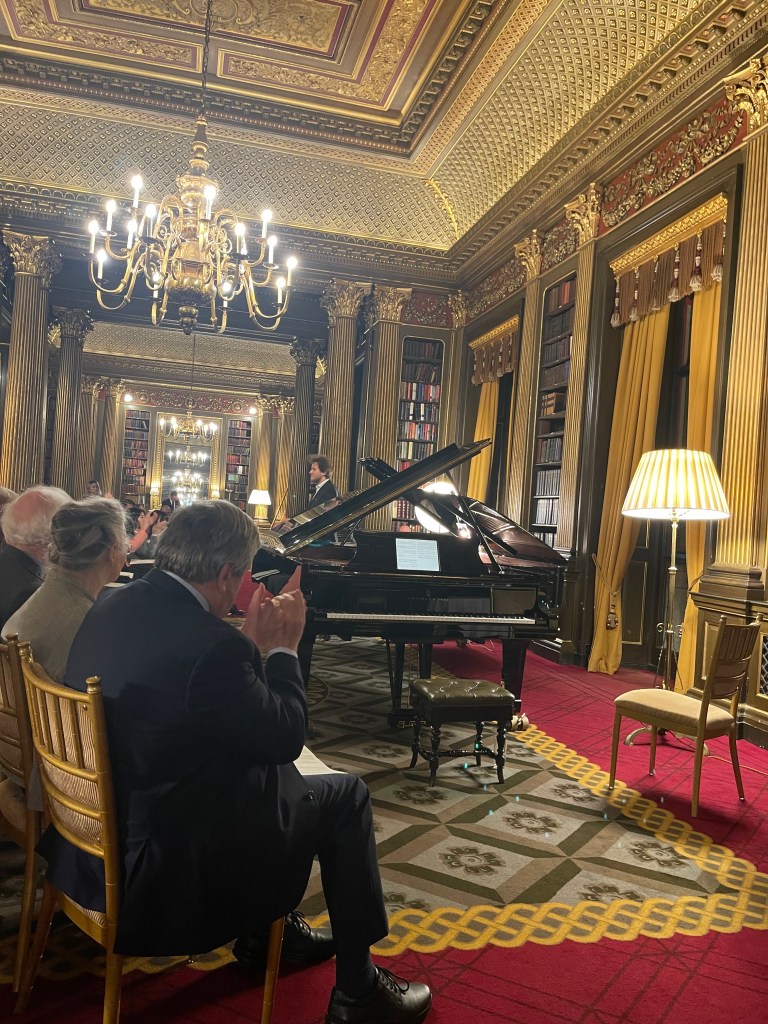
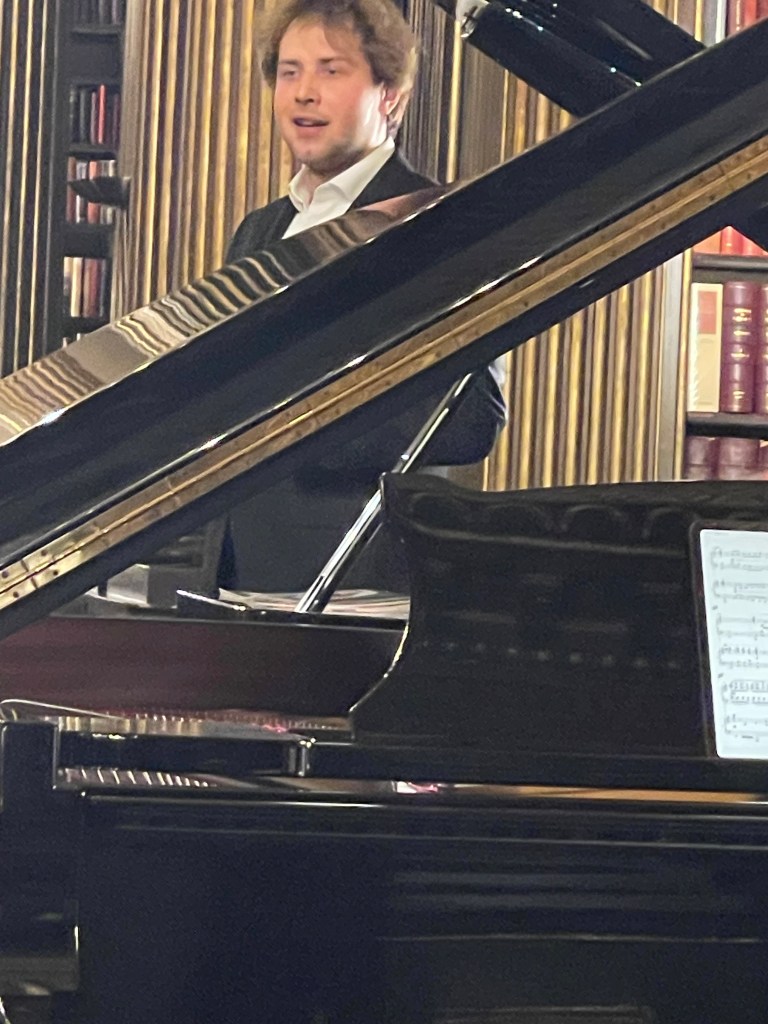
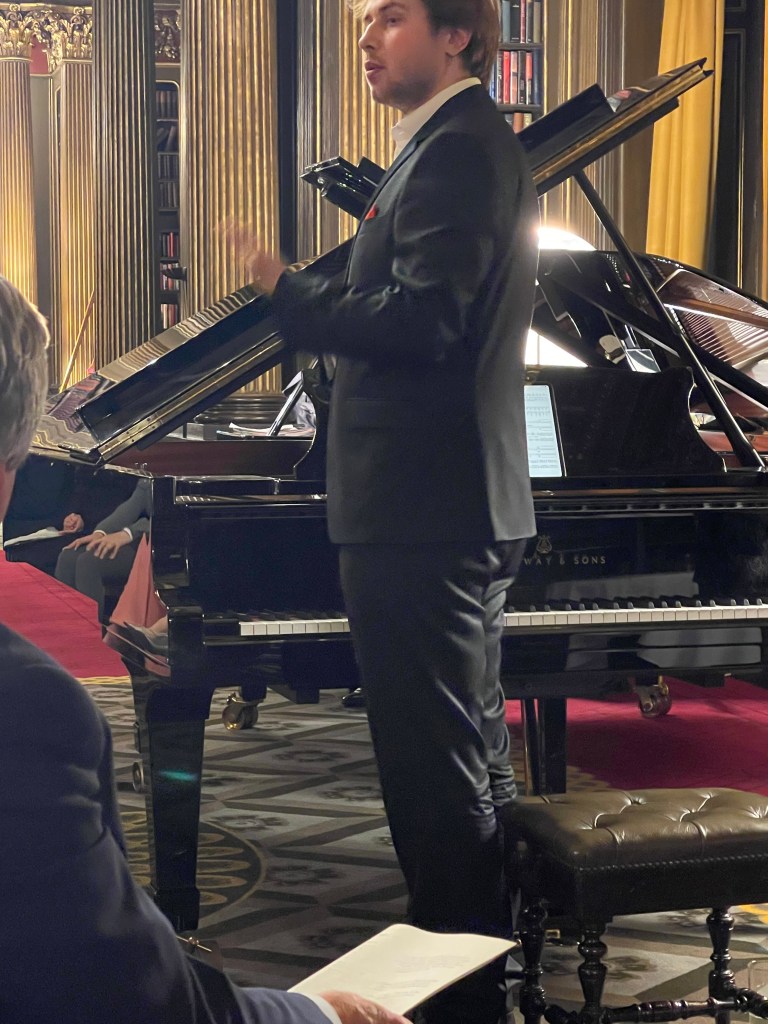
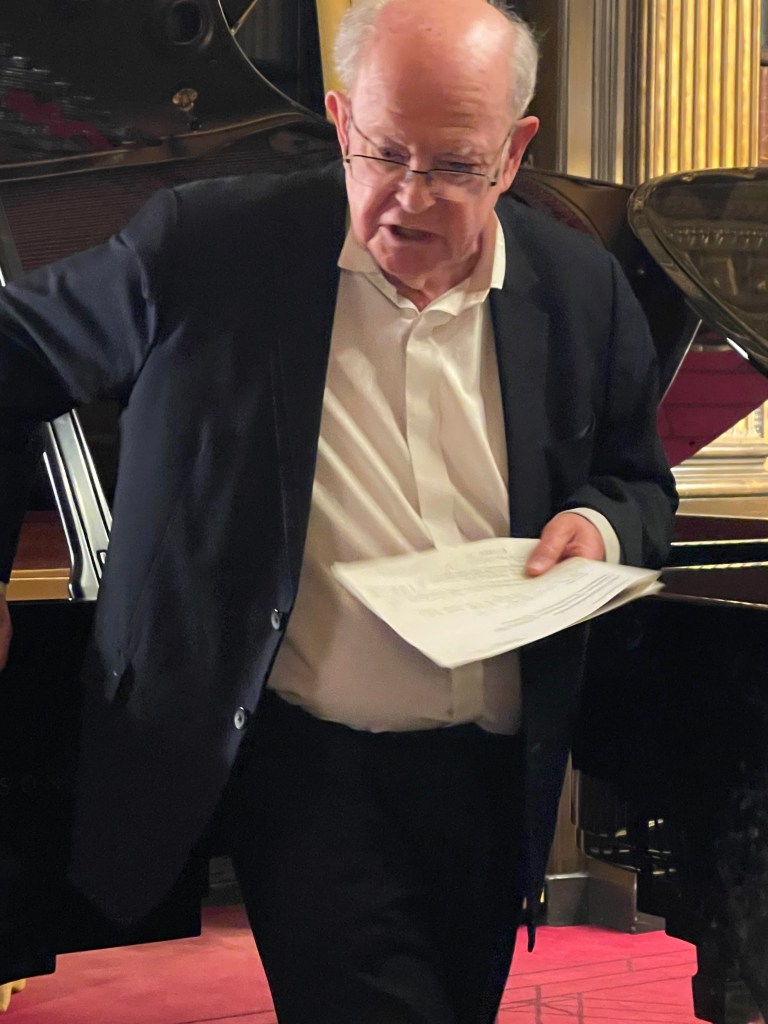
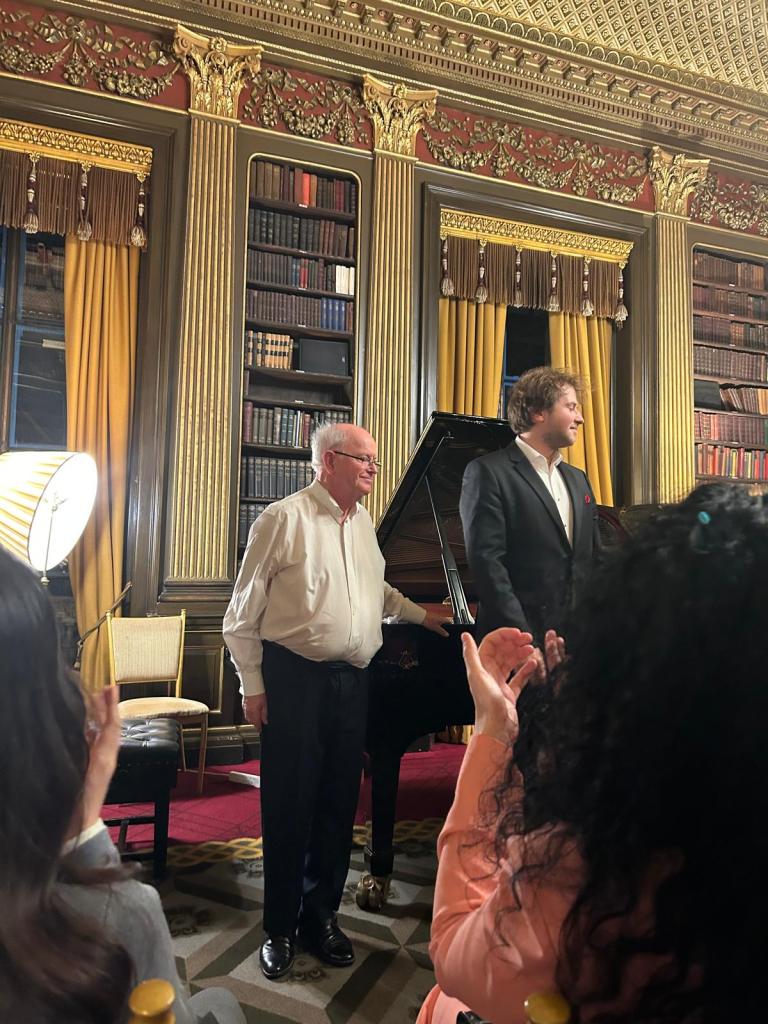
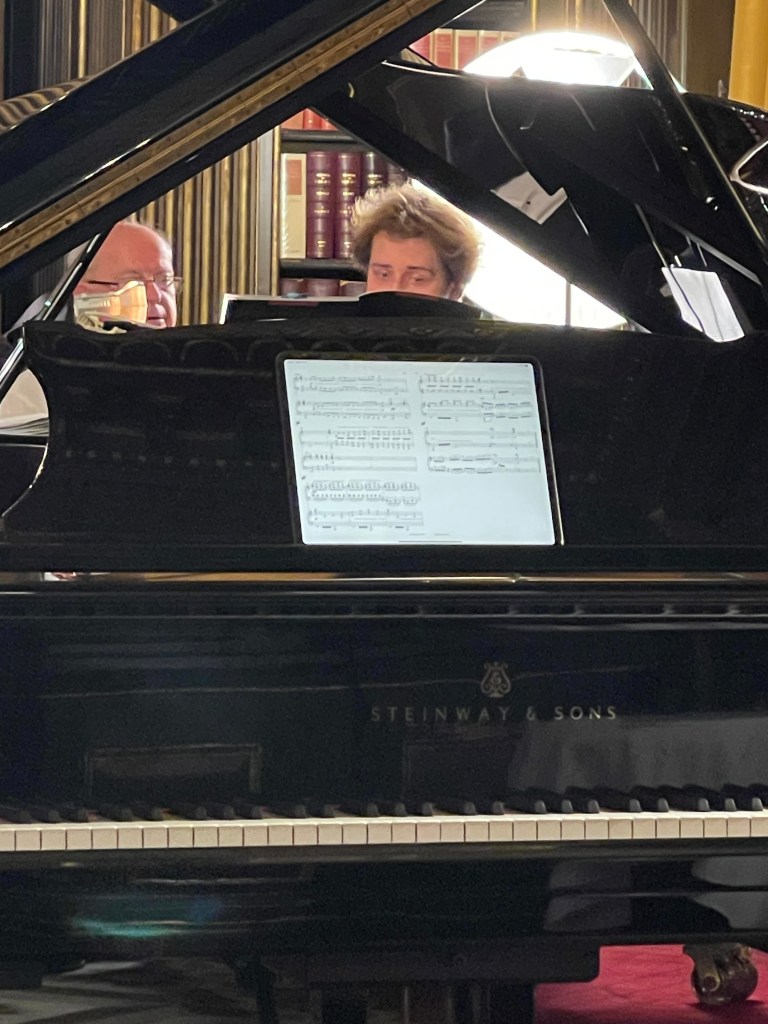
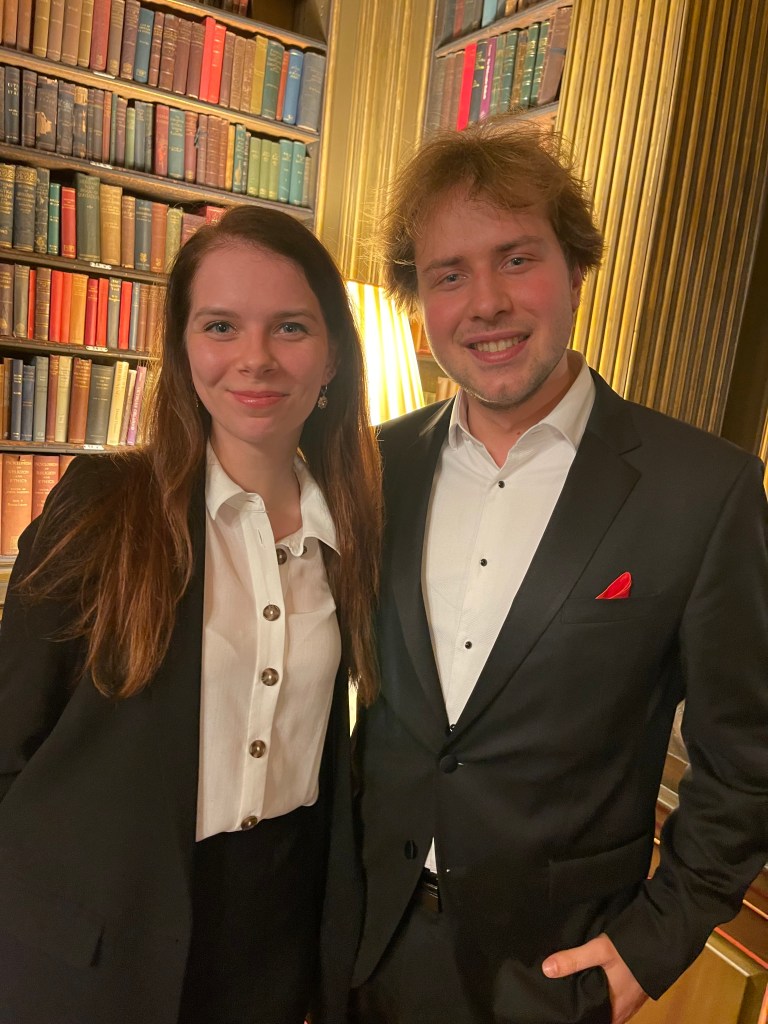
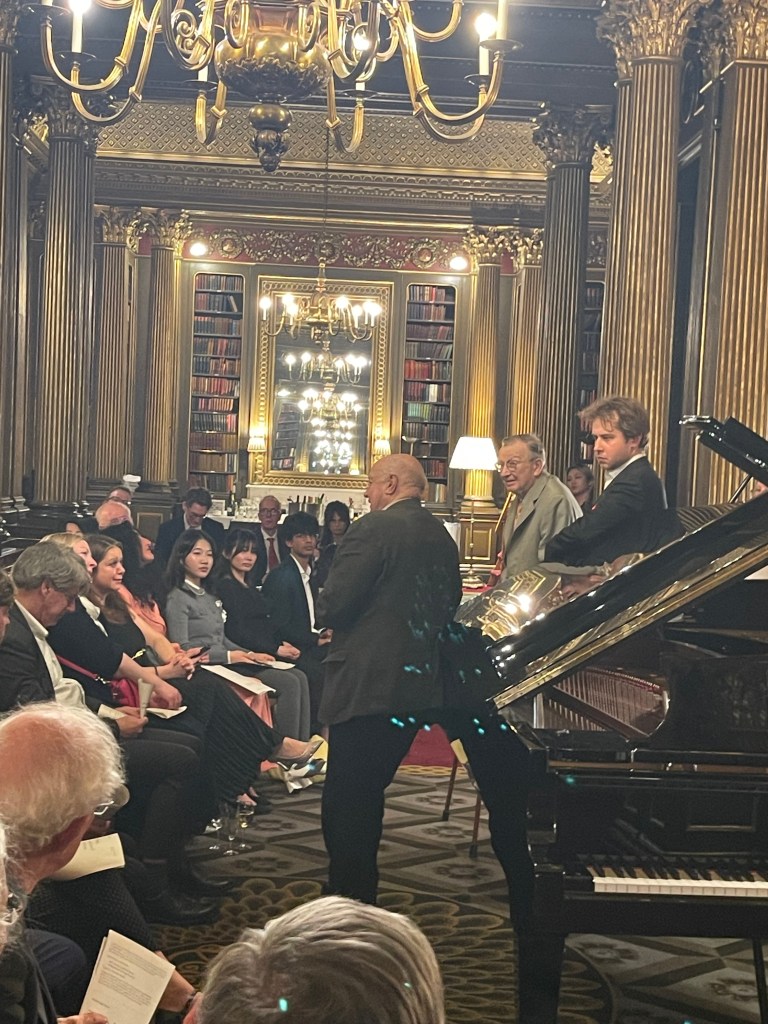
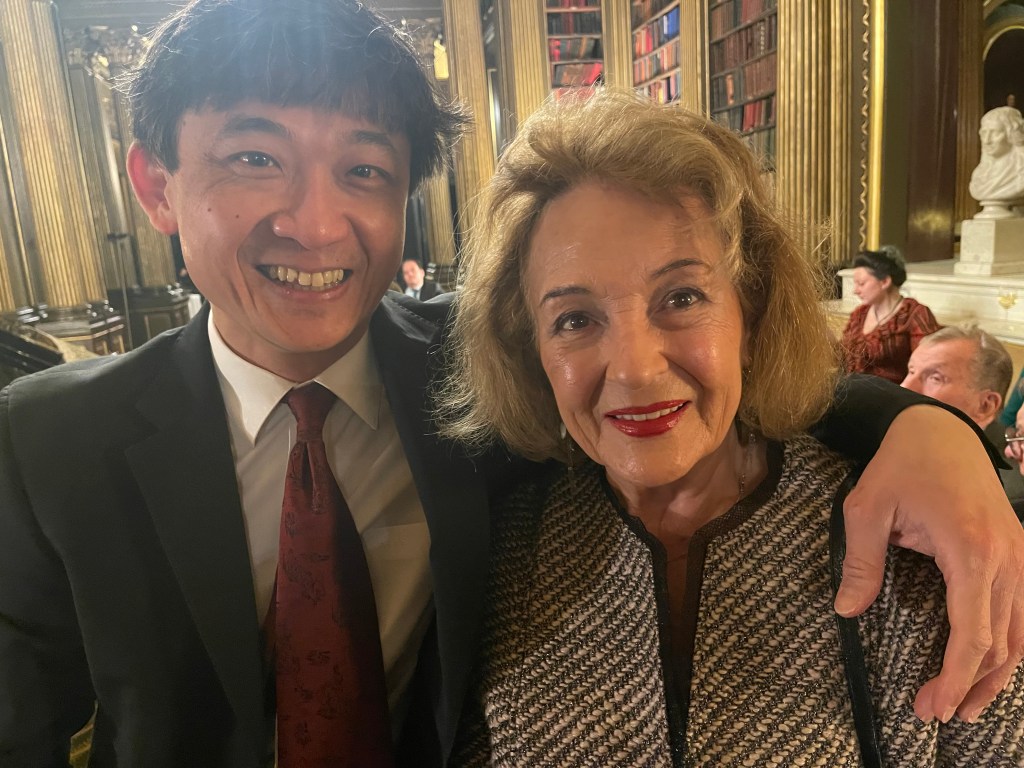
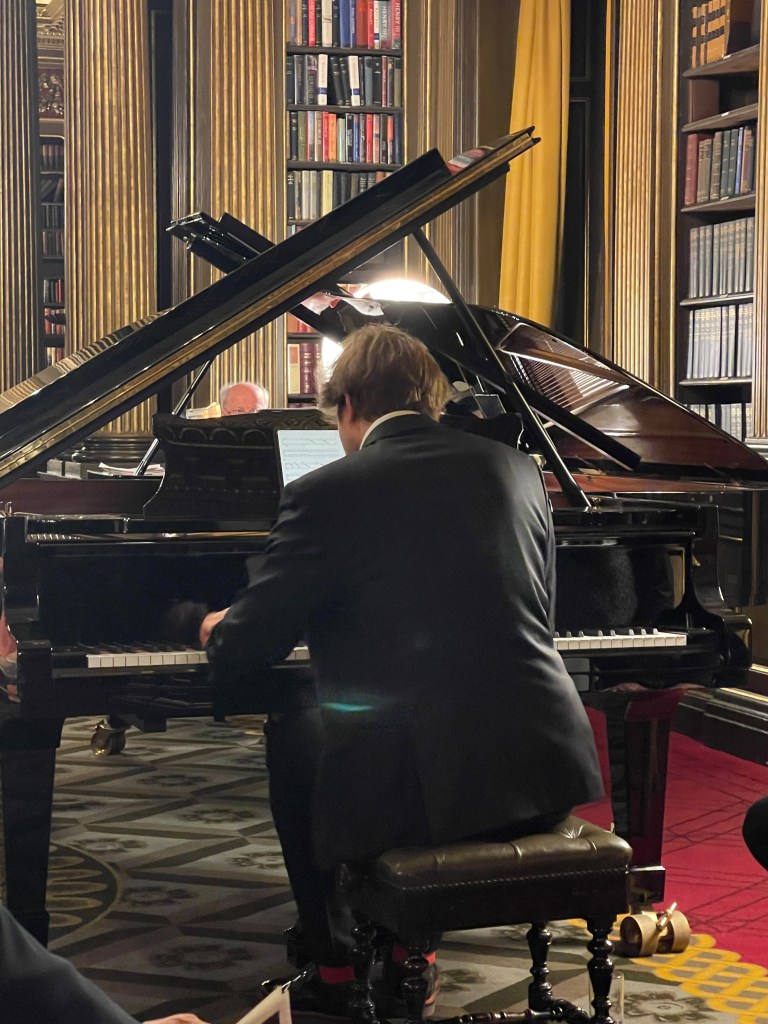
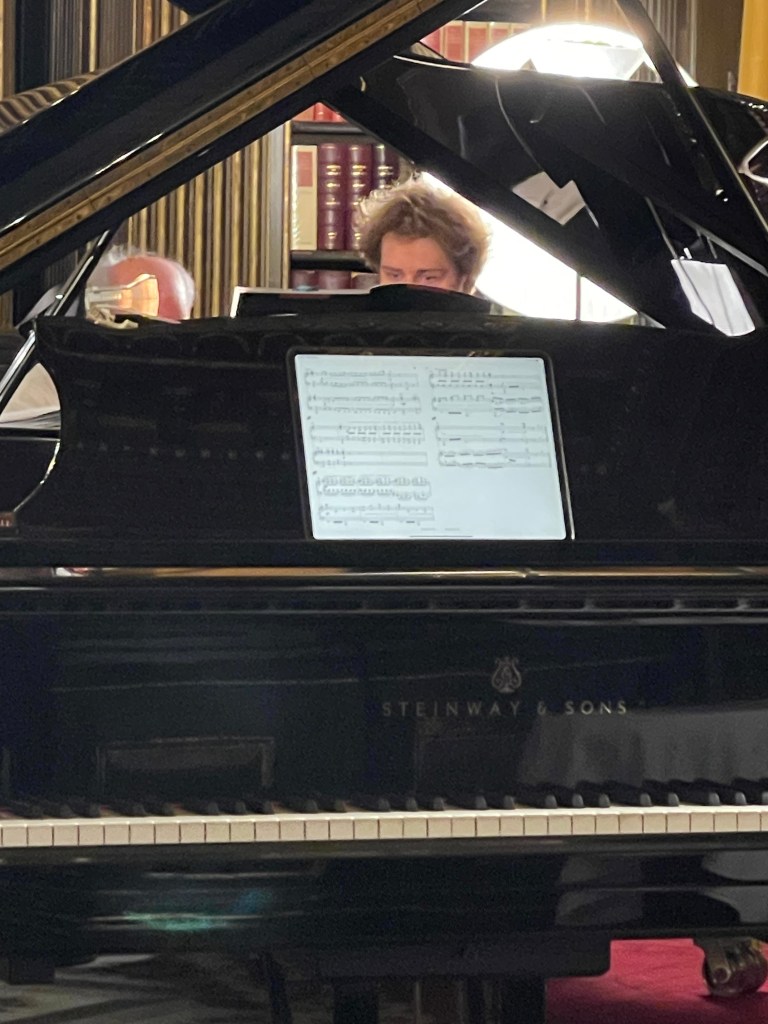
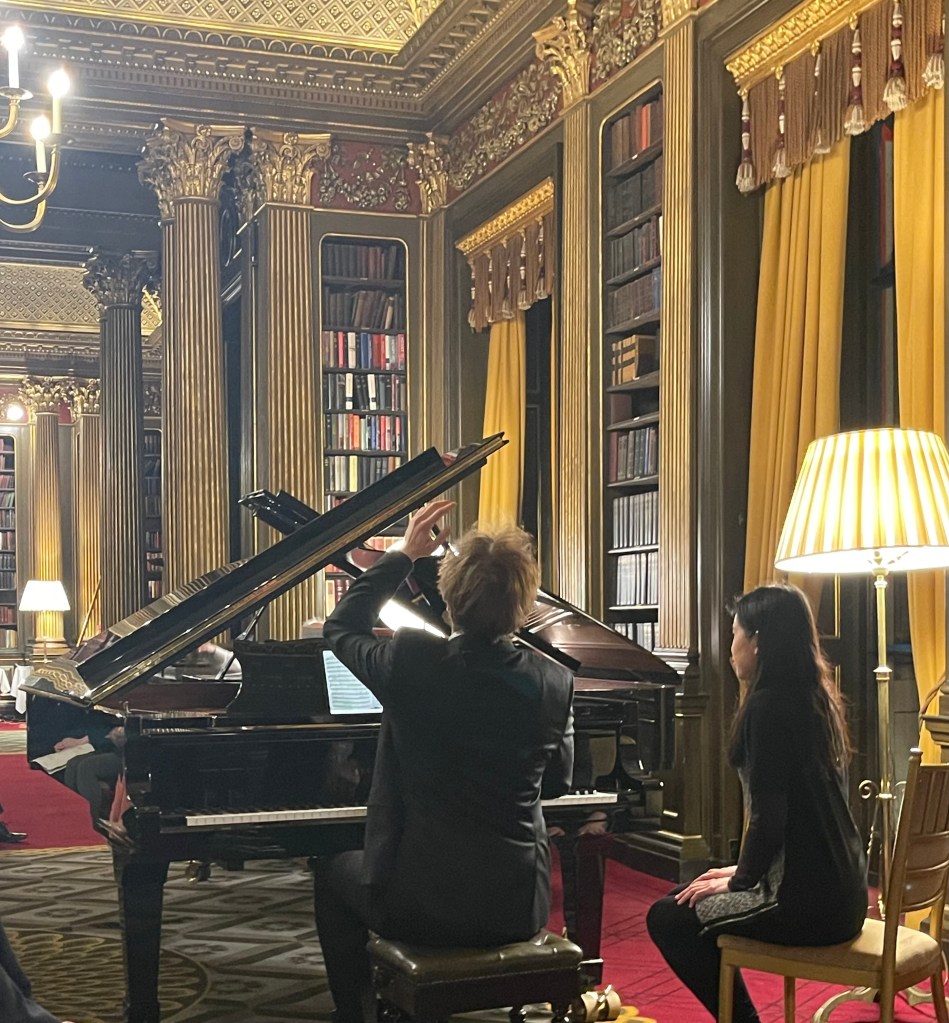
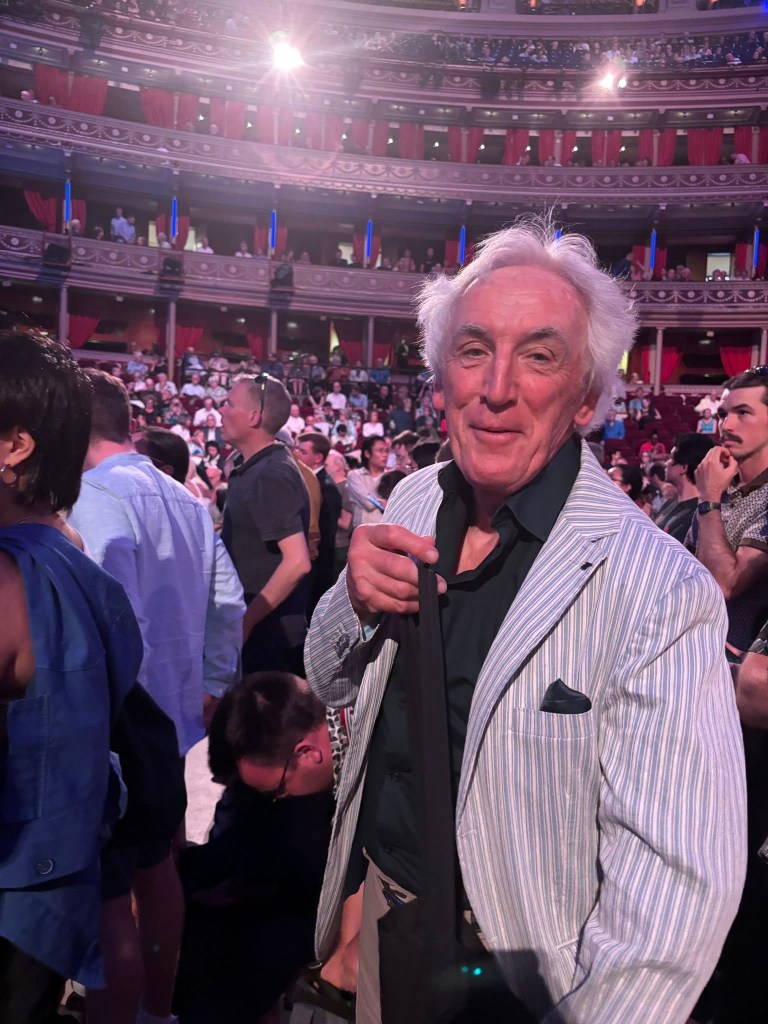
 ChristopherAxworthy-MusicCommentary