
Norma Fisher

Thanks so much Chris……..think of me, as you pass “that address”…….we will always share special memories!!!
Thought you might like to see the birthday “special” my son thought up……….https://youtu.be/DUxOsbDho58
And so it was in 1968 that I was taken by “our” piano daddy,Sidney Harrison , to hear the little girl that he had imbued with the magic of music just as he had done for me.
I was just a schoolboy at Chiswick Boys’ Grammar School a stones’ throw from his river fronted house.
Sidney Harrison was a household name in that period when he was the first person to give piano lessons on the television.
A box that had only four hours of transmission a day.
One channel- the British Broadcasting Company.
We were one of the few in my street to own one and all our schoolfriends and neighbours would come over to look into this magic box that had a gigantic enlargement lense in front of a tiny pale screen that would magically light up for those few hours a day.
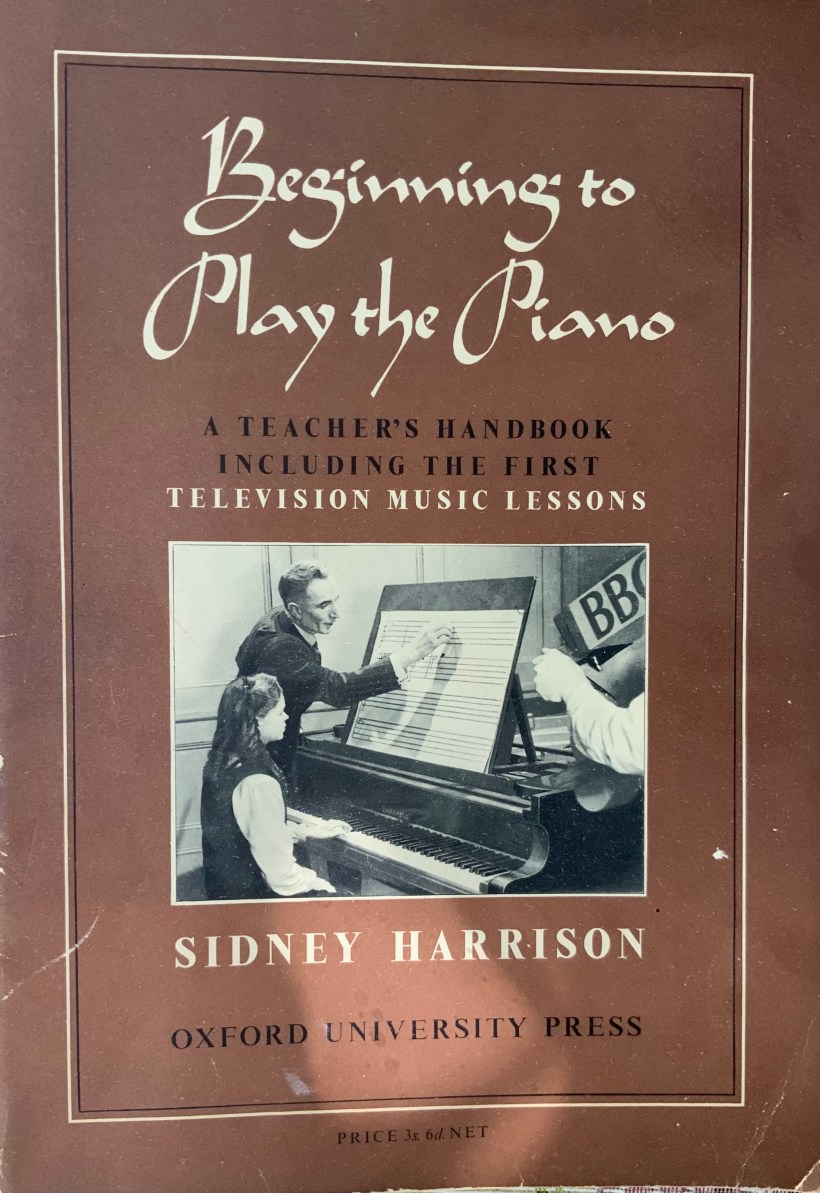 Poeople would follow Peter Croser’s lessons and others to see how they progressed.
So it was obvious that parents of talented children all wanted their offspring to study with the man who was as famous as Eamon Andrews of This is your Life.( By coincidence he lived next door to the Sidneys in Hartington Road)

How many young musicians had fallen under his spell and played on his beautiful inlaid Steinway?Enjoying endless cups of coffee prepared by his wife and very much partner in crime- she too a Sydney- whilst he enthralled us with the magic sounds he could draw from the piano.
He became our friend and accomplice with his expert no nonsense common sense knowledge of the piano but above all he shared his love for music with us .
He took me to the opera and to the Proms as I am sure he did Norma too.
I remember meeting the 15 year old Ian Hobson in the house too before he went on to win the Leeds Piano Competition.
Angela Hewitt, who although never his pupil, was befriended by him when she too came to live in Chiswick to further her studies in Europe.She had been discovered by Sidney as he had her fellow countryman Glenn Gould on his adjudication rounds of the festivals in Canada.
Norma was playing a recital at the Wigmore Hall in 1969 for the London Pianoforte Series and I was bowled over in particular by her performances of the Brahms Handel Variations and Chopin Berceuse.
Sidney took this rather shy fresher, now studying with him at the Royal Academy, to meet her.
‘Meet the winner of the Liszt Open Scholarship’ was his way of introducing me to her!
He was always very proud and generous of his students accomplishments.
He had often talked about Norma and how he had suggested to her as a fifteen year student of his to go and listen to great women pianists like Gina Bachauer.
Passing by the Royal Albert Hall one day she saw the name on the bill board.
Bought a ticket and went backstage to meet her.
‘My teacher says I play like you’ was her opening gambit .
‘Oh’ said Miss Bachauer ‘you had better come and play me something.’
She took her Brahms second piano concerto!
Although she did not have time to teach she introduced her to her own mentor Ilona Kabos ,the wife of Louis Kentner the great exponent of Liszt and Bartok.
Sidney with his great humility and wish for the advancement of his students was only too happy to place Norma into such illustrious hands as he had done for me with Gordon Green a few years later.
I went to many of her concerts in the 70’s and an occasional Prom during the summer months when I could spend more time in London.
During the 80’s my music had taken me to Siena in Italy.

A life long love affair in every sense was born!
I built and ran a theatre in Rome with my Italian actress wife Ileana Ghione and so I had not realised that Norma in the meantime had been forced to retire from the concert platform with focal dystonia in her right arm.

She came once to Rome,of course with Barry her husband, to play Rachmaninov second piano concerto in a summer open air venue in the courtyard of one of Bernini’s most famous churches.I regret that time did not permit her to come to my home and meet my wife or see our theatre that we had created with such love and passion in a happy life together.

The Sidney’s had come especially to Rome to see the theatre in 1984 and to my marriage on Kew Green in the same year.(Sidney was best man at Norma and Barry’s wedding)
I remember how proud he was to know that yet another of the promising youngsters he had helped had created such a venue and where such artists as Annie Fischer,Rosalyn Tureck,Shura Cherkassky and many many other young and old had found a welcoming home in the Eternal city that had been denied them until we came along.
He listened to Victor San Giorgio ,a student of Noretta Conci,and was very impressed with the way we promoted also young aspiring musicians.
 n
nIt was a great treat to find that in wishing Norma birthday greetings she had sent me quite unexpectedly her two new recordings from the BBC archive .
Ever generous she added :’Hope you enjoy them,Chris they are YOUR birthday present!’
Enjoy is not the word .I have spent two days enthralled to hear the pianist that I remembered.
As Tortelier said to me once …you know what I mean by weight?
It means playing into each note not with violence or harshness but clinging onto every note like a limpet.
Giving the sound a rich and pure quality that is never hard (we used to describe many of the pianists making their debut in London as having the trans atlantic percussive sound .It seemed at that time to be so much part of the so called virtuoso bagage of a whole generation of pianists seeking glory and fortune in London).
This was long before the arrival of Richter or Gilels in the west where we were not aware until then of how quietly and with what variety of sound the real word virtuoso implied.
It is interesting to note that the pianists who most influenced Norma were in fact Emil Gilels and Annie Fischer.Gina Bachauer too who had that extraordinary sound as does Lilya Zilberstein and Sofya Gulyak today.
And of course Martha Argerich is a unique example to us all.

It is exactly these qualities that I had noticed in a film that Norma’s son had prepared with such loving care for this very special occasion.
At the closing sequence the middle section of the ‘Gondoliera’ from ‘Venezia e Napoli’ by Liszt is heard in the background.Just a few short phrases but played with a unique sound and sense of line .With the same shaping as the human voice but with a flexibility without ever loosing the inner energy that lies within the very notes.
It was of course Norma and wishing her greetings and thanking her for the wonderful hour I had spent with all her friends,students and admirers but I just wish I could have heard more of that Liszt.
Hence the surprise packet from the postman!

Straight to that Liszt.
But first a Mephisto Waltz with a twittering of bird calls that was quite sensational.I have never heard such clarity and sound allied to such precision in pianissimo since Gilels.And it followed on from such sumptuous full sounds contrasted with such delicacy and clarity too.A limpet type belonging to the keys that seems to extract such energy from each note .The build up to the climax was of sound upon sound just as I remember Gilels in the Spanish Rhapsody in a rare appearance at the RFH.The sort of playing that grips you by the scruff of the neck and does not let go .Not the usual barnstorming or tear on the sleeve Liszt but a Liszt restored to the heights where it truly belongs.
A sound that glistens like gold even on these recordings.
They have been salvaged from the few BBC archive recordings not deleted in their inexplicable blitz on an archive of inestimable value. Luckily Norma had some recordings taken from the broadcasts and it is thanks to Tomoyuki Sawado,the producer, that a miracle has been performed here.
A exemplary presentation by Bryce Morrison who knows more about pianists and piano playing than anyone on the planet makes this a gem indeed.

And so to that ‘Venezia e Napoli’.
A ‘Gondoliera’ with the magical shimmering sound of water everywhere (the magic of Visconti in Death in Venice springs to mind) and the simplicity of the Gondoliers song with drops of water that seem to cascade from Norma’s fingers as at the Villa D’Este.
The pure opera of ‘Canzone’ in true Italian style with all the rhetoric and drama, all the more movingly powerful for that.An oh so subtle submissive duet that leads to a Tarantella of such lightweight virtuosity belonging to another age.
No empty note-spinning but clouds of sound with a forward impulse that is so hypnotically compelling.
The extreme beauty of the embellishments adding to the sumptuous sounds of the melodic line like diamonds glittering in the crown.
A luminosity of sound and gradual build up to its ultimate goal and furious conclusion in a maze of pyrotechnics.
And pyrotechnics abounded indeed in the two transcendental studies included here.
The F minor study was played surprisingly delicately.For here was a true musician who had seen this piece not as the usual barnstorming study but as a tone poem of passionate emotions.
The accompanying figures were played with such finesse where waves of sound were created on which the most noble of melodies could float and let its heart beat so searingly.Leading to a frenzied build up played with aristocratic control before the animal like excitement of the coda.
Like an animal finally let out of the cage and on the rampage!
Breathtaking indeed.
Mazeppa too was emersed in swirls of sound that climbed to the top of the mountain where the well known Mazeppa was revealed in all its glory.The sumptuous cantabile of the middle section was encapsulated in magical cascades of sound.
A Danse Macabre full of infectious dance rhythms and a wonderful sound from the tenor register full of melancholy and nostalgia.The wailing of the wind in this seemingly Icelandic landscape disappearing to a mere whisper.
Leaving a simple lied by Schubert in its wake closing this first CD dedicated to Liszt with his arrangement of Standchen.
A melodic line played with such luminosity and with a filigree accompaniment of subtle finesse becoming ever more delicate and luminous glittering like jewels in the sun.
The sumptuous final chords were of poignant artistry and a fitting end to these revelatory performances of Liszt.

The G minor Sonata by Schumann opens the second CD followed by three Etudes by Debussy full of subtle colours and above all clarity The same clarity that she brought to her friend André Tchaikowsky’s impishly good humoured inventions dedicated to many of their mutual friends.
A Schumann once overplayed is rarely heard in the concert hall these days.
Here it is restored to its true glory.
Both Passionate and melodic – Florestan and Eusebius very much in evidence here.
As fast as possible Schumann writes and it is the urgency and great sense of architectural line that is so evident in all that Norma does.Great breadth and depth with a melodic line of subtle inflections of a natural fluidity like the human voice.Filigree passages of fleeting lightness but with tumultuous rhythmic urgency.
An Andantino of sublime simplicity with one of Schumann’s most poignant melodies played with such a sense of balance that allows it to sing with such luminosity .A velvet trail sustained with sumptuous sounds of Philadelphian proportions.
A Scherzo with a supreme sense of legato as the contrast of rhythmic and melodic is always in perfect proportion and equilibrium.
It was interesting to hear the original finale (not the one usually played).A Presto Passionato of fleeting lightness.A toybox of magic sounds with a perfect sense of line and direction.Schumann’s rather abrupt ending makes me wish she had also included the more often played final movement,requested as something easier to play by his wife Clara,that finishes more in glory.
Three Etudes by Debussy in which the technical difficulties are completely assimilated into a sound world of such subtle colours and shapes.
Has a Czerny exercise ever sounded like this?
Or chromatic scales creating a floating wave of sounds on which the subtlest of melodies appears as though peeping through the cracks.The greatest ‘what the butler saw’ indeed.
Arpeggios that are those of pastoral origin so beautifully and expressively shaped with such clarity and subtle colouring.
André Tchaikowsky I met at his masterclasses in Dartington and he immediately became a friend to us all.
A remarkable musician and nice man.
Tragically struck down in his 40’s he was a renaissance man who not only played the piano magnificently but also composed some very important scores yet to be discovered.
His life’s work the opera ‘The Merchant of Venice’ was performed in Bregenz 11 years after his death and brought to London for only a weekend where it had been turned down just months before his death in 1982.
His recital of op 109 Beethoven and the Goldberg Variations at Dartington I will never forget.
He even persuaded Ilona Kabos to listen to his newly written string quartet for any criticism good or bad from her hawk like ears.
He died in Oxford and his great friends Peter Frankl,Gyorgy Pauk,Ralph Kirshbaum played his trio that he had never yet heard on his death bed.
Norma has recorded his piano concerto that one hopes will be reissued too.
Radu Lupu,also a great friend played it in a one off concert at the Festival Hall such was the esteem and affection that his colleagues had for this man with an impish sense of humour.
He left his skull to the Royal Shakespeare Company to be used in their productions of Hamlet.
In his will he left his body to medical research, and donated his skull to the Royal Shakespeare Company.In 2008, the skull was finally held by David Tennant in Stratford. After the use of the skull was revealed in the press, this production of Hamlet moved to the West End and the RSC announced that they would no longer use Tchaikowsky’s skull (a spokesman said that it would be “too distracting for the audience”).However, this was a deception; in fact, the skull was used throughout the production’s West End run, and in a subsequent television adaptation broadcast on BBC 2. Director Gregory Doran said, “André Tchaikowsky’s skull was a very important part of our production of Hamlet, and despite all the hype about him, he meant a great deal to the company.”

Here, actor David Tennant uses André Tchaikowsky’s skull in a 2008 production of Hamlet.
It is a fitting tribute to him that Norma Fisher dedicates a great part of her new CD to his Inventions op 2 from the BBC archive.
They are played with a clarity and sense of line and purpose that brings them to life probably better than the composer could have done himself.André had such a microscopic sensibility that sometimes in his own performances you would not always see the wood for the way he caressed and nurtured the trees.
Norma plays with the same sensibility but never forgetting the overall structure and architectural shape of each piece.
There could be no greater tribute to a much missed renaissance man.
It is a sign of Norma’s intellectual musicianship that her first CD should include the two sets of variations by Brahms op 21 and Scriabin’s almost unknown First Piano Sonata.
Five studies op 42 by Scriabin as an interlude show off her great technical prowess- a true ‘Kitten on the Keys’ who has the means to an end, which is always the very meaning of the musical message that she is transmitting.
No empty showmanship but a much more subtle showmanship that illuminates so poignantly all that she touches.
A Brahms that immediately from the first notes shows the great nobility of a Symphony orchestra dissolving into the most intricate world of subtle colour.
A true aquarium of exotic sounds bathed in gold.A great orchestral climax fearlessly thrown off descending into dark bass trills signalling the final descent with such a clear music vision and inward rhythmic impulse.
The short Hungarian Song variations that accompany op 21 is a completely different world but so clearly articulated.
I am reminded of her unforgettable performance of the Handel variation op 24 that I heard with Sidney Harrison at the Wigmore Hall 50 years ago!
Four studies op 42 by Scriabin took us into another world of ‘will 0′ the wisp’ sounds and great passionate outbursts.
The featherlight fleeting sounds of the D flat study was complimented by the serene luminous beauty of the F sharp minor n.4,full of nostalgia but with infinite delicacy and finesse.
The famous C sharp minor n.5 I have never heard played with this brooding cauldron of sounds of water boiling at a 100 degrees .The most passionate outpouring of lush romantic melody with a build up of sounds from the bass that was quite masterly and indeed breathtaking.
The gradual disintigration after that was very moving indeed.
The little study n. 8 in E flat beautifully played of course seemed rather pointless after that except that it allowed a subtle respite before the atomic explosion of the opening of the First Sonata.
I was at the Academy in 1972 and I remember being asked to turn pages at Maida Vale Studios for David Wilde who was performing all Scriabin too for this same series that Norma was sharing.
She had obviously pulled the short straw.
David played n. 6 .Norma the practically unknown n.1.
She may have drawn the short straw but she gave the work a performance of a lifetime.
Here captured for posterity and in Bryce Morrison’s own words: ‘ The First Sonata is a neglected masterpiece fully as ambitious as Brahms’s early examples of the genre yet already reaching far beyong precocity’
Norma plunges fearlessly into the romantic outpourings of this early work daring even to do the repeat.A masterly control of this very complex work she illuminates the way so clearly.With a brooding slow movement and an extraordinary syncopated Scherzo where streaks of lightning suddenly shoot across the horizon.A remarkable final movement that is a Funeral March!A central chorale which Scriabin asks to be played pianississimo before the final reappearance of the Funeral disappearing to a whisper with the door slammed shut with three ‘forte’ chords.
More please dear Norma and friends.
This is too important a lesson for anyone that cares about the Art of Interpretation.
Her many students worldwide have had the privilege to share this with her but I think it is now high time that we the public should be let into the secret too!
Happy Birthday dear Norma may there be many many more.We need you!





 Harmonies poétiques et religieuses (Poetic and Religious Harmonies), S.173, is a cycle of piano pieces written by Franz Liszt at Voronivtsi, the Polish-Ukrainian country estate of Liszt’s mistress Princess Carolyne von Sayn-Wittgenstein in 1847, and published in 1853. The pieces are inspired by the poetry of Alphonse de Lamartine, as was Liszt’s symphonic poem Les Préludes.Iyad chose four of the ten pieces : n.1 Invocation,n.9 Andante lagrimoso,n.7 Funerailles,n.10 Cantique d’amour.There was grandeur and a real self identification with Liszt’s great rhetorical statements in Invocation and an outpouring of melodic invention of heartrending significance in the Andante lagrimoso.The gong deep in the bass at the opening of Funerailles built up to a passionate outburst that melted so beautifully into one of Liszt’s most touching melodies .A wonderful liquid sound that contrasted so well with the full orchestral sounds that surround this moment of true magic.It could have been played with the same simplicity as Iyad’s Mozart but this was a young man playing with great commitment and passion as it led to the ever advancing army with a left hand of quite fearless technical assurance.The glorious victorious outbursts at the end were allowed to die away into the distance in a mist of mysterious sounds.Cantique d ‘ amour sang so expressively on a wave of magic arabesques with a wonderful sense of balance and use of the pedal that allowed the melodic line to be exposed and shaped so naturally.


