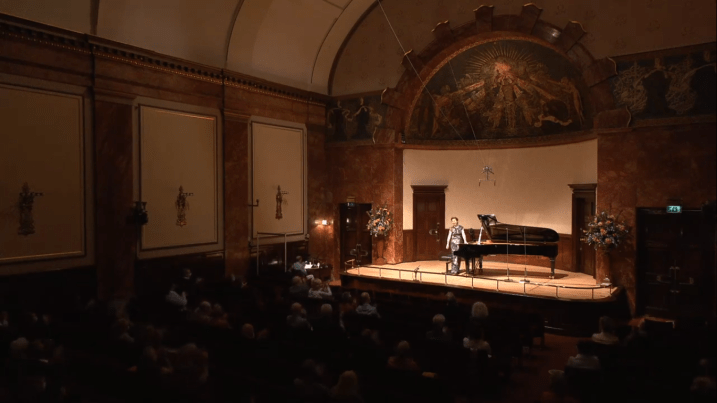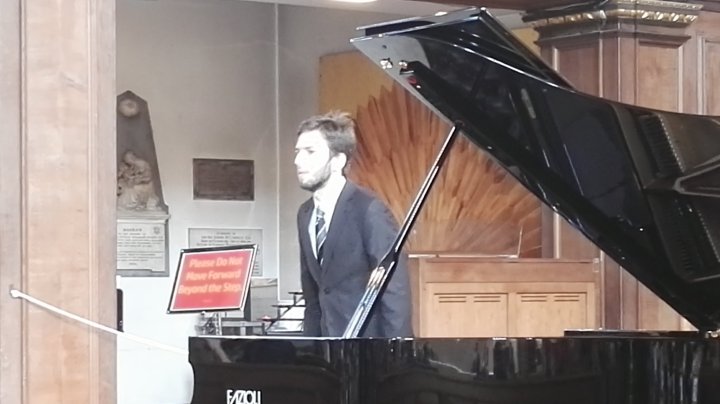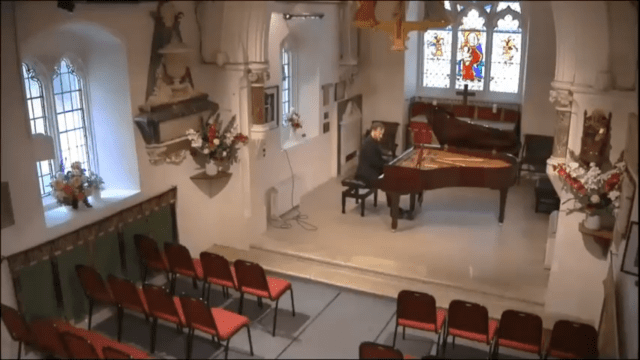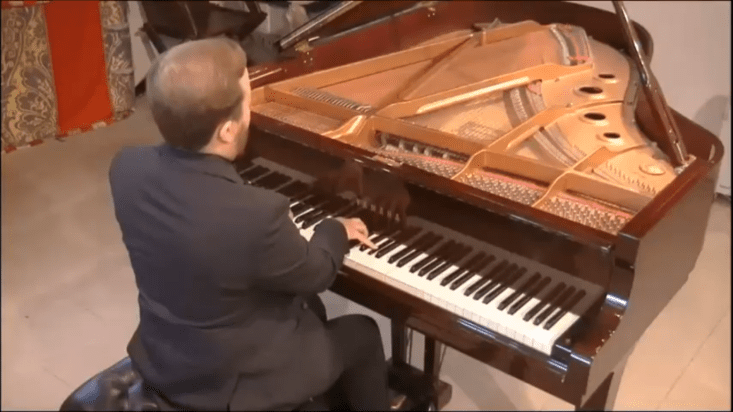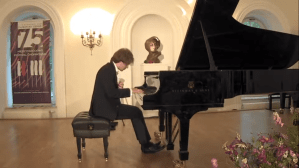
Charles Whitehead Pianists of the World Series at St Martin’s

Charles Whitehead Pianists of the World Series at St Martin’s
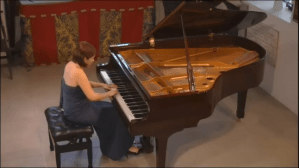
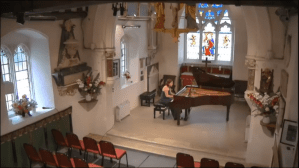
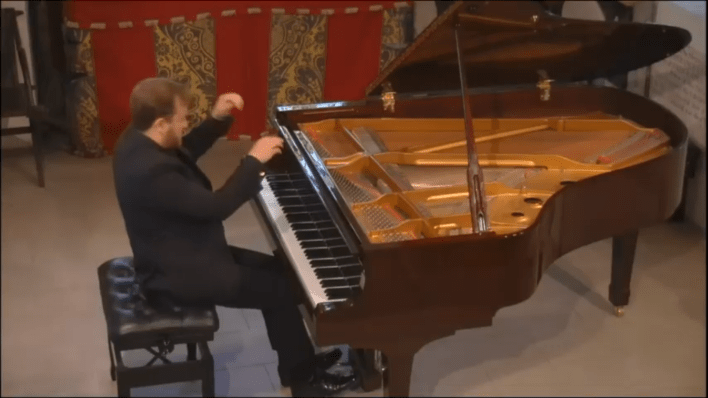
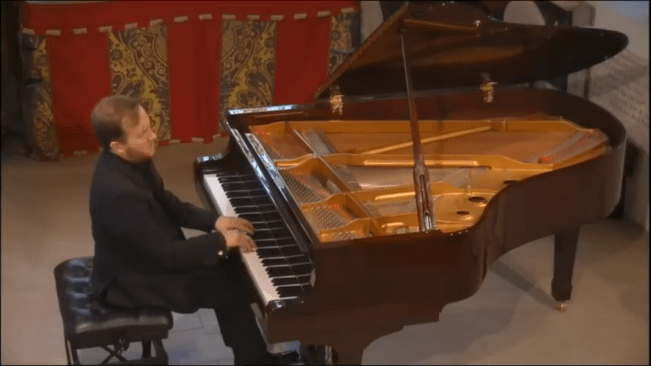
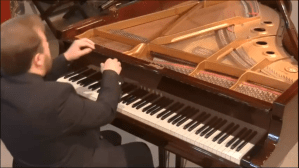
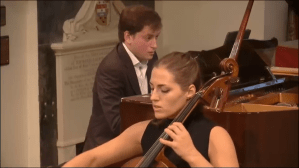
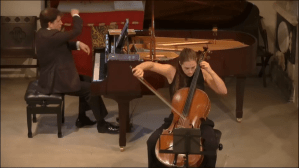
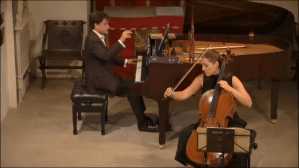
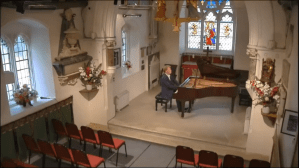
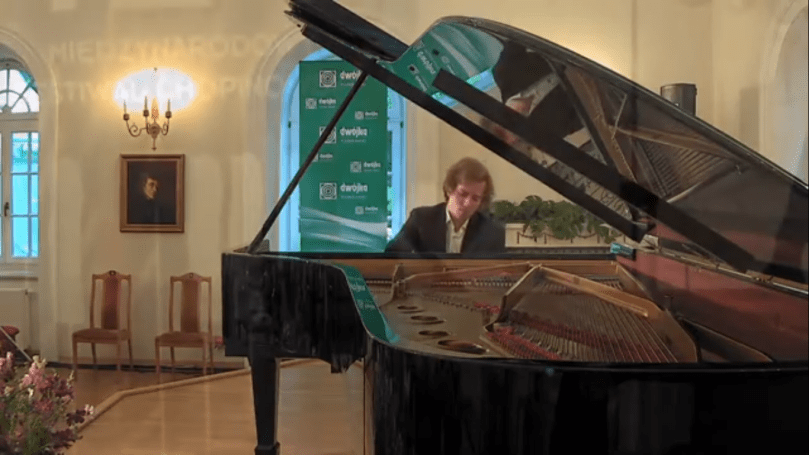
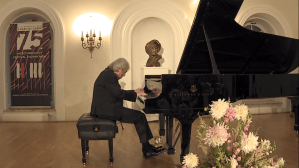
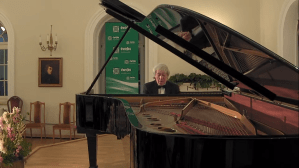
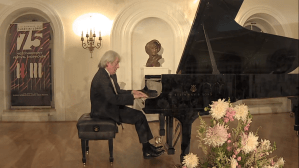
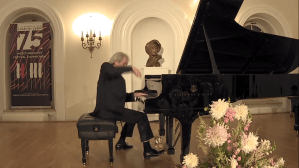
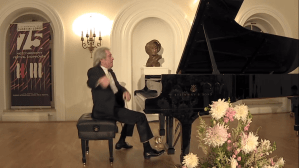
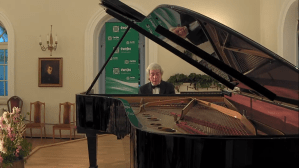
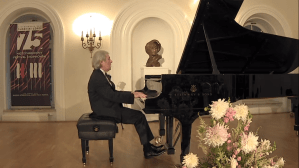
Charles Whitehead at St Martin in the Fields
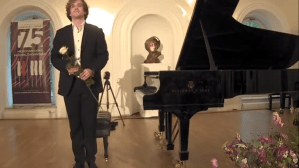
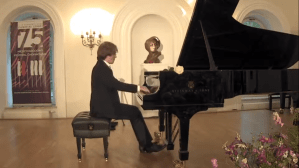
Some very assured playing from this American based pianist.
A luminosity of sound in the Scriabin 5th sonata ignited the atmosphere with a sensual sense of colour with great rhythmic impetus and chiselled sounds of great purity.
It was the clarity and purity of sounds together with a great sense of line that suited so well the fourth of Shostakovich`s Preludes and Fugues.A passionate almost obsessive climax to the fugue was very impressive if rather monochromatic.
Lovely to read in the programme of our adored Tatiana Nikolaeva who had been the inspiration for Shostakovich`s monumental 24 Preludes and Fugues when he heard her play in 1950 in the Leipzig J.S.Bach Centennial.
It was exactly this chiselled clarity that suited so well Messiaen’s expression of faith in the” Contemplation of the Son,the Word of God,looks upon the Son,the child Jesus.”
Sounds that wafted into the heights of this great edifice with pungent accuracy and insistence.
Wonderfully moving ending as the sounds gradually dispersed into oblivion.
The fifth of Messiaen`s twenty musical portraits of Christ child written in 1944,shortly before the liberation of Paris from the German occupation, are inspired expressions of his deep Catholic faith.
After this declaration of faith Liszt`s Spanish Rhapsody seemed rather too careful and laboured and could have been dispatched with more sense of improvisation and carnal enjoyment instead of rock solid reverence.
He paid the price forced to a hasty retreat at the end which he covered like the great professional he obviously is.
An ovation was offered by a public totally convinced and numerously gathered together to enjoy an hour`s respite from the confusion outside.
“Christmas is a comin!”
Only two months away today.

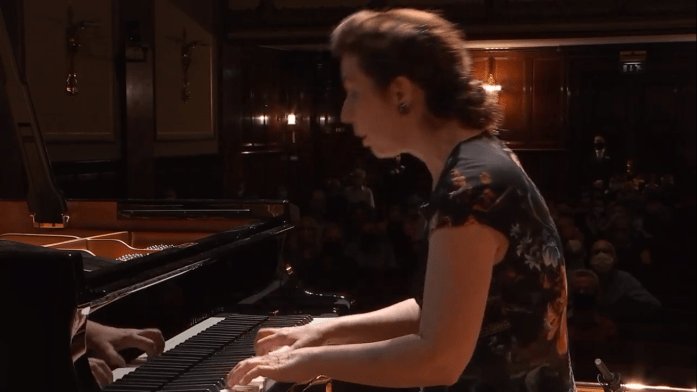
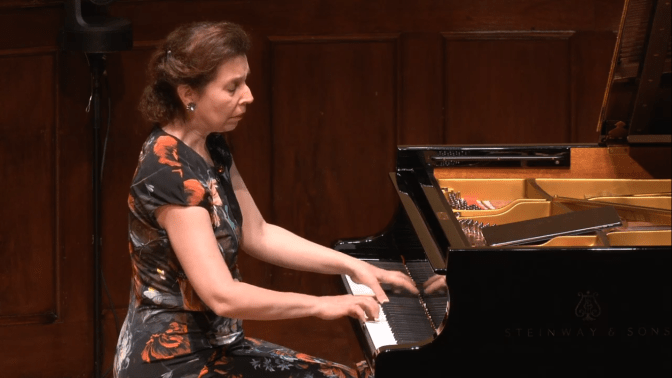
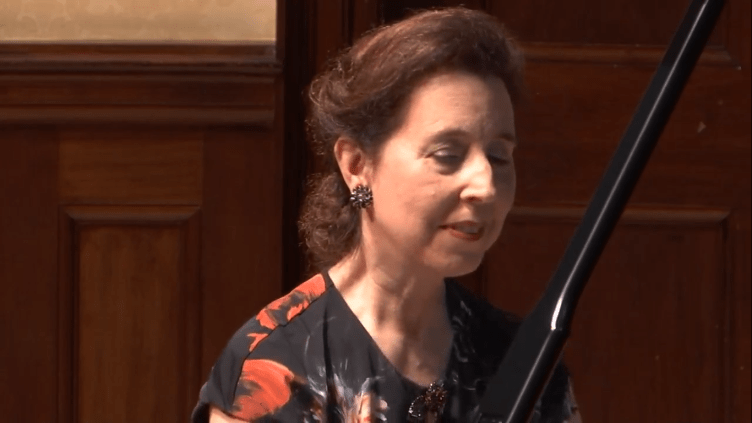
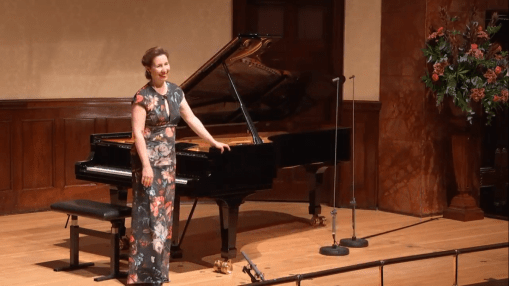
The glorious Bach of Angela Hewitt

The simple glorious Bach of Angela Hewitt
Three English suites that I hardly knew spoke like great friends as they flowed from Angela’s mellifluous hands in a stream of pure gold.
Wonderful to see how the young winner of the one and only Glenn Gould competition accompanied in the early 80’s to play in Rome by her parents has matured into a unique figure.
In a bleak world of false news she is the bringer of hope and glory.
With a visit to the National just before …..a real much needed soul cleansing day.
I added to my basket at the Wigmore as at the National to treasure a bit longer.
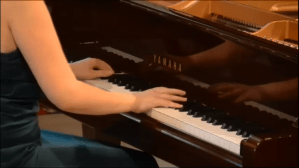
Dominic Degavino at St Mary’s

Dominic Degavino at St Mary’s
It was interesting to hear for the first time a pianist who has played many times in Dr Hugh Mather’s series.
A curriculum full of important prizes and recognition.
From an early age he was a student at Chetham’s studying with Helen Krizos and later continuing his studies with her at the RNCM in Manchester where he won the Gold Medal.Now completing his studies at the Guildhall in London with Charles Owen and Noriko Ogawa.
Three important works on the programme immediately established his pedigree even before he touched the piano.
Half term duties as grandfather called Dr Mather away leaving the master of cermonies to Roger Nellist who introduced this young man to the world so eloquently on their streaming system that I myself often listen to when unable to attend in person.
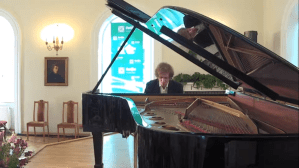
After such a serious programme so musically played I was pleasantly surprised that he offered as an encore a jazz improvisation of “ I fall in love with you.”At last he could let his hair down and produced the most sensuous sounds of the day with an abundance of pedal that gave such colour and shape to the well known melody.
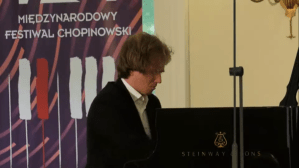
The Chopin third ballade is the most radiant and untroubled of the four and there were many beautiful things.
His ultra sensitive touch in the quieter passages did not allow for a continuity of line though.
This is a piece where each section should grow out of the previous all leading to the final glorious outburst.
He missed the overall architectural shape which was subsituted by some beautiful episodes that did not link one to the other .
When he played louder he seemed to get more to grips with the keys and find the weight and projection that was not possible on this piano in the quieter passages.
Introducing the programme so eloquently he explained about the Great Exhibition in Paris in 1889 where many instruments like the gamelan were heard for the first time and was such an influence of composers of that period.
It was just this atmosphere that he caught so well in the three Estampes by Debussy.
Some beautiful sounds in “Pagodes” with the shimmering right hand adding such atmosphere to the melodic bass.It evokes images of East Asia, which Debussy first heard in the Paris World Conference Exhibition of 1889, and later again in 1900. It makes extensive use of pentatonic scales and mimics Indonesian traditional melodies by incorporating hints of Javanese gamelan percussion. As this is an Impressionistic work, the goal is not overt expressiveness but instead an emphasis on the wash of color presented by the texture of the work. Debussy marks in the text that “Pagodes” should be played “almost without nuance”. This rigidity of rhythm helps to reduce the natural inclination of pianists to add rubato and excessive expression. Rigidity of rhythm within measures though does not mean rigidity of tempo in the work; the tempo gradually fluxes quicker and slower throughout the piece, which is also common in gamelan compositions.
”La soirée dans Granade”was played with such alluring sounds. It uses the Arabic scale and mimics guitar strumming to evoke images of Granada. At the time of its writing, Debussy’s only personal experience with the country was a few hours spent near Madrid.
Despite this, the Spanish composer De Falla said : “There is not even one measure of this music borrowed from the Spanish folklore, and yet the entire composition in its most minute details, conveys admirably Spain.”
But it was in “Jardins sous la pluie” describing a garden in the Normandy town of Orbec during an extremely violent rainstorm,that he found great washes of sound combined with great rhythmic impetus for these French folk melodies “Nous n’irons plus aux bois” and “Dodo, l’enfant do” that Debussy had incorporated into his very expressive etchings.
The four impromptus op.90 D.899 were played with great attention to detail.The great climax in the first was followed by the exquisite jeux perlé of the second .The beautiful G flat major n.3 sang so beautifully even though it was hard to control the intricate accompaniment at such a sensitive whispered level .The fourth was thrown off with great ease and the passionate middle section was a remarkable contrast to the delicacy of its surrounds.

Cristina Ortiz – The Joy of Music

Cristina Ortiz at the Chopin Society The Joy of Music
A party atmosphere at the Chopin Society for the recital by Cristina Ortiz at Westminster Hall.
She has appeared there many times for Lady Rose Cholmondeley and the loyal members of her Chopin Society.
In fact it was a concert amongst friends at the unusual time of five o’clock.

Jazz on the Faz in Kew
I fear that the usual after concert tea and cakes were put to one side after such an exhilarating concert and I did notice many bottles being uncorked as I rushed of to Kew for Jazz  on the Faz with Jonny Liebeck.

The Chopin Society programme
The infectious “joie de vivre” transmitted from the first to the last note had created a special atmosphere that as Lady Rose pointed out is quite unique for a concert hall in London.The piano too had been especially prepared for the occasion by Ulrich Gerhardt the indisputed expert from Steinways.
But it was the passionate warmth that Cristina Ortiz had brought to a rather chilly hall (Lady Rose also apologised for the lack of heating) that ignited the atmosphere with sumptuous sounds and passionate participation.
Miss Ortiz had brought the Brazilian sun to shine on us on a rather wintery english sunday!
Born in Bahia, Brazil, Cristina Ortiz began her studies in her home country before moving to France to study with Magda Tagliaferro. Soon after finishing her studies in Paris, at the age of 19 she won the first prize of the third edition of the Van Cliburn International Piano Competition in 1969 She continued her training with Rudolf Serkin in Philadelphia at the Curtis Institute and later moved to London.A household name in the 70’s together with Vladimir Ashkenazy,Zubin Mehta and Andre Previn But even though she has been resident in Europe for many years, it is the passion, spontaneity and allure so characteristic to her Brazilian cultural heritage, which is central to her music making.
As a true Ambassador, she has started to perform classical music in the various Embassies of Brazil around the world, closely relating to the exclusive audiences by informally announcing what she chooses to play: be it Chopin or Lorenzo Fernandez; Schubert or Fructuoso Vianna; Brahms or Nepomuceno; Debussy or Villa-Lobos: all chosen composers, equally treasured by her.
It was infact the radiant beauty of three intermezzi by Brahms that truly showed her great artistry.
The sheer beauty of sound in the B flat minor op 117 n.2 with such subtle colouring and magical sense of balance The two intermezzi op 118 were played with a simplicity where Cristina Ortiz’s generous heart only added to the warmth of one of Brahms’ most intimate utterings in the A major Intermezzo op 118 n.2.
It was the same generous warmth that she had brought to one of Schubert’s most sublime outpourings in the Impromptu in G flat op 90.n.3.A great song that was allowed to float into the hall on a wave of sumptuous sounds helped by the richness of her left hand that gave great depth to the sounds and allowed infinite gradations of colour in the melodic line.
It was the same beauty that she had brought to the Chopin study op 25 n.1 that was offered by request as one of five encores demanded by an insistent public.
The Preludes of York Bowen were new to me and the six offered from the 24 op 102 showed a Romantic style very reminiscent of Rachmaninov.They ranged from the virtuosity of the first,the cantabile of the second .the great romantic sweep of the third in E flat with a typically Rachmaninovian ending.The scintillating jeux perlé of the E minor Scherzando all played with great command and driving energy.
It was Rudolf Serkin and later Murray Perahia who had rediscovered Mendelssohn and brought a classical approach to music that can often sound rather facile .
The Mendelssohn Variations Serieuses op 54 was full of beautifully things as in the Chopin Barcarolle and First Ballade that followed.
They suffered though from a rather too fluctuating tempo and romantic approach where her enormously warm temperament was allowed too much freedom at the expense of simplicity and the great architectural line.
The sublime Barcarolle was rather too passionate and tempestuous as Chopin’s artistocratic simplicity and poise were allowed too much latin passion.Such fluctuations of tempo that disturbed the magical line that Chopin creates in one of his greatest works.
The opening of the first Ballade was extremely beautifully played but later as the passion rose we lost sight of the great musical line and sweep .
But this was the generosity of spirit that had given such warmth and only added to the initimate atmosphere of the concert today.
Music making amongst friends.
After her beautiful performances of Debussy Arabesque n.1 and a justly passionate L’Isle joyeuse, visibly moved and exhausted she turned to her friends to ask them what they would like to hear next!
A sumptuous Maiden and the Nightingale by Granados was followed by two Brazilian pieces by Villa Lobos.
By great request she even had the energy for two Chopin studies op 25 n.7 and 1 played with great simplicty and controlled passion.
This was the unique atmosphere that Cristina Ortiz had been able to create amongst the usually rather sedate Chopin Society audience who were happy to shout out requests for their favourite works.
I was sorry to have to leave as I imagine the fun carried on for quite some time after the last notes had died away.

A knight in shining armour Drew Steanson at Farm Street Church

A knight in shining armour Drew Steanson at Farm Street Church
There was magic in the air for a programme of Medtner,Rachmaninov and Scriabin in the first recital in a collaboration between The Keyboard Trust and Bobby Chen for Farm Street Jesuit Church 0f the Immaculate Conception .The most beautiful of churches in the heart of Mayfair with Pugin’s magnificent High altar looking on to all those that enter.
AWN Pugin ,the eminent Victorian architect also designed the interiors of the Houses of Parliament.
The second recital in this series will be on the 7th December with Bocheng Wang playing Chopin Preludes op 28 and the Bach Busoni Prelude “Wachet auf,ruft uns die Stimme”
At last today  a Medtner that made sense as the sheer beauty of sounds wafted into the church under the persuasive hands of this British Australian pianist.
Remarkable to appreciate such mastery from someone who had started piano lessons only 12 years ago.
He finished his degree at the Guildhall under Philip Jenkins and went on to study at Trinity Laban under Peter Tuite and Sergio De Simone.
He is now completing his studies with Alessandra Brustia in Bolzano Conservatory.
Having recently been a finalist in the first International Nikolai Medtner Competition in St Petersburg it was hardly surprising that he presented an all Russian programme with Medtner taking pride of place.
Gone was the barnstorming piano playing that one is all too often offered in this repertoire but here it was replaced with music full of poetry and wondrous sounds.
A pianist that could conjure magic sounds that could fill every crevace and seduce us in this beautifully imposing edifice.
It was clear that from the very first piece, the Elegie op 59 n.1 ,that we were in the hands of a true musician.
The whole piano seemed to be illuminated by such liquid sounds helped by the acoustic but also by a careful attention to balance and sumptuous bass reminiscent of the great russian pianists of the past like Emil Gilels whose 103rd birthday it would have been today.

Drew presenting the programme today
In Drew’s hands the line was so clearly drawn that the similarity with Rachmaninov and Scriabin became so apparent as is very rarely the case in lesser hands.
Rachmaninov had in fact dedicated his 4th Piano concerto to Medtner as Medtner had dedicated his 2nd and 3rd concertos to Rachmaninov.
I have often described Medtner as Rachmaninov without the tunes but today that was certainly not the case as Drew managed to steer us through the maze of intricate sounds but always with a great sense of line and above all of song.
The piano seemed to glow as Medtner’s rather elusive melodic line was so clearly and sensitively chiselled.
The two little Arabesques op 7 n.1 and 2 were played like poems of Scriabin.
The first with such meltingly liquid sounds reminiscent of the sounds of that great magician Horowitz for whom this music seemed to pour out of his soul like some golden lava whose trail he traced with such devout delicacy and passion.
The insistent rhythmic pattern in the second one was beautifully maintained with a sumptuous passionate climax and a great final flourish thrown off with such delicacy and leaving a very impressive peaceful ending.
A great calm descended on this magnificent edifice with Rachmaninov’s simple Ave Maria op 37 n.6.
A beautifully simple melody that was allowed to sing with such subtle colours.
This little known work was added to the programme to mirror the reflection that had been offered to the public by the presiding priest.
The few meaningful words offered had been the ideal opening for the sumptuous music we were about to receive.
This short programme continued with 3 Moments Musicaux op 16.Written in 1896 when Rachmaninov had urgent need of money having had his stolen on the train.
Already they show the charcteristics of the later Rachmaninov .The second a study with great arches of sound and cascades of notes with a passionate sense of forward movement.Some really sumptuous sounds in the passionate outpouring which contrasted with the first.
A theme and variations played with a beautifully shaped melodic line thanks to Drew’s great sense of balance allied to a kaleidoscopic sense of colour.
The cascades of notes thrown off with great delicacy and ease led to the final peaceful chords being placed so perfectly.
The third Moment is a great elegie of nostalgic melancholy where the full chords were never harsh but pregnant with meaning.
The march in the left hand with the right hand legato was extremely effective after this typical Rachmaninov lament.
The two fairy tales op.34 n.2 and 4 were made to speak so eloquently too.
The swirling of the water around the lake in the first one was magically played.
And the story telling of the knight in the second was worthy of the greatest of story tellers.
It was quite exquisitely played where every note seemed to be speaking with so much meaning.
The Scriabin study op 42 n.4 offered as an encore revealed yet again a real poet of the piano as it opened up a true world of fantasy played with quite exceptional musicality and command of the keyboard.

Drew with a guest after the concert

Luke Jones reaching for the stars

Luke Jones at Steinway Hall London for the Keyboard Charitable Trust
I have heard Luke Jones many times since Carlo Grante used to send me recordings of a remarkable young boy who had come to study with him in Campobasso in the mid-south of Italy.
From an early age he was taught at Chethams by the Head of Keyboard Murray McLachlan.
A strange twist of fate that whilst Luke was playing for the KCT in London Iyad Sughayer was playing for them in Steinway Hall in New York.

Iyad Sughayer in New York
He too had studied from an early age with Murray McLachlan and like Luke had gone on to study at the Royal Northern College of Music in Manchester.

Luke Jones in London
Even more curious was that the daughter of the founder Caroline von Reitzenstein was celebrating Iyad Sughayer’s birthday as her father was celebrating mine in London.
In London Angela Ransley and Sasha Grynyuk had prepared a special Happy Birthday duet which incorporated Chopin,Debussy,Art Tatum and much else besides.
It followed their recent success in Angela Ransley’s ‘Echoes of Dead Voices ‘ at Foyles Performing Space

Sasha Grynyuk with Angela Ransley

after concert festivities in New York with Iyad,Mario Scerbo and Caroline von Reitzenstein
As Iyad was celebrating in New York after his ‘beautiful’ recital at Steinway Hall in New York

Overwhelmed in London
Whilst we were celebrating the equally beautiful recital of Luke Jones in London

Luke Jones at Steinway Hall in London
An evening of extraordinary piano playing from this now 24 year Welsh pianist from Wrexham.Perfecting his studies with that renowned pianist and pedagogue Dina Parakhina.
After a recital of absolute authority and total command of the keyboard she confided to me that in her opinion here was the next contender to the Tchaikowsky Gold Medal in Moscow.

Luke Jones Dina Parakhina and Mathew McLachlan one of three pianist children of the amazing Murray McLachlan clan!
I think there can be little doubt amongst those present in Steinway Hall that here was the infallible authority of a John Lill or a Peter Donohoe combined to the poetry of a Barry Douglas that had won them all the coveted Gold Medal in Moscow.
Not quite the sumptuous romantic sounds of a Van Cliburn………….but his performance of Mompou revealed colours and atmospheres of the most sensitive of stylists.
It was ‘The Landscapes’ by Mompou that opened Luke’s very original programme.
Full of intoxicating colours and hazy sounds realised with a seemingly infallible touch – the wrist held noticeably low and the fingers pointing at the keys as a pointilesse painter might have pointed his brush at a canvas.
It is hardly surprising that the French critic Emile Vuillermoz proclaimed Mompou “the only disciple and successor” to Claude Debussy. Mompou himself often performed his own compositions, but only at private soirees, never in public.
Mompou had heard Fauré perform in Barcelona when he was nine years old, and his music and performing style had made a powerful and lasting impression on him. He had a letter of introduction to Fauré from Enrique Granados, but it never reached its intended recipient.
He entered the Conservatoire (with another Spaniard, José Iturbi), but studied with Isidor Philipp ,head of the piano department. His extreme shyness, introspection and self-effacement meant that he could not pursue a solo career, but chose to devote himself to composition instead.
British pianist Martin Jones has recorded the complete piano works of Mompou for Nimbus, including those unpublished in Mompou’s lifetime, many of which were discovered when his apartment was cleared out in 2008.
Just last week Giancarlo Simonacci played for Roma 3 University the 28 pages of piano music of Mompou together with 28 pictures by Mirò.
I remember Guido Agosti looking aghast when Jack Krichaf dared bring a piece by Mompou to his masterclass in Siena!
How times have changed when here was a strapping young welsh man conjuring magic colours out of the air with the delicacy and icedrop precision of a Michelangeli.
The three pieces make up this suite written between 1942 and 1960 ( Mompou died in 1987 aged 94.)
In 1957, aged 64, he married the pianist Carmen Bravo (1923– 2007) She was 30 years his junior. It was the first marriage for both of them and they had no children.After her death in 2007 about 80 unpublished and hitherto unknown works were discovered in Mompou’s files at his home.
A fascinatimg discovery of almost unknown miniatures that when played with the intelligence, style and kaleidoscope of colours as tonight one can well understand the advocacy of an artist of the stature of Alicia de Larrocha programming his music long before Volodos or Trifonov.
It was fascinating to hear another rarely played piece immediately after with the Sonata n.9 op 30 by Medtner.
Here Luke’s absolute control and extraordinary sense of line was a very persuasive advocate for a Sonata that even Leslie Howard in his interval speech had to admit that it must be at least 20 years since he had heard this work.

Leslie Howard co artistic director of the KCT
It is thanks to Dina Parakhina that her students regularly play all the sonatas of Medtner.
I remember hearing Edna Iles his devoted pupil playing Medtner after a performance of the Liszt Sonata in the Festival Hall.
A younger contemporary of Sergei Rachmaninov and Alexander Scriabin, he wrote a substantial number of compositions, all of which include the piano. His works include fourteen piano sonatas, three violin sonatas, three piano concerti, a piano quintet, two works for two pianos, many shorter piano pieces, a few shorter works for violin and piano, and 108 songs including two substantial works for vocalise. His 38 Skazki (generally known as “Fairy Tales” in English but more correctly translated as “Tales”) for piano solo contain some of his most original music.
I have often described Medtner to people that ask me about him as Rachmaninov without the tunes!
As unjust as Agosti’s opinion of Mompou I am ashamed to say!

Dina Parakhina in discussion with Noretta Conci Leech
Esteemed in England, he and his wife settled in London in 1936, modestly teaching, playing and composing to a strict daily routine.
At the outbreak of the Second World War, Medtner’s income from German publishers disappeared, and during this hardship ill-health became an increasing problem.
His devoted pupil Edna Iles gave him shelter in Warwickshire where he completed his Third Piano Concerto, first performed in 1944.
Medtner died at his home, 69 Wentworth Road, Golders Green, London in 1951, and is buried alongside his brother Emil in Hendon Cemetery.
It is curious to note that the one-movement Ninth Sonata in A minor, Op. 30, was published without a title but was known as the “War Sonata” among Medtner’s friends; a footnote “during the war 1914-1917” appeared in the 1959 Collected Edition.

Dina Parakhina with Sasha Grynyuk and Elena Vorotko,who had played the Prokofiev sonata many times on KCT tours before becoming a co artistic director of the KCT
The Sonata n.8 by Prokofiev which filled the second half of this fascinating programme is the last of the trilogy of “War Sonatas” – written during the second world war.
It is a monumental work which received its first performance from Emil Gilels in 1944.
Here was a meticulous attention to detail and the crystal clear clarity,sense of line and rhythmic impetus made up for any slight imperfections in this marathon work.Such was his architectural vision and sense of colour that any other considerations were swept away by his sheer conviction and total command of the keyboard.
Having heard Gilels many times I miss here and in the Medtner the sumptuous sound of a really grand piano that was so much part of the great russian school where the bass sustains the upper registers in an overall cocoon of voluptuous sounds.
But the extraordinary clarity and precision of Luke today made for a very persuasive case indeed.
In the newly renovated Steinway Hall this magnificent concert grand needed more space to breathe as its infinite possibilities are stifled by the distance the sound has to travel.
After all the art of a great actor is to use his diaphram to allow his voice to fly into the most distant crevaces long before the invention of acoustically assisted sound.
The Venetians of course knew the secret as I was told on a tour by the technicians of La Fenice before it was burnt to the ground.
Under the orchestral pit there are one and a half meters of glass.
The Venetians knew full well the value and quality of their glass !
It was infact a truly magical performance by Luke in Manchester of Brahms Paganini Variations that had me wishing for more space to allow the sounds to go on their journey unimpeded.
A Prelude in G from book 2 of the Well Tempered Klavier was like a lemon sorbet after a sumptuous meal.
What a treat to see a very talented young boy maturing into a great artist respected and groomed by his renowned mentor to aim for the stars.

Birthday boy in New York

Leslie Howard looking somewhat perplexed as Happy Birthday unraveled before him

An evesdropping Sarah Biggs,general manager of the KCT as Sasha and Angela unravel their unexpected birthday greetings

Simone Tavoni who will be performing in the next KCT concert on the 13th November …….In the foreground Federica Nardacci who wrote the Black Pearl the story of Callas as told by her butler with performances in London at the Playground Theatre in November…….Glass in hand now enjoying the fun Leslie Howard

Ilya Kondratiev and Andreas with Sarah Biggs

John Leech and Noretta Conci Leech with Luke

Mihai Ritivoiu’s blazing trail at St Mary’s

Mihai Ritivoiu’s blazing trail at St Mary’s
I have heard Mihai many times over the last five or six years but never have I heard him blaze a trail as he did today with Rachmaninov.The Etude Tableau op 39 n.5 in E flat minor was taken by storm in an impassioned fearless performance that knew no limits.A technical command that allowed him the liberty to throw himself into the fray as Richter used to do with total abandon at the service of his magisterial vision.
It came at the end of a very beautiful but serious programme of two of the most important works of Chopin and Beethoven.
The 24 Preludes op 28 and the Sonata op 110.
I first heard Mihai many years ago in a masterclass with Richard Goode.He had just started his studies at the Guildhall with Joan Havill and I was immediately struck by his intelligence allied to a poetic sensibility in one of the most complex works of Chopin ,the Polonaise Fantasie op 61.
In fact I asked Ronan o ‘Hora,head of keyboard studies, who he was.
Ronan and I had both studied with Vlado Perlemuter who was guided in his youth by Alfred Cortot and so had that poetic sensibility that is so necessary for Chopin.
It is so easy to slip into the so called Chopin tradition of disregarding the composers intentions for what passes for nostalgic patriotism.
Mihai has had the fortune too to be guided by that great pedagogue Joan Havill whose knowledge of the scores is second to none.
I notice  that he has been helped by Valentin Gheorghiu a great Romanian pianist whose recordings of Chopin were some of the first performances of Chopin that I had ever heard.
It was evident today from the very first notes of the Preludes that here was someone who had completely undertood the sound world of Chopin.
Fou Ts’ong used to called the 24 Preludes 24 problems, as each one poses a different challenge whilst architecturally being part of a whole.
As in Beethoven there are some very precise pedal markings that can seem at first sight exaggerated but in the hands of a true artist can reveal secrets that are of the very few.
The first prelude was played as if it had already begun offstage. Beautiful, full sonorous sound with some very telling phrasing in the final few bars.
There was a wonderful sense of balance in the second prelude that allowed the melody to sing with such noble nostalgia.
The trecherous left hand in the third prelude (like the right hand at the beginning of Ravel’s Ondine)needs a perfect instrument to bring it off to perfection but Mihai concentrating on the melodic line managed to shape it so beautifully.
The fifth Prelude wafted in like a magic wind separating two of Chopin’s most poetic utterences.
I would have trusted Chopin’s pedal marking at the end of number six (as Mihai had trusted Beethoven in the Sonata op 110) which would have allowed Chopin’s magical waltz to drift in seemingly unnoticed.
Great passionate involvement in the eighth without ever loosing sight of the line and the nobility of the ninth before the jeux perlé of the tenth thrown off with great nonchalance and delicacy.
The eleventh was played as a great song like the third Impromptu before the onslaught of the twelfth.The great Polonaise type rhythms played with enviable insistence.
The thirteenth floated in with a disarming simplicity on a magic wave that never faltered for a moment ending in a subtle question mark out of which the wind came blowing in on a sequence of overwelming sounds that disappeared to nothing with the disarmingly simple appearance of the so called ‘raindrop’prelude.
Played with a flexible simplicity and a middle section of subdued menace.
The great B flat minor prelude was thrown of with superb assurance and passionate involvement and was the ideal contrast between the
melifluous fifteenth in D flat and the seventeenth in A flat where a wonderful flowing tempo allowed an artistocratic sense of shape without any sentimentality.
The mist of A flat on which the melody returns was beautifully judged even if it might have been better to allow the music to flow more naturally.
The great declamation of the eighteenth was followed by the simple liquid cantabile that followed in one of the most transcendentally difficult of all the preludes.
The great C minor prelude (used by other composers, such as Busoni and Racmaninov,  as the theme for their variations) was played with great nobility with full sumptuous sound that gradually melted away to a whisper.The final few bars played with an exquisite almost non legato and a crescendo that led unusually to a delicately positioned final chord exactly as Chopin had indicated.
A beautiful sense of balance in the following prelude that led to great virtuosity with the left hand octaves in the twenty second prelude.
The gentle flow of the penultimate was almost” au bord d’une source.”
The last great Prelude in D minor was played in a very measured way that allowed all of Chopin’s passionate outpourings ,with his yearning for his beloved homeland spread over the whole keyboard, to find their true place in a relentless surge to the last three mighty D’s.
An extraordinary performance from a true Chopin player.
The concert had begun with a performance of Beethoven’s penultimate sonata op 110.
As one would expect from a disciple of Joan Havill it was an exemplary performance in which all of Beethoven’s most precise indications had been totally absorbed and incorporated in a very fine performance.

Beethoven’s very precise indications of the famous bebung(repeated notes)
It was in the Arioso that the Sonata suddenly became part of him and the fluidity and intelligence with which he interpreted Beethoven’s very precise indications led to a magic return of the fugue leading to the impassioned exultant final flourish.

Mihai Ritivoiu was born in Bucharest and began piano lessons at the age of 6. In 2012 he graduated with the highest honours from the National University of Music in Bucharest, the piano class of Professor Viniciu Moroianu, and is currently studying at the Guildhall School of Music & Drama in London, with Professor Joan Havill. He also participated in masterclasses with Dimitri Bashkirov, Dominique Merlet, Richard Goode and Emmanuel Ax, and benefited from the advice and guidance of Romanian pianist Valentin Gheorghiu.

Mihai won the Dinu Lipatti National Competition in Bucharest in 2010 and was a laureate of the George Enescu International Piano Competition in 2011. Following these achievements he was invited to record the Second Piano Concerto by Rachmaninoff for the Romanian Broadcasting Corporation, with the Romanian Radio Orchestra conducted by Gheorghe Costin.

He has since played as a soloist and chamber musician throughout Romania, England, France, Portugal, Switzerland and Italy, performing in such venues as the Romanian Athenaeum, St. Martin-in-the-Fields, Wigmore Hall, Barbican Centre, West Road Concert Hall and the Ernest Ansermet Studio. His performances have been broadcast by Radio România Muzical, Radio Suisse Romande – Espace 2 and has appeared on BBC Radio 3’s ‘In Tune’.

Most recently, Mihai was awarded the Gold Medal in the Beethoven Piano Society of Europe Intercollegiate Competition, and his future engagements include recitals at St. Martin-in-the-Fields and Steinway Hall, as well as concerto performances with the Bucharest Philharmonic Orchestra and the Lausanne Chamber Orchestra.

Mihai’s studies at the Guildhall School are generously supported by Noswad Charity. He is also grateful for having received awards from the Liliana and Peter Ilica Foundation for the Endowment of the Arts and the Erbiceanu Cultural Foundation, for being the best ranked Romanian competitor in the 2011 Enescu Competition, and, in 2013, being offered a grant by the Ratiu Family Charitable Foundation.

Evelyne Berezovsky – A shining light illuminates St Mary’s

Evelyne Berezovsky – A shining light illuminates St Mary’s
It was nice to hear Dr Hugh Mather describe the first part of the concert today as ‘sensational’.
At the end of the recital his mentioning so enthusiastically the carisma and flair of Evie and that she sounds as though she is improvising such is her complete command of the keyboard.
Evelyne Berezovsky had stood in at short notice for an indisposed Lara Melda in a season that includes many of the finest young musicians in the land and it was nice to have the opinion of a real expert.
Infact the only person that one could compare her with is the young Argerich for her improvisatory style where communication and love for music hold you enthralled from the first note to the last.
You may not agree with all that she does but she convinces you in that moment with the way she can make every note speak so directly to every member of the audience.
I had recently heard her in a similar programme and my views coincide completely with Dr Hugh Mather today.
The second half I had heard before and I am glad that the slight cuts I had suggested in the Messiaen brought to perfection her extraordinarily moving performance today.
An encore of the Scarlatti Sonata in D minor L 413 was played with a freedom and flexibility that was exactly like an improvisation with such sparkling embellishments.
The first half was new to me and there was indeed some superbly stylish playing.
Some really exquisite shading in the Schubert Impromptu in B flat that opened the programme.
A jeux perlé of such delicacy and subtle rubato .Every note spoke so eloquently and the ending was pure magic.

Evie with Dr Hugh Mather
Beethoven’s so called poor relation to the “Moonlight” Sonata was given a reading that immediately put it back on the unique pedestal that Arrau would demonstrate to us.
A very beautiful opening that in this Sonata op 27 n.1 it immediately became apparent the title of Sonata – ‘quasi una fantasia.’
A great attention to the detail and dynamic contrasts that Beethoven asks for created the same magic as the “Moonlight” sister sonata op 27 n.2.
The Allegro middle section was played with great rhythmic drive and absolute attention to the dynamic contrasts that made the reappearance of the main theme even more poignant.
The final few bars were played with such subtle artistry that the sheer beauty created belies the few notes that Beethoven spreads over the whole keyboard.
The Allegro molto e vivace was played with the great Beethovenian rhythmic contrasts and if she quite unintentionally mislaid a section it had no importance when she played the Adagio con espressione with the same heartfelt beauty as Beethoven’s third concerto.
The Allegro vivace immediately burst out of this magic bubble that had been created.
Full of sudden telling contrasts in dynamics and a rhythmic foreward movement that was quite infectious.
The emergence of the Adagio before the coda made us realise in her sensitive hands what a genius Beethoven was already in these early works.
It was in the Scherzo n.2 by Chopin that one was reminded of the early performances of Argerich.
I remember in the first concerto with Argerich where one could marvel at the colour,control and fire but could also feel that the aristocratic nobility of Rubinstein was too often substituted by an improvisatory style that was on occasion a little too wayward.
I found the middle section a little slow but when it is played with such poetry and deep nostalgia how could one not be totally capitivated. Her technical command and total authority were overwhelming.
Evelyne Berezovsky was born in Moscow in 1991, the daughter of the eminent pianist Boris Berezovsky. She started playing the piano at the age of five and two years later joined the Purcell School of Music. She then studied at the Royal Academy of Music in London with Hamish Milne, in Italy with Elisso Virssaladze, and with Rena Shereshevskaya in Paris. She has played in public since she was 7 years old and appeared with the orchestra for the first time at the age of 11. Since then she has performed at major venues in London, including the Wigmore Hall, St. John’s Smith Square and the Southbank Centre, and at concert venues in Germany, Belgium, Holland, France, Norway, Russia and Japan, including a recital at the prestigious piano festival in La Roque d’Antheron. In February 2012 she won First Prize in the Lagny-sur-Marne International Piano Competition in France. Following this, she has been regularly invited to play on Radio France, including a performance at the Fête de la Musique which took place at the Olympia, Paris. Evelyne has given concerts and recitals in the UK, France, Belgium, Germany and the USA, including performances at Lorin Maazel’s Festival in Castelton, VA and Steinway Hall, New York. She has performed with London Musical Arts Orchestra, Enschede Symphony Orchestra, Hulencourt Soloists Chamber Orchestra, Tokyo Mozart Players, Musica Viva, Thailand Symphony Orchestra and North Czech Philharmonic, and the Latvian National Symphony Orchestra.

Miracles in Teatro Torlonia – Mahler 4th Symphony

Miracles in Teatro Torlonia

Mahler 4th Symphony in a chamber version by Claudio Brizi

Mahler’s 4th Symphony with just ten players would not seem possible but nevertheless in Claudio Brizi’s hands it was a quite moving experience.
In the magnificence of Teatro di Villa Torlonia we were able to appreciate all the poetry and musical invention in what must be one of Mahlers most pastoral of Symphonies.
Stripped of all the magnificent excess that abounds in Mahler scores we were taken to the core of the music and it was a revelation.
Das Himmlischen Leben (The Celestial Life) in the last movement was beautifully sung by Ilaria Vanacore.
A chamber music version played by the superb players from the Ensemlbe Roma Tre Orchestra.
It was the first collaboration with the Accademia degli Sfaccendati based in Aricia and run for years by Giacomo Fasola and Giovanna Manci.( this year celebrating 50 years of music with Coop Art Cesten)

Giovanna Manci presenting the concert
Giovanna I have known for over thirty years.From when her father,my bank manager,spoke about his daughter who he thought had quite a nice voice!
Would I listen to her?
She had one of the most beautiful voices that I have heard and I immediately put her in touch with the singing expert and musicologist Michael Aspinall who took her under his wing.

The Ensemble Roma Tre Orchestra with Claudio Brizi and Ilaria Vanacore
We gave many concerts together and even recorded the music of Paisiello for Orazio Costa’s last work as director with ‘Cosi è se vi pare’ by Pirandello with my wife Ileana Ghione, Carlo Simoni and Mario Maranzana.
Our production that sold out in Rome and Milan and was even seen in Argentina.

Valerio Vicari after a recital a few days ago in his Young Artists Series with Jonathan Ferrucci in collaboration with the Keyboard Charitable Trust
Hats off to Valerio Vicari,artistic director of Roma 3 for having the courage to include them in his most varied series of concerts for Roma Tre Orchestra.

The magnificent Teatro di Villa Torlonia ex residence of Mussolini

A full house for Mahler 4

In performance with the Ensemble …….Claudio Brizi directing from the keyboard

Jonathan Ferrucci at Roma 3

Jonathan Ferrucci in Rome
A great success for a new collaboration between Rome University Roma 3 and the Keyboard Charitable Trust in London.
Jonathan Ferrucci had been invited by Valerio Vicari the artistic director of Roma 3 to perform in the Aula Magna.

Valerio Vicari with Jonathan Ferrucci
I had spoken to Valerio Vicari about Jonathan Ferrucci and when he heard his CD from a live performance in the Wigmore Hall he not only wanted to include him in his prestigious series but he also wanted to listen live to much that was on the CD.
His programme also included a work new to his repertoire the Theme and Variations op 73 by Fauré.
The Theme and Variations op 73 by Fauré is a work that my old teacher Vlado Perlemuter used to play showing us what a masterpiece it can be when played with intelligence and nobility .Faurè can so easily slip into a rather romantic sentimentalism that has no place with a composer where everything is indicated with such precise detail.
Perlemuter had me tell the public in Rome that the nocturnes he was about to play had been passed down by Faure,with the ink still wet, to try out.
They lived in the same house in Paris and it is fascinating to see Perlemuter’s scores covered in fingerings in all different colours  trying to find the perfect fingering for a  cantabile with weight that is so much part of an organist’s technique where a sustaining pedal does not exist.
In fact it is the sustaining pedal that can be so damaging to the works of Fauré for piano. It was refreshing to see Jonathan’s scrupulous attention to detail.
The very precise attention to the rests in the left hand accompanying the nobility of the theme gave an almost orchestral feel to the whole and the sudden piano with pianissimo accompaniment was played with the utmost simplicity without any added ritardandi or excess of rubato.
It created the same nobility that I well remember from Perlemuter’s own performance.
Nobility without sentimentality.
I found the first variation a little slow with the theme singing so well in the bass with delicate filigree accompaniment in the treble.Looking at the score I see that Jonathan was absolutely right as Fauré states quite clearly the same tempo even giving a metronome marking.
Well composers are not always right look at Beethoven or Schumann !
I think here Fauré did not want the variation to be played in a virtuoso fashion so he indicated that it was the bass theme that was so important and not the continual semiquavers above!
It just feels as though it should move a little more to arrive at the next variation that is marked faster.It was played very clearly with superb organists’ sense of legato and staccato.Even the third variation is marked slightly faster and it was was played so beautifully with the staccato marcato interrupted by a very flexible expressive legato.
The fourth variation will always stay in my memory for how Perlemuter well into his 80’s would suddenly throw himself into the fray.
Jonathan too today.
Not quite the sumptuous sound that I remember from Perlemuter that was not possible on this rather bright Schimell Concert Grand.

Introducing the programme
So many beautiful things were revealed though in Jonathan’s sensitive hands.
The great sense of balance in the ‘eery’ sixth variation marked molto adagio, and scrupulous attention to the minute detail of the ninth.
The great sense of syncopated legato with staccato accompaniment in the tenth was technically quite extraordinary and the build up to the great climax was overwhelming.
It left us with one of Fauré’s most poignant statements in his last variation.
A heart rending question mark played with all the passionate involvement today that I remember from Perlemuter.
It is similar in many ways to Ravel Valses Nobles et Sentimentales in which the last epilogue seems to sum up all that has gone before in a great journey of a multitude of mixed feelings.
Fauré seems to have foreseen already in 1895 the extraordinary language of his last great Nocturne n.13 in B minor of 1921.
There was all the tragedy of the first world war between them.

Proud parents .Prof Ferrucci and his wife had come today from Florence to her their son
It was a sign of a great artist who decided in the atmosphere created to allow Bach to enter almost unnoticed on the wave of C sharp.
The C sharp minor Prelude and Fugue Book 1 (a rare fugue in five voices one of only two in the 48)
This is a monumental performance that I had heard last summer in London and described above.
The sublime prelude and a fugue of such proportions that a whole world is revealed in only a few intense minutes.It is probably one of the finest performances of a fugue that I have heard (with apologies to Tureck,Nikolaeva,Richter and Angela Hewitt– who is infact an important mentor to Jonathan).
I remember Sydney Harrison who both Angela and I knew and loved so well in our student days,saying that his dream was for one of his pupils to play better than he could.Sydney was not one of the most modest of men but I think here we certainly get his meaning loud and clear.

Clare Pakenham,the distinguished authoress and sister in law of the late Harold Pinter had come to Rome especially for the concert
The Fourth Partita I had heard before in Padua(see above) and on that occasion I had found it a little too fast to allow space for the nobility and above all the sense of dance and song that is so much part of the music as Angela Hewitt has so rightly indicated.
Today nine months later (sic) he had found the ideal tempi ( except maybe for the Gigue that he kept miraculously under control even at breakneck speed!)
The opening had a nobility and sense of precision with superlative ornamentation that only added to the expression and were essential parts of the line and not as is so often the case added because one is supposed to!
The heartrending Sarabande was quite sublime as was the crystal clear Menuet that followed before the magnificent onslaught of the Gigue.
A remarkable performance I like to think in some way inspired by the Fauré that had preceeded it today.
Both Valerio and I had heard the CD of Jonathan’s Wigmore Hall Prize Winners concert two years ago.We had both been struck by the sublime beauty and rigorously authorative performance of Cesar Franck Prelude ,Choral and Fugue but I do not think either of us expected to be swept off our feet as we were today.
Jonathan too rising to the occasion in every sense when in moments of passionate involvement he rose from the seat just as Rubinstein used to do on many memorable occasions.
It was quite breathtaking at the climax of all that had gone before to suddenly have an electric shock injection of energy (of course Serkin was absolute master of this too).
It is not exhibitionism it is a question of being so involved that anything goes to get the maximum expression from this wooden box full of hammers and strings!
It is always inspirational and one can never tire of reading Alfred Cortot’s words (Perlemuter was a teenage pupil of his):
“the most expressive of his pianistic production,was to recall the musicians’ attention to the classical disposition of the Prelude and of the Fugue which had been almost forsaken by the composers of his generation after the brilliant realisations of Mendelssohn.
It only happened later that he thought to join the Prelude and Fugue by means of a Choral….a stroke of genius that humanises without taking away any of its innate dignity but gives it that emotive power……….The expressive beauty of the Prelude,from which,for two times ,rises a fervant and painful supplication overflowing from the heart of the man and from the inspiration of the musician.
The Choral an uninterrupted lament to the eternal imploration of a humanity going to the research of justice and consolation.
The Fugue which crowns the work and seems to emanate more from a psychic necessity than from a principle of musical composition.When ,after the ardour of the crescendo that leads to the paroxysm of a true cry of anguish,the sweet comforting theme of the choral contained in the fluid murmuring of the heavenly harps,appears again,everybody will feel a suggestive impression of repose,of recovered personal tranquility…..
The sonorous exaltation which mixes in a brilliant peroration the triumphant voices proclaiming the divine word to the bronze thrills of the exultant bells will appear as the repercussion of our own emotion.
This is the ideological feeling to which the interpretation should conform of this work of grave and noble expression of a Christian soul inspired by her own God”
                                                                                       Alfred Cortot(conference of 1933)
Cortot had a wonderful way of expressing the spritual content in music.
I remember Perlemuter writing in my score of the Chopin 4th Ballade at the return of the introduction” avec un sentiment de regret” that just illuminated the whole interpretation.
Jonathans’ performance was everything that Cortot outlines in his introduction to his edition.We were immediatley plunged into a magic world of tenderness and nobility – a fatal combination. Waves of sound engulfed us as we were mesmerised by the architectural control allied to extreme beauty of the performance.
There was magic in the air indeed.
After much imploring this young man of deceptively slight build swept us all away on a relentless wave of sounds in the Toccata by Ravel from Le Tombeau de Couperin .
A truly transcendental performance of enormous power,colour and tendresse.
I believe the entire performance of this work is included on his CD.
Ravel wrote it dedicating each movement to a friend who had not returned from the first world war.
In fact a whole generation wiped out…Ravel was lucky to escape as he was an ambulance driver during the war too.

The second concert in the collaboration between The Keyboard Trust in London and Roma 3 and Roma tre orchestra
Valerio Vicari was visibly moved today as we all were and he is looking forward to hearing the next pianist Yuanfan Yang from the remarkable roster of the Keyboard Trust in Teatro Torlonia on the 29th January.