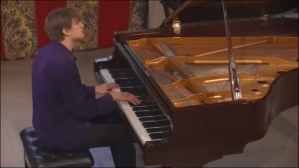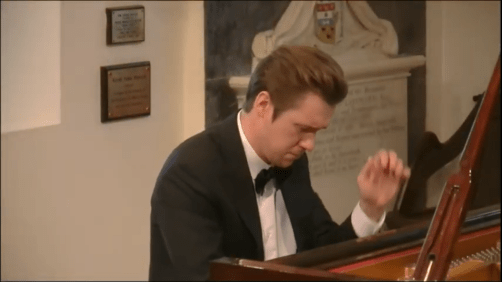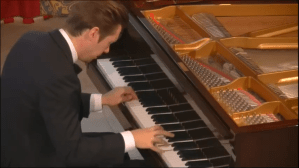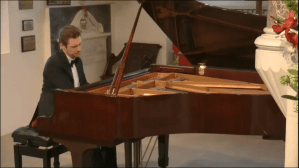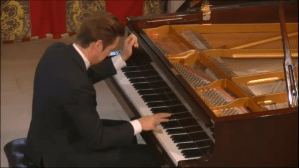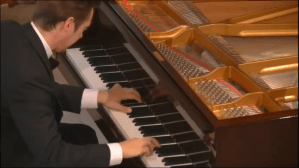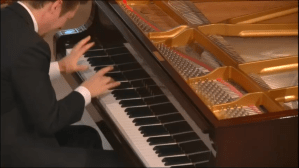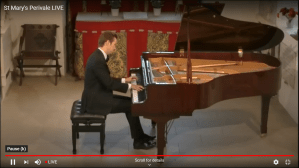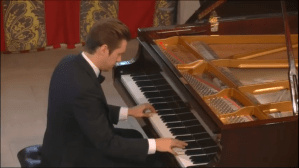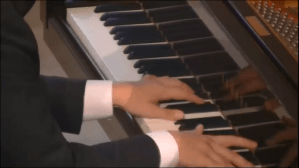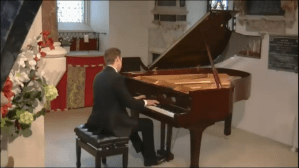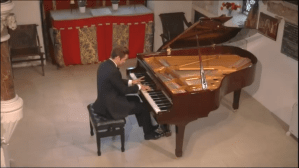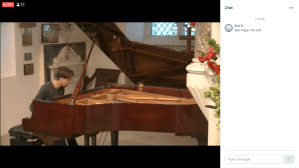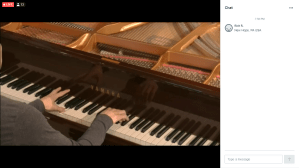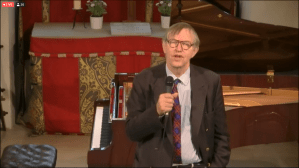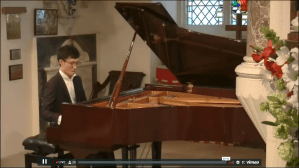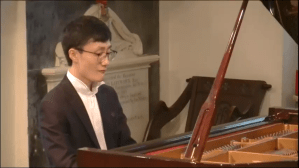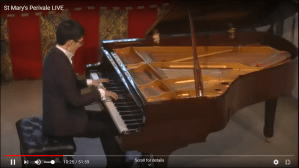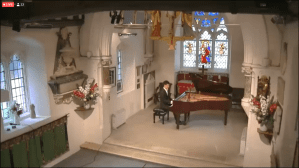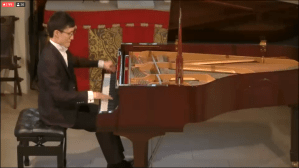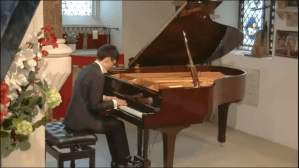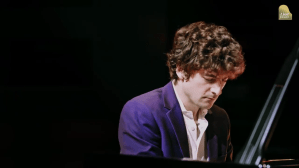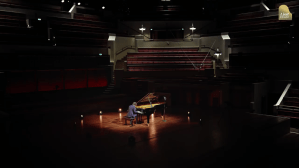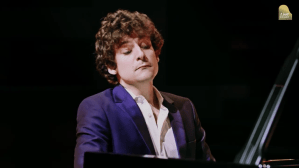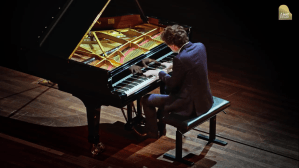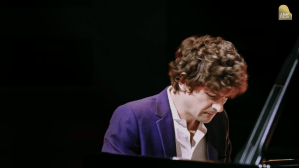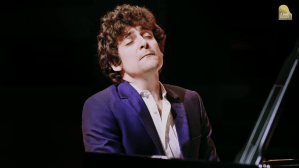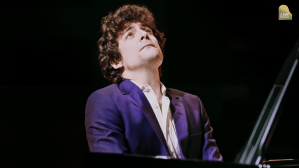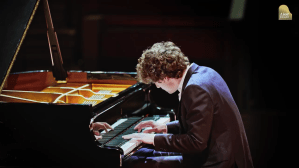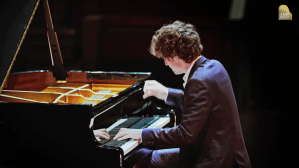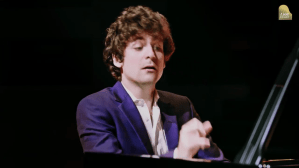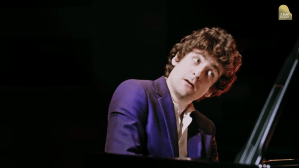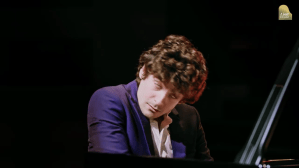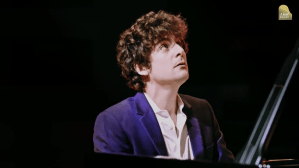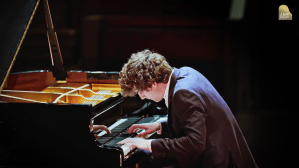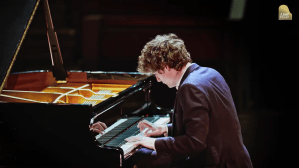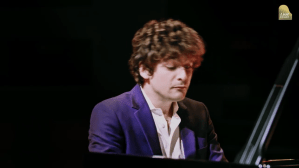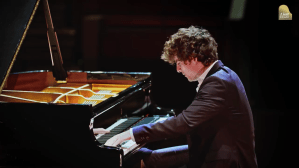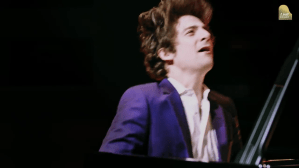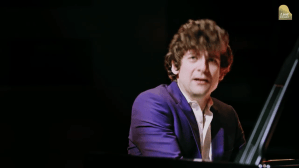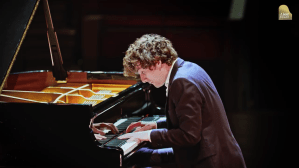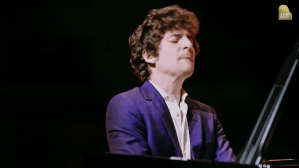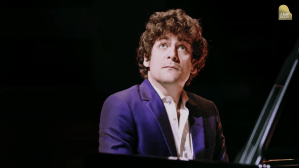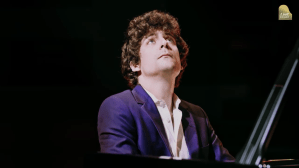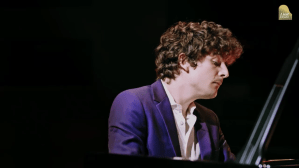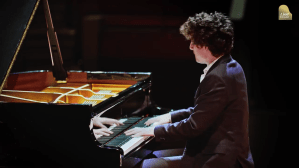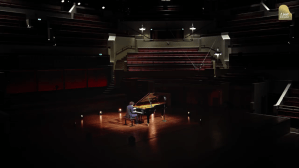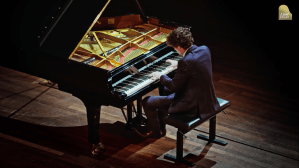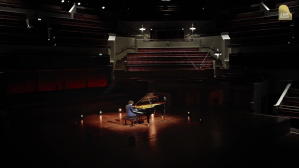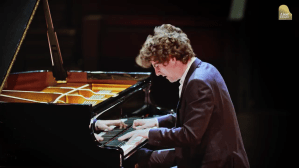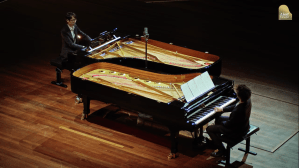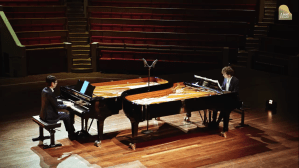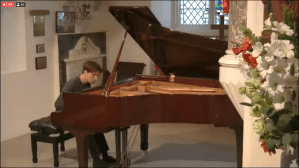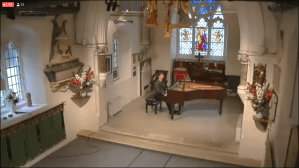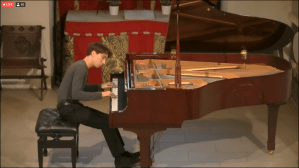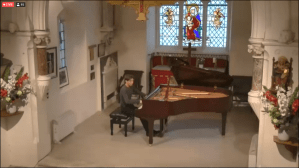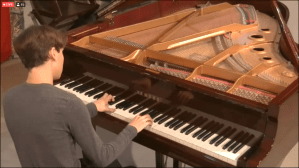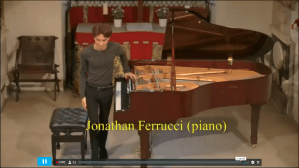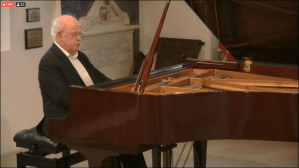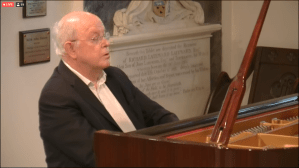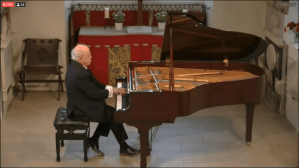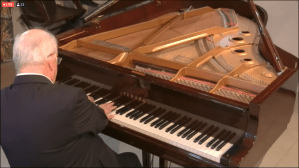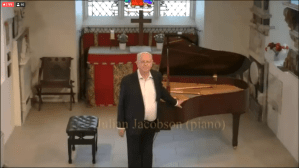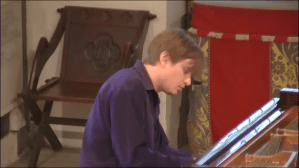
Thomas Kelly takes St Mary’s by storm

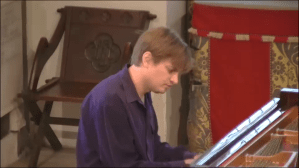
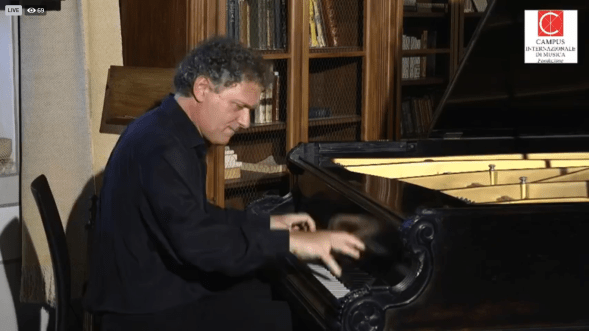
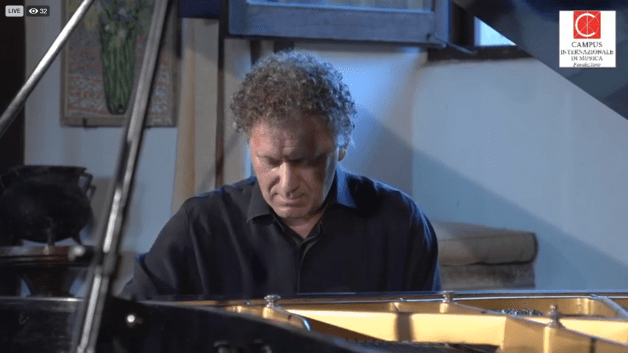
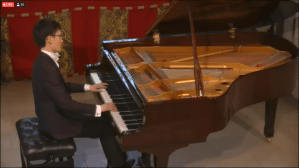
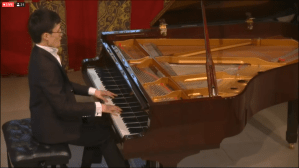
Thomas Kelly at St Mary’s
Thomas Kelly at St Mary`s

Today’s programme
I first heard this 22 year old pianist at the Royal College of Music during the annual Joan Chissell Schumann competition.
There were some fine performances of many of the masterpieces that Schumann wrote one after the other from the Abegg variations op 1 to the Eight Novelettes of op 21 and on.
A continuous series of masterpieces.
But it was a performance of op 9 Carnaval that caught my attention for the liquid sound and natural pianism almost of Nelson Freire dimension.
Some things cannot be taught and the God given gift to communicate has been given only to a chosen few.
They may exceed in rubato or excess of bravura but there is a quality of sound that goes straight to the heart in a direct musical conversation.
Thomas Kelly ran away with the prize and I can just see Joan Chissell with a smile of recognition on her face.
She was a critic who could in just a few well chosen words illuminate her articles in the Times.
Mr Rubinstein the `Prince of Pianists` has remained in my memory as was her description of  Villa Lobos` O Prol do Bebe` :’Mr Rubinstein turned baubles into gems.’
She could be harsh and unforgiving too and I remember Peter Katin telling me that he implored the Times not to keep sending her to his sold out Chopin recitals in the Festival Hall!
And so it was today that I was able to hear Thomas Kelly in a full recital for that connoisseur of young musicians Dr Hugh Mather.
I was not disappointed,on the contrary ,Thomas has matured without damaging his great natural talent and what we were privileged to hear today was quite extraordinary.
The only other pianists that I could liken his sound to are Leonard Pennario or Byron Janis or almost a Curzon.A liquid sound that is so pure and never with a hard edge.A sound that could go on forever in any direction.
It is a question of super sensibility to balance and a completely relaxed arm allied to ears that listen to every single nuance with a masterly control of the pedals.
That is a very simplified way of describing a sort of piano genius and in a nutshell that was what we were treated to today.
Starting with Schubert’s little A minor sonata D.784 which immediately showed his extraordinary range of sound.
The purity too of the opening theme that returns even more delicately after the menacing bass trills that were so beautifully calculated.
The initial outburst never exceeding the great architectural line created led so naturally to a heartmelting second subject.Magic was in the air even more etherial when the right hand embellishments were added.
A perfect sense of lilt in the developement section contrasted so well with the mighty dotted octaves and allowed a magical transition back to the recapitulation.
The final sighing farewell was played with a nostalgia and beauty of sound that was quite memorable.
A sumptuous sound for the Andante contrasted so well with the menacing dotted rhythmic interruptions played very clearly and precisely even though pianissimo.Maintaining the flow that Schubert asks for, the return in the tenor register of the main theme with magical embellishments high in the upper register created an otherworldly atmosphere.
This is surely one of Schubert’s most beautiful utterences full of both subtle tenderness and hint of menace.
The last movement entered in a whisper like Chopin’s B flat minor Sonata with’ the wind blowing over the graves.’
The difference is that here it was full of joy and Schubert’s endless melodic invention adding only to the glow of the contrasting episodes.
A true ‘Allegro vivace’ beautifully maintained to the very end with the famous octaves dispatched with an ease and sense of cantabile that is rare indeed.The final three chords played in crescendo and not the usual slam of the door that we are used to in lesser hands.
I remember Radu Lupu playing this sonata in the opening round of the Leeds Piano Competition and although his sound was even more etherial he together with Gilels a few years later in the Festival Hall had opened the pandoras box of one of Schubert’s most beautiful early creations.
Thomas too today has been touched by the same magic wand and his care and attention to detail kept us following his every move.
Kinderscenen by Schumann maintained the same magic with a visit from beautifully simple ‘foreign lands’ leading to a most charming ‘curious story.’A lovely ending to ‘blind mans bluff’ and has a ‘child’s imploring’ ever been more persuasive?Interrupted by a really ‘important event’ that gradually disappeared into the distance as a dream came floating in on a cloud of ravishing beauty.
A’ fireside’ both welcoming and warming and the ‘knight on the hobby horse’ entering at first so delicately.Could it have been a ‘dream’ as he mused ‘almost too seriously and frighteningly’ with such fantastic fantasy.The ‘child falling asleep’ on a truly magic wave of sumptuous sounds with a beam of light illuminating the entry of’ the poet who speaks’ so eloquently with sounds pulled out of this magic box that were so beautiful.
All this was conveyed by this young man as a Curzon or a Cortot could do in the past bringing to life Schumann’s fantasy of a child’s dream world.
The Scriabin Fantasie op 8 opened up a world of subtle insinuating sounds.
An opening that had the quiet menace of things to come.Thomas has the ideal sound for Scriabin where his liquid sound world gave endless possibilities of unsuspected directions. Scriabin’s luxuriant melodies emerge to disappear almost immediately in a couldron of kaleidoscopic sounds.Gradually re-emerging in romantic triumph.
A virtuoso performance that led the way for the almost orchestral sounds in Liszt’s Reminiscences de Norma.
Here he could let his hair down and fearlessly treat us to one of Liszt’s masterly revisitation of Bellini’s Norma.
Enormous orchestral sounds dissolving into heartmelting cantabile.
The menace of the war turning into the most demonic show piece of transcendental difficulty thrown off with all the ease that is needed and rarely offered.
The final duet between the two voices was really breathtaking in its unrelenting crescendo to the end.
As Dr Hugh Mather exclaimed an exhilarating afternoon of quite phenomenal playing that can all be relived on the magnificent streaming from St Mary’s Perivale .

Tea for two- Leslie Howard 45th Wigmore Celebrations and Burnett Thompson The Age of Mayhem

Tea for two -Leslie Howard 45th Wigmore Celebration and Burnett Thompson “The Age of Mayhem”
It may seem strange to talk about two concerts together but as coincidence would have it Leslie Howard ‘s 45th Anniversary Concert coincided with Burnett Thompson’s at the Church of the Annunciation,just a stones throw away.
Leslie is a founder trustee and co artistic director of the Keyboard Charitable Trust created by his mentor Noretta Conci-Leech.
Burnett has for many years befriended Keyboard Trust Artists at the Maazel Estate in Virginia of which he was an artistic director.
The only thing to do was to divide the concerts in half – I did the only thing possible and divided Leslie into two thirds and much to my sorrow Burnett a third.
As it turned out they both have much in common.

Burnett Thompson on  stage with Chloe Mun on the Maazel Estate in Castleton,
A complete command of the instrument and a sense of fantasy and colour of true musicians that actually listen to themselves!
Burnett of course in the jazz idiom and improvising with such intelligence and humour.
Rameau himself could not have made better imitations.
The art of improvisation and discovery has almost been lost in our quest to interpret the scores of the great masters from Bach to Liszt – who were both in their day the greatest of improvisers.

Leslie Howard programme
Leslie is a great interpreter and knows the scores intimately which in turn gives him great freedom.
Always having to keep on the straight and narrow of the path indicated by the composer in the many editions and changes in manuscript that have to be consulted.
The few lines in the programme written by Leslie immediately show his intimate knowledge of the composer and the scores which he puts over with the same intelligent wit that Burnett did just around the corner.
Beethoven’s description of his Sonata op 22 that “hat sich gewaschen”- has washed itself —meaning that he himself was very pleased with it.
Leslie is a mine of information.
His insatiable appetite made him nearly 50 years ago the great favourite of Guido Agosti in Siena.
Guido Agosti was one of the greatest interpreters of his day.A disciple of Busoni , musicians would flock to his studio in the summer months in Siena to learn secrets of interpretation that only he seemed to have the key to.
I well remember Leslie playing op 101 to Agosti and the great master being so impressed with his scholarship and complete command of the instrument.

Burnett Thompson :Reformation Age of Mayhem
Burnett had presented his programme :Reformation :Age of Mayhem.The project began in Washington DC and premiered in New York at the renowned Mezzrow Jazz Club.The CD will be released on 1st December.
It is a non-traditional look at the mid-16th century history and culture via the music of the time.
Medieval and Renaissance repertoire were complimented by Burnett’s own compositions.
A last minute recital date was invented by Sasha Grynyuk and Katya Gorbatiouk to perform as part of the London Town Chamber Fest in the Church of the Annunciation.

Burnett Thompson and Dudley Phillips
Only an upright piano was available but in Burnett’s hands he turned it into gold.
Full of shimmering colours and magic sounds where the music took wing and spoke so eloquently sometimes with Messiaen overtones and others with the mischievous humour of Rameau.Always in the magic jazz idiom that seemed to pour from his fingers with such ease.
Aided and abetted by bassist Dudley Phillips .Burnett with the dry humour of a Woody Allen.
I had to drag myself away with a heavy heart.
But magic awaited just around the corner too .
I arrived just in time to hear most of the Mozart Sonata K331 from the very comfortable divan in the foyer of the Wigmore Hall.
As Leslie himself says:one of Mozart’s best loved sonatas with all three movements in the home key of A major and with the complete absence of any movement in ‘sonata form’.
Fascinating to read in so few lines that Mozart very likely employed his ‘banda turca’ pedal with its simultaneous stroke of bass drum,triangle and cymbals!
Leslie played it with two hands and two feet in the traditional manner on the rather bright sounding house Steinway.Of course played in great style and the discovery of an original autograph manuscript in Budapest in 2014 led to several striking deviations from the familiar text.
Many great virtuosi of the past play the closing Alla Turca as an encore piece.Cherkassky used to play it with a teasing jeux perlé contrasting with the great roll of the left hand drums.
Of course Leslie played it in context and it was even more impressive following on as it should from the beautiful opening variations and charming Menuetto.

Leslie greeting his enthusiastic audience
The sonata in B flat op 22 ,as Leslie again points out’  brings the sonatas of the so called first period to a very happy and robust conclusion. ‘I had never thought of the last movement being so similar in mood to that of op 7.
The opening theme and key points,of course, to the greatest of all piano sonatas :Beethoven’s “Hammerklavier” op 106.
I had heard Richter play op 22 many years ago in the Festival Hall and had not understood a critic complaining that much was inaudible.
I was just a student and had much to learn but now I understand that the great Russian school sometimes took Beethoven’s extremes of dynamics to its limit without actually thinking of the great architectural line.
That was not the case today where Leslie’s scrupulous attention to detail was allied to the overall shape not only of each movement but also of the whole.That may explain why the second movement marked’ Adagio con molta espressione’ seemed to move as an ‘Andante con moto.’It is marked in 9/8 but I found it just a fraction too fast as an Adagio in feeling although I am sure that Leslie has  very definite reasons for chosing that tempo.
It was played with a beautiful cantabile sound and a bass that sustained without counting the beats.

Noretta Conci Leech with Kathryn Page Mclachlan
The Menuetto bubbled along in a very simple way that made the Beethovenian outbursts all the more surprising.
The return after the ‘minore’ was like the return of an old friend.
The entry of the Allegretto was like a refreshing return to the countryside with the bubbling brook and feeling of tranquility.
As Leslie says in his notes:’there remains throughout the air of this being a good job well done.’
After the interval the age of Mayhem indeed reigned.
It was as though a new wind had blown into the hall from the moment Leslie sat at the piano to play Liszt.
Leslie has made a lifelong study of Liszt and after his historic 10 recitals here of all the works of Liszt he has recorded them on 100 CD’s ..he is in the Guinness book of records no less!
Here the piano was ablaze with subtle colours and a range from the almost inaudible staccato to the tumultuous sounds of a truly “Grand” piano.I know it is probably sacrilege,and may Leslie forgive me for even thinking it, but I could not help musing that some of these wondrous sounds surely he could have shared with Mozart and Beethoven too!

In the green room with great fan Simon Callow
‘Trois Odes funèbres’ were written to be played together but as Leslie states they have never been published together and have rarely been performed as Liszt desired.
The first ‘Les Morts’ was prompted by the death at only 20 of his only son Daniel.The second ‘La notte’ was composed after the death in childbirth of Liszt’s first daughter Blandine.’Le triomphe funèbre du Tasse’ was a self portrait believing as Liszt did that his time too would not come until after his own death.

With pianist Tyler Hay
Some extraordinary playing of true mastery.
Like Rubinstein hardly seeming to move but the sounds he found inside that old box of strings and hammers were quite extraordinary.
Here was Leslie Howard the world authority on Liszt sharing with us with his searching mind and intellect ,some of the lesser masterpieces of this very often misunderstood and underrated composer.

With colleague of the Liszt Society pianist Mark Viner
It was only fitting that to contrast with all this morbosity even Leslie should let his hair down and show us the other side of Liszt.
The travelling virtuoso astonishing the courts of the whole of Europe with his amazing bag of funabulistic tricks that he pulls out of his magic bag one after the other.
A transcription I had not heard before based on Robert le Diable de Meyerbeer.The Cavatina and the Valse Infernale.

With fellow pianist Vitaly Pisarenko
Leslie visibly exhausted as I expect Liszt himself would have been.
Ever generous and by great demand he let us hear his ‘sigh’ of relief.
’Il sospiro’ was absolute magic.
A wonderful wash of sound on which Liszt’s magical melody could float.An expertly handled tangled knot in the middle led to an ending that I would not be surprised was another discovery that this master musician had discovered on delving deep into the archives of the great composers.

with Simon Callow

with Kathryn Page Mclachlan

Viva Alberto Portugheis and the Thomas Harris International Piano Foundation

Alberto Portugheis Festival
A week of intense study in the masterclasses that the indefatiguable Alberto Portugheis holds each year in London.
At the age of 78 he has an activity that would wear anyone half his age out.
Between his lifelong passions of music and peace work he still finds time to play with his great friend Martha Argerich.
In fact they shared their 75th birthday at a Wigmore Hall concert three years ago and he tells me there is an 80th in view for 2021.
In August there will be a Carnaval of the Animals in London St James’s 12/8 and Oxford Sheldonian 13/8 for this duo that was formed as children together in their home city of Buenos Aires.
And so I was invited to listen again this year  to the students that had spent some days in preparation for the final concert ar Steinway Hall.

Steinway Masterclass Concerto Programme  page 1
A very fine Bach Chaconne played by the eighteen year old Matthew Mclachlan continuing his studies with Dina Parakhina on a full scholarship at the RCM in London.Having already studied with her for many years in Manchester after his early training from his father Murray McLachlan head of keyboard and much else beside at Chethams Music School.
His elder brother, Callum, is studying in Salzburg; his younger sister, Rose, has just played Shostakovich 2 with the BBC Concert Orchestra and the youngest brother  is a professional junior footballer for Everton!
A family of winners indeed under the expert guidance of their mother Katherine Page McLachlan,herself a very fine pianists having met her husband at the RCM some years ago.
A Bach Chaconne that showed a great sense of architecture allied to a subtle sense of colour and great temperament .

Steinway Masterclass Concerto Programme page 2
Some beautifully shaped pieces by Graziela Jimenez were played by the Argentinian from Mendoza Juan Antonio Sanchez.
A Debussy study “ Pour le notes repétées” was played very cleanly and correctly and is obviously work in progress under the expert guidance of fellow Argentinian Alberto Portugheis.
Zoltan Galyas chose to play with Sophia Ramnarine the A major Sonata of César Franck.Some very beautiful moments mixed with some intonation problems not completely resolved.The infamous second movement was played with great virtuosity by Galyas no doubt helped by Alberto who has learnt the “tricks of the trade” from the many fine performances that he himself has given over the years.

Nicolas Absalom
Nicolas Absalom played Beethoven’s op 2 n.2 and once again ( having heard him a few months ago in St Martin in the Fields and last year in Beethoven Piano Concerto Competition) showing his very precise touch and musicality.He tells me he is preparing for the Beethoven year with Concertos n. 3 and 5 and many solo works by the great master in his 250th anniversary year celebrations in Vienna.
In fact today he is playing for the Thomas Harris Foundation in Rye a complete Beethoven recital programme.
Artur Haftman I have known since his very first year at the RCM under Dmitri Alexeev.
He played a Mozart Sonata K 281 with some beautiful phrasing and very sensitive touch allied to a very secure technical command.

Mathew McLachlan
Strangely his A flat Polonaise op 53 by Chopin suffered from a rather wayward rubato that robbed this most “Heroic” of all polonaises of its nobility and almost military stance.
Mrs Judy Harris had very generously donated prizes for the best performances that went of course to Artur Haftman and joint second to Nicolas Absalom and Mathew McLachlan
Last year was the Beethoven Piano Concerto Competition linked to the week of study and Masterclasses .
This year the Concerto Competition was dedicated to Chopin with the Orpheus Ensemble led by Orpheus Leander .

Artur Haftman in Chopin 2nd Concerto
Two performances of the 2nd piano concerto and one of the 1st Concerto.
Unfortunately two of the performances were very much work in progress.
Juan Antonio Sanchez showed the makings of a very classical approach with some beautiful aristocratic cantabile full of noble sentiment but not for a minute sentimental.With work in progress it should develop into a fine performance.
Zoltan Galyas showed signs of a great natural technical fluency more wayward than Antonio in the cantabile passages but with a fine sense of colour that now needs to be refined and perfected.
Both played from the score.
Artur Haftman came into his own with a very fine account of the 2nd concerto.
Played with great authority with an ensemble that were not at ease with the score.
He led the way and if there were a few stumbles in the last movement they were a small price to pay for a very secure musicianly performance.

CA ,Bobby Chen, Alberto Portugheis .Alberto Urroz,Mrs Judy Harris
Artur was awarded the prize from the Thomas Harris Foundation judged by Bobby Chen ,Alberto Urroz and myself who is only too happy to help Alberto in all his commendably worthwhile enterprises.
Hats off to Mrs Judy Harris and her illustrious consultant Albert Portugheis for offering a platform and much more besides to these aspiring young musicians.

Zoltan Galyas

Juan Antonio Sanchez

Artur Haftman with Bobby Chen and Alberto Urroz

Anna Tsybuleva – Mastery at St Marys’

Anna Tsybuleva – Mastery at St Mary’s
CPE Bach: Piano Sonata in A major, No.4 W55
Beethoven: Piano Sonata in D minor Op 31 no 2Schubert: 12 Deutsche Ländler, D790
Schubert: Fantasy in C D760 ‘/Wanderer’

It was a few years ago that I heard Anna Tsybuleva’s London debut at the Wigmore Hall as winner of the Leeds International Piano Competition.
I had met Dame Fanny Waterman,the founder and lifeblood of the Leeds, in Oxford.
Later,the next spring, in wishing her birthday greetings from Italy we discovered that we had both heard a magnificent concert transmitted live from the Wigmore Hall on BBC Radio 3.
She in Leeds and I in Italy.
We had great fun exchanging views and saying how wonderful the concert had been with Graham Johnson at the piano (I cannot remember the name of the very fine baritone) .
We both agreed that Graham is one of the greatest accompanists of our day, a just heir to Gerald Moore and Geoffrey Parsons.
Graham and I were contemporaries at the Royal Academy and even shared, in our first year, chamber music coaching from John Streets.
I put Graham and her in touch much to their mutual delight.
So when we met at the Wigmore Hall at the end of Anna’s recital I
was pleased to say in person how much I had enjoyed the second half of the recital.
I did not say that the first half of CPE Bach and Schumann had left me very perplexed whereas the second of Debussy and Medtner was quite superb.
”You must have been asleep in the first half then” she immediately replied!
Dame Fanny is invariably right and judging by what I heard today she may very well have been or at least saw what potential lay behind the notes having heard Anna in all the rounds in Leeds that led to her ultimate victory.
A CPE Bach that I heard today, with the superb streaming from St Mary’s, that showed a complete mastery.
An infectious almost electric sense of rhythm and a great sense of characterisation.An almost euphoric enjoyment as she played with such spirit and obvious joy.
The transition, quasi recitativo, from the Allegro to the Andante was quite magical and played with a subtle sense of colour and rubato that made every note speak so eloquently.Deeply felt, it led into the Allegro finale played with great contrasts and a conversation between upper and lower registers of the keyboard that was quite exhilarating.
I think Anna has matured and grown in confidence since her Wigmore debut recital and as she herself said she felt at home at St Mary’s.With such an appreciative warm audience she could relax and enjoy the music too,
The trial was over and she could allow the artistry, that Dame Fanny had noted, to flower and mature.
It was the same with the Beethoven Sonata op 31 n.2 (The Tempest).
It reminded me of the debut recitals of Ashkenazy when he too played the sonatas op 31 together with the Chopin studies in two memorable recitals.
It was as though we were hearing these well known works for the first time such was the complete mastery of sound and colour.
A complete understanding of the style and above all Beethoven’s indications scrupulously interpreted.
Not just played because written on the page but as Murray Perahia has said in his memorable interview with Arie Vardi on you tube:”a true artists has to understand what in his opinion the composer wanted to convey and translate that into sound but also adding his own personality and experience too.To make the music a living experience. “ https://youtu.be/T-RHiS4H_xE
Her performance today was like quicksilver in the changes of colour and character and it made one realise just how revolutionary this fairly early work of Beethoven’s must have been received by the public of the day.
Respecting also how the music was written on the page.
There was no changing of hands to hold long bass notes as is so often the case but she hinted at them the same.
Beethoven’s long pedals were beautifully interpreted and the staccato pianissimo chords that led back into the allegro sounded like the orchestra coming in after the cadenza.The deep bass notes especially in the recitativi were quite overwhelming in their quiet authority. The deep bass pianissimo rumblings and the two final chords created the magic for the personalities that were to enter centre stage in the Adagio.
The music spoke with such immediacy that one could almost see the curtain rising for the drama that was about to unfold.
The contrasts between the sumptuous melody and the dotted rhythm after dry comments from the timpani and flutes was wonderfully realised.The telling dotted rhythm beautifully poignant (I would have kept the rhythm after the right hand turns that she chose to relax).Ending in a murmur always with that dotted rhythm in view.
The Allegretto drifted in lazily gradually picking up momentum.
There was a delicious lilt to the rondo theme with a very telling rubato so subtle as to be almost unnoticeable.
A meticulous attention to detail that was just as I remembered Ashkenazy all those years ago when I heard this sonata in the Festival Hall for the very first time.
A beautiful music box effect before the final triumphant entry of our,by now, old friend disappearing like scarbo into the quiet depths of the keyboard.
A quite remarkable performance that kept me mesmerised thousands of miles away in the depths of the Italian countryside.
The 12 Schubert Landler showed a great sense of style sometimes with a great Viennese lilt or a beautiful sense of legato.An almost Chopinesque rubato and elegance sometimes of great nostalgia or great majestic rhythmic impulse .They were a kaleidoscope of emotions and colours played with such emotive participation.
It led to a monumental performance of the Wanderer Fantasy. A great sense of architectural shape that did not allow her to wallow or alter the great rhythmic drive of the first movement.
There was great attention to detail and the chords usually bashed out fortissimo in the recapitulation were played as Schubert indicated in the score and were integrated into what had preceeded them.
Schubert has written out his own ritardando before the Wanderer Adagio and if respected, as today, it is even more poignant than the usual slowing down.
Very subtle expression so similar to the great lieder for which Schubert is best known. The left hand demisemiquavers just a subtle link to the magical appearance of the melody with a typical Schubertian accompaniment.Embellishments gleaming like magic as the bass filled in the harmonies leading to a great passionate outburst.Dying away on a cloud that links up to the Presto.Great washes of sound and a lovely lilt to the waltz in the middle episode.

With our host Dr Hugh Mather
A passionate climax led to the Allegro fugato that was played with ever more fervancy and rhythmic drive.
A Hymn of triumph with a great sense of balance and contrasts even in the most troubled waters.
An ovation from a packed audience that had come to hear this great young artist.
They were rewarded with scintillating encore of Saint Saens’ “Etude en forme de valse.”
A great ‘cavallo di battaglia’ of Alfred Cortot. It’s technical difficulties thrown off with an ease and nonchalance that is of a different era.
The Golden Age of piano playing indeed.
There were seemless streams of gold that we were treated to today.
Will Dame Fanny ever forgive me?
Anna Tsybuleva shot into the international spotlight in 2015 when she won First Prize in the Leeds International Piano Competition, being described as “A pianist of rare gifts: not since Murray Perahia’s triumph in 1972 has Leeds had a winner of this musical poise and calibre”. Now a regular performer in major cities worldwide, Anna’s early experiences were more modest: born in 1990, she was raised in Nizhny Arkhyz – a small village of approximately 500 inhabitants – in the Karachay-Cherkess Republic of Russia. She took her first piano lessons with her mother at the age of 6, before moving away from home in order to attend the Shostakovich Music School in Volgodonsk at the age of 9. From age 13, she continued her studies at the Moscow Central Music School and the Moscow State Tchaikovsky Conservatoire, under internationally renowned pedagogue Professor Lyudmila Roschina. During this time, Tsybuleva garnered other major competition wins – including the Grand Prix of the International Gilels Piano Competition (2013), and top prizes from the Hamamatsu International Piano Competition (2012) and Takamatsu International Piano Competition (2014). After graduating in 2014 with the coveted award for ‘Best Student’ from the Moscow Conservatoire, Tsybuleva furthered her studies with Claudio Martínez-Mehner at the Hochschule für Musik Basel. She now combines her international performance career with completion of post-graduate studies at the Moscow State Tchaikovsky Conservatoire.
Tsybuleva appears regularly throughout Europe, including in recital on some of the greatest international stages, such as Palais des Beaux-Arts , Philharmonie Luxembourg , Tonhalle Zürich , and the Wigmore Hall . As concerto soloist, recent and forthcoming highlights include Basel Symphony, the Hallé, Mariinsky Orchestra, Oxford Philharmonic, Royal Liverpool Philharmonic, Royal Philharmonic, and the St. Petersburg Philharmonic Orchestra. Tsybuleva is in high demand in Asia, with recent and forthcoming concerto engagements including those in Singapore (Singapore Symphony), South Korea (Daejeon Philharmonic), and Japan (Tokyo Philharmonic), as well as recitals at the Shanghai Grand Theatre and Hong Kong Concert Hall, amongst others. Her debut solo recording, Fantasien (Champs Hill, 2017) garnered universal praise for its imaginative and carefully crafted programme. With her “energetic elan, bravura, and heart-on-sleeve communication” (International Piano Magazine), Anna Tsybuleva is fast emerging as one of the finest pianists of her generation, “destined to become a world piano star” (APE Musicale, Italy)

Roma Tre Orchestra at Palazzo Chigi Ariccia – Mozart home sweet home

Roma Tre Orchestra at Palazzo Chigi Ariccia -Mozart home sweet home
The magnificent Bernini Palazzo Chigi in Ariccia was the scene of an all Mozart concert with the Roma Tre Orchestra under Filippo Manci with two young solists Ivos Margoni and Matteo Rocchi.
It is a collaboration between the Giovanna Manci Accademia Sfaccendati ,the Campus Musicale di Latina and the Roma Tre University.

Valerio Vicari with the 20 year old violin soloist Ivos Margoni
The orchestra was founded in 2005 and is the first University orchestra to be created to make great music more accessable to young people whilst giving young musicians a chance to excel.
The Roma Tre Music under the artistic direction of the dynamic and very knowledgeable artistic director Valerio Vicari has a season of music that fills a 22 page catalogue!
A series of concerts that gives the opportunity to so many young solists as well as their orchestra to perform in their three principal halls:Teatro Palladium,Teatro Torlonia and the Great Hall of the University.
They have now found a collaboration with the Campus Musicale in Latina which has for the past sixty years held summer masterclasses in Sermoneta.Created by Menuhin and Szigeti in the 60’s in the Caetani Castle overlooking the valley that leads down to Latina.
It has recently opened its archive to the public with precious scores of Goffredo Petrassi ,Barbara Giuranna and many other illustrious composers who have bequeathed their works to the Campus.

Giovanna Manci with conductor brother Filippo
Giovanna Manci has with her husband Giacomo organised concerts in Ariccia and elsewhere for the past 5o years from 1969- 2019.
So the circle is complete with the Orchestra provided by the University.The two soloists by the Campus di Latina and the splendid hall in Ariccia by the Accademia Degli Sfaccendati.
Ariccia is well known in the Castelli regione above Rome for its roast suckling pig and and a famous bridge that was a favourite lovers leap!

Palazzo Chigi in Ariccia
The Castelli regione though was also on the Grand Tour in the 18th and 19th Century with illustrious visitors that included Franz Liszt and Mozart who would visit the sumptuous villas and magnificent gardens in the hills above Rome.
As Giovanna Manci said in her opening welcoming address it may very well be that we are playing a Mozart programme in the same hall where Mozart had performed.
Italy in the words of Rostropovich really is the ‘Museum of the World’ and the more one delves the deeper one can go!
I have known Giovanna for over forty years from when her father,our bank manager, asked my wife if I would audition his daughter who he thought had a nice voice.It was one of the most beautiful voices I have ever heard and I was fast on the telephone to ask Michael Aspinall (who at the time was writing the embellishments for Monserrat Caballe and Joan Sutherland as well as imitating them on stage)  if he would teach her.Of course he brought the voice to fruition and she gave many fine performances some even with me at the piano!
She now dedicates herself to helping young musicians find a platform in the many venues that her husband Giacomo has created over the years.

Filippo still the little boy that I remember
Filippo was a little boy who had just started to play the organ and for me had remained as I remembered him.
So I was very surprised and taken aback when I saw him conduct so expertly two very complex works by Mozart.
Filippo is a ‘natural‘he moves and directs in a way that after acquiring the necessary technique cannot be taught.
He feels and moves with the music as though it was in his bones.Not only that but the little A major Symphony K 201 was played with a style,charm and lightness that is so hard to achieve.
I was told he had worked hard with the orchestra but hats of to them all that they had succeeded so beautifully.
The second work in this ‘All Saints’ concert was the sublime Sinfonia Concertante K.364 with the two young soloists Ivos Margoni,violin and Matteo Rocchi,viola.

Ivos Margoni and Matteo Rocchi
Matteo Rocchi moved so naturally with the music but sometimes played with too much romantic rubato.Ivos Margoni was remarkable for his rock solid playing and with experience he too will move and use his whole body to express the music.
Both technically superb with Ivos hardly glancing at the score and Matteo moving so musically too.
The playful Presto finale was thrown off with great ease and charm .Filippo always ready to follow and out charm them in a conversation that was quite scintillating.The sublime Andante was helped by the sumptuously expressive playing of the orchestra.
The first movement played with all the opening fanfare that Mozart demands with Allegro Maestoso.
A real ovation for these two young musicians and it was very good to see that all the members of the orchestra were justly listed in the programme too.

A suite by Handel from our two solists
A ovation for all and in particular for the two young virtuosi who put the music to one side to play an encore of a Handel Suite in a transcription of Holvorsen (thank you Valerio for that information).
A virtuoso transcription which allowed our two young solists to let their hair down and treat us to a truly virtuoso exhibition all the more astonishing as it was a complete suite from memory!
A good look around the remarkable museum in the Palace and the propect next time of walking around the historic gardens.
And after the concert, suckling pig sandwich and a glass of Castelli wine was a must before leaving this atmospheric town perched in the hills above Rome.
I was happy to relistened to the remarkable concert of Martha Argerich trasmitted live on the car radio from S Cecilia in Rome.
Who knows – Filippo is waiting in the wings all he needs is a nudge and a wink from Pappano !
Tonight he conducts the Mozart Requiem in memory of Karajan in the great Basilica of St Anselmo on the Aventine Hill in Rome.
The little boy has certainly grown up!

Roma Tre Orchestra

The beautiful Bernini Church in the square opposite the Chigi Palace

Wonderful ensemble of orchestra and solists

The museum in the Chigi Palace

A legend speaks – Martha Argerich in Rome

A legend speaks……..a change of programme but what does it matter when whatever she touches turns to gold.
Martha Argerich is quite unique and in a state of absolute grace as Rubinstein was once he passed the three score years and ten.
A lifetime of music making distilled like a great wine into an experience of a communication that pours out of her like a great wave and even takes her by surprise.
The art or recreation indeed.
A prism that glistens like jewels in the sun.
Its great rays fireing off multicoloured colours from the almost inaudible to the most sumptuously rich sounds that like Rubinstein belies their age.

Not forgetting the triangle player
Her tiger like attack in the opening octaves of Liszt 1 was breathtaking not only for the passion with which she dispatched them but for the full rich sound never hard or metallic.
A truly ‘grand’piano.
Her great sense of balance like Cherkassky “the man she loved “to quote ‘Le Monde de la Musique.’Listening so carefully and with such love to each individual note and not afraid to split the chords almost imperceptibly to find the colours therein.
A wonderful ‘jeux perlé’ knowing exactly which notes to accentuate to give such a foreward impetus.
Her melting self communing cantabile was of such seductive beauty but with a sense of projection that carried to the far corners of this vast hall of Renzo Piano- Sala S.Cecilia Parco della Musica Rome
‘Widmung’ by Schumann/Liszt was played as though she was alone and dreaming of one of Schumann’s most magical melodies.
Hardly aware that there were over 2000 people hanging on to every note.
The passionate climax after the intimacy of the opening was quite overwhelming as it grew so naturally out of the preceeding hymn.
It died away to a whisper as we eavesdroppers hardly dared to breathe.
So much for changing Chopin 1st concerto to Liszt Ist because of fatigue after endless tournees.
Walking off the stage arm in arm with her great friend Sir Antonio Pappano she looked tired but she certainly did not sound it!
El Dorado has arrived
Rai radio 3 tonight 1st November at 20.30(Italian time) 19.30 UK ….”May the Saints come marchin’ in “ indeed

Hand in hand with the triangle player

The Rising Star of Chloe Jiyeong Mun

The rising star of Chloe Jiyeong Mun
Chloe Jiyeong Mun takes London by storm
With no one to share my thoughts with on the N.9  at 1 am I decided to write them down in the wake of
the complete euphoria after such a wonderful evening of music,humility and friendship.
Not a lot of takers on the night bus…….none actually!!!
“Unbelievably refined playing both tender.and passionate,intelligent but free.
Playing of such exquisite beauty that has rarely been heard in this hall since it changed its name………

C A congratulating Chloe after the concert (courtesy of G.Cox)
The serenity of op 110 was matched with the sublime simplicity of Schumann Humoresque.
Can Ravels moths ever have been so beguiling,birds more forlorn or bells so atmospheric?
Triana had us dancing in the aisles with sounds so sumptuous we could almost feel the impassioned spanish warmth envelope us.

Elena Vorotko ,co artistic director and trustee of KCT visibly moved by Chloe’s extraordinarily beautiful playing
Has the Autumn song of October ever been so full of nostalgia as in her hands today or Debussy`s rays of moonlight so full of sweet magic
Nothing like this has been heard in London for far too long.

After concert celebrations with members of the KCT and here with the founders Noretta Conci Leech and John Leech
It is thanks to John and Noretta Leech and their Keyboard Trust that we were able to hear for the first time in London this remarkable young musician, teenage winner of Geneva and Busoni Competitions as only Martha Argerich was before her!
Welcome to London the first of many more visits I am sure.”
It was with the opening of op 110 that we knew immediately there was something very special in store.
Like his fourth piano concerto it is so difficult with the very first notes of a concert to find the correct balance and a simplicity pregnant with significance and meaning.

Beethoven’s autograph score that sits on the wall in the Ghione Theatre donated by Guido Agosti on his mermorable performance of op 110 and 111 in 1983.It is the only recording of this student of Busoni that exists.We all used to flock to his studio in Siena for enlightenment and inspiration,
I remember Sidney Harrison telling me that judging the young Glenn Gould in Canada long before his celebrity he was told that he had spent hours only trying to balance the first chord.
”Who is that terrible student playing”exclaimed a friend on the other end of the line to my teacher Gordon Green in Liverpool.”Sviatloslav Richter” he replied.He had spent hours perfecting just one passage in Bartok’s 2nd that he was playing that evening with the Philharmonic.
It is the super sensibility of a selected few that can turn an old friend into a magical new experience.
Murray Perahia can do that with an intelligence that has us reaching for our scores each time we hear him play.
Chloe Jiyeong Mun is one of that select group as she demonstrated from the very first chord of op 110.
Perfectly balanced with the trill leading into the melodic line so naturally.
It created an atmosphere and bond with the audience that was to last until the final passionate explosion.

One of the greatest interpreters of our time who would share his knowledge of a lifetime studying masterworks with the musical world that flocked to his studio every summer in Siena and have never forgotten what they heard
We knew that we could trust her!
The sublime melody played as Beethoven indicates ‘cantabile molto espressivo’ but always with the left hand like a rock on which this celestial melody is allowed to float.The passionate outburst after the perfectly judged left hand trills – just reverberations leading to the final E flat- where the passion and total involvement were on a Serkin frenzied scale.
The swirling left hand in the development was superbly controlled.
Beethoven’s very precise crescendi and diminuendi were an integral part of her interpretation where the composers intentions had been absorbed so naturally.
The modulation in the recapitulation was breathtakingly magic as it must have seemed when the notes were still fresh on the page.
The Allegro molto was played not as the usual march but like a great song that the whole of this sonata really is.
A Hymn to life where technical difficulties just did not concern Jiyeong as she threw herself into the fray with such rhythmic impetus and with such a profound understanding that belied her 23 years.
The final arpeggiando left hand notes came as a great relief after the great sforzando disjointed chords.

The total concentration even in rehearsal listening so attently to every nuance
It led into the most magical of all Beethovens creations in his 32 sonatas.
The ‘Adagio ma non troppo’ with her careful use of the pedal that Beethoven indicates.
Hardly touching the keys to create the effect that the composer intended in the recitativo.We were unaware of the repeated notes, the so called bebung, which were simply made to vibrate before the Arioso dolente where Beethovens phrasing became her own.
This is the true meaning of interpreter where the composers wishes are translated into sounds in a totally convincing way.
The Fugue was at once innocent and menacing building to a climax that burst like a great bubble to reveal the Arioso as Beethoven says’ perdendo le forze,dolente.’
After the tempest- calm.
And what calm!
Revealing the absolute desolation in a song of almost unbearable beauty.
Her enormous concentration was ours as we were led into this magic final world that only Beethoven could hear but was still able to share with posterity .

Controlling a note with the piano technician before the concert
The gradual final build up at the end of this Arioso was overwelming, helped as it was by Beethoven’s own pedal which allowed the chords to disintegrate seemingly naturally.It led to the innocent purity of the return of the fugue this time inverted (upside down).
The gradual build up in note values ( written to be slower but with note values twice as fast) arriving triumphantly to the original tempo and Beethoven’s exhilarating shout from the rafters where his sforzandi were merely crescendi (not the usual blaring trumpets) so perfectly judged by Jiyeong.
One wonders why other pianists had not fully understood Beethovens’ intentions as he sang his heart out like the great Neapolitan tenors of the past.
The final cascade of notes came as such a relief from the tension that she had created and the world she had discovered and so magnificently revealed to us.
Serkin and Perahia are the only other pianist I have heard in concert who have reached the pinnacle of this great monument as she had done tonight.

A packed Wigmore Hall for the London debut of Jiyeong Mun
It was Horowitz who brought the Schumann Humoreske back into the concert hall as he did the Rachmaninov Second Sonata and many other neglected works too.
It needs a great musician who can weave their way through Schumann’s maze of different moods.
From the subtle introspective Eusebius to the outlandish jinks of Florestan.
It also needs such subtle changes of colour.
From the luminosity of sound of the introspective opening where Jiyeong’s subtle artisty knew just where to allowed the bass to reply to the treble in true liederistic fashion.

Jiyeong greeting her public in the green room after the concert
To the passionate outpourings of great technical brilliance.
The subtle legato of her octave playing was quite extraordinary as she built up the crescendo and diminuendo within the span of one episode like a camera zooming in and then retreating,
The most remarkable thing about the playing tonight was that however technically difficult there was always the subtle artistry of the voice in mind and never the guns and canons that I have so often experienced in this very complex work.
Her great sense of character where every note had a meaning was often allied to a passionate temperament that left one at times almost breathless.
Wonderful washes of colour where sounds wafted out of the pure air and were incorporated into a massive rhythmic drive.
Even great artists such as Sokolov or Richter have not been entirely innocent here.
It reminded me of the young Janina Fialkowska who had brought tears to Rubinsteins’ eyes at his first competition in Tel Aviv.
He had recognised a great poet and stylist who could make the piano sing as he had done for a lifetime.

In rehearsal a few hours before the concert
Hats off to this poet of the piano with her total concentration, listening so carefully to every sound with eyes that seem glued to the keys in a way I have rarely experienced in the concert hall.
Mention should be made in the Ravel ‘Miroirs’ where true feats of piano playing passed almost unnoticed……… except to the initiated.
Her superhuman control of sound was a revelation.
The sounds in ‘La vallèe des cloches’ were I expect, exactly as Ravel had imagined with his ‘tres doux et sans accentuation’ in pianissimo, ending pianississimo.With very precise indications of pianissimo ,mezzo piano and mezzo forte all so clearly incorporated in her realisation of Ravels’ vision of bells in the distance coming closer and then disappearing to nothing.
The lugubrious central section so beautifully sung in the middle register’largement chanté’ .Could it have ever sounded so sleepy and atmospheric as today?
The repeated notes and glissandi in thirds in Alborada were quite astonishing in the way they were thrown off as pure washes of sound. The spiky dance rhythm was played with velvet gloves and a real feeling of a frenzied dance.
It brought a spontaneous ovation from a public entranced and astonished even though there was still the ‘Vallée’ to come.
The supreme calm after the storm again.
Even more beguiling in this magic world that Ravel creates fifty years on from Beethoven.
One could write a book about what we heard tonight but I think it is enough to say that nearly all those present will not forget the magic and beauty that was created by this remarkable young lady.
It is surely no coincidence that she and Martha Argerich had both won Geneva and Busoni competitions as teenagers.
Both can create such magic as only great masters can with their total dedication to their art.
I had toured USA with her last year and am pleased to include s record of her reception and success on that memorable occasion.
After such a memorable occasion it was only fitting to have a suitable celebration with the friends of the Keyboard Trust and our founders Noretta and John Leech.

John greeting Jiyeong and her mother
John in his 95th year made a moving speech of warmth and appreciation for the debut of Chloe Jiyeong Mun as winner of the Career Development Prize offered to the most talented pianist at the Busoni International Piano Competition in Bolzano.
A competition that Noretta Conci-Leech has attended since the very first one in 1949 where Alfred Brendel took fourth prize! (He is an honourd Trustee of the KCT)
The Prizewinners Series held every year at the Wigmore Hll for the past decade was the idea of KCT founder member and trustee Dr Moritz von Bredow.
He has generously sponsored the concerts that from the very first with Lilija Zilberstein  have included since: Alexander Romanovsky,Michail Lifits,Jayson Gilham,Vitaly Pisarenko,Sasha Grynyuk,Alexander Ullman,Emanuel Rimoldi,Mark Viner .

Jiyeong with Mrs Jocelyne Fox in the green room

The many friends of the KCT including co artistic director Leslie Howard in the foreground

Affectionate ‘thank you’ to KCT founder father John Leech

Charles Whitehead Pianists of the World Series at St Martin’s

Charles Whitehead Pianists of the World Series at St Martin’s
Charles Whitehead at St Martin in the Fields
Some very assured playing from this American based pianist.
A luminosity of sound in the Scriabin 5th sonata ignited the atmosphere with a sensual sense of colour with great rhythmic impetus and chiselled sounds of great purity.
It was the clarity and purity of sounds together with a great sense of line that suited so well the fourth of Shostakovich`s Preludes and Fugues.A passionate almost obsessive climax to the fugue was very impressive if rather monochromatic.
Lovely to read in the programme of our adored Tatiana Nikolaeva who had been the inspiration for Shostakovich`s monumental 24 Preludes and Fugues when he heard her play in 1950 in the Leipzig J.S.Bach Centennial.
It was exactly this chiselled clarity that suited so well Messiaen’s expression of faith in the” Contemplation of the Son,the Word of God,looks upon the Son,the child Jesus.”
Sounds that wafted into the heights of this great edifice with pungent accuracy and insistence.
Wonderfully moving ending as the sounds gradually dispersed into oblivion.
The fifth of Messiaen`s twenty musical portraits of Christ child written in 1944,shortly before the liberation of Paris from the German occupation, are inspired expressions of his deep Catholic faith.
After this declaration of faith Liszt`s Spanish Rhapsody seemed rather too careful and laboured and could have been dispatched with more sense of improvisation and carnal enjoyment instead of rock solid reverence.
He paid the price forced to a hasty retreat at the end which he covered like the great professional he obviously is.
An ovation was offered by a public totally convinced and numerously gathered together to enjoy an hour`s respite from the confusion outside.
“Christmas is a comin!”
Only two months away today.

The glorious Bach of Angela Hewitt

The simple glorious Bach of Angela Hewitt
Three English suites that I hardly knew spoke like great friends as they flowed from Angela’s mellifluous hands in a stream of pure gold.
Wonderful to see how the young winner of the one and only Glenn Gould competition accompanied in the early 80’s to play in Rome by her parents has matured into a unique figure.
In a bleak world of false news she is the bringer of hope and glory.
With a visit to the National just before …..a real much needed soul cleansing day.
I added to my basket at the Wigmore as at the National to treasure a bit longer.

Dominic Degavino at St Mary’s

Dominic Degavino at St Mary’s
It was interesting to hear for the first time a pianist who has played many times in Dr Hugh Mather’s series.
A curriculum full of important prizes and recognition.
From an early age he was a student at Chetham’s studying with Helen Krizos and later continuing his studies with her at the RNCM in Manchester where he won the Gold Medal.Now completing his studies at the Guildhall in London with Charles Owen and Noriko Ogawa.
Three important works on the programme immediately established his pedigree even before he touched the piano.
Half term duties as grandfather called Dr Mather away leaving the master of cermonies to Roger Nellist who introduced this young man to the world so eloquently on their streaming system that I myself often listen to when unable to attend in person.
After such a serious programme so musically played I was pleasantly surprised that he offered as an encore a jazz improvisation of “ I fall in love with you.”At last he could let his hair down and produced the most sensuous sounds of the day with an abundance of pedal that gave such colour and shape to the well known melody.
The Chopin third ballade is the most radiant and untroubled of the four and there were many beautiful things.
His ultra sensitive touch in the quieter passages did not allow for a continuity of line though.
This is a piece where each section should grow out of the previous all leading to the final glorious outburst.
He missed the overall architectural shape which was subsituted by some beautiful episodes that did not link one to the other .
When he played louder he seemed to get more to grips with the keys and find the weight and projection that was not possible on this piano in the quieter passages.
Introducing the programme so eloquently he explained about the Great Exhibition in Paris in 1889 where many instruments like the gamelan were heard for the first time and was such an influence of composers of that period.
It was just this atmosphere that he caught so well in the three Estampes by Debussy.
Some beautiful sounds in “Pagodes” with the shimmering right hand adding such atmosphere to the melodic bass.It evokes images of East Asia, which Debussy first heard in the Paris World Conference Exhibition of 1889, and later again in 1900. It makes extensive use of pentatonic scales and mimics Indonesian traditional melodies by incorporating hints of Javanese gamelan percussion. As this is an Impressionistic work, the goal is not overt expressiveness but instead an emphasis on the wash of color presented by the texture of the work. Debussy marks in the text that “Pagodes” should be played “almost without nuance”. This rigidity of rhythm helps to reduce the natural inclination of pianists to add rubato and excessive expression. Rigidity of rhythm within measures though does not mean rigidity of tempo in the work; the tempo gradually fluxes quicker and slower throughout the piece, which is also common in gamelan compositions.
”La soirée dans Granade”was played with such alluring sounds. It uses the Arabic scale and mimics guitar strumming to evoke images of Granada. At the time of its writing, Debussy’s only personal experience with the country was a few hours spent near Madrid.
Despite this, the Spanish composer De Falla said : “There is not even one measure of this music borrowed from the Spanish folklore, and yet the entire composition in its most minute details, conveys admirably Spain.”
But it was in “Jardins sous la pluie” describing a garden in the Normandy town of Orbec during an extremely violent rainstorm,that he found great washes of sound combined with great rhythmic impetus for these French folk melodies “Nous n’irons plus aux bois” and “Dodo, l’enfant do” that Debussy had incorporated into his very expressive etchings.
The four impromptus op.90 D.899 were played with great attention to detail.The great climax in the first was followed by the exquisite jeux perlé of the second .The beautiful G flat major n.3 sang so beautifully even though it was hard to control the intricate accompaniment at such a sensitive whispered level .The fourth was thrown off with great ease and the passionate middle section was a remarkable contrast to the delicacy of its surrounds.