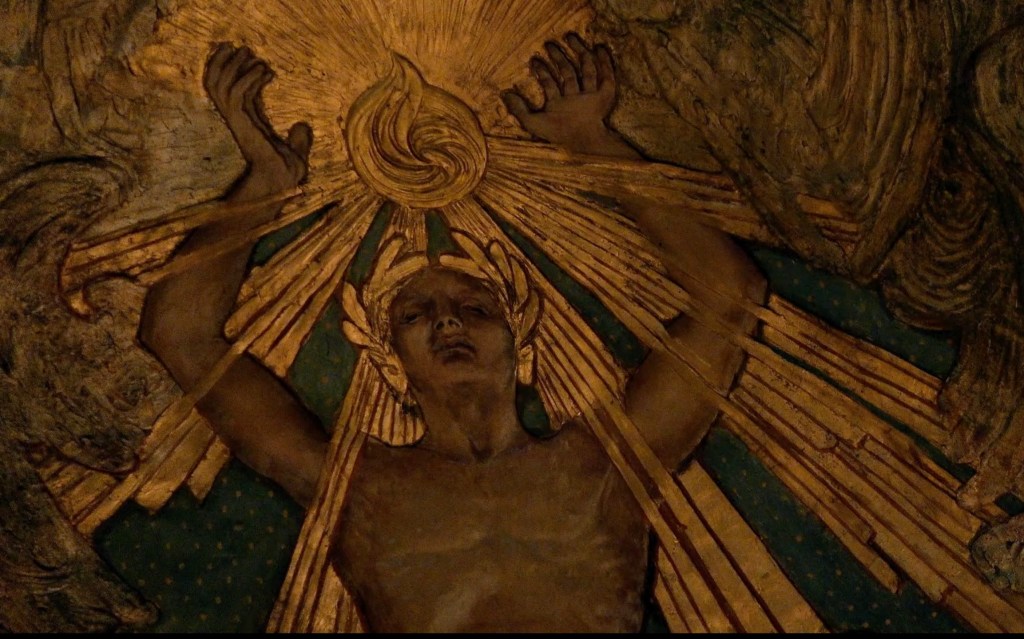
Filippo Gorini’s Sonata for 7 Cities project began in 2025. The idea was simple: he would take part in seven month-long residencies in cities around the world, combining recitals with teaching and outreach work. Each recital was designed around sonatas from the Classical and Romantic repertoires, with seven composers also commissioned to create new works.
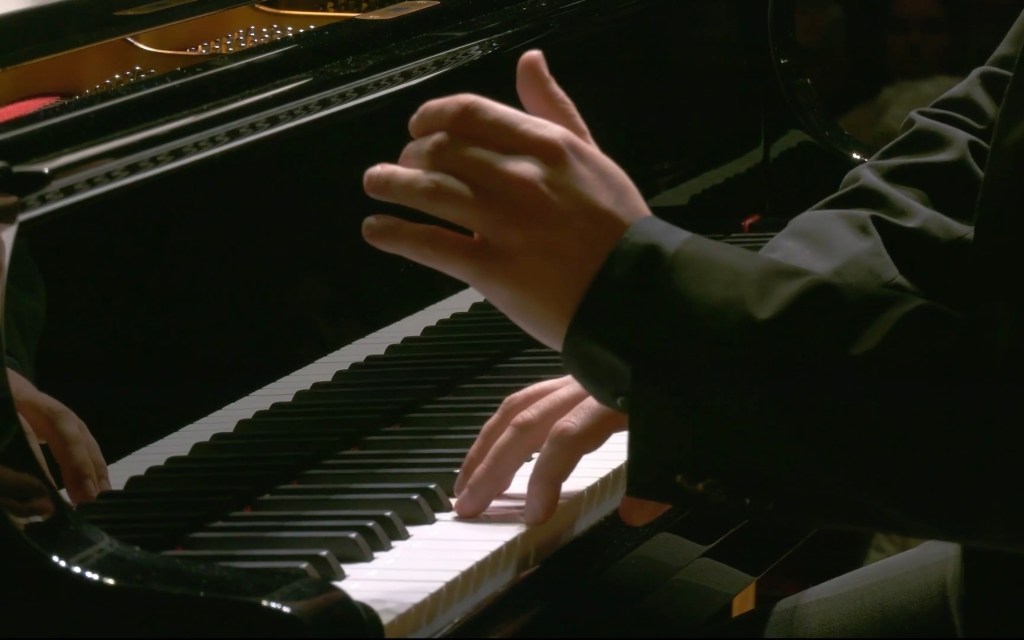
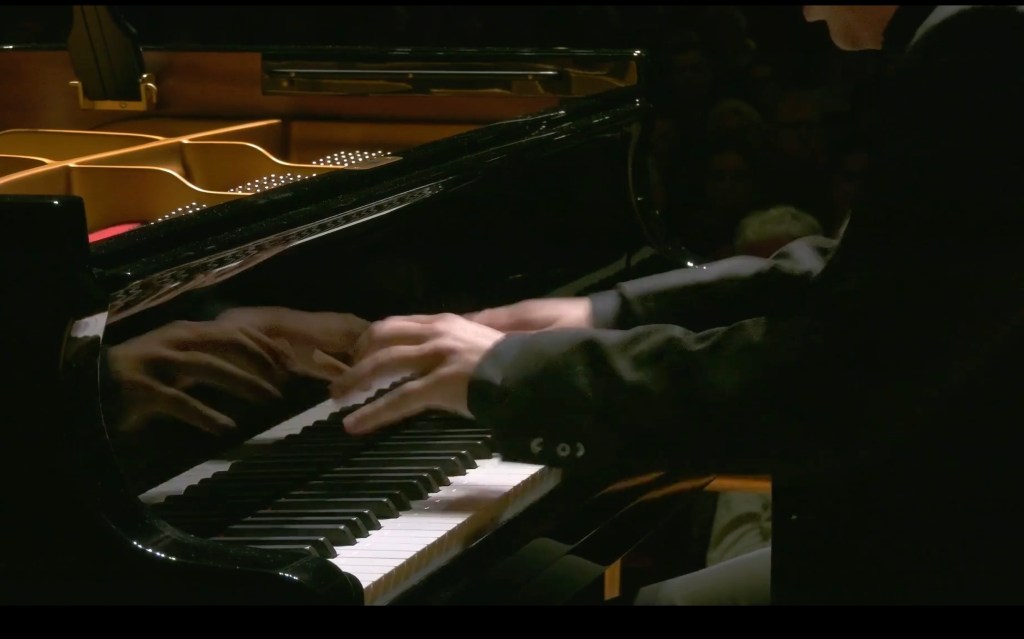
It is almost a year since Brendel left us and even during his retirement from the concert platform his presence at the Wigmore Hall was always an endorsement of a hall where music with a capital ‘M’ can always be heard. Brendel passing on his wisdom and knowledge to many musicians who came within his radius. A school demonstrating honesty, integrity and a selfless dedication to the composers that they are serving with no thought of showmanship or self advancement.
I have been following Fillipo’s performances for some time, from the Art of Fugue filmed live in Turin to the Diabelli variations that he explained and played in London, invited by his colleague and friend,Raffaello Morales, to play at his Fidelio Café. Filippo, mentored by Brendel, is one of the few artists that you can trust and that regularly have me rushing to take another deeper look at the score. They are artists who can unlock secrets that are only revealed to those that with total dedication and mastery can unravel the mysteries left by the composers. It is a voyage of discovery together, where performance becomes recreation. This is what we experienced from Filippo Gorini today.
Schumann and Beethoven a continuous outpouring of sounds with an inner meaning to notes, that we have heard from many hands, but today played with a simplicity and humility that illuminated these scores in a way that held us in a spell of concentrated revelatory beauty. First performances in the UK of works commissioned by this young man, who is not living in the past but with eyes and ears looking to the future and bringing new discoveries into the concert hall with sounds that open our ears and allow us to listen even to well worn masterpieces with different ears. Rubinstein would often, in the middle of a Chopin recital, include mazurkas by Szymanowski that was like a sorbet in a sumptuous feast, opening our ears ready for even more delights. Rubinstein too was a great promulgator of contemporary composer friends, and his first performance of Ravel Waltzes in Spain was booed by an audience not used to such modern sounds. Without batting an eye lid the much feted pianist played the whole thing again as an encore!. Well Gorini was certainly not booed after his masterly performances of breathtaking daring and total conviction of the two works commissioned by him for his 7 City project. He did not need to play them again but luckily the Wigmore had thought of that and their superb live stream recording can be listened to as many times as desired!
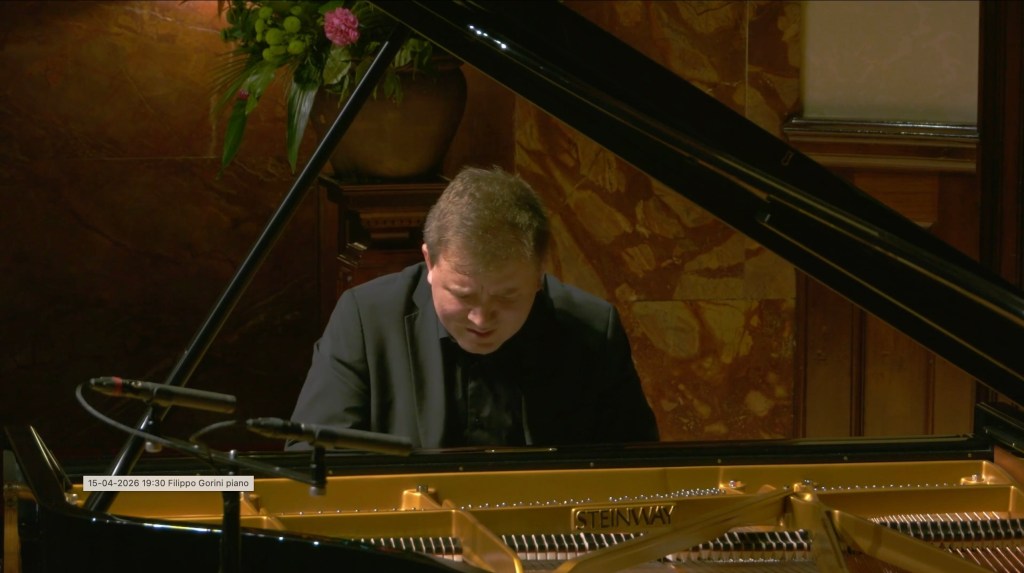
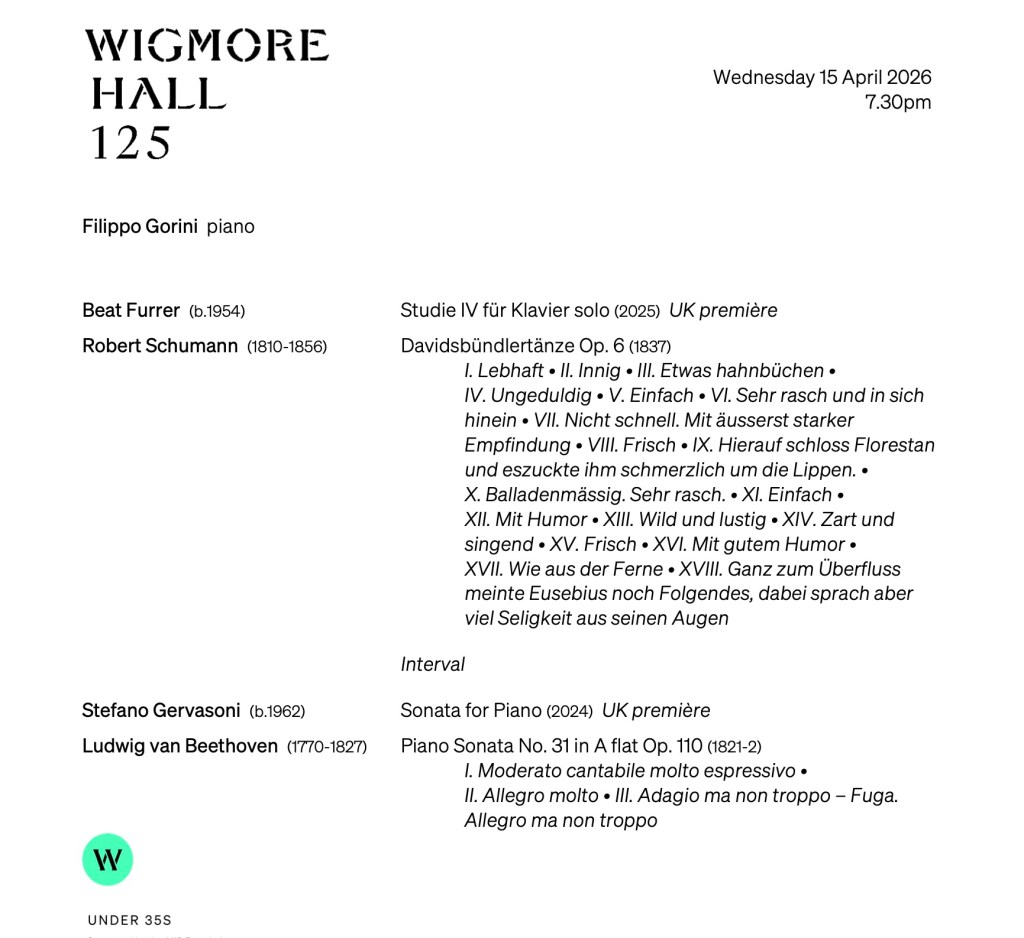
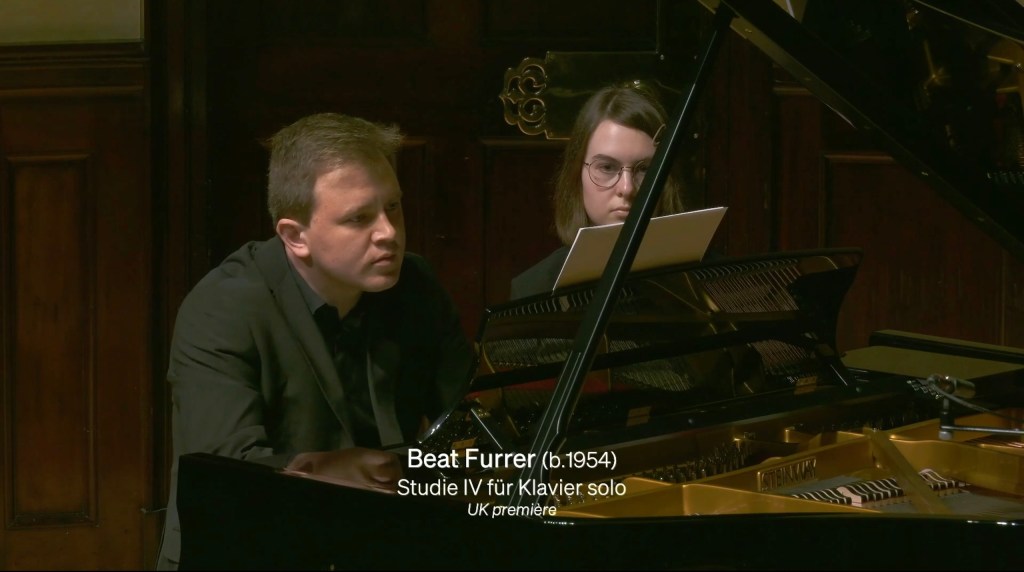
Beat Furrer’s Studie IV was composed for Gorini’s residency in Hong Kong. It’s a work that makes considerable technical demands on the performer, switching between a variety of textural patterns with scarcely a break in the texture, rather like a pianistic workout routine.
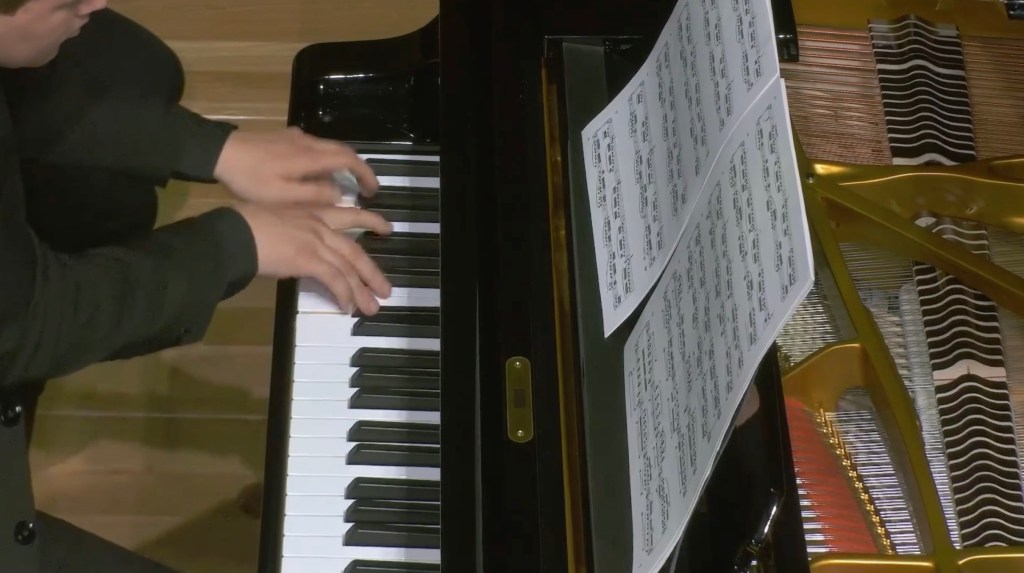
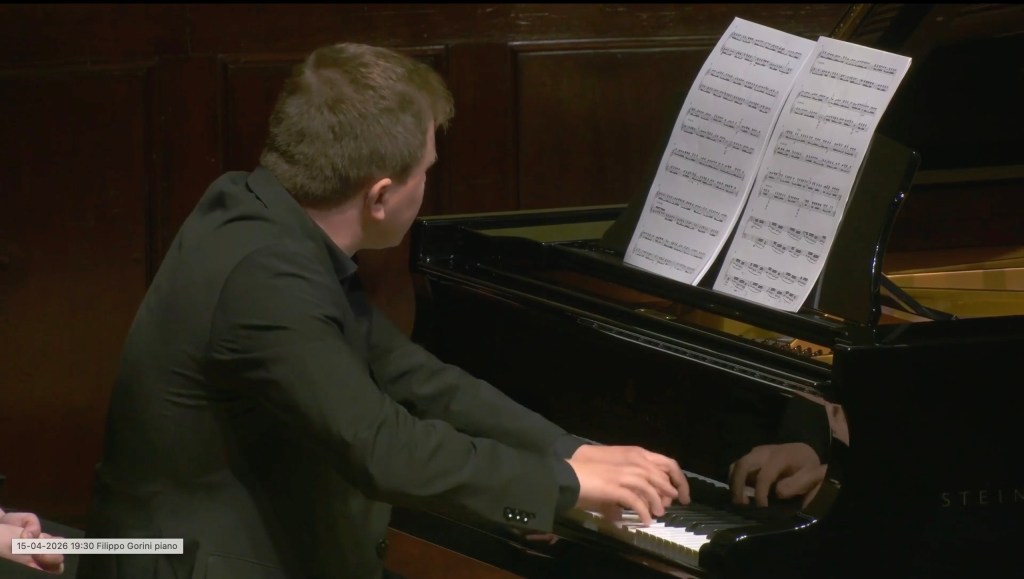
Beat Furrer’s study for piano is a continuous outpouring of dissonant chattering played with a dynamic drive and inner energy with splashes of notes thrown in from above and below with quite remarkable agility. A seemingly endless repetition of sounds like a cauldron of boiling water on which streaks of colour were played like strokes on a modern canvas. The sudden contrasting silence towards the end was even more poignant as bell like sounds were heard with a glistening glow as they were isolated sounds in a sudden barren landscape. A tour de force from Gorini but even more, an arresting opening of burning intensity and poetic poignancy.
In the words of the composer :’ Its opening idea is a percussive interplay of note clusters, slowly rising from the middle of the keyboard, with stabbing interruptions from the outer extremes of the piano’s register. Fast downward-sliding figures follow, murky and low. These descending gestures expand in range, gathering strength and complexity until they resound like a vast peal of bells. There is a temporary respite of short, sharp chords, before further whirling patterns and variations on earlier material. But all this technical display falls away in an eerily sparse coda. With almost every note given its own precise dynamic marking, Studie IV concludes with anexploration of subtly differentiated tone colours.’
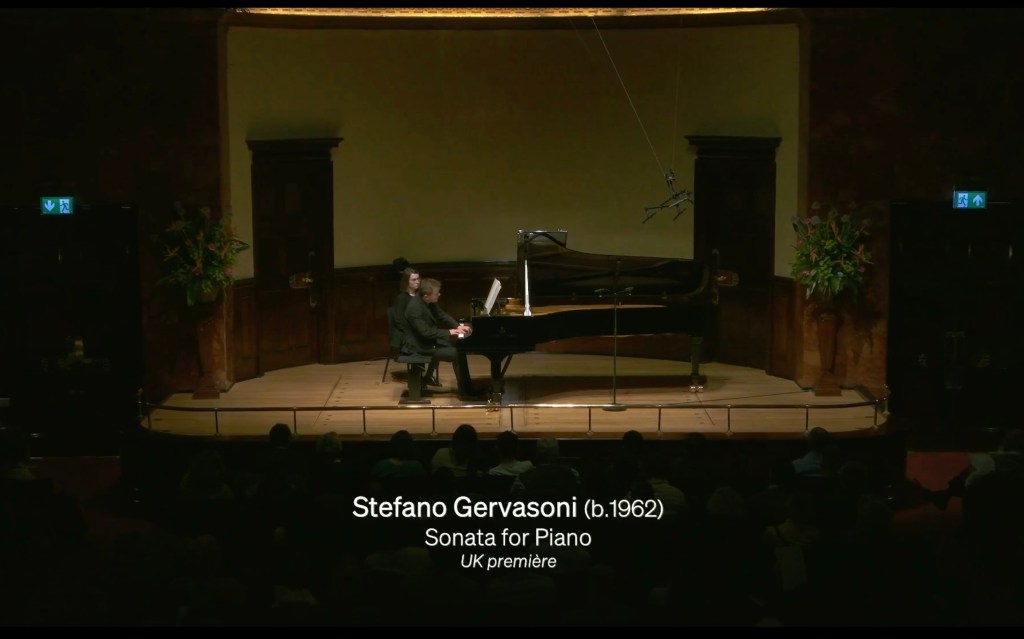
Stefano Gervasoni expressed trepidation in composing a Sonata for Gorini – it is the first time he has ever used a conventional formal title. Citing its modernist evolution under figures such as Boulez and Ives, he describes sonata form as ‘capable of tempering expression and forcing it into objectivity … not a single note must be wasted, no expressive value can be squandered’
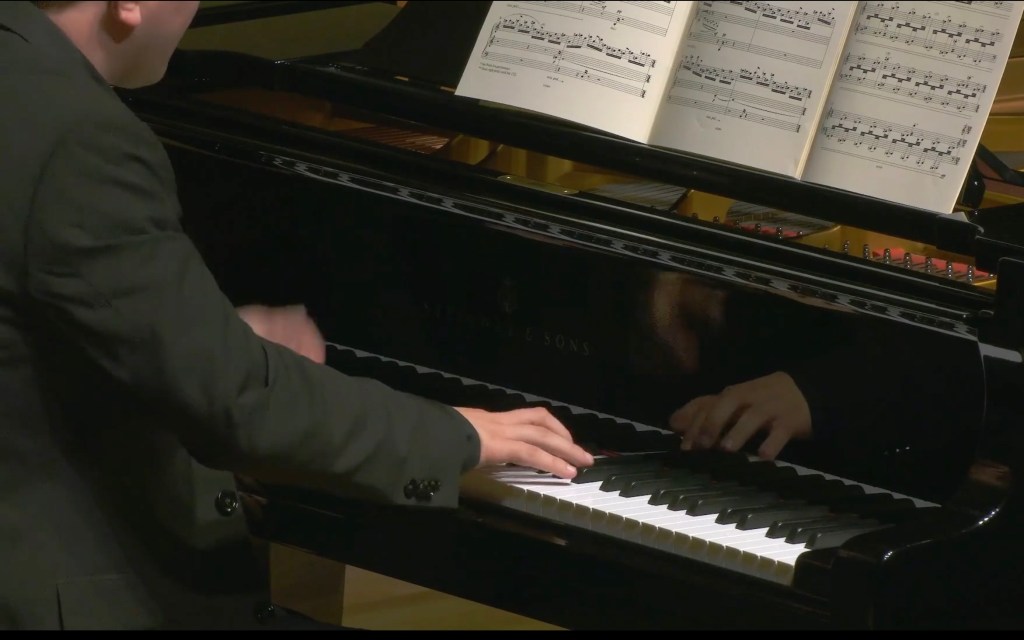
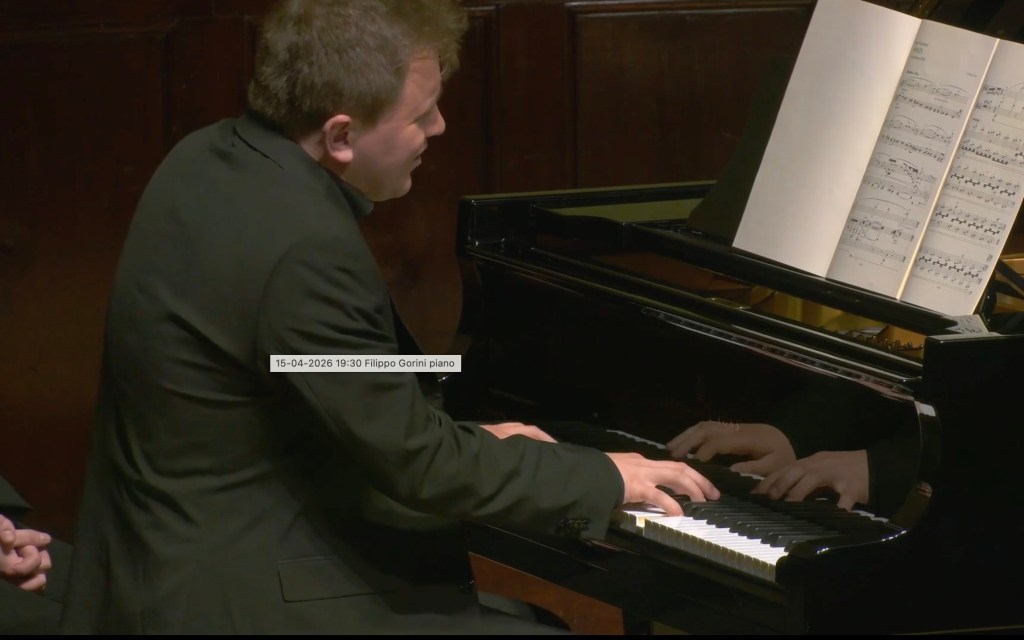
A work of violent contrasts with a swirling whirlwind of sounds out of which are posted notes high in the piano register. An impressive work played with an architectural shape that moulded a very episodic work into one continuous whole.
In the words of the composer : ‘ Structured in a single movement, but covers a wide expressive terrain, something reflected in his imaginative performance directions, which include terms such as ‘disintegrating’ , ‘sliding’ and ‘whipping’. Its opening theme is a slow treble melody which fluctuates around the note of G, set against a rhythmically dislocated accompaniment. This melody recurs in several forms, but along the way the music progresses through sudden eruptions, ghostly processions, and furious torrents of notes. When the opening melody returns at the end it slowly dies away, seemingly sapped of energy before a loud chord – ‘shouted’ is the word in the score – brings matters to a close’
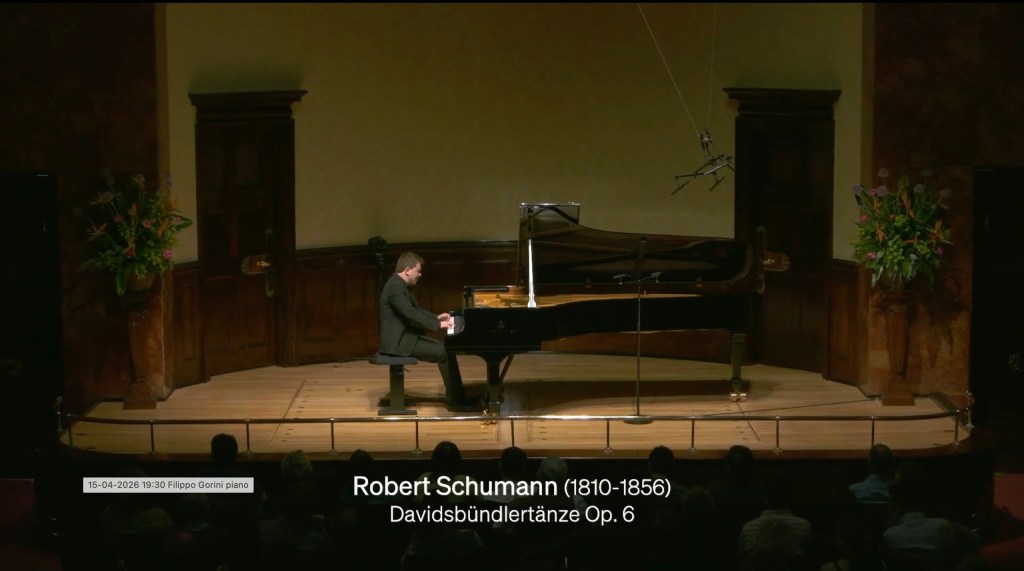
Rarely have I heard Schumann’s Davidsbündler played with such solidity but also such freedom and ravishing beauty. Joy and grief did indeed go hand in hand. I wonder why he split the hands at the opening and look forward to seeing eventually what he might do with op 106! But of course it is the intention behind the notes that counts and his passionate drive at the opening swept us along as it was combined with moments of refined rubato and fantasy. ‘Innig’ Schumann writes and at first seemed very slow but was beautifully shaped where delicacy and yearning went hand in hand. The third piece sprang to life with drive and capricious energy before the passionate outpouring of the ‘Ungeduldig’. A very thoughtful Eusebius, played with glowing timeless beauty, slowing down at the end ,weighed down with measured thoughts. Great clarity to the left hand in the sixth as the tension rises before the beautifully pensive ease of a seeming long improvisation. It was this continuous contrast between passion and poetic contemplation that came across in Filippo’s masterly playing, underlining the conflicting elements in Schumann’s split personality of Florestan and Eusebius. The eighth ‘Frisch’ was played with nonchalant ease as the passionate outpouring of the ninth entered the scene with its duet between the two characters.Its capricious ending where Schumann adds : ‘Florestan made an end, and his lips quivered painfully’. ‘Balladenmässig’ was played with sumptuous rich Brahmsian sounds where Filippo’s limpet like touch could extract wonderfully rich sounds. Simple contemplative beauty to the ‘Einfach’ with Filippo’s extraordinary control of sound and beauty of balance of sensuous and profound sculptured sounds of poignant beauty. ‘Mit humor’ that Filippo played with capricious playfulness, shaped beautifully as one phrase answered another with eloquence. There was a passionate intensity to ‘Wild und lustig’ with a wonderful almost imperceptible transition to the chorale like melody that Schumann floats above these sumptuous sounds and where Filippo’s mastery of the pedal allowed for clarity bathed in beauty. The fourteenth is one of Schumann’s most beautiful melodies and Filippo played it with glowing beauty and a rare sensibility where he could stretch the sound like a belcanto singer without ever breaking the overall shape and spell of such radiance. Rudely interrupted by the abrupt ‘Frisch’ before turning into a wondrous outpouring of waves of sounds spread over the entire keyboard. Filippo’s masterly control illuminated an Aeolian harp with a ravishing kaleidoscope of sounds. The chattering spirited chords of the sixteenth were played with capricious freedom as they dissolved into the magic world of wondrous beauty that Schumann could create. Here Filippo’s mastery of sound and sense of balance created the magical world of Schumann and the final slow dance was played with a touching tenderness and nostalgia relieved only by the striking of midnight so subtly suggested in the bass.
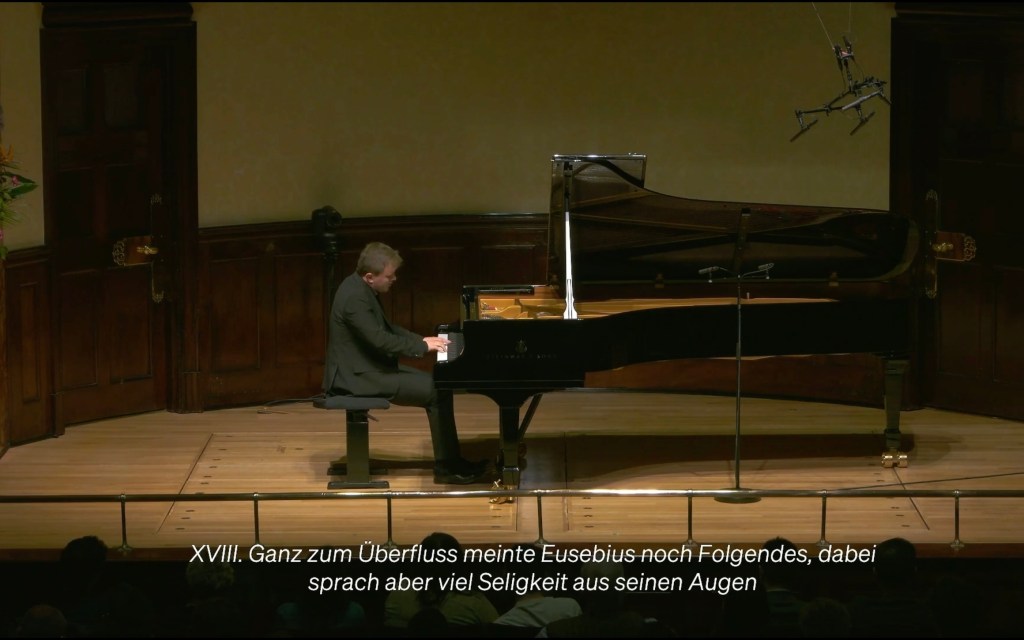
Moments of silence were a sign that the magic of Schumann had penetrated deeply into the atmosphere. An audience in one of those magic moments where people are united as one and as Schumann says “Quite superfluously Eusebius remarked as follows: but all the time great bliss spoke from his eyes.”
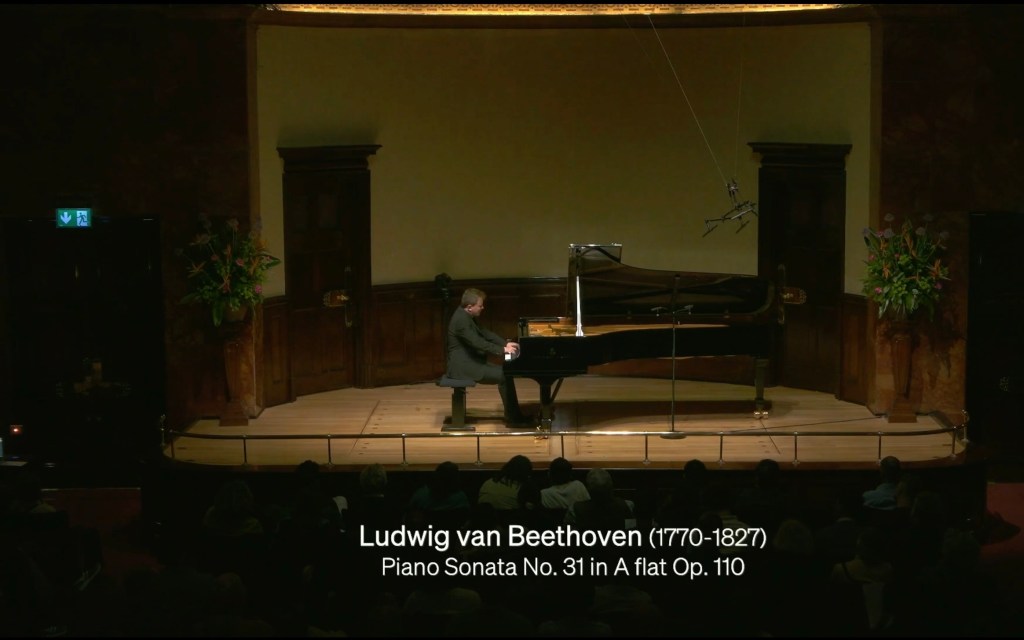
A monumental performance of Beethoven’s penultimate sonata played with radiance and beauty. Unfolding with waves of sound linking moments of deeply felt poignancy as Filippo played with a simplicity but also at times with an innermost turbulence. He could bring magic moments to the transitions or changes of key without ever underlining what Beethoven has written in the score. An awareness that was touched with Godliness. This was a performance where so little could mean much. Great buoyancy to the ‘Scherzo’ also played quite simply and legato with the delicate return of the ‘Scherzo’ after the masterly control of the ‘Trio’. A stillness to the ‘Adagio’ as it unfolded to an aria that was remarkably free, allowed to breathe as a singer, where fluctuations of the heart beating in the left hand were allowed more liberty to accompany rather than as an anchor. A poignant whispered entry of the fugue and an even more intense return of the aria leading to powerful chords of great inner turbulence before the whispered return of the fugue in inversion. A gradual increase in volume as Filippo allowed this joyous outpouring of passionate intensity to fill the hall with the vision of beauty that Beethoven could already envisage. A masterly performance from a thinking musician who could delve deeply into the score as indeed Brendel had shown us and whose heritage has been passed on to his disciple Filippo Gorini, as the the voyage continues!
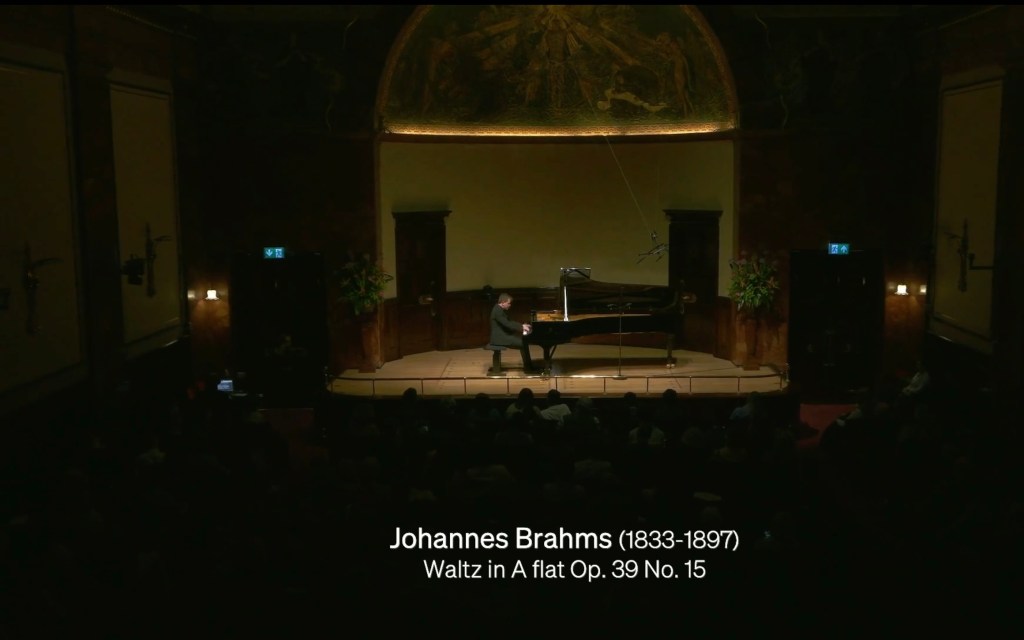
Brahms Waltz op 39 n.15 also in A flat was played with ravishing beauty and a refined sense of style and brought to an end a recital from a pianist who is above all an interpreter who can delve deeply into the scores and share with us the discoveries that are hidden within.
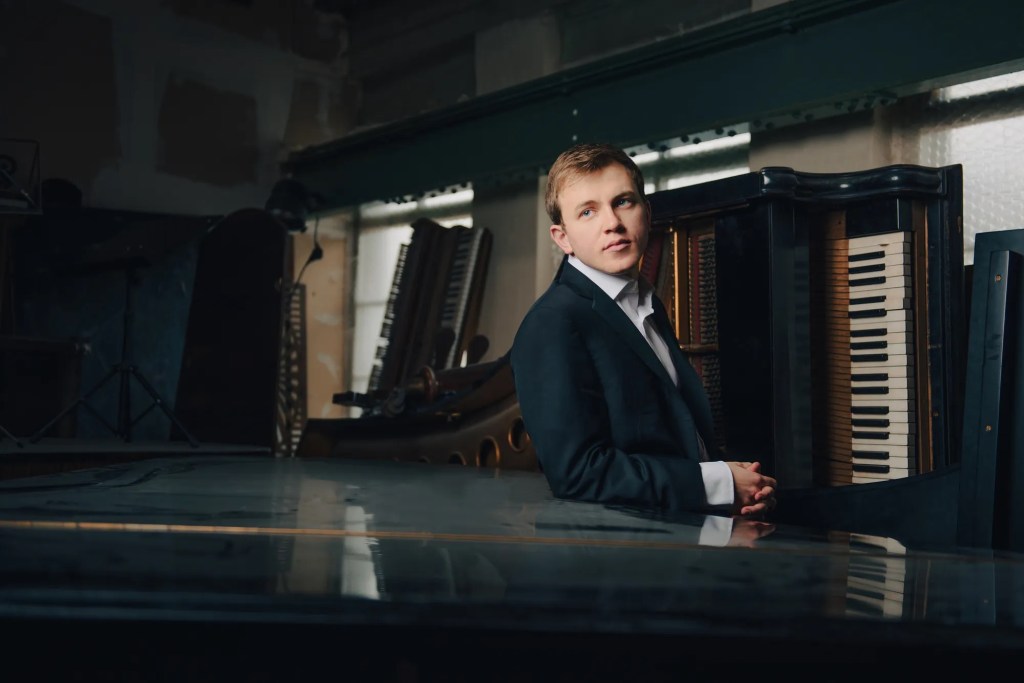
Filippo Gorini’s musicianship has drawn acclaim in recitals in the major venues in Europe and abroad, ranging from Milan’s Teatro alla Scala to the Amsterdam Concertgebouw, Berlin Konzerthaus, and Louis Vuitton Foundation Paris, as well as with orchestras such as the Santa Cecilia Orchestra in Rome, the Salzburg Mozarteum Orchester, the Flanders Symphony Orchestra, the Gyeonggi Philharmonic in Seoul, the Opera Nacional de Chile, under conductors such as Daniele Gatti, Hartmut Haenchen, Junichi Hirokami.
Filippo’s highlights from 2024-25 include his recital debut in Carnegie Hall, his one-month residency at the Vienna Konzerthaus, and concertos with the Orchestre Nationale de Lille and Nagoya Philharmonic. Next season he will have one-month residencies in Cape Town for the Stellenbosch University, in Hong Kong for Premiere Performances, and in Oregon for Portland Piano International, as well as returns in Wigmore Hall and La Scala for recitals.
His ongoing project “Sonata for 7 cities”, set to end in 2027, aims to show a new, responsible and ethical approach to concert life with monthly residencies in Vienna, Cape Town, Hong Kong, Portland, Medellín, Milan and more, centred around performances, outreach, teaching, and philanthropy. During this project he will also perform seven newly commissioned piano pieces by composers Stefano Gervasoni, Federico Gardella, Beat Furrer, Michelle Agnes Magalhaes, Yukiko Watanabe, Oscar Jockel, Ondrej Adamek. This journey will also be covered in a documentary-series by director Ruggero Romano, and by the release of seven live albums on Alpha Classics.
Filippo’s previous multi-year project “The Art of Fugue Explored” had already shown his vision and creativity to go further than just his performing abilities: with the support of the Borletti-Buitoni Trust, he released the work on Alpha Classics in 2021, performed it internationally over 30 times, and published on RAI5 and online a series of filmed conversations on Bach’s music involving personalities such as Peter Sellars, Frank Gehry, Sasha Waltz, Alexander Sokurov, Alexander Polzin, Alfred Brendel, George Benjamin, and many more. A filmed live-performance is also available on Carnegie+.
Filippo has received the “Premio Abbiati”, the most prestigious musical recognition in Italy, in 2022, as well as the Borletti-Buitoni Trust Award 2020 and First Prize at the Telekom-Beethoven Competition 2015. His three albums featuring Beethoven and Bach late works, released on Alpha Classics, have garnered critical acclaim, including a Diapason d’Or Award and 5-star reviews on The Guardian, BBC Music Magazine, Le Monde.
Alongside his solo career, Filippo has performed chamber music with musicians such as Marc Bouchkov, Itamar Zorman, Andrea Cicalese, Haesue Lee, Pablo Ferrandez, Brannon Cho and Enrico Bronzi, in renowned festivals such as the Marlboro Music Festival, the Prussia Cove Chamber Music Seminars, as well as “Chamber Music Connects the World” in Kronberg with Steven Isserlis. He has taught masterclasses at the Liechtenstein Musikakademie, the University of British Columbia, the Royal Welsh College of Music, and the conservatories in Bergamo and Siena. He follows actively the world of contemporary composition, and has played works by composers such as Stockhausen, Kurtág, Boulez and Lachenmann as well as commissioning new pieces.
After graduating with honours from the Donizetti Conservatory in Bergamo and the Mozarteum University in Salzburg, Filippo’s development was further supported by Maria Grazia Bellocchio, Pavel Gililov, Alfred Brendel and Mitsuko Uchida.
https://christopheraxworthymusiccommentary.com/2024/03/20/christopher-axworthy-dip-ram-aram/

