
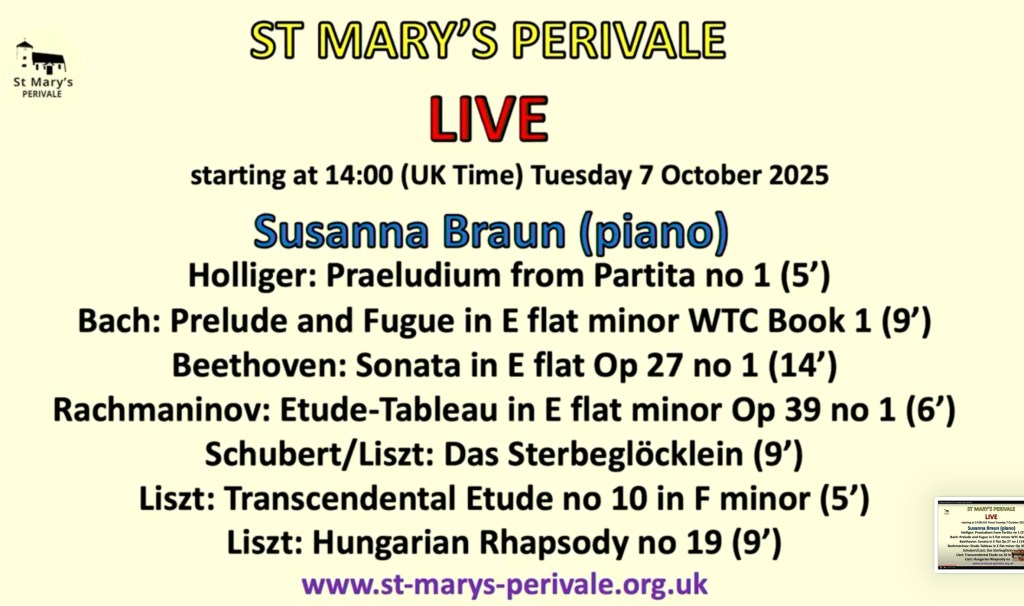
Many are tuned in to the Chopin Competition live stream in Warsaw where many pianists are in the running who have been promoted by Dr Mather. We should not forget that the indomitable St Mary’s are continuing, non stop, to give a platform to young artists with three concerts or more every week, also live streamed to an audience worldwide. I managed to hear this brilliant young Swiss pianist on play back and thank God I did ! Superb playing of the clarity and precision of a baroque keyboard player but with the colour and sumptuous sounds of a superb pianist too. Strange curled fingers like ten little hammers, necessary for playing antique instruments, but rather unnatural for the piano with pedals . Chopin was the first to show us that the scale of D flat was for starters not C major, with a hand that caressed the keys and extracted the sound like limpets sucking the lifeblood from each note. But this young Swiss pianist is also a formidable musician with a passionate heart. She is also very knowledgable and able to choose a stimulating programme where the final cluster of Holliger on E flat was the sound out of which emerged the Bach prelude from book one. A Beethoven sonata op 27 but not the ‘Moonlight’ but its sister less often played but still a Sonata ‘quasi Fantasia’ as Beethoven announced. A transcription of a Schubert song that was new to me but was transformed into a magical tone poem by Franz Liszt. The Nineteenth Hungarian Rhapsody was also new to me and what a discovery with the same Hungarian inspired virtuosity and sense of beguiling dance but with that strange late world that was beginning to open up a whole new vision for the future by the genial Abbé Liszt . It was the encore of Scarlatti that gave the game away with Susanna’s obvious baroque training such was the clarity and drive but also the ornamentation that she discreetly added to such a scintillating sonata.
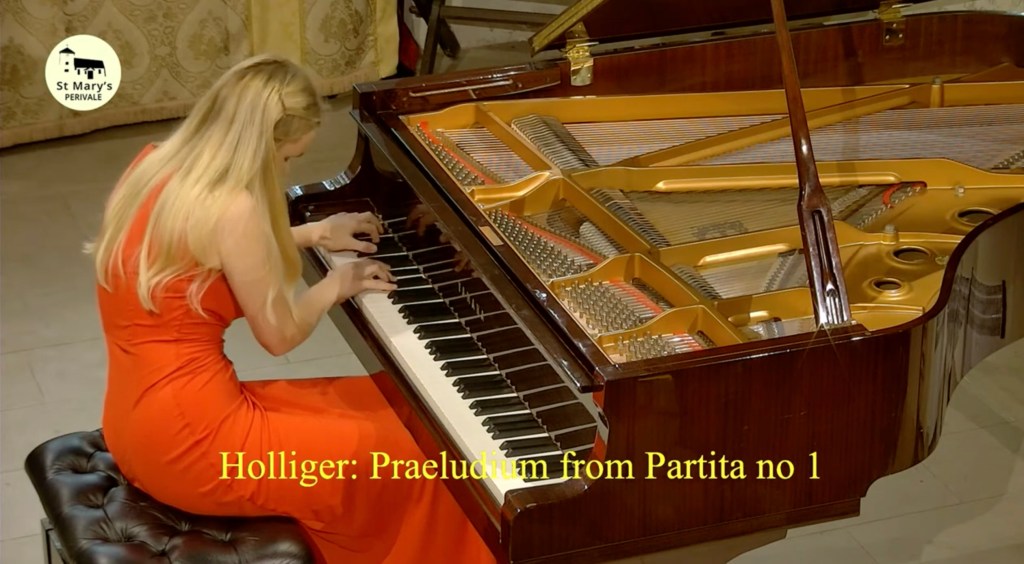
Holliger Praeludium from partita n. 1 is dedicated to Andras Schiff . Here are Susanna’s own words: My E-flat pairing of Holliger and Bach where his admiration for Bach resonates in his own Partita for Piano (completed on Dec 31, 1999). The title itself recalls the Baroque form, and its seven movements combine references to tradition with avant-garde elements. Notably, Holliger employs soggetti cavati, a Renaissance technique deriving melody from vowels, echoing Bach’s own cryptographic motifs such as B-A-C-H. The opening Praeludium recalls Bach’s improvisatory preludes. It erupts in thunderous clusters, followed by resonant triads Holliger calls the inner voice: “music as from inside your body… like a backstage chorus singing”. He himself described it as “like a Couperin or Rameau harpsichordist warming up with big arpeggios.” When its final cluster fades, only a single E-flat remains. That very note becomes the opening of Bach’s Prelude and Fugue in E-flat minor, BWV 853. A difficult work played with clarity and technical brilliance with extravagant sounds of reverberations.
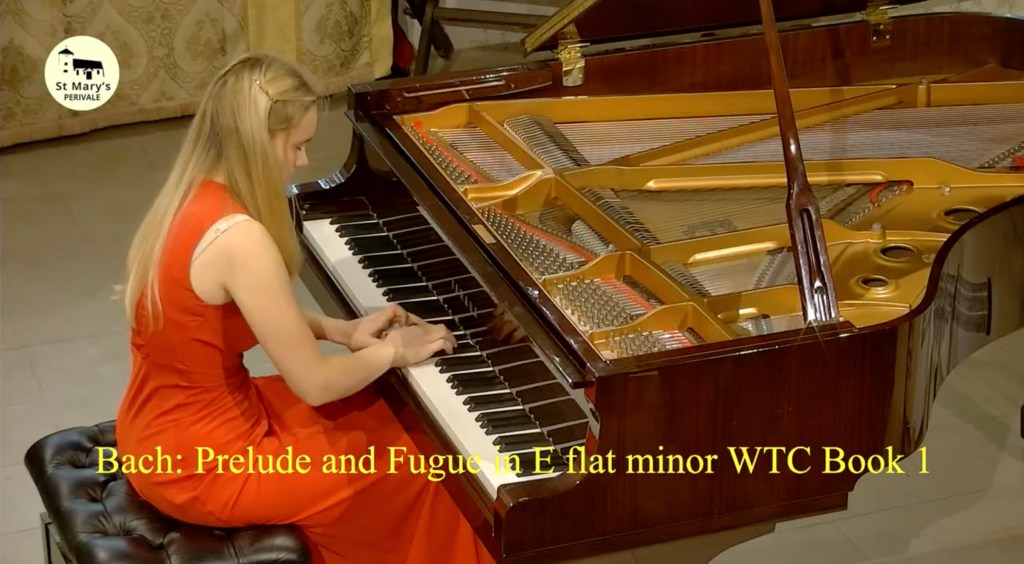
A final cluster played with the arm as the glory of Bach shone through this extraordinary modern sound world. It was like a celestial cloud opening with beautiful radiance and fluidity with the simplicity of the fugue gradually unfolding.
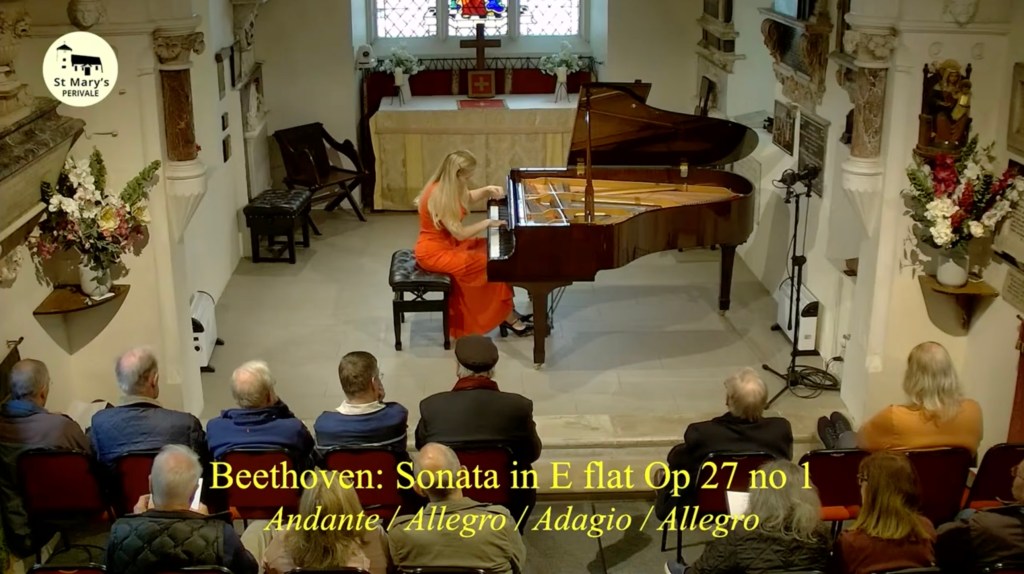
Playing in two as Beethoven indicates allowed the Andante of the Sonata to flow naturally with beauty and deep feeling but without any sentimentality.The ‘Moonlight’ Sonata was written in two as well and is too often played in four which takes away the extraordinary architectural shape of these highly original opening movements of a classical sonata. The ‘Allegro’ central interruption was played with dynamic brilliance and extraordinary clarity. Driving Beethovenian impatience was quelled with the exquisite beauty of the return of the ‘Andante’ that just dissolved to a whisper without any rallentando! Susanna’s extraordinary intelligence and musicianship allowed each movement to flow into the next in a work of unique originality for it’s time. A true ‘Allegro molto e vivace’ second movement, was played with the irascible youthful Beethovenian drive and impatience, with the central driving bass rhythms giving extra energy always especially when played with the dynamism of this young Swiss pianist. The ‘Adagio’ she so rightly said was similar to the second movement of the C minor concerto and she played it with the same poignant nobility and extraordinary beauty that Beethoven could conjure out of his genius that had nothing to do with Bel Canto but was more of orchestral origin. It was Susanna’s thinking up from the bass always that gave strength to Beethoven’s deeply felt mellifluous outpouring. After a beautiful whispered cadenza Susanna held us in suspense on a single A flat before allowing the ‘Allegro vivace’ finale to take us by storm. A rhythmic energy with dynamic contrasts all played at red hot temperature. Extraordinary clarity and precision but also passionate drive and understanding, of overwhelming energy that made the short return of the ‘Adagio’ so moving as it was unexpected.

Rachmaninov’s well known Etude Tableau was with the Liszt F minor Study the only two pieces from the standard piano repertoire today. The Rachmaninov was played with fearless passion and a kaleidoscope of colour that brought this miniature tone poem vividly to life.

There was a chiselled beauty to the Schubert song transcription by Liszt which I have to admit I did not know. Her ravishing sense of balance with playing of ease and natural beauty as the bells were allowed to sound all around this glorious melodic outpouring. Sustained by the bass as the melody was played with ever more passionate conviction and mastery . A trilled pedal note that was a mere vibration on which the bells were allowed to glisten with wondrous beauty.
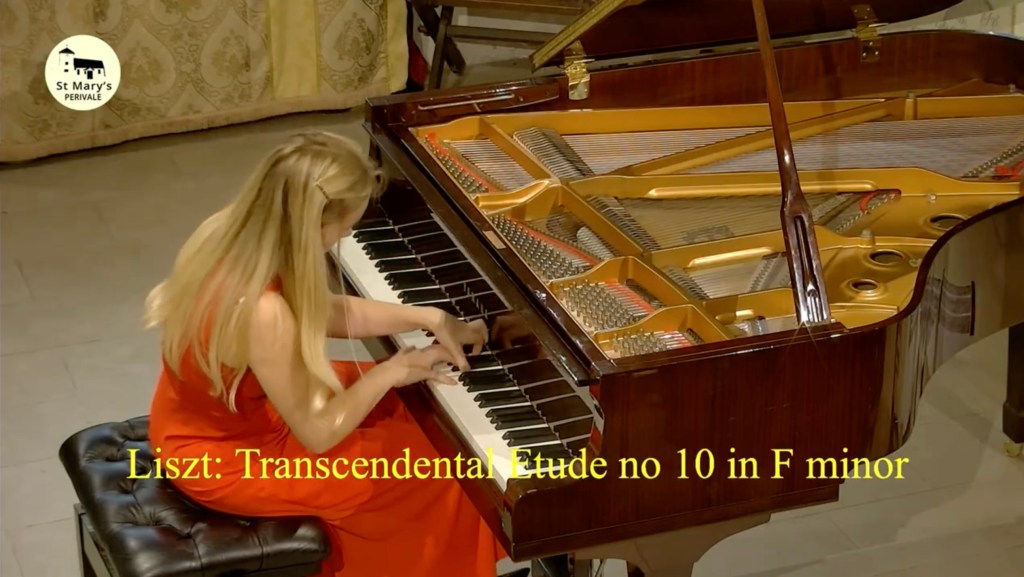
The Liszt F minor transcendental study was played with quite extraordinary mastery but also with colour and a passionate temperament that was quite breathtaking in its audacity .

She brought a great sense of style and authority to Liszt’s 19th Hungarian Rhapsody which was his last . A true sense of the Hungarian idiom almost savage in it’s Gypsy drive with technical difficulties thrown off with the ease of native players with their extraordinary natural technical mastery.

Swiss pianist Susanna Braun debuted at the Tonhalle Zürich in 2024, performing Mozart’s Piano Concerto KV 466, where her delicate touch, virtuosity, and musical sensitivity captivated audiences. Her interpretation was praised for its freshness and maturity, offering a refreshing contrast to routine performances. In June 2025, she made her debut with the BBC Philharmonic, performing Grazyna Bacewicz’s Piano Concerto for a BBC Radio 3 recording. Highlights of the second part of the 2025 season will include a performance with the Youth Symphony Orchestra of Ukraine of Ludwig van Beethoven’s Piano Concerto No. 4, with the Camerata Manchester, performing Ludwig van Beethoven’s Triple Concerto, and the release of her first CD for the Valaris Music label dedicated to the music of Liszt.

She holds an “International Artist Diploma” from the Royal Northern College of Music, a Master’s from the Hochschule für Musik FRANZ LISZT in Weimar, a diploma ( corso triennale di alta perfezionamento ) from the Imola International Academy “Incontri con il Maestro”, a B.Mus with honours from RNCM and a Diplôme Supérieur from the Schola Cantorum in Paris. She is currently pursuing the “Post-Diploma Course” at the Imola International Academy “Incontri con il Maestro”, and a Master’s in Specialized Music Performance – Soloist at the ZHdK (Zurich University of the Arts). Her main teachers are and were Boris Petrushansky, Grigory Gruzman, Till Fellner, Helen Krizos and Danilo Manto.

She has performed at prestigious venues, including the TivoliVredenburg in Utrecht, Concertgebouw in Amsterdam and Bridgewater Hall in Manchester, and has collaborated o.a. with Sinfonietta Schaffhausen and Jena Philharmonie. Susanna has won multiple awards, including first prizes at the 10th International Piano Competition in Enschede. She is also the artistic director of “BlenioMusica,” an annual chamber music festival in Switzerland . Susanna Braun is part of the Valaris Music family. Susanna is grateful for the Excellence Scholarship from the ZHdK Foundation.


 ChristopherAxworthy-MusicCommentary