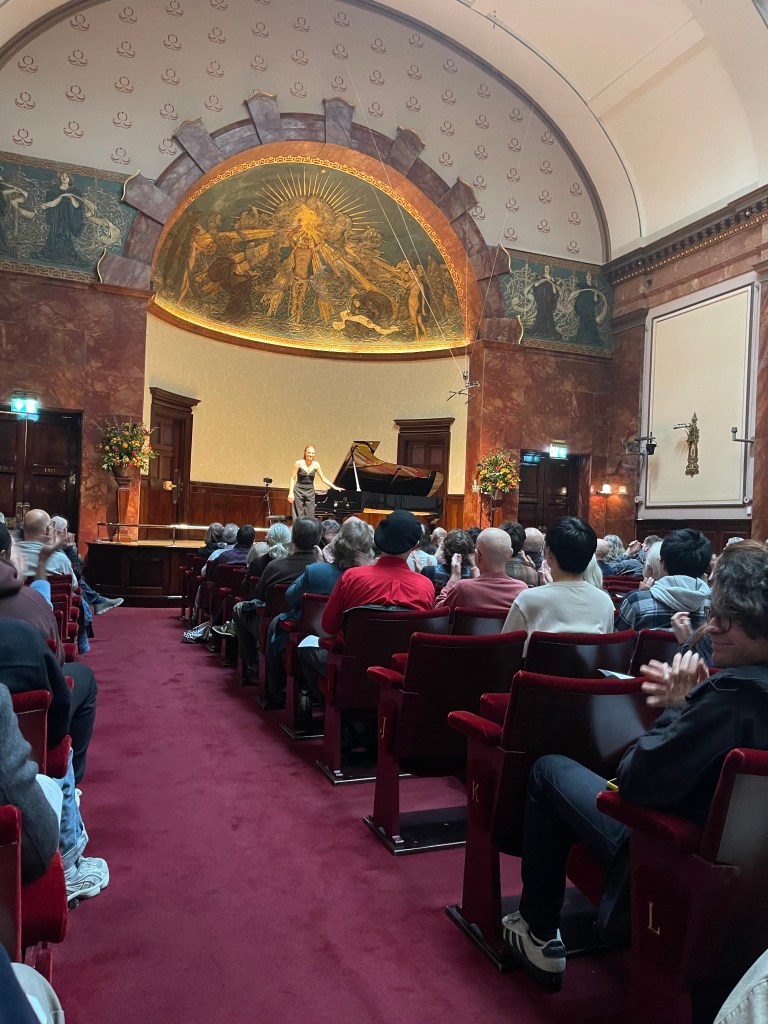
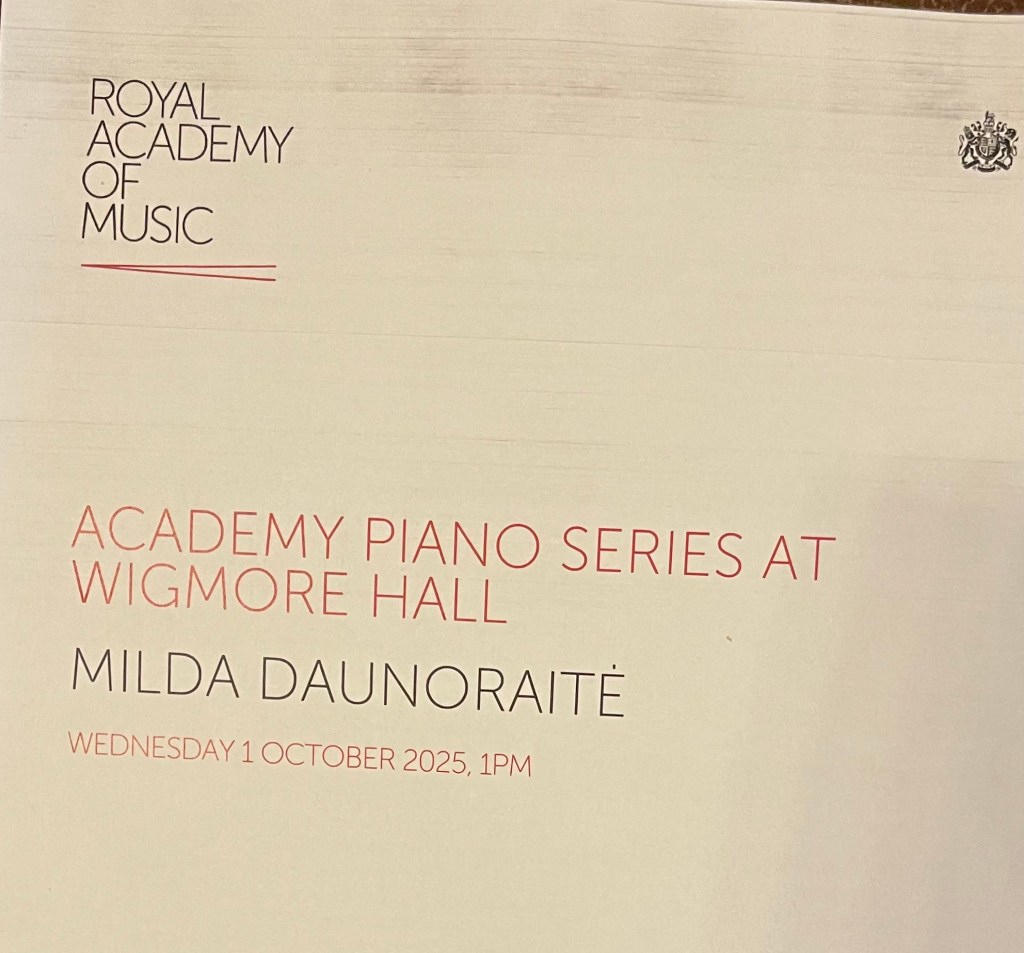
Dazzling is the only way to describe Milda Daunoraite’s long awaited London debut at the Wigmore Hall.
Radiance, vitality, ravishing beauty combined with an irresistible ‘joie de vivre’ was the hallmark of an artist with a mission to share her undying love and passion for music with others.
An immediate sense of communication holds her audience spellbound following every move of her hypnotic mastery …….
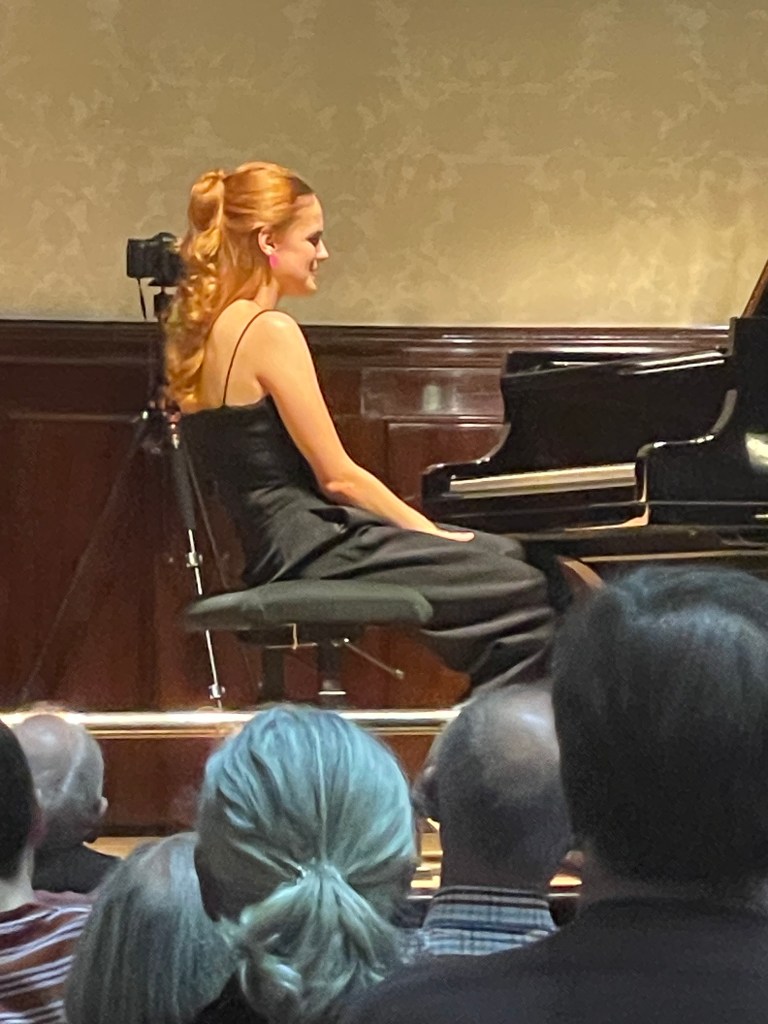
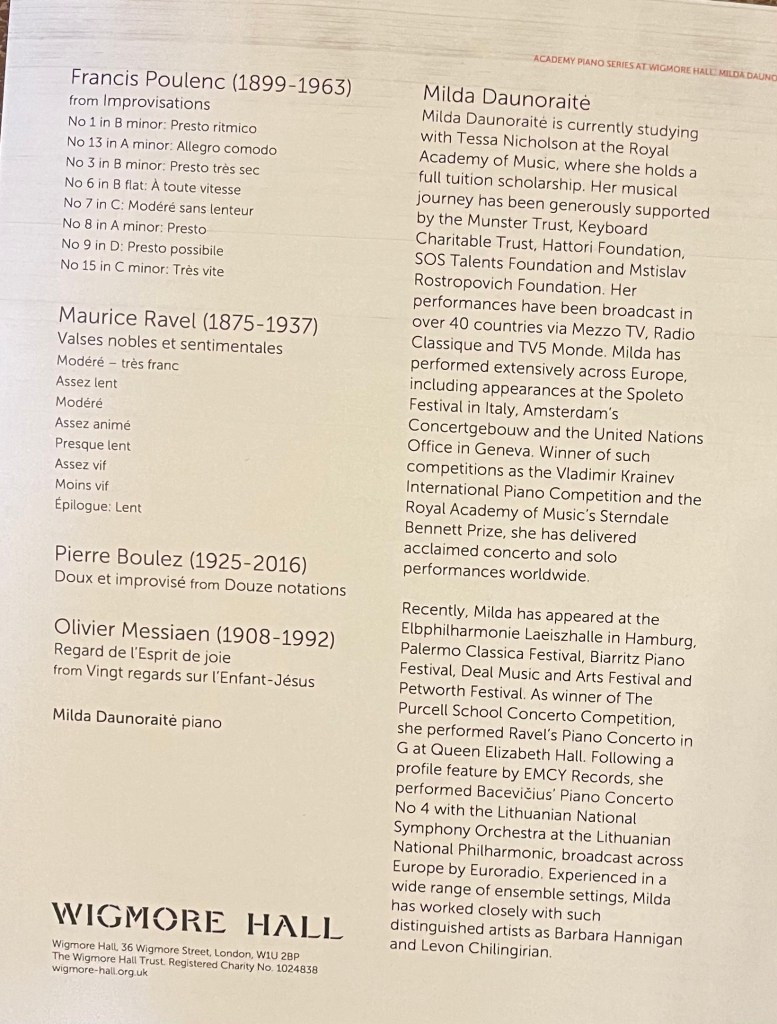
An all French programme with a refreshing difference. Poulenc, Boulez , Ravel and Messiaen all different musical languages each made to speak with immediacy and eloquence by a true poet of the keyboard.
Milda chose eight of the fifteen Improvisations by Poulenc to open her short lunchtime recital. Immediately imbuing the ‘Presto ritmico’ with startling, arresting character that took us by surprise.There followed the 13th of improvised beauty with subtle colouring of sumptuous decadence; there was the impish fun of n.3 and Poulenc’s humorous bustling call to attention of n. 6. Followed by the gentle radiance to n. 7 in C major of purity and rich golden harmonies with its barely suggested blues note ending. The 8th was a Parisian free for all of ‘Baba’ proportions and the 9th was thrown off with masterly ease as the chattering unmistakable voice of Poulenc shone through. The 15th a ‘Homage to Piaf ‘ is the best known of these improvisations and was played with a masterly sense of colour and sophisticated elegance.
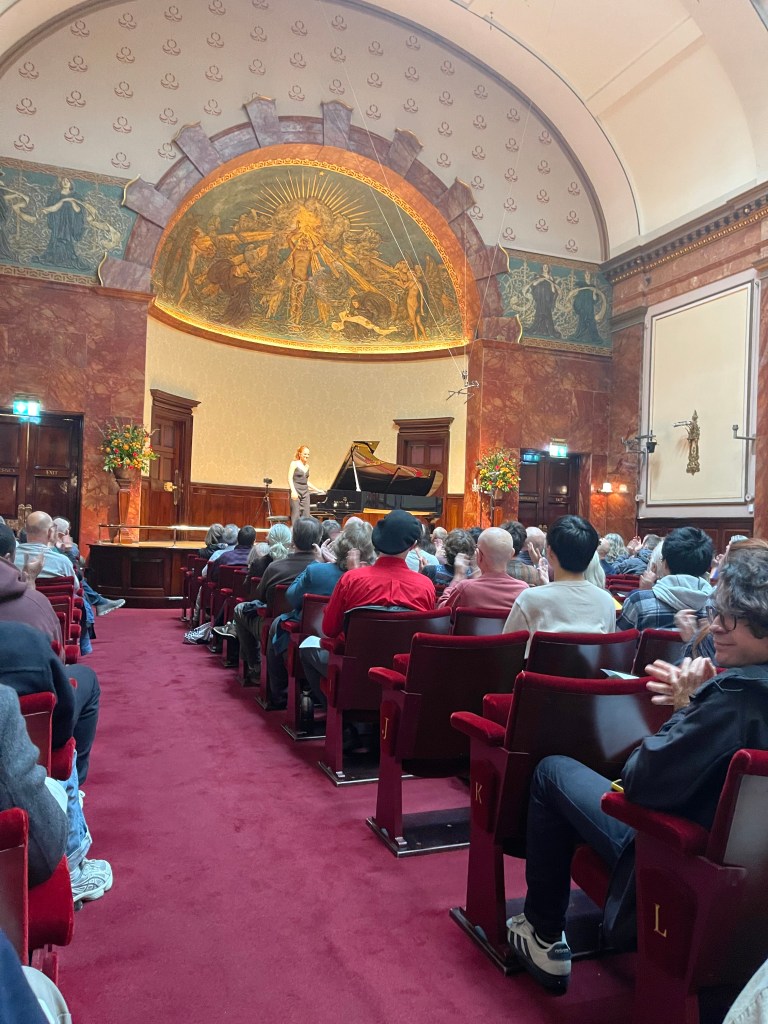
Poulenc was followed by Boulez, with the same sense of character but of a different musical language .Bursting into furious activity with a sound world that glowed of radiance and crystal clarity .
As Rubinstein famously said you should only play music that convinces you and speaks directly to your heart.
https://youtu.be/gex0sOR7XZ0?si=JzzvzSKfUpNShBzq
It is this that came to mind as Milda was convinced and convincing with a frantic fugato dissolving into whispered oblivion. A kaleidoscope of colours and sounds with a masterly use of the pedals.This was like a breath of fresh air in a sumptuous somewhat decadent feast of music making.
It was Rubinstein who gave the first performance of Ravel’s ‘Valses nobles’ in Spain .It was received with such a clamorous rejection that he famously decided to play it all over again as an encore! Today it is considered one of the most beautiful works of Ravel, far removed from his transcription of ‘La Valse’. However the seduction and perfumed brilliance of these Waltzes in this work are of refined elegance and radiant beauty. After the brilliance of the opening there was the ravishing fluidity of the ‘assez lent’ followed by the whispered delicacy of the ‘moderé’ ready to burst into mellifluous flights of fancy . A featherlight cascade of notes in the ‘assez animé’ led to the purity and poignant beauty of the ‘presque lent’. Crawling around the keys with insinuating ridiculousness before bursting into an unashamed Viennese waltz and the passionate climax of the final ‘moins vif’ .The Épilogue is one of Ravel’s most poignant creations and Milda played it with magical sonorities. A radiant misty cloud out of which Ravel could recall what we had just experienced, with poignant nostalgia. A memorable performance that Milda played with subtle refined elegance and tonal mastery.

‘Regard de l’Esprit de joie’ has long been a pianistic show piece and is part of the ‘Vingt regards sur l’Enfant- Jésus’ of which the most poignant is ‘Le baiser.’ I remember my impression of astonishment and breathless wonder when a young French boy played it at the first Leeds Competition. Jean- Rodolfe Kars I believe became a Trappist monk instead of becoming a concert pianist.The intensity and purity of his playing gave some idea that here was a true believer, as was the composer. I am quite sure that Milda will not become part of a ‘Clausura’ but she played Regard de Joie with the same burning intensity and fearless mastery of a true believer. Messiaen’s chorale was played with terrifying commitment like broken glass showered with burning conviction from the roof tops. Milda has a small hand but that did not stop her from mastering this work and delivering it to us with breathtaking mastery. An enormous palette of sounds and a dynamic drive that held us on the edge of our seats. Plunging down to the bottom of the keyboard where she stayed for quite some minutes as we marvelled at what we had just witnessed.
Awakened from her trance she offered as a thank you, one of Chopin’s most beautiful Mazurkas, op 63 n. 2 in F minor. Played with all the subtle beauty and beguiling rubato of the passionately committed musician we had encountered today.

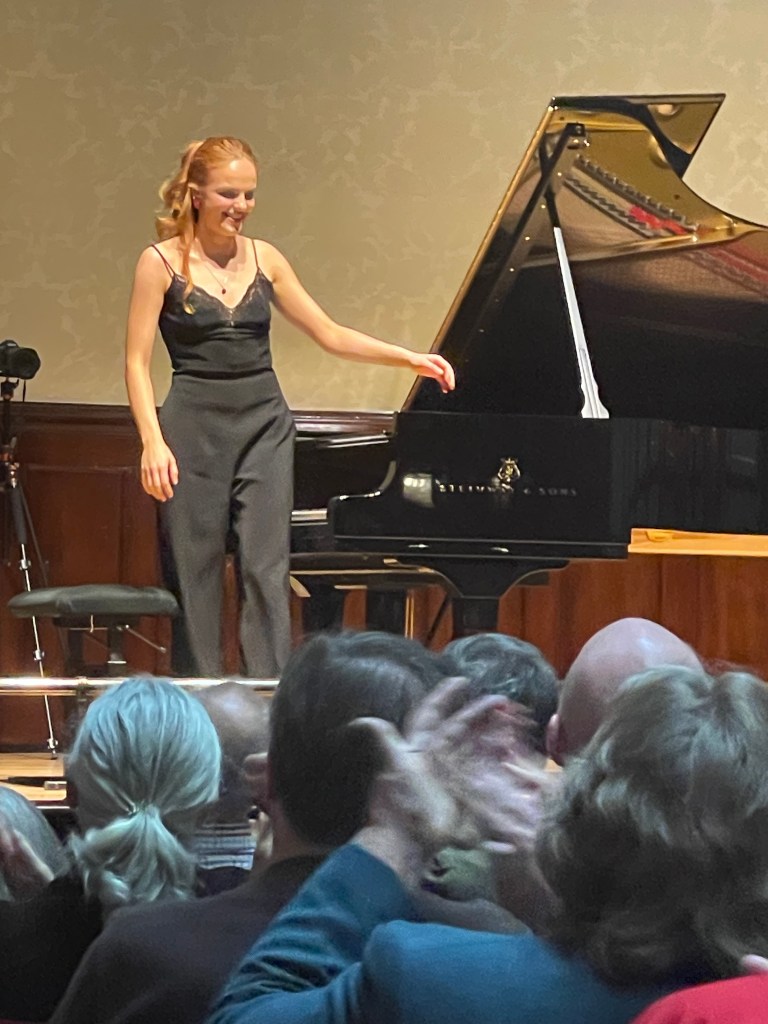


The fifteen Improvisations were composed at intervals between 1932 and 1959. All are brief: the longest lasts a little more than three minutes. They vary from swift and balletic to tender lyricism, old-fashioned march,perpetuum mobile, waltz and a poignant musical portrait of the singer Édith Piaf.

Douze Notations pour piano have a special place in the musical output of Pierre Boulez (1925-2016). For one thing, ever since their belated publication in 1985 these short piano pieces have headed the work list of this extremely self-critical composer. For another, Boulez frequently drew on these fledgling compositions in his later music. Finally, this collection of 1945 offers fascinating insights into the compositional workshop of the then 20-year-old composer.”Douze Notations” consists of 12 short piano pieces that explore the early development of his musical language. “Doux et improvisé” (Soft and improvisational) is the title of the fifth piece in this collection. The pieces were published in 1985 and Boulez frequently drew on them for later orchestral versions, which he continued to develop throughout his career, creating a “spiral” of constant evolution of his own work. The 12 pieces were premiered on 12 February 1946, in Paris (concerts du Triptyque), by Yvette Grimaud.:
1. Fantasque. Modéré 2. Très vif 3. Assez lent 4. Rythmique 5. Doux et improvisé 6. Rapide 7. Hiératique 8. Modéré jusqu’à très vif 9. Lointain. Calme 10. Mécanique et très sec 11. Scintillant 12. Lent. Puissant et âpre

 ChristopherAxworthy-MusicCommentary