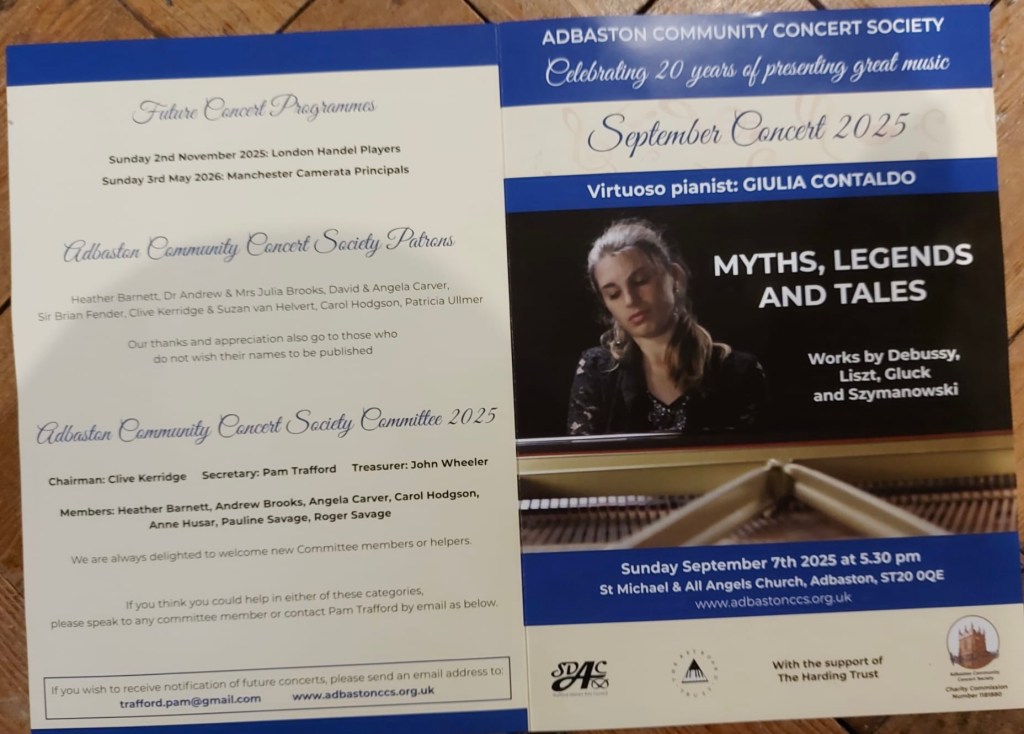
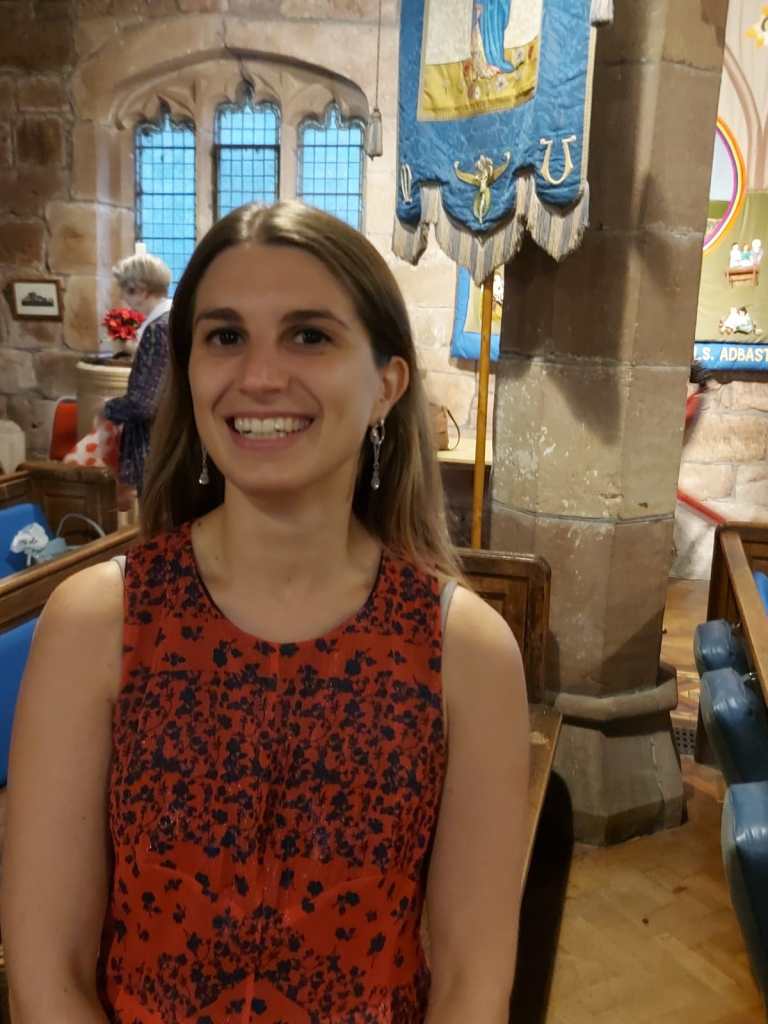
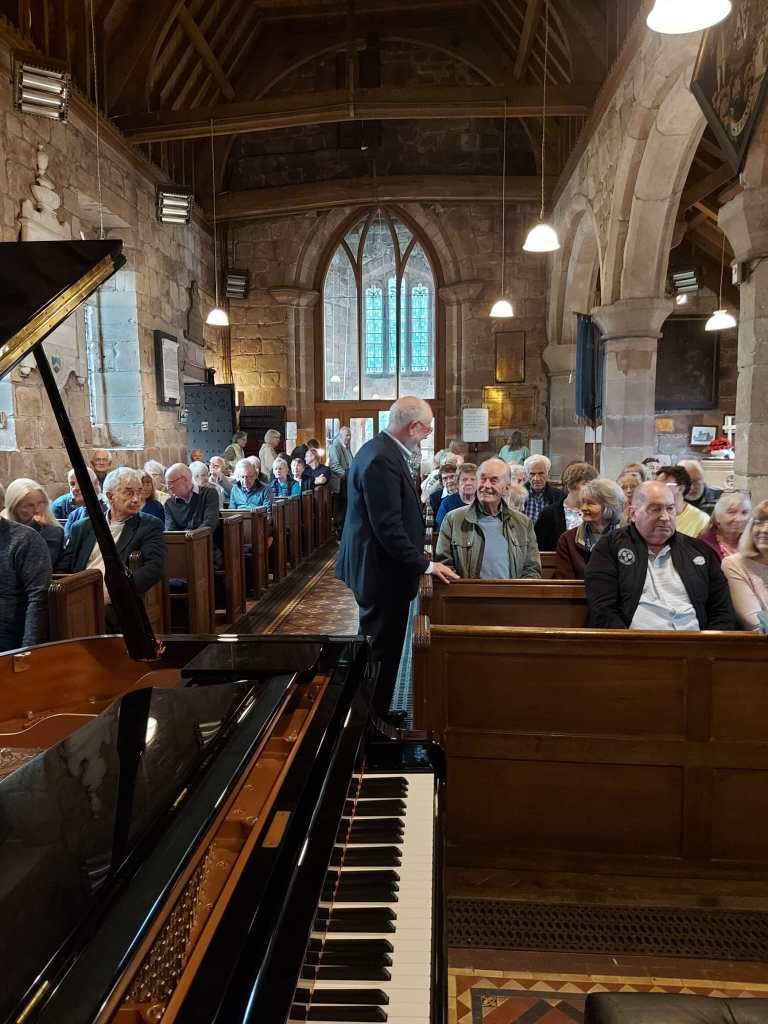
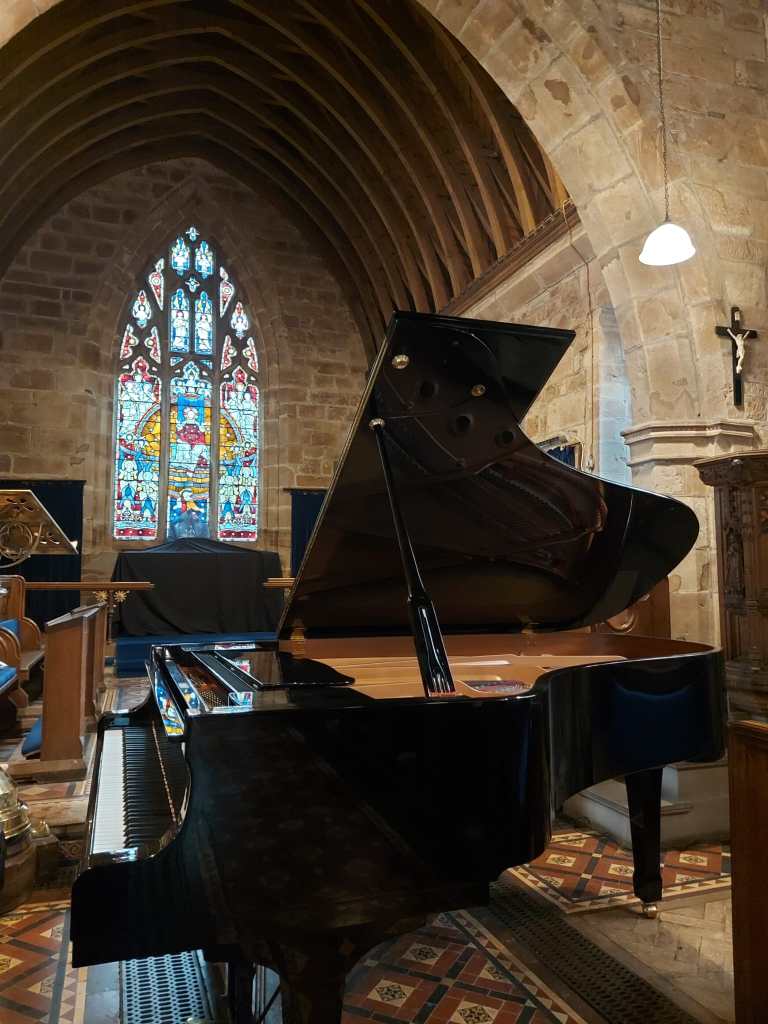
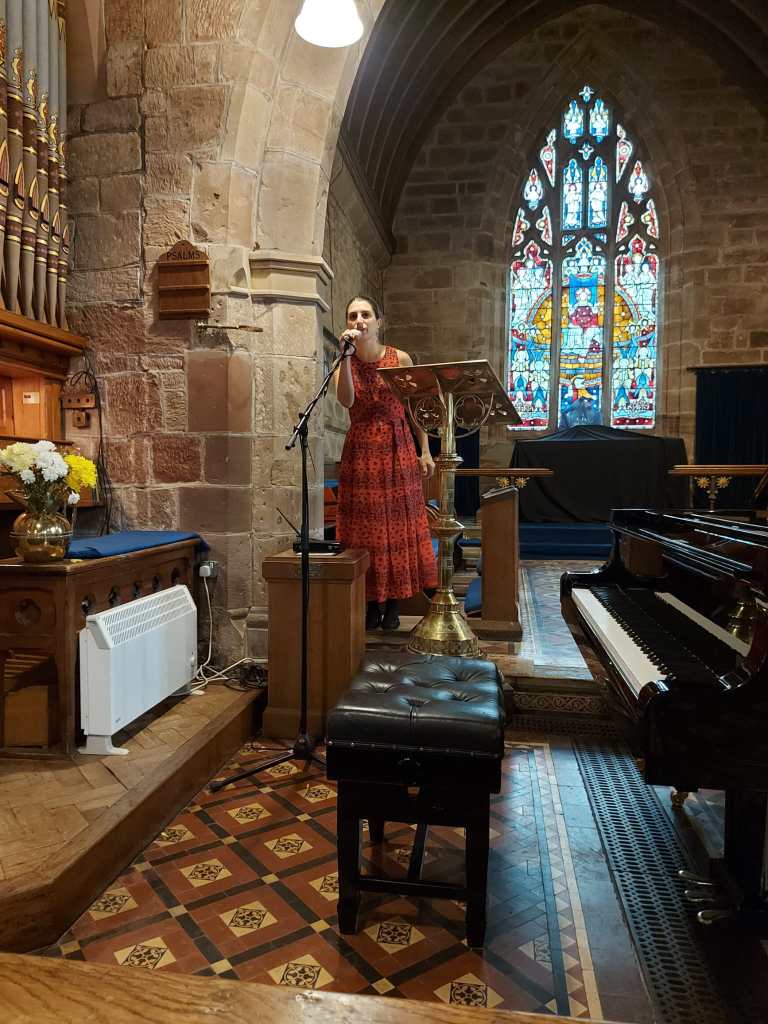
Clive Kerridge writes : ‘ There was an enthusiastic reception for KT-supported rising star, Giulia Contaldo‘s recital in Adbaston (Stafford) on Sunday 7th September 2025 .
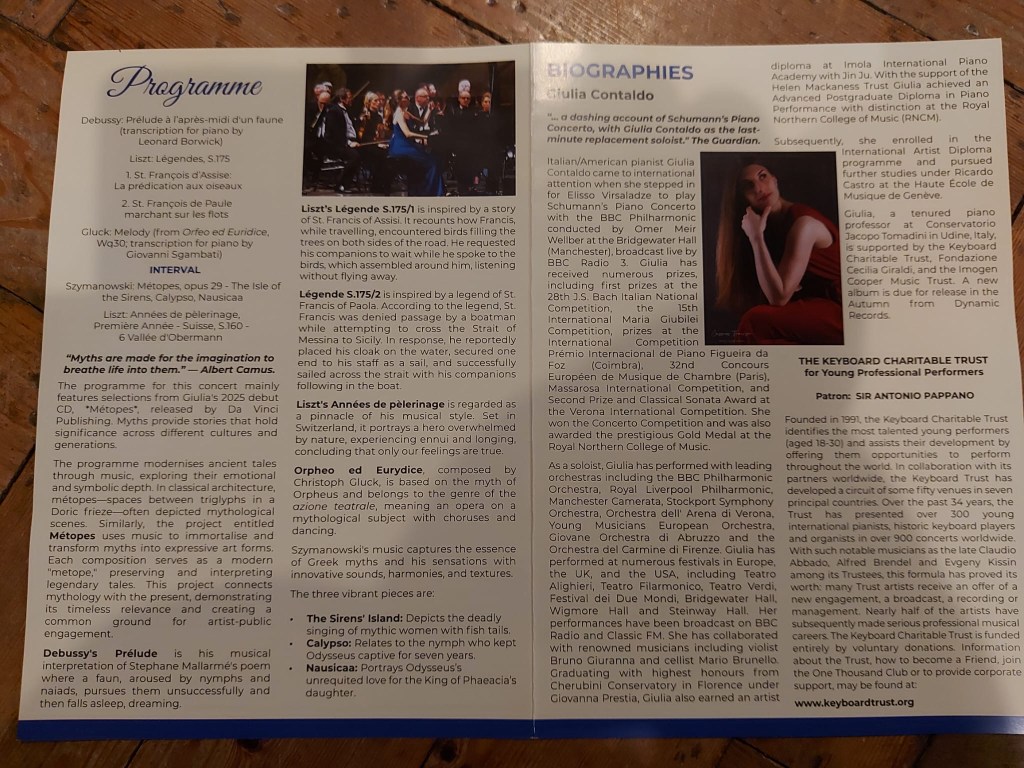
It opened with her sensitive rendition of Claude Debussy‘s celebrated Prélude à l’après-midi d’un faun, transcribed for piano by his contemporary Leonard Borwick (though Giulia‘s elegantly colourful playing was almost orchestral in its own right!). That was followed with two pieces from Franz Liszt ‘ Légendes‘, concluding with her full-blooded rendition of S175/2, inspired by a legend of Saint Francis of Paola.
Giulia‘s second set maintained the theme of Myths, Legends and Stories, starting with Szymanowski‘s Trois Poèmes, the Polish-Ukrainian composer’s recognised piano masterpiece, which Giulia played with her characteristic pathos and exuberance across the three sections.
The concert concluded with her scintillating playing of another Liszt piece: from Années de Pèlerinage, S160 Vallée d’Obermann, described as ‘achingly beautiful’ by the [Adbaston] host, which received a rousing ovation from the audience.This was an excellent recital by an assured keyboard artist, surely on a trajectory to becoming a recognised international virtuoso soloist.’
Carol Hodgson writes : ‘Once again it was such a pleasure to see you all again and host a KT pianist in Giulia: she was wonderful, and I felt she put her very soul into each piece. I felt transported by music I was hitherto unfamiliar with. She is a powerful player, yet the slightest touch on the keys conveyed such gentleness and sensitivity.’
“Music has the power to bring people together, no matter race, gender, sex, or religion, and it creates emotions unable to be felt in everyday life. It is important to me because it gives my life a new flavour, a new colour, and a new spectrum.” Shunta Morimoto aged 14.
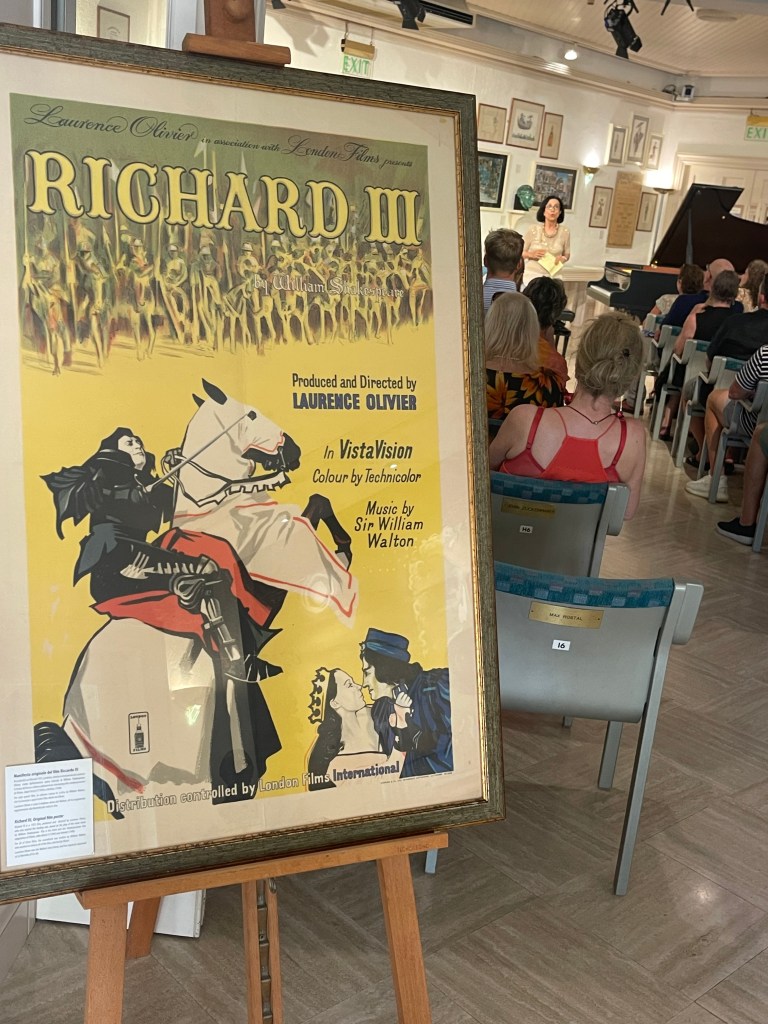
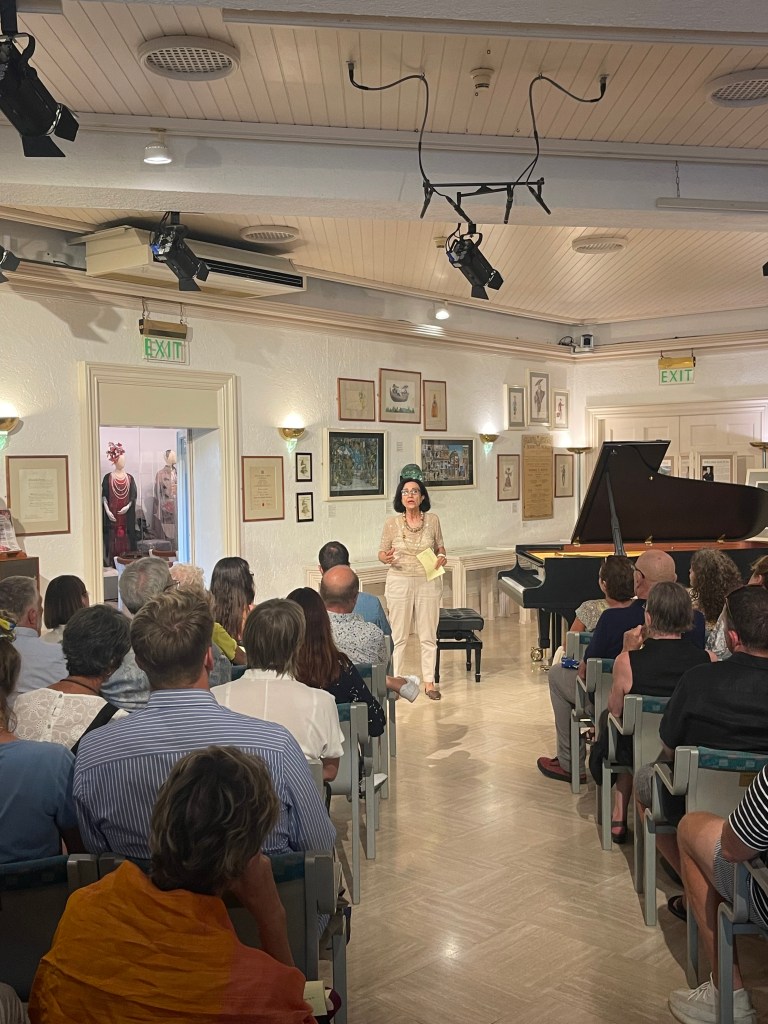
Lina Tufano,artistic director of Incontri presenting the concert
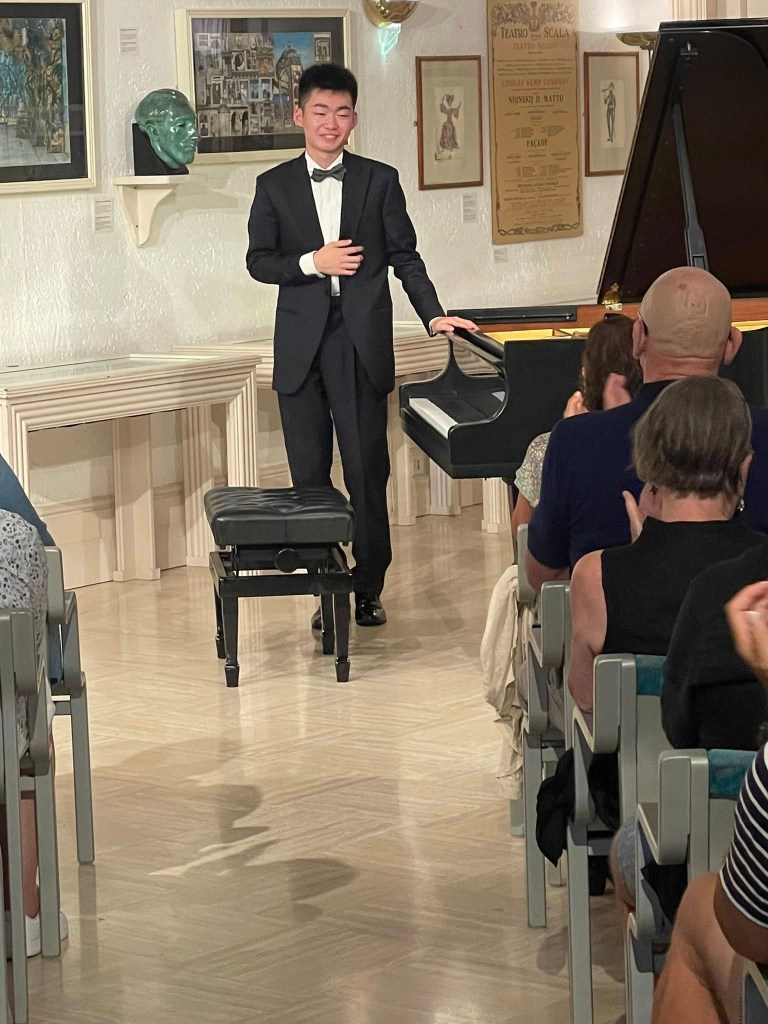
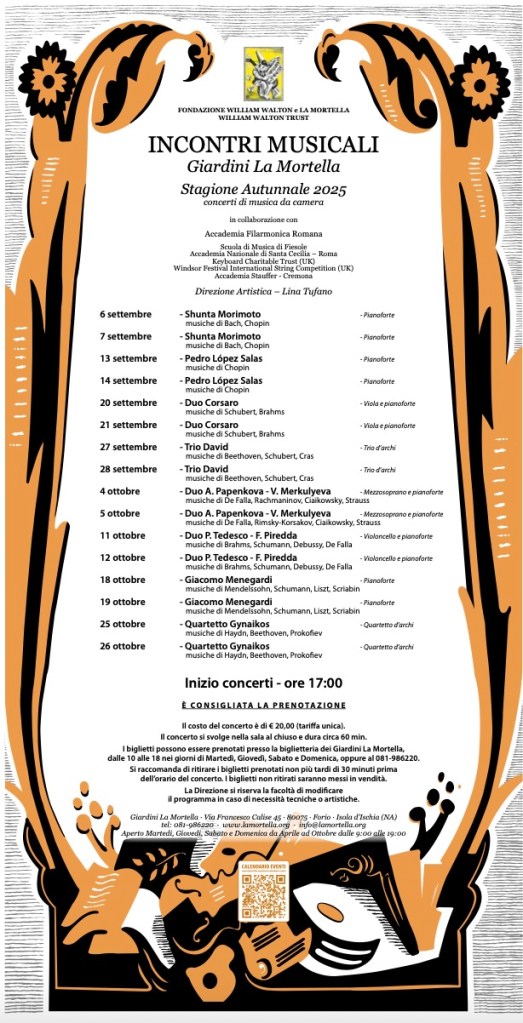
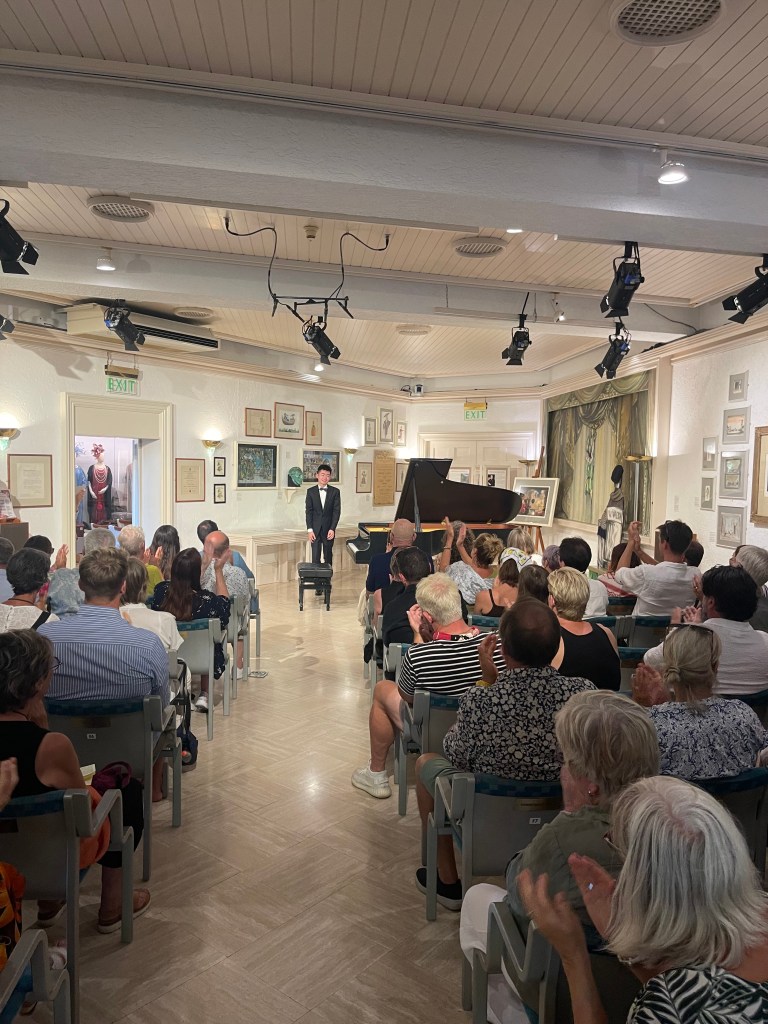
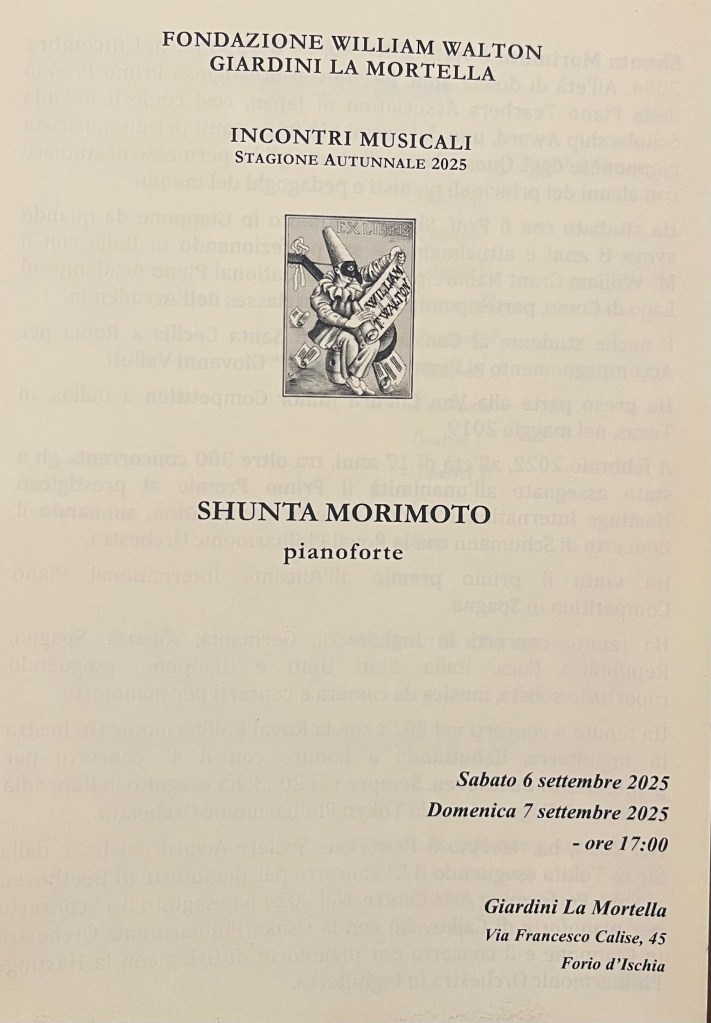
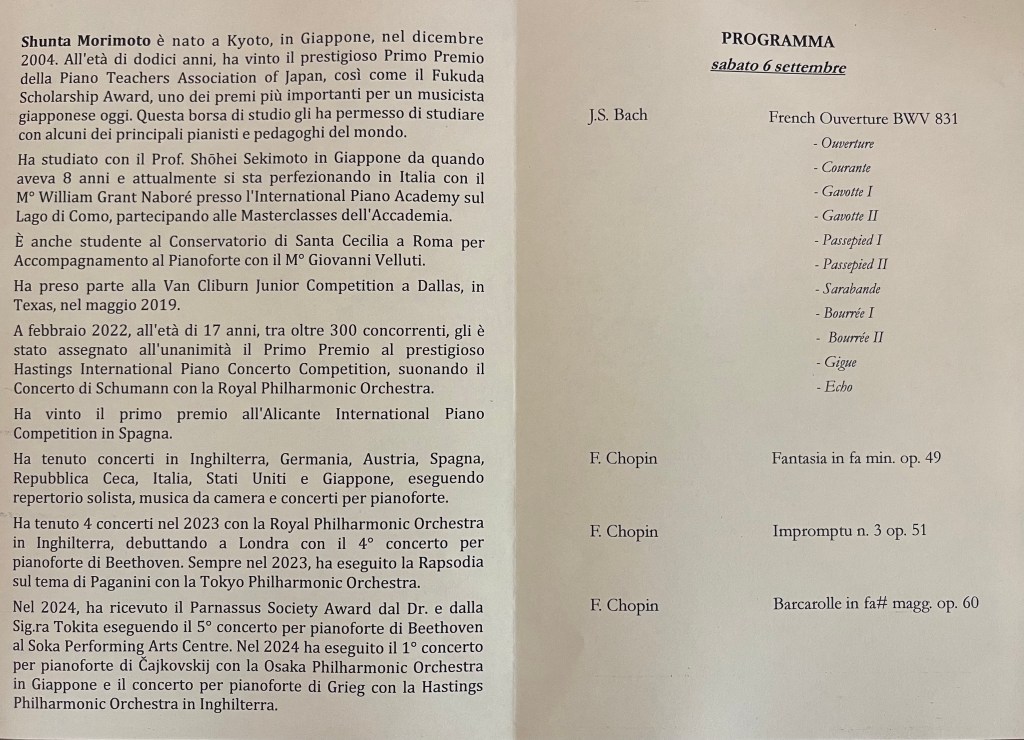
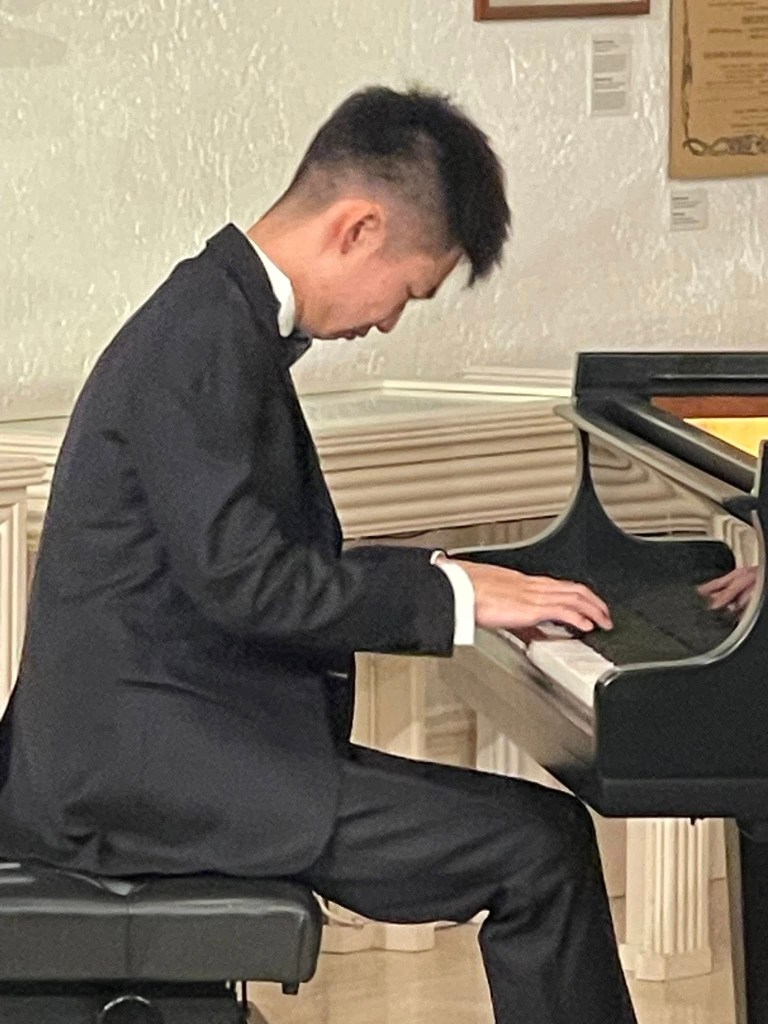
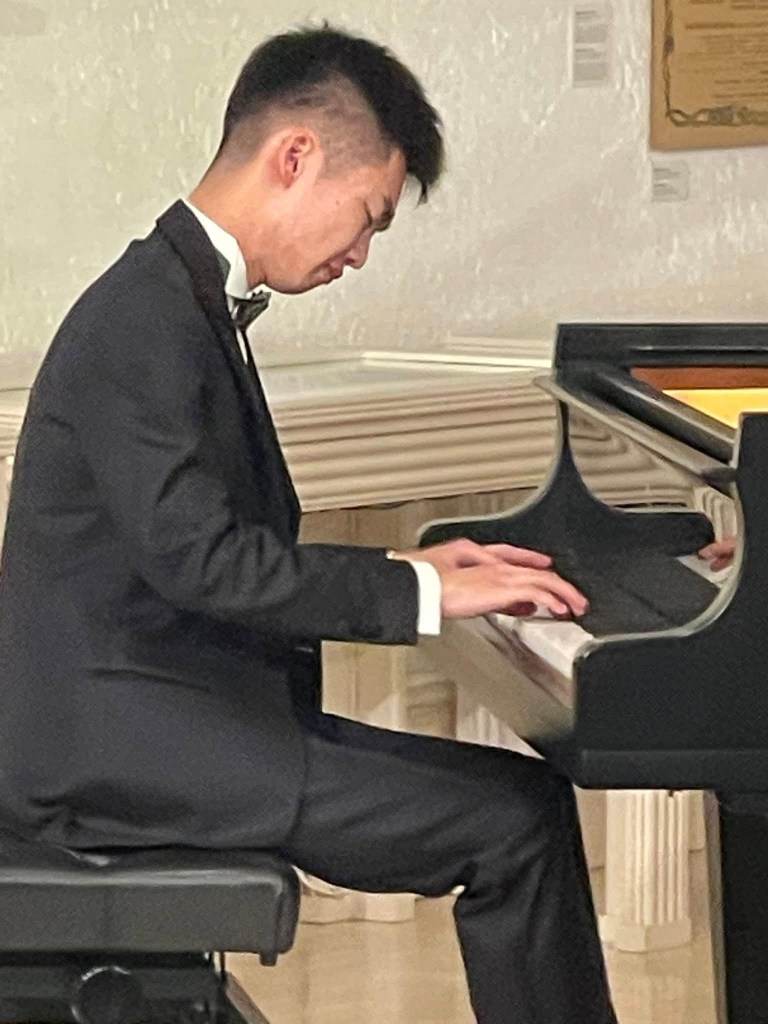
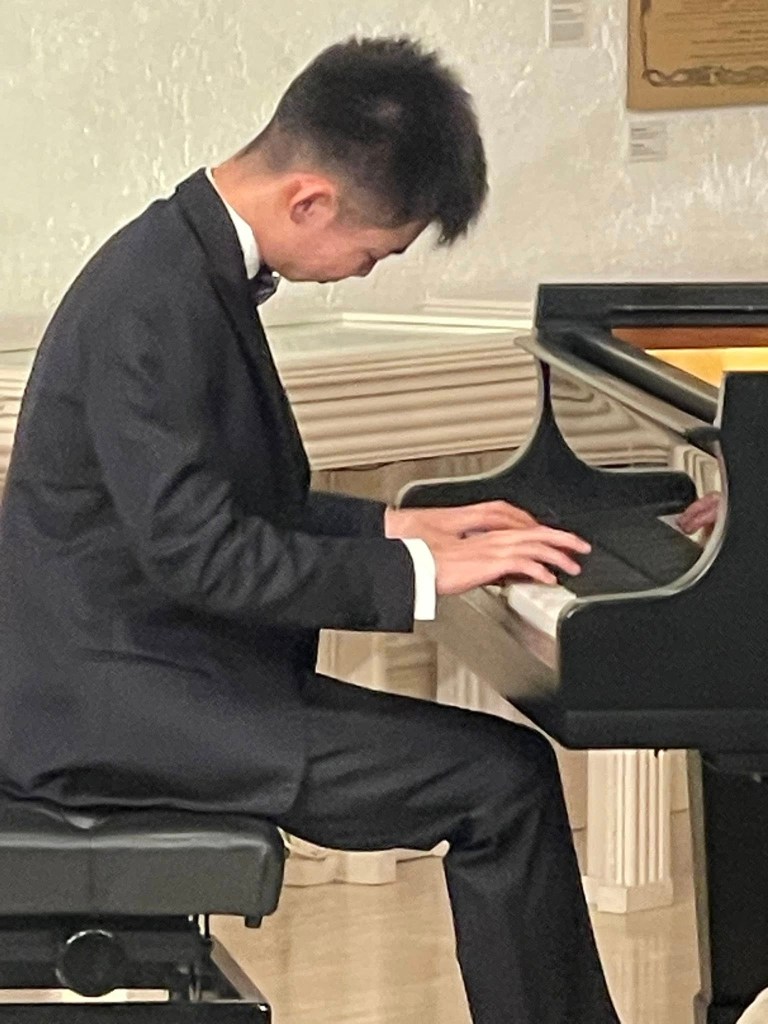
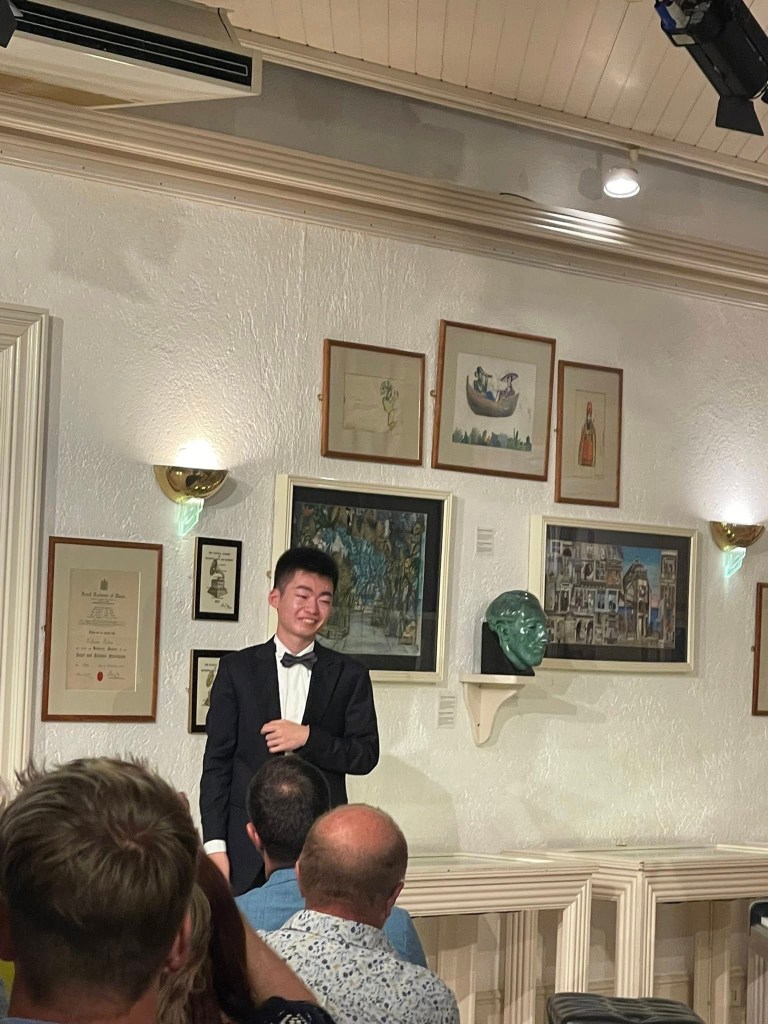
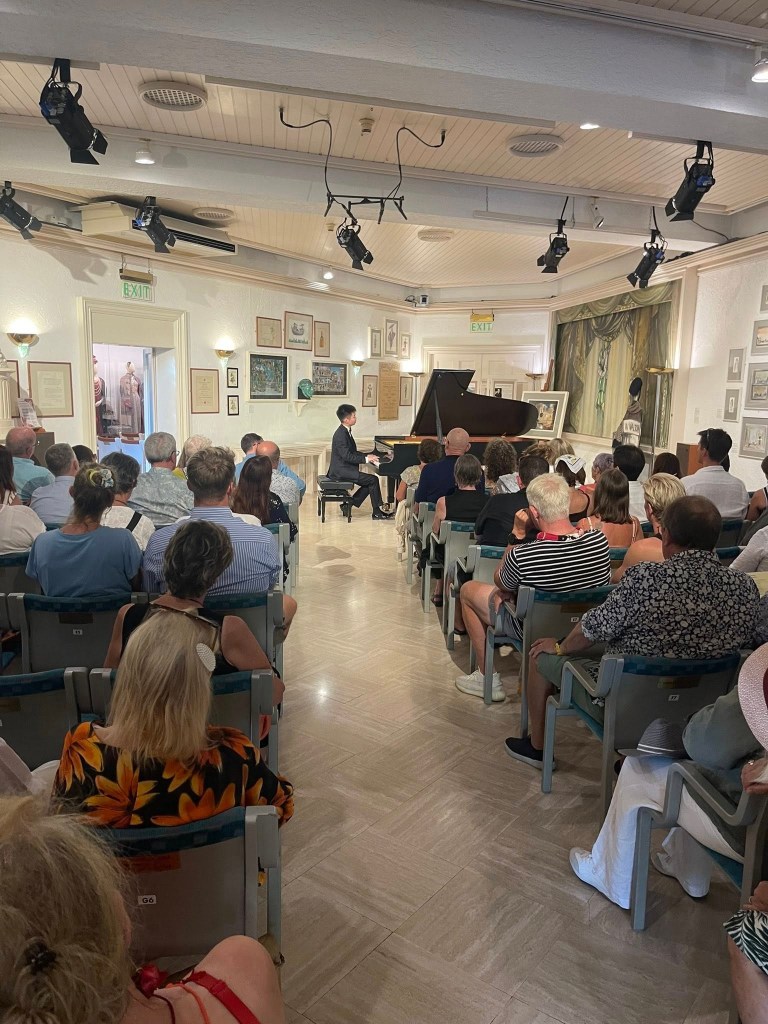
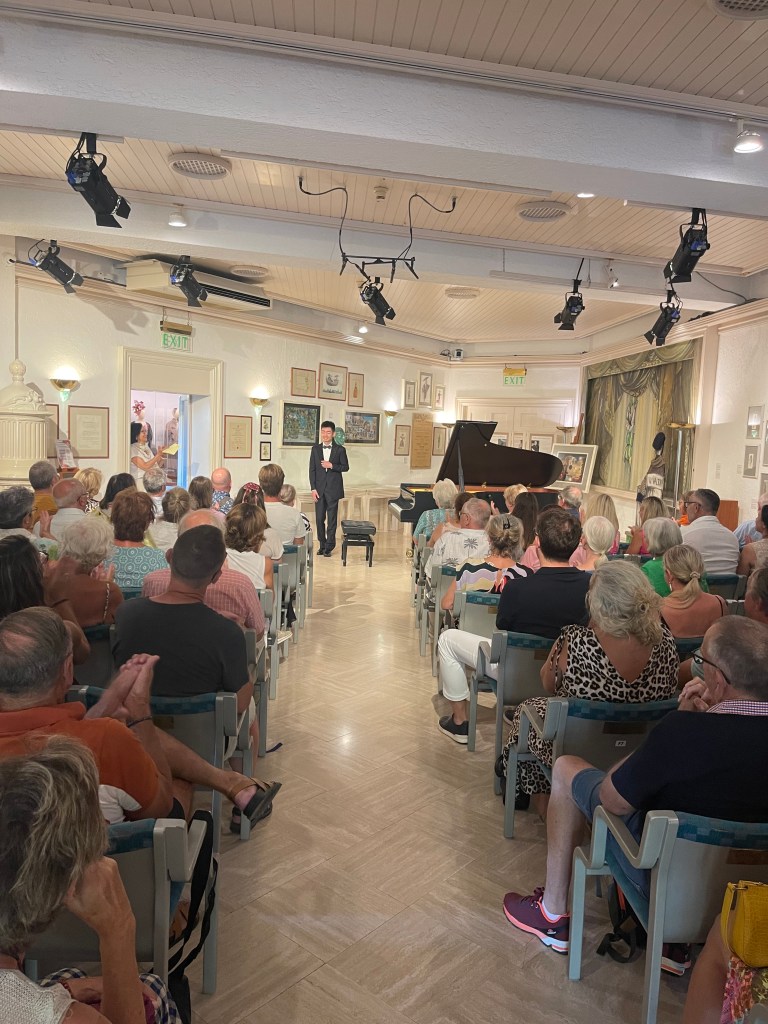
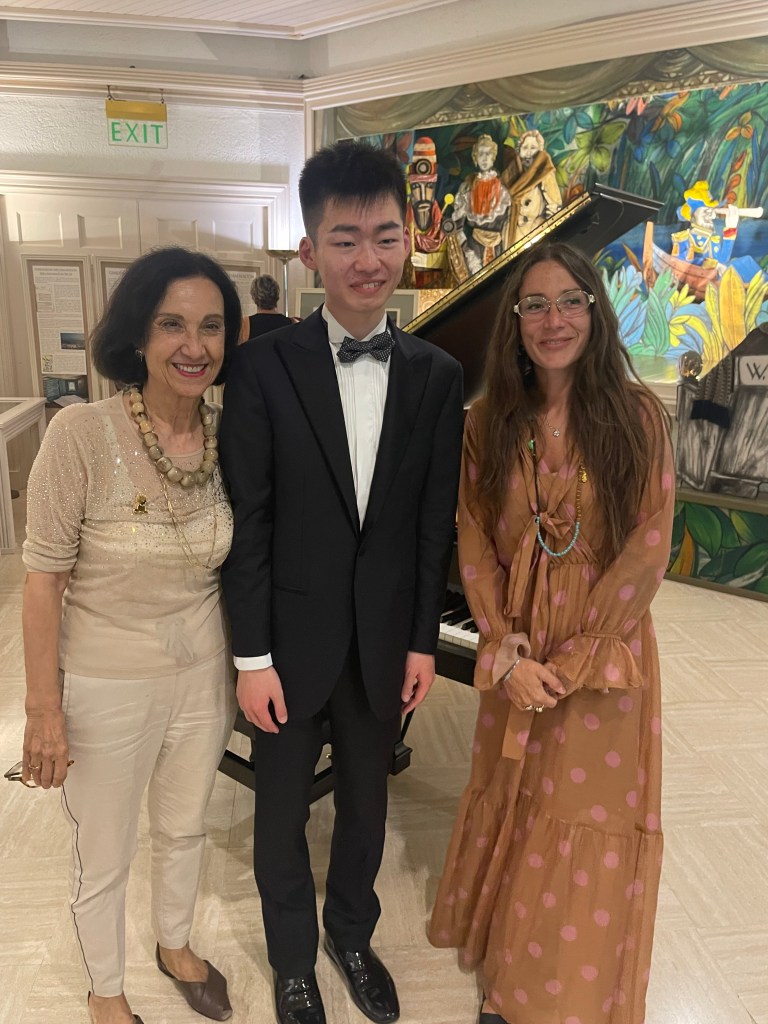
Shunta Morimoto just arrived from Japan to play at La Mortella before concerts in Ireland and London, at the beginning of what will be a very busy season for this twenty year old pianist. Unanimous winner of Hastings International Piano Competition when he was seventeen, and now embarking on a career that has already taken him to Los Angeles to play Brahms 2 having played Beethoven 4 and Liszt 1 with the RPO in England, and when he was only sixteen Rachmaninov 3 with the Tokyo Philharmonic.
A rising star indeed with an insatiable appetite to discover ever more about the mysteries that are hidden within the scores. A quite extraordinary artist that Stanislaw Ioudentich ( winner of Van Cliburn in 2001 and distinguished teacher in Oberlin ,Como and Madrid ) declared quite candidly ‘ is the greatest talent I have ever known.’
Here is Shunta aged fourteen in Fort Worth – Van Cliburn. ” Shunta Morimoto has won first in his category three times in the Piano Teachers’ National Association of Japan Piano Competition, as well as other competitions in his home country, which has led to multiple performances in Tokyo, Yokohama, and his home town of Kyoto. He also placed first in the 2018 Aloha International Piano Competition and subsequently gave concerts in Hawaii, including with the Hawaii Youth Symphony. He says that experience helped him believe in the “magical power of music,” because he could use it to communicate easily where a language barrier may have prohibited him. A student at Momoyama Junior High School, Shunta currently studies with Shohei Sekimoto.”
Shunta has a hand that has been moulded by superb teaching in Japan from a very early age, giving him a flexibility and true weight that never attacks the key but sucks the life blood from each one with beautiful natural horizontal movements , it is like watching a painter in front of his canvas. Delving deep into the scores having been mentored by William Naboré in Rome and Como for the past five years, he has an insatiable appetite to acquire knowledge and share inspiration as he tries to find the true meaning behind the notes bequeathed to posterity by the great composers.
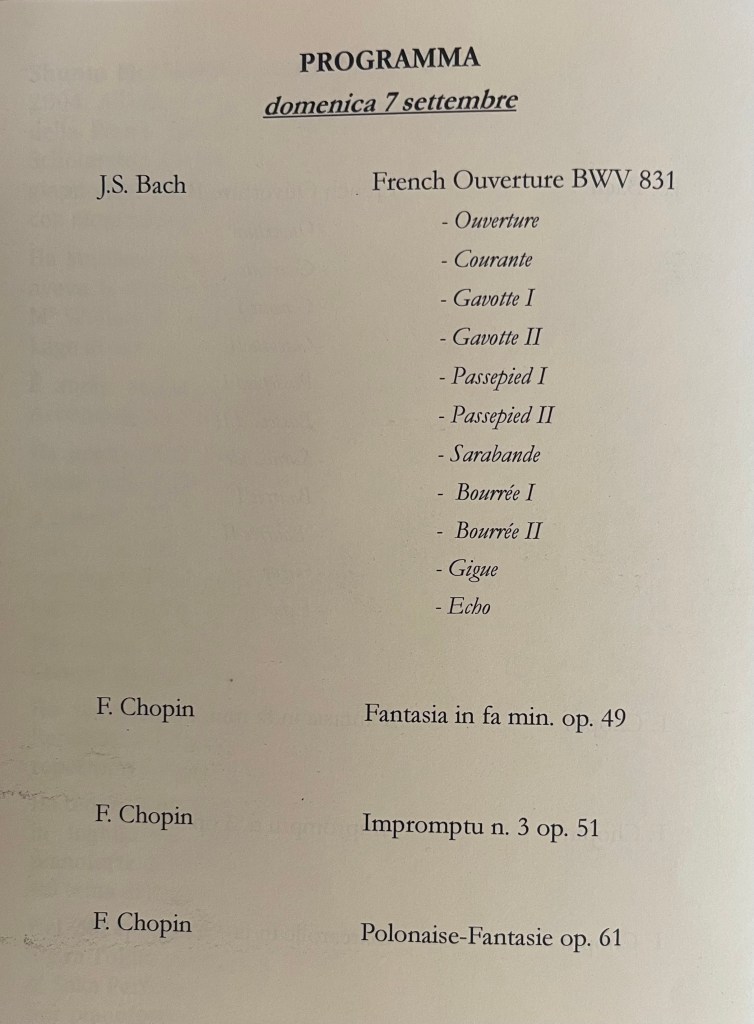
And it was the Great French Overture by Bach that opened Shunta’s two recitals in Ischia. Often known as the seventh Partita, it is a work of great significance and appears on programmes of only the most eclectic musicians such as Andras Schiff or Angela Hewitt. In eleven movements lasting over thirty minutes it opens with an Overture of monumental proportions. Shunta played with commanding authority as the opening flourish immediately held our attention with its nobility and grandeur. Subtle ornaments unwound like springs from his fingers never interfering with the overall outline. It was like a great Gothic Cathedral taking our breath away as we are overwhelmed by such a man made construction. Bursting into life in a spectacular rhythmic way with energy that came from within the notes with a buoyancy and elan of extraordinary eloquence. The genius of Bach bringing back the opening with an ever more poignant nobility. There was a delicacy to the meanderings of the ‘Courante’ and a deliberate fluidity to the ‘Gavottes’ and a decisive brilliance to the ‘Passepieds’. Shunta brought a subtle veiled beauty to the ‘Sarabande’ contrasting with the boisterous dance of the ‘Bourées’. A ‘Gigue’ that just flew from his fingers, but it was above all the ‘Echo’ that Shunta played with impish good humour and enticing rhythmic characterisation. A ‘tour de force’ of concentration and intellectual understanding of a maturity, way beyond Shunta’s twenty years.
It was followed by some of the greatest works by Chopin. Truly masterpieces that the genius of Chopin had created for a piano that had evolved from the earlier keyboard instruments, that now had a sustaining pedal that became the very soul of the piano – to quote Anton Rubinstein. It becomes a full orchestra capable of a variety of sounds where above all Chopin could create new art forms of refined elegance and fantasy. It was this full orchestra that Shunta showed us today choosing Chopin’s only two Fantasies that are art forms that do not conform to the standard practice of the day.Following in Schubert’s footsteps trying to find a form that had logic and cohesion but also the character of operatic proportions where there is a wondrous story to tell. No longer tied down with formal tradition but able to bring a personal spirit to the music as the Romantic era broke away from the formal constraints of the baroque period.
Shunta played the Fantasy with expansive beauty, nobility and delicacy. The opening was like a sunrise with the unfolding of the drama about to explode. A passionate outpouring of extraordinary mastery and a remarkable palette of colours. An unusually long wait before the opening of the central episode that was of extraordinary poignancy. A vision of paradise was opening up with startling simplicity and purity. The passionate return of the opening was played with even more burning intensity disintegrating to a beseeching cadenza with its simple whispered beauty. It was interesting to note the keys that Shunta held silently in the bass to allow the harmonics to reverberate without the cloud of pedal. It was greeted by a miraculous wave of sounds to the final imperious closing chords.
The G flat Impromptu was played with a beguiling beauty of aristocratic good taste. Shunta added another level of fantasy to this work with an extraordinary range of subtle colouring and shaping of the phrases. The gentle whispered return of the opening, after the ravishing noble beauty of the tenor voice of the central episode, I will cherish for a long time. I have always Rubinstein in my ears when I hear this work as he played it with that same aristocratic French heart that he brought to his friend Poulenc’s music. Shunta showed me another side today with a dream like fantasy world of glistening beauty, without loosing any of the refined elegance that is so extraordinary in this wondrous Impromptu.https://youtu.be/mB9MgedVR3o
It was the same magic that he brought to the Barcarolle op 60 which is one of Chopin’s greatest creations. It is a true ‘Lied von der Erde’, starting from the deep bass C sharp that just opens up the piano so that all that follows can float on the continuous gentle wave of the lagoon, creating pure magic. A magic land indeed of a story told with refined beauty but also with passion. Barely touching the keys in the miraculous bel canto central episode as he allowed the music to gradually engulf him as the temperature rose. The extraordinary thing about Shunta’s playing is the depth of sound that is never ungrateful or percussive but comes from deep within the very soul of the music.There was a refined beauty to the final meanderings as we near the sad farewell , with the gentle tenor melody just glowing in the distance.This was a passage that Ravel, the absolute master of colour, so admired. A cascade of notes leading to the final simple vision to this wondrous land of dreams.
Two encores showed off the wonderful jeux perlé and also the beguiling sense of showmanship that is so much part of the Waltzes of Chopin. Op 42 with its intricate knotty rhythms was played with an extraordinary sense of dance and freedom . https://youtu.be/QTebZVST-oM?si=sipmtOeJ3v0EuXrr
The Prelude op 28 n. 3 just flowed from Shunta’s fingers with disarming simplicity as this extraordinary jewel in a crown of 24 problems ( according to Fou Ts’ong) was shaped as the miniature tone poems of each one should be, and that Shunta will treat us to in the National Liberal club in London for halloween .
The second recital was with the addition of the Polonaise- Fantaisie op 61 ,the twin of the Barcarolle op 60. Fantasy was the word for the first chords just opening up a magic world of wondrous whispered sounds. Playing these ‘vibrations’ with one single movement it became truly an undulation of the senses both visual and audial. A Polonaise that burst onto the scene with unusual vehemence and that Shunta played with passionate drive, but there was also a feeling of tenderness and wonder. A beautifully free,almost improvised, central episode where the melodic line passed from the tenor to the soprano register with poetic beauty and tranquility .Gradually trills appeared magically vibrating with ever more intensity until the opening chords return with even more etherial vibrations. Suddenly the intensity increases as Chopin reaches for a climax of exhilaration and nobility played by Shunta with extraordinary power and passion. Octaves flying as the tension diminishes and this fantasy world of genial creation comes to a close on a single isolated A flat.
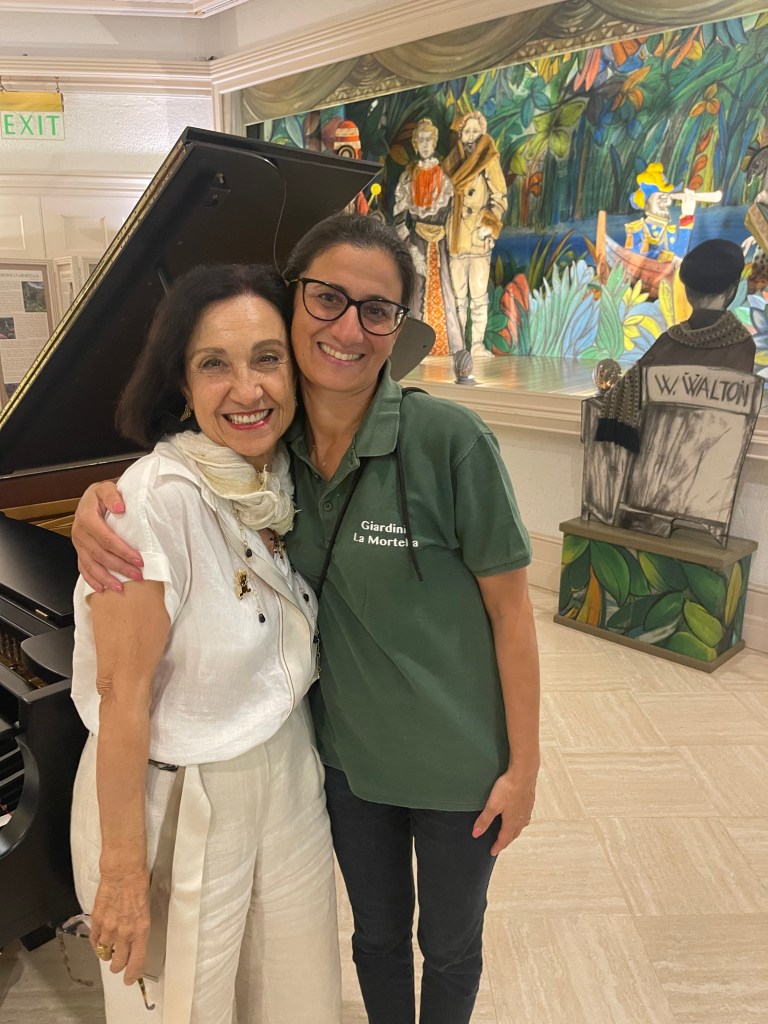
Lina Tufano with Raffaella our guardian angel in La Mortella
Shunta added to his encore of op 42 that he had played yesterday too, with a magical account of Chopin’s Berceuse.Whispered tones made us listen even more intently to the beauty of the magic web of variations that Chopin could weave,adding to the most beautiful of all lullabies with a rocking motion of sumptuous innocence and beauty.
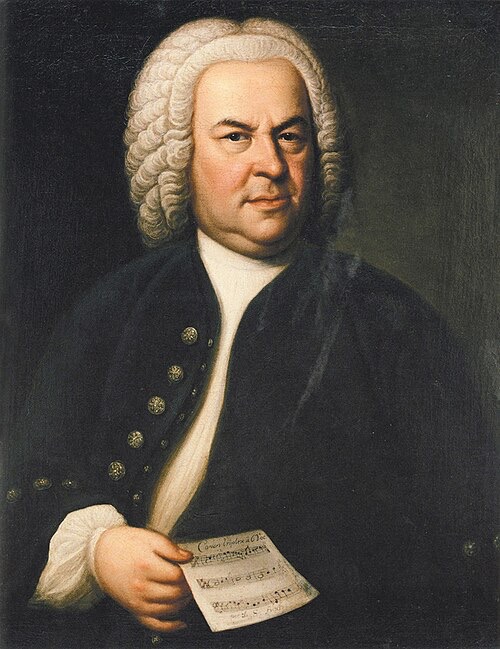
Signora Lucia the Deus ex Macchina of La Mortella Professor Lina Tufano with an ex student of Avvelino Conservatory The Concert Hall with Linda Alberti who had travelled from Frascati to support Shunta with sigma Anna of La Rondinella beach restaurant after concert dinner 1748 portrait of Bach holding a copy of the canon BWV 1076 Born 21 March 1685 Eisenach Died. 28 July 1750 (aged 65) Leipzig
The Overture in the French style, BWV 831, original title Ouvertüre nach Französischer Art, also known as the French Overture and published as the second half of the Clavier Übung II in 1735 (paired with the Italian Concerto ), is a suite in B minor for a two-manual harpsichord.
The term overture refers to the fact that this suite starts with an overture movement, and was a common generic name for French suites (his orchestral suites were similarly named). This “overture” movement replaces the allemande found in Bach’s other keyboard suites. Also, there are optional dance movements both before and after the Sarabande. In Bach’s work optional movements usually occur only after the sarabande. All three of the optional dance movements are presented in pairs, with the first one repeated after the second, but without the internal repeats. Also unusual for Bach is the inclusion of an extra movement after the Gigue, the “Echo,” a piece meant to exploit the terraced loud and soft dynamics of the two-manual harpsichord. Other movements also have dynamic indications (piano and forte ), which are not often found in keyboard suites of the Baroque period, and indicate here the use of the two keyboards of the harpsichord. With eleven movements, the French Overture is the longest keyboard suite ever composed by Bach. It usually has a duration of around 30 minutes if all the repeats in every movement are taken.
Bach wrote an earlier version of the work, in the key of C minor (BWV 831a) later transposed to B minor to complete the cycle of tonalities in Parts One and Two of the Clavier-Übung.The keys of the six Partitas (B♭ major, C minor, A minor, D major, G major, E minor) of Clavier-Übung I form a sequence of intervals going up and then down by increasing amounts: a second up (B♭ to C), a third down (C to A), a fourth up (A to D), a fifth down (D to G), and finally a sixth up (G to E).[1] The key sequence is continued in Clavier-Übung II (1735) with two larger works: the Italian Concerto, a seventh down (E to F), and the French Overture, an augmented fourth up (F to B♮). Thus a sequence of customary tonalities for 18th-century keyboard compositions is complete, beginning with the first letter of Bach’s name (B♭, in German is B) and ending with the last (B♮ in German is H).
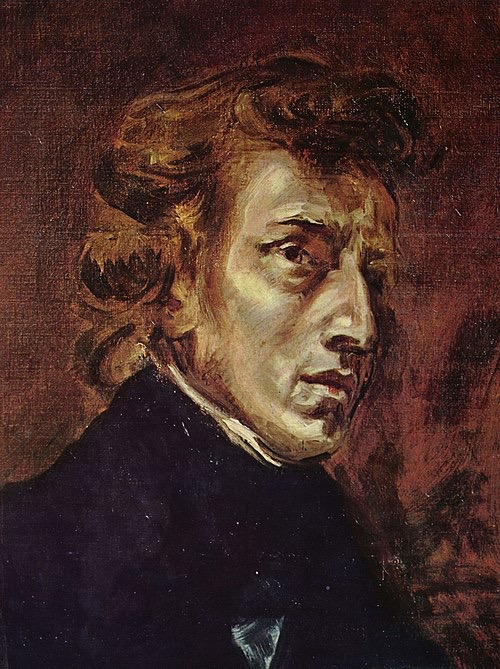
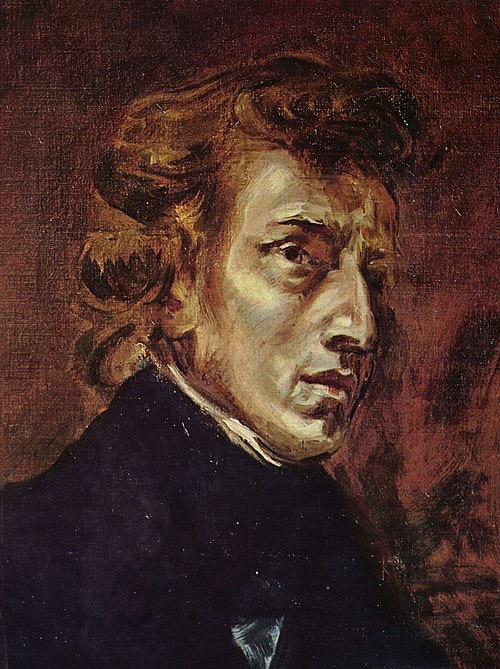
Fryderyk Franciszek Chopin. 1 March 1810. Żelazowa Wola, Duchy of Warsaw. 17 October 1849 (aged 39) Paris. Chopin, 28, at piano, from Delacroix’s 1838 joint portrait of Chopin and SandScreenshot
The Polonaise-Fantaisie in A flat op 61, was dedicated to Mme A. Veyret, written and published in 1846.This work was slow to gain favour with musicians, due to its harmonic complexity and intricate form . Arthur Hedley was one of the first critics to speak positively of the work, writing in 1947 that it “works on the hearer’s imagination with a power of suggestion equaled only by the F minor Fantasy ore the Fourth Ballade ” . It is intimately indebted to the polonaise for its metre, much of its rhythm , and some of its melodic character, but the fantaisie is the operative formal paradigm, and Chopin is said to have referred initially to the piece only as a Fantasy. Parallels with the Fantaisie in F minor include the work’s overall tonality, A-flat, the key of its slower middle section, B major, and the motive of the descending fourth.
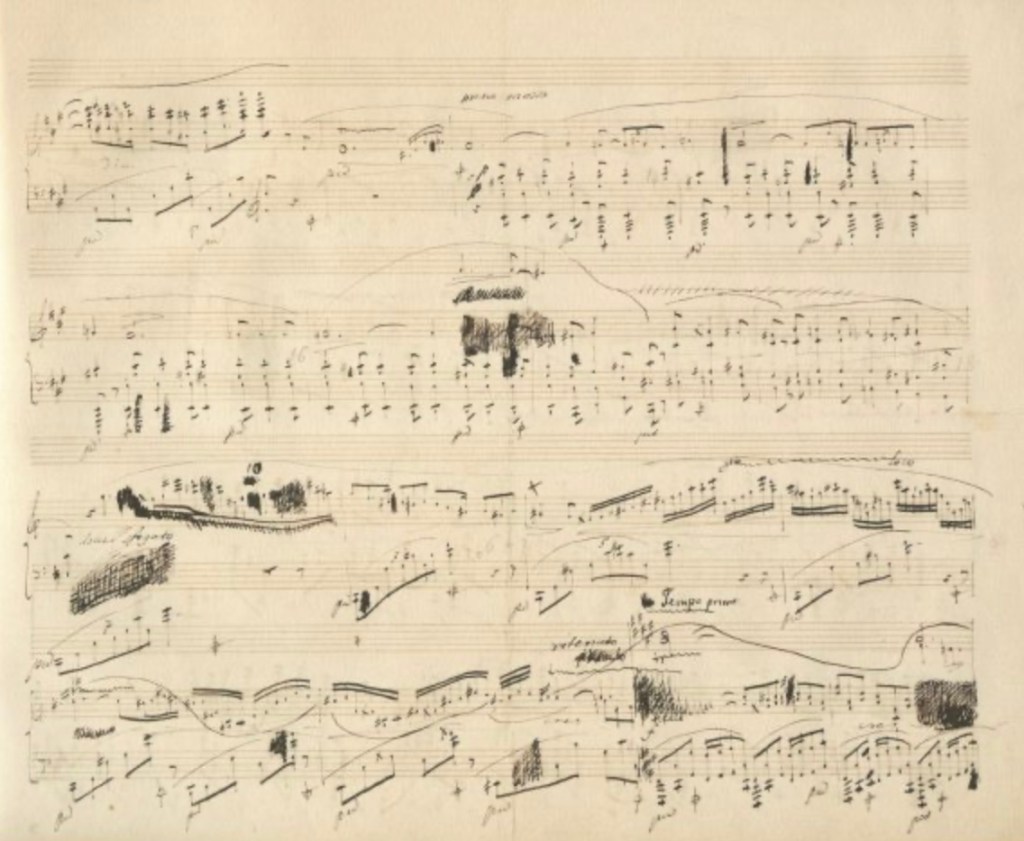
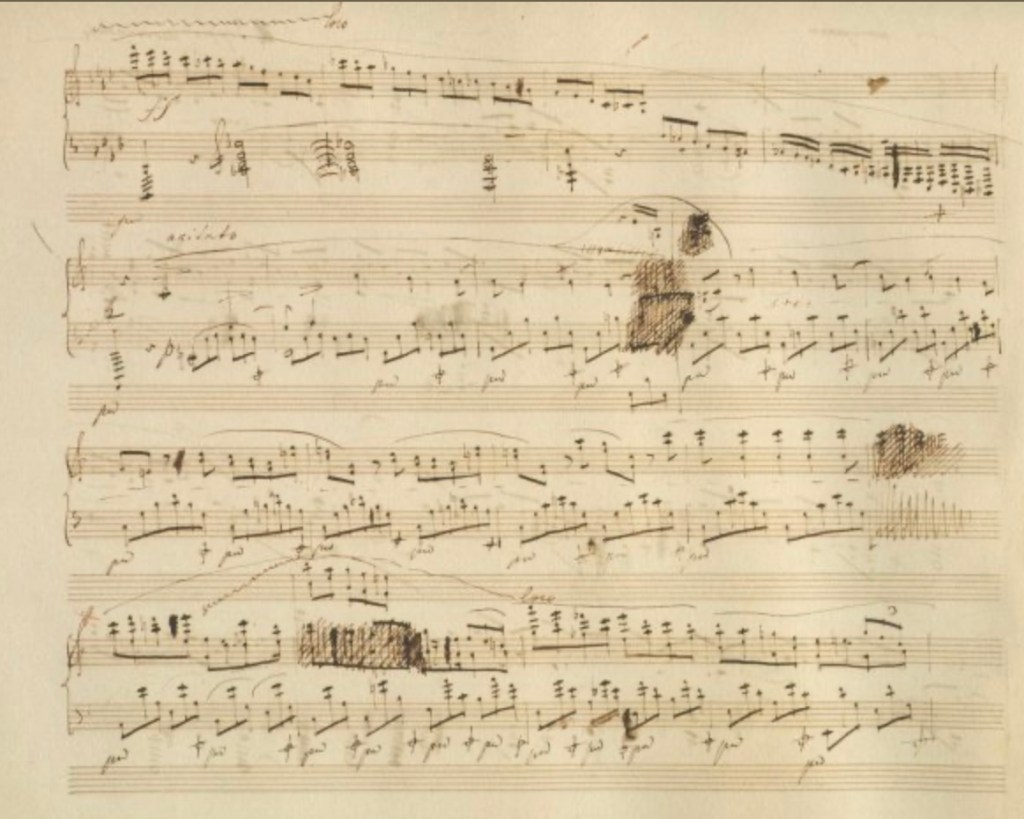
Autograph of Chopin Barcarolle central episode
The Barcarolle in F sharp major op 60 composed between autumn of 1845 and summer 1846, three years before his death.[1]
Based on the barcarolle rhythm and mood, it features a sweepingly romantic and slightly wistful tone. Many of the technical figures for the right hand are thirds and sixths, while the left features very long reaches over an octave. Its middle section is in A major , and this section’s second theme is recapitulated near the piece’s end in F-sharp. It is also one of the pieces where Chopin’s affinity to the bel canto operatic style is most apparent, as the double notes in the right hand along with spare arpeggiated accompaniment in the left hand explicitly imitates the style of the great arias and scenas from the bel canto operatic repertoire. The writing for the right hand becomes increasingly florid as multiple lines spin filigree and ornamentation around each other.
This is one of Chopin’s last major compositions, along with the Polonaise – Fantasie op 61 is often considered to be one of his more demanding compositions, both in execution and interpretation.
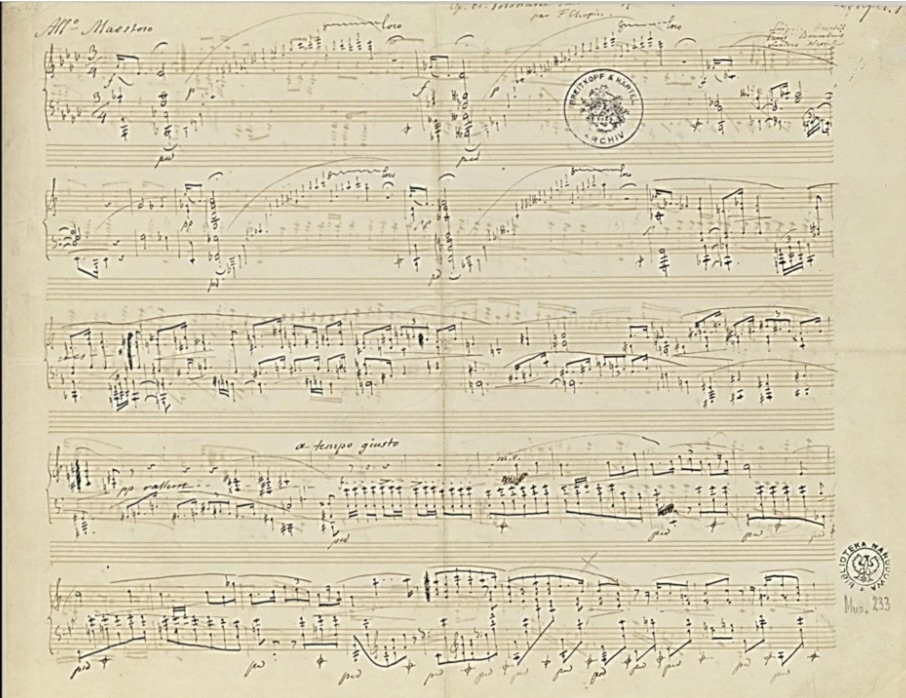
autograph of the Fantasy
The F minor Fantasy is an expansively constructed work belonging to the sphere of such epic-dramatic genres in the Chopin oeuvre as the ballades and the scherzos. Yet it occupies a distinctive, exceptional place among them. Discounting the rather trivial fantasies of the potpourri type written to operatic or other themes, such as were fashionable in Chopin’s day, we immediately perceive his Fantasy as a work referring to the most splendid and most ambitious traditions of the piano fantasies of Mozart and the Wanderer-Fantasie of Schubert . From Chopin’s letters, we also know that he employed the name ‘fantasy’ to describe works that broke with the canon of unambiguously defined genres (e.g. the Polonaise – Fantaisie ). The term ‘fantasy’ unquestionably implies some sort of freedom from artistic rules and a peculiar, Romantic expression. It was completed and published in 1841. Through its narrative it insistently draws the listener into an expansive musical tale. But can we answer the question as to what this tale is about? In the interpretations of many commentators we find the conviction that Chopin’s work might be an echo of improvisations on national themes (as is indicated by some of the Fantasy’s melodic strands). So Fantasy would contain a distinctive patriotic message, leading from the elegiac tone at the beginning of the work to the triumphant accents in its closing climax.
In the construction of this fascinating composition, we find elements of various forms (e.g. sonata form combined with the principle of cyclical form), yet defining the form of the Fantasy is no easy task, even though the work does display a rigorous logic of construction. We find here moments that are very precisely formed (particular themes) and others of a looser character, akin to improvisation (especially the figural passages). In general terms, the flow of the work may be presented as follows: an introduction with two ‘march’ themes, a sort of exposition of the rich thematic material, a middle section (lyrical, at a slow tempo, in the key of B major), a sort of reprise and a coda (a reminiscence of the middle section). Of course, there are other possible interpretations of this work, which represents a real challenge for performers. It is one of Chopin’s longest pieces, and is considered one of his greatest works.
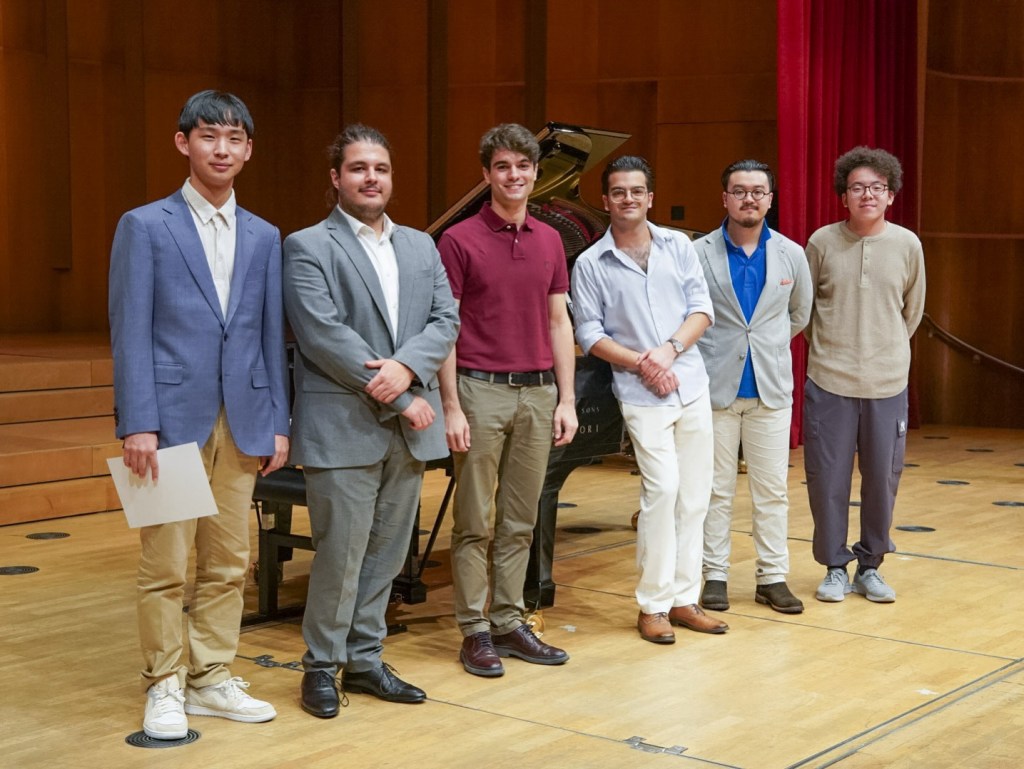
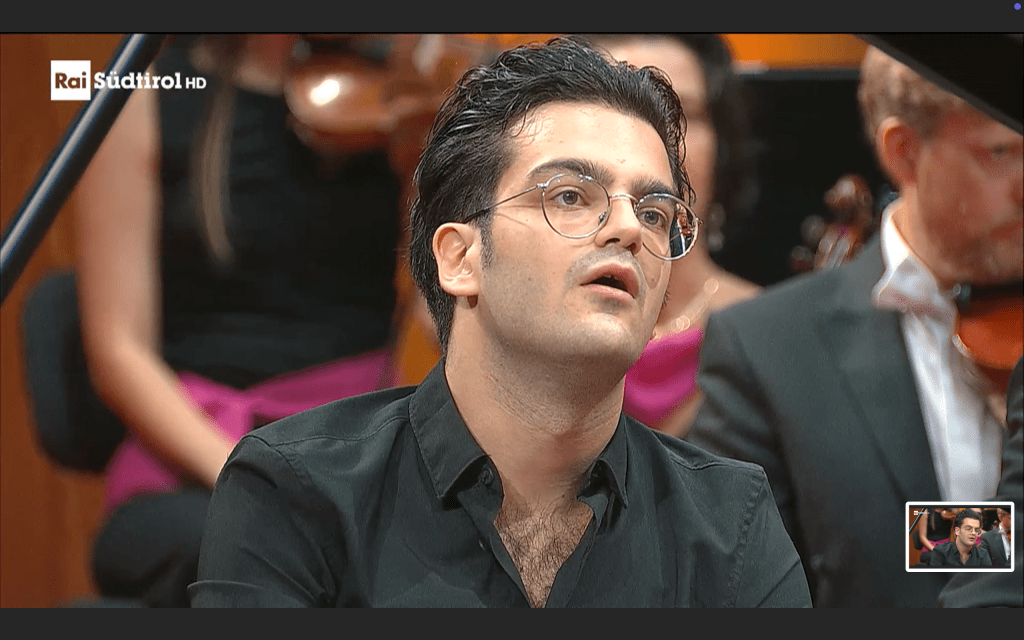
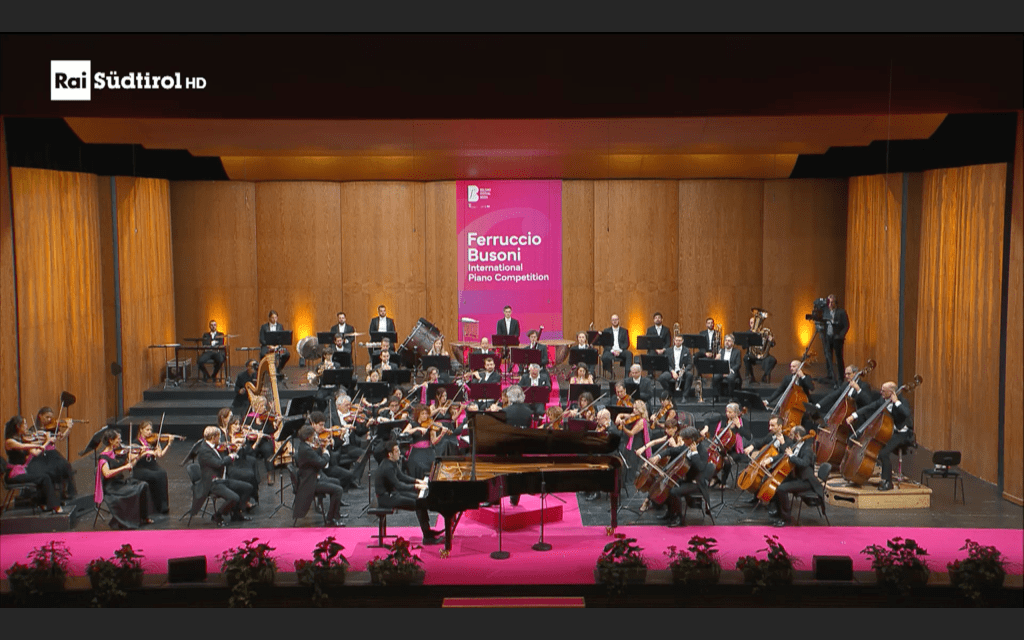
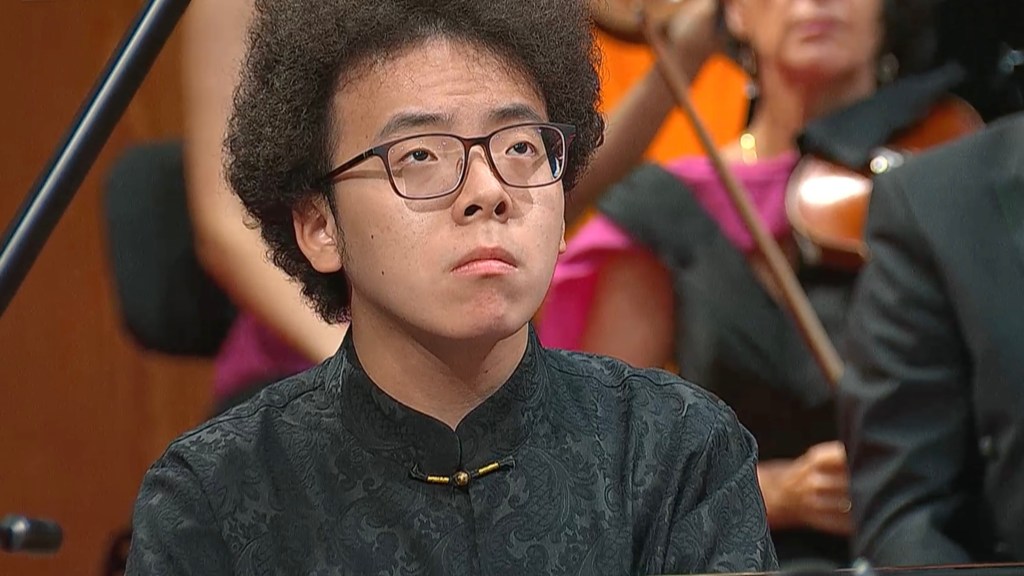
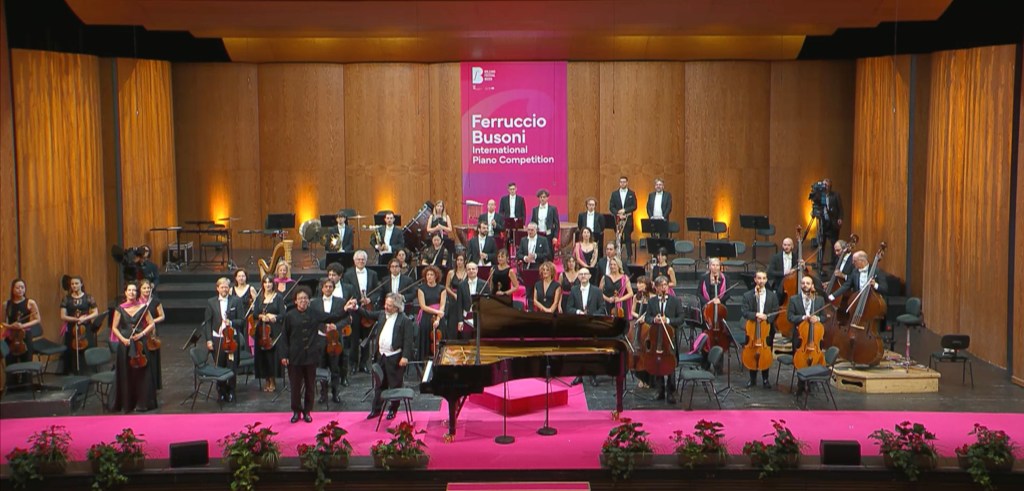
The 12 Finalists of the 65th Busoni Piano Competition:
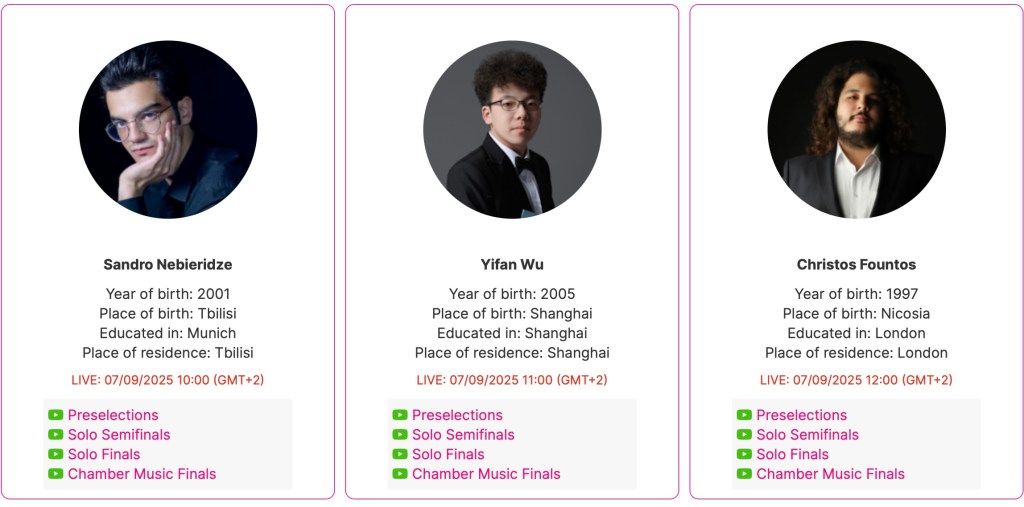
Ennian Bai. Elia Cecino Christos Fountos Yungyung Guo Dongyoung Kim Sandro Nebieridze Shion Ota Zeyu Shen Jakub Sládek Zhonghua Wei Yifan Wu (2005) Jialin Yao
The Solo Finals will be held on August 30th & 31st!
The six candidates selected for the Chamber Music Final are:
From September 2 to 4, the candidates will have the unique opportunity to shine both as soloists and as chamber musicians, performing masterpieces by Schumann, Dvořák, Brahms, Shostakovich, and Franck with the prestigious Simply Quartet quartet from Vienna.
Teatro Comunale Stadttheater
FINALISSIMA
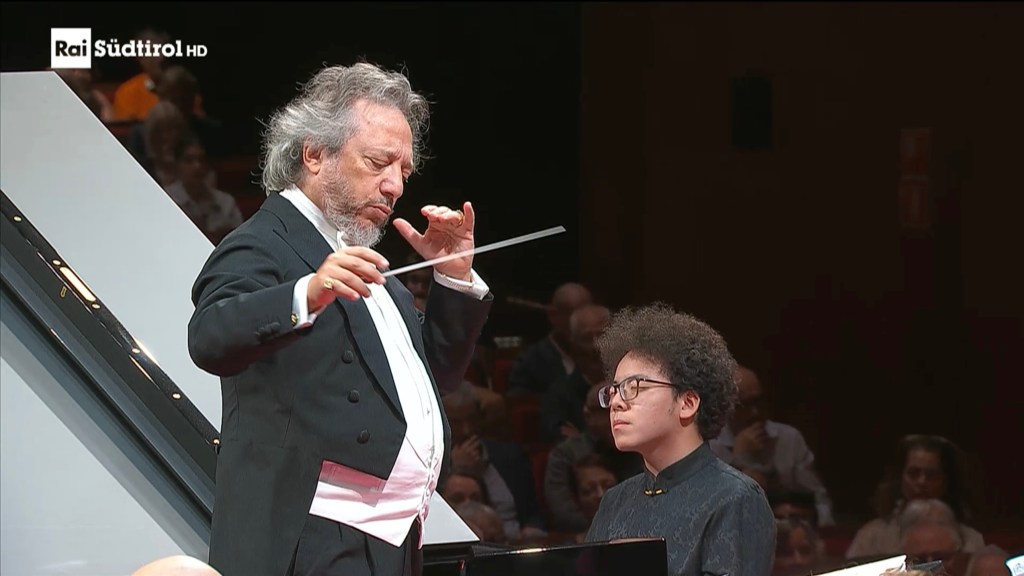
Orchestra Haydn Orchestra George Pehlivanian Direttore Dirigent Sandro Nebieridze Sergej Rachmaninov Rapsodia su un tema di Paganini, op. 43 Rhapsodie über ein Thema von Paganini, op. 43 Yifan Wu Ludwig van Beethoven Concerto n. 3 per pianoforte e orchestra in do minore, op. 37 Klavierkonzert Nr. 3 c-Moll, op. 37
– Intervallo – Pause – Christos Fountos Sergej Rachmaninov Concerto per pianoforte e orchestra n. 1 in fa diesis minore, op. 1 Klavierkonzert Nr. 1 fis-Moll, op. 1
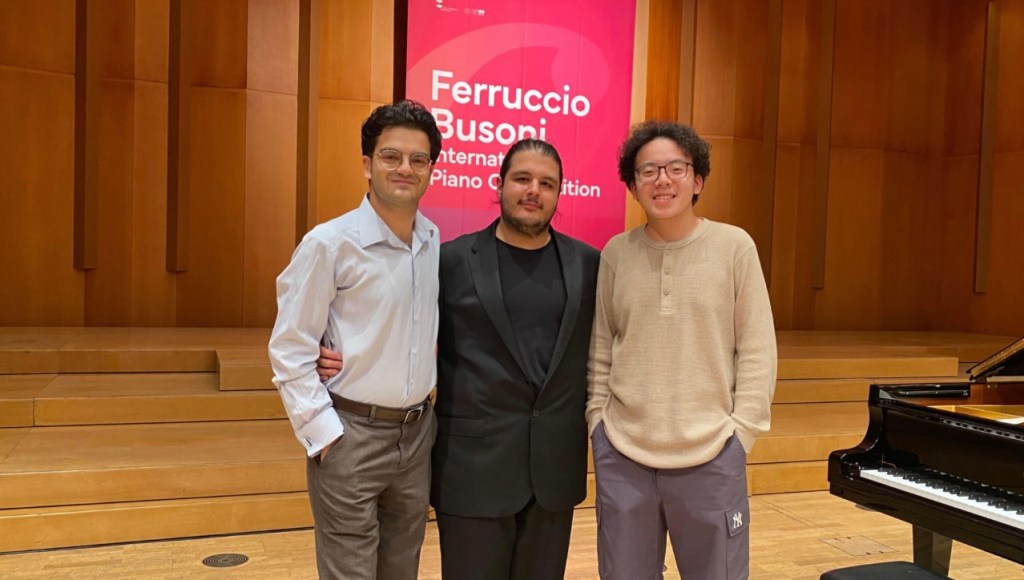
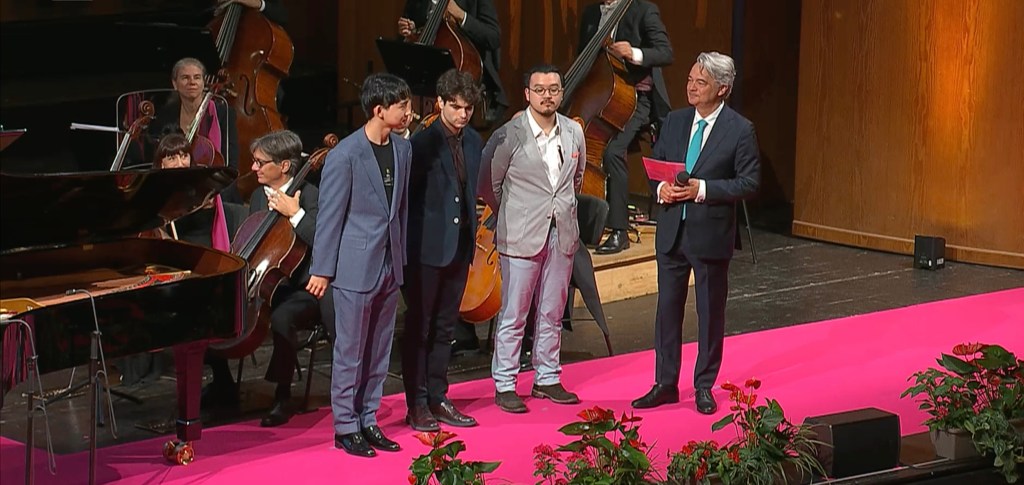
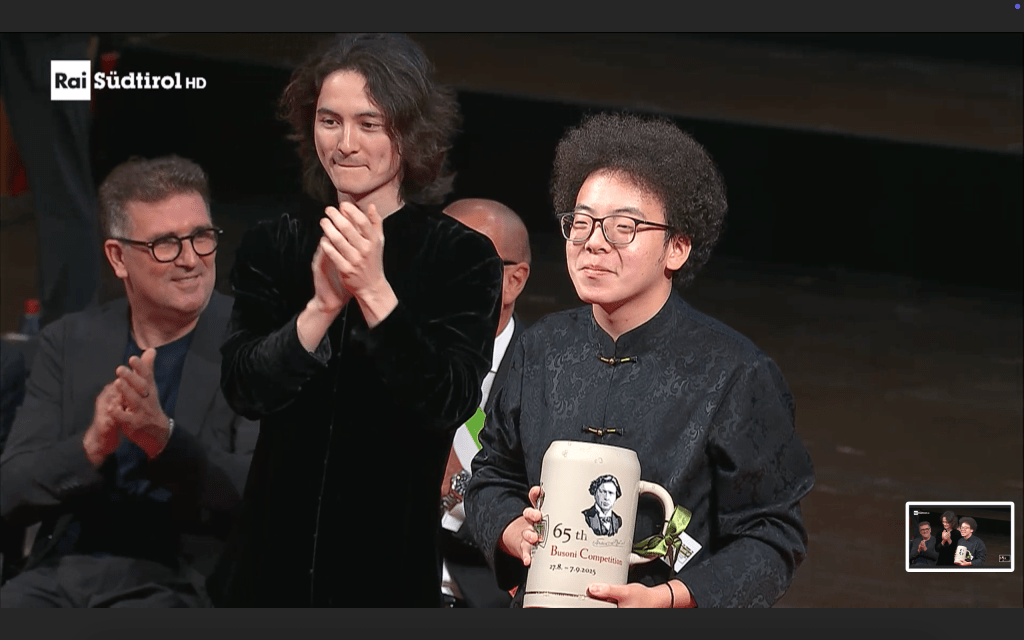
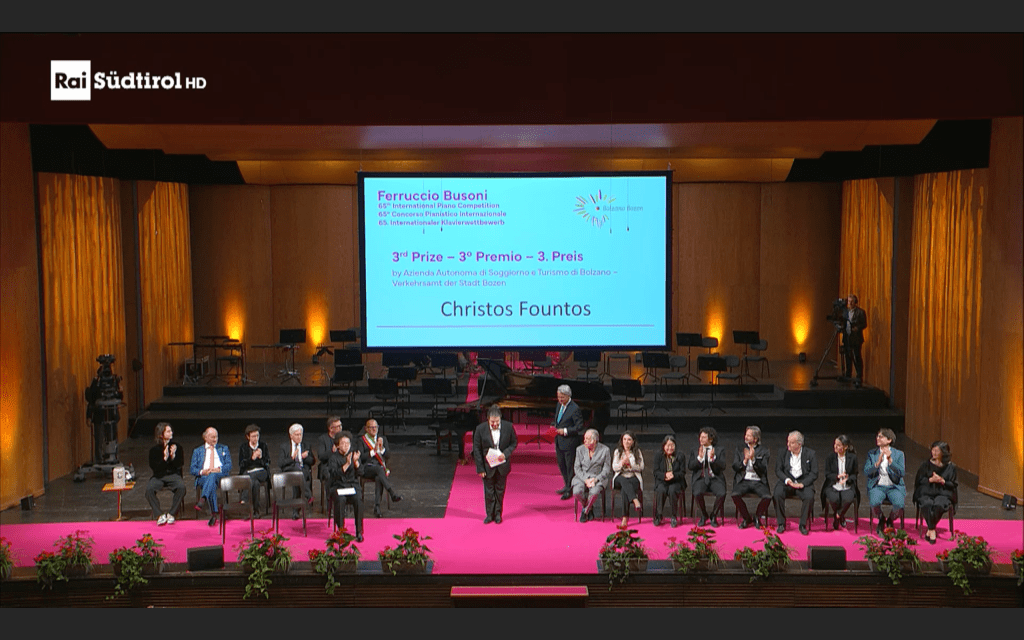
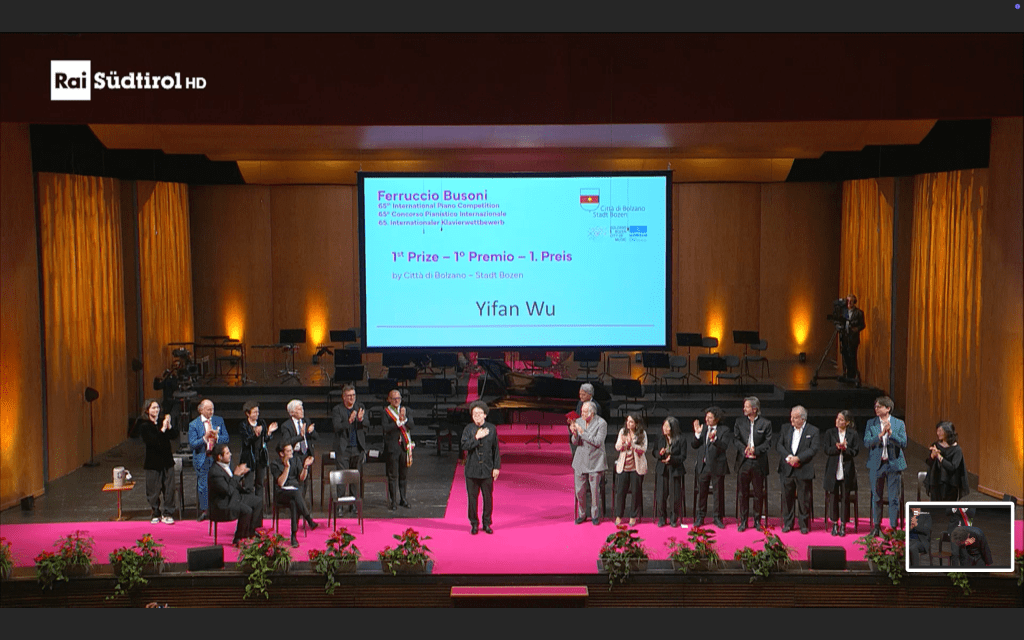
Sandro NebieridzeYifan Wu Christos Fountos4th 5th and 6th prize
Lista completa dei premi | Vollständige Preisliste
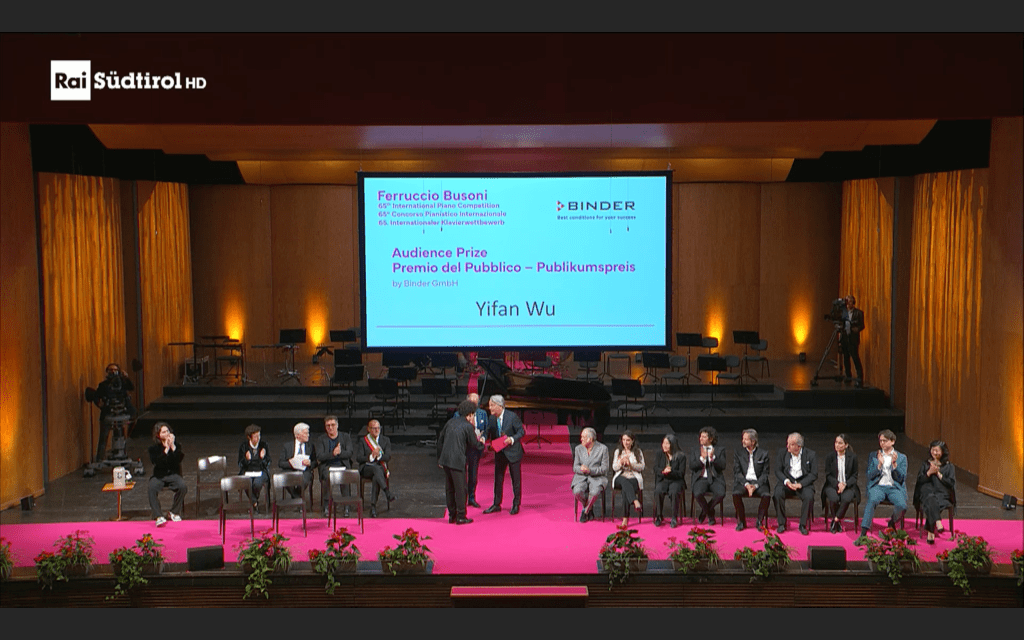
Premio Fryderyk Chopin Preis Jialin Yao Premio Senior Jury Preis Zhonghua Wei Premio Junior Jury Preis Sandro Nebieridze Premio speciale musica da camera | Sonderpreis für die beste Interpretation eines KammermusikwerkesChristos Fountos Premio speciale per la migliore l’interpretazione di musica pianistica contemporanea | Sonderpreis für die überzeugendste Interpretation zeitgenössischer Klaviermusik Zhonghua Wei Premio per l’esecuzione di un’opera di Busoni | Preis für die überzeugendste Interpretation eines Werkes von Busoni Yangrui Cai Keyboard Career Development PrizeYifan Wu Premio Alice Tartarotti Preis Yifan Wu
Grazie a FORST, Main Sponsor della Finalissima | Danke an FORST, Hauptsponsor des Grand Finale
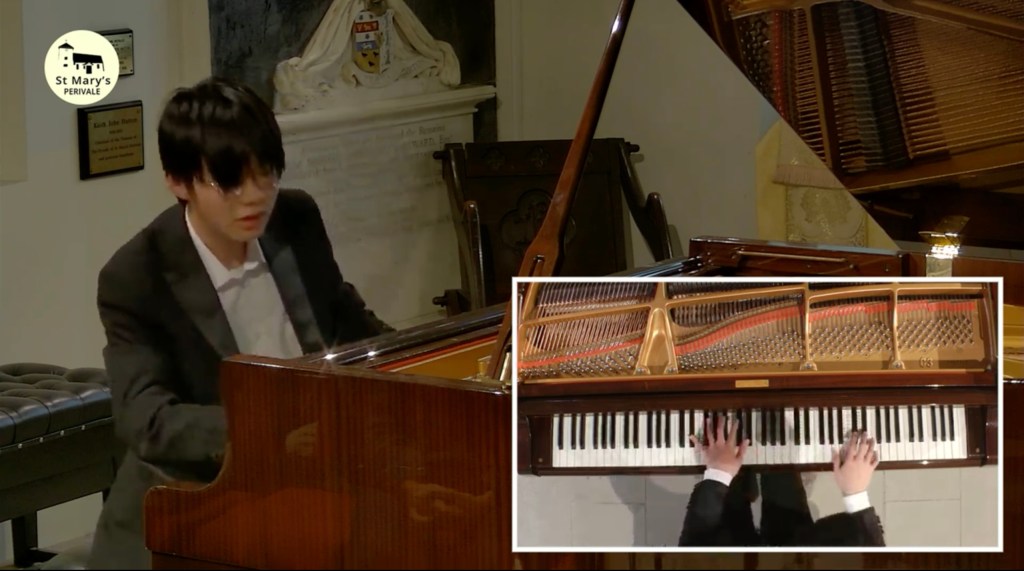
Genius is certainly not easy to live with as we have experienced today from a young man who I have followed and admired for some years whilst he has been studying with Dmitri Alexeev. A young boy who could master some of the most complicated works ever written for the keyboard from Bach’s Goldberg Variations to Beethoven’s Diabelli. Then we experienced the rebellious youth with flowing locks and individual ideas. Today we are experiencing a young man where every sound he makes on the keyboard touches him almost painfully. I remember Graham Johnson with whom I shared chamber music lessons with John Streets, who would tell him that he did not have to play as though a knife was being driven into him with every note he played. But there was a super sensibility to sounds that touched him so deeply and is why and how he has become the Gerald Moore of our day . I often tell aspiring young ‘virtuosi’ to listen to Graham to learn how to make the piano sing.
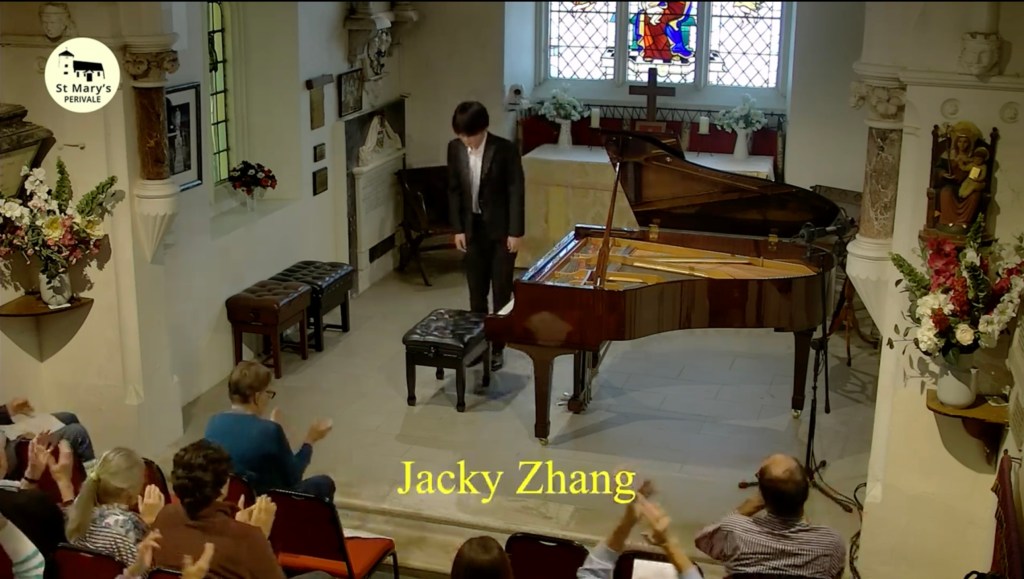
Jackie’s is a very exciting talent because it is a real voyage of discovery that is continually evolving. Of course what comes across is his passionate love of the sounds he is making and how they touch him so deeply. Sometimes with exaggeration as there are no half measures with his all or nothing playing of searing intensity.But as Barbirolli was to say in defence of Jacqueline Du Pré, often criticised for playing with too much passion and extravagance, ‘ If you don’t play with passion in your youth what do you pare off in maturity?’.
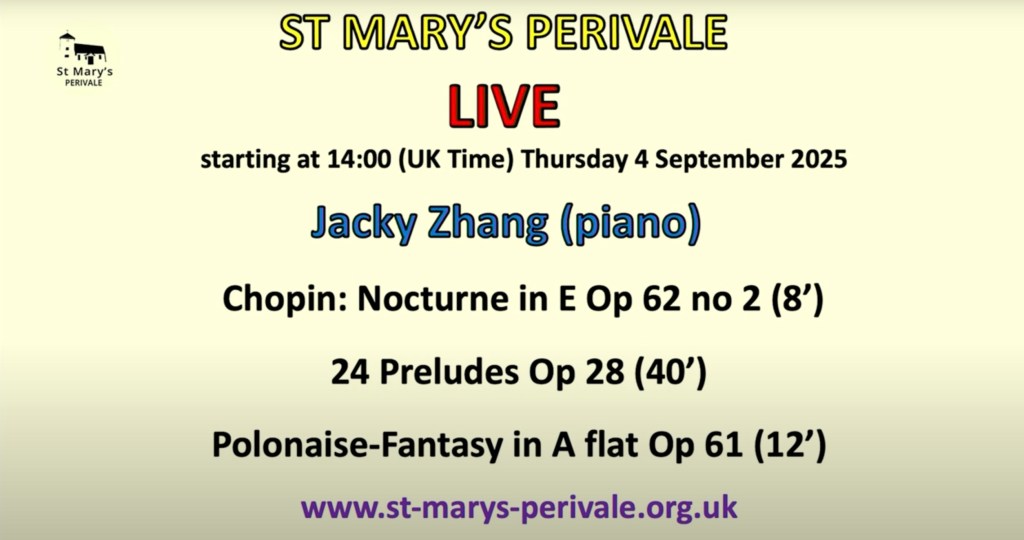
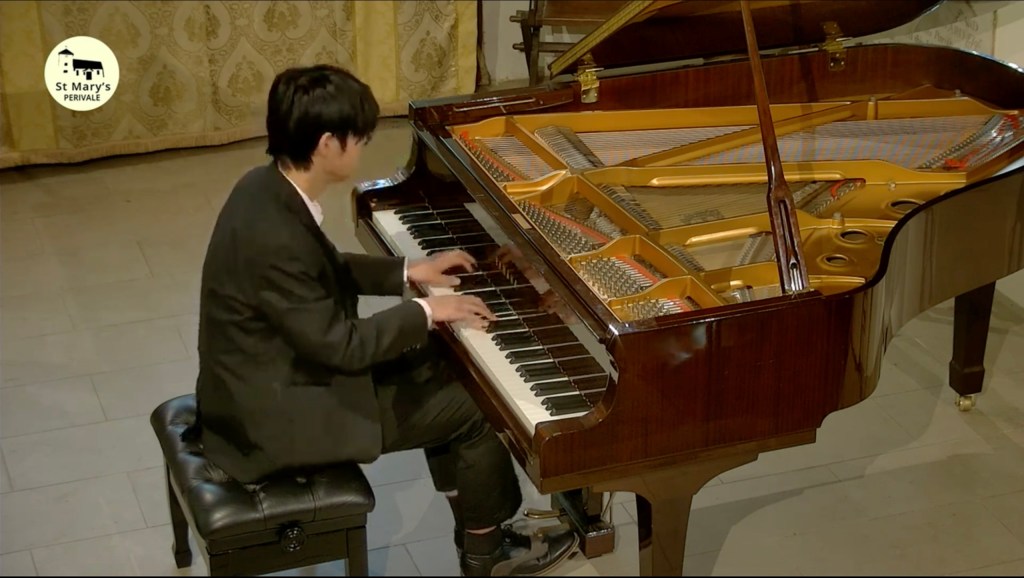
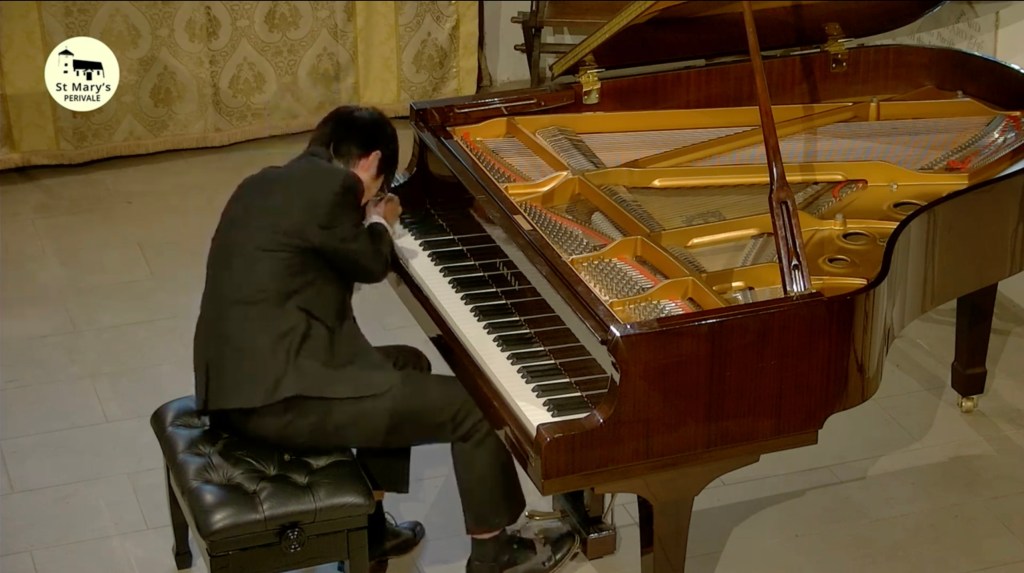
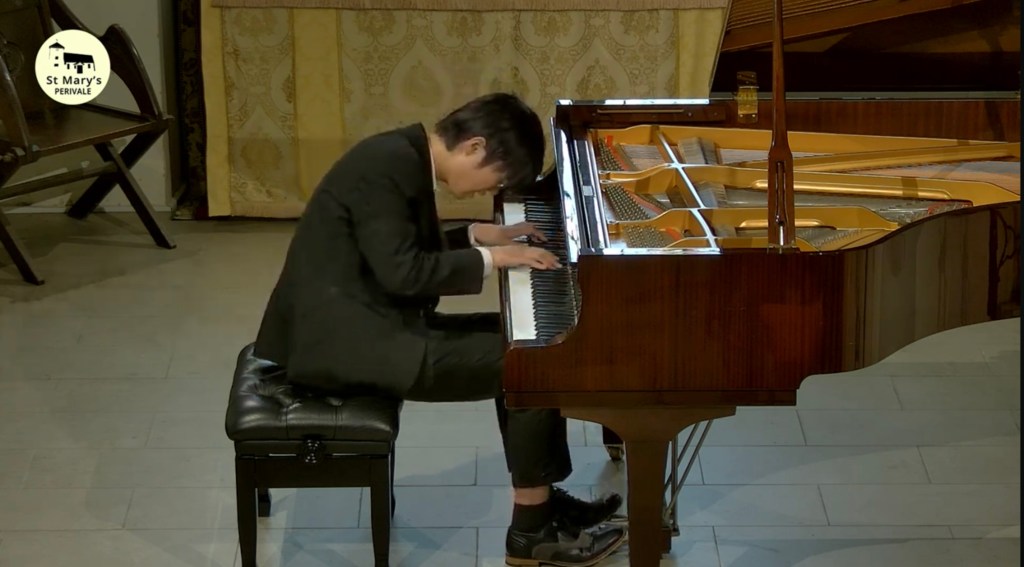
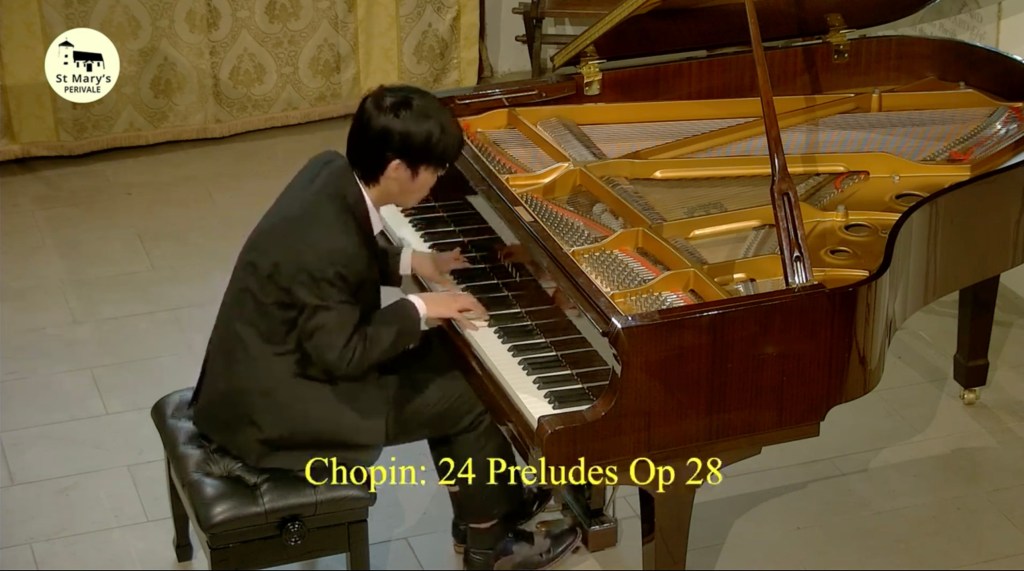
Certainly to see Jackie hit the final three D’s of the preludes with his fist is hard to accept or his strange arrangements of notes in the third prelude or the jiggery pokery of alternate hands for the vibrating flourishes of the Polonaise – Fantaisie.This was a small price to pay for a Chopin Nocturne op 62 n.1 that had a rare sense of freedom with a wondrous range of colour. Less successful was the Polonaise -Fantaisie op 61 where his playing lacked an overall architectural shape, sacrificing it for some memorable moments.Proven by the fact that he played the final A flat like a shot in the dark instead of like a gentle closing of fantasy as it had opened.The Barcarolle op 60 the twin of the Polonaise too, starts with a deep C sharp that just opens up the sonority of the piano and closes with the same sound. The actual climax of the work, as with the Polonaise Fantaisie comes long before the end.
It was in the smaller forms that the true genius of this young man rang out so memorably. Fou Ts’ong called these Preludes 24 problems because they each have problems, whether interpretative or technical, and Jackie imbued each one with life or death intensity that kept us enthralled.These well known preludes were reborn as he recreated each one with burning passion and ravishing beauty. Nowhere in this consideration have I spoken about the technical mastery and perfection of this young man, which was remarkable. It was just the means to allow him to express the deep inner meaning that the music provoked in him.
Waving his hands like a painter before they actually stroked the canvas with the improvised freedom of the first prelude. A deep brooding to the second where the accompaniment almost eat the melody live as it was allowed a voice of its own. No idea why he wanted to play the opening of the third with two hands when he has a technical mastery the envy of most! He allowed the melodic line, though, to float above this wave of sounds.The famous fourth prelude was played with a drama enacted with riveting intensity followed by the subtle brilliance of fifth and the ravishing beauty of the melodic line in the sixth. The seventh may be the shortest prelude but when played as Jackie did it became a breath of fresh air of glowing beauty.
It was the eighth which ignited the passion and burning intensity within this young man where he was allowed this outlet with playing of mastery and conviction. The grandeur of the ninth with its sumptuous climax and miraculous ending was followed by a brilliant fleeting jeux perlé just ornamenting the sumptuous melodious chords of arrival. A beguiling rubato to the eleventh where the branches of Chopin’s trees were allowed to flow with extraordinary natural beauty and freedom. A burning intensity to the twelfth with its dynamic drive. The thirteenth in many ways the most strikingly beautiful of the preludes was played old style with broken hands because he was searching for the magic sounds that the great pianists of the past knew lay in the cracks. Jackie listening to every note with quite extraordinary sensibility. The wind of the fourteenth ,a mere breeze as it built in intensity only to burn itself out revealing the radiant beauty of the ‘Raindrop’. A real tone poem opened as the central episode unwound with disturbing turbulence.The sixteenth with its study like brilliance was played with the amazing assurance of a young virtuoso who must now listen more to the bass which will give more meaning and depth of sound to this study that is above all a miniature tone poem. Beautiful long lines and ravishing freedom to the seventeenth was greeted by the dynamic cadenza of the eighteenth. The nineteenth is one of the technically most difficult of the preludes ,but in Jackie’s masterly hands it became the Aolean Harp of Chopin’s dreams. The mighty C minor was played with the enormous conviction of this young artist as it disappeared so magically, leaving the beautifully mellifluous twenty-one to lead us to the final three preludes , played with poetic fantasy and passionate persuasion. A remarkable performance full of blemishes and exaggerations but the preludes have never kept me riveted to the seat as much as they did today. This was a young man with a poetic soul gradually coming to terms with his youthful passion and mastery , where his deep love for music was overpowering and deeply moving. I look forward to the next instalment in Jackie’s thrilling voyage of discovering himself through his music.
The waltz op 18 was an unexpected encore. It was played with brilliance rather than charm, starting with chiselled notes that might well have broken the toes of Les Sylphydes!
Jackie is a great artist who is living, searching, suffering every moment as he strives to recreate the vision of his poetic sound world.
Jacky Zhang is a young composer, pianist, songwriter, and producer. Still only 17 he is a fourth year undergraduate currently studying piano and composition at the Royal College of Music. He has won the first prize of the UK Piano Open International Competition in 2020, Premio Alkan International Piano Competition in 2022, and both Classical and Romantic sections at the Cantù International Piano and Orchestra Competition in 2023 and was a finalist in the BBC Young Musician 2024. Jacky has performed at many festivals and venues and has played concertos by Saint-Saëns, Mozart, Beethoven, and Rachmaninoff with well-known world-class conductors.
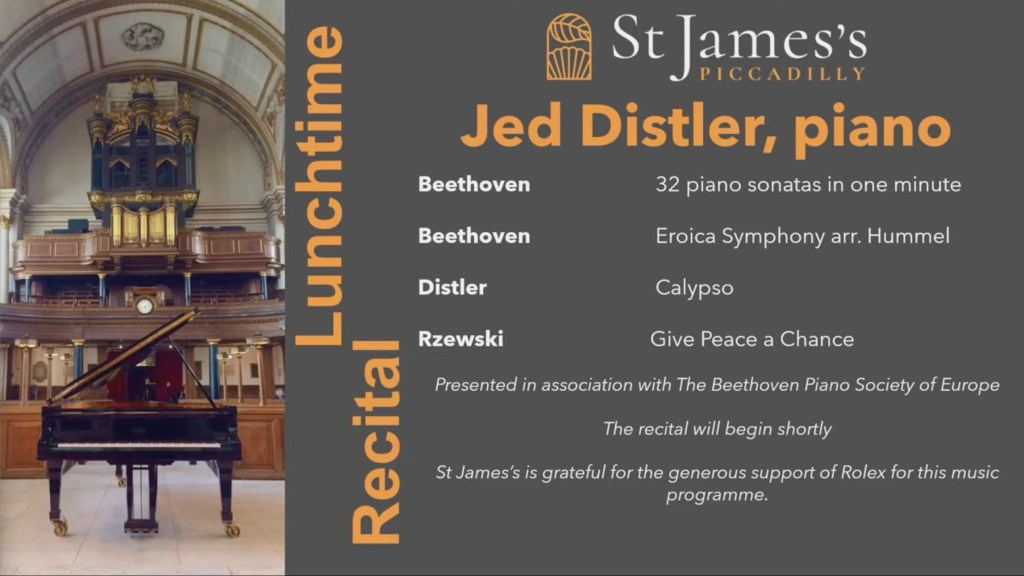
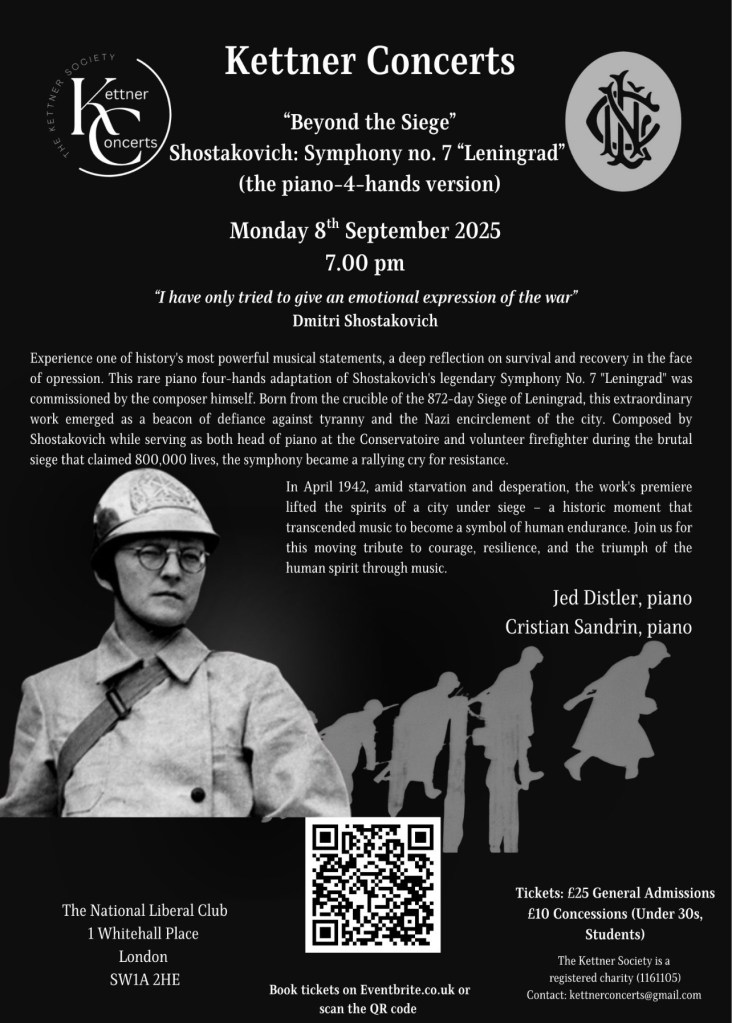
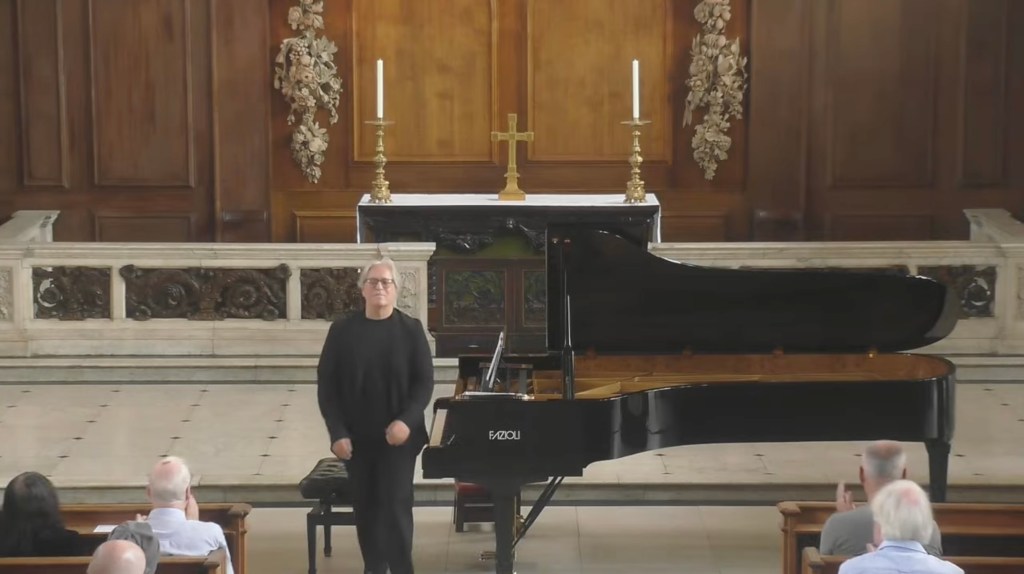
Beethoven Piano Society of Europe | Jed Distler Concert Wednesday, September 3, 1.10 pm sees the latest in our St James Piccadilly lunchtime series. We were lucky enough to be able to secure a date for the extraordinary New York-based pianist and composer Jed Distler on his current European tour. Many of you will also know Jed as perhaps the world’s leading authority on piano recordings, historical and modern.
Jed after all the Beethoven Sonatas was quite happy to add the Funeral March from the Eroica Symphony before entering into his unique sound world.
I had met Jed at a musical fair in Cremona and we hit it off immediately but then who wouldn’t ! Jed knows more about pianos and pianist than anyone alive or dead and is also one of the nicest people I know .It is an honour to have him as a guest in my house but he asked me not to write about his concert today so as not to be accused of conflict of interests. So ‘mum’s’ the word but the recording is here and can be enjoyed at your leisure without any words from me !
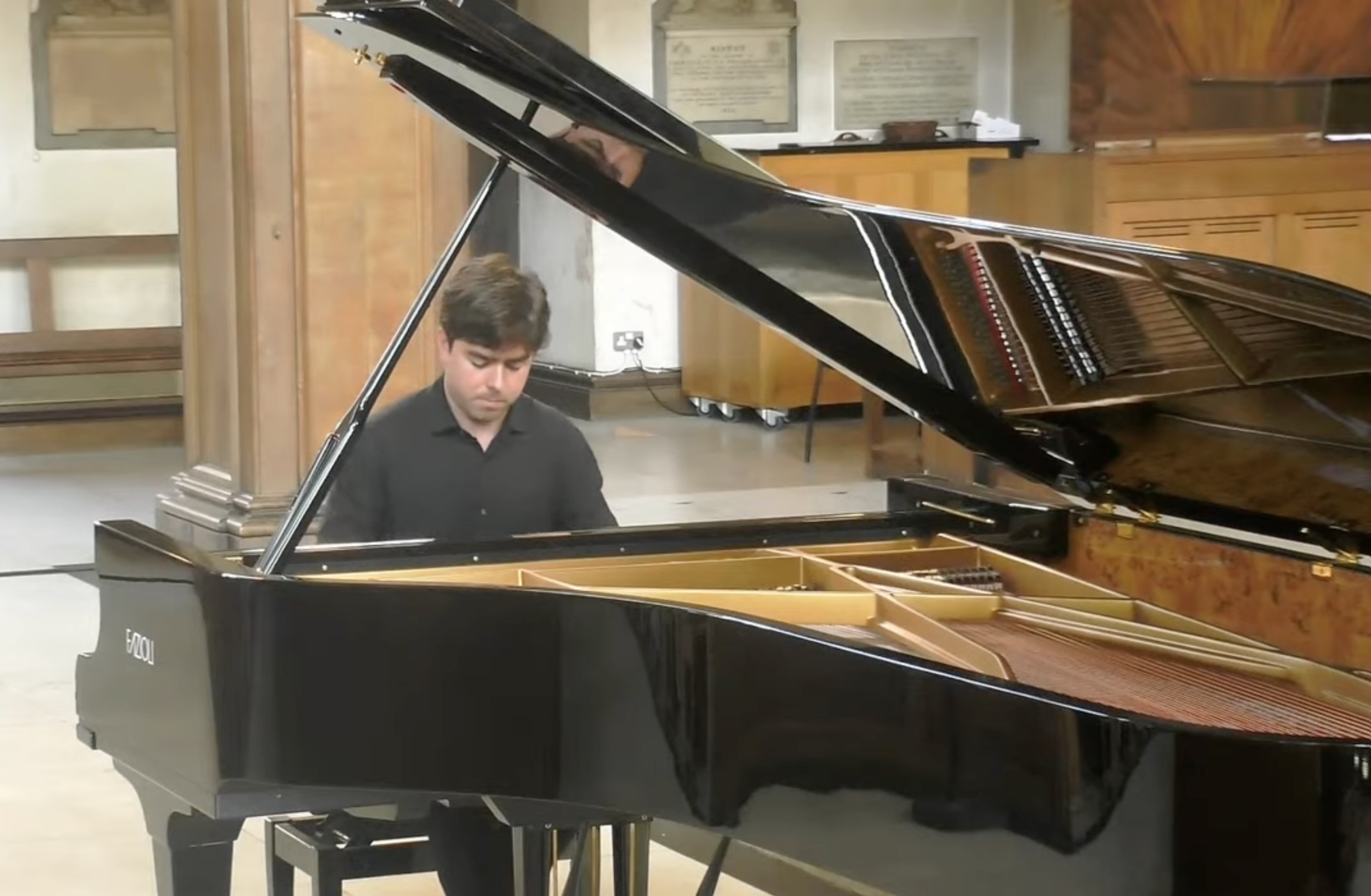
So I am not writing any more than to say I have rarely heard this Fazioli- or any other come to that – sound so beautiful as it did today!
I look forward to his performance of Shostakovich ‘Leningrad’ Symphony with Cristian Sandrin next week ,and there I will let rip with unconstrained praise and admiration for two such eclectic musicians
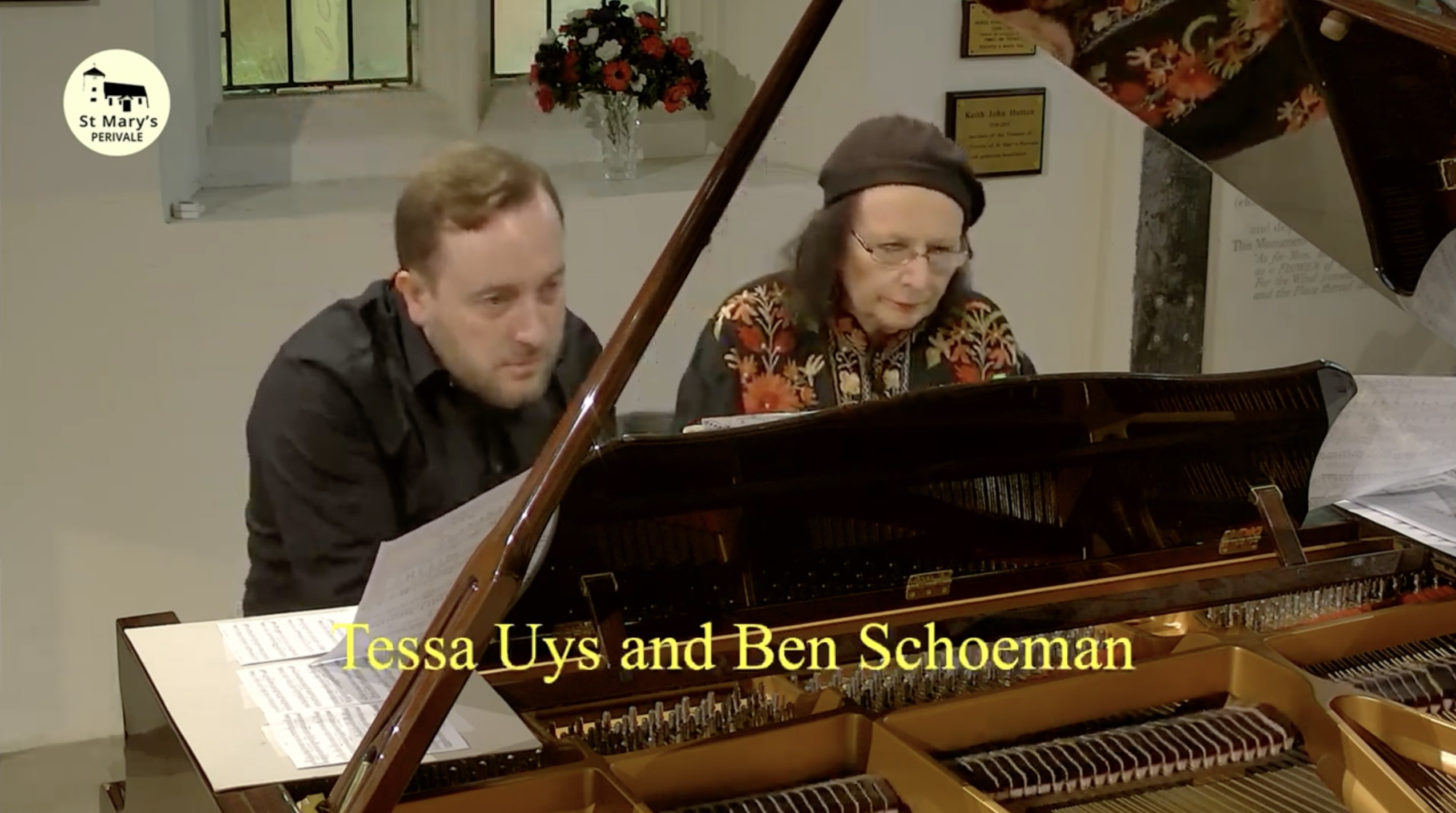
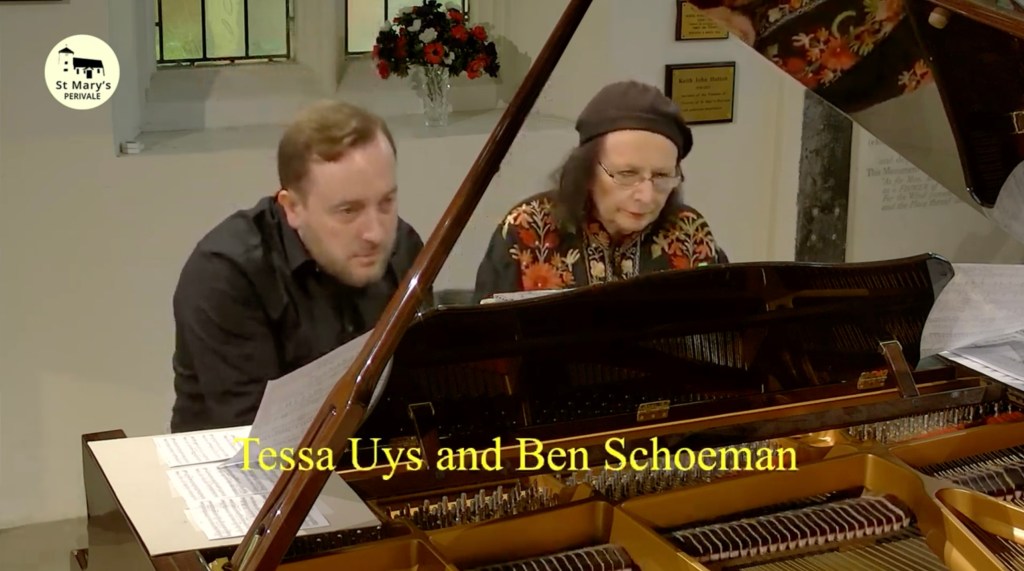
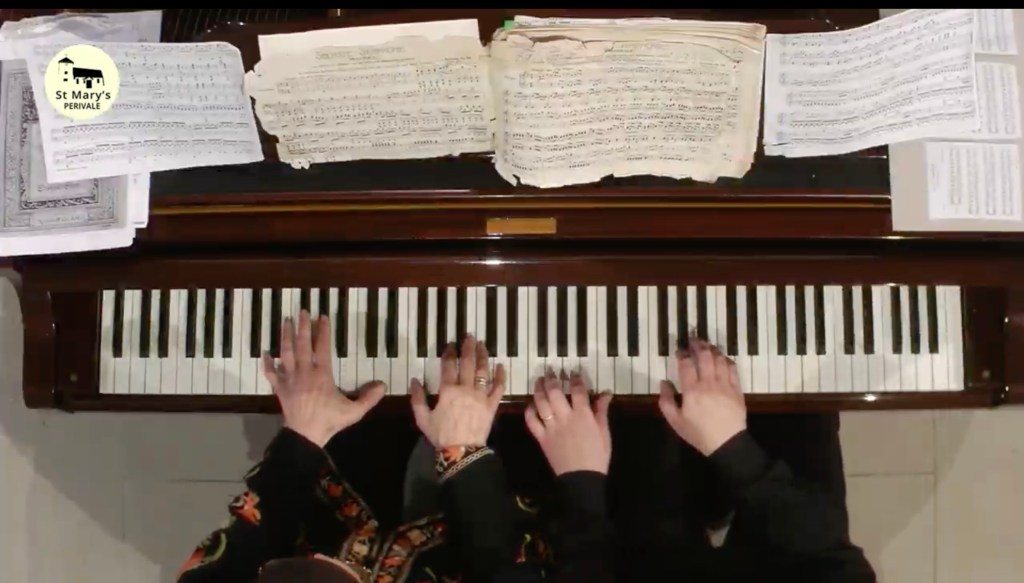
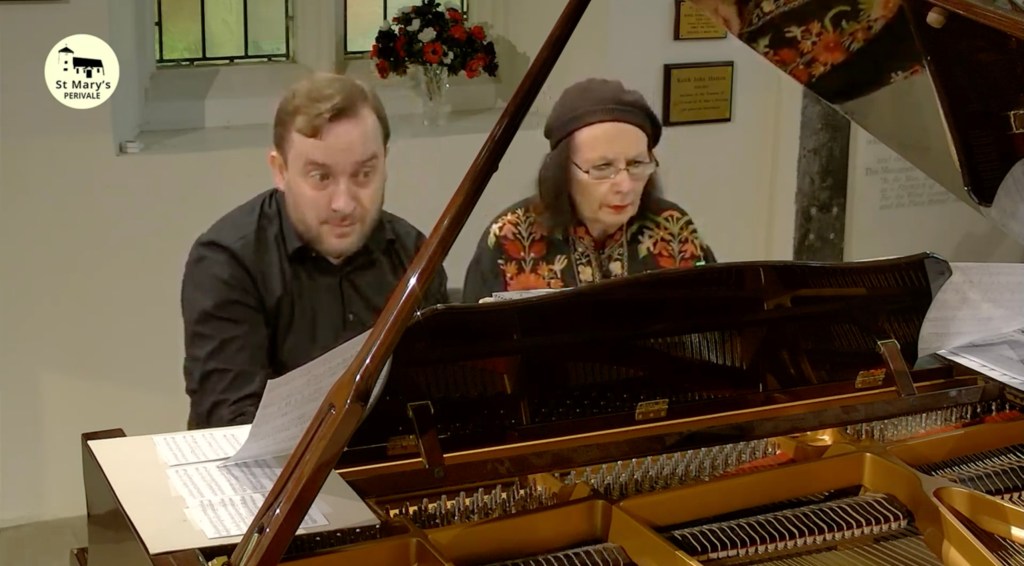
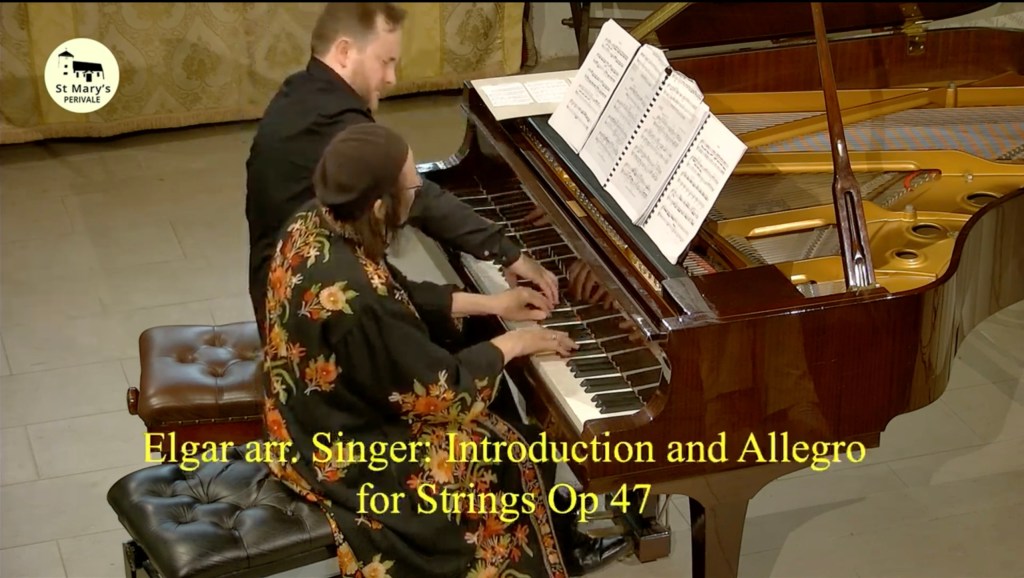
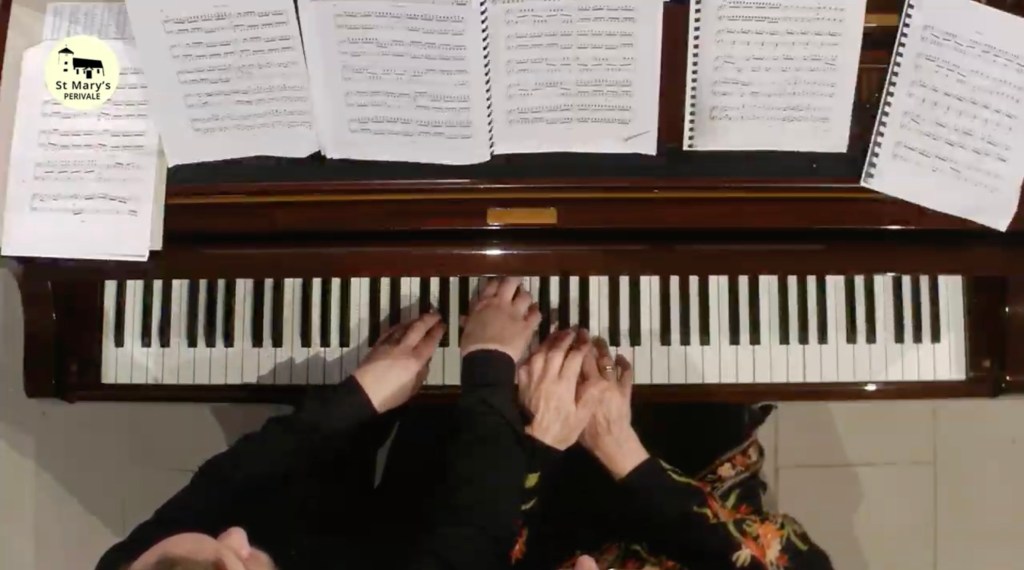
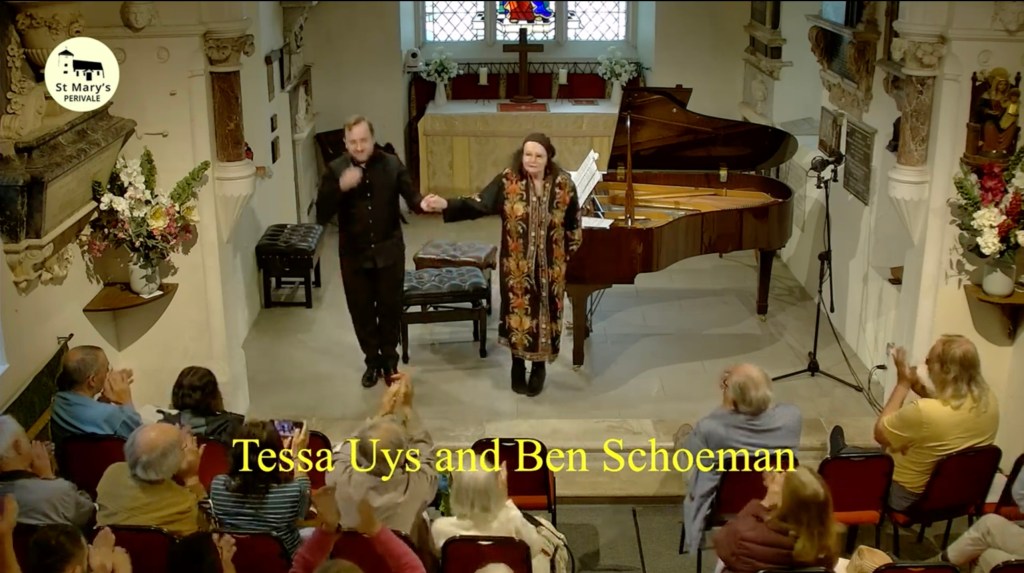
I have heard Tessa and Ben play many of the Scharwenka transcriptions of the Beethoven Symphonies over the past seven years. It is very touching to see the old battered copy of the Symphonies on the piano stand and know that it was the very copy that stood in her mother’s studio when Tessa was growing up.
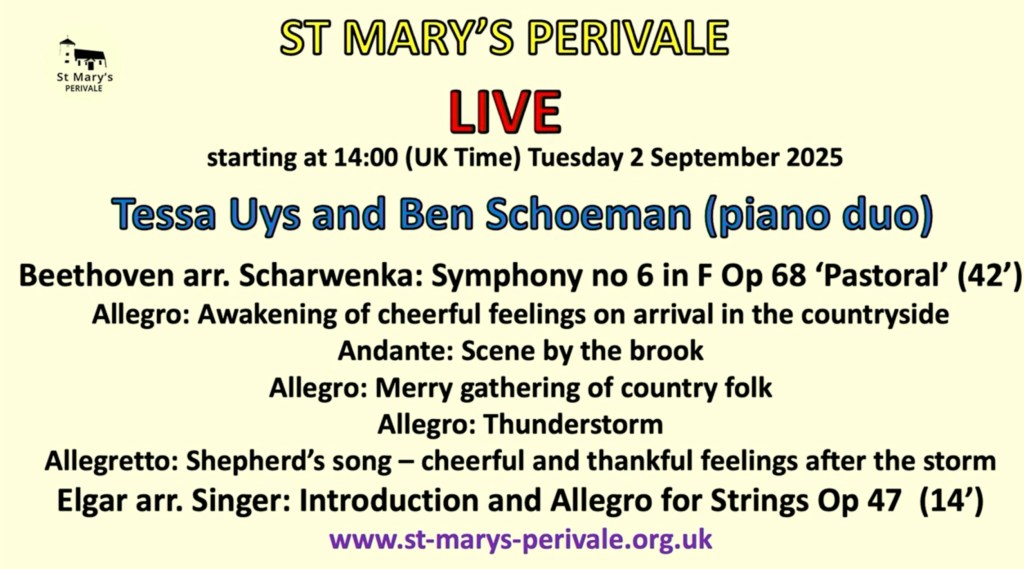
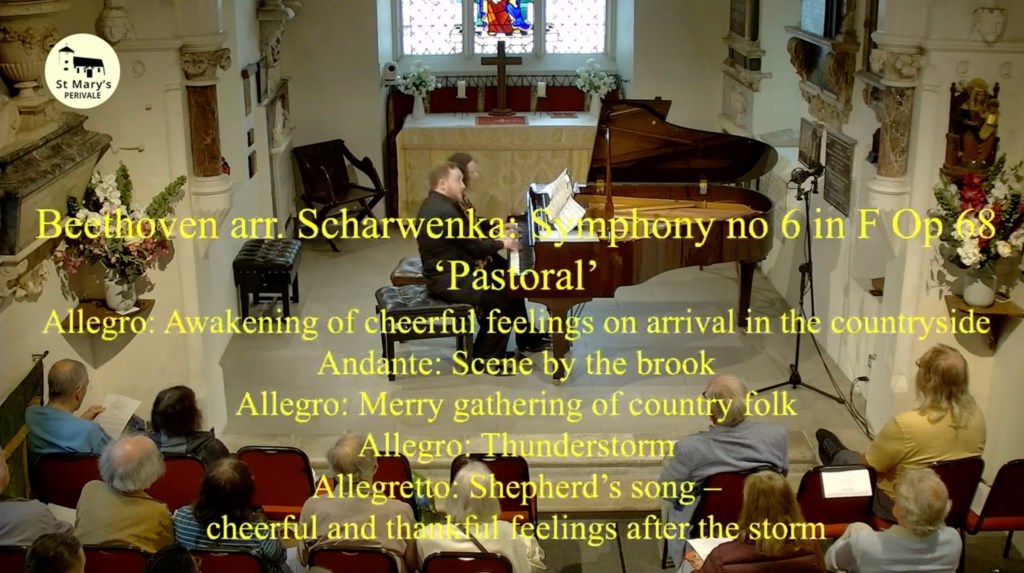
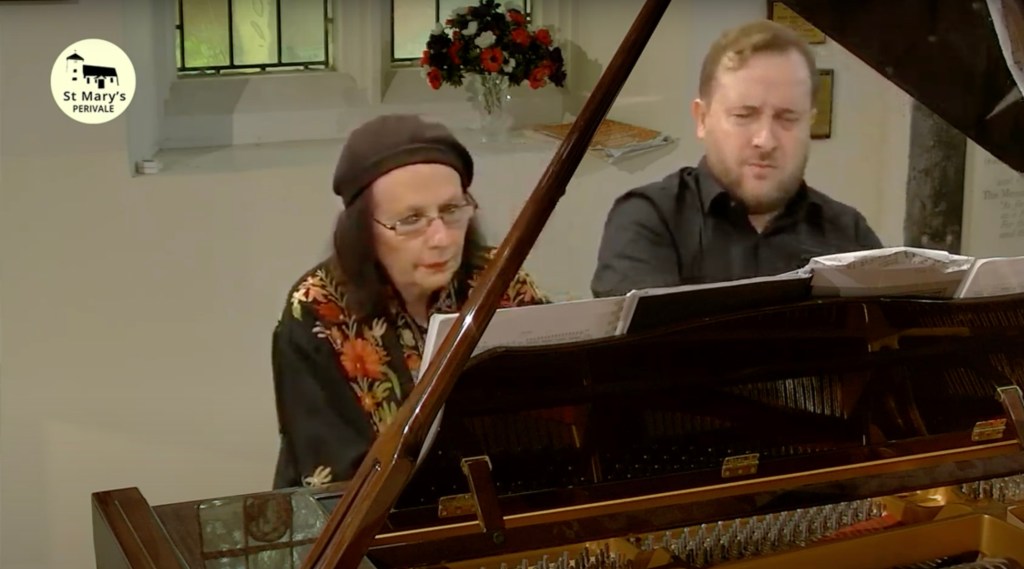
Tessa and Ben are both highly esteemed artists not only in their homeland but also in their adopted home in London. Since those early days when I first heard them they have been discovered and have now made some highly acclaimed CD’s as a piano duo. As Dr Mather said St Mary’s may be too small for an orchestra but Sharwenka has proven him wrong, as today we heard the Pastoral Symphony in all it’s glory on this newly restored piano that is more used to Sonatas than Symphonies.
Tessa and Ben over the years have truly learnt how to play as one with an extraordinary sense of balance created by two great artists that listen to themselves and adjust accordingly. Tessa may have been at the bass end for the Beethoven but even when she played at the top the balance was just as superb.
I have written many times about their Beethoven performances but today I was overwhelmed by their superb performance of Elgar. The Introduction and Allegro like the violin or cello concerti have something so unique about the sound world that one can envisage the green pastures and wondrous landscapes that surrounded the composer as he wrote music that fits the era of Bernard Shaw or Constable and fills it with such sumptuous rich sounds.
The British Brahms you could almost call him and when I hear this music I immediately envisage Sir John Barbirolli or Sir Adrian Boult who I was lucky enough to experience in my student days at the Royal Academy and Royal College that I frequented almost daily in my teenage years. I remember Barbirolli when I, like Tessa, was a student at the Royal Academy, and I followed his rehearsals with the student orchestra. I can still see this short very passionate man walking through the cello section and looking the players in the eye to get them to play with more passion. The first recording of the cello concerto with Jaqueline du Pré is legendary but she was often criticised for playing with too much passion. ‘ But if you don’t play with passion when you are young what will you pare off later in life?’ Little was he to imagine that we would never know ,as she was struck down at only 28. Luckily she had Daniel Barenboim at her side who had managed to give her the maturity and security that only true love between genius can provide. A Golden couple indeed!
Boult on the other hand at the college would stand on the podium like a Military gentleman waving a very long stick. But the intelligence and passion that the stick contained was a great lesson indeed and it was his recording of the Elgar Introduction that I would play over and over again as a student.
Beethoven’s Pastoral Symphony is one of the marvels of creation and the fantasy and imagination that Beethoven was able to portray was made even more poignant by the titles he gave each movement.
It was such a good idea to play these two ‘Pastoral’ gems one after the other. Not to compare but to wallow in genius that can portray in music such wondrous scenes. Tessa suggested, as a future project , Bruckner Symphonies in the arrangement of Otto Singer which sounds like a wondrous voyage of discovery .
I know that Jed Distler ,who will shortly play in Perivale is preparing Shostakovich Leningrad symphony with Cristian Sandrin that they will play in London shortly.He is also playing four hands all the Mahler Symphonies. St Mary’s may be redundant no longer !! Watch out Hugh ……….as the little one said move over !
In 2010, Tessa Uys and Ben Schoeman established a duo partnership after being invited to give a two-piano recital at the Royal Over-Seas League in London. Ever since, they have performed regularly at music societies, festivals and at the BBC. They have recorded six volumes encompassing the nine symphonies by Beethoven arranged for piano duet by Xaver Scharwenka, alongside two-piano works by Schumann, Saint-Saëns and Busoni for SOMM Recordings. They have received praise for this “landmark” project, and it has been described as a “tour-de-force” in the BBC, Gramophone and International Piano Magazines.
Tessa Uys Born in Cape Town, Tessa Uys was first taught by her mother, Helga Bassel, herself a noted concert pianist. At sixteen, she won a Royal Schools Associated Board Scholarship and continued her studies at the Royal Academy of Music in London where she studied with Gordon Green. In her final year she was awarded the MacFarren Medal. Further studies in London with Maria Curcio, and in Siena with Guido Agosti followed. Shortly after this Tessa Uys won the Royal Over-Seas League Competition and was elected an Associate of the Royal Academy of Music. During the past decades, Tessa Uys has established herself an impressive reputation, both as concert performer, and as a broadcasting artiste, performing at many concert venues throughout the world. She has performed at the Wigmore Hall, Southbank, Barbican and St John’s Smith Square, and has played under such distinguished conductors as Sir Neville Marriner, Walter Susskind, Louis Frémaux and Nicholas Kraemer. https://www.impulse-music.co.uk/tessauys/
Ben Schoeman Steinway Artist, Ben Schoeman was the first prize laureate in the 11th UNISA International Piano Competition in Pretoria, winner of the gold medal in the Royal Over-Seas League Competition in London and was also awarded the contemporary music prize at the Cleveland International Piano Competition. He has performed in prestigious halls on several continents, including the Wigmore, Barbican and Queen Elizabeth Halls in London, Carnegie Hall in New York, the Konzerthaus in Berlin, the Gulbenkian Auditorium in Lisbon, Cape Town City Hall and the Enescu Festival in Bucharest. As a concerto soloist he has collaborated in over 40 works with conductors including Diego Masson, Gérard Korsten, Yasuo Shinozaki, Bernhard Gueller, Jonathan McPhee and Wolfram Christ. He studied piano with renowned musicians such as Joseph Stanford, Michel Dalberto, Boris Petrushansky, and Eliso Virsaladze, and obtained a doctorate in music from City, University of London and the Guildhall School of Music and Drama with a thesis on the piano works of the composer Stefans Grové whose African-inspired music Schoeman has premiered and performed in numerous countries. Over the past decade, he has been a senior lecturer and research fellow at the University of Pretoria. He has served on the jury of international music competitions and his students have won top prizes. www.benschoeman.com
Franz Xaver Scharwenka born: 6 January 1850 died: 8 December 1924
Franz Xaver Scharwenka was born on 6 January 1850 at Samter, near the Polish city of Poznan, which was then in East Prussia. Both Xaver and his older brother Philipp (1847–1917) showed early signs of musical talent and were much encouraged by their father in their first music lessons. In 1865 the Scharwenka family moved to Berlin where the two brothers were enrolled at Theodor Kullak’s Neue Akademie der Tonkunst. Xaver made rapid progress, studying the piano with Kullak himself, a pupil of Carl Czerny, and composition with Richard Wuerst who in turn had studied with Mendelssohn in Leipzig. This formal musical education, together with his own natural ability and dedication, ensured Scharwenka’s success as both pianist and composer, and in 1869, a year after his pianistic debut at the Berlin Singakademie, his first compositions were published. Before 1874, when he took up a career as a travelling virtuoso, he had already been on Kullak’s teaching staff for some five years as professor of piano, and the experience thus gained was to prove invaluable in later years when he turned his attentions more to teaching, opening his own conservatory in Berlin in 1881, and subsequently a branch in New York in 1891 following his successful American debut. By the middle of the 1890s that institution had become one of the world’s largest, universally acknowledged as offering the highest quality of musical education. It was the outbreak of war in 1914 which forced Scharwenka’s retirement from the international concert platform after some forty years, during which time he had achieved the highest reputation worldwide, not only as a pianist of exceptional quality but also as a fine all-round musician, receiving numerous decorations and orders from most of the crowned heads of Europe, as well as many honours from various educational institutions. The last few years of his life were spent in semi-retirement in Berlin, where he died, a much respected man, in December 1924.
Otto Singer Jr., (September 14, 1863 – January 8, 1931), composer and conductor, produced piano transcriptions of all nine of Beethoven’s symphonies, at least 57 of Liszt’s songs, all four of Brahms’s symphonies, vocal-piano reductions (vocal parts plus solo piano) of 12 of Wagner’s operas (as well as instrumental solo piano versions for some of them), as well as transcriptions of other works by Richard Strauss, Brahms, Beethoven, Bruckner, Tchaikovsky, Mozart, and Mahler, among others including this Elgar
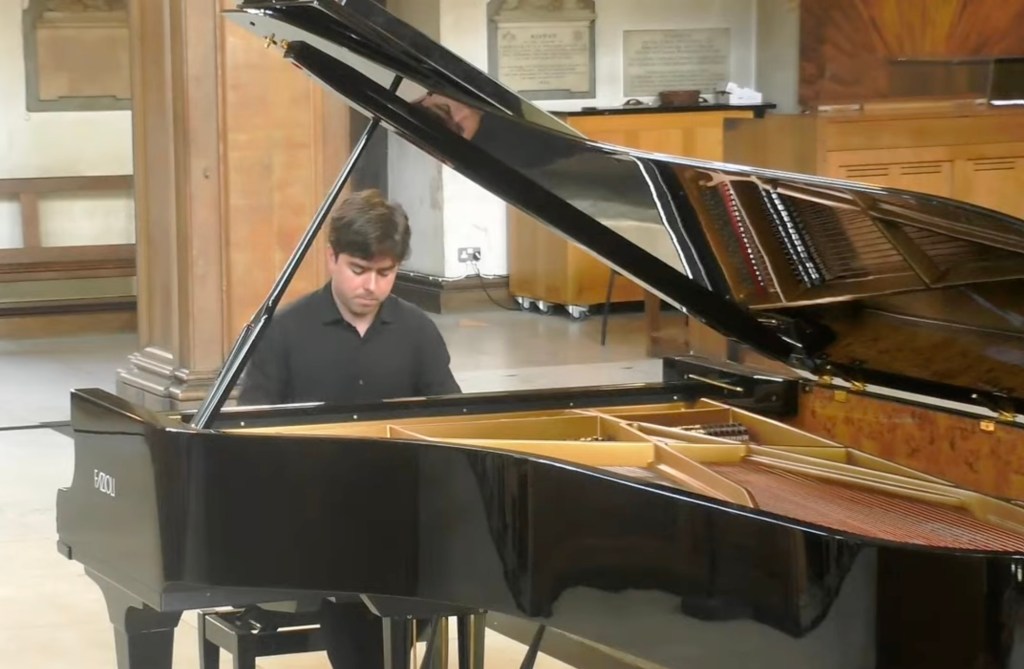
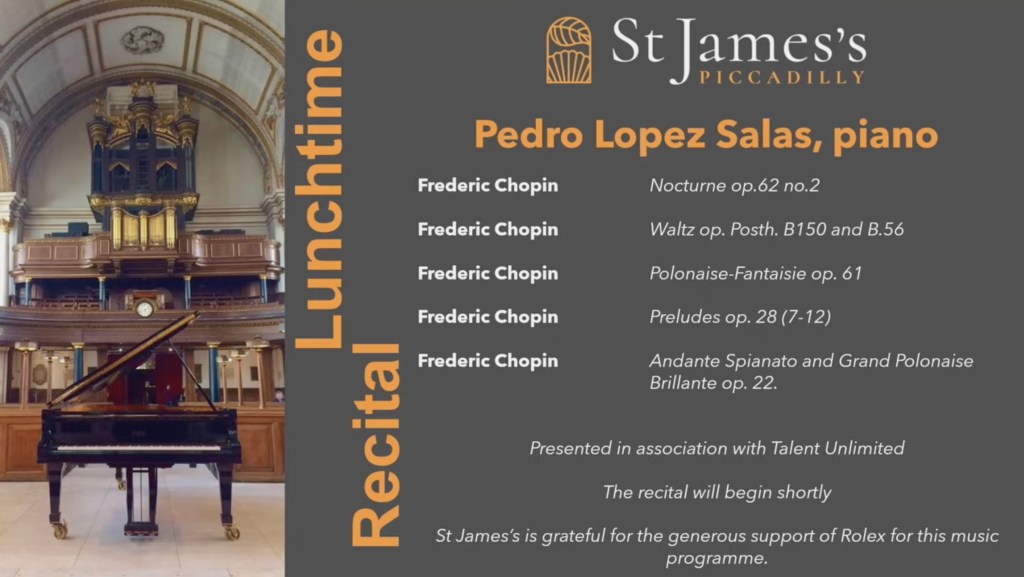
Pedro Salas is a very fine pianist whose playing I have long admired, following his career during his studies in London with Norma Fisher and Vanessa Latarche.
He has now graduated with considerable honours and is perfecting his studies at home in Spain with Stanislaw Ioudenitch in the Conservatory in Madrid where he also holds a teaching post. Winner of numerous important International Competitions Pedro has set his sites on the Chopin Competition in Warsaw. Having been a top prize winner in the Paderewski Competition his presence in Warsaw was guaranteed for the 2025 Chopin Competition in Warsaw.
The good thing is that it will lead to a feast of wonderful performances and the discovery of so many marvellous young musicians dedicating their youth to perfecting their art.
I have heard recently some wonderful things from Andrzej Wiercinski, Diana Cooper, Jackie Zhang, Ryan Wang ,Yuanfan Yang and now Pedro Salas .All wonderful performers many playing the same Chopin Polonaise – Fantaisie op 61 and Preludes , but all completely different.
Chopin’s late Nocturne op 62 was played with great sensitivity and an extraordinary almost improvised freedom creating a bel canto of beauty and timeless wonder.
Screenshot
Chopin’s very youthful Waltz B 150 is full of nostalgia and the refined elegance of it’s time ( I had infact chosen it to accompany some scenes in Ibsen’s Doll’s House) and it was very moving to hear the unmistakable genial voice of Chopin played with the aristocratic good taste that was Chopin’s birthright. The second posthumous Waltz is of scintillating brilliance of liberation and freedom where even here Pedro found some magical inner counterpoints that he underlined with subtle prism like rays of beauty.
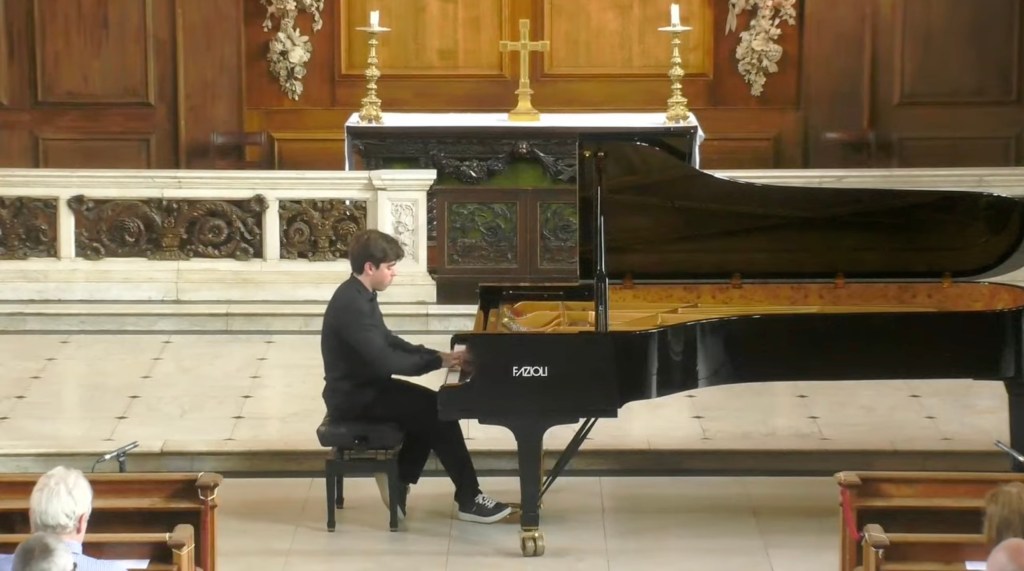
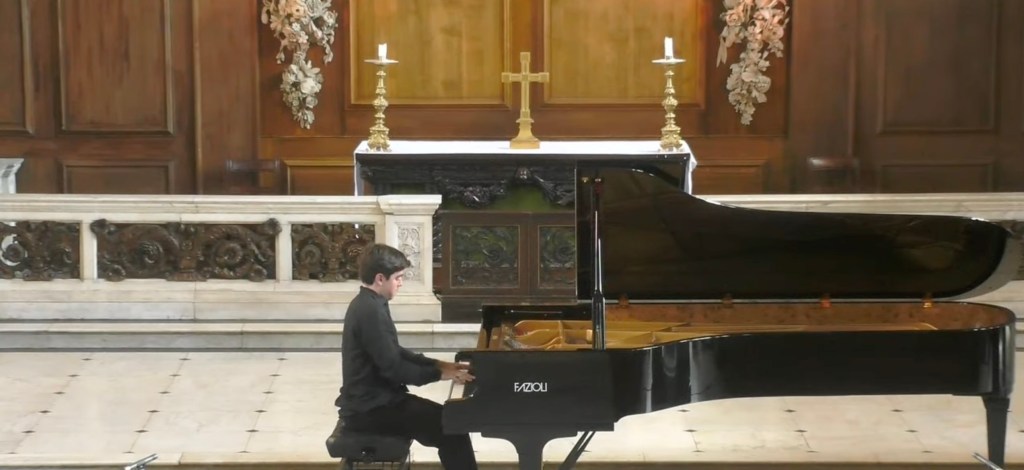
The Polonaise-Fantaisie opened with imperious sounds that reverberated so naturally over the entire keyboard. Pedro played them in just one sweep taking the last note (like Wiercinski) with a slow descending left hand where harmonic and visual beauty went hand in hand. It was this poetry that Pedro was to imbue in this extraordinary original creation where ‘war and peace’ are combined in a flow of beauty of sumptuous sounds and dynamic rhythmic drive arriving at the final explosion of exhilaration and aristocratic control. Pedro allowing the music to calm until the final whispered notes hovering over deep bass reverberations are greeted by a plaintive single A flat. It completes this perfectly shaped work that like its partner the Barcarolle op 60 , finish in paradise not in crowd pleasing triumph. Pedro chose the six preludes from 7 to 12 instead of 13 to 18 like many of his colleagues. Chopin never played all his twenty four Preludes together choosing ( as Sviatolasv Richter was to do ) a selection as obviously has been requested by the competition rules !
A beautifully simple n. 7, the shortest of all the preludes was followed by the passionate outpouring of the 8th ( obviously of great inspiration to Scriabin ). Full rich sound to the 9th was followed by the delicate cascades of notes of the 10th. The beautiful flowing line of the 11th was played with a beguiling beauty and contrasted with the stamping militaristic 12th . Pedro played each one like miniature tone poems shaping them with sensitivity and poetic inspiration .
It was at the end of the recital that Pedro like all great performers had created an atmosphere where every note was being shadowed by an audience totally seduced by this hot blooded young spaniard. An ‘Andante spianato’ of ravishing beauty with a subtle sense of balance that allowed the melodic line to sing so naturally above the hovering waves of sound in the bass. A simplicity and clarity that allowed Chopin’s bel canto to rise above this delicate wave with the natural shape of Monserrat Caballé! A mazurka that was played with a glowing simplicity and subtle freedom before the entry of Pedro’s orchestra, and a complete change of character, as the Grande Polonaise Brillante was allowed to take wing. Even here there was a subtle bel canto which turned into streams of jeux perlé that were played with a beguiling mastery and palette of colour. Powerful octaves and agitated chords but always with the brilliance and masterly sense of elegance with which Chopin conquered the salons in Paris on his arrival as a teenager escaping the political unrest in his homeland.
Pedro is a great musician with a refined tonal palette and rare good taste but he also has Spanish blood in his veins and can raise the temperature with imperious showmanship and mastery. An ovation from this lunchtime audience and an unexpected encore where Pedro’s great artistry was allowed to lead the audience through a most beguiling ornamented version of Chopin’s famous E flat Nocturne. Embellishments recently published in the most complete edition of Chopin’s works and are original embellishments that Chopin would give away as presents to his pretty aristocratic pupils. Kochalski recorded some of them in 1938, and recently ornamentation has become more and more common place.
Pedro played this magic web of sounds with such beauty and mastery that the audience held their breath as we used to do when Caballé would sing a chain of notes with such perfection of unbelievable breath control.
The entire audience were on their feet to thank this young man for the beauty he had shared with them this lunchtime and to wish him a voyage on the same wings of song to Warsaw.
Born in 1997, Pedro is a Spanish pianist who is currently studying the Master of Performance Degree with the legendary pianist and pedagogue Norma Fisher at the “Royal College of Music” in London (RCM), awarded with full scholarship and the title of the “Leverhulme Honorary Arts Scholarships”. He is a “Talent Unlimited” artist, as well as a “Keyboard Trust” artist, both from the UK.
He has been awarded with more than 40 prizes at International and National piano competitions (among them, the First Prizes at the Malta International Piano Competition; International Piano Competition “Composers of Spain” CIPCE (Las Rozas, Madrid); “Joan Chisell” Schumann Prize of the RCM (London), etc.)
He has also received crucial inspiration from internationally renowned masters such as Dmitri Baskirov, Dmitri Alexeev, Alexander Kobrin, Pavel Nerssesian, Marianna Aivazova, Pascal Nemirovsky, Pavel Gililov and Ludmil Angelov.
He has performed throughout Spain and Europe in auditoriums such as the “Manuel de Falla” in Granada, “Teatro Circo” in Albacete, Aachen Theater, “Wiener Saal” in Salzburg and as a soloist with the Orquesta de Valencia (OV) in the “Palau de la Música” in Valencia and with the Real Orquesta Sinfónica de Sevilla (ROSS) in the Teatro de la Maestranza in Seville, he has been praised by the critics as “more than an excellent pianist, he is a soloist and almost a conductor, judging by his scenic development” (Ritmo magazine) or “enormous security and great capacity of the young pianist to endow Liszt’s concerto number 2 with expressiveness and poetry” (El correo de Sevilla). Also, in the “Miguel Delibes” of Valladolid, playing with the OSCYL (“Orquesta Sinfónica de Castilla y León”); “Teatro Canónigos de la Granja” of Segovia and “Centro Cultural Nicolás Salmerón” of Madrid and with the CSKG orchestra, performing the second piano concertos of F. Chopin and F. Liszt, etc. Among his scheduled performances, it deserves an specoal mention the “Rhapsody in Blue” by G. Gershwin at the ADDA in Alicante and the “Auditorio Internacional de Torrevieja” with the OST (“Orquesta Sinfónica de Torrevieja”), as well as having been invited to perform Rachmaniov’s concerto number 2 again with the ROSS at the Teatro de la Maestranza in Seville, given his fabulous previous reviews with Liszt’s 2. In addition, in 2022 he will make an international concert tour in the UK (London), Russia (Severodvinsk and Arkhangelsk), as well as Spain (Lleida, Albacete,etc.).
He has offered numerous interviews for international and national press, radio and television. “Three encores, standing audience and a long line of spectators lined up to congratulate the young Spanish pianist. Pedro López Salas brightened up the evening in Milan” (Cultura di Milano).
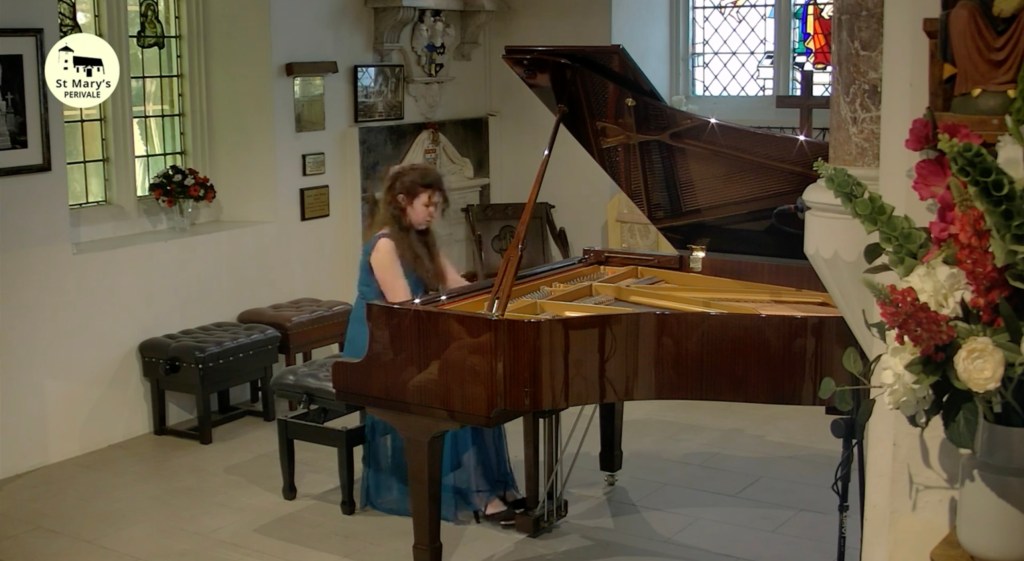
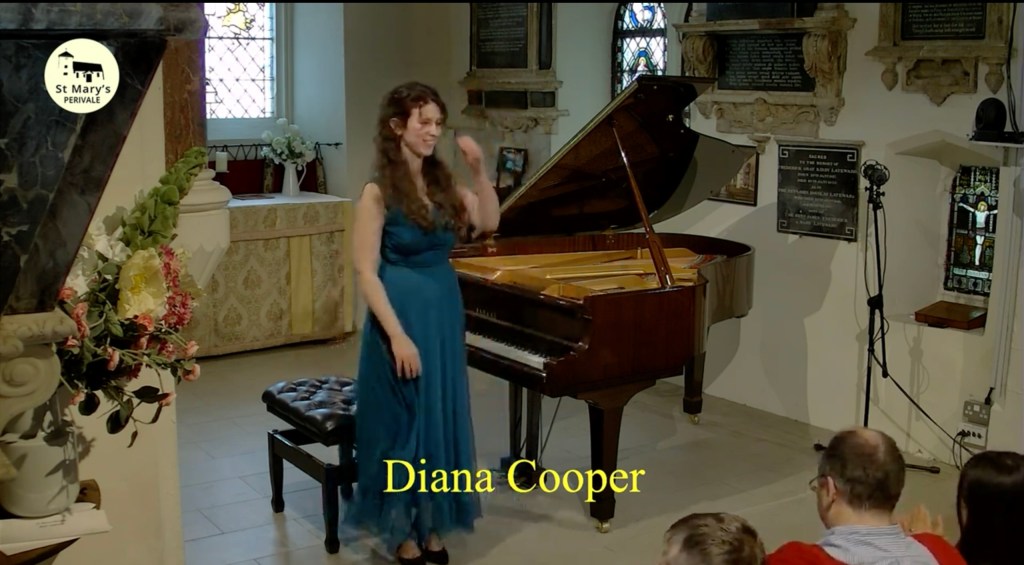
I have heard Diana Cooper many times over the past few seasons in London, as she unknowingly prepared to participate in the Chopin Competition in Warsaw in 2025. There has been a very drastic selection of videos sent in from the hundreds of applicants who wanted to follow in the steps of Bruce Liu who was the winner in 202I. Diana is one of the lucky few selected to go to Warsaw, into the ring where the gladiators will fight to the end in this Circus arena that these competitions have created. https://christopheraxworthymusiccommentary.com/2016/05/16/piano-competitions-a-consideration/
Diana is a great artist but working on her Chopin programmes I have noticed that added to her intelligence and pianistic mastery, she has acquired an authority that is made of the humility and respect for the text of Chopin that he had bequeathed to the world, mostly written in his own hand. A so called Chopin tradition has grown up since his death where the idiosincracies of great pianist – entertainers has sometimes turned Chopin’s so called rubato into a grotesque distortion aimed at titivating the senses and arousing the approval of the audience. Chopin has no need for that because he was able to create a new art form for a piano that now had pedals, and a soul of its own that lies within the very notes, and needs no external icing on the cake! It was Rubinstein who broke away from this so called tradition and as Perlemuter once told me there is no-one who knows the scores better than he.
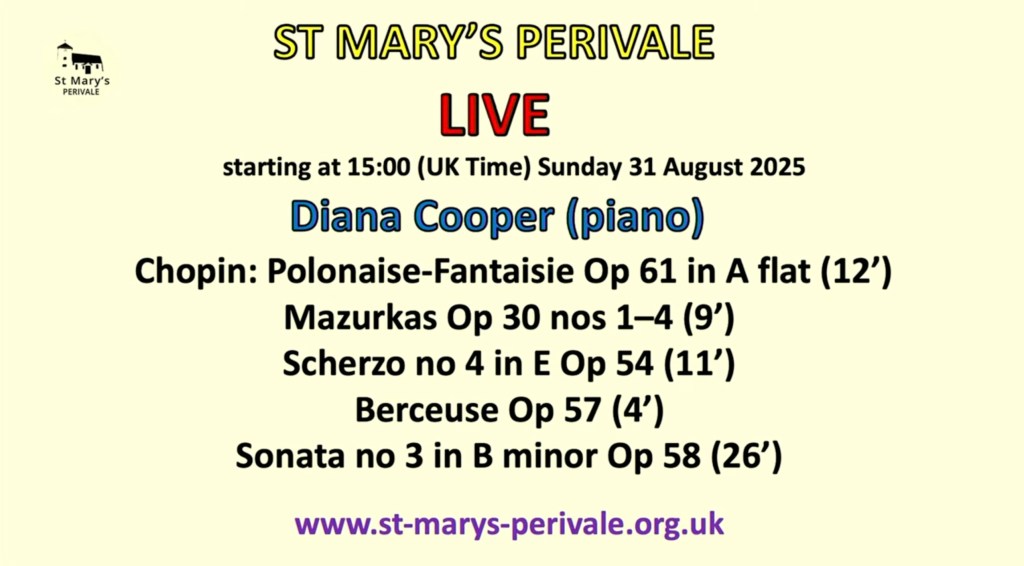
Diana realises this and her superb musicianship and sensitivity give her playing a strength and nobility that allows Chopin’s own voice to shine through. I have quoted from some of my past reviews below but there were a few works that I had not heard her play before. The Polonaise Fantaisie,the Berceuse ,three Mazurkas and the Waltz op 42 that I have added an appreciation to, below each piece.
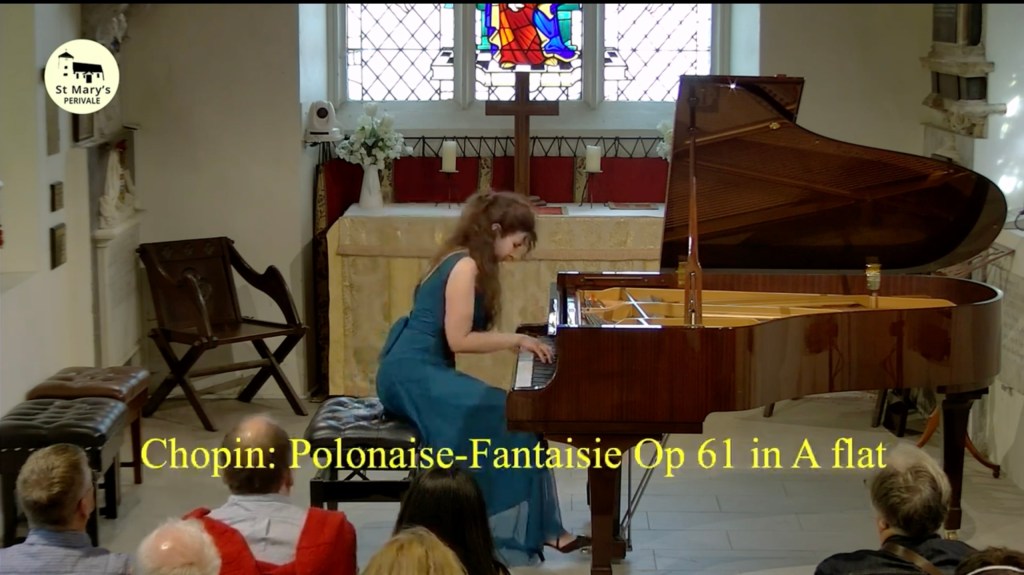
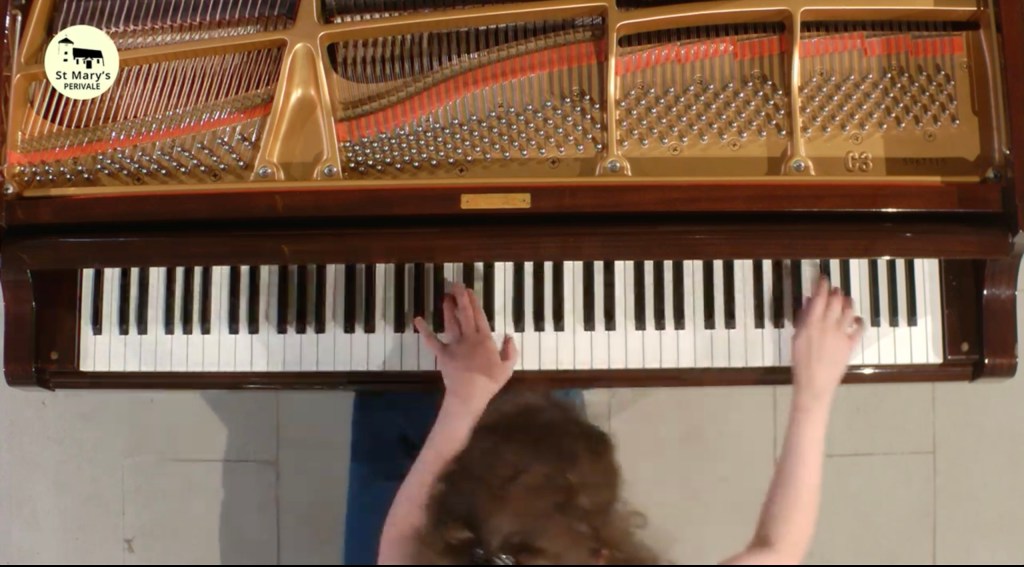
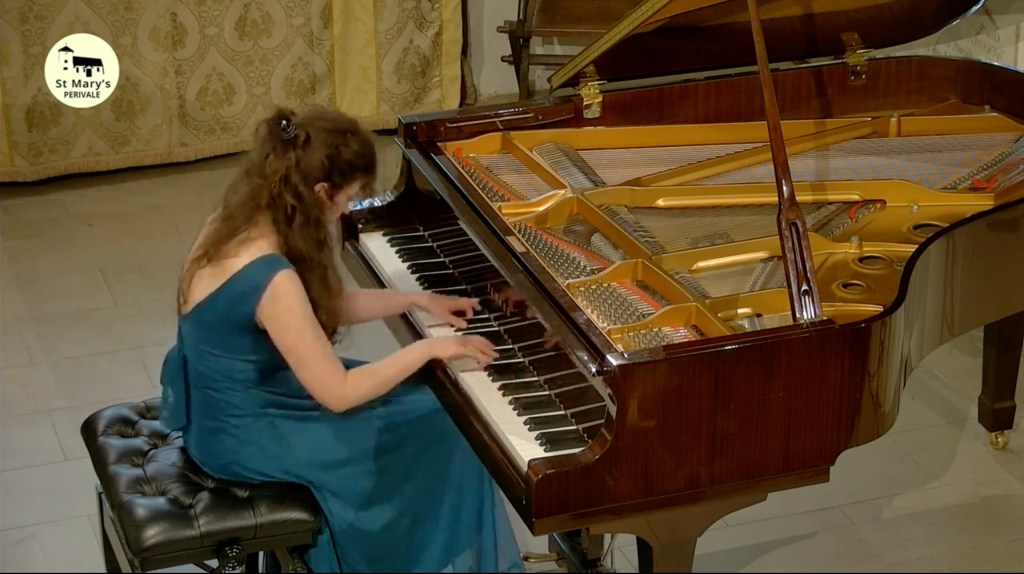
A Polonaise – Fantaisie played with strength and passion with a superb use of the pedals that allowed Chopin to create this new form in the last year of his life, where the Polonaise and fantasy were inextricable interwound. A very noble opening but I would think twice before splitting the long vibrations between the hands as it ruins the impression of an artist making one stroke with his brush. Diana however could create of this extraordinary work one great architectural shape, that took us to the beautiful central episode with such inevitability and a sense of riding on a wave of sounds always moving forward. Leading to the return of the opening declamation and with dynamic drive to the sumptuous climax of glorious exultation and aristocratic nobility.
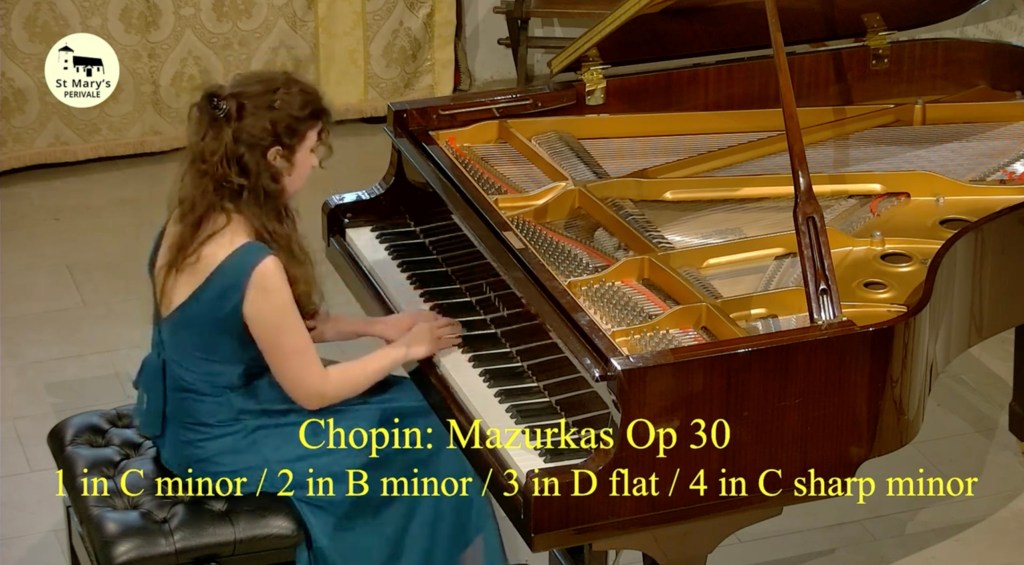
‘Diana Cooper at Bechstein Hall – ‘freedom and flexibility of rare artistry’ – ‘ravishing sounds of refined delicacy mingled with robust declamations’. This is what I jotted down as she recreated the Mazurka op 30 n. 3 that opened this extraordinary Chopin Recital.She shared with us in just a few minutes a tone poem with a kaleidoscope of colours and emotions. ‘Canons covered in flowers’, never have Schumann’s words come so vividly to life. A piano that I have heard played by many very fine artists, but today the sounds she found with a miraculous sense of balance and sensitivity , a subtle palette of colours, I would never have thought possible. A bass that resounded with the deep velvety resonance reminiscent of a Bosendorfer or Shegeru Kwai – a middle register of Bluthner or Fazioli richness – an upper register that of the Hamburg Steinway of yore.’
What a joy to hear the other three Mazurka’s that make up this set . The beguiling nostalgia of the C minor never forgetting the refined elegance and fantasy of this dance so deeply embedded in Chopin from birth. The boisterous dance of the B minor was played with exhilaration and excitement. There was ravishing beauty and an extraordinary range of sounds in the C sharp minor mazurka with it’s ever questioning phrases.
There was the same sense of style and refined elegance in the waltz op 42 that she played in Perivale as an encore .
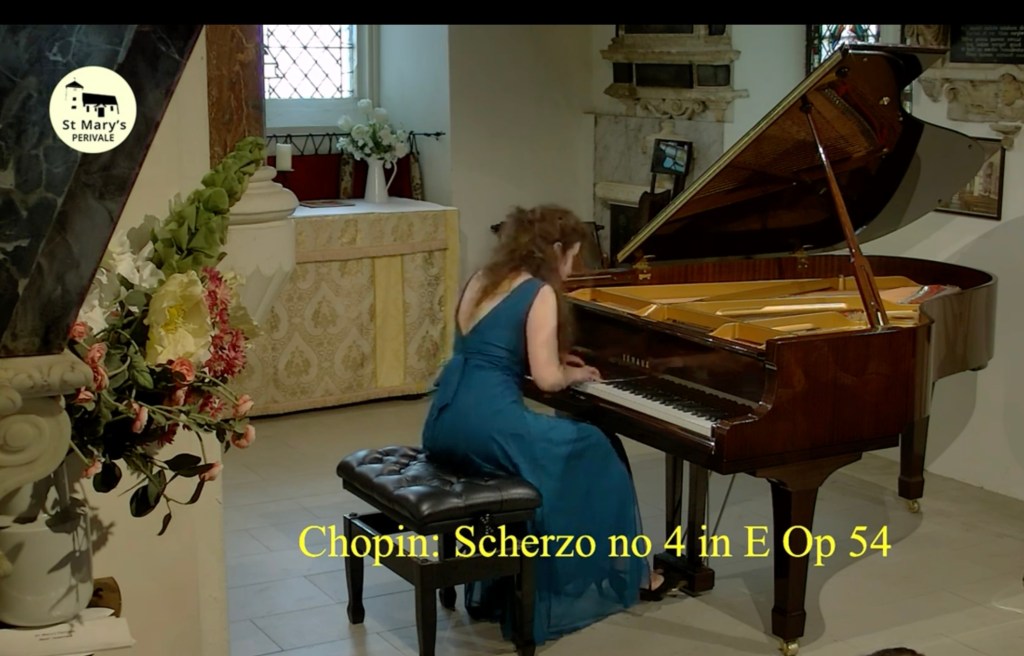
‘The Fourth Scherzo, an elusive work of extraordinary fantasy and chameleonic changes of character that have made it less accessible to all but the greatest of interpreters. Diana played it today with a kaleidoscope of sounds as she took us into a fantasy world of fleeting quixotic fancy and ravishing washes of sumptuous melody. In Diana’s masterly hands even the glistening jeux perlé that abounds was played with a clarity starting with the pedal but then continuing without, that was quite breathtaking in it’s audacity.The bare notes of the introduction to the ‘più lento’ central episode I have rarely heard played with such poignancy, where one could feel the collegiate atmosphere created and of her leading us by the hand into a wondrous land of beauty .The radiance and sumptuous beauty of the imperious final few bars gave us that rich sound of a truly ‘Grand Piano’ with a depth and richness of magisterial authority. ‘
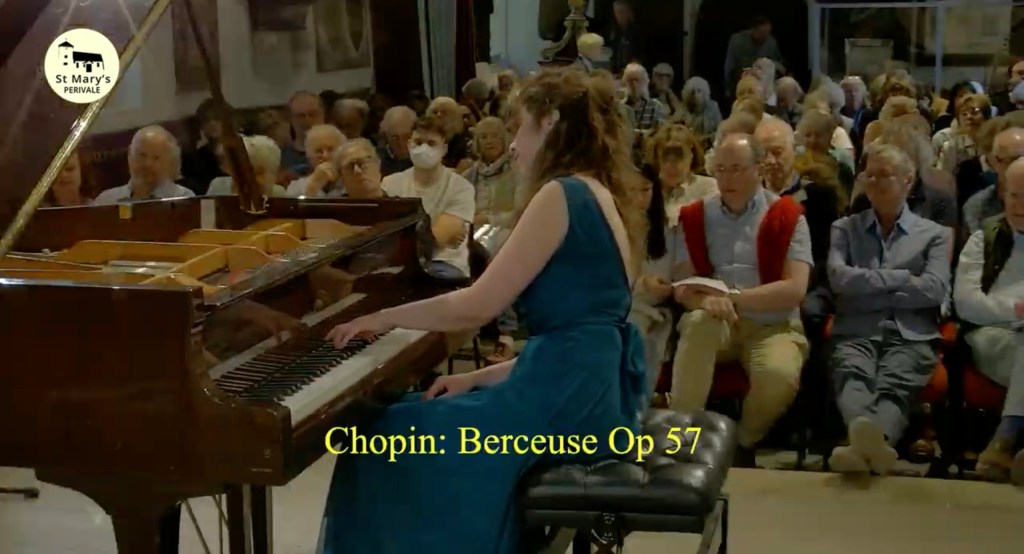
I have never forgotten a performance of the Chopin ‘Berceuse’ that I had heard from Norma Fisher in the London Piano Series at the Wigmore Hall in the sixties. I had been taken by ‘our’ teacher Sidney Harrison, who had taken me under his wing as a schoolboy and wanted to introduce the winner of the Liszt Scholarship at the Royal Academy to his prize student, now and established artist worldwide. It is Norma Fisher who has been mentoring Diana and it was this rich aristocratic sound that I was reminded of today. A refined simplicity almost a classical style ( Mozart A minor rondo comes to mind) as the variations evolved glistening and shimmering with silvery sounds of glowing beauty. The beauty of C flat floating with subtle beauty into the atmosphere creating a magic aura of sublime beauty taking us to the whispered ending.
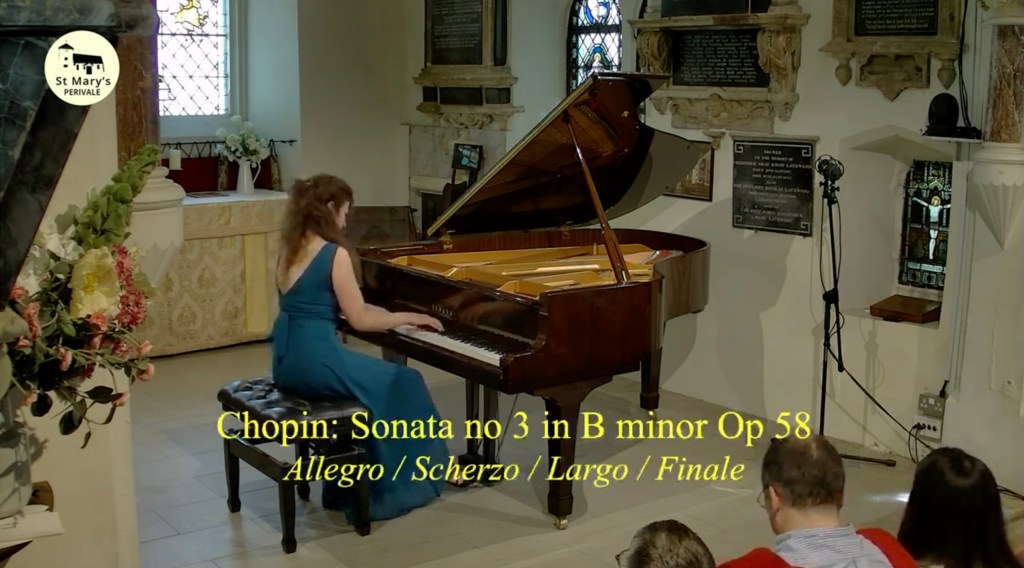
‘It was this same authority that opened the B minor Sonata,with the power of a drama that was about to unfold. Searing passion and breathless declamations gave way to a bel canto with an inner energy, as Diana had conceived the whole movement in one glorious architectural whole. Moments of extraordinary beauty as counterpoints just shone like jewels catching the light.There was no repeat but straight into the development with overwhelming drive and authority. The Trio of the Scherzo was given unusual importance with contrapuntal strands that all made such sense and were the guiding light for this movement that can sound, in lesser hands, so disjointed. An imperious opening to the Largo played with extraordinary intelligence and sensitive musicality as she gave a monumental shape to passages that can seem like senseless beautiful meanderings. She brought a breathtaking climax played with her extraordinary ability to feel and search for a balance that would allow beauty, passion and delicacy to live under the same roof. The ‘Presto non tanto’ was played with beguiling menace as it became ever more excited and exhilarating, all leading to the final tumultuous explosion and the triumphant left hand fanfare taking us to the final chords of breathless inevitability.’
Winner of numerous awards including 1st Prize at the Brest Chopin Competition, 1st Prize at the Halina Czerny-Stefanská International Competition in Poznan (Poland) and 1st Prize at the Concurso Internacional de Piano de Vigo (Spain), Diana Cooper has been invited to perform in various venues and festivals in France and abroad, including the Nohant Chopin Festival, the Festival Chopin à Paris, the Salle Cortot, the Hrvatski dom Split in Croatia, Chopin’s manor in Zelazowa Wola in Poland, the Teatro Filarmónica de Oviedo… In 2023 and 2024, she was selected to take part in the project Un été en France avec Gautier Capuçon, for which she performed solo and chamber music in several open-air concerts across France, including in Corsica. She was invited in 2018 to take part in the radio program Générations Jeunes Interprètes on France Musique and, in 2023, performed as a trio in the television programme Fauteuils d’orchestre, broadcast on France 5. In 2024 she was chosen to take part in a masterclass with Yuja Wang, filmed and produced by the BBC for the art series Arts in Motion. She appeared with several orchestras including the Orkiestra Symfoniczna Filharmonii Kaliskiej, in Poland, performing Chopin’s 1st concerto under the baton of Maciej Kotarba. Born in Tarbes (France), Diana is a graduate of the Conservatoire de Paris (CNSMDP), the Ecole Normale de Musique Alfred Cortot and the Royal College of Music in London. Her main professors include Norma Fisher, Philippe Giusiano, Rena Shereshevskaya, and Marie-Josèphe Jude. Diana has recently recorded her first CD, featuring works by Haydn, Chopin and Ravel, after winning 1st Prize in the Concours d’aide aux Jeunes Artistes organised by the Festival du Vexin.
























 ChristopherAxworthy-MusicCommentary