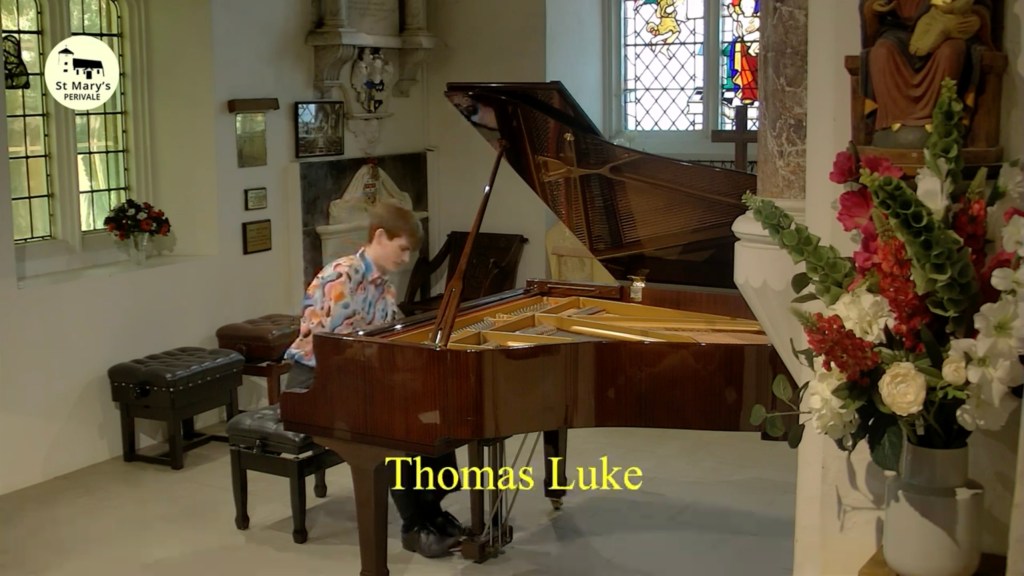
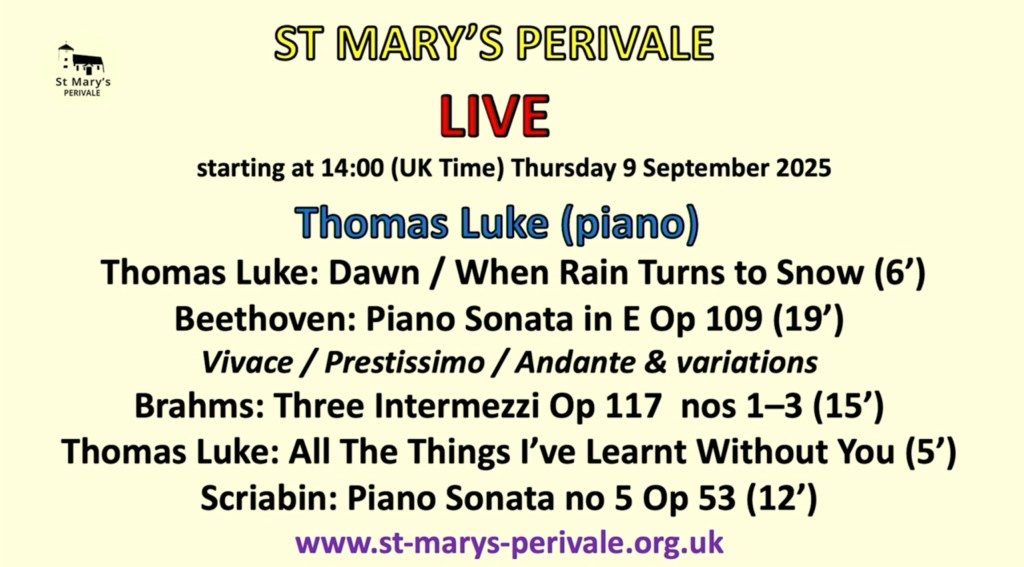
Thomas Luke is not only a pianist but also an accomplished composer, and what shines through all his work is the absolute clarity of his intelligent musicianship. I first heard him eighteen months ago in the final round of the Chappell Gold Medal at the RCM which was being judged by the ever eclectic Jed Distler. We had both noticed the clarity of his playing as I had when he played the Saint Saens second concerto in Lang Lang’s masterclass a year earlier. Young winner of the BBC Competition he has now acquired an authority from working over these past two years with Alim Beisembayev and Vanessa Latarche. We now see a young man who knows what he wants to say and has the means to express it, not only in music but also in words.
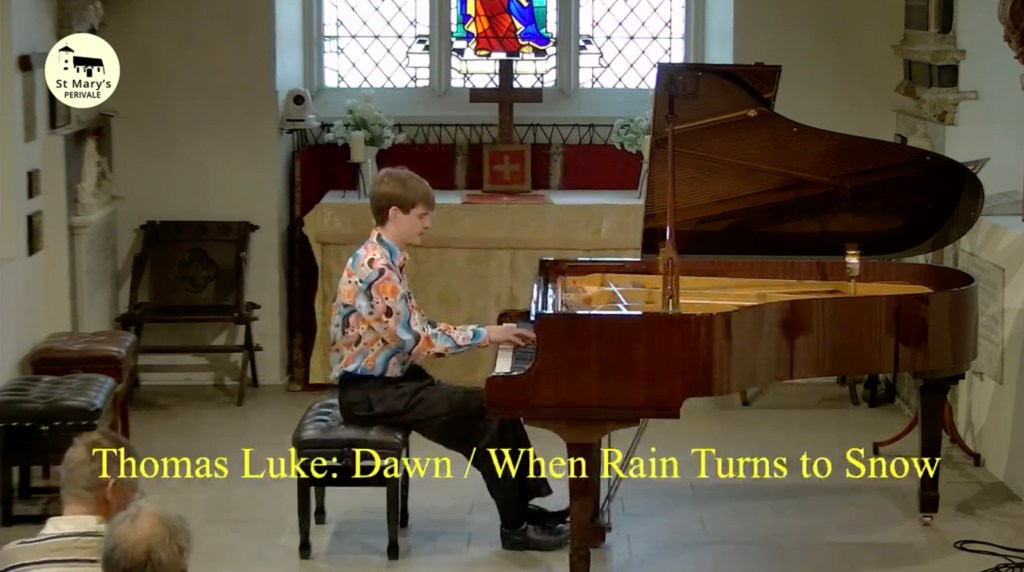
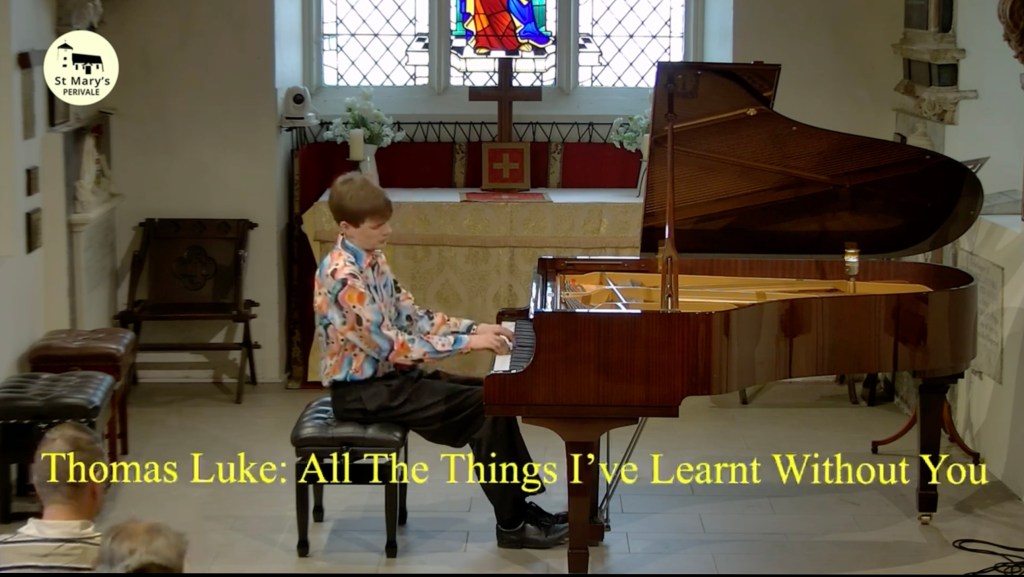
His two pieces that were on today’s programme are part of a new CD of his own composition to be imminently released. His words revealed a very deep emotional understanding and poetic reasoning as was mirrored by his striking multi coloured shirt! His two short piano works were followed by a third as a much requested encore. They revealed a music language of mellifluous beauty and ingenious pianistic understanding as the clarity of his playing showed also the direct emotional message that his music carries,with playing of glowing beauty. A sense of balance but above all a chiselled mellifluous beauty of his own voice speaking with such conviction and authority.
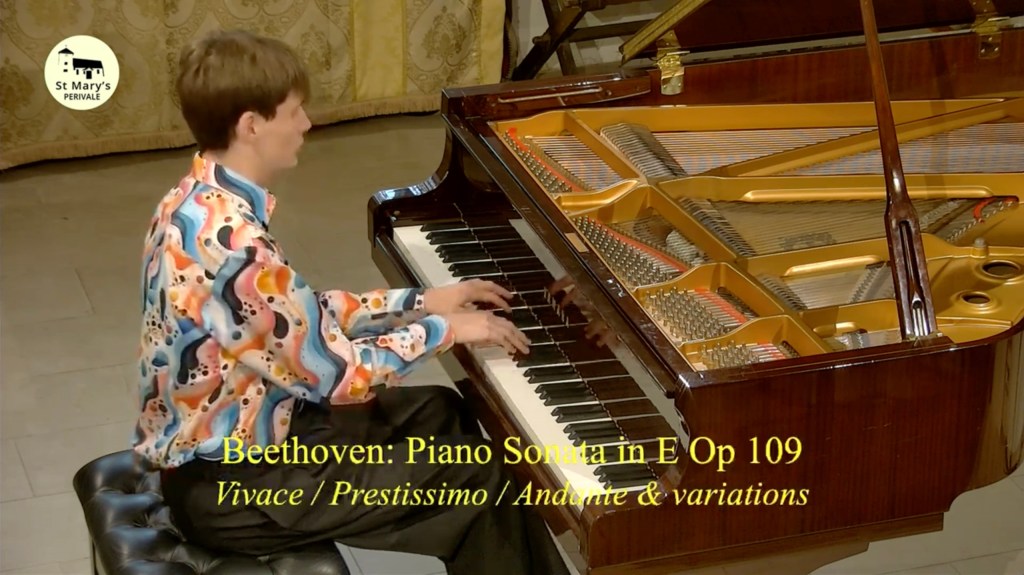
To Beethoven he not only brought a clarity but also a rhythmic intensity that was like a wave entering with simple flowing sounds interrupted by Beethoven’s demanding personality and irascible temperament. But in this and it’s twin op 110 Beethoven had found a pastoral landscape of etherial beauty as his temperament was gradually calmed and reassured as he saw the light that awaited him at the end of a long and turbulent tunnel. A light that he resolved in many ways with his expansion of the variation form. In fact his last major work was the Diabelli variations but anticipated by the final movement of these two final sonatas op 109 and 111. Op 110 was more of a joyous acceptance whereas the theme and variations of its twins op 109 and op 111 was of poignant emotional meaning ending in a whisper of deep feeling . Thomas allowed the music to pour from his crystalline fingers with a fluidity as the first movement was like a stream entering and exiting with the simple beauty of a pastoral landscape. The brusque ‘Prestissimo’ was played with burning intensity and brilliance and was remarkable for his absolute fidelity to the score. Dynamic contrasts but above all an architectural understanding that gave such strength to this irascible contrasting movement. It was, though, the ‘Andante molto cantabile ed espressivo’ that allowed Thomas’s playing to glow with poignant meaning. The theme played with simple string quartet texture where each strand was a voice of expressive beauty as the first variation was played with simplicity and intensity. He allowed the ‘leggiermente’ to speak for itself with a gentle forward movement of whispered beauty. The ‘Allegro vivace’ sprang from his well oiled fingers with masterly control and rhythmic drive dissolving so naturally into the mellifluous weavings of the fourth variation. ‘Piacevole’ Beethoven writes and it was this simple beauty that Thomas was able to convey with such clarity and musical intelligence. The fifth and sixth variations were played with a mastery and sense of balance from the ‘Allegro ma non troppo’ of almost military order to the disarming beauty and gradual disintegration and rebirth of the opening theme .’Cantabile’ is all Beethoven writes for this wondrous final variation and it was exactly this that Thomas realised. Trills that were merely vibrations as the theme is envisaged on high before magically returning to earth for the ending of this wondrous story, as it had begun. Thomas played with a purity and scrupulous understanding of Beethoven’s surprisingly meticulous indications exactly following in his mentor, Alim Beisembayev’s masterly footsteps.
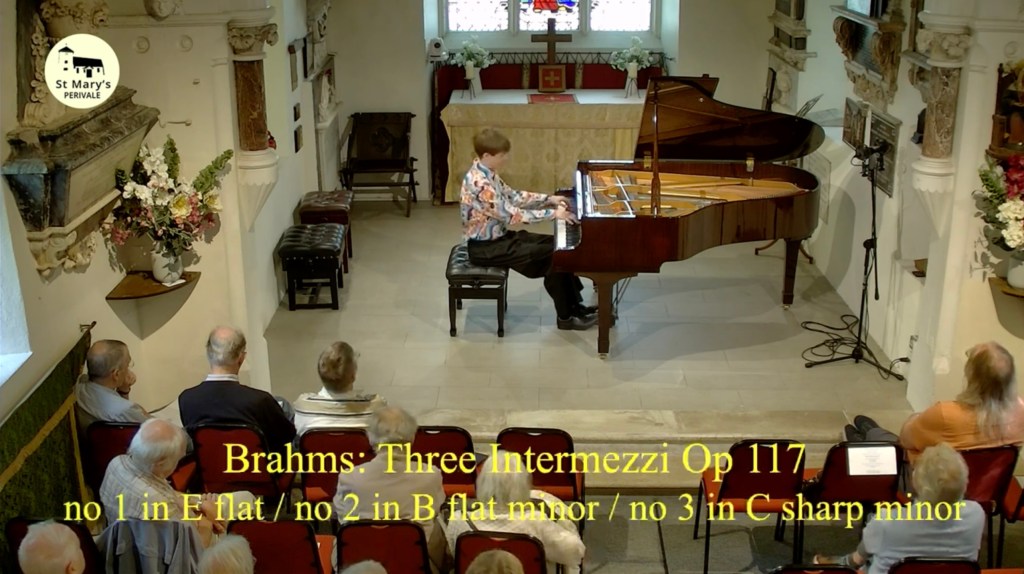
The three Brahms Intermezzi were played with exquisite beauty from the gentle lyricism of the E flat through the beguiling ravishing beauty of the B flat minor to the haunting mystery of the C sharp minor. These are works that reveal their deep meaning only to the greatest of musicians who can bring a clarity to the musical line whilst being immersed in sounds of extraordinary colour and subtlety.
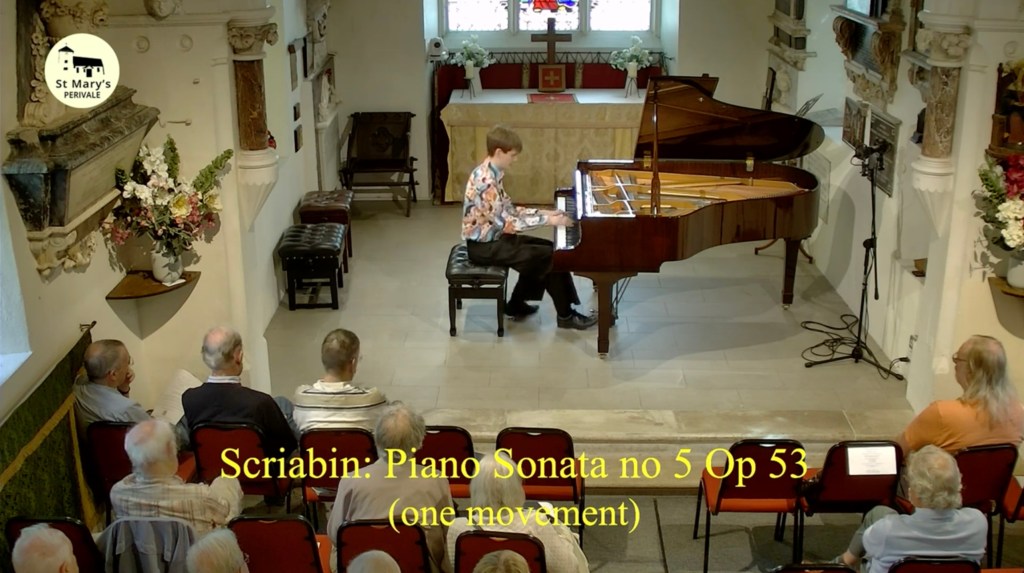
Scriabin’s fifth Sonata shot from Thomas’s hands with unexpected vigour and explosive drive. Contrasting with the glowing simplicity of Scriabin’s magical sound world as Thomas built up the tension with masterly control and breathtaking brilliance. Reaching the star, which shone with brilliance and overwhelming passion as it was swept away as it had begun on an impatient glissando of sounds across the entire keyboard (which often reminds me of Beethoven’s impatience in op 106 Scherzo.)
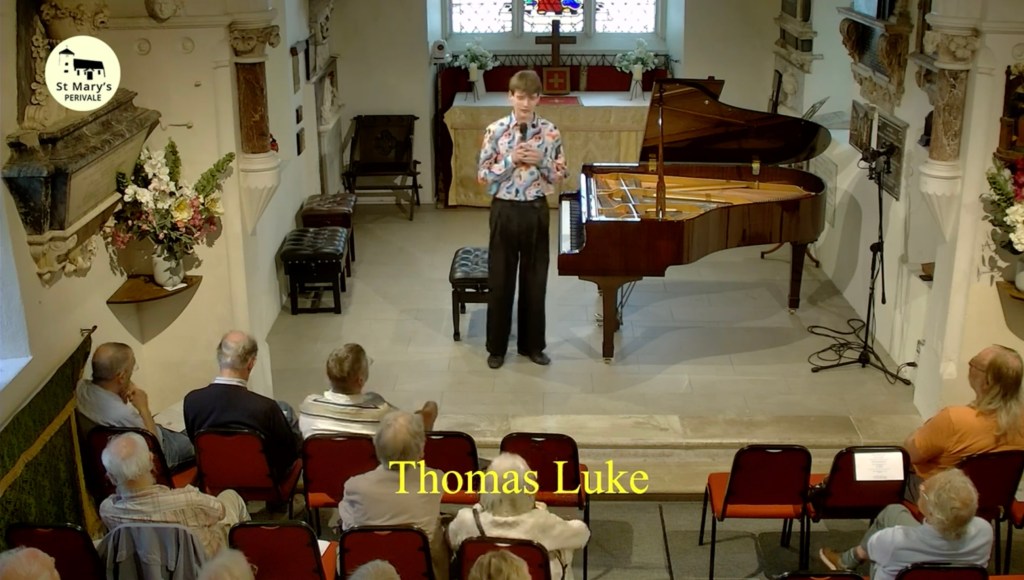
Thomas Luke came to national attention after winning the keyboard category of BBC Young Musician 2020. Driven by a desire for discovery and authentic human connection, he moves freely between traditional concert repertoire, his own compositions, and expansive multi-piano arrangements. His performances have featured on national radio and television, and have taken him to stages worldwide, including London’s Wigmore Hall, Leipzig’s Weißes Haus, the Xiamen International Conference Centre Concert Hall and the Van Cliburn Concert Hall in Fort Worth.
Hailed as a “trailblazer” by Steinway & Sons, Thomas made history by performing the inaugural Steinway SpirioCast between two UK institutions. He was recently awarded the Prix Monti at the 2025 Piano Campus International Competition and has been recognised by the Vienna International Music Competition for his “outstanding talent, a remarkable musicality and a very accomplished technique.” In June 2024, he was selected as one of just 24 Young Artists globally to attend the PianoTexas International Festival, and has participated in lessons and masterclasses with Lang Lang, Arie Vardi and Stephen Kovacevich.
In 2024, he launched Many Pianos – a series of bold, layered arrangements for four or more pianos, blending digital and acoustic elements. His first video, a cover of Jacob Collier’s “Little Blue”, was recognised by Collier himself and has since reached thousands of listeners online. Thomas’ next major release, an album of original music, is due in early 2026.
Born on the Isle of Wight, Thomas’ musical spark was lit in the room under his grandparents’ stairs, playing keyboard games on the organ with his grandfather. He began piano lessons with Judith Harvey aged four, continuing studies with Eleanor Hodgkinson at the Junior Royal Academy of Music. He now studies with Vanessa Latarche at the Royal College of Music as the Margaret Mount Scholar.
 ChristopherAxworthy-MusicCommentary