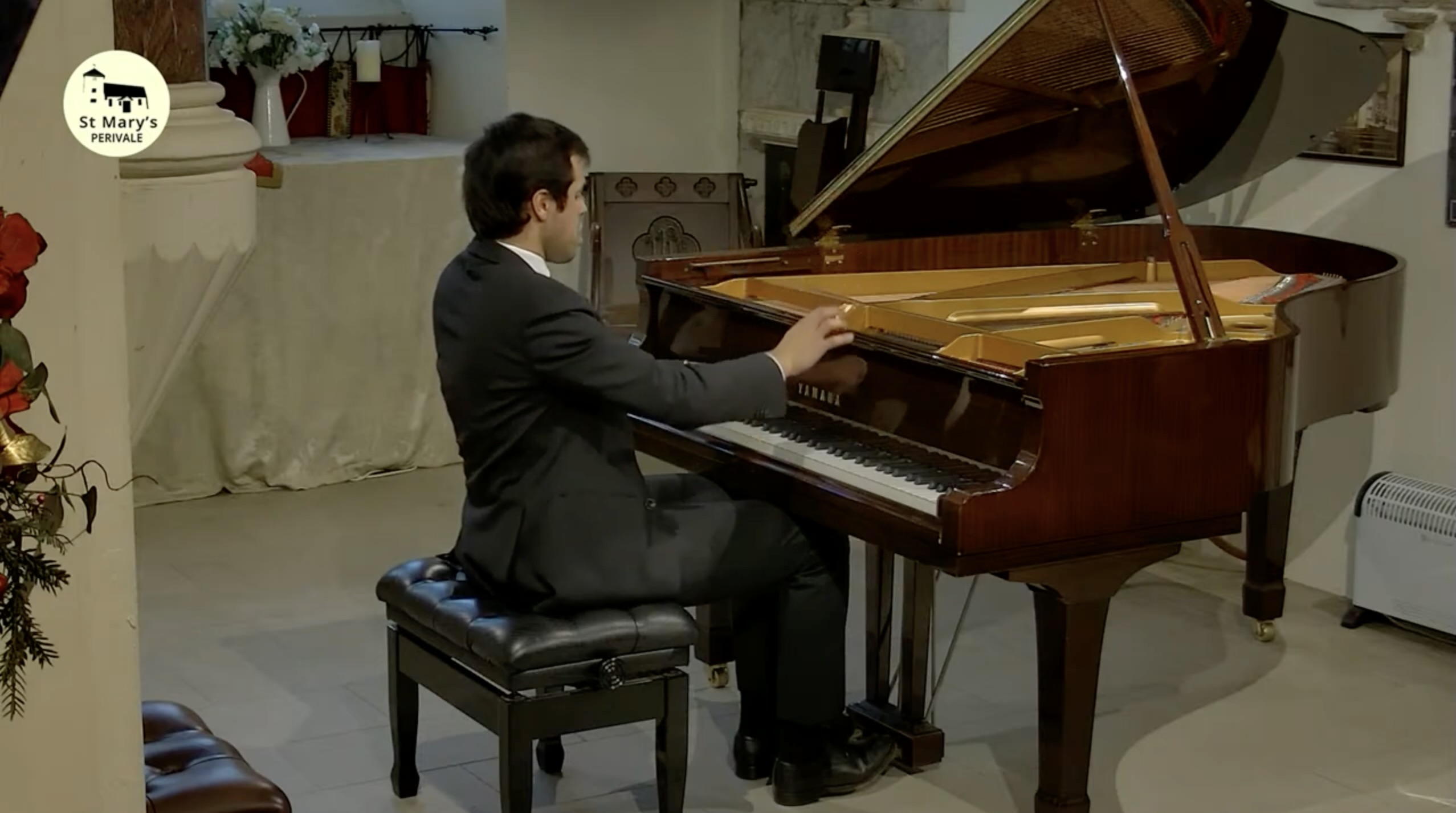
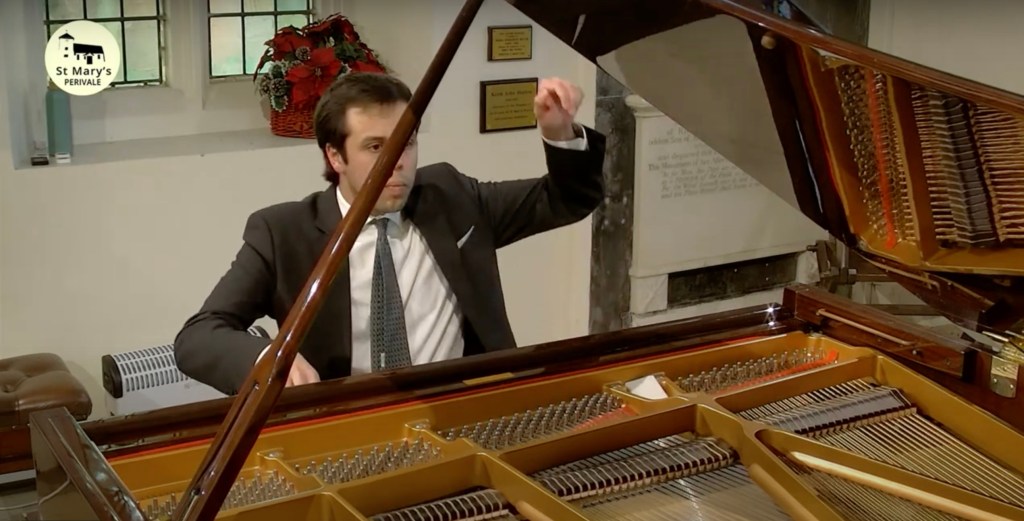
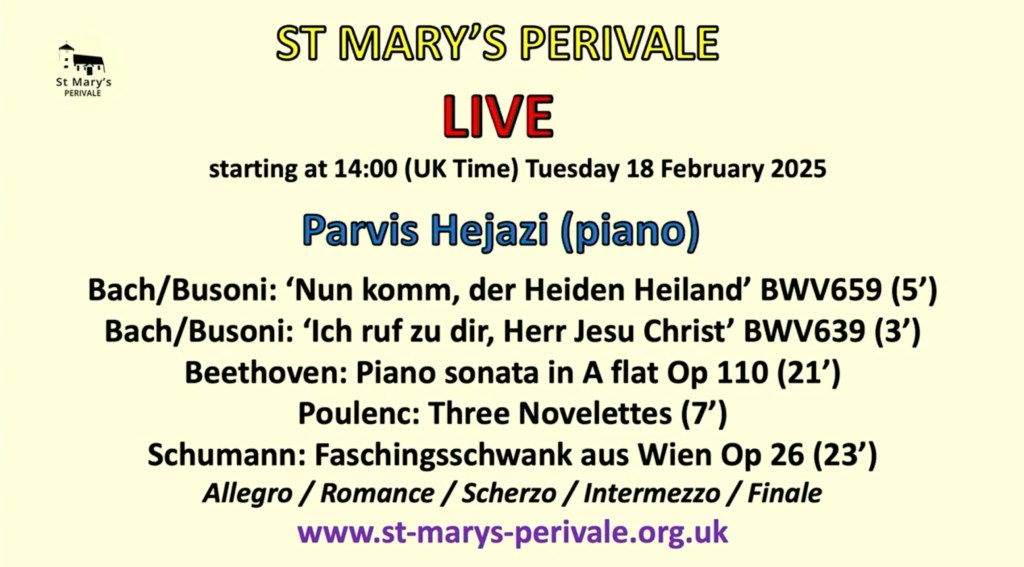
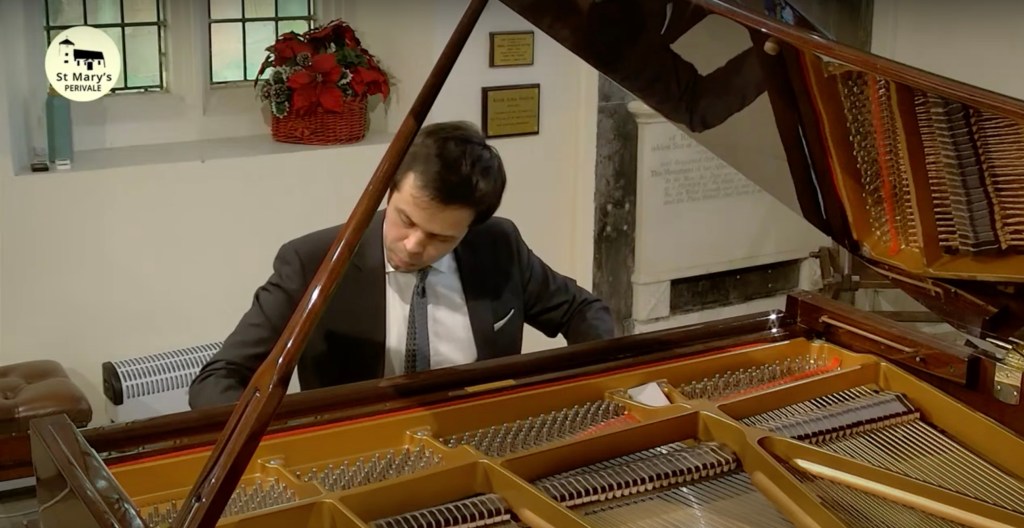
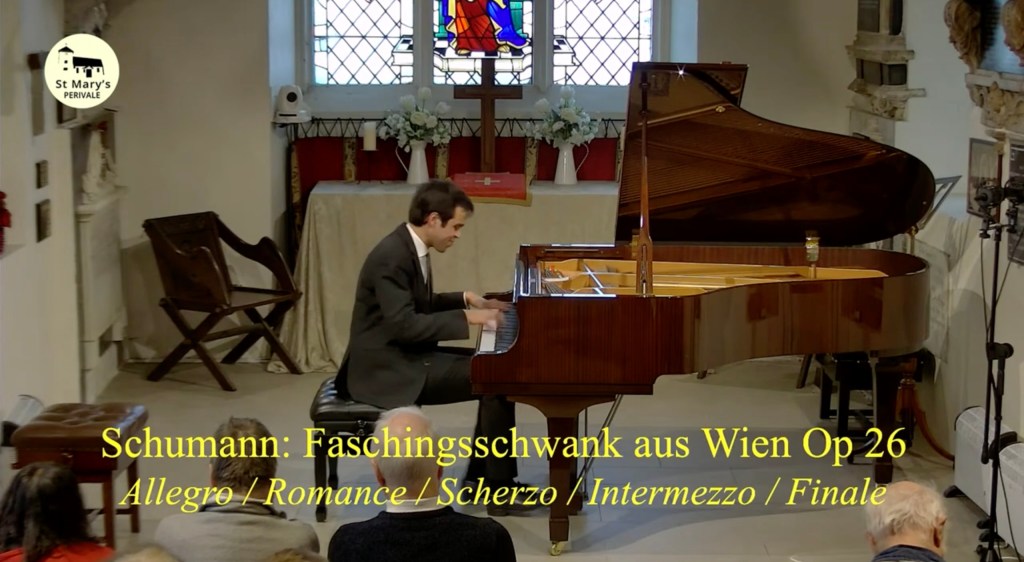
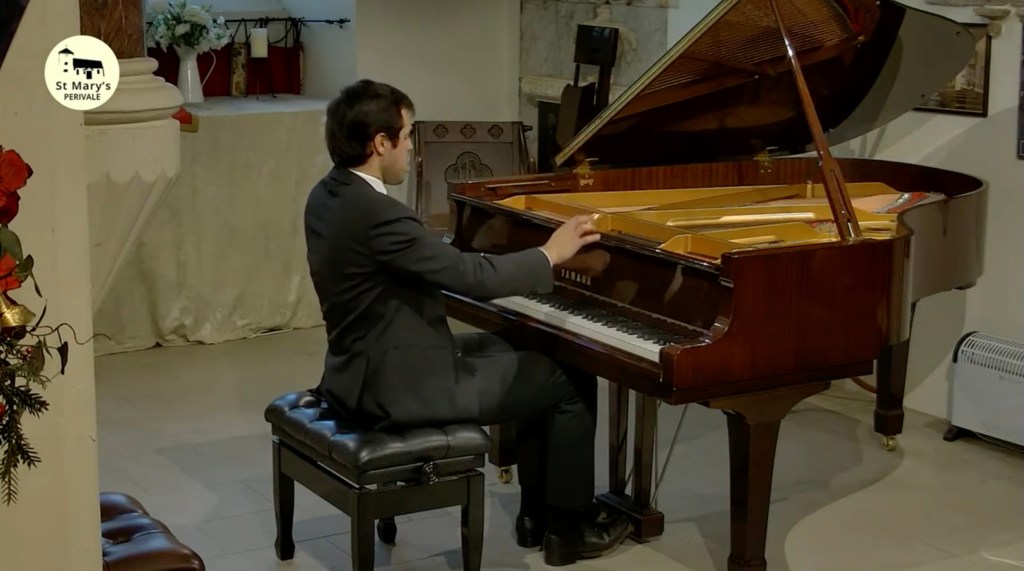
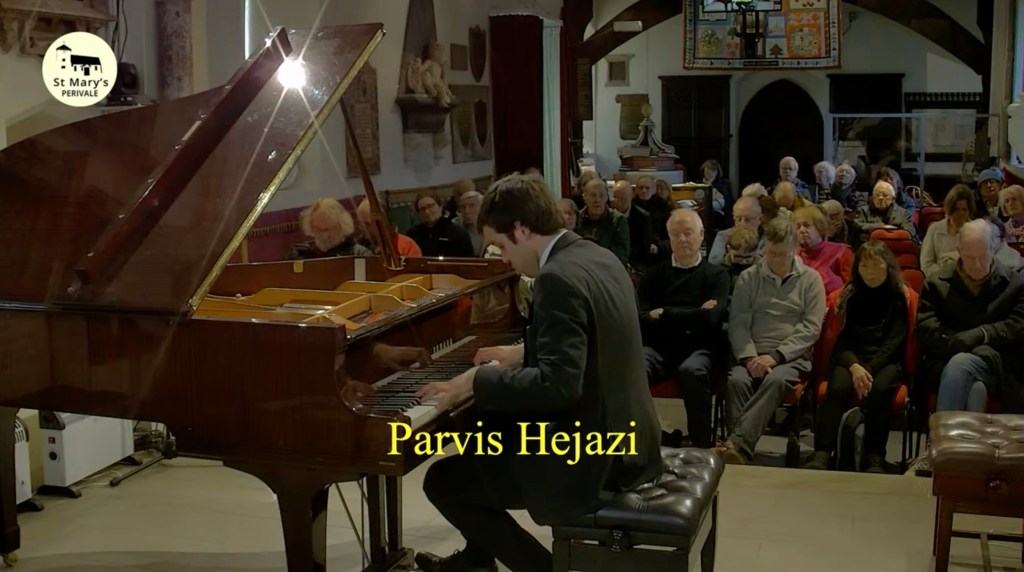
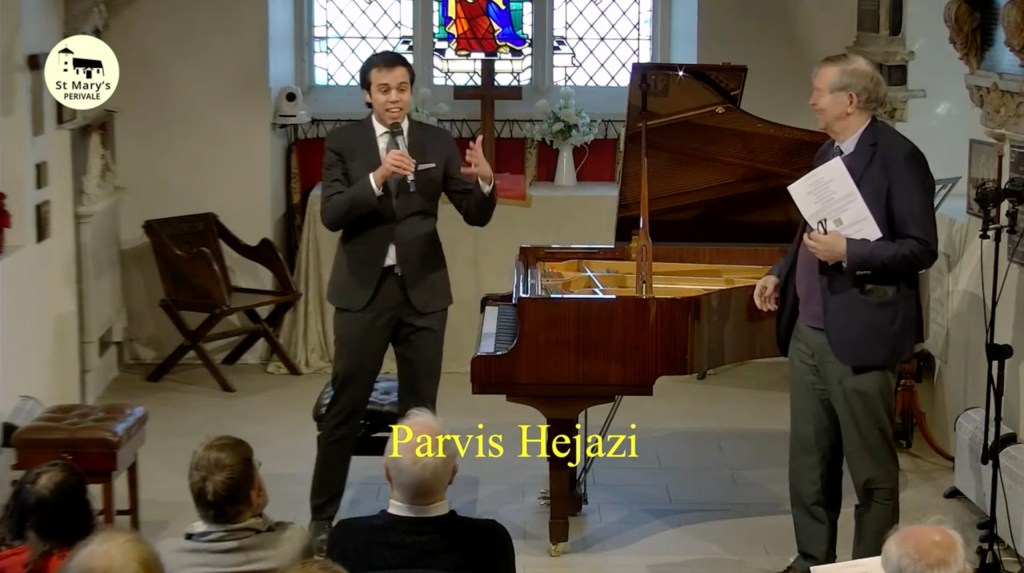
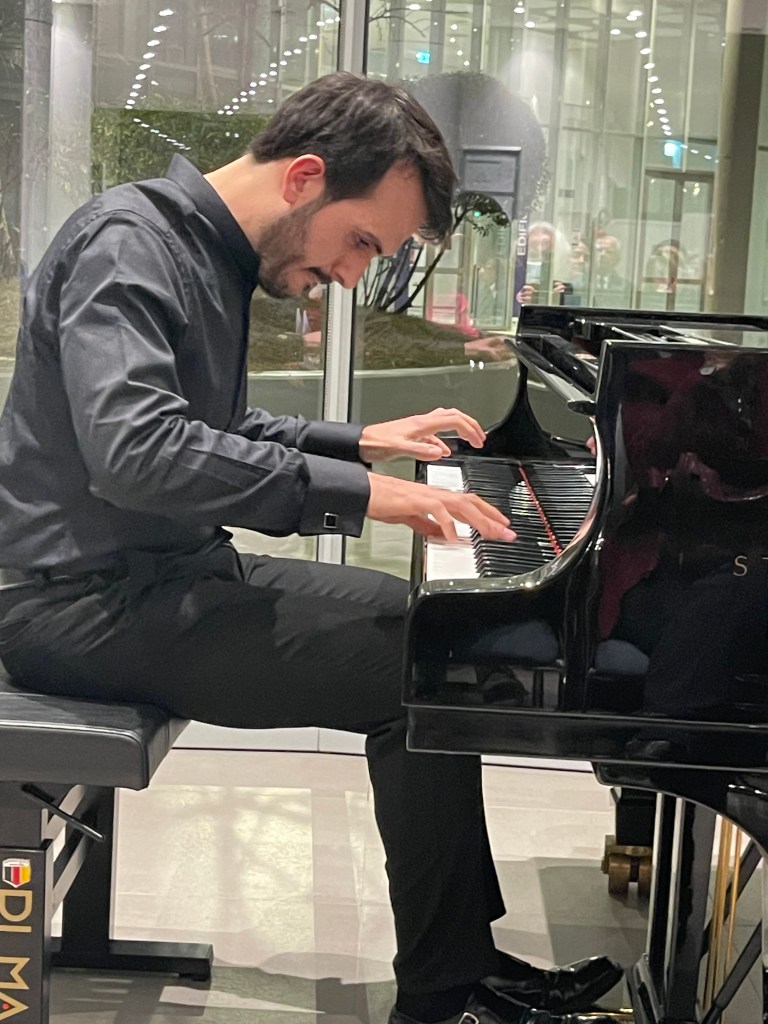
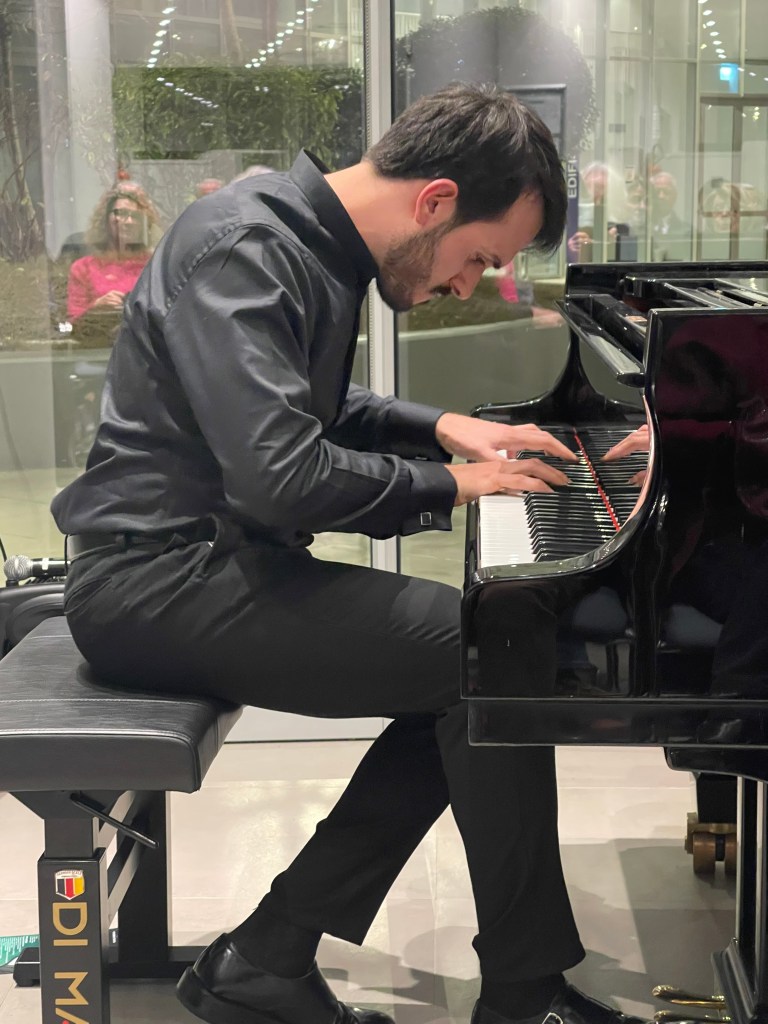
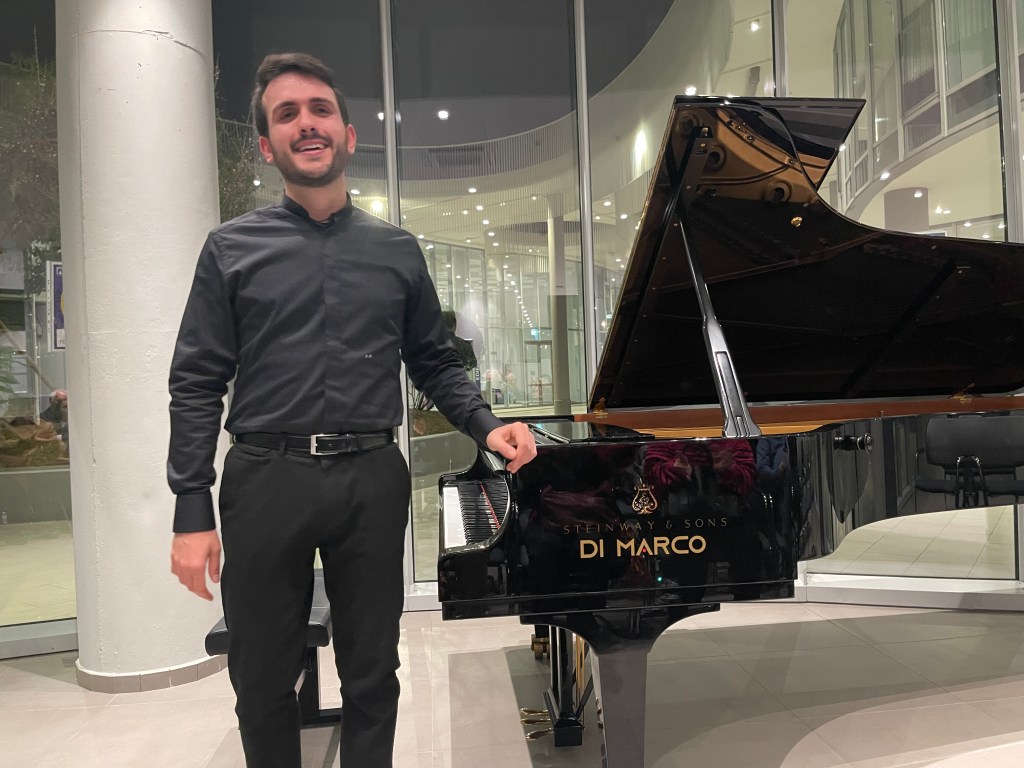
I have heard Parvis play many times during his studies with Norma Fisher at the Royal College of Music but the pass from being a prize student to becoming an artist can be long and arduous. You have been given a superb training but this is just the beginning and the experience of playing in public and gaining confidence takes time and sacrifice. Most,having finished their scholarship programmes, have to augment the continuation of their artistic ideals with teaching, that can lead to having less time to spend at the keyboard and to prepare programmes. Parvis seems to be an exception to this rule. As a student he was trying to run before he could walk, but his talent was always evident.Today I was very pleased to hear a rather lazy student become a serious artist. Parvis today played with impeccable preparation and authority and if anything he could now take more time and allow the music to unfold naturally allowing more freedom for his stylistic and undoubted poetic sensibility.
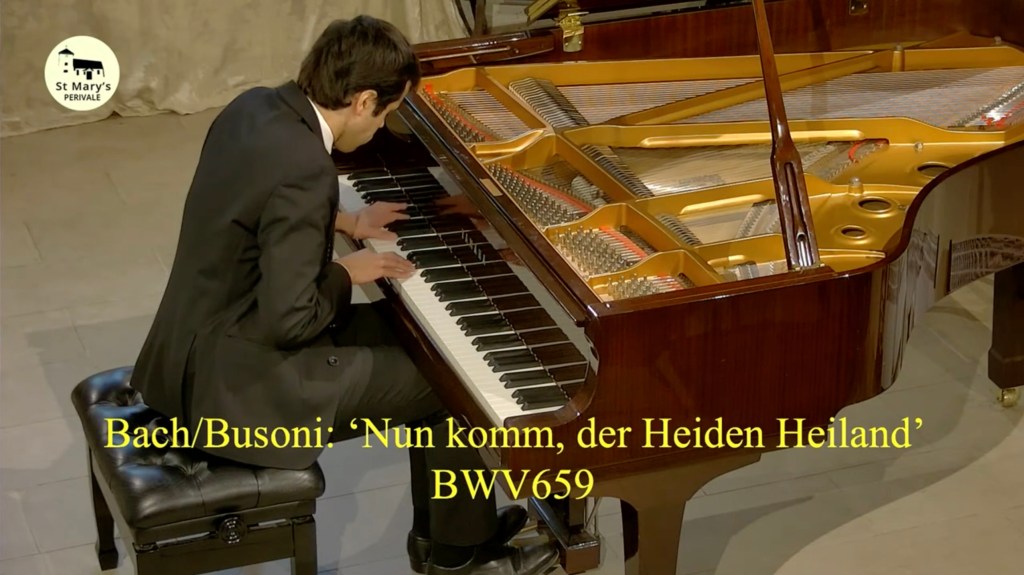
Two of the most beautiful of Busoni’s transcriptions of Bach Chorales were played with beauty and deeply felt sentiment. Sentiment that was never sentimental but of the aristocratic fervour of a true believer. There was a flowing line to ‘Nun komm’ that at first seemed very slow but was so full of significance that it was totally convincing.
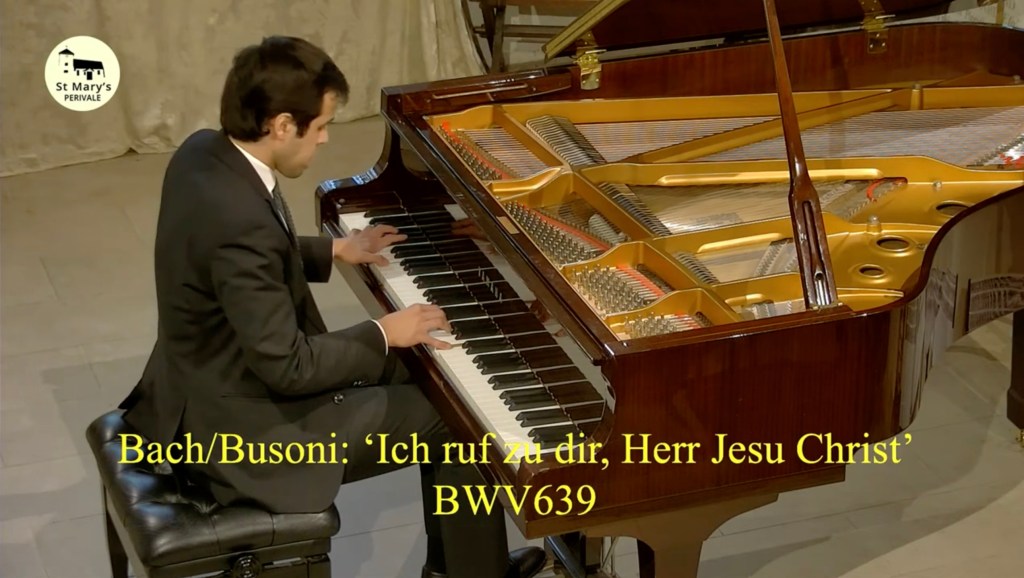
‘Ich ruf zu dir ‘ is one of the most beautiful of all Busoni’s reimaginings of Bach and I was reminded today of the much missed Nelson Freire who would always include it somewhere in his recitals in Rome together with Gluck/Sgambati : Melody from ‘Orfeo ed Euridice’. Parvis played it with a radiance and a beautiful wave of sounds on which he etched Bach’s glorious melodic invention, sustained by sumptuous bass notes that gave a monumental richness to the beauty that was unfolding from Parvis’s sensitive hands with poignant simplicity.
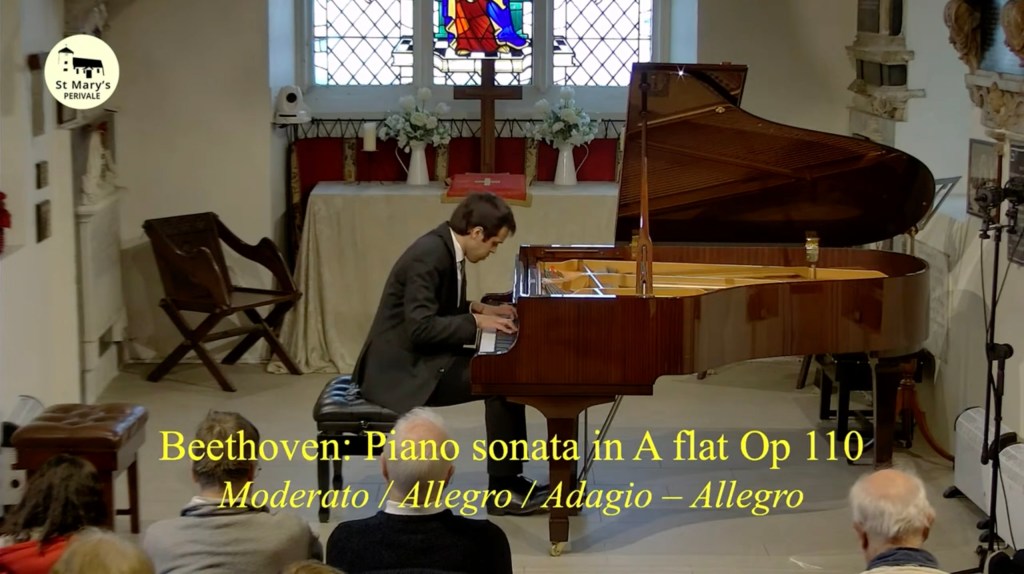
Beethoven’s penultimate sonata was played with remarkable technical and musical preparation where even the treacherous leaps in the ‘Trio’ of the ‘Scherzo’ were played with fearless abandon and authority. But as Parvis said in his very interesting and authoritative introductions:’ Is Beethoven a Classical or Romantic composer?’ Well let us not forget that his teacher, Haydn was the inventor of the symphony and inherited the musical forms of his age, bringing them to a new stage of genial invention, but they were mostly of the refined denial of his age. Beethoven took these early forms from his mentor and transformed them with genius, bringing them into a world of ‘Sturm und Drang’ where music could dig deep into the emotions and reveal things that words could never do. Parvis had seen Beethoven as classical and his performance could have had more time to breathe and be shaped with a style that is both classical and romantic. A beautiful opening to op 110, but after a rather prolonged trill suddenly the tempo changed and the ravishing beauty of the opening ( similar to the fourth piano concerto) gave way to a chase. Played with great mastery but lacking the ‘spiritual’ character of one of Beethoven’s gentlest late creations. Beethoven’s irascible contrasting temperament of sudden eruptions and abrupt changes are alien to this last sonata ( and also the one before op 109) giving way to a gentler more accommodating vision of life. Parvis, always playing with a very sensitive sense of balance and extraordinary clarity which suited more the ‘Scherzo’ than the ‘Moderato’ of op 110. The ‘Adagio’ was played with beautiful poise where Beethoven’s own pedalling give a luminous glow to the absolute clarity of the knotty twine that was unfolding. The great ‘Aria’, though, floating on a heart, beating intensely, missed the etherial magic of a composer who had come to terms with a difficult and turbulent life and could now envisage the paradise that was awaiting him only a few years later at the age of fifty seven.
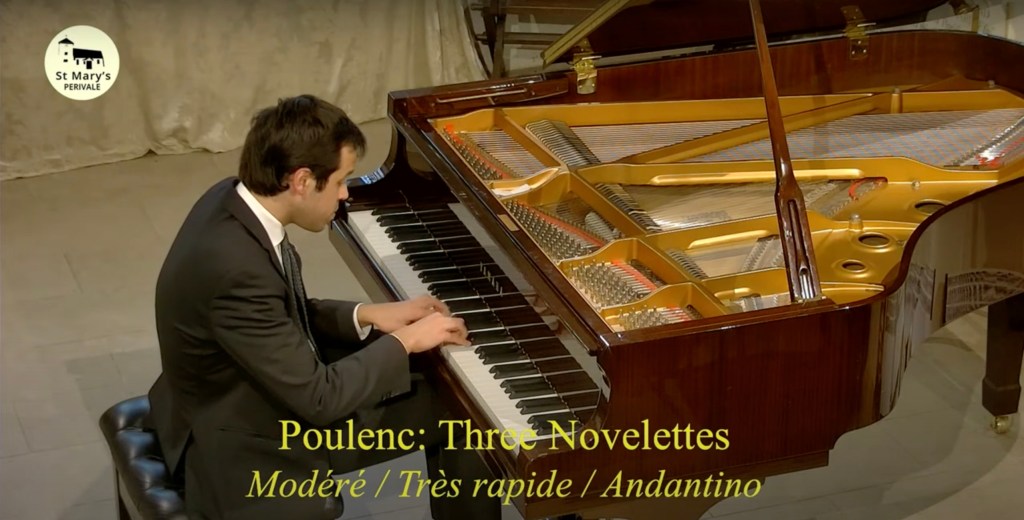
Poulenc’s suave elegance and showmanship suited Parvis much better, as he gave great character to the infectious ‘joie de vivre’ and facade that Poulenc escaped to in his music. A capricious sense of humour to the ‘Très rapide’ was played with a rhythmic elan where Parvis could have been even more fancy free to enjoy the bucolic outpourings of a true Parisian entertainer of the 20’s and 30’s . Sumptuous golden beauty was part of Poulenc’s world too and the ‘Andante’ was bathed in a subtle radiance where Parvis allowed the music to unfold naturally, leading to the ending suspended in air, with a cadence that owed much to the freedom of jazz improvisations of the day.
The opening of Schumann’s ‘Carnaval Jest’ was like the Beethoven, rather breathless, with Parvis’s wish to show us the architectural shape of the opening ‘Allegro’ rather than risking taking a little more time to breathe. I remember a famous pianist friend playing the Schumann Concerto in Rome with a good but not well established ensemble. In the rehearsal she mentioned to the conductor that in various places she liked to breathe .Oh,my dear,he exclaimed, that is very dangerous! It is a risk, but one that I feel Parvis can now allow himself, seeking to be free from architectural constraints and to just turn corners with a little more self indulgence.The indulgence that he did bring to the ‘Intermezzo’, that he played with admirable passion and freedom, allowing the music to unfold with ravishing beauty of romantic intensity.The ‘Romance’ ,too, was played with disarming simplicity and beauty and the ‘Scherzo’ thrown off with admirable nonchalance and ease. There was a rhythmic drive to the finale but here, as in the first movement, the lyrical passages were not given the time that they needed to speak with Schumann’s unique voice – that of Eusebius the poet of his soul.
I had no idea that Parvis was also a composer, and so was impressed with his own improvisation on a Gregorian chant .Beautiful, subtle un constrained sounds, those that had been missing in the masterworks he was interpreting showing a little too much respect.
The notes on the page are only an indication of the sounds that are in the composers head. Beethoven,miraculously, when he was totally deaf, could still write exactly what was in his head to bequeath to posterity.
‘Je sens,je joue ,je trasmet’ is a motto that all interpreters should keep in their studio. Together with humility, respect and intelligence, it is the secret formula of all great artists and one that can open the door to a ‘Pandora’s Box’ of hidden secrets. A voyage of discovery shared with an audience is a unique experience and, as Gilels exclaimed :the difference between fresh food rather than canned!
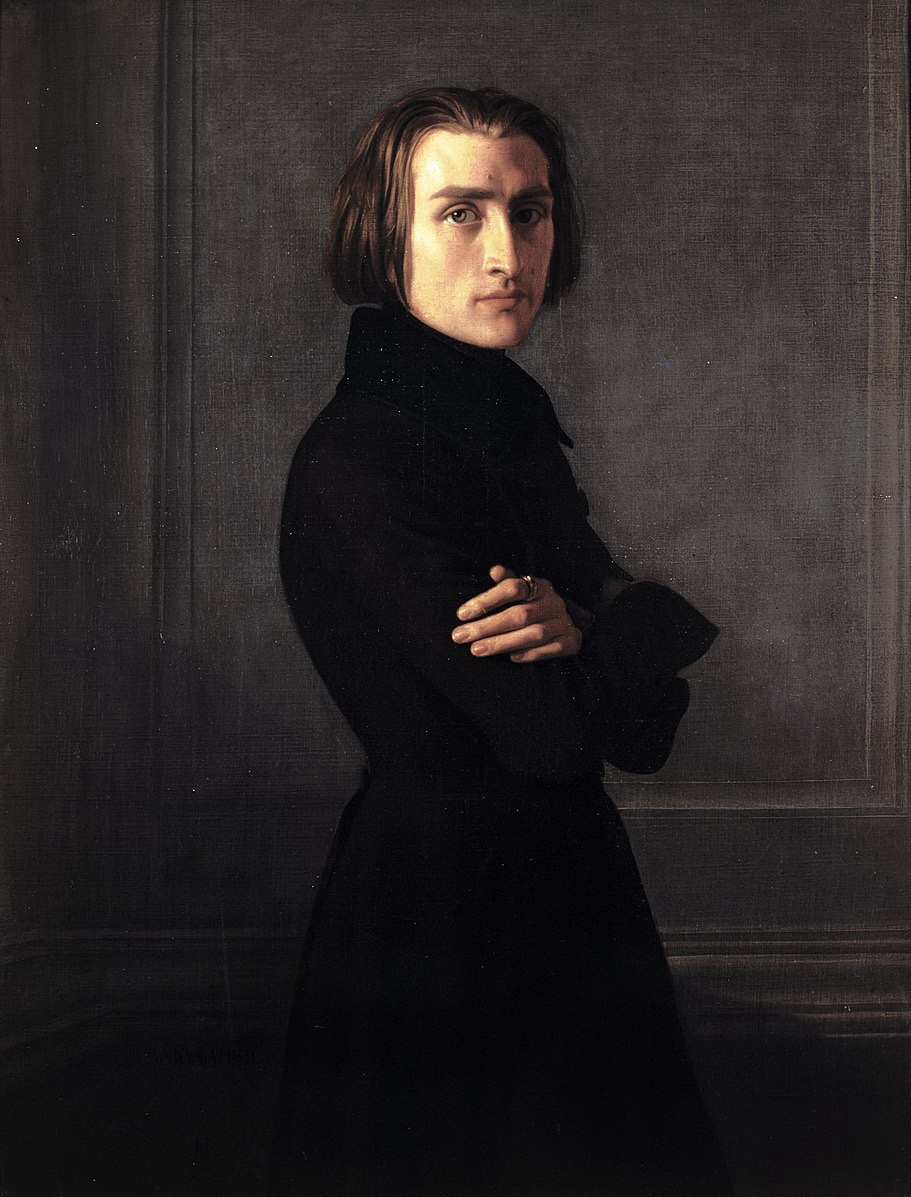
Franz Liszt. 22 October 1811 Doborján,Kingdom of Hungary, Austrian Empire 31 July 1886 (aged 74) Bayreuth, Kingdom of Bavaria, German EmpireDante and His Poem by Domenico di Michelino
Liszt had been sketching themes for A Symphony to Dante’s Divine Comedy,S 109 since the early 1840s.The French poet Joseph Autran recalled that in the summer of 1845, Liszt improvised for him “a passionate and magnificent symphony upon Dante’s Divine Comedy” on the organ of the empty Marseille Cathedral at midnight, and later invited him to collaborate with him on a Dante oratorio or opera, which the poet failed to pursue. In 1847, he played some fragments on the piano for his Polish mistress Princess Carolyne zu Sayn-Wittgenstein. At this early stage in the composition, it was Liszt’s intention that performances of the work be accompanied by a slide show depicting scenes from the Divine Comedy by the artist Bonaventura Genelli and also planned to use an experimental wind machine to recreate the winds of Hell at the end of the first movement. Although Princess Carolyne was willing to defray the costs, nothing came of these ambitious plans and the symphony was set aside until 1855 when Liszt wrote to his future son-in-law Richard Wagner. “So you are reading Dante. He’s good company for you, and I for my part want to provide you with a kind of commentary on that reading. I have long been carrying a Dante Symphony around in my head – this year I intend to finish it. Three movements, Hell, Purgatory and Paradise – the first two for orchestra alone, the last with chorus. When I visit you in the autumn I shall probably be able to bring it with me; and if you don’t dislike it you can let me inscribe your name on it.” Liszt had been reading Dante’s Divine Comedy in Lake Como in 1937 whilst initially in the company of Marie d’Agoult. A work that would combine music ,poetry and visual arts. Wagner was enthusiastic, but advised against including a choral finale as “Paradise could not be depicted in music.” Liszt discarded the idea of a choral finale and added a brief setting for women’s voices of the first two verses of the “Magnificat,” all ending with a “Hallelujah.”
Liszt played the Dante symphony for Wagner in Zürich in October 1856, who disliked the fortissimo conclusion and as he wrote in his autobiography “If anything had convinced me of the man’s masterly and poetical powers of conception, it was the original ending of the Faust Symphony, in which the delicate fragrance of a last reminiscence of Gretchen overpowers everything, without arresting the attention by a violent disturbance. The ending of the Dante Symphony seemed to me to be quite on the same lines, for the delicately introduced “Magnificat” in the same way only gives a hint of a soft, shimmering Paradise. I was the more startled to hear this beautiful suggestion suddenly interrupted in an alarming way by a pompous, plagal cadence. No! I exclaimed loudly, not that, away with it! No majestic Deity! Leave us the fine soft shimmer!”
Liszt dedicated the Dante Symphony to Wagner but kept both endings; the loud one is indicated in his version for two pianos, but in the orchestral score it is usually omitted.The first performance on 7th November 1857 took place in the Royal Theatre in Dresden conducted by Liszt and ‘the occasion proved a fiasco ‘ wrote Liszt’s son in law Hans von Bulow and even Liszt commented that the performance was ‘very unsuccessful due to lack of rehearsals’
George Bernard Shaw reviewed the work in 1885 and wrote, “the manner in which the program was presented by Liszt could just as well represent a London house when the kitchen chimney is on fire.”
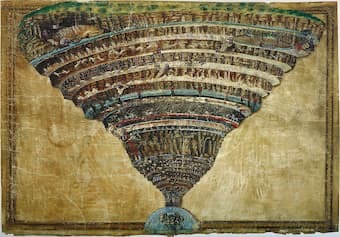
Sandro Botticelli: Chart of Hell
The opening movement is entitled “Inferno” and guides us through the nine Circles of Hell. The “Gates of Hell” opens with a slow introduction (Lento) based on three recitative-like themes, which Liszt has set to four of the nine lines inscribed over the Gates of Hell: Inferno Canto 3
Per me si va nella città dolente, Per me si va nell’eterno dolore, Per me si va tra la perduta gente. … Lasciate ogni speranza voi ch’entrate.
Through me is the way to the sorrowful city, Through me is the way to eternal sorrow, Through me is the way among the lost people. … Abandon all hope you who enter here.
1
3
9
and at “The Vestibule and First Circle Hell” the music becomes frantic. When Dante and Virgil enter the “Second Circle of Hell,” the infernal “Black Wind” that perpetually shakes the damned greets them. Here is depicted the tragic love of Francesca, whose adulterous affair with her brother-in-law Paolo cost her life and soul.Liszt sets the music to the words of Francesca da Rimini :Inferno canto 5
…. Nessun maggior dolore che ricordarsi del tempo felice ne la miseria.
…. There is no greater sorrow Than to recall happy times In the midst of misery.
121 122 123
The “Black Wind” motif returns in the “Seventh Circle of Hell,” and Liszt writes, “this entire passage is intended to be a blasphemous mocking laughter.” The “Eight” and “Ninth Circles of Hell” present slightly varied themes, as Dante and Virgil gradually emerge from Hell. They ascend Mount Purgatorio in the second, initially solemn and tranquil movement. Dante and Virgil ascend the two terraces of Ante-Purgatory, where souls repent their sins. The “Seven Cornices of Mount Purgatory” represent the seven deadly sins, and “Earthly Paradise” guides the soul to Paradise. In the score, Liszt directs that the choir be hidden from the audience in the concluding “Magnificat.” declaring that “Art cannot portray heaven itself, only its image in the hearts of those souls, which have turned to the light of heavenly grace. Thus for us the radiance is still shrouded, although it increases with the clarity of understanding.” Curiously, the Magnificat is not mentioned anywhere in the Commedia; nor is there any Hallelujah; the Hosanna, however, is heard both in the Earthly Paradise of the Purgatorio and in the Paradiso.In the score, Liszt directs that the choir be hidden from the audience:
‘The female or boys’ choir is not to be placed in front of the orchestra, but is to remain invisible together with the harmonium, or in the case of an amphitheatrical arrangement of the orchestra, is to be placed right at the top. If there is a gallery above the orchestra, it would be suitable to have the choir and harmonium positioned there. In any case, the harmonium must remain near the choir.‘
The orchestra concludes with a quiet plagal cadence in B major; the timpani add a gentle authentic cadence of their own. The work ends molto pianissimo.
The second ending, which follows rather than replaces the first ending, is marked Più mosso, quasi Allegro. The ppp of the first ending gives way to ff. Majestic trumpets and trombones – accompanied by rising scales in the strings and woodwind, and by chords in the horns, harps, harmonium and strings – set the scene for a reappearance of the chorus. Three repetitions of a single word, Hallelujah, bring the work to a towering conclusion with a plagal cadence in B major.
The Dante Symphony is not so much a symphony in the classical sense as it is two descriptive symphonic poems consisting of two movements, both in a loosely structured ternary form with little use of thematic transformation.
The Symphony is in three movements : Inferno- Purgatorio – Magnificat
The transcription of the symphony – Liszt’s own, dating from 1859 S 648 – makes for a disquieting experience. Uncompromisingly stark and austere in comparison with the more sensuous orchestral original, the piano writing, particularly in the Purgatorio, seems to pre-empt the dissonant terseness of Liszt’s later works.
The symphonic poems of Franz Liszt are a series of 13 orchestral works, numbered S.95–107. The first 12 were composed between 1848 and 1858 (though some use material conceived earlier); the last, Von der Wiege bis zum Grabe (From the Cradle to the Grave), followed in 1882. In developing the symphonic poem, Liszt satisfied three of the principal aspirations of 19th century music: to relate music to the world outside, to integrate multi-movement forms … and to elevate instrumental programme music to a level higher than that of opera, the genre previously regarded as the highest mode of musical expression. In fulfilling these needs, the symphonic poems played a major role, widening the scope and expressive power of the advanced music of its time. Their historical importance is undeniable; both Sibelius and Richard Strauss were influenced by them, and adapted and developed the genre in their own way. The symphonic poems offer many examples of Liszt’s unique pioneering spirit.
In the late 1840s, Franz Liszt settled in Weimar and gave up the life of the international concert star to devote himself to composition and conducting. Liszt’s pioneering series of 12 symphonic poems came to fruition during his time as Kapellmeister at the court of the Duke of Weimar . The final order of the works was not conceived until all the pieces were ready for publication, but it is clear that he thought of all 12 works as a gigantic cycle. He issued them in versions for orchestra, for two pianos, and for piano duet. Its premiere was on 23 February 1854, conducted by Liszt himself. It was published in 1856 by Bretikopf & Härtel and dedicated to Carolyne zu Sayn-Wittgenstein and is the earliest example of an orchestral work entitled “Symphonic Poem”
Thus, although works such as Les Préludes are familiar in their orchestral guise, they were conceived from the outset for the keyboard. The two-piano versions of these pieces are no mere transcriptions: Liszt allows quite considerable variance from the orchestral scores in order to make real duos, occasionally even adding or omitting some bars or even transforming the material with new harmonies .Les Preludes was published as the third of his twelve symphonic poems but was probably the earliest of orchestral origins, if one considers that the thematic material was derived from his cantata Les Quatre Élémens (The Four Elements), produced at Marseilles in 1844. Liszt’s starting-point for the cycle was Les aquilons (“The North Winds”), a male chorus with piano accompaniment composed on 24 July 1844 . Liszt had arrived in Marseille the day before and met with choristers of a German travelling company, who requested an original chorus piece from Liszt . The poet Joseph Autran, whom Liszt had visited, offered him the poem Les aquilons. In the afternoon of the 24th, Liszt composed the piece. The work was performed on 6 August at Liszt’s fourth concert in Marseille. The accompaniment was on two pianos, one played by Liszt himself .Besides Les aquilons, Autran gave three further poems to Liszt: La terre (“The Earth”), Les flots (“The Floods”) and Les astres (“The Stars”), and Liszt also set these to music. As a series, La terre, Les aquilons, Les flots and Les astres formed a cycle Les quatre élémens (“The Four Elements”). Liszt was not happy with Autran’s words for the movements which depict “The Earth, The North Winds, The Floods, and The Stars,” and looked to Victor Hugo to write him a new text. Hugo, whose Ce qu’on entend sur la montagne was the subject for his first symphonic poem, did not comply. In 1849, while making a fair copy of Ce qu’on entend sur la montagne, he also brought out his earlier score and drafted a purely symphonic version. However, he laid it aside again.
In 1854, wanting a new piece for a pension fund concert of the court orchestra at Weimar, Liszt turned once more to the incomplete symphonic poem, which now had its first association with the poem of his friend Alphonse Lamartine (1790-1869), the fifteenth number of the Méditations poétiques. It is probable that this symphonic poem underwent considerable remodeling when it acquired its final title and form. Les préludes is the final revision of an overture initially written for the choral cycle Les quatre éléments (The Four Elements, 1844–48)
The chorus Les Aquilons was composed and created in a version for male chorus with 2 pianos accompaniment in Marseille in 1844, and the first sketches of the Ouverture des quatre élémens date from 1845, during Liszt’s tour through Spain and Portugal. A manuscript of the overture from 1849 to 1850 shows that the work had by then reached its almost definitive structure and thematic content.
After being partially orchestrated, the choral cycle project was abandoned. The overture was revised in 1853-54 as a stand-alone piece, with a new title inspired by an ode by the French poet Alphonse de Lamartine,Les préludes. Written for a large orchestra of strings, woodwind, brass (including tuba and bass trombone), harp and a variety of percussion instruments (timpani, side drum, bass drum and cymbals). The full title of the piece, “Les préludes (d’après Lamartine)” refers to an Ode from the Alphonse de Lamartine’s Nouvelles méditations poétiques of 1823. The final version no longer contains any reference to Autran or to the Chorus cycle Les quatre élémens.
The 1856 published score includes a text preface, which however is not from Lamartine. ‘What else is our life but a series of preludes to that unknown Hymn, the first and solemn note of which is intoned by Death?—Love is the glowing dawn of all existence; but what is the fate where the first delights of happiness are not interrupted by some storm, the mortal blast of which dissipates its fine illusions, the fatal lightning of which consumes its altar; and where is the cruelly wounded soul which, on issuing from one of these tempests, does not endeavour to rest his recollection in the calm serenity of life in the fields? Nevertheless man hardly gives himself up for long to the enjoyment of the beneficent stillness which at first he has shared in Nature’s bosom, and when “the trumpet sounds the alarm”, he hastens, to the dangerous post, whatever the war may be, which calls him to its ranks, in order at last to recover in the combat full consciousness of himself and entire possession of his energy.’
The earliest version of this preface was written in March 1854 by Carolyne zu Sayn-Wittgenstein and comprises voluminous reflections of the Princess, into which some lines of quotations from the ode by Lamartine are incorporated. It was drastically shortened for publication in April 1856 as part of the score; there only the sentence, “the trumpet sounds the alarm” and the title “Les préludes”, survive from Lamartine’s poem.
A different version of the preface was written for the occasion of a performance of Les préludes on 6 December 1855, in Berlin. In the 1855 version the connection with Lamartine is reduced to his alleged query, “What else is our life but a series of preludes to that unknown Hymn, the first and solemn note of which is intoned by Death?” However this sentence was actually written not by Lamartine, but by Princess Wittgenstein.
For the occasion of a performance of Les préludes on 30 April 1860, in Prague a further version of the preface was made. This version was probably written by Hans von Bulow who directed the performance. It is rather short and contains no reference to Lamartine at all. According to this version, Les préludes illustrates the development of a man from his early youth to maturity. In this interpretation, Les préludes may be taken as part of a sketched musical autobiography.
Nevertheless, no specific statement by Liszt himself has been found in favour of a particular programme. In a letter to his uncle Eduard List, dated 26 March 1857, he refers to his préludes as: « my preludes (which, by the way, are only the prelude to my path of composition)…», which seems to mean nothing more than the beginning of his interest in cyclical form and new orchestration techniques : the rest of the letter contains indeed only technical considerations on the principle of thematic transformation in his 1st piano concerto, and a plea for percussion instruments despite the reproaches of many other musicians.
Liszt made his own arrangements for two pianos S 637 and for piano duet.The first American orchestral performance of Les Préludes S.97 took place in New York in May 1858 with an unnamed orchestra under the direction of Carl Bergmann (a duo-piano performance had in fact preceded it by a year).
The 12 Symphonic Poems
1 Ce qu’on entend sur la montagne (Symphonic Poem No.1), S635
2 Tasso – Lamento e Trionfo (Symphonic Poem No.2), S636
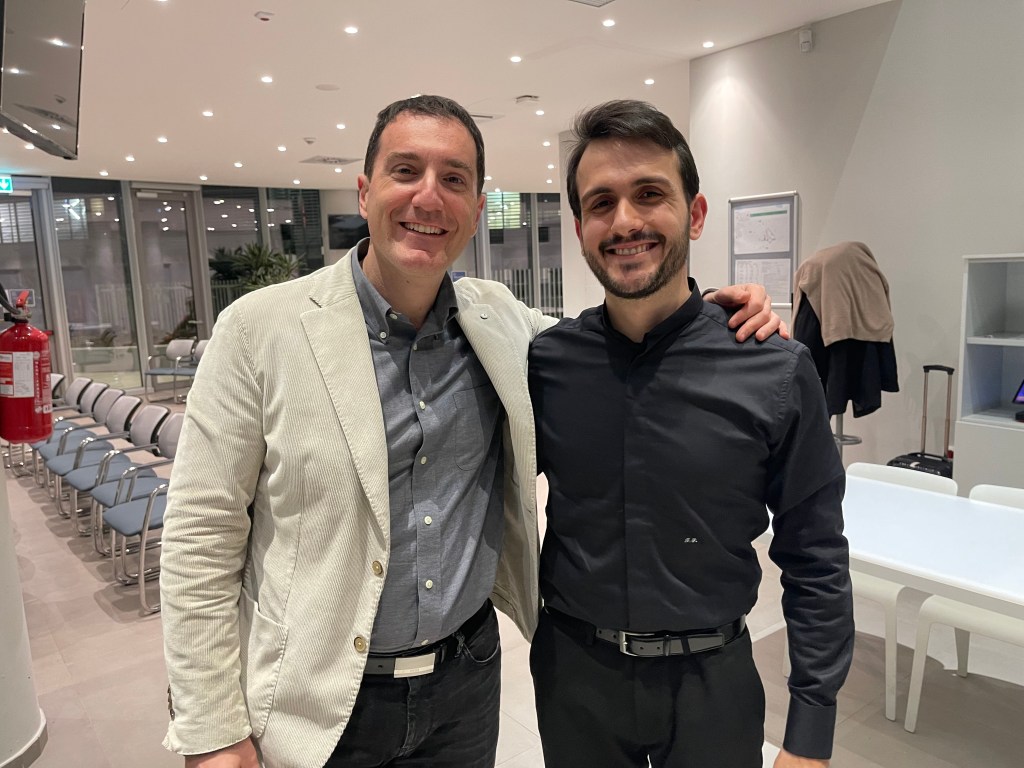
with Valerio Vicari artistic director an selfless promoter of young musicians
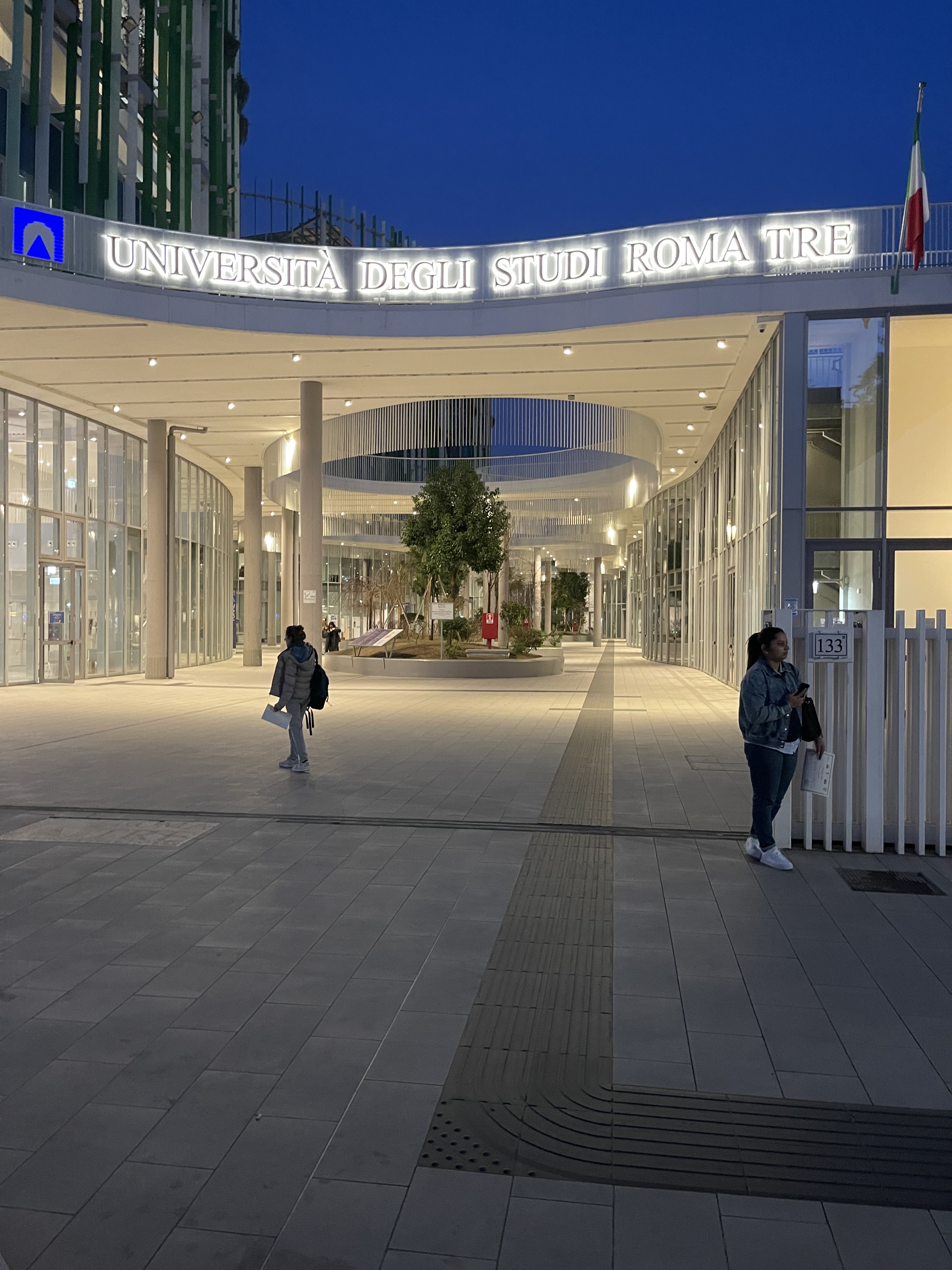
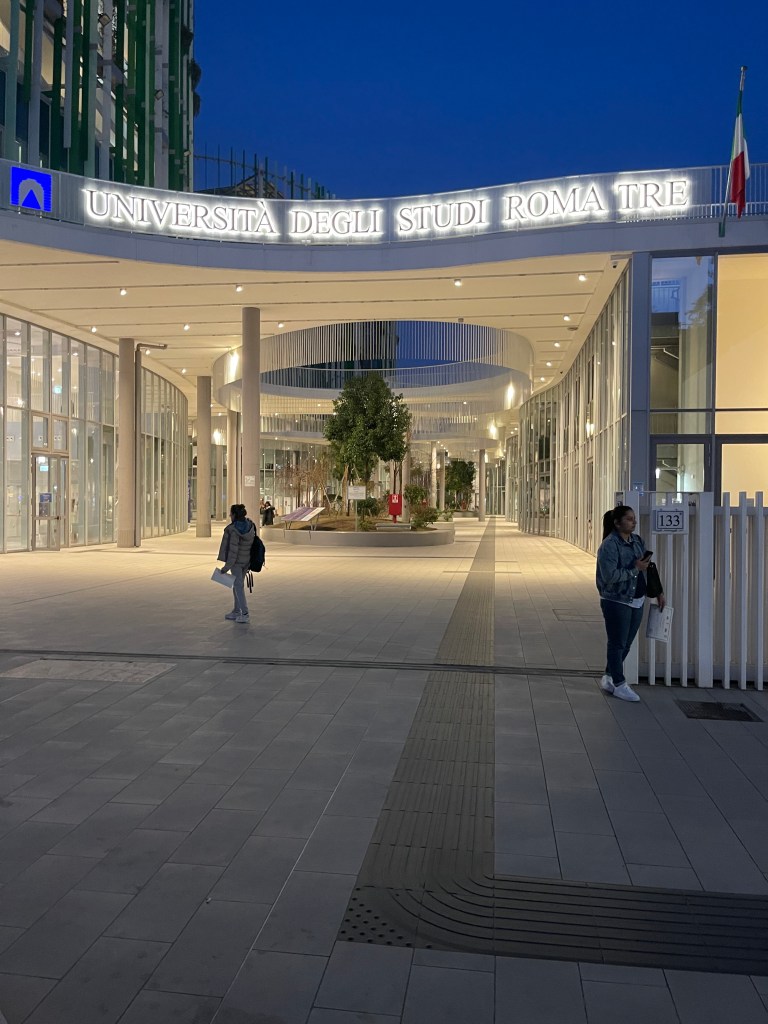
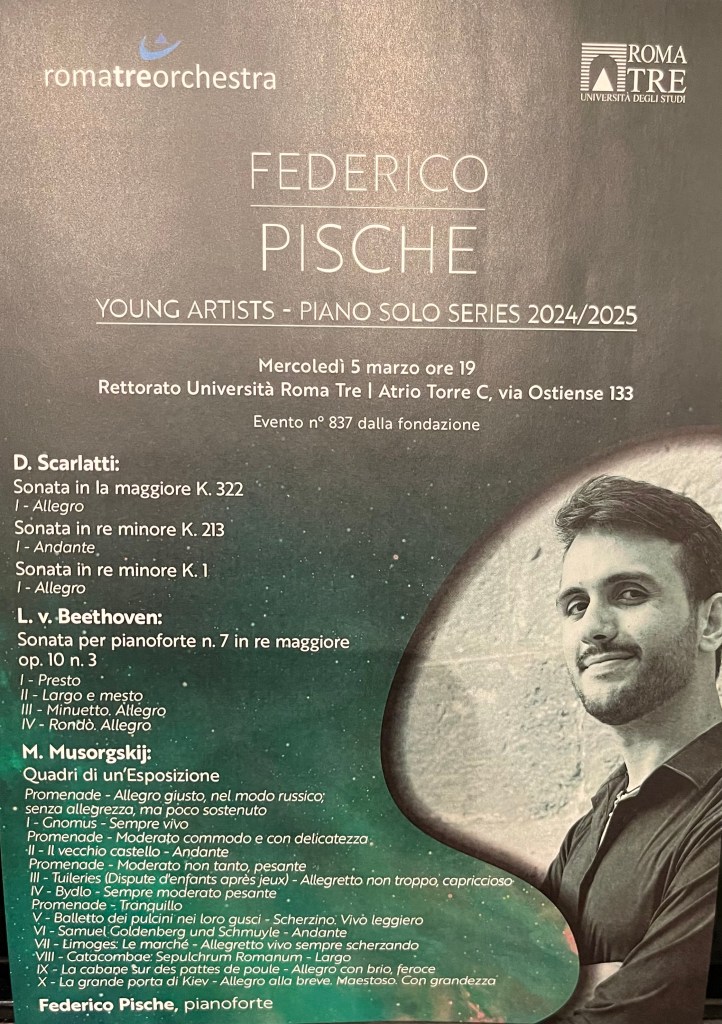
Federico Pische in the Young Artists series at Roma 3 University . From the class of Benedetto Lupo with a programme of Scarlatti, Beethoven and Mussorgsky. Played with a musical intelligence and integrity where his technical mastery was at the service of the composers he was playing and just underlined the title he had given to his recital of ‘Form and Significance’. Crystalline purity of three Scarlatti Sonatas, a poignant profundity to the early Beethoven Sonata op 10 n 3 where the Largo e mesto already marks out the genius that was to recreate the sonata form, bringing it to the celestial heights of his final trilogy. But it was Mussorgsky that marked this young man out as an artist of refined good taste and remarkable technical mastery. A pianist who listens to himself with a sensitivity to balance and a kaleidoscopic range of colours can bring this old war horse back to where it truly belongs as one of the pinnacle’s of the pianistic repertoire.
.The A major Scarlatti sonata was played with a purity and clarity of sound with very discrete ornaments and an even more discrete use of the pedal which gave a glow to his playing of refreshing fluidity.The slow D minor sonata K.213 was beautifully shaped with the refined elegance of it’s time and a glowing poignant fluidity reaching a burning intensity diffused by the ebullient ‘joie de vivre’ of the other D minor sonata K.1 with ornaments that sparkled like tightly wound springs overjoyed to be part of such busy chattering of great buoyancy.
There are three sonatas from Beethoven’s early period that immediately show the genius who could take his master, Haydn’s, model and add his explosive temperament and genius in a fast changing world where music was a personal expression and not just an expression of elegant denial. This was a new age where the sonatas opus 2 n. 3, op 7 and op 10 n. 3 all pointed to a brave new world where the slow movements are personal statements of burning intensity and poignancy. Federico opened the op 10 n. 3 quite gently, a radiance gradually building in intensity .There was a dynamic drive and a sense of architectural shape to the first movement with it’s constant changes between rhythmic and lyrical,without ever loosing that burning drive. The ‘Largo e mesto’ was played with a musical intelligence of aristocratic beauty with a sense of balance that allowed the melody to glow without any forcing but with a kaleidoscope of colours and emotions that was breathtaking in it’s intensity. A sense of orchestral colour with deeply agitated bass notes of frenzied emotional impact diffused with a subtle recitativo of purity and naked emotions.There was a simple elegance to the ‘Minuetto’ that was allowed to unfold so simply as the ‘Trio’ burst into life with its enticing question and answer between the hands. The same questioning but with uncertain answers of the Rondò that was played with refined brilliance and rhythmic energy disappearing into the bass of the piano from where this great tale had begun.
Mussorgsky’s Pictures and tribute to his friend Victor Hartmann,were given a monumental performance with an extraordinary range of colours. Even in the most energetic episodes the sound was never allowed to harden as everything Federico did was shaped like the true musician he is. ‘Gnomus’ burst onto the scene with extraordinary impertinence but also with subtle colouring and an ending played with fearless courage. ‘The Old Castle’ of simple beauty as a heartbeat deep inside the piano carried us into this mysterious landscape. Federico brought an irresistible lilt to the children squabbling in the ‘Tuileries’ only to be overpowered by the prepotentious Bydlo. Federico even played it with a pointed finger but gradually allowed the old cart to disappear into the distance with barely audible whispers. A promenade that was now bathed in pedal as he caught sight of the chicks chattering away with insistent clarity and sparkle. ‘Samuel Goldenberg’ took centre stage with unstoppable authority as he was answered by the beseeching cries of ‘Schmuyle’, only to be overridden by the dynamic drive a extraordinary technical prowess of the hustle and bustle of the ‘Market Place in Limoges’. Suddenly ‘Catacombae’ appeared with a vision of terrifying desolation played with great conviction and enormous resonating sonorities, dissolving magically to ‘cum mortuis in lingua mortua’. ‘Baba Yaga’ entered at a fearsome gait as the tension and excitement rose to fever pitch only to be cut short by the wondrous vision of the ‘Great Gate of Kyiv’. Bells pealing all over the keyboard with a mastery of transcendental playing of overwhelming authority. There was beauty too with the interruption of a gentle chorale gradually becoming overwhelmed by the pealing of bells and the glorious vision of the grandeur of such a monumental vision of peace …………
Rachmaninov ‘s D major Prelude offered as soothing balm after a monumental performance of the Great Gate of Kyiv, demonstrated in just a few bars the simple poetic artistry of this extraordinary young artist
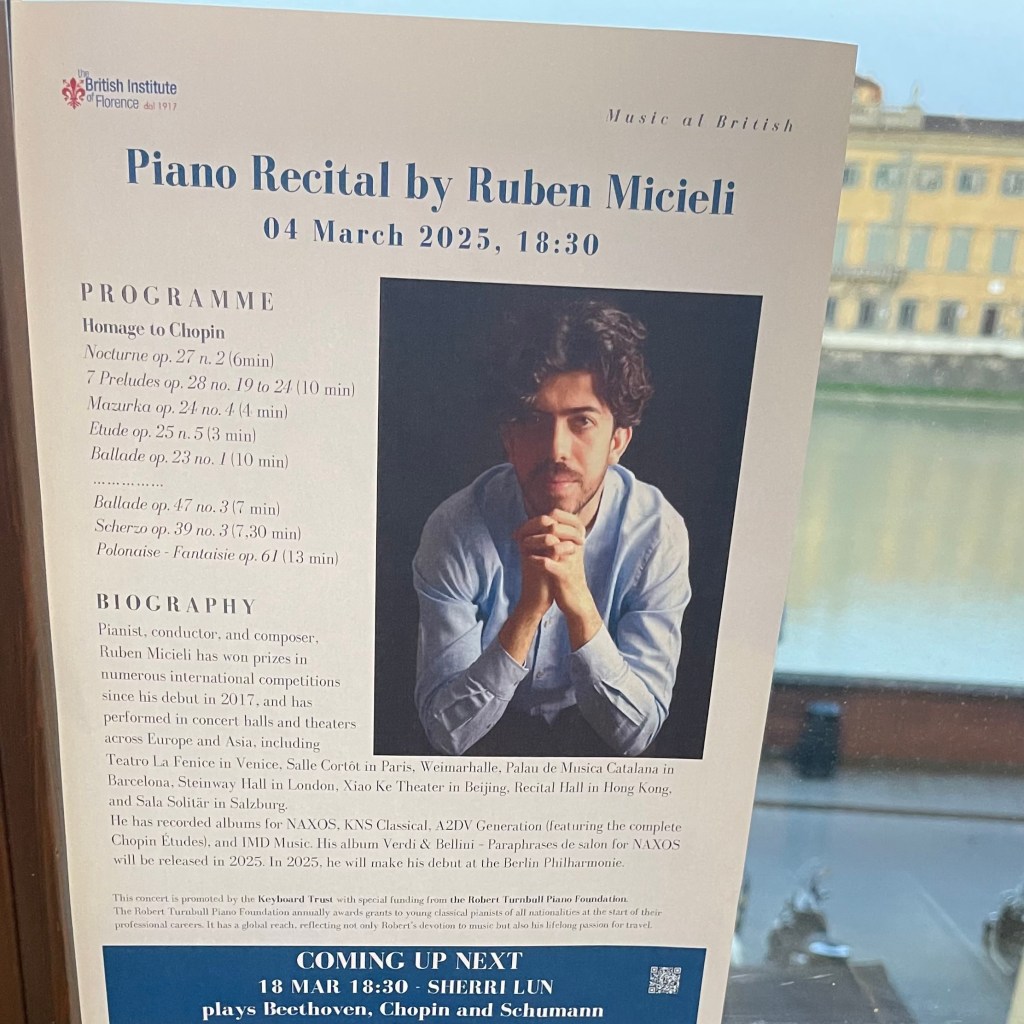
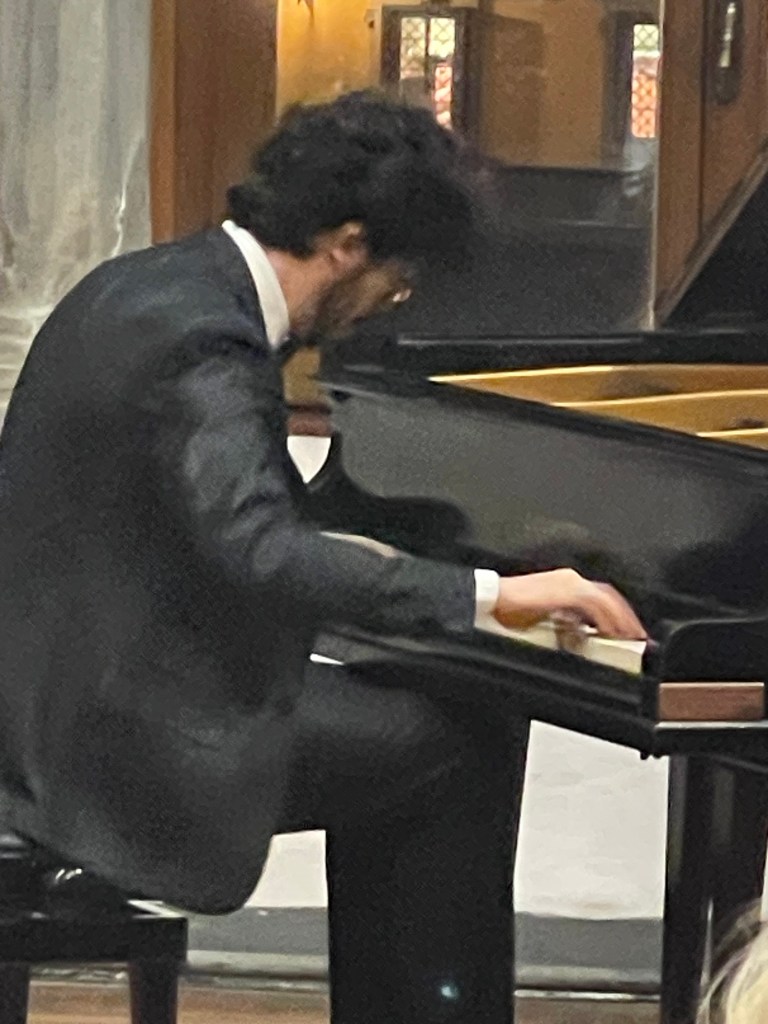
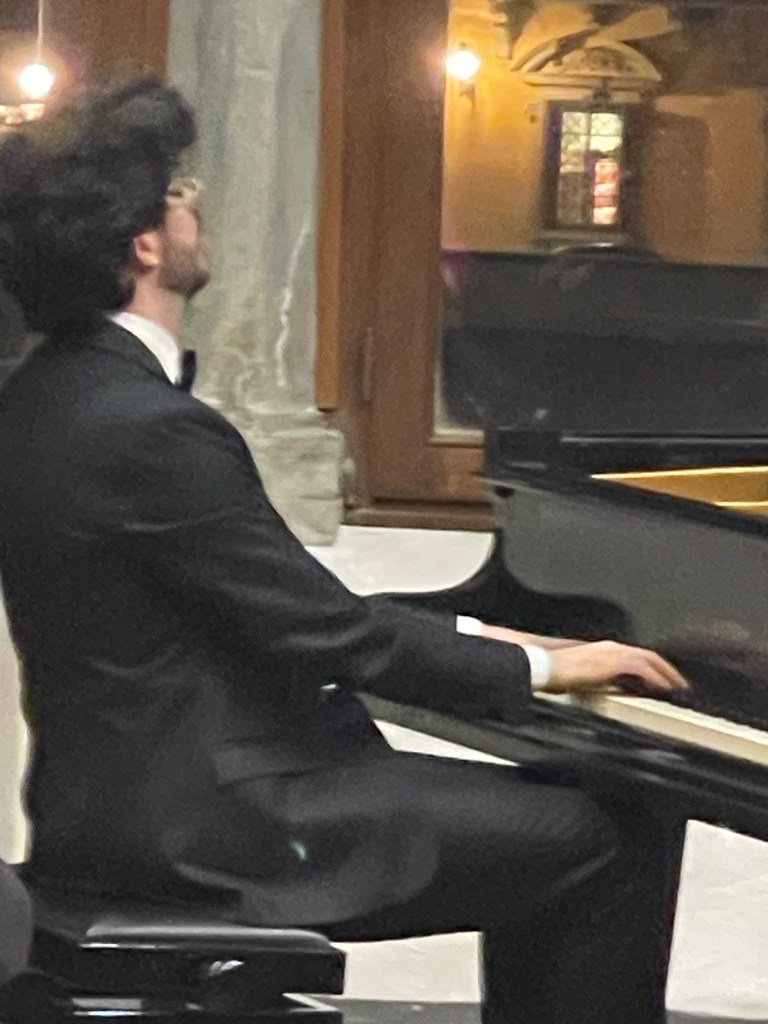
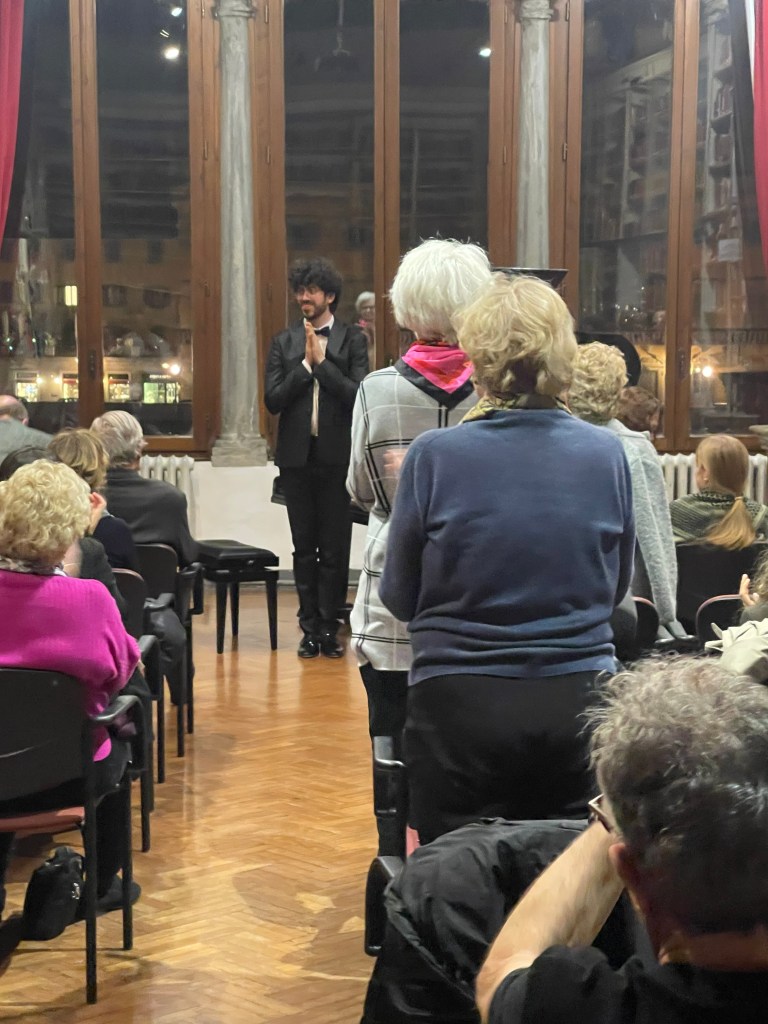
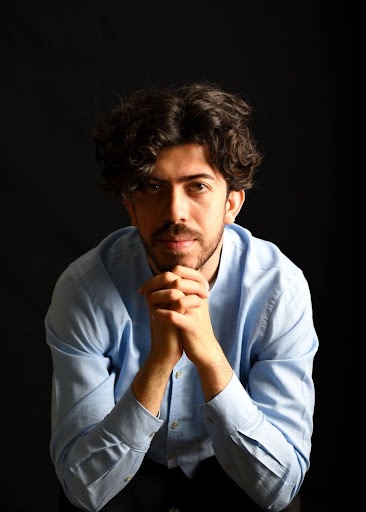
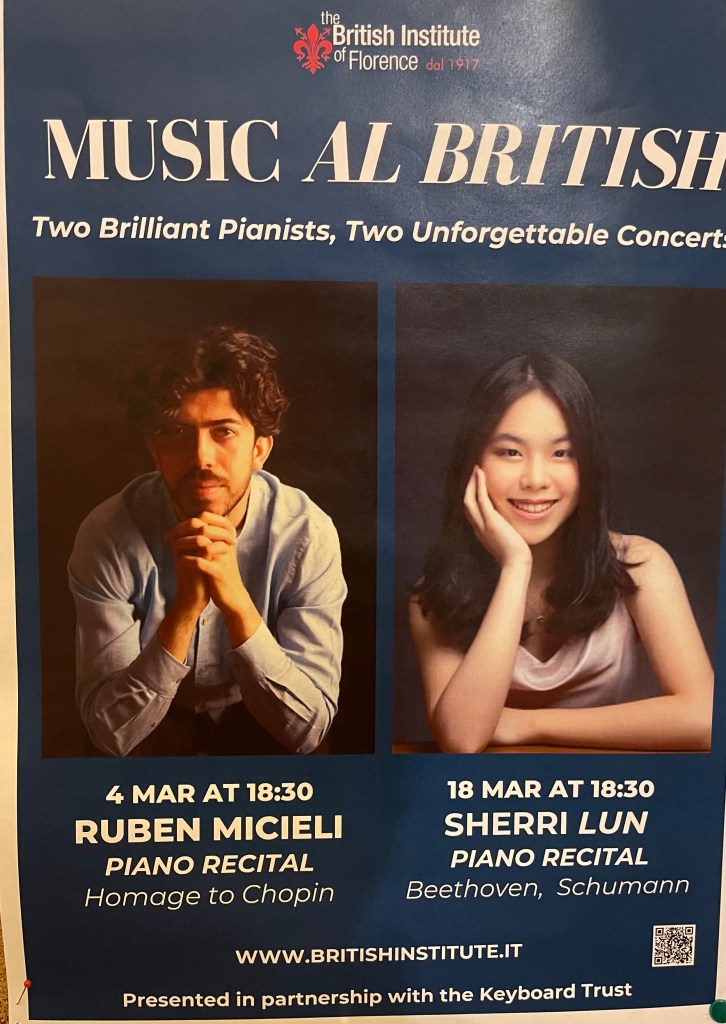
A standing ovation for Ruben Micieli at the end of a concert dedicated to Chopin. Not only a celebration in Chopin’s 215th birthday week but also the news that Ruben has been selected to go to Warsaw as part of the Chopin competition selection process. Performances of subtle beauty and mastery that began with the whispered beauty of the D flat nocturne. Ruben allowed Chopin’s bel canto to cast a spell as you might expect from a young musician born in the shadow of Bellini in Catania. Beautiful hand movements of grace and beauty the same as in one of Chopin’s most beautiful creations. A whispered veiled sound world of ravishing beauty.
Masterly performances of the first and third ballades showed off this young man’s superb musicianship with performances of aristocratic authority and sensitivity. Great delicacy mixed with nobility, brilliance and passion in the G minor Ballade.A tone poem of so many emotions played with extraordinary intelligence and poetic sensibility.The A flat Ballade had a fluidity as it’s continuous outpouring of song was played with a kaleidoscope of colours.Embellishments that were jewels that glowed with knowing beauty as the Ballade moved with a masterly build up to the final ecstatic goal. A fearless plunge across the keys brought this most pastoral of Chopin’s Ballades to the noblest of conclusions.
The last six of Chopin’s 24 preludes flowed with a natural fluidity from the mellifluous nineteenth where the melody was allowed to float on Aeolian harp strings belying the technical feats that are required. The imperious twentieth of restrained grandeur was played with ever more whispered echoes of extraordinary barely audible delicacy as the twenty first entered with flowing aristocratic poise. The imperious bass octaves of the twenty second rang out with a noble voice of commanding authority. Chopin’s own jeux d’eau just flowed from Ruben’s well oiled fingers like water in a brook that was to take us to the heroic outpouring of passionate glory with the final twenty fourth. Played with fearless abandon but like all that this young man did it was imbued with the poetic musicality which is at the very heart of Chopin’s music .
Canons covered in flowers is how Schumann was to describe Chopin Mazurkas and it was this subtle poetry and beguiling sense of dance that Ruben brought to his op 24 n.4 .
It was followed by the E minor study op 25 that too was imbued with a sense of dance and fantasy until Chopin was to fill the central episode with one of his most magical tenor melodies accompanied by washes of notes of gossamer lightness. Superb playing of ravishing sounds that gave a glowing radiance to a historic Bechstein that has rarely been asked to bequeath such beauty.
The final two works on the programme included the third Scherzo where Ruben played the commanding octaves with a musicianship that shaped all that he did. Dissolving so naturally into a chorale that was accompanied by filigree notes where delicacy and fragility gave a warmth to the solemn beauty of the chorale before erupting into a coda of transcendental exhilaration and excitement .
But it was the genial invention of Chopin in his final year combining fantaisie to the polonaise and which Ruben described as his vision of life and death where fragility is complemented by passion . A masterly performance of the Polonaise – Fantaisie where Ruben was able to give an architectural shape and nobility to one of Chopin’s greatest creations .
After such profound performances of poetic mastery Ruben surprised us with Fazil Say’s jazzed up version of Mozart’s Turkish March . Played with technical wizardry and not a little showmanship it brought the audience to their feet in appreciation .
Back to Chopin for a second encore with the Revolutionary study that was played with extraordinary clarity and passionate intensity .
A third encore for an ever more enthusiastic public was a free improvisation on Autumn Leaves. There was magic in the air as we all were glad to join together to taste the beautiful nectar that was being offered in the next room by the sponsors of such an uplifting experience.
Sir David Scholey talking to Ruben’s parentsRuben with his parents who had all flown in for the day from Catania
Pianist ,conductor, and composer, Ruben Micieli has won prizes in numerous international competitions since his debut in 2017, and has performed in concert halls and theaters across Europe and Asia, including Teatro La Fenice in Venice, Salle Cortôt in Paris, Weimarhalle, Palau de Musica Catalana in Barcelona, Steinway Hall in London, Xiao Ke Theater in Beijing, Recital Hall in Hong Kong, and Sala Solitär in Salzburg.
He has recorded albums for NAXOS, KNS Classical, A2DV Generation (featuring the complete Chopin Études), and IMD Music. His album Verdi & Bellini – Paraphrases de salon for NAXOS will be released in 2025.
In 2025, he will make his debut at the Berlin Philharmonie.
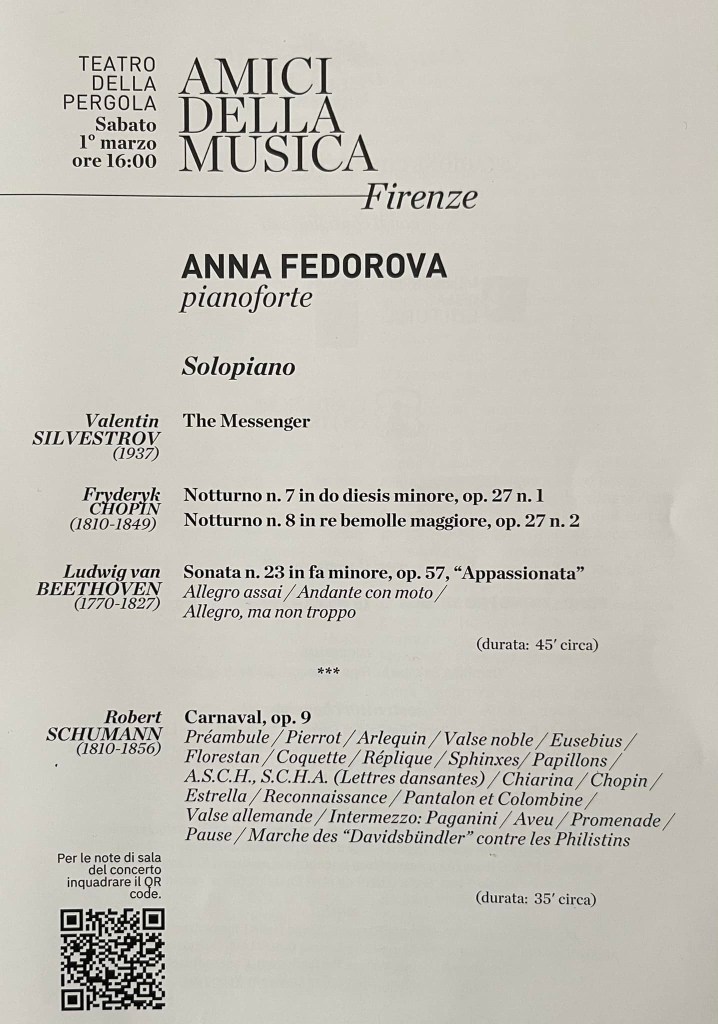
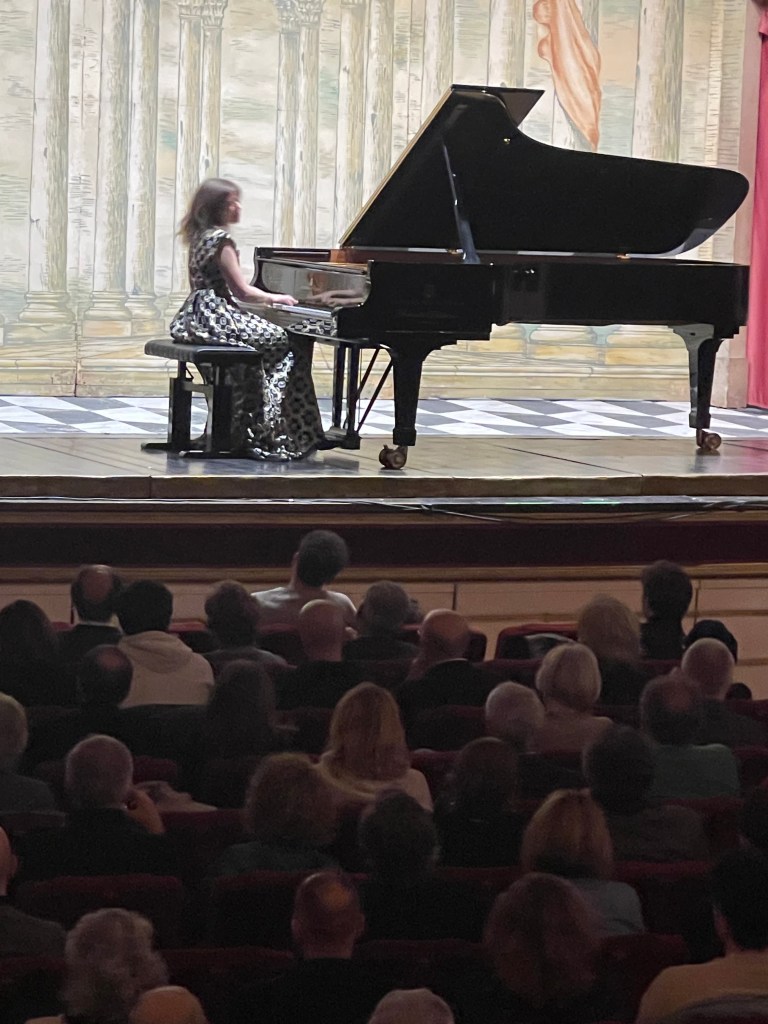
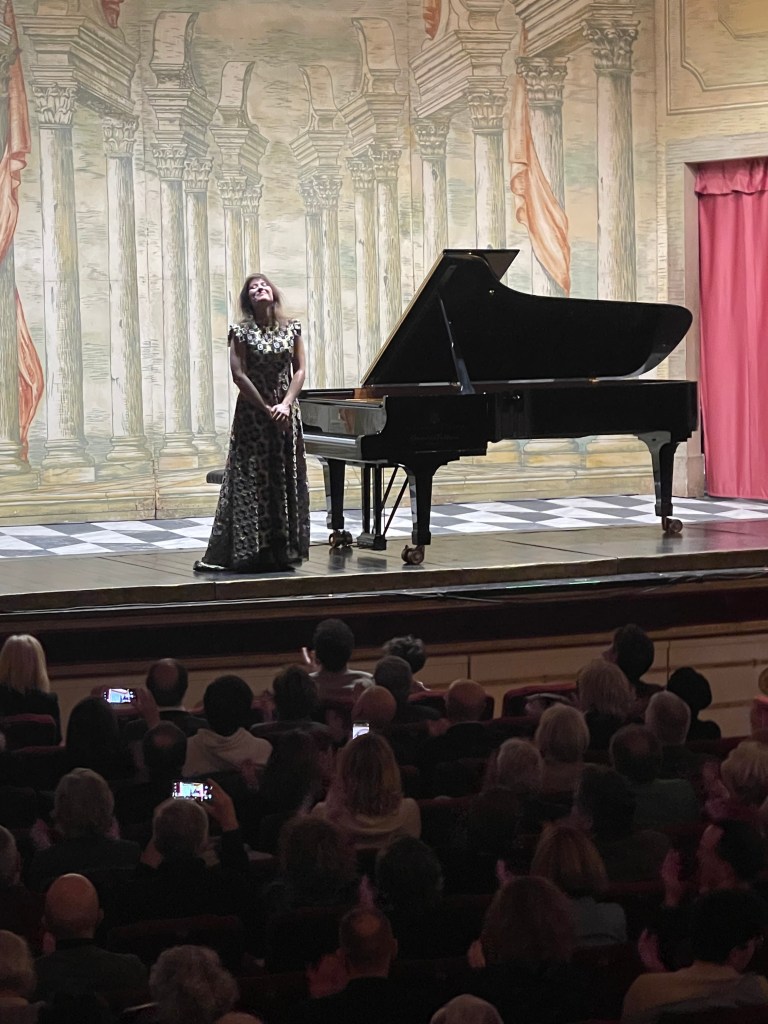
Anna Fedorova with the triumph of a supreme stylist
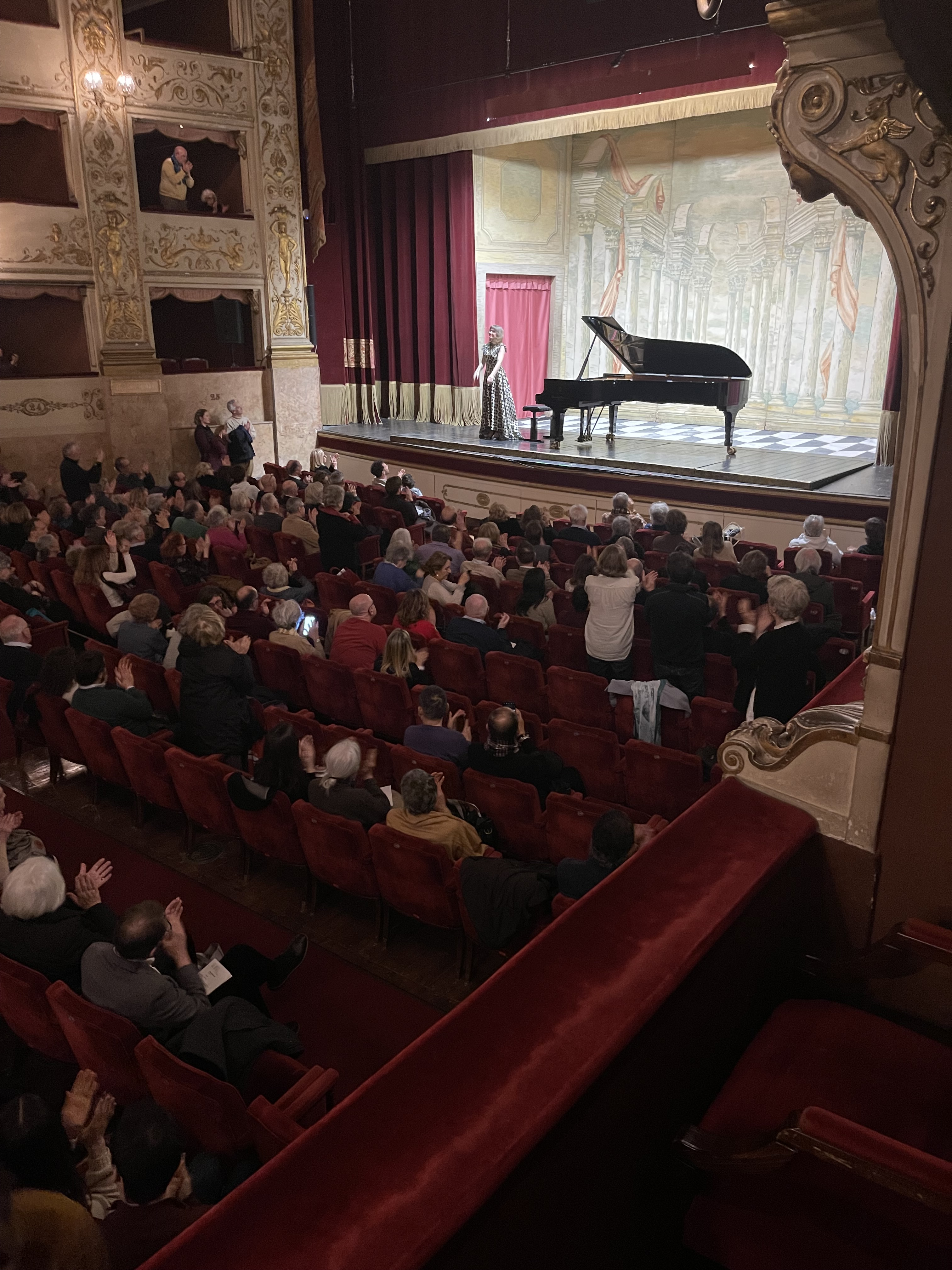
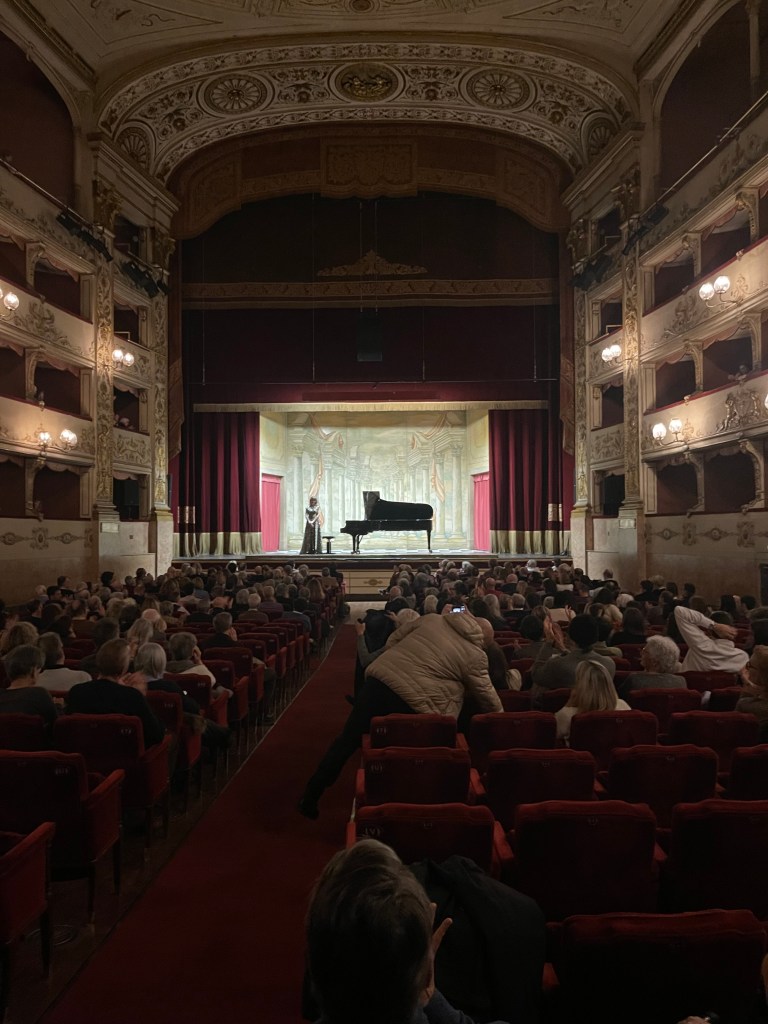
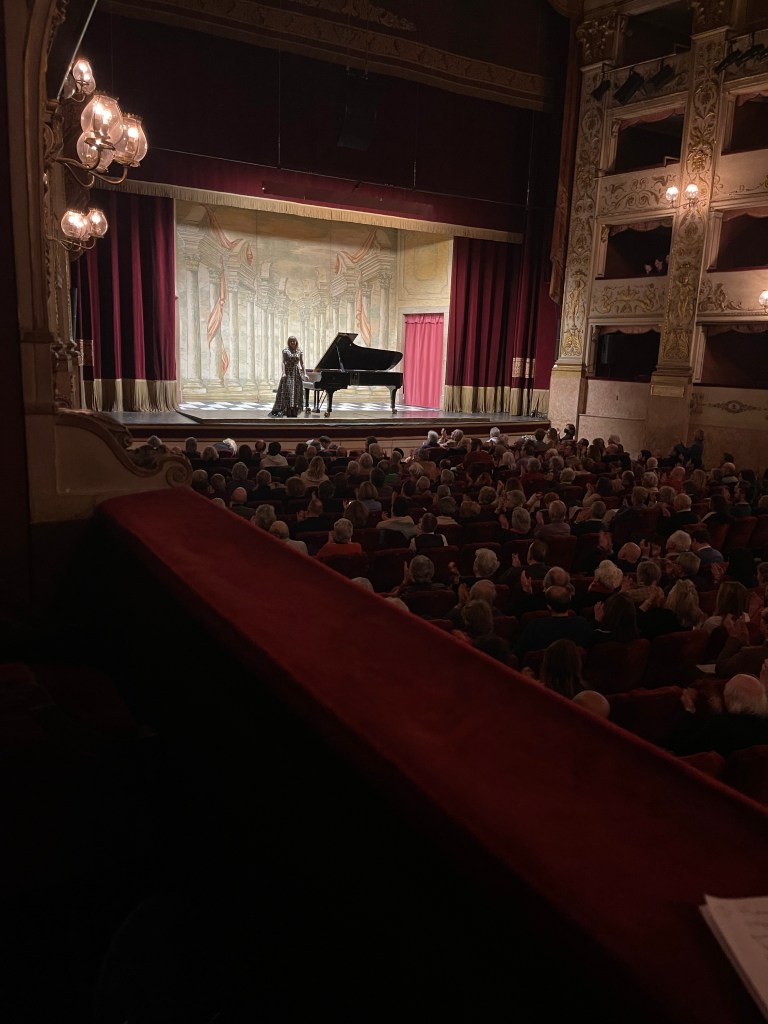
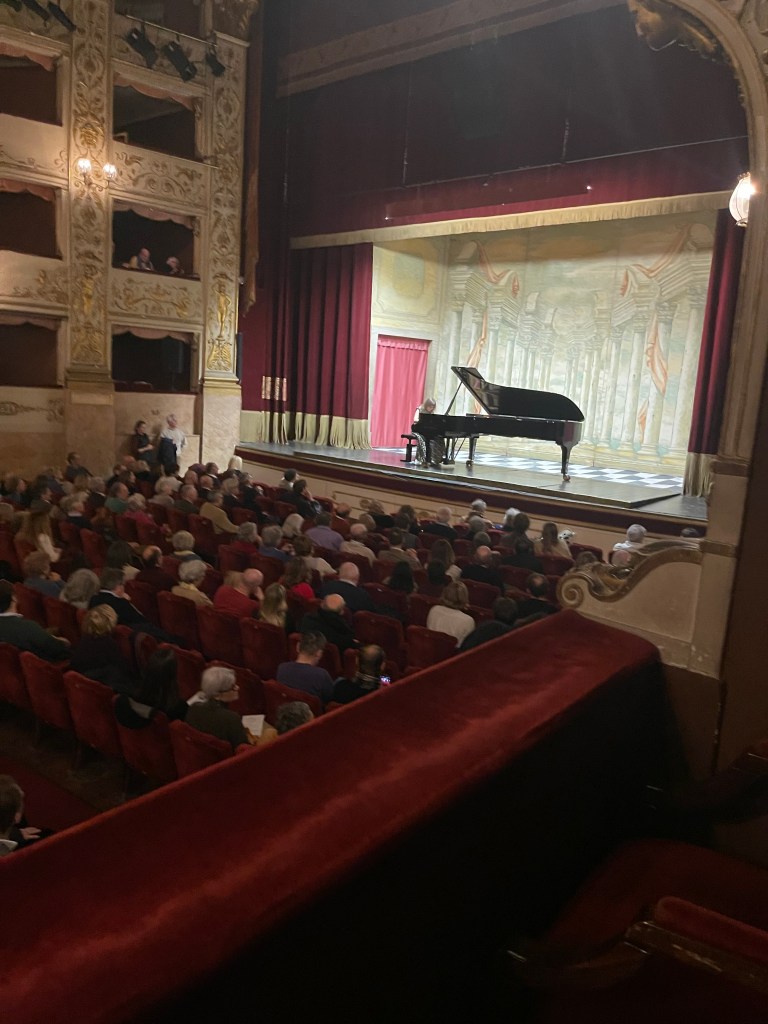
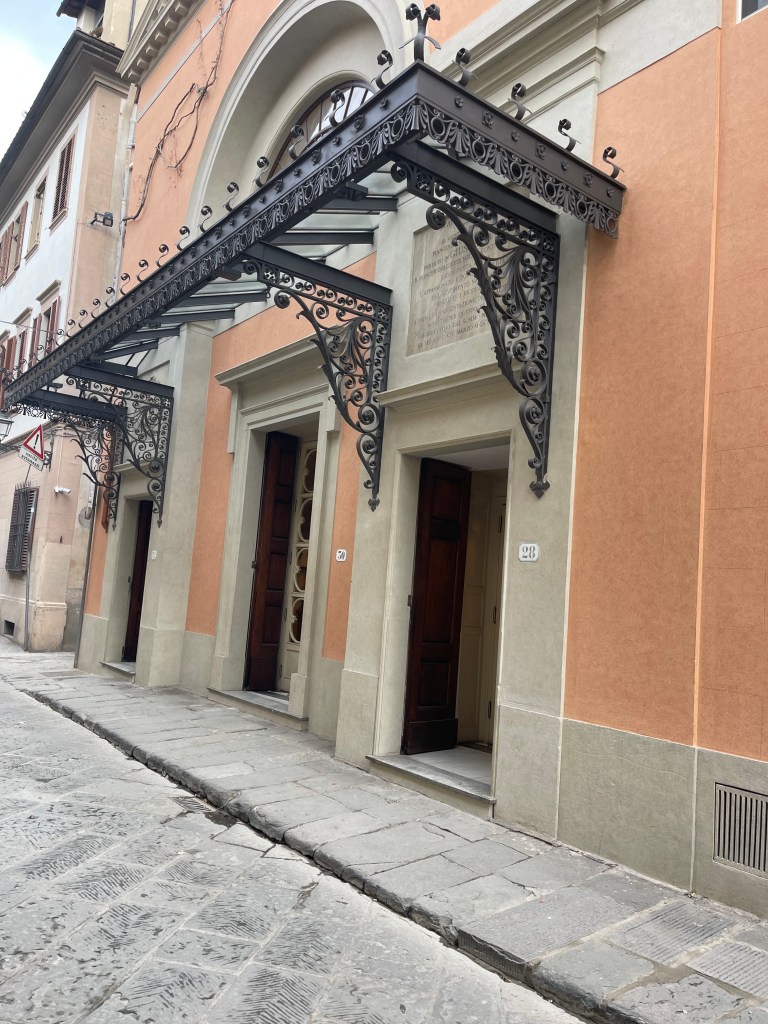
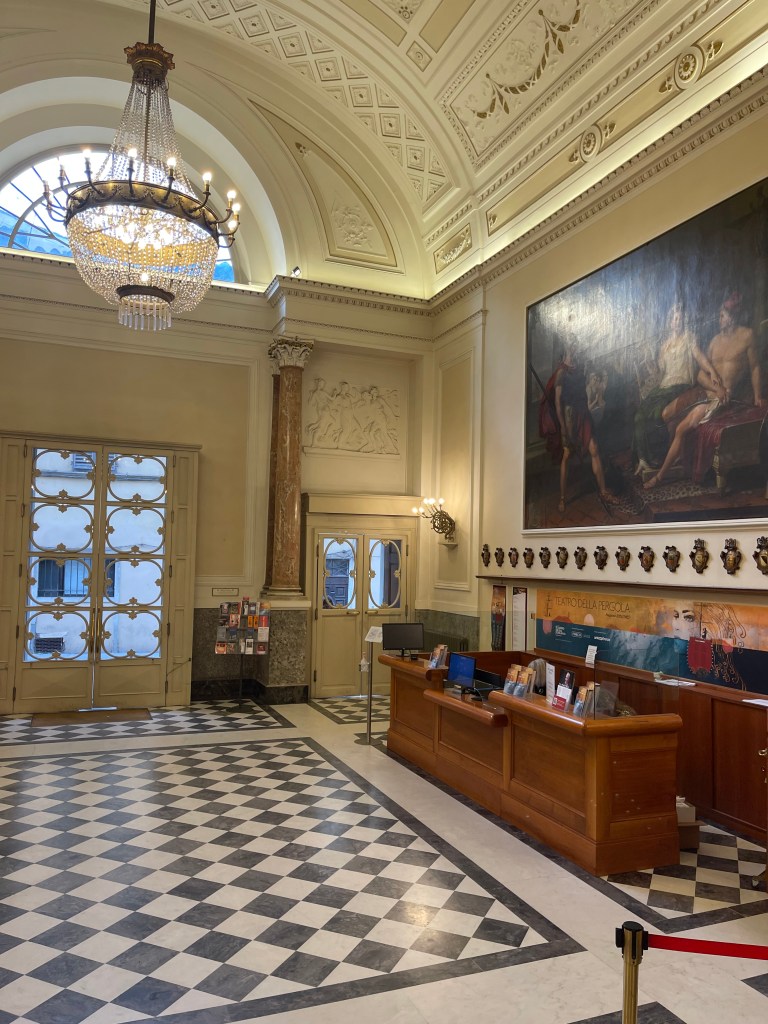
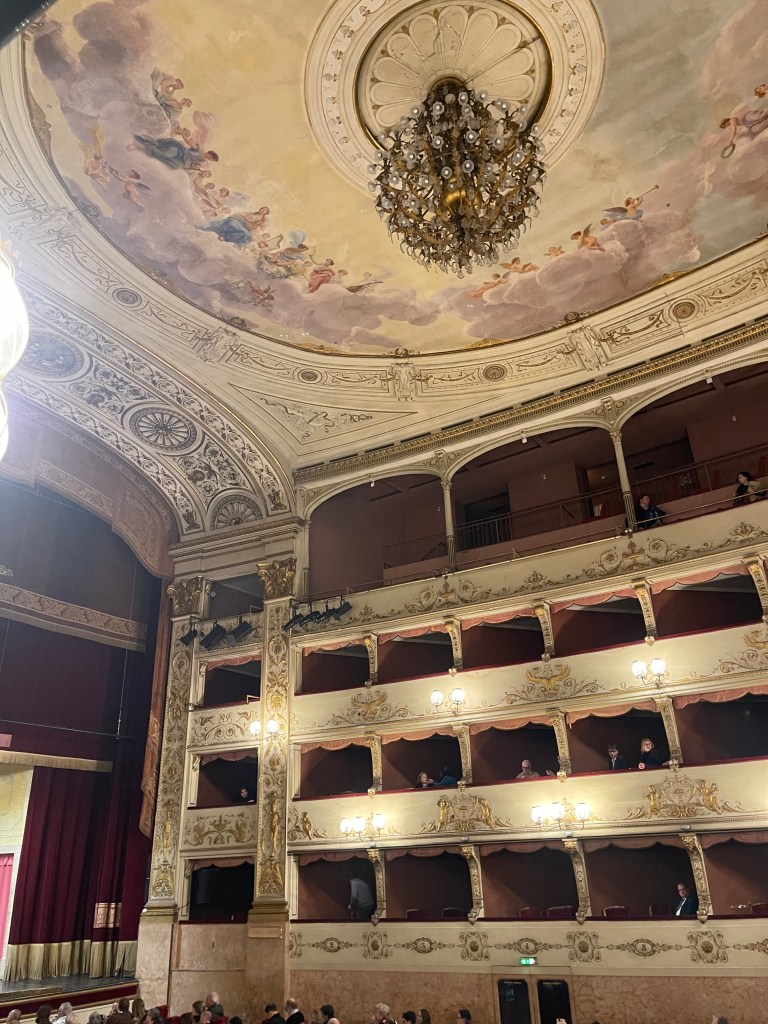
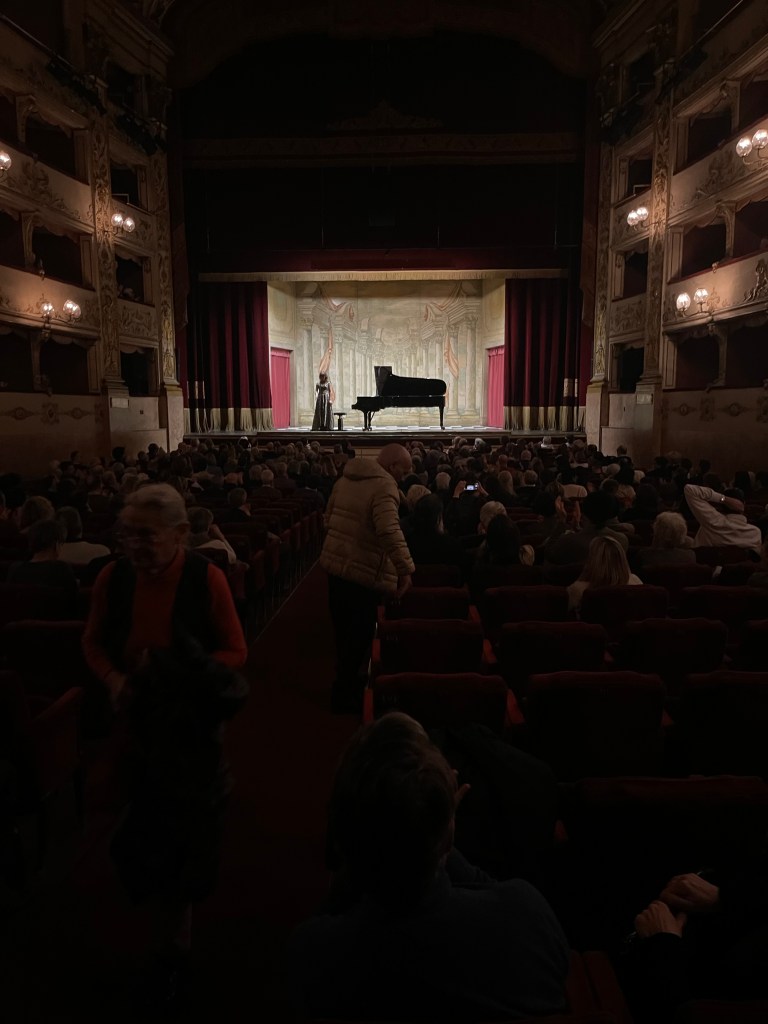
in La Pergola ,the temple of serious music making in Italy.
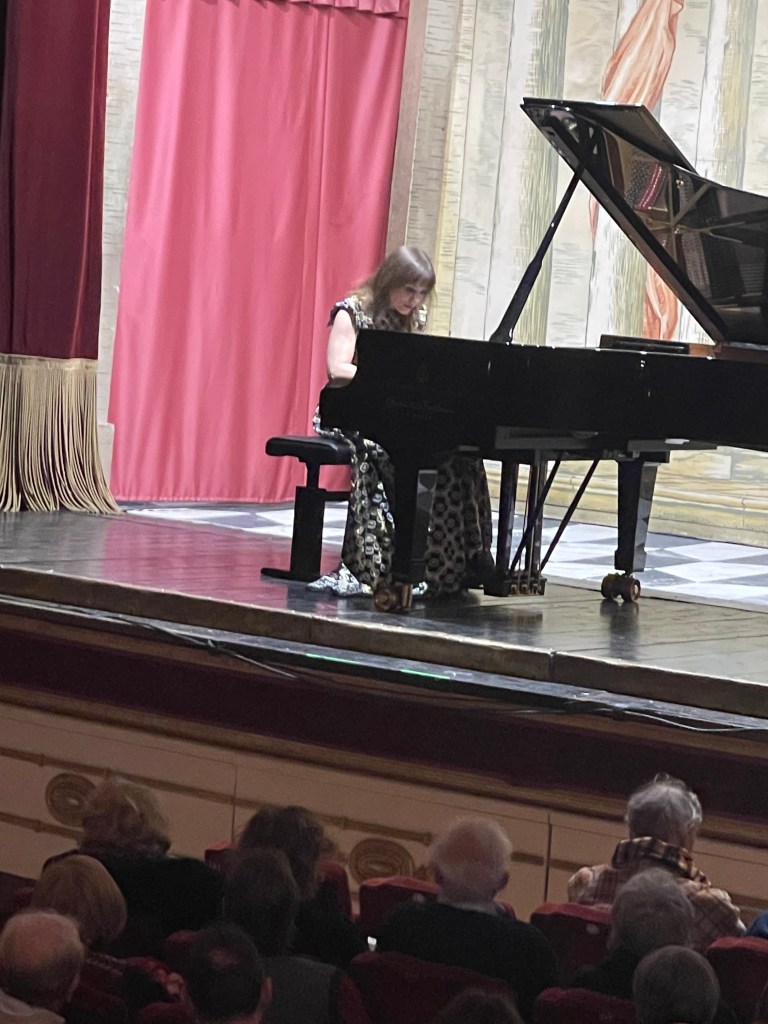
Wondrous whispered sounds of Ukrainian Silvestrov to remind us of what beauty there could be in the world. Anna very much involved with her support for Ukraine opened with these very delicate musings on Mozart, demonstrating Silvestrov’s wish that his music is ‘a response to and an echo of what already exists’. Barely audible sounds gradually taking shape with exquisite glowing beauty immediately showing the delicacy and sensitivity of Anna’s playing. And it was this beautiful world that we heard today, that of a Myra Hess (Tobias Matthay) who could make music speak without resorting to force or speed. Anna Fedorova allowed music to speak louder than any words with a kaleidoscope of colours where each note had an infinite possibility of sounds. Chopin nocturnes op 27 that were a marvel of bel canto and the genial fantasy of Chopin who today was celebrating his 215th birthday.There were deep bass notes barely touched but sustaining the glowing bel canto that grew in intensity in this first almost impressionistic nocturne. The left hand gradually taking on sinister overtones before bursting into a Mazurka played with the lightness of the dance it is, before the solitary glowing beauty of the coda.
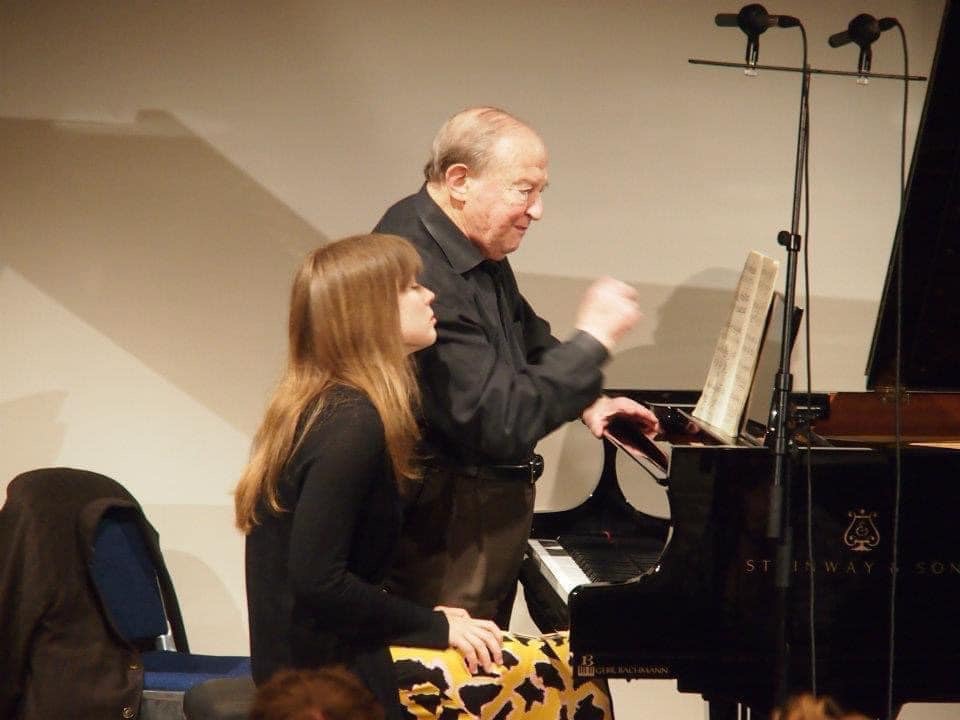
Menahem Pressler with Anna as he almost reached his 100th year Menahem Pressler with Lady Weidenfeld to whom he dedicated his last recording Claire de Lune
I was reminded of Anna’s mentor Menahem Pressler when we we listened together with Peter Frankl to a fantastic performance of Petrushka from a top prize winning pianist. I remember Pressler being impressed by the fantastic technical feats but remarking that it is a dance not a circus act! Anna is first and foremost a musician whose love for the music shines through all she does.Her technical command is remarkable but it is above all her love and musicianship that endear her to audiences, as we saw today. There was a deep warmth and expressiveness to the D flat Nocturne with a questioning of passionate intensity and an answer of beseeching compliance. A timeless beauty as the ornaments were allowed to unfold like Caballé ravishment, nowhere more than in the coda where she took all the time needed to underlined the expressiveness of the acciaccaturas without ever disturbing the overall pulse of the music.This was a true example of tempo rubato which Chopin was to describe to his society lady pupils, a tree with the roots firmly planted in the ground with branches that were free to move as the wind blew through them. Surely this was Chopin describing the secret of all great Bel Canto singers.
An ‘Appassionata’ where the pedal played such an important part, allowing a fantasy and colour that is rare indeed, but that Beethoven has actually indicated in the score. I was reminded of Myra Hess who would use the pedal to build up sonorities without the percussive ‘fingerfertigkeit’ that we are so often treated to on pianos that are super resilient, and pianists with muscles that they like to flex in public.This was an ‘Appassionata’ that had great impact for the overall architectural shape and the scrupulous attention to the composers indications. It was the rests at the beginning that were so important and kept the opening trills from overstaying their welcome as they were tightly wound springs, gasps before the explosion that marks the true opening of the sonata. There were great contrasts too between legato and staccato with dynamic contrasts where Anna even noted the way Beethoven had written the waves of notes and kept the physical shape that just mirrored the musical one with no ‘pianistic’ simplifications . Beethoven takes great risks and it is this that adds to his genius – it is not play safe music! Beethoven’s irascible tempo could explode quite unexpectedly as it does indeed in his music. Anna brought orchestral sounds to the coda with much pedal, that gave a shape and meaning too often played like an exercise. Beethoven does not mark a rallentando at the end as this great wave of sound lasts to the very last breath. A flowing ‘Andante’ and as Beethoven asks ‘con moto’.This is a procession as the variations are allowed to unfold naturally on its long journey. A deep resonant bass to the first variation gave unusual depth as the second was allowed to glow with a golden fluidity.It moved with even more haste to the startling unexpected final chord which Anna allowed to unwind with trepidation to the final top note, placed with masterly care. Throwing herself into Beethoven’s irascible slamming of the door she allowed the ‘Allegro,ma non troppo’ to unwind with washes of sound rather than individual notes. Of course she played the repeat that Beethoven asks for, but with even more intensity as it lead to the frenzy of a coda where Anna literally threw herself at the piano with lots of pedal adding washes of orchestral sounds tumbling down on us unsuspecting public with overwhelming effect. Who could not be reminded of Rubinstein who made this Sonata very much his own and played it with electric shocks of passionate impulses until his 90th year!
After the interval Anna gave a performance of ‘Carnaval’ that mesmerised the audience with playing of style and a kaleidoscope of colours with chameleonic changes of character. A noble opening of aristocratic grandeur was followed by a short preview of the charm and excitement that was to unfold over the next twenty scenes, in fact it was a ‘Préamble’ like no other ! ‘Pierrot’ appeared with a sense of line, walking a little faster than usual, but Anna pointing to rich tenor notes adding ravishing colour from this very first scene. A gently teasing ‘Arlequin’ lead to a truly noble ‘Valse’ which she suffused with delicate beauty and shaped with whispered tones which fitted well with the sultry delicate beauty she gave to ‘Eusebius’. ‘Florestan’ was allowed to take the stage with radiance and insistence only to be greeted by the delicacy and charm of ‘Coquette’ with her beguiling shades of insinuation looking nostalgically over her shoulder with ‘Réplique’. Anna chose not to play the ‘Sphinxes’, as Rachmaninov did to such overwhelming effect, because they are rarely played by others as they are the outlines of Schumann’s construction and are probably not meant to be included in performance. ‘Papillons’ came flitting onto the scene with a gossamer lightness which burst into ‘Lettres dansantes’ where Anna’s ‘joie de vivre’ was allowed full reign. Finishing with a flourish that announced the entrance of ‘Chiarina’ with all her radiance and shy beauty. Anna brought a subtle rubato to ‘Chopin’ with its exquisitely beautiful outpouring, played with freedom but also simplicity. ‘Estrella’ on the other hand entered with dynamic drive and passion before the beauty of the melodic line in ‘Reconnaissance’.The inner repeated notes and technical difficulties were hardly noticed as a beautifully robust duet between tenor and soprano opened up to fill the central episode. After the opening was repeated ‘Pantalon et Colombine’ could be heard squabbling with a furious debate that Anna played with astonishing precision, allowing these two squabbling characters moments of gentile reflection before finally calling it a day with a quiet aside to finish. What style Anna brought to this episode with the two quiet chords just thrown onto the scene with nonchalant ease! A beautifully insinuating ‘Valse allemande’ was the frame into which Paganini was drawn to astonish and overwhelm.The violinist of the devil and the example that Liszt was to follow and where he learnt that showmanship and mastery could hold a public, and beautiful ladies, in their spell. Anna played this technically challenging episode with admirable command but it was her addition of pedal that showed us the true beauty and shape that Schumann could give to even Paganini! The final crashing chords giving way to an echo effect and a trick of the pedal that Anna showed us with rare perfection, an effect that is usually hit and miss in most performances! The inner counterpoints that she found in the beautiful ‘Aveu’ I have rarely heard played with such loving beauty and it lead into the ‘Promenade’. It was played with a capricious freedom before the ‘Pause’, that was in fact a record amount of notes played at breakneck speed! The triumphant ‘Davidsbündler’ March was played with clipped military indifference and was a call to arms contrasting with a finale of changing moods and an astonishing range of sounds.The final bars were played with bravura and showmanship as she brought this ‘Cirque du solei’ to an exhilarating end.
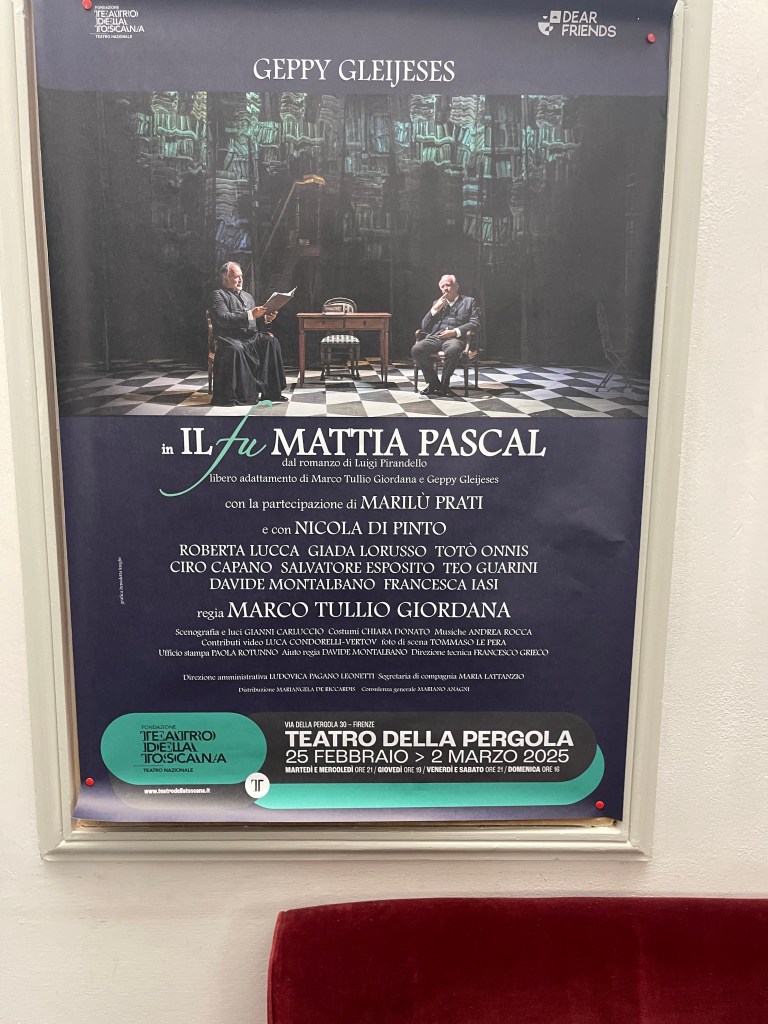
Three encores, and there could have been many more,but alas Pirandello was waiting in the wings for an evening performance in one of the most important theatres in Italy.
De Falla’s ‘Ritual Fire Dance’ , again bathed in pedal but with a throbbing insistent rhythm over which rose passionate melodic outpourings. Rubinstein was famous for playing this crowd pleasing piece and his performance is renowned for his alternating high flying arms as he played the pungent rhythms with astonishing energy. Anna too followed the great master and afterwards told me that he was quite right because it added an extra sound and rhythmic dimension and it was not just a circus trick! Rachmaninov’s G sharp minor Prelude was played with supreme style and colour and a delicacy that was breathtaking for its audacity. For a final encore Anna decide to play one of the pictures of Mussorgsky’s suite.The ‘Ballet of Unhatched Chicks’ was an ideal and scintillating end to a memorable afternoon of real music making.
The wonder of what will obviously be the first of many Florentine concerts was with a performance of Carnaval that reminded me of the style of Giuomar Novaes and the simple musicianship of Myra Hess . A supreme stylist who is also a great musician where every one of Schumann’s characters was given a unique voice of its own. Greeted by an ovation she was persuaded to play three encores having flown in only this morning from Madrid where she had been playing Ravels G major concerto.
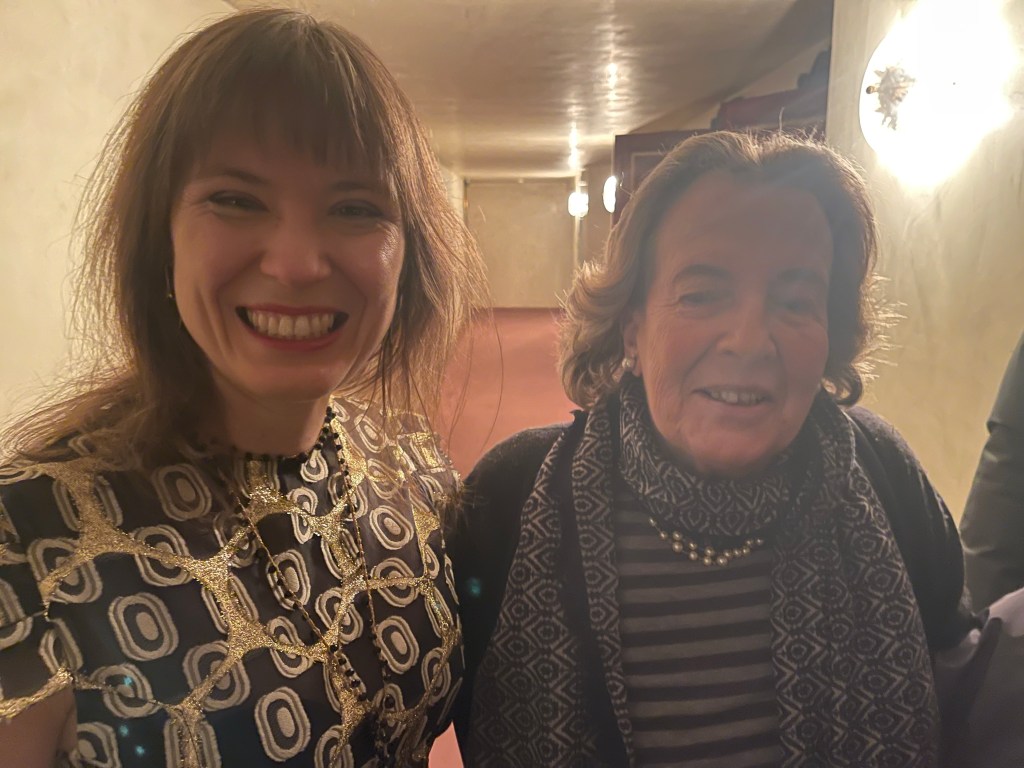
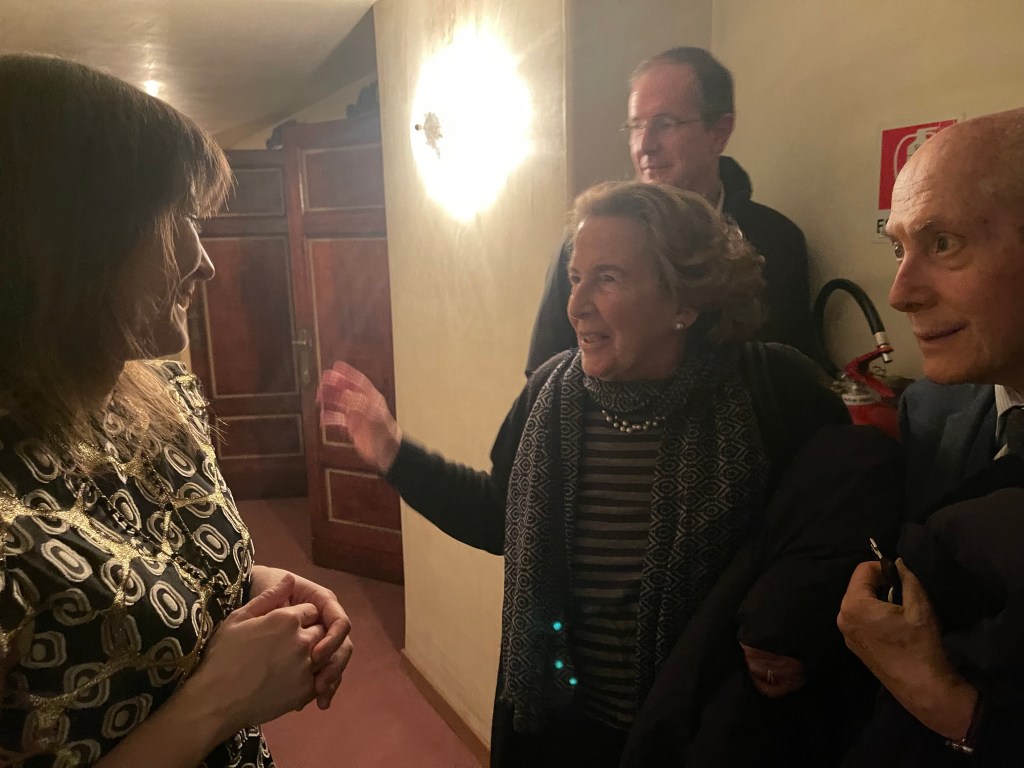
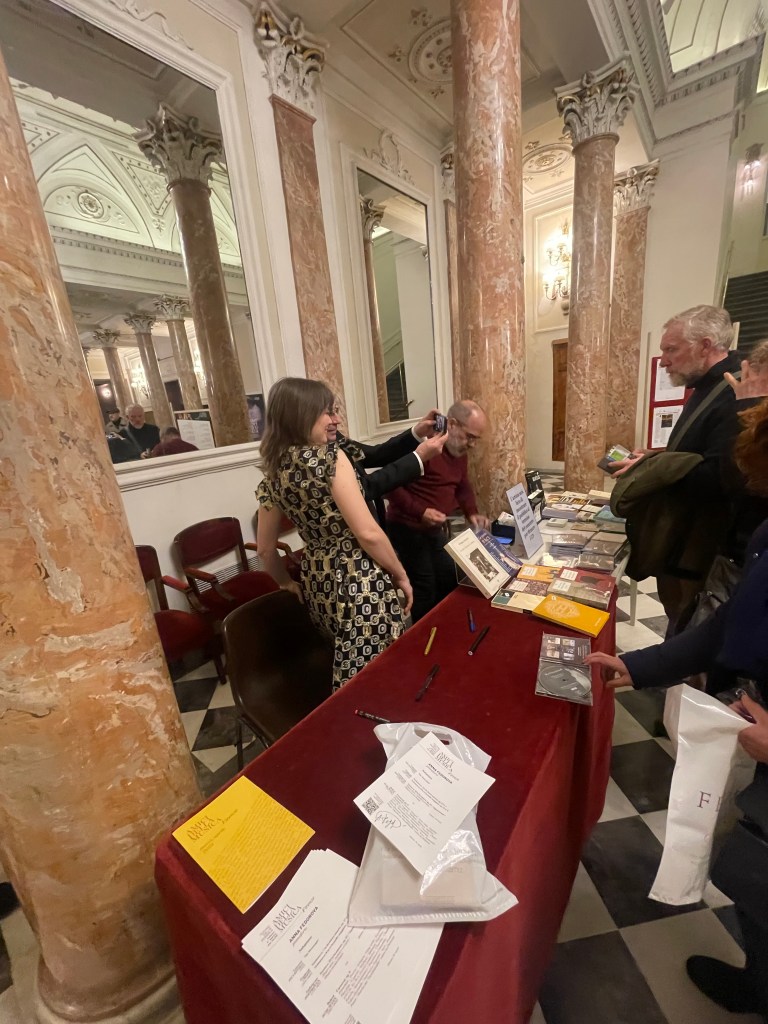
Domitilla Baldeschi former artistic director of the Amici and with whom I shared Tureck,Perlemuter,Cherkassky bringing them for the first time to Florence in their Indian Summers with Domitilla Baldeschi e Stefan Passigli former artistic directors of the Amici della Musica Anna signing CD’s and happy to pose for selfies even though on a very tight schedule .In life as on stage with a joie de vivre that is so refreshing
“Anna Fedorova’s beautiful sound and natural freedom in making music with total technical security makes for one of the finest Chopin performances I have heard in a long, long time.”
– Menahem Pressler, September 2022
with Menahem Pressler
From an early age, the Ukrainian pianist Anna Fedorova showed an innate musical maturity and amazing technical abilities. Her live recording of Rachmaninoff’s 2nd Piano Concerto has over 43 million views on YouTube and is highly acclaimed by critics and world-renowned musicians. She regularly performs at the world’s most prestigious concert halls such as the Concertgebouw in Amsterdam, New York’s Carnegie Hall & Lincoln Center, Palacio de Bellas Artes in Mexico City, Tonhalle Zürich, Théâtre des Champs-Elysées in Paris, Bunka Kaikan in Tokyo, and London’s Barbican Centre & Royal Albert Hall.
As a soloist, Anna Fedorova has performed with many wonderful orchestras such as the Philharmonia Orchestra, Verbier Festival Orchestra, Royal Philharmonic, Tokyo Symphony, Yomiuri Orchestra, Ukrainian Freedom Orchestra, Utah Symphony, Dallas Symphony, Hong Kong Philharmonic, and the Netherlands Philharmonic with conductors such as Daniel Harding, Vasily Petrenko, Gianandrea Noseda, Jaap van Zweden and more. Nicknamed the ‘house pianist’ (Telegraaf) of the Concertgebouw, Anna Fedorova has given over 45 concerts in this prestigious concert hall in Amsterdam, often live broadcasted. She is a regular guest at leading music festivals such as Verbier and Menuhin Festivals in Switzerland, Stift Music Festival in the Netherlands, Festival de Sintra in Portugal, and Ravinia Festival in the US. In July 2022, Anna performed with the Verbier Festival Orchestra under the baton of Gianandrea Noseda at the opening of the Verbier Festival. And a week later, she made her debut at the international piano festival La Roque d’Anthéron with a solo recital, to much acclaim in both local and international press.
On 6 March 2022 she was one of the first to initiate a charity concert to raise money for the victims of the war in Ukraine, together with her musician friends, Interartists Amsterdam and the Concertgebouw. Having raised over 100,000 Euros on that first night, she has continued to perform in benefit concerts for Ukraine ever since. During the summer of 2022, she was the solo pianist with the Ukrainian Freedom Orchestra, performing under the baton of Keri-Lynn Wilson at Teatr Wielki–Polish National Opera, Royal Albert Hall London (televised BBC Proms concert), Munich, Chorégies d’Orange, Konzerthaus Berlin, Edinburgh Festival, Summer at Snape Maltings, Concertgebouw Amsterdam, Elbphilharmonie Hamburg, Lincoln Centre New York (twice) and Kennedy Centre Washington. The New York Times noted that “The pianist Anna Fedorova was a sensitive, poetic soloist in Chopin’s Piano Concerto No. 2, a nod to the Polish support for the Freedom Orchestra project.”
In 2018, Anna Fedorova signed with Channel Classics Records. By the beginning of 2023, she will have released three solo piano albums, four chamber music albums, and all of Rachmaninoff’s Piano Concertos with the Sinfonieorchester St. Gallen under Modestas Pitrenas. BBC Music Magazine gave a 5-star review for the first album with Rachmaninoff’s Piano Concerto No. 1, Preludes, and Rhapsody on a Theme of Paganini. BBC Music Magazine also published a 5-star review for Anna Fedorova’s rendition of Rachmaninoff’s Piano Concertos Nos. 2 & 4, noting that “the clear thinking and feeling behind these Rachmaninoff concerto interpretations are refreshing indeed: this certainly isn’t just yet another ‘Rach 2’.” It was Classic FM’s Album of the Weekend, received Luister Magazine’s 10 star-review, and it became Album of the Week on Scala Radio as it was released in October 2022. Anna Fedorova, Sinfonieorchester St. Gallen and Modestas Pitrenas recorded Rachmaninoff Piano Concerto No. 3 in November 2022, which will complete their Rachmaninoff Piano Concertos cycle in May 2023; the 150th birthday year of the composer.
Anna Fedorova graduated from the Lysenko School of Music in Kyiv with Borys Fedorov and the Accademia Pianistica in Imola, Italy, with Leonid Margarius. She received her Master’s degree and Artist Diploma at the Royal College of Music, London, under the guidance of Norma Fisher. Her mentors include Alfred Brendel, Menahem Pressler, Steven Isserlis, and Sir András Schiff.
In 2022, Anna Fedorova and double bassist Nicholas Santangelo Schwartz founded the Davidsbündler Music Academy in The Hague. Before the Academy’s door officially opened in September 2022, the Davidsbündler Foundation already started to provide top quality musical education to Ukrainian refugees who had fled to the Netherlands. They continue to do so in 2023 and provide full scholarships to young talented pianists and string players from low-income families, among which are 12 young Ukrainian pianists.
Dal più tenera età, la pianista ucraina Anna Fedorova ha dimostrato un’innata maturità musicale e sorprendenti capacità tecniche. La sua registrazione in diretta del Concerto n. 2 per pianoforte e orchestra di Rachmaninov ha superato i 40 milioni di visualizzazioni su YouTube ed è stata molto apprezzata dalla critica e dal pubblico. Si esibisce regolarmente nelle sale da concerto più prestigiose del mondo, come il Concertgebouw di Amsterdam, la Carnegie Hall e il Lincoln Center di New York, il Palacio de Bellas Artes di Città del Messico, la Tonhalle di Zurigo, il Théâtre des Champs-Elysées di Parigi, il Bunka Kaikan di Tokyo, il Barbican Centre e la Royal Albert Hall di Londra. Come solista, Anna Fedorova si è esibita con rinomate orchestre come la Philharmonia Orchestra, la Verbier Festival Orchestra, la Royal Philharmonic, la Tokyo Symphony, la Yomiuri Orchestra, la Ukrainian Freedom Orchestra, la Utah Symphony, la Dallas Symphony, la Hong Kong Philharmonic e la Netherlands Philharmonic. È ospite regolare di importanti festival musicali come i Festival di Verbier e Menuhin in Svizzera, lo Stift Music Festival nei Paesi Bassi, il Festival de Sintra in Portogallo e il Ravinia Festival negli Stati Uniti. Fedorova è stata una delle prime musiciste a proporre l’idea di organizzare concerti di beneficenza per le vittime della guerra in Ucraina. Insieme ad amici e noti musicisti, il 6 marzo 2022 ha raccolto oltre 100.000 euro per le organizzazioni umanitarie al Concertgebouw di Amsterdam. Da allora, si è esibita in oltre 20 concerti di beneficenza nei mesi di marzo e aprile 2022. Durante l’estate del 2022, è stata la pianista solista dell’Ukrainian Freedom Orchestra, esibendosi sotto la direzione di Keri-Lynn Wilson al Teatr Wielki-Polish National Opera, alla Royal Albert Hall di Londra (concerto trasmesso dalla BBC Proms), a Monaco di Baviera, alle Chorégies d’Orange, alla Konzerthaus di Berlino, al Festival di Edimburgo, al Summer at Snape Maltings, al Concertgebouw di Amsterdam, alla Elbphilharmonie di Amburgo, al Lincoln Centre di New York e al Kennedy Centre di Washington. Nel 2018 Anna Fedorova ha firmato un contratto con Channel Classics Records per una serie di registrazioni. Ha pubblicato tre album di pianoforte solo, quattro album di musica da camera e tutti i Concerti per pianoforte di Rachmaninov con la Sinfonieorchester di San Gallo. La rivista BBC Music Magazine ha assegnato una recensione a 5+5 stelle al primo album con il Concerto per pianoforte e orchestra n. 1, i Preludi e la Rapsodia su un tema di Paganini di Rachmaninov A novembre 2023 è uscito l’album Fathers & Daughters con Anna e Dana Zemtsov e i loro padri. Anna Fedorova si è diplomata alla Scuola di Musica “Lysenko” di Kiev con Borys Fedorov e all’Accademia Pianistica di Imola con Leonid Margarius. Ha conseguito il Master e il Diploma di Artista presso il Royal College of Music di Londra, sotto la guida di Norma Fisher. Tra i suoi mentori figurano Alfred Brendel, Menahem Pressler, Steven Isserlis e Sir András Schiff.
Anna Fedorova: il contributo concreto della musica
Nel suo concerto di debutto per gli Amici della Musica di Firenze accosterà opere di Chopin, Beethoven e Schumann a quelle del compositore e pianista ucraino Valentyn Silvestrov. Come ha concepito questo programma?
Nel mio recital presento una raccolta di brani che hanno un significato molto profondo per me. La Sonata Appassionata di Beethoven, che suono fin dall’adolescenza, è una delle mie preferite e rappresenta un viaggio emotivo potente, arricchito dagli insegnamenti di Sir András Schiff. Non smetto mai di stupirmi della straordinaria intensità spirituale che la attraversa. I Notturni di Chopin, tra mistero e luminosità, offrono un contrasto perfetto, mentre il Carnavaldi Schumann, con i suoi ritratti musicali e la celebrazione dello spirito libero, si lega all’ispirazione che mi ha portata alla fondazione della Davidsbündler Music Academy all’Aia, assieme a mio marito. Il recital si apre con The Messenger di Silvestrov, un brano carico di emozione e speranza, nato da un’esperienza di lutto e percepito come un messaggio dall’aldilà. È un programma che esplora intensamente la forza interiore, l’immaginazione e la connessione tra passato e presente.
Ha organizzato concerti benefici e iniziative di raccolta fondi a sostegno del popolo ucraino.
Dall’inizio della guerra nel 2022, per tutto il primo anno mi sono dedicata all’organizzazione e all’esecuzione di concerti di beneficenza. Il primo evento è stato organizzato appena una settimana dopo lo scoppio del conflitto, e in pochi giorni siamo riusciti a realizzare due grandi concerti di raccolta fondi: uno ad Amare, all’Aia, e l’altro nella Sala Grande del Concertgebouw di Amsterdam. L’energia e il senso di unità tra musicisti e pubblico in quelle occasioni erano indescrivibili. Nonostante la paura e la tristezza del momento, è stato straordinario vedere così tante persone riunite con lo stesso obiettivo. Più di 20 musicisti di fama internazionale hanno partecipato gratuitamente, alcuni viaggiando persino da altri paesi. Anche alcuni membri dell’Orchestra del Concertgebouw hanno formato un piccolo ensemble per accompagnare le esibizioni. Abbiamo suonato molta musica ucraina e altri brani dal forte valore simbolico. Grazie a questi due concerti, siamo riusciti a raccogliere oltre 150.000 euro. È stato un risultato incredibile per un evento di musica classica e un’esperienza indimenticabile. Soprattutto, mi ha dato la sensazione di poter contribuire concretamente in un momento così difficile.
with John Leech founder with his wife Noretta Conci of the Keyboard Trust in London .He died last November on S. Cecilia Day, the patron saint of music.A commemoration in London was on Valentine’s Day with many distinguished guests including a tribute from Evgeny Kissin who played Brahms to celebrate a great man and close friend. johnleechvr.com
Valentyn Vasylyovych Silvestrov was born on 30 September 1937 in Kyiv and began private music lessons when he was 15. After first teaching himself, he studied piano at the Kyiv Evening Music School from 1955 to 1958 whilst at the same time training to become a civil engineer. He attended the Kyiv Conservatory from 1958 to 1964, and was a freelance composer in Kyiv from 1970 to 2022, when he fled from Ukraine following the Russian invasion in February.. He lives in Berlin. He is perhaps best known for his post-modern musical style; some, if not most, of his works could be considered neoclassical and post-modernist. Using traditional tonal and modal techniques, Silvestrov creates a unique and delicate tapestry of dramatic and emotional textures, qualities which he suggests are otherwise sacrificed in much of contemporary music. “I do not write new music. My music is a response to and an echo of what already exists,” Silvestrov has said.
Silvestrov demands from his performer in the score of The Messenger,that alludes to Mozart , nuances ranging from mp to pppp, and the score is replete with meticulously detailed instructions with Silvestrov’s request to make the piano as muffled and quiet as possible (keeping the lid closed, using soft pedal) The Messenger for synthesizer, piano and string orchestra (1996–1997)Alexei Lubimov provides the most authoritative interpretation available on CD , both of the piano solo version and the one for piano and strings. Here is an artist truly in the service of the composer, acting as his messenger between the here and now and the beyond and bygone.
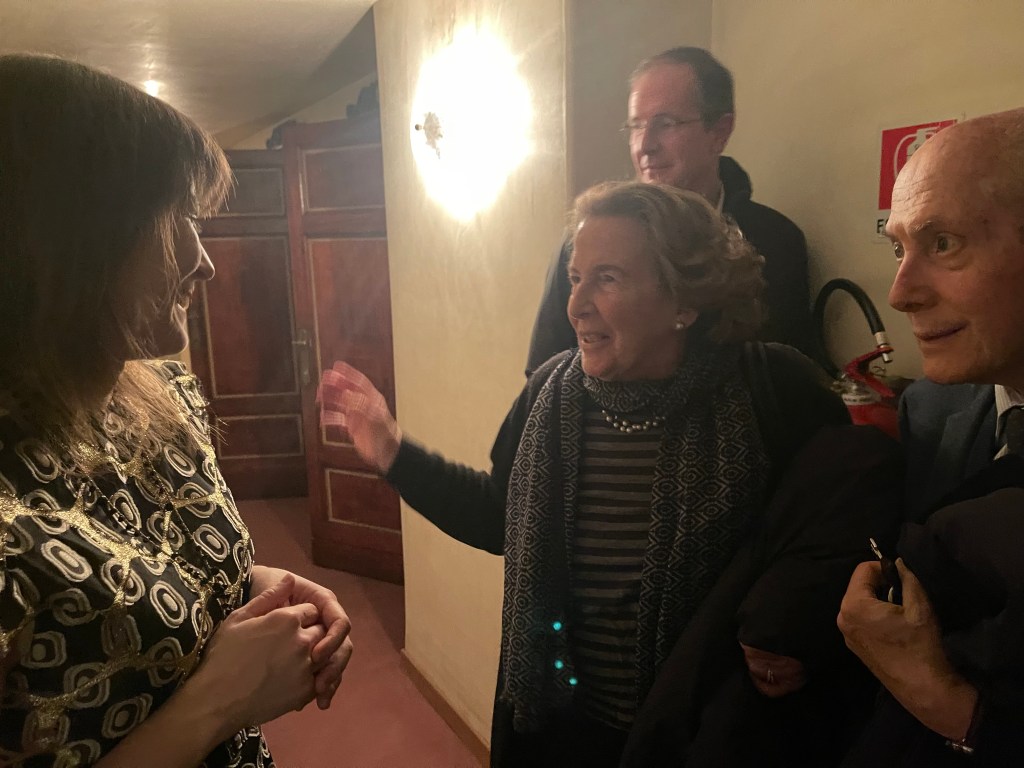
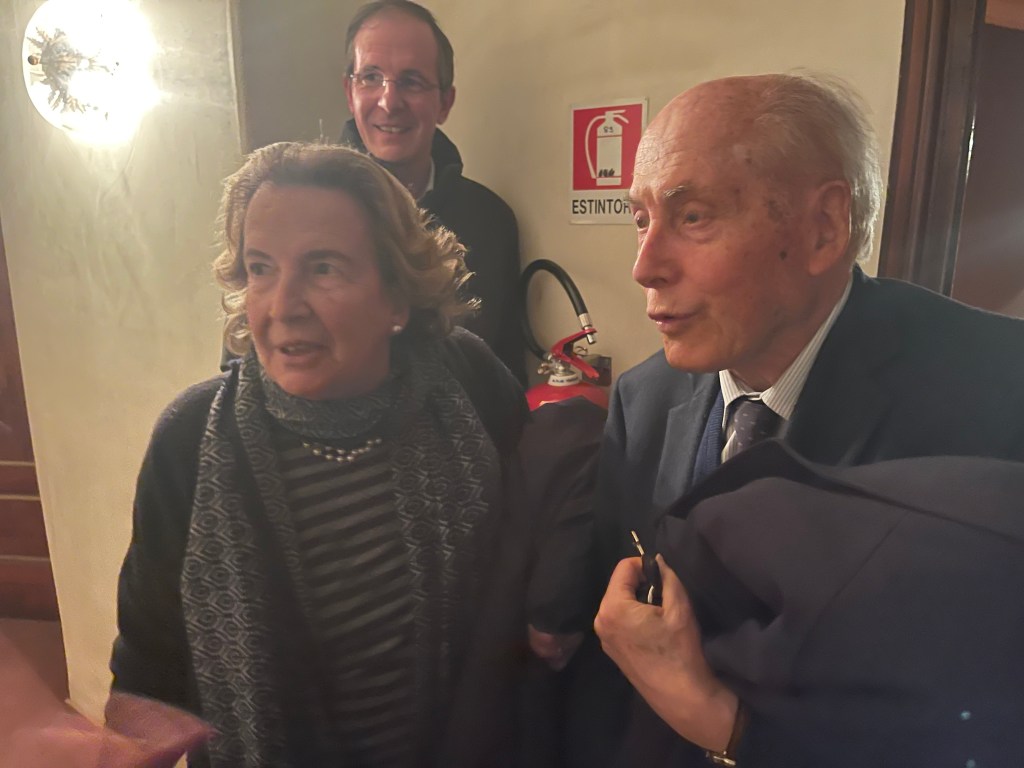
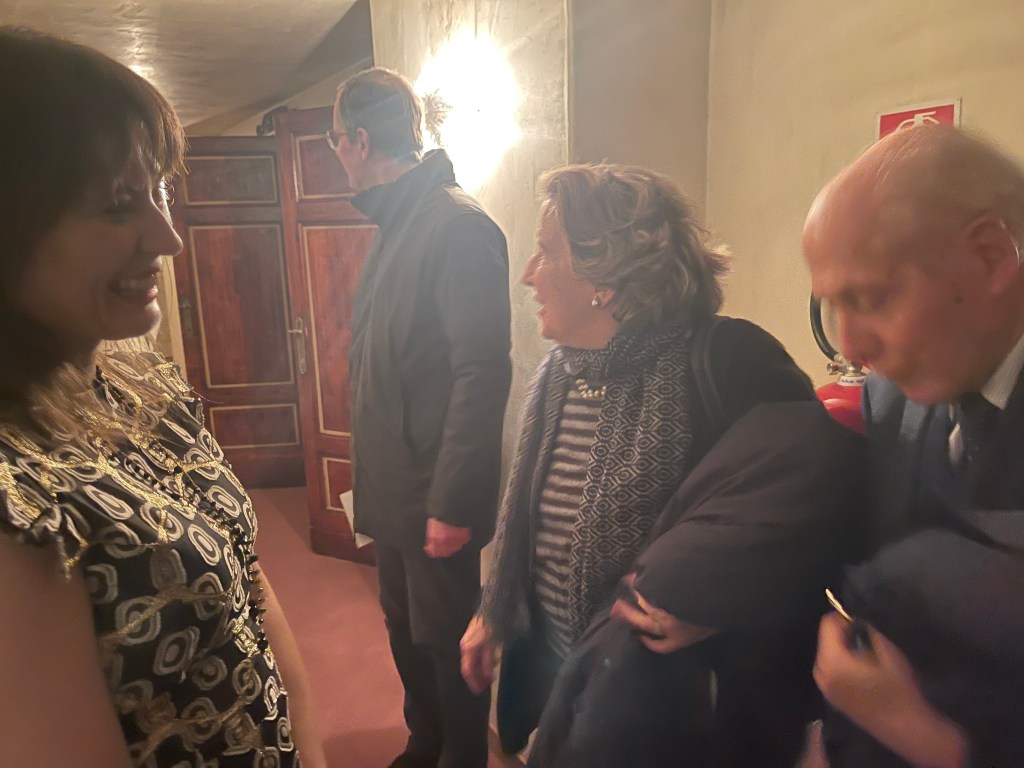
Domitilla Baldeschi with Anna Fedorova in that same corridor where I was accused of bringing Perlemuter, Tureck and Cherkassky to Florence Domitilla and Stefano Passigli with son in background
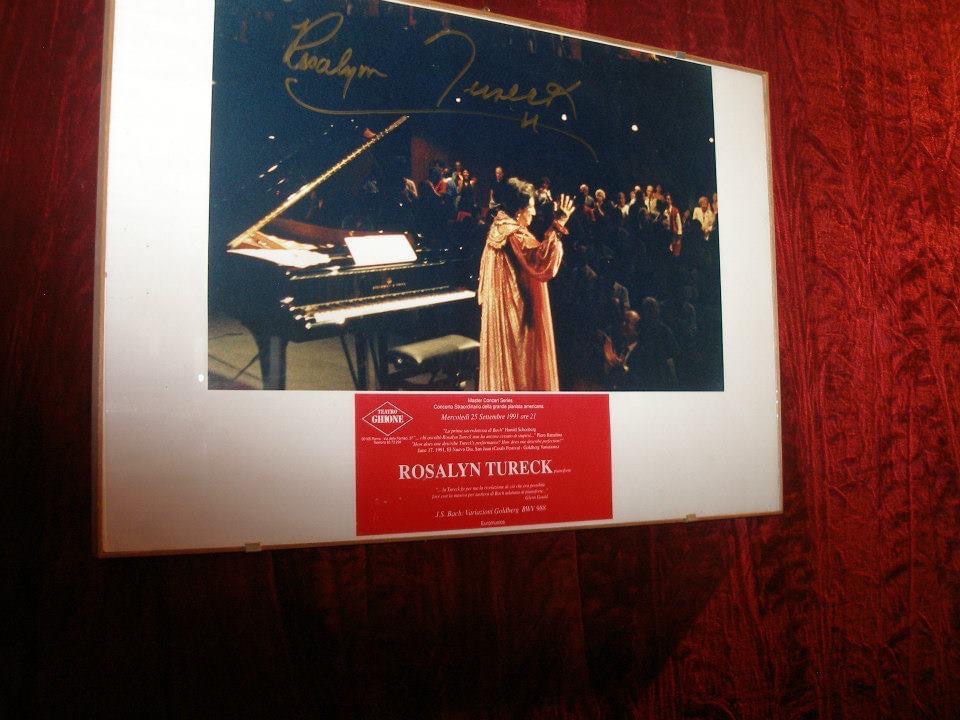
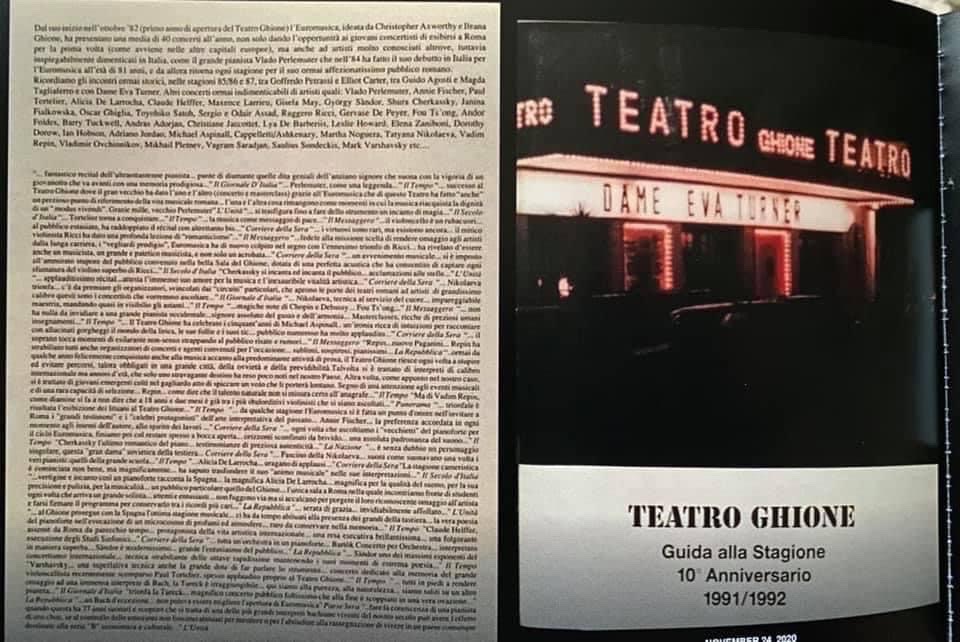
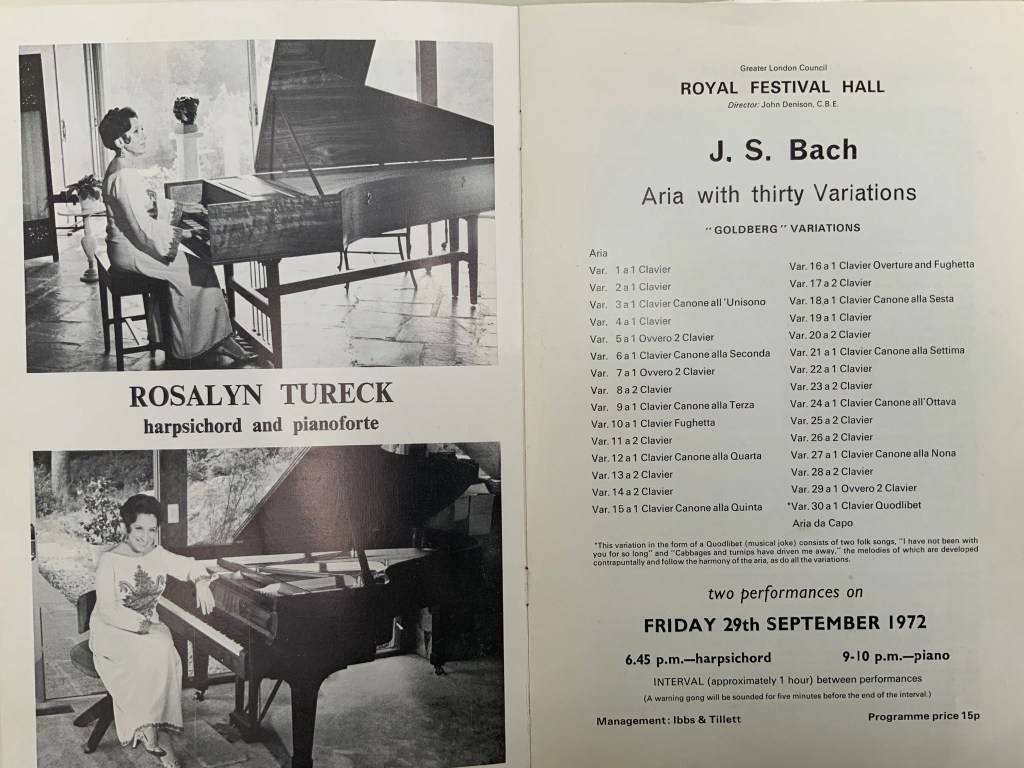
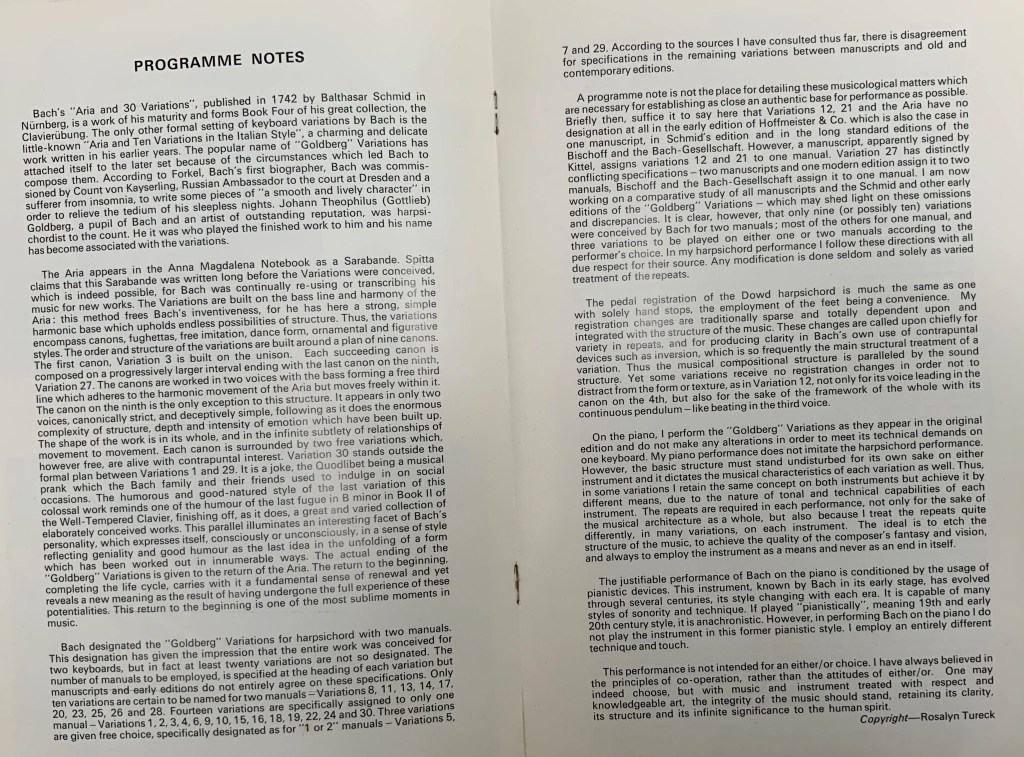
Wonderful to see Domitilla Baldeschi and Stefano Passigli who ARE the Amici della Musica ……..and we recognised each other too. I remember bringing Vlado Perlemuter to substitute for Claudio Arrau in 1985. Vlado already in his 80’s making his debut in Florence ( due to the sudden death of Arrau’s wife who had to cancel the opening concert of the season) and a public who in the interval were so angry that Perlemuter had never been invited before !!!! Rosalyn Tureck too became the Diva of Florence when I brought her here, already in her Indian Summer.She had given a lecture in Florence for Stefano Fiuzzi’s Accademia Bartolomeo Cristofori but had not been invited to play. She played a week later the Goldberg Variations in the Teatro Ghione in Rome and her glorious Indian Summer in Italy,Russia and Argentina began. The High Priestess of Bach whose role has now passed to Angela Hewitt who plays every season in what is still the Temple of classical music.
Domitilla’s role has been passed to Andrea Lucchesini whose teacher, Maria Tipo died just a few months ago. I remember Cherkassky playing in Empoli and Luciano Berio sending a car to bring him to his house to hear Andrea play his Wassermusik . Shura was of course very impressed by this winner of the Dino Ciani competition as we all have been since. Shura even learnt the Berio and played it in his recitals that year. In his Indian summer Shura set himself a goal to learn a new contemporary piece every season to add to his programmes.
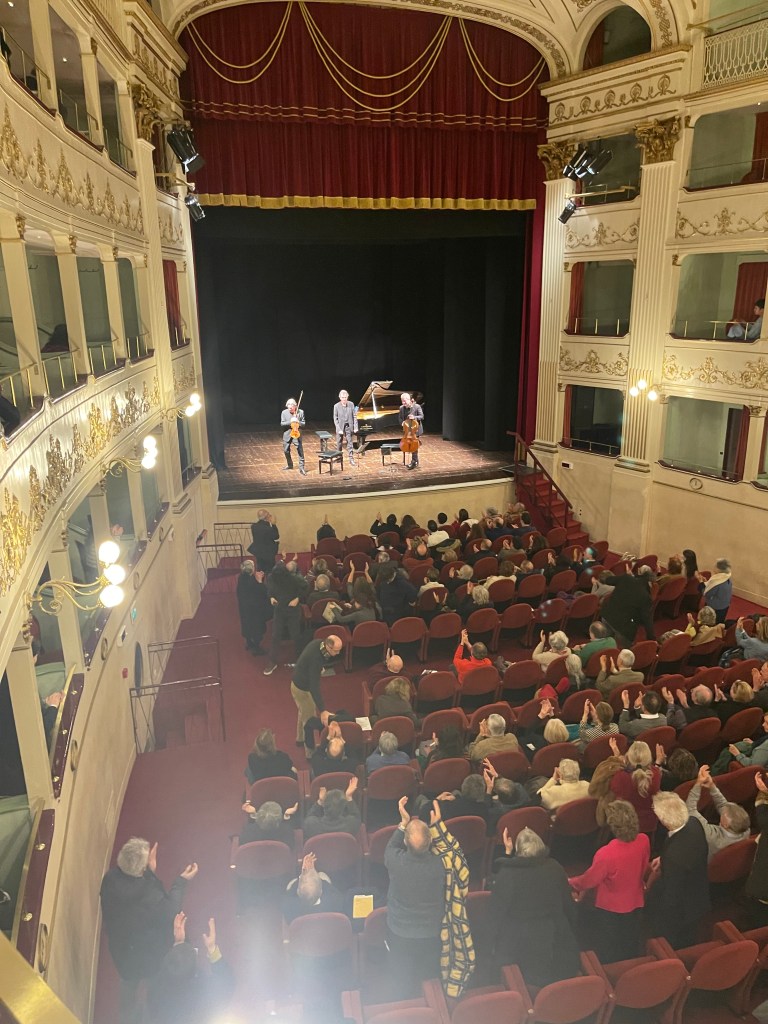
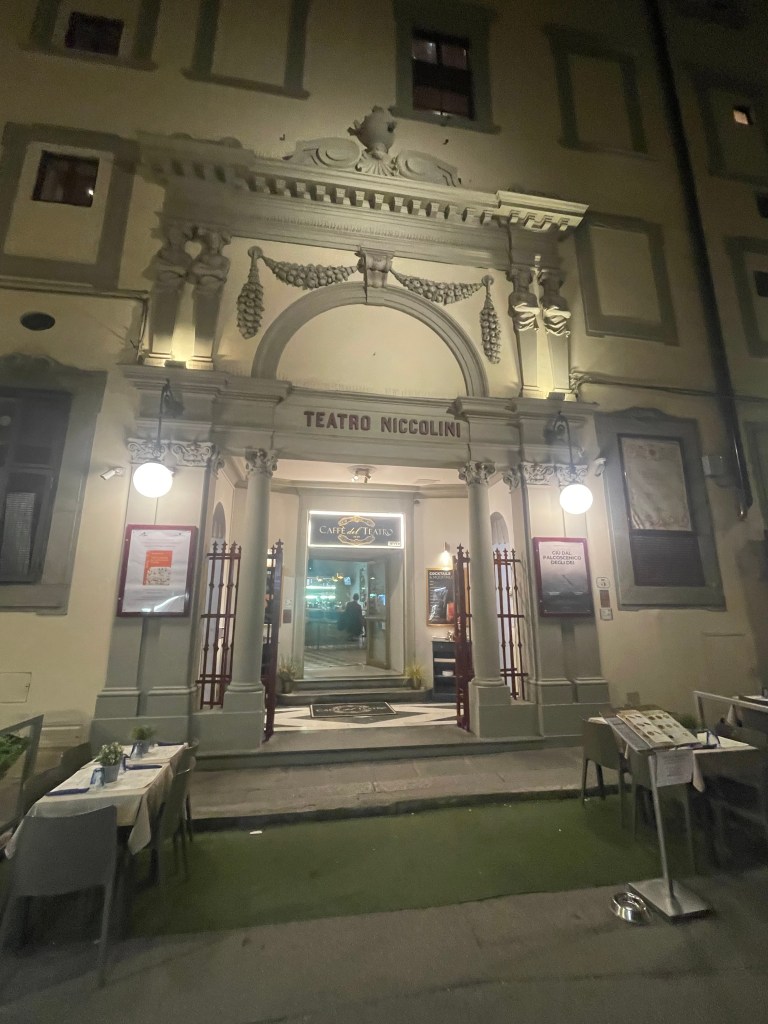
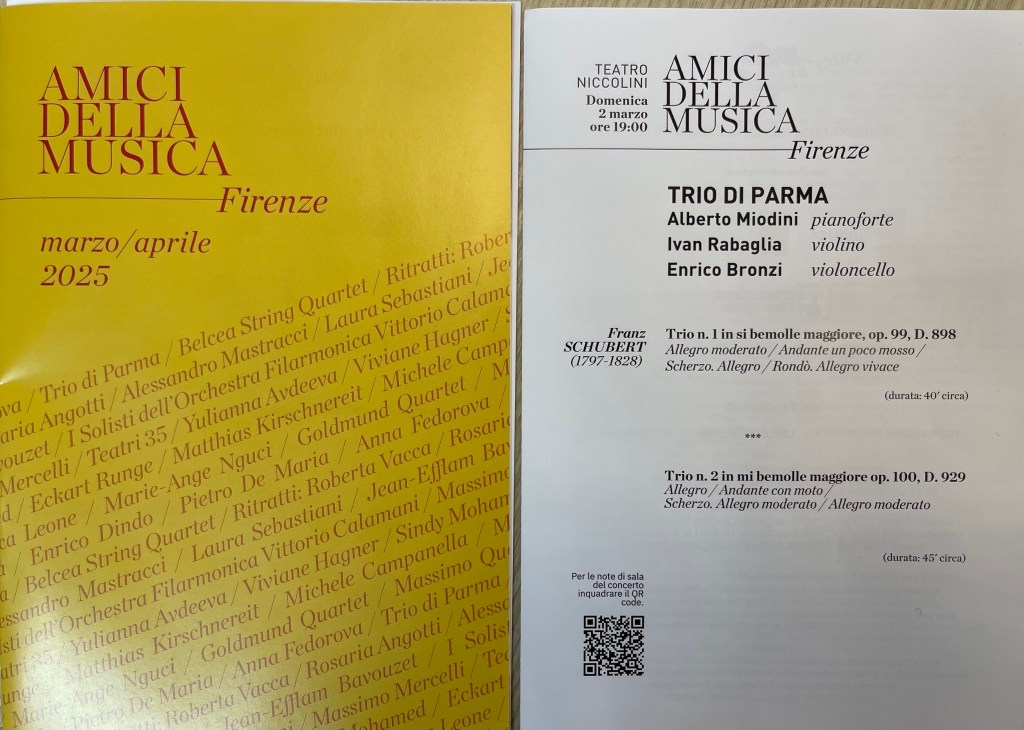
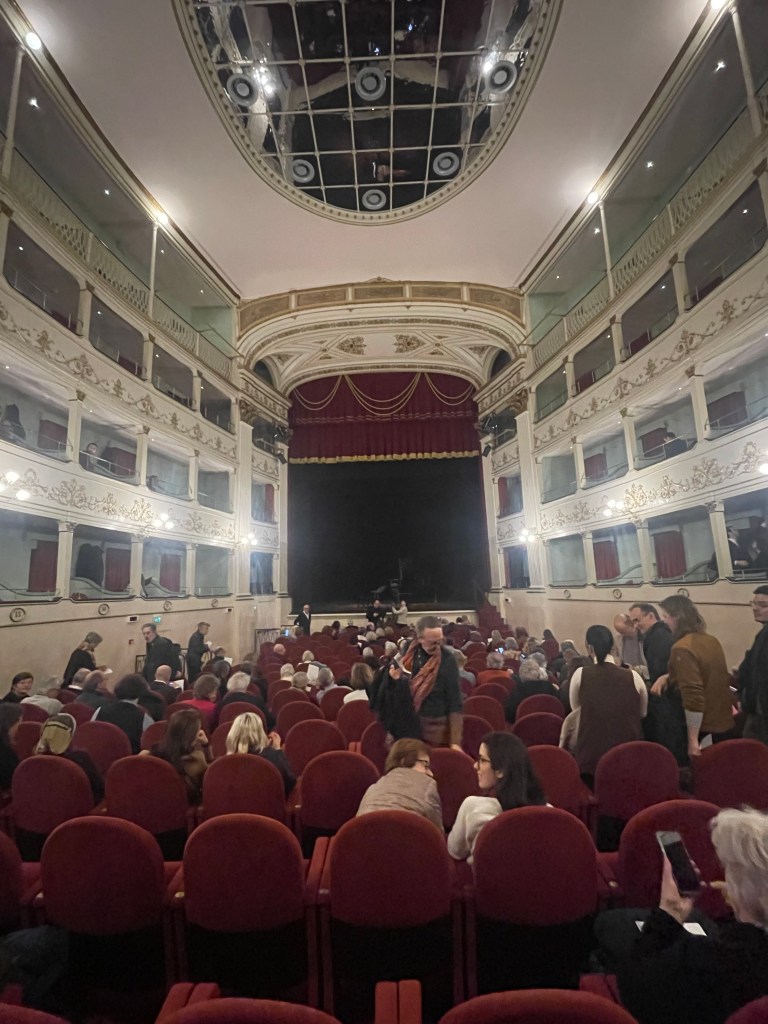
And the day after La Pergola a Schubertiade for the Amici della Musica with the Trio di Parma in the beautifully restored Teatro Nicolini
Teatro Niccolini just a stones throw from Santa Maria dei Fiori in the centre of Florence .
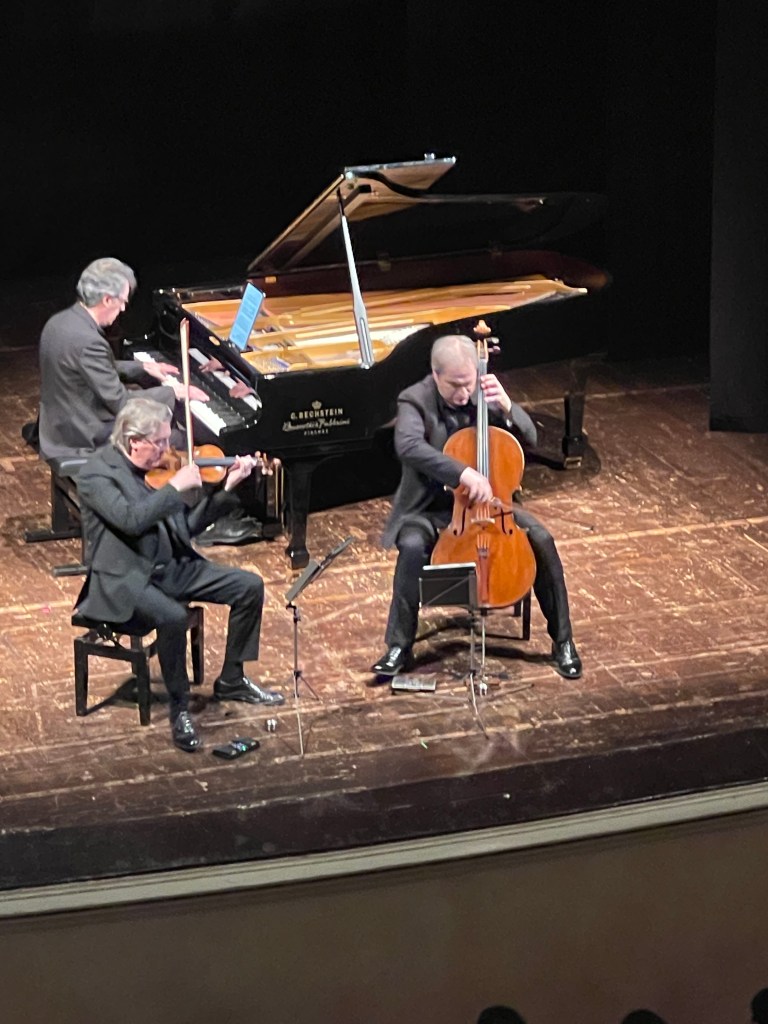
A Schubertiade offered by the Trio di Parma with the two piano trios op 99 and 100.
An outpouring of mellifluous invention and subtle refined music making that was to be Schubert’s swan song before leaving this world for a far better place than we could ever imagine but that he he could already forsee in the not too distant future
A Trio that after thirty-five years together play as one, with Alberto Miodini piano, the lid fully opened giving a knowing glow to all he did .The violin of Ivan Rabaglia playing with unobtrusive radiance and subtle beauty and the cello of Enrico Bronzi living every moment with the joy and grief that is at the very heart of Schubert.
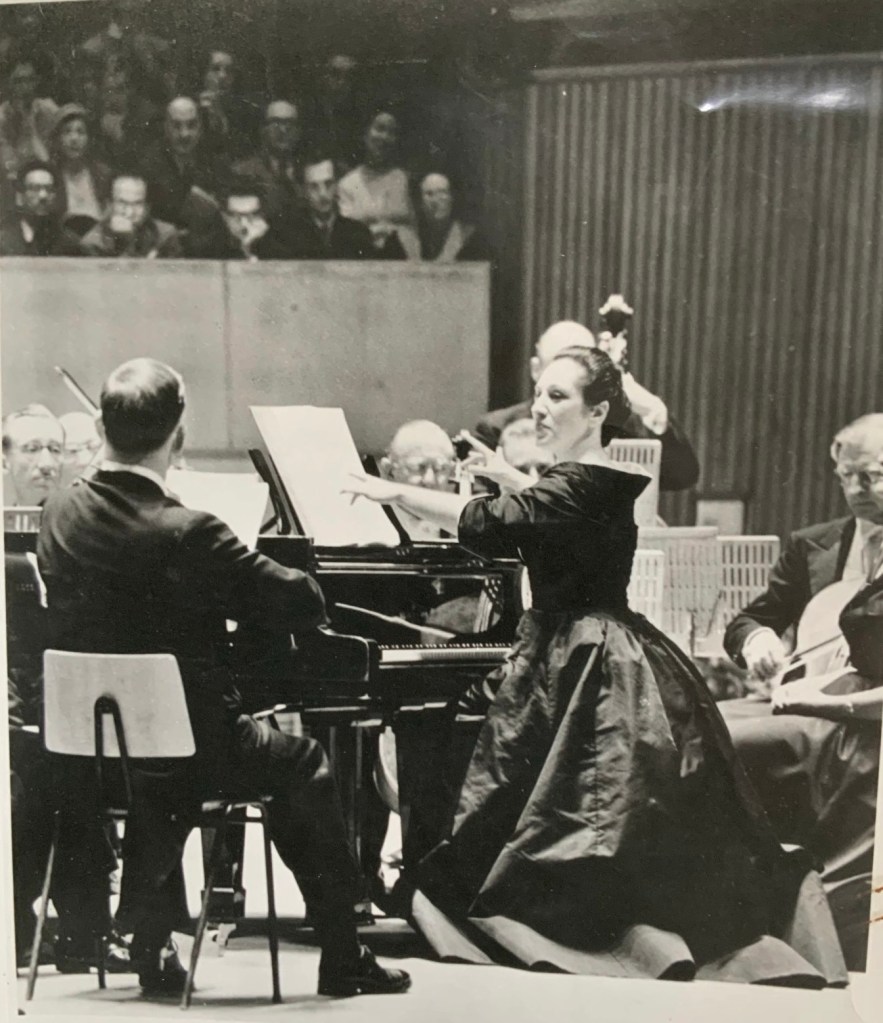
famous 1959 photo of Tureck directing the Philharmonia in London Rosalyn Tureck with Ileana Ghione with the Maga Circeo looking on Vlado’s last concert in London where I was backstage with Joan to help him fight his nerves ,as right until the last he complained that the distance from the Green Room to the piano was like going to the guillotine. The last concert of his career was in Geneva a few months later and a brief appearance at a memorial concert in the Wigmore Hall together with Larry Adler and Victoria de Los Angeles for Basil Douglas,his agent. Ileana and Joan 3rd December https://christopheraxworthymusiccommentary.com/2023/12/05/ileana-and-joan-3rd-december-2023/
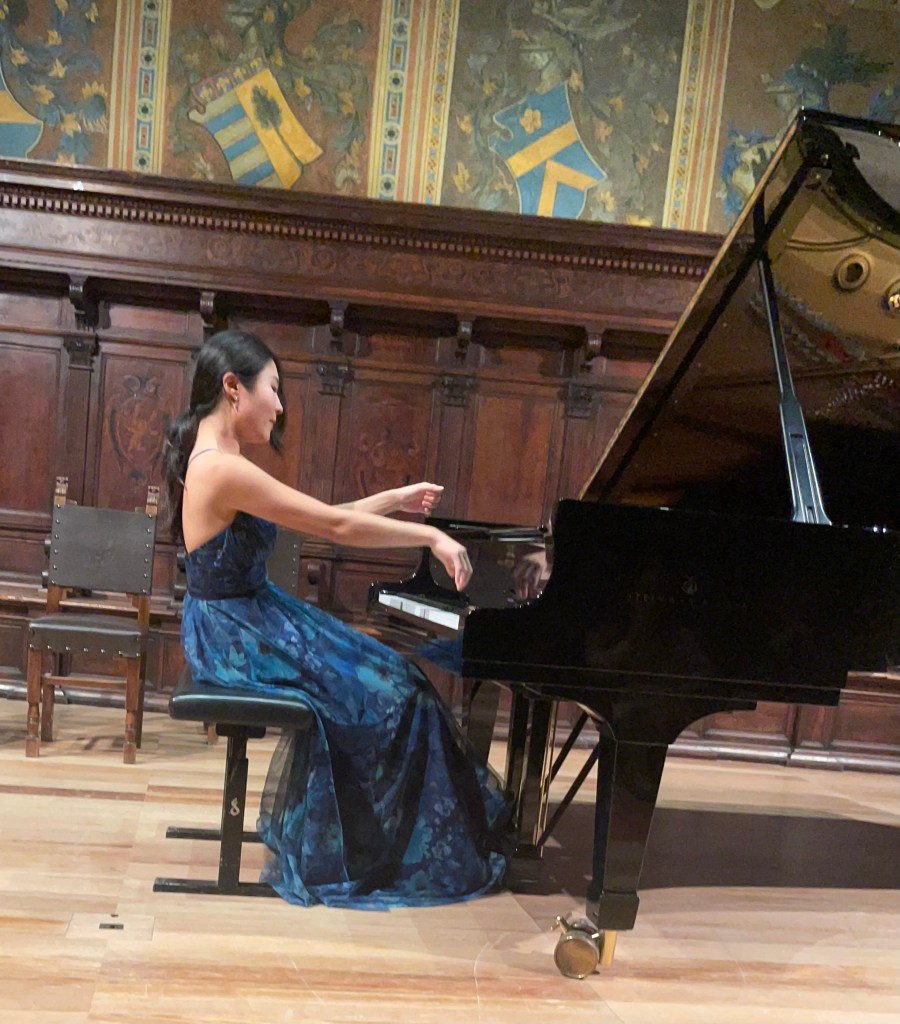
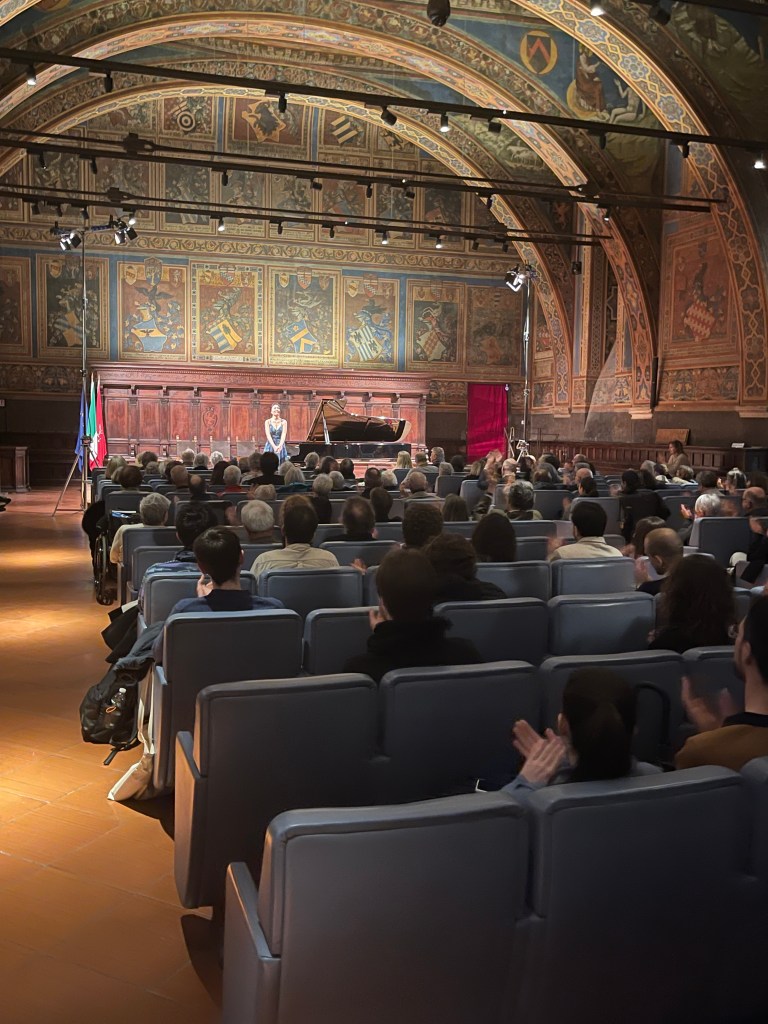
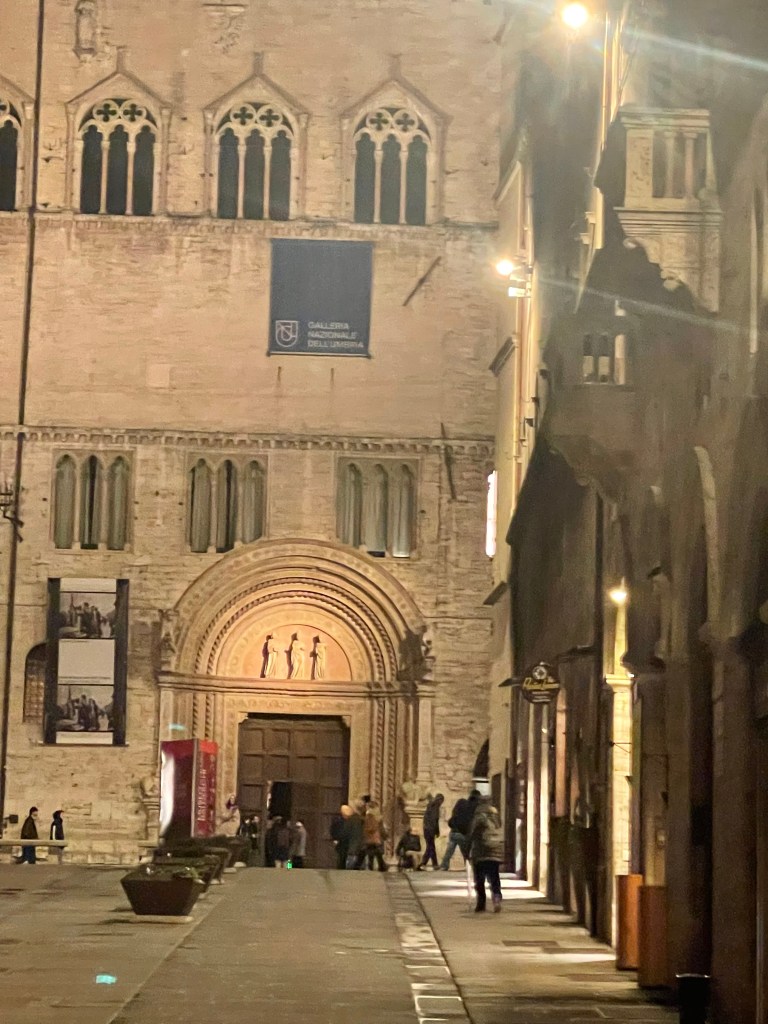
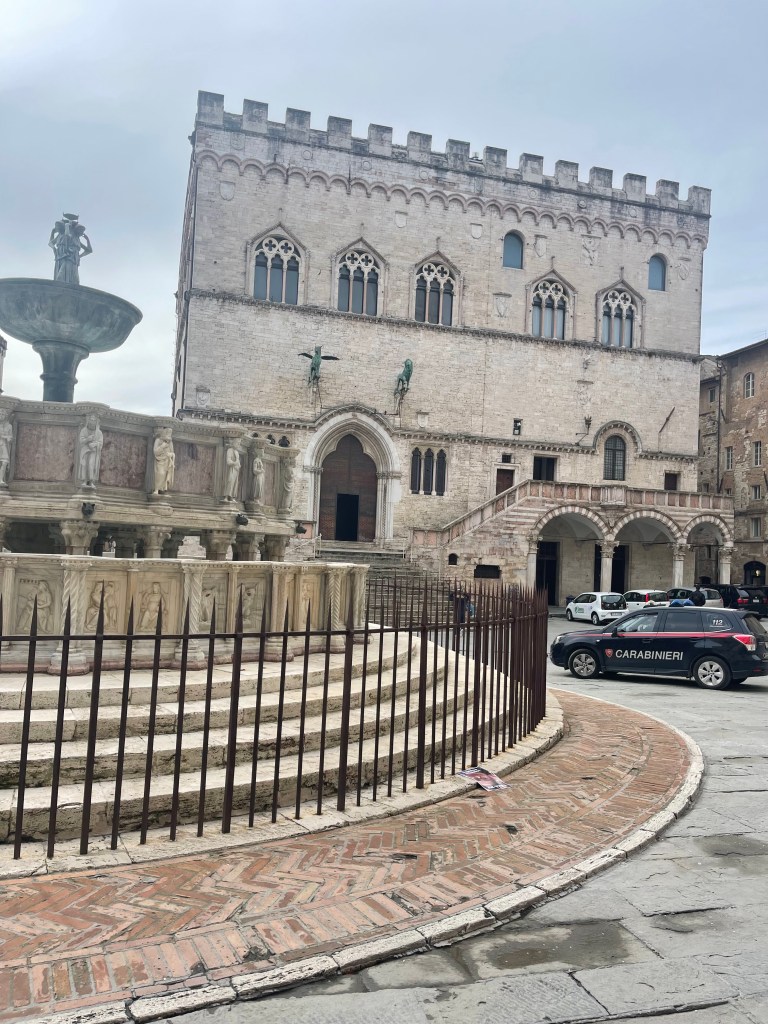
The historic Sala del Notari in the centre of Perugia
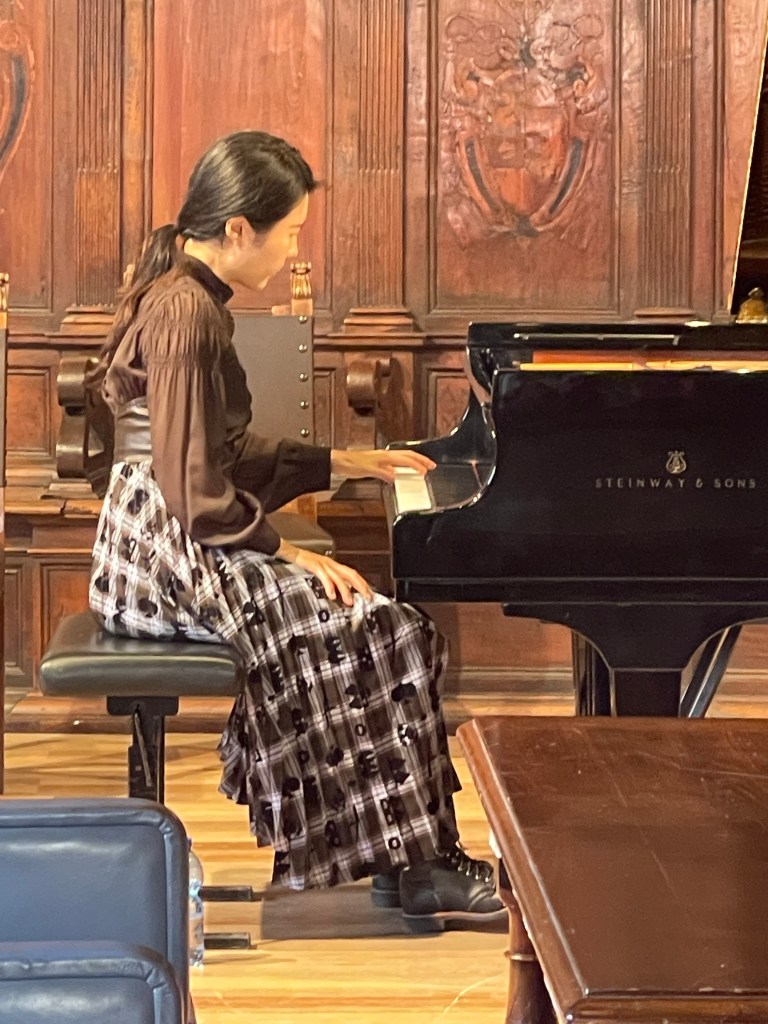
A concert of simple great artistry from Chloe Mun in Perugia. A ‘Building Bridges’ concert in which her mentor Andras Schiff brings to public attention artists who are ready to share the true message of music with the world. Haydn,Debussy and Schubert of intensity and beauty with a control and mastery that allowed these great works to live and breathe with a natural musicianship. An artist who with humility and integrity can delve deep into the scores to find the secrets bequeathed to us by the composers.
Winning both Geneva and Busoni competitions as a teenager, a distinction that she shares only with Martha Argerich and whose mutual love and passion for music is their raison d’etre, that with generosity share with a public hungry for masters who will never let them down!
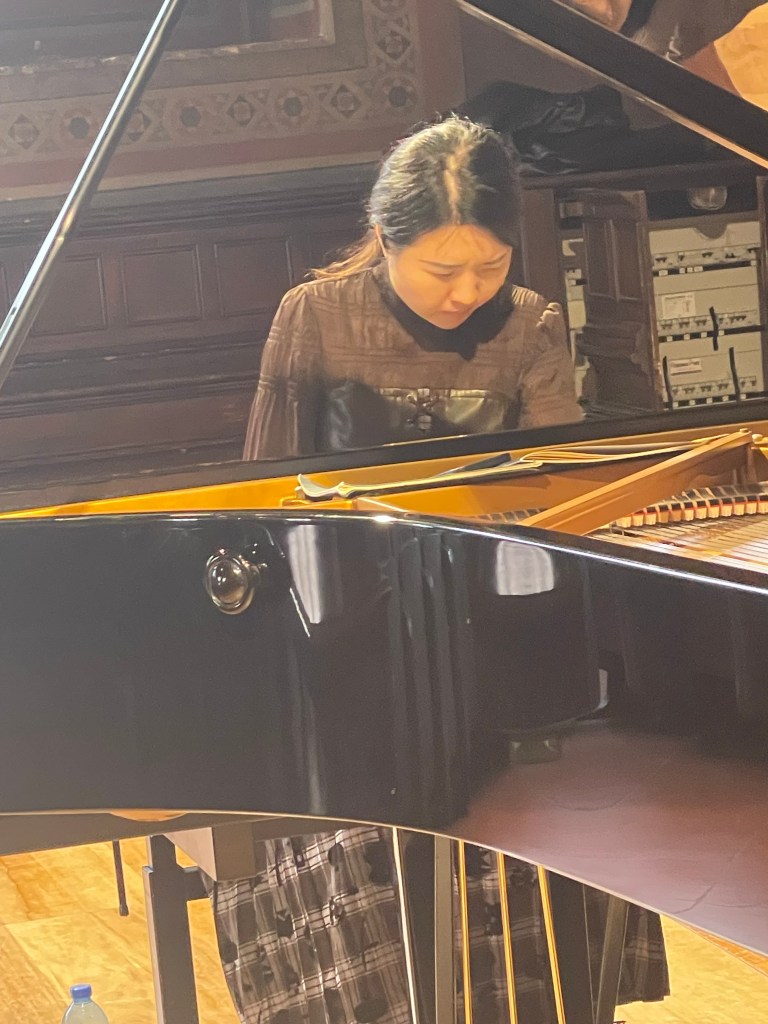
Haydn’s two movement late C major Sonata opened with an ‘Andante’ of delicacy and etched beauty of a continual questioning as the beautifully shaped melodic line was imbued with a subtle sense of colour. A ‘Rondò’ that sprang from her fingers with a refreshing ‘joie de vivre’ and impish sense of humour of scintillating rhythmic drive. Fluidity and golden delicacy she brought to Debussy’s ‘Estampes’ with a kaleidoscope of sounds bathed in pedal,creating the same magic and ethereal perfection that Richter was to seduce us with on his first visits to the West. ‘Pagodes’ with a sheen of magical sounds that were wafted into the air with a mixture of melody and mist that became ever more intense, bursting into passion and fire only to disappear to the wondrous land from which it had been born. Whispered haunting sounds of a ‘Soirée dans Grenade’ seen in the distance as it gradually came into view with its rhythmic insistence wrapped in a warmth of ravishing beauty. The pitter patter of rain in ‘Jardins’ was of gentle persuasion as its velvet clarity gave way to a vision of childish wonderment. Chloe demonstrated her masterly control of sound and transcendental command as she brought these three etchings to us as if newly minted, with a freshness and perfection of rare sensibility. There was delicacy and a perfection of art that conceals art but there was also passion and intensity as Chloe kept her eyes glued to the keys with daggers drawn. Looking down at her hands as they delved deep into the keys with selfless authority commanding them to show us what was in her heart and mind. Her work with Andras Schiff at the Barenboim-Said Academy has only intensified her wish to delve ever more deeply into the scores of the great masters and share them with a public hungry for the message that is hidden within.
Schubert’s C minor Sonata was lain bare with its deep brooding Beethovenian declamation that Schubert was immediately to diffuse with a mellifluous outpouring of disarming simplicity. What contrasts Chloe brought with her burning intensity of orchestral sounds mixed with the ethereal beauty of Schubert’s seemingly endless mellifluous invention. A mastery that could allow Chloe to unravel the contrapuntal complexities of the developments with simple, unadorned mastery. Fingers that could extract rich orchestral sounds with never a trace of hardness or words spoken in haste . An ‘Adagio’ of monumental proportions as the melodic line built to a climax of searing intensity only to return ever more beautifully with a delicate filigree accompaniment that showed Chloe’s transcendental control of the pedal.
It brought to mind Anton Rubinstein’s declaration, that was surely that of his mentor Franz Liszt, that the pedal is the soul of the piano. It was the mastery of the pedals tonight that illuminated all that Chloe did as she so unobtrusively used them to illuminate and ignite the wishes of the composers of which she was merely their devoted servant. A beautiful fluidity to the ‘Menuet’ was complimented by the subdued beauty of the ‘Trio’ with its very subtle bass counterpoints.
A last movement that sprang from her fingers with a rhythmic drive and vervet fluidity that gave no indication of the irascible Beethovenian interruptions it would receive before being allowed to weave it’s way to the final chords of this masterwork written in the final years of the composers thirty one years on this earth.
As Maude Tortelier once said Schubert is one of the angels bequeathed to us on this earth for a short period to enrich and illuminate our lives forever.
After such a monumental performance Chloe could only share with us Chopin’s vision of paradise with a recreation of his D flat nocturne where time stood still. Here in just a few moments her mastery and musical integrity illuminated one of Chopin’s most beautiful bel canto creations.
We shared one of those rare moments where people are united in the strage alchemy that only music can provide.
United under a roof of peace and sublime beauty.
morning rehearsal in the Sala dei Notari Ravel Left Hand Concerto for a performance in Seoul shortly
Venerdì 28 febbraio 2025 ore 20:30 Perugia, Sala dei Notari Chloe Mun, pianoforte
Programma F.J. HaydnSonata in do maggiore Hob. XVI: 48 C. DebussyEstampes (1903) F. SchubertSonata in do minore D. 958
Classe 1995, la sudcoreana Chloe Mun ha iniziato lo studio del pianoforte all’età di cinque anni, distinguendosi con la vittoria a due importanti Concorsi europei, a Ginevra (2014) e a Bolzano (“Busoni”, 2015). Da allora si è esibita in numerosi paesi europei, nonché in Corea e in Giappone, sia in recital che come solista con orchestra sotto la direzione di Myung-Whun Chung, Alexander Shelley, Yuri Bashmet, James Judd, Mario Venzago, Eiji Oue e altri ancora. Per l’etichetta DGG ha registrato un primo cd dedicato a Schumann (la Sonata op. 11 e la Fantasia op. 17). Attualmente è allieva di Sir András Schiff alla Barenboim-Said Akademie di Berlino e la sua attività della stagione in corso fa parte del progetto “Building Bridges”, con il quale il maestro ungherese invita organizzatori musicali internazionali a voler dare spazio ai suoi allievi più meritevoli.Molto articolato il programma della serata, che ha inizio con una delle ultime Sonate (1789) di Joseph Haydn, in do maggiore Hob. XVI:48. Due soli i movimenti, ma di una grande originalità: una serie caratteristica di “doppie variazioni” (tra maggiore e minore), seguito da un animato Presto dal clima innegabilmente “orchestrale”. Seguono le Estampes (“stampe” o “incisioni”) di Debussy (1903), le prime delle sue escursioni coloristiche in paesi “esotici”: l’Estremo Oriente per Pagodes e la Spagna per i ritmi suggestivi di habanera nella Soirée dans Grenade, mentre sono più vicini a casa i Jardins sous la pluie, quando i giochi di bambini vengono interrotti da improvvisi scrosci di pioggia. Decisamente turbato – quando non tragico – il clima espressivo della Sonata in do minoreD. 958 di Franz Schubert. Stati d’animo che a momenti rasentano la disperazione, che nelle successive due Sonate si trasformeranno in un’atmosfera più rassegnata, seppure sempre inquieta. Andrew Starling




































 ChristopherAxworthy-MusicCommentary