

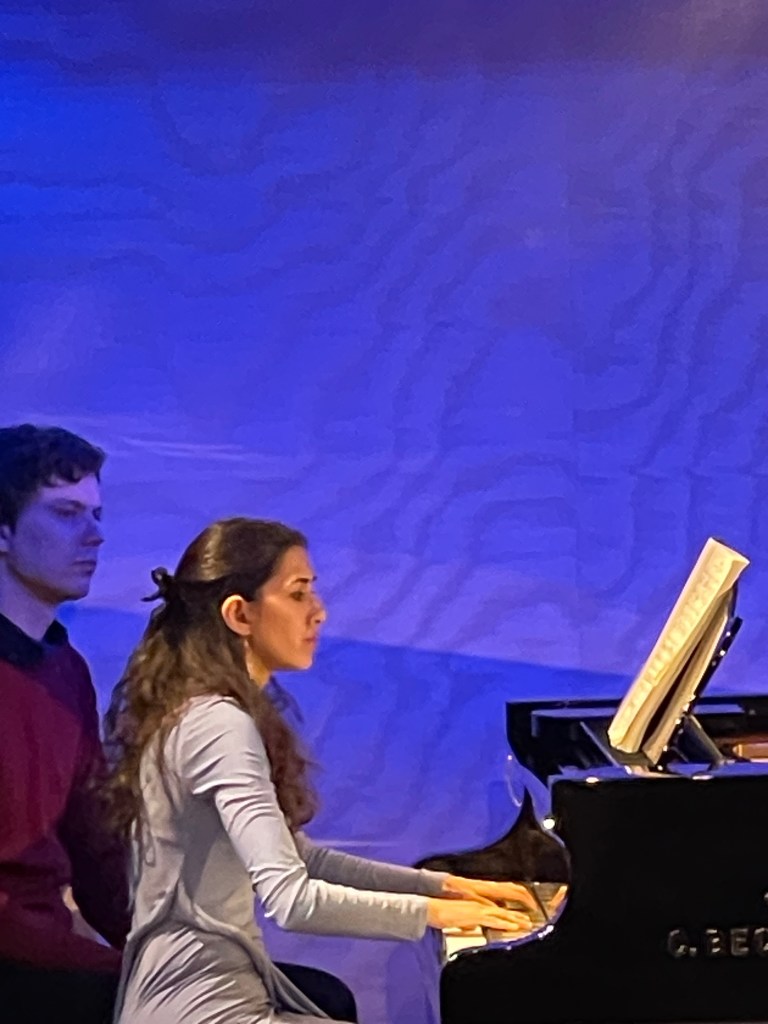
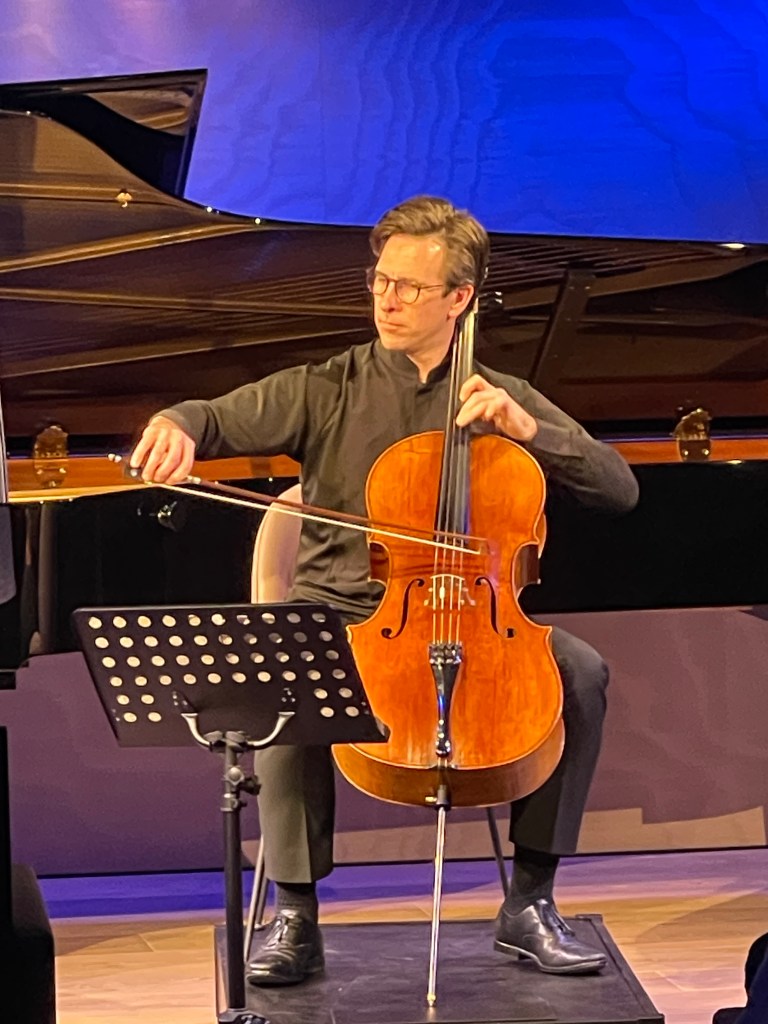
Beethoven in all his glory tonight at Bechstein’s. The first and last cello sonatas, the penultimate twin of op 102 and the virtuoso show piece variations ‘See the conquering hero comes’.
After the deep contemplation of the opening ‘Adagio sostenuto’ this first sonata of Beethoven burst into an outpouring of joy with the sun shining unusually brightly for Beethoven. Even the Allegro Vivace final movement was full of playful energy and shifting colours.Youthful brilliance and exhilarating energy were the hallmarks of a performance that reminded me of that ‘Golden couple’ almost fifty years ago. A light still shining brightly with these two genial musicians.
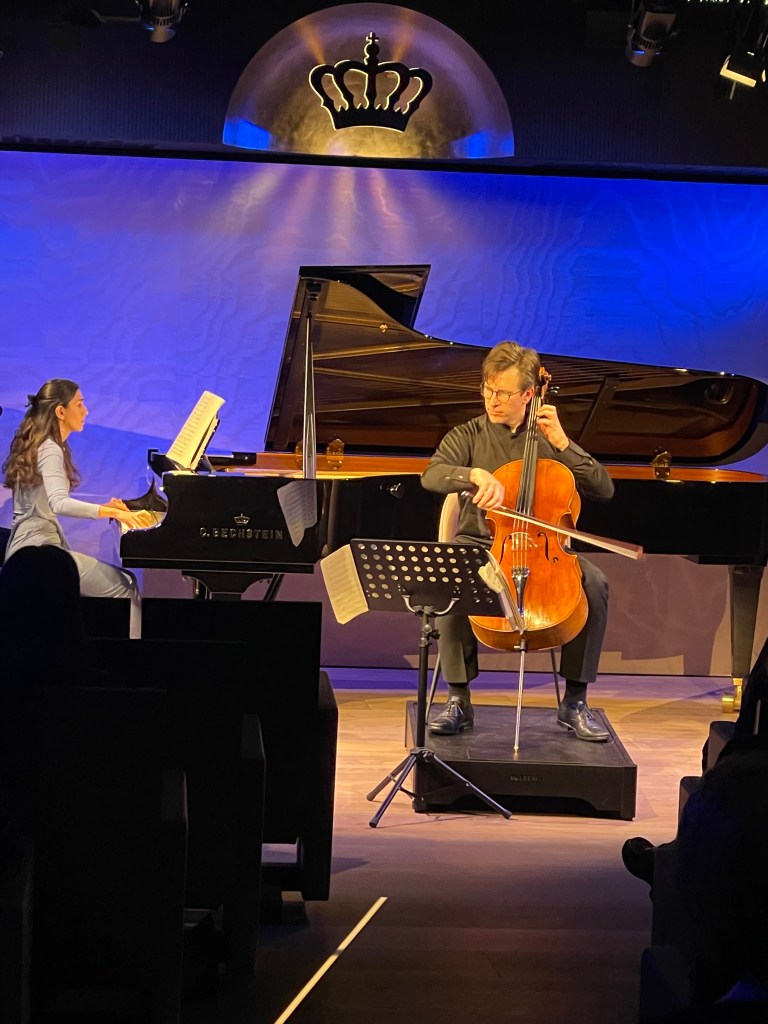
Op 102 n.1 where the plaintive cry of the cello was answered by the simple benediction of the piano before the eruption into the imperious Allegro vivace. It was played with dynamic relentless drive and with its abrupt non nonsense Beethoven ending.The question and answer of the Adagio was followed by the unexpected changes of character in the Allegro vivace in a performance of great authority and musical integrity.
The variations that followed the interval were a series of brilliant show pieces for each instrument with each player trying to outdo the other. The eleventh variation showed the genial invention of Beethoven with the poignancy of the two instruments united in an Adagio that was to point to the final and greatest inspiration of Beethoven with his Sonata op 102 n.2.

It was here, in this final sonata, that both players were inspired to give a mesmerising performance of this great work, from its opening call to arms ( every bit as arresting as the Fifth Symphony) and the Adagio of searing beauty with a deep soulful communion of great poignancy. Played with poise and aristocratic weight, its gentle hints barely whispered of what was to come with the mighty Fugue final movement. A movement played with quite considerable mastery not only technically but above all for the music line that together they could carve out of this monumental construction. Veni Vidi Vici indeed
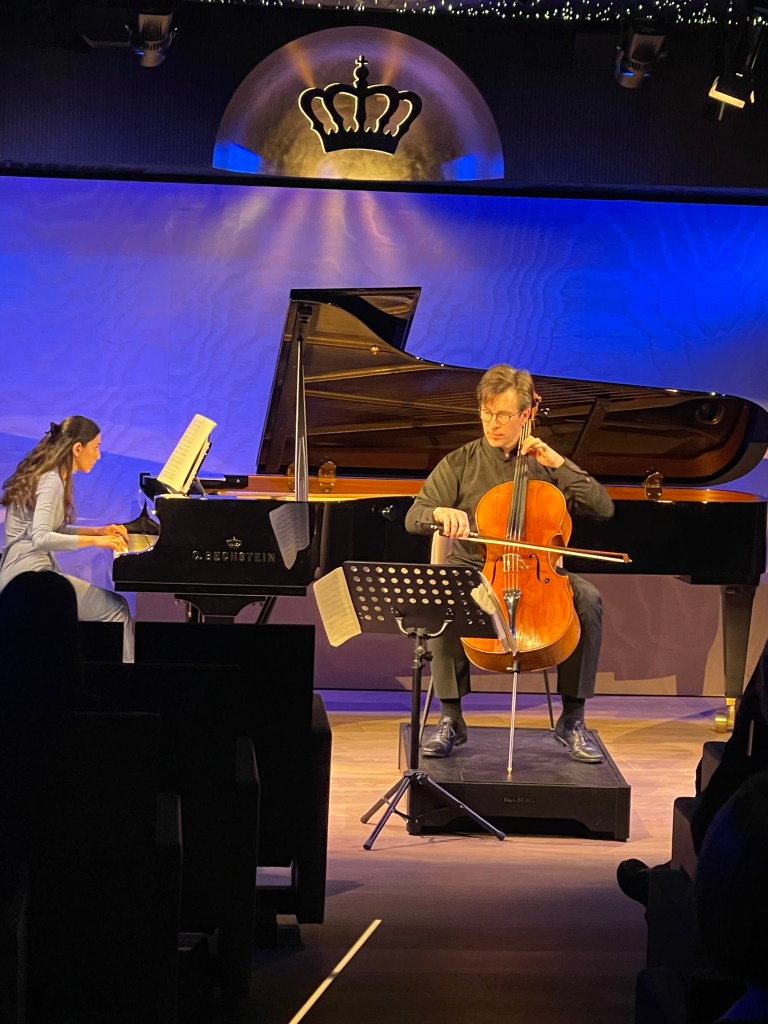

It is this that could well have given the title to performances tonight of dynamic drive and searing intensity.
Guy Johnston and Mishka Momen Rushdie, two players that play as one .
The piano lid fully opened and the cellist using the sound board of the piano to project sounds that rarely we hear in the concert hall united with such vibrancy and energy.

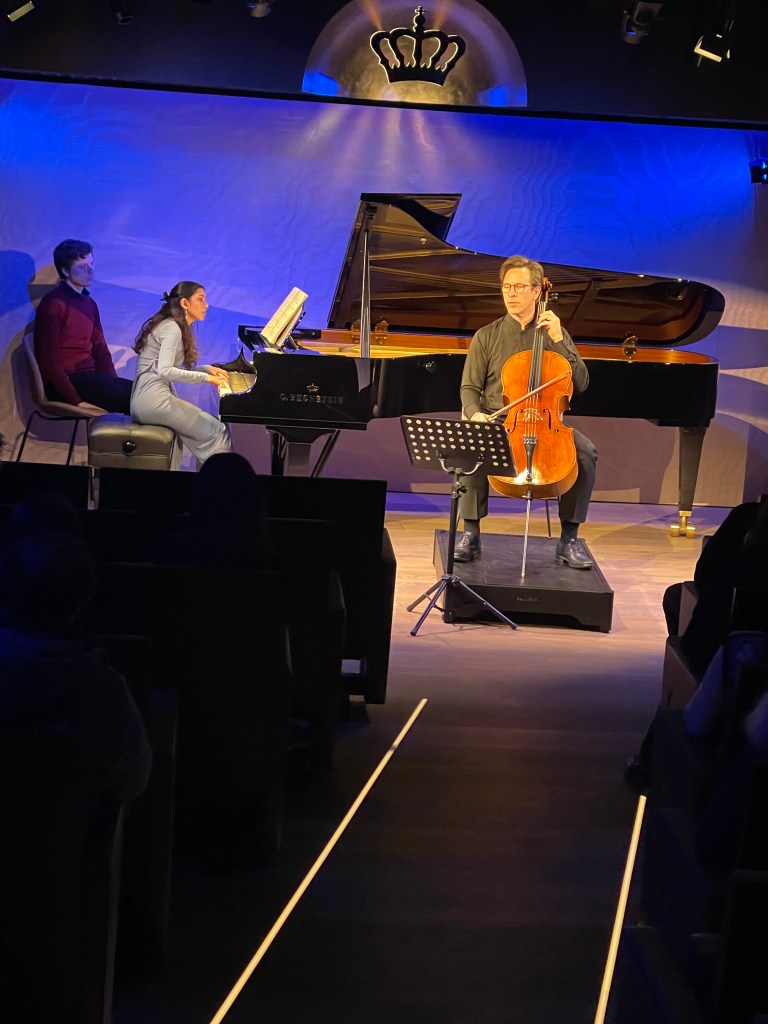
Guy Johnston and Mishka Momen Rushdie are both masters linked inexorably together to bring Beethoven’s thoughts to us ‘hot off the press.’ These were performances in this sumptuous new hall that were born of an intelligence and musical integrity of an age when there was time to dig deep into the very core of the music and extract the meaning that hides behind the seemingly innocuous black and white symbols on the page.
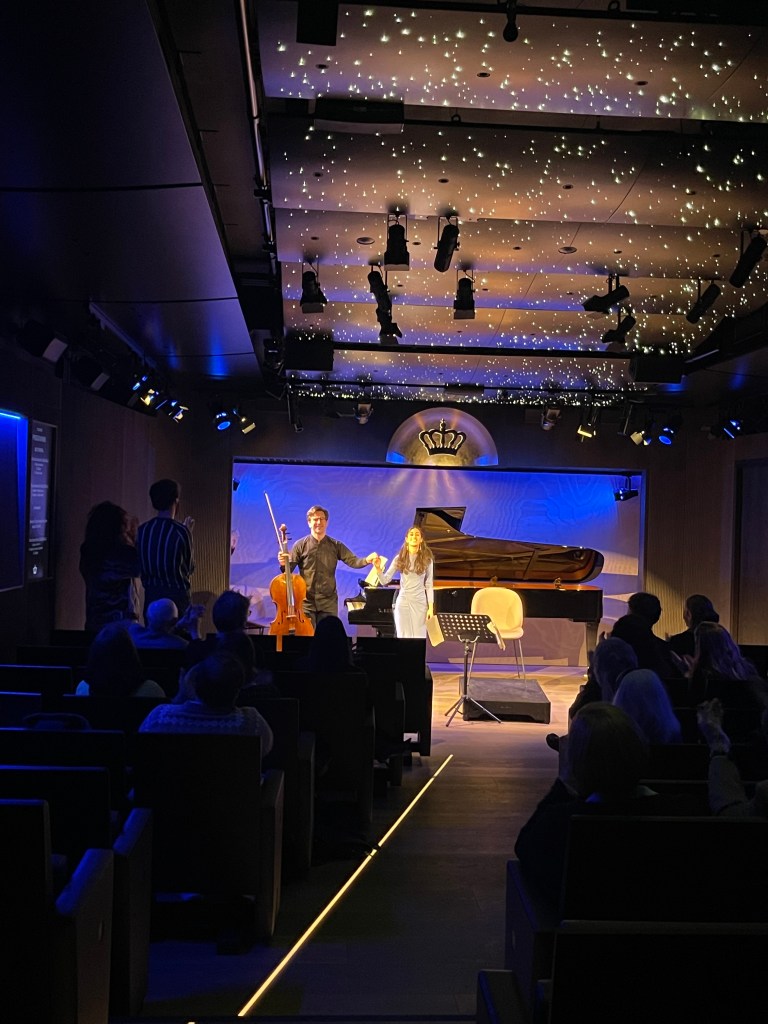

These were performances that in the not too distant past one would travel to Marlborough or Prades to hear and learn from.
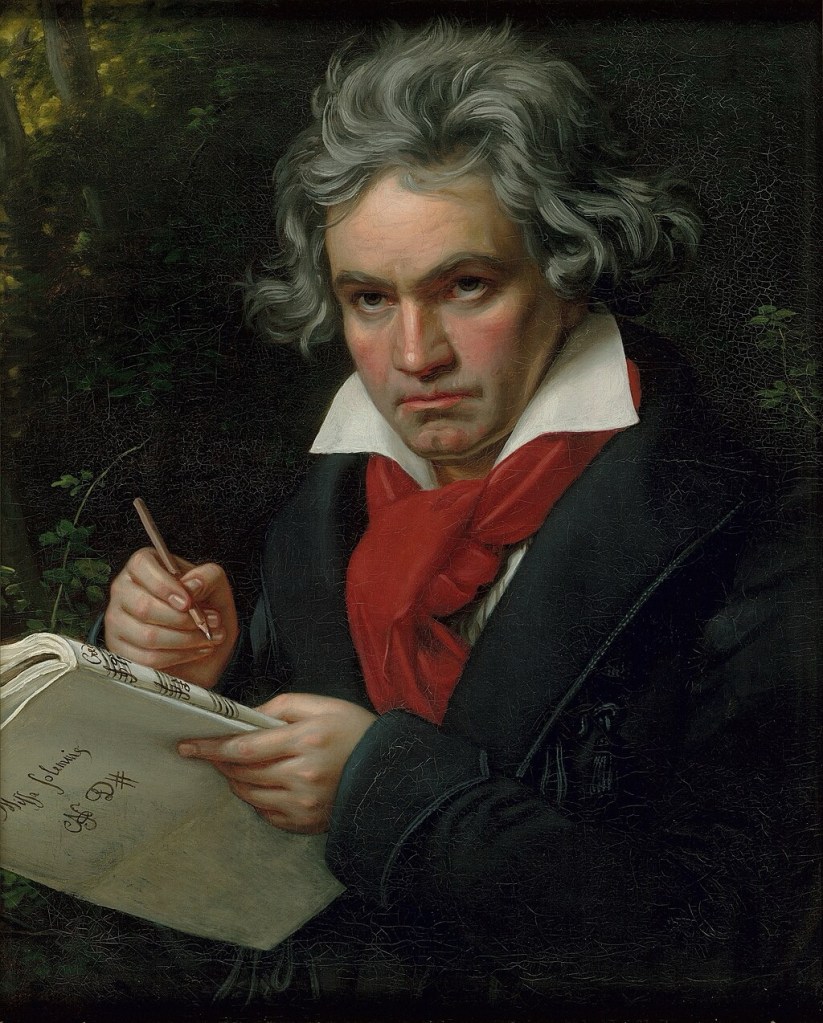
Beethoven composed five sonatas for cello and piano, between 1796 (op. 5 nos. 1–2) and 1815 (op. 102 nos. 1–2)
In February 1796, Beethoven set out on a tour of East-Central Europe, starting with Prague and working his way to Berlin via Dresden and Leipzig. Berlin had been one of Europe’s musical centers but was, by the time Beethoven arrived that May, in dire musical straits. Johann Friedrich Reichardt, the distinguished composer who had brought the city’s musical life to distinction in the 1780s, had been relieved of his post for pro-French-Revolution sympathies. (He apparently let slip that the best kind of king was one with no head during a card-game in Hamburg, something that didn’t exactly thrill his boss, King Friedrich Wilhelm II of Prussia.) Among the few performers of distinction who remained in the Prussian capital was the cellist Jean-Louis Duport, a favorite of the king, who was himself a fine amateur cellist. So it was only natural that Beethoven should write some music for cello and piano during his stay in Berlin. His first two Cello Sonatas, Op. 5, and the Variations on “See the conqu’ring hero comes” from Handel’s Judas Maccabaeus were the results. The Judas Maccabaeus Variations date from this Berlin visit; they, too, were published by Artaria (without an opus number) in 1797. The theme – probably the best-known from Handel’s entire oratorio – was an especially felicitous choice on the part of the young Beethoven. He may not have known it, but Handel occupied a special place in Friedrich Wilhelm’s affections. The king, during his days as crown prince, had declared his musical independence from his predecessor, Friedrich the Great, by sponsoring a massive performance of Handel’s Messiah in the Berlin Cathedral. Beethoven, too, held Handel’s music in the highest esteem. The theme, with its measured tread and lofty bearing, provided the composer with the basis for an engaging set of 12 variations. The eleventh variation, an extended adagio, is the longest “slow movement” Beethoven would write for cello and piano until his final work for the pairing, the Sonata, Op. 102, No. 2.
Nikolaus Kraft (1778-1853) was the eldest son of the cellist Anton Kraft (1749-1820). In 1801 he travelled to Berlin together with his father where he received cello lessons for one year from the virtuoso cellist Jean-Louis Duport (1749-1819), who was employed there at the Prussian court of King Friedrich Wilhelm II. Nikolaus, as well as his father, was also for a time a member of the Schuppanzigh string quartet – named after its founder the violinist Ignaz Schuppanzigh (1776-1830) – which gave a number of first performances of Beethoven’s string quartets.The Krafts were not the only cellists with whom Beethoven worked during his life. In spring of 1796 Beethoven visited the Prussian court in Berlin, where he also met Jean-Louis Duport, and it was there that his op. 5 cello sonatas originated. These sonatas are regarded today as the first ‘true’ sonatas for cello and piano, as the two instruments are given equal importance.Jean-Louis Duport was one of the most influential cellists of his time. In the early 19th century he published a violoncello treatise entitled: Essai sur le doigté du violoncelle et sur la conduite de l’archet (Essay on fingering the violoncello and on the conduct of the bow) (Paris, 1806). This became one of the most influential cello treatises in the history of the cello; the exercises (Études) that are included in it are still practised by cello pupils today.
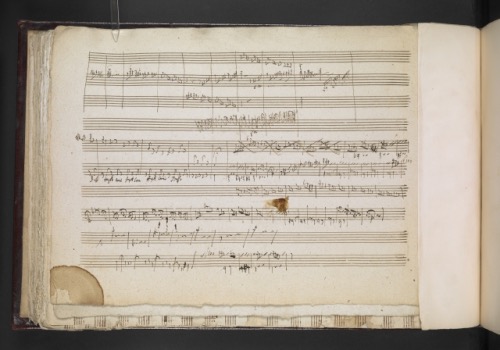

At the time of Beethoven’s visit, Jean-Louis Duport was principal cellist in the opera orchestra and, together with his brother the virtuoso cellist Jean-Pierre Duport (1741-1818), also instructed the king on the cello. Beethoven and Jean-Louis Duport performed his op. 5 cello sonatas for the king, and apparently, Beethoven also intended to dedicate the two sonatas to him. This is evident from a letter, now lost, which Duport sent to him where he wrote: ‘Duport, acknowledges the dedication to him of Beethoven’s two sonatas for piano and violoncello and expresses the wish to play them with the composer’. In the end the op. 5 cello sonatas were dedicated to the King of Prussia, Friedrich Wilhelm II.
The Sonatas for cello and piano No. 4 in C major. op.102, No. 1, and No. 5 in D major, Op. 102, No. 2, were composed simultaneously in 1815 and published, by Simrock, in 1817 and were dedicated to the Countess Marie von Erdödy, a close friend and confidante of Beethoven.
The two sonatas were written between May and December 1815. The first copy by Beethoven’s copyist Wenzel Rampl was made in late 1815 but was then subject to further alterations by Beethoven. A subsequent ‘good’ copy was supplied in February 1816 to Charles Neate for proposed, though unrealized, publication in London. Beethoven then made further small alterations prior to their eventual publication by Simrock in Bonn.
During the period 1812 to 1817 Beethoven, ailing and overcome by all sorts of difficulties, experienced a period of literal and figurative silence as his deafness became overwhelmingly profound and his productivity diminished. Following seven years after the A major op 69 the complexity of their composition and their visionary character marks (which they share with the piano sonata op 101 the start of Beethoven’s ‘third period’.
The critics of the time, were often perplexed by Beethoven’s last compositions: ‘They elicit the most unexpected and unusual reactions, not only by their form but by the use of the piano as well…We have never been able to warm up to the two sonatas; but these compositions are perhaps a necessary link in the chain of Beethoven’s works in order to lead us there where the steady hand of the maestro wanted to lead us.’

He has performed with many leading international orchestras including the London Philharmonic, NHK Symphony Orchestra,BBC Symphony, Deutsches Symphonie-Orchester Berlin, Orquestra Sinfônica do Estado de São Paulo, and St Petersburg Symphony. Recent seasons have included a BBC Prom with BBC National Orchestra of Wales, concertos with The Hallé, Philharmonia Orchestra, Royal Philharmonic Orchestra, Orchestra of Opera North, BBC Symphony Orchestra, Aurora Orchestra, Royal Northern Sinfonia, and Orchestra of The Swan. Most recently, he has been the featured soloist of Taverner’s ‘The Protecting Veil’ for Britten’s Sinfonia 2024 UK and Ireland tour receiving critical acclaim in The Guardian and the Arts Desk.
Performances and recordings with eminent conductors have included collaborations with Alexander Dmitriev, Sir Andrew Davis, Daniele Gatti, Ilan Volkov, Leonard Slatkin, Mark Wigglesworth, Robin Ticciati, Sir Roger Norrington, Sakari Oramo, Vassily Sinaisky, Yan Pascal Tortelier and Yuri Simonov.
Guy is a passionate advocate for chamber music and recitals as founding Artistic Director of the Hatfield House Music Festival and performs regularly at prestigious venues and festivals across Europe including Wigmore Hall, Louvre Museum, the Moscow Tchaikovsky Conservatory, and Three Choirs Festival, collaborating with instrumentalists such as Anthony Marwood, Brett Dean, Huw Watkins, Janine Jansen, Kathy Stott, Lawrence Power, Melvyn Tan, Mishka Rushdie Momen, Sheku KannehMason and Tom Poster.
A prolific recording artist often championing contemporary British composers, Guy’s recent releases include Dobrinka Tabakova’s Cello Concerto with The Hallé and Rebecca Dale’s ‘Night Seasons’ with the Philharmonia Orchestra. Other recordings include a premiere of Herbert Howells’ completed Cello Concerto with the Britten Sinfonia, a celebration disc of the tricentenary of his David Tecchler cello with commissions by Charlotte Bray, David Matthews, Mark Simpson and a collaboration with the acclaimed Orchestra dell’Accademia Nazionale di Santa Cecilia in Rome, where the cello was made. 2025 will bring forth Guy’s latest recording of Xiaogang Ye’s My Faraway Nanjing with the Royal Liverpool Philharmonic Orchestra.
He gave the premiere of Charlotte Bray’s ‘Falling in the Fire’ at the BBC Proms and Joseph Phibbs ‘Cello Sonata’ at Wigmore Hall. His 2024/2025 season will see the world premiere of Joseph Phibbs’ Cello Concerto for Guy and the BBC Symphony Orchestra. Other premières include Emma Ruth Richards ‘Until a Reservoir no longer remains’ and a recording of Matthew Kaner’s solo suite for cello.In addition to a busy and versatile career as an international soloist, chamber musician and guest principal, Guy is an inspiring leader of young musicians. He was Associate Professor of Cello at the Eastman School of Music in Rochester, New York (2018-2024) and a guest Professor of Cello at the Royal Academy of Music, where he was awarded an Hon. ARAM in 2015. He has recently been appointed President of the European String Teachers Association and is patron of several charities which promote music education for school children and young people including Music First and Future Talent. He is also a board member of the Pierre Fournier Award for young cellists.
Guy Johnston plays the 1692 Antonio Stradivari cello known as the “Segelman, ex Hart” kindly loaned to him through the Beare’s International Violin Society by a generous patron. He is a Larsen Strings Artist.
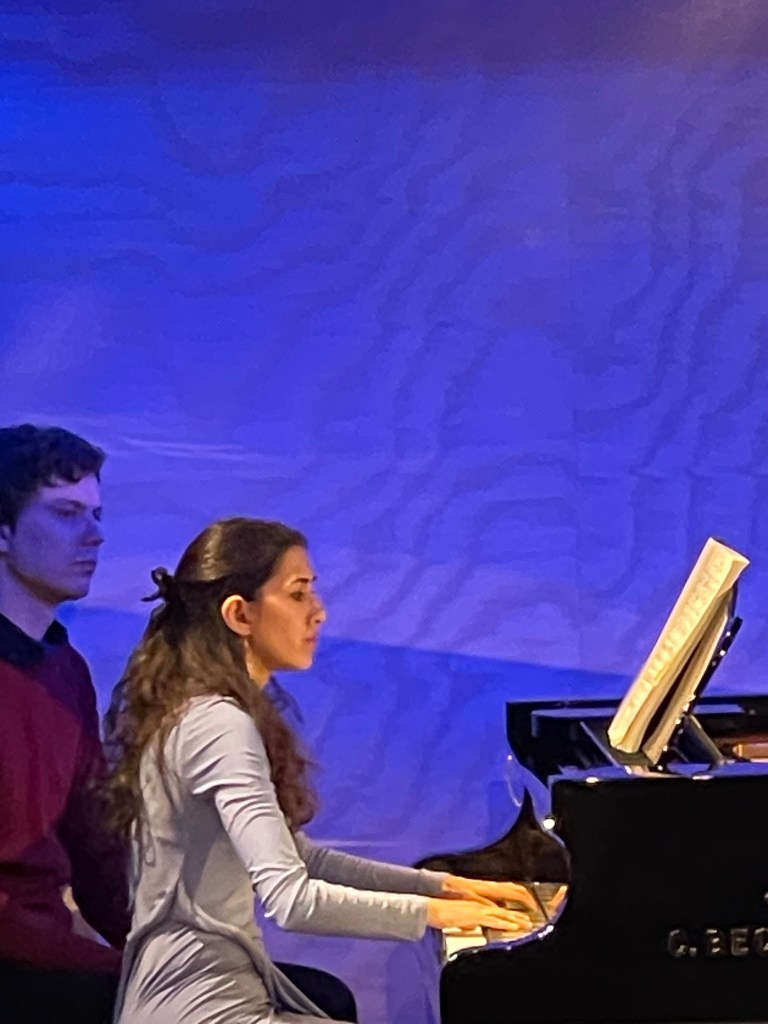
Mishka Rushdie Momen’s wide repertoire focuses on Mozart, Beethoven, Schubert, and Schumann, whilst reaching back to Gibbons and Rameau. Committed to performing new music, Mishka Rushdie Momen has commissioned works by Nico Muhly and Vijay Iyer, and premiered An Inviting Object by Héloïse Werner at the Lucerne Summer Festival in 2022.
Recent and upcoming concerto highlights include debuts with The Royal Danish Opera, London Philharmonic Orchestra, Turku Philharmonic Orchestra and Mannheim Chamber Orchestra. Further orchestral engagements to date include City of Birmingham Symphony Orchestra, Deutsche Kammerakademie Neuss, Orchestre National d’Ile de France, Britten Sinfonia and play/directing Mozart K.271 with Luzerner Sinfonieorchester, working with Dinis Sousa, Anu Tali, Paul Meyer, Case Scaglione and Natalia Ponomarchuk. Rushdie Momen’s recital highlights include performances atHamburg Elbphilharmonie, Lucerne Festival, Tonhalle Zurich, Wigmore Hall, Antwerp’s deSingel, Guggenheim Museum Bilbao and Leeds Piano Competition and, in the US, Philadelphia Chamber Music Society, Phillips Collection in Washington DC, New York’s 92Y, Carnegie Hall, Portland Piano and The Maestro Foundation in Santa Monica. Her 24/25 recitals include Wigmore Hall, Royal Welsh College of Music and Drama, Aldeburgh Festival, and the re-opening festival of the Frick Collection in New York.
Equally at home as a chamber musician, Rushdie Momen’s chamber partners include Ian Bostridge, Mark Padmore, Joshua Bell, Midori, Angela Hewitt, Steven Isserlis, Timothy Ridout and Zlatomir Fung, with festival performances including Rheingau Festival, Gstaad Menuhin Festival, Oeiras International Piano Festival, Chamonix Vallée Classics, Hindsgavl, Chipping Campden, Trasimeno Festival, the new Casals Forum at Kronberg, and IMS Prussia Cove.
Rushdie Momen’s latest release Reformation (Hyperion, 2024) presents the works of William Byrd, John Bull, Orlando Gibbons and Jan Pieterszoon Sweelinck, performed on the modern piano. The album was described in The Times’ selection of the best releases of 2024 as “a triumph”, as “quietly beguiling” (The Guardian) , “performed with thrilling exuberance and subtlety” (The Spectator), topped the Classical Charts in July 2024 and was chosen as a Classic FM Discovery of the Week.
Her debut solo recording, Variations, was released in October 2019 by SOMM Recordings, featuring works by Robert and Clara Schumann, Brahms, and Mendelssohn. Mishka Rushdie Momen was The Times Arts critics’ chosen nominee in the field of classical music for their 2021 Breakthrough Award, given by Sky Arts and The South Bank Show, who profiled her for an episode of the programme broadcast in July 2021
Mishka Rushdie Momen studied with Joan Havill and Imogen Cooper at the Guildhall School of Music and Drama. She also studied periodically with Richard Goode, and at the Kronberg Academy with Sir András Schiff, who has presented her in recital and orchestral dates across the USA and Europe. Mishka Rushdie Momen’s studies at the Kronberg Academy were generously funded by the Henle Foundation.
Mishka Rushdie Momen a timeless message of comfort and beauty
https://christopheraxworthymusiccommentary.com/2021/04/30/mishka-rushdie-momen-a-timeless-message-of-comfort-and-beauty/

