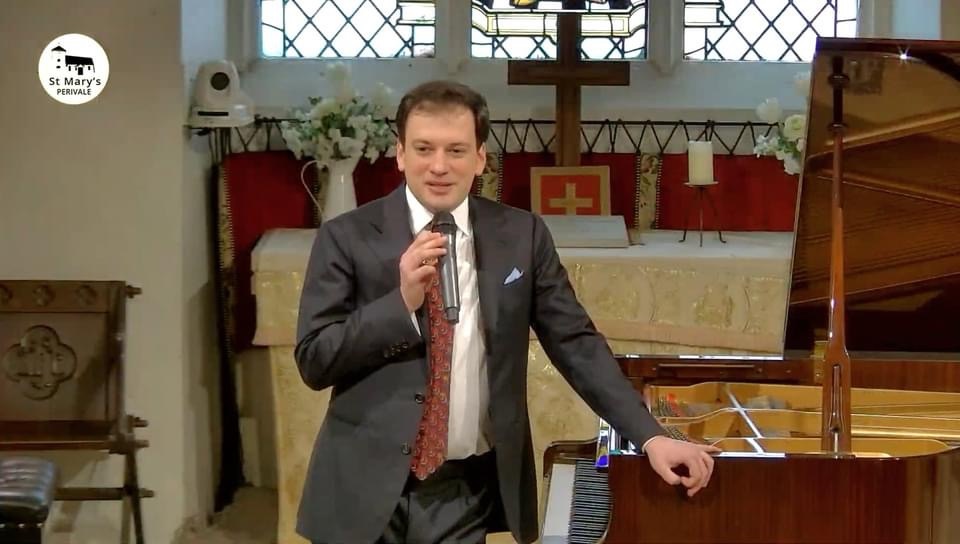

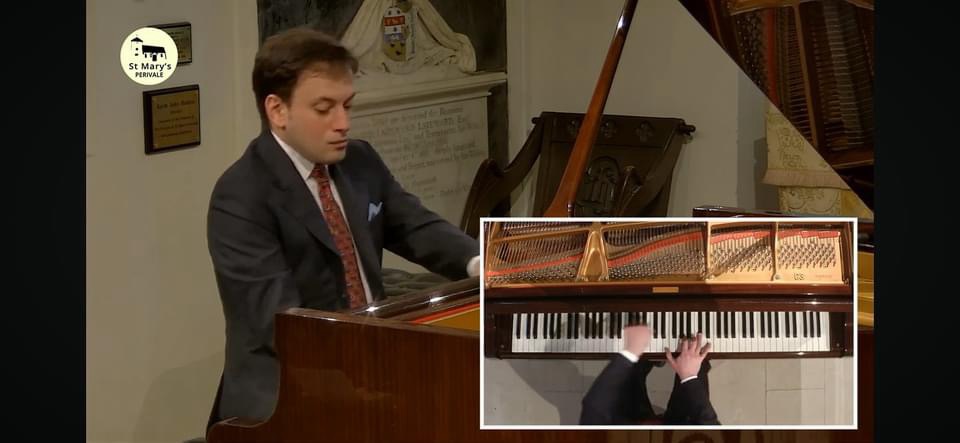
Playing of great authority and aristocratic bearing from Mihai Ritivoiu who at only thirty hours notice had agreed to give this recital that was to be broadcast on live streaming .I have known Mihai since the time I heard a young pianist play the Polonaise Fantasy by Chopin in a Masterclass of Richard Goode at the Guildhall .I remember being so impressed that I asked Ronan O ‘Hora who he was. Ronan is head of keyboard at the Guildhall and a master pianist in his own right and we have a bond between us that all disciples of Vlado Perlemuter maintain.I had just decided to spend as much time in the UK as in Italy and to maintain the same interest in talented young musicians that I had nurtured for thirty years in Rome.Offering opportunities for neglected musicians Old and New in the Eternal city where I was running a theatre that I created with my actress wife next to St Peter’s Square.
Christopher Axworthy Dip.RAM ,ARAM
I have since become involved with the Keyboard Trust where much of my activity now is centred in helping young musicians find a platform in between graduating from the various music Academies and taking the first steps on the very steep ladder to a career in music.About ten years ago I was invited by Alberto Portugheis,the then President of the Beethoven Society in London to be part of a jury of their Beethoven Prize, together with Piers Lane and Noretta Conci ( founder of the Keyboard Trust ).Amongst the very fine artists there was one that shone more brightly than the others – a student of Joan Havill – Mihai Ritivoiu with a magnificent performance of Beethoven’s Appassionata.From that victory Mihai was taken under the wing of many institutions created to help young musicians and of course he was invited for the Keyboard Trust to play in a very important concert in the Travellers Club in the presence of Sir Antonio Pappano.I have since heard him play many times and even followed in streaming his performances with orchestra at the Enescu Festivals in his homeland of Romania and also appearances with orchestra at the Cadogan Hall here in London.I had heard him quite recently play in the Liberal Club in London in a series run by a pianist colleague and co-national,Cristian Sandrin.It was a very impressive performance of the young aspiring pianist who had matured into an artist of stature and authority.It was the same pianist who performed today but there was even more of an aristocratic bearing.This young student has indeed matured as man and musician and he created a presence not only with his playing but also with his bearing and appearance that commanded attention.
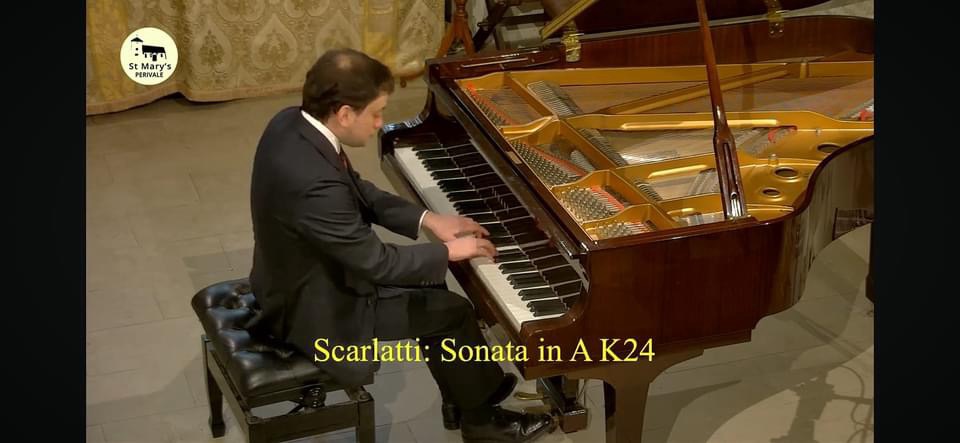
This is indeed an artist to be reckoned with and his sense of style and kaleidoscopic sense of colour allied to an impeccable musicianship ( as you would expect from the class of Joan Havill – Fou Ts’ongs words not only mine) bring everything he plays vividly to life with simplicity and sumptuous beauty.From the very first notes of the Scarlatti Sonata in A K 24 it was obvious that here was an artist that could turn one of 555 sonatas into a miniature tone poem of vibrancy and scintillating subtlety.There was an architectural shape but also a luminous sound of great purity.This was a stylist and master musician that as Joan Chissell would say ‘could turn a bauble into a gem’.

Beethoven too the Sonata in D op 10 n.3 with it’s profoundly moving Largo e mesto of such maturity and poignant beauty.This is one of the first of the Sonatas where Beethoven truly breaks away from his master Haydn and allows the sonata to evolve as it was to do over Beethoven’s lifetime in 32 steps.The slow movement reveals the genius of Beethoven as he had already hinted at in the sonatas op 2 n.3 and op 7.Mihai played this movement with poignant weight and beauty with a full orchestral sound where one was made aware that this was a symphony on the piano.Not just the simple melody and accompaniment but where every strand of counterpoint or accompaniment has a meaning and an important role to play.There was ravishing beauty of the return of the opening theme where the full whispered richness of string quartet quality was so poignant with ‘rinforzandi’ within the notes themselves.The deep bass notes of the coda with the washes of sound above gaining in searing intensity until the bubble broke and we descended into a paradise of subtle sounds.The two whispered final appogiaturas are answered by a barely audible D deep in the heart of the piano.There followed a beautifully pastoral Menuetto and bucolic Trio played in the style of it’s age.The gentle questioning of the final Rondo as the intervening episodes became ever more rumbustuous and full of refined jeux perlé always with the insistence of the opening question present as it blew itself out with scintillating nonchalant ease.

It was the same ease and refined beauty that Mihai brought to the Fauré Ballade .I have often regretted not asking Perlemuter why it was not in his repertoire as he lived in the same house or just next door to the composer and would often play through the nocturnes for the composer with the ink still wet on the page.As Mihai says it a beautiful early work that for some strange reason has not entered the standard concert repertoire.Especially hard to understand when you hear a performance as the one today with its cascades of notes that were quite simply strands of colour illuminating the very individual voice of Fauré.There was a great sweep of harmonic colour out of which emerged the bitter sweet melodic invention added to great intensity and excitement. From the bel canto opening like the Chopin Berceuse to the increasing intensity and build up of sumptuous sounds all played with the aristocratic control that the composer demands.The beauty is in the music not on the surface and playing with the weight of an organist there are sounds to be cherished that are not immediately apparent to lesser mortals! Mihai and Louis Lortie earlier this season have both shown us a Fauré that makes it seem incredible that he is still one of the most misrepresented composers today.
Louis Lortie pays ‘Hommage à Fauré’ ‘À la recherche du temps perdu’
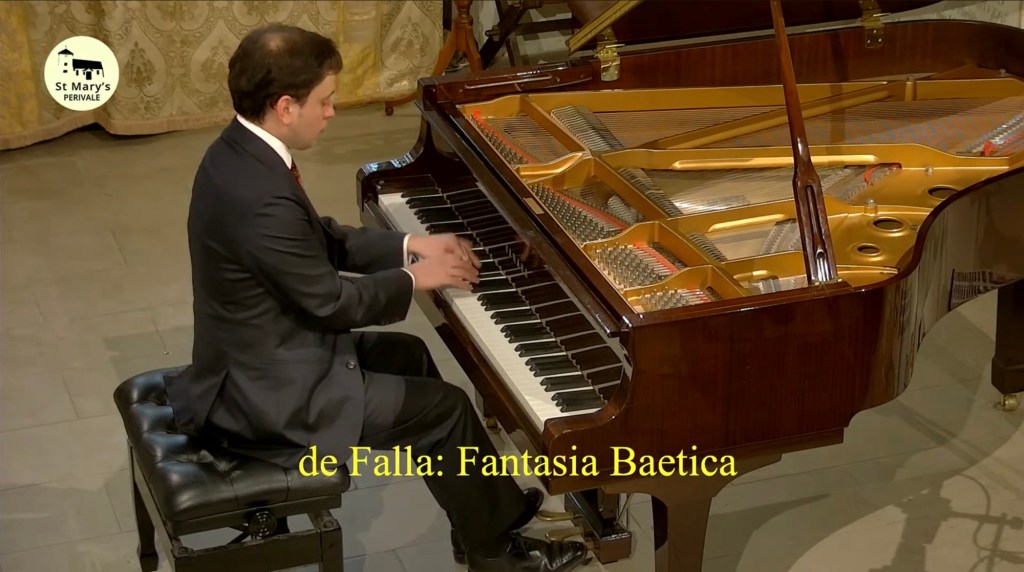
I remember Aquiles delle Vigne giving me the urtext edition of the Fantasia Betica with the dedication to Artur Rubinstein who rarely played it as he complained it was too long!
Aquiles delle Vigne una vita per la musica
Mihai today brought this work vividly to life and it certainly did not seem too long because there was such an extraordinary palette of colours that every episode was like a new chapter in a thrilling novel. A voyage of discovery with a range of sounds from the shrill hard edges and gleaming glissandi to the gently whispered pluck of the guitar strings and the mighty oceans of sound leading so hysterically to the chiselled final notes and stamp of the feet. A remarkable performance that makes me question the validity of Rubinstein’s remark. Certainly Mihai’s performance did not seem too long today .On the contrary I would have readily listened to it all over again!
There is a story of Rubinstein playing the Ravel Valses nobles e sentimentales in Spain that was greeted with boos and hisses.He quite simply sat down at the piano and instead of the expected Ritual Fire Dance he played them the ‘Valses’ all over again!
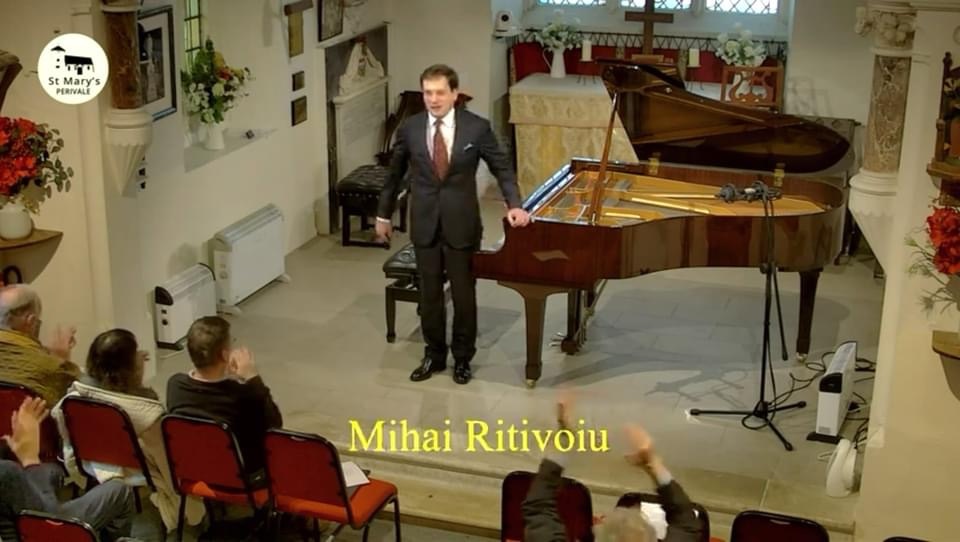
Born in Bucharest, the London-based Romanian pianist Mihai Ritivoiu is alaureate of numerous national and international competitions, most notably the George Enescu International Competition. Mihai leads an international career performing solo and chamber music recitals in Europe and Asia, and has played concertos with the George Enescu Philharmonic Orchestra, Lausanne Chamber Orchestra, the English Chamber Orchestra and MDR Leipzig, and with conductors such as Joshua Weilerstein, Robert Trevino, Michael Collins, Cristian Mandeal, Christian Badea and Horia Andreescu. He has been invited to play at prestigious festivals, including Young Euro Classic in Berlin and the Enescu Festival in Bucharest, and has performed in halls such as the Barbican Centre, Wigmore Hall, Cadogan Hall, Konzerthaus Berlin, Studio Ernest Ansermet Geneva, the Radio Hall andthe Romanian Athenaeum in Bucharest He appeared live multiple times on BBC Radio 3’s programme ‘In Tune’,and his performances have been broadcast by Radio Romania MuzicalRadio Television Suisse and Medici TV. His debut album, released under the label Genuin with solo works by Franck, Enescu and Liszt, has been praised as “beautifully recorded, handsomely played – a solo recital to cherish” (The Arts Desk).A graduate with the highest honours from the National University of Music in Bucharest and the Guildhall School of Music & Drama in London, Mihaistudied with Professors Viniciu Moroianu and Joan Havill. He took masterclasses with Dmitri Bashkirov, Dominique Merlet, Emmanuel Ax, Richard Goode, Jean-Claude Pennetier and has been mentored by Valentin Gheorghiu and Christopher Elton. In addition to his solo career, Mihai is passionate about chamber music. Throughout the years he has played with Corina Belcea, Antoine Lederlin,Roland Pidoux, Alexander Sitkovetsky, Bernhard Naoki Hedenborg andOleg Kogan. Mihai became a City Music Foundation artist in 2016. He has also received generous support from the Liliana and Peter Ilica Foundationfor the Endowment of the Arts, Erbiceanu Cultural Foundation and Ratiu Family Charitable Foundation.
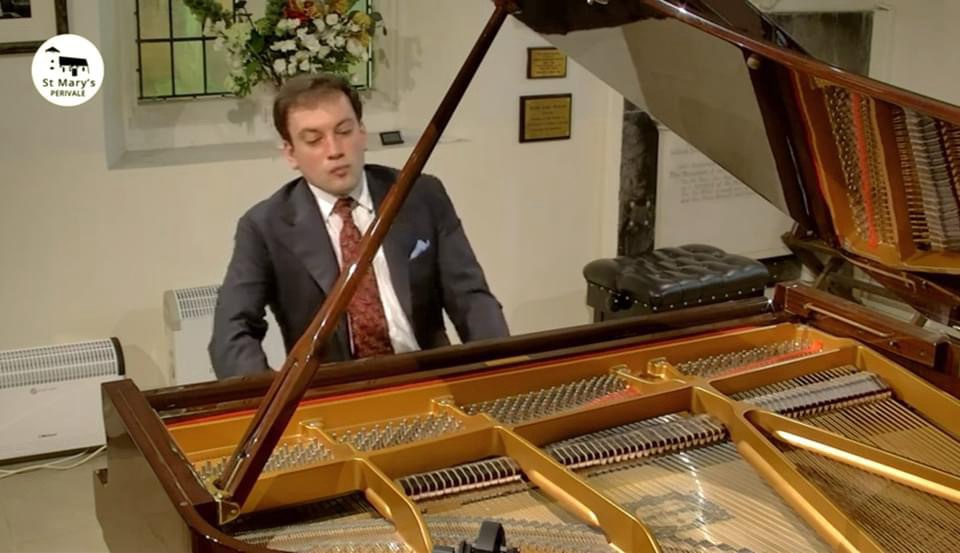
Mihai Ritivoiu’s triumphant recital signals a musical renaissance at the National Liberal Club
Mihai Ritivoiu at St Martin in the Fields Simple great Beethoven from a musician who thinks more of the music than himself
Ballade in F♯ major, Op. 19
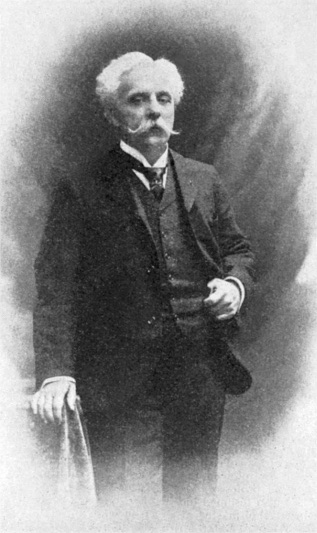
In the rigid official musical establishment of Paris in the second half of the 19th century Gabriel Fauré won acceptance with difficulty. He was a pupil of Camille Saint-Saëns at the École Niedermeyer and served as organist at various Paris churches, including finally the Madeleine, but had no teaching position until 1897, at the Conservatoire, where his pupils included Ravel and Enescu. In 1905 he became director of the Conservatoire in the aftermath of the scandal of the Prix de Rome being refused to Ravel, and he introduced a number of necessary reforms. He retired in 1920, after which he was able to devote himself more fully again to composition, producing notably two final chamber works: a Piano Trio and a String Quartet. He died in Paris in 1924.
He grew up, a rather quiet well-behaved child, in an area of great beauty. … But the only thing he remembered really clearly is the harmonium in that little chapel. Every time he could get away I ran there :’and I regaled myself. … I played atrociously … no method at all, quite without technique, but I do remember that I was happy; and if that is what it means to have a vocation, then it is a very pleasant thing.’ An old blind woman, who came to listen and give the boy advice, told his father of Fauré’s gift for music.He sent him to the École Niedermeyer de Paris which Louis Niedermeyer was setting up in Paris.When Niedermeyer died in March 1861, Camille Saint Saens took charge of piano studies and introduced contemporary music, including .Fauré recalled in old age, “After allowing the lessons to run over, he would go to the piano and reveal to us those works of the masters from which the rigorous classical nature of our programme of study kept us at a distance and who, moreover, in those far-off years, were scarcely known. … At the time I was 15 or 16, and from this time dates the almost filial attachment … the immense admiration, the unceasing gratitude I [have] had for him, throughout my life.”The close friendship between them lasted until Saint-Saëns died sixty years later.Roger Ducasse wrote ‘More profound than Saint-Saëns, more varied than Lalo, more spontaneous than d’Indy, more classic than Debussy, Gabriel Fauré is the master par excellence of French music, the perfect mirror of our musical genius’
The Ballade, dedicated to Camille Saint – Saens dates from 1877, and is considered one of the three masterpieces of his youth, along with the first violin sonata and the first piano quartet .It is one of Fauré’s most substantial works for solo piano, but is better known in a version for piano and orchestra that he made in 1881 at Liszt’s suggestion.Playing for a little over 14 minutes, it is second in length only to the Thème et variations.Fauré first conceived the music as a set of individual pieces, but then decided to make them into a single work by carrying the main theme of each section over into the following section as a secondary theme.The work opens with the F♯ major theme, an andante cantabile, which is followed by a faster section, marked allegro moderato, in E♭ minor. The third section is an andante introducing a third theme. In the last section, an allegro, a return of the second theme brings the work to a conclusion where the treble sings with particular delicacy.
Fauré appears to have first conceived his Ballade in
the late 1870s as a series of related short pieces, rather
in the tradition of Schumann. But in a letter of
September 1879, he explained that the central B-major
allegro had become ‘a kind of alliance between [piano
pieces] nos. 2 and 3. That is to say, by using new but
old methods I have found a way of developing the
phrase of no. 2 [the E-flat minor allegro moderato] into
a sort of interlude, and at the same time stating the
premises of no. 3 [the concluding allegro moderato,
with its bird-call trills] in such a way that the three
pieces become one. It has thus turned into a Fantasy
rather out of the usual way.’
Marcel Proust knew Fauré, and the Ballade is thought to have been the inspiration for the sonata by Proust’s character Vinteuil that haunts Swann in In Search of Lost Time .Debussy reviewing an early performance of the Ballade, compared the music with the attractive soloist, straightening her shoulder-straps during the performance: “I don’t know why, but I somehow associated the charm of these gestures with the music of Fauré himself. The play of fleeting curves that is its essence can be compared to the movements of a beautiful woman without either suffering from the comparison.” Bryce Morrison describes the Ballade as “a reminder of halcyon, half-remembered summer days and bird-haunted forests”.
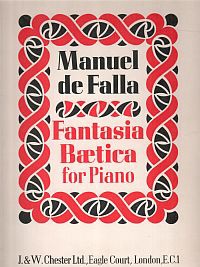
Fantasía bética, or Andalusian Fantasy, was written in 1919 evoking the old Roman province of Baetis in southern Spain, today’s Andalusia. It was commissioned by Artur Rubinstein ,who planned to perform it in Barcelona that year but did not learn it in time and so wound up giving the premiere in New York on 20 February 1920; as it turned out, he would play it only a few times before dropping it from his repertory without recording it and years later he explained to the composer that he found it too long … It was Falla’s last major piano work and the only one that belongs to the virtuoso tradition in which Falla the pianist had been trained. ‘Guitar figurations transformed into pianistic terms abound … other passages evoke the harpsichord, Scarlatti as it were, rewritten by Bartók.’ Beyond that are the smoky, heavily ornamented lines of flamenco singers and the tightly controlled gestures of Andalusian dancing, the whole work adding up to a marvellously varied and vigorous portrait of Spain. From the structural point of view Falla’s ‘internal rhythm’, which he explained as ‘the harmony in the deepest sense of the word born of the dynamic equilibrium between the sections’. Any attempt to shorten the work would have blunted its impact.
The abstract, large-scale work is a celebration of Andalusian culture and history, but not an historical evocation. Its influences draw from Falla’s knowledge and experience of the the flamenco culture that evolved in Andalusia.
Provinicia Baetica was the old Roman name for Andalusia and so a translation of the title might be “Andalusian Fantasy.” Although the materials used are original with Falla, they strongly evoke the folk music of southern Spain:
the strident, sombre cante jondo sung in oriental-sounding scales, chords derived from guitar tunings, and a harsh percussive quality reminiscent of castanets and heel stamping.
The tonal originality of the Baetica is a result of Gypsy, ‘Middle Eastern’, Sephardic, Indian and subtle French influences woven into the harmonic language.

Manuel de Falla was born in 1876 into a reasonably affluent family in Cádiz, where music was confined to annual performances of Haydn’s The Seven Last Words, occasional visits by grand opera companies, and folk songs—not as museum pieces, but as living elements of Spanish life. By 1896 the family fortunes had diminished and they moved to Madrid, where Falla entered the conservatoire and began to compose zarzuelas, the Spanish form of operetta. But his eyes were set on Paris and in 1907 he began a seven-year stay, making friends with Debussy, Ravel and Dukas. He had already begun the Cuatro piezas españolas in Madrid, but they were brought out in 1909 by the Parisian publisher Durand on the recommendation of the three above-named composers. Despite the obvious debt to Albéniz, also in Paris at the time and the dedicatee of the pieces, Falla’s mixture of harmonic invention and elegant counterpoint is unfailingly captivating, banishing any hint of the boredom that might otherwise accrue from the insistent Spanish dance rhythms. His tunes too recall Spanish folk music with its repeated notes and small intervals, but his textures are in general more economical than those of Albéniz.
The opera La vida breve was written in 1904–5 but not performed until 1913. It includes two Spanish dances which have subsequently achieved a life of their own. The first, which opens the second act, was published in a variety of settings, including transcriptions for piano solo and four-hand duet by the composer, and with the music from the end of the scene as Interludio y Danza for orchestra. It was also arranged by Fritz Kreisler for solo violin and piano (as Danza española) in 1926.
 ChristopherAxworthy-MusicCommentary