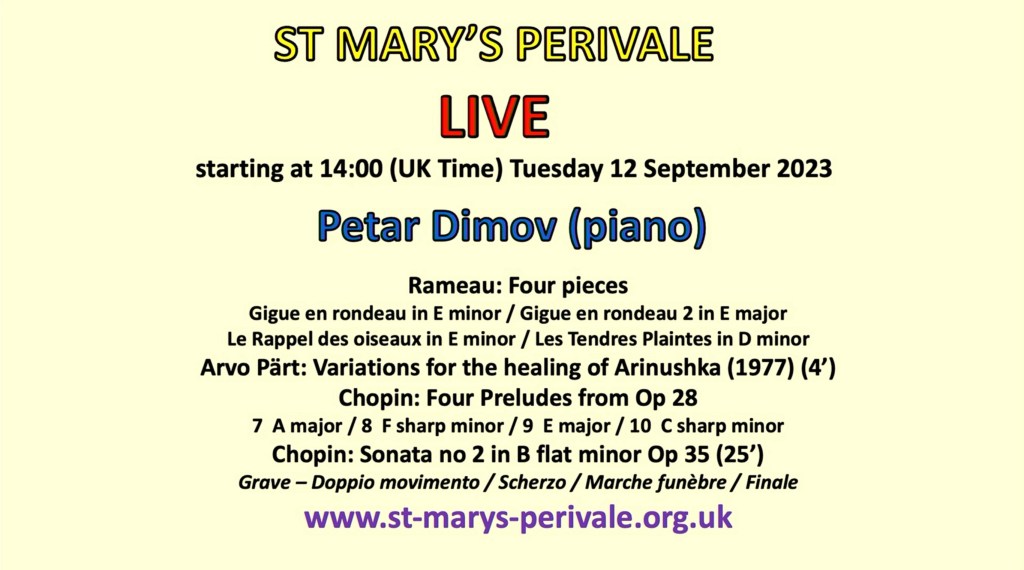
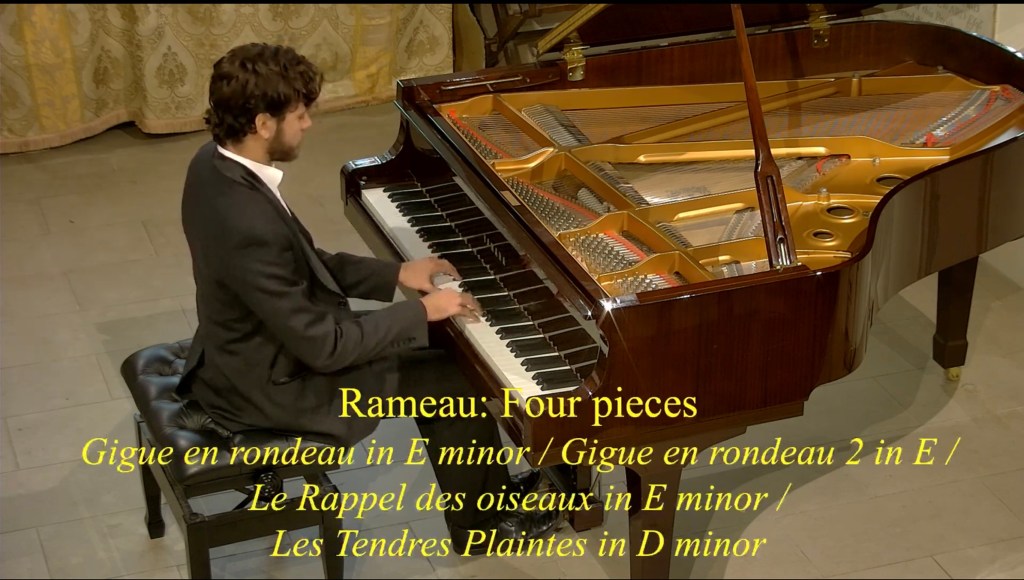
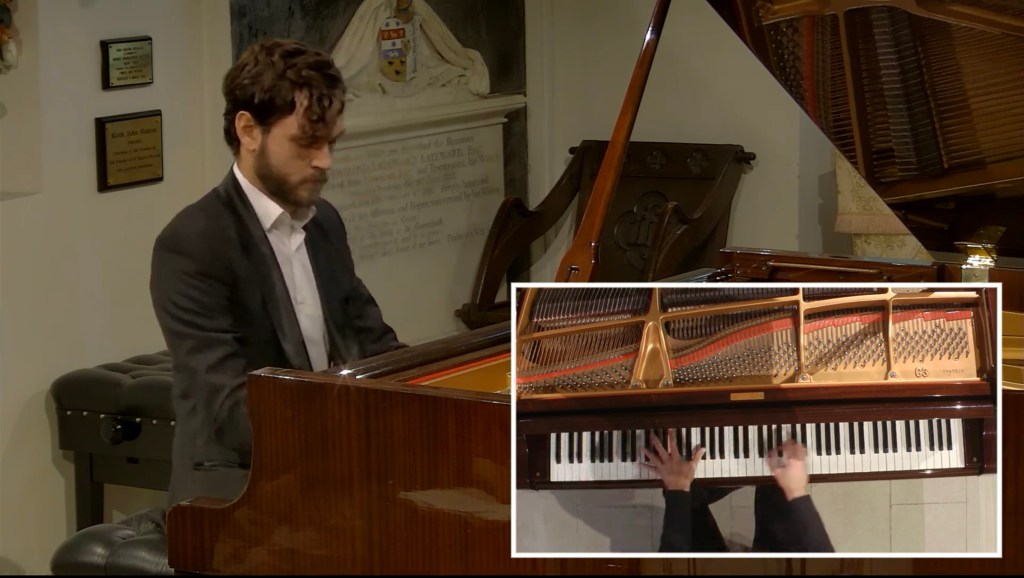
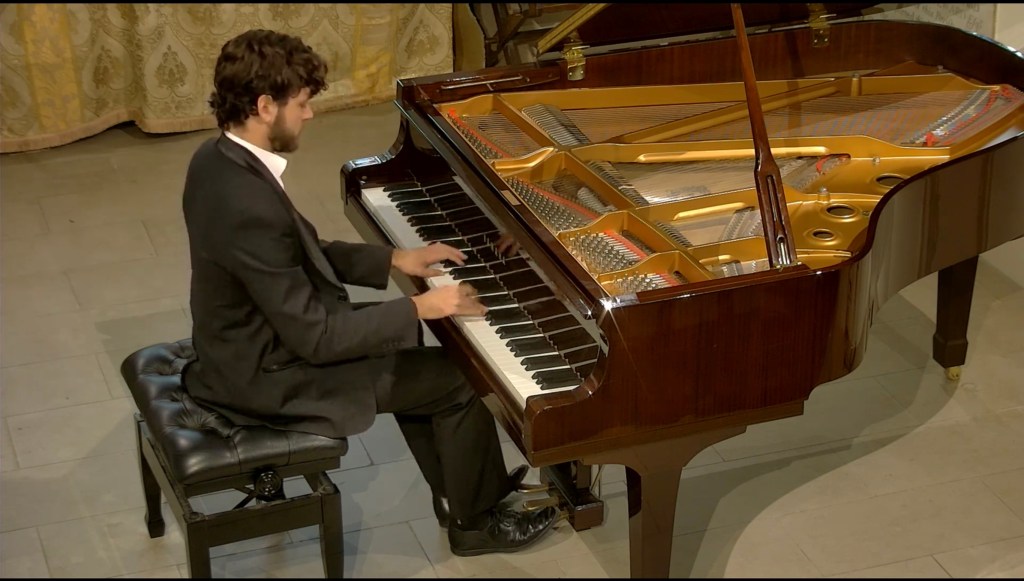
A beautiful programme that showed immediately that we were to be in the sensitive hands of a true musician .A choice of pieces by Rameau full of character and rhythmic drive but also of tenderness and colour as each picture was painted by an artist with a clear visionary view of these miniature masterpieces.A sense of fluidity and freedom that brought these miniature tone poems vividly to life.There was a fluidity to Les Tendres Plaintes that was played with great expression and whispered beauty immediately transformed into the atmospheric sound world of Arvo Part.
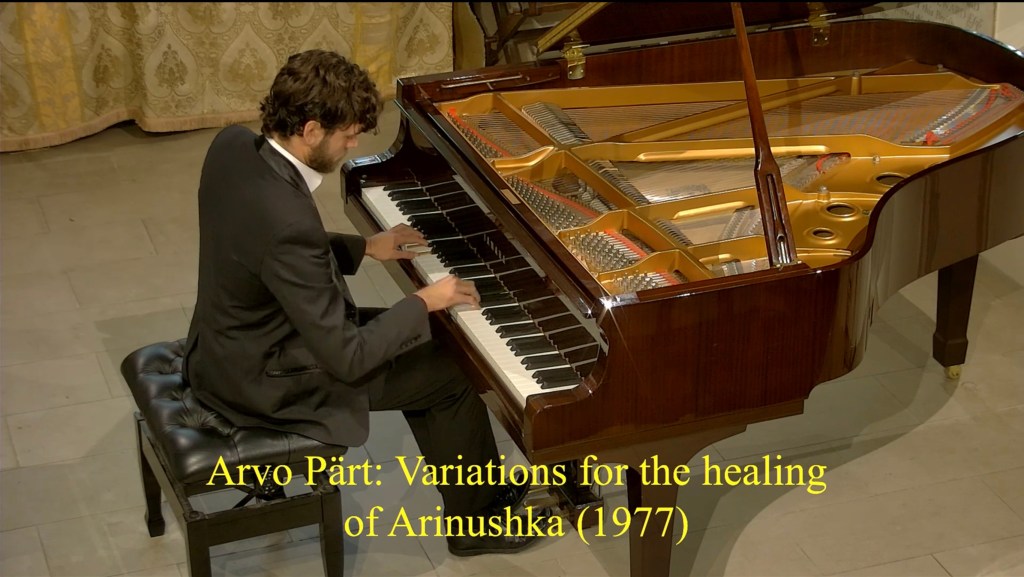
Petar had created a programme that had an overall architectural shape and sense of colour much as I had heard Volodos recently play a complete first half of Liszt specifically asking for there not to be any interruption between the pieces.
The same simplicity and fluidity but with three centuries that separate them.It just goes to show that the world of sound is as timeless as it is full of wonder.It was this sense of wonder and purity that Petar brought to these Variations of Arinuschka and it was a pity to ruin the spell created by applause before the utter simplicity of Chopin’s shortest of 24 preludes .
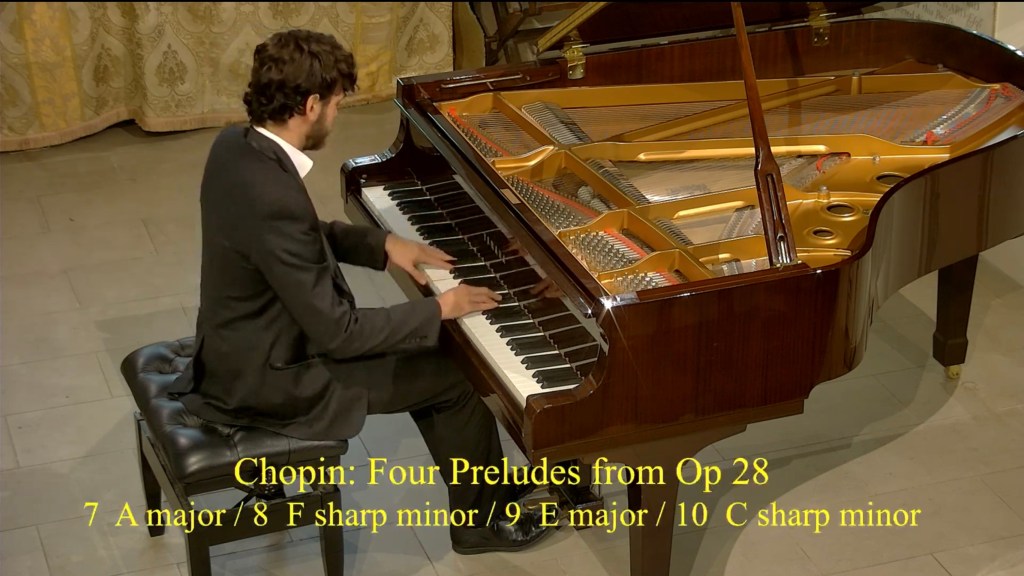
Petar’s Chopin was full of passion and romantic colours a long song from beginning to end.No jagged edges but simple pure beauty.I doubt that the Prelude in F sharp minor has ever flowed so beautifully more like an Aeolian Harp op 25 n.1 than the Winter Wind op 25 n.11.There was an undercurrent of passion and drive but contained under the shelter of aristocratic control.The E major Prelude was played with a nobility and importance before the almost flippantly impish Prelude in C sharp minor was thrown of with an easy jeux perlé of enviable lightness as it was greeted by the chorale like melodic line each time on its arrival to base.
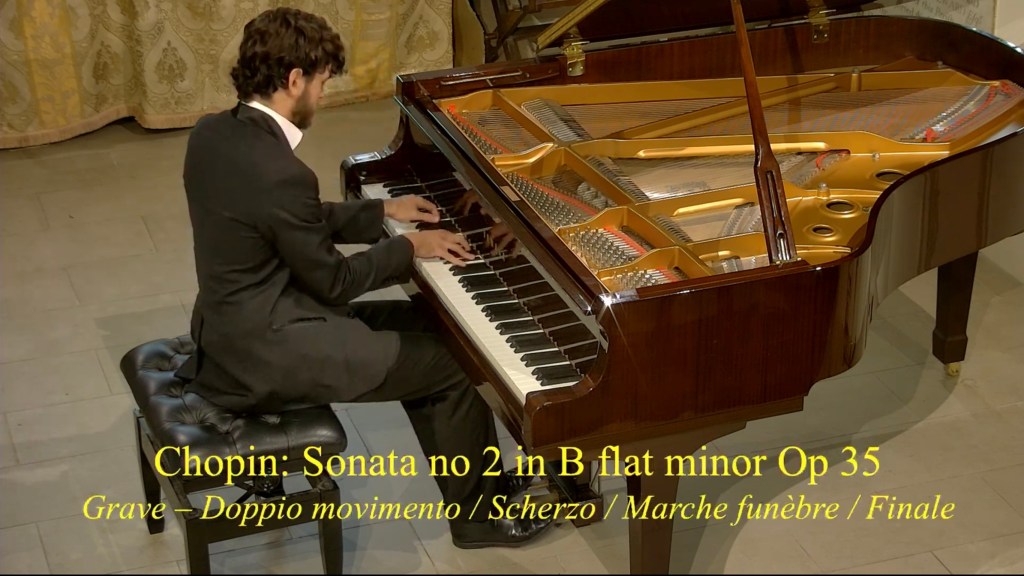
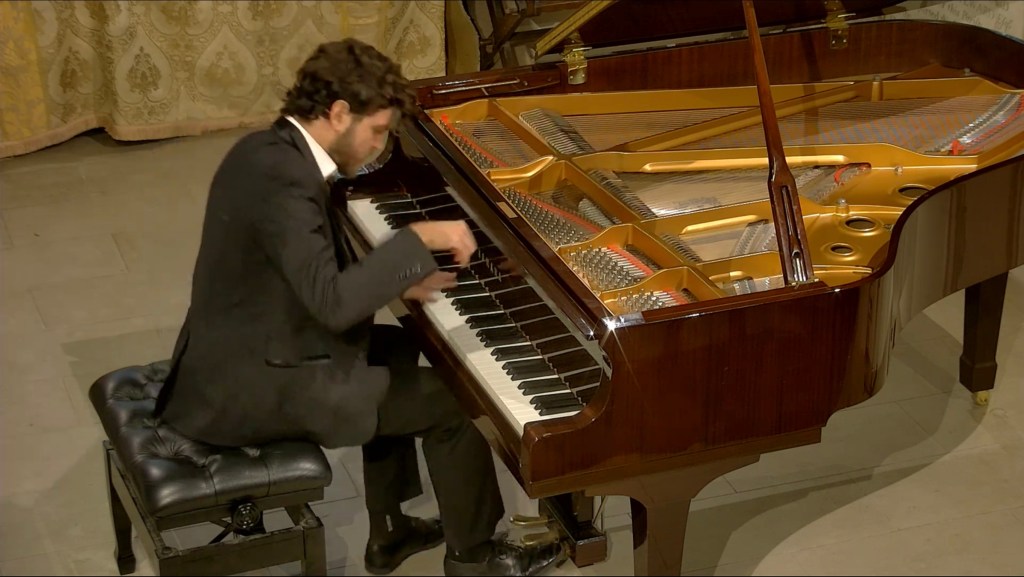
The Sonata in B flat minor one of the great works for piano was given a performance of aristocratic strength – there was none of the too much discussed repeat of the exposition but straight into the development with it contrasts like Beethoven’s Fourth Concerto between heaven and hell.The rhythmic strident opening motif in the bass was answered by the beseeching tenderness of the treble.United in a development of grandeur and nobility melting to the beautiful second subject that came as such a contrast as it was shaped with style and subdued passion.A Scherzo that was kept beautifully under control and at a tempo that suited the Trio without interrupting the overall architectural shape.Ravishing beauty and subtle rubato with a naturally measured return to the Scherzo that gave great cohesion to a movement that can seem ,in lesser hands,a series of unrelated episodes.The famous Funeral March was played with austere sonority with a relentless forward movement,gently leading into a Trio that flowed with timeless reverence.Out of the final chord emerged the whirlwind of sounds that Schumann had criticised so much. A movement of an innovative genius and who knows where it would have taken Chopin had he been granted more than his 39 years on this earth.Petar throughout the furious wind that blew across the keys found a throbbing sense of line only interrupted by sudden gusts of wind until it blew itself out on a wave of grandeur and .majesty
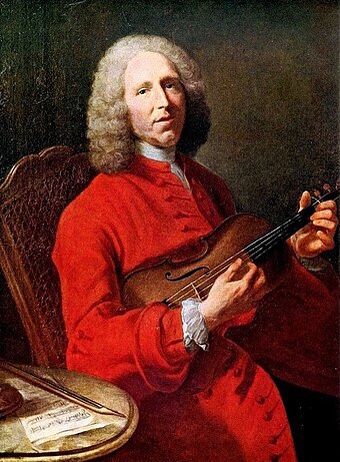
Jean-Philippe Rameau (25 September 1683 – 12 September 1764) was one of the most important French composers and music theorists of the Baroque era. He replaced Jean-Baptiste Lully as the dominant composer of French opera, and was attacked by those who preferred Lully’s style.
Rameau’s music is characterised by the exceptional technical knowledge of a composer who wanted above all to be renowned as a theorist of the art. Nevertheless it is not solely addressed to the intelligence and Rameau himself claimed “I try to conceal art with art”. The paradox of this music was that it was new, using techniques never known before, but it took place within the framework of old-fashioned forms; Rameau appeared revolutionary to the Lullystes, disturbed by the complex harmony of his music, and reactionary to the “philosophes” who only paid attention to its content and who either would not or could not listen to the sound it made. The incomprehension he received from his contemporaries stopped Rameau repeating such daring experiments as the second Trio des Parques in Hippolyte et Aricie, which he was forced to remove after a handful of performances because the singers were unable to interpret it correctly. So the greatest harmonist of his era went unrecognised at the very time that harmony – the “vertical” aspect of music – was taking precedence over counterpoint, which represented its “horizontal” aspect.Rameau introduces an imitation of nature in Le rappel des oiseaux (roughly translated as ‘The conference of the birds’). This piece was most likely inspired by Rameau’s friendship with the Jesuit Père Castel, who discussed with the composer the phenomenon and study of birdsong. The French Baroque composer Jean-Philippe Rameau wrote three books of Pièces de clavecin for the harpsichord .The first, Premier Livre de Pièces de Clavecin, was published in 1706; the second, Pièces de Clavessin, in 1724 ;and the third, Nouvelles Suites de Pièces de Clavecin, in 1726or 1727 They were followed in 1741 by Pieces de Clavecin en concerts , in which the harpsichord can either be accompanied by violin (or flute) and viola da gamba or played alone. An isolated piece, “La Dauphine“, survives from 1747.
Pièces de Clavessin (1724)
Suite in E minor, RCT 2
- Allemande
- Courante
- Gigue en Rondeau I
- Gigue en Rondeau II
- Le Rappel des Oiseaux
- Rigaudon I – Rigaudon II et Double
- Musette en rondeau. Tendrement
- Tambourin
- La Villageoise. Rondeau
Suite in D major, RCT 3
- Les Tendres Plaintes. Rondeau
- Les Niais de Sologne – Premier Double des Niais – Deuxième Double des Niais
- Les Soupirs. Tendrement
- La Joyeuse. Rondeau
- La Follette. Rondeau
- L’Entretien des Muses
- Les Tourbillons. Rondeau
- Les Cyclopes. Rondeau
- Le Lardon. Menuet
- La Boiteuse
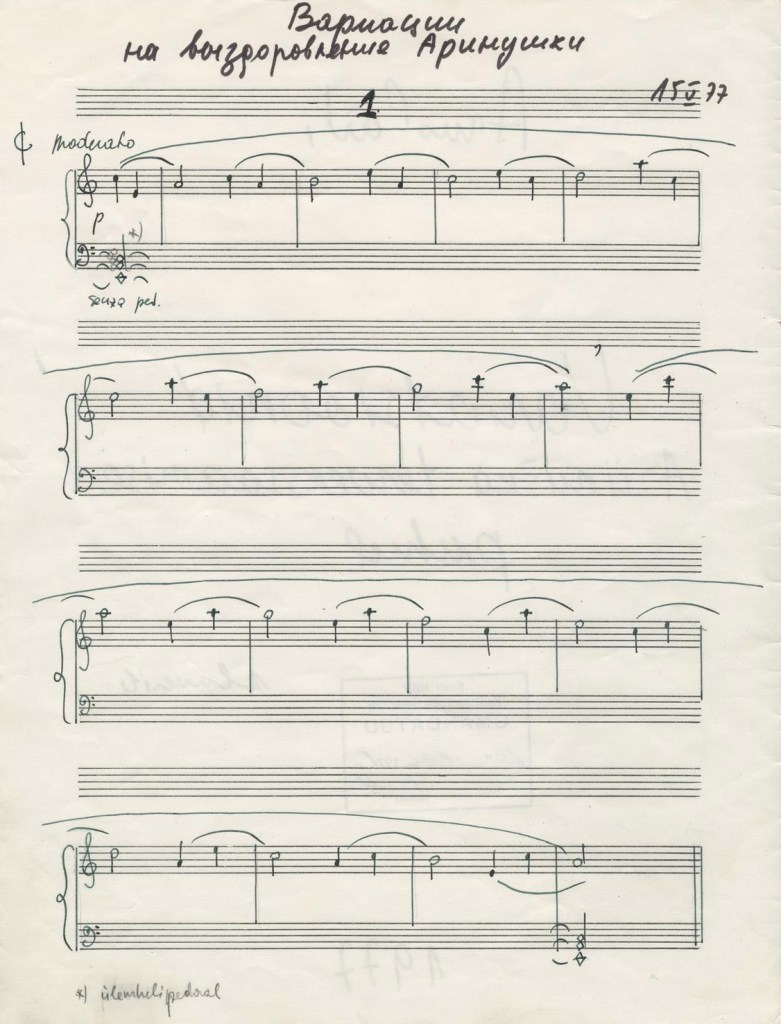
Variations for the Healing of Arinushka for solo piano was composed in 1977 for the composer’s daughter Ariina who was recovering from an appendix operation. The piece contains six short variations, the first three of which are in minor key and the other three in major. They are based on a very simple theme of a rising and falling octave scale. The clear and transparent soundscape of this early tintinnabuli composition is created by the resonating overtones and subtle use of the pedal. Variations… was first performed in November 1977 in Lithuania by Rein Rannap.
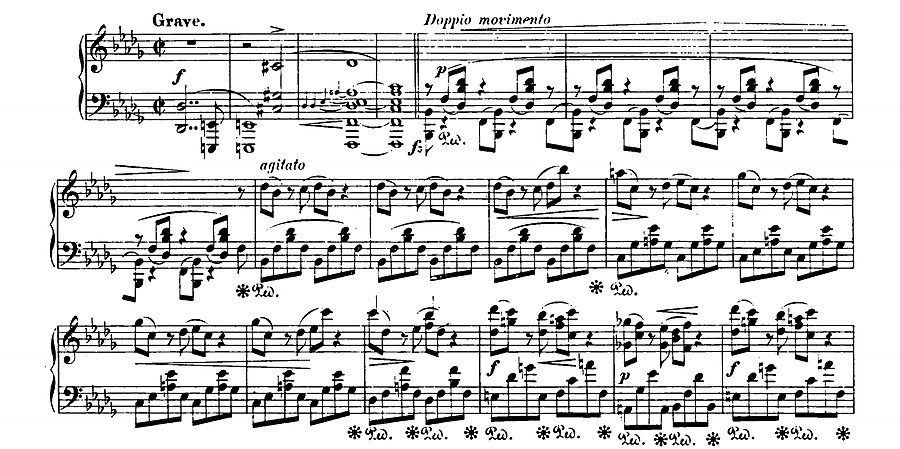
Around 1837 Chopin composed a Funeral March , a piece which most likely reflected the musician’s profoundly mournful mood following the breaking of his engagement to Maria Wodzińska. When he then went to the island of Majorca,at the end of 1838, he began to write a piece, Grave , which will later be the first movement of the sonata, and a Presto which will be the finale; this time in composing Chopin was influenced by the worsening of his illness and influenced by the gloomy ruins and cemetery of the Certosa di Valldemossa,certainly not cheerful visions in the pouring rain that gave no respite. The Scherzo was written when the musician returned to Nohant in the second part of 1839.
In a letter to his friend Fontana he wrote: “I am composing a Sonata in B flat minor in which the Funeral March that you already know will be found. There is an Allegro, then a Scherzo and, after the March, a small Finale, not very long, in which the left hand chatters in unison with the right hand”. In writing the Scherzo , the musician had thought of collecting the pieces already composed in a Sonata, perfecting and polishing them.The Sonata in B flat minor was published in 1840 in Paris by Troupenas, later in Leipzig by Breitkopf & Härtel and in London by Wessel. The piece is one of the few by Chopin that does not feature a dedication, perhaps it was actually a tribute intended for George Sand, to be kept private. Contemporaries were rather baffled by this Sonata. In the first place Robert Schumann who, while recognizing the beauty of the piece, even found “something repulsive” in the Funeral March and defined the Finale as “something more like an irony than any other music”. Even Felix Mendelssohn, not understanding the modernity of the Finale, declared that he abhorred it.Later Vincent d’Indy even went so far as to argue that Chopin had chosen certain keys not for strictly musical reasons, but only for executive convenience. The Funeral March was performed, in the version orchestrated by Reber , together with the Preludes op. 28 no. 4 and 6, played by the organist Léfebure-Wély, at the composer’s funeral on 30 October 1849. Of the Sonata Schumann wrote: “It might be called a whim, if not a hubris, that he called it the Sonata , for he brought together four of his most bizarre creatures, to be smuggled under that name into a place where they otherwise would not have penetrated “. The Sonata op. 35 has also been taken to support the view of many critics that Chopin had found himself in difficulty with the sonata and its formal construction.Others have found the composition to be defective in poetic unity and continuity, constructed with limited technique, judgments based mostly on an outward view of the work rather than an examination of its content.
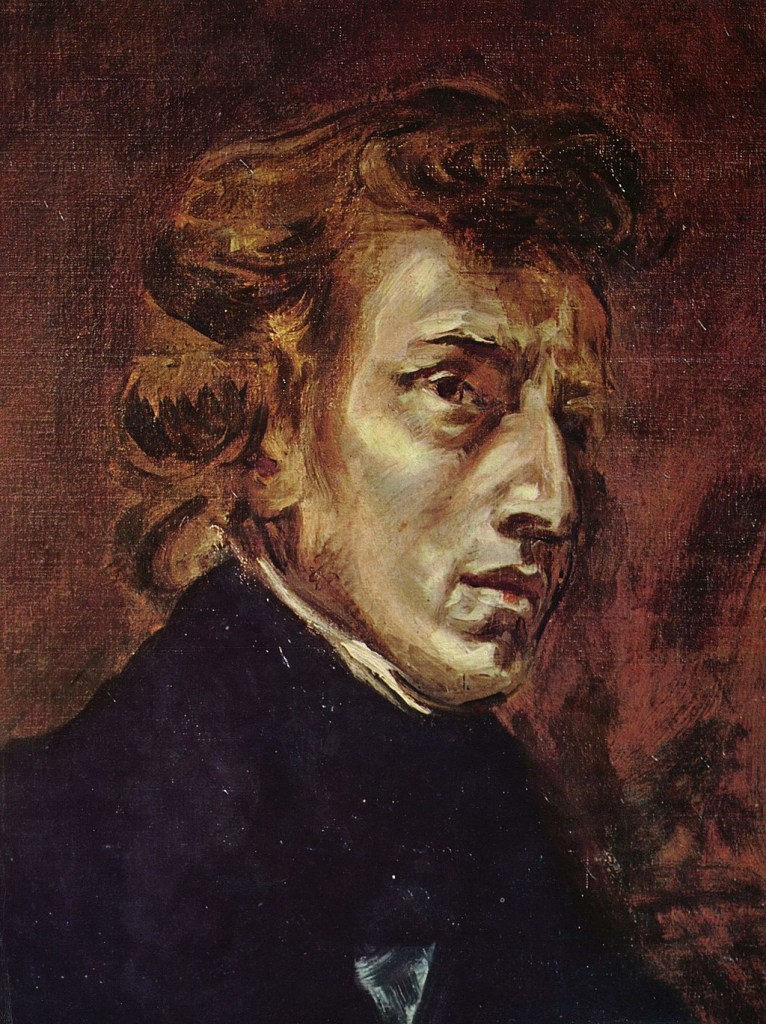
Chopin’s 24 Preludes, op .28, are a set of short pieces for the piano, one in each of the twenty-four keys , originally published in 1839.
Chopin wrote them between 1835 and 1839, partly at Valldemossa,Mallorca, where he spent the winter of 1838–39 and where he had fled with George Sand and her children to escape the damp Paris weather.In Majorca, Chopin had a copy of Bach’s ‘48’ and as in each of Bach’s two sets of preludes and fugues, his Op. 28 set comprises a complete cycle of the major and minor keys, albeit with a different ordering.Whereas Bach had arranged his collection of 48 preludes and fugues according to keys separated by rising semitones , Chopin’s chosen key sequence is a circle of fifths , with each major key being followed by its relative minor, and so on (i.e. C major, A minor, G major, E minor, etc.). It is thought that Chopin might have conceived the cycle as a single performance entity for continuous recital.An opposing view is that the set was never intended for continuous performance, and that the individual preludes were indeed conceived as possible introductions for other works.Chopin himself never played more than four of the preludes at any single public performance.Nor was this the practice for the 25 years after his death. The first pianist to program the complete set in a recital was probably Anna Yesipova in 1876.Nowadays, the complete set of Op. 28 preludes has become part of the repertoire , and many concert pianists have recorded the entire set, beginning with Busoni in 1915, when making piano rolls for the Duo-Art label. Alfred Cortot was the next pianist to record the complete preludes in 1926.He would also play the 24 Studies op 10 and 25 together with the 24 Preludes op 28 in the same programme.Something that Fou Ts’ong had done at the Festival Hall in London and on my request at the Ghione Theatre in Rome.
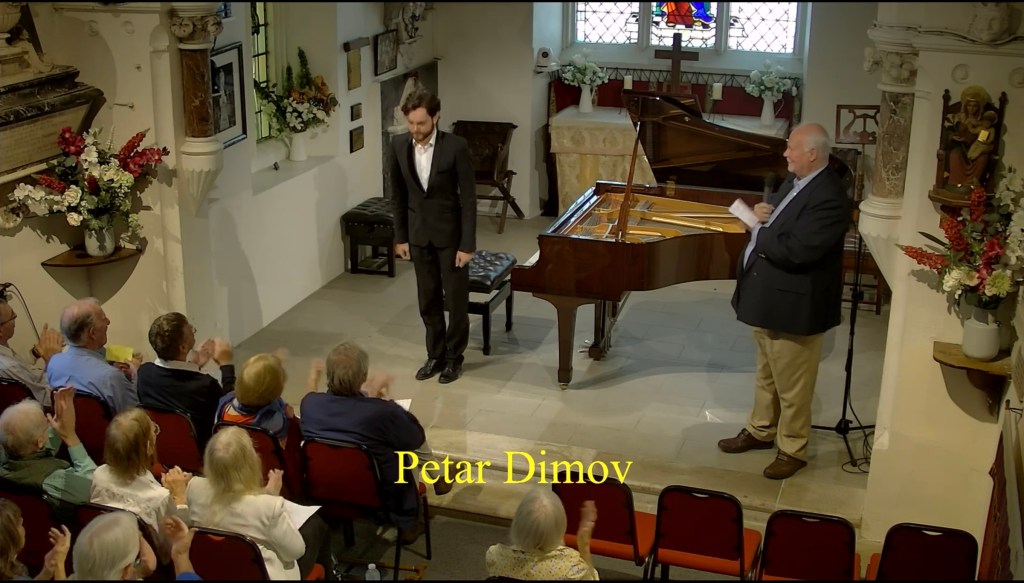
Petar Dimov is a Bulgarian pianist and composer based in London. He was a scholar at the Royal College of Music in London from 2014 to 2020 in the piano class of Norma Fisher, obtaining a Master of Performance degree with Distinction in 2020 and a Bachelor of Music degree with Honours in 2018. His musical education began in his native Plovdiv (Bulgaria) where he studied with Svetlana Koseva until his graduation in 2014. He has won over twenty prizes from International competitions and has performed in Bulgaria, Cyprus, France, Greece, Italy, Macedonia, Romania, Serbia, Spain, Turkey and the UK. As a composer, Petar Dimov has had output for orchestra, chorus, various solo instruments and chamber ensembles. Dimov is currently supported by the Talent Unlimited foundation.
Petar Dimov a voyage of discovery of sumptuous beauty
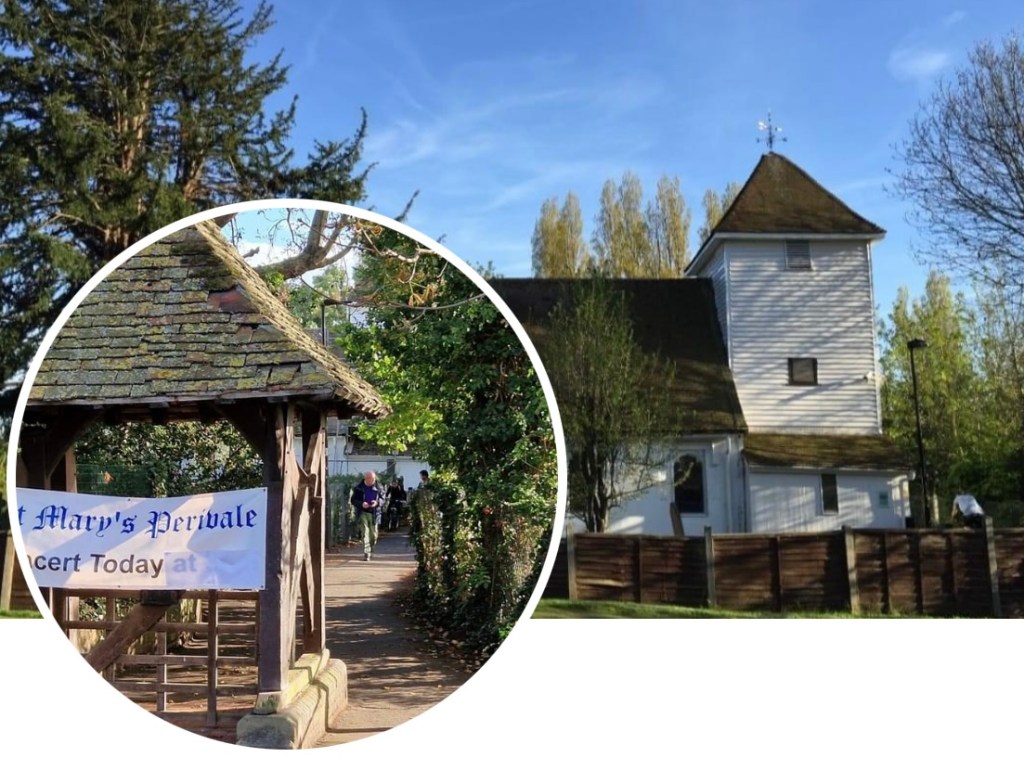
Petar Dimov and Damir Duramovic united in performances of poetic sensitivity Acton Hill and a repeat performance at St Mary’s Perivale
 ChristopherAxworthy-MusicCommentary