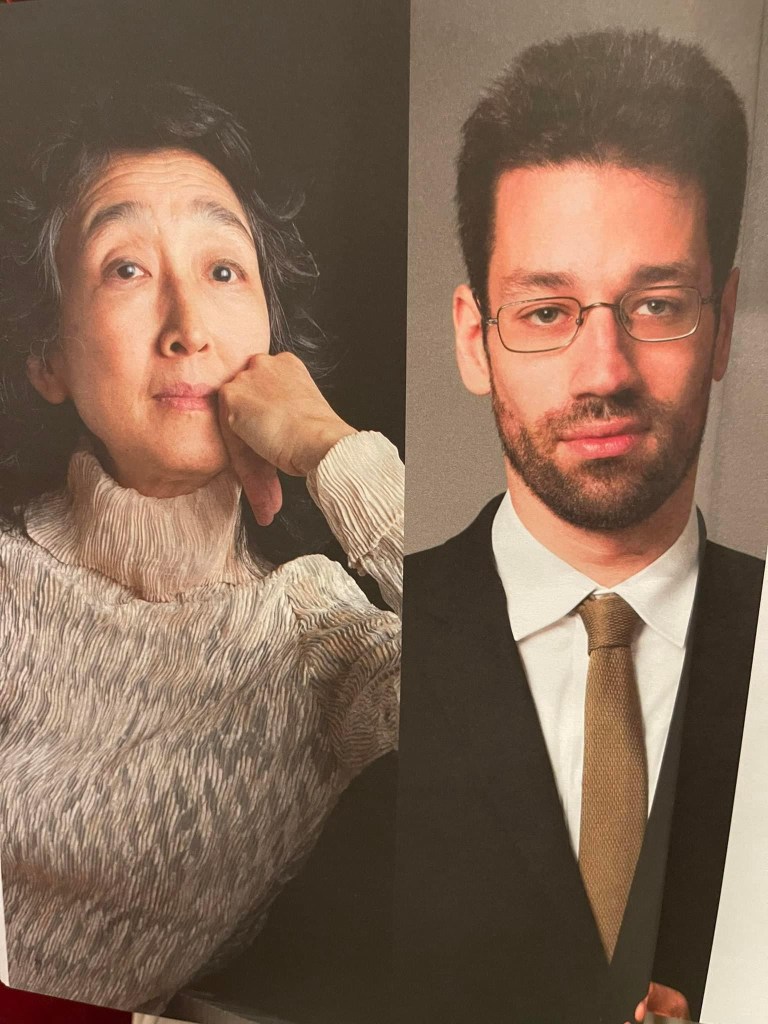
Sublime Schubert at the Wigmore Hall with Mitsuko Uchida and Jonathan Biss.
Of course we have known for some time that Uchida can unlock the secrets of Schubert as no other but little could have led us to believe that the same poetry could flow from such an intellectual as Jonathan Biss.
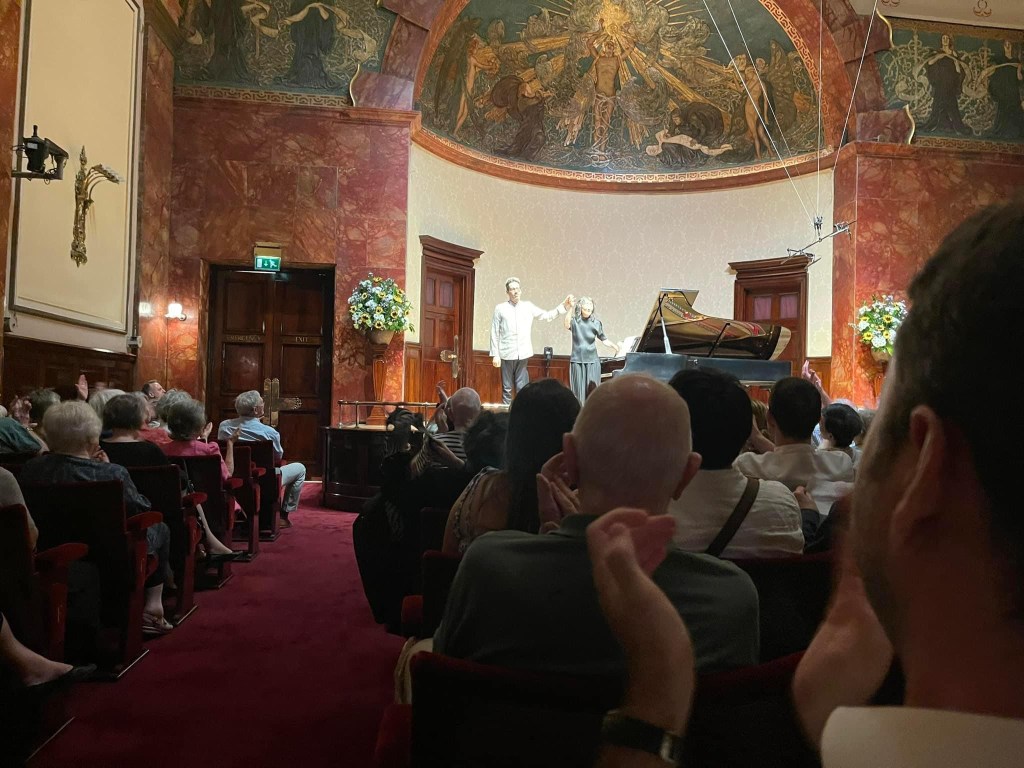
A transcendental control of sound that could produce what his beautiful programme notes describe as ethereal with unearthly beauty.
Words can only go so far to describe what sounds can do so much better and it was the sounds that created the magic that one could only imagine from his written notes .
What a voyage of discovery too with a March in E flat minor from 1824 that was such an extraordinary work of incredible poignancy and sheer genial invention.
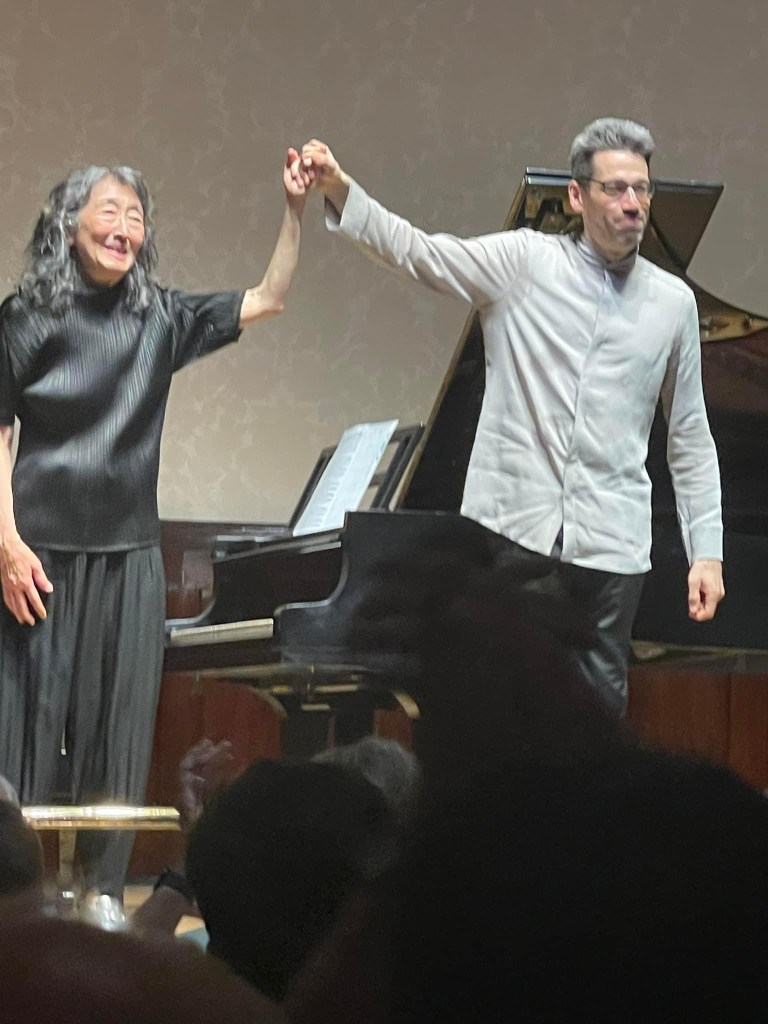
Jonathan strangely describes it in only a few words in his notes but you could write a book about the revolutionary form and modernity of sound and invention.Of course it leaps out at you – in E flat minor!!!!- whatever next …..indeed if Schubert had lived a true life span where would it have all led?An astonished silence at the end was gently filled with the simple sublime beauty of the Rondo in A that has recently enchanted the audiences of Barenboim and Argerich. This was just as beautiful and infact the final few bars like a balloon inflating before our very eyes only to dissolve without a trace into the magic stratosphere with a turn that must be the most sublime ever invented.
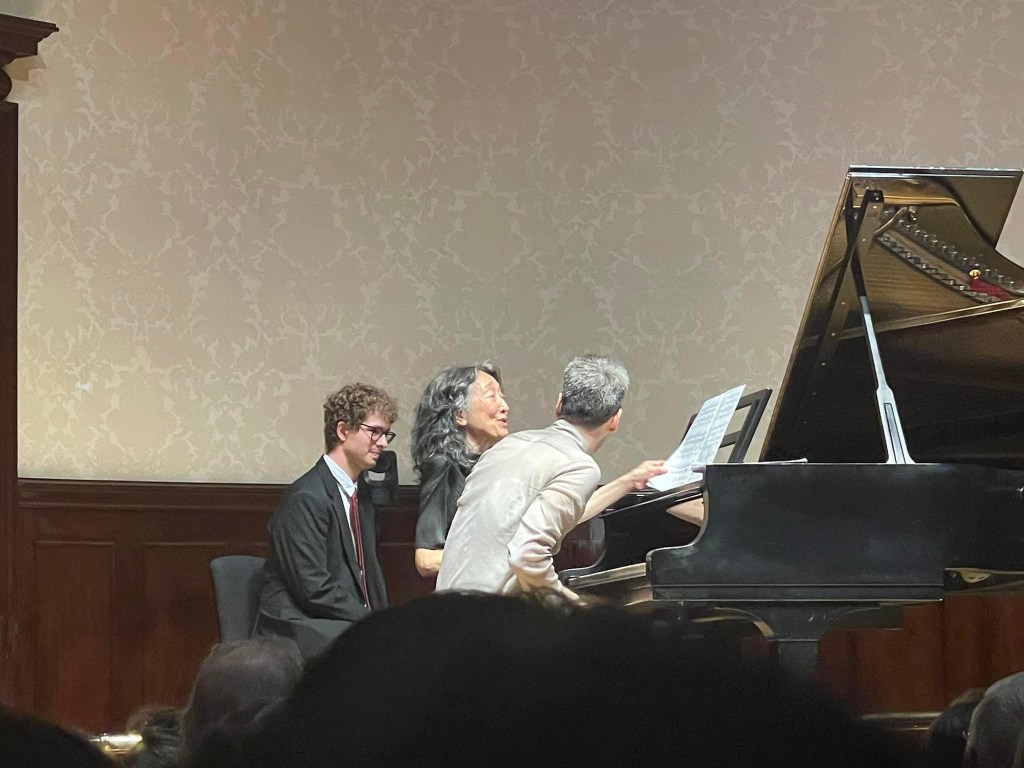
The concert had begun with a well known masterpiece ‘Lebenssturme’ written in Schubert’s final hour where moments of sublime beauty make one wonder how he could share the vision of paradise that awaited him with us mortals left behind.An extraordinary performance of passion ,colour and astonishment that was truly unforgettable.
The whole of the second half saw a swapping of chairs with Uchida this time at the top.
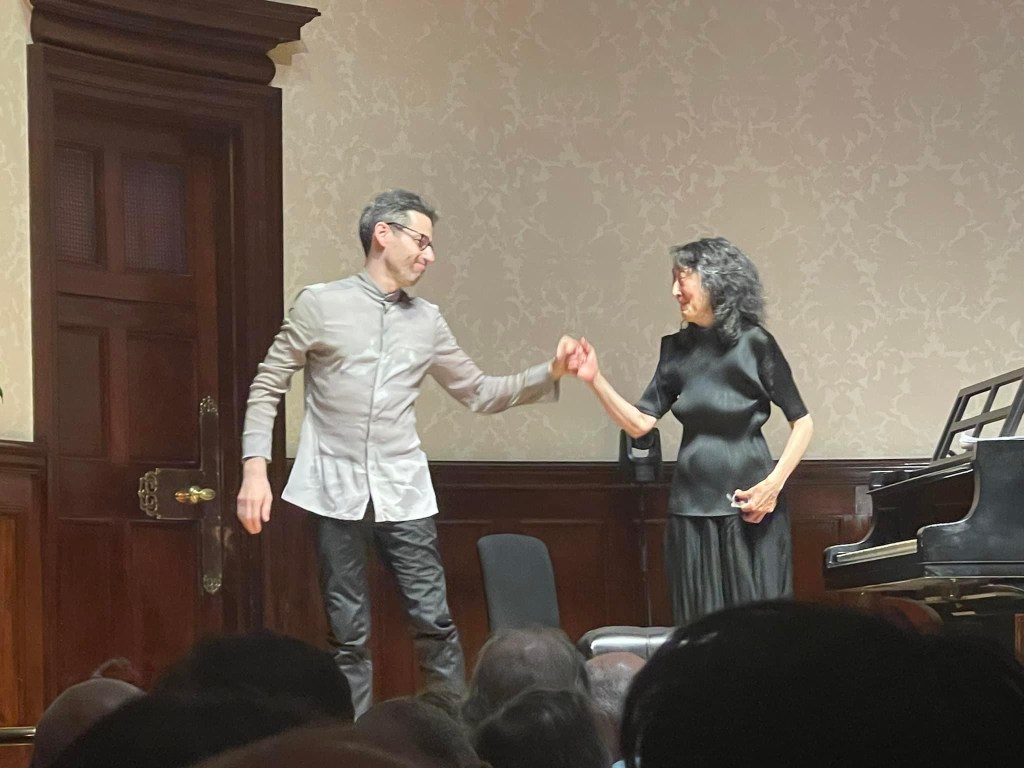
Even the genius of Uchida could not prevent the tedium of a series of dances with every repeat noted with intellectual punctiliousness that made this divertissement not very ‘divertente’ clocking in at fifty minutes.
There were some beautiful things because we were in the hands -four -of masterly musicians.
The gentle lilt of the Allegretto finale so beautifully played sent me finally to sleep perchance to dream of the wonders they had shared with us in the first half of the concert.
Performances that will remain with us,as Mitsuko has said when asked for a selfie in the Green room in Perugia ,a photo should be like a beautiful memory and not a fixed image that may appear instantly on the other side of the globe.
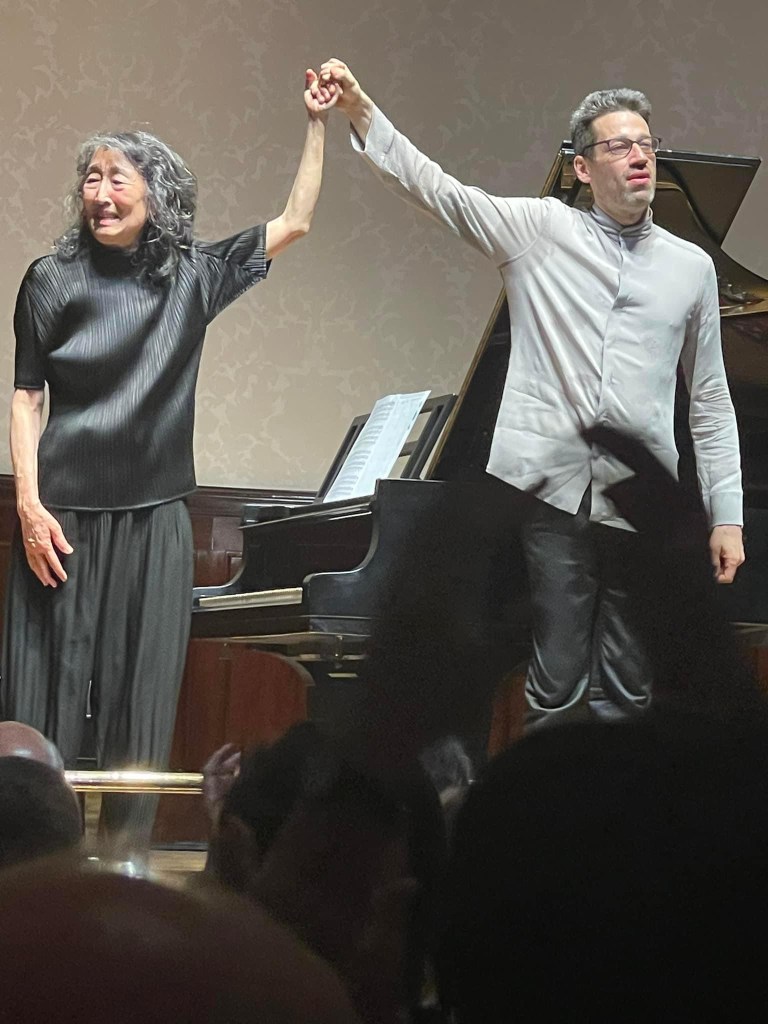
Dame Mitsuko at the Wigmore Hall…..the sublime remedy in these troubled times
Miracles in Perugia- Dame Mitsuko plays Schubert
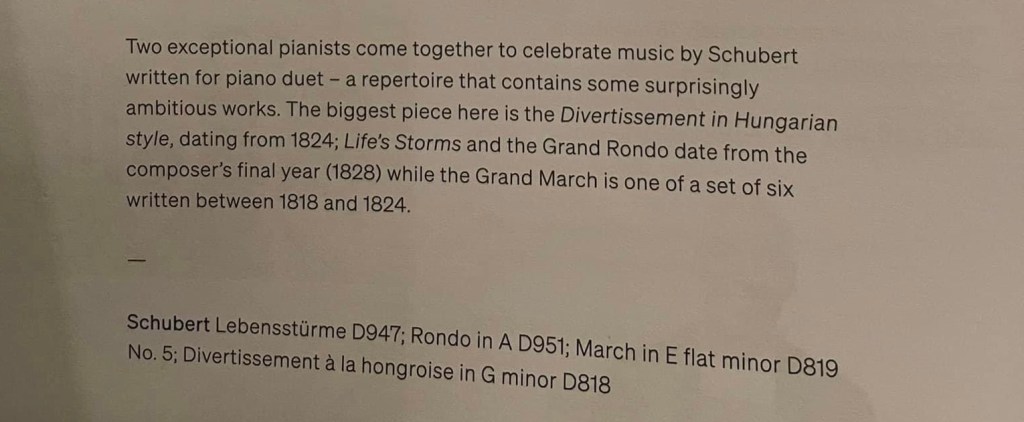

In 1823, Schubert wrote his first large-scale song cycle , Die schone Müllerin (D. 795).This series, together with the later cycle Winterreise (D. 911, also setting texts of Müller in 1827) is widely considered one of the pinnacles of Lieder.He also composed the song ‘Du bits die Ruh’You are rest and peace,D. 776 during this year. Also in that year, symptoms of syphilis first appeared.
In 1824, he wrote the Variations in E minor for flute and piano; Trockne Blumen, a song from the cycle Die schone Müllerin ; and several string quartets. He also wrote the The Arpeggione Sonata D. 821.In the spring of that year, he wrote the Octet in F D. 803.a sketch for a “Grand Symphony,” and in the summer went back to Zseliz. There he became attracted to Hungarian musical idiom and wrote the Divertissement à la hongroise in G minor for piano duet D. 818 and the String Quartet in A minor Rosamunde D. 804.It has been said that he held a hopeless passion for his pupil, the Countess Caroline Esterházy but the only work that bears a dedication to her is his Fantasia in F minor for piano duet D. 940.This dedication, however, can only be found in the first edition and not in Schubert’s autograph.
From 1826 to 1828, Schubert resided continuously in Vienna, except for a brief visit to Graz ,Austria, in 1827. In 1826, he dedicated a Symphony D. 944, that later came to be known as the Great C major to the Gesellschaft der Musikfreunde and received an honorarium in return.[The String Quartet in D minor D. 810 ,with the variations on Death and the Maiden , was written during the winter of 1825–1826, and first played on 25 January 1826. Later in the year came the String Quartet in G major, D 887, first published as op. 161,the Rondo in B minor for violin and piano D. 895 ,Rondeau brillant, and the Piano Sonata in C major D 894, first published as Fantasie in G, op. 78. He also produced in 1826 three Shakespearian songs, of which “Ständchen” D. 889 and “An Sylvia ” D. 891 were allegedly written on the same day, the former at a tavern where he broke his afternoon’s walk, the latter on his return to his lodging in the evening.
The works of his last two years reveal a composer entering a new professional and compositional stage.Although parts of Schubert’s personality were influenced by his friends, he nurtured an intensely personal dimension in solitude; it was out of this dimension that he wrote his greatest music.The death of Beethoven affected Schubert deeply,and may have motivated Schubert to reach new artistic peaks. In 1827, Schubert wrote the song cycle Winterreise D. 911 ,the Fantasy in C major for violin and piano (D. 934, first published as op. post. 159), the Impromptus for piano, and the two piano trios (the first in B-flat major (D. 898), and the second in E-flat major, D. 929,in 1828 the cantata Mirjams Siegesgesang Victory Song of Miriam, D 942 on a text by Franz Grillparzer ,the Mass in E flat D. 950, the Tantum Ergo D. 962 in the same key, the String Quintet in C D. 956 ,the second “Benedictus” to the Mass in C D. 961,the final three piano sonatas D. 958, D. 959, and D. 960,and the collection 13 Lieder nach Gedichten von Rellstab und Heine for voice and piano, also known as Scheanengesang (Swan-song, D. 957)The Great C major symphony is dated 1828, but Schubert scholars believe that this symphony was largely written in 1825–1826 (being referred to while he was on holiday at Gastein in 1825—that work, once considered lost, is now generally seen as an early stage of his C major symphony) and was revised for prospective performance in 1828. The orchestra of the Gesellschaft reportedly read through the symphony at a rehearsal, but never scheduled a public performance of it. The reasons continue to be unknown, although the difficulty of the symphony is the possible explanation.In the last weeks of his life, he began to sketch three movements for a new Symphony in D D 936A;In this work, he anticipates Mahler’s use of folksong-like harmonics and bare soundscapes.Schubert expressed the wish, were he to survive his final illness, to further develop his knowledge of harmony and counterpoint, and had actually made appointments for lessons with the counterpoint master Simon Sechter.
On 26 March 1828, the anniversary of Beethoven’s death, Schubert gave, for the only time in his career, a public concert of his own works.The concert was a success popularly and financially,even though it would be overshadowed by Paganini’s first appearances in Vienna shortly after.
In the midst of this creative activity, his health deteriorated. By the late 1820s, Schubert’s health was failing and he confided to some friends that he feared that he was near death. In the late summer of 1828, he saw the physician Ernst Rinna, who may have confirmed Schubert’s suspicions that he was ill beyond cure and likely to die soon.Some of his symptoms matched those of mercury poisoning ,a common treatment for syphilis, again suggesting that Schubert suffered from it.At the beginning of November, he again fell ill, experiencing headaches, fever, swollen joints, and vomiting. He was generally unable to retain solid food and his condition worsened. Five days before Schubert’s death, his friend the violinist Karl Holz and his string quartet visited to play for him. The last musical work he had wished to hear was Beethoven’s String Quartet in C sharp minor op 131 ;Holz commented: “The King of Harmony has sent the King of Song a friendly bidding to the crossing”.
Schubert died in Vienna, aged 31, on 19 November 1828, at the apartment of his brother Ferdinand. The cause of his death was officially diagnosed as typhoid fever , though other theories have been proposed, including the tertiary stage of syphilis . Although there are accounts by his friends that indirectly imply that he was syphilitic, the symptoms of his final illness do not correspond with tertiary syphilis. Six weeks before his death, he walked 42 miles in three days, ruling out musculoskeletal syphilis. In the month of his death, he composed his last work, “Der Hirt Auf Den Felsen”, making neurosyphilis unlikely. Finally, meningo-vascular syphilis is unlikely because it presents a progressive stroke-like picture, and Schubert had no neurological manifestation until his final delirium, which started only two days before his death. This, and the fact that his final illness was characterized by gastrointestinal symptoms (namely vomiting), led Robert L. Rold to argue that his final illness was a gastrointestinal one, like salmonella or indeed typhus.

At the height of his Weimar period, Franz Liszt arranged four marches for piano four hands by Franz Schubert for orchestra in 1859-60 for his eminent Viennese colleague Johann Herbeck (1831-77). Among these, the march from Opus 121 was subsequently incorporated as the middle movement in the orchestration of Franz Schubert’s “Divertissement à la hongroise,” the corner movements of which were orchestrated by Max Erdmannsdörfer (1848-1905). The edition unites the three remaining Schubertian marches in Liszt’s orchestration in one volume.
Johann Herbeck, as a conductor in Vienna, was not only the most important discoverer of Franz Schubert, but also an unabashed champion of Franz Liszt’s music in an extremely reactionary environment. Given these preferences, as well as the high esteem in which Liszt held Schubert’s work, reflected especially in piano transcriptions of songs, but also in the orchestration of Schubert’s piano songs (and, of course, in the problematic arrangement of the Wanderer Fantasy for piano and orchestra), it was natural for Herbeck to ask Liszt to orchestrate other works by Schubert, and apparently it was agreed that these should be some of the marches for piano four hands that were already popular at the time.
In any case, Liszt wrote to Herbeck from Weimar on November 18, 1859: “Dear friend, having returned from Zwickau a few hours ago, I have received your kind letter and must unfortunately apologize for not being able to comply with your request regarding Schubert’s marches as quickly as I had intended. This delay, which was very unpleasant for me, was caused by an indisposition which forced me to remain in bed for a whole week at the end of October. After that, the Weimar and Jena Schiller celebrations made it completely impossible for me to proceed with the orchestration of the marches. – But I promise you that you will receive the score by Christmas at the latest.”
Herbeck replied to Liszt from Vienna in January 1860: “I received the eagerly awaited Prometheus, as well as the marches, and I immediately fell upon them with a real ravenous appetite. […] I appreciate the great honor that has been bestowed upon me by the friendly dedication of Schubert’s marches, which have been so magnificently re-composed, and I thank you most sincerely for it. Prometheus will be performed on February 26 in the Redoutensaal; the marches, the Schubert piano fantasia and the manuscript rhapsody with orchestra of your composition (which I expect with each passing day from Berlin) played by H. v. Bülow will follow on March 25.”Schubert’s Funeral March from Opus 40 in Liszt’s orchestration was premiered on March 10, 1862 at the 4th Society Concert. On March 27, 1863, Schubert’s unfinished ‘Lazarus’ was premiered. On February 28, 1864, either one of the two marches was repeated, or the one from the ‘Divertissement à la Hongroise’ was heard for the first time, and on November 27, 1864, Carl Tausig was the soloist in the Wanderer Fantasy by Schubert/Liszt. On December 17, 1865, Schubert’s unfinished Symphony in B minor was played for the first time in Vienna under Herbeck’s direction. On February 25, 1866, Schubert’s Funeral March was repeated in Liszt’s version, After the premiere of the orchestration of the Funeral March, Eduard Hanslick wrote: “Another novelty was Liszt’s orchestral arrangement of Schubert’s Funeral March in E-flat minor. As the composition is presented as a piano piece, it is genuinely Schubertian in its tuneful manner, naturally flowing, but by no means significant; the trio in E-flat major, which sounds too jolly for a funeral march, becomes downright tedious in its harmonic and rhythmic simplicity and meager eighth-note accompaniment in such frequent repetition. But how Liszt understood to treat this little drawing! An imposing colorful picture, which one cannot get enough of and which reveals ever new coloristic wonders. This is true poetry of instrumentation, in contrast to that heartless technical dexterity that one must praise in so many modern orchestral pieces. How the theme first appears in the darkness of the violas and low clarinet notes, then becomes lighter through the addition of violins and flutes, how finally in the second part horns, trumpets and the three trombones along with tuba gradually spread a solemn glow over it like burning sunset, all this defies description. And that major trio, how Liszt knows how to enrich and elevate it through alternating, finely graduated instrumentation! First the cellos bring the melody in singing tenor, then the violins on the G string, finally French horn, clarinet and flute over an accompaniment of the violins slightly enlivened by triplets. In the second part of the trio, the first horn blows solo, the three lower horns accompany with muted sound, while two flutes flutter gently over it in tied arpeggios; at last, all the violins and cellos grasp the theme in unison and in octaves, raising it to supreme power, whereupon, at the very end, a new twist surprises us: the melody in the oboes. Liszt appears here in the full glory of his art – as always when Schubert provides the ideas. In its genius, this arrangement by Liszt can almost be called a new creation, and yet no measure of the original is changed by it, no Schubertian note is given the lie. If Schubert could hear his March in Liszt’s orchestration, I think he would make the same admiring exclamation that is recounted to Voltaire when he saw one of his tragedy roles played unsurpassably by the Clairon: “Is it me who has done this?””

