

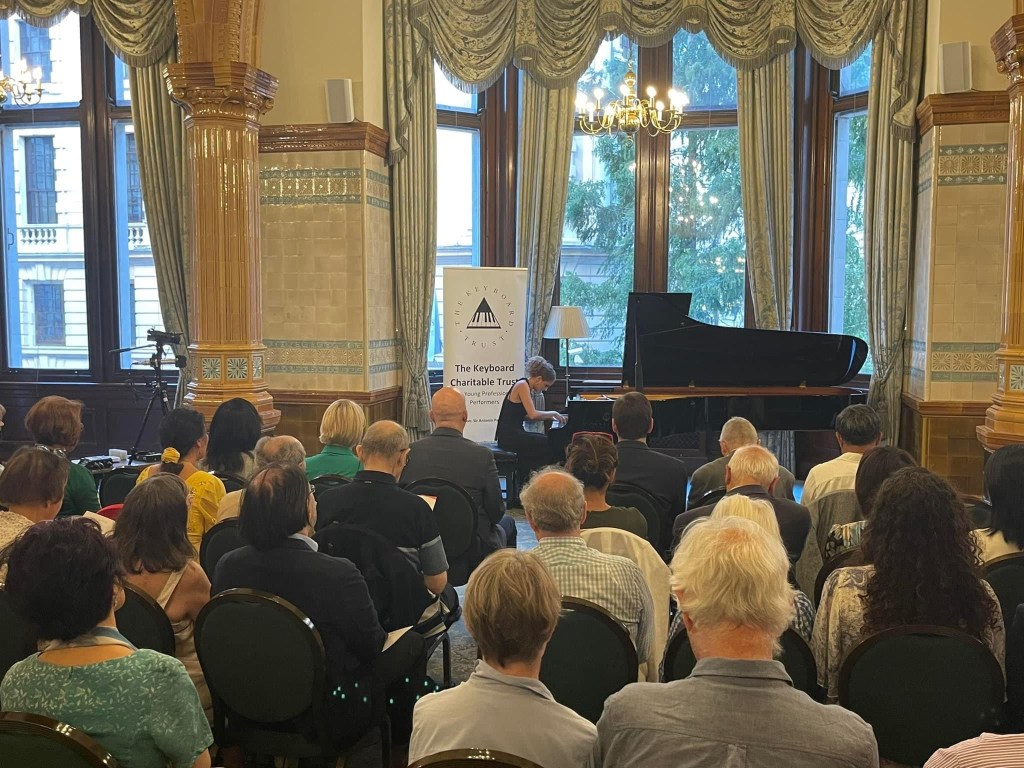
Some superb playing from the young Lithuanian pianist Milda Daunoraité from the school of Tessa Nicholson.The Lithuanians seem to be born with an ingenuous ‘joie de vivre’ that is reflected in their wonderful,relaxed style of playing .
Perlemuter,born in Kaunas ,was a prime example and it was to his first teacher Moszkowski that Milda turned today to close her scintillating recital with sparks that crackled and shone with such fun as they spun from her fingers with the ravishing style of a bygone age.
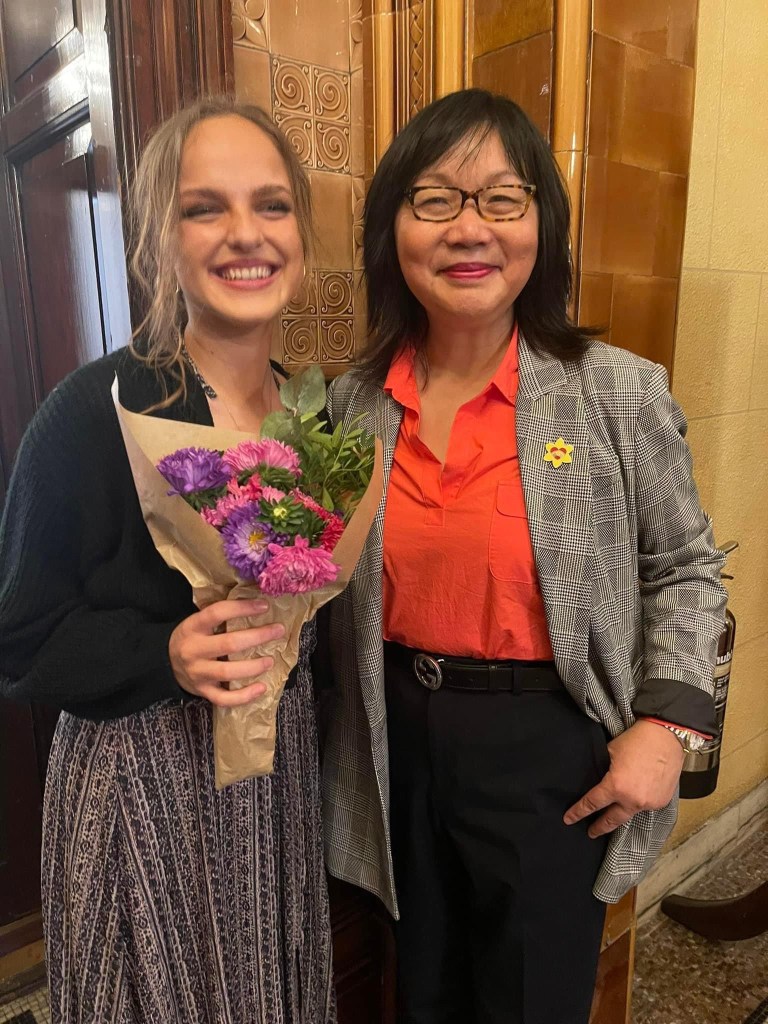
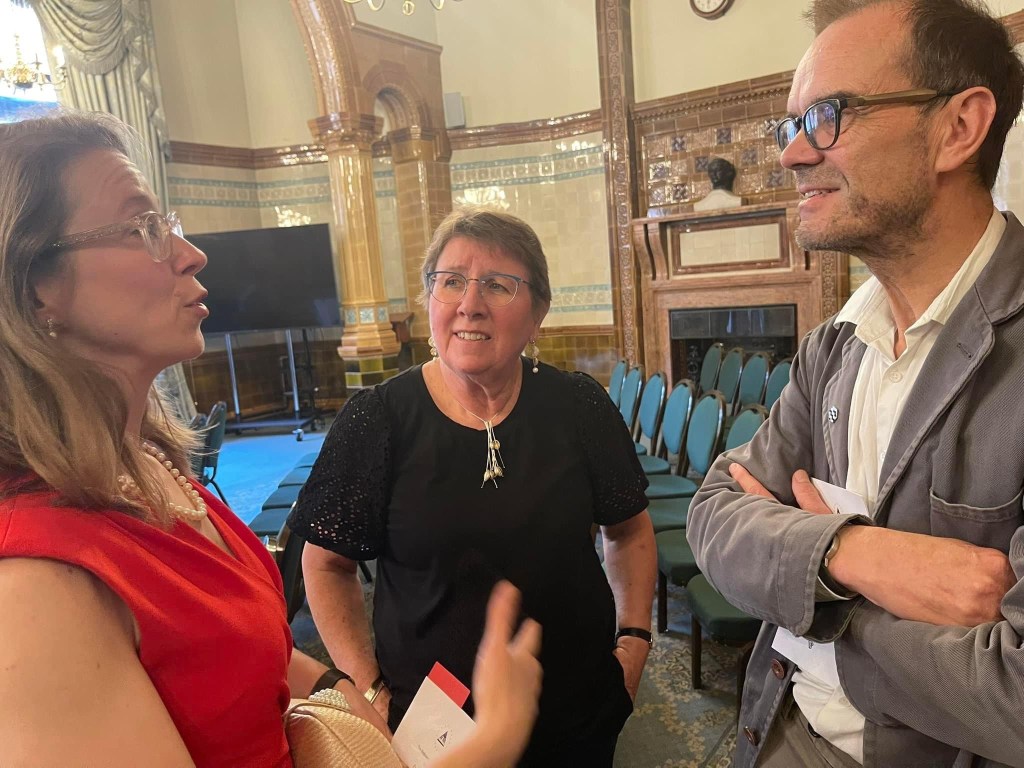
The sheer enjoyment and exhilaration that she shared with us was of that was the same refreshing simplicity that was mirrored in the short conversation with Elena Vorotko at the conclusion of another memorable concert in the En Blanc et Noir series dedicated to the memory of the late Robert Turnbull.
This had come after one of the finest performances of Chopin’s elusive fourth Scherzo I have ever heard.It was full of jewel like colours and pungent emotions all thrown off with a mastery that revealed the true depth of feeling behind the seemless web of golden notes.
Debussy’s haunting bells were heard with a purity and a luminosity as they became ever more insistent followed by the ravishing vision of moonlight that in turn gave way to the fleeting high jinx of Golden Fish.
Schumann’s monumental first sonata bravely opened the recital and is an early work where the continual conflict of Floristan and Eusebius is never truly resolved .It was given an at times heroic performance of deeply felt emotions from the intense to the frivolous.Living every minute but where a greater architectural awareness would have united her emotions into one great outpouring of monumental shape .


Milda’s performances have been featured live in forty countries through Mezzo TV, Radio Classique, TV5 Monde and Lithuanian National Television and Radio. In 2018, Milda performed the Fourth Piano Concerto by V. Bacevičius for the Lithuanian National Philharmonic Society with the Latvian National Symphony Orchestra. This concert was broadcast across Europe by Euroradio (EBU).
She has performed at venues such as Wigmore Hall, the Amsterdam Concertgebouw, Musikhuset Aarhus, the United Nations headquarters in Geneva, at the EMMA World Summit of Nobel Prize Peace Laureates in Warsaw and many others. Milda’s recent performances include a recital in the Laeiszhalle Recital Hall in Hamburg, at the Deal Music & Arts Festival, at the Petworth Festival, Biarritz Piano Festival and at the Palermo Classica Festival.
Milda won the Purcell School’s Concerto Competition which gave her the opportunity to perform Ravel’s Piano Concerto in G major at the Queen Elizabeth Hall in London. She also won First Prize in the international V. Krainev Piano Competition in Kharkov, Ukraine; the ‘Jury‘ Prize in the Pianale International Academy & Competition in Germany; and First Prize in the fourth International Piano Competition in Stockholm.



HHH Concerts and The Keyboard Trust a winning combination of youthful dedication to Art
Milda Daunoraite – youthful purity and musicianship triumph in Florence
The Piano Sonata No. 1 in F♯ minor, Op. 11, was composed by Robert Schumann from 1833 to 1835. He published it anonymously as “Pianoforte Sonata, dedicated to Clara by Florestan and Eusebius”.
Eric Frederick Jensen describes the sonata as ‘the most unconventional and the most intriguing’ of Schumann’s piano sonatas due to its unusual structure.The Aria is based on his earlier Lied setting, “An Anna” or “Nicht im Thale”.Schumann later told his wife,Clara , that the sonata was “a solitary outcry for you from my heart … in which your theme appears in every possible shape”.
The four movements are as follows:
- Un poco adagio – Allegro vivace (F♯ minor)
- Aria: Senza passione, ma espressivo (A major)
- Scherzo : Allegrissimo (F♯ minor) – Intermezzo: Lento. Alla burla, ma pomposo (D major) – Tempo I
- Finale: Allegro un poco maestoso (F♯ minor, ending in the tonic major)
Images is a suite of six compositions for solo piano by Claude Debussy.They were published in two books/series, each consisting of three pieces. The first book was composed between 1901 and 1905, and the second book was composed in 1907.The total duration is approximately 30 minutes. With respect to the first series of Images, Debussy wrote to his publisher, Jacques Durand : “Without false pride, I feel that these three pieces hold together well, and that they will find their place in the literature of the piano … to the left of Schumann, or to the right of Chopin… “
Debussy wrote another collection, Images oubliées (L. 87), in the Winter of 1894 and dedicated it to Yvonne Lerolle, daughter of the painter Henry Lerolle.
“Cloches à travers les feuilles” was inspired by the bells in the church steeple in the village of Rahon in Jura, France.Rahon was the hometown of Louis Laloy , a close friend of Debussy and also his first biographer.
“Et la lune descend sur le temple qui fut” (And the moon descends on the temple that was) was dedicated to Laloy.The name of the piece, which evokes images of East Asia , was suggested by Laloy, a sinologist. The piece is evocative of Indonesian gamelan music, which famously influenced Debussy.
“Poissons d’or” was probably inspired by an image of a golden fish in Chinese lacquer artwork or embroidery , or on a Japanese print. Other sources suggest it may have been inspired by actual goldfish swimming in a bowl,though the French for goldfish is ‘poisson rouge’ (red fish).
The Scherzo No. 4, Op. 54, was composed in 1842 in Nohant
The scherzo was published in 1843. Unlike the preceding three scherzi (Op. 20, Op. 31, Op. 39), the E-major is generally calmer in temperament, though it still possesses some exceptionally passionate and dramatic moments. It seems to be a work that divides opinion: “it is one of Chopin’s most elegiac works, and without doubt contains some of the most profound and introspective music the composer ever wrote”compared to “more capriciousness and elegance than profundity.”`” it differs from the others as if it had passed through a magically purifying expressive filter.”The scherzo is in sonata rondo form with a trio in C sharp minor .It is the only one of Chopin’s four scherzos primarily in a major key. As one critic explains, “When Chopin is at his happiest, most outwardly serene, then, for the pianist, he is at his most treacherous. The Fourth Scherzo is the only one in a major key and its mercurial brilliance and whimsy are notoriously hard to control.” Saint- Saens particularly liked this scherzo.
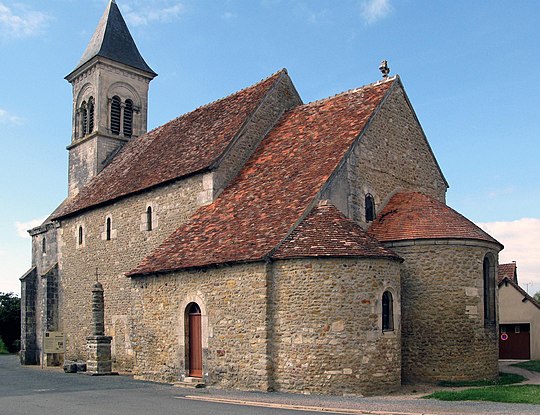
The barn and garden of George Sand, and the church of Nohant. Sand’s grave is in a small enclosed cemetery between the church and the garden.

It is located near La Châtre, on the D943, approximately 36 km (22 mi) southeast of Châteauroux and consists of two villages, Vic and Nohant, extended along the road.
The commune lies on the lower Jurassic rocks at the southern margin of the Paris Basin. Just to the south of La Châtre, some twelve kilometres south of Vic, the Variscan-faulted rocks of the Massif Central begin with Cambrian/Ordovicianmigmatite.
It is near the southern end of the old province of Berry.

https://christopheraxworthymusiccommentary.com/2023/06/05/nikita-lukinov-at-st-marys/


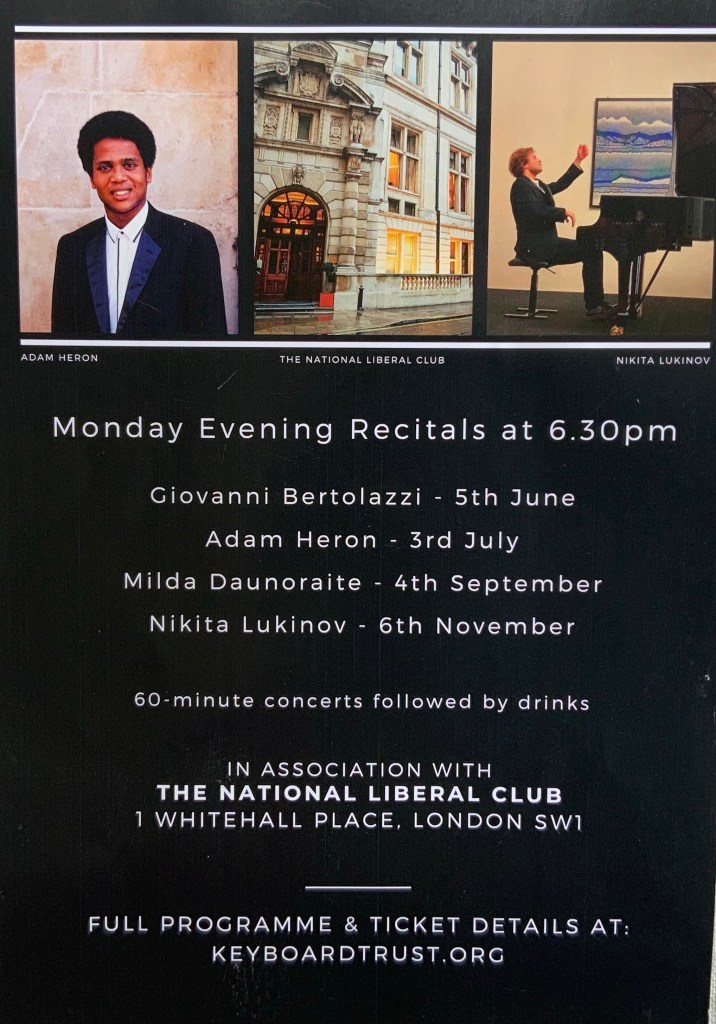
Adam Heron at the National Liberal Club. An eclectic musician of refined taste and eloquence


 ChristopherAxworthy-MusicCommentary
4 risposte a "Milda Daunoraité at the National Liberal Club – Sparks flying with refined piano playing of elegance and simplicity"