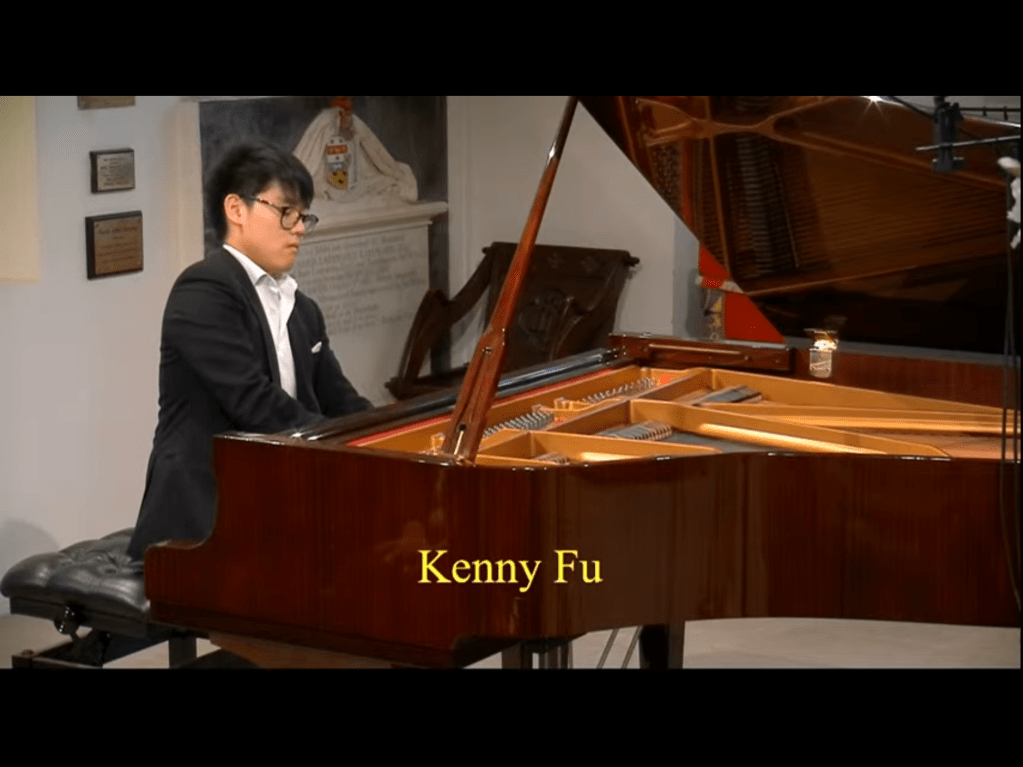
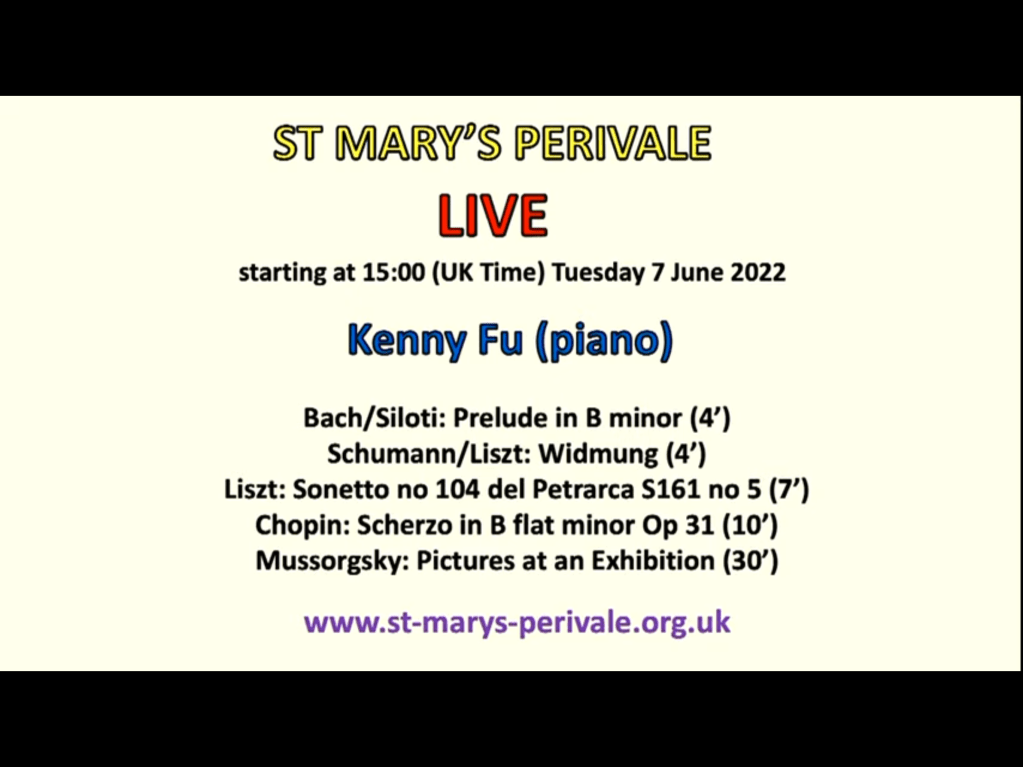
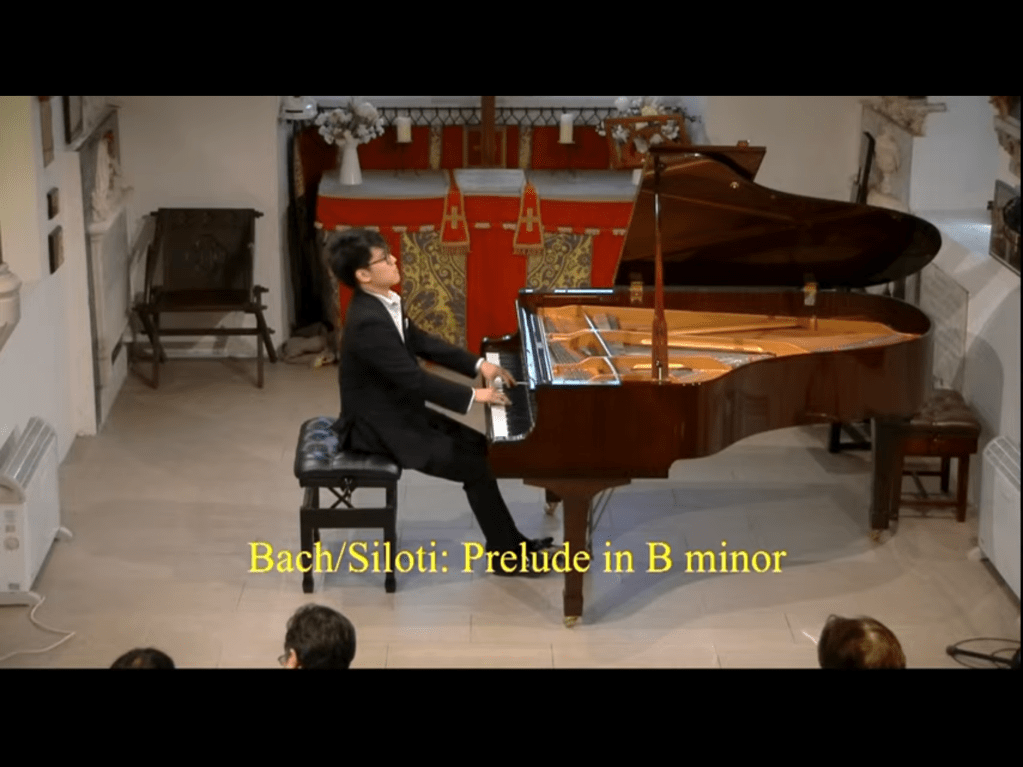
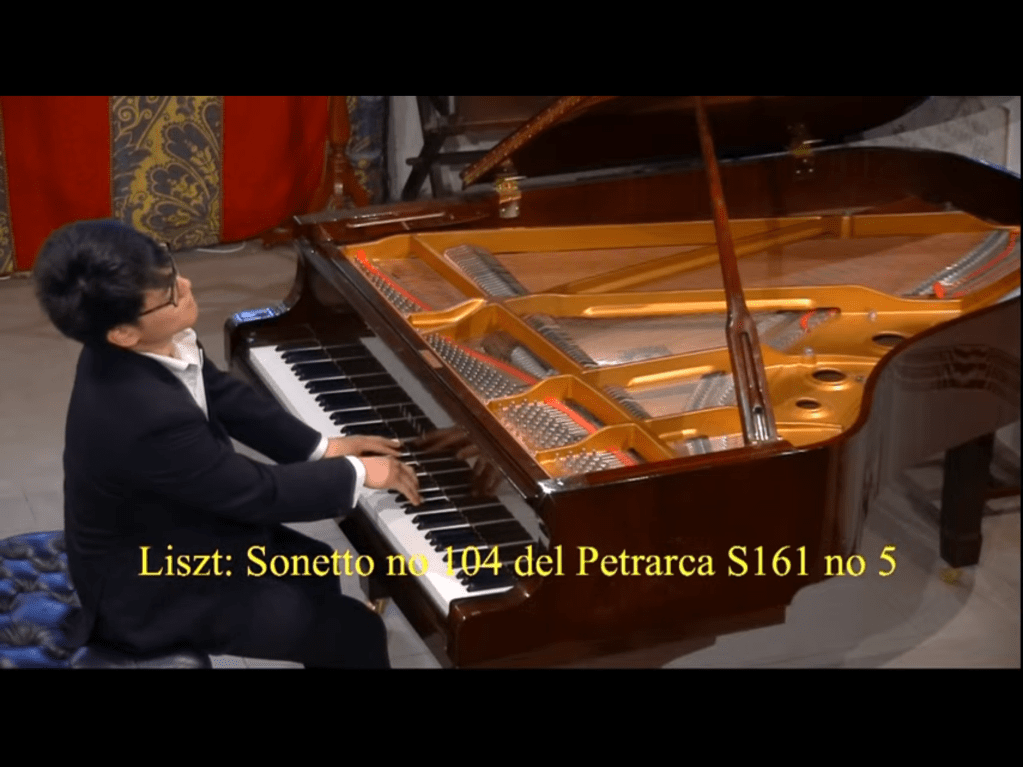
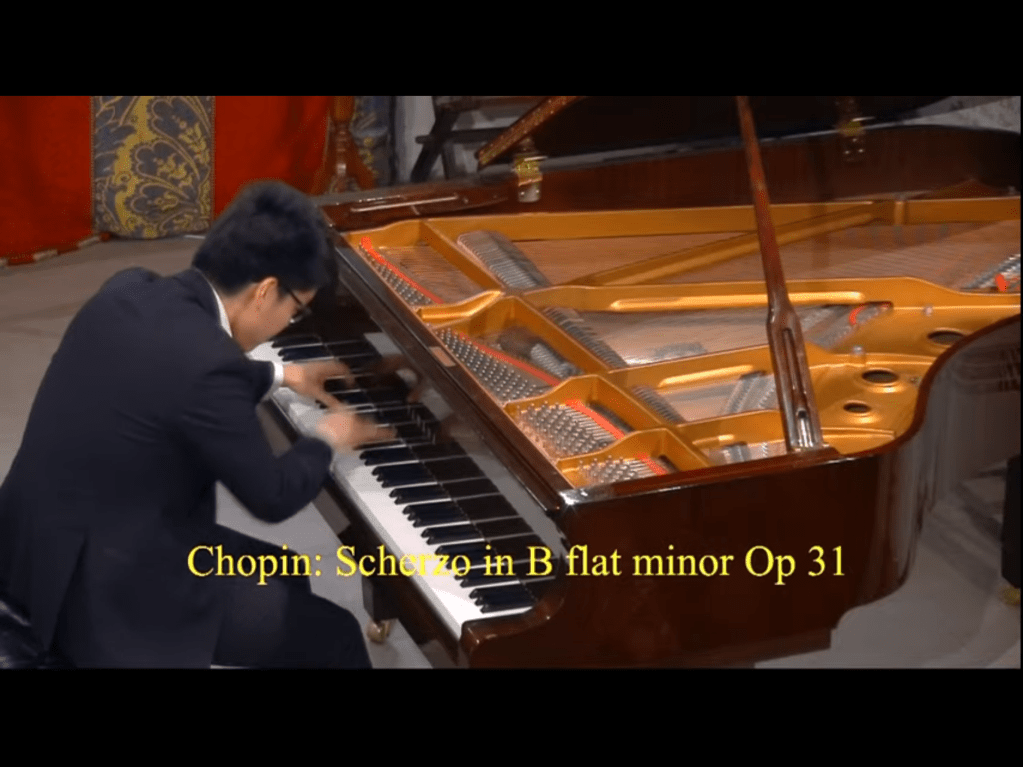
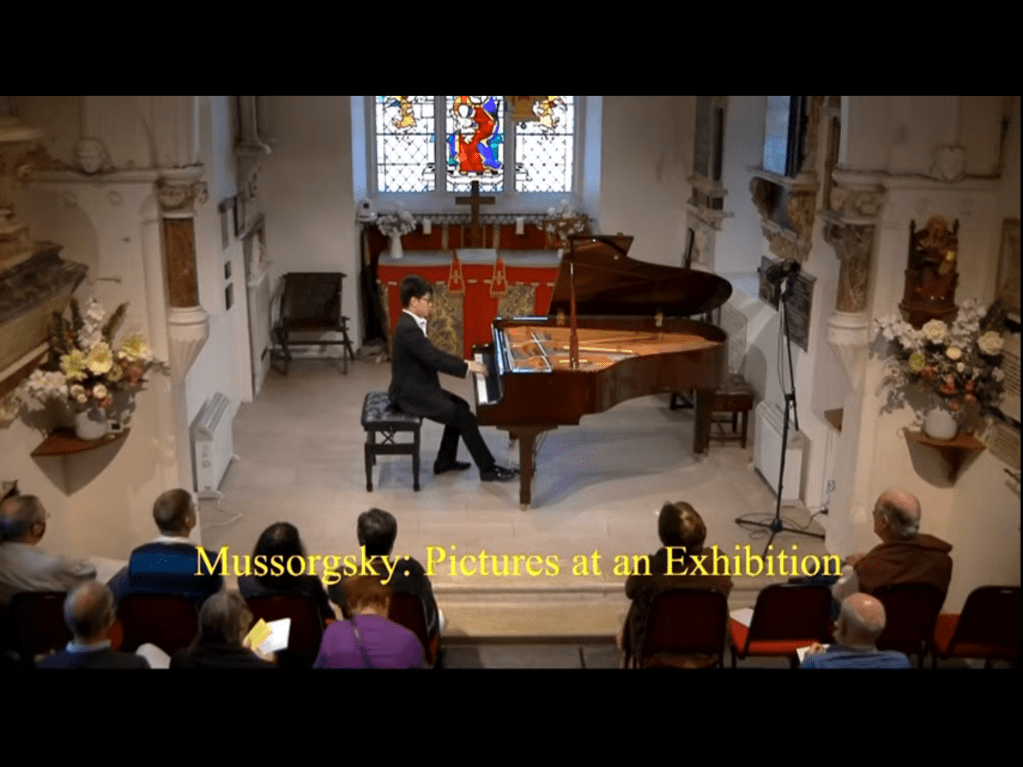
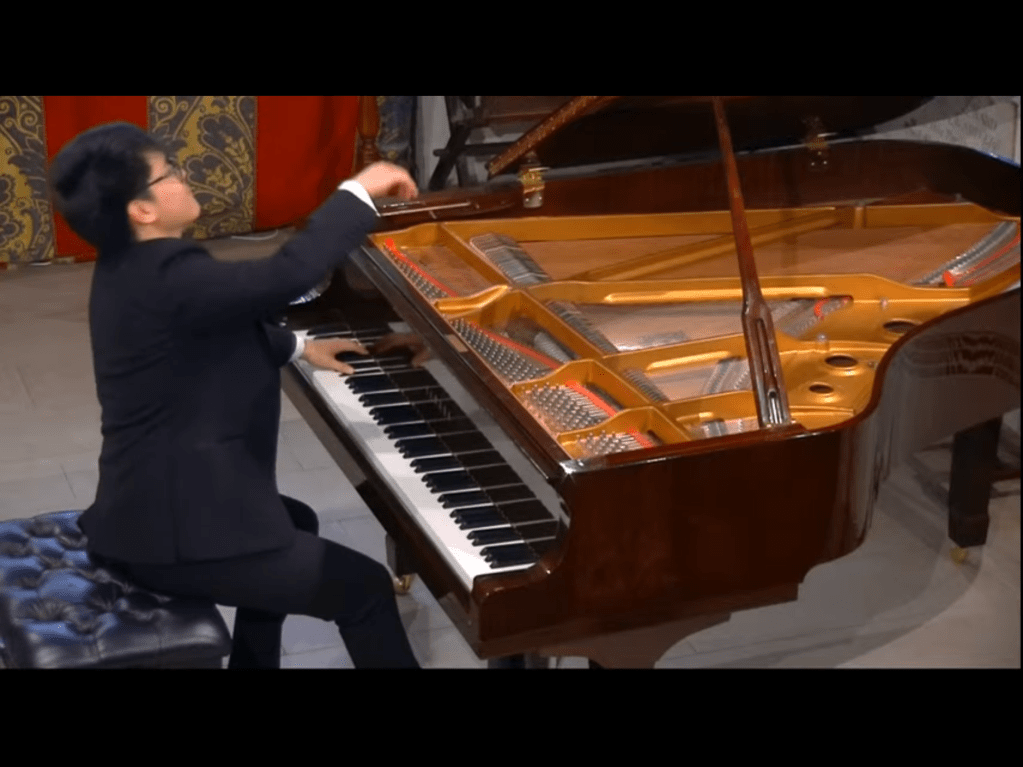
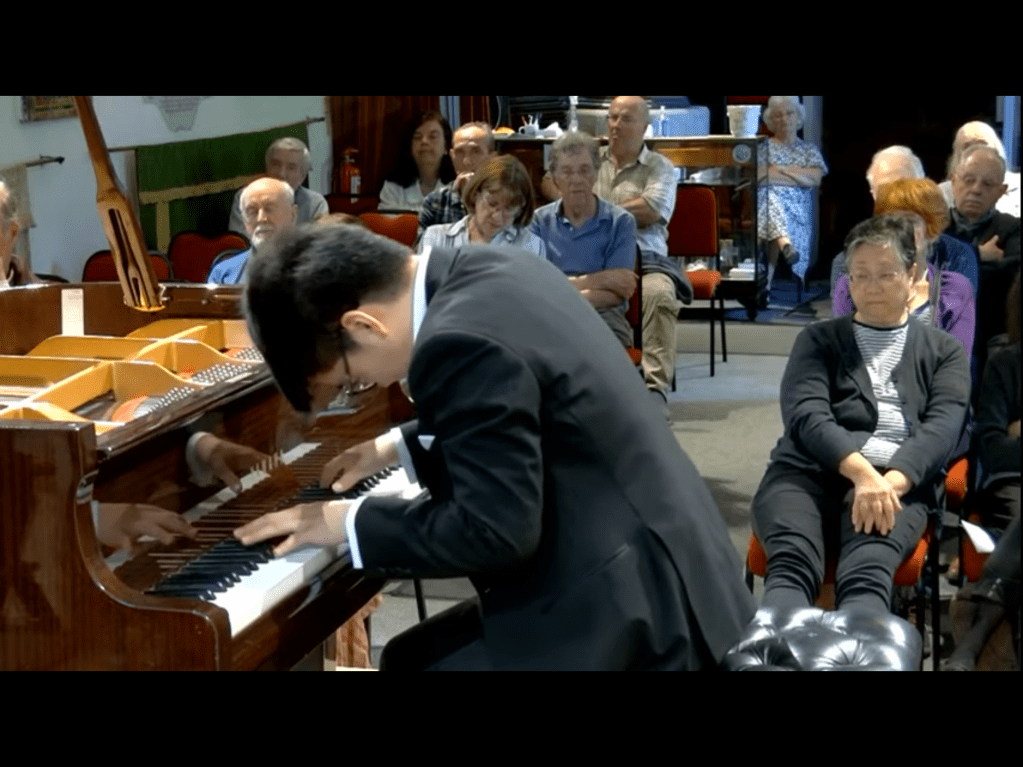
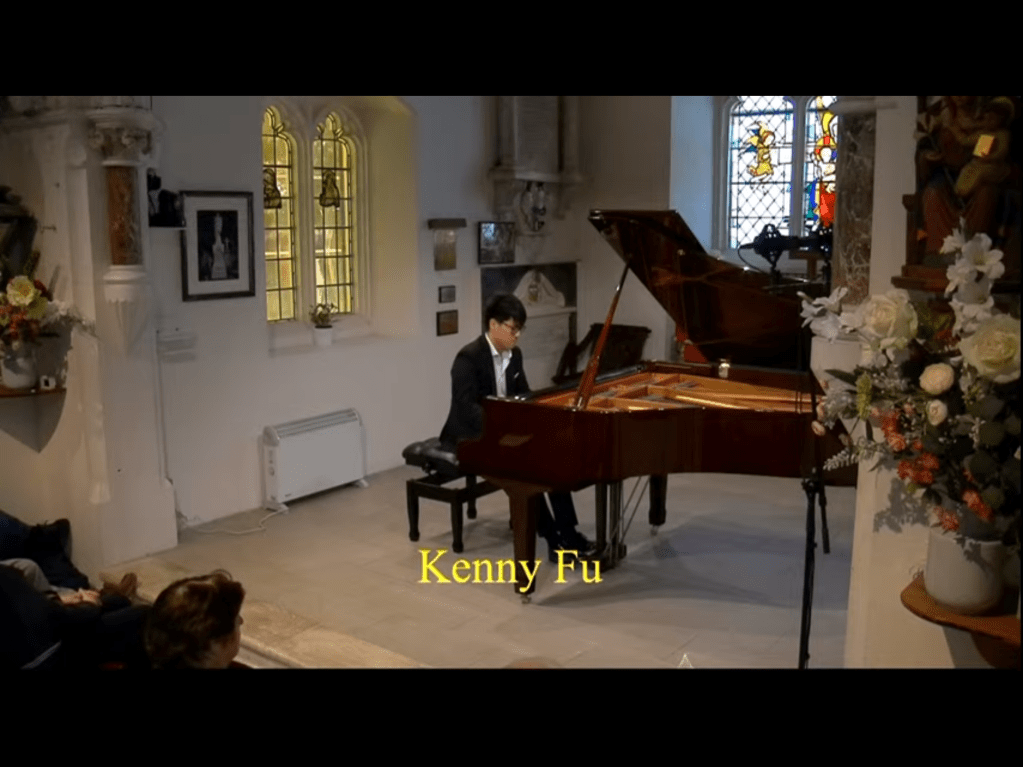
Some magnificent playing not only the ravishing beauty of a continuous outpouring of song with Liszt’s poetical transcription of Widmung and the Petrarch Sonnet 104 but there was from the very first notes the mystical magic of Siloti’s B minor Prelude and a Chopin Scherzo of aristocratic authority and excitement. It was,though,the grandeur allied to a sense of character and architectural shape that he brought to Mussorgsky’s ‘Pictures’ that was so overwhelming . To see this teenager touch and caress the keys as only a true artist could do brought to mind what Schnabel said of Mozart …too easy for the young and too difficult for adults. Here was a young man with an orchestra in his ten fingers but it was his natural way of using his arms and body and the way he would withdraw his hands as though out of water that was of a born artist. Of course being helped and nurtured by the Alexeev’s means his natural gifts will be transformed into great artistry of which Ealing can again be very proud.
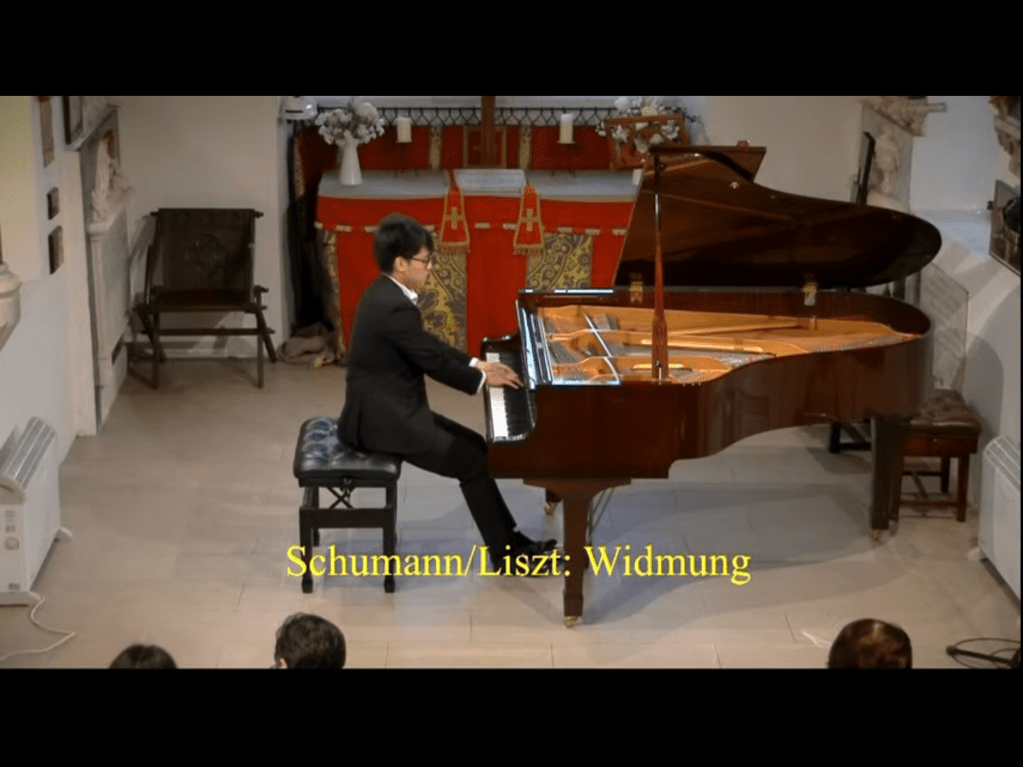
It was the simplicity and luminosity of sound that was immediately apparent as this young man caressed the keys with such natural flowing movements.The entry of the chorale melody was of unforced beauty as his sense of balance and colour was of a rare sensitivity.Although he did not have the creamy rich sound of Gilels or the whispered concentration of Pisarenko he had a personality of unmistakeable authority in someone still so young.A real tone poem and a continual outpouring of love of Robert for Clara who at last in 1840 could marry dedicating this beautiful song op 25 n.1 to her as a wedding present.Kenny found all the subtle poetry in a continual outpouring of beautiful sounds.His sense of balance in the central episode where the melodic line floats of a bed of romantic chords was of a pianist who listens carefully to the sounds he is making and is able to follow the musical line without it ever being submerged by an ever more passionate accompaniment.Freedom and control .Passion and intelligence.Remarkable sensitivity for a young man where life is only just beginning to open up.Such improvised freedom to the opening with the beautiful melodic line passing from soprano to tenor with just barely suggested harmonies.Bursting into a great outpouring of song played with passion and a natural flexibility where the embellishments were thrown off with the same ease and shape of a bel canto singer.Some ravishing colours with a liquid purity in the coda of luminosity and mystery.A performance of this well worn masterpiece restored by this young man to the pinnacle of the romantic repertoire.An aristocratic control and sense of style where Chopin’s often disregarded indications were restored to their rightful place.The beauty of the tenor line in the central section was answered by the crystalline delicacy of the soprano embellishments as it gradually built in excitement and technical difficulty.An ease of playing even in the most challenging passages gave an overall architectural line from the first to the last notes.And what excitement and power there was in the final exhilarating pages played by this young thinking virtuoso.A extraordinary performance where this young man had been able to show us each of the pictures full of character and colour but at the same time had seen a greater picture,that of a monumental gallery.From the sudden dramatic appearance of the ‘Gnome’ to the subtle mystery and colour of the ‘Old Castle’.The clarity of the children quarrelling in the Tuileries with it’s quixotic central episode.The great authority he gave to ‘Bydlo’ moving forward like on a great wave.The rhythmic energy and precision he gave to the ‘Ballet of the unhatched chicks’ was contrasted with the great booming voice of Samuel Goldenberg with the beseeching luminosity of Schmuyle.There was amazing technical control in the ‘Market of Limoges with its exciting climax ending in the desolate emptiness of the Catacombs with the magic sounds of the ‘dead in a dead language’.’Baba Yaga’ bursting on the scene with such power and technical assurance with some magical orchestral colours in the mysterious central section.The Great Gate of Kiev that has taken on great significance in these last 100 days was given a remarkable performance .The gradual tolling of bells are those that we are all longing to hear as this young man built up the sounds with a transcendental sense of balance allowing the final great declaration to ring out with such sumptuous full rich sounds.It was the same beauty of sound that had been a hallmark of the entire recital by this young aspiring poet of the piano.
From his early solo debut at the Wigmore Hall to his attainment of the prestigious Sir Elton John Scholarship, Kenny Fu holds much potential and promise for a bright future. Kenny is currently completing his undergraduate studies at the Royal Academy of Music under the tutelage of Professor Tatiana Sarkissova. He has also received guidance from numerous esteemed musicians such as Dimitri Alexeev, Pascal Devoyon, Imogen Cooper, Bernard d’Ascoli and Angela Hewitt. His repertoire choices gravitate toward the late Classical and Romantic Eras where he brings an intense and captivating temperament to the works of Beethoven, Brahms and Rachmaninov. Kenny has found success throughout the UK and was recently a semi-finalist at the Sussex International Piano competition. During his earlier years he was the winner of the Solihull Young Musician of the Year and a Quarter Finalist at the BBC Young Musician of the Year. His reputation as a musician has also extended internationally where he was a silver medalist at the Cyprus International Piano Competition and a semifinalist in the Brescia International Piano Competition. Kenny has performed in distinguished halls such as the Fazioli Concert Hall in Italy, the Wigmore Hall in London, Kings Place, St Martin-in-the-Fields, and gives several charity concerts at local venues. He has also had the opportunity to give concerts in Germany, Italy and Canada. Kenny is looking forward to his Postgraduate studies at the Royal Academy of Music where he has been accepted with a substantial scholarship.
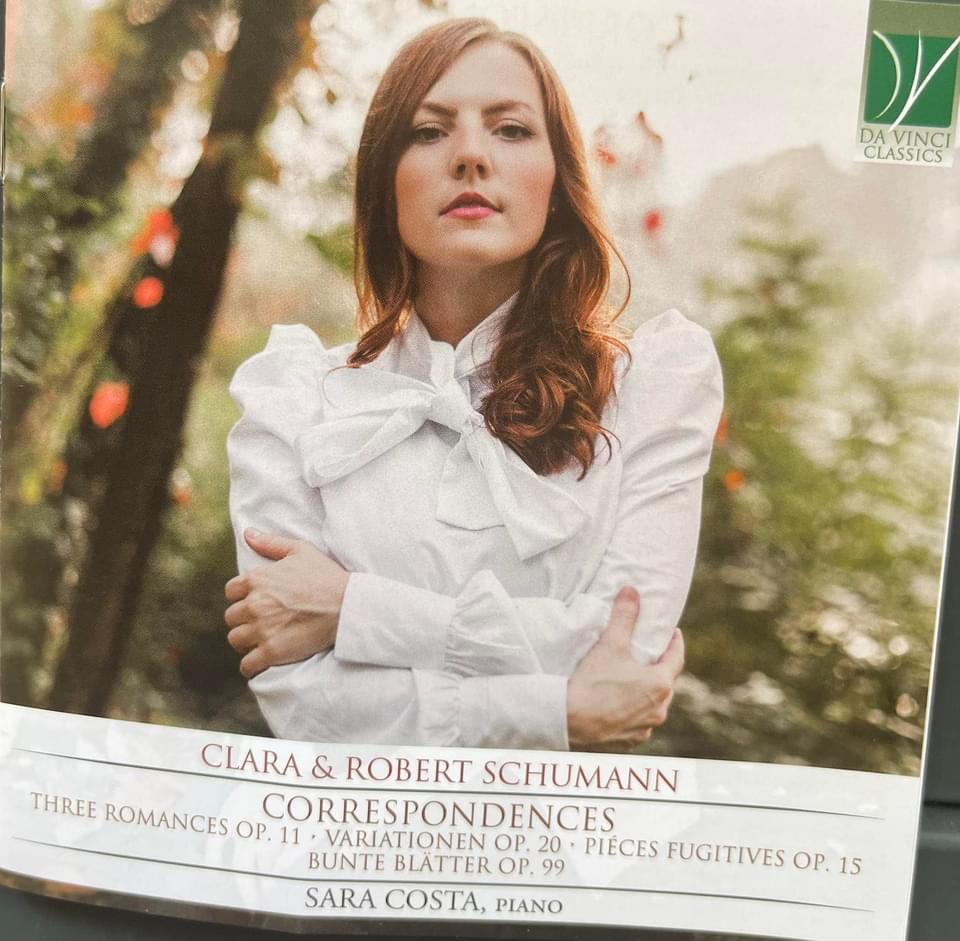
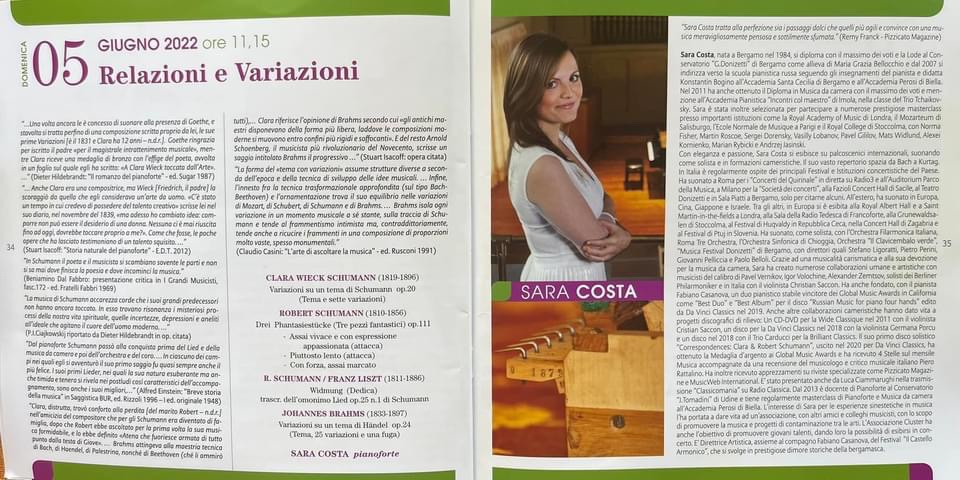
The fifth in a series of eight concerts that Giancarlo Tammaro has organised with such loving care.A recital by Sara Costa with the genial title of ‘Relations and Variations ‘ promoting her recent CD of piano works by Clara and Robert Schumann.A very clever mixture of compositions from the love triangle of Clara,Robert and Johannes.
This is the tenth edition of an annual series of concerts that were born in the Villa d Este in Tivoli for the 200th Anniversary of the birth of Franz Liszt.The star of these concerts is the 1879 Erard piano lovingly restored,allowing the extraordinary sound of this preferred piano of Liszt to be heard once again in the hills overlooking Rome where Liszt was a regular visitor whilst on the ‘Grand tour’ or taking holy orders in Rome.
Every year Ing.Tammaro produces a comprehensive programme full of fascinating information about the composers and the soloists not to mention their link with the hills around Rome.
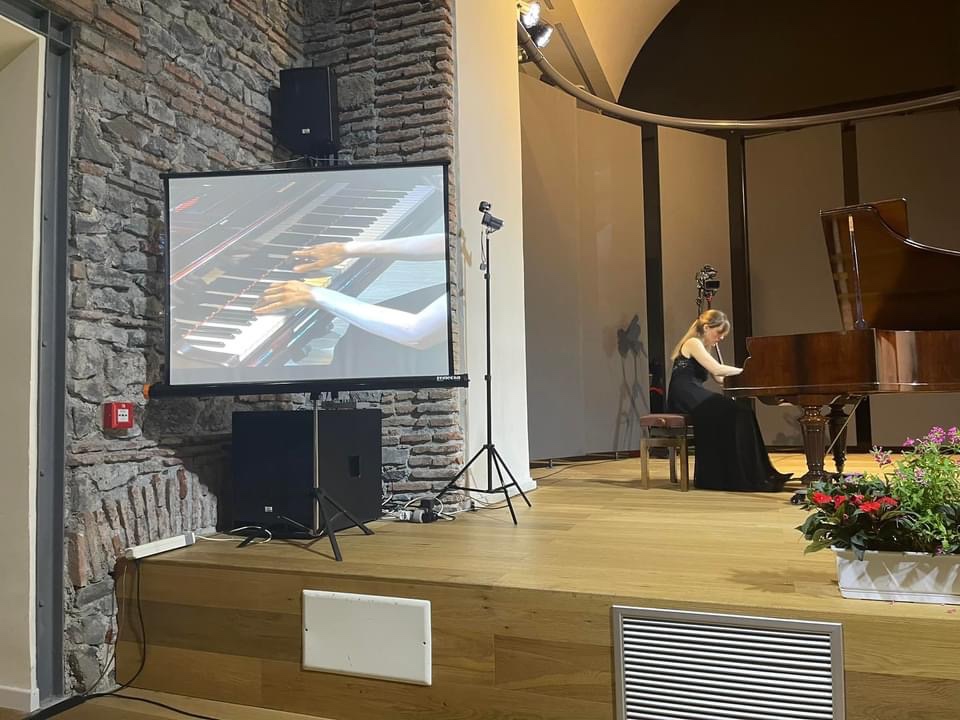
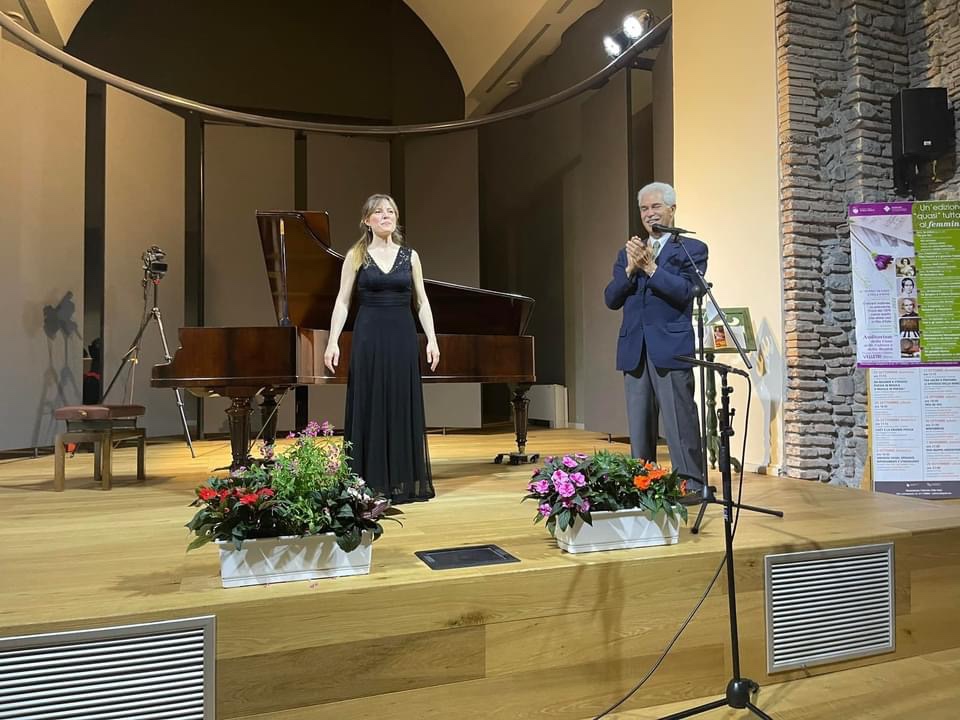
Now in the last few years the concerts have taken place in the restored sixteenth century Carmelite Convent in Velletri.And what an oasis of culture it is!A haven of peace,beautifully restored,and the ideal place to house Ing Tammaro’s much loved Erard piano.
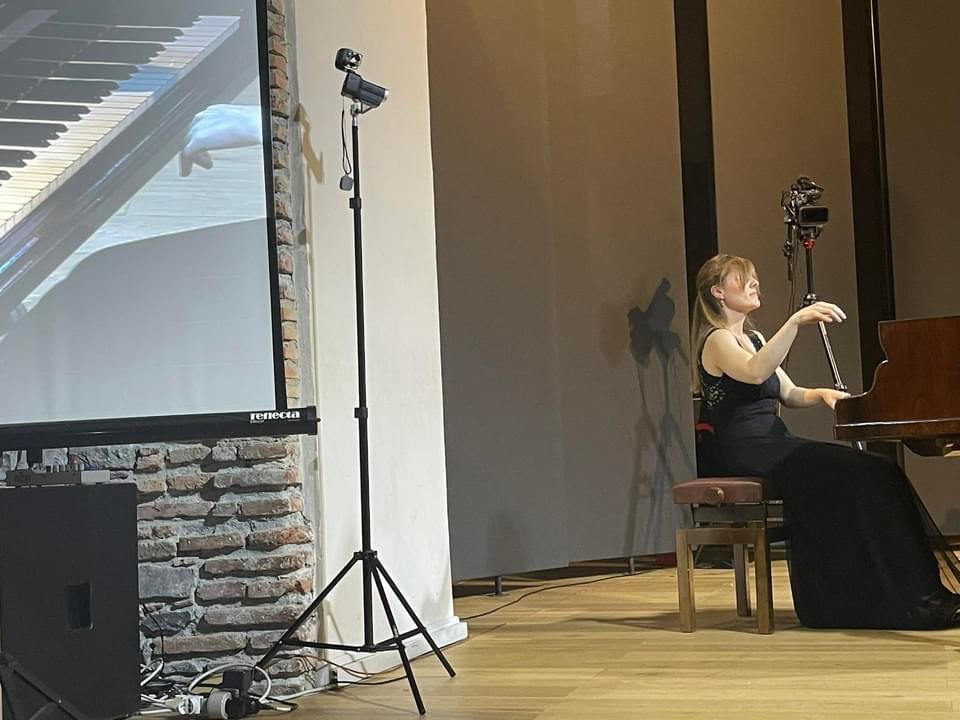
Whilst all around on the plains below the beaches are full of holidaymakers enjoying the sun,we are able to listen on Sunday mornings from April to July to some remarkable young performers.An eclectic choice of programmes not only on a historic instrument but with sophisticated video cameras that allow us to appreciate -up close- the artistry of the artists as they bring the instrument back to life.This year the ‘theme’ is dedicated to ‘nearly all’ female performers to compensate for their unintentional exclusion from many of the previous editions.So not only some very fine female artists but also a revaluation of two female composers in particular :Clara Wieck Schumann and Fanny Mendelssohn.
The Variations on a theme of Schumann op 20 is one of the last Clara composed for piano and opened this fascinating programme today.Clara had presented the variations to Robert for his 43rd birthday in 1853,the last he was to spend at home with his family.He died in a mental institution only three years later.Clara having written many works before her marriage since when her family and concertising took up all her time.She had born Robert eight children!So it was with hesitation that she dedicated this work to Robert based on one of his ‘Bunte Blatter’ op 99 n. 4 (Inspired by this example, Brahms composed his own Variations on a Theme by Robert Schumann Op.9 and dedicated them to Clara).The Theme and seven variations immediately showed off not only the artistry of Sara but also her musicianship as she built up the variations whether they be in great octaves ,ravishing jeux perlé embellishments or the beauty of harp like arpeggios spread over the entire keyboard.Always there was the harmonic structure born on the bass that gave her such freedom and at the same time a sense of architectural line where each variation grew out of the previous.There was a coda of rare atmosphere and subtle beauty of refined playing where the mellow tones of this piano just added to the overall melancholy voice of this final gift of Clara to her beloved Robert.
Following Schumann’s move to the Rhine, where he had become the musical director of the Düsseldorf Music Society, times became hard for him. Despite several initial successes, he increasingly encountered resistance from notabilities, musicians and the public. He thus worked all the more intensively at home on his new works. “R. has composed three piano pieces of a very serious, passionate character, which greatly please me”, Clara Schumann wrote in her diary in September 1851. Three contrasting pieces op 111 are gradually making their way more often into the concert hall .I had first heard them when Cherkassky played them in my series in Rome as a prelude to the Liszt Sonata.The ‘assai vivace’ is a whirlwind of continuous outpouring of romantic sounds played with great rhythmic energy and sweep.Contrasting with the ‘piuttosto lento’ of Schubertian character played with a very subtle sense of line of mellifluous sensitivity.Her sense of balance allowed the melodic line to be shaped with ravishing care and beauty.The bucolic Con forza was played with rhythmic energy but always with a sense of melodic line with its boisterous tenor melody passing to the soprano with Schubertian elegance.
Widmung is much more than a mere showpiece – containing the most passionate music full of heartfelt feelings. Written by Robert Schumann in 1840 ,it is the first from a set of Lieder called Myrthen, Op.25 dedicated to Clara Wieck as a wedding gift when finally he married her in September 1840,despite the opposition from Clara’s father (who was also Robert’s piano teacher). It was later arranged for piano solo by Franz Liszt. It starts with a flowing sense of pulse, while the first phrase (“Du meine Seele, du mein Herz”) already captures Schumann’s love for Clara and devotion to the relationship. Here, Schumann sincerely confesses to Clara, declaring how important she is to him. For him, Clara is his angel, his spiritual support, and his entire world. Nevertheless, there is still a sense of fear and insecurity in the music, due to separation and uncertainty about their future. This complex mixture of feelings, as a true and full-bodied representation of love, certainly strengthens the emotional power of the music.Liszt lengthened the first section by repeating the first theme, but with the melodic line mostly embedded in left hand (with some intertwining) and accompaniment in higher register. Then, the music moves on to the chordal section in E major, which is unchanged in Liszt’s arrangement. The repeated chords convey warmth, tenderness and peace, especially when the text here is associated with death and heaven. Here, the love has changed into everlasting, eternal one – love that transcends space and time.Schumann’s love for Clara becomes so dramatic and uncontrollable, and eventually erupts – a perfect combination of rapture, passion, commitment and sense of elevation. With ecstatic joy, the music transforms into a declaration, as if Schumann is announcing that he is determined to spend the rest of his lifetime with Clara and willing to make sacrifices in the face of adversity, for Clara is an indescribable miracle of his life.
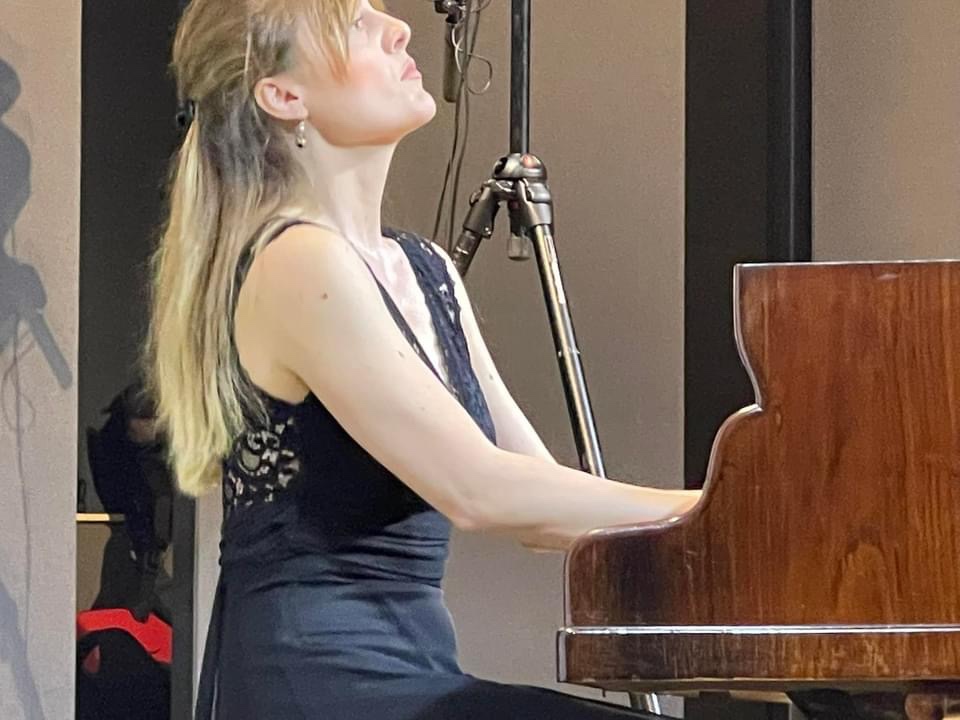
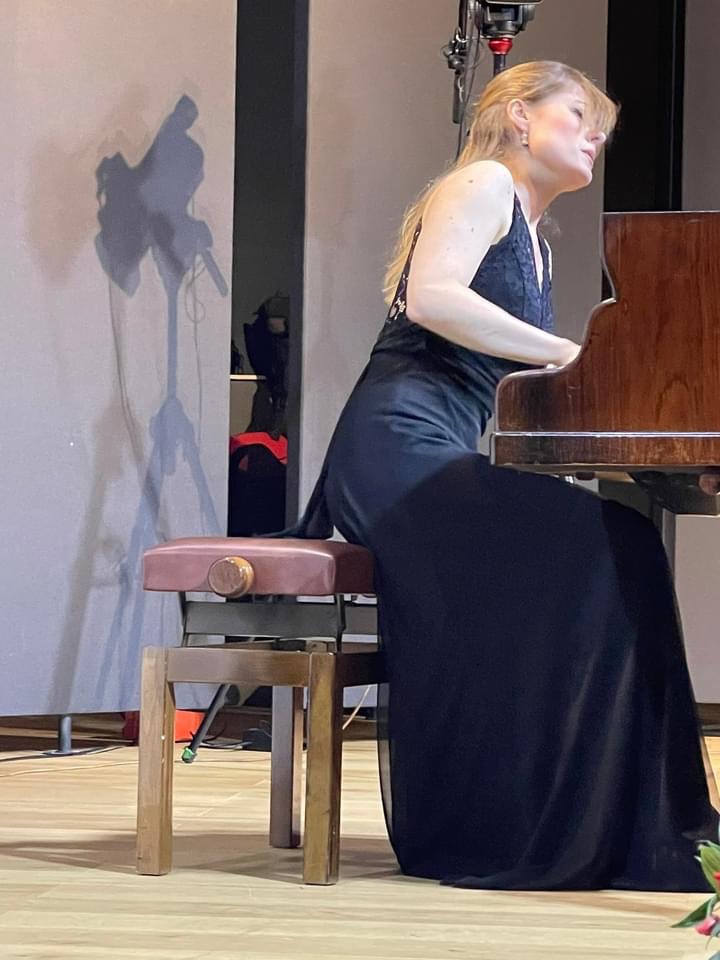
Sara played it with a gentle fluidity with sensitivity and forward movement like a a great wave as her circular movements became ever more agitated the passionate outpourings of great virtuosity spread over the entire keyboard.The great climax dissolving to a mere whisper as this miniature tone poem had run it’s loving course and there was left only the refined gentle caresses of Sara Costa’s true artistry.
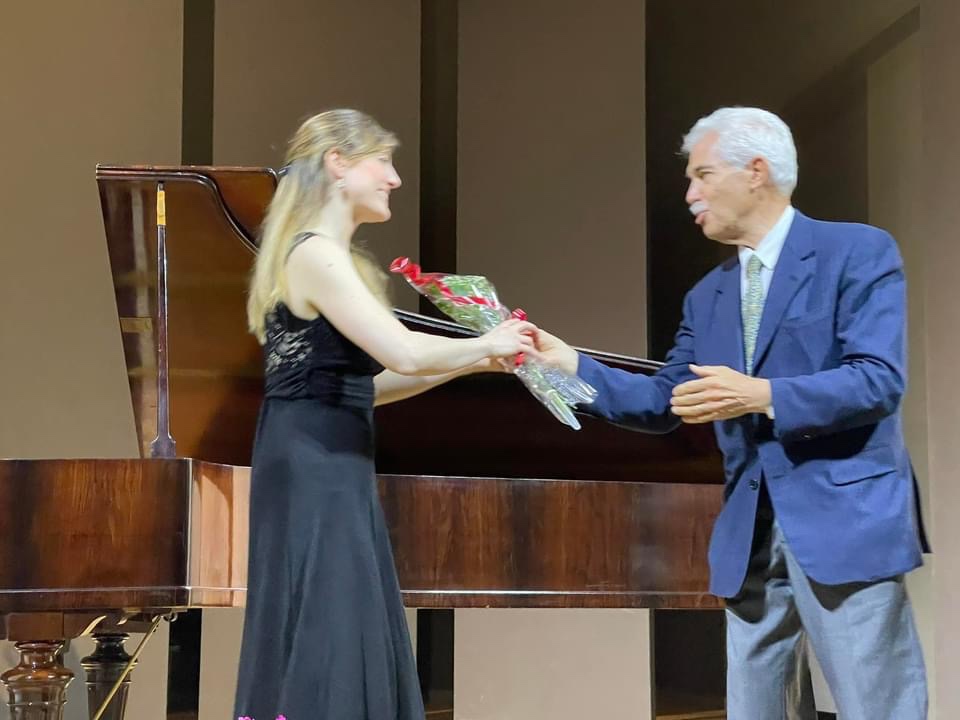
Flowers from Ing Tammaro and by great request a repeat of Widmung for an enthusiastic public at the end of her concert which she played as a second encore.
The Handel Variations were written in September 1861 after Brahms, aged 28, abandoned the work he had been doing as director of the Hamburg women’s choir (Frauenchor) and moved out of his family’s cramped and shabby apartments in Hamburg to his own apartment in the quiet suburb of Hamm, initiating a highly productive period that produced “a series of early masterworks”.Written in a single stretch in September 1861,the work is dedicated to a “beloved friend”, Clara Schumann, widow of Robert Schumann.It was presented to her on her 42nd birthday, September 13 1861.Barely two months later, in November 1861, he produced his second set of Schumann Variations, Op. 23, for piano four hands.
A performance of great power and architectural shape where the sound was always built up from the bass leaving such freedom but at the same time an anchor of such solidity.It had been the hallmark of a fellow student of my old piano teacher Sidney Harrison at the Royal Academy in London.Norma Fisher was already a very highly esteemed pianist when I was taken to hear her play this very work at the Wigmore Hall and was presented to her afterwards in the Green Room.Our mutual father figure was proud to present her the newly awarded Liszt Scholar!Sara Costa in the Green Room today greeted me with the name of our mutual friend Norma Fisher! Small world,our old teacher would have exclaimed!Sara had studied this very work with her during her studies at the Royal College of Music where she is now a highly sought after pedagogue. https://christopheraxworthymusiccommentary.com/2022/05/12/norma-fisher-at-steinway-hall-the-bbc-recordings-on-wings-of-song-the-story-continues/. There was the same solidity to her playing and a sumptuous rich orchestral sound where the minutest details whilst being played with great sensitivity never took away from the overall shape with the underlying wave giving a sense of direction.I slightly missed the mechanical statement of the Aria where the ornaments should unwind like clockwork springs as this is the theme that Brahms will elaborate in so many different ways.Maybe it was the mellow sound of the piano that here did not have the radiant brilliance that we are used to hearing .It was immediately put to rights though with the very crisp and clear first variation contrasting with the legato forward flow of the second.The shaking of hands in the third was done as Brahms indicates -scherzando and dolce and led to the technical prowess of the ‘risoluto’ octaves played with great drive but being orchestral I would have made them more marcato than staccato.There was great sweep to the fifth variation that led to the delicacy of the legato octaves of the seventh.She brought great nervous energy to the staccato drive of the seventh and eighth leading to the imperious gasps of sustained octaves.The chase from the top to the bottom of the keyboard was done with great brilliance in the tenth variation with the gently expressive eleventh and twelfth before the grandiloquence of the ‘ Largamente ma non troppo ‘ of the thirteenth.Startling technical feats abound in the following variations played with a real sense of character and shape gently arriving at the lilting Scottish dance rhythm of the nineteenth.There was beautiful luminosity of sound in the music box variation before the scintillating drive to the triumphant outpouring of the theme in all its glory.Some extraordinary playing of infectious drive and fearless virtuosity.The clarity of the fugue played almost without pedal at the beginning as it gradually built to a tumultuous climax of quite transcendental difficulty.The extraordinary thing is that we were never aware of the hurdles she was tackling such was the overall sweep and excitement that she was able to generate.An ovation from a very enthusiastic audience was rewarded by another great outpouring of song of great beauty and sensitivity,choosing another from one of Schumann’s last collection of pieces ‘Coloured leaves’- Bunte Blatter
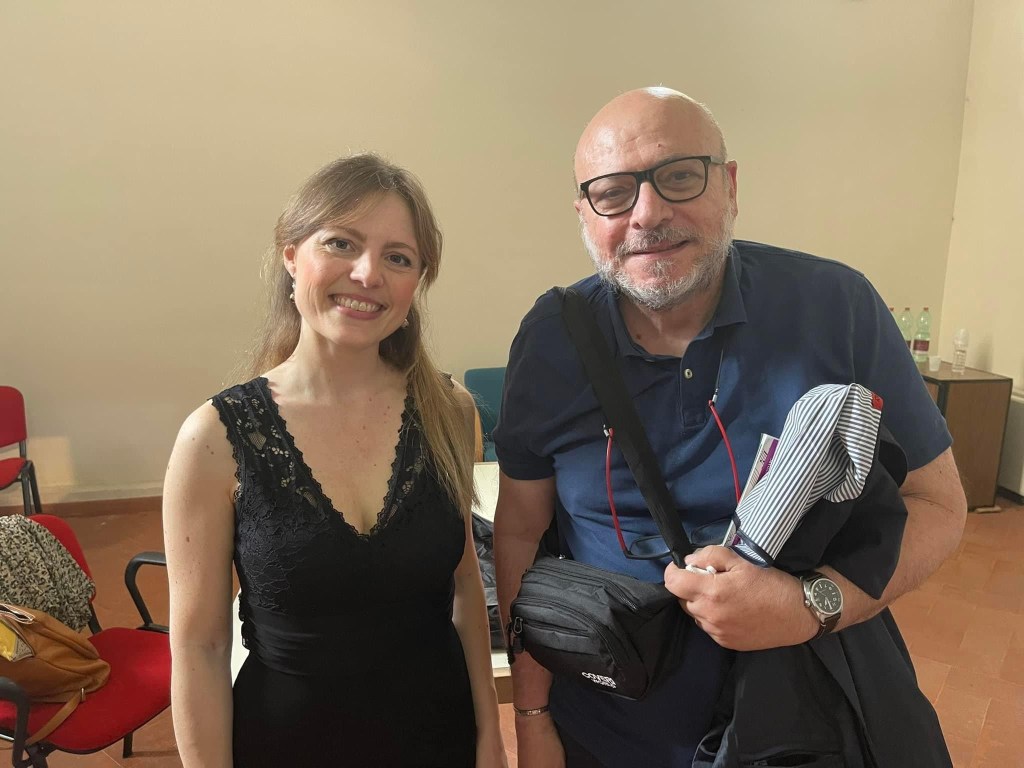
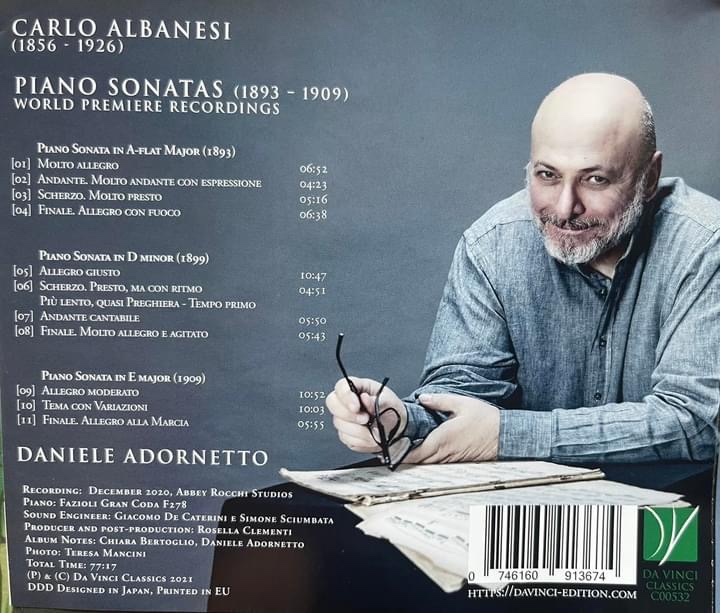
Sara Costa with Daniele Adornetto who has recently made a world premiere recording of Sonatas by the Neapolitan Composer/pianist Carlo Albanesi (1856-1926) who became in 1893 a much respected Professor at the Royal Academy of Music in London much sought after by the nobility for piano lessons.
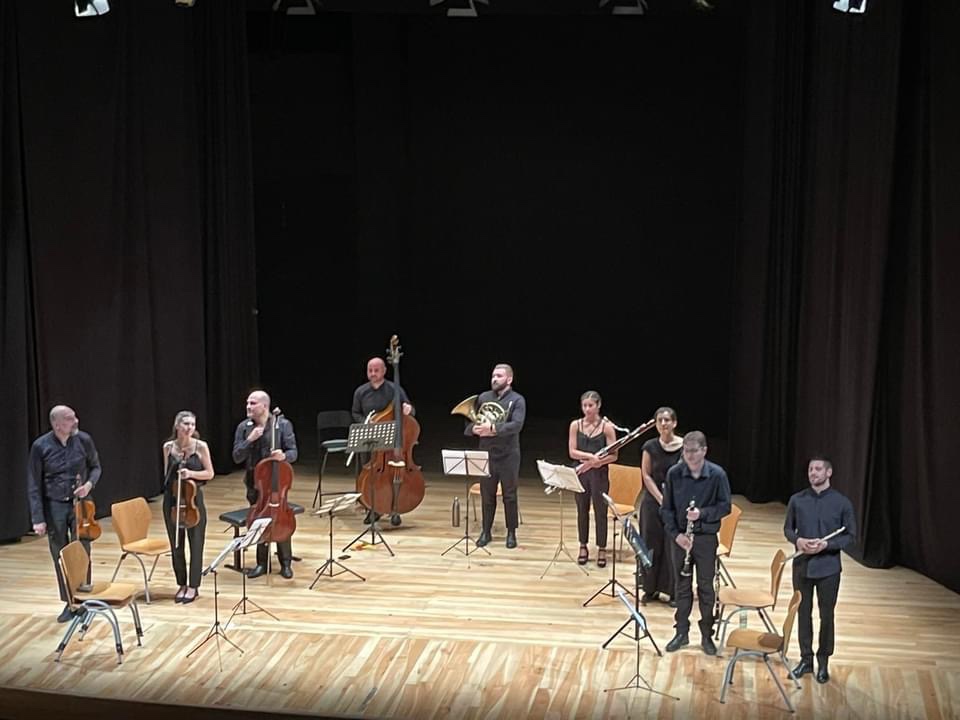
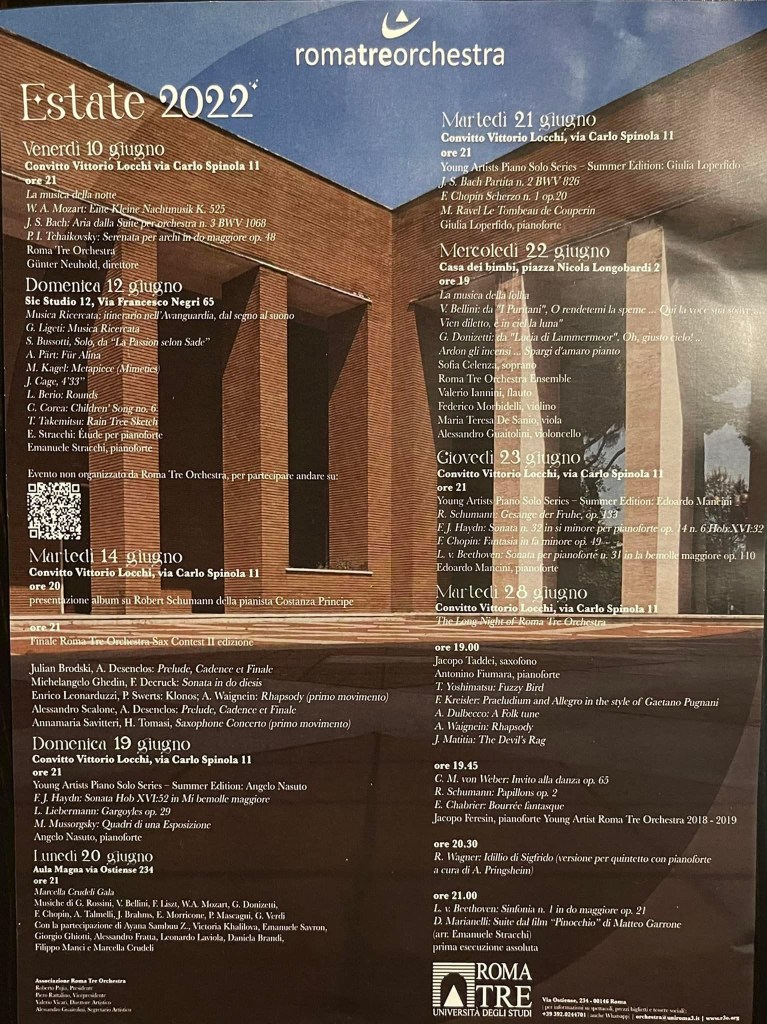
Venerdì 3 giugno Teatro Palladium ore 20.30 Le piace Brahms? J. Brahms: Serenata n. 1 in re maggiore op. 11 (versione originale per 9 strumenti) Roma Tre Orchestra Ensemble David Romano, violino Diego Romano, violoncello
The final concert in the Spring Season for Roma 3 with even more surprises from Roberto Pujia and Valerio Vicari in their quest to help young talented musicians find a home to share their remarkable talents with a discerning audience in the Eternal City.Not happy with just a series of concerts,they had created sixteen years ago an orchestra made up of musicians who have graduated from their advanced studies and need experience of playing in an ensemble.The Orchestra has gone from strength to strength thanks to the expert musicians that have been invited to share the platform with them.Enrico Bronzi helped form an ensemble that actually listens to itself. https://christopheraxworthymusiccommentary.com/2020/12/18/roma-3-orchestra-comes-of-age-at-teatro-palladium-in-rome/
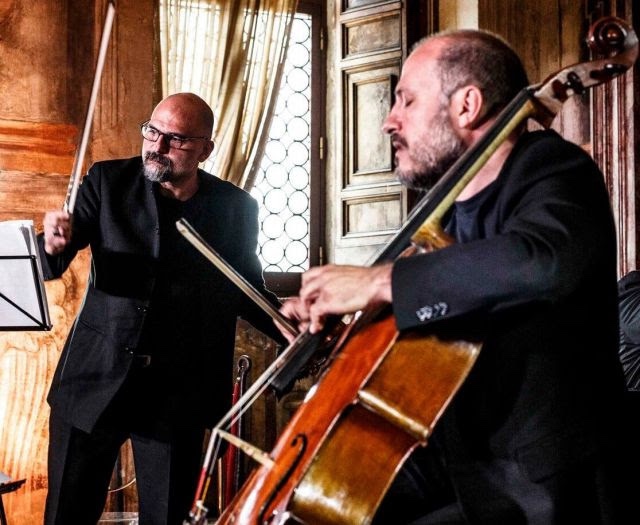
And tonight in the quest to learn and perfect their ensemble,the remarkable Romano brothers had been invited to work together on the rarely performed original version of Brahms Serenade op 11.I had heard David Romano last summer in a chamber music festival held on the beautiful Spada estate in Sutri.
I had not heard him before but his overwhelming participation and music personality ignited the Souvenir de Florence after an equally overpowering performance of the Rite of Spring played by the indomitable Beatrice Rana and her partner Massimo Spada.
This year’s eagerly awaited Festival later in the month
Per la prima volta ospiti della stagione di Roma Tre Orchestra insieme, i fratelli Romano sono due fuoriclasse del violino e del violoncello e ricoprono ruoli di prime parti presso l’Orchestra Nazionale dell’Accademia di Santa Cecilia.
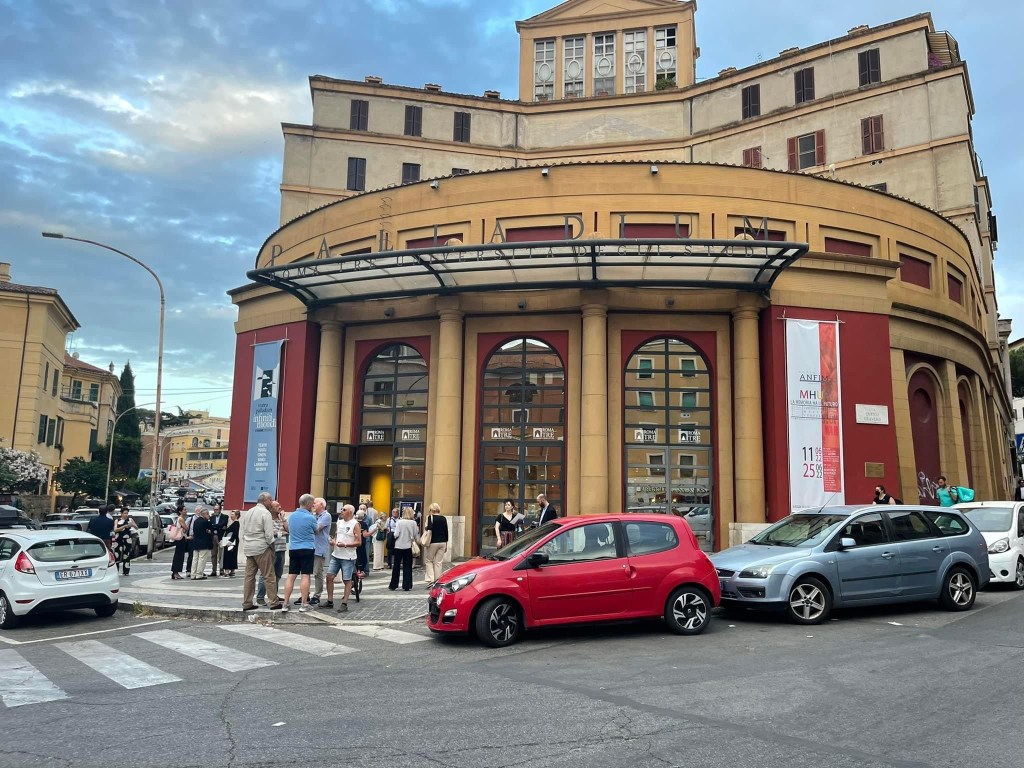
Teatro Palladium seat of the Roma 3 Orchestra
In questo progetto guidano un ensemble di nostri giovani musicisti nella Serenata n. 1 in re maggiore op. 11 di J. Brahms. Questo brano fu inizialmente concepito nell’estate 1858 per nove strumenti (flauto, due clarinetti, corno, fagotto e quartetto d’archi) durante delle vacanze a Göttingen trascorse con Clara Schumann e alcuni amici. Dopo un primo ascolto in occasione di un concerto privato ad Amburgo il 28 marzo 1859 Brahms si convinse che fosse opportuno elaborare anche una versione orchestrale del brano. Si tratta della prima composizione sinfonica pubblicata dal giovane Brahms ed è caratterizzata da un clima sereno e una scrittura contrappuntistica che colpì positivamente i suoi contemporanei. Emerge chiaramente uno sguardo attento al passato: alla forma della fuga così come era stata elaborata da Bach, alla musica da camera di Haydn e Mozart nonché a precedenti formazioni cameristiche originali quali il settimino di Beethoven e l’ottetto di Schubert. Non mancano tuttavia i tratti distintivi di quello che sarebbe stato il personale stile compositivo di Brahms, nella musica da camera come in quella sinfonica.
The two Serenades, Op.11 and 16, represent early efforts by Brahms to write orchestralnmmusic. They both date from after the 1856 death of Schumann when Brahms was residing in Detmold and had access to an orchestra. Brahms had a goal of reaching Beethoven’s level in writing symphonies,and worked long and hard on his first symphony completing it only in 1876 when he was 43 years old. As preliminary steps in composing for orchestra, he chose early on to write some lighter orchestral pieces, these Serenades.
The first serenade was completed in 1858. At that time, Brahms was also working on his first Piano Concerto.Originally scored for wind and string nonet and then expended into a longer work for chamber orchestra ,the serenade was later adapted for orchestra;Brahms completed the final version for large orchestra ?in December 1859.In the orchestration of the Concerto Brahms had solicited and got a great deal of advice from his good friend Joseph Joachim.For this Serenade Joachim also gave advice, although to a lesser extent.The first performance of the Serenade, in Hanover on 3 March 1860, “did not go very well” in Brahms’s opinion,but evidently the unusually large audience of 1,200 did not notice any mistake during the performance. At the end, applause “persisted until I came out and down in front.” After every piece in the concert “the audience was shouting.”This was a vastly better reception than the Piano Concerto had in either of its first two performances. But at its third performance, 24 March, also in Hamburg, it had been a success, perhaps not to the same degree as the Serenade.
The Serenade is in six movements:Allegro molto ,Scherzo,Allegro non troppo – Trio. Poco più moto,Adagio non troppo,Menuetto 1– Menuetto 2 ,Scherzo. Allegro – Trio Rondo,Allegro
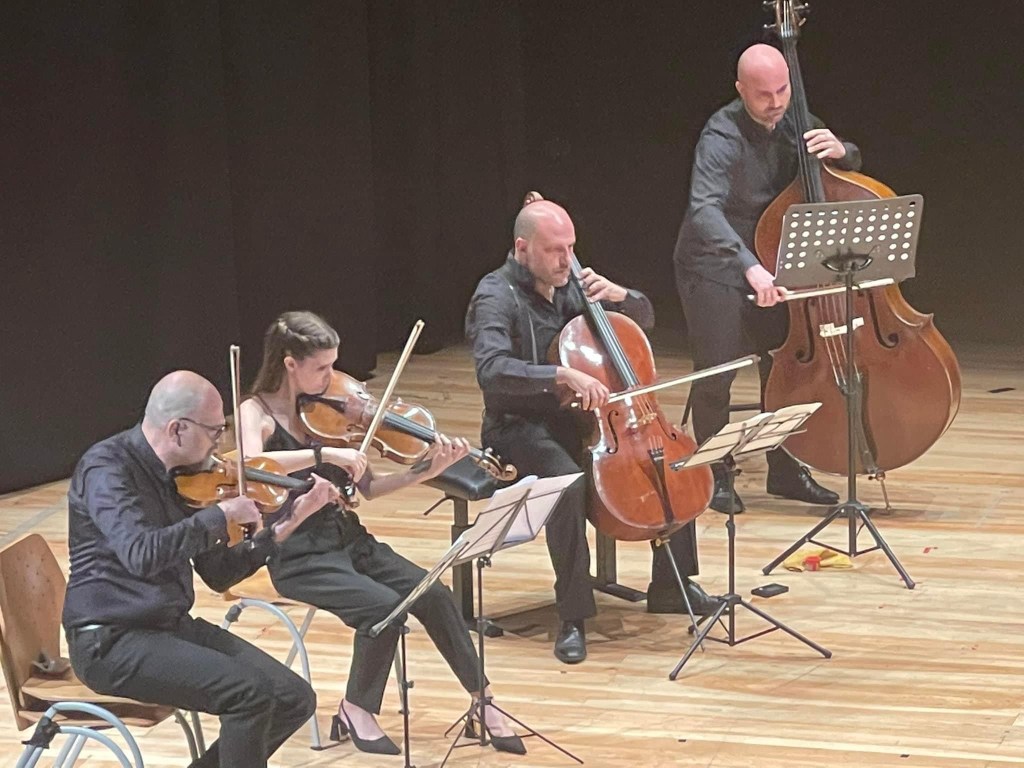
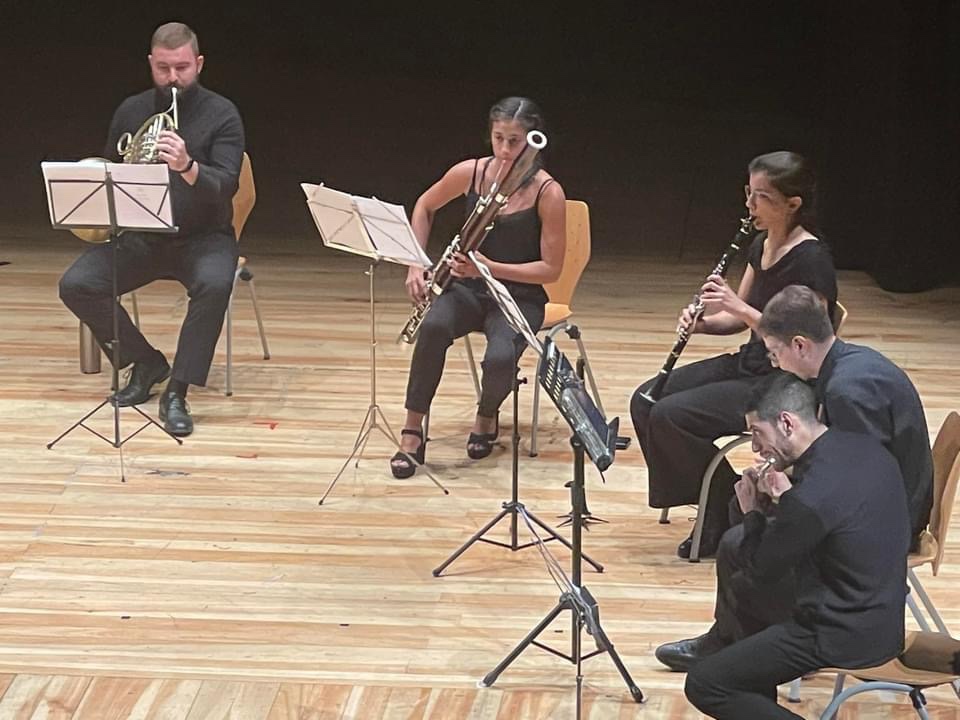
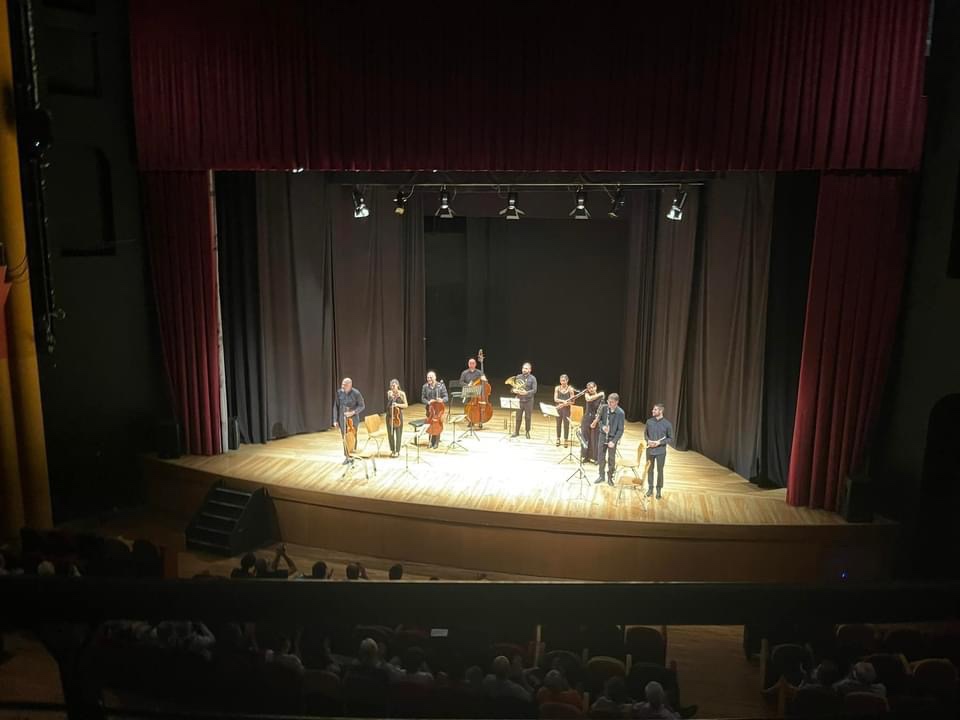
A superb ensemble and as David Romano had said in his introductory talk – whilst the votes were being counted for the audience prize – the horn takes on a pivotal role and is thus seated between the strings in one side and the wind on the other.There was some remarkably authoritative playing from the horn of Gabriele Gregori.And with David and Diego Romano seated between Carlotta Libonati,viola and Daniele De Angelis double bass how could,they not play with the same passion and searing intensity of these remarkable brothers.Valerio Iannini,flute,the two clarinets of Alessandro Crescimbeni and Giuliana Nicotra and the bassoon of Carolina Santana all inspired to bring such mellifluous shape to this early work in progress of Brahms.
The beautiful pastoral of the Allegro molto or the mystery of the Scherzo.The extraordinary opening of the Adagio for just viola,cello and doublebass.The pure charm of the Menuetti and the almost call to arms of the second Scherzo followed by the exhilaration of the hunt in the Rondo.A remarkable performance by an ensemble that played as one thanks to the inspired participation of the Romano brothers who knew how to ignite and encourage with such humility their younger colleagues,allowing them all to reach even greater heights together.
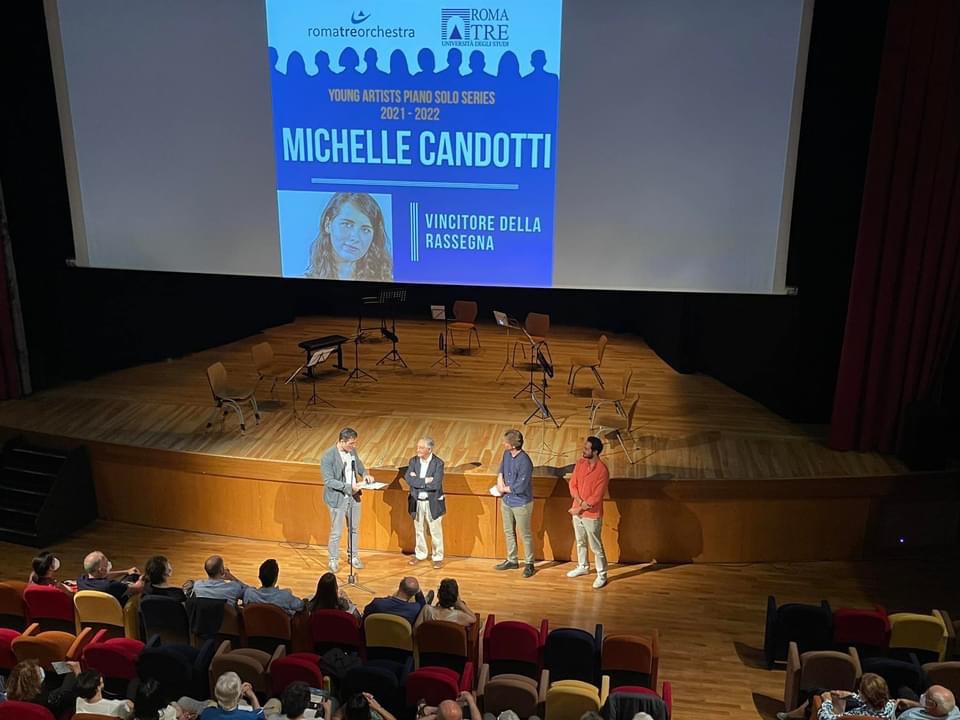
Fascinating too the idea of audience participation for their Young artists piano series during the season at the Teatro Palladium,Teatro Torlonia and the Aula Magna of Roma 3.I had heard a lot of the concerts and know the five finalists well although I had not been able to listen to all their performances in this season.All remarkable young musicians who just need a platform and a discerning audience to share their music with.Hats off to Roma 3 who are gradually building up a following and faithful public who know and appreciate the quality of the performances from these young musicians .And hats off too to an audience who could pin point the remarkable artistry of Michelle Candotti a student of Dmitri Alexeev at the RCM in London.When we met after this concert she was on her way to play to him at his country home near Rieti – small world! https://christopheraxworthymusiccommentary.com/2021/11/13/dmitri-alexeev-mastery-and-communication-beyond-all-boundaries/
I had heard these remarkable musicians at the Razumovsky Academy of Oleg Kogan last April when they were playing in trio with the equally remarkable Lovell-Jones.
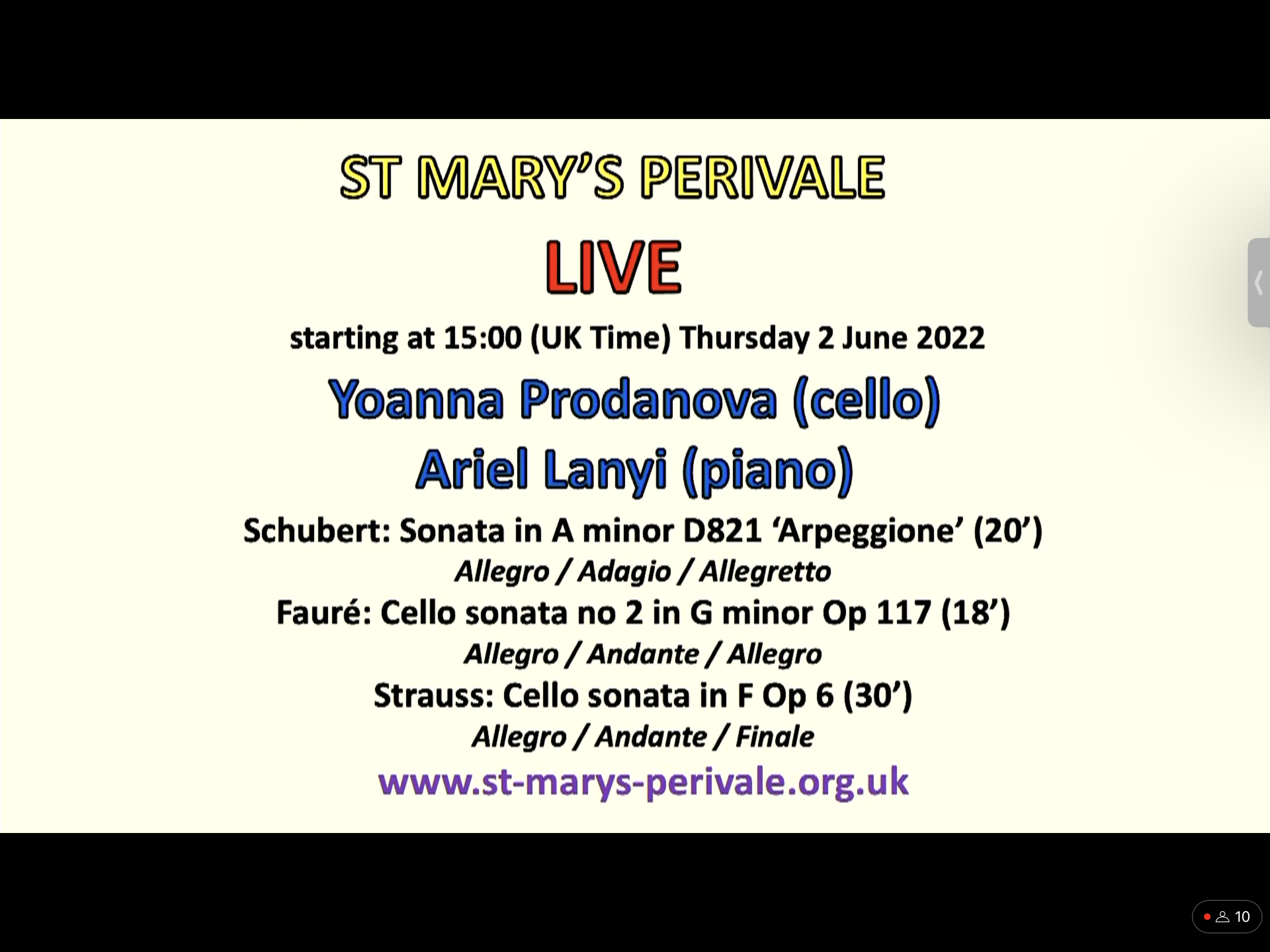
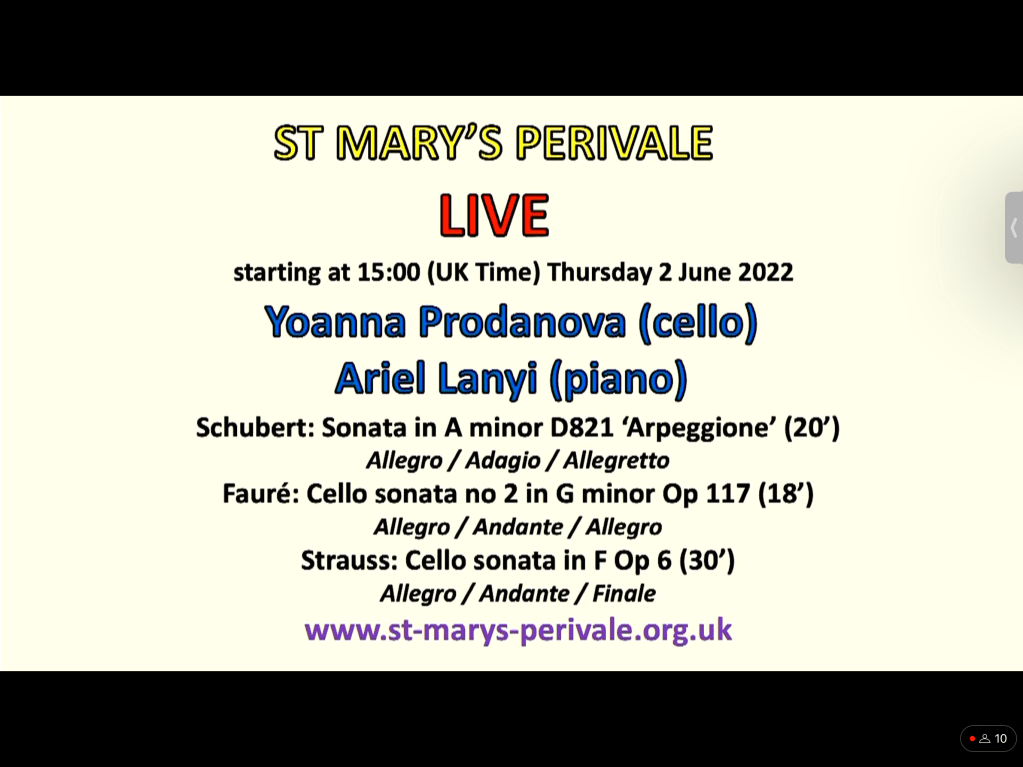
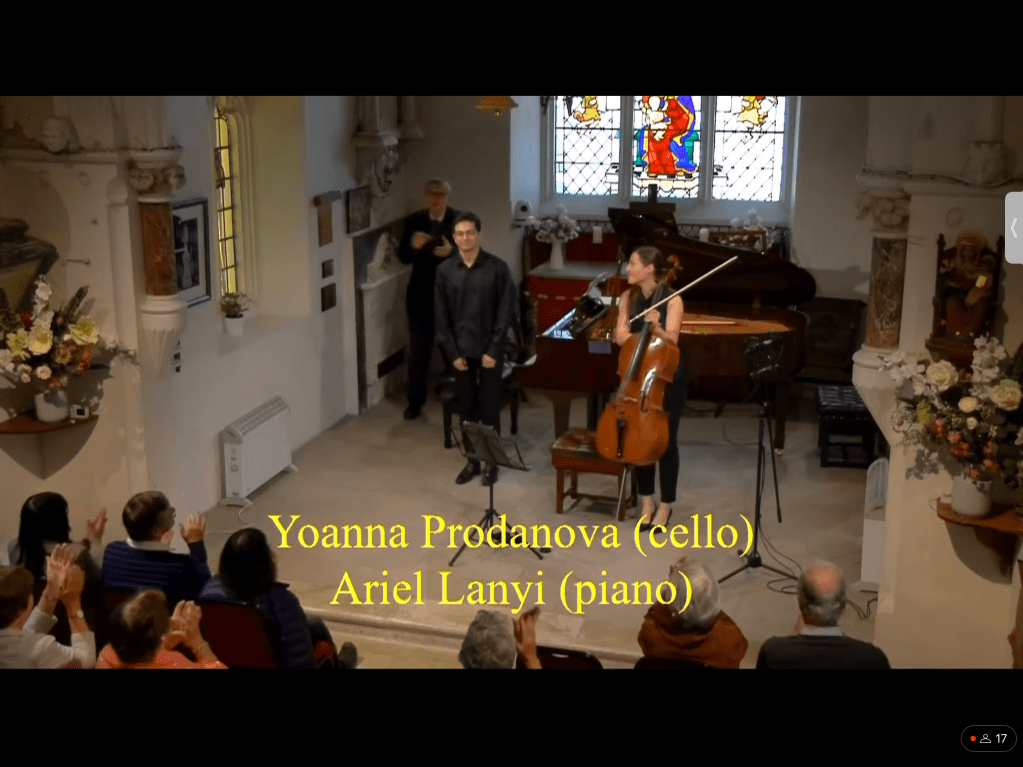
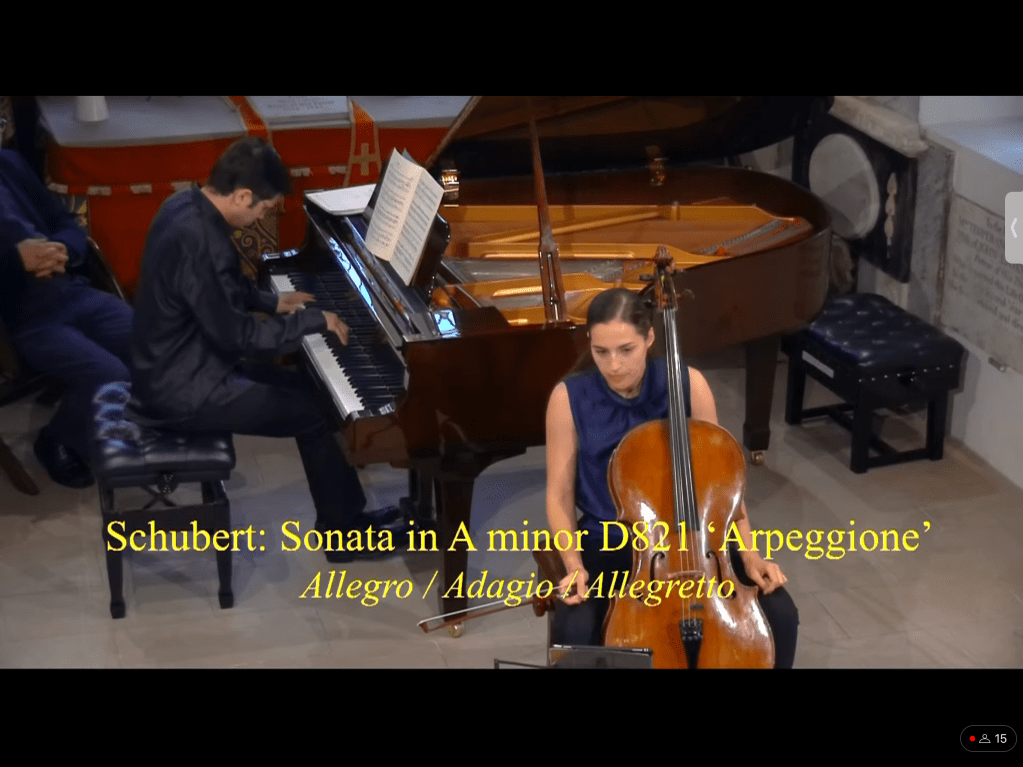
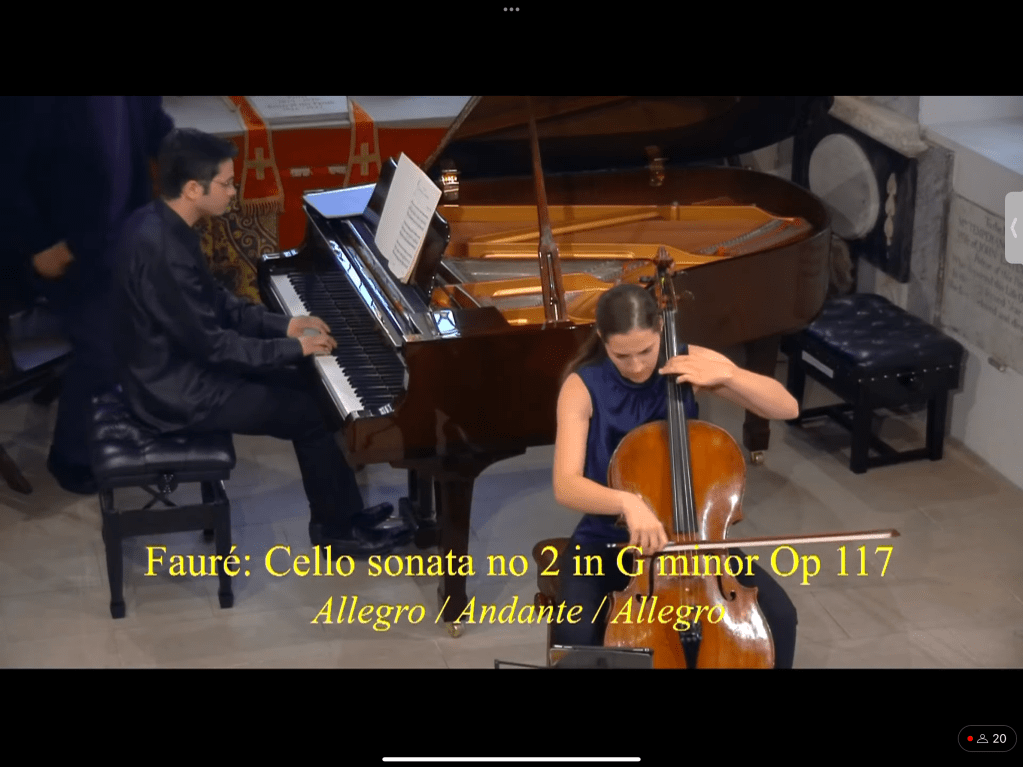
I was tempted this afternoon to listen to Ariel and Yoanna in duo this time and to appreciate once again their superb musicianship in three sonatas for ‘cello and piano.I can only add my admiration and appreciation for the simplicity of the Schubert followed by the streams of mellifluous sounds in Fauré and ending with the scintillating early Sonata by Strauss.A wonderful afternoon of music making at its best and I was glad to have chosen to be bewitched by their playing rather than being roasted on the beach from where I was listening in Italy.Today is a bank holiday for the 66th Anniversary of the foundation of the Republic whilst celebrations for the Queen’s Jubilee are well under way I hear in the UK.
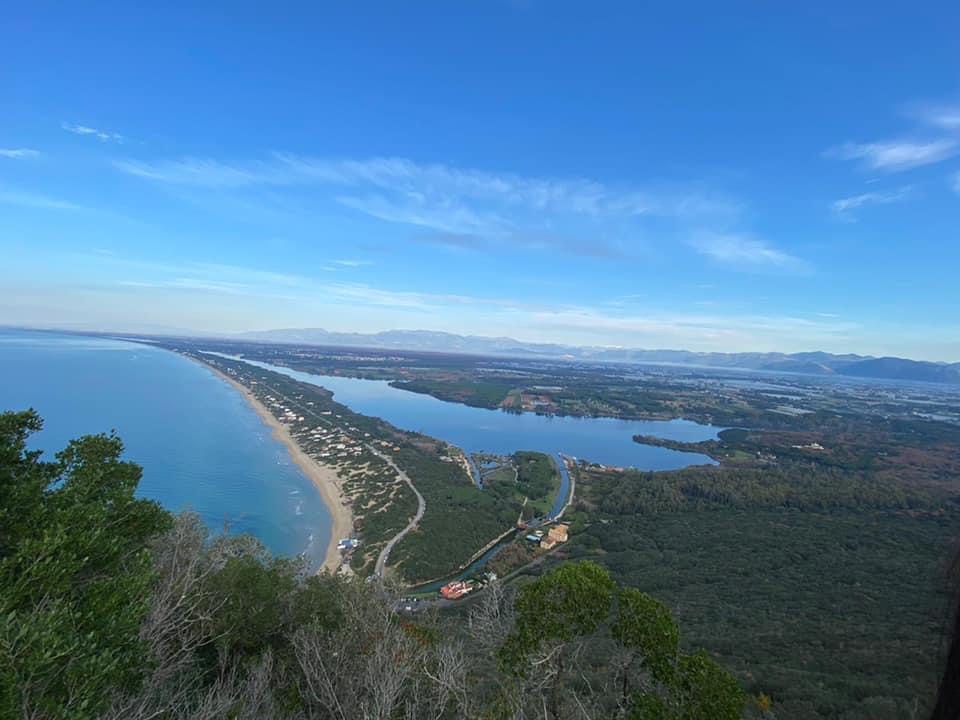
San Felice Circeo – Sabaudia 100km from Rome or Naples
Cellist Yoanna Prodanova was born in 1992 in Varna, Bulgaria. She completed her studies in 2019 at the Royal Academy of Music in London where she was a Bicentenary Scholar on the prestigious Advanced Diploma course, already having obtained her Bachelor and Master’s degrees at the Guildhall School of Music and Drama. Previously she studied in Varna and in Montreal where her family immigrated in 2006. He has performed concertos with the Royal Academy of Music Orchestra, the Amati Orchestra, the Surrey Philharmonic and the Guildford Symphony Orchestra among others. She regularly performs as a recitalist in the UK and Europe. Her debut album including works by Janacek, Fauré and Chopin with Mihai Ritiviu was released in 2020 on the Linn Records label. She has also recorded the Brahms clarinet trio with Joseph Shiner and Somi Kim for Orchid Records. Yoanna’s awards include The Philip and Dorothy Green Award for Young Artists (2016), the Sylva Gelber Award (2017, 2018), Tunnell Trust Award (2019) and the First prize at the International Joachim Competition in Weimar with her string quartet, the Barbican Quartet.She is extremely grateful to the Canimex Group for the loan of a beautiful cello made by Giuseppe Gagliano in 1788.
In 2021, Ariel Lanyi won third prize at the Leeds International Piano Competition, and was a prize winner in the inaugural Young Classical Artists Trust (London) and Concert Artists Guild (New York) International Auditions. Over the last year Ariel has made his debut at Wigmore Hall and participated in the Marlboro Music Festival in Vermont,. As soloist he performed Brahms Concerto No.2 with the Israel Philharmonic Orchestra and the Royal Liverpool Philharmonic Orchestra, and Beethoven’s Concerto No.2 at the Royal Academy of Music. This season Ariel returns to give performances in the Miami Piano Festival and at Wigmore Hall, as well as recitals in Rome kand across the UK, and performances with orchestras in Israel and in the US, playing concerti by Mozart and Brahms. Born in Jerusalem in 1997, in 2021 Ariel completed his studies at the Royal Academy of Music in London after studying at the High School and Conservatory of the Jerusalem Academy of Music. Awards include 1st Prize at the 2018 Grand Prix Animato Competition in Paris and 1st Prize in the Dudley International Piano Competition, as well as a finalist award at the Rubinstein Competition. Ariel is a Countess of Munster Recital Scheme Artist
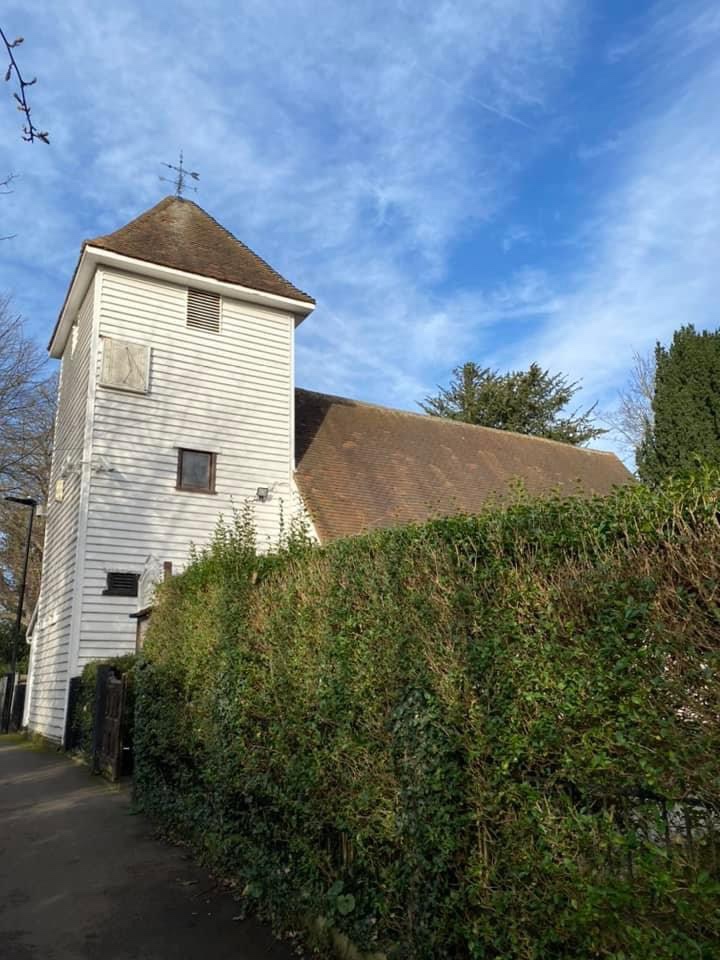
Hats off again to Dr Hugh Mather and his team that allowed me and many more world wide to appreciate the wonders that are a regular occurrence in the beautiful little redundant church of St Mary’s in Perivale.











 ChristopherAxworthy-MusicCommentary