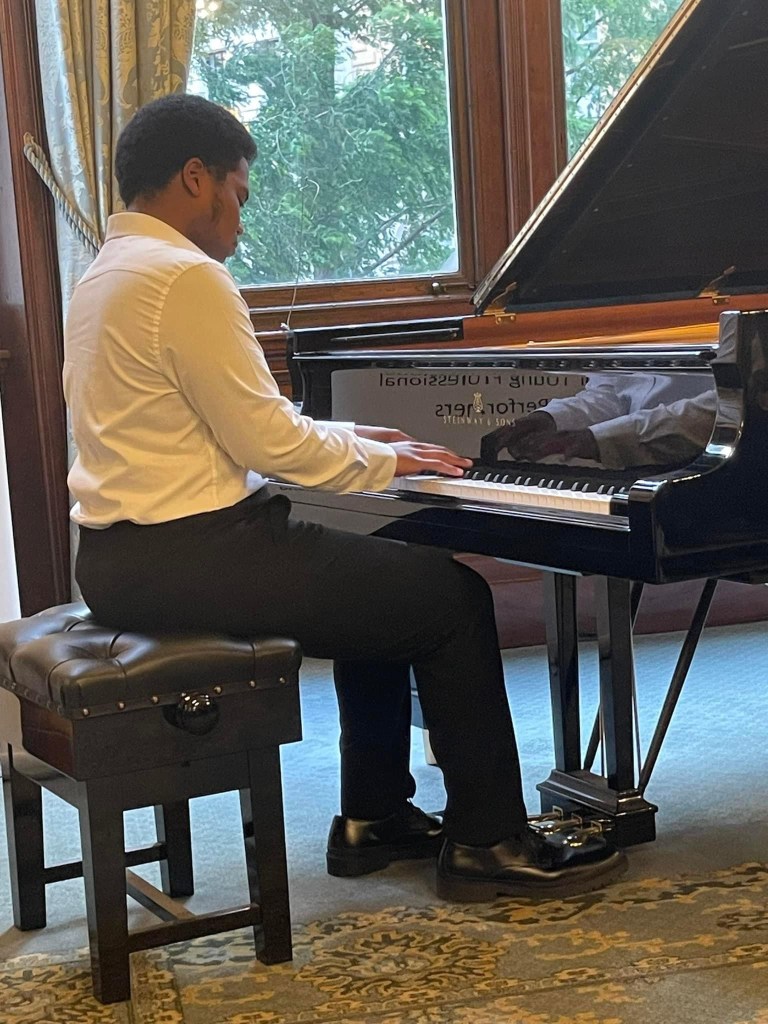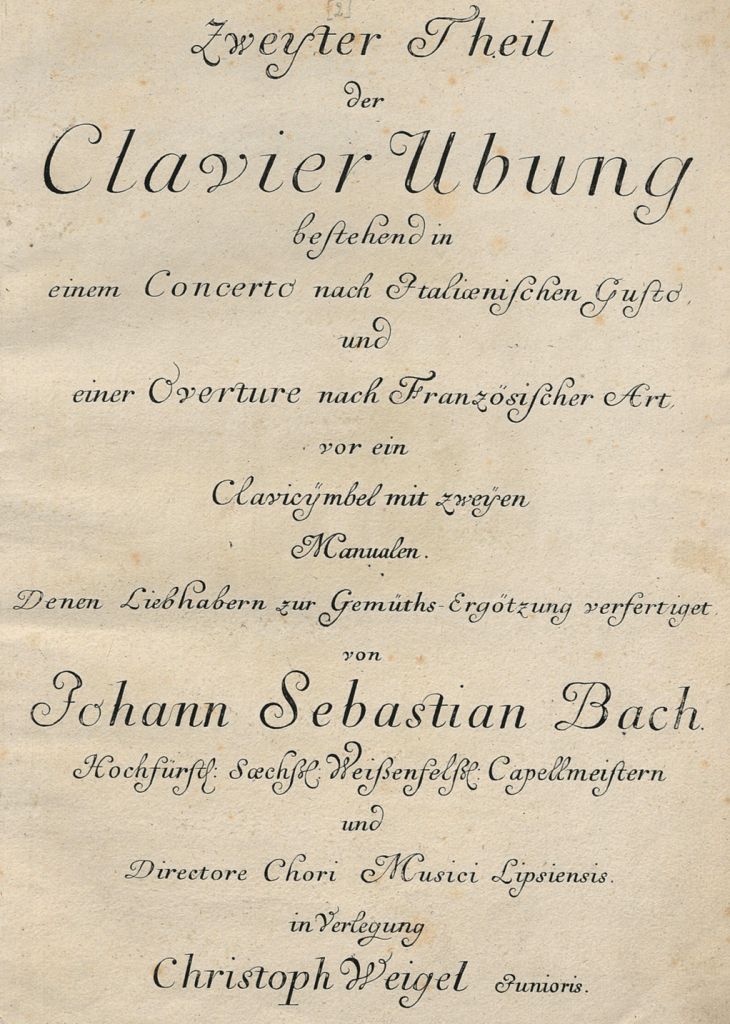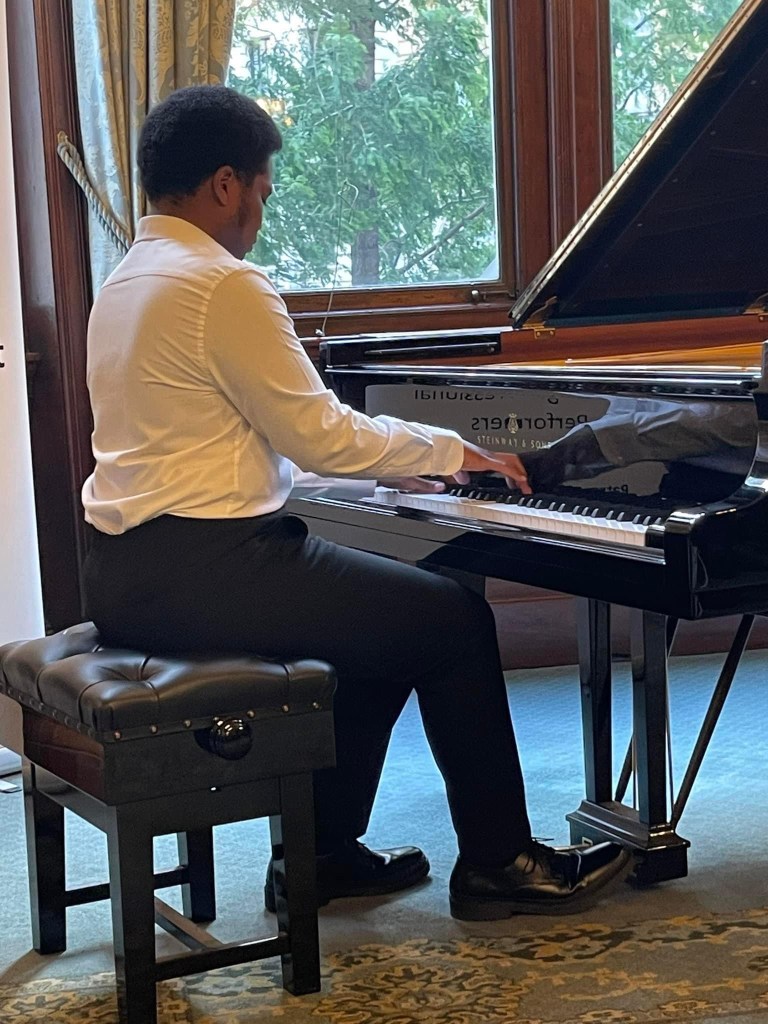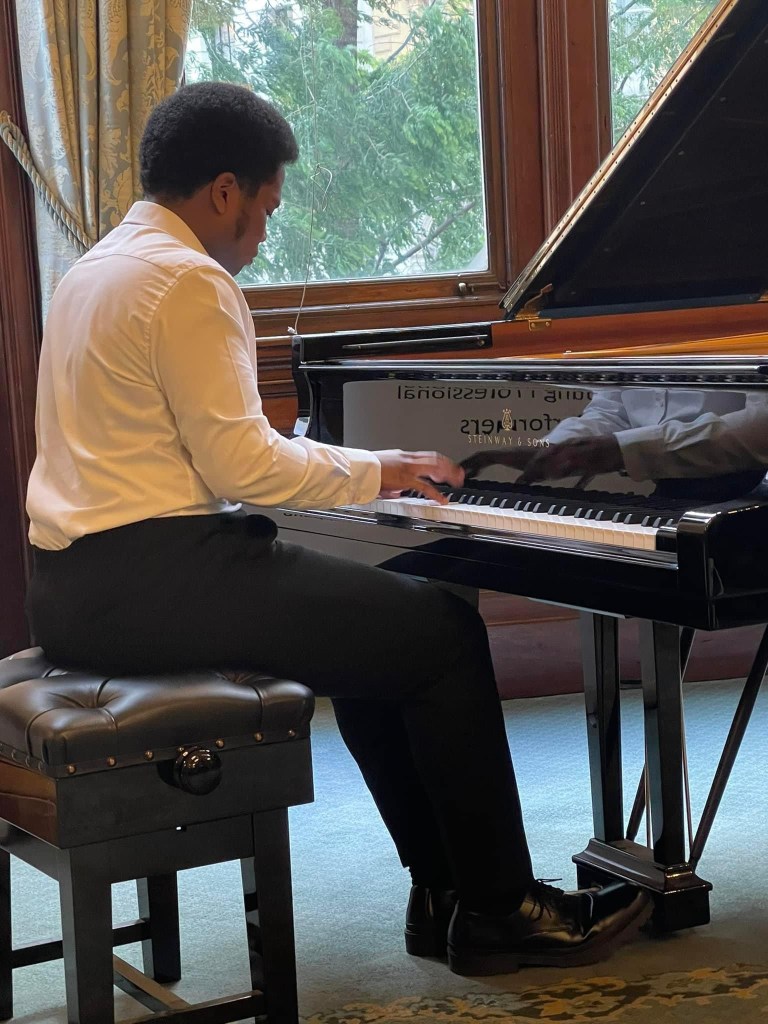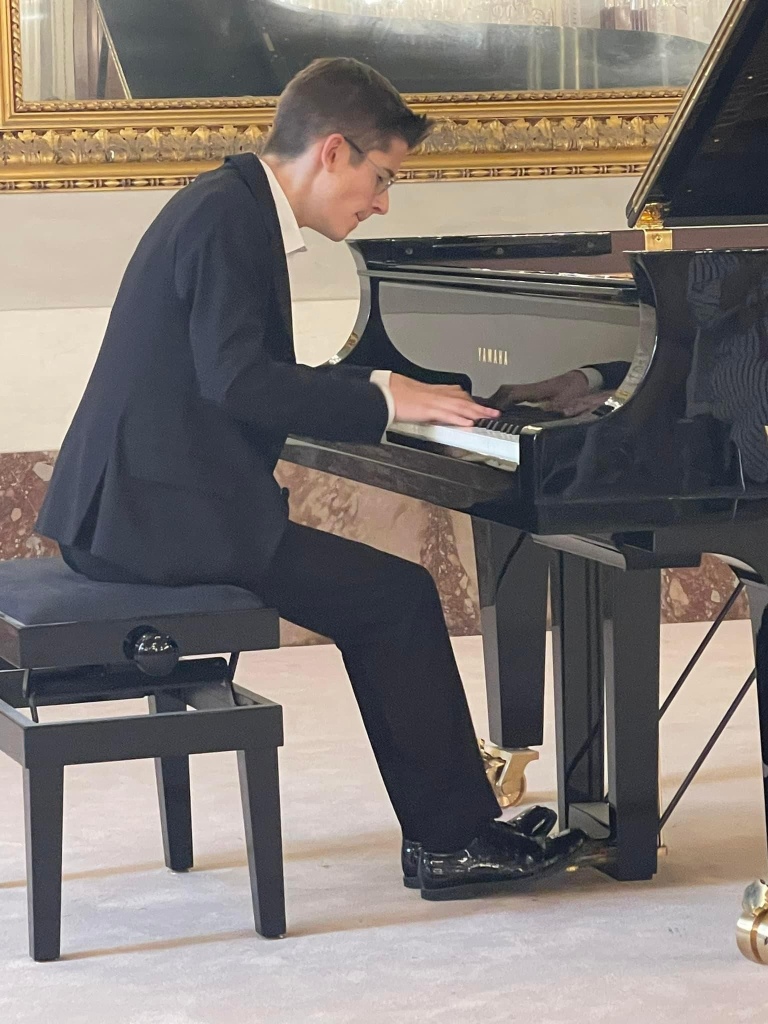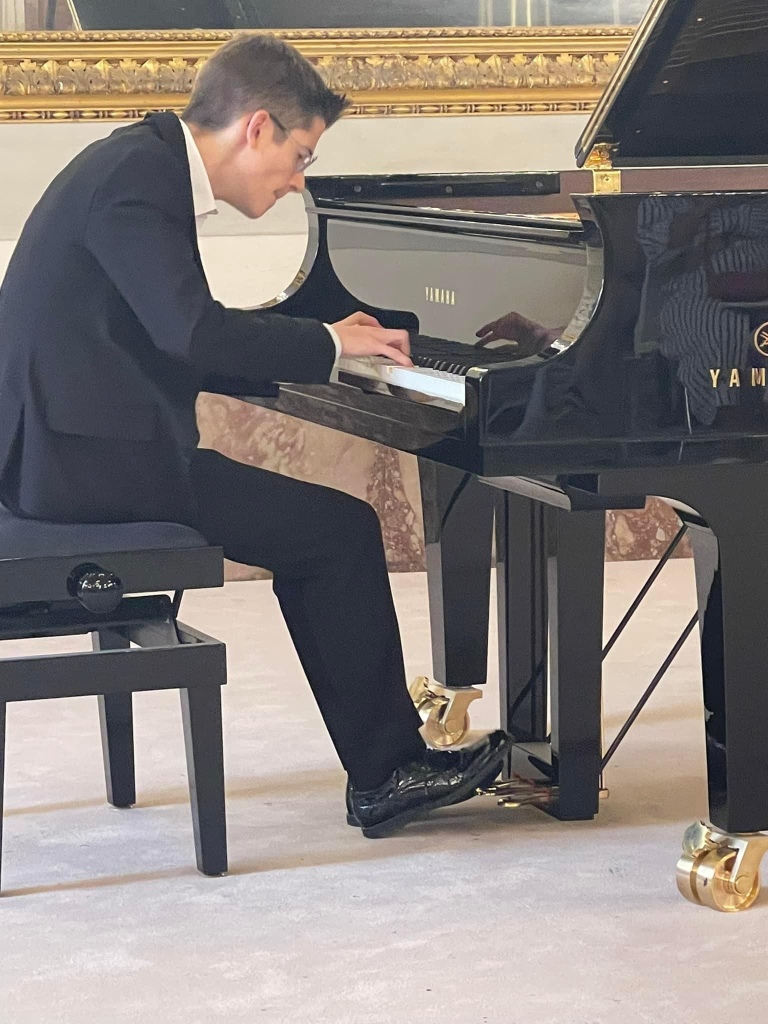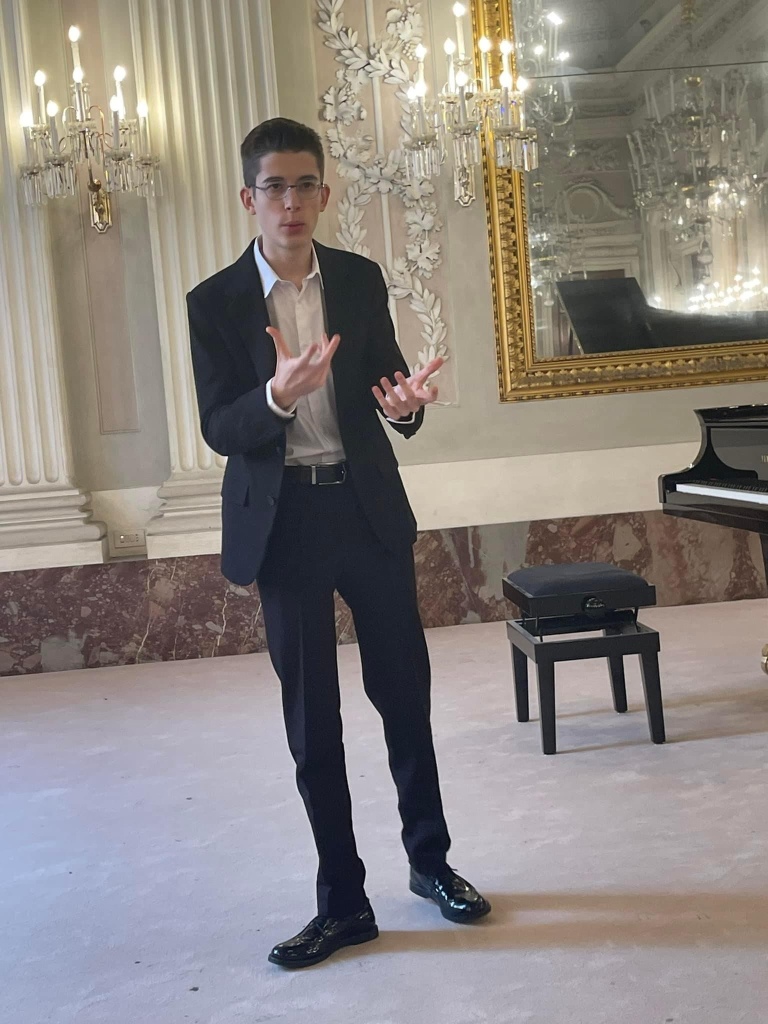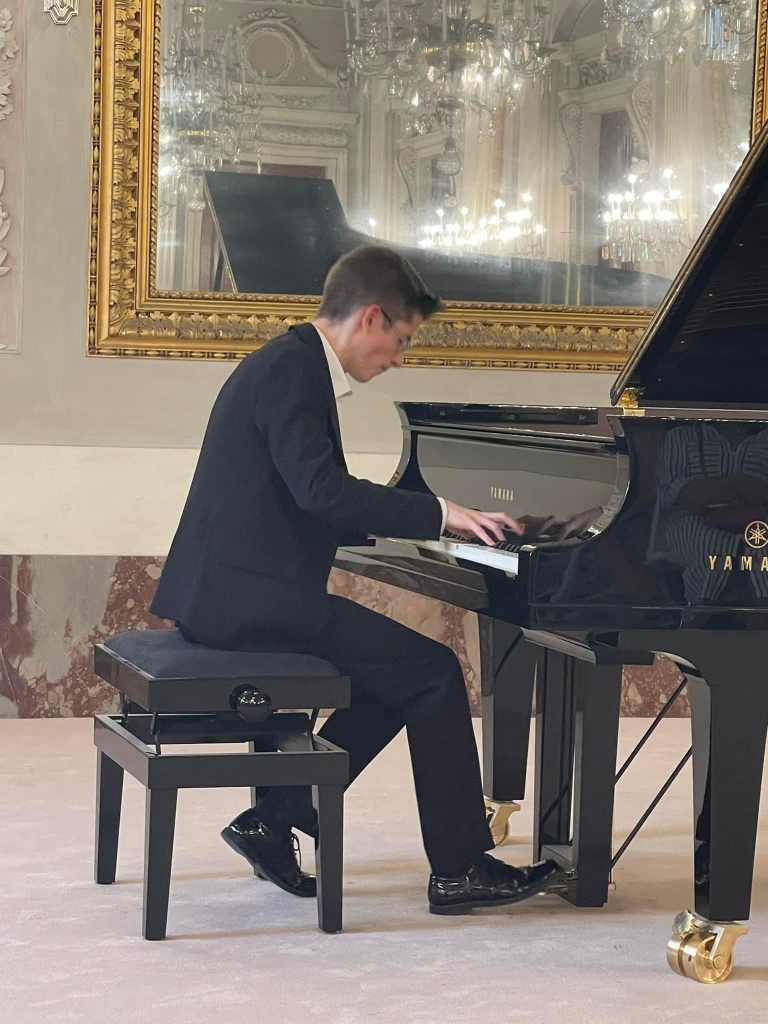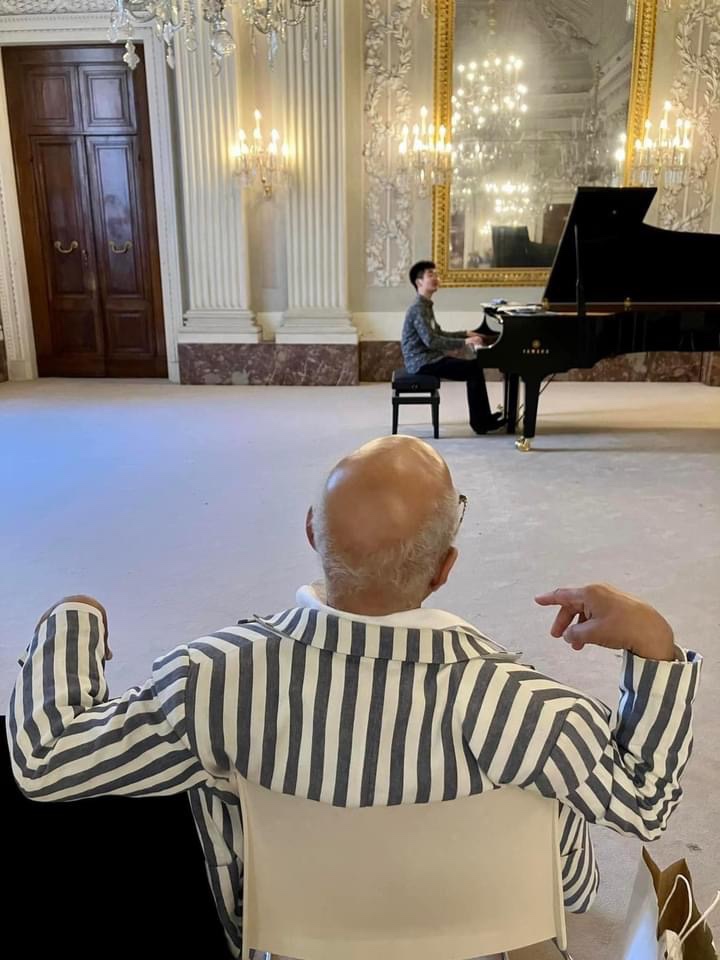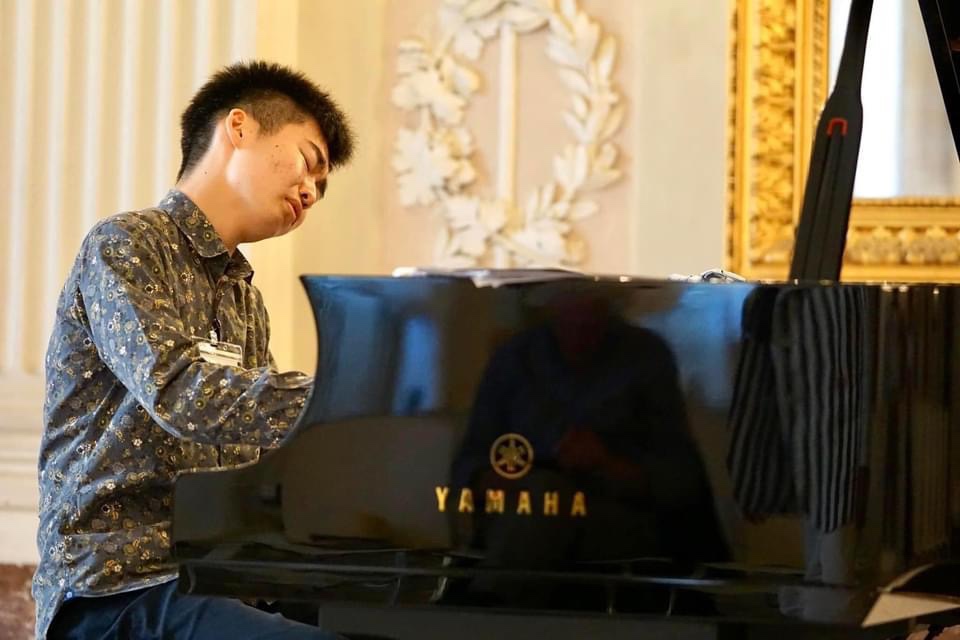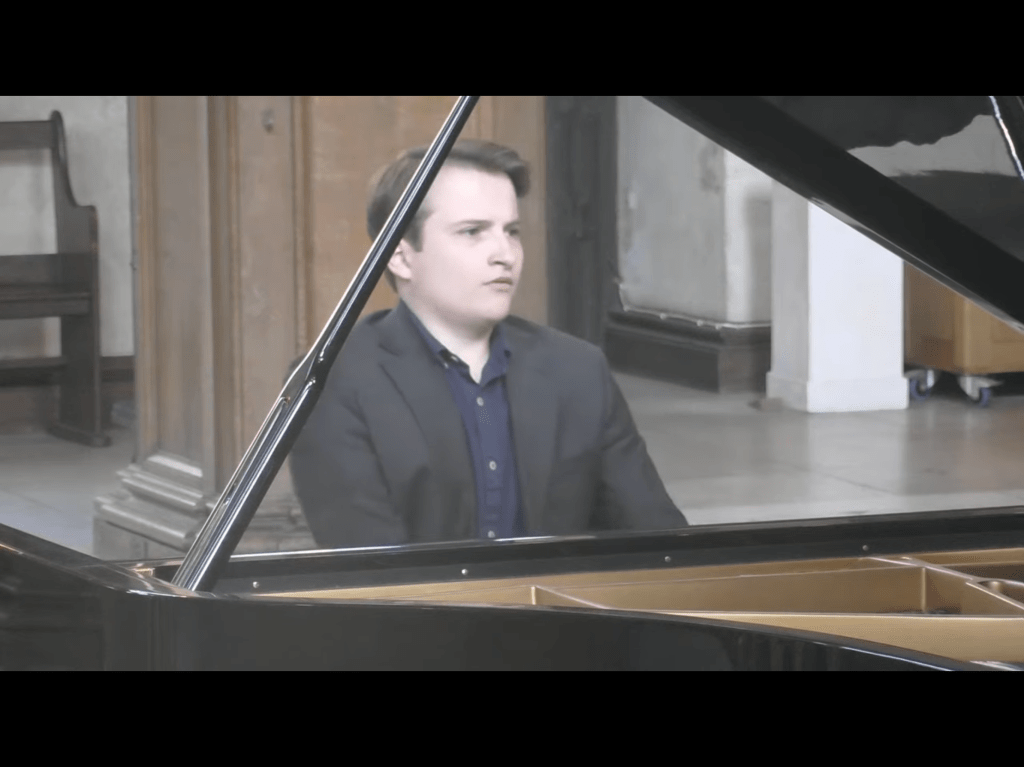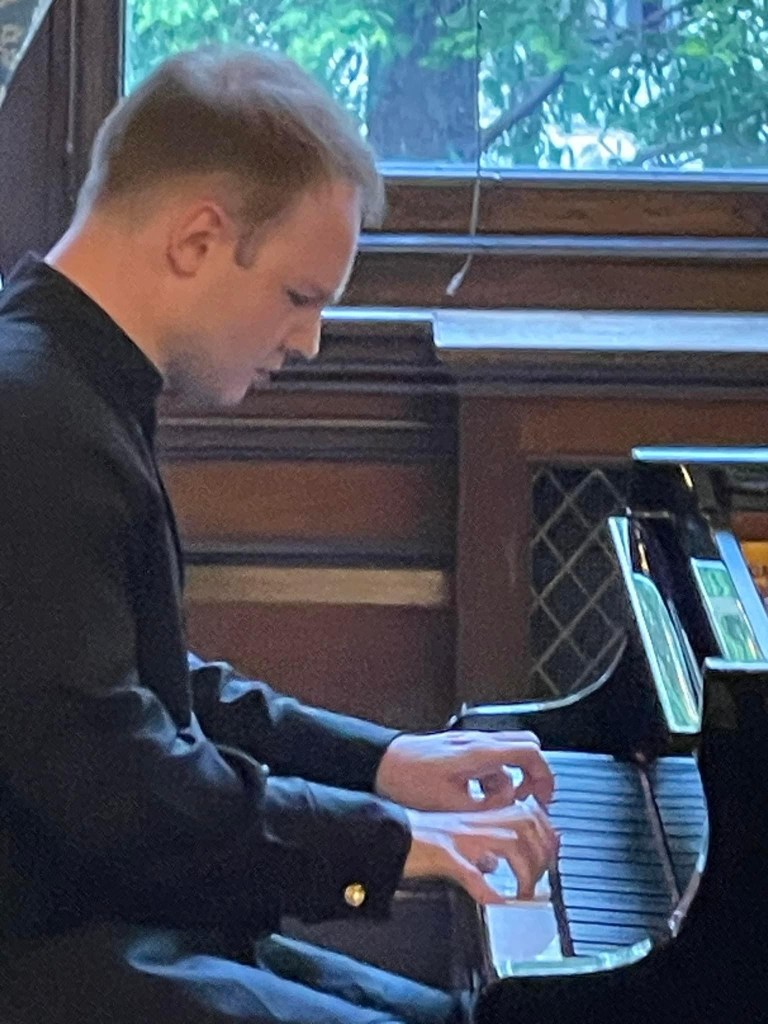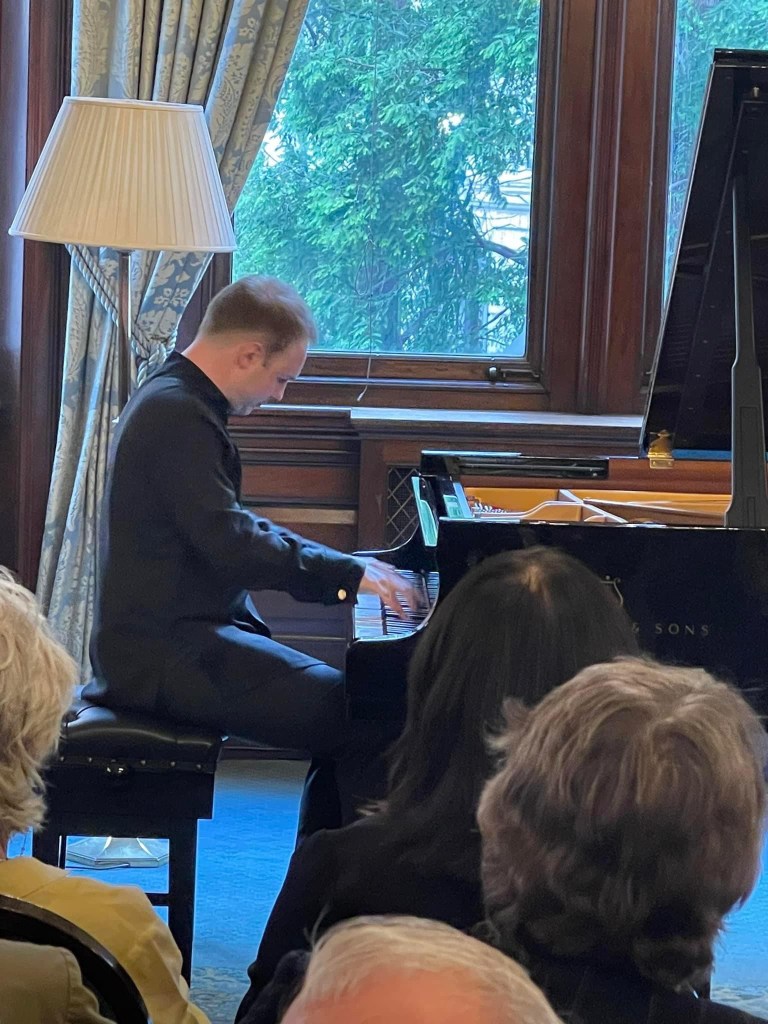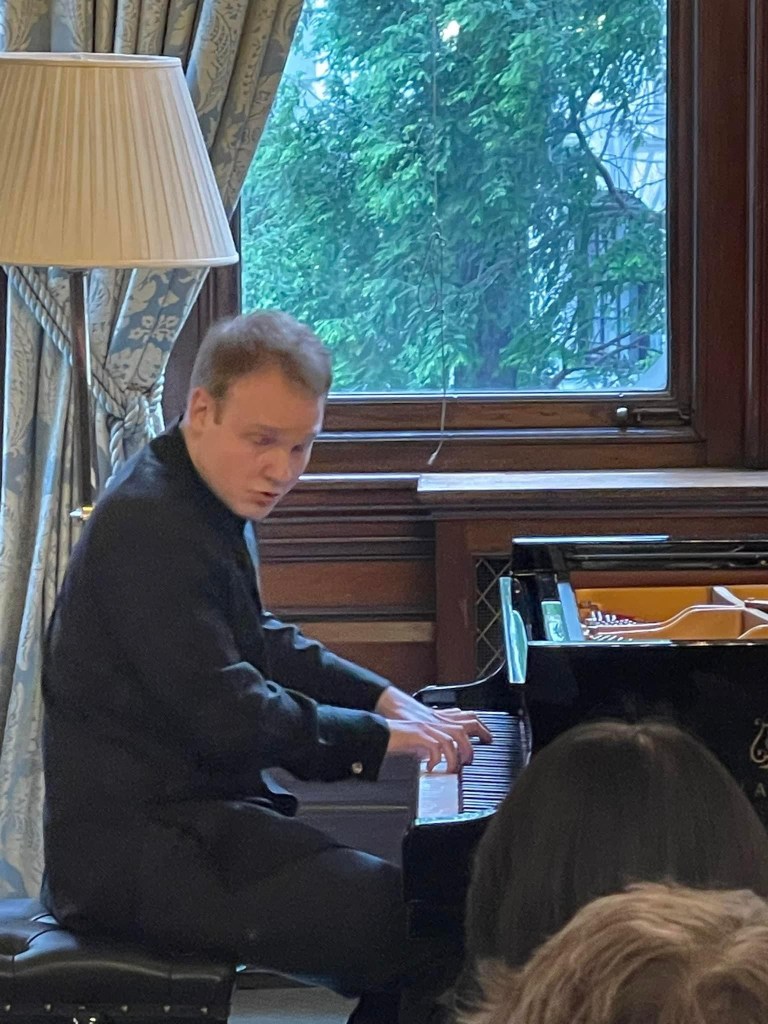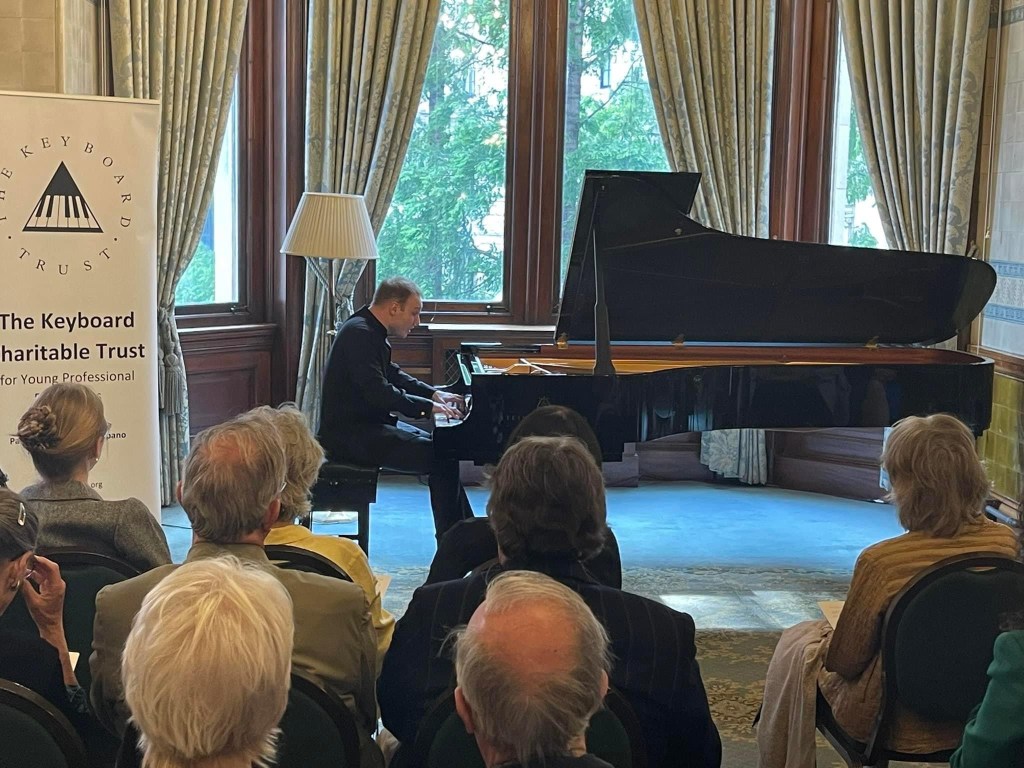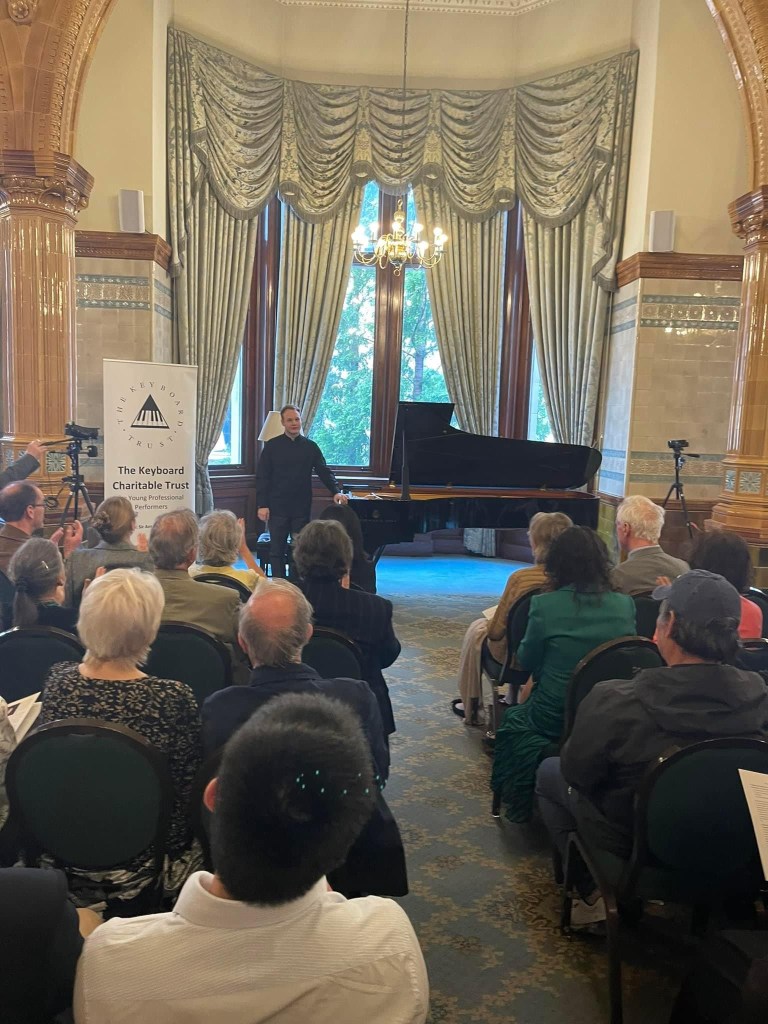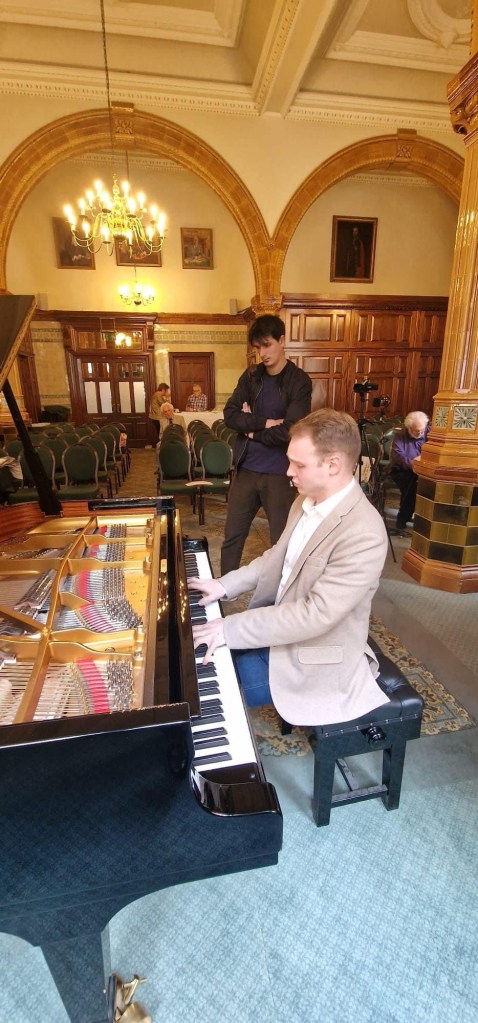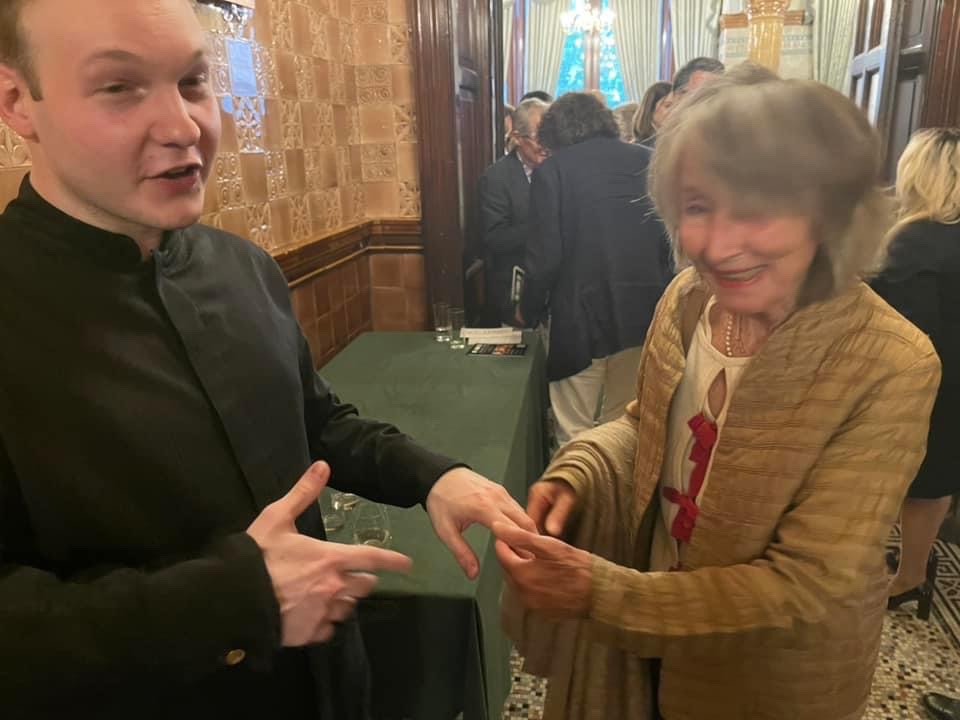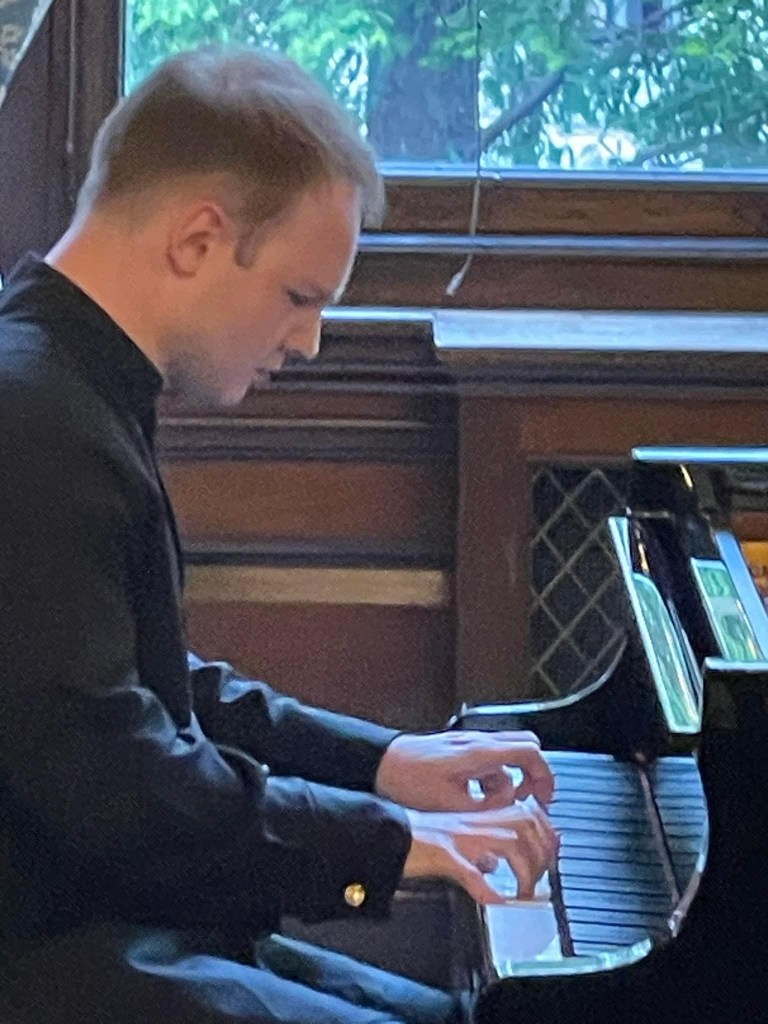
Songs from the shows indeed !But what a show with the simplicity of ‘Jesu Joy of man’s desiring’ with the strength of the tenor register giving such hope as it had done to Dame Myra in her ‘penny concerts ‘at the National Gallery during the air raids that raged in London during the war.In Filip’s hands immediately showed his credentials as an artist of refined aristocratic musicianship.Deep sonorous sounds of Busoni’s magical ‘Ich ruf zu dir , Herr Jesu Christ’ every bit a beautiful as the performances of the much lamented Nelson Freire.
Bursting into the sunlight with Mozart’s Rondo alla turca as beguiling in Filip’s crystalline hands as the pyrotechnical wizardry that has befallen it from the dazzling Fazil Say or Arcadi Volodos.What a revelation to hear the Mozart ‘Lacrimosa’ in a sumptuous heartrending transcription by Evgeny Sudbin,of a true believer .Magnificent full sounds of orchestral proportions where every strand in every chord had a special role to play.
There was a wonderful sense of balance in Liszt’s recreation of Schubert’s Standchen where the musical line was allowed to sing with such beauty as it duetted in magic harmony with the world.
A minute waltz that Filip almost completed in 55 seconds and luckily slowed himself down enough to give it ravishing shape without any ‘traditional’ messing with Chopin’s ‘tip toeing through the tulips!’The C sharp minor waltz had something of the refined elegance that Rubinstein used to bring to it with the slight hesitation of the reply to the opening deep sigh.An E flat nocturne that was played simply and with a fluidity of sound that was refreshingly innocent as it built to a climax and it’s feigned cadenza of shimmering beauty.
Straight into Liebestraum which took me by surprise as I did not recognise it at first until it burst into the sumptuous melodic outpouring that we are all too rarely treated to these days.And a dream that came true in Filip’s hands with the simple beauty of Schumann’s song without words.
The spell was broken by Pletnev’s Nutcracker.An ingenious transcription of doubly troubled genii!There was sumptuous beauty of the Rachmaninov Vocalise as it built to a climax as ravishing as anything the Philadelphia and Ormandy could have provided.
Filip was now diving into the depths of the piano into the Hall of the Mountain King.Again a piece so well known that one dares not play it in public for fear of a cliché,and is fast falling into oblivion.
The oblivion of Piazzola following on from the most famous waltz of Brahms.In the good old pre- television days the music would sit on the music stand in every respectable ‘front parlour’,between the two candelabra and the piano overlooked by the aspidistra and lace doilies.
The hysterical rhythmic drive of Liebertango worked its magic even in Perivale and was greeted by an ovation for our young Dane who impishly exclaimed that we had had all his encores already so that was that !
But there was still one more treat in store with a scintillatingly pure account of Scarlatti’s famous E major Sonata K.380.Unfortunatley it brought this wonderfully enjoyable survey of old ‘favourites’ to an end.A presto to the next sumptuous Danish sandwich..
The young Danish/Polish classical pianist, Filip Michalak is an active soloist and chamber musician. He has performed across Europe in countries such as Poland, Germany, England, France, Italy and all Scandinavian countries and has future engagements in more European countries, China and USA. Filip has won numerous prizes abroad and in his home country and has also been awarded prestigious scholarships for his studies. In 2021 he performed Beethoven’s 5th Piano Concerto with Shrewsbury Sinfonia. This year he is going to play Chopin’s 2nd Piano Concerto with a string quartet in Poland and few weeks after he will be performing Brahms’ 1st Piano Concerto in USA. Filip is also an active chamber musician playing with all different ensembles. Future engagements include a concert tour in China with violinist Kehan Zhang and performances with his duo partner Lovisa Huledal in Sweden and Denmark. He is the Artistic Director of Södertälje Chamber Music Festival in Sweden which had its first edition in 2019 and this summer it had its 3rd edition. He started his studies at The Royal Danish Academy of Music in Copenhagen in prof. Niklas Sivelövs class. Later on he received many scholarships to study abroad and for 3 years he was a student of prof. Julia Mustonen-Dahlkvist at Ingesund Musikhögskolan in Sweden and simultaneously he was pursuing his master-degree at Royal College of Music in Stockholm. Filip has finished his Post Graduate Diploma at Royal Northern College of Music in Manchester with prof. Graham Scott, and is currently being mentored by the world famous pianist Gabriela Montero.
A truly breathtaking and exhilarating performance of Brahms first Piano Sonata op 1. From the very first notes there was a sumptuous richness to the sound with the deep bass harmonies opening up endless possibilities of colour. Infact the melting whispered cantabile of the second subject had a fluidity of ravishing beauty.Here was a true musician the same one that had mesmerised me in the performance he gave to an empty Philharmonie in Paris during the Covid pandemic.An oasis of beauty and hope for the future.A performance of Rachmaninov’s seemingly ungrateful first sonata that in his hands revealed a hidden masterpiece.
Waiting for Kantarow in the sumptuous beauty of San Carlo Opera House in the heart of Naples
It was the same today in the bustle of Naples on a Saturday night where he created an oasis of beauty revealing a masterpiece every bit as noble as the better known third sonata.Revealing a true symphony for piano with transcendental command and a technical mastery at the service of the composer.Here was a Furtwangler at the piano commanding attention and revealing the very soul of recreation.The Schubertian questioning and answering of the Andante was unforgettable for the portent that was concealed in so few notes.A truly magical duet between the tenor and soprano voices was a celestial ending.A spectacular Scherzo immediately broke the spell with its dynamic driving energy contrasting with the beautifully fluid trio.The finale was indeed Allegro con fuoco with it’s burning intensity and driving bass energy.Above all there was clarity and precision not only technically but of the mind of a great artist that can give us the complete architectural shape of a very complex work
A selection of six Schubert Lieder in the transcription of Liszt.Miniature masterpieces recreated by the genius Liszt.In Kantorow’s hands they were indeed imbued with the magical atmosphere of Schubert that Liszt had miraculously recreated.Six miniature tone poems in this artist’s sensitive hands where each one was a true ‘song without words’.Avoiding the more obvious well known Erlkonig,Standchen etc Kantarow brought us the rarely heard ‘other six’.I imagine he may have chosen them at the last minute like Schiff and Richter preferring not to be pinned down to a specific programme years in advance.’Sei mir gegrusst,Du bist die Ruh’,Meeresstille,Die junge Nonne,Rastlose Liebe,Der Wanderer’ by process of elimination were the Lieder he actually played.I have rarely heard them in concert and they were a revelation of sumptuous golden sounds,melancholic simplicity,mystery but above all a sense of balance that allowed the melodic line to sing out no matter the glittering ingenious cascades of notes that Liszt envelopes them in.They sparkled and shone like the jewels they are but above all communicated the emotion of the poetry and digging even deeper,revealing a world where the actual words are just not enough.Hypnotic performances that showed the extraordinary sensitivity and artistry of this youthful poet of the piano.A remarkable technical command of hands and feet! Yes,it was Anton Rubinstein who said the pedal was the soul of the piano and nowhere has it been more apparent than in the series of wondrous sounds and atmospheres that surrounded this beautiful black box on a stage that is used to welcoming the greatest voices of the age.A public that had escaped to a world of pure magic as they surrendered to the beauty and passion that was filling this historic temple of music that has resounded to some of the greatest performances ever heard.
The Wanderer Fantasy continued this Schubertiade without a break (probably because we were expecting all twelve Lieder as printed) but also because it had created an atmosphere that Kantarow was happy to maintain to the tumultuous ending of Schubert’s Wanderer Fantasy.A Fantasy that had opened the door for Liszt with it’s newly created form created with the transformation of themes.Liszt was to continue and pursue this new form bringing to it to even more Romantic self identification.He was happy to inspire his son in law Richard Wagner who was to bring it to unheard of heights of inspiration.To quote Badura Skoda :’It is Schubert’s most monumental piano piece and stands as a guidepost to the future not only in the matter of form ,but also in its grandiose ‘orchestral’ use of the piano’.Kantarow imbued it with orchestral sounds and even the scales and arpeggios that abound were linked to a bass that was the anchor that guided us through a work written in the same year as Beethoven’s visionary last thoughts in the evolution of the Sonata from op 2 to the final Sonata op 111. The four movements are developed from a single thematic cell ,a rhythmic motive taken from the song Der Wanderer (that we had heard earlier in Liszt’s transcription ). All the themes in the Fantasy are developed from a single Leitmotiv as in the symphonic poem of a later era.Here the classical symphonic order of movements -Allegro,Adagio,Scherzo,Finale – corresponds to the principal sections of one larger sonata movement (exposition,development,recapitulation and coda).
It was this architectural shape that was missing in a performance of great beauty and transcendental command where he chose rather fast tempi that meant there was a continual relaxation of tempo in the more lyrical passages that rather fragmented a work that in many ways anticipates the symphonic sonata of the Brahms op 1.In Brahms Kantarow had kept a bass anchor that was like a great wave that took us from the first note to the last and gave great weight and authority as in fact he had done in the Rachmaninov Sonata from the Philharmonie.His Schubert of course was played with the same artistry and sensitivity but I missed this undercurrent that could have given great weight and authority to this most Beethovenian of all Schubert’s piano works.I found the opening of the Scherzo – Presto rather fragmented and the last movement too fast for it’s Allegro indication.The last movement lost something of it’s accumulation of grandeur and crescendo of excitement that was so telling in Arrau’s artistocratic hands.This was a Schubert Fantasy of a young poet that I am sure will gain in weight and authority as it enters his soul.
Amazingly only the night before Kantarow had played a magnificent Rachmaninov First Piano Concert in Turin with Barenboim’s assistant Thomas Guggeis – two artists in their twenties who can be heard in this link to the live radio broadcast:
Three encores in a crescendo of acceptance as Kantarow treated us to another Schubert transcription of sumptuous beauty.
It was followed by the encore he had played the night before in Turin :Vecsey/Cziffra ‘Valse Triste’.Played with passion and insinuating style together with all the jeux perlé ‘tricks of the trade’ associated with the heir to Liszt that was the extraordinary Cziffra.Like the ‘bel canto’ stars that have ignited this stage for the past two centuries Kantarow knew how to ignite and excite an audience that was now following his every move with rapt attention and adulation.Realising like the great artist he is that he could not leave his audience yet he gave them what they were craving for with the greatest circus act of our age :Volodos’s revisitation of Mozart’s ‘Turkish March’.It sent the audience into delirium with everyone on their feet cheering this great new star that had arrived in their midst.
A surging mass of people outside on a festive Saturday evening in the centre of Naples Waiting for Kantarow in one of the most beautiful theatres in the world Kantarow ‘Veni,vidi,vici’Nice to join in the fun of Naples by night in the Pizzeria opposite San Carlo with my adopted family waiting to run me home.Nice to know that Michael Aspinall’s favourite restaurant awaits just around the corner too
A standing ovation for Ruben Micieli after his scintillating performance of Fazil Say’s fantasmagoric manipulation of Mozart’s Turkish March! Chopin Mazukas op 24,the second Ballade and Polonaise Heroique opened his recital before Ruben lifted the lid to his discovery of opera paraphrases and fantasies by long forgotten virtuosi of the 1800’s. Immersed in a style from another age this young Sicilian musician,disciple of the much missed Aquiles delle Vigne, gave scintillating not to say titivating accounts of ’songs from the shows’ Thalberg style.
As a child near Catania and an aspiring young pianist he was shown the scores of Ignace Leybach by an elderly ex pupil of this long forgotten virtuoso. She bequeathed her entire library to Ruben entrusting him with her invaluable archive. It was in Catania the birthplace of Bellini whose bel canto was to be such an influence on music of the nineteenth century. Chopin and Field above all brought it to the piano with refined aristocratic elegance. Liszt and Thalberg used the famous opera melodies for an intricate web of virtuosity where they gave the illusion of having many more hands than just the two that God gave them. The Norma fantasy by Liszt has become a standard piano showpiece often played by great virtuosi of our day such as Hammelin and Arrau. Mark Viner another Keyboard Trust alumni has made a special study of this legendary period seeking out and recording the works of Alkan,Thalberg,Liszt and many other pioneers of a past age. The golden age of piano playing when pianists were feted like pop stars by the aristocratic salons of the time.Refined gentry were turned into a hysterical mob seeking out souvenirs of their idols to take home perchance to dream.
Sir Geoffrey Nice a long time trustee of the KT taking time off from negotiating peace in the world,introducing his grandson Leo to the much more beautiful world of music
Ruben had gone a step further after this childhood discovery and now has been commissioned by Naxos recording company to seek out further gems in the archives of the musty libraries and institutions where these scores have lain undisturbed for centuries. Ruben has a virtuoso technique acquired from the Russian school of his first Serbian teacher in Catania. Much more importantly he has a sense of style and colour,nurtured by Jasinski and Delle Vigne,that brings these works vividly to life with the same love and sense of showmanship for which they were born. There was a crescendo of cheers and applause as Ruben unraveled this magic in transcriptions of Gluck,Mozart,Verdi and Bellini that cast the same spell on today’s audience as they had obviously done at their birth. It was interesting to note that Leybach’s Norma fantasie uses many of the arias that Liszt chooses to ignore.Of course it is a sign of the genius of Liszt who knew how to transform and even improve on Bellini’s order.Leybach is a good workmanlike fantasy,black and white as compared to Liszt’s multicoloured score.
It was strange to hear Raff’s treatment of Gluck’s ‘Che faro’,having been so used to Sgambati’s magical transcription.It often cast it’s spell as an encore piece from the hands of the much loved Nelson Freire.The Raff transcription is much longer and more complex and was in itself a great discovery from a name that I have only ever seen as editor on the cover of early scores.
Duvernoy’s ‘Don Giovanni’ fantasy was simple and ingenious but of course not the masterpiece that Liszt had penned,but well worth hearing. Eugenia Appiani ,a female virtuoso like Clara Wieck,in what was predominantly a man’s world in that period.A fascinating and beautiful Ballade on Verdi’s Rigoletto and as Ruben told us afterwarda he hopes to find many more pioneering ladies in the archives. A fascinating conversation after his triumphant performances just whet the appetite for more discoveries.Watch this space! His encore was a modern day caprice on Mozart by the now much feted Turkish pianist Fazil Say.A few years ago Say was made to suffer imprisonment from a regime he chose to challenge in his home country. I have never seen an audience so enthusiastic giving a spontaneous standing ovation to this remarkably committed young artist. Music hidden in musty archives and now given a new lease of life?! Last night in this young artist’s golden hands it had the same effect as they would have received from the hands of long forgotten virtuosi of the past. Hats off and more please !
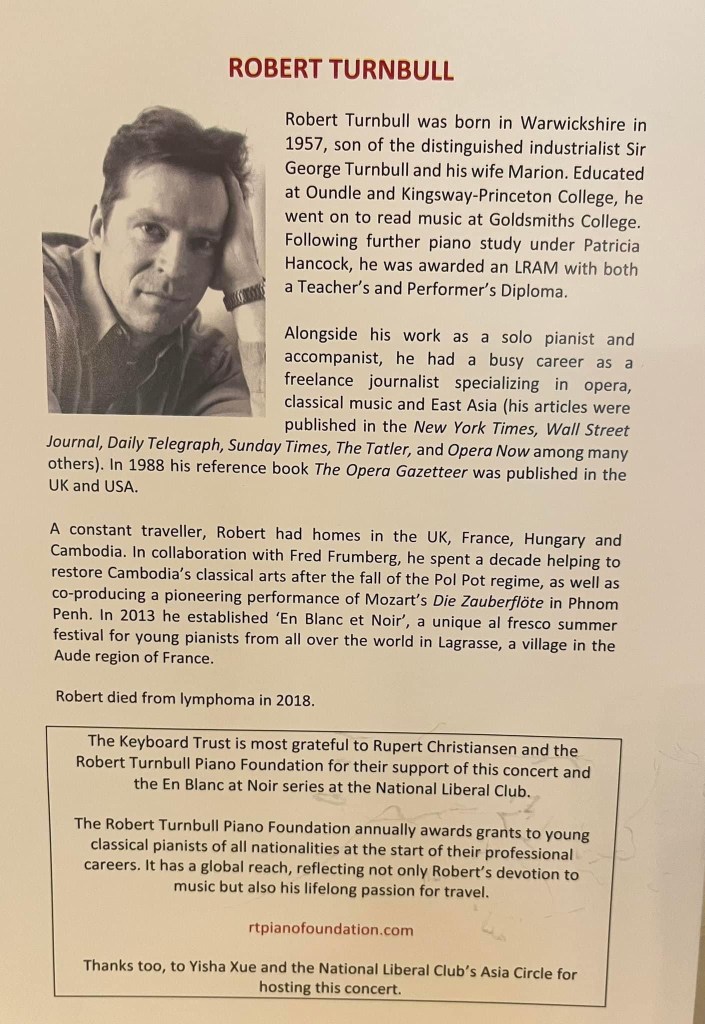
What fun we had too with Cremonese Mario,ex head waiter at the Hilton,now at 89 an enthusiastic follower of the Keyboard Trust Exciting times for the KT with one of the finest pianists of his generation opening the new season at the national Liberal Club.Four stars will be shining brightly thanks to the Robert Turnbull Foundation and Yisha Xue at the Liberal Club
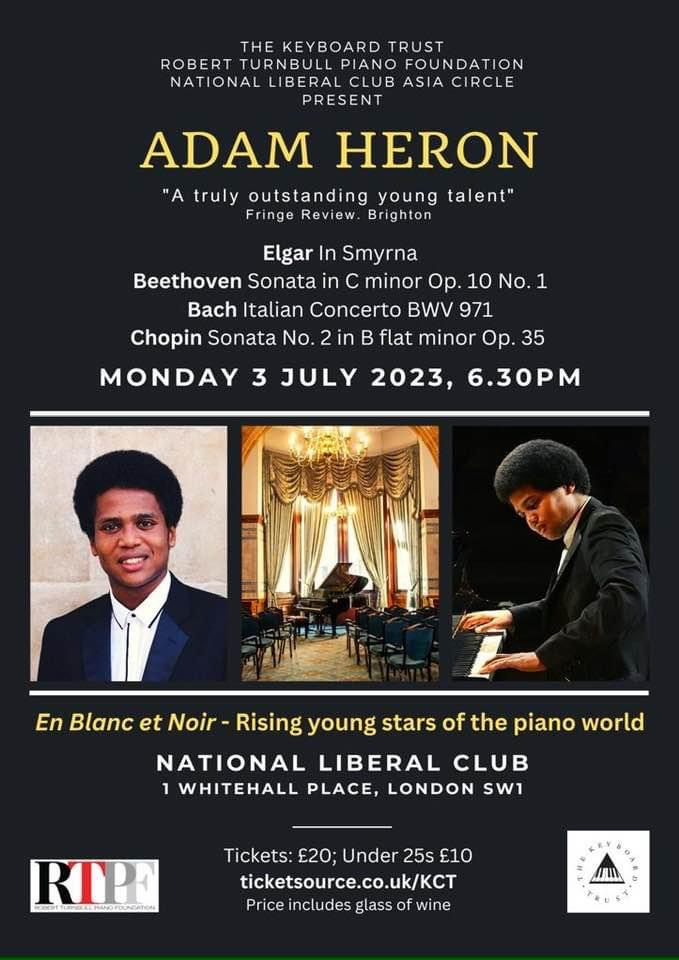
Schumann – Arabesque op 18 Rachmaninov– Etude Tableaux op 39 N. 3 in F# Minor Chopin – Barcarolle op 60 Shostakovich – Prelude and Fugue in D Minor op 87 N.24
Programme Juanjo Blázquez:
-Gounod/Blázquez Duo de Marguerite and Faust -Schubert/Liszt Gretchem am Spinnrade, Erlkönig -Dukas/Staub l’apprenti sorcier Presented by Talent unlimited.
What a feast of music in one of London’s most secluded churches just a stone’s throw from Piccadilly Circus.All those that had taken the time off to sit and marvel at two young artists united under the banner of Canan Maxton who with her ‘Talent Unlimited’ is the unstoppable promoter of young musicians,left enriched and enlightened ,as they returned to the bustle of the world outside.
From the very first notes of the Schumann Arabesque it was obvious we were in the presence of a young artist of a rare sensibility with something very important to say.The kaleidoscope of sounds and ravishing colours from Callum McLachlan allowed this little gem to shine and gleam as it rarely does in lesser hands.A very subtle flexibility allowed the music to speak with a voice where every note had a significance while showing us the overall shape of this miniature tone poem.
It was the same subtle beauty that Juanjo bought to the duet from Gounod’s Faust.Such subtle colour and ravishing sense of balance brought this transciption vividly to life .But it was the Liszt transcriptions of Schubert’s Gretchen and the mighty Erlkonig that was breathtaking in its refined beauty and passionate outpouring of sumptuous sounds.No matter how many notes were spread over the keyboard Juanjo’s sense of colour and shape never allowed the music to become hard or ungrateful.It was instead the sumptuous sounds of a truly ‘Grand’ piano in the sensitive hands of a refined artist. It was the same sensitivity that Callum had brought to Chopin’s great outpouring of song with his Barcarolle op 60.From the gentle opening with a melodic line played with such beautiful legato,the continuous gentle lapping of the left hand following so attentively but never overpowering.A fluidity of sound with a luminosity that in the beautiful central episode reached truly sublime heights .It led to the climax of passion and glory only to die to a whisper before the final four chords that mirrored the opening chord that had opened the gate to Chopin’s wondrous lagoon. The technical wizardry and sense of character that Juanjo brought to Dukas ‘Sorcerer’s Apprentice’ was breathtaking in it’s total conviction and technical mastery.All at the service of a story that held us mesmerised by this young magician. It was the same magic that Callum had brought to the Shostakovich Prelude and Fugue in D minor.A monumental work that from the whispered opening could be transformed into a climax of such grandeur and pyrotechnical authority,it made one realise what a genius Shostakovich truly was. Often saturated by complete performances it was refreshing to hear this monumental work given the space it truly deserves on its own. Two artists of great stature still only in their twenties both having dedicated their youth to their art.Something that is never mentioned in the mass media that only spreads the word of evil and ugliness in the world .But there is another much better world of beauty and dedication for all those with the ears to hear it.
Callum McLachlan was finalist of The 18th International Robert Schumann Competition Zwickau and Semi-Finalist of the XX Santander International Piano Competition Paloma O’ Shea, Callum Mclachlan, 23, has been described as ‘A born Schumann player’ with a ‘magical sense of colour and extraordinary technical prowess’ (July 2019, London recital). Born into a family of musicians, he first started piano lessons with his father at the age of 7, and entered Chetham’s School of Music at age 11, where he studied with Russian pianist and pedagogue Dina Parakhina. He was awarded the highest diploma from Trinity College – the FTCL, in his final year. He studied under Professor Claudius Tanski for Bachelors at the Universität Mozarteum Salzburg.He is now studying for Masters with Professor Claudio Martinez Mehner in Cologne Hochschule fur Musik and Prof. Jacques Rouvier in the Universität Mozarteum Salzburg.He has performed at many of the most important concert venues throughout the UK, Europe, and USA, including Laeiszhalle Hamburg, Wien Konzerthaus, Pereda Hall Santander, London’s Steinway Hall and Manchester’s Bridgewater and Stoller Hall. Recently he performed with the renowned ensemble Casals Quartet. .In 2021, he was a Hattori Foundation 2021 Senior Finalist and receives generous support. He has performed at the Edinburgh Fringe Festival, works of Benjamin Britten in Steinway Hall London, Liszt’s 2nd Piano Concerto with Paul Mann and CSO at RNCM Concert Hall, which he recently repeated at the Turner Sims Concert Hall in Southampton in March 2020 and Mozart Sonatas for Piano and Violin at The Bridgewater HallHe has also had much success in competitions throughout the UK, winning 1st prize in the Welsh International Piano Competition (U19), The Scottish International Youth prize, as well as reaching the national finals of the EPTA piano competition.Most recently, he made a recording of Beethoven’s Pathetique Sonata at the Universitat Mozarteum Salzburg, in collaboration with G. Henle Verlag for Beethoven 250. He made his New York recital debut in 2019, performing works of Brahms and Percy Grainger, an eclectic recital programme he performed at the newly opened Stoller Hall in Manchester, to critical acclaim. In his first year of studies at the Mozarteum, he was personally invited by Pascal Nemirowski to perform in the Young Artist Series in the RBC Birmingham Piano Festival
Juanjo Blazquez was born in Lorca (Spain) in 1998, he began his piano studies at the “Narciso Yepes” Professional Conservatory of Lorca in 2006. He received his first lessons from professor Estrella Romero Jiménez and later from Antonio Agustín González Hidalgo and Helena Ayala Gea. He has performed concerts in Spain and UK, and the ALTI Hall in Kyoto. Juanjo recently performed as a soloist Tchaikovsky’s 1st Piano Concerto at Madrid’s National Auditorium with the María Rodrigo Symphony OrchestraHe has received masterclasses from teachers such as Lilya Zilberstein, Anna Malikova, Jean-Efflam Bavouzet, Stephen Hugh, Claudio Martínez-Mehner, Ashley Wass and Nino Kereselidze among others.Juanjo has won prizes in national and international competitions such as the “Ciudad de Albacete”, the “Entre Cuerdas y Metales”, the “Almudena Cano” and “ClaMo” International competition. He is also recipient of the “FW Wright Piano Scholarship” endowed by the RNCM , and he was chosen to represent Spain in the “Kyoto International music students festival” in 2019, receiving outstanding reviews.He completed his piano studies at the Real Conservatorio Superior de Música de Madrid in 2020, under the guidance of Ana Guijarro, having previously studied with Pilar Bilbao Iturburu. He continued his Master’s studies at the Royal Northern College of Music in Manchester with Graham Scott and Kathryn Stott.
Leslie Howard, who has chosen a typically diverse all-Liszt programme for his 75th birthday concert at Wigmore Hall, is known universally as a specialist in the music of this most prolific and influential of composers and has devoted much time to performing, recording, teaching and writing on his works. Howard has also shared his extraordinary understanding of Liszt in numerous masterclasses around the world where his erudition and ease enable him to convey the very essence of Liszt’s style.
Masterly playing for Leslie Howard’s 75th birthday concert. Of course a Liszt recital of works many of us have never heard on the concert stage before. His series of Liszt recitals in this very hall have passed into history as have his complete recordings on 100 cd’s of the entire pianistic repertoire of the Genius that is Liszt. Seated at the piano hardly moving a muscle he miraculously ignited the piano with an extraordinary range of sounds and colours.It was the same lesson that had allowed Rubinstein to ravish and seduce audiences right up to his last concert in this very hall at the age of 90. Art that conceals art that had so inspired the young blue eyed ,blond haired Australian who had made the pilgrimage to Siena to study in the class of Guido Agosti.
Leslie following his colleague Jack Krichaf in Agosti’s masterclass in Siena .Leslie seated in the front row with long hair and beard .
Agosti who had been a disciple of Busoni in turn a disciple of Liszt was no showman and playing in public was a great suffering for this real gentleman of the piano. His true artistry could only be best expressed in the intimate atmosphere of his studio that became his home every summer in Siena for thirty years . There were sounds heard in that studio that have never been forgotten by generations of pianist many of whom at the beginning of illustrious careers. Agosti and his wonderfully extrovert wife Lydia a real Floristan and Eusebius couple,immediately realised the extraordinary intellect and serious intent of this young virtuoso as they took Leslie very much under their wing. It was obviously from Agosti that the seed of absolute musical integrity and reverence for the composer’s wishes was born.Also a musical curiosity of rare intelligence and humility. Lydia had never realised also what refreshing fun music could be with this extrovert young Australian. A musical purity in which the pianist is a medium between the composer and his audience. Je sens,je joue,je trasmets. Music for Agosti was the bible! Of course there is great scholarship and the understanding of structure and architectural shape of a great musical mind .A scholarship that has Leslie searching the archives for the original manuscripts to get as close as possible to the seed that gives birth to the music. Agosti and Leslie Howard,two great minds at the service of the composer.
Leslie has happily an international concert itinerary which has seen him performing throughout the world for more than half a century.Unlike Agosti he relishes his ability to communicate with a public and his generosity towards serious young musicians is well known by all those that flock to his home to discuss and discover the secrets in the scores of which Leslie is a living encyclopaedia of knowledge and acquired wisdom. https://christopheraxworthymusiccommentary.com/2022/02/16/leslie-howard-masterclass-at-the-r-c-m-scholarship-and-mastery-shared/.
A talking encyclopaedia indeed that can bring all the most obscure and absurdly ignored scores vividly to life ……at the touch of a hat! Like Rubinstein Leslie is also a ‘Bon viveur’and well known also for his discerning taste in fine wines. Tonight on his 75th birthday even though in momentarily difficult circumstances he pulled another rabbit out of the hat. A scintillating display of virtuosity,scholarship and the joy of communication that held a full house astonished and astounded by many works that they had never heard before.
Infact some works were only recently discovered in the archives.’Der Todesengel’ was dicovered by Minkyu Kim, a disciple of Leslie,and a distinguished pianist and scholar in his own right, who found it in Georgetown University -Leon Robbin Collection. Above all Leslie like Rubinstein shared his ‘joie de vivre’ and generosity with his admirers who are happy to know that Leslie still has another quarter of a century before him of stimulating discoveries. He may not have had the strength to offer a much requested encore,but it certainly did not stop him from unwinding with his many friends and disciples in the improvised Green room just a stones’ throw from the scene of his triumphant birthday concert.
Noretta Conci-Leslie’s “Piano mummy’
Noretta Conci and her husband John Leech,both well into their nineties were the first to congratulate their musical ‘son’ who they have nurtured and mentored for more than half a century. Noretta,a disciple of Arturo Benedetti Michelangeli ,who had also as a child studied with Agosti,was astounded that there was not a single wrong note musically or technically in Leslie’s heroic appearance tonight.
John founded the Keyboard Trust together with Leslie,thirty three years ago ,as a sixtieth birthday present for his beloved Noretta. He will be 98 on Friday and made the pilgrimage tonight especially to be with his musical ‘baby’ on his mere seventy fifth birthday.
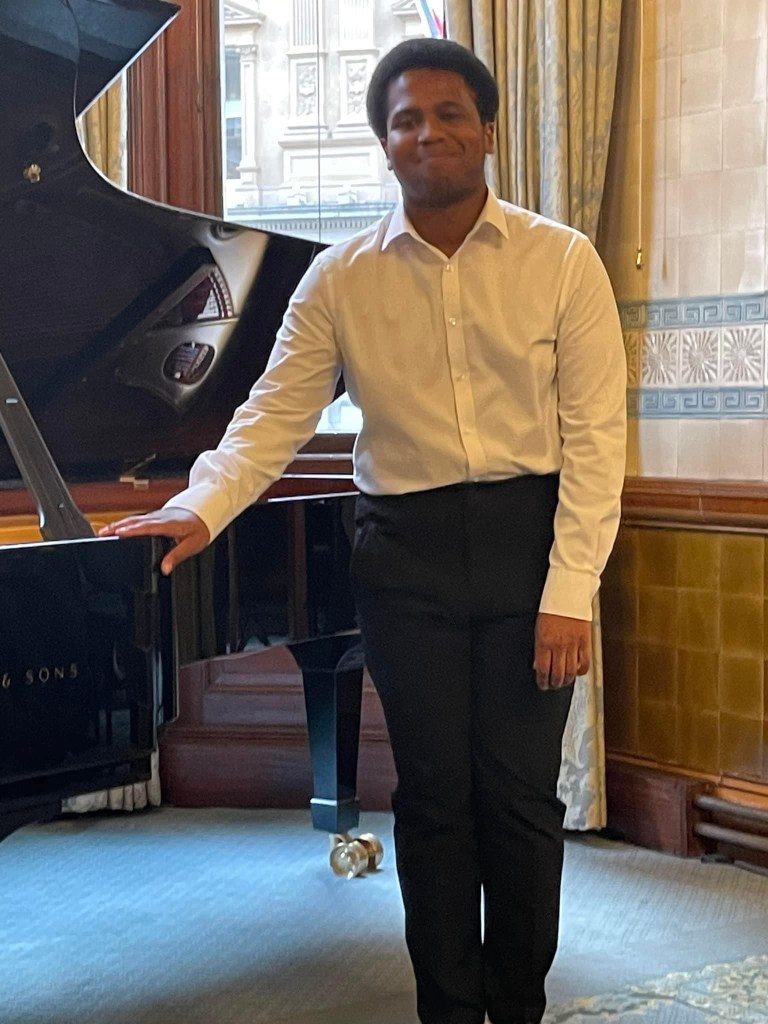
The improvised after concert Green Room
Edward Morton Jack of the Liszt Society, writes in tribute: ‘Among Leslie Howard’s many distinctions is his having been invited, aged only 39, to be president of the Liszt Society upon the death in 1987 of Louis Kentner. Howard has remained president of the Society ever since, working tirelessly to promote an understanding of the music and life of Liszt’. Tonight’s concert is no exception.
Leslie in the green Room with Elena Vorotko co artistic directors of the Keyboard Trust
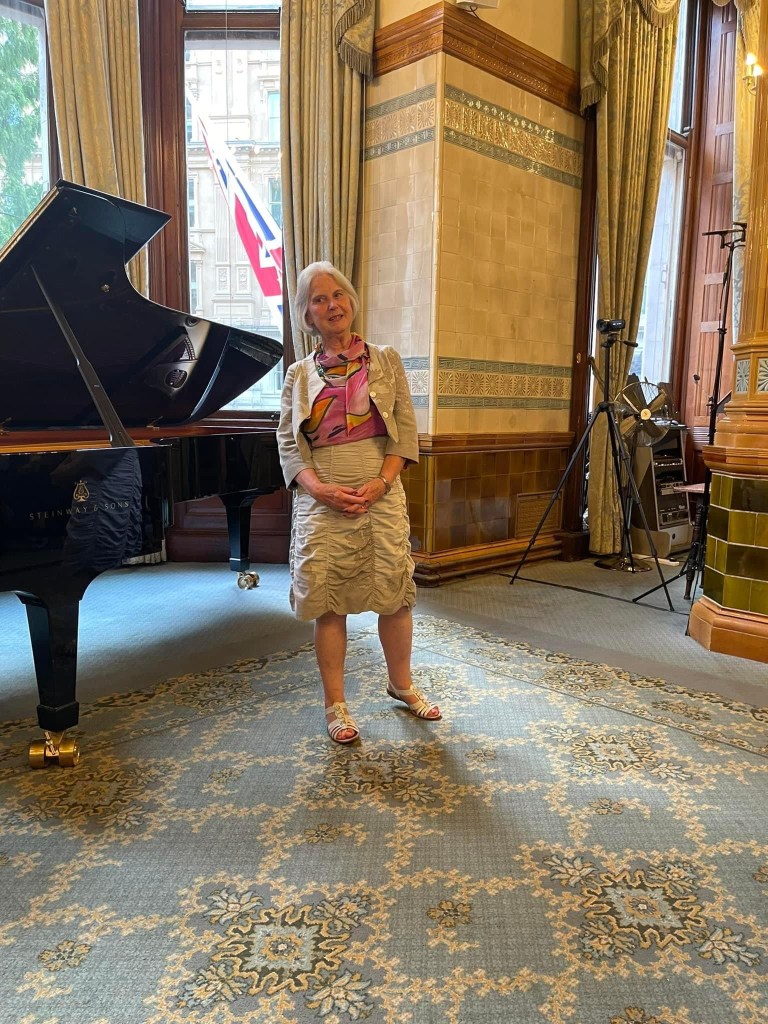
Franz Liszt (1811-1886)
Ballade No. 1 (‘Le chant du croisé’) S170
Ballade No. 2 S171
4 Valses oubliées S215
Petite valse (‘Nachspiel zu den drei vergessenen Walzer’) S695e
Variationen über das Motiv von Bach S180
Hungarian Rhapsody No. 16 in A minor S244
Hungarian Rhapsody No. 17 in D minor S244
Hungarian Rhapsody No. 18 in F sharp minor S244
Hungarian Rhapsody No. 19 in D minor S244
The Maestro speaks.Leslie’s own programme notes – no comment needed or indeed possible from us mortals.Leslie at home amongst his scores
A fascinating survey of music with a Spanish flavour from this most eclectic of young musicians.Axel was born in the Castelli Romani in Genzano and brought up in Aprilia on the plains below.His musical wings have taken him far and wide to study with Maurizio Baglini and Denis Pascal.I first heard him in the final concert of Benedetto Lupo’s class at the Academy of S.Cecilia.Recently it was Louis Lortie who spoke so highly of this young musician and even acted as recording engineer for his two piano recording with Luigi Carrocia of Liszt ‘s mighty Dante Symphony.
I have recently listened to his CD of the first two books of Iberia and was very curious to hear today the third book.Interludes of three of Mompou’s very suggestive songs and dances ,as Axel explained,gave us the introvert side to the Spanish character as opposed to the scintillating glitter and animal passion of Albeniz,Ravel and De Falla.It was refreshing to hear with what intelligence and integrity Axel brought to these little pieces that are now being re-evaluated by musicians of great standing.Both Stephen Hough and Arcadi Volodos have recently made CD’s of the works of this much neglected composer.It is a far cry from Agosti’s class in Siena in the late sixties when a very fine Canadian student Jack Krichaf after playing Chopin’s B minor Sonata and the Goldberg Variations appeared with some pieces by Mompou.Agosti took the music from the stand and put it in the waste paper bin saying:’Now play me some music!!!!’.Axel may have turned baubles into gems but they stood their own today against the other undisputed masterpieces on the programme.
Albeniz was played with scintillating colours and spectacular technical prowess where no matter how many notes were scattered around the keyboard the musical line came shining through.Ravel too was played with ravishing colours and refined good taste.De Falla of course was like a wild animal let loose on the keys with amazing glissandi up and down the keyboard like jets of light being shot at an uncontrolled crowd.Chopin’s Nocturne op 62 n. 1,played as an encore,came as a relief with Axel’s refined tone palette and intelligence giving such strength to the Genius of Chopin.
De Falla’s Ritual Fire Dance was a must as a parting shot.I have never heard it played with such electric passion and rhythmic energy.Even the middle section where Rubinstein would throw his hands up and down to great effect Axel turned it into a murmuring boiling cauldron out of which exploded a savage musical cry.You could almost hear the raucous gipsy voice intoning her seductive song.
The distinguished pianist Marylene Mouquet thanking Axel for his magnificent performance
An exhilarating recital from a musician returned to his origins thanks to Marylene Mouquet’s association dedicated to her teacher Arturo Benedetti Michelangeli and to the Keyboard Trust of London who had invited this young star back to his roots to astonish and amaze.
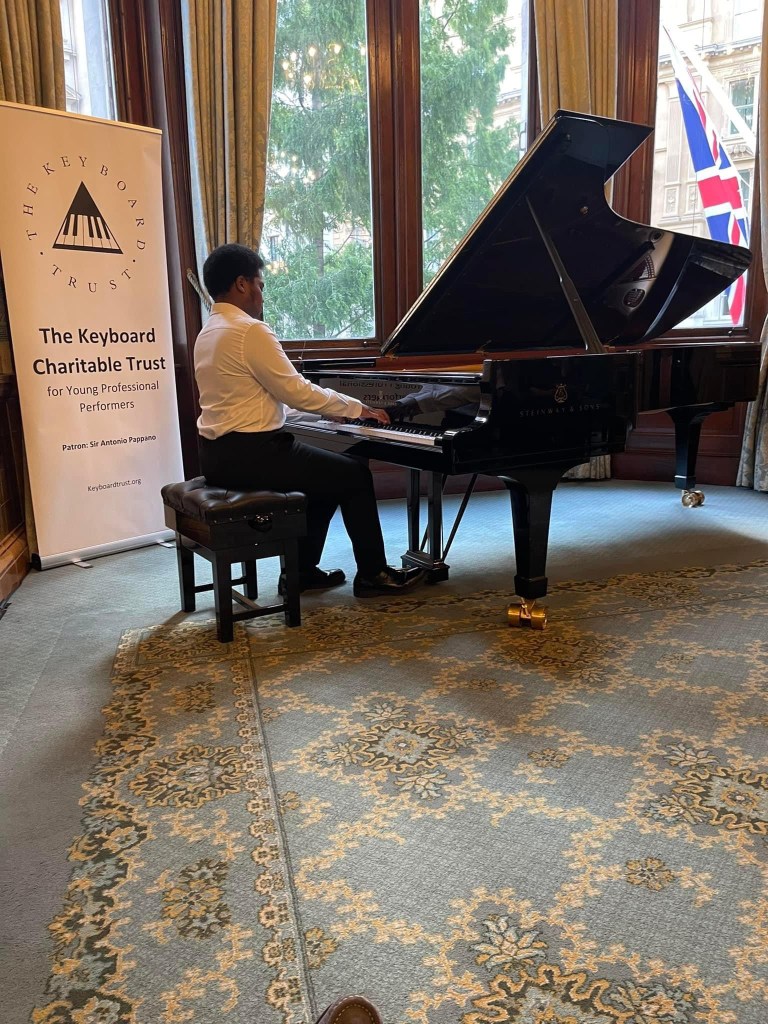
Iberia is a suite for piano composed between 1905 and 1909 by Isaac Albeniz. It is composed of four books of three pieces each.
It is Albéniz’s best-known work and considered his masterpiece. It was highly praised by Debussy and Messiaen who said: “Iberia is the wonder for the piano; it is perhaps on the highest place among the more brilliant pieces for the king of instruments”. Stylistically, this suite falls squarely in the school of impressionism,especially in its musical evocations of Spain.It is considered one of the most challenging works for the piano: “There is really nothing in Isaac Albeniz’s Iberia that a good three-handed pianist could not master, given unlimited years of practice and permission to play at half tempo. But there are few pianists thus endowed.”
El Albaicin where Axel brought bright and brittle rhythms of savage exhilaration after a sleepy atmospheric opening .It was interrupted only by a melancholic cry with magic bells heard in the distance.Axel showed here his transcendental sense of colour as he did in the lavish melodic dance of El Polo.Played with great passion and sumptuous full sounds of rhythmic energy.Lavapies an intricate Spanish dance with a jumble of clashing sounds out of which emerges the melodic cry amidst all the bustle of Spanish life.
Axel played Book 3 :El Albaicin a district of Granada El Polo (F minor) after the flamenco Polo Lavapiés another district of Madrid.
Cançons i danses– Songs and Dances by Frederic Mompou each originally published singly under the Spanish title Canción y Danza is the title of a collection of 15 pieces by Federico Mompou and were written between 1918 and 1972. All were written for the piano except No. 13 for guitar and No. 15 for organ
Axel brought a luminosity and simplicity to these three pieces with a full rich melodic sound of such strength and character .
Each piece consists of an introductory slow Cançó, followed by a more animated Dansa in a related key but not necessarily in the same time signature. They are mostly based on existing Catalan folk tunes, although some of them are original works.
N.1 Song :Quasi moderato; F-sharp major; based on La hija de Crimson (La Filla del Carmesi) and dance :Allegro non troppo; F-sharp minor – F-sharp major; based on Dansa de Castelltercol (or Castelltersol) written without a key signature .
N.7 Song :Lento; A major; 6/8; based on Muntanyes regalades) Dance:A major; 3/4; based on L’Hereu Riera ;
N.3 SongModéré; based on El Noi de la Mare Dance:Sardana-temps de marche; 6/8; original, salvaged from an unfinished string quartet dedicated to Frank Marshall and contains no bar lines.It is interesting to note that Alicia de Larrocha became director of the Frank Marshall Academy named after her illustrious teacher.
Frederic Mompou Dencausse (Federico Mompou) 16 April 1893 – 30 June 1987 was a Catalan composer and pianist.
Rapsodie espagnole is an orchestral rhapsody written by Maurice Ravel and composed between 1907 and 1908, the Rapsodie is one of Ravel’s first major works for orchestra. It was first performed in Paris in 1908 and quickly entered the international repertoire. The piece draws on the composer’s Spanish heritage and is one of several of his works set in or reflecting Spain.Axel played the transcription by Lucien Garban.
Lucien Garban (1877–1959) was a French composer, music arranger and editor who wrote transcriptions still performed in the modern repertoire. Garban studied under Gabriel Fauré at the Conservatoire de Paris and served as musical director of the publishing house Durand until 1959.Around 1900, Garban along with Ravel and a number of young artists, poets, critics, and musicians joined together in an informal group; they came to be known as Les Apaches (“The Hooligans”), a name coined by Ricardo Vines to represent their status as “artistic outcasts”.
Axel introducing the Ravel before giving a quite spectacular account that was breathtaking in its sweep and subtle sense of colour
Prélude à la nuit movement is marked très modéré and the whole movement is quiet, never rising above mezzo forte . Malaguena is the shortest of the four movements, and is marked assez vif and refers to a flamenco dance from the southern Spanish province of Malaga where Ravel’s music here is more a romantic evocation of place and mood. Habanera is beguiling and subtle in its expression of a thoroughly Spanish character and spirit. Feria is the longest of the four movements, and is the first point in the score at which Ravel allows “the élan that has so far been deliberately stifled” to break out. The boisterous carnival atmosphere has undertones of nostalgia, but exuberance triumphs and the work ends in a joyful burst of orchestral colour.
Fantasia Baetica was given a quite remarkable performance of burning Latin fire.Some amazing technical feats whilst maintaining this energy even in moments of peaceful contemplation where there was always a feeling that something was about to erupt.Listening to Axel’s superlative performance I find it even more surprising that the fiery temperament of Rubinstein had not taken this work into his repertoire as he had The Ritual Fire dance. I have a copy of the Urtext edition given to me by the much missed Aquiles delle Vigne that he gave me especially on one of his many visits to Rome. https://youtu.be/Q-XP_AIYPuc
Fantasía bética, or Andalusian Fantasy, was written in 1919 by Manuel de Falla evoking the old Roman province of Baetisin in southern Spain, today’s Andalusia. It was commissioned by Artur Rubinstein who planned to perform it in Barcelona that year but did not learn it in time and so wound up giving the premiere in New York on 20 February 1920; as it turned out, he would play it only a few times before dropping it from his repertory without recording it.Arthur Rubinstein, years later,explained to the composer that he found it too long … It was Falla’s last major piano work and the only one that belongs to the virtuoso tradition in which Falla the pianist had been trained. As Ronald Crichton has written: ‘Guitar figurations transformed into pianistic terms abound … other passages evoke the harpsichord, Scarlatti as it were, rewritten by Bartók.’ Beyond that are the smoky, heavily ornamented lines of flamenco singers and the tightly controlled gestures of Andalusian dancing, the whole work adding up to a marvellously varied and vigorous portrait of Spain. From the structural point of view, one can only admire what Falla called ‘internal rhythm’, which he explained as ‘the harmony in the deepest sense of the word born of the dynamic equilibrium between the sections’.
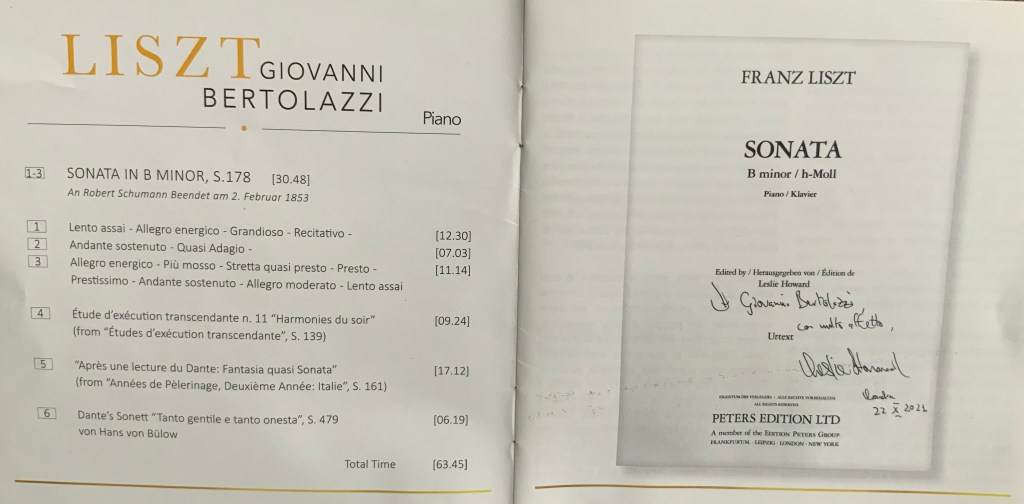
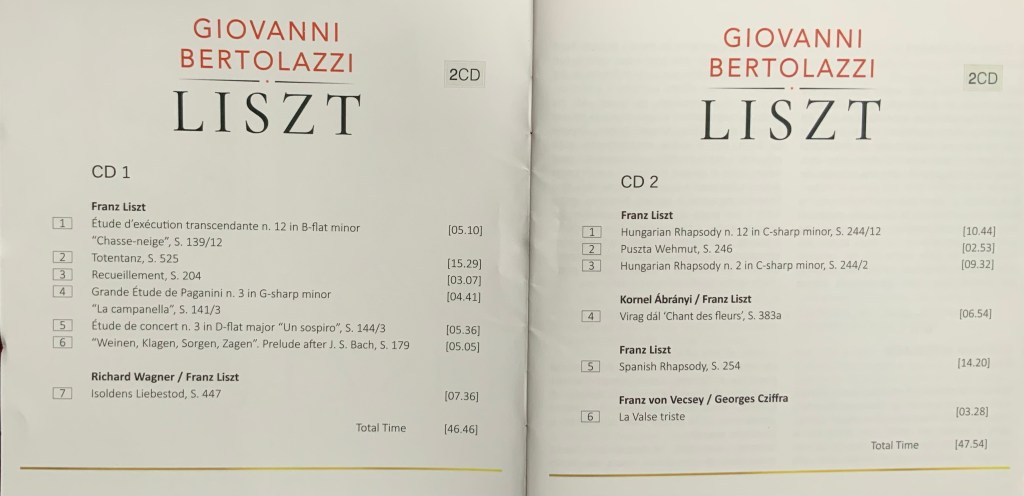
Après une lecture du Dante – Fantasia quasi Sonata da Années de pèlérinage. Deuxième Année. Italie, S.161 (1849). Sonetto di Dante “Tanto gentile e tanto onesta” (da H. v. Bülow), S.479 (1874) Totentanz. Parafrasi sul Dies Irae, S.525 (1865) Preludio su “Weinen, klagen, sorgen, zagen” (da J. S.Bach), S.179 (1859) Recueillement. Vincenzo Bellini in memoriam, S.204 (1877) Rapsodia ungherese n. 2, S.244 (1847)Lento a capriccio (do minore)
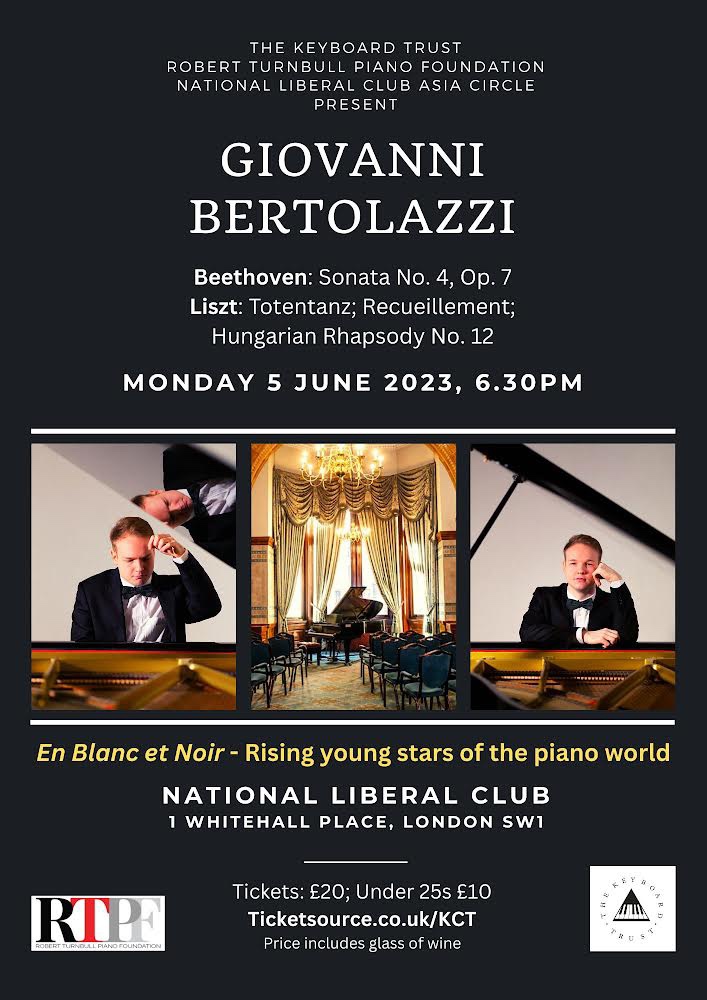
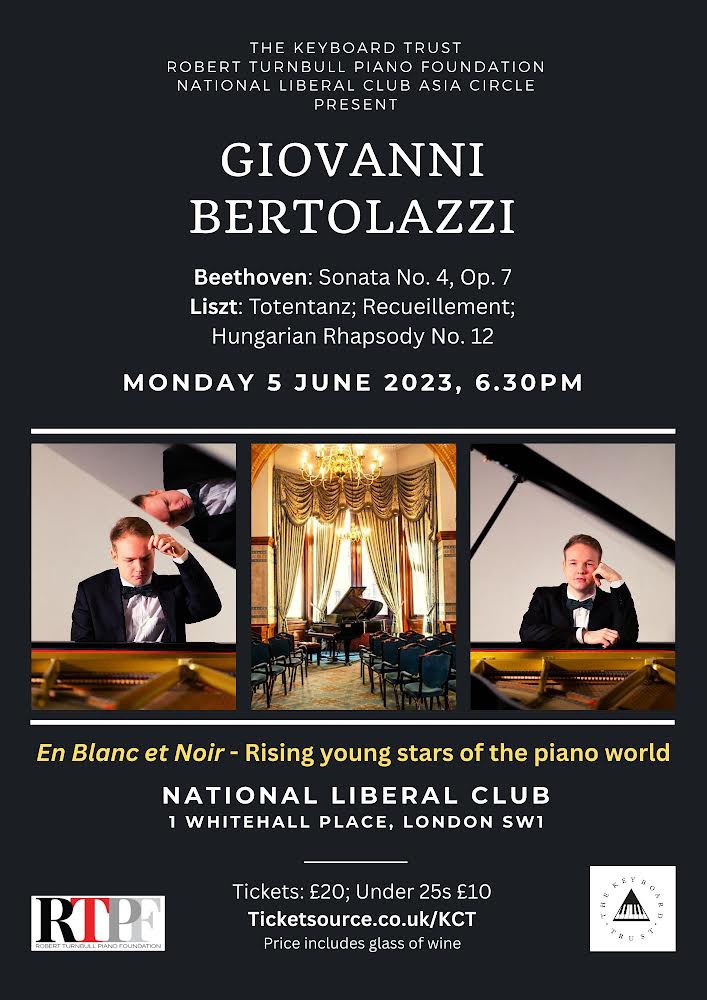
Liszt is alive and well in his beloved Eternal City and at the President’s Palace . With the young virtuoso ,top prize winner of the Liszt / Budapest competition , Giovanni Bertolazzi astonished us this morning in a live Sunday morning broadcast where not even the unexpected intrusion of a brass band could distract him from the nobility and poetic insights he brought to the Genius of Liszt.
An encore in Hungarian Style with the Valse Triste by Vecsey-Cziffra
Considered by many to be the finest young pianist of his generation he showed us why, with an hour of astonishing playing of great showmanship but above all with a kaleidoscope of ravishing sounds of deep poetic content all from the hands of an artist of great stature.Liszt is indeed alive and well and I like to think he too was looking on today to a worthy disciple https://christopheraxworthymusiccommentary.com/2022/12/04/giovanni-bertolazzi-the-mastery-and-authority-of-liszt/
The dramatic intensity he brought to the ‘Dante Sonata’ from the very first notes immediately held our attention.Silences that became menacing as sounds entered like threatening whispers out of this void.A performance of great theatricality where passionate explosions were contrasted with sublime confessions of intimate secrets.It was not only the transcendental control and dynamic physicality of his virtuosity but it was the kaleidoscope of sounds that he could find and extract from this powerful Fazioli that surrendered all its secrets under his hands.Not even the explosion of a loudspeaker in the most tender part of the Sonata could distract from the atmosphere he had created that held us all in his spell from the first to the last note of this remarkable one movement work.
Après une lecture du Dante: Fantasia quasi Sonata (French for After a Reading of Dante: Fantasia quasi Sonata; also known as the Dante Sonata) was completed in 1849. It was first published in 1856 as part of the second volume of the Anne de Pélerinage (Years of Pilgrimage) and was inspired by the reading of Victor Hugo’s poem “Après un lecture du Dante” (1836).It was originally a small piece entitled Fragment after Dante, consisting of two thematically related movements,which Liszt composed in the late 1830s.He gave the first public performance in Vienna in November 1839.When he settled in Weimar in 1849, he revised the work along with others in the volume, and gave it its present title derived from Victor Hugo’s own work of the same name.
Three rarely heard works by Liszt gave much needed contrast to the drama that unfolds in the Dante Sonata and Totentanz.I imagine the Liszt expert Leslie Howard had pointed Giovanni in the direction of these rarely heard gems of Liszt.A simple beautiful outpouring of song from Hans von Bulow who was Liszt’s son in law until Wagner came along and stole away the heart and mind of his daughter,Cosima.Beautifully played with a ravishing sense of balance that resounded with such beauty in these sumptuous surroundings
Von Bülow’s song Tanto gentile e tanto onesta never entered the repertoire, Liszt’s enthusiasm for it notwithstanding. The piano transcription S.479 is simple and straightforward, and the original song a worthy setting of Dante Alighieri. (‘My lady is so gentle and modest when she greets others that every tongue trembles and is still, and eyes do not dare to look upon her.’) .Written on the first anniversary of Beatrice’s death (therefore in 1291, according to the chronology established by Dante himself) this sonnet with two different beginnings above all describes the poet’s pain in the memory of his woman now seated in the splendor of the heavens, also through the personification Cavalantiana of the sighs that come out of the author’s chest and speak autonomously. In the prose, the anecdote that allegedly gave rise to the composition of the sonnet is interesting, i.e. Dante’s meeting with unspecified important characters while he is intent on drawing “an angel above certain tablets” (perhaps evidence of an artistic practice also evoked in other parts of Dante’s work).
An overwhelming performance of Totentanz where even my camera could not keep up with the funabulistic gymnastics of Giovanni.I remember hearing Arrau play this with orchestra in the vast Royal Albert Hall and being blown away by the volume of sound that he could produce.It is rare to hear this version for piano solo but Giovanni brought an amazing sense of line pointing out the Dies Irae no matter what technical feats were being performed all around.Giovanni had an entire orchestra in his hands as he astonished and amazed us.He also found the tranquility and innocence of a saint with the simplicity he brought to the plain chant in between the enormous volumes of sumptuous sounds he produced that would have put any orchestra to shame .
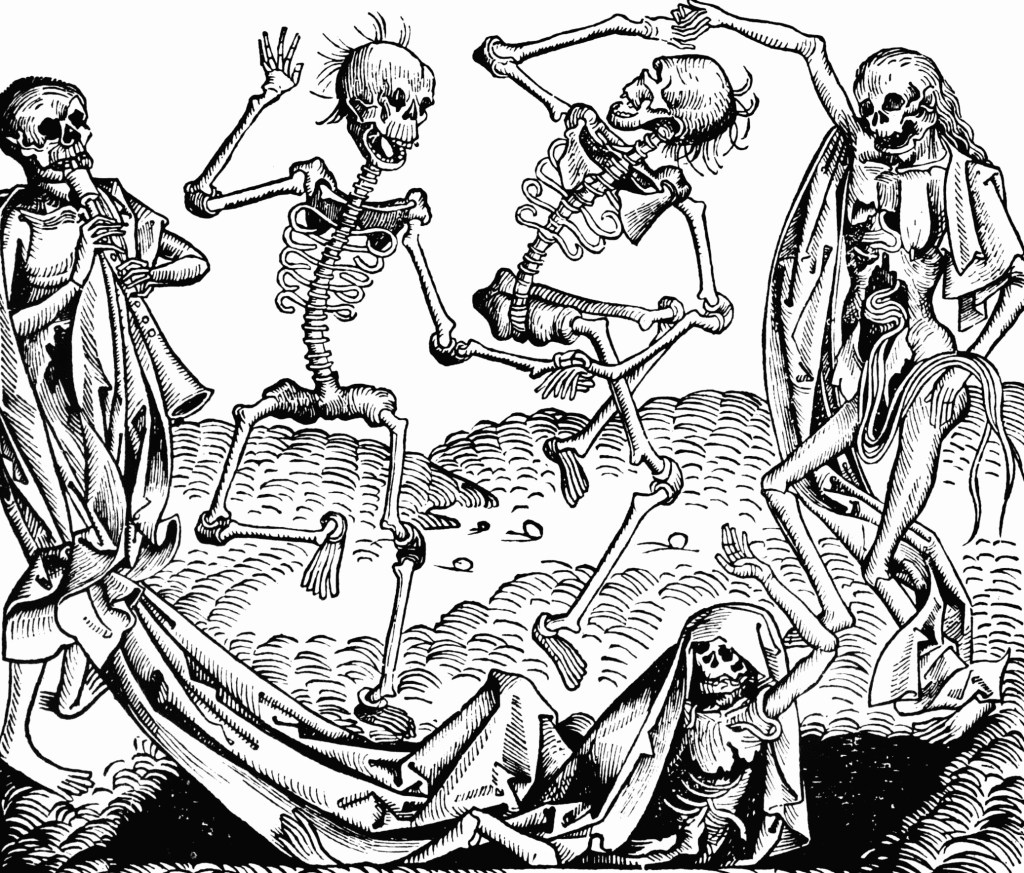
Totentanz (English: Dance of the Dead): Paraphrase on Dies irae, S .126 for solo piano and orchestra is notable for being based on the Gregorian plainchant melody Dies irae as well as for stylistic innovations. It was first planned in 1838, completed and published in 1849, and revised in 1853 and 1859.Some of the titles of Liszt’s pieces, such as Totentanz,Funérailles,la lugubre gondola and Pensée des morts show the composer’s fascination with death.In the young Liszt we can already observe manifestations of his obsession with death, with religion, and with heaven and hell.Liszt frequented Parisian “hospitals, gambling casinos and asylums” in the early 1830s, and he even went down into prison dungeons in order to see those condemned to die.Liszt also wrote versions for two pianos (S.652) and solo piano (S.525) In the last movement of the Symphonie fantastique by Berlioz the medieval (Gregorian) Dies Irae is quoted in a shockingly modernistic manner. In 1830 Liszt attended the first performance of the symphony and was struck by its powerful originality. Liszt’s Totentanz (Dance of Death), a set of variations also paraphrases the Dies Irae plainsong.An an early biographer notes, “Every variation discloses some new character—the earnest man, the flighty youth, the scornful doubter, the prayerful monk, the daring soldier, the tender maiden, the playful child.”
The Dance of Death (Totentanz) from Liber Chronicarum [Nuremberg Chronicle], 1493, attr. to Michael Wolgemut
The Prelude Weinen,Klagen,Sorgen,Zagen ‘Praludium nach Johann Sebastian Bach S 179 of 1859 is a dignified and restrained piece with just one dramatic outburst, all within the framework of a passacaglia which unfolds 25 variations on the motif
The prelude a work of more substance than these other two gems as Giovanni built it to a climax of unexpected architectural importance.Not the masterpiece of Liszt’s Variations on the same theme but a performance of great simplicity and beauty that I have never heard in the concert hall before.
Recueillement (‘Recollection’) S 204 was a gift to the Italian composer Lauro Rossi .It weaves arpeggios around a rising scale before settling into very simple, chordal writing.Written in memoriam to Vincenzo Bellini of who Liszt had made famous paraphrases of his Norma,La Sonnambula and I Puritani (Hexameron).Played with simplicity and sensitivity before the final salute from Liszt the greatest showman the piano has ever known .
One of Liszt’s most popular works the Hungarian Rhapsody n. 2 that followed the simplicity of the work dedicated to the memory of Bellini .It was given a new lease of life in Giovanni’s hands.There was a veiled beauty to the lassan before the full brass band of the friska.It was played with an irresistible sense of dance and style.Even the cadenza made a dramatic appearance as it led to the hard driven final octaves and the abrupt explosive final notes.
Hungarian Rhapsody No. 2 in C-sharp minor, S.244 is the second in a set of 19 Hungarian Rhapsodies and is by far the most famous of the set.Franz Liszt was strongly influenced by the music heard in his youth, particularly Hungarian folk music, with its unique gypsy scale,rhythmic spontaneity and direct, seductive expression. These elements would eventually play a significant role in Liszt’s compositions.Composed in 1847 and dedicated to Count Laszlo Teleki it was first published as a piano solo in 1851 .Offering an outstanding contrast to the serious and dramatic lassan.the following friska holds enormous appeal for audiences, with its simple alternating tonic and dominant harmonization, its energetic, toe-tapping rhythms, and breathtaking “pianistics”.Most unusual in this composition is the composer’s invitation for the performer to perform a cadenza .Sergei Rachmaninov wrote a famous cadenza for his interpretation and Liszt himself wrote several cadenzas for the piece, but they were rarely performed.
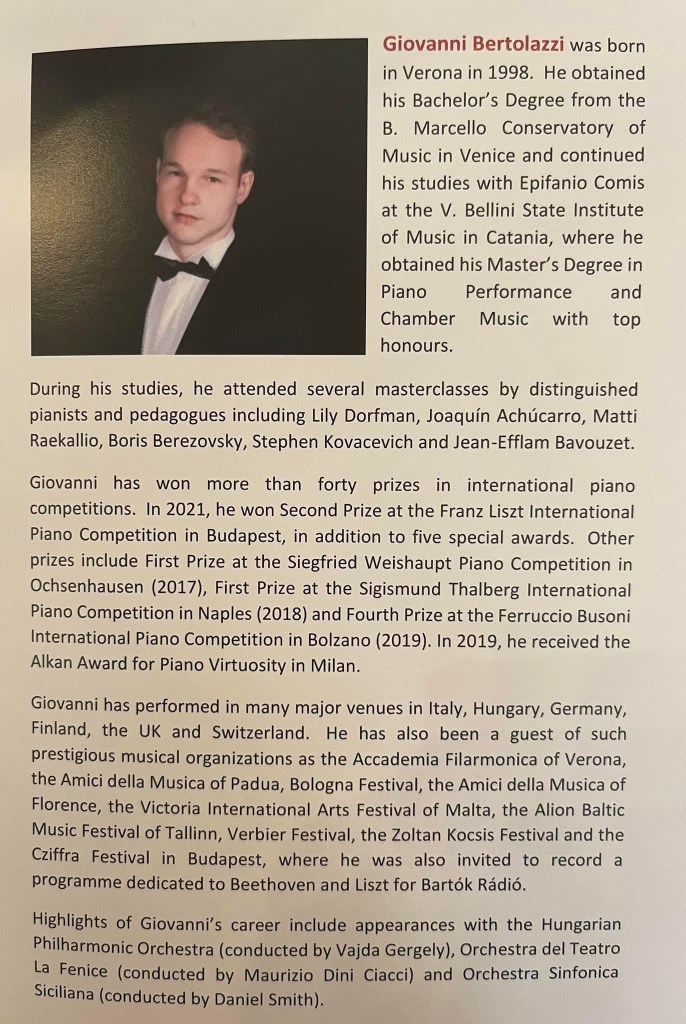
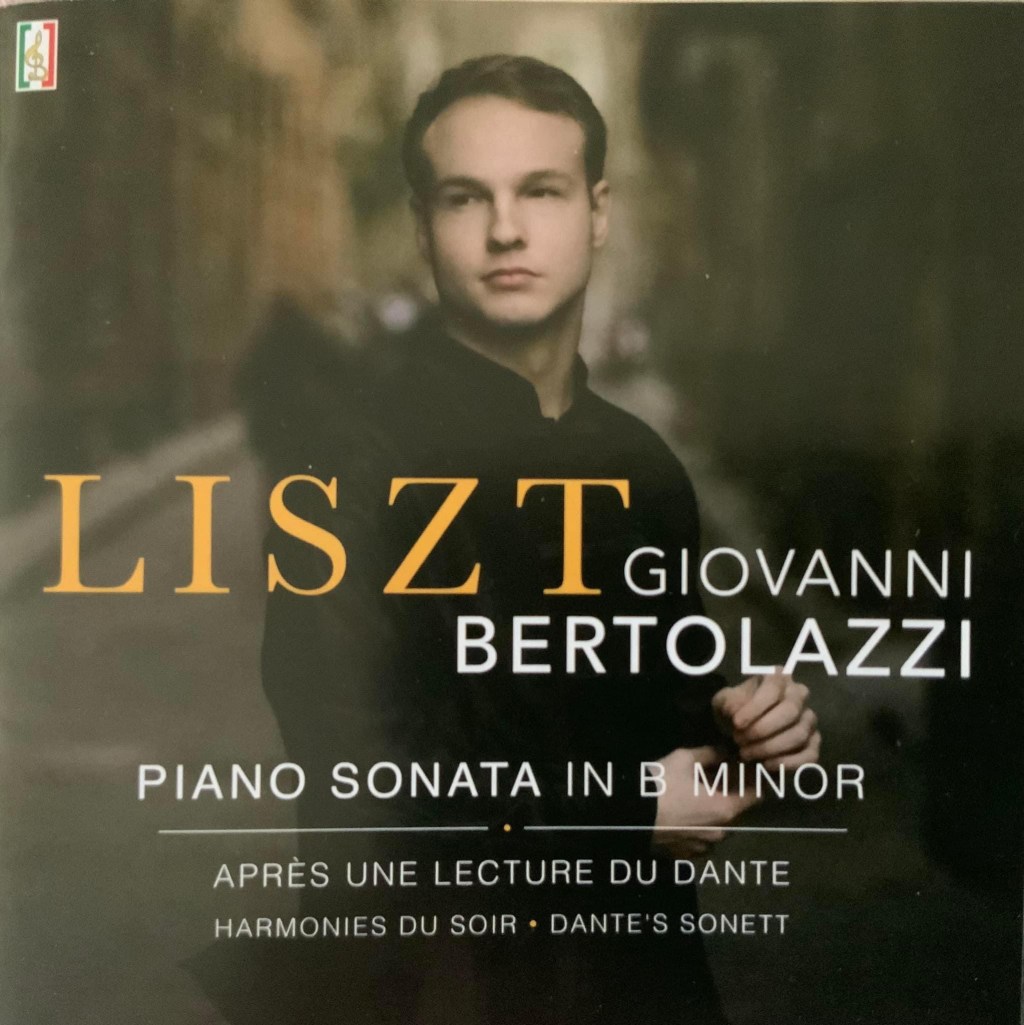
Giovanni Bertolazzi Insignito nel 2021 del 2° Premio e di 5 premi speciali al prestigioso Concorso Pianistico Internazionale “Franz Liszt” di Budapest, Giovanni Bertolazzi è nato a Verona nel 1998 e ha iniziato a studiare pianoforte da bambino. Diplomato prima al Conservatorio “Benedetto Marcello” di Venezia con Massimo Somenzi, quindi all’Istituto Superiore di Studi Musicali “Vincenzo Bellini” di Catania con Epifanio Comis, ha frequentato le masterclasses di Lily Dorfman, Joaquín Achúcarro, Matti Raekallio, Violetta Egorova, Boris Berezovsky, Stephen Kovacevich e Jean-Efflam Bavouzet. Ha vinto più di 40 premi in concorsi pianistici internazionali, tra cui il 1° Premio al Concorso Pianistico “Siegfried Weishaupt” di Ochsenhausen (2017), il 1° Premio al Concorso Pianistico Internazionale “Sigismund Thalberg” di Napoli (2018) e il 4° Premio al Concorso Pianistico Internazionale “Ferruccio Busoni” di Bolzano (2019). Nel giugno 2019 a Milano ha ricevuto il “Premio Alkan per il virtuosismo pianistico”. Dal 2020 è sostenuto artisticamente dall’Associazione Culturale “Musica con le Ali” e nel 2022 è stato premiato con il “Tabor Foundation Award”, riconoscimento assegnatogli dalla Verbier Festival Academy in occasione del Verbier Festival (Svizzera). Si è esibito fra l’altro al Teatro La Fenice di Venezia, a Palazzo Pitti a Firenze, al Teatro Politeama Garibaldi di Palermo, al Teatro Bellini di Catania, presso la Sala Verdi del Conservatorio di Milano, a Budapest alla “Franz Liszt” Academy of Music e al Liszt Ferenc Memorial Museum, alla Landesmusikakademie di Ochsenhausen, al Kadrioru Kunstimuuseum di Tallinn e alla Steinway Hall a Londra. È stato ospite inoltre delle Serate Musicali di Milano, degli. Amici della Musica di Padova, del Bologna Festival, degli Amici della Musica di Firenze, del Verbier Festival e del Cziffra Festival di Budapest. Nei suoi concerti con orchestra ha collaborato, fra gli altri, con direttori come Gergely Vajda, Maurizio Dini Ciacci, Epifanio Comis, Daniel Smith. Ai Concerti di Radio3 al Quirinale ha debuttato in recital nell’ottobre del 2020. Di recente ha pubblicato un album dedicato a Liszt e premiato dalla critica internazionale nel quale suona un pianoforte Borgato Grand Prix 333, strumento di fabbricazione italiana che detiene anche il record della maggior lunghezza (3,33 m.) per uno strumento gran coda da concerto.
With Andrea Penna the unflappable and highly informed radio presenter
Giuliano Tuccia,per la prima volta ospite delle stagioni di Roma Tre Orchestra
Domenica 16 aprile 2023 ore 19 Convitto Vittorio Locchi Rome Giuliano Tuccia – Young Artists Piano Solo Series 2022 – 2023 F. Liszt: Ballata n. 2 in si minore per pianoforte S. Rachmaninov: Sei momenti musicali op. 16 M. Ravel: Valses nobles et sentimentales Giuliano Tuccia, pianoforte
Reading Nicolò Giuliano’s curriculum is like turning the clock back with so many names from the past that have crossed my path.Andrea Fasano who sent me the link to his programme of a recording of a recital that Giuliano made in the Ravenna Festival in July 2021.Andrea was a young aspiring giornalist who used to frequent many of the musical events at the Ghione Theatre in the Golden era of the 80’s and 90’s.He asked me to listen to this remarkable young man with whom he is collaborating on many interesting musical projects.A young man from Forli who is running a concert series in the name of Guido Agosti.
Giuliano is mentored by Leslie Howard the only pianist to have recorded all the works of Liszt on over 100 CD’s
Leslie Howard who is now mentoring Nicolò Giuliano was Agosti’s favourite student in those years in Siena when the world would flock to hear this legendary musician,a student of Busoni,in his studio at the Chigiana Academy.Sounds were heard in that studio that have never been forgotten by all those that frequented his summer course that he held there for over thirty years.Agosti was born in Forlì and is buried there.On his grave is inscribed simply GUIDO AGOSTI MUSICIAN .The same simplicity and integrity that he dedicated to the great composers he served so faithfully in his long life.
Lydia and Guido Agosti with my wife Ileana Ghione
Agosti and his wife Lydia Stix Agosti became family friends and they would come every weekend to our home on the seashore in Sabaudia.Lydia and my wife would spend the day on the beach and leave the Maestro to play duets all day long with me!Beethoven quartets,Brahms Symphony’s and Hungarian Dances.We would preparare an after dinner concert for our wives after their day on the beach!
Lydia even managed to persuade Guido to give a recital in our newly opened theatre.The recording we made of his performance of Beethoven op 110 and 111 is one of the only recordings of this great but very private musician.
Ileana Ghione with Guido Agosti
Reading on in Giuliano’s curriculum I see he is now studying in Imola with Andrea Gallo.One of the finest musicians I know.I am proud to say he performed several times in his formative years for the Keyboard Trust of which Leslie Howard,Elena Vorotko and I are the artistic directors.He is now second in command at the famous pianistic mecca in Imola.Here is a conversation with him in which he talks about his extraordinary approach to piano playing:https://youtu.be/1TTxiaFESH0
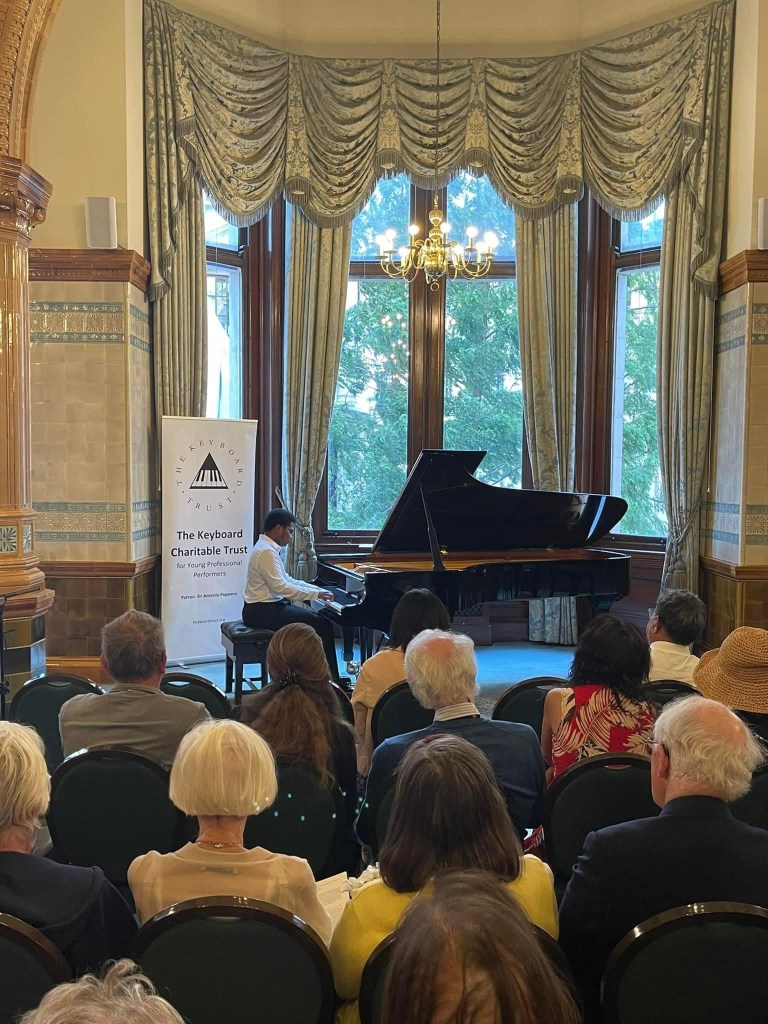
All this to say I was curious to hear how this young man plays!!!!
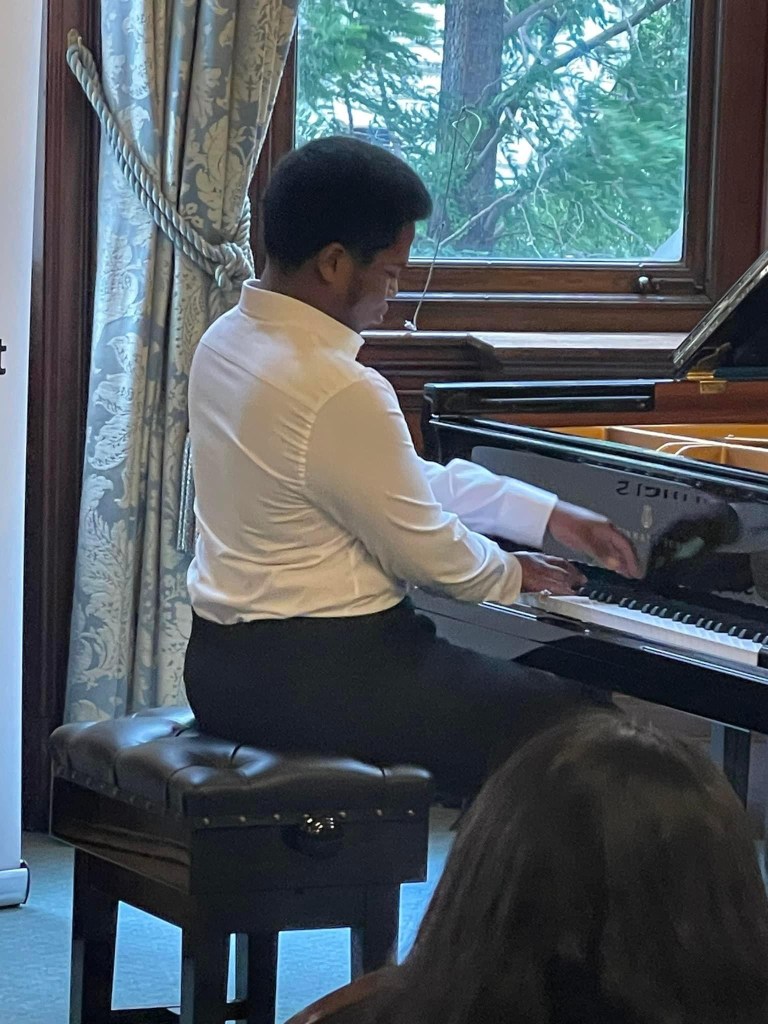
A superb performance of Schumann’s Kreisleriana which reminded me in so many ways of Bruno Leonardo Gelber.The limpet like hand that dug deep into the notes with absolute legato and could extract a unique velvet sound just as I heard today.Gelber too had a great personality that was evident today in Giuliano’s performance.It was a performance that had so many individual things that it had me delving into the score to see what I had missed for so many years.Always with impeccable good taste but a pianist who has something very personal to say.
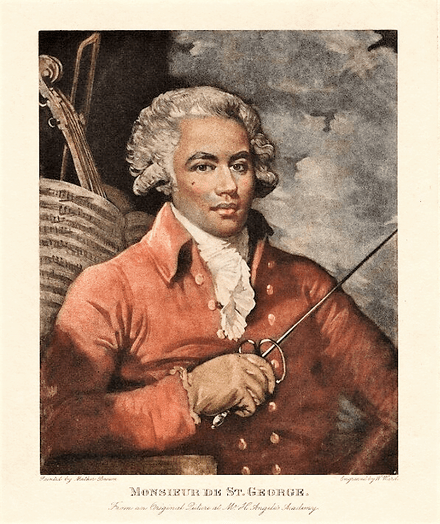
Kreisleriana, Op.16, is a composition in eight movements that Schumann claimed to have written in only four days in April 1838 and a revised version appeared in 1850. The work was dedicated to Frederic Chopin but when a copy was sent to him he commented favourably only on the design of the title page.It is a very dramatic work and is viewed by some critics as one of Schumann’s finest compositions.In 1839, soon after publishing it, Schumann called it in a letter “my favourite work,” remarking that “The title conveys nothing to any but Germans. Kreisler is one of E.T.A Hoffmann’s creations, an eccentric, wild, and witty conductor.”In a letter to his wife Clara ,Schumann reveals that she has figured largely in the composition of Kreisleriana:”I’m overflowing with music and beautiful melodies now – imagine, since my last letter I’ve finished another whole notebook of new pieces. I intend to call it Kreisleriana. You and one of your ideas play the main role in it, and I want to dedicate it to you – yes, to you and nobody else – and then you will smile so sweetly when you discover yourself in it.”
Our concert halls are flooded with young pianists with superb technical training usually from the Eastern countries but have no respect for the very precise indications of the composer.Are pianists merely showmen using the composer’s notes as a means to show off their superb technical proficiency?I remember Charles Rosen telling a remarkably trained pianist in a masterclass that he plays like a whore.Karl Ulrich Schnabel told another that he was obviously a composer as he took the notes of great composers to suit himself! Perlemuter too was sent a rough copy of a famous young pianist playing Ravel Valses Nobles and Gaspard .The record company were looking for a quote from a legendary pianist who had studied the works of Ravel with the composer.’Qu’est -ce que c’est che ca’ was Perlemuters innocently ingenuous remark.
All this to say that there is a very fine line for a true interpreter like riding a high wire where if you have the courage to mount it you risk falling either way.It is this risk which made Gilels exclaim that the difference between recorded music and live was like that between fresh food and canned!Giuliano took risks but as a true musician he always had the larger architectural shape in sight.Sometimes his highlighting of inner counterpoints could really illuminate passages but it could also disturb.The only place it disturbed me was in the last movement where Schumann’s own syncopated bass is quite enough over a gently lilting right hand,so any inner counterpoints in the right hand I found disturbing.A very small point but one of the thousands of choices a true interpreter has to make but always starting from the indications left by the composer.Other slight highlighting of an inner voice here and there I found absolutely enlightened,as I used to indeed with Gelber,Moiseiwitch or even Cherkassky.
The opening movement was played immediately with controlled passion with Giuliano’s limpet like fingers extracting velvet rich sonorities from the piano.Maintaining the same tempo for the central episode but completely changing the colour as he allowed the beauty of the melodic line to be suggested over this flowing contour.It was here that subtle tenor counterpoints here and there shone like the jewels of a prism as the light passed over them.There was a beautiful legato to the second where Giuliano had made a definite choice of phrasing which allowed the melodic line to shine above and below this gently moving frame.I loved what he did but sometimes felt the gently flowing accompaniment could have been played even more simply so as not to disturb the ravishing beauty of the melodic line that he had created.The Intermezzo 1 was played with passion and rhythmic control and the Intermezzo 11 had a romantic sweep .It was ,though, the transition to the return of the opening that was remarkable for its sense of line.Giuliano even highlighted inner counterpoints that just clarified his complete understanding of a musical line that in lesser hands can sound like a bit of a ramble!
There was great rhythmic impulse to the third movement and a romantic sweep to the central episode where the soprano and tenor voices comune together so intimately.The fourth movement was played with a luminosity of sound and simplicity as everything was given the time needed to express such deep thoughts,but never losing sight of the overall shape.The gentle lilt to the central episode was even more beautiful for the inner colours that this young artist could so subtly suggest.In particular there was the sumptuous beauty of the cadence before the magical return of the opening theme.The fifth movement was played with a lightweight capricious rhythmic elan but every so often bursting into song like a glimpse of the sun between the clouds.After the passionate central outburst Giuliano added a silence not indicated by Schumann.Could it have been an oversight as it sounded so convincing to me before the return of the opening?Personality and good taste go hand in hand for a true interpreter as do intelligence and musicianship!Ravishing beauty of the sixth where this time the inner tenor notes in the ‘Etwas bewegter’ were indicated by Schumann himself and led to a whispered ending that was pure magic.The seventh is ‘Sehr Rasch’ but how fast is very fast? It is a question for the true interpreter to decide a speed in which the contour of the music can be clearly defined and not overlooked for virtuosistic showmanship!Giuliano chose just the right tempo that allowed the passionate outpouring to be clearly defined and it even gave him time to juggle with the notes between the hands in a very exposed spot well known to all pianists! The sudden interruption of chords ‘Etwas Langsamer’ was played as Schumann implores ,but Giuliano also kept the same colour as before and I have never heard it played with such intelligence as it is merely the coda or a slowed down version of what had come before.I have already mentioned the counterpoints and bass syncopation of the last movement played with such clarity of musical thought and digital precision.
There was also great sweep and passion to the intervening episodes that interrupt this lazy ride into the depths of the piano.A remarkable performance that I recommend all to enjoy in this link :
Après une lecture du Dante: Fantasia quasi Sonata (French for After a Reading of Dante: Fantasia quasi Sonata; also known as the Dante Sonata) was completed in 1849. It was first published in 1856 as part of the second volume of the Anne de Pélerinage (Years of Pilgrimage) and was inspired by the reading of Victor Hugo’s poem “Après un lecture du Dante” (1836).It was originally a small piece entitled Fragment after Dante, consisting of two thematically related movements,which Liszt composed in the late 1830s.He gave the first public performance in Vienna in November 1839.When he settled in Weimar in 1849, he revised the work along with others in the volume, and gave it its present title derived from Victor Hugo’s own work of the same name.
Intelligence,virtuosity,showmanship but above all respect for the genius of Liszt all went hand in hand in this remarkable performance that can be enjoyed from this radio performance together with two Rachmaninov Moments Musicaux op 16 an encore and a short interview.This is the link:
Nicolò Giuliano Tuccia è protagonista del Concerto di Pasqua 2023 su IMD RADIO/IMD PLAY con la riproposta di un suo bellissimo recital del 2021 che lui stesso presenta e ricorda attraverso una breve intervista a corredo dell’ascolto integrale e senza pause della registrazione che a breve sarà disponibile anche come album discografico. In questa intervista il giovane pianista forlivese anticipa pure alcuni suoi prossimi impegni ed incisioni dedicate alla riscoperta del repertorio strumentale italiano. Questo, intanto, il programma della trasmissione odierna. Robert Schumann: Kreisleriana, op. 16 – Franz Liszt: Dante Sonata – Sergeij Rachmaninoff: Dai 6 “Momenti Musicali” Op. 16; nn. 3 & 4- Nicolò Giuliano Tuccia, pianoforte – Chiesa di S. Massimiliano Kolbe, Lido Adriano (RA), 29 luglio 2021 (per la rassegna “Diapason, percorsi aonori”, I Edizione).
Nicolò Giuliano Tuccia was born in Emilia-Romagna: born in 1999, he began studying the piano at the age of 8. Nicolò Giuliano Tuccia boasts over 30 prizes in national and international competitions and more than 50 recitals as a soloist in important institutions and concert halls. His career starts from 2018 performing with the “Circle Symphony Orchestra” of Padua playing Beethoven concert n.3 Op.37 for piano and orchestra. In2019 he graduated in piano at the Rimini Conservatory with 110 cum laude. In 2020 he received recognition at the “Sergio Fiorentino piano competition” which led to a concert in Helsinki for the University piano circle supported by Eero Tarasti. In 2021 he made his debut at the “Kaunas Piano Festival” obtaining a scholarship to perform at the “M.K. Čiurlionis” from Kaunas. Also in the same year he won the special prize at the Kings Peak International Music Competition obtaining a masterclass with maestro Anthony Tam and the first prize at the Map international Music Competition, which will subsequently give him prize concerts in the USA. In 2022 he undertook an intense concert activity making his debut not only with the Orchestra of the Conservatory “B.Maderna di Cesena” at the Teatro Verdi in Cesena with 1053 by J.S.Bach, at the Sala “Marco Biagi” in Bologna, at the Circolo Culturale “G. Fantoni” in La Spezia and at the “Music Hall” of the University of musical semiotics in Helsinki, under the invitation of the famous maestro Eero Tarasti. Nicolò Giuliano Tuccia currently attends the piano academy of Imola “Incontri col Maestro” under the guidance of maestro Andrè Gallo and the European piano academy “High musical education” under the guidance of maestro Giuseppe Devastato. He is artistic director of the “Guido Agosti” concert series as well as president of the “Forlì Cultura” association. In 2023 he will perform in various European cities such as Rome, Rovereto, Lecco, Umeå, León and Berlin.
“ Nicolò Giuliano Tuccia è un musicista sensibile, dedito e intelligente, il cui pianismo elegante, eloquente e nobile lo colloca tra i migliori giovani artisti del nostro tempo.” Leslie Howard Inizia all’età lo studio del pianoforte sotto la guida del maestro Giancarlo Peroni. Nel 2020 consegue il diploma di Triennio accademico con il massimo dei voti e la lode, nel 2022 consegue il diploma accademico di secondo livello con il massimo dei voti e lode presso il Conservatorio “B.Maderna” di Cesena. Nel 2021 studia per un anno all’Accademia di Pinerolo con i maestri Pietro De Maria, Enrico Stellini e Andrea Lucchesini. Nicoló Giuliano Tuccia attualmente studia all’Accademia “Incontri col maestro” di Imola sotto la guida del Maestro André Gallo e all’Accademia Europea “Alta Formazione” di Napoli con Giuseppe Devastato. Durante la sua carriera musicale, Nicolò Giuliano Tuccia si perfeziona con vari maestri e tiene masterclass nazionali ed internazionali. I maestri con cui ha avuto il piacere di perfezionarsi sono: Mauro Minguzzi, Alessandra Ammara, Manila Santini, Giovanni Valentini, Luigi Tanganelli, Riccardo Risaliti, Emanuel Krasovsky, Sergio Tiempo, Inna Faiks, Massimiliano Ferrati, Roberto Cappello, Edith Fischer, Siavush Gadjev, Antonio Pompa – Baldi, Pablo Galdo, Andrea Lucchesini, Giuseppe Albanese, Avedis Kouyoumdijan, Hortense Cartier Bressan, Anthony Tam, Jesus Maria Gomez, Elvin Rodriguez , Francesc Vidal, Andrè Gallo e Giuseppe Devastato. Nicolò Giuliano Tuccia è stato vincitore di premi nazionali e internazionali, piazzandosi sempre ai primi posti. I concorsi dove si è distinto positivamente sono: “Premio Alberghini” di Castel Maggiore, 1° premio assoluto, “Premio Zangarelli” 1° premio, “Città del Borgo dell’angelo” Concorso 1° premio assoluto, “maria labia prize” 1° premio, “ Map international piano competition“1° premio“concorso pianistico Ugo Amendola 1° premio, Città di San Donà di Piave 2o premio, “Kings Peak International music Competition” 2° premio, vincitore unico premio speciale della sua categoria”, Città di Riccione “2° premio”, Città di Magliano Sabina “2° premio”, “Premio Humberto Quagliata “2° premio”, menzione d’onore al Concorso pianistico online “Sergio Fiorentino” etc Quest’anno ha vinto la borsa di studio “Rotary Club” di Cesena, vincendo un concerto che lo ha visto protagonista al conservatorio “B.Maderna” di Cesena. Nicolò Giuliano Tuccia ha suonato in rinomate sale da concerto sia come solista che in formazioni cameristiche quali: “Teatro Galli” di Rimini, “Teatro B. D’antona” di Castel Maggiore, “Teatro Alighieri” di Ravenna, “Teatro degli Atti ” di Rimini, “Foyer Respighi” del Teatro Comunale di Bologna, “Sala Corelli” del Teatro Alighieri di Ravenna, “Sala della Prefettura” di Forlì, “Teatro Talia” di Gualdo Tadino, “Circolo degli Ufficiali” di Bologna, “Palazzo Raffaello” di Urbino, Sala “Marco Biagi “di Bologna, Circolo Culturale G.Fantoni della Spezia, Sala “L.Dalla Piccola” di Cesena, “M.K Ciurlionis Museo Nazionale “ di Kaunas, Auditorium “Martin Codax” di Vigo, Aula Magna della Università di Helnsiki, Auditorium della musica di Telki in Ungheria, “Teatro Don Bosco” di Gualdo Tadino etc.
Sono vari festival a cui Nicoló ha preso parte. Tra i tanti ricordiamo: “Misano Piano Festival”, “Ravenna Festival” “Festival della Romagna”, “Festival delle note tra i calanchi” di Bagnoregio “Clivis Umbria” “Kaunas Piano Festival” in Lituania , “Swing Music Fest” in Ungheria, “ Conoscere la musica “ di Bologna, “ Eila’s Piano Circle” di Helsinki , “Pomeriggi Musicali al Fantoni “ di La Spezia , “le Salon de la musique “ etc. Ha suonato come solista il K414 di W.A.Mozart presso l’istituto musicale Masini, il 3° Concerto di L.V.Beethoven con la “Circus Simphony Orchestra” di Padova, il K413 di W.A.Mozart con l’Orchestra da Camera del Conservatorio di Cesena nella sala del l’Eliseo di Cesena, con i “Musici Malatestiani”, il Concerto BWV1053 di J.S. Bach, al Teatro A.Galli di Rimini, musiche di Antimo D’Agostino con l’Orchestra “Rimini Classica” e con l’Orchestra Giovanile di Faenza il k413 di W.A.Mozart. Ha avuto il piacere di collaborare con i direttori Stefano Pecci, Raffaele Valentini, Parvi Shejazi, Antonio Raspanti e Jacopo Rivani. Nicolò Giuliano Tuccia ha pubblicato CD per Movimento Classical, Aulicus Classica eDoppio Movimento music Label.
Playing of crystalline clarity and precision allied to an intelligence and real musical understanding.It allowed her to shape everything she did with such architectural authority of great strength thanks to her considerable technical prowess and the ravishing sounds she could mould from the piano with such sensitivity.
https://youtube.com/live/TYeGqHxLoQw?feature=shareThree Scarlatti Sonatas without the repeats made for a glorious single movement of clarity and precision.The famous C major Sonata K 159 was played with a very convincing military style energy that completely changed its usual rather lightweight character.And the scintillating energy she brought to K 427 was quite hypnotic in its relentless forward movement.It was the same clarity that she brought to the ‘Waldstein’ Sonata op 53.One of the most technically challenging of Beethoven’s 32 it held no terror for Minjung.Her absolute clarity and precision in the Allegro con brio was allied to her driving rhythms and dynamic energy.The second subject though could have been given more space and elegance.By taking the overall tempo from here would have meant she could have kept the same architectural shape that she had managed to maintained with the same musical intelligence.Allegro con brio it certainly was but there were moments that a more ‘bel canto’ approach to some of the scales and arpeggios could have been shaped more elegantly at a slightly slower tempo.She could have taken a leaf out of her own book as the ‘Allegretto moderato’ last movement was slightly on the slow side as she had taken the tempo from the beauty she was able to shape out of the Rondo theme.She maintained the same tempo throughout all the ever more pyrotechnical difficulties of the episodes allowing the rondo theme to flow so beautifully every time it returned.It gave her space too to augment the tempo of the coda following Beethoven’s own indication of ‘Prestissimo’.She brought exhilaration and excitement to the coda never slowing down for the octave scales which can sometimes be played glissando but MinJun managed to split between the hands to great effect. The Adagio molto introduction that Beethoven had substituted for the original slow movement (that was to appear at later date as the Andante Favori) was beautifully shaped.It was played with great intensity and scrupulous attention to Beethoven’s very precise indications.Sumptuous sounds that prepared us for the bell like luminosity of the G that Beethoven miraculously brings to life with the pulsating movement of the Rondo.Rachmaninov playing to treasure for its sumptuous beauty,sense of balance and intelligence.Her transcendental technique allowed her to concentrate on the musical line that no matter how many notes were spread over the keyboard shone through with sumptuous beauty and luminosity.Substituting the famous fifth Prelude for the languid beauty of the first op 23 n.1 .There was subtle beauty to the melodic line as it rose to a luxuriant climax only to die away to the final repeated chords each one given a different intensity.There was grandiosity and virtuosity with the B flat Prelude where the melodic line was allowed to shine through the maze of ravishing sounds that surround it .She brought quixotic humour to the fleetingly capricious third which contrasted so well with the stillness and beauty of the long melodic line of the fourth in D.She brought delicacy to the embroidered accompaniment as it built to a climax of passion and elegance.There were the romantic meanderings of the seventh in E flat where the melodic line was shaped with great style above it.The busy weaving of notes in the final C minor Prelude where she allowed the melodic line to shine through the maze of notes that she was spinning with transcendental virtuosity.Whether in the treble or the bass her musicianly sense of line gave great architectural shape to this most noble of Preludes.There was a scintillating coda too that exploded to the final majestic chords.
A beautifully stylish performance of Liszt’s arrangement of Schumann’s Widmung ( Devotion) showed the same simple pure musicianship that this very fine artist had displayed throughout the programme .
London based, South Korean pianist MinJung Baek is returning to give a recital at St.Mary’s Perivale in London. Since her talent was immediately recognised when she entered her first competition at the age of five, she went on to win more than fifty prizes in Korean national competitions and at international competitions including the Beethoven Piano Society of Europe Competition; Skokie Valley in USA; the Giuliano Pecar, Liszt, Pietro Argento and Rachmaninoff piano competitions in Italy. Since her first public recital appearance at the age of eight and at age ten the orchestral debut with the Busan Philharmonic Orchestra, her sensitive touch, expressive playing, and strong charisma have led her to perform at prestigious halls including Carnegie Hall, Barbican Hall, Wigmore Hall and extensively throughout in 5 Continents.
MinJung has been invited to play as a soloist with numerous orchestras and her performances and interviews have been broadcast on KBS, Rai, Rai Radio 3, ITV, PBS and WQXR. Recent highlights include invitations as a faculty at the East/West International Piano Festival in Shenzhen, China, one of the most prestigious international piano festivals – the International Keyboard Institute&Festival in New York City and the Haus Marteau in Germany and a jury at national and international competitions, releasing her four CDs <Rachmaninoff>, <Beethoven vo.1>, <Scarlatti> and <Beethoven vol.2> under the Onclassical, Italian label, all albums immediately embarked as a “Popular Release” on including Spotify, Highresaudio and AppleMusic and the critically acclaimed CDs have been presented on RaiRadio3 and RadioClassica. In this season of 2023, new albums will be continuously released and she is looking forward to meeting her lovely audiences in recitals at such prestigious concert halls including the Carnegie Hall in NYC and the Concergebouw in Amsterdam.
https://youtube.com/live/XCgwSYaZ53w?feature=shareThere was a luminosity from the very first notes that were played with an unearthly beauty .The central episode could have moved more freely as if the sumptuous strings of a great orchestra taking over from the plaintive cry of the woodwind.But it was the clarity and deep meaning to every note that touched the heart of these last thoughts that Brahms was to write.The gentle throbbing of the second intermezzo was followed by the grace and charm of the third.The grandiose sounds of the heroically noble Rhapsody broke the spell and prepared us for the feast of Rachmaninov that was to follow.A quite remarkable performance that I doubt could be matched by many other pianists in a live performance.Thirteen Preludes that were miniature tone poems.From the clarity and rhythmic drive of the first contrasting with the gentle lilt to the second.With its superbly played fleeting ornamentation building to a transcendental climax only to die away to a whisper.The fourth Prelude showed a mastery of control and character as it’s busy weaving was continually transformed in what must be the longest of the preludes .There was ravishing beauty with a superb sense of balance in the hauntingly beautiful G major Prelude.It was the same beauty that he found in the G sharp minor Prelude n.12.Rachmaninov’s favourite n.10 was played with a kaleidoscopic sense of colour and an architectural shape that gave great meaning to this ‘Homecoming’.And homecoming there was with the grandeur and nobility of the 13th Grave.It was here in particular that I was reminded of the transcendental artistry of Peter Katin who would regularly include this prelude in his recitals.
Playing of remarkable clarity and intelligence from Dominic Doutney.It is the same playing that I remember from Peter Katin in the days when he together with Moura Lympany were the pride of Madam Tillett who in that period was known as the Empress of Europe.For the greater part of the twentieth century, Ibbs and Tillett’s concert agency was to the British music industry what Marks and Spencer is to the world of the department store. The roll-call of famous musicians on its books was unmatched, and included also such international stars as Clara Butt, Fritz Kreisler, Pablo Casals, Sergei Rachmaninov, Andr Segovia, Kathleen Ferrier, Myra Hess, Jacqueline du Pre Clifford Curzon and Vladimir Ashkenazy, to name but a handful. From 1906, the success of the company was due to the dedication of its founders, Robert Leigh Ibbs and John Tillett. After their deaths, the agency was run by the latter’s wife, Emmie, who, dubbed the ‘Duchess of Wigmore Street’, became one of the most formidable yet respected women in British music.
Peter Katin after the downfall of Ibbs and Tillett was unjustly forgotten especially after his return from Canada where he had moved to be part of a prestigious piano faculty.His performance of the Rachmaninov Third Piano Concerto at the Promenade Concerts was considered by many to have been the finest of the day.His Chopin recitals in the Festival Hall were regularly sold out.Although Moura Lympany was the first to record all the Rachmaninov Preludes it was Peter Katin that soon followed suit.His playing of the Preludes as with his Chopin or Mendelssohn was like that of a superb precision clockmaker.Within the notes that were played with impeccable good taste and control there was deep feeling for all that could appreciate it.There was none of the flamboyance of the Russian School that was yet only on the distant horizon.Kept at bay by the ‘Cold War’ that prevailed until Victor Hochauser managed to persuade the authorities in Russia to allow some of their stars to play in the west.Richter,Gilels Oistrakh and Rostropovich changed our conception of Russian music with its flamboyance and animal like mastery.It was the same change with the Baroque movement that appeared on the scene and completely changed the style of performance.Authenticity was the key word much to the dismay of artists who until up until then had been quite happy to play in a musicianly way rather than turning the clock back.
Peter Katin after a concert at the Ghione Theatre with Ileana Ghione
It was just this mastery of Peter Katin that I was reminded of today listening to Dominic’s masterly performances.An intelligence and musicianship but allied to a superb technical control and faultless precision.There was none of the visible flamboyance that we have come to associate with Rachmaninov these days but there was just as much passion and expression within the notes themselves.Dominic has the same very large hands of Katin who used to play for us in Rome regularly during his Indian Summer.
A wonderfully incisive sound without any hardness or digging right down to the bottom of the keys as we had heard from Lazar Berman or Alexander Toradze.Dominic’s was simple musicianship where the music was allowed to unfold with naturalness and beauty.
The Four Pieces for Piano Op. 119, were composed by in 1893 .The collection is the last composition for solo piano by Brahms. Together with the six pieces op 118 ,Op. 119 was premiered in London in January 1894.
In a letter from May 1893 to Clara Schumann ,Brahms wrote: I am tempted to copy out a small piano piece for you, because I would like to know how you agree with it. It is teeming with dissonances! These may [well] be correct and [can] be explained—but maybe they won’t please your palate, and now I wished, they would be less correct, but more appetizing and agreeable to your taste. The little piece is exceptionally melancholic and ‘to be played very slowly’ is not an understatement. Every bar and every note must sound like a ritard[ando], as if one wanted to suck melancholy out of each and every one, lustily and with pleasure out of these very dissonances! Good Lord, this description will [surely] awaken your desire!
Clara Schumann was enthusiastic and asked him to send the remaining pieces of his new work.
The first edition 1911
Thirteen Preludes op 32 were composed in 1910.It complements his earlier Prelude in C sharp minor op 3 n.2 and 10 Preludes op 23 to complete the full set of 24 preludes in all 24 major and minor keys.
The Homecoming 1887 Arnold Böcklin
Prelude in B minor, Op. 32, No. 10, was written in 1910 along with the other twelve pieces. Rachmaninoff was inspired by Arnold Bocklin’s painting “ Die Heimkehr”- “The Homecoming” or “The Return”Rachmaninoff also stated to pianist Benno Moiseiwitsch that this was his personal favourite among his preludes. This is the second work of Rachmaninoff’s to be inspired by one of Böcklin’s paintings; the other being Isle of the Dead
Dominic Doutney is a graduate of the Royal College of Music, where he was the Fishmongers’ Company Beckwith scholar, and studied with Professors Ian Jones, Dmitri Alexeev and Sofya Gulyak. At his graduation he was awarded the prestigious Tagore Gold Medal, given to two students annually for outstanding musical contribution to the Royal College.In 2022 Dominic was awarded 1st prizes at the 25th Mauro Paolo Monopoli International Competition in Barletta, Italy, and Semana Internacional de Piano de O´bidos in Portugal. In 2021 he was awarded 3rd prize at the Jaén International Piano Competition in Spain in April 2021, 1st prize in the Norah Sande Award, and 3rd prize in the Clamo International Competition in Murcia, Spain. Dominic is also the 2020 winner of the Royal Over-Seas League Award for Keyboard. In the summer of 2021 Dominic attended the Oxford Piano Festival on the personal invitation of Sir Andras Schiff, having played in a highly publicised masterclass with him at the RCM in the previous May. Dominic has also spent summers at the Aspen Music Festival and School and the Banff Centre. Concerto appearances include Brahms 1st concerto with both the Málaga Philharmonic and the Leipziger-symphonieorchester in the Leipzig Gewandhaus Mendelssohn-Saal; Schumann’s Piano Concerto in St John’s Smith Square with the Young Musician’s Symphony Orchestra; Beethoven’s 3 rd with the Soundiff Orchestra in the Teatro Curci, Barletta; Stravinsky’s Concerto for Piano and Wind Instruments with Martyn Brabbins and the Royal College of Music Symphony Orchestra; and Beethoven Piano Concerto No. 5 with the Dorset Chamber Orchestra.