Trapani the jewel of Sicily where dreams can become reality – The International Piano Competition – Domenico Scarlatti

Lost for words for such a warm heartfelt welcome from one of the truly great artists of our time.
This regal artist here in Sicily dedicating her time and energy to helping and encouraging young musicians as she has always done in a long and distinguished career.


Oxana Yablonskaya,in Trapani as presidente of a jury that includes many distinguished colleagues all united for their friend Vincenzo Marrone d’Alberti in his wish to launch his home town of Trapani as a centre of cultural excellence on the world stage.
Oxana now in her 85th year has come from Jerusalem where she lives and teaches to listen to young musicians gathered from around the world whose only wish is to be able to dedicate their lives to sharing their art.
We hear everyday about war and greed but there is also another world that is not spoken about which is our only hope for a better future.
Young musicians dedicating their youth to their art and despite differences and worldly grievances searching for the same Eutopia that we are all in the end striving for .
I have never forgotten Oxana’s Prokofiev third sonata ,that she played for Bruno Nicolai’s Edipan in Rome forty years ago,in the theatre that my wife and I had built and run just next door to St.Peter’s Square.
And only twenty years ago playing again in Rome a magnificent Rachmaninov Third Concerto where her regal presence and command allowed her to take over from a conductor overcome by emotion.
She not only played magnificently but also conducted the performance from the keyboard!
It is we that should thank you dear Oxana for the honour of wanting still to share with aspiring young artists your vast experience and legendary musicianship with such humility and humanity.

https://christopheraxworthymusiccommentary.com/2024/04/11/oxana-yablonskaya-la-regina-the-queen-of-the-keys/

First day for me of the 2nd International piano competition Domenico Scarlatti


https://www.scarlattipianocompetition.it

Ekaterina Chebotareva Foto Lorenzo Gigante


Some superb playing from Ekaterina Chebotareva where she was able to bring the same extraordinary clarity to Ravel’s La Valse as she had done to Scarlatti K 47 or Rachmaninov op 33 etude tableaux in D minor .

Rongrong Guo


Playing of extraordinary involvement and conviction from Rongrong Guo brought vividly to life a really sizzling Scarlatti K 24 and a deeply felt Scriabin with the passionate outpouring of this most romantic of studies op 42.
Her 12th Hungarian Rhapsody would have got an ovation in the concert hall for its theatrical vividness and conviction.What she missed in detail was made up for with passionate involvement .

Mikhail Kambarov


The surprise was the young Russian in refuge in Weimar like Liszt .Mikhail Kambarov ignited and illuminated this Yamaha concert grand with the ravishing colours that only a born artist could discover .A Scarlatti Sonata K 87 that owed more to Chopin than Scarlatti but was imbued with ravishing subtlety.Colours that were strangely missing from Chopin’ s own double third study where his technical command and ingenious fingering brought a smile even to Oxana’s up until now rather serious demeanour. Scriabin fifth that was just the ideal piece for a passionate young artist of his calibre.
I missed seven earlier candidates but this jury of serious distinguished musicians had decided to allow all ten competitors to return to the second round where they will give an hour long recital including a classical sonata which will certainly demonstrate their artistry and musicianship to the full .

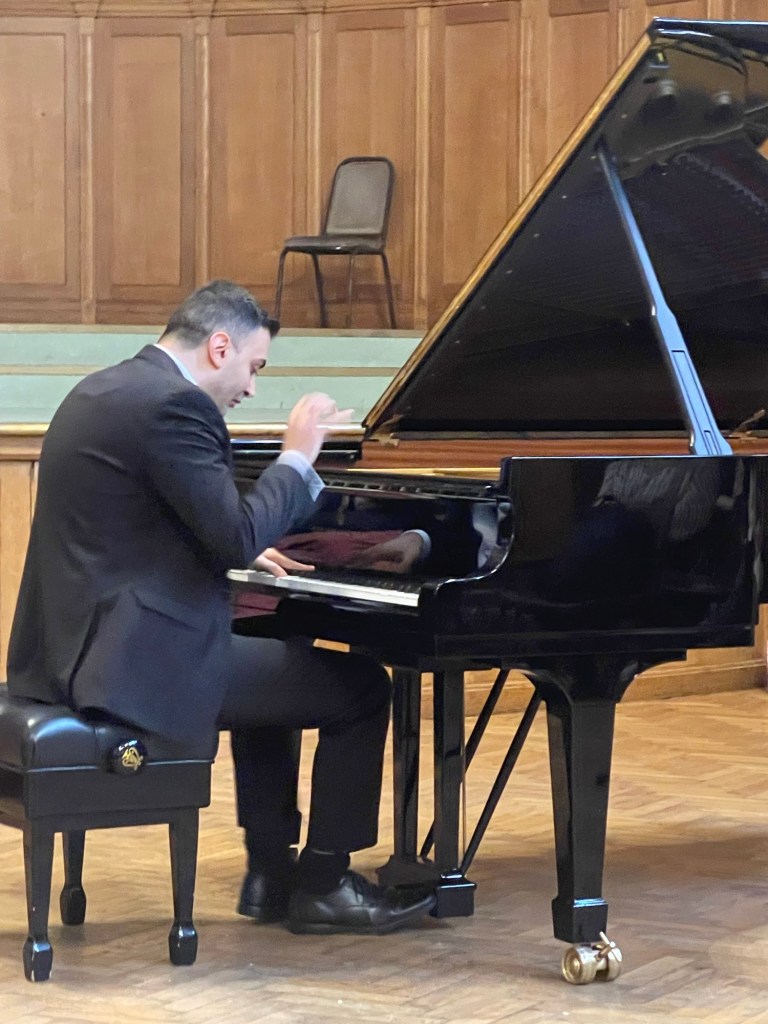
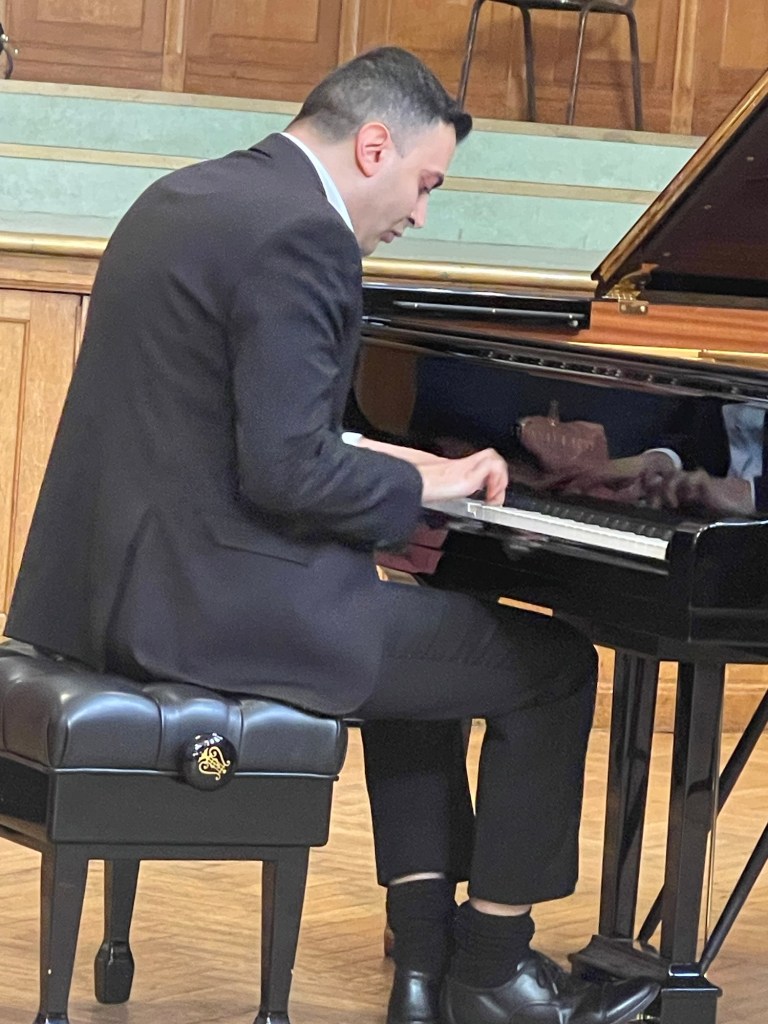
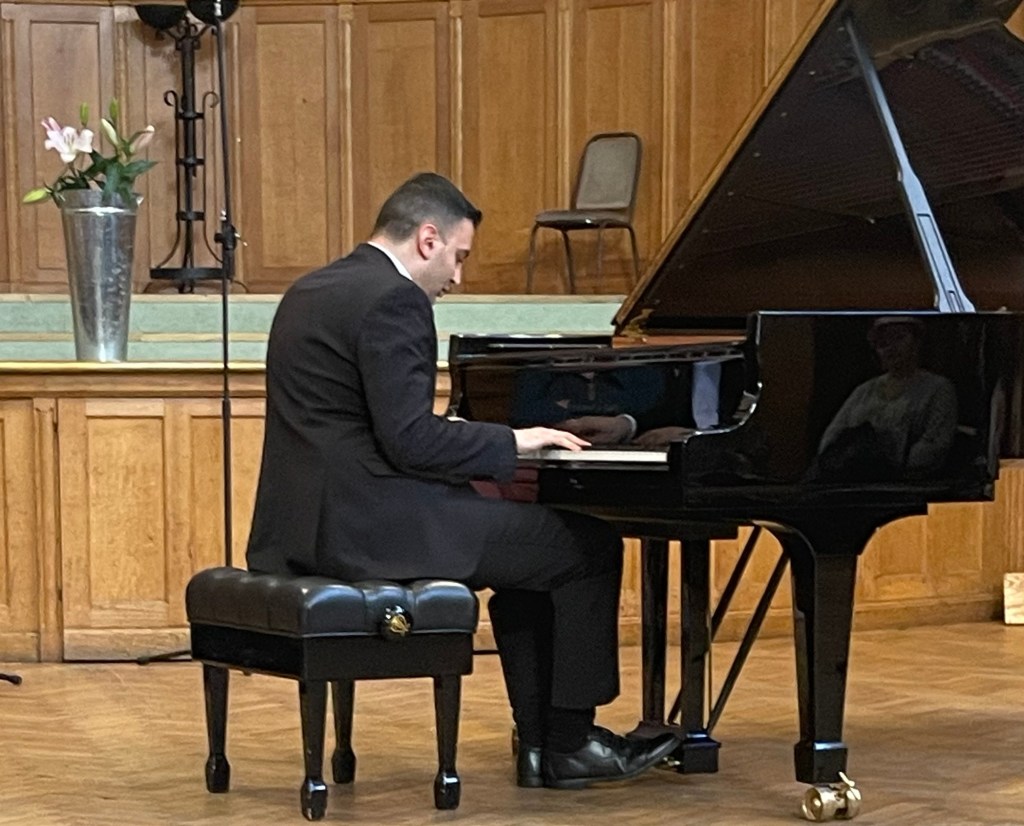
The second day for me in Trapani and what a surprise it has been.The day started with a student of the artistic director Vincenzo Marrone d’Alberti taking advantage of this magnificent CF 3 Yamaha whilst awaiting the arrival of the candidates and the jury.

Matteo Pierro just turned twenty gave a performance of Scriabin’s 9th Sonata that would have won him a top prize in the competition if a conflict had not stopped him from entering into the circus arena.

Matteo Pierro like a scene from Chekhov giving a superb Scriabin 9th before assisting everyone else in the competition

Vincenzo’s staunch advocacy of the Tobias Matthay school allows for a range of sounds that most pianists today do know exist! This young artist was humbly placed at the service of the distinguished jury and just managed to snatch a few minutes to indulge in the sumptuous sounds that lay within this instrument that have mostly remained undiscovered.

Jeongro Park – masterly playing from day 1 Foto Lorenzo Gigante


It was one of those mornings because the jury was seated now and Jeongro Park took his place at the piano and proceeded to give a series of performances of such mastery and conviction that time stood still as he kept us in his spell for over an hour.
His Davidsbundler reminded me of Murray Perahia playing it in the Leeds competition and reducing the jury to tears.As if that was not enough after the desolate final waltz he played his own transcription of the fourth movement of the Resurrection Symphony .The organisers had put this before the Davidsbundler but a great artist is known by his programmes and this young man knew exactly where it should be placed.With baited breath we were now treated to an astonishingly masterly display of fireworks in a performance of Liszt’s diabolical Totentanz that I have never heard played with such total mastery even from Arrau.
Follow that !

Federica Reale


It was the young Italian pianist Federica Reale who treated us to a musicianly performances of five Scarlatti’s Sonatas ,Clementi’s Sonata op 26 n.2 and the Eight pieces that make up Brahms op 76.This certainly calmed the air as we listened to the refined and intelligent performances that were played with beauty and colour as she shaped the music with such loving care and restrained passion.

Kiana Reid


The final pianist before the lunch break was the Japanese pianist Kiana Reid.Stylish playing of sonatas by Scarlatti K.450 and Haydn Hob VI .23 both played with great character and clarity.But it was the Schumann Fantasie op 17 that showed off her true musicianship and considerable artistry.An architectural shape to the great outpouring of love for the composer’s future wife Clara.Fussy meticulous indications by the composer can be distracting for lesser musicians but Kiana was able to steer her way through the beautiful trees to show us the power and sweep of the entire wood.If the second movement was a little overpowering at the beginning ,as it is marked only mezzo forte ,she managed even here to give a coherent shape to Schumann’s rather tiresome dotted rhythms as she built up the tension to the final coda .Many lesser pianist can fall at this last notorious hurdle but Kiana played with controlled passion where maturity and mastery can allow youthful exuberance to be always kept under control.The last movement was played with ravishing beauty and delicacy and the final pages were played with aristocratic authority following impeccably the composers wishes to allow the work to come to rest only on the final three consiliatry chords.

Kiana Reid


A remarkable performance especially coming after the Davidsbundler where these two more mature contestants could show us how maturity can tame youthful passion.And like her colleague she finished with the pianistic fireworks of the Tarantella from Liszt’s Venezia e Napoli. A breathtaking performance but one that should be linked to the previous ‘Canzone’ as Liszt very clearly indicated.His very precise pedal indications make his wishes quite clear but that almost no one observes thinking of Liszt as merely a juggler of notes rather than the most visionary composer and precise editor of his own and his colleagues scores .
As Nadia Boulanger was fond of quoting from Shakespeare 12th Night :’words without thought no more to heaven go’.

Zukhra Sharpova. Foto Lorenzo Gigante


After the lunch break Zukhra Sharpova gave very crisp and clear performances of Scarlatti and Beethoven Sonatas.One or two mishaps very professionally disguised obviously made her feel very uncomfortable but she went on to give a musicianly performance of another Schumann masterwork op 22.She was obviously not happy with her performances and this was a disappointing off day for a very fine pianist.

Changyu Yin Foto Lorenzo Gigante


The final contestant was Changyu Yin,a 23 year old pianist from China.He was down to play the ‘Hammerklavier’ but it had been changed to yet another master work of Schumann with the Etudes Symphoniques op 13.
Beginning with two Sonatas by Scarlatti and Haydn that were played with clarity and precision but just missing a natural sense of style.
The Schumann showed off impeccable preparation and musicianship but whereas Schumann himself had described Chopin ‘s Mazurkas as ‘canons covered in flowers’,these are studies that should also blossom and we should not be aware of the considerable technical hurdles that are being attempted.

Changyu Yin Foto Lorenzo Gigante

It was in the five posthumous studies (published by Brahms after Schumann’s untimely death) that Changyu allowed the music to bloom with great style and beauty.The finale can seem very repetitive and some pianists like Changyu today look maybe unnecessarily to the first edition to bring a little variety to what can seem monotony to less imaginative hands.
A fine well prepared performance but missing the natural artistry that had taken us so by surprise this morning.
And so another five pianists to hear tomorrow but not before two jury members give a concert together tonight.

https://christopheraxworthymusiccommentary.com/2024/04/11/daniel-rivera-and-misha-dacic-take-trapani-by-storm/

The jury members with maestro Vincenzo Marrone d’Alberti announcing their decision

The end of the semifinal as we wait for the result to see which out of the ten contestants will take part in the final tomorrow morning

Vincenzo Marrone d’Alberti making the announcement. Foto Lorenzo Noto


In the meantime tonight a much awaited recital by Oxana Yablonskaya

Kazumitsu Ujisawa

The day started with the Japanese pianist Kazumitsu Ujisawa with the Scarlatti Sonata K.101 played with sparkling brilliance and clarity.This was followed by Beethoven’s penultimate Sonata op 110 that we were to hear three times today.An intelligent musician and there were moments of great beauty but I did not really feel he penetrated the deep inner meaning of one of Beethoven’s most poignant compositions.There was an unexpected change of programme as instead of the Schumann Fantasie we suddenly heard a sublime performance of Chopin’s F sharp major Nocture op 15 n.2.A refined performance that will long be remembered for it’s delicacy and aristocratic poise.This was followed by the Andante spianato op 22 that we were also to hear three times today.A beautiful performances of refined delicacy ,brilliance and style.

Dott. Maria Efenesia Baffa


Maria Efenesia Baffa,a doctor from Florence ,started her recital with Beethoven’s last Sonata op 111. With tiny hands but such a passionate heart she played with the temperament and drive of someone who is in love with music.I remember when I was teaching at the Royal Academy in London ,next door to Harley Street,a doctor came asking for lessons.I was the youngest teacher then and was sent to a sumptuous studio with a grand piano that would have been the envy of many professional musicians.This charming overworked doctor admitted after an hour of talking but not actually performaing music that it was me or the psychiatrist and I was a bit cheaper !
It is this love for music that came across so vividly today and if there were blemishes in the longer works by Beethoven and Chopin due obviously to having to divide her time between her passion for medicine and music it was in the shorter Scarlatti Sonatas that her temperament and agile fingers brought the music vividly to life.

Ekaterina Chebotareva


Ekaterina Chebotareva I had already heard and admired in the first round,in particular playing a crystal clear ‘La Valse’.Today she showed much more authority and character and it was this that came across in theatrical performances of Scarlatti and Haydn Sonatas.There was scintillating brilliance to the second movement of the Haydn Sonata in G that she played with crystalline clarity.Brahms’s 8 pieces op 76 were played with fluidity and luminosity that she combined with mastery and musicianship.

Rongrong Guo


Rongrong Guo I had heard too in the first round when her performances were more of a good impression than perfect in detail.So it came as a surprise to hear such a fine performance of Scarlatti with well controlled and detailed playing with a natural musicality of someone who loves the music that is pouring from her agile fingers.Beethoven’s op 110 was given a very well prepared and controlled performance only getting slightly out of hand as she lost her head allowing her heart full reign for the passionate finale outpouring.However an impressive performance that I was not expecting from someone with a natural but sometimes untamed temperament.There were many beautiful things in her Carnaval even though this was more a good impression than a detailed interpretation.She feels the music so intensely and it is this love which she communicates with such immediacy to the public.

Mikhail Kambarov


Having lifted an eyebrow at Mikhail Kambarov’s Scarlatti in the first round I was bowled over by his superb performance of the two Scarlatti Sonatas that opened today’s programme.K8 was dynamic,rhythmic but above all refined and scintillating.The Sonata K 487 was played with such fantasy that he revealed the genius of this little Sonata which was a true tone poem in his refined poetic hands.There was beauty from the very first note of Beethoven’s op 110 where there was weight mixed with gossamer lightness.A sound world of whispered confessions of ravishing beauty and showed a sensitivity to sound that I remember startled us in the west on the first visits from Richter.One critic of his performance of Beethoven’s op 22 Sonata said that the slow movement had been in existent such were its secrets revealed in whispered undertones by a Master. There were so many beautiful things today too and a Scherzo that was shaped as a real musician with scrupulous attention to Beethoven’s detailed indications.The sublime Adagio was allowed to gradually grow in intensity until the final passionate explosion of triumph as Beethoven ,like Scriabin a century later ,had envisaged his star.

Chopin too was elegant and refined maybe trying a little too hard to ‘do things’ instead of letting the music speak simply and eloquently for itself but it was of such ravishing beauty with the scintillating beguiling jeux perlé of another age.
Ten exceptional performances over two days but the circus aspect of a competition is the decision now to choose only four to take part in the final tomorrow morning.
After an hour long deliberation the four chosen to go ahead are Jeongro Park,Kiana Reid,Ekaterina Chebotareva and Mikhail Kambarov.
Mikhail,this poet of the piano was awarded unanimously the Scarlatti Prize today too.

And today was the final round of the International Piano Competition in Trapani .Four pianists had been chosen for this final round and it was a morning of sumptuous music and scintillating piano playing.Such was the high standard that the distinguished jury could do no better than award two tied prizes.

Three of the finalists (missing Kiana Reid who after her ‘tour de force’ of Rachmaninov 2nd Sonata followed by La Valse needed to eat something!)

First Prize was awarded to Jeongro Park and Mikhail Kambarov and Second Prize to Ekaterina Chebotareva and Kiana Reid.A happier result could not have been bettered from the sumptuous music making that all four had offered us today.
It had all been streamed live at http://www.memassociation.org

Jeongro Park


Jeongro Park had opened today’s final round with a scintillating account of the Scarlatti Sonata K.20 that he played with an infectious rhythmic drive that did not exclude refined phrasing of delicacy and style.A kaleidoscope of sounds and colours was opened up in the magic box that is Kurtag’s Homage to Scarlatti .Jeongro showed us his mastery of sound from the whispered barely audible to the rich full sounds that this wonderful instrument can reveal .There was never any hardness but always with full sounds of seemingly infinite reverberations.A truly masterly performance of Schubert’s Drei Klavierstucke revealed an intelligent musicianship allied to a poetic fantasy always at the scrupulous service of the composer.There was a wonderful sense of balance that allowed the melodic line to sing without any forcing but also to be sustained by Schubert’s miraculous harmonic invention.
Rachmaninov’s Chopin variations have long been neglected because thought of as overlong and drawn out.This was not the case today in Jeongo’s masterly hands where his sense of colour and transcendental piano playing showed a work of great invention and variety .Chopin’s C minor prelude was subjected to Rachmaninov’s fantasy world of scintillating pianistic invention from the hands of a master who could show us so clearly the musical line in a work where there are so many notes that it takes a real musician to sort out the wood from the trees.
Jeongro’s own trascription of Dreams ,one of Rachmaninov’s six romances op 38 , was a masterly reworking of a rarely heard song.

Kiana Reid


The second to play in this final round was the Japanese pianist Kiana Reid whose beautifully florid C sharp major prelude lead so beautifully into the opening of Beethoven’s Sonata op 109. Playing where beauty and intelligence combined as Beethoven’s first of his final trilogy was given the space and freedom as meticulously noted in the score.There was dynamic drive to the Prestissimo second movement where the melodic line was finely drawn also here.The final theme and variations were played with great weight and authority as the quartet quality of the theme was gradually transformed into ever more vigorous variations until the return of the theme and Beethoven’s miraculous use of seemless trills on which his vision of Eutopia is revealed as the theme is allowed to float on this wonderful stream of sounds.This was playing of remarkable technical control but also of poetic understanding and intelligence.

Kiana Reid


It was the same intelligence combined with breathtaking virtuosity that made for overwhelming performances of Rachmaninov’s Second Sonata and Ravel’s own transcription of “La Valse’. There was a sense of colour and transcendental virtuosity that was a continual outpouring of sumptuous beauty and overwhelming power.
The range of colour that she found in La Valse was quite remarkable and her glissandi in both hands were just streams of gleaming sounds that shone in this rather sultry atmosphere with a build up in tension that was hypnotic and breathtaking in it’s mastery of control and daring.

Ekaterina Chebotareva


The third of our quartet of finalists was Ekaterina Chebotareva who saved her finest performances for today’s final round. Playing of intelligence and authority with a poetic understanding that could bring Schubert’s three movement Sonata in A minor D.537 vividly to life .It is a sonata that can seem rather disjointed in lesser hands but Ekaterina made the music speak eloquently and with such subtle colouring .The seemingly ungrateful rather heavy handed chords were given a new life and meaning that I have rarely heard from others. She had started with Soirée de Vienne n 6 by Schubert in Liszt’s teasingly tantalising transcription and she played it with subtle charm and a lightweight jeux perlé of great character and style.A Scarlatti Sonata K.82 was played with a scintillating lightness and clarity before Puccini’s ‘Crisantemus’.

Ekaterina Chebotareva

A work I have never heard in concert before and it was a real curiosity inserted in a programme by this discerning young artist.It was a sumptuous interlude before Agosti’s famous transcription of Stravinsky’s ‘Firebird’.Her transcendental technique and musicianship brought this famous transcription vividly to life.After the extraordinary gymnastics of the opening there were moments of purity and beauty before the magic entry of the Firebird and the tumultuous build up to the final breathtaking ending.Some remarkable playing for it’s intelligence and musicianship allied to a clarity and technical mastery.

Mikhail Kambarov taken from the live stream by his teacher Misha Lifits in Weimar. Foto Lorenzo Gigante

The fourth of the pianists today was another Russian pianist this time transferred to Weimar and was the youngest of the four competitors .Mikhail Kambarov’s performance today was for me the highlight of a very special morning of music making.
Everything he played was so convincing and full of temperament as he lived every moment of the works he played.I was brought up on the Bach of Rosalyn Tureck and would often stick the pages on the aide memoire that she would use in her old age when she was no longer the High Priestess that had reigned in the world’s great concert halls for generations.But Mikhail played a different type of Bach ,more streamlined and certainly faster but it had the same unrelenting pulse that Rosalyn would bring to all she did.Mikhail today brought a sense of colour to his Bach that showed a phenomenal technical control allied to an intelligence and a personality that were for me totally convincing.The range of sounds that he brought to the slow movement were quite remarkable where legato and staccato somehow in his hands could live together without any smudging from the pedal.
It was Anton Rubinstein who said that the pedal was the soul of the piano and Mikhail certainly realised that.He had a total mastery of them which just gave him the same range of sounds of the different manuals that Bach would have had.But Mikhail also had the modern piano with it’s range of sounds and possibilities that Bach could never have imagined!
The Messiaen brought tears to my eyes as the stillness and whispered sounds of heart rending significance struck deep and the pungent harmonies ,sometimes like broken glass,were of searing intensity.
Rameau’s ‘La Poule’ was played with the same amazing dexterity and clarity as Sokolov and it was a lesson in refined playing of great artistry.
The control of sound in Scriabin’s Prelude for the left hand was nothing short of miraculous.I have never heard it played with such golden luminosity and delicacy but there was also an unbridled passion as this little prelude was monumental in the way that Mikhail managed to tell a story in sound that was really quite remarkable for its control and poetic understanding.
There was a magical luminosity and purity to the ‘Follia’ that Rachmaninov chose for his variations.Even a very subtle addition of ornaments ,as he had done in the Bach Italian Concert too , brought a smile to my face at the cheek of daring to hint at such a thing!
But this was a true artist where one felt anything was possible on a true voyage of discovery.The sounds and colours that he found together with the sudden rhythmic impulse that he would add to some of the variations were astonishing in their daring and total conviction.Using his whole body to obtain a rhythmic energy where his devil may care daring was totally at the service of the music ,as he plunged into the octaves or the menacing chords that fill many of the final variations.Like Alfred Cortot the poetic content and musical meaning made any little technical slips on the way completely irrelevant in performances of such overwhelming authority and vision.The searing intensity of the coda and the final return of the theme was one of those magic moments that will remain in my memory for long to come.

Mikhail in discussion with la Yablonskaya after the final result


At 23 this is an artist to watch and the Jury quite rightly awarded him first prize together with the more mature mastery of Jeongro Park who is though more than ten years his elder.

The final concert and prize giving was for me an occasion to hear a remarkable pianist from Palestine who had been having lessons from Oxana Yablonskaya on line as travelling to her home in Jerusalem was not possible.Mohammed Alshaikh aged 21 was awarded the young Emerging Pianist Category Prize and I was astounded by his performance at the concert tonight of the Danse Macabre by Saint Saens in the diabolical transcription of Vladimir Horowitz .

https://www.ansa.it/sito/notizie/cultura/musica/2024/04/08/la-pianista-ebrea-yablonskaya-premia-il-palestinese-alshaikh_b2540cbe-8a06-4411-9889-15a23f16508d.html

My wish to hear a young man who I was told had taken the competition by storm,had come true .But then Trapani is that sort of place where dreams can become reality thanks to the vision and hard work of Vincenzo Marrone d’Alberti and his team intent on bringing,to the world’s attention, culture in their beloved city of Trapani

discussions with Nina Tichman. Foto Lorenzo Gigante

Prof Tichman discussing with first prize winner
Discussions between illustrious colleagues are an important part of competitions
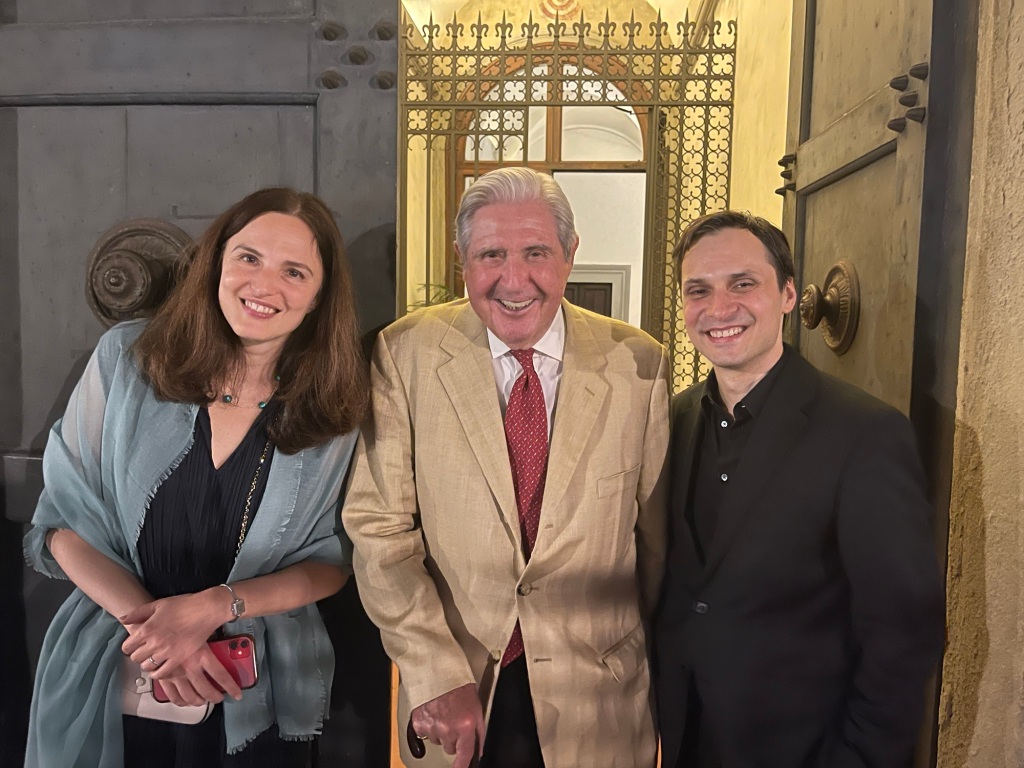
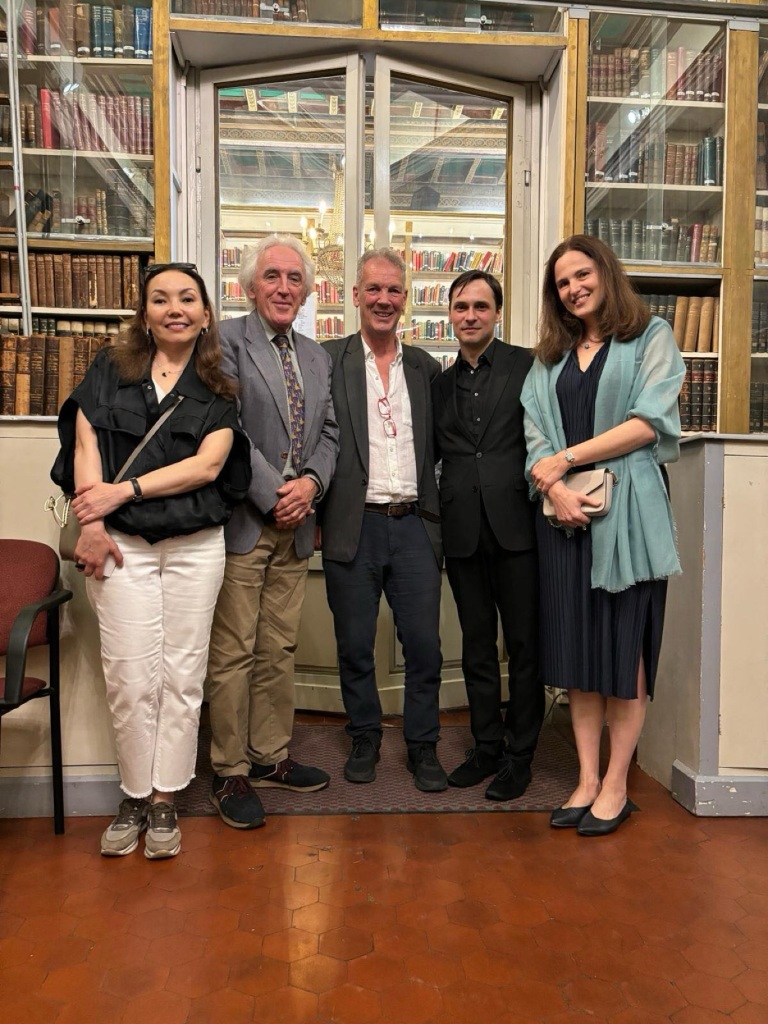
discussions with young professional pianists following the competition
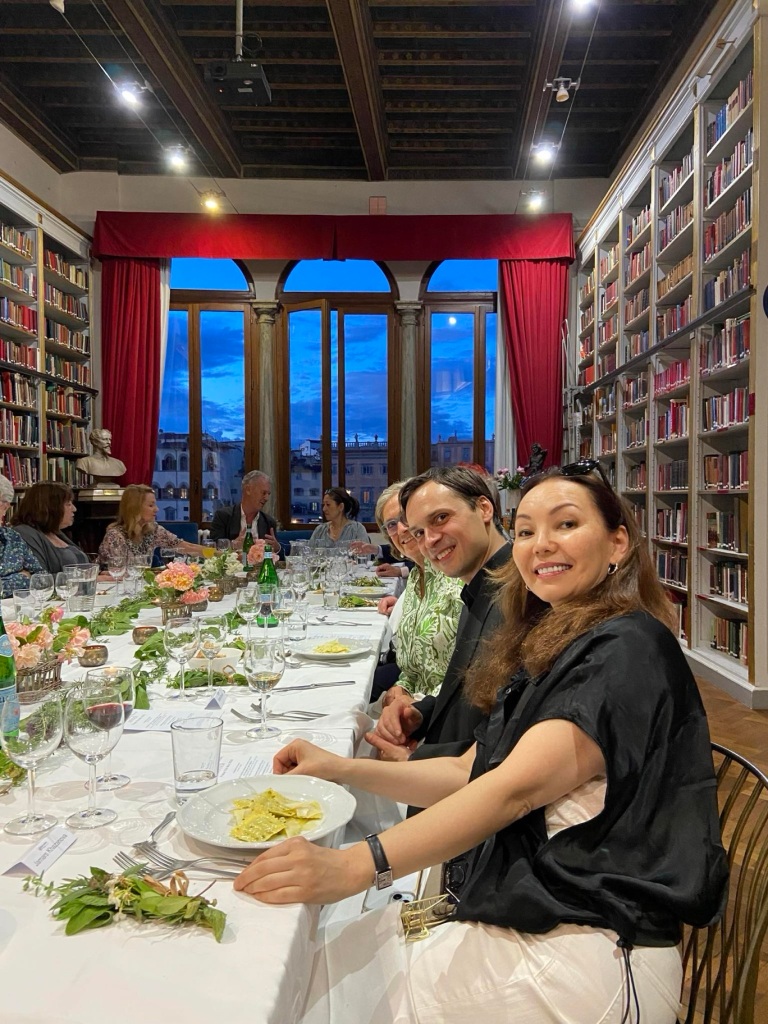
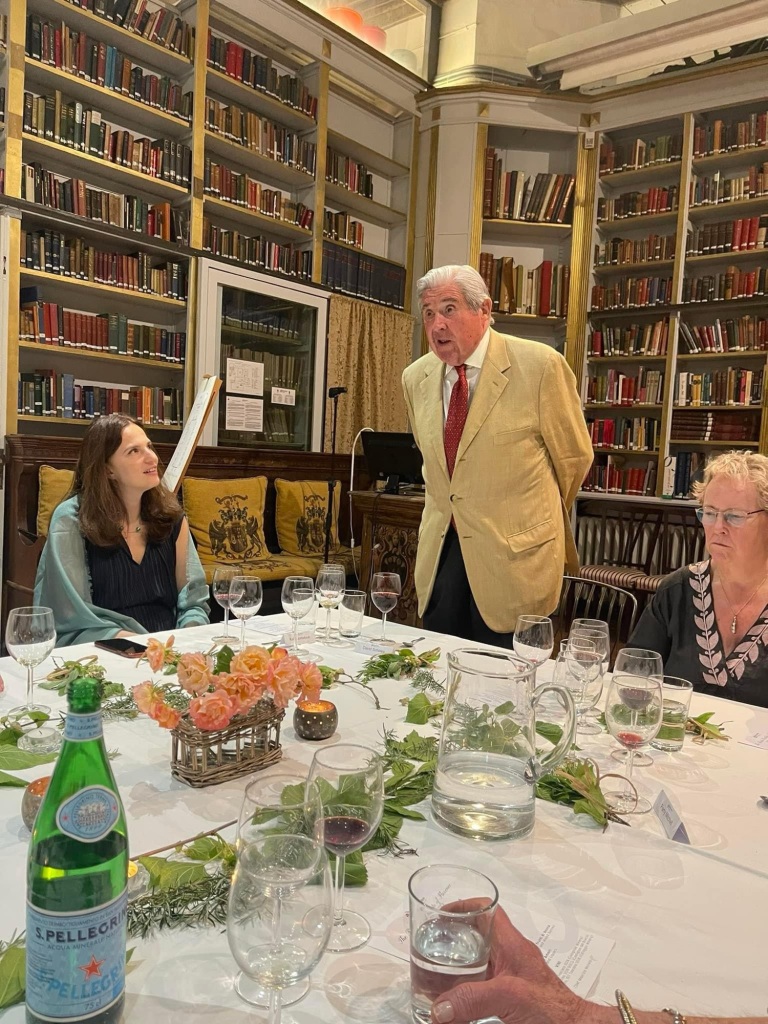
Moments to cherish even at the dinner table
Silence for President Vincenzo Marrone d’Alberti of Trapani Classica created in 2021
Silence for President Giovanni De Santis of MEMA – Mediterranean Music Association -the oldest concert society in Trapani founded in 1947
In the office this week
Foto hanoutmedia .com
Beautiful Trapani
https://christopheraxworthymusiccommentary.com/2024/03/20/christopher-axworthy-dip-ram-aram/. Foto Lorenzo Gigante

Daniel Rivera and Misha Dacic take Trapani by storm

It is only right that a Jury should be given the chance to perform themselves after having given so generously of their time to listen to their younger colleagues.


And so it was tonight the turn of two jury members Daniel Rivera and Misha Dacic to give a duo concert together of works by Rachmaninov at the end of the 150th anniversary celebrations of this much loved composer.


An impeccable sense of balance from Misha Dacic in the bass, who was also in control of the pedals, allowed Daniel Rivera to play with chiselled beauty.Ravishing penetrating sounds from a pianist who knows what real weight means squeezing golden sounds out of every note from pianissimo to forte.Misha too would suddenly illuminate sounds in the heart of the keyboard that would light up a phrase while Daniel would immediately accomodate the entry of this new instrument from their sumptuous Philadelphian orchestra.


Starting with the six little pieces op 11 for four hands on one piano.They really are not such little pieces as these two artists showed us,turning each one into miniature tone poems.


And a Philadelphian orchestra there certainly was when each pianist had his own instrument to play the Simon Callaghan transcription of Rachmaninov’s much loved Second Symphony.
A kaleidoscopic sense of colour as the demonstrative Daniel played with passion and technical mastery equalled but not outwardly visible by Misha Dacic.It was interesting to watch Misha as his eyes devoured the music but without any physical effort whatsoever.


Playing as one with a clarity and beauty that was never overpowering but as sumptuous and golden as Rachmaninov’s favourite orchestra .It is interesting to note that just before Rachmaninov’s death in 1943 he and Horowitz’s had become neighbours in Beverley Hills and often used to play at home for fun.


If only I phones had been invented then but I imagine the conviction and mastery of the performance we heard tonight may have been similar to what the neighbours in Beverley Hills might have experienced as the Second World War was in full devastating force in Europe.

Oxana Yablonskaya La Regina – The queen of the Keys

foto hanoutmedia.com

Oxana Yablonskaya at 85 the undisputed Queen of the Keyboard
A superb recital during her gruelling schedule as president of the Jury in Trapani.Having spent the entire day listening to five young pianists and as President supervising the votes of her much younger colleagues before having a cup of tea and appearing on stage with a solo recital and a programme that would have tired a pianist even half her age.


Here this regal lady appeared on stage and proceeded to create the magic that she has been sharing with her public for the past four decades.It was the same authority and presence that I remember from the first time I heard her in Rome forty years ago or as she suggested even more than that !

Oxana Yablonskaya President of the jury of the 2nd International Piano Competition Domenico Scarlatti

Lost for words for such a warm heartfelt welcome from one of the truly great artists of our time.
This regal artist here in Sicily dedicating her time and energy to helping and encouraging young musicians as she has always done in a long and distinguished career.
Oxana Yablonskaya,in Trapani as presidente of a jury that includes many distinguished colleagues all united for their friend Vincenzo Marrone d’Alberti in his wish to launch his home town of Trapani as a centre of cultural excellence on the world stage.
Oxana now in her 85th year has come from Jerusalem where she lives and teaches to listen to young musicians gathered from around the world whose only wish is to be able to dedicate their lives to sharing their art.
We hear everyday about war and greed but there is also another world that is not spoken about which is our only hope for a better future.
Young musicians dedicating their youth to their art and despite differences and worldly grievances searching for the same Eutopia that we are all in the end striving for .
I have never forgotten Oxana’s Prokofiev third sonata ,that she played for Bruno Nicolai’s Edipan in Rome forty years ago,in the theatre that my wife and I had built and run just next door to St.Peter’s Square.
And only twenty years ago playing again in Rome a magnificent Rachmaninov Third Concerto where her regal presence and command allowed her to take over from a conductor overcome by emotion.
She not only played magnificently but also conducted the performance from the keyboard!
It is we that should thank you dear Oxana for the honour of wanting still to share with aspiring young artists your vast experience and legendary musicianship with such humility and humanity.


I had heard her twenty years on take over the reigns of a performance of Rachmaninov Third Concerto that was at risk of falling apart in the hands of an ‘elderly’ Turkish conductor overcome with emotion from such a towering performance as Oxana’s.

She actually had programmed the earlier Sonata in F K.280


Today the moment she sat at the piano she became another person as the serenity and simplicity she unfolded in C.P.E Bach’s Rondo espressivo from his B minor Sonata H.245 seemed to give her the vigour and stamina to contemplate a programme that included two major Sonatas by Beethoven and Mozart.
The rondo was played with a delicacy and a ravishing sense of colour but above all a simplicity that allowed the music to speak for itself with disarming beauty.It is the same simplicity that Rubinstein was to share with his public when he too had reached Oxana’s age.It is a simplicity born of total mastery not only as a musician but also being able to play with such natural movements that it is like a great sage seated before us ready to recount the most wondrous stories.


Relaxation in tension because to play the piano is also a physical exercise and Oxana’s technical mastery allows her to place her hands on the keys like a swimmer floating in water.The physical effort is reduced to a minimum with no superfluous crowd pleasing gestures .She like Rubinstein is there at the service of the music with the disarming simplicity of Art that disguises Art.
The Mozart Sonata in F K 280 she told me afterwards she had learnt as a child .The little Polka by Tchaikowsky played as one of three encores she had first played when she was seven!


It was Schnabel who said that Mozart is too difficult for adults and too easy for children as it must be played with simplicity and style where every note has been placed by a Genius in its proper place.There is also a theatricality in Mozart that is apparent in his sonatas and it was this that Oxana made so apparent and which brought her performance vividly to life as the characters entered onto the scene with dynamic drive and individuality.The years just disappeared as she too became one of those characters enjoying acting a part with such vitality .A slow movement that was of etched beauty and the last movement played with buoyancy and a scintillating ‘joie de vivre’ where the years just seemed to disappear as she became once more the child prodigy discovering the genius of Mozart for the first time in this early F major Sonata .The Beethoven she had chosen to play is one of the first major sonatas of the 32 that were to span the composers entire life.Breaking away from the model of his illustrious mentor Haydn it is in the Sonatas op 2 n 3 , op 7 and this op 10 n 3 that the composer reveals his revolutionary spirit in opening new paths into the future.It is in all three of these early sonatas that the slow movements become of great poignancy and beauty and show the depth of feeling and orchestral thinking of Beethoven.

foto hanoutmedia.com


From the very first notes Oxana took us into a world of dynamic drive and suprising contrasts with the opening octaves shaped with her great artistry into a wind that blew in from a far to arrive at a light where the beautiful second subject could flourish with greater beauty but without ever sacrificing the drive that was to guide us from the first to the last note of this remarkable sonata .The dark sombre string quartet texture of the extraordinarily poignant Largo and mesto was followed by the wonderful way Oxana just allowed the minuet to float in like a ray of sunlight after such sombre brooding .The wonderful expression on this great artist’s face as Beethoven’s question and answer in the Rondo became ever more insistent .There was an ethereal ending with jeux perlé scales accompanying the still questioning left hand as it disappeared so peacefully into the depths of the keyboard .
A remarkable performance of mastery and musicianship that will long be remembered.

foto hanoutmedia.com


An all too short break brought her back on stage to play the two Rhapsodies by Brahms.I don’t know what happened in the Green Room but she attacked the first Rhapsody with a force and drive that were breathtaking and overwhelming .There were great orchestral sounds where this great black beast was aflame with passionate outpourings of great intensity.There were moments when the music dissolved to leave a heart melting mellifluous outpouring of nostalgia and beauty. Not allowing herself a break between the two Rhapsodies she burst into the second with a kaleidoscope of colour and sumptuous richness.A breath of fresh air blew over the keys as she brought simplicity and purity to the contrasting central episode.


Three Chopin Mazurkas were indeed ‘canons covered in flowers’ and became miniature tone poems in Oxana’s poetic hands.There was searing beauty full of nostalgia in the barely whispered A minor op 17 which was the bridge between two boisterous folk dances of Chopin’s native homeland.
It was though the Barcarolle that will be long remembered where Chopin’s greatest outpouring of song is united in one continuous work.Oxana played it with the same aristocratic ease as Rubinstein where the music was allowed to unfold with sumptuous beauty and ravishing colour.There was passion too but always with every strand of counterpoints allowed to sing as it built to the final beautiful bars where the tenor melodic line is accompanied by a florid accompaniment ,that was Ravel’s favourite passage, as it rose to the top of the keyboard only to cascade to the final four chords and the end of a dream.

foto hanoutmedia.com


Our Queen of the Keyboard was submerged with bouquets of flowers and a standing ovation from a public who knew no other way to thank her for coming to their city.Three encores were her way of repaying their kindness with a Scarlatti Sonata ,a Polka by Tchaikowsky and another Mazurka by Chopin.

foto hanoutmedia.com


She even had enough energy to make a little speech together with the artistic director Vincenzo Marrone d’Alberto with her only thought being to publicise the concert the next day of the young musicians that she had been listening to all week.


After such a long day one might have thought that Madam Yablonskaya would want to to get home to rest.This indomitable great artist had other ideas and was happy to enjoy the hospitality of her colleagues and friends way into the early hours!

Recognise the scarf ?!
With her colleague the distinguished pianist and jury member Nina Tichman
With Daniel Rivera

With fellow jury members Anna Chiara D’Ascoli and Daniel Rivera

Our twice daily office

foto hanoutmedia.com

Bravi – Scapicchi at St Mary’s A Piano Duo playing with one mind and one heart with ravishing colour,refined brilliance and savagery.

https://youtube.com/live/VnYjOq2xqlc?feature=shared

Some exciting playing from four hands and four feet but more importantly one mind and one heart …………..Ravishing colours of Debussy and refined brilliance of Ravel were but just an inspired preparation for the savagery of Stravinsky with his mixture of innocence and brutality depicted magnificently by a team that played as one.An ovation from a full house in Perivale was rewarded with an even more dynamic Danse Russe from this young Italian duo who had come especially to make their first appearance in the UK before embarking on an American tour.

A superb sense of balance with a luminosity of sound from Francesco and a majestic passionate climax from Adriano .It was ,though,the architectural shape allied to their kaleidoscopic sense of colour that made this a fascinating opening for an afternoon of refined playing from a duo that played as one
There was a great sense of atmosphere from the very first notes of the Prelude.Malaguena was an exotic dance with very suggestive recitativi answered by the pungent colours and sounds of Spain.An insinuating melodic outpouring in the Habanera (showing a remarkable resemblance to Debussy) was followed by a Feria of excitement and refined brilliance.
Innocence and menace went hand in hand in the remarkable work which caused a scandal at its first orchestral performance conducted by Pierre Monteux in Paris in 1913.
Today 111 years on it was greeted by an ovation rarely seen by the usually undemonstrative audience at St Mary’s Perivale!
The dynamic changes of character and driving rhythms from this piano duo created a hypnotic atmosphere from the beauty of the introduction similar in many ways to the Debussy Faune,but erupting into savagery with the pungent rhythms from Alessandro of the ‘Dances of the young girls’.It is interesting to note that it was Debussy who first played this original version for four hands with the composer.
A remarkable precision that allowed Francesco to show us the parade of ‘Young Girls’ in all their naive innocence floating above this undercurrent of menace.Erupting in a ‘Ritual of Abduction ’ and a display of transcendental piano playing from Francesco before the insinuating pulsating sostenuto e pesante of the ‘Spring Rounds’.All the time the rhythmic drive was remarkably constant despite all the enormous rhythmic intricacies involved. There was beauty too as ‘Le Sacrifice’ opened the second part of the ‘Rite’. Gradually leading to the eruption and the ‘Glorification of the Chosen One ’.A remarkable sense of control and colour in the ‘Ritual action of the Ancestors ’ in which Alessandro kept the pulsating driving rhythm as an undercurrent to the insinuating melody from Francesco.
Knotty twine indeed but nothing could prepare us for the remarkable playing of the ‘ Sacrificial Dance’ where the precision and continual changes of colour were like shots being fired with their piercing lightening strikes.
A tour de force of piano playing but above all of united musicianship that could reveal this extraordinary work in all its naked brilliance.

Italian pianists Francesco Bravi and Adriano Leonardo Scapicchi regularly perform in duo since 2018. In 2019 they performed Stravinsky’s original version for piano four-hands of The Rite of the Spring at Teatro Palladium, for Roma Tre Orchestra Young Artist Piano Solo Series. The success following their performance, described by Christopher Axworthy as “a formidable knotty twine of great precision and rhythmic pulse”, brought them to be invited to many international music festivals, such as Villa Pennisi in Musica, I Tramonti di Tinia, Villa Borghese Piano Day. In 2023 they were awarded the Outstanding Musicians Prize at the International Classical Music Competition Ibla Grand Prize, where they also received a special mention for their interpretation of Debussy’s Prélude à l’après-midi d’un faune. As winners of the competition, in 2024 they will take part in a tour in the USA, performing in many important venues including the Weill Recital Hall of the Carnegie Hall. In 2022 they were invited to play Stravinsky’s Petrouchka at the Accademia Filarmonica Romana for the presentation of a new edition of Roman Vlad’s biography of Stravinsky. The following year they have been invited again for the presentation of the new book written by Francesco Maria Colombo. They performed at several venues, including Università Roma Tre, Reale Circolo Canottieri Tevere Remo, and Pontificio Istituto di Musica Sacra. In 2024 they have been invited to perform in the chamber music concert series Suoni Oltre Confine and at the Pauline Chapel of the Quirinal Palace for the series The Concerts at the Quirinale, live streamed by Radio 3. They took part in masterclasses led by renowned pianists who regularly perform in piano duos, such as Massimo Spada and Alessio Bax. They attend the Chamber Music Course at the International School of Music Avos Project in Rome. 

https://christopheraxworthymusiccommentary.com/2020/12/23/roma-3-orchestra-young-artists-series-streamed-live-from-teatro-palladium-rome/

Stravinsky’s sketchbooks show that after returning to his home at Ustilug in Ukraine in September 1911, he worked on two movements, the “Augurs of Spring” and the “Spring Rounds”.In October he left Ustilug for Clarens in Switzerland, where in a tiny and sparsely-furnished room—an 8-by-8-foot (2.4 by 2.4 m) closet, with only a muted upright piano, a table and two chairs – he worked throughout the 1911–12 winter on the score.By March 1912, according to the sketchbook chronology, Stravinsky had completed Part I and had drafted much of Part II.He also prepared a two-hand piano version, subsequently lost,which he may have used to demonstrate the work to Diaghilev and the Ballets Russes conductor Pierre Monteux  in April 1912.He also made a four-hand piano arrangement which became the first published version of Le Sacre; he and the composer Claude Debussy played the first half of this together, in June 1912.The conductor Pierre Monteux had worked with Diaghilev since 1911 and had been in charge of the orchestra at the premiere of Petrushka.

Stravinsky by Picasso 1920

The Rite of Spring – Le Sacre du printemps is a ballet and orchestral concert work written for the 1913 Paris season of Sergei Diaghilev’s Ballets Russes ; the original choreography was by Vaslav Nijinsky and the first performance at the Theatre des Champs- Elysées on 29 May 1913, caused a sensation and many have called the first-night reaction a “riot” or “near-riot”.Monteux’s first reaction to The Rite, after hearing Stravinsky play a piano version, was to leave the room and find a quiet corner. He drew Diaghilev aside and said he would never conduct music like that; Diaghilev managed to change his mind.Although he would perform his duties with conscientious professionalism, he never came to enjoy the work; nearly fifty years after the premiere he told enquirers that he detested it.In old age he said to Sir Thomas Beecham’s biographer Charles Reid: “I did not like Le Sacre then and I have conducted it fifty times since. I do not like it now”.On 30 March Monteux informed Stravinsky of modifications he thought were necessary to the score, all of which the composer implemented.The orchestra, drawn mainly from the Concerts Colonne  in Paris, comprised 99 players, much larger than normally employed at the theatre, and had difficulty fitting into the orchestra pit.

Stravinsky was a young, virtually unknown composer when Diaghilev recruited him to create works for the Ballets Russes. Le Sacre du printemps was the third such major project, after the acclaimed Firebird (1910) and Petrushka ( 1911 ).The concept behind The Rite of Spring, developed by Roerich from Stravinsky’s outline idea, is suggested by its subtitle, “Pictures of Pagan Russia in Two Parts”; the scenario depicts various primitive rituals celebrating the advent of spring, after which a young girl is chosen as a sacrificial victim and dances herself to death.  In his autobiography, Stravinsky writes that the derisive laughter that greeted the first bars of the Introduction disgusted him, and that he left the auditorium to watch the rest of the performance from the stage wings. The demonstrations, he says, grew into “a terrific uproar” which, along with the on-stage noises, drowned out the voice of Nijinsky who was shouting the step numbers to the dancers.Monteux believed that the trouble began when the two factions began attacking each other, but their mutual anger was soon diverted towards the orchestra: “Everything available was tossed in our direction, but we continued to play on”. Around forty of the worst offenders were ejected—possibly with the intervention of the police, although this is uncorroborated. Through all the disturbances the performance continued without interruption. 

Claude Debussy in 1905

Prélude à l’après-midi d’un faune (L. 86), is a symphonic poem ,composed in 1894 and first performed in Paris on 22 December 1894. It was inspired by the poem by Stephane Mallarmé and is one of Debussy’s most famous works and is considered a turning point in the history of Western art music . Pierre Boulez  considered the score to be the beginning of modern music, observing that “the flute of the faun brought new breath to the art of music.”
Debussy’s work later provided the basis for the ballet choreographed by Vaslav Nijinsky.

Debussy wrote :’The music of this prelude is a very free illustration of Mallarmé’s beautiful poem. By no means does it claim to be a synthesis of it. Rather there is a succession of scenes through which pass the desires and dreams of the faun in the heat of the afternoon. Then, tired of pursuing the timorous flight of nymphs and naiads , he succumbs to intoxicating sleep, in which he can finally realize his dreams of possession in universal Nature.

Mallarmé himself was unhappy with his poem being used as the basis for music: He believed that his own music was sufficient, and that even with the best intentions in the world, it was a veritable crime as far as poetry was concerned to juxtapose poetry and music, even if it were the finest music there is.However, after attending the premiere performance at Debussy’s invitation, Mallarmé wrote to Debussy: “I have just come out of the concert, deeply moved. The marvel! Your illustration of the Afternoon of a Faun, which presents no dissonance with my text, but goes much further, really, into nostalgia and into light, with finesse, with sensuality, with richness. I shake your hand admiringly, Debussy. Yours, Mallarmé.”

Maurice Ravel in 1913

Rapsodie espagnole was composed between 1907 and 1908, the Rapsodie is one of Ravel’s first major works for orchestra. It was first performed in Paris in 1908 and quickly entered the international repertoire. The piece draws on the composer’s Spanish heritage and is one of several of his works set in or reflecting Spain.

The genesis of the Rapsodie was a Habanera, for two pianos, which Ravel wrote in 1895. It was not published as a separate piece, and in 1907 he composed three companion pieces. A two-piano version was completed by October of that year, and the suite was fully orchestrated the following February.At about this time there was a distinctly Spanish tone to Ravel’s output, perhaps reflecting his own Spanish ancestry.His opera L’heure espagnole  was completed in 1907,as was the song “Vocalise-Etude en forme de habanera”.

In the interval between the composition of the original Habanera and the completion of the four-movement Rapsodie, Debussy had published a piano suite, Estampes (1903), of which the middle section, “Soirée dans Grenade”, had a Spanish theme.To counter any accusations of plagiarism, Ravel made certain that the date 1895 was clearly printed for his Habanera in the published score of the Rapsodie.

Phillip James Leslie at St Mary’s Perivale ‘On wings of song’ with artistry and integrity

https://youtu.be/ILlIhE_8fsk

I think five years have passed since I first heard Phillip play in Perivale.He won a top prize in the Liszt Society Competition and later was invited to stand in at the last minute for an indisposed pianist.The difference now in five years is quite astonishing as a fine student pianist has turned into a real artist .Could it be the air in Scotland which is where he has been perfecting his studies after finishing at Trinity Laban in London? A pianist now who listens so carefully to all he does and plays with great sensitivity and sense of colour.Never a hard sound but his very pianistic fingers are like limpets clinging to each key and extracting the sounds they contain without any unnecessary hitting the keys or extrovert showmanship.

A beautiful programme that gave Phillip the possibility to explore the beautiful sounds that are hidden in this box of hammers and strings for those with ears to search and extract them.Of course one needs a sense of balance and musicianship allied to a technical preparation not only of the fingers but above all the use of the pedals.It was Anton Rubinstein who said the pedals are the soul of the piano and a careful use of the pedals allied to a sense of balance can give the impression that this percussion instrument can sing as well as any singer!Phillip showed us all that today.

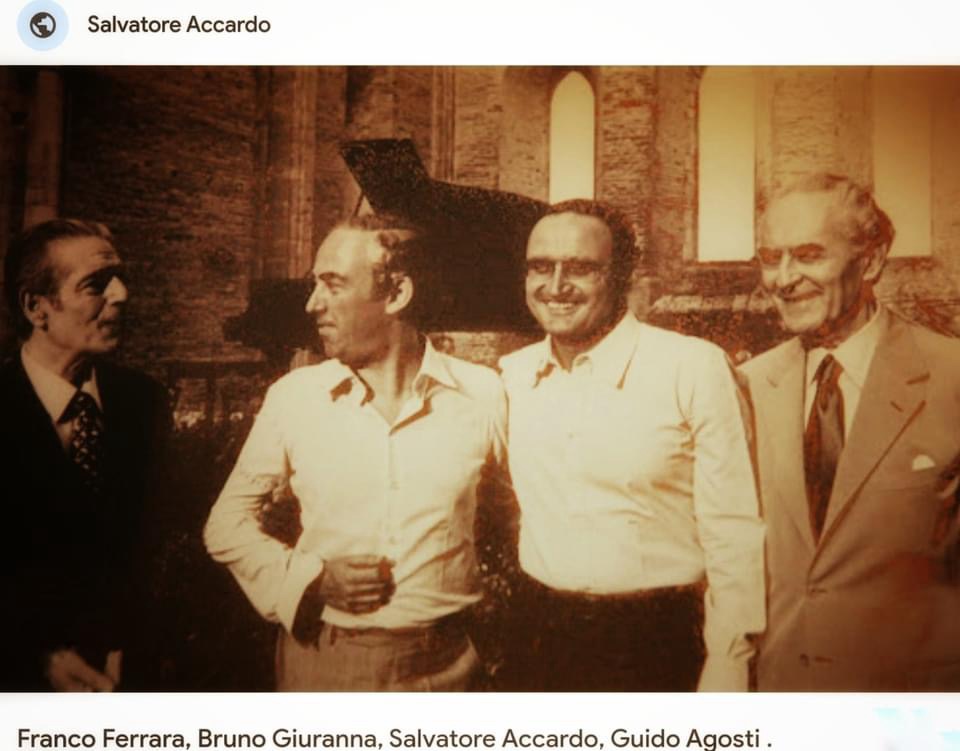
I remember the great pedagogue Guido Agosti in his studio in Siena where every pianist worth his sort would flock for inspiration from a student of Busoni. A young Canadian pianist had just played the Goldberg Variations and thought he would bring some pieces of Mompou to the great master. Agosti took the music from the stand and put it in the waste paper bin saying ‘Now play me some music!’ Times have changes since the sixties and seventies and Mompou has now been revalued and many great pianists have made recordings of his works .It is music of miniatures of great delicacy with a kaleidoscope of colours and as Phillip showed us today it is music of great beauty and atmosphere.There is a wistful fluidity to the music with a gentle murmur of evocative sounds with splashes of colours spread over the entire keyboard.There were beautiful pungent sounds too in the Carros de Galicia with a beautifully etched melodic line.

Tchaikowsky’s Dumka is a miniature tone poem that Phillip played with great artistry with the beautiful opening melody gradually building in intensity with cascades of notes gently accompanying the melodic line.A beautifully quixotic central episode was just a gentle interlude before the final dramatic ending.

The Schumann is unjustly neglected because it is a work of great beauty of Schubertian contrasts.There was a great sweep to the opening ,’molto vivace ed appassionatamente’, and Phillip played it with a freedom and sense of style allowing the melodic line to float with refined rubato on the continuous wave of swirling sounds.The ‘Piuttosto Lento’ of the second movement was played with disarming simplicity and beauty and if the phrasing of the ‘etwas bewegter’ central episode was not as clear this may well have been Schumann’s elusive character just interrupting what was so obviously inspired by Schubert. The last movement ‘con forza ed assai marcato’ was played with rhythmic clarity and spirit and again here the elusive central episode was not always so clearly defined as it reappears in the coda like Eusebius interrupting the high jinx of Florestan.

It was Shura Cherkassky who I first heard play Schumann’s op 111 as a prelude to the Liszt B minor Sonata .Today Phillip played them as a prelude to the Franck Prelude Chorale and Fugue which was the work that Richter chose as a prelude to the Liszt sonata!

The César Franck was given a performance of an architectural form managing to shape the three movements into one unified whole.The Chorale in particular was played with simplicity and a beautiful sense of line with the expansive arpeggiando chords unfolding with ravishing beauty.If in the outer movements there were moments when rests were pedalled over and details smudged it was because he felt it so intensely as he allowed the music to move unrelentingly forward leading to the climax out of which the opening melody appears on a magic wave of sounds as it reaches the triumphant conclusion.A fine performance from a true musician.

British pianist, Phillip Leslie is known for his captivating playing and diverse programming. Praised for his sense of “culture and refinement” by the Liszt Society he has received considerable acclaim for his performances across the UK and Europe. He has been described by ESM as a “tour-de-force” and has performed extensively across the UK and Europe. His concert engagements include performances at Salle Cortot, Steinway Hall, St John’s Smith Square, Liverpool Philharmonic Hall, Castellon Auditorio & the Wigmore Hall and made his ‘Emerging Artist’ debut recital at the Usher Hall this season. A prize winner of the Anton Rubinstein International Piano Competition in 2023, he recently won First Prize and ‘Best Interpretation of a Swedish work’ at the Gothenbur International Piano Competition in Sweden. He is a laureate of the Liszt International Piano Competition (UK), EPTA Piano Competition, Vienna International Piano Competition, Jock Holden Mozart Prize and a finalist in the Beethoven Society of Europe Competition in 2021. Named a Park Lane Group Artist in 2018, he made his Southbank Centre debut in 2019. Phillip has been broadcast on BBC Radio and performed for the BBC Philharmonic Chamber Recitals at the Bridgewater Hall. He has collaborated with orchestras including the Scottish Sinfonia and the Liverpool Philharmonic Orchestras. Educated at Trinity Laban, Royal Conservatoire of Scotland, RNCM & L’Ecole Normale de Musique de Paris, he received the Weingarten Prize and Silver Medal Keyboard Award for his studies in London. His teachers have included Philip Fowke, Alexander Ardakov, Margaret Fingerhut, Kathryn Stott & Aaron Shorr.

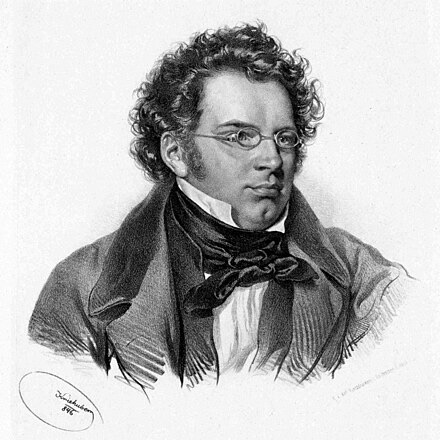
Robert Schumann  8 June 1810 – 29 July 1856

Three Fantasiestücke for piano, Op. 111, composed in 1851, is one of four works by Schumann entitled Fantasiestücke. The other three are:

  • Fantasiestucke op 12 (1837), eight pieces for solo piano, also based on Hoffmann’s Fantasiestücke in Callots Manier
  • Fantasiestucke op 73 ( 1849), three pieces for clarinet and piano (violin or cello)
  • Phantasiestücke, Op. 88 (1842), for piano, violin and cello in four movements

The title was inspired by the collection of letters and writings about music published in 1814–1815, Fantasiestücke in Callots Manier by E.T.A. Hoffmann one of Schumann’s favourite authors. The composer greatly appreciated the 17th-century engraver’s sense of fantasy.Clara Schumann wrote in her diary in September 1851 : “Robert has composed three piano pieces of a grave and passionate character which I like very much.”
Frederic Mompou Dencausse or Federico Mompou 16 April 1893 – 30 June 1987 , was a Spanish composer and pianist.

Mompou is best known as a miniaturist, writing short, relatively improvisatory music, often described as “delicate” or “intimate”.His principal influences were French impressionism, Erik Satie and Gabriel Fauré, resulting in a style in which musical development is minimised and expression is concentrated into very small forms. He was fond of ostinato figures, bell imitations (his mother’s family owned the Dencausse bell foundry and his grandfather was a bell maker),and a kind of incantatory, meditative sound, the most complete expression of which can be found in his masterpiece Musica Callada (or the Voice of Silence) based on the mystical poetry of Saint John of the cross .He was also influenced by the sounds and smells of the maritime quarter of Barcelona, the cry of seagulls, the sound of children playing and popular Catalan culture. He often dispensed with bar lines and key signatures. His music is rooted in the chord G♭–C–E♭–A♭–D, which he named Barri de platja (the Beach Quarter).

Grigory Sokolov A Genius in contemplative mood in Rome

A full hall for the annual recital by Sokolov at the Academy of Santa Cecilia.Today with Maurizio Pollini being honoured by La Scala with his 169th appearance on that hallowed stage. The President and Artistic Director of the Accademia Nazionale di Santa Cecilia,Michele dall’Ongaro, offered his heartfelt condolences from the stage where our beloved living legend had performed for a lifetime but will now no longer appear in his much anticipated annual performances.


But what a wonderful tribute to a master to hear Bach played with the same crystalline simplicity from Sokolov today with Bach’s Four Duets and his Second Partita.
The music just seemed to flow so naturally from Sokolov’s hands with a beauty and clarity of art that conceals art as he seems to do nothing but manages to recount a universe.
There is such subtle control of sound that Sokolov can pin point certain details in Bach’s knotty twine without ever disturbing the pulse or even the dynamic range.Even the majestic opening of the Second Partita was imperious without ever stepping out of the dimension of sound that he had established with the opening four duets .The first duet sounded in this way so modern with its daring clashing counterpoints .There was featherlight passage work in the second with delicacy,beauty and clarity .The gentle meandering of the third was followed by the whispered entry in the bass of the fourth.

Even the second partita was played in a contemplative mood where the Allemande was allowed to flow so beautifully with the Courante slightly more robust as though he had only moved to a different register .He returned though to the gently chiselled sounds of the Sarabande before the rhythmic vitality of the Rondeau and the decisive almost imperious Capriccio.The Grave adagio of the opening was played with absolute clarity with dynamic energy driven by the rests in between such noble statements.The Andante emerged from this imperious opening statement and was barely whispered as it flowed like a great singer sotto voce with the gentle rise and fall of the phrases that were allowed to breathe and flow so naturally.Bursting unexpectedly into life after the long beautiful ornaments of Bach’s aristocratic Bel Canto.A remarkable conversation was started between the parts as the chattering phrases were imperceptibly highlighted with technical masterly control always guided by the mind of a master musician.


Seven Chopin Mazurkas where whispered confessions of ravishing beauty showed us that these were ‘canons covered in flowers ‘ as they were the true Poland that had remained in Chopin’s heart during a lifetime of exile from his homeland.

The four op 30 began with Allegretto but as Chopin asks ‘non tanto’ as there are the yearning phrases in Sokolov’s hands played with disarming simplicity before almost taking flight but ‘con anima’ always as it unwinds it’s way so subtly to the yearning of the opening.A slightly more robust dance with it’s question and answer was greeted by the tolling of the bell of A flat that heralds this more rumbustous third Mazurka.Leading by way of a magical cascade of etherial notes to a mysteriously driven sotto voce that seems to burn itself out with the gentle beat of the drum in the left hand played with such delicate staccato that it was no more than a mere suggestion before taking flight again.The last of this set and the longest is a real tone poem where a story is being told.There was magic in the air as Sokolov just barely reached for the golden high notes.Leading to a majestic climax only to dissolve to what was for me the most magical sound of the whole evening: the final E that shone like gold in the magical descent to complete the home key of C sharp minor.

The three mazurkas op 50 sprang to life with the ‘vivace’ of this rousing first dance.There was aristocratic beauty in the second of the set with its almost military style central episode.The last of this set is one of the longest and the most poignantly beautiful.I remember Perlemuter playing it with great depth of sound or weight where his fingers like Sokolov’s today seemed almost glued to the keys like limpets as they extracted the very essence of sound from each note.This is indeed a jewel amongst gems and Sokolov played it with disarming beauty with the quixotic changes of character passing almost unnoticed as the great architectural line was maintained with mastery and great artistry.And mastery there was too even with the way he just placed to perfection the final C sharp .The slam of the door but not Beethovenian but with the aristocratic respect of Chopin!
Schumann too was present with one of his most contemplative works where a poet is saying goodbye to the world. A whispered haunting opening was greeted by ‘Lonely Flowers’ entwined in a duet of delicacy and poignant beauty with a transcendental control of sound .A wistful ‘Prophet Bird’ with its almost too serious central chorale hymn to life before taking flight again with etherial lightness and whimsical improvisation.Drawing to a close but not before a gentle reminder of the ‘Hunter in the Woods’ played with almost Mussorgskian terror mixed with joy.Secrets shared of a ‘Haunted place’ where Schumann’s dotted rhythms in Sokolov’s hands became a lazy question and answer of great effect. A ‘Friendly Place’ that just flowed like water from Sokolov’s hands with a fluidity and buoyancy that was like a breath of fresh air blowing over the keys.A rumbustuous rhythmically driven ‘Hunting Song’ was played with joy and playfulness .There was great nostalgia in the beautiful outpouring of song that describes so well the relief to find the ‘Wayside Inn’ before saying a heartfelt Farewell.’Abschied’ is one of Schumann’s most poignant utterings that was played with golden sounds and a ravishing sense of balance as befits this moving ‘song without words’. All played with perfection by Sokolov with the same superhuman control of sound that we have only ever experienced from Richter.
Even the five encores that were demanded by an insistent public were played with subdued contemplative whispered beauty.The Mazurka in F minor op 63 n.2 opened Sokolov’s traditional succession of encores.A mere whisper that Chopin like Schumann was yearning for a past with searing nostalgic intensity.Sokolov’s Rameau has passed into legend for the incredibly crisp and clear ornaments and the hypnotic rhythmic drive combined with delicacy and sense of style that on a modern day piano is something quite miraculous.His’ Raindrop’ Prelude is exquisite and at times overpowering as so many emotions can be experienced in just a few pages of music – a true miniature tone poem.I think,though, the only sound we heard this evening over forte was in the last encore : the C minor Prelude op 28 n. 20.

https://youtu.be/ly4tsSZpzkE?feature=shared

https://youtu.be/gBaq0d1I96I?feature=shared

https://youtu.be/XEcedNpqlxE?feature=shared

https://youtu.be/dZz_OcJNFuc?feature=shared

https://youtu.be/1chVdUgTJS8?feature=shared


Sokolov is a master musician and pianist and in the past few years I have been astonished how a whole concert with Haydn ,Byrd ,Purcell or lesser know masterpieces by Schumann could hold us in his spell as much as his ‘Hammerklavier’ could ever do.


Today though his contemplative mood did not touch me as it always does.Could it be the programme ? Is the master feeling the strain of choosing to play the same programme for an entire season? Was it just me after being blown away the other day by the young Kantorow or bewitched by the supreme style of Lugansky .
I felt tonight for the first time that a ritual was being repeated rather than recreated .Maybe we were all just in a melancholy mood thinking of the loss just three days ago of a much loved legend ?

Sokolov casts his spell over the Eternal City https://christopheraxworthymusiccommentary.com/2023/04/04/sokolov-casts-his-spell-over-the-eternal-city/

Sokolov in Todi……..”…..the greatest pianist alive or dead?”https://christopheraxworthymusiccommentary.com/2020/02/17/sokolov-in-todi-the-greatest-pianist-alive-or-dead/

The Sublime Perfection of Sokolov https://christopheraxworthymusiccommentary.com/2018/03/15/the-sublime-perfection-of-sokolov/

Waldszenen (Forest Scenes), Op.82, is a set of nine short solo piano pieces composed by Robert Schumann  in 1848–1849, first published in 1850–1851 in Leipzig

  1. Eintritt (Entrata) – Nicht zu schnell (si bemolle maggiore)
  2. Jager auf der Lauer (Cacciatore in agguato) – Hochst lebhaft (re minore)
  3. Einsame Blumen (Fiori solitari) – Einfach (si bemolle maggiore)
  4. Verrufene Stelle (Luogo maledetto) – Ziemlich langsam (re minore)
  5. Freudliche Landschaft (Paesaggio gioioso) – Schnell (si bemolle maggiore)
  6. Herberge (Osteria) – Massig (mi bemolle maggiore)
  7. Vogel als Prophet (Uccello profeta) – Langsam, sehr zart (sol minore)
  8. Jagdlied (Canzone di caccia) – Rasch, kraftig (mi bemolle maggiore)
  9. Abschied (Addio) – Nicht schnell (si bemolle maggiore)

It is tragic to note that a late work of Schumann, such as Waldszenen (Forest Scenes), is the effort of a man not yet 40. After a life of severe mental instability, Schumann committed himself to an asylum in Endenich in 1854 and would be dead within two years at the age of 46. Still, in the short time allotted to his professional career, he was able to distinguish himself both as a composer and musical journalist.Battling against cycles of debilitating depression, Schumann completed his Waldszenen in 1848 and early 1849. Clara Schumann found some of the individual scenes upsetting and chose not to play them.Schumann wrote: “The titles for pieces of music, since they again have come into favour in our day, have been censured here and there, and it has been said that ‘good music needs no sign-post.’ Certainly not, but neither does a title rob it of its value; and the composer, by adding one, at least prevents a complete misunderstanding of the character of his music. What is important is that such a verbal heading should be significant and apt. It may be considered the test of the general level of the composer’s education.”With Waldszenen, it had been the composer’s intention to head five of the cycle’s nine episodes with fragments of poetry in addition to their descriptive and sometimes enigmatic titles. In the event, he removed all but one of these fragments before publication, recognizing that one can be too specific and limiting in an intentionally evocative musical excursion. Schumann’s regard for Waldszenen is documented in a letter to his publisher in which he refers to the piece as one which “I have greatly cherished for a long time.”

The Partita for keyboard No. 2 in C minor, BWV 826, is a SUITE of six movements written for the harpsichord.It was announced in 1727,issued individually, and then published as Bach’s Clavier-Ubung in 1731.

The six movements are

  1. Sinfonia
  2. Allemande
  3. Courante
  4. Sarabande
  5. Rondeau
  6. Capriccio
The Parco della Musica in Rome

Nikolai Lugansky in Rome pays homage to a legend- Maurizio Pollini.

Nikolai Lugansky in a concert dedicated to Maurizio Pollini who made his debut for the University in 1958 and today almost sixty years on we salute a legend.
And what better salute could there be than a recital from one of the finest pianists of our day.
One who with the same mastery,integrity and honesty presents the composer to us with a simplicity that is indeed humbling .
And humbled we were indeed as the last word went to Lugansky who dedicated a Bach Chorale; ‘Jesu Joy of man’s desiring’,to one of the greatest pianists of our age.
https://christopheraxworthymusiccommentary.com/2023/06/26/london-salutes-a-legend-maurizio-pollini-the-story-of-a-miracle-by-antonio-morabito/


Nikolai Lugansky was making his debut for the University concert series and will long be remembered for the ravishing beauty of his playing.
Six Songs without Words by Mendelssohn opened the concert with playing of timeless beauty and a sense of balance that allowed the harmonies to mingle and colour the melodic line.There was a subtle freedom to his playing as he shaped Mendelssohn’s bitter sweet melodies with the same freedom as a bel canto singer.A mellifluous gentle unwinding of the melodic line in the ‘Duetto’ op 38 n.6 as the two voices intertwine, the beautifully robust tenor voice answered by the more gentle soprano.Joining together for a gloriously operatic reunion before disappearing into the heights with exquisite delicacy and refined good taste.The extraordinary control of song and accompaniment in the ‘May Song’ op 67 n.6 where the coquettish melody legatissimo floated so easily on the featherlight accompaniment with an extraordinary control of sound all played with the charm of another age of civilised respect and restrained passion.

This was followed by the ‘Spinning song’ sometimes known as the ‘Bees Wedding’ which was played with etherial featherlight jeux perlé with the slight hesitation judged to absolute perfection before the plunge into the devouring melody.It can so easily be either exaggerated or even ignored but here Lugansky’s superb musicianship made everything he did speak as if there were infact words!The final two impish chords were placed with absolute disarming simplicity .The same aristocratic simplicity that I remember from Rubinstein who played this just once as an encore in London.There were marvels indeed in the F sharp minor op 67 n.2 where I have always had Horowitz or his pupil Turini in mind .Hovering above the featherlight accompaniment there floats a legato melody of such beguiling charm that can in lesser hands become rather banal and obvious.Lugansky played it with the same coquettish charm of a Schwarzkopf which was of seeming simplicity and the innocence of a child but that showed the art that conceals art of a truly great interpreter.

It is so easy to overstep that hairline boundary and fall into the quagmire of kitsch where Mendelssohn is so unjustly categorised as being dated and rather superficial.But like Schwarzkopf with Wolff Lugansky revealed with humility and great artistry the true genius of the still underrated Mendelssohn.Some might say that Mr Lugansky turned baubles into gems which would not be correct because Mr Lugansky showed us what neglected gems they truly are!Only Schubert could have written such a wondrous melody as in the last ‘Song’ in this all too short selection .The Andante sostenuto of op 85 n.4 was played with the same wondrous inflections of a Caballé because there was the ravishing sound that Lugansky brought to the melodic line.Also he allowed the harmonies to add colours from an accompaniment with sounds like the continual water of a brook in a tranquil pastoral landscape .The water continuing into the distance as we cherish the wonders that it shared with us on its unending journey into the distance.

It was by coincidence that Lugansky should have had in his programme three works by Chopin that were amongst the most closely associated with Maurizio Pollini.The third and fourth Ballades and the magical Nocturne in D flat op 27 n. 2. I remember the intelligence and beauty mixed with power and mastery that Pollini would bring to the first Ballade that he often would play as an encore.Today were were treated to the beautifully whispered opening of the third Ballade, surely the most pastoral of all four and infact was the ideal companion to the ‘songs without words’.This was indeed a long song of ravishing beauty but also of an extraordinary architectural shape.Each episode grew out of the previous in a continual outpouring of streams of golden sounds.Wondrous liquid ornamental trills were like drops of water just allowed to glimmer in this pastoral landscape.Suddenly there appeared as if by magic the crystalline delicacy of a lilting bell on the horizon out of which the melodic line was allowed to evolve.Arabesques that were played with ease as they were allowed to unfold like a flower in blossom with the music moving inexorably forward on a wave of subdued emotion.There was an etherial lightness to the left hand jeux perlé which was just accompanying the melodic line as it built to a passionate climax.

There was controlled passion and masterly musicianship as this was only the start of the build up to the final outpouring of nobility where even in this red hot final outpouring there was a sense of balance that allowed this great song to open up with a masterly control of sound like the opening up of the diaphragm of a great singer.This like the Barcarolle was Chopin’s song without words where Lugansky’s musicianship intelligence and artistry combined to exult the Genius of Chopin.Even the final plunge from the top to the bottom of the keyboard was played with one stroke of the arm like a great painter with his brush.(I have never noticed before that Lugansky has an unusual way of using his arm from the elbow which of course has no relevance but it had never truck me before.An artist must use any physical means to produce the sounds that he is searching for. Richter would throw his whole body on to the keyboard like a wild animal and Gilels would throw his arms into the air with great aristocratic sweeping gestures .They are all a means to the end which is the sound they have in their heads,hearts and souls!

And Lugansky certainly has a soul the same as his teacher,our beloved Tatyana Nikolaeva.Intelligence ,simplicity and aristocratic nobility always at the service of the wishes of the composer .

The D flat Nocturne op 27 n. 2 was played with poignant veiled beauty.There was the same aristocratic nobility that was of Pollini or Rubinstein with the beautiful sense of question and answer in the build up of intensity.The release of restrained tension was with a bouquet of refined ornamentation that was allowed to flower in a shower of golden notes.There was magic in the air with the tender coda of ever more beseeching delicacy and the disarming simplicity of the final two chords.

Out of this magic world emerged the Andante con moto of the Fourth Ballade.This with the Liszt sonata and Schumann Fantasie are the Pinnacles of the Romantic piano repertoire and are works of absolute originality and genius.Lugansky played the opening like an apparition or mirage that seemed to have no beginning or ending it was simply a cloud to take us into a magic land of wondrous beauty.There were barely suggested left hand octaves marked pianissimo and legato that took us into the series of variations that would lead to the magical return of the opening .Perlemuter wrote in my score at this point Cortot’s poignant words :’avec un sentiment de regret’ .A golden web of sounds brings us to the contrapuntal opening theme played with the beauty that Chopin’s counterpoints ( Bach was Chopin’s God) obviously imply as this is Bach seen through ‘rose coloured spectacles’.The fluidity that Lugansky brought to these final pages was breathtaking with the left hand scales just like wafts of colour on which the melodic line could float with ever more passionate abandon.The tumultuous climax was played with enviable precision and vehemence but even more remarkable was the gentle glow he immediately brought to the five pianissimo chords that prepare us for the virtuosistic coda.An extraordinary mastery of technical brilliance and musicianship with a masterly control brought this first half of the recital to a magnificent finish.

We should not forget the magnificent piano or the magic presence of Mauro Buccitti,master technician.

The second half was dedicated to Rachmaninov a composer I can never recall Pollini playing.

This was Rachmaninov played with the mastery and musicianship that so astonished us in the west when Richter first appeared on the scene with his recording of the second concerto and six preludes.Lugansky is presenting programmes of the complete works of Rachmaninov for the 150th anniversary year and today played five Etudes Tableaux from op 33 and 39 and six preludes from op 23 and one from op 32 as an encore.

https://christopheraxworthymusiccommentary.com/2023/05/18/nikolai-lugansky-miracles-at-the-wigmore-hall/

The daughter of Luigi Alfonsi whose father now 97 is still providing the finest of Steinways for the University Season

This was masterly playing with a technical prowess that went unnoticed as it was the streams of golden sumptuous sounds that poured from the piano that kept us enthralled and entranced and not a little astonished.The quite extraordinary tone poems that are each of the Etude Tableaux where technical difficulties were just absorbed into a musical panorama of extraordinary expressiveness.I have never heard the infamous op 33 n. 5 played with such beguiling beauty where the enormous technical challenges were just inexistant in such masterly hands.There were the enormous sumptuous sounds of op 39 . N. 9 and the disarming simplicity of op 33 n. 2 .The preludes too were a similar selection to those that I heard as a child on the now historic first recording of Richter.The spiders web of sounds of the 7th on which the noblest of melodies resound unperturbed by such busy fingers. There was the same disarming simplicity and veiled passion of the D major n. 4 and the tumultuous driving brilliance of the G minor n. 5.

An encore was the beautiful G sharp minor op 32 n,12 ending with the same impish charm as in op 23 n. 5.

The greatest performance however, Lugansky reserved for Pollini in a personal homage of the Bach chorale that he announced at the end of this extraordinary tribute from one great pianist to another.

A moving commemoration remembering the towering personality of Maurizio Pollini .The president and artistic director of the IUC : Rinaldo Gentile and Giovanni D’Alò

https://christopheraxworthymusiccommentary.com/2018/04/13/russia-comes-to-rome/

Nikolai Lugansky was born in 1972 in Moscow. He was studying at Central Music School at Moscow Conservatory under Tatiana Kestner and later on with such professors as Tatiana Nikolayeva and Sergey Dorensky. He continued his postgraduate education under Dorensky supervision. The initial stage of his career as the solo pianist brought him the title of the laureate of the I All-Union competition of young musicians in Tbilisi (1988), VIII International competition of J.S. Bach in Leipzig (1988), All-Union competition of S.V. Rachmaninoff in Moscow (1990), International summer academy Mozarteum (Salzburg, 1992) and the win at the Tchaikovsky Competition in 1994.In 2013, Nikolay Lugansky was awarded the title of the “Honored artist of the Russian Federation”. Today on the count of the soloist of the Moscow Philharmonic and honored member the Russian Academy of arts there are many brilliant artistic achievements. They include collaboration with the best symphonic orchestras of Russia, France, Germany, Japan, Netherlands, and the USA and of many other countries under the direction of well-known conductors as Evgeny Svetlanov, Yuri Temirkanov, Gennady Rozhdestvensky, Valery Gergiev, Vladimir Fedoseyev, Mikhail Pletnev, Vladimir Spivakov, Vladimir Jurowski, Yuri Simonov, Alexander Vedernikov, Kirill Petrenko, Kurt Masur, Charles Dutoit, Leonard Slatkin, Kent Nagano, Marik Janowski, Gianandrea Noseda and Sakari Oramo. Besides Lugansky`s partners in chamber performances were pianists Vadim Rudenko, Yuja Wang, violinists Vadim Repin, Leonidas Kavakos, Isabelle Faust, Sergey Krylov, cellists Aleksander Knyazev, Aleksander Rudin, Misha Maisky, clarinetist Evgeny Petrov and soprano Anna Netrebko.

The discography of Nikolai Lugansky includes records with such labels as “Melody”, Erato Disques, Warner Classics, Deutsche Grammophon, Naïve, Harmonia Mundi and other companies. His albums have been awarded many international prizes, including the Award of Terence Judd, Diapason d’Or de l’Annee (three times), ECHO Klassik (three times), Choc du Monde de la Music, Preis der Deutschen Schallplattenkritik and BBC Music Magazine Award.

Since 1998, the pianist has been giving lectures as the professor at the Moscow Conservatory at the department of special piano. Besides, Nikolay Lugansky still gives hundreds of concerts all over the world annually.

Alexandre Kantorow bestrides the Wigmore Hall like a Colossus.


Johannes Brahms (1833-1897) Rhapsody in B minor Op. 79 No. 1 (1879)
Franz Liszt (1811-1886) Chasse-neige from Etudes d’exécution transcendante
S139 (pub. 1852);
Vallée d’Obermann from Années de pèlerinage,
première année, Suisse S160 (1848-55)
Béla Bartók (1881-1945) Rhapsody Op. 1 (1904)


Interval


Sergei Rachmaninov (1873-1943) Piano Sonata No. 1 in D minor Op. 28 (1907)
I. Allegro moderato • II. Lento • III. Allegro molto
Johann Sebastian Bach (1685-1750) Chaconne from Partita No. 2 in D minor for solo violin
BWV1004 (1720) arranged by Johannes Brahms.

Kantorow bestrides the Wigmore Hall like the colossus he truly is .A burning intensity from the very first notes of Brahms B minor Rhapsody that was truly monumental.A colossal range of sounds of orchestral proportions with deep bass notes added just to open up the sumptuous sonorities of golden beauty .
There was a glow to the sound that I have never heard before in this hall as this unassuming young man seduced and ravished us as probably only Horowitz could have done .
A ‘Chasse Neige’ with such a ravishing sense of balance and a range of sounds from the whispered to the overwhelming with an intensity that was at times almost unbearable.To see this young man looking so intently at the keys as he was truly unfolding a story of unbelievable beauty and passion.Reduced to a murmur as the chromatic snow drifts gradually grew in enormous intensity that I thought the piano might break in two.But never with hardness or ungrateful sounds but the full sumptuous sounds of Stokowski’s Philadelphia.

Leading in from the glowing embers the haunting tenor melody of the Vallée d’Obermann could be heard.There was all the eloquence of opera singers conversing with tender beauty as they courted each other in this wondrous land of make believe looking to discover where and who they are.
The entry on high of the tender reply was one of those magic moments that all those that can remember Caballé will begin to understand what wonders were being enacted at the Wigmore Hall tonight .A deep growling bass signalled the towering storm of transcendental gymnastics that were only at the service of the great story that was unfolding before our incredulous eyes.The magical return of the opening melody barely whispered but glowing like a will o’ the wisp because this magician had barely touched a note deep in the bass that had illuminated the sounds that became a breathing wondrous thing.A tumultuous outpouring of passionately expressive octaves was breathtaking in its unrelenting release of passionate intensity.I have in the past been bowled over by Volodos and Horowitz but it is this young French man whose performance will linger in my heart for long to come.A triumphant frenzied climax and then total silence which spoke louder than any sounds ever could .A final relieving exclamation played almost sotto voce and placed with aristocratic control came as a desperately needed release of tension.

Davide Sagliocca and Joelle Partner greeted like princes by our young hero

The Bartok Rhapsody n.1 was played with a kaleidoscope of throbbing sounds orchestral in the range and quality of sounds that were being conjured out of this great black box by a master magician.He seems to have a key no one else possesses where all he touches turns to gold.Not only of colour but the character he brought to all he did one can always envisage a great story being told by a master who believes so intensely all he is sharing with us.(It is interesting to note that the Bartok Rhapsody will be substituted for the Fauré 6th Nocturne in Rome where he makes his recital debut on the 10th April )

I heard him play the Rachmaninov Sonata n.1 and the Bach/Brahms Chaconne the very first time that I had heard him streamed live during the pandemic from an empty Philharmonie in 2021.

Alexandre Kantorow takes the Philharmonie de Paris by storm

A queue that stretched into the distance after such a triumphant London debut recital

I was bowled over then and am even more now listening to him live by his understanding of the Rachmaninov which for me has always been a work where you cannot see the wood for the trees. Kantorow though has a vision of this work which is obviously the key that the young Rachmaninov struggled with when trying to give a formal shape to a work that is so obviously based on the leit motif.All through the performance there were the recurring themes of consolation and of throbbing intensity.The massive numbers of notes in his hands are just golden threads that illuminate the path for what in this young man’s hands appears to be a youthful masterpiece.Here was a great actor recreating a performance of vibrant haunting intensity.From the opening menacing bass notes to the searing intensity of luminosity and purity of the Lento to the dynamic breathtaking drive of the Allegro molto.Can this be the case of a master turning a bauble into a gem? Could it be a case where the performer is greater than the composer?It has no importance but what we all felt in the hall was a master convinced and convincing who involved us all in his ecstatic discovery of a work of passionate intensity and beauty.It was the same question I asked myself in Naples where he recreated the First Sonata of Brahms in the same way.

Alexandre Kantarow ignites and delights Naples at San Carlo with his great artistry

Brahms in a letter to Clara Schumann  described the chaconne : ‘On one stave, for a small instrument, the man [Bach] writes a whole world of the deepest thoughts and most powerful feelings. If I imagined that I could have created, even conceived the piece, I am quite certain that the excess of excitement and earth-shattering experience would have driven me out of my mind.’

We all know the Bach – Busoni Chaconne but all too rarely we hear the Bach- Brahms Chaconne.So it was breathtaking to hear a masterly performance with the left hand alone recreating this masterpiece as Bach had written it for a single hand on the violin.The colours and driving rhythmic energy were quite overwhelming as he let his right hand rest at the top of the keyboard and would only place it in his lap at moments of particular transcendental gymnastics .His eyes glared at the keys that he dominated with a mastery that will long be remembered in this hall.It was the same mastery I had heard from the Philharmonie .But there was an atmosphere and tension he created last night which was something that makes me thank God for live performances where an artist still has the courage to risk all for the sake of the music! Inspite of and because of his quite phenomenal technical prowess and kaleidoscopic range of colour it was Kantorow’s musicianship that was to be cheered to the rafters.

A star is truly born and long may it shine as brightly as last night and illuminate our musical lives for long to come.An unforgettable experience that will eventually in the farthest distant future possible be given pride of place with the historic archive programmes that adorn this historic venue.

Just one encore that he later told us was by Nina Simone : ‘The Theme from Samson and Delilah’ taken from her historic Carnegie Hall recital on the 30th May 2015

It was played like a great bel canto singer – even better – and was the only way for a great artist to say au revoir.

Rushing from the green room through a now empty hall to the enormous amount of people waiting to greet him in the foyer

Racing across the hall to sign his CD’s for a queue of people that now stretched for as far as I could see into the street.

With the simplicity and charm of a great artist he greeted each one with the same rapt attention with which he greeted the music.Love of Music and Love of Life combine in a way we have only witnessed before with Rubinstein.If music be the food of love ……please play on!

Sergei Rachmaninov

Piano Sonata No. 1 in D minor op 28 was completed in 1908.It is the first of three “Dresden pieces”, along with the symphony n.2 and part of an opera, which were composed in the quiet city of Dresden.It was originally inspired by Goethe’s tragic play Faust,although Rachmaninoff abandoned the idea soon after beginning composition, traces of this influence can still be found.After numerous revisions and substantial cuts made at the advice of his colleagues, he completed it on April 11, 1908. Konstantin Igumnov gave the premiere in Moscow on October 17, 1908. It received a lukewarm response there, and remains one of the least performed of Rachmaninoff’s works.He wrote from Dresden, “We live here like hermits: we see nobody, we know nobody, and we go nowhere. I work a great deal,”but even without distraction he had considerable difficulty in composing his first piano sonata, especially concerning its form.Rachmaninoff enlisted the help of Nikita Morozov , one of his classmates from Anton Arensky’s class back in the Moscow Conservatory, to discuss how the sonata rondo form applied to his sprawling work.Rachmaninov performed in 1907 an early version of the sonata to contemporaries including Medtner.With their input, he shortened the original 45-minute-long piece to around 35 minutes and completed the work on April 11, 1908. Igumnov gave the premiere of the sonata on October 17, 1908, in Moscow, 

Lukas Geniusas writes about his premiere recording of the Rachmaninov Sonata n. 1 to be issued in October : ‘About a year ago I came across a very rare manuscript of the Rachmaninov’s Sonata no.1 in its first, unabridged version. It had never been publicly performed. 
This version of Sonata is not significantly longer (maybe 3 or 4 minutes, still to be checked upon performing), first movement’s form is modified and it is also substantially reworked in terms of textures and voicings, as well as there are few later-to-be-omitted episodes. The fact that this manuscript had to rest unattended for so many years is very perplexing to me. It’s original form is very appealing in it’s authentic full-blooded thickness, the truly Rachmaninovian long compositional breath. I find the very fact of it’s existence worth public attention, let alone it’s musical importance. Pianistic world knows and distinguishes the fact that there are two versions of his Piano Sonata no.2 but to a great mystery there had never been the same with Sonata no.1.’

Vallée d’Obermann (Obermann’s Valley) in E minor – Inspired by Etienne Pivert de Senancour’s novel of the same title, set in Switzerland, with a hero overwhelmed and confused by nature, suffering from boredom and longing,finally concluding that only our feelings are true.Liszt’s quotes include one from Byron’s succeeding canto 97 :”Could I embody and unbosom now / That which is most within me,–could I wreak / My thoughts upon expression, and thus throw / Soul–heart–mind–passions–feelings–strong or weak– / All that I would have sought, and all I seek, / Bear, know, feel–and yet breathe–into one word, / And that one word were Lightning, I would speak; / But as it is, I live and die unheard, / With a most voiceless thought, sheathing it as a sword”and two from Senancour’s Obermann, which include the crucial questions, “What do I want? Who am I? What do I ask of nature?”

Liszt was entranced Senacour’s novel Obermann, which he carried with him during his journey across the Swiss Alps in 1835, and which had an enormous influence on the young artists of Liszt’s generation (Liszt was not yet 25, and his mistress Countess Marie d’Agoult was about to give birth to their first child).  Obermann is the archetypal romantic recluse, the misunderstood artist, the seer who grapples with the immensity of suffering in the world, his own and mankinds. The Swiss Alps provided the perfect backdrop for cosmic reflection, as described by Marie d’Agoult: Ramparts of granite, inaccessible mountains now arose between ourselves and the world, as if to conceal us in those deep valleys, among the shadowy pines, where the only sound was the murmurng of waterfalls, the distant thunder of unseen precipices.

« Alexandre is Liszt reincarnated. I’ve never heard anyone play these pieces, let alone play the piano the way he does. »

Jerry Dubins, Fanfare Magazine

Alexandre Kantorow is the winner of the 2024 Gilmore Artist Award, the youngest pianist and the first French artist toreceive this accolade.  Four years ago,at the age of 22, he was the first French pianist to win the Gold Medal at the Tchaikovsky Competition, also receiving the Grand Prix, previously awarded only three times in the competition’s history. Now in demand at the highest level worldwide, he is applauded for his innate poetic charm, luminous clarity, andstunning virtuosity.In recital, Mr. Kantorow appears at major concert halls such as the Concertgebouw Amsterdam, Queen Elizabeth Hall inLondon and Philharmonie de Paris, and in 2023 he makes his debut at Carnegie Hall and Tokyo Opera City. He performs regularly at the most prestigious festivals around the globe, including the Ravinia Festival, Verbier Festival and BBC Proms. Chamber music is one of his great pleasures, and he performs with artists such as violinist Renaud Capuçon, violist Antoine Tamestit,cellist Gautier Capuçon, and baritone Matthias Goerne.Highlights of Mr. Kantorow’s upcoming seasons include concerts with the Pittsburgh Symphony, Berliner Philharmoniker, Orchestre de Paris, Philharmonia, Rotterdam Philharmonic and tours with the Munich Philharmonic and Hong Kong Philharmonic orchestras amongst others, and with conductors including Manfred Honeck, Sir John Eliot Gardiner, Jaap van Zweden, Francois-Xavier Roth and Klaus Mäkelä. Past highlights have included performances with the Boston Symphony, Budapest Festival and Israel Philharmonic orchestras, and with conductors such as Sir Antonio Pappano and Valery Gergiev.
Mr. Kantorow records exclusively for BIS, now part of Apple Music.  All his recordings have received the highest critical acclaim internationally as well as multiple awards, including several Diapason d’Or, Victoires de la musique Classique and Trophée d’Année and in 2022 he was featured in Gramophone magazine, with a full front-page cover and Editor’s Choice.
Mr Kantorow is a laureate of the Safran Foundation and of the Banque Populaire Foundation.  Born in France and of French British heritage, Mr. Kantorow studied with Pierre-Alain Volondat, Igor Lazko, Frank Braley, and Rena Shereshevskaya.
Davide Sagliocca’s birthday treat ( standing behind Joelle ) – the same day as J.S. Bach and that other great French musician Paul Tortelier

https://youtube.com/watch?v=TaI06XGM1No&feature=shared

https://youtube.com/watch?v=oswBAnsx1Hw&feature=shared

Lo Specchio 17th December 2005 ‘The Ring’ ‘Ileana has shown us how to leave the stage’

To go on stage is relatively easy as the stage director pushes you into the spotlight.It is more difficult to leave the stage sliding between the wings judging the exit with care because there is always someone who wants to cheat you out of your applause.For Romolo Valli he would have liked to go ‘Prima del Silenzio’ as he himself said quoting from the title of his last play,instead of a banal overturning of his car for he who was so Proustian in his stage roles.And Turi Ferro? Sometime before his end he felt so ill he confused life with death.He was destined to die in the wings perhaps upset that he had to pass his retired life digesting useless medicine and not a little scandalous gossip.

Also Gassman dreamt of dying on stage like ‘The Great Kean’ .He announced it often although he kept his fingers crossed ,as he told his friend Carlo Mazzarella,because he had so much more ahead of him to look forward to .Raffaele Viviani ,De Filippo,Angelo Musco ,Anna Lelio all had dreamt to die on stage like Molière.And there was a truly great actor,Antonio Petit feeling that death was close managed to put his costume on as Pulcinella to give himself up to his respected public.Playing ‘Gli esami non finiscono mai’ Eduardo tried at the Eliseo to do like Petit but he had an actress companion who he loved so he finished with only flirting with death until with his superb irony vanished together with her.

In Rome in Via delle Fornaci a stones’ throw from the austere home of that great Italian called De Gaspari there was once upon a time a seedy little cinema called ‘Rosa’.Cabaret companies would perform until with courage a delicate lady with an iron will turned it into a theatre to which she lent her name :the Ghione Theatre – because the daring actress /impresario was called Ileana Ghione.

Yes I am talking about the delicate actress who died two weeks ago whilst on stage ,she so fresh and open playing the terrible rugged Ecuba.Tenderly the President Ciampi sent a heartfelt message to Ileana’s husband ,the English pianist Christopher Axworthy.A serious artist has left us and one who in my honest opinion never had the fame she deserved.But she cared very little of success often not merited : she just adored acting.Under the make up her complection was pale surrounded by the perfume that only the stage can produce of a mixture of talcum powder and cologne of wood ,velvet and rhinestones.

Before leaving the stage forever she took off her wedding ring and placed it on the finger of her companion of a happy life together.In the confusion that death can create Ileana’s ring vanished .Christopher tortured himself in desperation asking forgiveness from his adored companion.But Ileana seemed to just smile indulgently with a shade of irony on her lips.And so returning to the theatre Chris found the missing wedding ring on the pavement outside the theatre.This is a great ending .Worthy of an actress who knew how to be a wife,companion and a real person.Always.

‘Every invented drama reflects a drama that is not invented’ Francois Mauriac

Christopher Axworthy Dip.RAM ,ARAM

Christopher Axworthy Dip.RAM ,ARAM

CHRISTOPHER AXWORTHY Dip.RAM,ARAM
Christopher Axworthy was born in London,but since 1980 has built and run the Ghione Theatre in the centre of Rome together with his wife the distinguished actress Ileana Ghione .

It was Stockhausen’s favourite theatre.He loved to direct the lighting
It has become one of the most important theatres in the city having created its own theatre company principally for young actors.
At the same time Euromusica of International standing was created with over 40 concerts each season.Not only famous musicians strangely neglected by Rome but also for young talented musicians seeking an important platform.
For this activity his wife was awarded one of the highest honours from the President of Italy –Grande Ufficiale della Repubblica Italiana and he was made an Associate of the Royal Academy in London.

Letter from the President on hearing of Ileana’s death
Some of the artists who played and often gave masterclasses for young musicians too include:
Vlado Perlemuter,Guido Agosti,Shura Cherkassky,Annie Fischer,Dame Moura Lympany,Fou Ts’ong,Peter Frankl,Rosalyn Tureck,Gyorgy Sandor,Alicia De Larrocha,Peter Katin,Ruggiero Ricci,Idil Biret,Dominique Merlet,Bruno Canino,Pina Carmirelli,Jeno Jando,Vadim Repin,Mikhail Pletnev,Tatiana Nikolaeva,Andor Foldes,Paul Tortelier,Janina Fialkowska,Angela Hewitt,Ivo Pogorelich,Friedrich Gulda,Jerome Rose,Dmitri Alexeev,Oxana Yablonskaya ,Boris Berman,Gervase De Peyer,Bary Tuckwell,Paul Badura-Skoda,Franco Mannino,Fausto Zadra,Martha Noguera,Aquiles Delle Vigne,Lya De Barberiis,Alberto Portugheis,Alexander Romanovsky,Bruno Canino,Karlheinz Stockhausen,Luciano Berio,Marilyn Horne,Lucia Valentini Terrani,Carlo Bergonzi,Jose Cura,Mariella Devia,Margaret Price,Dame Gweneth Jones,Olga Borodina,Dmitri Hvorosovsky,Nicolai Gedda,Giuseppe di Stefano,Goffredo Petrassi,Eliot Carter, Dame Eva Turner,Roberto Prosedda,Jayson Gillham,Alexander Ullman,Vitaly Pisarenko,Pablo Rossi,Leslie Howard,Carlo Grante etc.

                             one of the many Master Concert Series
Christopher Axworthy has also been invited on the jury of many International Competitions in Italy including Enna,Monza and Sulmona,and was for many years also and examiner for the Associated Board of the Royal Schools of Music.
He studied in London from an early age with Sidney Harrison and continued his studies with him for three years at the Royal Academy of Music and for a further two years at the RAM with Gordon Green and Frederick Jackson receiving chamber music guidance together with Graham Johnson from John Streets.
He won all the major prizes which included:Liszt Open Scholarship,The Tobias Matthay Fellowship,RAM Student Fellowship and the Recital Diploma where he was awarded the MacFarren Gold Medal,the highest award of the RAM.

Agosti op 110 and 111. Op 110 was issued as a CD op 111 was lost and only a video remains
Leaving the Academy to study with Vlado Perlemuter in Paris and Guido Agosti in Rome and Siena on scholarships from the Italian Government,Leverhulme Trust (via Youth and Music),Countess of Munster Trust.

He also received guidance from Andre Tchaikowsky,Geza Anda,Ilona Kabos,Nadia Boulanger and Stephen Bishop Kovacevich.

He has played extensively throughout Italy and amongst many performances he gave the first performance in Italy, directing from the keyboard ,of Trouble in Tahiti by Bernstein.
He also gave a series of recitals of Benjamin Britten to mark his 60th birthday sponsored by the British Council and played at the British Embassy on the occasion of the visit to Rome of Prince Charles and Princess Diana.

Rosalyn Tureck with “her” Goldberg after an absence from the platform for 20 years
He was a trustee of the Tureck Bach Institute in Oxford and is actually a trustee and co- artistic director of the Keyboard Charitable Trust.
His main activity has been running a major concert hall in Rome and for the past 40 years helping young musicians to find a platform.
He dedicates himself still to helping young musicians mainly via the Keyboard Charitable Trust based in London

Newspaper article that was published on the news of Ileana’s sudden death on stage

After Agosti and Perlemuter the only possible one was Annie Fischer

I took this foto of Paola Borboni ,famous actress ,the first to de robe for serious theatrical purpose for Pirandello.She loved the foto and asked me to have 100 copies made to give to her many admirers

Just some of the critics over the years .

A production that Ileana was proud of.We took it to Argentina too and it sold out in Milan and Rome

ArrigoTassinari first flute of Toscanini and next door neighbour to  the theatre.Guido Agosti who was on the jury of the Rubinstein Competition where Janina was a top prize winner and noticed by Rubinstein who befriended her and help start a major career.

Canan Maxton A remarkable man, an inspirational visionary! I stand in awe of you, Chris!

Denise Betts Lovely photo xx

Christopher Axworthy It is for my passport.

Christopher Axworthy Lasts ten years so will not have the bother again

Canan Maxton It is a seriously good photo. Lucky passport!

Christopher Axworthy It was taken in my house in Italy with an I phone.Elisabeta took two or three following the on line instructions.Some could not be used because my white hair blended in with the neutral background and it was not clear how big my head is…….no comments please.

Canan Maxton Hahaha about the size of your head! It must have been the background that blended into your head and not the other way around!

Eleanor Wong Lovely to know you, and very impressed for what you have done and the things you are doing now.I only knew the Chris 50 years ago!

Clare Pakenham I am left speechless with awe! Wow! Amazing! I wish I’d heard you play. Great photo of you, too. And lovely tributes re your wife who must have been a very exceptional person. I so hope one day I’ll bet able to visit her & your theatre with you.

Heather Turnham I am in awe of all that you have achieved. I have enjoyed reading this very much. You are an inspiration.

Oxana Yablonskaya The best to You

https://christopheraxworthymusiccommentary.com/2023/12/05/ileana-and-joan-3rd-december-2023/