Marcos Madrigal at St Mary’s 5 star review

Marcos Madrigal at St Mary’s
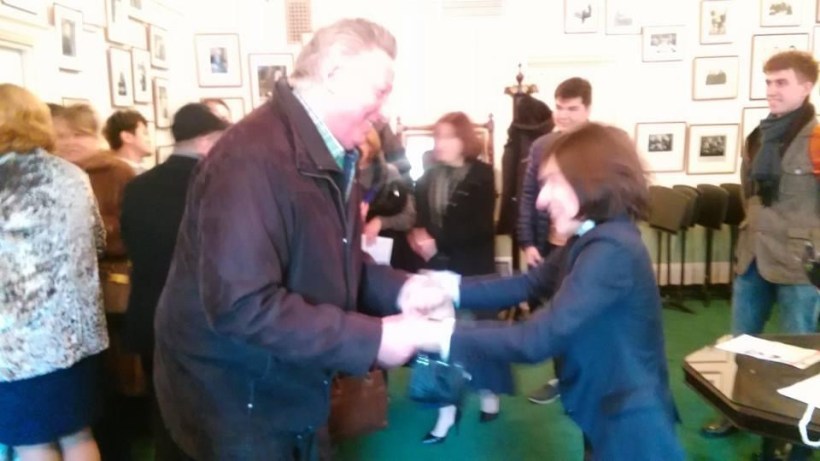
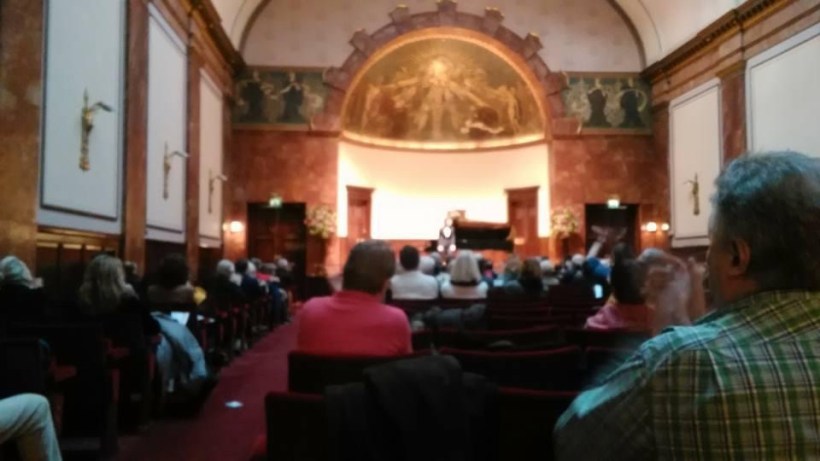
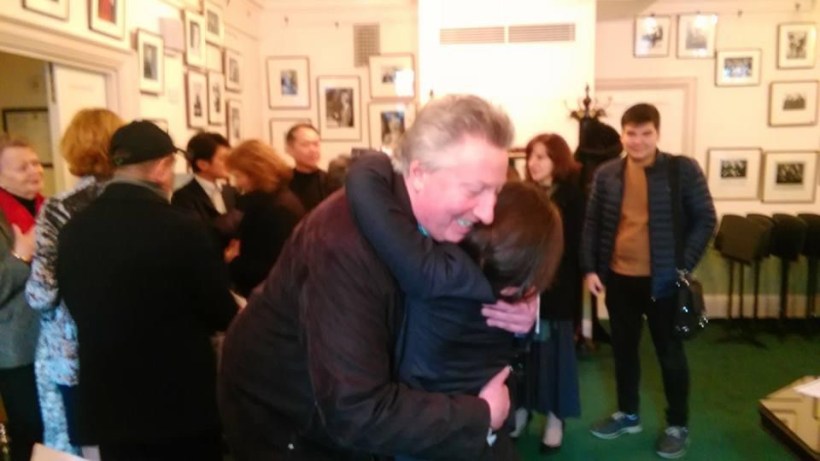
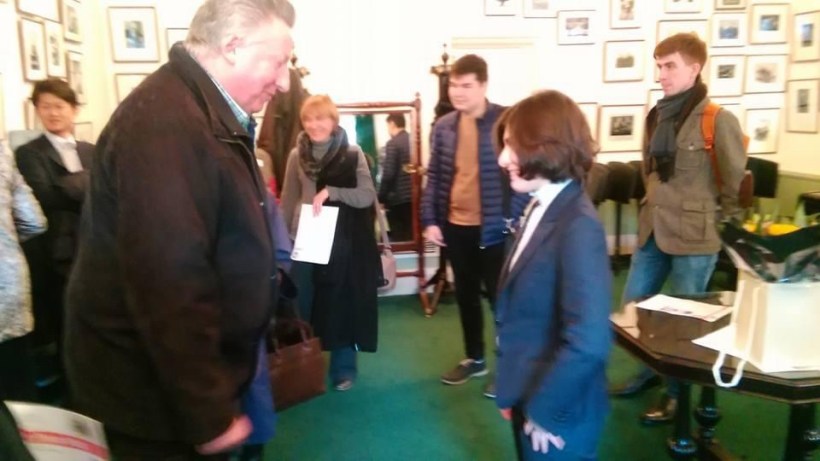
“World class” exclaimed an exulted Hugh Mather at the end of the extraordinary recital by the Cuban pianist Marcos Madrigal today.
Playing in collaboration with the Keyboard Charitable Trust in the most remarkable series of great young pianists in London.
“on a cold day like this he has brought some Spanish sunshine into our lives” enthused a very excited Hugh,who has certainly seen some great young pianists in his time.
And much more besides, dear Hugh, as we were all witness today.
Right from the first note of the Chopin Nocturne in C Sharp minor op.posth,the penetrating luminosity of the sound gave us some indication that we were in the presence of a master. Perfect trills all with such clarity and allowed to sing thanks to this musicians wonderful sense of balance.
Musician…..magician yes – on the piano,and on this not easy Yamaha grand he was able to convince us that the sounds can live forever just like the human voice.
A juggling act indeed when one knows as soon as you play a note on a percussion instrument it begins to die away…unless you have found the secret of a Rubinstein,Zimerman,Perahia or a Curzon.
It is an art that conceals art and requires above all talent,but also dedication ,passion and work. Was it not Curzon,himself, who when asked his secret declared it was ninety per cent work and ten per cent talent. What talent though!
Following with another nocturne the almost” ballade” like one in C minor op 48 n.1 The wonderful cantabile sound but the subtle sense of colour and a rubato of such good taste one was not even aware of it. The music spoke as Chopin must have imagined it . The tumultuous middle section was kept under control with all the sense of line and shape paramount.No fireworks here as is often the case in lesser hands . The return of the melody above a shimmering accompaniment played with real passion and sentiment disappearing into the final expressive flourish so perfectly timed and with such poise .
Little did the audience expect the onslaught that followed with one of Prokofiev’s “War Sonatas” .The seventh in B flat op 83 He threw himself into the fray ” my kingdom for a horse indeed” …no blood on the keys but we certainly got the idea in this inspired performance. The second movement with its beautiful melody so sumptuously played with such ravishing sound a real magic trick indeed the violent passionate eruptions coming as even more of a contrast than expected. The last movement “Precipitato”.was just that . The insistent rhythmic pulse maintained with a tenacious magnetism ending in the most violently rhythmic onslaught that brought him a standing ovation . Rarely has that much heard sonata been heard in such a coherent full blooded but also passionate and tender performance I imagine since Richter’s premiere performance.
And so after the storm the sun came out in a selection of pieces by his compatriot Lecuona . Charmingly introduced by Marcos explaining the Cuban,Spanish,African influence and proceeding to charm and seduce us as only a true Cuban can. Was not Jorge Bolet the most seductive of pianists too . And so the colours the complicated syncopated rhythms all flowed from his fingertips seemingly so naturally . A Gitaneiras with such transcendental fingerwork -knotty twine indeed – but no knots here just pure simple sunshine thrown off with the ease of someone who lives in the country where manyana reigns . Malaguena ,of course was played to the manner born and from a beseeching public our charming magnificent pianist treated us to Goodbye Cuba . Arrivederci I think you mean dear Marcos as Hugh was reaching for his diary before this young man could get to the door.

The Genius of Trifonov

The genius that is Trifonov.
That Trifonov is a genius there can be no doubt .
Winning both Rubinstein and Tchaikowsky competitions is only incidental to his all consuming passion for music.
Not content at only twenty five to take the major concert halls worldwide by storm he has also written many works including his own piano concerto which can be heard on you tube.
Anyone that talks to him is immediately aware of his urgency and total commitment when speaking about music .
Genius sometimes is not easy to take and must be digested in small doses as one risks being totally overwhelmed.
Thus it was a pleasurable surprise to hear his very poetic, totally simple but original performance of Schumann`s Kinderscenen with which he opened his sold out recital at the Barbican today.
Traumerei may have been unusually slow but played with simplicity and loving care. Even the final chord of the Poet Speaks was absolutely perfect as were so many marvellous unforgettable moments in this much maligned miniature masterpiece .
As op 15 was an ideal foil for op 16  Kreisleriana that was separated by the Toccata op.7. Obviously he thought of the Toccata as a total contrast to the miniature fantasies that make up op.15 and 16.
And so it was just like a bull in the china shop a Toccata  that can be of such ravishing beauty was treated to a martellato like opening that should have been so legato and quiet. But a genius knows no bounds and Trifonov gave a totally committed performance which was almost totally contrary to what the composer so clearly indicates.
But this was no show off virtuoso performance but a man possessed and determined to share his vision with us.
So many wonderful things in Kreisleriana but so fragmented.
Whilst one admired the wonderful insights his flight of fancy was determined  to share with us, the lack of an overall sense of line and direction failed to hold my attention and in fact more than irritated me and left me bored and frustrated.
Genius has its price.
I hoped that we would have a less fragmented more readily coherent second half with Shostakovich and Stravinsky.
A hope immediately dashed by four such monumentally distorted Preludes and Fugues by Shostakovich that I can well imagine our beloved Nikolaeva (the inspiration and dedicatee)smiling as she turns in her grave even though I am sure she   would have fully admired what he was trying but not succeeding to do  .
I defy any one who could dance to this Danse Russe without breaking all their bones in this truly breathtaking account of Petrushka.
Even more irritated by Harriet Smiths translation of Petrushka`s Room,the second movement, in the almost inexistent programme note hidden  amongst a barrage of publicity .
Trifonovs total identification with this second movement  had led to the most successful and accessible interpretation of this work .
The opening of La Semaine Grasse was sheer ethereal magic but once again spoilt for us mortals in not being able to fully comprehend the madly driven performance  that followed that brought the house down.
I stayed only for one encore again very fragmented- maybe a piece of his own certainly under the influence if Medtner.
I could not take any more but would not have missed this glimpse of genius for the world even though hard going for us mortals

Asia Jimenez and Alexander Ullman at St Barnabas

Asia Jimenez -AlexanderUllman in St Barnabas Ealing
Asia Jimenez and Alexander Ullman in recital together at St Barnabas in Ealing.
Some wonderful sounds from Asia Jimenez on her glorious Gagliano violin and with Alex Ullman on the wonderfully sounding Bosendorfer in the very fine acoustics of St Barnabas Church in Ealing led to a very fine lunchtime concert in Hugh Mathers notable series .
Debussy Sonata,one of his last works, played with all the subtle colour and shifting moods with the whispered sounds intertwining so beautifully in the hands of these two very fine artists . The Meditation was the original slow movement of the violin concert as Asia explained to the numerous public present and they played it together with the Melodie with all Tschaikowsky’s full blooded passionate melancholy , the wondrous sounds soaring into the vast space of this beautiful church.
The scherzo that completes this Souvenir d’un Cher was played with great virtuosity with perfect ensemble with her partner. The De Falla,of course ,was perfect for this beautiful young spanish violinist who graduated from the Conservatory in Barcelona and is now ,like Alex pursuing the Master’s degree at the Royal College in London .
Naturally she had a real understanding of these very atmospheric pieces, that make up the Suite Populaire ,together with all their youthful passion and virtuosity made for a very fine ending to this short but very enthusiastically received recital.

Alexander Ullman at the RCM

Alexander Ullman at the RCM
Magnificent Grieg Piano Concerto from Alexander Ullman and the RCM orchestra under Peter Stark as winner of this years concerto prize.
All the youthful flamboyant virtuosity allied to an innate,unfailing musicality that allowed this unjustly neglected masterpiece to soar and sing as it has not done since it was so lovingly restored to the repertory by Artur Rubinstein.
A young mans vision full of passion and heartfelt cantabile passages that penetrated the magnificent youthful orchestral sounds on the very fine new Steinway Concert Grand that he was privileged to inaugurate. Winner of the prestigious Liszt/ Bartok International Piano Competition in Budapest five years ago at the age of only 20.
Having studied with William Fong at the Purcell School he won a scholarship to study at the Curtis Institute in Philadelphia with Leon Fleisher ( whose historic recording of the Grieg with Szell is a beacon for us all).Choosing on his return to the UK to perfect his studies at the Royal College of Music with Dmitri Alexeev and Ian Jones and selected to play for the prestigious YCAT and the Keyboard Charitable Trust concerts that help promote the very best young musicians .This young musician is fast making a name for himself as an unusually musical virtuoso.

A star is born …Mariam Batsashvili

A star is born…..Mariam Batsashvili at the Wigmore Hall.
There has certainly been a line up of great pianists this week with the winners of the Leeds,Santander competitions and Beatrice Rana`s magnificent Goldbergs for the BBC but what we heard this morning may be likened to the reverence with which the great pianists of the past spoke about the legendary Leopold Godowsky.
There was magic in the air from the very first note.
A phenomenal sense of balance that allowed the melodic line to sing with such purity allied to a complete immersion in the style together with a subtle sense of rhythmic energy.
The Concerto in D minor BWV.974 by Marcello in the transcription of J.S.Bach was played with just such subtle sense of rhythm and colour . The Adagio displayed her artistry to the full where the melodic line was allowed to whisper thanks to the amazing control of the left hand. But a sound of such beauty that it was projected even to the back of the hall. The infectious rhythm of the Presto with all its stylistic shading was indeed a very rare thing.
But even in the Liszt arrangement of Handel’s Sarabande and Chaconne from Almira S181 she displayed her wonderful sense of colour that she was able to transmit not only in the quiet melodic passages but also in the overwhelmingly full but never percussive fortissimo passages that abound in this very rarely heard Liszt transcription.
 Beethoven`s youthful “Rage over a lost penny” had all the “tongue in cheek ” humour allied to an amazing pianistic control as she threw herself into it at breakneck speed.
But even at this speed the music spoke with such subtle good taste and control that I would certainly not have thought it possible until hearing it today in Mariam’s golden hands.
 With all the half light “will`o the wisp “shading this was what virtuosity really means as Godowskys illustrious colleagues were well aware and were only too happy to bow to a superior being as many of the very fine pianists present today certainly were.
Leslie Howard the legendary Liszt authority was present and it was thanks to him and the Utrecht/Liszt Competition that we were able to witness the London debut of this twenty three year old future star .
Such subtle colours together with an infectious rhythmic pulse in the Allegro Barbaro by Bartok but completely different from the previous works such was her identification with this unique sound world.
 Enormous sonorities at the end of Liszt`s 13th Hungarian Rhapsody defied belief not only because of the sparrow type stature of this great artist but because of the enormous sound without the slightest hardness that she was able to produce. Such subtle rubato and aristocratic good taste in what can so often vulgarly demean these masterpieces .
  This led to the Tarantella from Venezia e Napoli where the delicate return of the melody was of such sublime beauty I just thank God that I was present today to witness it.
Her double octaves at the end were of “Horowitz”proportions.
After that an encore would have been unthinkable for lesser mortals but not for our “`gal “who treated us to the fourth Paganini study of such subtle charm and quiet virtuosity especially having only at the end ,on the way to the Green Room, noticed it was on a Yamaha grand.
Richard Goode at the Guildhall
An absorbing afternoon with Richard Goode at the Guildhall today introduced by another very fine musician Martin Roscoe . It was nice to be reminded by Martin of our student days in Dartington together sharing many a glass of Scrumpy whilst playing in the masterclasses there of Stephen Kovacevich.
Martin with a very distinguished career and part of that wonderful trio of great pianists from the North of England completed by Peter Donahue and Katherine Stott .Displaying a prodigious memory for it was almost fifty years ago that Katherine and I taught for Miss Rowe in Ealing and Martin and I passed our wonderful summers immersed in music in Dartington
Introducing Richard Goode Martin revealed that his masterly recording of the Beethoven Sonatas was in fact the inspiration for his own which is nearing completion.
Together with other old friends and fellow students of Gordon Green :Tessa Uys and Peter Bithell who were present hoping to be not only inspired but informed by one of the great musicians of our time.
The opening Beethoven Sonata op 27 n.1 very musically played failed to ignite the masterclass in spite of some very interesting comments from Richard Goode . It was the Mozart Sonata in D K.311 that followed , played in a very professionally proficient manner by a master pianist but the moment that Richard Goode tried to explain that every note must have a meaning and began to demonstrate in his inimitable way the musical language of Mozart that spoke so eloquently and immediately a magic was created where the teacher ,student and public were totally involved.
And so it continued with the Fourth Ballade by Chopin. Richard Goode now totally inspired managed to share his passion, sense of balance ,colour and musical intelligence with the excellent young pianist who immediately inspired by the passionate technical and musical demonstrations turned a very fine performance into something really totally on a different plane.
An afternoon of sheer magic..

Daniel Lebhardt in Perivale

Daniel Lebhardt at St Mary’s Perivale
Daniel Lebhardt.at St Mary`s Perivale for Hugh Mathers remarkable series of young virtuosi.
Wonderful to be back to this beautiful church seen from afar in the winter sunshine today.
The opening concert a bit later than usual due to urgent repairs on the delicate roof.
Young hungarian born pianist already at only 23 graduated with honours from the Royal Academy in London where he won the prestigious Sterndale Benett Prize receiving also recognition from YCAT UK and America giving him numerous concert experiences to consolidate his career in music.
Studying from an early age at the Franz Liszt Academy in Budapest I was very happy to be able to hear this distinguished young musician in Hugh Mather`s extraordinary series.
In three pieces from Brahms op 118 he showed the best of himself with a solid,mature but very sensitive musicianship.
Some beautiful sounds and a sense of line that never led to excess.
A heartfelt interpretation that never dissolved into sentimentality but always the head held nobly on high.
A sense of pulse and rhythmic impulse that led to a very moving interpretation of these deceptively difficult last utterings of Brahms
.
Persuaded by our genial host to present the programme the words used to express what he felt in Brahms were so clearly mirrored in his performances at the keyboard.
Explaining why he preferred the orginal version of Rachmaninovs epic second sonata he proceeded to give a virtuoso performance full of colour and subtle nuances but that somehow did not have the same impact as the famous much truncated”Horowitz” version.
I must say while I appreciate the reason for searching out and presenting the original version which is intellectually admirable but Horowitz was an animal who had a great sense of theatre combined with great musicianship that he is not always credited with.Was it not Rachmaninov ,his best friend ,who said Vovka plays me well!
Daniel gave a very fine full blooded virtuoso performance not missing in subtlety and heartrending romanticism.I just feel that for the actual content it would have benefitted from some cautious cutting and re-editing !
Starting his programme with Beethoven’s “Hunt” Sonata op 31 n.3 I felt as though he had not quite got to grips with the instrument in his quest to find delicacy and almost pastoral cantabile he somehow missed that rhythmic energy and clockwork precision that is so part of Beethoven in this early to middle period.Jaining Kong a few weeks ago in the same master series had shown us exactly how it could be done with masterly,mesmerising accounts of Beethoven Sonatas.
Next Tuesday another great pianist Marcos Madrigal with music of Chopin,Prokofiev and Lecuona a preview of which can be heard on Radio 3 “In Tune” on Thursday as he presents his phenomenal new CD of his compatriot Lecuona .
Marcos is absolutely unique in this music and it was the great conductor Claudio Abbado who recognised his talent and was responsible for helping him leave Cuba to complete his musical studies.

Realms of Gould

The Spiders Goulden Web Beatrice Rana at the Wigmore Hall
“The Spiders Goulden Web”
Beatrice Rana `s monumental performance of the Goldberg Variations for the BBC at the
Wigmore Hall today .
Total silence from a packed Wigmore Hall in which she bewitched us with the same rapt concentration that this 23 year old shared with us.
So rare to see a pianist listening so intently to every note totally still except for her magnificent hands spinning their golden web.
Glenn Gould too was only 23 when he recorded his revolutionary performance and I hear that Beatrice`s CD will appear commercially next month.
It was a young intelligent man`s performance as was Beatrice`s today.
Firstly the transcendental piano playing that was never in evidence for its own sake but was totally at the service of the music.
Always with great taste and intelligence some very subtle colouring and shaping.
Maybe the more rhythmic variations could have been slightly slower and weightier with slightly less rubato in the middle variations but that sense of a monumental rock will grow as this young virtuoso takes her rightful place, in the not too distant future, with the likes of Arrau,Tureck or Pollini.
I well remember some years back inviting both Nikolaeva and Tureck to play the Goldbergs in my theatre in Rome within a month of each other and people commenting on the lack of fantasy in programming .
It was exactly the contrast of two of the greatest Bach players of the century interpreting this masterwork in an intellectually intelligent reading both totally different,that was so stimulating and indeed created quite a stir.
It marked the return to the concert platform of Rosalyen Tureck after having retired to Oxford to study in depth the composer that she had dedicated her life to.
Tureck was magnificently slow and weighty(like Klemperer) a monument etched in marble.
With Nikolaeva music poured out of her in such a simple natural way and had a flexibility and humanity that one felt could change:A monument written in sand (like Bruno Walter).
Beatrice Rana did not quite have the authority which will only come with the maturity of experience but she was someway between these two magnificent extremes and it made for a very stimulating and totally absorbing performance.
Her wonderful Steinway was used to the full never aware of her subtle use of the pedals used only as a harpsichordist would change register.
The whispered simplicity of the return of the theme after almost an hour and a half took our breath away ,I think hers too .
Such was the control and silent virtuosity of this performance ,I am sure it will go down in history as one of the most memorable performances in recent times.
There was certainly magic in the air that one can luckily savour on the BBC radio 3 website(bbc.com/radio 3)

Alberto Portugheis Birthday Co

Happy Birthday Alberto .
CHRISTOPHER AXWORTHY·SABATO 14 GENNAIO 2017

Great celebrations for Alberto Portugheis`s 76th birthday concert at St James`s Piccadilly today.
They say a man is known by his friends and as if that was needed to experience such wonderful company at the luncheon party that Alberto hosted for his friends in the beautiful restaurant in Piccadilly .
It was the same generosity of spirit that pervaded the passionate performances of Beethoven and Mussorgsky that he offered to his friends on his 76th birthday at St James’s Piccadilly. Only just recently celebrating with his childhood friend Martha Argerich their 75th birthdays in a memorable duo concert at the Wigmore Hall .
Due to the availability of dates it was only a month later that we celebrated Alberto again …his birthday day being the first of the year.
A real Renaissance man Alberto Portugheis was more concerned in conversation with his young disciples to know how to communicate via the mass or social media to all the mothers of unborn children on how to stop them being butchered in the wars that are endlessly being wagered in the name of Peace.
For there are many publications by Alberto in his quest for peace and his battle to take away the power of governments to wage war without any heed of the human sacrifice involved.
The church too has to take its share of the blame according to Alberto who has been nominated for a Nobel Peace Prize.
His Mussorgsky threw all caution to the wind in a passionately theatrical heart felt performance that earned him a standing ovation at the end of his concert .
Having started with the Andante Favori by Beethoven – the original slow movement of the Waldstein Sonata.
He offered his adoring public an encore of a Russian melody by an Austrian composer as he announced himself …the third Moment Musicaux by Schubert played with a subtle rubato and sense of song that sent his friends happily away and us privileged few to celebrate around the table with this remarkable man ,where his many faceted views and spirited intelligent conversation kept us at the luncheon table until well into tea time !

Juan Perez Floristan at the Wigmore Hall

Santander Prizewinners concert
Juan Perez Floristan at the Wigmore Hall tonight for the Prizewinners concert of the Santander International Piano Competition. A strange programme confronted us with the first half the Liszt Sonata and the second four preludes by Debussy ,three by Gershwin and in between the Bartok Sonata and Ginasteras`s Argentinian Dances.
My first reaction ,of course,was to think it rather foolhardy or at the very least presumptuous to open a debut recital with such a monumental work. However in his hands it was a totally convincing and satisfying first half. A very mature intelligent reading allied to a luminosity of sound that allowed this masterpiece to unfold without any exaggerations or over passionate exclamations .In fact a quite overwhelmingly professional performance without the hystrionics of a Horowitz or the deep introspection of an Arrau but a real understanding of the structure of this masterpiece.
Blessed,obviously,with a large hand,strong fingers and relaxed arms his sound could be likened to cristal drops reminiscent of Michelangeli. It suited him well also in the second half. His Canope ,one of four preludes by Debussy, was the most remarkable performance in a notable debut recital. La Puerta del Vino was given a performance of orchestral proportions such was his feeling for the colour and style that he was able to produce. A Bartok Sonata of such clarity and precision one was reminded of Andor Foldes memorable recording.
Some subtle additions to Gershwin’s seductive second prelude added to the razz matazz that he found in the outer ones. Leading ,of course, to a sensational account of Ginasteras dances that brought the house down. Party time secured an encore charmingly introduced to the public :his own arrangement of a Flamenco to thank us and wish us goodbye. Well it was quite a farewell for this consummate artist still only twenty three so there will be many more occasions to hear him in London again …………the earlier the better. As Paloma O`Shea says in her programme introduction :”the combination of luminosity and musical depth make Juan a very special pianist”………..this remarkable promoter of the arts has hit the nail on the head that is for sure