Roberto Prosseda and Oleg Caetani with the London Philharmonic in London

“Get Closer” Roberto Prosseda and Oleg Caetani at the Festival Hall
As always a fascinating journey of discovery with Roberto Prosseda with his appearance with the London Philharmonic introducing the pedal piano to London audiences.
The last time he was here was with the then unknown conductor Yannick Nezet Seguin with Mendelssohn’s 3rd piano concerto ( fragments of a third concerto never finished but assembled and completed by Marcello Bufalini).
Roberto went on to record it with Riccardo Chailly and the Leipzig Gewandhaus Orchestra for Decca.
(The unknown Nezet Seguin has since become director of the Philadelphia Orhestra after Riccardo Muti!)
And this time he brings to London Gounod’s Concerto for Pedal Piano in E flat -1889.
He was shown the then unpublished score in 2010 by Gerard Conde who explained that Gounod had given the original manuscript to Lucie Palicot for whom his four works were written.

The Pinchi system brought especially to London by Roberto Prosseda

The Pinchi pedal board
A student of the son of Alkan ,Elie Dalaborde It was her appearances in Paris at the Salle Pleyel in 1882 ,having also heard Alkan himself in 1875 , that inspired Gounod and he gave her sole rights to the concerto.
Unfortunately she retired from the concert stage in 1895 when she married for the second time and the manuscript disappeared.
A report from the musicologist Paul Landormy recalled :”I remember what a strange impression was produced by the sight of this graceful and dainty person perched on a huge case containg the lower strings of the pedal-board beneath a grand piano resting on it.What surprised us above all,pleasantly enough to be sure,was to see Mme Palicot wearing a short knee-length skirt ( entirely necessary but astonishing in those days),and her pretty legs darting most adroitly to reach the different pedals of the keyboard she had at her feet !”
Roberto Prosseda  has recorded all four works by Gounod for Hyperion directed by Howard Shelley in his Romantic Piano Concerto Series.
He had commisioned from the Italian organ builder Claudio Pinchi an innovative system so that a pedal piano can be created from any two grand pianos.
Two Steinway D pianos one on top of the other with the Pinchi system that allows them to be transformed into a pedal piano.
The problem is that the pedal technique used for the organ cannot be applied since it requires a particular sensitivity of touch,as the pedals control a piano with hammers and strings.

The artistic balancing act of Roberto Prosseda
So a more pianistic approach is required,using the weight of the leg and transferring the weight from one note to another in order to achieve a legato and enable a rich sonority and good control of dynamics.
The sustaining pedal is seldom used as both feet are often busy playing the pedal board.The hands are required to play differently than on a normal piano as the player’s balance and seating position are often altered by the constant movement of the legs!
No one was aware of all these difficulties listening to the superb performance of Gounod’s long lost concerto.
The outer movements were extremely rhythmically controlled in their question and answer between pianos and orchestra .
It was in the beautiful Adagio and in the Schumann encore – the fourth of the six Canonic studies for pedal piano – that one could appreciate to the full the supreme artistry and superb sense of style of Roberto Prosseda.

Roberto discussing the pedal piano  with his colleagues and sponsors after his superb  London premiere performance of Gounod’s Pedal Piano Concerto
Infact I was witness backstage to the orchestral players coming one by one to congratulate Roberto especially for the beauty of his performance of the Schumann encore.
Praise indeed coming from his colleagues in the London Philharmonic.
It is very nice to see the success of the young pianist who studied in the Sergio Cafaro/Martinelli household a stone’s throw from our theatre in Rome(Teatro Ghione) and was reared by the Campus Musicale in his home town of Latina.
He often used to play in our theatre in Rome as ” try outs ” for his appearances in International Competitions .
I well remember the joy of Fou Ts’ong on hearing that Roberto would be playing in his Masterclasses.
He also went on to study with Fou Ts’ong and William Grant  Nabore at the International Piano Academy in Como  created and run  by William Nabore a former disciple of Carlo Zecchi (Martha Argerich is honorary President).
For some years he was artistic director of the Pontine Festival together  with Fabrizio von Arx  continuing their great tradition by bringing Elisso Virsaladze,Charles Rosen  and many others to the summer festival in Sermoneta in the grounds of the Caetani Castle.
A festival started in the 60’ by Menuhin/Szigeti and Alberto Lysy.

Oleg Caetani son of Igor Markevitch one of the last of the noble Italian dynasty of  Caetani
By coincidence the concert was the symphonic debut with the LPO of Oleg Caetani.Renowned in the opera houses throughout the world he is one of the last surviving members of the noble Caetani family.
His father was Igor Markevitch and his mother was Donna Topazia Caetani from whom he chose to take his name to prolong the family lineage.
Not only  with a renowned father whom I heard many times on this very stage but also with a superb pedigree of studies with Nadia Boulanger and Franco Ferrara.
He gave some superb performances of Messiaen : Hymne and the Symphonie fantastique by Berlioz that I well remember his father performing with such electricity here all those years ago.
We await many new discoveries from Roberto Prosseda in London on his remarkable journey in the music world where he delves with such intelligence and artistry .

The rather complicated removal in the interval of the two Steinways and Pinchi system

Roberto explaining the Pinchi system during the interval backstage

The rapt attention of his colleagues in the LPO during the Schumann encore that Roberto very spiritedly introduced .

Rachel Cheung at St Mary’s Perivale

Rachel Cheung at St Mary’s Perivale
Not a week goes by without hearing another remarkable young pianist in the series of Tuesday afternoon piano recitals at St Mary’s in Perivale.
And Hugh Mather has struck gold again today with a young pianist from Hong Kong: Rachel Cheung.
Looking at her biography it was reassuring to see that her early training she had received from a fellow student of mine at the Royal Academy in London.
Eleanor Wong studied with Frederick Jackson a remarkable musician who died conducting the Verdi Requiem in the Dukes Hall of the RAM .His final words were to carry on as they carried him off in an ambulance.
Eleanor had won all the major prizes and also carried off silver medal at the Vercelli competition in Italy.
She used to knock on my door where I was practicing every evening to play through her programmes to this young first year student.
Of course I was very impressed but not nearly as impressed as seeing her forty years later on the jury of the Leeds International Piano Competition.
Great reports were coming from Hong Kong of this superb trainer of young pianists as we were to hear today from Rachel Cheung.

Rachel Cheung
It was nice to see also that after graduating from Hong Kong Academy with First Class Honours Rachel had gone on to complete her studies with the legendary hungarian pianist Peter Frankl at Yale University in America.
One of the youngest competitiors in the Leeds Competition in 2009 at the age of 17.
She was awarded fifth prize the year that Gulyak Sofya was awarded the Gold medal.
She went on to win prizes in many other major competitions and recently conducted from the keyboard Beethoven’s Fourth Piano Concerto with the Orchestre de Chambre de Paris at the Play-Direct Academy led by Stephen Kovacevich.
It was hardly surprising that St Mary’s was packed to the rafters for the beautiful programme of Franck,Schumann and Liszt presented by this remarkable young musician.
Still only 26 she played with the authority and control of a master.
Starting with the hauntingly beautiful transcription by Harold Bauer of Cesar Franck Prelude,Fugue and Variation op 18 for organ.
It was clear from the beautiful liquid tone and the way that she moved so naturally at the piano that we were in the presence of a true musician and poet of the piano.
So often the works of Franck for solo piano and piano transcriptions from the organ can sound so thick and heavy and these days rather outdated.
Rachel managed to convey with an almost whispered appearance of the recurring melody a feeling that this was the only possible medium for this piece.
Even the Fugue was played with the same delicate tone colour and the reappearance of the melody at the end was quite magical.
She looked exactly as I remember Eleanor did at the piano all those years ago.
A beautiful natural way of almost conjuring the sounds out of the keyboard.
The main work on the programme was the Fantasy in C Major by Schumann.
Charmingly presented to the public explaining that it was an outpouring of love for his beloved Clara and there are many references to her throughout the work .

Rachel presenting her programme after the Franck
Not least the quote from Beethoven  :To the distant beloved – An die ferne geliebte at the end of the first movement.
It is dedicated to Liszt who in turn dedicated his B minor Sonata to Schumann.
The two pinnacles of the Romantic piano repertoire.
And it was to Liszt that Rachel turned to close the programme ;the Mephisto Waltz n.1.
I well remember Peter Frankl giving a masterclass in Oxford on the Schumann Fantasy and explaining the difficulty of keeping the structure of the first movement in mind amidst the continual fluctuations of tempo that Schumann asks for.
It was exactly this that marked Rachel’s performance as very special today.
All the passionate outpouring of love for Clara was there together with the extreme tenderness and subtle sense of colour and exquisite phrasing.
All this held tightly together to the final magical quote from Beethoven.
Ever more in diminuendo to the bell like final chords and the three final bass chords almost disappearing into the infinite.A remarkable control of sound completely mesmerised the audience.
The march of the second movement was played with great rhythmic impetus but I felt the dotted rhythms of Schumann could have been less clipped and more melodically shaped.
The middle section was beautifully shaped though.
Hampered I fear by a small hand but she managed to conquer the infamous difficulties of the coda magnificently.
The last movement was magically played managing to play with great feeling but always keeping the great melodic line in view architecturally.The melodic line in the bass in the coda was sublime and her control of sound remarkable.
The minutes of silence that greeted the final chords was evidence enough of the magic she had created this afternoon.
This was obviously the Eusebius side of Rachels’ character.
Now with the Mephisto Waltz n.1 we were treated to Floristan and a truly fearless performance of this virtuoso showpiece.
There was though a virtuosism of great subtlety with infinite shades of colour in the most transcendental scale passages.
A middle section of heartrending sentiment and a coda in which she threw herself completely at the infamous octave leaps that the virtuoso Liszt had conjured up.
The birdcalls at the end were played with a clarity and precision before throwing herself at the double octave ending.
One can understand why she won the Audience Award at the 15th Van Cliburn International Piano Competition.
In fact it was by popular demand that she played Widmung by Schumann in the Liszt transcription where the two composers were at last consoled in a performance at once delicate,passionate and virtuosistic.
But above all it was the the poetic intelligence and complete command of the keyboard that kept us spellbound for this short recital in Hugh Mather’s remarkable series.
An immediate invitation for a return match was greeted with cheers from this very appreciative audience today.

Rachel Cheung

Rachel Cheung and CA

Graham Johnson and the Songmakers’ Almanac

On Wings of Song The Songmakers’ Almanac 40 years on
It was in 1976 under the enlightened management of William Lyne that the Wigmore Hall was relaunched.
He had persuaded Artur Rubinstein to give just one last concert in his long career in order to save the Wigmore Hall from the threat of demolition.
A concert on the 31st May 1976 when an almost blind Artur Rubinstein played for the very last time in public.
His final piece the B flat minor Scherzo by his beloved Chopin he abandoned as he could no longer see the great leaps involved.
He proceeded to play two studies op 10 n.4 and one we had never heard him play in public before op 25 n.2.
Both of which took our breath away.
It was a truly memorable recital that had included Schumann Carnaval,Beethoven op 31 n.3 Ravel Valses Nobles and Chopin Nocturne op 27 n.2 and Scherzo op 31.
An audience in delirium and Rubinstein with not the slightest sign of having played a recital that would have worn out much younger colleagues.
He turned to the audience and begged them not to allow the hall to be demolished.
He had started his career in 1912 in the Bechstein Hall and he was happy to finish it here in the newly named Wigmore Hall 54 years later.
He invited the audience to go backstage for this very last time.
He was being greeted by all when he could sense that there was someone very exceptional in front of him.
”I may be blind but not too blind to know when a beautiful lady is standing in front of me.”
Lauren Bacall was charmed of course as only Rubinstein knew how.
William Lyne not content with just Rubinstein devised in typical antipodean style a month of celebrations with concerts that included Elisabeth Schwarzkopf,Henryk Szeryng, Peter Pears with Julian Bream and Murray Perahia,Melos Ensemble,Parikian, Fleming,Roberts Trio and a concert in memory of David Munrow who was to have directed the Early Music Consort.
The Hall was reborn and has since under the enlightened antipodean Managements of William Lyne and now John Gilhooly become one of the most sought after and revered chamber music venues.
It has created its own audience who fill the hall night after night for artists such as Andras Schiff,Steven Isserlis,Angela Hewitt,Joshua Bell ,Graham Johnson etc etc .

Elisabeth Schwarzkopf on the 12th June 1976
Little could they have imagined that the hall was born on the wings of song.
For just down the road on the South Bank a young enthusiastic pianist was devising programmes for singers with themes under the name of the Songmakers’ Almanac.

A man in love
It took a little while for William Lyne and Graham Johnson to find each other and to realise that the ideal place for this new adventure was infact in the reborn Wigmore Hall.
With the first steps on stage of Graham with his colleagues from the RAM :Felicity Lott,Anthony Rolf Johnson,Richard Jackson,Ann Murray it was love at first sight.
A love affair that has lasted over 40 years.
Visibly moved as Graham Johnson remembered all those who had been on this long journey of discovery with him but were no longer with us.
The voice of “Tony”Rolfe Johnson brought a tear to his eyes as it still brought to us a tingle of excitement with the sublime exchange between voice and piano of this singer whose life was cut short much too early.
Sharing with us so generously his memories of 40 years of the almanac which he had idealised for these great young singers who were just happy to have programmes devised for them rather than jotting down their pieces on the back of a brown envelope.
Geoffrey Parsons was not immediately convinced.
Singers sing and accompanists follow !
He soon changed his tune and became an invaluable part of the Almanac as did the veteran Gerald Moore.
Officially retired in 1967 to tend his rose garden rather than darting from one continent to another.Gerald Moore took the Almanac audience by surprise one evening by joining Graham at the piano for a Schubertiade.
What greater endorsement could there be than that for a young man who had been seduced by song at the age of 21 playing with Felicity Lott in the class of Flora Nielson.
Graham and I had been contemporaries at the Royal Academy.
He had come on an Associated Board Scholarship from South Africa to study with Harry Isaacs .
I with Sidney Harrison but we shared chamber music coaching together with John Streets.
I well remember him telling Graham that he did not have to play every note as if someone was sticking a knife into him!
But Graham was already ultra sensitive to beautiful sound and he would also regularly quote the great poets to us in the student canteen much to our bewilderment.
Graham took part in the BBC Cello Competition directed at Dartington by Eleonor Warren.
He partnered Jonathan Williams a very fine cellist and the son of one of the Trimble sisters who had a well known piano duo at the time.
But when he struck up the Rococo Variations by Tchaikowsky it was the sheer beauty of the sound of Grahams’ orchestra that has remained with me all these years.
As Graham told us he was preparing the usual Concerto and Sonatas of a solo pianist ………………..that is until at the age of 21 he fell madly in love ………..with song.
Thanks to that great singing teacher Flora Nielson.
A lover he has never betrayed in fact it has become stronger as he delved deeper and came into contact in those early days with musicians of the calibre of Schwarzkopf,De Los Angeles,Pierre Bernac,Peter Pears,Gerald Moore,Walter Legge ,Hugh Cuenod etc etc.
He even helped Benjamin Britten write down his opera Death in Venice when he became physically too frail to write down the marvels that were still in his heart and mind.
This is just a small part of the fascinating journey that Graham shared with us on a Saturday morning here on his beloved stage.
Pointing to the spot where an already invalid Peter Pears had participated at an Almanac dedicated to him and had stated :
”The Wigmore hall is the place where singers can sing better than they ever thought possible”
How many programmes had been meticulously prepared and in preparing them how deeper his love had become.
His CD recording of the complete Schubert Songs has become a classic and his volume that accompanies it a reference for all that wish to know every detail of Schuberts heart and mind.
It was a story that Graham shared in is inimitable way.
With elegance,wit and above all intelligence in which his passionate involvement rang out so strongly.
A few years ago after one of his many recitals he was honoured with the Gold Medal of the Wigmore Hall.
He was presented too with a carriage clock.
Graham in thanking John Gilhooly immediately  quipped “but I have no intention of retiring!”
I introduced him via internet to Dame Fanny Waterman.
I had been listening in Italy over the radio to a recital transmitted from the Wigmore Hall.
Mesmerised by the beauty of Graham’s playing in writing to Dame Fanny with birthday greetings I mentioned that I had just been overwhelmed by the concert.
”But I was listening too in Leeds and he is the greatest accompanist alive .“
Fanny has chosen artists of the calibre of Murray Perahia and Radu Lupu to win her competition and is rarely wrong when it comes to playing the piano.
They have since become friends and mutual admirers.
I am involved too with helping to monitor and point in the right direction extraordinarily talented young pianists on the verge of important careers in music.And I often say to these Lions of the Keyboard if you want to learn how to make the piano sing listen to Graham Johnson.
Ever generous he came to one of the Keyboard Trusts’ Prize Winners Wigmore debut of a magnificent Russian pianist who had sought from Graham to find his secret of true legato hidden in that black box of hammers and strings.
A wonderful illuminating morning that I just hope will be recorded for posterity or at least published as an important document of someone who has changed the face of music appreciation.
Not content with all that he does he has just finished an important book on Poulenc which is about to be published in the UK.
The Green Room crowded by his friends and admirers after an hour and a half cut short only because time ran out.
“Am I too loud” his mentor Gerald Moore would ask.
No No dear Graham but much much “more” please.
The good news is that at the invitation of John Gilhooly,Graham has devised a new Songmakers’ Almanac series that begins on the 24th January 2019.
The Wigmore and Graham Johnson are indeed floating once again on Wings of Song.

Graham Johnson

Jamie Bergin for the Keyboard Trust

Jamie Bergin at St Mary’s Perivale
Hugh Mather and friends greet the Keyboard Charitable Trust

Programme of Jamie Bergin
Once again thanks to the generosity and enthusiasm of Hugh Mather and Roger Nellist we were able to hear the superb young British pianist Jamie Bergin in London.
Having been selected by the Keyboard Charitable Trust to give a public audition / concert in Steinway Hall to find that due to rebuilding work the hall will not be available until the spring.
Jamie having studied from an early age with Murray McLachlan at Chethams and then at the Guildhall with Joan Havill has gone on to complete his studies with Lars Vogt in Hannover and since 2016 was invited to be his assistant.
Here was a pedigree of great musicianship and it was exactly this that was so evident from a programme of often heard works but in the hands of a true musician.
It was as though we were hearing them afresh for the first time.
The really refreshing surprise was the variety of sounds that he could  conjure out of a piano that we have heard so many times in lesser hands.
Here was a professionality where there was absolutely no doubt technically or musically of his intentions.
To start at the end with the encore of Granados: “A Maiden and the Nightingale” of such sublime beauty.
The almost whispered melodic layers of sound each one weaving a magic spell but with a quality of sound at once creamy rich but with undercurrents of harmonies of such subtle colour like a fabulous string orchestra that is barely audible.
The passionate outbursts were a consequence of the slow built up of sound.
The imitation bird calls would have had Messiaen green with envy.
They were played with clarity but also with just the right amount of pedal that blurred the edges to perfection.
This was after a Gaspard de la Nuit that I have never heard played so perfectly in a live performance.
Scarbo was quite fenomenal in it’s sheer brilliance and complete technical command.
The subtle indications of diminuendo and crescendo so often ignored were here wonderfully noted and the deep throbbing notes at the beginning and in the mysterious middle section were quite a revelation.
To hear what Ravel actually wrote was a technical and musical feat of but a chosen few.
The opening of Ondine was beautifully judged with the melody shaped so perfectly where the murmur of the water was never allowed to be distinct or invasive.
Of course there were great washes of sound and in the great double note climax I have never been so aware that they start piano and lead to a crescendo of great brilliance- a real technical feat indeed.
The tolling bell of Le Gibet was even more mysterious for its  understated clarity.
The concert had started with Les Adieux Sonata op 81a by Beethoven.
Of course as we would expect with a disciple of that great trainer of musician pianists, Joan Havill, every marking was scrupulously noted and incorporated into a very personal interpretation.
In fact it was immediately noticeable the differing liquid sounds that he managed to find within piano to mezzo piano.
This I imagine is the influence of that other great musician Lars Vogt who we know from his participation for many years with the Leeds Competition and conducting from the keyboard the orchestras in the north of England.

foto taken by Roger Nellist from the video camera hidden in the gallery
The whole of the first movement had an almost “pastoral” feel to it with some wonderful attention to the bass where I have never noticed such differing colours before.
Technically impeccable,of course, but almost too fussy for Beethoven with hairpin shaping and slight changes of tempo that disturbed a little the true Beethovenian rhythmic drive.
The slow movement was beautifully shaped and lead to the Vivacissimamente which had all the relentless drive that had been missing in the first movement.
It was indeed a very fine performance and was followed by Chopin’s great continuous melodic outpouring that is his Barcarolle.
Played with great taste never allowing the rubato to become vulgar but with that fexibility that is as Chopin describes: a tree with the roots in the ground but the branches  that are allowed to sway naturally in the wind.
Inner counterpoints so beautifully shaped as rarely heard with great aristocratic nobility but at the same time with a heart that beats so strongly from within.

Hugh Mather applauding Jamie Bergin
This remarkable young man, well on his way to a great career ,can be heard in London at St John’s Smith Square for the Kirckman Young Artists Series on the 24th January at 19.30 ………………
I for one shall not miss it!
Thank you Hugh Mather and your remarkable team for opening up not only your beautiful church but also sharing your informed enthusiasm with the Keyboard Charitable Trust on a friday night .

Hugh Mather Elena Vorotko co-artistic director of the KCT and Jamie Bergin

IYAD SUGHAYER at Conway Hall in Praise of Peaceà

Palmusic UK shakes hands with The Keyboard Charitable Trust

John Leech and his wife Noretta Conci,founders of the Keyboard Charitable Trust
I have followed the career of the young Jordanian pianist Iyad Sughayer for some years and it was a great pleasure to share in the celebration that Palmusic UK had organised together with the Keyboard Charitable Trust to celebrate his winning the Trinity Laban Gold Medal 2018.

John Leech with Iyad Sughayer
As John Leech proudly announced in the question and answer session that followed a remarkable recital.
The Keyboard Trust has been able to offer this young musician concerts in Germany and in Manchester Cathedral with the Manchester Camerata.
Other tours await this gifted young man in Italy and the USA in the future.

Wissam Boustany
Sharing the platform in the Q&A session was Wissam Boustany,the artistic adviser of Palmusic and  distinguished flutist (teaching at Trinity Laban and visiting Professor at the Edward Said Conservatory in Palestine)and above all an International Peace Campaigner.
Outlining the power of music in creating peace in the Middle East just as Edward Said together with Daniel Barenboim have demonstrated to the world with their East-West Divan Orchestra.
Creating dialogue between peoples with differing cultures can only be achieved by sharing something loved by all sides:MUSIC.
The words and actions of Politicians have proved to be futile if the dialogue is not shared and understood by the people that are suffering.
As John Leech rightly said the Keyboard Trust is proud to be associated with Palmusic on this and hopefully on many other occasions.
It was a short showcase recital that left plenty of time for discussion and celebration.
In the splendid acoustics of the Conway Hall in Holborn.
A Bosendorfer piano that had seen better days but still retained it’s unique voice.
It was ,infact this voice that was immediately noticeable in Iyad’s hands.
In the Q&A session he had been asked if he had a favourite composer.
Mozart without any doubt was the reply.
His Mozart showed remarkable clarity and control but it was above all the purity and beauty of the sound that struck us all and especially Noretta Conci-Leech,former assistant for many years of Arturo Benedetti Michelangeli.
No higher praise could be offered !
The first movement in particular had all the rhythmic drive together with the finesse and contrasts that mark this sonata in particular one of the most important of Mozart’s output and with the C minor almost forseeing what would come afterwards in Beethoven’s revolutionary hands.
The Andante cantabile is pure opera and here the dramatic contrasts are quite unique and should almost take us all by surprise.
A recent performance by Janina Fialkowska was really a lesson to us all and quite enthralling.
Iyad loves this music so much and played extremely beautifully but one felt that he was almost afraid to show us the jagged edges of Mozart’s teeth.
His performance will gain in depth as he matures and develops his already quite extraordinary gifts

Ilya Kondratiev in discussion with Noretta Conci Leech
The Presto was played in true sotto voce and the beautiful A major section was allowed to breathe to perfection.
The problem with this movement is the left hand that needs to be so precise as to allow the whispered right hand to really speak.
Iyad did wonders but it was Craig Sheppard who had pin pointed this in a masterclass at the RCM with Ilya Kondratiev.
Ilya had flown in especially from a German tour for the KCT to support his colleague and admire his Mozart .

Iyad with that other remarkable pianist and indefatigable peace campaigner Alberto Portugheis*
In his interview after the concert Iyad said he was very excited about recording all the works of Khachaturian.
Something that only Murray McLachlan had done previously.
It was with Murray that Iyad had studied since leaving Amman and the National Music Conservatory at the age of 14.
Studying first at Chetham’s and later at the RNCM always in Manchester.
Awarded a full scholarship to study at Trinity Laban Conservatoire of Music in London he continued his studies with Martino Tirimo .
Now having completed his studies there having been awarded the prestigious Gold Medal he returns to Manchester to complete his International Artists Diploma with McLachlan,Tirimo and Scott.
An exciting project to be invited to record for the Swedish label BIS the solo works of Khachaturian and  it was after a performance of the four Mazukas op 33 by Chopin  that we were treated to a transcendental performance of Khatchaturian’s 1961 Sonata.
Here was all the verve and drive of a young lion .
Not only.
But with a sense of colour and contrast that had ignited this young man’s imagination and that he transmitted to an audience mesmerised and overwhelmed by such authority.
A work in many ways reminiscent of Prokofiev with its liquid cantabile contrasting with passages of enormous velocity and power.
A remarkable performance that augers well not only for posterity in the recording but also in the performance with the BBC Philharmonic which is in programme shortly after in Manchester.

Wissam Boustany with Iyad
A very interesting Q&A with a capacity audience after the performance in which it was refreshing to see with what simplicity and joy this young man could share not only his music but also his views on music in the Middle East and the message that music can have for all those who have ears and the wish to listen.
A celebration afterwards was a fitting end to an uplifting evening dedicated to Art and Peace.
His next performance in Amman will be on the 23rd December with that other extraordinary Jordanian pianist Karim Said (a student at Purcell School of that other renowned trainer of young musicians Tessa Nicholson)
In programme Beethoven Concerto n. 2 .
* honoured to be corrected and enlightened by another extraordinary human being present in the audience:Alberto Portugheis
Dear Wissam Boustany (you can read what he wrote about me on the back cover of my first book, with John’s foreword) is a Peace lover and occasionally Peace searcher, but not a campaigner as such. He’s very spiritual and a wonderful musician. We have partnered each other on occasions. This, from his website, expresses in a clear way what his interests are:
Wissam’s experiences of the war in Lebanon have greatly influenced his outlook on both Life and Music, crystalizing into a burning intensity, commitment, deep sadness, and spirituality that find their wings in the sound of his flute. In 1995, he founded Towards Humanity, a multi-decade international initiative working with musicians and charities, helping communities who suffer from the tragedies of war.
You don’t mention his teaching at Trinity Laban; has Wissam retired ?
To me, outlining the power of music in the context of Peace work, is distracting and confusing. Many politicians and often the more warmongering ones, (Hitler included) listened to good music all their lives. Armed Forces have orchestras, bands, chamber music, choral music, etc. Many military murderers are excellent painters, sculptors, poets.
ART is used to celebrate good or evil, depending on who orders it.
Famous composers have written marches to encourage killing. The 5th verse of God Save The Queen says we must kill all the Scotts !!!
Daniel Barenboim has repeatedly said the East-West Divan Orchestra is not a Peace Project and he does not expect their concerts to do anything to advance the Peace process.  The Said-Barenboim Project’s aim is: show that communication between Jews and Muslims is possible. This however, is already know by everybody, but Militarism, Politics and money makes Peace impossible. In fact, we have so many wars because of the excellent communication, fluid dialogue between all the warrying parties.
You say Creating dialogue between peoples with differing cultures can only be achieved by sharing something loved by all sides:MUSIC.
In Spain, when the Civil War broke out, thousands of people who shared the music they were singing, in Church choirs all over the country, ended up killing each other, depending on which side of the conflict they belonged to. You also write The words and actions of Politicians have proved to be futile if the dialogue is not shared and understood by the people that are suffering..
In reality most people don’t understand what happens, because people are gullible and they believe politicians. People believe that we need Armed Forces for “Defense”. Politicians are ‘forced’ by the system to create ‘enemies’ so as to justify military expenditure. We force them to lie to us. They have to promote the military Trade (something impossible without creating the terrain for wars), so that they can tell us of their Peace efforts.
To the piano now !!!

Ciao,

Alberto

The remarkable work of Palmusic UK

The distinguished audience in Conway Hall

Alberto Portugheis demonstrating his up and coming Beethoven Piano Concerto Masterclasses in St John’s Notting Hill on the 17th November

Iyad celebrating with us after his distinguished performances

Yuanfan Yang takes Rome by storm The XXVIII Rome International Piano Competition

Yuanfan Yang takes Rome by storm The XXVIII Rome International Piano Competition
It was in 1989 that Marcella Crudeli decided that Rome merited a competition like many of the other major cities.
With her enormous energy and indomitable spirit the first Rome National Competition was won by Roberto Prosseda and Enrico Camerini.
Two pianists that had been giving recitals from an early age in the Ghione Theatre which for years tried to give a platform to musicians who for one reason or another were not being invited to perform in Rome.
( Young and old alike included Vlado Perlemuter,Guido Agosti,Shura Cherkassky,Annie Fischer,Dame Moura Lympany,Fou Ts’ong,Peter Frankl,Rosalyn Tureck,Gyorgy Sandor,Alicia De Larrocha,Peter Katin,Ruggiero Ricci,Idil Biret,Dominique Merlet,Bruno Canino,Pina Carmirelli,Jeno Jando,Vadim Repin,Mikhail Pletnev,Tatiana Nikolaeva,Andor Foldes,Paul Tortelier,Janina Fialkowska,Angela Hewitt,Ivo Pogorelich,Friedrich Gulda,Jerome Rose,Dmitri Alexeev,Oxana Yablonskaya ,Boris Berman,Gervase De Peyer,Bary Tuckwell,Paul Badura-Skoda,Franco Mannino,Fausto Zadra,Lya De Barberiis,Martha Noguera,Alberto Portugheis.Alexander Romanovsky,Bruno Canino,

Teatro Ghione next to St.Peter’s Square in the heart of Rome
Karlheinz Stockhausen,Luciano Berio,Marilyn Horne,Lucia Valentini Terrani,Carlo Bergonzi,Jose Cura,Mariella Devia,Margaret Price,Dame Gweneth Jones,Olga Borodina,Dmitri Hvorosovsky,Nicolai Gedda,Giuseppe di Stefano,Goffredo Petrassi,Eliot Carter, Dame Eva Turner,Roberto Prosedda,Jayson Gillham,Alexander Ullman,Vitaly Pisarenko,Pablo Rossi,Leslie Howard,Carlo Grante,Enrico Camerini etc)
The Theatre was built and run by the distinguished actress (my wife) Ileana Ghione for over thirty years.
It is still going strong and is a just monument to her.
And as Marcella Crudeli said in her closing speech tonight at the end of its 28th edition: “This is the International Piano Competition of Rome” and not the Marcella Crudeli Competition as it is familiarly known.”It must carry on long after I have gone.”
The same sentiments of my wife who died on stage in her theatre 13 years ago.

Exhibition of Marcello Mastroianni at the Ara Pacis in the centre of Rome
It was a nice coincidence that in the interval between the Final and the gala concert at the Teatro Quirino – Vittorio Gassman I was able to visit an exhibition mounted for a colleague of that other famous Italian actor Vittorio Gassman- Marcello Mastroianni.
The final exhibit is a film where he quotes Kafka saying so poetically that the hill that had seemed so far away in his youth was now only a stone’s throw away.
It is truly admirable to see the strength of women ready to fight for what they believe in and to never give up until they succeed.
Such was the determination of Fanny Waterman with the International Competition that she brought to her city of Leeds.
Sulamita Aranowska did the same for her adopted city with the London Power Piano Competition.
Carla Grindea too founded EPTA(European Piano Teachers Association) with Perlemuter President and Sidney Harrison ,chairman.
It is now an organisation worldwide of which Marcella Crudeli is the Italian representative.

Marcella Crudeli after the Final the morning of the Gala Concert
The first competition was followed the following year by the first “International” Competition which has since seen 28 editions.
A list of prize winners over the years includes Dmytro Choni,Dmitry Masleev,Denis Zhdanov,Ilya Maximov,Luca Rasca,Boris Giltburg all of whom have gone on to distinguish themselves in competitions such as Van Cliburn,Tchaikowsky,Queen Elisabeth and forge great careers.
It was Enrico Camerini who won the very first Roma 1991 prize and was today on the jury of the competition together with Carles Lama( Spain),Martin Munch and Frank Wasser (Germany),Kathryn Page(UK),Arturo Stalteri(Italy).
The President of the jury was Enrica Ciccarelli,distinguished pianist and artistic director of the Societa dei Concerti in Milan.

The jury at the final round in Teatro Quirino
I was only able to listen to the Final round with orchestra of the three finalist selected during a week of sessions at the Confraternita di S Giovanni Battista de’ Genovesi.
.Soo Jin Cha from South Korea opened with Chopin First Concerto op 11.
Actually studying with Pavel Gililov in Salzburg whose assistant, Ilya Maximov, had won the Rome 2008 prize.

Soo Jin Cha
At 33 she was the eldest of the three finalists and was able to give a very fine beautifully shaped performance inspite of an orchestra and conductor who had not played this repertoire before.
The slow movement in particular was of ravishing beauty.
The outer movements equally beautiful but missing the drive and rhythmic energy that Rubinstein had taught us was so much part of Chopin’s personality.
She went on to win second prize and give some equally poetic solo performances in the gala concert.
Her Chopin Mazuka op 17 n.4 brought spontaneous applause for its poetry and complete understanding.
Debussy “Jardins sous la pluie” and Rachmaninov Etude Tableau op 39.n.5 were equally beautiful but here again missing that energy and drive that was missing too in the Concerto.
Some very fine professional performances under difficult circumstances from an artist of some experience

Gen Li
Gen Li at 27 ,who I have heard in London play Prokofiev superbly well (St John Smith Square celebration concert for his teacher Deniz Arman Gelenbe on her retirement from Trinity college).
He also studied with Bryce Morrison and now receives guidance from Dmitri Alexeev.
His choice of Mozart D minor Concerto K466 took me by surprise especially as he had played Prokofiev 7th Sonata and Liszt Mephisto Waltz n.1 in the previous rounds.
Very clean and clearly played with a rather cheeky little cadenza added to Beethoven’s,all perfectly in style.
Some beautiful playing but somehow missing that demonic spark that I know he possesses.
A little too in awe and respectful he gave a very solid musical account but as with Soo Jin Cha it missed that special spark that holds an audiences’ attention to every single note as with a Curzon or Serkin.
Gen Li was give third prize and went on to astonish us with his Mephisto Waltz at the final gala.
Although not note perfect as he was obviously drained after a gruelling week competing, it did have that spark that marks his performances out as “very special “in that piano expert Bryce Morrison’s words .

Yuanfan Yang with Kathryn Page after the results had been announced
Yuanfan Yang,the scottish pianist of chinese origin, at only 21 was the youngest of the three finalists.
Trained from an early age at Chethams with Murray McLachlanwhere he received that superb early training and support that is so important and that Chethams continues to surprise and provide in abundance.
Now with Christopher Elton at the Royal Academy in London he is not only a pianist but also a composer in his own right.Having played his own piano concerto all over China to audiences in their thousands.
He has also been accepted by the Keyboard Charitable Trust of which I am a co artistic director together with Leslie Howard and Elena Vorotko,for monitoring and guidance.

Yuanfan Yang morning Finals
He gave a very fine performance of Beethoven 3rd Concerto under very difficult circumstances indeed.
Enough said that every time he played a trill in the cadenza the conductor gave the up beat and brought the orchestra in.
There are many trills in the cadenza unfortunately and the magical coda was the sacrificial lamb to the conductor’s inexperience.
Far from being put off Yuanfan rose to the occasion with an injection of Beethovenian fervor that had been missing in a beautiful but rather lightweight performance.
It was the performance that gained him first prize and another performance of the entire concerto at the Gala Concert.
This time both orchestra and conductor were in almost complete syntony with our young soloist who had retained the same authority and Beethovenian rage acquired under duress that same morning.

Marcella Crudeli introducing the Cuomo Foundation prize to Yuanfan Yang
Receiving numerous prizes in particular the Medal from the President of the Republic,the Cuomo Foundation and the International Federation of Chopin Societies. Also generous sponsors glad to be associated with Marcella Crudeli and her crusade to bring youth into contact with culture in the name of the Eternal City.
In fact it is the Cuomo Foundation that prominently states:
“The Art of Education is Education of the Heart”
A very fine account of Beethoven’s 3rd Concerto followed where all the difficulties of the morning performance had been ironed out.
A charming speech of thanks from Yuanfan was followed by a very poetic account of La Campanella Study by Liszt.
And then the surprise of the evening which took us all by storm after an evening of prizes and performances that had started three hours earlier.
Yuanfan had been asked by some of the jury if he would give an example of his improvisations that they had heard about from me.
Marcella Crudeli provided the theme which was “La ci darem la mano” and there followed a transcendendal performance in which Marcella’s melody appeared in every part of the piano amidst the most amazing Lisztian or Thalbergian arabesques and octaves.
This is what we had been waiting for.
Someone born to play the piano fearlessly with that “goie de vivre” and authority that had up until now been lacking.
It brought the house down and as the cheering died down we realised that “our” Marcella had done it again!
Mention should be made of her beautiful performance of the Fantasie Impromptu by Chopin as accompaniment to the historic film archives of the past editions.

The Gala Concert Programme
A young Lithuanian at only 17 years old had won two categories and gave some very fine if rather lightweight performances of Rachmaninov and Tchaikowsky.
Kasparas Mikuzis is obviously a name to watch as he gains in experience and authority

Kasparas Mikuzis ,17 year old Lithuanian pianist double prize winner
A cheer from the audience for the piano duet team made in Italy of Giuseppe Carmine Atorino and Armando Sabbarese .

Piano duet team Atorino- Sabbarese
A performance of Petrouschka more remarkable for the fact that they played this very complex work without the score than for its lack of demonic rhythmic drive and colour.
I wish I could have heard more of this duo than the Stravinsky.
Obviously the jury had, and justly gave them first prize.
Remarkable though were the two piano team of Kyungchan Nahk and Jonghwa Park from South Korea.
A strepitoso performance of Lutoslawski’s Pagnini variations.
In which that spark that had been missing from many of the young pianists was ignited by the pianist with the lid to the piano and complimented by the composure of the one without.Sorry to say I do not know the names of each one individually but what does it matter when the sparks fly in such an exciting and intelligent performance

Two piano team Bahk and Park
Before the ceremony the National Hymn with orchestra and with a performance of the choir of young ladies with speaking impediments expressing the music so movingly with the movement of their hands.
As my wife would so often say “It is not only theatre but also a social service “
It can help so many express our true feelings in a world where we seem afraid of having them at all!
Words so eloquently expressed by the President of the Jury: Enrica Ciccarelli in her thank you speech to Marcella and her colleagues on the jury

The choir “singing” in their own very special way the National Hymn

Enrica Ciccarelli with Yuanfan Yang

First prize presented by Madam Cuomo

Elisso Virsaladze in Latina “Homage to Riccardo Cerocchi “

Elisso Virsaladze in Latina The Grande Dame of the piano
Elisso Virsaladze in Latina in memory of Riccardo Cerocchi
Wonderful to see Elisso Virsaladze back in Latina to pay homage to Riccardo Cerocchi the founder of the Campus Musicale in Latina and of their summer Festival Pontina in Sermoneta.
She is not only a great artist but a wonderfully warm human being who gave up her time to come to Latina to pay her own homage to a remarkable man that she had known in the many years that she has been giving classes in Sermoneta.
In fact this leggendary musician only holds classes in Moscow ,Fiesole and Sermoneta.
Such is her generosity though that she had been teaching, I am told by one of her students, 13 hours a day for five days in Fiesole prior to arriving just in time to play a long and complex programme of Schumann and Chopin!

Elisso trying the piano with that magician Mauro Buccitti looking on
Any other artists would have cancelled and gone back home to Moscow to rest.
But not “our” Elisso who just had time to try the piano a few minutes before the public were allowed to enter.
Of course she knew that she could rely on Mauro Buccitti to give her the piano of her dreams.
For many years she has been giving Masterclasses in Sermoneta where all the finest young musicians flock in the summer months to this hill side town for Elisso as they did for Menuhin,Szigeti, Kempff ,Navarra,Rosen to mention only a few of the great musicians that have given up their time to fulfill the dream of Arch Cerocchi to fill his beloved hills in Latina with music and above all with young musicians on the crest of a wave with a wish to learn and be inspired by the musicians that he esteemed from his regular visits with his wife to Gstadt and Salzburg,
The course this summer has just been announced from the 30th June to the 5th July with her solo concert on Saturday the 29th June 2019
………….A recital of Schumann and Chopin in a new hall for me Teatro Ponchielli that Arch.Cerocchi had been responsable for designing in the initial stages .
A well appointed hall of 200 seats which is part of a local school.

A standing ovation in Teatro Ponchielli for Elisso Virsaladze at the end of her concert
The magnificent Teatro D’Annunzio complex being caught up in political wrangling over safety regulations and opens only when a temporary certificate of responsability can be provided by the Mayor ……………
This for a man who has done more than any other for his home town was  evidently not possible on this noble occasion!
The Schumann that filled the whole of the first half of a long programme were the rarely performed six Intermezzi op 4 and the work that immediately follows it the beautiful Davidsbundlertanze op 6 (although actually written after Carnaval op 9)
The Intermezzi were given rigorous performances of such energy and rhythmic drive .In fact much more Floristan than Eusebius that were the two sides of Schumann’s complex personality.But out of the enormous virtuoso demands from the pianist there always emerged melodic lines of passionate involvement .It is just this rigorous non sentimental approach always with a sense of the great architectural line in mind that had Sviatoslav Richter exclaim that she was one of the greatest Schumann interpreters of our time.
It was in Zwickau at the age of only twenty four after running away with first prize in the International Schumann Competition that she had the press worldwide acclaiming her performances.
In the Davidsbundlertanze that followed Schumann indicates for the first time to whom the 18 pieces are attributed.The more energetic Floristan or the introverted poet Eusebius.In the final melancholic dance Schumann writes above the score:
“Here Florestan made an end, and his lips quivered painfully” “ Quite superfluously Eusebius remarked as follows: but all the time great bliss spoke from his eyes.”
A whole world that Elisso opened up for us with her great artistry.
From the extreme simplicity of the second marked just “innig” and signed “E”to the rumbustuous third “Mit Humor” and signed “F” leading into a most passionate outburst of the fourth.
The disarming simplicity of the fifth was played with great almost elastic flexibility.
The virtuoso demands of the sixth showed her amazing command of the keyboard.
There were so many beautiful things it is impossible to list them all but the fourteenth “zart und singend” was quite magical and the sweep of the fifteenth where Eusebius and Florestan are united was quite breathtaking in its passionate involvement.
The capricious charm of the sixteenth and its gradual disintigration lead the way to the magical penultimate dance.
What was very noticable was her almost orchestral sound in Schumann as opposed to her liquid “ bel canto” sound in the Chopin that made up the second half.
From the very first notes of the second ballade (that is dedicated to Schumann) there was a completely different sound.
The hands sometimes very subtly unsyncronised which allowed a much more cantabile sound.It is the secret of the great pianists of the past who could appear as if by magic to make the piano sing without any percussive sounds.
Six of Chopin’s fourteen Waltzes were played with all the charm and style that these little masterpieces rarely receive these days.
From the charm of the “Cat” waltz 34 n.3 to the nostagia of the “Valse de l’Adieu” op 69.n.1 .The noble charm of the C sharp minor op 64 n.2 or the scintillating virtuosity of op 34 n.1 offered as an encore.
Here Elisso showed us a multicoloured world from a past era.
The nocturne in D flat was played with a luminosity of sound where every note spoke so eloquently the like of which I have not heard since Rubinstein made it so much his own.
Its partner op 27 n.1 was played with such subtle half lights at the beginning one was almost reminded of Debussy Cathedrale Engloutie .
Maria Teresa Cerocchi and one of her daughters thanking the charming  presenter for his short but heartfelt introduction.
The Nocturne in F op 15 n.1 and the Third Ballade completed the programme so brilliantly.

The concert was preceded by an introduction and poem dedicated to Riccardo Cerocchi
What better tribute could there be for Riccardo Cerocchi and his wife Maria Teresa who have dedicated their lives to bringing the greatest music to the  their fellow citizens.
I well remember Arch Cerocchi at Elisso’s recital in the courtyard of the Town Hall in Latina.
A programme as today of Schumann and Chopin.
I remember very well the twinkle in his eye as we exchanged our enthusiasm for the wonderful evening of such nobility that this great artist had given us …………just as she had so generously  today.
Here is our Elisso over the past few years ….and with the hope for many more years to come ……..
Thank you dear Elisso for all that you share with us so selflessly
Hugh Mather By coincidence I just came across a Youtube clip of her playing in the Tchaikovsky competition of 1962 when she was third to Ashkenazy and John Ogdon https://www.youtube.com/watch?v=mJjQ-6yWMlw at about 6’40.
A wonderful piece of music history if you haven’t seen it before.
 YOUTUBE.COM Tchaikovsky 1962
📷 Christopher Axworthy That’s wonderful Hugh I will add that if I may to my commentary.
She also played last september in Torino the Tchaikowsky Concerto absolutely magnificently.
It was broadcast live and expect you can pick it up on you tube by now

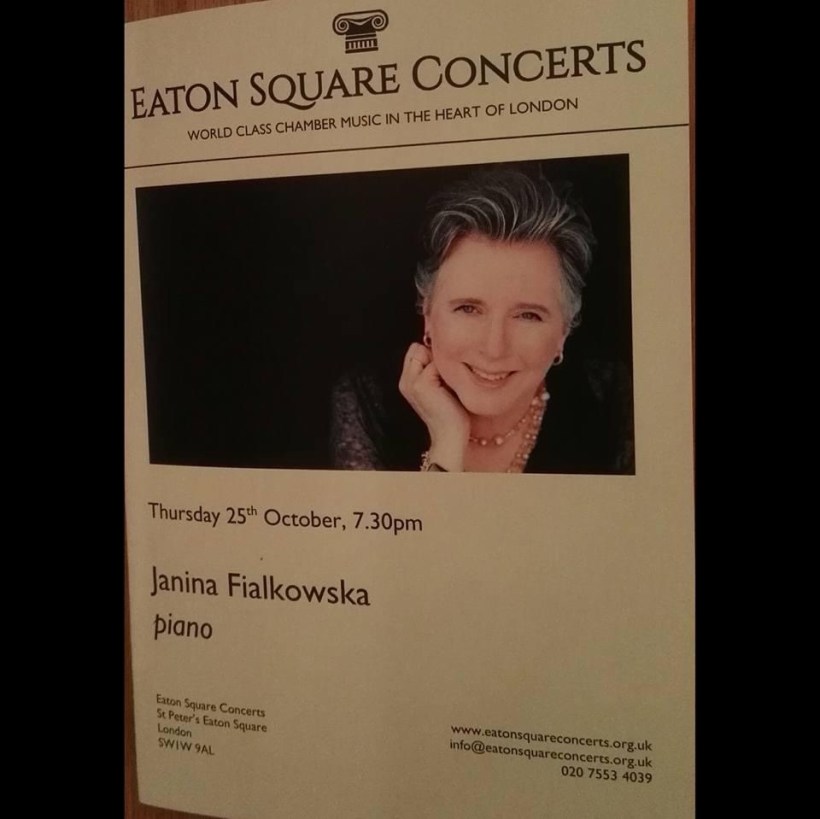
Miracles in Eaton Square Janina Fialkowska at St Peter’s

Miracles in Eaton Square Janina Fialkowska at St Peter’s
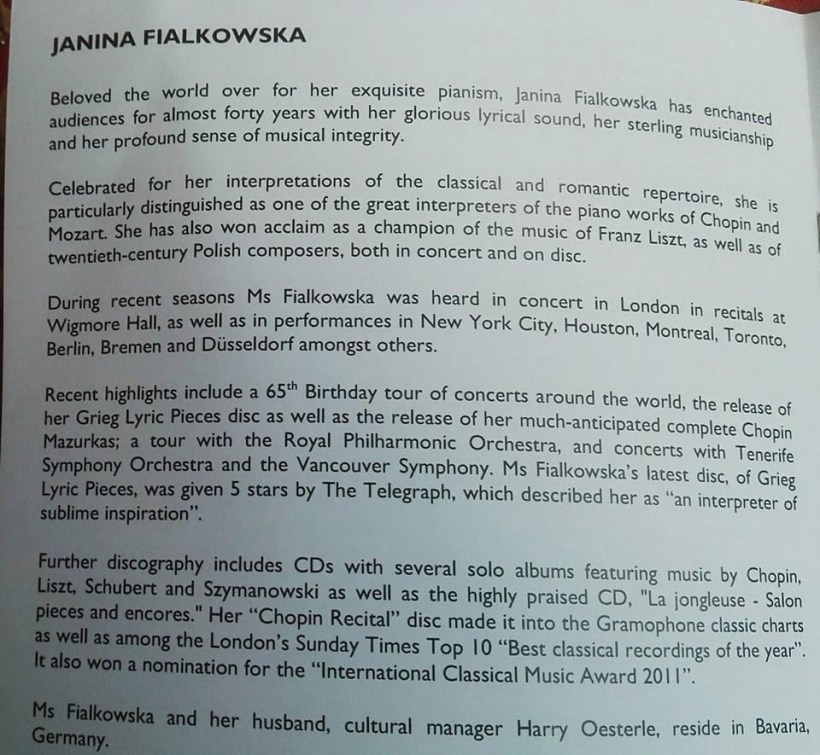
It was wonderful to have Janina Fialkowska back with us again after a second miraculous recovery from a life threatening illness.
To have her back and playing so wonderfully well.
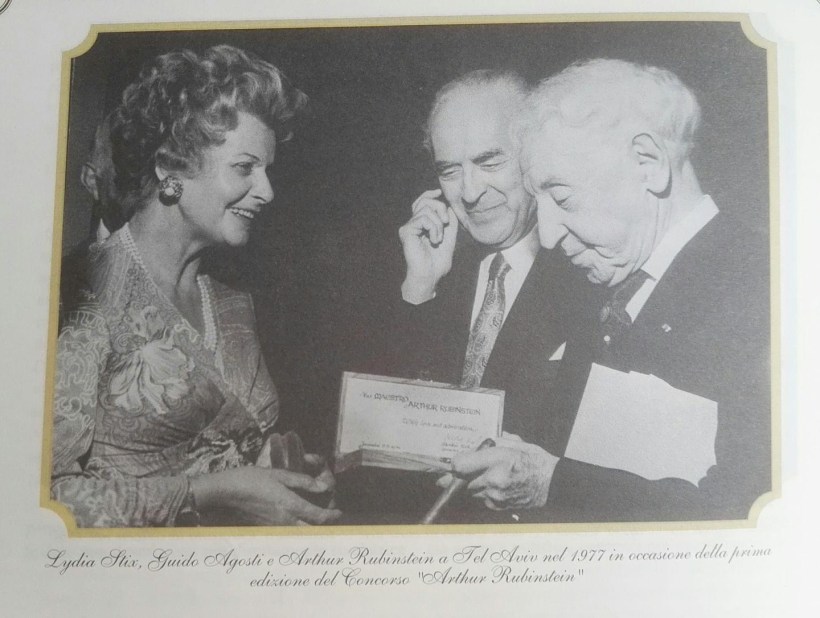
Listening to the magical sounds that she conjured up from a Fazioli piano we could fully understand why Rubinstein had been in tears with her moving performances at the very first Rubinstein Competition.
Infact although Emanuel Ax won first prize she got Rubinstein’s very special prize of concerts worldwide following in his shadow.
Both she and her good friend Emanuel Ax have since been feted by music lovers worldwide.
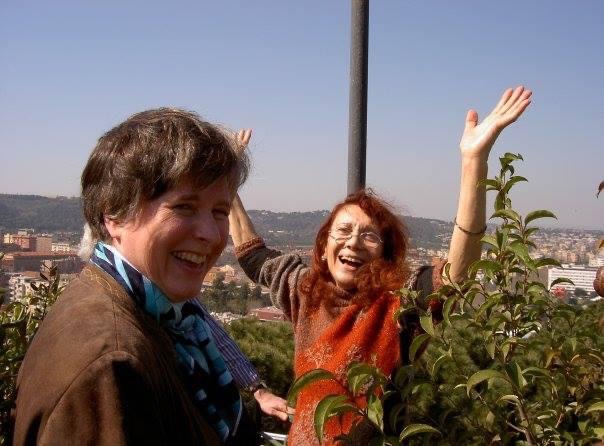
She even came to Rome to play in the theatre that my wife,Ileana Ghione and I had just opened.
She was promoted by the Canadian Embassy and Guido Agosti who had been on that first Rubinstein jury came to applaud her too.
She became a great friend and came back as many times as her worldwide career would allow.
She even brought Harry her future husband to meet us.
She gave a concert in 2006 in memory of my wife who had died on stage a few months earlier in December 2005..
Playing the Chopin Barcarolle she whispered to me in the wings afterwards that,that was
Ileana.
Very special people for me indeed both Janina and Ileana.

Ileana Ghione with Janina on top of Rome
But already some years ago she was told by her doctors that she would never play the piano again due to a growth in her left arm.
Miraculously she proved them all wrong.
Infact she made her come back just a year after this dramatic prediction , in a little town in Bavaria to which her friends flocked.
She played the Chopin B minor Sonata just to prove her point that her seriously weakened left arm was ready to go again.
It is exactly the left hand in the Finale of the Sonata which is feared by every pianist.
She has been playing even better since.
The critics noting that the great virtuoso pianist had now acquired an even more profound voice.
And now years later another illness has struck but also another miracle and she is with us again playing so beautifully.
” Des Abends” was even more beautiful than her mentor Artur Rubinstein.
Jeux d’eau was a miracle of sound and one could almost see “ The river god who laughs at the water as it caresses him “to quote De Regnier.

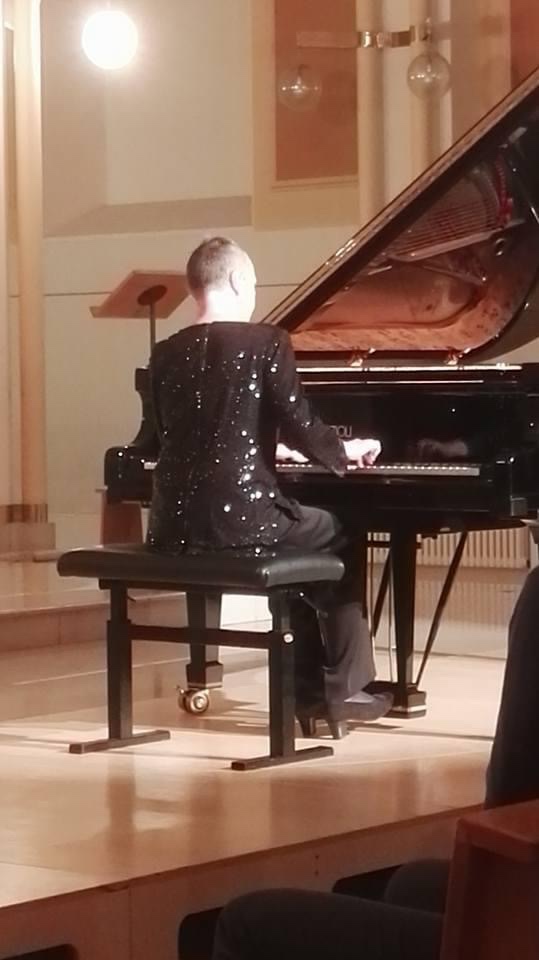
Janina in concert
The Mazuka op 50 n.3 was like a miniature painting in sound.
I have never heard it played with such layers of colour and such character.
A real tone poem with a heartrending story to tell.
The second Ballade and the F minor Fantasie were given passionate performances but always with that nobility and simplicity that was so much the mark of Rubinstein’s then revolutionary break with tradition.
The final beseeching notes of the Fantasie before being enveloped by a wave of sound in many ways made me think of Ravel’s Ondine.
Only the final noble chords reminding me that we were at the end of a marvellous journey with Chopin.
The second Ballade too from the tender almost Schumannesque (it is in fact dedicated to Schumann) melody being so violently interrupted by Chopin’s storm.
A real virtuoso performance that lead so beautifully into the magical mazukas that make up op 50.

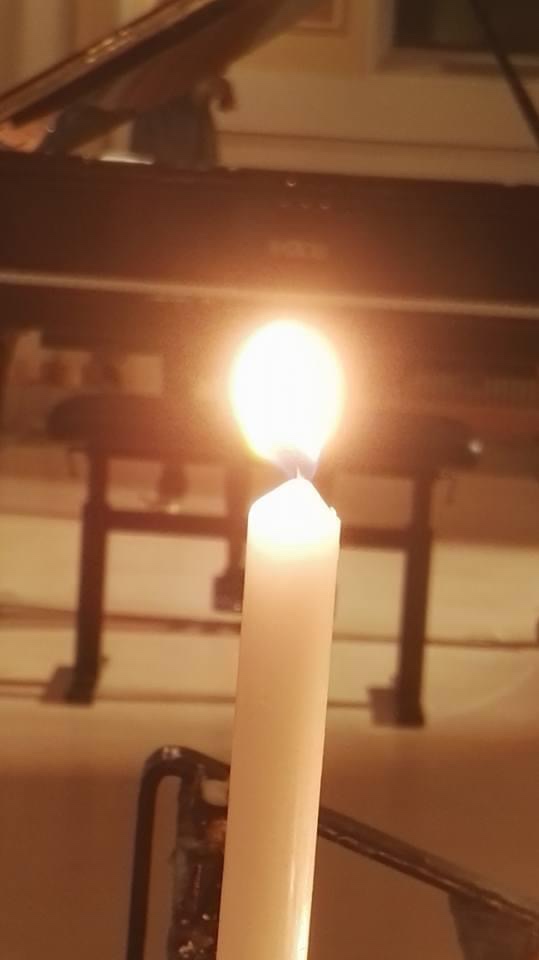
A candle shining brightly for Ileana as Janina ravished us with sublime sounds
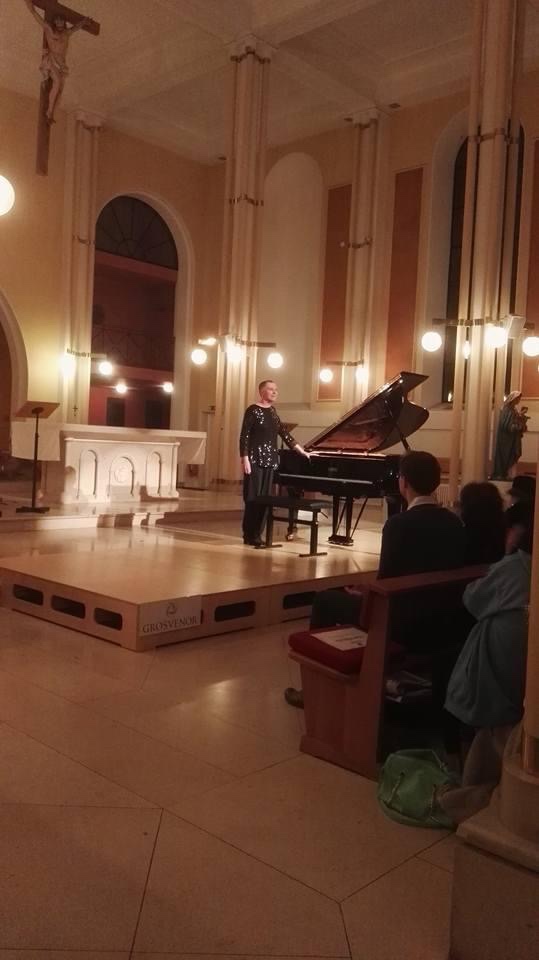
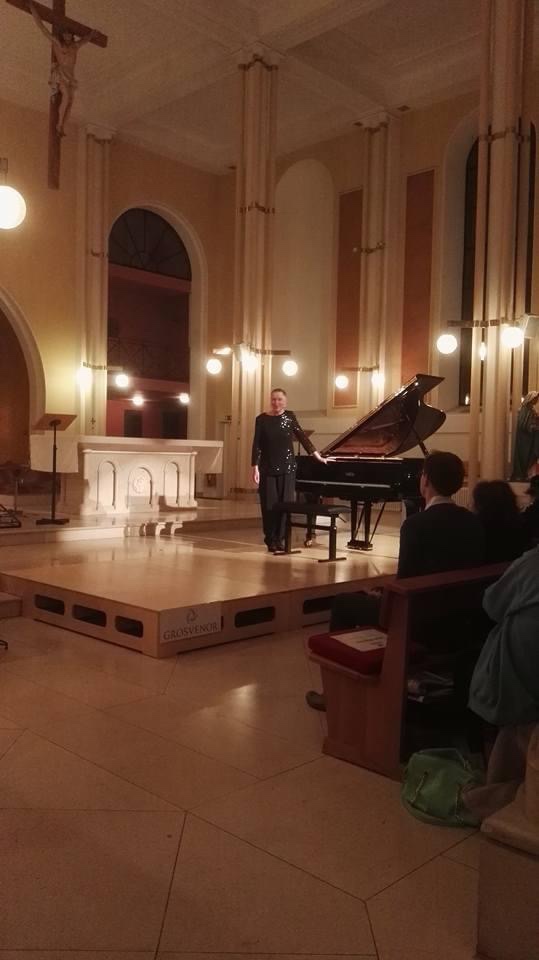
The Mozart Sonata was a real lesson of how one can keep the classical style but make the phrasing so much clearer by a subtle change of colour and shape.
I found the first movement a little too fast to allow the Maestoso marking to take effect But it was so beautifully shaped and the development section so dramatic with the trills glowing so beautifully.The chromatic scale that leads back to the recapitulation was quite miraculous.
The opening of the slow Andante cantabile was sung with such a beautifully pure expressive voice and the phrases shaped to absolute perfection .The tempestuous middle section took us aback as a storm that gradually awakens as the clouds thicken
The Presto was taken as Mozart had indicated but played with a clarity and sotto voce that made the appearance in the left hand almost whispered so much more dramatic instead of the usual rather jagged performances that this work is usually treated to.
I thought the magical change of key could have had a slightly more relaxed tempo but such was Janina’s vision that we were swept away by the whispered urgency of Mozart’s message .

Magic in the air in Eaton Square
The Fantasiestucke op 12 by Schumann were played much as I remember Rubinstein in his last performances in London.
Every movement had a marvellous story to tell and was a little tone poem in its own right.
From the magical sounds of Des Abends to the dramatic outburst in Aufschwung.
The beautiful lines woven so movingly in Warum to be answered by the whimsical chords of Grillen.
In der Nacht and Traumes Wirren showed us that here was still the great virtuoso that we had always known but with a voice that made every note speak so tellingly.
The story she had to tell in Fabel truly reminded me of Rubinstein who could make the simplest of pieces talk as never before.
The grandiosity of Ende vom Lied was followed by a disintigration that was depicted so clearly we could almost imagine the end of a story beautifully told and so back to sleep.

Janina with Amit Yahav
Just one short encore …infact the minute waltz played with the clarity and charm of a true Chopin player who has polish blood in her veins.
The spirit of Rubinstein was obviously hovering over Eaton Square last night.

Linn Rothstein,Janina’s best friend and fellow Canadian with Geoff Cox

China comes to Perivale…MENGYANG PAN at St Mary’s

Mengyang Pan at St Mary’s………and in China
It was very fitting that a favourite such as Mengyang Pan should be celebrating the 100th Tuesday afternoon concert in Hugh Mather’s prestigious series of piano recitals at St Mary’s in Perivale.
And the novelty that it should be live streamed to China too.
I understand there is a move to live stream all the recitals from Perivale in the near future.
I first met Mengyang in Monza in Italy where I had been invited to be on the jury of the Rina Sala Gallo International Competition.
I was asked by one of my dearest friends Constance Channon-Douglass who was too ill to be able to be part of the jury.
I do not normally accept these invitations as the Circus aspect of these events does not appeal to me .
I am not totally convinced that they are helpful except perhaps to the one who comes in first.
It is for the artistic damage to the other artists that I am concerned.
However I well remember two of the contestants: Julien Brocal for his performance of Schumann Carnaval and Mengyang Pan for her performance in the final of the Emperor Concerto.
I also remember the wonderful encore only of the eventual first prize winner Sangiovanni Scipione after a rather poor performance of Liszt Concerto n.2 hampered by an orchestra that had obviously not rehearsed enough a work they had not played before.
Such is the Circus aspect but it is nice to know that all three are forging ahead with notable careers .

Mengyang Pan
What I did not know at the time was that Mengyang Pan was a student of two of my esteemed colleagues in London.
Tessa Nicholson at the Purcell School where Mengyang received her early training from the age of fourteen leaving the Central School of Music in Beijing where she had studied since the age of nine.
Tessa is fast building a reputation for training brilliant young musicians both at the Purcell School and the Royal Academy.
Mark Viner,Tyler Hay,Karim Said and Alim Beisembayev amongst many others have a lot to thank her for.
Mengyang Pan went on to study with another much esteemed colleague, Vanessa Latarche ,head of Keyboard Studies at the Royal College and former star pupil of the much missed Eileen Rowe in Ealing.
Mengyang’s performance of the Emperor I have long remembered and have on DVD from the competition.
I remember it for it’s clarity,precision but mainly for her complete understanding of Beethoven’s world that can go from the imperious to the most touching without any warning.
Such was Beethoven’s complex character .But always in Beethoven there is an underlying forward current that gives a terrific sense of architecture even in his simplest works.
It was just this that made her performance of what can sometimes seem much overplayed “Appassionata” Sonata op 57,so refreshing and in many ways original.
Her Grandiose approach to the opening Allegro was of great effect.That slight wait before an important bass note sometimes even adding an octave very subtly was of aristocratic nobility.
The accentution of the downward scale on the first of the groups of five was a bold decision that was totally convincing.
The playing of the great arpeggiandi with one hand towards the end of the movement would have had the approval of Arrau and all the great Beethoven interpreters.
The struggle to play such passages without splitting the hands in a more pianistic way is exactly the struggle that Beethoven infused into the very core of his music.
Anyone who had seen Serkin at work would realise just what it means to struggle and suffer as Beethoven obviously did to the bitter end.
Dramatic contrasts and taught rhythms were all here but together with a flexibility when the time came to reveal the heart and soul that was also very much part of Beethoven’s character.
The Andante con moto played with the weight of a true string quartet where every part gave such substance to this long cortege.The impetus and subtle shaping of the variations was a lesson to behold and the sudden interruption even more astonishing because of it.
The Allegro was played with great precision and energy.
I found the occasional jeux perle and clipped chord of arrival not quite in keeping with her overall majestic conception of this masterpiece.
But masterpiece it is.
Restored so brilliantly to its rightful place and sent with much love all the way to China.
The second half of the programme was dedicated to Spain.
All brilliant rays of light and heartrending nostalgia.
Mengyang loves teaching and comunicating as was shown by her delightfully informed introductions.
She does infact hold important posts at Imperial College,Blyth Centre for Music and the Visual Arts and St Paul’s School.
Lucky them is all I can say as she introduced us to a relatively unknown work by Albeniz.

Introducing the works to her sold out audience in Perivale
His Cantos de Espana op 22.
But sugaring the pill with an old warhorse of the great virtuosi of the past :Moszkowski’s Caprice Espanol op 37.
(I had studied with Perlemuter whose first teacher was Moszkowski and I have never been able to reconcile that fact with this illustrious interpreter of Chopin and Ravel)
Many of the Cantos are well known from the guitar transcriptions.
The Prelude in particular with its repeated notes and urgent interruptions so typical of the Spanish folk idiom.
Superbly managed and contrasted with the long languid melody in the tenor register of the Orientale.Allowed to sing so touchingly and commented on by a coquettish right hand.
The Scot Joplin ease of Sous le palmier was greeted by the sombre drum roll of Cordoba where the question and answer between the hands was a pure delight.
Seguidillas was full of sun and light alternating between the subtle and delicate only to be enveloped by the infectious dance rhythms that are so much part Spain.

Embracing Hugh Mather and thanking us all for the fun that she had had, and hope that we had too
Caprice Espanol was given a performance in the style of the Golden age of piano playing as we have heard in recordings of Levitski,Godowsky,Rosenthal and Cherkassky.
The magic world of  jeux perle and subtle hinted melodies that appear and disappear like gems in the brilliant sun.
Such sounds conjured out of her magic hands just thirty minutes on from such an exemplary Beethoven.
It took us all by surprise and her charming thank you to the audience in Perivale and China ,in which she exclaimed what fun she had had and hoped that we had too.
Her encore of Gershwin’s first prelude brought the house down and a wish to hear much more of this charming young lady with a bag so full of remarkable jewels

with Hugh Mather

Love,Betrayal,Death and pure fun at the Chelsea Arts Club

Love,Betrayal ,Death and pure fun at the Chelsea Arts Club
I like to think that it was not just a coincidence that Umberto Jacopo Laureti and Adrian Brendle were performing in two different venues on two different nights in the centre of London over the weekend.
Both are ex students of my old Alma Mater the Royal Academy and more importantly coached by the only British pianist to have won first prize at the Artur Rubinstein Competition in Tel Aviv.
I am talking ,of course ,about Ian Fountain.
It is a well known fact that many illustrious musicians who live in London are very rarely invited to perform in the capital.
Infact Ian Fountain was on a plane to a concert tour in China whilst leaving us with two of his prize students in London.
It is obvious listening to the extreme intelligence and musicianship of these two young artists that the coaching they have received over the past years has helped shape their artistry and will be a solid base for future growth in their up and coming careers.

Umberto Laureti
Umberto’s was a cameo performance as an introduction to an operatic evening which included a mini Italian wine tasting.

St Giles Cripplegate
Whilst these fine young singers were invoking Love ,Betrayal and Death ,Umberto was ravishing their audience with a beautifully shaped performance of Liszt’s paraphrase on the quartet from Verdi’s Rigoletto.
Some virtuoso playing on a beautiful sounding Steinway in St Giles Cripplegate just the other side of the lake to the Barbican Centre.
Beautiful sounding but quite problematic mechanically Umberto was to tell me later.
But such was his artistry and professionalism we were not at all aware of the battle he was waging in a performance of quite breathtaking sweep and colour.
It was just last June that Adrian Brendle had played in the same church but on a specially imported Bechstein for a concert dedicated to the famous lunchtime National Gallery concerts that Myra Hess instigated during the war.
All the pictures had been placed in a safe haven whilst the Londoners including the Queen decided to stay with Churchill and battle it out with the enemy.
This too had been given a general title of “Swords and Ploughshares “
Now the day after Umberto’s concert Adrian had been invited to play in the beautifully intimate Arts Club in Chelsea.
Introduced by the soprano and satirist Melinda Hughes ,here wearing so beautifully her hat as artistic director of the Sunday Night Concerts.

Melinda Hughes introducing the artist in her inimitable way
A beautiful new Steinway awaited tonight and little did I know that it had been chosen Alexander Ullman one of our stars from the Keyboard Charitable Trust.
In fact what Melinda did not know either is what a closely knit family we are as Adrian and Umberto too have been selected just recently to play for the Keyboard Chartiable Trust .

Adrian Brendle totally involved with a piece written for him by his colleague Elias Corrinth
As with his recent Steinway Hall concert for the KCT he performed a piece written for him in 2015 by Elias Corrinth.
The opening Invocation is an echo to the opening poem of Scriabin’s 5th Sonata:”Je vous appelle a’lavie,o forces mysterieuses!”
A wonderful sense of colour and commitment kept this distinguished audience spellbound.

The Arts Club audience
This was followed by a remarkable performance of the 13 Preludes op 32 by Rachmaninov .
Here are my thoughts from his performance of the same works just a few months ago at Steinway Hall in London,
No Rachmaninov Celebration could be complete without one of his famous transcriptions.

Adrian Brendle introducing the concert
The concert opened with a virtuoso performance of the Suite from the Partita in E for violin by J.S.Bach.
It is a long time since I listened to a recording of Rachmaninov himself playing this together with his more well known transcriptions of works by Kreisler and Mendelssohn.
Even though transcriptions there is the unmistakable voice of Rachmaninov throughout.
Adrian Brendle gave a superbly rhythmic,virtuoso performance of the Prelude Gavotte and Gigue holding the audience’s complete attention right from the very first notes.
A short one hour concert followed by a sumptuous supper in the beautiful old world dining rooms of the Arts Club.
Hosted by Melinda Hughes who tells me that she too will be giving performances in London this week as an International Satirist with her “deliciously wicked political and social satire””so clever…every pun hit the mark”The Times.
She certainly has a lot of ammunition this week!

Melinda Hughes hosting the post concert supper

Adrian Brendle being congratulated for his performance

A Celebration of Rachmaninov