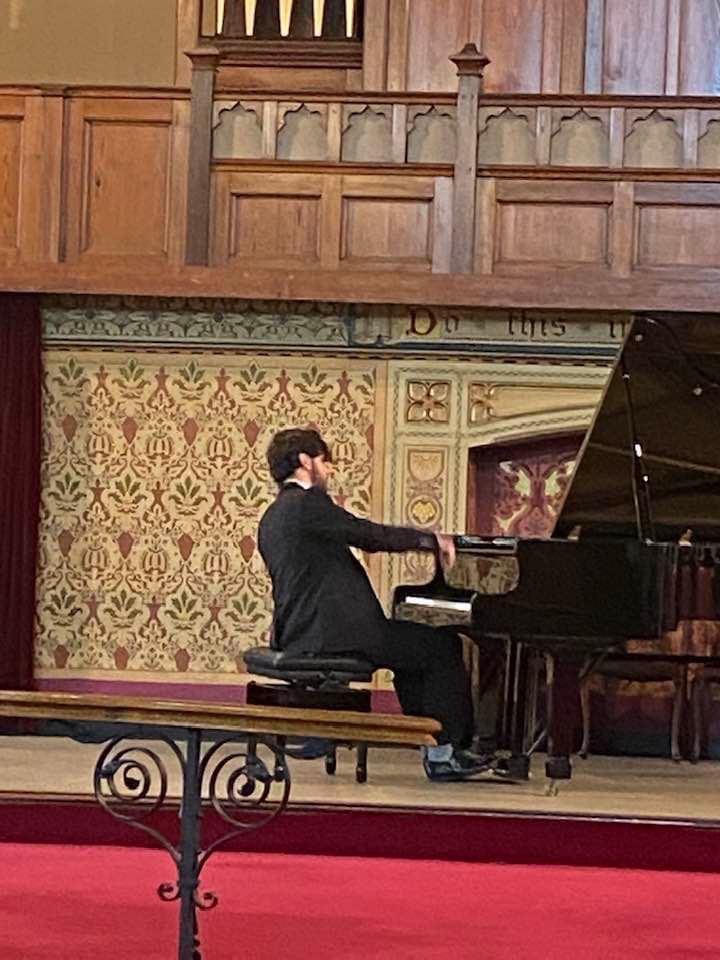
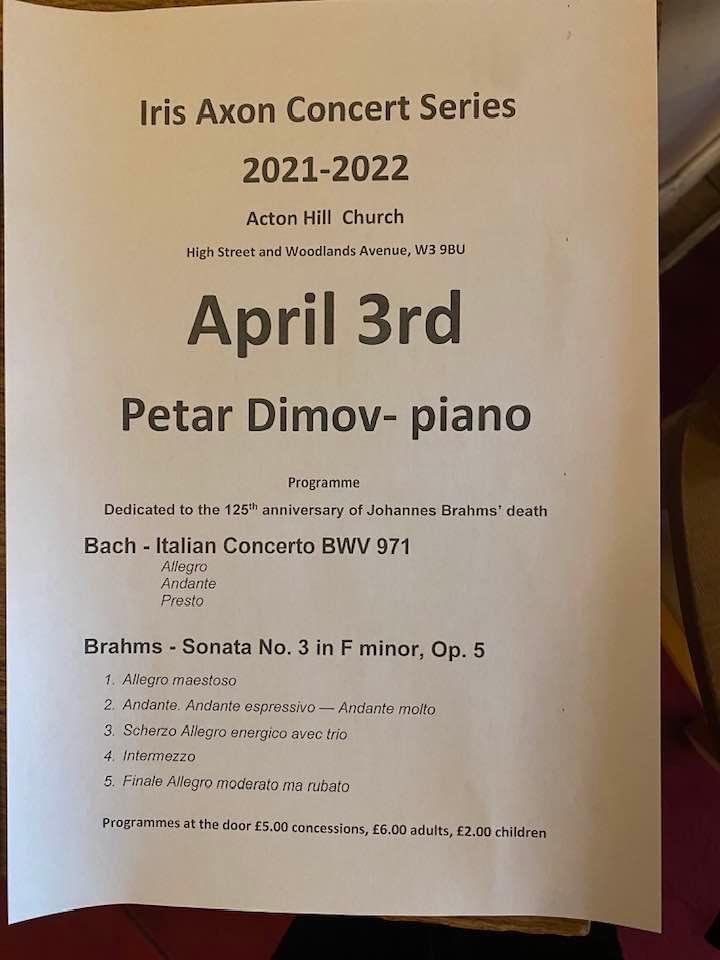
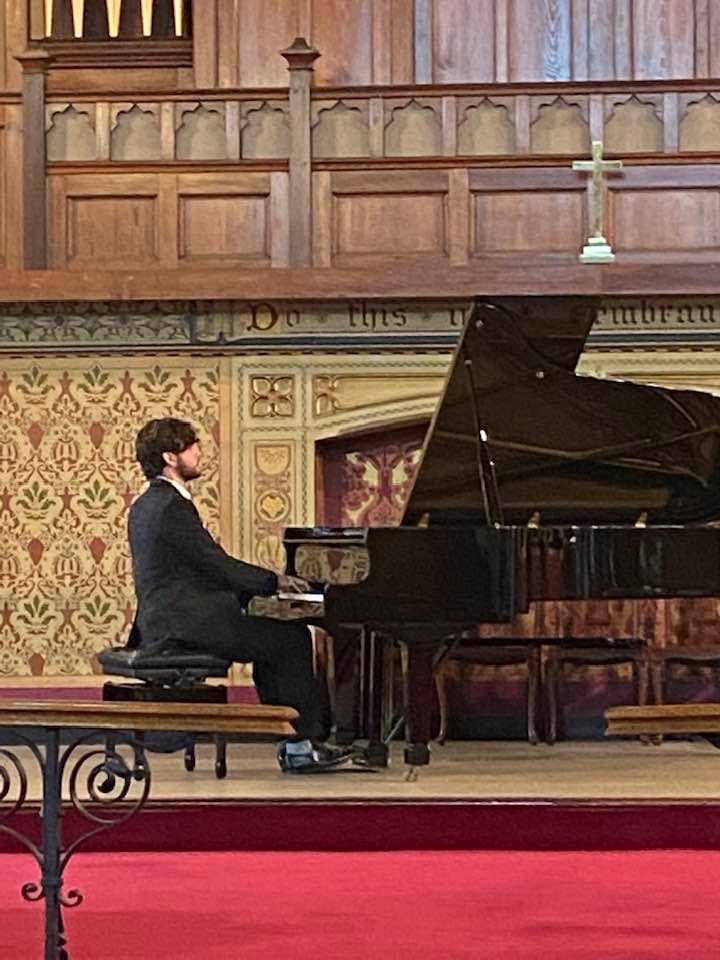
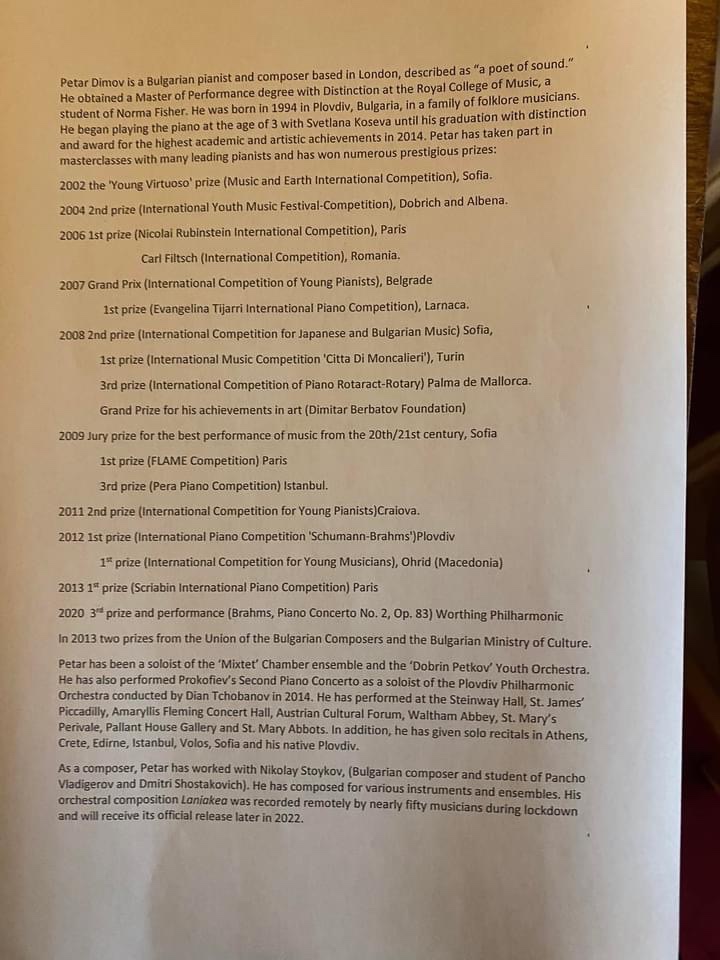
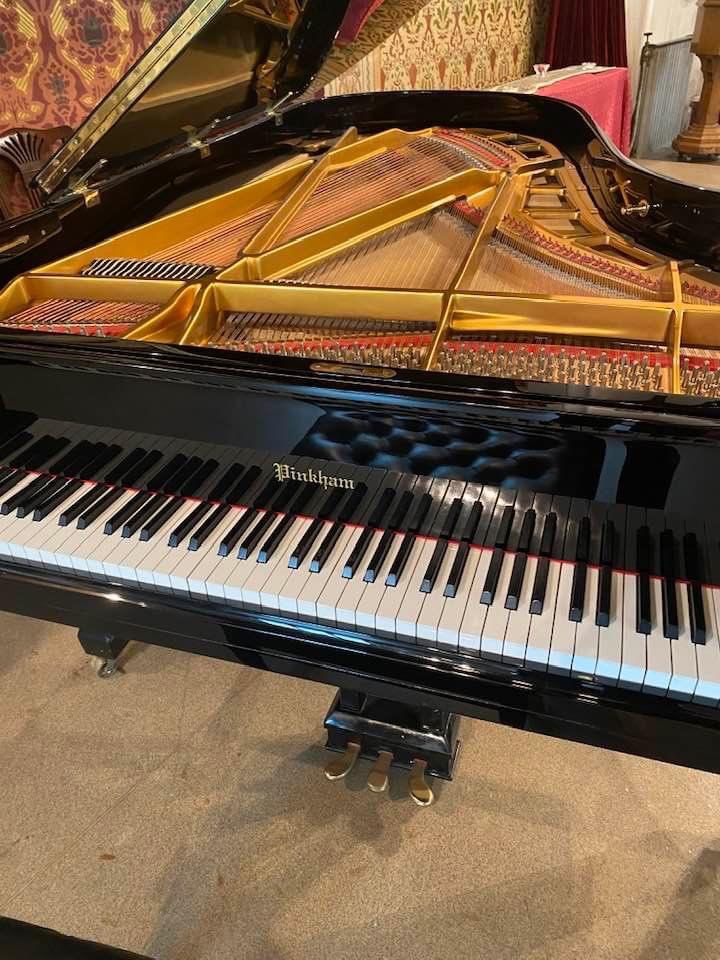
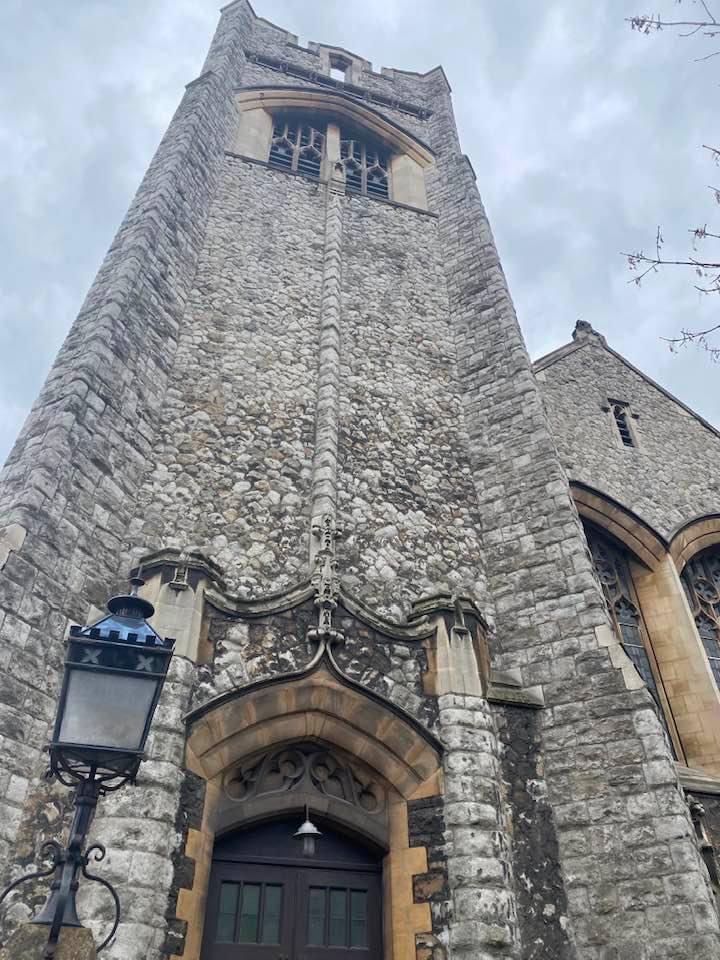
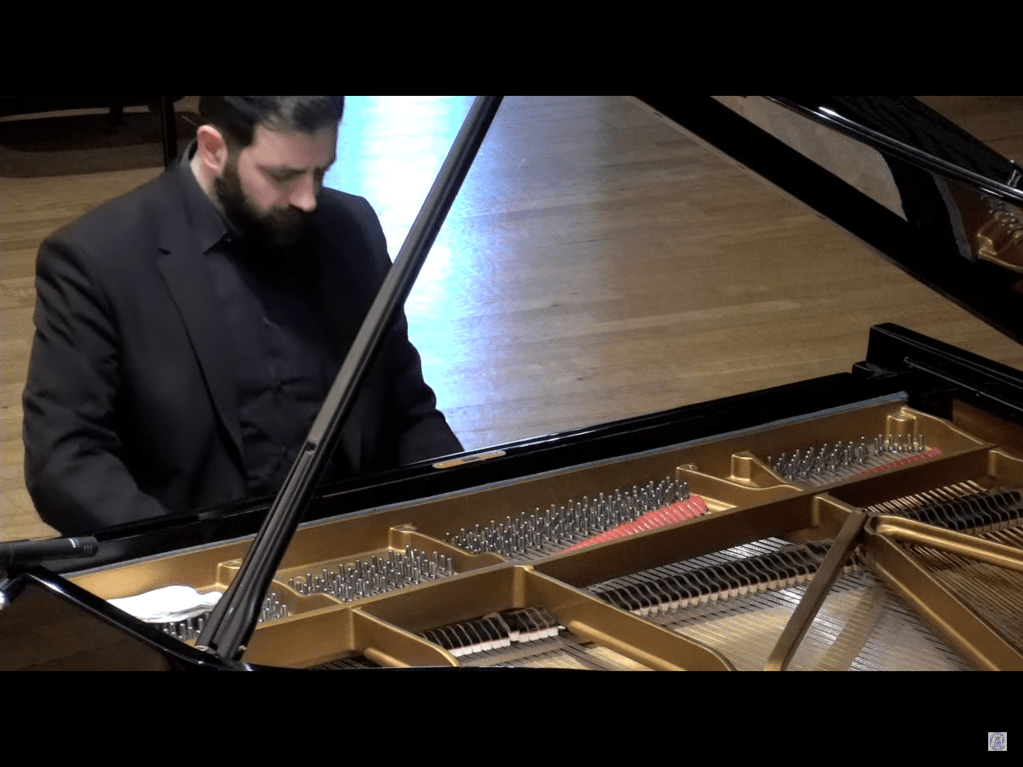
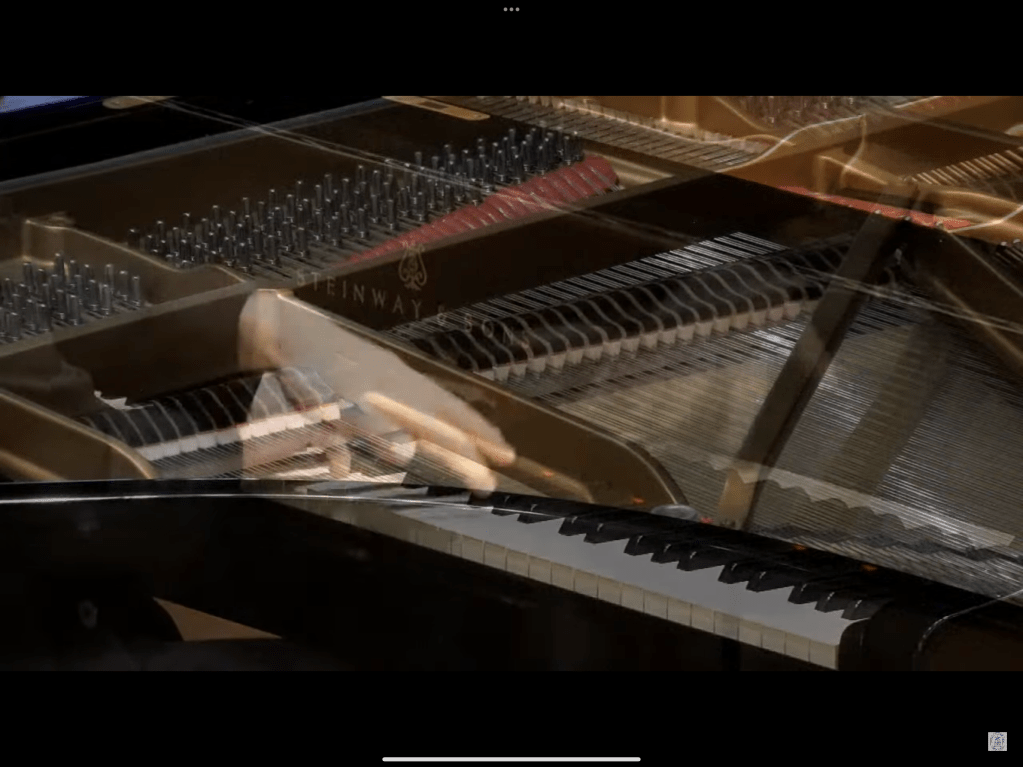
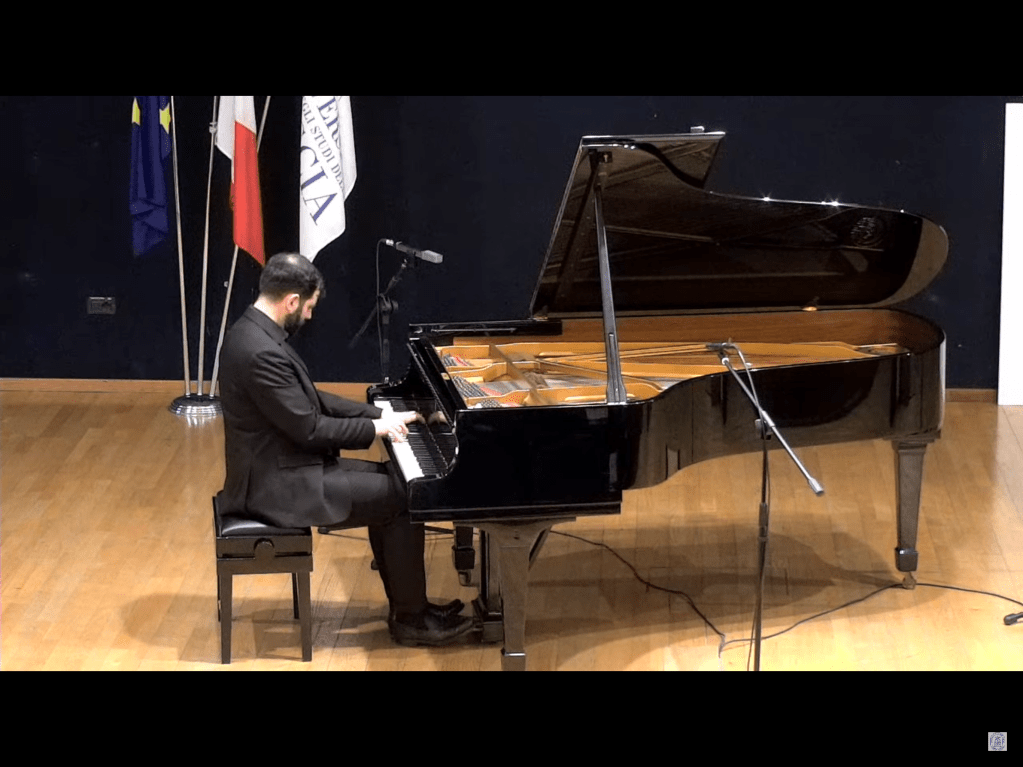
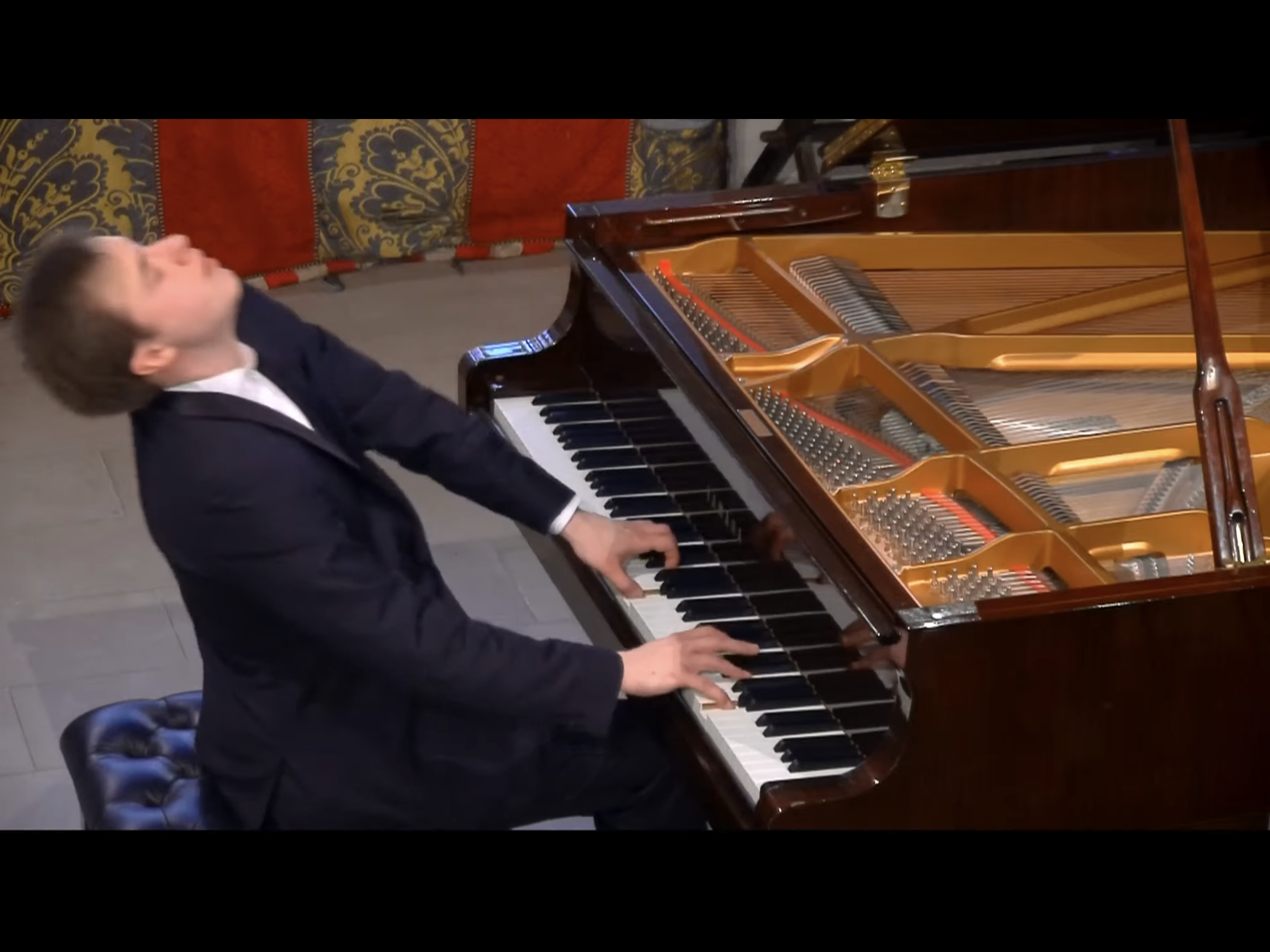
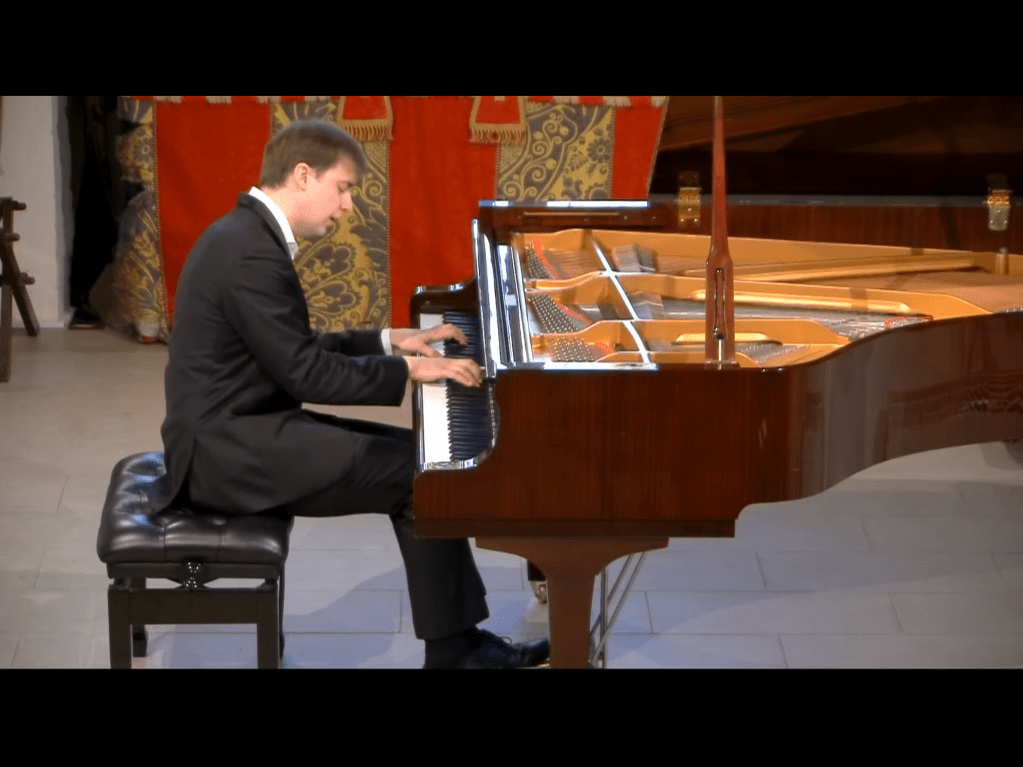
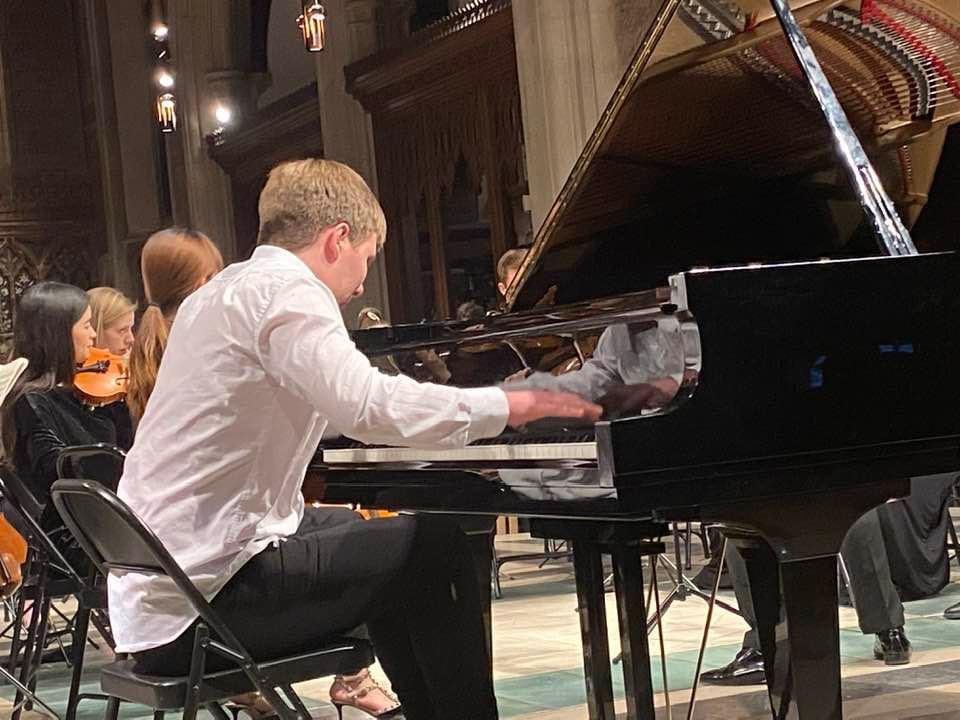
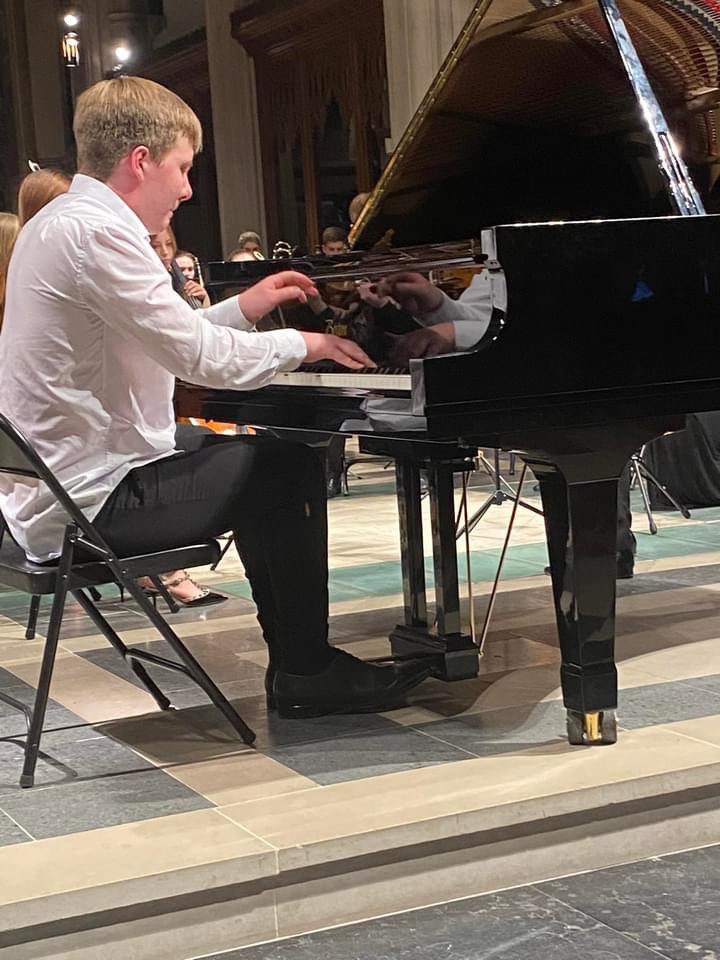
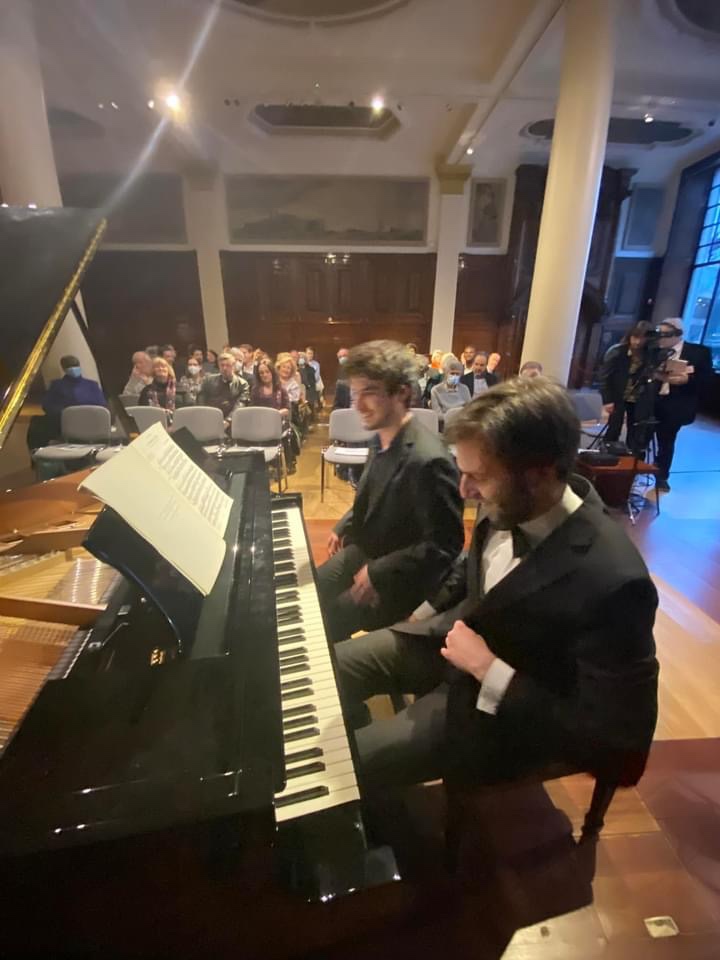
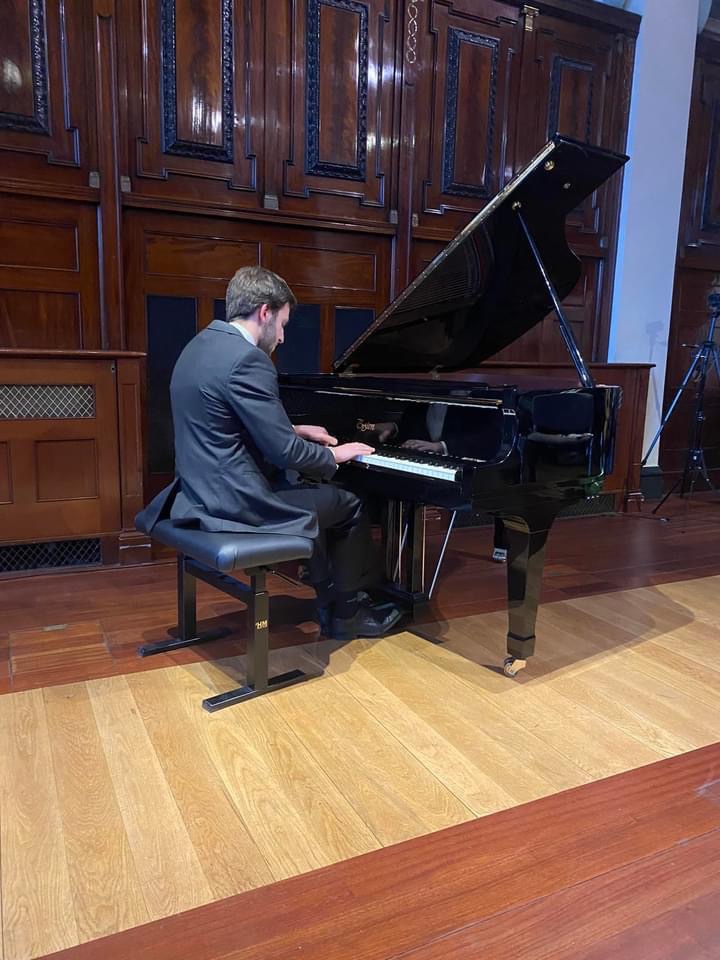
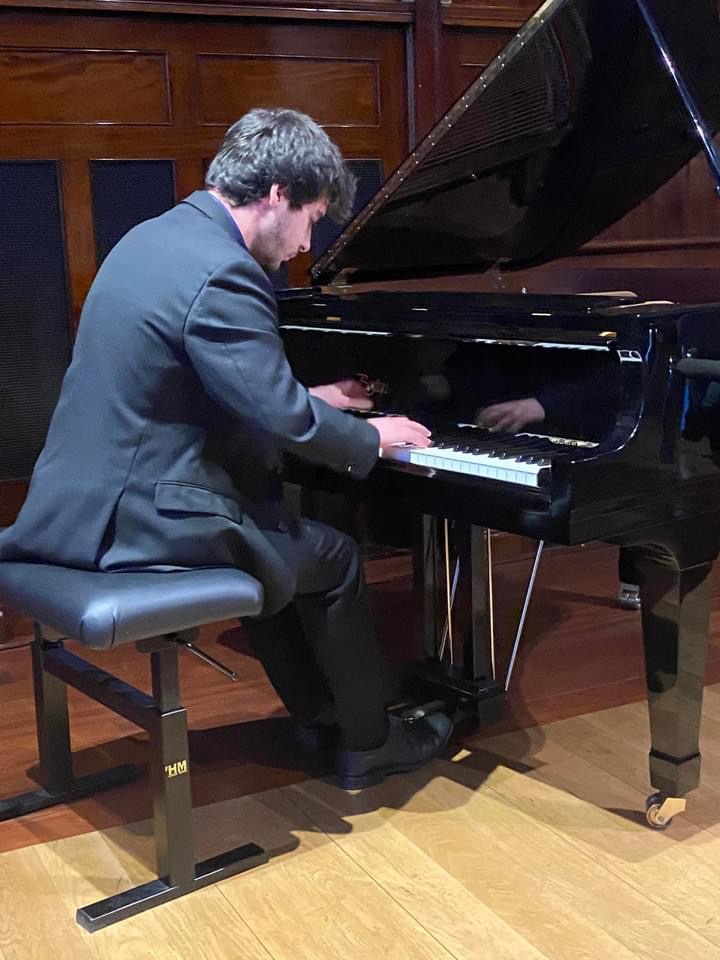
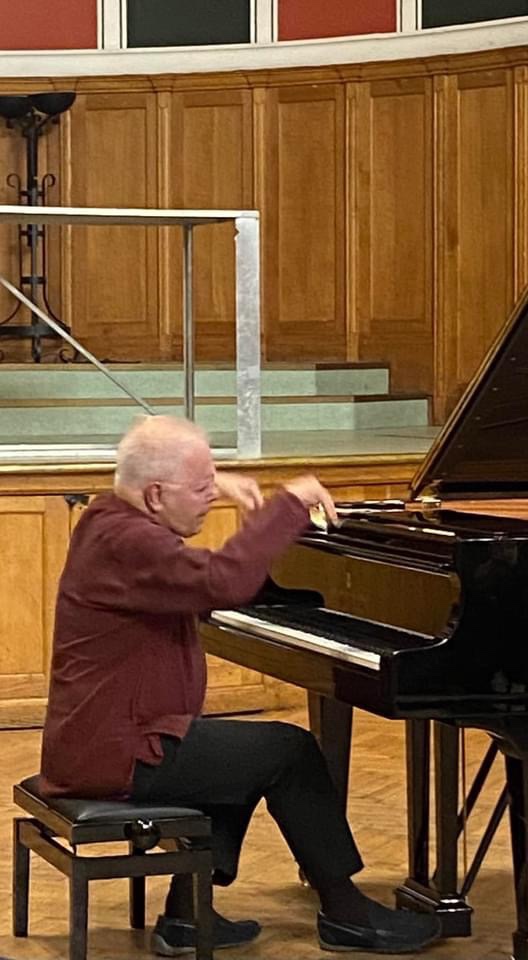
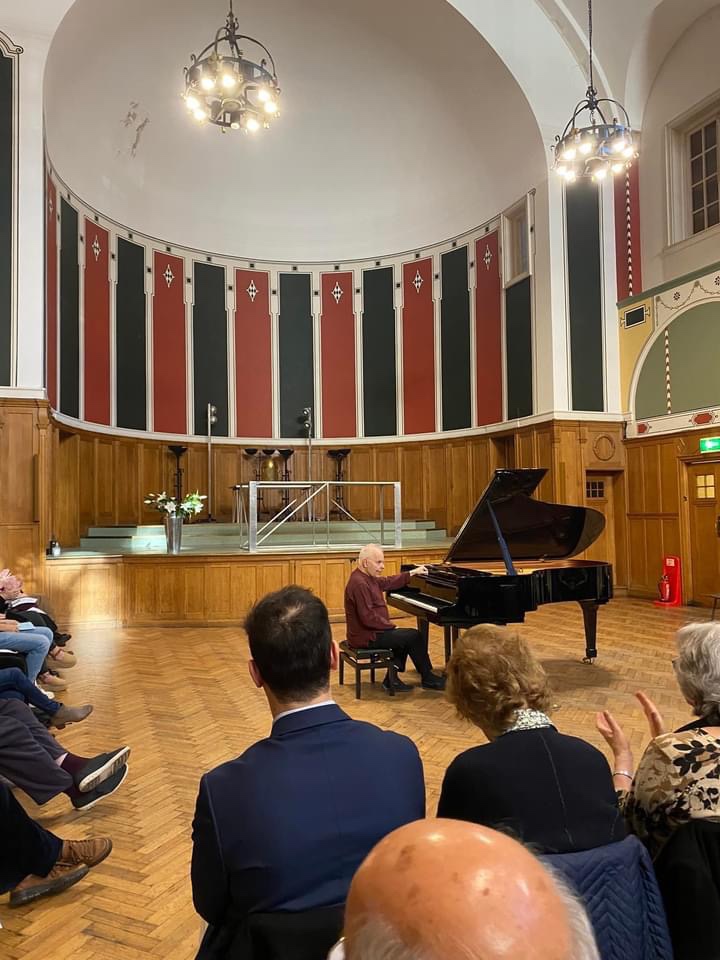
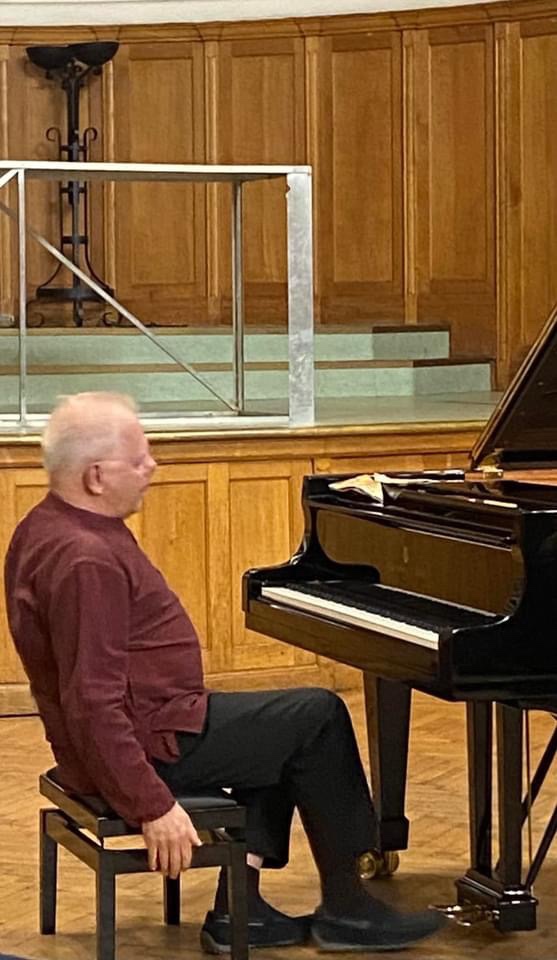
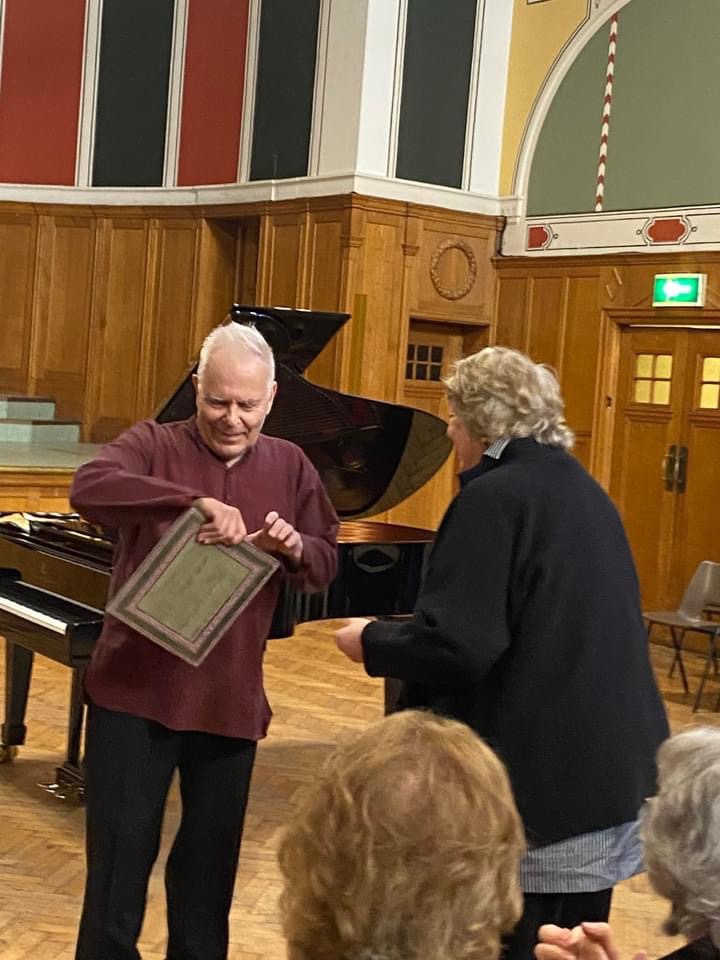
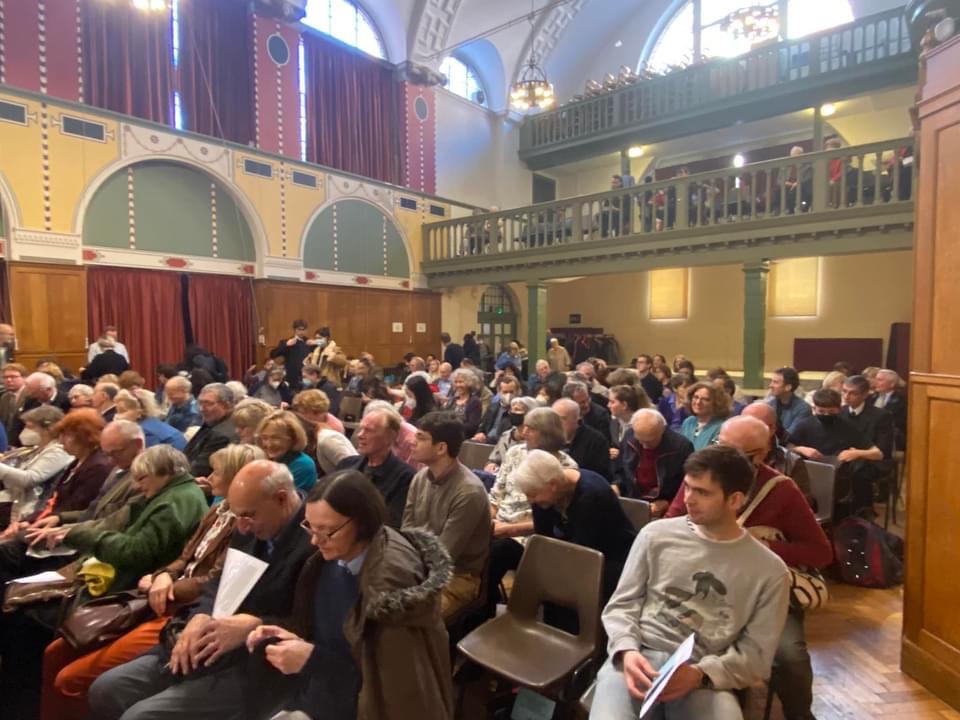
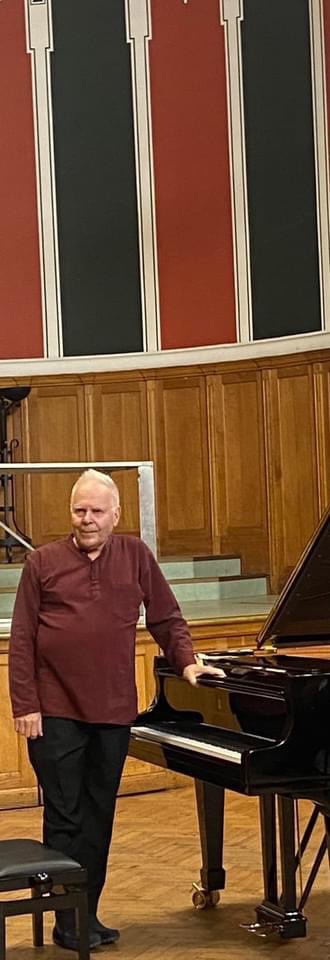
Petar Dimov playing in this new venue today two masterworks of the keyboard literature. Played with unusual intelligence and musical integrity that brought refreshing new life to a well worn friend like the Italian Concerto. It was interesting to see a gleaming new grand piano mounted on a stage like plinth in this Methodist Church in the centre of Acton in west London.Looking at the name of the piano I was surprised to see a name unknown to me……I have known many makes of piano even including a Barenboim but the name Pinkham was new to me.The very informed church master of music ,Jane Schopf,suggested I look on google for information about this piano made in Cornwall – something I was glad to do as you will see below. But it is Petar Dimov’s playing that was so interesting.
A Bach with such subtle ornamentation that gave character to the outer movements bringing them vividly to life with a real sense of joie de vivre in the Presto and of the grandeur of concerto in the Allegro moderato.The Andante by contrast was of a disarming simplicity allowing Bach’s beautiful aria to sing with such purity over the continual bass heart beat.The hushed re entry of the solo voice where a mere murmur drew the audience in to marvel at the simplicity of Bach’s genius where so few notes could mean so much. The beauty of the piano sound too was remarkable for its purity and penetration where the kaleidoscope of sounds in the Brahms was remarkable for its warmth and clarity.
Of course Petar’s masterly musicianship had much to do with that but was helped rather than hindered by an instrument that responds so readily. There was a sense of orchestral colour as the majestic opening chords of the Brahms F minor Sonata rang out only to be answered by the gentle palpitations of the horn and cello’s or the grandiose chorale with the non legato bass comments. Such grandeur that was to dissolve into liquid sounds of ravishing beauty before the grandiose development episode that gave way to palpitations in which a dialogue emerges between bass and tenor registers. The Andante was of luminosity and a constant flow of beauty gradually leading to the magic of the ‘poco più lento’ where the tone that Petar was able to share was of a whispered confession of such delicacy. Gradually increasing in intensity until the explosion of passion that Brahms himself marks ‘con passione e molto espressivo’.The consequent gradual disintegration was enhanced by the care that Petar took over the rests in the final gentle pulsating left hand before the coda that Brahms marks ‘Andante molto espressivo pianississimo’.This is surely one of the marvels of all piano literature that Petar played with the same absolute simplicity and beauty that all those that heard Rubinstein or Curzon have never forgotten.
A scherzo that flew out of his fingers but with such attention to detail where the great bass melodic line was commented on by gently cascading streams of notes in the treble with a clarity and care of phrasing that was rare indeed.The trio too was played with the full rich sound of a string orchestra where all the voices had an importance that created a sumptuous whole. There was a stark mystical atmosphere to the Intermezzo introduction to the last movement that was played with an improvisatory quality that was both tender and terrifying with its thunderous bass notes relentlessly insistent.Leading to the final gasps played miraculously without any ritardando or pedal.The finale was played at a deliberate pace where the syncopated chords acted as break like interruptions before the final abandonment and mellifluous outpouring of melody.The rich and glowing sound of the chorale was of a beauty worthy of the Philadelphia orchestra as it gradually built up to the frenzy of the coda on which floats the melodic line in a sort of whirl of almost Irish merriment! Finally the frenzy giving way to a passsionate climax in an explosion of grandiose full orchestral sounds of sumptuous beauty. An encore of one of Petar’s own compositions just went to demonstrate the complete musician that he is.
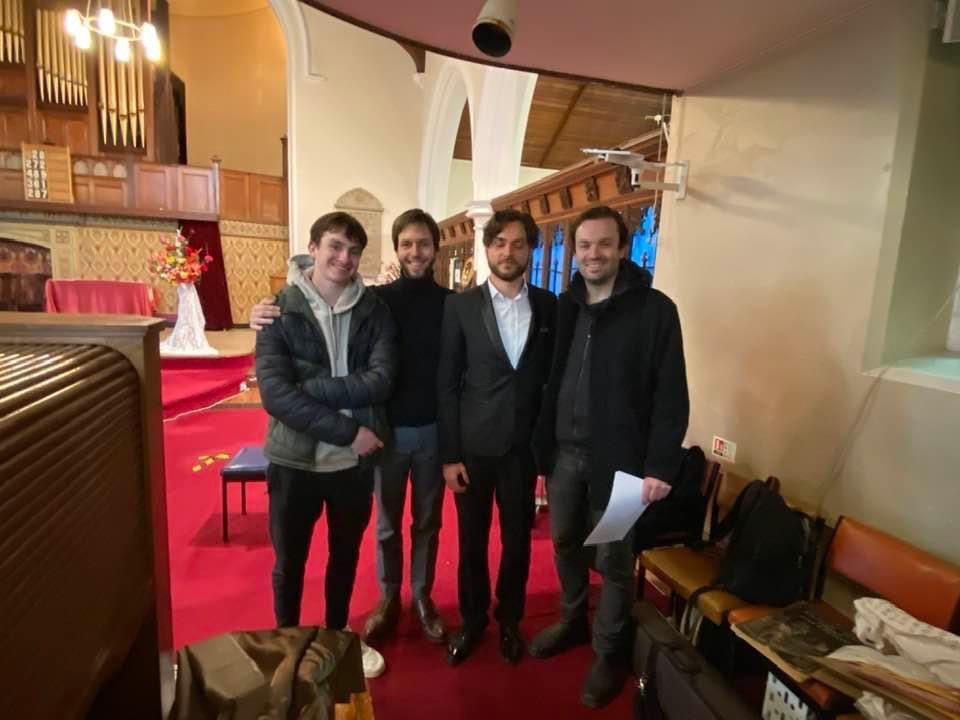
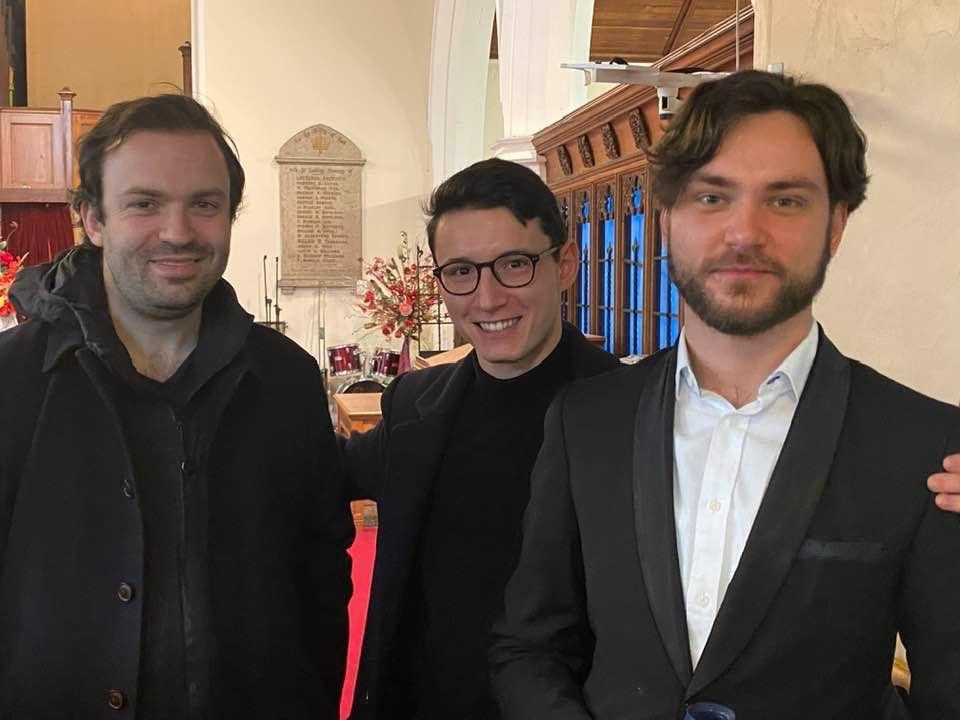
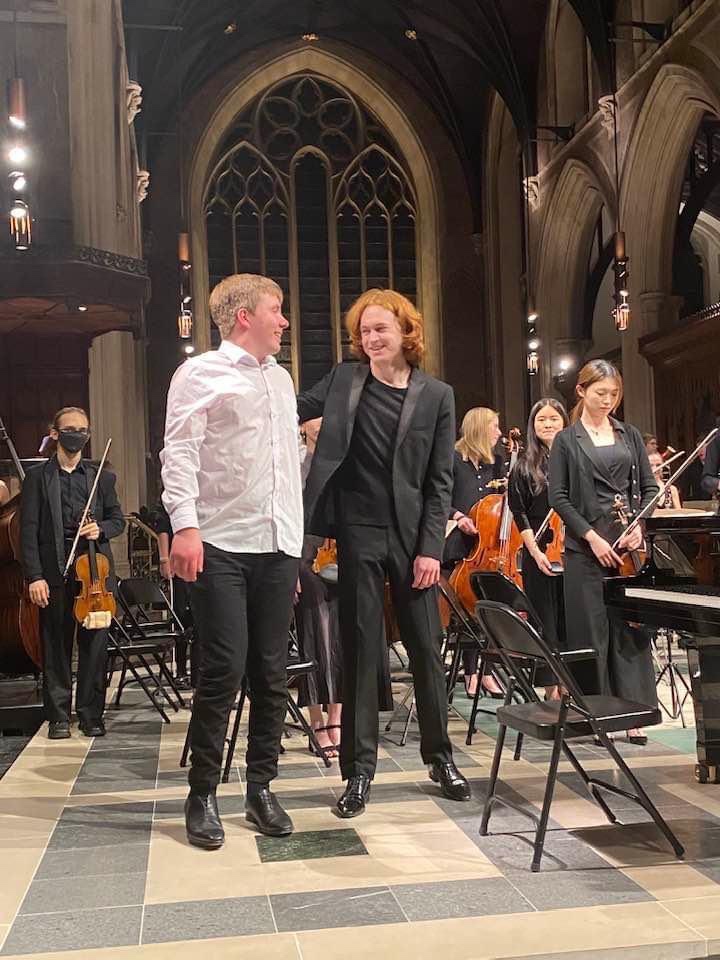
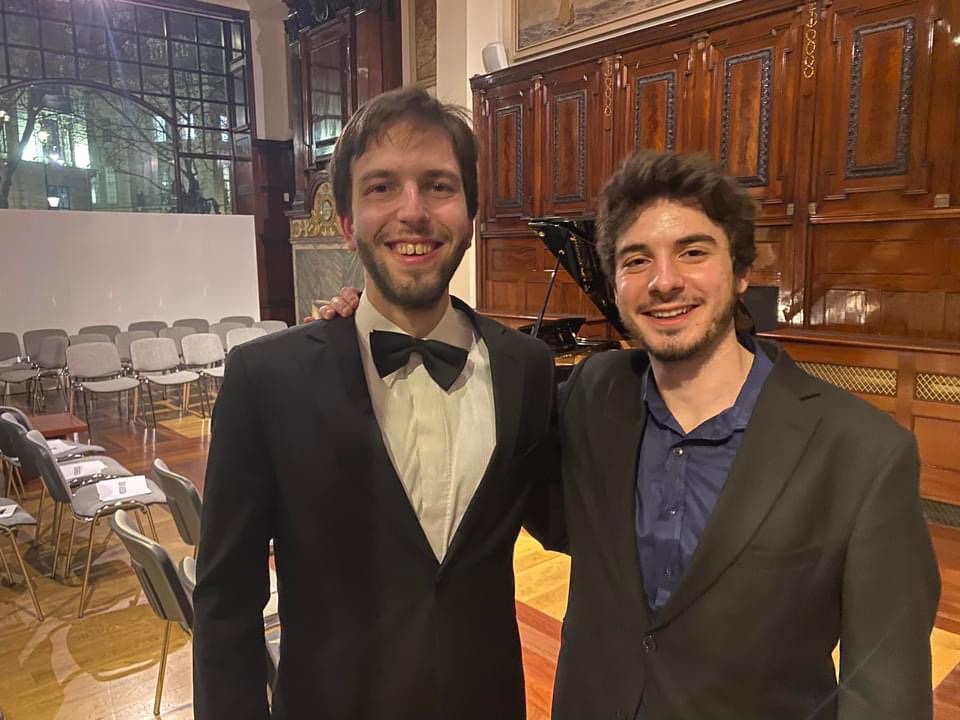
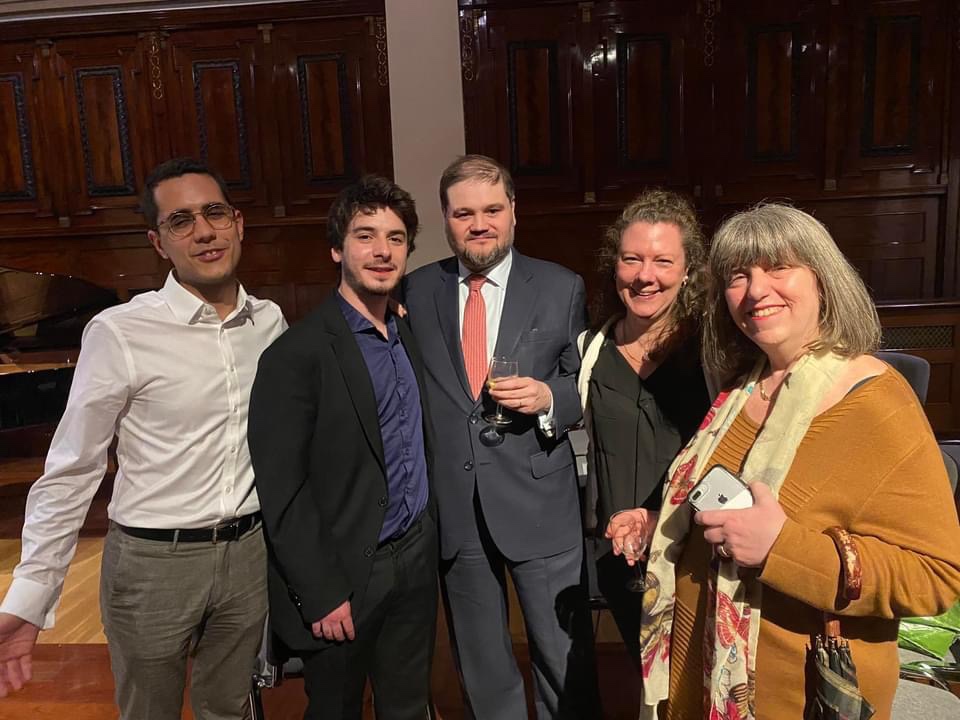
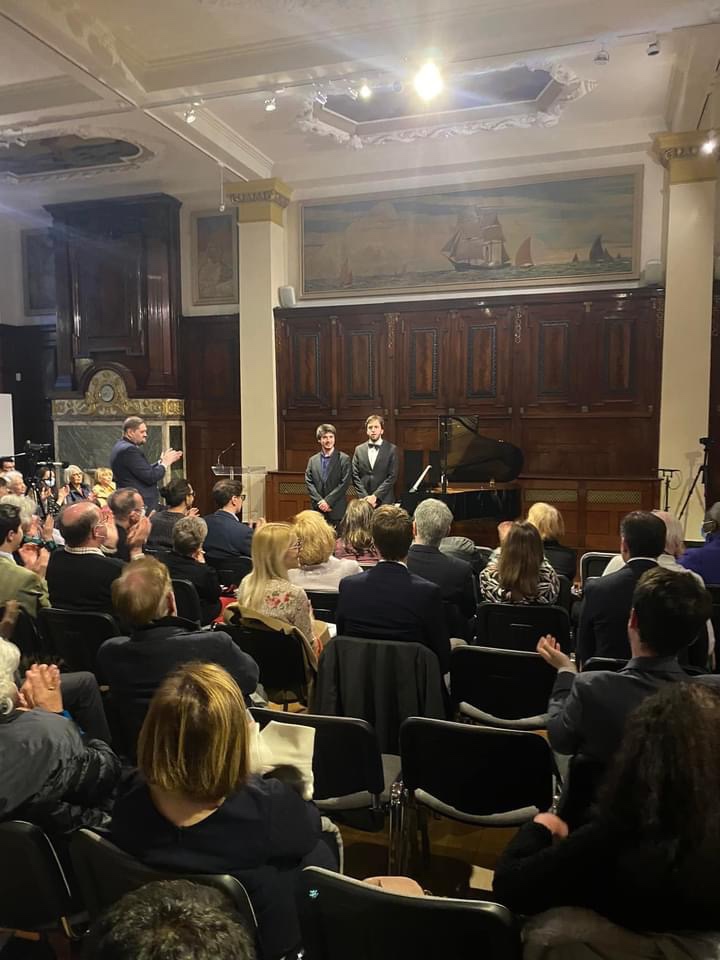
Matthew McLachlan Damir Duramovic Petar Dimov Ross Koopmans
It was refreshing too to see his musician friends present to admire and salute their colleague on one of his all too rare public performances .
Clive Pinkham’s love and passion for the piano started from a very young age. The enthusiasm for the instrument gave him a lifetime of dedication striving for perfection. He used to do ten hours a day piano practice and found it frustrating having to play on poor pianos. From this a burning desire was born to make a piano that would respond accurately to what he asked of it. His aim was to create a piano that was affordable to all. A piano that would respond accurately to what he was asking from it, and a piano that would produce an effortless long rich sweet singing tone. Clive Pinkham gave his first piano recital at the age of eight and went on to win the prestigious August Holmes scholarship to the London College of Music. He has given recitals at the Purcell Room of the Royal Festival Hall, at the Wigmore Hall and has appeared on American and British television. “My philosophy is a total commitment to quality and customer satisfaction. For me it is important for my pianos to be of the very best as it is my name that is on the front of each piano, and I know myself first hand how much pleasure can be given by a piano that is a dream to play.” Telephone: +44 (0) 845 0703833 / +44 (0) 1579 370423 clive.pinkham@pinkhampianos.com
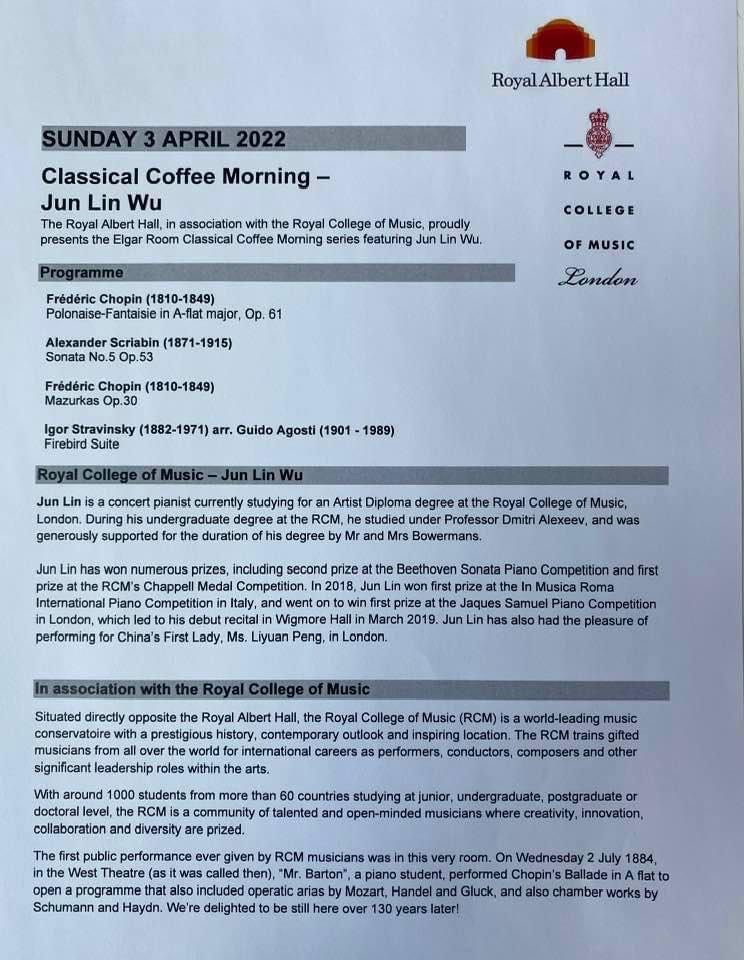
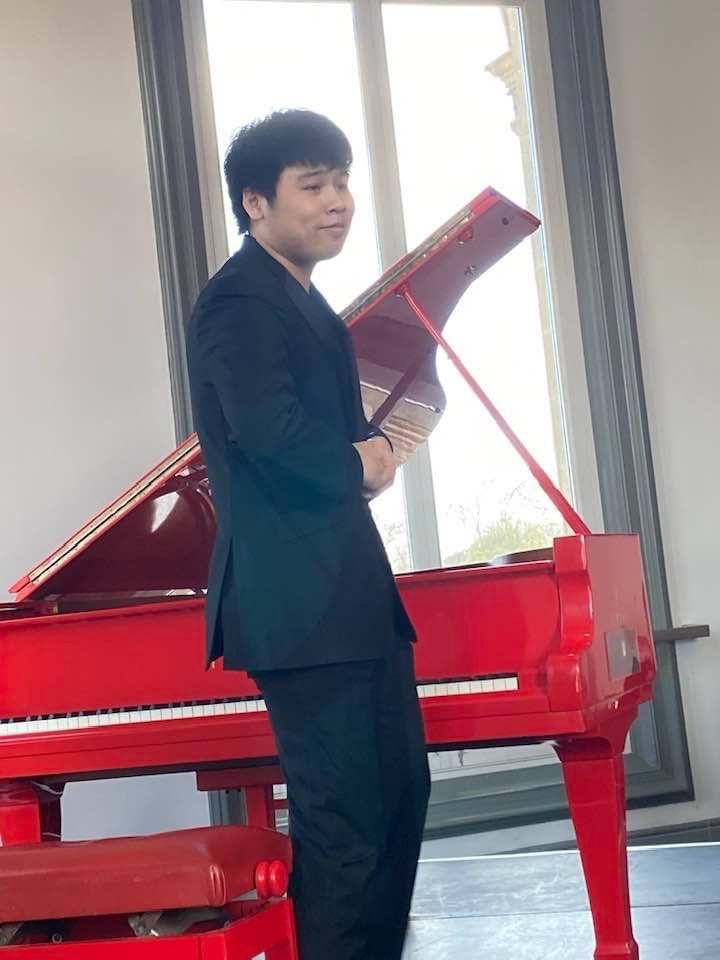
Jun Lin Wu may have complained of an early start today but Elton John’s piano certainly had no complaints. In the hands of this young Chinese pianist it was seduced ravished and conquered as rarely it can ever have imagined in its most wildest history. A world of such sublime beauty and demonic energy combined with such an aristocratic sense of style and irresistible sense of rubato. Bar lines did not exist as there was a sense of recreation with sounds that seemed so refreshingly spontaneous with a technical mastery that knew no limits.
A very spacious opening to Chopin’s late masterpiece op 61 Polonaise Fantasie that was exactly that.An opening of such spaciousness and subtle colour with a gradual build up to the sumptuous passionate final climax. The gentle opening arpeggios of Chopin were immediately answered by the savage animal attack of Scriabin’s opening of his 5th Sonata.Instantly dissolving into a magic world of mystery and kaleidoscopic colours.A luminosity of sound that gently penetrated the multicoloured world it inhabited and was played with a clarity and quite remarkable sense of balance. Interspersed with demonic bursts of energy as it led so unrelentingly to the final glorious star of Scriabin’s unique magic world . It is one of the marvels of the world how the Chinese soul mirrors that of Chopin. It is the same heart that throbs with nostalgia and an irrepressible sense of rhythm that is inborn.It was infact Fou Ts’ong who astonished the public in the Warsaw competition all those years ago playing the mazurkas as we had only thought possible from Chopins compatriots. Such sense of aristocratic charm and heartfelt nostalgia interspersed with infectious rhythmic elan that sounded so sincere and natural. Something so in born that it cannot be taught or added as it comes from within.This fresh faced looking young man certainly has a soul of a quite extraordinary poetic depth.
Agosti’s famous Firebird was unleashed on an unexpecting public with a demonic energy that was quite breathtaking. This has long been one of the most challenging of all transcriptions even out doing Stravinsky’s own Petrouschka that the composer dedicated to his friend Artur Rubinstein to try to appease the Ragtime that Rubinstein had commissioned from his friend but refused to play as Stravinsky was intent on demonstrating that the piano could not sing but was purely percussive. This transcription written in 1928 by Agosti who was to live until the ‘80’s and where every summer the musical world would frequent his studio in Siena where sounds never to be forgotten were to be cherished.
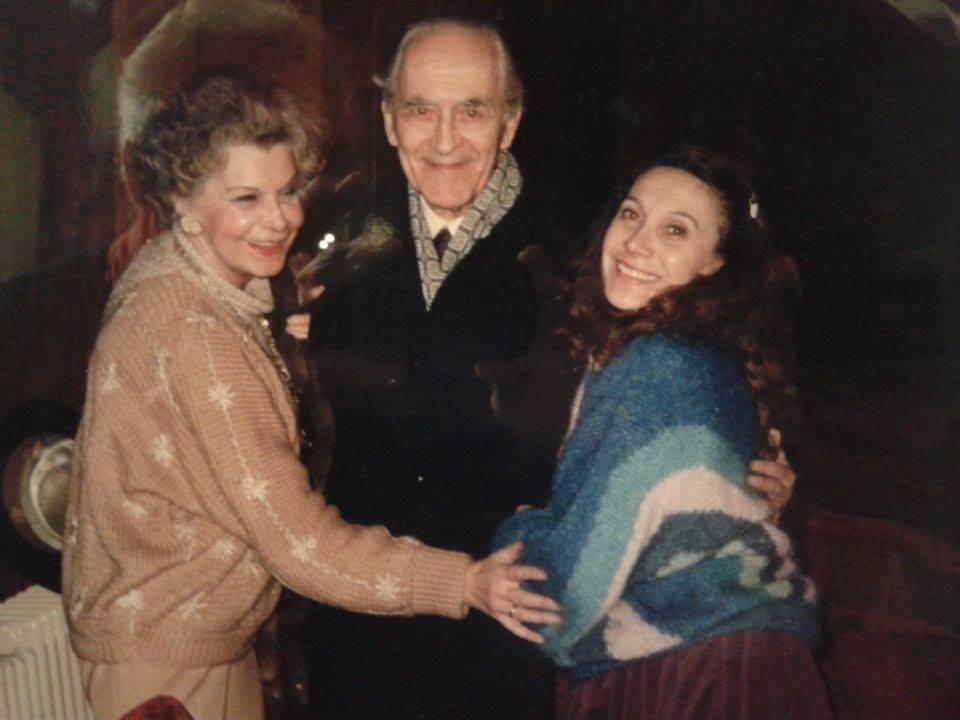
Lydia and Guido Agosti with my wife Ileana Ghione in the Teatro Ghione in Rome
Agosti had abandoned the concert stage very early to dedicated himself with religious zealousness to the masterworks that his teacher Busoni had shared with him in his youth. After such a frantic attack of the Firebird the sun suddenly appeared in a magical cloud of sounds that led to the final triumph of the Firebird. Jun Lin Wu had no need to ask if his audience would like more. Cordoba by Albeniz was his thank you farewell of sultry sounds and rhythms played as to the manner born in a masterly performance that I expect his mentor Dmitri Alexeev had imparted to him. The same mastery that Alexeev one of the greatest pianist of our day generously shares with a select few at the Royal College of Music just a few steps away from the Albert Hall
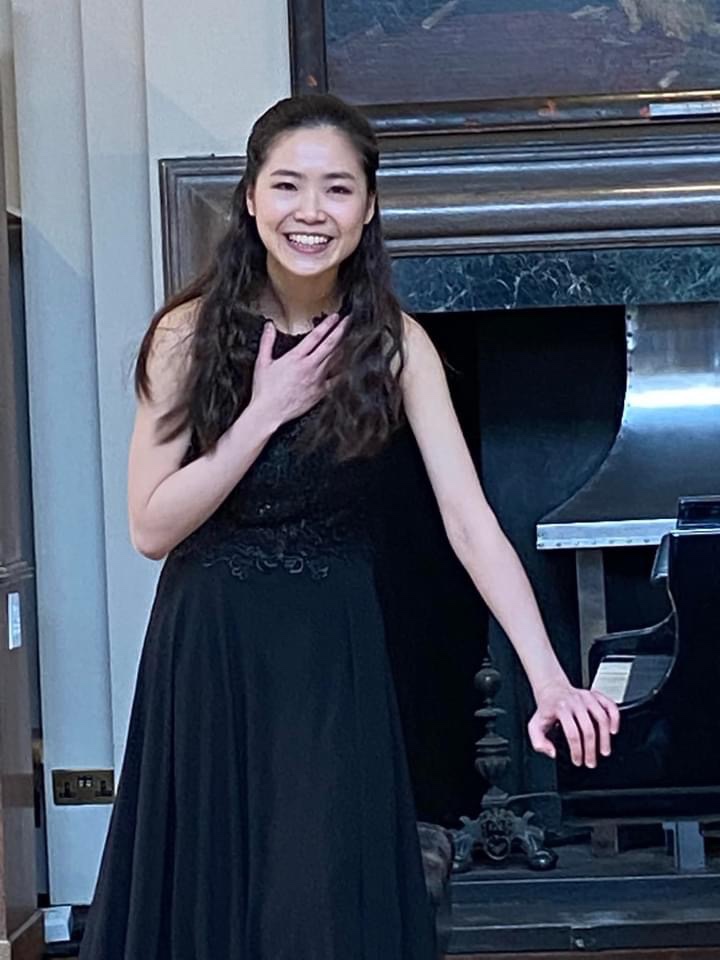
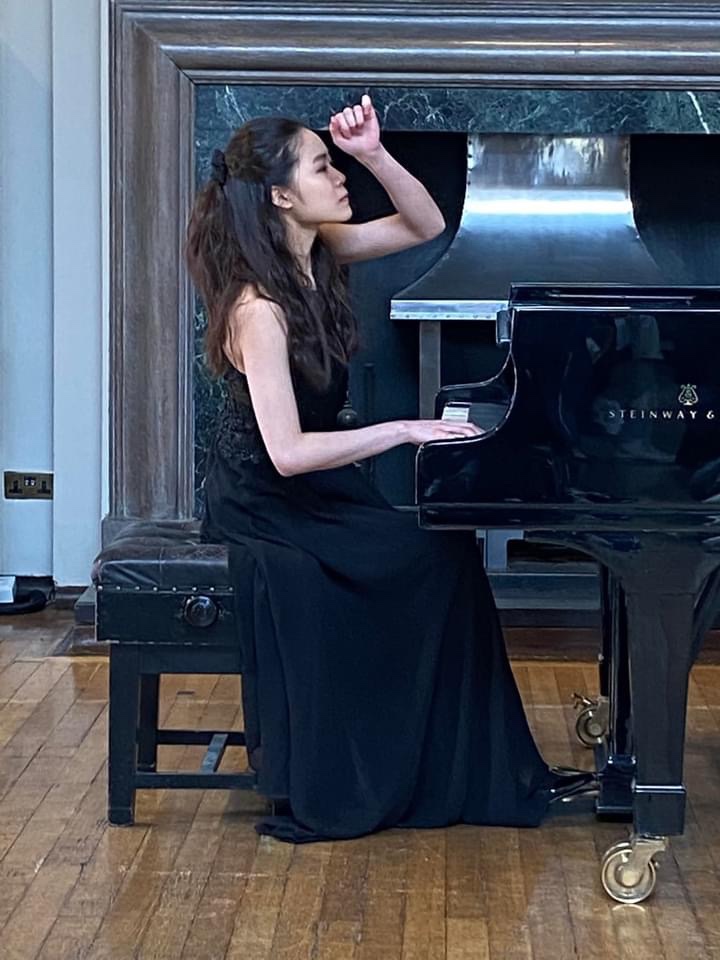
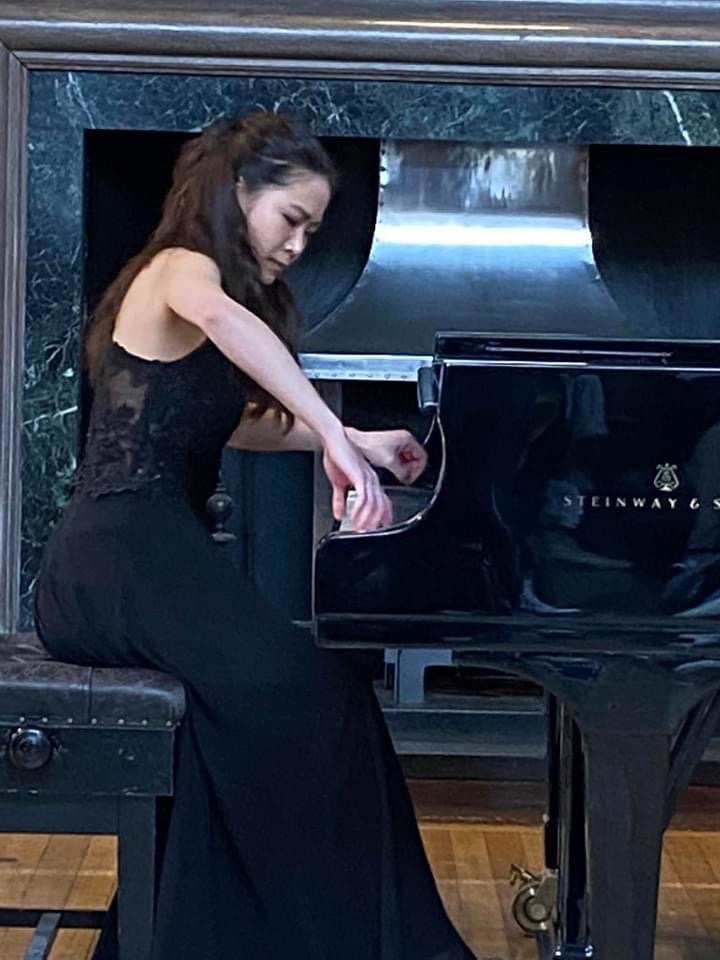
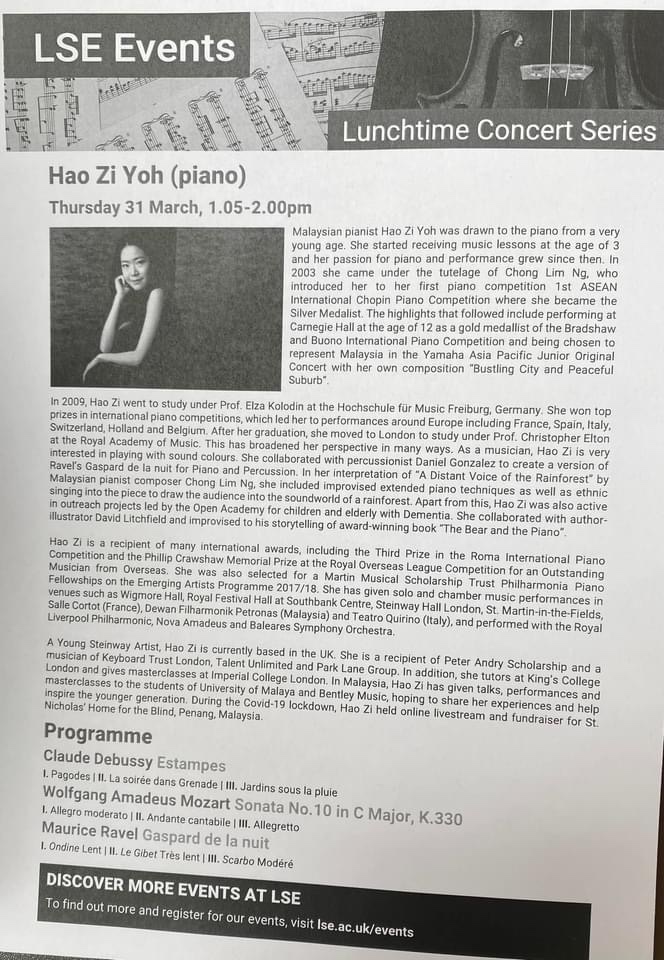
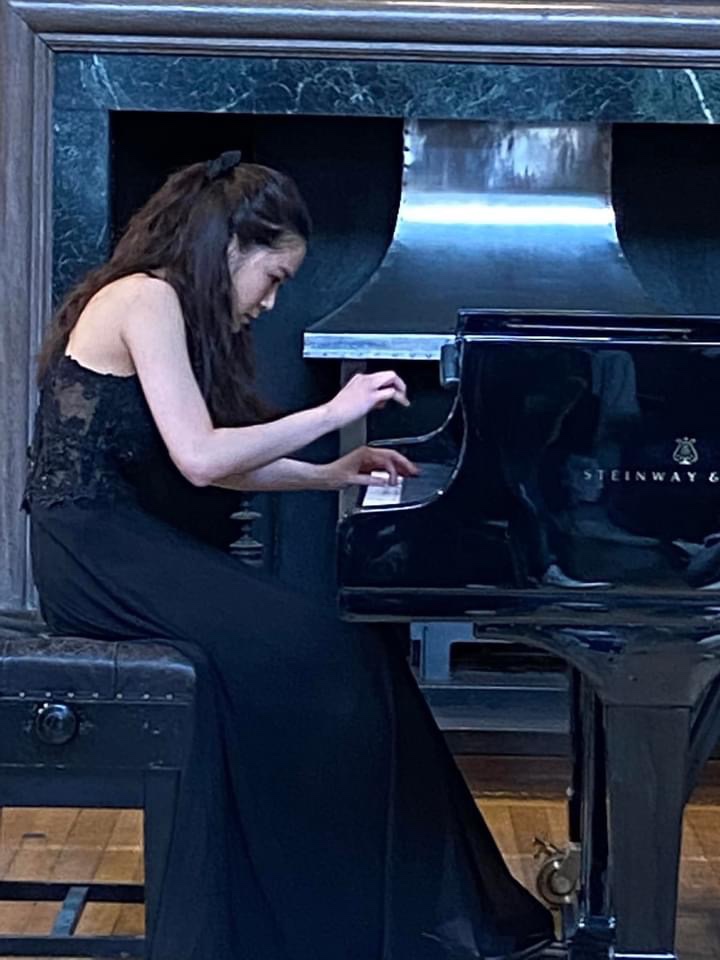
Some ravishing playing from Hao Zi Yoh at the LSE .Playing of such clarity and purity,sensibility and intelligence that brought everything she played vividly to life.It was in Mozart’s simple C major sonata K.330 that this ability to make the music speak brought operatic life to a work that Schnabel famously said was too easy for children but too difficult for adults. The ornaments in the first movement unwound like a spring of real jewels allowed to glisten and gleam with such ease and simplicity. Art that conceals art was indeed the hallmark of this refreshingly innocent young artist who could imbue everything she touched with a life of its own.
From the golden sounds of Debussy’s Pagodes to the sultry seductive atmosphere of Soirée dans Grenade.Has the rain ever been so insistent as in Jardins sous la Pluie where even the gentle patter of rain and the eventual tempestuous torrent that followed could not diminish the radiance of the little children’s melody and the crystalline clarity of innocence that Debussy so magically allows to sing out during such a downpour .The ending is so similar to Ravel’s Jeux d’eau where the water is obviously continuing into the distance and we are only allowed a brief glance while the water continues on to some distant land
Glissandi played with transcendental ease
‘Ondine’ too sang so happily in such clear waters and even the impending turbulence did not disturb Hao Zi’s extraordinary sense of balance and a technical command at the service of the musical line .Glissandi on white notes and black were played with such ease as streams of sounds swept over the keys before cascading down like a great waterfall The tolling bell in ‘Le Gibet ‘ was with a relentless luminosity despite all the cloudy atmosphere of the desolate landscape .A technical control of sound that was remarkable as it was unnoticeable. The devilish imp ‘Scarbo’ streaked across the keyboard like strokes of lightning as he went on his devilish way with an unstoppable rhythmic drive.Only stopped by the great chimes that Hao Zi struck from above as this devilish thing burnt himself out
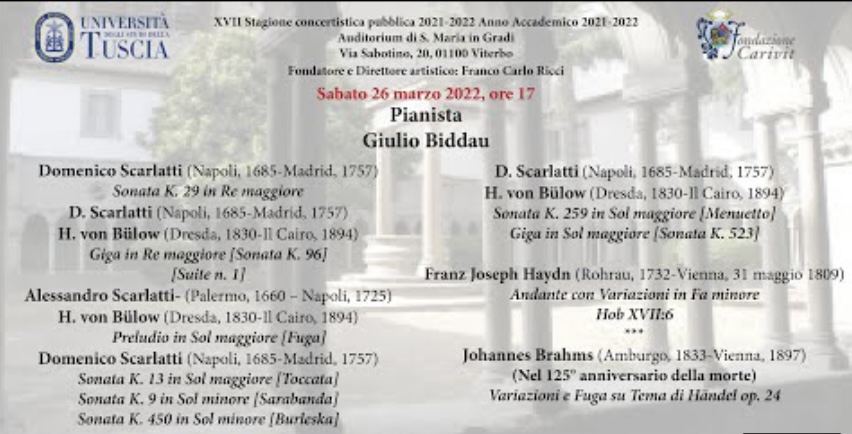
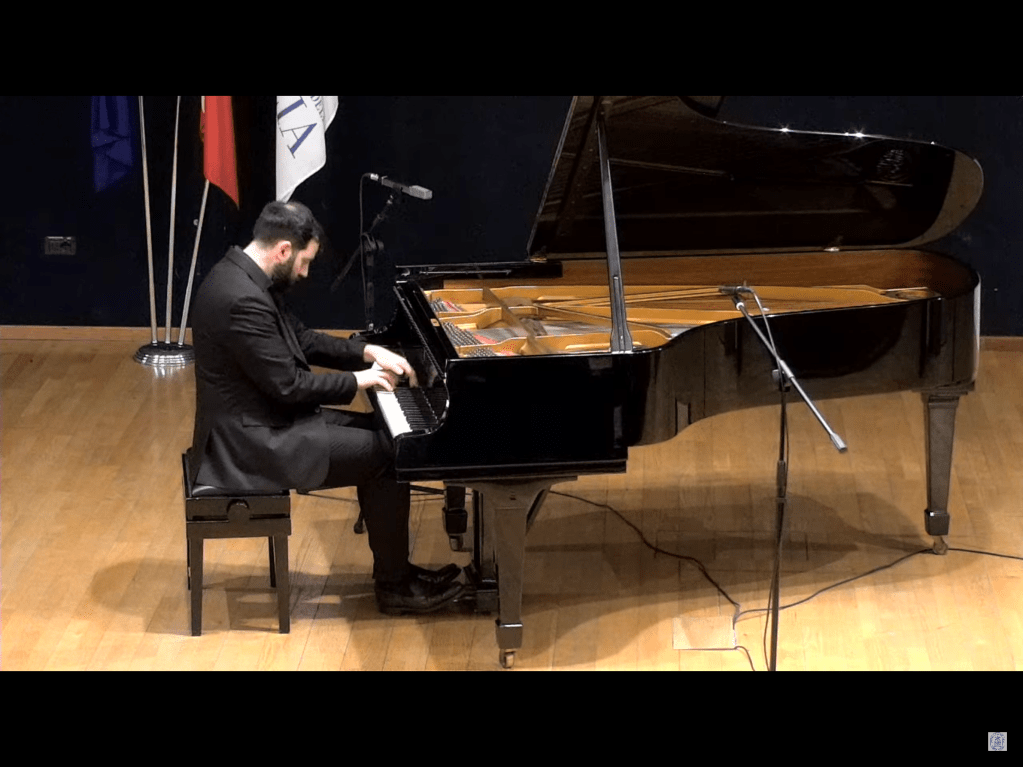
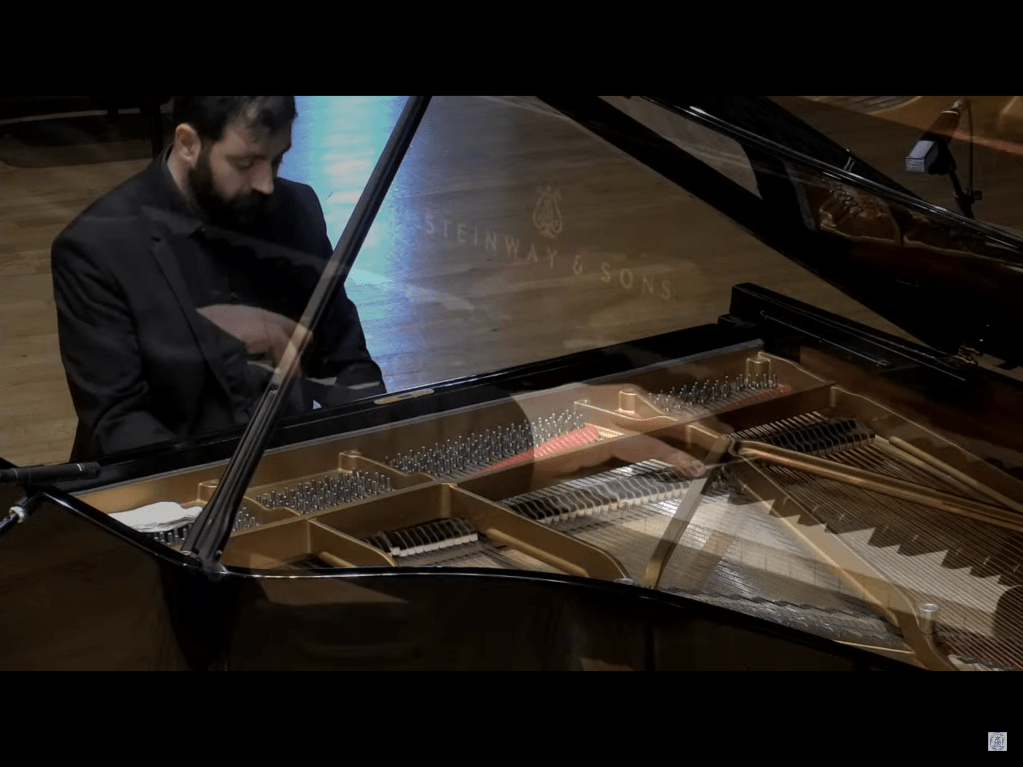
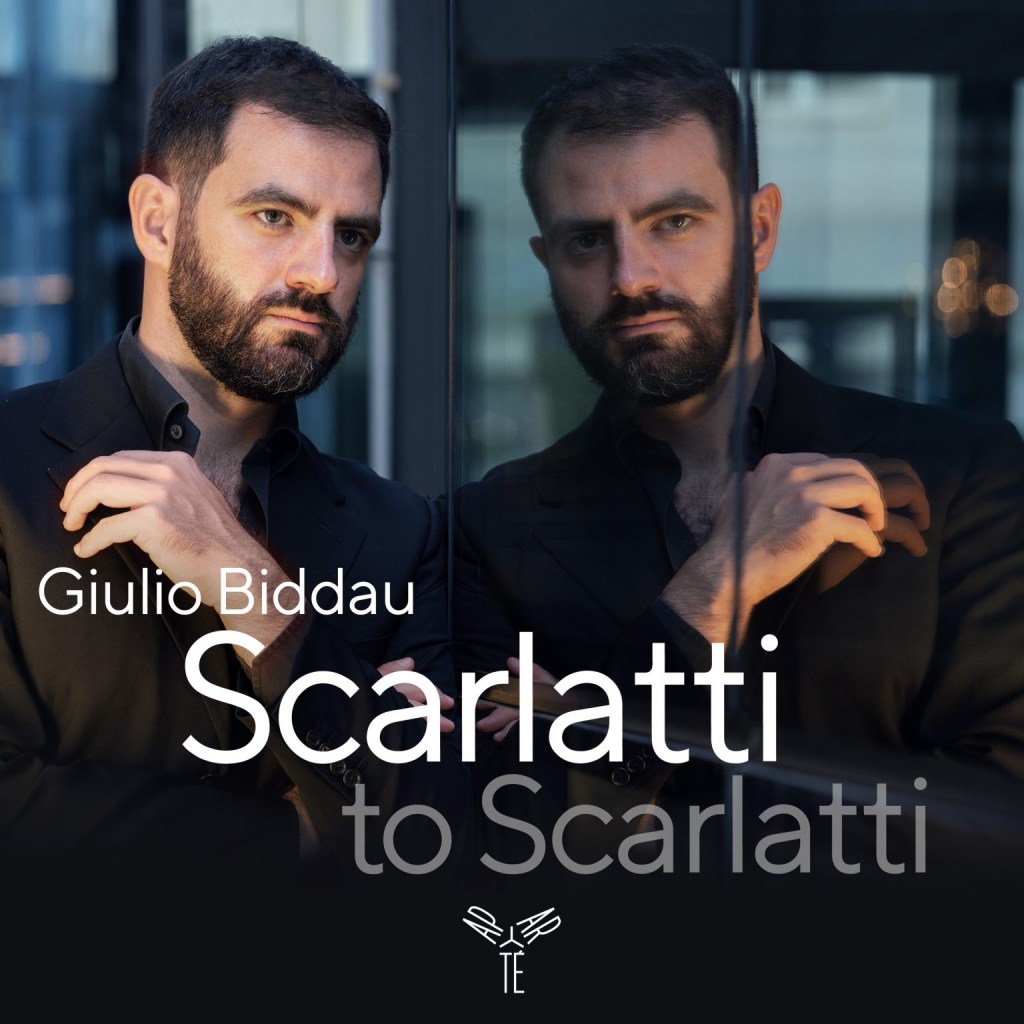
A fascinating programme from a real thinking musician with a crystalline technique. Giulio Biddau brought the sonatas by Domenico and Alessandro Scarlatti vividly to life with just a minimum of ornamentation helped a little by Von Bulow.Always in such good taste and style and was a good visiting card for his new CD. Standing in at the last minute for an indisposed colleague he gave a recital of impeccable style and technical prowess.
Not only Scarlatti but Haydn Andante and variations were played with a simplicity and clarity that reminds me of Alicia de Larrocha. Brahms Handel Variations were played with the same refreshing clarity where Brahms’s sometimes orchestral sounds were given a refreshing sense of line never overwhelming these intricate variations with unnecessary volumes of sound or grandeur. A masterly performance of Chopin’s revolutionary study was his way of thanking his enthusiastic public in this interesting series in Viterbo directed always by Professor Franco Ricci.
Scarlatti to Scarlatti is the title of the new CD of Giulio Biddau and I print some of the very interesting notes from the very serious study that has gone into these interpretations
Released: 28 January 2022 Reference: AP283 Buy this album Label Aparté Credits Enregistré par Little Tribeca les 29-30 juin et 26-27 novembre 2020 à la Salle Colonne, Paris Direction artistique, prise de son : Nicolas Thelliez / Hugo Scremin Montage, mixage et mastering : Ambroise Helmlinger Enregistré en 24 bits/96kHz
Editions of Domenico Scarlatti’s almost 600 keyboard sonatas were for a long time based on uncertain sources. The resulting editorial confusion gave rise to different readings at different times and in different places. A prime example is Hans von Bülow’s selection of eighteen of the sonatas (published in 1864), viewed through the prism of Romanticism. On this double album the pianist Giulio Biddau compares that version with a recent critical edition. Each sonata is played twice, thus alternating the perspectives and shedding light on two different approaches to Scarlatti’s work.
Se scrivo così alla buona, e non con eleganze di bel dire, mi contento, e non sarà poco, che mi consideri come Musico, non come Rettorico.
Francesco Gasparini, L’armonico Pratico al Cimbalo, Venezia, 1708 1 ”If I write plainly and without the niceties of a cultivated style – so be it; I shall not be hurt if you consider me a musician, not a rhetorician.” (trans. Frank Stuart Stillings, New Haven: Yale School of Music, 1963)
Scarlatti: sources and the modern piano By recording Domenico Scarlatti’s keyboard repertoire, one is inevitably confronted to the problem of source materials: no autograph manuscript of his sonatas has ever been found. Only 30 pieces of Scarlatti’s vast output were ever published; these appeared in 1738 in a volume entitled Essercizi per Gravicembalo. Posthumous editions of his compositions were often ‘Revised with a Variety of Improvements’, as Ambrose Pitman’s 1785 edition of The Beauties of Domenico Scarlatti put it. Not until the 20th century did research carried out by specialists establish more faithful texts. Thanks to Maria Barbara of Braganza, the prescient Spanish queen who was Scarlatti’s student and benefactor, modern editors possess reliable and complete sources of the sonatas in two series of manuscripts that were probably copied from originals that were subsequently lost. The manuscripts are preserved in the Biblioteca Palatina in Parma and the Biblioteca Marciana in Venice. They form the basis for the critical edition I chose for my recording, which was published in 1978 by Emilia Fadini, the recently deceased Italian harpsichordist and musicologist who accompanied me throughout my research on Scarlatti.
One must wonder, however, whether there is a contradiction between the desire for authentic sources and the adaptation of Scarlatti’s music to the modern piano. For many years it was thought that his sonatas had been primarily written for the harpsichord; the organ was sometimes considered as a possible instrument for their performance, and the fortepiano not at all. Ralph Kirkpatrick, who spearheaded the philological rediscovery of Scarlatti, unambiguously reaffirmed this hypothesis in 1953. Certain musicologists still share his opinion today, despite the fact that historians have established a surprising correlation between the spread of Bartolomeo Cristofori’s Gravicembalo col piano e forte on the Iberian Peninsula and the movements of Scarlatti and Maria Barbara’s court, where the presence of this instrument is well documented. Perhaps one day we will know more about the instrument for which these works were written. In the centuries following their composition, Scarlatti’s sonatas were not played on the harpsichord and were adapted several times, first for the fortepiano and then for its modern counterpart. This pattern began in 1791 with Muzio Clementi’s edition of Scarlatti’s Chefs-d’oeuvre, in which the musical text was appended for the first time to include dynamics (piano and forte), new phrasing, and suggestions about rhythm. Scarlatti’s music was published ‘in colour’ until the 1950s: the most important editions, those of Carl Czerny for Haslinger (1839) and Alessandro Longo for Ricordi (1906), were still intended for pianists, and included an arsenal of indications dealing with articulation and expression on their instrument. But it was after 1850 that indications in the score reached their greatest density; Bülow’s anthology belongs to this generation of publications. I discovered his edition, which had never been recorded before, during my research on the fortunes of Scarlatti’s work. The encounter was enlightening for me, because it provided the answer to another question I had been asking: how to choose among Scarlatti’s sonatas? While Kirkpatrick catalogued 555 sonatas by Scarlatti, further discoveries have brought the tally up to around 600 keyboard pieces. Almost all of them are one-movement works, and musicologists have long debated about how they should be grouped. First Kirkpatrick and then Joel Sheveloff identified correlations between successive sonatas in the Parma and Venice manuscripts, which led to the conclusion that Scarlatti sometimes imagined his sonatas as bi- or tripartite works, which were common at the time. Other solutions appeared in revised editions. Alessandro Longo, for example, suggested groups of sonatas that he termed suites, and these sequences, although they are completely arbitrary, are often quite successful.
The Bülow edition A commercial adaptation The most surprising procedure was carried out by the legendary pianist and conductor Hans von Bülow in the anthology of Scarlatti sonatas he published in 1864. In order to make the repertoire more interesting to the German public, Bülow selected 18 sonatas from the Czerny edition and arranged them in groups based on key signatures (sometimes transposing them into new keys2) to form three six-piece suites. In these new configurations the term sonata, which Scarlatti had used in keeping with Baroque practice, was often replaced with the name of the dance with which Bülow associated the music. These adaptations of course also altered tempo indications. Examples include K. 83, which was changed from Allegro to Moderato, ma deciso, and K. 446, which Scarlatti labelled Pastorale: Allegrissimo and Bülow modified to Siciliano: Andantino.4 Tempo changes like these, which appeared during the same period in pianist Carl Tausig’s edition, were not without consequences: for many years Scarlatti’s sonatas were performed at these slower tempos, and what had originally been editorial remarks evolved into a performance tradition. Indications in the score The most interesting thing in the Bülow edition for the modern performer is the phrasing. Bülow’s indications in the score correspond quite precisely to the advice given in the treatises of Quantz, Leopold Mozart, and Türk. Although the overall effect is sometimes rather muddled by an excess of romantic dynamics, this edition contrasts with those of the early 20th century, in which the lovely phrasing is replaced with staccato markings that aim to mimic the sound (but not the playing technique) of the harpsichord. Unfortunately, Bülow sought only to perpetuate the German tradition, probably because he was unaware of 17th and 18th centuries Italian tutors like the one written by Francesco Gasparini, one of Scarlatti’s teachers. He therefore missed out on certain performance practices that Gasparini explains, such as the suonar pieno (and the acciaccatura) – the simultaneous playing of a chord with other short nonharmonic notes – and deviations from the rules of counterpoint like doubling certain octaves and fifths.5 Corrections Since Bülow did not understand the originality of and the traditions associated with Scarlatti’s writing, he systematically corrected it.His wish to make Scarlatti resemble J.S. Bach should not be seen as an outrage, as the philological precautions of today were not in place at the time. The dissemination of earlier repertoires inevitably took place through new editions and on the stage, and performances of these works, including Hummel’s Mozart and Busoni’s and Godowsky’s Bach, very often brought them up to date. In light of our current historicist sensibilities, it would be better to refer to the Scarlatti-Bülow score as a transcription rather than an edition. Confronting such transcriptions can be quite fruitful for today’s performer, because their attention to dynamics and widely varied phrasing is the most authentic and faithful route back to the performance tradition, unlike the editions of the early 20th century. Bülow’s interventions are also interesting to analyze because they suggest ways of varying the repeats in the sonatas, such as by adding counterpoint.7 Although Bülow’s variants are often a far cry from Scarlatti’s style, they sometimes result in charming hybrids. One of these can be heard in Sonata K. 96,8 in which passages of repeated notes metamorphose into an almost Mozartian style. It should be mentioned in closing that, among the 18 sonatas included in Bülow’s anthology, two of them were not written by Domenico Scarlatti: the Fugue in F minor and the Prelude in G major9 are by Alessandro Scarlatti, his father. I chose to include them in the present recording, however, in order to preserve the structure of the suites.
The Fadini edition The critical edition I felt the need to base a second recording of these Scarlatti sonatas on more up-to-date critical editions: it was crucial to blend the problems of the Bülow edition with historical and musicological information acquired since his time. Emilia Fadini’s edition struck me as the most complete: its critical apparatus is wide-ranging and brimming with information; it faithfully reproduces the original notation; and most importantly, it preserves the Andalusian harmonies that other editions misinterpreted. Once I had solved the problem of which text to use, I concentrated on the performance questions posed by the Bülow edition, developing them in my second reading. Varied repeats Although musicians of the past abstained from varying repeats – perhaps also because of Kirkpatrick’s indications –, it has become more common to do so nowadays. This parallel with Bülow’s edition encouraged me to vary each repeated passage with slight or more elaborate modifications, sometimes developing a contrapuntal passage, sometimes using a different affect. I gave myself permission to feel free in these instances, as musicians did in the baroque period, and in contrast with the romantic era, when such matters were the prerogative of the composer – or the editor…
Questions of tempo My comparison of the two Scarlatti editions also dealt with tempo choices. My research showed me how much the meaning of tempo indications has changed over the centuries. After the baroque era these indications gradually became steps on a scale of speeds stretching from Largo to Prestissimo, whereas earlier they had been more flexible, and defined more the character of a piece than its pace. In the baroque period the word Andante, for instance, was much closer to its literal meaning (“at a walking pace”), and indicated performance speed as well as the mood of the music. In Bülow’s edition, however, it is used as a synonym for Langsam. A second aspect I considered was the sonatas’ brilliant, virtuoso side, which I feel is often exaggerated. Many of these works were written for pedagogical purposes, and it is necessary to put certain anecdotes – like Charles Burney’s description of Scarlatti’s music as “ten hundred devils at (the) instrument” – and partisan readings – such as those of the “futurists”, who feel that Scarlatti was a precursor of their modernity – into a different perspective. I chose not to exaggerate the virtuosity of Scarlatti’s music, and instead opted for speeds that were guided by the Andalusian rhythms, and by their at times dizzying repetition. The Spanish element The necessity of underscoring the Spanish element also informed my decision to present the original text side by side with the version from Bülow’s anthology. Apart from the following description of Sonata K. 377 – “composed in Aranjuez, the Spanish King’s palace, 1754” – Bulow did not show much interest in Iberian elements, and reserved his praise for sonatas that prefigured romantic music.10 The research and the critical apparatus included in Emilia Fadini’s edition are, on the other hand, extremely thorough, and allow us to grasp the importance of the Spanish influence. Certain sonatas – for instance K. 96 and K. 17311 – provide meticulous descriptions of the Andalusian universe. The listener experiences the zapateados of the bailadora, the clicking castanets, and the rasgueados and punteados of the guitar accompaniements. The repetition of these figures often results in accelerandos, tempo changes, and sudden pauses, after which Scarlatti catches the listener with a new type of expression. These sudden and intensely lyrical passages are reminiscent of the cante jondo tradition, the melismata through which persecuted Andalusian minorities expressed their despair and rebellious feelings. Although García Lorca acknowledged the influence of the cante in Debussy’s music (in La Puerta del Vino and La soirée dans Grenade), we should also recall that the first great composer to illustrate this tradition was Scarlatti. Pairing the same pieces as mirror images of one another enabled me to demonstrate two visions that travel between Spain and Germany, the court to the inn, and the baroque to the romantic. This double interpretation of these sonatas, this toing and froing between the transparence of the Urtext and the perspective of Bülow, projects Scarlatti’s music into the kaleidoscope of history. 10 This includes Sonata K. 525 which corresponds to the Scherzo, the last piece in Bülow’s second Suite, and which in his opinion anticipated the music of Beethoven.
Born in Cagliari, Sardinia, in 1985, Giulio Biddau took up the piano at the age of twelve with Arlette Giangrande Eggman (a pupil of Dinu Lipatti and Nikita Magaloff) at the Cagliari Conservatory, and with Boris Petrushansky in Genoa. He then moved to Paris to attend classes with Jean-Marc Luisada at the École Normale de Musique, where he obtained his Diplôme Supérieur de Concertiste. In 2007 he continued his studies at the Accademia di Santa Cecilia in Rome with Sergio Perticaroli, and for the past two years, he has been coached by Aldo Ciccolini, whom he meets regularly in Naples and Paris.Giulio Biddau has won several international competitions, including the Casagrande Competition in Terni, the Iturbi Competition in Valencia, the Porrino Competition in Cagliari. In September 2009 he won first prize at the Concours international des Nuits Pianistiques – Lauréats SPEDIDAM in Aix-en-Provence, as a result of which he has been invited to take part in some of the most important festivals in France, including the Festival de Radio France-Montpellier, the Pablo Casals Festival in Prades and Piano en Valois in Angoulême.He has given many concerts in Europe, playing for such institutions as the Accademia di Santa Cecilia in Rome, the Teatro Lirico in Cagliari, the Dino Ciani Festival in Cortina, the William Walton Foundation of Ischia, the Villa Medici in Rome; in France he has played at the Salle Cortot in Paris, the Grand Theatre de Provence in Aix, and in Pontoise, Nancy, Rouffach, Gerberoy; in Spain, at the Palau de la Musica of Valencia and Leon; in Sweden, at the Berwaldhallen, Stockholm; and in Slovenia, Austria, etc.He has appeared with orchestras including that of the Accademia di Santa Cecilia in Rome, the Orchestre National de Montpellier, the Orquesta del Palau de la Musica in Valencia, the Orchestra del Teatro Lirico di Cagliari, Les Siècles, the Orchestra Sinfonica Abruzzese… under Lawrence Foster, Francois-Xavier Roth, Tan Dun, Max Bragado…As a chamber musician Giulio Biddau plays in duo with the violinist Anna Tifu and he works with singers Lisa Visentin and Alessandra Martirossyan.His repertoire includes many composers of the second half of the twentieth century, including Ligeti, Gubaidulina and Dutilleux, and he is also committed to contemporary music. In March 2010 he gave the first performance of The Banquet Concerto for piano, orchestra and chorus by Tan Dun at the Accademia di Santa Cecilia in Rome with the composer conducting. The concert was broadcast by RAI Radio Tre. He has also played for France Musique and for Japanese television, NHK.
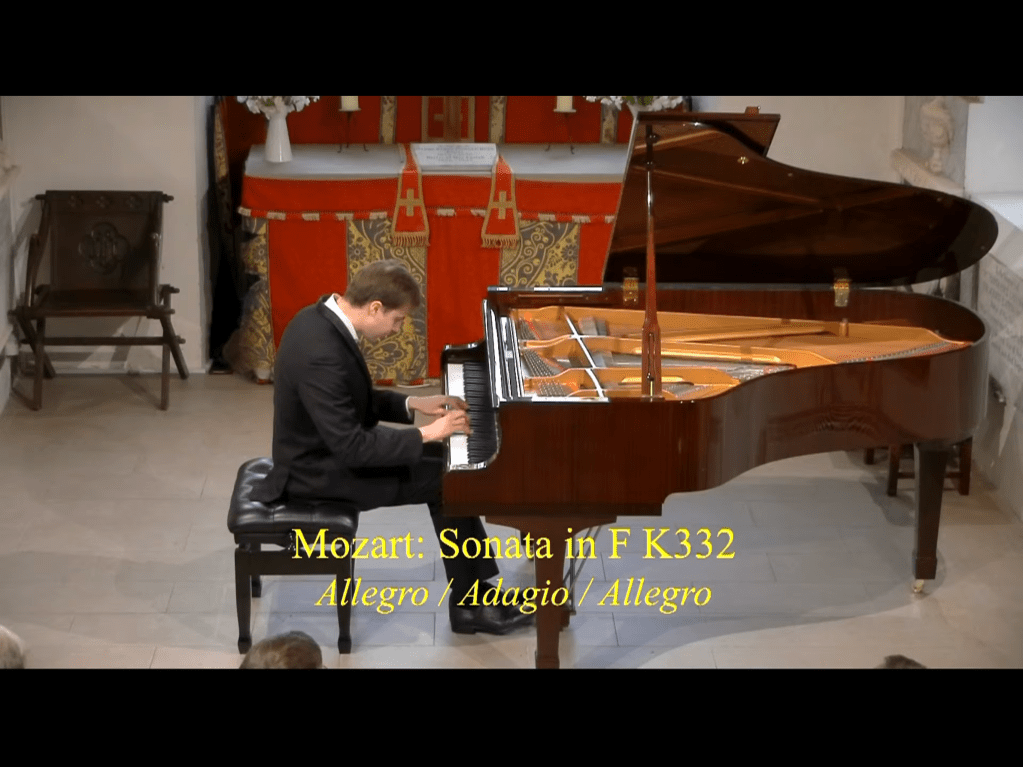
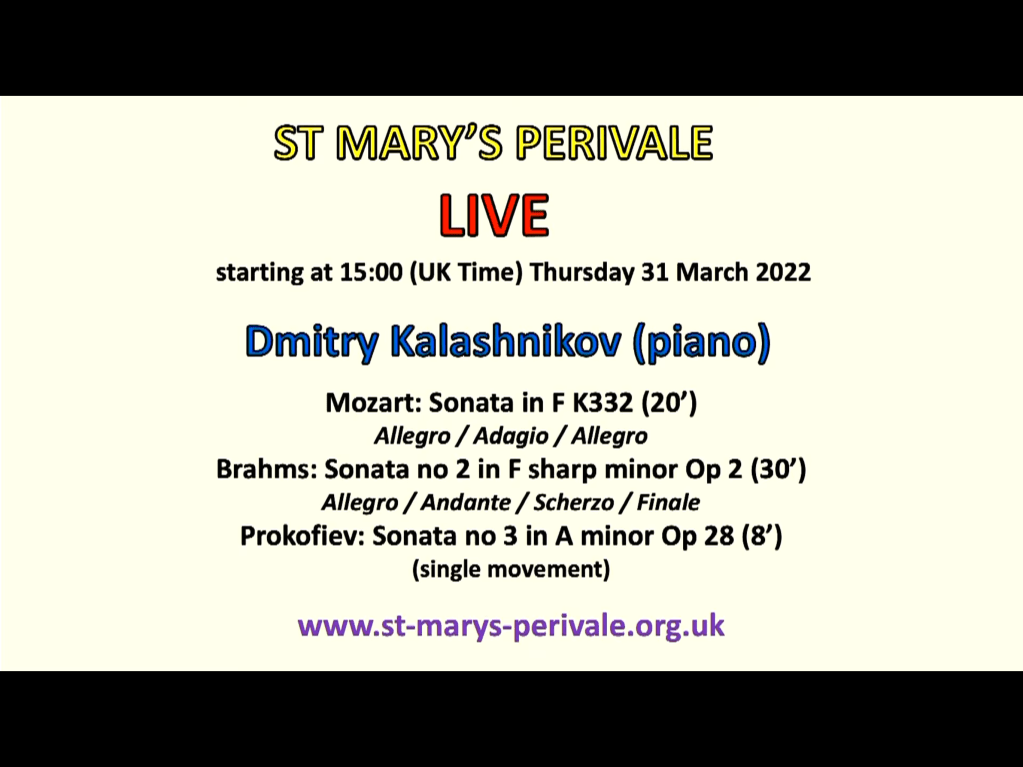
Mozart: Sonata in F K 332 Allegro / Adagio / Allegro
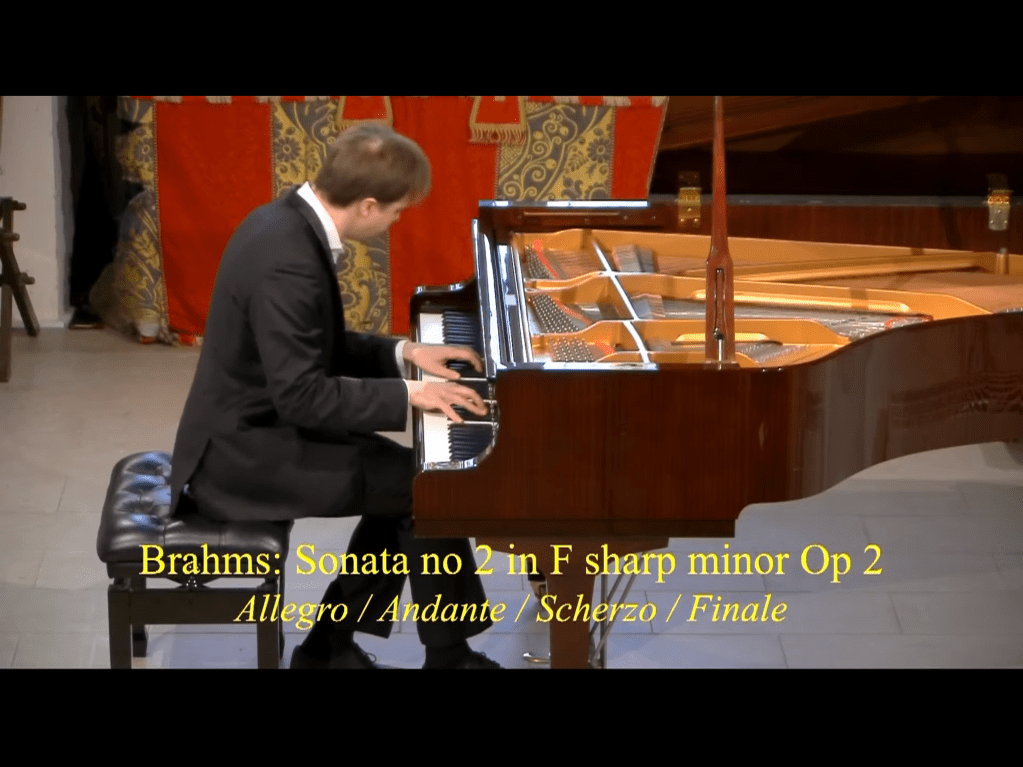
Brahms: Sonata no 2 in F sharp minor Op 2 Allegro / Andante / Scherzo / Finale
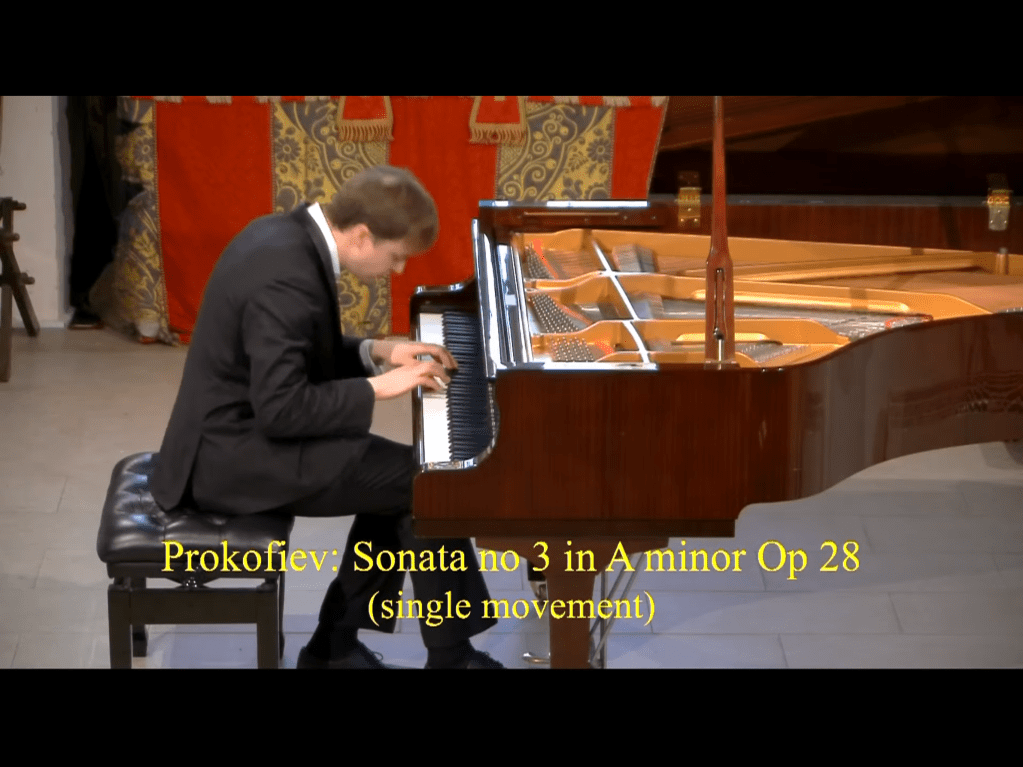
Prokofiev: Sonata no 3 in A minor Op 28 (single movt)
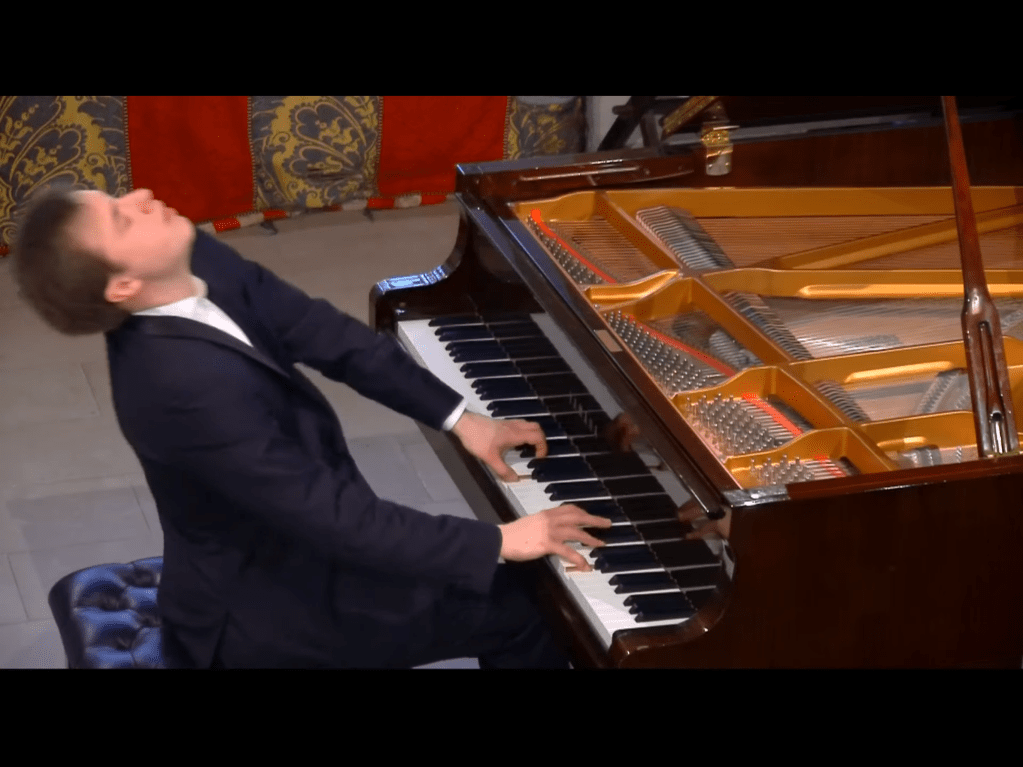
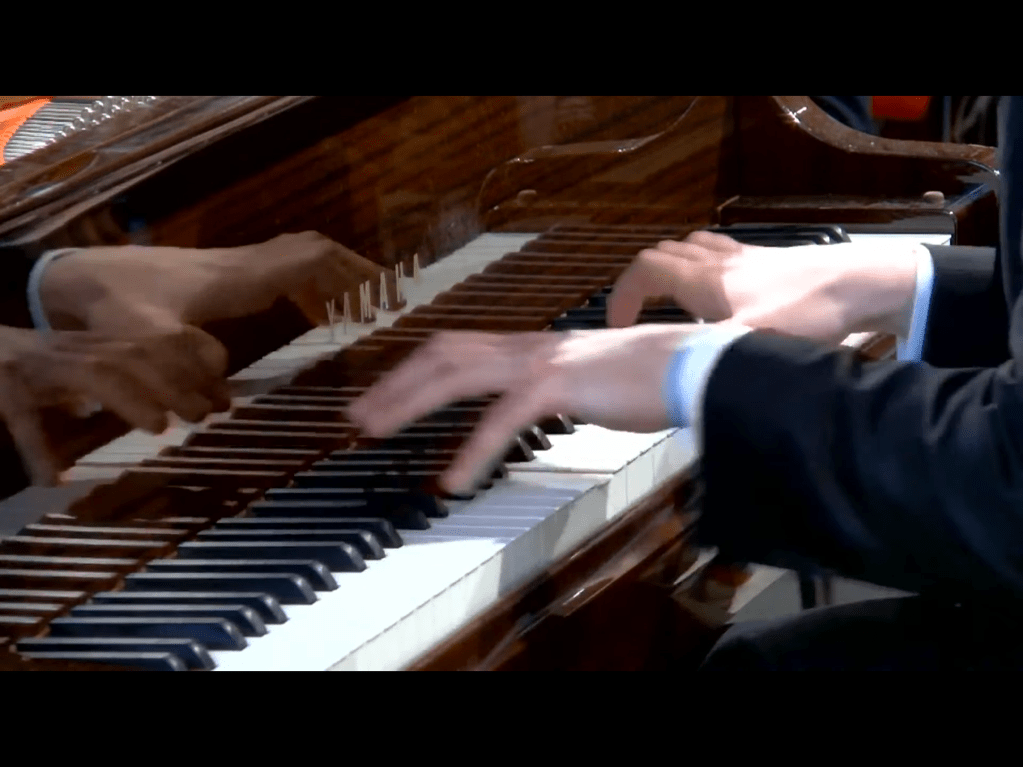
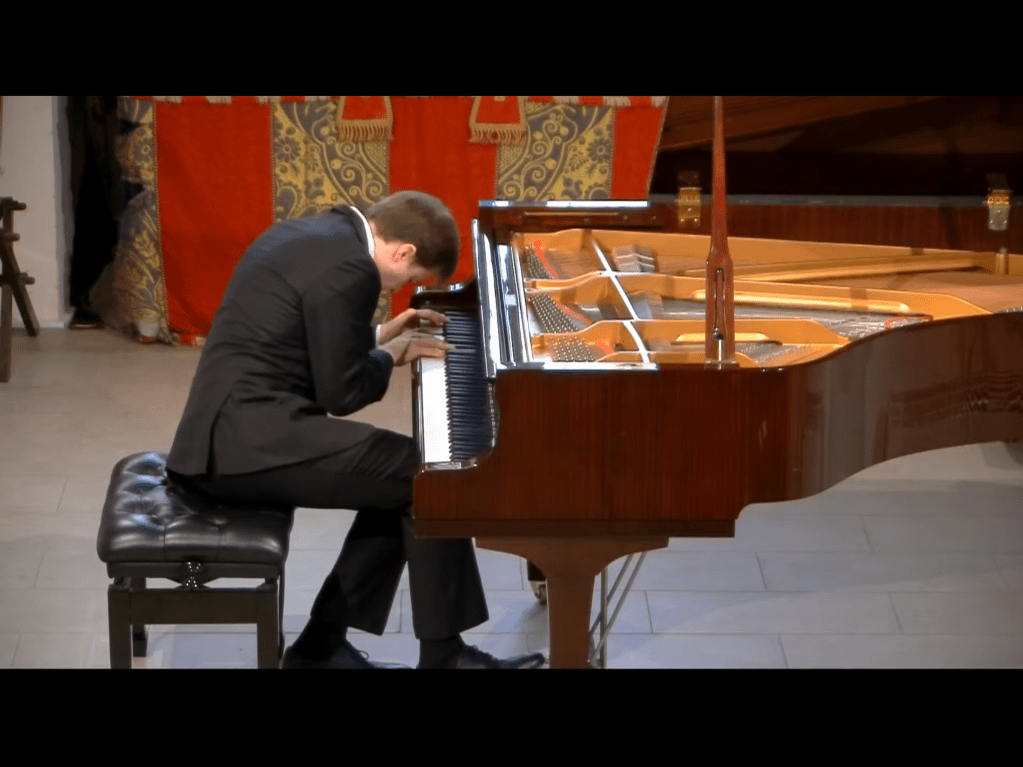
A dash across London from Ho Zi Yoh at L.S.E https://christopheraxworthymusiccommentary.wordpress.com/2022/03/31/hao-zi-yoh-at-the-l-s-e-puritysensibility-and-elegance-simply-expressed/. ……………..and with no pistol pointed but just the pleasure to hear this remarkable pianist again at St Mary’s Perivale just an hour later. Some remarkable playing with a masterly control of the keyboard and an intelligence that could make such sense of Brahms’ early second sonata that in lesser hands can seem rather rambling.There is a great architectural line and orchestral sense of colour but also a sense of improvised beauty that Dmitrii Kalashnikov showed with such mastery. There was clarity too in the Mozart Sonata but one felt that he did not delve deep enough into the keys to extract the full subtle meaning hidden within.
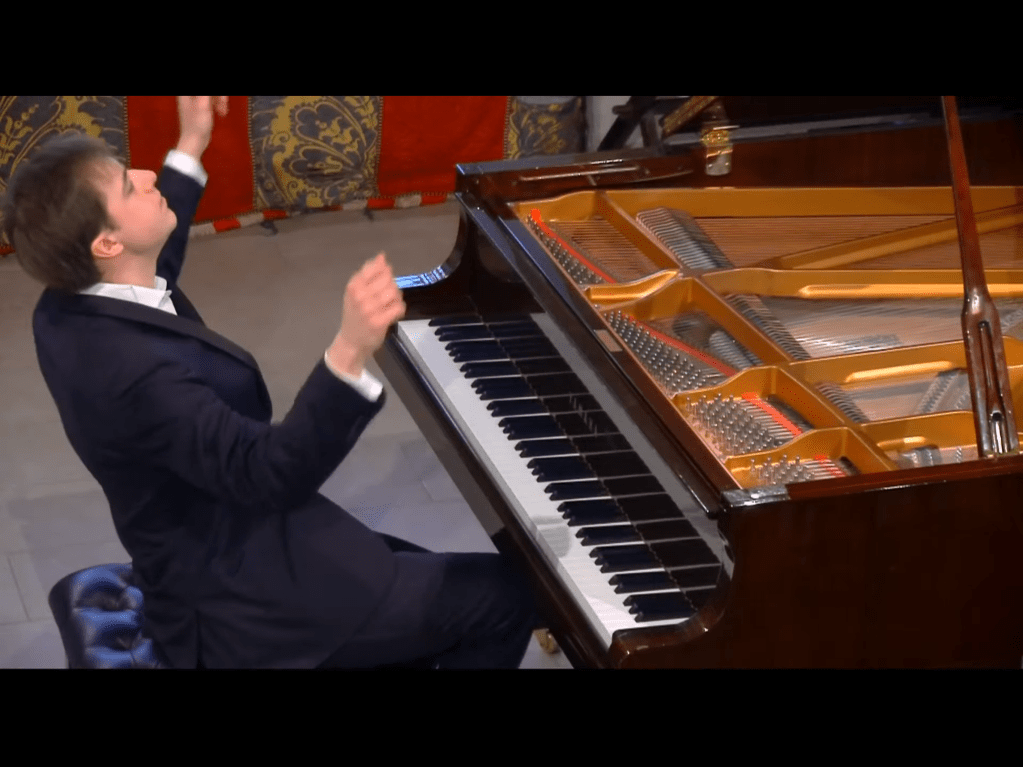
It was Prokofiev’s third sonata that ignited in Dmitri such fire and energy that was breathtaking.He seemed to be enacting a great drama such was the overpowering impact of his physical contact with the keys. He had already struck some keys in Brahms with his fist but nothing like the assault he saved for Prokofiev.
This was the same controlled frenzy that I remember from Gilels or Richter where the music of Prokofiev was part of their DNA and their power of communication was overwhelming as it was today. What could he play after that he seemed to be thinking as Dr Mather pressed him for more.
What better than a scintillating performance of Chopin’s revolutionary study …….Prokofiev was born in the Ukraine so it seemed like a fitting musical tribute in these disturbingly turbulent times especially when played with such extraordinary passion and technical prowess that would be difficult to equal.
Dmitrii Kalashnikov was born in Moscow in 1994. He graduated with distinction from the Gnessin Moscow Special School of Music (2012; classes of Ada Traub and Tatiana Vorobieva) and the Tchaikovsky Moscow State Conservatory (2017; class of Elena Kuznetsova). In 2021 he completed his postgraduate studies at the Royal College of Music in London (class of Vanessa Latarche). He was a prize-winner at the Concours International de Piano du Conservatoire Russe Alexandre Scriabine (Paris, 2008; 1 st prize), the Jaques Samuel Pianos Intercollegiate Piano Competition (London, 2019; 1 st prize) and the Beethoven Senior Intercollegiate Piano Competition (London, 2021; 1 st prize). He is a grant-recipient of the New Names foundation, the Yuri Rozum International Charitable Foundation and the Homecoming Culture Development Fund, and has received the Prize of the Support for Talented Youth of the Government of the Russian Federation, the City of Moscow Prize and the George Stennett Award. He was also supported by a Neville Wathen Scholarship. He gives recitals at the Moscow Conservatory, the Gnesin Russian Academy of Music, the Moscow International Performing Arts Centre, London’s Wigmore Hall and at various venues in France, Austria, Poland, Estonia, Italy, Belgium and the United Kingdom. He has appeared on several occasions with the Russian National Orchestra under the baton of Mikhail Pletnev and in a duet with Pletnev on two pianos (conducted by Mischa Damev). He regularly performs at the Mariinsky International Piano Festival. In December 2018 he appeared at the Concert Hall of the Mariinsky Theatre with the Mariinsky Orchestra. He has taken part in various projects of the State Tretyakov Gallery. For several years he ran artistic soirees with the artist Gavriil Kochevrin for charitable events for orphans at the Marina Tsvetaeva House Museum (Moscow). These concert performances have seen the participation of Yevgeny Knyazev, Alexander Rudin and Boris Andrianov. In September 2019 he took part in the opening of the season at the Nizhny Novgorod State Academic Opera and Ballet Theatre named after A.S. Pushkin.
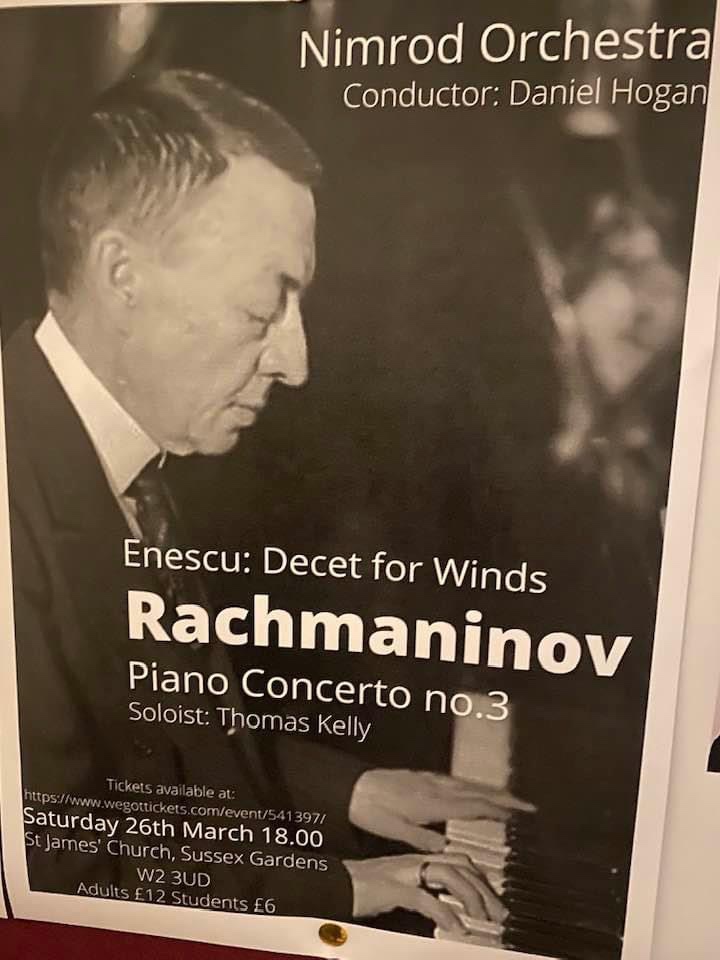
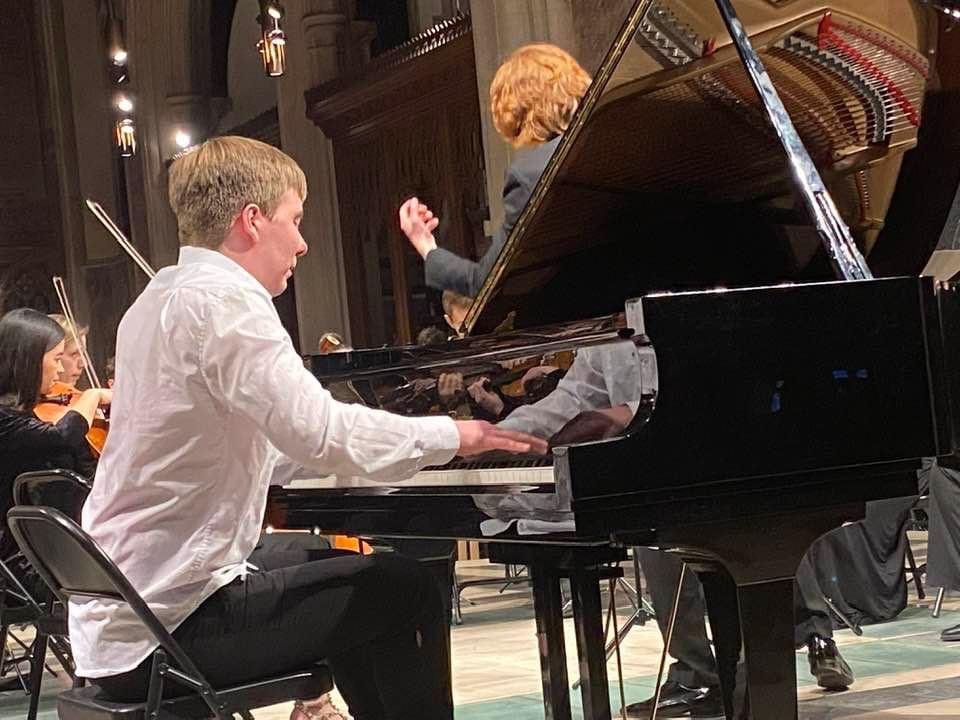
Astonished ,amazed and completely exhausted by a performance of staggering proportions by Thomas Kelly of Rachmaninov third piano concerto. I have heard Thomas play many times over the past four years since winning so unexpectedly the Schumann prize at the RCM .I heard him recently play in Hastings this very concerto but today he was like a man possessed. In fact it was the same unbridled passion of his teacher Alexeev whose performance in Rome thirty years ago has remained with me ever since. The reports of Rachmaninov from my old teacher Perlemuter who would often say of Rachmaninov coming on stage looking as though he had just swallowed a knife but would then produce the most wondrous sounds he had ever heard.
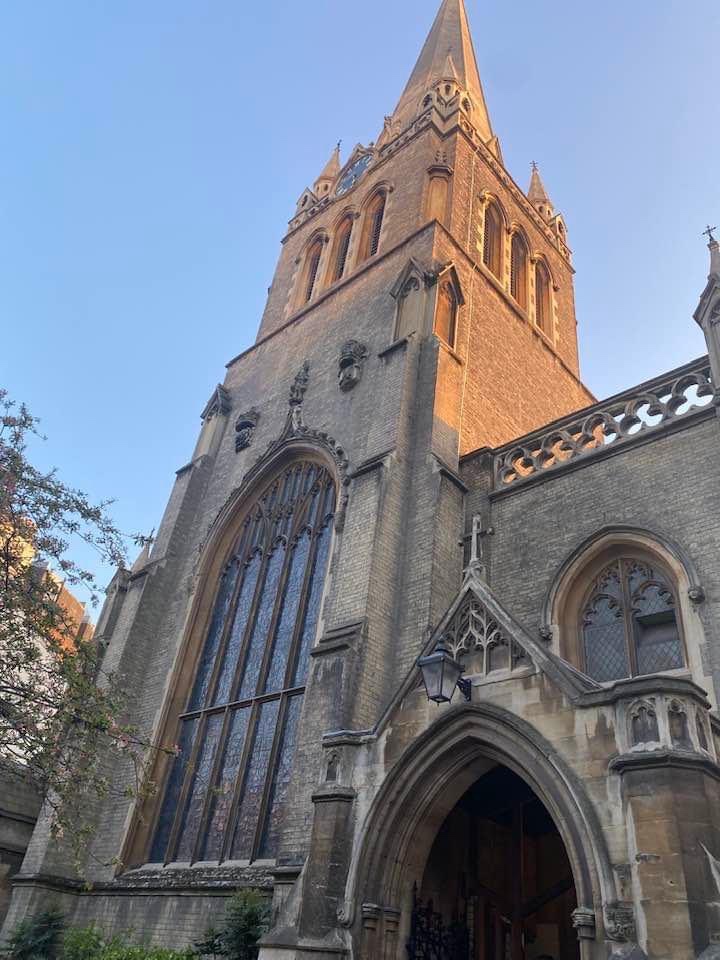
St James’ Church Sussex Gardens Lancaster Gate
Today Thomas showed no outward signs and did not seem to look at the conductor even once but my God he was listening with an eagle eye that did not miss a trick. A devilish almost demonic energy that was so assured and with such authority that it was breathtaking in its sweep and total commitment.There was sumptuous beauty as the left hand would mirror the melodic line and inner counterpoints would be generously shared giving such depth of sound and endless possibility of colour.At some moments his flat fingers and low wrist reminded me of Rachmaninov’s close friend Horowitz.
A performance where there was no doubt about a great musical personality on the crest of a wave . I am much looking forward to his recital in Florence in a few weeks time for the Keyboard Trust series with Rachmaninov second sonata. An orchestra of young professional musicians played remarkably well and the young conductor brought real passion and style to the beautiful opening of the second movement.
Thomas Kelly with Daniel Hogan
But this was Thomas’s night as even the orchestra realised as they cheered him to the rafters too.The Nimrod Orchestra of young colleagues from the Royal College of Music were superbly conducted by Daniel Hogan following Thomas’s every move and playing with sumptuous sounds and youthful passion.
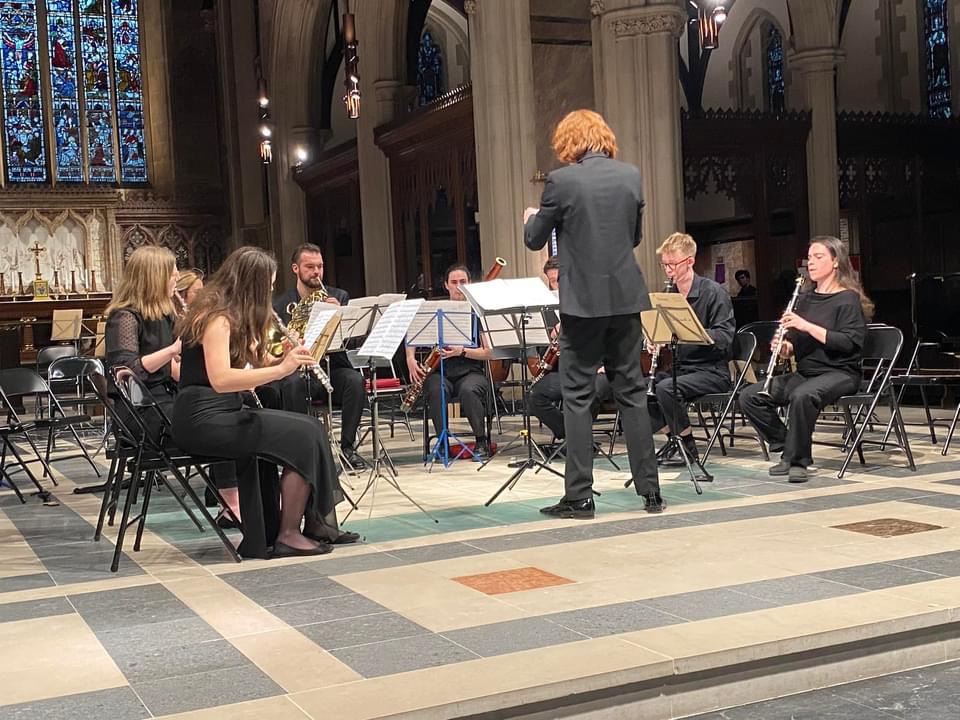
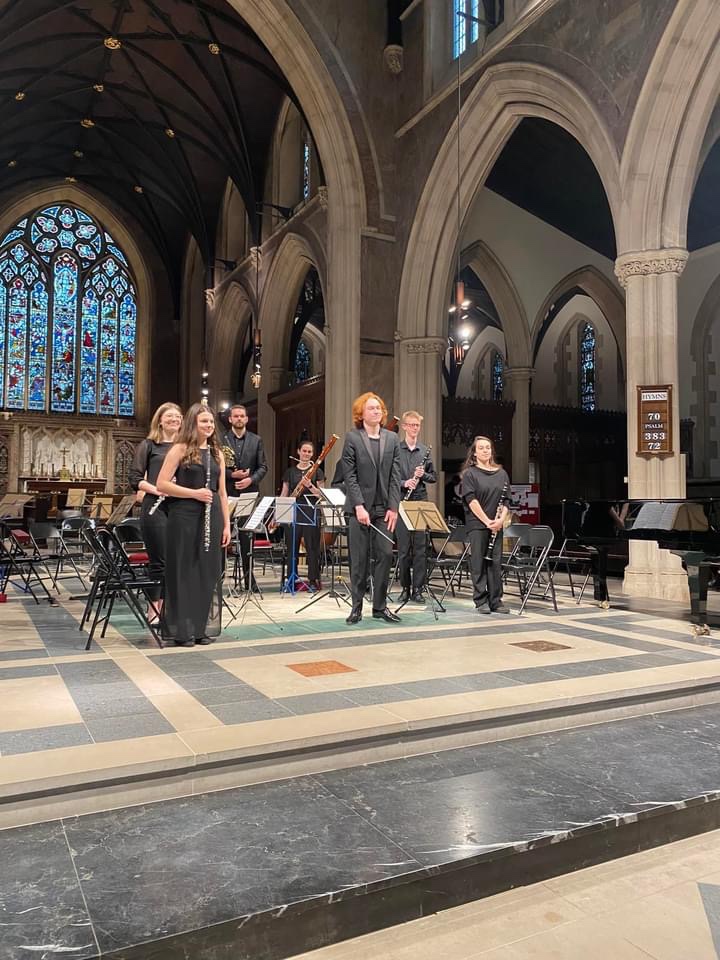
Enescu Decet for winds
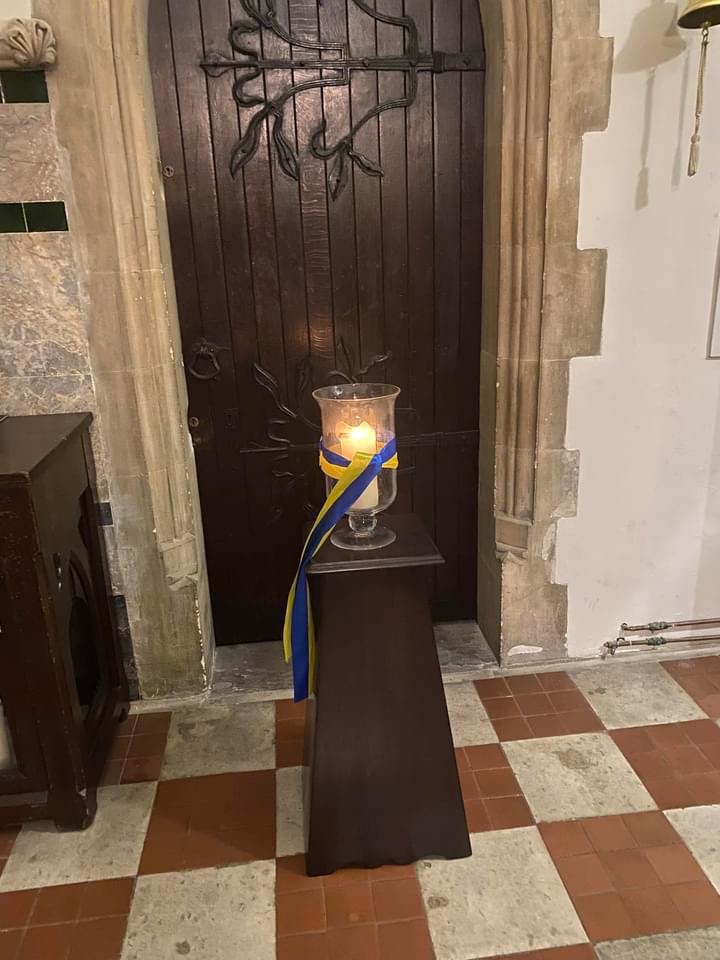
The Decet for Winds by Enescu was a very adventurous choice for the opening of a concert but showed off the precision and musicianship of nine superb players with a sense of architectural shape from Daniel Hogan’s intelligent and sensitive baton. A single candle wrapped in ribbons of the colours of the Ukrainian flag and placed by the front door was a beautiful way to end such a richly rewarding performance .
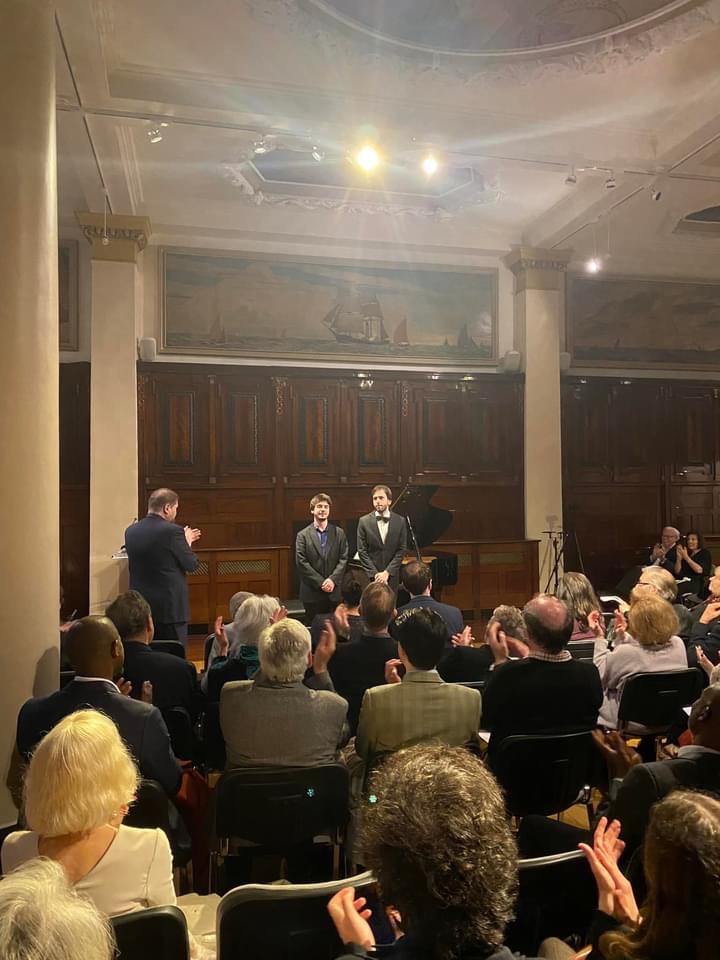
Roberto Doring Pinho da Silva,Minister Counsellor applauding the two soloists
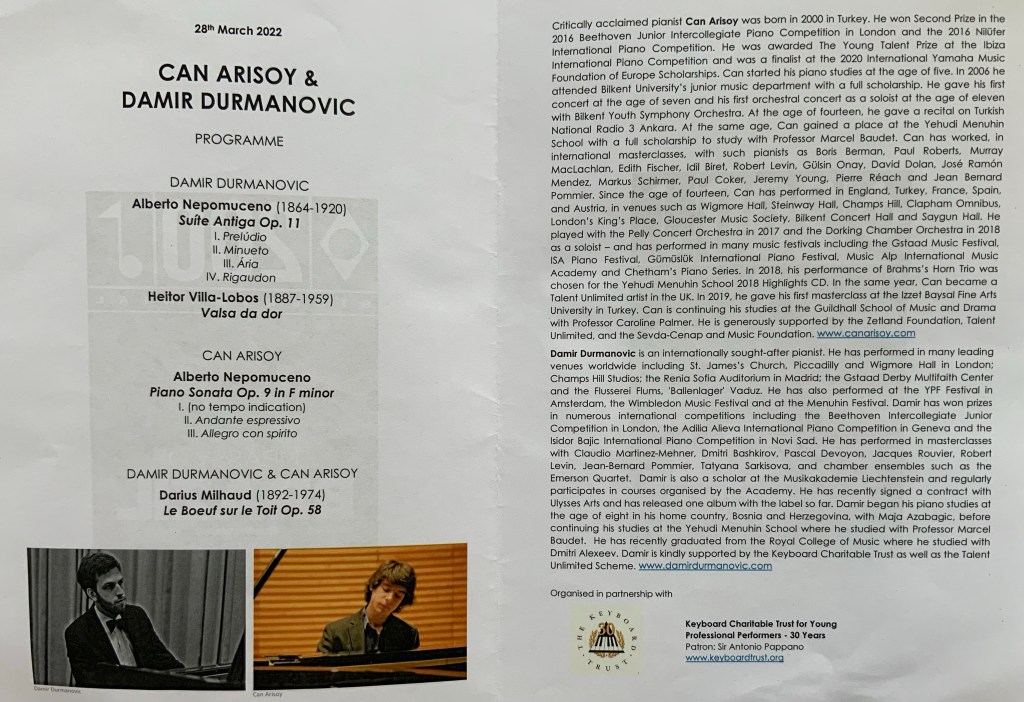
A wonderful evening in celebration of Brazil 200 and the Keyboard Trust 30.It is the second concert in this series generously promoted by the Brazilian Embassy .A series in which the music of Brazil is part of the project ‘Brasil em Concerto’ developed by the Brazilian Ministry of Foreign Affairs in order to promote music by Brazilian composers dating back to the 18th century.A marriage made on wings of song in the historic Cunard Hall now restored to its antique splendor and rechristened Sala Brazil. Damir Durmanovic and Can Arisoy filled this hallowed hall with sumptuous music of Alberto Nepomuceno ,Villa Lobos and a Brazil inspired Milhaud.
Damir Duramovic and Can Arisoy
Playing with such superb performances by two pianist on the threshhold of a professional career having both been students of Marcel Baudet at the Menuhin School since their teens.Damir now a graduate of the class of Alexeev at the Royal College of Music and Can about to graduate from the class of Ronan O’Hora at the Guildhall, they both gave performances of such musicianship and technical command that made one wonder why these works of Nepomuceno have ,remained in obscurity for so long.
Preparing for Milhaud’s Le Boeuf sur le Toit op. 58
Le Boeuf sur Le Toit – Brazil inspired by Milhaud brought these two superb musicians together with a performance of irresistible elan and style …..it must be the longest encore piece ever.Milhaud said that he composed Le Bœuf sur le toit as “fifteen minutes of music, rapid and gay, as a background to any Charlie Chaplin silent movie”.The composer spent two years in Brazil in the French diplomatic service during the First World War , and was influenced by its music in his own compositions. There have been various explanations of the title: that the title was taken from the sign-board of a tavern, and another, that it is from an old Parisian legend of a man in a top-floor flat who insisted on keeping a calf, which grew into a large ox, too big to be removed. Milhaud himself said that it was the title of a Brazilian folk dance.The music cycles through all the major keys and some minor ones and Milhaud quoted extensively from Brazilian tunes. There are more than 20 pieces by 14 Brazilian composers referred to in the score but the lively opening motif is Milhaud’s own invention and recurs throughout.Jean Cocteau persuaded Milhaud to let the music be used for a ballet that made its first appearance in 1920 at the Teatre de Champs -Elysées The only thing to do after such a scintillating performance was to open a bottle or two of superb Brazilian wine and toast to the next voyage of discovery of this treasure trove of Brazilian music
The Brazilian pianist Clelia Iruzun with the distinguished critic Bryce Morrison on the left
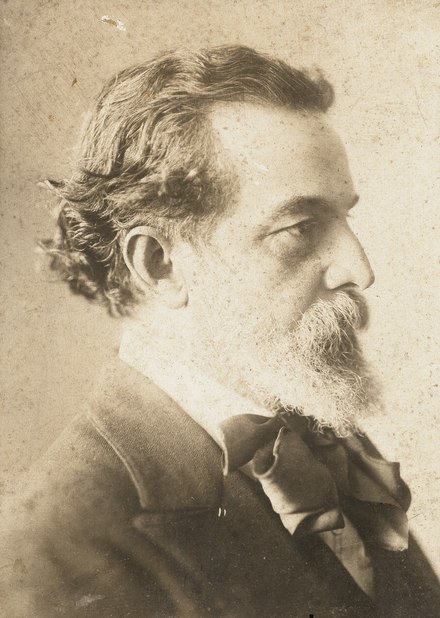
Alberto Nepomuceno (July 6, 1864 – October 16, 1920) began to study music with his father, a violinist, organist, teacher and chapel-master at the Fortaleza Cathedral. In 1872, he and his family moved to Recife, also in Northeastern Brazil, where he started to study the piano and violin. In 1888 he left for Europe where in Rome he took lessons from Sgambati and moving to Berlin in 1890 he studied composition with Heinrich von Herzogenberg and piano with Theodor Leschetizky. In Leschetizky’s class, he met Norwegian student Walborg Bang, whom he married in 1893. Bang had been a student and friend of Edvard Grieg and after the wedding, Nepomuceno moved to Bergen and lived in Grieg’s house. As Grieg was also an advocate for nationalism in composition, the friendship was instrumental in convincing Nepomuceno to write music which reflected Brazilian culture. Before leaving Europe, he visited Paris, where he met Saint-Saens and d’Indy and on his return to Brazil, he taught at the Instituto Nacional de Música (National Music Institute) in Rio de Janeiro.He returned to Europe in 1910 for a series of concerts in Brussels, Geneva and Paris and during this trip, he became friends with Claude Debussy. Back in Brazil, he championed the use of Portuguese in opera and song and remained the leading musical figure in the country until his death at age 56. Heitor Villa-Lobos was one of his students.
Alberto Nepomuceno 1864-1920Damir Duramovic playing Nepomuceno op.11 and Villa Lobos Valsa da dor
The Suite Antiga op 11
Prélude (Allegro commodo G minor)
Menuet (Minuet I. Allegro con spirito — Minuet II — Minuet I da capo; G major)
Air (Andante espressivo; G minor)
Rigaudon (Allegro con brio; G minor)
The first performance in 1893 was in Bergen (piano version) The orchestral version which omits the Prélude was in 1894 with the Berlin Philharmonic, conducted by the composer.An infectious sense of rhythmic energy invaded the Prelude,Minueto and Rigaudon.There was grandeur in the Rigaudon and sense of dance with flourishes of great effect in Damir’s musicianly hands.But there was a more reflective middle episode of great nostalgia before the final joyous eruption of dance.It was the sublime beauty of the Aria though,that made such a striking contrast, played with a great sense of colour where the melodic line glowed with a radiance that was most touching.
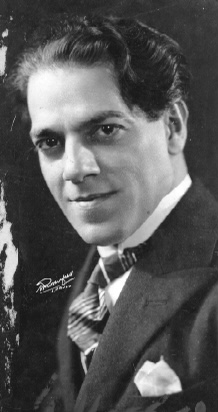
Villa Lobos 1887-1959
Damir’s improvisatory link joined the Suite to Valsa da dor by Nepomuceno’s pupil Villa Lobos.It was played with subtle seductive sounds with it’s central passionate outpouring before the gentle surrender of touching beauty.The Valse de la douleur was written in 1932 but not published until 1972 and is a very effective concert piece that deserves to be better known.Heitor Villa-Lobos (March 5, 1887 – November 17, 1959 ) underwent very little formal training in Brazil and after a few abortive harmony lessons, he learnt music by illicit observation from the top of the stairs of the regular musical evenings at his house arranged by his father. He learned to play cello,clarinet and guitar and when his father died suddenly in 1899 he earned a living for his family by playing in cinema and theatre orchestras in Rio.European influences inspired Villa-Lobos and in 1917 Diaghilev made an impact on tour in Brazil with his Ballets Russes.In that same year Villa-Lobos also met the French composer Darius Milhaud who was in Rio as secretary to Paul Claudel at the French Legation. Milhaud brought the music of Debussy,Satie and Stravinsky ; in return Villa-Lobos introduced Milhaud to Brazilian street music. In 1918, he also met the pianist Arthur Rubinstein , who became a lifelong friend and champion and prompted Villa-Lobos to write more piano music.
Can Arisoy playing Nepomuceno Sonata op 9 in F minor
Nepomuceno’s Sonata in F minor, Opus 9, is the first such work by a Brazilian composer, its three movements suggesting at times the style of Brahms, a reminder that he had studied in Berlin with Brahms’s friend Herzogenberg. Composed in 1893, the sonata was first performed in Rio at the Instituto Nacional by the composer in August 1895 and not published until 2016!
Sonata in F Minor, Op. 9 Allegro con fuoco -Andante espressivo -Allegro con spirito
In Can Arisoy’s hands the sonata was give a performance of great rhythmic energy with its long Brahms like melodic lines in the tenor register played with a noble sense of architectural line.With great authority and technical command it was indeed very like Brahms with its thick almost orchestral texture.
Minister Counsellor Roberto Doring Pinho da Silva with Can Arisoy and guests
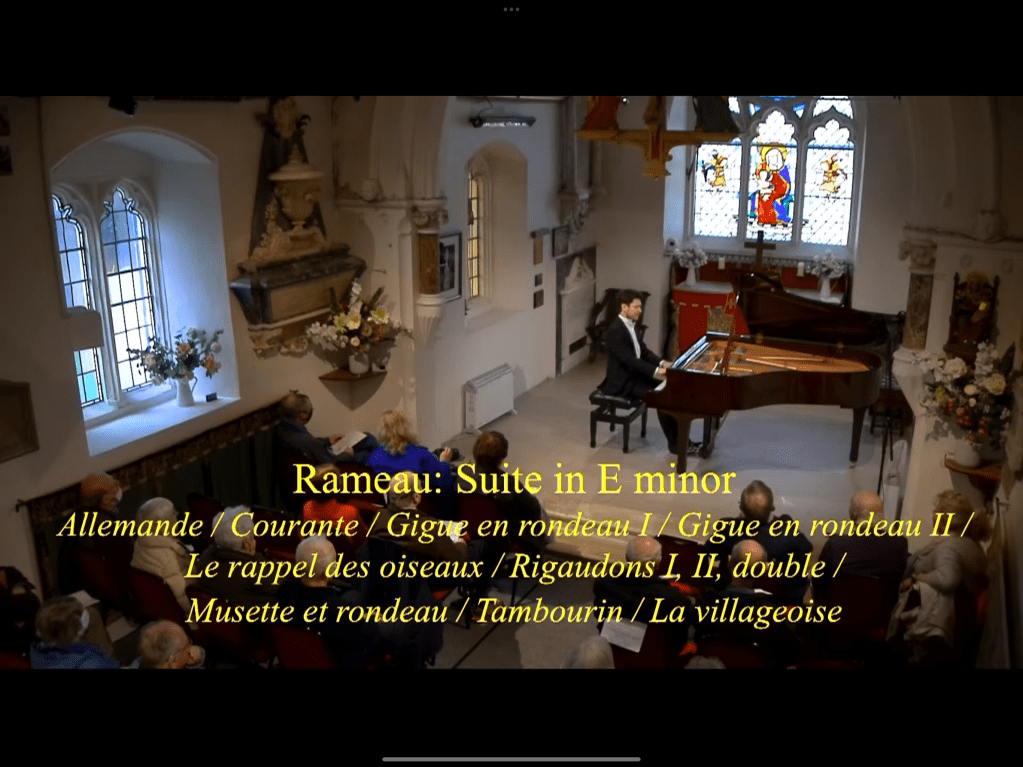
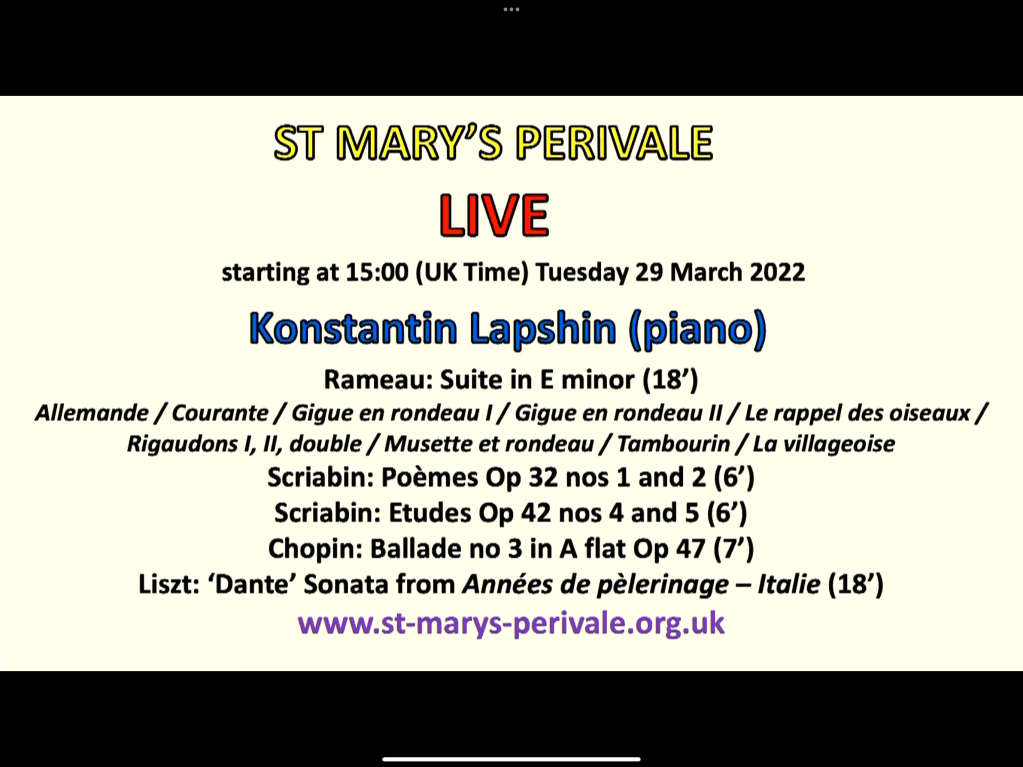
Allemande; Courante; Gigue en rondeau I; Gigue en rondeau II; Le rappel des oiseaux; Rigaudons I,II,double; Musette et rondeau; Tambourin; La villageoise
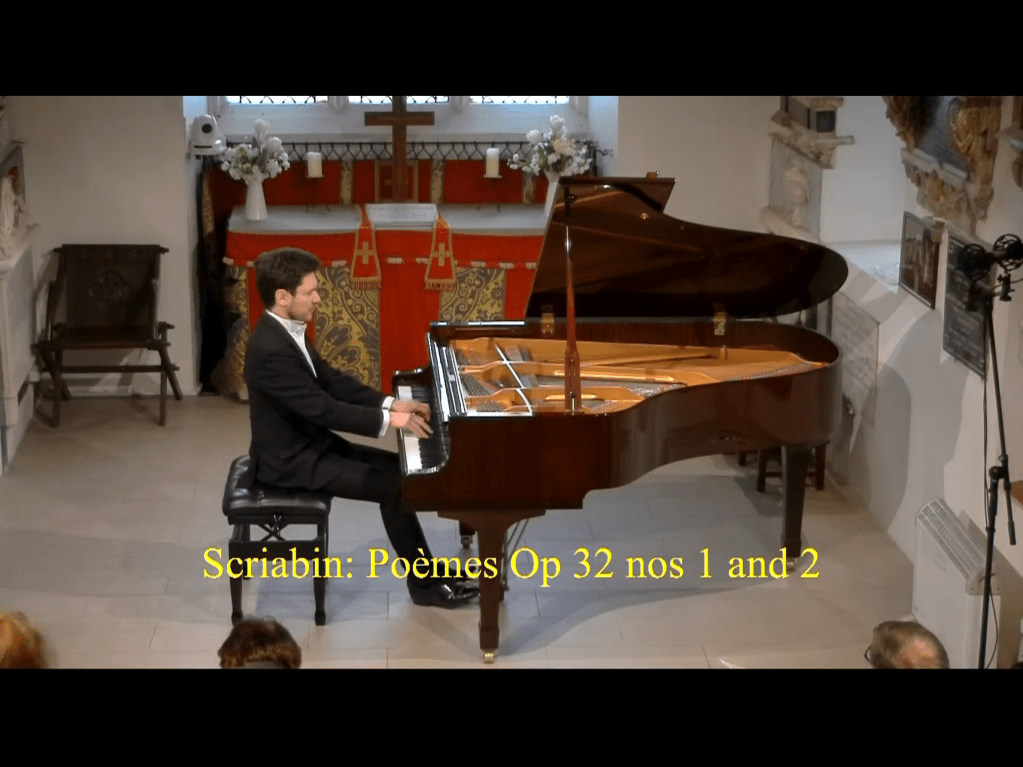
Scriabin: Poèmes Op 32 no 1 and 2
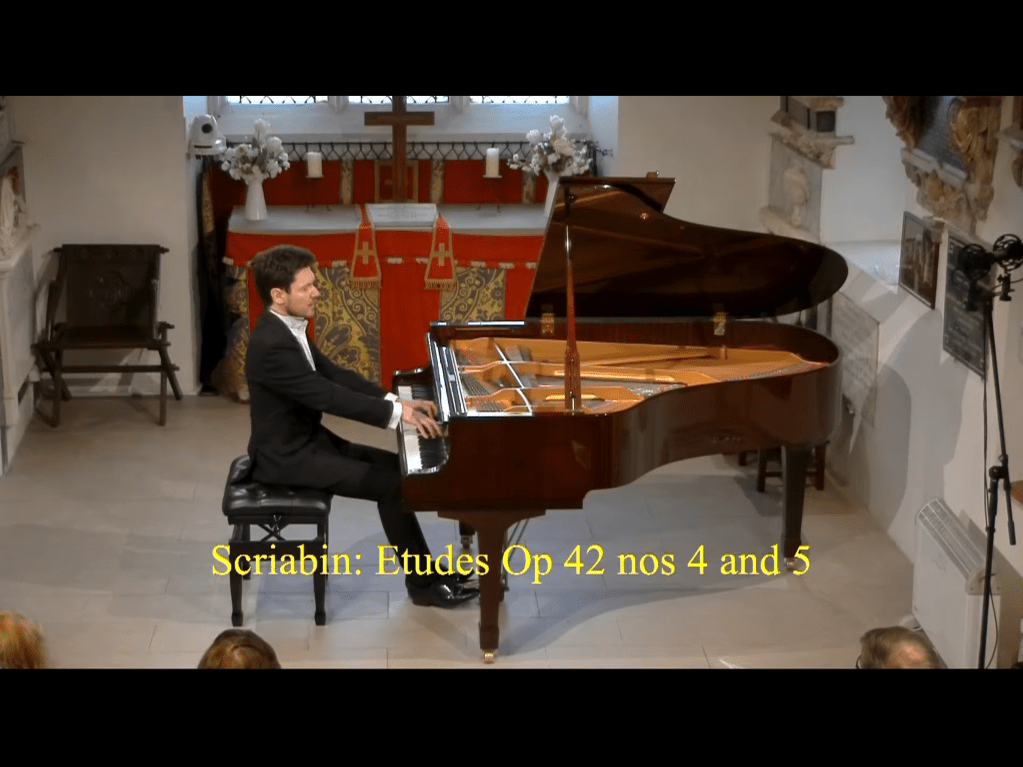
Scriabin: Etudes Op 42 no 4 and 5
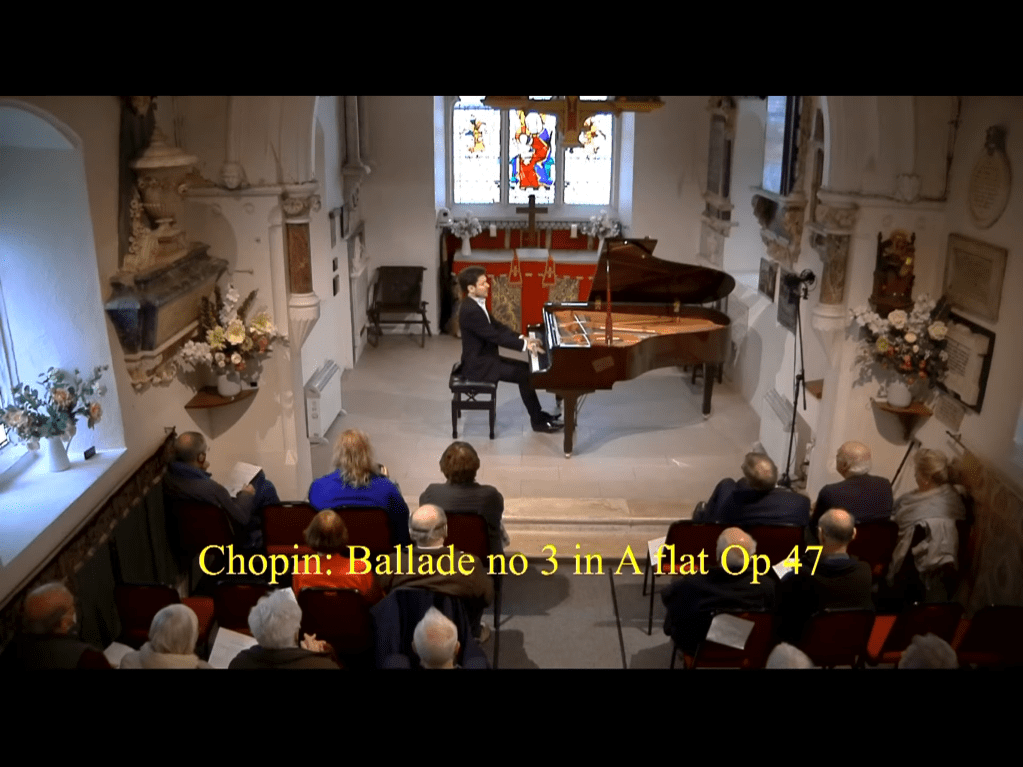
Chopin: Ballade no 3 in A flat Op 47
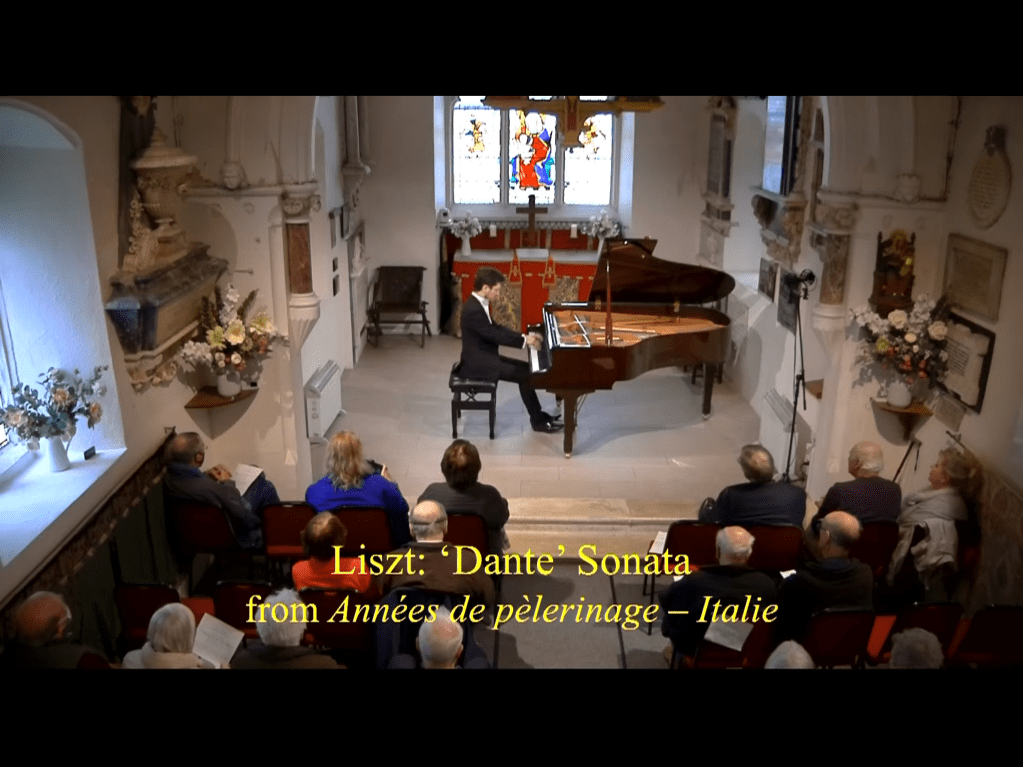
Liszt: ‘Dante’ Sonata from Annees – Italie
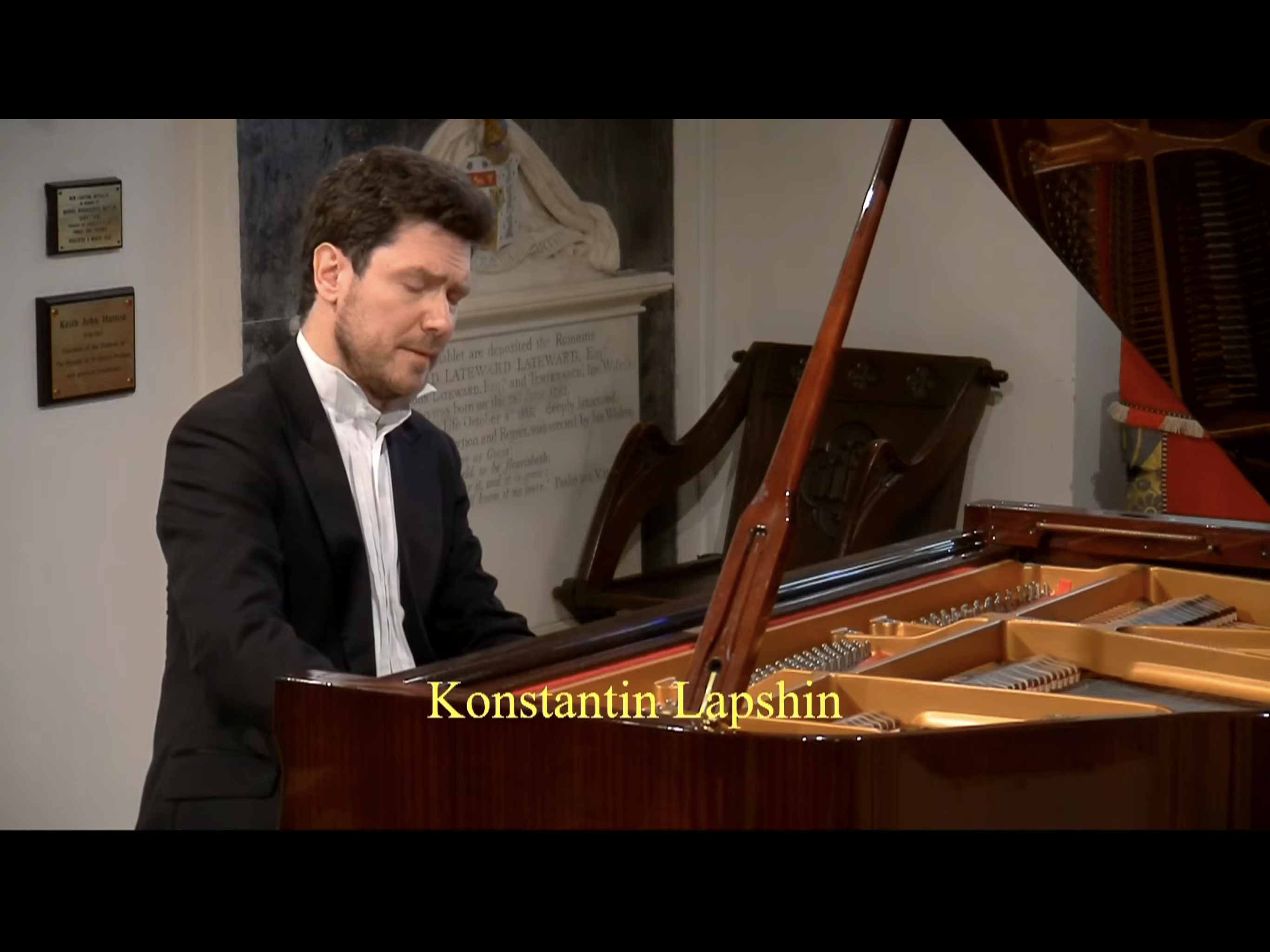
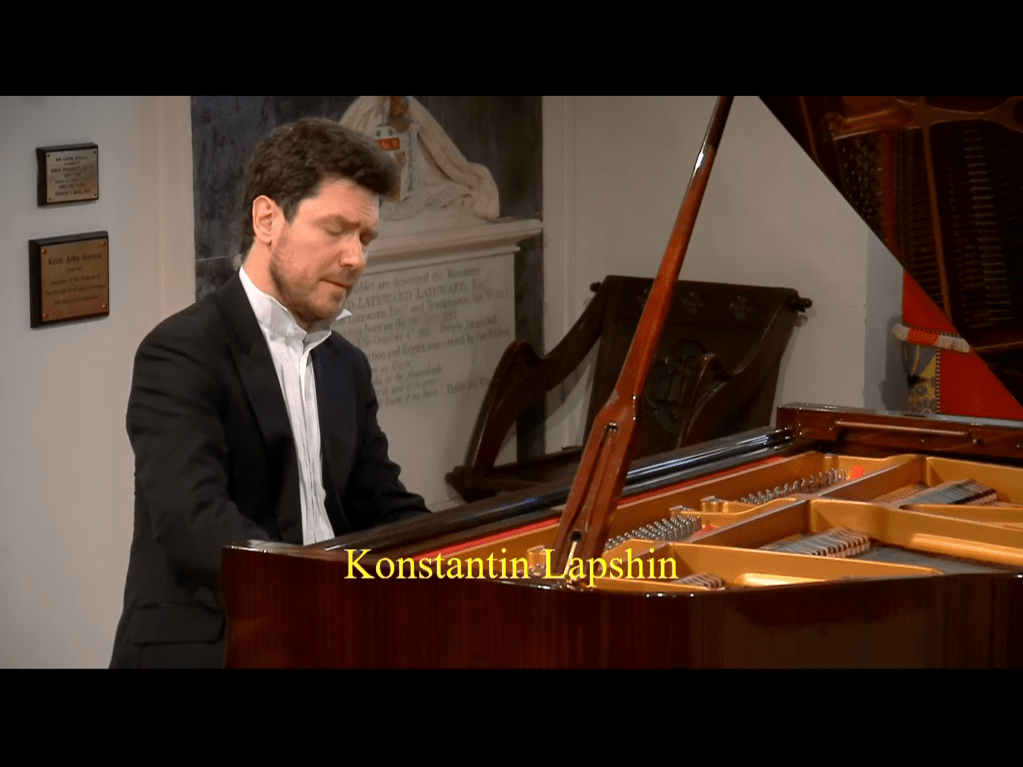
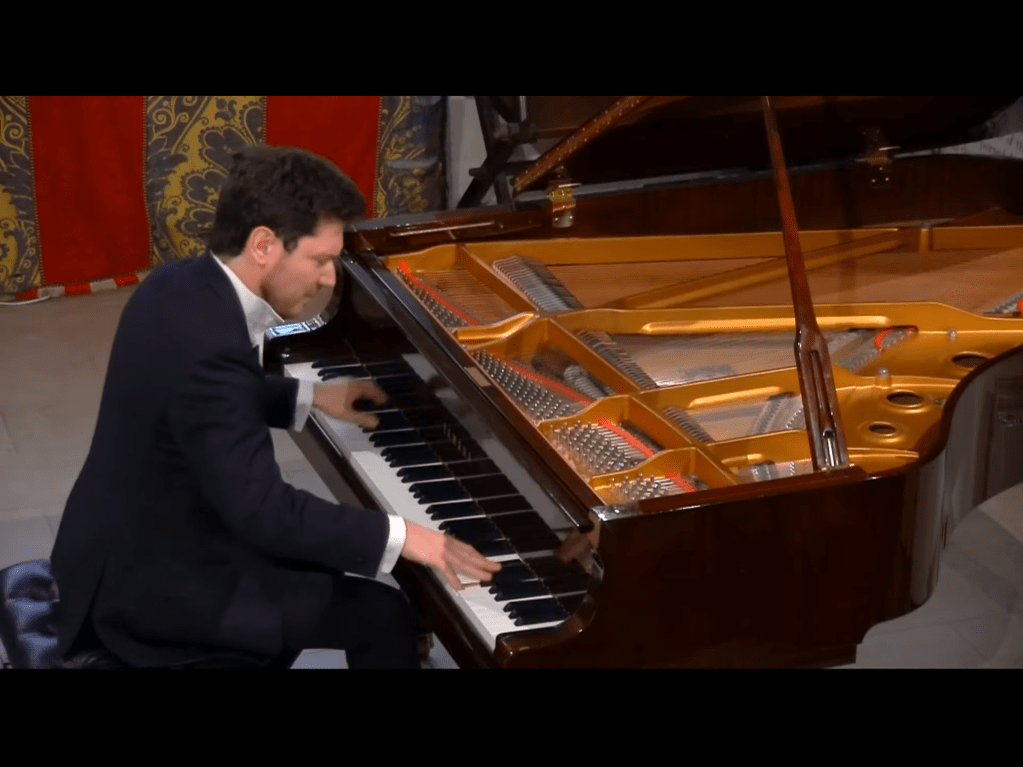
Some superb playing from Konstantin Lapshin,a true poet of the piano. A world of ravishing sounds of luminosity and clarity but with an infinite variety of subtle sounds. From the delicacy and exquisite ornamentation of Rameau where the clarity together with luminosity of Rappel des oiseux together with the magic of La villageoise was of such ravishing beauty that was breathtaking as it was unexpected. There were a kaleidoscopic range of sounds as the poèmes op 32 and two studies op 42 by Scriabin unwound with a mystical and passionate outpouring of such purity where Konstantin’s hands just seemed to caress the keys.There was passion,power and explosions of sound but never hardness or ugliness.It was a lesson in how to disguise the fact that the piano is after all just a box full of hammers and strings.In Konstantin’s delicate hands however it became a celestial harp full of glowing sounds.A very spacious and personal account of Chopin’s third ballade allowed the music to unfold as if a great story was being told. And of course the greatest story was the one he told in one of the finest performances of the Dante Sonata by Liszt that I have ever heard. Gone was all the usual rhetoric and bombastic sounds replaced by an architectural sense of sound that for once this work astonished,bewitched and overpowered as one of the great masterpieces that Liszt was to write in his years of pilgrimage. The ravishing beauty from the very first notes of the Petrarch Sonnet 104 was elaborated into a tone poem of rare passion and beauty and offered as a thank you to the very enthusiastic audience at St Mary’s today.
An impressive technique, and the impulsive, Romantic expression that has been a hallmark of so many Russian pianists, including Rachmaninov and Horowitz”- said ‘Fanfare’ magazine (USA) about Konstantin Lapshin, a multi award – winning Russian concert pianist who has in his collection more than 15 International and National prizes. Konstantin moved to London in 2007 to study at the Royal College of Music, where he won all the competitions and prizes available for pianists, including the most coveted Chappell Gold Medal and the College’s highest prize The Queen Elizabeth Rose Bowl. He subsequently played for HRH The Prince of Wales. Since then, he has given performances at various concert halls across the Europe, Russia and America, including the Royal Albert Hall, Wigmore Hall, Purcell Room at the Southbank Centre, Cadogan Hall, Bridgewater Hall in Manchester, the Salle Cortot in Paris, Piano Salon Christophori in Berlin, Great Hall of the Moscow Conservatoire and others. In 2014 Konstantin was invited to play Rachmaninov’s Concerto no.3 with Odessa Philharmonic and Grammy award-winning conductor and pianist Mikhail Pletnev In Odessa (Ukraine). Konstantin holds Doctoral degree and teaches at the Royal College of Music, giving masterclasses around the world and adjudicating International festivals and competitions.
The Chopin Society full to the rafters to salute a master Stephen Kovacevich’s aristocratic style and search for the perfect legato were the hallmark of a recital that included Berg op 1 and Beethoven op 110 but also the intimate luminosity of Chopin in two nocturnes op 48 n. 2 and op.62 n.2 and three mazurkas op 41 n.1,op 56 n.3.op17 n. 4
When as teenager in London and I began to realise that music was to be the most important thing in my life there appeared on the scene an amazing group of friends who would meet up regularly at Fou Ts’ong’s house in Hermitage Lane on the edge of Hampstead Heath.It was there that Daniel Barenboim first played Brahms with Jaqueline Du Pre and joined ranks in playing chamber music with Itzhak Perelman,Pinchas Zuckerman,André Tchaikowsky,Vladimir Ashkenazy,Nelson Freire,Martha Argerich,Radu Lupu and of course Stephen Kovacevich (Bishop in those days) who was an athletic young man fresh from California studying in London with Dame Myra Hess.Madame Tillett was proud to present Stephen and Jaqueline together in duo and as soloists with Barbirolli and Boulez -Stephen in Beethoven 4 and Jaqueline with Elgar they were her young stars.The recording of their Beethoven Sonatas is one of the recordings that I have most cherished for the past sixty (!) years.
Madame Tillett was known as the Empress of agents who was loved and feared in equal measure.When Jackie decided to stay by the side of Daniel Barenboim,the man she loved,during the war in Israel the idea that her stars could renounce engagements for such a thing was completely incomprehensible.All these artists have gone on to illustrious careers but in that formative period there seemed to be more time for them to have fun together and they could regularly be seen playing together in the Southbank Summer Festival and Brighton Festivals both directed by an as yet almost unknown energetic young Daniel Barenboim.The summer school in Dartington too was a favourite haunt and I well remember the arrival of Stephen in his coupé sports car with a tennis racquet and beautiful companion on the seat next to him ready to spend a week with us students sharing music and fun with us whilst enjoying the wonder that was Dartington under Glock and Amis in that period.
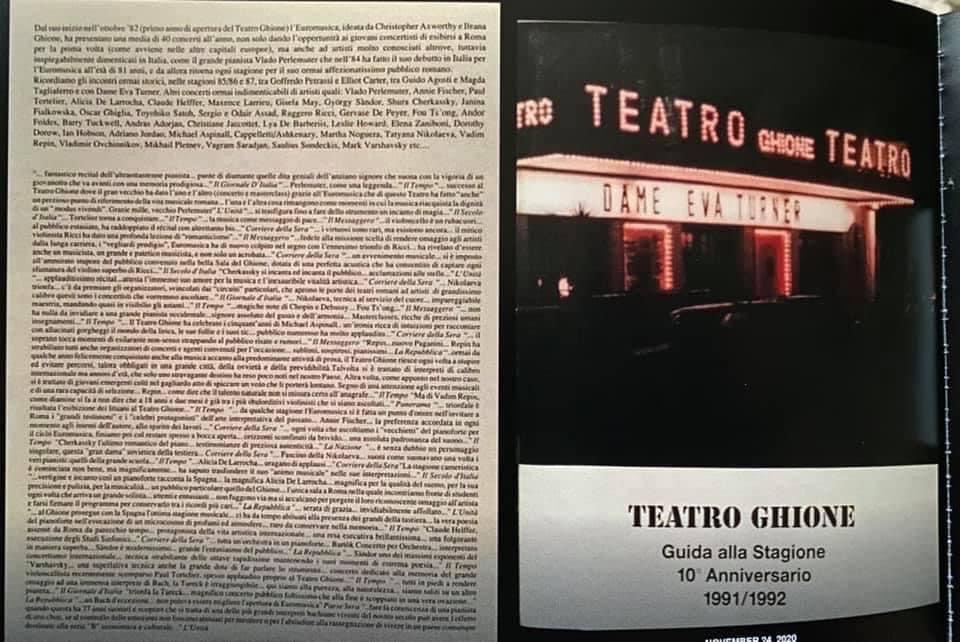
A few years later I set up home in Rome and side by side with my actress wife we created the Ghione Theatre next to St Peter’s Square .For thirty years it became a much needed cultural centre in the eternal city that in the 80’s and 90’s lagged much behind the rest of the major European capitals.(With the opening of the Renzo Piano concert halls since 2005 that has all changed and Rome is now one of the major beacons for classical music).I remembered all the wonders I had experienced in London and in between producing my wife’s plays I would squeeze in many of the artists that were virtually unknown to Rome audiences.Together with my old teachers Vlado Perlemuter and Guido Agosti, we invited Shura Cherkassky,Annie Fischer,Paul Tortelier,Rosalyn Tureck ,Ruggiero Ricci and even Stockhausen .I had never forgotten Fou Ts’ong and Stephen Kovacevich though and they became firm favourites in Rome and through their masterclasses inspired the same passion in young musicians that I had known.Stephen came to us via a charming old world agent in Milan.Donatella Brizio was an elderly lady with such integrity and honesty where in those days an agents word was her bond(!).She was happy to persuade Ruggiero Ricci,Dmitri Alexeev and Stephen to come to us in Rome as she together with her equally noble colleague Gabriella Giordano would bring Alicia de Larrocha ,Shura Cherkassky and Rosalyn Tureck as they in turn would applaud my wife in our productions when on tour in Milan.
I remember Stephen coming one year to play the Schubert B flat Sonata and in between asking if I would mind chopping off a good portion of the piano stool legs he asked if I minded if he played the A major Sonata instead as he thought it more suitable for the piano.I used to video record the concerts just for the archive and one year he asked me not to as he felt he could be much freer if it was not frozen onto a video tape.He is the only artist that has ever commented on how much money I must have lost through having a poor audience when in May his concert coincided with a football final in Rome!
It is just this honesty and integrity in his artistry that shone through all that we heard today at the Chopin Society.It is thanks to Lady Rose Cholmondeley and Gillian Newman that we are able to hear such artists who are excluded for some extravagant reason from the ‘business’that the concert profession has become.In the past years I have been able hear such artists as Janina Fialkowska,Dmitri Alexeev and an unforgettable ninety year old Abbey Simon.An atmosphere where they play amongst friends and feel happy to be able to share their music and experience in an un pressured way just as the artists did for us in Rome.Gillian is not only a wonderful organiser but is equally renowned for her home made marmalade!Lady Rose is there side by side with the artist as they play their heart out for her and are often offered tea and cakes afterwards .The Artist is even entrusted with the key to the bathroom in the vestry- green room.(Janina inadvertently took it to Bavaria with her and was quickly reminded to return it for the next artists relief!)
Wonderful to be able to hear Stephen again and see him sitting almost on the floor with his hands uplifted to the keys.And it was obvious that like Wilhelm Kempff ,he was searching for the perfect legato where the sounds could blend into each other without any percussive or athletic interventions .Sounds that melted into each other with a luminosity and sense of balance which was so noticeable from the very first knotty strands of Berg’s remarkable op 1 Sonata.There was passion too but always within the sheen that was created by a subtle and sometimes even excessive use of the pedal.It allowed the music to grow from the initial gentle idea through a world of anguish and passion before resolving or at least resting ,in peace.It was remarkable to note too that there was no I pad or aide memoire necessary where the music was ingrained in the soul and no longer on the page!Young musicians please take note!
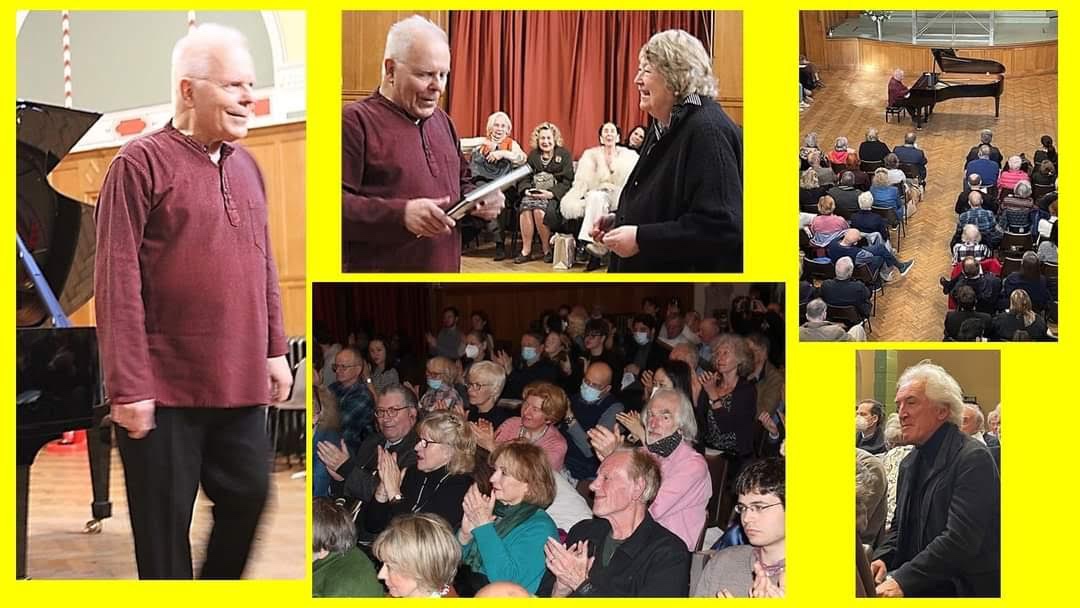
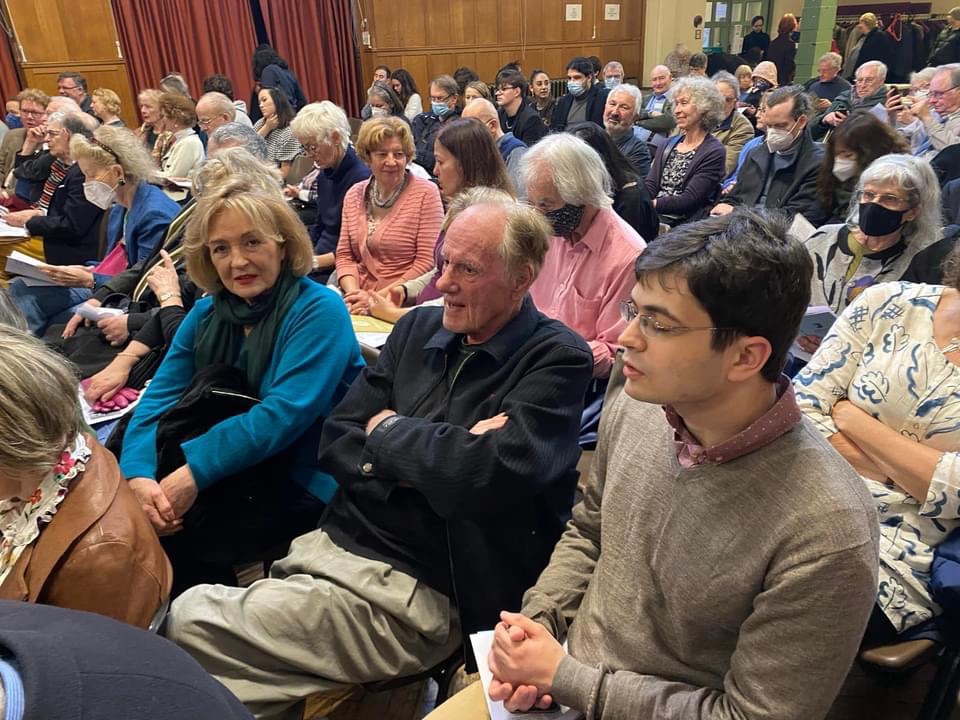
The vast and distinguished audience young and old at the Chopin Society.
It was not only refreshing to hear Stephen but also to admire his undemonstrative stillness at the keyboard as he was totally engrossed and concentrated on transmitting with such intelligence and humility the composers wishes.This concentrated composure has always been the hallmark of the young American teenager who was adopted by Myra Hess as the true disciple of her integrity and artistry that made her so loved and cherished.I think that she was proudly present at his debut recital at the Wigmore Hall when he astounded the musical world with his performance of the Diabelli variations.In fact it was in late Beethoven and in particular op 109 and 110 that Dame Myra will always be remembered.
It was in the performance of the Sonata op 110 that we heard today that we too were reminded of how beautiful the piano can sound and how Beethoven’s minute details can be transformed into the same magic that the composer himself was only able to hear in his head.If some of the detail was no longer as precise as it would have been it is a small price to pay to hear such magic pour from the hands still of Stephen Kovacevich unbelievably in his eightieth year.The vision of the lythe young American in Dartington springs to mind but it is his music that has remained in my heart and which is still very much present.The unforced sheen he gave to the small group of ‘obligatory’Chopin was a wonder of colour and mystery almost as though on a voyage of discovery into a world of whispered sounds.The middle section of the F sharp minor nocturne I have rarely heard so subtly teasing with kaleidoscopic sounds,the same wondrous sounds that he miraculously ended the mazurka op 17 n.4 with.Sounds that were barely audible but that shone like the jewels they truly can be.
Lady Rose presenting her book about Chopin’s piano to Stephen
Tea and cakes afterwards with Stephen and most of the audience was one of the wonders that can still be found in certain corners of a great city if one wants to look.
The only empty seat is mine whilst taking this photo!
Vieni,vedi vinci indeed …….Hats off to the Chopin Society and all those that sail with her.
“To remain silent today is to betray our conscience and our values, and ultimately what defines the nobility of human nature.”Semyon Bychkov
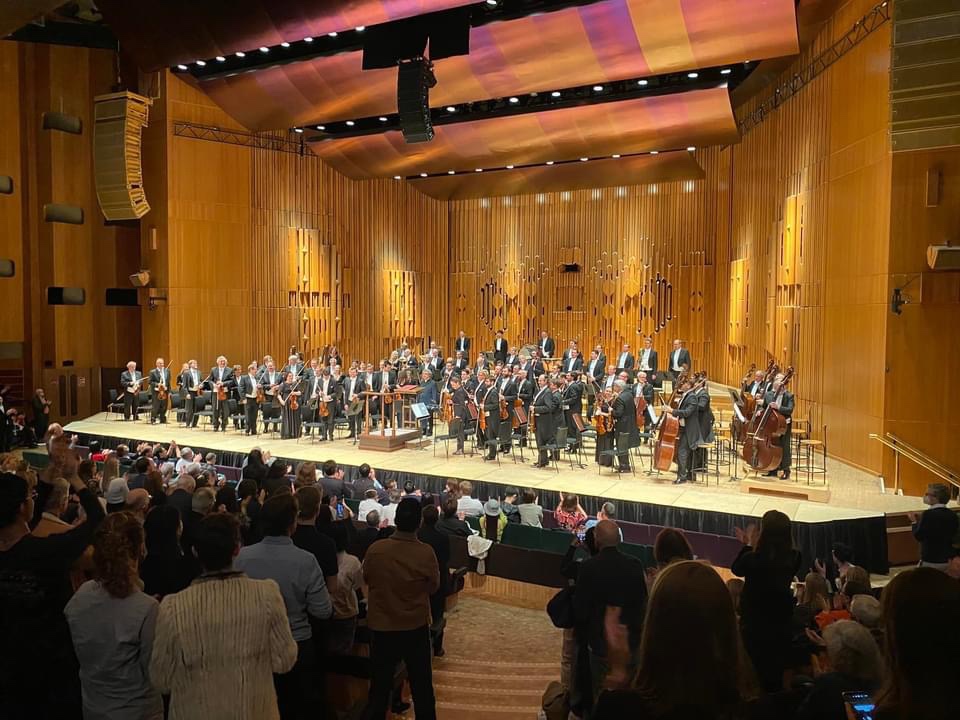
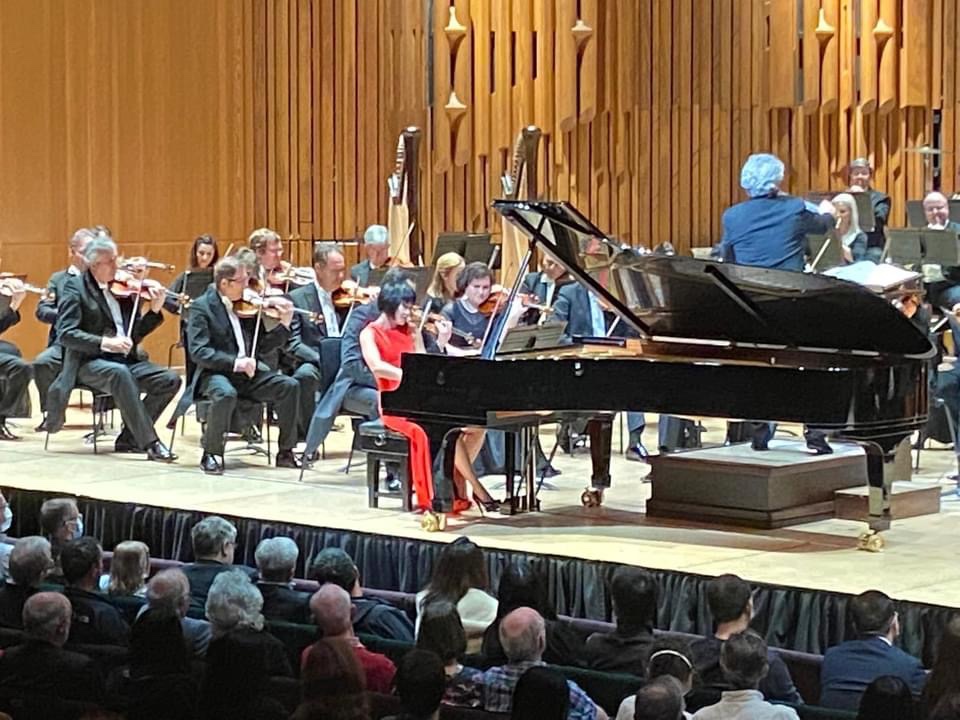
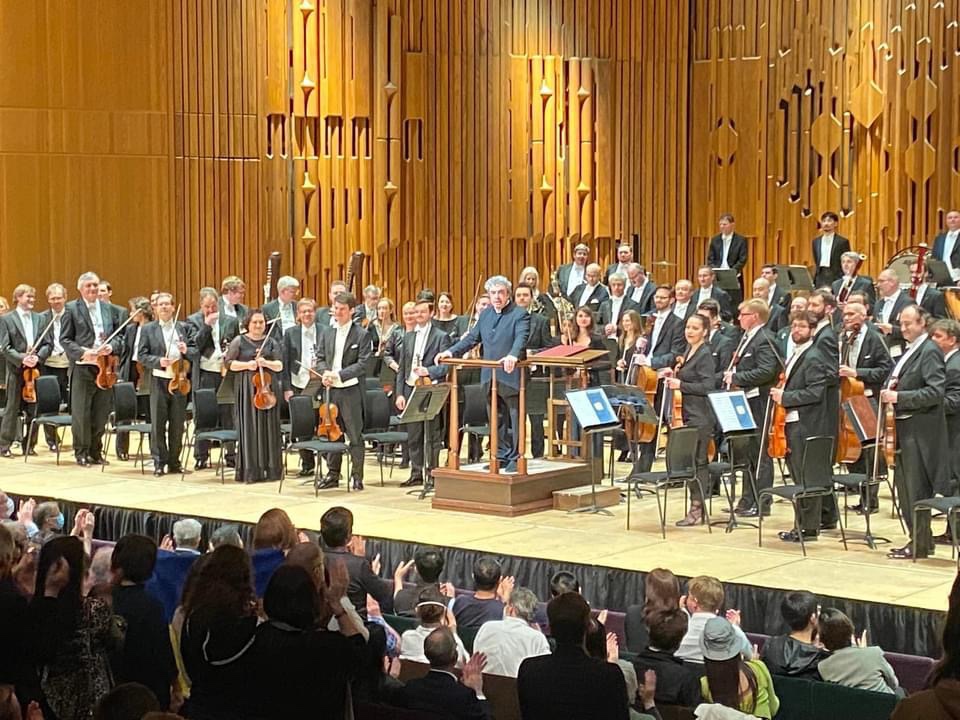
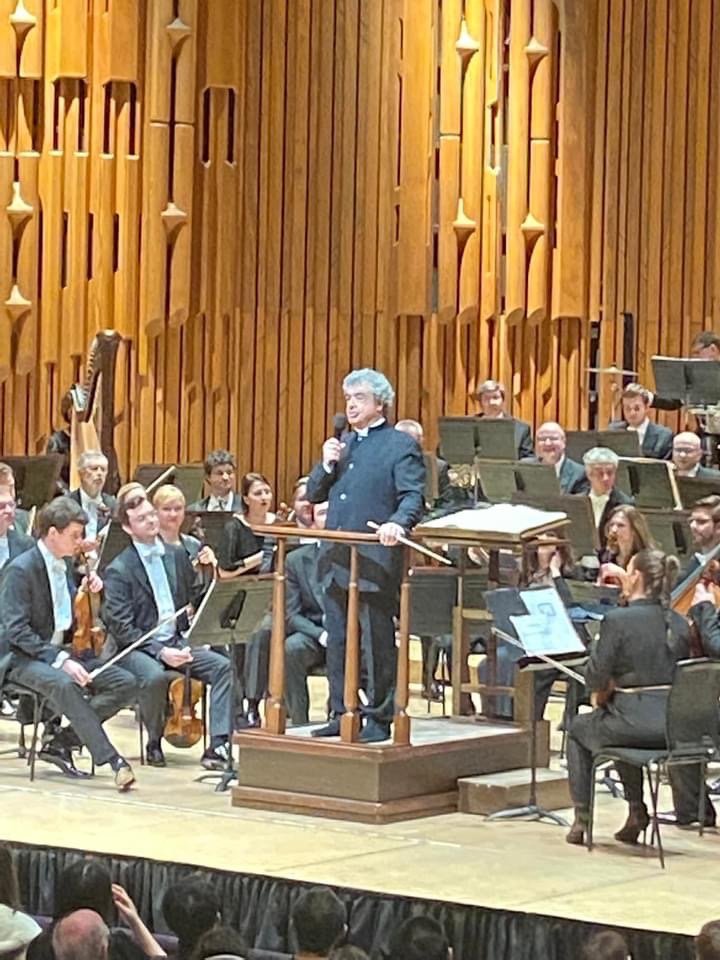
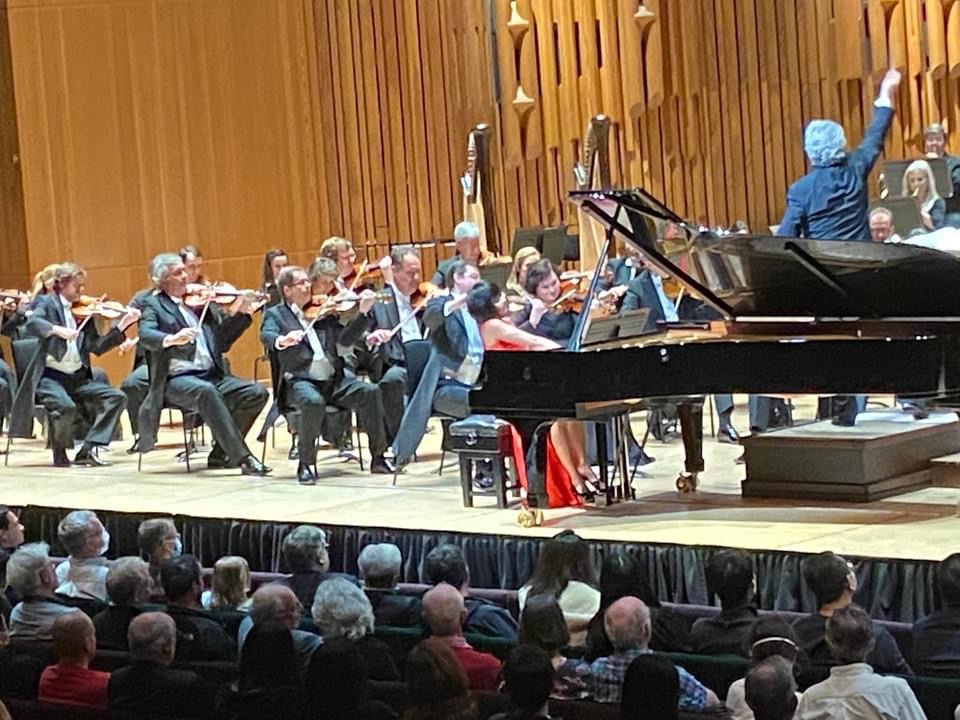
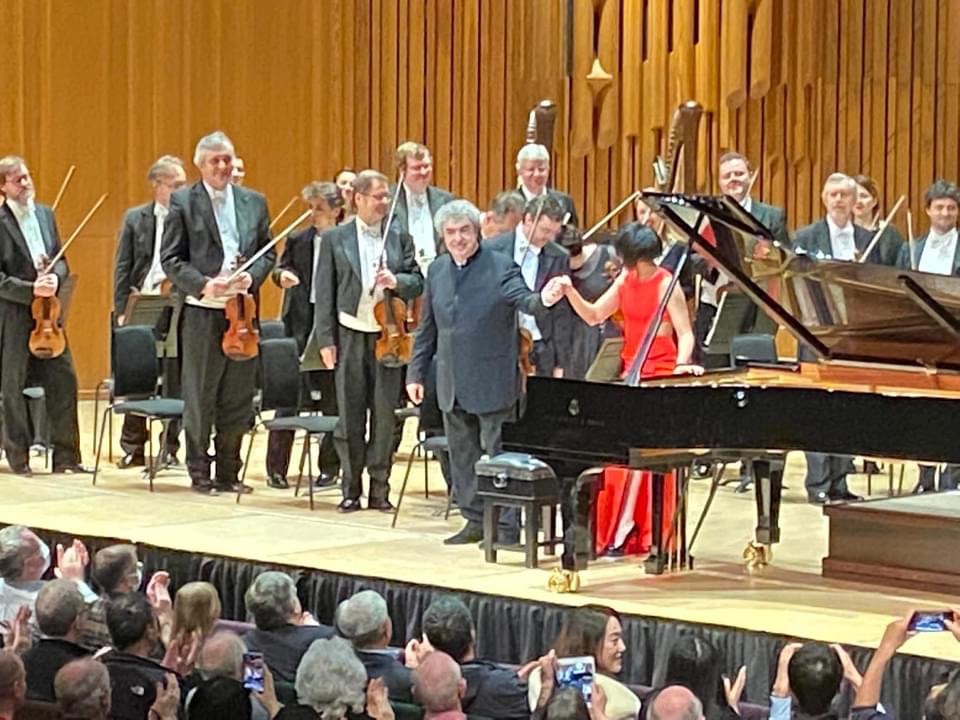
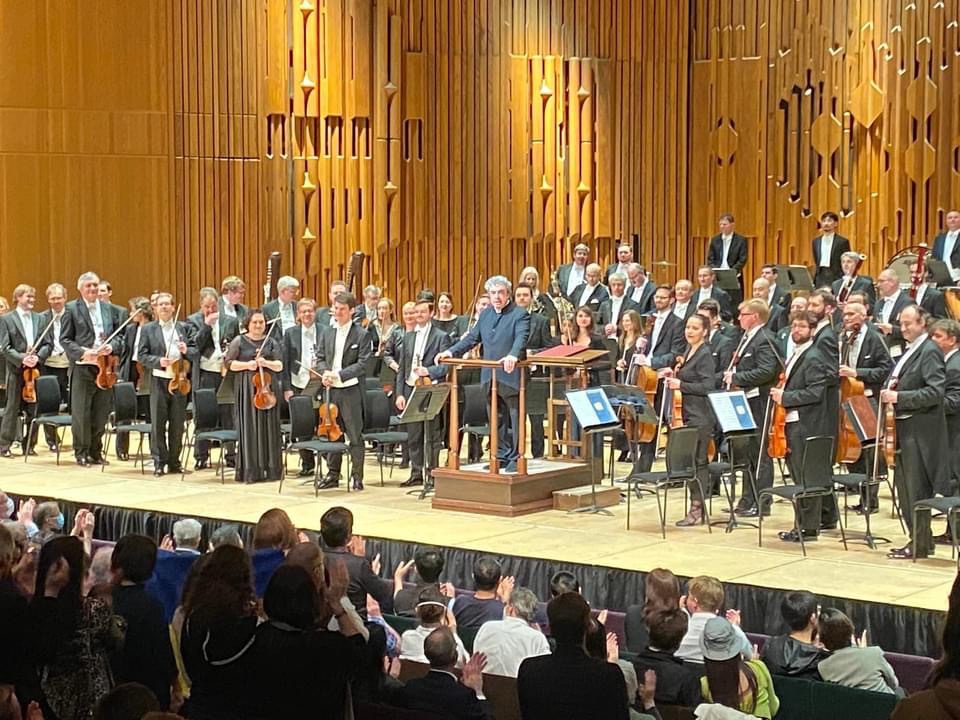
Czech Philharmonic/Semyon Bychkov & Yuja Wang A tribute to the people of Ukraine A Yuja Wang in scintillating form in Rachmaninov’s first piano concerto with the sumptuously free strings of this historic orchestra.Semyon Bychkov’s extraordinarily fluid magic wand creating a continuous stream of sounds from an orchestra of the grandest of traditions.It was from the very opening romantic sounds of Rachmaninov that there was a flexibility of shape and style of operatic proportions with a richness of sound and colour that I have only ever heard from Rachmaninov’s favourite orchestra in Philadelphia.Yuja Wang’s absolute authority from the opening octaves was breathtaking as was the sumptuous way she could draw the audience in to eavesdrop on such ravishing musings or take us by storm with her scintillating energy in the last movement.The great first movement cadenza she built up the rich sonority from a mere whisper in such a masterly way that one would not have thought the amount of sound and power possible from the elegant lady in the flaming red dress .Piano playing of the Golden age bequeathed to her by her great mentorGary Graffman.
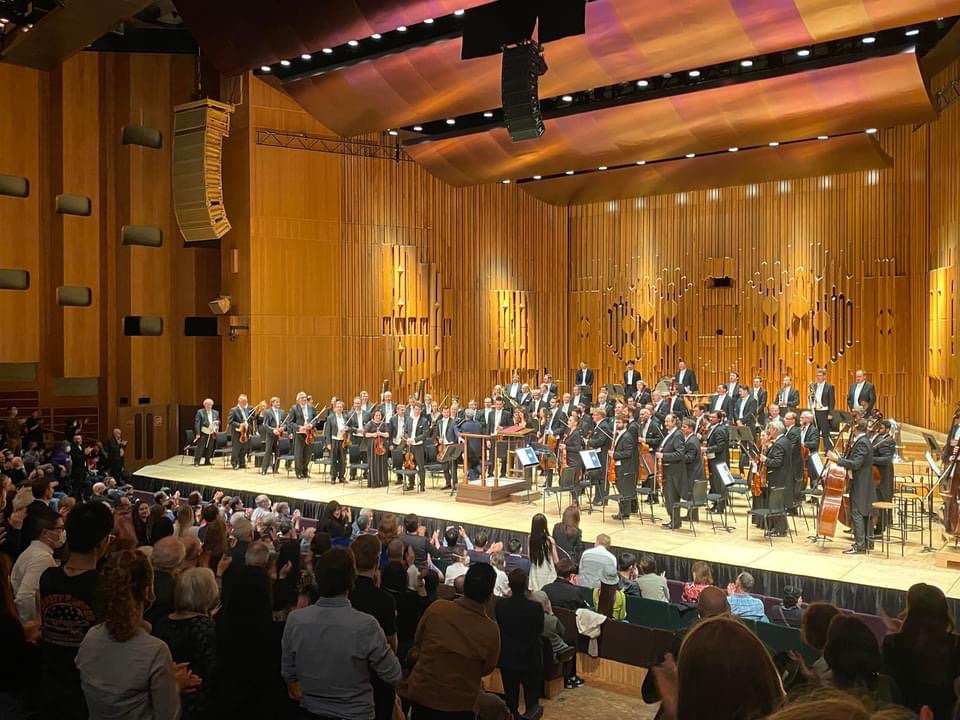
Throughout the concert Semyon Bychkov’s authority artistry and above all humanity and integrity illuminated a sold out Barbican and we left uplifted and resolved as never before.
A short speech and the Ukrainian National Anthem was a very dignified way to open such a poignant occasion.’A music that is an identification with the land that brought us into this world.We hear this music now at a time when people are suffering in a way that is hard for us to imagine,somehow the notes sound differently’
It was in the spring of 1902 that the Czech Philharmonic first took up residency in London,the first to do so ,and today more than a hundred years (and several visits) later, they come with their chief conductor and musical director since 2018,Semyon Bychkov bringing a message of solidarity and peace in light of the tragedy that is unfolding in the past few weeks in the Ukraine.
Sergei Rachmaninov Piano Concerto No 1 1. Vivace – Moderato 2. Andante 3. Allegro vivace Bedřich SmetanaMá vlast (My Fatherland) 1. Vyšehrad (The High Castle) 2. Vltava (The Moldau) 3. Šárka 4. Z českých luhů a hájů (From Bohemia’s Woods and Fields) 5. Tábor 6. Blaník
Sergei Rachmaninov, newly graduated from Moscow Conservatory in 1892 premiered the first movement of this work but was never quite satisfied with it and it was in 1917 after writing his Second and Third Piano Concertos,that he began the revision whilst blocking out the Revolutionary turmoil all around him.It was the last major work he composed before leaving Russia for ever .Rachmaninov’s changes were quite extensive especially in the last movement but it still balances the extraordinary virtuosity and a romantic lyricism that was characteristic of Rachmaninov one of the great virtuosi of his day.These two sides can be heard, for example, in the first movement, where, after a brass statement combined with cascading piano double octaves, the orchestra launches into the broadly lyrical main theme.
Bedřich Smetana (2 March 1824 – 12 May 1884 )was a German speaking Czech composer who pioneered the development of a musical style that became closely identified with his people’s aspirations to a cultural and political “revival.” He has been regarded in his homeland as the father of Czech music.He is best known outside his homeland for his opera The Bartered Bride and for the symphonic cycle Mà vlast (“My Fatherland”), which portrays the history, legends and landscape of the composer’s native Bohemia .In 1861, it was announced that a Provisional Theatre would be built in Prague, as a home for Czech opera and Smetana saw this as an opportunity to write and stage opera that would reflect Czech national character.At this stage in his career, Smetana’s command of Czech was poor as his generation of Czechs was educated in German,and he had difficulty expressing himself in what was supposedly his native tongue.To overcome these linguistic deficiencies he studied Czech grammar, and made a point of writing and speaking in Czech every day.By the end of 1874, Smetana had become completely deaf but, freed from his theatre duties and the related controversies, he began a period of sustained composition that continued for almost the rest of his life. His contributions to Czech music were increasingly recognised and honoured, but a mental collapse early in 1884 led to his incarceration in an asylum and subsequent death already from 1879, Smetana had written to friends revealing fears of the onset of madness and by the winter of 1882–83 he was experiencing depression, insomnia, and hallucinations, together with giddiness, cramp and a temporary loss of speech.His family, unable to nurse him any longer, removed him to the Kateřinky Lunatic Asylum in Prague, where he died on 12 May 1884.The hospital registered the cause of death as senile dementia.However, Smetana’s family believed that his physical and mental decline was due to syphilis.
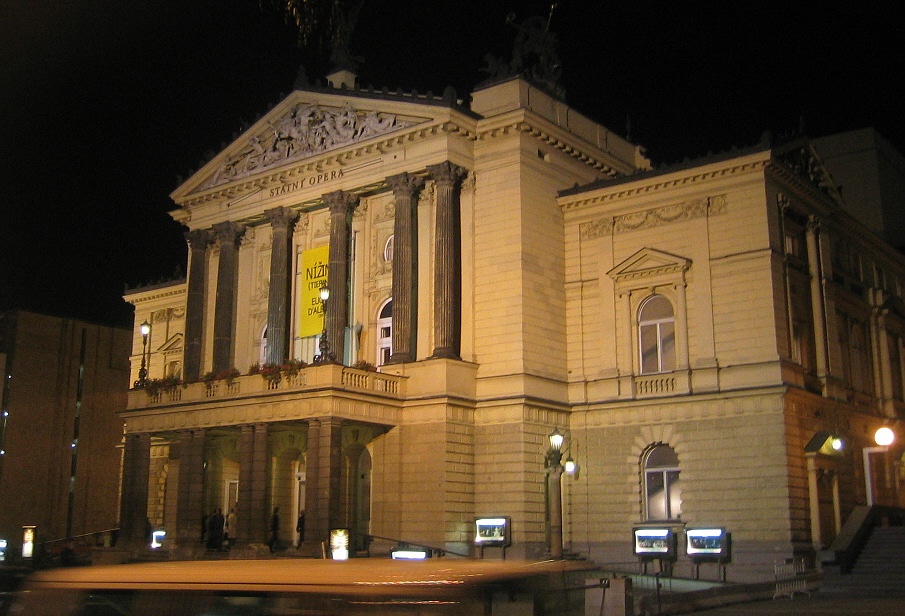
The State Opera in Prague
The State Opera is part of the National Theatre of the Czech Republic, founded by Ministry of Culture of the Czech Republic in 1992. It was originally opened in 1888 as the New German Theatre and from 1949 to 1989 it was known as the SmetanaTheatre . More recently it was renamed the Prague State Opera And is home to approximately 300 performances a year. It regularly plays Smetana’s nine operas in the original Czech.I was present at a performance of ‘The Kiss’ where the whole audience was participating totally and applauded wildly when the ‘Kiss’ actually occurred much as in England with the Pantomime or in Italy and Vienna with Operetta.A very stirring and moving experience indeed.
‘My Fatherland ‘ contains the famous symphonic poem “Vltava”,also popularly known by its German name “Die Moldau”and is a cornerstone of Czech repertoire. Though inspired by the Lisztian ideal of the symphonic poem Smetana only slowly came to the idea of a cycle of ‘poems’ extolling his homeland.The first ‘poem’ – ‘Vyšehrad’ – was completed in November 1874 and premiered on 14 March 1875. Portraying the mythical birthplace of Prague, the legendary and historical fortress which stands on a rock east of the river Vltava, the piece begins with a solo harp playing the ‘Vyšehrad motif’. As Smetana said, ‘a poet sings of the events on Vyšehrad, of glory and splendour, of tournaments and battles, and of eventual decline and ruin. The poem ends on an elegiac note.’Janáček described the reaction to Smetana’s second poem ‘Vltava’ when in 1875 he first heard it: “At the end a tumultuous roar fused into the name Smetana!” ‘Vltava’ is the most popular of Ma vlást’s movements. It depicts the course of the mighty Czech river (in German: ‘Moldau’) that flows through much of Bohemia, from its source as two rivulets, past a woodland hunt, peasants’ wedding, and mermaids in moonlight, to St. John’s Rapids. The ‘river’ theme blazes forth in major mode, setting up a victorious return to Vyšehrad, before fading away. The Vltava eventually joins the Elbe. The third movement depicts the legend of Šárka who avenged herself on men for an earlier infidelity. We hear the approach of Ctirad and his men, the cry of anguish Šárka feigned to lure Ctirad’s men to her maidens’ trap, love music, carousal, slumber and then a horn, Šárka’s signal to start the massacre. ‘From Bohemia’s Woods and Fields’, denotes Smetana’s love of the Bohemian countryside. He basks in generous melody though making prominent use of fugue.By 1878, Smetana had decided to expand his original concept of three to six movements, ending with a pair inspired by the Hussite period in Czech history. Both make use of ‘Ye who are God’s Warriors’, a hymn that supposedly struck fear in the enemy. ‘Tábor’, named after the Hussite stronghold, depicts the Hussites’ faith and resolve. ‘Blaník’ refers to the hill under which Czech warriors are thought to sleep until rallied to save the nation under St. Wenceslaus. The cycle ends with the ‘Vyšehrad motif’.Ma vlást premiered on 5 November 1882,by which time Smetena was completely deaf and it was immediately an important national emblem that has gained worldwide appeal.
Semyon Bychkov’s tenure as Chief Conductor and Music Director of the Czech Philharmonic was initiated in 2018 with concerts in Prague, London, New York and Washington, marking the 100th anniversary of Czechoslovak independence. With the culmination of The Tchaikovsky Project the following year, Bychkov and the Czech Philharmonic turned their focus to Mahler.With a repertoire that spans four centuries, Bychkov’s highly anticipated performances are a unique combination of innate musicality and rigorous Russian pedagogy. He holds honorary titles with the BBC Symphony Orchestra and the Royal Academy of Music and is a frequent guest with all the major international orchestras. International Opera Awards named him ‘Conductor of the Year’ in 2015 and this year he will receive an Honorary Doctorate from the Royal Academy of Music.
On 1 March, Semyon Bychkov and members of the Czech Philharmonic took part in a benefit concert for Ukraine.Thirty thousand people gathered together at Prague’s Wenceslas Square and more tuned in in solidarity, donating over 180 million in CZK. “I came to this sacred place in Prague to honor the memory of 1968. Today, 54 years later history repeats itself once again. This time in Ukraine. I want to say to Vladimir Putin who doesn’t deserve to be addressed as Mr. Putin: Look at the images of Ukrainians you are killing. Look in the eyes of Russian soldiers you sent to kill and be killed. Look in the eyes of their mothers, fathers, wives and children. You will see tears, pain and hatred. The world has cried too many tears. The world has felt too much pain. The world has seen enough of hatred. You must stop destroying Ukraine. You must stop destroying Russia. Your dream of having a place in History is already achieved. You will be remembered for crimes against humanity.”
It is with a heavy heart that Semyon Bychkov has had to withdraw from his concerts this summer with the Russian Youth Orchestra. Here he explains why:”The Russian invasion of Ukraine brought unthinkable devastation and human suffering. There can be no winners whatever the outcome of this unjust and artificially created war.Under these circumstances I must withdraw from conducting the Russian Youth Orchestra in Moscow next June. This is a painful decision as I was looking forward with enormous joy to making music with the exceptionally gifted young Russian artists.Yet doing so under the present circumstances would be an unconscionable act of acquiescence.I want the spirit of this decision to be unmistakably clear: it is in no way directed at the orchestra or its public. The emotional suffering of ordinary Russian people at this time, the feeling of shame and economic losses they experience are real. So is a sense of helplessness in face of repression inflicted by the regime. Those individuals who dare to oppose this war put their own life in danger. They need us who are free to take a stand and say: ‘The guns must fall silent, so that we can celebrate life over death’.”
Silence in the face of evil becomes its accomplice and ends up becoming its equal. Russian aggression in Ukraine brings us to what my generation hoped would never happen again: War.Russia still mourns some 27 million citizens who perished at the hands of the Nazis in World War II, when Hitler delivered what he promised years earlier in Mein Kampf. How ironic that, while celebrating its victory over Nazi Germany in 1945, Russia chooses to forget its non-aggression pact with Hitler. Signed in 1939, the pact made Russia one of the co-authors of World War II; becoming one of the winners when the war ended in 1945 doesn’t acquit those who made it possible. The post-war Nüremberg Trials of leading Nazis brought atonement in German society for crimes committed against humanity, which continues to this day.What about Russia’s atonement for the genuine genocide of tens of millions of citizens killed by its own communist regime in the two decades preceding war with Germany? That was a physical genocide. And, what about the mental genocide that continued for decades after the war? The methods of the murderers and their hunger to destroy anything and anyone who refuses to obey have passed to their successors. Today they rule the country again. Born after the war, they have no concern and no interest in understanding what war brings. After all it won’t be their children who are sent to the front lines Their knowledge of history extends only to abstract geopolitical ideas of the instruments needed to acquire and keep power, whatever the cost to human life and, whatever destruction it brings. One has to be demented to refer to the collapse of the Soviet Union as the greatest tragedy of the 20th century, which is how Putin defined it, rather than rejoice at the fact that it happened without bloodshed and brought an end to the kidnapping of many nations in addition to Russia itself.If only the end of Russia being held hostage by its ruling elite weren’t temporary! One of many signs and symbols that the country has returned to pre-Perestroika times is the dissolution of the Memorial Society founded by Nobel Peace Prize winner Andrei Sakharov in 1989. Its mission was to research every single victim of repression and keep the memory of the dead alive. Through the dissolution of the Memorial on 29 December 2021 victims of repression were killed once again. This too is a form of genocide. Not in the Russian-occupied Donbas of Ukraine as Putin claims.The Russian regime wants to obliterate the memory of its victims. If we forget them we will betray them. They may no longer care about being betrayed, but we should if we don’t wish to suffer their fate. History always repeats itself if and when it is forgotten.I was born in St. Petersburg in 1952 and lived there for 22 years before emigrating to the United States. My paternal grandfather went to war and never came back. My maternal grandfather’s family members were exterminated by the Nazis in Odessa. My father fought in the war and was twice wounded. My mother survived the 900-day siege in Leningrad.Russian culture, its language, its noble traditions are in my blood. They always have been and always will be. Having gifted the world with extraordinary artistic creations and scientific discoveries realized by its sons and daughters, it pains me to see how Russia is unable or maybe unwilling to escape its dark past.Russians are capable of endless sacrifice and endurance, and truly know the meaning of friendship, generosity and compassion, some of the best qualities present in human nature. Yet those qualities are systematically destroyed by the regime that governs their life on all levels, unable to escape it for lack of mechanisms that allow for change without resorting to violence.I don’t know if Russia will discover how to live in peace with itself and the world in my lifetime. What I do know is an ancient Russian saying: ‘Words are silver, and silence is gold’. Yes. but there are moments in life when silence in the face of evil becomes its accomplice and ends up becoming its equal.
Yuja was born into a musical family in Beijing. After childhood piano studies in China, she received advanced training in Canada and at the Curtis Institute of Music under Gary Graffman. Her international breakthrough came in 2007, when she replaced Martha Argerich as soloist with the Boston Symphony Orchestra. Two years later, she signed an exclusive contract with Deutsche Grammophon, and has since established her place among the world’s leading artists, with a succession of critically acclaimed performances and recordings. She was named Musical America’s Artist of the Year in 2017, and in 2021 received an Opus Klassik Award for her world-premiere recording of John Adams’ Must the Devil Have all the Good Tunes? with the Los Angeles Philharmonic under the baton of Gustavo Dudamel.
The 126 year-old Czech Philharmonic gave its first concert – an all Dvořák programme conducted by the composer himself – in the famed Rudolfinum Hall on 4 January 1896. Acknowledged for its definitive interpretations of Czech composers, the Orchestra is recognised for its special relationship to the music of Brahms, Tchaikovsky and Mahler, who conducted the world première of his Symphony No 7 with the Orchestra in 1908. Throughout the Czech Philharmonic’s history, two features have remained at its core: its championing of Czech composers and its belief in music’s power to change lives. As early as the 1920s, Václav Talich (Chief Conductor 1919–1941) pioneered concerts for workers, young people and voluntary organisations. The philosophy continues today and is equally vibrant. A comprehensive education strategy engages with more than 400 schools bringing all ages to the Rudolfinum. An inspirational music and song programme led by singer Ida Kelarová for the extensive Romany communities within the Czech Republic and Slovakia has helped many socially excluded families to find a voice. In addition to an international education exchange with the Royal Academy of Music in London, over lockdown the Orchestra gave seven benefit concerts which were live streamed internationally in 4K by Czech Philharmonic’s producing house Czech Phil Media, raising funds for hospitals, charities, and healthcare professionals. An early champion of the music of Martinů and Janáček, the works of Czech composers – both established and new – remain the lifeblood of the Orchestra. Initiated by Semyon Bychkov, nine Czech composers have been commissioned to write works for the Orchestra alongside five international composers – Detlev Glanert, Julian Anderson, Thomas Larcher, Bryce Dessner and Thierry Escaich. The Orchestra additionally holds an annual young composers’ competition launched in 2014 by Jiří Bělohlávek (Chief Conductor 2012–2017).
To remain silent today is to betray our conscience and our values, and ultimately what defines the nobility of human nature.”