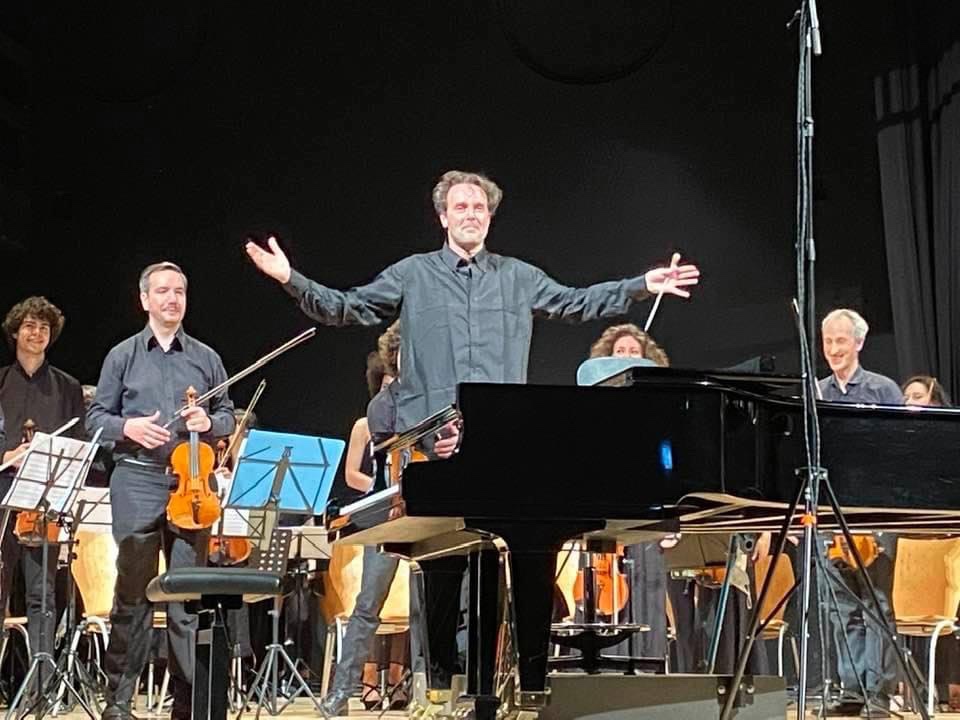
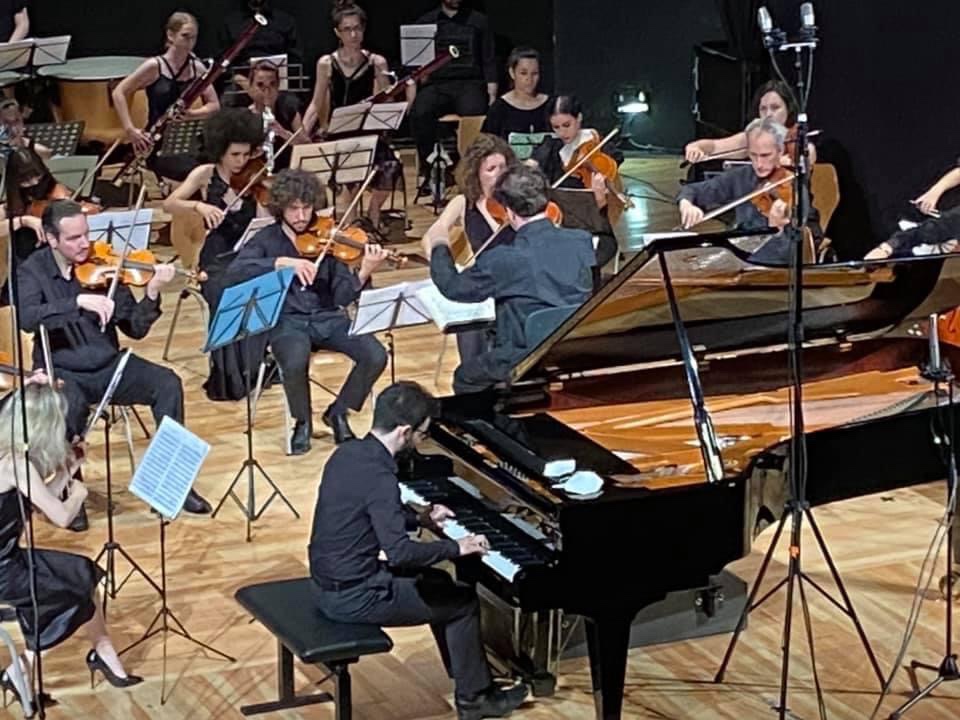
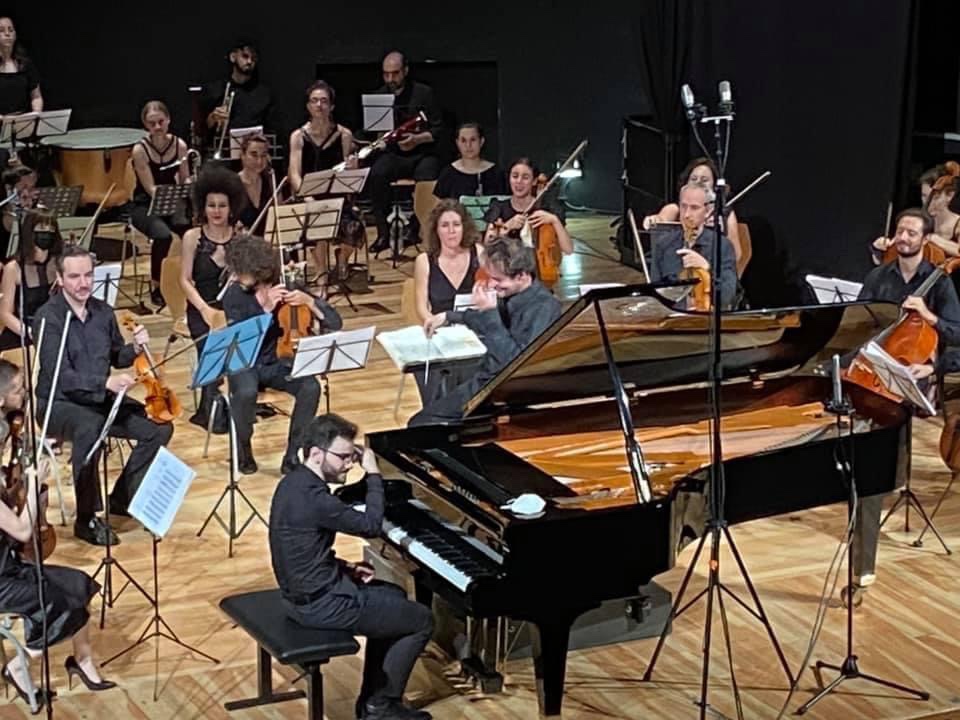
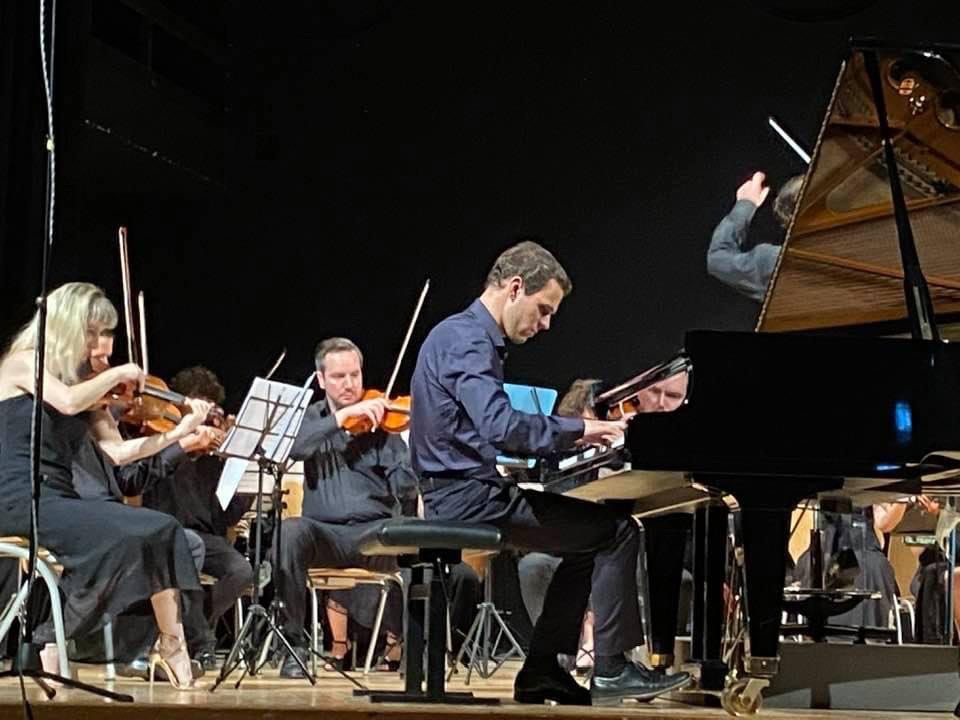
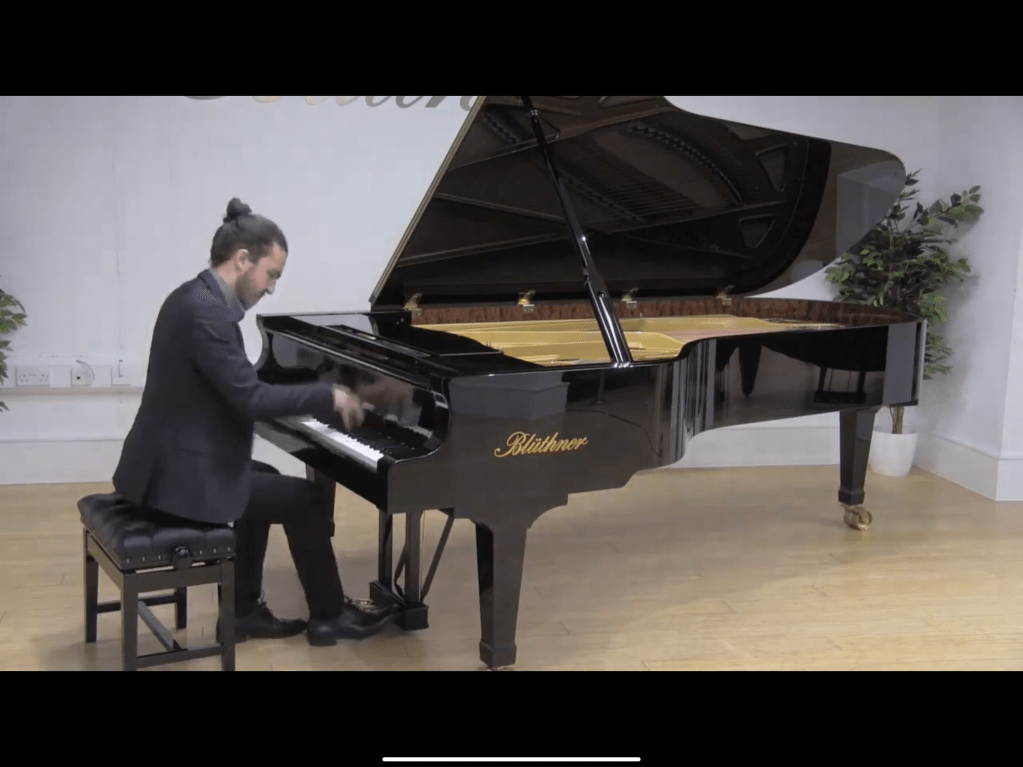
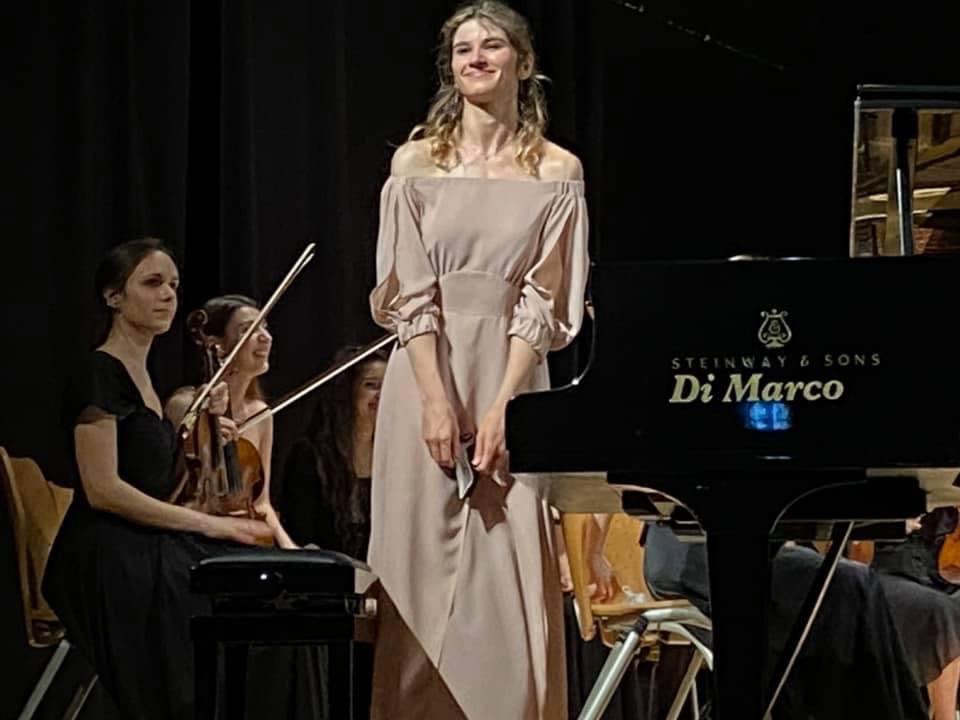
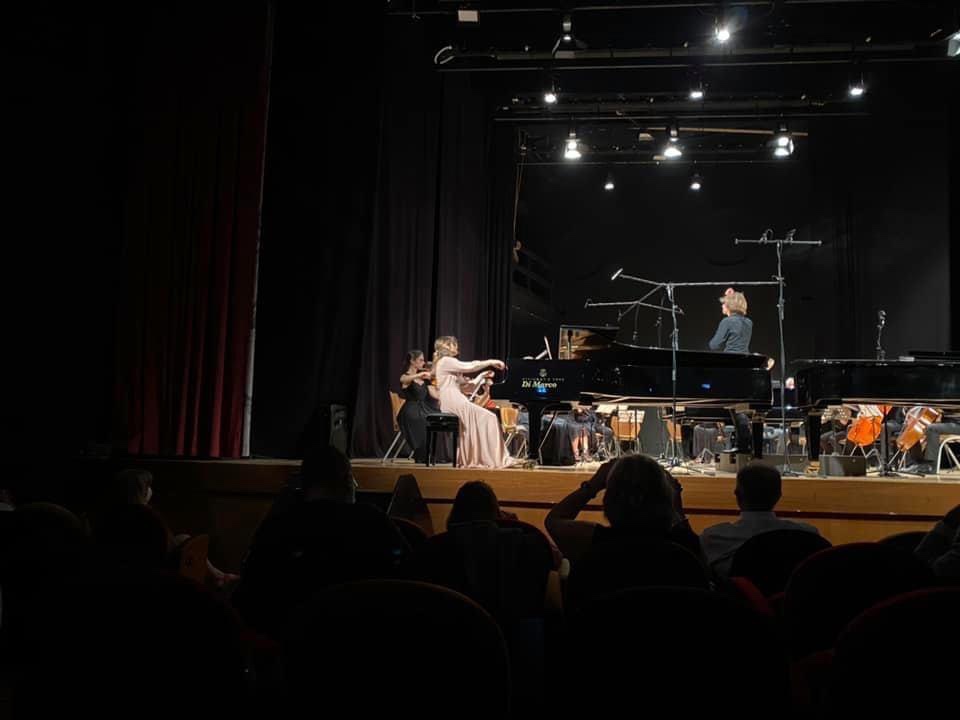
A fascinating concert from the opening provocative chord of Beethoven’s Fourth Piano Concerto.The pianist was the 24 year old Jacopo Feresin who in 2018 was voted an honorary member of Roma 3 and is now perfecting his studies with the distinguished pianofile and musicologist Piero Rattalino.
I was intrigued to hear the opening spread chord and also the arpeggiated chords in the slow movement. Jacopo gave a fine performance despite a mishap in the first movement that he happily was able to risolve in a professional way.He did,however,sometimes play with too much youthful passion that overwhelmed the perfection of Beethoven’s most pastoral of Concertos. It is a great responsibility to play with this orchestra under a Massimiliano Caldi who like Enrico Bronzi is turning this student orchestra into a professional body to be reckoned with.
But it is interesting to note how many musicians are playing Beethoven 4 not only with arpeggiando chords as in the clamorous case of Juan Perez Florestan,winner of the Rubinstein Competition.He not only opened the final round of this prestigiius tournament with a great flourish but then went on to embellish Beethoven’s own magical web of delicate elaborations in the first movement – where infact Jacopo came unstuck this evening. Igor Levit too ,the other day,did the same.Angela Hewitt tells me that Jeffrey Tate had found evidence that this is what Beethoven intended. Steven Kovacevich was the first over twenty years ago to spread the opening chord in his Australian recording of the complete Beethoven’s that he gave me one year as a present on his annual recital at the Ghione theatre.He too told me of the evidence in Beethoven’s correspondence that gave weight to this theory .But Stephen had studied the concerto with Myra Hess who certainly never spread the chords.He was her true heir playing the concerto on tour with Boulez and the BBC Symphony Orchestra together with that other golden talent under Madam Tillett management,Jaqueline Du Pre.They were the young much feted soloists,long before the arrival of Daniel Barenboim. I was in the Festival Hall when Rubinstein played it ( recorded live on video) with Antal Dorati without any sign of arpeggiando chords or added embellishments.Serkin,Backhaus,Schnabel,Arrau,Gilels,Fleischer and Perahia never spread them and they were all artists who delved deep into the scores and original editions to get as close to the composers intentions as possible.So why should there be the increasingly prevelant habit of adding embellishments especially amongst the new generation?
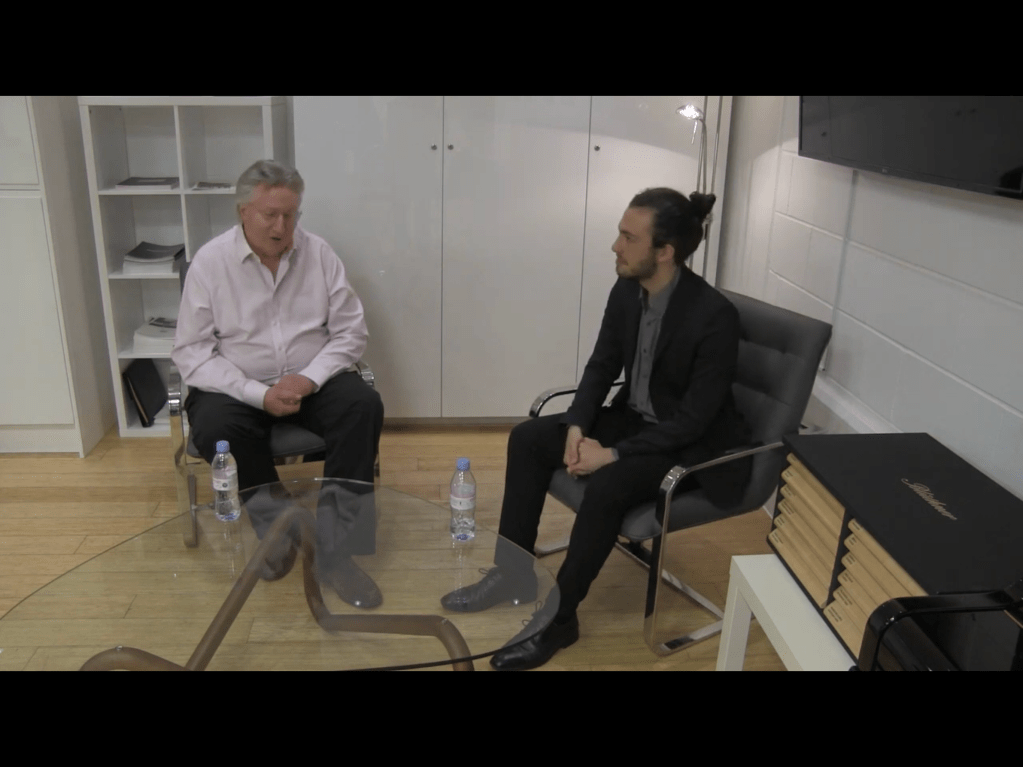
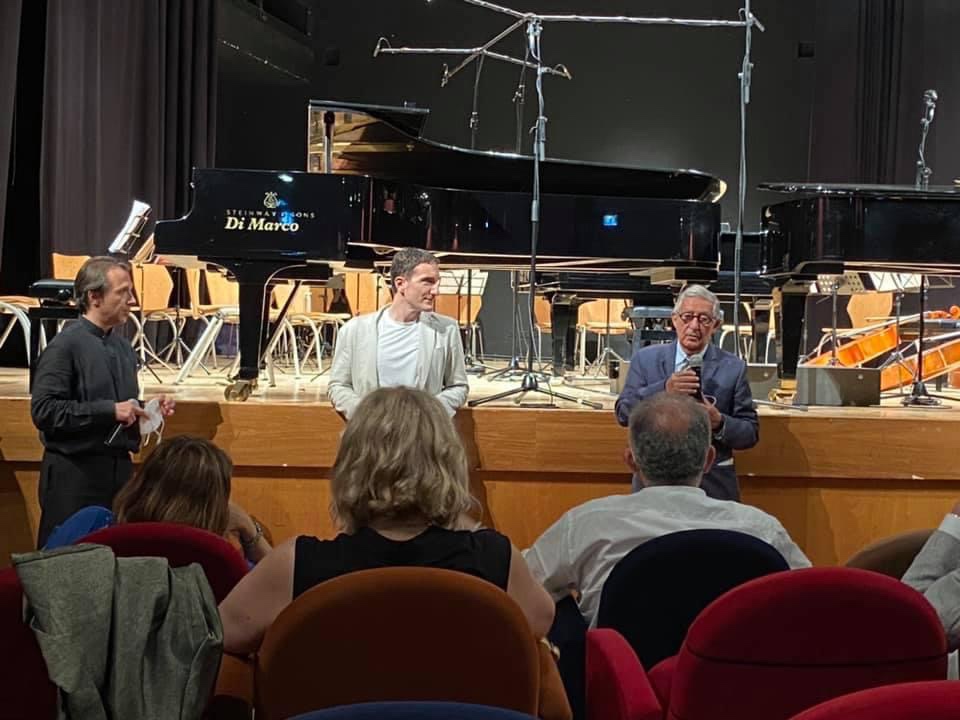
Jacopo Feresin in conversation with Valerio Vicari
Could it be the case that a little knowledge is a dangerous thing? I remember Tortelier saying he would play Bach on a baroque instrument when they managed to find a baroque recording studio ! The early instruments had very little sustaining power (with the gut strings and less powerful instruments) especially in the big concert halls of today.To prolong the sound one had to embellish or arpeggiate in order to be heard and produce a coherent musical line. But today we are playing on instruments that are far more capable of sustaining sounds (and metal strings )and of projecting the sound above or at least within the orchestra ,projecting it into halls that are far bigger than those previously known in the composers lifetime. It is a question of taste and integrity and there are some performers who can add just a magic touch to Mozart’s long lines and there are others that think that Mozart’s sublime simplicity is enough. All this passed through my mind until I heard Jacopo add his own cadenza in the last movement.It may be historically accurate but as I say a little knowledge is a dangerous thing and it is a pity to blemish what is probably Beethoven’s most perfect work for piano and orchestra.
Widmung by Schumann/Liszt gave this talented young man the opportunity to seduce and ignite with Schumann’s passionate outpourings.
Gabriele Strata
Tonight Schumann Piano Concerto in this remarkable series of concerts for young performers that the enlightened Valerio Vicari has envisaged and encouraged for the past 15 years helping endless numbers of great young talents to find the experience and an audience which is the only way to grow as an artist learning the greatest art of all :listening to yourself!
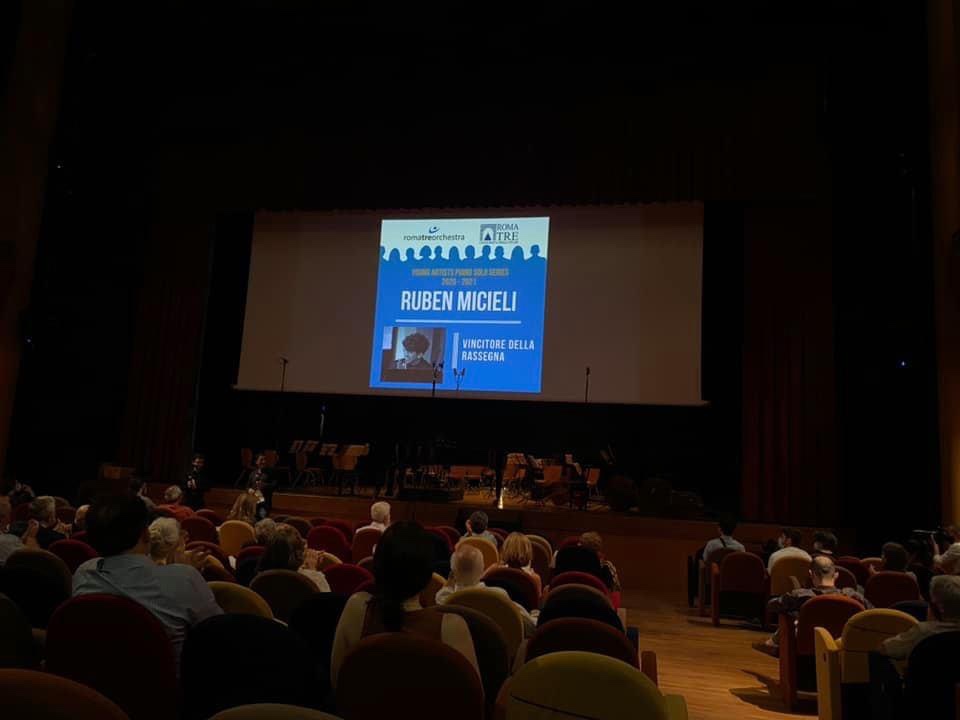
Lorenzo Bagnati – runner up to Young Artist Award 2021Luigi Carroccia – runner up to Young Artist Award 2021Ruben Micieli winner of Young Artists award 2021 with Valerio Vicari
A competition amongst recent solista saw Ruben Micieli declared the unanimous winner and he will be invited next year to play with this prestigious orchestra.
Gabriele Strata
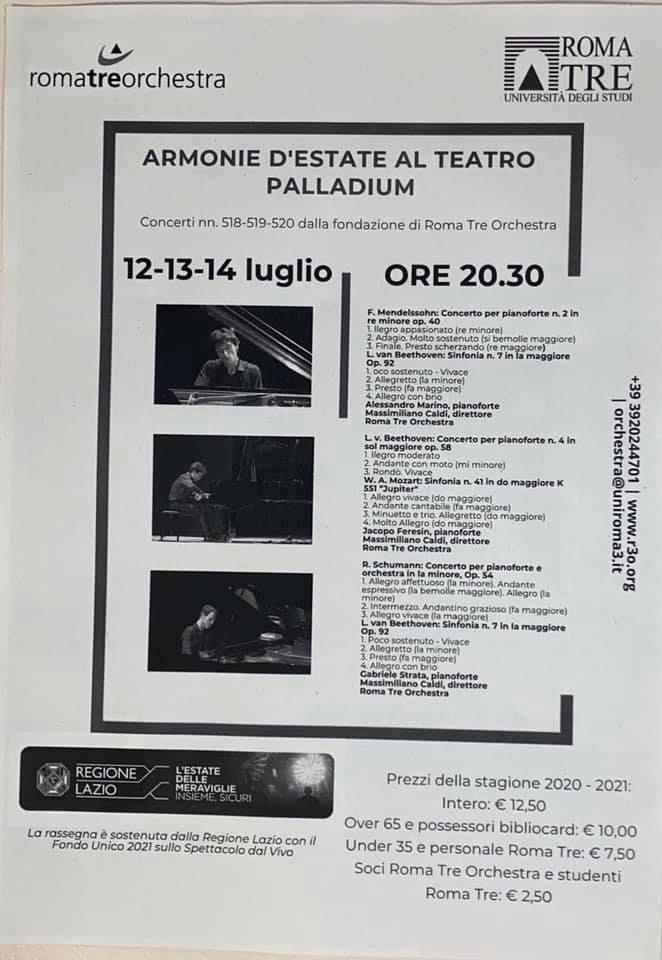
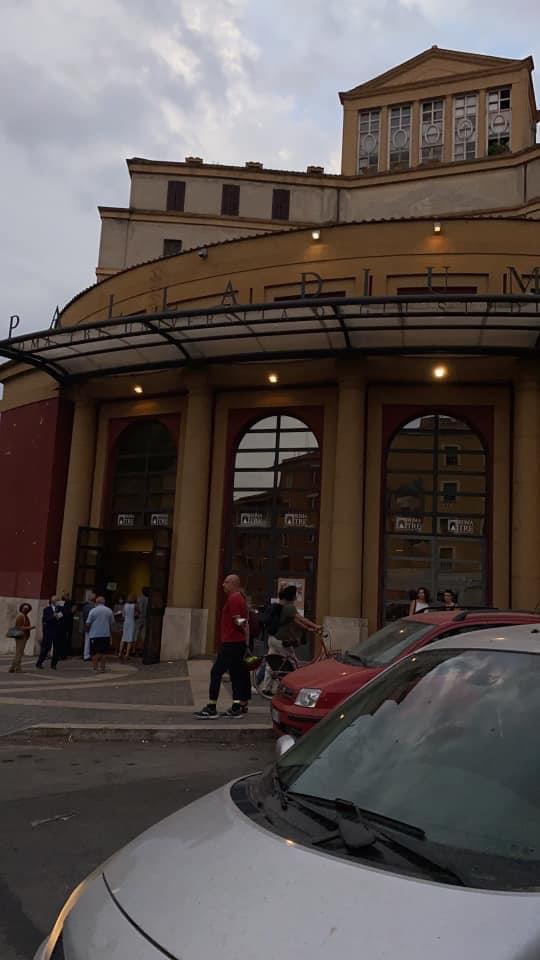
Masterly playing from Gabriele Strata for the final concert of the remarkable season of Roma 3 Orchestra under the title of Evening Harmonies at Teatro Palladium. Very assured playing of Schumann piano concerto hardly surprising when you realise that this young pianist from Padua is finishing his studies under a master at Yale University. Boris Berman a pianist who has played many times at the Ghione Theatre as has his colleague Peter Frankl.They have been passing on their knowledge and skill to the next generation for some years. Boris adores Italy and every opportunity he is here to enjoy the sea,the sunshine but above all the culture. As Rostropovich declared :Italy is the museum of the world .
A performance of great assurance and clarity and although hard hitting at times there were moments of great sensibility and poetry.A young man with a powerful engine in his hands that now with maturity will find the elegance and time to allow the music to unfold naturally. In the Andantino grazioso Intermezzo he found the ideal tempo to be able to dialogue with the orchestra without loosing the rhythmic impetus which he had slightly forsaken in the first movement’s beautiful central episode even though marked Andante espressivo.The last movement Allegro vivace was played with great authority that could have had a stronger blend of charm and grace.Nevertheless a remarkable performance very much in command of the situation. As an encore he chose the beautiful Abendlied by Schumann exquisitely played but even here he could have taken more time to allow this most beautiful page of music to speak with even more intensity.
Beethoven 7th Symphony was given a driving performance of unrelenting rhythmic energy.Even the famous Allegretto was at a tempo that at first seemed rather fast but as the music unfolded in the masterly hands of Massimiliano Cialdi it became totally convincing as did his driving rhythms in the Presto and Allegro con brio. A tournée is announced in the next few weeks in Puglia and Calabria. Is there no stopping the passionate dedication to help young musicians of the remarkable Roma 3 Orchestra in the hands of Prof Roberto Pujia and his star ex student ,now Artistic director Valerio Vicari?
The tour of Puglia and Calabria Teatro PalladiumGabriele Strata receiving an ovation after his performance of Schumann
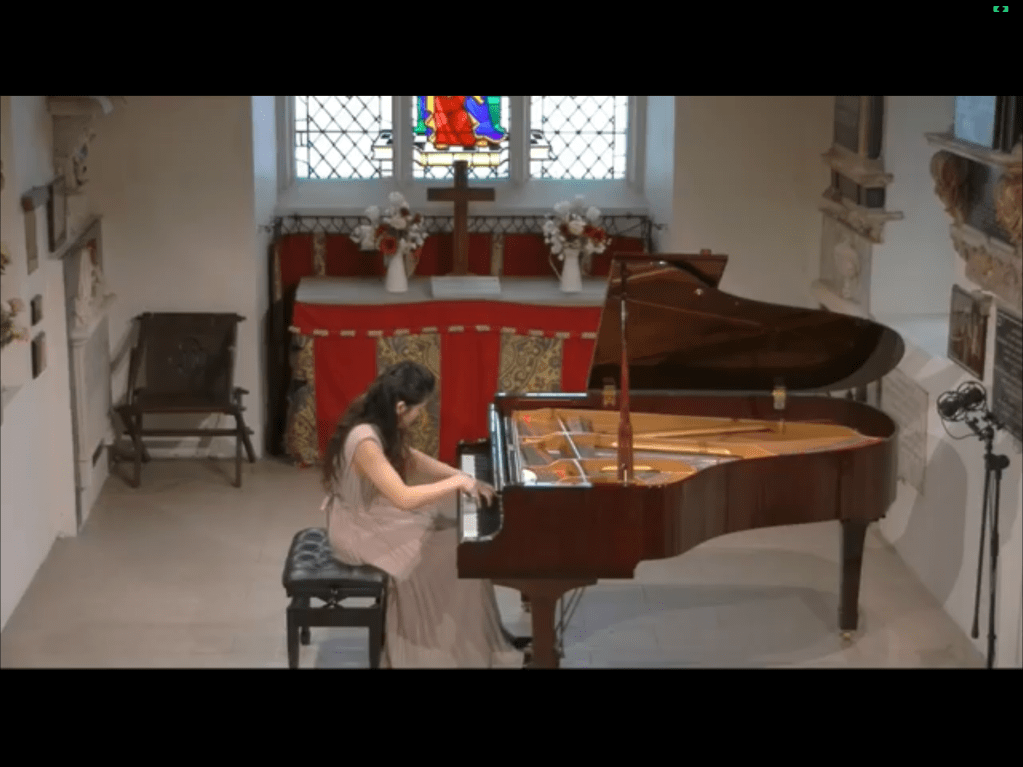
Some ravishing playing from Li Siqian with a luminosity of sound from the first deep D flat of Chopin’s Funeral March Sonata to the voluptuous sounds of the hair raising transcription of Ravel’s La Valse.
The ravishing beauty of the più lento in the Scherzo of the Sonata was indeed to cherish as was the supreme stillness of the Trio section of the Funeral March. Her total command of the keyboard allowed her to shape the great first movement with all the intelligent musicianship that we have come to expect from the Norma Fisher studio. But there was much more besides with the meltingly sensitive sounds and scrupulous attention to the shaping of every phrase.I was surprised she left out the repeat of the first movement and that the great bass notes in the development were underplayed but her overall architectural understanding and the clarity she brought to the most demanding passages was remarkable.
The beautiful D major Prelude suited her remarkably sensitive palette of sounds.It contrasted so well with the technical prowess and energy that she brought to the G minor Prelude where the middle section was simply a sumptuous succession of ravishing sounds
She brought colours to Estampes by Debussy that I have only ever heard from the hands of Richter in his first recitals in London.The subtle shaping of La Soirée Dans Grenade reminded me of our old ‘piano daddy’ Sidney Harrison who could sometimes make the music speak as eloquently as any singer. Her agility and clarity in the Jardins was allied to a disarming simplicity and extraordinary dexterity and rhythmic impetus.
But it was the extraordinary pyrotechnics not only of agility but also with her kaleidoscopic sense of colour that was truly breathtaking in La Valse.To see with what flexibility her hands could play glissandi was even more extraordinary when the sounds she produced were of pure glistening streams of gold.
Born in 1992, Chinese pianist Siqian Li started her musical education at the age of four. She studied with Madame Huiqiao Bao, received her Bachelor of Music Degree at the Central Conservatory of Music (Beijing) and became the first pianist to be awarded the “Best of the Best – Top and Innovative Talent” diploma and scholarship from China’s Ministry of Culture. As a student of Professor Alexander Korsantia, she obtained a Master of Music Degree with Academic Honors and a Graduate Diploma at the New England Conservatory (Boston). She continues to pursue an Artist Diploma at the Royal College of Music (London) under the tutelage of Professor Norma Fisher. Her performances have taken place across China, USA, Great Britain, Germany, France, Italy, Spain, Egypt, Japan, and South Korea at venues including Tokyo Yamaha Ginza Concert Hall, Beijing Forbidden City Concert Hall, Beijing Concert Hall, New England Conservatory’s Jordan Hall, Egypt Cairo Opera House, Shenzhen Grand Theatre, London School of Economics, and Hochschule für Musik und Theater Hannover. She also frequents the festival circuit, with recent performances at the Annecy Classic Festival, Festival d’Auvers sur-Oise, Dinard Festival International de Musique, Shanghai International Music Festival, and BNP Paribas Rising Star Piano Festival. As a young musician, Siqian was invited to join charity concerts to support children’s musical education in China. As a soloist, she has collaborated on a wide range of repertoire with international chamber musicians, and has appeared in concerts with Xiamen Philharmonic Orchestra, Xiamen Opera Symphony Orchestra, Kiev Philharmonic Orchestra, Ukraine State Symphony Orchestra, and the Central Conservatory of Music Youth Symphony Orchestra, amongst others.
In 2020, Siqian won the first prize at the Chappell Medal Piano Competition, the Royal College of Music’s top award for pianists. She is the silver medalist and a special prize winner of the San Jose International Piano Competition 2019, a semi-finalist of the Leeds International Piano Competition 2018, the Grand Prix and a special prize winner of Vladimir Krainev International Piano Competition. She was also awarded first prize at the Imola International Piano Competition, Yamaha China Piano Competition Conservatoire, Puigcerda International Festival Competition, the Conservatorie Diploma at Tbilisi International Piano Competition, and prizes at Vladimir Horowitz International Piano Competition, Shanghai International Piano Competition, Chopin International Piano Competition in ASIA, International Music Competition Jeunesses Musicales Bucharest, China National Symphony Orchestra Concerto Competition, and the Guangren Zhou Pianist Award. Meanwhile, Siqian is a Yamaha Young Artist, Drake Calleja Trust Scholar (London), the recipient of the Lansum Music Scholarship (Los Angeles), the Chengxian Fu Music Scholarship (Taiwan), and generously supported by the Talent Unlimited Foundation (London). Siqian is a nominated contestant of both the Queen Elisabeth International Music Competition (Brussels 2020) and the 16th Arthur Rubinstein International Piano Master Competition (Tel Aviv 2020). Both competitions have had to be postponed due to the COVID-19 crisis.
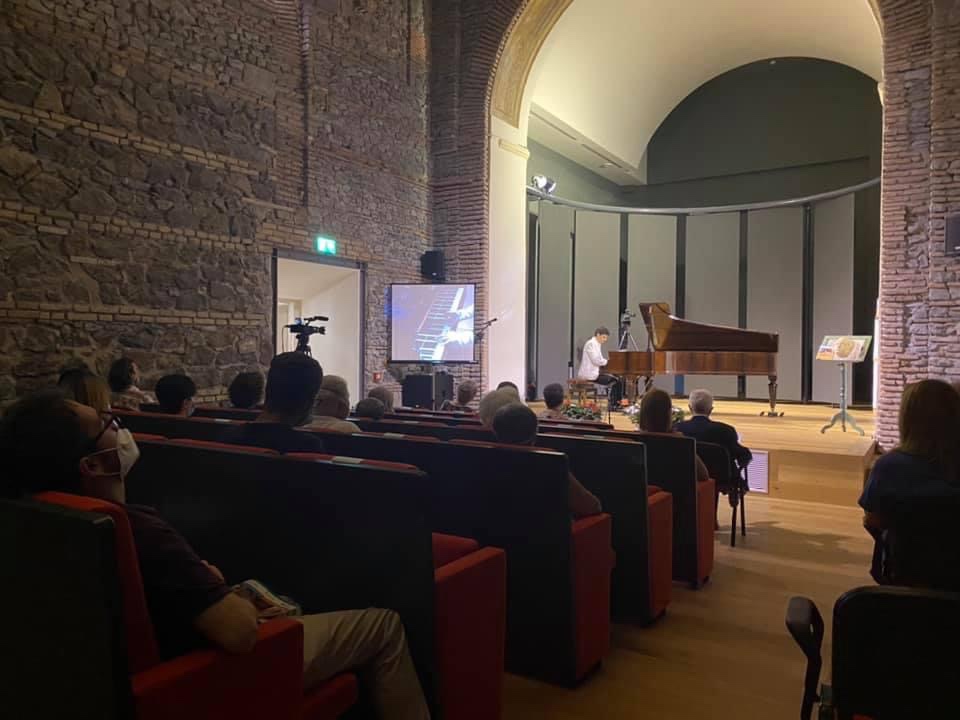
While Italy awaits the battle in London at Wimbledon and Wembley the hub town of Velletri is full of surprises . Diabelli variations on a piano similar to Liszt’s Erard piano restored to perfection by Giancarlo Tammaro of ‘il ‘suono’ di Liszt a Villa D’Este’ played magnificently by Ivan Donchev.
Ivan Donchev with the owner of the piano and organiser of the concert Ing.Giancarlo Tammaro
Even more surprising though was his magical account of Brahms Intermezzi op 117. Where Beethoven’s demonic rhythmic combinations in Diabelli were more rounded than we are used to, the Brahms was infinitely more bitter sweet from this beautiful instrument.
Velletri cathedral
A Cathedral of such beauty the side door left open for my delection in a town abandoned by people searching for the sea in this scorching heat. Different ways of waiting for the party tonight…. all leading to the same goal hopefully .
An Erard gran coda n.53283 of 1879 -similar to Liszt’s Erard 36052 of 1862 that was found in 1991 in a religious institute in Rome and after being exhibited in New York is now in Vienna .Ivan rehearsing before the concert.
JOHANNES BRAHMS (1833-1897) Tre Intermezzi per pianoforte op.117 n.1 Andante moderato (Mi bemolle maggiore) n.2 Andante non troppo e con molto espressione (Si bemolle minore) n.3 Andante con moto (Do diesis minore)
The Three Intermezzi for piano, Op. 117 ,composed in 1892,were described by the critic Eduard Hanslick as “monologues”… pieces of a “thoroughly personal and subjective character” striking a “pensive, graceful, dreamy, resigned, and elegiac note.”The first intermezzo, in E♭ major, is prefaced in the score by two lines from an old Scottish ballad, Lady Anne Bothwell’s Lament: Balow, my babe, lie still and sleep!It grieves me sore to see thee weep.The middle section of the second intermezzo, in B♭ minor, seems to Brahms’ biographer Walter Niemann to portray a “man as he stands with the bleak, gusty autumn wind eddying round him.”The final intermezzo, in C♯ minor, has an autumnal and stressful quality also, suggesting the cold wind sighing through the trees as leaves are falling.Ivan tells me that Prof Atanas Kurtev had given these titles : ‘ un lontano ricordo’ a distant memory -‘Il labirinti della vita’ the intrigues of life – ‘Salmo delle riscossione dell’anima’- the corpse of the recovery of the soul .
They were beautifully played with an unusual radiance to the sound.From the very first notes there was a luminous quality that added to Ivan’s sensitivity and sense of architectural shape and created just the atmosphere where this piano sound was quite unique.A luminous radiance but with a mellow non percussive sound that was pure magic.If the B flat minor Intermezzo could have been allowed more sweep it was more than compensated for by the sumptuous middle section that rarely can have spoken so eloquently.Ivan creating an ending of a rare dream like atmosphere which led to the bare open notes of the C sharp minor Intermezzo where there was a sweetness and amalgam of sound that was quite unique.
The 33 Variations on a waltz by Anton Diabelli, Op. 120, was written between 1819 and 1823 by Ludwig van Beethoven on a waltz by Anton Diabelli . It is often considered to be one of the greatest sets of variations for keyboard along with Bach’s Goldberg Variations .Donald Tovey called it “the greatest set of variations ever written”and Alfred Brendel has described it as “the greatest of all piano works”.It also comprises, in the words of Hans von Bulow “a microcosm of Beethoven’s art” and in his Structural Functions of Harmony, Arnold Schoenberg writes that the Diabelli Variations“in respect of its harmony, deserves to be called the most adventurous work by Beethoven”.
Ivan Donchev in concert.
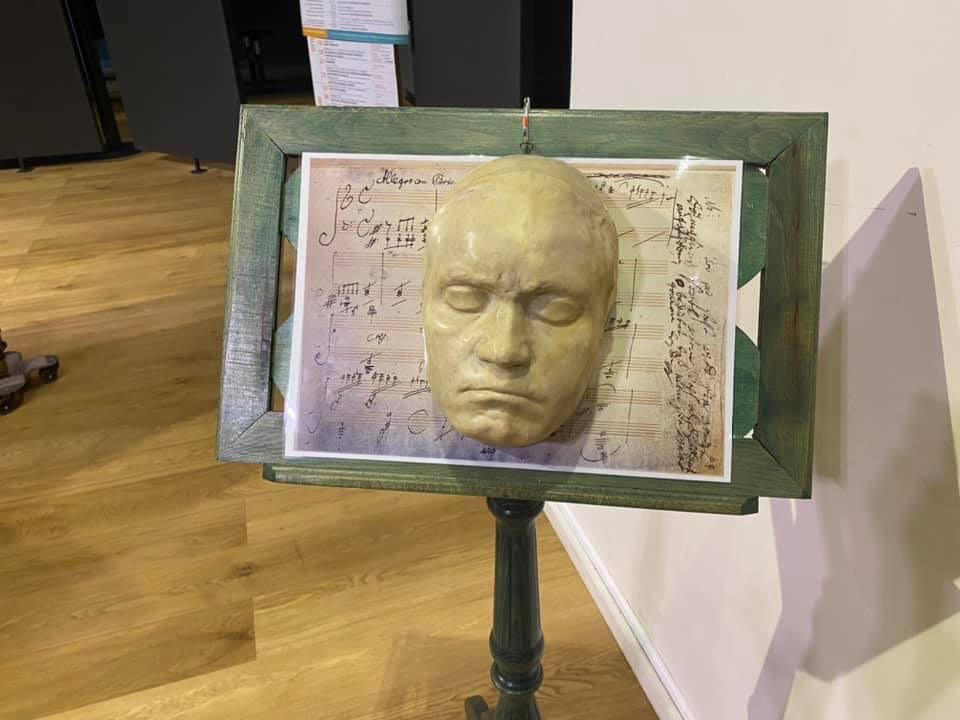
I have heard many performances of the Diabelli variations but the two that will remain with me always are those of Brendel and Serkin.With both performances there was an electric current of energy from the first to the last note.Even in the most mellifluous variations there was always this undercurrent of energy which in the end erupts with the Fugue of the penultimate variation dissolving in the last ,like in his sonata op 111,into a celestial place that only Beethoven could truly experience with his private ear.
Ivan started with a burst of energy in the bucolic waltz played with great precision and sense of forward movement that spilt over into the nobility of the Alla Marcia and delicate syncopation of the second.There was sumptuous sound in the third and a great sense of mystery in the fourth.Great precision too in the fifth and trills that passed from one hand to the other in the sixth leading to the call to arms of the seventh.There was the same luminous sound ,that was so evident in the Brahms,in the poco vivace that flowed with such mellifluous ease.The acciaccaturas of the ninth we’re like springs jumping from one to the other .Great feats of virtuosity in the tenth were complemented by the ravishing beauty of the Grave of the fourteenth .The build up of energy with the fifteenth,sixteenth and seventeenth was not quite as dynamic on this very soft sounding instrument hampered too by Ivan trying to accommodate this with unrequested ritardandi at the end of each variation .The beautiful mellifluous sounds of this piano seem to exclude the very rhythmic percussive energy that is driving Beethoven to enormous technical feats as in his Sonata op 106 The Hammerklavier (sic).There was almost Mozartian playfulness in the twenty second variation before the extreme agility of the Allegro assai .The fughetta of the twenty fourth was played with luminous clarity before the bucolic enjoyment of the twenty fifth.I remember the poignancy of the rests in André Tchaikowsky’s performance of the twenty ninth that Ivan and many others choose to ignore in their quest for profundity.It was in the thirty first variation Largo molto espressivo that this piano came into its own in the very sensitive and intelligent hands of Ivan.If the frenzy like water boiling at 100 degrees was missing from the penultimate Fuga the luminosity and innocence of the last variations were of a clarity very rarely heard.
Ing Giancarlo Tammaro with Ivan Donchev being awarded a medal of recognition by his music society
Two encores from a very enthusiastic public were awarded a beautiful Gluck Sgambati transcription of ravishing beauty and a Ritual fire dance that prepared us for the furnace that awaited outside!
LUDWIG VAN BEETHOVEN Trentatre variazioni per pianoforte in Do maggiore su un Valzer di Anton Diabelli op.120 (1819-23) Tema: Vivace – Variazioni: 1. Alla marcia maestoso; 2. Poco allegro; 3. L’istesso tempo; 4. Un poco più vivace; 5. Allegro vivace; 6. Allegro ma non troppo e serioso; 7. Un poco più allegro; 8. Poco vivace; 9. Allegro pesante e risoluto;Presto; 11. Allegretto; 12. Un poco più moto; 13. Vivace; 14. Grave e maestoso; 15. Presto scherzando; 16. Allegro; 17. Allegro; 18. Poco moderato; 19. Presto; 20. Andante;Allegro con brio-Meno allegro-Tempo primo; 22. Allegro molto, alla “Notte e giorno faticar” di Mozart; 23. Allegro assai; 24. Fughetta (Andante); 25. Allegro; 26. Adagio ma non troppo; 27. Vivace; 28. Allegro; 29. Adagio ma non troppo; 30. Andante, sempre cantabile; 31. Largo, molto espressivo; 32. Fuga: Allegro; 33. Tempo di Menuetto moderato IVAN DONCHEV pianoforte
Restava, infine, il pianoforte a concludere ancor più intimamente l’esperienza artistica e spirituale del maestro amburghese; il pianoforte che era stato il suo strumento prediletto, la sua voce iniziale, quella delle Sonate, delle prime variazioni, delle Ballate. L’arco, dunque, stava per chiudersi. Le quattro raccolte di pezzi op. 116, 117, 118 e 119 costituiscono il messaggio più alto della musica pianistica tardoromantica: le uniche pagine degne di continuare l’interrotta tradizione di Chopin e di Schumann.” (aa. vv. da: I Grandi Musicisti – ed. Fratelli Fabbri 1967) “La strada che porta all’estrema fioritura pianistica del nuovo secolo, al pianismo di Debussy, di Ravel e di Bartók, non passa soltanto attraverso Liszt, ma presuppone l’incredibile primavera delle sette Fantasie, dei tre Intermezzi, dei sei e quattro Klavierstücke op.116-119, tutti germogliati nel sessantesimo anno di vita del compositore. … E del resto, la vecchiaia degli artisti non consiste nel numero degli anni trascorsi, ma nella prossimità della morte. A Brahms non restavano più che quattro anni da vivere quando dal cuore gli fiorì l’ultima primavera creativa: il nuovo pianoforte. Non più Sonate, non più Variazioni, ma Fantasie, Intermezzi, Capricci. Klavierstücke, e basta. La sua arte era cresciuta nel segno della disciplina. Ora la visitò l’ultima dea: la Libertà.” (Massimo Mila: “Brahms …” in “Musica e Dossier” anno III n.19- ed. Giunti, giugno 1988) “La forma variazione si unisce dunque alla fuga come uno dei tratti più caratteristici dell’ultimo stile beethoveniano, e tempi in forma di variazione compaiono in molti degli ultimi capolavori… L’opera cruciale di questa nuova problematica va individuata nelle Trentatre variazioni su un valzer di Diabelli. …È forse preferibile considerare le Variazioni Diabelli come un gigantesco ciclo di bagatelle, che abbraccia l’intero ambito della fantasia e dell’inventiva beethoveniana… troviamo fianco a fianco un’arcigna rozzezza e una celestiale serenità, passione selvaggia e nobile maestà, lazzi senza nesso e delicato incanto, involuzioni tortuose e limpida semplicità. … Le Variazioni Diabelli furono l’ultima importante opera di Beethoven per pianoforte.” (Maynard Solomon: “Beethoven” – ed. Marsilio 2002) “Con quest’opera capitale, talmente avanzata e visionaria da risultare ancora oggi sconcertante per la maggior parte degli ascoltatori, Beethoven mette in discussione il principio stesso della variazione. …L’idea rivoluzionaria del compositore è quella di scrivere trentatre brani totalmente diversi tra loro che però ripensano e ricreano ogni volta lo schema di base, l’”archetipo” musicale incarnato dal valzer. …è chiara la volontà di Beethoven di ricercare la massima varietà di atteggiamenti e di caratteri. Anche in questo caso basta leggere la stupefacente ricchezza nelle indicazioni di tempo tra i diversi brani…” (Giovanni Bietti: “Ascoltare Beethoven” – ed. Laterza 2016)
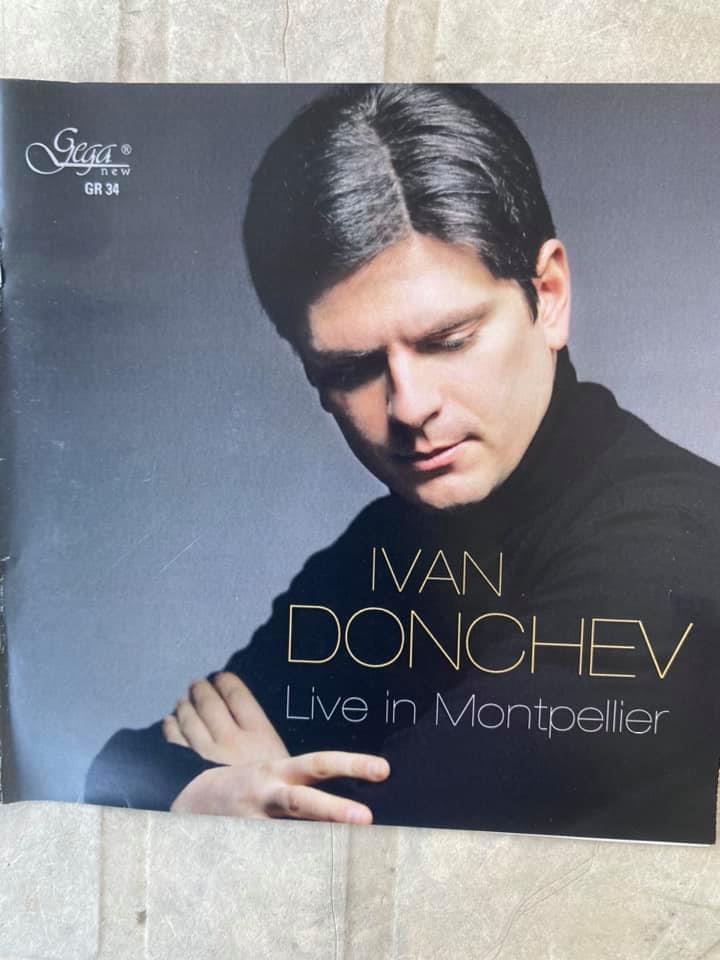
IVAN DONCHEV è stato definito da Aldo Ciccolini “artista di eccezionali qualità musicali” e dalla critica internazionale come “raffinato”(Qobuz Magazine), “pieno di temperamento”(Darmstadter Echo), dotato di “tec- nica impeccabile e incredibile capacità di emozionare”(Il Cittadino). Nato nella città di Burgas (Bulgaria), intraprende lo studio del pianoforte all’e- tà di 5 anni con Julia Nenova e dopo tre anni tiene il primo recital. A 12 anni vince il 1°premio al Concorso Nazionale “Svetoslav Obretenov” e debutta con l’Orchestra Filarmonica di Burgas. Nel 1996 è finalista al Concorso EMCY di Dublino. A 16 anni vince il 1° premio al Conc. Intern. di Musica Austro-Tedesca a Burgas, cui segue il debutto internazionale alla Gasteig Saal di Monaco di Baviera, ed anche il prestigioso Premio della Società “Chopin” di Darmstadt e una Menzione Speciale per la sua composizione nell’ambito del Conc. Intern. “Carl Filtsch” in Romania.
È regolarmente invitato a suonare in tutta Europa, Russia, Stati Uni- ti e Asia. Tiene concerti alla Merkin Hall di New York, al Conservatorio Ciajkowskij di Mosca, alla Geumanrae Hall di Seoul, alla Bösendorfer Saal di Vienna, per la Società Chopin di Darmstadt, alla Holst Hall di Lon- dra, alla Sala dell’Accademia Nazionale di Sofia e poi ancora a Berlino, Oslo, Varsavia e molte città della Corea del Sud e del Giappone. Par- tecipa a importanti Festival europei, tra cui Festival de Radio France e La Folle Journée in Francia, Seiler Klavier Festival in Germania, Krakow Piano Festival in Polonia, Apollonia Music Festival in Bulgaria. In Italia suona a Milano (Sala Verdi per la Società dei concerti; Università Bocconi per Kawai in concerto), Roma (IUC e Filarmonica Romana), Pesaro (Te- atro Rossini), Bologna (Fondazione Liszt), Firenze (Orsanmichele), Na- poli (Concerti di Primavera), Messina (Sala Laudamo), Taranto (Teatro Orfeo), Osimo Piano Festival (Teatro La Nuova Fenice), Civitanova Piano Festival, Festival dei Due Mondi di Spoleto e altri. Suona regolarmente con orchestre internazionali: New York Festival Orch., Sinfonica Rossini, Filarmonica Marchigiana, Roma3, Sinfonica di Bari, Orch. della Magna Grecia, Orch. da Camera Fiorentina, Burgas Philharmonic, Kronstadt Philharmoniker, Pleven Philharmonic, Nis Sym- phony, Pazardzhik Symphony, Jeonju Philharmonic, Solisti di Zagabria, Bryansk Symphony. InItaliahainoltrevintoiconcorsi:CittàdiStresa;GranPrizeEcomusic 31 (Monopoli 2000), Premio Seiler (Palermo 2001), Migliori Diplomati (Castrocaro 2003), Premio Sergio Fiorentino (Morcone 2004), Premio Pianistico Giuseppe Terracciano (Giffoni 2005). L’esecuzione a 19 anni della Sonata in Si min. di Liszt gli vale il Premio Speciale al Concorso Europeo a Villafranca Tirrena. Nel 2008 vince il XVIII Concorso Società Umanitaria di Milano. Incide i concerti di Ciajkowskij e, in prima mondiale, il Quadro sinfonico concertante di Vito Palumbo, a lui dedicato. Pubblica per le etichette Rai Trade, Sheva Collection e Gega New. Sue registrazioni sono trasmesse dalle Radio France, Classica, Vaticana, Radio3 e BNR. Il CD con il violinista Ivo Stankov delle sonate di Beethoven riceve il 5 stars award della rivista Musical Opinion. Nel 2017 pubblica il CD “Live in Montpellier”, giudicato dalla critica come il recital più interessante del Festival de Radio Fran- ce. Con la violinista Annabelle Berthomé incide per MUSO le sonate di G.Bacewicz e il loro disco riceve 4 stars del BBC Music Magazine. Invitato in giuria di concorsi internazionali, ha tenuto masterclass al Conservatorio di Mosca, Brooklyn College di New York, Whitgift School a Londra, in Giappone e in Corea del Sud. Dal 2018 intraprende l’esecuzione integrale delle 32 Sonate di Beethoven. Fondamentale è stato il pluriennale perfezionamento con A.Ciccolini dal quale riceve il premio “Sorrento Classica” e con il quale ha suonato in piano duo al Festival de Fenetrange in Francia.
The beautifully restored hall in Velletri with the original affresco from this ex Convent Del Carmine of 1615 ………..opened in 2016
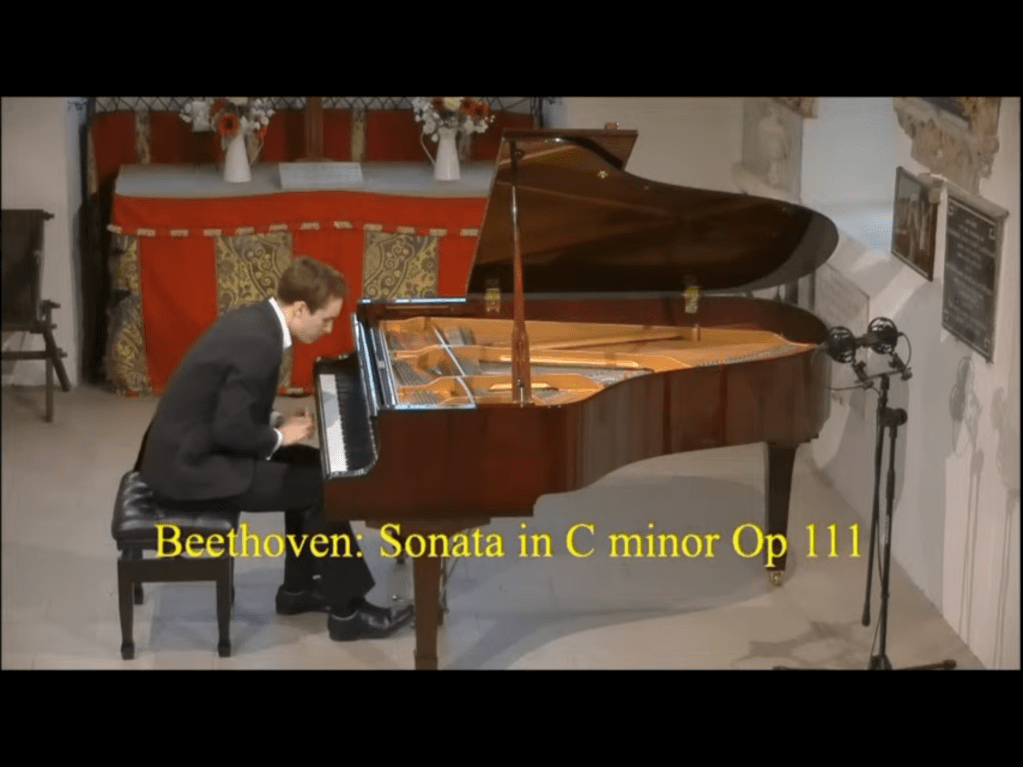
Some impressive playing of great clarity and weight from the very opening of Beethoven’s last thoughts on the piano sonata.Scrupulous attention to detail and extraordinary technical command allowed Beethoven’s words to speak on their own without any personal intervention.The end of the first movement led so naturally into the Arietta and variations played with string quartet intensity with some very beautiful counterpoints in evidence in the second variation before the explosion of the l’istesso tempo.His great technical control and musicianship allowed this to be the natural climax before the final variation with fragments floating magically on a vibration of murmured sounds with its gradual passionate build up and the final disintegration of celestial sounds which could though have had a more improvisatory feel to it.Even Beethoven was searching in un chartered territory that only he could hear in his private ear and a feeling of discovery and mystery are part of this search.Something of the magic was missing but his unrelenting forward movement and clarity gave great weight and authority to this great monument that I am sure he would not normally programme as an opener.
It was in Chasse Neige that Dominic revealed his sense of colour and passionate involvement that he had denied himself in Beethoven.The beautiful opening melody led to a passionate outpouring of ravishing sounds played with remarkable technical control and sense of architectural shape.
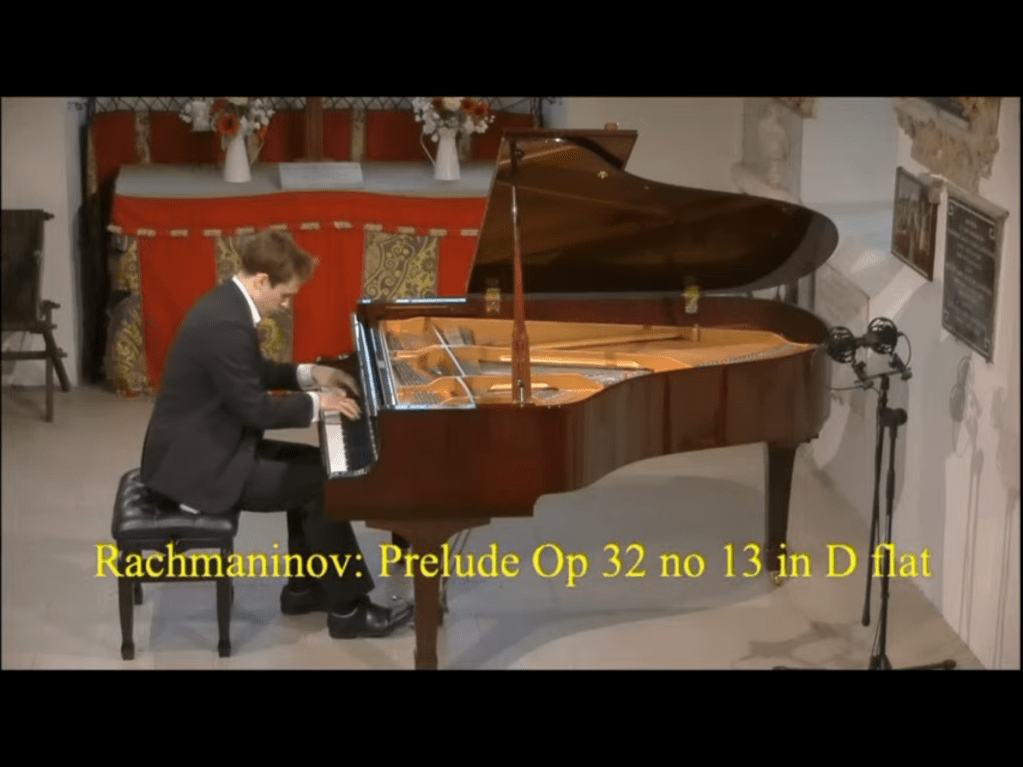
It was the same clarity and passion that he brought to the last of Rachmaninov’s preludes op.32.A sense of nobility contrasting with extraordinary flights of virtuosity culminating in the glorious outpouring of triumphant sounds of grandeur and nobility.
The piece by Zev Gordon reminded me very much of the modern work that Cherkassky would add to his standard repertoire every year.I well remember the glee and the twinkle in his eye as he grappled with Copland’s El salon Mexico much as Dominic did today.Some very complicated cross rhythms played with amazing agility and rhythmic impetus contrasting with long held pedal notes.The final slam of the door was played by Dominic with the same mischievous joy that I remember brought the house down for Cherkassky.
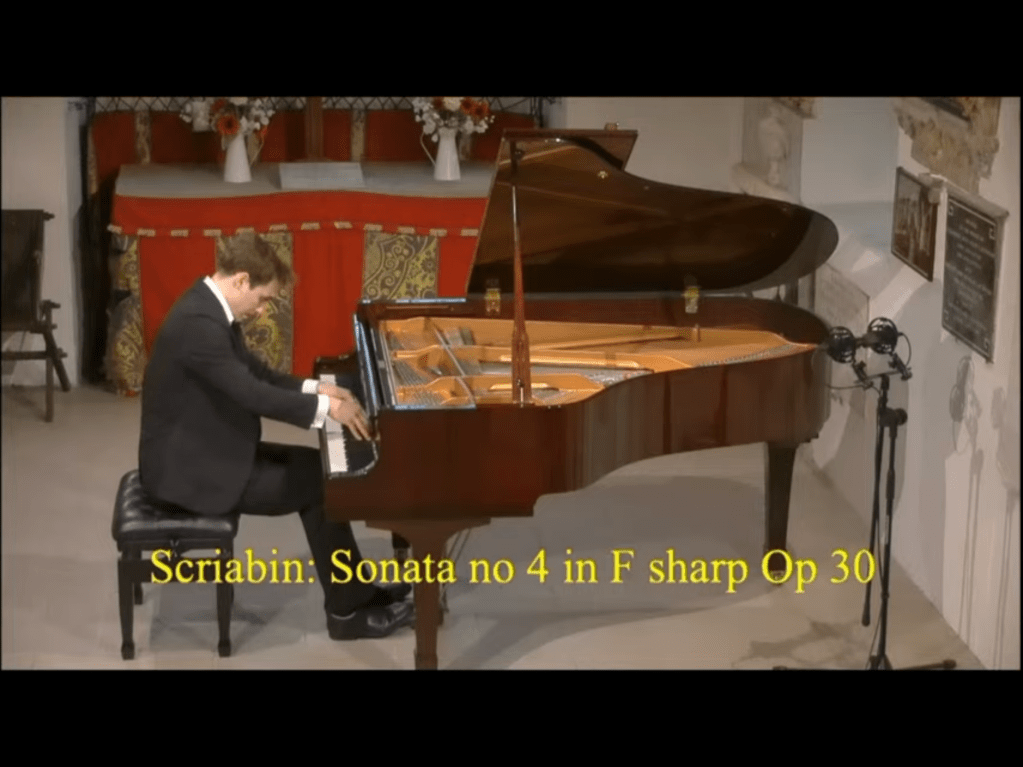
The beautiful Scriabin fourth sonata was given a superb performance where Dominic’s sense of balance was allied to his scintillating clarity even in the most capricious passages but all starting from the gentle opening star burning so brightly at the end amid passion and ferocity as ecstasy has been reached.Some very fine playing from a true musician and master pianist.
Dominic Doutney is a London-based pianist, studying for his Artist Diploma at the Royal College of Music in London, with professors Ian Jones, Dmitri Alexeev and Sofya Gulyak. He is the current recipient of the prestigious Fishmongers’ Company Beckwith Scholarship. Dominic is the 2020 winner of the ROSL Award for Keyboard. In summer 2019, Dominic studied at the Aspen Festival and School in Colorado, on a Polonsky Foundation Fellowship, having previously taken part in the piano masterclass programme at the Banff Centre in Canada (thanks to the English-Speaking Union’s Yehudi Menuhin scholarship). Dominic is a former joint winner of the EPTA UK Piano Competition and winner of the Royal College of Music’s Teresa Carreño (2013) and Constance Poupard (2014) prizes. In 2017, Dominic was placed third in the Joan Chissell Schumann Prize, and in 2016, second at the Isidor Bajic Memorial Competition (category B). Dominic is becoming a seasoned recitalist and concerto soloist. In October last year he performed Schumann’s Piano Concerto in St John’s Smith Square with the Young Musician’s Symphony Orchestra and Beethoven Piano Concerto No. 5 in November with the Dorset Chamber Orchestra. In June the previous year he performed Brahms Piano Concerto no. 1 with the Leipziger-symphonieorchester in the Mendelssohn-Saal at the Leipzig Gewandhaus, to critical acclaim. Other concerto performances have included Stravinsky’s Concerto for Piano and Wind Instruments (with Martyn Brabbins and the Royal College of Music symphony orchestra), Brahms’ Piano Concerto no. 2, Rachmaninov’s Piano Concertos nos. 2 & 3, Grieg’s Piano Concerto, and Mendelssohn’s Piano Concerto no. 1. Solo appearances have included recitals at the prestigious Beaumaris and Beaujolais music festivals (France), the Poros Piano Festival (Greece), the Banff Centre (Alberta, Canada), and in Moscow (at the invitation of the Spivakov Foundation). Closer to home, Dominic has performed at the Bolivar Hall, Cadogan Hall, Wigmore Hall, St Martin-in-the-Fields, the Elgar Room (at the Royal Albert Hall) and at 22 Mansfield Street (for the Nicholas Boas Foundation). Dominic has made appearances on BBC Radio 3 (performing Chopin and discussing the art of virtuosity) and on CNBC (discussing the experience of participating in a masterclass with Lang Lang). Dominic is also a keen jazz pianist and arranger. Outside of the piano, Dominic’s interests include theatre, art and literature, and he is a fan of Harlequins rugby club.
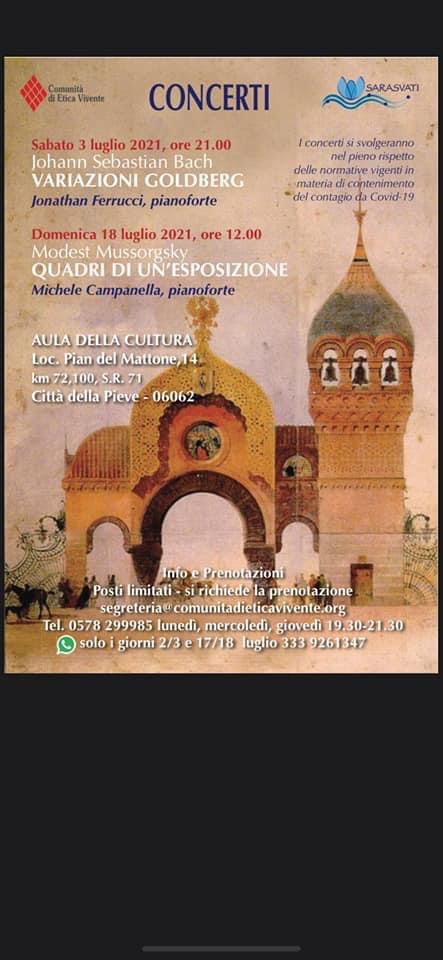
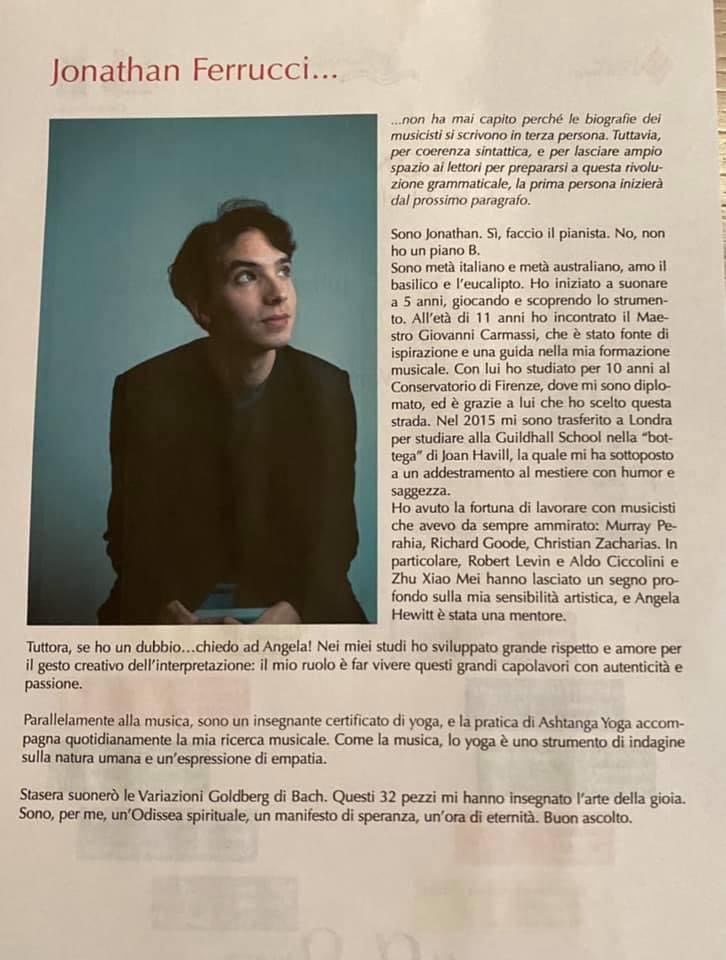
Like all great artists Jonathan’s fourth outing of the Goldberg Variations was thought provoking not only for us in the beautiful countryside surroundings of the Comunità di Etica Vivente in the city of Perugino.
Above all it was thought provoking for Jonathan as in the 75 minute tour de force his voyage of discovery took him to places of sublime beauty but also places that yet have to fit perfectly into this jig saw puzzle that Bach pieced together for a noble man’s insomnia.
Jonathan being thanked by the director of this remarkable Comunità
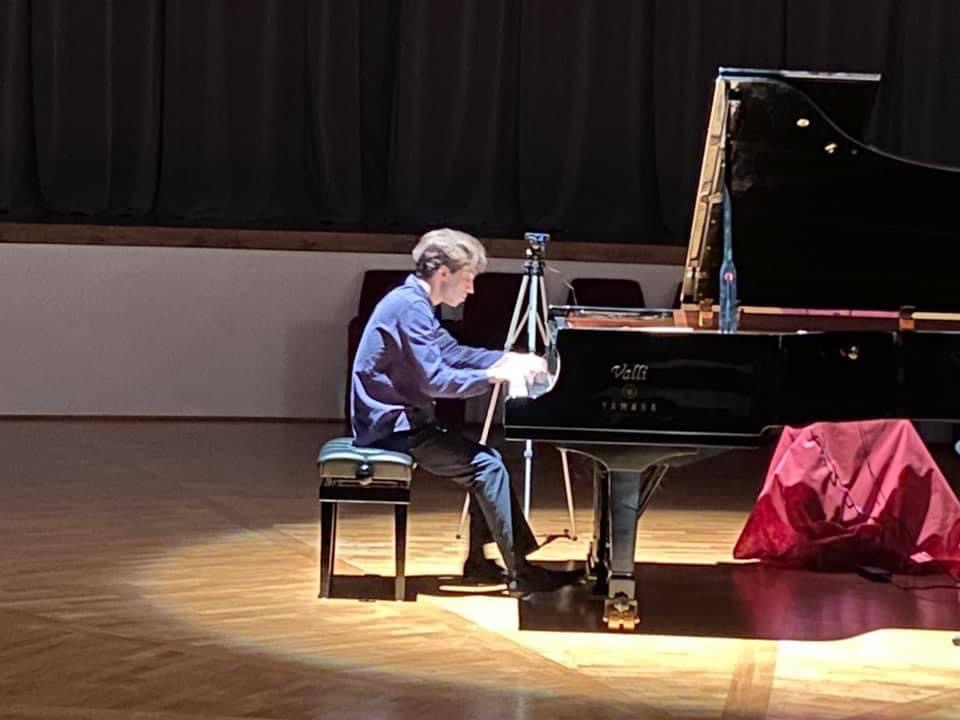
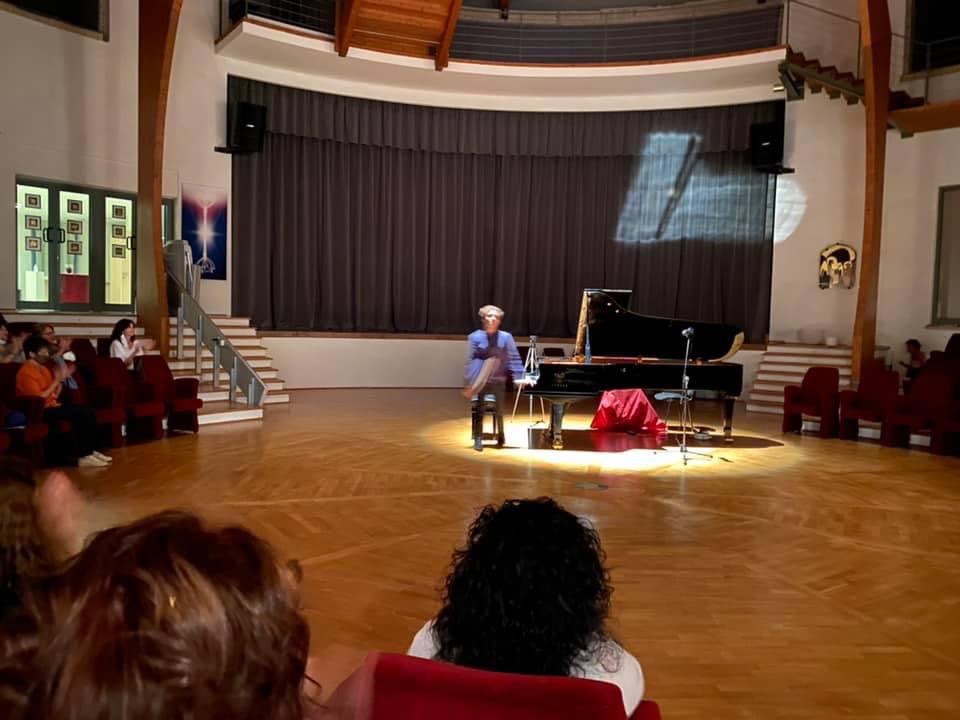
Jonathan in performance streamed live on the Facebook site of the Comunità di Etica Vivente
I even made a podcast with him for the Keyboard Trust in which he spoke of his humility but also exhilaration at starting a journey where a lifetime may not ever be enough.Perfection is the unattainable goal of all thinking artists but it is the search that can be so fascinating when conducted with the intelligence and artistry of Jonathan.
Jonathan Ferrucci with his mentor Angela Hewitt
It was refreshing to see his mentor Angela Hewitt at his performance and to see the discussions afterwards and to know that those discussions will continue in private as they share their opinions with such humility and honesty each one trying to convince the other of the route they had chosen.In trying to convince each other maybe even finding a completely different route themselves.Variation 28 was indeed thought provoking in Jonathan’s ultra sensitive hands.He obviously had in mind the celestial trills that were so much part of late Beethoven’s search for the perfect legato.Busoni had similar flights of imagination in the second half of the variations as many were inspired by the influence on him of the visionary Franz Liszt.Rosalyn Tureck had the idea that there should be a constant tempo throughout the variations like a immovable rock whereas Nikolaeva played with the warmth based on the song and the dance.
Angela joining in the ovation for this remarkable young man
His mentor Angela Hewitt gave a monumental performance during lock down in Bach’s own church in Leipzig as near to Bach as anyone could possibly get.Glenn Gould gave a performance in Moscow where as he played for the first time word spread and the hall gradually filled to capacity as he too was on his genial journey which was to cause such debate when his famous ( or should I say infamous ) recording took the music world by storm.Jonathan will eventually find the simplicity and an immovable rhythmic precision as his journey continues.He may decide that it is enough to embellish the ritornelli with simplicity rather that try to make ,so obviously,one hand more prominent than the other.There are so many combinations possible and a lifetime may indeed be too little.
A standing ovation after 75 minutes of exhilarating music making
But Jonathan’s struggle is a vibrant living,fascinating thing that I for one would not miss the next instalment which hopefully will be in his hometown of Florence – the cradle of Western Culture.
Hats off to a young man who has decided to dedicate his youth to art with such dedication and technical expertise.A rarity indeed and an example to us all,especially the young, in these difficult times.
In discussion after the performance with Angela and young Cambridge graduate relation
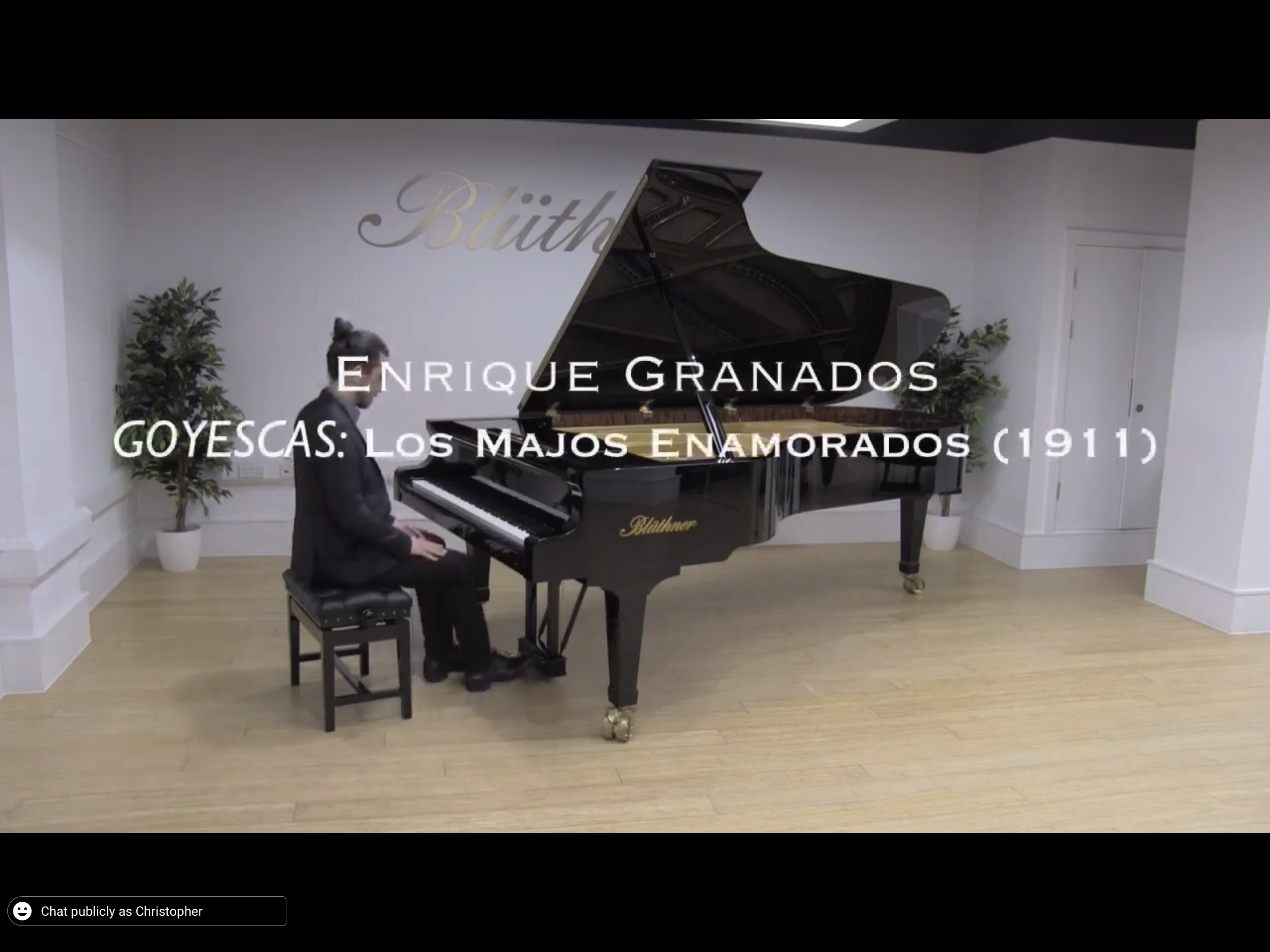
Recorded live at the Blüthner Piano Centre, London Enrique Granados Goyescas: Los Majos Enamorados (1911) 1. Los Requiebros (The Compliments) 2. Coloquio en la Reja (Conversation at the Window) 3. El Fandango de Candil (The Candlelight Fandango) 4. Quejas, o la Maja y el Ruiseñor (Complaints, or the Maiden and the Nightingale) 5. El Amor y la Muerte (Love and Death) 6. Epílogo: La serenata del Espectro (Ghost’s Serenade) Enrique Granados El Pelele (1913) Debussy Bruyères
As Leslie Howard said,at the end of this recital,he was astonished that Salvador had any energy left after such scintillating performances not only of Goyescas but also the energetic El Pelele.We were left clicking our heels and stamping our feet as this hypnotic feast of music wove its seemingly endless web of miriades of notes.Salvador took us by surprise with a magical performance of Debussy’s Bruyères (from Book 2 of his preludes ) which just complimented ,with its serenity and peace,this red hot survey of the colours and emotions of Spain.Let us not forget that it was all allied to the transcendental technique and infallible memory of this young Spanish pianist.It also demonstrated the wonderful depth of sound and rich palette of colours of this magnificent Bluthner Concert Grand piano.
Goyescas, op.11- Los majos enamorados (The Gallants in Love), was written in 1911 and wasm inspired by the work of the Spanish artist Francisco Goya.The piano pieces have not been authoritatively associated with any particular paintings with two exceptions:El amor y la muerte (Love and death) shares its title with one of Goya’s prints from the series called Los caprichos El pelele (The straw man) is one of Goya’s tapestry cartoonsThe piano writing of Goyescas is highly ornamented and extremely difficult to master, requiring both subtle dexterity and great power. Some of them have a strong improvisational feel, the clearest example of this being the fifth piece, called El amor y la muerte (Love and Death). The fourth piece in the series (Quejas, ó la maja y el ruiseñor—The Maiden and the Nightingale) is the best known piece from the suite, it is filled with intricate figuration, inner voices and, near the end, glittering bird-like trills and quicksilver arpeggios.This piano suite was written in two books and Granados himself gave the première of Book I at the Palau de la Musica Catalana in Barcelona on 11 March 1911. He completed Book II in December 1911 and gave its first performance at the Salle Pleyel in Paris on 2 April 1914.El pelele (The Straw Man), subtitled Escena goyesca, is usually programmed as part of the Goyescas suite; Granados gave the première in the Teatre Principal at Terrassa, on 29 March 1914.
Goyescas is also an opera in one act and three tableaux, written in 1915 .Granados composed the opera to a Spanish libretto by Fernando Periquet y Zuaznabar with melodies taken from his 1911 piano suite.Prevented by World War I from being presented at the Paris Opéra the premiere of Goyescas took place on January 28, 1916 at the Metropolitan Opera New York.It was the first opera to be performed there in Spanish and was paired on a double bill with Leoncavallo’s Pagliacci.The success of the Met premiere of Goyescas led indirectly to Granados’s death as he was invited by President Woodrow Wilson to give a piano recital at the White House, causing him to postpone his return to Spain. Granados and his wife lost their lives on March 24, 1916 when their ship, the French steamer Sussex,was torpedoed by a German U-boat in the English Channel.
Read Salvador Sánchez’s insights about his repertoire: Enrique Granados (1867-1916) was a Spanish composer and pianist, known for being one of the most representative musicians of Spanish Romanticism. Goyescas is well known for being Granados’s most ambitious and influential work. This piece resonates with me deeply for many reasons. In my opinion, it manages to encapsulate all the different traits that define Spanish culture and history. While Coloquio en la Reja evokes the love and passion of a summer night and makes continuous references to Spanish traditional songs and guitar music, El Fandango de Candil evokes the ancient Arabic past that is so ingrained in Spanish culture. All of this while grabbing direct inspiration from one of Spain’s most important artists of all time: Francisco Goya. Goyescas is the melting point of all of Spain’s most important and recognisable artistic and cultural traits; traits that are ingrained in Spanish history and that have never been represented better than in Goyescas.” Salvador Sánchez
Salvador Sánchez was born in Elche, Spain in 2000.Salvador started playing piano at the age of 9. At the age of 12 he started his studies in his hometown conservatoire where he had piano lessons for four years with Pedro Vera.At the same time, he was having lessons with Pablo Gómez-Ábalos and international soloist Sue-hee Myong.In 2016, he started his piano and composition studies in St. Mary´s Music School in Edinburgh with Ms. Margaret Wakeford and Mr. T. Wilson, where he spent 3 years.Salvador has been awarded several prices in competitions throughout his career in both of his two main areas, piano and composition. In 2014, he was awarded with the Second Prize at the “XXVII National Piano Competition in Toledo”. In 2016 he was awarded the “Isobel Dunlop Composition Prize” for his String Quartet “Black Rhapsody”. In 2017 he won the “St. Mary’s Music School, Director’s Recital Prize” which is the most prestigious prize within the school. Finally, in 2019 he was awarded the first price in the “Edinburgh Competition Festival, Concerto Class” performing Ravel’s G major Piano Concerto in the Queen’s Hall in Edinburgh.Not only that, Salvador has performed as a soloist in numerous occasions in different venues around Spain and the United Kingdom, in many cases performing a full programmed concert just by himself.At the moment, Salvador is studying piano and composition in the Royal College of Music in London, with professors Mr. Danny Driver and Ms. Alison Kay.
This recital is immediately followed by an interview with Keyboard Trust Co-Artistic Director, Dr Leslie Howard, about Salvador’s life and choice of music.
The Keyboard Trust is entirely dependent on donations from our friends for its work in supporting outstandingly talented young musicians and so we’d be especially grateful to you for your support of this venture.Please feel free to make a donation via this website.
Any contributions will go towards creating new performing opportunities for these remarkable young musicians at the start of their careers,
Thank you and best wishes from The Keyboard TrustKeyboard Charitable Trust for Young Professional Performers 30th Anniversary Year Patron: Sir Antonio Pappano
Here is your free link to watch the concert, which comes from the Blüthner Piano Centre, London:
An afternoon of pure magic as we were taken to a world of sumptuous sounds.Jewels that glistened and shone with such ravishing beauty. I was transported back to the wonderful world of Benno Moiseiwitch.A world of ravishing sounds and superb musicianship that combined in a subtle display of masterly playing. From a Scarlatti that had the same subtle colours and shape that Horowitz had demonstrated in his historic CBS recordings that he made together with Clementi Sonatas in one of his retirement periods. Chopin that was reminiscent of an old recording of Moiseiwitch playing the 3rd and 4th Ballades that I have always cherished.I once played it in the car while driving Cherkassky to a concert from Rome to Pescara and I hoped he did not mind. But I love Moiseiwitch he exclaimed. They both had that kaleidoscope of sounds in their fingers together with a jeux perlé of true transcendental piano playing of an era that has almost disappeared. It is gradually reappearing with Benjamin Grosvenor,Stephen Hough (who Shura also adored) .Today Thomas Kelly undoubtedly joins these illustrious ranks. I first heard Thomas at the Schumann prize competition that Joan Chissell had bequeathed to the Royal College.He played Schumann Carnaval with a luminosity of sound and ease of playing that was like the young Nelson Freire.Like Freire there were some musical things that I found a little too self gratifying but the overall impression was totally convincing as the piano was made to dance and sing with featherlight feux follets colouring contrasting with the sumptuous sounds of a full orchestra . Of course he won and since then I have heard him getting better and better with each hearing.
His musical curiosity allows him to explore unexpected territory too.It is the same curiosity of Busoni whose works he relishes admired too by Ronald Stevenson whose works he also plays I heard a remarkable Reubke Sonata for the Keyboard Trust that will remain with me for a long time. All of which I have written about. But today it was his superb musicianship and aristocratic good taste that came to the fore in a programme of piano lollipops that just showed how a talented young musician can over a few years be allowed to develop into a great artist. His mentor Andrew Ball,recently retired from the RCM,has been his constant advisor and can be truly proud of his last student who has been transformed under his guidance from a bauble to a gem – to quote the great critic Joan Chissell!
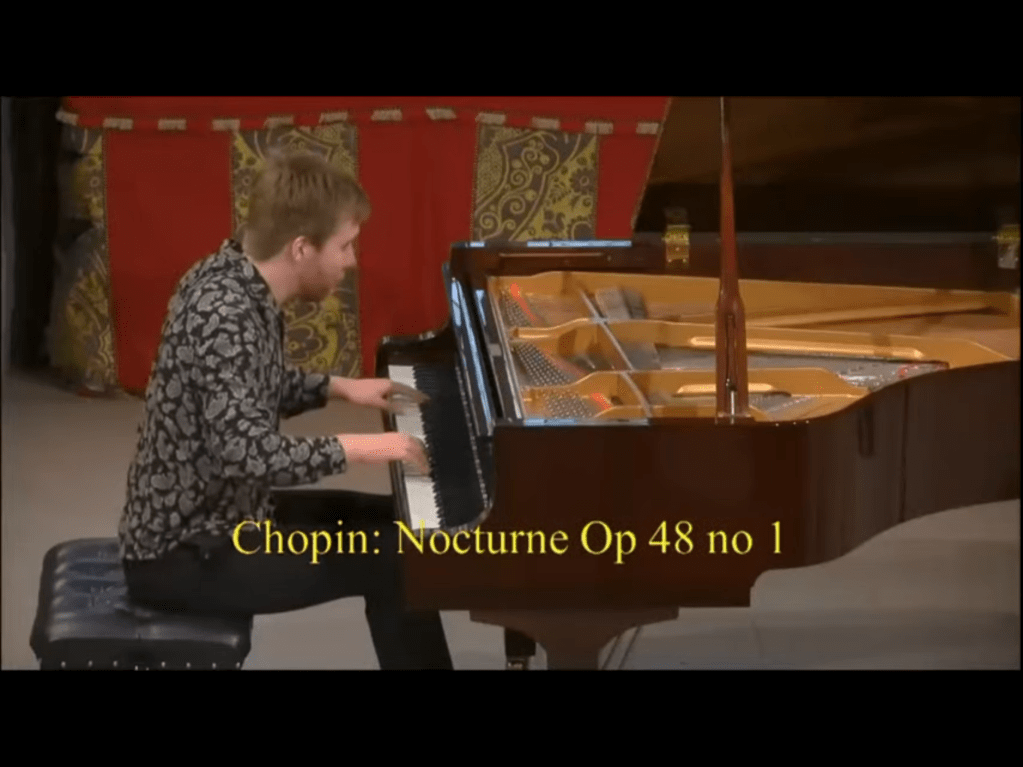
The Chopin Nocturne in C minor op 48 was played with a bell like almost chiselled cantabile reminiscent of Michelangeli’s remarkable sound world.But here there was immediately a warmth as the deep bass notes were allowed to resonate and envelop us is a world of sumptuous velvet sounds.The subtle colouring in the tenor register in the organ like middle section just added to the great build up with the octave interjections just adding a carpet of sound that took us so naturally to the tumultuous climax .Dying away to the ‘doppio movimento’ return of the main theme on a layer of ever more romantically agitated sounds until the desolate quiet farewell.
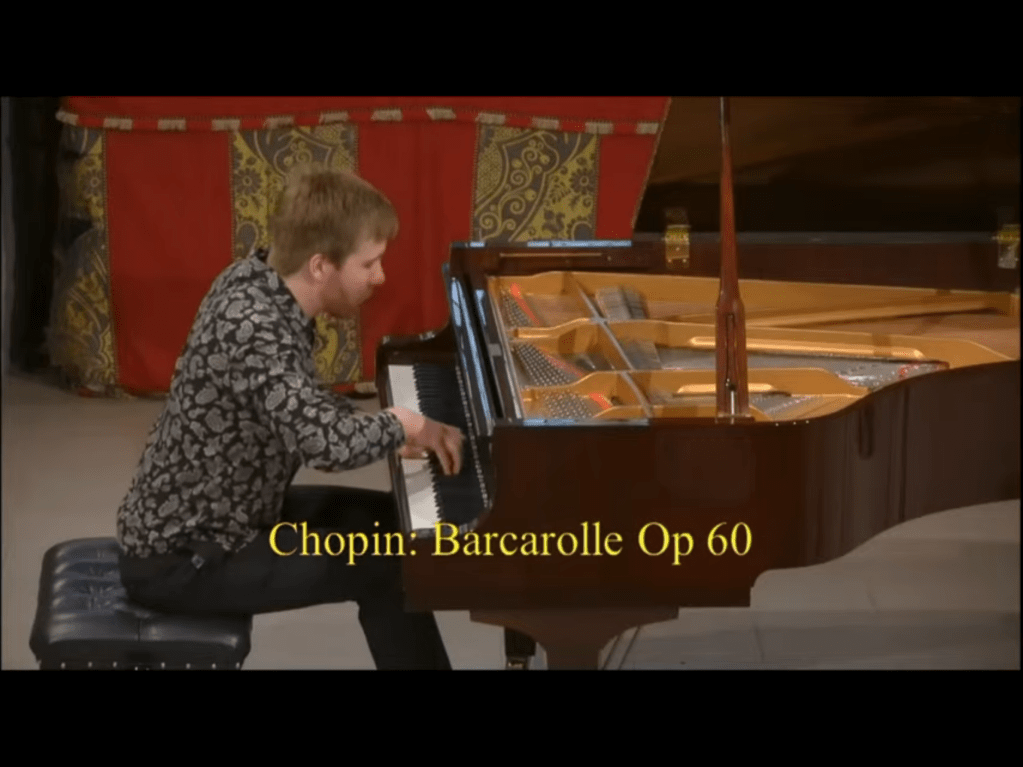
The Barcarolle too was a great song played with a rubato of aristocratic good taste and magic sounds of ravishing beauty.His very original way of allowing prominence to the left hand in the meno mosso all led to the deep C sharp of the ‘dolce sfogato’one of Chopin’s most beautiful creations.The più mosso build up was played with passionate restraint that just added to its noble grandeur before the streams of sounds ‘leggiero’with the left hand melodic line a mere whisper as it wove its way to the final conclusion.
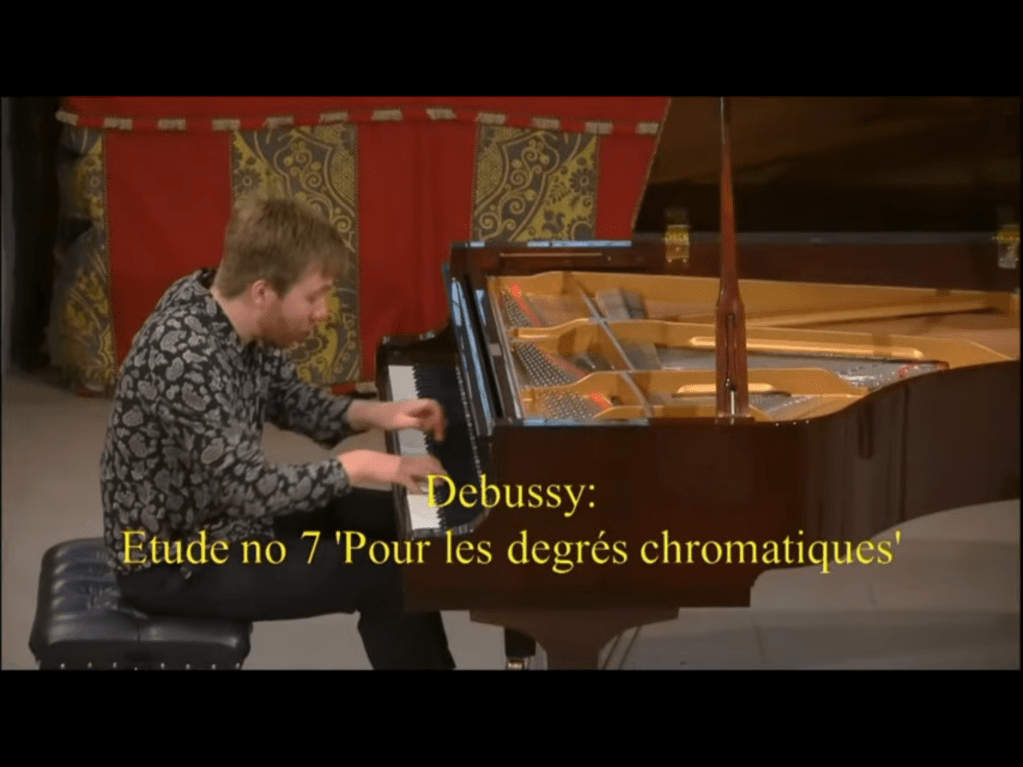
Debussy’s Chromatìc Study demonstrated in a few minutes the remarkable art of this young artist.His technical perfection as the lightness of the jeux perlé just created wafts of sound where Debussy’s hint at melody could rise and fall with such subtlety.His transcendental control of the pedal allowed absolute clarity to mingle with streams of sound in such a natural way that never disturbed the constant flow of sounds like water running gently in a mountain stream.
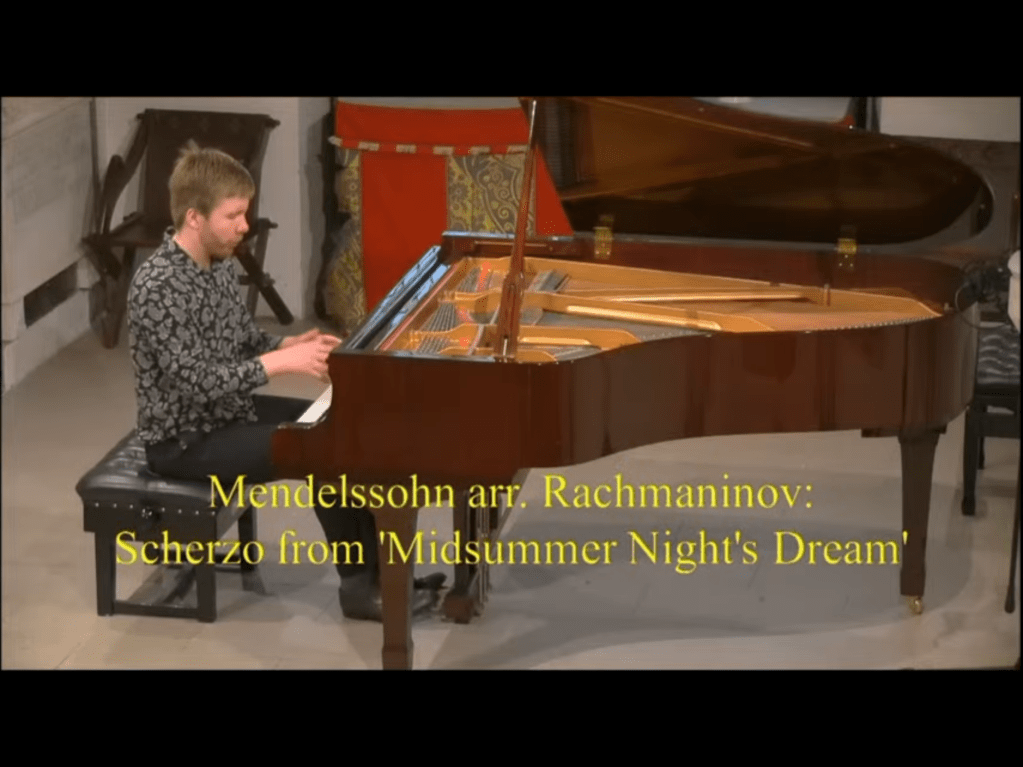
It was Moiseiwitch who made a historic recording of Rachmaninov’s Scherzo from Mendelssohn’s Midsummer Night’s Dream.He had a few minutes left in a recording session and decided to just play through this very tricky piece.The result was one of the most phenomenal recordings that has since become legend.Full of ethereal lightness and subtle shading with a ravishing jeux perlé and the appearance of the melodic line in the alto register that was miraculous for its shape and colour.Thomas today gave a brilliant note perfect account but could have had lighter dance shoes at the outset as he tried to tip toe through the magic forest rather too deliberately with clogs rather than dance shoes.As the music unraveled though a magic wand was obviously waved as he let his hair down and allowed the music to glow and gleam. A smile appeared on his face as he too was charmed like us all by the sudden appearance of the alto melody amongst all the magic fairies dancing with wistful lightness and charm.A tour de force of transcendental piano playing where clarity,lightness and charm are allied to the magic sparkle of the will o’ the wisps.
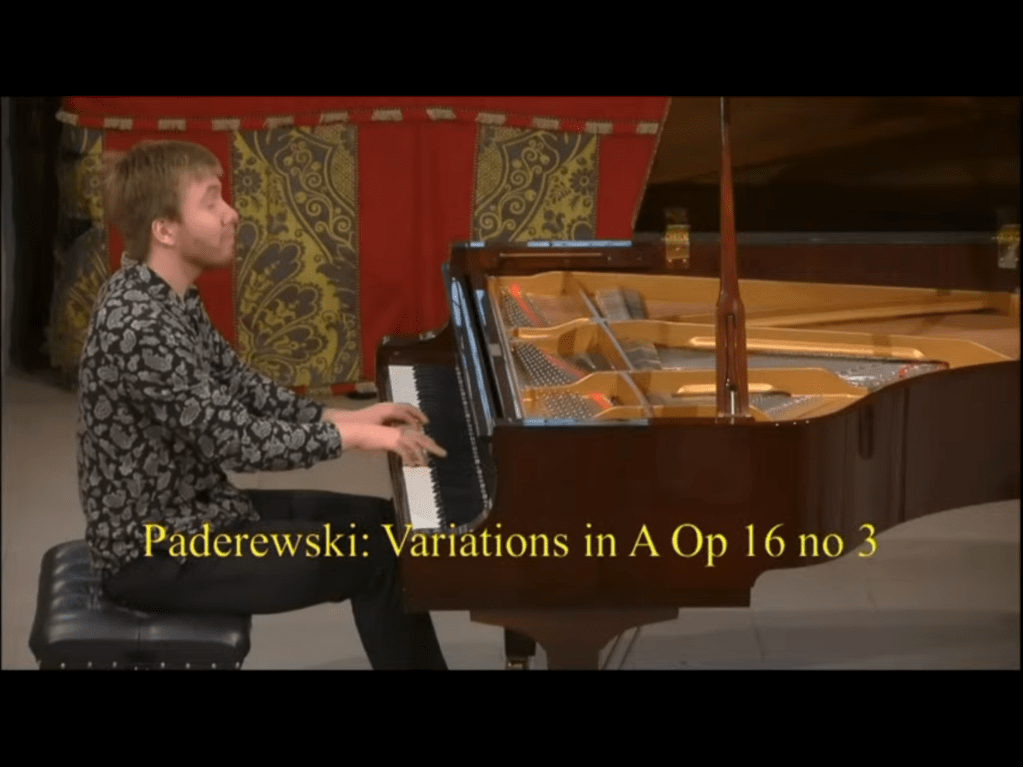
This was after a performance of Paderewski’s Variations in A op.16 n.3 with the theme played with such delicacy as the three variations were allowed to grow one out of the other to the final excitement and sumptuous finish of this rarely played gem.There are seven pieces in this collection and part of the considerable legacy of the legendary Paderewski.A student of Leschetizky with triumphs in America where he would tour more than 30 times for the next five decades.His stage presence, striking looks, and immense charisma contributed to his stage success, which later proved important in his political and charitable activities.He became a spokesman for Polish independence and in 1919, became the new nation’s Prime Minister and foreign minister during which he signed the Treaty of Versailles ,which ended World War 1.His Minuet in G was a piece that many children used to struggle with but he wrote numerous works that are rarely heard so it is hats off to Thomas for including one today.
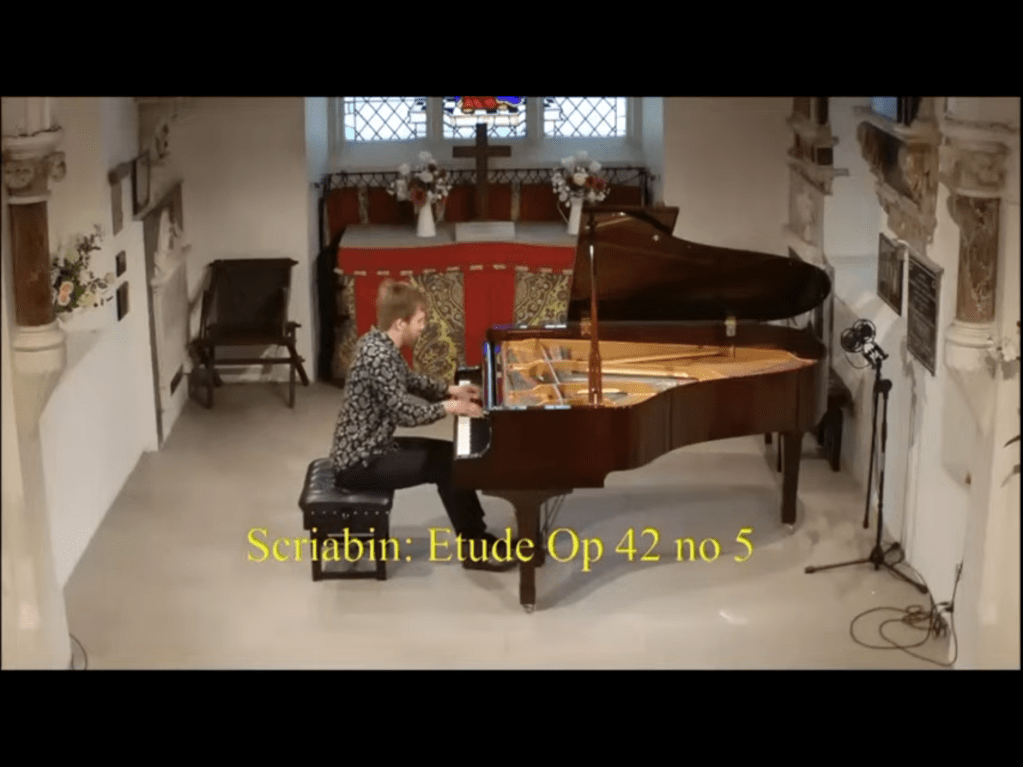
There were the same layers of sound that he found in Scriabin’s famous C sharp minor study op 42 n.5.One of the most romantic outpouring of passionate sounds it has long been favoured by the great virtuosi of the day.Today,although played with phenomenal digital and technical control,the individual notes were just streams of sound that pulsated as the excitement and passion grew ever more fervent with a melodic line that floated on this sea of sumptuous sounds.Thomas’s command and musical understanding allowed him even to bring out some subtle left hand counterpoints whilst all around the music was boiling over at 100 degrees.
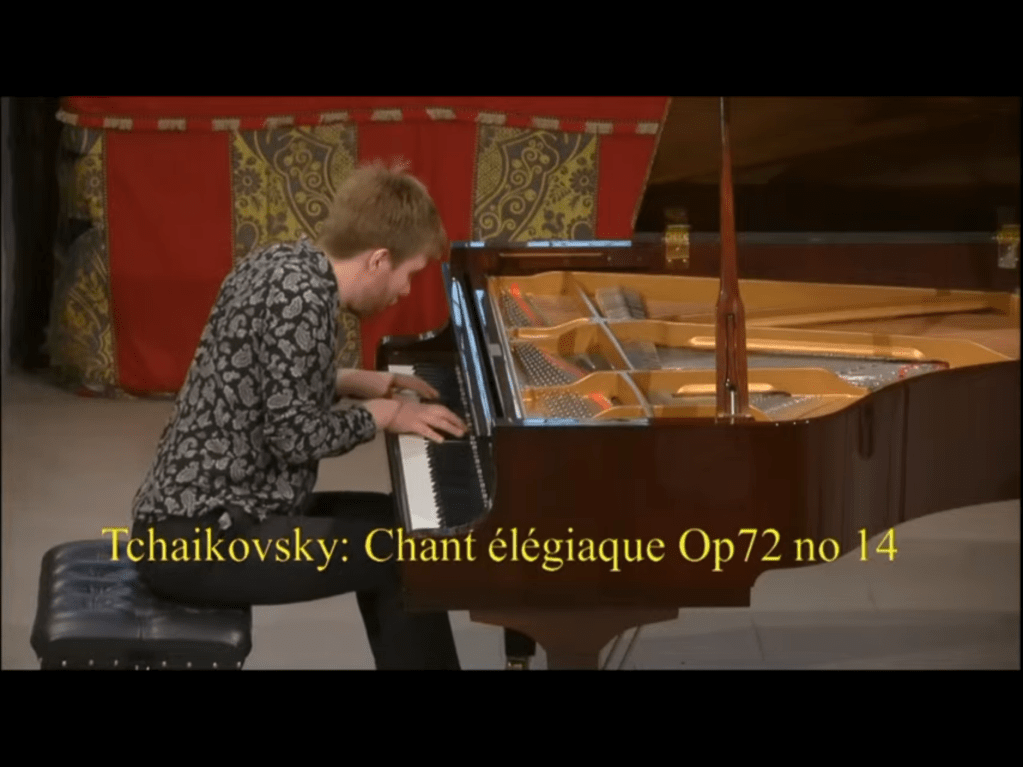
This was followed by a heart rending account of Tchaikowsky’s Chant Elegiaque played with sumptuous colour and ravishing sounds with a sense of balance that allowed the poignant melodic line to shine through a web of magic accompaniments.It was a fitting end to a recital where poetry and musicianship were allied to the almost lost art of piano playing of the Romantic era of the likes of Lhevine,Godowsky,Rosenthal. and Levitski.All pianists that I had heard at the Brentford Piano Museum where piano rolls of this great era of piano playing were stored by that eccentric engineer Frank Holland.Sidney Harrison brought them to the notice of the BBC who gave a series of programmes with these recordings that were a revelation,made long before CD’s were even dreamt about.They even played Moiseiwitch’s recording of Ravel’s Jeux d’Eau to him as he lay in his hospital bed and he just smiled and said :’yes.I used to play like that!’Cherkassky would often end his recitals after numerous encores of Rachmaninov’s Polka,Godowsky’s Tango or the Boogie Woogie Etude by Morton Gould.Always ending though with the Autumn Melody from Tchaikowsky’s Seasons.Seducing his audience with such subtle ravishing sounds,as beautiful as any singer,where his sense of balance and subtle timing held his audience with baited breath much as Thomas had done today.I remember Fou Ts’ong coming to play for us a day after an infamously renowned pianist was playing in the same hall :Two Mozart Sonatas and Chopin 4 Scherzi.I warned Ts’ong who wanted to listen too,that this pianist was a bit like Cherkassky in the liberties he might take with the score.After the concert Ts’ong admonished me saying:’But Shura loves the piano.This man hates it!’It was indeed this great love that shines through all that Thomas does and like Grosvenor or Hough he actually listens to himself.A rarity indeed and a pianist to be reckoned with these days.
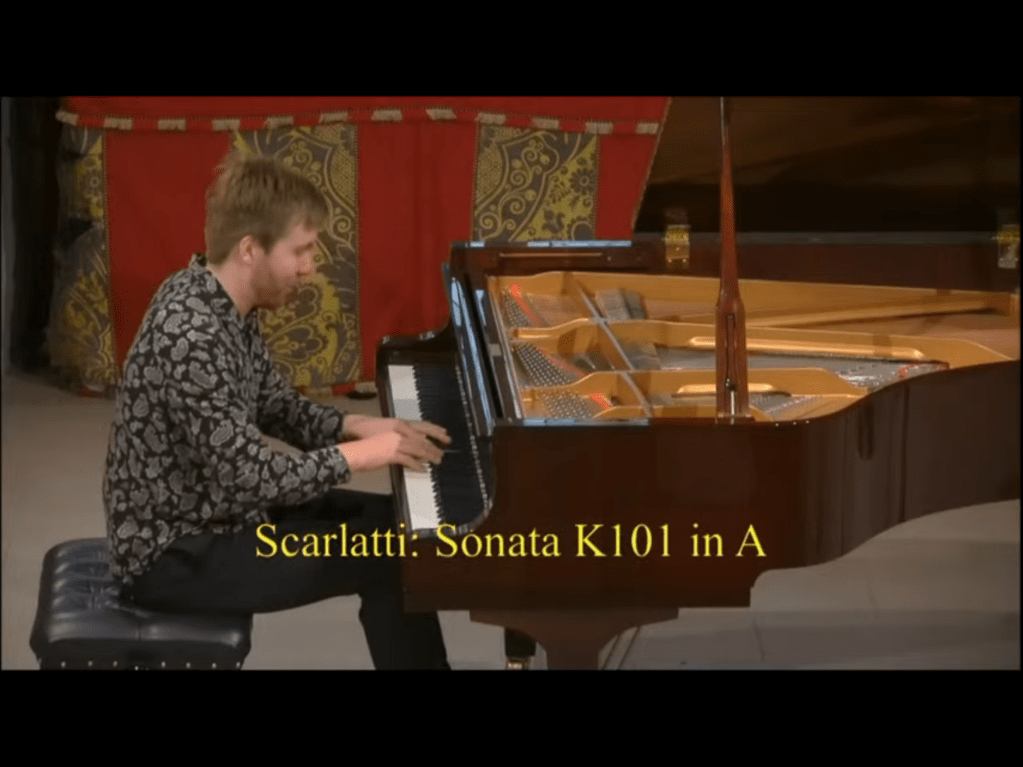
The two Scarlatti Sonatas that opened the programme were played with a clarity and a delicate jeux perlé where streams of notes were shaped with such loving care with delicate phrasing of quite touching beauty.There was a great sense of character of almost operatic bel canto but kept perfectly in style .Hushed almost music box sounds and magical embellishments created a magic out of which these jewels were allowed to be revealed as they sparkled like rays of light in his delicate hands.
Thomas Kelly was born on 5th of November 1998. He started playing the piano aged 3, and in 2006 became Kent Junior Pianist of the Year and attained ABRSM Grade 8 with Distinction. Aged 9, Thomas performed Mozart Concerto No. 24 in the Marlowe Theatre with the Kent Concert Orchestra. After moving to Cheshire, he regularly played in festivals, winning prizes including in the Birmingham Music Festival, 3rd prize in Young Pianist of The North 2012, and 1st prize in WACIDOM 2014. Since 2015, Thomas has been studying with Andrew Ball, initially at the Purcell School of Music and now at the Royal College of Music. Thomas has also gained inspiration from lessons and masterclasses with musicians such as Vanessa Latarche, William Fong, Ian Jones, Valentina Berman, Wei-Yi Yang, Boris Berman, Paul Lewis, Mikhail Voskresensky, Dina Yoffe. Thomas will begin studying Masters at the Royal College of Music in 2021, sharing with Professors Andrew Ball and Dmitri Alexeev. Thomas has won 1st prizes including Pianale International Piano Competition 2017, Kharkiv Assemblies 2018, at Lucca Virtuoso e Bel Canto festival 2018, RCM Joan Chissell Schumann competition 2019, Kendall Taylor Beethoven competition 2019, BPSE Intercollegiate Beethoven competition 2019 and the 4th Theodor Leschetizky competition 2020. He has performed in a variety of venues, including the Wigmore Hall, the Cadogan Hall, Steinway Hall, Holy Trinity Sloane Square, St James’ Piccadilly, Oxford Town Hall, St Mary’s Perivale, St Paul’s Bedford, the Poole Lighthouse Arts Centre, the Stoller Hall, at Paris Conservatoire, the StreingreaberHaus in Bayreuth, the Teatro Del Sale in Florence, North Norfolk Music Festival and in Vilnius and Palanga. Since the pandemic restrictions in 2020, Thomas’ artistic activities include participating in all 3 seasons of the “Echo Chamber”, an online concert series curated by Noah Max, and releasing 3 singles under the Ulysses Arts label on digital platforms. Thomas is a C. Bechstein Scholar supported by the Kendall-Taylor award. He is being generously supported by the Keyboard Charitable Trust since 2020, and Talent Unlimited since 2021.
Music making that touched the sublime. When David Romano intoned with Alessio Pianelli with such freedom and soaring passion it was hard to believe it possible to find such unison between these six instruments in Tchaikowsky’s truly ravishing Souvenir de Florence op 70.
The extraordinarily moving musical conversation between David Romano and Alessio Pianelli
It was the same unison that had made Beatrice Rana and Massimo Spada’s performance of Stravinsky’s own arrangement for four hands on one piano of The Rite of Spring,so hypnotic and mesmerising.To hear Massimo’s pungent rhythms in the bass played with a relentless throbbing suddenly exploding into cascades of notes from his partner Beatrice.Only to dissolve into the most ravishingly desolate voice with the four hands and arms entwined in a musical unison that was quite extraordinary.It was even more remarkable than the first time I heard this arrangement in 1968 at the South Bank Festival in London with a then unknown Daniel Barenboim and the recently defected Russian Vladimir Ashkenazy.They also performed the Mozart Double Concerto captured on a famous video by Christopher Nupen.Together with Jaqueline Du Pré,Pinchas Zuckermann,Itzak Perleman,Zubin Mehta,Martha Argerich and Nelson Freire it was a glorious moment of friends having all the time in their youth of enjoying each others company.
David Romano Massimo Spada Beatrice and Ludovica Rana enjoying each others company during a pause between works.
The Rite of Spring was composed for Sergei Diaghilev’s Ballets Russes, and premiered in 1913 at the Théâtre des Champs-Elysées in Paris,conducted by Pierre Monteux .Igor Stravinsky’s harmonically adventurous score–along with a scenario of pagan sacrifice and Vaslav Nijinsky’s unconventional choreography–excited both opposition and support, and the event’s climax in a near-riot remains among the most notorious premieres in music history. Stravinsky created a version of the orchestral score for piano four hands, and it was in this form that the piece was first published in 1913; the full score was unavailable in print until 1921 and there were few performances in the years following its composition due to the Ist world war and its after effects which made this arrangement the primary introduction to the work.
Beatrice Rana with Massimo Spada
Rubinstein famously used to try to convince Stravinsky that the piano was not a percussive instrument but to no avail.He even commissioned his friend to write a piece for him but was shocked when he received the Piano Rag Music and refused to perform it and the first performance was given by José Iturbi on 1919.Stravinsky in 1921, though,dedicated the piano reduction of Petrushka to him and gave Rubinstein permission to make his own arrangement which he played in his own inimitable free way but never allowed it to be recorded for posterity.Stravinsky’s aim was to attempt to influence Arthur Rubinstein into playing his music. (A 1961 live recording featuring Rubinstein at Carnegie Hall was published in 2012,after Rubinstein’s death and were part of the tapes made during his historic ten benefit recitals).Stravinsky ensured that Rubinstein would find the arrangement technically challenging but musically satisfying. Trois mouvements de Petrouchka reflects the composer’s intentions and is renowned for its notorious technical and musical difficulties. The three dances from Petrushka together with Agosti’s 1928 arrangement of the Firebird are two of the most difficult pieces in the piano repertoire and are usually rattled off with ease nowadays by note spinning virtuosi.But there are rare exceptions ,like today,when technical command is allied to musical artistry and Stravinsky’s early music can bring the same magic without the visual aid of Diaghilev.
Rehearsing the Rite
I usually dislike composers that use the piano as a percussive instrument but Massimo Spada and Beatrice Rana made the piano sing dance and seduce as only true magicians can.To turn a box of hammers and strings into a kaleidoscope of multi coloured sounds and moods shows a rare sense of artistry.Massimo Spada had the pedals and it was Anton Rubinstein who said the pedal is the soul of the piano …..never more evident than what he did today.Beatrice’s artistry has long been recognised but together they are a force to be reckoned with.
From Beatrice’s absolute clarity of the Adoration of the Earth and Massimo’s magical reverberations before his savage eruption with the Dances of the Young Girls.Beatrice’s streaks of lightening just adding to the gradual build up of excitement with its constant undercurrent of continual movement and the appearance of the young girls .The frenzy they both brought to the Ritual of Abduction was quite as electrifying as the grandest of orchestras.Arms were entwined for the sudden Spring Rounds where the melodic line is shadowed both on high and below with ravishing effect.The shooting stars of glissandi in the Dance of the Earth was indeed mesmerising as it led to the sublime beauty of the Sacrifice.There was magic in the air as the Mystic Circles of the Young Girls was suddenly revealed with an almost Messiaenic sense of pagan rapture.The Glorification of the Chosen One produced some electrifying playing as the Evocation of the Ancestors blazed out of Beatrice’s hands.The sinister rhythmic precision from Massimo in the Ritual Action of the Ancestors was indeed hypnotic in its unrelenting advance to the Sacrificial Dance.A transcendental eruption of sounds played with such unrelenting rhythmic precision made one suddenly aware that the piano can also be a savage percussive instrument as this still quite astonishing work came to its explosive end.
Our host Massimo Spada with an ever more enthusiastic Amodeo-the youngest member of the family.
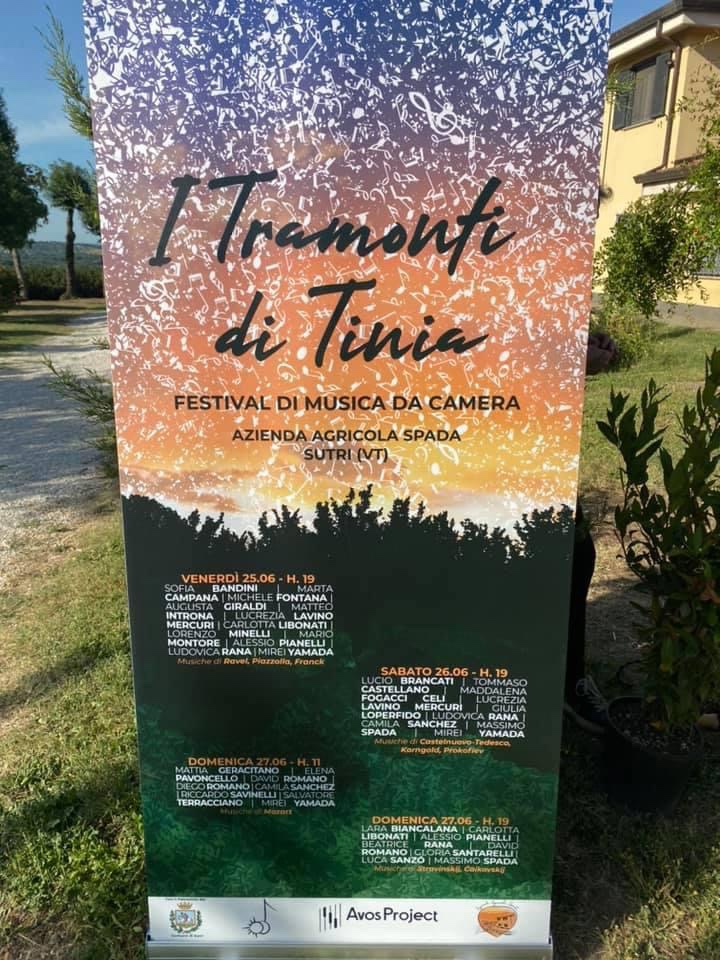
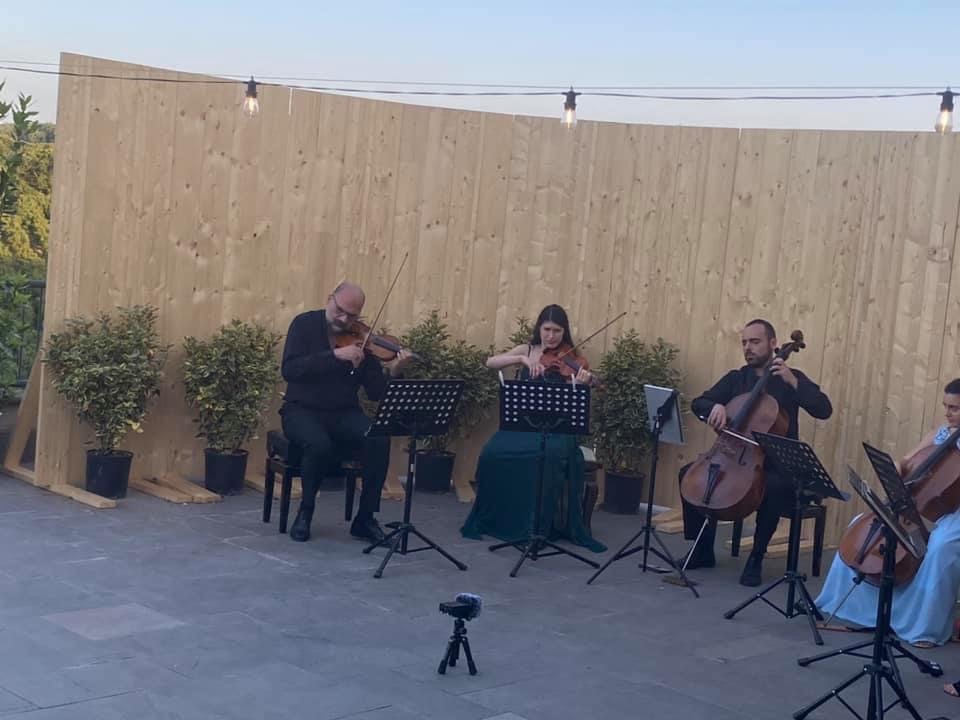
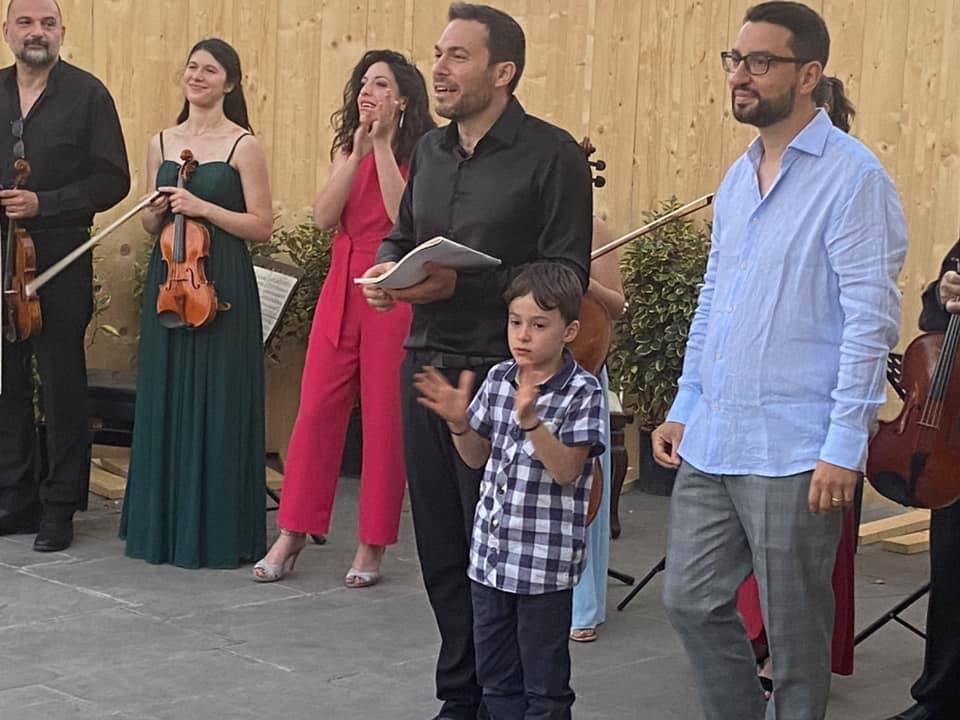
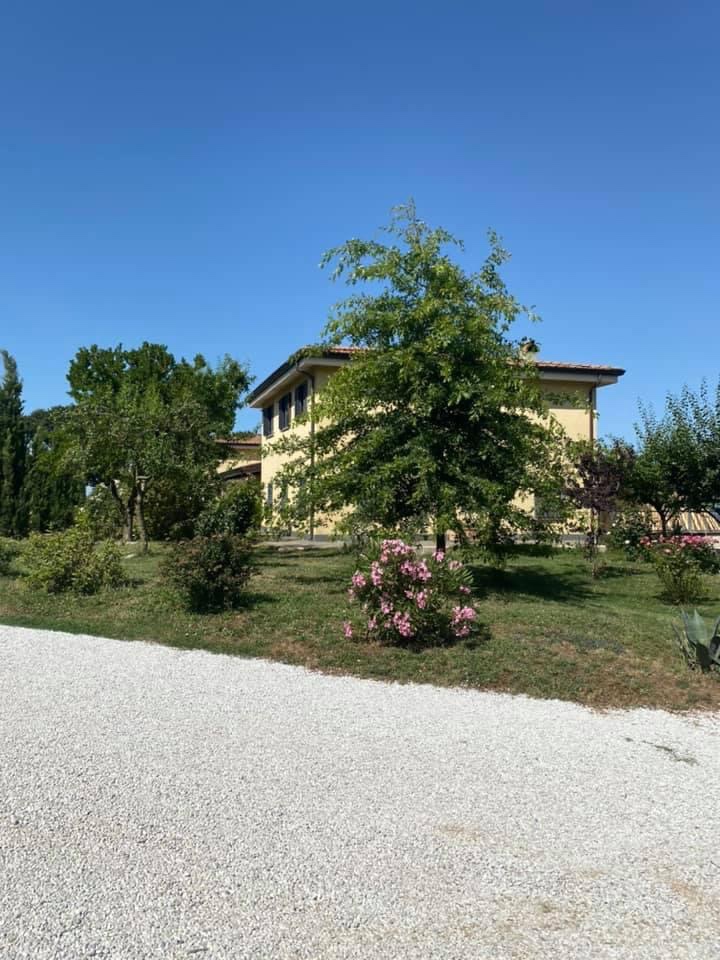
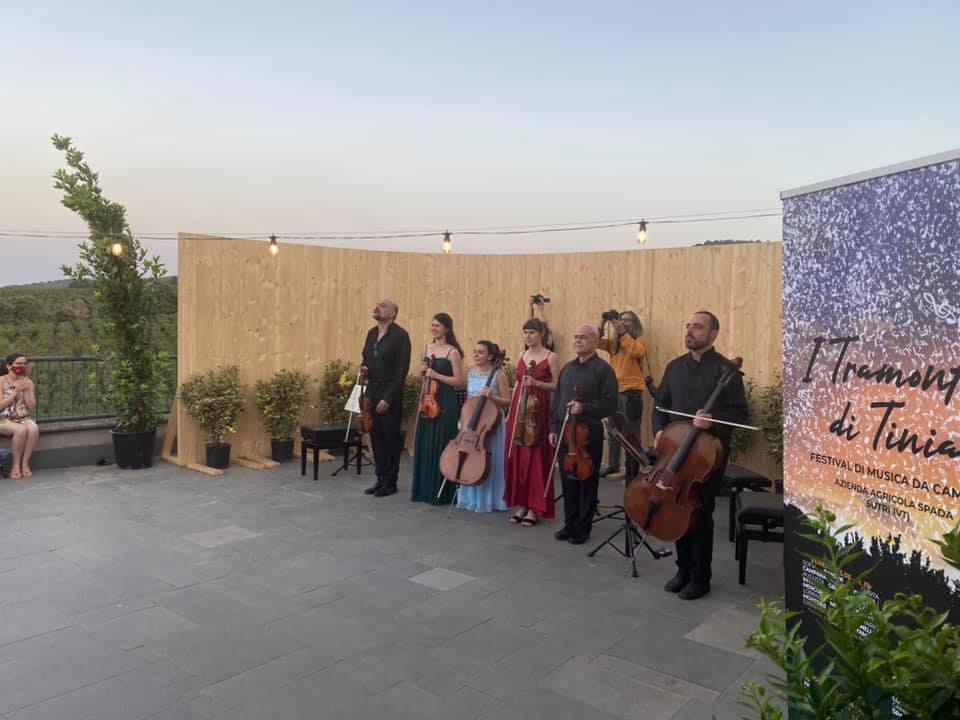
This new festival was pieced together by a group of extraordinary artists and friends in the family agricultural estate of Massimo Spada deep in the heart of the countryside in Sutri near Viterbo.It was to demonstrate their new Academy in Rome where the more experienced musicians share their artistry with the young and aspiring by making music together.As Massimo said at the end of a magical evening of music making:’it is a new way of teaching chamber music by sharing the platform with younger less experienced musicians.’The Avos project is a new and exciting reality
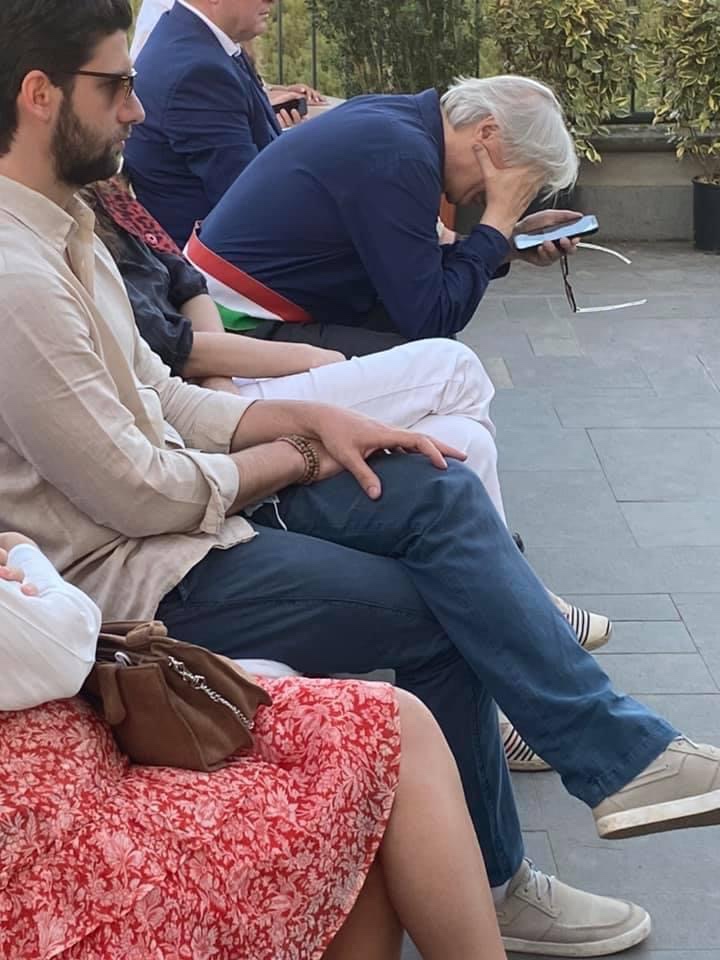
Well if this is the result it is has certainly created an earth tremor today. I hope that the Mayor of Sutri,the celebrated art historian Vittorio Sgarbi arriving late and spending his time on his mobile phone will at least have noticed the reaction of the public on their feet visibly moved by such sublime music making
Vittorio Sgarbi obviously plagued by problems that as Mayor of Sutri he hopes to resolve ,enveloped and helped by the ravishing sounds that fill the air
Domenica 27 giugno ore 19.00 • Igor Stravinskij – La Sagra della Primavera Versione dell’autore per pianoforte a 4 mani Quadri della Russia pagana in due parti Beatrice Rana, pianoforte Massimo Spada, pianoforte • Pëtr Il’ič Čajkovskij – Souvenir de Florence I. Allegro con spirito II. Adagio cantabile e con moto III. Allegretto moderato IV. Allegro vivace David Romano, violino Gloria Santarelli, violino Luca Sanzò, viola Carlotta Libonati, viola Alessio Pianelli, violoncello Lara Biancalana, violoncello
Tchaikovsky adored Italy and spent the long, harsh Russian winter in Rome, Florence, and Venice, seduced by the warmth of the sun, the music in the streets and the beauty of the men.”I am under a clear blue sky,” he wrote, “where the sun is shining in all its magnificence. There’s no question about rain or snow, and I go out wearing nothing but a suit … a magical shift is finally happening to me.”The first performance was in St Petersburg in 1890 when Tchaikovsky had finally achieved international fame.He was at the peak of his powers, pouring his full emotional self into every bar he wrote, not knowing that he had just three years left to live.In Florence, he scratched out a simple duet for violin and cello. This germ gave birth to Souvenir de Florence.
The sextet in rehearsal
In Tchaikowsky’s own words :”The second movement I have called adagio (because here one crochet is no more than 58, and to me this is not Andante); however this movement has the character of an Andante, and should not be drawn out. The central section of this adagio, probably written molto piu mosso (I don’t remember exactly) should be played with an improbable pppp; this should be just discernible, like summer lightning. The first movement needs to be played with great fire and passion. The second: cantabile. The third: scherzo. The fourth: brightly and enthusiastically”Tchaikowsky’s own words describe so perfectly the performance we heard today with the drive of David Romano as he threw himself with the ‘fire and passion’that just ignited the entire performance.The plucked strings in the second movement was like a guitar serenading the beautiful duet between violin and cello so eloquent as they intoned together.The simple folk song of the third flowed from Luca Sanzo’s viola with heart rending intensity.The last movement a relentless Slavonic dance with the melodic line shared in every conceivable combination of solo,duo and trio.There were some young faces amongst these six magnificent players that was the demonstration that Chamber Music cannot be taught but has to be lived as it certainly was today
Tchaikovsky’s verdict on his work? “It’s frightening to see,” he wrote, “how pleased I am with myself.” Which aptly sums up the feeling of elation that brought the audience spontaneously to their feet today.
The artists taking part in the concert share the tumultuous applause
Che festa! What a party for the final concert in the Maurizio Baglini project festival held over the last three days in Rome.Two in the historic Teatro Torlonia and the final concert in the much larger Teatro Palladium. And larger than life it was too with Mozart’s concerti for two and three pianoforti with Maurizio Baglini himself at the helm.Directing three young pianists as he himself took turns to play with Axel Trolese, Giuseppe Rossi and Filippo Tenisci.
Lucrezia Liberati with Sieva Borzak
The opening of the concert had very gentlemanly been given to the charming Lucrezia Liberati who played the glittering early concerto in A minor by Mendelssohn.Some scintillating playing from Lucrezia with the Roma 3 orchestra with their resident conductor Sieva Borzak.A charming early work with reams of notes played with such relish and rhythmic energy catapulting the seemless streams of gold with a jeux perle that only youthful talent can dispatch with such simplicity and joie de vivre.It was the same spirit a century earlier that was evident in the fun and games that was created in the Mozart Concerti.
Maurizio Baglini. Valerio Vicari. Roberto Pujia
It is quite a rarity to hear these concerti in concert because three pianos on stage takes some organising.So hats off to Roma Tre for being able to find the space at their Teatro Palladium for three pianos and orchestra .As the President of Roma Tre,Roberto Pujia,said in his brief introduction,the combination of music and friendship has allowed him and his former pupil, Valerio Vicari, artistic director for the past 15 years ,to promote and help exceptional young talent to have a platform and to find a family of dedicated professional enthusiasts to help them.
Thus was born the Roma Tre Orchestra and the Young Artists Piano Solo Series all under the wing of Roma Tre University.Maurizio Baglini,the distinguished pianist,has become part of this family and his projects regularly take pride of place.In fact the project in the past few days has seen involved many of the musicians who Maurizio is dedicated to helping forge a professional career in music.
Maurizio Baglini conducting from the keyboard
Also playing with the musicians himself but always taking second place and allowing these young musicians their opportunity to shine.Much as Marie Joao Pires and Martha Argerich lend not only their name but also their precious time to helping the next generation
Giuseppe Rossi whose Hammerklavier received such praise from Maurizio Baglini – here joining in the fun of Mozart triple
In fact one of the Roma Tre prodigies Giuseppe Rossi was even allowed to play Beethoven’s longest most complex sonata op 106 ‘Hammerklavier’!Whilst others played Liszt’s extraordinary arrangements of some of the Beethoven Symphonies.
Filippo Tenisci and Giuseppe Rossi with Maurizio Baglini in the background conducting from the third piano!
There is only a limited number of works for two or more solo instruments with orchestra.Mozart, however, was evidently attracted by the sinfonia concertante genre and created some of the finest examples of it, such as the Sinfonia Concertante for Violin and Viola and the Concerto for Flute and Harp, as well as his two concertos for more than one piano. The ‘Lodron Concerto’ for three pianos was composed in 1776 for Countess Lodron and her daughters. It is Mozart’s third piano concerto and the young man’s irrepressible sense of fun is obvious with ‘a true musical joke, in which the musical line is divided between the three players quite arbitrarily; one piano continues what another has started and the third will conclude.
Axel Trolese and Maurizio Baglini at the end of Mozart Double Concerto
When the composer three years later returns to the task of writing for more than one piano, the result is quite different. The Concerto in E flat major KV 365, composed for Mozart himself and his sister Nannerl, is ‘in many respects Mozart’s first ‘big’ piano concerto. It is the first in which we find the very characteristic intertwining of the woodwind and the piano part, accomplished very effectively and virtuosically.’ Mozart seems to have been fond of the work, so fond that for a later performance he added clarinets, trumpets and timpani to the orchestra
Martedì 22 giugno 2021 ore 19 Teatro Torlonia Maurizio Baglini Project – Le sinfonie di Beethoven trascritte da Franz Liszt Sinfonia n. 2 in re maggiore op. 36 Axel Trolese, pianoforte Sinfonia n. 5 in do minore op. 67 Simone Librale, pianoforte Sinfonia n. 6 in fa maggiore op. 68 “Pastorale” Maurizio Baglini, pianoforte
Mercoledì 23 giugno 2021 ore 19 Teatro Torlonia Concerto à la carte L. v. Beethoven: Sonata per pianoforte n. 29 in si bemolle maggiore op. 106 “Hammerklavier” Giuseppe Rossi, pianoforte Il pubblico sarà invitato a scegliere il programma sulla base di una lista di brani proposta dagli artisti Silvia Chiesa, violoncello Maurizio Baglini, pianoforte
Giovedì 24 giugno 2021 ore 20.30 Teatro Palladium Giovani artisti per giovani compositori progetto realizzato nell’ambito del programma LazioSound di GenerAzioni Giovani e finanziata dalle Politiche Giovanili della Regione Lazio e dalla Presidenza del Consiglio dei Ministri – Dipartimento per la Gioventù F. Mendelssohn Bartholdy: Concerto per pianoforte e orchestra d’archi in la minore Lucrezia Liberati, pianoforte Sieva Borzak, direttore W. A. Mozart: Concerto per due pianoforti n. 10 in mi bemolle maggiore K. 365 Maurizio Baglini e Axel Trolese, pianoforte W. A. Mozart: Concerto per tre pianoforti n. 7 in fa maggiore K. 242 Maurizio Baglini, Giuseppe Rossi, Filippo Tenisci, pianoforte
Maurizio Baglini e Silvia Chiesa, da tanti anni artisti di riferimento per Roma Tre Orchestra
Above all there was such exhilarating music making which made for a real party atmosphere.There were details that could have been perfected ,some rounding of corners and unexpected liberties and embellishments in Mozart but the overall message was one of pure musical enjoyment that is surely what Mendelssohn and Mozart intended.
A late start was to allow a video recording to be made without disturbing the audience in the actual concert.It will allow Roma 3 to share this musical feast with a much larger audience as they have been doing during the pandemic with their magnificent live stream recitals .A family indeed to be cherished and enjoyed in the name of Youth and Music.
Below are some things I was able to enjoy long distance during this strange pandemic period of silence in the concert halls:
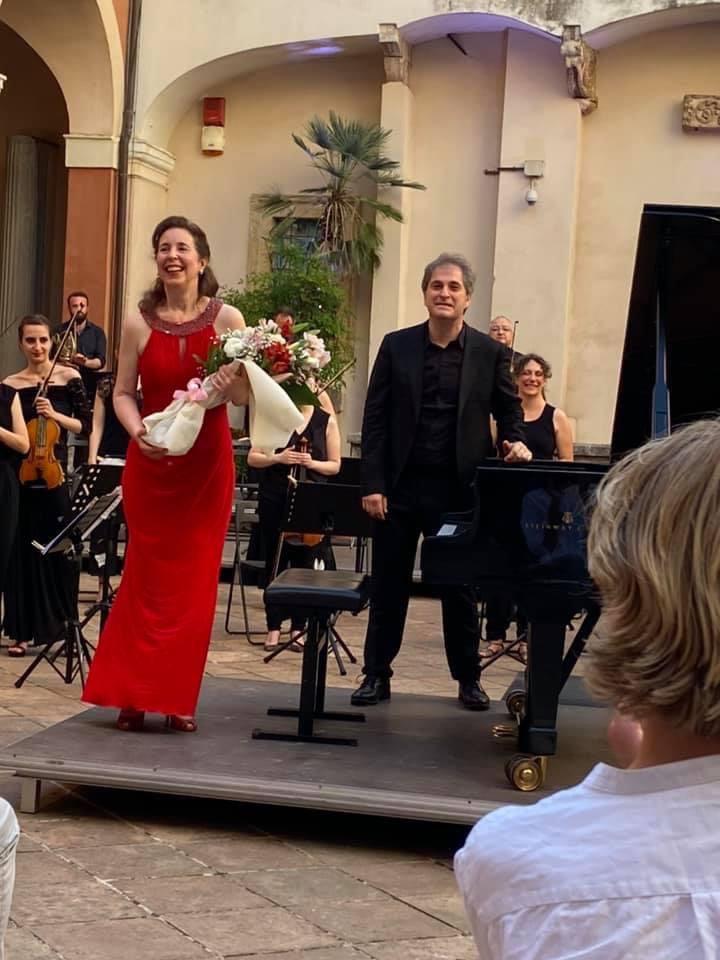
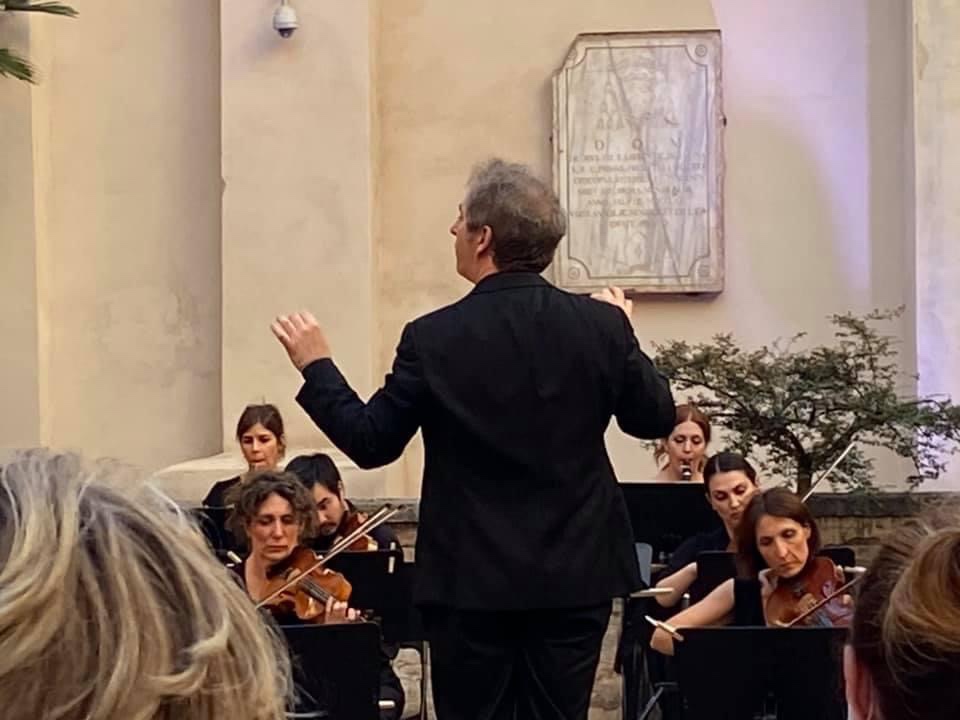
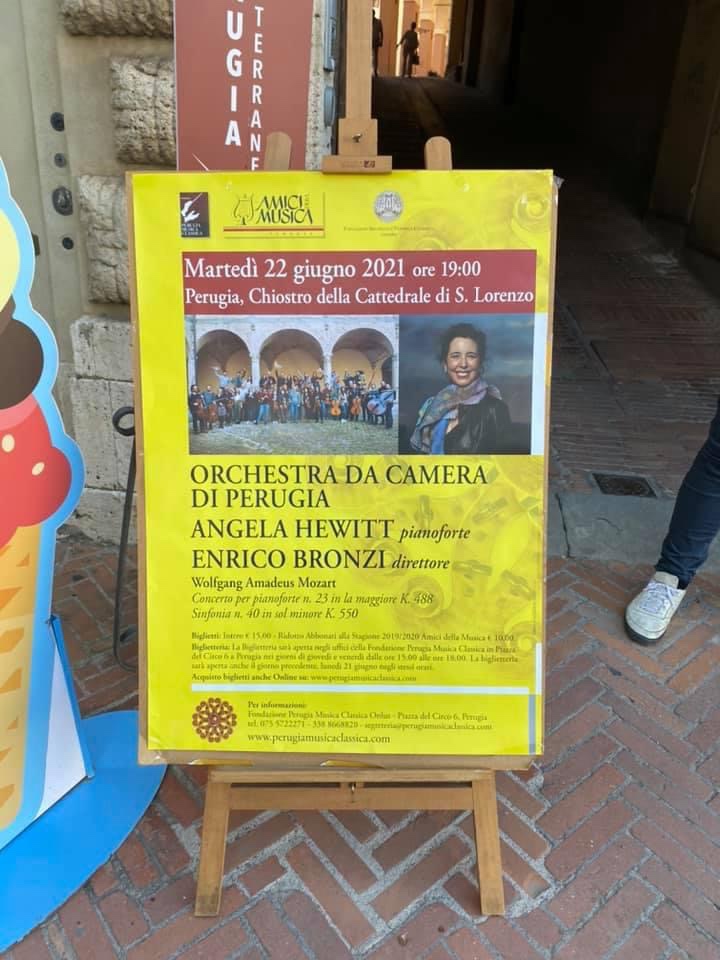
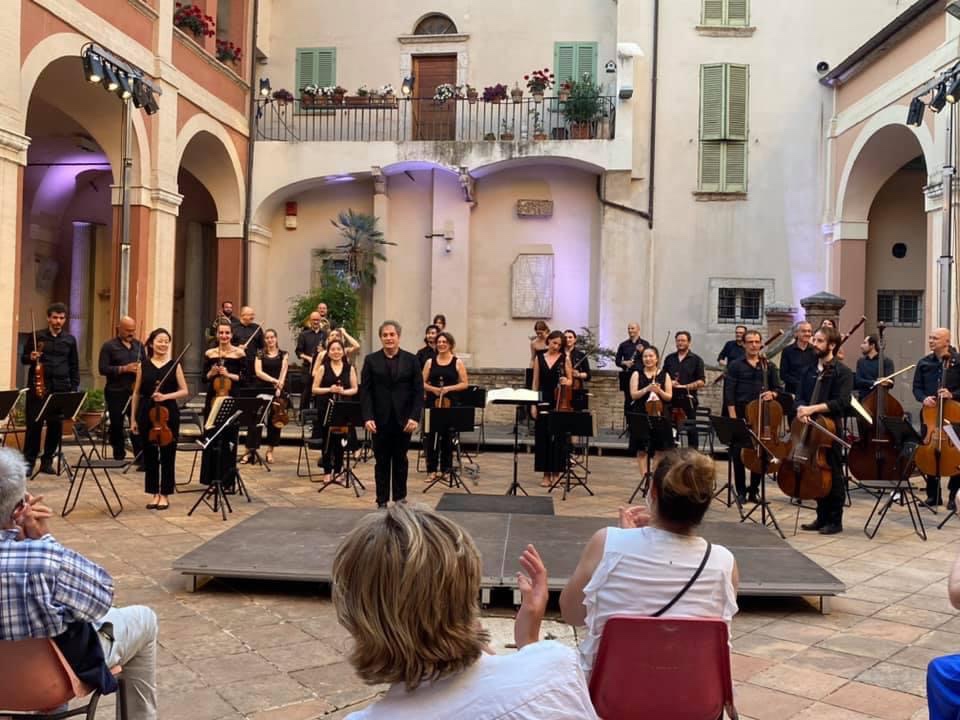
The miracle of Mozart in Perugia today with Angela Hewitt ,Enrico Bronzi and The Chamber Orchestra of Perugia. Mozart’s most perfect concerto K488 played with such sparkling ‘joie de vivre’as Angela wove Mozart’s magic web in and out of an orchestra that under Enrico Bronzi’s hands was truly listening to each other and above all to Angela.
There was magic in the air as the sublime Adagio was played with such poignant meaning from the very first notes. This is the only movement by Mozart in F♯ minor and the middle of the movement contains a brighter section in A major announced by flute and clarinet that Mozart would later use to introduce the trio “Ah! taci ingiusto core!” in his opera Don Giovanni .The clarity and Angela’s ability to live through every note meant that Mozart’s simple outline needed no embellishing as the utmost simplicity touched the sublime.An almost ecstatic outpouring of melody was the natural outlet for such emotion and gave such architectural shape to the entire movement .The quiet opening of the rondo and its every reappearance just added to the build up of exhilaration that was quite overwhelming .
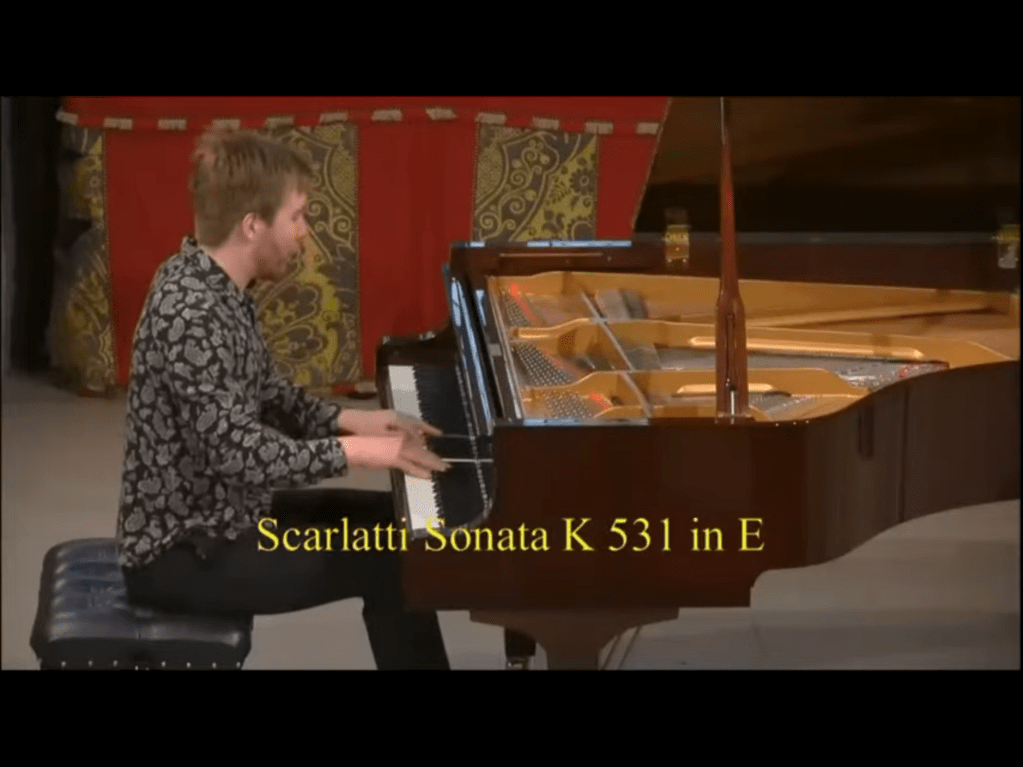
Scarlatti’s famous E major sonata as an encore was a way of thanking the audience from what has been her home for many years. It was played with a freshness and subtle colouring that had the orchestra as enchanted as the public.
Angela tells me that she has been able to organise her 16th annual festival of Lake Trasimeno at this late hour .Last year it was cancelled as were so many things due to the pandemic.This year with her indomitable spirit she has organise her festival as she herself said :’You must do what you love best.’It is just this love and spirit that have carried her great artistry around the world many times.It would appear that the world is beginning to start turning again.It was interesting that she will include the Dvorak Quintet in one of the concerts in programme.Enrico Bronzi will play the cello with other distinguished colleagues.Angela exclaimed that she had not played it since her student days but she got great consolation knowing that Menahem Pressler had played it at his 90th birthday concert!
Pressler in heated discussion at the rehearsal of K 488
It reminded me that the last time I heard this Mozart concerto was with Pressler in Oxford.I remember trying to calm him down at the rehearsal as the ‘ad hoc’orchestra of brilliant musicians ,down from London for the day,had been engaged principally to play the Mozart Requiem and were just anxious to play through the concerto and get to the pub before the main rehearsal!Pressler already in his 90’s could not understand how they could be so nonchalant about the rehearsal as he sweated tears over every single note.I tried to calm him down pointing out that he was in the historic Sheldonian and I was sure the musicians would pull out all the stops at the concert.And they certainly did under Marius Papadopoulos,the innovatore and driving force behind the Oxford Philomusica.In the audience were many distinguished musicians taking part in his important summer festival.
The late Dame Fanny with Menahem Pressler
Dame Fanny Waterman was in the front row ,nodding her head as she listened to every single note with rapt attention.She too had played this concerto at her Prom debut in the 40’s.Great discussions with Pressler afterwards about his magnificent performance.In fact as I told Pressler both he and Dame Fanny were two of the very few musicians who actually listen with rapt attention to every single note.
Great friends and admirers
He told me that Dame Fanny always wanted him to sit next to her on the jury of her competition in Leeds.Unfortunately in the after lunch session during some dreary performances many of the jury might take 40 winks but not Dame Fanny and those near to her ( Pressler!)as she was always wide awake to every single sound that was played !
Angela Hewitt ‘joie de vivre’ in all she does
Here it is! The programme of the 16th edition of the Trasimeno Music Festival, to be held in Umbria from July 23-26, 2021. This year it will be only four days instead of the usual seven, and we cannot use our beloved Castle of the Knights of Malta in Magione, but we have five stunning venues in Perugia, Spoleto, and Trevi, and wonderful musicians joining me in concert. The Italian mezzo-soprano Anna Bonitatibus will sing Rossini in the Teatro Caio Melisso in Spoleto (which Rossini visited); a wonderful group of chamber musicians from Italy and Switzerland (including cellist Enrico Bronzi) will perform Dvorak, Borodin and Clara Schumann in the Basilica of San Pietro in Perugia; I will perform solo Bach in the stunning Baroque surroundings of the Oratorio di San Francesco dei Nobili in Perugia; and the one and only Rudolf Lutz of St Gallen, Switzerland (organist, improvisor, composer, conductor) is FINALLY coming to Trasimeno….which I’m really thrilled about. He will perform both in the Cathedral in Perugia (original Bach and Mozart and improvisations on Schubert and Dvorak) and with me in the church of San Francesco in Trevi–a concert in which we will play off each other and discuss how Bach used to the full the expression of each key. Of course space is very restricted due to social distancing, but the atmosphere will be very intimate. If you become a Friend of the festival you can book right away. As of tomorrow we are selling subscriptions and packages (which include tickets to all the concerts) to the general public. Tickets to individual concerts will go on sale at a later date. I hope to see some of you there! https://trasimenomusicfestival.com/festival/programme/tmf-2021/
Returning to listen to Enrico Bronzi’s G minor symphony we were rewarded a performance of relentless energy that was quite remarkable. The very opening was like a great gust of wind but also with such refined shaping ,the Andante with searingly beautiful counterpoints .The minuet was played with such militant authority that the final movement came as a great relief,returning to the great waves of sound similar to that of the opening of the symphony.Schumann described it as “Grecian lightness and grace” but Charles Rosen saw in it “a work of passion, violence, and grief.”In Enrico’s hands it was all those things and held the audience spellbound from the first to the last note,swept along on a relentless wave of rhythm and passionate involvement .
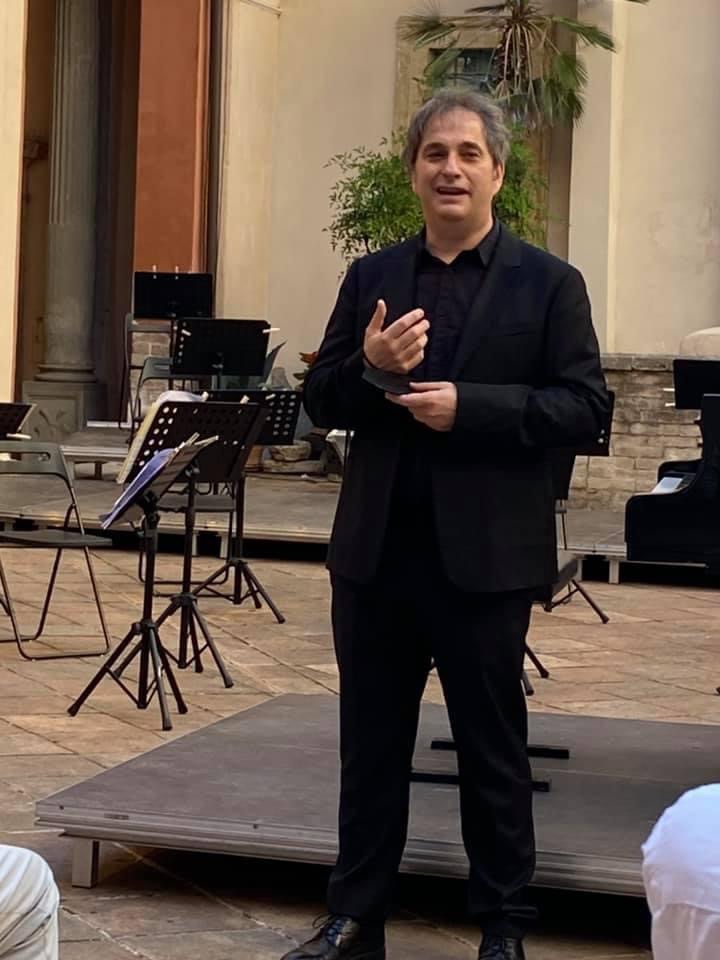
Enrico Bronzi introducing the concert.
Enrico as I have said before is a great trainer of orchestras as his technical skill as a cellist and great musicianship allows him to push his players into playing better than they ever thought they could.An orchestra that listens to themselves is an orchestra to be reckoned with indeed.






































 ChristopherAxworthy-MusicCommentary