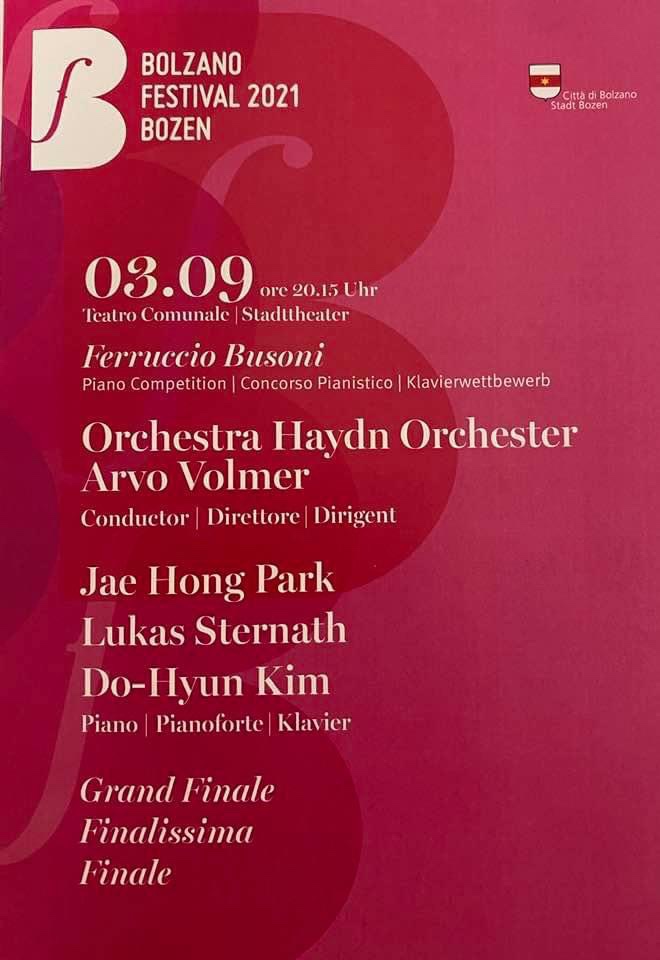
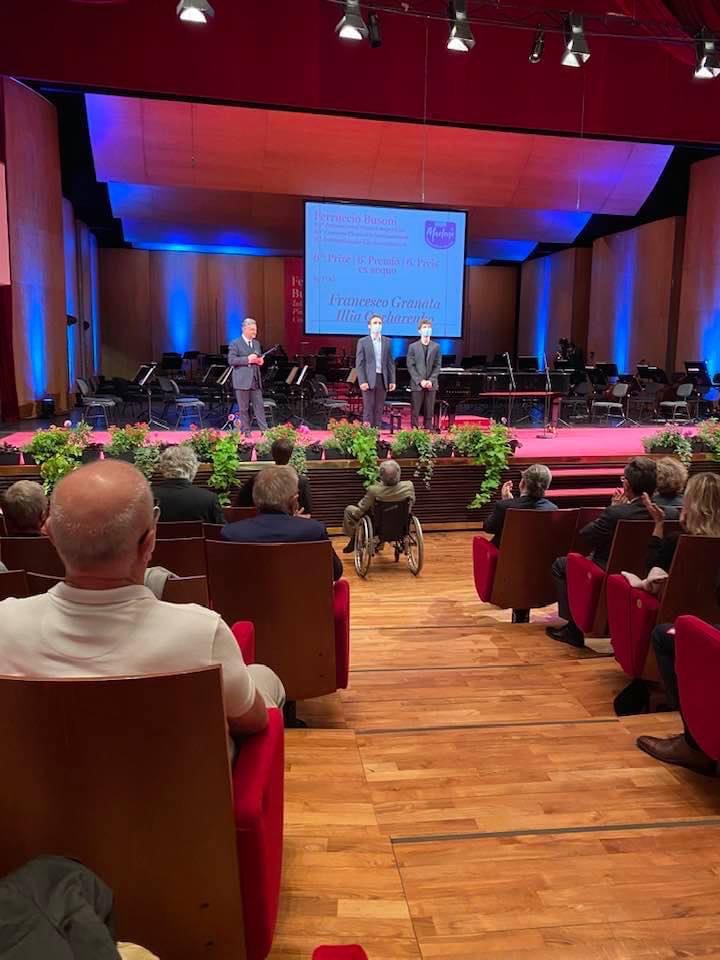
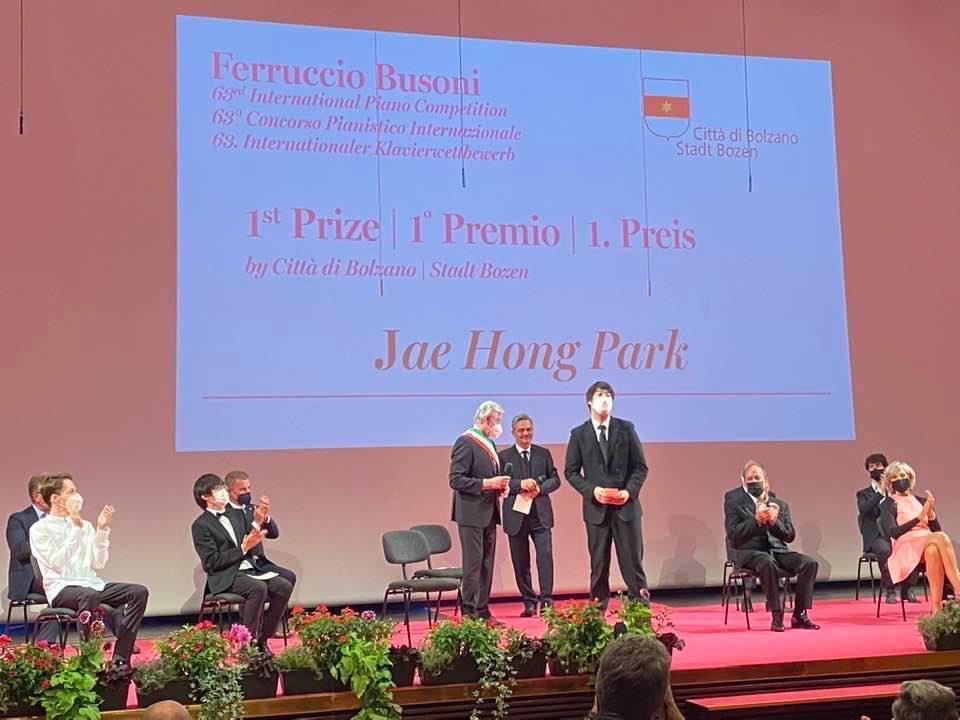
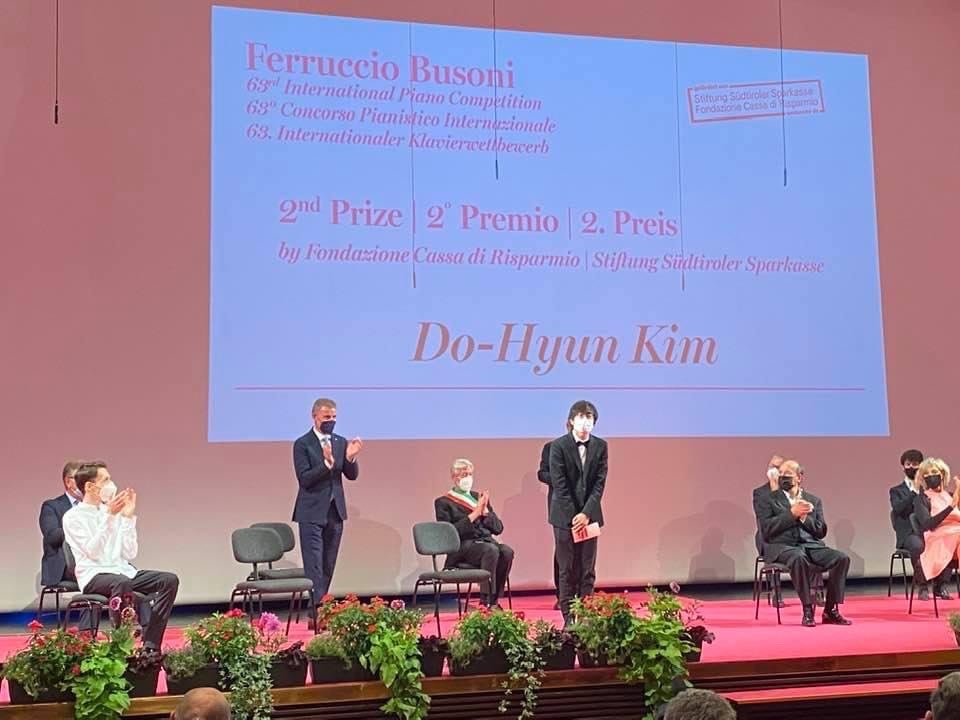
Grand Final of the Busoni International Piano Competition 1st prize Jae Hong Park 2nd Do-Hyun Kim 3rd Lukas Sternath
Should music be put on the Olympic stage and have musicians competing against each other for a medal? For what ? For playing faster,slower,louder or quieter something that can be anyway very subjective. In every competition there is always a winner and that is the Circus element that can creep in.
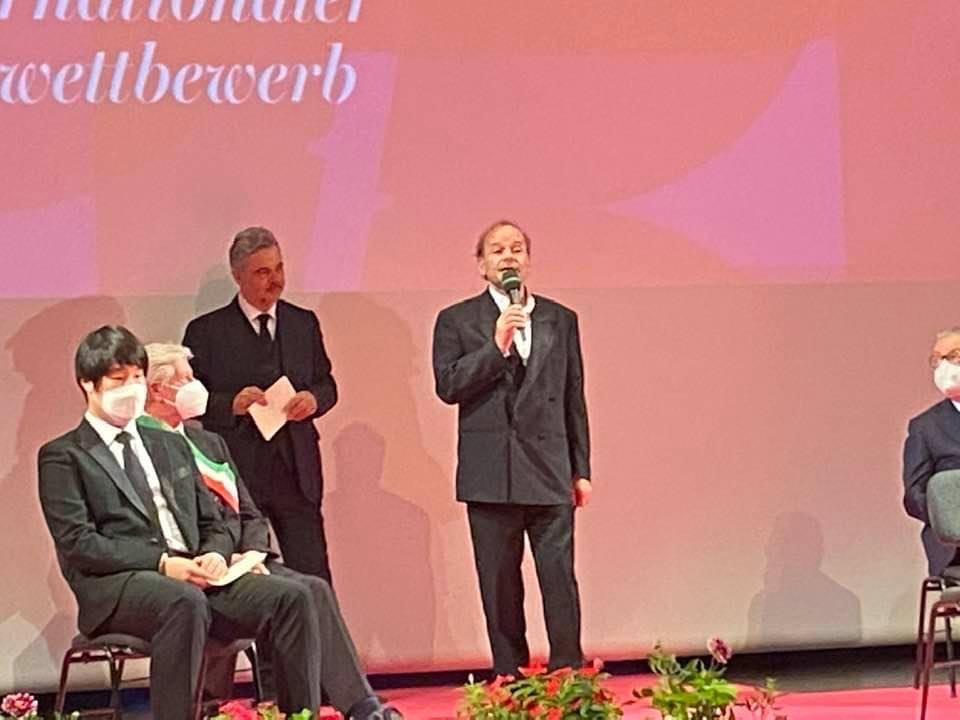
Louis Lortie,President of the jury
But as both Louis Lortie,president of the jury and Peter Paul Kainrath,Artistic director pointed out,a competition must be a global platform for the great young talent that come with programmes that demonstrate their interpretative skills. It is exactly for this reason that Louis Lortie praised the Italian public television for their live relay of the final of the competition. Of course the media usually look at the number of spectators that can be captivated as this in turn is what interests the sponsors who contribute to the all important financial aspect. Quantity rather than quality is often the guiding light. So it is very refreshing when enlightenment raises its head and a cultural event can be given the same attention as a football match!
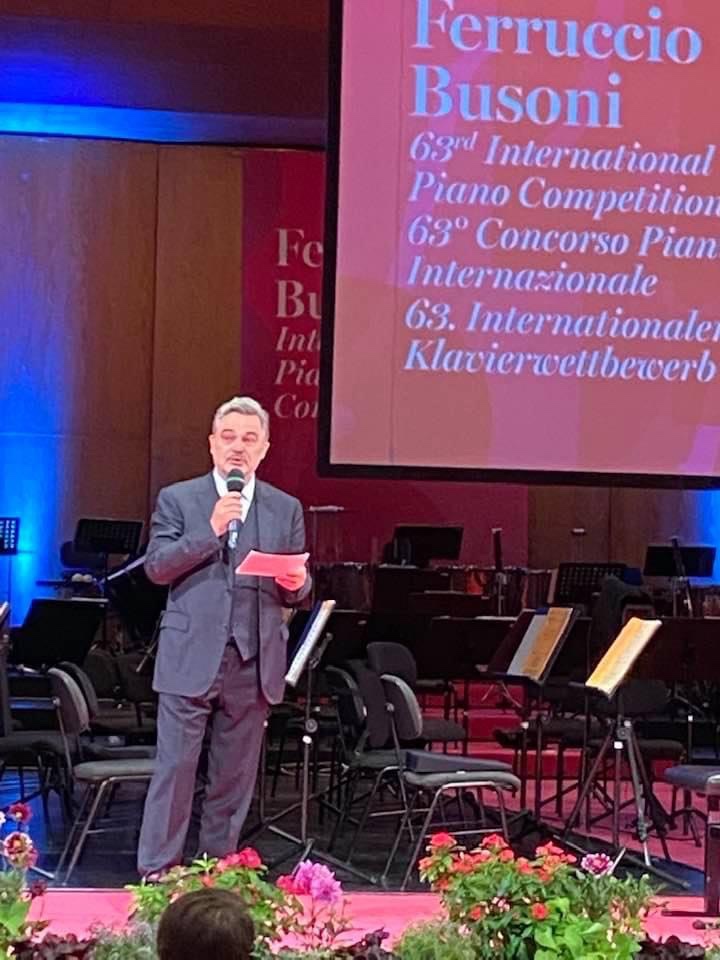
Peter Paul Kainrath,Artistic director
Dott. Kainrath has for some years been convinced of the world platform that a competition should offer to young musicians.It is,in fact,via the superb streaming of the Busoni that every note from the first to the last day can be listened to worldwide.
I had written earlier in the week listening from the comfort of my own home : ‘To put pianists trained in the east from birth with ours in the west who are trained too late means that they play better because they are better pianists not better musicians.Look at many great pianists on the world stage like Paul Lewis,Angela Hewitt or Imogen Cooper with their definitive performances but can you compare their sound to a Richter or a Gilels? I think each performance should be judged for what it is in that moment and not placed side by side with others. This of course is the bad thing of competitions…..how fast is your Feux Follets and all that nonsense’
I had also written after the selection of the final 7 to a very fine young pianist who at this point had be excluded : ‘…your performances were superb and will be remembered by many.I did not hear many of the other contestants,a refined Liszt Sonata,a monumental Hammerklavier or astonishing Petroushka but find it hard to imagine more beautiful performances than yours.’
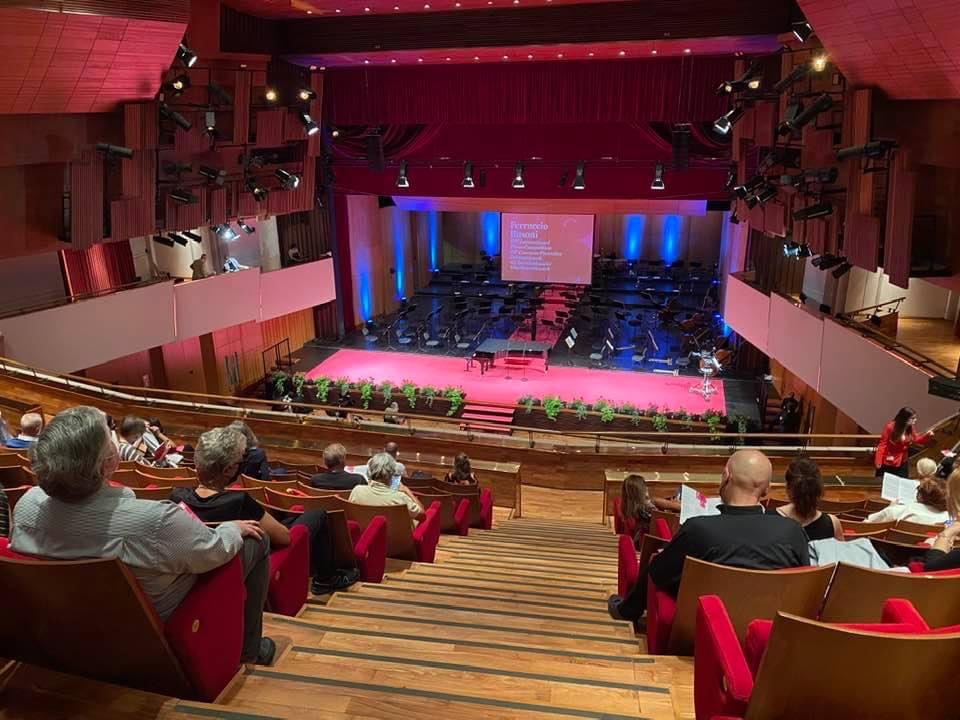
Teatro Comunale Bolzano
And so the Busoni competition via its inspired use of streaming and information on social media is helping to launch so many young musicians. During the lockdown, streaming was the only way forward when live performances were not possible when suddenly the presence of public augmented as a great void had been opened. I know of one small but distinguished music society which usually have a public of at most a few hundred but can now boast via streaming of thousands worldwide. This was one of the very few good things to come out of the pandemic. But now the worst seems to be over and public is being allowed back to live performances ,streaming should not be considered an optional but a necessity. Live performances with public but also streamed seems a logical conclusion. Of course nothing can take the place of a live performance and the atmosphere created in the concert hall can be vibrant and stimulating for both performer and public. And so it was that I left home at four in the morning to be able to be present at the final concerto round of the Busoni Competition. Having listened to many of the contestants from the comfort of my home I wanted to be part of the atmosphere that had been created by these young artists over the past couple of weeks. The excitement of a competition can also stimulate young musicians into giving performances that inspire them to even greater heights. And so it was to the final chosen three to do the honours for the 31 young musicians who had given some memorable performances during their stay in Bolzano.
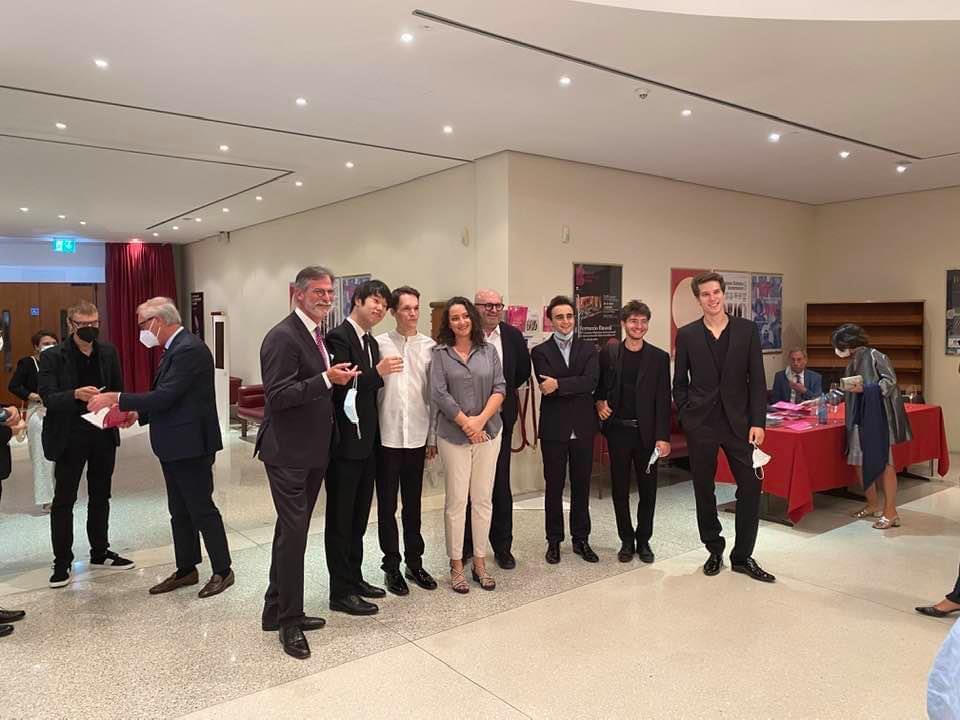
Some of the contestants present
Of course it is not easy for these young artists when they come to the competition not knowing how much of their prepared repertoire they will actually be called on to perform. Pacing themselves becomes another hurdle they have to face as they advance through the rounds. So hats off to the valiant final three that were called on at a days notice to perform their chosen concerti. And what concerti they were: Rachmaninov 3,Prokofiev 2 and Beethoven Emperor.With the superb Haydn Orchester under Arvo Volmer they gave very professional performances but on this occasion did not create that electric atmosphere that we were all hoping for.
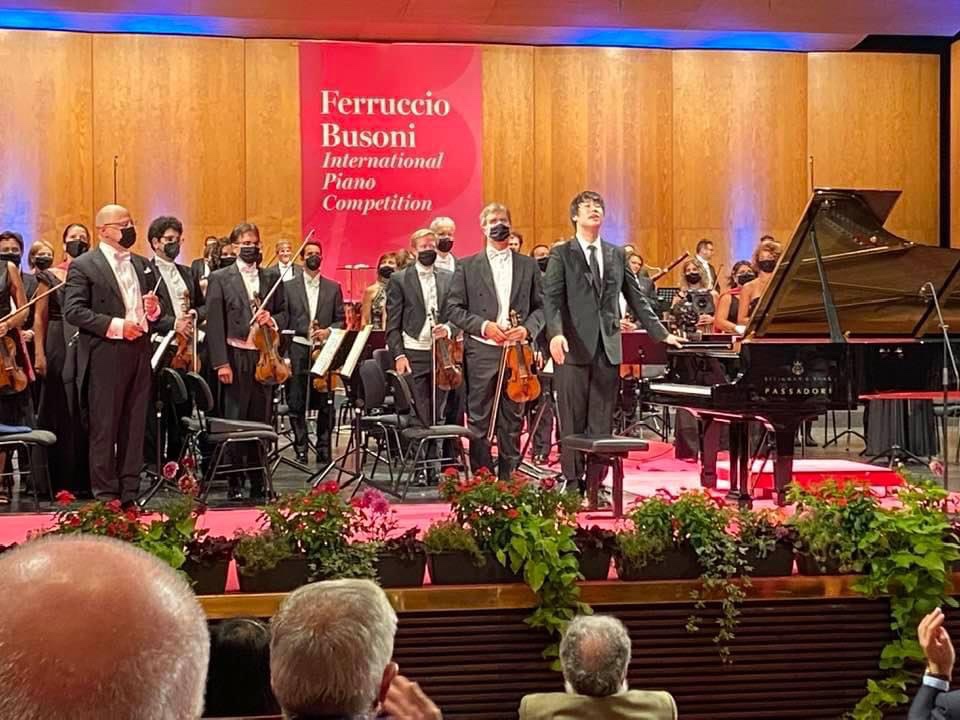
Jae Hong Park First prize winner and the Keyboard Trust Career Development Prize with a concert at Steinway Hall London on the 12th October 2022
Jae Hong Park,who was awarded first prize, is from the school of Daejin Kim in South Korea.He had given a monumental performance of Beethoven’s Hammerklavier and had been given the Schumann Quartet’s own prize for his Brahms Quintet.He will perform his ‘ Hammerklavier’ in London at Steinway Hall on the 12th October 2022 as winner of the Keyboard Trust Career Development Prize.So it was no surprise that the Rachmaninov concerto was missing some of the colour and excitement that will come in later more considered performances.
Do-Hyun Kim
Do-Hyun Kim,his fellow countryman,was awarded second prize for his performance of Prokofiev’s second piano concerto.He threw himself into the enormous difficulties with animal like participation that was greatly appreciated by an audience who gave him an ovation. He is a young virtuoso who seems to know no difficulties as we had seen from his performances of Schumann Toccata,Stravinsky Petrouchka and Chopin studies op 25. Rachmaninov 3rd and Prokofiev 2 were both works that were considered insuperable hurdles when I was a student.That is until Vladimir Ashkenazy appeared on the scene and made his London debut playing both on the same night! It has now become part of the standard repertoire of young pianists.
Lukas Sternath
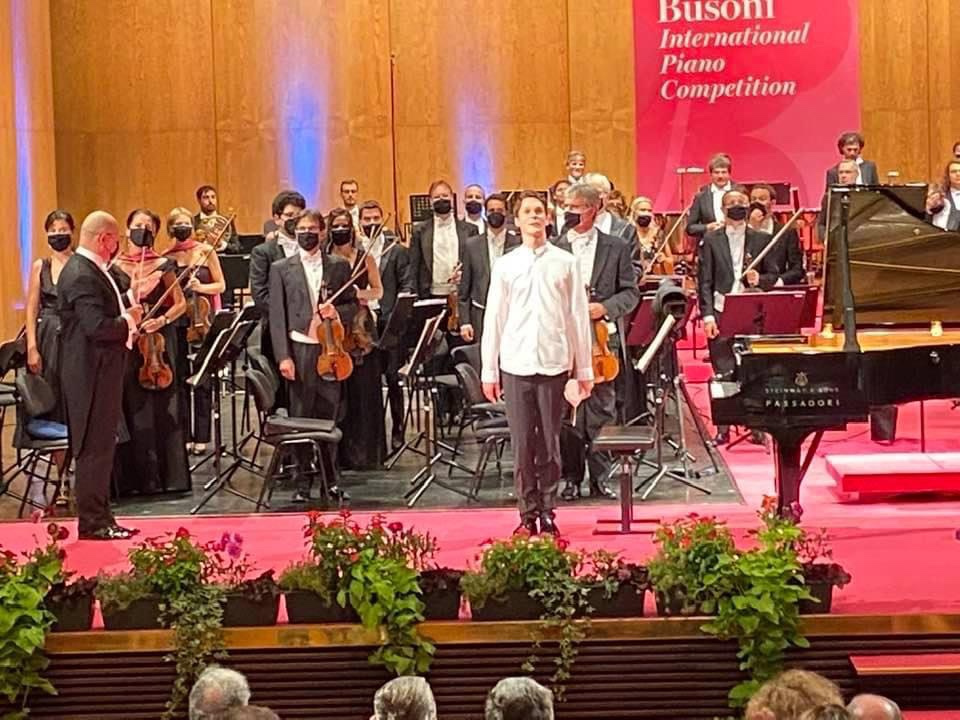
The young Austrian Lukas Sternath was given third prize for his musicianly performance of Beethoven’s Emperor Concerto. A youthful performance that will grow in weight as this twenty year old musician grows in stature. It must be said that the orchestra was an exhilarating partner playing with real weight and fervour under the superb baton of Arvo Volmer.
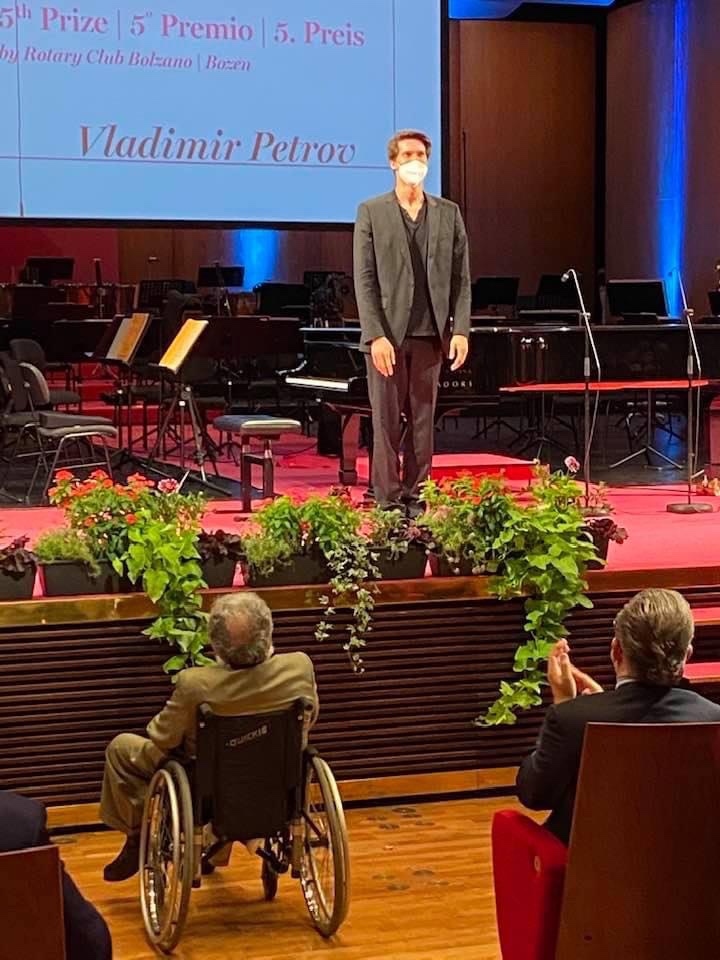
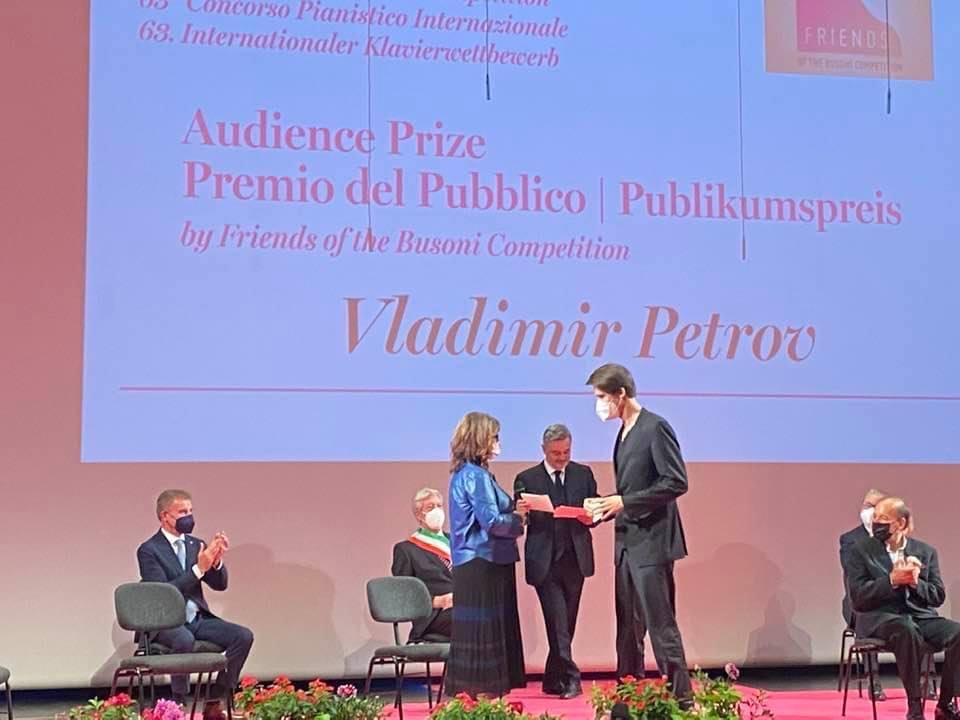
Vladimir Petrov was voted the favourite of the audience on line and he was awarded fifth prize by the jury too.
Serena Valluzzi was awarded fourth prize having given some fine musicianly performances of Ravel’s Gaspard de la nuit and Rachmaninov second sonata.
Iliia Ovcharenko was awarded 6th prize,together with Francesco Granata, with Illia’s refined performances of Les Adieux and Liszt Sonata and Francesco’s irresistible jazz studies by Kapustin
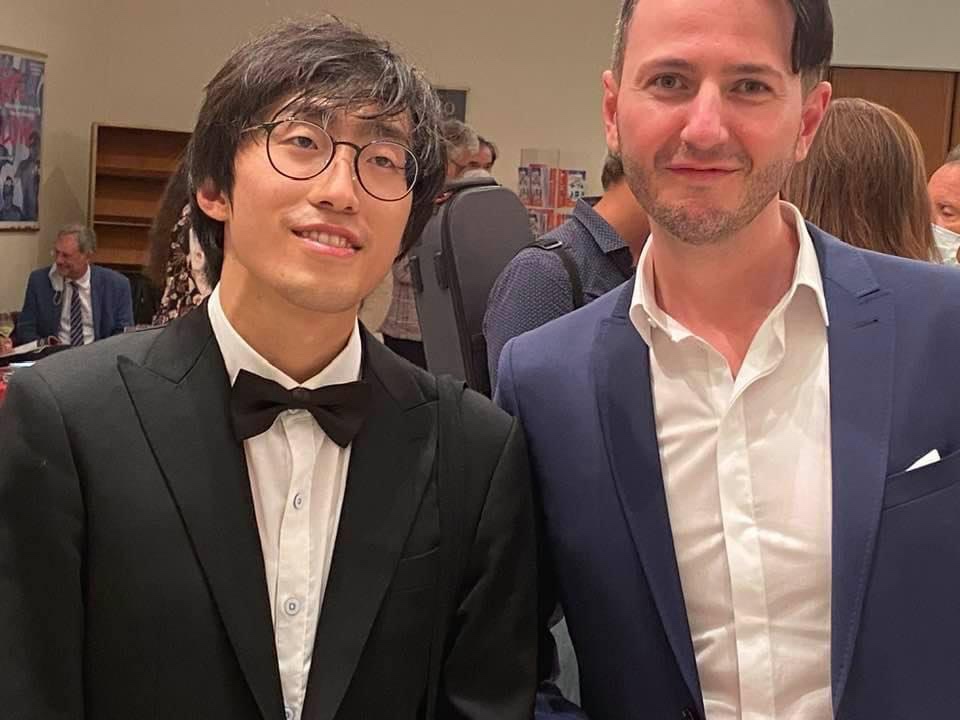
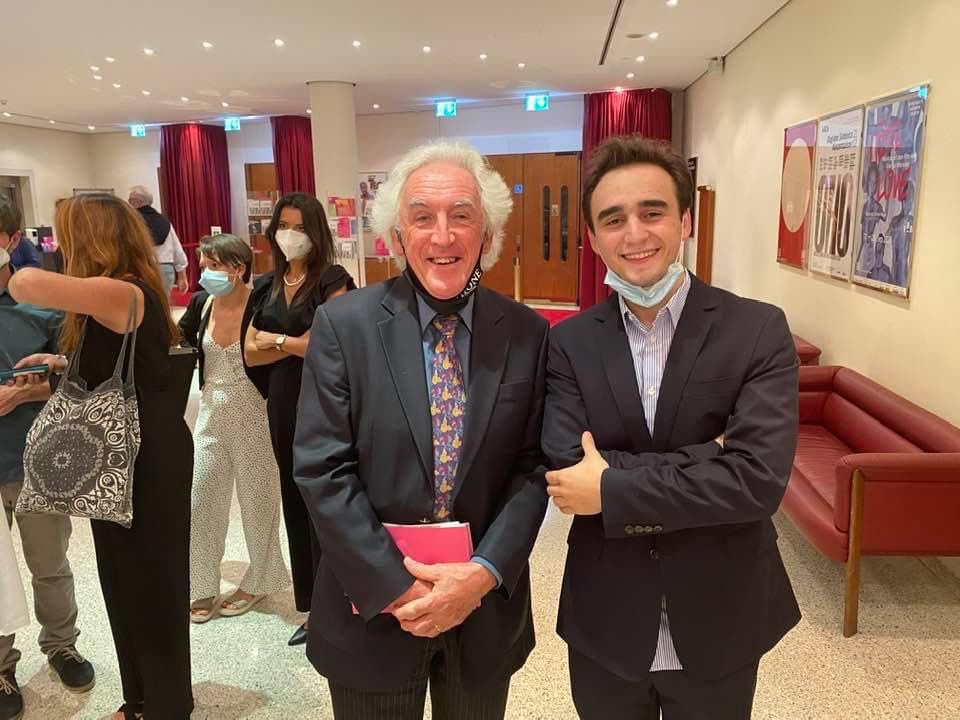
Michael Lifits 2008 winner with Do-Hyun KimMe with Illia Ovcharenko mentored by our mutual friend Janina FialkowskaThe distinguished jury of the final
A recent article of 2014 winner Chloe Jiyeong Mun including articles about past competitions
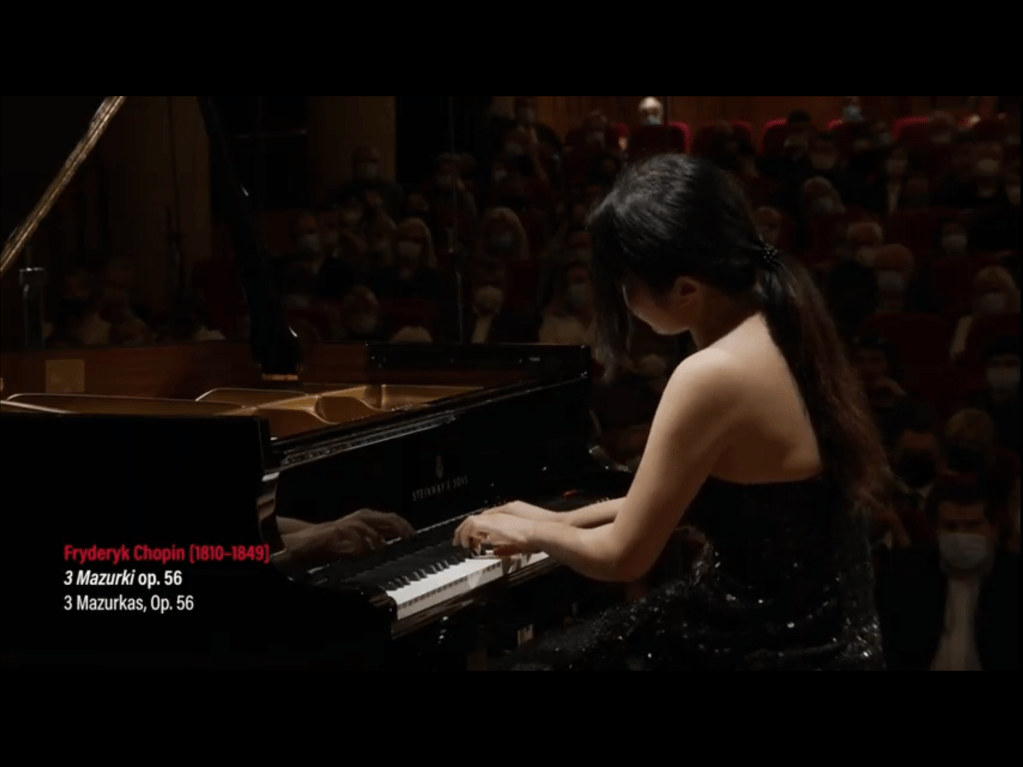
Chloe Jiyeong Mun in Warsaw with playing of such subtle artistry,ravishing colours and passion.
From three Mazurkas op 56 played with an improvisatory freedom of such colour and fantasy with a pervading feeling of nostagia and yearning.There was frenzy too in the folk dance of the second but such a wondrous sense of the subdued passion of a great statement in the last.
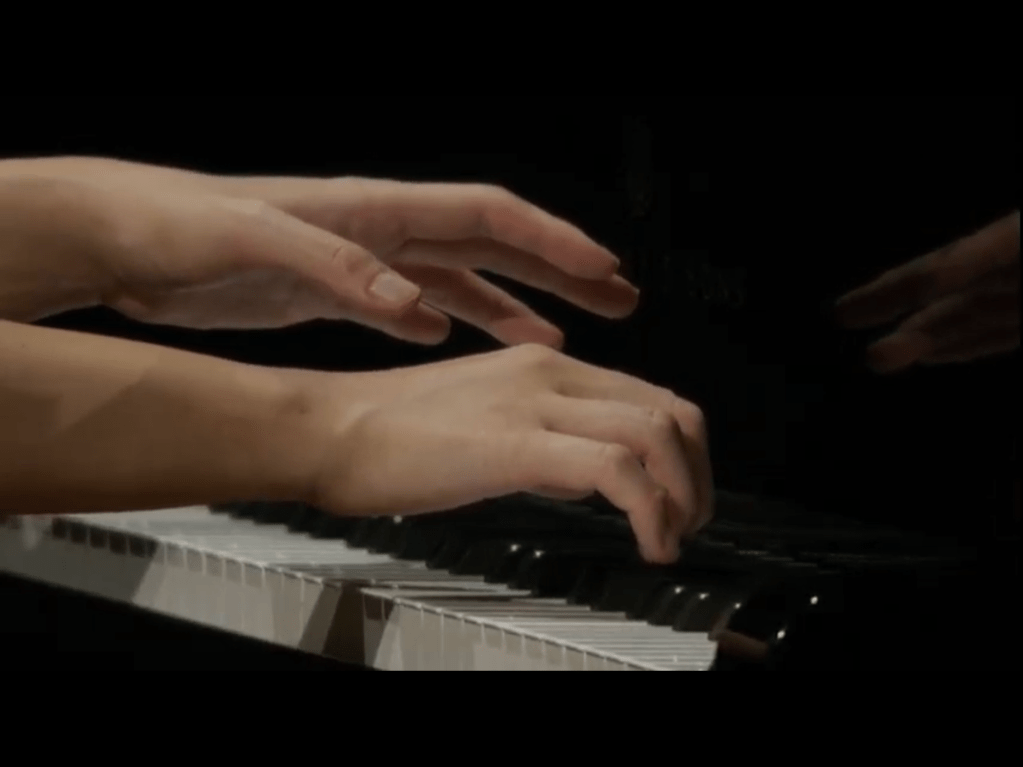
The sheer beauty of her hands was of Michelangelo proportions
This was just a preparation for the 24 Preludes op 28. A series of jewels that were allowed to sparkle and shine with such subtle poetry.An aristocratic sense of line that allowed her to shape what Fou Ts’ong described as 24 problems into an architectural whole that was quite enthralling.
The opening improvisatory statement was followed by a barely whispered second prelude.The third of a melodic line over a gentle breeze to be followed by the almost heartbreaking simplicity of the fourth.The gentle unravelling of the 5th led so naturally into the yearning beauty of the 6th with it’s sublime final breathtaking comment.The little waltz that follows just bridged the gap to the passionate outpouring of the 8th spilling over to the ecstasy of the 9th.
Such beauty and subtle colouring of the 11th before unleashing the controlled passion of the 12th.Sublime beauty and aristocratic shaping of the 13th led to the breeze that takes us to the simplicity and subtle beauty of the so called ‘raindrop’ prelude .Sokolov turns this into a great drama but Chloe’s vision is of a more pastoral and intimate scene.The B flat minor was thrown off with such passionate assurance and led to deep bass notes of rare eloquence of the seventeenth.Passion was unleashed with the octaves of the 22nd before the gentle mellifluous stream of sounds of the twenty third that just unleashed all the turbulent passion of the twenty fourth and the final three great gongs each played with growing intensity.
The two books of Images by Debussy were played with a luminosity of sound,crystal clear purity,subtle colouring and startling changes of mood.Have Gold-fish ever been treated to such a luxuriant bath with water reflecting radiance and bells appearing as if by magic as the moon glowed over the temple?Sounds and movements of jewel like precision and beauty and the Hommage à Rameau had the same aristocratic perfection and simplicity that was so unforgettable in Artur Rubinstein’s performances.
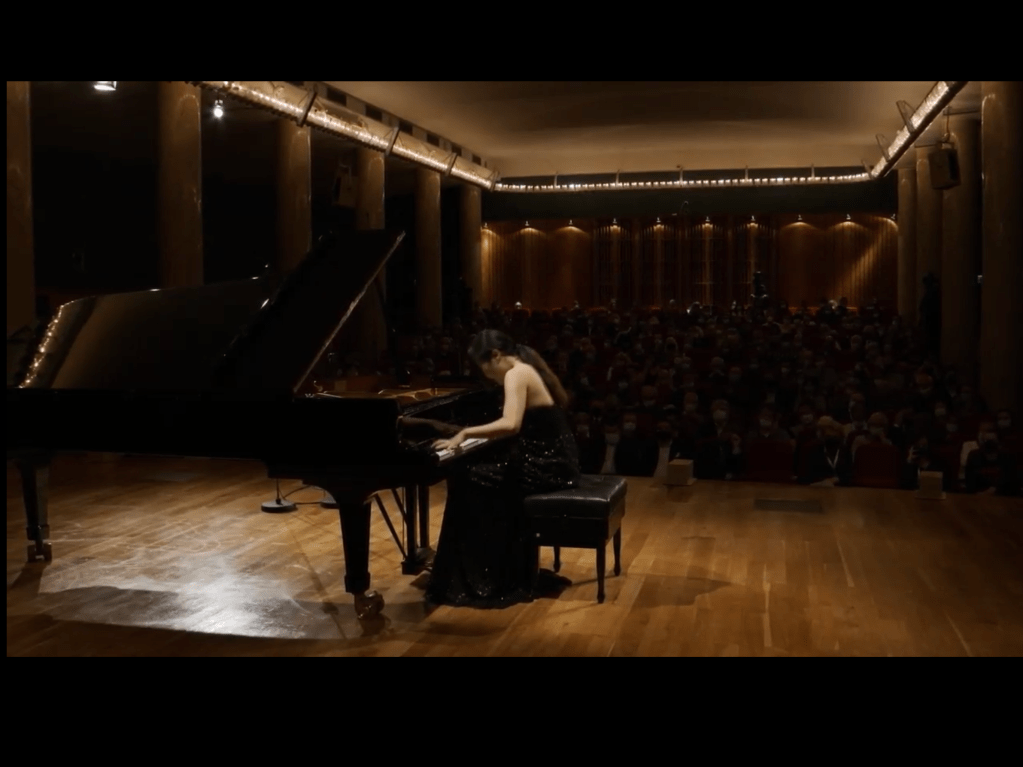
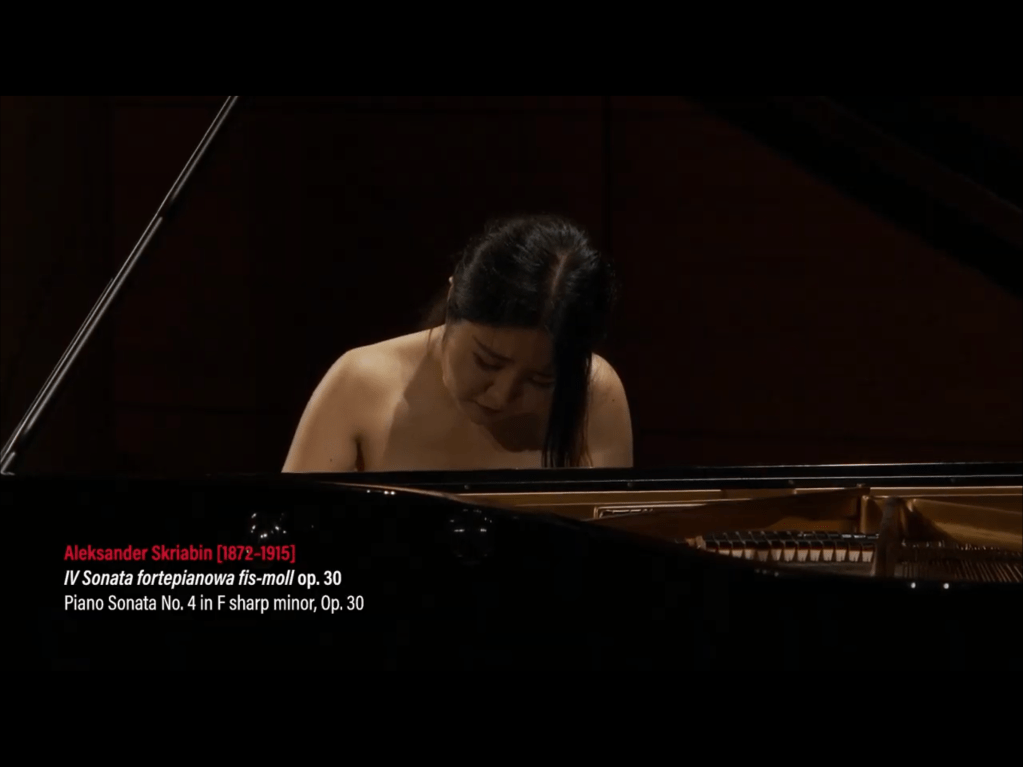
The same passion and colour that she brought too,to Scriabin’s fourth Sonata were reminiscent of Emil Gilels with its undercurrent of energy about to explode.It was Rubinstein who was beseeched to listen to a teachers star pupil.On hearing the young red headed boy he announced that if he ever came to the west he would pack his bags and disappear.There was room for them both and as today has proven artists of such inspiration are a rarity and a joy forever in any age Ravishing fragments,in this sublime Scriabin sonata,gradually uniting with the building up of turbulent energy played with such subtle transcendental mastery until the ‘star’ is unleashed shining with burning intensity.
Zilberstein Masterclass final concert at the Chigiana CONCERTO DEL CORSO DI PIANOFORTE LILYA ZILBERSTEIN docente Nel corso del concerto saranno attribuite le Borse di Studio “Matilde Neri Sclavo”
Lilya Silberstein with the duo Diego Benocci and Gala Chistiakova
Fryderyk Chopin Żelazowa Wola 1810 – Parigi 1849 Scherzo n. 3 in do diesis minore op. 39 (1839) Francesco Maria Navelli (Italia) Fryderyk Chopin.Some fine very solid playing maybe misjudging the very resonant acoustic of this beautiful hall in the Chigiana Academy.He gave however an architectural shape that kept the rhythmic energy from the first to the last note.Very assured playing missing the finer filigree of the cascades of shimmering sounds that accompany the great choral that appears so magically out of the exuberance of the outward octave declarations .
Barcarole 9op. 60 (1846) Giulia Toniolo (Italia).Some beautiful playing of great musicality as one would expect from the school of Maddalena De Facci ( teacher of Elia Cecino) .There was a spaciousness to her performance that allowed the music to breathe so naturally as this song born on gentle rippling waves was allowed to unfold with great beauty.A pianist who listens to herself and plays with such loving care as she coaxes such ravishing sounds in what is surely Chopin’s most perfect work.The sumptuous climax was born on the most exquisite bel canto melody that Perlemuter described as being in heaven.The final washes of sound that Ravel admired so much were played with real musicianship and the final four chords played as the very opening note had been – sounds resonating without a trace of any percussiveness.
Giulia Toniolo from the school of Maddalena De Facci about to study at the RCM in London
Franz Liszt Raiding 1811 – Bayreuth 1886 da Années de pèlerinage. Deuxième Année. Italie, S 161 V. Sonetto 104 del Petrarca (1858) Agitato assai – Adagio Gabriel Giannotti (Italia)A very assured performance but one that made me wonder if he had ever heard the song.The opening was rather slow and do not think a singer would have thanked him for such a tepid introduction.But as soon as he reached the melodic line he played with a great sense of balance and colour with the great embellishments thrown of with the ease of a true musician.
VI. Sonetto 123 del Petrarca (1846-1849) Lento placido – Sempre lento – Più lento Louyiheng Yang (Cina)From the very first note there was a fluidity and sense of line with a natural sense of colour and flexibility.There was a clarity as the melodic line was allowed to shine with jewel like precision as she built up to the inevitable romantic climax
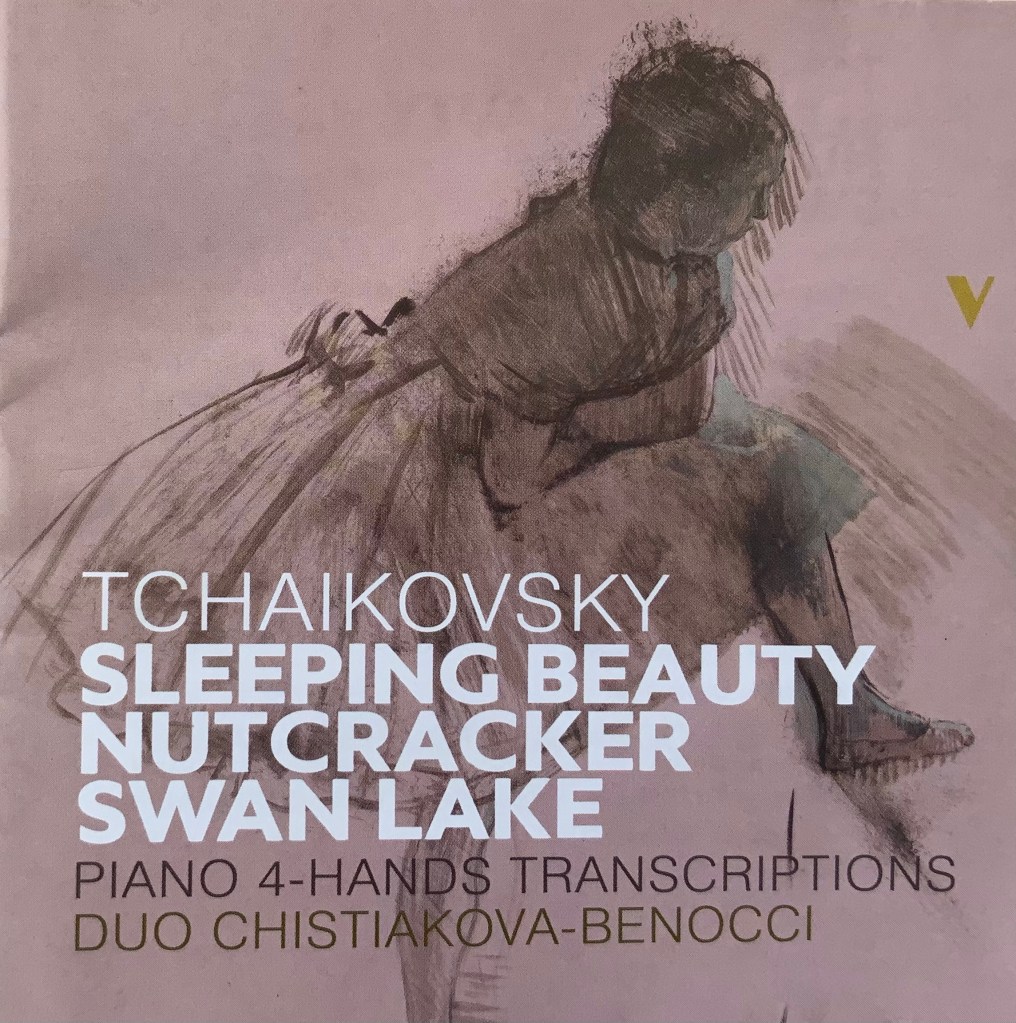
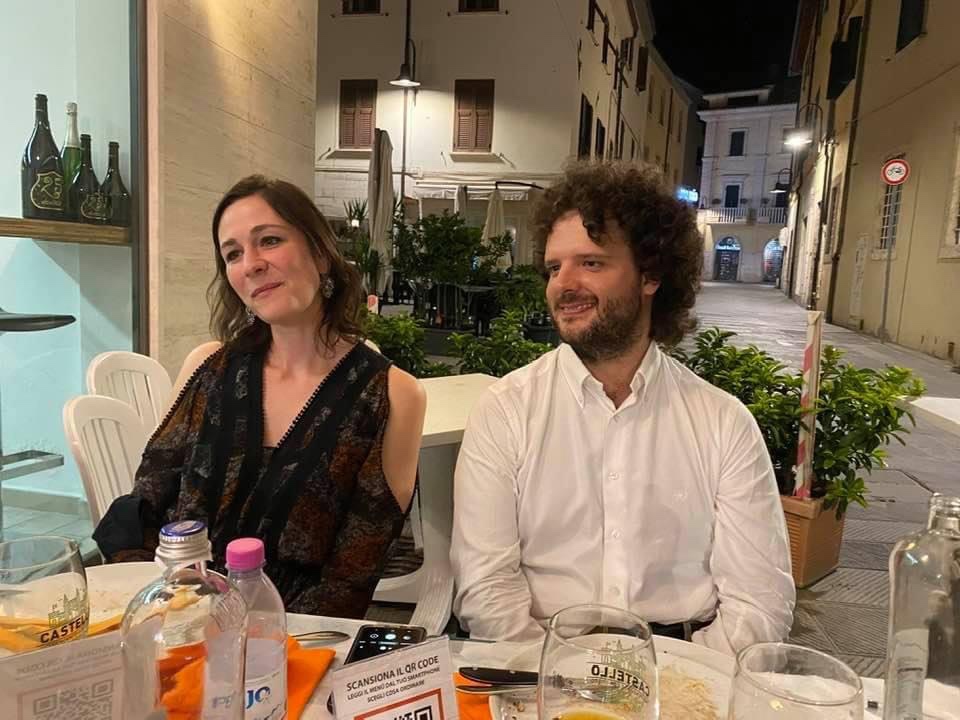
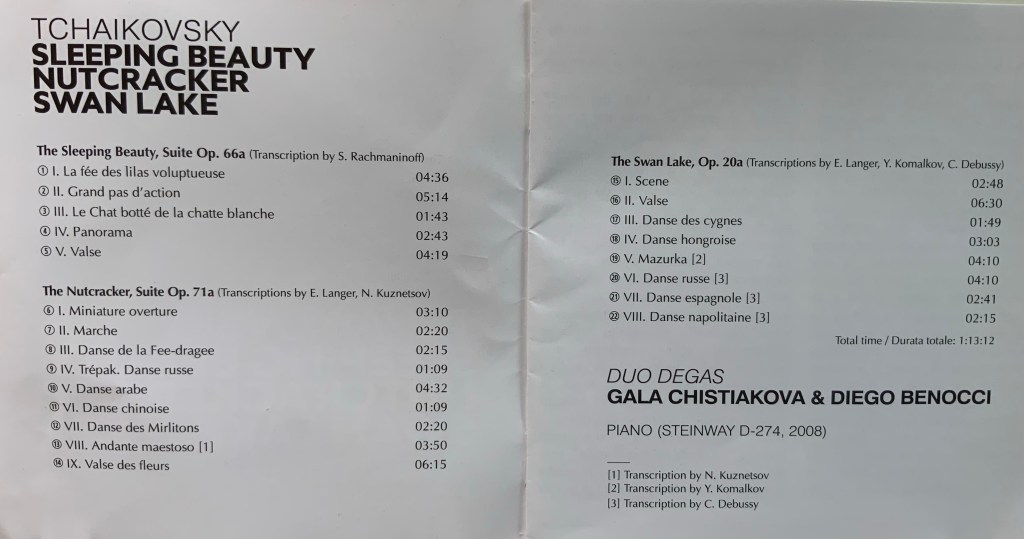
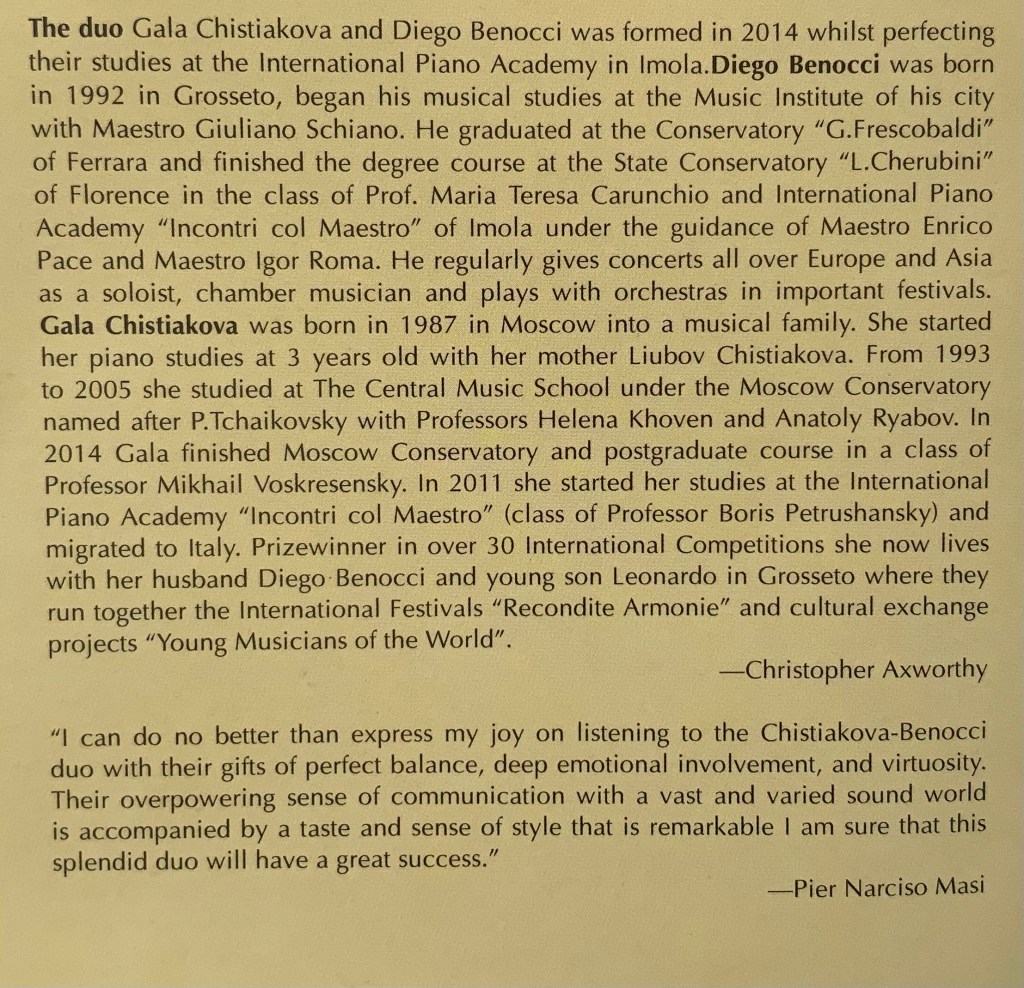
Johannes Brahms Amburgo 1833 – Vienna 1897 dalle Danze ungheresi per pianoforte a quattro mani (1852) n. 1 in sol minore – Allegro molto n. 6 in re bemolle maggiore – Vivace n. 5 in fa diesis minore – Poco sostenuto CHISTIAKOVA & BENOCCI PIANO DUO Diego Benocci (Italia) Gala Chistiakova (Russia)I have heard this duo many time before and listening to their new CD I could only comment that they play as one.Husband and wife team with their own remarkable festival in nearby Grosseto their performance of Brahms illuminated this beautiful hall with all their assurance and natural musicality.It should be mentioned that Gala like la Zilberstein was trained at the Gnessin school in Moscow for talented young children (she met her husband in the class of Petrushansky in Imola.)Together with Diego they invite hundreds of young talented children to Grosseto from Russia filling every corner of their home town with music from these remarkably talented children.
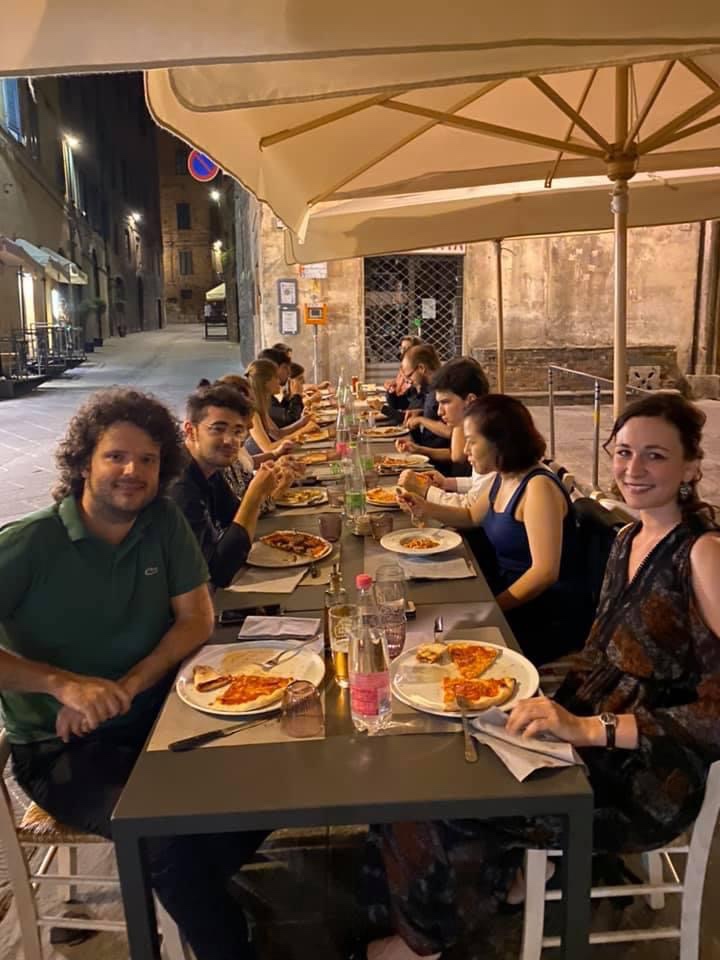
Unfortunately I was not able to hear the entire concert and missed the following students chosen to perform in this concert which started at 9.15 and was still continuing at 10.30 when I had to leave .I did however bump into them all in the streets with a celebratory pizza around mid-night.It reminded me of my old teacher Guido Agosti whose 80th birthday concert at the Chigiana finished around 1.30!
Madame Zilberstein’s post concert celebrations with her complete class
Claude Debussy Saint-Germain-en-Laye 1862 – Parigi 1918 dai Préludes
Aleksandr N. Skrjabin Mosca 1872 – 1915 Sonata n. 9 op. 68 “Messa nera” (1912-1913) Bella Schütz (Francia)
Sergej S. Prokof’ev Soncovka 1891 – Mosca 1953 dalla Sonata n. 2 in re minore op. 14 (1912) I. Allegro ma non troppo II. Scherzo. Allegro marcato Eden Lorenzen (Israele / Germania)
Paul Hindemith Hanau 1895 – Francoforte 1963 dalla Sonata n. 3 (1936) III. Mäßig schnell IV. Fuge. Lebhaft Virgilio Volante (Italia)
Sergej V. Rachmaninov Semenovo, Velikij Novgorod 1873 – Beverly Hills 1943 Sonata n. 2 in si bemolle minore op. 36 Allegro agitato – 2a versione (1931) Matteo Giuliani Diez (Spagna / Italia) Non allegro – 1a versione (1913) L’istesso tempo – Allegro molto Tommaso Boggian (Italia)
Lilya Zilberstein ha iniziato lo studio del pianoforte con Ada Traub all’età di 6 anni presso la Scuola di Musica Gnesin di Mosca, per perfezionarsi con Alexandr Satz all’Istituto Gnesin (oggi Accademia) fino al 1990. Nel 1987 ha vinto il Concorso Busoni di Bolzano e ha intrapreso una intensa attività concertistica internazionale, che la vede suonare con grandissimo successo in tutto il mondo. Dal debutto a Berlino nel 1991 sotto la direzione di C. Abbado ha suonato con i più importanti direttori e le più prestigiose orchestre, incidendo un vasto repertorio per l’etichetta discografica Deutsche Grammophon. Ha svolto tournées internazionali in duo con M. Vengerov, M. Quarta e M. Argerich, con la quale nel 2009 ha festeggiato 20 anni di attività. Nel 1998 le è stato attribuito il Premio Internazionale “Accademia Musicale Chigiana”. Dal 2009 al 2013 ha insegnato alla Hochschule für Musik und Theater di Amburgo ed ha tenuto corsi alla Royal Academy di Londra, alla Musikhochschule di Weimar e in numerose Università di Corea del Sud, Taiwan e Stati Uniti. Dal 2014 insegna alla MDW-Universität für Musik und darstellende Kunst a Vienna. È docente presso l’Accademia Chigiana dal 2011.
Guido and Lydia Agosti with Count Chigi.I had met my wife Ileana Ghione in 1978 helping Lydia with the course that she held under the title ‘Da Schoenberg ad oggi’(a title that perplexed Franco Ferrara ).Many actors would come to this remarkable lady for interpretation of song and how to use the diaphragm-something most actors no longer have!The Agosti’s had a wedding breakfast for us in Siena in 1984 after our marriage in LondonMaurizio Pollini doing what has come naturally for the past 70 years!Cortot,Casals and Cassadò with Count ChigiJohn Williams playing to Segovia Ugo Ughi with Van KempenThe little house perched on the top of the Comune in Piazza del Campo where the remarkable Hilda Colucci lived having retired as head of music for the British Council in Rome.A great friend of Signora Neri they would both be seen with Lydia Agosti gossiping while the Maestro -Guido Agosti -held his famous summer course for three months every year which he was bequeathed by Alfredo Casella .Lovely to know that there is a Scholarship bequeathed by Signira Neri The famous statue at the entrance to the ChigianaInspired artistic director Nicola Sani ( my ex neighbour in Rome) with our duoThe remarkable new CD by husband and wife duo William Nabore of the Piano Academy Lake ComoNo words needed here
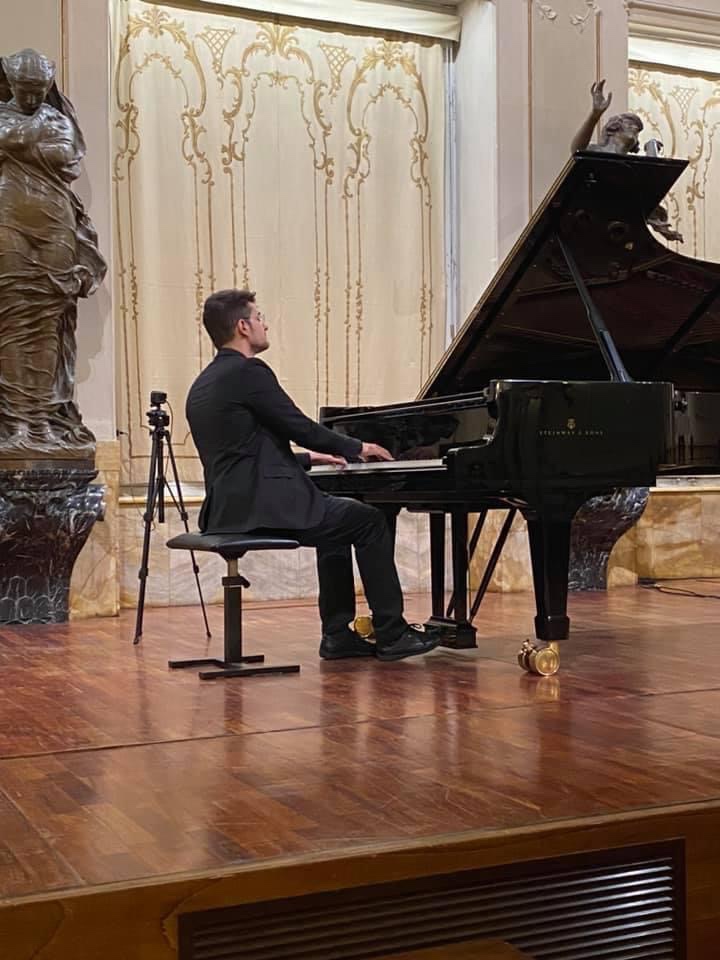
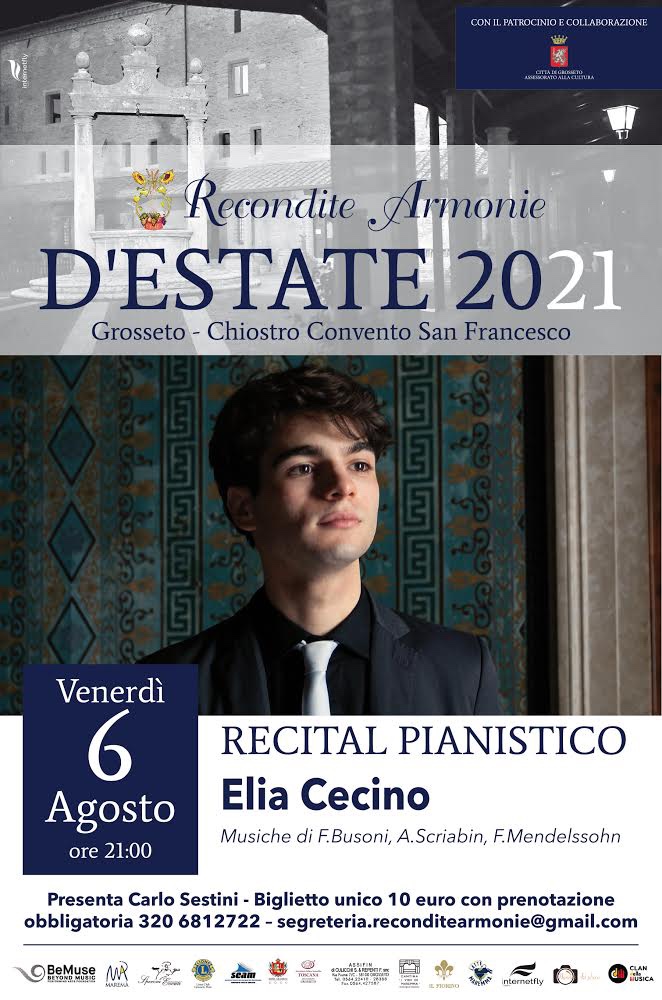
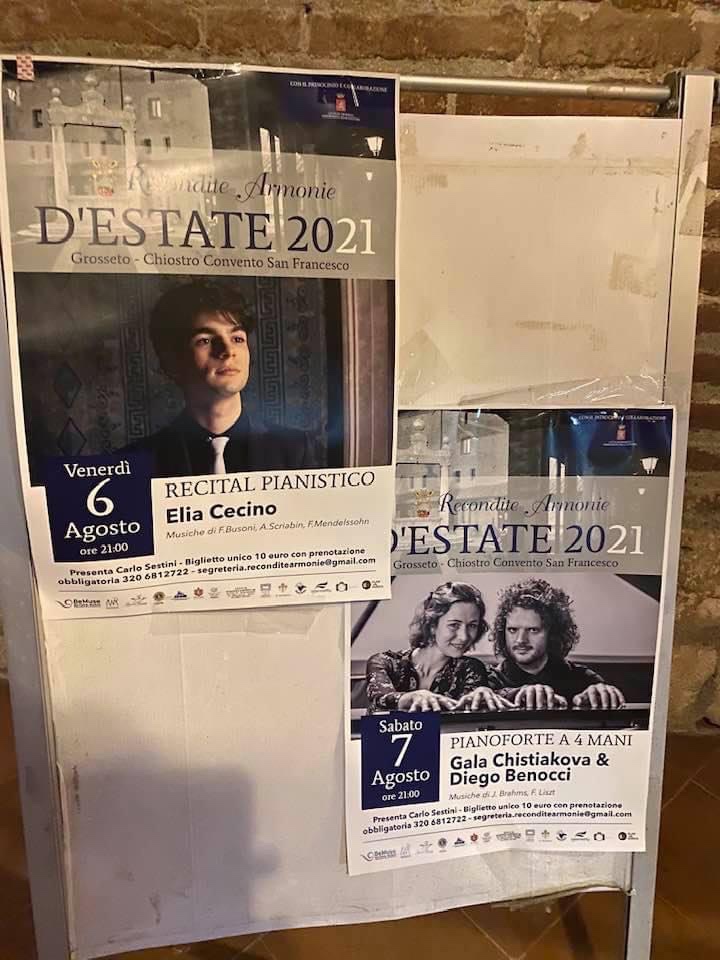
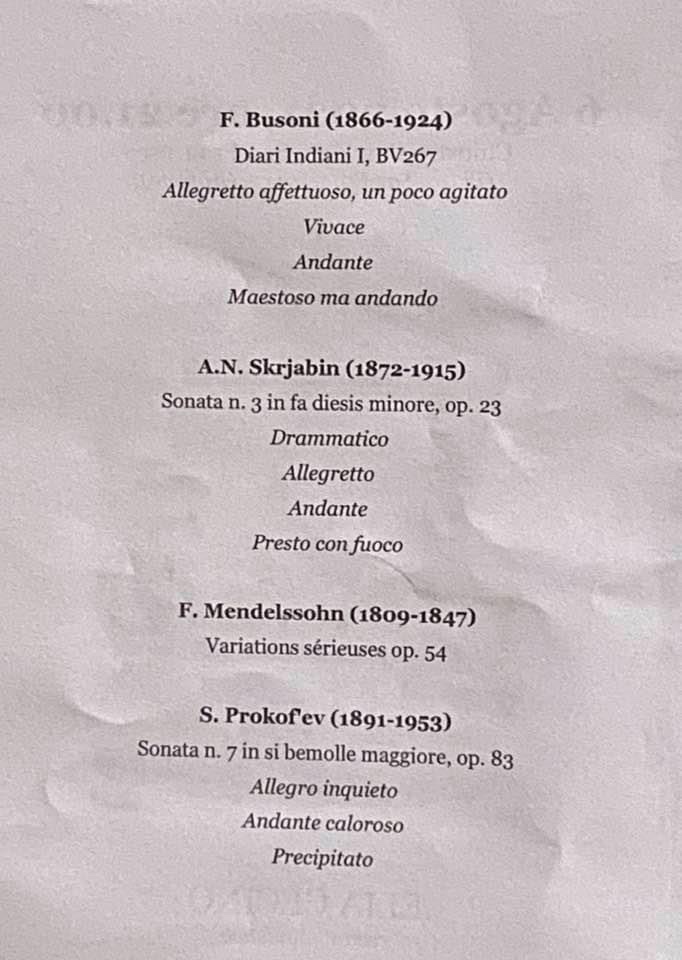
Elia Cecino in Grosseto – a superb recital from a pianist who has acquired in the past year an authority and mastery way beyond his 20 years. The Indian Diary n.1 by Busoni was played with an extraordinary sense of architectural line and a kaleidoscopic sense of colour that immediately brought these rarely heard pieces vividly to life and made one wonder why they have been neglected for so long. His Scriabin 3rd Sonata I have heard many times but never as today,when he played with a clarity of vision that brought this extraordinary brooding work to life with a sensuality of impending drama and doom that was like sitting on a knife edge waiting to see what would happen next. Mendelssohn’s Variations Serieuses were thrown off with all the jeux perlé charm of another age -the golden age of piano playing of Rosenthal Lhevine or Godowsky . Prokofiev’s 7th was played with a demonic barbarity that took us by surprise as did the remarkable sensuality and simplicity of the hollywoodian slow movement before the unrelenting energy exploding with such force in the last movement. A sublime transcription by Busoni of Bach’s Ich ruf zu dir was answered by the spotless precision of Shostakovich’s Prelude and Fugue in B flat.
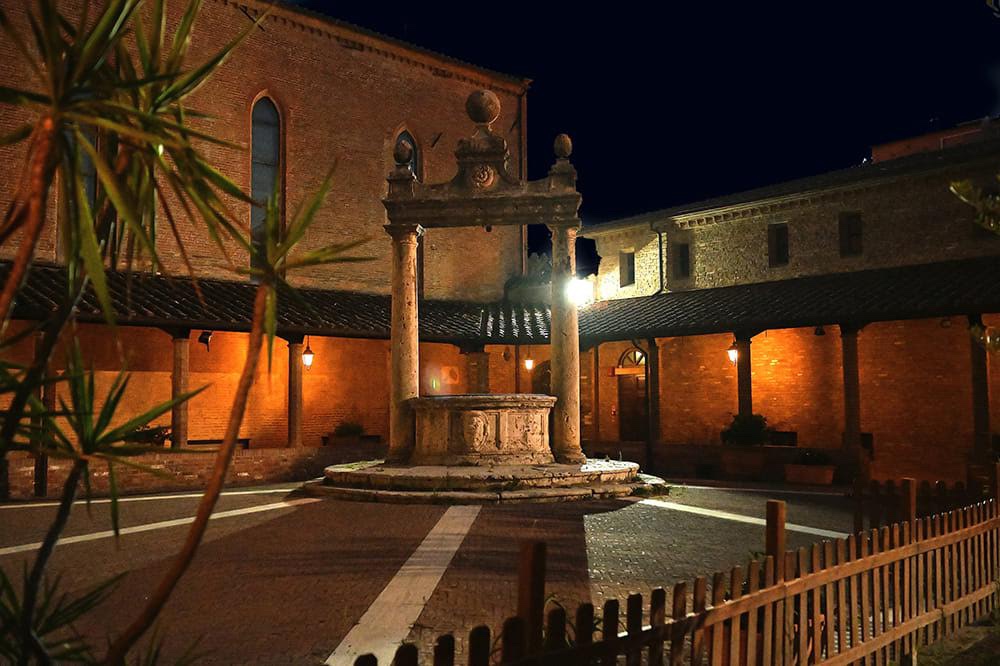
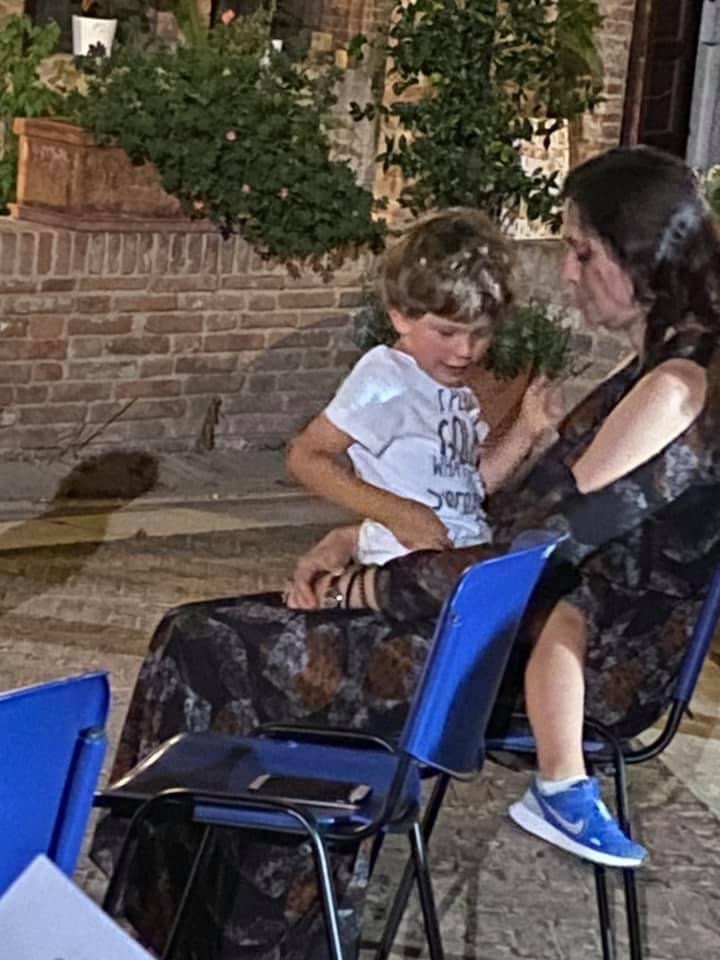
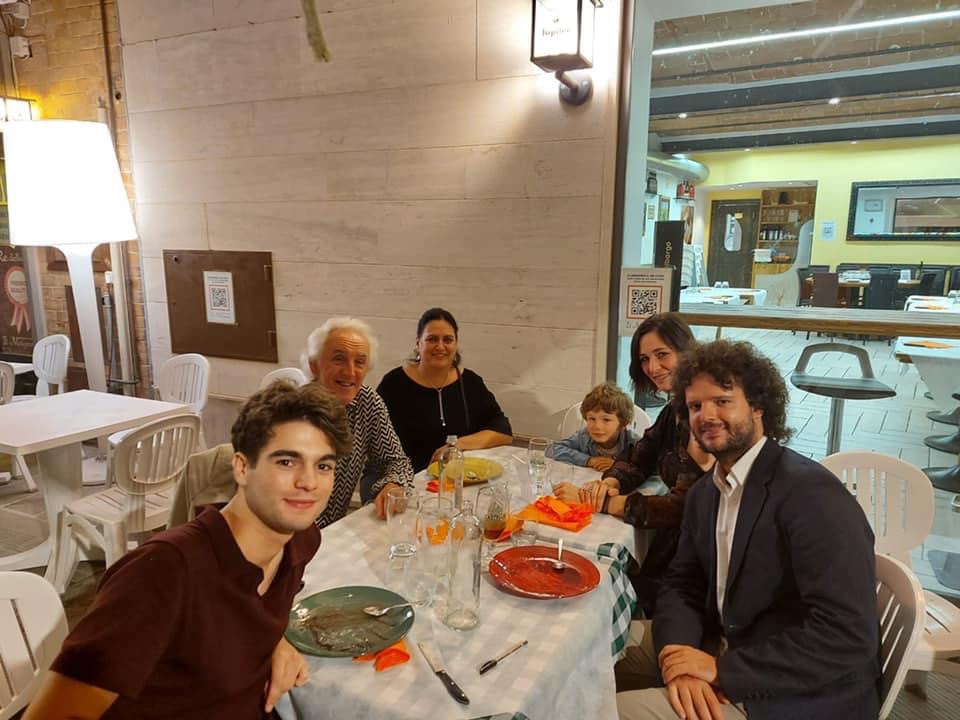
The final two concerts in the summer series of Recondite Armonie organised by the remarkable Benocci family in the beautiful little town of Grosseto in Tuscany.Diego and his wife Gala Chistiakova were in the front row with their child Leonardo to applaud this remarkably talented young pianist from the school of the indefatigable Maddalena De Facci.Tomorrow it will be the husband and wife duo who will close the season with a concert of works taken from their new CD.
It is refreshing to see all these talented people dedicating their time to encouraging the next generation.Vitaly Pisarenko is little Leonardo’ s God father who was playing and giving Masterclasses yesterday in Colombia!Gala and Diego were just back from the Chigiana in Siena where they will play on Friday mentored by Lilya Zilberstein.
Little Leonardo with his mother enjoying the concert together
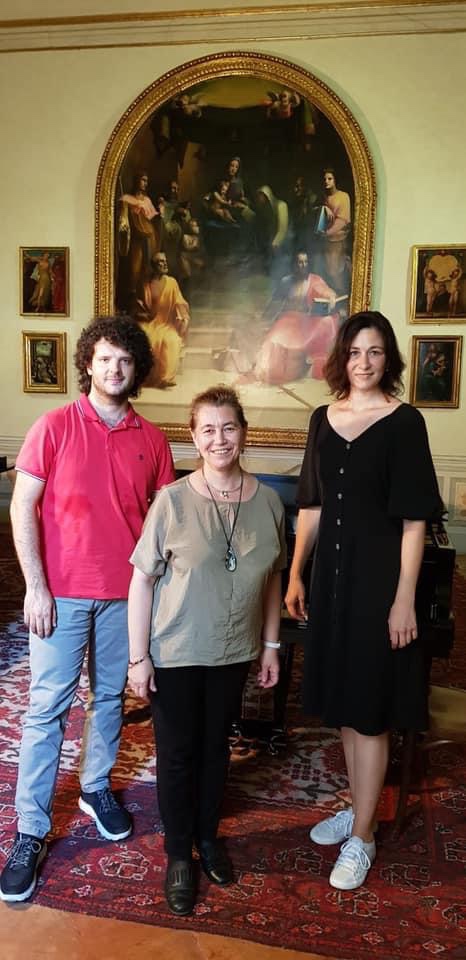
Maddalena fresh from Stradella Academy and on her way to Rome where she has a series of concerts with Elia and his sister Vera before accompanying Elia to the International Busoni Competition in Bolzano,which Zilberstein won many years ago.
Maddalena De Facci rehearsing with Elia
Small world that of music – but the one thing they transmit and is so rare and uplifting these days is the absolute passion which drives them to superhuman feats as they are able to share it with the next generation who today have a real need of direction and dedication.
Ferruccio Busoni (1 April 1866 – 27 July 1924) began composing in his early years in a late romantic style, but after 1907, when he published his Sketch of a New Esthetic of Music, he developed a more individual style, often with elements of atonality. His visits to America led to interest in North American Indigenous tribal melodies which were reflected in this remarkable work written in 1915 :Indianisches Tagebuch. Erstes Buch. [Indian Diary. First Book],BV 267 in four sections:Allegro affettuoso,un poco agitato;Vivace;Andante;Maestoso ma andando.The tribes and song names in the four sections are :Hopi: “He-Hea Katzina Song”,Cheyenne: “Song of Victory”,Pima: “Blue-Bird Song” and Lagunas: “Corn-Grinding Song”Wabanakis: “Passamquoddy Dance” and Hopi: “He-Hea Katzina Song”.His original works are catalogued in Busoni Verzeichnis from n.1 in 1873 to 303 in 1923 with his unfinished masterpiece Doktor Faust.
This work by Busoni was quite a discovery when played with the authority and a melodic line beautifully shaped with a true sense of style and subtle colouring.But it was the architectural shape and rhythmic energy that allowed for unusual clarity of line and direction of a deep mature understanding.The washes of colour in the final section allowed a platform for the almost desperate melodic explosion with which the work finishes.
It led to the imposing opening of Scriabin’s 3rd Sonata that I have written in detail about in the recent recitals streamed live by Elia during the pandemic.Today,though,there was an unexpected maturity where the architectural line was so clearly etched that the subtle kaleidoscopic colours from the luminous whispered confessions to the vehemence of Romantic declarations never lost it’s overall sense of line.The Allegretto was of a fleeting lightness alternating with a melting fluidity of melodic line that prepared the way for the extraordinary Andante. It gave the unmistakable sense that this is the very core of a work that is conceived in one large breath.The beauty of the tenor melodic line accompanied by shimmering golden sounds of sumptuous beauty was really quite sublime as this young man managed to reveal the very heart of the work with such disarming simplicity and sincerity.The subtle menacing reappearance of the opening motif allowed the Presto con fuoco to take flight in a scintillating display of transcendental pianistic fireworks that was pure magic.
The Variations Sérieuses op 54 was Mendelssohn’s contribution to the Beethoven monument in Bonn that Liszt had taken in hand- Schumann contributed his Fantasie op 17.These variations are masterly crafted and something of a showpiece for pianists with it fluidity and trasparent flights of scintillating virtuosity.But there are also moments of great beauty that in the right hands can add a profundity to a work that can all too often be thrown of with a nonchalance of only great effect.In Elia’s hands there was a simplicity and subtle sense of phrasing from the very opening where Mendelssohn’s very detailed indications were scrupulously noted.An unrelenting rhythmic drive did not preclude detail of extraordinary sensitivity.There was pure magic in the almost whispered quieter variations before the exultation of the final excitement generated with ever more rhythmic impetus.Mention must be made of the tenor melody in the variation of such subtlety as it was accompanied by a fleeting staccato every bit as worthy of a Midsummer night’s dream!
Prokofiev 7 I have written about in Elia’s past streamed performances but it was again the absolute authority and brazen sense of character that took me by surprise.I had noticed this change in a performance of Chopin first piano concerto streamed from an International piano competition in Spain having heard it just six months before with string quartet in his home town near Venice.It is the difference between a top of the class student and a real artist.Someone who has scrupulously followed the indications of his teachers but that now he has absorbed them into his own being as he allows the music to flow through him .There was an interview with Shura Cherkassky in Le Monde de la Musique back in the days where quality not quantity was the rule for the media.’Je joue,je sens,je trasmet’.It was exactly this that was so evident in Elia’s playing today.Even Gala Chistiakova who knows this fine Kwai piano – the best instrument to be found in Grosseto- was astonished by the sounds and colours that Elia could coax as if by magic out of this box of hammers and strings.It was the barbaric rhythmic drive of Prokofiev that never before has been so evident that this was part of the war trilogy of sonatas.A brazen sense of character and the menacing melodic meanderings played with a fluidity and sense of line that was quite extraordinary.There was a masterly sense of balance as he was able to expose the bass melody even on this seemingly weak piano.An Andante caloroso of such subtle sensitivity without a trace of sentimentality that allowed the melodic line to sing with a disarming sensitivity and simplicity.A depth of sound and control with a kaleidoscopic sense of colour in constant change.The extraordinarily whispered return of the opening melody allowed to disintegrated before our very eyes before the subtle entry of the precipitato (similar to the control that is needed in Chopin’s B minor sonata)led to a gradual crescendo of enflamed vehemence and energy to the final desperate outburst with which the sonata ends.
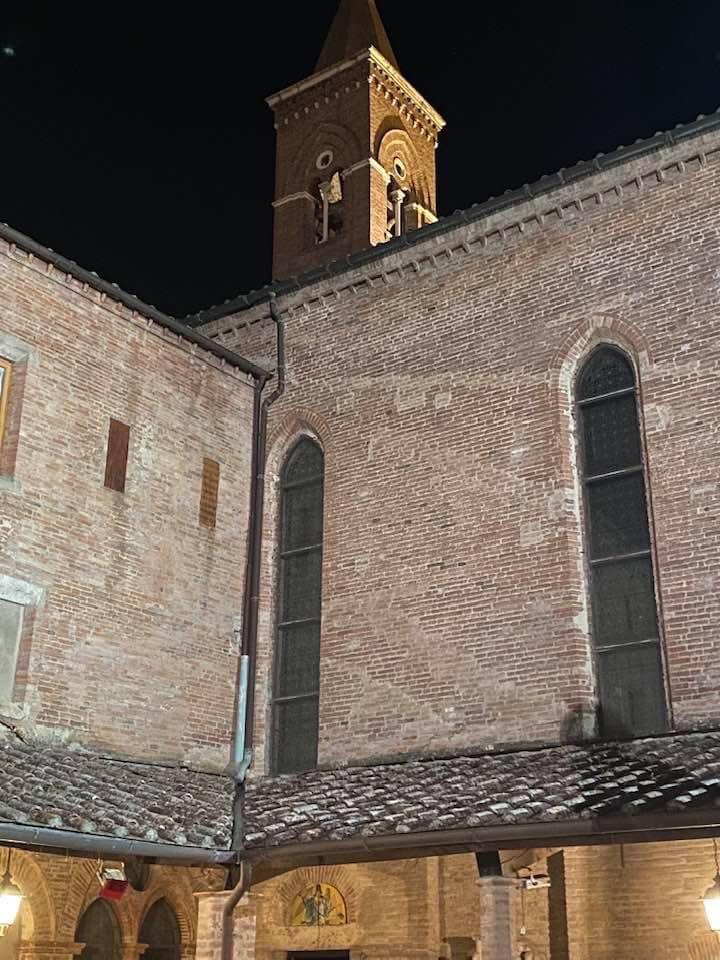
‘Ruf su dir ,Herr Jesu Christ‘BWV 639 was the only answer to the declaration of war as Elia’s hands brought sublime peace to reign once more in the magic atmosphere of this cloister of San Francesco.The Prelude and Fugue op 87 n.21 in B flat was thrown off with a clarity and simplicity that made us realise that the recital had been just a dream from which we were awoken refreshed and enlightened and just thankful of the cultural events that Gala and Diego are bringing to this beautiful town.
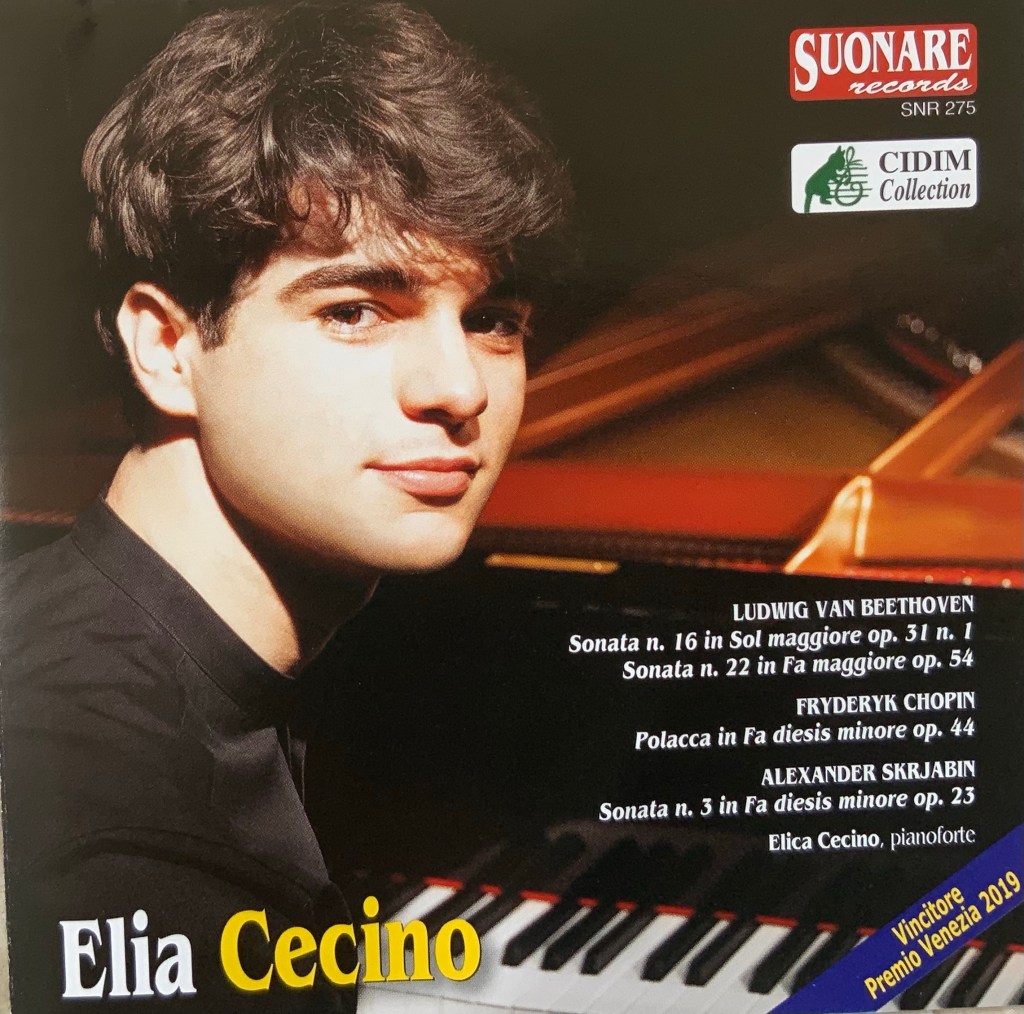
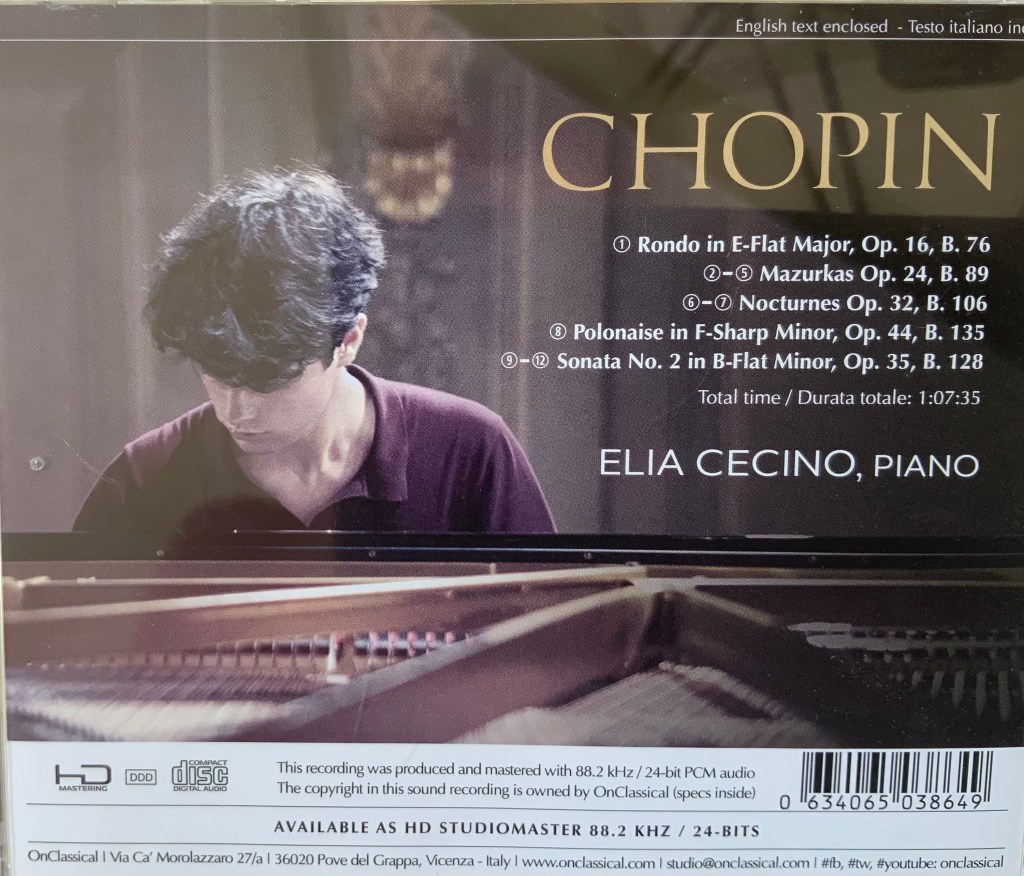
Elia Cecino dal 2014 si esibisce con continuità in recital spaziando nel repertorio presso numerose sale europee quali il Teatro Verdi di Trieste, Teatro La Fenice di Venezia, Fazioli Concert Hall di Sacile, Teatro Toniolo di Mestre, Teatro Olimpico di Vicenza, Conservatorio di Bolzano, Sala dei Giganti di Padova e molte altre. Nel 2016 ha preso parte a un tour di concerti negli Stati Uniti.Si è proposto da solista con la Simfònica del Vallès, Sinfónica de Galicia, Düsseldorf Symphony Orchestra, Sichuan Philarmonic, Bacau Philarmonic, FVG Orchestra, Orchestra Vivaldi di Morbegno, Joven Orquesta Leonesa, Orchestra Busoni di Empoli, Complesso d’Archi del Friuli e del Veneto, Orchestra Concentus Musicus Patavinus, Orchestra San Marco di Pordenone.Nell’ottobre 2020 la casa discografica Suonare Records ha pubblicato il suo CD di debutto e un secondo album monografico su Chopin é stato pubblicato da OnClassical nell’aprile 2021. Sue interpretazioni e interviste sono state trasmesse da Rai Radio 3, Radio Popolare, Rai Friuli Venezia Giulia e Radio MCA. Nel dicembre 2020 ha collaborato con il violoncellista Mario Brunello in occasione del 250esimo anniversario della nascita di Beethoven.Vincitore del XXXVI Premio Venezia, Elia si è affermato in Italia e all’estero in concorsi internazionali tra i quali spiccano il Viñes di Lleida, Ciudad de Ferrol, Pozzoli di Seregno, Casagrande di Terni, Schumann di Düsseldorf, Luciani di Cosenza, Città di Albenga, Bajic di Novi Sad, Chopin di Budapest, Marciano di Vienna, Brunelli di Vicenza, Bramanti di Forte dei Marmi.Nato nel 2001 a Treviso, Elia comincia lo studio del pianoforte a 9 anni con Maddalena De Facci sotto la cui guida si diploma da privatista con 10 e Lode presso il conservatorio di Cesena nel 2018. Nel 2020 ottiene il Diploma di Specializzazione dell’Accademia del Ridotto di Stradella studiando con Andrzej Jasinski. Si sta perfezionando con Elisso Virsaladze presso la Scuola di Musica di Fiesole.
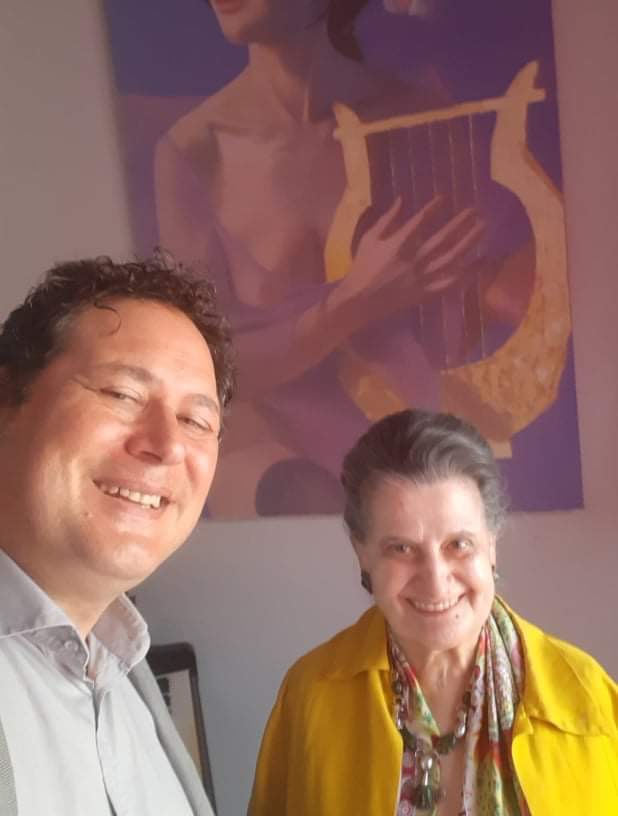
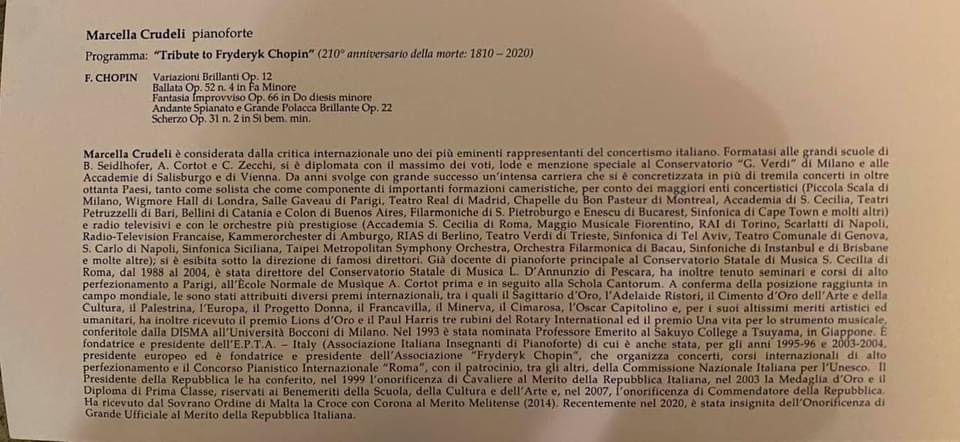
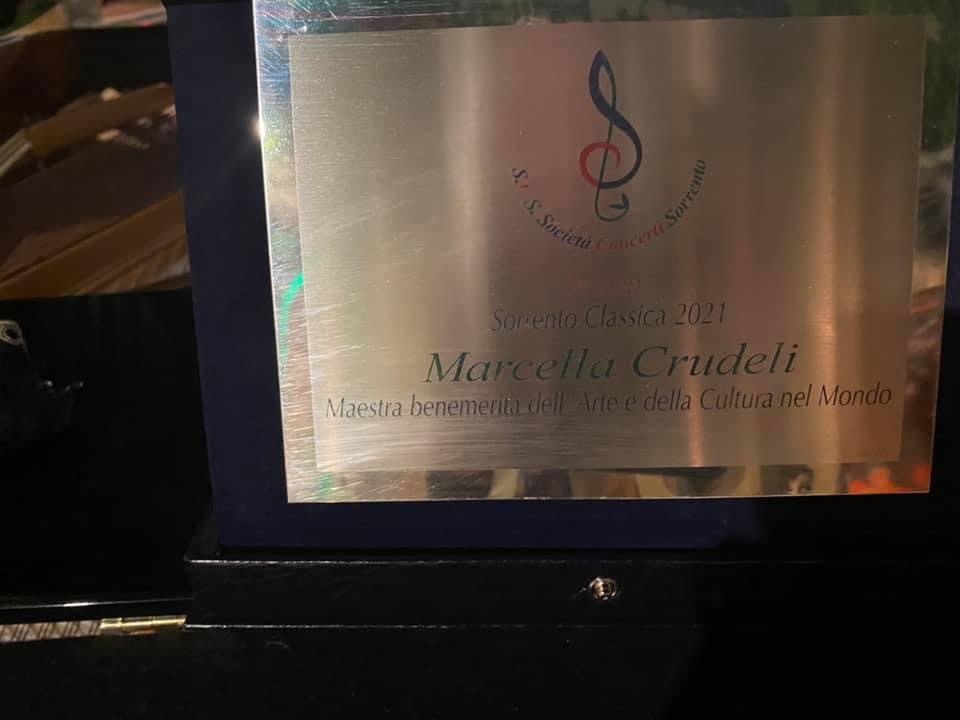
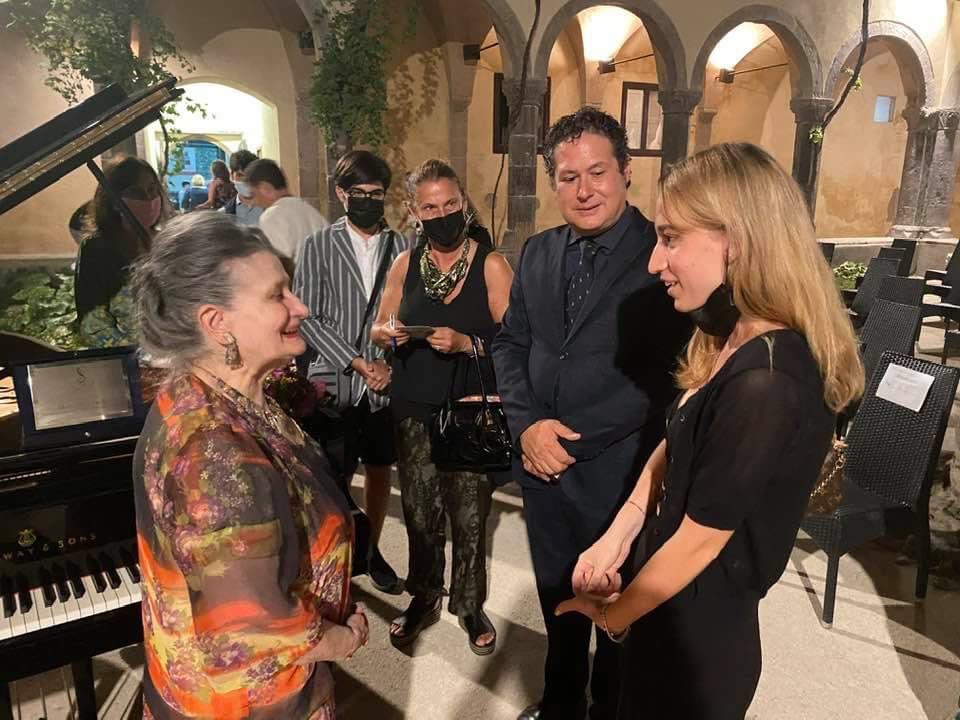
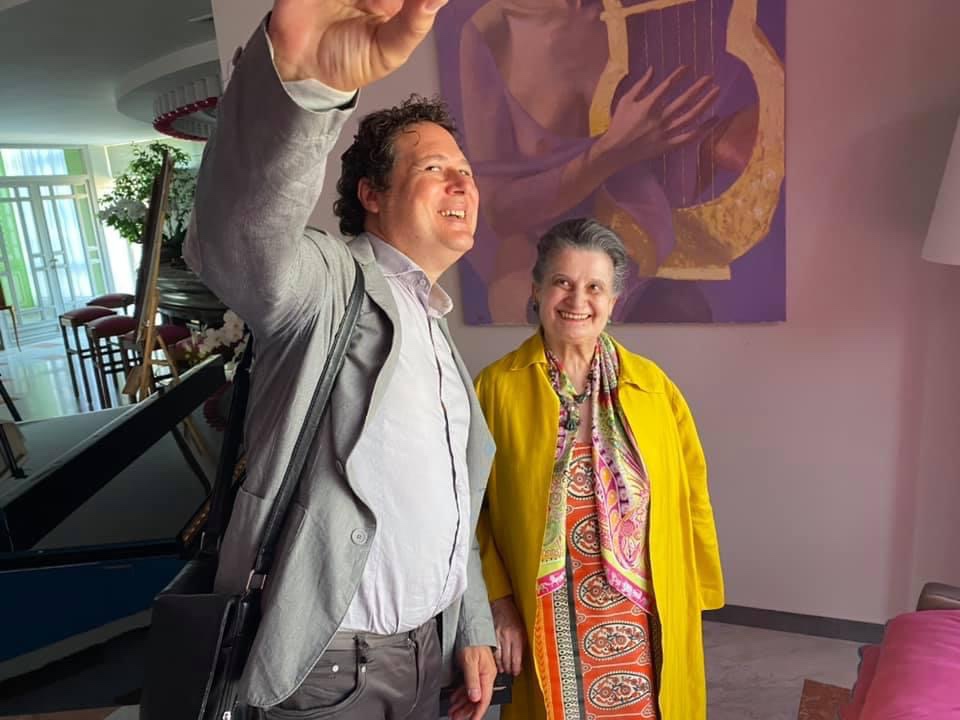
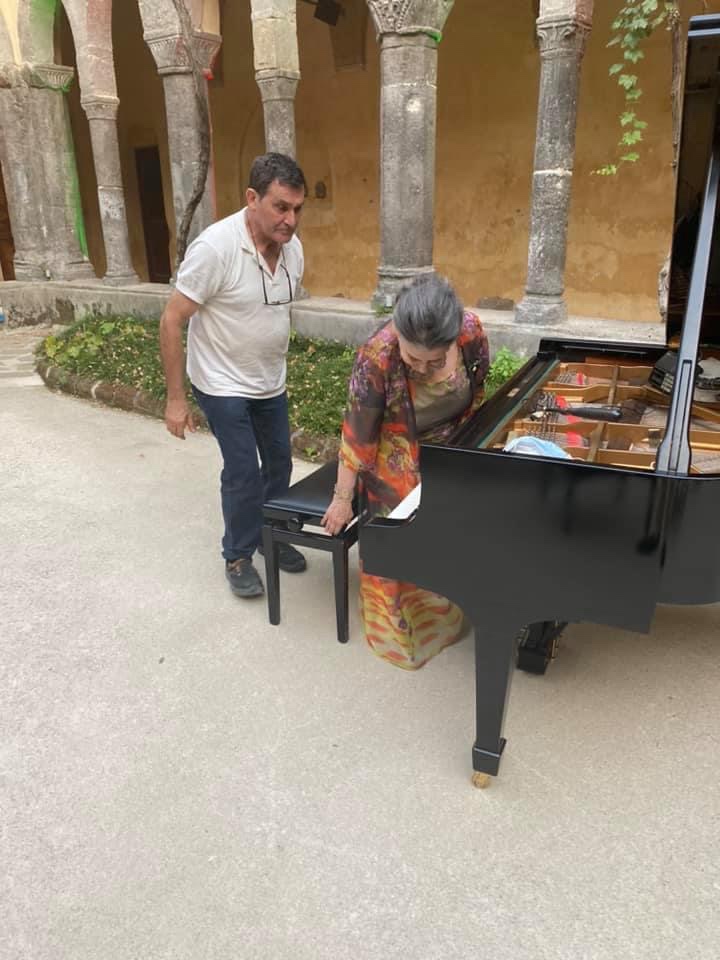
It was a great honour for me to accompany Marcella Crudeli to Sorrento where for her 80th birthday celebrations she had be given the prestigious Premio Sorrento Classica 2021.She had already been honoured last April by President Mattarella of Italy with the Grande Ufficiale della Repubblica Italian and received a few years ago from President Ciampi the Gold medal for her dedicated service to education.But it is thirty years that Marcella has been at the helm of the Rome International Piano Competition that she created knowing that Rome had been lacking one for too long .Like Fanny Waterman in Leeds,who with the same indomitable spirit and unrelenting search for excellence had created in the 60’s one of the first piano competitions to stand side by side with Warsaw and Moscow.There are now hundreds of competitions but the Rome Competition stands out for the presence of the founder controlling with her eagle eye and with a directness that is missing from many similar state run events.
Paolo Scibilia with Marcella Crudeli
Paolo Scibilia the deus ex machina of Sorrento who fills this unique city with music involving the great Hotels and sponsors partecipating in the events of great cultural value.
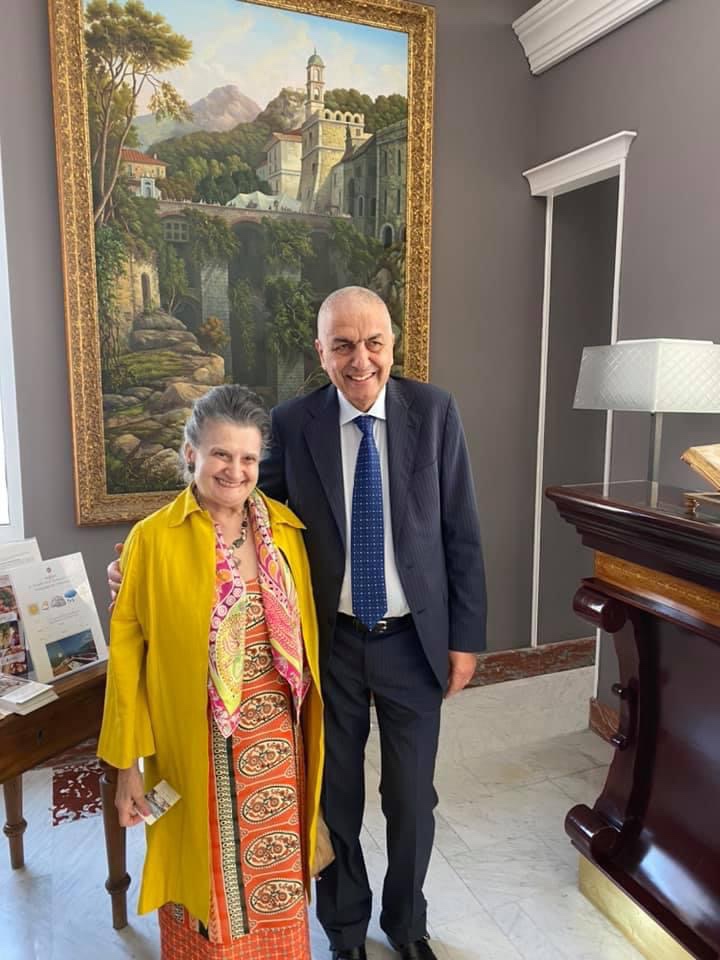
Marcella with the director of the magnificent Hotel Continental
I have known Paolo from the first time that Lya De Barberiis asked me to play four hands with her on a Sunday morning in the museum of ceramics.Later Paolo had invited my wife Ileana Ghione and I to give a recital at the Grand Hotel Coccamella.Paolo’s father had been president of the school where Fausto Zadra housed the students for his Masterclasses that he together with Wilhelm Kempff (who lived just down the road in Positano) Nikita Magaloff and many other renowned musicians held for many years in Sorrento.
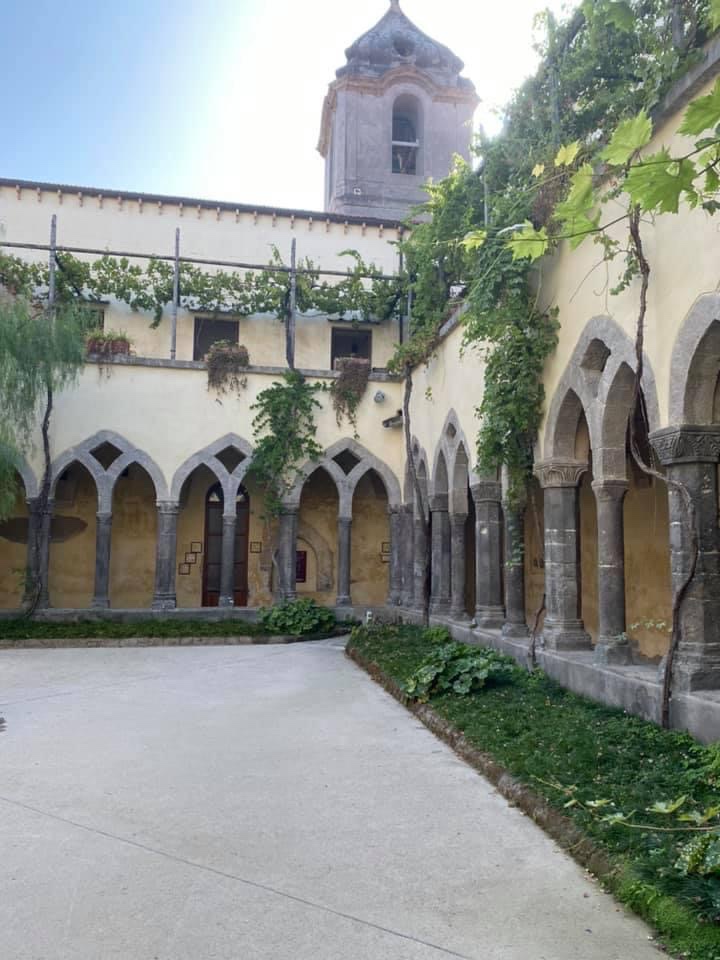
The cloister of S.Francesco
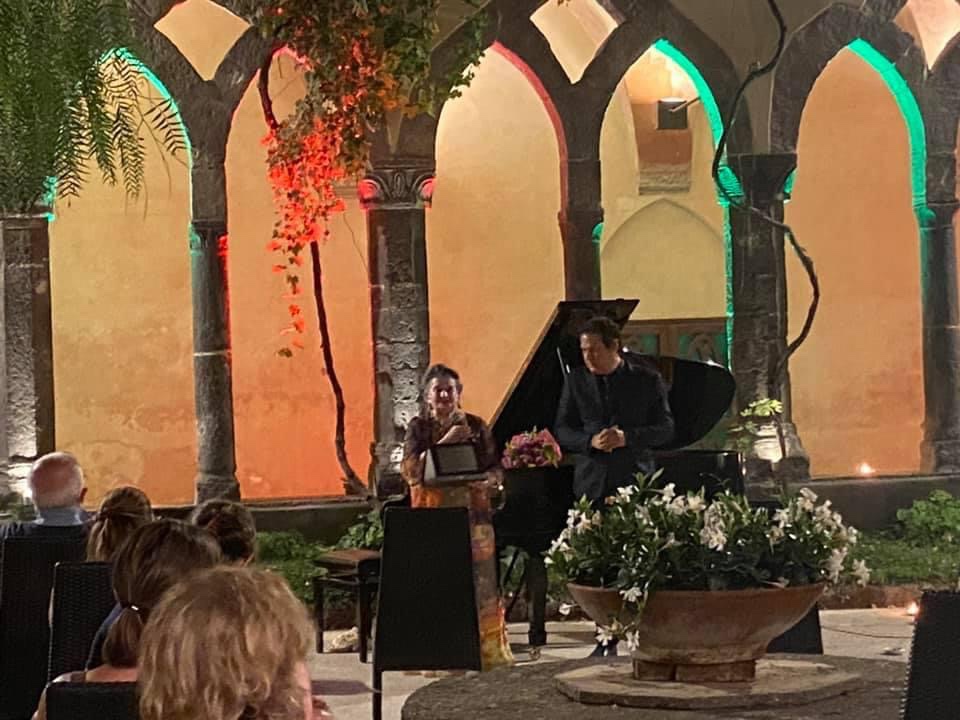
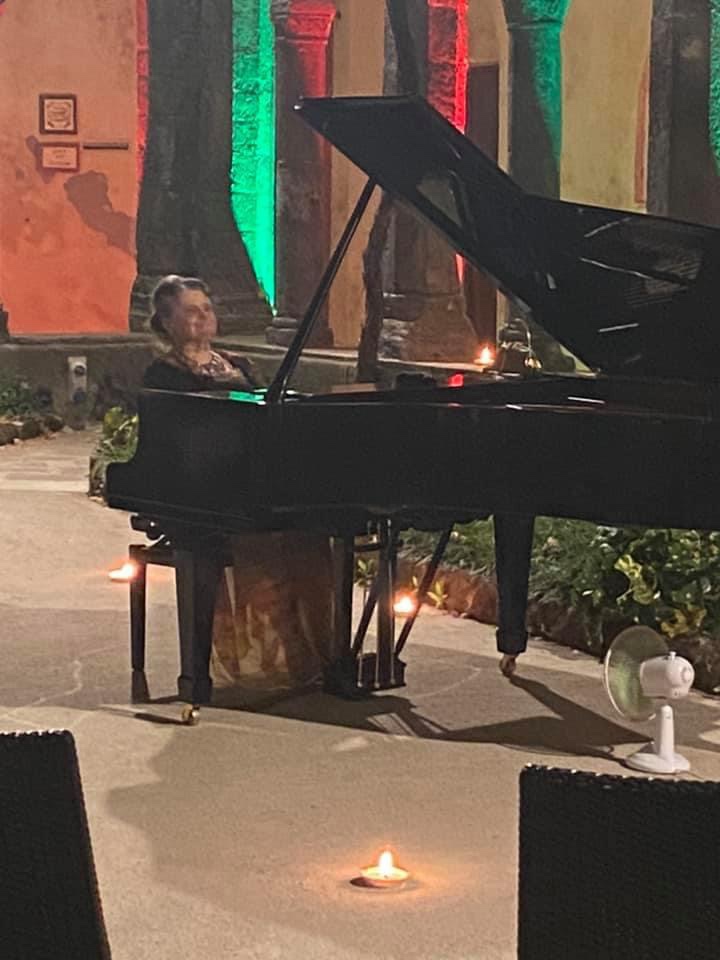
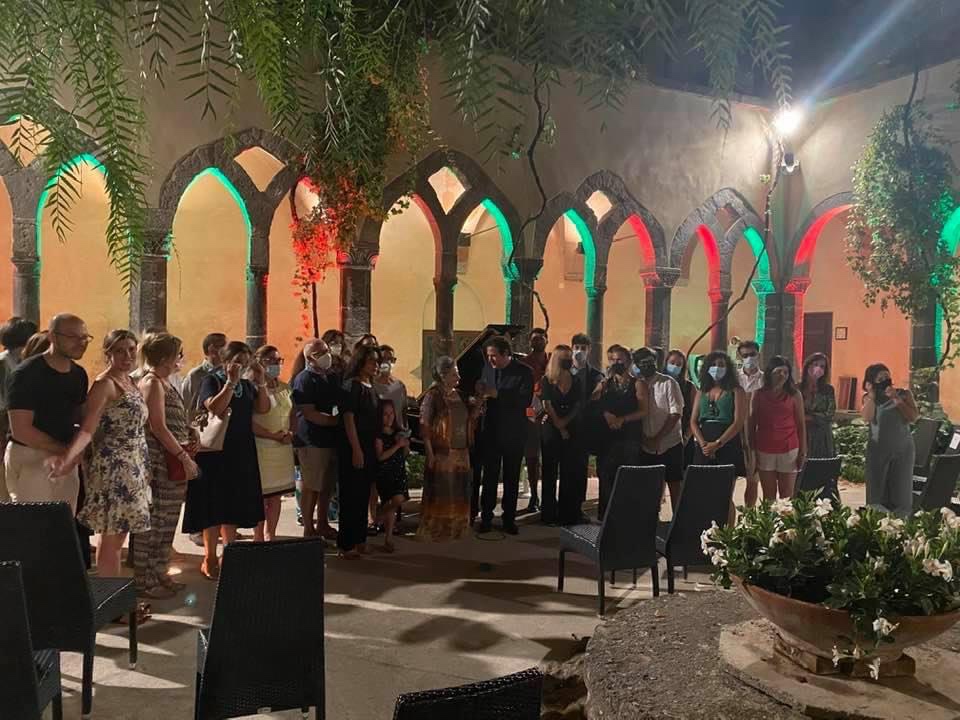
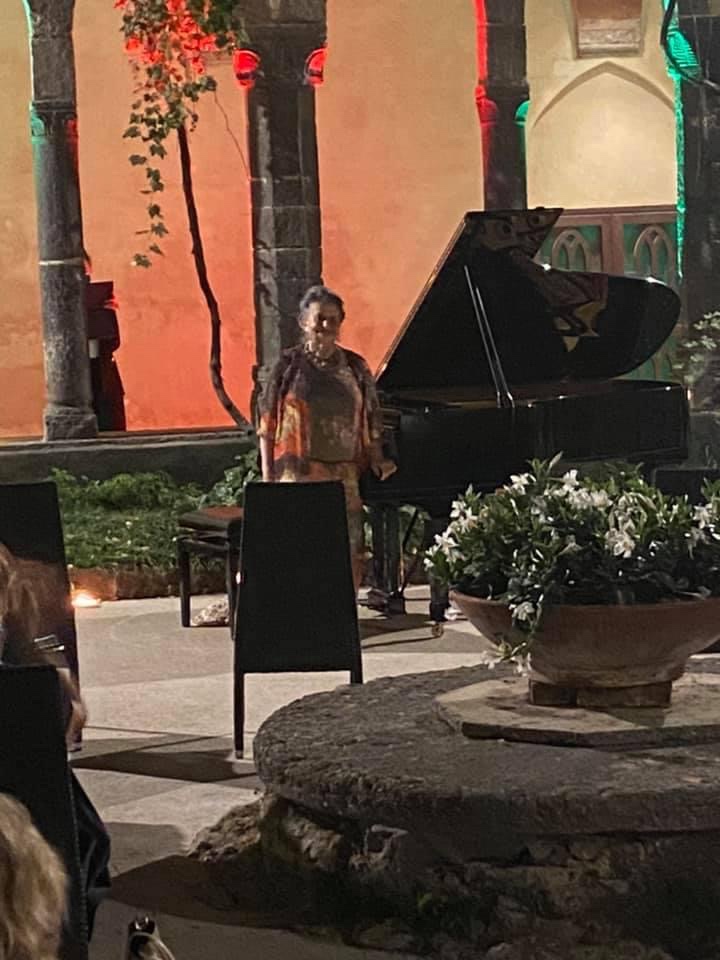
I had taken Shura Cherkassky to play in the Cloister of S.Francesco many years previously.I had also found Rosalyn Tureck there and persuaded her to come to my theatre in Rome where she created a sensation with her return to the concert platform.And so it was a great honour to be able to accompany Marcella Crudeli to give a recital in the very cloister where so much great music had been heard in the past.
A Chopin recital and a Tribute for the 210 anniversary of the death of Fryderyk Chopin ( 1810 – 2020) with a mixture of works from the earliest Variations Brillantes op.12 through the Andante Spianato e Grande Polonaise Brillante op 22 and Scherzo n.2 op 31 to the Fantasie Impromptu op 66 and the crowning glory of the Fourth Ballade in F minor op 52.
I had listened to a masterclass by Marcella this winter in which she had complained that the young pianists of today do not seem to breathe enough to give time and depth for the music to evolve naturally.This was .of course,the great poetic lesson that she had learnt from her mentor Alfred Cortot and it was indeed this that stood out in her recital of much loved classics of Chopin.Nowhere was it more apparent than in the opening variations not often played since Nikita Magaloff who could thrown them off with a charm and jeux perlé of another age.
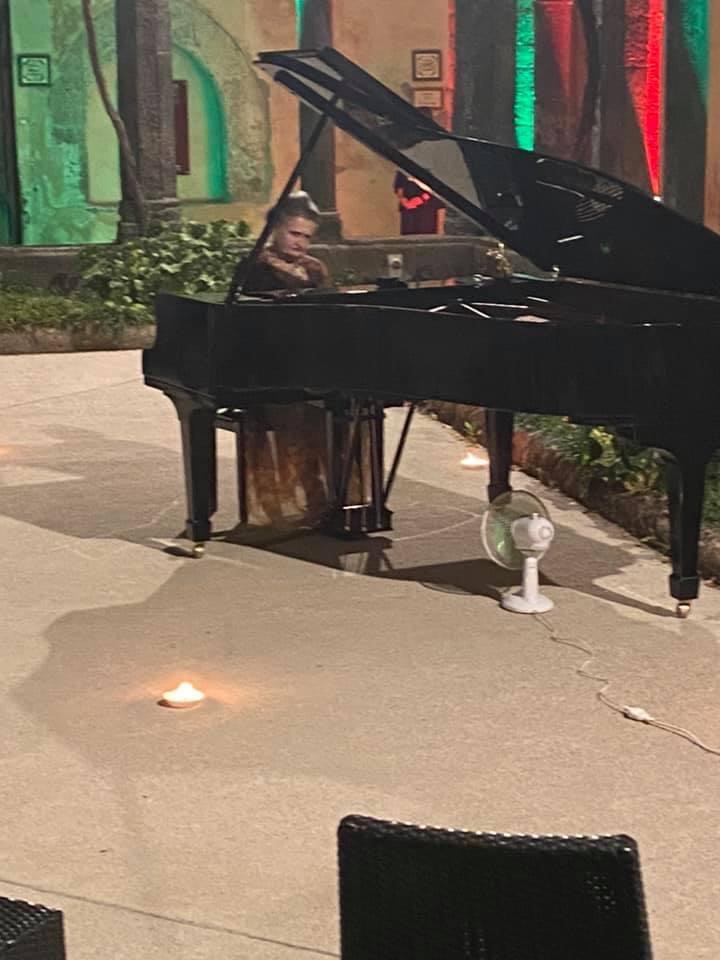
Marcella having placed the ventilator at her feet and mosquito candles all around could allow her music to sing out unimpeded
Marcella showed us too her absolute control and the sense of character that she gave to each of the variations leading to a finale of scintillating and beguiling charm.It was the same charm and intense character that she gave to the well known Fantasie Impromptu with the opening intricate web of notes given all the time needed to shape them into a seamless stream of golden sounds .The middle section was allowed to sing with grandeur and eloquence before the passionate outpouring and gradual dying away of the finale.
The Andante Spianato and Grande Polonaise was played with great style and not a trace of sentimentality.There were moments when the music seemed to stop as Marcella would underline a particularly beautiful passage or cadence.The Fourth Ballade too was given a very robust performance leading to the passionate outcry before the transcendental coda.The highlight of the evening though was the B flat minor Scherzo played with great energy and rhythmic elan together with passages of heart rending cantabile.
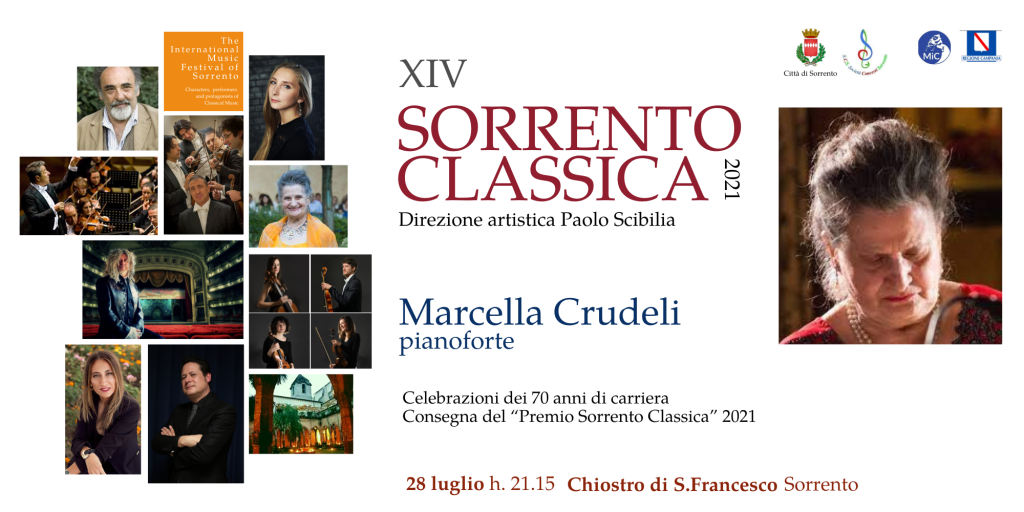
Premio Sorrento Classica 2021
Having received with great joy the Premio Sorrento Classica from the hands of Paolo Scibilia one would have thought that Marcella might have been tired and ready to stop.Little do they know ‘our’ Marcella who has superhuman energy and curiosity and was very happy to play three encores to the very enthusiastic audience that by now had invaded the stage.
A song without words by Mendelssohn (Marcella tells me she has recorded them all on CD),the Chopin Study op 10.n.3 (How sweet is your heart) and a Scarlatti sonata in D that she confided afterwards she had not played for some years but that this evening she had played it in a new way that even surprised her.
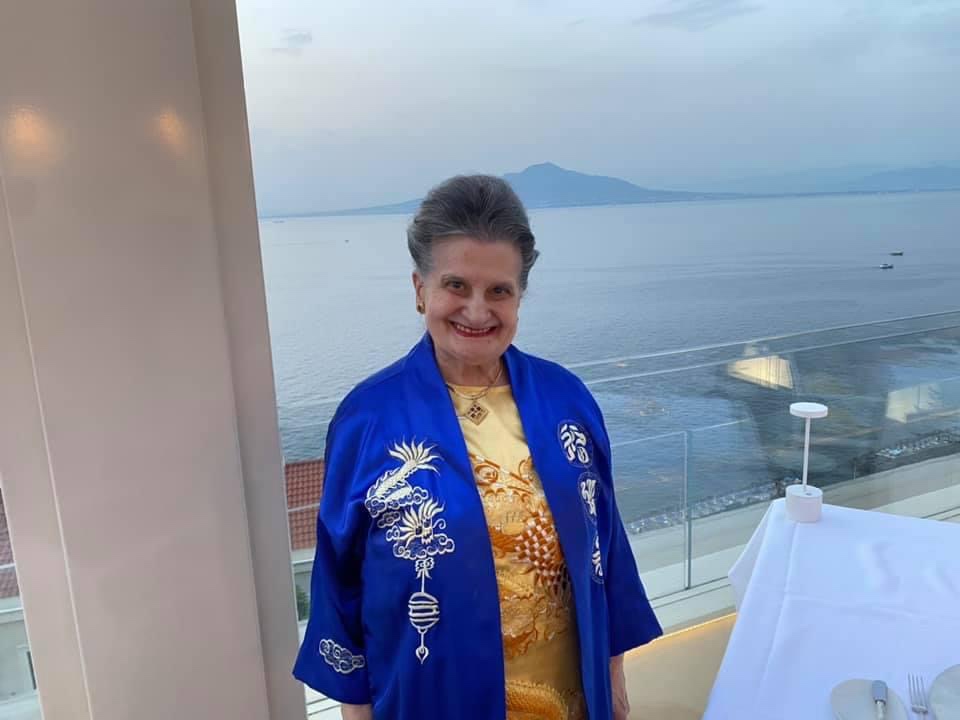
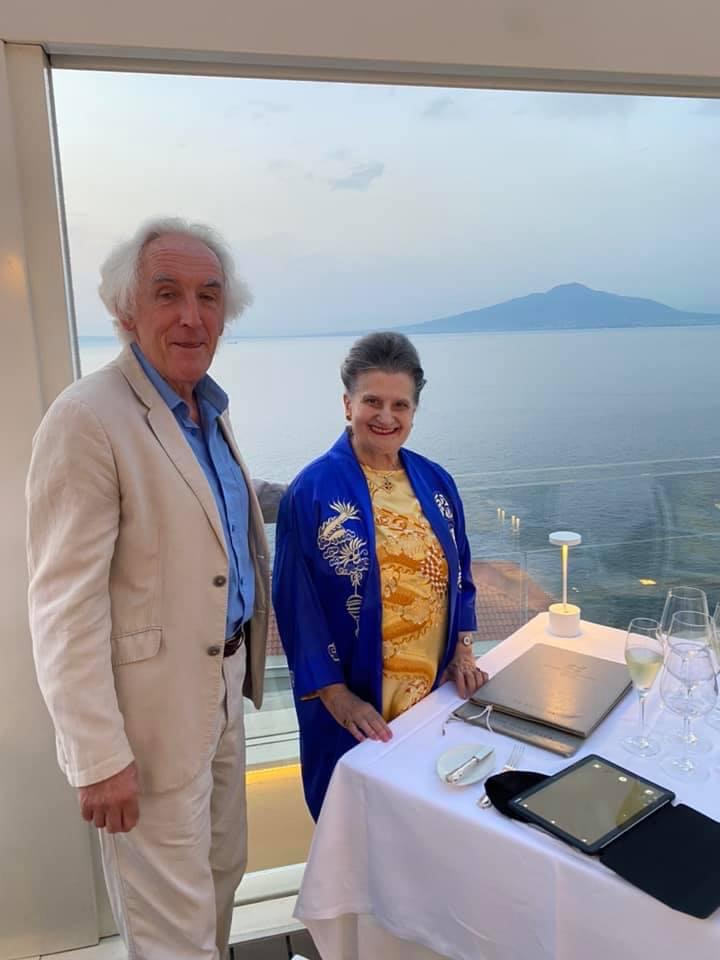
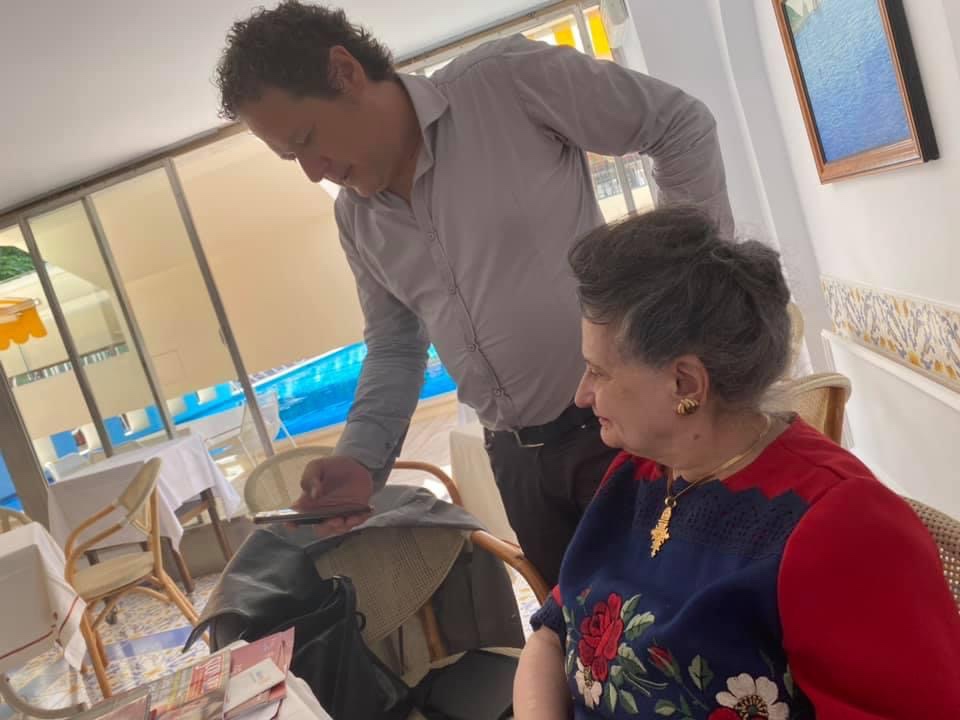
Marcella Crudeli in the Terrazza Restaurant of the Continental with a view of Vesuvius in the distance
A constant voyage of discovery and an honour indeed to pay homage to this remarkable artist.
Ischia on the left of the photo where I will accompany the winner of Marcella’s competition on 4/5 September ,Yuanfan Yang,to play at the Walton Foundation of La Mortella in the first collaboration with the Keyboard Charitable Trust.He will also play in Sorrento thanks to Paolo Scibilia 6/7 September
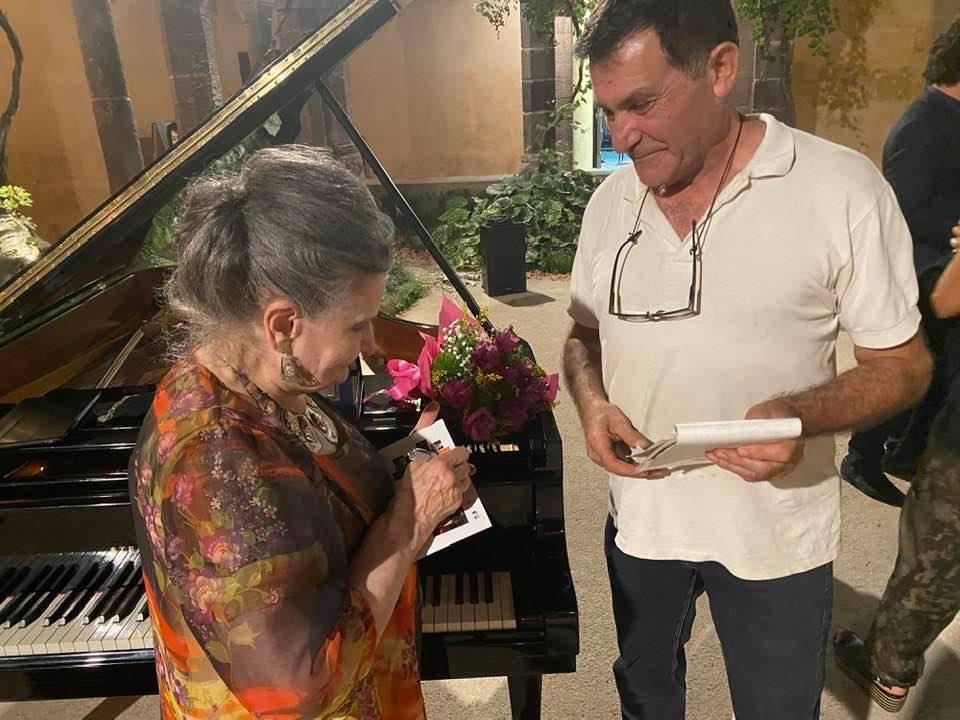
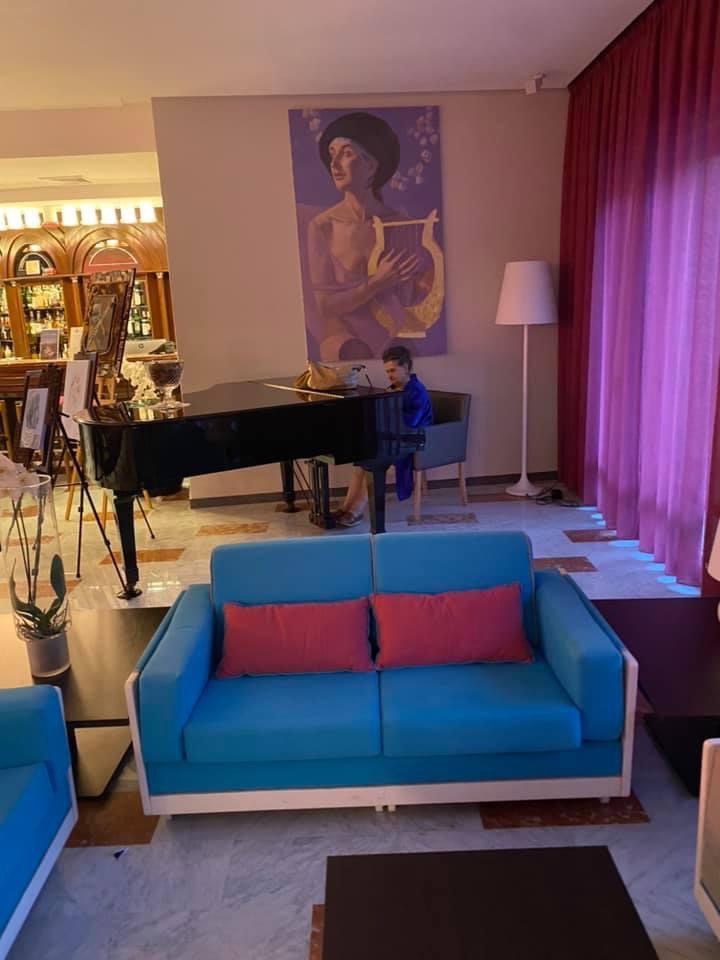
Even the piano tuner wanted her autograph!An enthusiastic public eager to congratulate Marcella CrudeliMarcella found a piano in the hotel tooWith Paolo Scibilia Checking every detail from ventilator to mosquito candles and finally the piano seat
Here are my first impressions that I shared with his mentor Norma Fisher immediately after the live recording …………’ Even in Ginastera,a piece of great effect,he brought his sense of colour and discovery to the first movement …the slow movement was even more remarkable for his control of sound. But in a great masterpiece like the Schumann I was completely mesmerised and thought of De Larrocha or Pires where the musical journey is so absorbing as every note has a meaning . My thought of slightly over phrasing in the second and third and counterpoints could verge on gimmick if taken a step further but his intelligence and musicianship never allow that.Maybe it was missing the sweep and abandonment which will come as he plays it more often.The last one was quite remarkable for its clarity and the added octave in the final passionate episode was judged as only a great artist could do.Just once but at that crucial moment like Rubinstein could do. I will write more fully when it is streamed to the public but just wanted to thank you for all you are doing with these wonderful young artists.Sidney Harrison,’our piano daddy’,would be rubbing his nose in agreement and it is so important that we hear these young artists in masterworks and not just their party pieces of great effect.Pedro has both but it was the Schumann that marks him for me as a true artist and musician’
I was even more impressed by this recital on a second hearing.It was in fact Schumann’s Kreisleriana that stood out as a quite remarkable performance.It was Murray Perahia who had reduced some of the jury in Leeds to tears with his performance of Schumann’s Davidsbundler op 6 .It was remarkable for his absolute fidelity to the composer’s indications together with his sense of poetry and technical command which gave a simplicity and directness to everything he did.It was exactly this that Pedro brought to his performance of Kreisleriana.I was even more convinced on second hearing of the sweep and colour he did actually bring to all that he played but with such simplicity and subtle artistry.It is hardly surprising that he won the coveted Schumann prize at the RCM, bequeathed by that much missed critic Joan Chissell whose admiration for Artur Rubinstein knew no bounds.Her phrase that Mr Rubinstein,the Prince of Pianists ,turned baubles into gems was in itself an unforgettable turn of phrase.It was also exactly what Pedro did with Ginastera and Albeniz today as Rubinstein had done with Villa Lobos all those years ago.
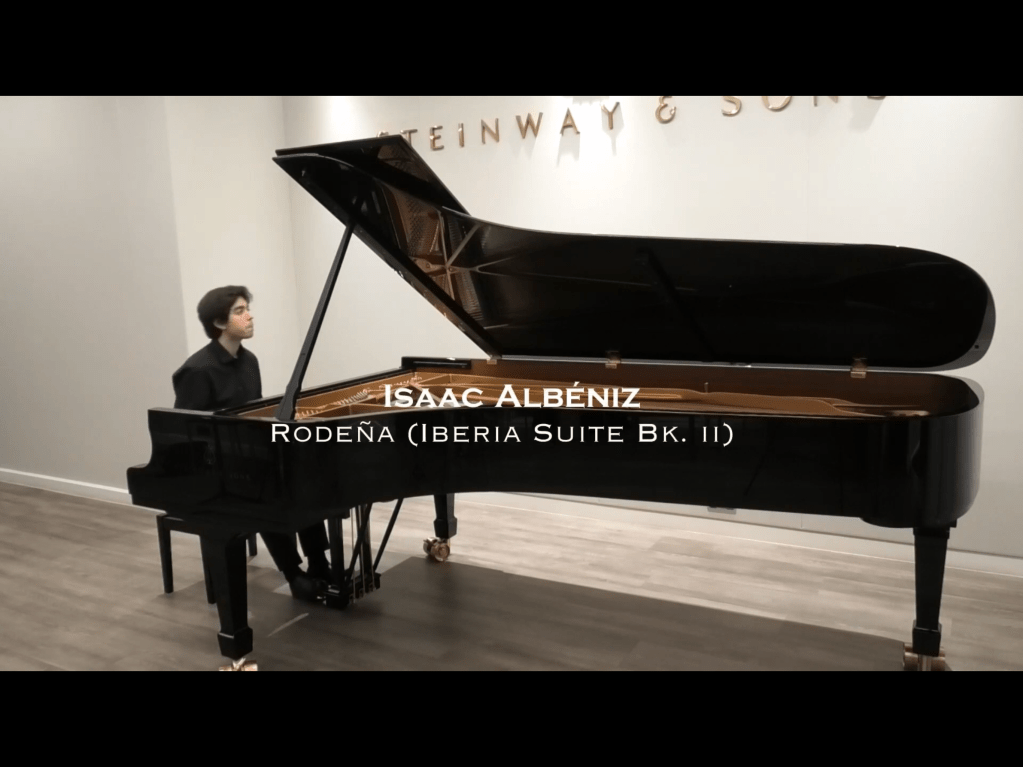
Rondena is from Albeniz’s best-known work Iberia which was highly praised by Debussy and Messiaen who said: “Iberia is the wonder for the piano; it is perhaps on the highest place among the more brilliant pieces for the king of instruments”. As one critic put it ‘ there is really nothing in Isaac Albeniz’s Iberia that a good three-handed pianist could not master, given unlimited years of practice and permission to play at half tempo’.Rondeña is named after the Andalusian town of Ronda and is a variant of the fandango .It is from the second of the four books of twelve pieces that make up this suite and is full of subtle insinuating rhythms and energy.It was played with jewel like precision that did not preclude sultry atmosphere and passion.Pedro had a teasing rubato that was most beguiling and a sense of balance that created the magic world of Spain.The ecstatic duet between the hands was played with great poetry and artistry,a real tone poem of wondrous story telling and obviously only a dream as we were rudely awoken by the final scintillating bars.
The first four of Scriabin’s set of 24 Preludes op 22 were played with a great sense of colour with a very delicately shaped musical line full of luminous fluidity.There was a subtle sense of rubato and an understatement of sublime sensuality
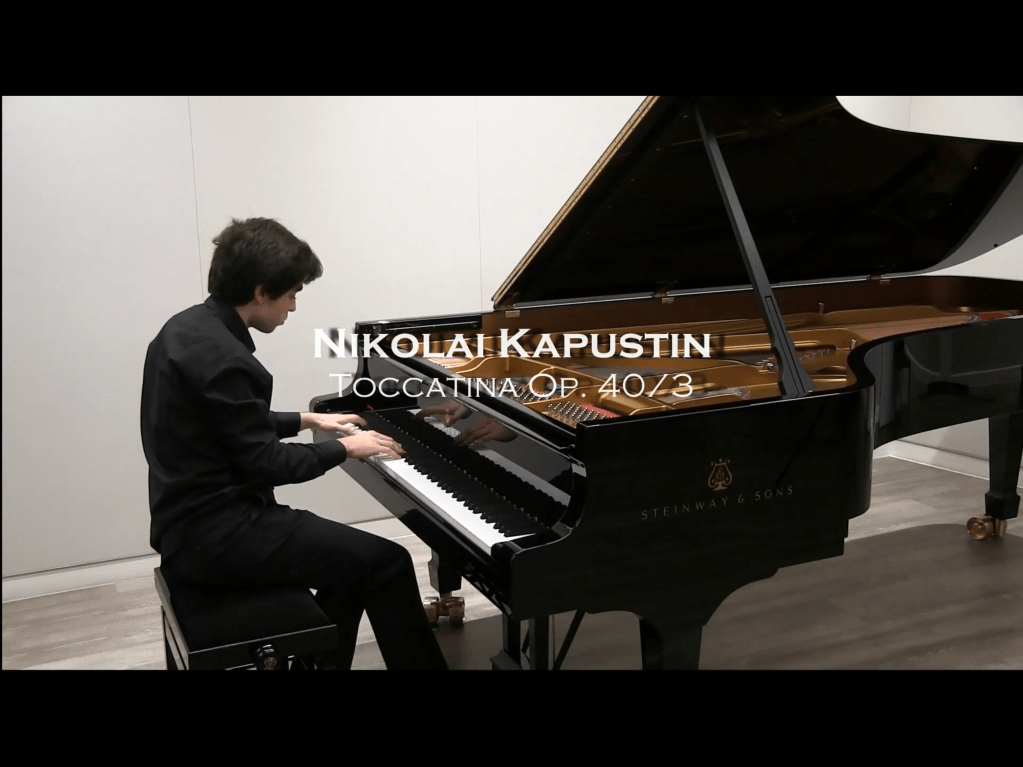
Contrasting with the Kapustin Toccatina full of clarity and rhythmic precision with the jazz idioms brilliantly brought to life.There was a remarkable agility and relentless forward movement to the scintillating final bars.
Schumann Kreisleriana was given a remarkable performance of aristocratic simplicity from the very first notes with a melodic line of subtle shape and colour.A magic change of colour for the B flat section was played with great sensitivity and the subtle pointing of the left hand just before the return of the opening episode created a magic atmosphere of rare beauty.The second piece was played with a simplicity and aristocratic sense of line with some beautiful colouring from the left hand .I would have ignored the bar lines completely as his hesitations slightly disturbed the absolute simplicity that his subtle sense of legato was creating.There was a real sense of contrast with the Sehr lebhaft and it was so beautiful how he allowed the Etwas bewegte to just creep in with its romantic sweep and deep bass counterpoints.His remarkable sense of legato in the Langsamer return created a sense of improvised stillness to the magical ending.There was absolute clarity and nobility in the third piece contrasting with the sumptuous melodic line of the etwas langsamer which was of an almost whispered confession of great intimacy.Nobility was restored and turned into passionate frenzy beautifully controlled and sustained by the deep bass notes.There was beauty and simplicity in the fourth played with a beseeching calm and truly sublime sounds arriving at the bewegter that unfolded with an intensity that was very moving.The pianissimo just showed his searching musicianship so often overlooked but here scrupulously noted.Schumann’s dotted rhythms in the Sehr lebhaft were given a melodic shape with a sense of delicacy and colour that was remarkable.A song of heartfelt simplicity was followed by the frenzy and romantic fervour of the Sehr rasch.There was a very deliberate tempo to the last piece but he had a vision that was so clear and convincing for one of the most elusive of endings,There was great sweep and passion in the two intervening episodes where I have already spoken of the great effect of the added bass note before the absolute stillness and clarity of the long bass notes over which the staccato right hand disappeared into the distance.
Piano Sonata No. 1, Op. 22, is in four movements and Ginastera was commissioned by the Carnegie Institute and the Pennsylvania College for Women to write a piano sonata for the Pittsburgh International Contemporary Music Festival. The first performance in 1952 was given by pianist Johana Harris, wife of American composer Roy Harris, and Ginastera’s intention for the piece was to capture the spirit of Argentine folk music without relying on explicit quotations from existing folk songs.There was playing of rhythmic precision and driving Latin fever mixed with episodes of ravishing colour.The legato meanderings of the second movement were of Chopinesque mystery.There was startling intensity in the Adagio with its atmospheric calm and crystalline melodic interruptions and a final toccata played with great rhythmic fervour of great effect which brought this showcase recital to a brilliant conclusion .
‘Enormous confidence and great capacity of the young pianist to endow Liszt’s Piano Concerto No.2 with expressivity and poetry’ – El Correo de Sevilla. ‘Perfect blend of musicality, personality and brilliantly polished technique’ – La Tribuna. ‘Three encores, a standing audience and a long queue of spectators to congratulate the young Spanish pianist. Pedro López Salas brightened up the evening in Milan’ – Cultura di Milano. ‘More than an excellent pianist, he has the makings of a soloist and almost a conductor, judging by his stage performance’ – Ritmo Magazine
Pedro López Salas was born in 1997 in Spain. He is currently studying with Norma Fisher at the Royal College of Music on a full Leverhulme Arts Scholarship. He has recently completed his studies with Professor Mariana Gurkova at the CSKG (Centro Superior Katarina Gurska) in Madrid, receiving an Honours Degree in piano, an Extraordinary National Education Award and an Exemplary and Academic Merit Award from the Rotary Club. López Salas has won numerous prizes in national and international competitions, including First Prizes in the following international piano competitions: Malta; Compositores de España CIPCE; Madrid; ‘César Franck’, Brussels; ‘Ciudad de Leganés’; Granada’s ‘María Herrero’; Villa de Xábia; International Music Competition of Panticosa ‘FIP’; Wiener Klassiker in Hungary, Franz Liszt Center in Spain and the ‘Iscart’ Lugano International Music Competition in Switzerland, among others. He has recently received an invitation to participate in the prestigious International Piano Competition ‘Vendome Prize’ in New York which will take place in October 2021. López Salas has participated in masterclasses with such internationally renowned pianists as Dimitri Baskirov, Dmitri Alexeev, Alexander Kobrin, Pavel Nerssesian, Pascal Nemirovsky, Pavel Gililov and Ludmil Angelov. He has also studied on piano performance courses in Austria, Germany, Malta and Italy. He has performed all over Spain and Europe in auditoriums such as the Manuel de Falla in Granada, the Teatro Circo in Albacete, the Aachen Theatre, the Wiener Saal in Salzburg and as a soloist with the Valencia Orchestra (OV) in the Palau de la Música in Valencia and with the Real Orquesta Sinfónica de Sevilla (ROSS) in the Teatro de la Maestranza in Seville. He has performed with the Orquesta Sinfónica de Castilla y León and with the GSKG Orchestra in performances of concertos by Chopin and Liszt. He also performed Rhapsody in Blue by Gershwin in the ADDA in Alicante and the Auditorio Internacional de Torrevieja with the OST (Orquesta Sinfónica de Torrevieja).
Here is your free link to watch the concert, which comes from the Steinway Hall, London:
Immediately followed by an interview with co-artistic director, Dr Elena Vorotko, talking about Pedro’s life and his choice of music.
The Keyboard Trust is entirely dependent on donations from our friends for its work in supporting outstandingly talented young musicians and so we’d be especially grateful to you for your support of this venture.Please feel free to make a donation via this website.
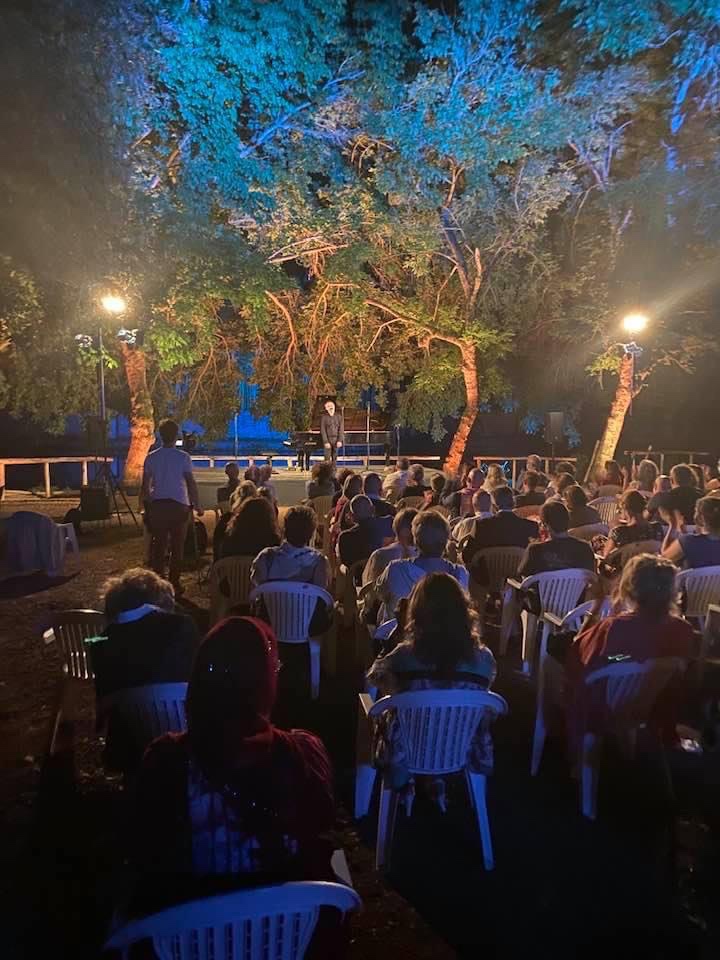
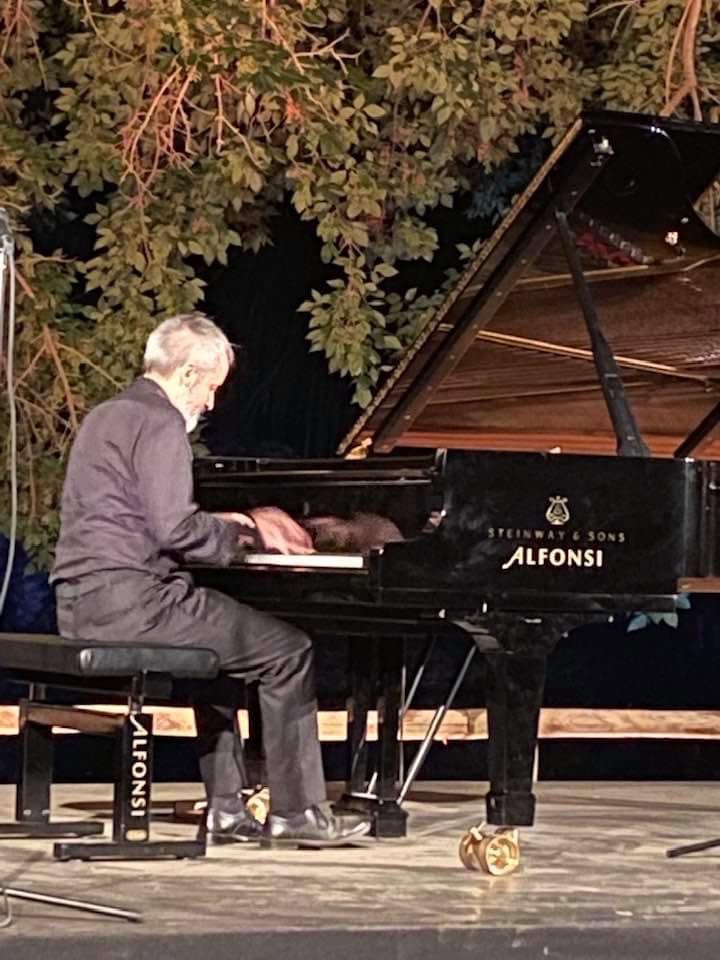
This is the third time that Alfonso Alberti has shared his searing intellectual curiosity and masterly playing with a public that had taken life into their hands ( with a little help from google maps ) to find the well hidden magic realm of Ninfa.
A mediaeval city that was the toll cross roads from one region to another to avoid the plague and other mishaps.It fell into ruin for a long and difficult conflict and remained in ruins around the saving lymph of constant water from the fast flowing river Ninfa.It took Lelia Caetani ,the last of the noble dynasty,to turn it into a fairy tale garden of pure magic.Much as Susana Walton had done many years later at La Mortella on Ischia.
Infact Sir William often used to stop over in Ninfa to compare notes!It took the American wives of the two composers to turn history into a fairy tale dream………a New World indeed.Sir William Walton is now well known and his home on Ischia has been transformed into a foundation to help young musicians delve deep into the mysterious world of music ‘far from the maddening crowd’.Sermoneta that overlooks Ninfa – it’s backyard you might say- has been doing that since Menuhin and Szigeti were invited by the Caetani/Howard family to use the castle and grounds to share their knowledge with the next generation.
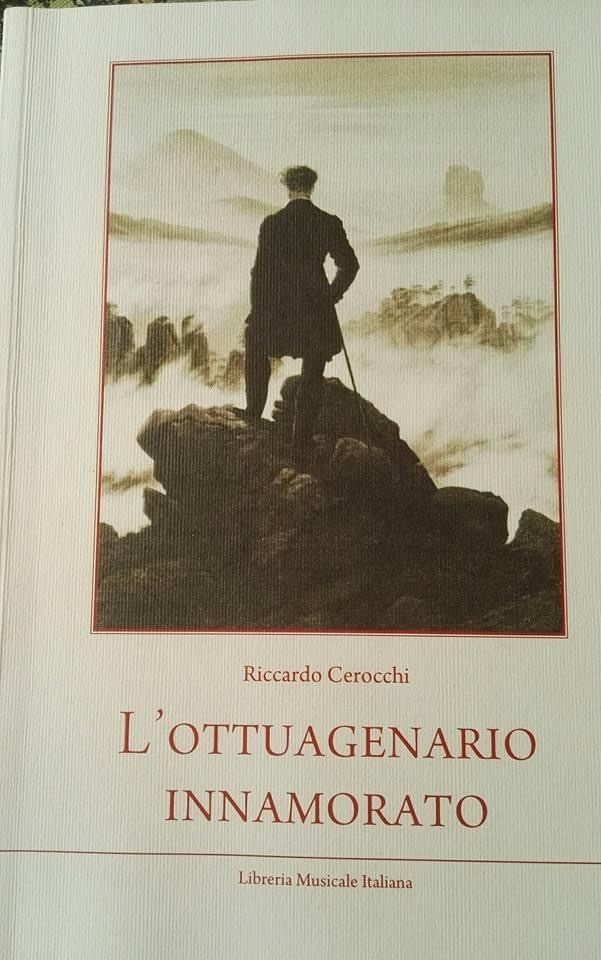
Autobiography of the late Riccardo Cerocchi founder of the Campus Musicale in Latina
Something that continues to this day with the Campus Musicale created in the 70’s by an enlightened architect from Latina,Riccardo Cerocchi
Elisa Cerocchi with Alfonso Alberti
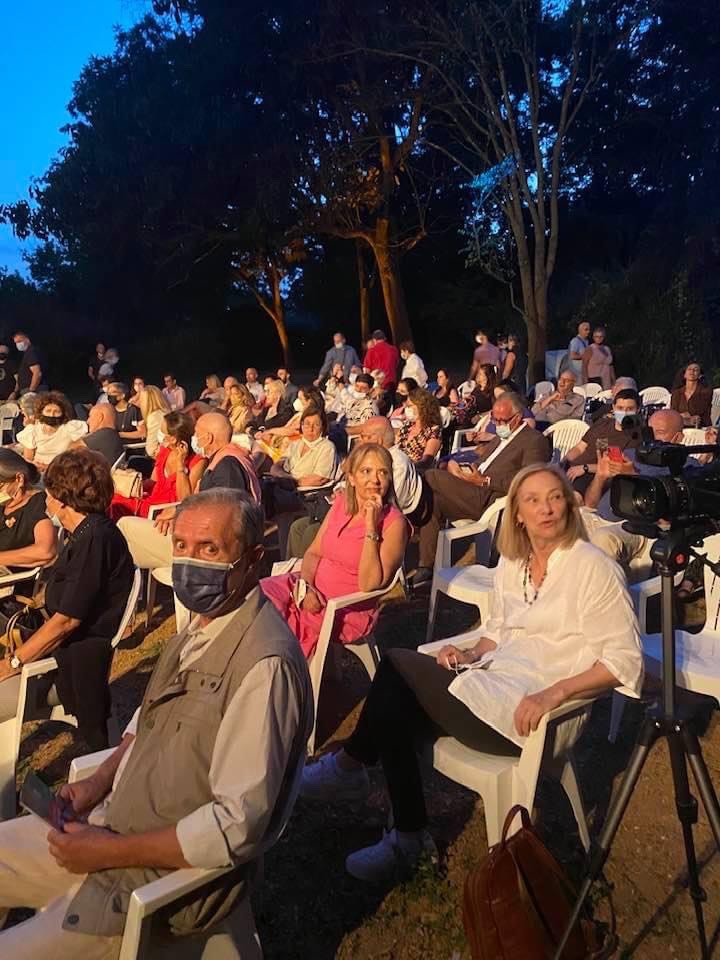
His daughter Elisa Cerocchi is valiantly keeping the flame ignited,with not a little help from Tiziana Cherubini and her sons.And it was they that had managed to fill the concert last night on a balmy Saturday night where the unenlightened had mostly spent a glorious summer day at the nearby seaside of Circeo.
Goffredo Petrassi embracing Mount Circeo in the garden of Ileana Ghione,who took the photo.
The first President of the Campus was the composer Goffredo Petrassi whose precious scores are now kept in the Campus archive.The new honorary president is another distinguished composer Luis de Pablo whose reduction of Ravel’s piano work Valses Nobles for string quartet will receive it’s world premiere,in it’s complete form,tonight in the Castle grounds of Sermoneta.
A fascinating journey devised by Alfonso Alberti for the 700th anniversary of the death of Dante Alighieri and the 150th of the birth of Roffredo Caetani.As Alfonso so eloquently explained many musicians have been inspired by the great poet not least Liszt,who often frequented Ninfa- where his piano is housed to this day.He would come to give lessons to his godson Roffredo Caetani (1871-1961) a gifted composers who’s works are housed in the Caetani Foundation archives.Liszt reflected on the ‘Divina Commedia’which inspired amongst other things his Dante Symphony and his fantasia quasi sonata ‘Après une lecture de Dante’.Works that confront passion ,damnation and salvation even though the later much underlined in crucial moments needs to be questioned and clarified!Liszt’s religious beliefs are certainly not necessarily always serene!Francesca da Rimini by Tchaikowsky in this elaboration by a pupil of Liszt, Karl Klindworth, there is no doubt that it was inspired by the 5th canto ,‘Inferno’ and amongst the numerous sinners emerge the lovers Paolo and Francesca.Verdi was added by Alfonso in his own piano reduction especially made for tonight’s concert.From Paradiso the 33rd canto with the ecstatic words of San Bernardo ‘Laudi alla Vergine Maria’ which in the original are scored for female voices and are from Verdi’s 4 Sacred Pieces.Ingenius too was how Alfonso had found in the Caetani archive a piece with the title :La commedia di un musicista,’Il viaggio immaginario’.He related it to the fact that the Pope Bonifacio VIII was a Caetani and was in Dante’s’Inferno’ and now ironically the last Caetani duke takes up the journey as he too becomes part of the story.As if not enough a Prelude by the elusive figure Alkan (one of his set of 25 !!) which Alfonso has always played as an encore here as it is well suited to this very particular atmosphere (no doubt tongue in cheek too )op 31 n.8 ‘Le chanson de la folle au bord de la mer’!
Some fine totally assured playing from this eclectic artist.The all intrusive I pad nowhere to be seen.This was an artist who had delved deep into the meaning not only of each individual piece but also the overall picture and had the music deep inside him ready to be shared with his very attentive audience.
Interesting family tree of the last of the Caetani’s.Showing Lelia,the daughter of Roffredo as the last of the Caetani’s married to the noble Hubert Howard they did not have children.
Roffredo Caetani does not seem to belong to any school as I was trying to place it as the music evolved in a magisterial performance of gripping intensity and conviction.Could it be that it is a music well crafted but from a craftsman with little to say.Food for thought and I will seek out the recordings that Roberto Prosseda,a local boy made good,has made here in Ninfa on Liszt’s own piano.Roberto Prosseda born in nearby Latina is very much a product of the great musicians invited every year to Sermoneta and was for a brief period artistic director with Fabrizio von Arx before both their distinguished careers took them to different parts of the globe.
The Liszt ‘Dante’ Sonata was given a very assured performance although professional care occasionally took over from the passionate funabulistic outbursts that Liszt demands in this piece written at the height of his fame as a virtuoso.The Dante Sonata was originally a small piece entitled Fragment after Dante, consisting of two thematically related movements , which Liszt composed in the late 1830s.He gave the first public performance in Vienna, during November 1839 but when he settled in Weimar in 1849, he revised the work along with others in the volume, and gave it its present title derived from Victor Hugo’s own work of the same name and it was published in 1856 as part of Années de pèlerinage.
The music box creating the atmosphere for ‘Paradiso’
There was indeed a beautiful stillness to the Verdi ‘Laudi alla Vergine Maria’ even incorporating a hand wound music box to create the atmosphere which was one of purity and serenity played with a disarming simplicity in his own elaboration.
The Francesca da Rimini was a tour de force of memory and transcendental piano playing.I found it hard to follow the musical line which I put down to the transcription of Klindworth who was better known as a music publisher than pianist or composer.As Alfonso added ,with a twinkle in his eye, no doubt he had his eye on revenues from a transcription for piano of this popular overture!
A fascinating evening …Food for thought indeed whilst all those after the beach were stuffing themselves with food for their already overfull stomachs,the magnificent Pontine Festival had once again provided nutriment for the soul !Long may it prosper.
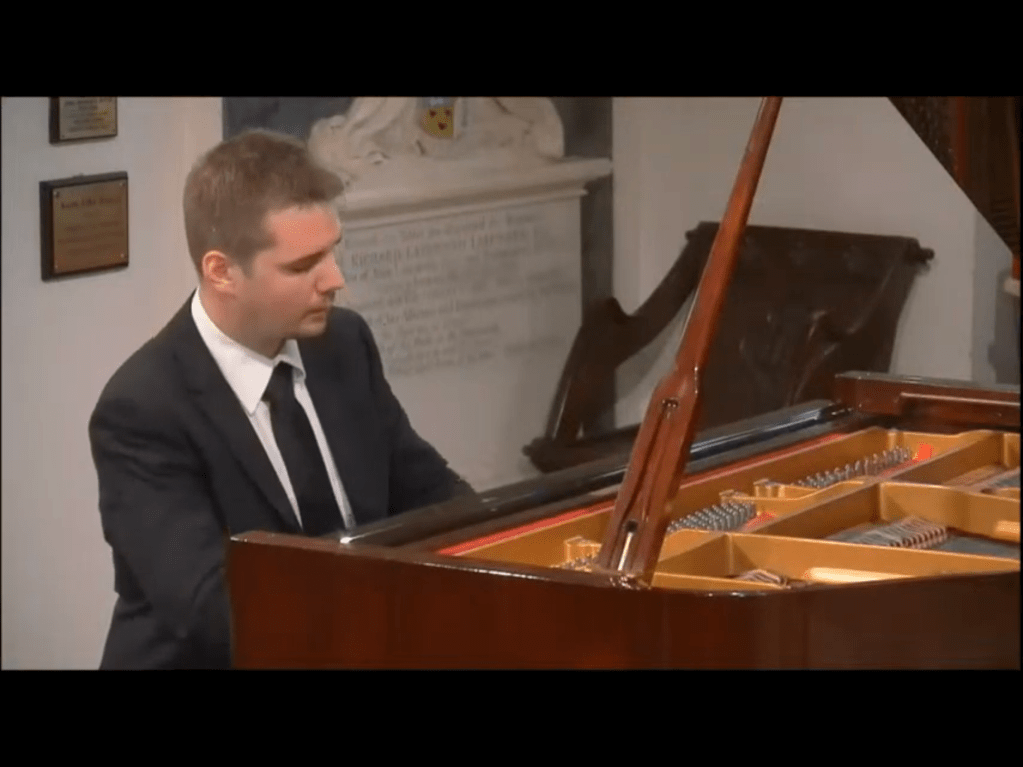
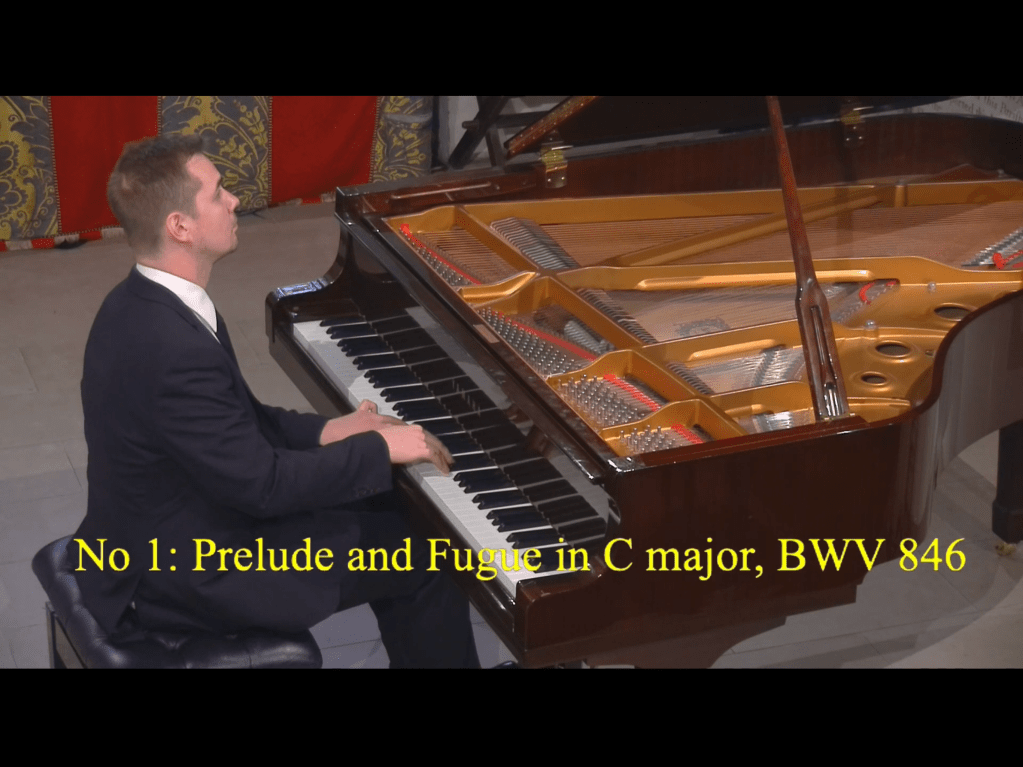
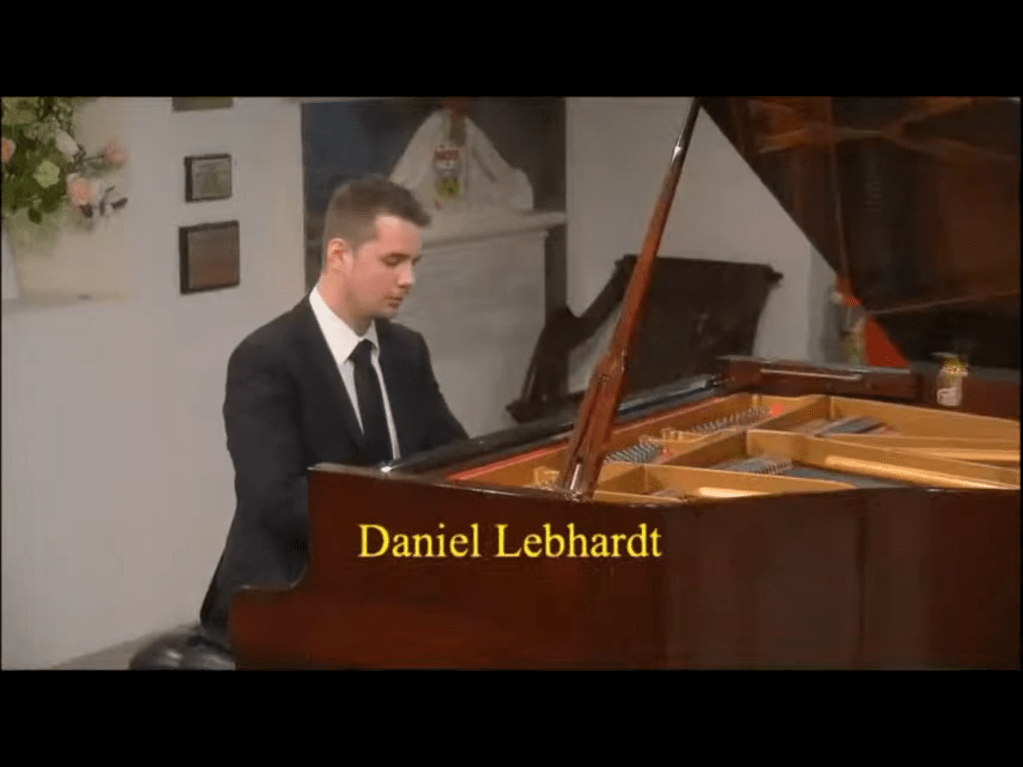
As Dott.Hugh Mather rightly said the last word goes to the universal genius of Bach.After 85 concerts this year and a total of 154 during the lockdown it was fitting that the final word should be given to J.S.Bach especially when played with the simplicity,intelligence and eloquence of a master.I have heard Daniel play many times and he is one of a select group of young musicians fast making a name for themselves .We hear so often in these showcase recitals streamed into our homes wherever that may be on the globe,the great romantic works of the piano repertoire and especially a plethora of Russian classics from Mussorgsky and Scriabin to Shostakovich and Prokofiev but it is rare indeed to hear included the monumental works of J.S.Bach.Goldberg Variations played by Cristian Sandrin and Jonathan Ferrucci stand on an unforgettable pedestal this season on which they are now joined by Daniel Lebhardt today. https://christopheraxworthymusiccommentary.wordpress.com/2021/03/25/goldberg-ferrucci-at-st-marys-the-start-of-a-glorious-journey-of-discovery/. https://christopheraxworthymusiccommentary.wordpress.com/2020/10/13/cristian-sandrin-at-st-marys/
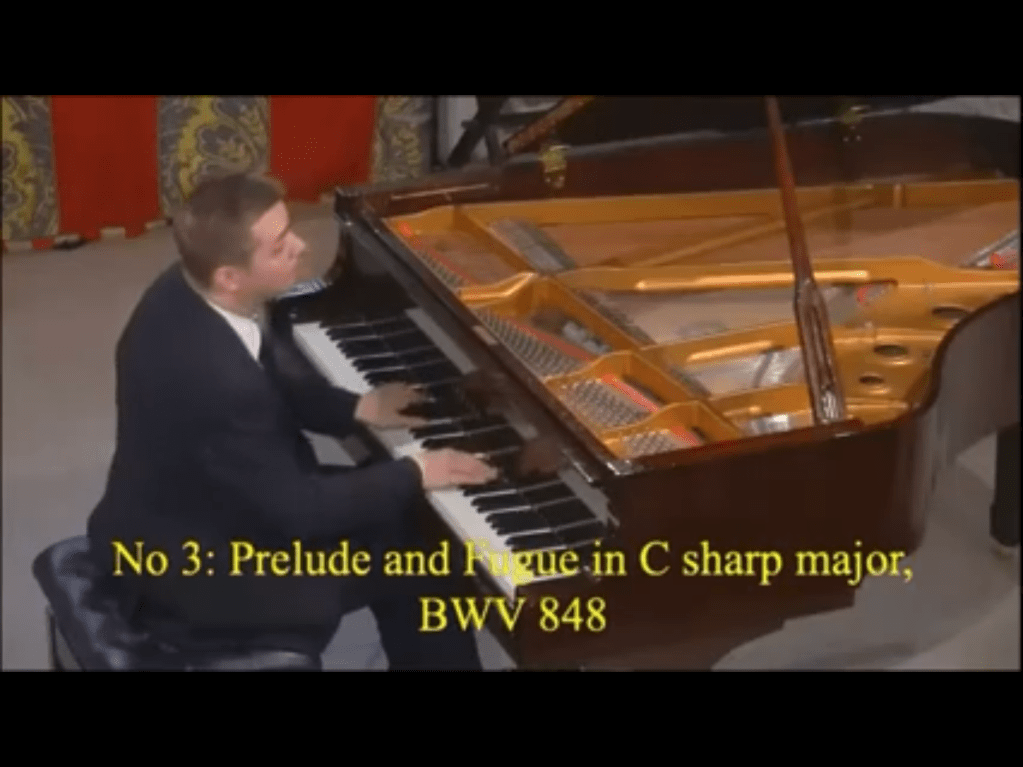
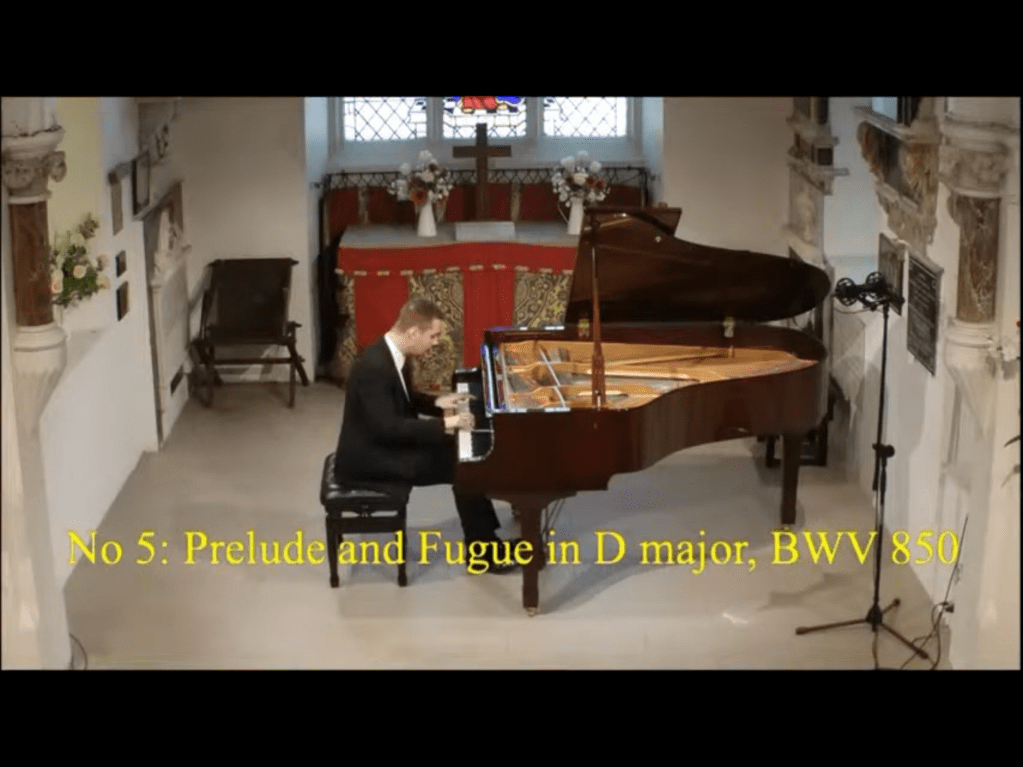
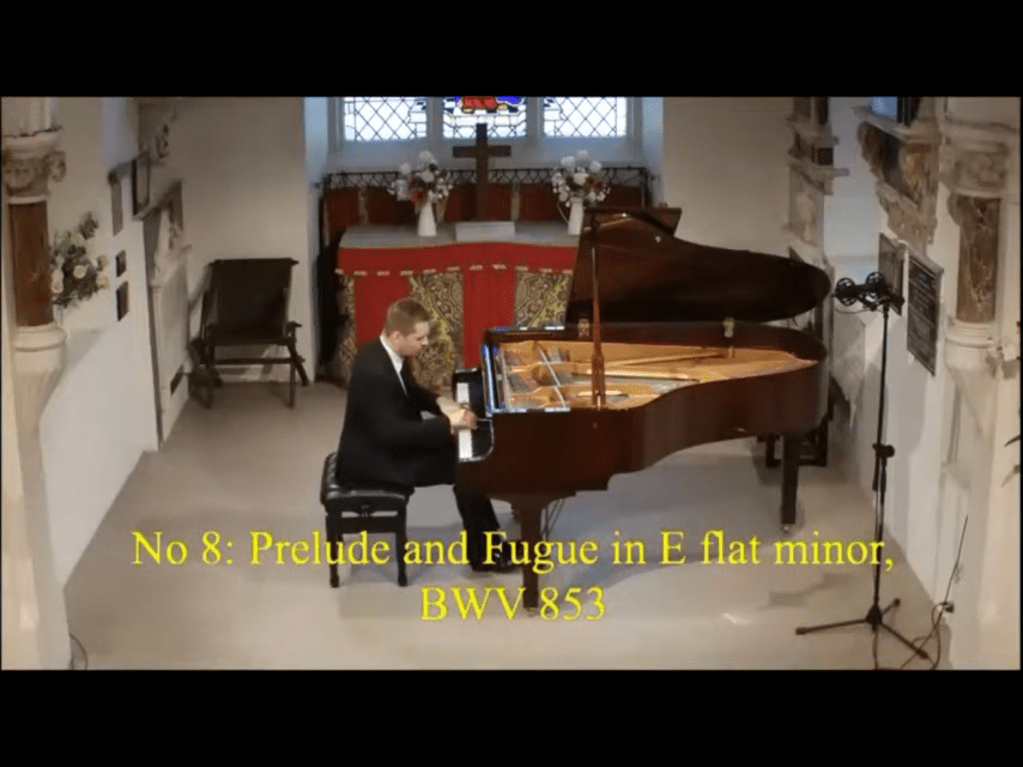
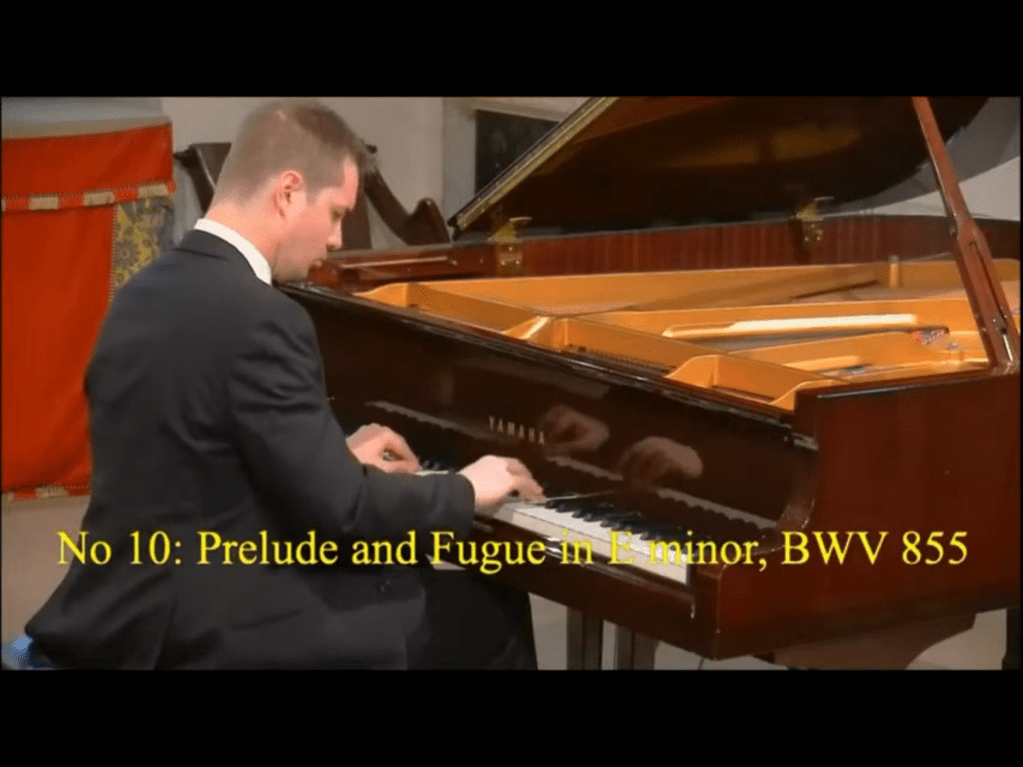
A luminosity and clarity from the very opening simplicity of the Prelude in C to the perpetual movement of the second and the graceful elegance of the third.There was an absolute simplicity to the great C sharp minor Prelude and a monumental inevitability to the five part fugue that follows.Delicacy and virtuosity in the D major Prelude and absolutely no doubt about the French overture dotted rhythm of the fugue.There was a sense of mystery and buoyancy of the D minor Prelude and a beautifully shaped E flat was followed by the joyful playfulness of the fugue.There was absolute stillness and mature serenity followed by a haunting fugue in E flat minor.A pastoral simplicity to the E major with its fugue of real ‘knotty twine’ to use the words of Delius.There was gentleness in the E minor with a luminous melodic line over a continuous stream of mellifluous sounds like a continual gentle flow of water followed by the frantic contrast of the fugue.Simplicity in F major with its continual gentle movement followed by the bucolic fun of the fugue.And to end a gentle melodic line in F minor and the stillness of the fugue .Hopefully this is just the beginning of a complete survey of Bach’s ‘48 from the hands of this master musician.
In 2014 Daniel Lebhardt won 1st Prize at the Young Concert Artists International auditions in Paris and New York. A year later he was invited to record music by Bartók for Decca and in 2016 won the “Geoffrey Tozer Most Promising Pianist” prize at the Sydney International Competition. In 2018 he has been signed for commercial management by Askonas Holt. March 2020 saw Daniel make his debut with The Hallé, performing Beethoven’s Piano Concerto No 5 – a work he has also performed at the Barbican, London and Symphony Hall, Birmingham. The last two concert seasons have also witnessed recital debuts in Dublin and Kiev, and at the Lucerne International, Tallinn International and Miami International Piano festivals. He has received reinvitations to Wigmore Hall, London, the Auditorium du Louvre, Paris and Merkin Concert Hall in New York (‘He brought narrative sweep and youthful abandon to [Liszt’s B minor Sonata], along with power, poetry and formidable technique’ – The New York Times). Other recent highlights include a return to Paris for a recital at L’Église Saint-Germain-des-Près, as part of the festival ‘Un week-end à l’Est’; an appearance as soloist in Mozart’s Piano Concerto No 21 at the Royal Festival Hall, London; and tours in China, South America and the USA. Born in Hungary, Daniel studied at the Franz Liszt Academy in Budapest with István Gulyás and Gyöngyi Keveházi, then with Pascal Nemirovski at the Royal Academy of Music and Royal Birmingham Conservatoire. He was a prizewinner at the Young Classical Artists Trust auditions in 2015 and currently lives in Birmingham.
Bach gave the title Das Wohltemperierte Klavier to a book of preludes and fugues in all twenty-four major and minor keys, dated 1722, composed “for the profit and use of musical youth desirous of learning, and especially for the pastime of those already skilled in this study”. Some twenty years later Bach compiled Book 2, completed in 1742, which was intended as a complement to Book 1. It is generally far more difficult than Book 1, with greater technical and structural difficulty for the performer. It was the ultimate work book, open to constant change and refining by Bach himself.Busoni famously said the first book was for performers and the second for composers. Each set contains twenty-four pairs of preludes and fugues.The first pair is in C major, the second in C minor, the third in C sharp major, the fourth in C sharp minor, and so on. The rising chromatic pattern continues until every key has been represented, finishing with a B minor fugue. The first set was compiled in 1722 during Bach’s appointment in Köthen; the second followed 20 years later in 1742 while he was in Leipzig. Book 2 was written during a period of Bach’s life when many keyboard works appeared including the Klavierübungen Parts 2 and 3, the ‘Goldberg’ Variations of 1741 and the first version of The Art of Fugue. As with these other works, it exemplifies Bach’s inexhaustible musical appetite for different styles.Bach recycled some of the preludes and fugues from earlier sources: the 1720 Klavierbüchlein für Wilhelm Friedemann Bach, J.S.B’s son, for instance, contains versions of eleven of the preludes of the first book of the Well-Tempered Clavier. The C sharp major prelude and fugue in Book 1 was originally in C major. Bach’s title suggests that he had written for a (12-note) well-tempered tuning system in which all keys sounded in tune (also known as “circular temperament”). The opposing system in Bach’s day was “meantone temperament” in which keys with many accidentals sound out of tune.Bach would have been familiar with different tuning systems, and in particular as an organist would have played instruments tuned to a meantone system. It is sometimes assumed that by “well-tempered” Bach intended equal temperament which had been described by theorists and musicians for at least a century before Bach’s birth. Evidence for this may be seen in the fact that in Book 1 Bach paired the E flat minor prelude (six flats) with its enharmonic key of D sharp minor (six sharps) for the fugue. This represents an equation of the most tonally remote enharmonic keys where the flat and sharp arms of the circle of fifths cross each other opposite to C major. Any performance of this pair would have required both of these enharmonic keys to sound identically tuned, thus implying equal temperament in the one pair, as the entire work implies as a whole.Forkel, Bach’s first biographer, reports that Bach tuned his own instruments and found other people’s tunings unsatisfactory; his own allowed him to play in all keys and to modulate into distant keys almost without the listener noticing it. More recently there has been a series of proposals of temperaments derived from the handwritten pattern of loops on Bach’s 1722 title page.
These loops (though truncated by a later clipping of the page) can be seen at the top of the title page of the first book of The Well-Tempered Clavier, 1722, showing the handwritten loops which some have interpreted as tuning instructions:Each prelude is followed by a fugue in the same key. In each book the first prelude and fugue is in C major, followed by a prelude and fugue in its parallel minor key C minor. Then all keys, each major key followed by its parallel minor key, are followed through, each time moving up a half tone:C → C♯ → D → E♭ → E → F → F♯ … →ending with … → B♭ → B.The two major primary sources for the collection of preludes and fugues in Book 2 are the “London Original” manuscript, dated between 1739 and 1742, with scribes including Bach, his wife Anna Magdalena and his eldest son Wilhelm Friedemann, which is the basis for Version A. Version B is the version published by the nineteenth-century Bach-Gesellschaft, a 1744 copy primarily written by Johann Christoph Altnickol (Bach’s son-in-law), with some corrections by Bach himself, and later also by Altnickol and others.Mozart transcribed seven of the fugues of the Well-Tempered Clavier Book 2 for string ensemble showing the influence that the Well-Tempered Clavier had on him. Beethoven played the entire Well-Tempered Clavier by the time he was eleven, and produced an arrangement of BWV 867 no. 22 in B flat minor Book 1, for string quintet.Hans von Bulow, Liszt’s son in law, called The Well-Tempered Clavier the “Old Testament” where Beethoven’s sonatas were the “New Testament”. Von Bülow gave the first performance of Tchaikovsky’s famous piano concerto and also Liszt’s B minor Sonata, but had a distaste for the endless insistence for encores. He would raise his hand, saying “Ladies and Gentlemen! If you do not stop this immediately I shall play you Bach’s forty-eight preludes and fugues from beginning to end!” The audience laughed but also stopped applauding as they knew von Bülow was able to perform the work from memory.Bach’s example inspired numerous composers of the nineteenth century. For instance, in 1835, Chopin composed his 24 Preludes op. 28;
Ileana Ghione in our theatre with Tatyana Nikolaeva
Dmitri Shostakovich wrote his 24 Preludes and Fugues after he had been inspired by Tatyana Nikolayeva’s Gold Medal performances at the Bach Competition in Leipzig in 1950 marking the bicentennial of J.S.Bach’s death.Inspired by the competition and impressed by Nikolayeva’s playing, Shostakovich returned to Moscow and started composing his own cycle of 24 preludes and fugues. He worked quickly, taking only three days on average to write each piece. The cycle was dedicated to Nikolayeva on completion in 1951.Musically, the structural regularities of the Well-Tempered Clavier encompass an extraordinarily wide range of styles, more so than most pieces. The preludes are formally free, although many of them exhibit typical Baroque melodic forms, often coupled to an extended free coda.The preludes are also notable for their odd or irregular numbers of measures, in terms of both the phrases and the total number of measures in a given prelude.Each fugue is marked with the number of voices, three or four only in Book 2. There are ten binary movements among the preludes (double bar in the middle, with repeats and written in the new ‘sonata form’) which is the most obvious innovation in Book 2, though ‘sonata’ here is close to Scarlatti’s conception, not Mozart’s. This gives the preludes much greater size and stature on average than they had in Book 1.Book 2 shows very clearly Bach’s integration of European styles, in particular between the Italian tradition for display and French dance forms that we see also in the partitas.It is interesting to note Rosalyn Tureck’s observation that Bach writes in his own ornamentation for Book 2 whereas the ornamentation for Book 1 was left to the artist’s discretion, much to Bach’s dissatisfaction.
J.S.Bach
It is interesting to note the figure of Ebenezer Prout (1 March 1835 – 5 December 1909) who was an English musical theorist, writer, music teacher and composer, whose instruction has been embodied in a series of standard works still used today, and underpins the work of many British classical musicians of succeeding generations.He has one rather unexpectedly appealing trait: he added words to the fugue subjects of Bach’s ‘48’ to help his pupils remember them. The idea being that not only did the words help them memorise the fugue subject but they also helped delineate when the fugue subject started and finished.
Book I
He went to town in a hat that made all the people stare.
John Sebastian Bach sat upon a tack, but he soon got up again with a howl!
O what a very jolly thing it is to kiss a pretty girl!
Broad beans and bacon…(1st countersubject)…make an excellent good dinner for a man who hasn’t anything to eat.(2nd countersubject)…with half a pint of stout.
(Subject) Gin a body meet a body Comin’ through the rye, (Answer) Gin a body kiss a body, Need a body cry?
He trod upon my corns with heavy boots—I yelled!
When I get aboard a Channel steamer I begin to feel sick.
You dirty boy! Just look at your face! Ain’t you ashamed?
Hallo! Why, what the devil is the matter with the thing?
Half a dozen dirty little beggar boys are playing with a puppy at the bottom of the street.
The Bishop of Exeter was a most energetic man.
The slimy worm was writhing on the footpath.
Old Abram Brown was plagued with fleas, which caused him great alarm.
As I sat at the organ, the wretched blower went and let the wind out.
O Isabella Jane! Isabella Jane! Hold your jaw! Don’t make such a fuss! Shut up! Here’s a pretty row! What’s it all about?
He spent his money, like a stupid ass.
Put me in my little bed.
How sad our state by nature is! What beastly fools we be!
There! I have given too much to the cabman!
On a bank of mud in the river Nile, upon a summer morning, a little hippopotamus was eating bread and jam.
A little three-part fugue, which a gentleman named Bach composed, there’s a lot of triple counterpoint about it, and it isn’t very difficult to play.
Brethren, the time is short!
He went and slept under a bathing-machine at Margate.
The man was very drunk, as to and fro, from left to right, across the road he staggered.
The ovation greeting Rosalyn Tureck’s return to the concert platform in 1991
It was in 1991 that I had invited both Rosalyn Tureck and Tatyana Nikokaeva to perform the Goldberg Variations within a month of each other in my series of ‘Euromusica -Teatro Ghione’ in Rome.I was fascinated by the different approach of these two master musicians.Tureck like an unmovable rock on which Bach was carved in stone.Nikolaeva where the natural flexibility of the song and dance was somewhat reminiscent of Edwin Fischer.Tureck had been studying the A minor fugue from book 1 n.20 during her studies at Juilliard with Olga Samaroff ( Lucy Hickenlooper ,wife of Leopold Stokowski (Leonard Stokes),when she had a revelation that rather than change instrument she would renew the pianistic style to suit Bach.It created quite a revolution that much influenced Glenn Gould which he later brought to rockstar proportions.
Rosalyn Tureck retired to Oxford to study in depth the more scientific aspects of the genius of Bach with the creation of her Tureck Bach Research Institute.After I had persuaded her to return to public performance she had a true Indian summer and became at the age of 78 a star shining brightly again in Italy and elsewhere.I was invited to be a trustee of her Oxford Institute where she would hold symposia for mathematicians,scientists and musicians to delve deep into the different aspects of the genius of Bach.Alas at the age of 85 her friend and long time sponsor died and she had to provide documents and details for his foundation that had been sustaining her research,which she found too onerous at her age.She fled to Marbella and got the Queen Elisabeth to return to New York in style.She had be diagnosed with cancer years before but it had remained stationary until now.She arrived back in New York on 9/11 much to everyone’s deep concern for her safety.She took a house overlooking the Hudson in Riverdale much as Toscanini had done before her and the very day she died she had been celebrated with a special award for her life’s work.Michael Cherry her lifelong friend and founder of her American Bach Institute hurried to take it to her in person but she had died half an hour before.
Ileana Ghione at our home in Sabaudia with Rosalyn Tureck
It was also interesting to hear another young musician ,Andrea Bacchetti,playing Book 2 in Genoa during the lockdown and I include some notes that I made that will be included in the CD that is being published shortly .
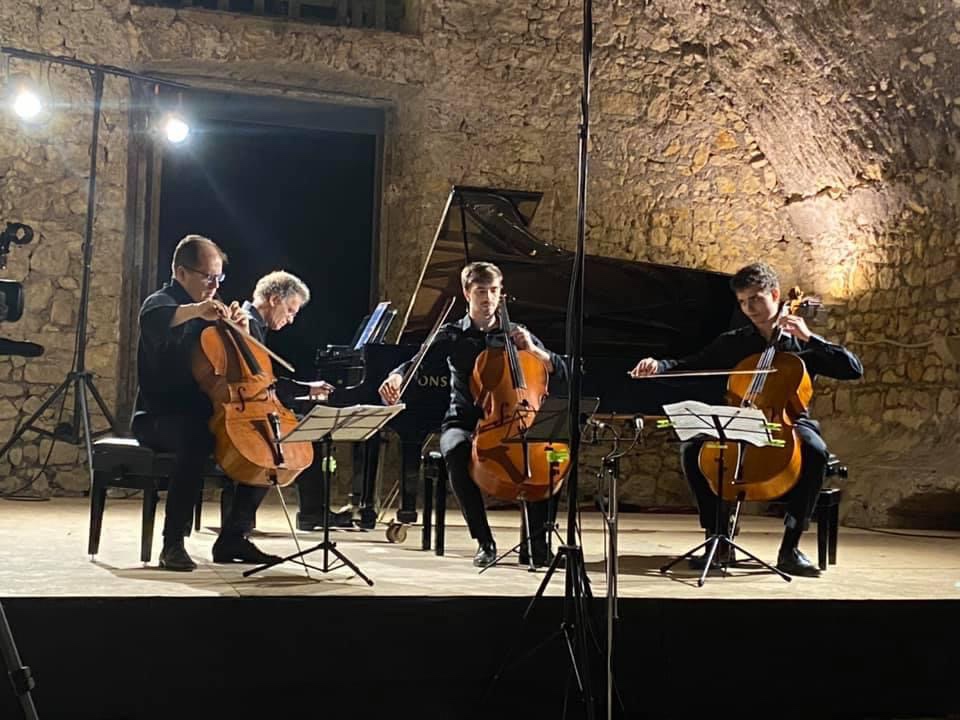
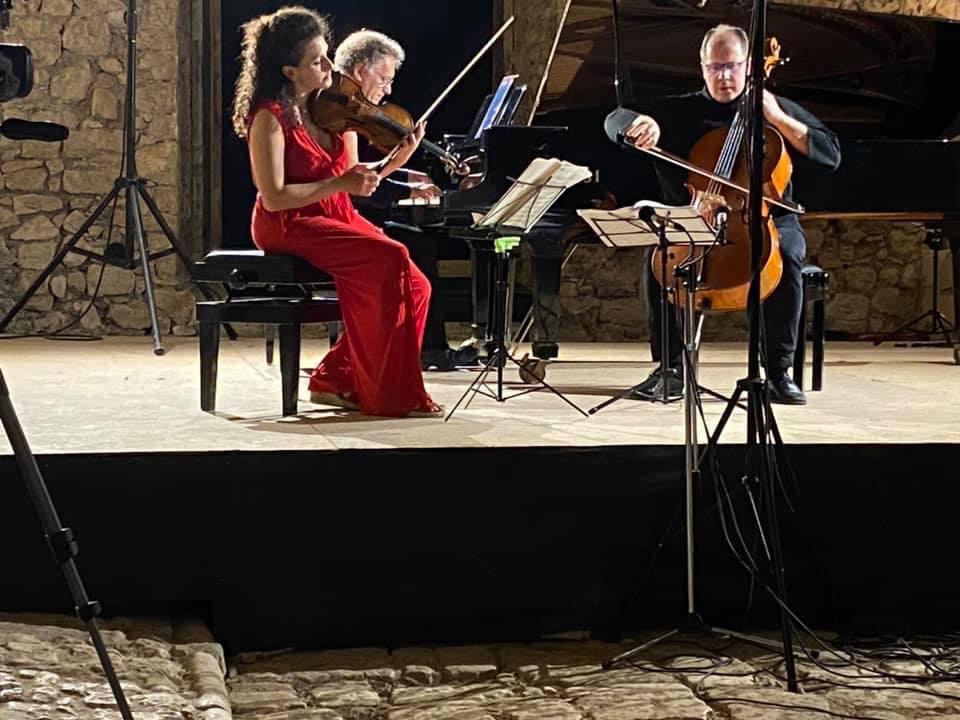
Ferschtman-Gnocchi-Lucchesini Trio in Sermoneta Giovanni Gnocchi’s selfless dedication to music and his quest to help talented young musicians by playing together with them gave us a very welcome unannounced addition to the programme with a Requiem by David Popper dedicated to the great cellist Rocco Filippini who passed away earlier this year. Gnocchi too had taken part in a concert in 1995 when he was in the masterclasses of Rocco Filippini who together with Bruno Canino,Bruno Giuranna,Mariana Sirbu,Franco Petracchi and many other distinguished musicians maintained the great principles of Sermoneta as laid down in stone in the 60’s by Menuhin and Szigeti.
Involving Andrea Lucchesini too with the glorious intense sounds of the three cellos of Giovanni Gnocchi,Leonardo Notarangelo ,Luigi Visco and the piano resounding around the Stables of the Castle that Filippini knew so well for so many years.
Liszt recommended Popper for a teaching position at the newly opened string department at the Conservatory in Budapest where he participated in the Budapest Quartet with Jeno Hubay.He and Hubay performed chamber music on more than one occasion with Brahms including the premiere of Brahms’s Piano Trio in C minor op 101 in Budapest, on December 20, 1886.Popper was a prolific composer of cello music, writing four concertos a Requiem for three cellos and orchestra (1891) and a number of smaller pieces which are still played today.He was born in Prague in 1843 and was one of the last great cellists who did not use an endpin
Three pieces from the suite by Glière( born in Kiev in 1875)for violin and cello opened the announced programme.From the intense tone in the Prelude of Gnocchi’s cello resounding in this atmospheric space and with the searing beauty of Liza Ferschtman’s violin in the Berceuse disappearing to a whisper as the final mellifluous duet of the Canzonetta took over.
This was just a prelude to the great Kodaly duo that like his solo cello sonata is a remarkable monument to this much neglected Hungarian composer.I remember hearing André Navarra in 1985 give an unforgettable performance in Sermoneta of the Kodaly monumental solo sonata.Bartók and Kodály cultivated a distinct Hungarian musical identity, deeply rooted in folk sources. Bartók later extolled his colleague: “If I were to name the composer whose works are the most perfect embodiment of the Hungarian spirit, I would answer Kodály”.Violin and cello seems barely sufficient to contain the work’s muscular content, as though Kodály were dressing a giant in tight- fitting clothes. Though a relatively early work in Kodály’s broad oeuvre (a catalogue including some twenty chamber works, yet more exten- sive in the realms of vocal, choral, and pedagogical music), the duo nevertheless illustrates the essence of the composer’s mature musical language. Primacy of melody is on display throughout the work. The cello begins the first movement with a proud, folk-like theme, proclaimed forte, risoluto; the violin comments with equally assertive double- and triple-stopped chords. A lyrical second theme appears, piano, tranquillo, paced by steady pizzicati. From the grandiose awakening of the Allegro serioso to the deep lament of the Adagio and the sheer exhilaration and trancendental mastery of the Presto it was a masterly performance played as one.
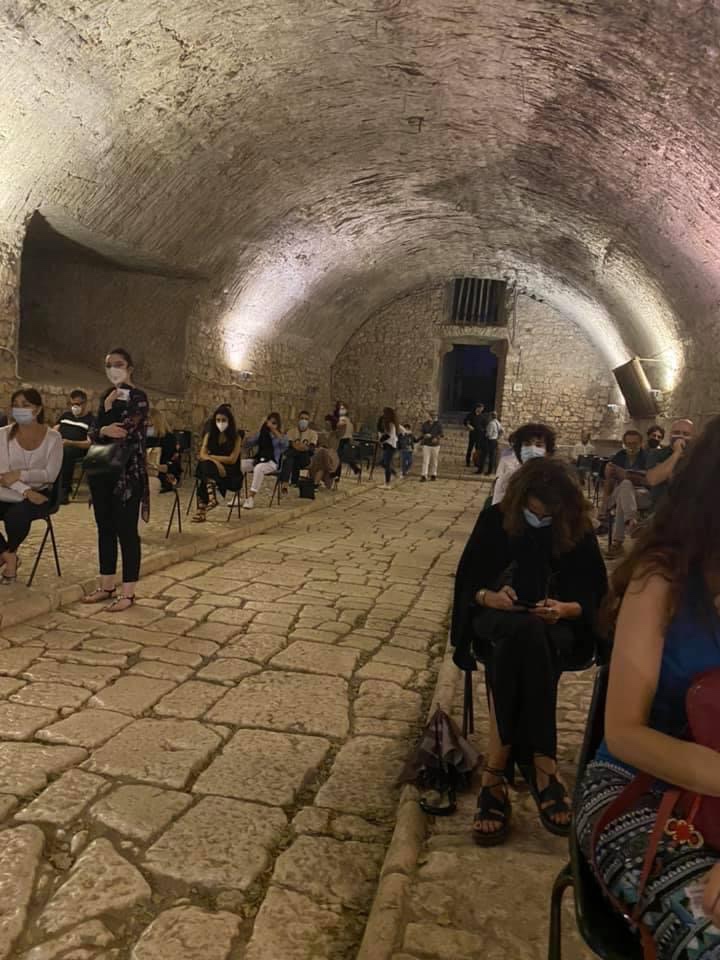
The evening magic that surrounds Sermoneta Castle
It was the demonstration that Sermoneta’s noble musical values are in good hands with musicians dedicated to the musical principles that have always been the emblem of Sermoneta maintained so faithfully by the Cerocchi family. From father Riccardo to daughter Elisa the flame ignited by the enlightened Caetani- Howard family in the 60’s is still shining brightly.
It was demonstrated with the inclusion of Andrea Lucchesini into this select group.A pianist who had impressed the legendary Shura Cherkassky when he was invited to listen to a young boy in Luciano Berio’s house in Tuscany.I had accompanied Shura to play in Empoli,the birthplace of Busoni, in the ‘90’s and he was most impressed by this student of Maria Tipo. Lucchesini has gone on to have an illustrious career but always allied to the highest musical principles that have brought him to direct the renowned Academy in Fiesole and now the Filarmonica in Rome. And so it was fitting that he should be passing on his knowledge to the next generation in the renowned courses in Sermoneta that have left such a sign and formed so many great musicians in the past.
Sketches for the 3rd and 4th movements of the trio op 97
It was the pure magic of the Archduke Trio that filled the air with refined music making from three great musicians listening so attentively to each other in a musical conversation of the highest calibre.How we are being bombarded in the Mass media by vulgarity and ignorance as virtuosi of the football pitch are passed the microphone and whose views are treated as gospel!It was a relief to hear the eloquence of the opening statement of one of Beethoven’s greatest works played with such aristocratic nobility on the piano and answered by the refined,passionate involvement of violin and cello.It created such magic from the outset.The interplay between the cello and violin in the Scherzo erupting into a mellifluous outpouring of glorious exhilaration before the deeply contemplative Andante cantabile leading to the exhuberance of the final Allegro moderato.
An extraordinary performance by three great musicians who after such an exhilarating performance insisted on sharing their ovation with the two young musicians who had opened this evening of sublime music making . An evening dedicated to the memory of Rocco Filippini where the walls of this castle have absorbed so many of his masterly performances in the past.
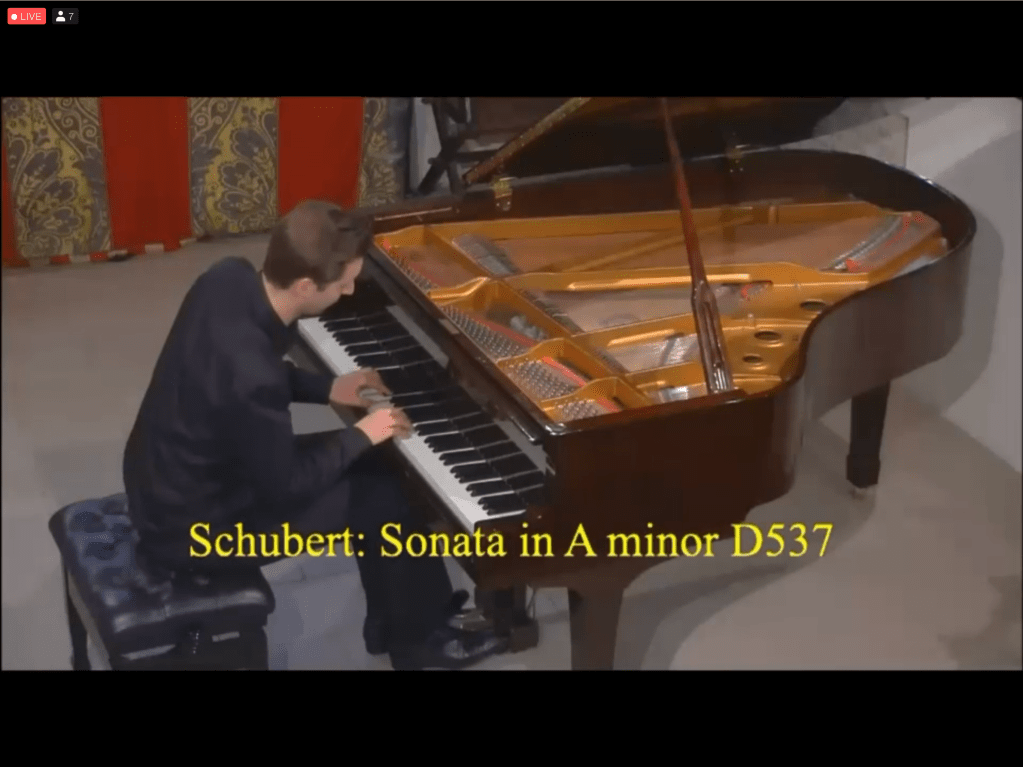
Schubert: Sonata in A minor D 537 Allegro / Allegretto / Allegro
Brahms: Rhapsody in B minor Op 79 no 1
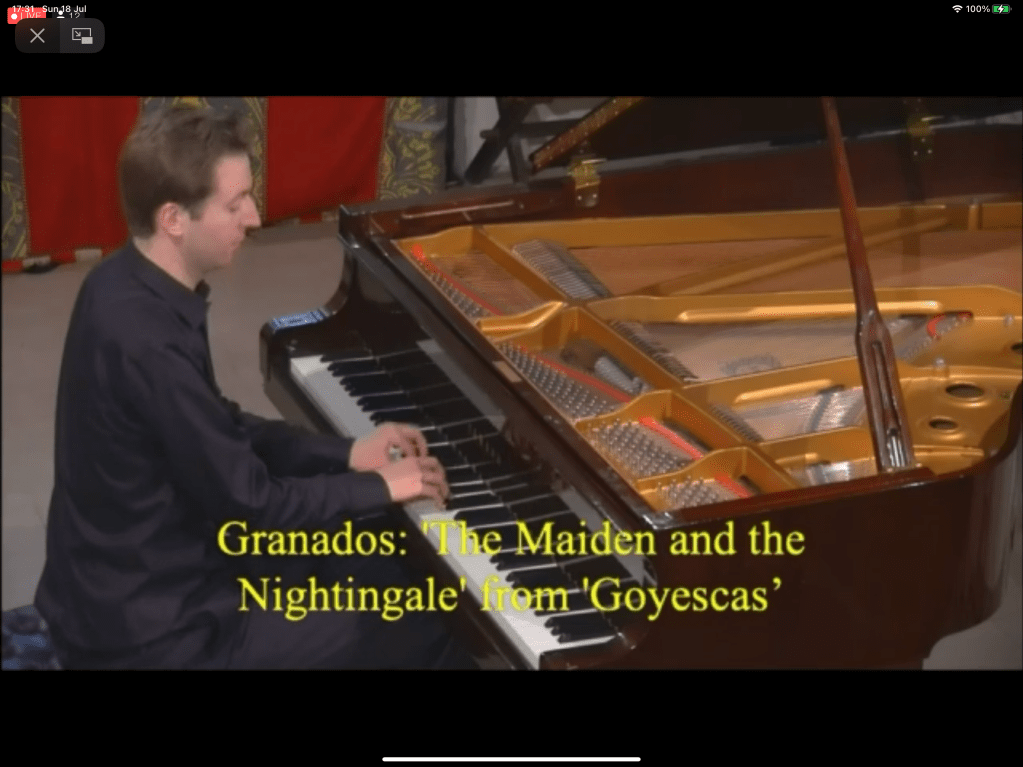
Granados: ‘The Maiden and the Nightingale’ from ‘Goyescas’
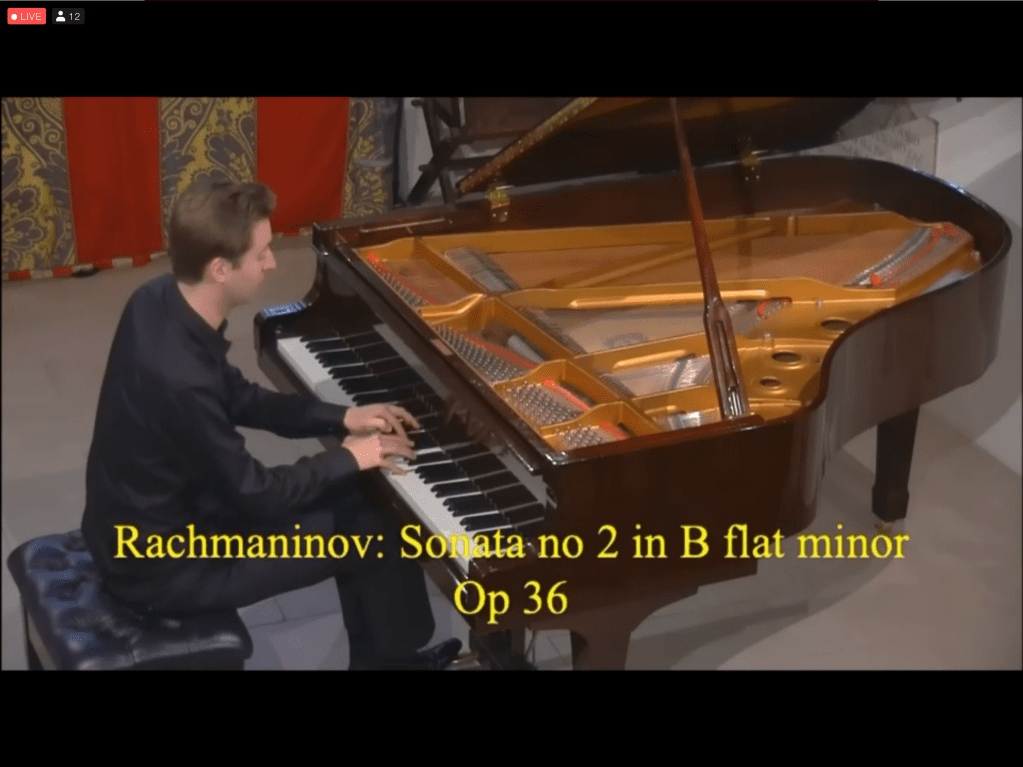
Rachmaninov: Sonata no 2 in B flat minor Op 36 Allegro / Lento / Allegro
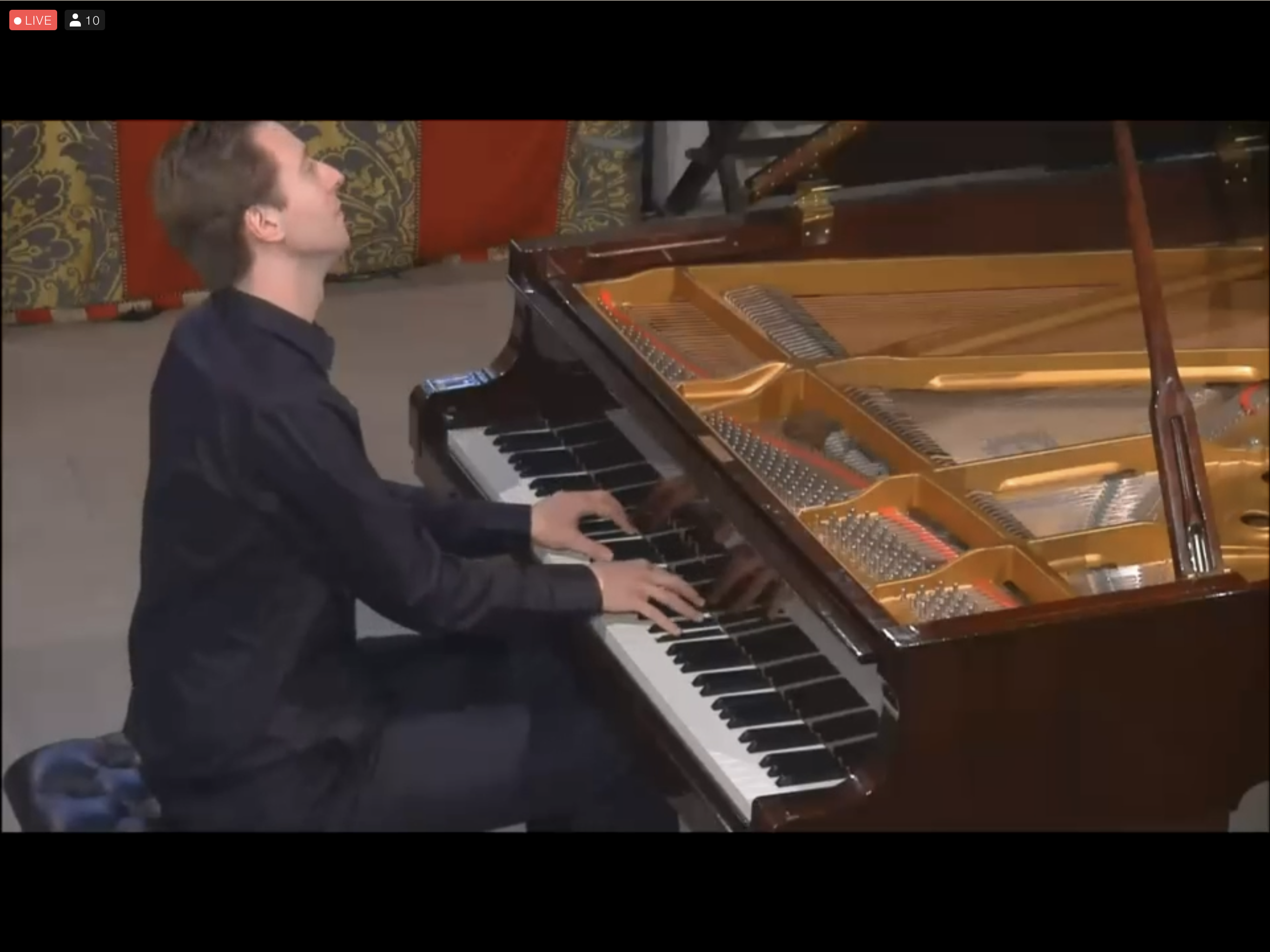
Some superb musicianly playing from Jamie Bergin as you might expect from the assistant of the heroic Lars Vogt.
An early A minor sonata of Schubert was played with extraordinary orchestral texturing that brought everything he did vividly to life.His sense of dance and rhythmic energy allied to some truly magical colouring brought eloquence and shape to this comparatively rarely played sonata. Even the Allegretto,that Schubert was later to use in his penultimate sonata,was embellished with such charm and subtlety.The beautiful legato melody shaped with such loving care as the left hand staccato was so delicately traced.There was a wonderful sense of improvisation in the Allegro vivace last movement with delicate fragments united by a beautifully shaped ascending scale and comments of almost Mendelssohnian lightness and agility.
His superb musicianship shone out in the Brahms Rhapsody where his attention to every minute indication led to a refreshingly mellifluous opening which contrasted so well with the ravishing fluidity of the middle section.The way he led from one episode to another was real poetry and of a true artist who seemed to have the same vision that Brahms had tried to capture with pencil on paper. The final exciting climax was always within the framework of his architectural vision and made its gradual disappearance a hypnotic succession of magical sounds.
There was beauty and simplicity in the Maiden and the Nightingale with a melodic line accompanied by sumptuous colours played with great sensitivity.Barely whispered confessions mingled with outbursts of passion and a tenor who suddenly made his voluptuous appearance.A truly magical moment was the reappearance of the Maiden with heart rending simplicity answered by the eloquence of the nightingale as it disappeared into the distance with infinite nostalgia.
Rachmaninov’s powerful B flat minor sonata was rarely played until Horowitz introduced it into his last performances. From that moment it has become in too many cases a show case of barn storming passion and flamboyant virtuosity. Today in Jamie’s musicianly hands it was restored to the remarkable work that Horowitz indeed had reminded us of. Jamie has a transcendental technical prowess;a powerful machine that is directed by his poetic sensibility and musicianly sense of architectural shape.His wonderful sense of balance allowed the melodic line to sing out always so clearly.There was of course the sumptuous passionate final outpouring of voluptuous sounds and the breathtaking feats of agility in the coda.But there was also such beauty and gentleness in the meno mosso and a beautiful purity of sound in the non allegro with an extraordinary palette of colours from the underlying harmonies.The enormous amount of notes ,that the great virtuoso Rachmaninov did not spare himself,were however shaped into a seamless stream of quicksilver sounds of ravishing beauty. A remarkable work of passion, beauty and excitement restored so eloquently by Jamie today to its rightful place in the piano repertoire
Jamie Bergin was born in 1989 and comes from Great Britain. He attended Chetham’s School of Music in Manchester where he studied with Murray McLachlan and completed his Bachelor of Music degree at the Guildhall School of Music and Drama in London where he studied with Joan Havill. He recently completed the Soloklasse (artist diploma) degree at the University of Music in Hannover where he studied with Karl-Heinz Kämmerling and Lars Vogt. In October 2016, Jamie became the assistant of Lars Vogt’s class in Hannover.He has won various prestigious prizes at international competitions including First Prize, Audience Prize and the prize for best interpretation of the commissioned work at the Europäische Klavierwettbewerb Bremen 2012, and Second Prize and the Carl Nielsen Prize at the ‘Bang and Olufsen’ Piano-RAMA International Competition 2011 in Denmark. In 2014, he won the Chopin Wettbewerb (Stiftung Kurd Aschenbrenner) in Cologne, Germany. He has received major scholarships from the Musicians’ Benevolent Fund, the Countess of Munster Musical Trust and Spannungen Chamber Music Festival in Heimbach. Over the past few years, Jamie has performed solo recitals and concertos throughout Europe at internationally renowned halls including the Bridgewater Hall, St Martin-in-the-fields, The Barbican, the Sage Gateshead, Berliner Philharmonie and die Glocke in Bremen. He has made appearances with distinguished orchestras including the Royal Northern Sinfonia, Manchester Camerata, Bremen Philharmonic and Aarhus Symphony Orchestra. Jamie has appeared at international festivals such as ‘Klavier Festival Ruhr’ (Essen), Schumann (Bonn) and ‘Spannungen’ (Heimbach). He was also featured in a documentary broadcast several times on Channel 4. His performances have been broadcast on radio stations including Radio Bremen and Deutschlandradio Kultur. In June 2016, Cavi-music released an album of chamber music taken from live performances at the Spannungen Kammermusikfest in Heimbach where Jamie plays works by Klughardt and Saint-Saëns.



















































 ChristopherAxworthy-MusicCommentary