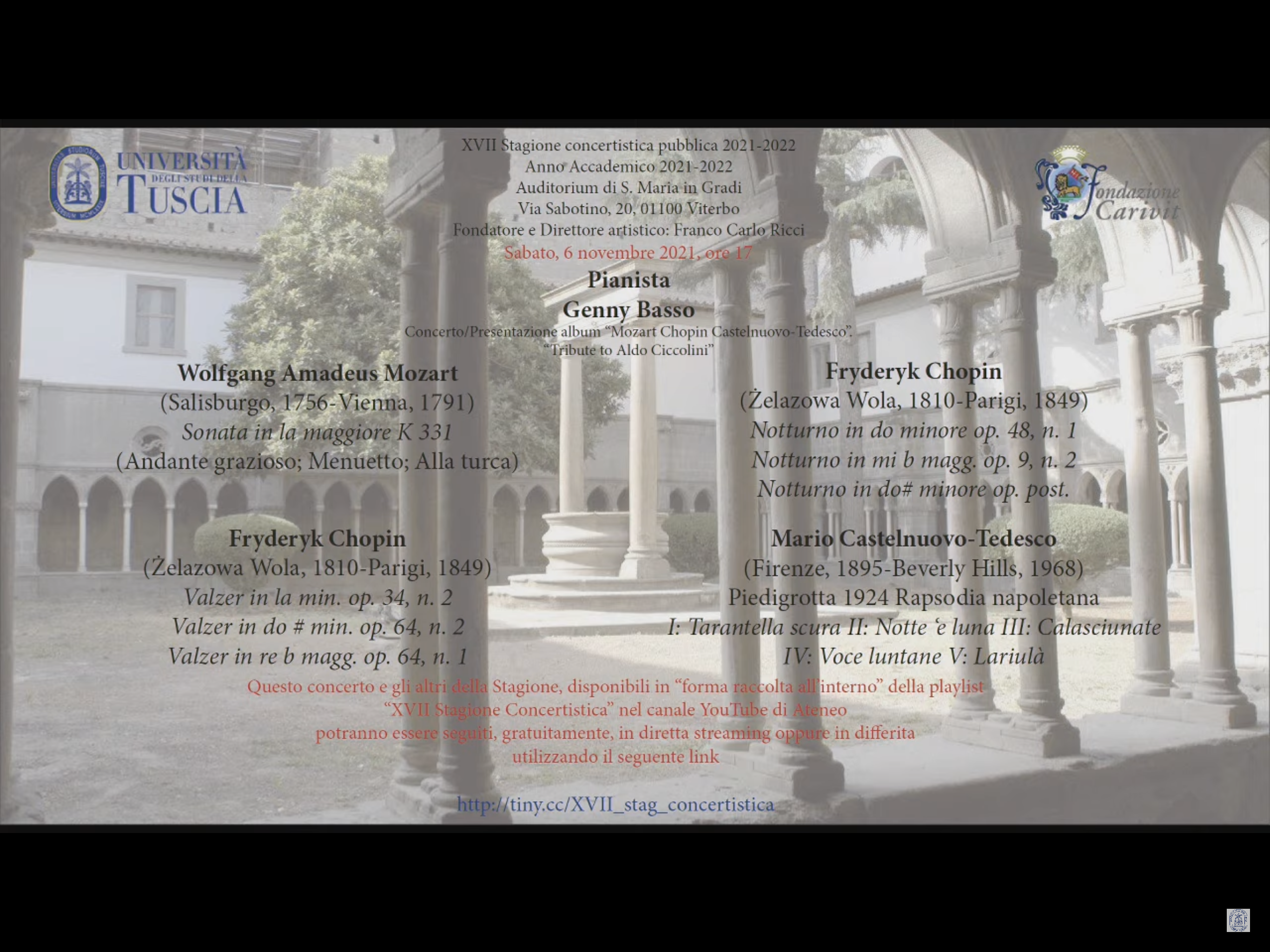
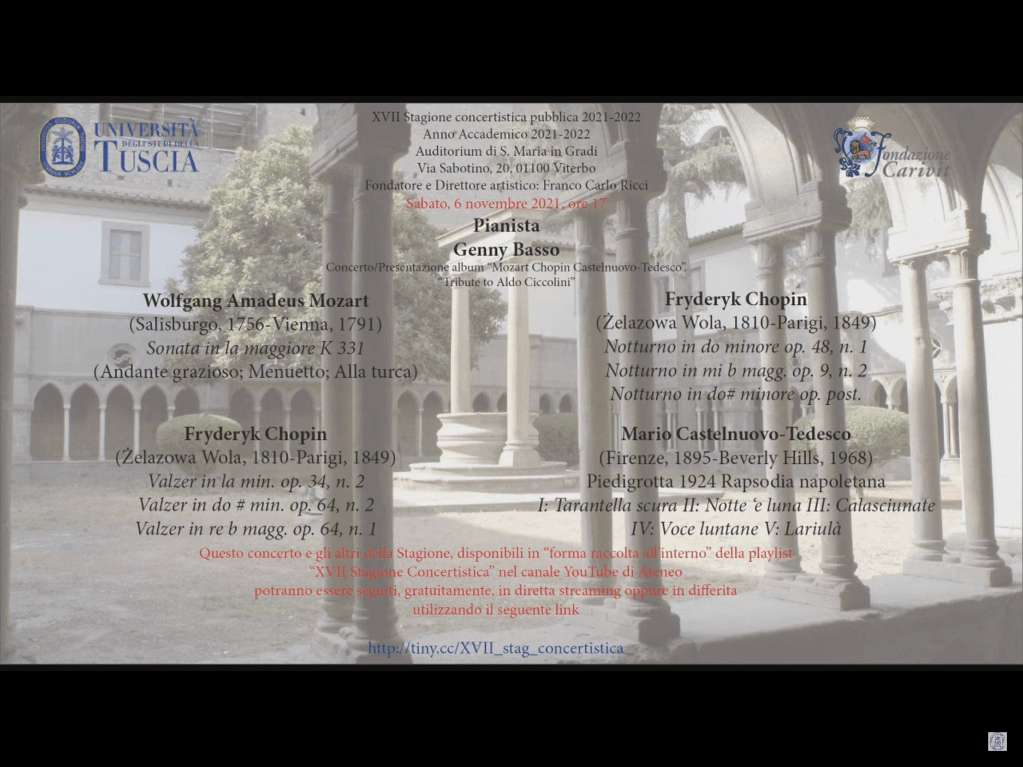
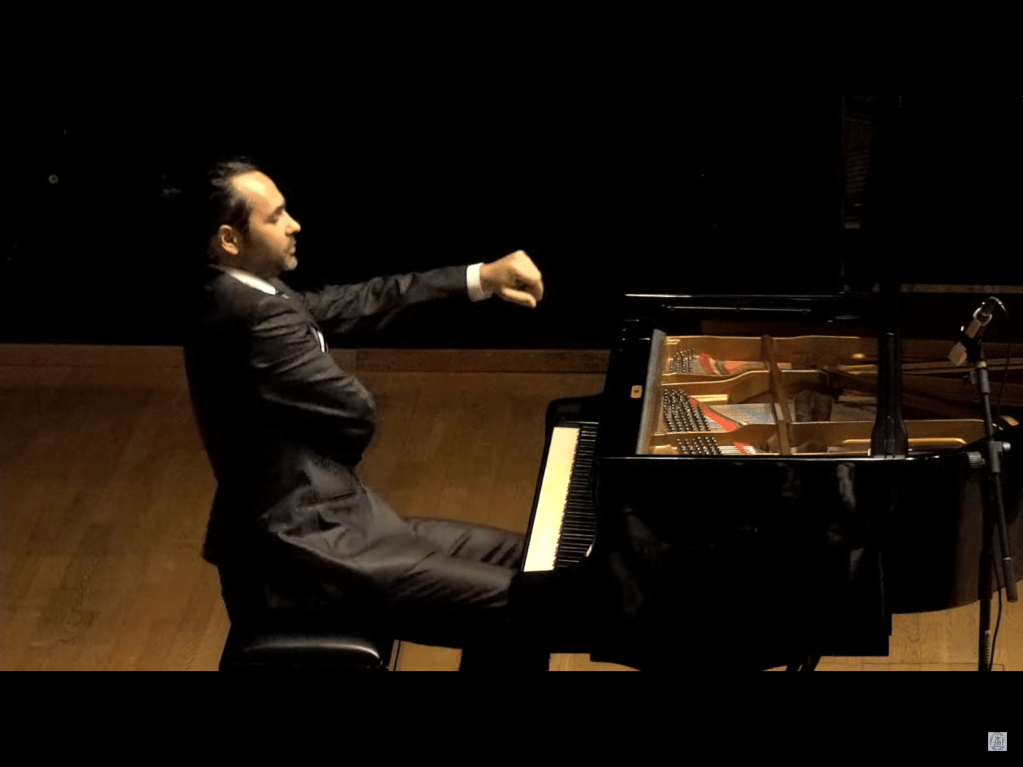
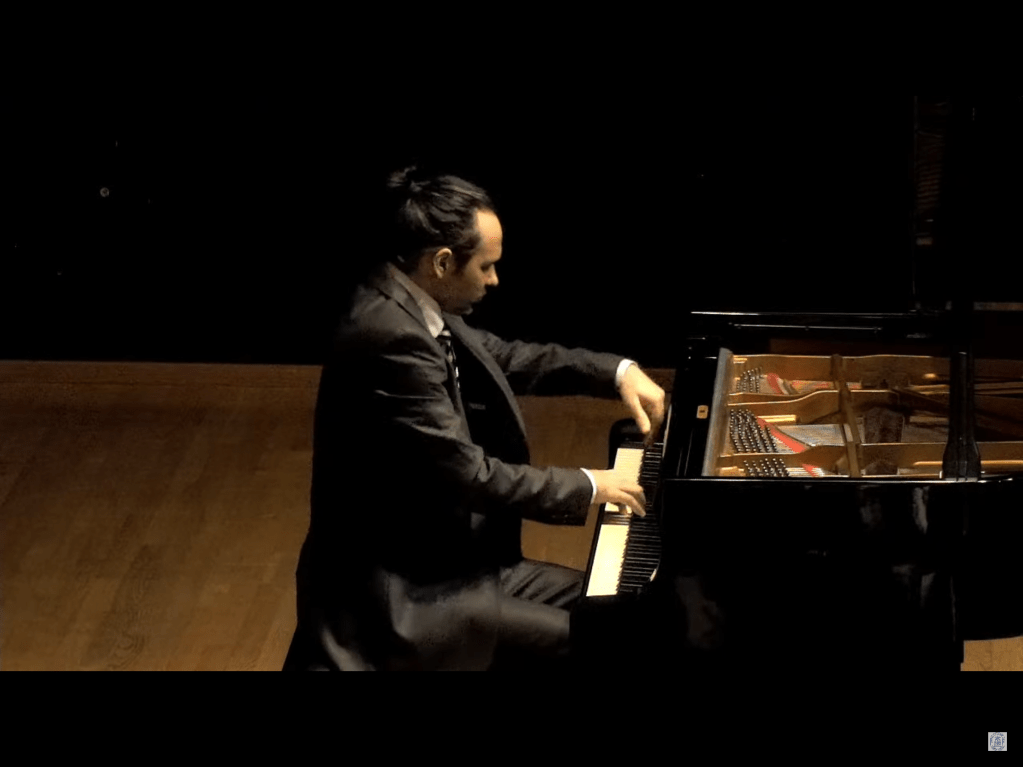
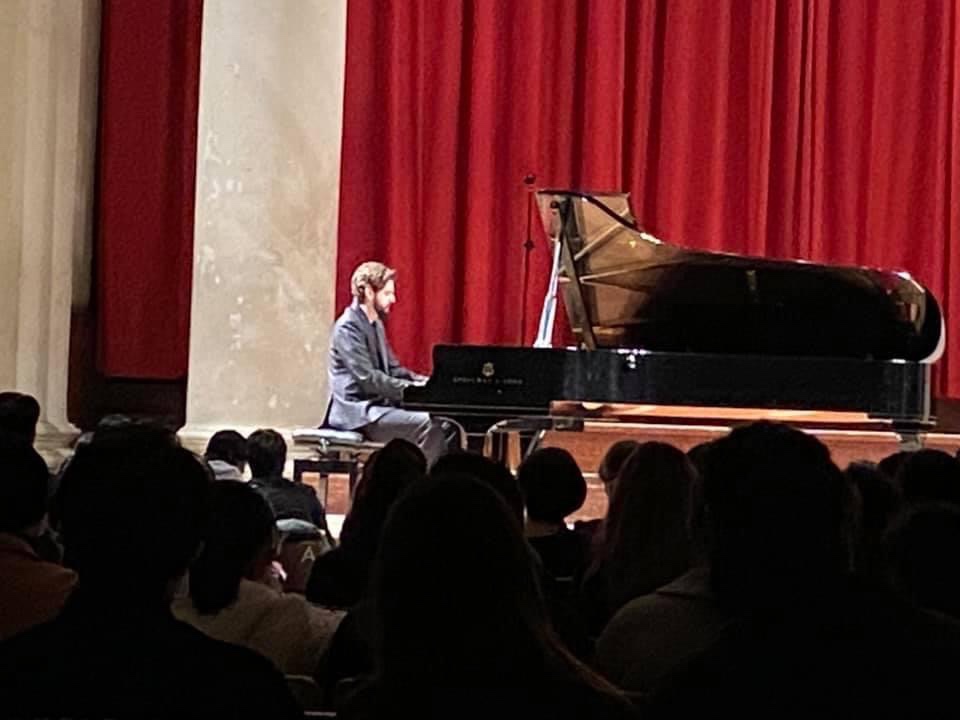
Some very fine playing from Genny Basso paying homage to his teacher Aldo Ciccolini in a presentation concert of his CD ‘Tribute to Aldo Ciccolini Mozart-Chopin-Castelnuovo Tedesco’ relayed live from Viterbo University. Mozart Sonata in A K 331 was played with great style and ravishing tone.A simplicity but of great character,from the opening variations played with great beauty and sense of architectural shape. A contrasting Menuetto played with imposing authority before the beguiling Alla turca played at a very deliberate tempo that was superbly maintained with irresistible charm and grace.
The sombre Waltz in A minor op 34 was played with a flexibility and subtle sense of rubato and the waltz in C sharp minor was played with a restrained elegance and a gradual accelerando that was quite captivating.After these two waltzes played with such aristocratic charm and grace the famous minute waltz did not quite capture the same flights of fancy and sounded a little grounded in comparison.
The three nocturnes were played with ravishing sound and great sense of style as you would expect from a pianist who had been for many years assistant to Aldo Ciccolini in Paris.From the aristocratic control of op 48 n.1 with a noble Lento was gradually trasformed into a deeply expressive Poco più lento choral in a gradual build up of sonority.Exploding into the passionate doppio movimento played with a sense of balance that allowed the melodic line to shine above the agitato accompaniment.The famous E flat nocturne was played with a disarming simplicity and aristocratic sense of rubato.The C sharp minor nocturne was played with a radiance and simplicity that was magical.
The Pedigrotta 1924 Rapsodia Napoletana by Mario Castelnuovo Tedesco opened up a world of colour and fantasy played by a pianist who had graduated from Naples Conservatory under Luigi Averna of the school of Arturo Benedetti Michelangeli.Later studying with Paul Blacher at the Ecole Normale de Musique a Paris and becoming the official assistant to Aldo Ciccolini in his International Piano Masterclasses in Paris. An encore of his own very atmospheric revisitation of the famous Neapolitan song by Denza’ Funiculi,Funiculà’ brought this very enjoyable recital to a festive conclusion by a Neapolitan artist of great style and integrity.
Genny Basso è un pianista nato a Napoli nel 1984. Il celebre Maestro Aldo Ciccolini, con cui ha vissuto per alcuni anni a Parigi diventandone l’assistente ufficiale nelle Masterclass internazionali di pianoforte, nel 2014 lo ha definito “una splendida promessa del concertismo internazionale […], un vero artista, dotato di una seducente musicalità e di un’impareggiabile preparazione pianistica”. Oggi la sua attività concertistica lo vede esibirsi in teatri e festival internazionali, come presso la Salle Gaveau di Parigi, il Teatro San Carlo di Napoli, l’”Hideyo Noguchi Memorial Fukushima International Music Festival”, il “Festival de Piano Rafael Orozco” a Cordoba, al “Bosa Musica Festival” in un concerto a due pianoforti con Aldo Ciccolini, il “Noli Musica Festival”, in Vaticano nella “Sala Accademica dell’Istituto Pontificio di Musica Sacra”, il Teatro Diana di Napoli, il Piano Salon Christophori di Berlino.Si avvicina alla musica in età precocissima e dopo esperienze formative in Irlanda e in Inghilterra si affida al Maestro Luigi Averna – che vanta una discendenza con la scuola di Arturo Benedetti Michelangeli – con cui consegue la laurea in pianoforte cum laude presso il Conservatorio S. Pietro a Majella di Napoli. Nel 2013 è ammesso a frequentare nella classe di Paul Blacher – erede didattico di France Clidat – l’ultimo anno dell’École Normale de Musique de Paris.Nel 2021 esordisce nel mondo discografico con l’album dal titolo “Mozart Chopin Castelnuovo-Tedesco”, pubblicato dall’etichetta tedesca ARS Produktion, recensito positivamente da riviste del calibro di Pizzicato e Phono Forum e con cui ottiene una nomination come “Young Artist of the Year” dall’Opus Klassik 2021 (Berlino). È invitato come membro della giuria di concorsi internazionali e nel 2017 è stato il Presidente della giuria del Beethoven International Piano Competition ASIA, in Giappone.Da sempre sensibile alla diffusione della musica classica in particolare tra i più giovani, è co-fondatore del canale Twitch “LaMusicaClassica”, attivo da gennaio 2021 e che già vanta la presenza di ospiti d’eccezione, tra cui il celebre violinista Uto Ughi.
‘God’ Bach/Gounod: Ave Maria Bach: Jesu Joy of Man’s Desiring Liszt: In festo transfigurationis Domini nostri Jesu Christi Liszt : Benediction de Dieu dans la solitude
‘Pray ‘. Franck: Prelude Chorale and Fugue
‘Love’ Liszt : Cantique d ‘ amour Bach/Naoumoff: ‘Aus Liebe Will Mein Heiland Sterben’ from St. Matthew ‘ s Passion Bach/Petri: ‘Sheep May Safely Graze’ Bach: Prelude in C BWV 846
He was with his mentor Julia Mustonen from the Ingesund School of music in Sweden and they suggested that I might like to hear his graduation recital in London at Milton Court/ Guildhall (where he has now been made a fellow).His performance of the ‘Hammerklavier’ at 10 am was quite astounding and I just wondered if the handful of people present -the adjudicators and a handful of friends -realised just what a phenomenal performance we had heard.His second half of Rachmaninov and Liszt was equally enthralling but it was his intellectual understanding of Beethoven allied to a transcendental command of the piano that was totally overwhelming.
I immediately contacted Dr Hugh Mather to suggest that he offer an engagement to this exceptionally talented young man who should be heard by a wider audience in London.The ever generous and enthusiastic Hugh offered him a slot that had by chance become available in his already over full season of young musicians.The concert today was what we were treated to.
It was with the arrival of Sviatoslav Richter in the west that we understood what Emil Gilels had meant when had exclaimed to an incredulous public ‘If you think I am good wait and see who comes after me!’Well, if someone like Gilels could have the humility to bow to genius I hope none of the very fine musicians who it has been my privilege to listen to over the years will understand when I say that Kajeng’s recital today was one of the greatest recitals that I have ever heard .One of the most moving experiences since listening to Richter himself play the Franck Prelude ,Choral and Fugue in the Festival hall in a programme that had included the Liszt B minor sonata .
Richter had refused to see anyone after the concert as he had not been happy with his performance of the B minor Sonata .Striving for perfection can be very difficult to live with and Richter was a tormented soul who shared his genius so generously but not without a great deal of suffering.His Cesar Franck had though reached the heights that we were treated to today by this young musician who has suddenly appeared on the scene thanks to Dr Mather and his enthusiastic team of retired professionals.
KaJeng had found a link that joined all the nine works in the programme starting and ending with the simple genius of Bach used by Gounod as the accompaniment to his ‘Ave Maria’ and after a kaleidoscopic outpouring of emotions ending with the sublime purity of the original Prelude n.1 in C .
This may be the right moment to quote Kajeng’s own words:’
In the first part, ‘God’. Began with Ave Maria (C major) and went into Jesu Joy of Man’s of desiring (G major/dominant of C) as Christ first came to earth. Then the third piece transcended from the C major/G major into the F-sharp, which is the key of the spiritual in Liszt’s music, and thus the Benediction that follows.At the very end the prelude in C returns. This time without the melody of the Ave Maria.So my point of this concert, is that after the story and teachings of Christianity, at the end of the journey, the ‘melody’ or the ‘thought’ of God’s grace no longer needed to be heard. It’s already ‘inside’ us. Spirituality is just something that attracts me. And I think it doesn’t take a Christian man to be holy/seeking’
The title of GOD- PRAY- LOVE was the name given to this most moving recital.Immediately from the very opening notes there was a liquidity of sound like water flowing gently where the melodic line was literally allowed to float on a sea of wondrous sounds.It was played with such a subtle flexibility of sound and colour that one could only marvel at Kajeng’s sense of control,balance and mastery of the pedal.All at the command of his superb musicianship and sense of architectural shape.Hardly moving his hands as they just hovered over the keys seminating golden sounds that were so exquisite that I wondered if this was the same piano that we are used to hearing so often at St Mary’s.This led straight into Jesu Joy or perhaps I should say floated in as the tenor melody was revealed amidst all the intricate weaving of knotty twine from which this glorious choral extricates itself in the famous transcription of Myra Hess.She of course had studied with Uncle Tobbs who had imparted all the secrets of the Matthay school to her and Moura Lympany.Imploring them to search for a microscopic sense of touch and balance where the beauty of sound was not disrupted by a battleground of unprotected projection!The treble voice sang out in Kajeng’s sensitive hands whilst there was an imperceptible build up of sonority equally disappearing just like an apparition of the miracles that were being created.
This in turn led without a break into the Liszt ‘In festa transfigurationis……’As Arthur Friedheim (1859-1932) a pupil of Liszt wrote:’Everything that was religious ,or that had the sound of worldly religion or that related to the Church,was transmuted by Liszt in the realm of mysticism.’Liszt composed this unusual and hypnotic piece in 1880.Starting from the depths of the keyboard it moves upwards to end with angelic chords in the high treble.It is typical of many of Liszt’s later works that expresses profound things with a minimum of notes.Leading so naturally into the flowing delicacy of ‘Benediction de Dieu dans la solitude’ from Liszt’s Harmonies poétiques et Religieuses It was played with such extraordinary artistry and real sentiment with a gradual release of sound as it built up to an overwhelming climax of aristocratic passion.Dying away to a mere whisper before the sudden ray of sunlight with the disarming simplicity of the Andante.It was played with a subtle change of colour with such poetry and a truly magical use of pedal.The più sostenuto quasi Preludio was like a prayer of thanksgiving with a continuous flow of mellifluous sounds .His hands did not seem to move as they communed with the keys in a final prayer at the ritenuto ad libitum.The andante reappearing like an apparition as sublime peace was created with three ever more poignant chords.I imagine that this combination might have been suggested to Kajeng by the noted Liszt expert Leslie Howard to whom I had suggested Kajeng visit to talk about the vast piano repertoire choices and in particular the lesser known works of Liszt.
What better prayer could there be than Franck’s Prelude,Choral and Fugue?With the prelude just floating on the keys as I remember Richter had seduced us with all those years ago.There was the same legato and luminosity that did not allow any percussive element even in the most fervent passionate outpourings.There was passionate declamation too – a capriccio- a momentary interruption and deep declaration of faith.And what significance and poignancy he brought to the deep bass notes that opened up a flood of marvellous sounds that led immediately into the Choral.Here there was magic in the air as the harp like chords were played with a luminosity and variety of sounds of such a sublime beauty that I had not even heard from Richter!He had,though,the same fervent overwhelming conviction that was every bit as breathtaking only defused by the opening statement of the Fugue.Such clarity with an unrelenting forward movement and passionate abandon of aristocratic poise.Cortot ‘s own words are the best to describe Kajeng’s miraculous performance: ‘it should appear like an almost supernatural emanation from a halo of celestial vibrations -Le motif du Choral,accompagné ici d’un ingénieux emprunt à la figuration initiale du Prélude ,doit se faire jour d’une manière quasi surnaturelle,et comme s’il émanait subitemant d’un halo de vibrations célestes’A burst of passionate fire ‘a tempo vivo’ where even the final great full stop was played with such significance.A quite overwhelming performance and unforgettable experience.
In the final part, ‘Love’ to quote KaJeng:’The cantique is a ‘Song of Love’ – a kind of spiritual love. Not like liebeslied.’
Opening in the rich tenor register with a wondrous sense of balance with the melodic line that was allowed to shine even with the accompaniment in all its many guises with this ever more passionate outpouring of love.Even in the most explosive passages his sense of line and musicianship allowed even the fortissimo appassionato to sing like a solo voice recitativo before the passionate final transcendental outpouring.
Quoting again Kajeng :’The St.Matthew Passion aria is titled ‘Jesus sacrificed in the name of love’, thus the choice.Cantique is in E major, and Matthew is in a minor. Thus the connection and flow.’
‘After Jesus’ death, ‘sheep may safely graze’. Thus the whole fundaments of Christian teaching.’
It useless to try to put into words these final moments of sublime beauty played with a luminosity of sound and heart rending simplicity and I can only advise anyone who has got this far to click on the link and listen to the recital and am sure be as moved and thankful as I have been today.
KaJeng Wong praised for his originality and exceptional musicianship, KaJeng was the winner at the Alaska International Piano E-Competition 2018, and was recently awarded Third Prize at the Maria Canals International Piano Competition 2019. Previously, KaJeng achieved success at Los Angeles IPC and Young Concert Artist Audition in New York. He received a commendation by the Hong Kong government and has been selected to represent Hong Kong at multiple international platforms, performing at Esplanade in Singapore, Shanghai Concert Hall, Palau de la Musica Catalana and participated in festivals such as PianoTexas, Verbier Festival and Hong Kong Arts Festival. The featured documentary about his growth, “KJ: Music & Life”, was awarded Best Documentary at the Golden Horse Awards. Besides his activities as a performer, he is involved in collaborative projects involving modern dance and theatres. Recently serving as Artist-in-residence at Zuni Icosahedron, they forged an ongoing relationship experimenting various productions crossing classical music. He also writes prolifically about music and was featured at the Pianist Magazine. Lately he hosted several TV/online programs promoting music in Asia. In the past 4 years, he has also curated the annual Music Lab Festival. After studies with Nancy Loo and Gabriel Kwok in Hong Kong, KaJeng further his training under Prof. Emile Naoumoff at the Indiana University. He is currently pursuing Artistic Diploma at Guildhall School of Music & Drama under Prof. Ronan O’Hora, and with Prof. Julia Mustonen-Dahlkvist at the Ingesund School of Music.
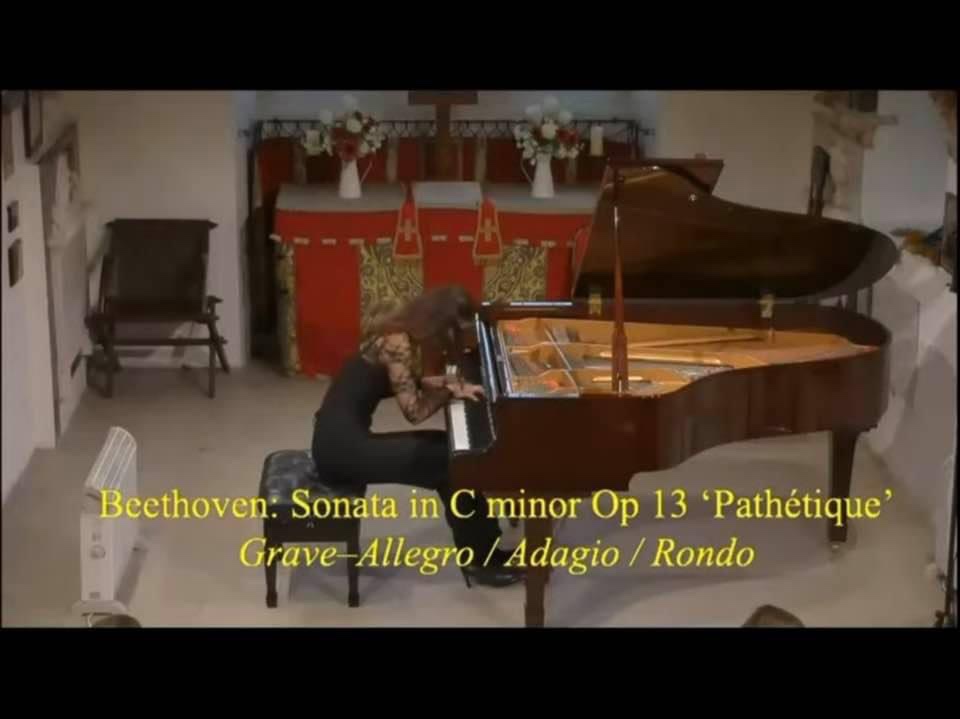
Beethoven: Sonata in C minor Op 13 “Pathétique” Grave-Allegro / Adagio / Rondo
Debussy: Images Book 1 Reflets dans l’eau / Hommage à Rameau / Mouvement
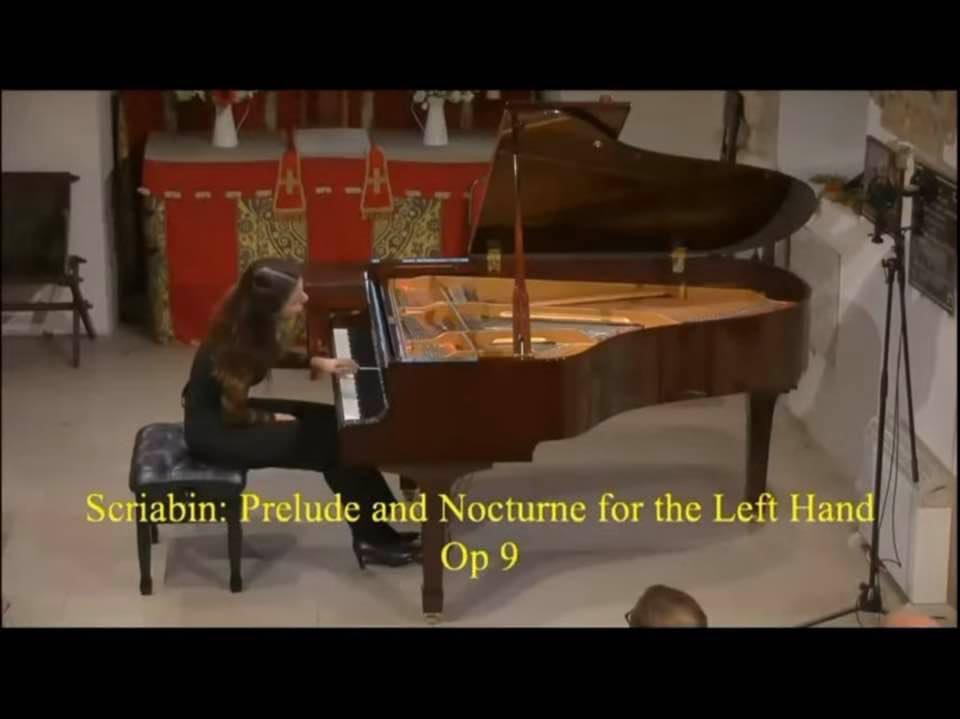
Scriabin: Prelude and Nocturne for the Left Hand Op 9
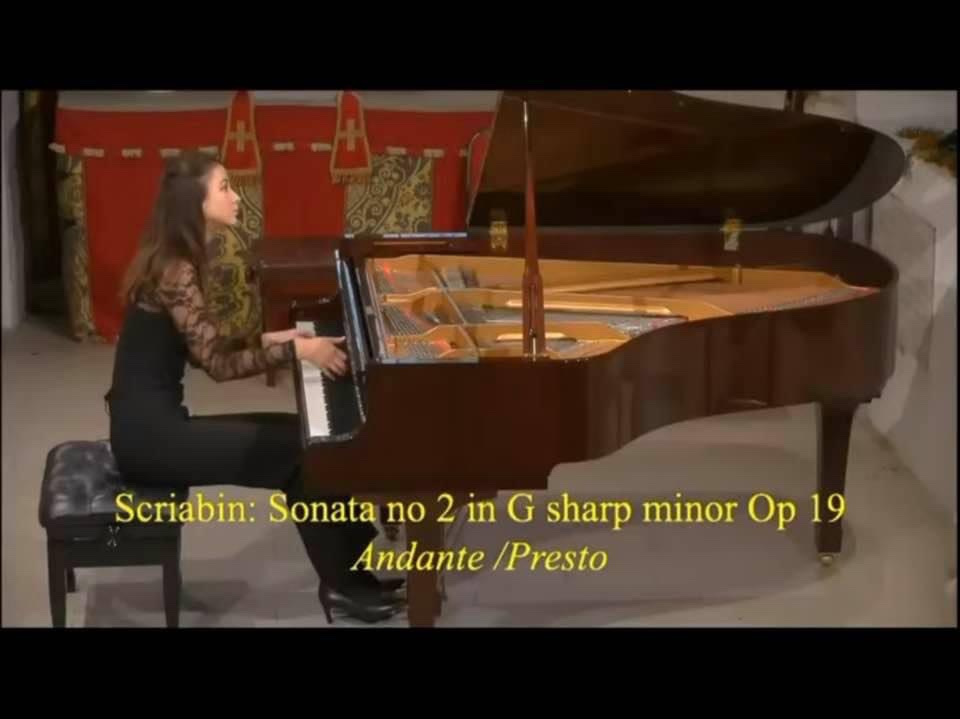
Scriabin: Sonata no 2 in G sharp minor Op 19 Andante / Presto
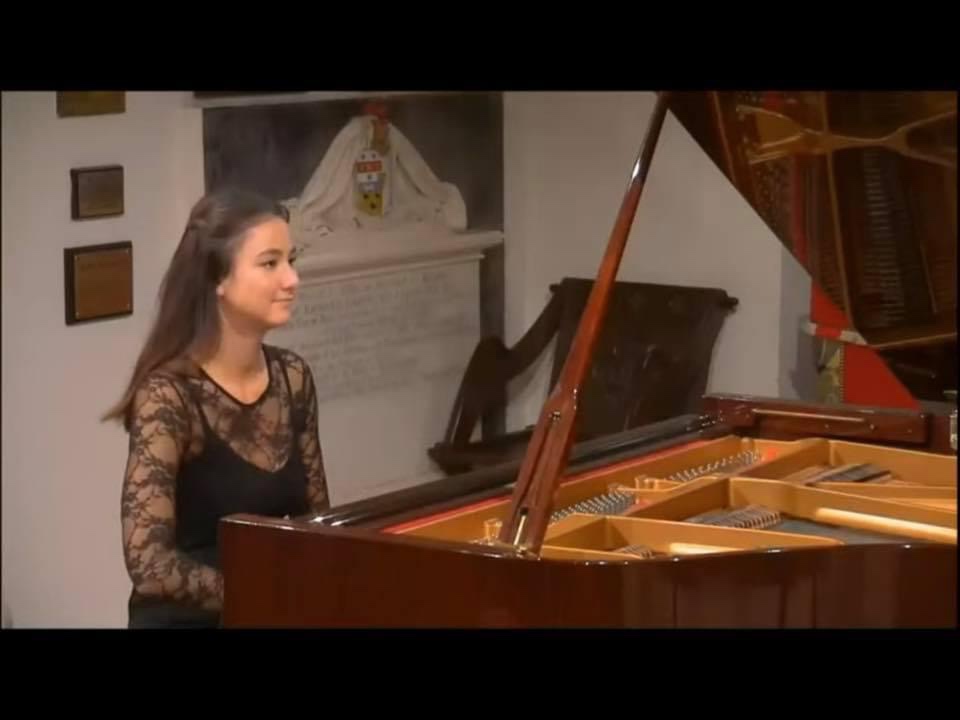
Nice to still be able to be in two places at once. From my country home in Italy to be able to hear a concert in Perivale was a necessity in the lock down but has now become a luxury. Thanks to Hugh Mather and his dedicated team of retired professionals I was able to listen to Zala Kravos who I had been advised not to miss by a very informed friend and colleague.
It was from the very first mighty chord of Beethoven’s Pathetique that she immediately caught my attention with the luminosity of sound and a sonority of an unusual richness.The poignancy of the silences too was quite arresting and I have rarely been aware of the importance of this much played work as she shaped the contours with a great sense of architectural line. Throughout the recital whatever she played had a weight and authority where every note had a meaning and significance from this very arresting opening to the ravishing beauty of the Adagio cantabile where in the contrasting central section she even found a completely different sound that was pure magic. The Rondo too was played with a clarity and subtle sense of phrasing as she brought such contrast and colour where every note had a meaning.
Debussy Images book 1 was full of ravishing colours from the subtle rubato of Reflets Dan’s l’eau to the stillness and desolation of Hommage a Rameau and the startling gentleness of Mouvement ,as Debussy asks for but very rarely gets,avec une légèreté fantastique mais précise -with a movement usually played like a study rather than the magic sound world that Zala could conjure up today.
There was such luminosity and a superb sense of balance in Scriabin’s Prelude for the left hand and the Nocturne had such ravishing sounds that it was hard to believe that only one hand was in play.
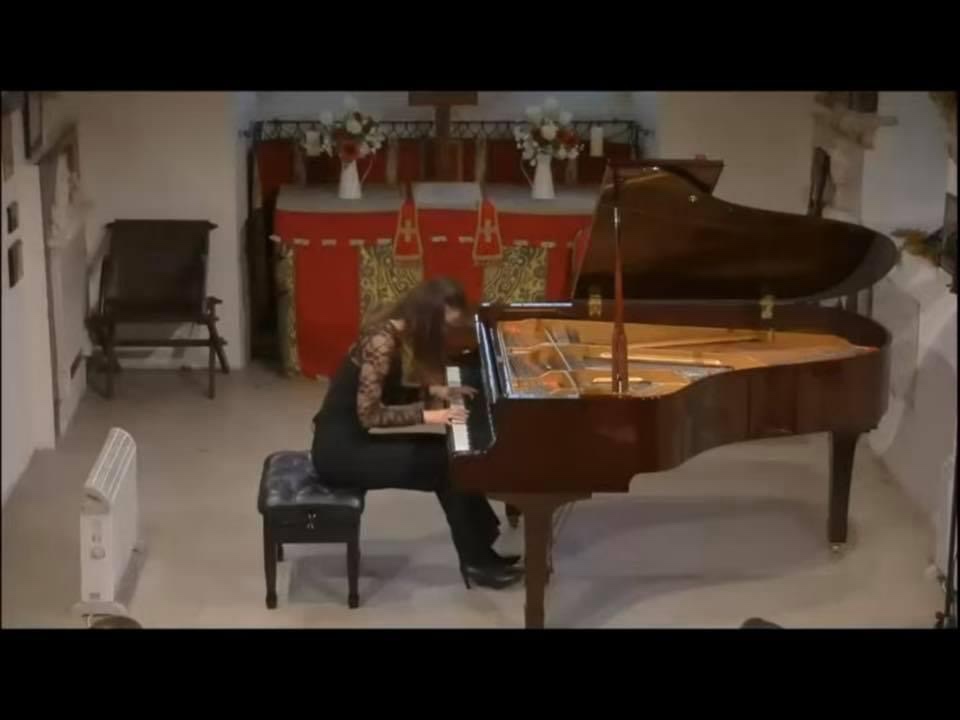
The second sonata was played with a wonderful sense of improvisation and her kaleidoscopic sense of colour allied to her superb natural musicianship gave a great sense of shape to this movement which is just a prelude to the unleashing of rhythmic drive and passion of the second movement.
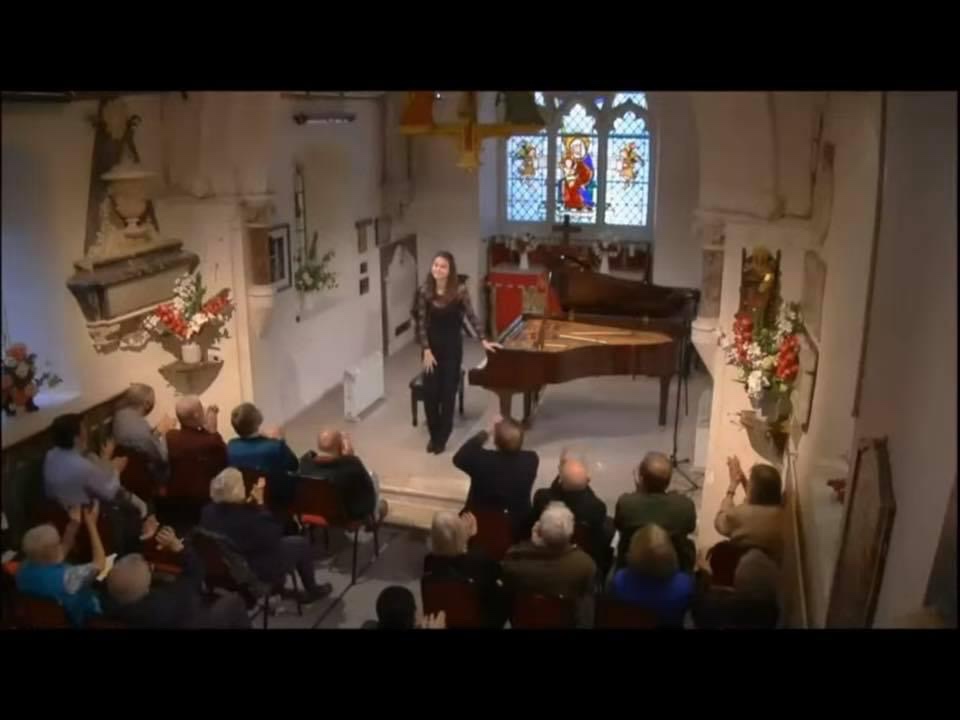
A real ovation from a full house at St Mary’s and thanks to Dr Mather we were treated to an encore of Scriabin Study op 8 n 12. It was here that all the qualities that we had enjoyed in this remarkable recital were underlined by a performance of transcendental control,ravishing sound and passionate commitment.
I had not realised that this nineteen year old pianist had already studied with Maria João Pires whose simple musicianship has been admired by a world starved of a transcendental command of the keyboard at the service of music.Pires like Zala today can shed fresh light on works that we have loved and cherished all our lives.Their playing is like a breath of fresh air in a world that we are fast destroying by our own pollution.As in music too where our insistence on bringing historic performances into modern concert halls to a vast public is becoming a case of a little knowledge that can become a dangerous thing.Pires with superb intelligence and scholarship is able to transmit with purity and simplicity the message that the great composers of the past have scribbled down on pieces of paper that of course a real interpreter should consult.Tortelier used to say that he would only play on a baroque cello when they discovered a baroque recording studio!Pires too when I thanked her for all she is doing to help young musicians she replied with simplicity and humility that it is she that should thank them for all that they gave her!I see that Zala continued her studies at La Chapelle with Louise Lortie,a pianist who I have admired for years.At only 19 she is now finishing her studies with another superb musician Norma Fisher -birds of a feather indeed and a disciple ready to be set free soon to fly high.
Zala Kravos was born in 2002 in Slovenia, and her family moved to Luxembourg in 2007. She studied there initially, and from 2012 to 2016 studied at the Queen Elisabeth Music Chapel in Brussels, in the piano section headed by Maria João Pires, and continued as the only ‘Young Artist’ with Louis Lortie, the new master in residence until May 2018, when she passed the ‘Young Artist Diploma’ exam. Since September 2019, she has been studying at the Royal College of Music with Norma Fisher. She has won many prestigious awards such as the Gold medal at the “Passion of Music 2016” international competition in New York, and Gold medal in European Competition for Piano Solo Luxembourg 2014 etc. She is quadrilingual (French, English, Slovenian, and Chinese) and likes reading, swimming, ski-ing (Bronze Star at the French Ski School), cycling and roller skating. She comes with exceptional recommendations such as ‘One of the best talents I have ever seen’ (Maria Joao Pires) etc.
From the ever enthusiastic Dr Hugh Mather:Excellent review as always, Christopher, of a remarkable recital. She is terrific and will always be welcome back. It was all remarkable but I was bowled over by her Scriabin, particularly the LH Prelude and Nocturne – simply ravishing control and sound. Here is the HD link
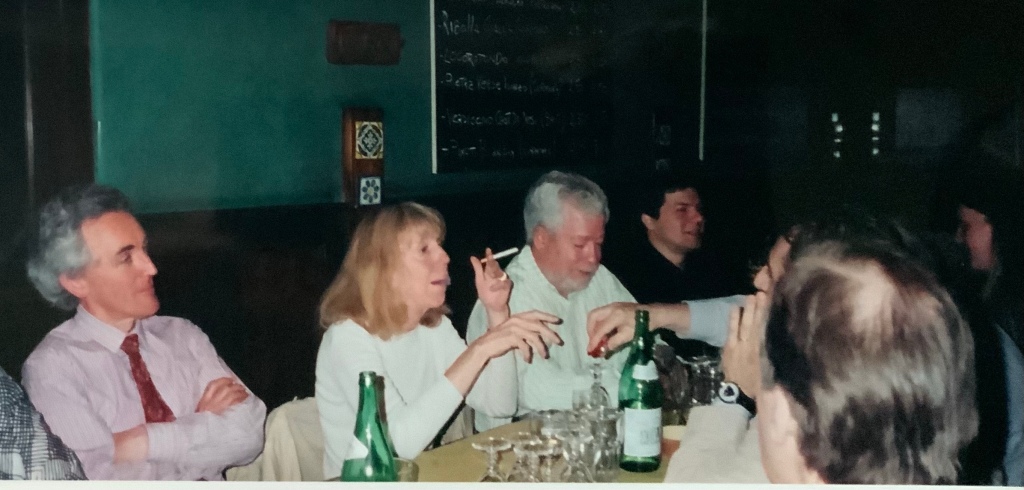
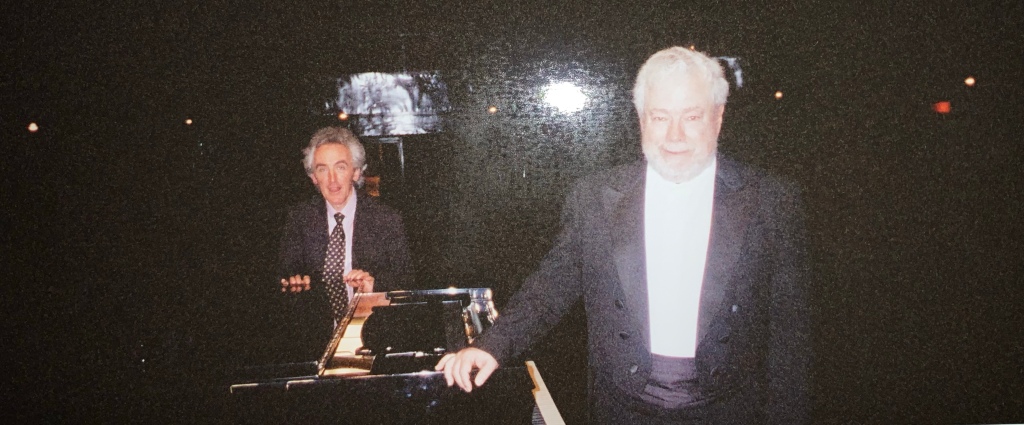
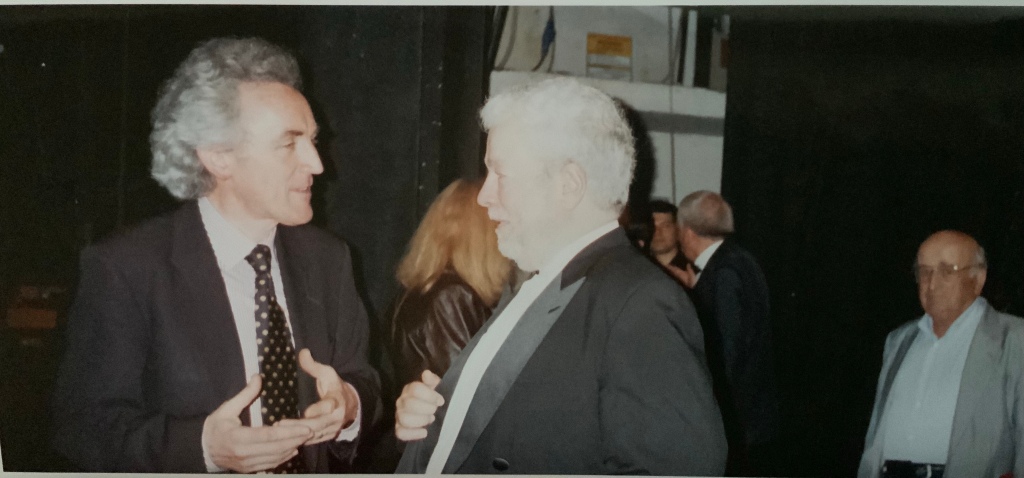
Nelson gave two recitals for us at the Ghione theatre .Memorable performances of Schumann Carnaval and Brahms F minor Sonata. It was a few years later after the death of my wife that he played at the Brazilian Embassy to repay their hospitality while he was playing Brahms 2 at S.Cecilia . It was a memorable occasion not only for the whole recital but for a little encore by Villa Lobos .After the concert I was surprised and very moved when he said that it had been my wife’s favourite encore at his concerts for us.
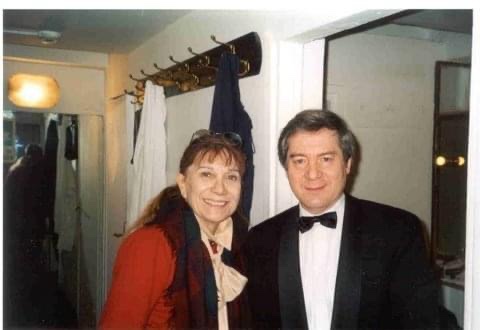
with Ileana Ghione
Nelson was like that a wonderful sensitive person and one of the greatest pianists I have heard .He was quite simply the Rubinstein of today.Like Rubinstein it was in live performance that the legend really began.His recordings are not always geared to the recording studio like his Chopin studies recorded at Snape where he adds an octave here and there as he and Rubinstein would do on the spur of the moment in the concert hall.His performance of Chopin 2 at the proms was notable for how he played a very light bass note at the beginning to open up the sonority of the piano entry high up on the keyboard.Always discreet and with great style not like some performers these days who think they have a special contact with Beethoven as they desecrate his most perfect creation :the Fourth Concerto with spread chords opening flourishes and alarming additions to the score in the name of authenticity.Some even add improvised Rachmaninovian cadenzas where Beethoven had left his own .
with Christopher Axworthy
There was none of this with Nelson who like Rubinstein with humility and love would seek out a performance of such simplicity and overwhelming beauty that would hold audiences mesmerised.He was a true legend in South America and we were lucky to catch only a rare glimpse of his solo recitals A great void has now opened but thank God we still have his best friend Martha Argerich who had left everything to be at his bedside. He was launched to fame in Europe when he stood in at a weeks notice for Shura Cherkassky learning especially Tchaikowsky n.2 creating a sensation and overnight success. Of course his duo concert at the Southbank festival with Martha Argerich after a shopping spree together in London just before has quite rightly gone down in legend
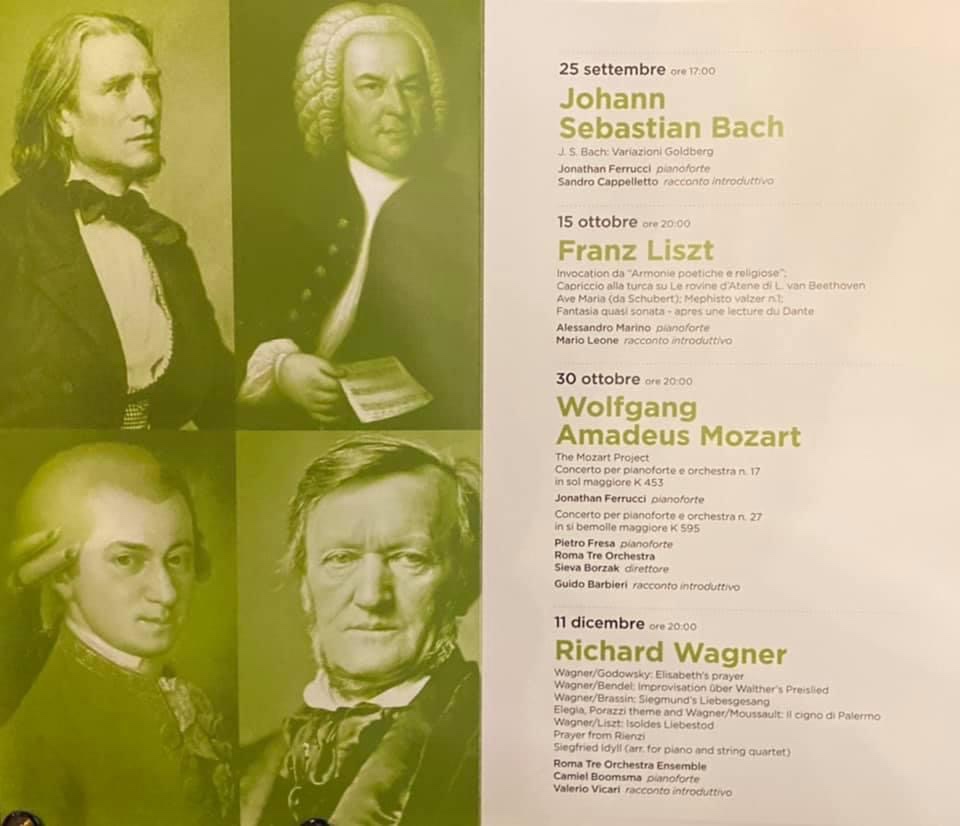
Sabato 30 ottobre ore 20 Teatro Torlonia Concerto per pianoforte e orchestra n. 17 in sol maggiore K 453 Jonathan Ferrucci, pianoforte Concerto per pianoforte e orchestra n. 27 in si bemolle maggiore K 595 Pietro Fresa, pianoforte Roma Tre Orchestra Sieva Borzak, direttore Guido Barbieri, narrazione
An evening of sublime music at Teatro Torlonia with two of the finest pianists of the younger generation playing two of Mozart’s most perfect creations : the concerto in G K453 and K595.Two young musicians brought together by the enlightened artistic director of Roma 3 orchestra ,Valerio Vicari with brief introductions by one of the most knowledgeable journalists in Italy,Guido Barbieri.
Guido Barbieri
A voice well known to listeners of Rai 3 La stanza della musica and someone whose articles in the Messaggero were sought out eagerly in the good old days for unusually informed criticism.He also invited pianists from the Keyboard Trust to perform all the Rachmaninov concertos for the Amici della Musica of Ancona.And on another occasion he invited other pianists of the Keyboard Trust to bring joy and comfort to the people of Aquila stricken so cruelly by an earthquake some years ago. https://christopheraxworthymusiccommentary.wordpress.com/2015/05/26/rachmaninoff-festival-ancona-2015/
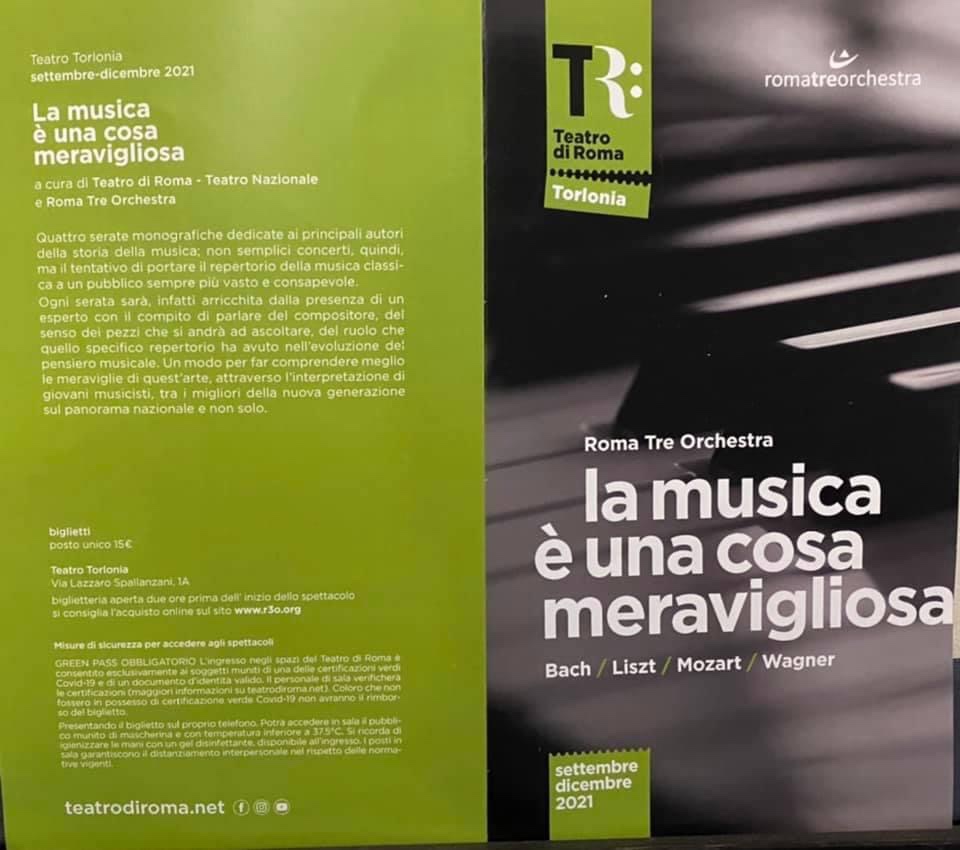
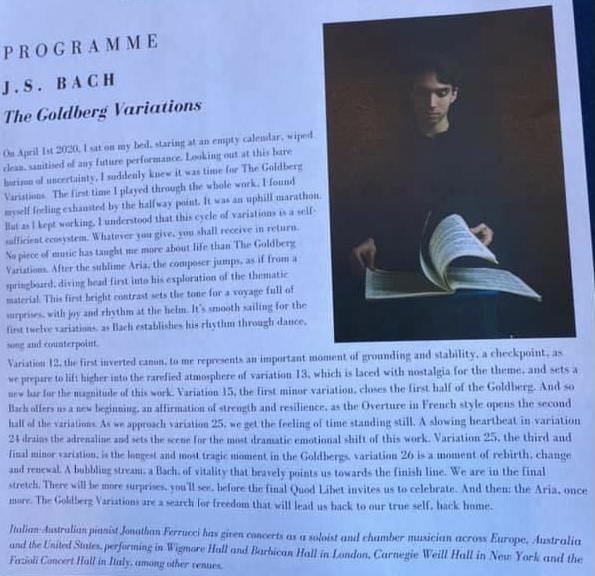
As Valerio Vicari explains in the programme of ‘La musica è una cosa meravigliosa’ each of the four concerts is enriched by an expert introduction that describes the world of the composer,the sense of the works in the programme and their part in the evolution of music.Well Guido not only did all that but he also amused and enlightened us with letters of the time describing the reaction that the works had produced. Jonathan had opened this important season at Torlonia with a performance of the Goldberg Variations introduced by another celebrated musicologist Sandro Cappelletti.He went on to repeat that performance again ,at the beginning of the week,in the same collaboration with the KCT in Florence in the Harold Acton Library. https://christopheraxworthymusiccommentary.wordpress.com/2021/10/27/jonathan-ferrucci-the-return-of-a-warrior-the-goldberg-variations-in-florence/
The Piano Concerto No. 17 K.453,according to the date that the composer himself noted on the score was completed on April 12, 1784.The date of the premiere is uncertain though but Mozart probably performed it in his concert on 29 April 1784 at the Kärntnertortheater.
The music Mozart jotted down in his expense book is fairly close to the opening bars of the third movement of the concerto K 453, which Mozart had completed a few weeks earlier (12 April). Presumably Mozart taught the bird to sing this tune in the pet store, or wherever it was that he bought it.
The finale is a variation movement whose theme was sung by Mozart’s starling that the composer’s pet and is remembered for the anecdote of how Mozart came to purchase it, for the funeral commemorations Mozart provided for it, and as an example of the composer’s affection in general for birds The first record of the starling is the entry Mozart made in his expense book when he bought it on 27 May 1784. When the bird died, on 4th June 1787 he arranged a funeral procession, in which everyone who could sing had to join in, heavily veiled – made a sort of requiem, epitaph in verse
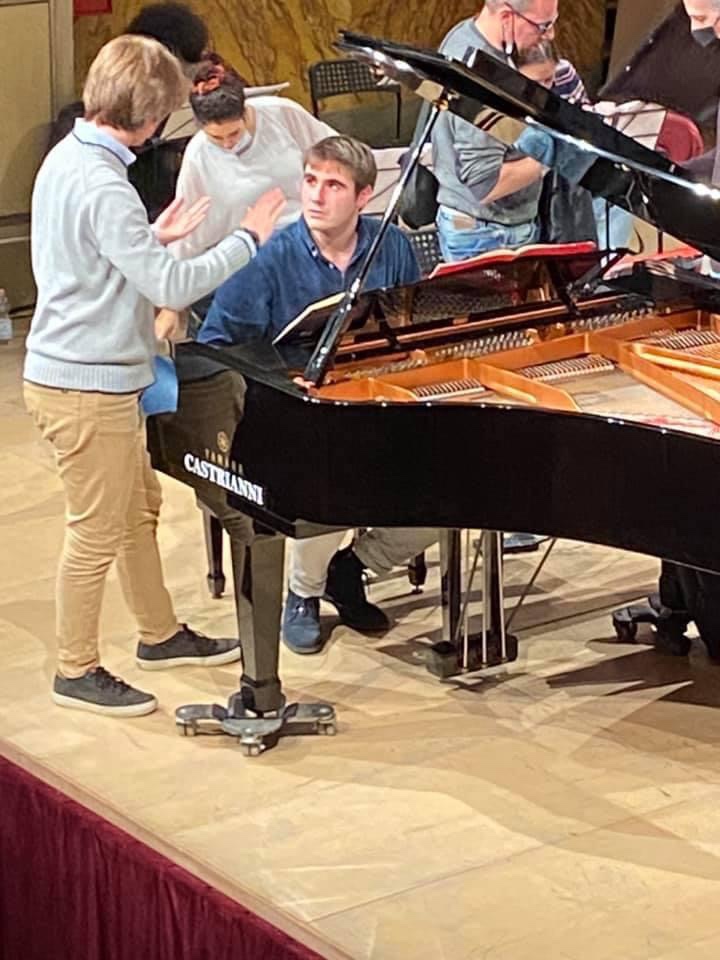
Jonathan in prova K 453
The Piano Concerto No. 27 K.595 was first performed early in 1791, the year of Mozart’s death and is one of his most perfect creations.Although all three movements are in a major key ,minor keys are suggested, as is evident from the second theme of the first movement (in the dominant minor), as well as the presence of a remote minor key in the early development and of the tonic minor in the middle of the Larghetto.Another interesting characteristic of the work is its rather strong thematic integration of the movements, which would become ever more important in the nineteenth century.The principal theme of the Larghetto, for instance, is revived as the second theme of the final movement.The principal theme for the finale was also used in Mozart’s song “Sehnsucht nach dem Frühling” (also called “Komm, lieber Mai”), K. 596, which immediately follows this concerto in the Kochel catalogue.
Pietro in prova with Sieva Borzak in K595
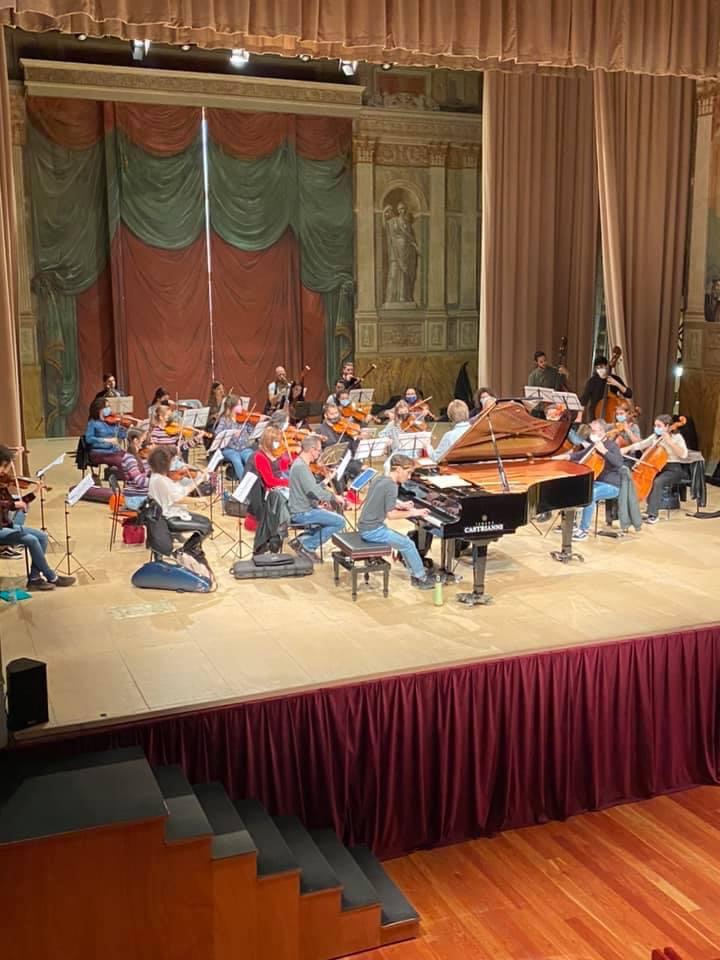
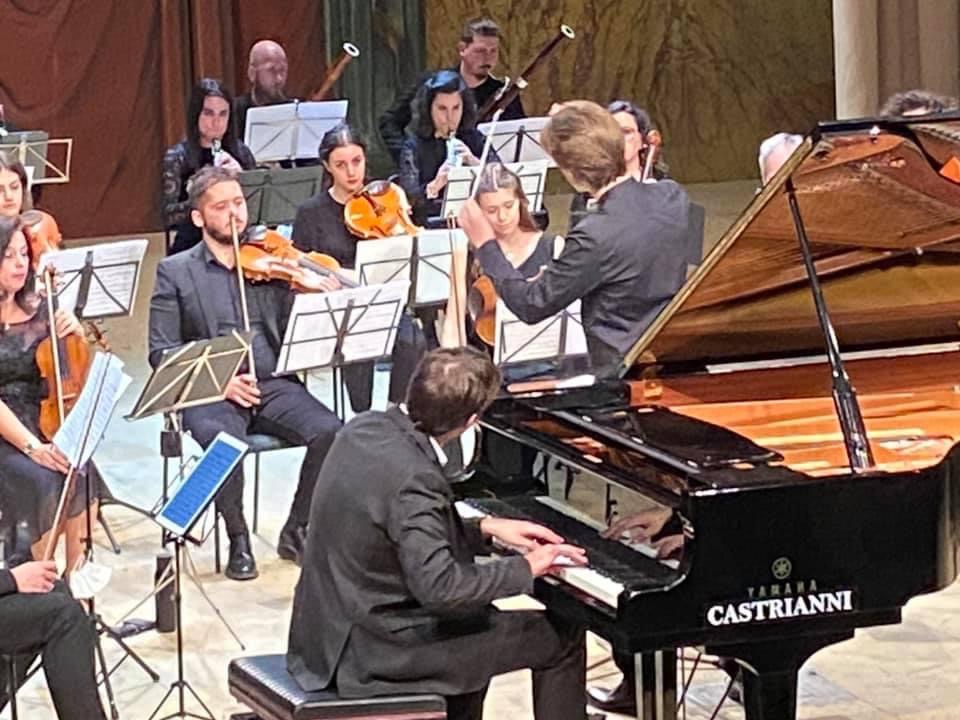
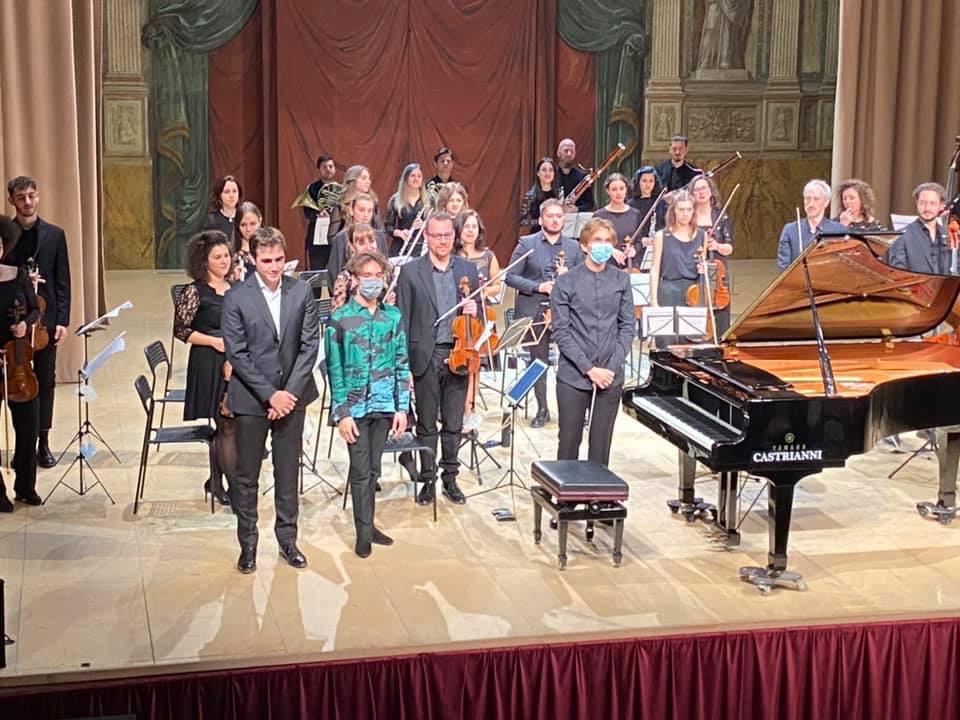
Two young pianists with completely different characters brought together by the genial Sieva Borzak.He had immediately resolved problems of acoustic in the rehearsal as he brought the piano as close to the edge of the stage as possible allowing the wind players to be able to have a more chamber music rapport with the piano which is so fundamental in these mature concertos of Mozart.
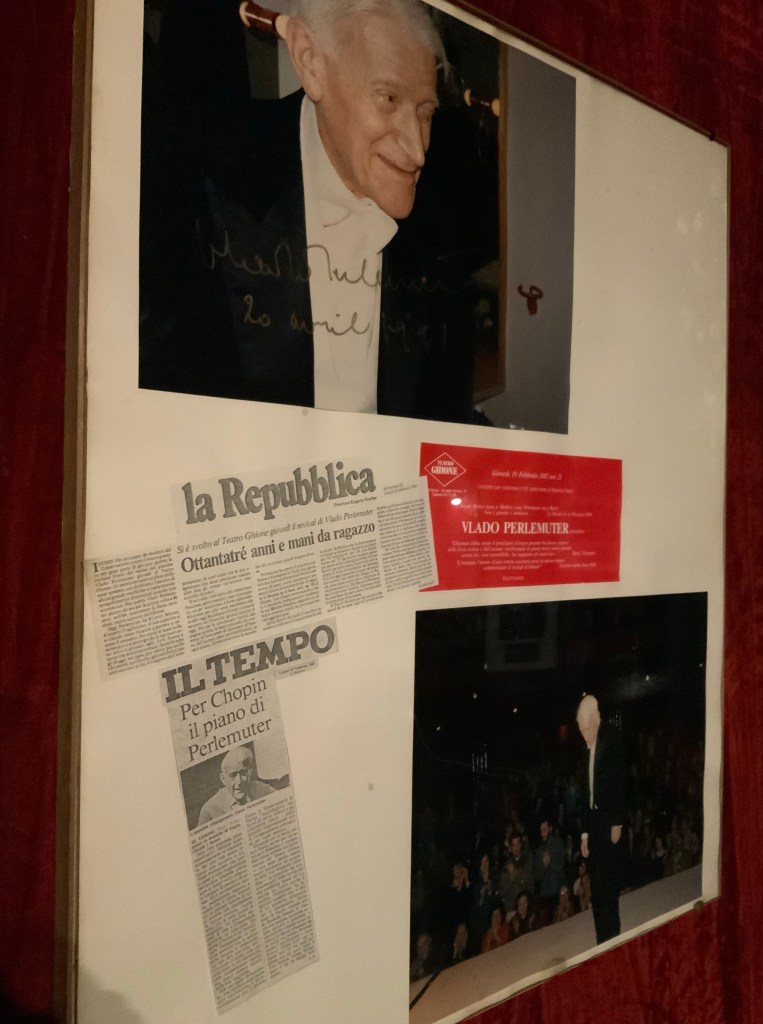
Perlemuter who made his debut in Italy at the Ghione theatre in 1984 at the age of 81 and went on to play every year and give Masterclasses until his final concert there in 1991
It was my old teacher Vlado Perlemuter who,making his debut in Italy in the Ghione theatre in Rome at the age of 81,insisted much to our alarm that the piano be less under the proscenium as possible at the extreme limit of the stage.Perlemuter,who had known Ravel and Fauré had a lifetime of experience of playing in theatres that were not specifically designed for instrumental music.
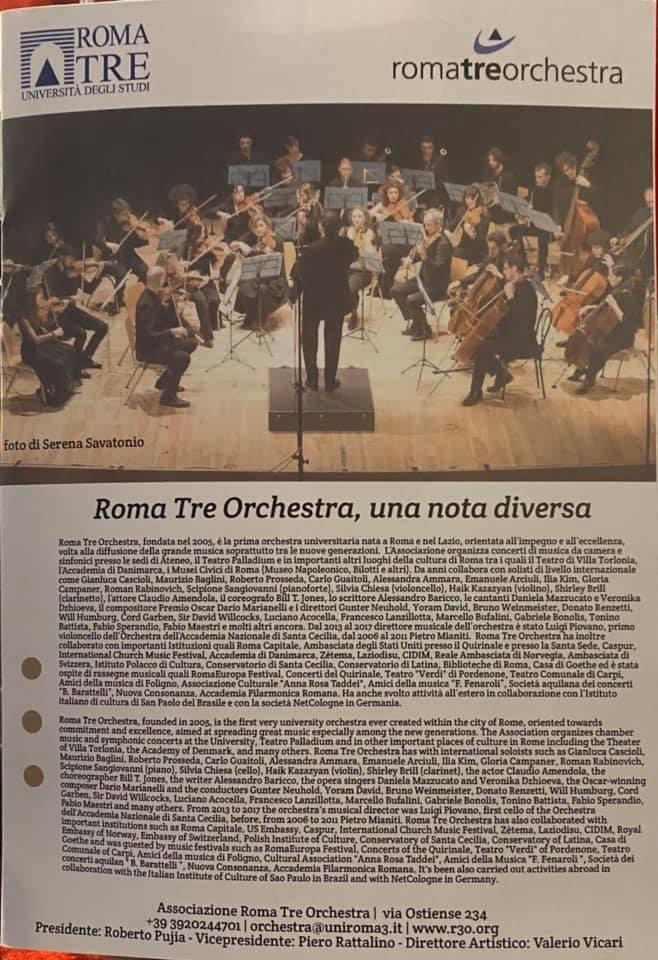
Sieva with many less years than Perlemuter immediately diagnosed the problem and like all great professionals found a simple solution.The orchestra under his hands were able to give all the dramatic contrasts and operatic energy to the earlier G major concerto together with the sublime legato and serenity of the B flat concerto.Leaving the important dialogue between wind and piano to a chamber music participation between the pianist and the instrumentalists that was extremely moving.A fine ensemble that Valerio Vicari and Roberto Pujia have been promoting for the past sixteen years giving a much needed platform to many remarkable young musicians at the beginning of their careers.
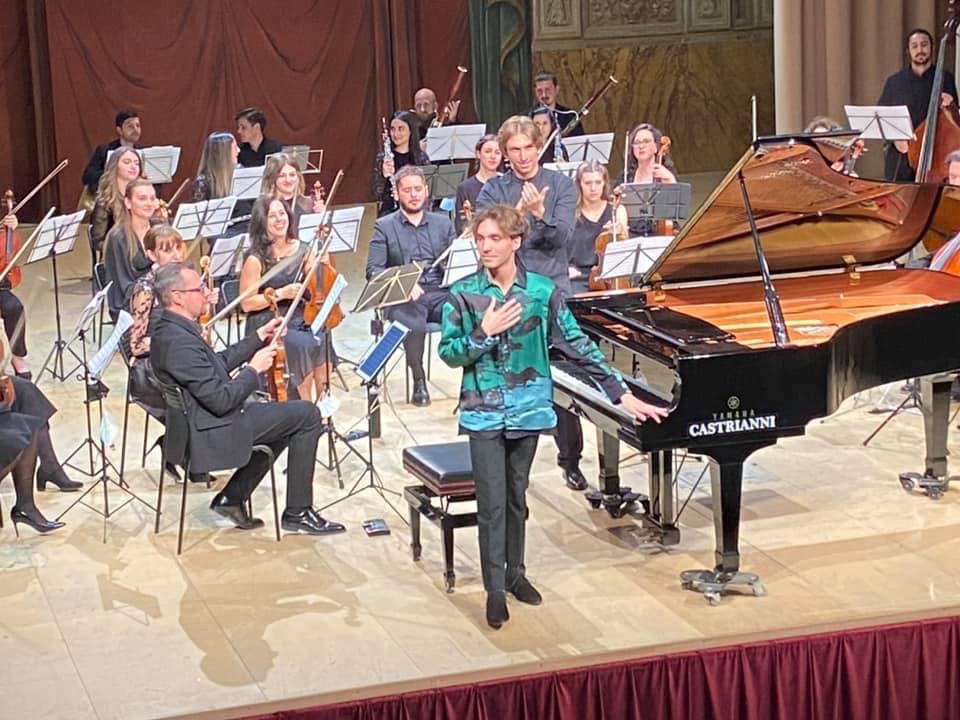
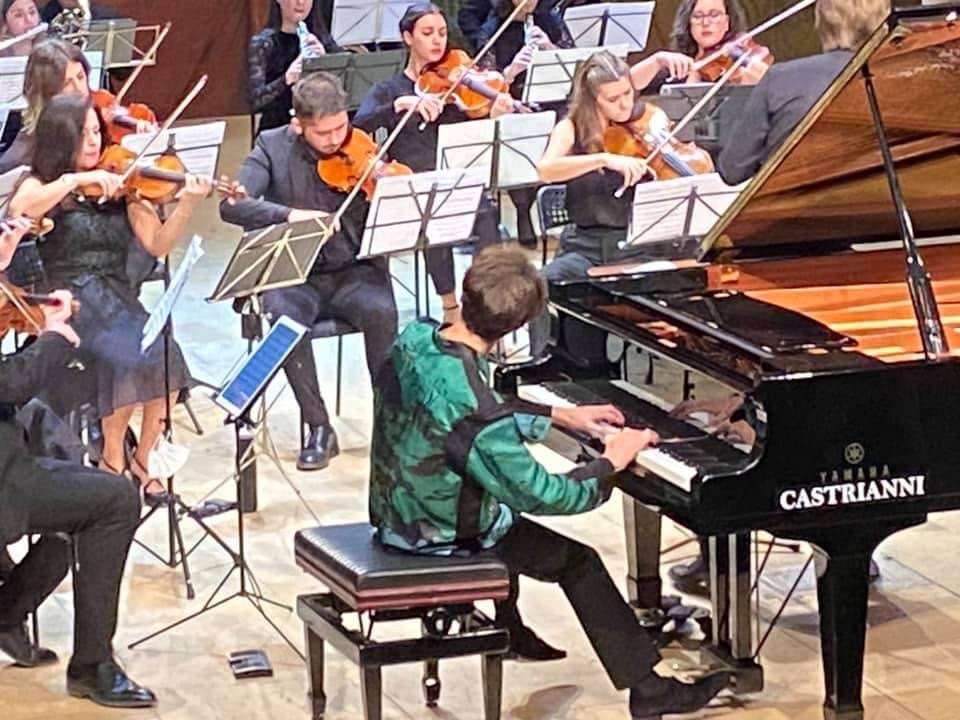
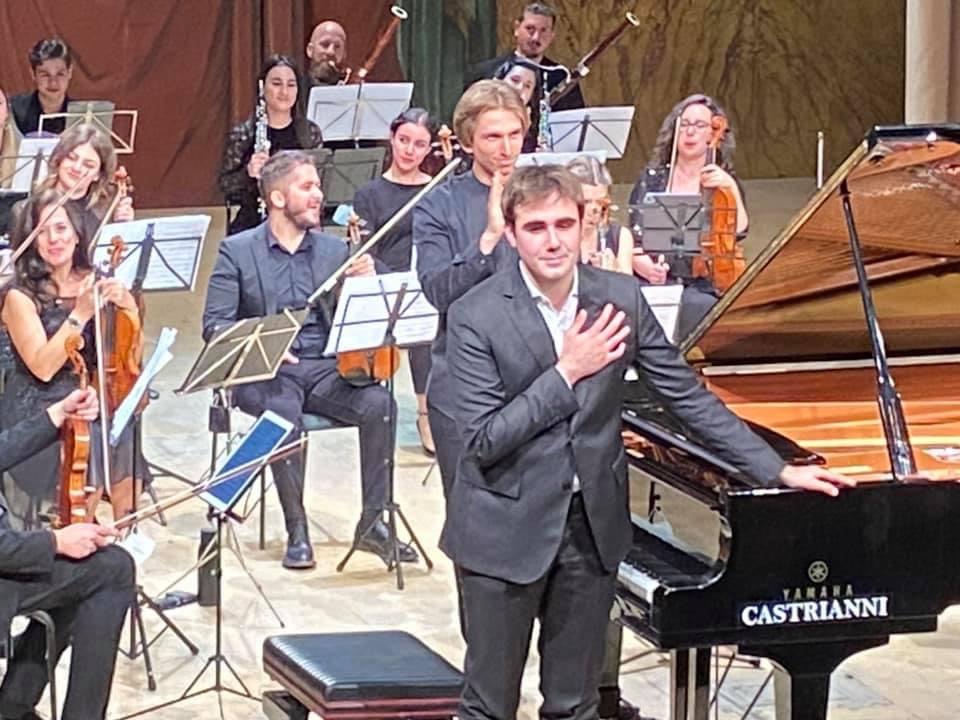
Jonathan appeared on stage in a striking green silk shirt like a painter before his canvas.From the very first notes there was a luminosity to the sound that integrated so well with the orchestra as a chamber music rapport was immediately instilled.Some very discreet ornamentation was added with such style and good taste with the same knowledge of his mentor Robert Levin.He even wrote his own cadenzas that like the ornamentation just illuminated Mozart’s own thoughts without imposing any unwanted external intrusion which is so often the case in lesser hands.
A little knowledge can in fact be a dangerous thing as we see from that other sublime concerto -Beethoven fourth – often played these days with ornamentation and rolled chords ad nauseam just because it was mentioned in letters of the period.It is a strange state of affairs because Beethoven was quite capable of writing these things down as in other of his works.The instruments of the period too did not have the sustaining power of todays !Mention should also be made of Mauro Buccitti the master craftsman who has turned this very discreet Yamaha piano into an instrument of such beauty and colour that the miracle of Mozart could mesmerise a full hall.An audience too that despite the complete block of a city under siege for the G 20 summit managed to get to this concert punctually filling every seat in this most beautiful of halls.
Jonathan looking directly at the wind players as he accompanied them with ravishing scales so delicately played followed by the question and answer between them as they brought such character to the purity and innocence of this concerto.Mozart had written the cadenzas for this concerto but Jonathan’s were so much in style and with a sense of invention and discreet showmanship the same that Mozart himself must have often improvised in public.Instead of being invasive and out of style they were so well integrated that they just shed light on a much loved work that was truly reborn under this young man’s dedicated fingers.The Andante was from the very opening played with ravishing sound and an ornamentation that seemed to shed light and bring to life the final notes of the opening cadence with almost operatic finesse.In the sublime middle section in minor key Jonathan brought a stillness that was very moving leading to his own cadenza again of style and invention that like the first movement seemed to bring this work vividly to life.I found the Allegretto a little slow at the beginning but as it progressed it became completely convincing as the melody of the second section seemed to grow out of the original ‘starling’ melody.Played by Jonathan with startling clarity and some ornaments that just added to the fun they were all having.The final operatic presto was played with a great injection of rhythmic energy by the orchestra and taken up by the soloist in an exhilarating ending of charm and character.
Pietro Fresa in sombre mood for Mozart’s last Concerto that was first performed in the last year of Mozart’s short life
Pietro Fresa on the other hand in a much more sombre dark suit as befitted the dark and subtle beauty of the B flat Concerto.The sublime opening barely a whisper from an orchestra where exhilaration and rhythmic excitement had been transformed into a serene meditative atmosphere.And Mozart’s sense of energy of almost operatic proportions was played with great precision and contrasts by an orchestra following so attentively the ‘Giulinian’ shaping from Sieva’s expressive hands.The scene was set for the mellow simplicity of Pietro Fresa’s opening statement.Played with a purity of sound almost chiselled as it penetrated to the very back of the hall with extraordinary clarity.Injecting the delicate passage work with the romantic fervour of a young man on a voyage of discovery.Some very personal touches gave great character to the continual dialogue with the orchestra.The gradual build up in the development section was beautifully integrated into the orchestra and led to a sublime outpouring of melodic invention before the gradual return to the recapitulation.The precision of his articulation was remarkable in its clarity and shape and led to Mozart’s own cadenza that was played with great style.It brought the same question and answer that we had heard earlier with the orchestra but now alone played with even more delicacy and character.
The Larghetto was played with a childlike simplicity at the opening where Pietro’s minute attention to Mozart’s phrasing brought such shape to this seemingly innocent melody.The absolute simplicity of the melodic line was delicately embellished and added to the sublime beauty of this movement.The opening melody’s final statement occurs as a shadowy whisper, the piano, flute and violins sharing the melody and creating an almost ghostly sonority played with real chamber music intensity by Pietro.The final Allegro was played with a beguiling sense of rhythm as Pietro took turns to dialogue with the orchestra bringing such buoyancy and energy to this seemingly innocent bucolic movement.Sometimes overdoing the contrasts though as a young man exhilarated by the masterpiece under is agile fingers.Always returning though to sublime beauty as the end of Mozart’s cadenza dissolves into the magical last appearance of the main theme.The entry of the strings underneath creates one of those sublime moments that is the genius of Mozart and leads to the simple final flourishes of Mozart’s last great piano concerto.
Sieva Borzak -Valerio Vicari -Pietro Fresa -Jonathan Ferrucci -Roberto Pujia
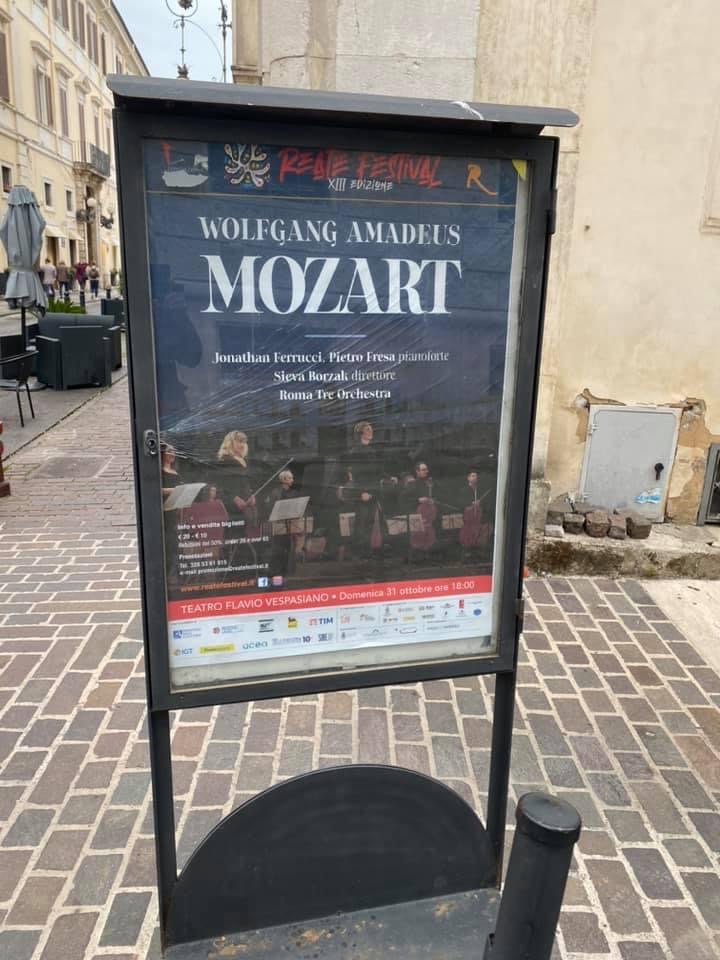
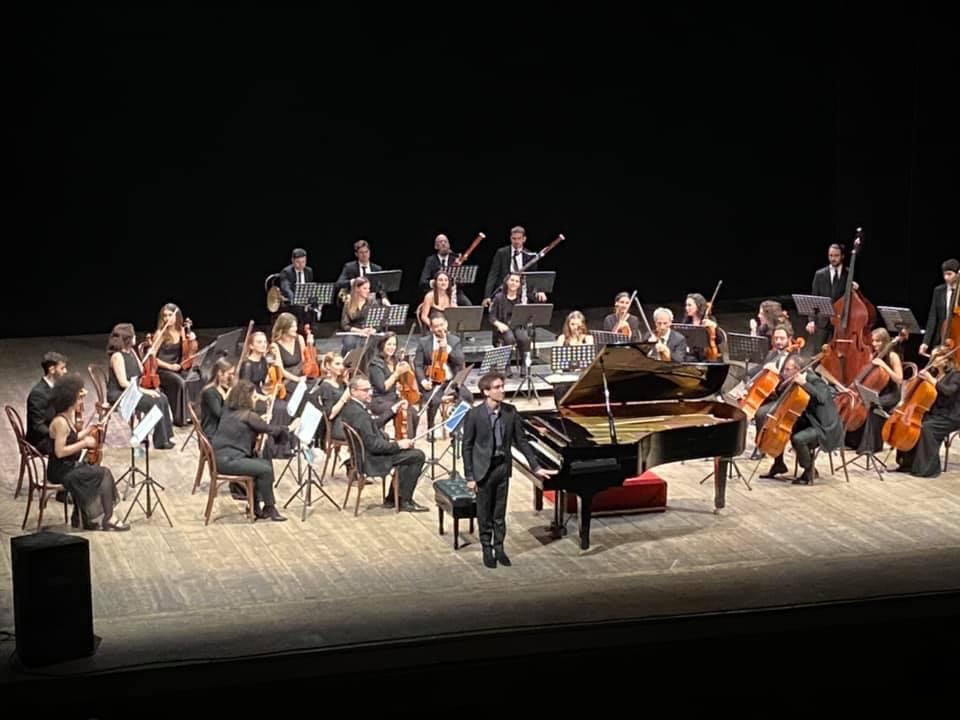
Encore at the Reate Festival at Teatro Vespasiano in Rieti just 60km from Rome.Not only the two piano concertos as before but also the Symphony n.40 in G minor K 550
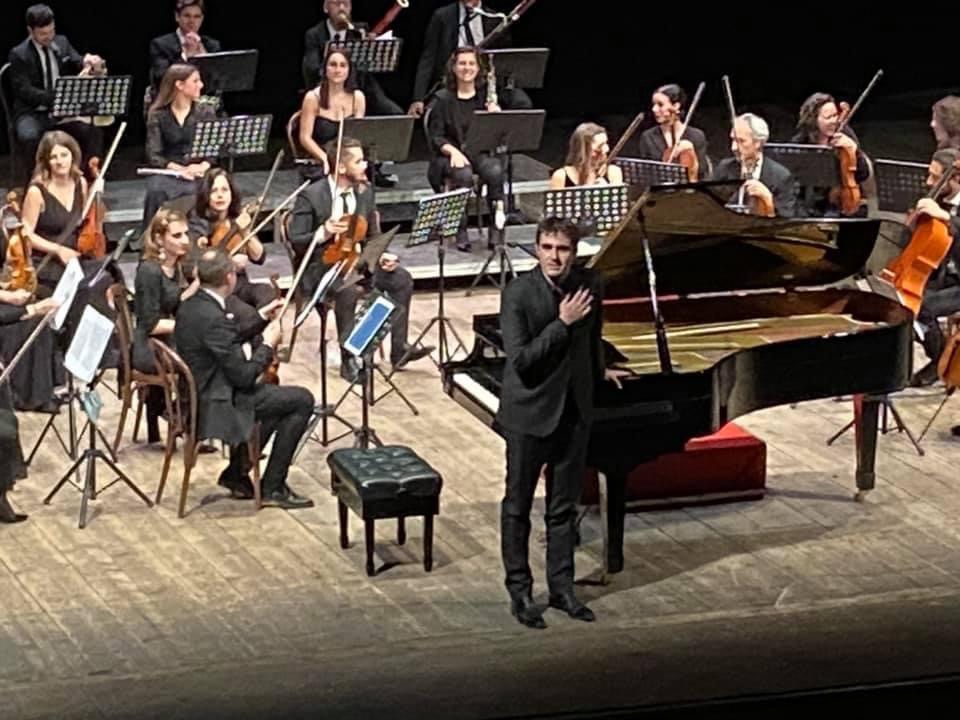
Jonathan Ferrucci in sombre attire in Rieti giving a ravishing performance of K 453
The date of completion of this symphony is known exactly since Mozart in his mature years kept a full catalog of his completed works; he entered the 40th Symphony into it on 25 July 1788.Work on the symphony occupied an exceptionally productive period of just a few weeks during which time he also completed the 39 and 41 symphonies (26 June and 10 August, respectively).Nikolaus Harnoncourt conjectured that Mozart composed the three symphonies as a unified work, pointing, among other things, to the fact that the Symphony No. 40, as the middle work, has no introduction (unlike No. 39) and does not have a finale of the scale of No. 41’s Jupiter .A final great trilogy.The 40th symphony exists in two versions and the autograph score of both versions were acquired in the 1860s by Brahms who later donated the manuscripts to the Gesellschaft der Musikfreunde in Vienna.
Pietro Fresa being rapturously received after K595
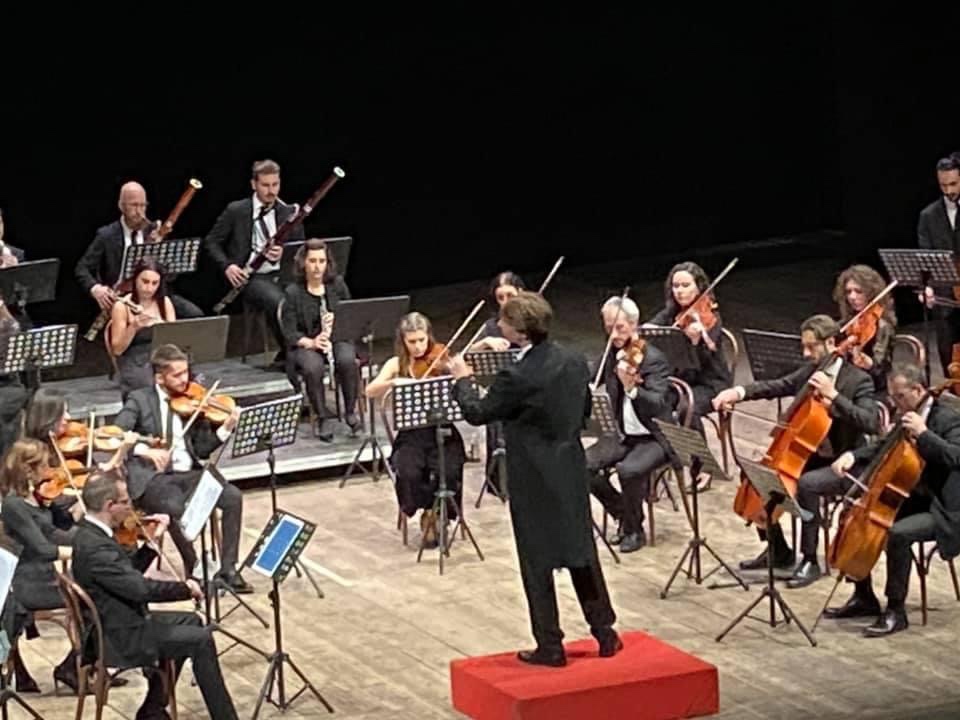
The orchestra were allowed free reign under Sieva Borzak who conducting without the score was free to let the music flow so naturally and with such character.
Sieva Borzak living Mozart G minor with his superb players
From the whispered urgency of the Molto Allegro and the deeply expressive contrapuntal Andante.Complimented by a rather militaristic Menuetto (that I found a little on the fast side ) with a Trio that had to be slowed down quite considerably.It did though give great contrast with the burning intensity of the Allegro assai Finale.Some very fine playing from this ensemble who applauded Sieva Borzak at the end for taking them into a realm of magnificent music making together.
An ovation for a superb performance of Mozart G minor Teatro Vespasiano – Rieti
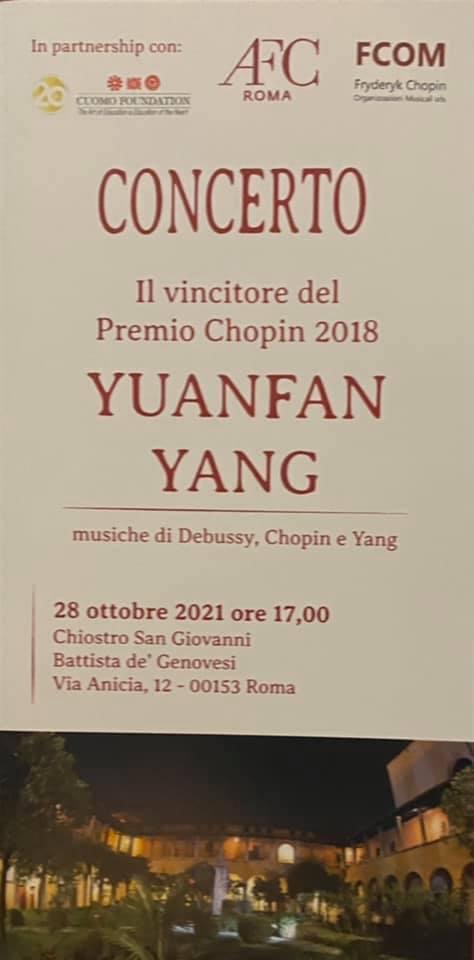
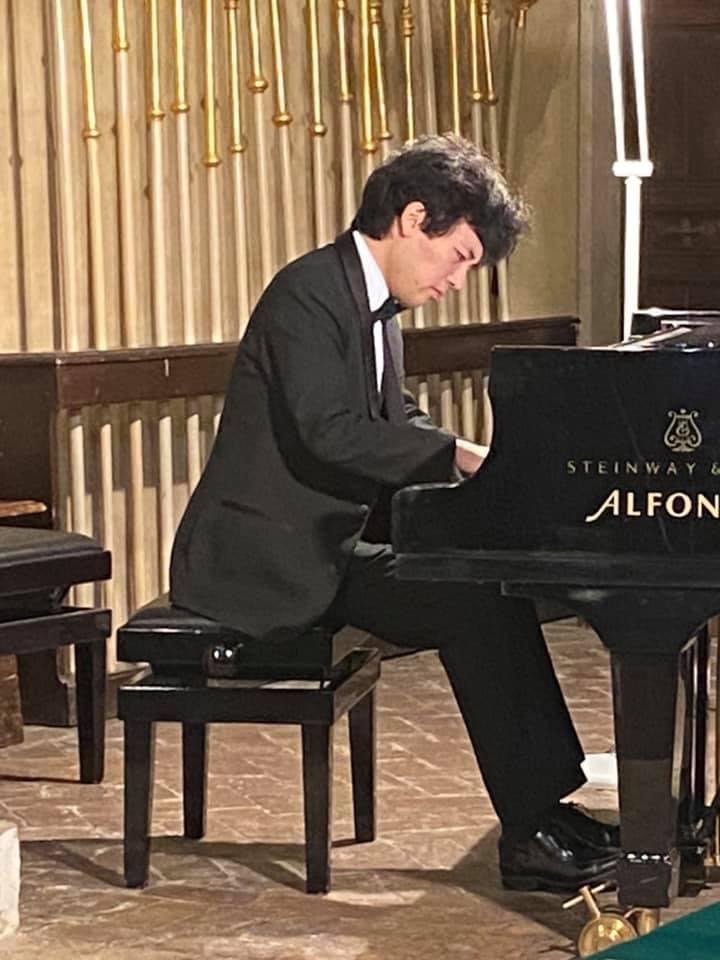
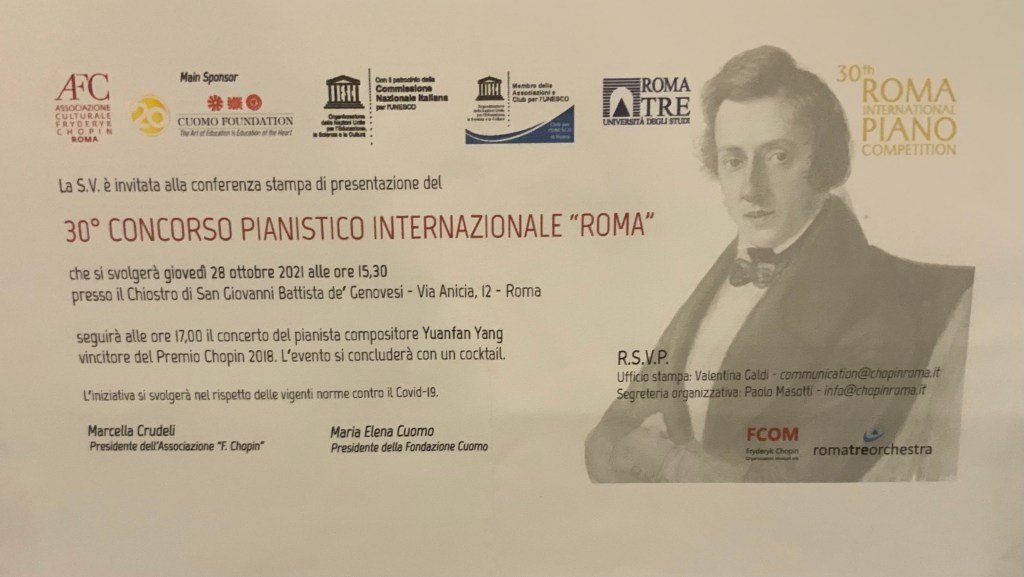
Yuanfan having won the ‘Premio Chopin’ in 2018 it was Chopin that took pride of place in a programme that included the Preludes op 28 together with three Debussy Preludes from Book 2 and his own composition the Waves ( written ten years ago and awarded many prestigious prizes including BBC television and radio performances).Yuanfan is not only a formidable pianist but a composer who tells me that he has just finished his third piano concerto which he wrote in the lockdown period and is very happy with the result.His first concerto toured China when he was still a teenager!A real thinking musician with that rare gift of improvisation,an almost almost forgotten art these days but an essential part of a complete musician in the past.
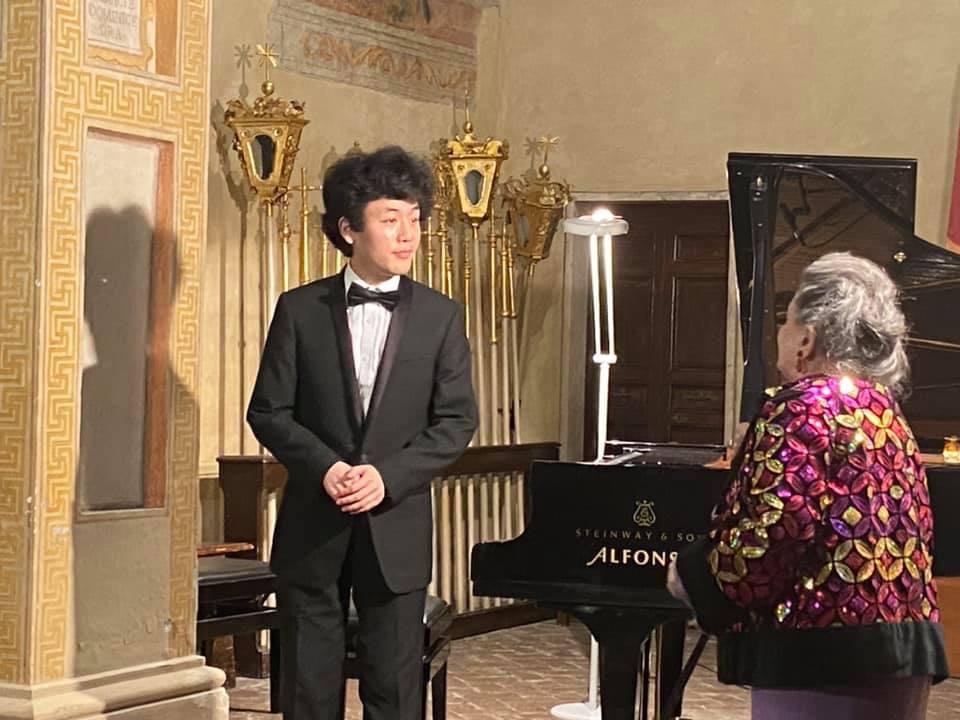
Marcella Crudeli congratulating Yuanfan and offering ‘La ci darem la mano’ for and improvised encore
And it was with such delight that after the tumultuous applause that greeted his ‘superb refined and mature’ performance of the Chopin Preludes that our hostess asked him to improvise on ‘La ci darem la mano’.An astonished and delighted audience after such a breathtaking performance of quite transcendental playing were invited to offer a melody for him to improvise on.
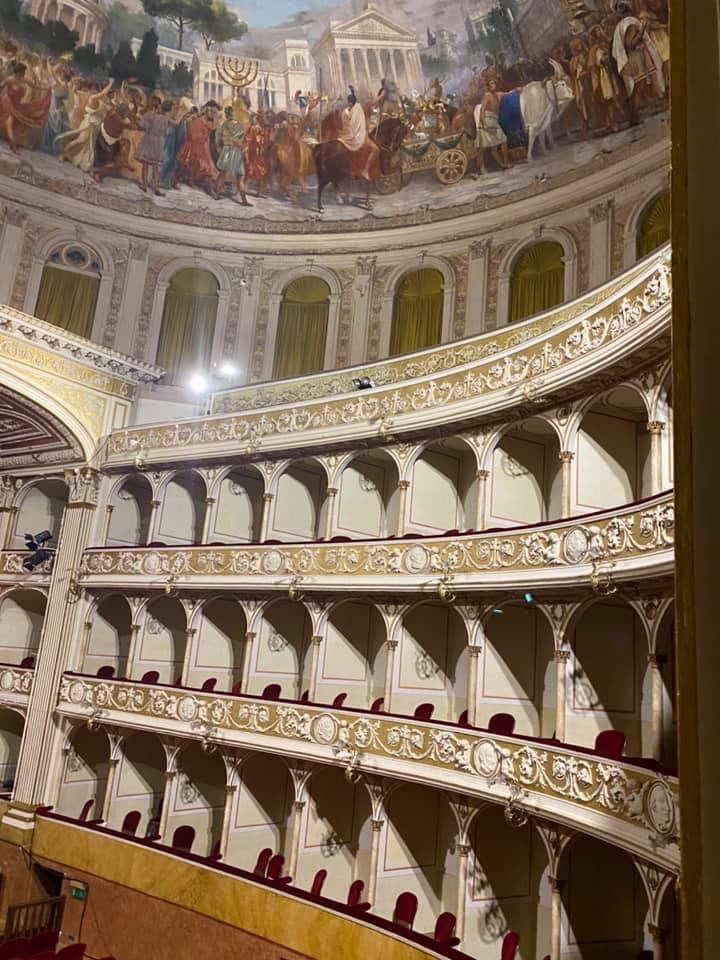
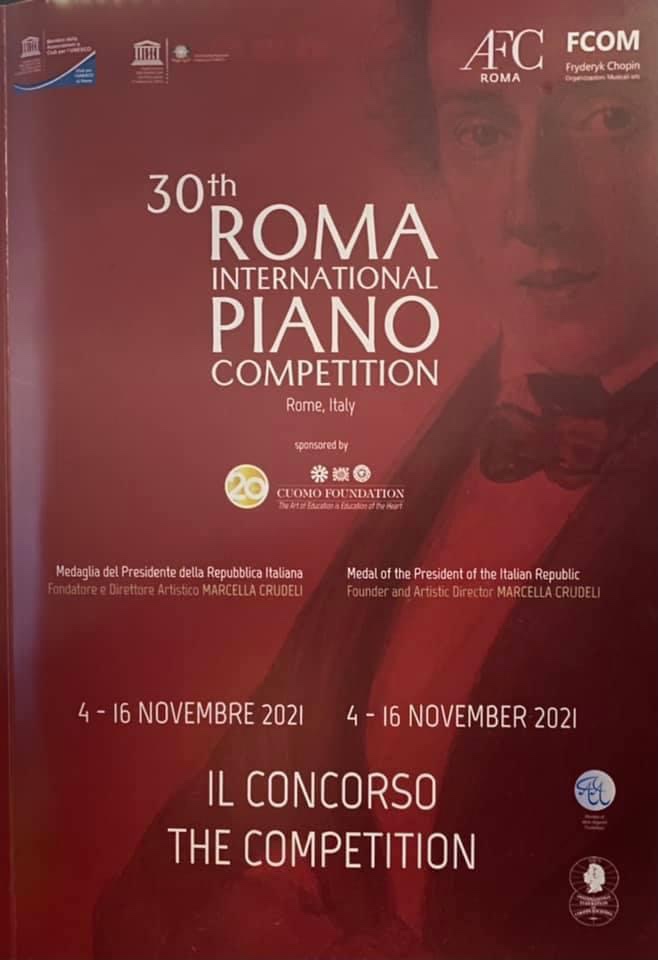
‘Carmen’in the style of Scott Joplin brought this small elite gathering to their feet as they more than confirmed the choice of this Premio Chopin 2018 and looked forward after the pandemic to the new live edition from 4-16 November.
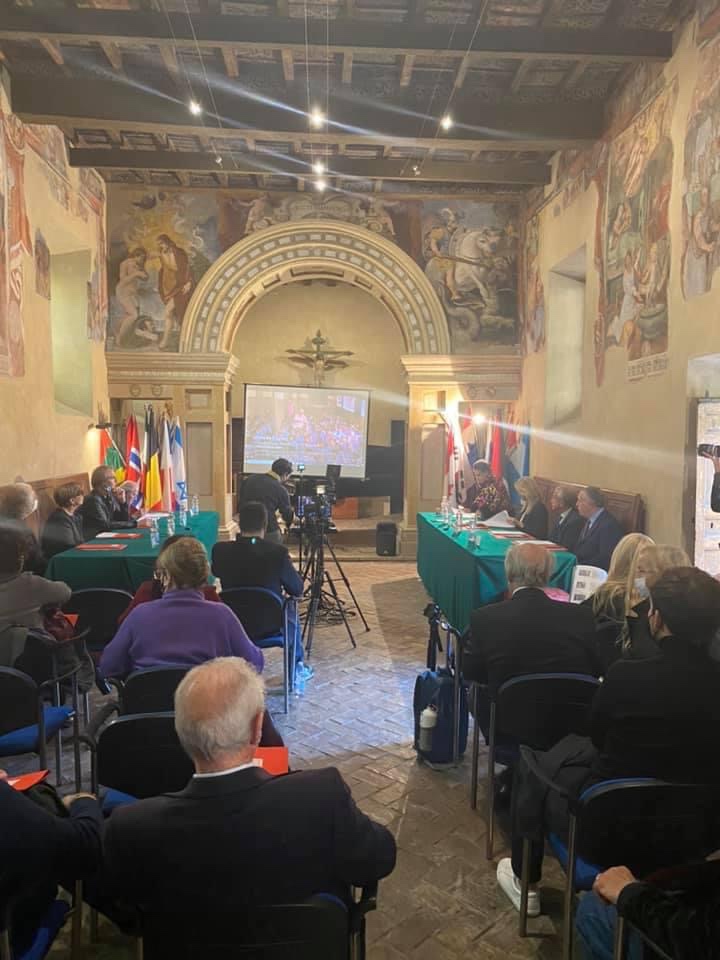
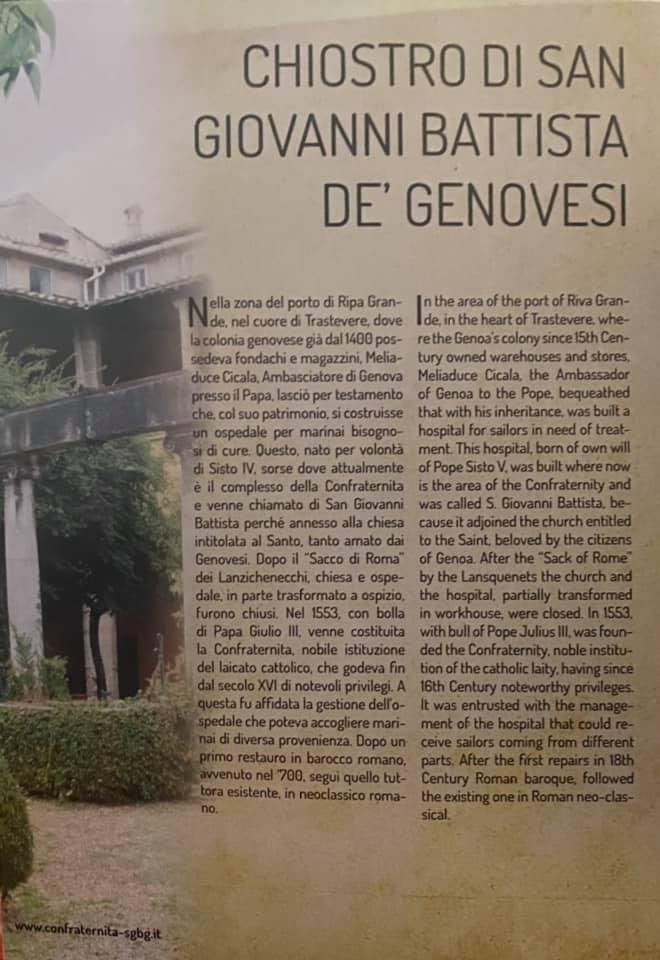
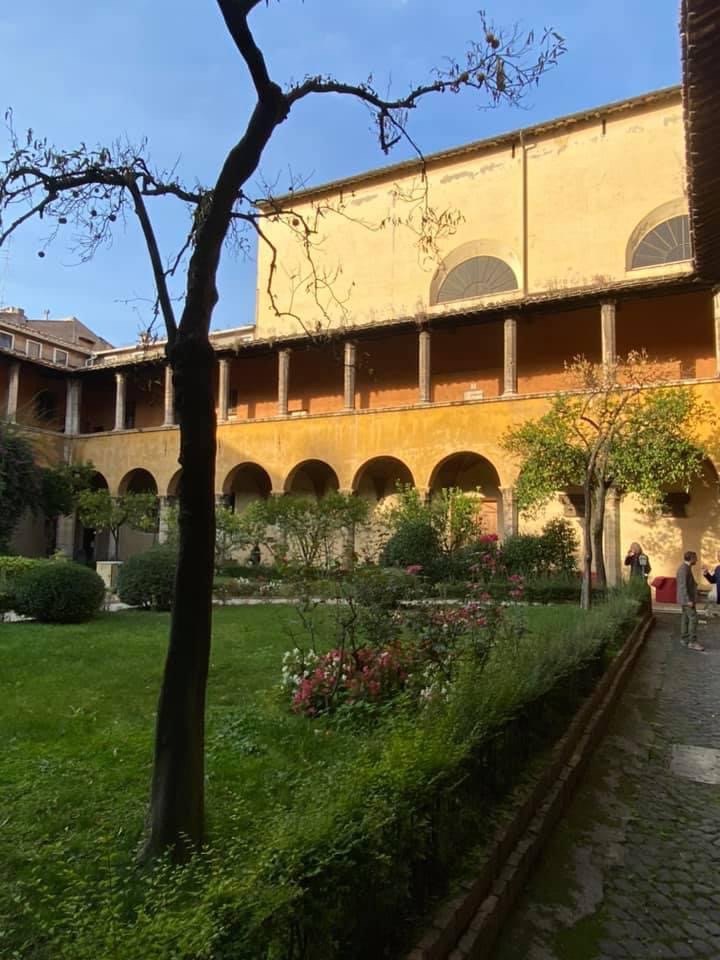
San Giovanni Battista de’Genovesi the press conference
Yuanfan Yang is helped by the Keyboard Charitable Trust of which I am a trustee and co artistic director and it was only last month that he was invited to play at La Mortella on Ischia in a long awaited collaboration between the KCT and the Walton Foundation.He was also invited to play in Sorrento by that other tireless promoter of all things musical in the Sorrento peninsular :Paolo Scibilia.I wrote a detailed appreciation of his magnificent performances some of which we heard today in Rome https://christopheraxworthymusiccommentary.wordpress.com/2021/09/06/yuanfan-yang-in-paradise/
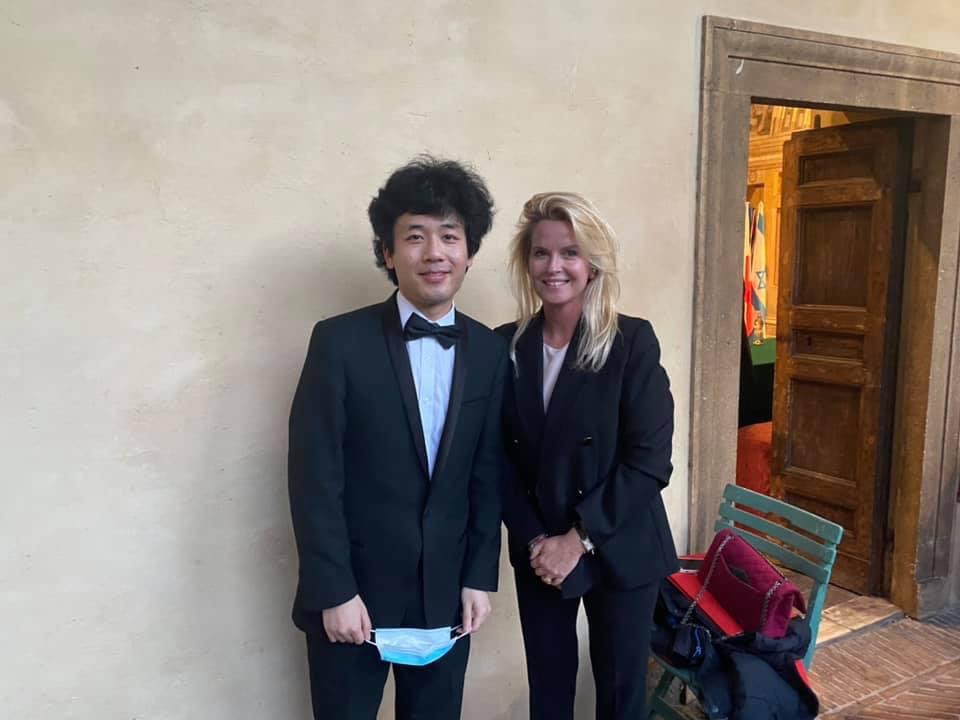
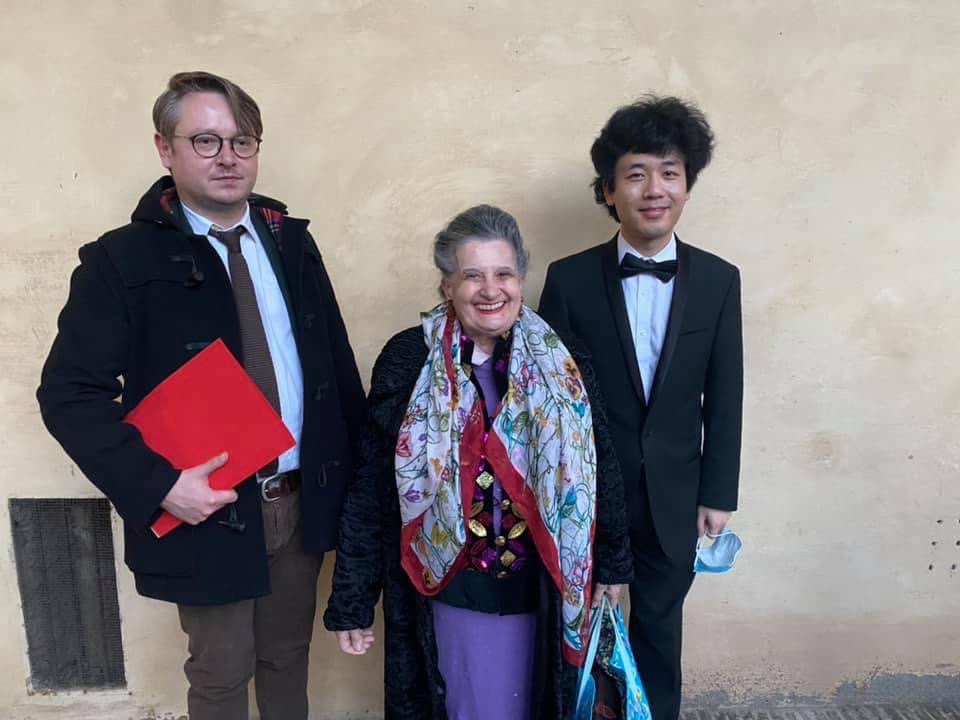
The indefatigable Marcella Crudeli with Yuanfan and Pawel Gorajski conductor of the Roma 3 Orchestra that plays in the final concert The Rome University Orchestra founded 16 years ago by their enlightened artistic director Valerio Vicari Yuanfan with pianist colleague ,also helped by the KCT,Drew Steanson in Rome by chance on a study holiday in Italy.A radiant Marcella Crudeli after the superb performances from her Premio Chopin 2018 Gold medal winner Yuanfan Yang
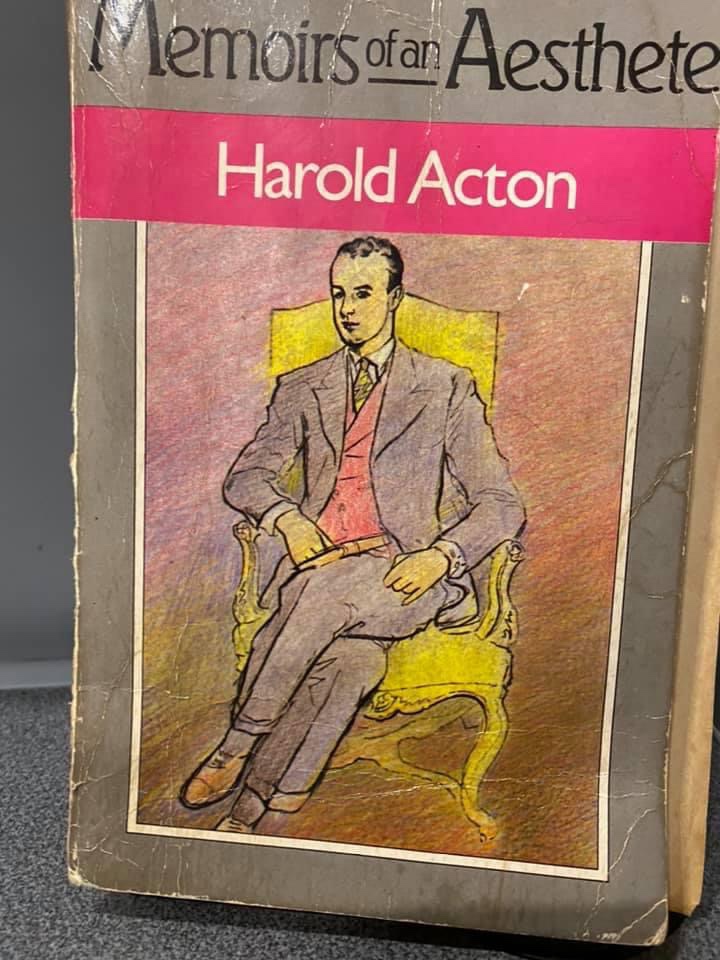
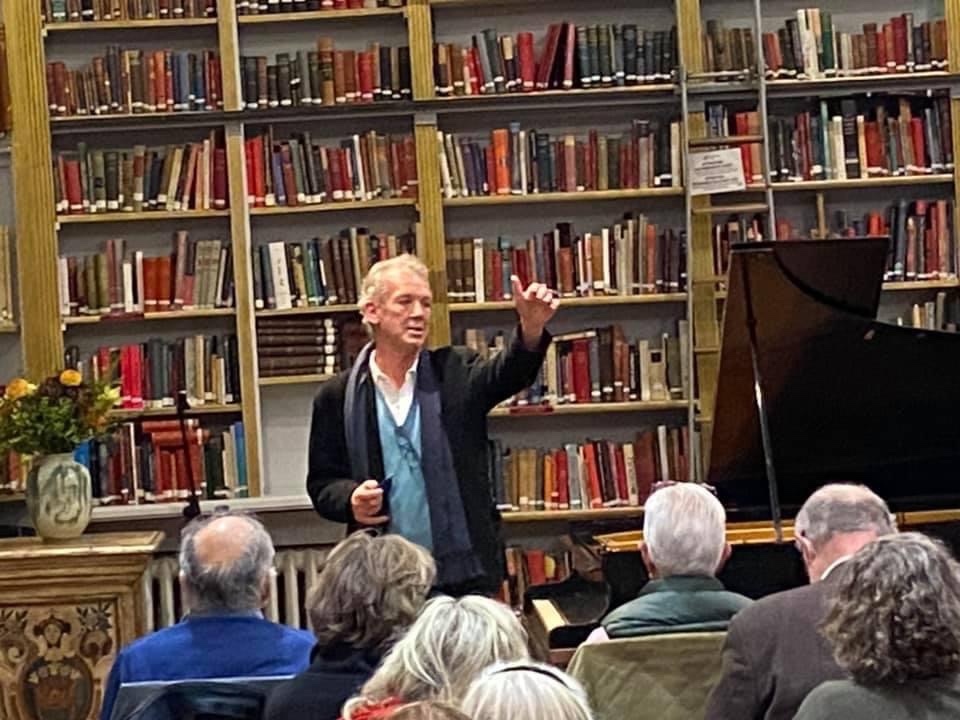
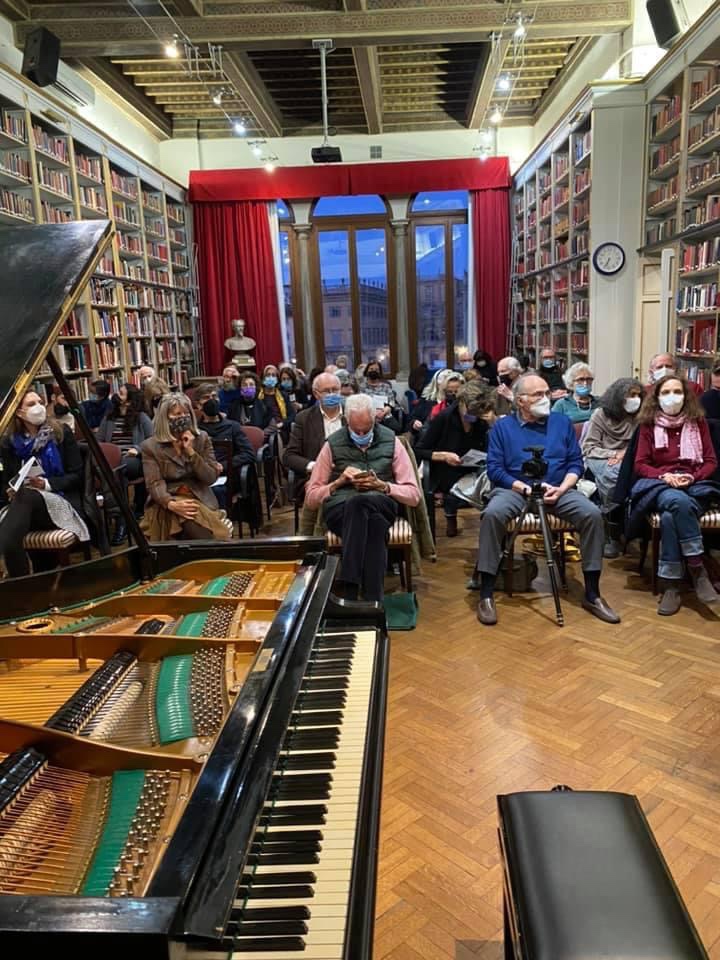
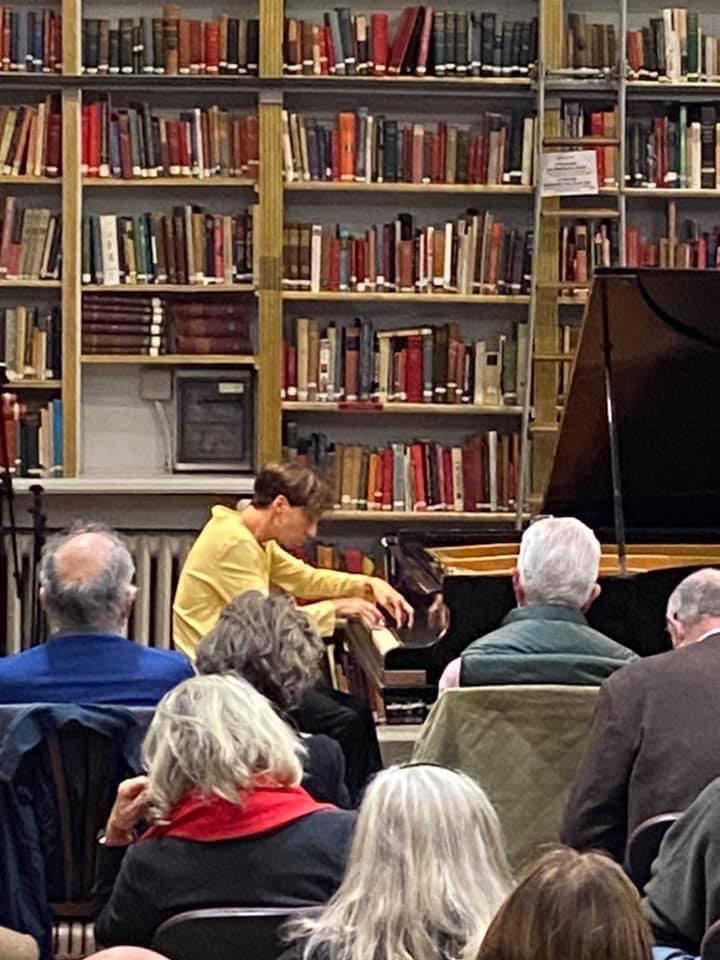
As he says a lifetime may not be enough to enter completely into the genial mind of J.S.Bach.One can but try and this is the start of a remarkable voyage of discovery.Now on his fifth public performance I think that from the spell that he created in Florence last night it was evidence enough that he is on the right trail.Seventy five minutes of total silence from an elite audience surrounded by the books of that remarkable aesthete Harold Acton.
Jonathan like Acton was born in Florence both bringing back their experiences from abroad to the cradle of culture in what Rostropovich described as the Museum of the World.
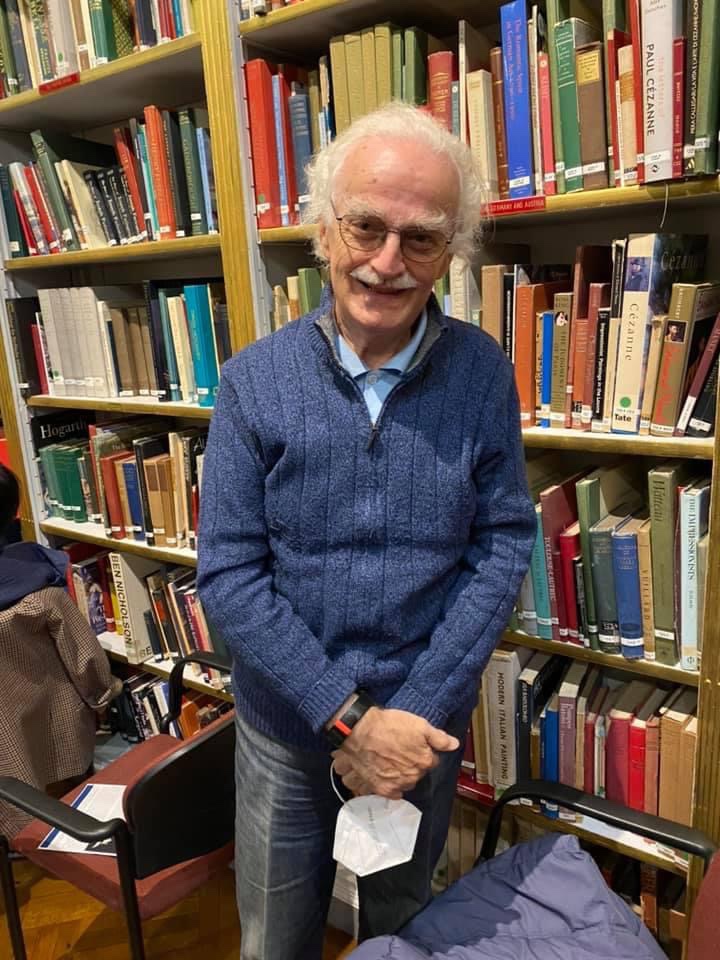
Giovanni Carmassi – Jonathan’s early mentor whose book of conversations with Prof Piero Ferrucci is every bit as significant as that of Heinrich Neuhaus
It was nice to meet at last Jonathan’s remarkable teacher Giovanni Carmassi who had instilled such poetry and wisdom into his young prodigy before sending him out into the world to perfect his studies with Joan Havill in London.
Jonathan is now being mentored by Angela Hewitt who has indeed inherited the mantle of Rosalyn Tureck as the High Priestess of Bach.I brought Rosalyn Tureck to Florence in the 90’s when she was 78 to play these very variations at La Pergola and she became immediately the ‘Diva’ of Florence.The mantle has now passed to Angela Hewitt whose approach to Bach is more human and less monumental than Tureck but their total dedication allows them to get as close as is possible to the core of the genius of J.S.Bach.
Jonathan is fast on this trail too as the minutes of aching silence that greeted the end of the Goldberg last night was proof enough.I have already written in detail about his performances but last night I could hear that he has refined his ornamentation and dug deeper into the sublime 25th variation and added a solidity to the 28th.His performance had the authority of someone who is living with the music and it is gradually but surely entering his being as it directs his spirit to the glory of the soul of Bach which is of course To the Glory of God! https://christopheraxworthymusiccommentary.wordpress.com/2020/11/18/angela-hewitt-for-the-glory-of-bach-the-pinnacle-of-pianistic-perfection/
Simon Gammell OBE the enlightened director of the British Institute in Florence
It is to Simon Gammell that our thanks must go for allowing the Keyboard Charitable Trust to bring some of its finest young pianists to play in the Harold Acton Library of the British Institute in Florence.Jonathan’s recital is the opening of a series of seven recitals that will fill these hallowed walls with the sound of music after this long lockdown period.The next date in this series is Thursday 27th January followed by Thursday appointments on 24/2,24/3,5/5,16/6,30/6 .More detailed information will be found eventually on the web site of the British Institute and the Keyboard Charitable Trust
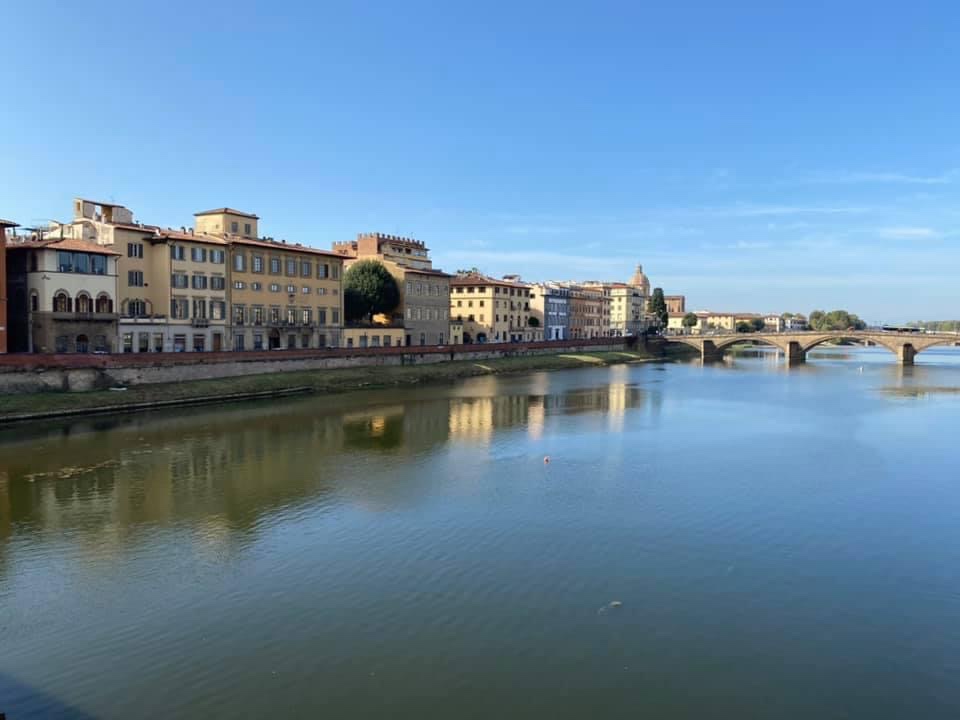
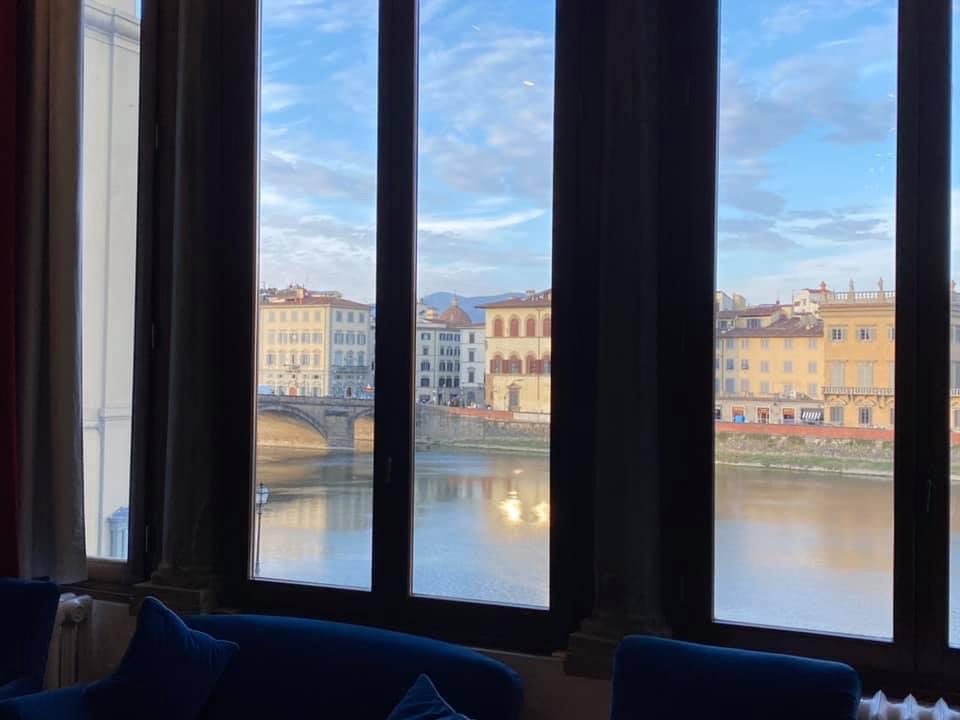
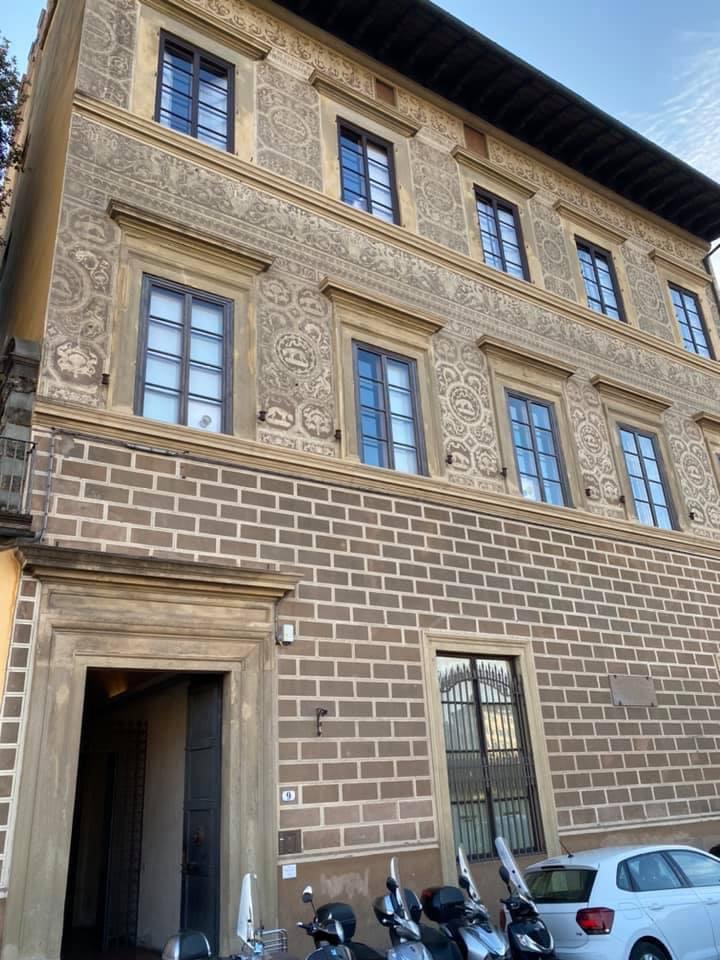
The British Institute in Florence Room with a view indeed The British Institute Lungarno Guicciardini Florence’s best kept secret Piazza S.Spirito just behind the B.I.Jonathan at the end of his fifth voyage of discovery
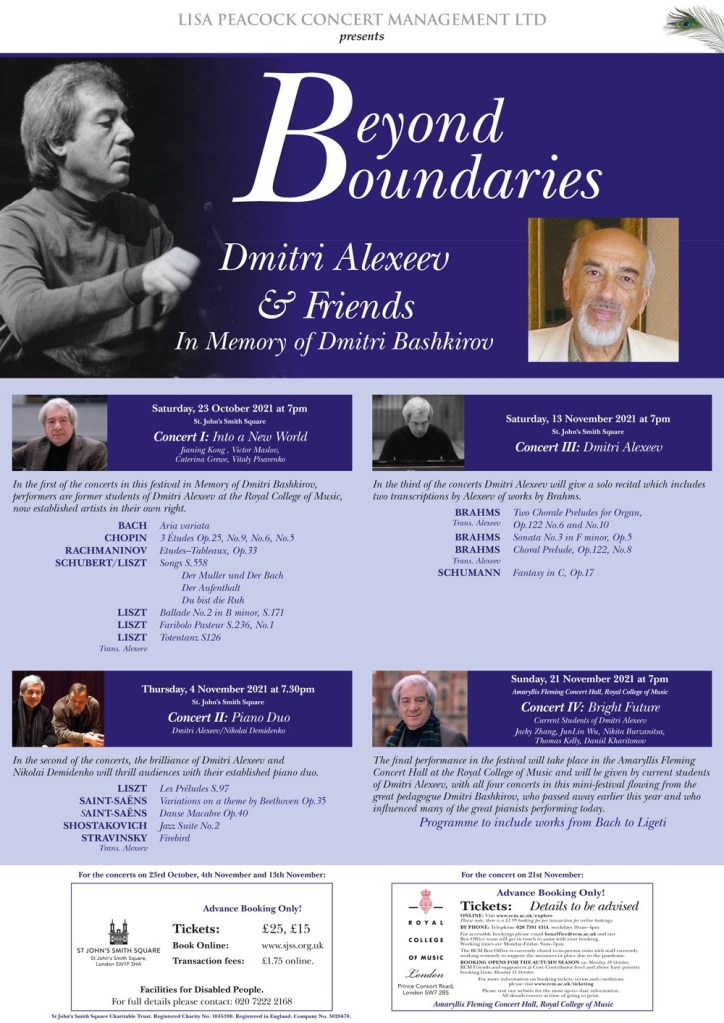
A Golden Age of piano playing was very much in evidence at the first of four concerts that Dmitri Alexeev has dedicated to his teacher Dmitri Bashkirov under the title ‘Beyond Boundaries’. In fact we were transported by four artists that have come under his influence to a magic world of radiance with a seemless stream of sumptuous golden sounds.
St John’s Smith Square
Can it be the hall,the piano or is it the supreme artistry that Alexeev has shared with his colleagues and that they have transformed into their own world taking us back to the Golden Age of piano playing. An age when pianists were magicians as they could turn a piano into an orchestra as easily as they could share intimate whispered confessions. Through a mastery of balance they could persuade us that the piano could sing as beautifully as any of the great bel canto divas of the day. It is through a subtle sense of touch and complete mastery of the pedals ,that Anton Rubinstein described as ‘the soul of the piano’,that miraculously a black box full of hammers a wires can be transformed into a magic box of sparkling jewels .
Patsy Fou – the widow of Fou Ts’ong
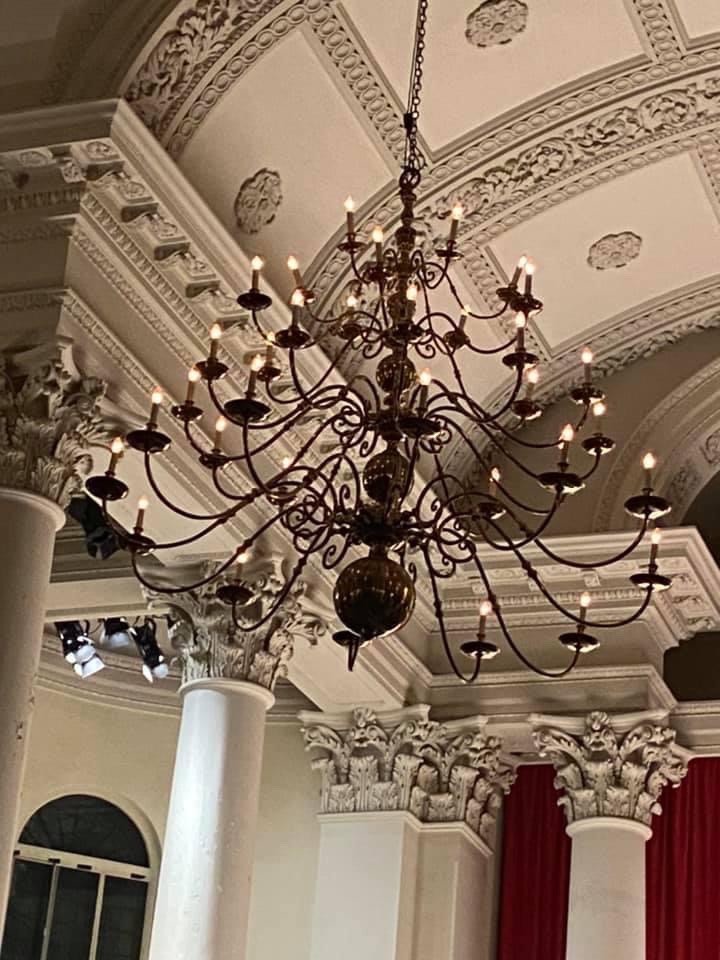
And so it was tonight that we were enveloped in a sound world of sumptuous beauty in the hall the Fou Ts’ong always said was his favourite hall in London- it is much easier to play intimately in a big hall than it is in a small one he would often remark.And it was Ts’ong who was in my thoughts tonight as I met his widow coming into this beautiful hall. The wonderful red drape backdrop and the refined central chandelier reminded me of all the great pianists I have heard here in the good old days.
It is good to be back and especially to hear artists that truly love the piano in a world where quantity has taken priority over quality and velocity has taken priority over artistry.
Jianing Kong
Jianing Kong’s Bach I could only admire from behind closed doors as both Patsy Fou and I were convinced it was a 7.30 start instead of 7. Instead of being early we were late c’est la vie !However I did hear his three Chopin studies.The so called ‘Butterfly’ study op 25 n.9 just hovered over the keys and the final delicate bar was judged to the perfection of an intelligent artist.
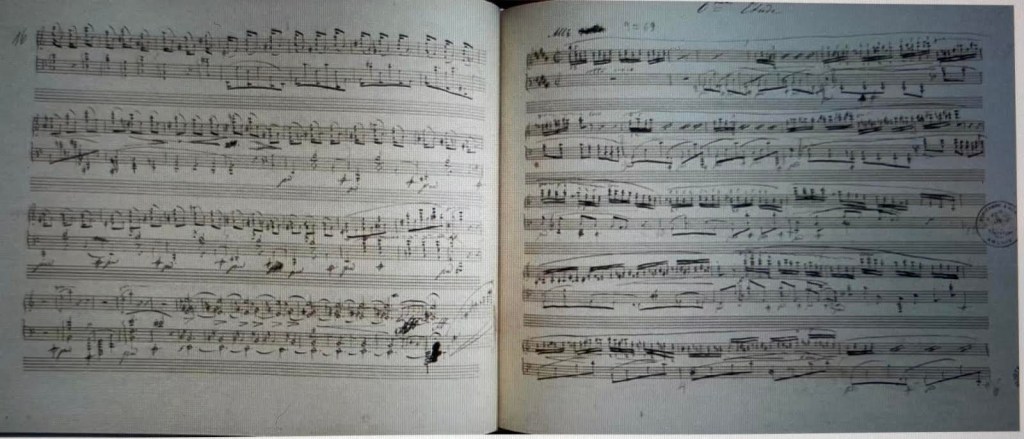
Facsimile Chopin op.25 n.5/6
Intelligence and beauty too were in evidence in the double thirds study op 25 n.6 where the beautiful bass melody was given the just priority over the transcendental double third accompaniment.Op 25 n.5 where the sumptuous middle section melody was played with ravishing beauty and the accompaniment just shimmered as it hovered above it. Rubinstein often used to play this study on its own but a closer look at the score indicates quite clearly that the pedal links the rather strange question mark ending of number five with the gentle rustle of number six that emerges from it.
Victor Maslov
A newly bearded Victor Maslov played 8 Etudes-Tableaux op 33 with such subtle sounds and jeux perlé passages that swept across the keyboard as we were reminded of the magic that Rachmaninov himself could conjure in his performances. I remember Vlado Perlemuter telling me that Rachmaninov would appear on stage looking as though he had swallowed a knife but then produced the greatest romantic sounds that he had ever heard. And so it was with Victor whose playing I know well but this evening he even surpassed his own prowess with such sumptuous romantic sounds of such subtlety and a characterisation of each study that was mesmerising. I suggested to Victor afterwards that he certainly keeps this new beard!
Caterina Grewe
There was more ravishing beauty from Caterina Grewe not only to see her in such a beautiful blood red gown but to listen to the velvety beauty of sounds that she could produce. A wondrous sense of balance allowed the melodic line of the three Liszt transcriptions of Schubert songs to emerge so naturally. ‘Am I too loud’ was the name of Gerald Moore’s autobiography and I would often compliment Graham Johnson on being allowed by singers to keep the piano lid fully open. ‘But I am a good driver’ would be Graham’s spirited reply. It was exactly this sense of balance that Caterina had too,where the accompaniment is an integral part of the story that Schubert is unraveling. A complete understand of the meaning of the poetry was immediately evident from the sounds that poured out of the piano where Caterina was both singer and accompanist. There was a wonderful luminous sound after the deep brooding waves of sound with which Liszt depicts the great drama about to unfold in his B minor Ballade.The sumptuous melody was played with ravishing seduction as it is transformed by Liszt in ever more affusive pyrotechnics in true Hollywoodian style. In Caterina’s hands it was full of overpowering emotion as her complete technical control allowed her to give full reign to her fantasy with sumptuous sounds and breathtaking virtuosity. Always with the musical line of this great drama in view it was not just an empty display of virtuosity but a continuous outpouring of emotions.
Vitaly Pisarenko
Last but certainly not least enters the minute figure of Vitaly Pisarenko,winner at only 20 of the International Liszt Competition in Utrecht and has since gone on to win a top prize in the Leeds Competition too.He has for some years been ravishing connoisseurs of piano playing worldwide with his refined aristocratic performances especially of Liszt. In fact it was in Liszt’s transcription of Schubert’s Gretchen am Spinnrade that a miraculous web of subtle sound kept the audience mesmerised.The absolute control and the enormous dynamic range was breathtaking as the melodic line emerged from the whispered spinning wheel to gradually build up to an astonishing fortissimo climax only to immediately allow the even more whispered spinning wheel to emerge at the end with heart rending beauty that had the audience on the edge of their seats. The rarely hear Faribolo Pasteur was give such a seemingly simple performance as Caterina had done with Du bust die Ruh where art truly conceals art. His performance of the solo version of Liszt’s Totentanz was a quite astonishing display of transcendental virtuosity but also of supreme musicianship as he kept the architectural line of these extraordinary variations on the Dies Irae as they unfold in ever more astonishing funambulistics. An extraordinary exhibition of virtuosity like the great pianists of another age.He tells me he will be playing the original for piano and orchestra in Moscow in December.
Dmitri Alexeev-Jianing Kong- Victor Maslov- Patsy Fou
A wonderful way to end a feast of music with Dmitri Alexeev in the audience visibly moved by the heartfelt tribute to his great mentor Dmitri Bashkirov. I had heard Bashkirov only once in a recital in Rome and was reminded of him as I listened to the Schubert Liszt songs,enraptured today as I was then all those years ago
I am now in Rome where Dmitri Alexeev was for many years one of our most cherished artists together with Fou Ts’ong,Peter Frankl,Annie Fischer ,Vlado Perlemuter and Shura Cherkassky
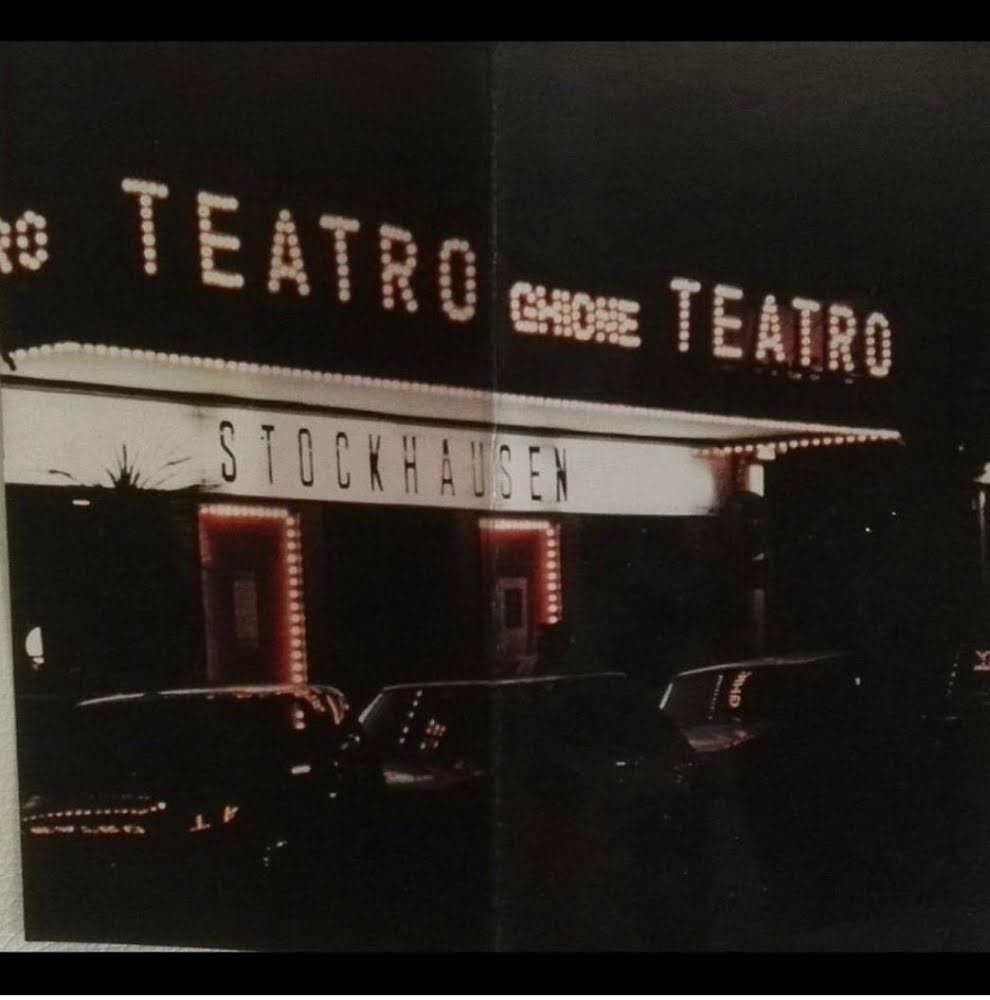
Ileana Ghione with Dimitri Alexeev in 2003 in Teatro Ghione Rome Teatro Ghione in RomeVictor Maslov and Vitaly Pisarenko being congratulated by Jessie HarringtonDmitri Alexeev in discussion with Linn Rothstein Caterina Grewe
Here is Yuanfan Yang winner of the last International Piano Competition who will play in Rome next Thursday at the press conference for the competition to be held next month.
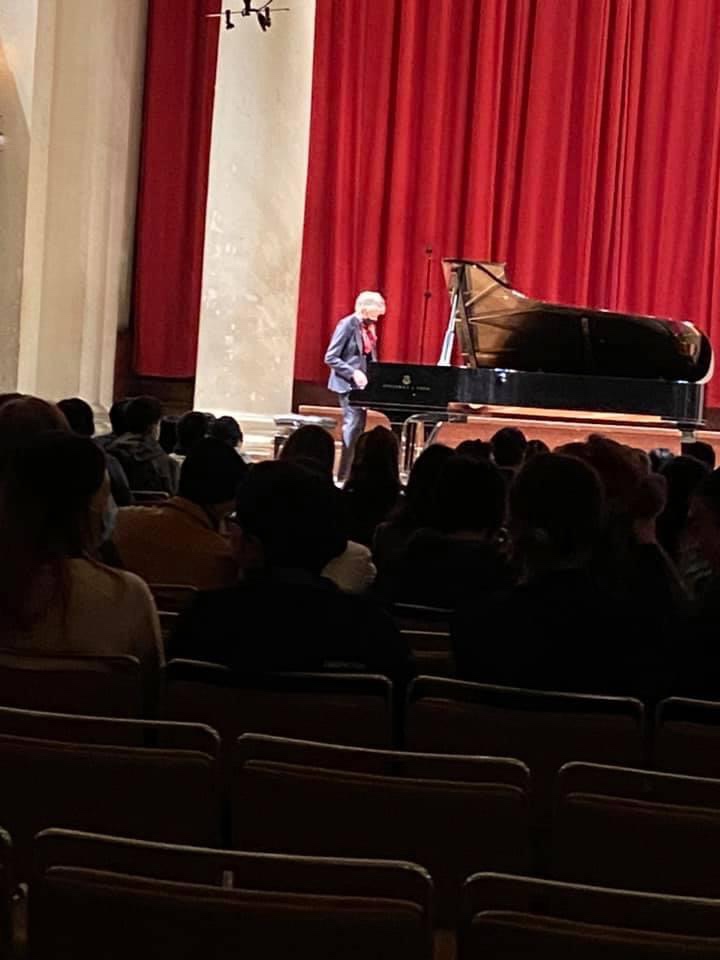
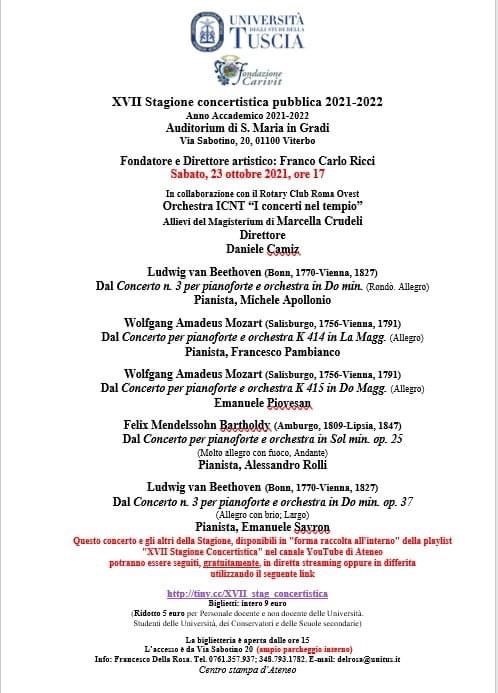
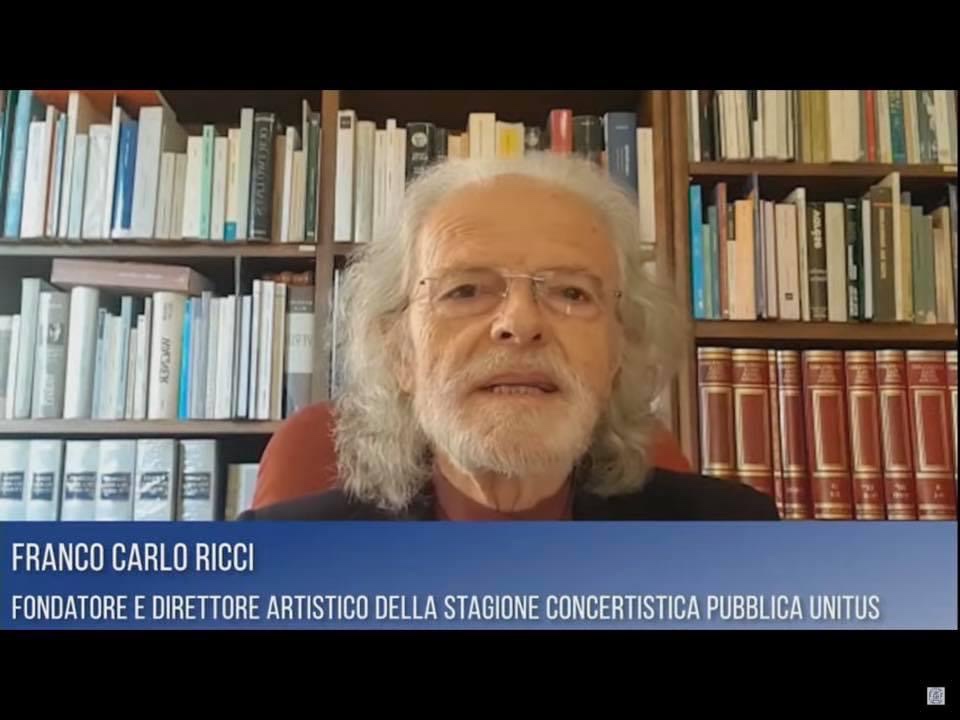
Streamed live from Viterbo thanks to the equally indomitable Prof Franco Ricci a concert that I will listen to live tomorrow in the Eternal City.
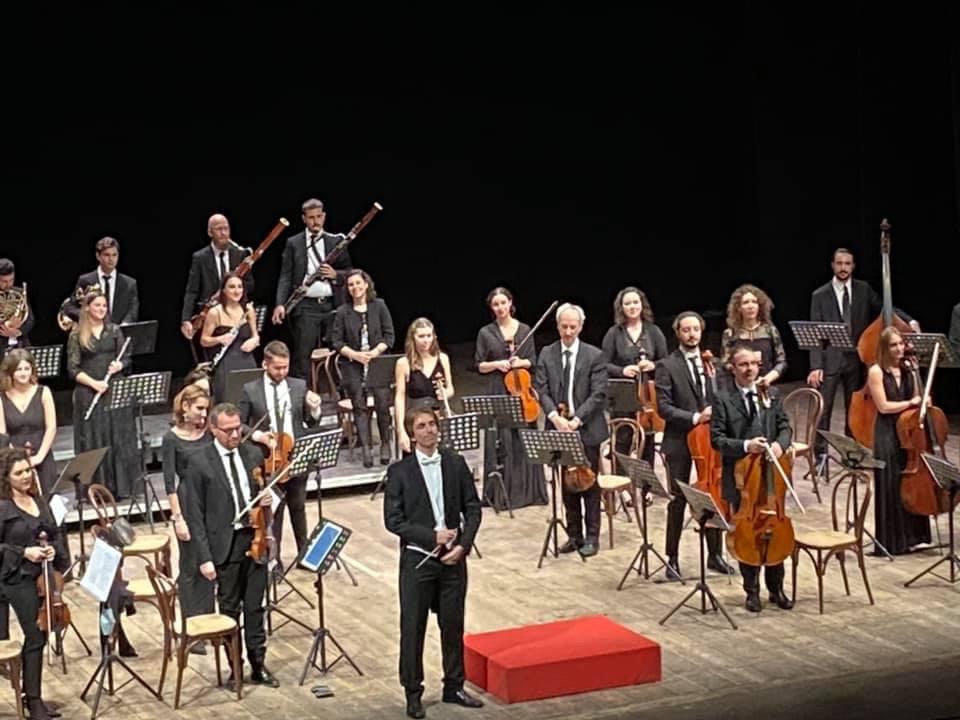
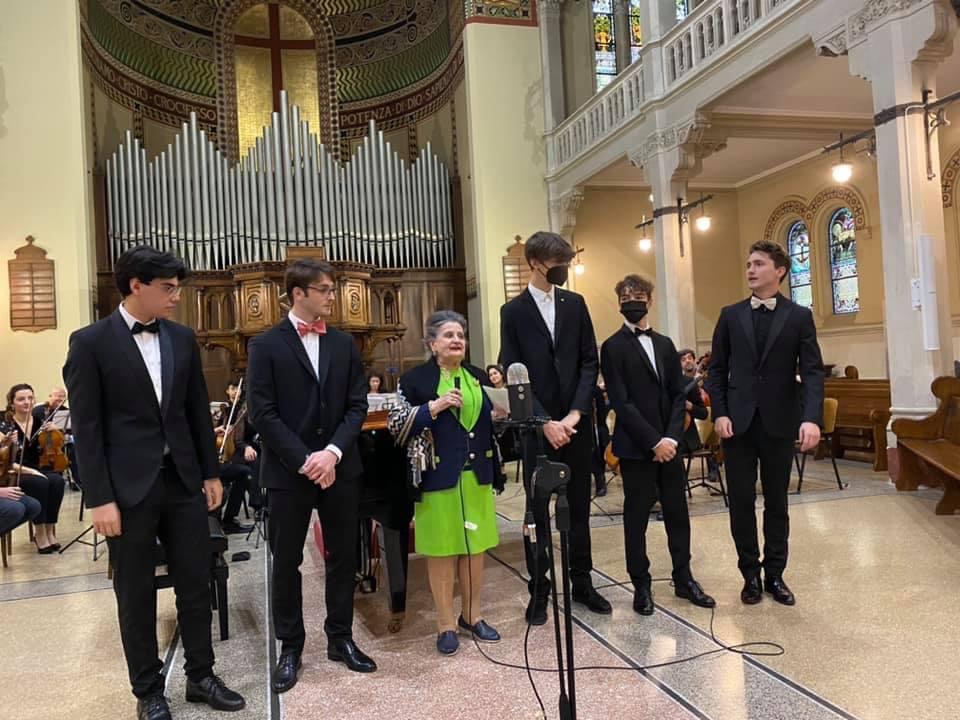
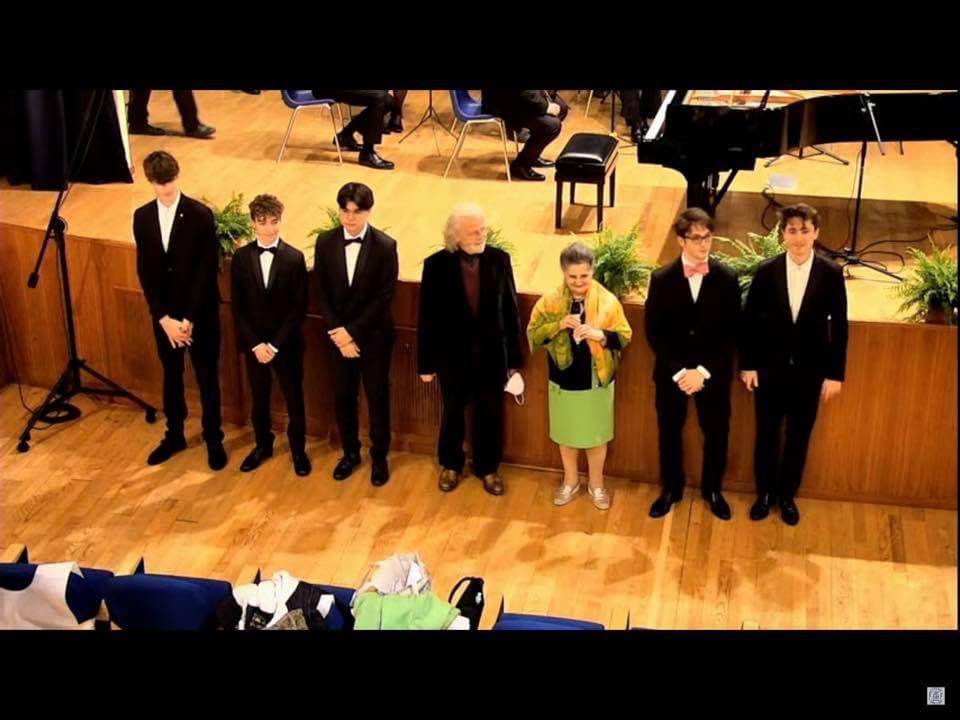
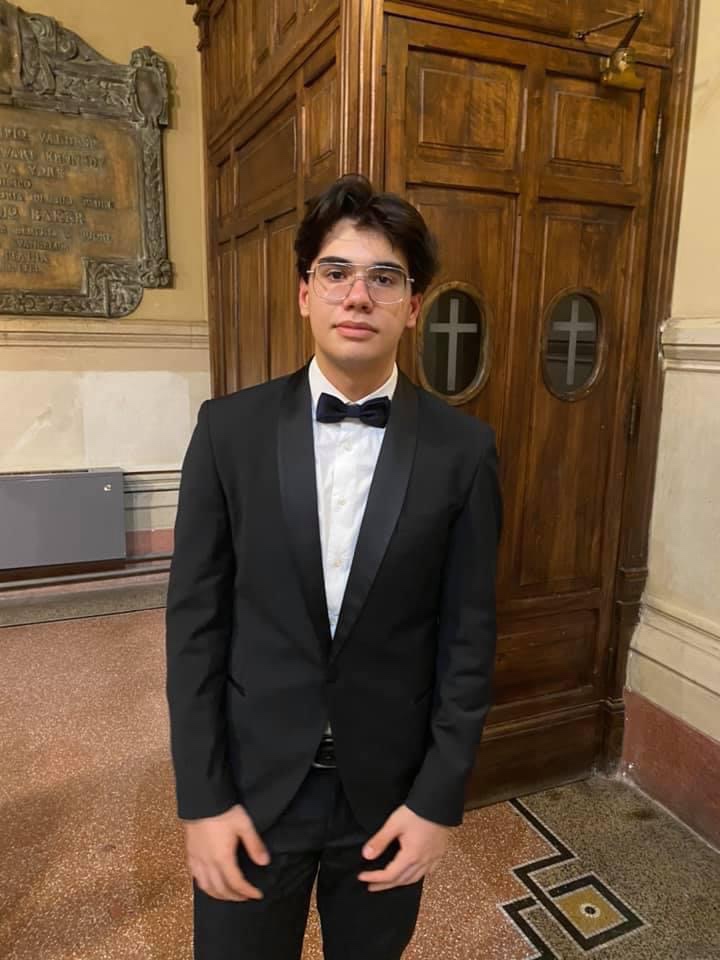
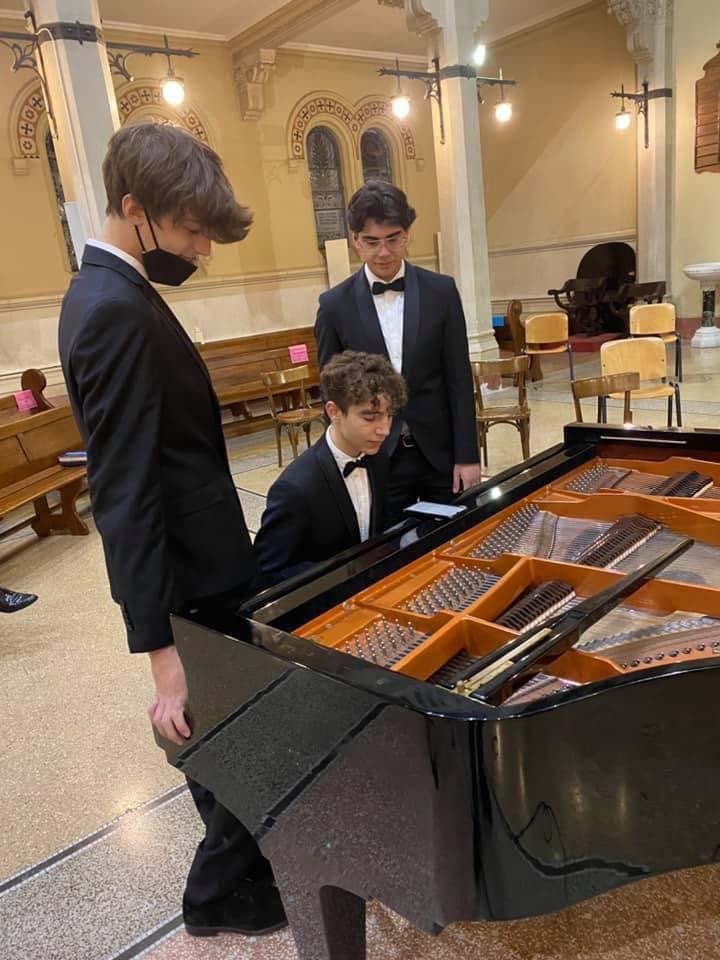
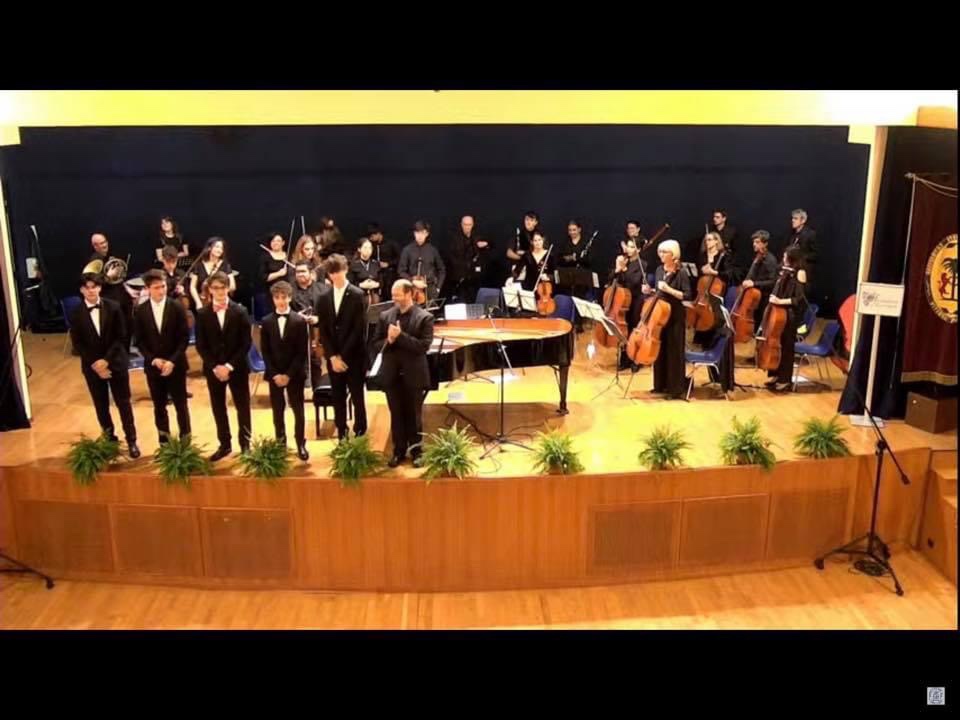
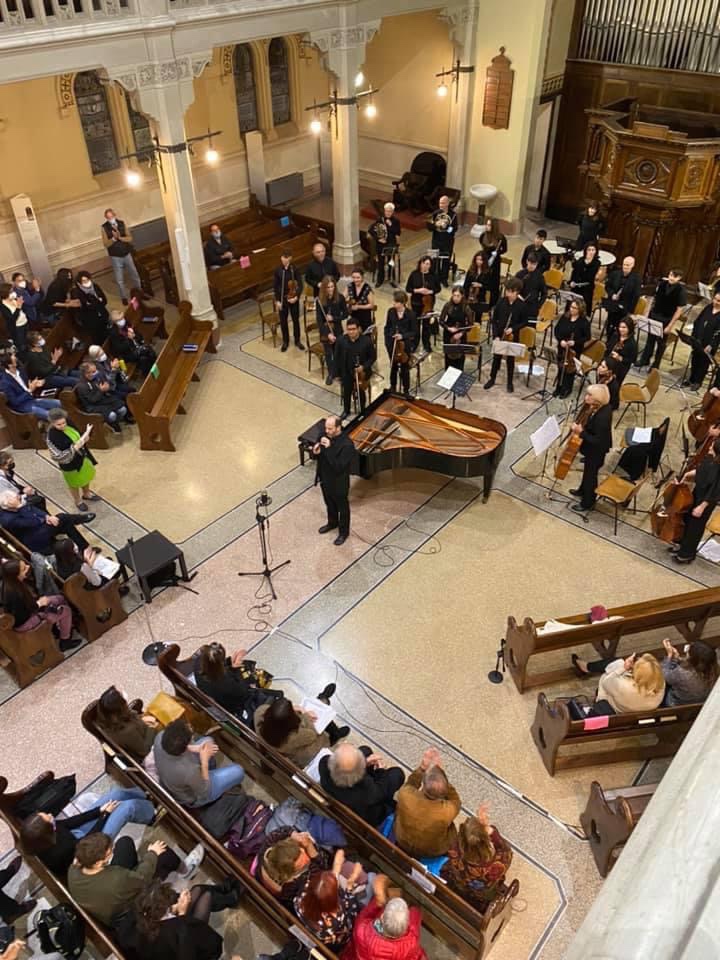
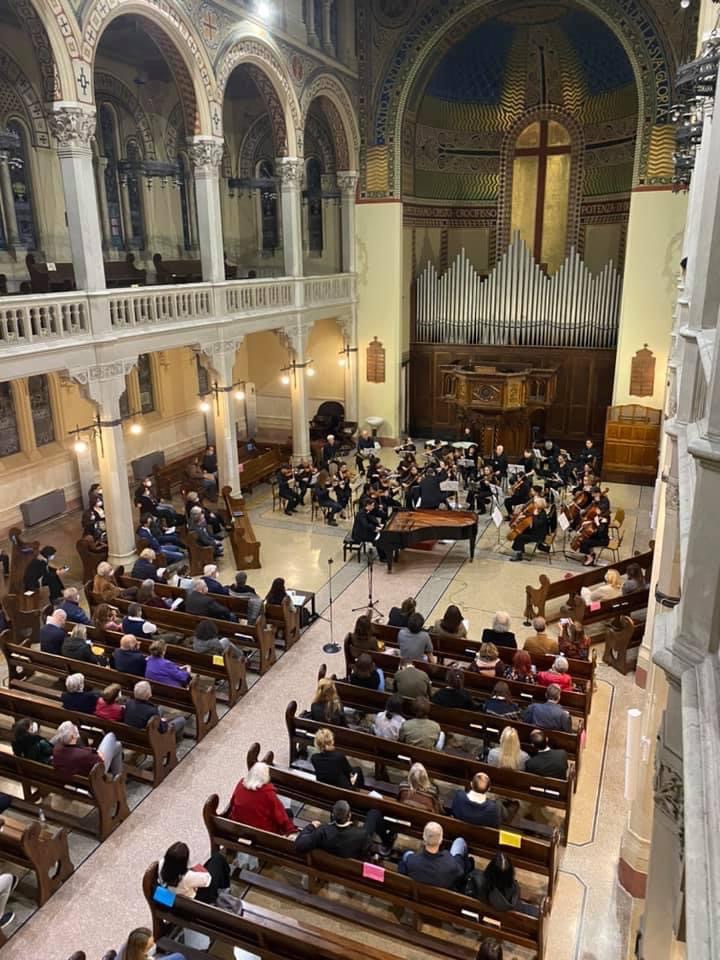
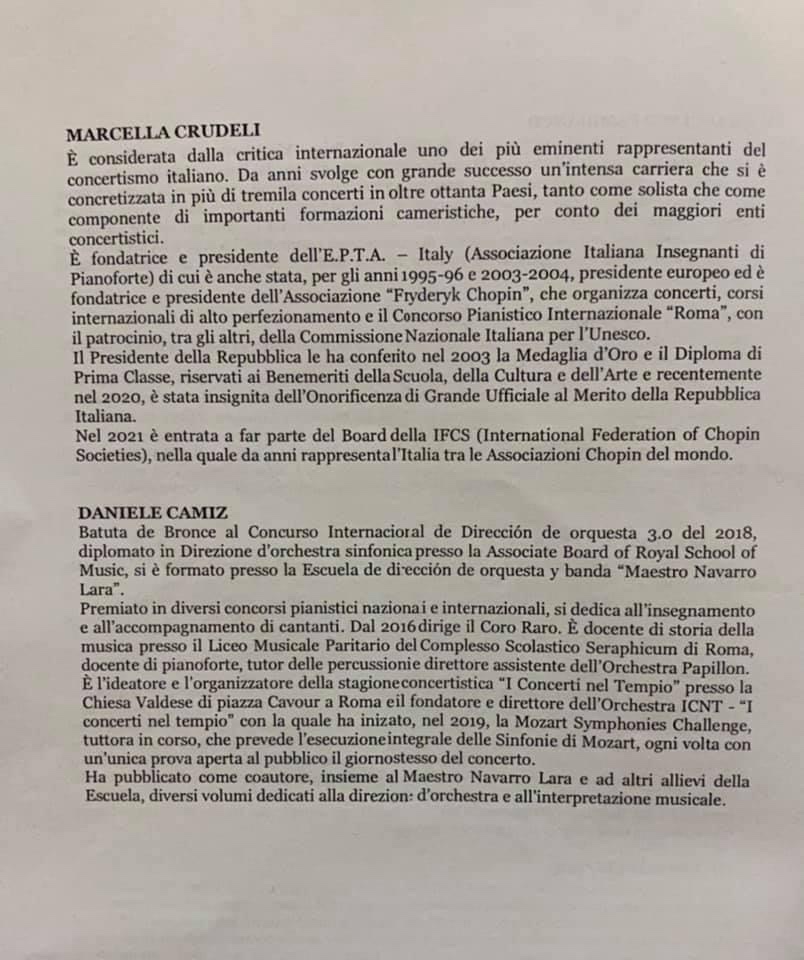
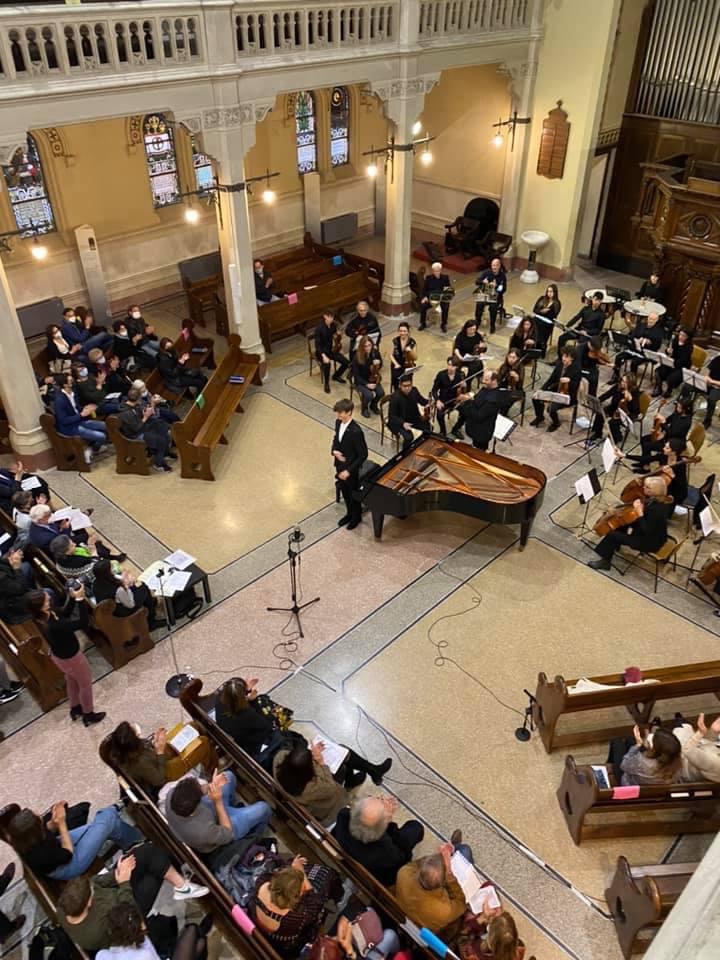
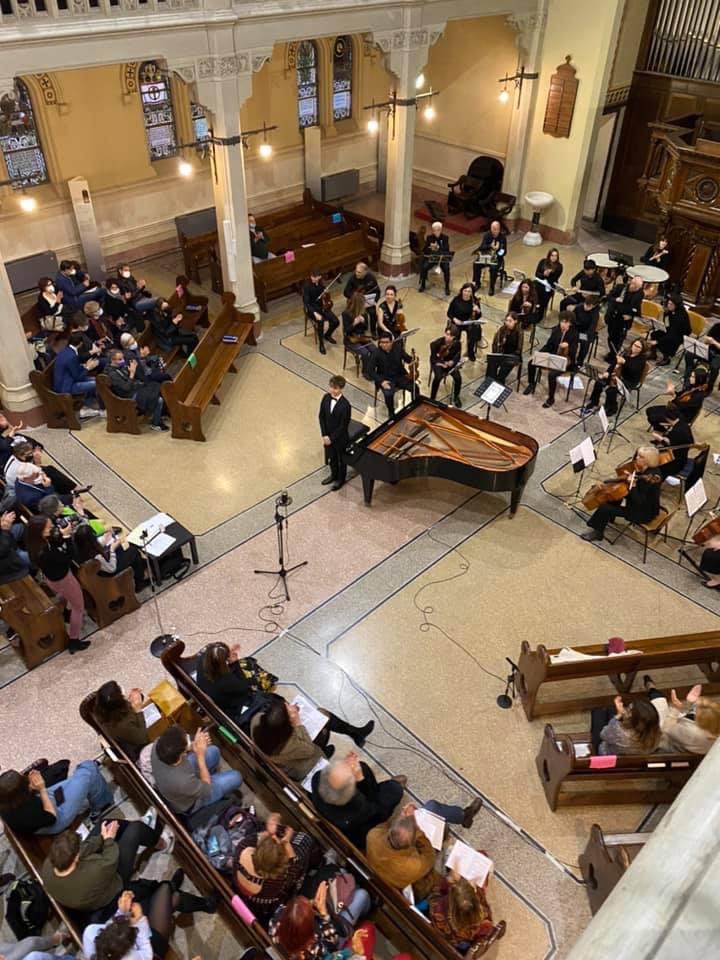
Mozart concertos K 414 and 415 played with impeccable taste and rhythmic flair. A Mendelssohn G minor concerto that made you marvel with what simplicity and facility Mendelssohn could spin so many notes with scintillating jeux perlé and heart on sleeve sentiment.To finish with Beethoven’s C minor concerto played with a great sense of architectural form and formidable contrasts. Each of the five teenage solists gave an encore of studies Chopin op 25 n.1 -7-12 and op 10 n 5 and Debussy Pour Les arpèges composée An orchestra only too happy to encourage and follow these budding young virtuosi under the complacent Daniele Cadiz striving to get the very best out of his musicians . A feast of music and a joy to watch with what seriousness and passion these young musicians are dedicating their youth .And so to the Chiesa Valdese in the centre of Rome for the final festive occasion at the end of Marcella Crudeli’s annual series of Masterclasses for talented young pianists.After each performance helping and encouraging these young musicians – work,work work as they dedicate more of their youth to music.
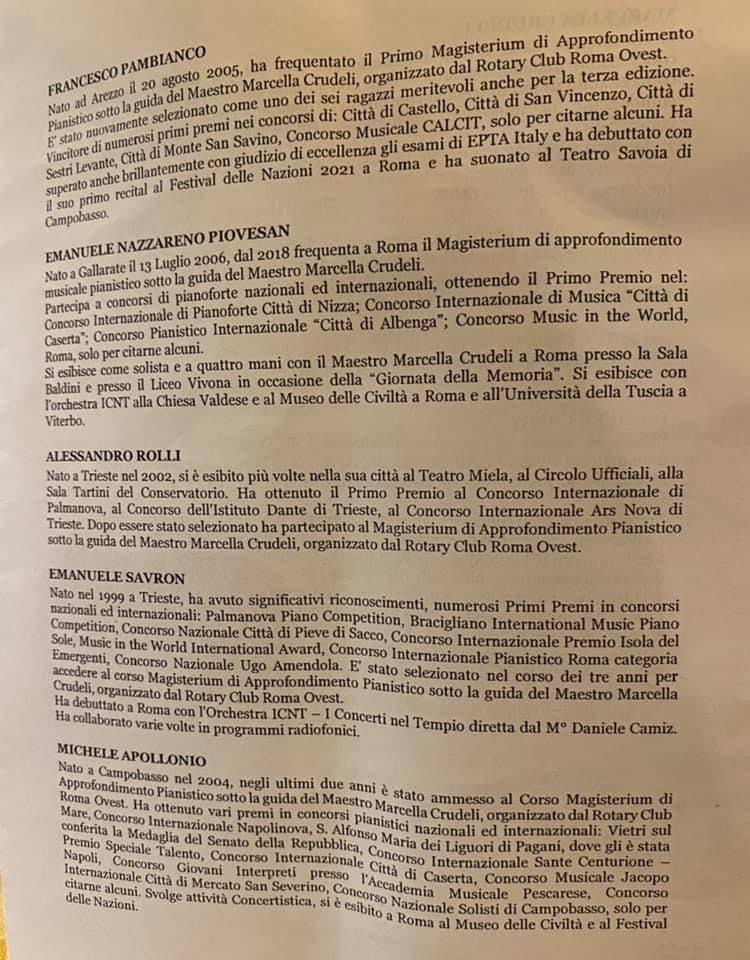
Francesco Pambianco
Sixteen year old Francesco Pambianco from Arezzo played the first movement of Mozart K 414 and was able to transmit the wonder of Mozart with great rhythmic precision and simple musicality.His encore of Chopin study op 25 n.1 was beautifully played but would have benefitted from the same simplicity that he had brought to Mozart.
Emanuele Nazzareno Piovesano
Emanuele Nazzareno Piovesan is fifteen and from Gallarate – Milan and played the first movement of Mozart K415. Schnabel famously remarked that Mozart was to easy for children but too difficult for adults and it was the simplicity and purity of a teenager that he brought to this early concerto that was so refreshing .His encore of op 25 n.7 a study in balance and cantabile is marked Lento.Some beautiful things but a little too slow at the opening to allow the melody to sing unimpeded by the accompaniment but as it got more agitated he rose to the occasion magnificently as he began to listen to the beautiful sounds he was producing.
Alessandro Rolli
Alessandro Rolli is nineteen from Trieste and played the first two movements of Mendelssohn G minor.He is more an artist than an artisan .The slow movement was beautifully played and the interplay between soloist and orchestral very well managed.The Allegro was played ‘con fuoco’ but could have been played with more rhythmic precision to contrast with his beautiful Andante.And it was his poetic Debussy Arpeggio study that ignited his real flair for keyboard imagination and colour.
Emanuele Savron
Emanuele Savron a veteran at twenty two and is also from Trieste.Beethoven 3rd concerto with playing of real beauty in the slow movement but slightly lacking in detail and rhythmic precision in the opening Allegro .His encore of Chopin’s last study op 25 was full of youthful passion and driving force even if the left hand sometimes trailed behind his impetuous right.
Michele Apollonio
Michele Apollonio is seventeen and from Campobasso and gave a very clean and rhythmic reading of the last movement of Beethoven’s 3rd Concerto.His encore of the ‘Black key study’ op 10 n.5 showed real flair and technical accomplishment even if the final octaves were more suited to Tchaikowsky than Chopin at the end.
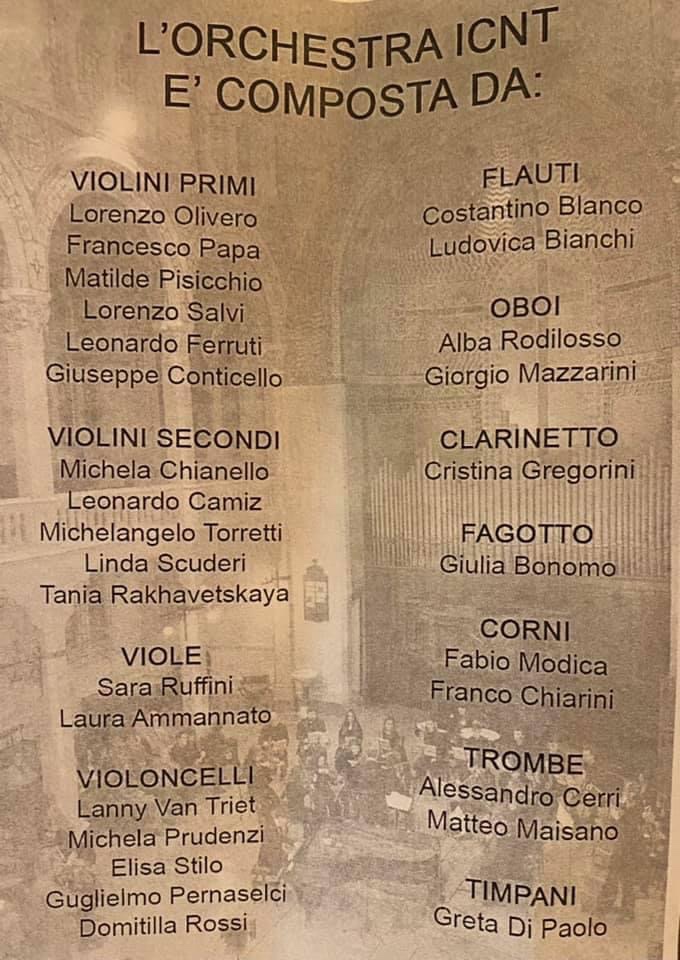
Not all work but fun too!While Marcella Crudeli is out counting the votes !Daniele Camiz applauding these young musicians in ViterboDaniele Camiz and his orchestra ICNTA full house in Rome
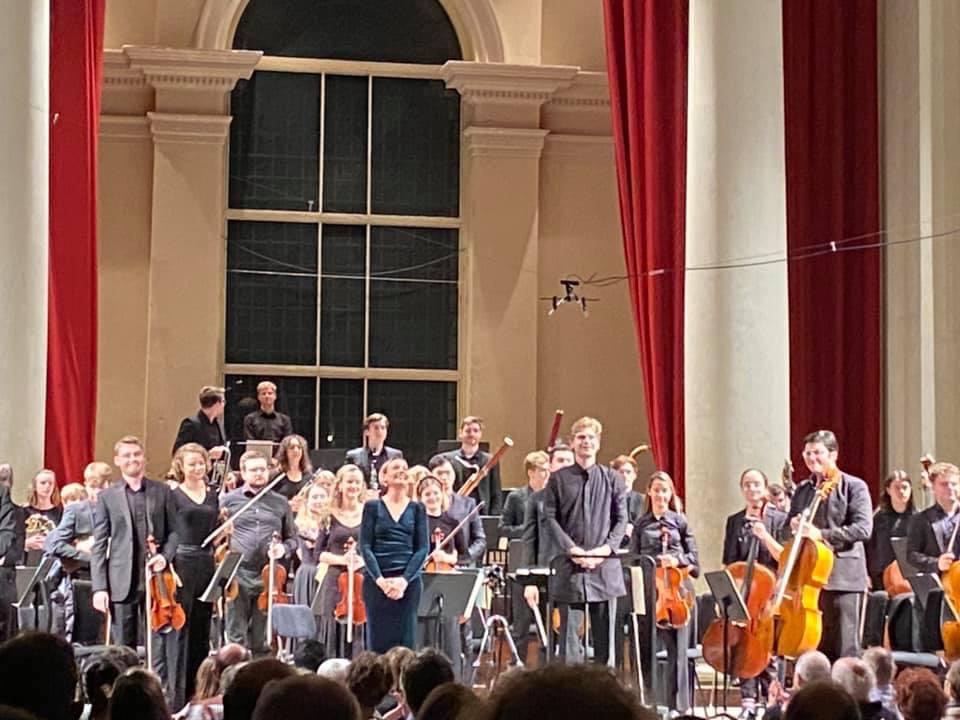
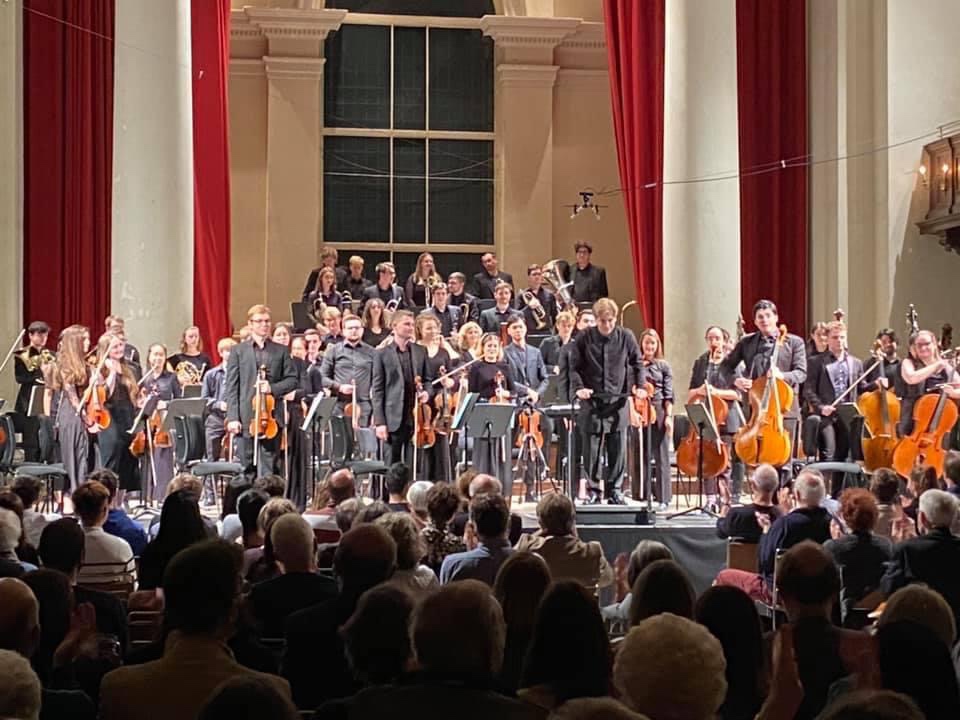
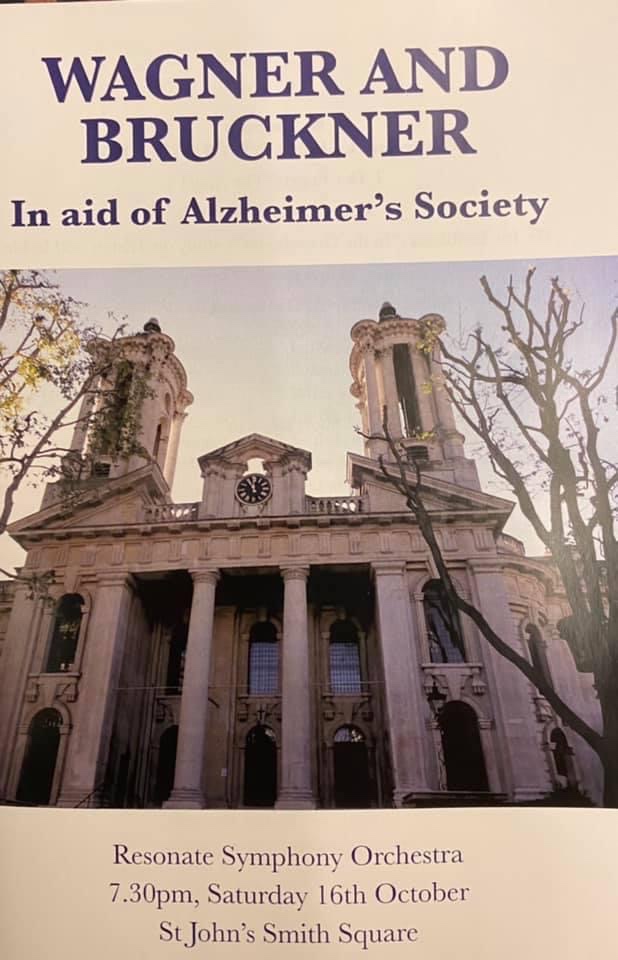
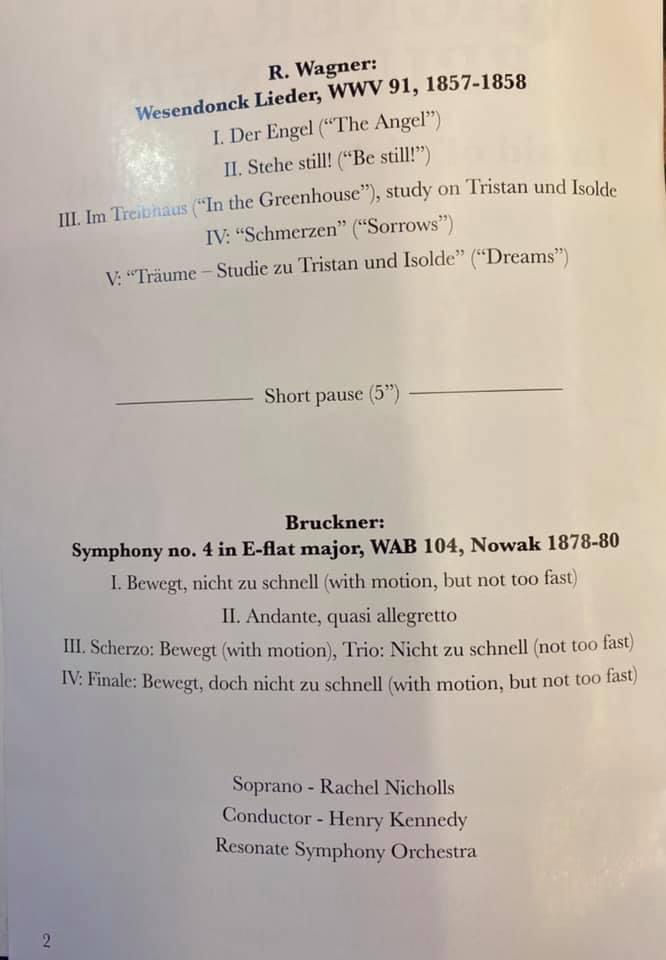
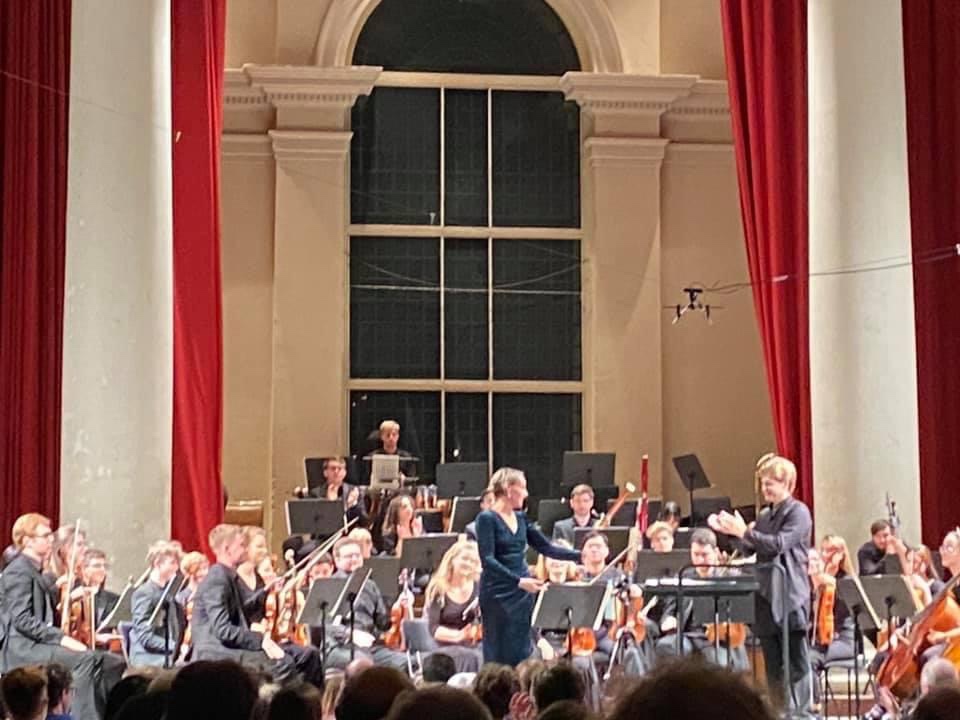
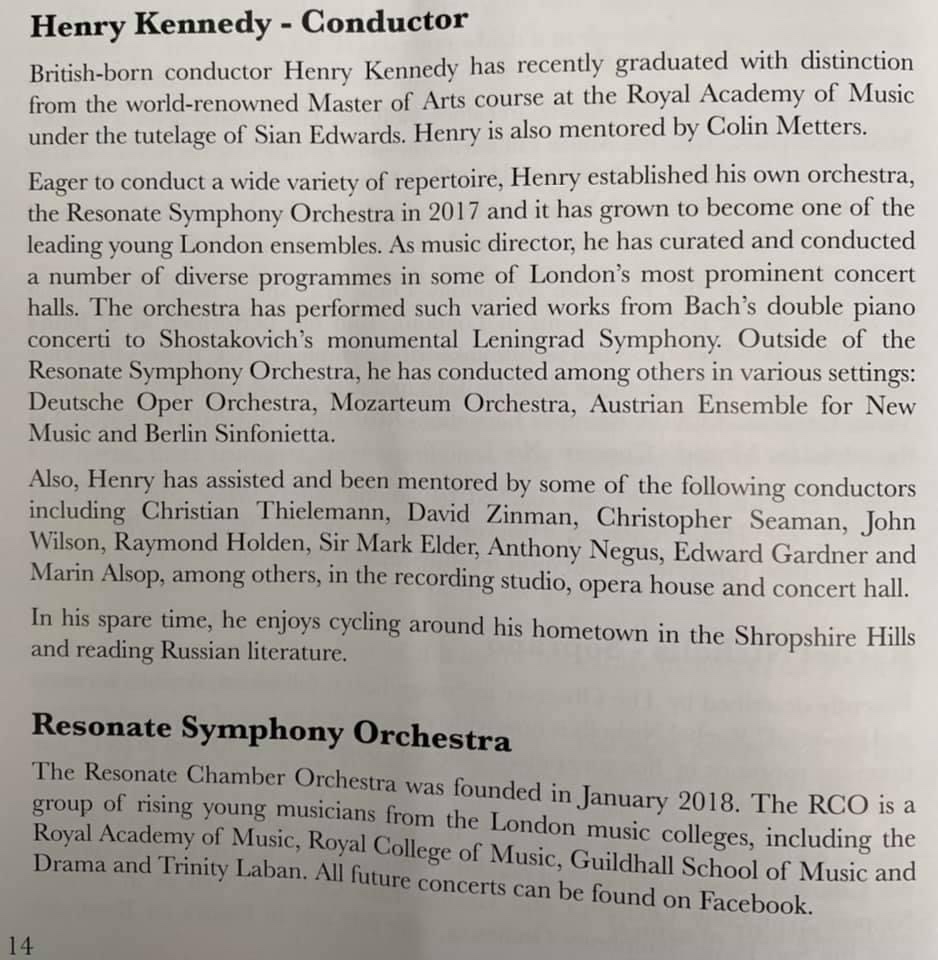
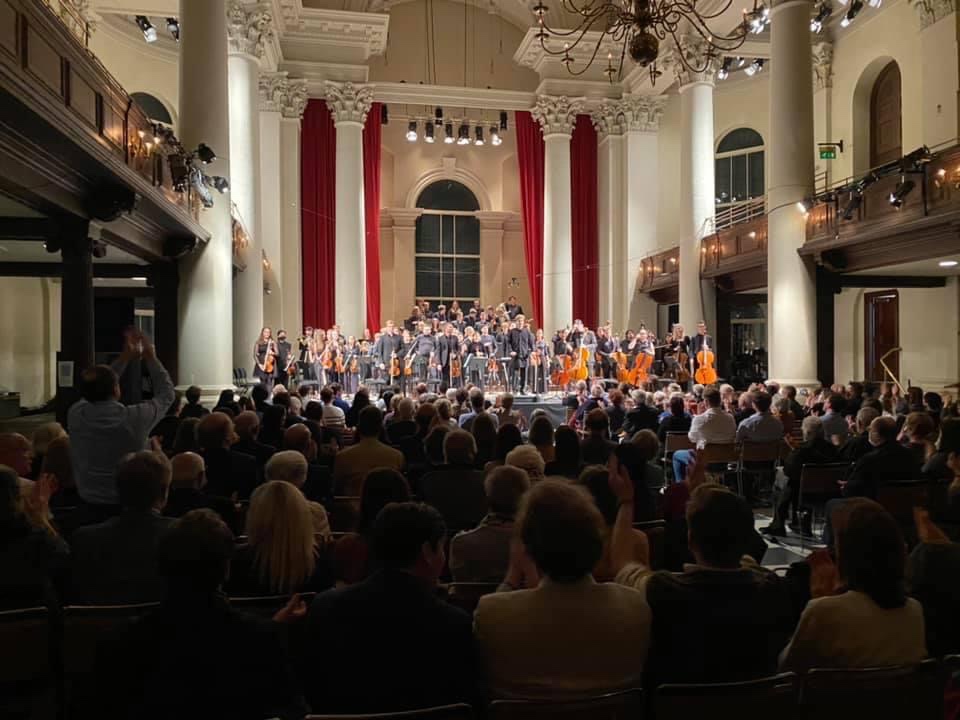
Superb singing from Rachel Nicholls with a voice of such velvet purity and intensity but it was the orchestra that was so extraordinary under its conductor Henry Kennedy.Some of the finest young players from the London conservatories united under their founder conductor to produce a remarkably rich and sensitive sound.
An orchestra that listens to itself is one to cherish indeed but when you add their youthful passion and technical mastery you have an orchestra that can turn Bruckner’s mighty Romantic Symphony into the masterpiece that it truly is. A sense of line and overall architectural shape that was so clearly etched.Like Jochum and the great German school the brass was allowed it’s just weight never overpowering the sumptuous string playing.Playing of silvery lightness that built to tumultuous ravishing fortissimi.Such sensitivity in the Wesendonck Lieder that created the world that the superb Rachel Nicholls was describing from The Angel to the magical Dreams via the Agonies and the wheel of time that measures eternity.






















 ChristopherAxworthy-MusicCommentary