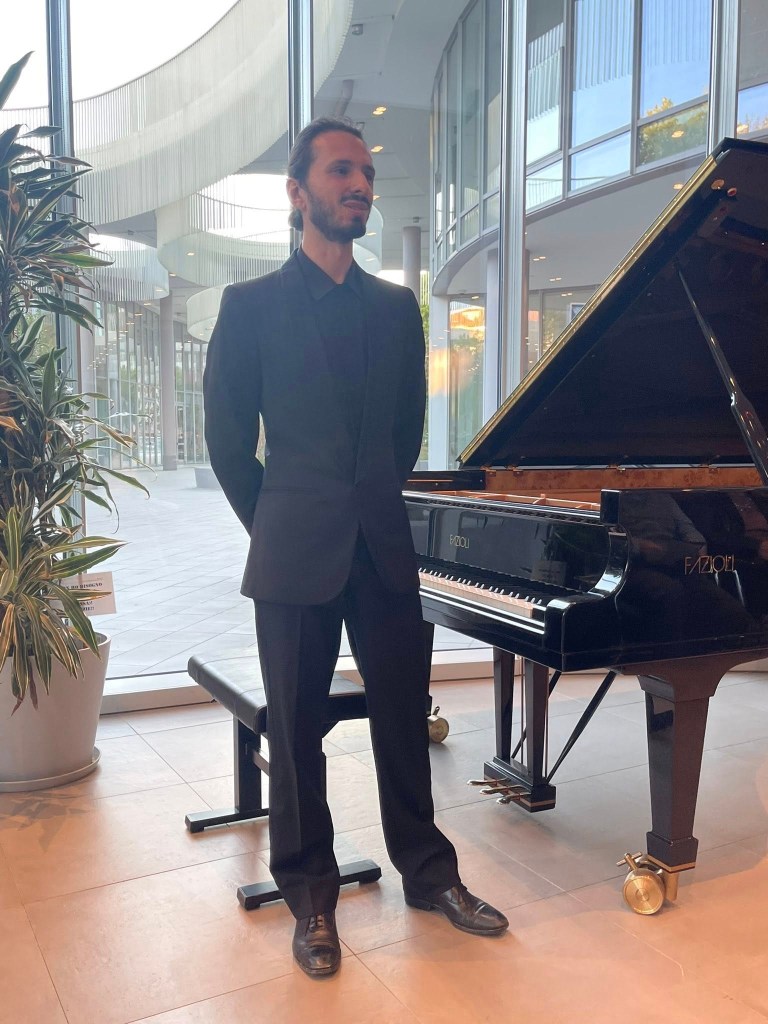
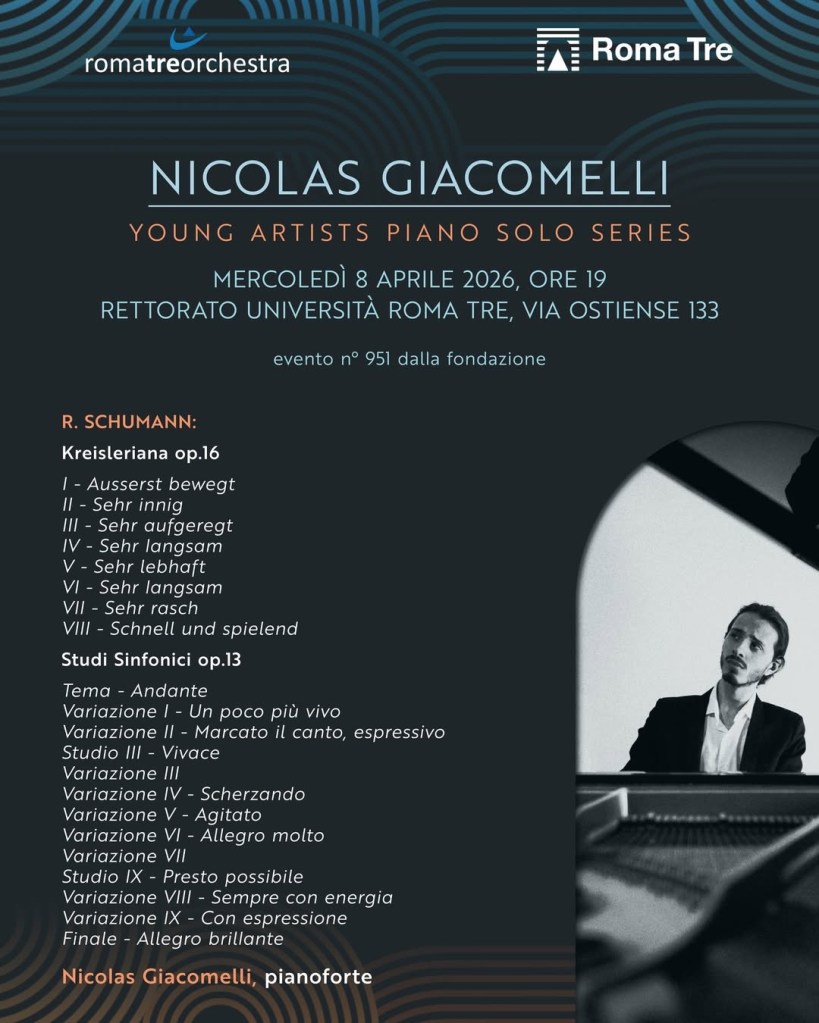
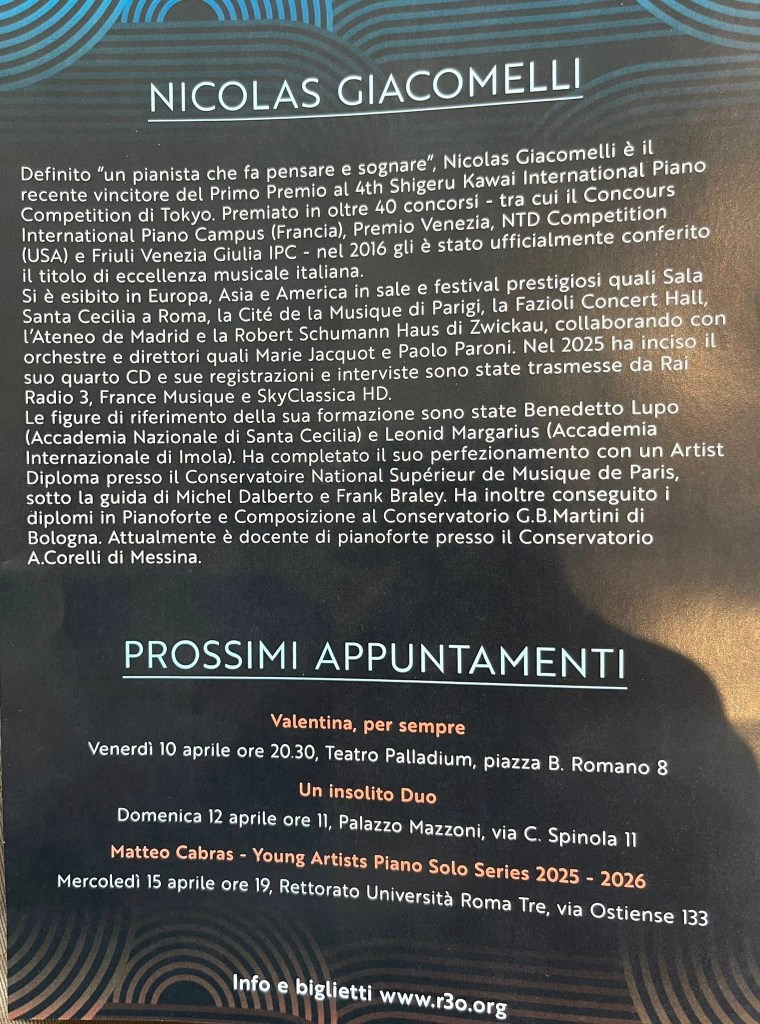
It was good to be able to listen to Nicolas Giacomelli again having been at his graduation recital last June at the Accademia of S Cecilia, where he was completing his studies with Benedetto Lupo.
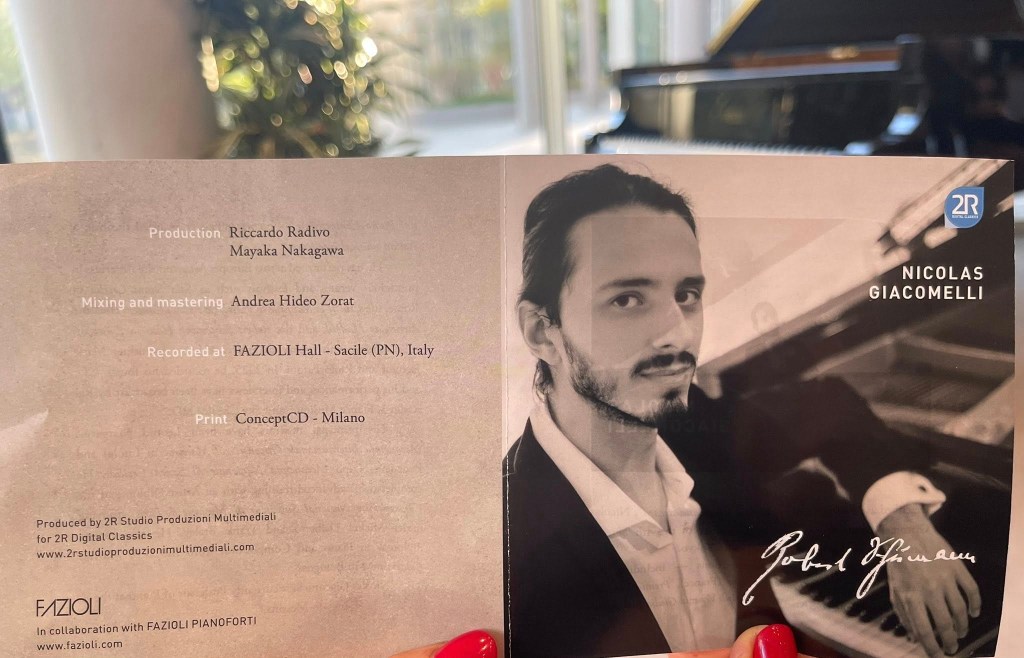
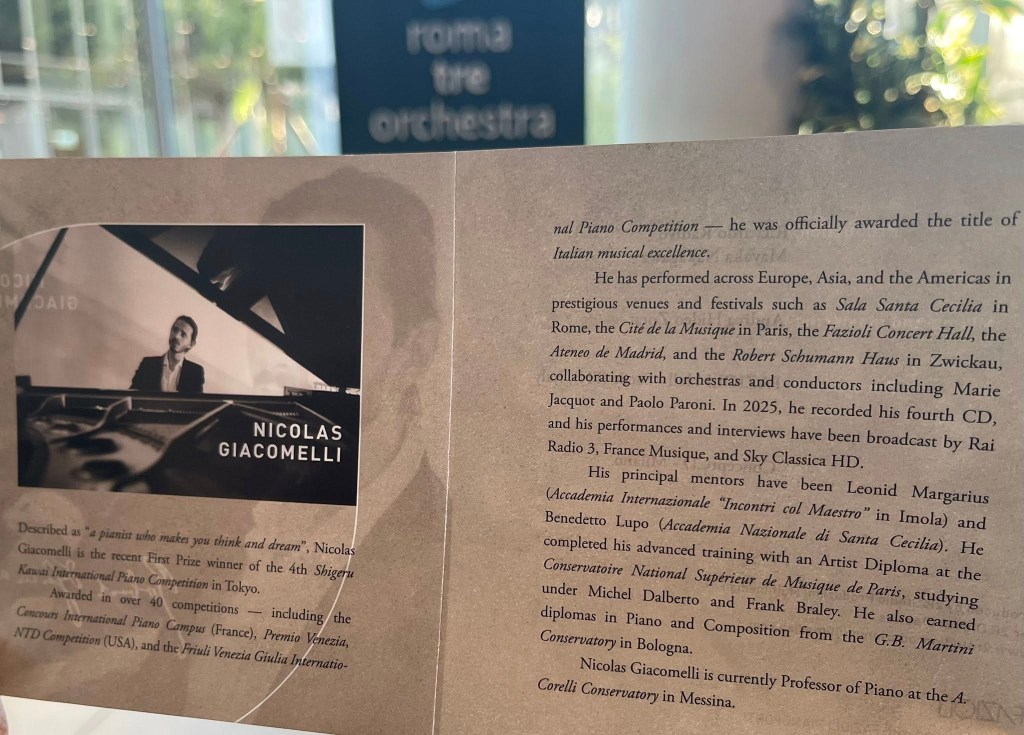
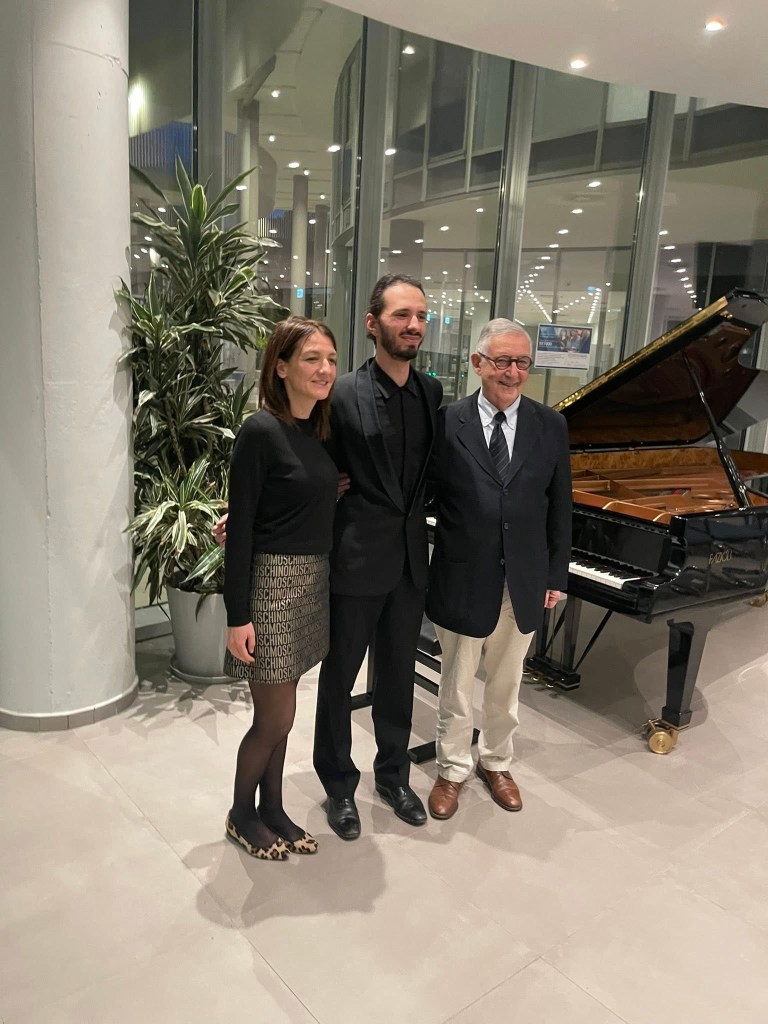
Presenting now his new CD at Roma 3 in their Young Artists Series that gives a stage to young musicians at the start of their career.
Two masterworks by Schumann op 13 and 16. The Symphonic Studies and Kreisleriana, compositions only separated by Kinderszenen op 15 and followed by the Fantasy op 17, written in a period when Schumann was training under Friedrick Wieck to become a virtuoso pianist . One masterpiece after another poured from his pen from op 1 to op 28 until he damaged his hand with a finger stretching contraption, and was from then on to dedicate himself mainly to chamber music and symphonic works.
The Symphonic Studies were dedicated to Sterndale Bennett ( the English pianist who was to become the first director of the Royal Academy in London). Kreisleriana was dedicated to Chopin, who Schumann had announced on the arrival of the teenage Polish emigré in Vienna, with ‘Hats off a Genius’.
But the main inspiration was to be the daughter of his teacher, the child prodigy, Clara Wieck . Much to her father’s consternation she was to become Schumann’s wife and mother of their eight children and the inspiration for most of his compositions before a nervous breakdown and his early death in an asylum.
Nicolas chose the first ,unrevised version of the Studies, which excluded the five posthumous studies often incorporated into the main version, mainly encouraged to be included in the final edition by Brahms, after Schumann’s death, a close family friend in an intimate triangle of artistic endeavour! It includes some variants in the last variation too where the repetitive march like finale is interrupted by a melodic interlude based on the theme ‘Proud England,rejoice’ from Marschner’s Opera based on Sir Walter Scott’s ‘Ivanhoe’ and was a homage to the dedicatee William Sterndale Bennett. I noticed in Nicolas’s performance, a slight variant in the first variation too, that I had not been aware of before.
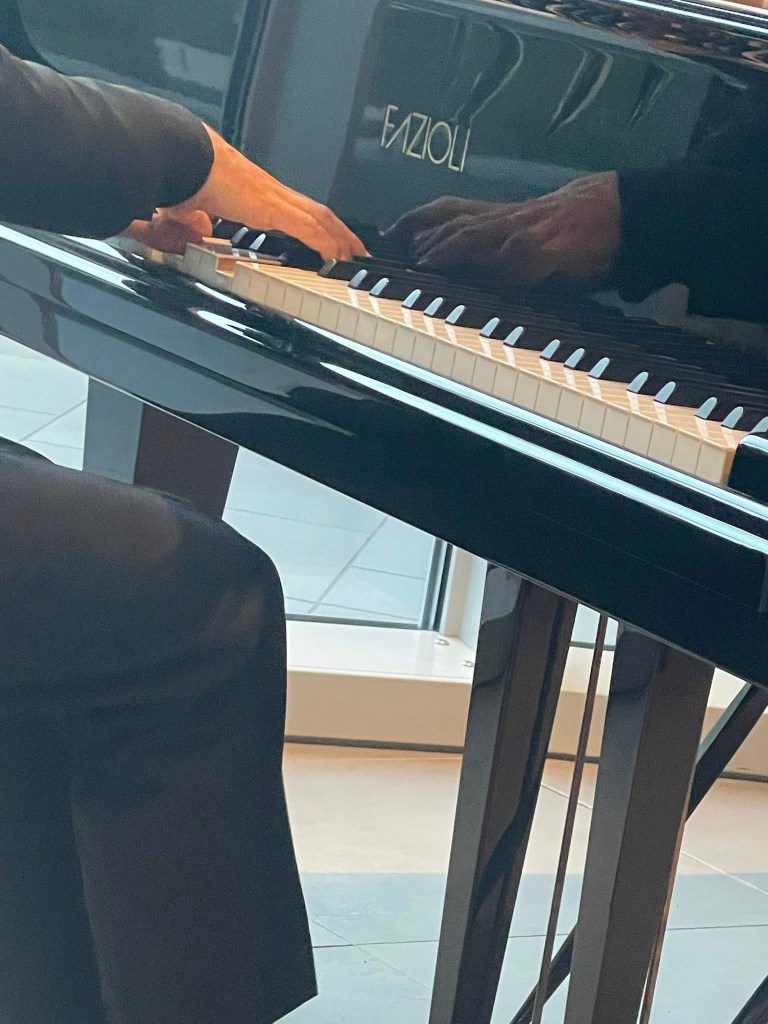
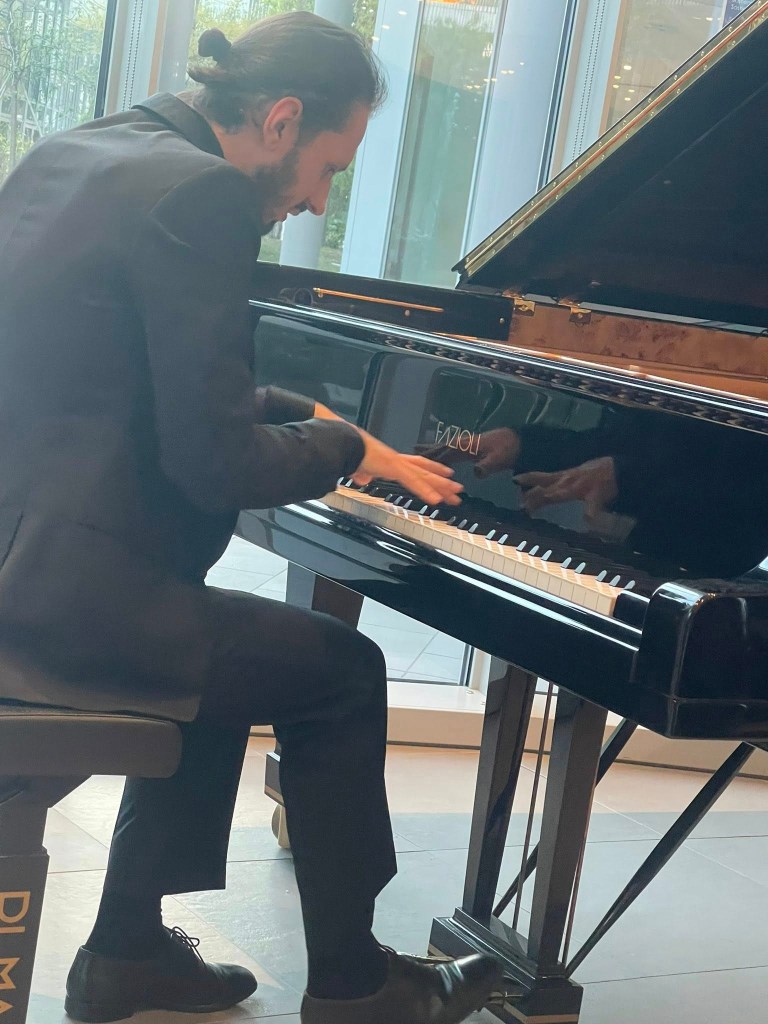
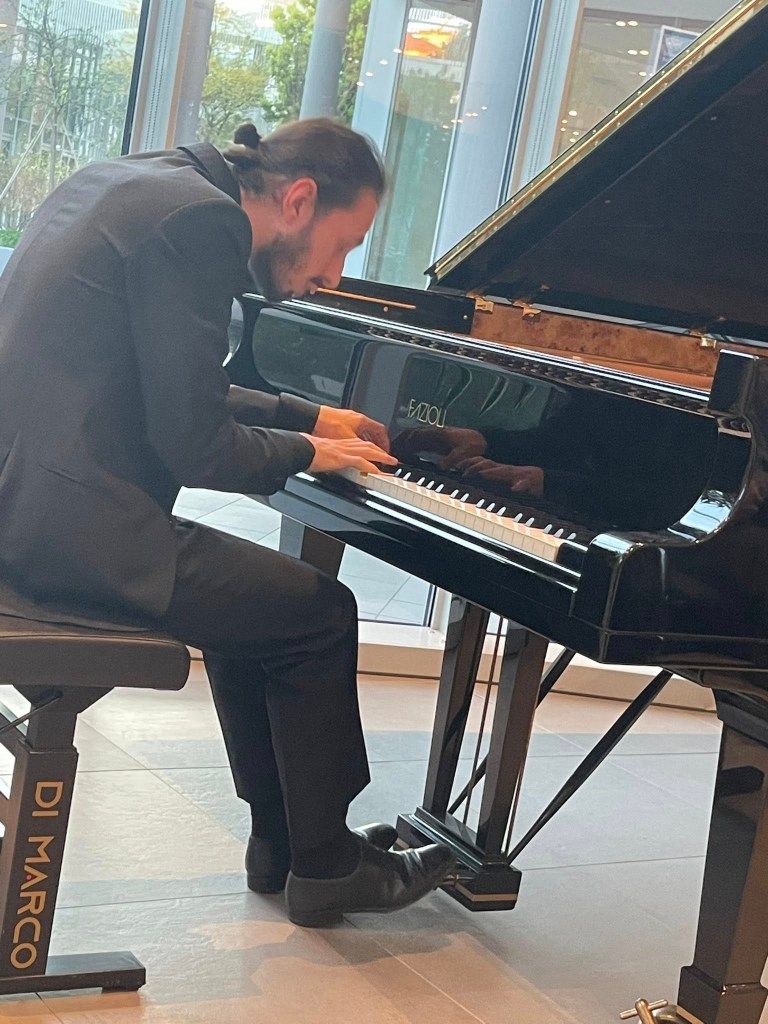
Nicolas played the opening theme rather slowly for its ‘Andante’ marking, making this ‘composition of an amateur’ vertical and ponderous rather than flowingly horizontal. It was the theme of Ernestine von Fricken’s father, whose daughter had been an ex flame of Schumann, depicted as ‘Estrella’ in his ‘Carnaval’ op 9! The variations and studies were played with great seriousness and solidity but sometimes lacked the dynamic contrasts and lighter touch that Schumann indicates in the score . There was a passionate intensity to the second variation where the melodic line was allowed to sing with vibrant rhythmic emotion. Bringing out the bass in the repeat to create more variety in a sound world that was always of passionate intensity and dynamic drive. It was in the fourth variation marked ‘scherzando’ that Nicolas remained rather earthbound rather than allowing his hands to flutter over the keys. Agosti described the seventh variation as a ‘Gothic Cathedral’ and this suited Nicolas’s monumental conception giving it a vibrant use of the pedal and a heavily marked bass anchor. The eighth variation, Schumann marks ‘Presto possibile’ and Nicolas played with transcendental mastery making easy fare of the fast moving chords but then the slower chords of the eighth, although played ‘con energy’ seemed unnecessarily ponderous. The ninth variation is a beautiful ‘bel canto’ inspired by Chopin which Nicolas played with radiance and beauty and if he played the climax with overpowering passion it was with great conviction and a variety of sounds that had been missing elsewhere. The Finale was indeed ‘Allegro Brillante’ and was a ‘tour de force’ of forward movement to the final pages of excitement and dynamic drive in a performance that was more symphonic and percussive than pianistic and melodic.
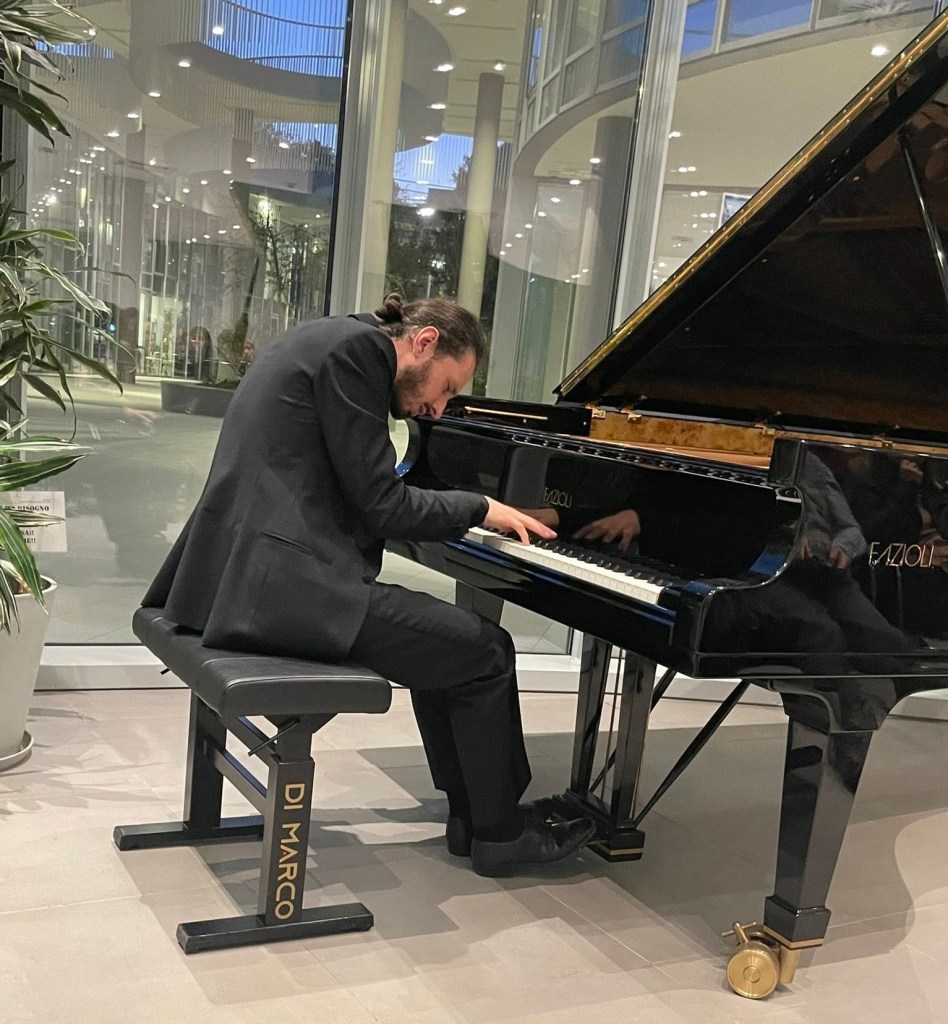
Kreisleriana began with passionate intensity taking Schumann’s marking ‘Ausserst bewegt’ rather literally, with a rather overpowering dynamic range, but Nicolas managed to keep the tempo throughout allowing the passion to die down for the beautiful lyrical central episode. The second movement ,sehr innig, is the longest and is interrupted by two interludes of spiky brilliance and flowing passionate intensity before returning to the ‘very heartfelt’ opening. In Nicolas’s attempt to make the piano sing the pedal was sometime overclouded and a real finger legato with weight would have given more control and clarity. In the third movement Schumann’s marking of ‘aufgeregt’ was taken rather literally as though ‘agitated’ was always passionate and it could have benefitted from a lighter less dramatic touch, but there was beauty in the weaving melodic outpouring of the central episode. Some contemplative playing in the fourth movement played ‘langsam’ but with flowing beauty.The fifth movement Schumann marks ‘lebhaft’ but Nicolas chose to play it with much more spiky brilliance and although played with great control it missed something of it’s fleeting elegance and style. The sixth movement Nicolas suddenly allowed the piano to sing with a beautiful sense of balance of glowing radiance. The seventh Schumann simply marks ‘sehr rasch’ and Nicolas certainly gave a fearless performance of extraordinary velocity but it was more of a tornado than a west wind and could have benefitted from more shape and tonal contrasts. The last movement was played with a capricious sense of style with the long bass notes interrupting the whimsical melodic line that Nicolas played with clarity and knowing impertinence. If the two intervening episodes were played with overpowering passion it was obviously the mood that Nicolas was in today with the white teeth of this powerful Fazioli concert piano staring up at him and just encouraging him to pounce with all his youthful mastery and power.
It was in the two French encores that Nicolas could relax and give exquisite performances of colour and style of La Veneziana by Gounod and the charm and delicacy of Wély’s salon caprice ‘Etincelle’.
Gounod: La Veneziana (Barcarolle) in G Minor CG 593
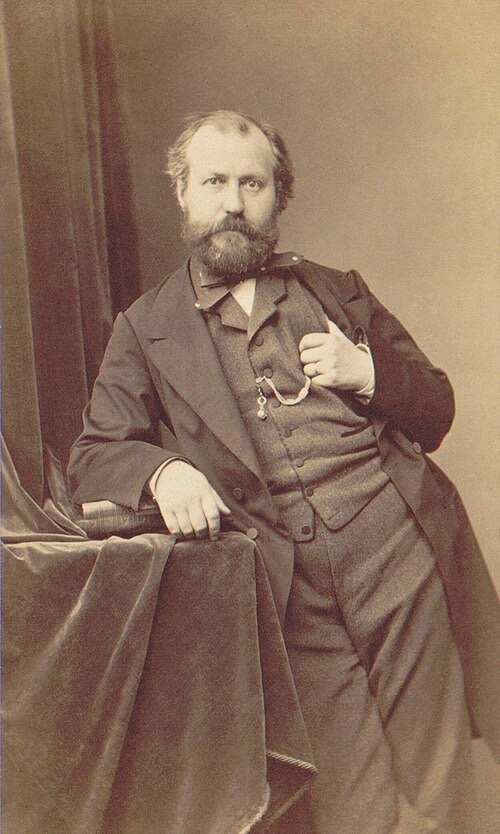
Charles-François Gounod (17 June 1818 – 18 October 1893) was a French composer. He wrote twelve operas, of which the most popular has always been Faust(1859); his Roméo et Juliette(1867) also remains in the international repertoire. He composed a large amount of church music, many songs, and popular short pieces including his “Ave Maria” (an elaboration of a Bach piece) and “Funeral March of a Marionette”.
Louis James Alfred Lefébure-Wély – L’Étincelle, Op.109 (Caprice)
Louis James Alfred Lefébure-Wély (13 November 1817 – 31 December 1869) was a French organist and composer. He played a major role in the development of the French symphonic organ style and was closely associated with the organ builder Aristide Cavaillé-Coll, inaugurating many new Cavaillé-Coll organs.
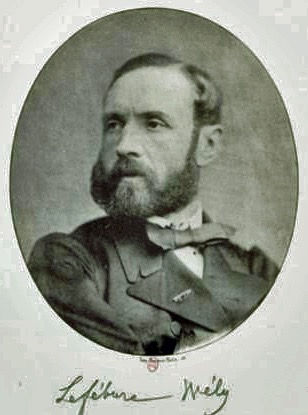
His playing was virtuosic, and as a performer, he was rated above eminent contemporaries including César Franck. His compositions, less substantial than those of Franck and others, have not held such a prominent place in the repertory.
Lefébure-Wely was awarded the Légion d’honneur in 1850. His contemporary, César Franck became better known as a composer, but was not as highly regarded as an organist. Adolphe Adam commented, “Lefébure-Wely is the most skilful artist I know”; Camille Saint-Saëns, Lefébure-Wely’s successor at the Madeleine, observed, “Lefébure-Wely was a wonderful improviser … but he left only a few unimportant compositions for the organ.” He was the dedicatee of the “12 études pour les pieds seulement” (12 Studies for organ pedals alone) by Charles-Valentin Alkan and of the “Final en si bémol” for organ, op. 21, by Franck.
Among 200 compositions Lefébure-Wely wrote works for choir, piano, chamber ensemble, symphony orchestra and an opéra comique, Les recruteurs (1861).
 ChristopherAxworthy-MusicCommentary