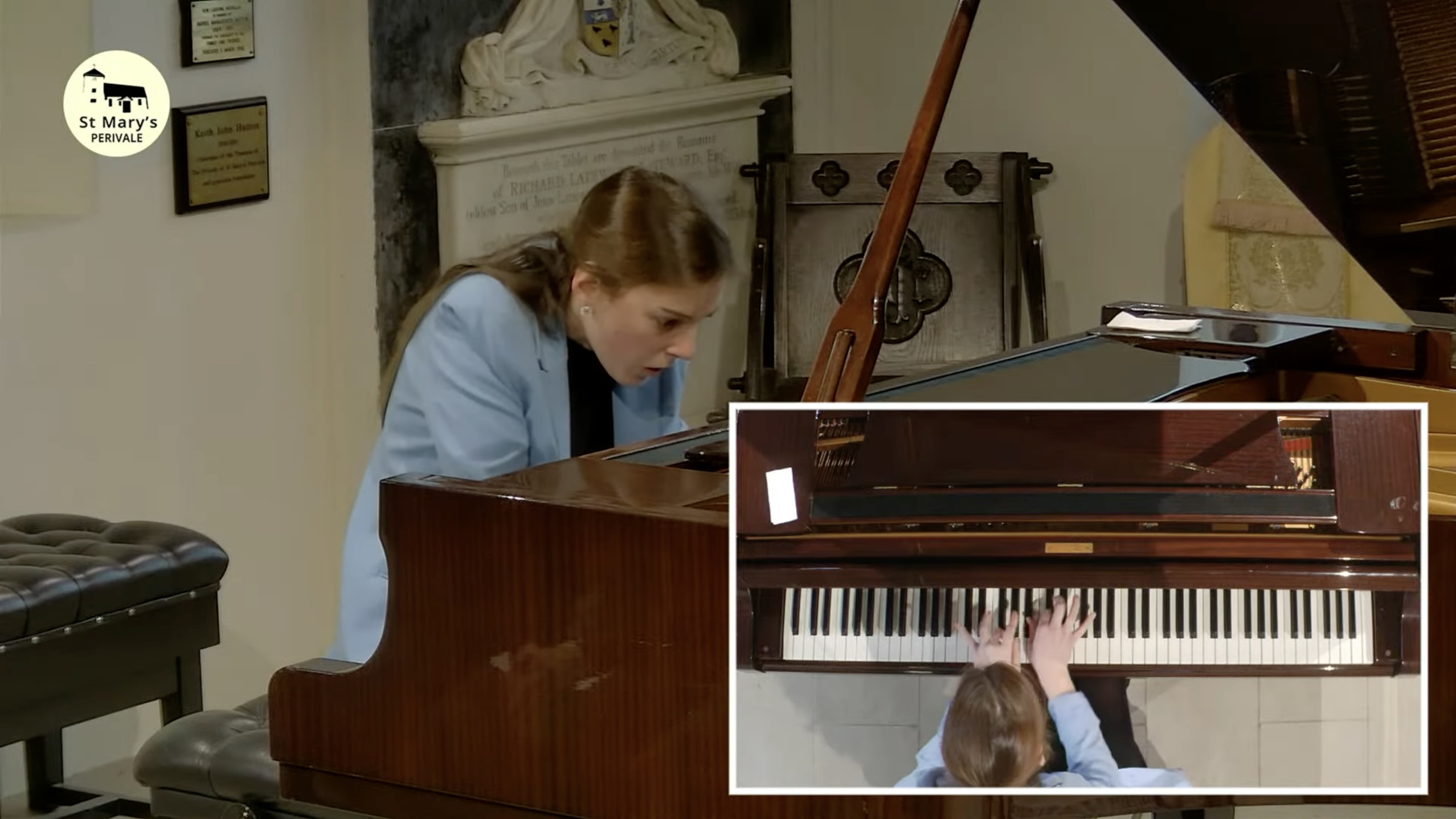
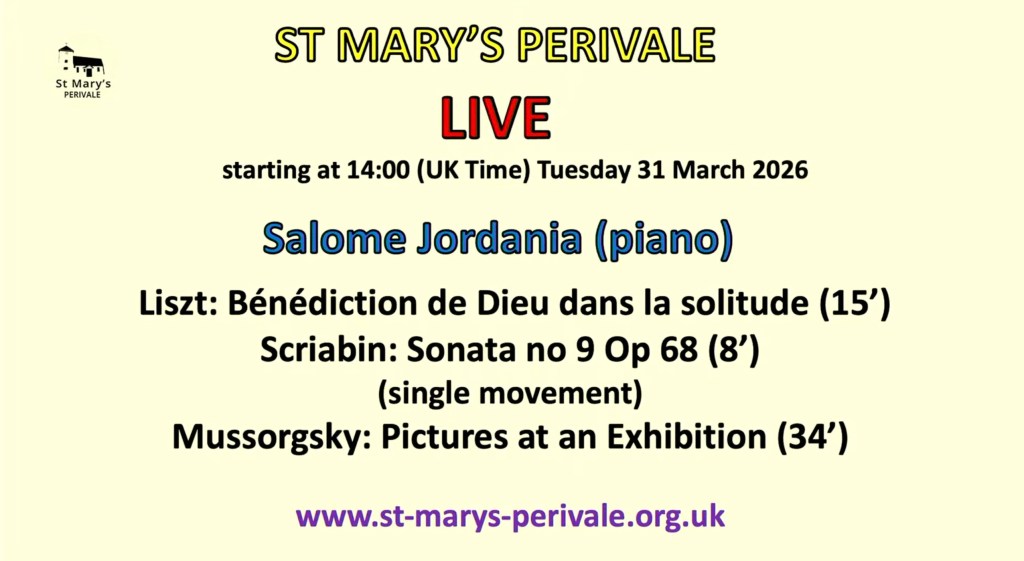
Some ravishing playing again from Salome of intelligence and poetic beauty. One of Liszt’s greatest works restored to its rightful place in the hands of a pianist who pays scrupulous attention to the composers indications but also can imbue them with the poignant beauty of a true believer. Bénédiction de Dieu dans la Solitude is the third of Liszt’s ten Harmonies poétiques et religieuses S.173, a cycle of piano pieces written at Woronińce the Polish-Ukrainian country estate of Liszt’s mistress Princess Carolyne von Sayn-Wittgenstein in 1847, published in 1853.They are inspired by the poetry of Alphonse de Lamartine ( as was Liszt’s Symphonic Poem Les Préludes ) and together with the Two Légendes ( written 10 years later) are works of a fervent believer but also of a master craftsman.There is none of the superfluous showmanship of the greatest pianist the world has ever known, but there is the poetic searching soul of a musical genius in works that are all too often neglected. They are works of a composer happy still to delve into the sound world of his time and to use the evolving piano to the full as his colleague and rival Thalberg was to do, much to Liszt’s irritation. There was the famous duel in the Parisian Salon of the Princess Belgiojoso on 31st March 1837, between these two giants of their day, in which the Princess very diplomatically declared Thalberg a great pianists, but Liszt unique. Liszt however was never content to just accept convention and in later life was to look to a future sound world that was indeed prophetic.It might well have been the sound world of Scriabin, another genial composer searching for his star via a multicoloured world of remarkable originality.
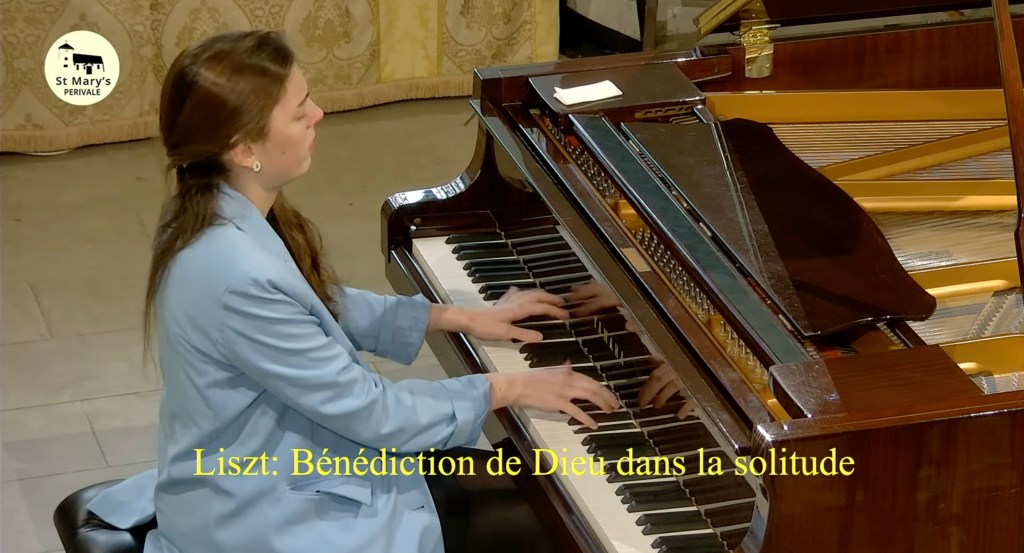
Salome allowed the tenor melody to emerge accompanied by bird like flutterings of radiance in the right hand that she played with remarkable fluidity considering their difficulty. Building to a climax of sumptuous full sounds of passionate intensity. A pastoral awakening of refreshing simplicity was gradually built into a burning intensity that burst into a cascade of notes spread over the keyboard with jeux perlé mastery.The melody returning to the tenor register with bird like beauty leaving a final ‘bénédiction’ of poignant beauty played with a rare sensibility.
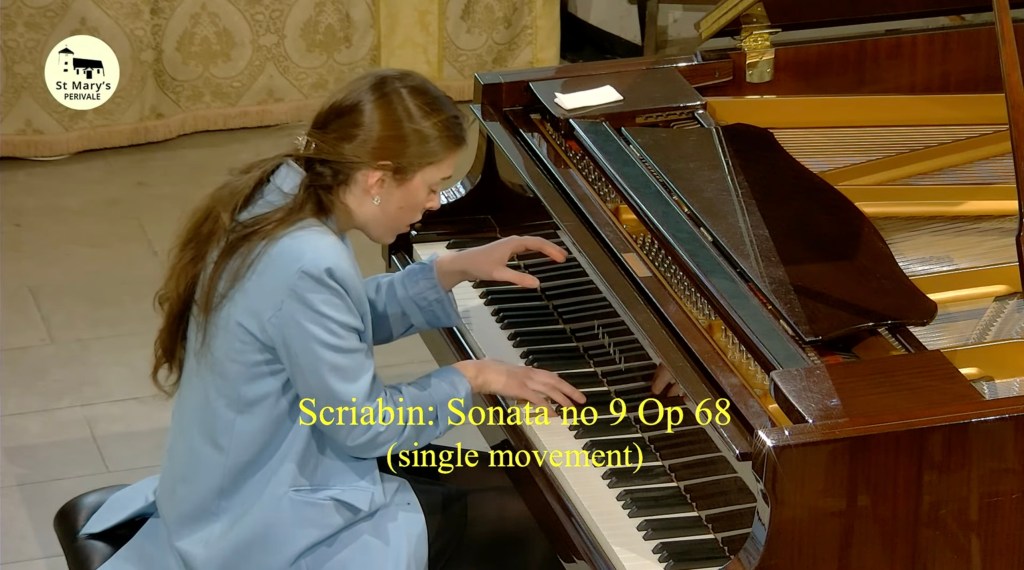
There was a glowing luminosity and purity to the sound as Scriabin’s poetic fantasy was played with a kaleidoscope of colour.The brooding insistence of Scriabin’s diabolical insinuations gradually encompassing the entire keyboard with a transcendental display of masterly playing. A passionate declaration of intent as this Black Mass cauldron of sounds reached boiling point with a masterly display of dynamism and also of a musician who could steer us through such murky waters with crystalline clarity. Salome managed to find the architectural line and sense of direction of fragments pieced together piece by piece before returning to the bleak opening landscape and whispered ending of troubled uncertainty.
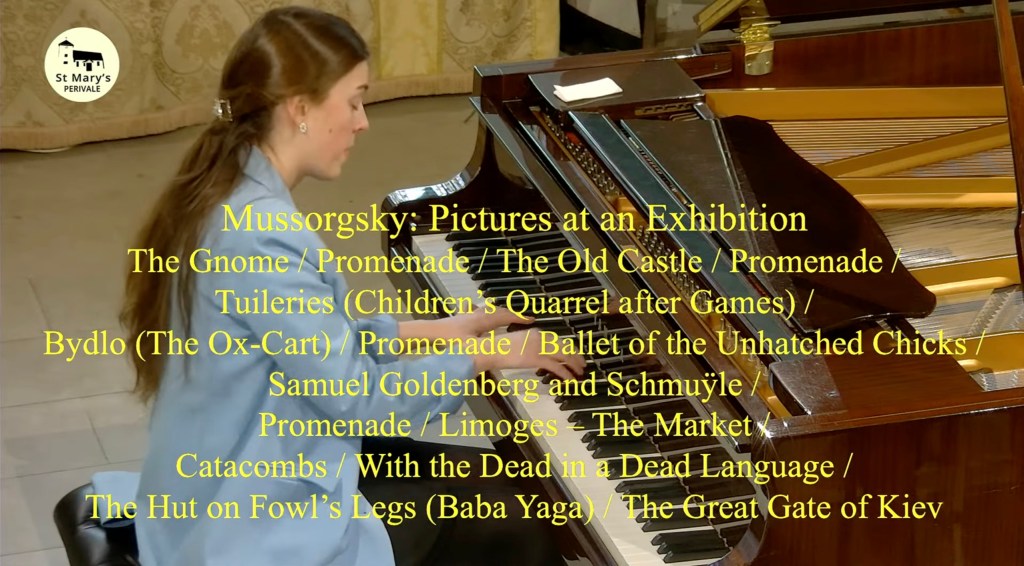
Pictures is so often given performances forgetting that it was written for the piano in mind, where a sense of balance and range of sounds is fundamental in disguising the fact that the piano is a percussion instrument. In the right hands and with a sensitive sense of balance and touch it can be made to sing and talk as expressively as the human voice. It was this that came across in Salome’s beautiful performance, where her musicianship and innate musicality allowed her to find colours and sounds of unusual expressiveness. Never resorting to brute force but searching for colour. Nowhere was this more evident than in Baba Yaga ,the penultimate picture, that was played with dynamic drive but with quite restrained volume which allowed for more contrasting sounds and where volume was substituted for intensity and sense of line. She had started her visit to the Victor Hartman Exhibition that had inspired Mussorgsky to write in only three weeks, this work dedicated to his friend who had prematurely died, with a promenade of simplicity but imbued with nobility. Leading into the diabolical antics of the ‘Gnome’ that she immediately played with rhythmic bite and great character, alternated with languid yearning ,and ending with a ‘Gnome’ that became almost too hot to handle as it exploded into a flash of brilliantly played notes. A lazy stroll to the next picture of the ‘Old Castle’ played in a nostalgic atmosphere with a beautiful duet between the hands as it disappeared into the mist. A rumbustious promenade moving on now to the next picture of children squabbling in the ‘Tuileries’, played with great spirit and lightweight vitality. The lumbering ‘Bydlo’ appeared on the scene with great resonance, beautifully contrasted with the central episode before it lumbered its way into the distance, it was here that Salome’s control of sound produced some quite masterly effects. An etherial walk to the glowing brilliance of the ‘Chicks’ with playing of rhythmic vitality, the clucking trills thrown off with fearless brilliance but also beautifully shaped.. ‘Goldberg’ entered with his austere authority played with great clarity as was the simple reply of Schmyle. ‘Goldberg’ now in the bass with a beautifully shaped melodic line before the subdued interruption of the simple Promenade. Salome brought a scintillating brilliance to ‘Limoges Market’. with playing of masterly brilliance where she brought an unusual clarity to the driving climax that was so rudely interrupted by the noble vision of the ‘Catacombs’. These were played without any exaggeration but with simple resonance and beautifully conceived reverence. ‘Baba Yaga’ burst onto the scene without the usual brutal force but with a musical intensity that was even more compelling. It was the same with the vision of the ‘Great Gate of Kiev’, where Salome’s sense of balance and palette of sounds combined with her great musicality to astonish and amaze us with the colours and glowing brilliance with which Mussorgsky could describe such a noble edifice. A remarkable performance not for its brute force but for her masterly playing of control and musicianship that could bring such character and style to a well worn showpiece so often brutalised in lesser hands.
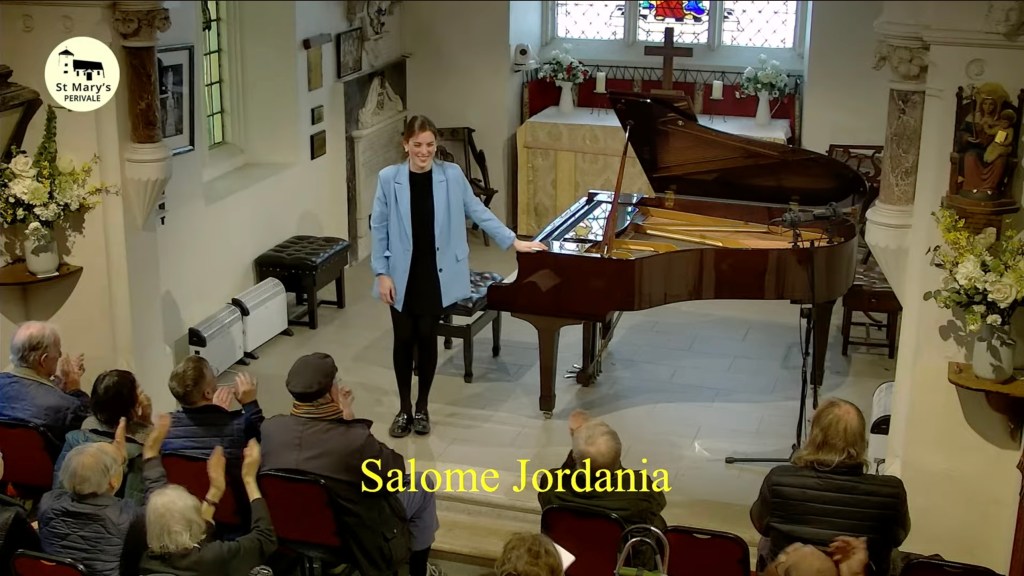
Georgian pianist Salome Jordania has rapidly emerged as one of the most compelling pianists of her generation, celebrated for her technical command, poetic imagination, and profound musical insight. In 2025, she was named one of Georgia’s Forbes 30 Under 30 in the Arts and Style category. She has performed as a recitalist, chamber musician, and concerto soloist across Europe, Asia, and the Americas, including Germany, France, Italy, Spain, Austria, Israel, the Netherlands, Japan, Mexico, and the United States. Her festival appearances include Piano aux Jacobins, Les Grands Interpretes, L’Esprit du Piano, Piano en Valois, Festival de Musique de Menton, Palazzetto BruZane, Batumi International Piano Festival, Texas International Piano Festival, Tel-Hai Festival, GijonPiano Festival, Yamaha Rising Stars in Tokyo, and the IKIF Rising Stars Series in New York.
Salome has won over 30 international prizes, including top honors at the Jose Iturbi Competition, Etoiles du Piano, Georges Cziffra Award (Vienna), Chopin National Competition (Georgia), Norma Fischer Prize (USA), Yamaha Prize (France), Goldene Taste (Frankfurt), and Silver Medal at theIKIF Competition (New York). She was the sole winner of the New York Concert Artists Competition, which led to her acclaimed debut recital at Berlin Philharmonie in 2023.
She has performed with leading orchestras including the Georgian Philharmonic, Orquesta de Valencia, Moscow Virtuosi, SLO Symphony, Orchestre de Picardie, Orchestra Giuseppe Verdi, Armenian National Philharmonic, and Potsdam Philharmonic. An active chamber musician, Salome is a member of the Amsterdam-based trio The Graces, whichhas performed at the Concertgebouw in Amsterdam, the Grachten Festival, and Settimane MusicaliInternazionali in Italy. In 2025, she made her Wigmore Hall duo debut, launching a UK tour.
Salome studied at Juilliard (B.M.), Yale (M.M., Charles S. Miller & Yale Alumni Prizes), and Guildhall (Artist Diploma, supported by the Steinway & Sons Scholarship). Her highly anticipated debut soloalbum with La Dolce Volta, centered on Liszt’s Sonata, is scheduled for release in 2026.
 ChristopherAxworthy-MusicCommentary