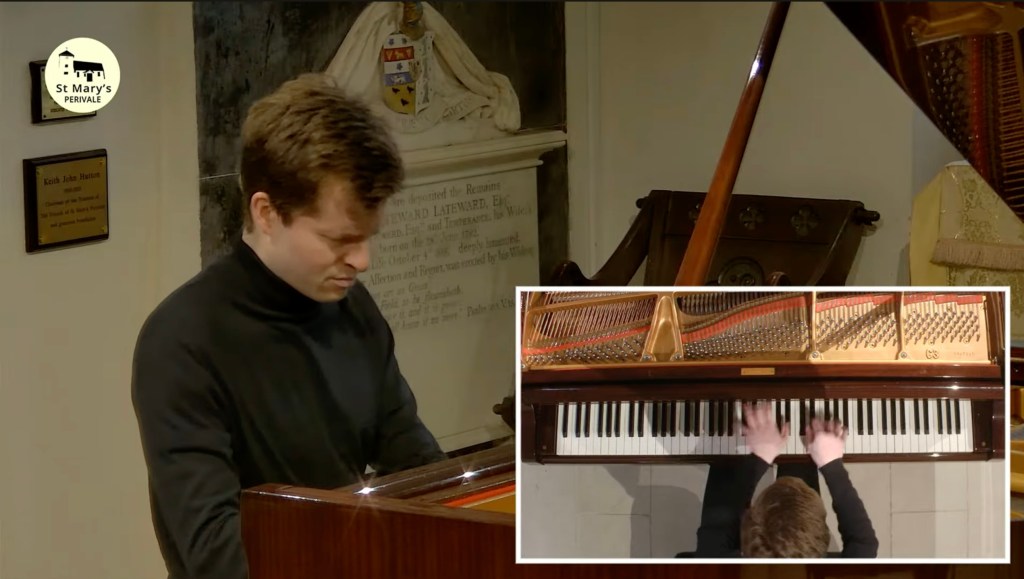
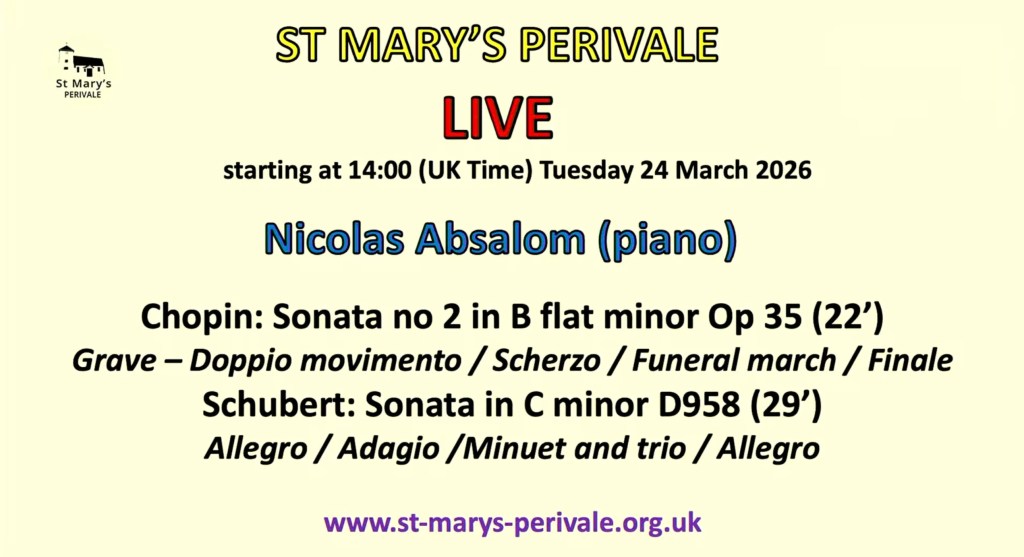
I have heard Nicolas play over a number of years in the annual masterclasses of Alberto Portugheis at Steinway Hall in London.Also for the Thomas Harris International Foundation competition founded by the much missed Judy Harris in memory of her son. Re reading my impressions then and now it was always the absolute clarity of Nicolas’s playing that was so remarkable. He has now matured over the past six years playing with ever more intelligence and technical maturity without loosing the clarity and beauty of his playing . Two major works on the programme showing immediately the credentials of a musician of ‘class’ to quote Dr Mather today. To sustain two such important works one after the other is a challenge to any musician, because the concentration and contemplation go hand in hand with memory and technical preparation. There was hardly a note out of place today because Nicolas is a musician who listens to himself and is so absorbed in the music that there are never any moments of distraction or unnecessary bravado.
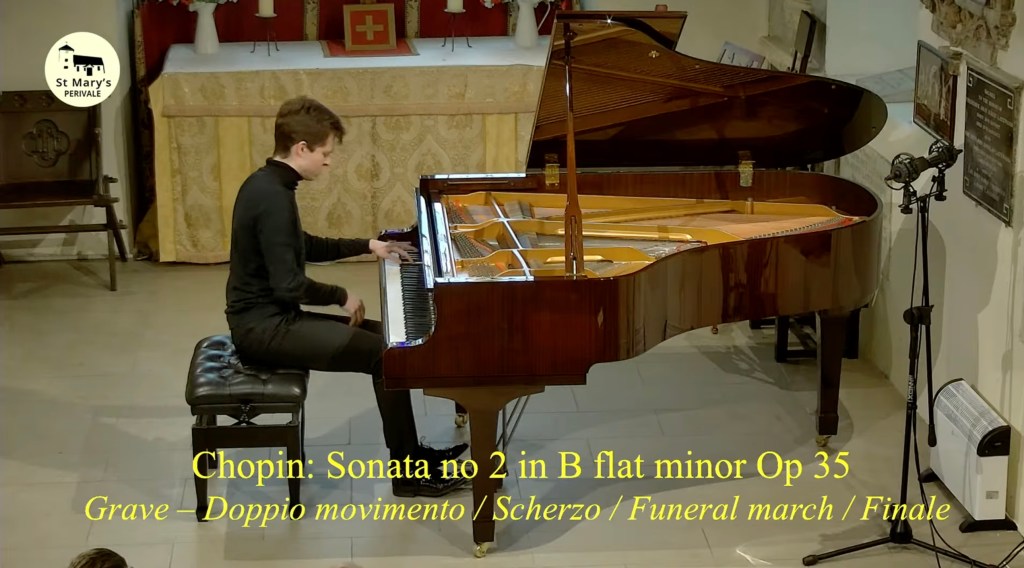
The Chopin Sonata is a masterpiece of construction of great originality, so much so that Schumann even described it as ‘four of Chopin’s maddest children all under the same roof’ , and went on the describe the last movement that ‘seems more like a mockery than any sort of music’. When Mendelssohn was asked for an opinion , he commented, “Oh, I abhor it”. Nicolas played it today very simply with great clarity, keeping the same tempo throughout the first movement that gave it an architectural strength , as the bass introduction is used in the development with masterly effect. There is always a question of whether one should repeat the exposition of the sonata , and if so where to? Nicolas decided ,as many great musician do, to ignore the repeat in favour of going straight into the development. Playing of dynamic drive and extraordinary clarity due to his very careful use of the sustaining pedal. Playing with a kaleidoscope of sounds but if he allowed his hands to delve even deeper into the keys with limpet like adhesion it would add even more warmth and sumptuous richness. Finding an even truer finger legato, like an organist, always with the same very careful use of the pedal. But this was very musicianly playing and the second subject was played with disarming beauty of great sentiment but never sentimentality. The ‘Scherzo’ was played unusually gracefully as it had a real sense of dance rather than the solidity of a study in lesser hands. The Trio was played with rare beauty and Nicolas’s ability to allow the left hand counterpoints to sing with clarity added another dimension of contrast to this beautiful bel canto. The whispered coda with just two whispered chords in the left hand over a long held chord allowed us to appreciate the relentless beauty of the ‘Funeral March’ that was on the horizon. As Nicolas explained in his introduction, the ‘Funeral March’ was composer first, and the rest of the Sonata was constructed with many of the same bricks as this remarkable movement. Even here Schumann could not appreciate the originality of Chopin’s genius, remarking that the Marche funèbre ‘has something repulsive about it’ , and that ‘an adagio in its place, perhaps in D-flat, would have had a far more beautiful effect’. Nicolas played it with fervent conviction where delving deeper into the keys would have added even more weight to his beautiful playing. The Trio, actually in D flat, was played with just the beauty that Schumann had missed. Nicolas played it with remarkable control and aristocratic good taste with a refined beauty that made the return of the march even more harrowing. Nicolas brought absolute clarity to the whirlwind of notes of the ‘Finale’ where maybe a little more pedal would have given an undulating shape to this extraordinary ‘wind passing over the graves’. A performance by a mature musician untainted by the so called ‘tradition’ as he showed us Chopin’s often criticised mastery of architectural construction that lives hand in hand with the poetic beauty of a genius.
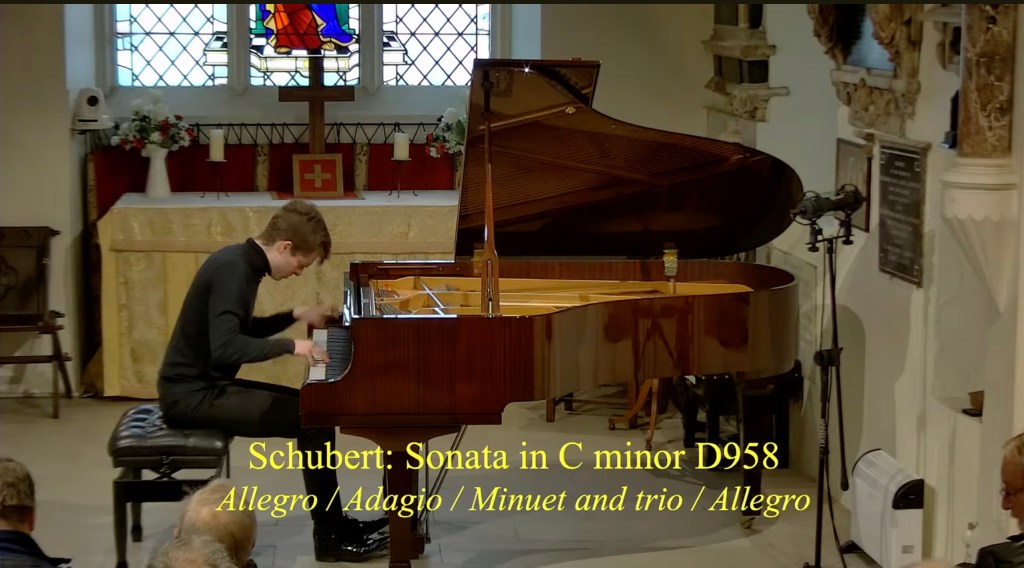
The Sonata in C minor is the first of Schubert’s final trilogy written in the last year of his short life. It is the most Beethovenian and choosing the key of C minor is also a declaration of dramatic intent and intensity. It has long been the Sonata favoured by great Russian virtuosi and it was Richter who was to astonish us with his performances in the 70’s of a Schubert of so many conflicting emotions. I remember the last movement, who could ever forget, Richter creating a whirlwind of breathtaking dynamism after an ‘Adagio’ of poignant penetration and an opening ‘Allegro’ like Beethoven’s 5th. Nicolas’s was not a performance of extremes, but a musicianly account of what he described as his favourite work. It was played with scrupulous attention to the composers indications and with dynamic drive and poignant poetic beauty. Again choosing not to repeat the exposition he entered the development where Schubert mixes a mystery of dark beauty of disturbing character. The chilling beauty of the left hand murmuring with whispered menace only to be replied by a bel canto of radiant beauty. Chromatic scales starting as a whisper and building into a massive crescendo, beautifully judged by Nicolas as the opening declaration was heard again with even more energy. He brought a poignant beauty to the ‘Adagio’ with a beautifully chiselled melodic line as it built in intensity of orchestral colouring only to reveal a coda of whispered significance.The Minuetto that follows was played with simplicity and buoyancy with a playful character that was the bridge between two movements of such conflicting emotions . The ‘Allegro’ was brilliantly played with a relentless drive until the cloud passes and one of those miraculous melodies of Schubert is suddenly revealed in a blaze of light and which Nicolas played with radiance and loving beauty. Of course there is no stopping this cauldron that is always in the background waiting to erupt and which Nicolas played with dynamic drive a brilliance. Another masterly account from a musician of ‘class’.
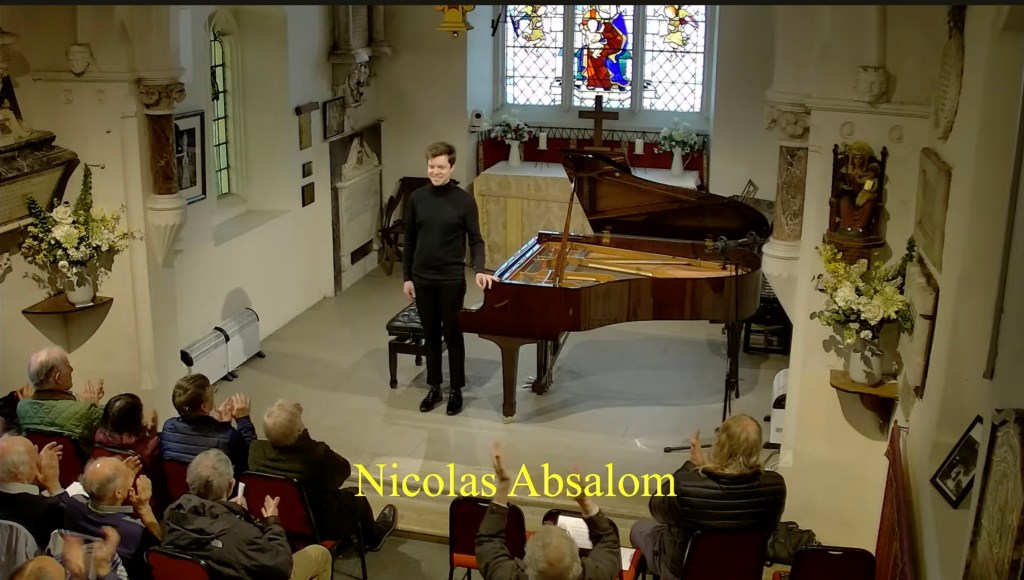
Belgo-British pianist Nicolas Absalom is a prize winner of international piano competitions and has been invited to festivals including the “Klevischer Klaviersommer” (DE) festival, the “NiederRheinLande Festival”, the “International Young Talents Festival” in Cannes, the „Fremtidens Lyd“ Stvens in Denmark as well as the “Passion:SPIEL” festival for contemporary music organised by the German National Theatre „DNT“.
Nicolas regularly performs recitals in Europe and has appeared in venues such as the „Berliner Philharmonie“, the „Museu Pau Casals“ in El Vendrell, the „Palau de la Música Catalana“, as well as the “Studio 4” Flagey in Brussels. He has collaborated with orchestras such as the „Sinfonieorchester of the University of Music“ in Dresden, the “Siegfried Camerata”, the „Music of the Spheres Ensemble” and the „Jenaer Philharmonie“. Currently Nicolas is pursuing his Master‘s degree in piano solo performance at the Berlin University of the Arts in the class of Prof. Björn Lehmann. Most recently he was offered a place on the Artist Diploma in performance course at the Royal College of Music for 26/27 year. He has also had the privilege of working with pianists such as Janina Fialkowska, Kevin Kenner, Klaus Hellwig, Alberto Portugheis and Hortense Cartier-Bresson to name a few.
Nicolas is also an avid chamber musician which has led him to work with musicians such as members of the Jerusalem, Artemis and Fauré Quartets. Another focal point in his education is historically informed performance where he specialises in Fortepiano (Hammerflügel).
 ChristopherAxworthy-MusicCommentary