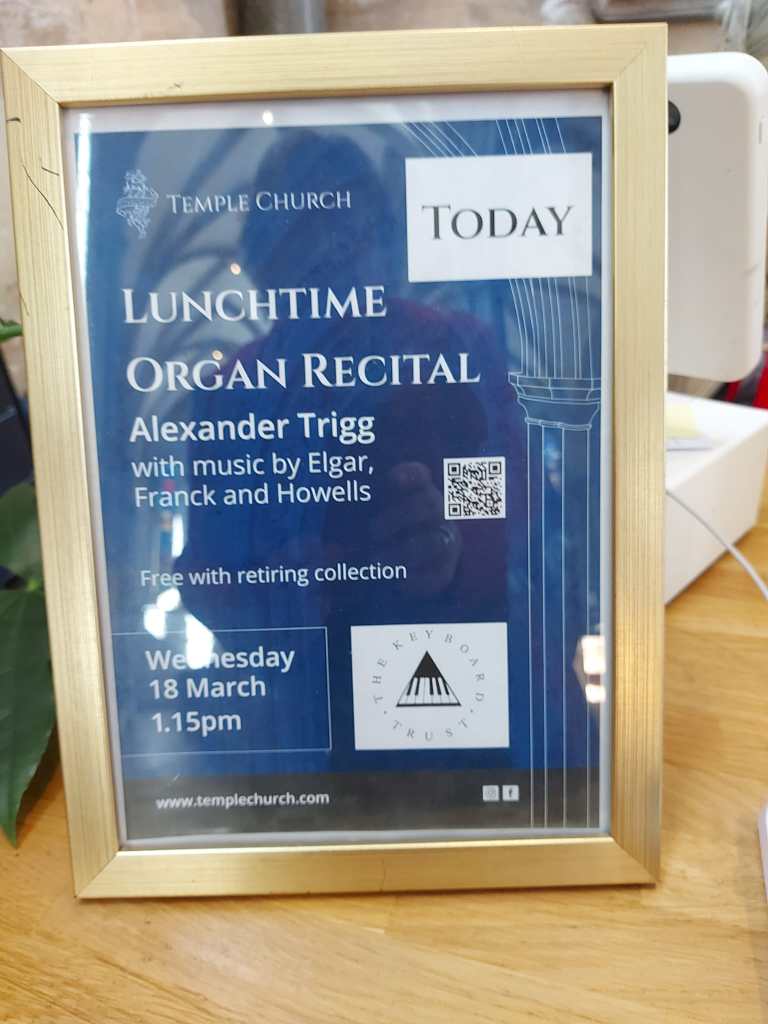
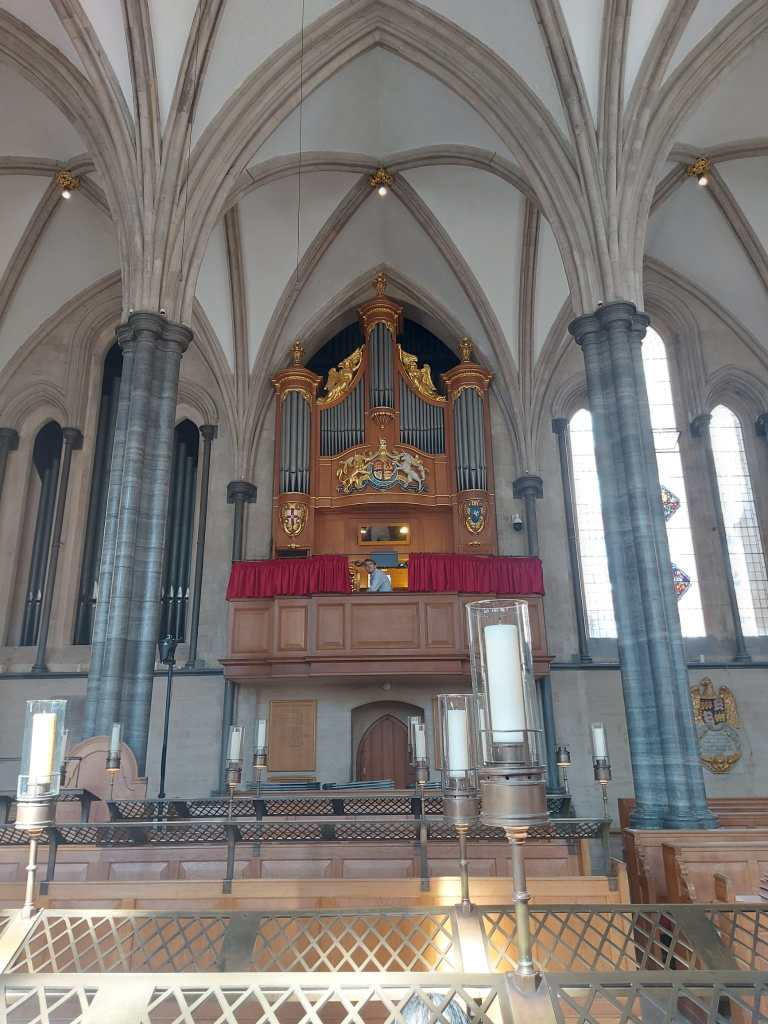
‘Alex Trigg (Advanced Postgraduate Diploma course) performs on Wednesday at 1315 at The Temple Church, London.
The concert was awarded by our friends at The Keyboard Charitable Trust, and we are very grateful for their continued support of our organ students.
Royal Birmingham Conservatoire’
The Harmony School of Pianoforte
Director Angela Ransley B Mus Cert Ed FVCM (TD)
54 Martell Road London SE21 8EE Tel: 020 8761 0640
e-mail: ransley_903@hotmail.com
Member of the European Piano Teachers Association
QUIET ASSURANCE AT TEMPLE CHURCH a review by Angela Ransley
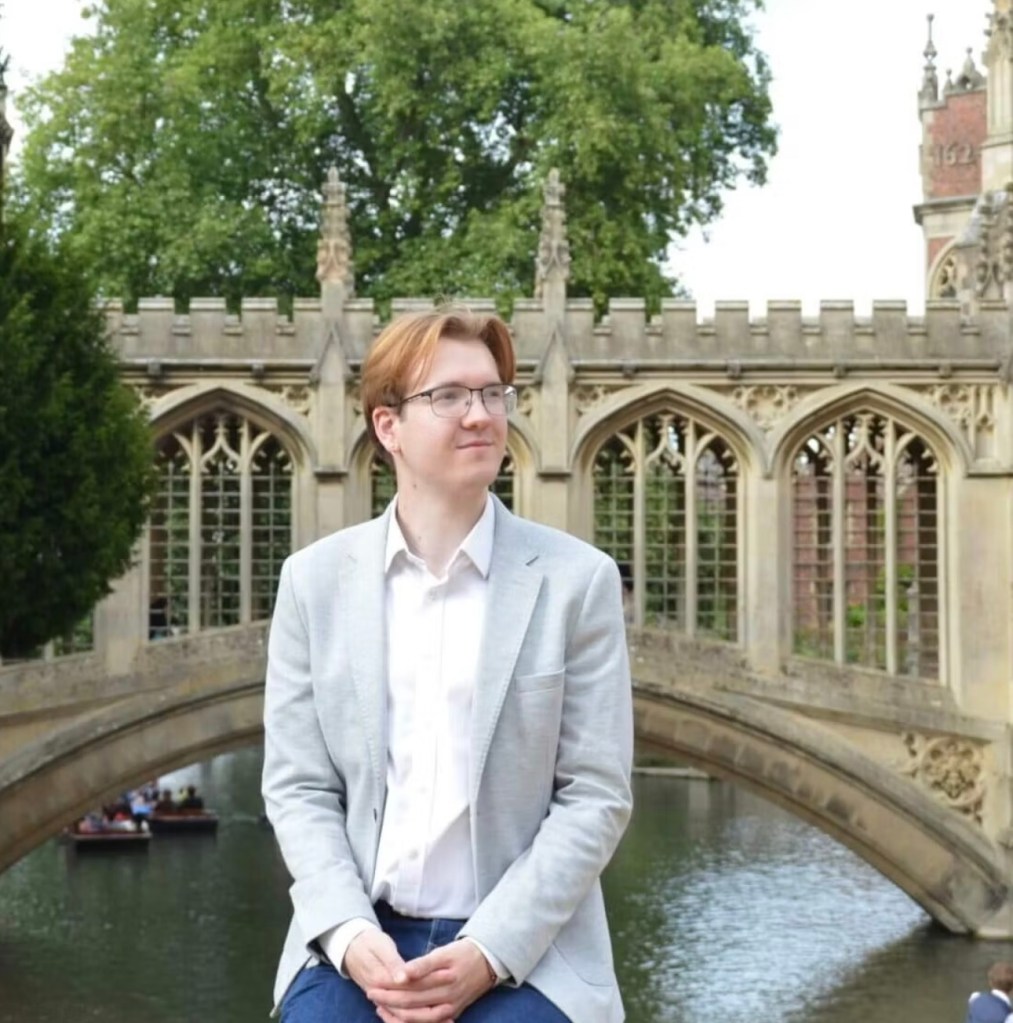
Alex comes to Temple with around 15 years of professional music experience,
firstly as a chorister at Kings College, Cambridge and after Tonbridge School as
Organ Scholar at St George’s Chapel, Windsor. He participated in royal
engagements before taking up the Organ Scholarship at St Johns College,
Cambridge. He was involved in founding the elite Cambridge University choir,
CAMBRIDGE SCHOLA and the St Andrews Music School which offers free
tuition to disadvantaged children. He is currently pursuing postgraduate organ
studies at the Royal Birmingham Conservatoire.
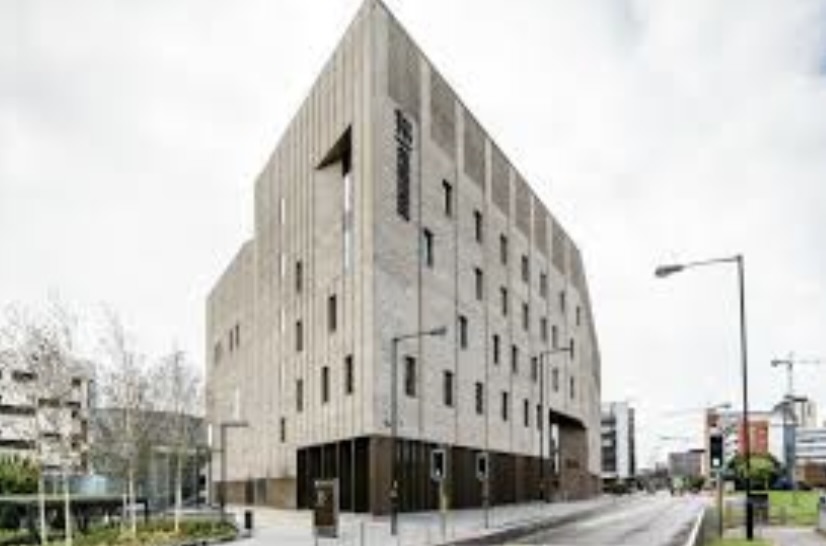
Royal Birmingham Conservatoire
The three composers in today’s recital, Elgar, Howells and Franck span almost
two centuries: when Cesar Franck was born in 1822, Beethoven was still alive.
Howells died in 1983, the world of the internet, space travel and minimalism.
Both English composers came from the territory of the Three Choirs Festival in
the west of England, and despite humble circumstances received support from
its rich heritage, allowing both to achieve distinction. Elgar was knighted and
appointed Master of the King’s Music in 1924; Howells became Professor of
Organ at the Royal College of Music and was made a Companion of Honour.
Cesar Franck came from Belgium but was based in Paris after his ambitious
father changed his nationality so that his two prodigies – Cesar and his brother
Joseph – could enter the Paris Conservatoire. Pere Franck destined Cesar as
a pianist and drove him inexorably until a rift between them opened up the
possibility of the organ. A major influence was the new symphonic instrument of
Aristide Cavaille-Coll, which Cesar demonstrated throughout France. His long
tenure at Eglise St Clothilde and Professorship of Organ at the Paris
Conservatoire secured his lasting reputation.
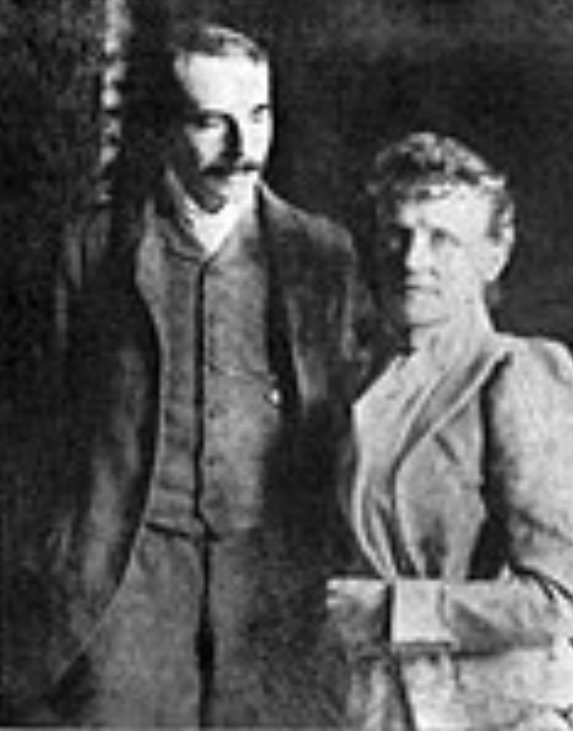
Edward and Alice Elgar in 1889
The first piece in Alex’s recital was the Allegro maestoso from the Organ
Sonata no 1 by Elgar (1857 – 1934). As well as the humble background, there
were other obstacles in his path: he had no formal training in composition,
despite wishing to attend the Leipzig Conservatoire (there was no money). And
he was a Roman Catholic which created a barrier between him and the
established church. By the age of 40, he had made little national impact and
often despaired of his prospects. But two significant life events brought change:
firstly, his marriage to Alice in 1889. She was the daughter of a Major-General
and the family were horrified by her wish to marry ‘a penniless shop assistant’ –
Edward often helped out in his father’s music shop. She was duly disinherited.
But Alice knew the truth and believed in Elgar: she was his muse and also his
business manager. ‘The care of a genius is enough of a life work for any
woman’, she wrote. The second was the first performance of Enigma Variations
in 1899. Its originality, charm and craftsmanship established Elgar as the pre-
eminent composer of his generation.
The Organ Sonata Opus 28 appeared in 1895 at the request of the organist of
Worcester Cathedral. A group of 150 American organists were touring the UK
and asked to hear a service. About 2 weeks before their arrival, he asked Elgar
for ’a voluntary’ that would show off the capabilities of the Hill organ. Elgar had
been working on the sonata for several months and a week later produced not
a voluntary but a full blown Sonata in 4 movements lasting 30 minutes! The
astonished organist had 5 days in which to master it and a contemporary
account records that he was not able to do it justice
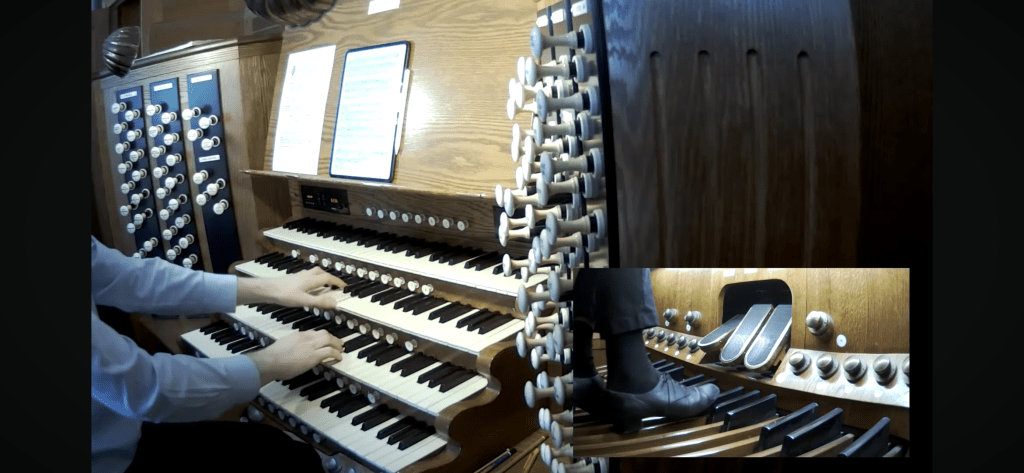
‘I’ve got a tune that will knock ‘em – will knock ‘em flat!’ This was Elgar’s
comment on the tune that has become Britain’s second national anthem and
indispensible to the Last Night of the Proms. This Allegro Maestoso contains
a wealth of memorable themes, from the buoyant opening chords to the
plaintive minor-key melody and then the expansive pastoral theme
foreshadowing those in the later symphonies. Alex made full use of the
instrument’s expressive power to highlight their different characters: full
organ for the opening, a woodwind reed solo for the minor-key melody and
an enchanting combination of flutes and strings for the quieter third theme.
The organ can sing both high and low and every opportunity was taken to
clarify passages of complexity by drawing our attention to significant solos.
Elgar’s compositional skills are also on display, exploring the opening
bravura through fugato while at the same time combining it with the minor-
key melody in the pedals. Dynamics were effectively judged for the Temple
acoustic.
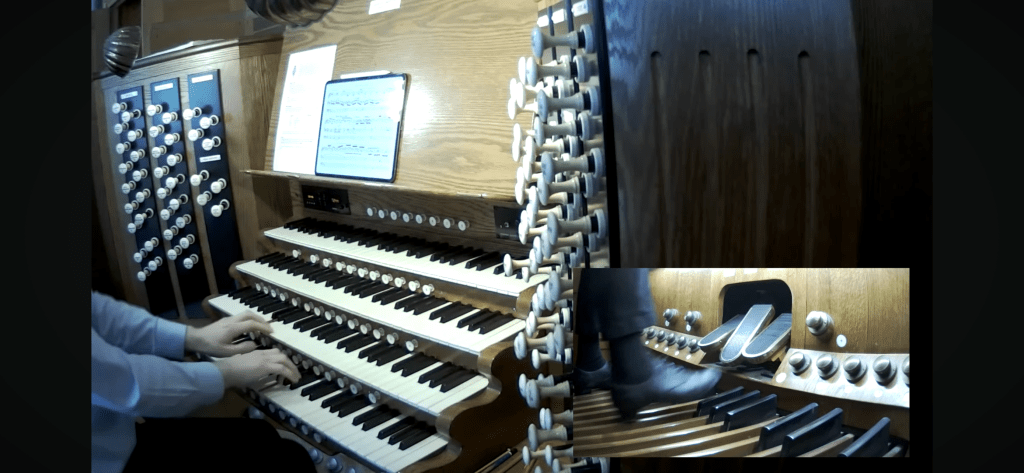
Rhapsody no 1 in Db by Herbert Howells (1893 – 1983) is the first of 3 in
Opus 17, an early work written when Howells was in his twenties. Howells has
organ lessons at Gloucester Cathedral and after his studies at the Royal
College of Music in London became Assistant Organist at Salisbury. His music
has been described as creating uniquely the ‘Anglican cathedral atmosphere’
and he admitted that ’he was inspired by the architecture of these magnificent
buildings’. The Rhapsody builds from a contemplative opening into an arch of
sound and up to a towering climax from which it returns to a tranquil close.
The soaring arches of Gloucester Cathedral
Howells enriched Anglican liturgical music with numerous mass and service
settings, anthems and hymn tunes and Alex must have sung and played many
of them over the years. This working knowledge was evident in the creation of
a contemplative atmosphere evoking the landscape dearly loved by Howells.
Dynamics were suitably wide ranging and the slow rise to the central climax
was finely controlled. Full space was given to the powerful discords and the
lingering ending
held the audience in a moment of magic.
Cesar Franck (1822 – 1890) began his professional life as a concert pianist but
over time found his true musical voice in the pipe organ.
His need for secure employment led him to become a church musician and
once appointed at Eglise St Clothilde in Paris, he remained there for over 40
years. One of the requirements of his post was to improvise on plainchant and
his extraordinary skill drew large numbers to the services.
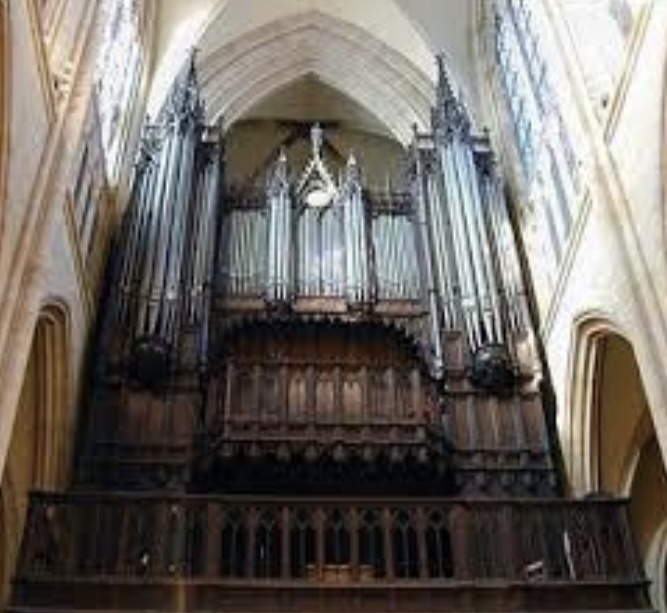
The organ at Eglise St Clothilde, Paris, by Aristide Cavaille-Coll
Choral no 1 FWV 38 is the first of Three Chorals written at the end of his life in
the late summer of 1890. It is a free-form composition whose ruminating
character comes close to the liturgical improvisation central to the French
organ tradition and for which he was justly renowned. A faster variation
enlivens the mood leading to a dramatic protest: did Cesar have a sense that
his time was near? Intense working of the main themes brings remote keys,
solos in different registers and
masterful combination of material until the main theme crowns the ending in a
blaze of organ glory.
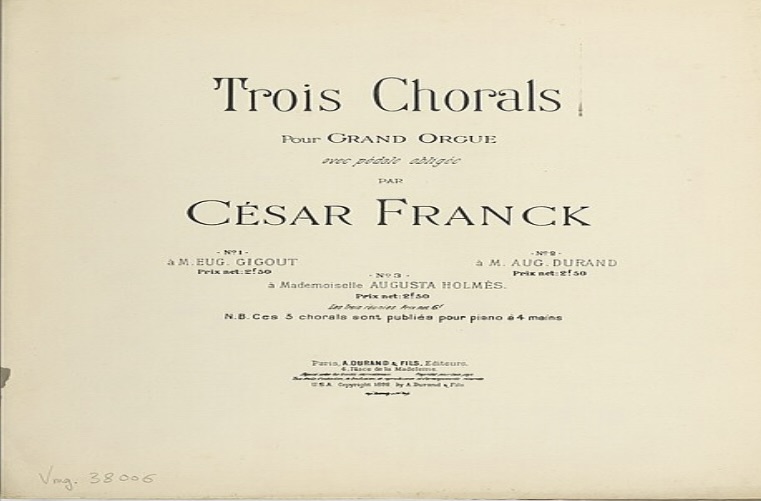
First edition of Trois chorals 1892
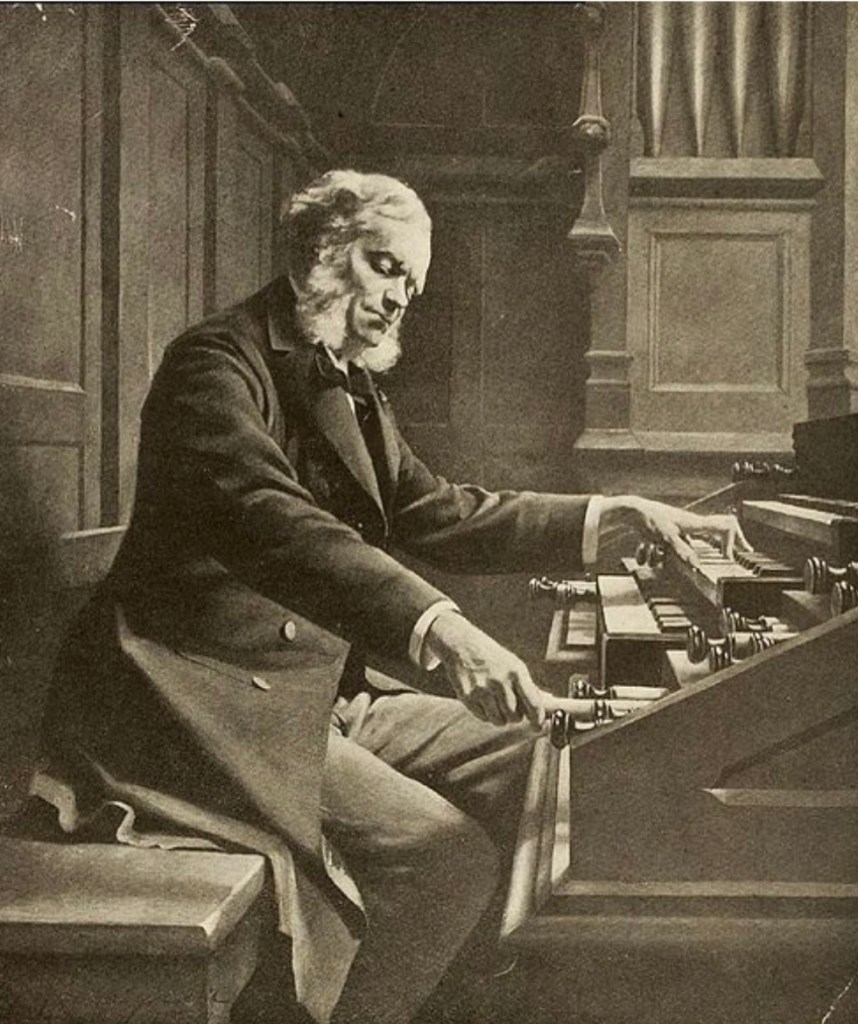
Franck at the organ of Eglise St Clothilde, Paris
Choral no 1 has taken its place as one of the cornerstones of the recitalist’s
repertoire and Alex matched his musical choices expertly to the demanding
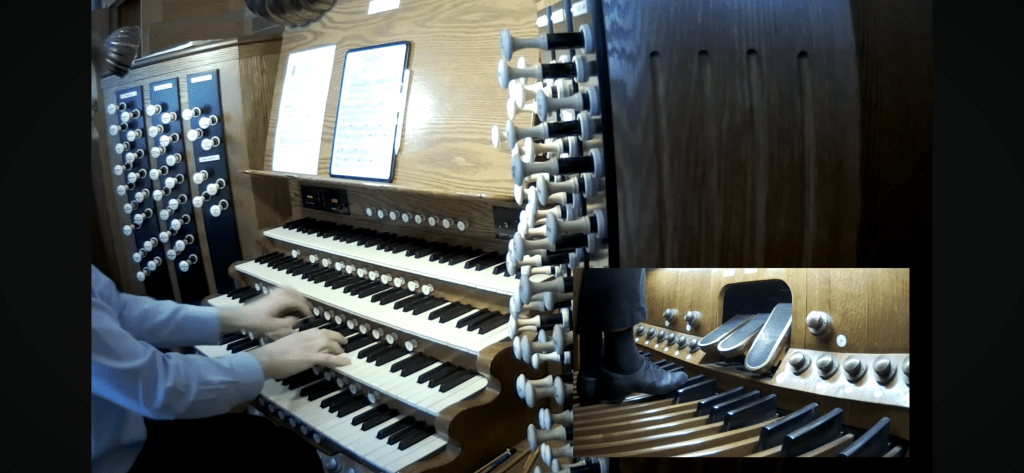
score: the need for full organ combining the forces of the two choruses
available on the Great Organ; the need for clarity in densely contrapuntal
passages with the wealth of stops on the Solo Organ. The use of the Flute and
Trumpet stops were especially memorable and the string texture made a
refreshing contrast. This piece gives full rein to the technical skill and musical
imagination of the performer and Alex rose impressively to both challenges.
Organists are in a uniquely difficult position in that they can only prepare in
advance up to a point. Every organ is different, specifically designed for its
building. This requires them to become familiar with the specification – manuals
and stops – and to fit their tempi to the acoustic.
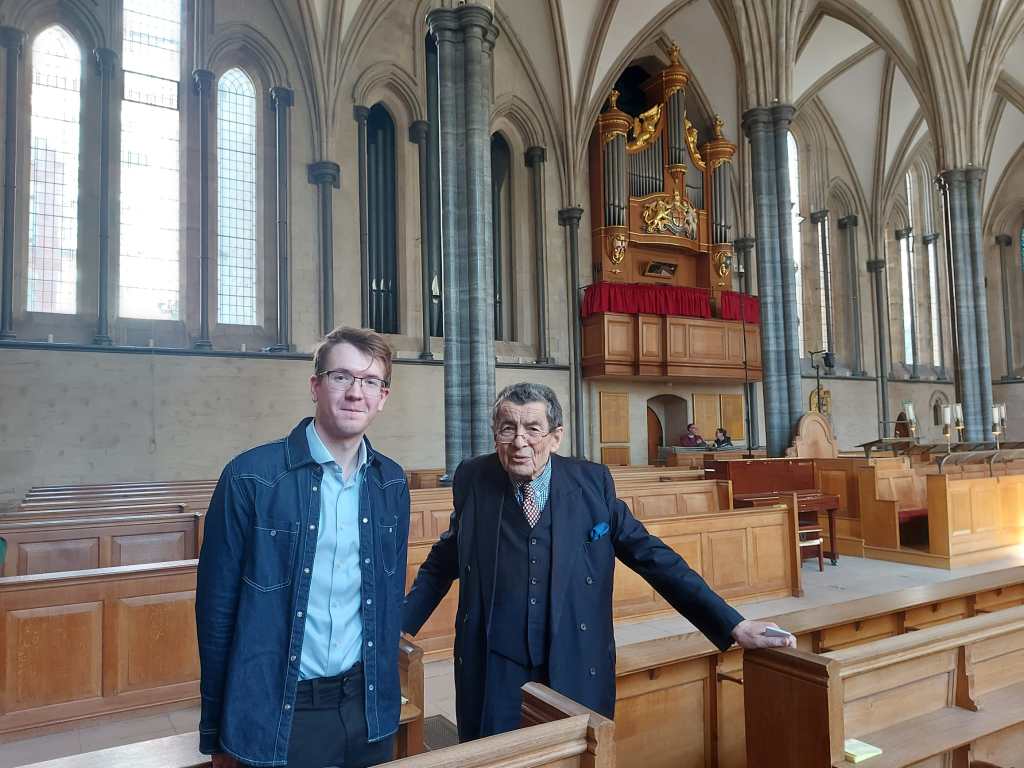
The Temple organ by Harrison and Harrison is one of the world’s elite
instruments with 4 manuals and 66 stops and is much favoured for recording. It
is now known all over the world as the one chosen by Hans Zimmer to record
the organ part for the film Interstellar in 2014 with organ maestro Roger Sayer,
who was Director of Music at the time. It is a busy church and visiting organists
such as Alex today only have a short time in which to settle these vital issues.
This recital was marked by quiet assurance and significant musical intelligence,
combined with a genuine love for this music.
The Keyboard Trust was founded in 1991 and has expanded from a family-
run organisation to concerts in 11 countries. It is indebted to Temple church
for its generous offer of an annual recital since 2004 with today’s established
artists such as Callum Alger and William Fox having received their support.
I asked Alex what this means to an artist embracing the music profession of
today:
I am enormously grateful for the support of The
Keyboard Trust, who were not only kind and generous
hosts, but also an enthusiastic and supportive audience.
This was my first collaboration with the Trust; I was
delighted for the opportunity to work with an
organisation which does such valuable work supporting
young musicians like myself.
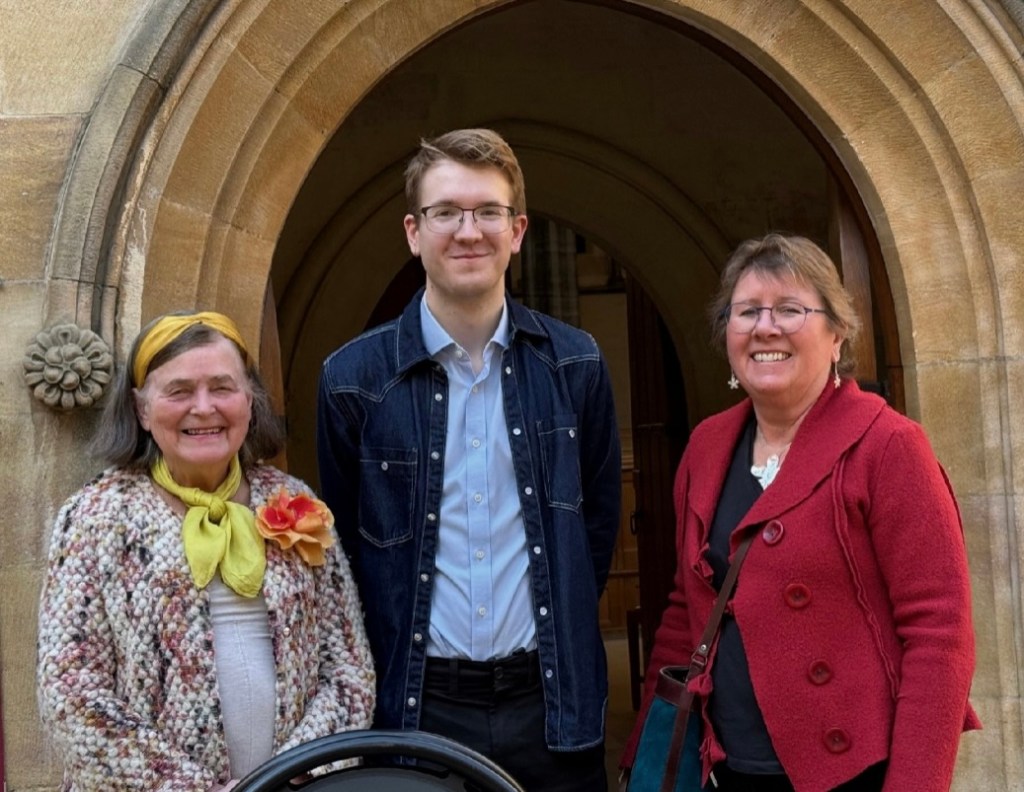
From the left: ANGELA RANSLEY, ALEX TRIGG and Keyboard Trust CEO SARAH BIGGS
ANGELA RANSLEY is a pianist and writer on musical subjects and
Director of the Harmony School of Pianoforte. She holds an organ post in Surrey
Alex’s full comments are in the link below.
HOW YOU FOUND THE ORGAN AND THE VENUE
It was a treat and a privilege for me to play such a fine instrument in a space with as rich a musical history as Temple Church. The organ was perfectly suited to the English repertoire in my programme, with so much colour to be found in the solo and swell divisions especially.
HOW THE KEYBOARD TRUST SUPPORT HELPS YOU
I am enormously grateful for the support of The Keyboard Trust, who were not only kind and generous hosts, but also an enthusiastic and supportive audience. This was my first collaboration with the Trust; I was delighted for the opportunity to work with an organisation which does such valuable work supporting young musicians like myself.
WHAT YOU CONSIDER TO BE THE CHALLENGES OF A YOUNG ARTIST IN 2026
I would say social media and the internet present some of the greatest challenges to young people today, not just for artists but for everybody. With thousands of influencers, performers and other personalities presenting their ‘best selves’ to the world online, it’s all too easy to compare ourselves to these polished acts, which often lack the human element of imperfection. As musicians it’s vital that we strive for self-improvement, but our expectations of ourselves need to be healthy and realistic. The work of The Keyboard Trust is so valuable as it offers young musicians the opportunity to gain performing experience in ‘real-world’ settings with supportive audiences.
 ChristopherAxworthy-MusicCommentary