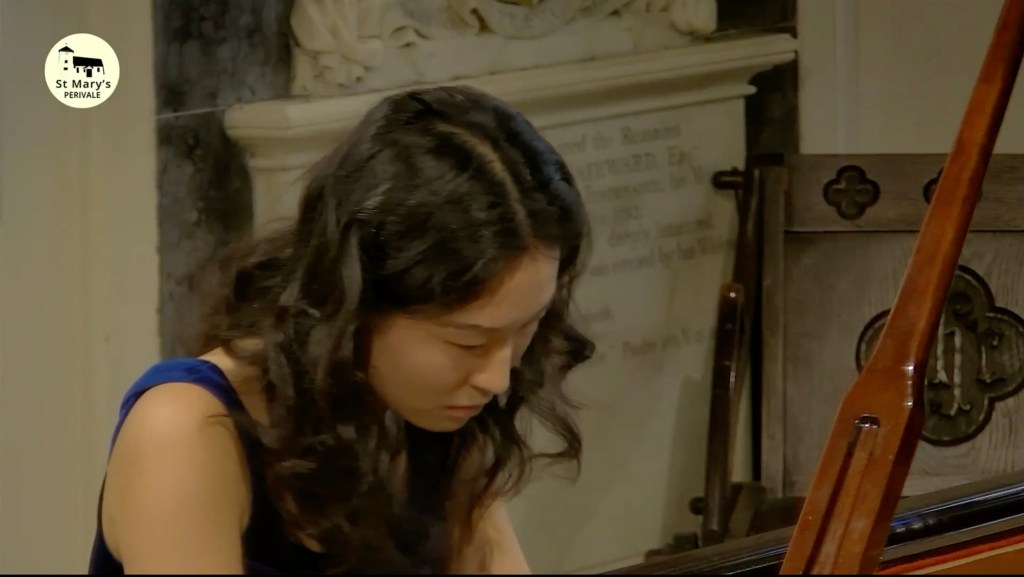
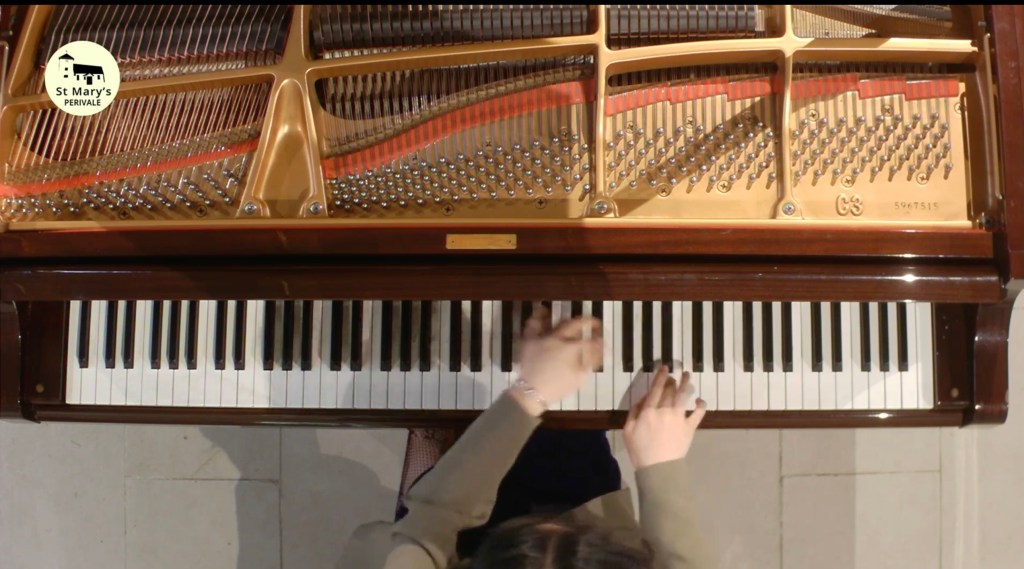
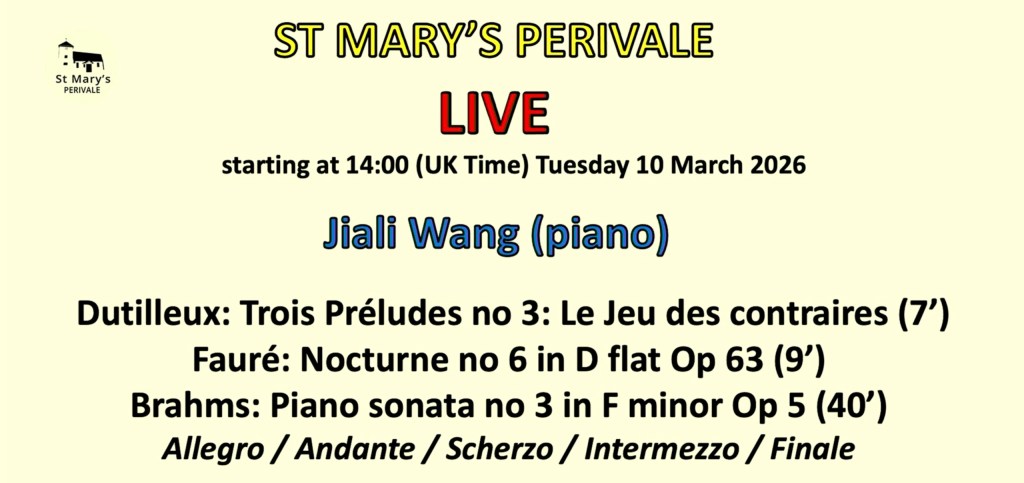
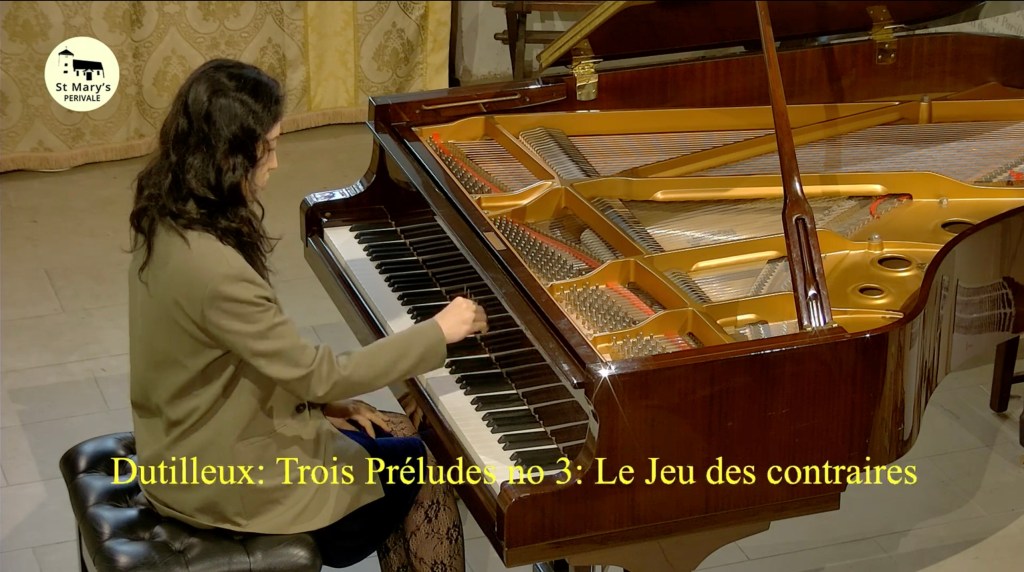
Jiali’s playing has grown in stature since her graduation recital at the Royal Academy last year ……..this is the third time I have heard her Dutilleux Prélude : ‘Le Jeu des Contraires’ and today she finally convinced me of a work of great value in which resonance and dissonance can live together only separated by transcendental brilliance. Jiali playing with great authority a score of obvious technical and intellectual complexity where it is already a ‘tour de force’ to be able to play such a work without the score. The point is, I believe, that it would be impossible to play it with the score and be able to convince and communicate the dynamic drive and kaleidoscope of colour that Jiali did today. Like Berio whose music plays with the reverberations of the notes even striking a chord and then replacing it silently again to allow the reverberations to continue after the initial shock. Streams of notes that acted as a bridge between these two ‘contrary ‘ worlds were played with a crystalline clarity and extraordinary precision.
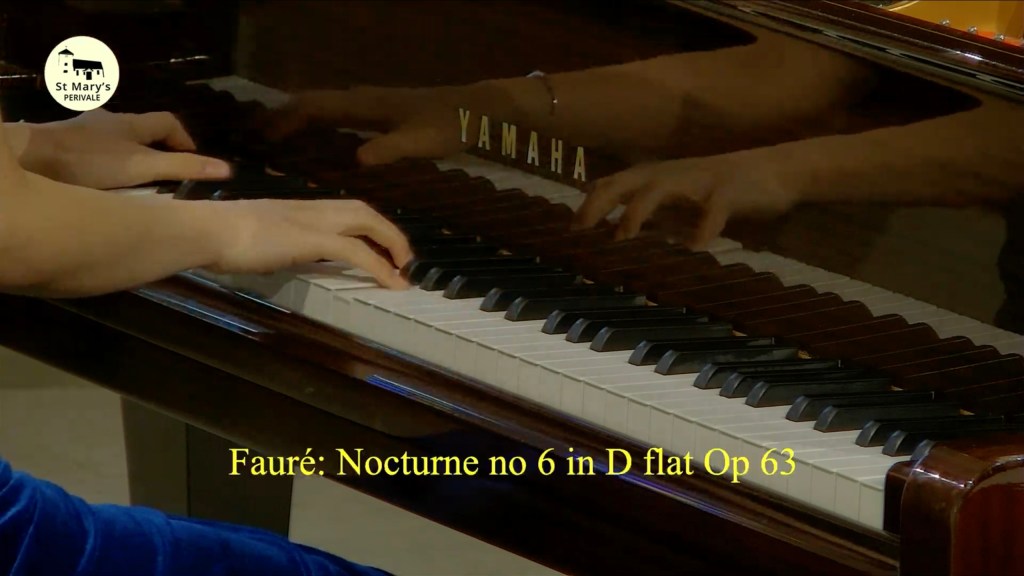
This was followed by another French composer from the previous century with the Nocturne in D flat by Fauré. Jiali explained that she saw the work more as a landscape in mid afternoon ,Fauré’s ‘après midi ‘ ?, which she played with long flowing lines of chiselled beauty. I remember a masterclass with Vlado Perlemuter in 1968 when Imogen Cooper played this nocturne to him together with Ravel Valses ,both works that he had studied with the composers.I was later to become a close friend of Vlado as he made his Italian debut in my series in Rome in 1984. He was 81 and I took him all over Italy until he was 90, once he had been discovered ! I remember a recital in Rome where he wanted me to tell the public, before he played some Fauré nocturnes, that the composer, who was director of the Paris Conservatoire at the time, would send the music with the ink still wet on the page for the young prodigy of Cortot to try out ! Perlemuter would always play strictly in time never slowing down the ends of phrases but playing with a chiselled aristocratic nobility. It was exactly this that Jiali showed us today and it gave an emotional strength to her interpretation. I remember Perlemuter’s absolute faithfulness to the organ like legato between the right hand and the syncopated chords of the left. All things that come naturally to an organist but where pianists are tempted to join notes with the pedal. Absolute clarity too to the ‘Allegro moderato’ where the fluttering birds are serenaded with one of Fauré’s most beguiling melodies. Streams of jeux perlé notes just finished off phrases without ever changing the tempo. There was passion too but always of purity and cleanliness where the great architectural line was the guiding light that she followed.
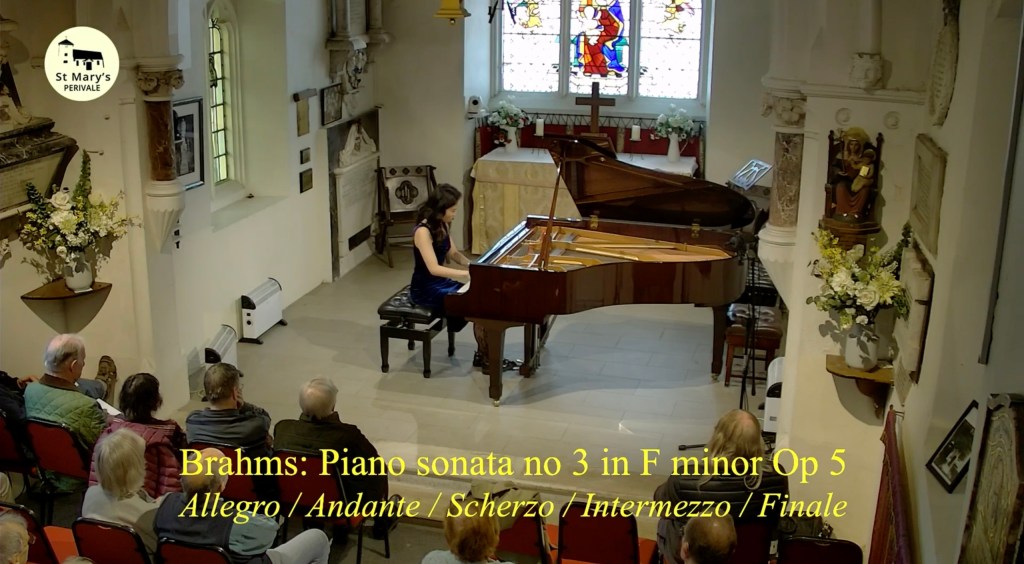
I have heard Jiali play the second sonata of Brahms and today I was glad to be able to listen to her interpretation of the third, considered by many to be his masterpiece amongst his ‘veiled symphonies’ ( Schumann). The sonatas are all in four movements but the third sonata has an introduction to the finale that by many is considered to be a fifth movement. It is a monumental work and although it does not have the same amount of notes as Liszt, Chopin or Schumann Sonatas it is constructed in marble and requires a construction of architectural importance and absolute precision. It is written too, with more orchestral sounds in mind than just pianistically satisfying virtuosity and bel canto. Jiali paid scrupulous attention to the composers markings and especially to his rhythmic precision where rests become as important as the sounds. From the very opening Jiali played with absolute precision the monumental declaration of intent allowing it to die away to moments of sublime introspection ‘con espressione’. Of course slight fluctuations of tempo as the poetry flowed through her veins but always ready to bring the entire orchestra in with Toscanini like precision and nobility. There was a radiance to the ‘Andante’ that she allowed to flow with disarming simplicity where the voices were allowed to speak to each other with remarkable clarity as she arrived at the whispered beauty of ‘poco piú lento’ which she played with great poise and beauty .Again it was here that her clarity and attention to the rests carried the music forward on a magical ‘wing of song’ . Gradually Brahms writes in, his own ritardando with notes and rests as we arrive at the heart of the work with the ‘Andante molto’ coda, where Brahms reaches sublime heights of controlled passion.I would not have returned to the original tempo ‘con molto expressione’ final bars as she decided to do, but would have stayed in the poignant Adagio and allowed the music to unwind with harp like radiance. However this was a remarkably mature performance of a real thinking musician and whatever her choices nothing was left to chance as this was a monument sculptured in marble. The Scherzo just swept from her fingers with Arrau type tenacity, with a limpet touch where each note was played with unambiguous authority. The Trio was played with sumptuous full sounds where each note of the chords had a significance and an important part to play. The ‘Intermezzo’ or fifth movement ,was played with searing intensity and it was here, as at the beginning, where rests became of such terrifying importance. A rhythmic precision to the ‘Finale’ that in lesser hands can seem so fragmented allowed her to show us the great architectural line and a central chorale that became the climax of this remarkable work. Fearlessly played , the coda was the climax to a truly monumental performance
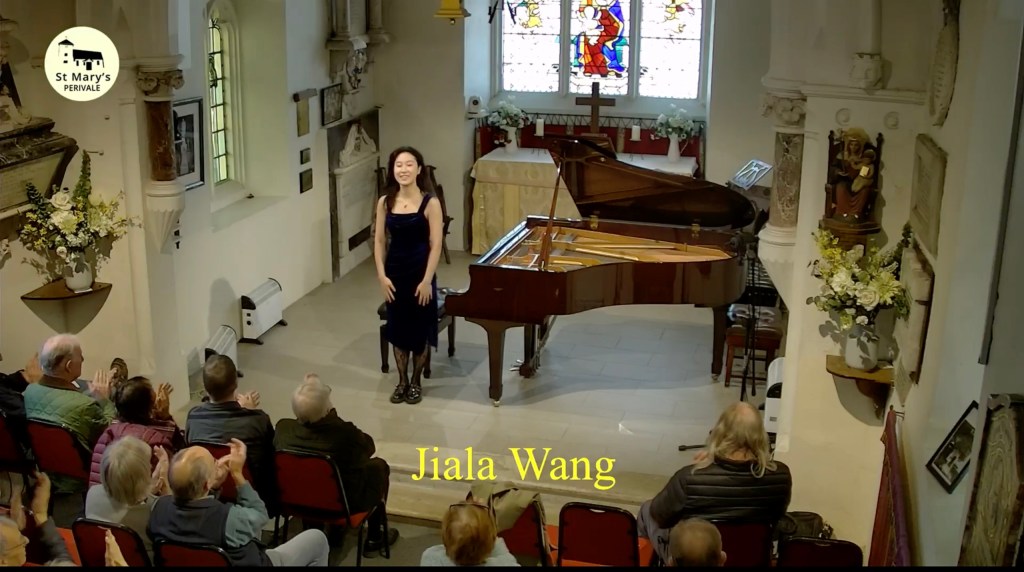
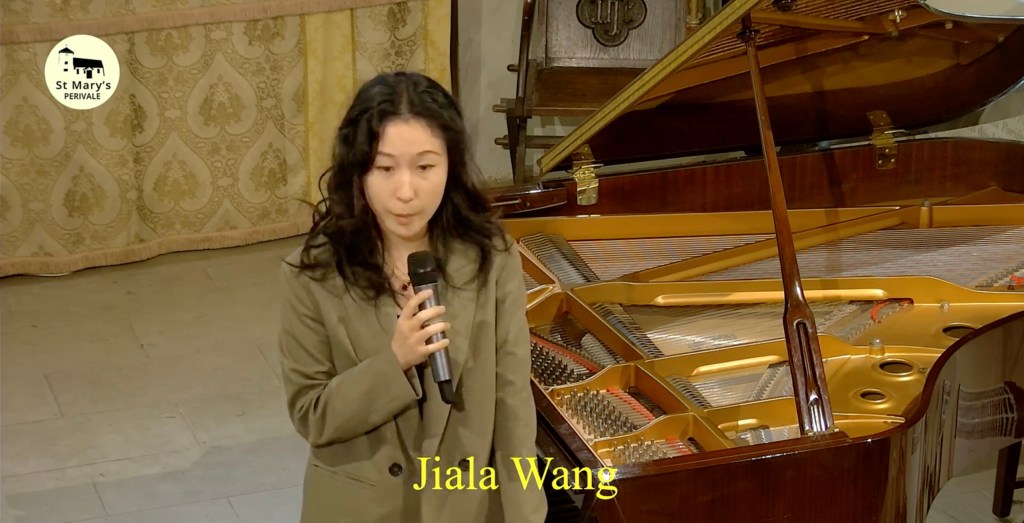
Jiali Wang is an accomplished pianist with extensive experience as a soloist and collaborative musician. She is currently based in London, where she is pursuing doctoral research at the Royal Academy of Music , alongside holding a fellowship at the International Piano Academy of Lake Como. Her performance work has taken her to major concert venues internationally, including Carnegie Hall in New York, Sun Yat-sen Memorial Hall in Beijing, and the Temppeliaukio Rock Church in Helsinki. She was artist-in-residence at the Petworth Festival , presenting twelve performances across three days at the Petworth Proms. She has worked in concerto settings with conductors including Edward Gardner, Daniel Hogan, and José Luis López-Antón , and continues to perform regularly in recital and collaborative projects in the UK and abroad.
Jiali has won a number of major international prizes. She is the winner of the Edna Bralesford Piano Prize , the Royal Academy of Music’s most prestigious award for instrumentalists graduating with the highest distinction. She has also won First Prizes at the Gershwin International Music Competition , the Málaga International Piano Competition , the Alion Baltic International Piano Competition , the Royal Academy of Music Piano Duo Competition , and the Harbin International Piano Festival Competition . In 2022, she won the Harriet Cohen Bach Competition Prize in England, together with the Harold Samuel Special Prize , recognising her interpretation of early music .
Alongside her performance and research activity, Jiali has worked closely with a wide range of leading pianists and pedagogues. Her principal mentors include William Grant Naboré and Christopher Elton . She has also regularly worked with artists such as Yevgeny Sudbin , Steven Osborne , Pascal Rogé , and Adrian Brendel . She has participated in advanced international training programmes including the International Holland Music Session with Boris Berman , and was a full-scholarship student at the Dartington International Summer School , led by Rolf Hind and Mahan Esfahani . In masterclass settings, she has collaborated with distinguished artists including Arie Vardi , Alexander Toradze , Fabio Bidini , Ian Hobson , Hung-Kuan Chen , Jerome Lowenthal , and Oxana Yablonskaya .
 ChristopherAxworthy-MusicCommentary