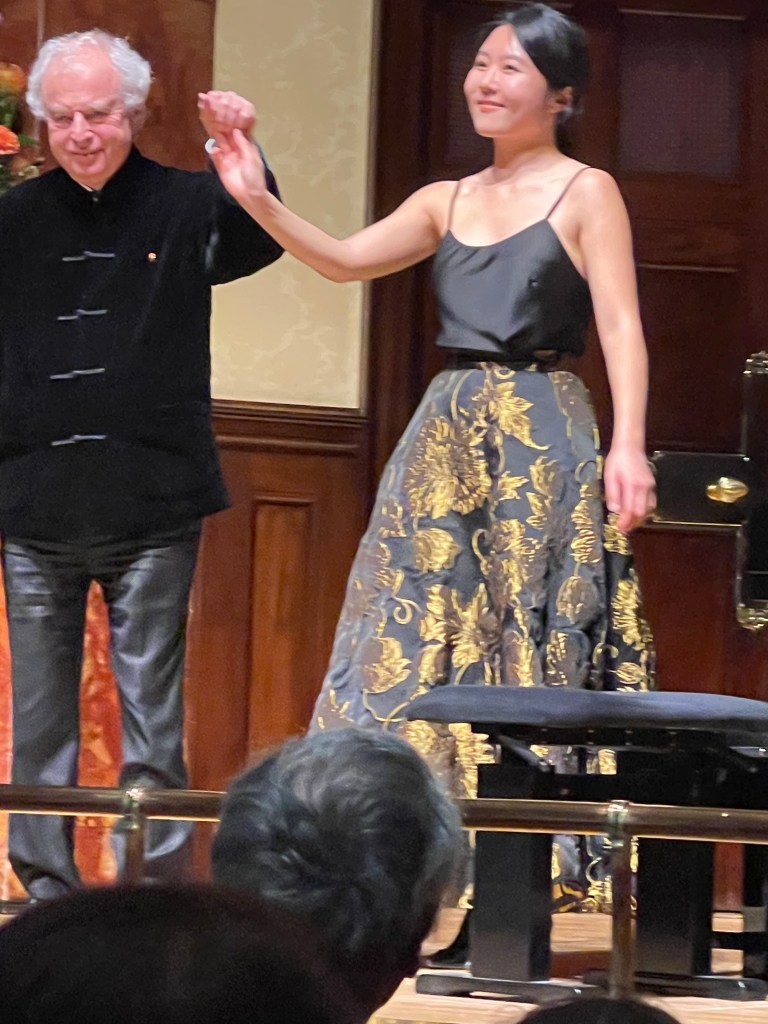
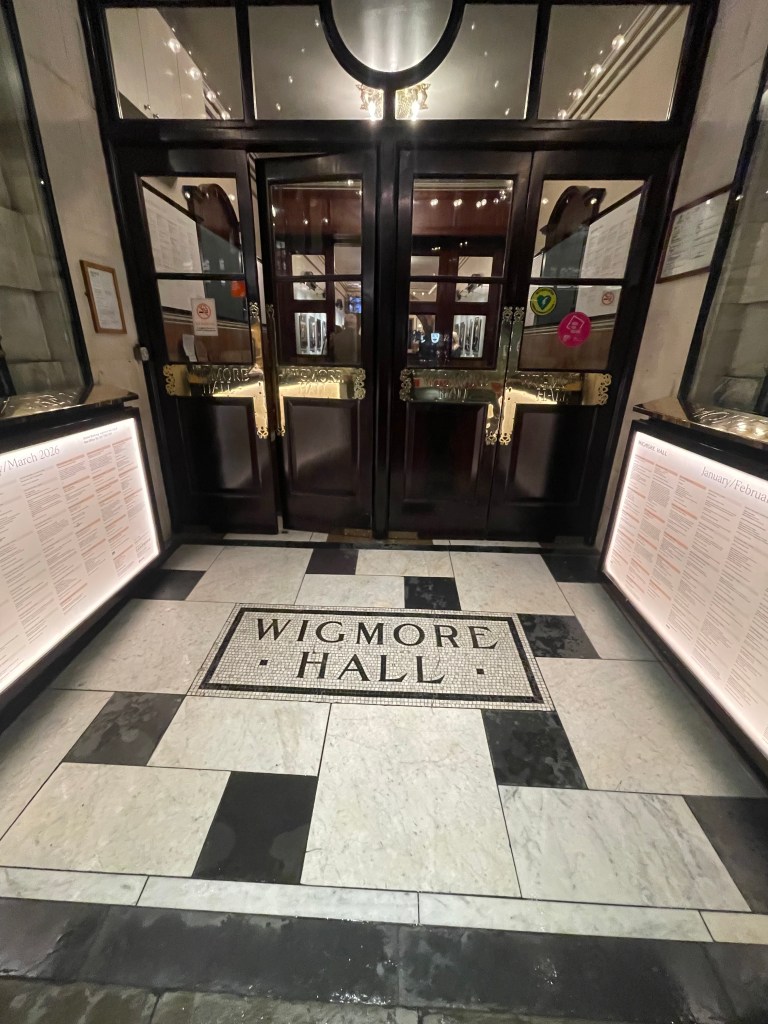
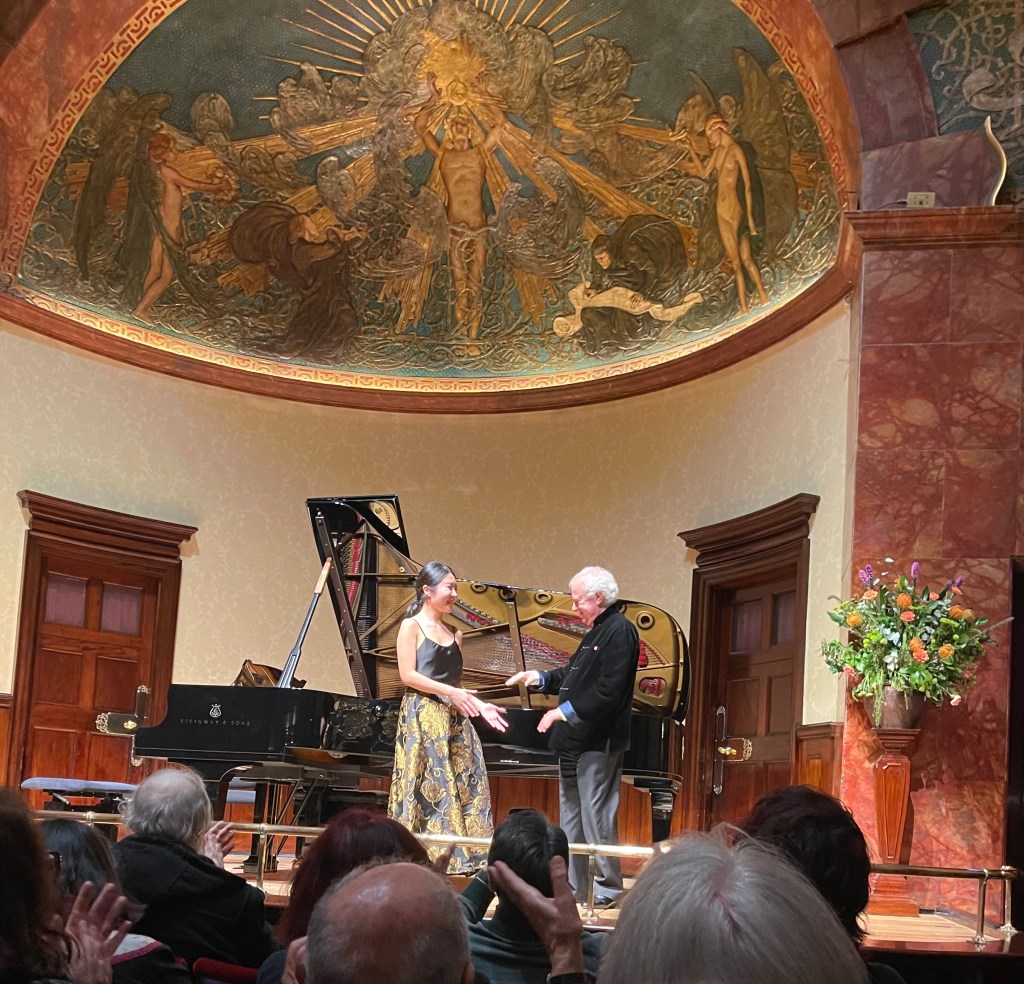
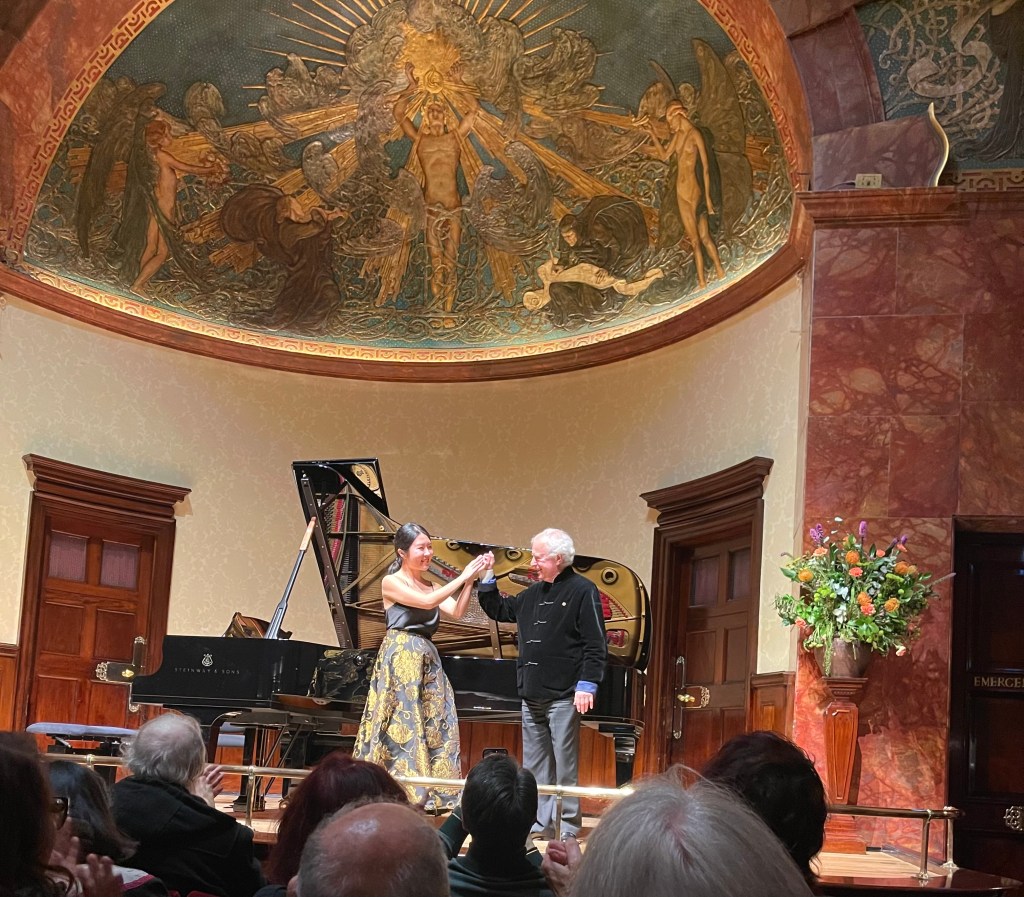
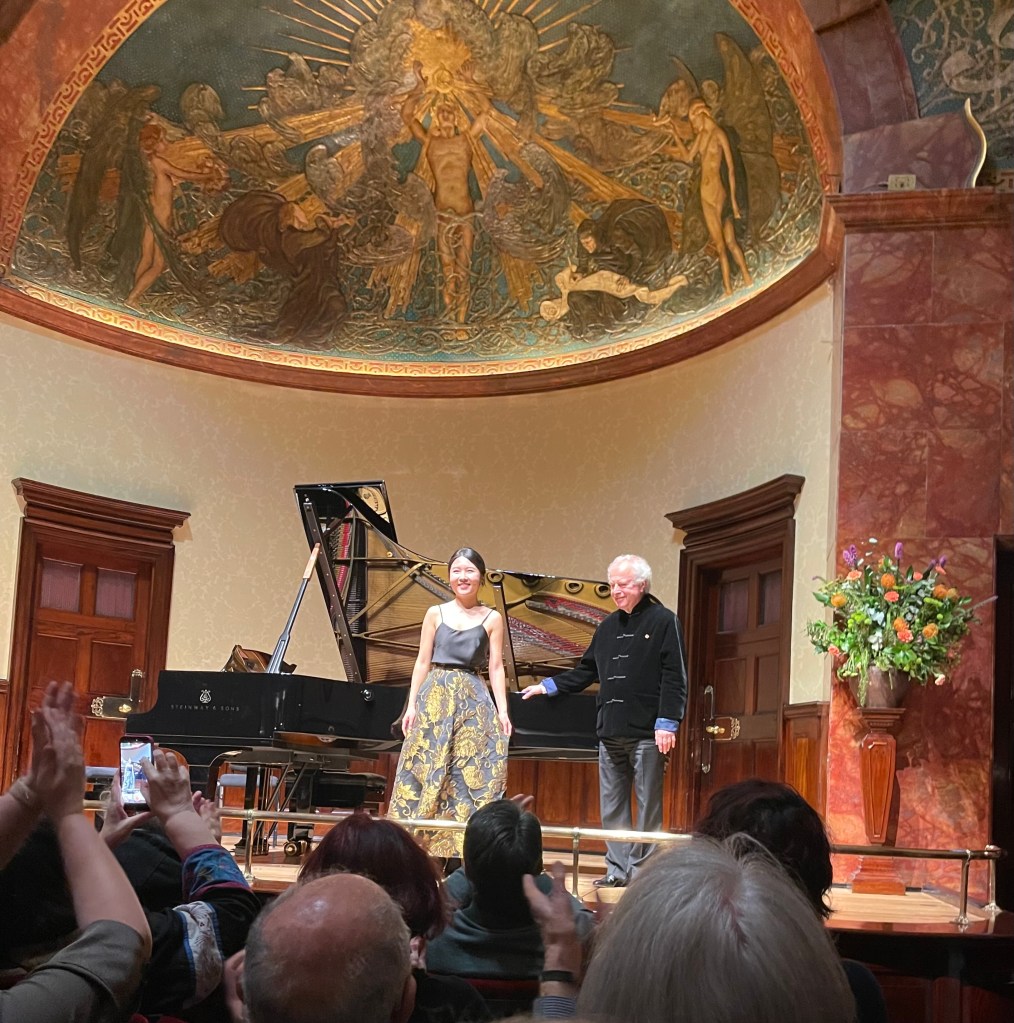
Andras Schiff with Chloe Mun transforming the Wigmore Hall into the intimate space where Schubert would have created his masterpieces for four hands to play with the lady of his choice . Chloe has been perfecting her studies with Schiff at the Barenboim Said Academy, having won both Geneva and Busoni International Competitions as a teenager. The only other person to have done that was Martha Argerich, so it was hardly surprising that he chose her to share in playing such masterpieces for his public that are happy to leave always the choice of music to him .
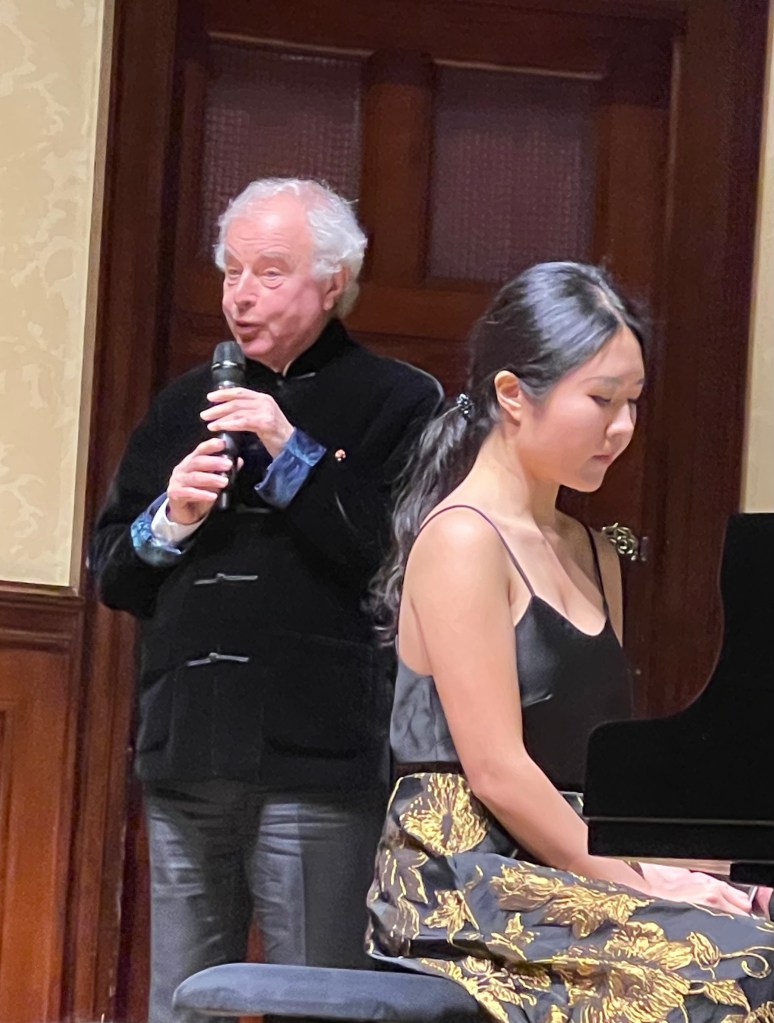
As he says the public trust him and know only the greatest music will flow from his hands.
And so it was today a sublime outpouring, with Schiff looking at Chloe in crucial moments, not playing the policeman, as they played as one, but sharing such intimacy not only with Chloe but with us all.
A Grand Rondò in A of refined delicacy and warmth was like greeting a long lost friend. There was a flexibility of tempo and with Schiff as an anchor moving the music on, showing us that the emotional strength was in the music, with no need or even scent of sentimentality. There was passion too with Andras suddenly going into fifth gear where Chloe’s exquisite finesse and refined phrasing suddenly were swept along on a wave of gentle persuasion from the bass until the return of the rondò was like seeing a friendly face on the horizon. Beckoning to us with scintillating streams of notes that glistened and glowed like rays of golden light as suddenly dotted rhythms provoked an outburst of notes from both players. Played not with Beethovenian impatience but with an internal agitation of refined mutual anticipation. Finally the melodic line passed to the tenor register which Andras played with refined insinuation as Chloe allowed her hands to shimmer with changing harmonies of ravishing beauty. A final few bars, where our old friend was revealed, as Chloe scaled the heights on a whispered trail ending with a glistening vibration of sublime beauty. A performance that I have rarely heard played so beautifully, as not only did they play as one, but they produced a unified sound through an extraordinary mastery of balance, as they were listening to the overall architectural shape that they were creating together. An amalgam of sound that all too often with four hands on one piano can sound too thick, but with two master musicians listening to themselves and both with a chameleonic technical mastery these sublime works written towards the end of the composers life can be recreated as he showed us a glimpse of the paradise that awaited him and was already so close.
One masterpiece followed another with the ‘Lebensstürme’ with Chloe playing ‘Primo’ and the ‘F minor Fantasie’ with Andras ‘Primo’, being the centre pieces of this Schubertiade. An architectural understanding of these two great works that were allied to a control of sound and with a palette of colours that could turn an electric shock of intensity into immediate sublime contrasts. In fact all through the performances it was this continual contrast between the sublime and the passionate that created a spiritual and emotional intensity that held us spellbound as we were allowed a glimpse of the paradise that the Genius of Schubert in his last days could transmit with such poetic and unearthly beauty.
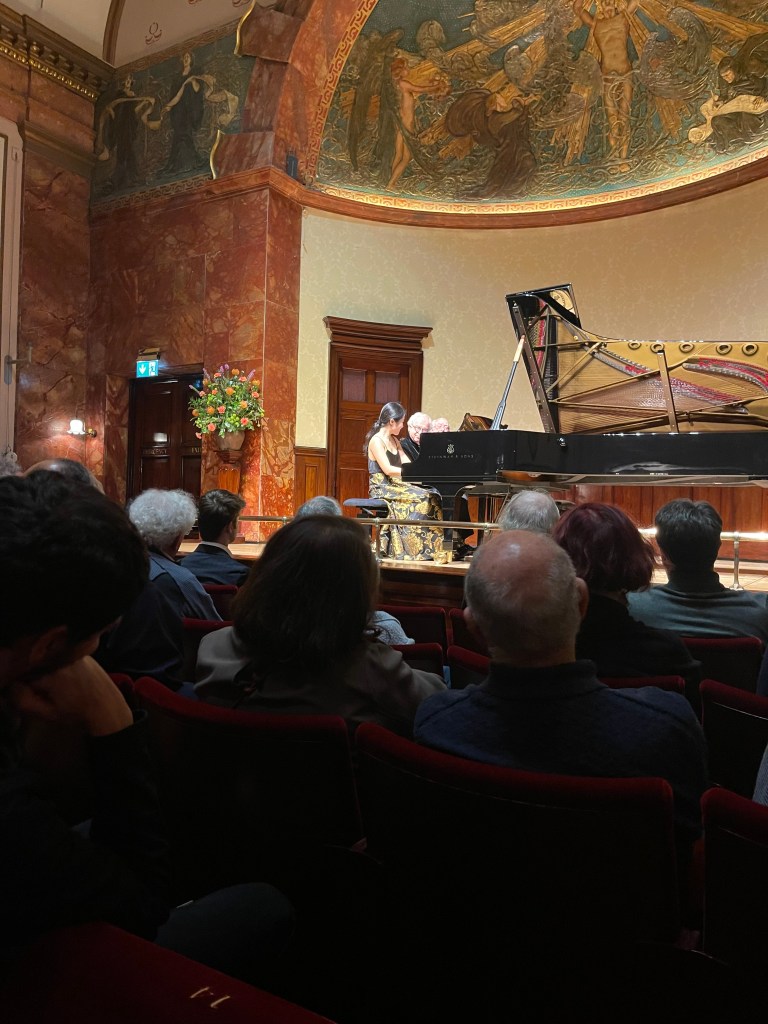
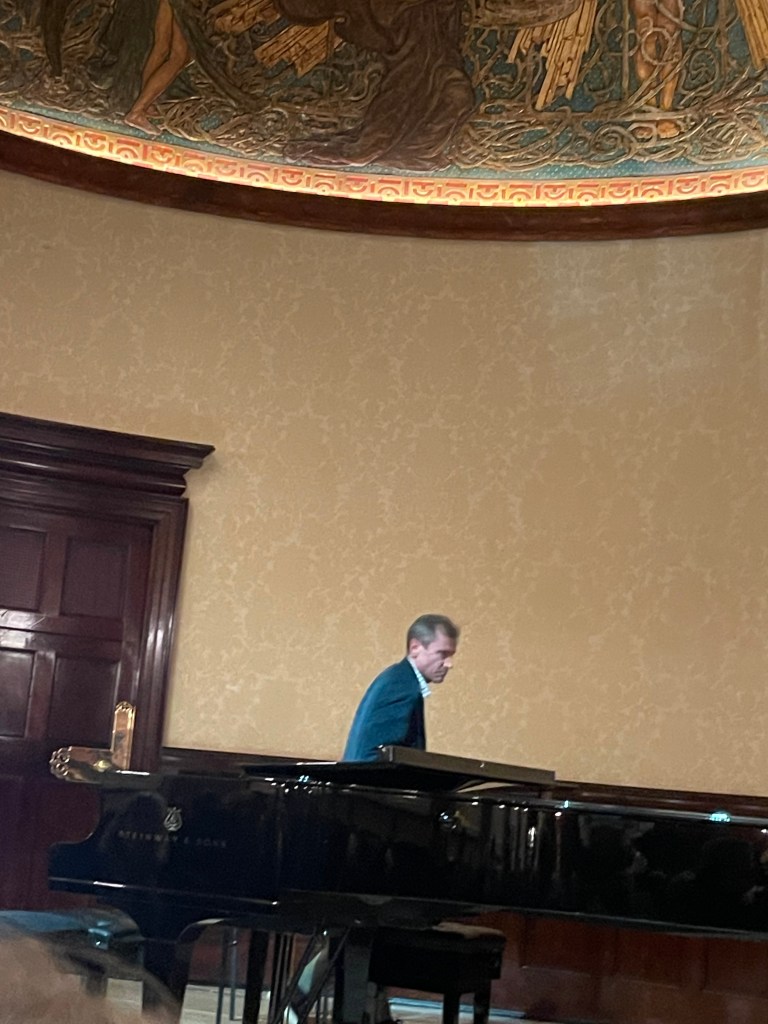
Accompanied by ‘Deux Marches Caractéristiques’ and two of the ‘Grandes Marches et Trios’ that are rarely revealed as Schubert actually wrote them. Wigmore’s ‘Old Lady’ dressed in her ‘Sunday best’ by that magician Ulrich Gerhartz ,was persuaded to give up all her secrets under such sensitive hands.
The two Grandes Marches with Schiff at the top was where the dynamic drive of the march was contrasted with the beautiful timeless beauty of the trios. Playing of quite extraordinary brilliance but always with scrupulous attention to the composers very meticulous markings brought these two marches to life as rarely I have heard before. With Schubert’s extraordinary accent on the up beat in the second march creating an electric shock of propulsion that was then relieved by the simple elegance of the Trio. The left hand ‘fp’ accents from Chloe made the disarming simplicity of Andras’s entry in the March n. 3 even more full of tongue in cheek character. A trio played with the grace and charm of a ‘ländler’ that Andras played with an exquisite palette of colour and whispered elegance.
The two marches that ended the second half, after a harrowing performance of the great ‘F minor Fantasie’ was where Schubert could let his hair down and prove he also had an impish sense of humour. Andras was now at the bottom and Chloe played the top with scintillating brilliance riding on the buoyancy created in the bass. The second march was remarkable for the effect that sudden pianissimo had before bursting into joyous brilliance and each time this understated theme occurred it brought with it a smile of impish good humour.
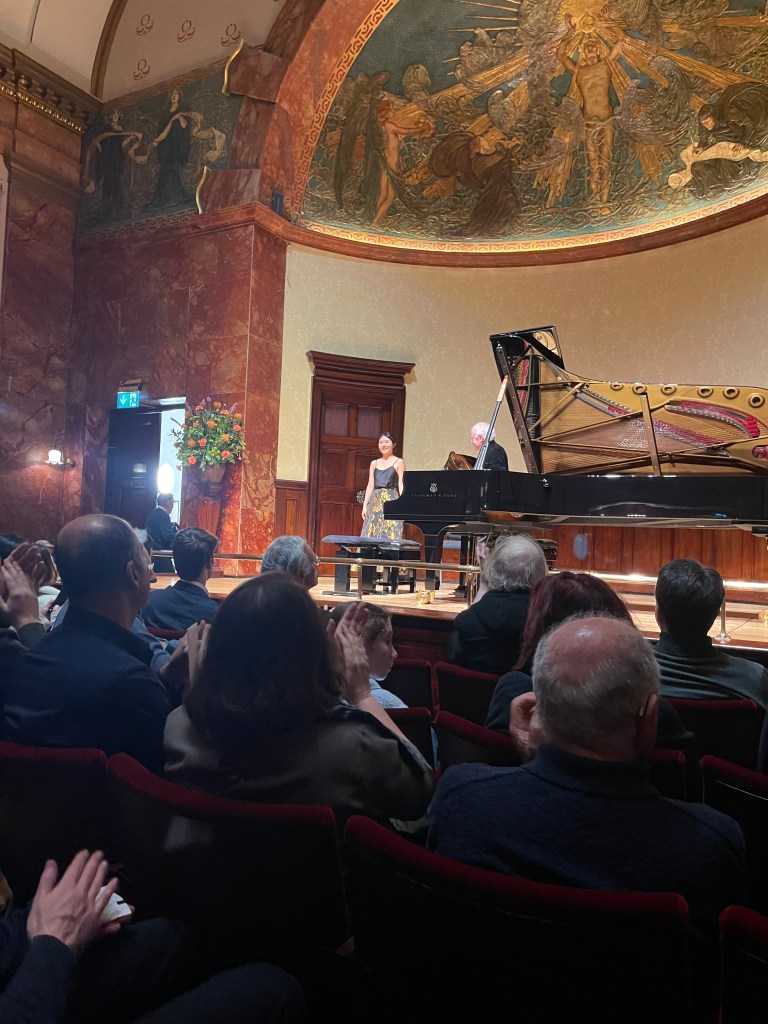
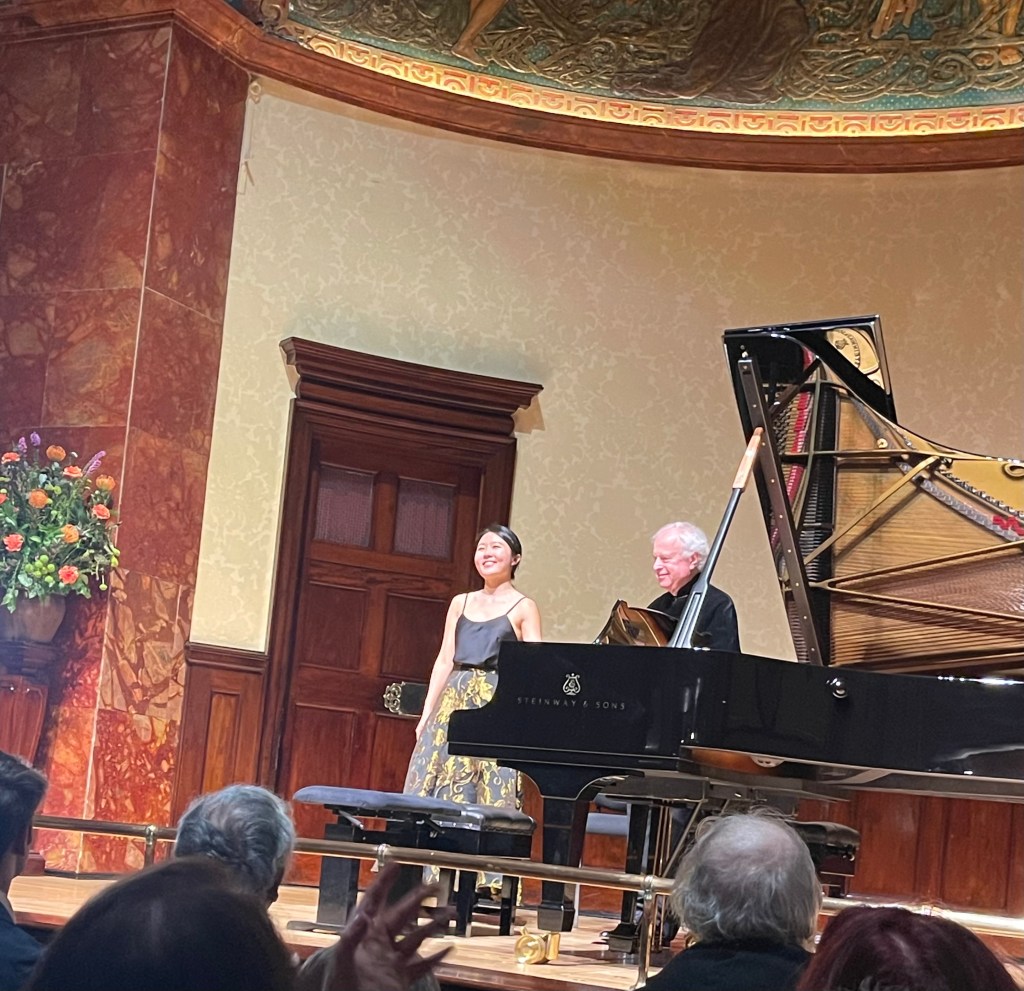
It was the Andantino Varié in B minor that was a revelation as Sir Andras explained that Beethoven and Mozart were very wary of delving into this key of ‘death ‘. Schubert had no such fear as he could already see the paradise that was awaiting him at only 31, and B minor became a celebration and thanksgiving for the genius that had been bequeathed to him. Andras playing the ‘Primo’ with a wonderful sense of improvised freedom as the music was allowed to flow with natural elegance.Chloe this time in the bass as the simple whispered theme that opened and closed this remarkable work was played by Andras with understated importance. Streams of notes played with scrupulous attention to Schubert’s very precise indications created a knotty twine of refined brilliance.
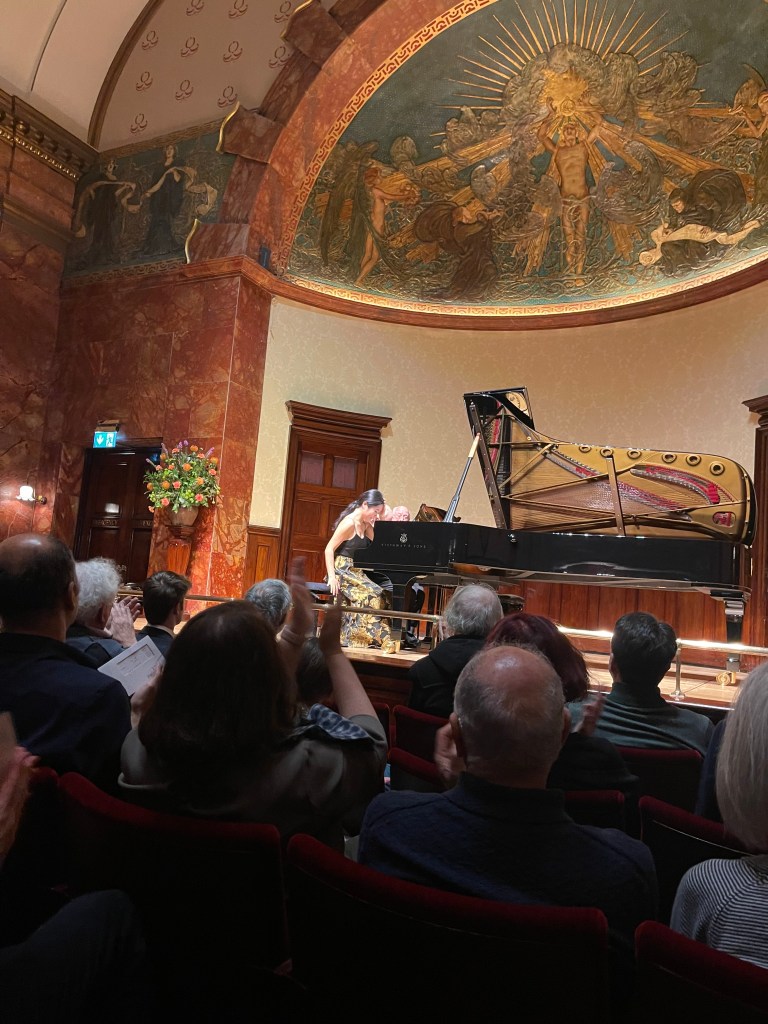
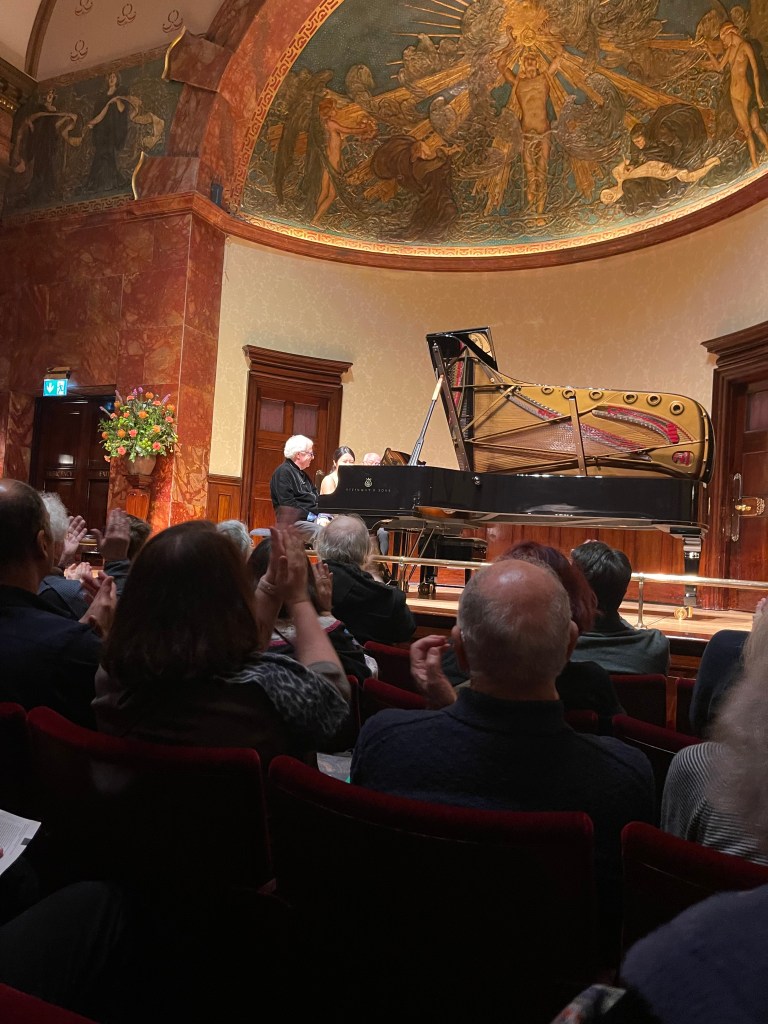
A ravishing ‘lied ‘ by Schumann, the fourth of his ‘Bilder aus Osten’ with Chloe playing ‘Primo’ was offered as an encore. A page of music that the composer simply marks ‘Nicht Schnell.’ In fact it is a page of sublime simplicity full of the same reassuring warmth that had been the hallmark of two hours of sublime, civilised, music making.
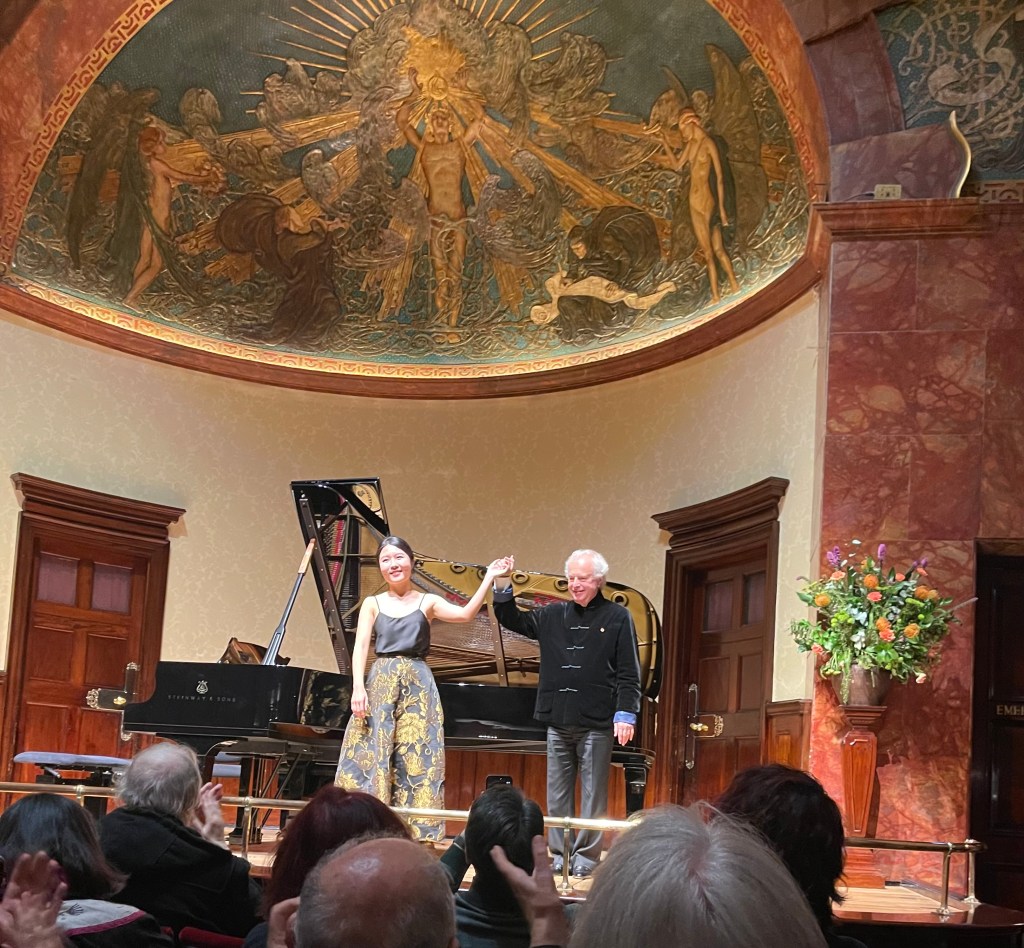
An oasis of peace and beauty that we have such need of in these turbulent times.
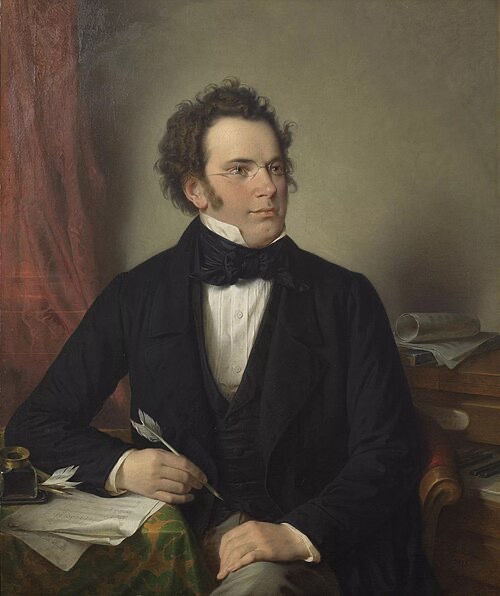
Schubert is unique among great composers in having written almost as much piano music for four hands as for two. Piano duetting was a popular pastime in his day, and the prospects for having such pieces published were far healthier than they were for solo piano music, particularly when it came to works of the ambitious scope Schubert wanted to write. Several of his most significant four-hands works had their origins in his two protracted visits to Hungary, where he was employed as music-master to the daughters of Count Esterházy von Galánta at his summer residence in Zseliz (now Zveliezovce, in Slovakia). When Schubert first went there, in 1818, the younger countess, Karoline, was a girl of thirteen, but when he returned six years later she had blossomed into a young woman, and by all accounts he fell deeply in love with her. Schubert may have intended the piano duets he composed at Zseliz for his two pupils to play together, or he may have taken one of the parts himself, thereby from time to time allowing himself a degree of intimacy with Karoline. In all likelihood, the players would have assumed the primo and secondo parts by turns.
The so-called ‘Divertissement über Französische motive ‘ D 823 with it’s first movement ‘en forme d’une marche brillante et raisonnée , the adjective ‘raisonée’ was the publisher’s only hint that the piece was a rigorously argued sonata allegro. The work is seldom played in its complete form, but its slow movement, the Andantino varié in B minor, is one of the most perfect and beautiful of all Schubert’s duets. The inspiration behind it is likely to have been Mozart’s piano duet Variations in G major K501, which have a similar chamber-music intimacy, and in which—as in Schubert’s piece—the theme returns in all its original simplicity to round the music off. Among Schubert’s variations, the second, with its toy-trumpet fanfares, has a Mendelssohnian lightness and transparency; while the third presents a continuous pattern of semiquavers in seemingly effortless counterpoint between the players’ right hands. In the deeply expressive final variation the tempo slows, and the music undergoes a change into the radiant key of B major. Rather than offer a literal repeat of each half of the theme, as in the first three variations, Schubert now presents elaborately ornamented quasi-repeats, so that this is in effect two variations rolled into one. From here, the music dissolves into an abbreviated repeat of the original theme, its unadorned nature highlighted by the intricacy of the music that has preceded it.
The Allegro in A minor, D947 and the Rondo in A major, D951 were written in May and June 1828 ,the last year of Schubert’s life , and may well have been intended to form a two-movement sonata along the lines of Beethoven’s E minor Sonata Op 90. Schubert’s rondo is lovingly modelled on the lyrical finale of Beethoven’s sonata: his theme follows a similar harmonic pattern, and even the keyboard layout of its opening bars, with the melody’s initial phrase followed by a more assertive answer in octaves, echoes Beethoven’s. Schubert mirrors Beethoven’s procedure, too, by transferring the final reprise of the rondo theme to the sonorous tenor register, with a continuous pattern of semiquavers unfolding above it. Particularly beautiful is the manner in which one of the important subsidiary themes returns towards the end, surmounted by a shimmering pianissimo accompaniment in repeated chords from the primo player.
The A major Rondo was published in December 1828, less than a month after Schubert died, but its A minor companion-piece did not see the light of day until 1840, when Anton Diabelli issued it under the heading of Lebensstürme (‘The storms of life’) which is one of Schubert’s most imposing sonata movements. Its turbulent opening pages contrast with the serenity of a second subject.Making dramatic use of abrupt silences—nowhere more startling than at the end of the first part where the music breaks off in mid-stream, only to plunge into a wholly unexpected key for the start of the central development section.
Throughout his life, Schubert was fascinated by the challenge of welding the various movements of a sonata into a continuous and unified whole—much as Beethoven had done in the first of his two piano sonatas ‘quasi una fantasia’, Op 27. Schubert’s earliest surviving composition, written at the age of thirteen, is a Fantasie for piano duet, the famous piano duet Fantasie in F minor, D940, composed in the early months of 1828, was preceded by two important works of a similar kind, both in C major: the ‘Wanderer’ Fantasy for piano solo, D760, where virtually everything arises out of the repeated-note dactylic rhythm of the song-fragment that forms the basis of its slow second section; and the Fantasy for violin and piano, D934, which also makes use of a pre-existing song.The Fantasie’s opening melody is similar the theme from the slow movement of Schubert’s C major String Quintet, composed in the same year. When Schubert submitted a list of his available compositions to the publishers Schott & Sons in February 1828, he informed them that the Fantasie was to be dedicated to Karoline Esterházy! It is a masterpiece and one of the most sublime works ever written for piano duet.
.
 ChristopherAxworthy-MusicCommentary