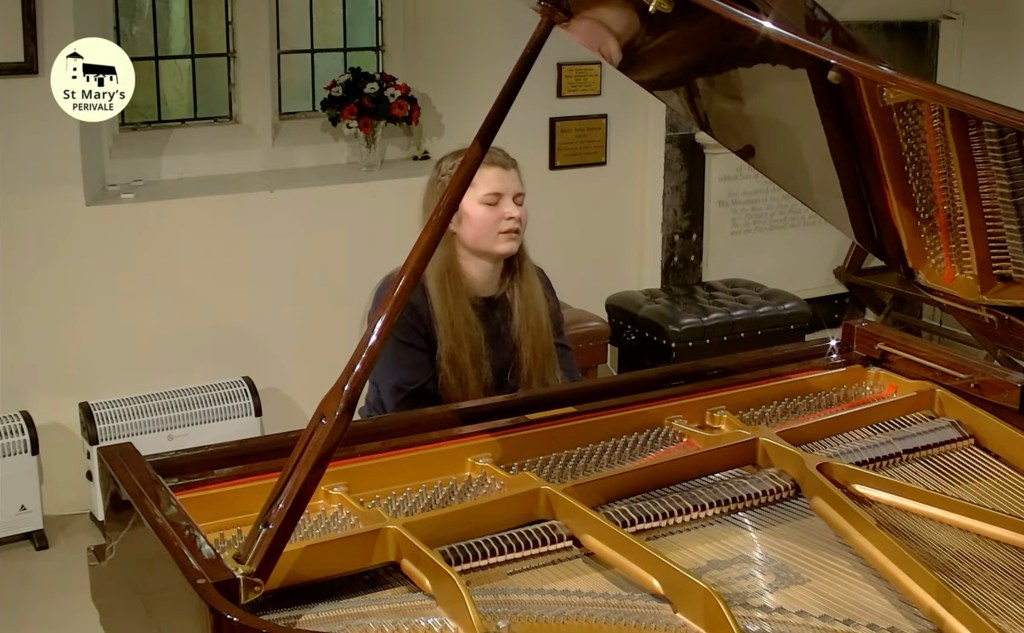
This is the third time I have heard Khrystyna since she was forced to flee her homeland and find refuge in the UK. It was Dr Mather who was one of the first to come to her rescue as she found a way of continuing her artistic journey in a new country. Like Chopin who fled his homeland, the heritage it had left him was always present in everything he did whether in Vienna ,Paris ,Nohant or even Majorca. Khrystyna too has inherited a musical training that has given her a phenomenal technical command of the keyboard but also a love for the sound of the piano. Her ‘fingerfertigkeit’ was given to her as her hands were growing as a child and they were obviously formed with a flexibility and natural beauty that can only be acquired from this early age. Whatever she plays there is always a wonderful fluidity and beauty of sound. Never hard or ungrateful sounds of tension but music that flows from her fingers as it did for Alicia De Larrocha ,Argerich and Pires too. Khrystyna is also blessed with a temperament that can excite as it can seduce.
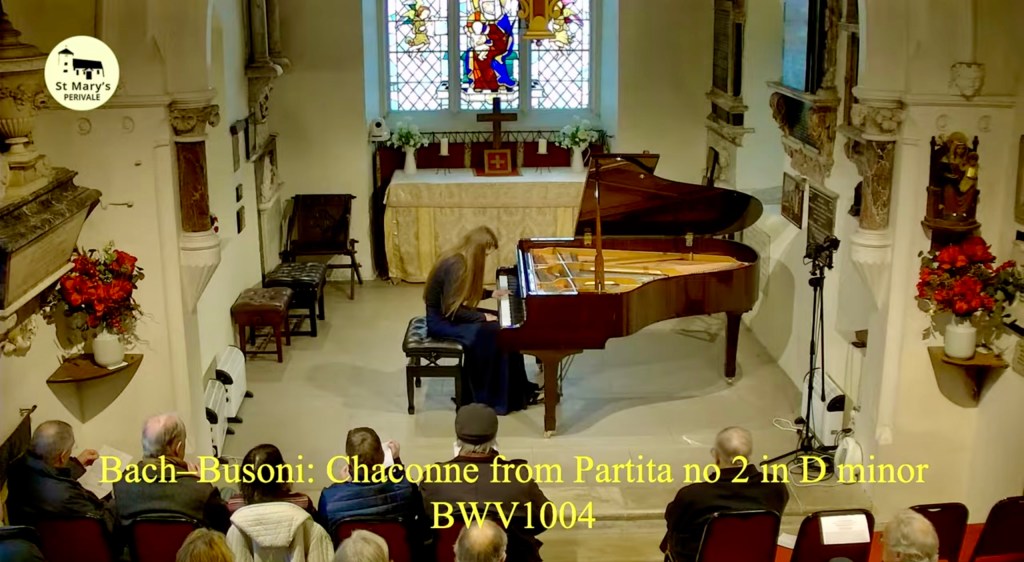
Today she chose two monuments of the piano repertoire . The Busoni ‘Chaconne’ is very much where Busoni has recreated on the piano the masterpiece that Bach had penned for solo violin. Brahms’s transcription is nearer to the original being played with the left hand just as it would have been on the violin. Busoni has created a concert piece and it is a master work but more Busoni than Bach. Busoni’s wife was often introduced to people as Mrs Bach Busoni such was the identification of Busoni with Bach in a period when Bach’s music was hardly known. The ‘Chaconne’ is a monumental work that needs a continuous undercurrent within it’s framework. As Chopin was to say : ‘a tree with firmly planted roots but branches free to move as nature commands’. Khrystyna found the excitement and exhilaration of this work but her breakneck speed and insistence even she found hard to maintain. Amazing lightweight left hand octaves and a driving insistence like the man on the high wire- will he make it or not? The opening tempo was much too slow and as Khrystyna delved into the notes finding great beauty we had lost from the very beginning the anchor on which the whole work depends. Khrystyna is a very fine musician and all she did was shaped with great artistry and loving care but one felt that there were the fast passages and the slow ones, both exaggerated in tempo, that they did not belong to the one whole. Her sumptuous sound and extraordinary technical mastery taken with more aristocratic nobility would allow this great work to speak for itself as one of the greatest works ever written for a solo instrument.
Khrystyna is now studying at my old Alma Mater, the Royal Academy, with Joanna McGregor ,head of the keyboard having been bequeathed it by Christopher Elton and the school of great musicianship of Gordon Green ( who was both Christopher and my teacher ) and I am sure with guidance she will come to understand the structure of the Chaconne, as she in fact demonstrated with the Brahms Sonata that followed.
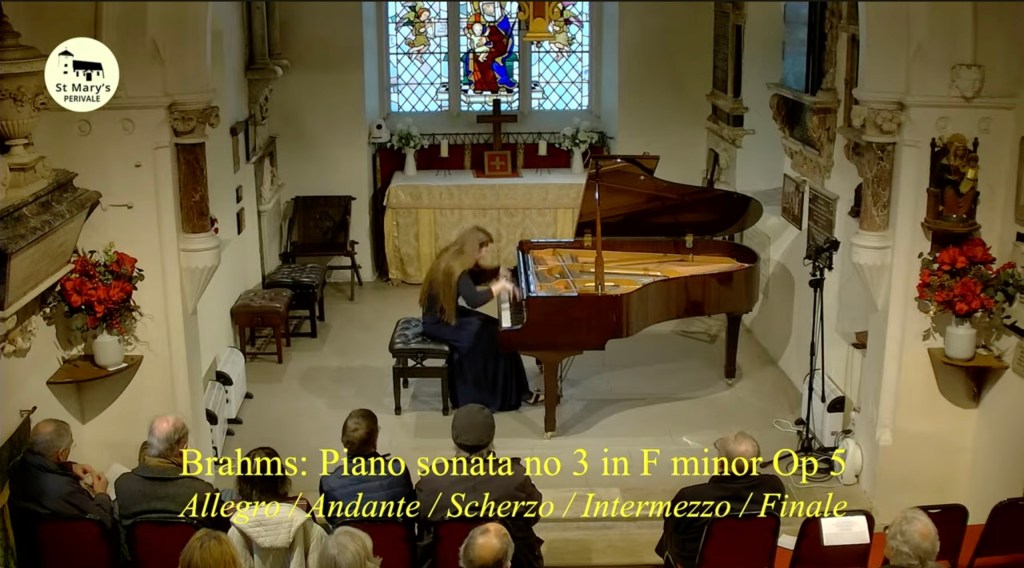
The Brahms F minor Sonata is a monumental work and a real trial of musicianship and resilience . Five movements for what was described by Schumann as a ‘veiled symphony’. Khrystyna played it with the same fearless drive that she had brought to the Chaconne but here it was allied to an architectural understanding that could construct a great Gothic Cathedral of monumental proportions. The fearless rhythmic drive and enviable precision of the treacherous octave leaps was allied to the beauty and simplicity that she brought to the lyrical passages. There were slight fluctuations of tempo but within the framework of the whole sonata . There was a beauty of balance in the ‘quasi ‘cello’ outpouring that Brahms marks with such indications as ‘pianissimo’ and ‘sostenuto’ before the dramatic outburst of the opening fanfare. A grandiose ending to the first movement was contrasted with the glowing luminosity of the ‘Andante espressivo’ and I doubt the ‘Poco più lento Äusserst leise un zart’ has ever been played with such touching radiance and beauty. Maybe only by Curzon ! The central passionate outpouring gave Khrystyna a chance to pour her heart out with passionate intensity and poignant meaning.The ‘Andante molto coda ‘ was played with whispered beauty and aristocratic authority as it built imperceptibly to the fortissimo climax of liberation and exhilarance.
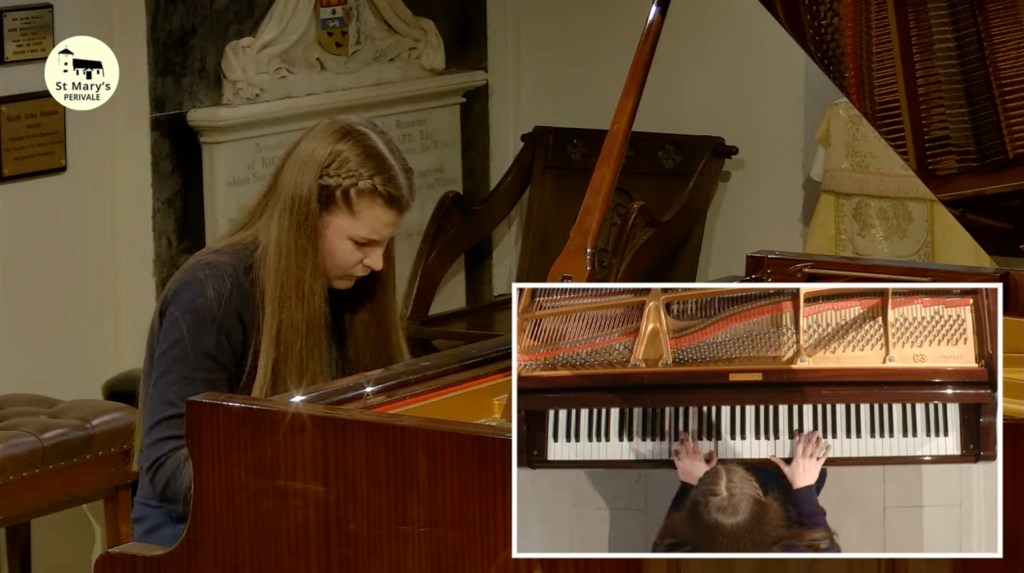
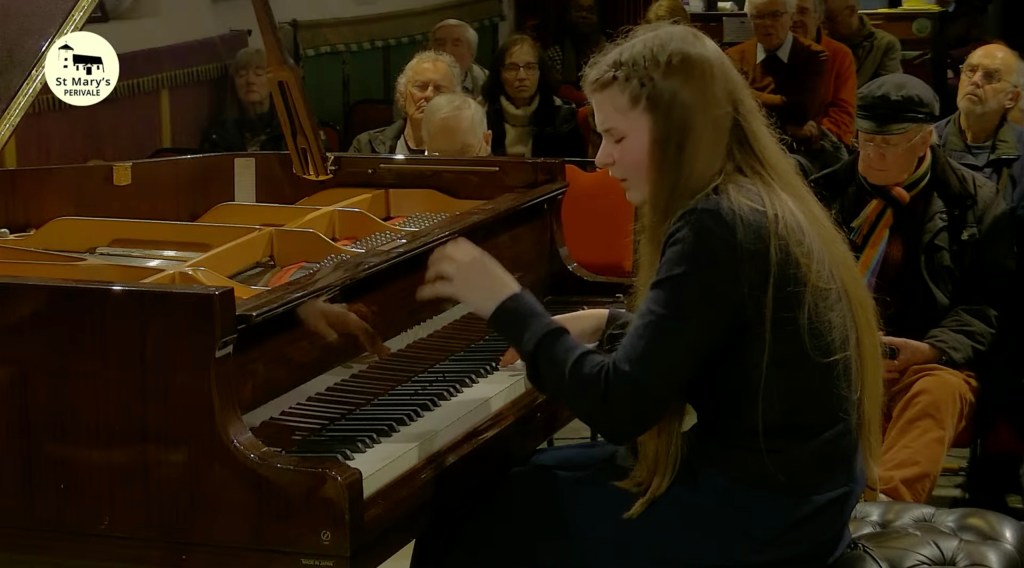
The ‘Scherzo’ just flew from her hands but with measured control and with considerable technical command. Even the ‘Trio’ she managed to maintain a similar tempo that made the surprise return to the ‘Scherzo’ even more effective. The ‘Intermezzo’,introduction to the last movement, was played with radiance until the menacing left hand throbbing of a desolate heart was intoned with extraordinary mastery and anguish.The ‘Finale’ that can sound so fragmented in lesser hands was played with such rhythmic finesse that the pieces fitted together in a jigsaw puzzle of genial invention. It was in the coda that Khystyna lapsed into sixth gear again and lost the grandeur and timeless magnificence of the climax of this monumental work. It was an amazing ‘tour de force’ where after the ‘più mosso’ she could even play faster the ‘Presto’ with extraordinary fingerfertigkeit, but it was where her technical prowess took over from what was truly in the heart and soul of a great pianist in the making .
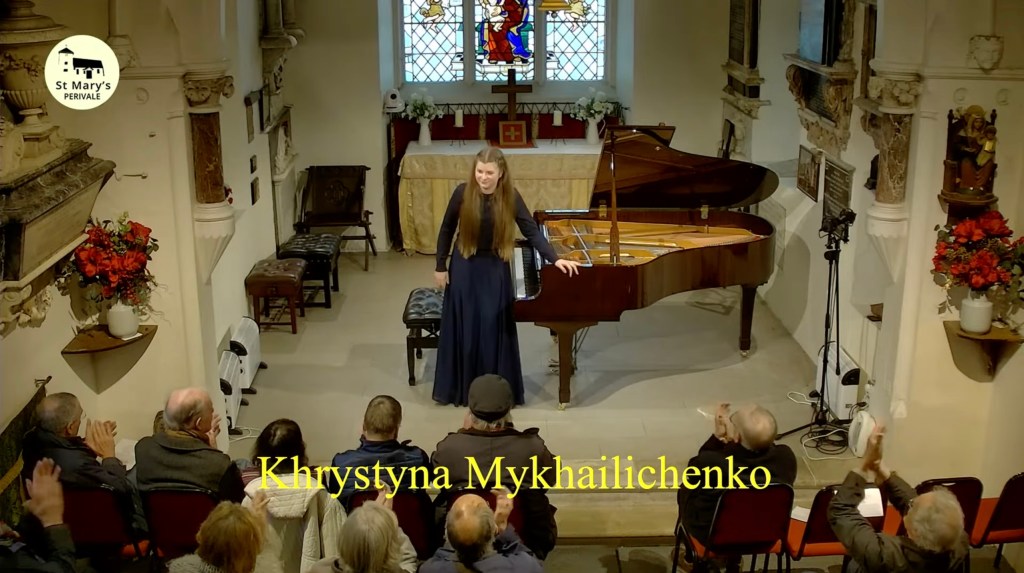
Khrystyna Mykhailichenko is a Ukrainian pianist, born in Simferopol (Crimea), whose exceptional talent was evident from early childhood. She began piano lessons at the age of four and made her orchestral debut at just eight years old in Sevastopol. By the age of ten, she was already an international prizewinner, having won several European piano competitions, and was performing across Europe and the United States. Since then, Khrystyna has established herself as a distinctive artist with over forty concerto appearances and an extensive recital career. She has performed at prestigious venues such as Salle Cortot in Paris, Bozar Hall in Brussels, the Music Academies of Bruges, Antwerp, Krakow, and Bremen, Gariunu Concert Hall in Vilnius, the University of Miami, the Broward Center for the Performing Arts, the World Bank in Washington D.C., the UN Residence in New York, and all National Philharmonics of Ukraine. Her festival appearances include the International Summer Music Academy in Memory of Vladimir Horowitz (Ukraine), the Art Dialogue Festival (Switzerland), LvivMozArt Festival (Ukraine), Musica Mundi Festival (Belgium), the Young Artists Festival in Bayreuth (Germany), and the Frost Chopin Festival (USA). Following the outbreak of full-scale war in Ukraine in 2022, Khrystyna moved to the United Kingdom, where she studied at the Junior Royal Northern College of Music with Professor Graham Scott. In 2023, she was awarded a full scholarship to study at the Royal Academy of Music in London, where she is currently pursuing her undergraduate degree with Professor Joanna MacGregor. Since coming to the UK, she has given over 40 performances, including solo recitals, chamber concerts, and concerto performances. A highlight was her debut at the Queen Elizabeth Hall, Southbank Centre, performing Gershwin’s Piano Concerto in F. Critics have praised her playing for its virtuosity, poetic intensity, and interpretative maturity, drawing comparisons to some of the greatest pianists of the past.
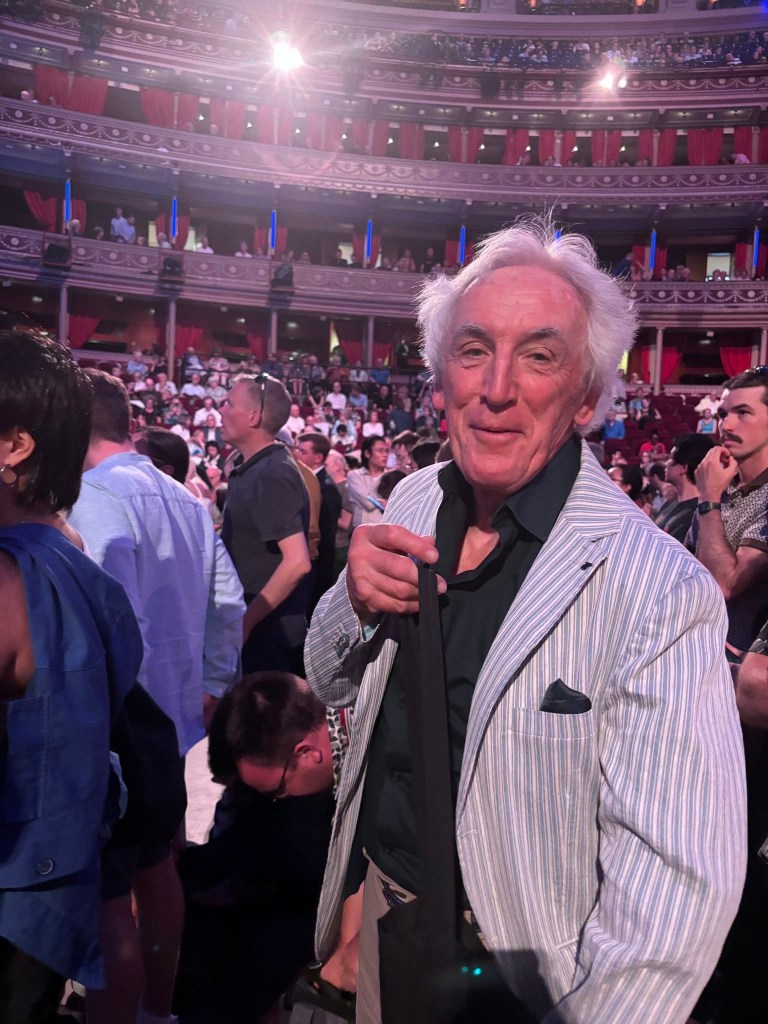
 ChristopherAxworthy-MusicCommentary