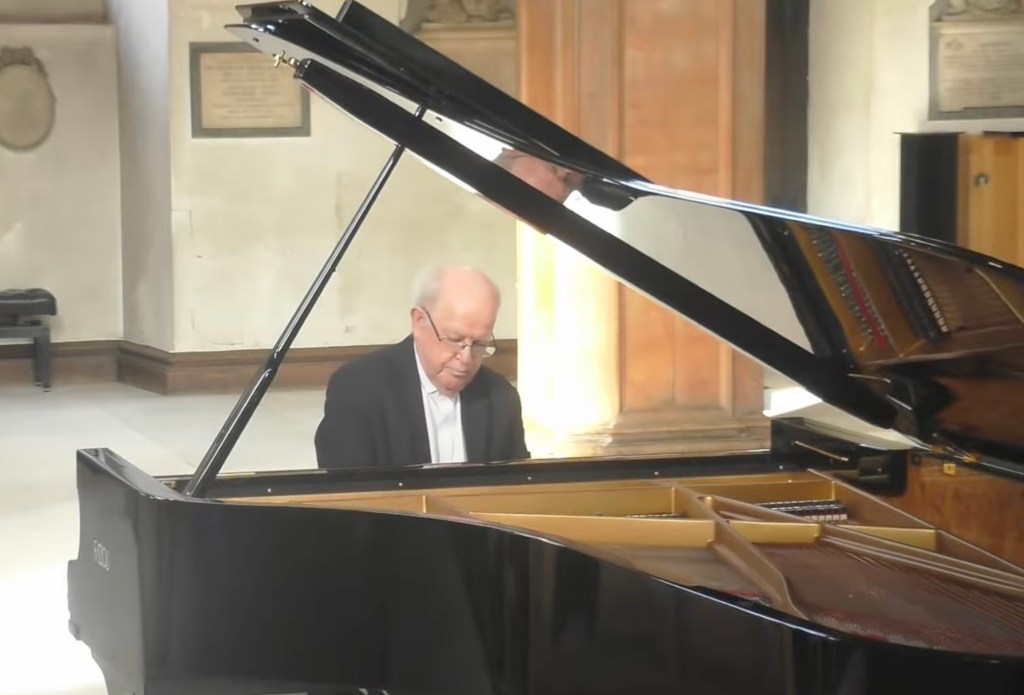
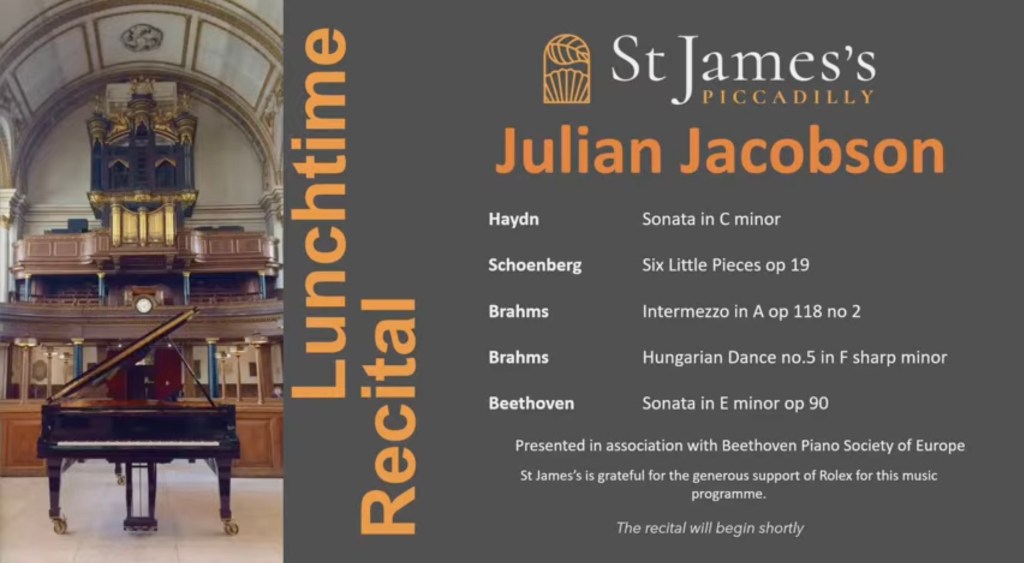
As always a very interesting programme from an eclectic kapellmeister, beginning with one of Haydn’s most beautiful Sonatas Hob XVI /20. It was played with great clarity and noble beauty with Julian’s impeccable musicianship allowing the music to unfold with simplicity and knowing scholarship.Very delicate embellishments, in particular the beautiful unfolding of an elaborated cadenza in the first movement, in no way impeded the natural architectural flow and shape but added a radiance of refreshing spontaneity. It has been suggested that this is “Haydn’s Appassionata”, and is ” the first great sonata for the piano by anybody”. Beethoven who was to inherit from his mentor Haydn the Sonata form was to take this as a starting point and transform it in thirty two steps as he battled and eventually came to terms with his genius during a tormented and struggled life.
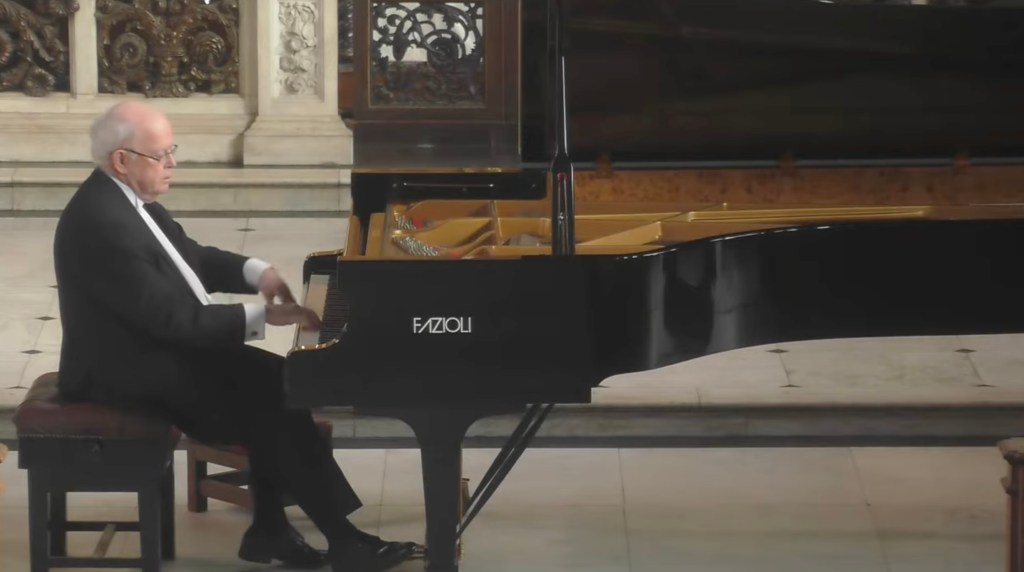
Julian had begun with this sonata and had chosen to end the recital with Beethoven’s Sonata op 90 which in a way is so similar in spirit and is a transition from the great Sonatas of Beethoven’s middle period, looking back to the simple mellifluous beauty of his master, with Schubertian radiance, before his final great burst of energy with the last five Sonatas from op 101 to op 111.
The beautiful flowing ‘Andante’ second movement was played with poise and a poignant beauty of disarming simplicity. The Allegro final movement Julian was anticipating Beethoven where his dynamic drive was not of the more restrained fury of Haydn’s time but revealed the less gentile energy of the next century.
It was the contrast that Julian wanted to underline between Haydn and Beethoven.The Sonata op 90 is one of Beethoven’s most poetic Sonatas with the struggle between heart and head of the first movement and the mellifluous conversation with his beloved of the second. An oasis of calm before opening the flood gates to Beethoven’s final great statement through struggle to a vision of the paradise that awaited him.
The Beethoven op 90 that closed the programme began with a more gentle dynamic drive than the earlier middle sonatas and was played with the knowing mastery of a pianist who knows intimately all thirty-two sonatas, and that at the drop of a hat could play them all at one sitting. Beethoven prefaces the two movements in an unusually descriptive way with the first movement : Mit Lebhaftigkeit und durchaus mit Empfindung und Ausdruck “With liveliness and with feeling and expression throughout” and the second Nicht zu geschwind und sehr singbar vorgetragen ” Not too swiftly and conveyed in a singing manner” .And indeed it was exactly these indications that illuminated Julian’s playing today with an especially beautiful unfolding of the first movement , The Schubertian beauty of the second revealed an unusual feeling of contentment and well being.
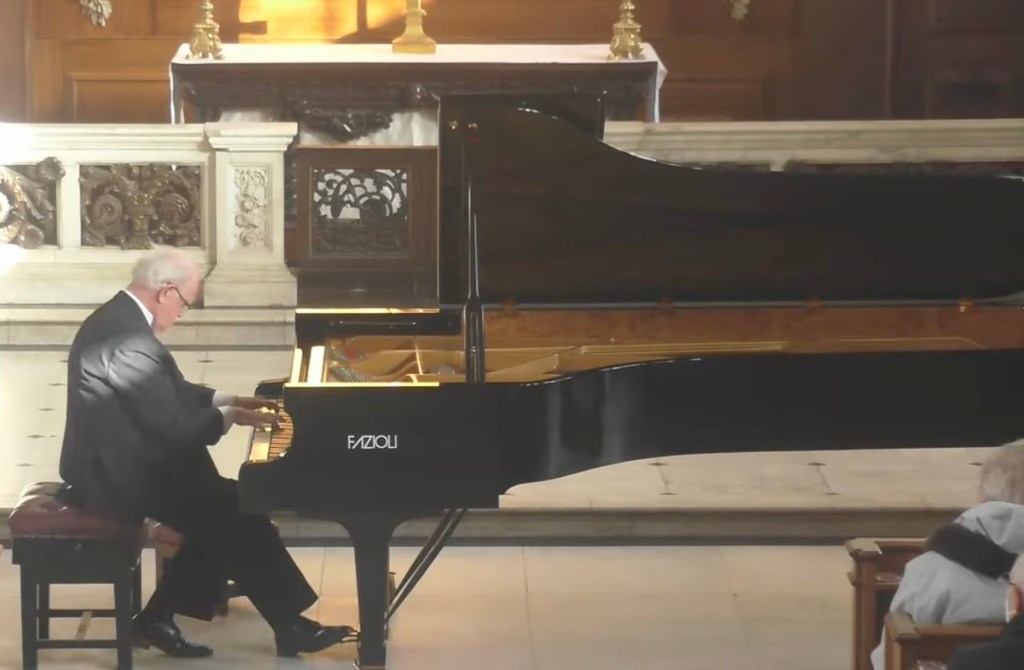
The Six Little Pieces by Schoenberg were like a breath of fresh air inbetween Haydn and the two B’s. These are six little gems of barely a minute each, but with a kaleidoscope of colour and sentiments that are contained in such a small space. One can only marvel at how so little can mean so much, especially as Julian played each one with such concentrated mastery. A clarity and great sense of character as wisps of sound revealed a completely new sound world.The clockwork precision of the second was contrasted with the sumptuous outpouring of the third with its chordal mystery of desolation and wonder. The playful wistfulness of the fourth and the unresolved question and answer of the fifth lead into the sixth, that was written on the day that Mahler died, and was a whispered yearning and respectful lament.
Returning to the sumptuous sound world of Brahms, Julian allowed the Intermezzo in A op 118 n. 2 to unfold with simplicity and an embracing beauty. It brought an unexpected ray of sunlight to shine onto the keys from the altar window that momentarily surprised Julian as he was about to play Brahms Hungarian Dance n. 5, which luckily he could still play with his eyes closed !
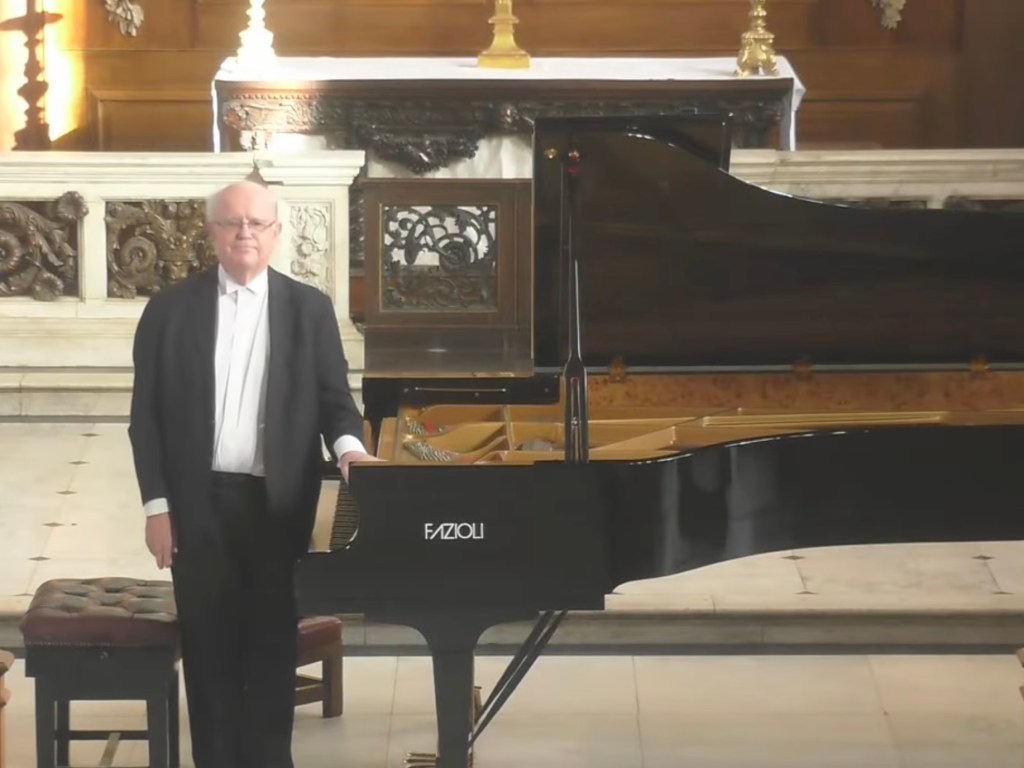
Julian Jacobson was born in Peebles, Scotland to parents who were both distinguished musicians: his father Maurice Jacobson had some piano lessons with Busoni while his mother, pianist and composer Margaret Lyell, studied in Berlin with Else Krause, daughter of Liszt’s pupil Martin Krause. Julian studied in London from the age of seven with Lamar Crowson (piano) and Arthur Benjamin (composition), and had four songs published by the age of nine. Further studies at the Royal College of Music and Queen’s College Oxford were supplemented by a period as the inaugural pianist in the National Youth Jazz Orchestra, as well as lessons from the great Hungarian pianist Louis Kentner. He made his London debut at the Purcell Room in 1974, followed immediately by the first of five appearances in the Park Lane Group’s annual Young Artists series and his Wigmore Hall debut as both solo recitalist and chamber musician. During the 1980s he established himself as a fine duo and ensemble pianist, partnering artists such as Zara Nelsova, Sandor Vegh, Ivry Gitlis, Lydia Mordkovitch, David Geringas, Christian Lindberg and Manuela Wiesler as well as many leading UK instrumentalists including Nigel Kennedy, Steven Isserlis, Moray Welsh, Colin Carr, Alexander Baillie and Philippa Davies. Jacobson’s appointment in 1992 as Head of Keyboard Studies at the Royal Welsh College of Music and Drama led to an increasing concentration on solo work. In 1994 he embarked on his first cycle of the complete 32 Beethoven sonatas; he has now presented the cycle eleven times. Five of these were “marathon” performances where he performed the entire cycle from memory in a single day – only the second pianist to attempt this. His 2003 marathon at St James’s Church Piccadilly, London, raised over £6000 for WaterAid while his 2013 marathon at the celebrated St Martin-in-the-Fields was streamed worldwide and attracted huge media coverage and rave reviews. In November 2022 he marked his 75th birthday by performing the marathon in London and at the Festival of Colonia del Sacramento, Uruguay. Since 2014 he is Chairman of the Beethoven Piano Society of Europe where he is responsible for organising many concerts, competitions and other events for young players. Presented in association with Beethoven Piano Society of Europe

 ChristopherAxworthy-MusicCommentary