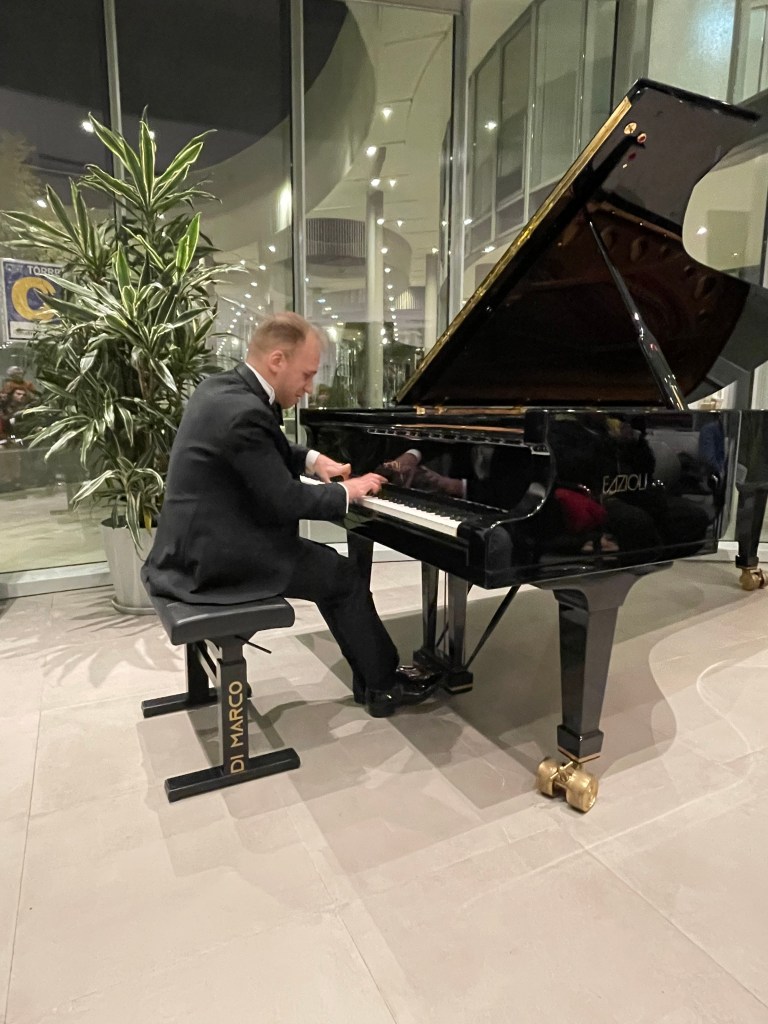
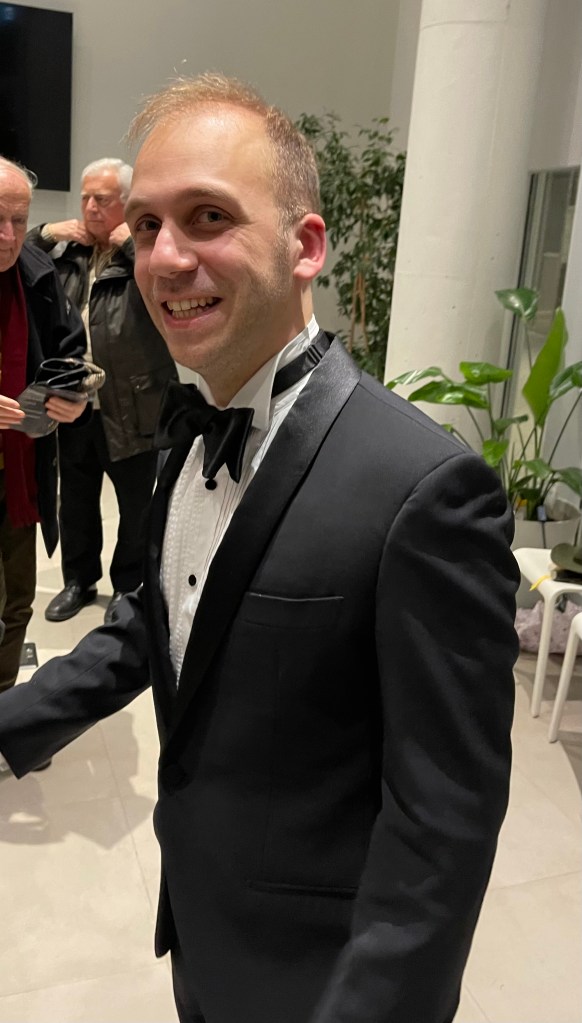
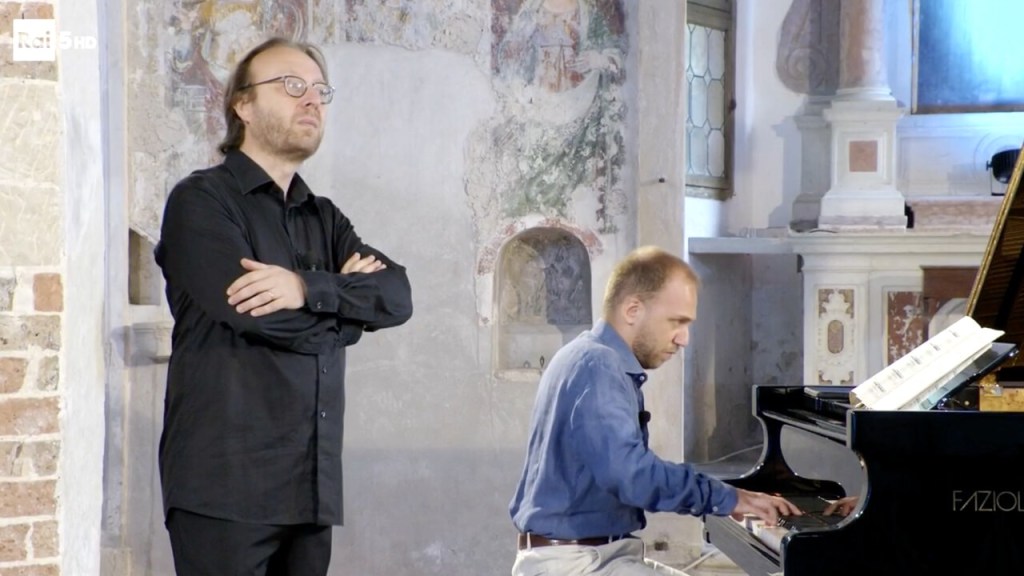
Andrea I had heard a few years ago invited by his mentor Roberto Prosseda to the festival that he organises every year in Cremona. Justly proud of his young prodigy he gave some very impressive performances including a study by Omizzolo, who was completely unknown to me at the time. In the meantime I had met Roberto in London who invited me to a recording session in the Henry Wood Hall where amongst other unknown Italian Piano Concertos with the London Philharmonic he included a concerto by Omizzolo. Roberto Prosseda and Maurizio Baglini are two remarkable musicians who I had known when they were students of Sergio Cafaro and his wife Anna Maria (Mimi) Martinelli.
Together with Francesco Libetta they have become a formidable trio and a voice for young musicians and for much music by Italian composers still completely unknown. Valerio Vicari and his Roma Tre Orchestra team have become an important component for our three heroes, where together with their brilliantly trained students they can always find a platform with a discerning public and genuine encouragement in a world where classical music is often treated as the poor relation.
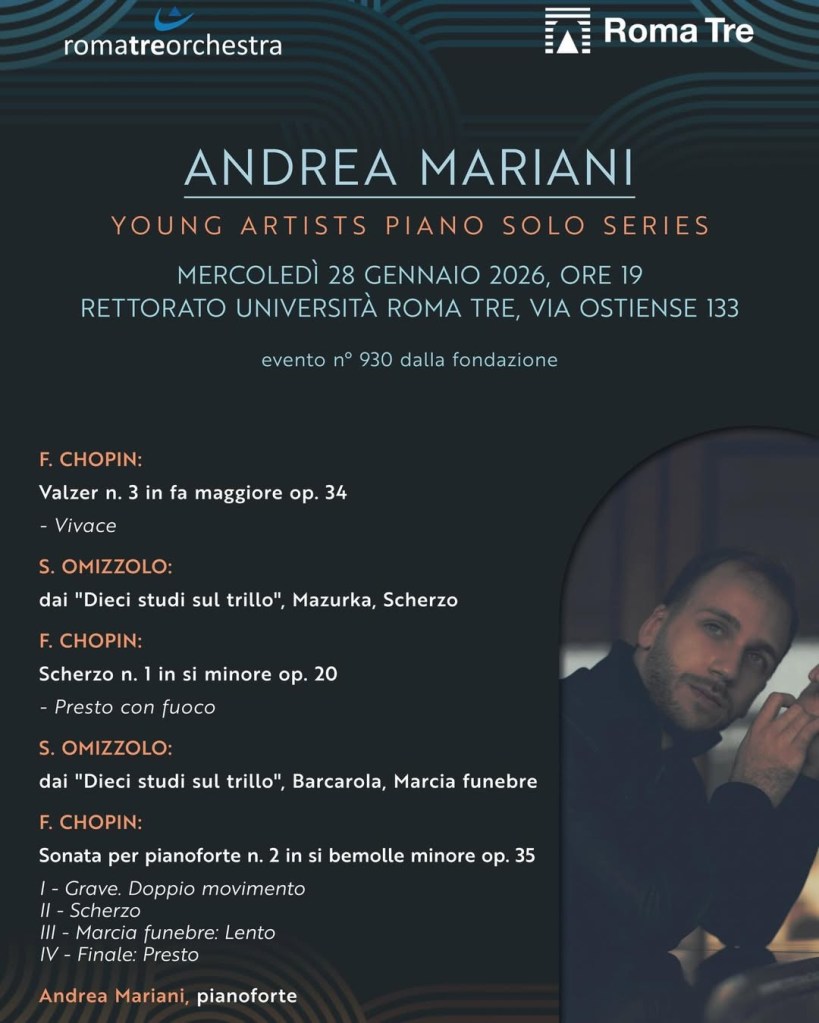
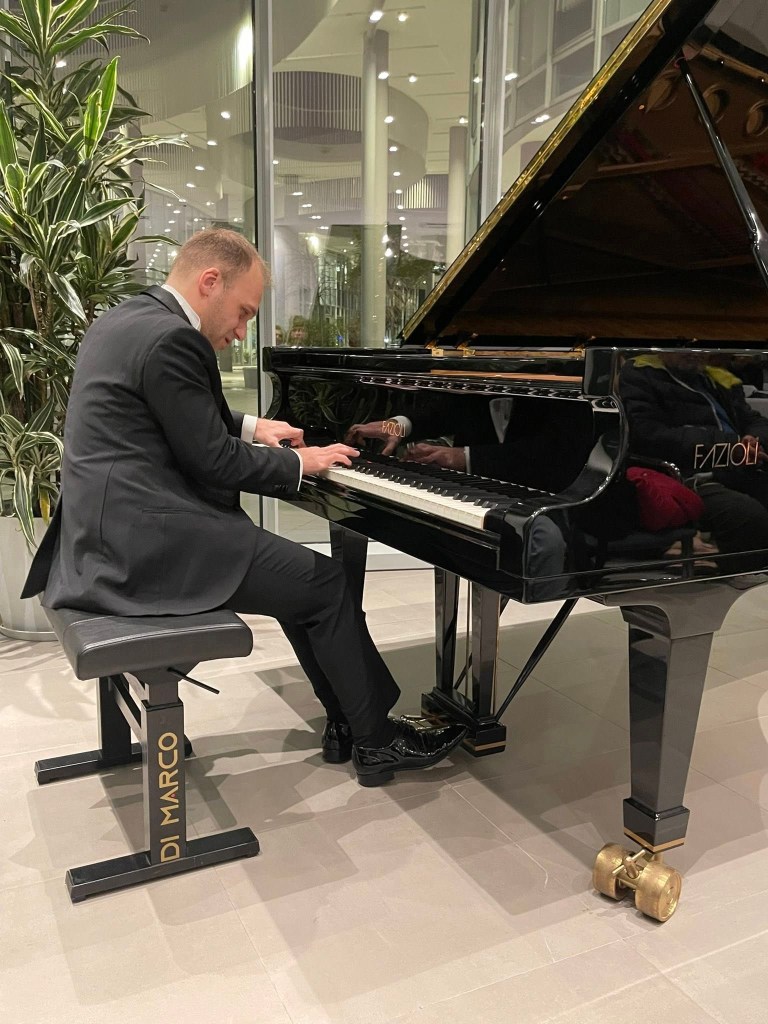
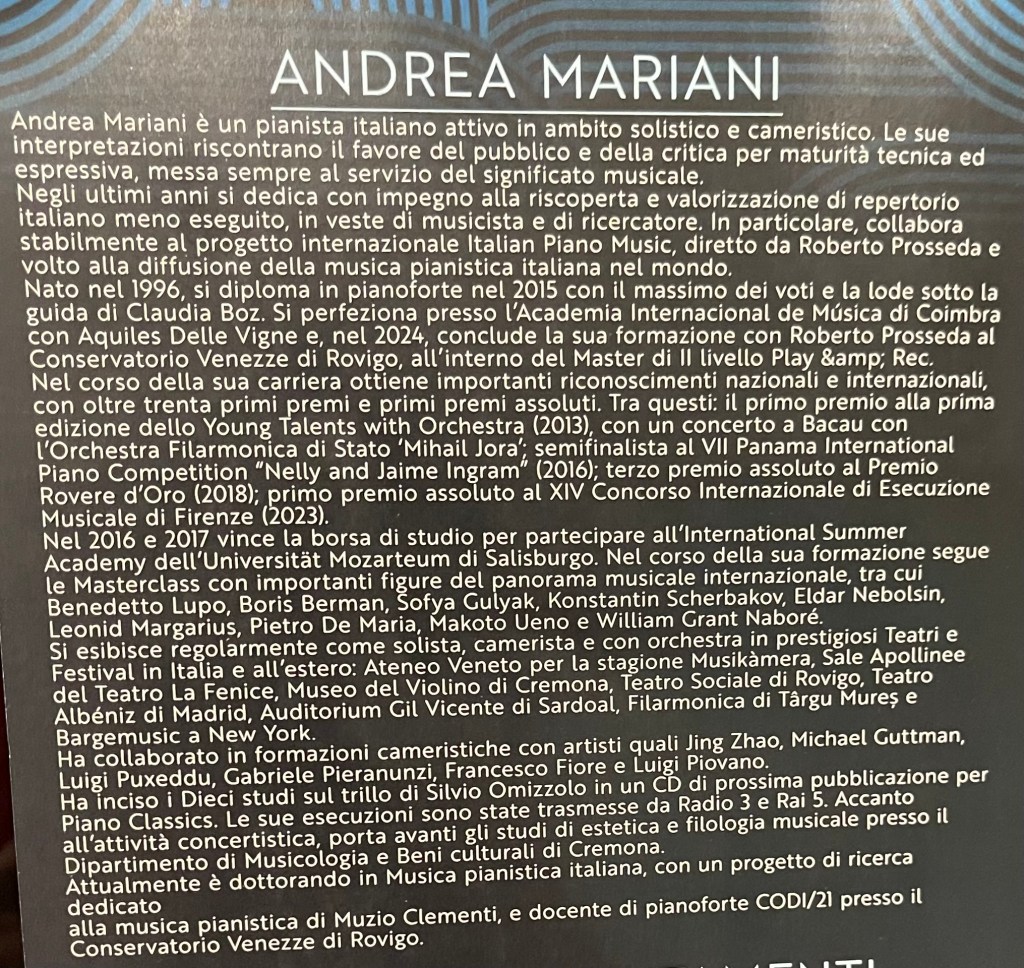
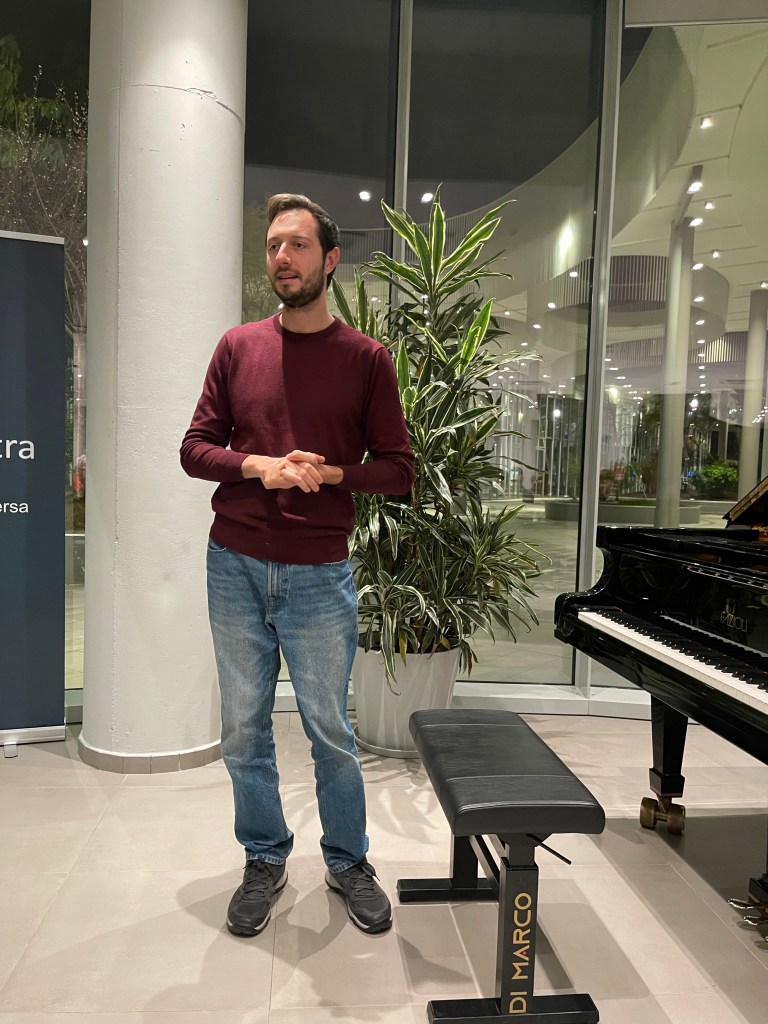
All this to present Andrea who is coming to the end of his studies in Rovigo under the eagle eye of Roberto Prosseda, preparing a doctorate on the piano music of Muzio Clementi ! The young musician who I had heard playing to Paolo Fazioli in Cremona is now an artist of quite considerable authority. A pianist who plays with weight and with his beautiful arched hand can dig deep into every key and find sounds that others search for in vain. A programme that gave me a chance to listen to more of the studies of Silvio Ormizzolo contrasted with works by the most important of all pianistic innovators Fréderick Chopin.
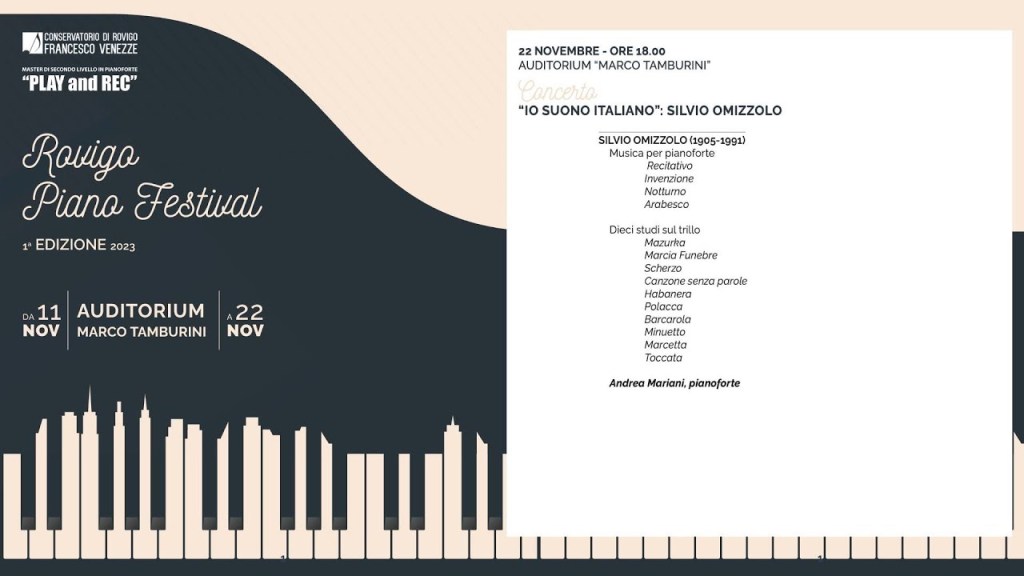
Andrea chose to start with the ‘Cat’ waltz by Chopin which was an unusual choice, as Rubinstein often used to play it at the end of his recitals as an encore. The reason became clear on listening to the Mazurka and Scherzo studies of Ormizzolo with which they were linked almost without a break. A Chopin waltz played with great charm and ‘old world’ rubato shaping phrases with then style of pianists of the Golden age of piano playing. It made for a beguiling opening and an introduction to the Omizzolo Mazurka played with the same teasing charm and a jeux perlé that was of master pianists of a past age. A remarkable clarity and authority brought this study to life as he had done with the ‘little’ Chopin Waltz. A musicianship that does not exclude a daring sense of style and personality. Two scherzi followed, one by Omizzolo and the other by Chopin. The Omizzolo was with cascades of notes and a whirlwind of sounds with playing of real weight and mastery. The Chopin first scherzo, I had heard Andrea play in Cremona, and today he played with even more assurance and authority of a young master. His fingers, like limpets fearlessly imbuing Chopin’s scintillating notes with a rhythmic energy and enviable accuracy! Occasionally Andrea could momentarily loose the architectural line as he brought out inner harmonies or lost the pulse in the quieter moments of reflection. He brought a great sense of line and beauty, though, to the Polish Christmas Carol that Chopin transforms into a berceuse of poignant simplicity . Of course the return of the Scherzo and the exciting coda were played with an exhilaration of burning masterly intensity. A return to Omizzolo with the Barcarolle and Funeral March from the same Ten studies on the trill. Here there was a beautiful tenor melody with the trills in the right hand played as a wistful accompaniment. It was here that Andrea’s musical pedegree shone through as he shaped the tenor melody with ravishing style and an extraordinary sense of line. Of course this cannot be compared to the study by Chopin op 25 n. 7 but it is music that deserves to be heard more often. The trills now transferred to the left hand for Omizzolo’s Funeral March floated on this wave of dynamic energy with almost military precision as it lead straight into Chopin’s ‘Funeral March’ sonata op 35.Onward Christian Soldiers!
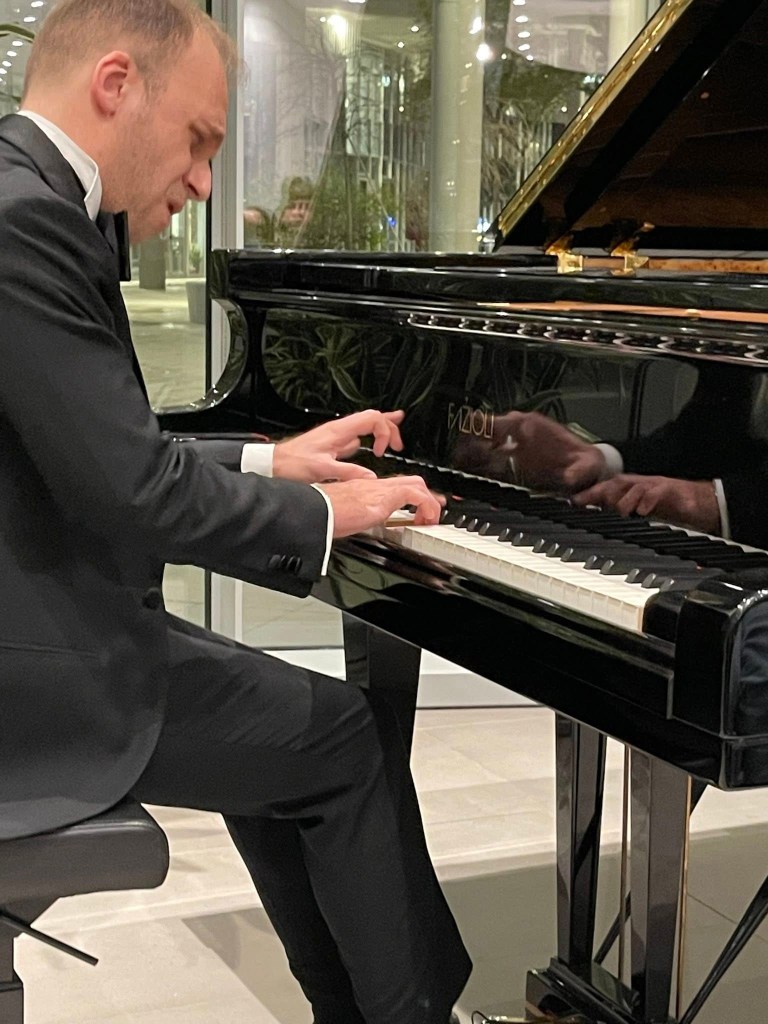
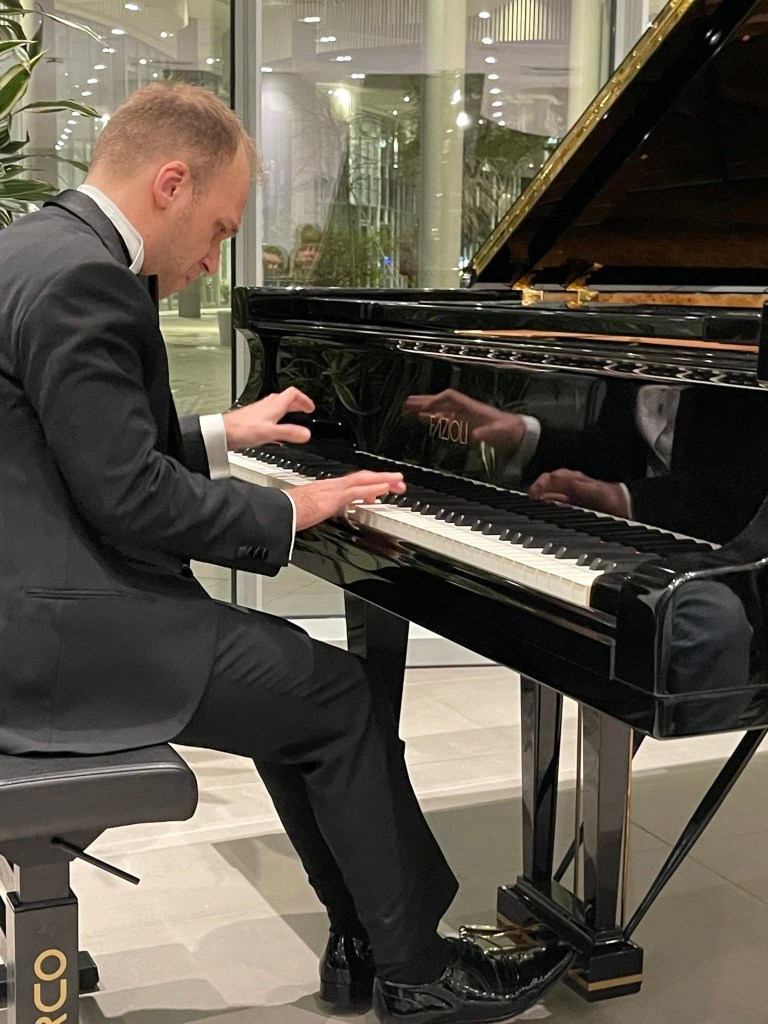
Of course this is one of Chopin’s greatest works where he could transform the formal sonata with innovative genius so much so that Schumann was to describe it as one of Chopin’s craziest children. He described the sonata as “four of his maddest children under the same roof” and found the title “Sonata” capricious and slightly presumptuous. He also remarked that the Marche funèbre “has something repulsive” about it, and that “an adagio in its place, perhaps in D-flat, would have had a far more beautiful effect”. In addition, the finale caused a stir among Schumann and other musicians. Schumann went on to say that the last movement “seems more like a mockery than any sort of music” and when Mendelssohn was asked for an opinion of it, he commented, “Oh, I abhor it.”
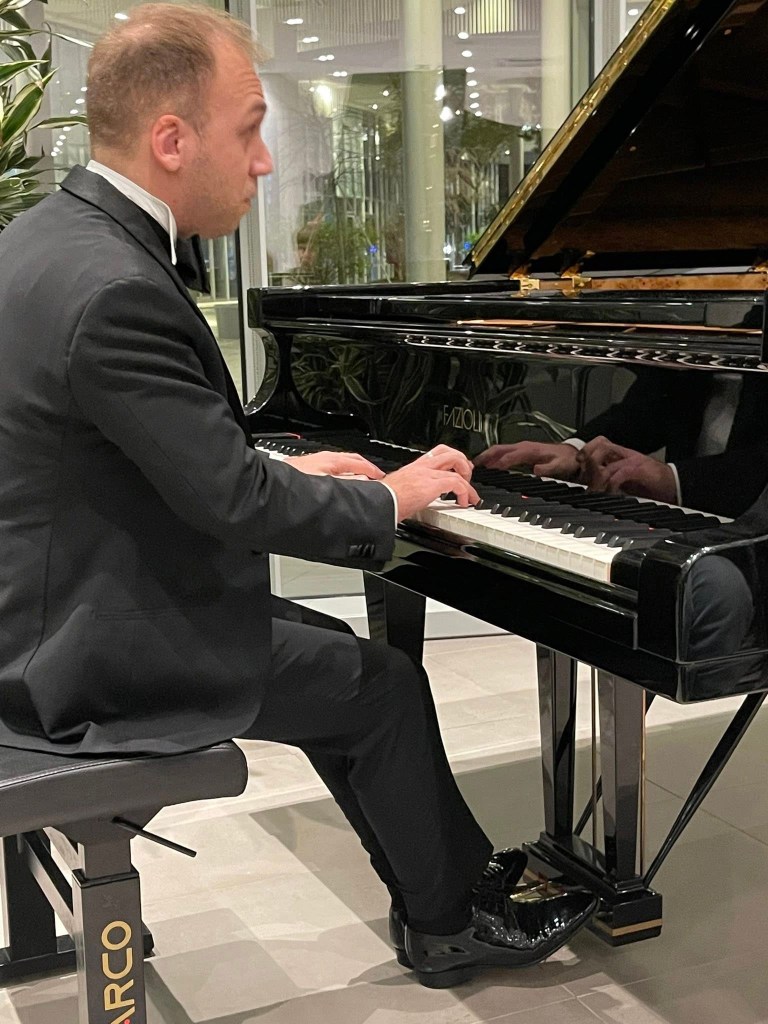
It was here that Andrea showed his great pedigree which has been handed down to him from Roberto Prosseda who was one of Fou Ts’ong’s most admired students. https://christopheraxworthymusiccommentary.com/2021/01/13/roberto-prosseda-pays-tribute-to-the-genius-of-chopin-and-the-inspirational-figure-of-fou-tsong/
Again Andrea brought great authority and remarkable intelligent musicianship to this work which he imbued with an architectural strength of considerable importance. He even chose to play the repeat as it would appear Chopin intended it. There has been so much discussion about whether to repeat to the introduction ,which Chopin uses as the anchor for the development of this first movement. Or to go back to where the movement takes flight a few bars later at the ‘Doppio Movimento.’ Many great artists simply leave out the repeat altogether! Andrea made a very convincing case today to go back to the introduction which he did with great artistry and conviction. His playing had a dynamic drive and if he slowed down the second subject it was because he wanted to imbue it with a poignant strength and not heart on sleeve sentiment. This was a performance of a thinking musician who had something to say. The first movement ran straight into the Scherzo played with a rhythmic drive but also in certain passages a slightly relaxed waltz like lilt that was not completely convincing as it relaxed the burning forward propulsion to the beautifully lyrical central episode. At the end of the concert Andrea confided that artists have to accept the instruments that they are given and sometimes that can lead to an unexpected voyage of discovery. Andrea today had a magnificent very powerful Fazioli under his fingers. A piano that tempted him to take a path where he sometimes overstated the drama and imposing sounds that the Fazioli is capable of. It was above all in the Funeral March that he allowed full reign to the Fazioli and was tempted to think of it a military march rather than a funerial one. The melodic line submerged in a mist created by the relentless bass march suddenly burst into flames with all guns blazing. It was a highly original performance, whether successful or not, it was convincing and of a real thinking musician on a voyage of discovery . It lead into the whispered meanderings of the maddest of Chopin’s four children that Andrea played with mystery and mastery.
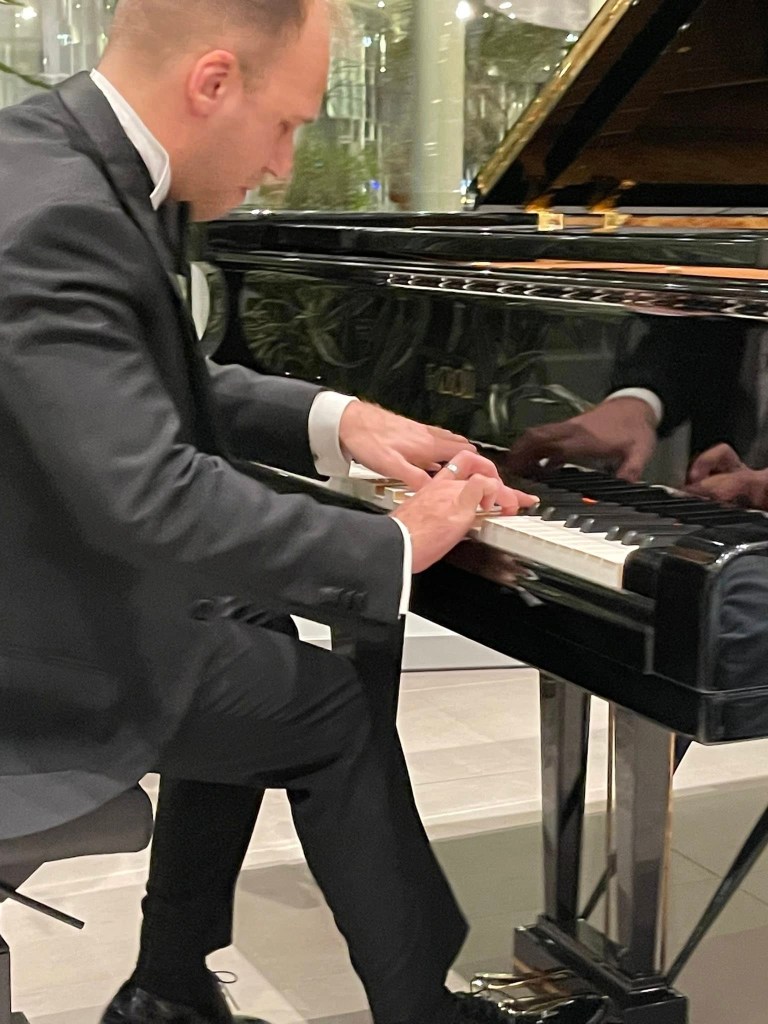
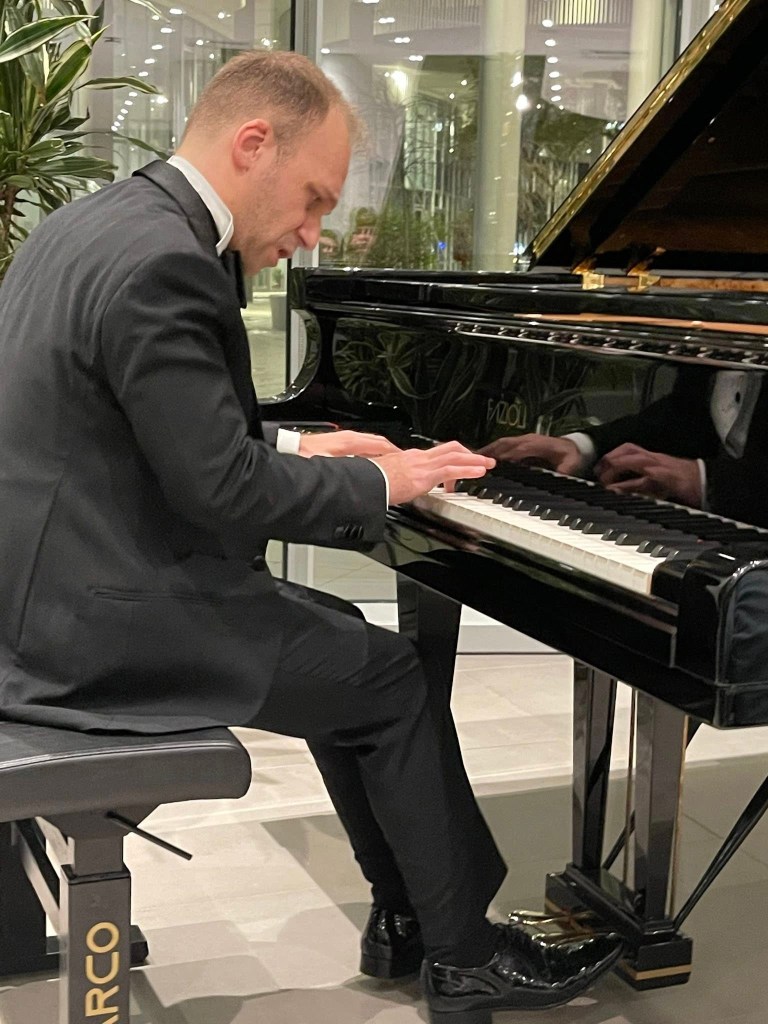
Persuaded to play more,Andrea played two works that he had conceived together. The heartrending delicacy of Grieg’s Arietta op 12 n. 1 was one of the most beautiful things in a remarkable recital. It was played with simplicity, delicacy and whispered beauty and contrasted with the transcendental mastery and trickery of Rachmaninov’s burningly intense Moment Musical op 16 n. 4
Valerio Vicari may spend much time the other end of Italy,in Trieste, now he has been discover by the world outside Roma 3 that he and Roberto Pujia have created. He has been called to direct the prestigious Theatre in Trieste one of the most important institutions in Italy. In Rome he has trained his valiant helpers to hold the reins in Rome with the same seriousness and passion that has made this an oasis for young aspiring musicians ……long may it last !
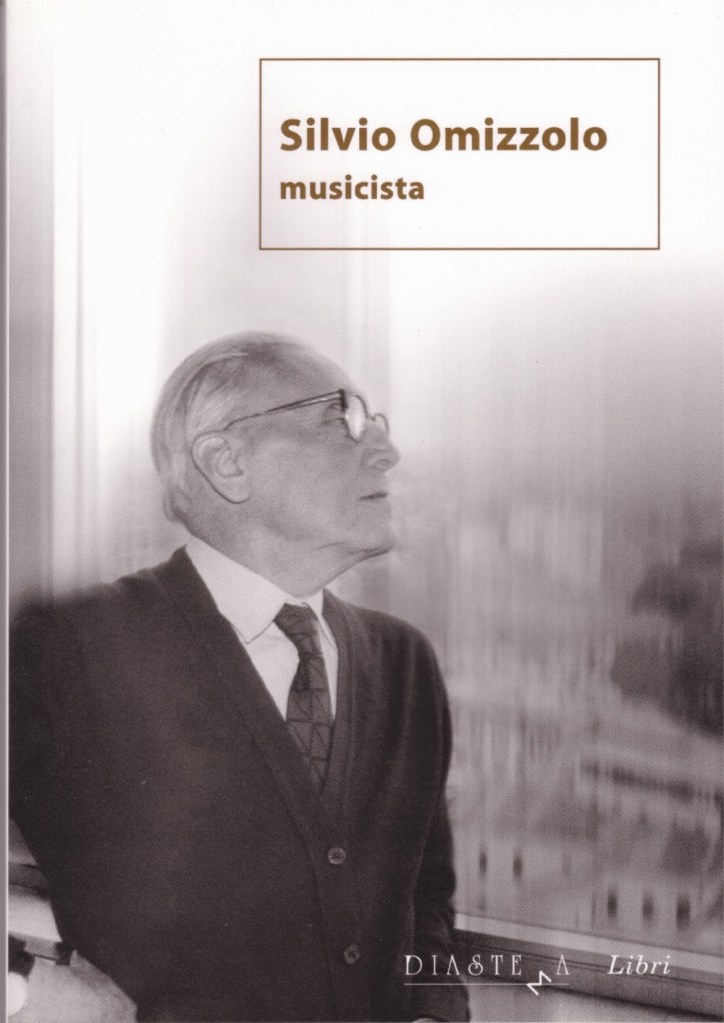
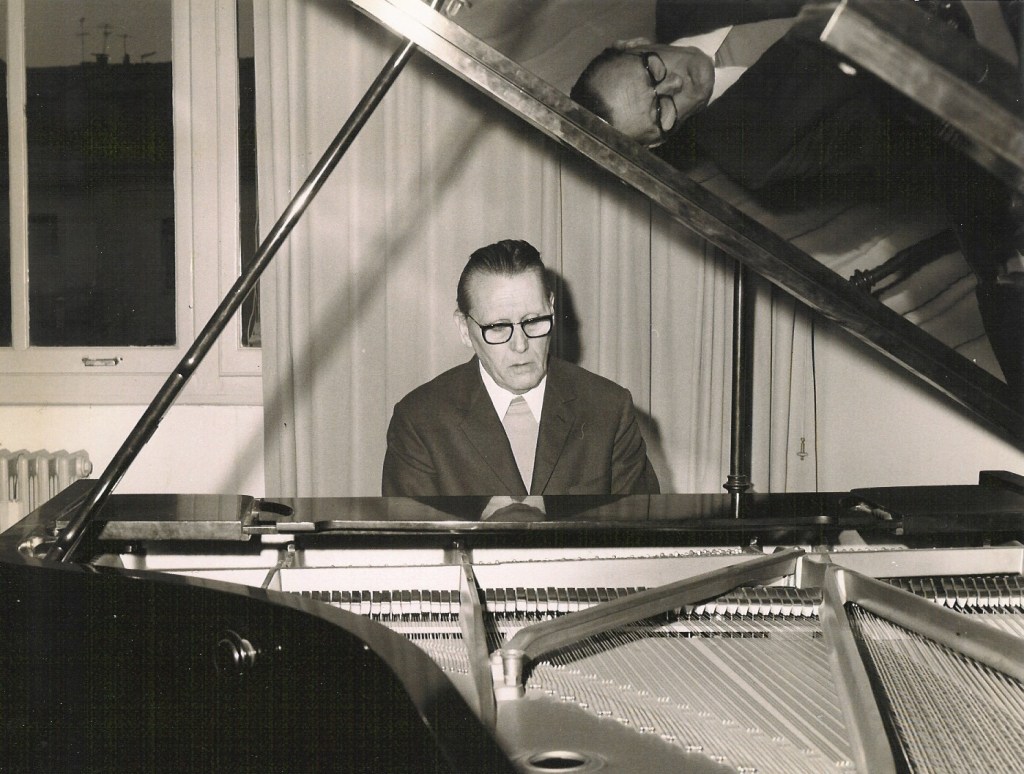
Silvio Omizzolo, born in Padua from a family whose roots were in the Asiago plateau, in the pre-Alps near Vicenza, was an excellent pianist and piano teacher, director of the Istituto Musicale C.Pollini, Padova, but also one of the main composers in the region of Venice during the XX century. A student of the composer Almerigo Girotto, from Vicenza, Omizzolo tempered his love for the romantic tradition in a constructivist language, largely based on counterpoint, which may be compared to those of Paul Hindemith and Bela Bartok; he also experimented with dodecaphonic techniques. His major works for the piano are Dieci Studi sul Trillo (1936-39), which have been recently arranged by the famous jazz player Enrico Intra and the jazz septet of Marco Gotti (Lectio brevis sul trillo per pianoforte di Silvio Omizzolo, 2005); another important work is the Concerto per pianoforte ed orchestra (1959-60), which received the 3rd prize from the Queen Elizabeth International Music Competition , Bruxelles 1969.
Silvio Omizzolo Padova 26 Agosto 1905 – 18 Marzo 1991 è stato un pianist e compositore italiano.
Si diplomò a Milano nel 1927 sotto la guida del maestro Renzo Lorenzoni. Conseguì la maturità classica al Liceo Tito Livio di Padova per poi laurearsi in Giurisprudenza all’Università di Ferrara. I suoi primi lavori per pianoforte risalgono al 1928. Seguirono numerose opere sia per piano che per diverse formazioni vocali e strumentali. Nel 1943 ottenne il primo premio al concorso del “Sindacato Musicisti Italiani” e in seguito ebbe altri importanti riconoscimenti. Fra tutti, il terzo premio al Concorso Internazionale “Regina Elisabetta” di Bruxelles nel 1969 con il concerto per pianoforte e orchestra, rimane ancora memorabile per essere stata l’unica opera italiana prescelta tra duecento concorrenti.
Numerose sue composizioni, alcune delle quali edite da Zanibon e da Ricordi, sono state più volte eseguite in pubblico e trasmesse dalla RAI.
Dal 1933 al 1974 fu docente del Conservatorio Cesare Pollini di Padova. Dal 1966 al 1971 ne divenne direttore.
https://christopheraxworthymusiccommentary.com/2024/03/20/christopher-axworthy-dip-ram-aram/
 ChristopherAxworthy-MusicCommentary