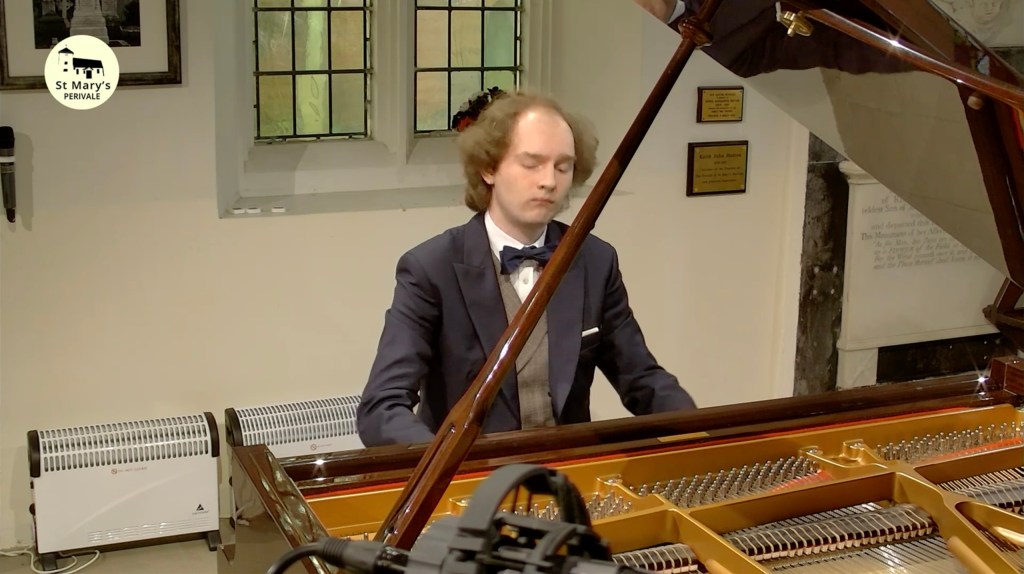
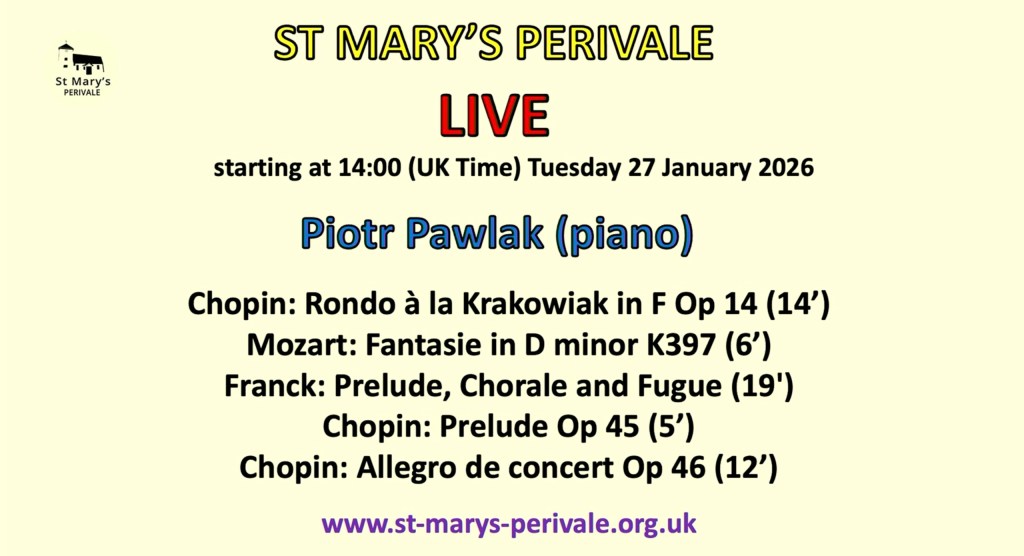
I had heard Piotr a year or so ago in the POSK annual Chopin Festival in London. It was on that occasion that I remember he wanted to explain to the pubic about the tradition of pianists of the past who used to improvise between pieces, taking us on a gentle transition to the different keys of each piece, something he went on to demonstrate in his recital. I then followed his playing in the Chopin competition in Warsaw where his stylish playing and evident love for music was much admired by a vast audience via their superb live streaming. It is easy to see why he was such an audience favourite because he exudes a sense of enjoyment in sharing his love for music and quite considerable scholarship. Judging by the comments during the live stream from Perivale today and an unusually full hall, he has a considerable following of admirers. It is playing of a crystalline clarity together with a natural way of playing that is like someone riding on a wave of sounds. A natural way of embracing the keys that allows him to produce a kaleidoscope of sounds that makes the music speak and brings all he plays vividly to life. It was Rubinstein who said you should only play music that you love and that speaks to you and it was his love for all the works on his programme that shone through his charming introductions, as it did with his music making that spoke even more eloquently ! https://youtu.be/gex0sOR7XZ0?si=_JaaqQqegHOeP4bT.
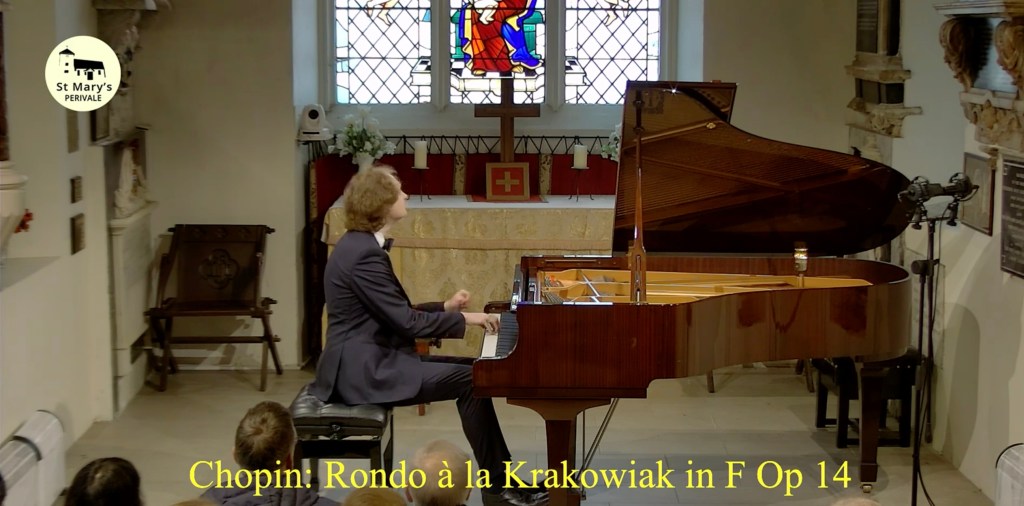
I remember discovering as a schoolboy Chopin’s ‘ Krakowiak’. It was a recording of Stefan Askenase and I found it so magical that I even bought the facsimile of the original in Chopin’s own hand. It was in the original version for piano and orchestra that I have never seen or heard of being played in public because being only fourteen minutes long it is hard to know how to programme it in orchestral concerts. It is nice to know that Chopin made this arrangement for solo piano and maybe it was with this that he astonished the public, whilst still a teenager, just before leaving Poland for good and taking up residence in Paris where he certainly made a mark. His ‘La ci darem’ variations, written for piano and orchestra and piano alone, were received by Robert Schumann with ‘Hats off,Gentlemen, a genius!’ A beautifully shaped and atmospheric introduction that suddenly sprang to life with brilliance and clarity. A cadenza taking us to a dance – Krakowiak – of irresistible style and with interludes that were washes of notes over the entire keyboard.They were played with brilliance and the jeux perlé that Chopin would have astonished his audiences with. Refined virtuosity with the Polish dance rhythms always present even in the maze of notes that poured from Piotr’s hands with flowing ease.
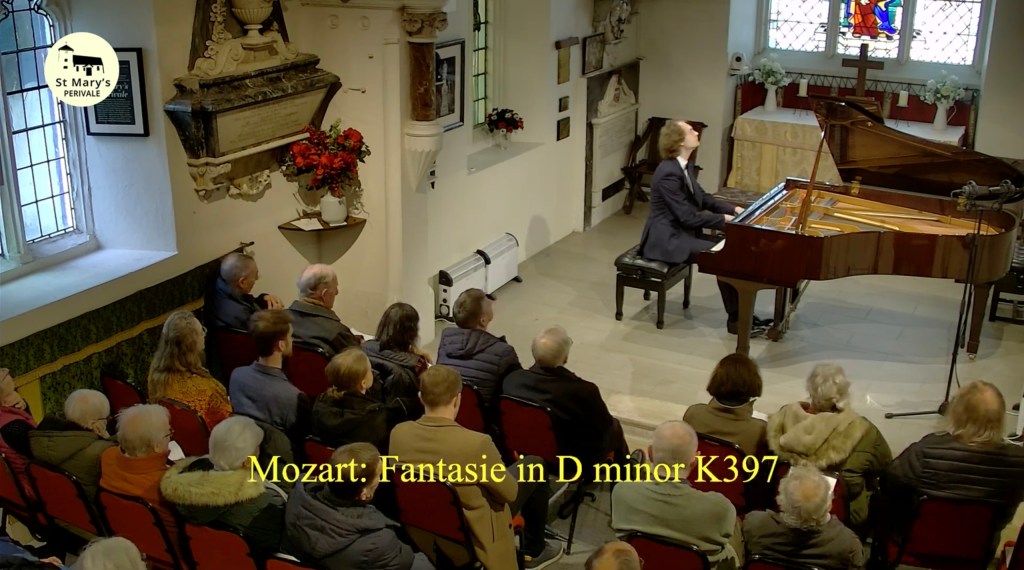
Today was Mozart’s birthday so it was as a fitting tribute that Piotr included his D minor Fantasie. As he explained Mozart had not actually finished the work and the final bars were in someone else’s hand. No matter, because Piotr is a master musician and when he got to that point he would improvise an ending that was less abrupt. There was a serenity to the opening spread out chords, the melody after this atmospheric opening played with simplicity and crystalline clarity. Beautifully shaped with great character and a palette of subtle colours, adding occasional embellishments always in good taste, being careful not to overload this simple melodic outline. Instead of the usual ending, written by an unknown hand, Piotr improvised an ending, as surely Mozart would have done, bringing back the opening themes in a poignant improvised farewell.
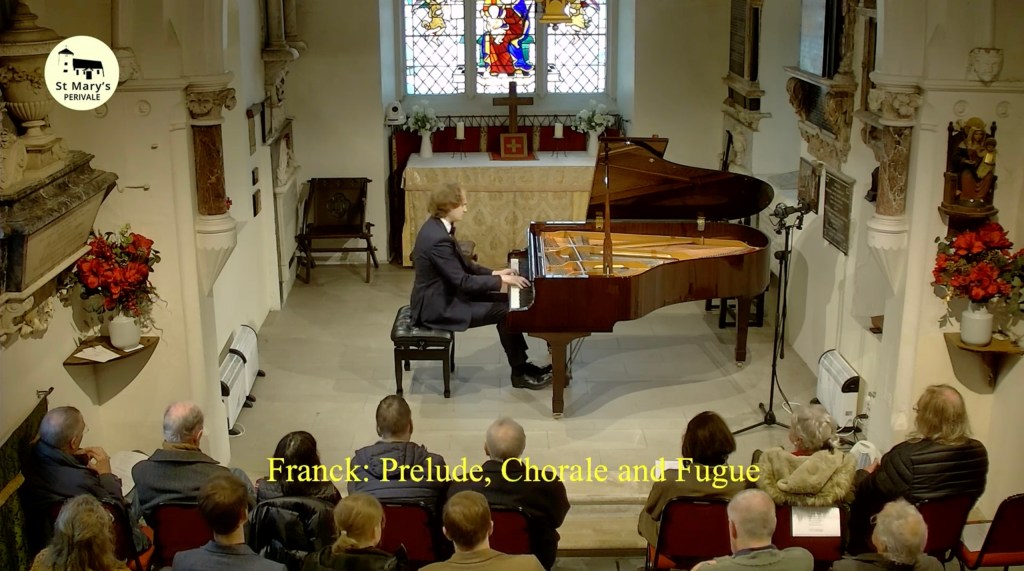
César Franck growing out of the Mozart quite simply, without any improvised interim modulations, as this too was played with a freedom but always within a strict architectural framework. It is a work that can sometimes sound fragmented, but Piotr managed to match the differing sounds of the etherial opening with the more earthbound chordal comments, in a way that one seemed to be a natural reply to the other. The meandering counterpoints ,that followed, shadowing each other and were played with clarity but also very expressive with an anguished feeling of impending mystery. His beautiful natural movements allowed the chorale to unfold with serenity and respectful beauty. It was in the same way that Chopin had described ‘tempo rubato’ to his pupils with roots firmly planted in the bass but with the branches free to flow freely above. There was always a musicianly sense of line and architectural shape as the volume almost imperceptibly increased in fervour as the music moved with a sense of improvised discovery towards the simple clarity of the Fugue. Unusually beautifully phrased as it built to a climax that was played with passion and sumptuous full sound, with a mounting tension unleashed by Piotr with almost total abandon. Suddenly a maze of notes unwound but always anchored to the insistent repeated bass notes, as the tension was released and the main theme of the ‘Prelude’ was allowed to float on this wave of mellifluous sounds. Gradually all three themes were miraculously united and incorporated into an exhilarating climax with the fervour of a true believer. If the ending was rather impetuous it was because the exhilaration and excitement that Piotr had generated almost risked to become out of control, adding a frisson of even more excitement to one of the finest performances that Dr Mather has ever heard in Perivale.
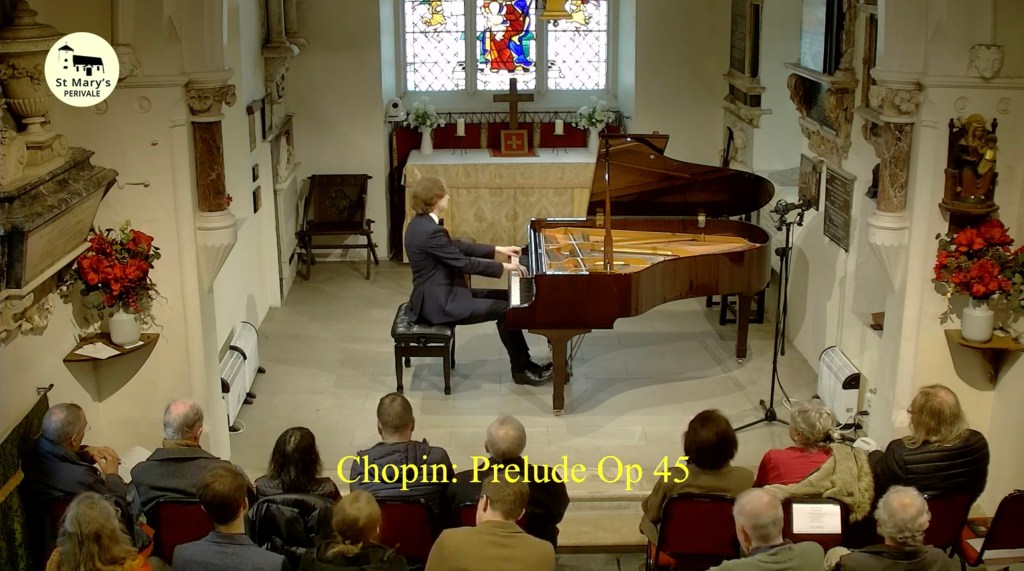
The final two works of the concert of were by Chopin and I had heard them both from Warsaw during the competition.There was an unusual clarity to the meandering unwinding ‘Prelude’ that Chopin was to pen towards the end of his life. A series of undulating modulations on which is revealed a melodic line very similar to Franck’s Chorale. I am used to hearing this work played rather faster by Vlado Perlemuter, and with a more luxuriant use of pedal, but Piotr revealed the timeless beauty of this extraordinary work where even the final cadenza was merely a shifting maze of chordal harmonies moving towards the final velvet clad chords.
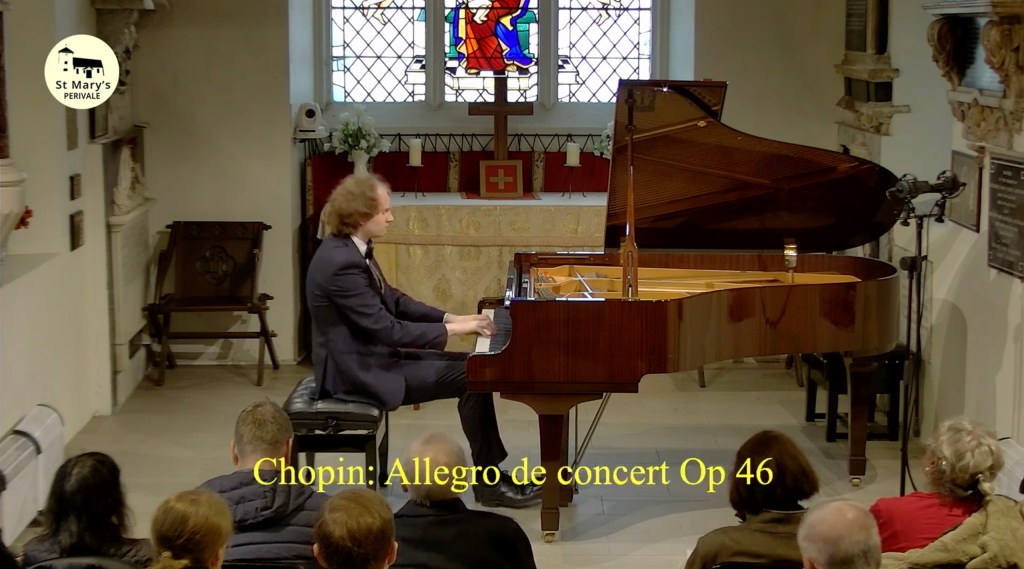
It was the same intelligence and informed musicianship that brought the first movement of Chopin’s Third Piano Concerto vividly to life, as I have only heard before from the hands of Arrau. The ‘Allegro de Concert’ op 46 is a notoriously difficult work to bring into the concert hall, not only for its technical difficulties with much Schubertian awkwardness ,pianistically speaking, but also to join them together into a whole where there is an obvious orchestral and soloist nature to the work. Where there is a will there is always a way, though, and love will always out. Piotr’s love for this work shone through a performance which was united under and umbrella of refined glowing beauty and sumptuous richness. Streams of notes were shaped into gleaming jewels of brilliance and at times of poignant significance .The final climax and exhilarating octave ending were played with aristocratic nobility and mastery.
Of course after such beautiful performances the ‘Perivalian’s’ or are they the ‘St Maryites’ were craving for more before allowing him to catch the plane back to Gdansk. Piotr with his ebullient ‘joie de vivre’ was more than happy to play some more. This time though the audience had to work as well, as he asked them to sing him a traditional English melody on which he could improvise a work of thanks to them. ‘Greensleeves’ was heard on an undercurrent of united song and it was this that Piotr with the mastery of a true kapellmeister transformed into a tone poem of intricate beauty and exhilaration. I bet Dr Mather already has a date fixed in his diary for a return match with this charming young master!
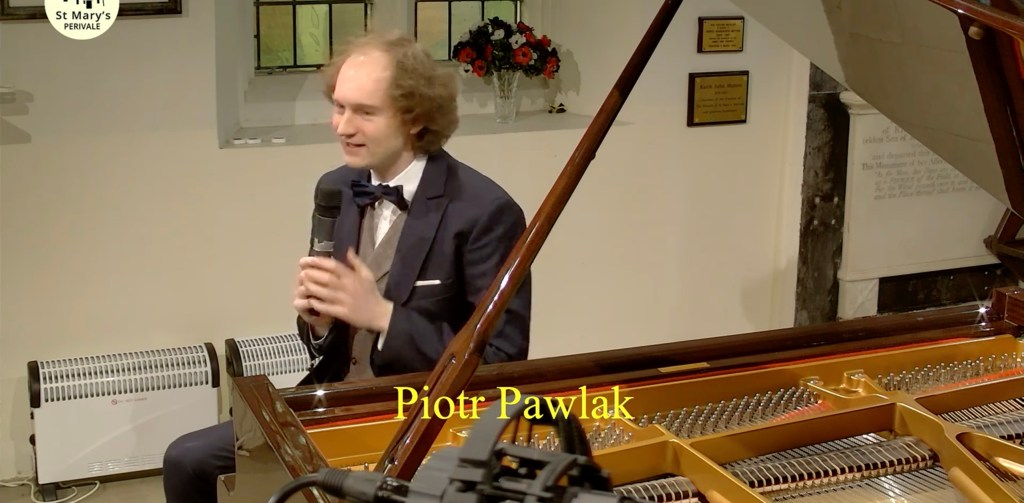
Piotr Pawlak is one of the most versatile Polish pianists of the young generation. He is the winner of many international competitions, including the V Maj Lind International Piano Competition in Helsinki (2022) and the XI International Chopin Piano Competition in Darmstadt (2017), laureate of Chopin Competitions in Beijing (2016), Budapest (2018) and Cracow (2019), the International Competition of Polish Music in Rzeszów (2019), the International Paderewski Competition in Bydgoszcz (2022) and the International Chopin Competition on Period Instruments in Warsaw (2023).
He regularly performs concerts worldwide, having appeared at numerous musical events in most European countries, as well as in the United States, China and Japan. He has performed at prestigious venues such as the Sankt Petersburg Philharmonic, Berliner Philharmonic, Sala Verdi in Milan and Teatro alla Scala, and has participated in renowned festivals such as „Kissinger Sommer” in Bad Kissingen and „Chopin and his Europe” in Warsaw.
In the 2024/2025 season, he was performing in Canada, Japan, Venezuela, Germany, Switzerland, Finland, the United Kingdom, France, Hungary and Poland, cooperating with e.g. Baltic Philharmonic Orchestra, Warsaw Radio Symphony Orchestra and Sinfonia Baltica.
Piotr Pawlak began his musical education on the piano at the age of six in Feliks Nowowiejski Music School in Gdansk with Ewa Wlodarczyk, and then he continued to study with Waldemar Wojtal until the end of his studies in 2021. He also graduated music school finishing in organ studies, under the tutorship of Hanna Dys, and he studied conducting in The Stanislaw Moniuszko Music Academy in Gdansk with Zygmunt Rychert. From 2024 he is also a student of the prestigious International Piano Academy Lake Como.
Piotr Pawlak is dedicated to reviving improvisation in the classical music world. He draws inspiration from historically informed performance practices, incorporating elements such as improvised cadenzas in Mozart’s piano concertos.
https://christopheraxworthymusiccommentary.com/2024/03/20/christopher-axworthy-dip-ram-aram/
 ChristopherAxworthy-MusicCommentary