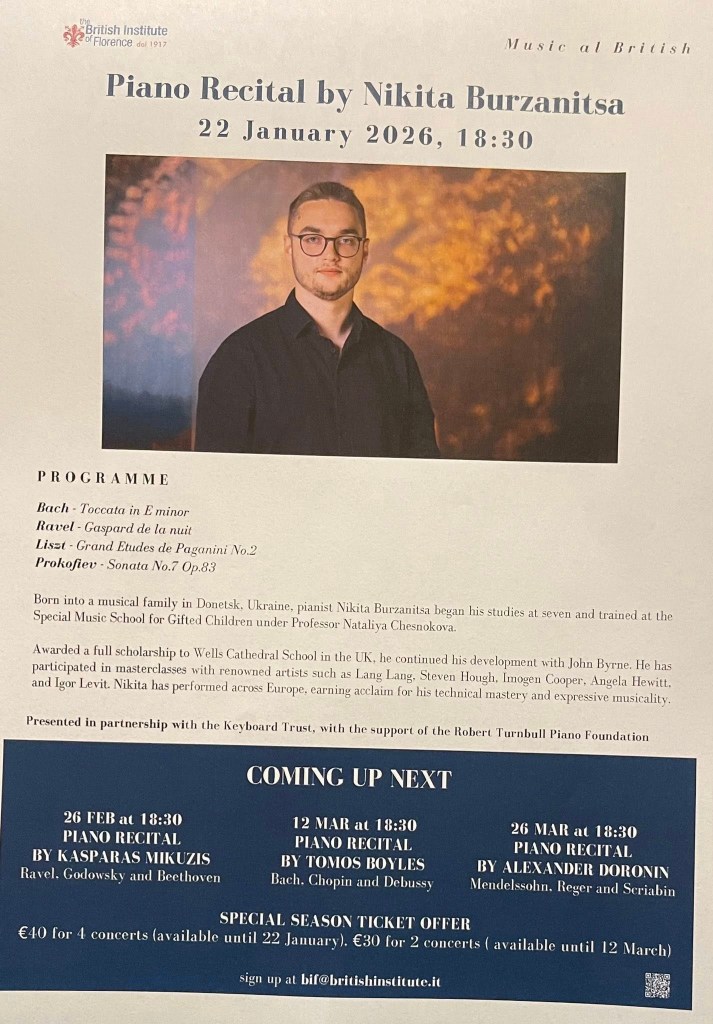
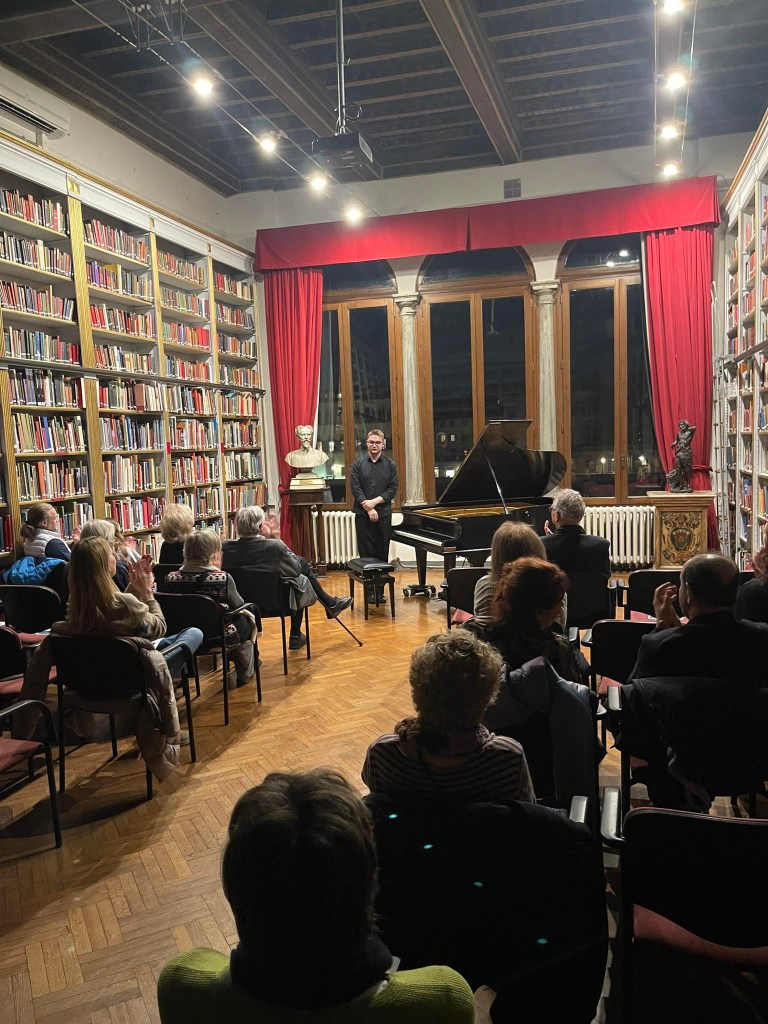
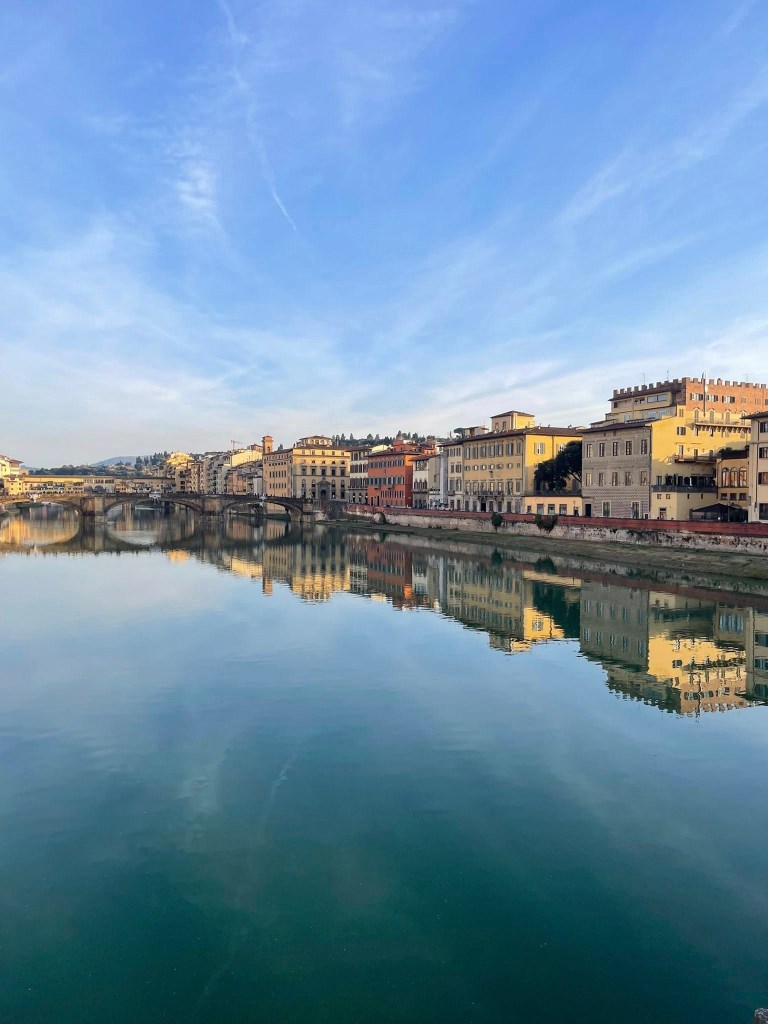
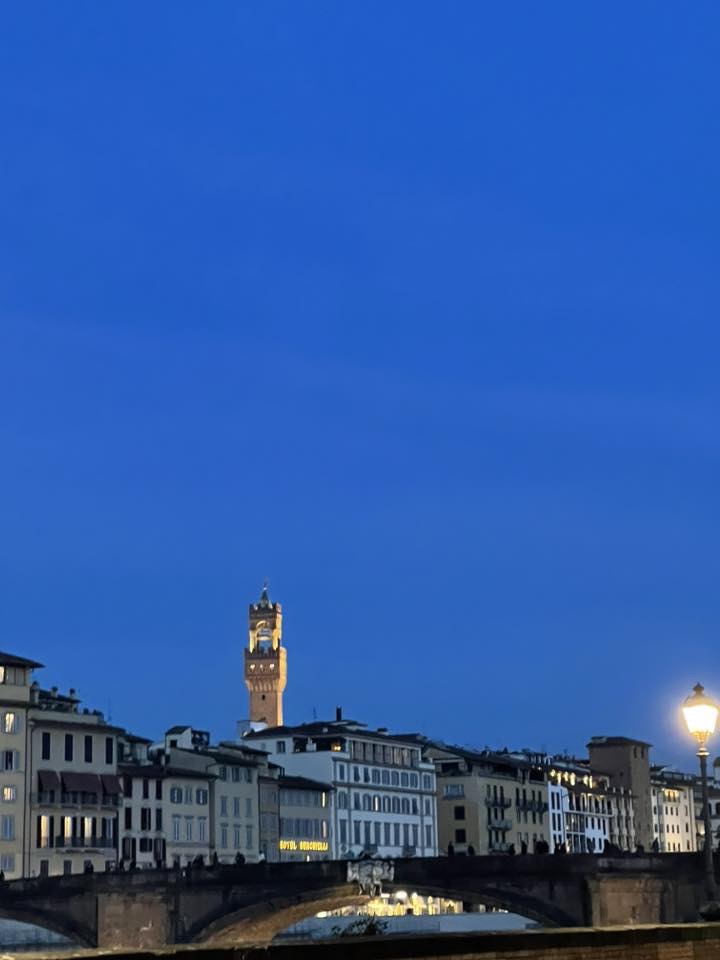
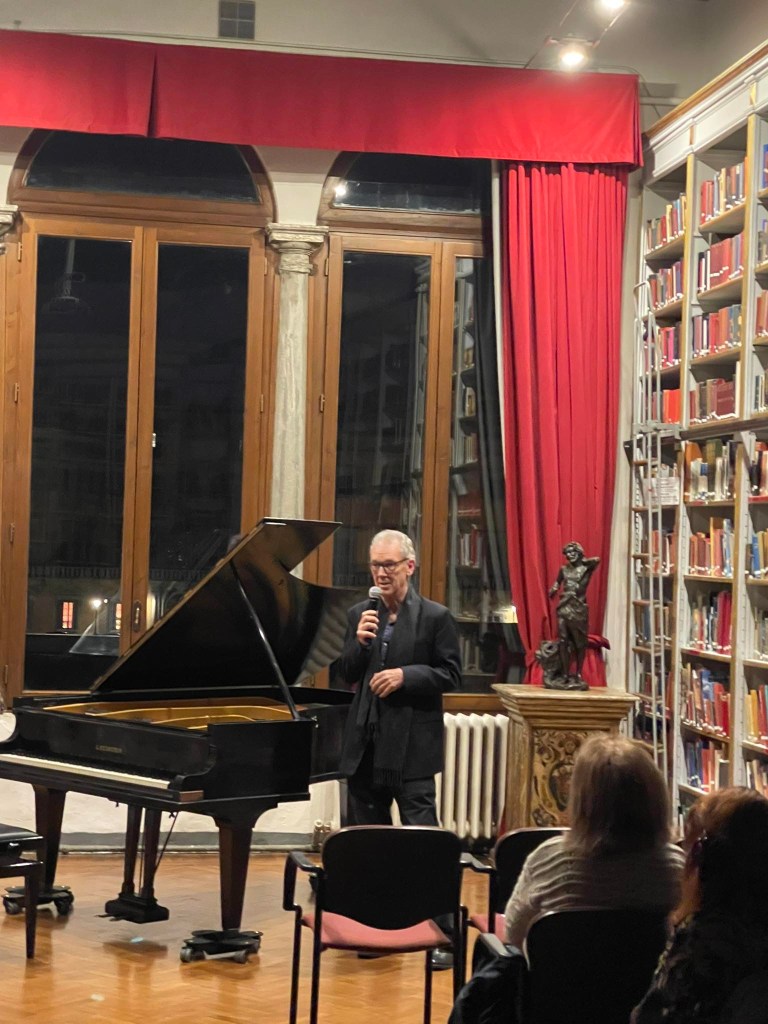
A room with a view for Nikita Burzanitsa’s birthday in Florence this evening in the Harold Acton Library of the British Institute. Some superb playing, from the absolute clarity of Bach where an improvisatory freedom made the entry of the Toccata even more of a surprise. Ravishing colours in Ravel with an extraordinary control of sound and a kaleidoscope of colours that allowed him to create the mellifluous beauty of ‘Ondine’ passing through the desolation of whispered mystery in ‘Le Gibet’ to the devilish antics of ‘Scarbo’. All played with a poetic mastery that brought these poems of Bertrand vividly to life.
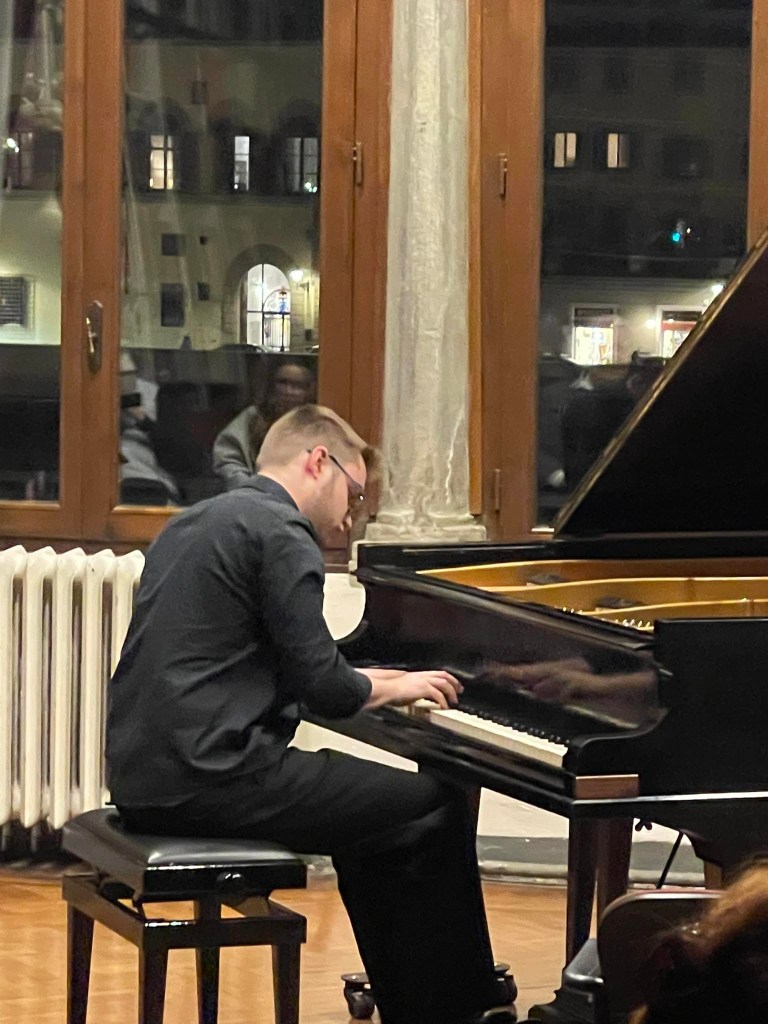
Liszt’s Paganini study n 2 was played with such grace and charm that Nikita’s transcendental command of the keyboard passed almost unnoticed.
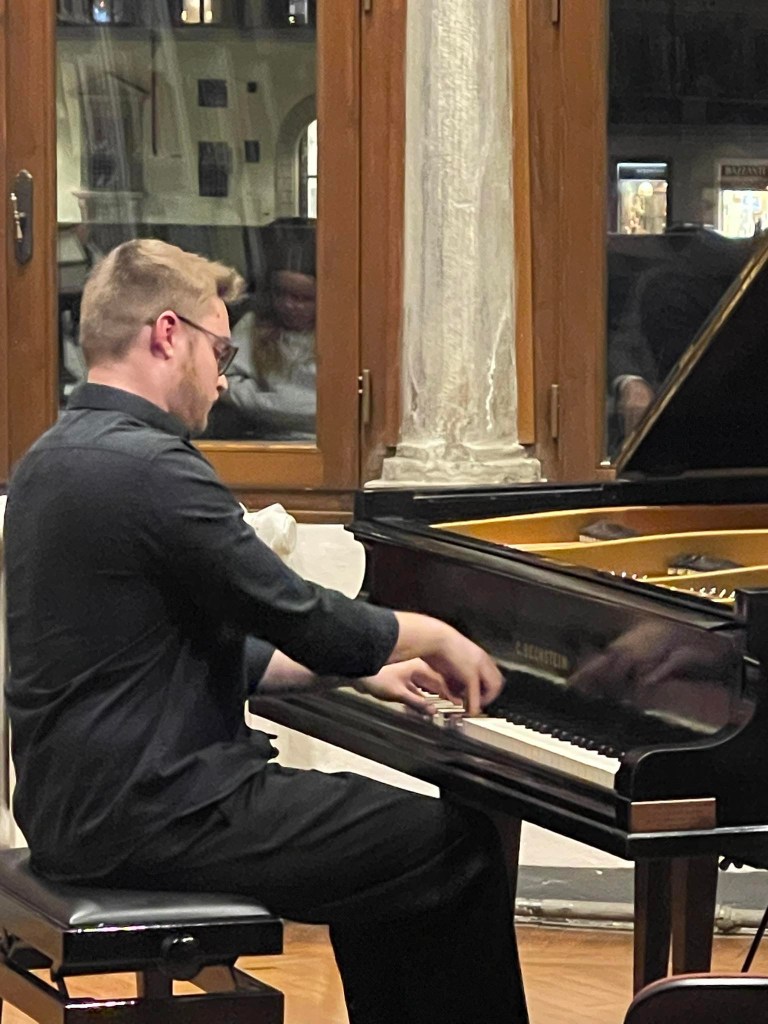
The last work on the programme was Prokofiev’s 7 th Sonata. One of his three war sonatas where again Nikita’s astonishing palette of sounds were of a real poet of the keyboard . Transforming this usually brittle sounding sonata into an evocative lament as well a ferocious scream for help and then a fight to the finish.
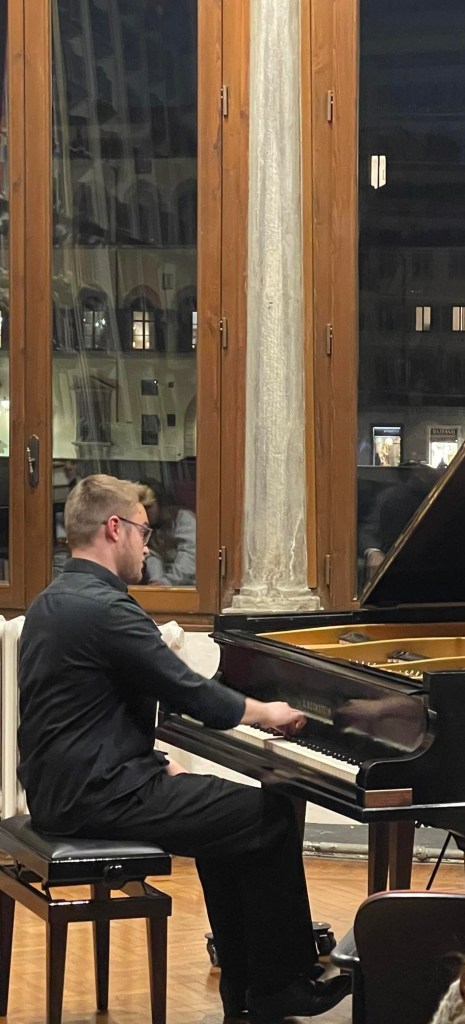
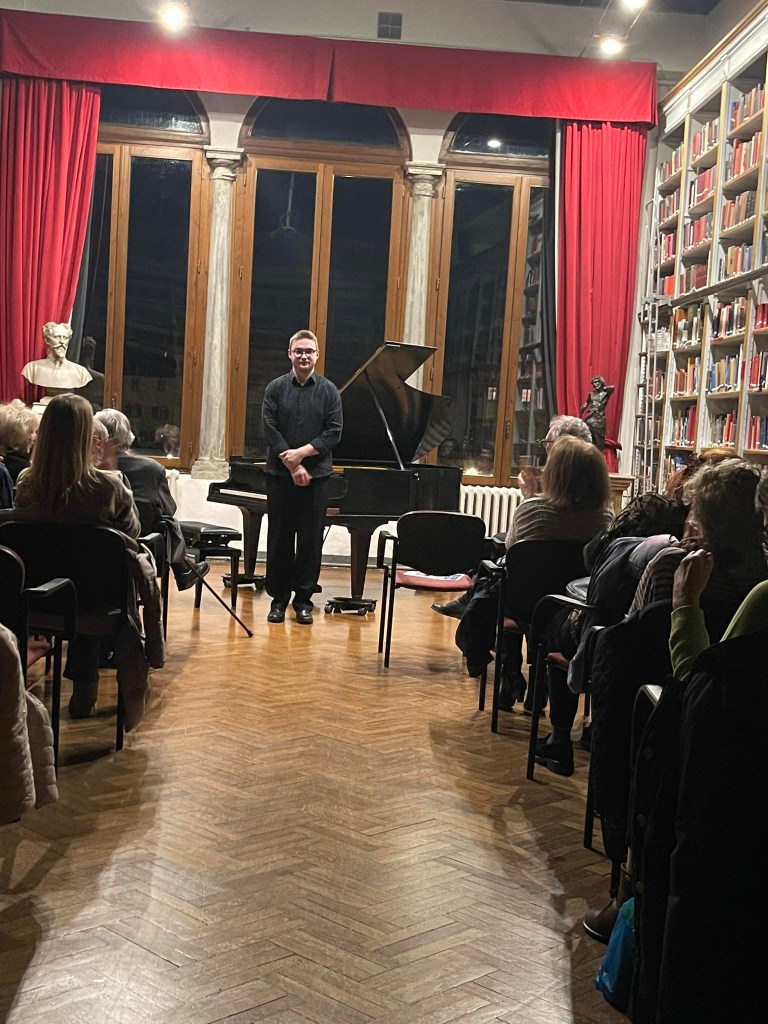
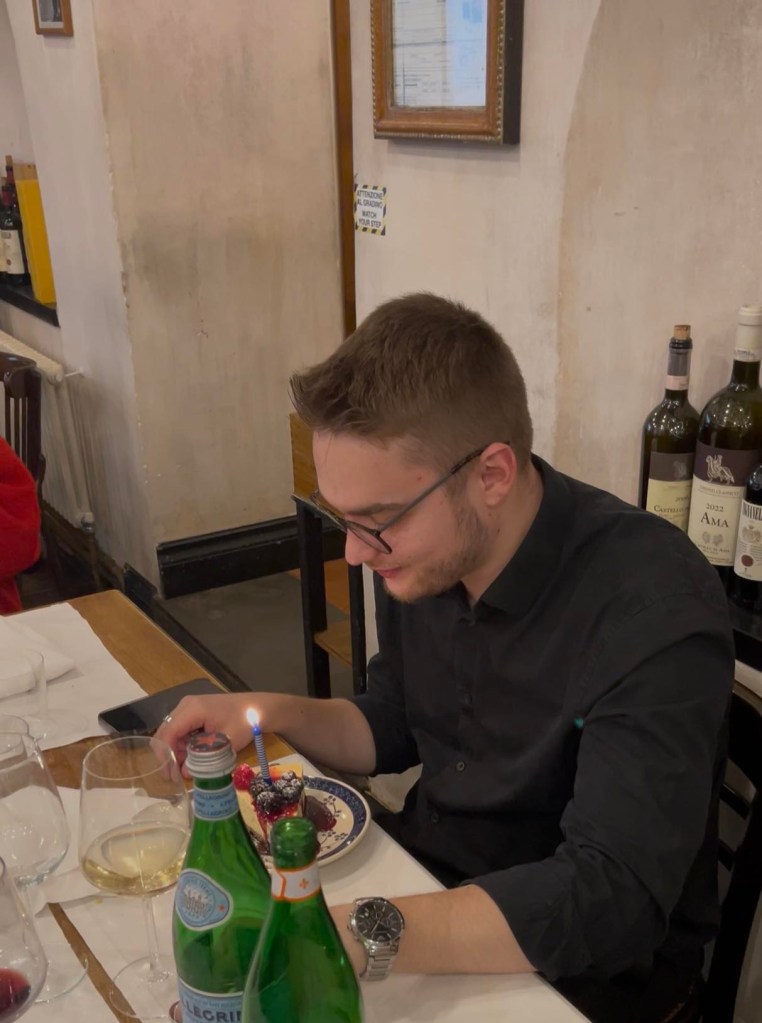
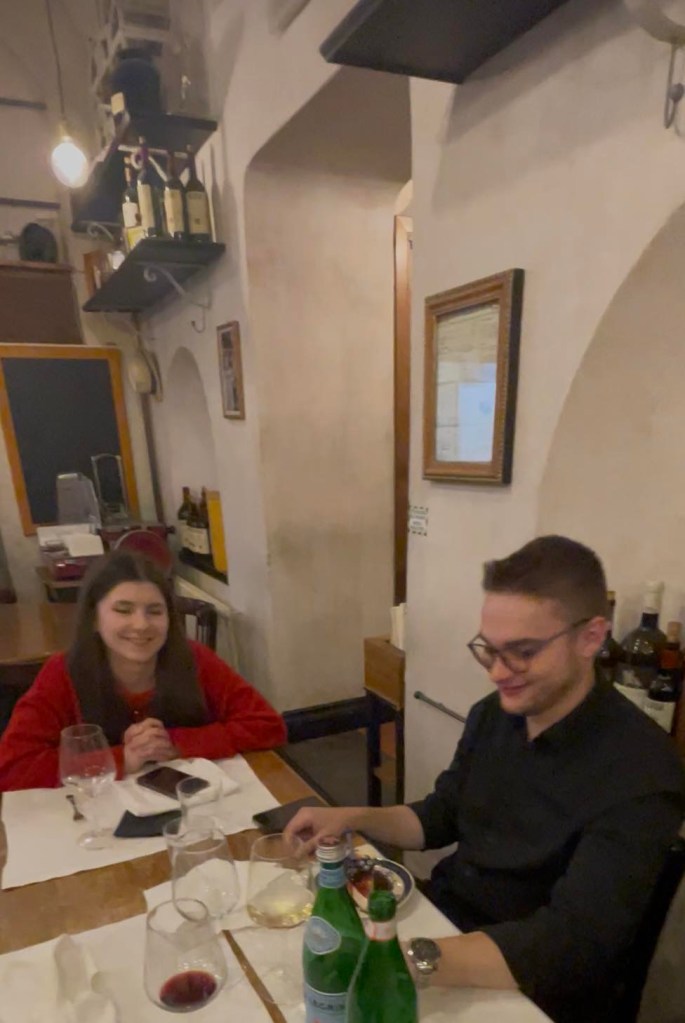
No encore could follow after such a harrowing and breathtaking experience and it was time for Nikita to let his hair down and enjoy this special day marking his first quarter of a century .
Programme:
Bach – Toccata in E minor
I. Toccata. II. Un Poco Allegro III. Adagio IV. Allegro – Fuga
Ravel – Gaspard de la nuit Ondine – Le Gibet – Scarbo
Liszt – Grand Etudes de Paganini No.2
Prokofiev – Sonata No.7 Op.83. Allegro inquieto – Andante caloroso – Precipitato
Here is a video of Nikita playing Prokofiev – Sonata No.7
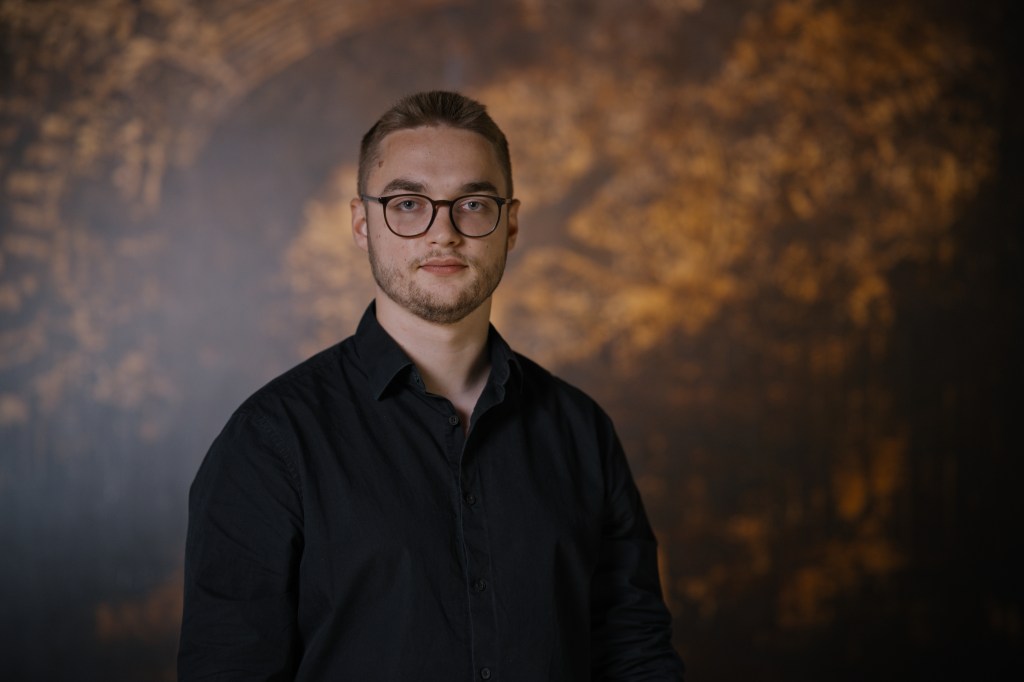
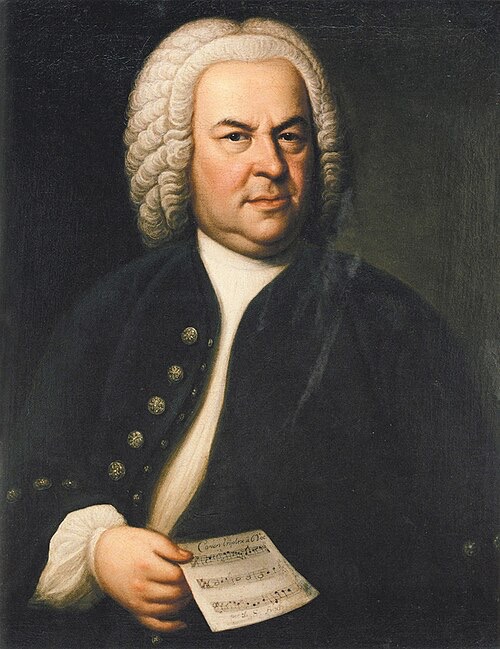
Born into a musical family in Donetsk, Ukraine, pianist Nikita Burzanitsa began his studies at seven and trained at the Special Music School for Gifted Children under Professor Nataliya Chesnokova. Awarded a full scholarship to Wells Cathedral School in the UK, he continued his development with John Byrne. He has participated in masterclasses with renowned artists such as Lang Lang, Steven Hough, Imogen Cooper, Angela Hewitt, and Igor Levit. Nikita has performed across Europe, earning acclaim for his technical mastery and expressive musicality.Bach likely composed the toccata while working as the court organist for Duke Johann Ernst of Weimar, depicted above.
https://youtube.com/clip/UgkxmAOb8F58Ydjv6Q0VICzNbODiuphQZn09?si=mMmoyXgEMcz1kvzm
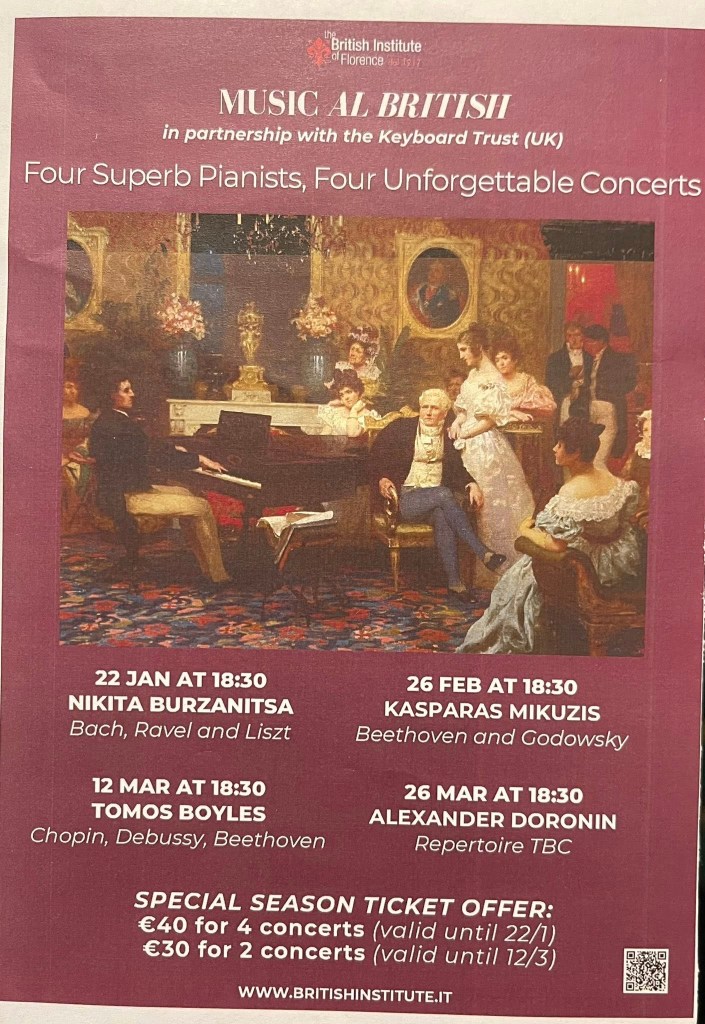
This is the first of four recitals organised by Simon Gammell and his team, in partnership with the Keyboard Trust supported by the Robert Turnbull Piano Foundation https://christopheraxworthymusiccommentary.com/2025/06/15/kasparas-mikuzis-at-la-mortella-creating-magic-sounds-in-waltons-paradise-on-ischia/
https://christopheraxworthymusiccommentary.com/2025/11/13/tomos-boyles-at-steinway-hall-for-the-keyboard-trust-intelligence-and-poetic-artistry-combine/ https://christopheraxworthymusiccommentary.com/2023/03/09/alexander-doronin-at-steinways-for-the-keyboard-trust/ Alexander has recently been awarded the Gold Medal at the Hong Kong International Piano Competition

Bach wrote the Toccata in E minor alongside six other keyboard toccatas, BWV 910-916 , between 1707 and 1710 or 1711, before the age of 30 The Toccata in E minor was likely composed in 1710.Some scholars have suggested potentially later dates of composition His toccatas were influenced by the Italian model of toccata, with varying lively and expressive tempos across each section of the composition, and with between two and six sections per toccata.The toccatas are typically opened by a short, striking toccata section, followed by a fugue, and then a recitative imitating the Italian aria or German fantasia forms. One section is always a fugue and fugues frequently conclude the toccatasFugal passages are often considered the most cherished features of the toccatas.
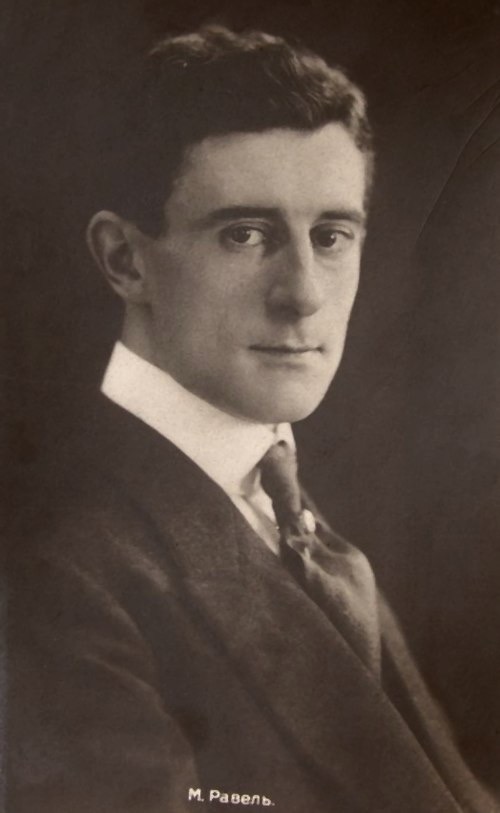
The name Gaspard ” is derived from its original Persian form, denoting “the man in charge of the royal treasures”: “Gaspard of the Night” or the treasurer of the night thus creates allusions to someone in charge of all that is jewel-like, dark, mysterious, perhaps even morose.
Of the work, Ravel himself said: “Gaspard has been a devil in coming, but that is only logical since it was he who is the author of the poems. My ambition is to say with notes what a poet expresses with words.”
Aloysius Bertrand , author of Gaspard de la Nuit (1842), introduces his collection by attributing them to a mysterious old man met in a park in Dijon , who lent him the book. When he goes in search of M. Gaspard to return the volume, he asks, “ ’Tell me where M. Gaspard de la Nuit may be found.’ ‘He is in hell, provided that he isn’t somewhere else’, comes the reply. ‘Ah! I am beginning to understand! What! Gaspard de la Nuit must be…?’ the poet continues. ‘Ah! Yes… the devil!’ his informant responds. ‘Thank you, mon brave!… If Gaspard de la Nuit is in hell, may he roast there. I shall publish his book.'”Gaspard de la Nuit — Fantaisies à la manière de Rembrandt et de Callot is the compilation of prosa poems by Italian-born French poet Aloysius Bertrand Considered one of the first examples of modern prose poetry, it was published in the year 1842, one year after Bertrand’s death from tuberculosis , as a manuscript dated 1836 by his friend David d’Angers The text includes a short address to Victor Hugo and another to Charles Nodier r, and a Memoir of Bertrand written by Sainte – Beuve was included in the original 1842 edition.
This suite of three pieces for piano was inspired by the prose poems of Aloysius Bertrand (1807 – 1841), which were first published posthumously in 1842 under the title Gaspard de la nuit: fantaisies à la manière de Rembrandt et de Callot; they are works of an intense romanticism, fascinated by the mediaeval and the mysterious. Ondine is a water-nymph who seeks a mortal spouse in vain before disappearing in a spray of water drops. Le Gibet depicts an eerie scene at sunset as the corpse of a hanged man swings to and fro on the gibbet. Scarbo is the malevolent gnome who appears in the middle of the night furiously spreading fear and disorder.
Ravel was first introduced to the work by his friend, the pianist Ricardo Viñes who subsequently gave the work’s first performance in Paris on 9 January 1909.
Ravel said that his intention had been “to write piano pieces of transcendental virtuosity which are even more complicated than [Balakirev’s] Islamey“. (Roland – Manuel [1947] p.54.) Speaking of the third movement Scarbo, he told a pupil, “I wanted to make a caricature of romanticism, but perhaps I let myself be taken over by it.” (Perlemute [1989] p.35). His friend Hélène Jourdan-Morhange was struck however by the classical form to be found in the work: “The three poems chosen by Ravel are quite dissimilar, but because of their perfect musical realisation, they seem to have been intentionally gathered together by the poet. The structure is almost that of a sonata: Allegro, Adagio and a dazzling Finale“. (Perlemuter 1989] p.31).
The author tells an introductory story of how he sat in a garden in Dijon , and fell into conversation with a dishevelled old man who sat near him leafing through a book. The stranger recognizes him to be a poet, and speaks of how he has spent his life searching for the meaning of Art (‘L’art est la science du poète’), and for the elements or principles of Art. The first principle, what was sentiment in Art, was revealed to him by the discovery of some little book inscribed Gott – Liebe (‘Dieu et Amour’, God and Love): to have loved and to have prayed.
Then he became preoccupied by what constituted idea in Art, and, having studied nature and the works of man through thirty years, at the cost of his youth, he wondered if the second principle, that of idea, might be Satan. After a night of storm and colic in the church of Notre-Dame of Dijon, in which clarity shone through the shadows (‘Une clarté piqua les ténèbres’), he concluded that the devil did not exist, that Art existed in the bosom of God, and that we are merely the copyists of the Creator.
Then the old stranger thrusts into the poet’s hand the book, his own manuscript, telling all the attempts of his lips to find the instrument which gives the pure and expressive note – every trial upon the canvas before the subtle dawn-glow of the ‘clair-obscur’ or clarity in shadow appeared there – the novel experiments of harmony and colour, the only products of his nocturnal deliberations. The old man goes off to write his Will, saying he will come back to collect his book tomorrow. The manuscript is, naturally, Gaspard de la Nuit. Fantaisies à la manière de Rembrandt et de Callot. The next day the poet returns to restore the book to its owner, who does not come: he asks after M. Gaspard de la Nuit, to which the answer is that he is probably in Hell unless he is out on his travels – for he is, of course, the devil. ‘May he roast there!’ says the poet. ‘I shall publish his book.’
A short preface attributed to Gaspard himself explains that the artists Paul Rembrandt] and Jaques Callotrepresent two eternally reverse or antithetic faces of Art: one the philosopher absorbed in meditation and prayer upon the spirits of beauty, science, wisdom and love, seeking to penetrate the symbols of nature, and the other the showy figure who parades about the street, rows in the taverns, caresses bohemian girls, always swears by his rapier, and whose main preoccupation is waxing his moustache. But in considering Art under this double personification he has included studies upon other artists among his poetic meditations, which he has not presented as a formal literary theory because M.Séraphin has not explained to him the mechanism of his Chinese shadow-plays, and Pulchinello conceals from curious viewers the thread which makes his arm move.
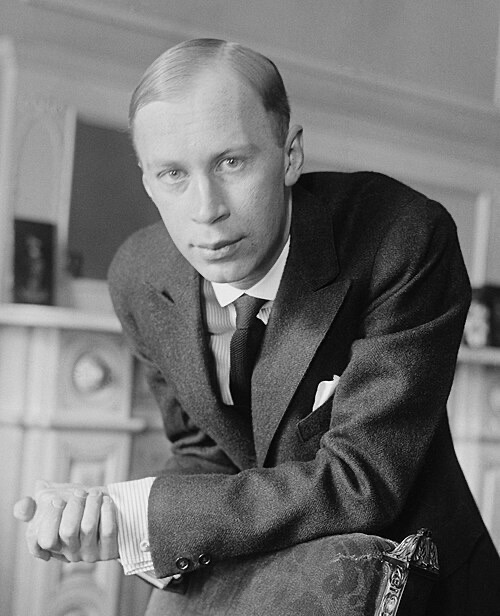
Sergei Prokofiev’s Piano Sonata No. 7 in B♭ major, Op. 83 (occasionally called the “Stalingrad”)is , the second of the three “War Sonatas”, composed in 1942. The sonata was first performed on 18 January 1943 in Moscow by Sviatoslav Richter.
On June 20, 1939, Prokofiev’s close friend and professional associate, the director Vsevolod Meyerhold, was arrested by the NKVDjust before he was due to rehearse Prokofiev’s new opera Semyon Kotko; he was shot on 2 February 1940. Although his death was not publicly acknowledged, let alone widely known about until after Stalin’s reign, the brutal murder of Meyerhold’s wife, Zinaida Raikh, less than a month after his arrest was a notorious event. Only months afterwards, Prokofiev was ‘invited’ to compose Zdravitsa(literally translated ‘Cheers!’, but more often given the English title Hail to Stalin) (Op. 85) to celebrate Stalin’s 60th birthday
Later that year, Prokofiev started composing his Piano Sonatas Nos, 6 , 7, and 8 Opp. 82–84, widely known today as the “War Sonatas.” These sonatas contain some of Prokofiev’s most dissonant music for the piano. Biographer Daniel Jaffé has argued that Prokofiev, “having forced himself to compose a cheerful evocation of the nirvana Stalin wanted everyone to believe he had created” (i.e. in Zdravitsa) then subsequently, in these three sonatas, “expressed his true feelings” The sonata was awarded a Stalin Prize (Second Class)
The sonata has three movements :
- Allegro inquieto (in B♭ major)
- Andante caloroso (in E major)
- Precipitato (in B♭ major)
 ChristopherAxworthy-MusicCommentary